
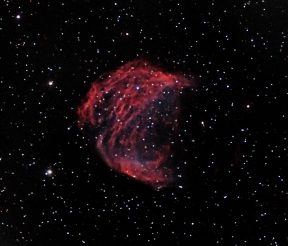
Medusa Nebula (Sharpless 2-274)741 viewsPlanetary Nebula in Gemini. Discovered in 1955, first thought to be a supernova remnant, but Soviet astronomers in 1971 determined it to be a planetary nebula.
|
|
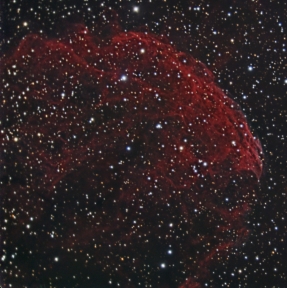
IC443 - Jellyfish Nebula713 viewsA galactic supernova remnant in Gemini, about 6000 light-years away.
|
|
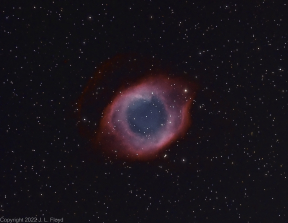
NGC 7293 - The Helix Nebula in Aquarius748 viewsOne of the closest planetary nebulae, at only 650 light-years from Earth. Around 10,600 years old and 2.5 light-years in diameter. Sometimes known as the "Eye of God" or the "Eye of Sauron."
|
|
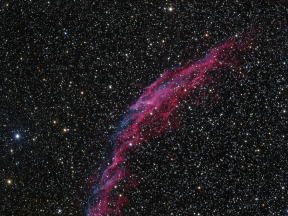
NGC 6992 - Eastern Veil Nebula715 viewsAlong with NGC 6960 and other objects, the Eastern Veil is a component of the Veil Nebula in the constellation Cygnus. It is a cloud of hot, ionized gas composed of oxygen, sulfur and hydrogen.
|
|
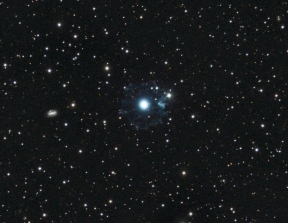
NGC 6543 - Cat's Eye Nebula694 viewsA structurally very complex planetary nebula about 3000 light-years from Earth in the constellation Draco. In large-telescope images it has the appearance of a cat's eye, but in my 5" refractor it appears simply as a bright blue star with a halo. The small spiral galaxy off to the left is probably NGC 6552.
|
|
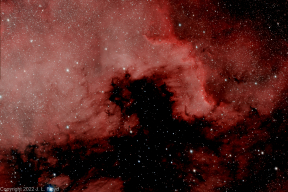
NGC7000 - The North American Nebula678 viewsNarrowband image of an H-II emission nebula in the constellation Cygnus; only part of the nebula is visible since it is too large to fit entirely in the field of view of the telescope. 2,590 light-years distant and 90 light-years across.
|
|
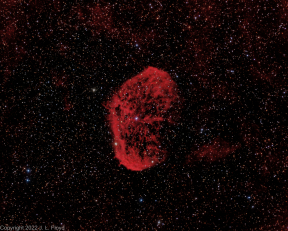
NGC 6888 - The Crescent Nebula753 viewsAn emission nebula in the constellation Cygnus, about 5000 light-years away from Earth; formed by the fast stellar wind from the Wolf-Rayet star WR 136 colliding with and energizing slower-moving matter ejected by the star when it became a red giant around 250,000 to 400,000 years ago.
|
|
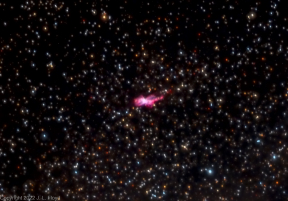
NGC6302 - The Bug Nebula773 viewsA bipolar planetary nebula in the constellation Scorpius. Also known as the Butterfly Nebula, but a larger telescope than the 5" refractor used to capture this image is needed to show the pattern clearly; it shows up well in Hubble images. In this image, the nebula looks more like a bug squashed on a car windshield.
|
|
|
|
|


