
 |
Topkapi Palace, 3/31/2006
|
|
|
 |
|
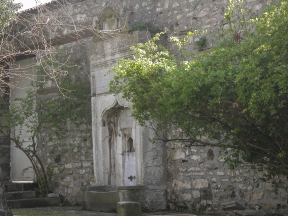
The Executioner's Fountain720 viewsThis may be the fountain where, as legend has it, the Sultan's executioner washed off his sword after lopping off a victim's head.
|
|
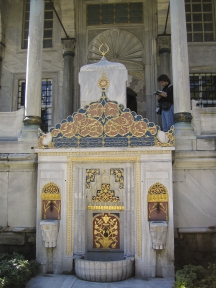
Treasury Fountain746 viewsOne of the most ornate and imposing fountains in the palace.
|
|
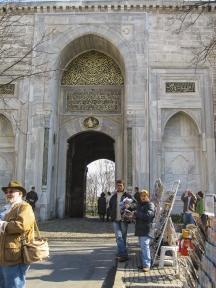
Imperial Gate (Bab-i-Humayun)713 viewsMain entrance to Topkapi Palace., leading to the First Courtyard. Guarded by Al Treder, at left.
|
|
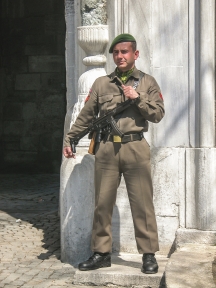
Guarding the Palace748 viewsA Turkish Green Beret stands guard at the Bâb-ı Hümâyûn.
|
|
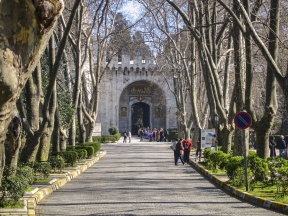
First Courtyard663 viewsLooking back along its tree-lined main avenue toward the Imperial Gate.
|
|
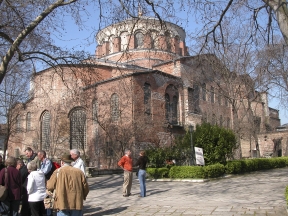
Hagia Irene725 viewsInside the First Courtyard of the Topkapi Palace stands the Church of St. Irene, originally built in the 4th century, burned down in 532 and rebuilt in 548, now open as a museum and, because of its extraordinary acoustics, as a concert hall.
|
|
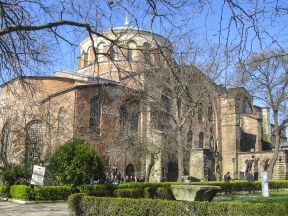
The Arsenal of Holy Peace736 viewsHagia Irene - the Church of Holy Peace - was one of the few churches not converted to a mosque after the fall of Constantinople in 1453. It was used as an arsenal instead.
|
|
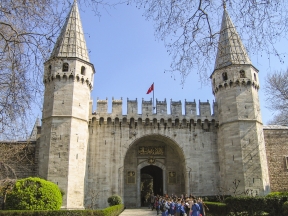
Gate of Salutation719 viewsLeads to the Second Courtyard of the palace. Only the Sultan was allowed to pass through on horseback; all others had to dismount.
|
|
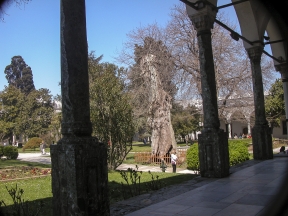
Trees723 viewsMany of the trees in the palace courtyards have been ravaged by fungi which hollow them out but do not kill them.
|
|
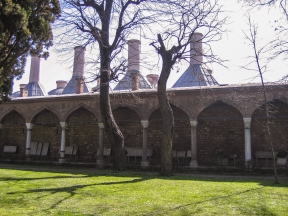
Chimneys708 viewsThe kitchens had 20 chimneys in two rows.
|
|
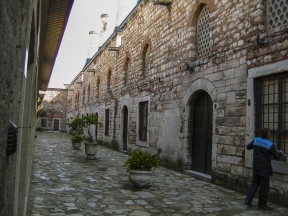
Kitchens758 viewsIn these kitchens, a staff of 800 prepared meals for over 4000 people.
|
|
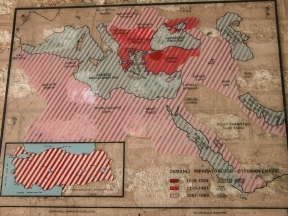
Map of the Ottoman Empire754 viewsShows how the Empire expanded from its early days, when it occupied just a small area of Anatolia and the Balkans, through the 17th century, when it reached its greatest extent. Note that in Turkish the name is "Osmanli," after Osman, the founder; "Ottoman" is a Western corruption.
|
|
| 51 files on 5 page(s) |
1 |
|
|
|
|


