
 |
 Most viewed - Astronomical Images Most viewed - Astronomical Images |
 |
|
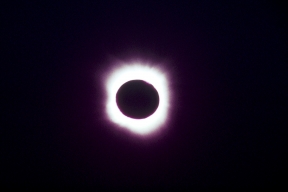
Maximum Totality694 viewsWith a glorious corona.
|
|
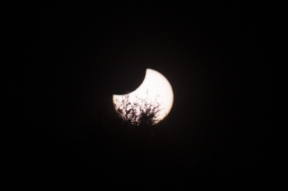
The Sun sets in the weeds694 viewsThe still-partially-eclipsed sun is being increasingly obscured by tree branches on a distant hillside - but they look more like weeds in this view.
|
|
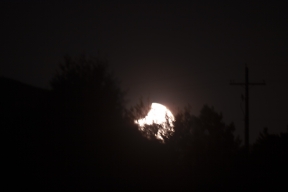
Nearing sunset694 viewsThe foreground trees show up a little better in this shot.
|
|
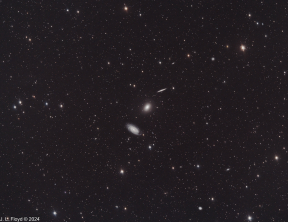
The Draco Trio of Galaxies694 viewsThree galaxies in Draco: NGC 5981, edge-on spiral at top; in the middle, elliptical galaxy NGC 5982; bottom, spiral galaxy NGC 5985.
|
|
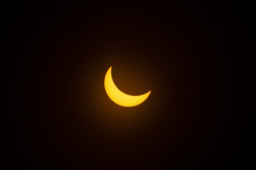
Totality minus 20 minutes693 viewsC2 - 20 min, 42 sec
|
|
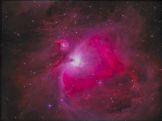
M42 - The Great Nebula in Orion692 viewsAnother take on the Great Orion Nebula, incorporating hydrogen-alpha data.
|
|
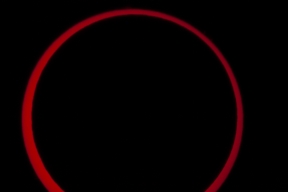
Maximum Annularity692 viewsThis was the closest I could get to maximum annularity, when the outer edge of the Moon's disk is equidistant at all points from the edge of the Sun.
|
|
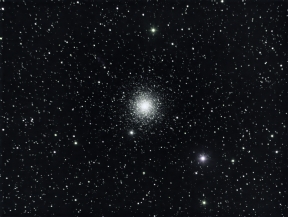
M15 - Globular cluster in Pegasus692 viewsContaining over 100,000 stars, 175 light-years in diameter, 33,600 light years from Earth. This is one of the oldest (12 billion years) and most densely packed globulars in the Milky Way.
|
|
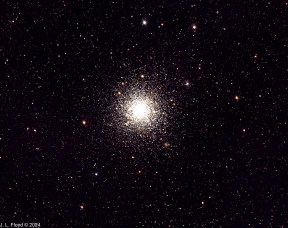
Messier 12, Globular Cluster in Ophiuchus692 viewsAbout 16,400 light years from Earth; diameter about 75 light-years. It is loosely packed and has an unusually small number of low-mass stars.
|
|
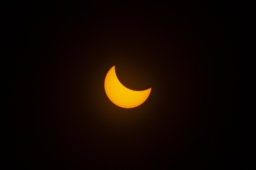
Totality minus 32 minutes691 viewsC2 - 31 min 50 sec
|
|
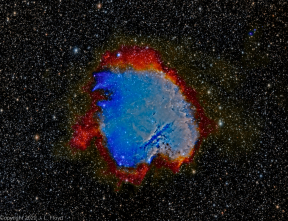
NGC281 - PacMan Nebula, narrowband version691 viewsA narrowband version of the PacMan, obtained with a one-shot color CMOS camera and an IDAS NBZ nebula enhancement filter, with H-alpha mapped to red and O-III to blue.
|
|
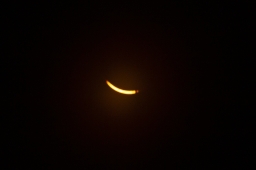
The last glimmer690 viewsAbout 30 seconds before Second Contact.
|
|
| 257 files on 22 page(s) |
|
|
|
|
|
|
|
12 | |
|
|
|
|
|
|
|


