Categories
Danube River Cruise, June 2023

Feast in Budapest, Evening of June 15, 2023

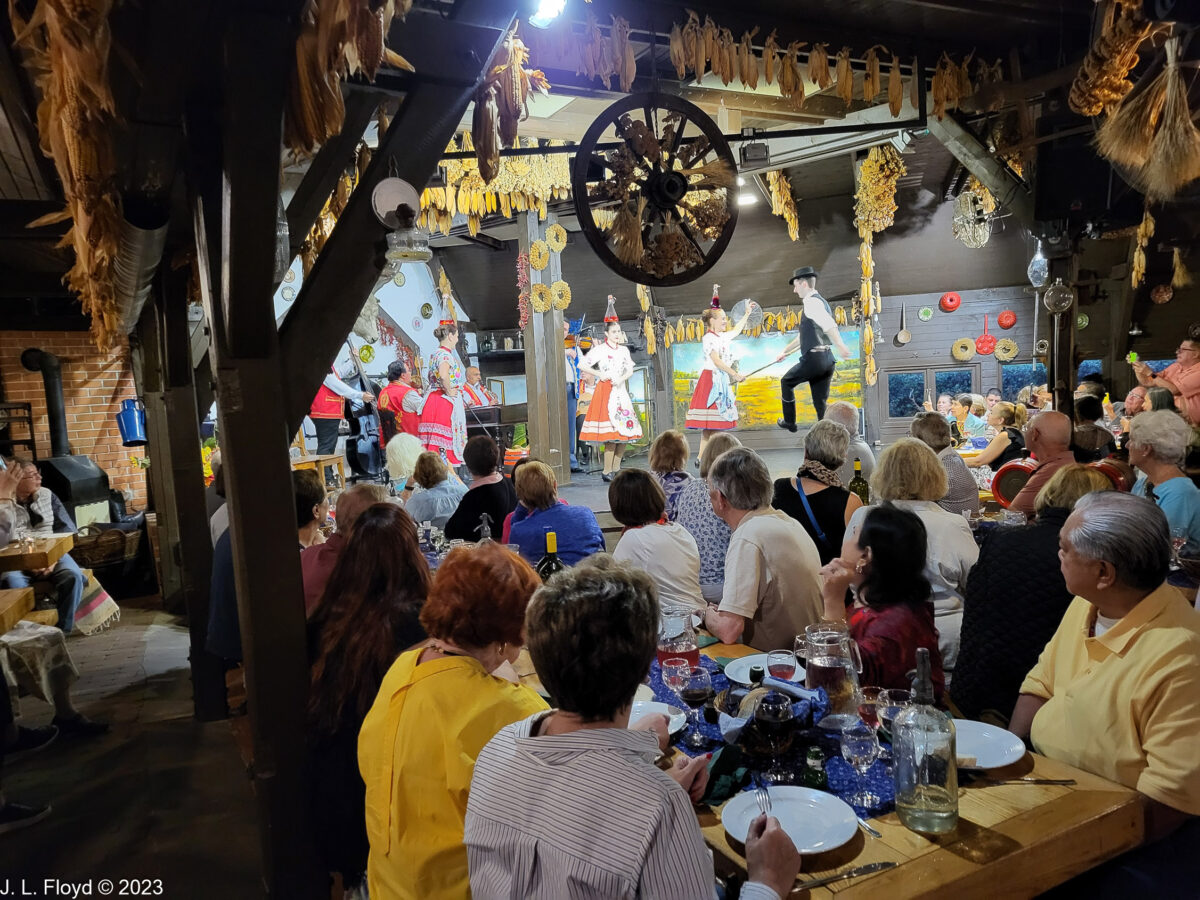
Our first full day in Budapest concluded with a “Welcome to Hungary” feast at the Vadaspark Étterem (Étterem means “restaurant” in Hungarian – not exactly a cognate, think “eatery”!). The place is hidden in a woodland high in the hills of west Buda hills woodland next to the Budakeszi Wildlife Park. In appearance it is a traditional Hungarian hunting lodge, and it serves traditional Hungarian cuisine. Guests are seating on wooden benches at long wooden tables and the ambience is pleasantly rustic.

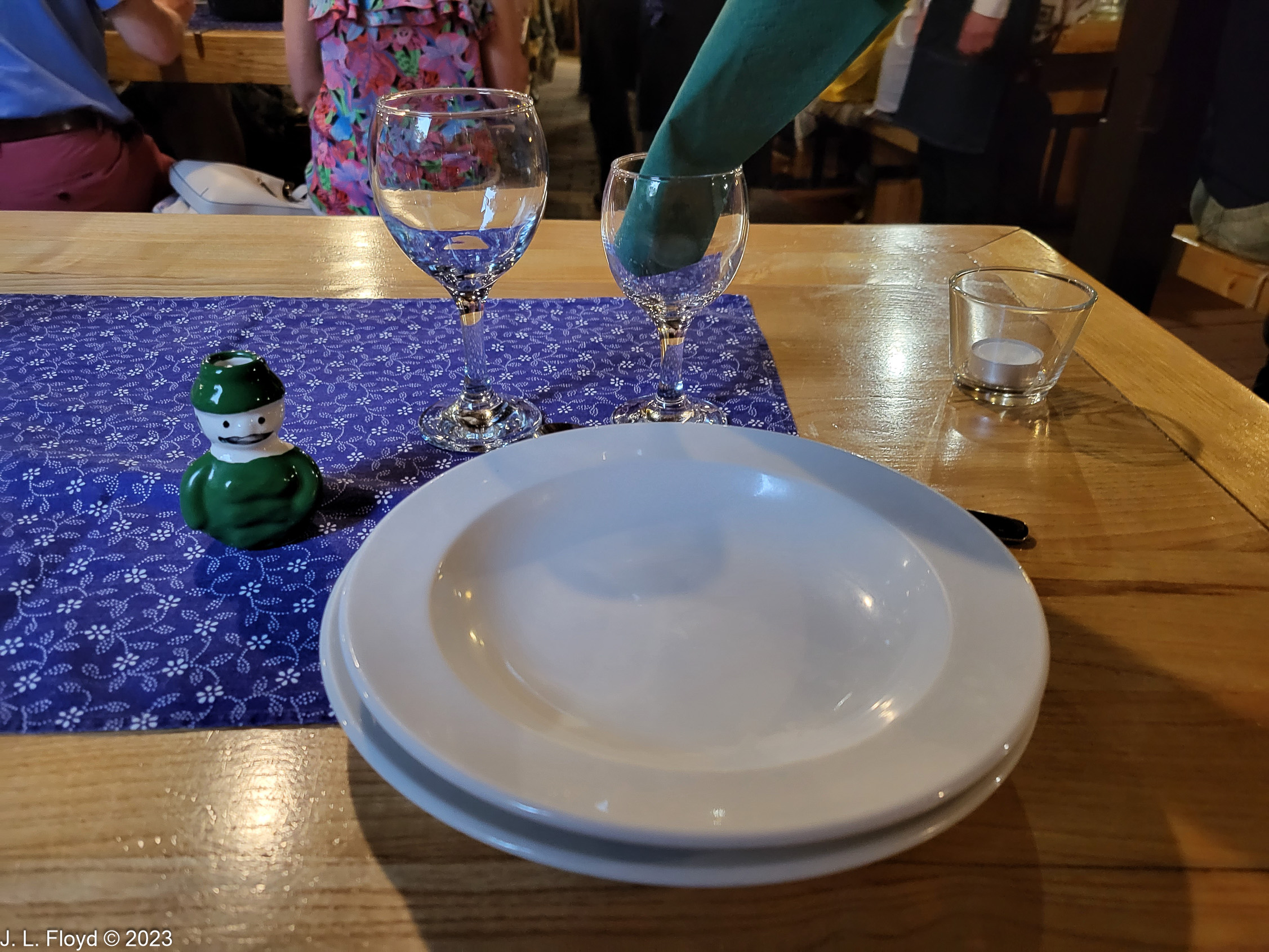
Dinner began with an aperitif, attractively served in a little ceramic cup in the form of a mustachioed Hungarian farmer in traditional costume. The little cup was filled with pálinka, a fruit brandy with a rather high alcohol content, between 37% and 86%, typically around 40%, but I think ours was more than 50%. Pálinka can made from plums, apricots, apples, pears, cherries and many other kinds of fruit, but not grapes. Brandy made from grapes is called törkölypálinka. When made entirely from apricots, it is called barackpálinka. One wonders how former President Obama feels about this. (Actually “barack” in Hungarian is pronounced “baratsk”.)

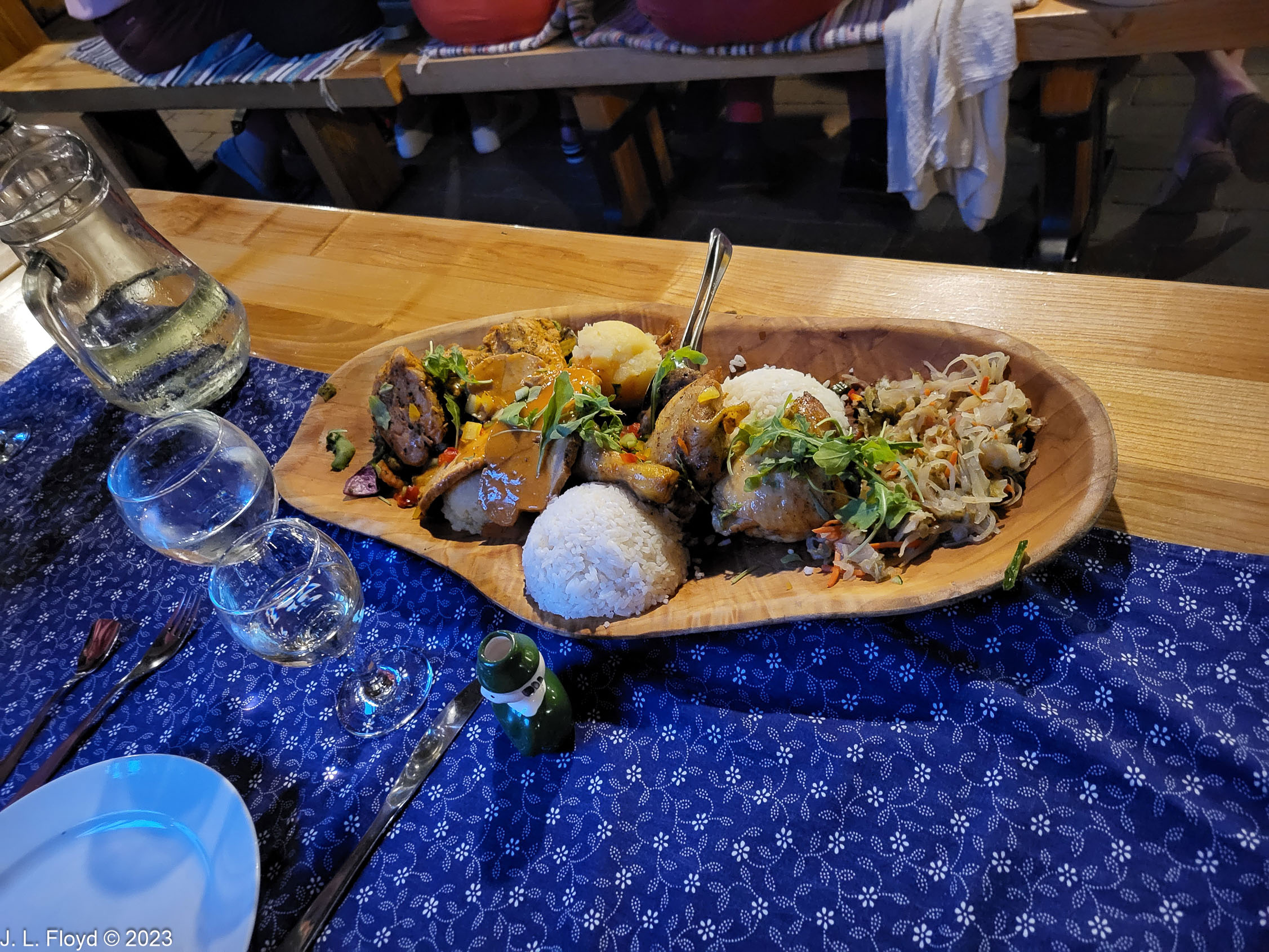
The food was delicious and attractively presented, and the wine flowed freely. But after pálinka and a few glasses of wine (both white and red), my memory ceased to operate effectively and I can’t say for sure which traditional Hungarian dishes we were served. I can say that it was all superb.

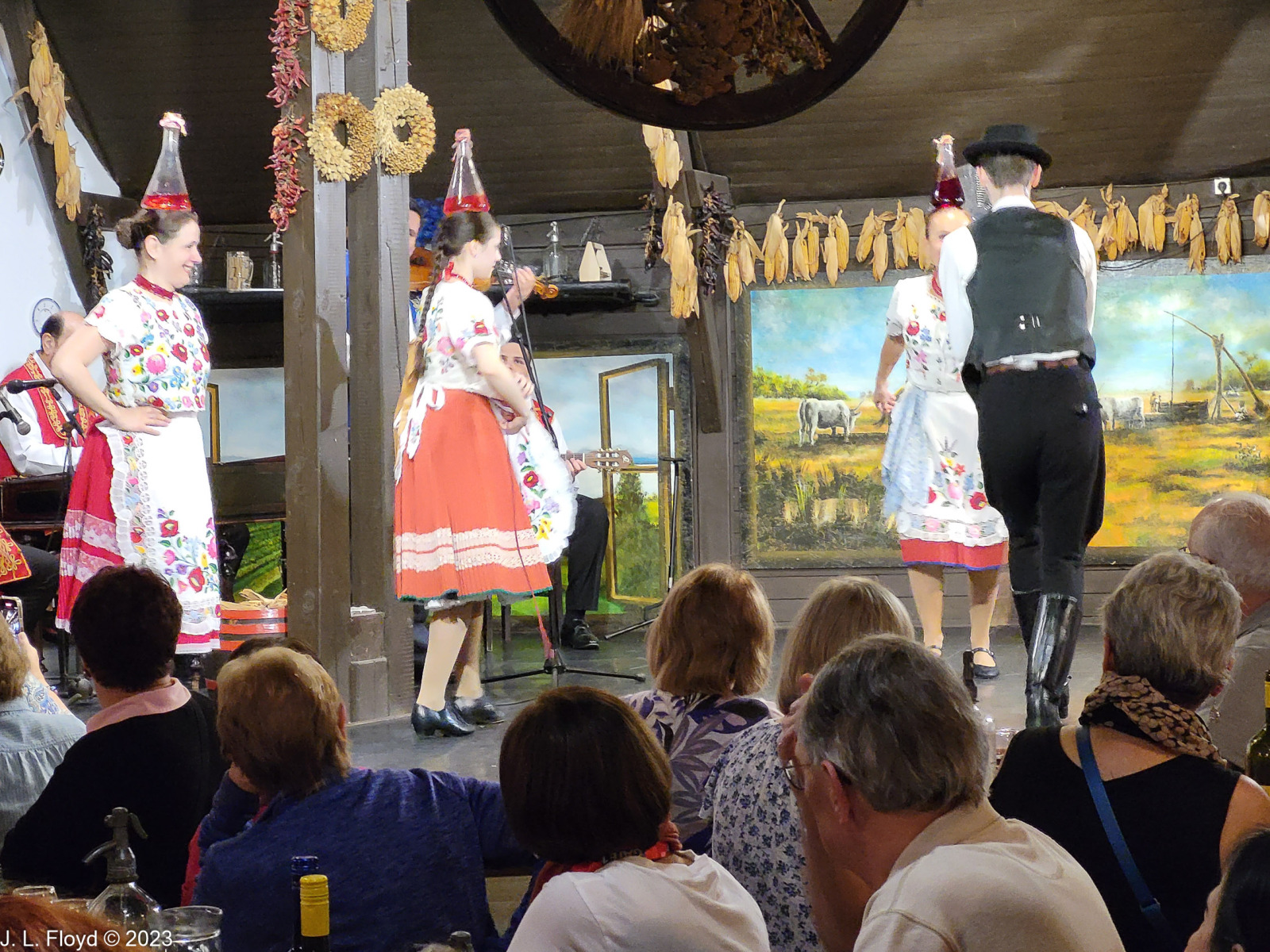
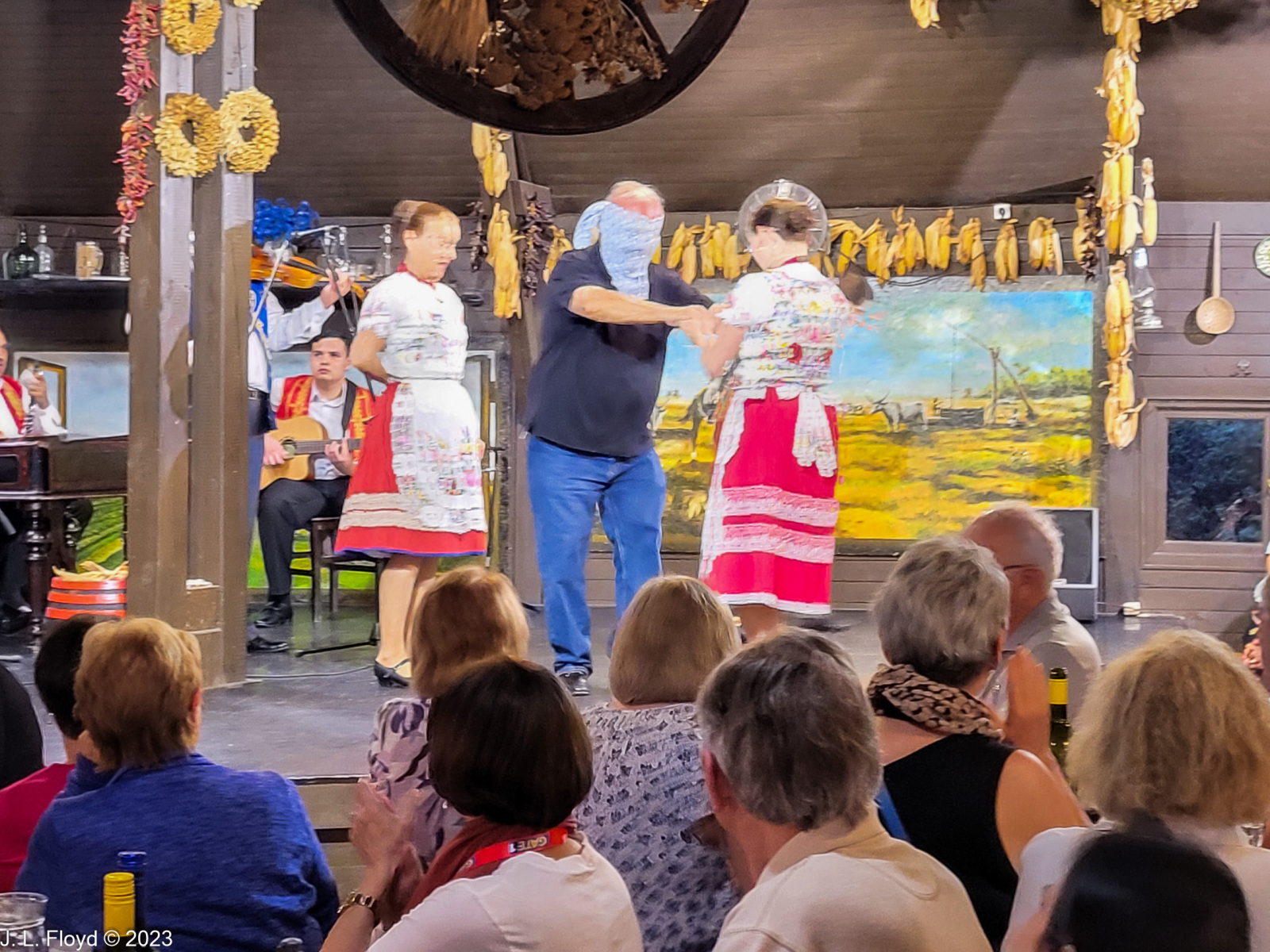
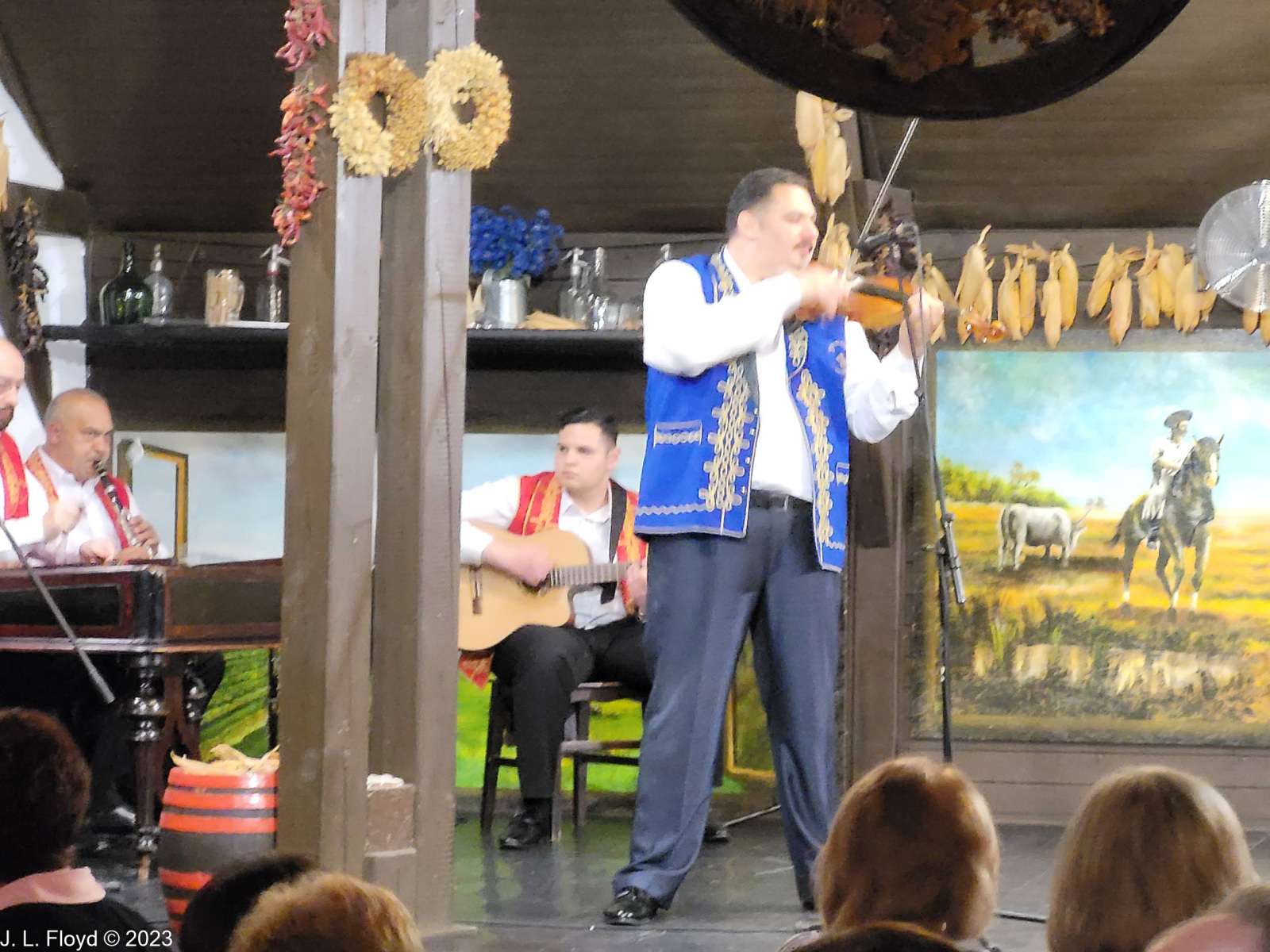
After-dinner entertainment consisted of folk dancing and music played by a live mini-orchestra with a superb violinist. But for the fact that the dancers were in traditional Hungarian dress, I would have thought it was a hoedown in the western USA, an impression that the pictures of cowboys and cattle on the walls reinforced.

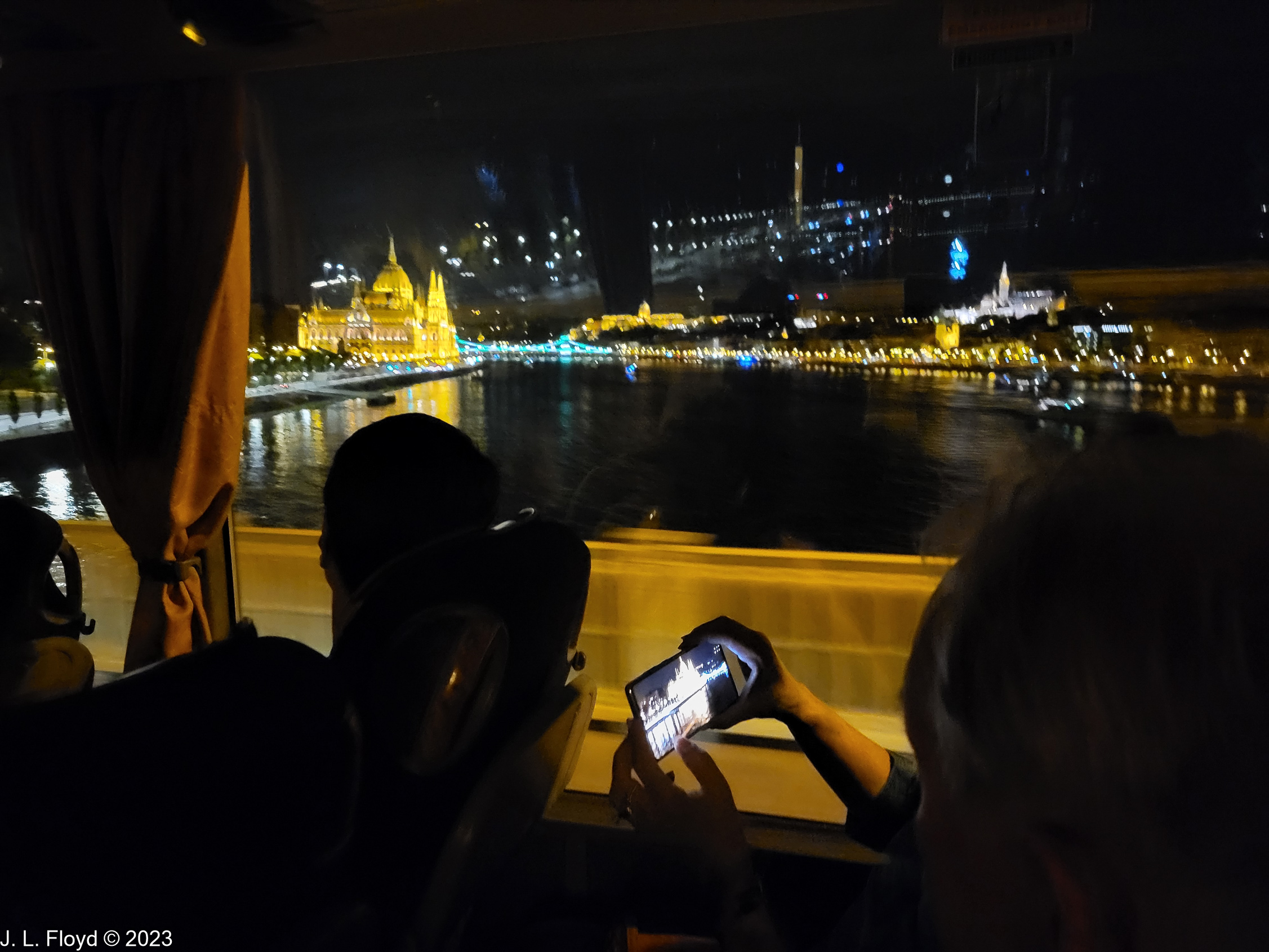
After dinner, on the way back from the restaurant to the Hotel Corinthia, I shot my only photo of Budapest at night, with my Samsung phone camera – not a very good one, to be sure, but at least I managed to include both banks of the Danube in the frame, with the Parliament building (left, on the Pest side), Buda Castle (center) and Castle Hill with St. Matthew’s Church and Fishermen’s Bastion on the right. Try to ignore the reflections in the windows.

Categories
Danube River Cruise, June 2023

Budapest, June 15, 2023: The Jewish Quarter

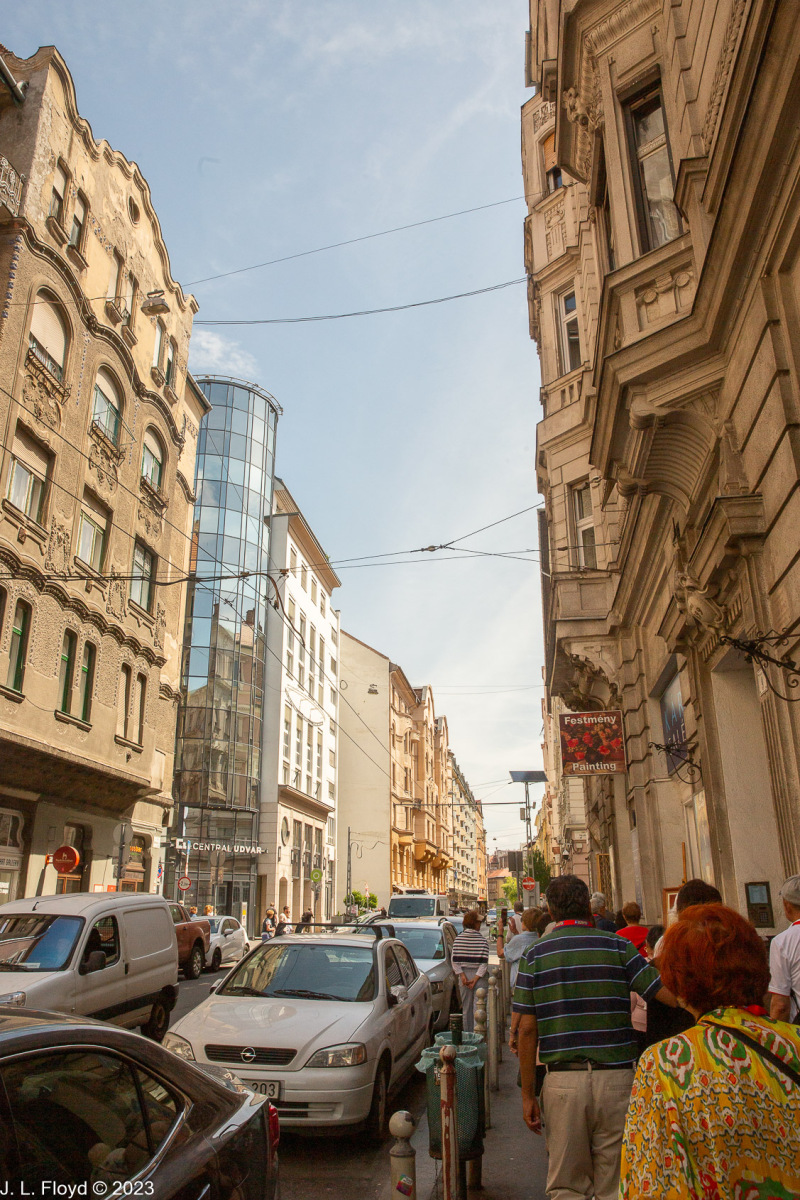
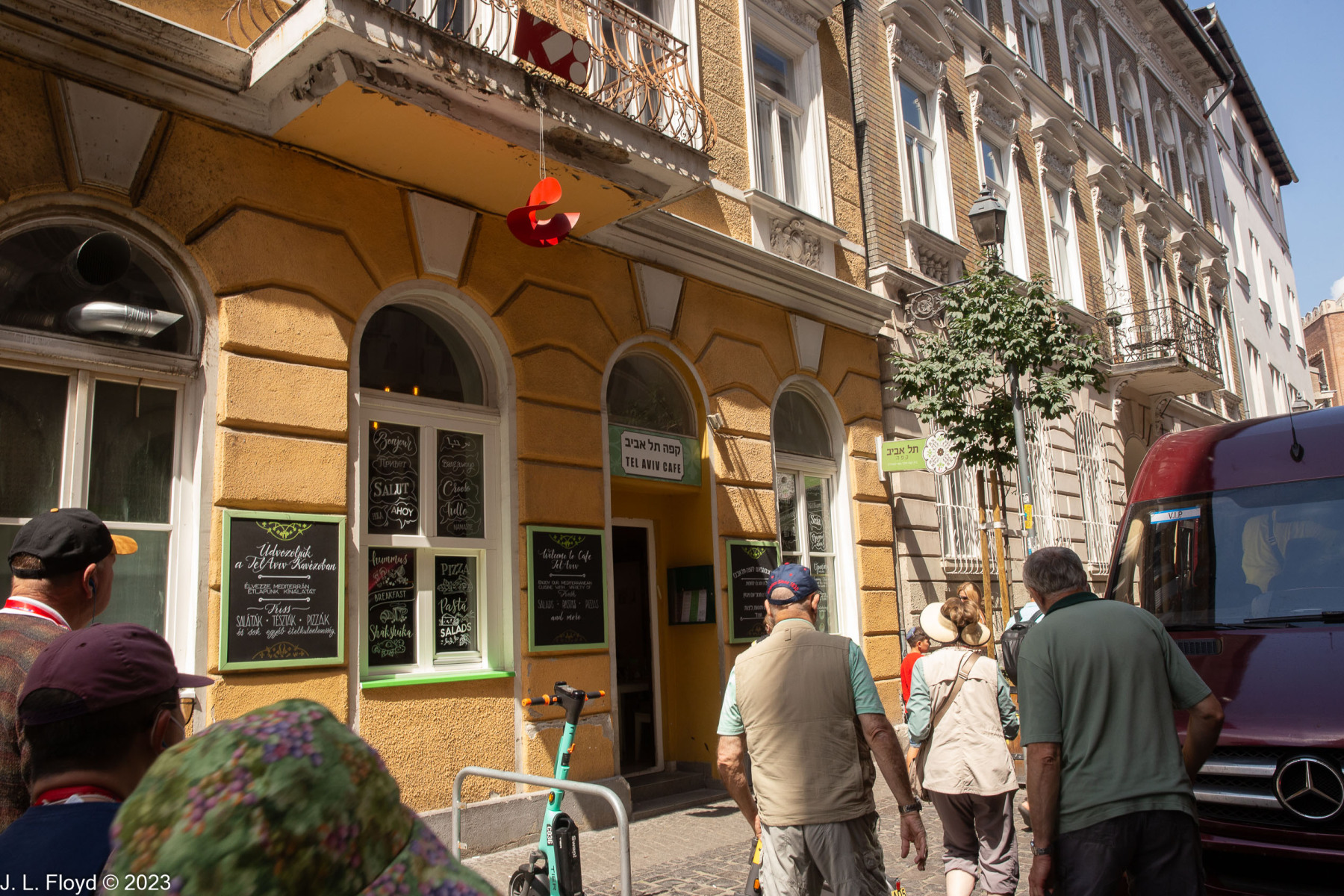
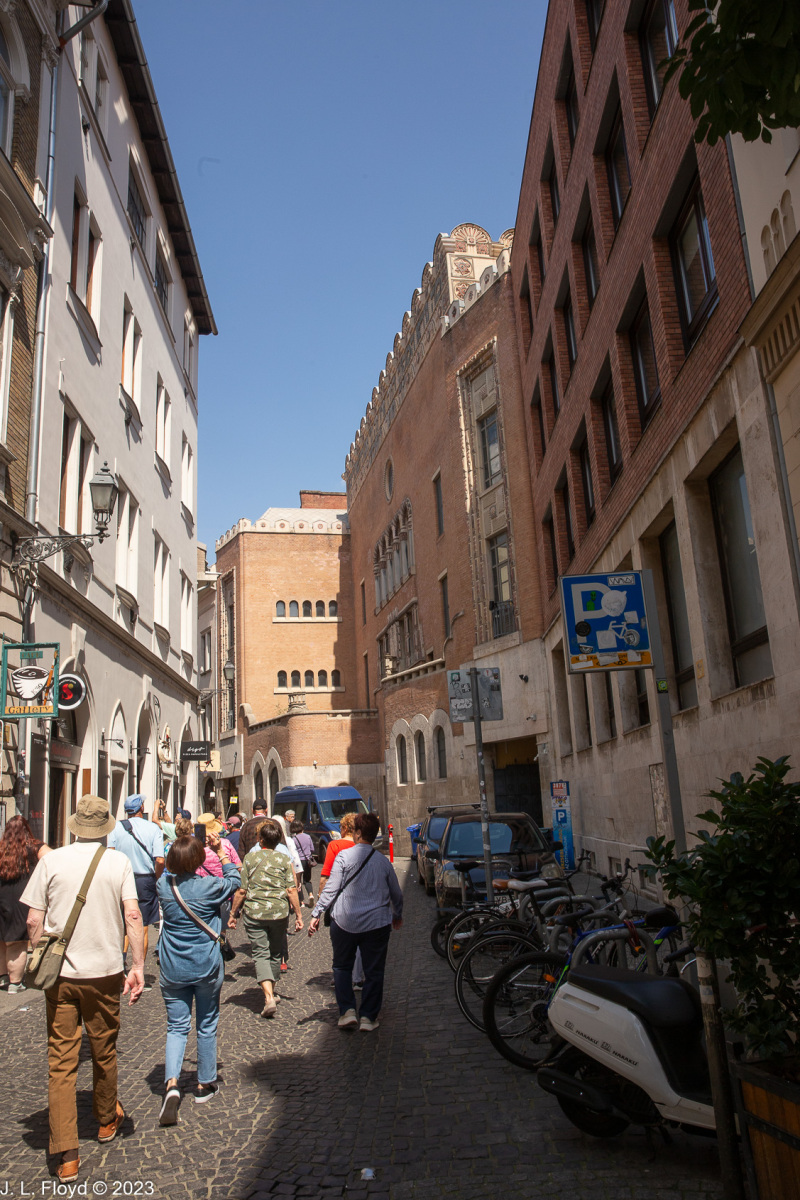
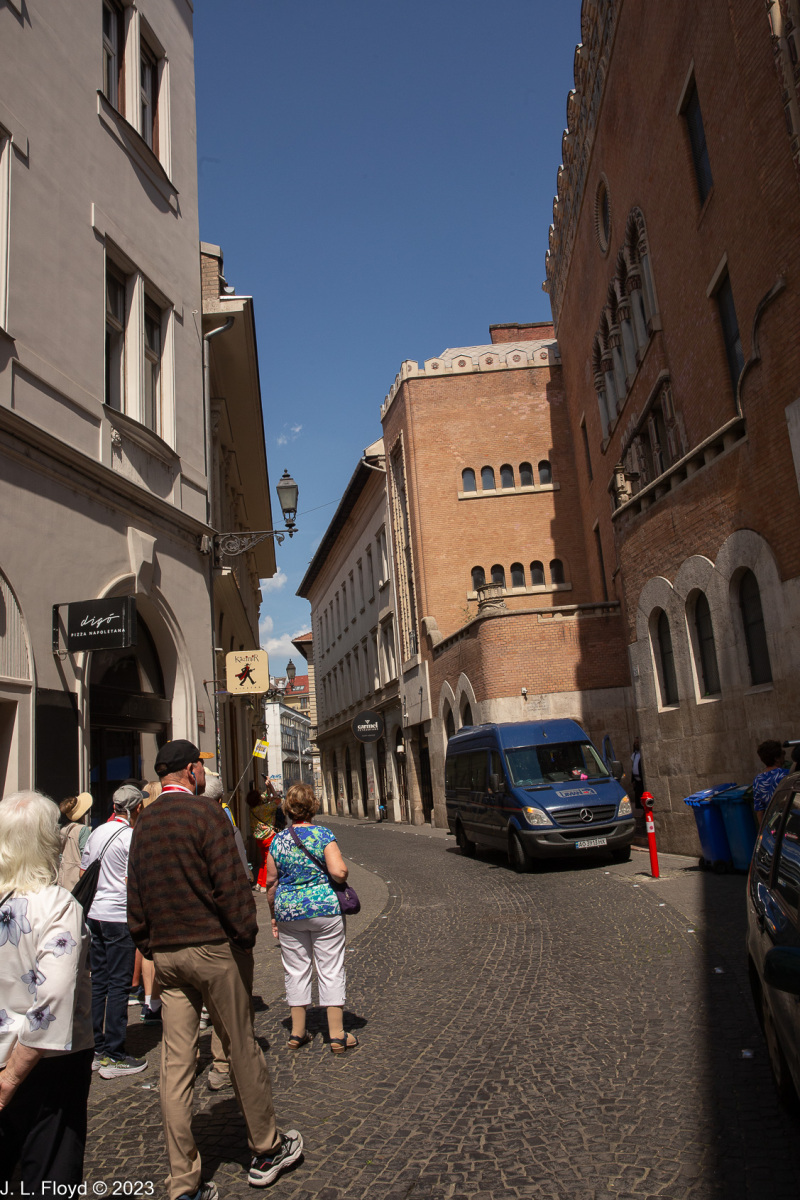
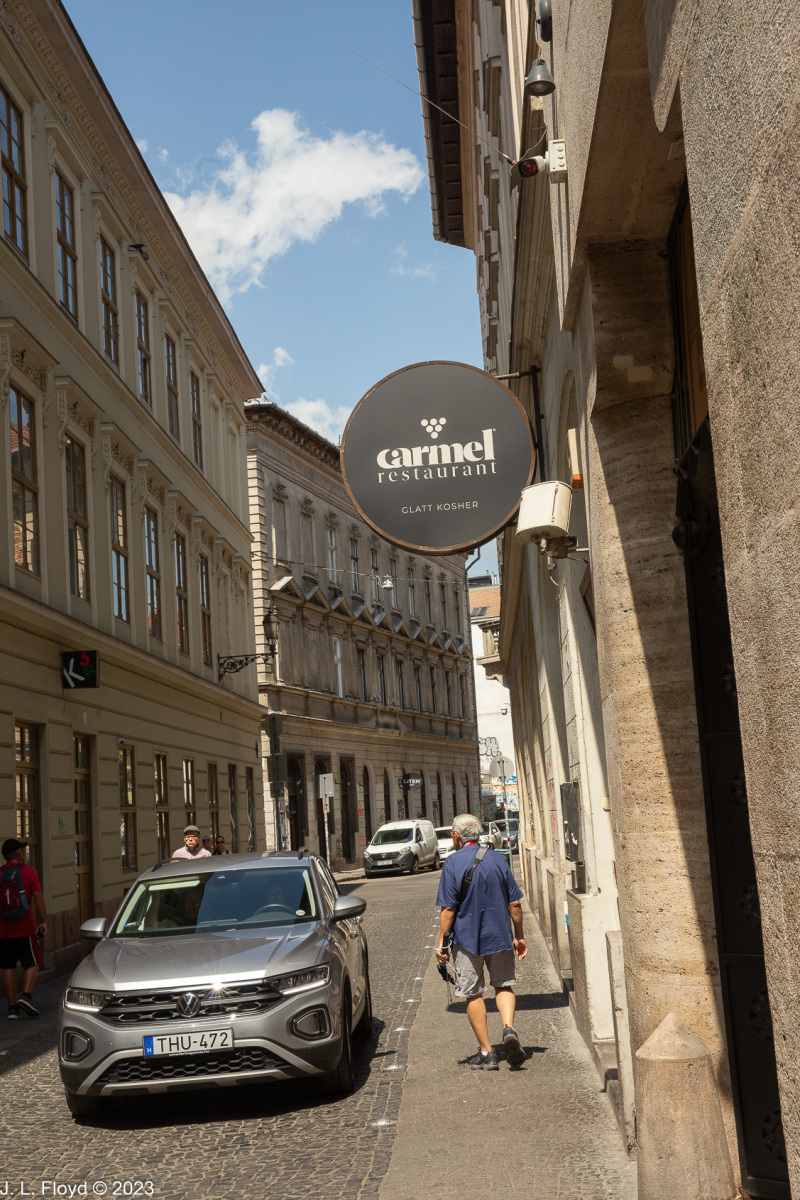
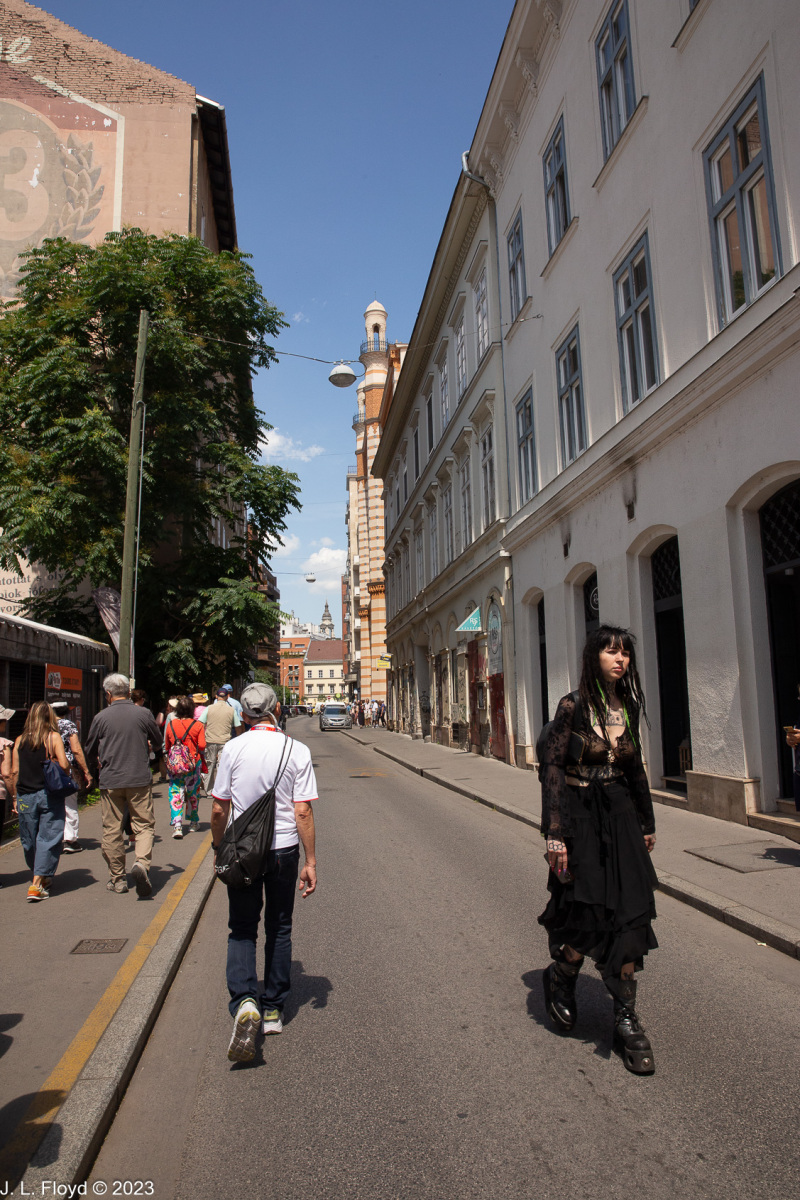
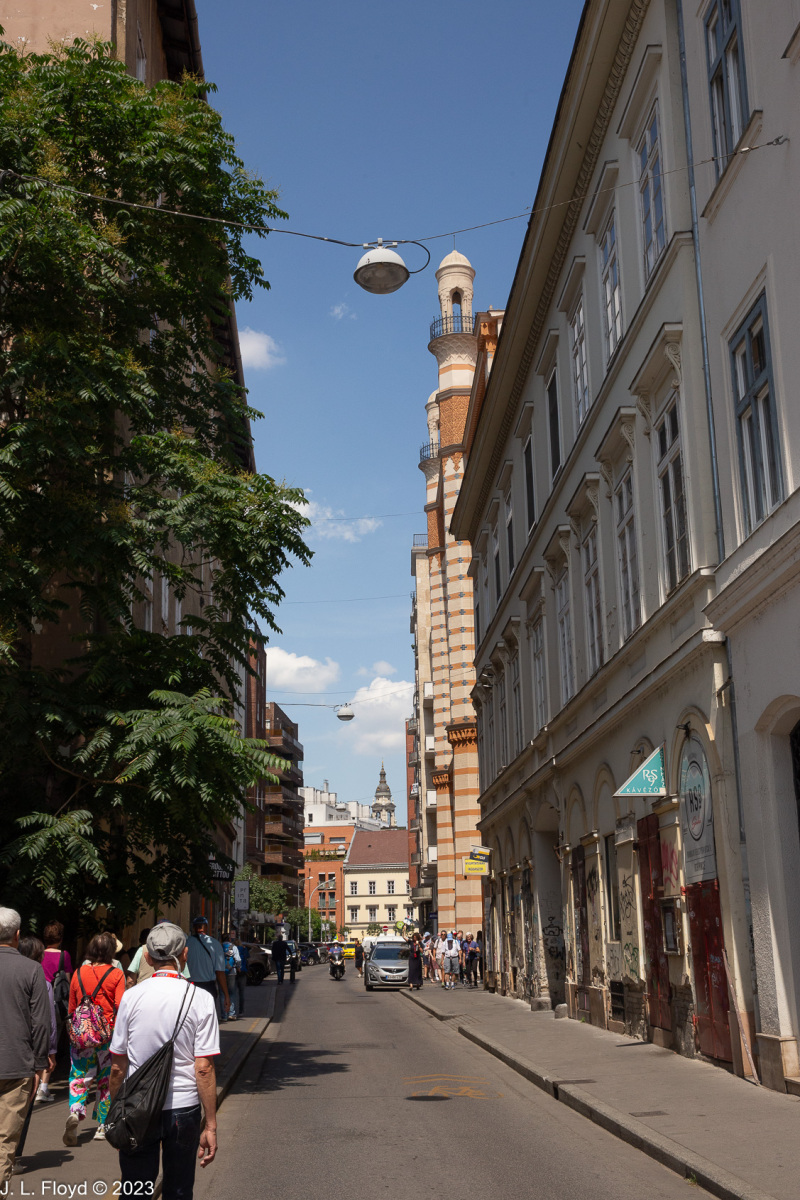
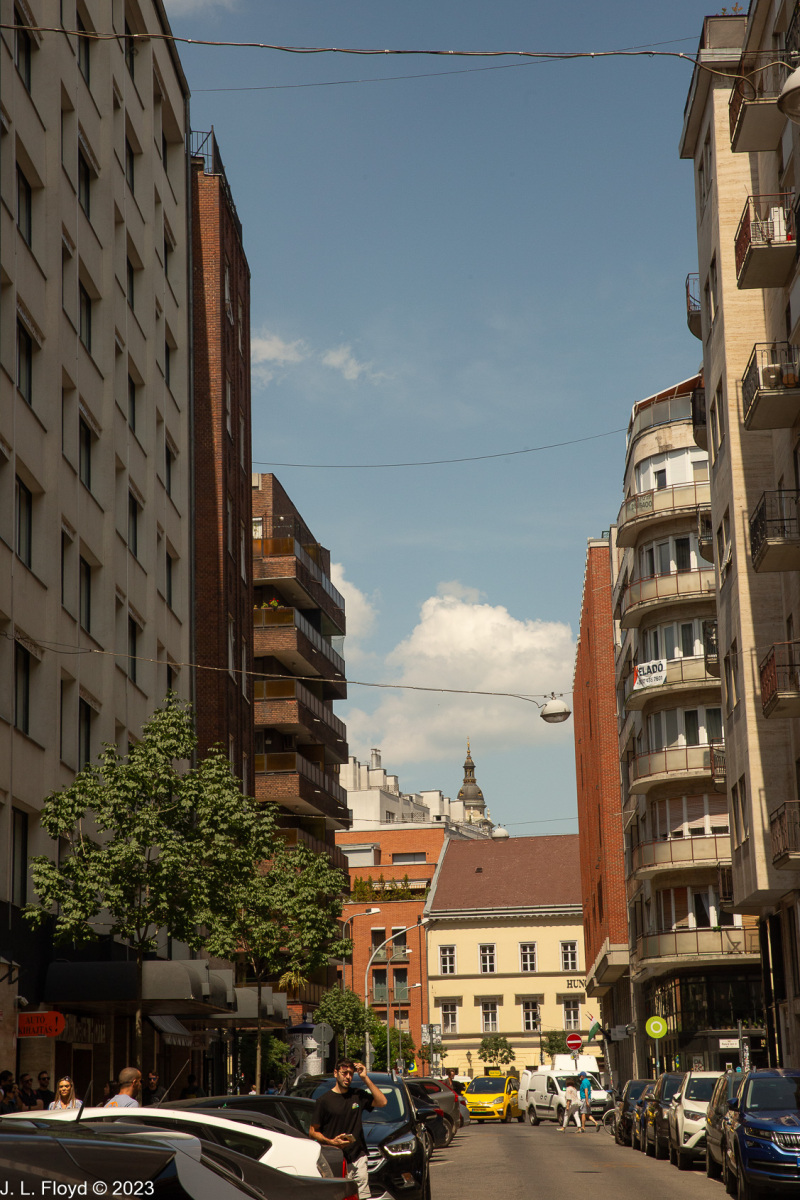
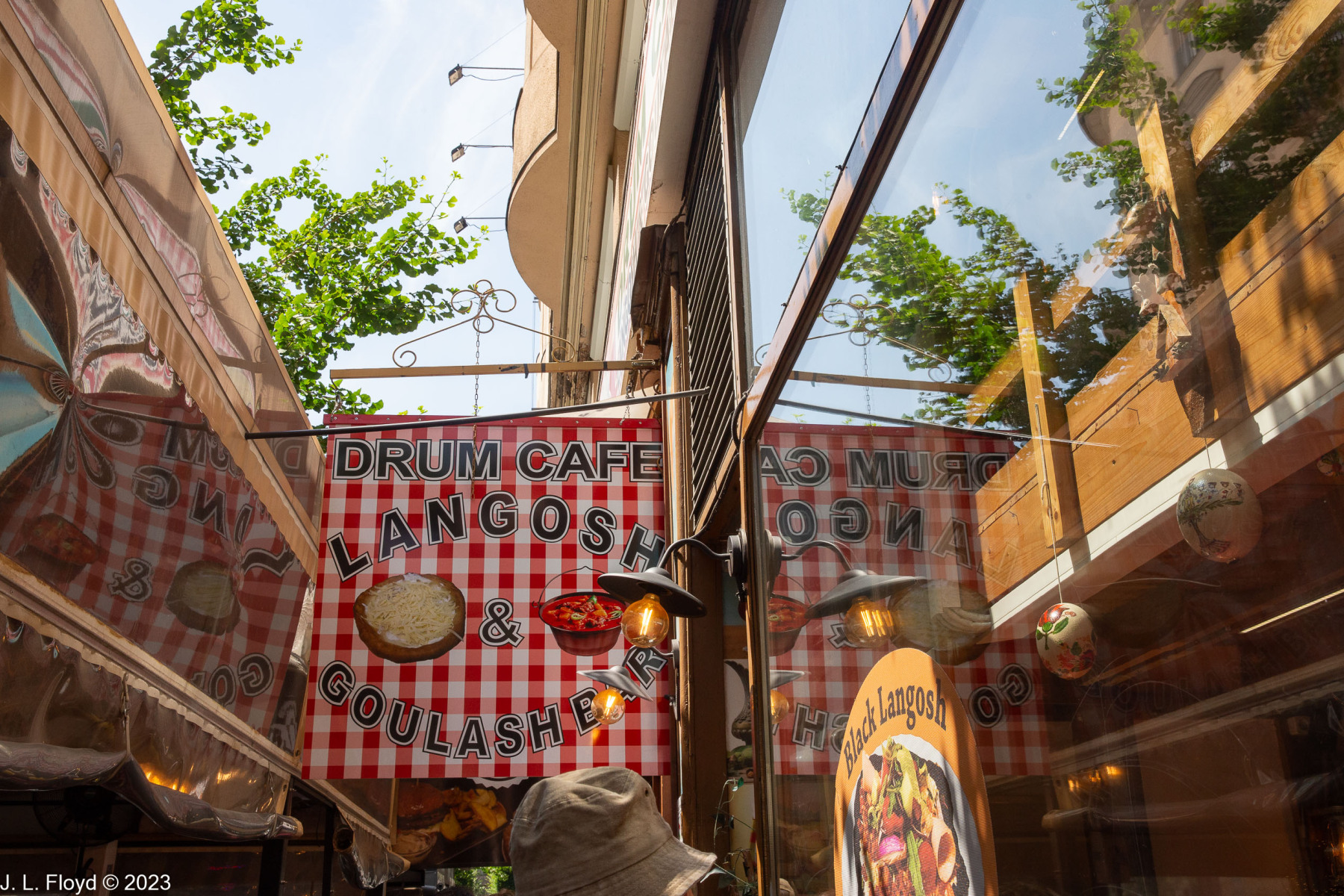
The Dohány Street Synagogue is affiliated with the Neolog or Congressional wing of Hungarian Jewry, a liberal and modernist denomination largely associated with middle and upper-class assimilated Jews, in sharp contrast to the conservative and traditionalist Orthodox Jewish community. The latter have their own places of worship, one of which is the Kazinczy Street Synagogue, which was our second stop in the Jewish Quarter. To get there we threaded our way through narrow, crowded streets, passing a number of interesting shops and tempting restaurants which I would have loved to patronize if there had been an opportunity.

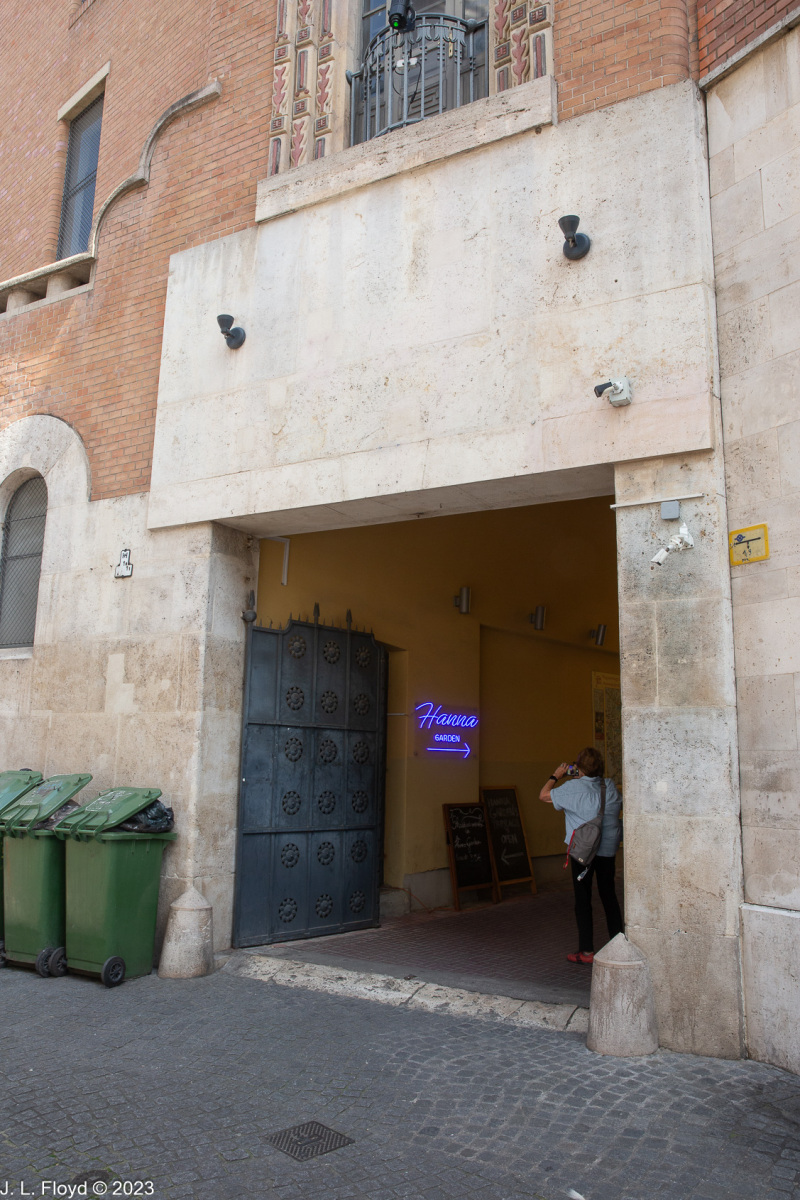
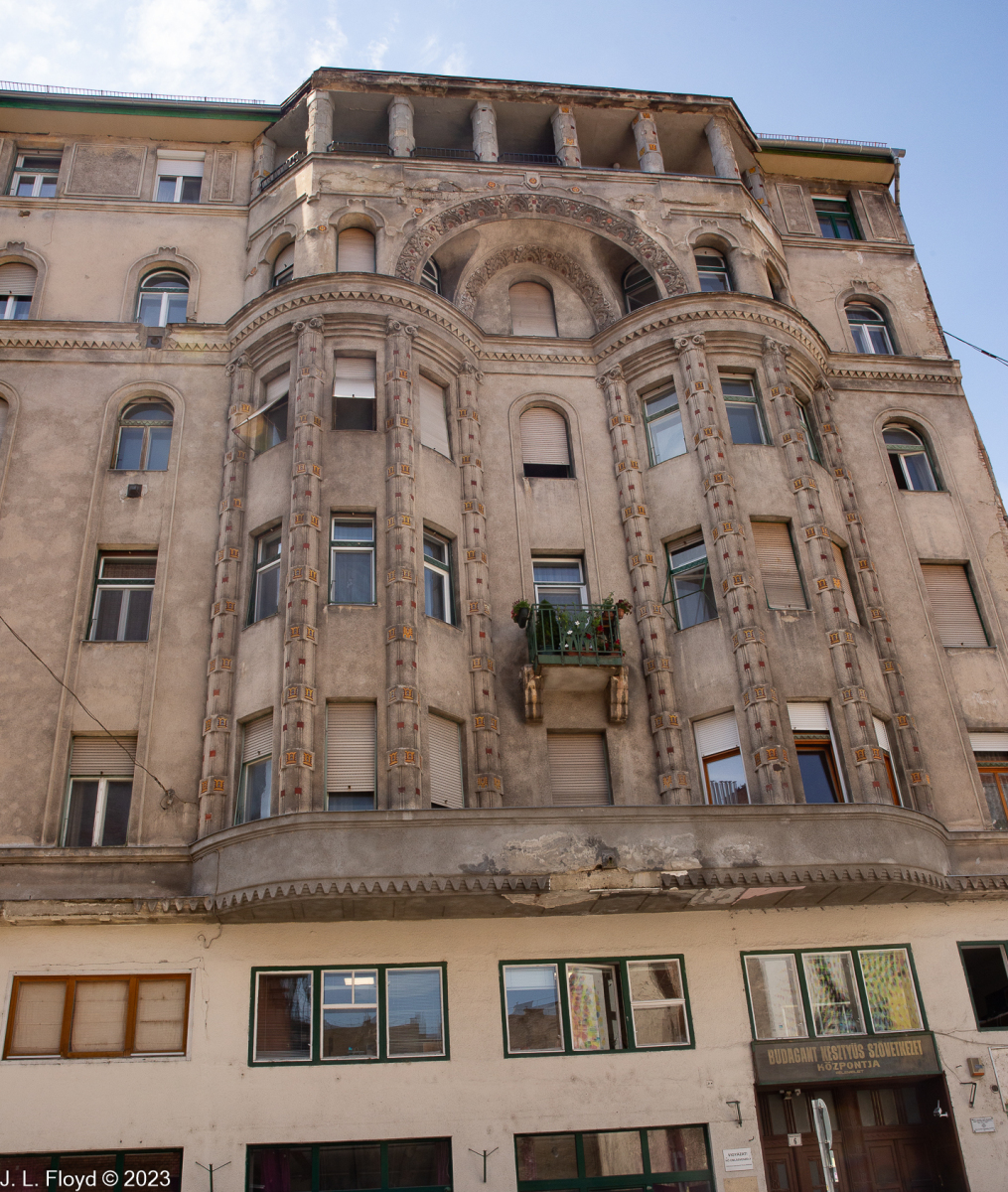
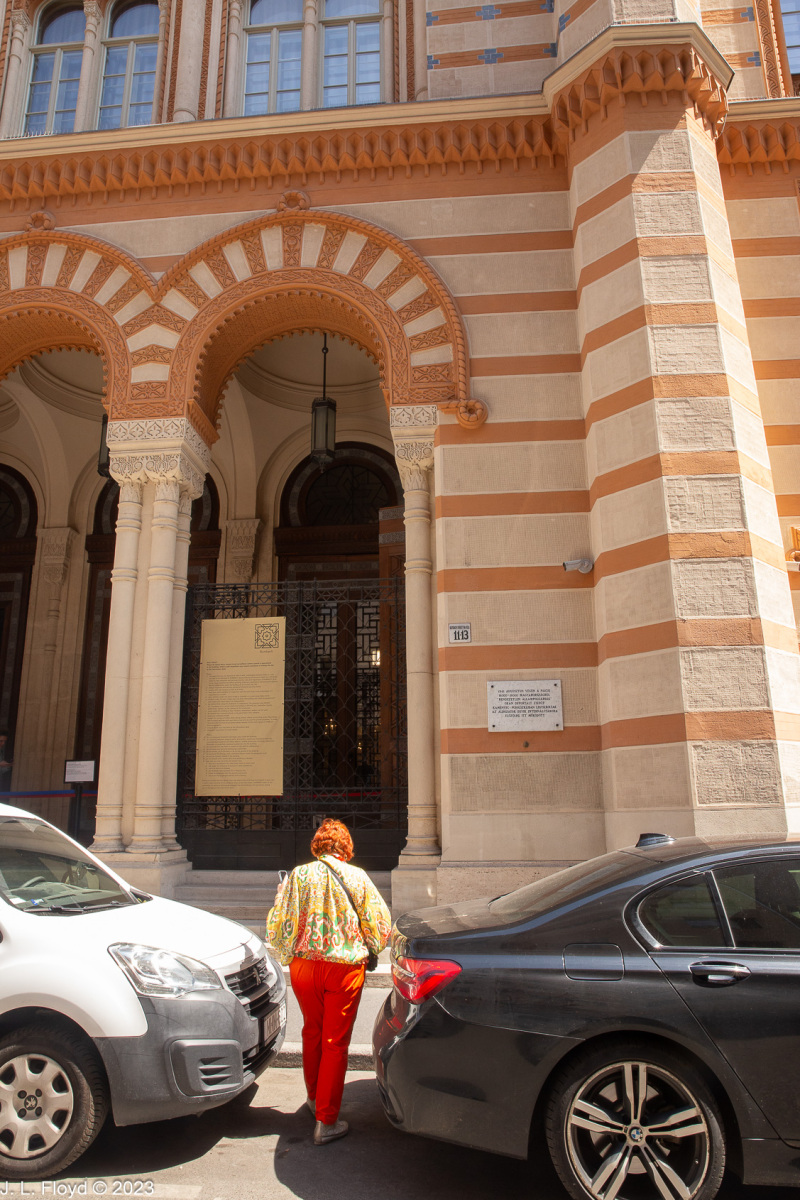
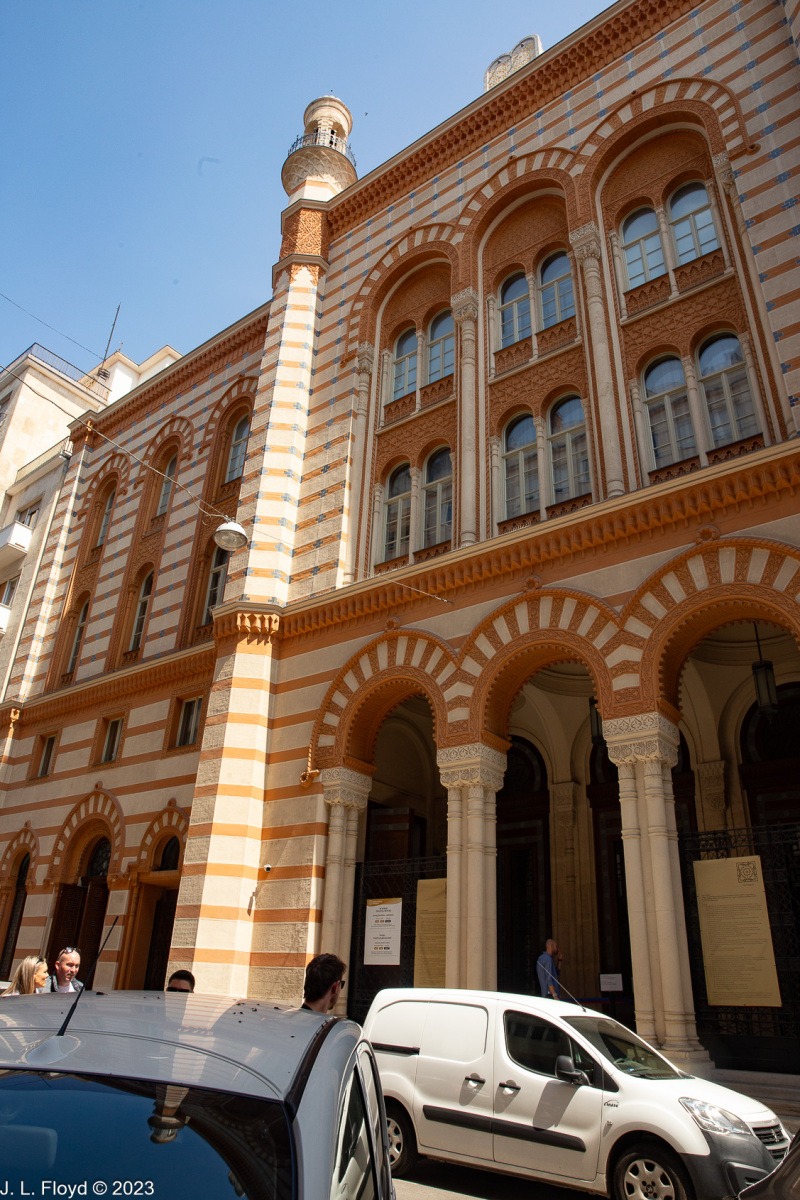
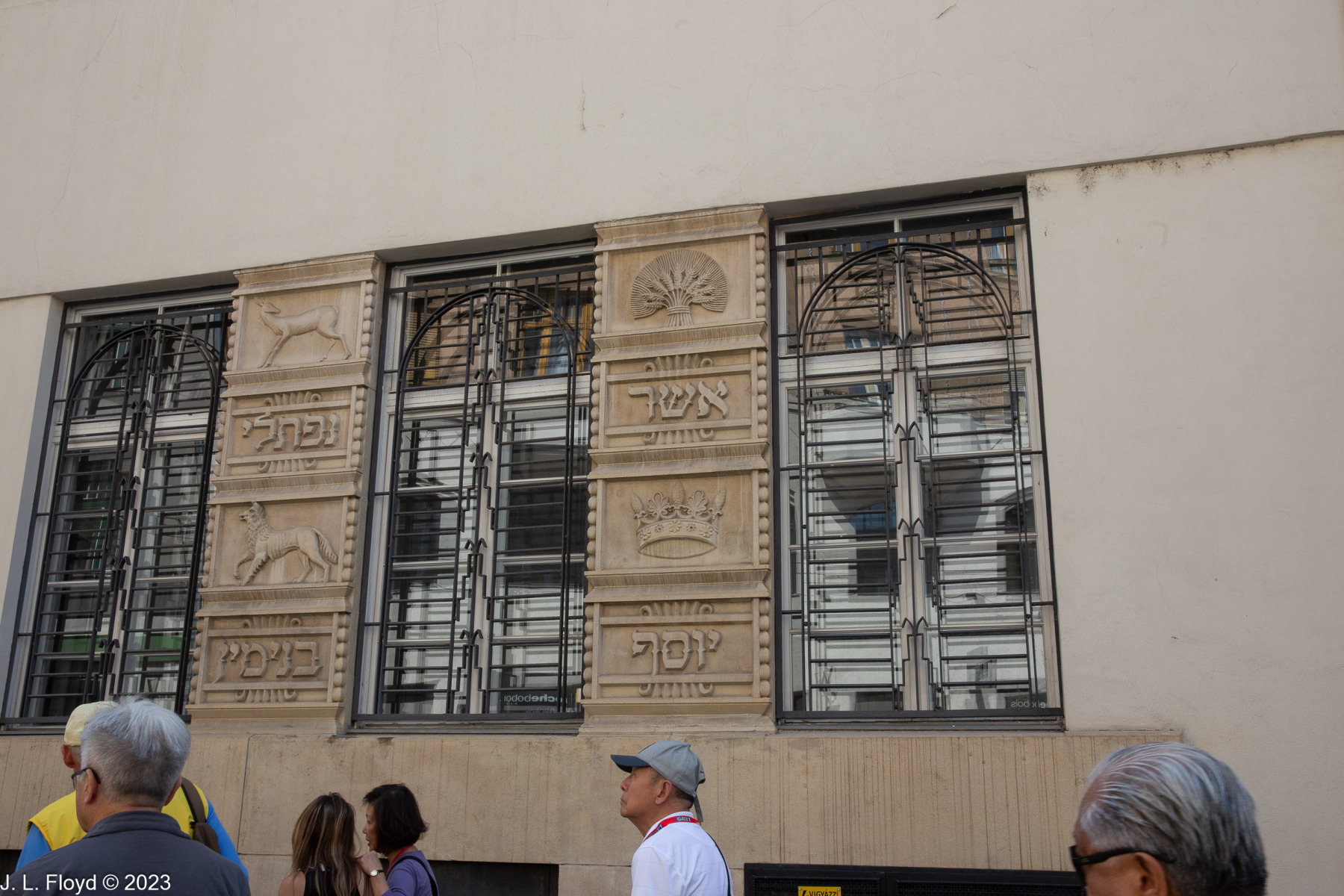
The Kazinczy Street Orthodox Grand Synagogue was built in 1913, just before the First World War, in a style which is the last thing I would have expected from a conservative and traditionalist denomination: Art Nouveau. In fact it is considered a masterpiece of Art Nouveau architecture. The narrow street and the limitations of my equipment (not to mention the skills of the photographer) prevented me from doing visual justice to the synagogue, but one can see more adequate photos online, for example here. In the post-World War II period, under the kindly auspices of the Communist regime, the Orthodox Grand Synagogue deteriorated to the point of unusability, and a smaller house of worship, the Sasz-Chevra Orthodox Synagogue, was built next to it (after the collapse of Communism the main synagogue was restored and can be visited today). I initially mistook the unpretentious doorway providing entry to the smaller synagogue, which also leads to the Hanna glatt kosher restaurant, for the main entrance to the Grand Synagogue.

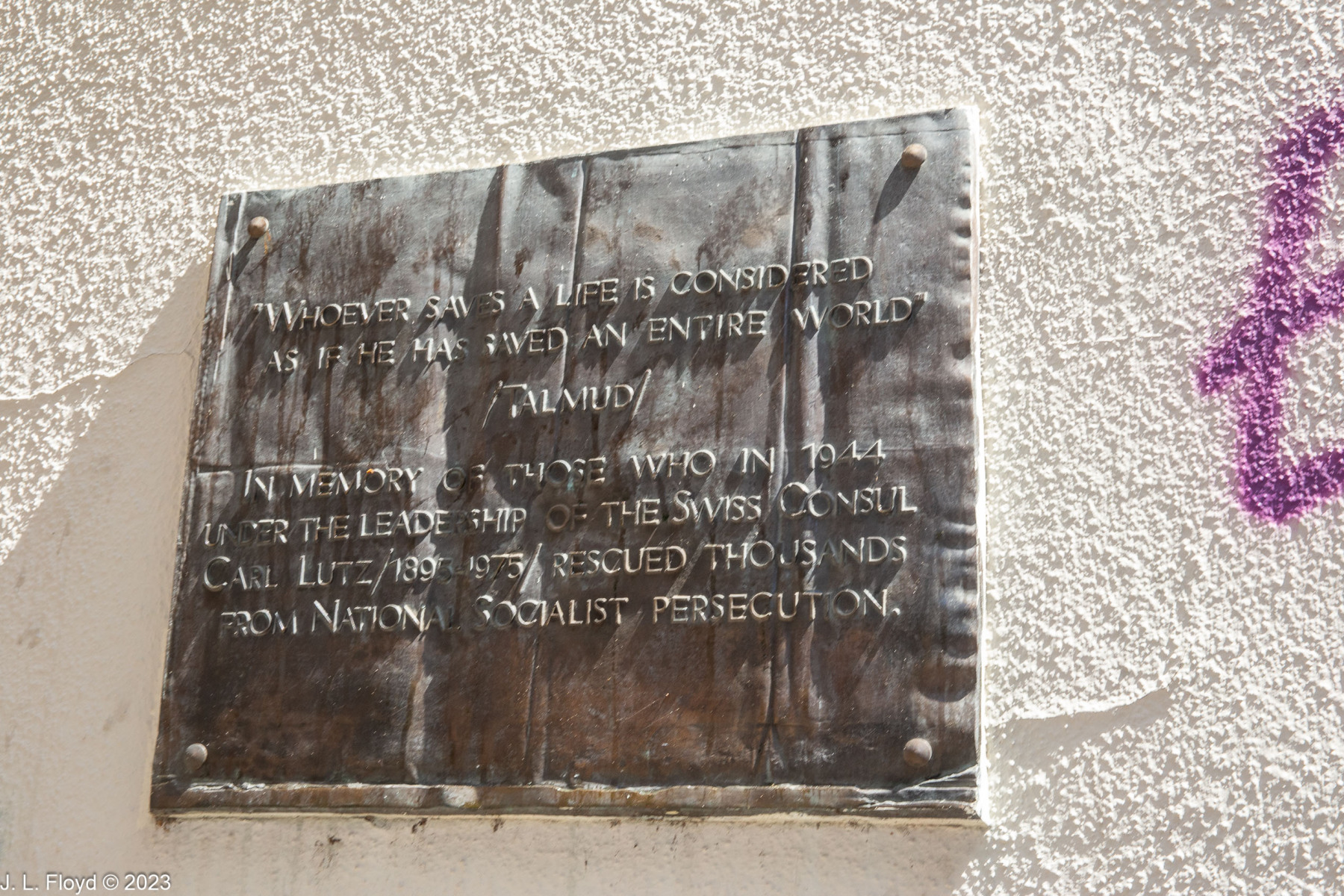
From Kazinczy Street we ambled on to the Carl Lutz Memorial, at the corner of Dob and Rumbach Streets. Carl Lutz was a Swiss diplomat who is credited with saving 62,000 Hungarian Jews from the Nazis during World War II.

Interestingly, Carl Lutz as a young man had emigrated to the United States. He lived there for two decades and worked his way through college, graduating from George Washington University in Washington, D.C., in 1924. By that time he had started working in the Swiss Legation there, and continued to pursue his diplomatic career in other American cities, remaining in the USA until 1934. In 1935 the Swiss diplomatic service sent him as a vice-consul to Jaffa in Palestine, where he apparently developed strong Jewish sympathies after watching a Jewish worker being lynched by an Arab mob. In 1942 he was appointed Swiss vice-consul in Budapest, and soon began helping Hungarian Jews emigrate to Palestine. He did so by issuing safe-conduct documents to Jewish families and by establishing safe houses, such as the famous “Glass House”, where Jews could live under official Swiss protection. His activities became so provocative that the German plenipotentiary in Hungary actually contemplated having him assassinated, but failed to obtain permission from his superiors. The Swiss government’s reward for his efforts was to reprimand him for exceeding his authority, though this was later reversed. He died in Switzerland in 1975.

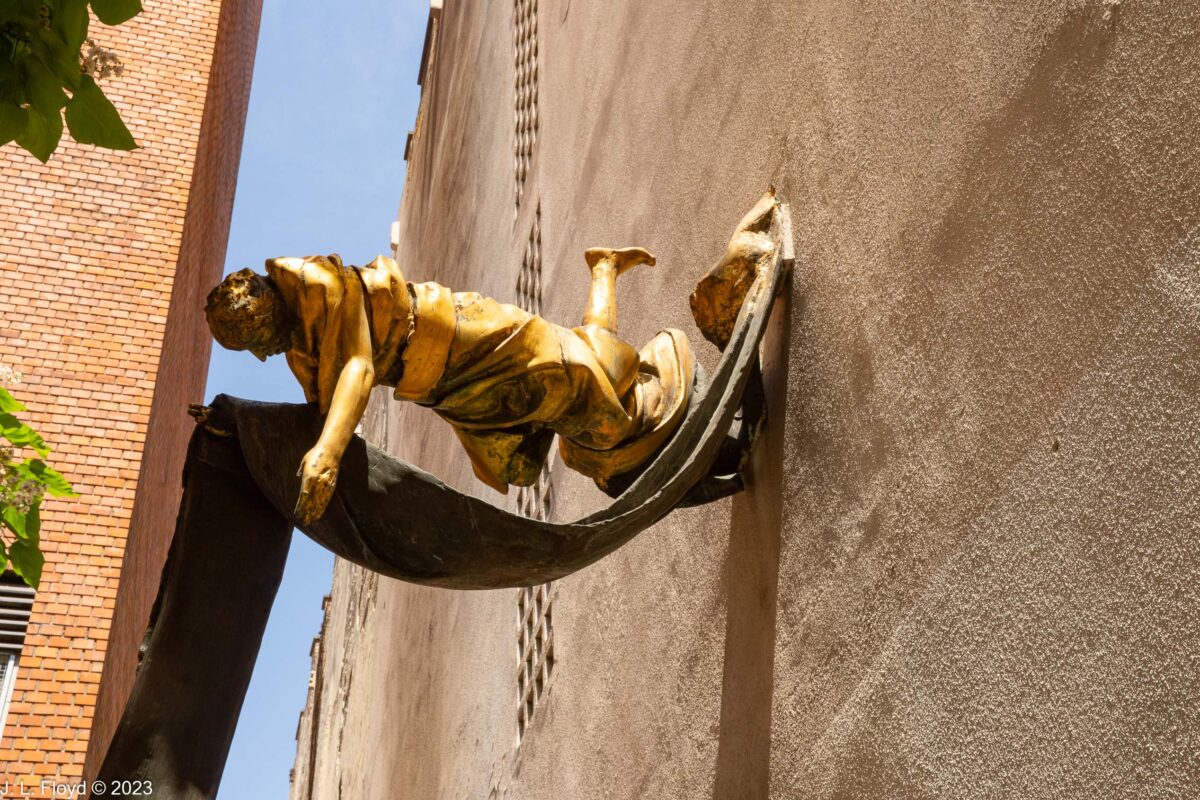
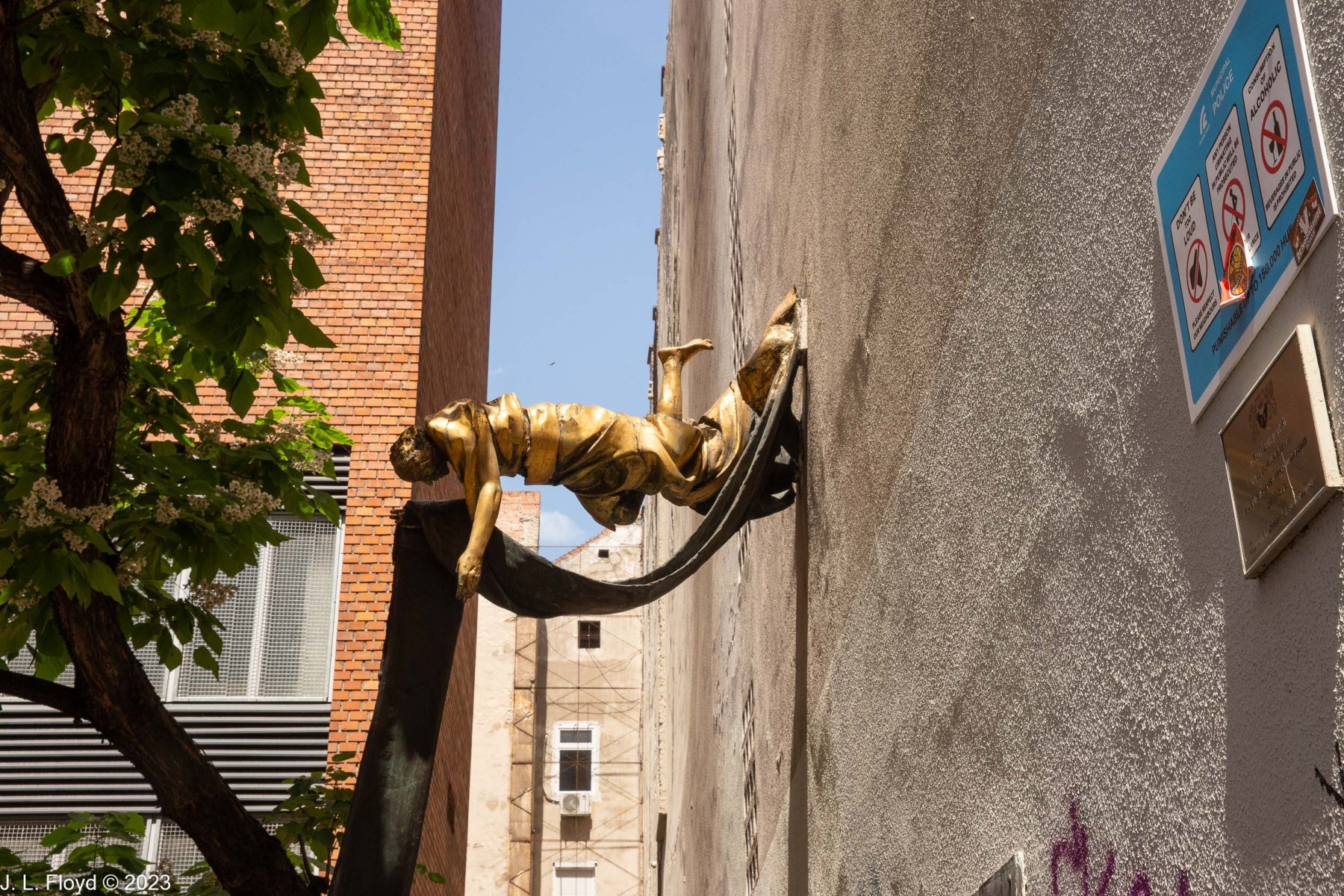
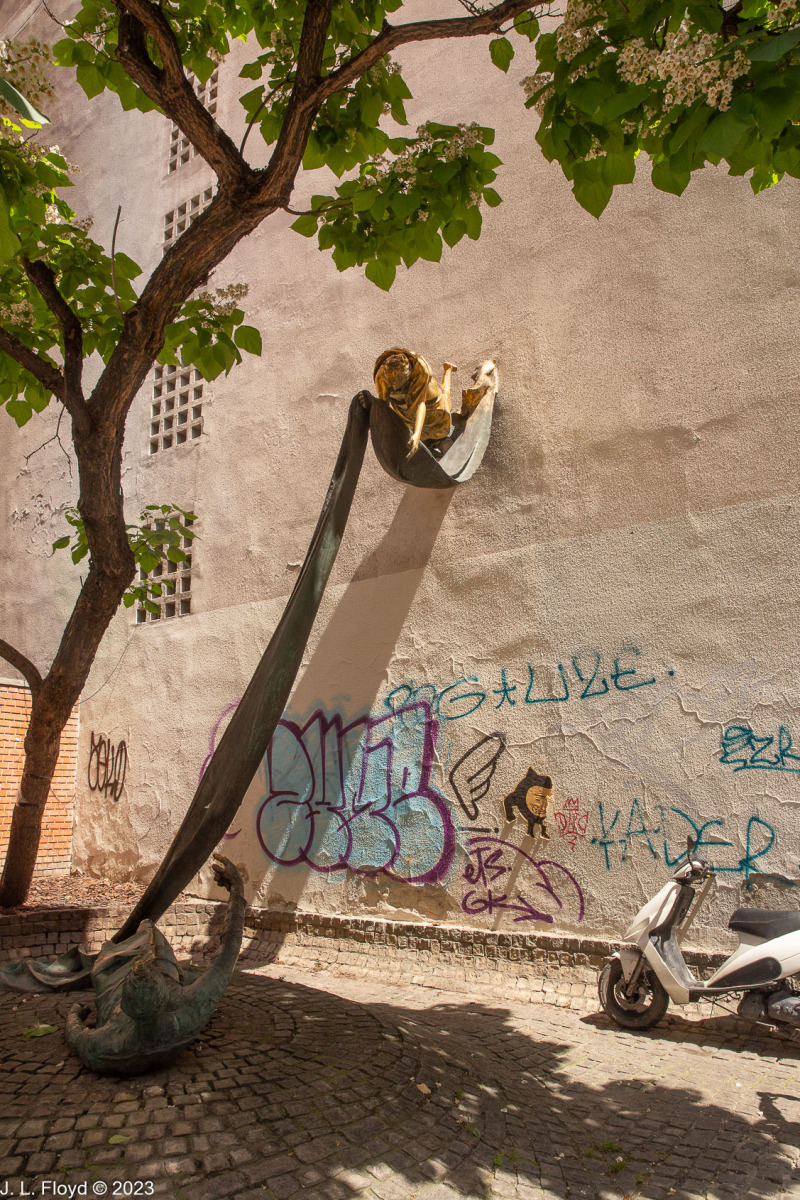
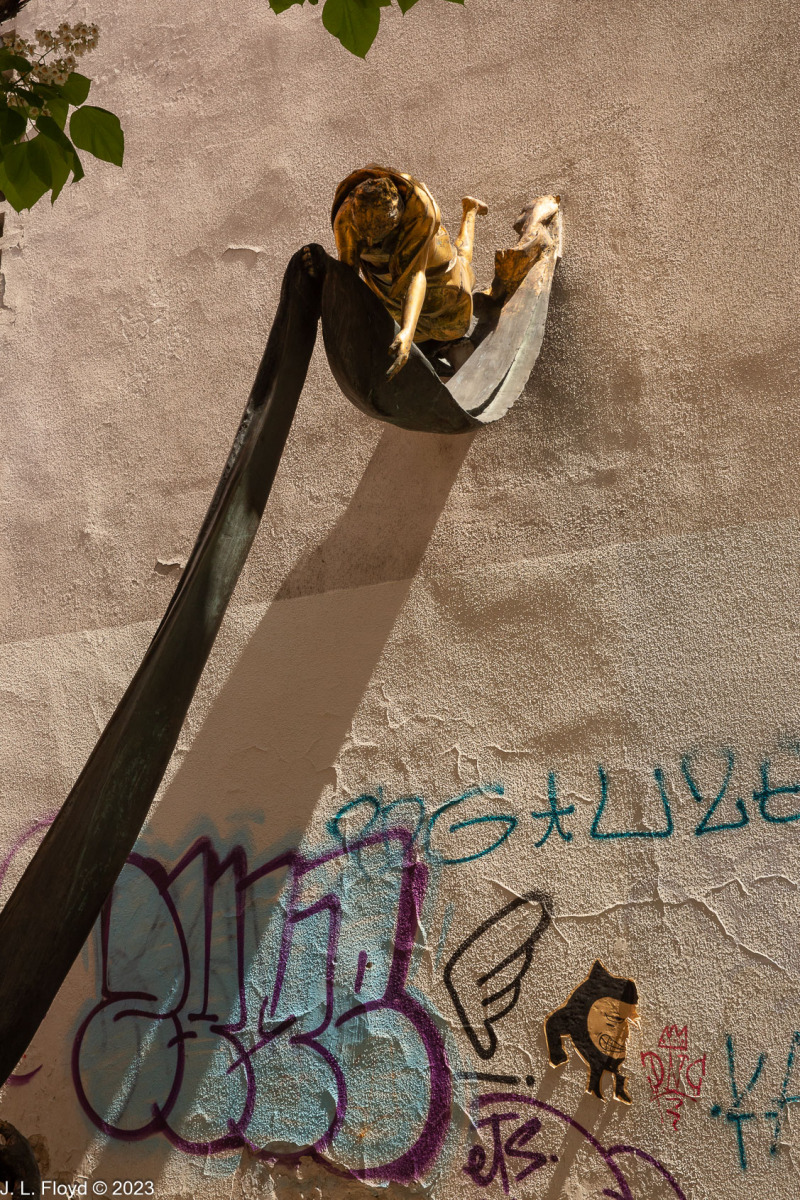
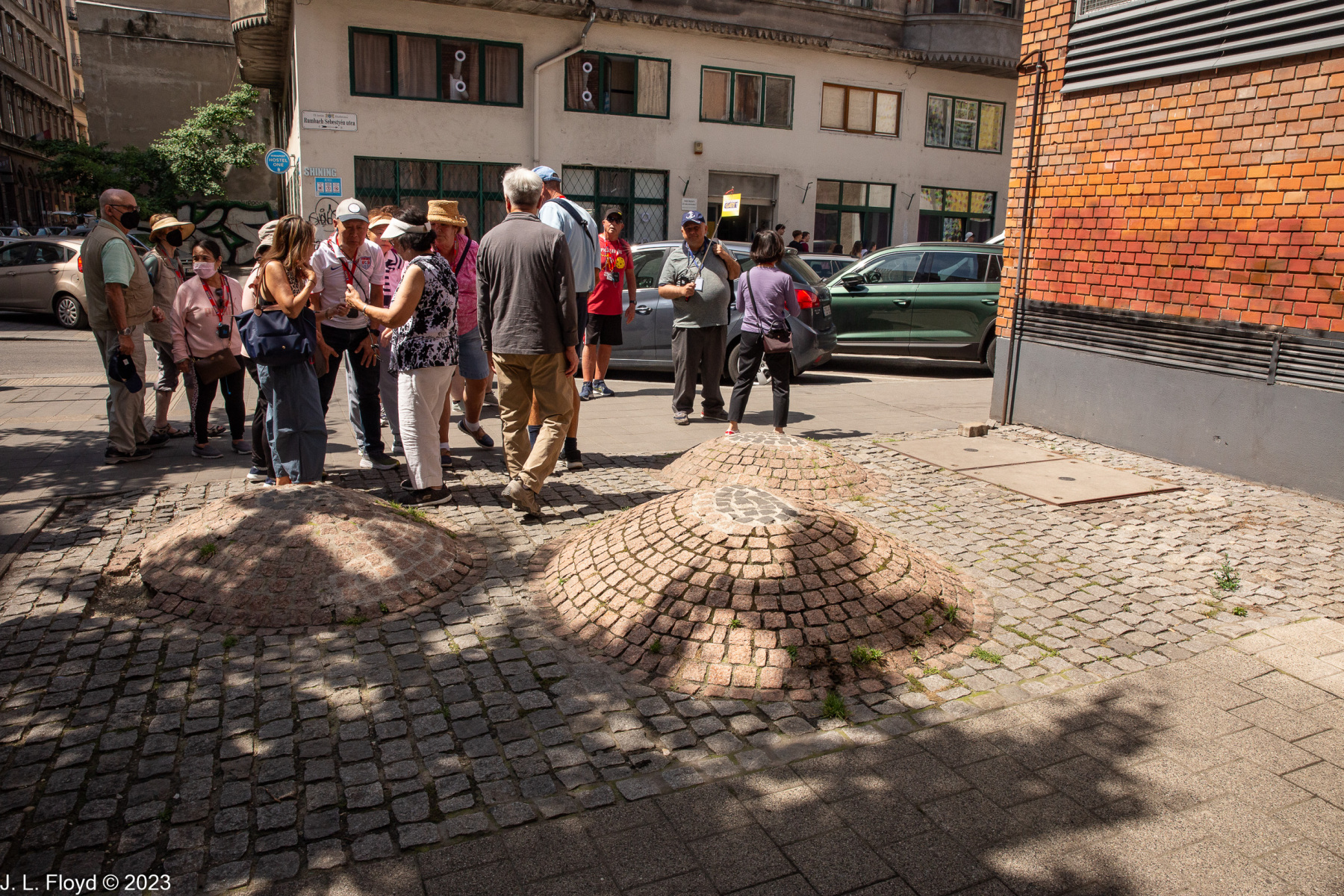
The Carl Lutz Memorial on Dob Street is a most unusual construction. Its most striking component is a statue of Lutz in the form of a golden angel standing sideways on the side of a building. From his height, Lutz throws a very long cape to serve as a ramp for an wounded Holocaust victim lying on the ground. extending an arm up to plead for help. Also on the wall is a plaque featuring a quotation from the Talmud, “Whoever saves a life is considered to have saved an entire world.” Beneath the golden statue on the wall have been scrawled a plethora of graffiti, which some people feel has ruined the atmosphere, but it didn’t bother me. The graffiti were unintelligible to me, and I could not tell whether they consisted of the ravings of anti-Jewish hatemongers displaying their idiocy for all the world to see, or else they have nothing to do with the memorial at all, in which case they are merely artwork. In any case, the memorial is set in a shady garden which provides a semblance of peace. On the street corner, at the opposite end of the garden from the memorial itself, we noticed three mounds which consisted of the same kind of brickwork as that supporting the victim statue, but which had nothing near them to indicate what they represented. I don’t recall whether the guide said anything about them and I haven’t been able to find out anything more, so if anyone reading this can help I would be much obliged.

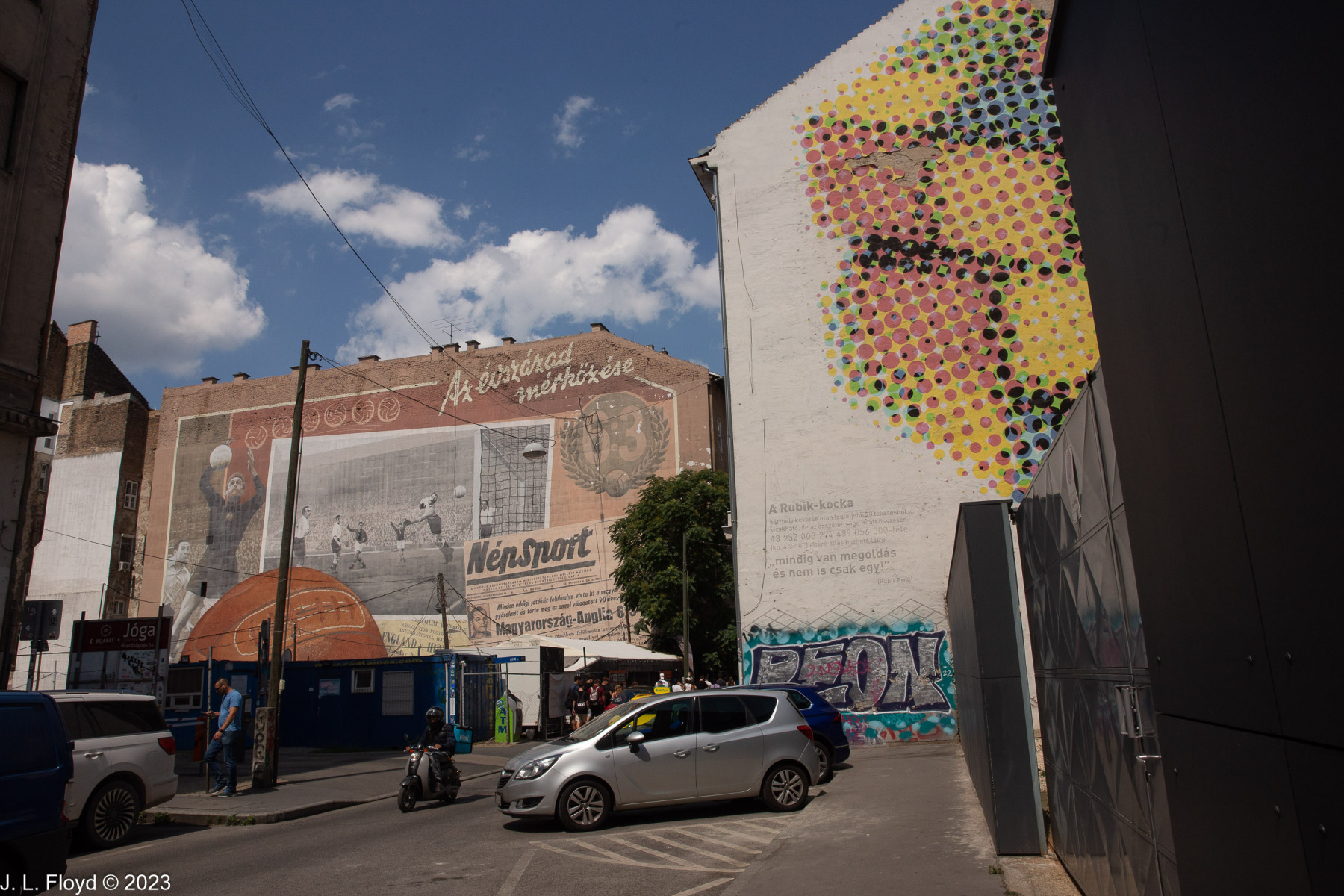
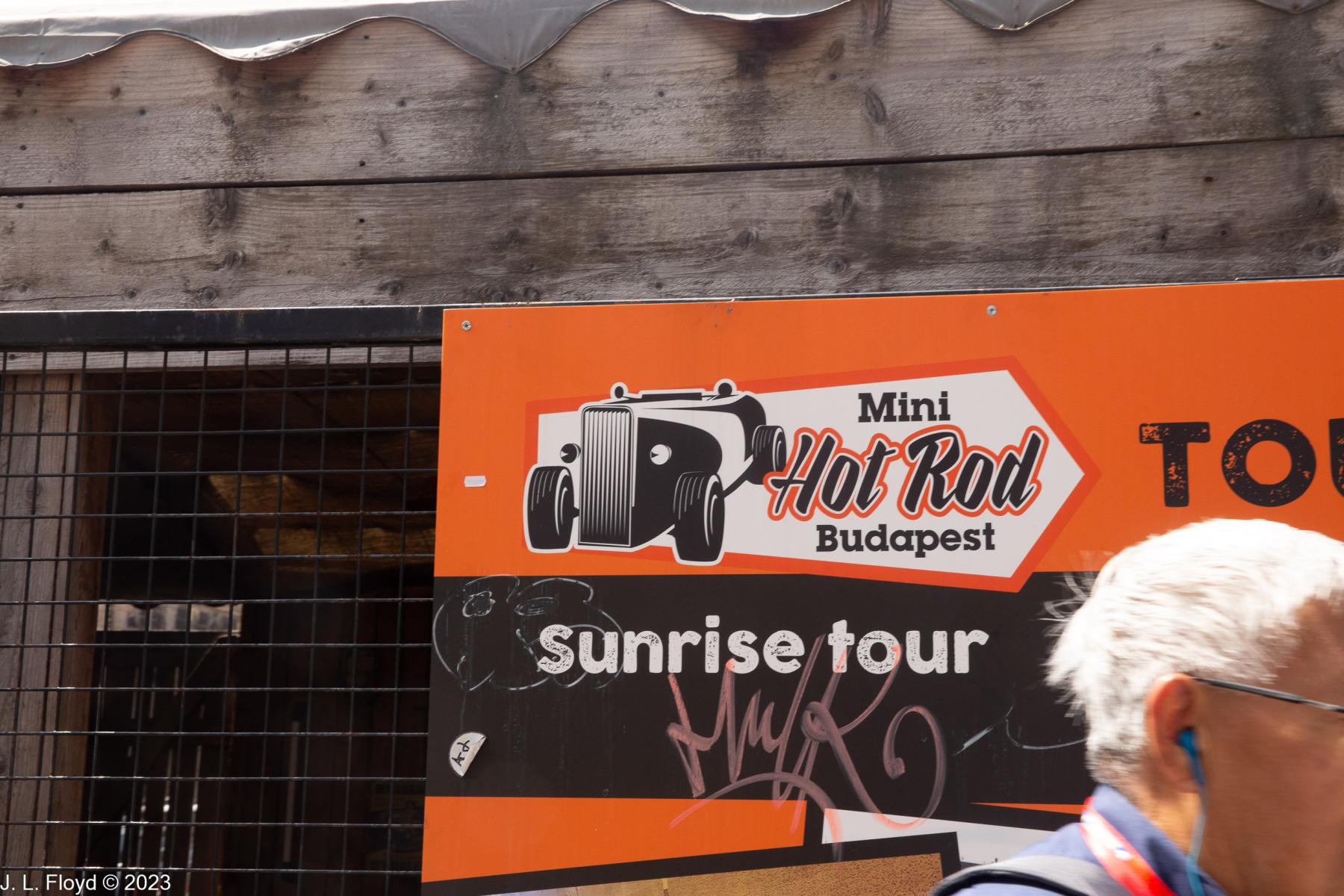
Turning the corner of Dob and Rumbach Streets, I found a graffiti-bedecked parking lot which turned out to be the base of an outfit calling itself Hot Rod Budapest, which offers tours of the city in fake “Deuces” – cut-down, souped-up 1932 American Ford open roadsters. Although these are obviously cheap imitations of the real thing, we would have tried them if we had a chance; we did something similar a few days later, in Prague, and enjoyed it greatly.

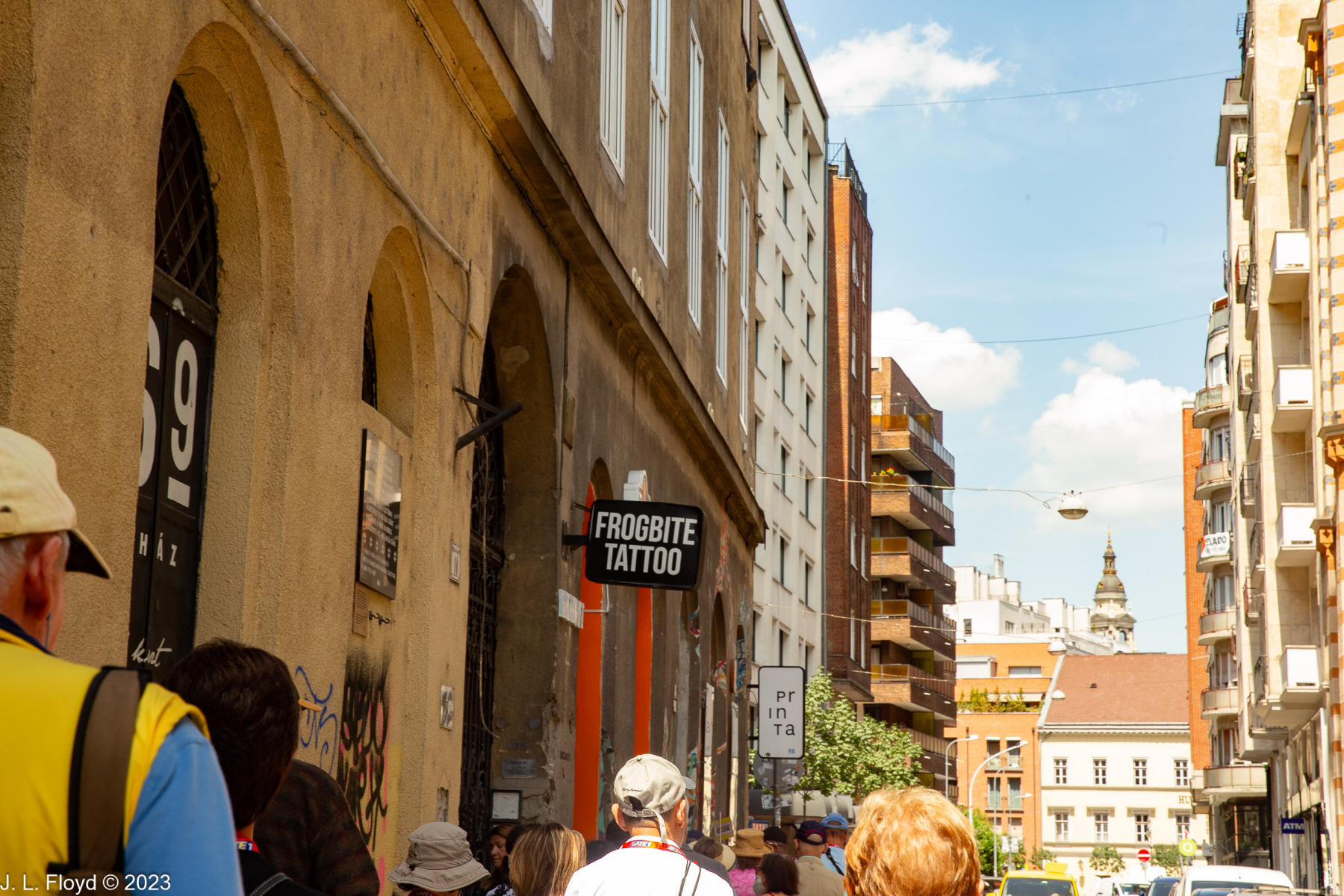
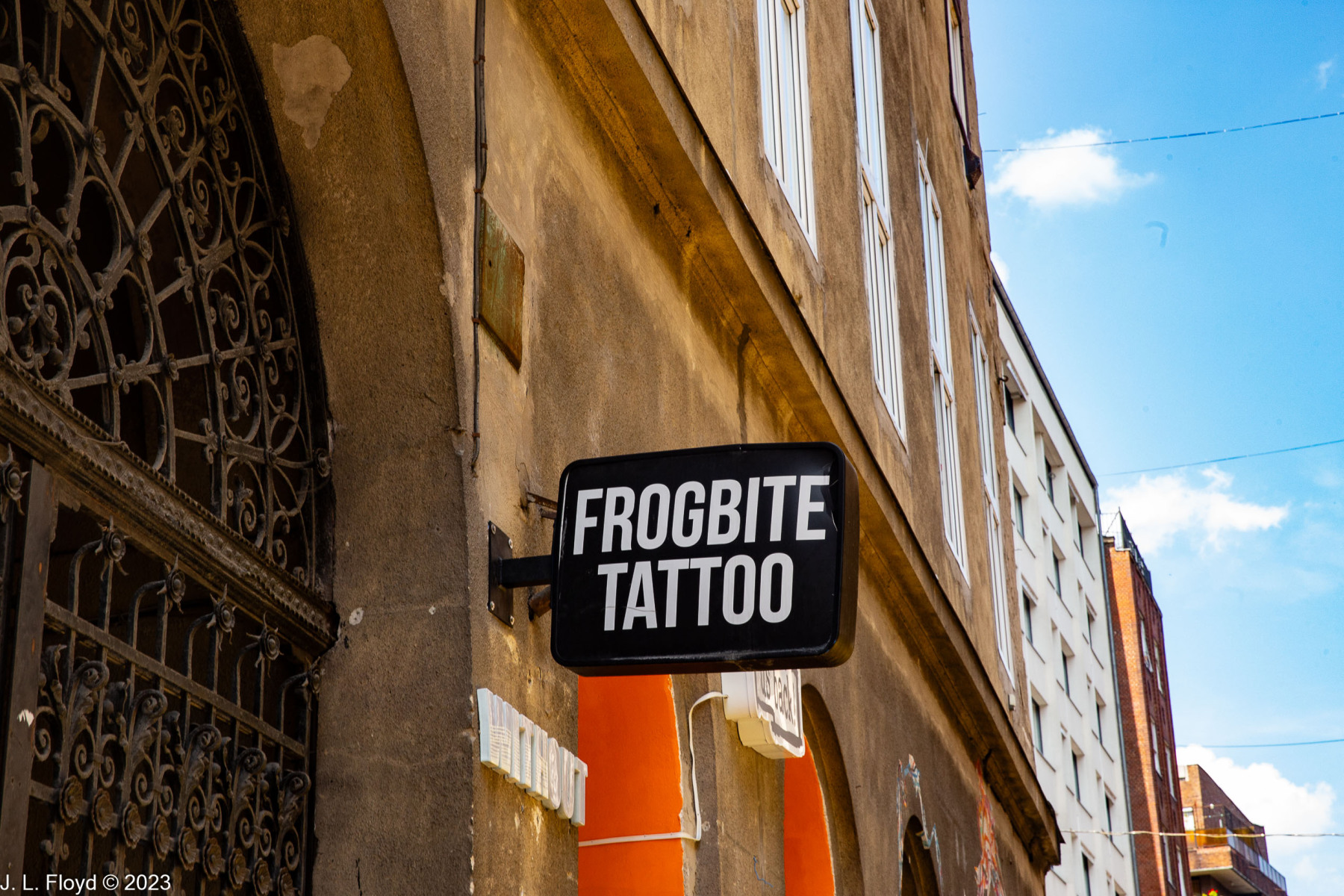
Continuing down Rumbach Street, we came across the Frogbite Tattoo Parlor. I don’t favor tattoos myself but I loved the name of the place. I had an old friend from FileNet days (mid-80s), Dennis Griesser, who was a ranarophile, otherwise known as a frog freak. I would have sent him a picture of the logo, but he passed away earlier this year. This page is dedicated to him in memoriam.

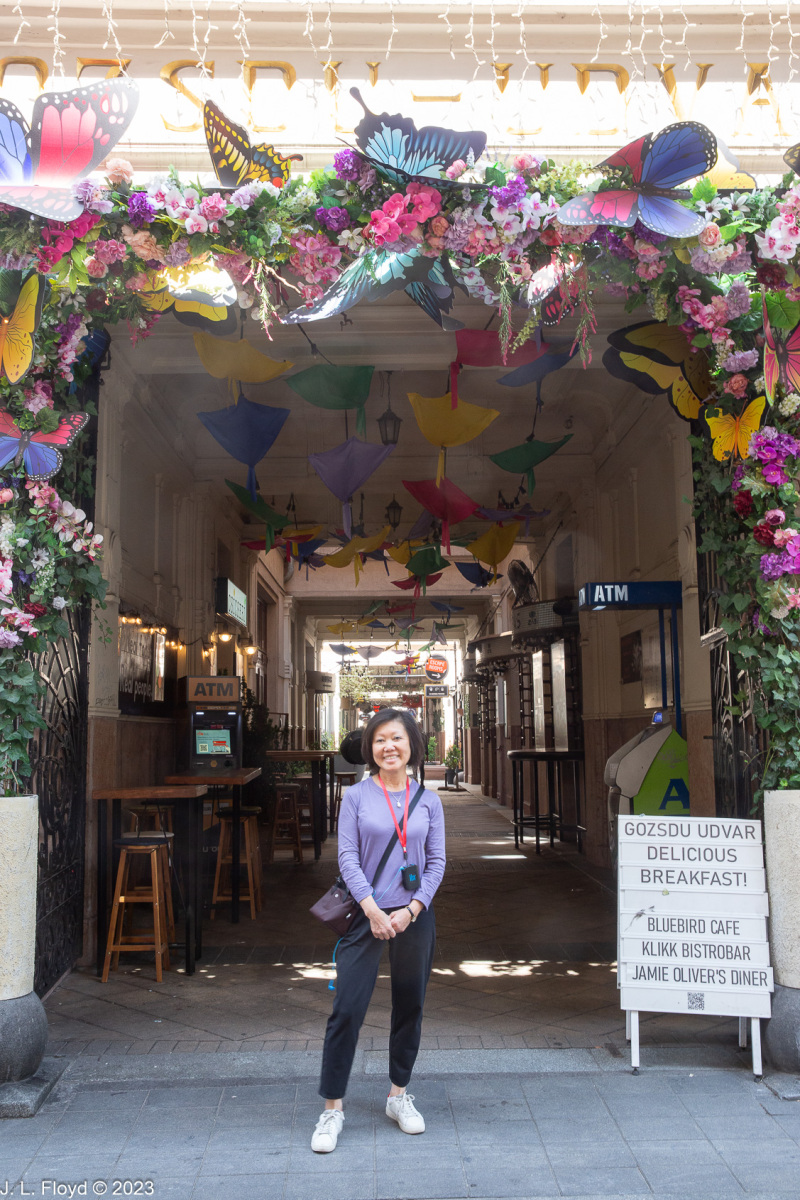
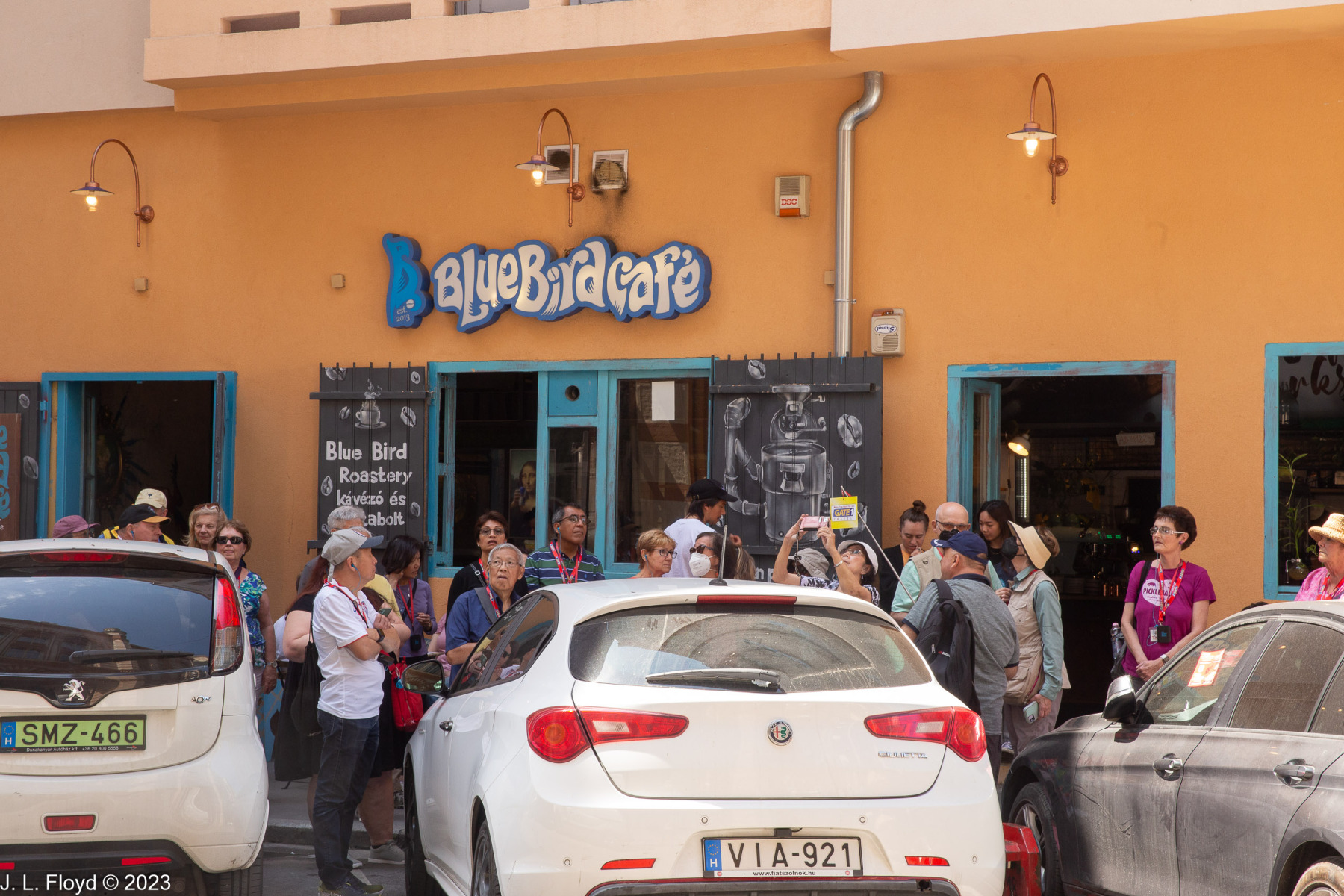
Also on Rumbach Street we encountered a number of other enticing establishments, such as the gaily decorated Bluebird Cafe, where I shot a picture of the entrance with an attractive young member of our tour group in front.

The Rumbach Street Synagogue is an octagonal structure built in 1872 in Moorish Revival style, like the Dohany Street Synagogue. In fact it was intended for the Neolog branch of Hungarian Jewry, but in the 1870s the schism between the Orthodox traditionalists and the Neolog modernizers evolved into a three-way split, with another conservative branch following its own path, to become known as the “Status Quo” faction; and the Rumbach Street Synagogue came under their aegis. Like the other two synagogues we viewed, the Rumbach deteriorated badly in the late 20th century, and was eventually restored to its pristine grandeur; today all three rank among the top architectural wonders of Budapest.

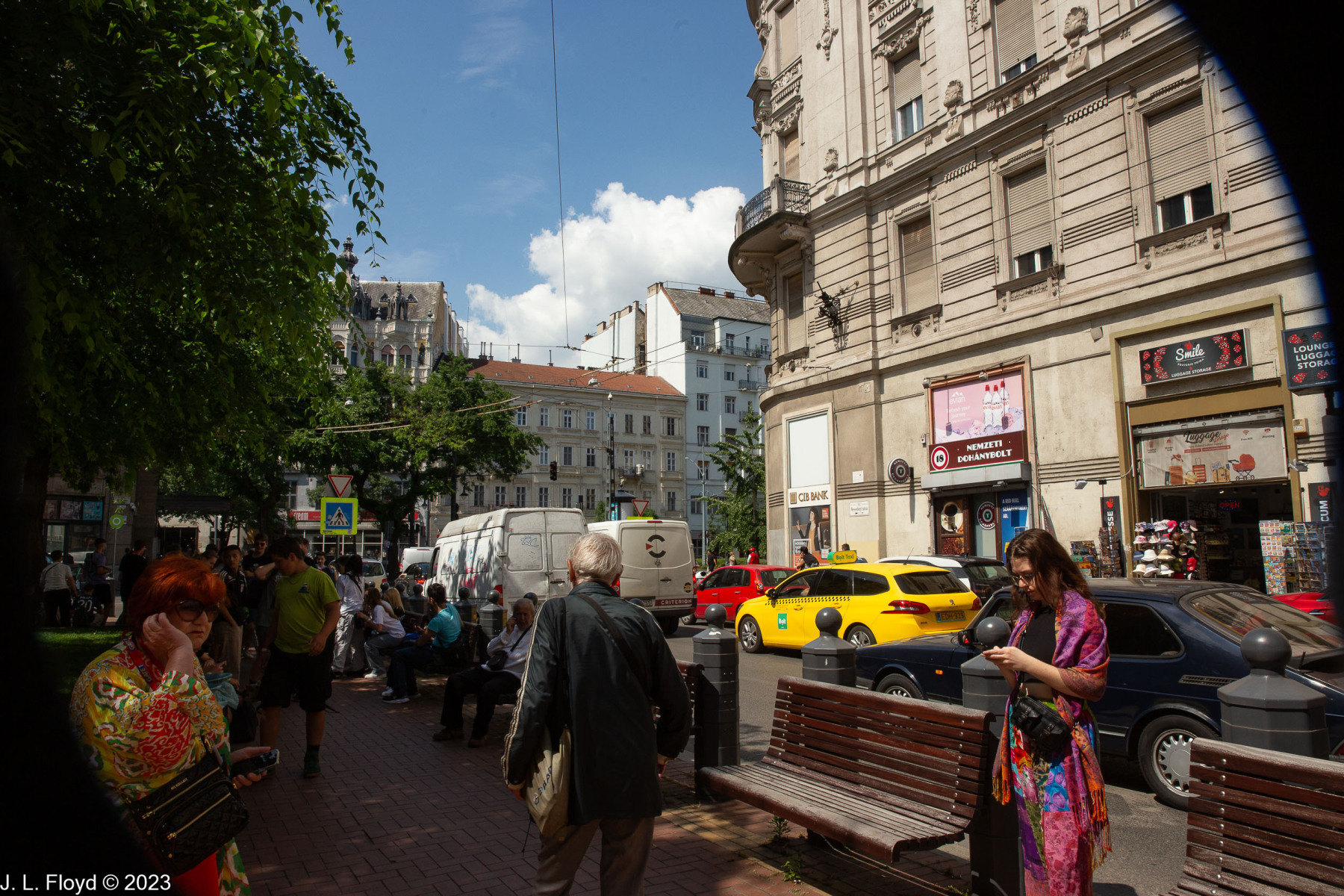
From Rumbach Street we headed back down Dob Street toward Károly Boulevard, a wide main thoroughfare which converges with Dohány Street near the Great Synagogue, where our bus awaited. On the way I was able to capture a few more subjects of interest with my camera, including a couple that probably won’t show up in any guidebooks.

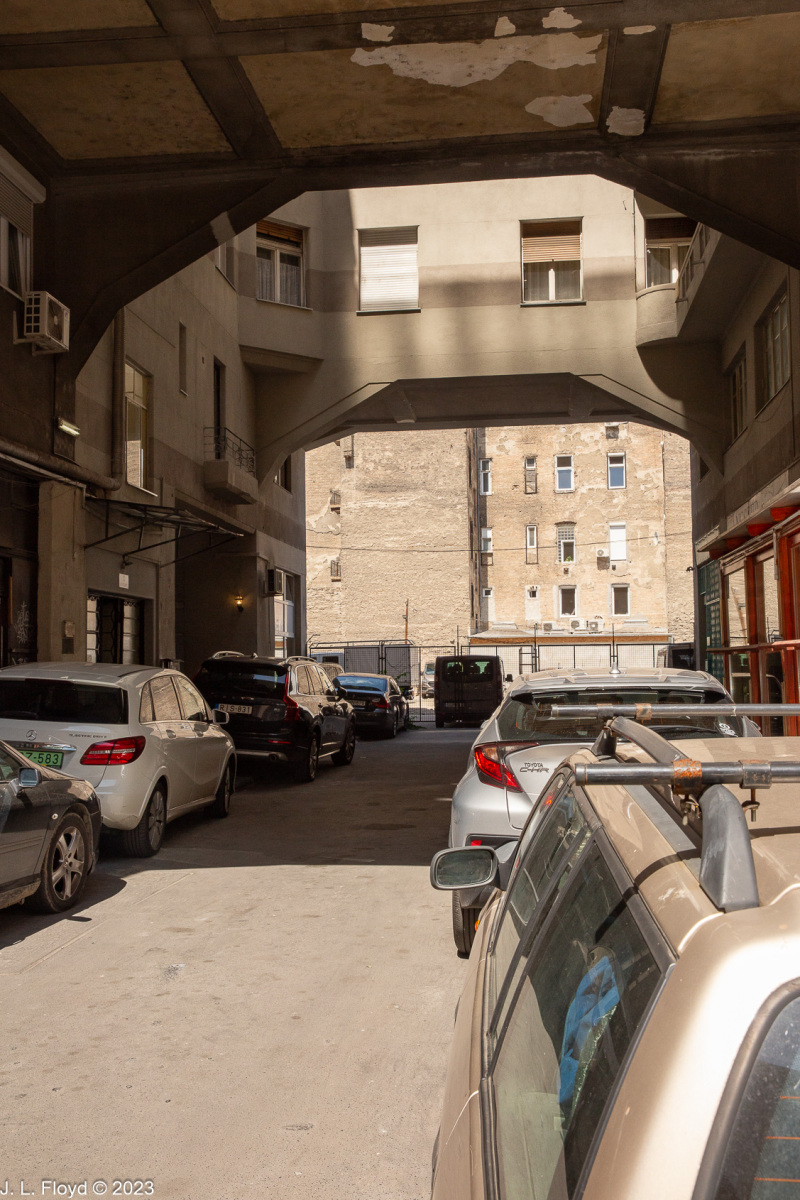
For example, I noticed that in the crowded Jewish Quarter some attempts had been made to maximize the use of real estate by building archways spanning the space between buildings over an intervening street. An example is shown below.

Károly Boulevard and Dohány Street mark the border of the Jewish ghetto of World War II, and the “Gentile” side of the street is lined with upscale apartment buildings, pricey boutiques and posh hotels. Nevertheless, I found a specimen of the ubiquitous Budapest graffiti even here, and in a rather inaccessible yet highly visible place.

Categories
Danube River Cruise, June 2023

Budapest, June 15, 2023: The Dohány Street Synagogue

Budapest’s historic Jewish quarter might well be called the Playground District these days because it appears to be the center of the city’s night life. But that would obscure the fact that the quarter has seen a great deal of history, much of it tragic, which should not be forgotten.

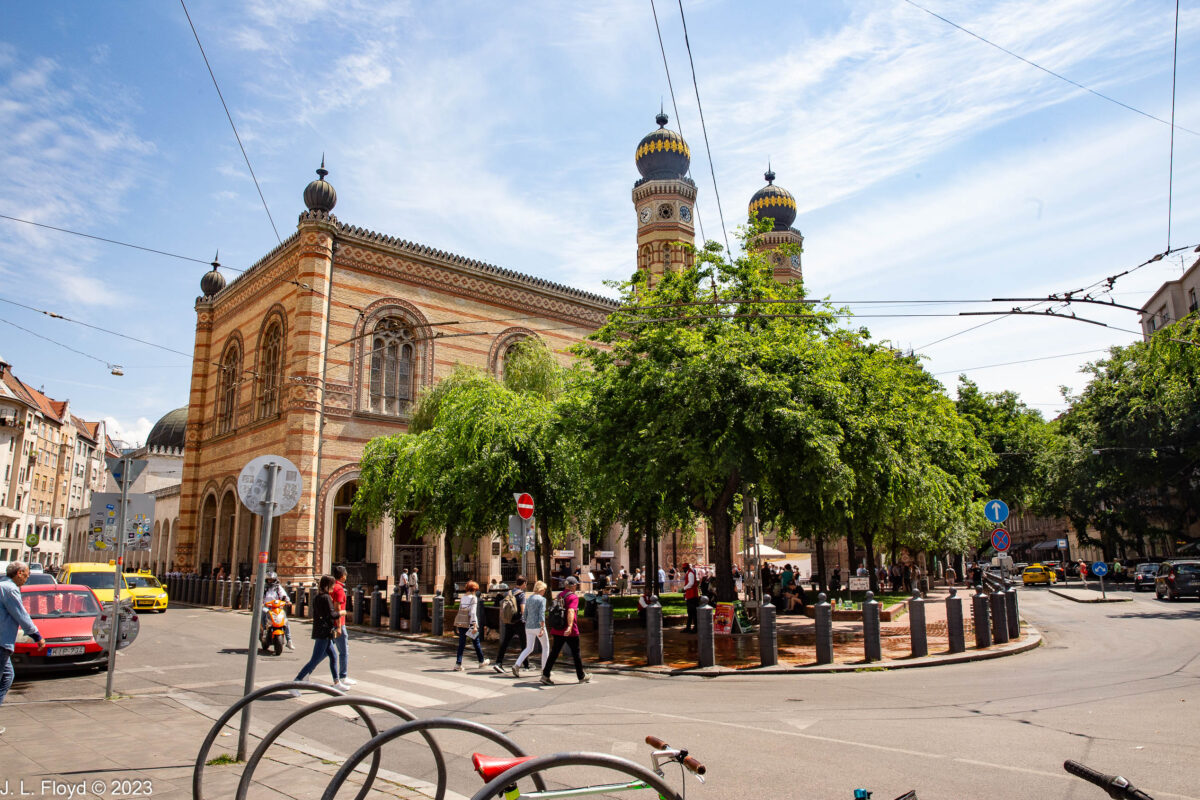
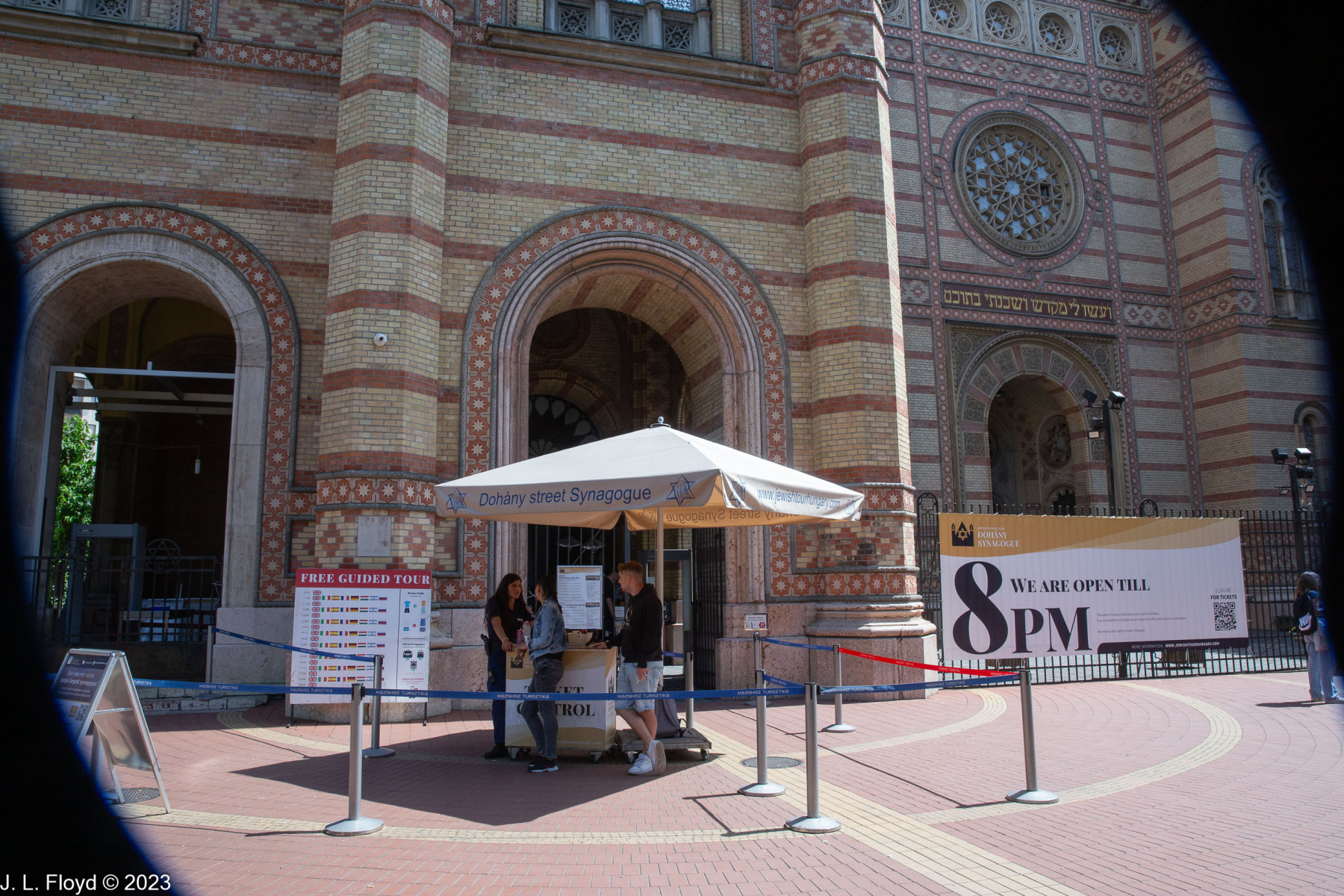
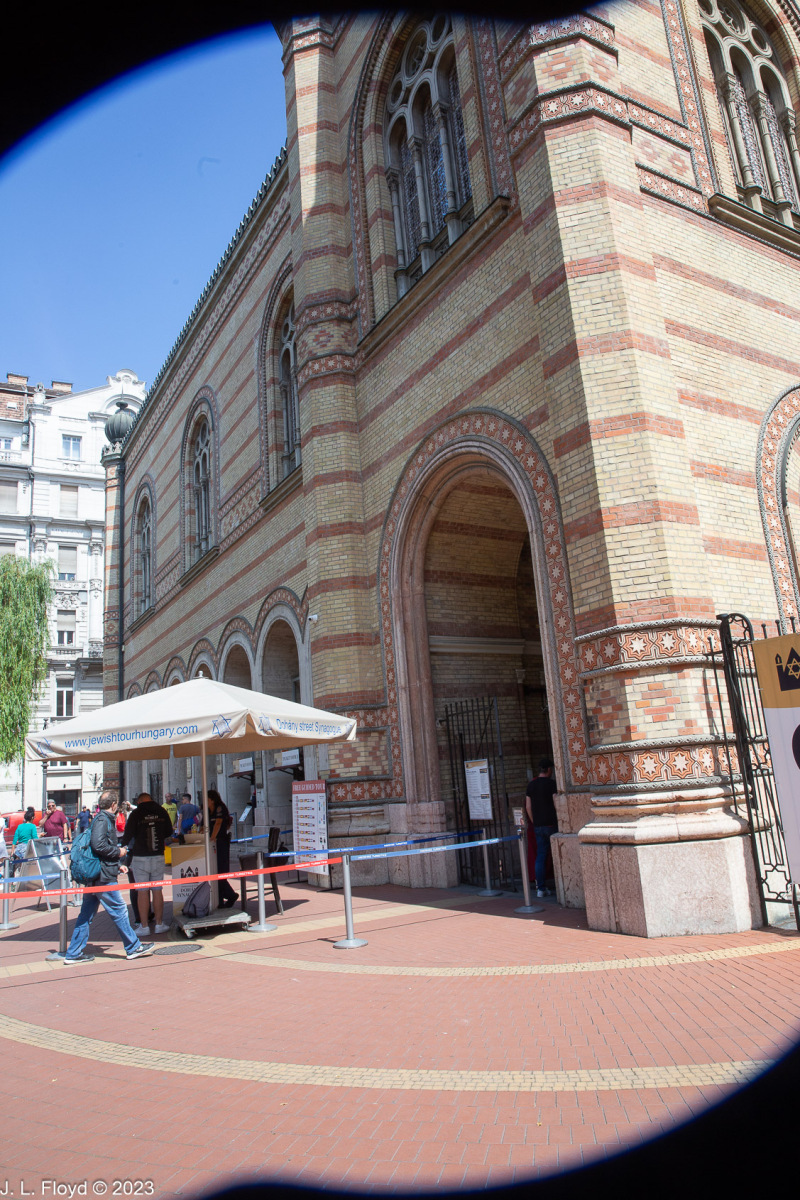
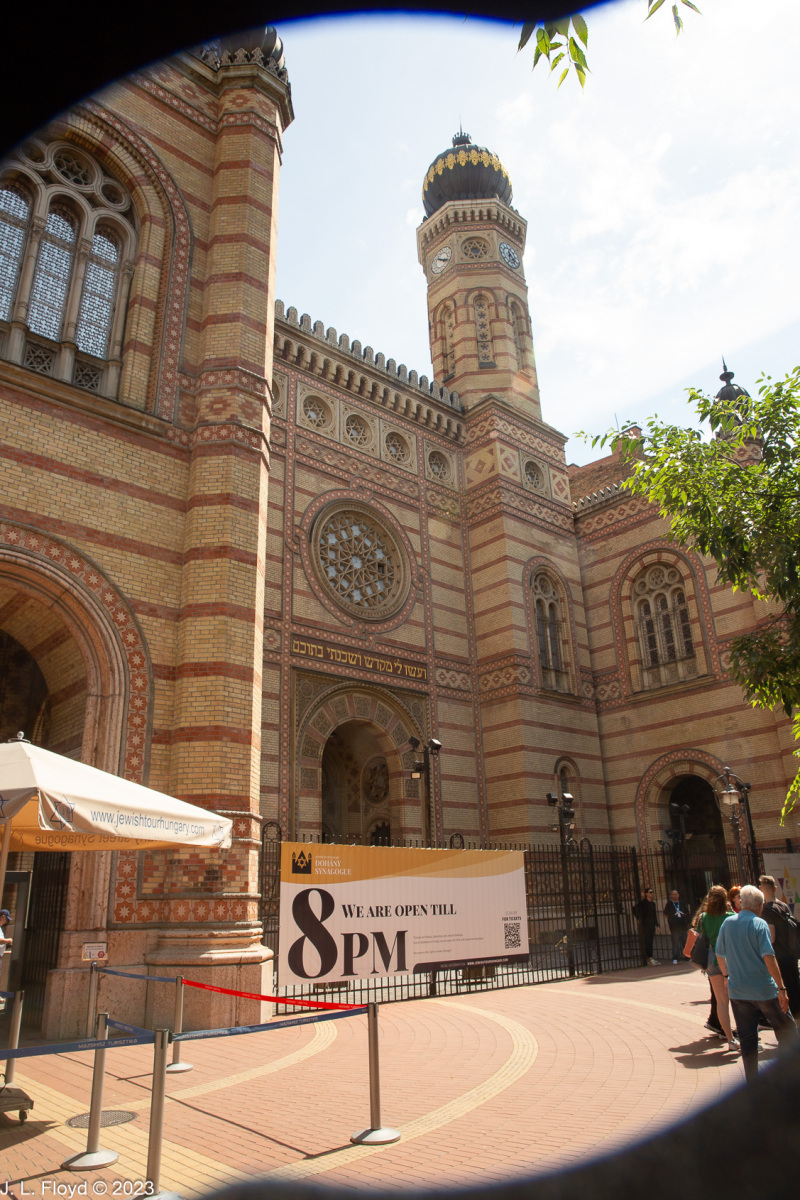
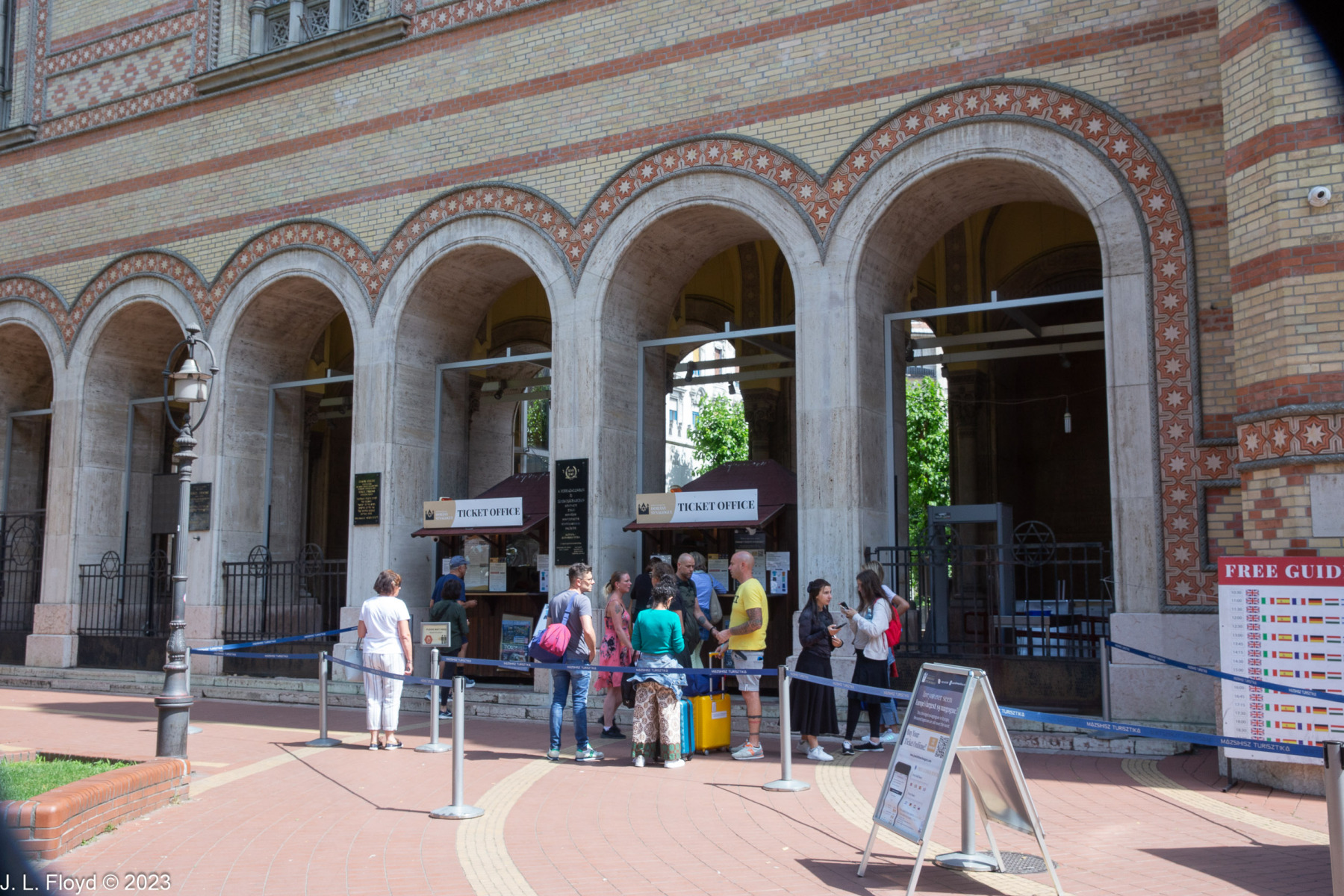
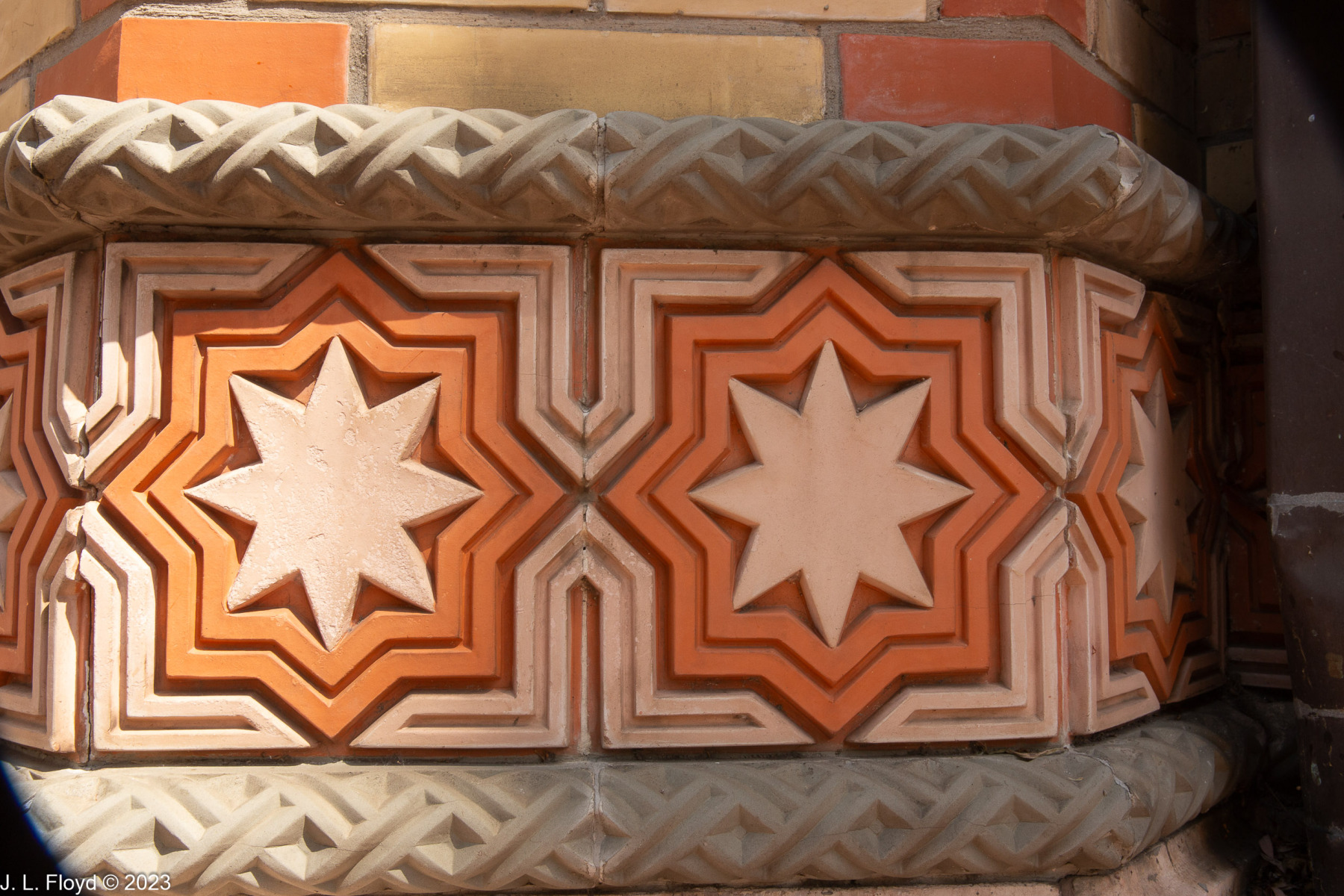
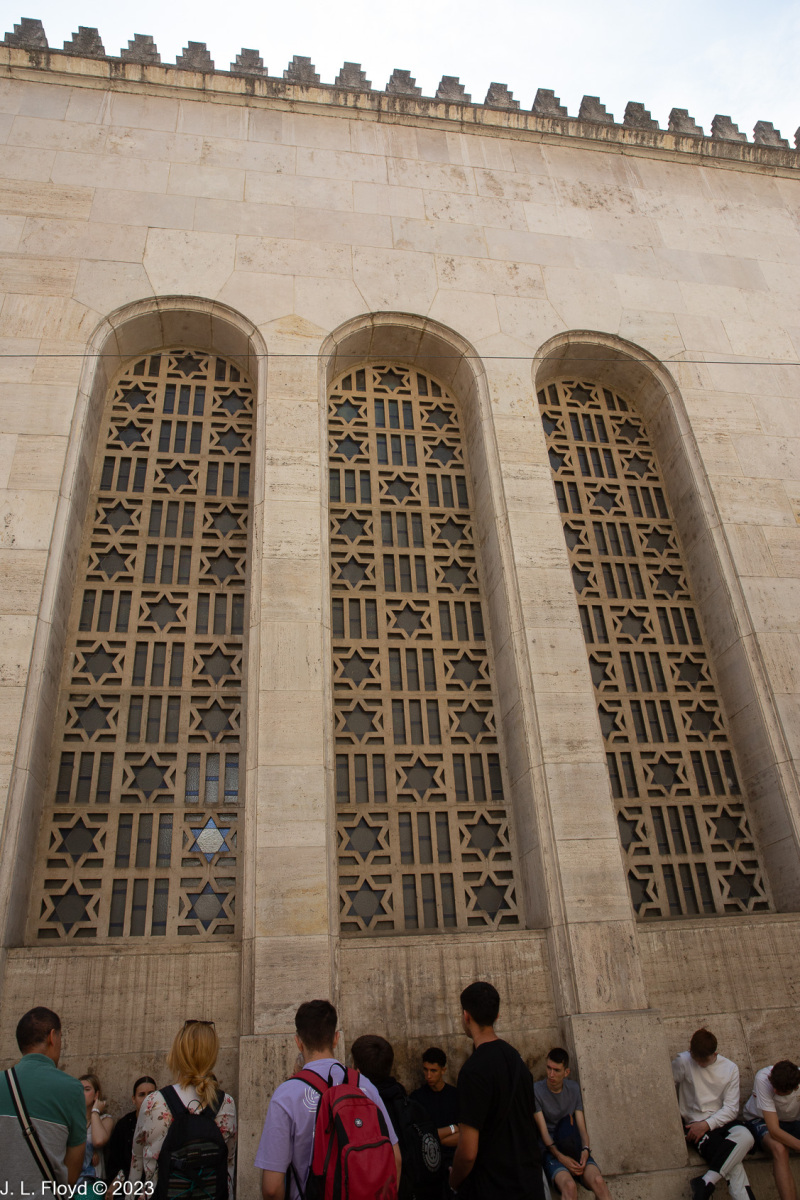
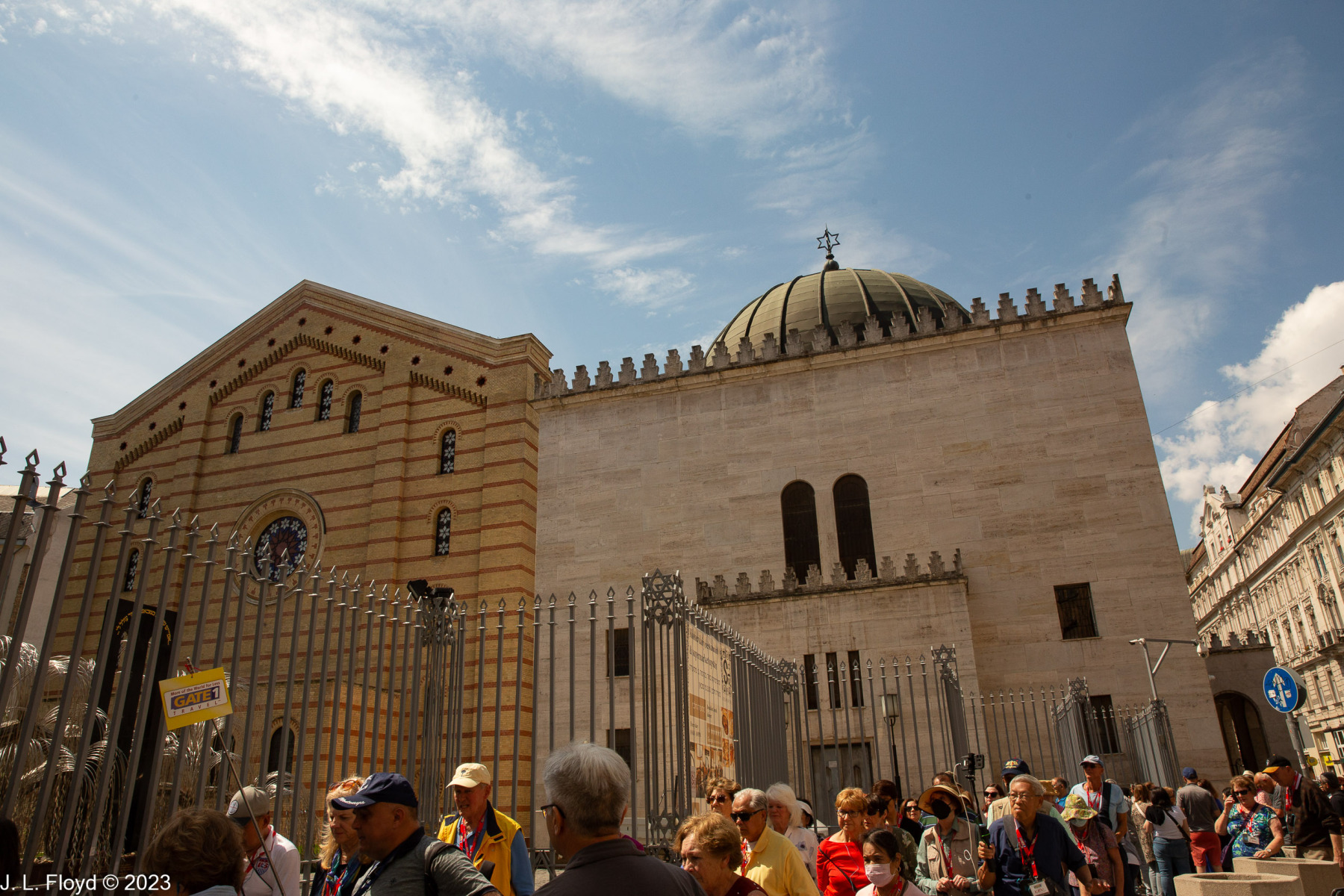
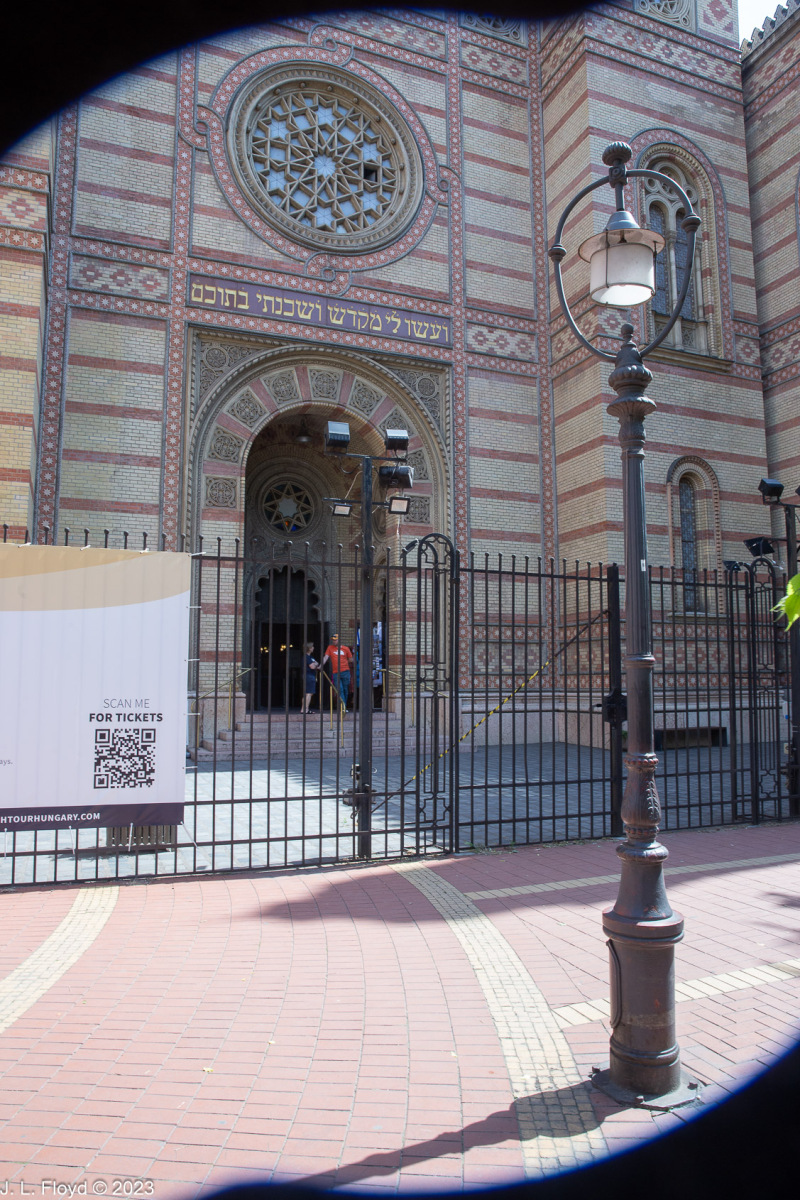
So it was appropriate that we began our tour of the Jewish Quarter at the Dohány Street Synagogue. (Dohány means “tobacco” in Hungarian.) This is the largest synagogue in Europe, seating almost 3,000 people, and the only synagogues in the world that are larger are in Israel and New York. It was built in the 1850s in a Moorish Revival style with an admixture of Byzantine, Romantic and Gothic elements. I’m a big fan of Moorish architecture and I regard the Dohány Street Synagogue as a masterpiece.

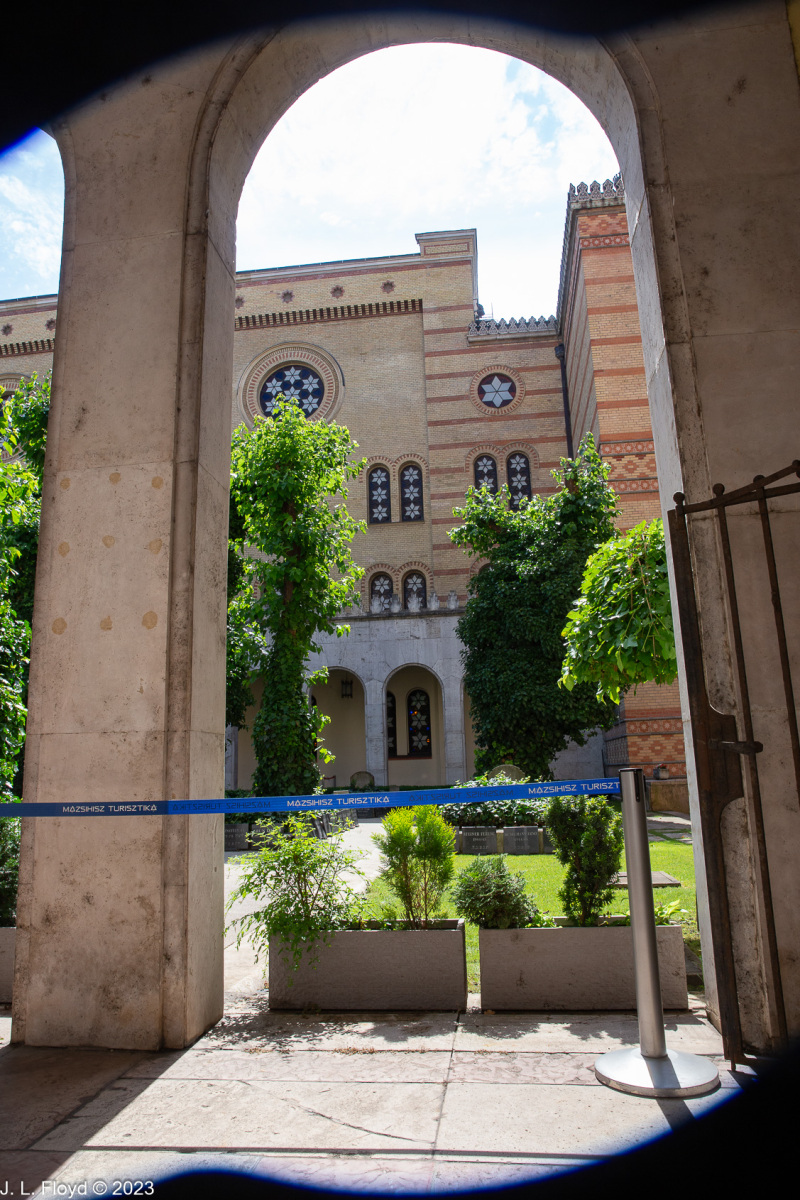
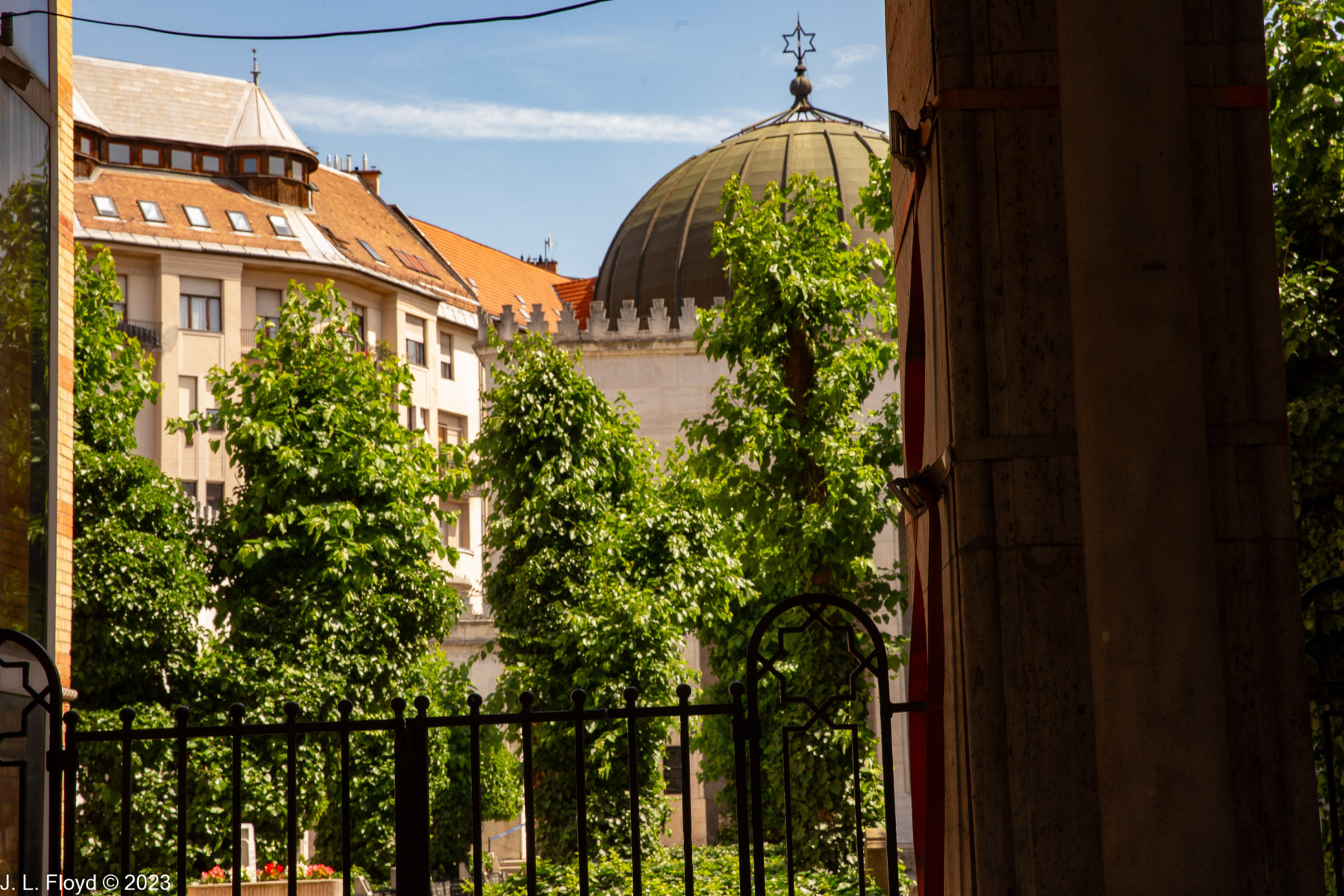
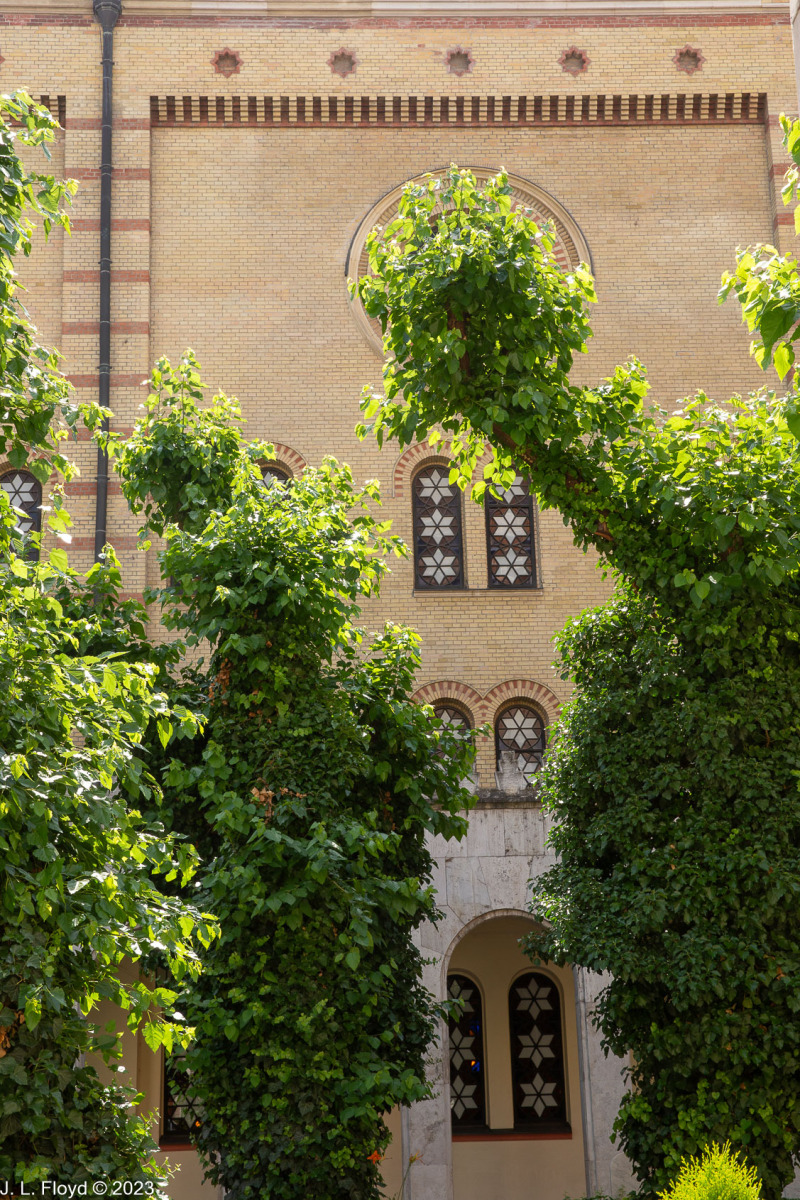
The synagogue played a key role in World War II. Hungary, under the right-wing government of Admiral Horthy, a former Austro-Hungarian admiral, was an ally of Germany in World War II and sent troops to participate in Hitler’s invasion of Russia. In 1944, after the tide turned decisively against the Axis powers, the Nazis perceived that Hungary was wavering in its commitment to the alliance; they sent in the troops and installed a puppet government. Up to that time, the anti-Semitic Horthy regime had conducted sporadic deportations of Jews and allowed occasional atrocities against them, but now Adolf Eichmann took charge and the Holocaust in Hungary began in earnest. In 1944 over 400,000 Jews were deported to Auschwitz. Those who were not deported were mostly relocated to the Jewish ghetto in Budapest. About 119,000 remained in the ghetto by the time the Russians liberated the city in January 1945. The Dohány Street Synagogue served as a refuge for many Jews who were unable to find quarters elsewhere in the crowded ghetto. Nevertheless, the winter of 1944-45 was a cruel one, and many ghetto residents died of cold and hunger. About 2,000 of them are buried in a makeshift cemetery behind the synagogue. The cemetery courtyard is a place of verdant beauty and tranquility, with walls, arches, windows surrounding a garden, all reminiscent of Moorish palaces in Spain.

The cemetery courtyard is walled on one side by the Heroes’ Temple, an adjunct to the synagogue built in 1931 to commemorate the Jewish soldiers who lost their lives fighting with the Austro-Hungarian army during World War I. On the other side of the Heroes’ Temple is the Raoul Wallenberg Holocaust Memorial Park. As most people know these days, Raoul Wallenberg was a Swedish diplomat who managed by various subterfuges to save thousands of Jews from Nazis and Hungarian fascists during the terrible days of 1944. In January 1945 he was arrested on suspicion of espionage by the infamous Soviet counterintelligence organization SMERSH (abbreviation for the Russian words smert’ shpionam, “death to spies”), depicted somewhat cartoonishly in Ian Fleming’s James Bond novel From Russia with Love. Twelve years later, in 1957, the Soviets reported that he had died of a heart attack in 1947, while imprisoned in the notorious Lubyanka prison in Moscow. There is no need to dwell on the suspiciousness of the Soviet account.

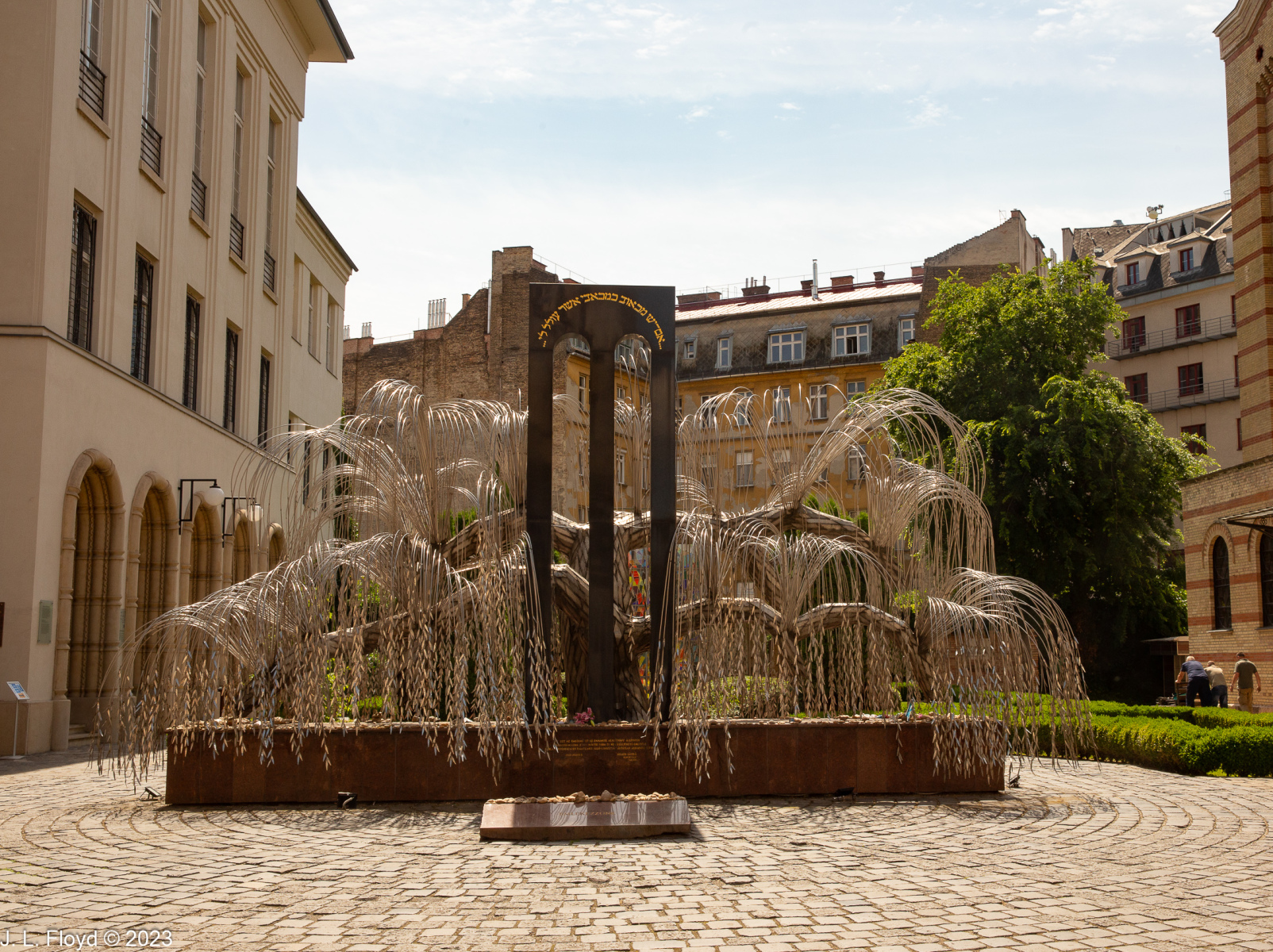
The Raoul Wallenberg Holocaust Memorial Park contains two memorials: one to Wallenberg and other persons, mostly diplomats, who saved thousands of Jews from the gas chambers by various subterfuges; and the second to the over 400,000 Hungarian Jews who died in the Holocaust. The latter, known as the Emanuel Tree, is in the form of a weeping willow tree, made of metal, each leaf of which is inscribed with the name and tattoo number of a victim.

Categories
Danube River Cruise, June 2023

Budapest, June 15, 2023: Heroes’ Square and City Park

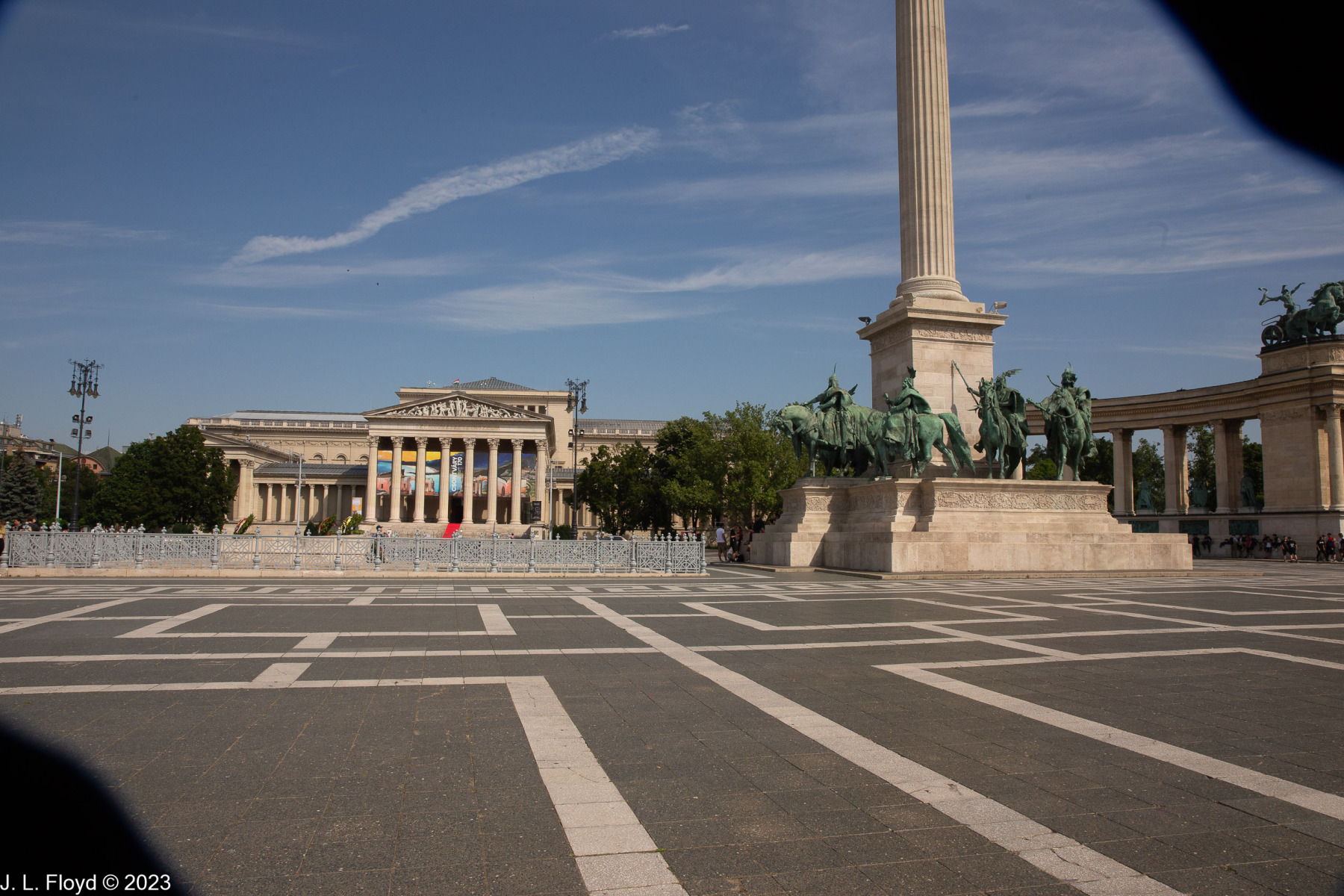
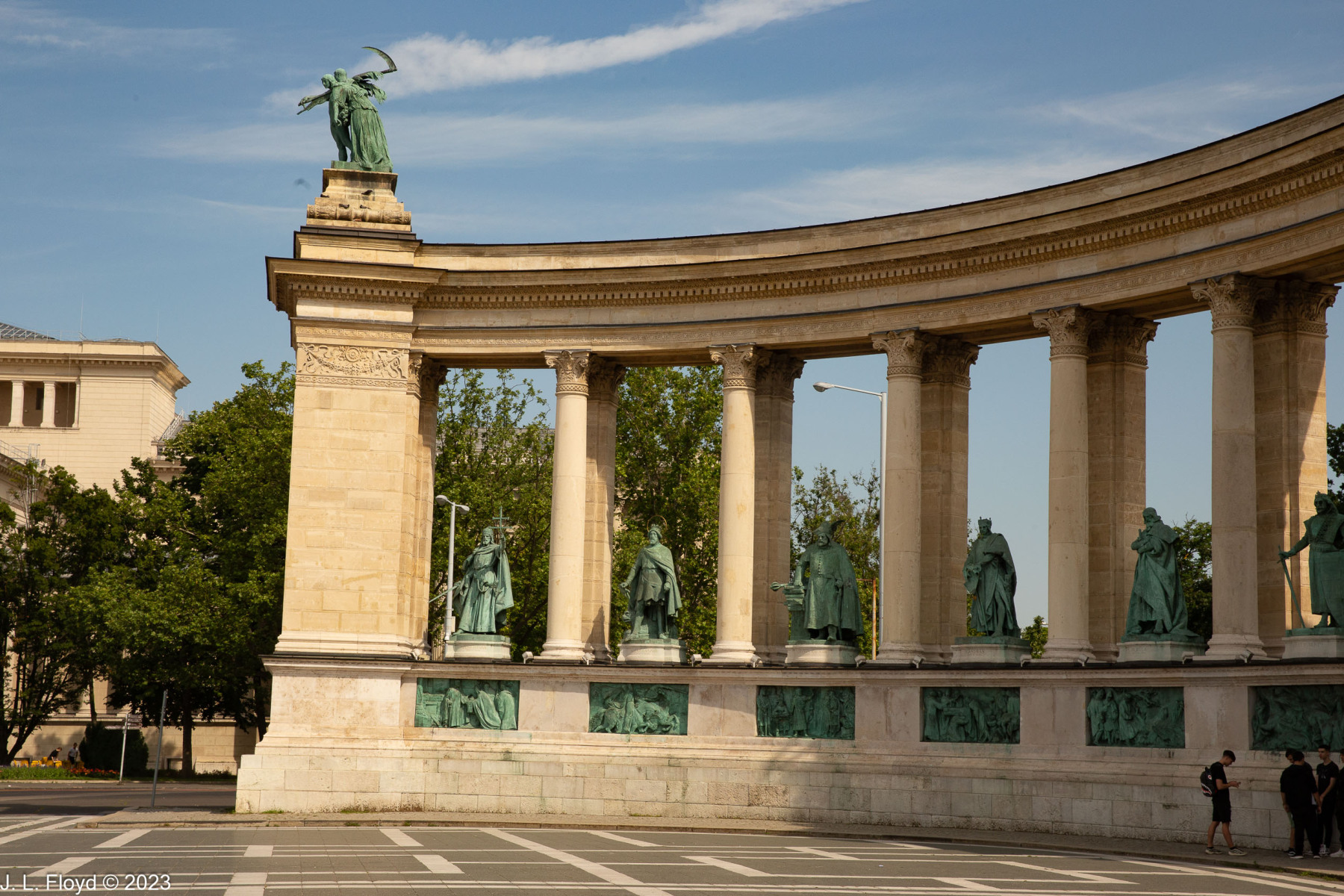
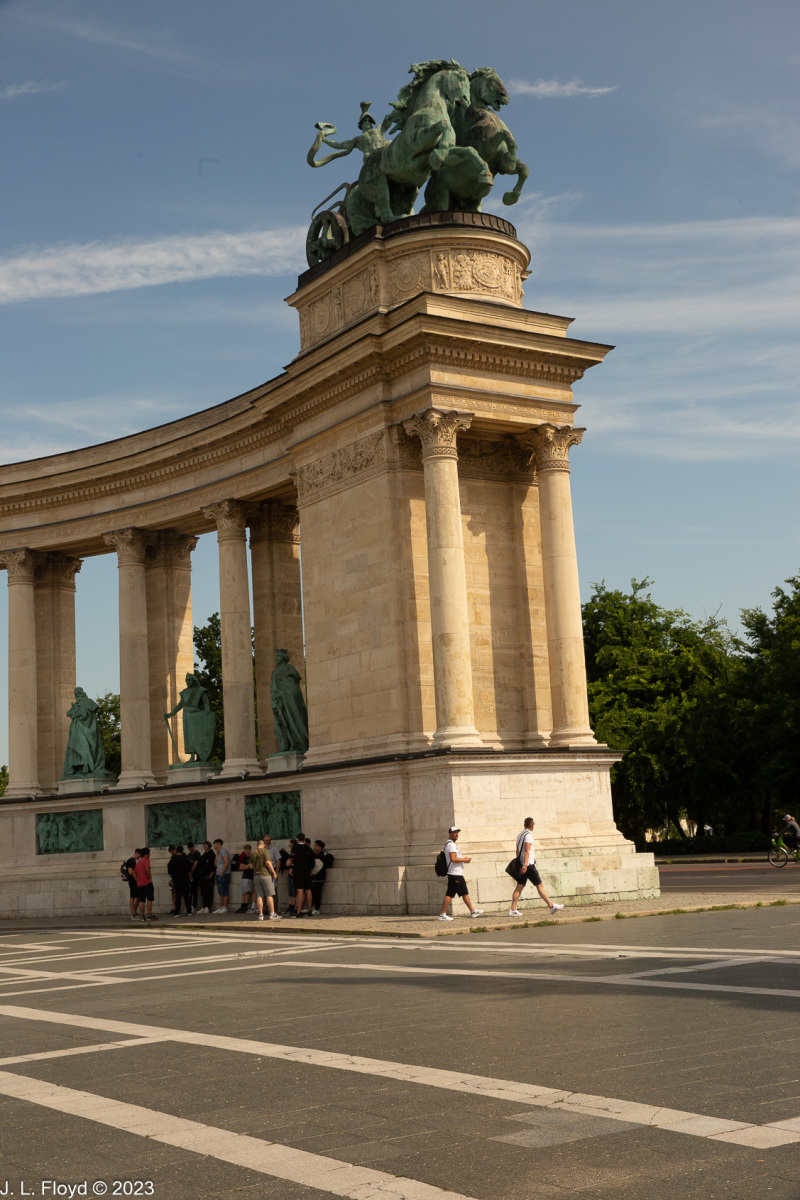
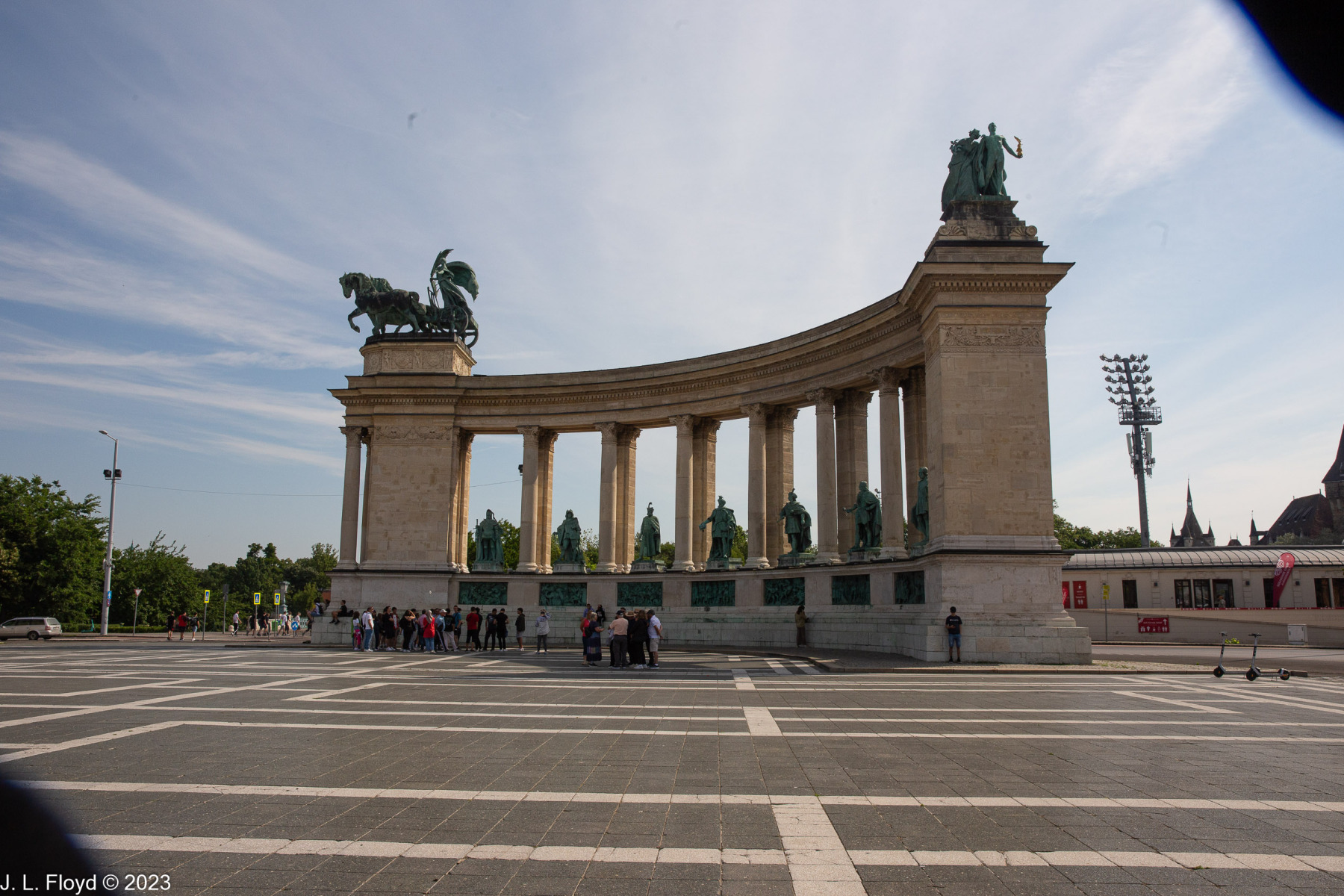
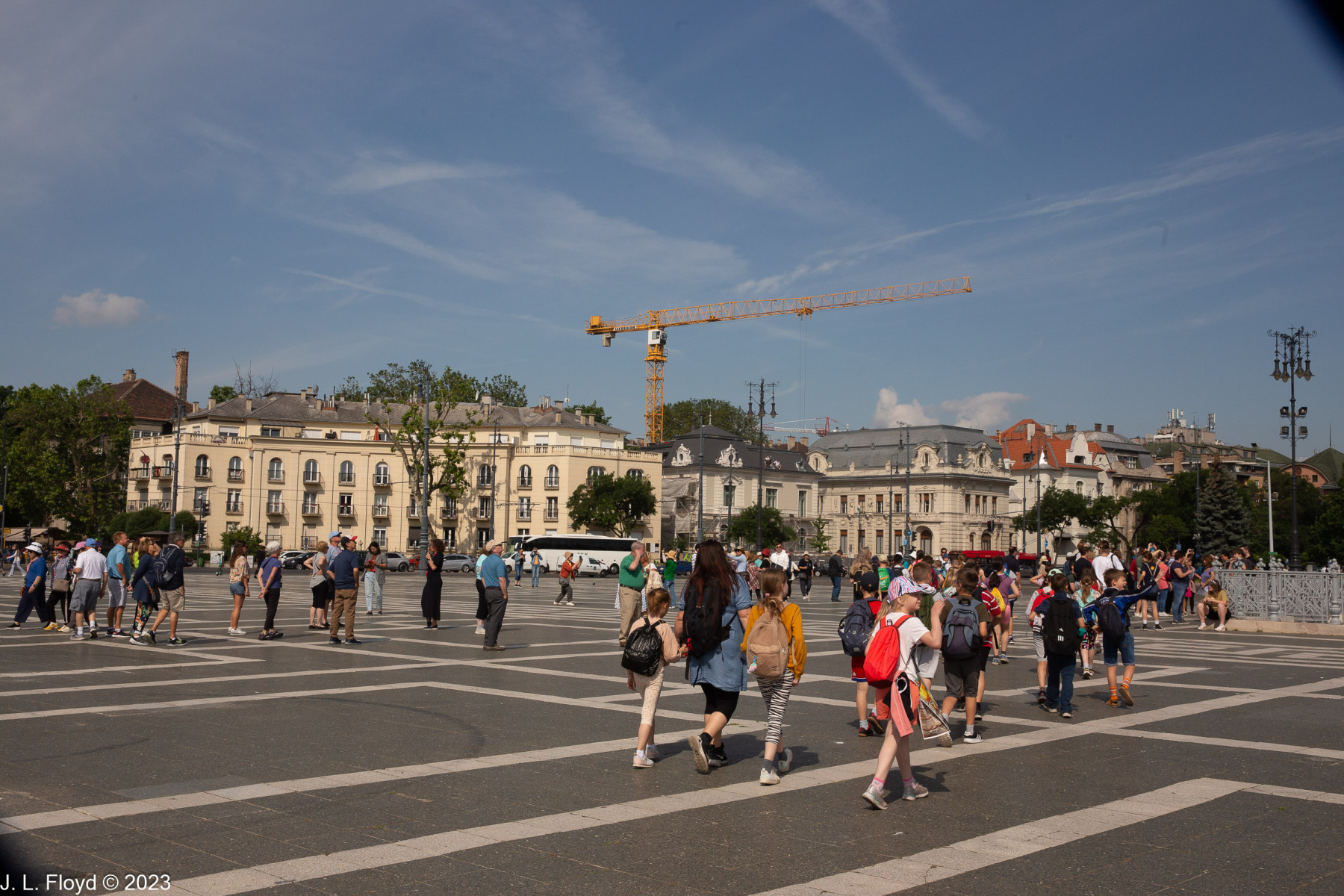
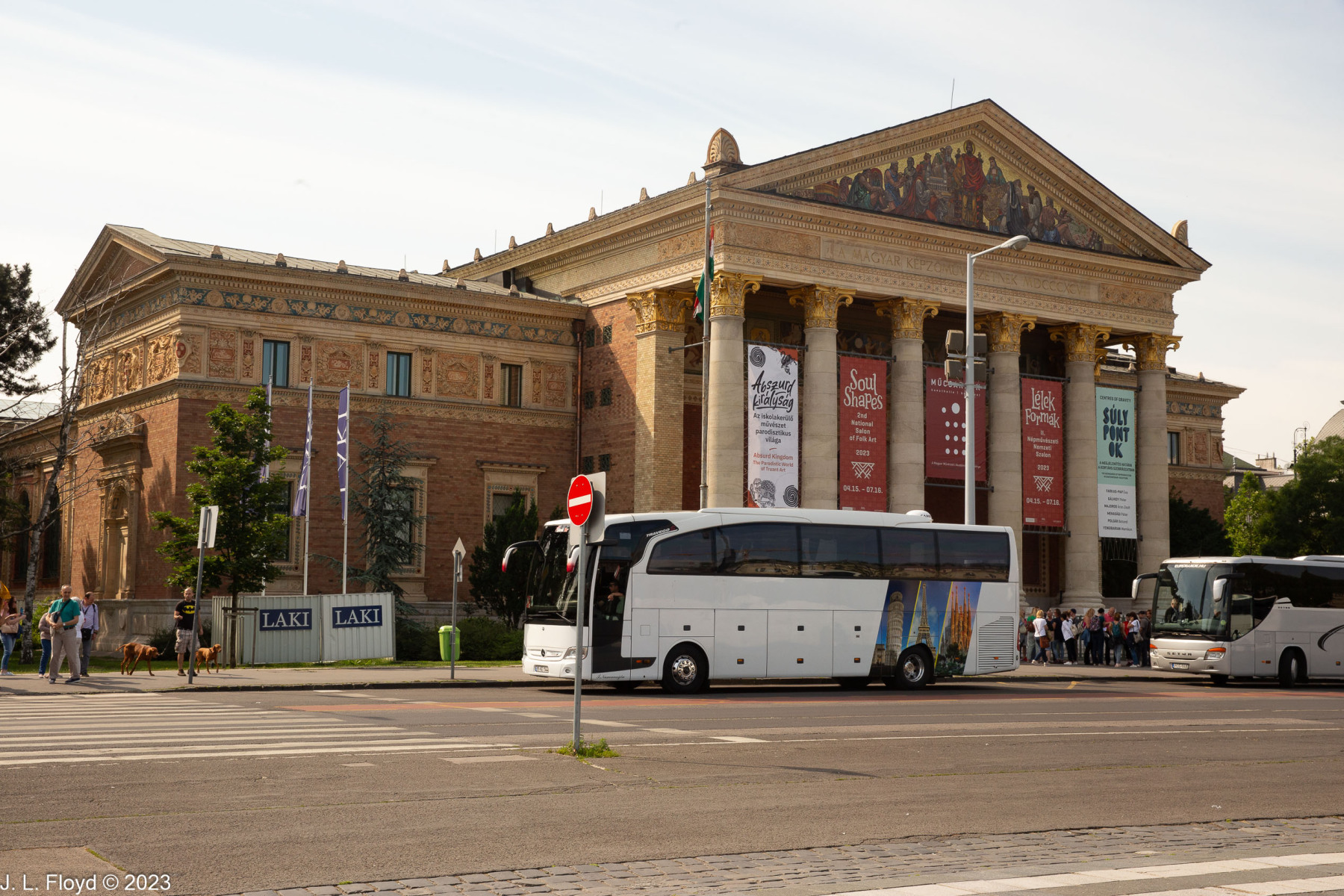
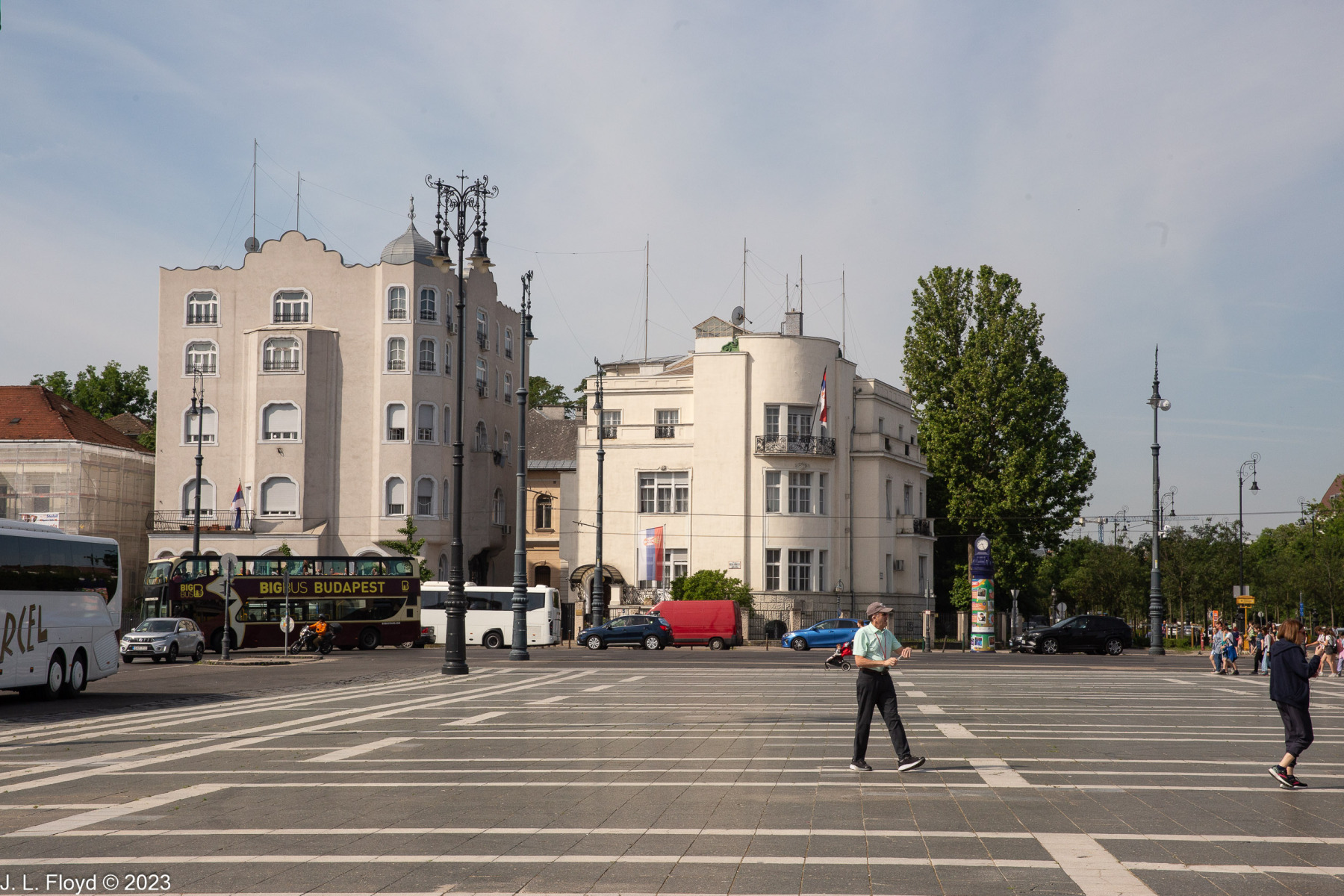
Our first full day in Budapest began with a visit to Hősök tere, Heroes’ Square, where some of the major milestones of Hungarian history are memorialized.

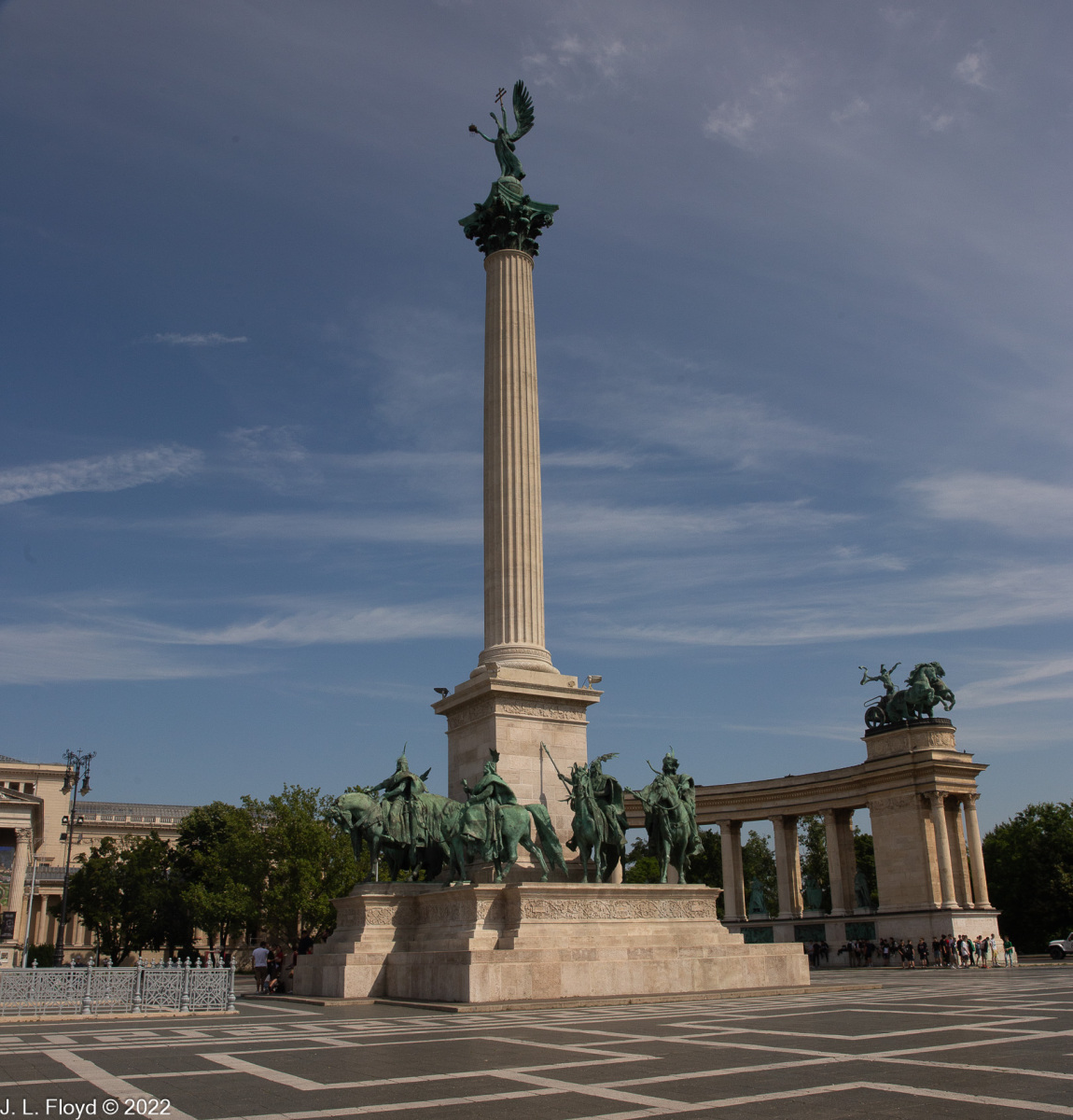
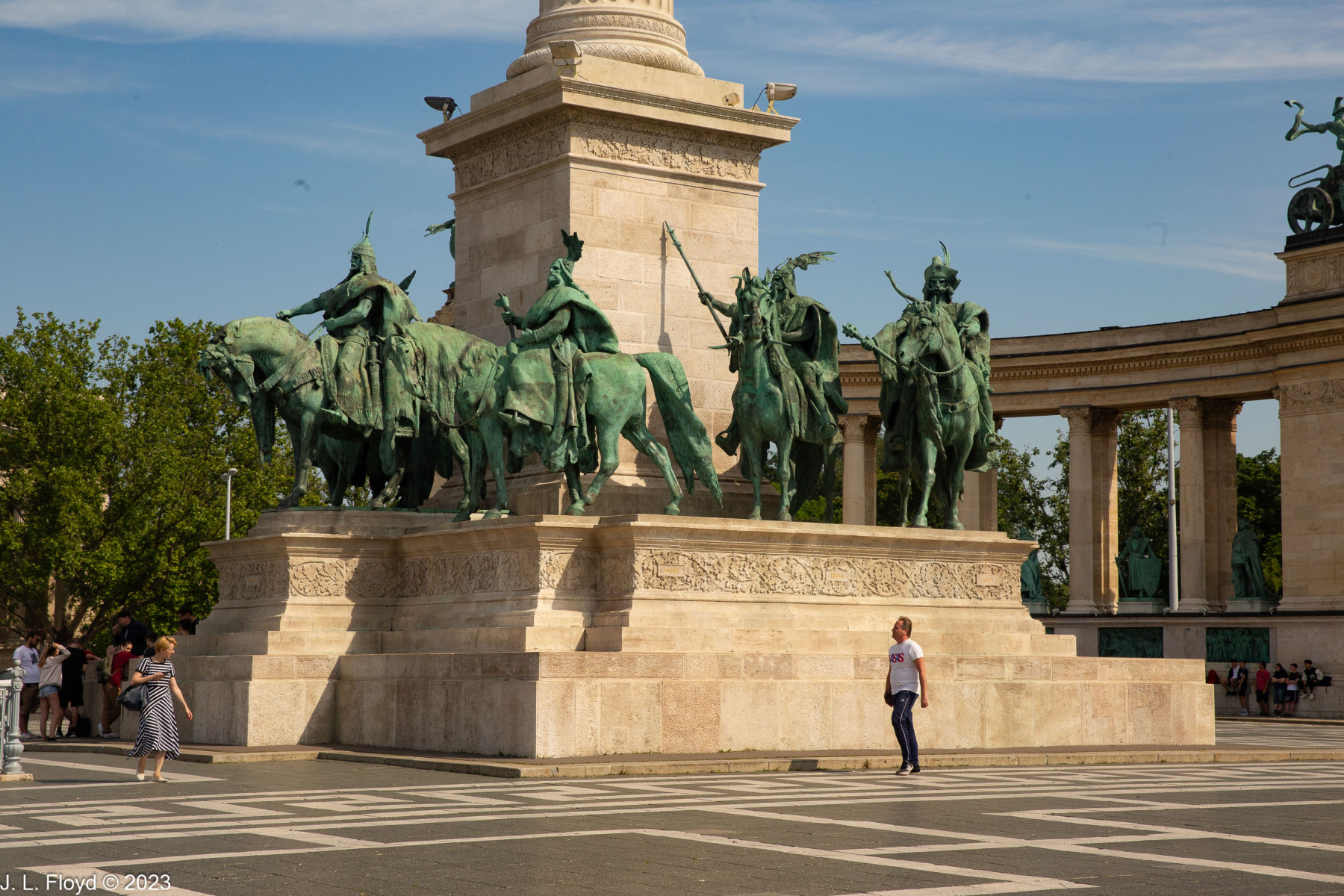
The centerpiece of Heroes’ Square is the Millenium Column, 36 meters (118 feet) high, with a statue of the Archangel Gabriel on top, holding a crown in one hand and a two-barred apostolic cross in the other. At the base of the column are mounted figures representing the Seven Magyar Chieftains, a group of semi-legendary figures who are supposed to have led the ancestors of the Hungarians into the land they have occupied ever since. Other than Árpád, considered to be the founder of the Hungarian nation, little is known about these men, and there are many uncertainties about Árpád’s life as well. In any case the equestrian statues are not intended to be realistic depictions.

What is well known is that in the late ninth century CE, a group of nomadic tribes known as the Magyars established themselves in the Carpathian basin, in the territory known to the Romans as Pannonia. They had previously lived in the Pontic steppes, north of the Black Sea, where they had been a thorn in the side of the Slavic people who later became the Russians, and had been in their turn harassed by Turkic nomadic peoples such as the Khazars, Bulgars and Pechenegs. The Magyars themselves were not Turkic but spoke – and still speak – a Uralic language, akin to Finnish. They originated in Central Asia and Siberia, where some Uralic languages are still spoken today. However, as nomadic horsemen they necessarily led an existence similar to the neighboring Turkic tribes and consequently developed a similar social structure, and eventually some of those tribes joined them in their migrations.

In any case, partly under pressure from their enemies, the Magyars moved west of the Carpathians and settled in the plains of the trans-Danubian basin, where they then became a thorn in the side of the neighboring German, Slavic and Vlach (Romanian) peoples. They had a reputation as particularly savage fighters, raiding the villages, slaughtering all the men and carrying off the women and children. However, this could not last, and in 955 the German king Otto I, later Holy Roman Emperor, inflicted a shattering defeat on the Magyars in the Battle of Lechfeld, ending their forays into Germany. In the following half-century the Magyars began to settle down, adopt a more sedentary lifestyle and convert to Christianity.

In front of the Millenium Column in Heroes’ Square is a large stone cenotaph – a symbolic tomb not containing any actual remains – that serves as a memorial to all those who died in defense of Hungarian liberty and independence.

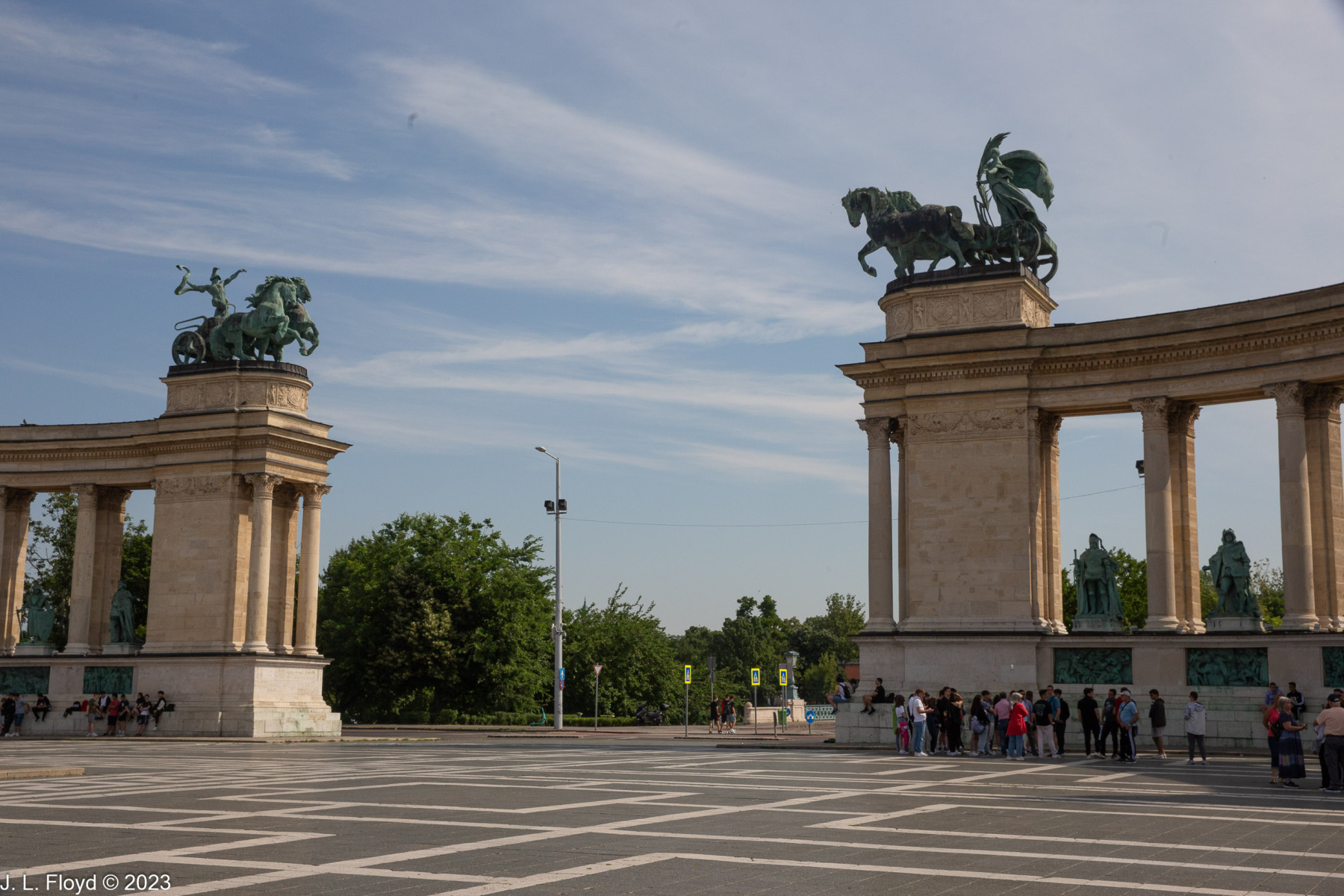
Behind the column is a pair of semicircular colonnades, each containing statues of major figures of Hungarian history, and topped with symbolic theme sculptures: outer edge of the left colonnade, a statue of a man with a scythe and a woman sowing seed, representing Labor and Wealth; on the inner edge, a male figure, representing War, driving a chariot using a snake as a whip. Opposite War on the right colonnade is a woman in a chariot holding a palm frond, personifying Peace, and on the outer edge of the right colonnade, statues of a man and a woman, representing Knowledge and Glory.

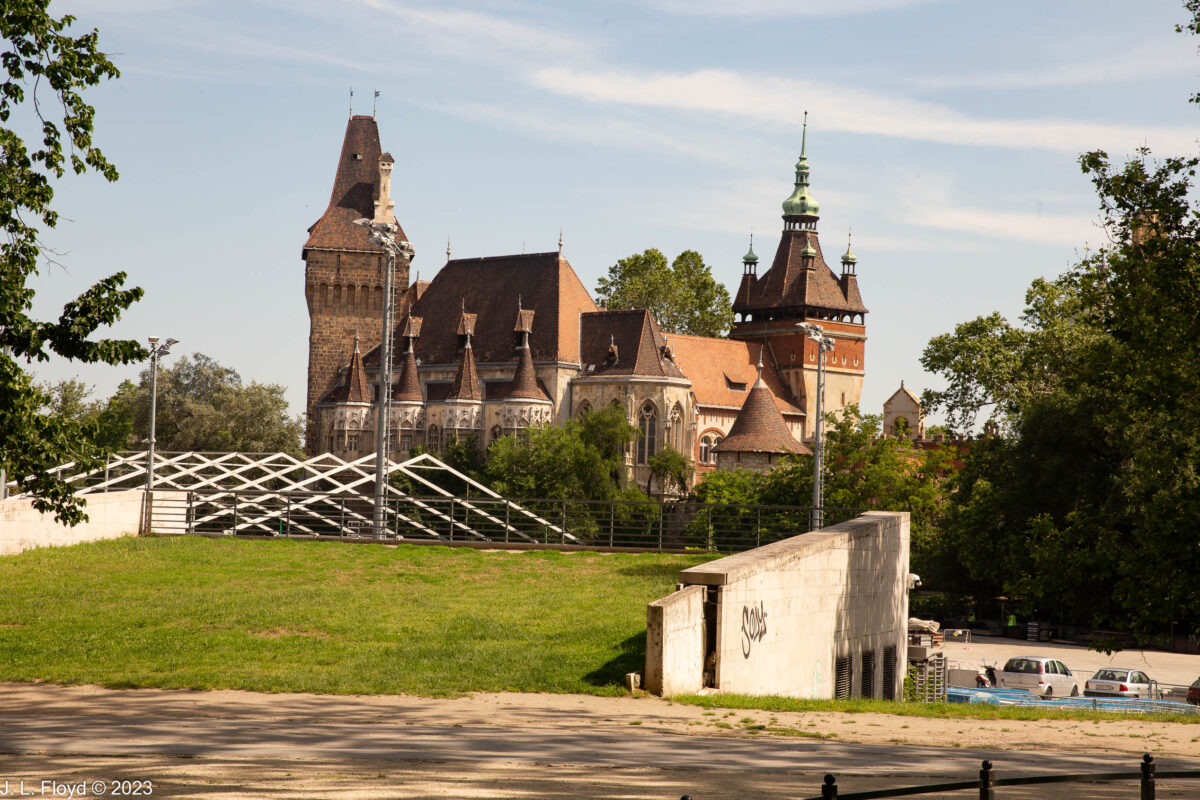
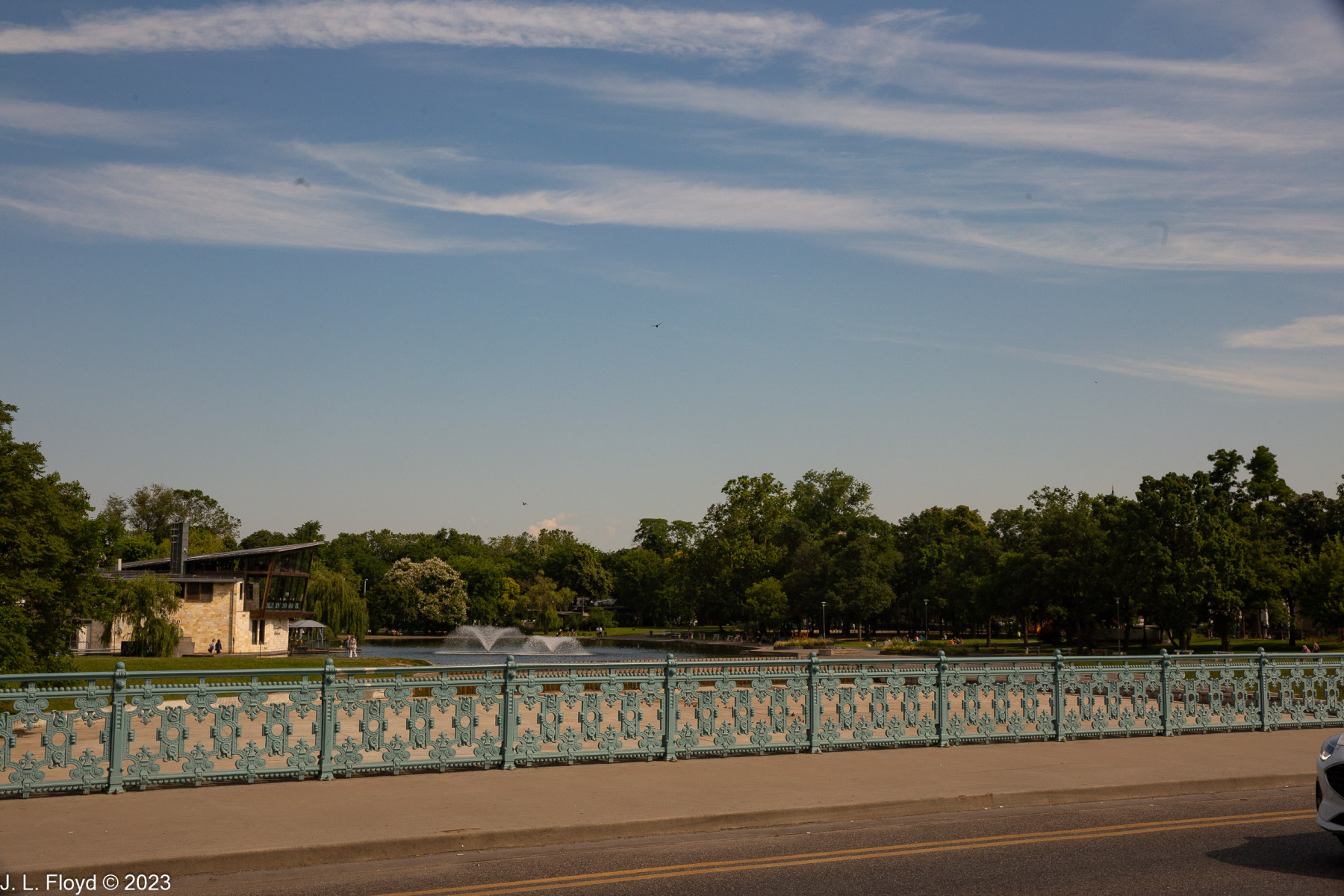
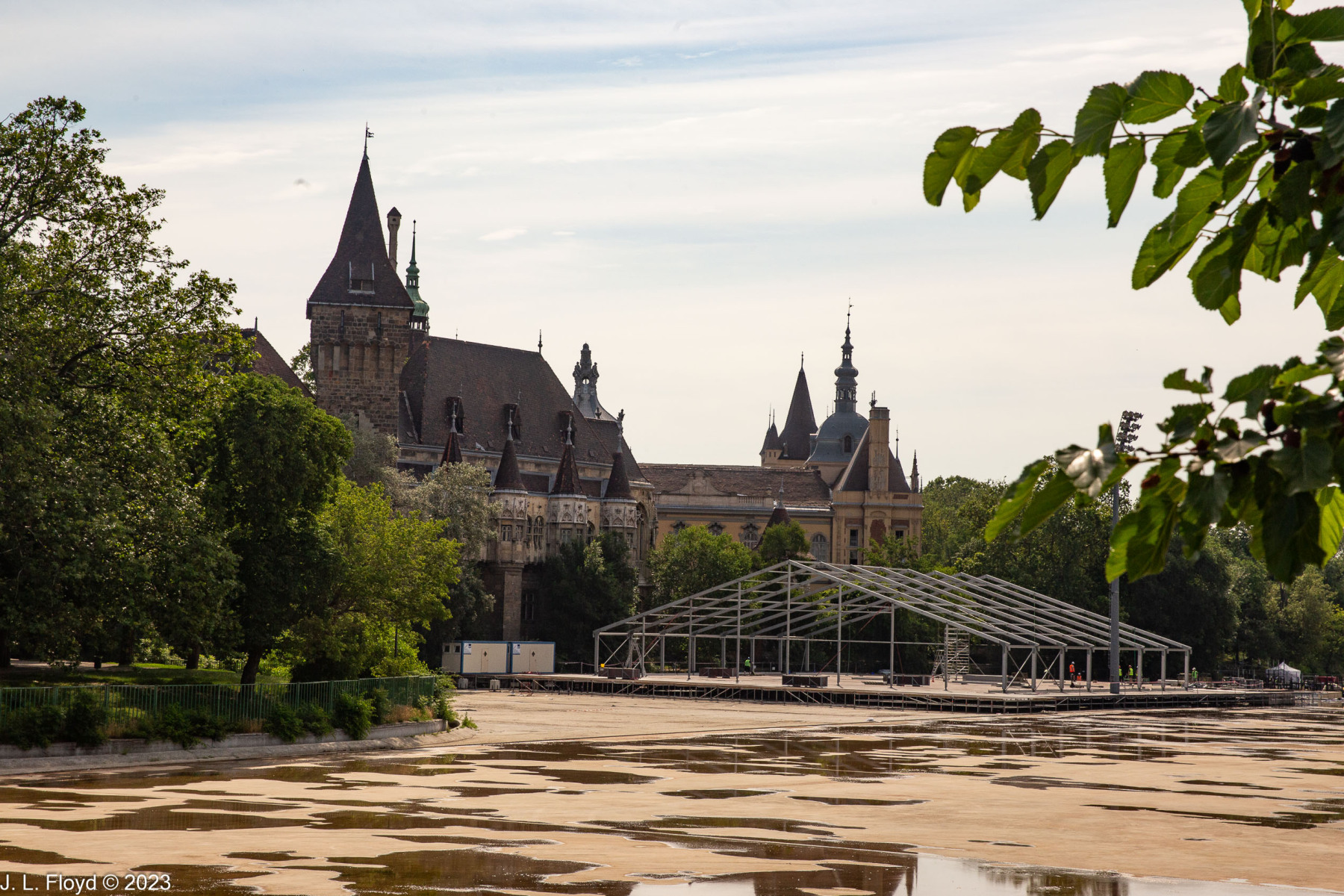
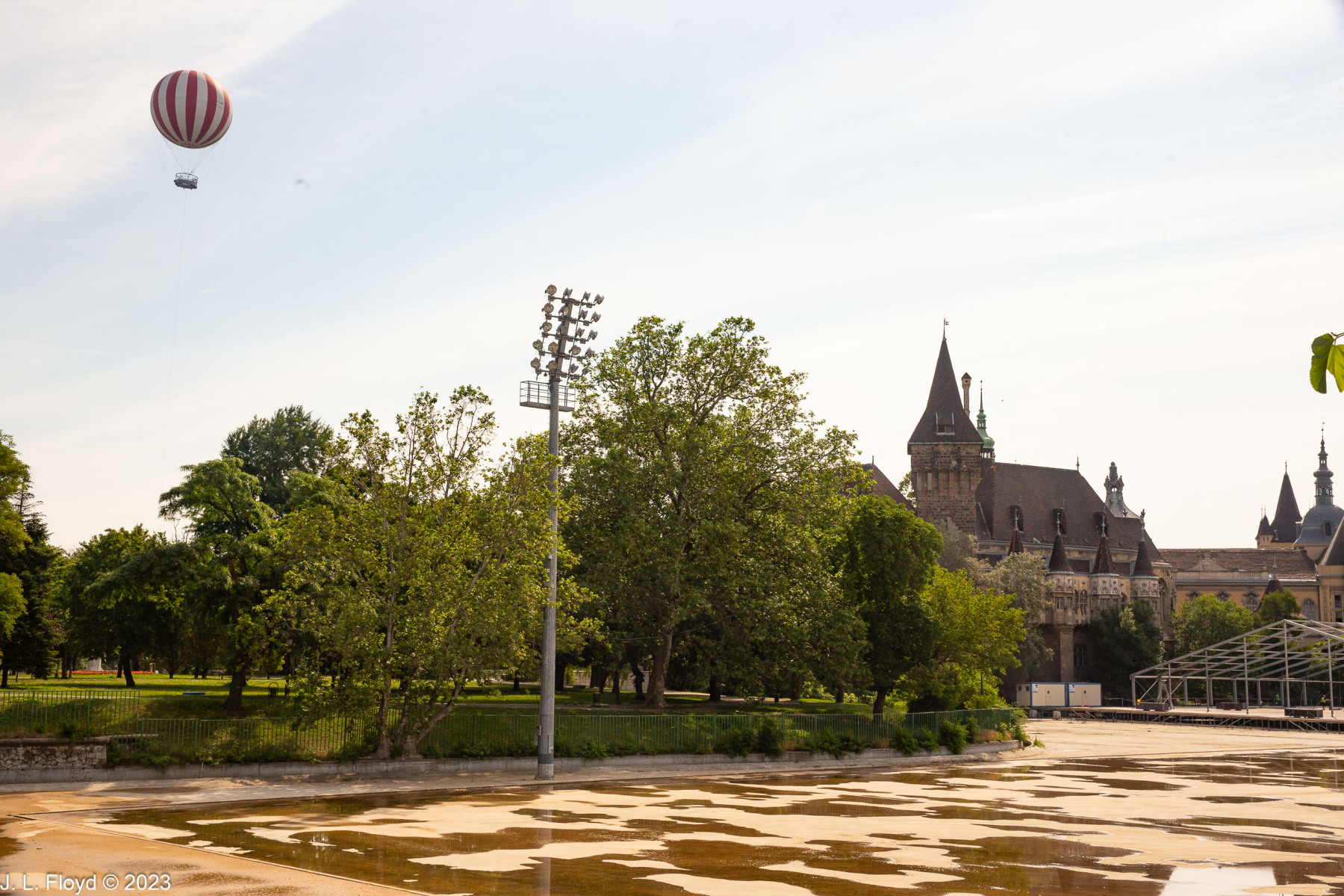
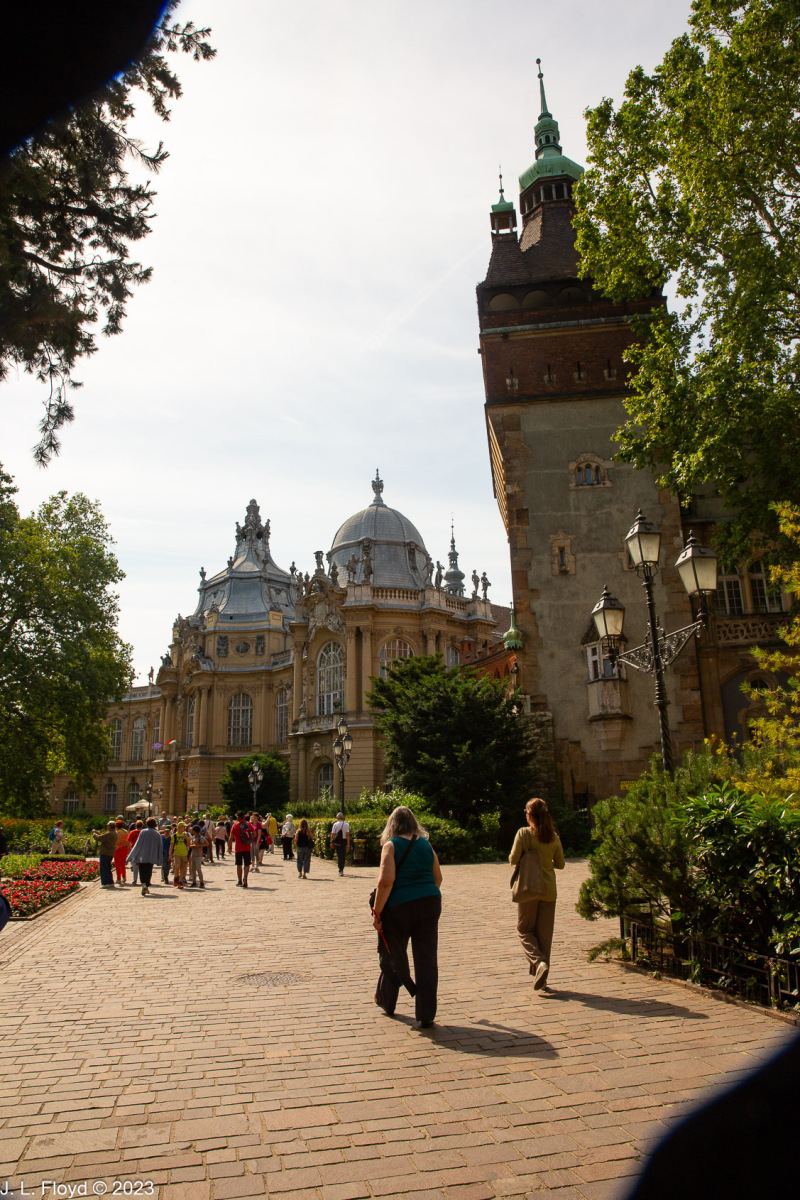
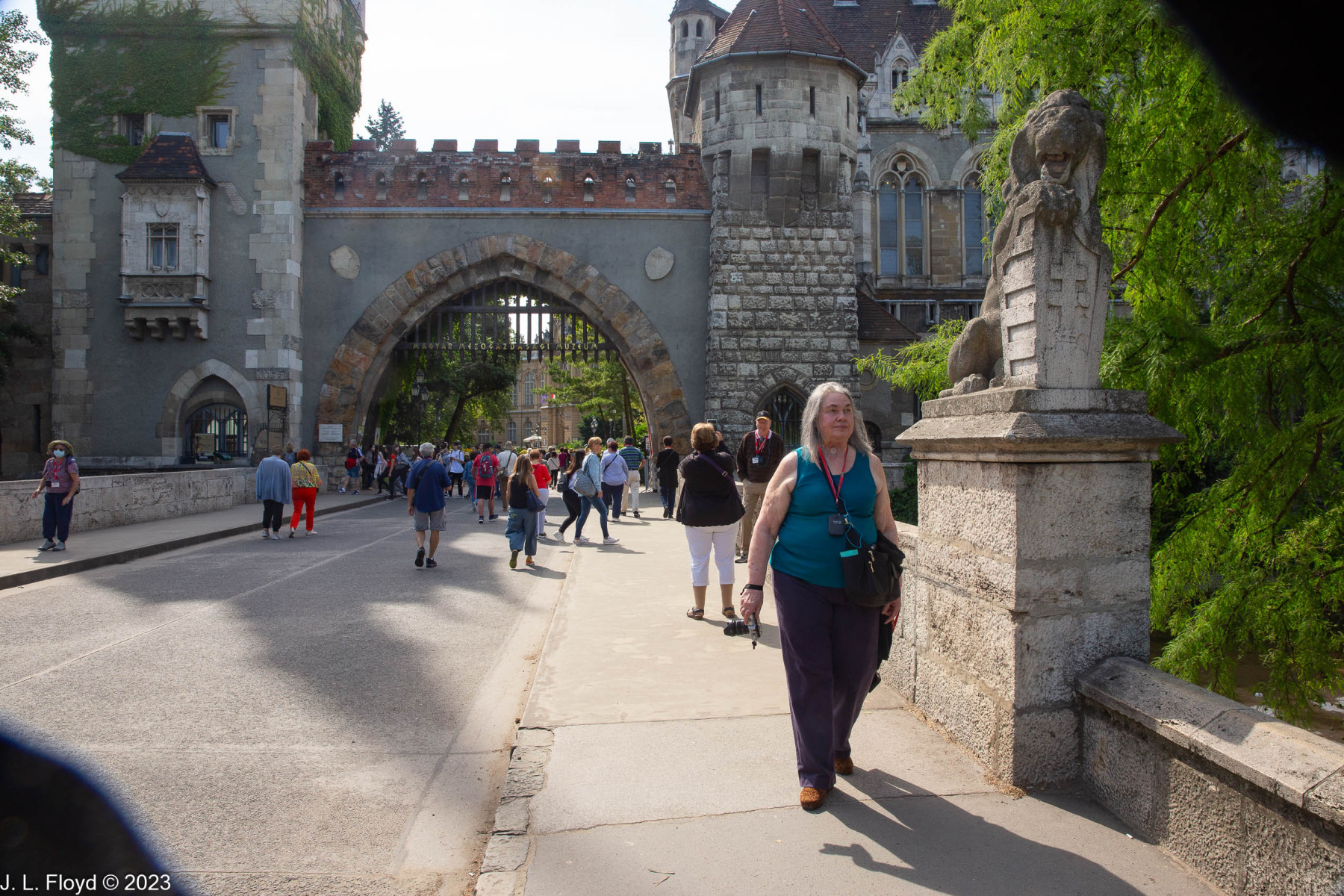
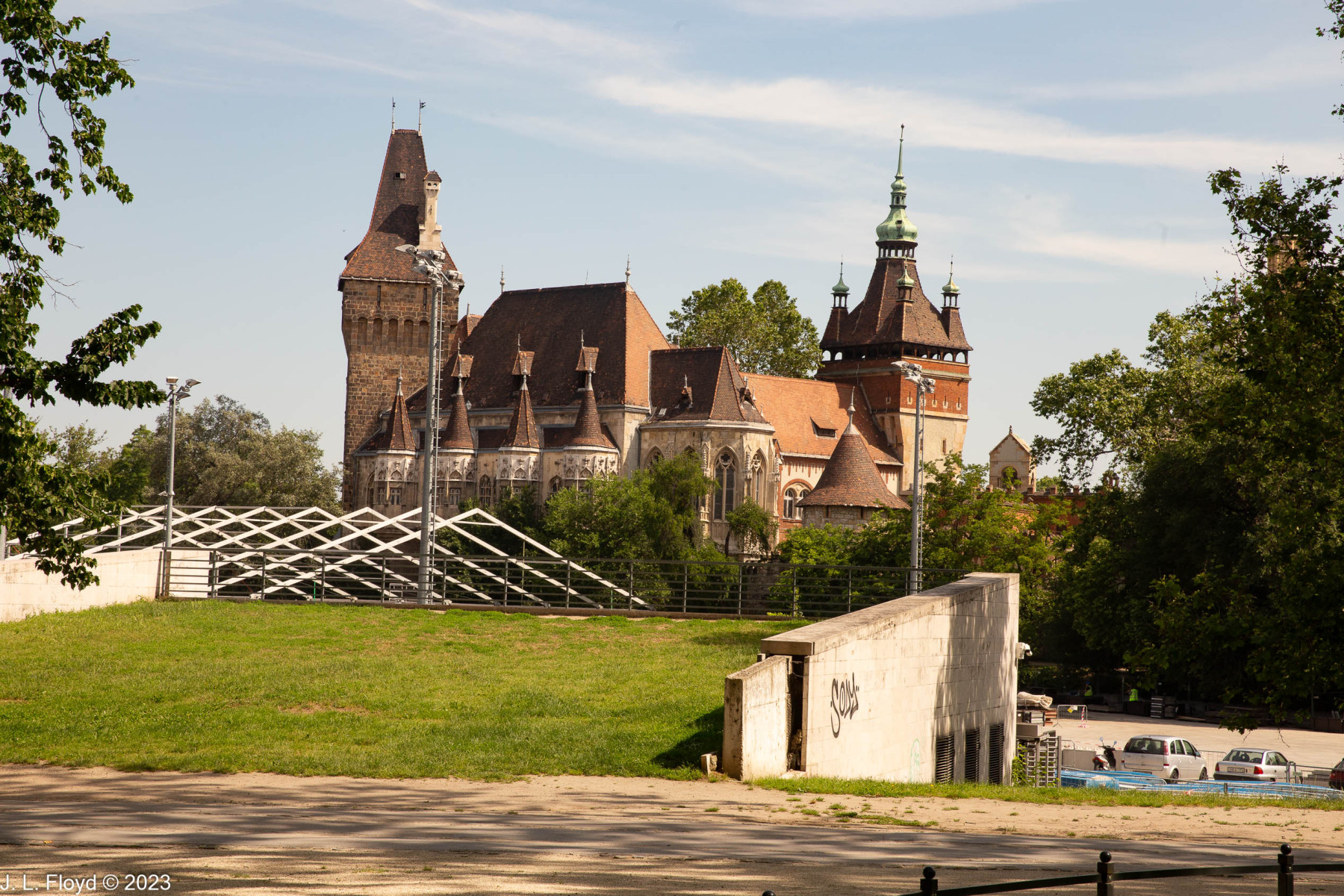
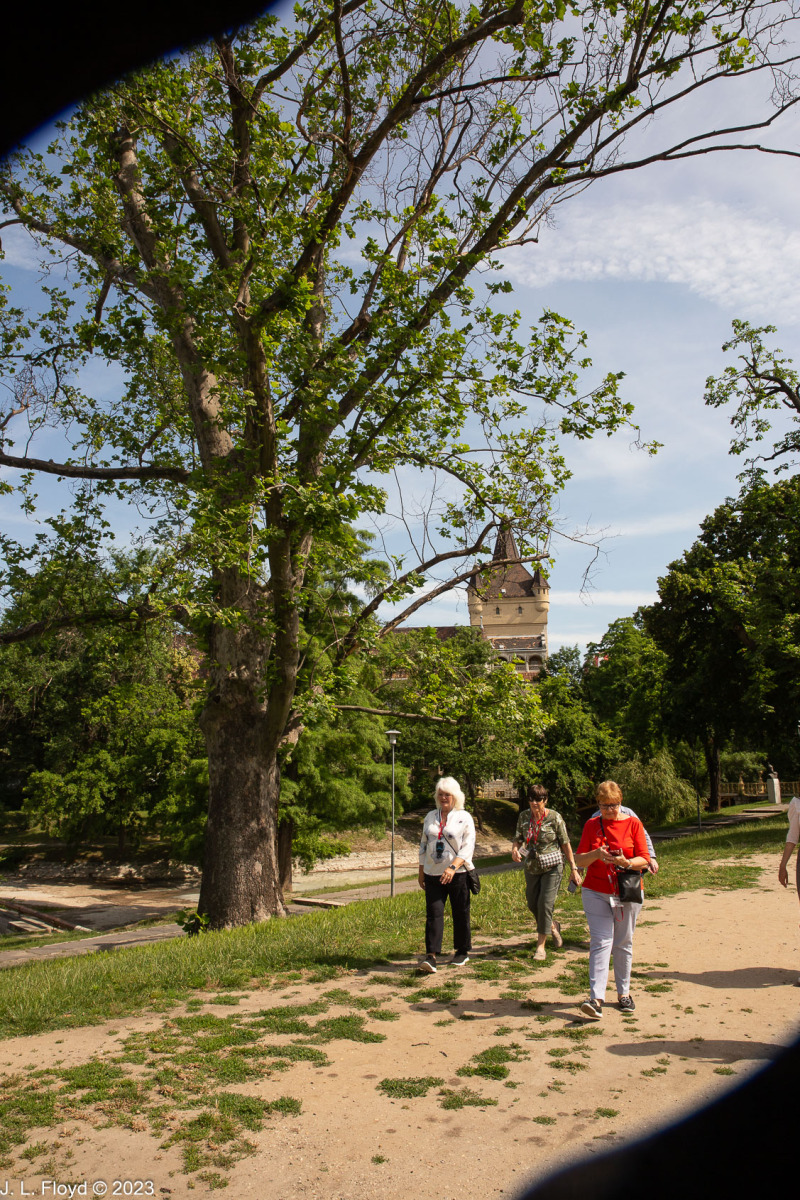
From Heroes’ Square we walked across a bridge over a mostly dry lake to Budapest City Park. The bridge, furnished with an elegant bronze railing, was designed by and named for Szilárd Zielinski, a Hungarian engineer who was a pioneer of reinforced concrete construction. Looming ahead of us in the park was a structure which for all the world looked like a castle out of a Dracula movie. This was the Vajdahunyadi Castle, which as far as I can tell means “Copy of Hunyadi Castle.” It was originally built in 1896 as part of an exhibition celebrating the millenial of the Magyar occupation of the Carpathian basin, and it was designed to incorporate features of various landmark buildings of Hungary – but above all the Hunyadi Castle (also known as Corvin Castle) in Transylvania, which was then part of the Kingdom of Hungary. Originally built of wood, it was later rebuilt in brick and stone, which was fortunate, since Hungary lost Transylvania to Romania, and with it Hunyadi Castle, in the aftermath of World War I. The Hungarians of course have never been happy about this, and they would prefer to have Transylvania back. John Hunyadi was a great military leader in 15th-century Hungary and is credited with successfully defending Transylvania against the seemingly unstoppable Ottoman Turks, who had conquered most of the Balkans as well as Constantinople by 1453. The castle which he built is one of the most magnificent in Europe and is now a major Romanian tourist attraction.

The copy in Budapest, though perhaps not as grand as the original, is no cheap imitation. It looks like someplace where Count Dracula might have felt at home. It now houses the Hungarian Museum of Agriculture. We did not go into the museum; our guide led us through the park on a different and longer path from the one on which we had come in, which brought us back to Heroes’ Square and our waiting bus.

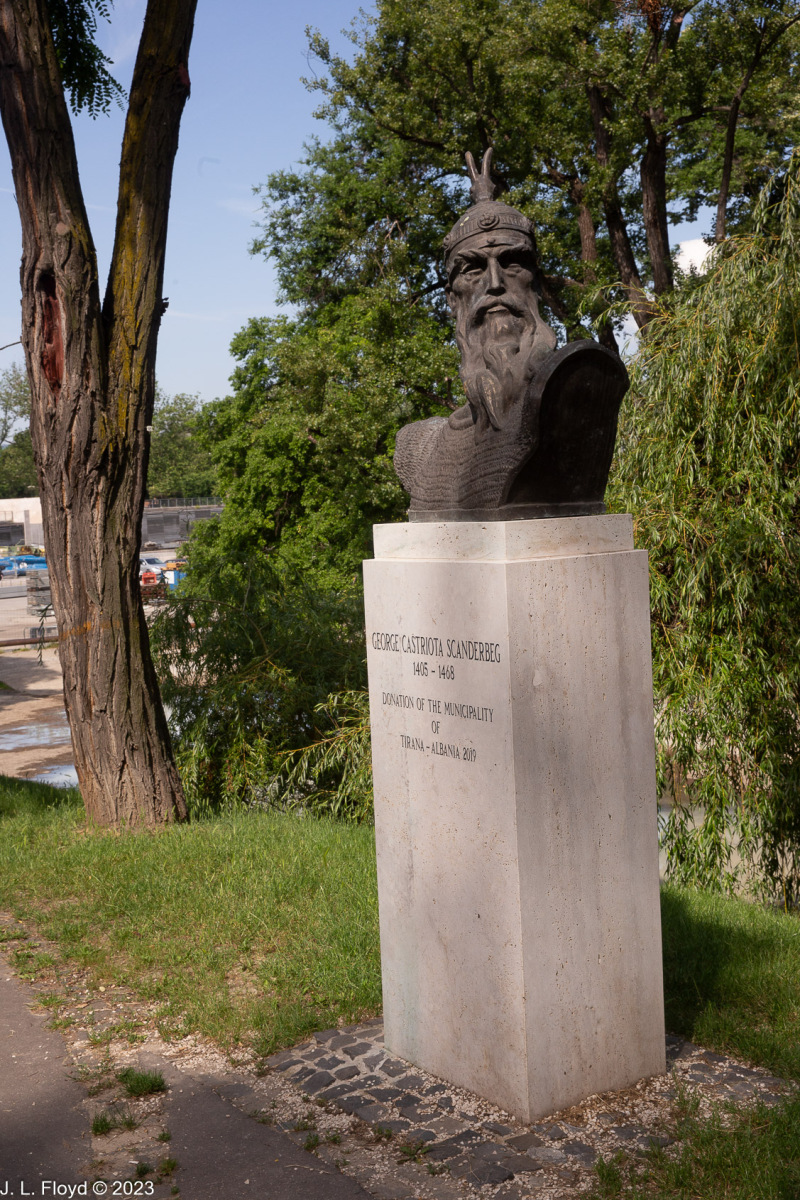
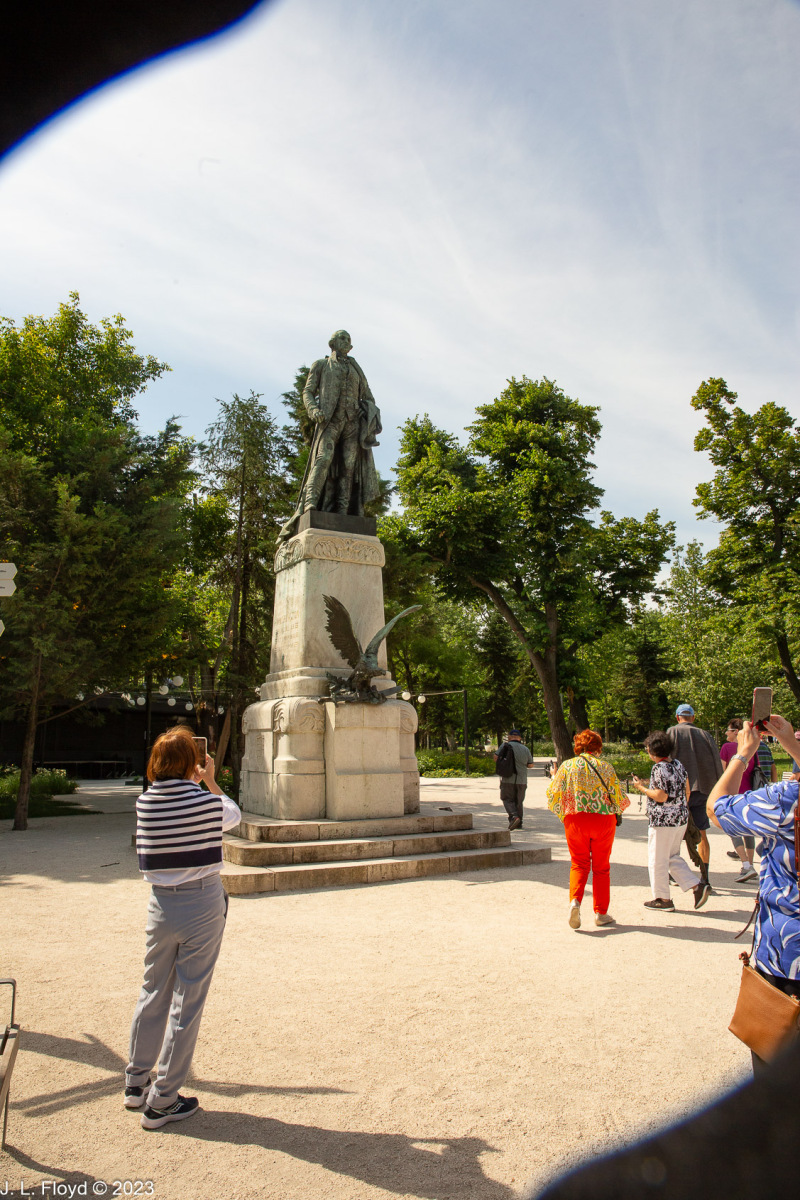
Our stroll back to the bus took us past a number of interesting landmarks. Most unexpected was a statue of George Washington, which was erected in 1904, while Hungary was still part of the Habsburg Empire, as a symbol of Hungarian-American friendship.

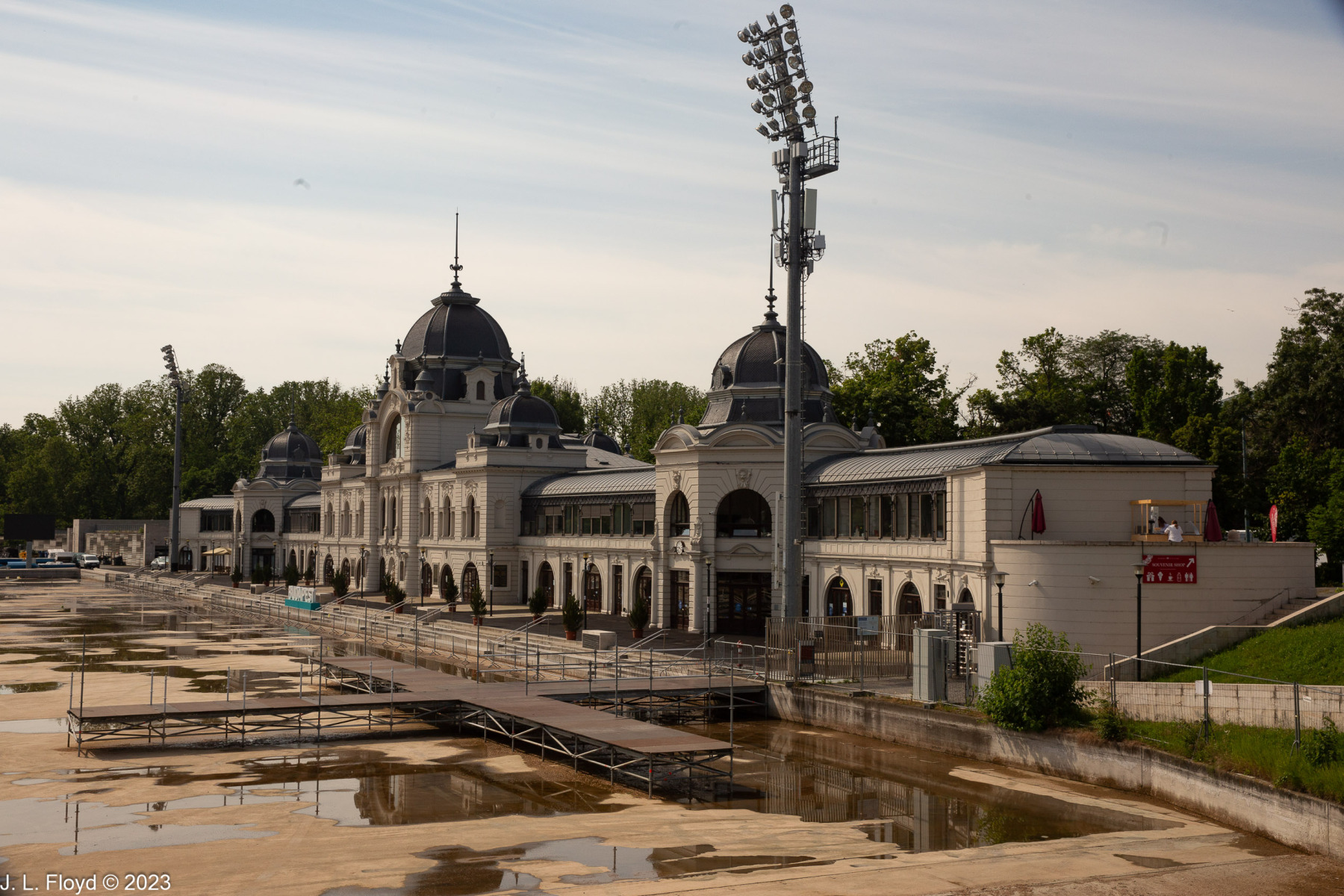
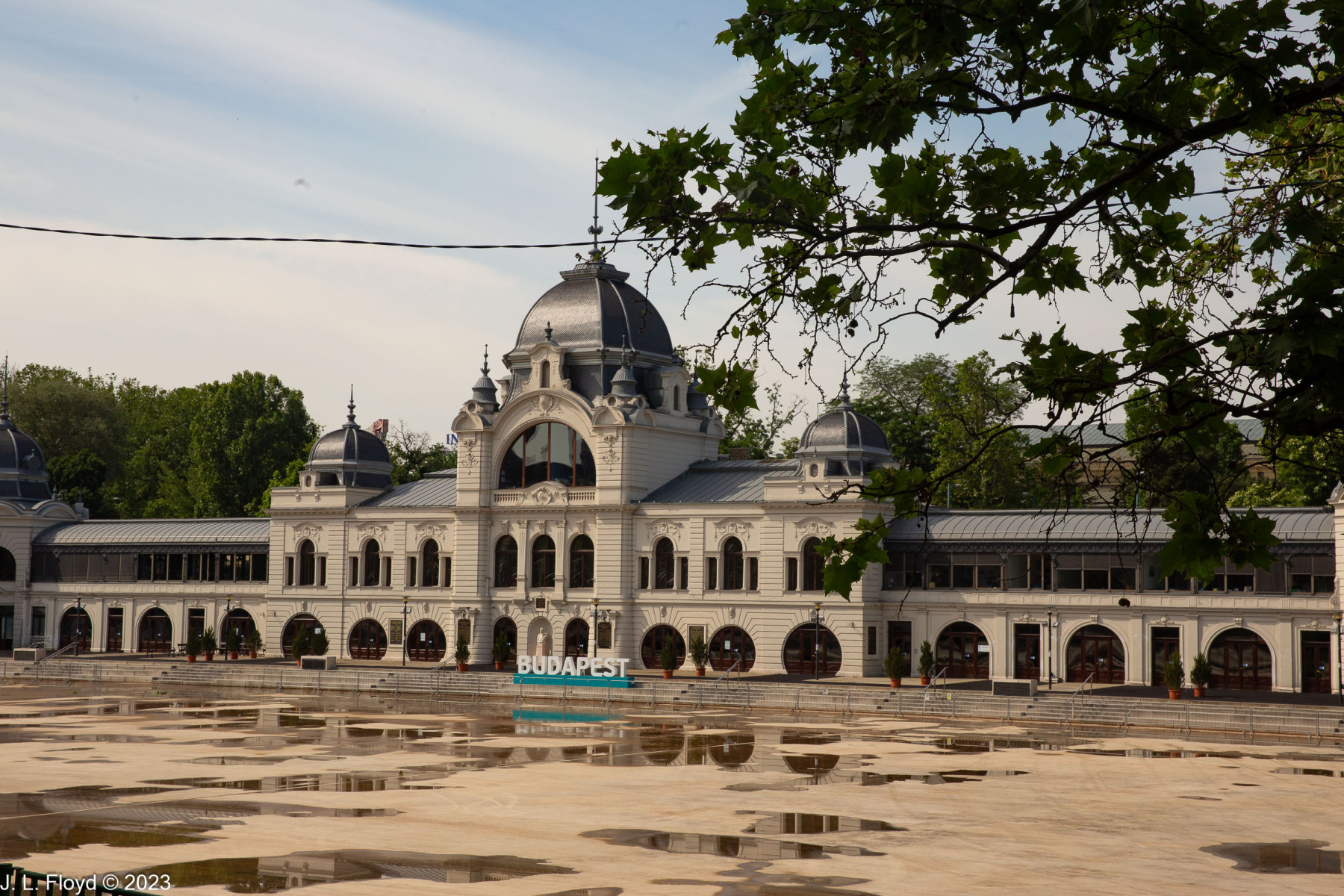
It was a bit difficult to believe, in the heat of the summer, that Budapest is a major world center for ice skating, with the largest ice skating rink in Europe. The dry basin over which we had crossed to get to Vajdahunyadi Castle is actually that rink; it is supposed to be filled with water during the summer to serve as a boating lake, but apparently the hot dry weather experienced by Central Europe this summer put the kibosh on that. Nevertheless the neo-Baroque pavilion built in 1893 to preside over the rink and provide a place for skaters to change into their skating shoes is still quite imposing.

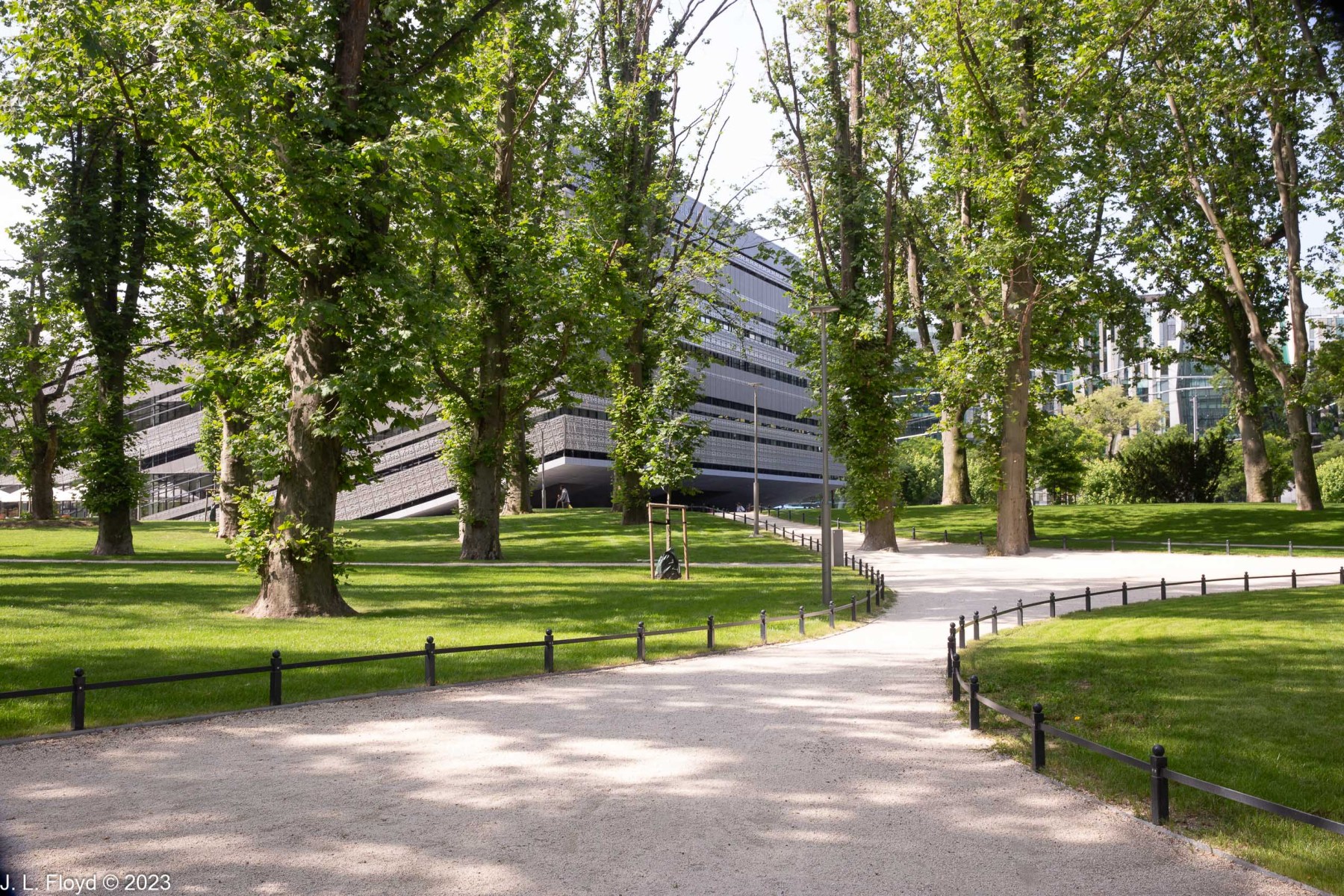
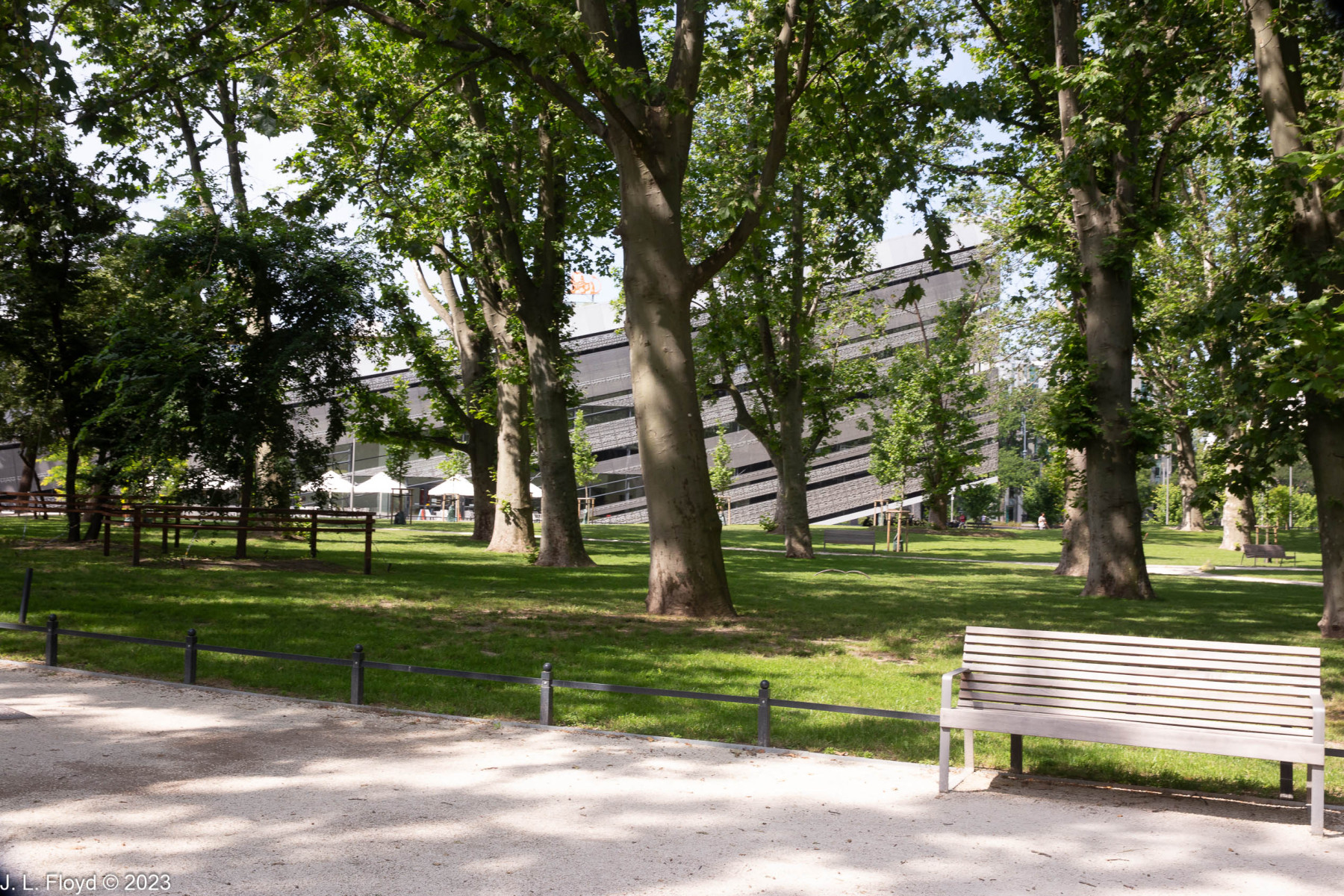
On the edge of the park, down the street from Heroes’ Square, we encountered a very unusual structure which turned out to be the brand-new home of the Hungarian Museum of Ethnography. This museum was founded in 1872 and has had many different homes; from 1975 to 2022 it was housed in the Palace of Justice (Hungarian Supreme Court) building on Kossuth Square, which we would visit two days later. The museum reputedly contains extraordinarily diverse and colorful collections of artifacts from all over the world, though its primary emphasis is on the folk culture of Hungary and other nationalities of the former Austro-Hungarian empire. But since we did not have time to go inside, it was the exterior that captured all our attention. It appears to be a huge curved ramp that slopes up from the ground, with a roof garden and walkway on top. The sloping sides are decorated with various folk motifs. I’ve never seen anything quite like it.

Categories
Danube River Cruise, June 2023

Arrival in Budapest, June 14, 2023

It was a great relief finally to arrive at Ferenc Liszt Airport in Budapest. Ferenc, by the way, is the Hungarian form of the German name Franz, by which the composer is usually known, and as far as I can tell it is pronounced the same way. Since we were late, there was no one to meet us at the airport, but we called the Gate1 Tour Director, Krisztina, who arranged transport to our lodgings.

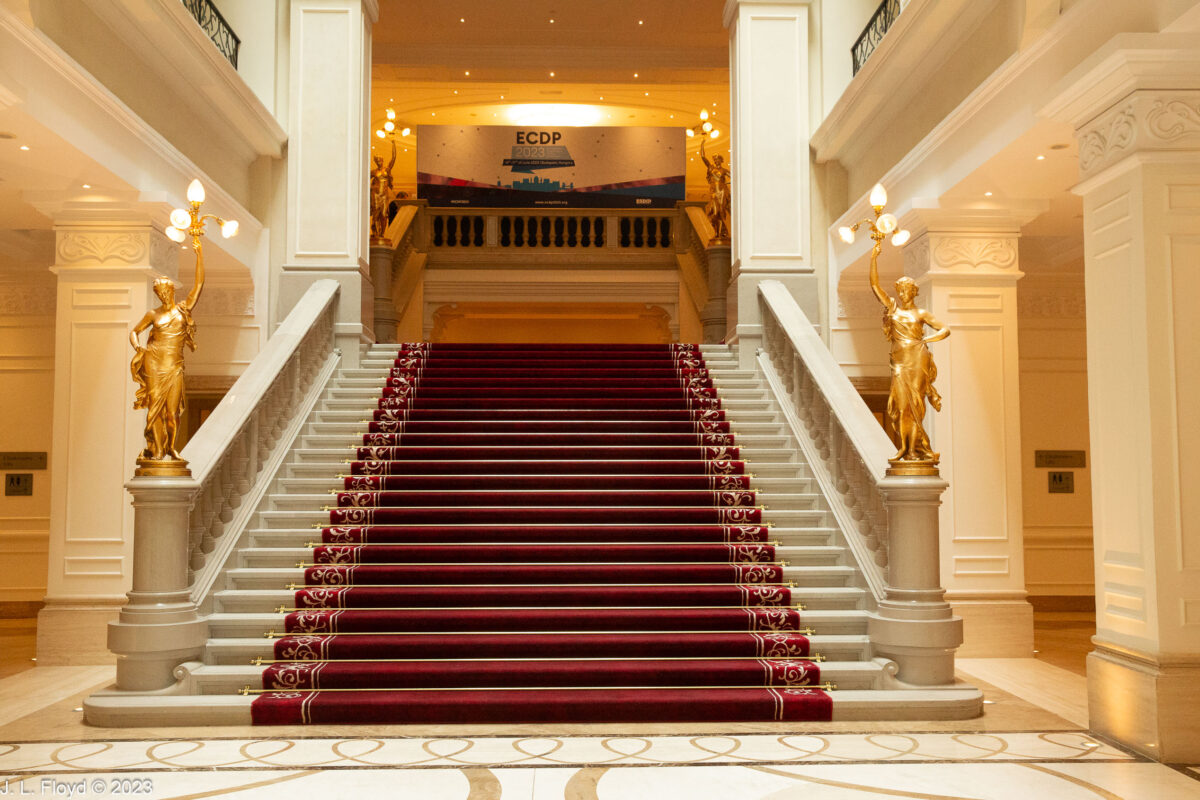
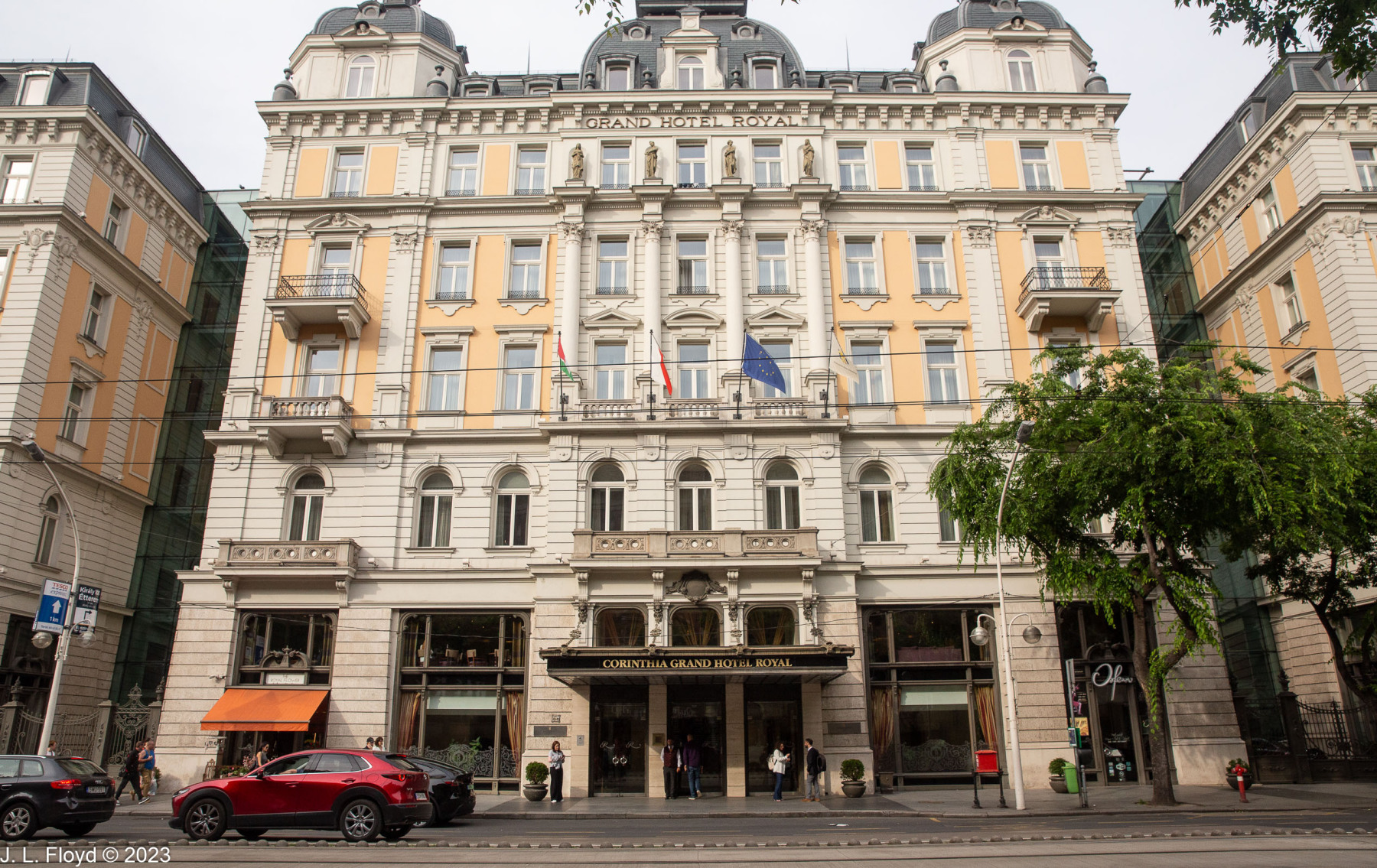
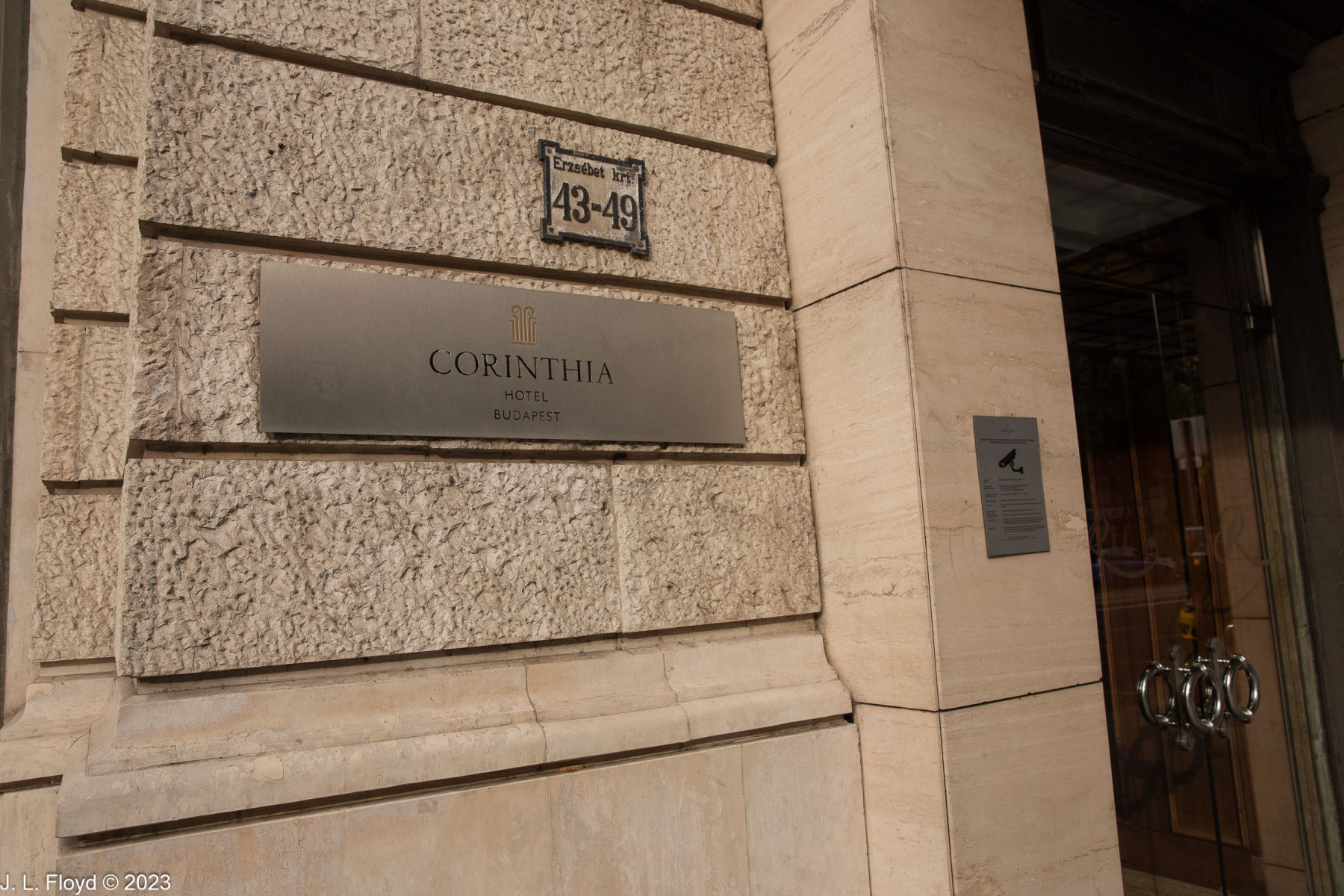
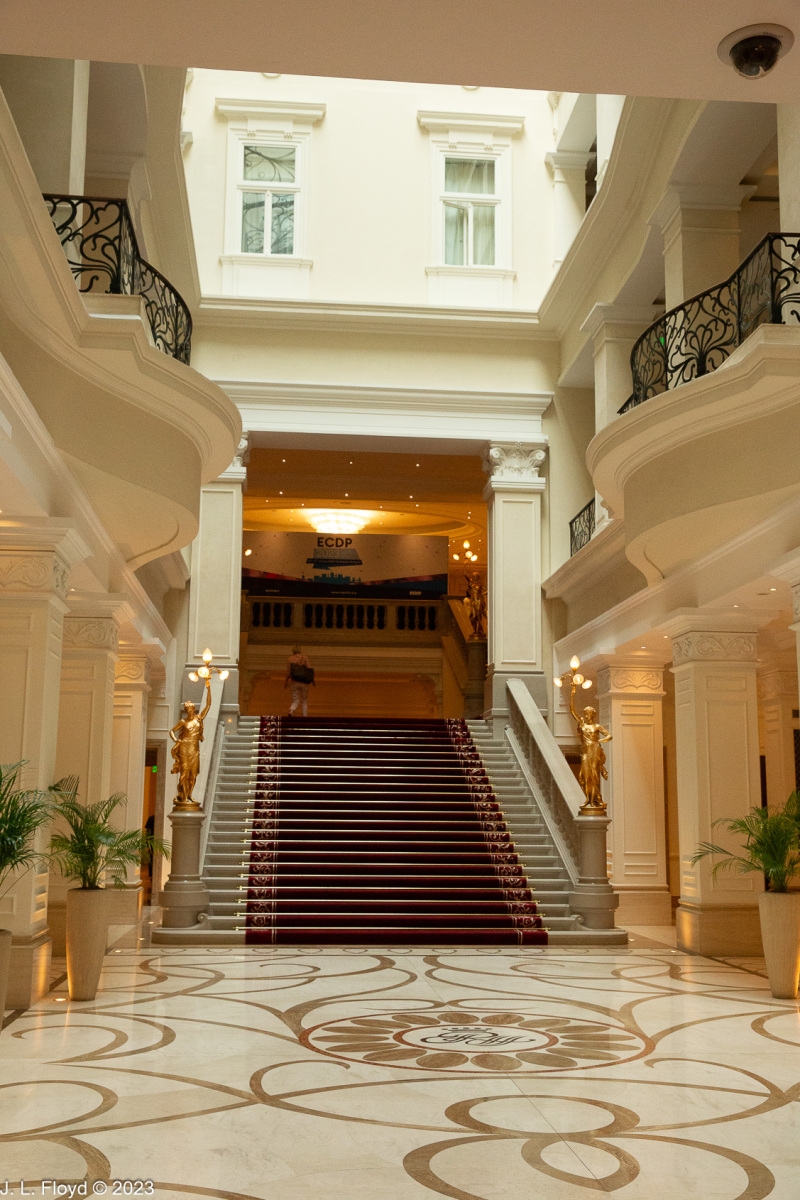
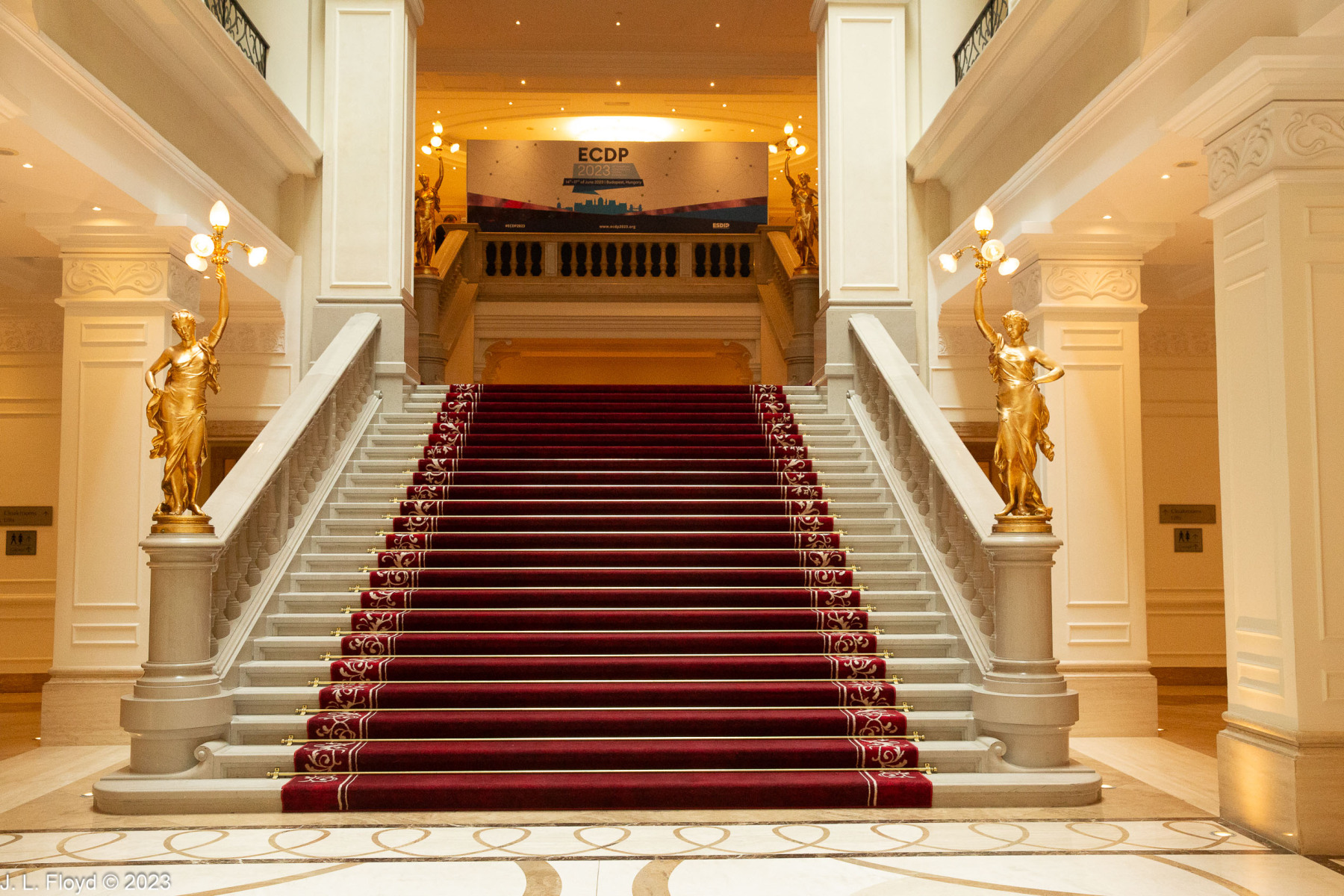
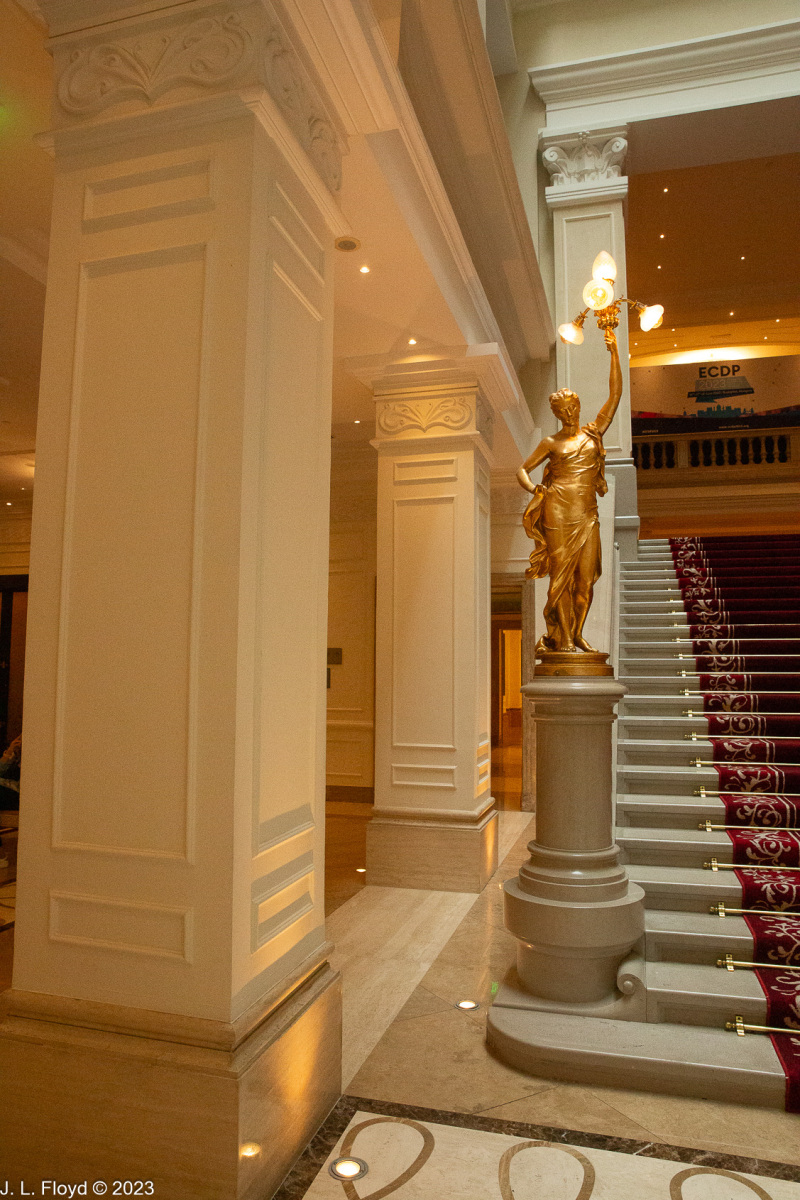
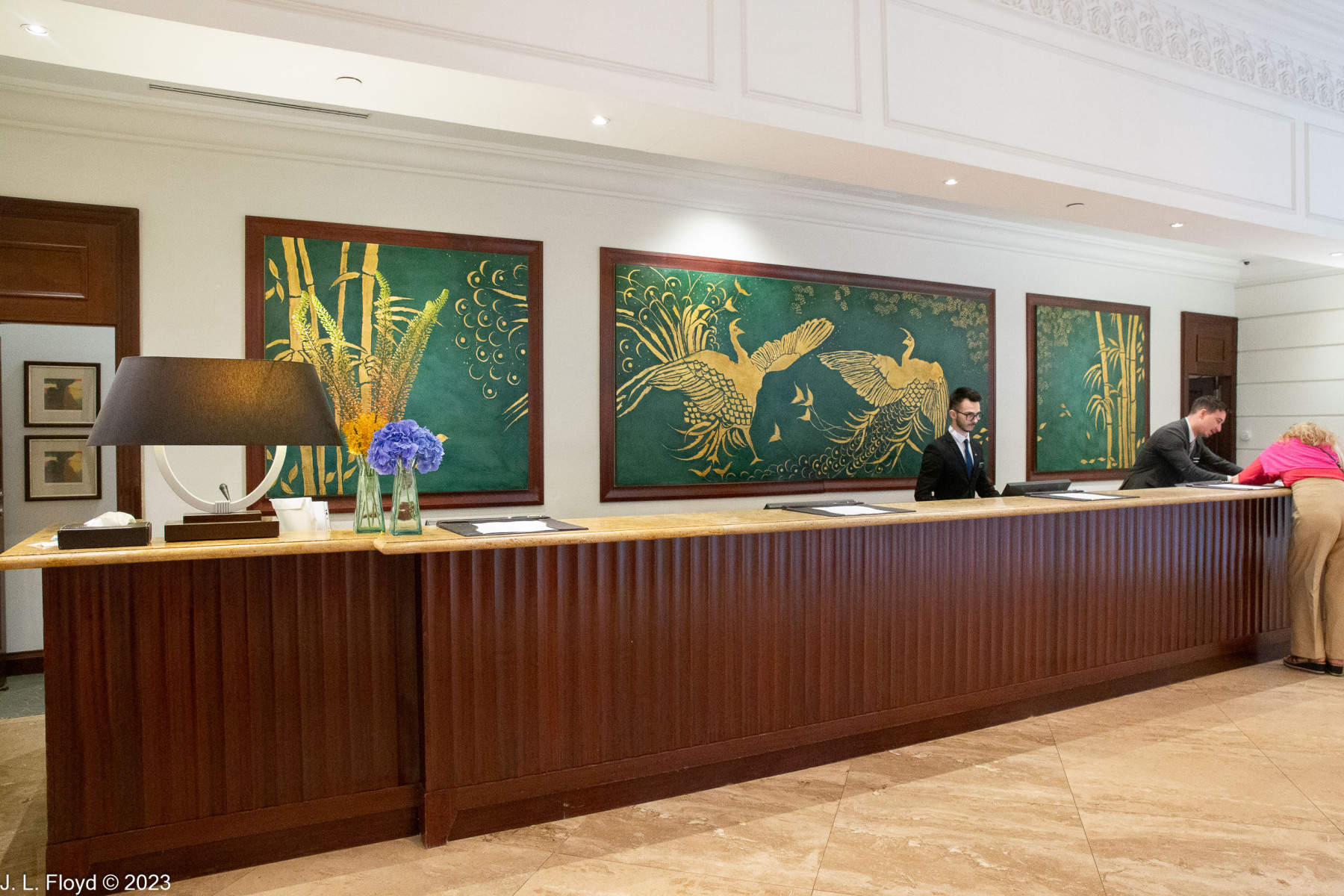
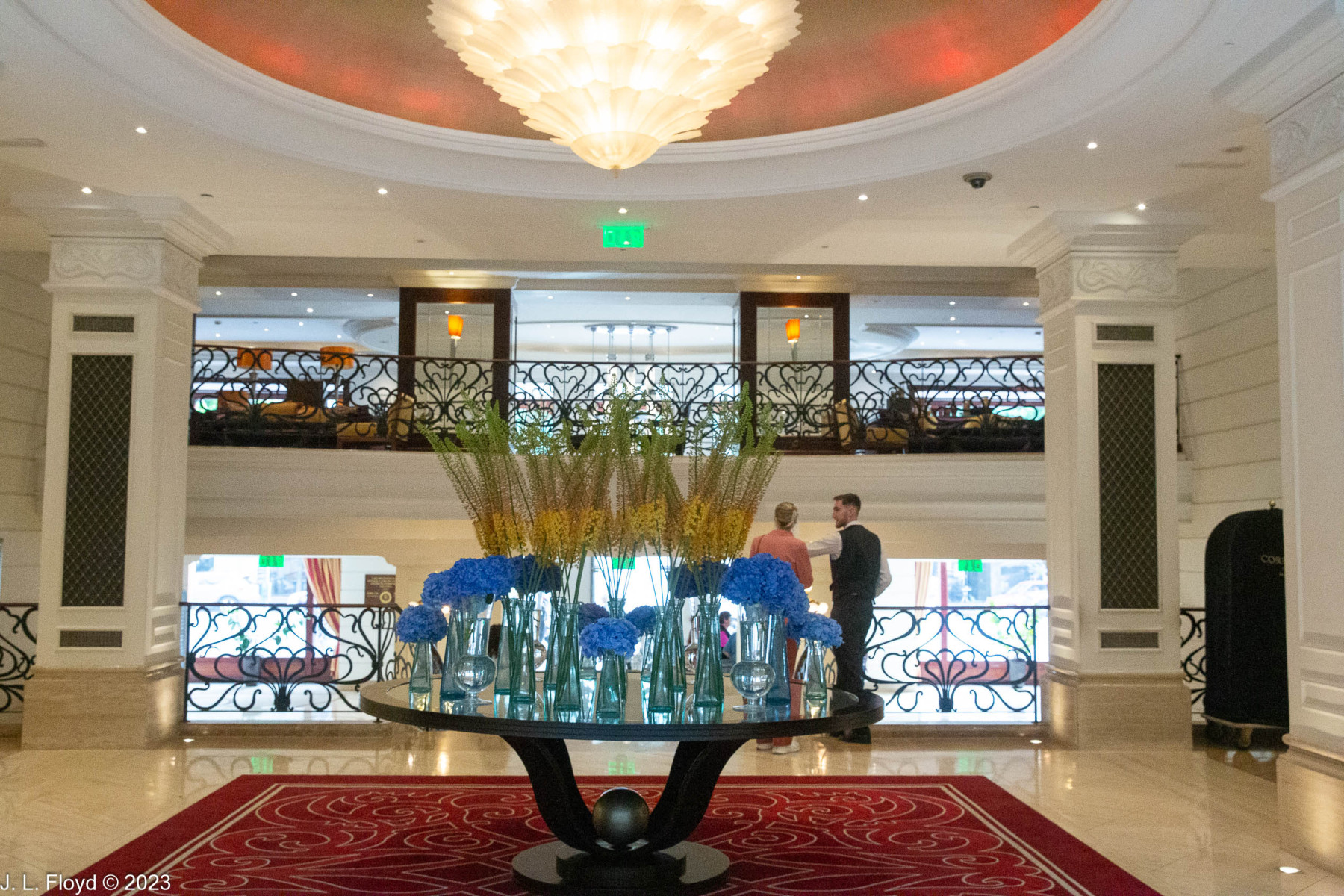
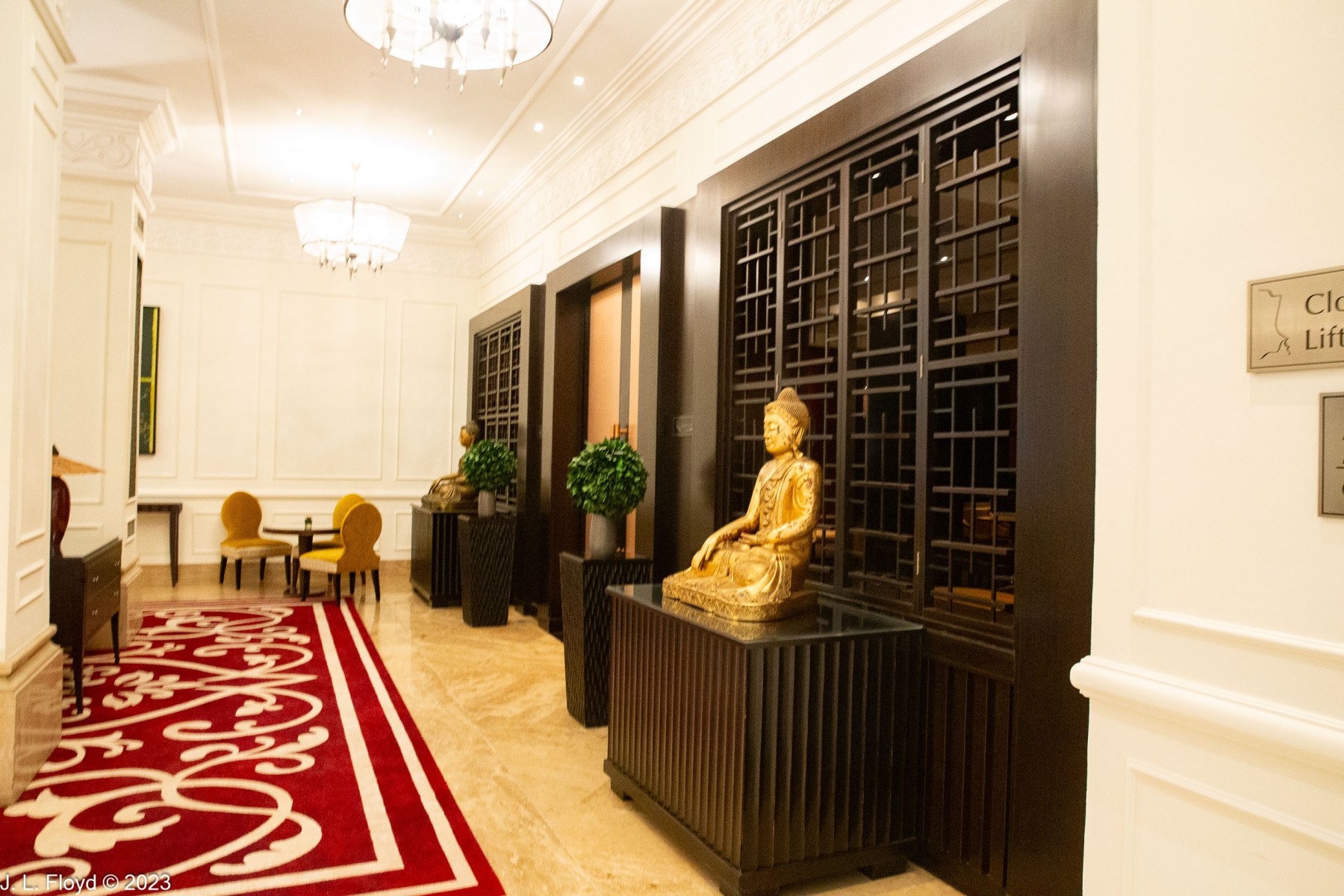
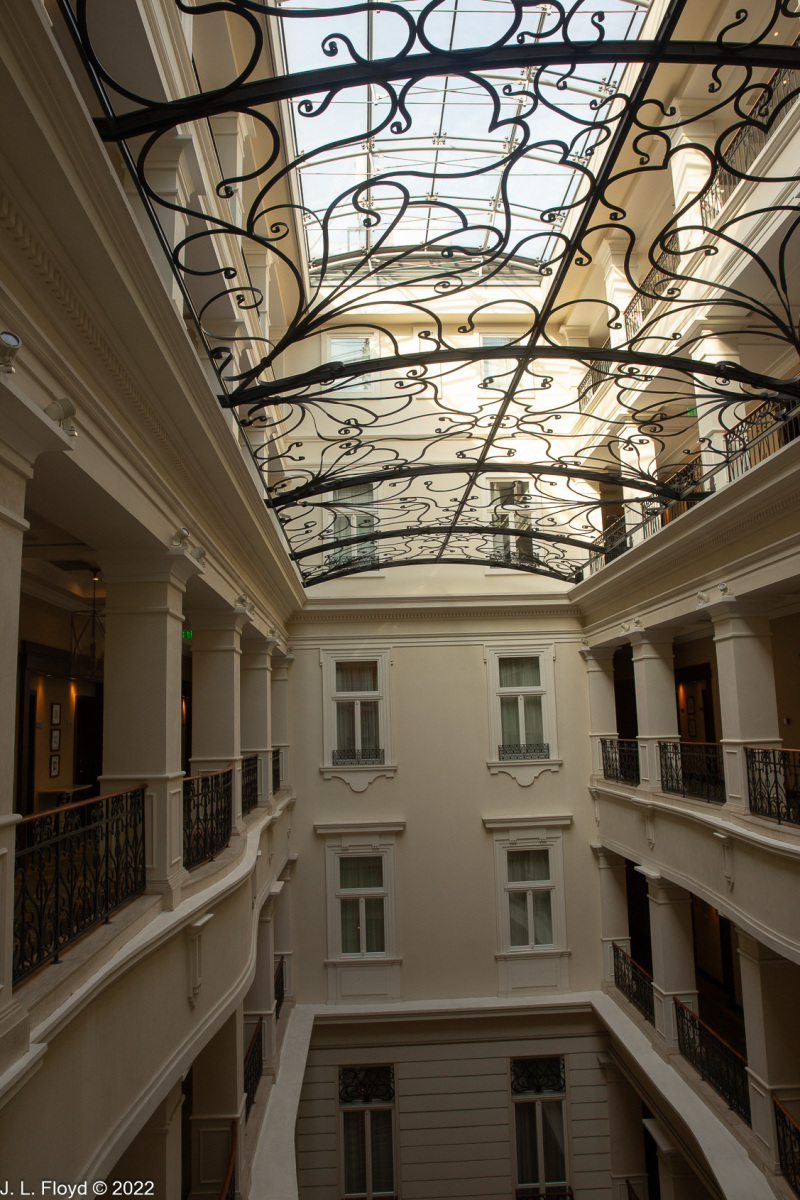
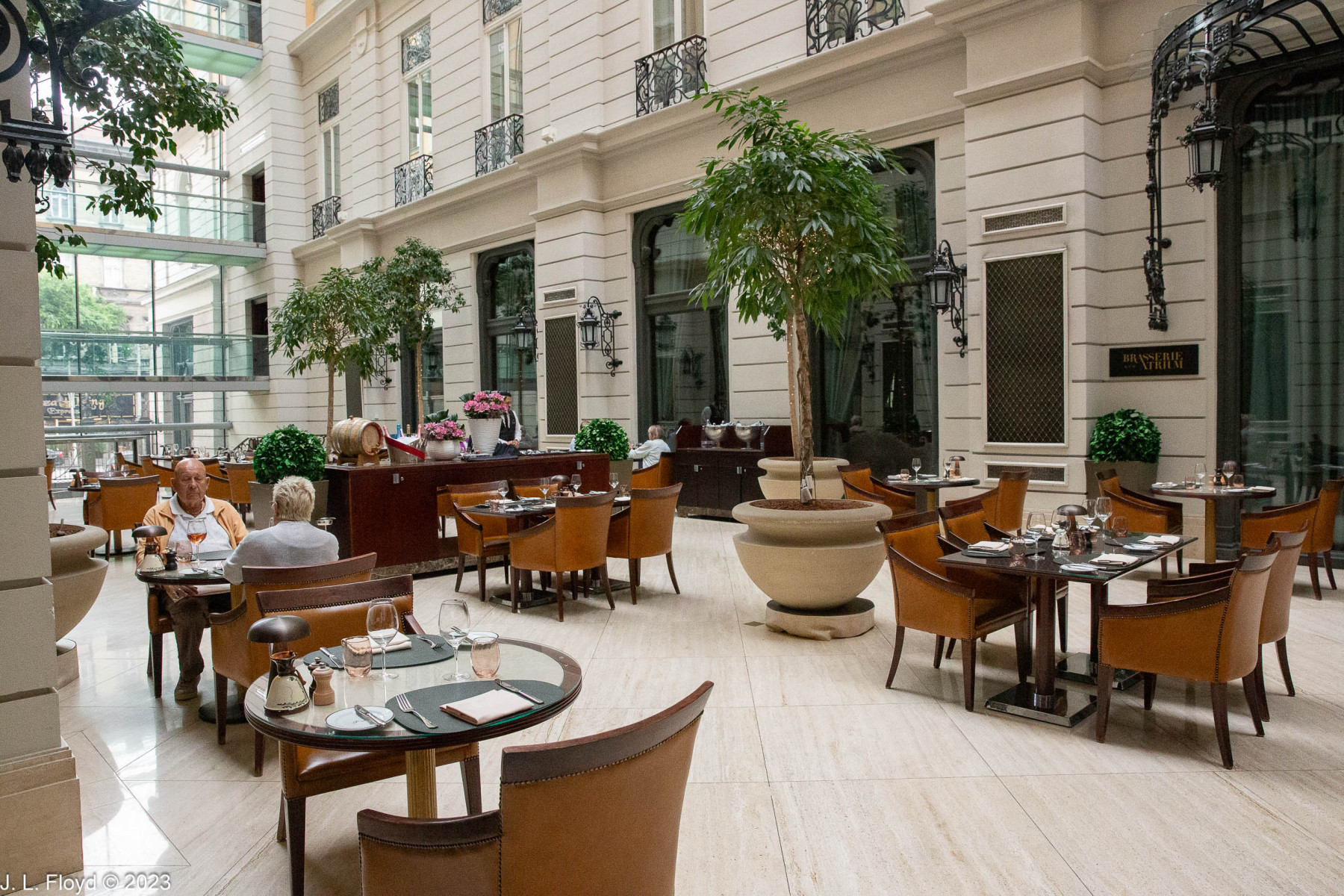
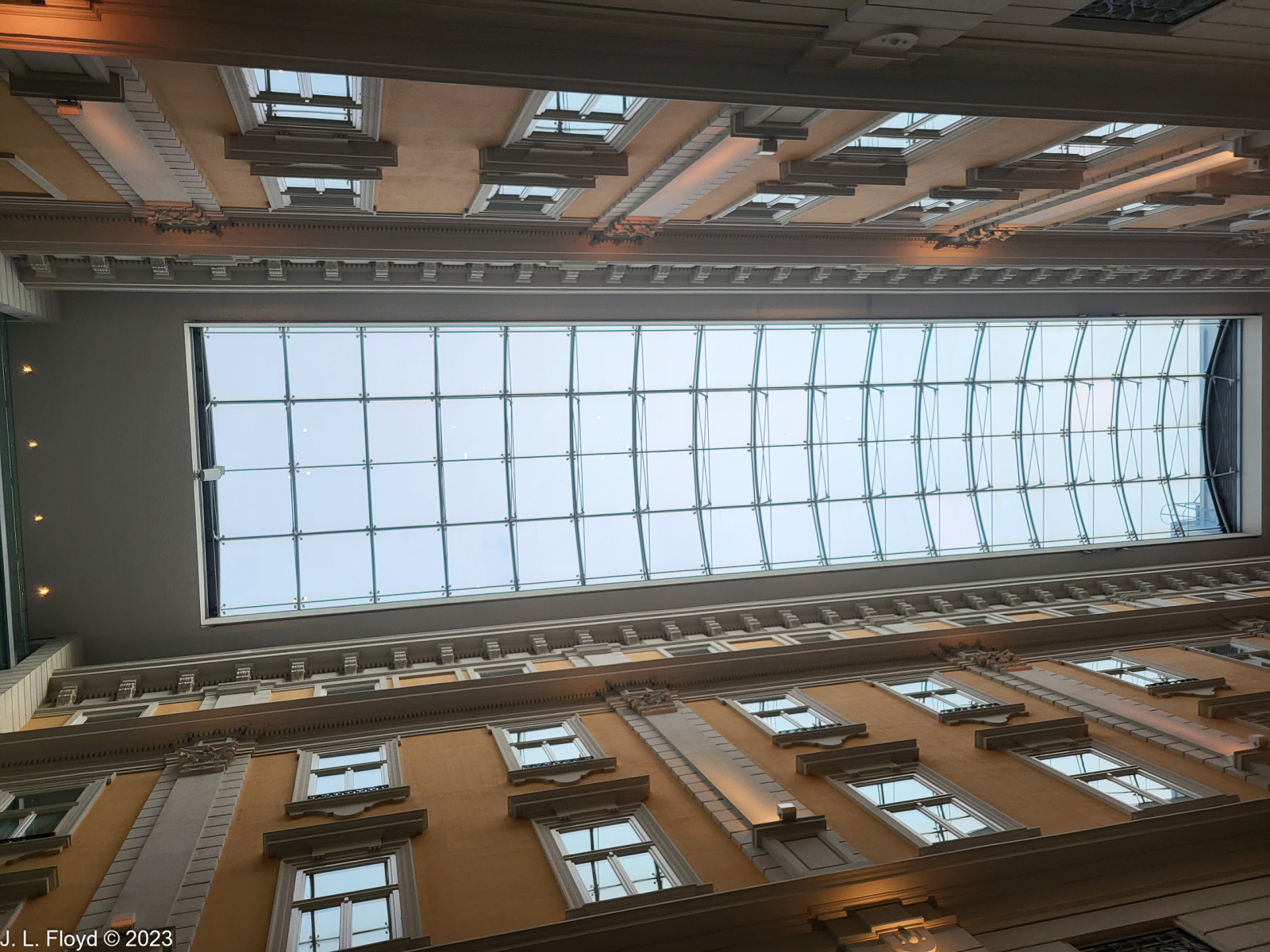
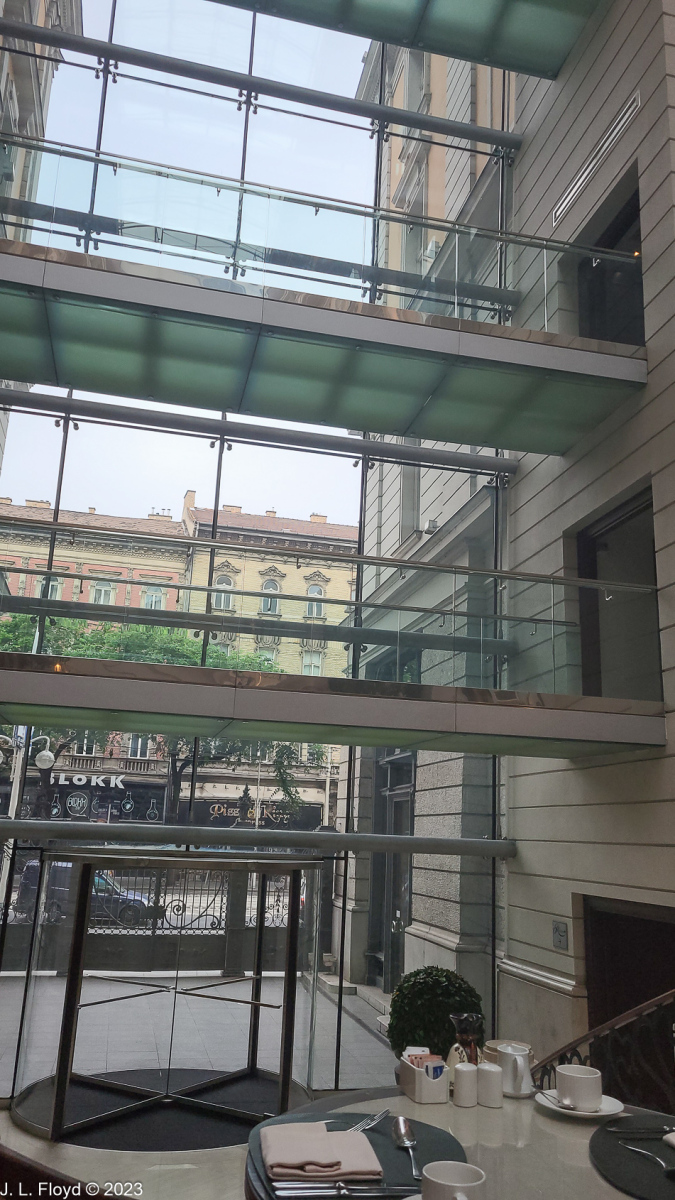
In Budapest we spent our first two nights, the 14th and 15th of June, in the Hotel Corinthia, one of the best hotels I’ve ever stayed in. Opened in 1896 as the Grand Hotel Royal, it has been through many ups and downs. In the early years, prior to World War I, it was the favorite haunt of the Hungarian literati and beau-monde. The great Hungarian composer Béla Bartók conducted concerts in the ballroom, and later a cinema was established there, which continued to operate until 1997. However, the hotel itself fell upon evil days after the Second World War. It was completely rebuilt in the 1950s and reopened in 1961. In 1991 it closed again, and was eventually revived with a 100-million-euro investment by the Corinthia Group, a Malta-based investment subsidiary of International Hotels, Inc. Although nothing of the original interior remains, the current furnishings still convey an atmosphere of fin-de-siecle luxury and opulence. And it couldn’t be faulted for comfort, either.

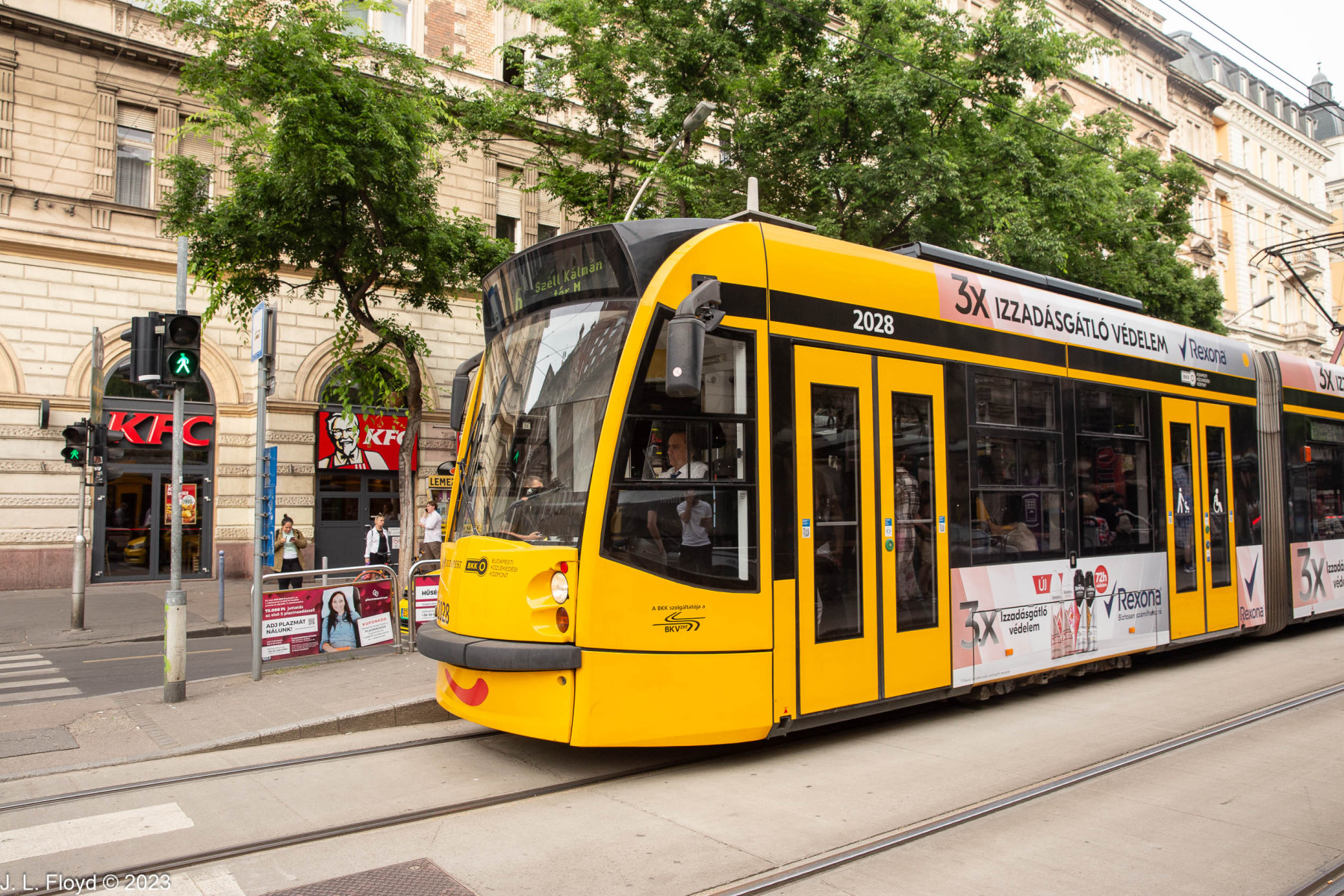
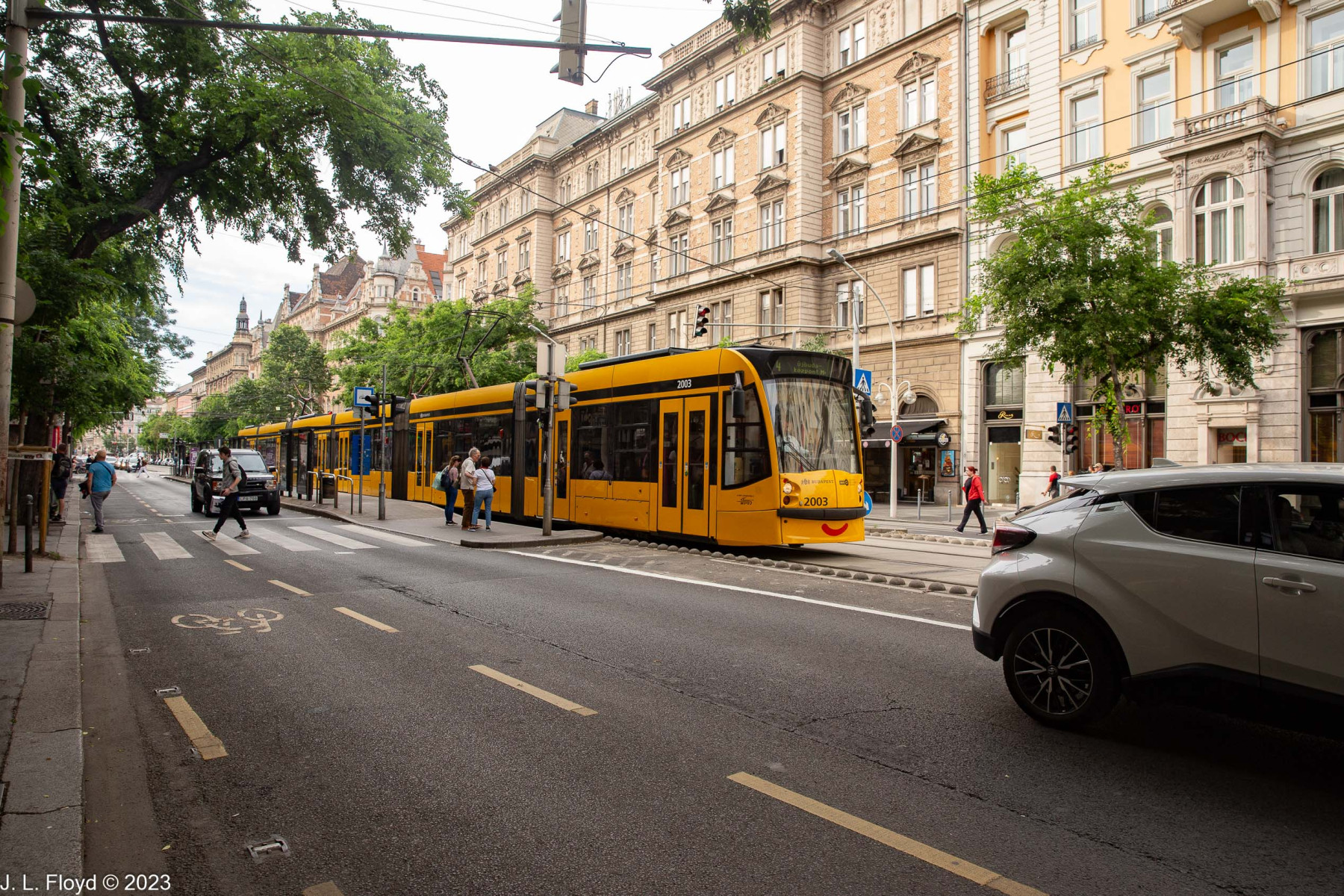
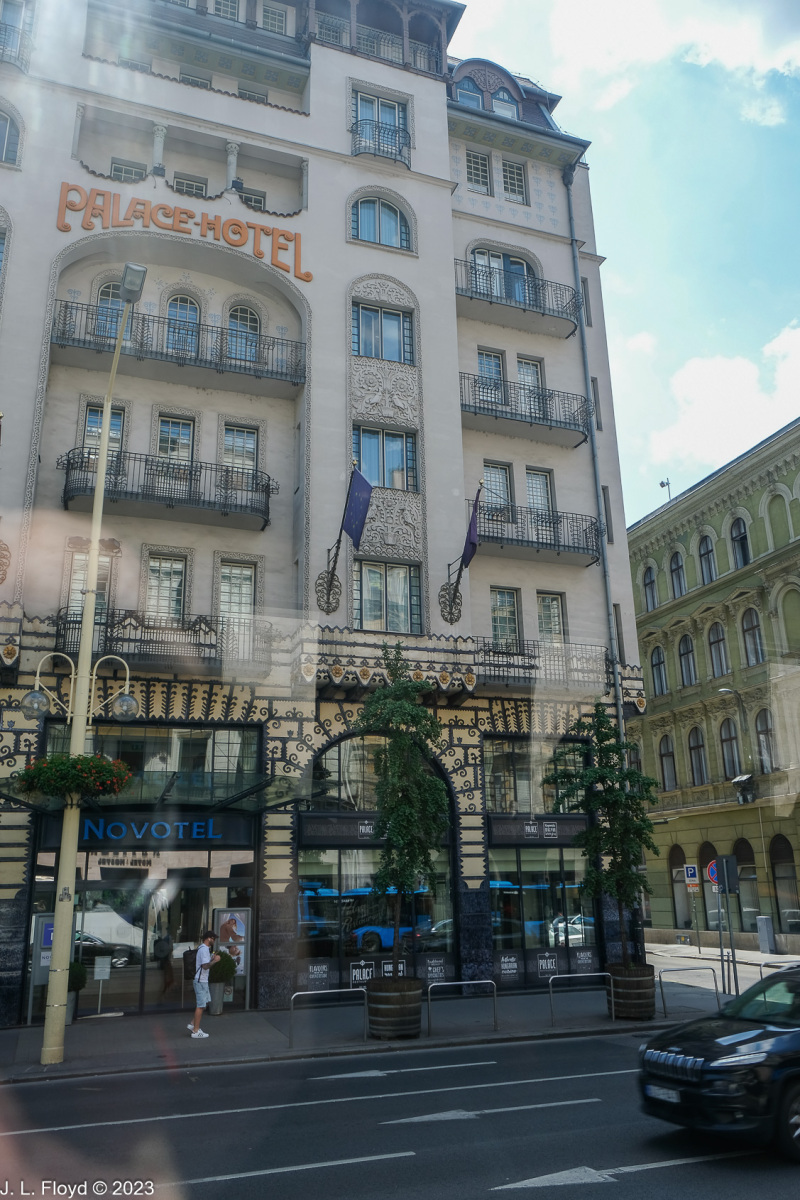
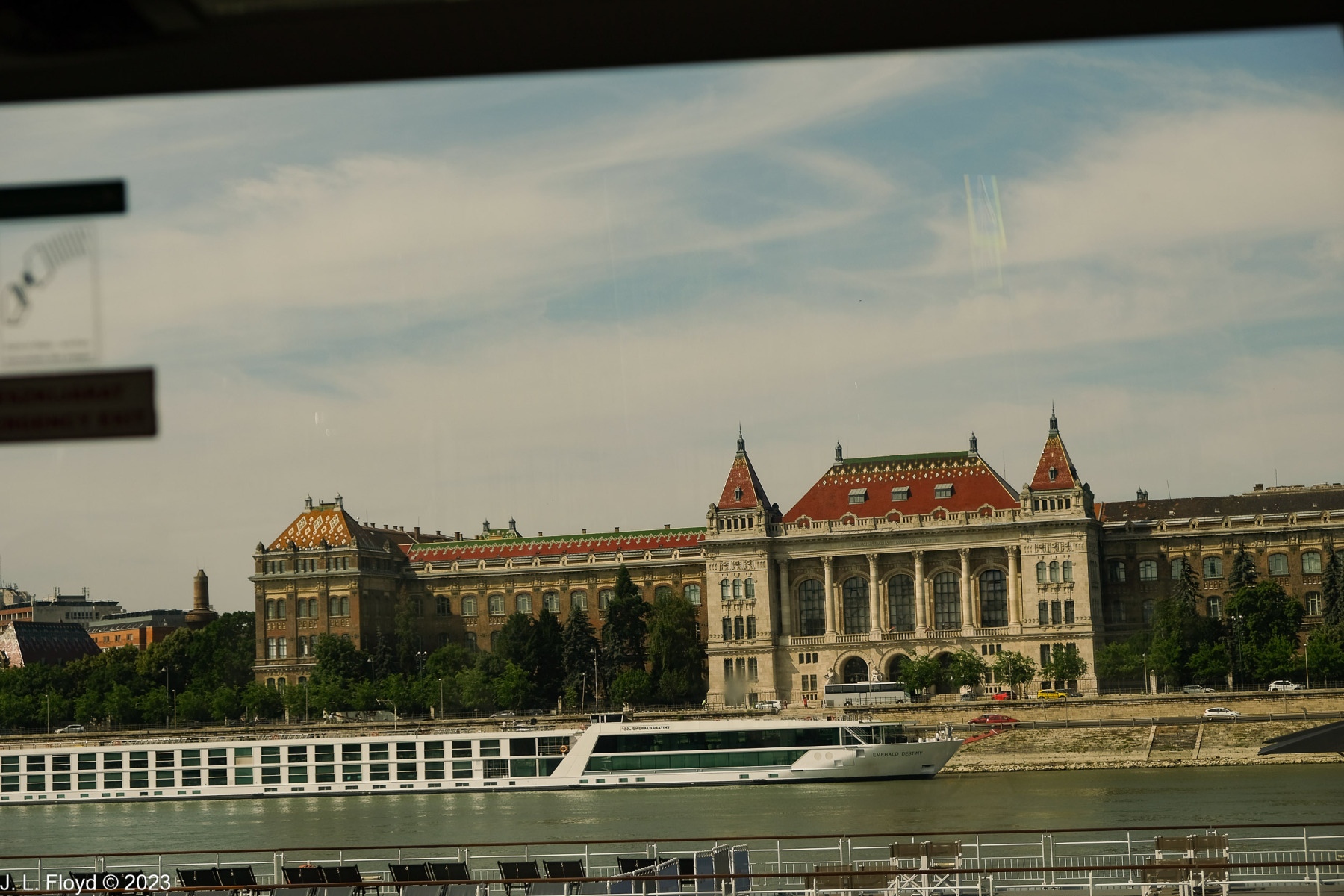
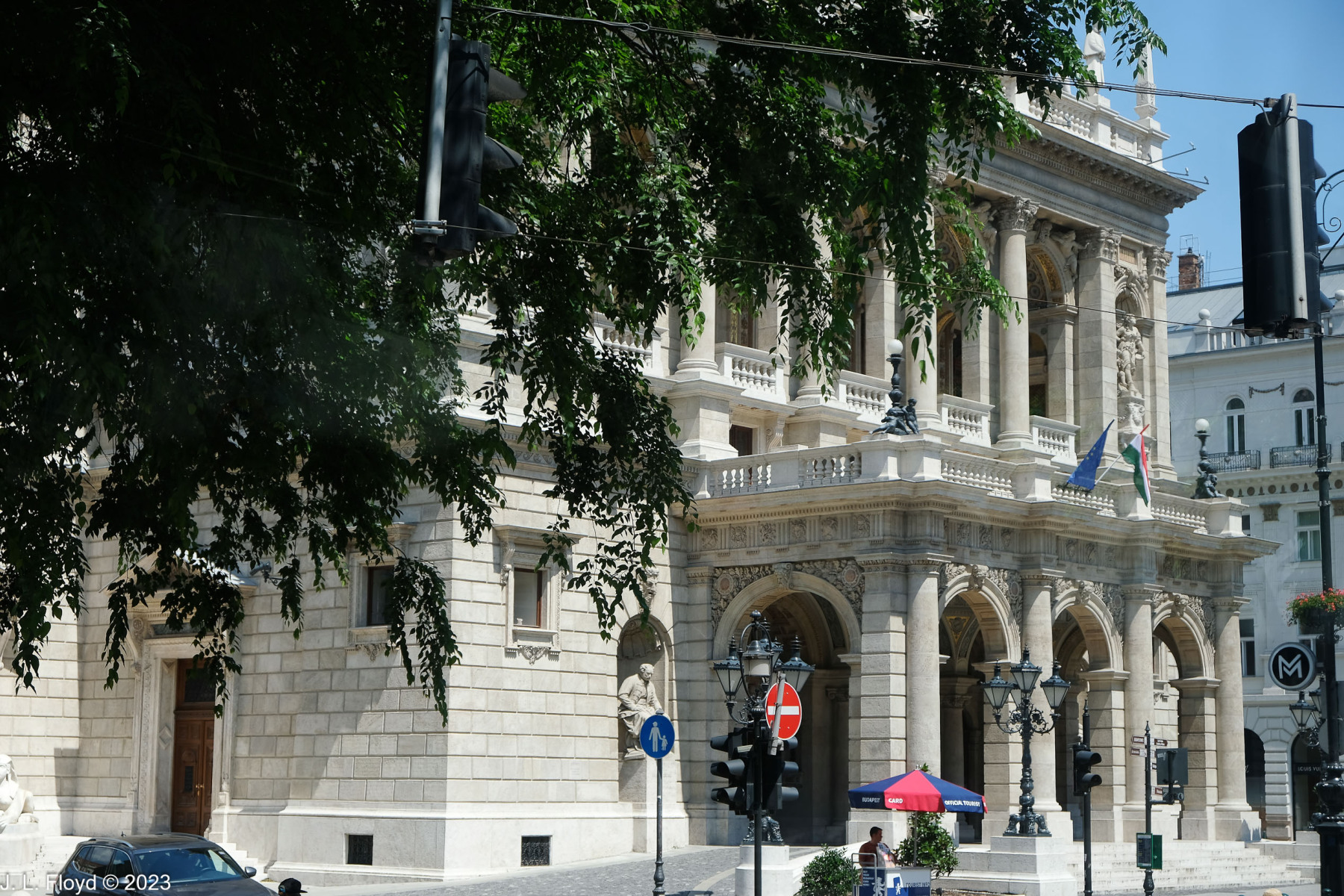
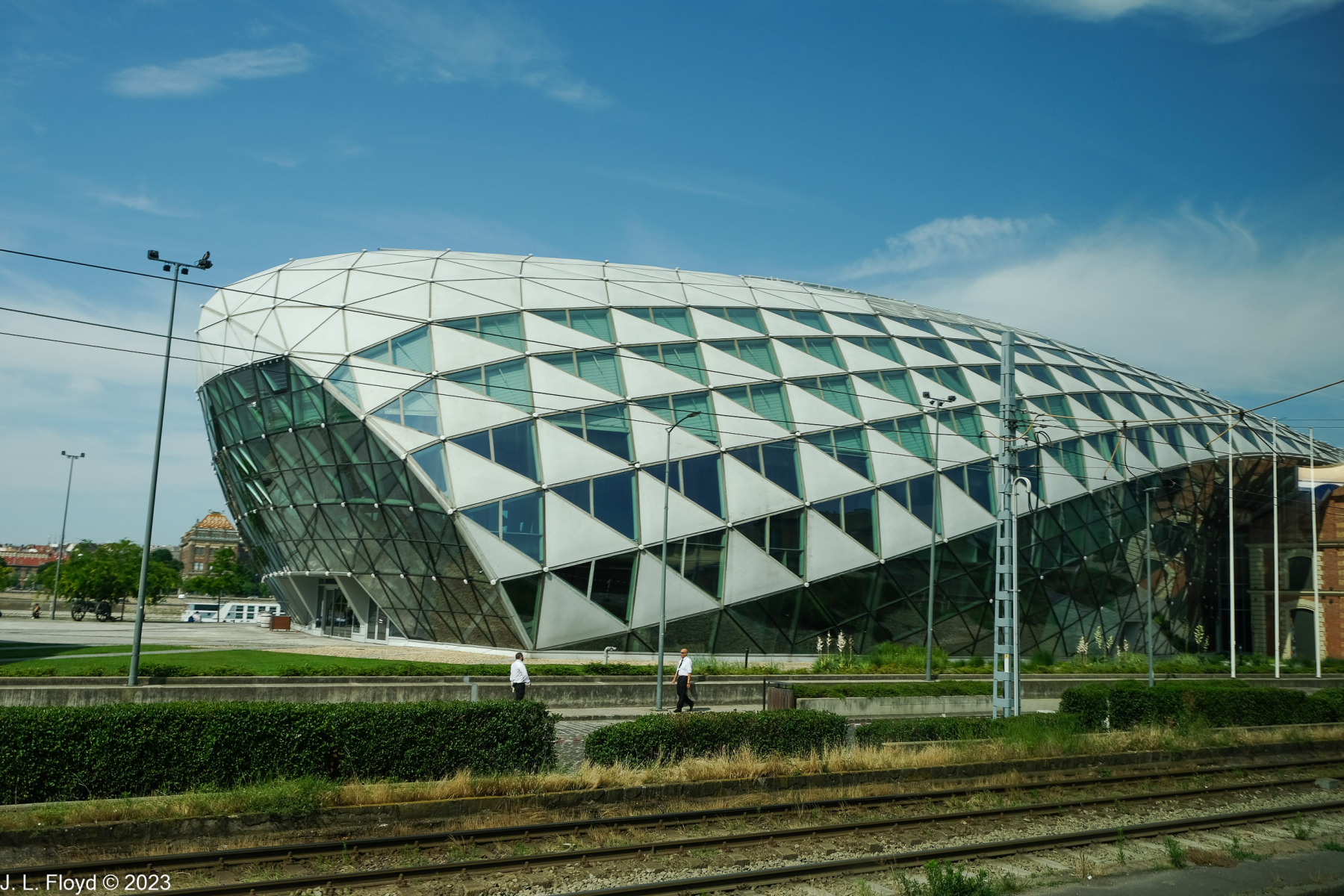
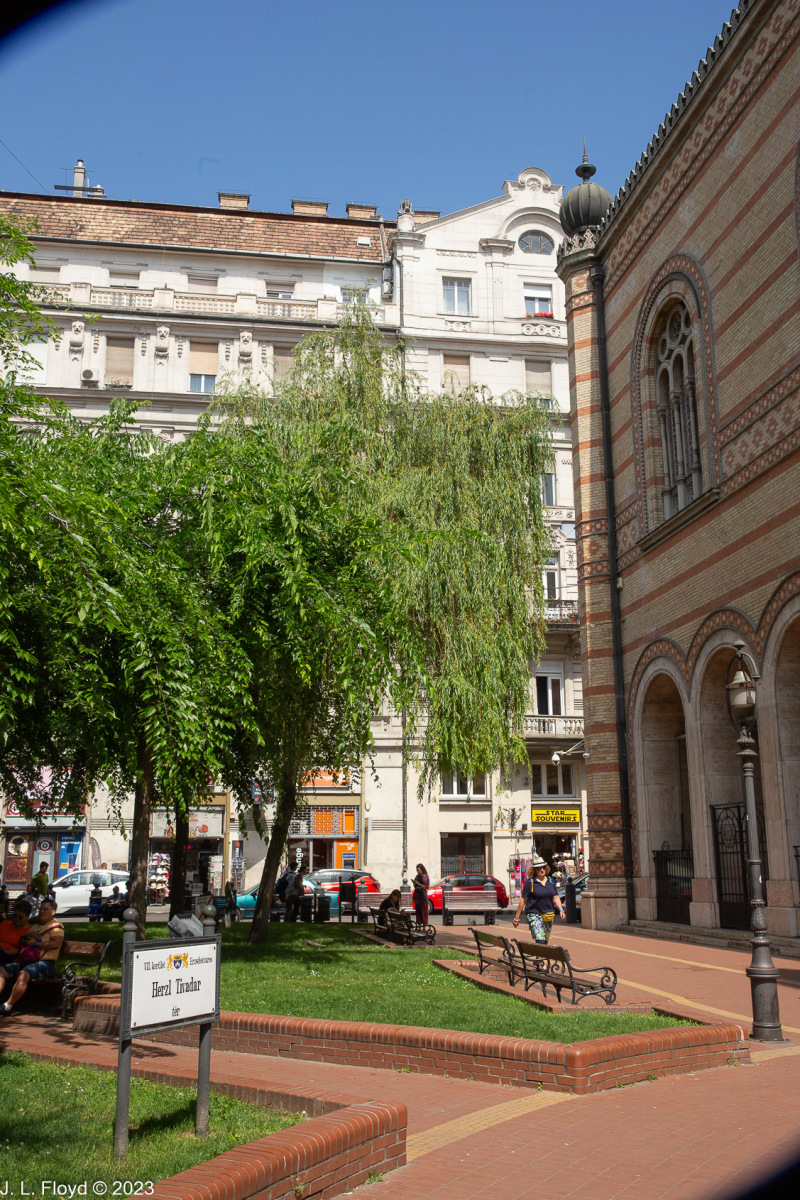
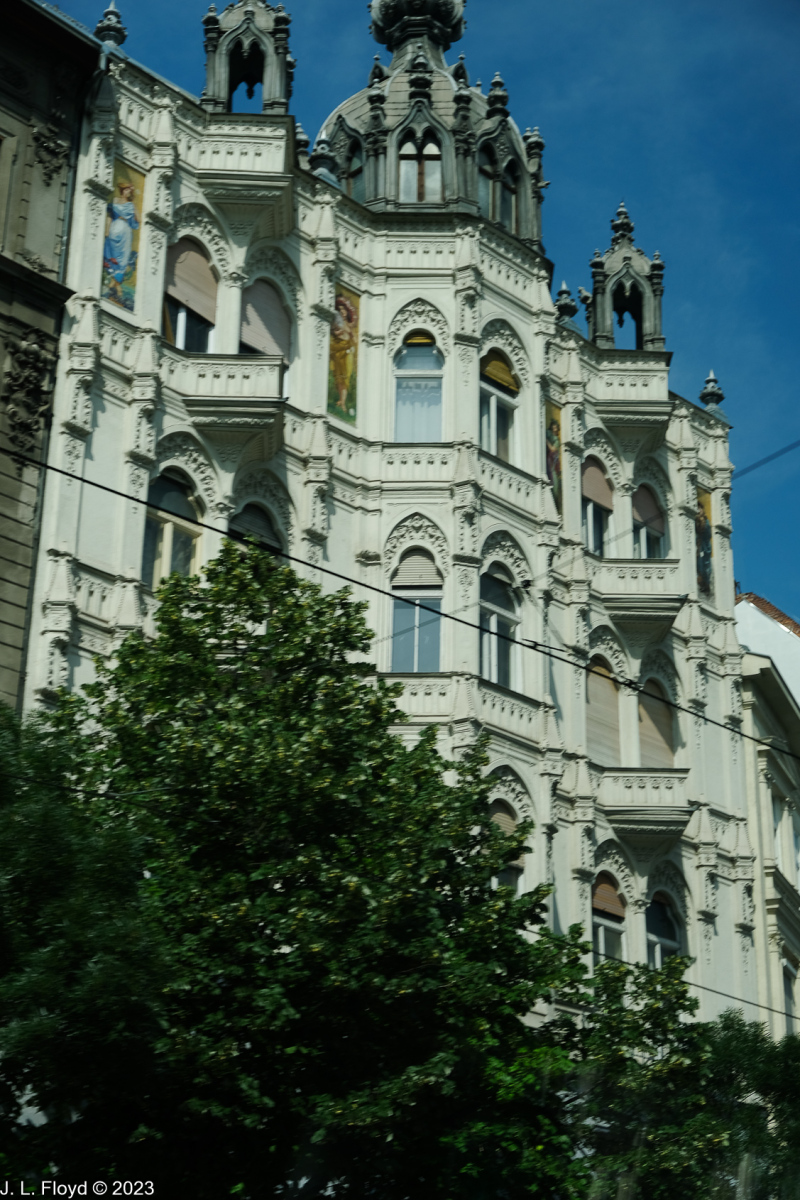
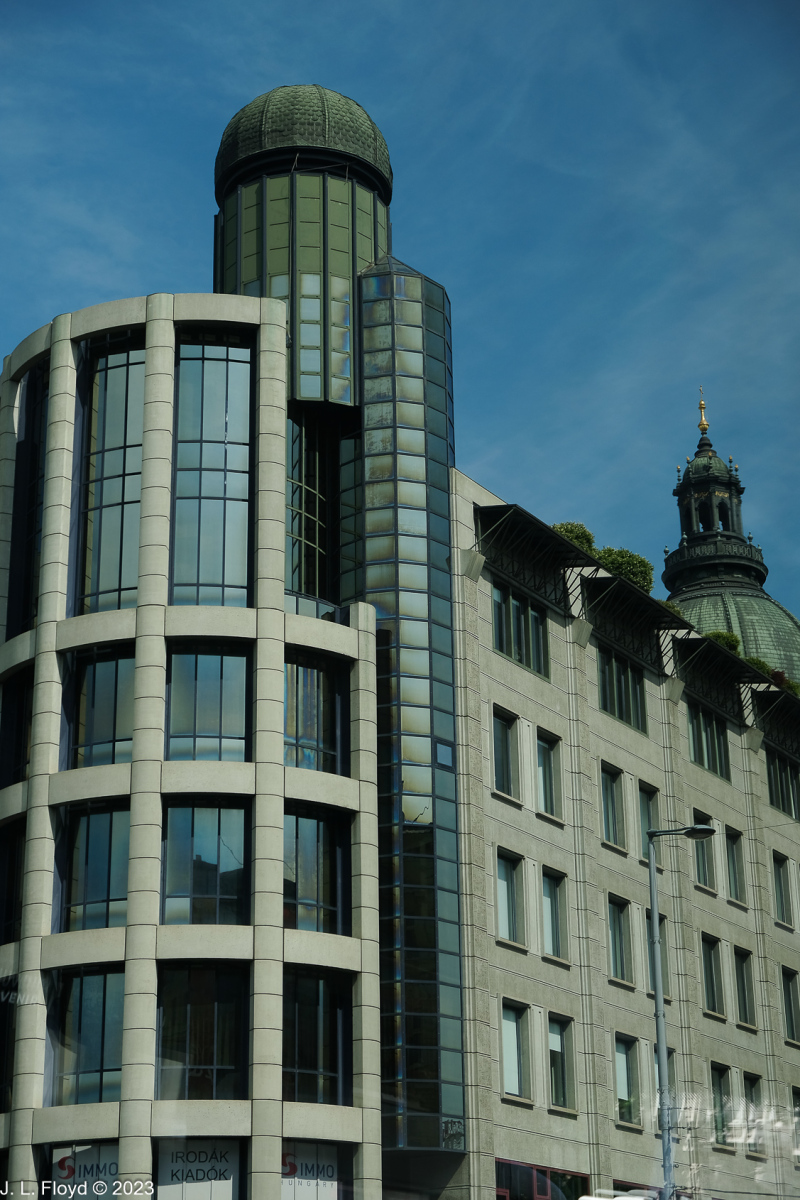
Our first impressions of Budapest were of a city of great beauty and great contrast. The contrast, of course, is between the old, represented mostly by the 18th and 19th-century inheritance, and the new, mostly dating from the post-1989 period, because most of the Communist-era appurtenances have been redone or removed. I’ve culled a few photos from some of our excursions over the succeeding days to provide abundant illustration of both the beauty and the diversity.

It’s important to keep in mind that Budapest began as two cities, one on either side of the Danube. (Actually there was a third, Obuda or Old Buda, just north of Buda, but let’s not complicate matters unnecessarily.) The Danube flows south at this point, and Buda is on the west bank, Pest on the east. Buda is hilly, Pest is flat. The two existed as separate cities for hundreds of years before being joined as one in 1867.

The next post will delve deeper into the sights we saw on our first full day in Budapest, Thursday the 15th of June 2023.

Categories
Spain, Portugal and Morocco, November 2017

Spain, November 8, 2017: The Road to Granada

The trip from Córdoba to Granada was generally uneventful, but had its noteworthy moments nonetheless. En route to Granada we passed through a district of the province of Andalusia known as la Subbética, which as far as I know includes no major cities or major tourist attractions other than the Sierras Subbéticas Natural Park, which we were not fortunate enough to visit, but which is home to a wide diversity of plants and animals, and a stronghold of the peregrine falcon. Our encounter with la Subbética was limited mainly to a rest stop on the N-432 highway at Nicol’s Restaurant, near the town of Luque. However, this proved to be of great interest to me as a showcase, as it were, of small-town Spanish life. The closest analogy I can think of is a roadside cafe in Midwestern America. But this was an area primarily devoted to the cultivation of olive trees and the production of olive oil, and Nicol’s was a market for that commodity as much or more than a roadside diner.

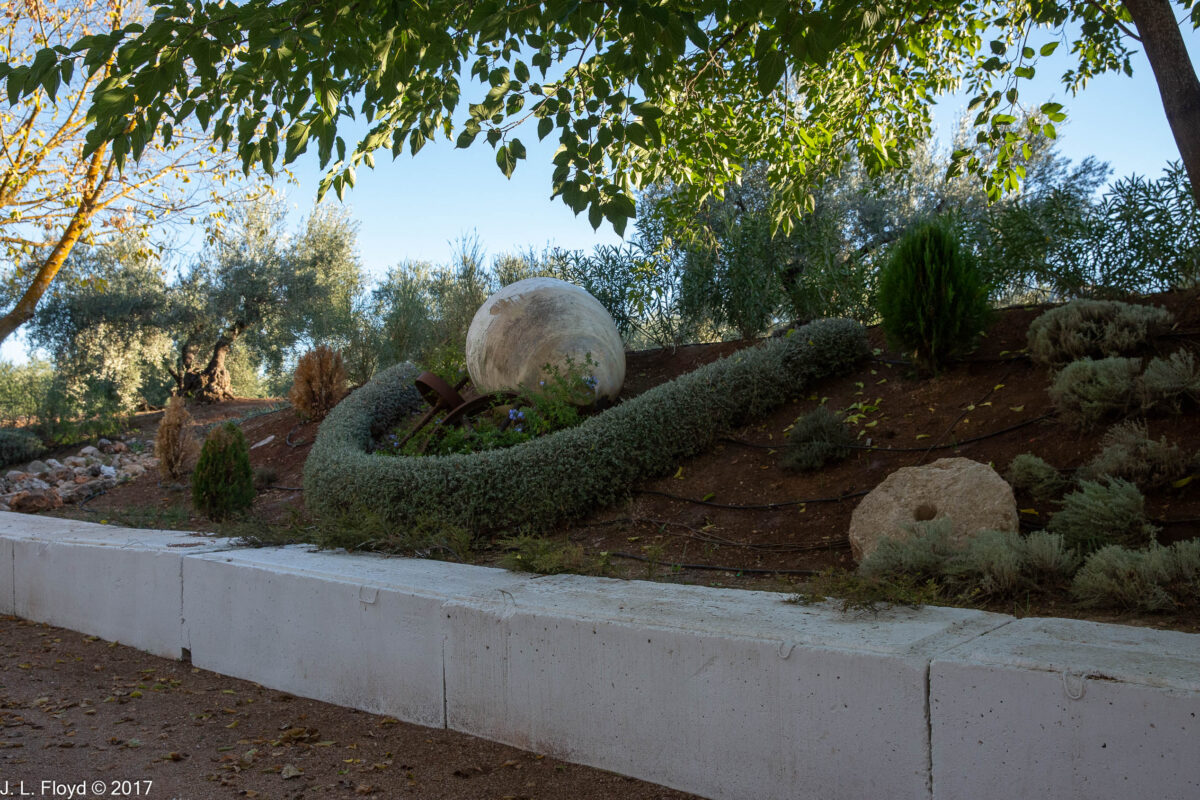
The olive groves and factory where the oil was produced were close behind the restaurant. Between the roadhouse and the olive groves there was a parklike area suitable for strolling, relaxing and picnicking according the needs of the moment. Although there was no railroad line, there were two railroad cars in back of the establishment, which puzzled me until I figured out that they provided the refrigerator for the business. Judging from the remains of an old horse trough, stone benches and other antique artifacts adorning the site. this place must have functioned as a travelers’ stop from time immemorial.

Resuming our journey, we continued across the rolling Andalusia countryside with its endless olive groves. Racing the oncoming twilight, we were able to catch late-afternoon views of picturesque towns and castles such as Castro del Rio and its hilltop fortress, until the curtain of darkness ended the show.

Categories
Spain, Portugal and Morocco, November 2017

Córdoba, November 8, 2017: Mihrab, Maqsura and Patio

The mihrab, the holiest place in a Muslim mosque, is ordinarily a semicircular niche in a wall indicating the qibla, the direction of the Kaaba in Mecca towards which Muslims face when praying. The wall on which a mihrab appears is therefore known as the ‘qibla wall’. The mihrab in the Mezquita is an exception to the usual pattern in that it is a small room behind a lavishly decorated door. The caliphs also added a maqsura, a screened-off prayer space in front of the mihrab, reserved for the ruler, intended to ensure his privacy and protect him from assassination.

The Castilians of the Reconquista era unaccountably felt no obligation to pray to Mecca, and they had insufficient appreciation of the esthetic value of the mihrab as well. In the 14th century they converted it into the chapel of Saint Peter, where the consecrated host was stored before the completion of the new Capilla Mayor in the 17th century.

In the 19th century, however, the Spanish began to rediscover the cultural heritage left by the Moors, and restoration work began on the mihrab and maqsura that has continued to the present; so visitors are now able to see it in its full glory.

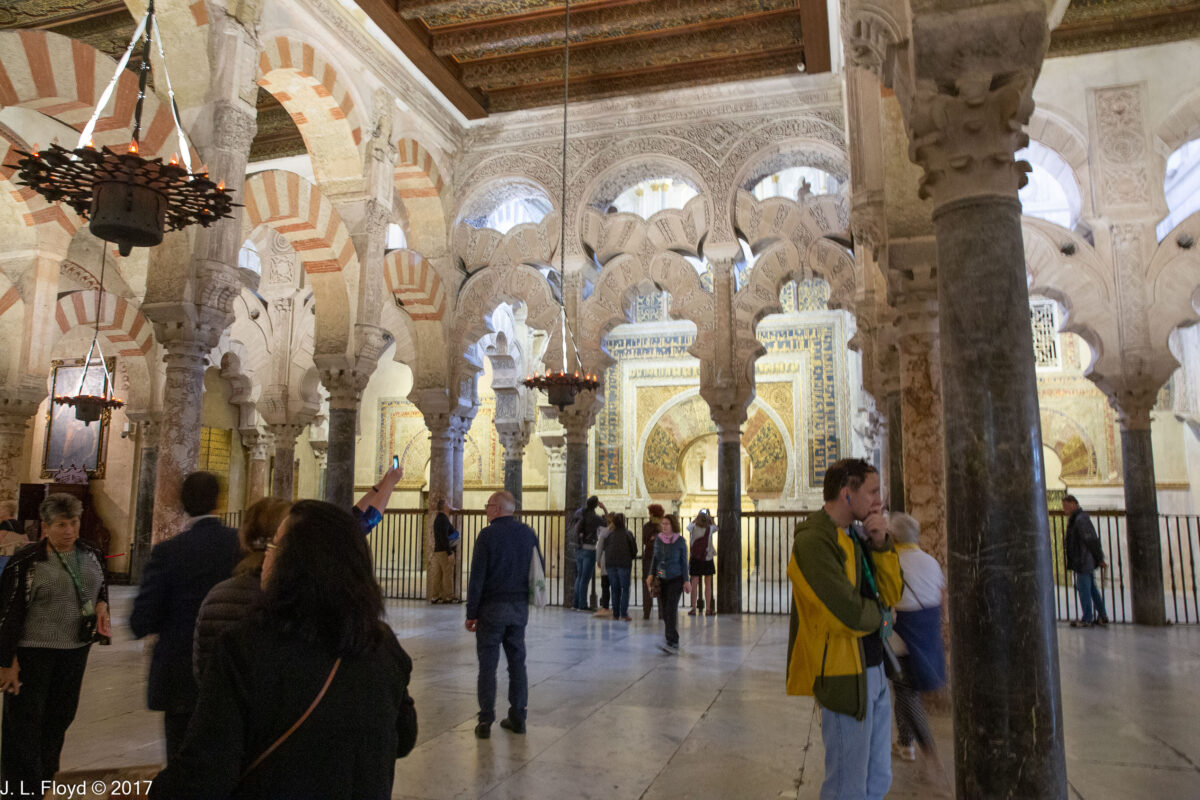
The mihrab is located at the south wall of the Mezquita just to the west of the Chapel of St. Teresa. On either side of it are two doors. The door on the left (facing the wall) of the mihrab, called the Bab Bayt al-Mal, led to the mosque treasury, which of course is now the cathedral treasury. The one on the right, the Bab al-Sabat, led to a passage (sabat) connecting the mosque to the caliph’s palace. The mihrab and the doors are lavishly decorated with mosaics and inscriptions from the Quran. The maqsura encloses the area in front of the doors in a set of intricate polylobed interlocking arches, which also serve to bear the weight of the three domes covering this space. No words can possibly convey the esthetic impact of viewing this astounding ensemble, which must be viewed in person to be fully appreciated. The pictures shown here can convey only a pale shadow of the reality. It was the culmination of our visit to the Mezquita and to the fabulous city of Córdoba.

Before leaving the Mezquita, I want to present a few glimpses of some of the detail-work of the walls and arches that has perhaps been neglected elsewhere. These serve as a reminder of the capabilities of the Moorish and Mudéjar craftsmen who built the mosque and continued its maintenance and transformation after the Christians took over, up until they were expelled from Spain in the 16th and 17th centuries.

We exited the Mezquita as we had entered, via the Patio de los Naranjos. As we emerged I caught sight of a young couple making out on the patio, and took a quick shot of them; the muchacho, probably an American, took a shot right back at me with his phone camera.

On our way out of the Patio de los Naranjos, Sandie took four superb photos of the Mezquita’s magnificent Campanario (Bell Tower). This began as a minaret, completed in 958 under the auspices of Abd al-Rahman III, the first Caliph. Although the Christians converted it into a bell tower after the Reconquista of 1236, they made few substantial changes at first, other than to put a cross on top. But in 1589 the tower was badly damaged in a storm, and rather than merely repairing the damage, the authorities decided to redo it in Renaissance style. They entrusted the work to Hernán Ruiz III, the latest member of the dynasty who had begun the new Capilla Mayor. The Ruiz family seem to have been singularly unlucky in completing their projects, since Hernán III, impeded by the neglect of his sponsors to fund his work, died in 1606, leaving it unfinished. The reconstruction was completed under another architect in 1617. But even that was not final; serious flaws in the construction, and further extensive damage storms and earthquakes, ensured that major modifications would continue throughout the 17th and 18th centuries. One significant enhancement, in 1664, involved the placement of a new cupola on top, crowned by a statue of Saint Raphael.

From the Mezquita, we embarked on the final phase of our visit to the wondrous city of Córdoba – an exploration of the Old Quarter. For that, a new post is in order.

Categories
Spain, Portugal and Morocco, November 2017

Córdoba, November 8, 2017: A Cathedral inside a Mosque

The Mezquita of Córdoba contains a traditional cruciform cathedral inside a Muslim mosque. How that came to be is a story worth telling.

By 1523 Carlos I was both King of Spain and Holy Roman Emperor as Charles V. The Bishop of Córdoba (and later Inquisitor General as well as Cardinal), Alonso Manrique de Lara, wanted to build a new cathedral in Renaissance style. The Córdoba city council vehemently opposed this idea. The bishop appealed to Charles V, who, being a devout Catholic, gave him the go-ahead. Later, upon seeing the (unfinished) result in 1526, Charles V is supposed to have said something like “You have built what you or anyone else might have built anywhere; to do so you have destroyed something that was unique in the world.” I very much doubt whether Charles V said anything of the sort; he was responsible for demolishing a Moorish palace in the Alhambra in order to build a Renaissance residence for himself, so it seems unlikely that the Córdoba project vexed his esthetic sensibilities. But somebody said something like it, and I agree: the cathedral, occupying the central section of the mosque, is a worthy endeavor, considered one of the best in Spain, but one can see similar achievements in Seville or Burgos, and I would rather have seen the Mezquita in its pre-1523 state. In any case Charles V did not see the final result, since it was not completed in his lifetime.

On the other hand, it has been observed that had the cathedral not been built inside the mosque, as opposed to another location in the city, the mosque might not have survived at all; making it a Christian holy place ensured its sanctity.

In any case, the architect chosen to design the cathedral, Hernán Ruiz, fortunately had a high regard for Moorish architecture and displayed considerable sensitivity in preserving as much of the mosque as possible while fulfilling the prescriptions of the sponsors. He started the construction of the nave, but died in 1547, leaving his son, also named Hernán Ruiz, to continue his work. Hernán Ruiz II built the walls of the transept, but he died in 1569, leaving the project still unfinished, and it was then entrusted to Juan de Ochoa, who completed the ceilings of the nave and transept in 1607. But even this was not the end result; the Capilla Mayor still needed an altarpiece, which was begun in 1618, and finished in 1653. During this prolonged period of construction, artistic fashions evolved considerably, so that the cathedral incorporated several different architectural styles – Gothic, Renaissance, Baroque.

As a consequence of all these changes, the number of columns in the Mezquita was reduced from 1250 to a mere 856.

The cruciform cathedral has four main sections: the Capilla Mayor, which contains the High Altar; the Choir; the Transept, which forms the arms of the cross and contains the Crucero, or Crossing, separating the Capilla Mayor from the Choir; and the Trascoro, or retro-choir, a space at the back of the choir for the clergy and altar-ministrants to assemble.

We first encountered the cathedral by way of the Trascoro. The wall separating it from the choir is decorated with a set of columns framing two doors presumably connecting to the choir, presided over by a relief nestled in an upper alcove depicting St. Peter seated in a chair at the heavenly gates.

The orientation of Ruiz father and son was primarily Gothic, and this is reflected in the high vaults and walls of the cathedral. But it was Ochoa who completed the choir ceiling and the dome over the transept, and he was a Mannerist. I won’t attempt to explain Mannerism here, but in short, it was an outgrowth of Renaissance styles characterized by elongated proportions, highly stylized poses, and lack of clear perspective. To me, Ochoa’s ceilings appear simply as Renaissance art.

Yet the final appearance of the choir section is neither Gothic nor Renaissance, because it was only finished in the 1750s, when the Baroque sculptor Pedro Duque Cornejo installed 53 intricately decorated choir stalls which he had carved in mahogany wood. The west end of the choir is dominated by an episcopal throne, also by Duque Cornejo, dated 1752, and designed like an altarpiece, with three aisles and a depiction of the Ascension of Christ into heaven on the upper vault, topped off by a statue of the archangel Rafael.

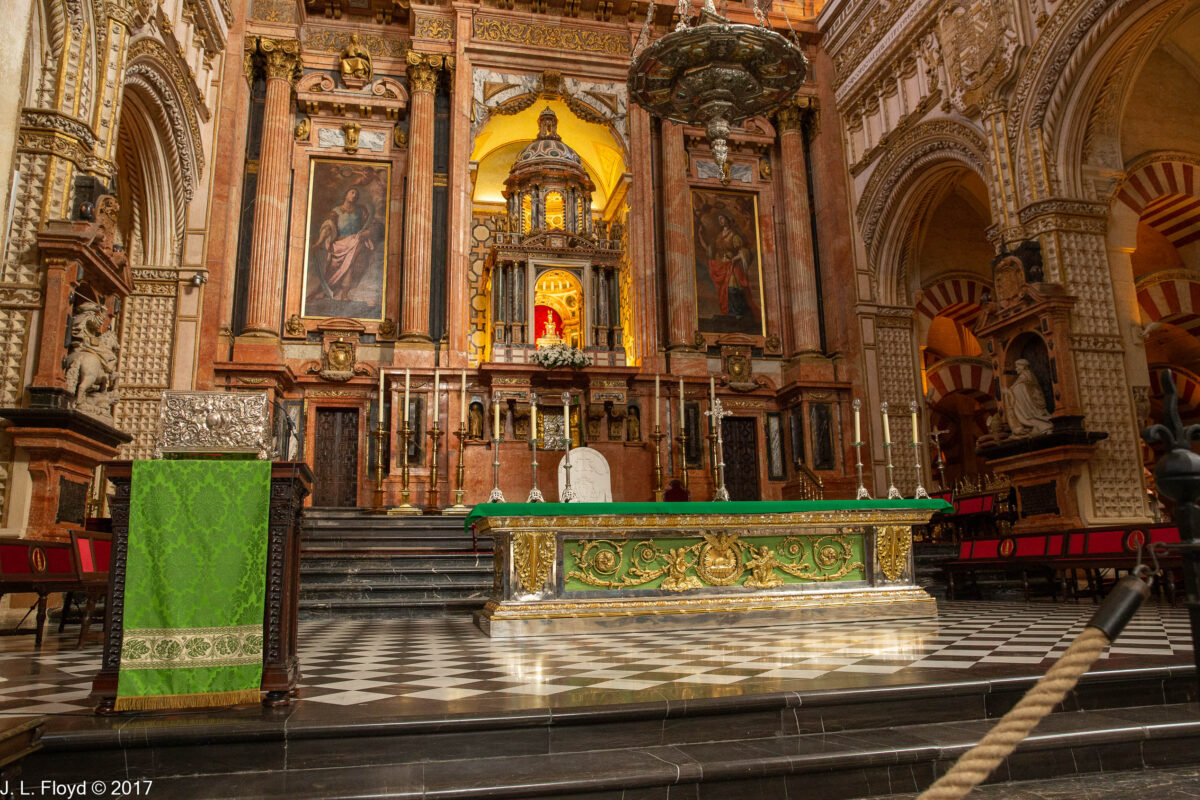
The altarpiece of the Capilla Mayor, begun in 1618, was not finished until 1653, and even then changes were made later. A Jesuit, Alonso de Matias, designed it in the Mannerist style, structuring it in three aisles separated by dual composite capital columns, and two levels above the base. Occupying the central bay of the altarpiece is a towering splendid Tabernacle, which displays the consecrated Host. Directly above the tabernacle is a painting of the Assumption of Mary, while the side bays are filled with canvases featuring martyrs of the Church, all by Antonio Palomino, a court painter from Madrid. Palomino received his commission for these paintings in 1713, when Europe was already well into the Baroque era, and they replaced originals which were also Baroque in style.

Just outside the Capilla Mayor, on either side of the transept, are two imposing Baroque pulpits carved in black marble, mahogany and bronze by a French sculptor, Michel Verdiguier, who completed them in 1779. They are dedicated to the writers of the Gospels: the one on the right, to Matthew and Mark, the one on the left to Luke and John.

Every proper cathedral has to have a sacristy or treasury, and the one in the Mezquita is located on its south side, in the Capilla de Santa Theresa, where we headed after viewing the Capilla Mayor. The Chapel of Saint Teresa was a late addition, having been founded in 1697 by the Bishop of Córdoba at the time, Cardinal Pedro de Salazar. He was a devotee of St. Teresa of Avila (1515-1582), the great Spanish mystic and religious reformer, and patron saint of those who suffer from headaches. Salazar intended it to be a funerary chapel for himself and his family, as well as a sacristy, and he is indeed buried there. He located the chapel, appropriately, in the same place where the treasury of the mosque had been centuries before.

The most striking of the many sacred objects displayed in the Treasury is the Processional Custody of Corpus Christi. This is a gold and silver monstrance, a container where the consecrated Host is displayed for veneration during ceremonial processions. It was the creation of two artists, one of whom, Enrique de Arfe (1475-1545), was of German origin (birth name Heinrich von Harff), but apparently worked all his professional life in Castile. He is credited with introducing Renaissance innovations in precious metalworking to Spain. In the seventeenth century the Spanish silversmith Bernabé García de los Reyes augmented Arfe’s work with a new base and other additions, completing the monstrance in its present form.

A number of other historically significant and precious gold and silver sacred objects were on display – processional crosses, reliquaries, scepters, etc. No less imposing were the paintings and sculptures in the Treasury. Almost all of them are products of the Baroque era, late 17th and early 18th century. There are eight statues of saints and church fathers by the celebrated sculptor José de Mora Exposito of Granada, placed between the arches of the chapel. And of course there had to be a sculpture of Saint Teresa of Avila, also by de Mora, which presides over the altarpiece of the chapel. I don’t have a photo of it, but a better one than I could have obtained may be seen here. She is depicted holding a book with a dove on her shoulder.

Two famous but anonymous paintings, located over the chapel doors, represent The Immaculate Conception and The Assumption of Mary. But I was more drawn to three canvases by Antonio Palomino illustrating scenes from the history of the city of Córdoba: The Martyrdom of Saint Acisclus and Saint Victoria, The appearance of Saint Raphael before Father Roelas, and The conquest of Cordoba by Fernando III the Saint. The last of these is the only one associated with a verifiable historical episode: it depicts the triumphant entrance of King Ferdinand (Fernando) III into Córdoba in 1536. We did not photograph it, but you may see it here. The other two deal with episodes which I would describe as legendary, but which Córdobans certainly believed to be true. The Appearance of St. Raphael to Father Roelas is the last of several occurrences in which the guardian angel of Córdoba is supposed to have revealed himself to local clerics to announce his divine appointment as custodian of the city. The Martyrdom canvas depicts an episode from 304 CE, during the persecutions of Diocletian, in which the Roman prefect of Córdoba had the youth Acisclus and his sister Victoria tortured and killed for refusing to abjure their Christian faith. They were later made patron saints of the city.

Before leaving the Treasury, I want to show a few items we observed there which were of less exalted character than the sacred objects pictured above, but which we found intriguing for one reason or another. I have not been able to find out much about these more mundane pieces, but they are worth presenting nonetheless.

The Treasury is situated next to the Mihrab, which I’ll deal with in the next post, where I conclude our visit to the Mezquita.
Categories
Spain, Portugal and Morocco, November 2017

Córdoba, November 8, 2017: The Judería

Leaving the Mezquita, we immersed ourselves in the narrow streets of the Judería, the old Jewish quarter of Córdoba, and arrived in front of a building which proclaimed itself to be the Faculty of Philology and Letters of the University of Córdoba. It’s difficult to know where the demarcation between the Judería and the rest of Córdoba lies, since for about 500 years no Jews lived there, and few live there today. In any case, there are many establishments in the Judería that have no obvious Jewish associations, such as the University of Córdoba. But it was a quiet and welcoming place to begin our tour of the Judería, as the black cat sleeping beneath a nearby tree confirmed.
It was only a short distance from the University to the Plaza Maimonides. This square, of course, is named after the medieval Jewish scholar and physician Moses ben Maimon, generally known as Maimonides, who was born in Córdoba in 1138. He did not live there long, but there is a monument to him in the square. In 1148 the Almoravids, the Berber dynasty which had ruled al-Andalus for a century, were replaced by a less tolerant regime, that of the Almohads, who demanded that all Christians and Jews in Córdoba either convert to Islam or emigrate. The family of Maimonides emigrated – first to the city of Fez in Morocco, then to Palestine and finally Egypt. He was trained as a physician and eventually became the court physician to the Islamic ruler Saladin. In the meantime he also became the leader of the Jewish community in Egypt and completed a series of writings which established him as the pre-eminent Jewish scholar and philosopher of the Middle Ages. It’s not surprising that Córdoba would want to claim him as a native son.

Plaza Maimonides is filled with attractive houses, which made it worth a look regardless of its illustrious past associations. In addition to the statue of Maimonides, there is a bust of Muhammad ibn Aslam Al-Ghafiqi (died 1165), an Andalusian-Arab physician and oculist who is credited with the invention of eyeglasses (still called gafas in Spanish).

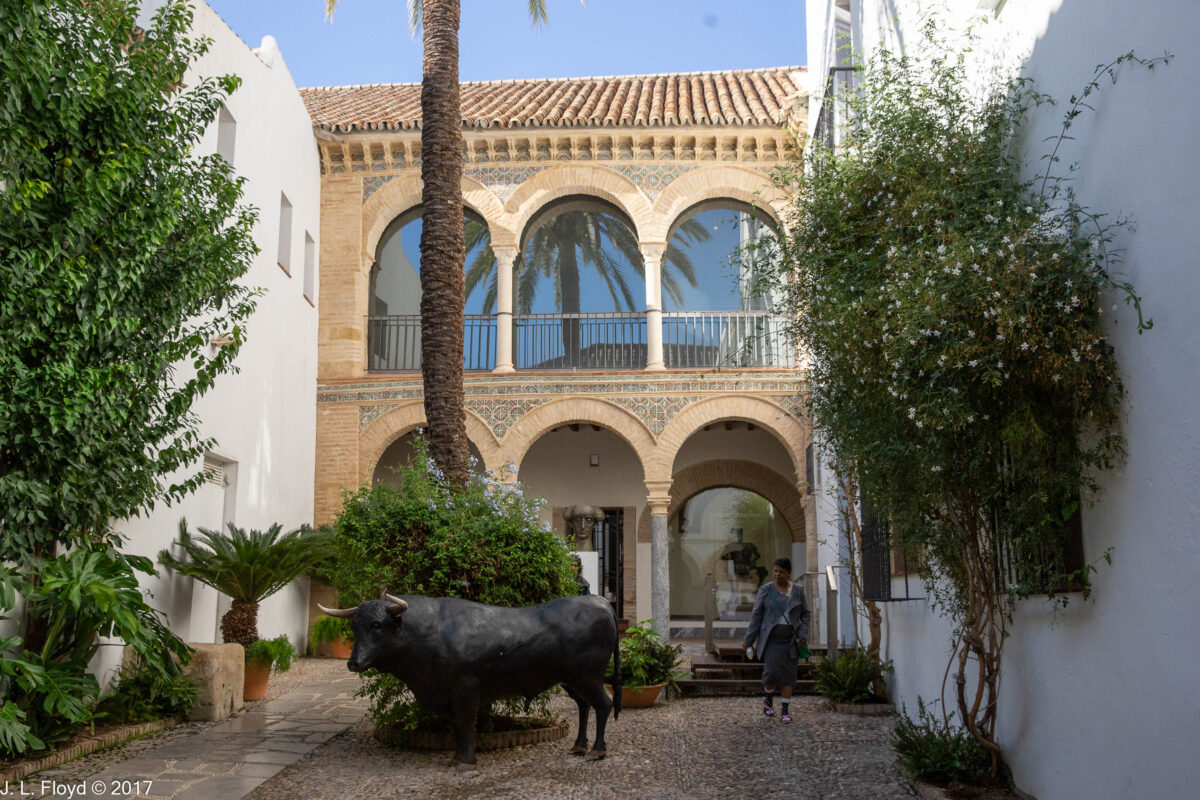
You wouldn’t expect a Jewish neighborhood to host a bullfighting museum. But that’s where we found the Museo Taurino de Córdoba- in an elegant mansion owned by aristocrats in the 16th century. We also found the Iglesia San Bartolomé. In the year 1391, a huge anti-Jewish pogrom broke out which decimated Jewish communities all over Spain, not least in Córdoba. Many Jews converted to Christianity or emigrated. In the aftermath, with many Jewish houses vacated, a new Christian parish church was established in the Judería on Calle Averroes. It is considered one of the finest examples of Mudéjar art in Spain. Unfortunately, it was closed when we were there, so we were only able to take pictures of the exterior, but a stunning photo of the interior can be found here.

Near the Plaza Maimonides we were ushered into a handsome two-story apartment complex, both stories fronted with arcades formed by elegant arches, surrounding a spacious courtyard paved with river-stone, dotted with trees and shrubs ensconced in graceful planters fashioned from brick-and-wrought iron, and graced with an exquisite fountain near the entry passage. Blue flowerpots, reflecting the Jewish heritage of the location, hung from the railings between the second-floor arches. The complex seemed to epitomize the life-style not only of the old Judería, but of medieval – and modern – Andalusia in general. We should all be so lucky.

The Córdoba Judería incorporates not only residential districts but also part of the downtown area of the city, and we soon found ourselves making our way down a busy street bedecked with hotels, bars, restaurants, boutiques and, of all things, the Museum of the Inquisition. Having been a familiar of the Spanish Inquisition in my salad days, I was anxious to get a look at it, although we did not have time to explore it at length.

Almost before we knew it, we found ourselves back at the Plaza de San Rafael, boarding the bus to continue on to Granada. I regretted having so little time to explore the city which was for many years the supreme jewel of Spain, but I was also thrilled to have beheld it once in my lifetime.

Categories
Spain, Portugal and Morocco, November 2017

Córdoba, November 8, 2017: From Mosque to Cathedral

The Mezquita-Catedral de Córdoba – Mosque-Cathedral of Córdoba – formally titled the Catedral de Nuestra Señora de la Asunción (Cathedral of Our Lady of the Assumption), but commonly just called the Mezquita, is one of the wonders of the world. I had wanted to see it for many years, ever since I saw a photo of the interior in a book of European history, and would not have gone on a trip that didn’t have it on the itinerary.

At the northeast corner of the Plaza de San Rafael, we saw what looked like an upscale apartment building with balconies overlooking the street. It turned out that these balconies were built into the south wall of the Mezquita in the 18th century to improve the illumination inside the walls. They do not provide entry to the Mezquita; for that we had to walk to the north end, along the Calle Torrijos, to the Patio de los Naranjos, the Courtyard of the Orange Trees. Confusingly, one enters the mosque through what is called the “south wall,” i.e. the south wall of the Patio, which is actually the north wall of the mosque. It is lined with 17 horseshoe arches which formerly provided access to the mosque, but nowadays only one of them, the Gate of the Palms (Puerta de las Palmas), is open.

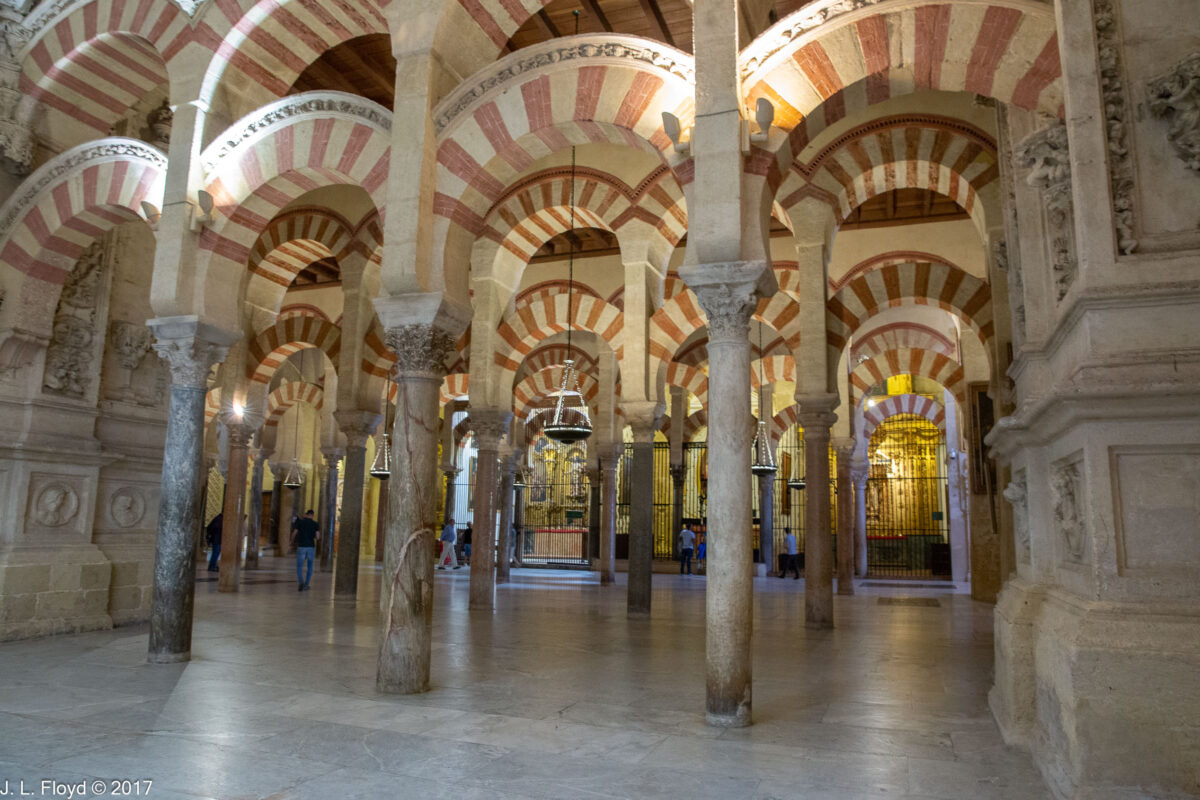
Crossing the threshold of the Puerta de las Palmas, the visitor is transported back to another age, the world of medieval Islam. It was Abd al-Rahman I, founder of the Emirate of Córdoba, who initiated construction of the Mezquita in 785 CE. His successors expanded and enhanced the mosque, and later, when the Christians took over, they left it essentially intact. When they did start making their own additions, they did so in Mudéjar style (at first), so that the visitor’s initial impression is that of an overwhelmingly Moorish ambience with a few Christian accoutrements.

Proceeding down the length of the vast entrance hall, which runs all the way to the south end, one encounters a glass floor through which are visible excavations of Roman ruins – on top of which the Mezquita was built. Turning to the right or left, visitors find themselves, as we did, in one of the several prayer halls, all of which are so expansive and so similar that you cannot keep track of which one you are in at the moment.

The founding builders of the Mezquita – the architect is unknown – made extensive use of material from those Roman ruins, especially columns, but the columns were not tall enough to build the ceiling of the prayer hall to the height deemed proper, so the Muslim engineers made up the difference by adding not only column extensions but arches in multiple tiers. The effect is astounding. Row upon row, tier upon tier, a forest of columns stretches off into what seems like infinity.

The first Christian addition, as one might expect, was an altar; in Spanish churches the altar is enclosed in a space called the Capilla Mayor, or main chapel. The original Capilla Mayor, now known as the Capilla Villaviciosa, was created between 1357 and 1372 by appropriating a space under a dome in the mosque extension added by Caliph al-Hakam II in the 10th century. The artisans who built the altar made few if any architectural changes to accommodate it. A Gothic nave was added later, in 1489, and much later a Baroque altarpiece and other furnishings, but these did not encroach on the splendid 10th-century dome or the incredible interlacing archwork at the chapel entrance; and they were removed in 20th-century restoration work. The Villaviciosa Chapel continued to serve as the Capilla Mayor until 1607, when the new Capilla Mayor was completed.

A more substantial modification to the mosque came with the construction of the Capilla Real, the Royal Chapel, completed in 1371. This was done under none other than Henry (Enrique) II, murderer of Peter the Cruel and persecutor of the Jews, who intended it as a funerary chapel and transferred to it the remains of his father, Alfonso XI, and grandfather, Ferdinand IV. Those remains are no longer there, but the chapel is still known as the Capilla Real. Despite its Christian sponsorship, the Capilla Real was constructed in Mudéjar style by Moorish craftsmen. The Spanish Christians of the Reconquista era remained heavily under the spell of Moorish art and architecture and needed the skills of its practitioners to emulate them.

But this did not last. In the fifteenth century the successes of the Reconquista fueled a growing self-confidence, cultural identity and religious fervor in the Iberian kingdoms, manifested in the conquest of the last remaining Muslim strongholds, the final expulsion of the Jews, and the Voyages of Discovery. This was accompanied by increased integration into the European political and economic sphere and, most notably, exposure to the influences of the Italian Renaissance.

In the sixteenth century the consequences of these changes would come into full force. I’ll deal with that in the next post.