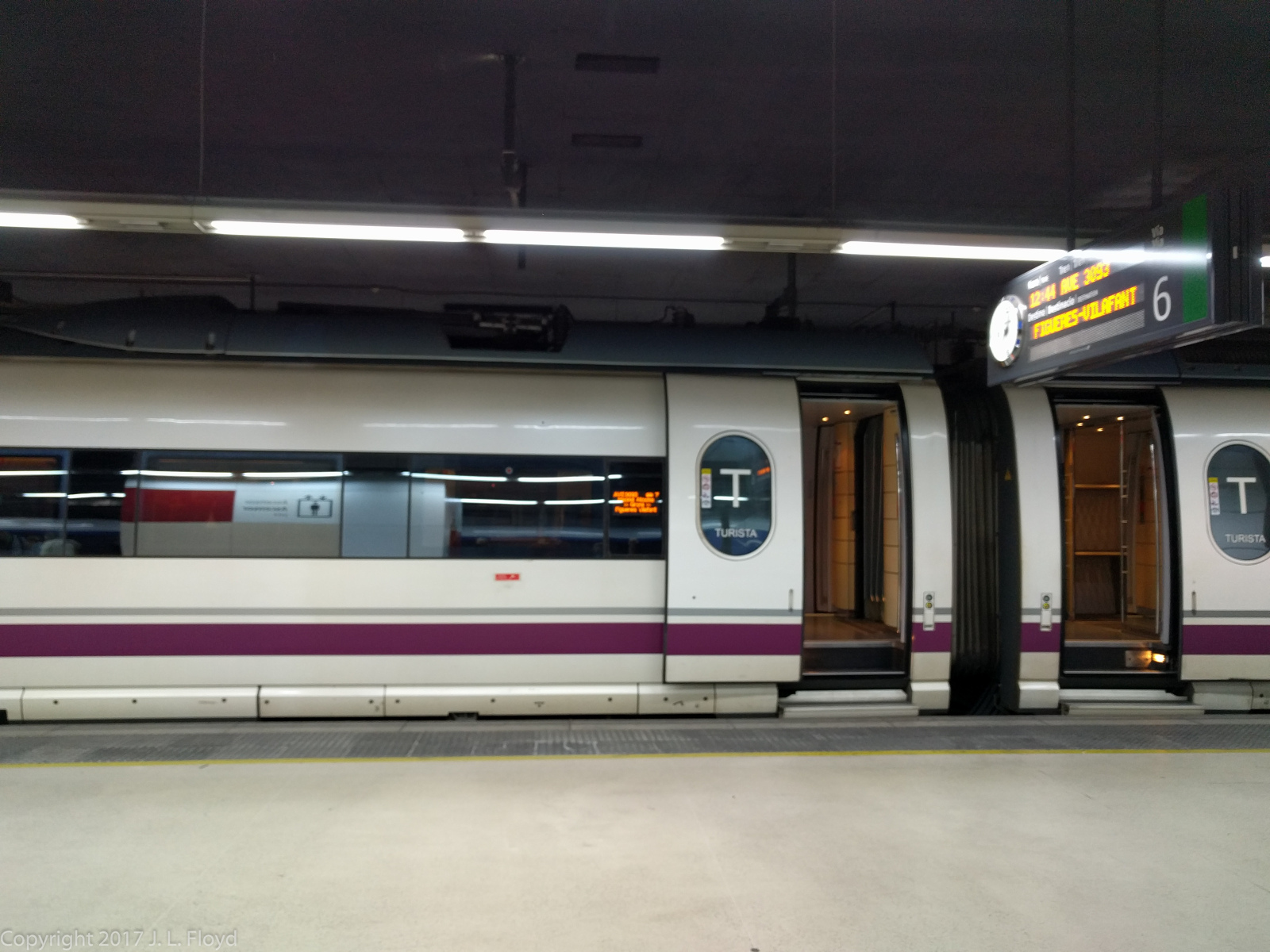
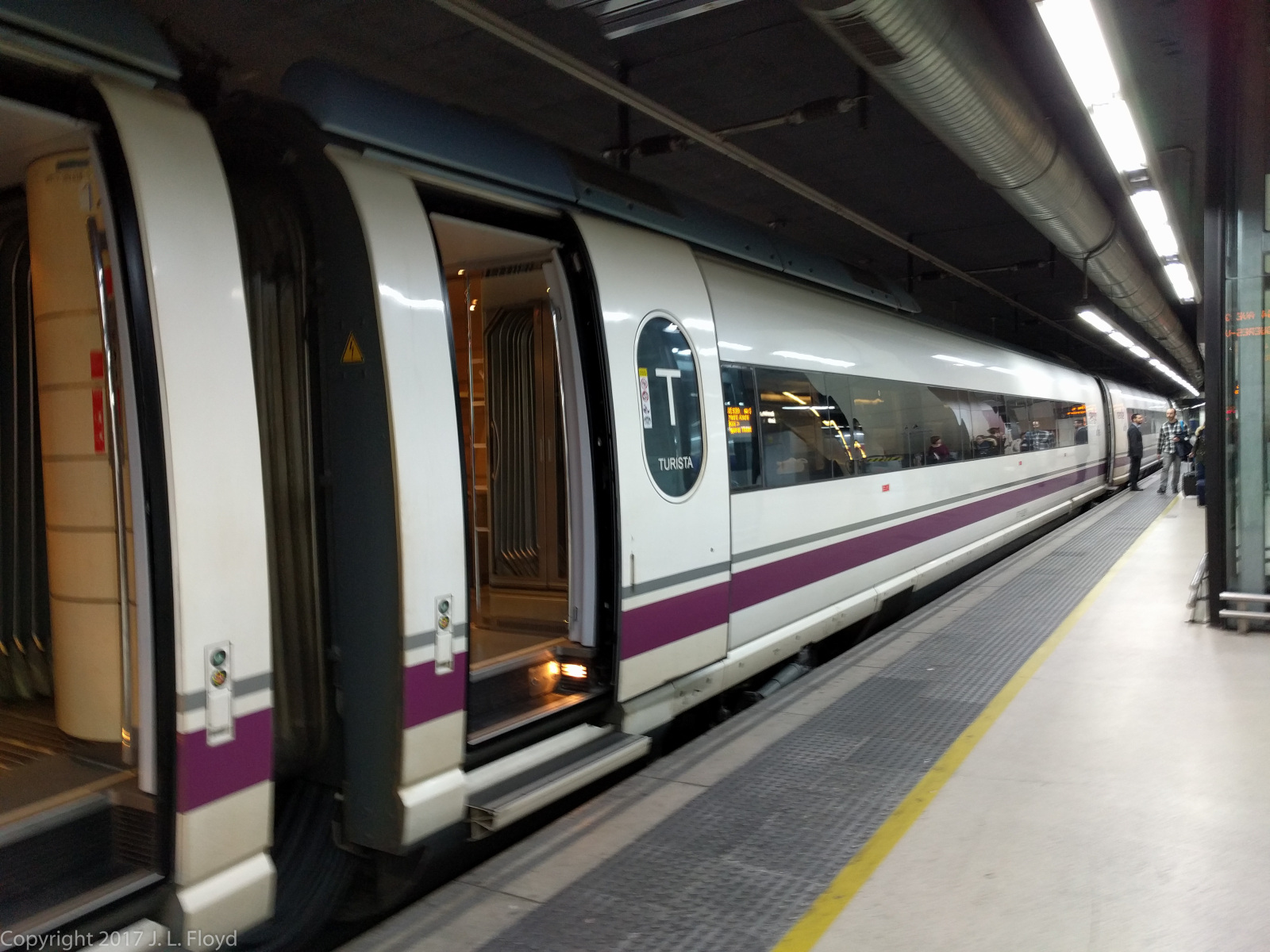
On the morning of November 19, 2017, a somewhat reduced Go-Ahead tour group boarded the high-speed AVE (Alta Velocidad Española) train in Madrid’s Atocha Station to leave for Barcelona. Reduced, because not all the members of the original group elected to take the optional extension to Barcelona, some of them having been there previously or just not wanting to go for one reason or another. For those of us who did take the extension, however, it was a memorable experience, beginning with the train ride.
AVE is Spain’s version of the Japanese Shinkansen (Bullet Train), which I had ridden during my trip there in 1996. It makes the 625 kilometer (388 mile) journey from Madrid to Barcelona in three hours. I like trains and prefer train to air travel for in-country trips, and I wish the USA had more passenger trains, especially the high-speed versions. The AVE train was comfortable, the ride was smooth and scenic, and we were in Barcelona almost before we knew it.
In fact, we arrived so early that much of even a short November day was still ahead of us — so much that we had time for an afternoon excursion to a destination an hour’s drive from Barcelona, and four thousand feet above sea level.
The latest incarnation of our faithful tour bus took us to the hamlet of Monistrol, deep in the Montserrat mountain range, part of the Catalan Pre-Coastal Range. There we debarked in a parking lot next to the C-55 highway and walked across a footbridge over the El Llobregat River to the Aerí de Montserrat cable-car station, where we boarded a gondola that took us up 1,236 meters (4,055 feet) to the Benedictine Abbey of Santa Maria de Montserrat.
The name “Montserrat” means “serrated mountain” in Catalan. I should mention at this point that Catalan, while it is a member of the Romance language family closely akin to Castilian, the national standard language of Spain, is nevertheless not merely a dialect of what we think of as “Spanish” but a separate language, distinct from Castilian, like Portuguese. Catalan is the indigenous and official language of the autonomous region of Catalonia as well as the Balearic Islands and the community of Valencia (where it is called “Valencian”). It is spoken in other parts of Spain adjacent to Catalonia and even in small enclaves in France and Sardinia as well. Like Castilian and other Romance languages it evolved from dialects of vulgar Latin during the early Middle Ages. During the Reconquista and the late medieval period Catalan was spoken in wide areas of the Kingdom of Aragon, but with the unification of Spain in the early modern period, and especially from the 18th century onward, the Spanish monarchy made concerted efforts to assimilate the minority regions of Spain, including not only political and economic but cultural institutions, into the dominant Castilian society. This entailed the replacement of regional languages such as Catalan and Basque with the Castilian language. There was a brief period of relaxation during the Second Spanish Republic (1931-39), but under the Francoist dictatorship (1939-1975) repression of the Catalan language and culture was reimposed and redoubled. Use of the Catalan language was banned in schools, religious institutions and public administration. Nevertheless, the language survived and after the Spanish transition to democracy, beginning in 1975, Catalan came to be recognized as the official language of government, education and mass media in Catalonia and Valencia; its teaching in schools there is mandatory.
One manifestation of that renaissance is the ubiquity of signage in Catalan in Catalonia. This is sometimes a source of confusion to tourists who are unaware of the distinction between Catalan and Castilian. For example, references to “Sant Joan” at Montserrat have led people to ask “What was Joan of Arc doing at Montserrat Abbey?” “Joan” is of course the Catalan form of the name “Juan”, rendered in English as “John”. For the most part I shall be using the Catalan forms of place and personal names in this post, with some exceptions where sources cited use the Castilian or Anglicized versions.
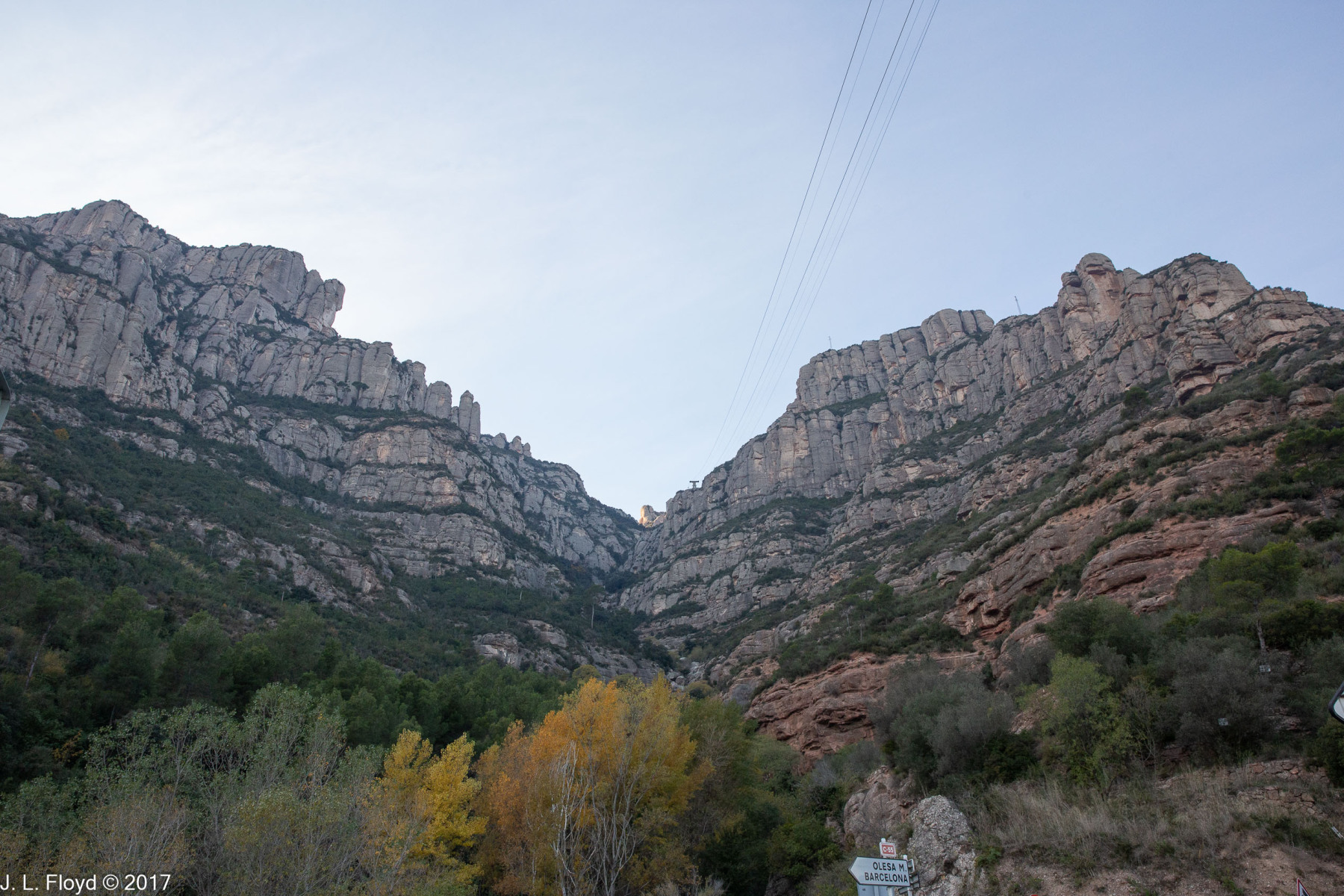
Before boarding the cable car, I was able to shoot a few pictures to capture the majesty of the jagged peaks of Montserrat and the serenity of the valley of the El Llobregat River.
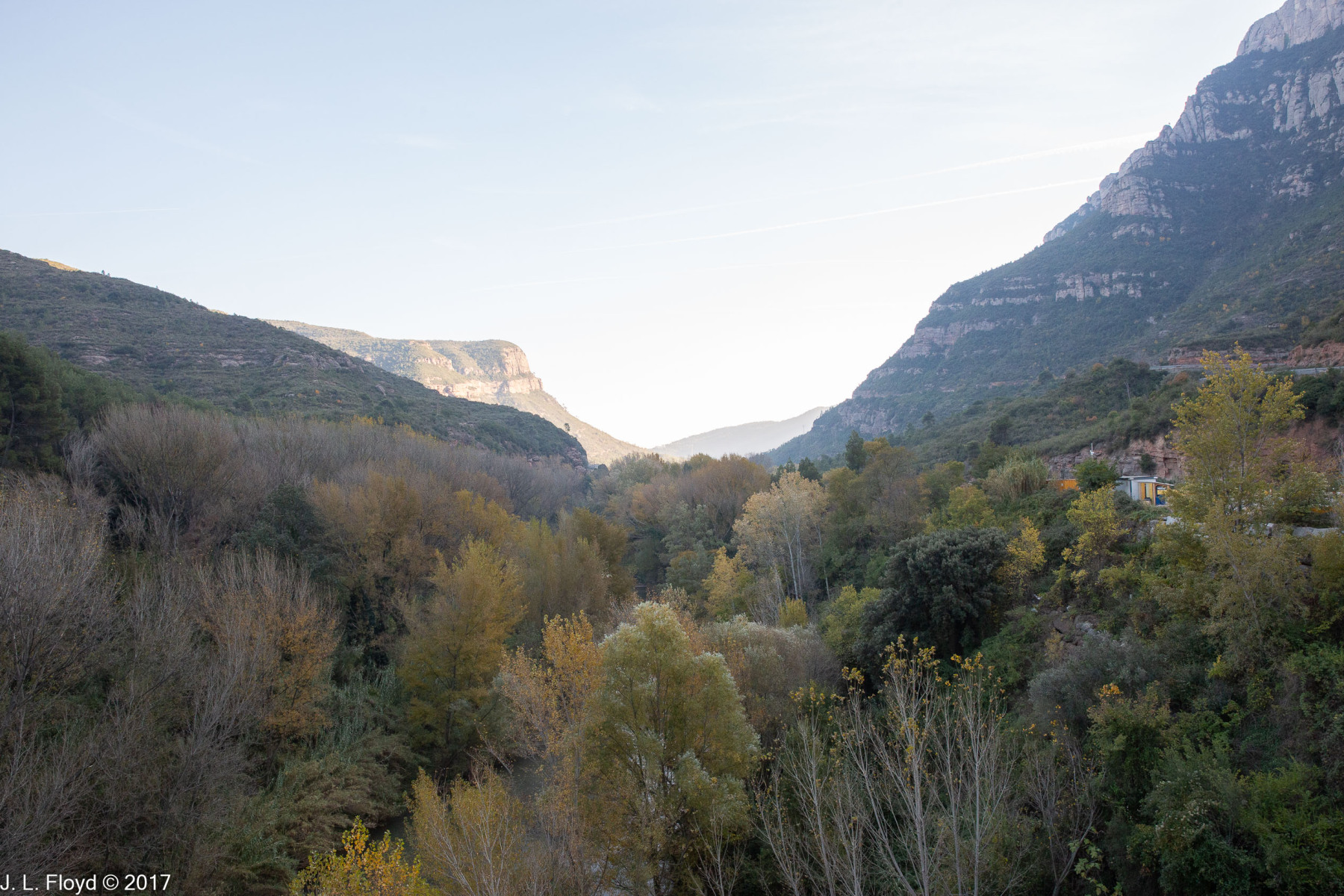
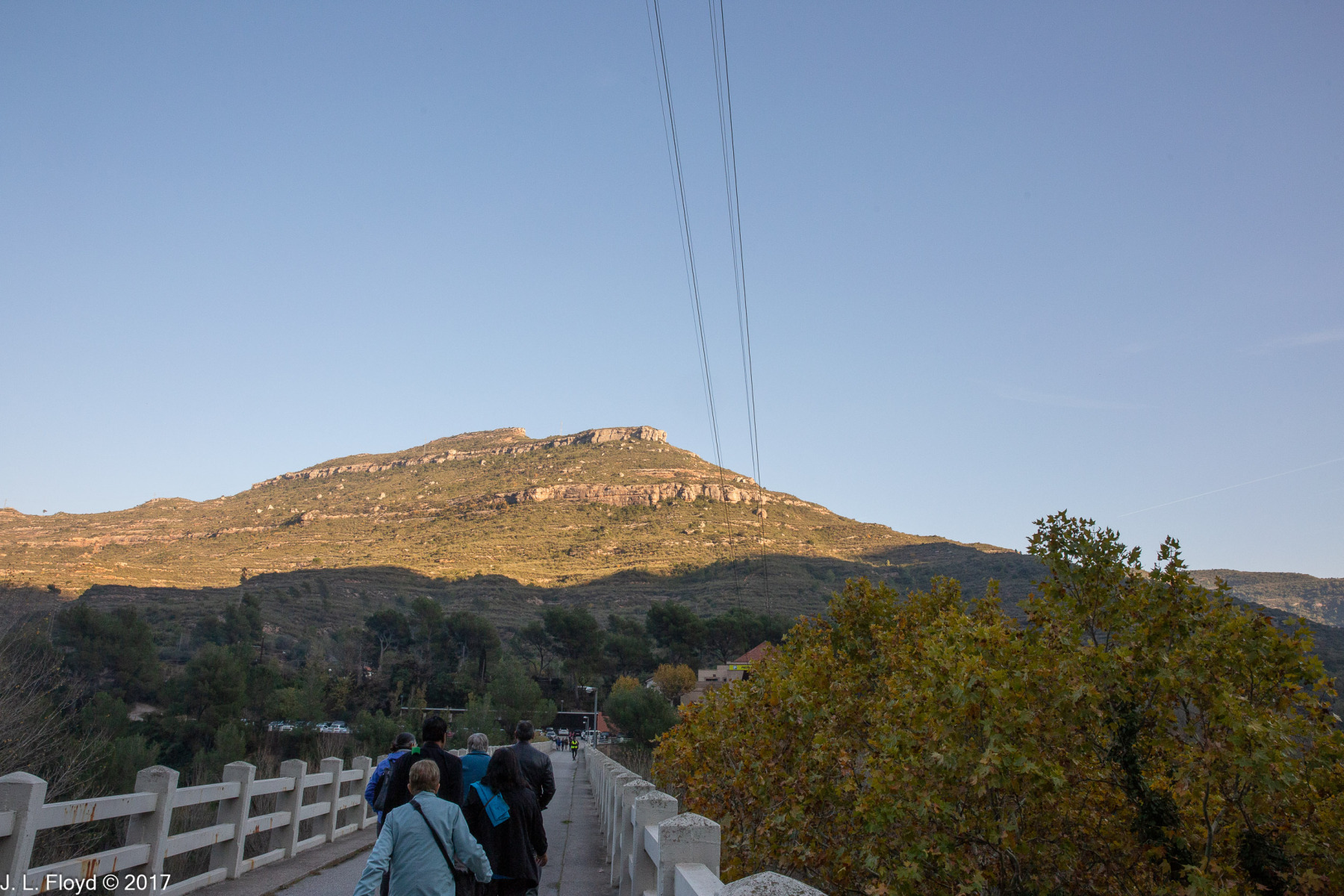
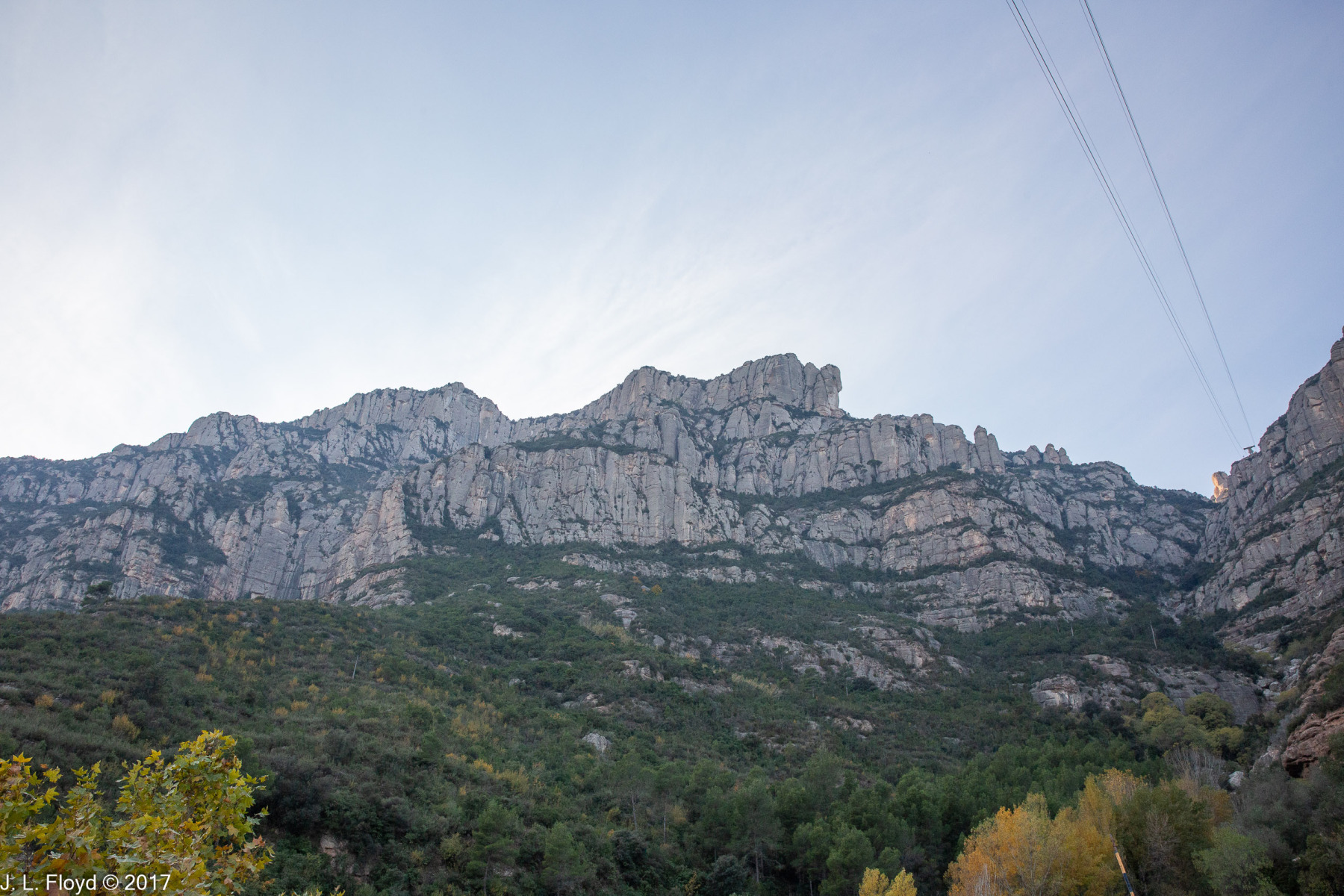
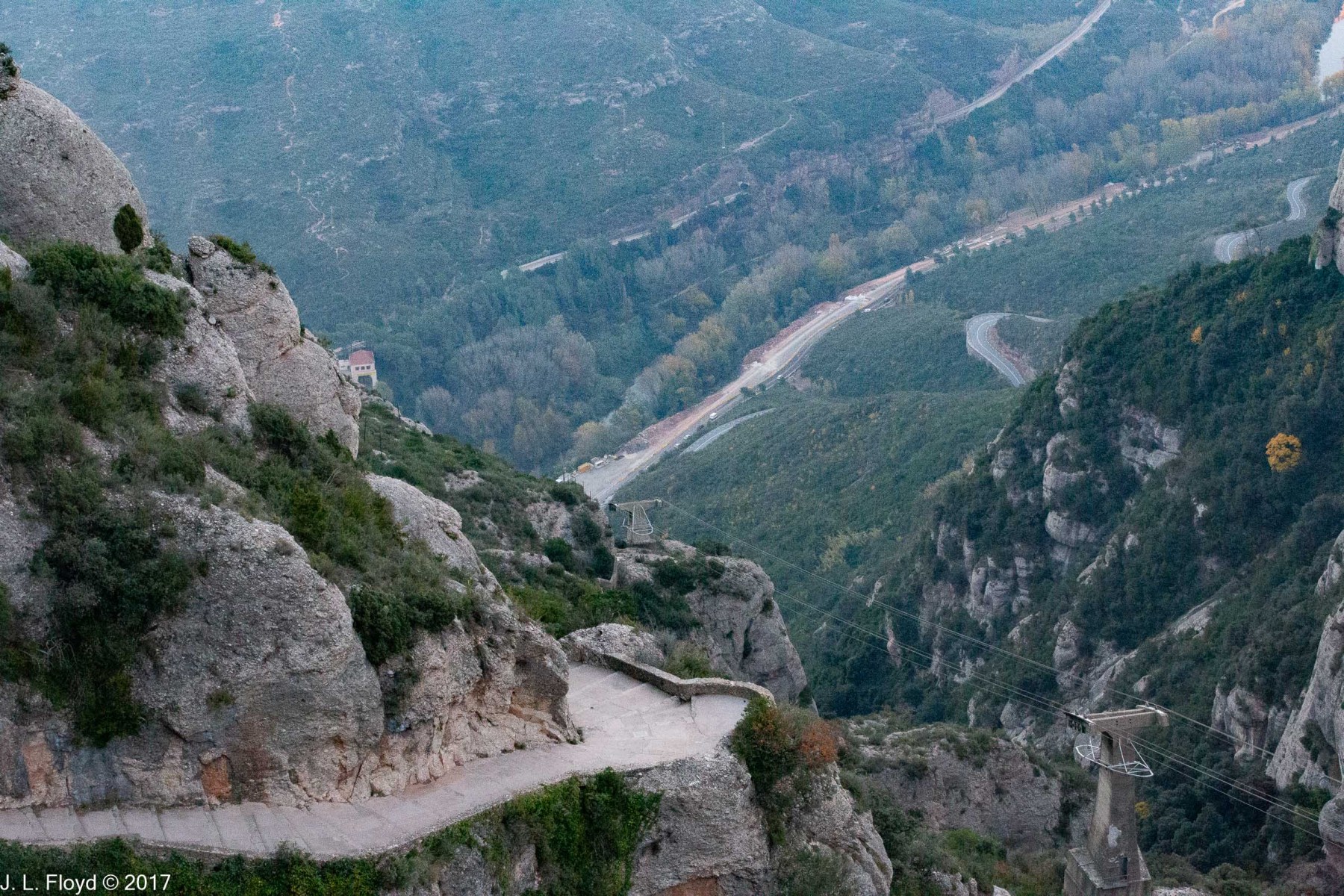
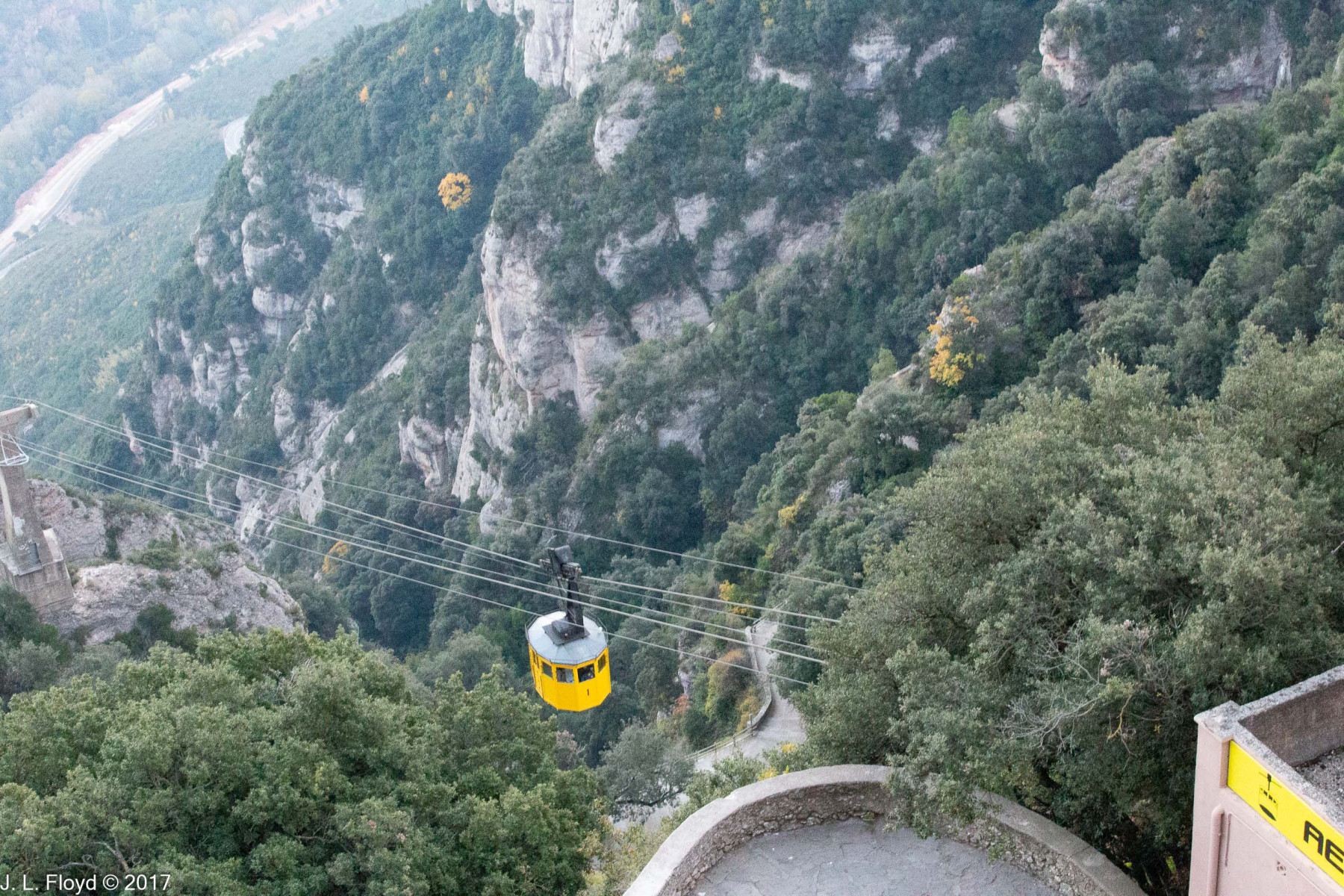
The cable-car ride was the most exciting part of the trip and gave me an opportunity to shoot some spectacular photos of the mountains and the valley beneath us.
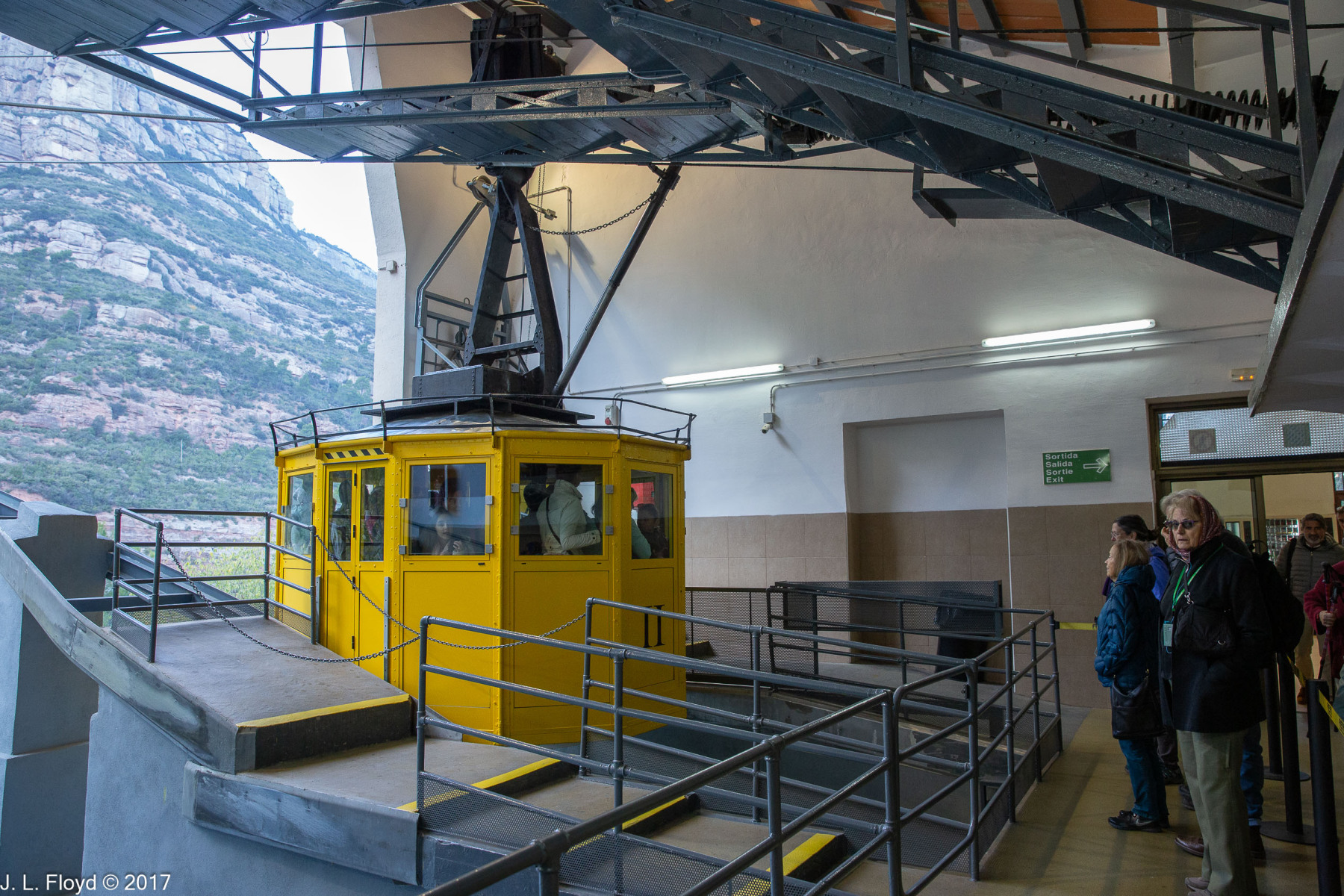
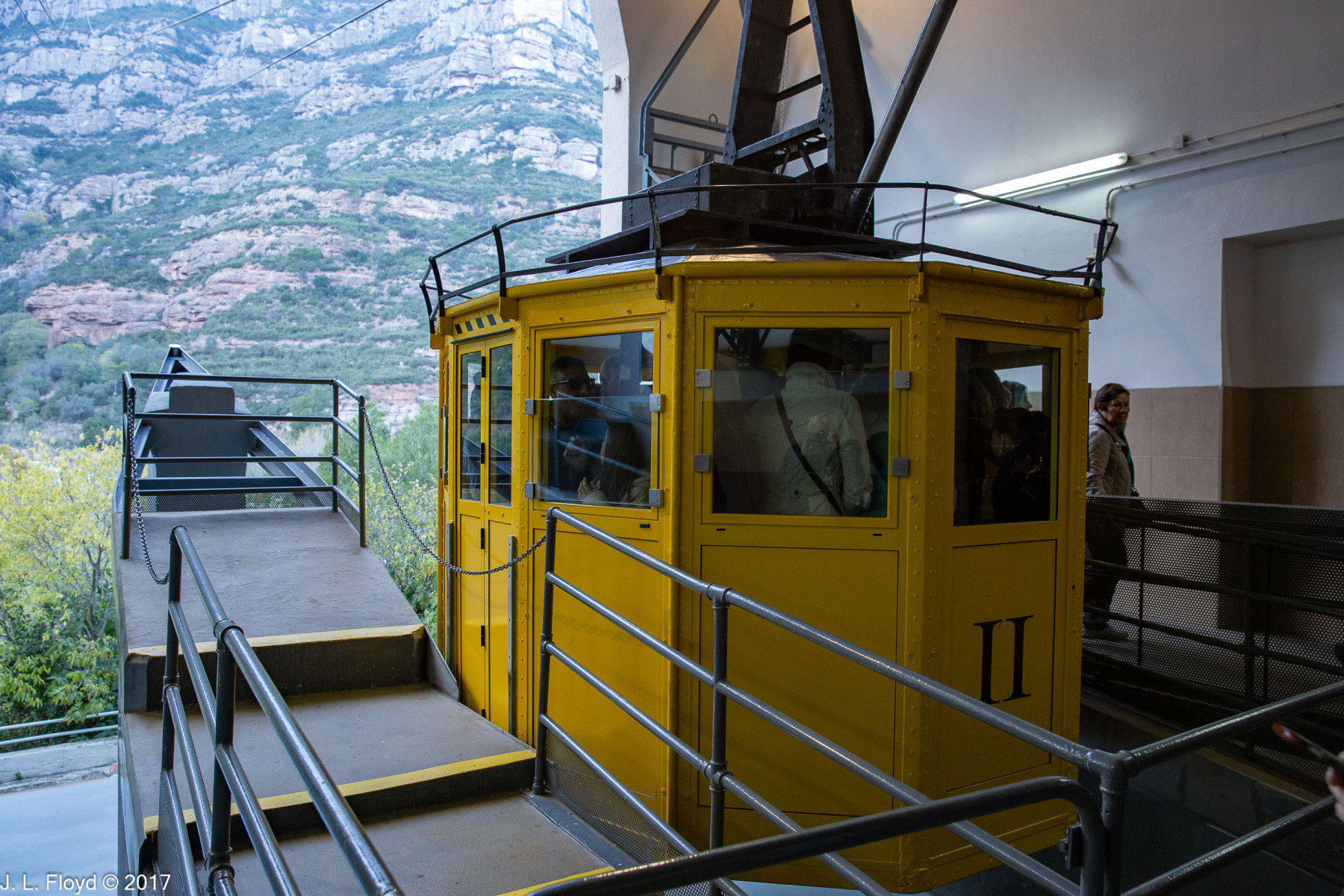
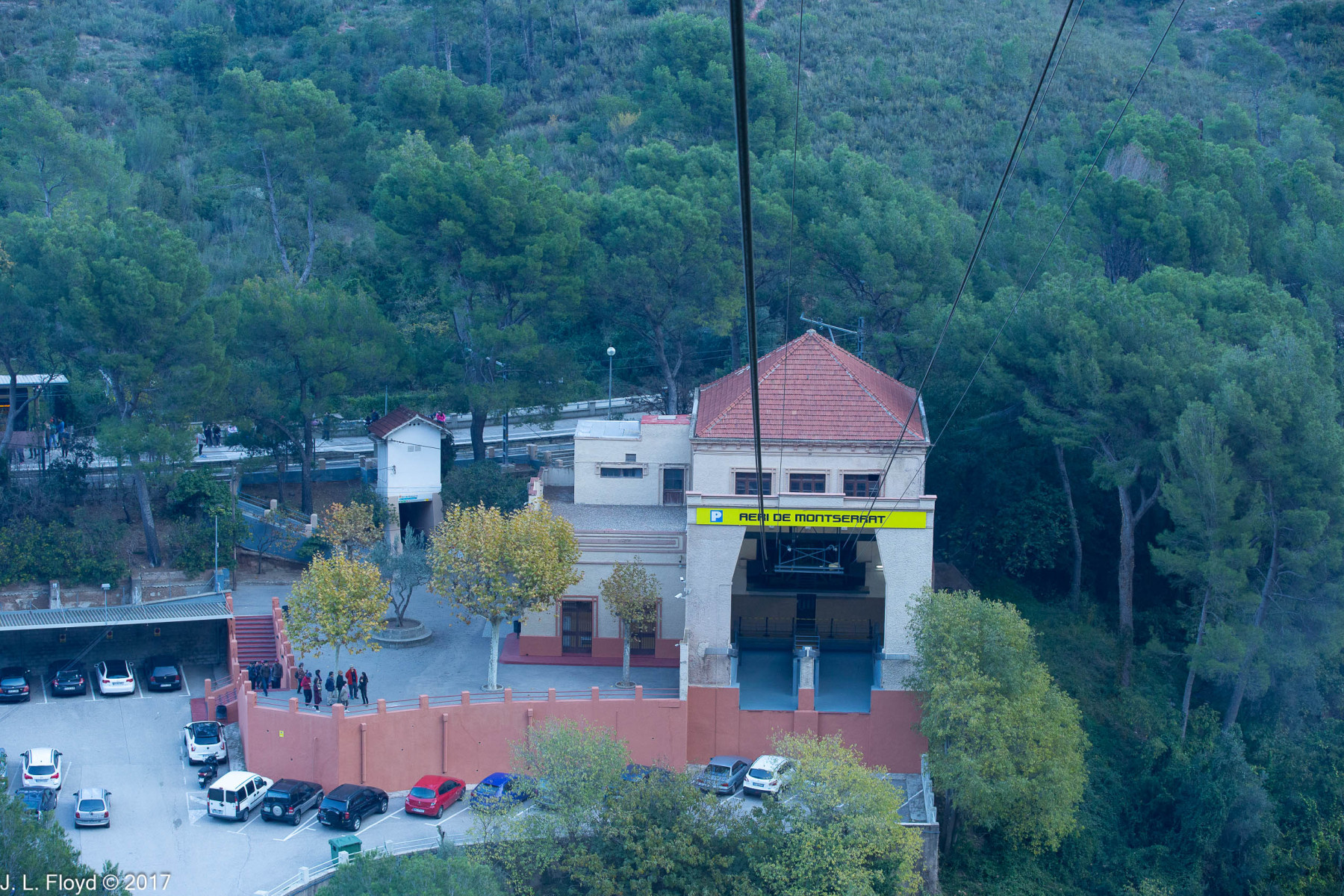
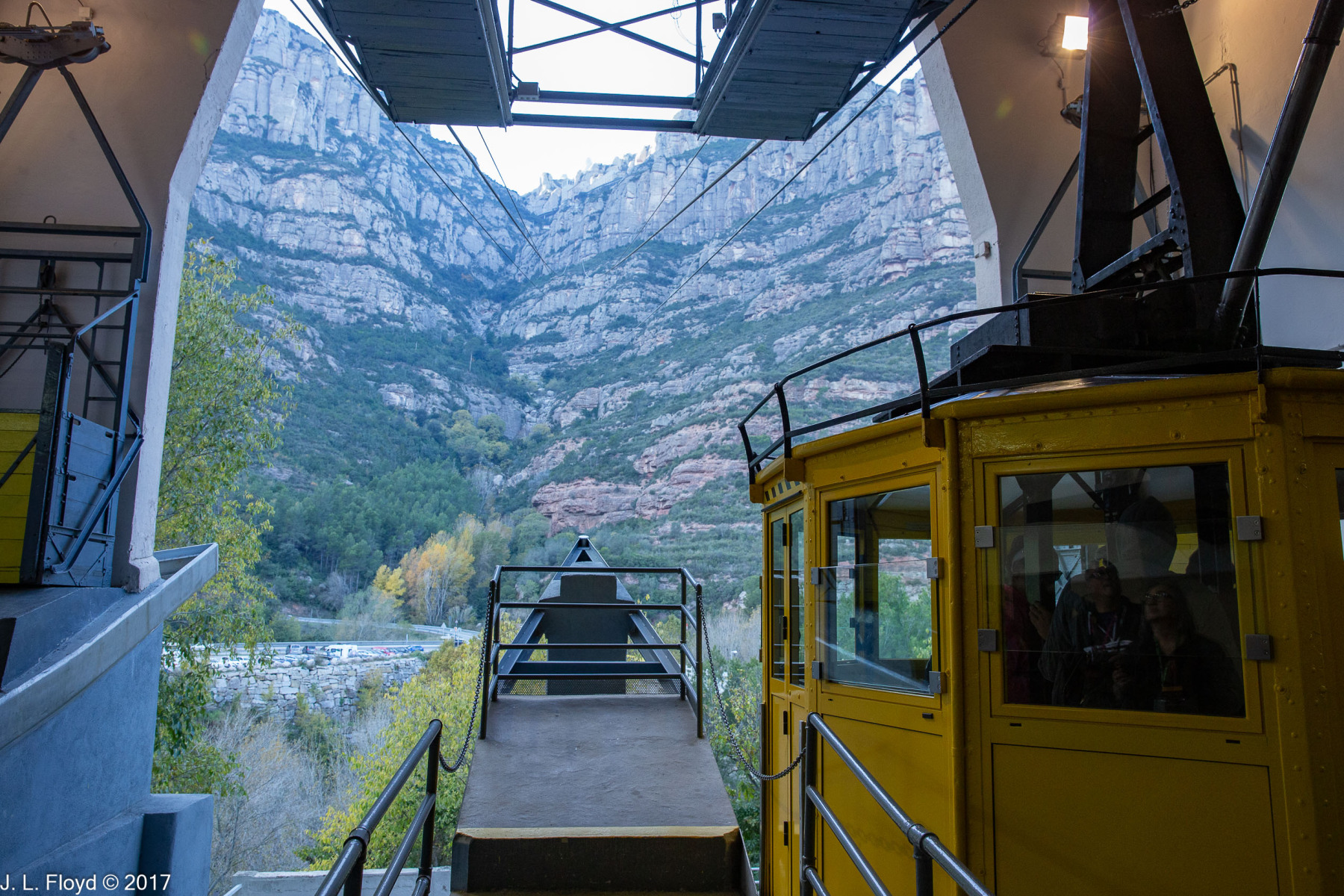
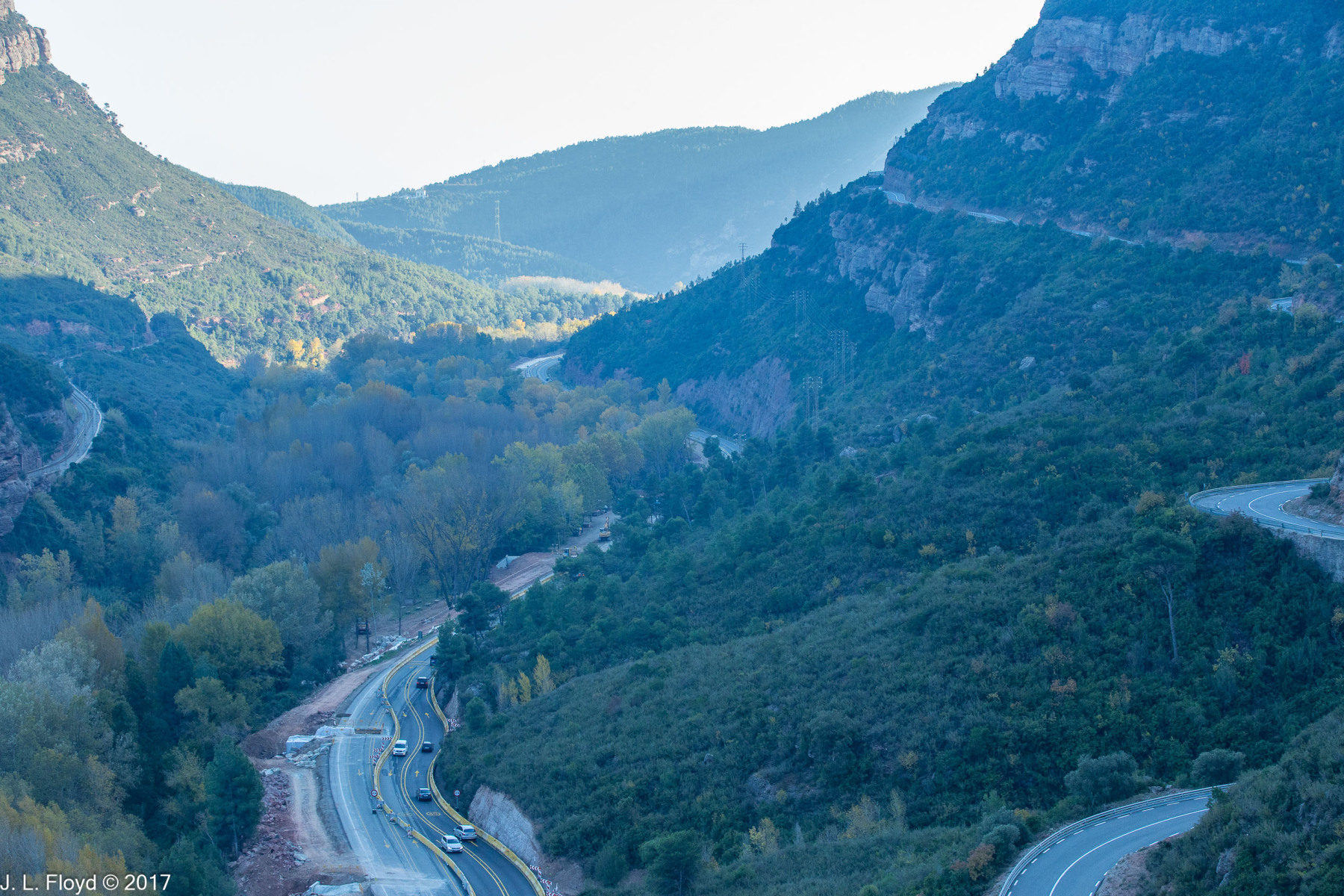
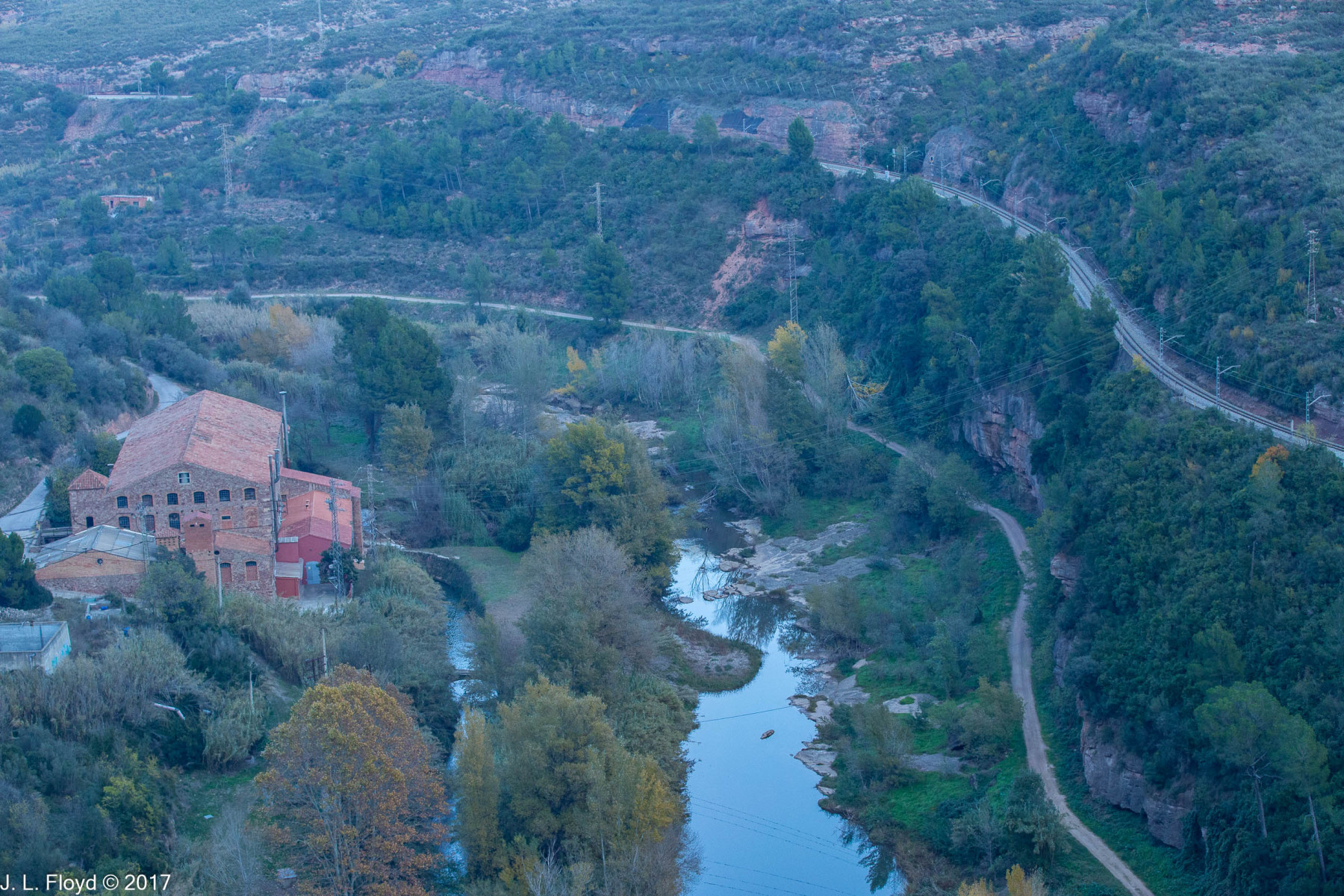
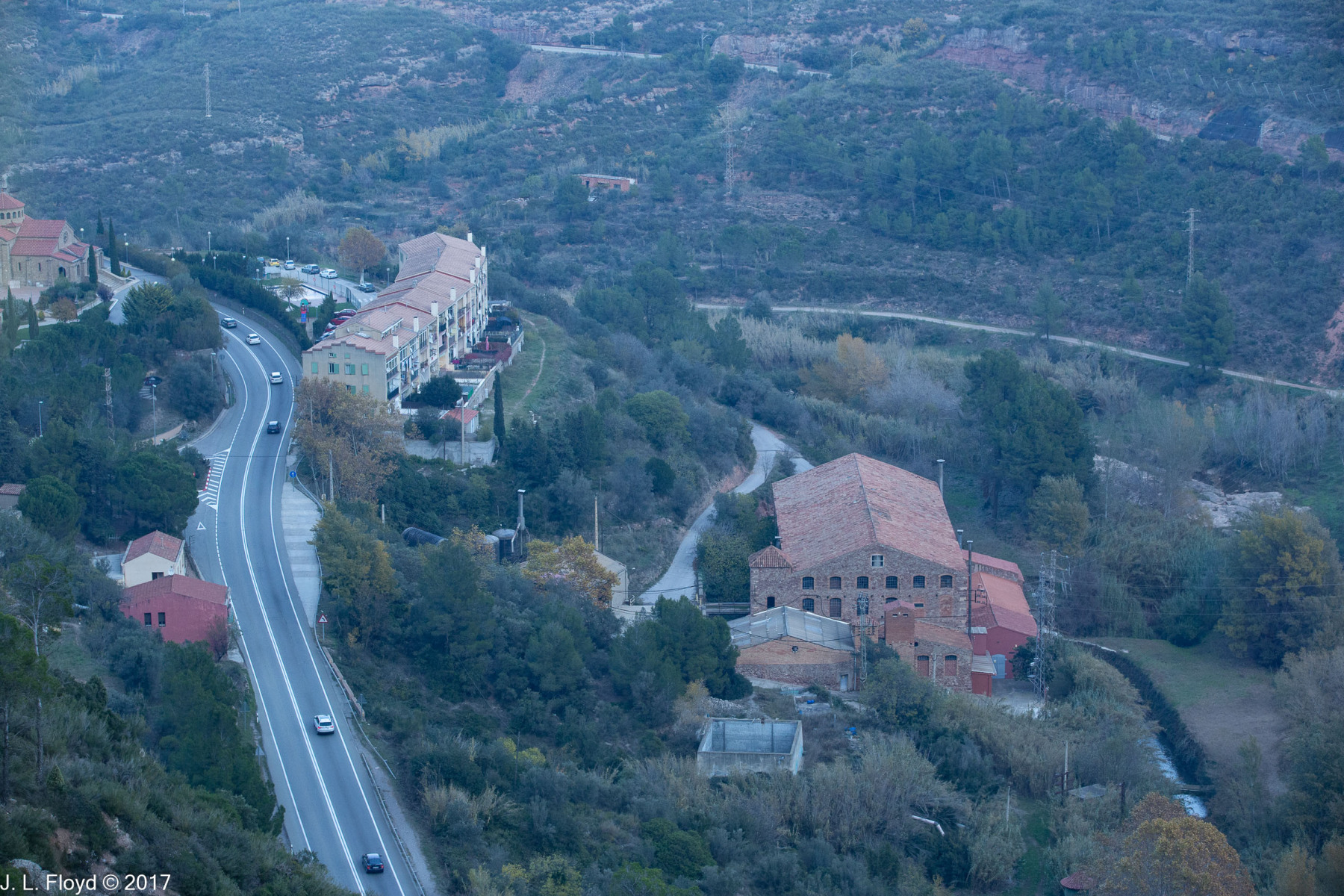
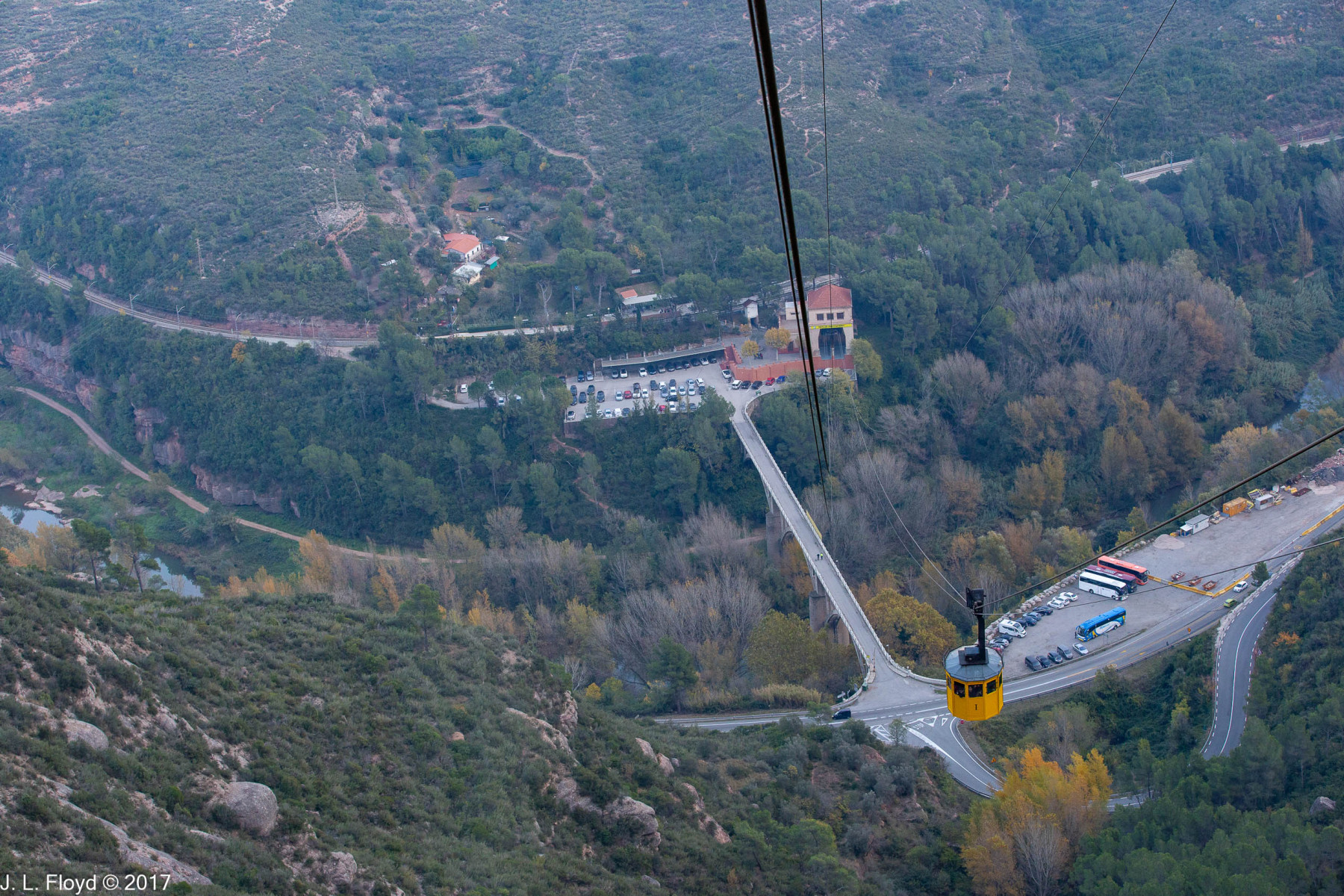
The mountain into which we ascended is composed of pink conglomerate, a form of sedimentary rock made up of rounded gravel-sized pieces of rock surrounded by finer-grained sediments such as sand, silt, or clay. The larger fragments within conglomerate are called clasts, while the finer sediment surrounding the clasts is called the matrix. The dominant type of rock in the conglomerate is limestone cemented by calcite. These are high-carbonate minerals, and their abundance in this area is associated with the formation of landforms such as cave systems and karst towers. The caves we could not see, but the towers comprising the cliffs of Montserrat were strikingly evident as we made our ascent.
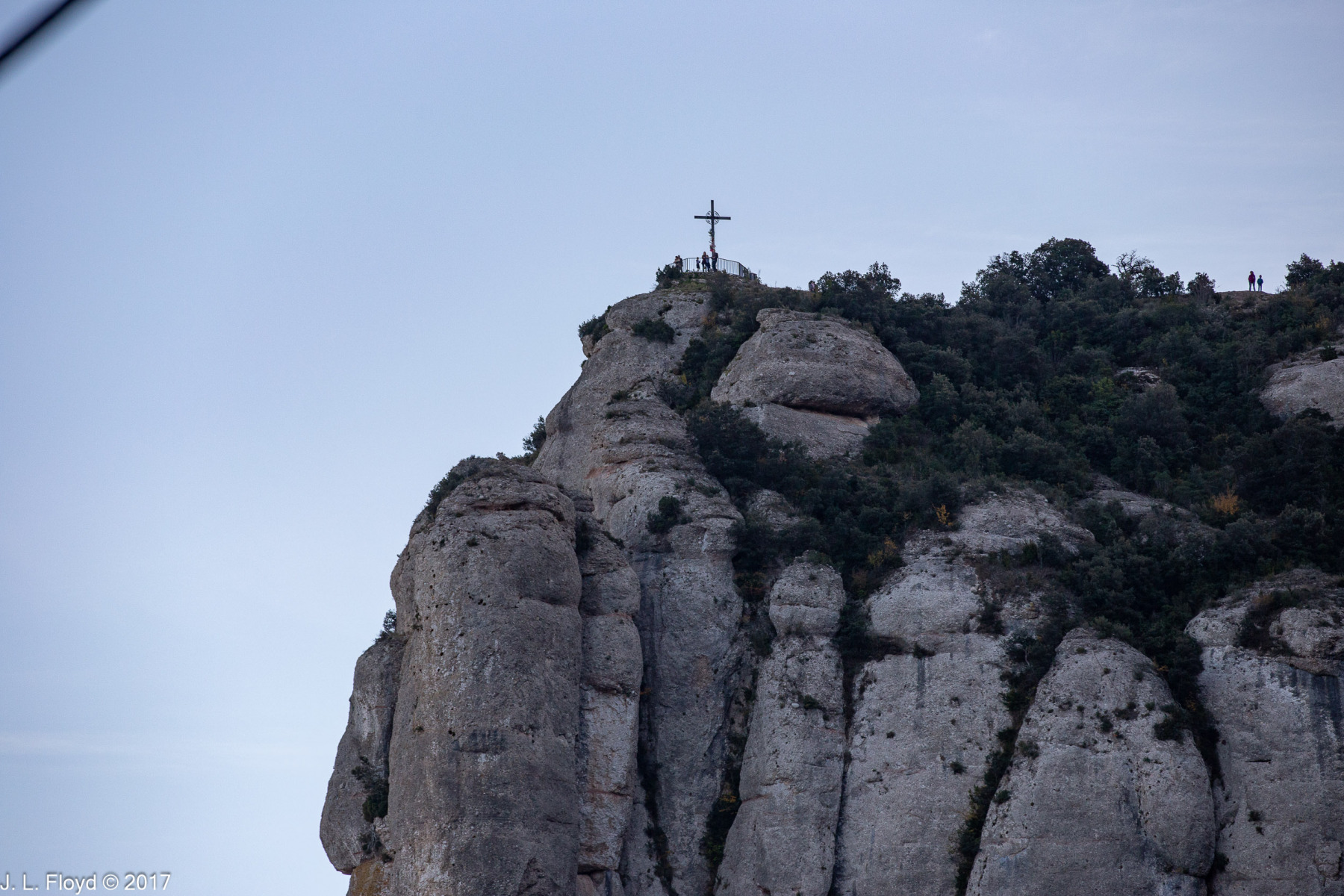
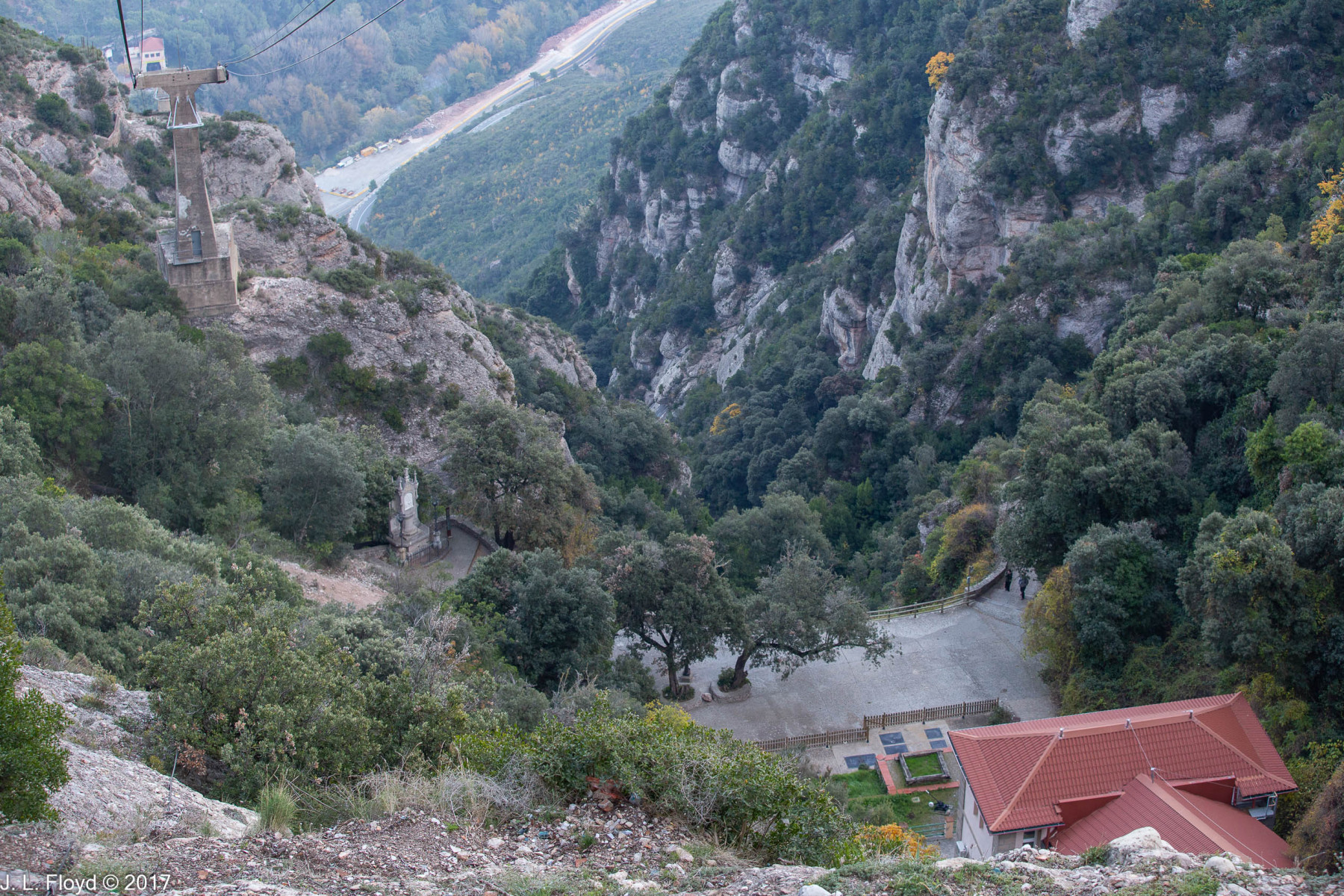
Perched on top of one of the cliffs to our left was the Creu de Sant Miquel, or St. Michael’s Cross; its site is a popular hiking destination providing stunning panoramic views of the mountains and valleys roundabout. Nearing the upper terminus of the Aerí, I was able to see and photograph “The First Mystery of Joy – The Annunciation” (in Catalan, I Misteri de Goig: L’Anunciació de l’àngel a Maria), a monumental work of late 19th-century Catalan sculptural art located in a glen partway down the mountainside. It is part of the Monumental Rosary of Montserrat, a set of religious-themed sculptural works located on a path that leads from the Monastery of Montserrat to a cave where an image of the Virgin of Montserrat was supposedly found in 880 CE. According to legend, church authorities tried to remove the image to the town of Manresa, 18 kilometers away, but as they did so the image became heavier and heavier until it was finally impossible to move, and it became clear that the divine will mandated that the image was to be venerated on the mountain of Montserrat; all of which ultimately resulted in the foundation of Montserrat Abbey in 1025. Actually, the Virgin of Montserrat, commonly known as La Morenata (more about it later), is most likely a 12th-century sculpture carved from beech and poplar wood.
Be that as it may, the First Mystery of Joy is the first stop on the Camí de la Santa Cova, a path excavated in the mountain between 1691 and 1704. The sculptures, however, were only added much later – the First Mystery of Joy, the Annunciation, was created in 1896. There are fifteen Mysteries in all – five each of Joy, Sorrow and Glory. The path reputedly takes about 45 minutes to walk. We did not venture on it ourselves, as we needed the entire afternoon to see the Abbey itself.
Among the contributors to the Rosary was the architect Antoni Gaudí i Cornet, whom we shall meet again in Barcelona. He was responsible for the design of the First Glorious Mystery, the resurrection of Jesus. It is noteworthy for being the only one of the Mysteries given a theatrical scenography treatment: a cave was excavated in the rock to depict the cenotaph of the resurrected Christ, attended by four figures sculpted in white stone – his mother, kneeling by the cenotaph, accompanied by an angel and two other women; hanging outside and above the cave is a bronze figure of Jesus. Gaudí had a somewhat difficult relationship with Montserrat; one previous engagement to work at the site had been interrupted by war and another ended badly because he could not get along with the diocesan architect Francisco de Paula del Villar. His work on the First Glorious Mystery did not proceed smoothly either; because of progressive reductions in the funding for the project, he lost interest and eventually turned it over to his assistants to complete.
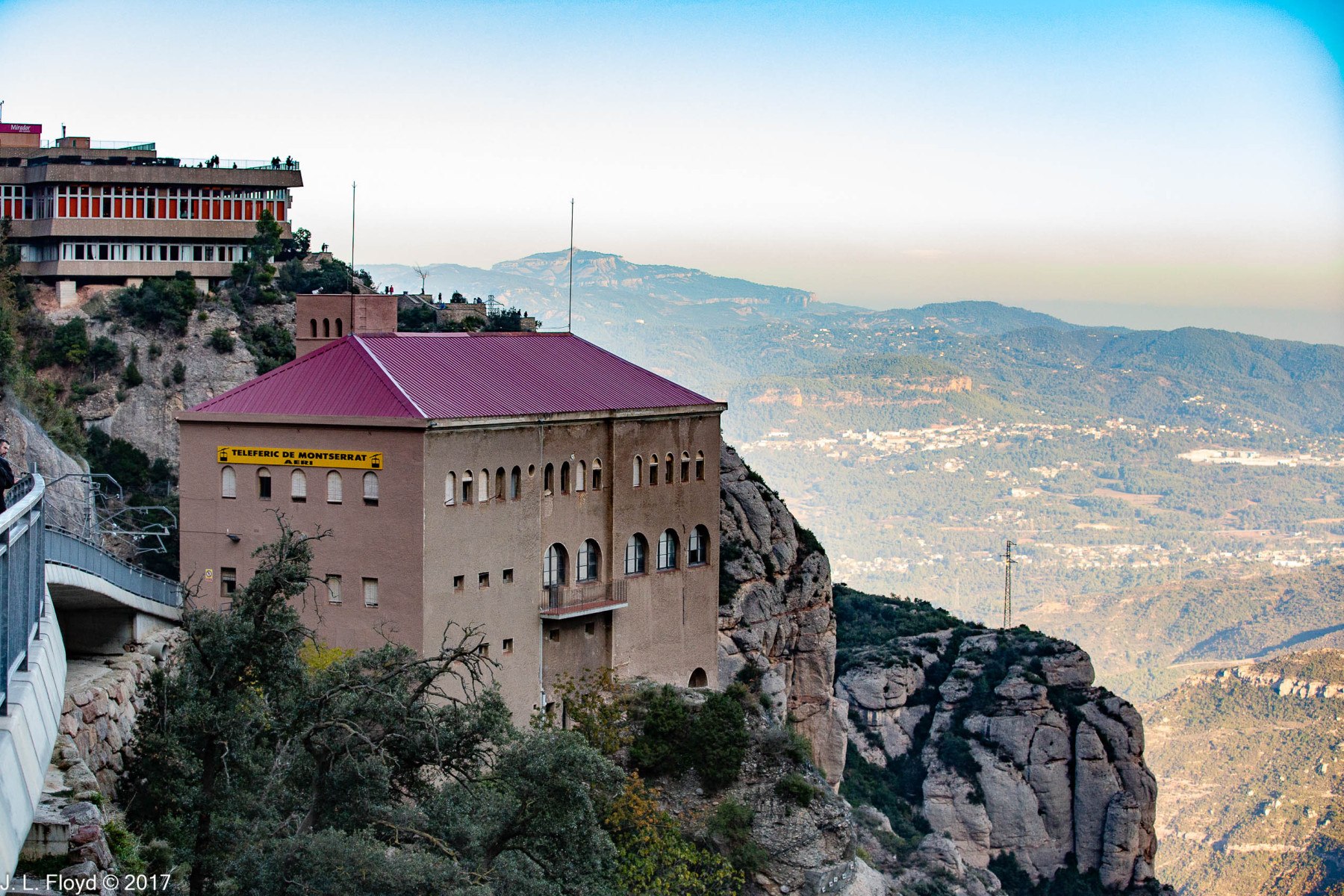
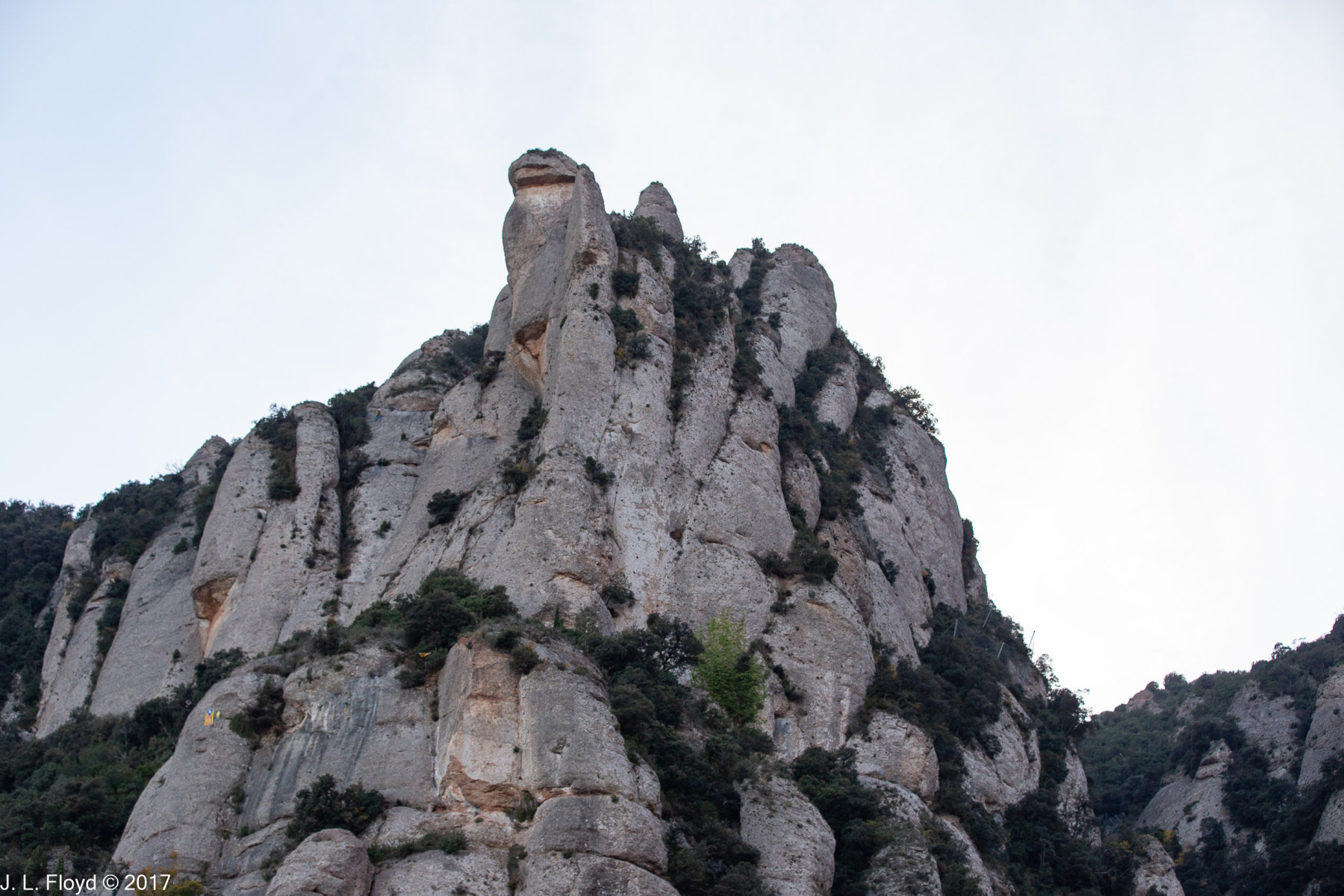
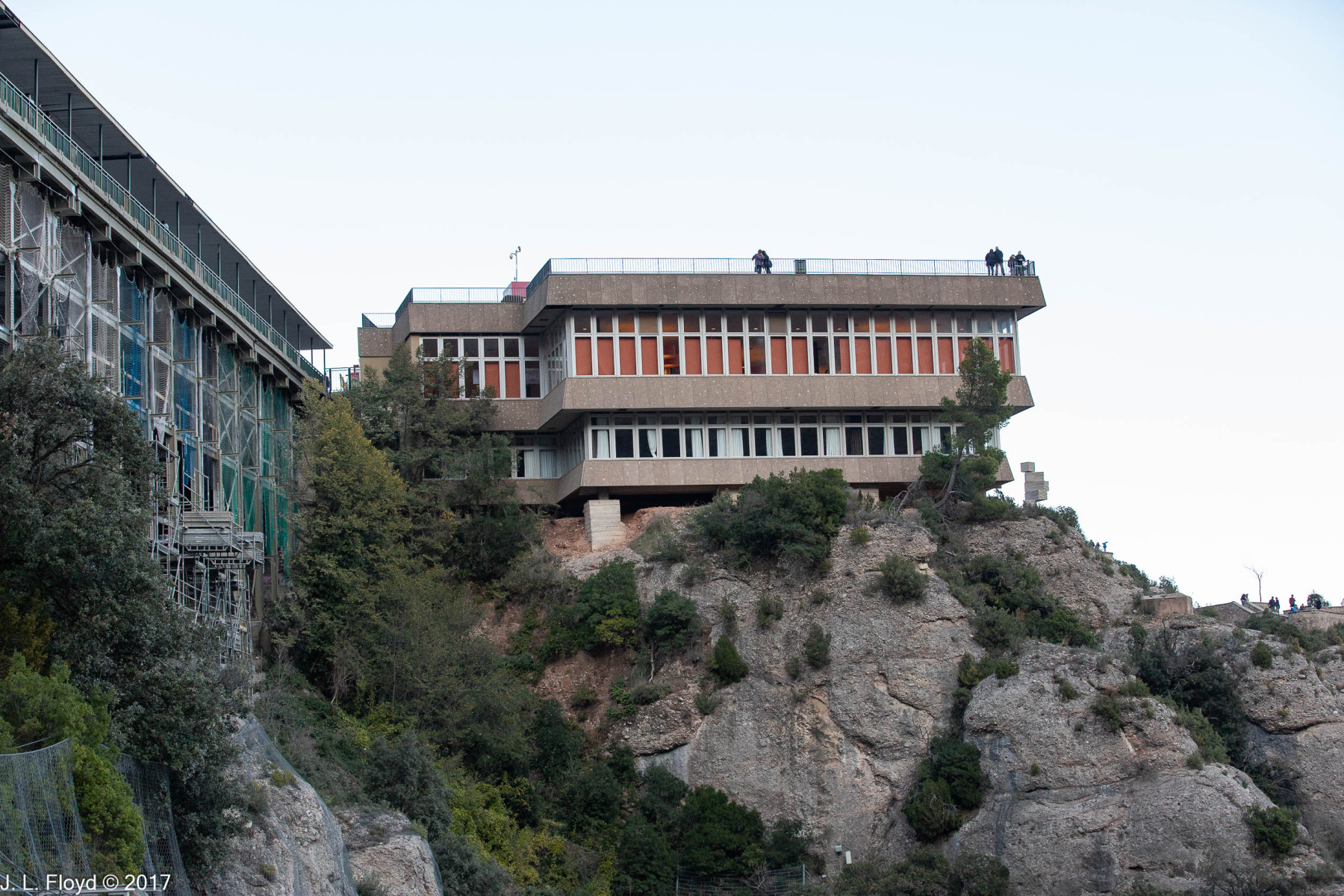
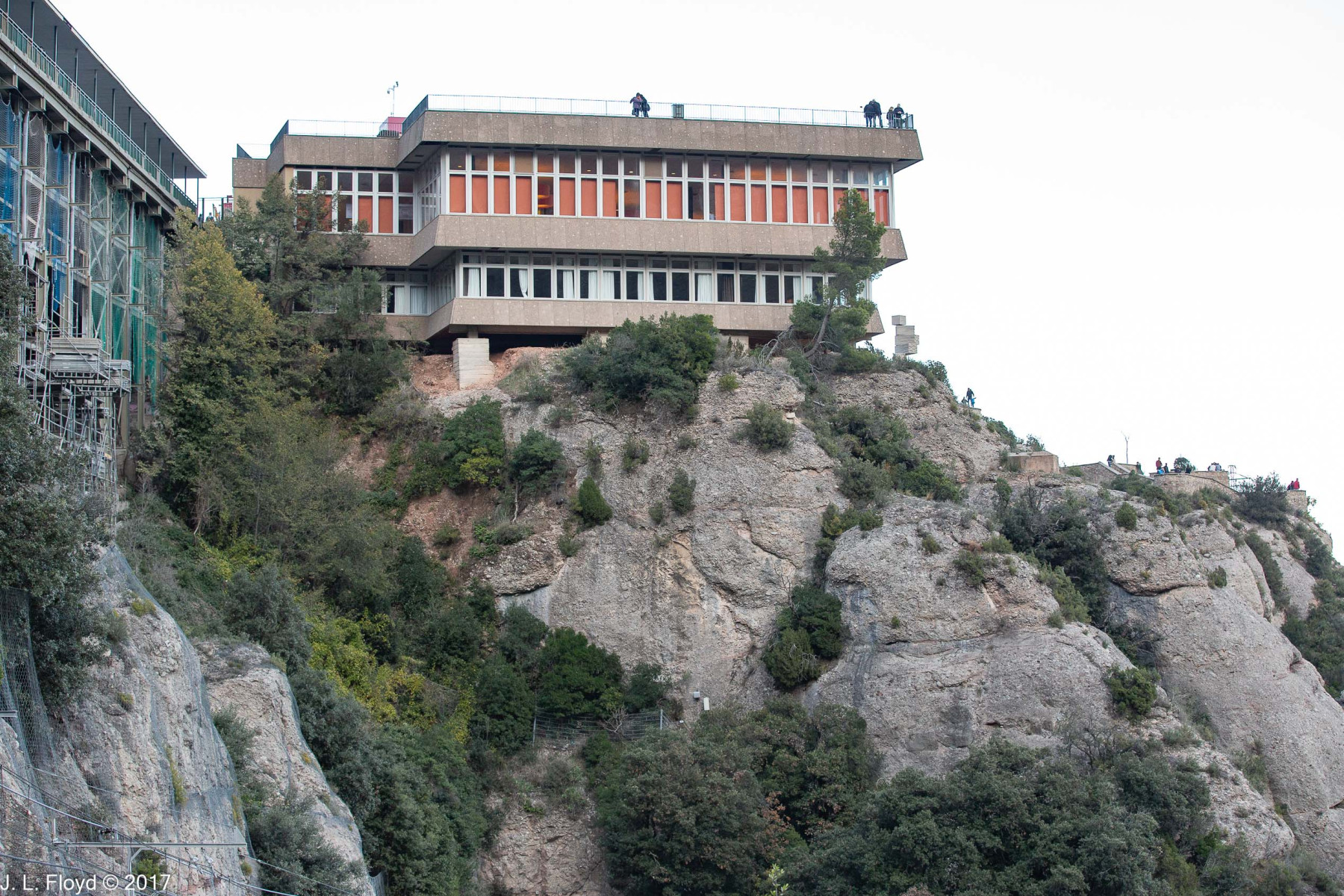
The Aerí de Montserrat cable car is only one of several ways to reach the Abbey. You can also hike, of course, or drive up a winding road. However, there is also a rack railway, the Cremallera de Montserrat, which like the cable car originates in Monistrol. (A rack railway has an extra toothed rack rail, engaged by cog wheels or pinions on the trains, enabling them to climb grades of up to 45 degrees, whereas regular friction-based rail trains can climb grades of 5.7% degrees at the most.)
In addition to the rack railway, there are two funicular railways based at Montserrat. A funicular, in contrast to a rack railway, uses a system of cables and pulleys, with an external motor for propulsion. Two cars are connected to the same cable, their weight counterbalancing one another. The Sant Joan funicular (not to be confused with Joan of Arc) takes up where the rack railway leaves off, connecting Montserrat Abbey to sacred sites and viewpoints higher up on the mountain. With a maximum gradient of 65%, it is the steepest funicular in Spain. Finally, there is the Funicular de la Santa Cova, which goes the other way, down the mountain, to a terminal at the end of the Camí de la Santa Cova, the path leading to the Holy Grotto where the Virgin of Montserrat image was supposedly found in 880. Each of these railways has its own terminal at Montserrat; they are all operated by Ferrocarrils de la Generalitat de Catalunya (Catalan Government Railways, FGC), which also operates suburban rail lines in and around Barcelona. In contrast, the Aerí de Montserrat is operated by a separate, private company with no connection to the FGC.
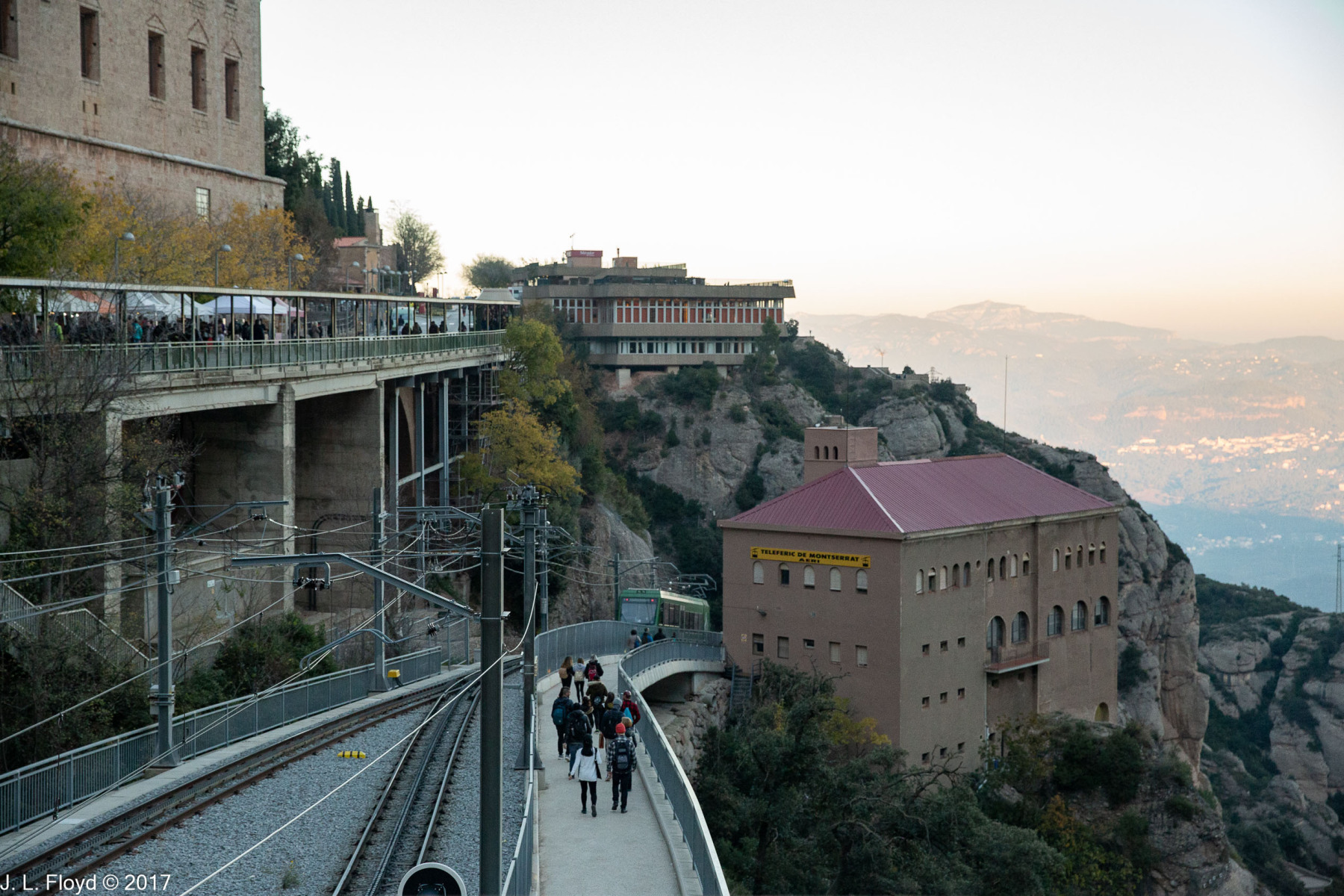
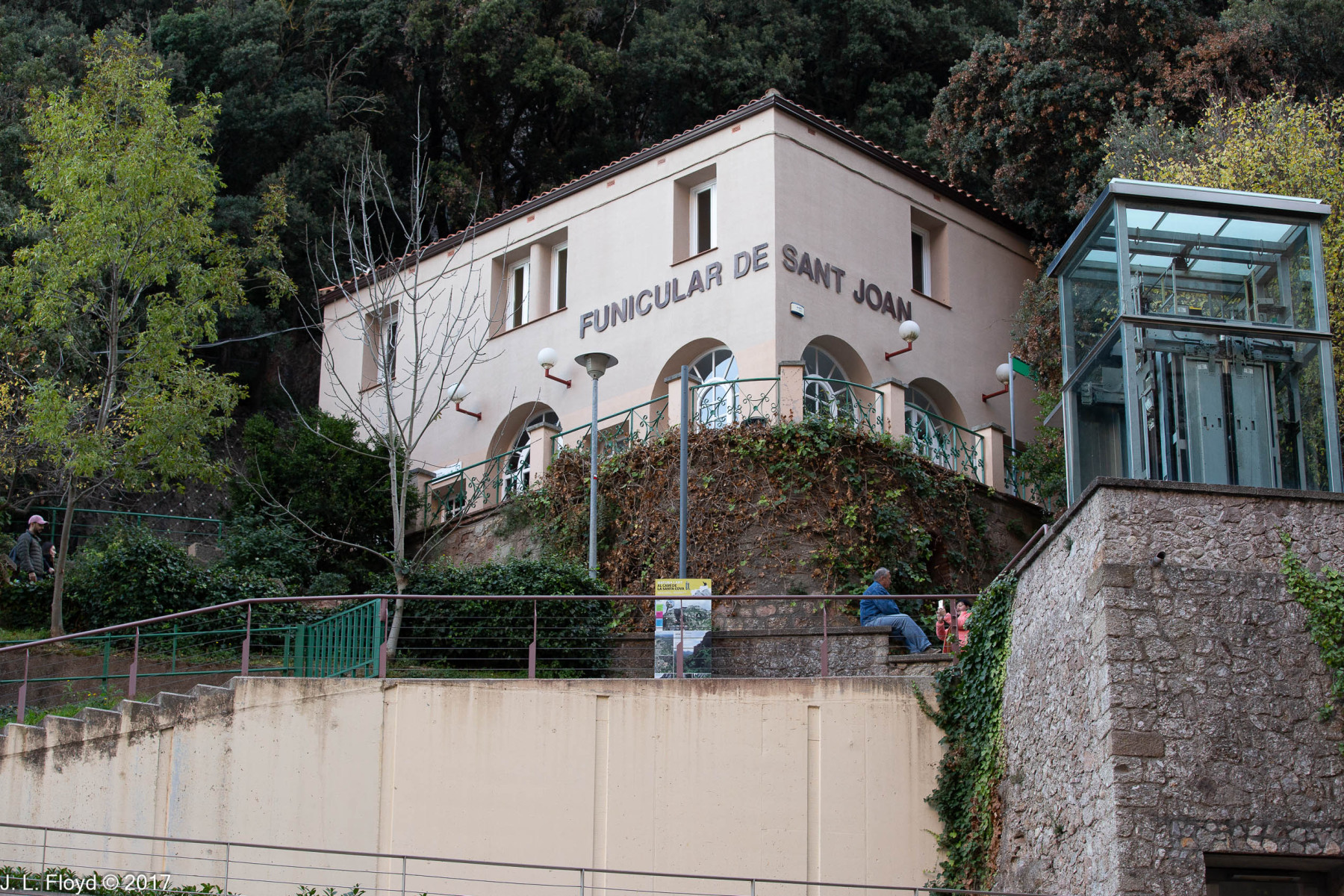
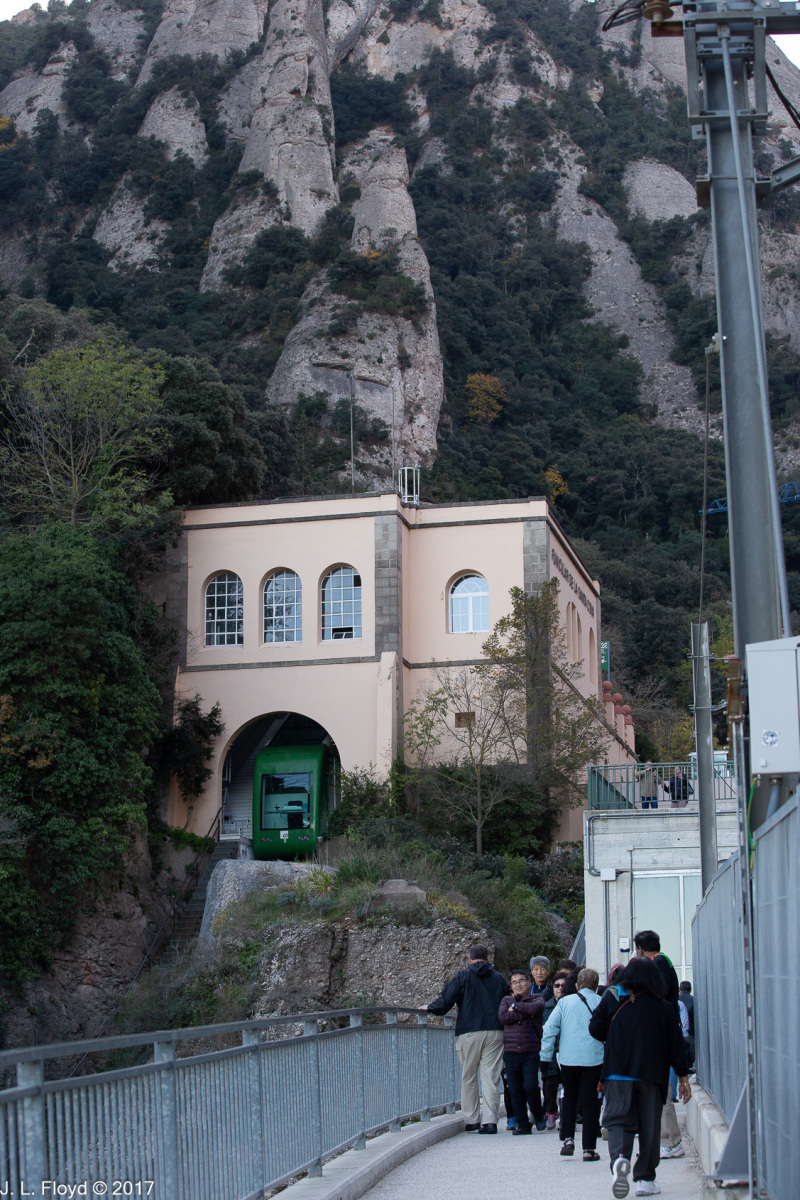
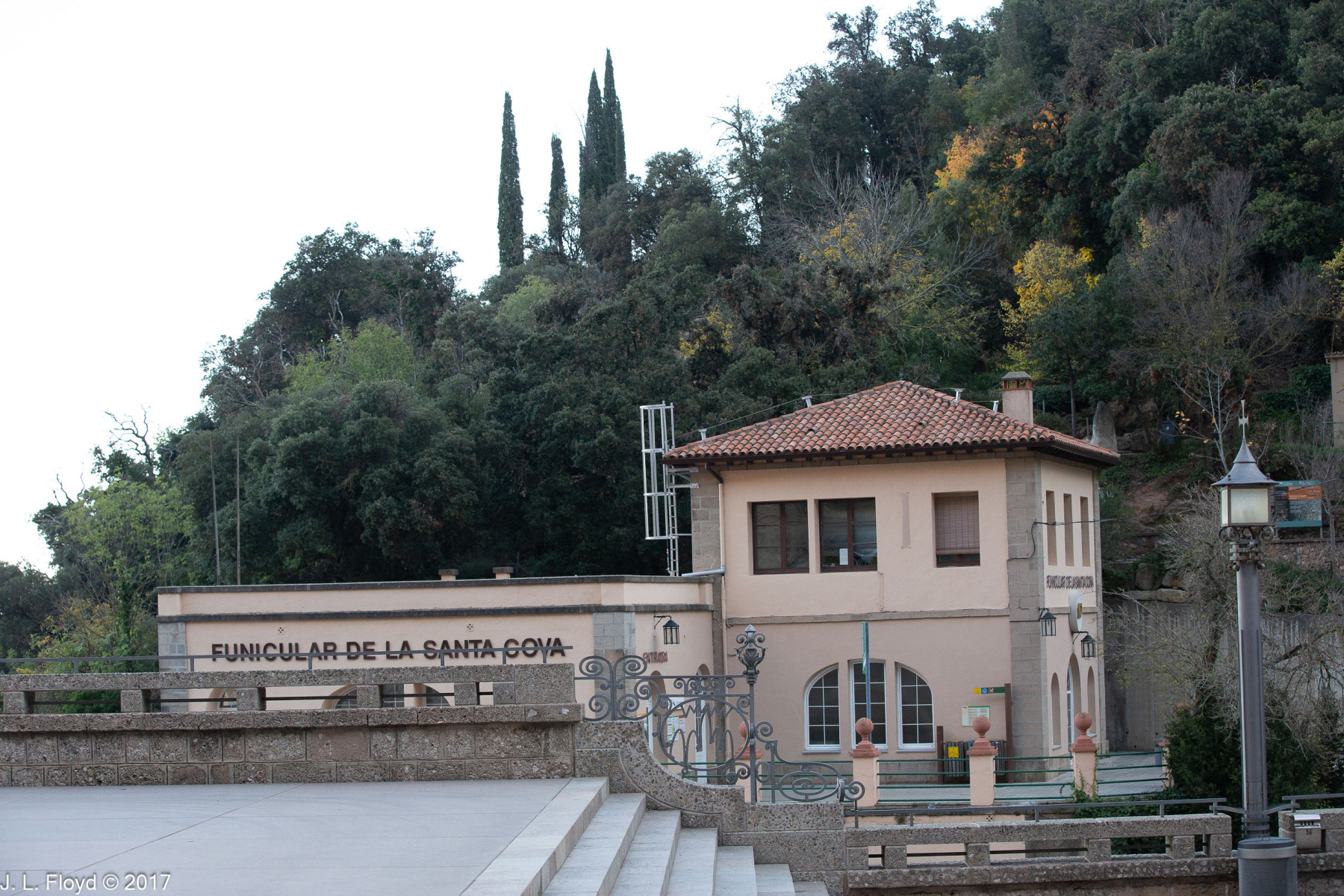
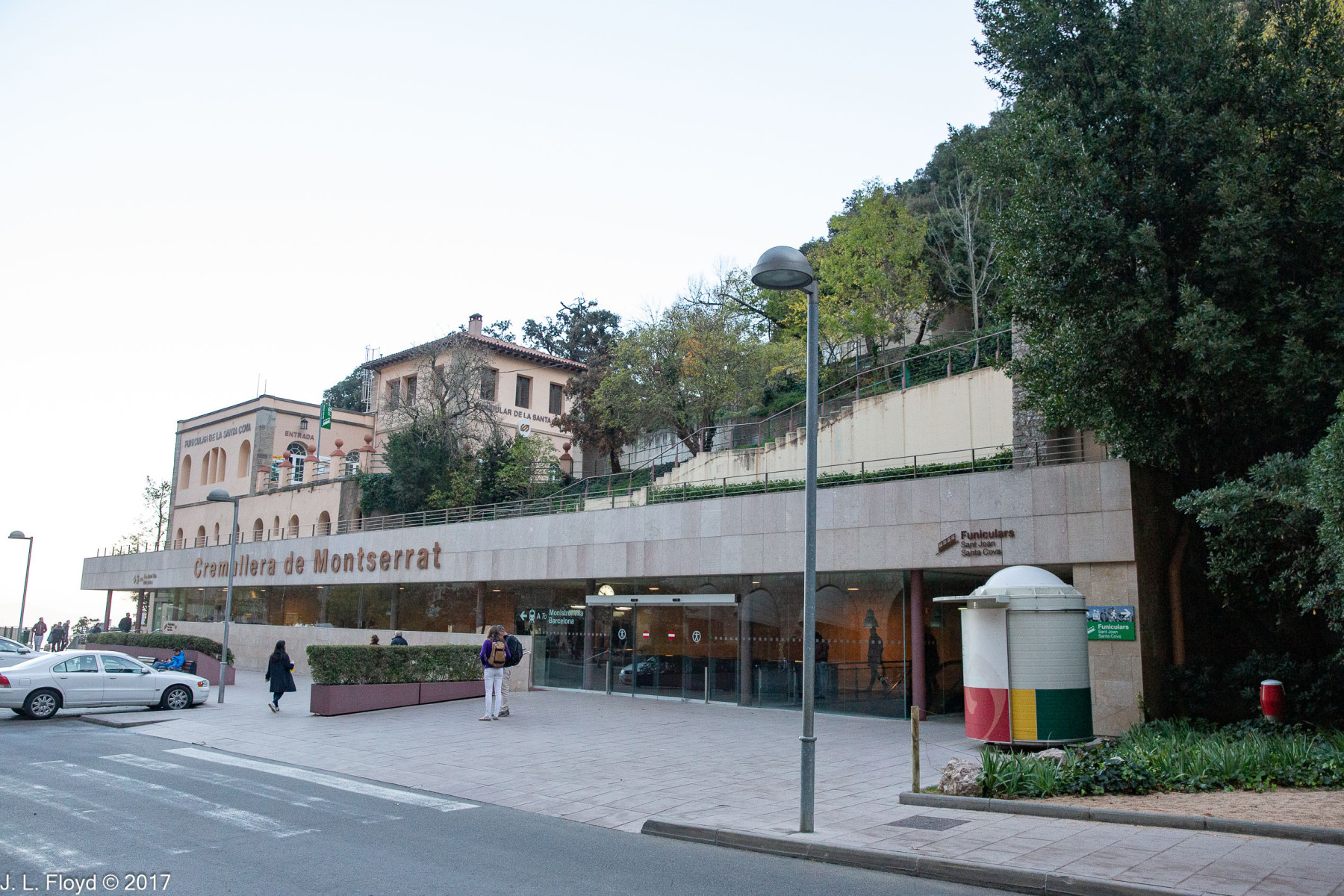
After alighting from the cable car, we proceeded on foot straight to the Abbey, bypassing the funicular terminals since we did not have time to explore the attractions to which they ran. Our first stop at Monserrat was to be the abbey church, or basilica.
Construction of the basilica of Montserrat began in the 16th century. But it was completely destroyed during the Peninsular War of 1807-1814 and had to be rebuilt from scratch. In 1881 Pope Leo XIII granted it the status of minor basilica, a title accorded to important pilgrimage churches and national centers of the faith.
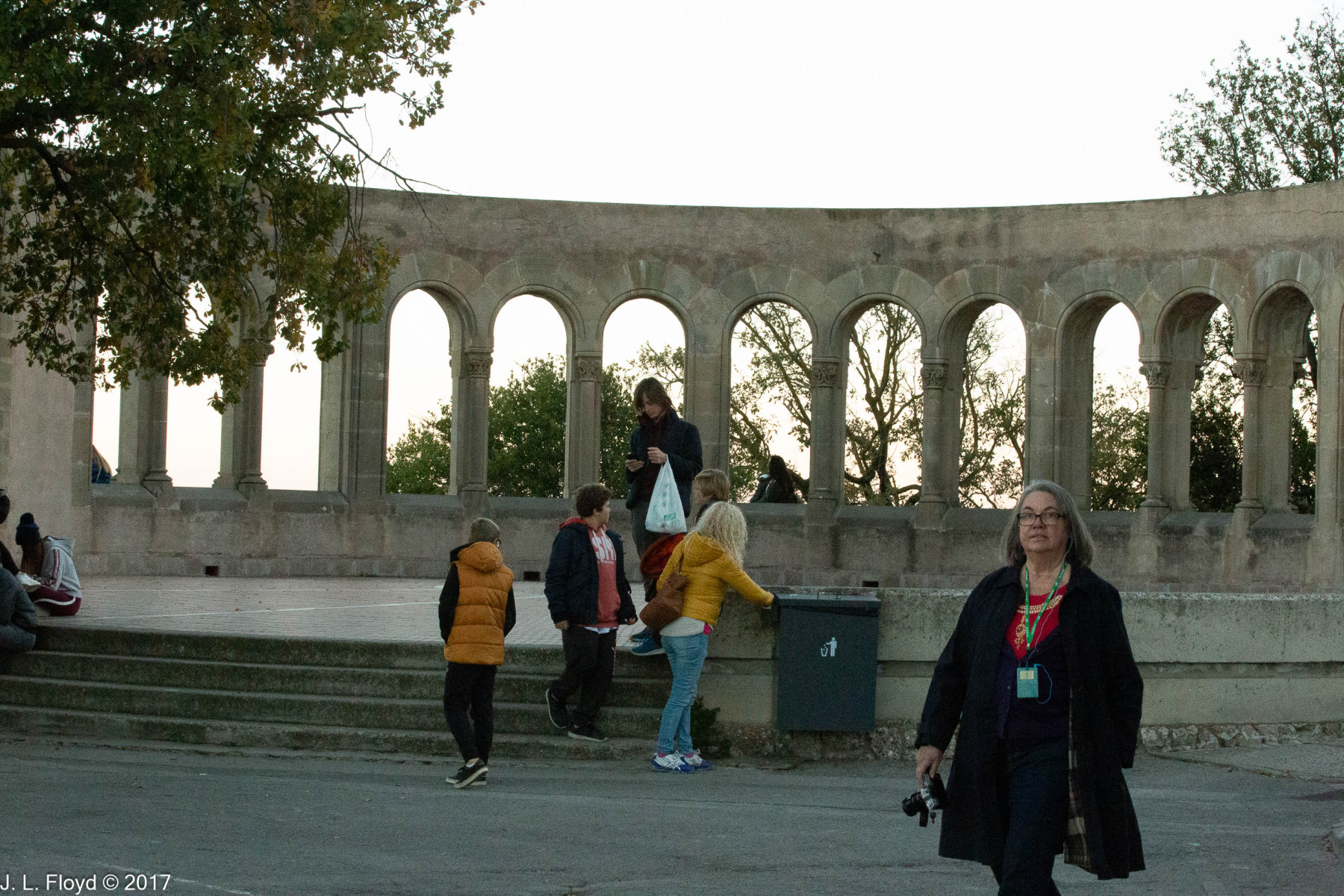
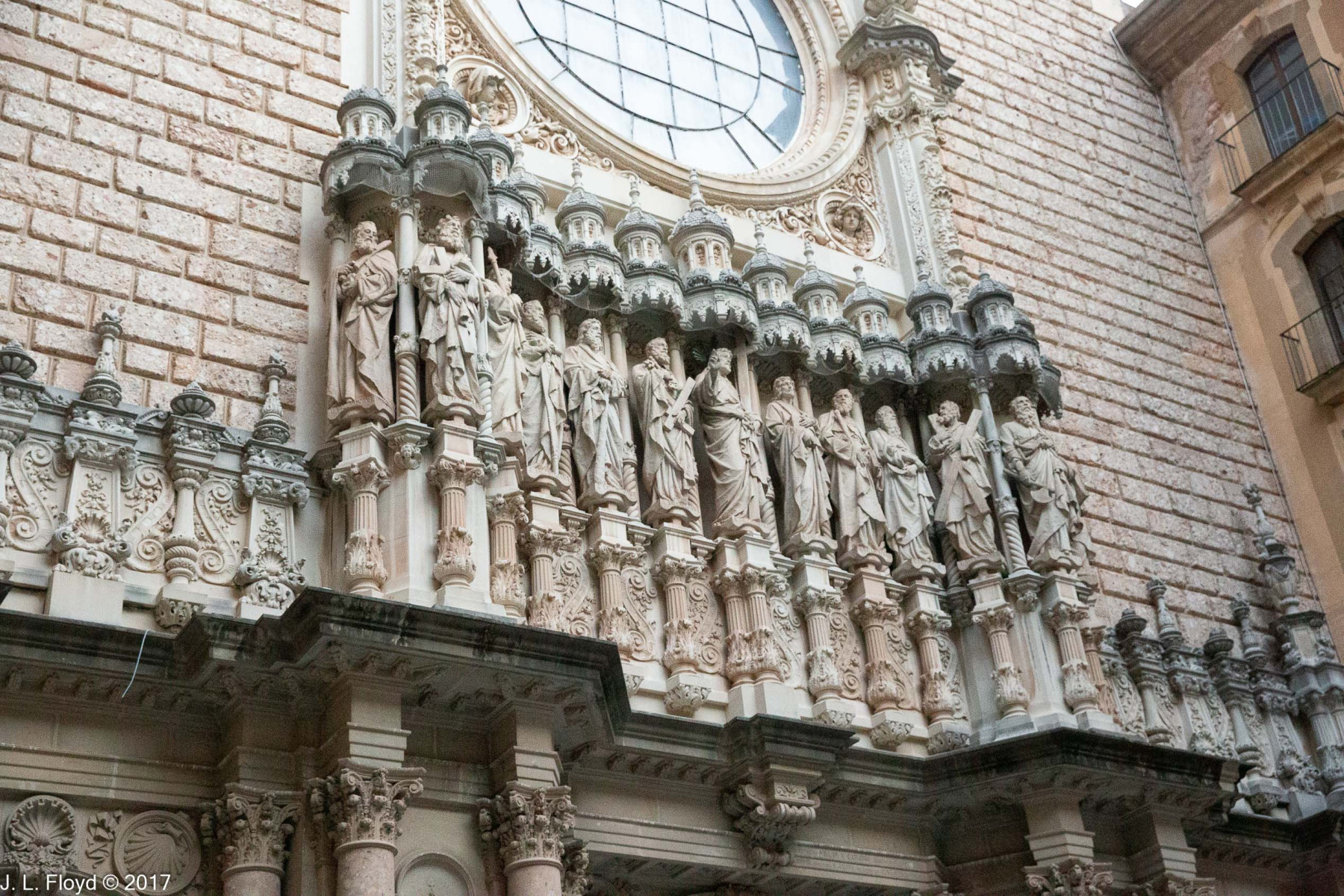
In 1901 a façade was completed in Plateresque revival style, the work of Francisco de Paula del Villar y Carmona. After the Spanish Civil War, between 1942 and 1968, a new façade by Francesc Folguera i Grassi was added, which incorporates a bell tower. This did not replace the 1901 façade; instead it was constructed as a kind of extension to the basilica, with the old façade enclosed by and the new and accessed through the open-air atrium, which is called called del Abat Argeric.
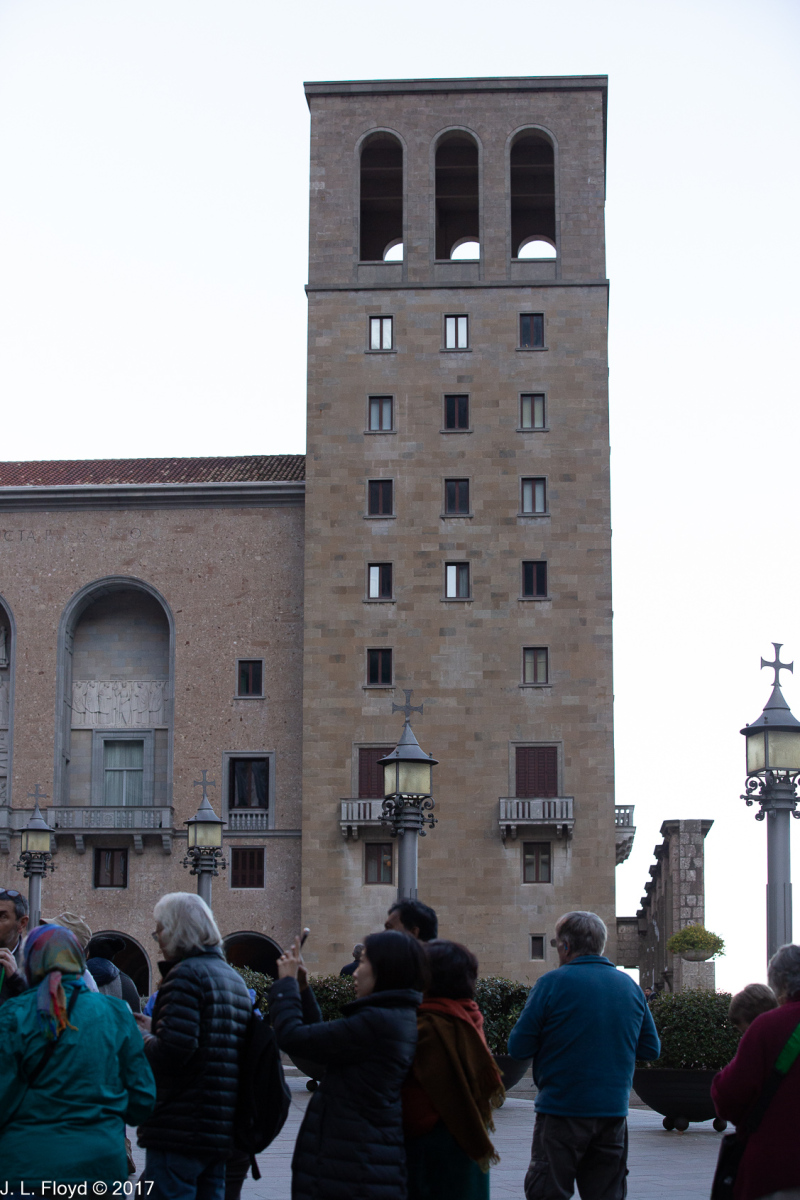
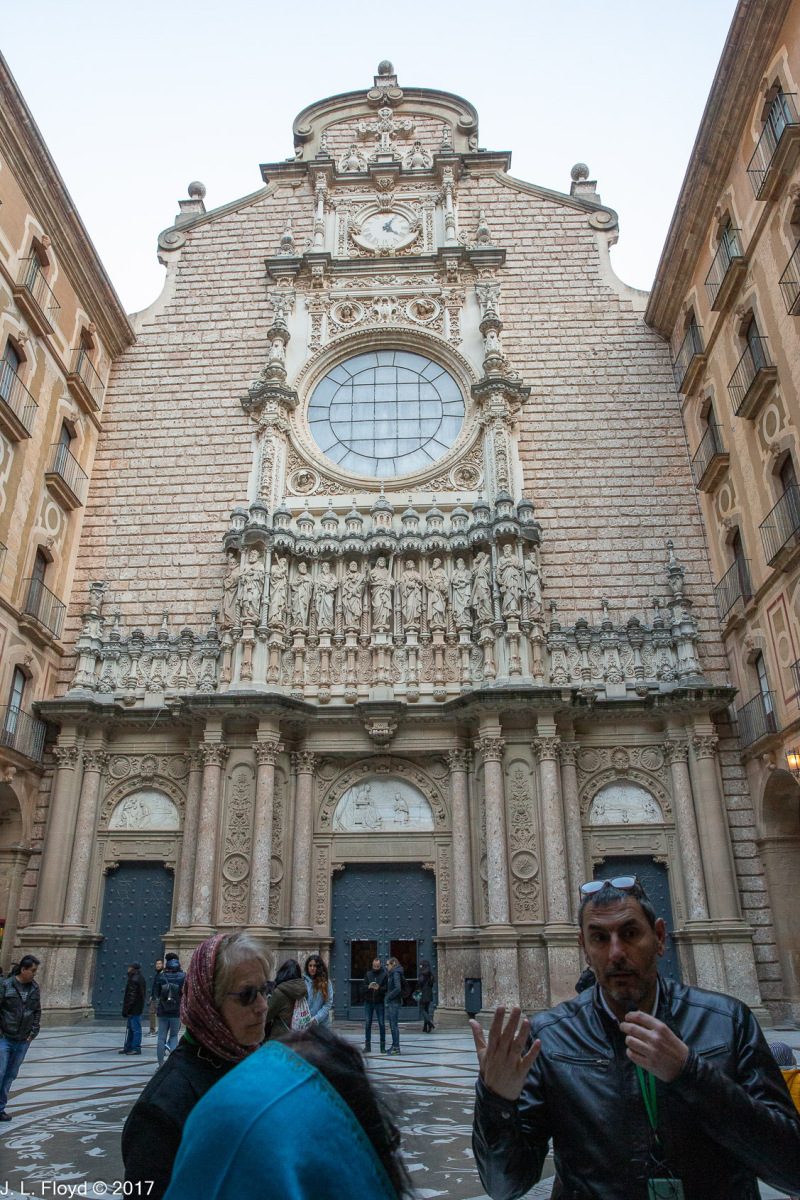
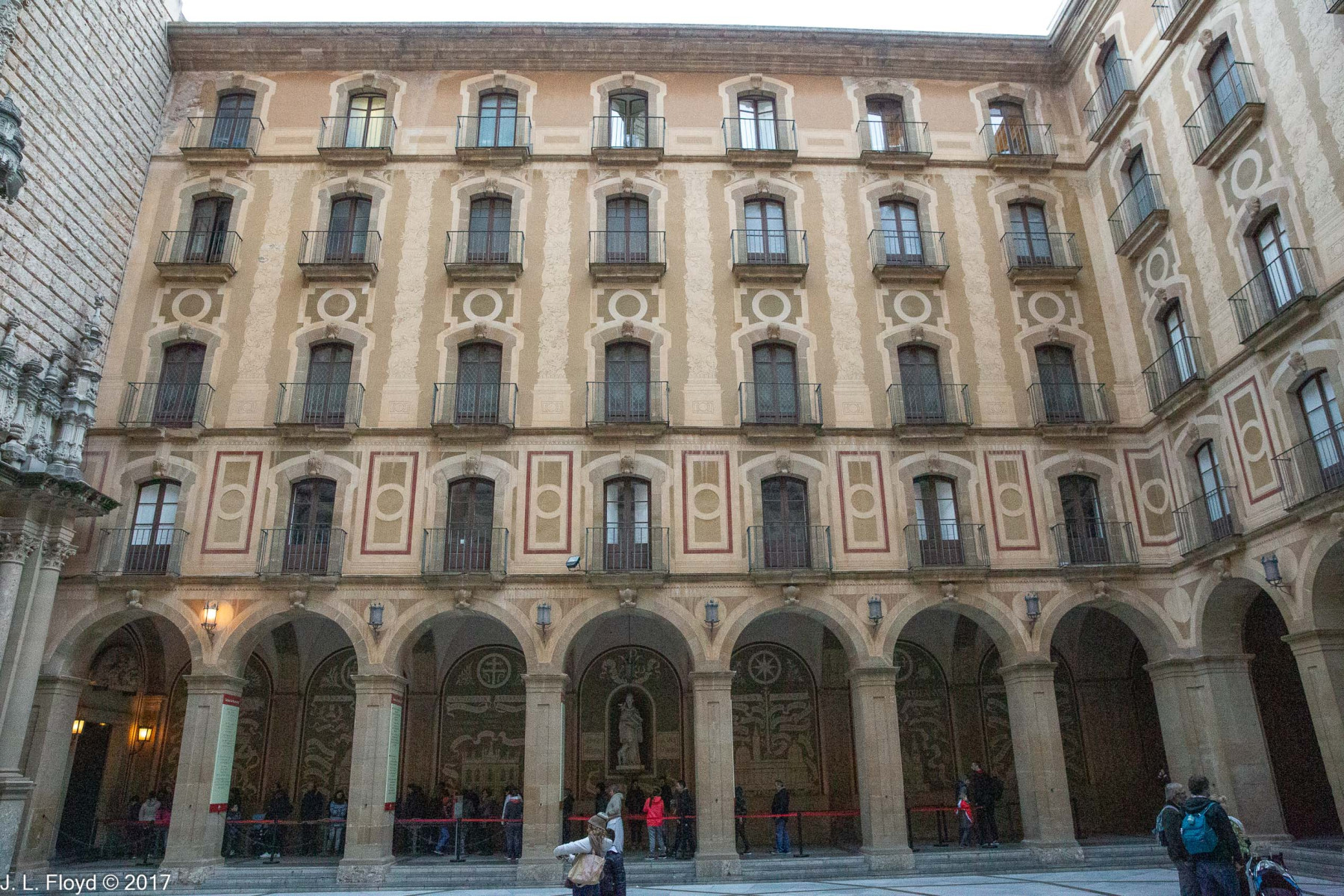
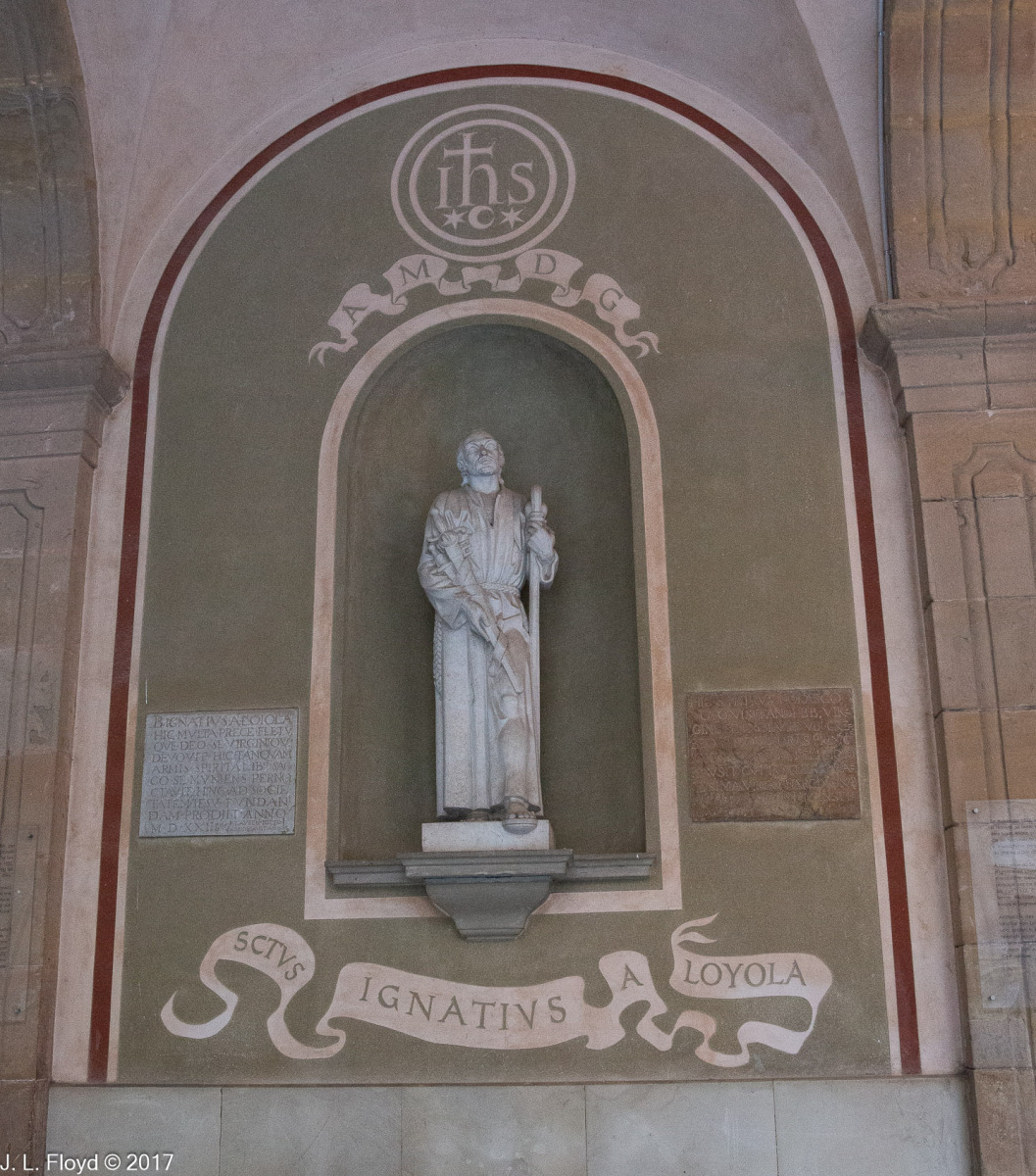
A variety of sculptures and other works of art are displayed in the arcades around the courtyard. Most of these are of Catholic saints and church figures, but secular personages are represented as well. Represented among the saints is St. Ignatius of Loyola, who founded the Society of Jesus (Jesuits) in Paris in 1541. Born in 1491, he was of Basque origin, a scion of the minor nobility. At the age of seventeen he embarked upon a military career, but a severe wound in the French wars of the early 16th century ended that phase of his life in 1521. During his recovery, he underwent a religious conversion and decided to go on a pilgrimage to the Holy Land. Before doing so, however, he visited the Abbey of Montserrat in 1522; and he spent some time in Catalonia after his return as well, before moving on to university studies in theology.
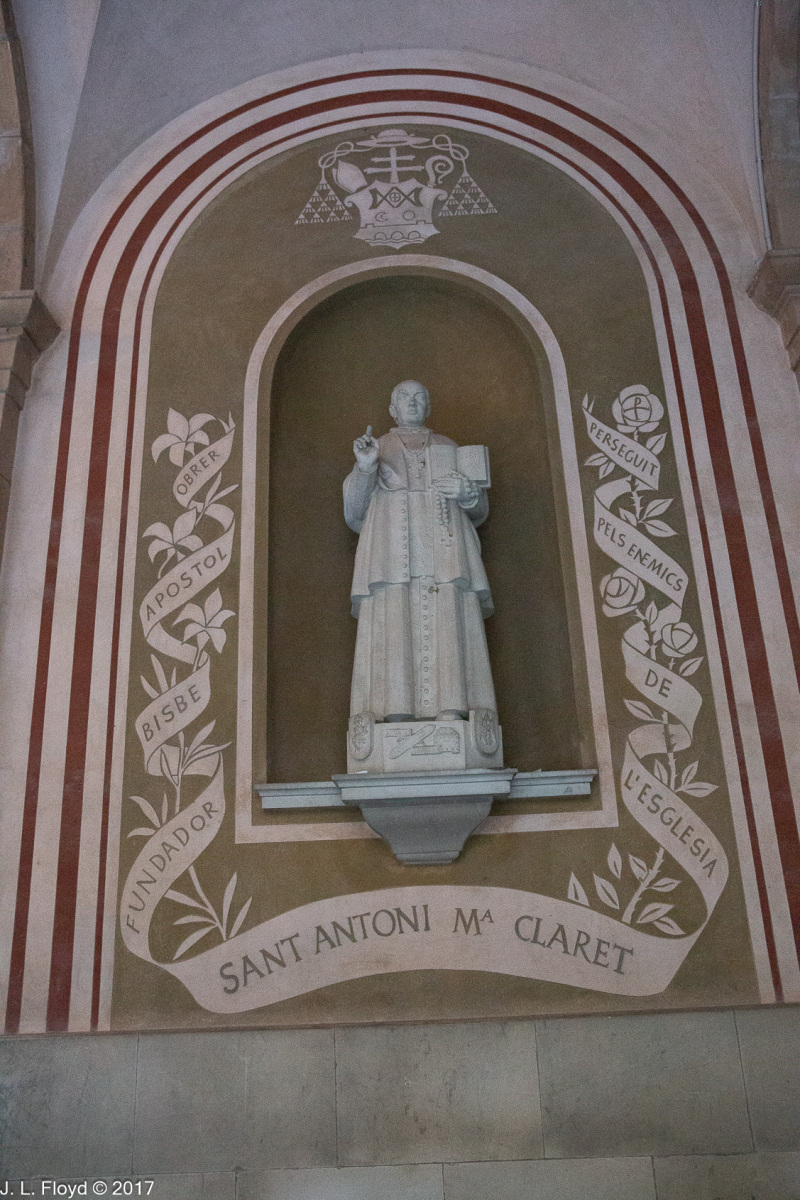
A less famous saint whose statue graces the basilica atrium is St. Anthony Mary Claret (1807-1870), archbishop of Santiago, Cuba and confessor of Isabella II, Queen of Spain from 1833 to 1868. He was also the founder of the Missionary Sons of the Immaculate Heart of Mary, commonly called the Claretians.
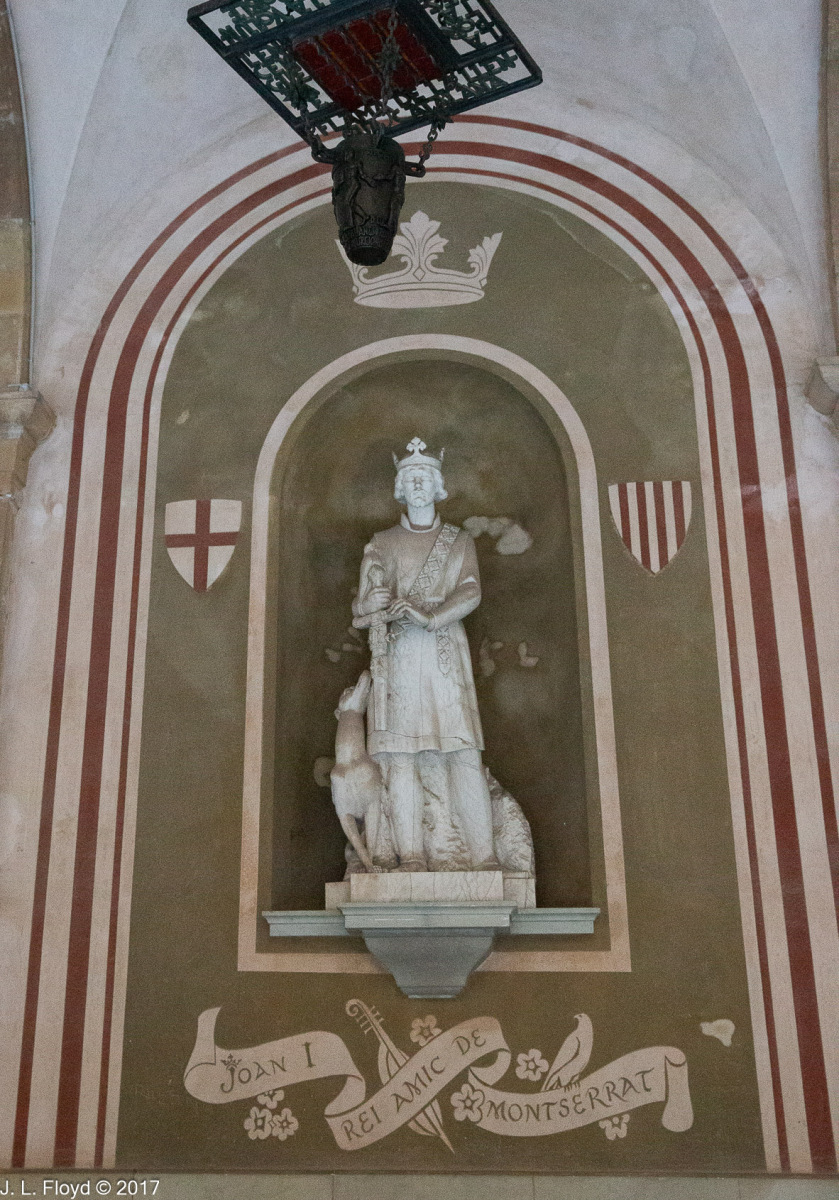
Among the secular figures represented in the arcade galleries is King John I of Aragon (1350-1396), who reigned there from 1387 to his death. He has been called “a man of insignificant character, with a taste for verse.” His reign was financially and politically a disaster for Aragon. Established as an independent entity after separating from the Kingdom of Navarre after 1035, the medieval Kingdom of Aragon profited greatly from a dynastic merger with the County of Barcelona (i.e. Catalonia) in 1150, as well as from the progress of the Reconquista, which resulted in the addition of Valencia and Majorca. Following the merger, which created a new political entity called the Crown of Aragon, the Aragonese also acquired important overseas territories (Sicily, Naples, Sardinia, parts of Provence in France, parts of Greece including the Duchy of Athens). Under John I, many of these territories were lost, though some of them only temporarily. However, he was a generous patron of the Abbey of Montserrat, which earned him the statue in the gallery.
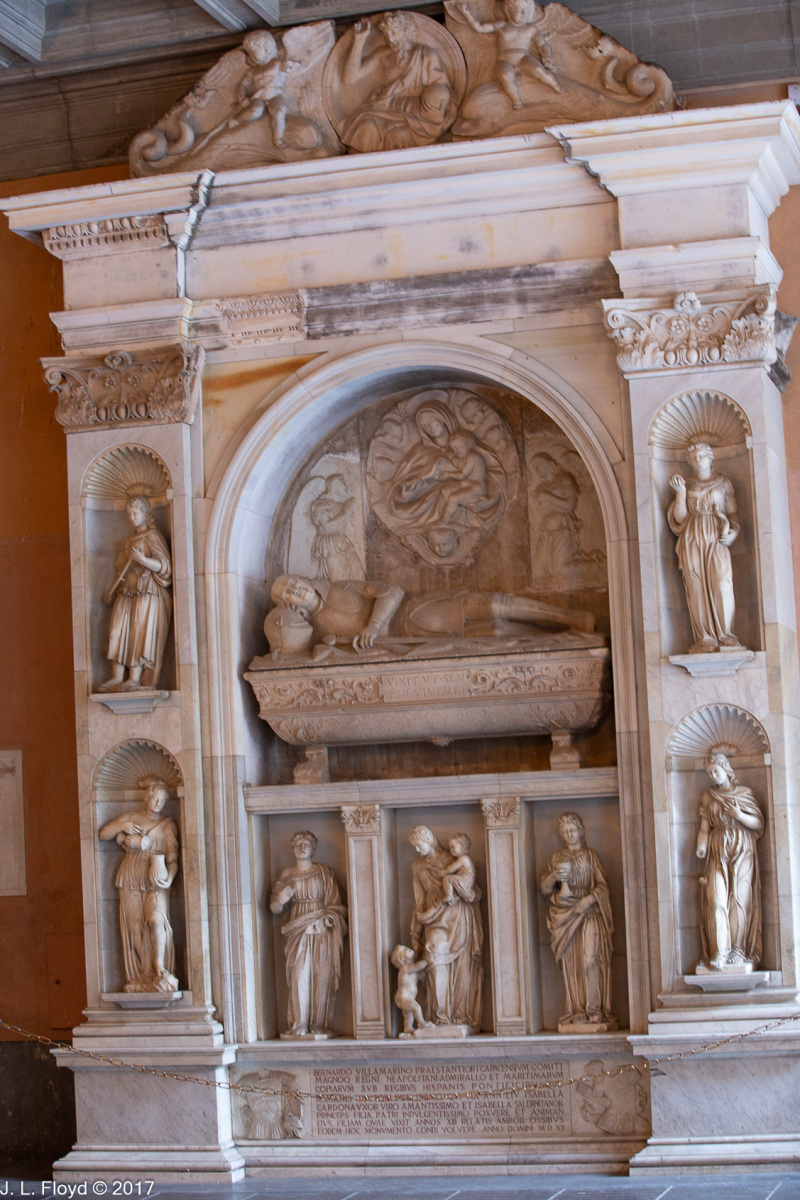
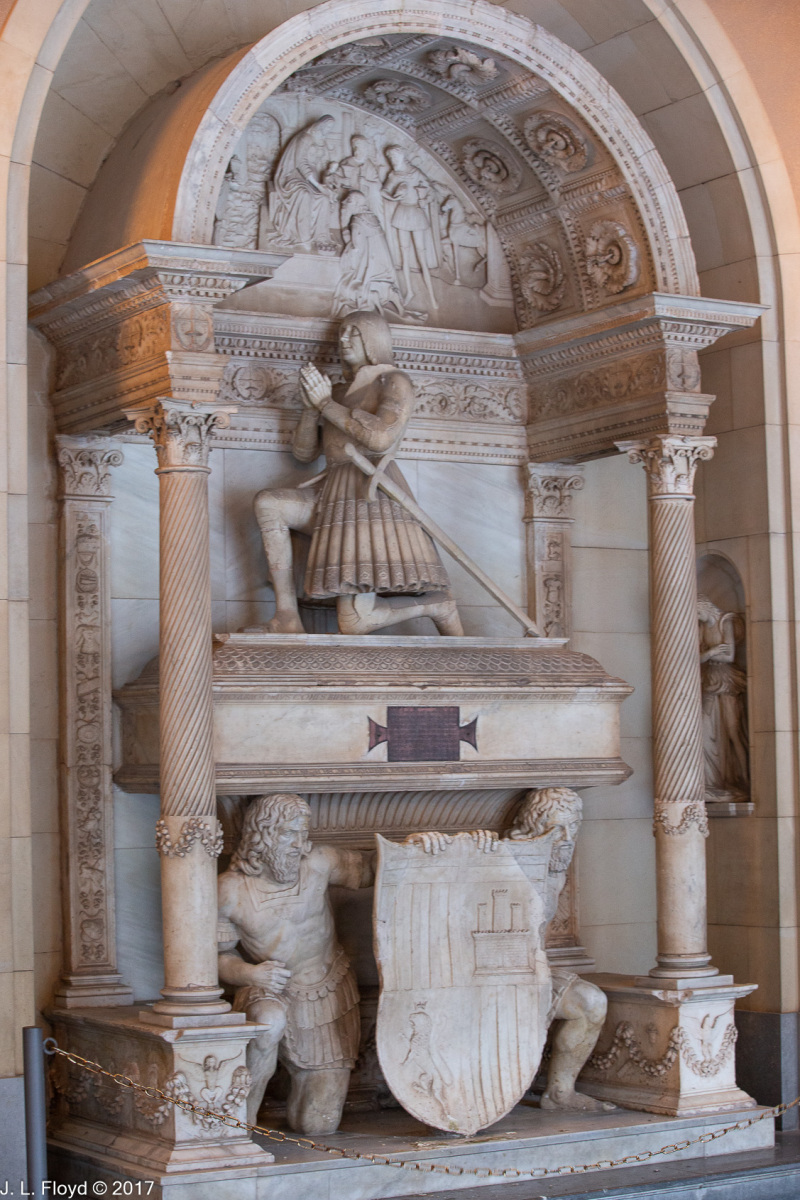
Two noteworthy figures of the early 16th century have tombs (sepulchres) in the gallery, though I’m unaware of how they got there since they greatly predate its construction; whether they were already there or were moved from somewhere else, I don’t know. One of them is Bernat II de Vilamarí (1471-1512), Admiral of Aragon and Naples, Count of Capacho; the other is Juan de Aragón y de Jonqueras, Count of Ribagorza (1457-1528), Viceroy of Catalonia and Naples. Bernat, or Bernardo, II was a scion of the powerful Catalan Vilamarí family, and his father, Bernat I, who died in 1463, was an admiral in the service of the King of Aragon. In Bernat II’s lifetime the crowns of Aragon and Castile were dynastically united by the marriage of Ferdinand II of Aragon to Queen Isabella of Castile in 1469. But legally and administratively they remained separate entities, and Bernardo remained in the service of the Aragonese crown. He also took service at various times under the King of Naples, which was a separate kingdom though dominated by Aragon. He led the Aragonese and Neapolitan fleets in the wars against the Turks, the suppression of the Catalan rebellion against the King of Aragon (1472), the conquest of Granada, and the Italian wars which pitted the Spanish monarchs against Venice, Genoa and France.
Juan II de Ribagorza, also buried at Montserrat, was an illegitimate son of a previous Count of Ribagorza who was himself an illegitimate son of King John II of Aragon. Juan II was thus a nephew of Ferdinand II, King of Aragon, who appointed him to succeed Gonzalo Fernández de Córdoba (1453-1515) as viceroy of Naples. Gonzalo de Córdoba was a spectacularly successful general who had succeeded in expelling the French from the Kingdom of Naples after they had twice invaded and occupied it (1494 and 1503). Known as El Gran Capitán, he was considered the author of the military reforms which made possible the Spanish domination of Europe in the 16th and early 17th centuries. Nevertheless, Ferdinand II did not entirely trust him because he was a Castilian and replaced him with Juan II de Ribagorza in 1507. Juan II had previously been Viceroy of Catalonia (1496-1501). But whereas Gonzalo’s administration had been a roaring success – his popularity there was one reason Ferdinand did not trust him – Juan II’s was a catastrophic failure. Attempting to levy extra taxes to finance the military forces, he evoked a popular revolt which forced him to leave Naples in 1509. He was then appointed again to be in charge of Catalonia in 1512, but he soon was forced out of that post also.
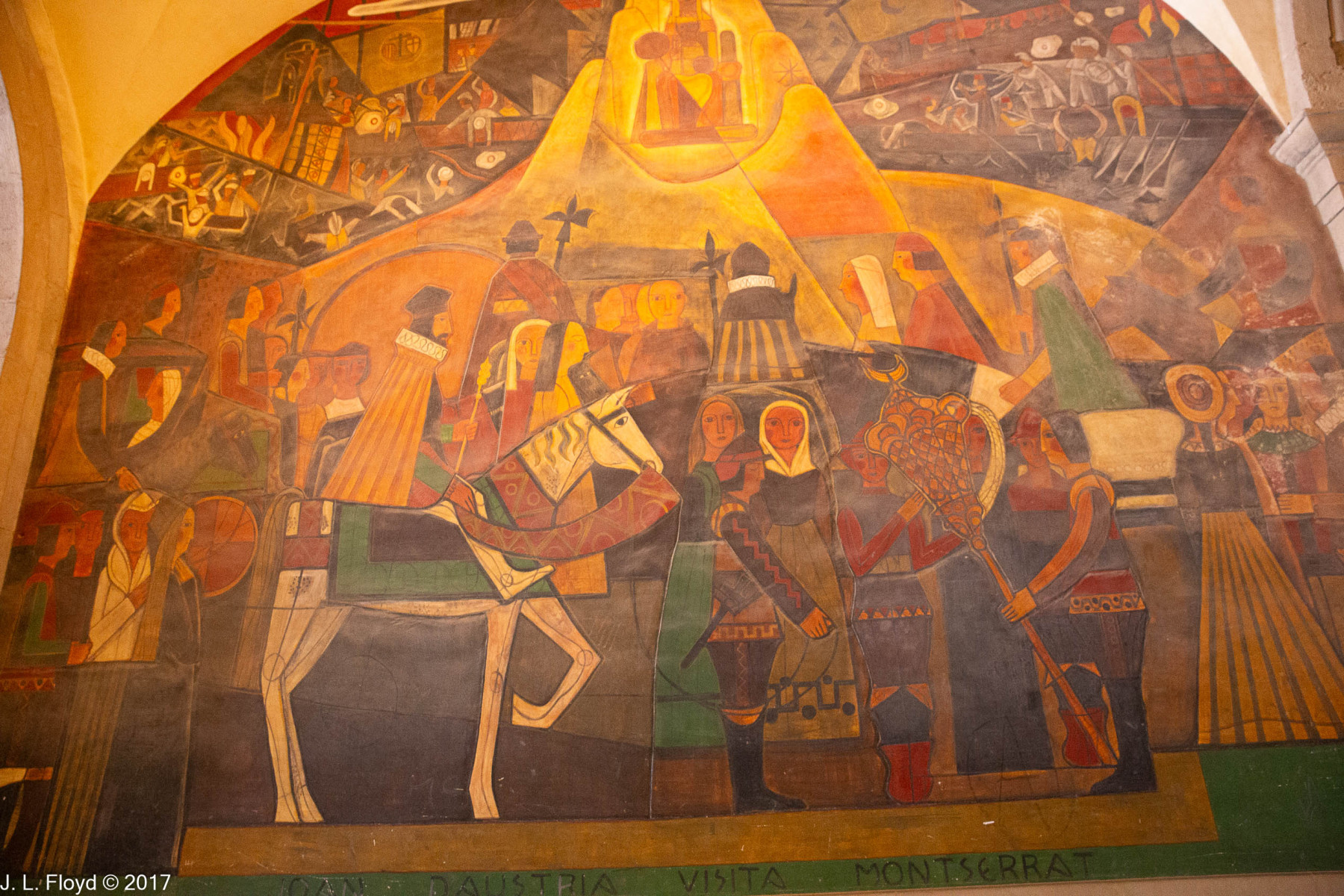
There are also a couple of wall paintings in the atrium: the Visit of the Catholic Monarchs to Montserrat and Visit of Don John of Austria to Montserrat, both completed by the Catalaan artist Francesc Fornells-Pla in 1921. I photographed only the second of these, and it is included in the gallery below.
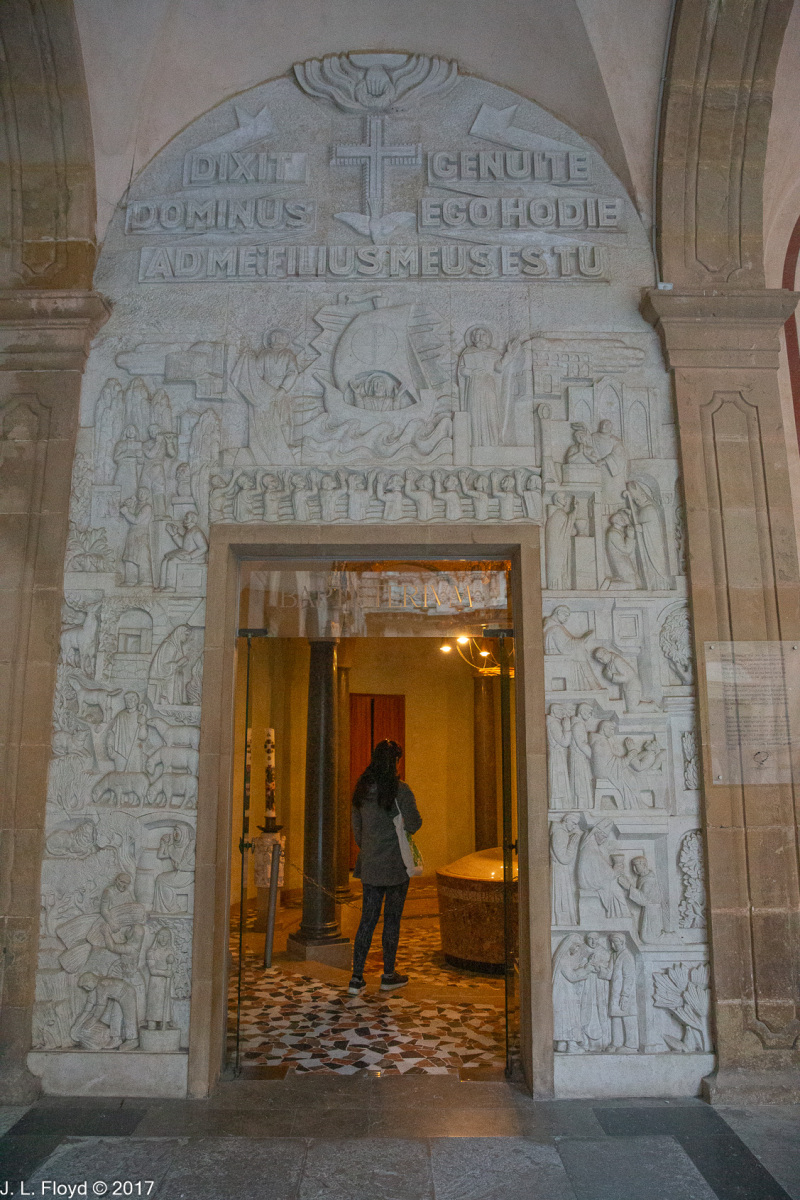
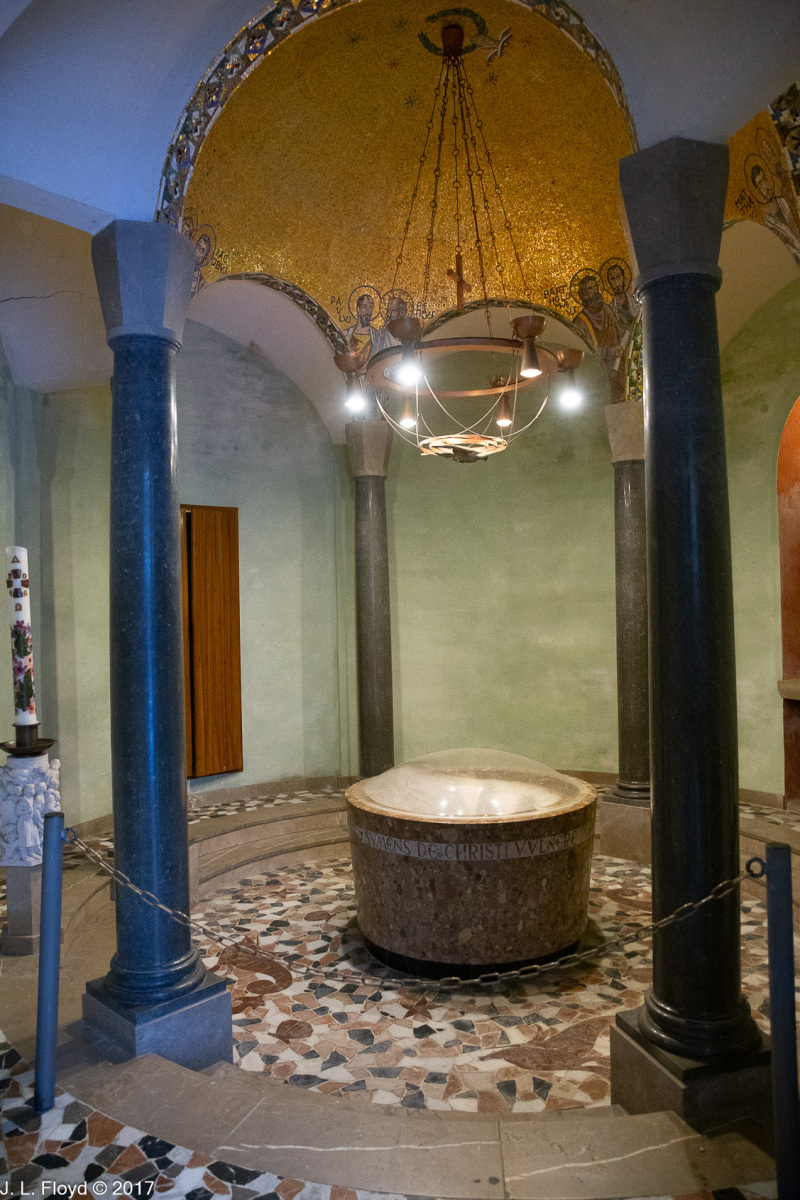
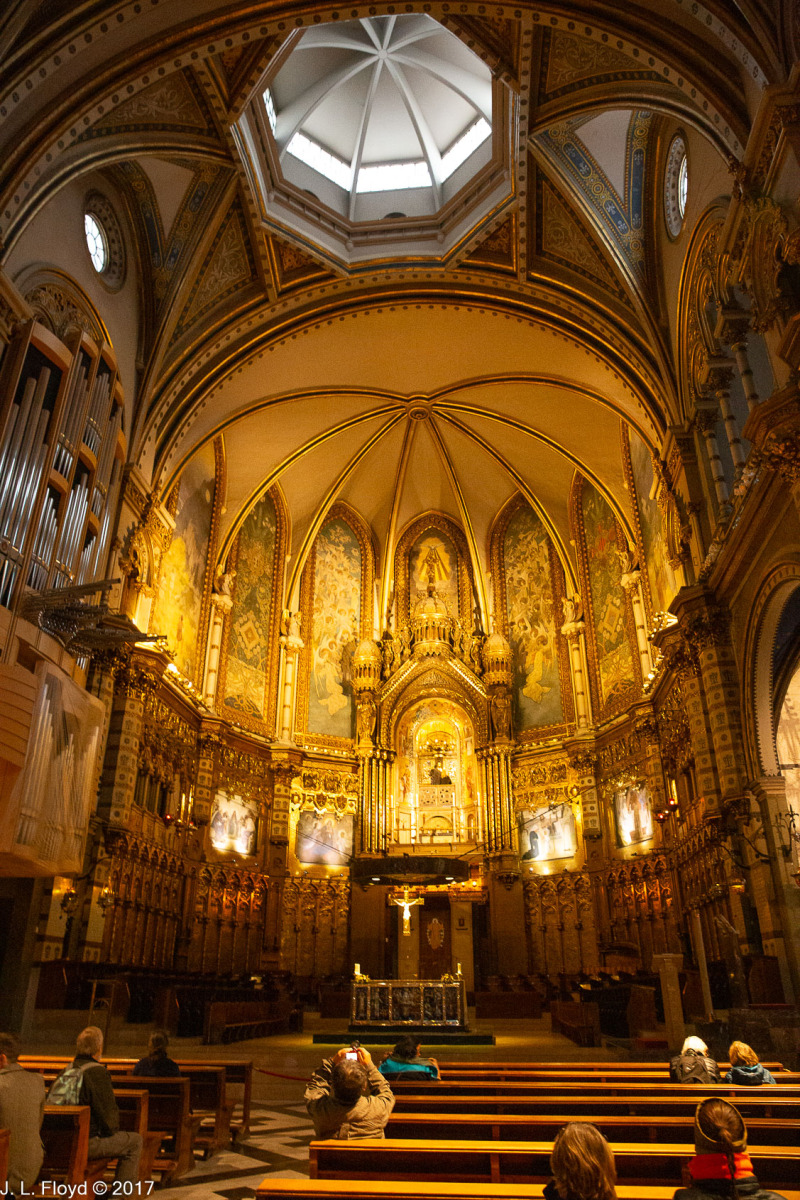
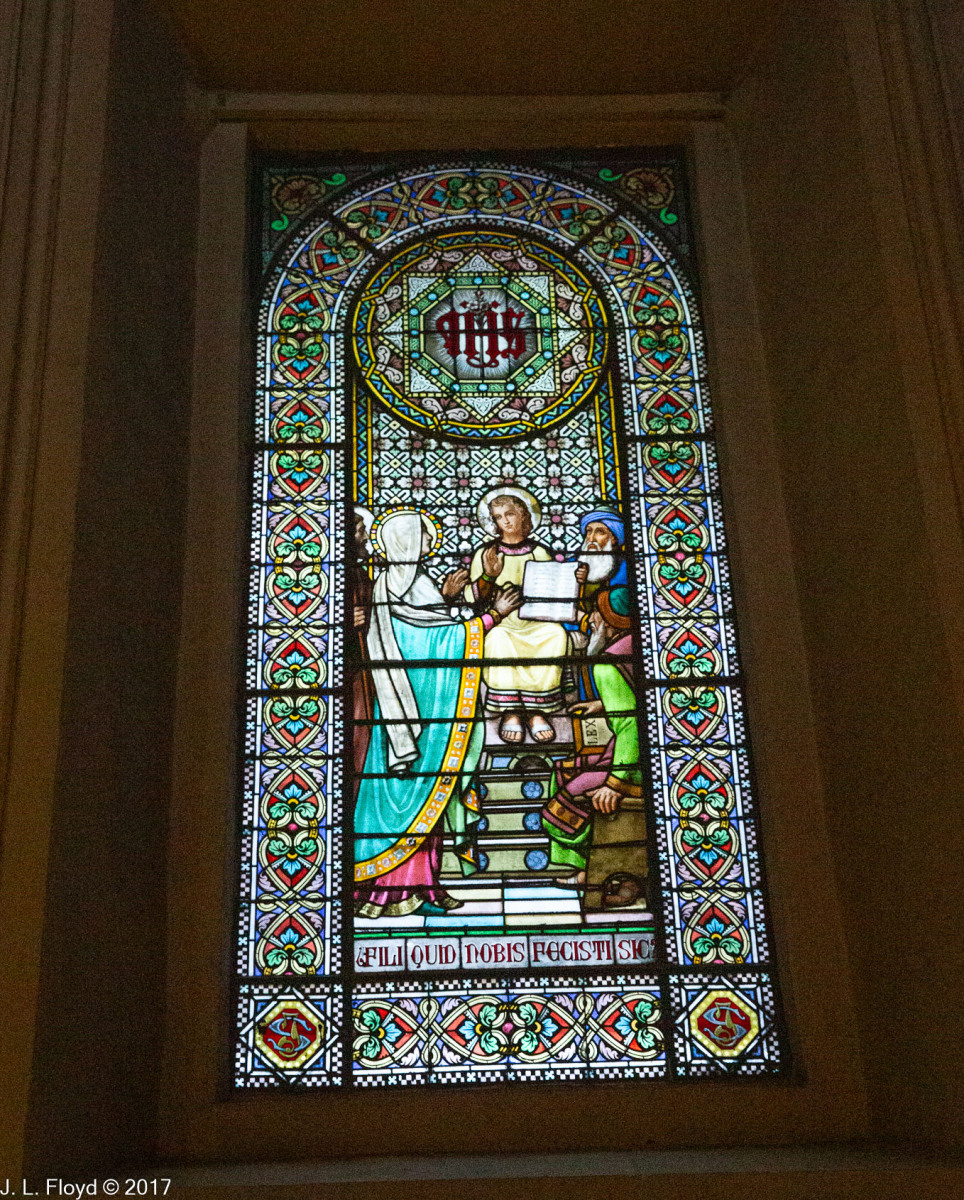
In the basilica itself, we first visited the Baptistery, which we entered via an elaborate portal sculpted by Charles Collet (1902-1983), a Swiss sculptor who settled in Catalonia in the 1920s and lived most of his life there. Next we toured the single-nave church, with its dome and main altar with enamels depicting various Biblical scenes such as the Last Supper.
Because time was short, we bypassed the remaining chambers of the basilica such as the Room of the Virgin, where the La Moreneta image is displayed, the Throne Room, and the various chapels. If I remember correctly, we did visit the Museum, located next to the basilica, but I did not take any pictures inside. It boasts many works by eminent artists, some of which can be seen on its web page in Wikipedia.
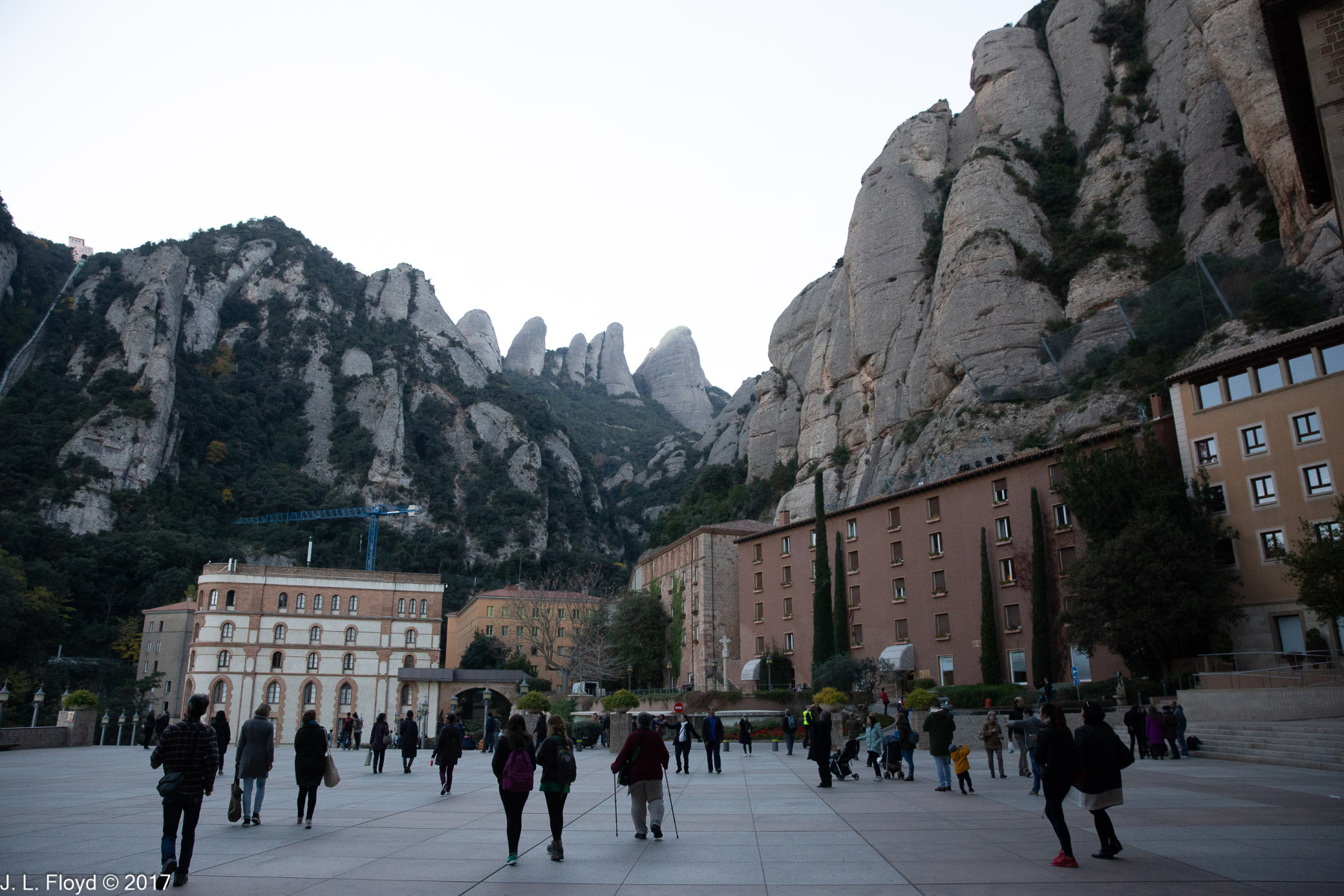
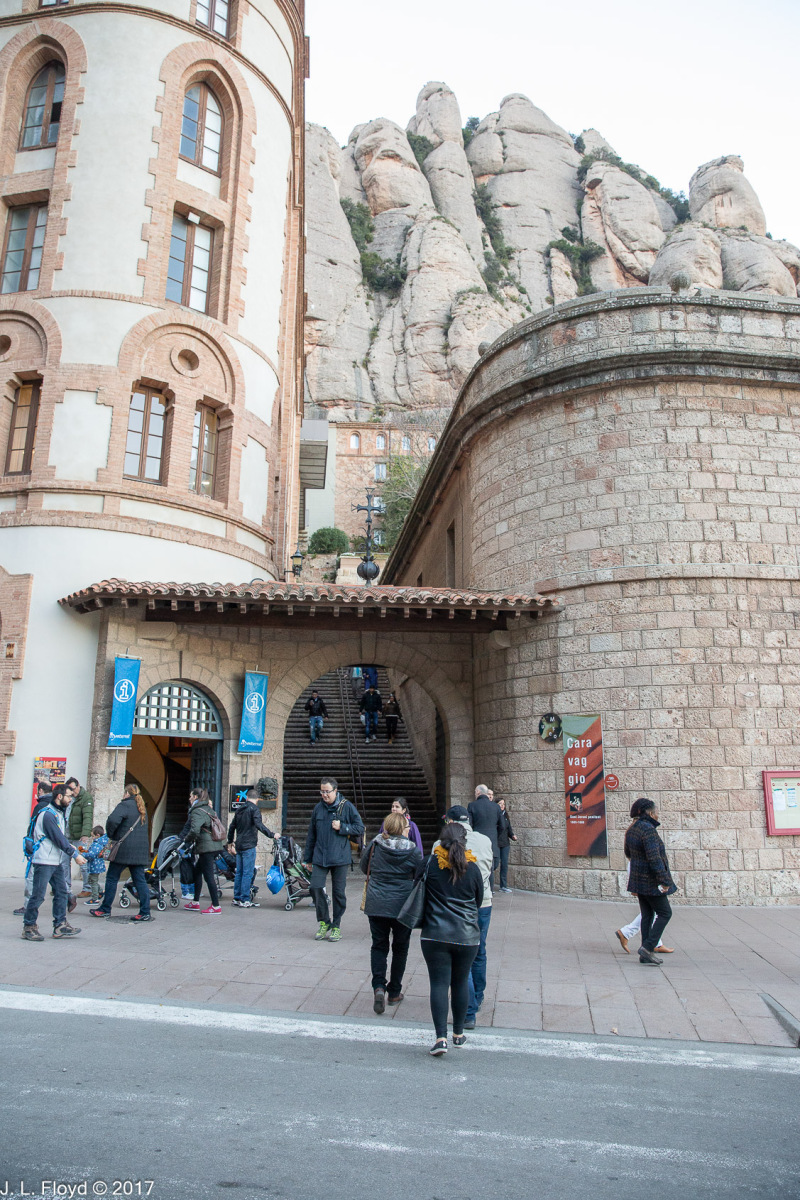
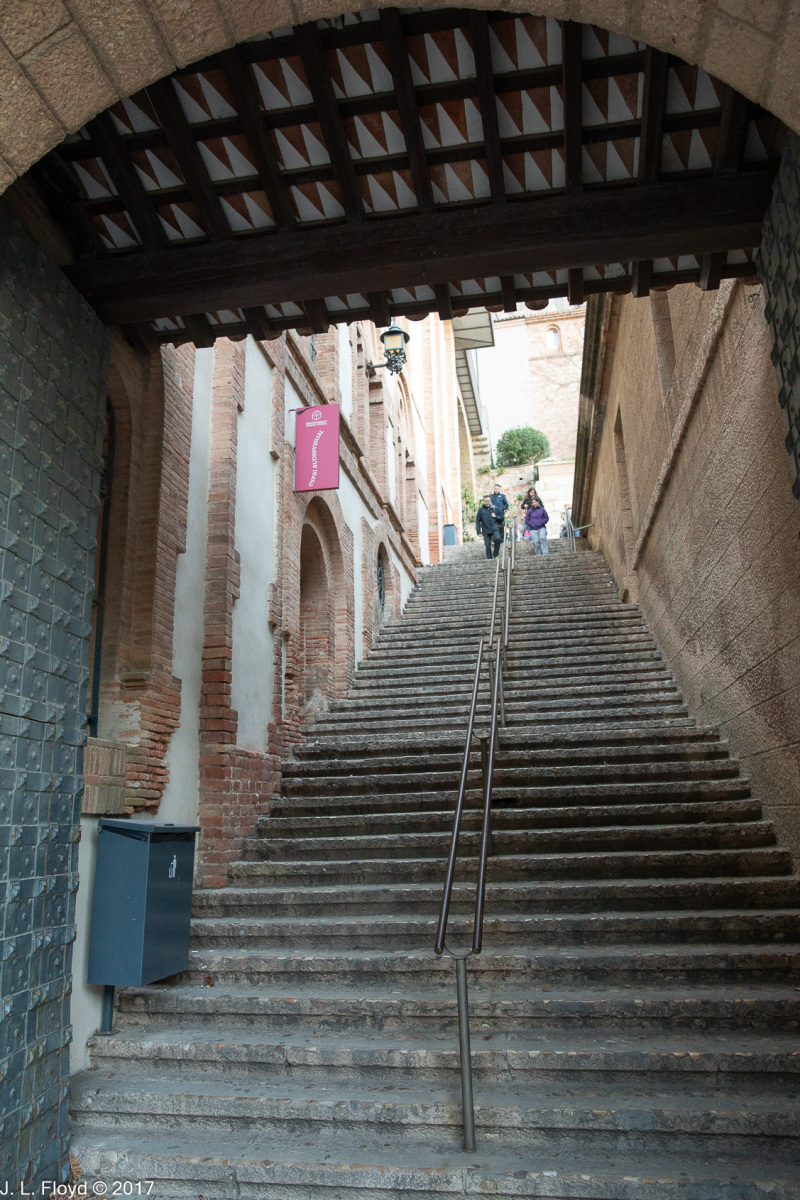
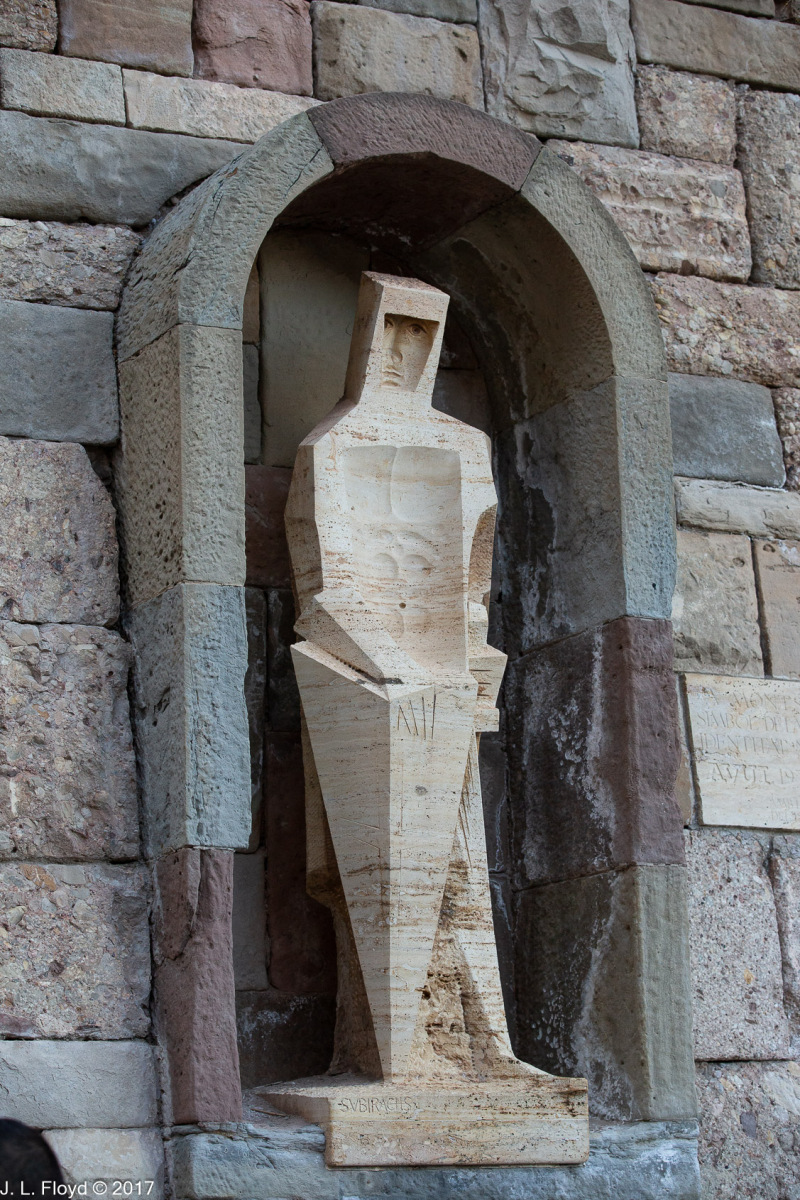
There was a great deal to see just wandering around the grounds of the Abbey, in the limited time left before we had to go back to Barcelona. At the top of the stone stairway which climbs from the abbey plaza to the museum entrance, I found a statue of St Jordi (George), who along with the Virgin of Montserrat is the patron saint of Catalonia. I personally found it rather ugly, but it is a prominent work of Catalan modernism, of which the sculptor, Joseph Maria Subirachs, was one of the foremost exponents. He was also responsible for other noteworthy pieces at Montserrat, such as the Stairway to Heaven, which we’ll see shortly.
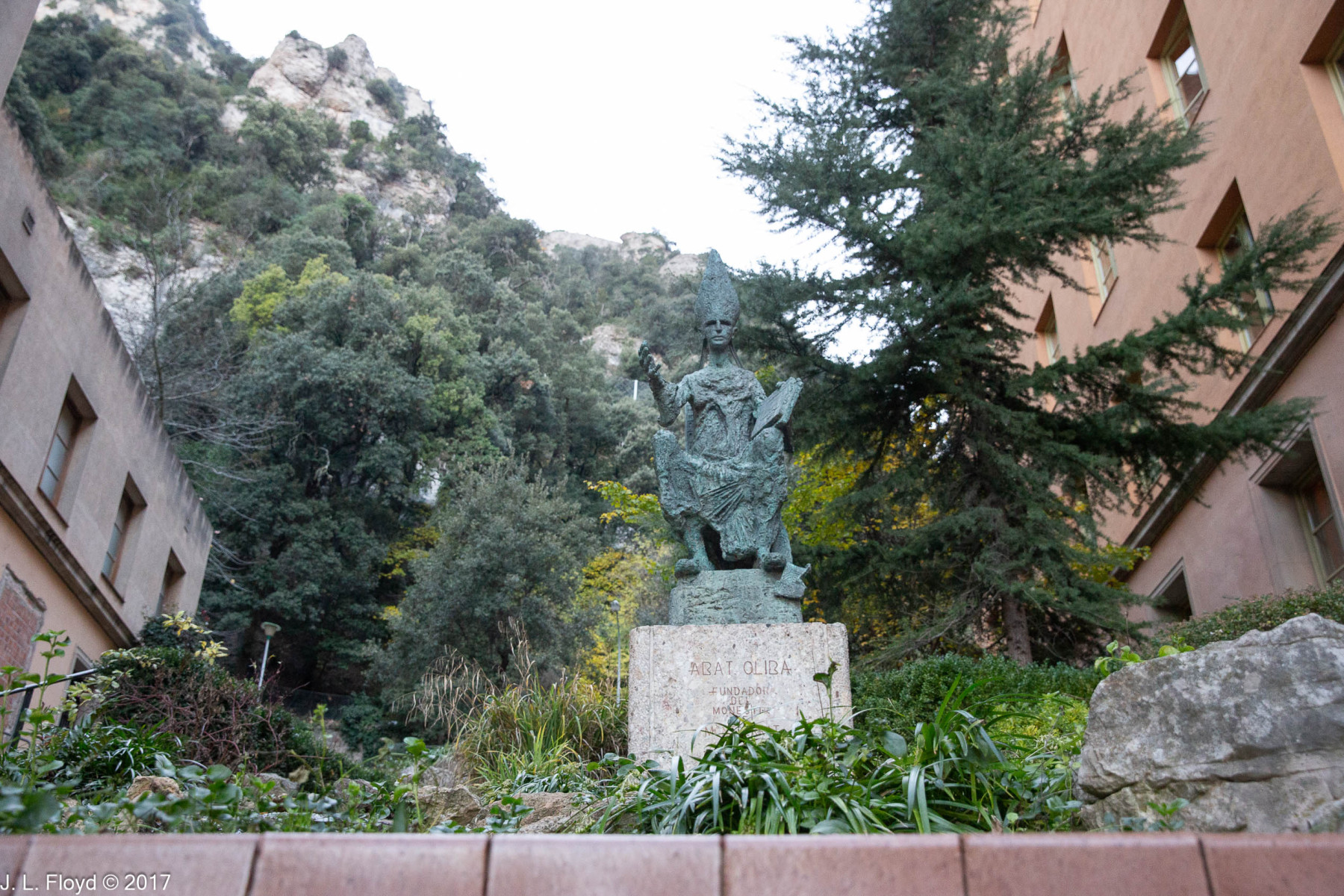
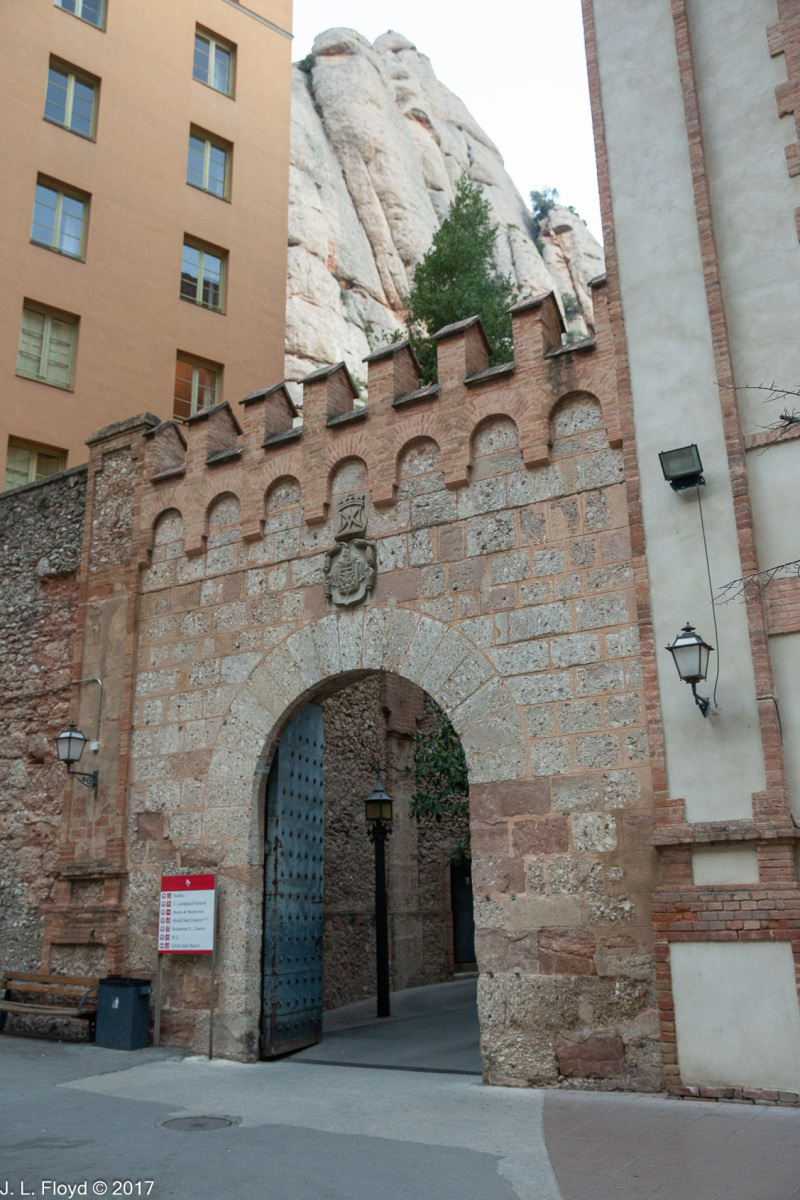
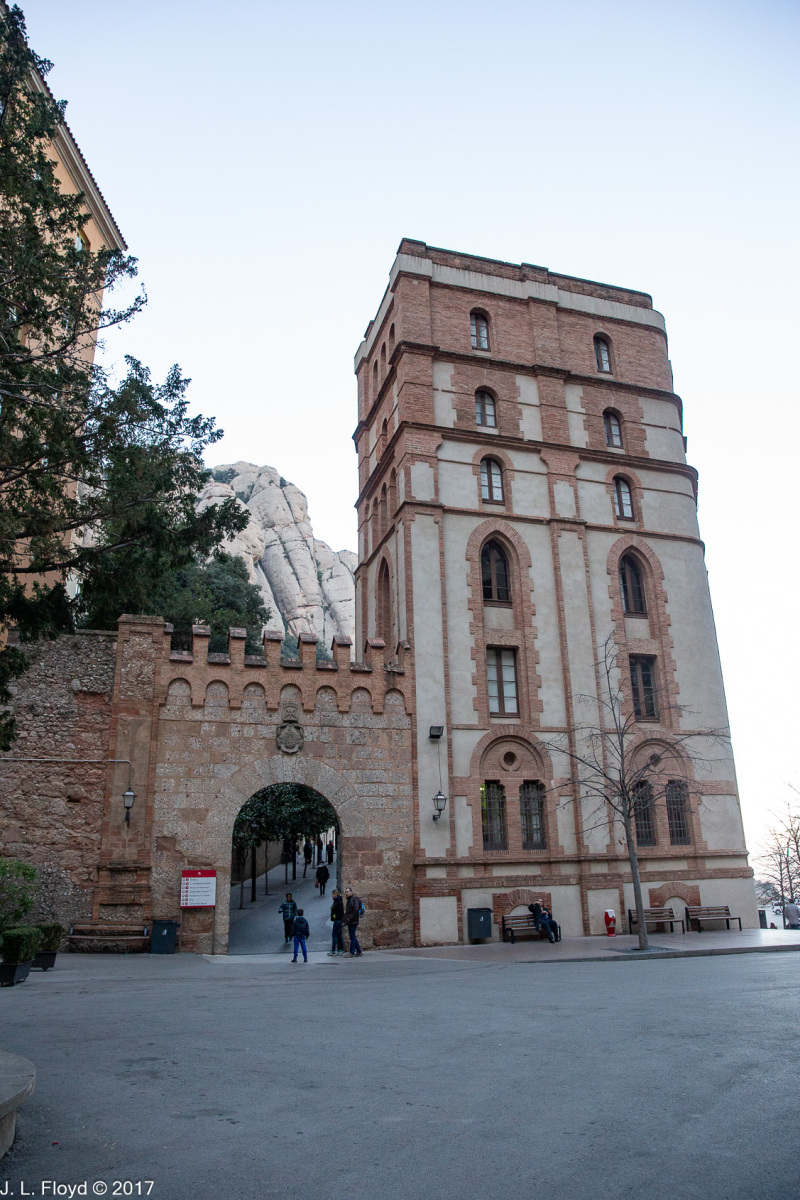
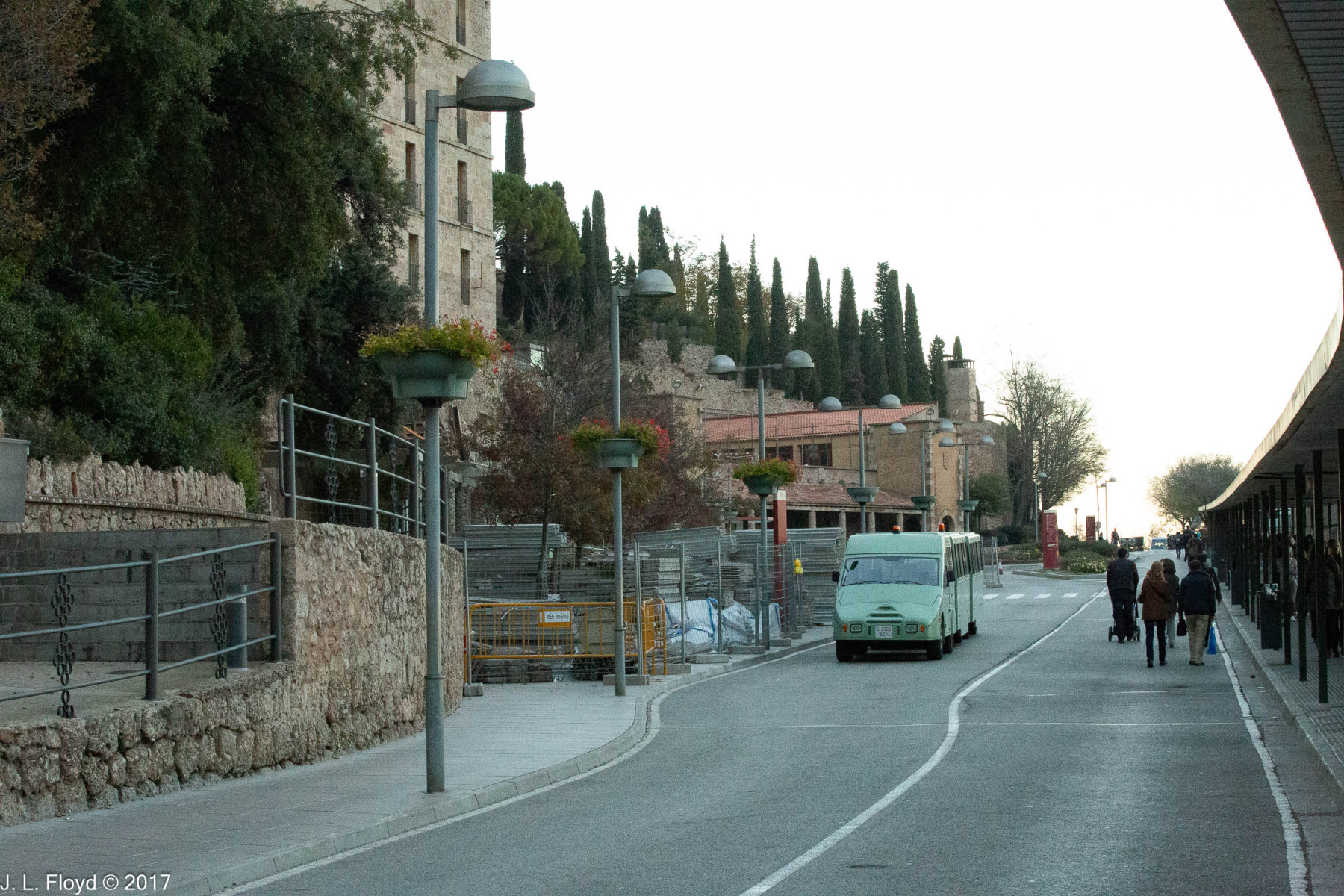
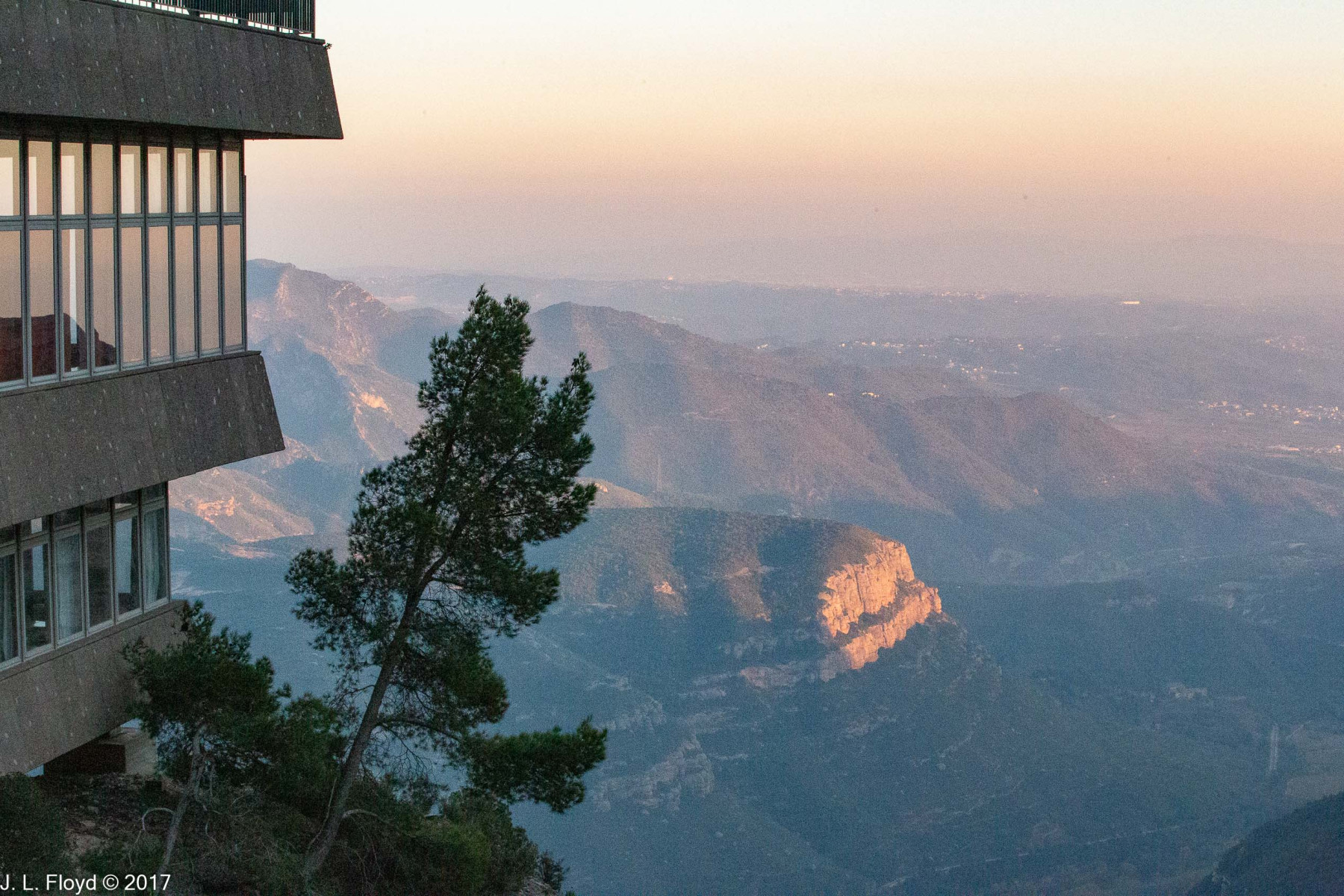
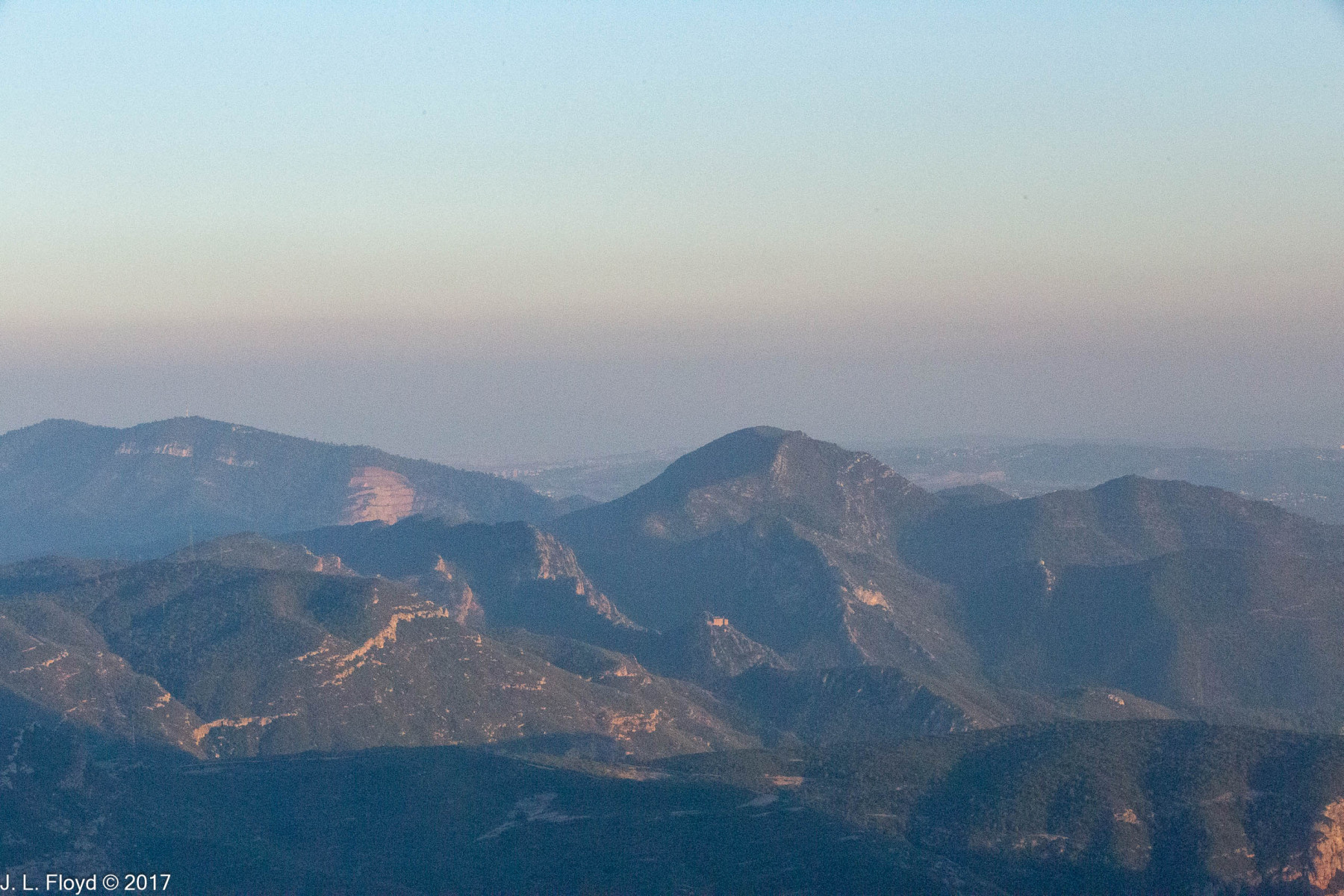
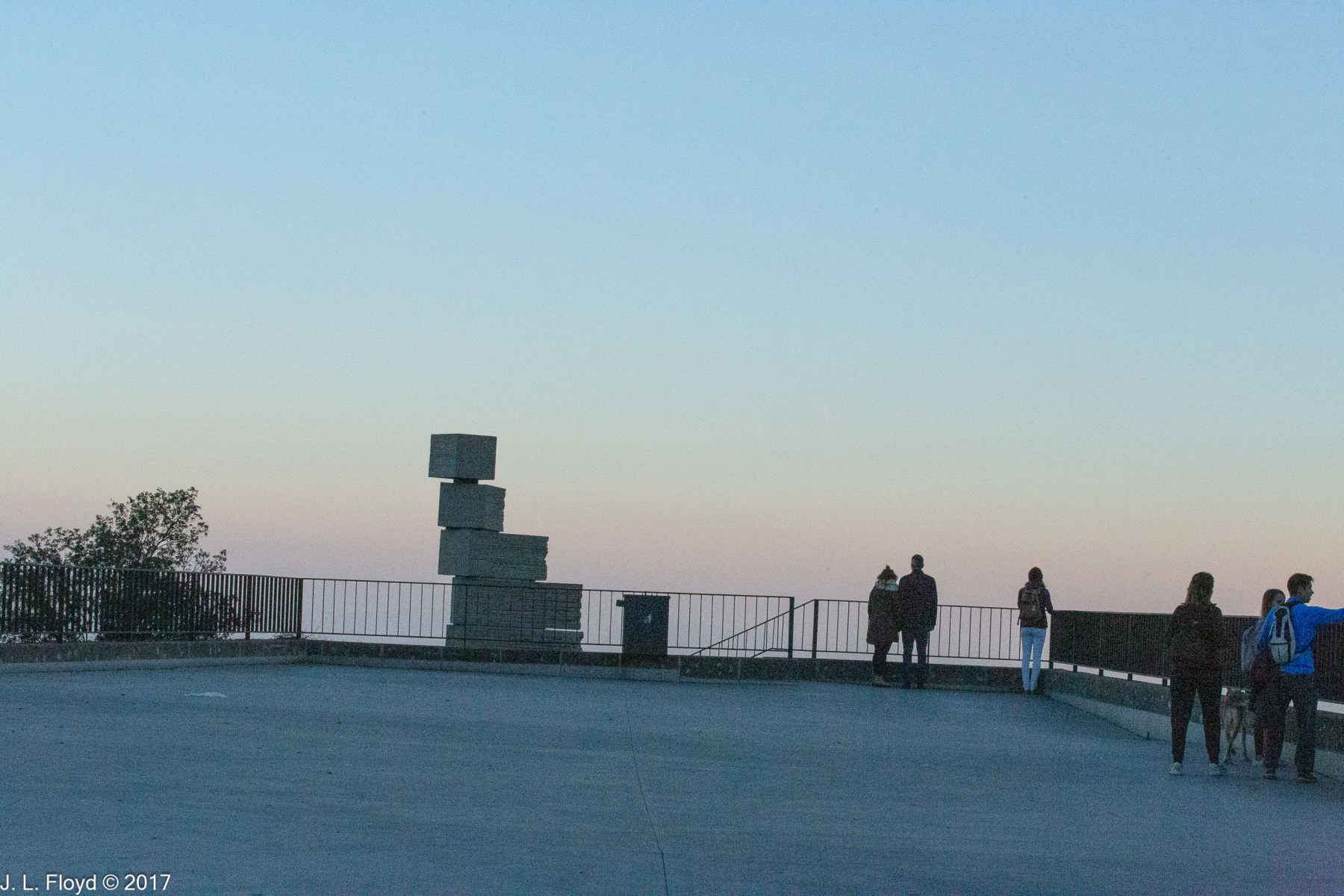
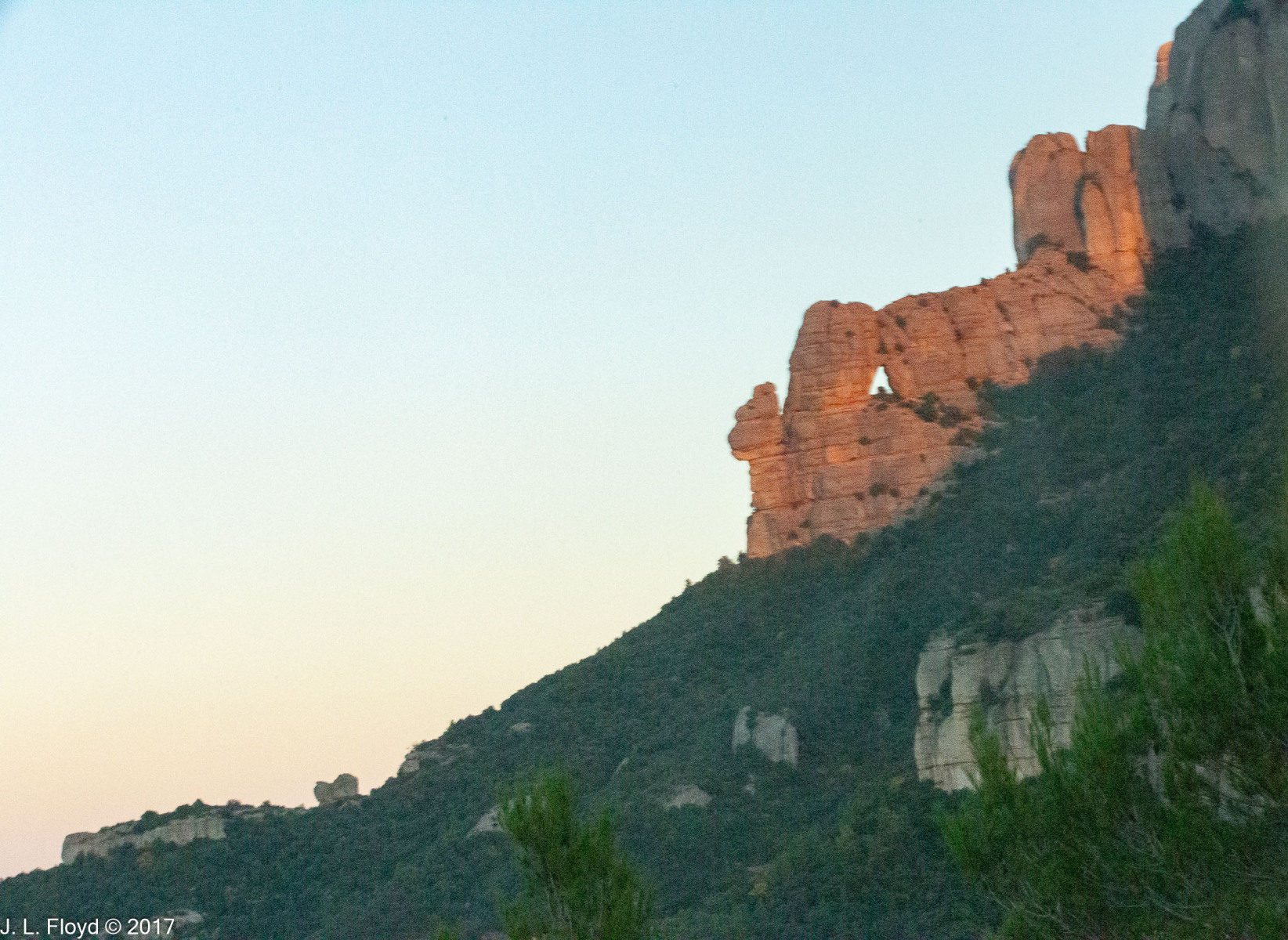
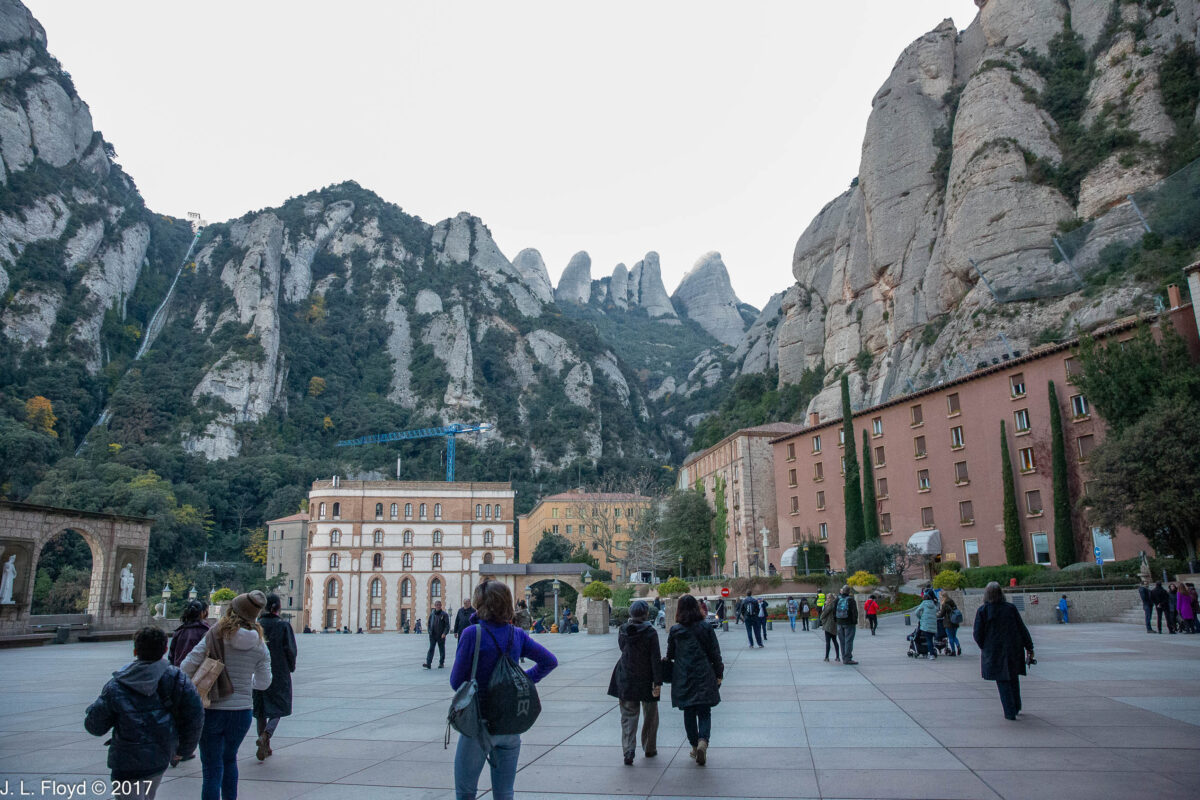
It was nearly dusk when we said “Adéu” (goodbye in Catalan) to Montserrat Abbey and headed for the bus stop. On the way I was able to shoot some lovely late-afternoon views of the mountain landscape and a few last scenes of Montserrat. Unfortunately my photo of Joseph Maria Subirachs’ Stairway to Heaven shows only the top part since most of it was below the level of the road we were walking on, but you can see it in its entirety, and read more about it, on its web page.