Categories
Spain, Portugal and Morocco, November 2017

Granada, November 9, 2017: The City Center and the Albaicín

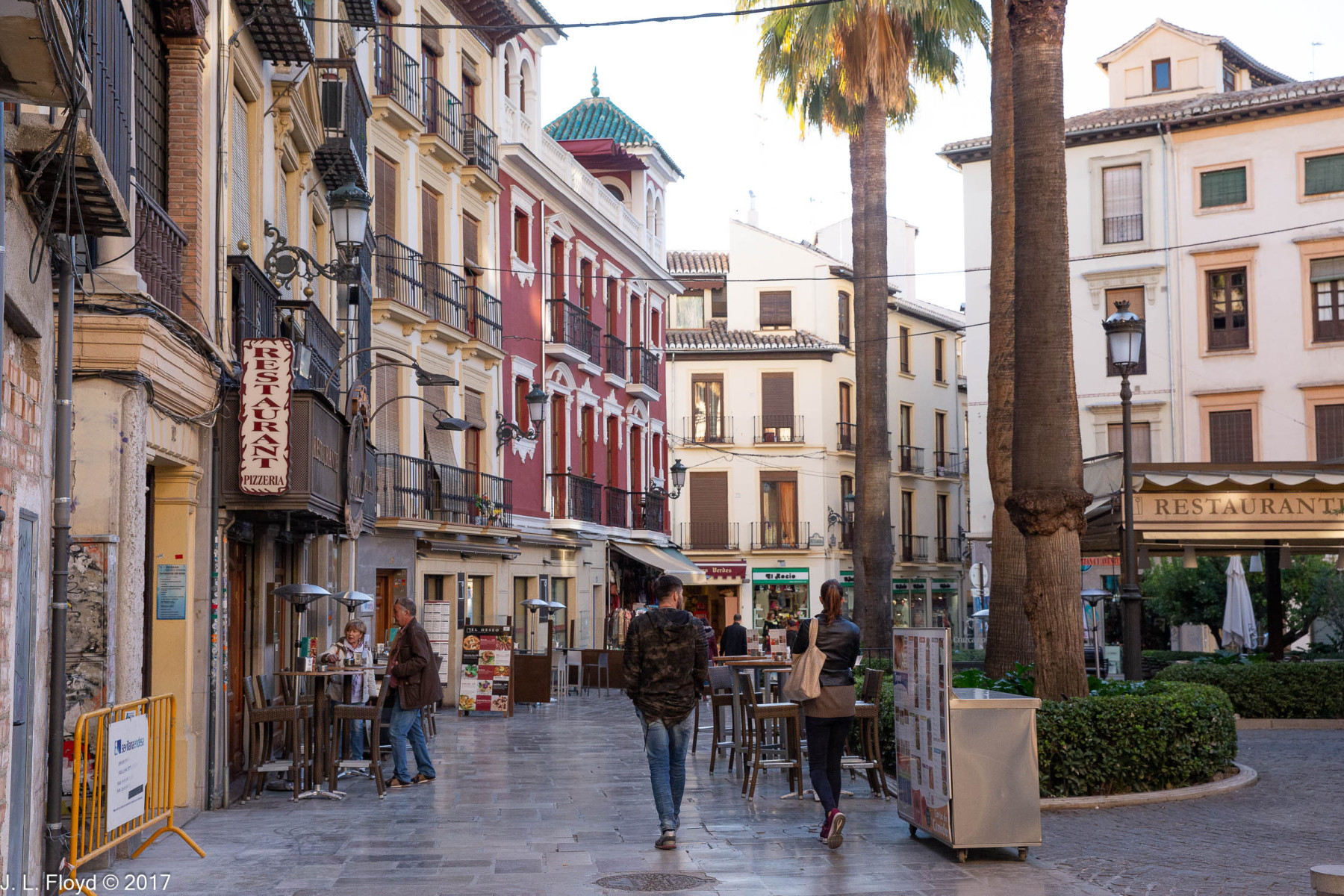
When we finished our tour of the Alhambra in the early afternoon of November 9, we were given the choice of going back to the hotel or seeing a little of the rest of the city of Granada via a guided walk through the downtown area. The long trek on foot through the Alhambra had worn Sandie out and and she chose to return to the hotel. I was almost dead tired myself, but nevertheless I opted to go on and I’m glad I did. Granada is a beautiful city and full of history. It would be worth a visit even if the Alhambra had been razed to the ground. Yet for all its historic significance, Granada is surprisingly petite, with a population of only a quarter of a million, about half the size of my home town of Long Beach, California. That, in combination with the higher population density that is typical of European cities, makes it possible to see many attractions in a brief walking tour.

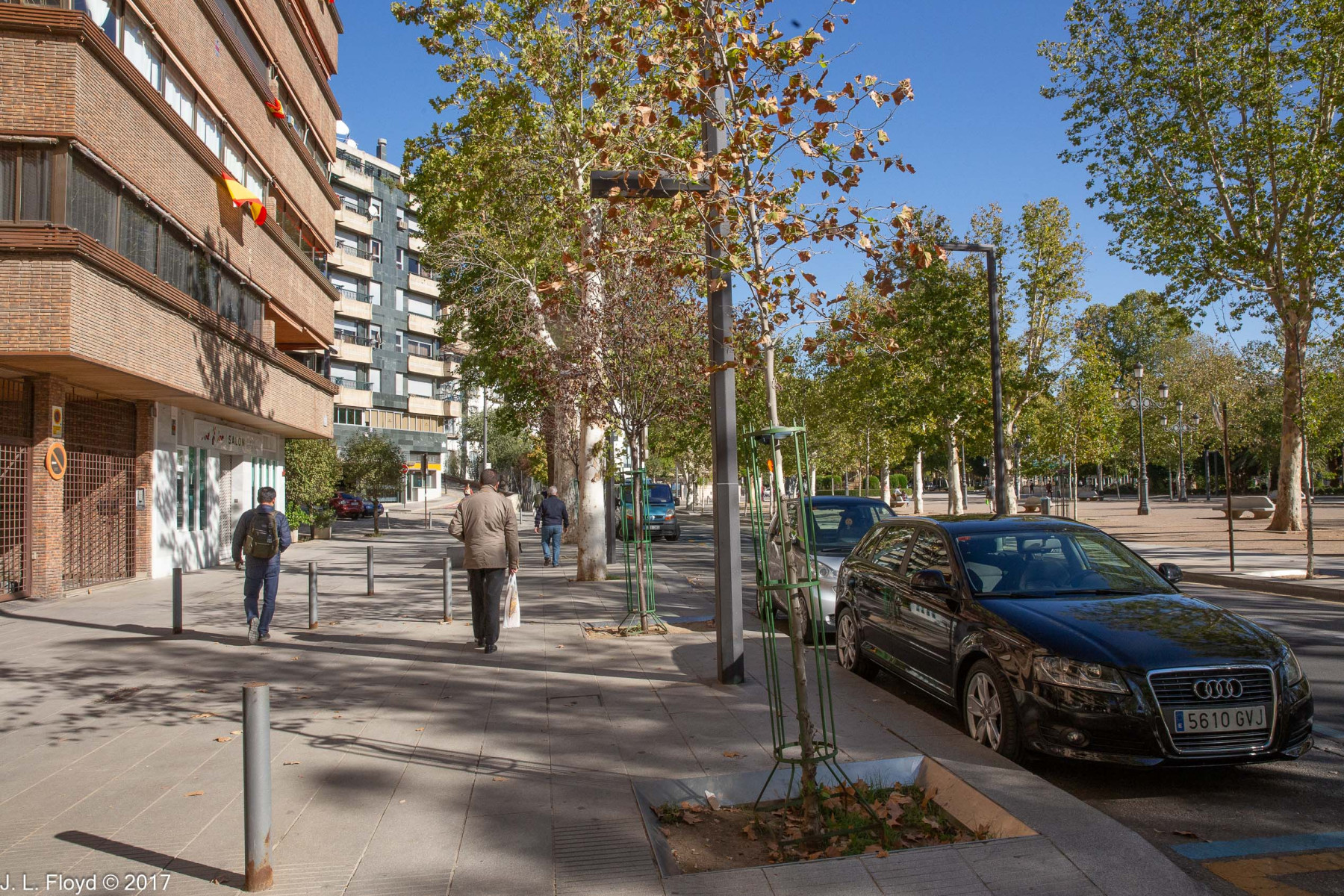
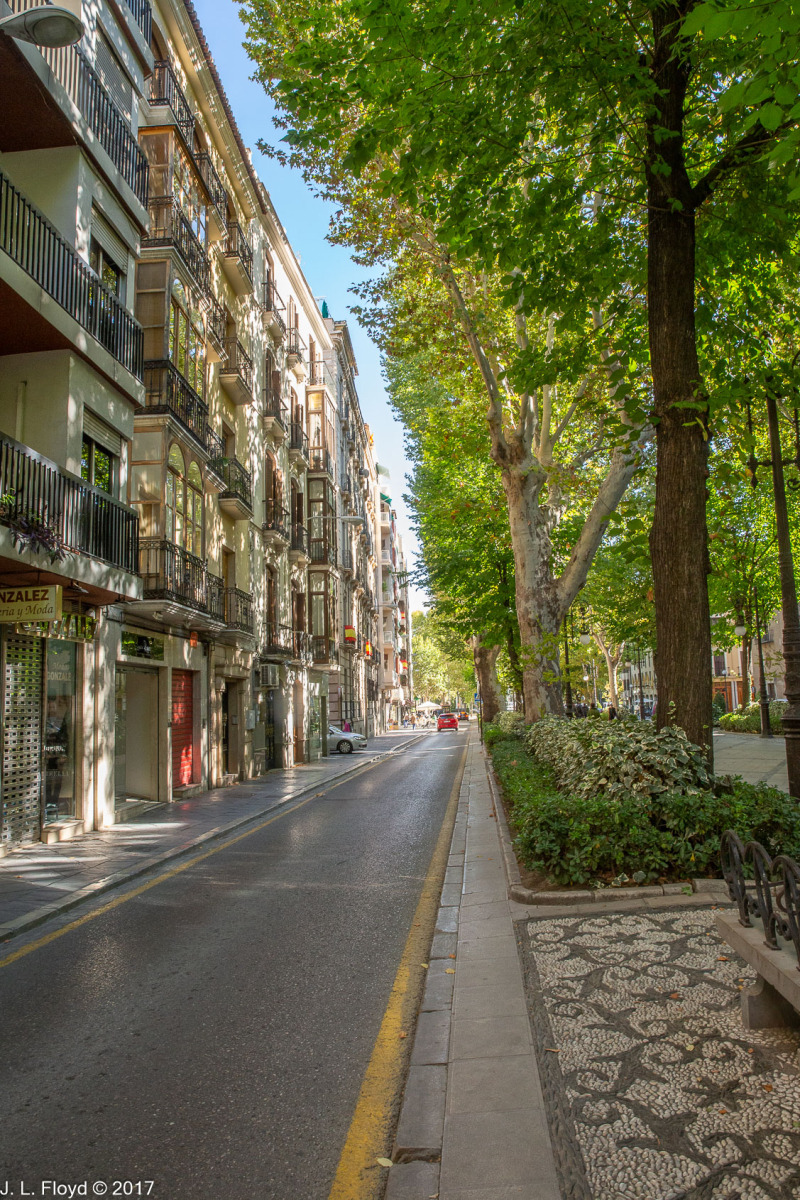
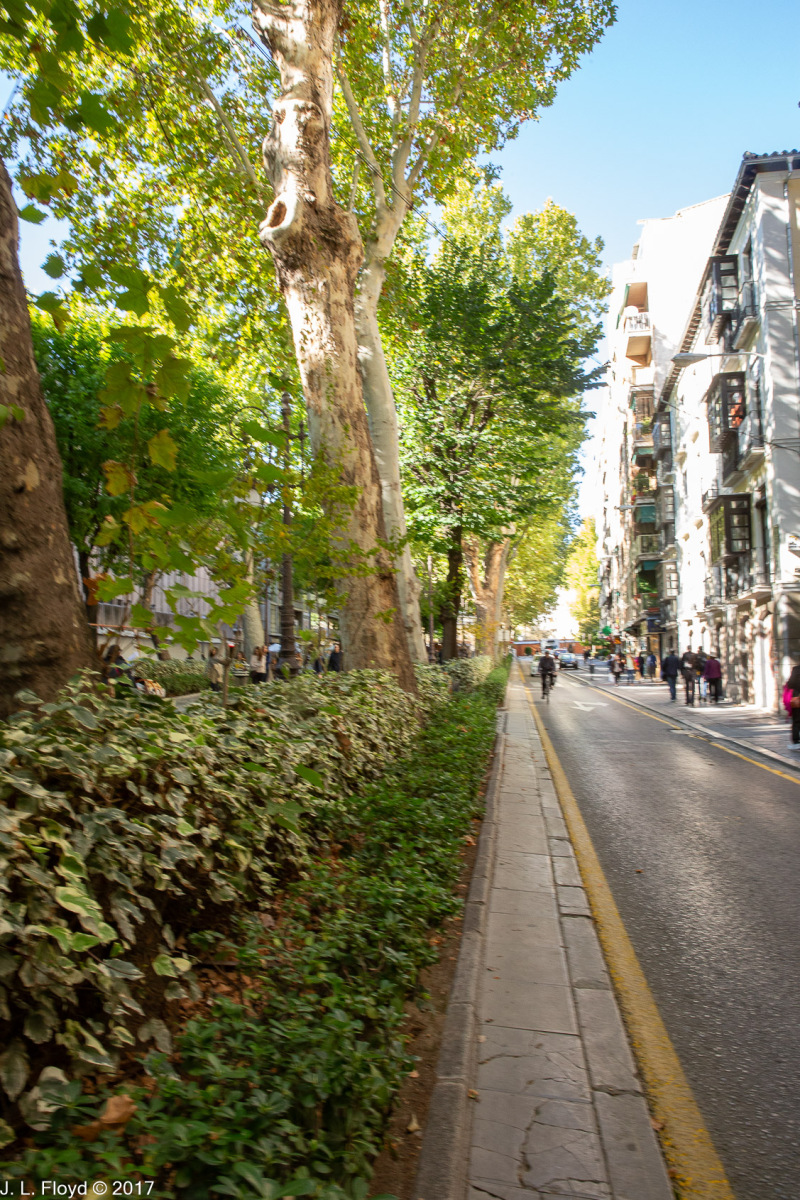
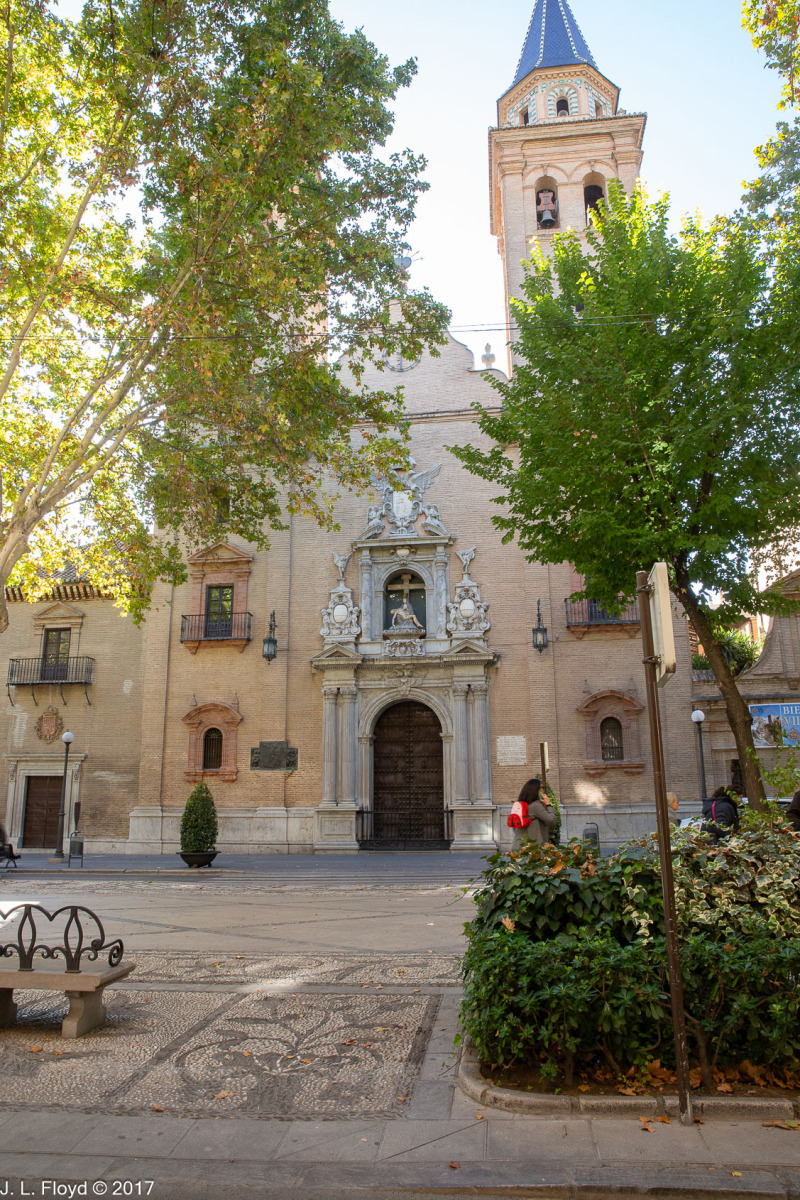
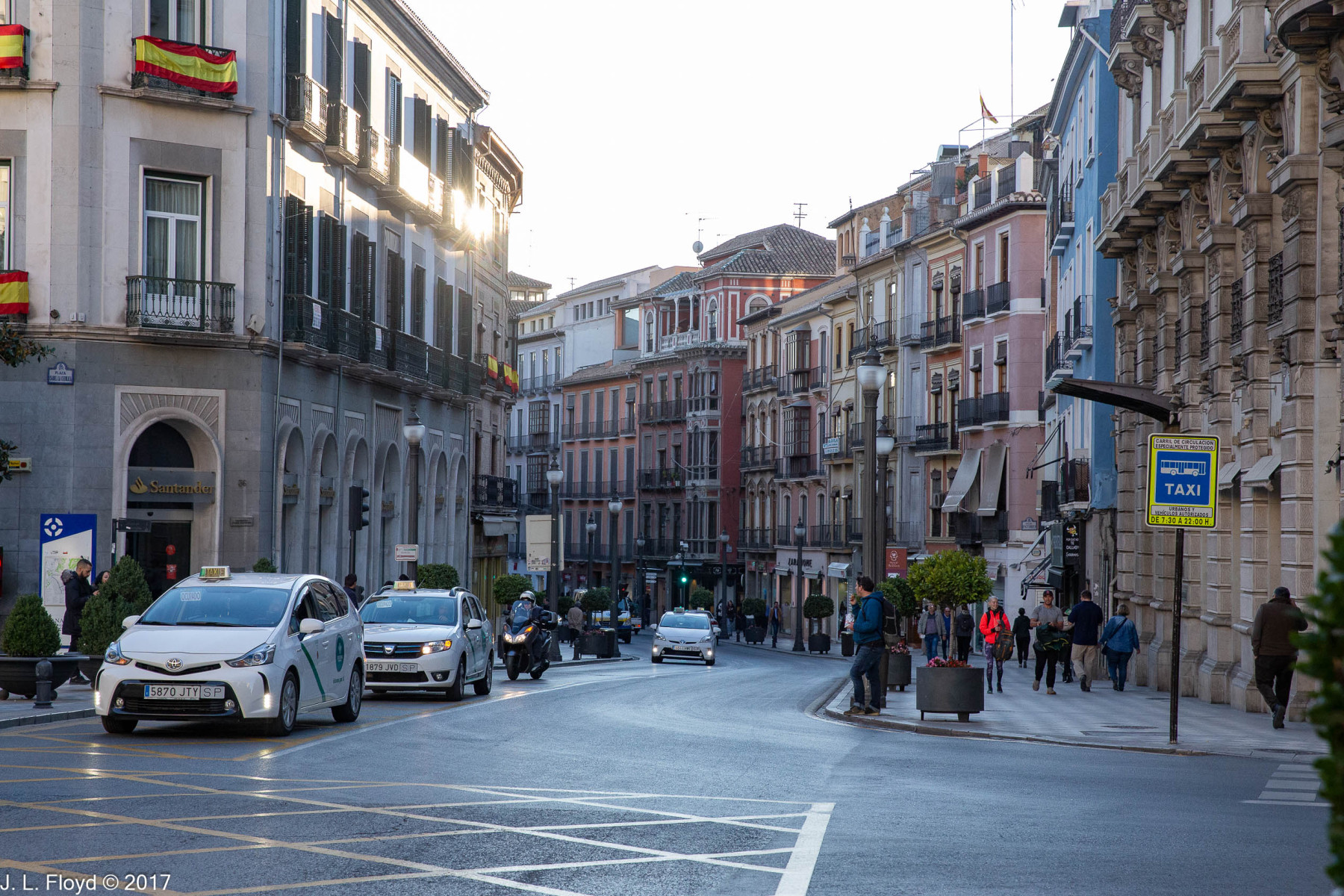
We began our walk in the downtown area, on the Carrera de la Virgen, a wide boulevard divided by a shady, tree-lined pedestrian median and lined with stately apartments and upscale businesses such as El Corté Ingles department store. We paused along the way to view the Basilica de las Angustias, a Baroque church which was begun in 1617 on the site of an old hermitage to provide a home for an image of the Virgin of Sorrows, donated by Queen Isabella the Catholic, which now graces the altarpiece of the church. The Virgin of Sorrows is considered the patron saint of Granada, as was officially recognized by Pope Leo XIII in 1887.

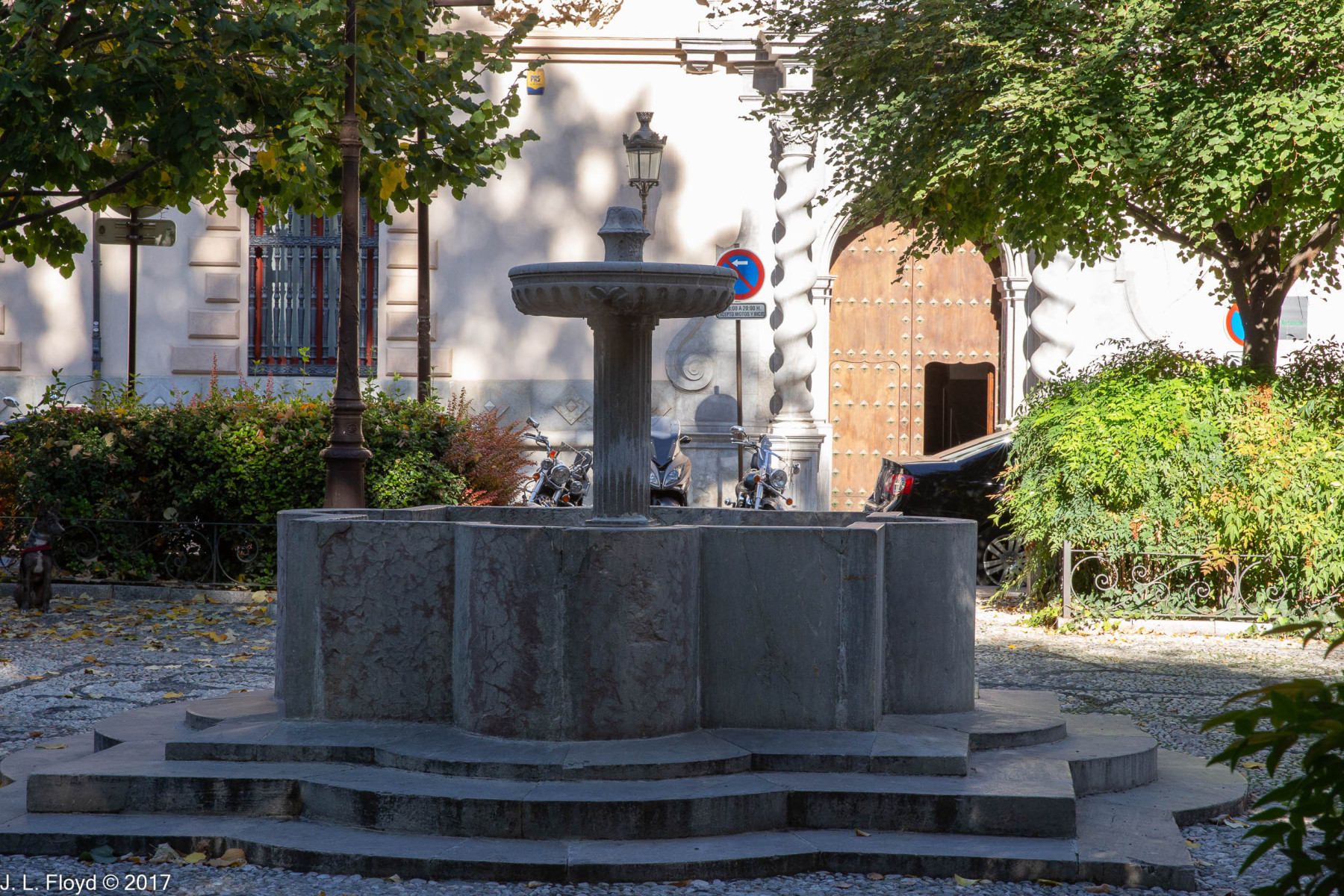
Before long we reached the end of the Carrera de la Virgen at the Plaza Bibataubín, where we encountered a fountain and a palace. The name is a corruption of “Bab al-Tawwabin,” Arabic for “Bricklayers’ Gate,” denoting that in Nasrid times it was the location of one of the city’s main gates, in a district inhabited by the stonemasons who built the gate. That was in the 12th century, in pre-Nasrid times, when the Almohads still ruled the area. The Nasrids reinforced the gate, but after the conquest of 1492 the Catholic monarchs decided to build a castle on the site to enhance the defenses of the city. In the 18th century the castle became an obstacle to the city’s growth, and it was converted to a barracks, a transformation which involved demolishing the existing edifice and rebuilding it with a facade made of premium-quality Sierra Elvira stone and featuring helical columns with a twisting spiral structure like a corkscrew. These are known as Solomonic columns because they were thought to have originated in the original Solomon’s Temple in Jerusalem (the one which was destroyed by the Babylonians in 586 BCE, and no remains of which have ever been found, so that nobody knows what it really looked like, or even if it really existed). These columns had originally been carved for the Church of the Sagrario (which we saw later) but had been rejected by its architect, so they were installed at the barracks instead. The building continued to serve that purpose until 1933, when it was given over to the Provincial Council of Granada. This led to a series of further remodelings and modifications, culminating in 2009 when the Provincial Council turned the edifice over to the Consejo Consultivo de Andalucía (Advisory Council of Andalusia), for which it now serves as headquarters.

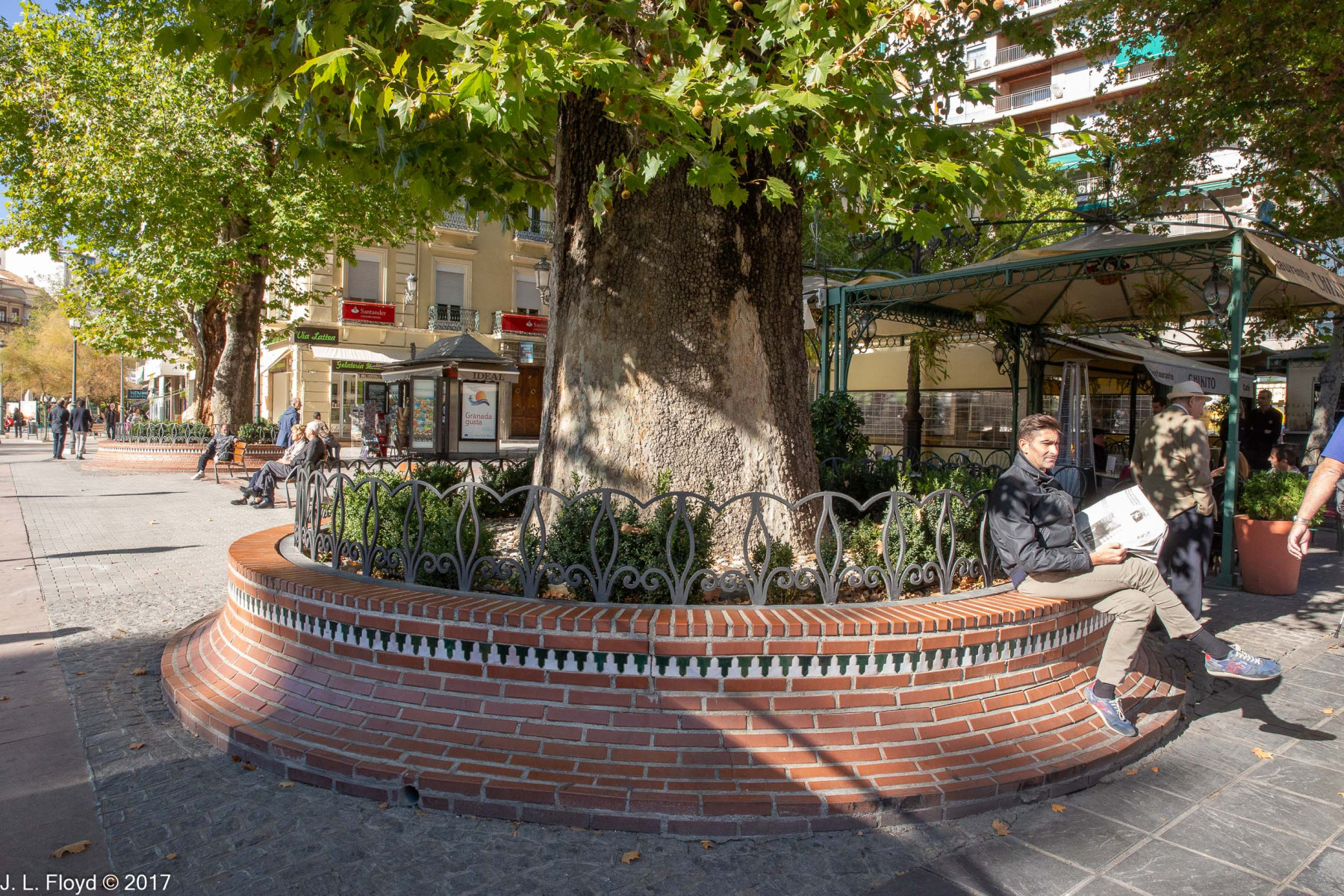
Next to the Palacio de Bibataubín on the north is another square, Plaza del Campillo, a pleasant locale with a newsstand, several enticing restaurants, and an attractive fountain. I was especially taken with a circular brick planter surrounding a huge, venerable old tree; the planter also served as a bench for passers-by to sit and rest their weary feet, and perhaps to contemplate dining at the nearby Restaurante Chikito.

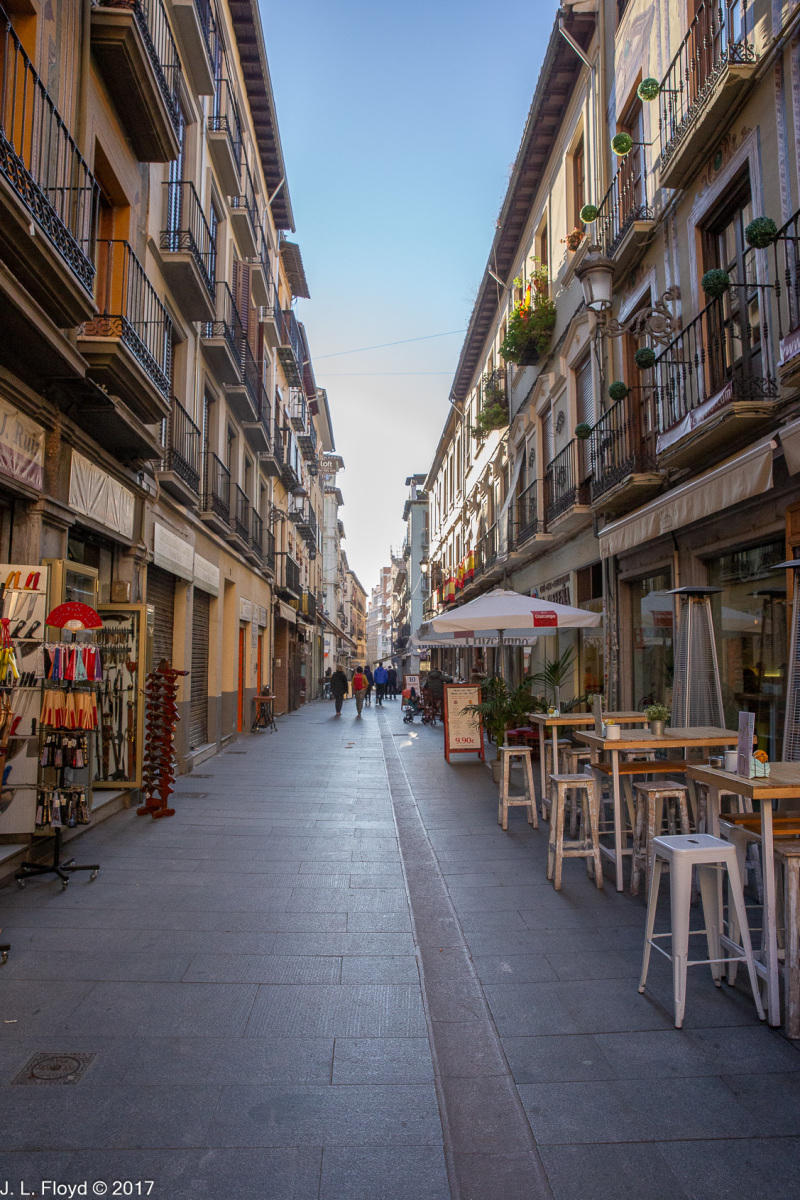
I must admit that I am hopelessly confused as to how we proceeded next. We ended up at the Ayuntamiento de Granada, which is the City Hall, in the Plaza del Carmen, but exactly how we got there I have no idea. My photos of the places we encountered aren’t very helpful since they don’t seem to comport with any logical route we could have taken. But it doesn’t really matter; the streets were well-kept and worth seeing in themselves.

The Ayuntamiento de Granada proved to be one of the most strikingly attractive town halls I saw in Spain, or anywhere else. It was originally built between 1572 and 1627 as a convent for nuns of the Discalced Carmelite order, and consisted of two enclosures: an old convent and a new convent, with a church attached to the latter . In the 19th century, the Spanish government conducted what it called a desamortización – confiscation – of ecclesiastical properties with the object of obtaining funds to pay off state debt and promote economic growth. In the aftermath of the expropriation, in 1858 the old convent and the church were demolished, and the Ayuntamiento offices were moved from their previous location to the undemolished new convent. The Casa Consistorial de Granada, as the building is formally known, is a two-story neoclassical structure with a high arched doorway and a balcony above it on the second floor. It has a beautiful patio, which however I have only seen in photos on the web, since we didn’t enter the building. The most striking feature of the Casa Consistorial, as far as I could see at the time, was the statue atop the building, which depicts a naked man on horseback; the man carries a golden globe, while the horse has two feet planted on identical globes. I have not been able to find out whom or what this sculpture is supposed to represent, but it is an impressive piece of work.

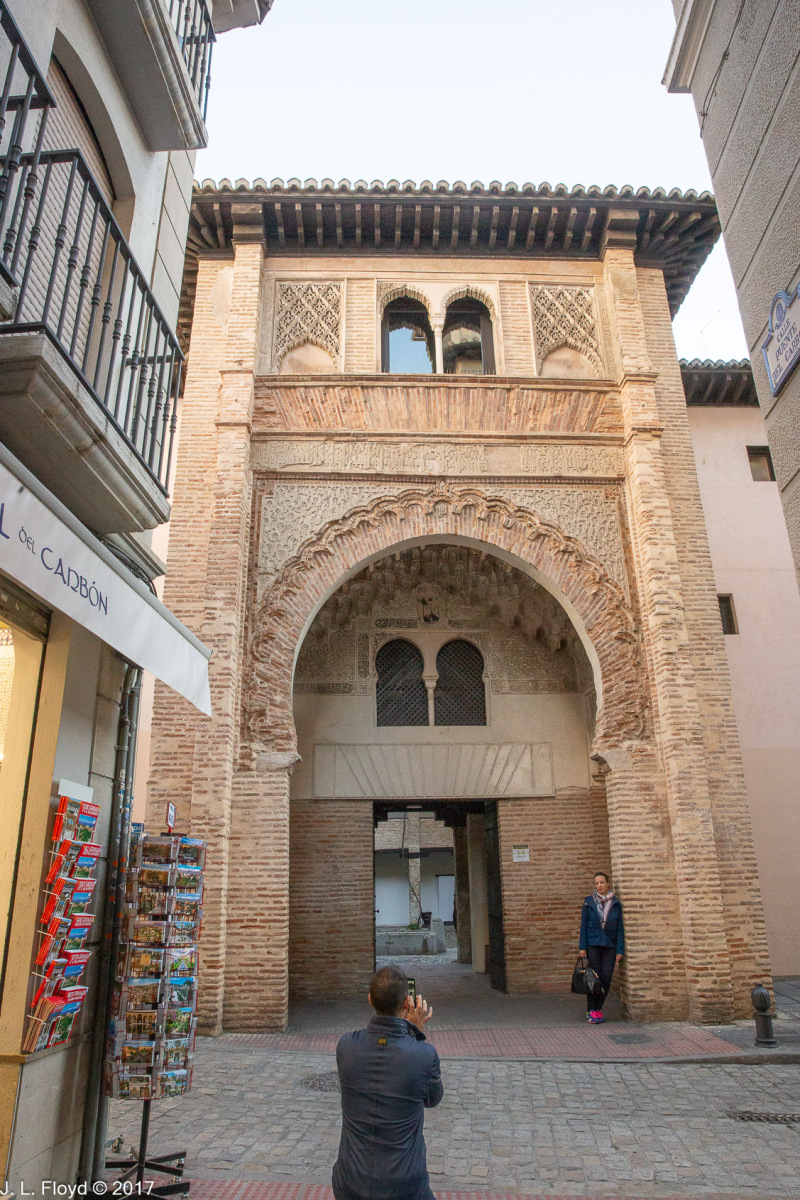
No less remarkable was our next stop, the Corral del Carbón. This is a survival of pre-Christian conquest Granada – in fact it is said to be the only structure of its kind surviving from the Nasrid period in the Iberian peninsula. It was built probably in the early 14th century as a caravanserai, a commercial and trading center serving as a warehouse for grain and as an inn and storage facility for traveling merchants. This type of establishment is known as a funduq in al-Andalus (Muslim Spain) and Morocco, and as an alhóndiga in Spanish. Its Arabic name was al-Funduq al-Jadida. After the 1492 conquest it was sold to private owners, who used it first as a theater, then converted it into an apartment building and also used the courtyard as an area for weighing and storing coal – hence the current name, which means “Courtyard of Coal.” By the twentieth century it had become quite dilapidated, but in 1928 the curator of the Alhambra, Leopoldo Torres Balbás, arranged to have the government purchase it with the proceeds of ticket sales from the Alhambra (which evidently was a major tourist attraction even then). The 36 tenant families still living in the building were ruthlessly evicted. Subsequently it underwent several restorations, the last one in 2006, and today it houses offices of the International Festival of Music and Dance of Granada and the Orchestra of the City of Granada.

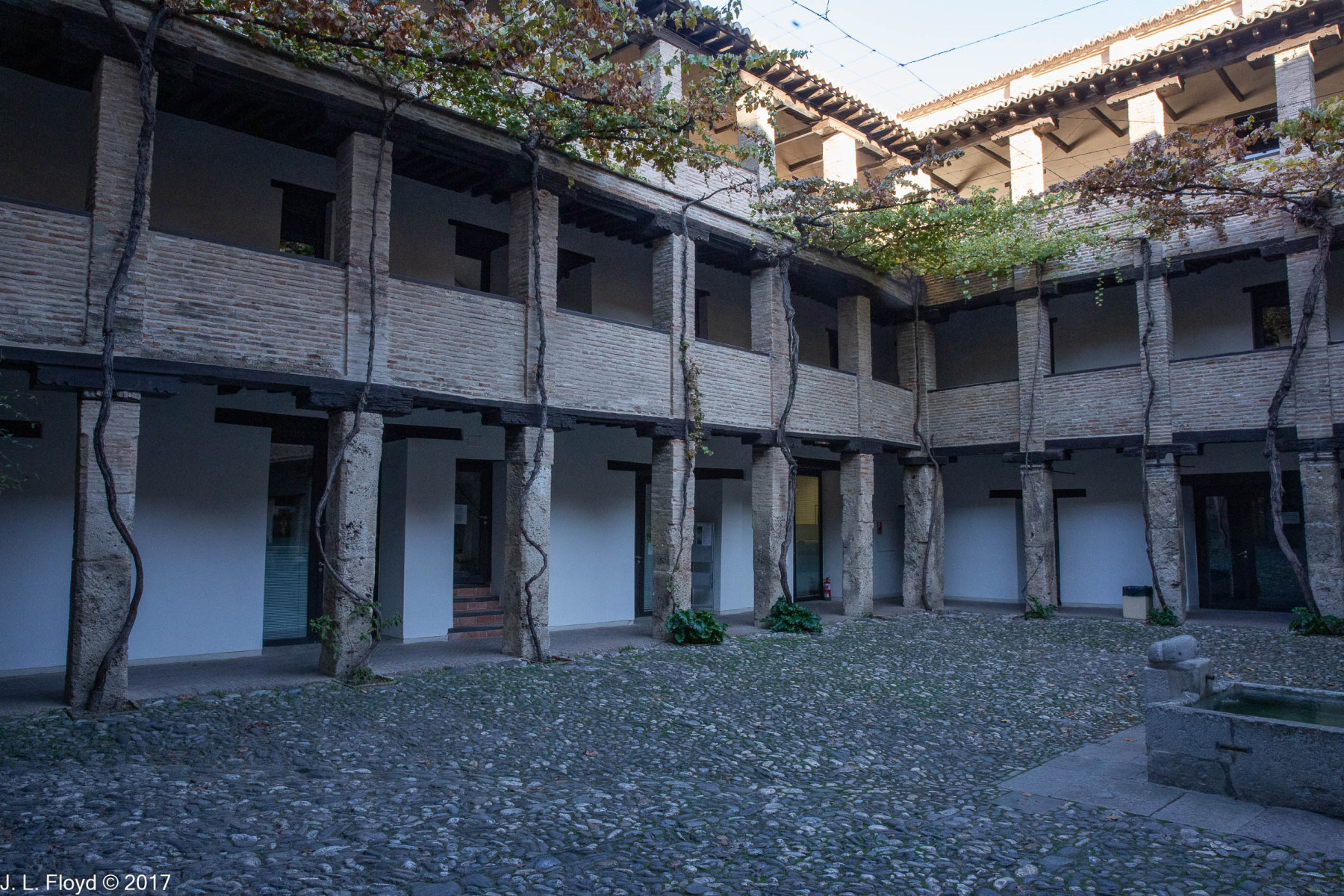
The most striking feature of the Corral is its monumental entrance façade, which has its roots in Sassanian Persian architecture but also displays typically Moorish and Nasrid characteristics such as double-arched windows, panels of decorative plaster with elaborate patterns and Kufic inscriptions, and muqarnas sculpting in the archway. The interior is more spartan. The central courtyard is surrounded on all sides by a three-story gallery, with the bottom floor containing storage facilities and the upper two serving as living quarters. In the center of the courtyard is a large stone basin with two water inlets, one on each side, which must have been used to water the camels in Nasrid times. (Actually I doubt whether camels were used in Spain, even by the Moors, but it would have served horses and donkeys equally well.) Around the sides of the courtyard are planted vines which rise majestically up to the third floor – I think they must be a type of wisteria, but they were not blooming in November.

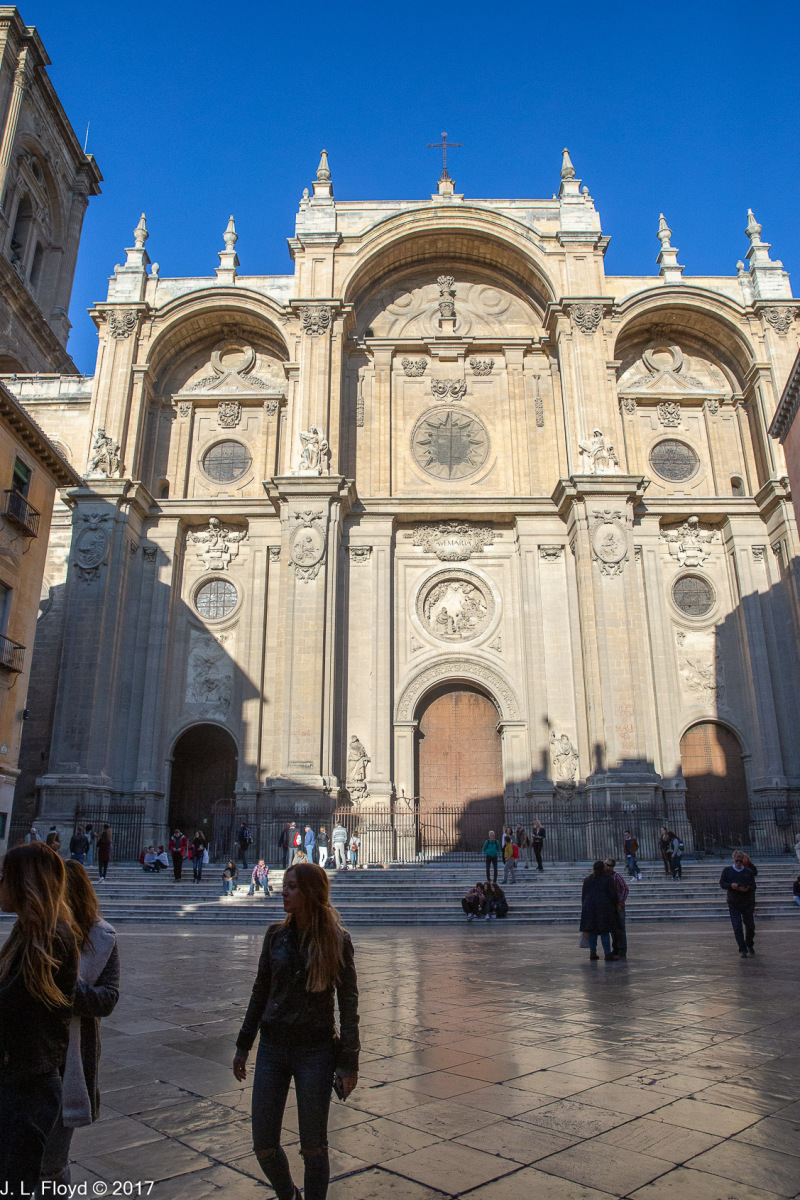
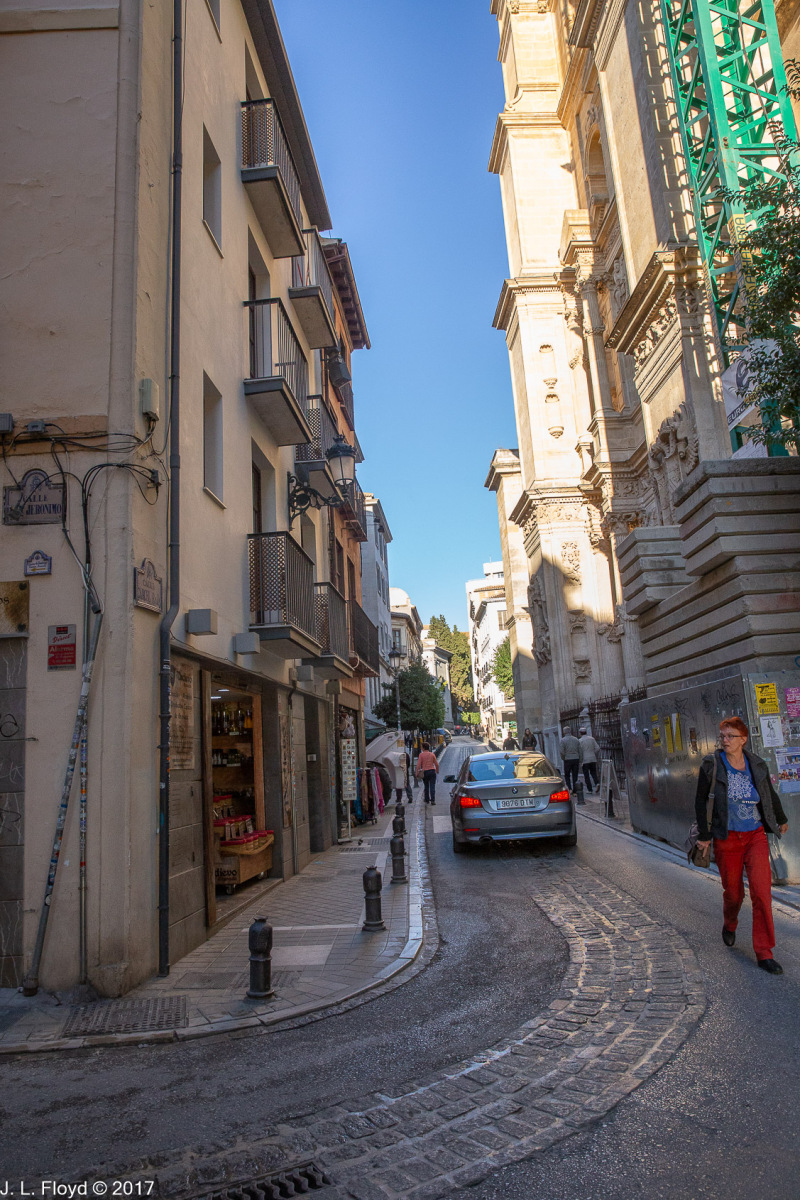
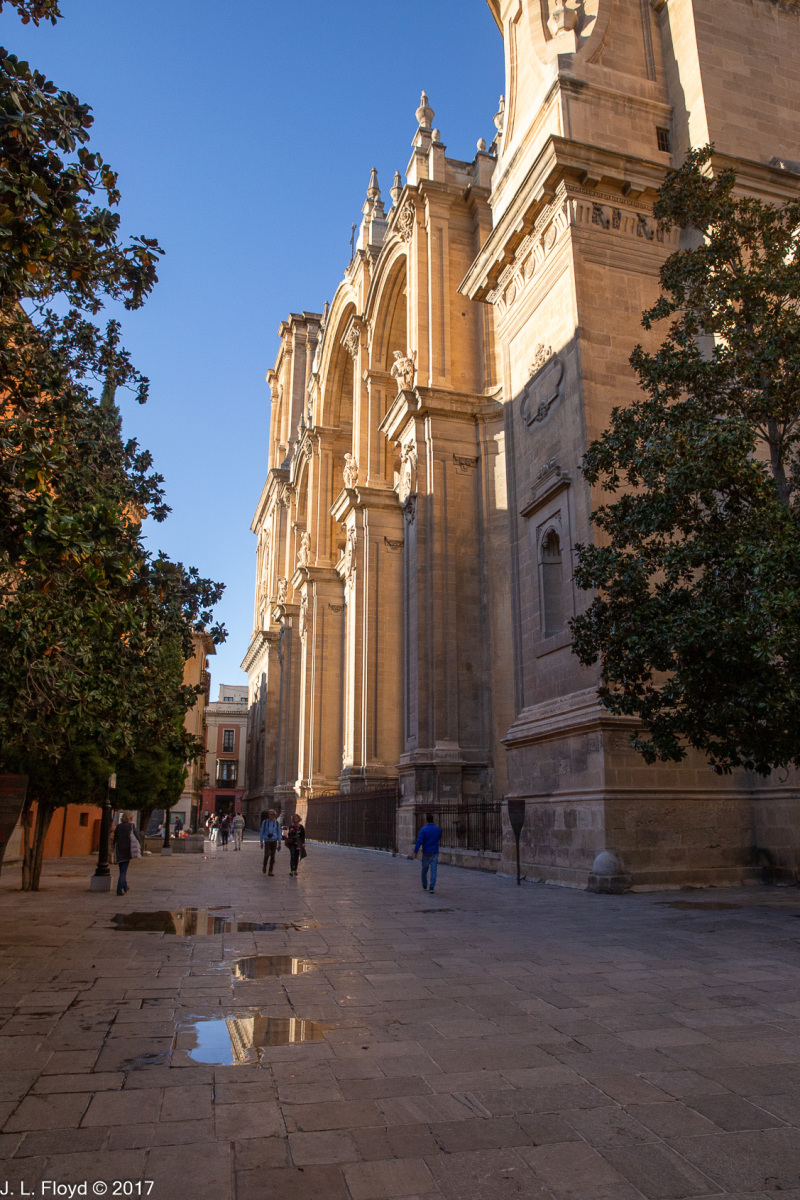
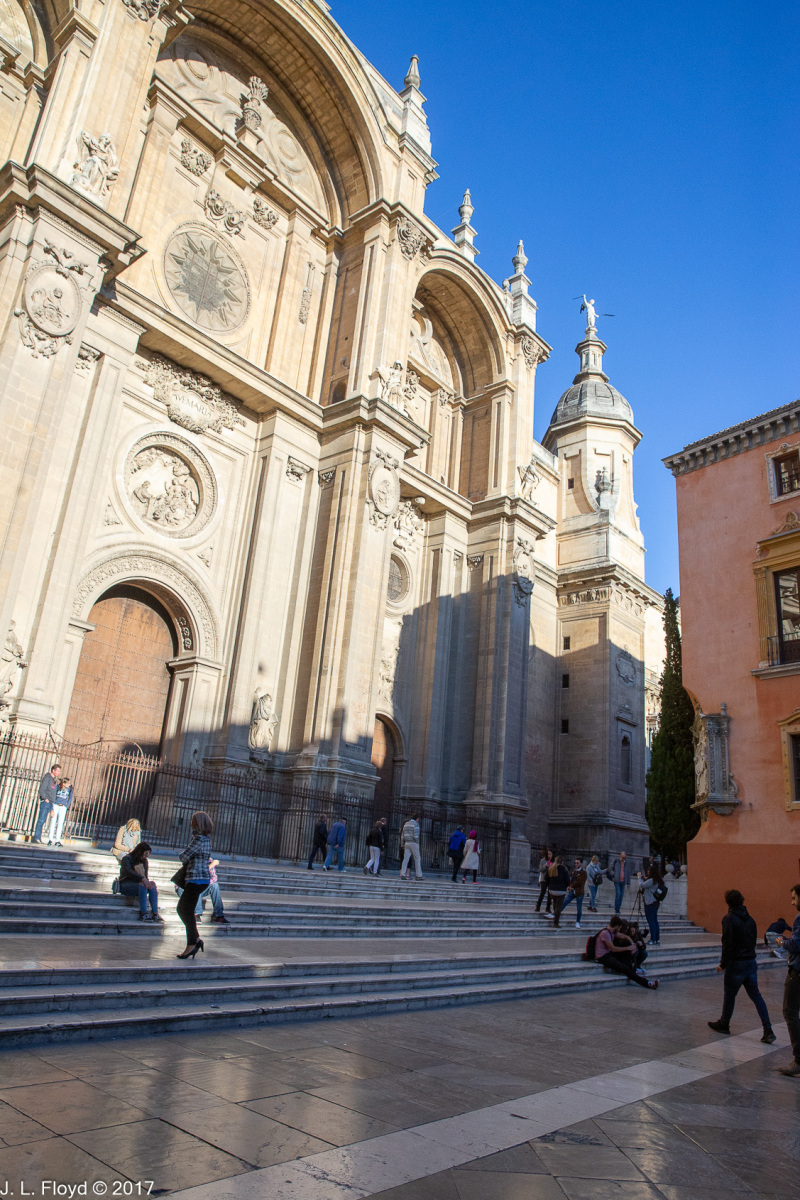
The Corral del Carbón is not far from the Granada Cathedral, and that is where we headed next. The Cathedral is part of a complex of ecclesiastical buildings which includes the Iglesia Parroquial del Sagrario, the Capilla Real de Granada and others. Formally known as Santa Iglesia Catedral Metropolitana de la Encarnación de Granada, it is the seat of the Archbishop of Granada. It was built on the site of what had been the city’s main mosque before the Reconquest. Construction began in 1518 and continued for 181 years. It was initially planned as a Gothic cathedral, but the second architect, Diego de Siloé, who replaced Enrique Egas in 1529, switched to a design reflecting the influence of the Italian Renaissance, which dominated thereafter, although Baroque elements were also added in the final years of construction. Siloé combined a Renaissance dome with a Gothic floor plan, but he also gave the cathedral five naves instead of the usual three, and he installed a circular capilla mayor (principal chapel) in place of the customary semicircular apse. Another architect, Alonso Cano, was responsible for completing the façade in its final form, an imposing tripartite triumphal arch, and that represented the Baroque influence.

The Royal Chapel of Granada (Capilla Real de Granada), on the south side of the cathedral, is actually older than the cathedral itself. It was built between 1505 and 1517 as the burial place of the Catholic monarchs, Ferdinand and Isabella. The chief architect was Enrique Egas, who designed it in a style known as Isabelline Gothic or Castilian late Gothic, a sort of transitional style between traditional Castilian Gothic and early Renaissance architecture, incorporating Flemish, Mudejar (Moorish) and Italian influences.

Also on the south side of the cathedral is another church, the Iglesia Parroquial del Sagrario or Parish Church of the Tabernacle. This was built much later than the cathedral, between 1705 and 1759, on the site of the mosque prayer hall, with a Greek cross floor plan. We did not see the interior, but it has what is said to be a “sensational” baptismal font and is filled with notable 15th and 16th-century works of art.

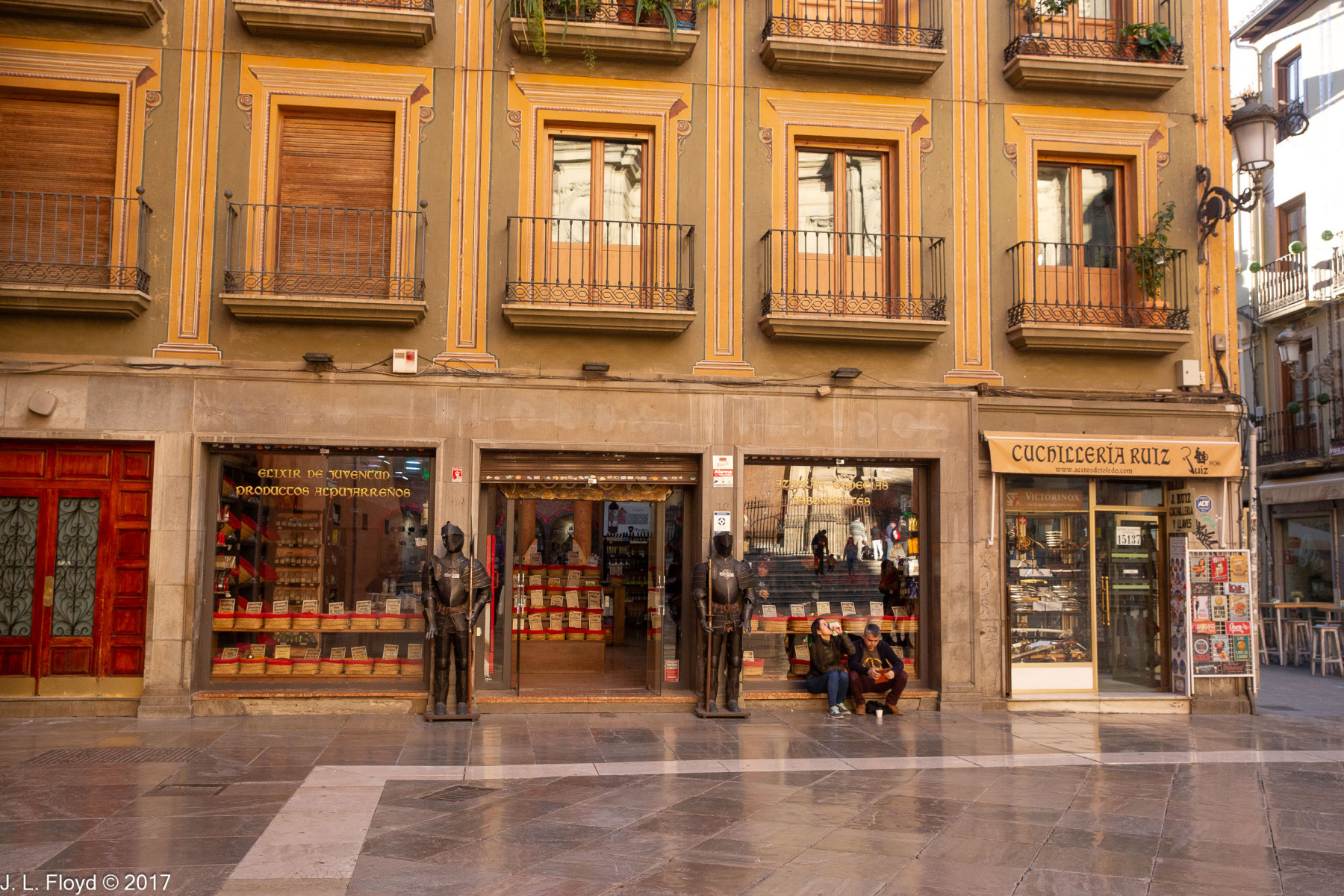
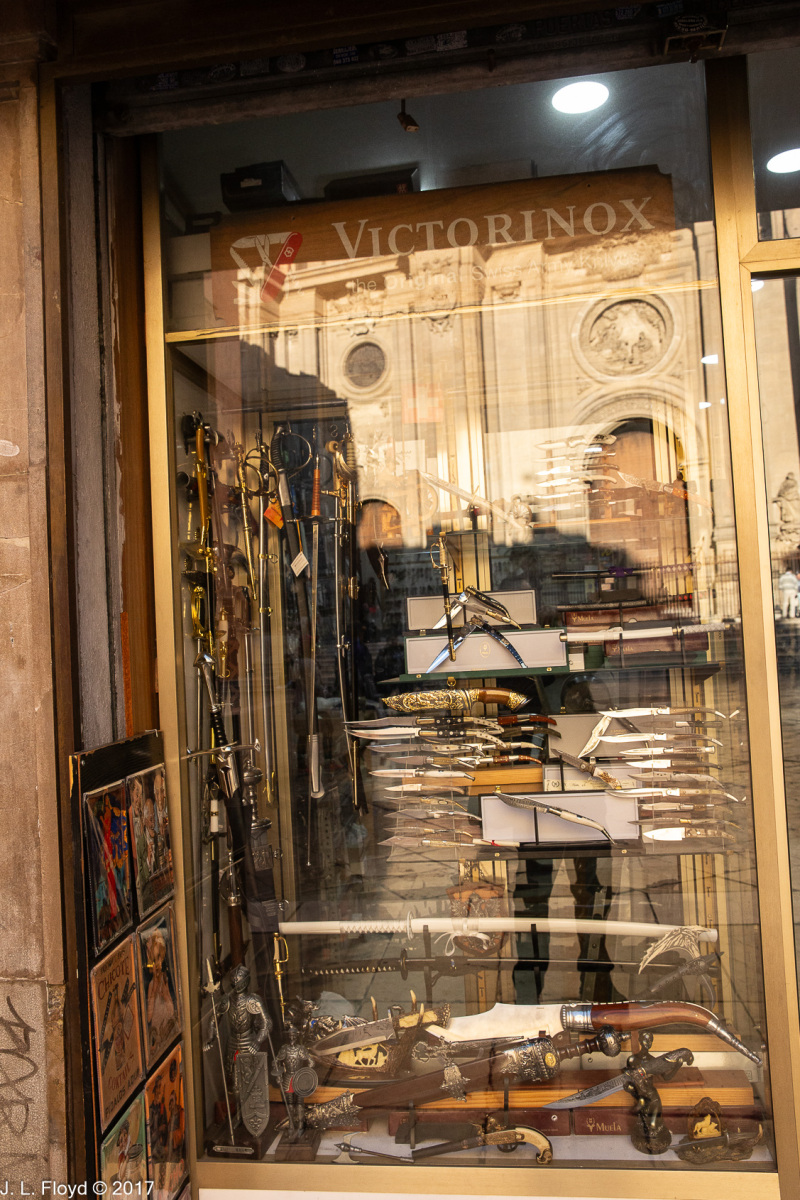
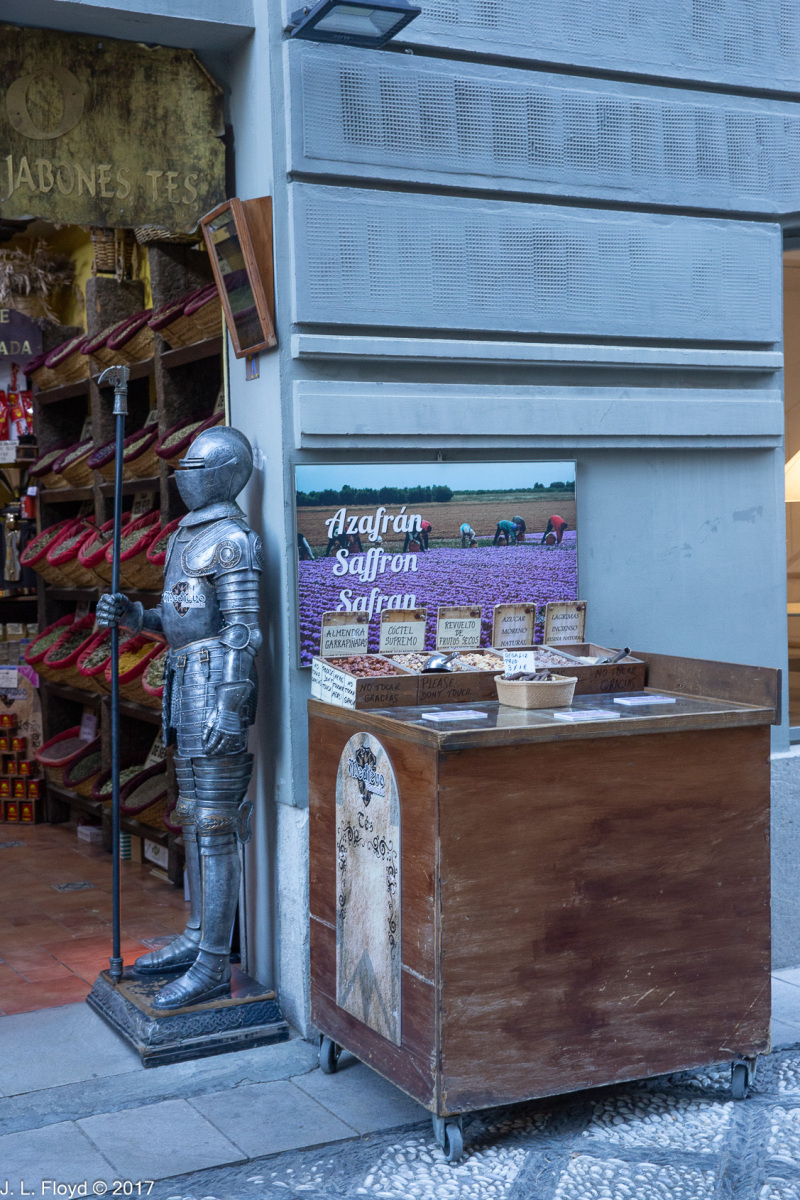
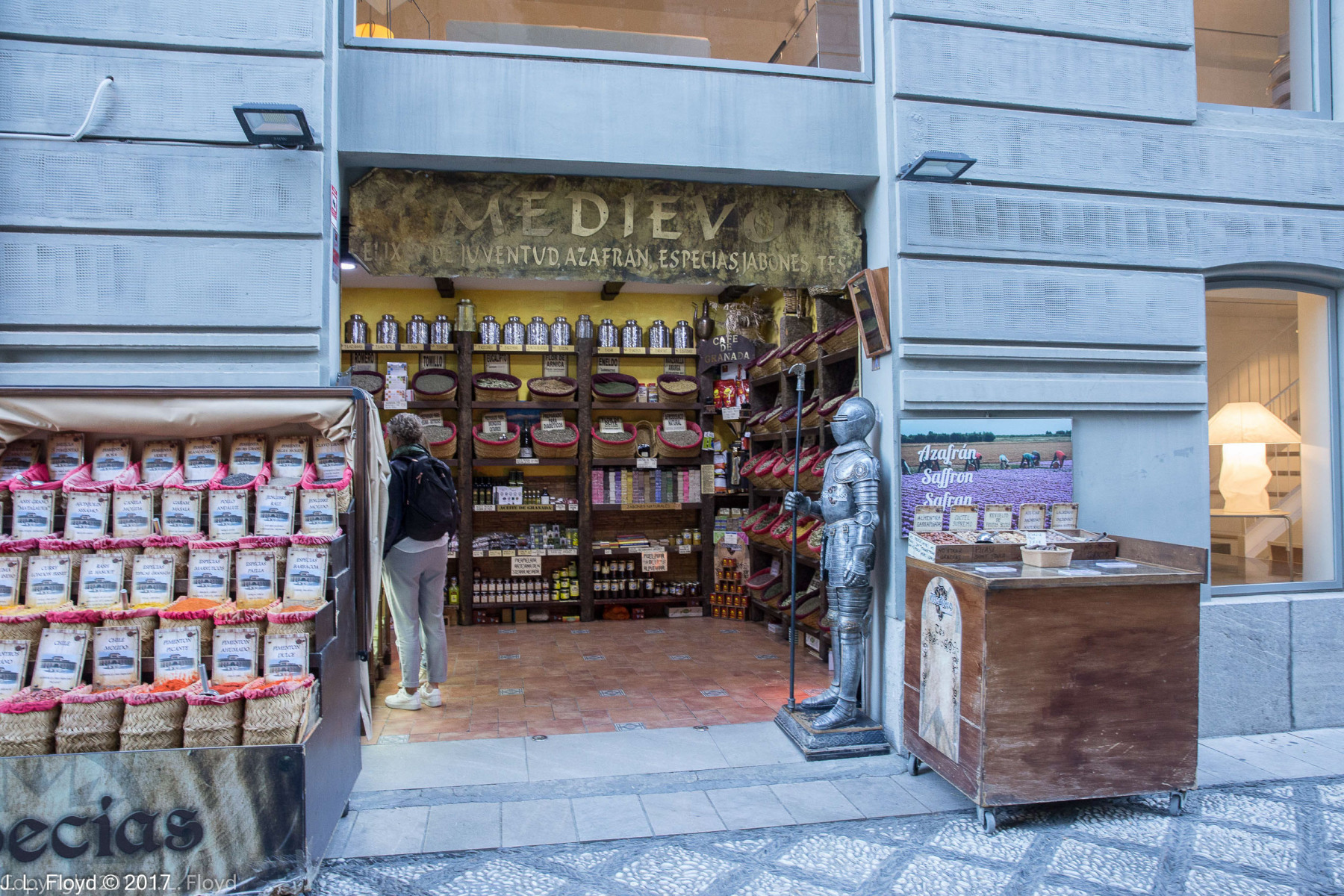
I also enjoyed snooping around in the area immediately surrounding the cathedral, where there were a number of interesting sights and shops. Right in front of the cathedral there is a square called Plaza de las Pasiegas; on its western edge is a series of shops – a cutlery store called Cuchillería Ruiz – El llavín de oro (“Golden Key”), a spice shop, and a café.

There was another spice shop on a side street not far away from the cathedral, and it was a matter of some interest to me that both of them were guarded by knights posted just outside the door – actually empty suits of armor, but formidable-looking nonetheless. It’s kind of understandable, because in early modern Europe spices were very valuable, and the quest to obtain them was what prompted the voyages of Spanish and Portuguese explorers to discover the New World and carve out empires in Asia. But it was a bit startling to see this historical moment reflected in a present-day context.

Hotels, rental apartments and airbnbs are plentiful in the cathedral neighborhood, and with good reason. The Plaza de las Pasiegas, and the major street that leads to it, is the venue of a number of processions during Holy Week, which lasts from Palm Sunday to Easter Monday. These are staged by the hermandades (religious brotherhoods) of Granada, and feature elaborate floats bearing tableaux depicting religious scenes and figures, as well as marching figures called “nazarenos”, people dressed up in white suits with pointed hoods looking alarmingly like Ku Klux Klan members. Although the nazareno garments did in fact serve as the inspiration for the KKK uniforms, the nazarenos themselves are not seeking to frighten or persecute anyone but rather to express penitence and ask for forgiveness of sins. Their processions are carried out throughout the city, but some of the most spectacular originate or terminate at the cathedral. Many outsiders come to Granada for Holy Week from all over the world as well as Spain.

Just off the northwest corner of the Cathedral is a square called the Plaza Romanilla, where I encountered the most appealing sculpture I saw in all of Granada. This was the Monumento al Aguador, Monument to the Water-Carrier, a recent work from 1999 by the sculptor Aurelio Teno. The profession of water-carrier was an essential occupation in Granada (as elsewhere) down to the twentieth century. Aguadors were itinerant figures who roamed the city, offering water to passers-by as well as houses who had no water – which would have been almost all of them in pre-modern times. (People would have been able to fetch water from fountains distributed in places around the city, but these were relatively few and far between.) All of the water for the city came from the rivers Darro and Genil, or from springs near the riverbanks. The aguadors fetched the water from these sources under the supervision of an official called muhtasib (in Arabic) or almotacén (in Spanish), who was charged with overseeing all the activities of the aguadors, including ensuring that they took the water from locations in the river which were not muddy, dirty or polluted – for all the garbage and industrial waste from the city was dumped in the rivers in those days. The aguadors typically transported the water in demijohns — large earthenware jars which they hauled on the backs of donkeys. The sculpture in the Plaza Romanilla depicts the aguador as a ragged, tired, almost emaciated figure holding a water glass, shambling alongside his heavily laden donkey, who appears surprisingly perky considering the weight he has to carry. I found this a very touching and thought-provoking portrayal. It drove home to me something that people tend to be unaware in these days of running water and flush toilets: how precarious access to water was in days of yore. Water was precious, and for those beneath the top layers of society it was very scarce. How would you wash cook your food, bathe yourself and your children, wash your clothes, and clean your house, all with the pitifully small amount of water obtained from the aguador? I find it difficult to imagine. At least you wouldn’t have to worry about washing your car. Anyway, I was very gratified to find that at last someone had created a monument to the poor and downtrodden members of society, and not just kings, emperors, nobles and churchmen like the notorious Cardinal-Archbishop Cisneros.

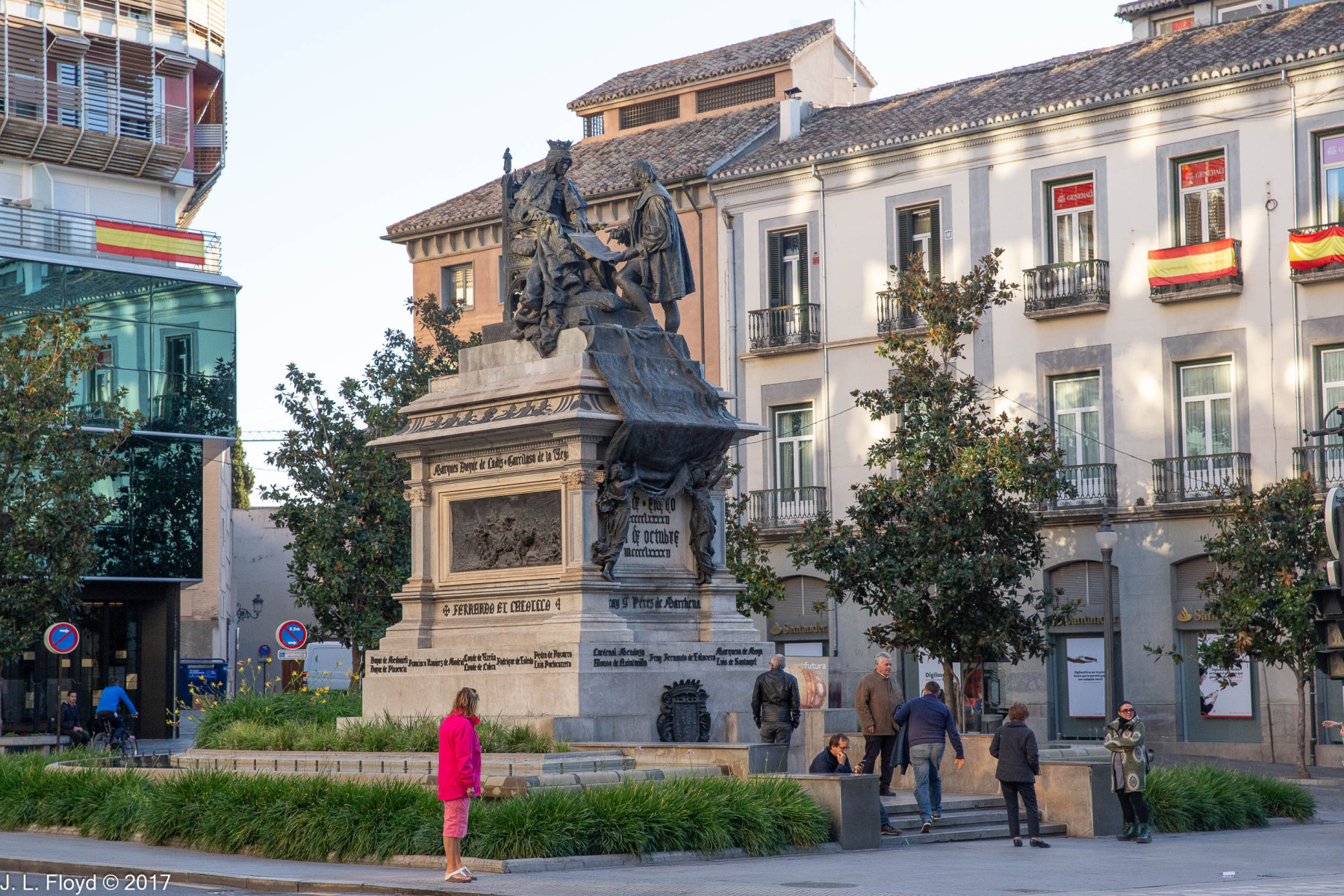
After exploring the cathedral area, we headed southeast and soon found ourselves on the Reyes Católicos, the grand east-west boulevard that runs through the heart of Granada. There, at the intersection with the Gran Vía de Colon, we emerged onto the Plaza Isabel la Católica. This is obviously the most appropriate place for a monument which depicts Queen Isabella holding an audience with Christopher Columbus – Colon being the Spanish form of his last name. The monument was built for the 400th anniversary of Columbus’ discovery of the Americas in 1892. It was originally intended to be a triumphal arch, but funds for such a grandiose project could not be raised, so the city settled for a high stone pedestal with Queen Isabella seated on her throne on top, and Columbus kneeling on steps in front of her. The pedestal is inscribed with the names of major dignitaries, including King Ferdinand of Aragon and various nobles.

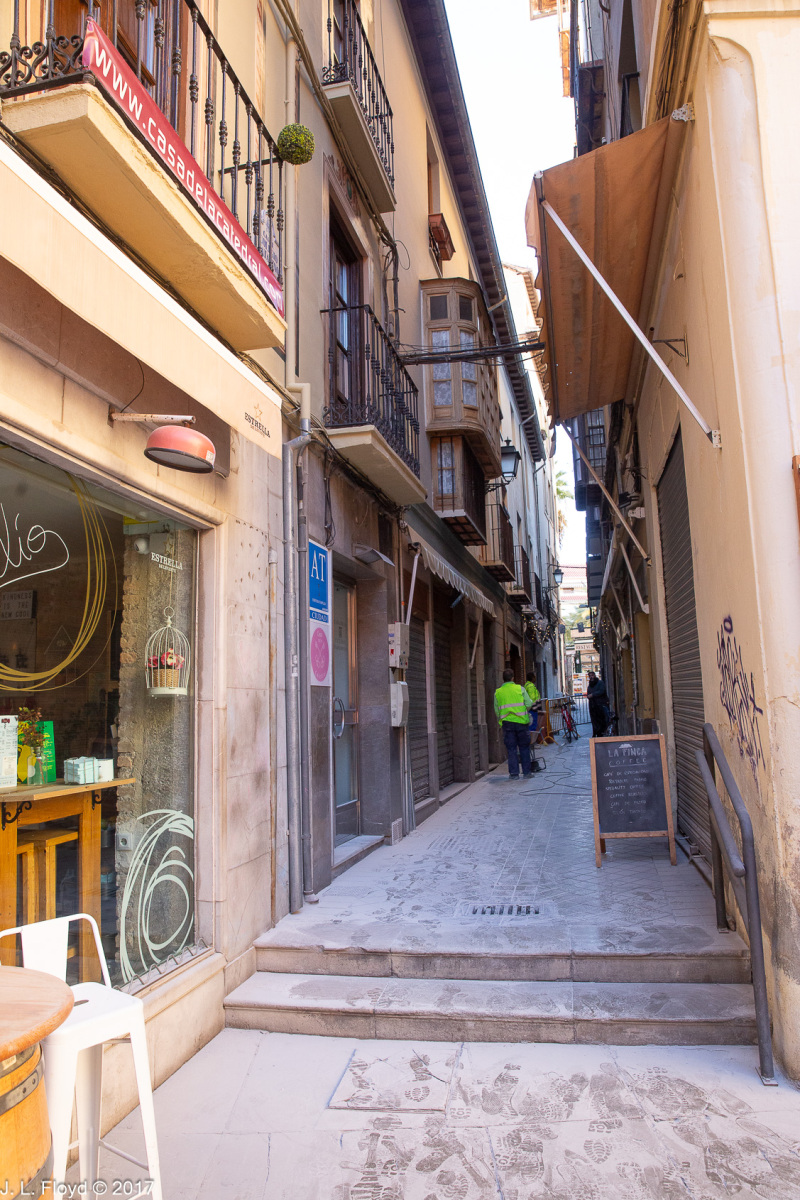
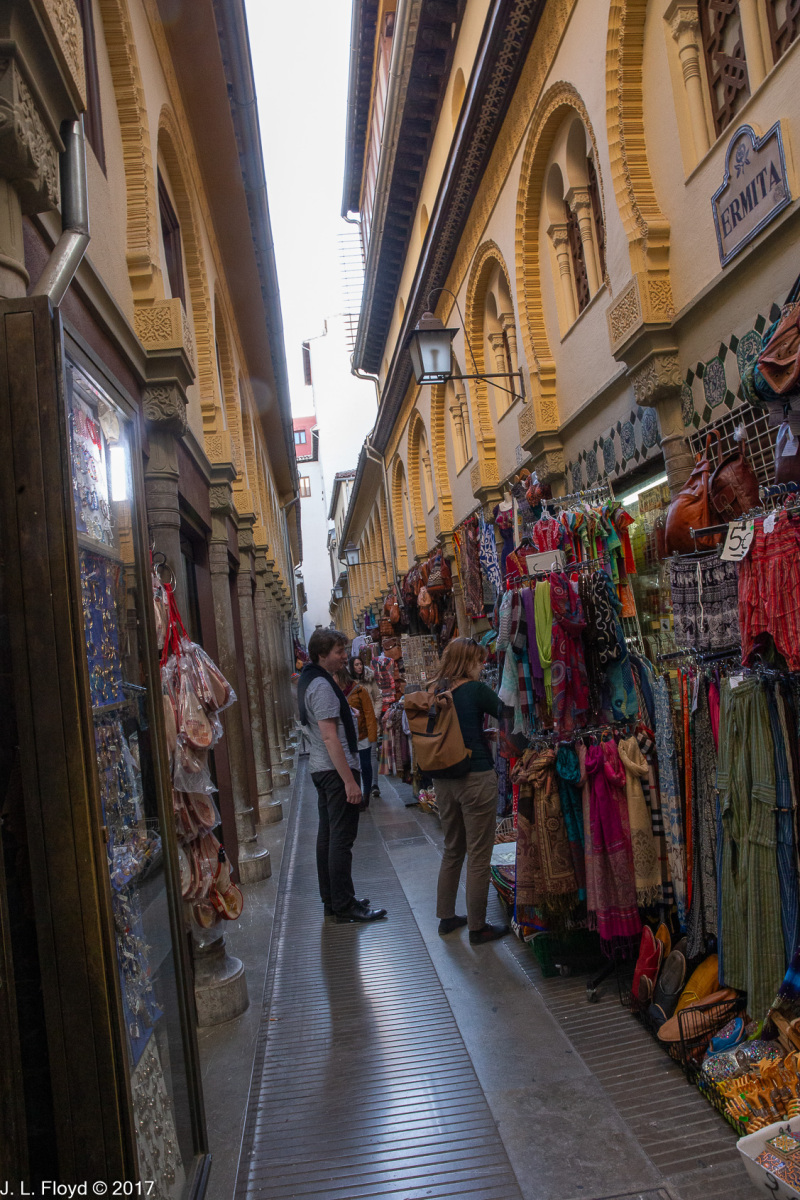
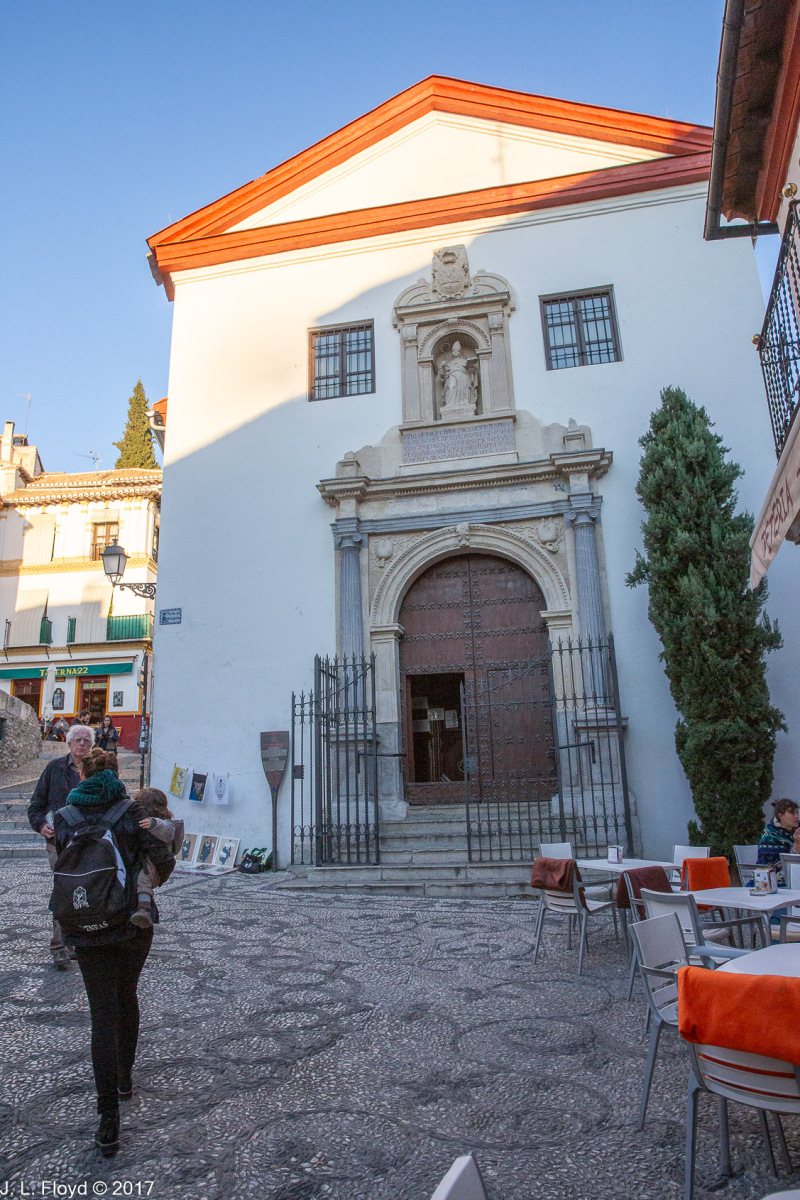
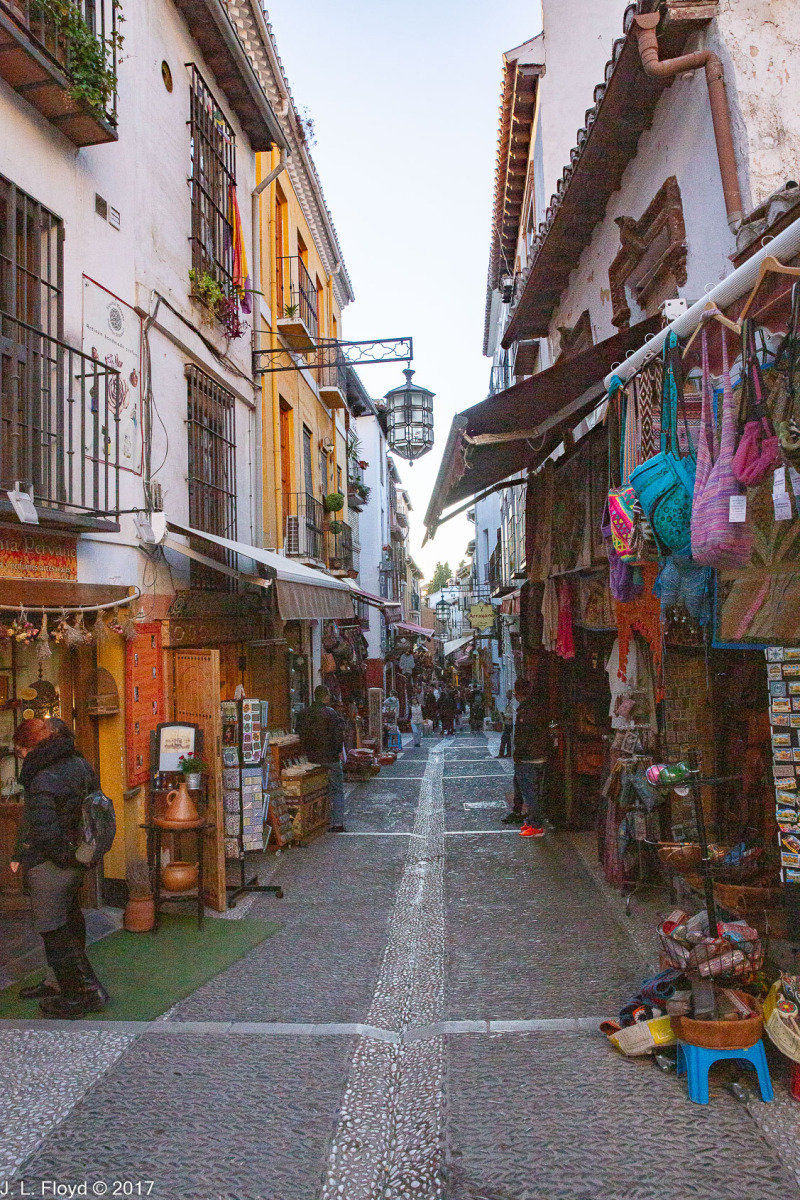
I don’t remember what route we took from the Plaza Isabel la Católica to our next stop, the Plaza de San Gregorio. We were heading in the general direction of the Mirador de San Nicolas, and by this time I was so tired that I remember very little, and would remember even less if I didn’t have the pictures I took along the way to remind me. I think we came by the Calle Calderería Nueva, since that picturesque street with its many colorful shops shows up in one of my photos. In any case, we somehow arrived at the Iglesia de San Gregorio Bético, Church of Saint Gregory the Blessed, which gives the square its name. The church began its existence as a small hermitage, founded by the Catholic Monarchs after the conquest of Granada in 1492 in honor of two Christian monks who tried to preach their faith at the mosque of Granada in 1397, and for their pains were tied to the tails of horses and dragged through the streets of the city to a dungeon, located where the present church now stands, for execution.

In the 16th century the hermitage was expanded into a church, with an adjoining convent. After the desamortización (confiscation of church properties) in 1835-1837, it was used variously as a wine and coal warehouse, a dance hall and a brothel. But in 1887 the secularization was reversed, with the congregation of nuns of Sancti Spiritus taking over management of the church. It was burned down in 1936, during the Civil War, but later rebuilt, and is currently occupied by an order of cloistered nuns known as the Poor Clares.

Architecturally, the church is distinguished by its Ionic style façade, done in Sierra Elvira marble, and by the location of its main tower at the back of the building, an unusual position in Granada. The interior is a mixture of Renaissance and Baroque styles. It has only one nave, which is divided in two halves, the back for ordinary worshipers and the front one, which includes the main chapel, for the nuns. It also boasts some celebrated frescoes in the presbytery and the dome.

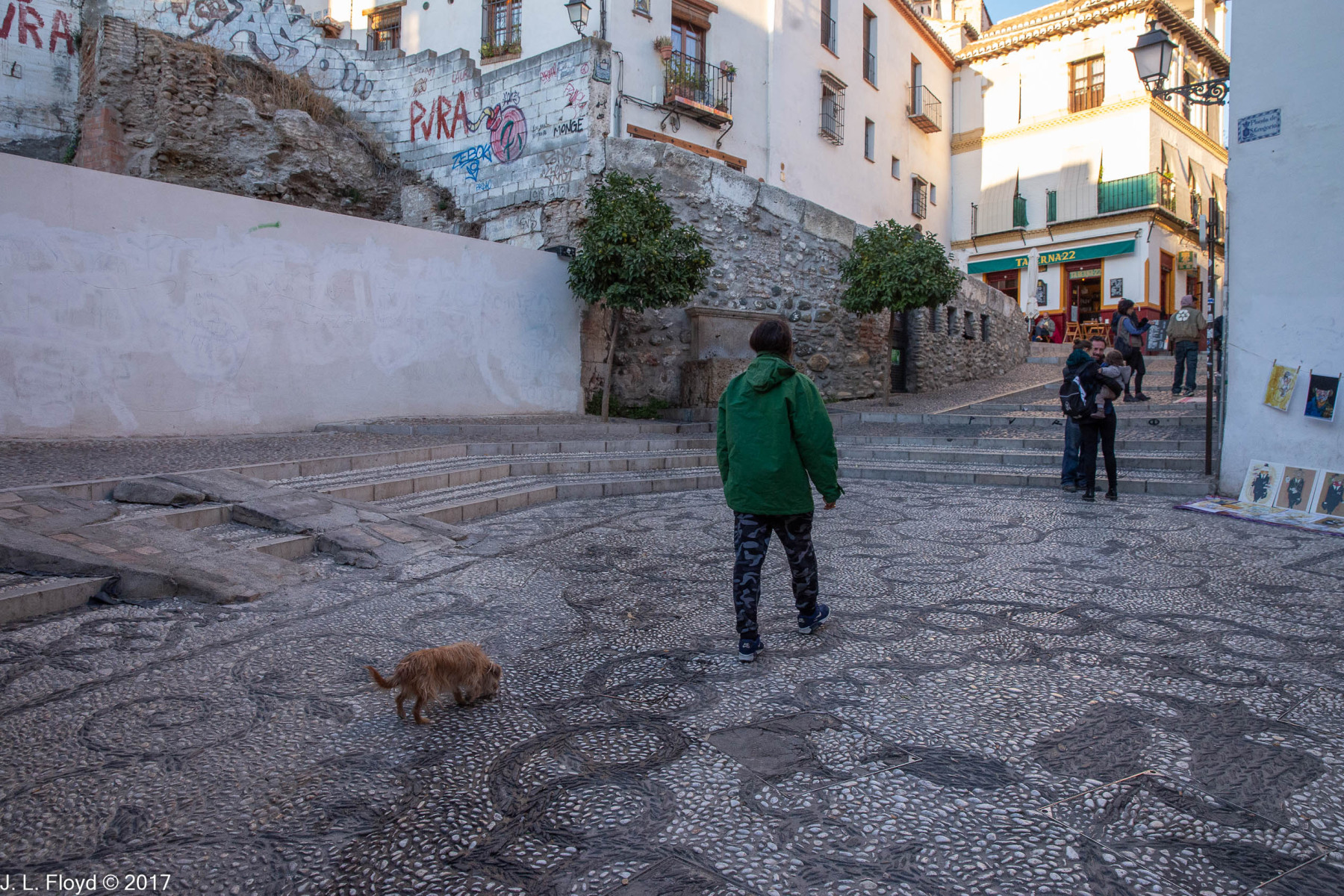
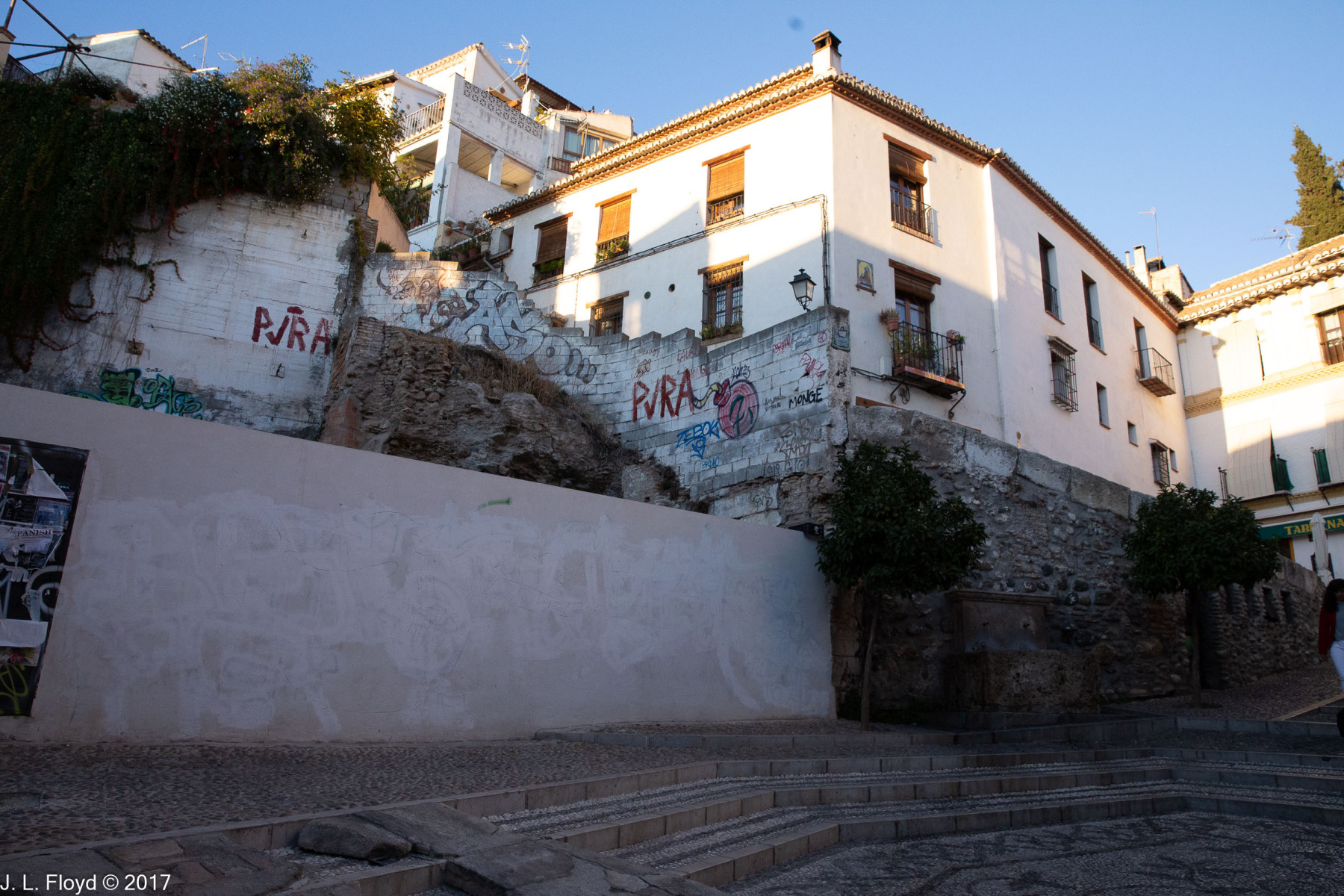
The square to which the church gives its name was also quite pleasant, with beautiful stone mosaic pavement and upscale houses all round. Here as elsewhere in Granada some of the walls were adorned with graffiti, but these were not nearly as prolific or as obtrusive as in another city of my acquaintance, founded in 1781 as El Pueblo de Nuestra Señora la Reina de los Ángeles del Río de Porciúncula.

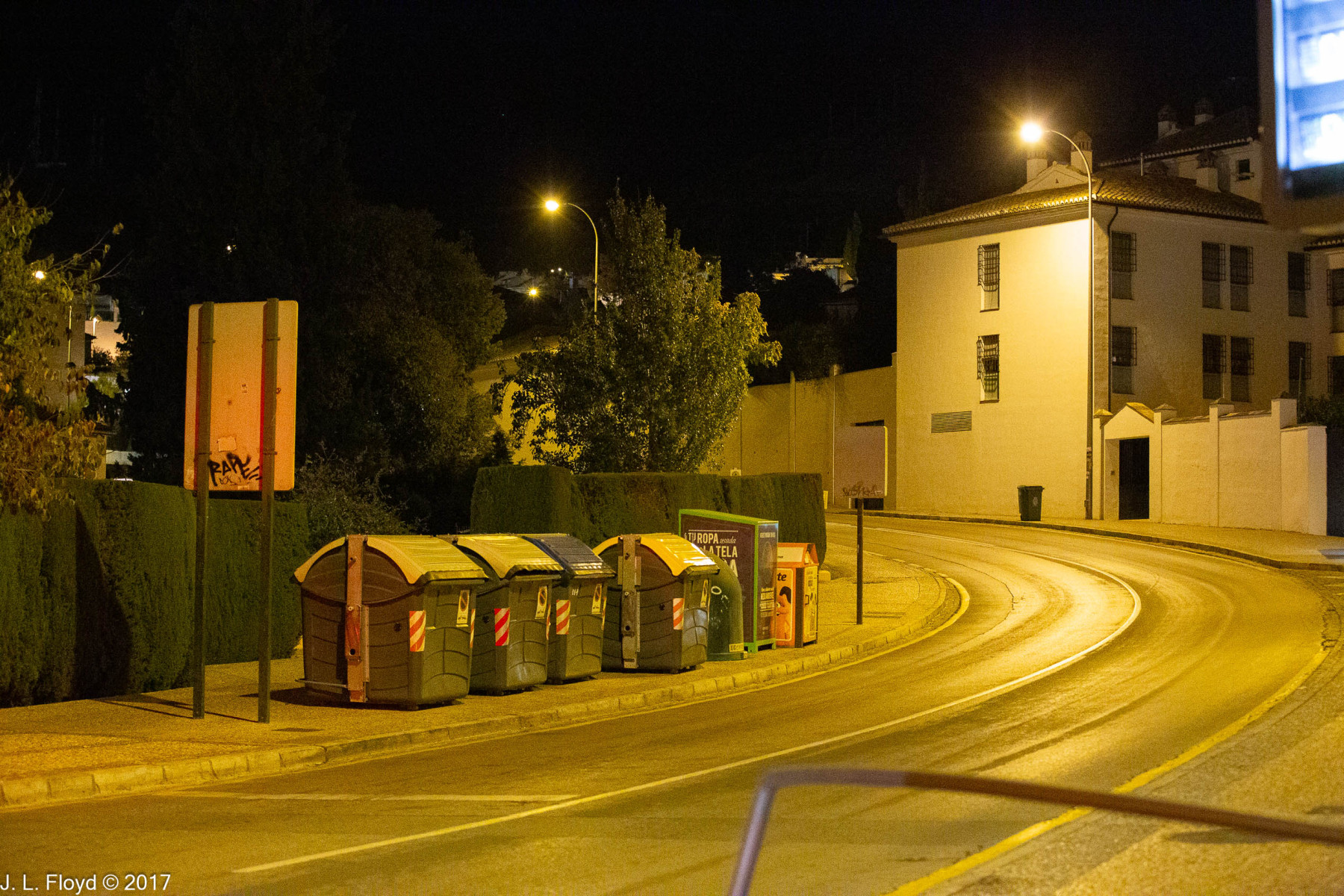
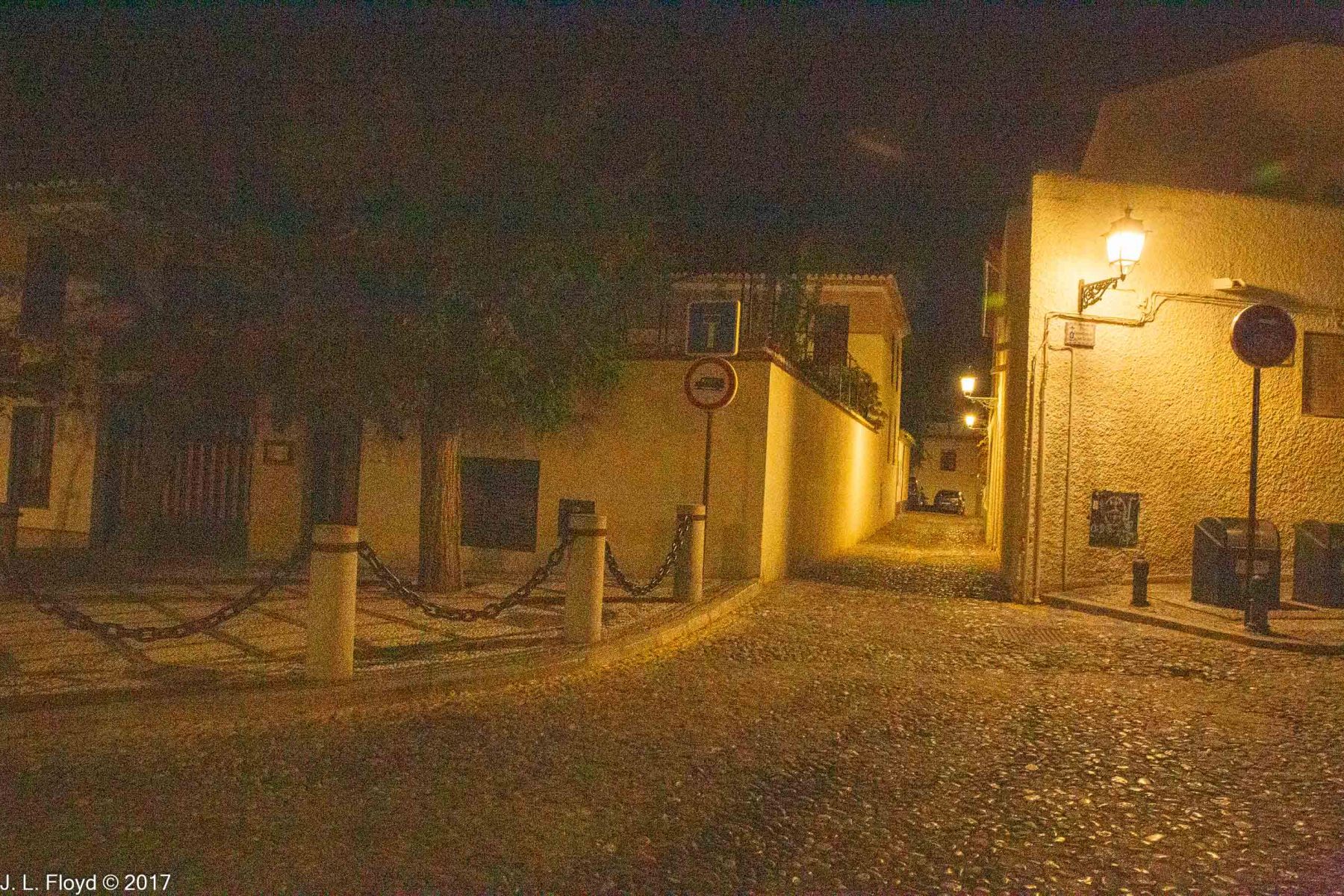
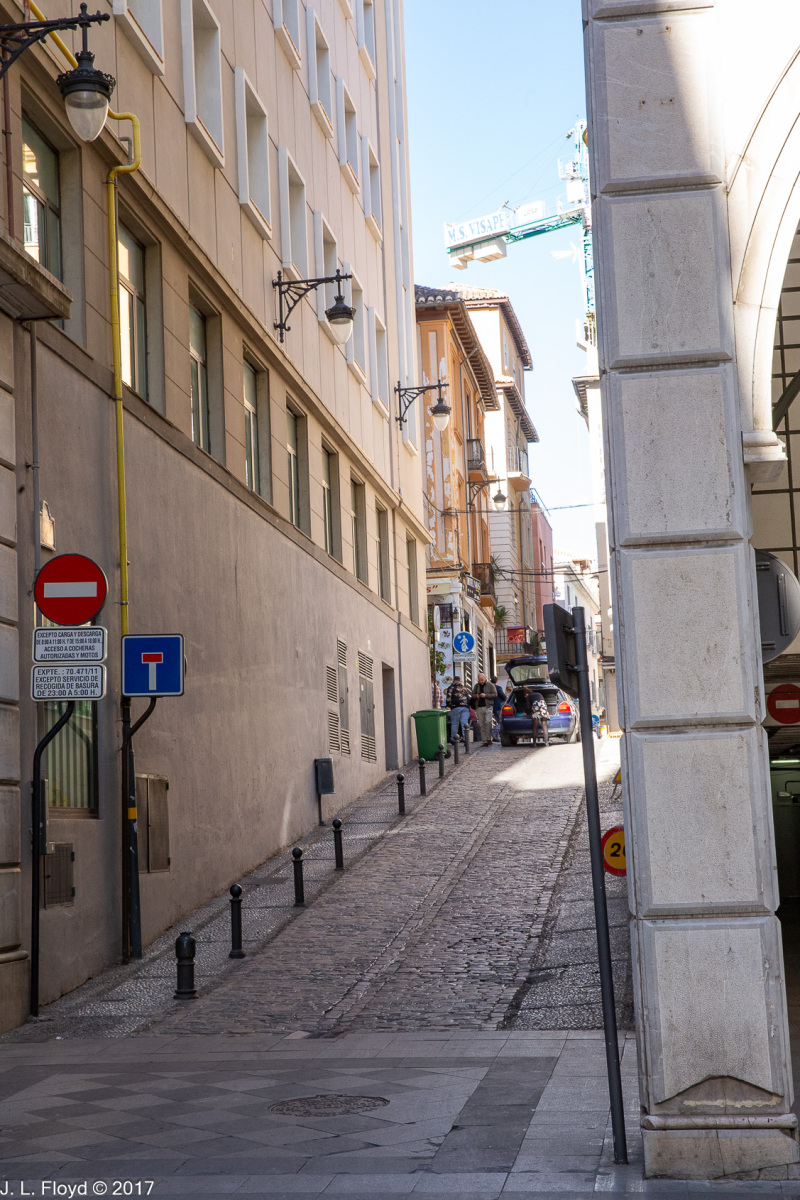
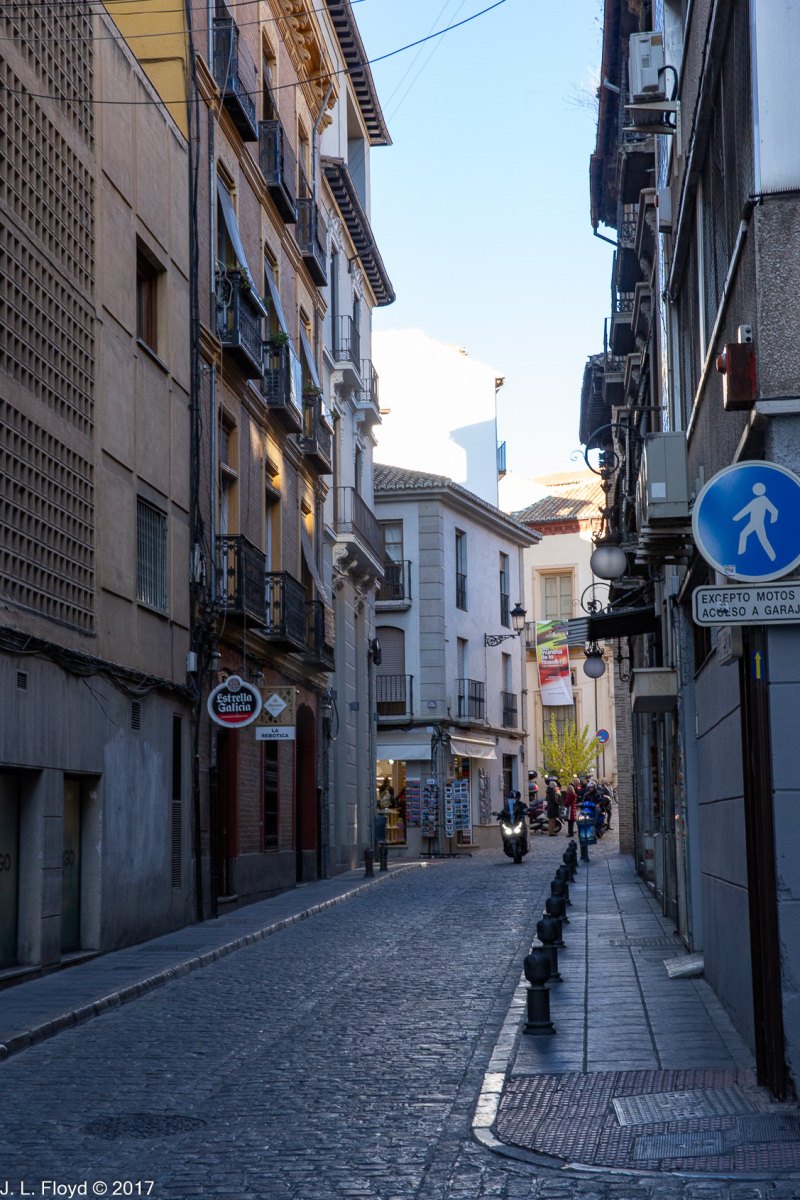
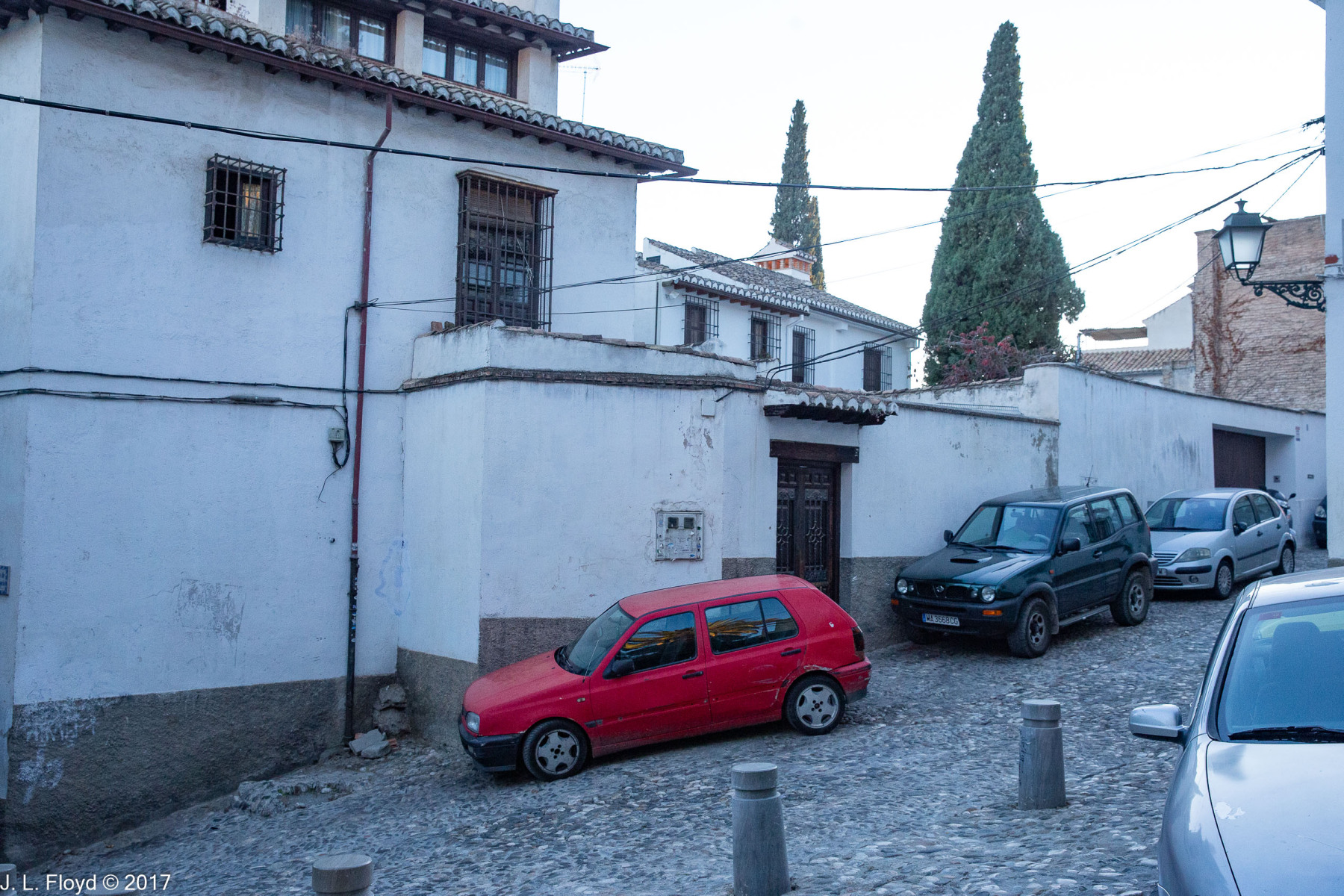
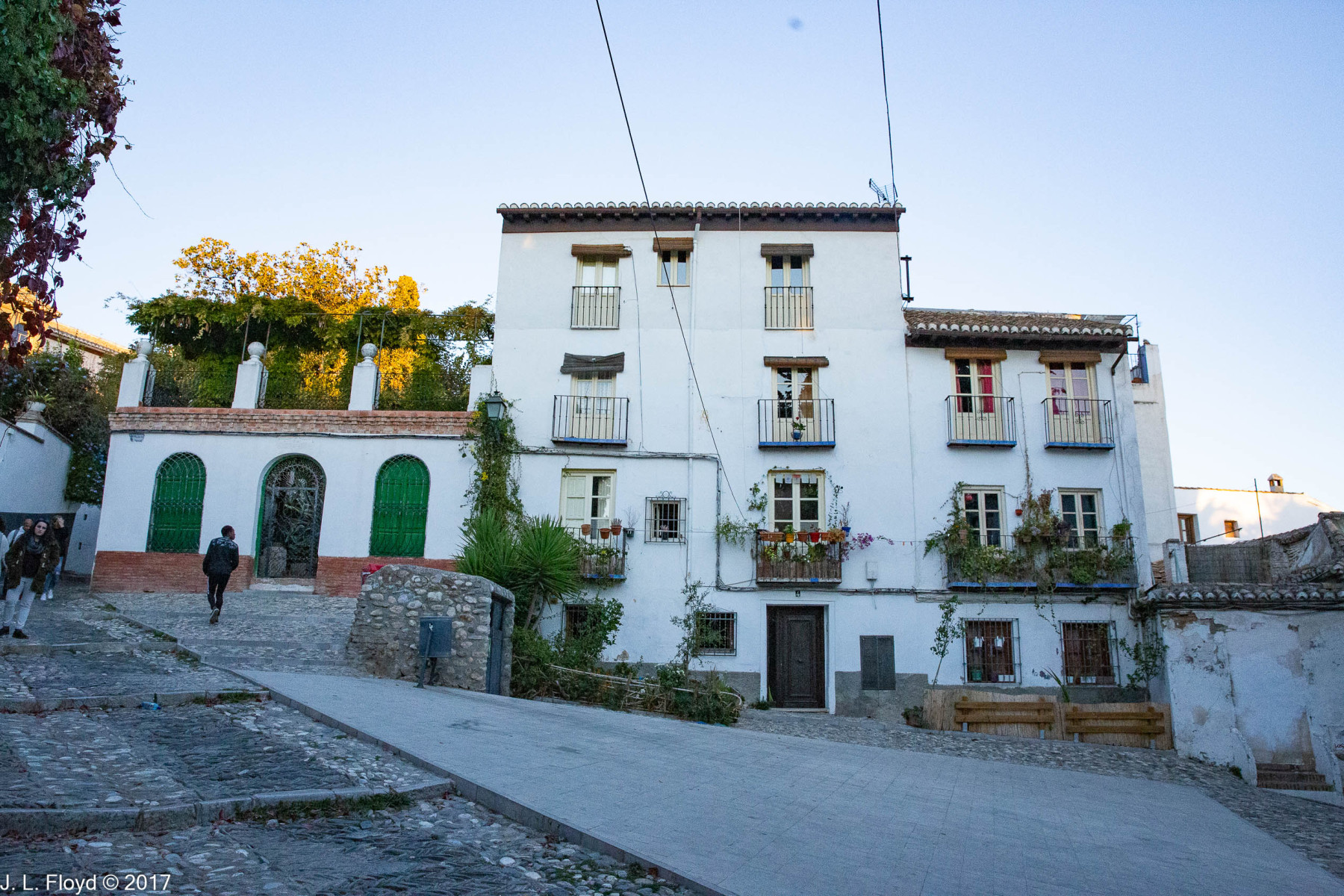
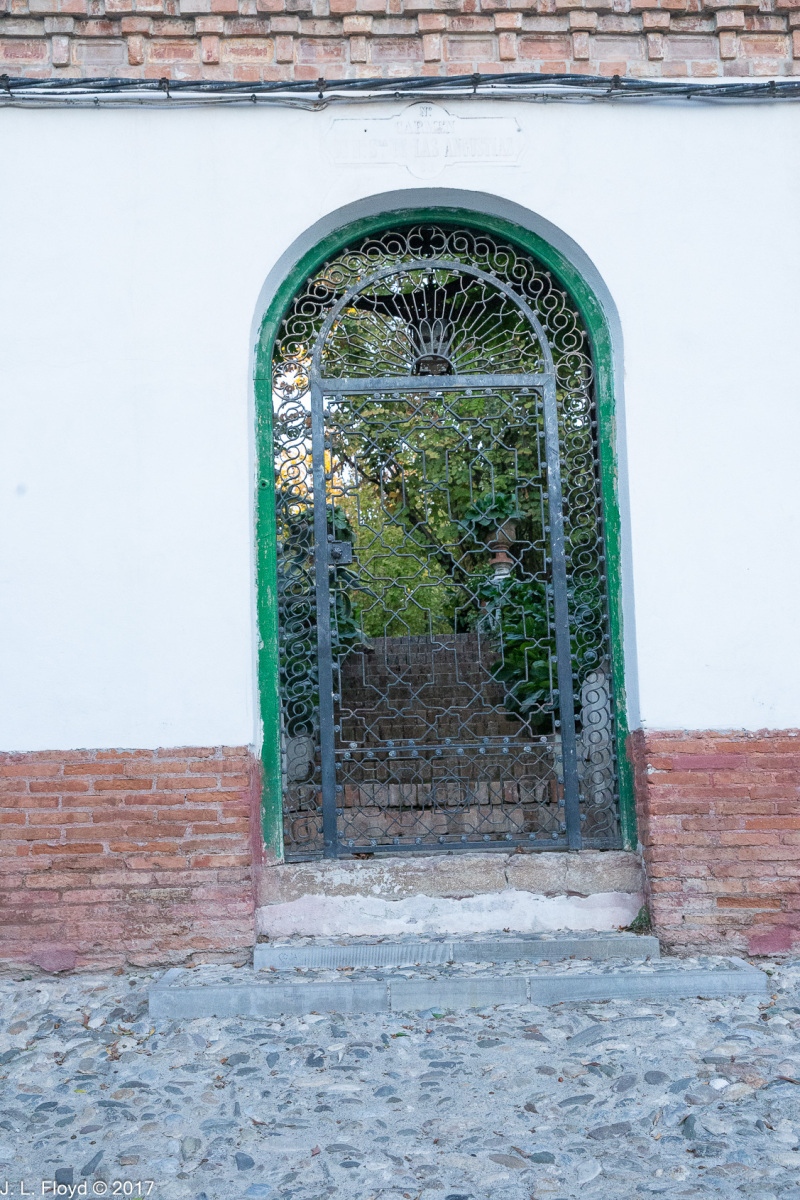
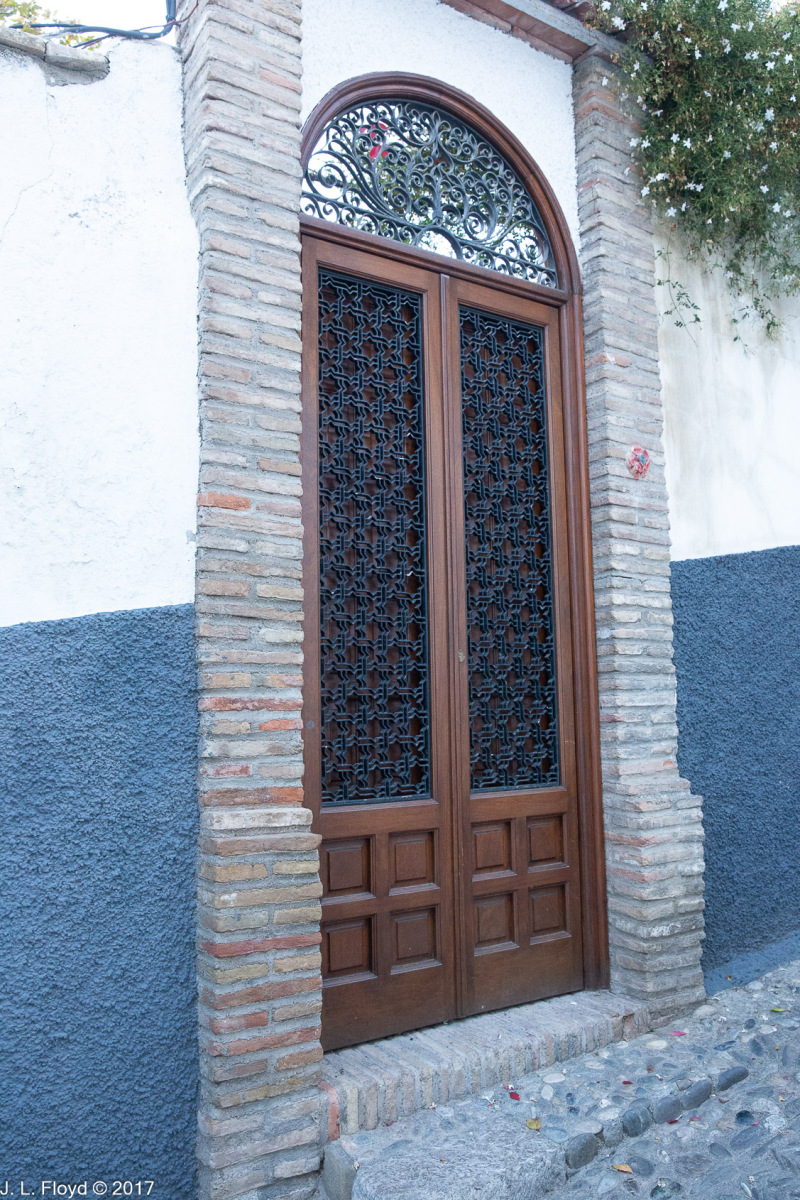
From the Plaza de San Gregorio I continued on to the Mirador de San Nicolas. The guided walking tour may have ended by then, but all I can remember now is that I was very tired and nobody was with me when I reached the Mirador. Fortunately I wasn’t too tired to take pictures along the way. The quiet streets of the Albaicín quarter were quite charming, lined with elegant houses and walled gardens, the only caveat being that they were so narrow that any car being driven in my vicinity was a mortal threat.

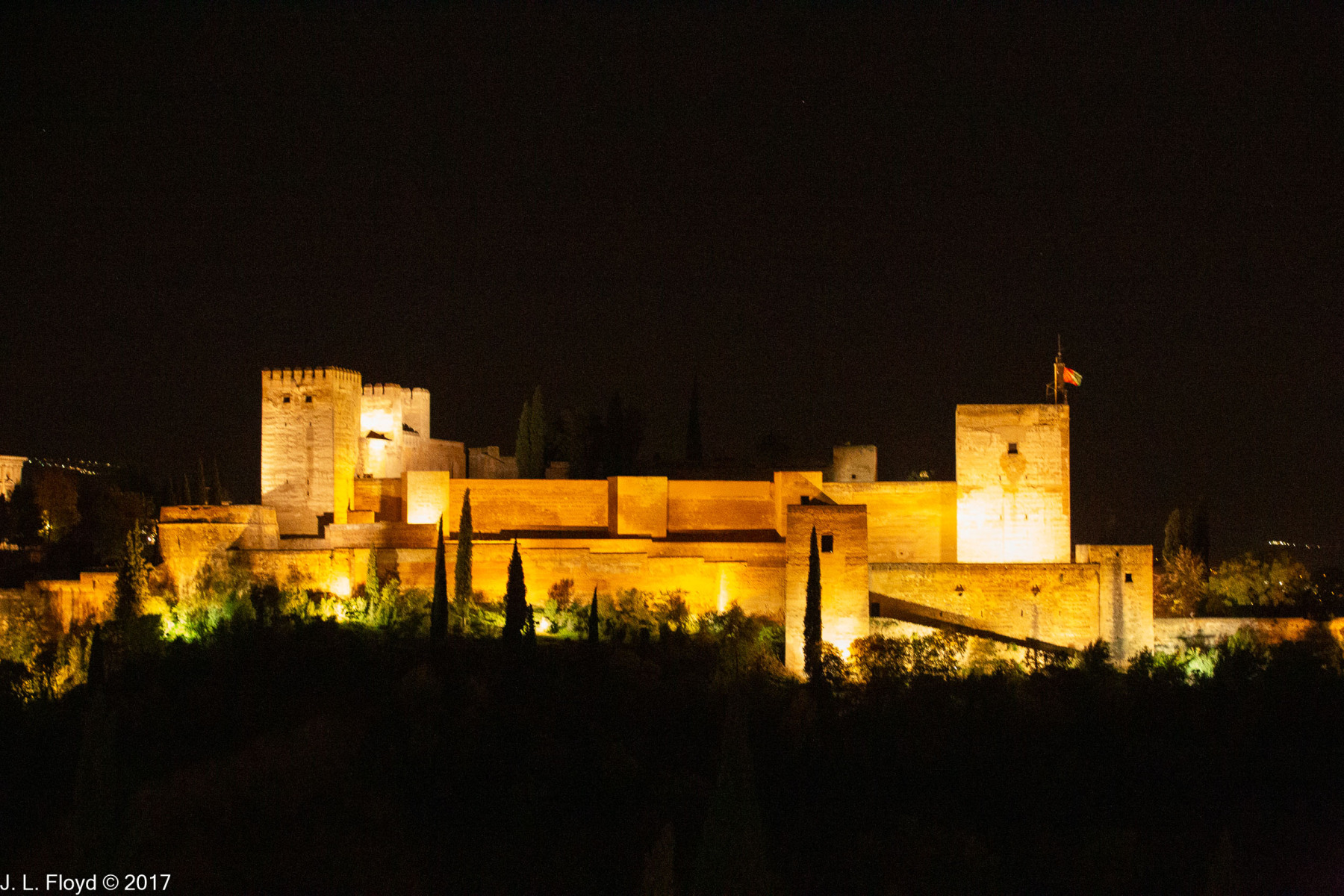
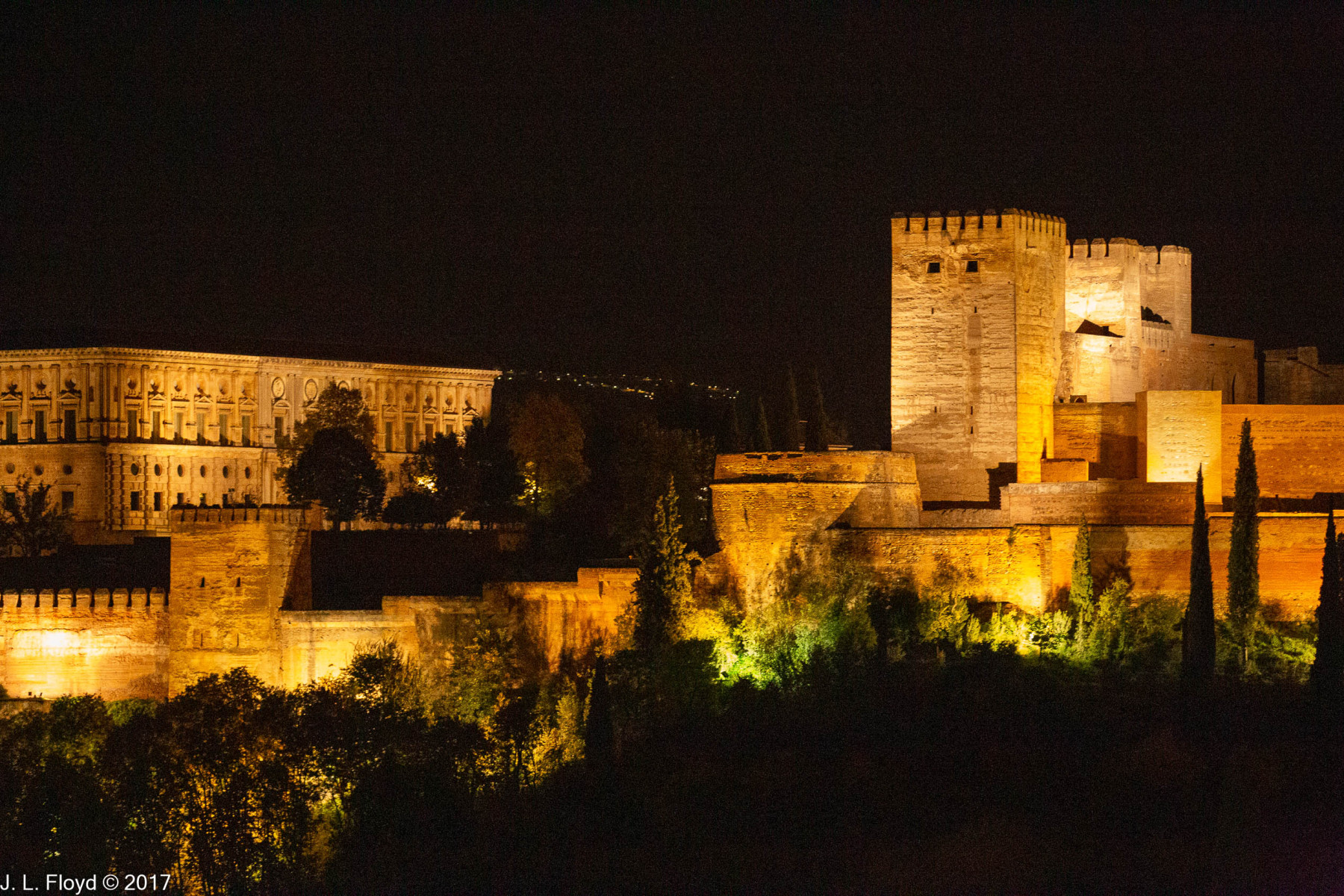
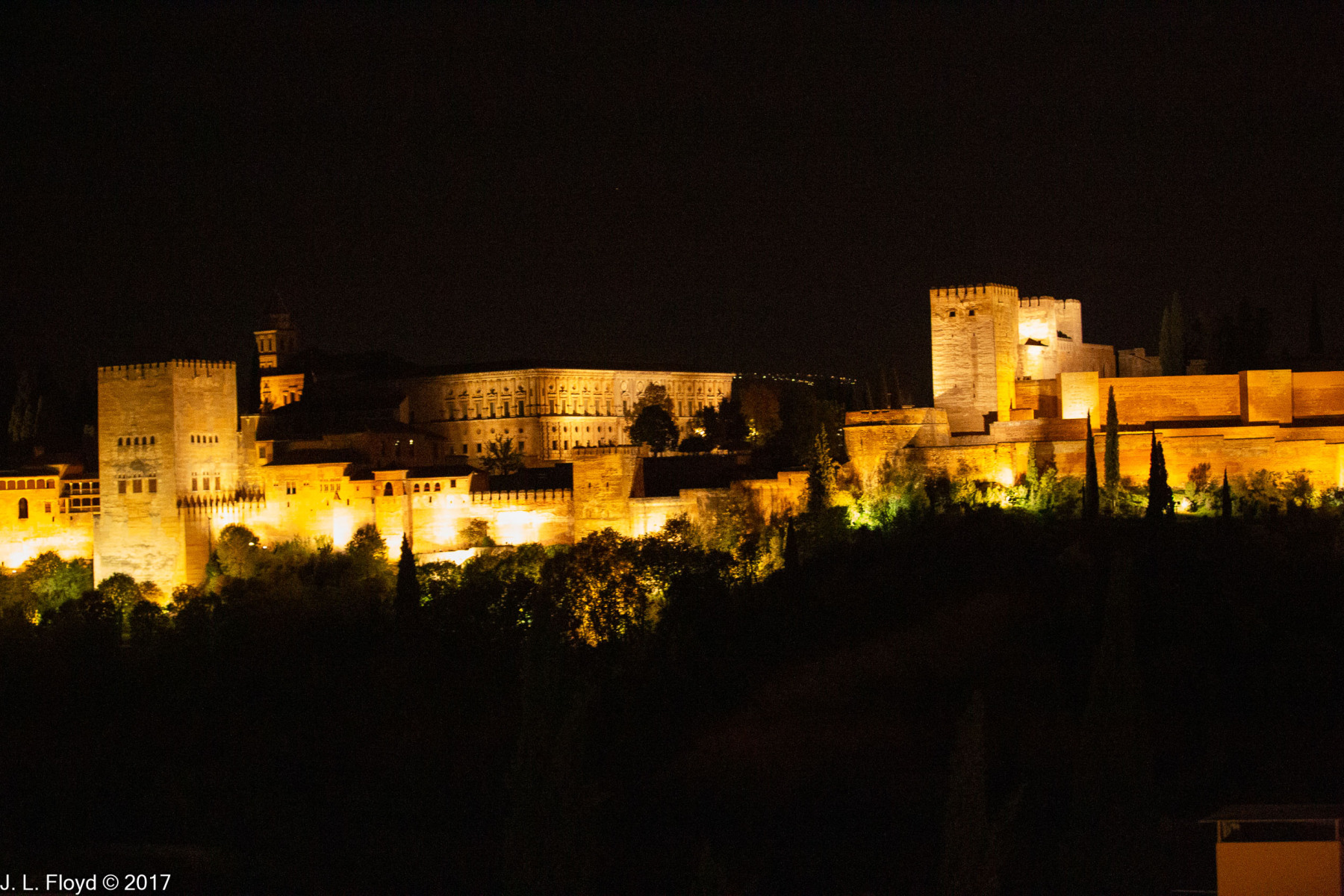
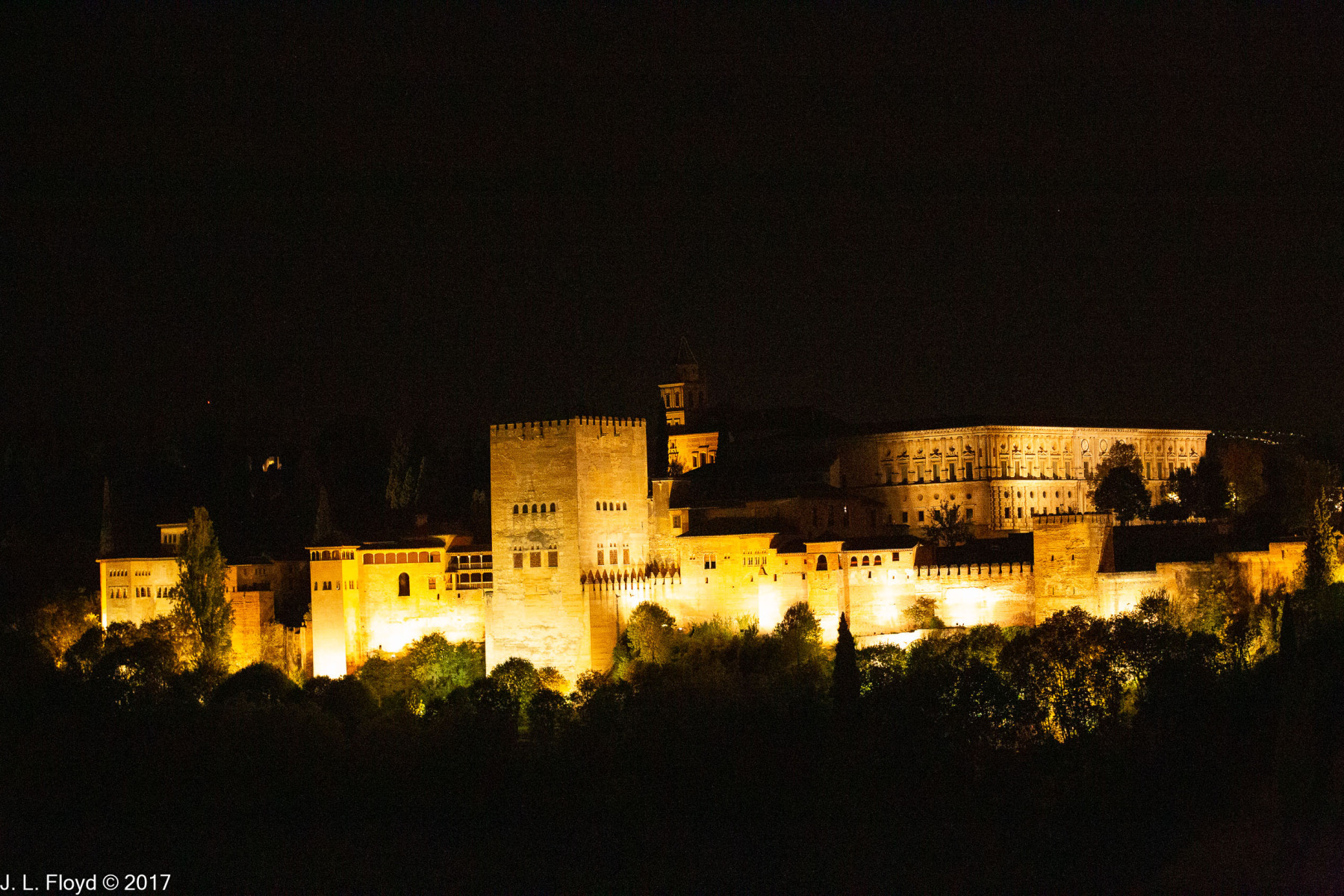
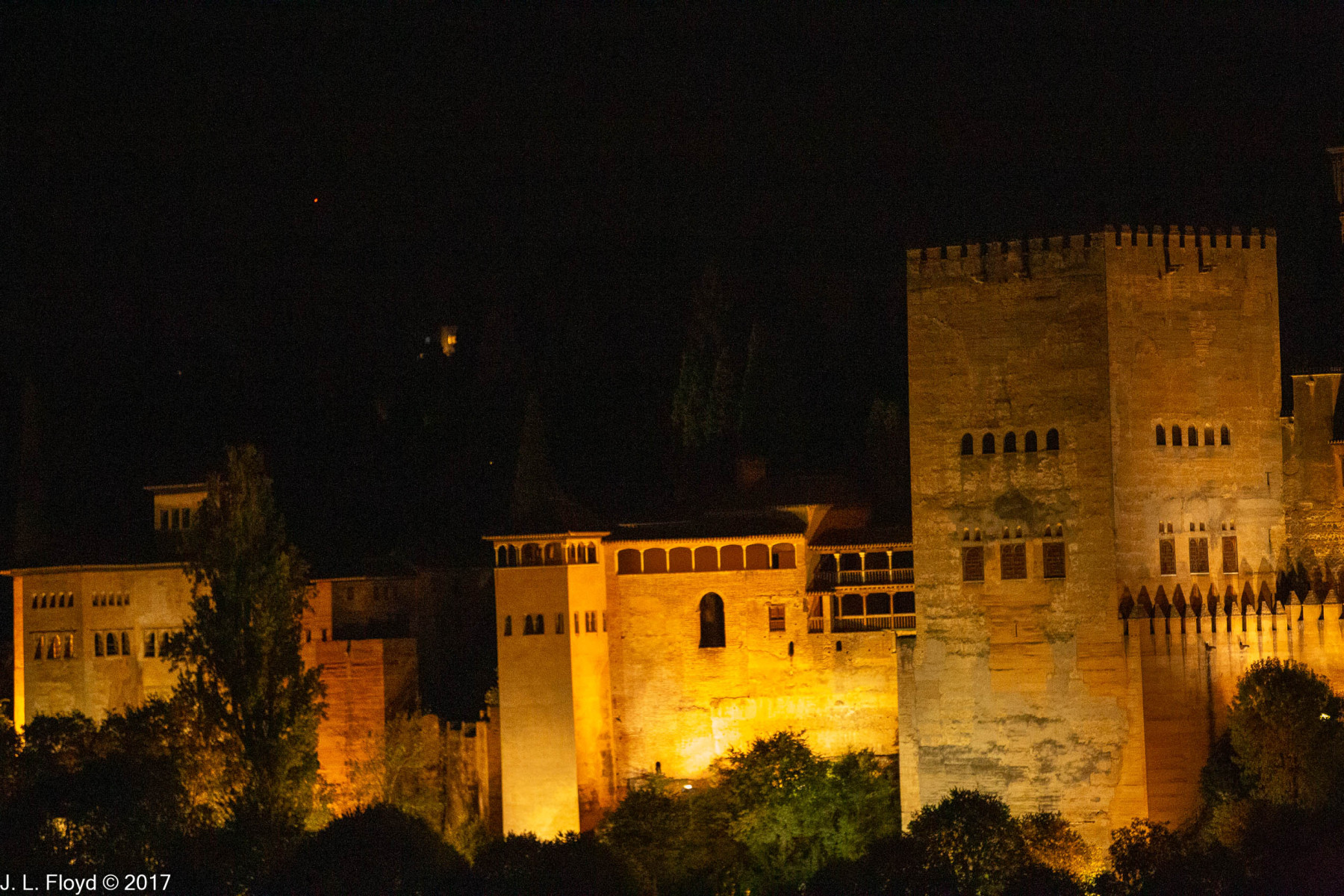
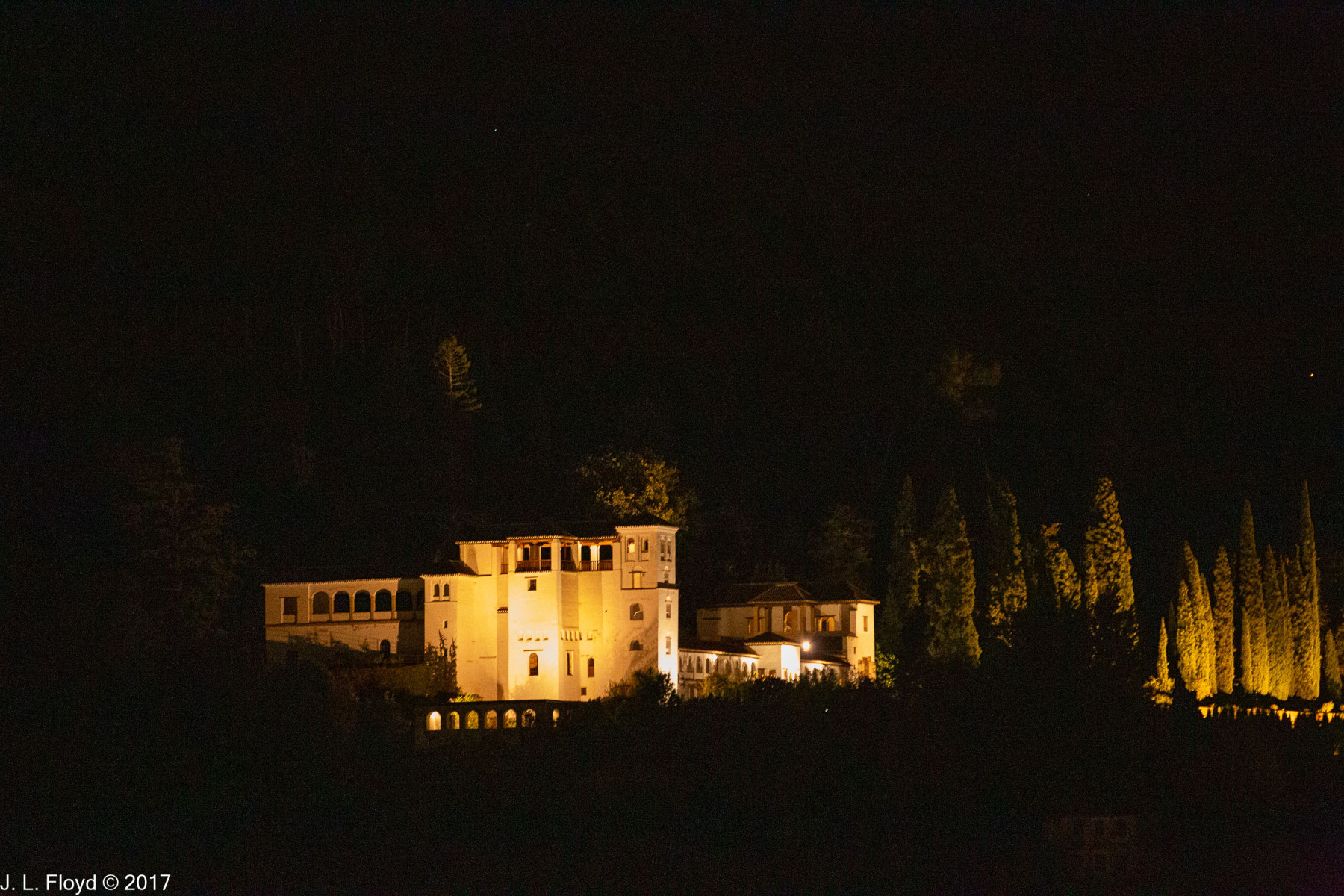
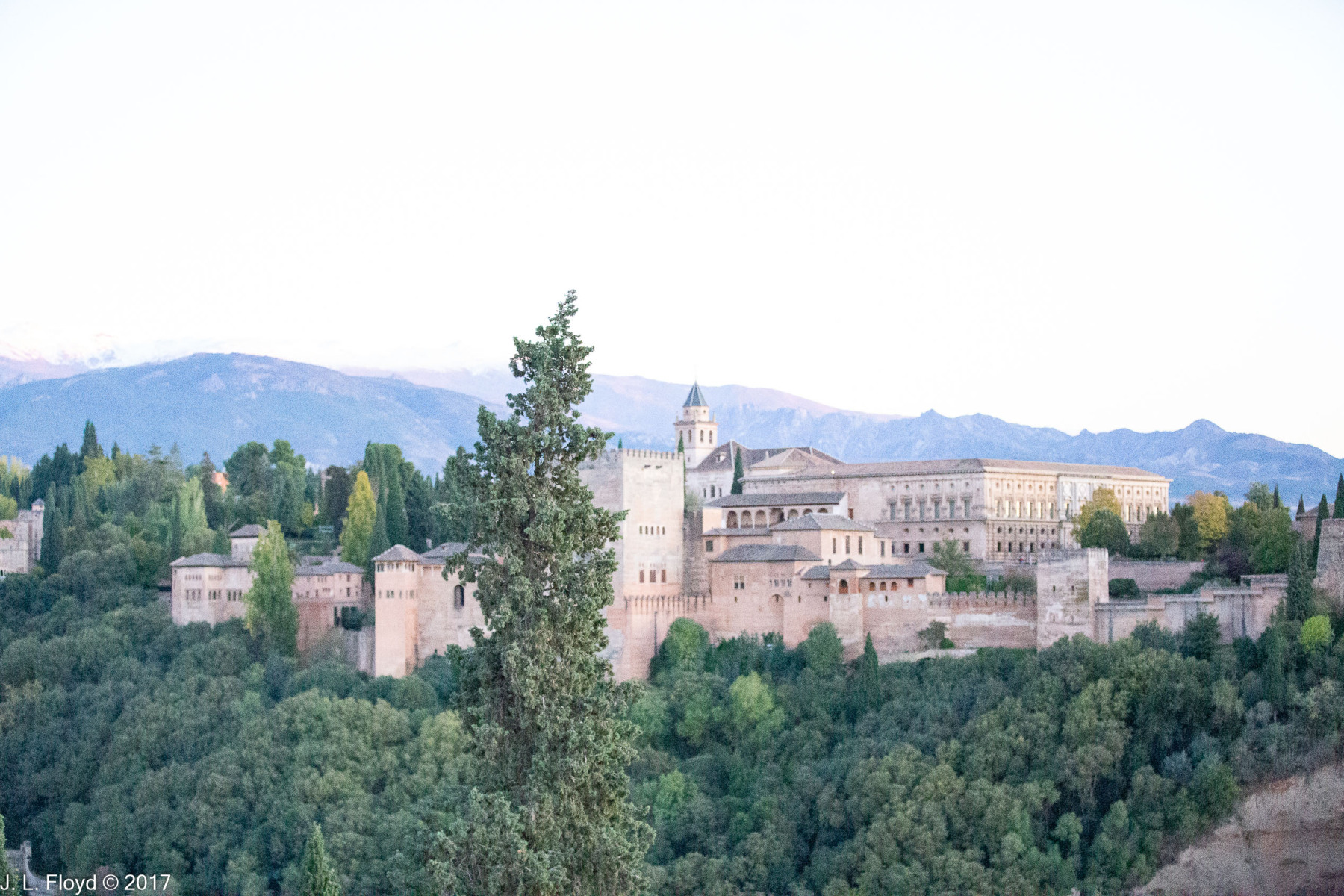
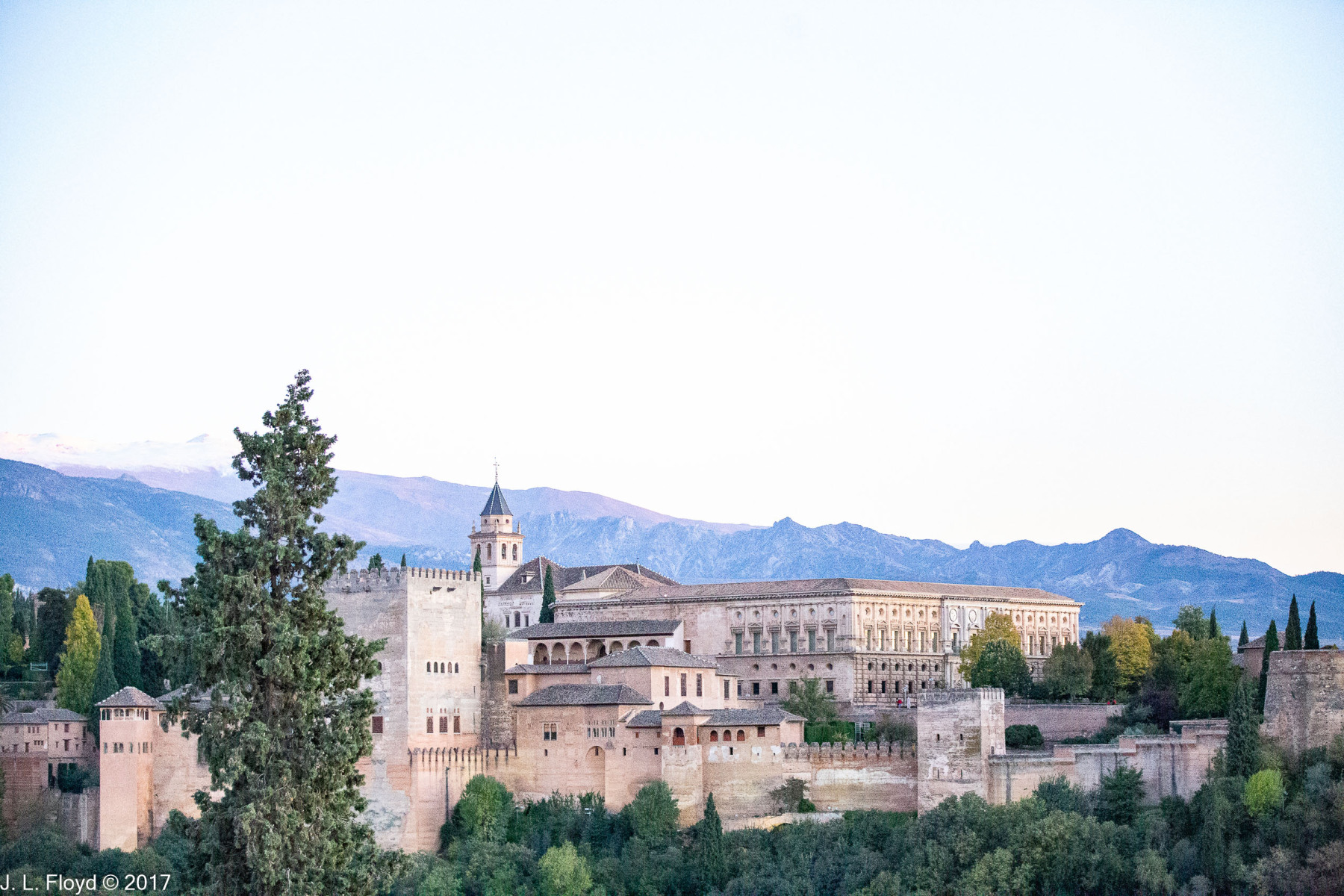
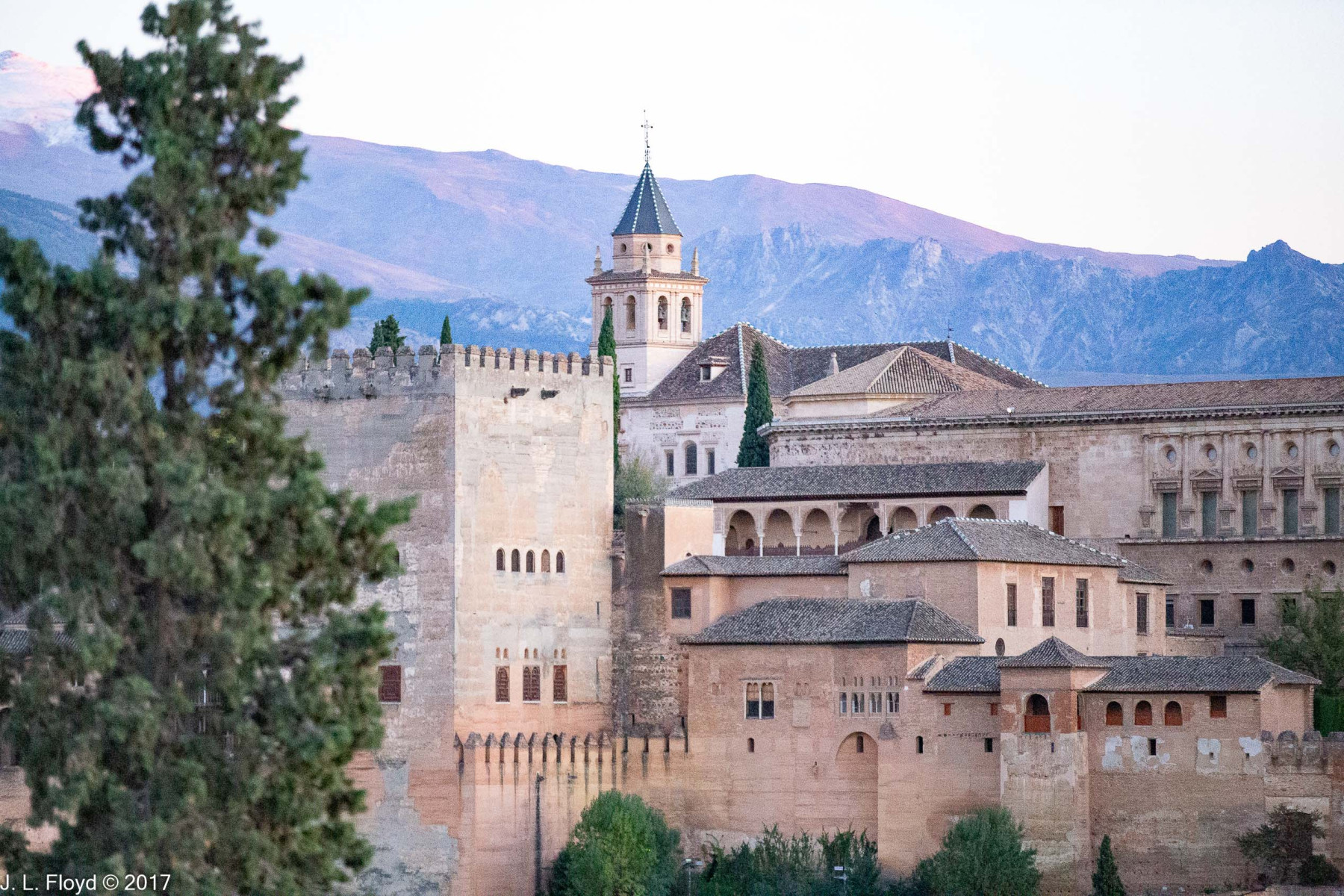
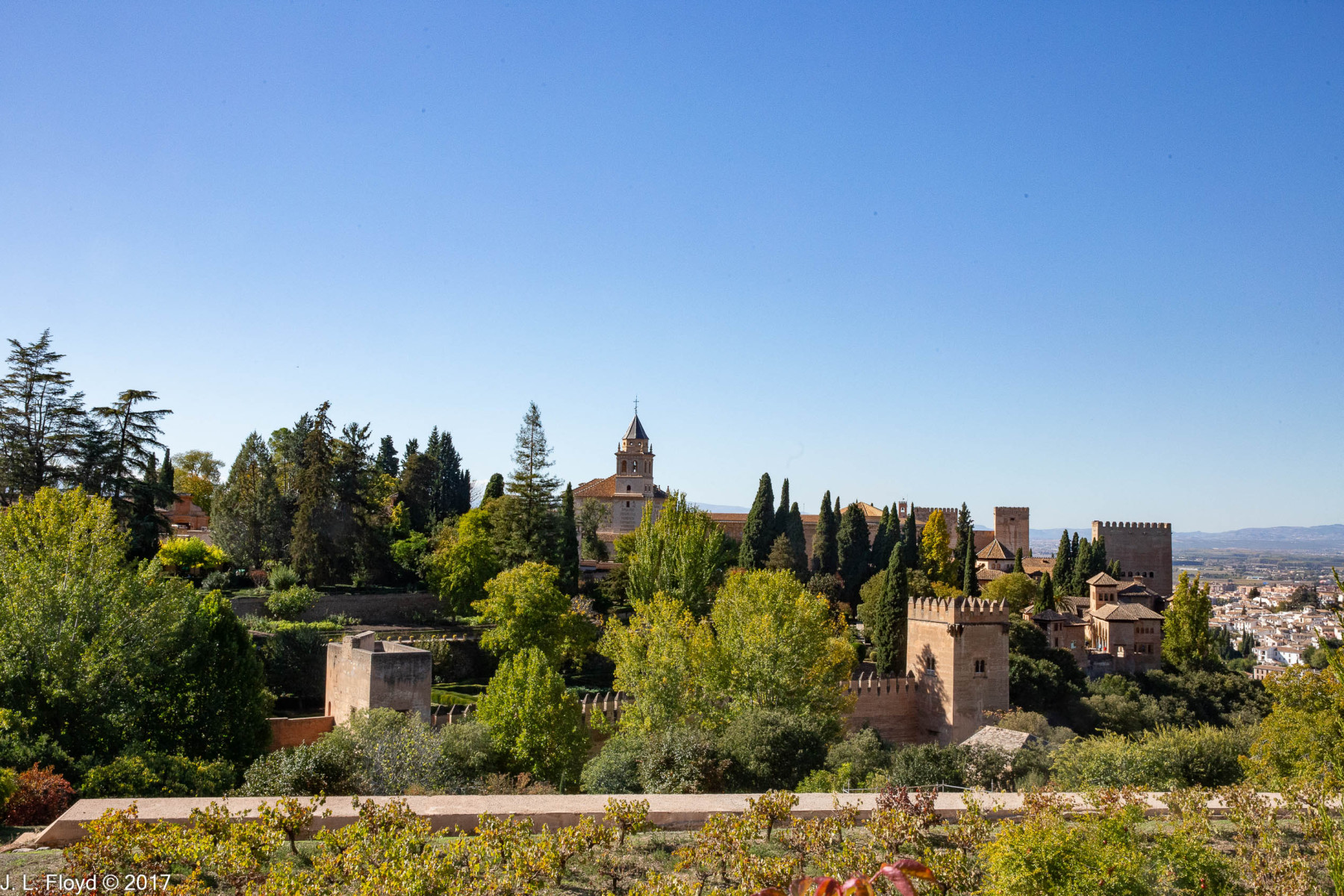
Somehow I made it to the Mirador de San Nicolas and was rewarded by stunning views of the Alhambra in the last light of day. After a few moments’ rest I was able to attach my 70-200mm telephoto zoom lens to my Canon EOS-6D DSLR and to shoot a panoply of pictures of that amazing fortress. I don’t remember how I made it back to the hotel from there, but having done so, I was able to recuperate for a few hours before we were whisked off to our after-dark adventure, which will be the subject of my next post.

Categories
Spain, Portugal and Morocco, November 2017

Granada, November 9, 2017 — The Alhambra, from the Gardens to the Generalife

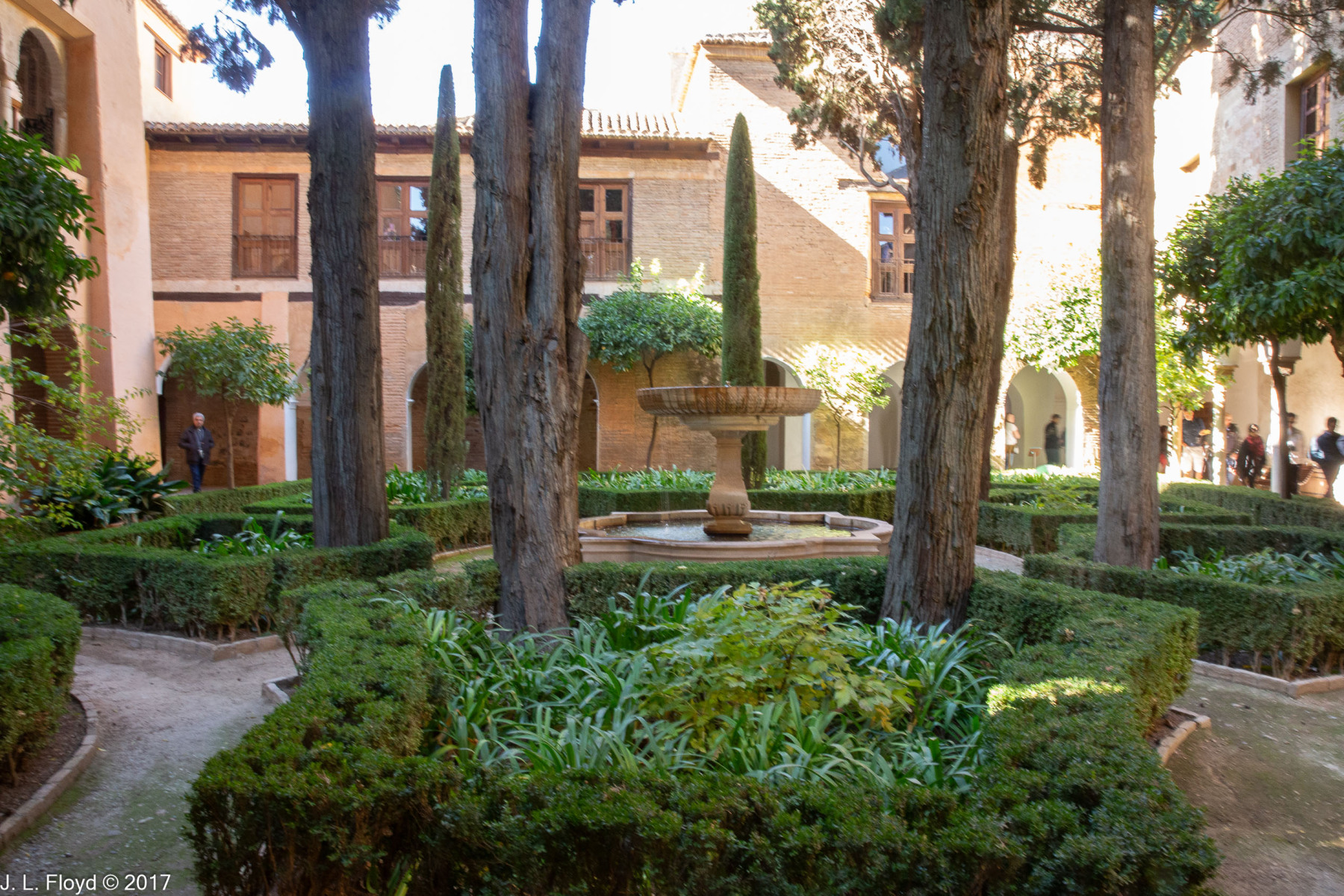
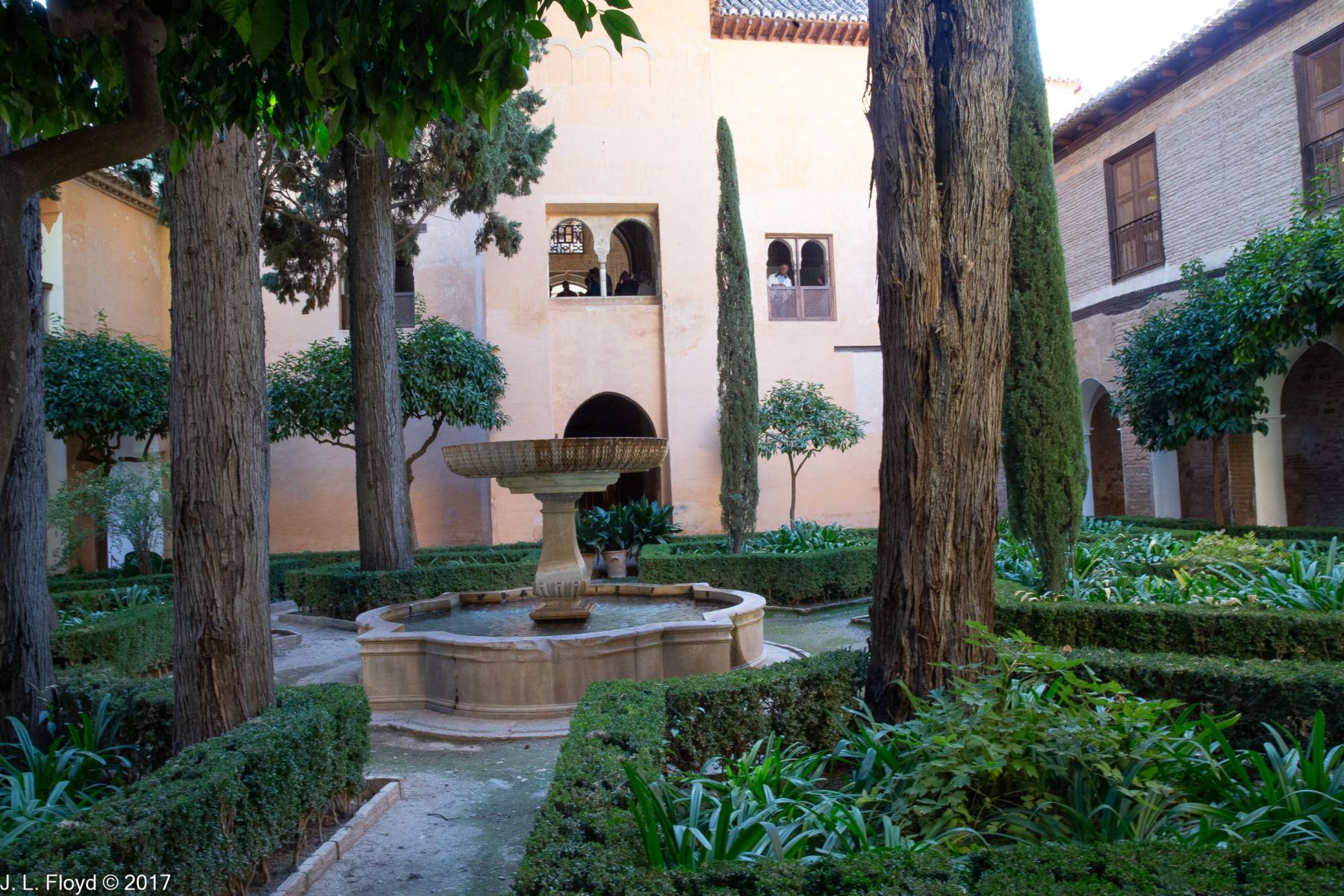
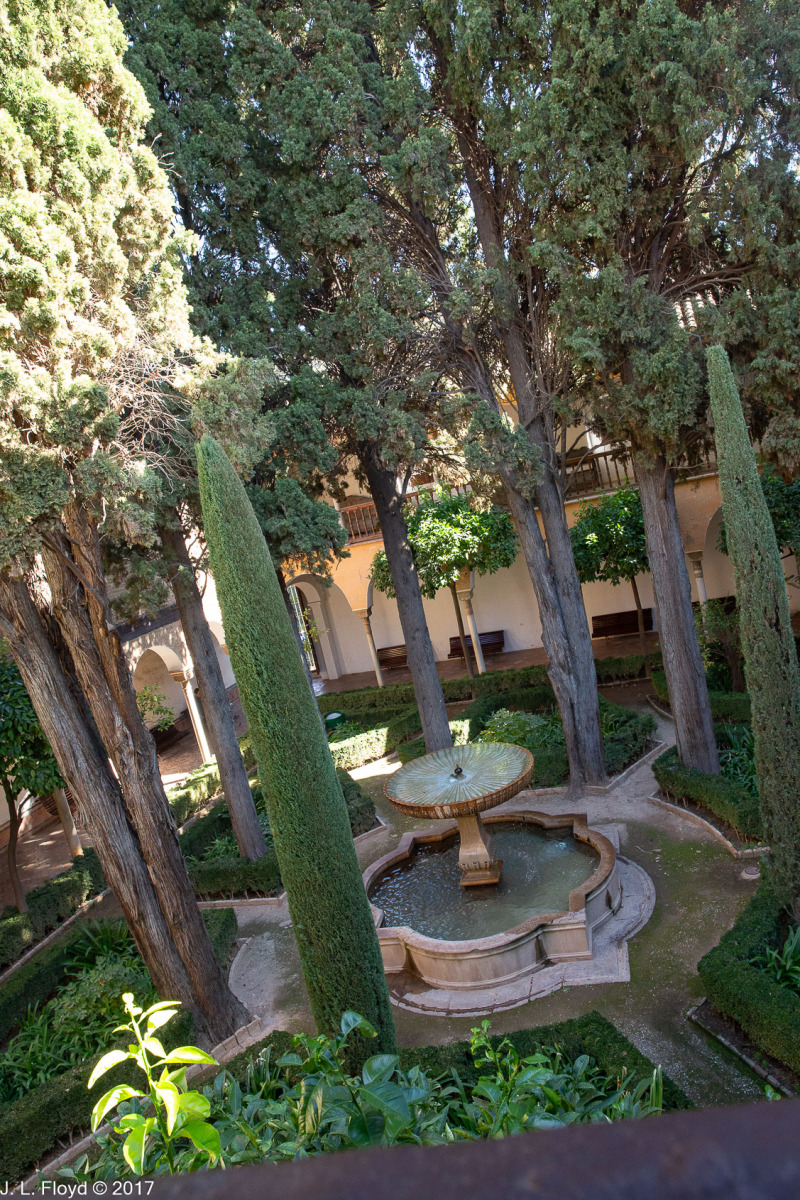
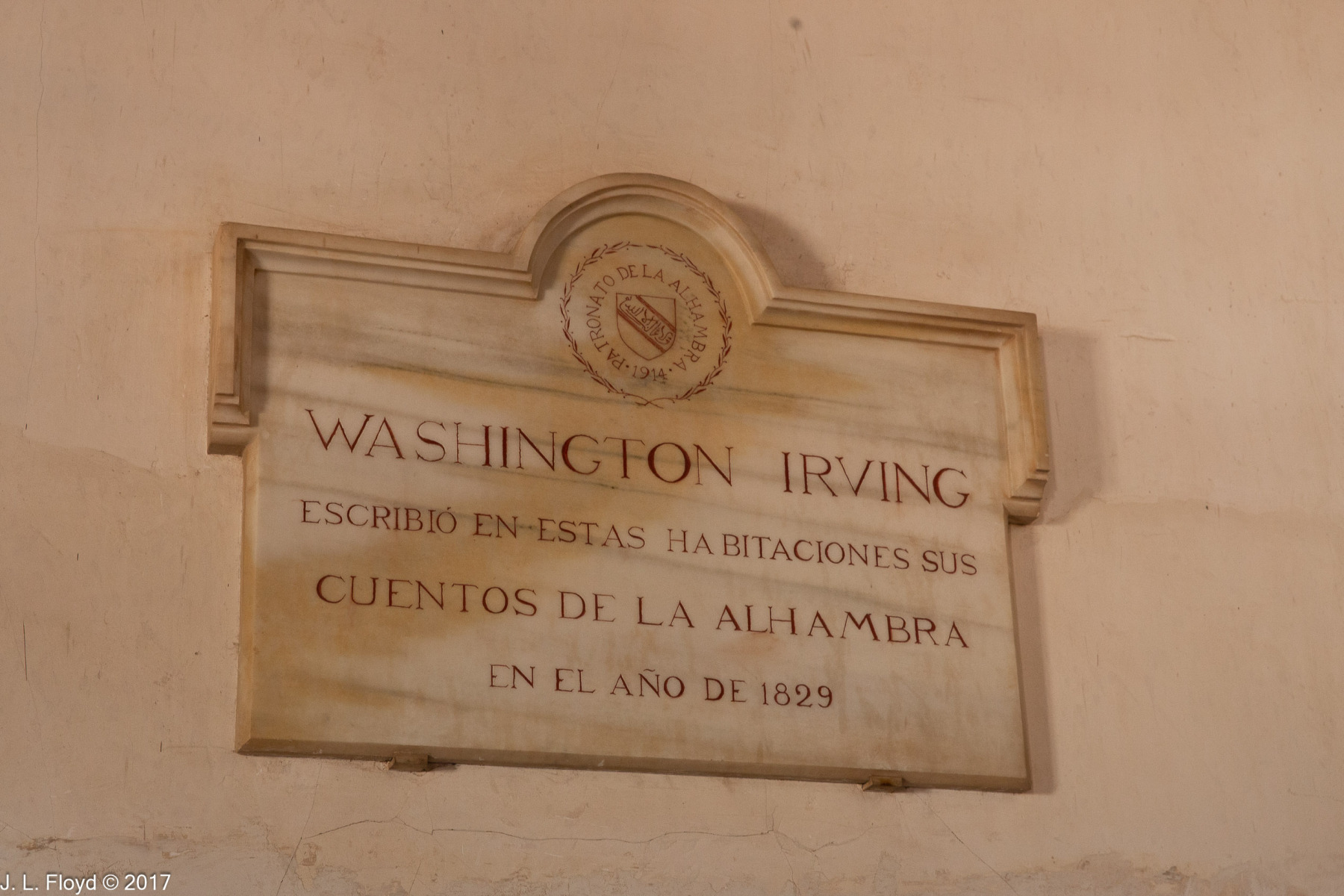
After viewing the Patio de Lindaraja from above, we descended into it and strolled through its garden on the ground level. Except for the Palace of the Lions on its north side, the enclosing structures are of Christian origin. In Nasrid times the gardens had occupied the entire space between the Palace of the Lions and the wall of the Alhambra. But in the 16th century the Emperor Charles V, after deciding to make his royal residence in the Alhambra, had a series of apartments built around the courtyard to serve as provisional quarters while the planned Renaissance palace was being built. Of course the latter mostly remained a mirage in his lifetime, and he was so busy traveling around the Holy Roman Empire fighting his wars that he rarely had time to stay in the Alhambra anyway; but subsequent generations were able to benefit from the construction. Washington Irving, for example, stayed in the Emperor’s chambers in 1829.

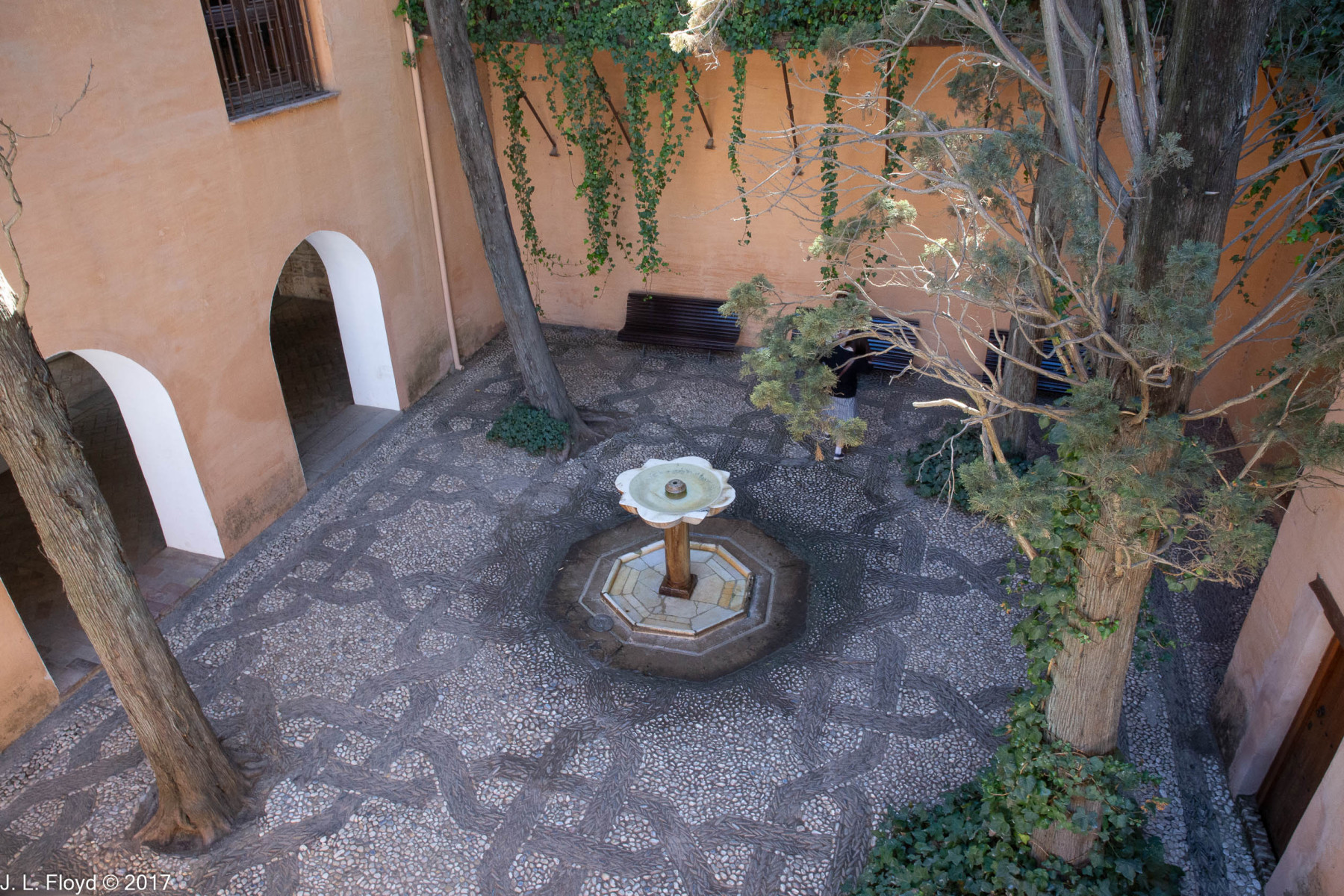
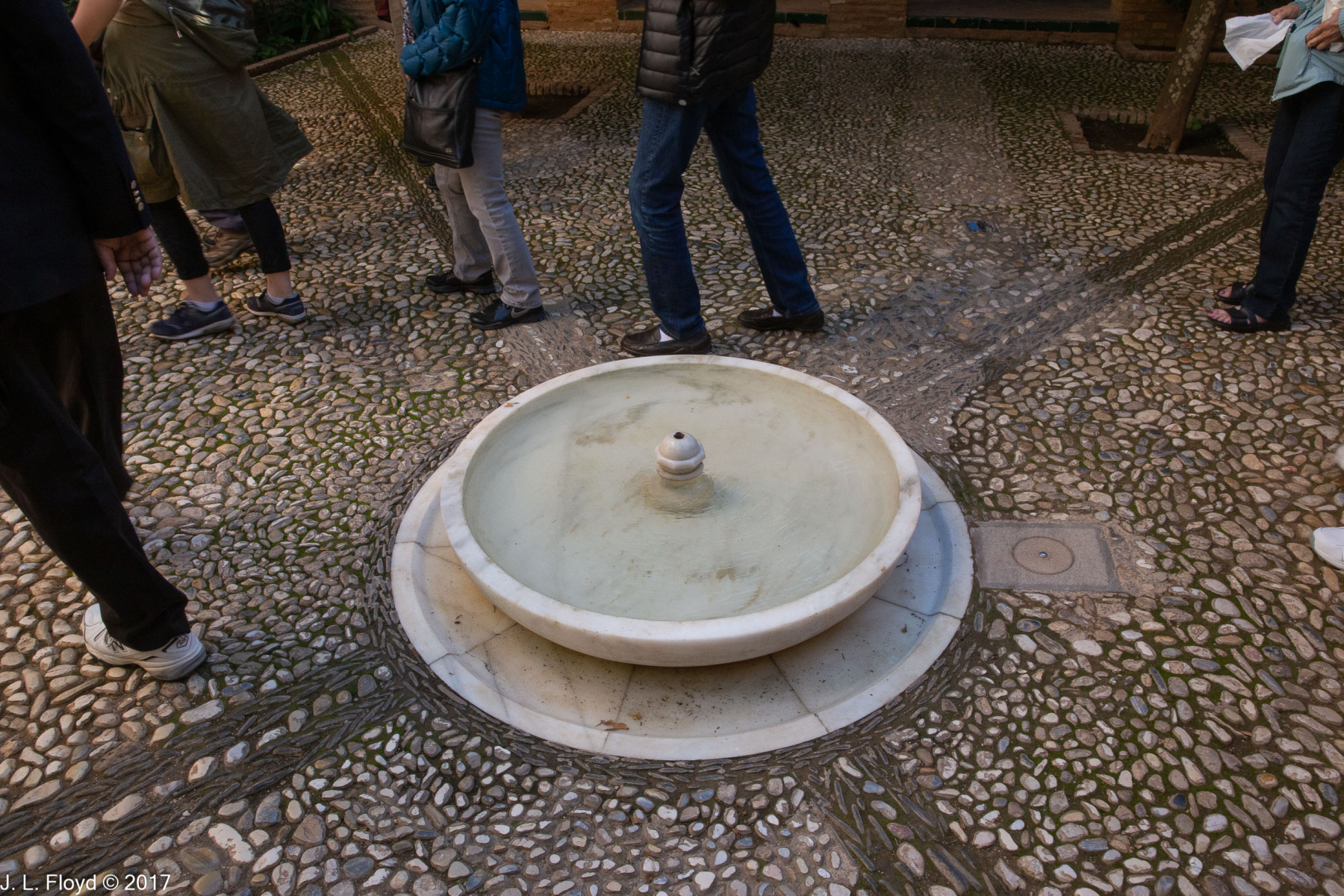
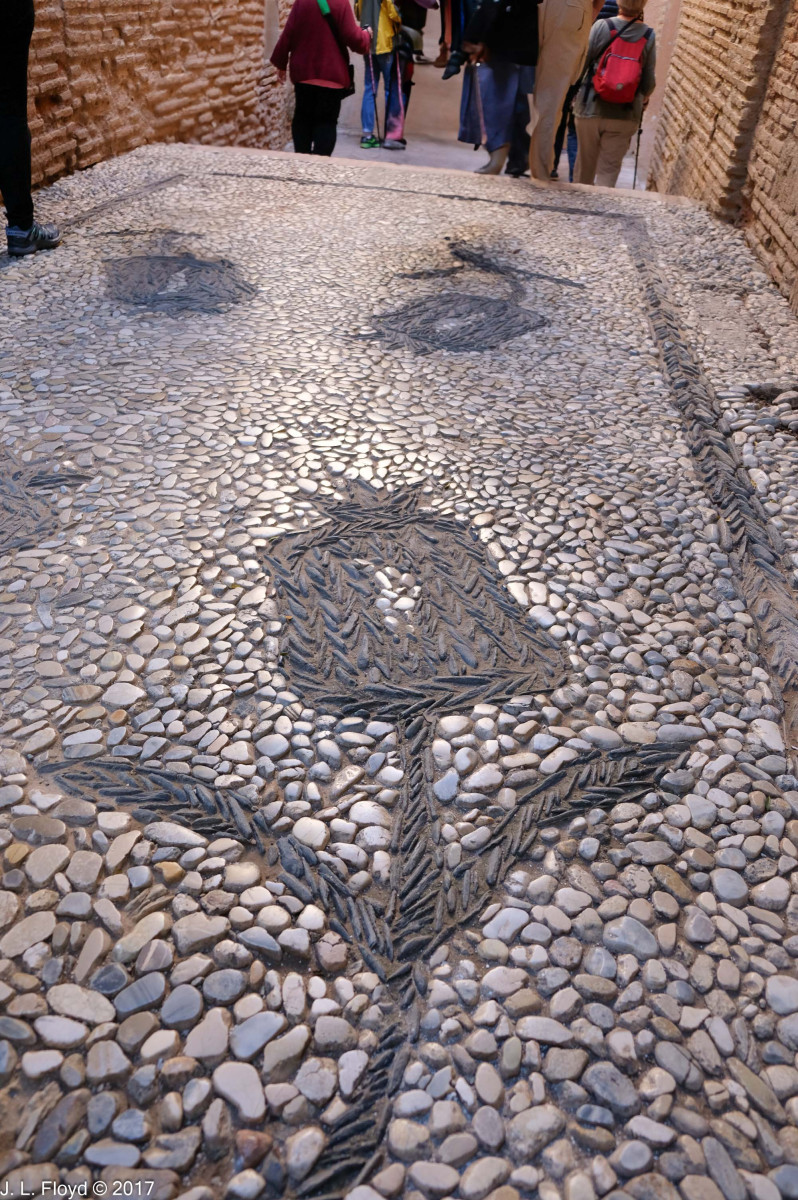
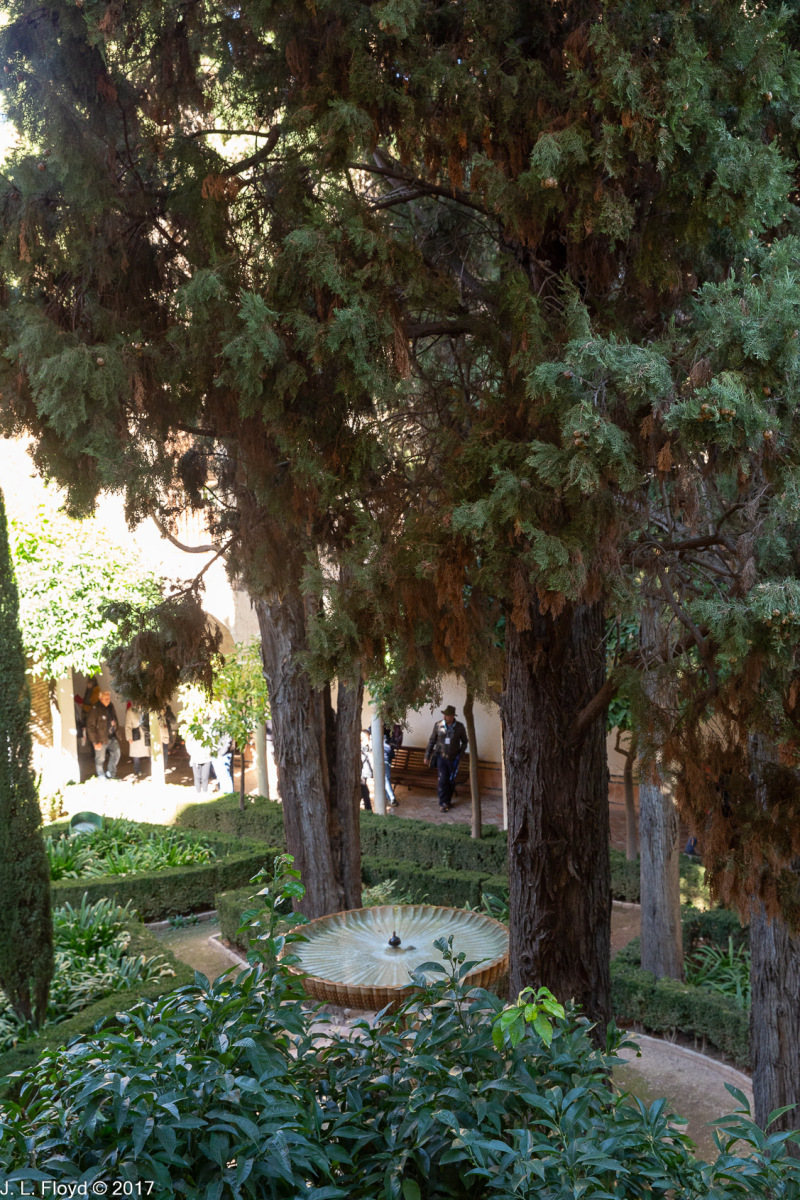
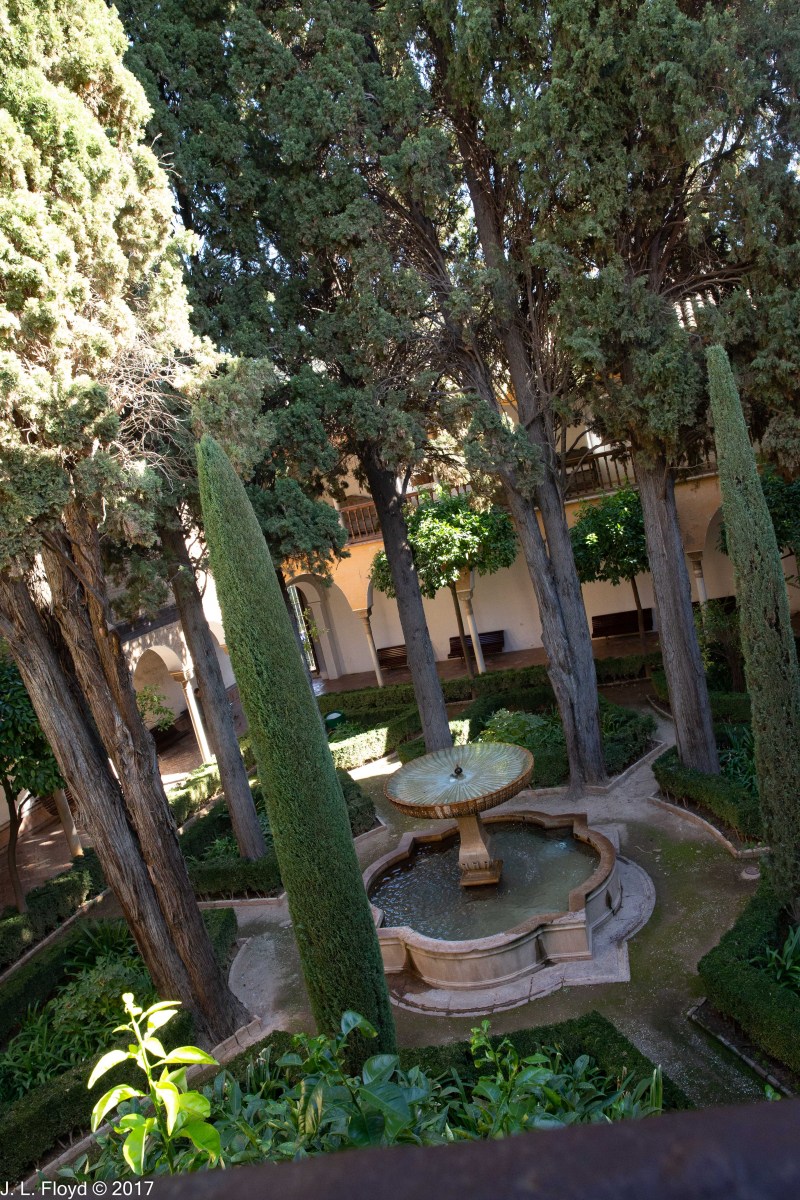
The Patio de Lindaraja is surrounded by an arcaded gallery, of which the supporting columns are of Nasrid origin. In the middle of the patio is a large but simple fountain, surrounded by garden plots filled with tall cypresses and bordered by well-tended hedges. Adjacent to the Lindaraja there is another, smaller courtyard known as the Patio of the Grated Window owing to a wrought iron balcony on the south side. It also has a gallery with Nasrid-era columns as well as an exquisite white marble fountain and elegant mosaic paving composed of stones forming geometric designs.

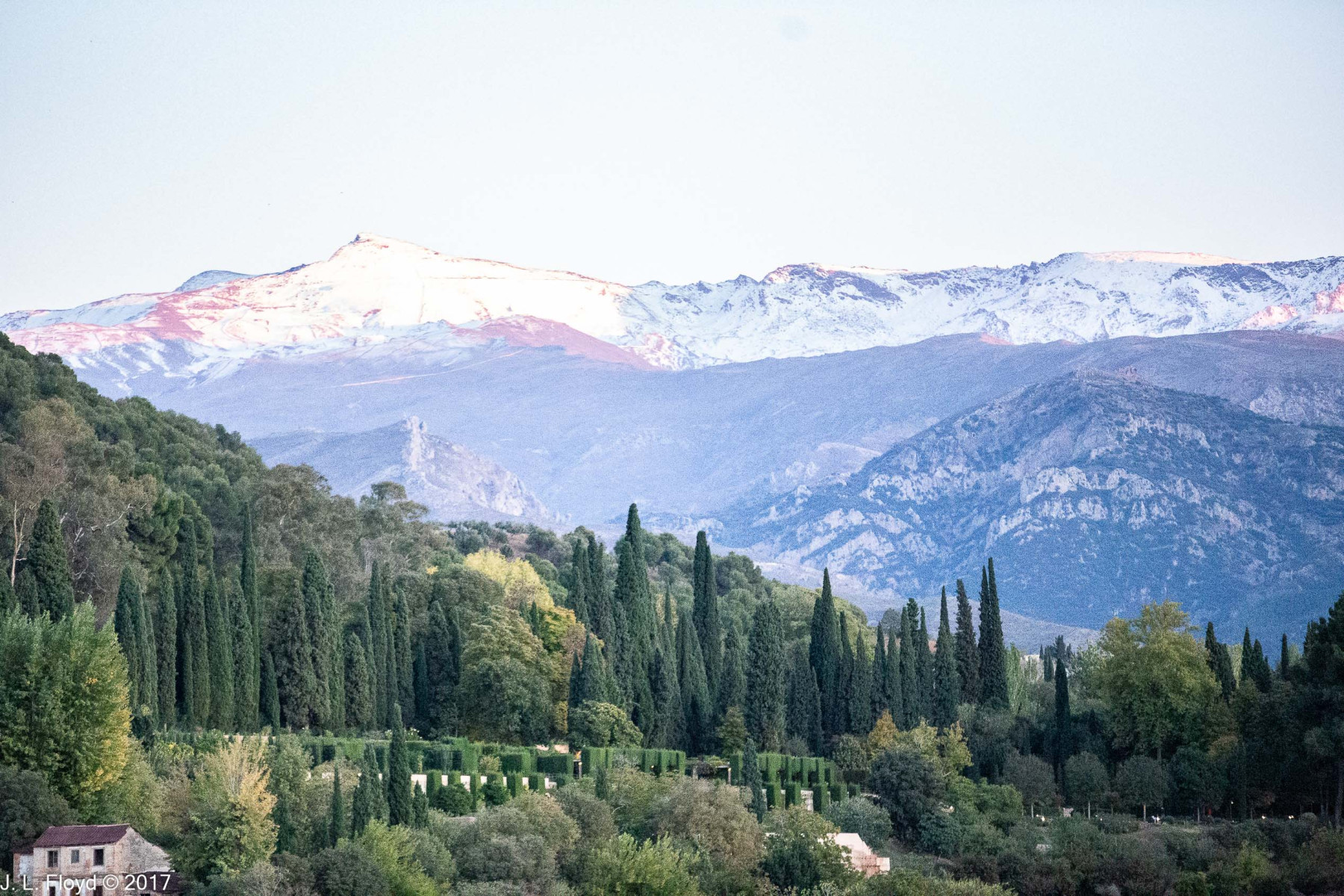
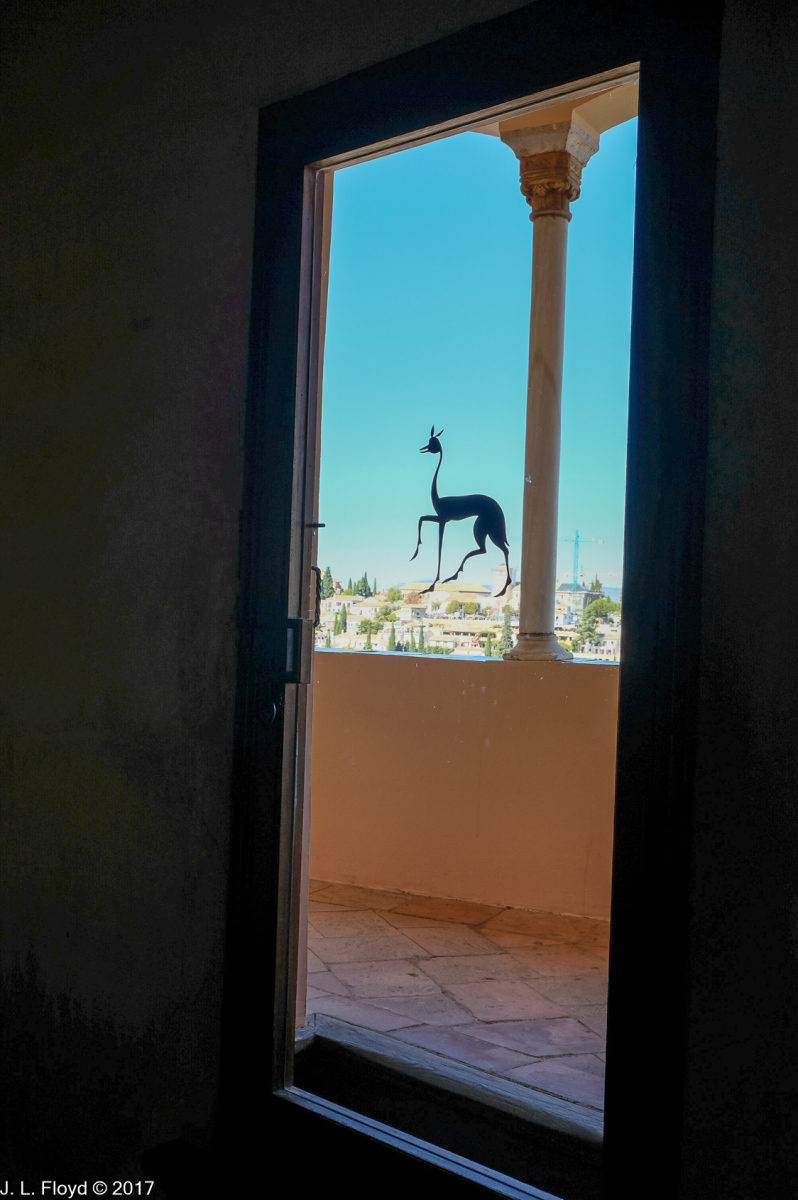
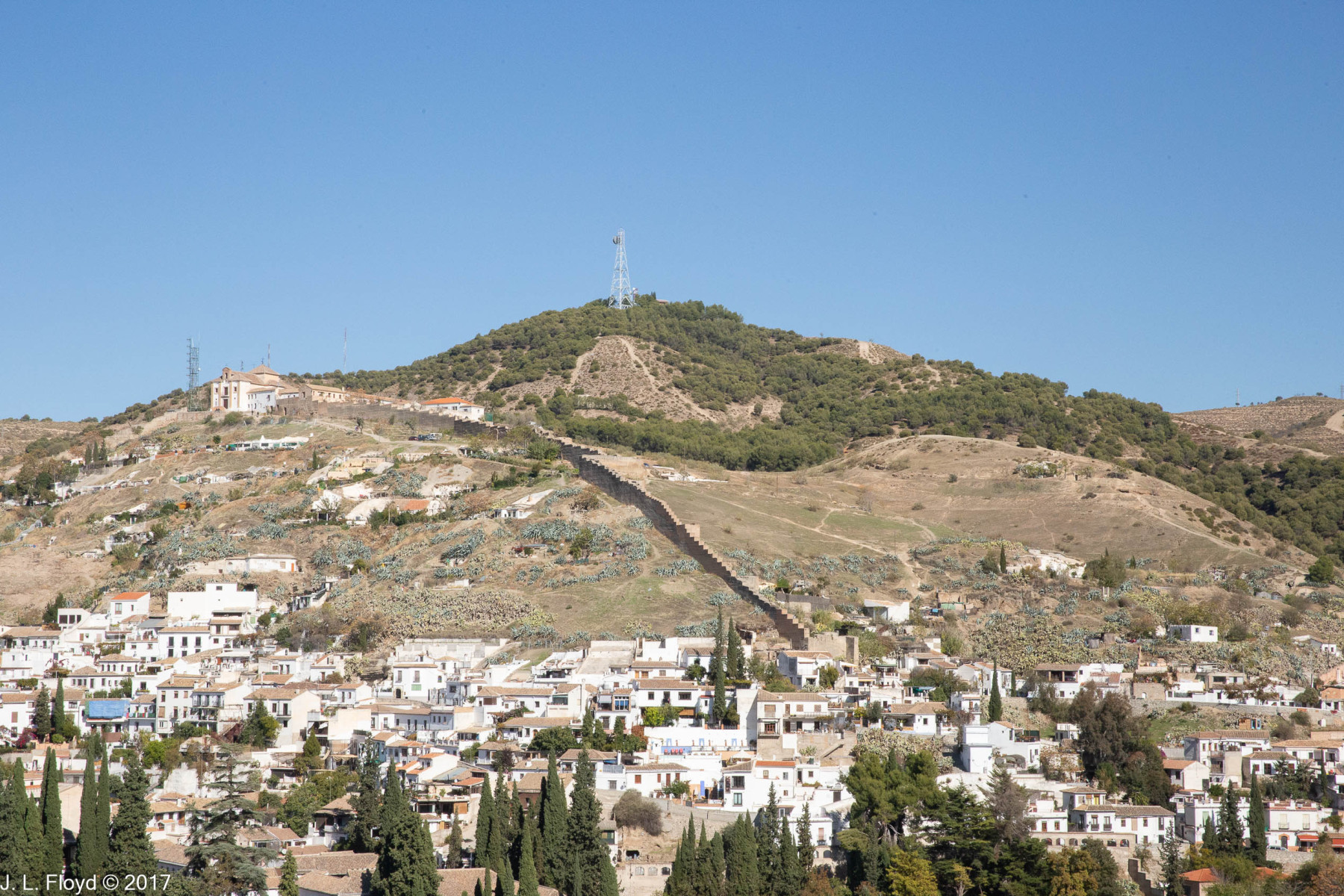
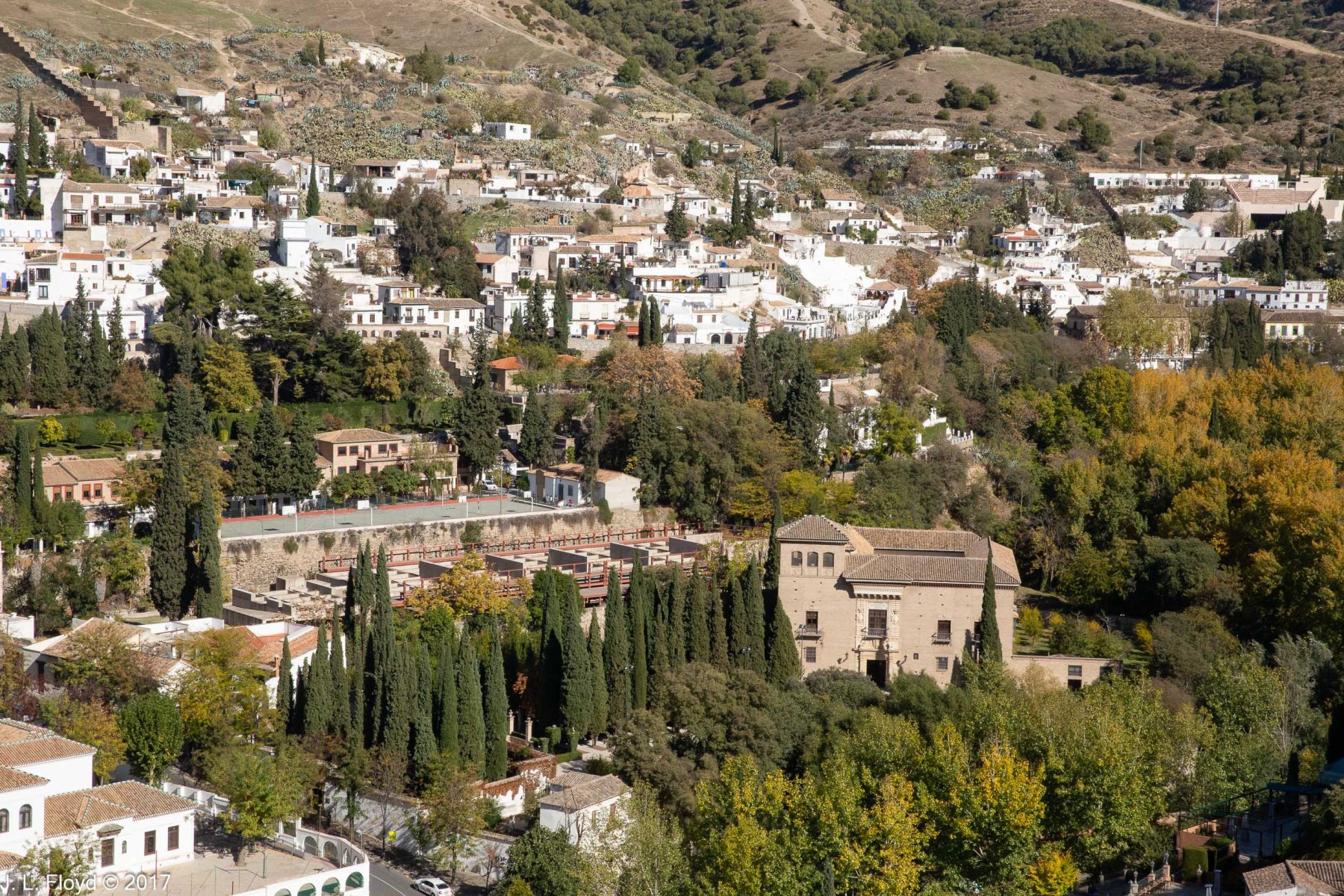
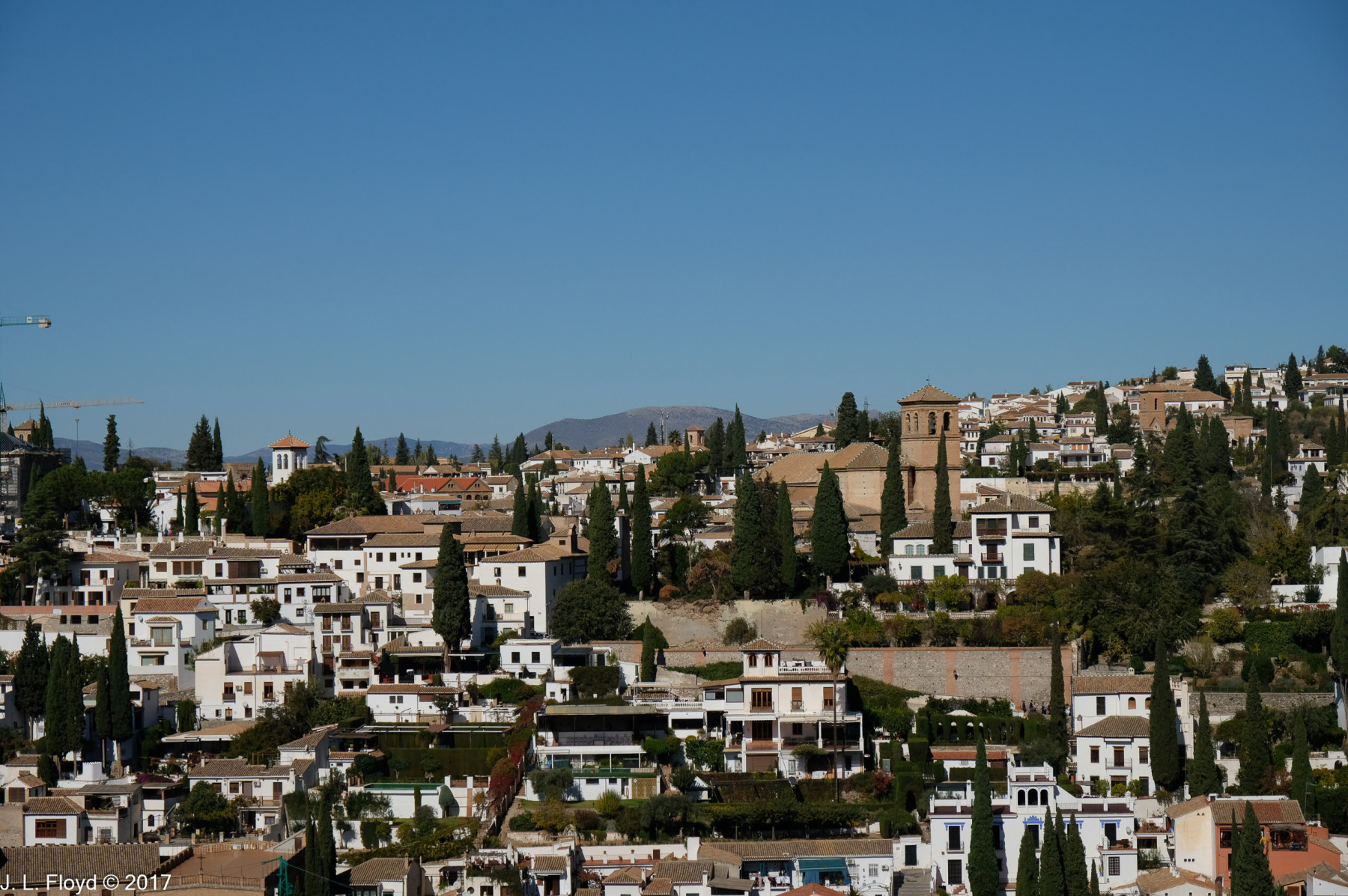
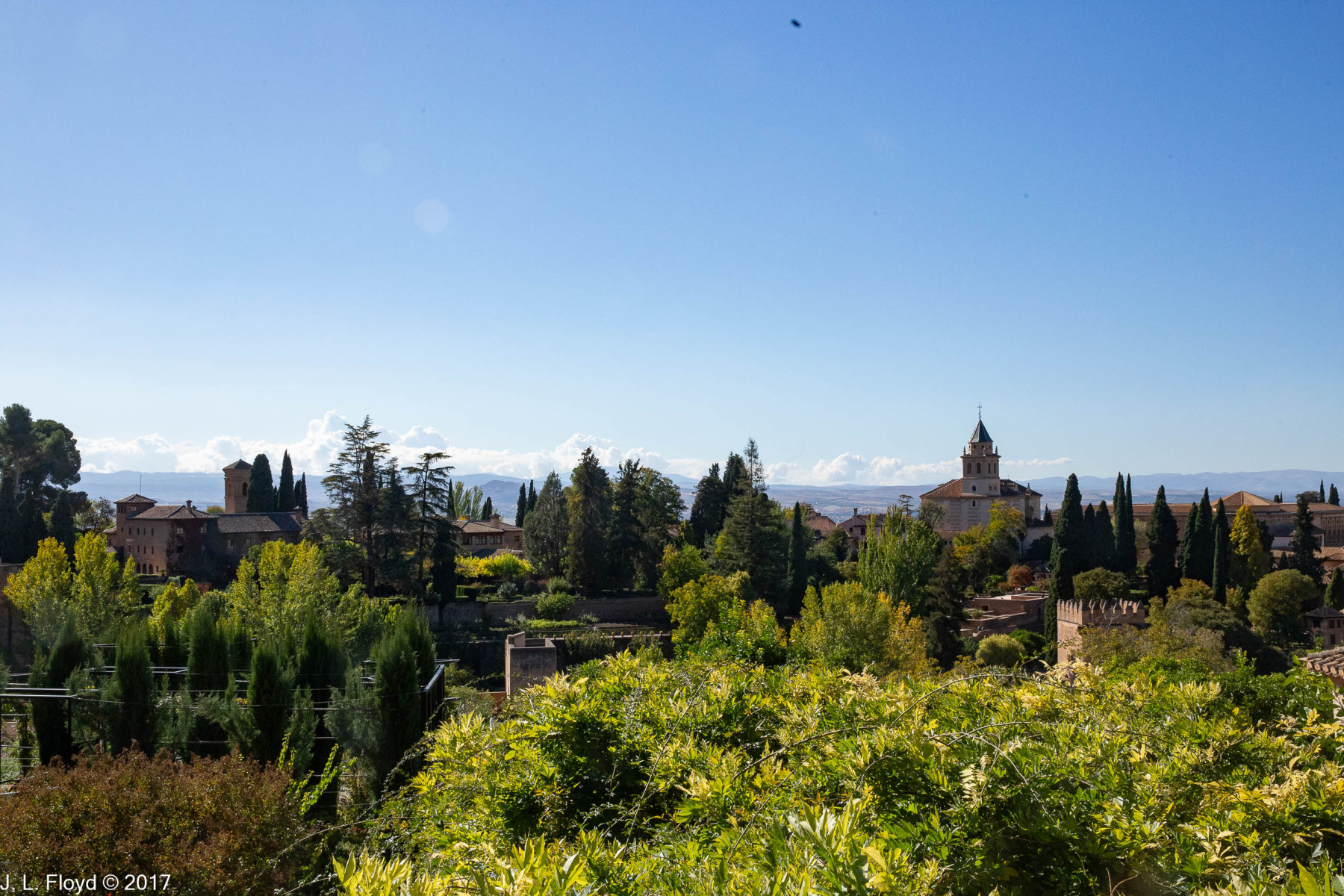
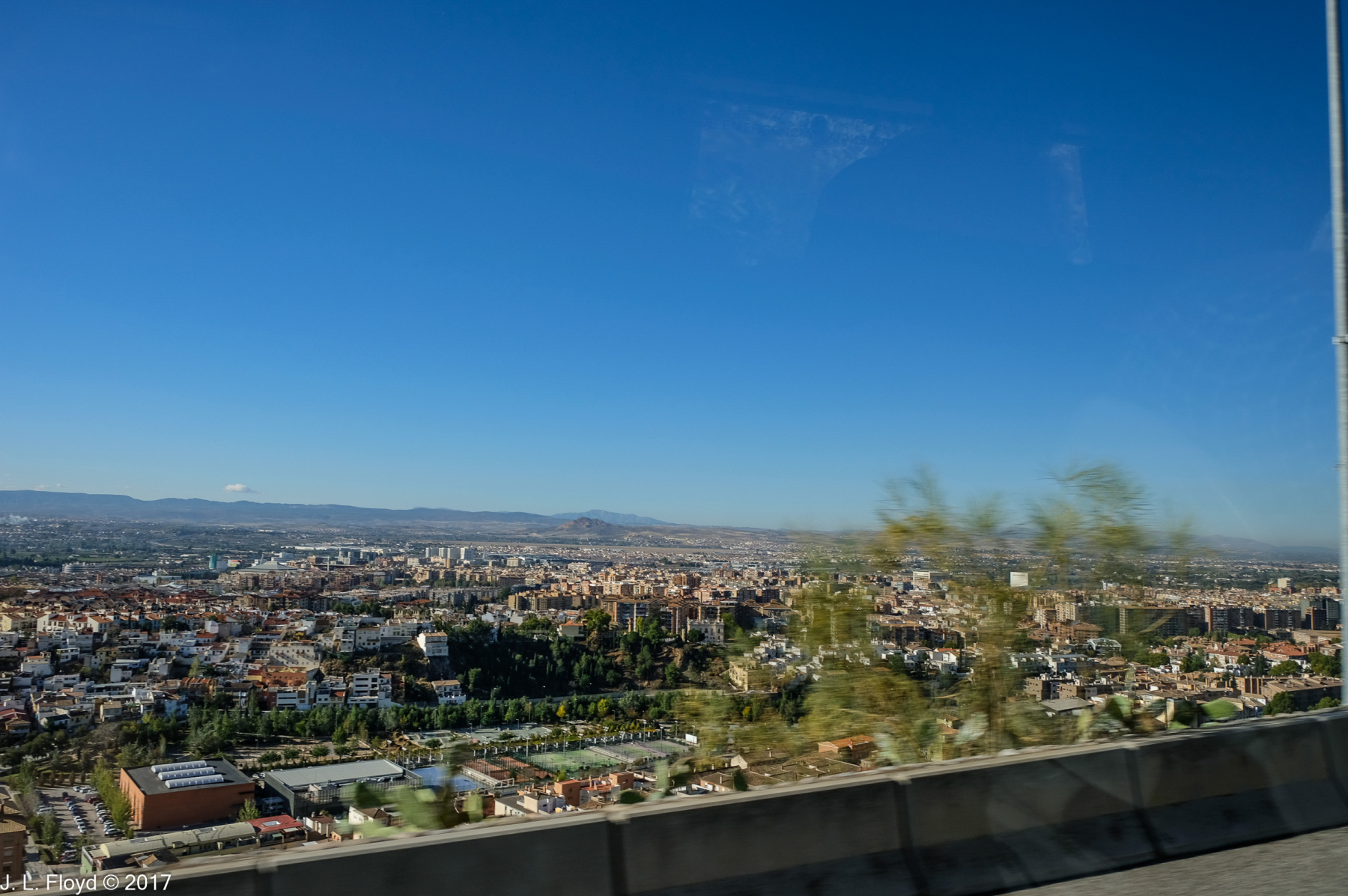
From the Patio as well as the Mirador of Lindaraja there are wonderful views to be had of the city of Granada. To the north, the Albaicín hill rises majestically over the Albaicín and Sacromonte districts. Turning a little to the west, one sees the Cathedral of Granada with its stately bell-tower, the Royal Monastery of St. Jerome (Real Monasterio de San Jerónimo) and other landmarks in the heart of the city. We would see more of those sights later that day.

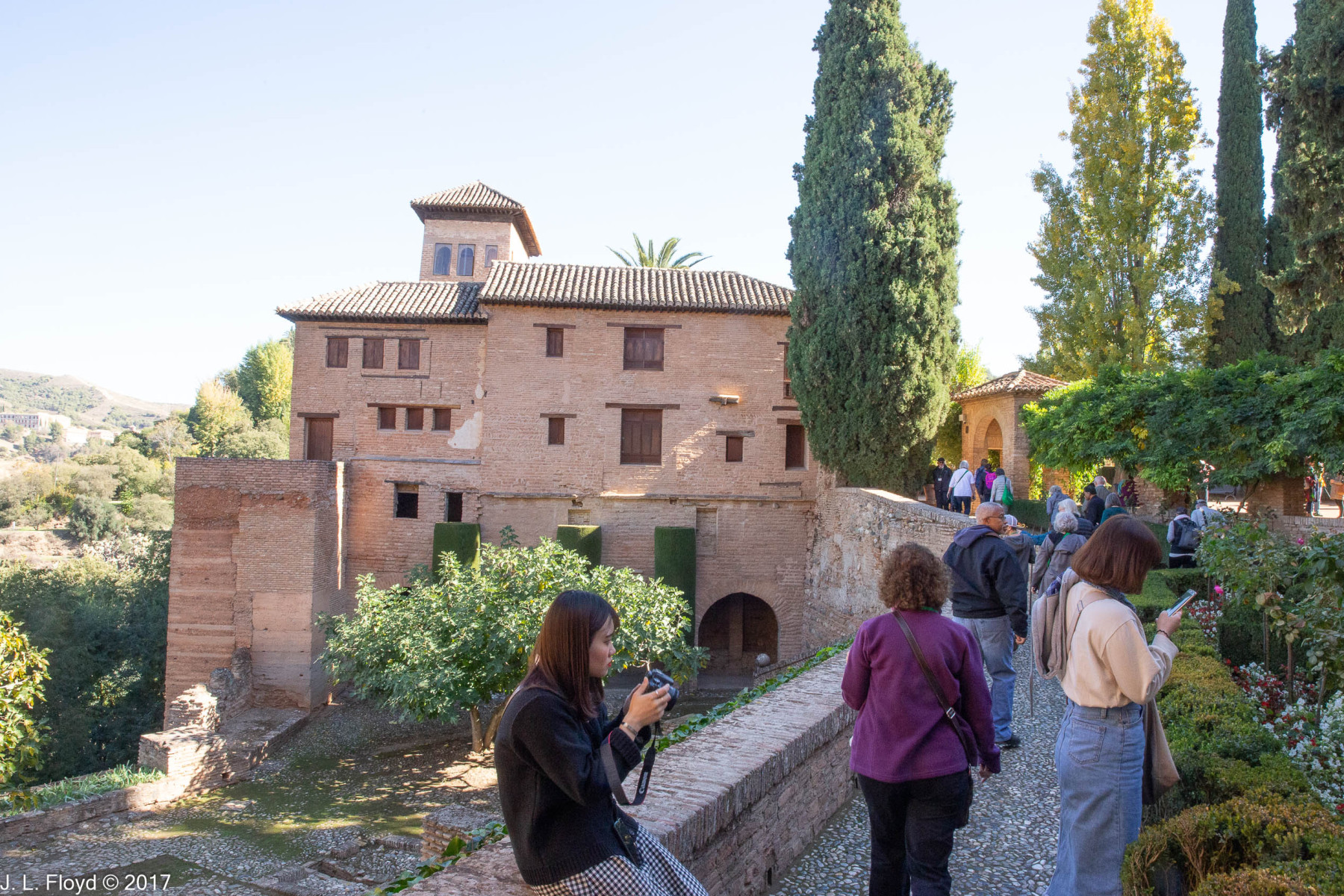
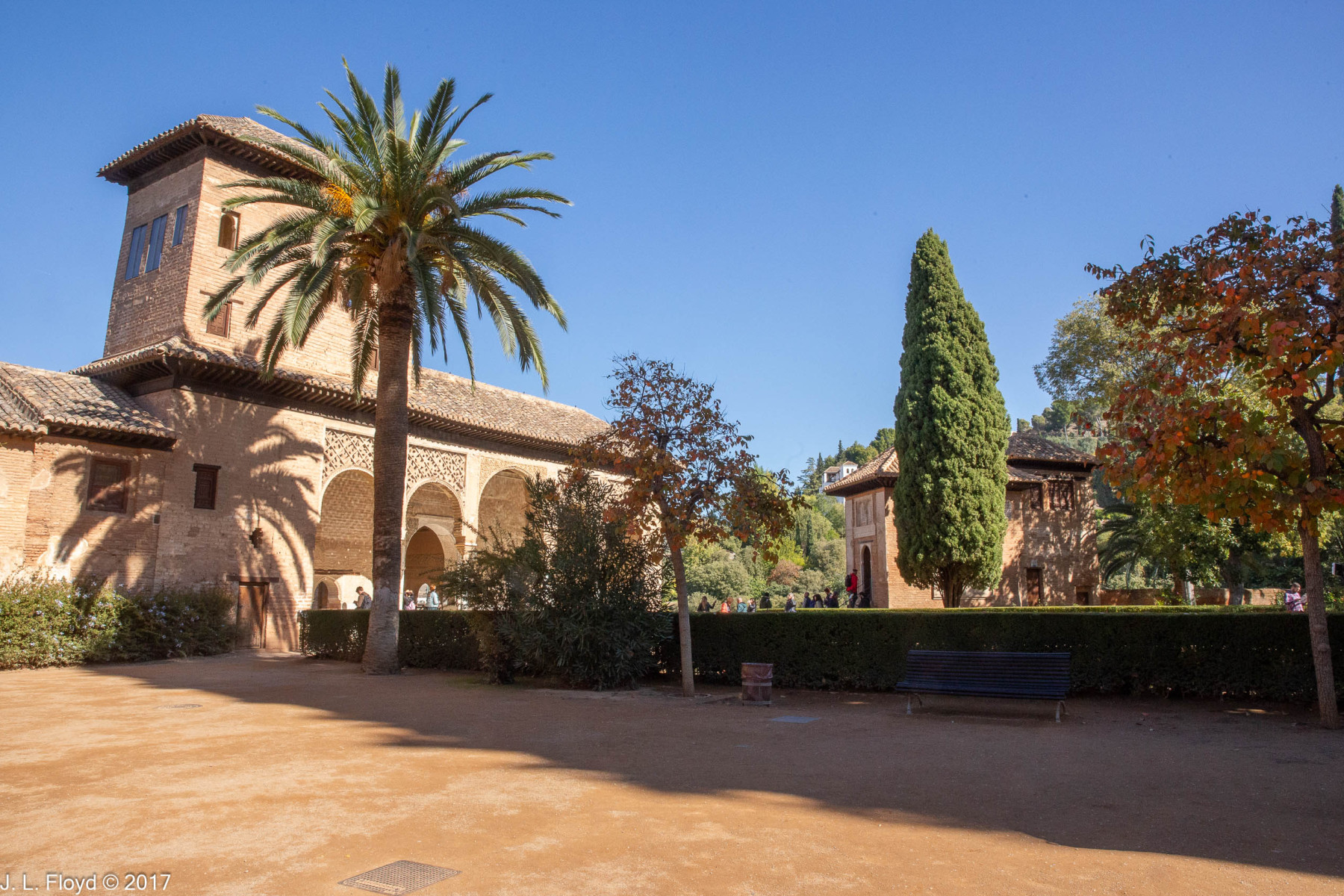
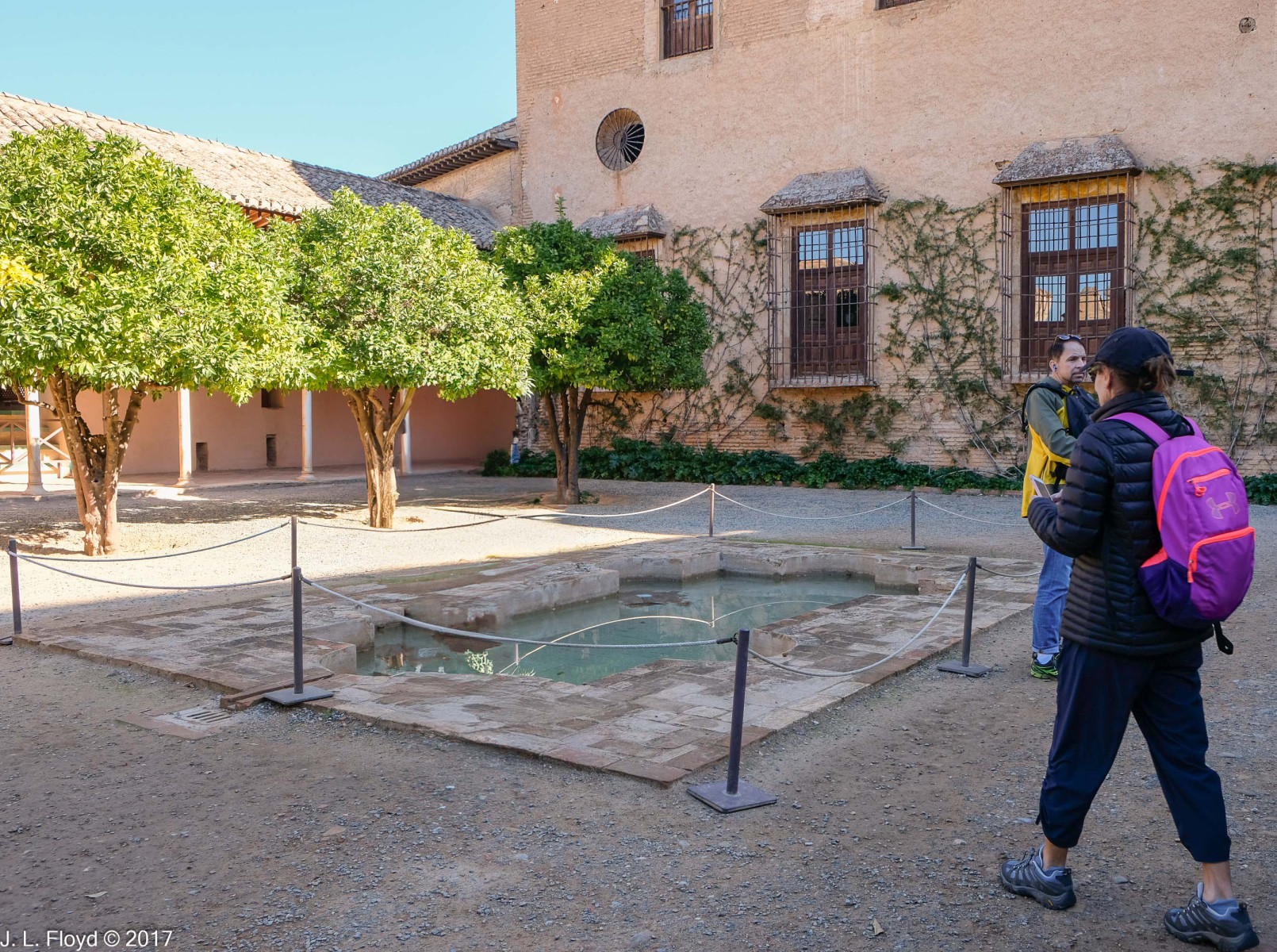
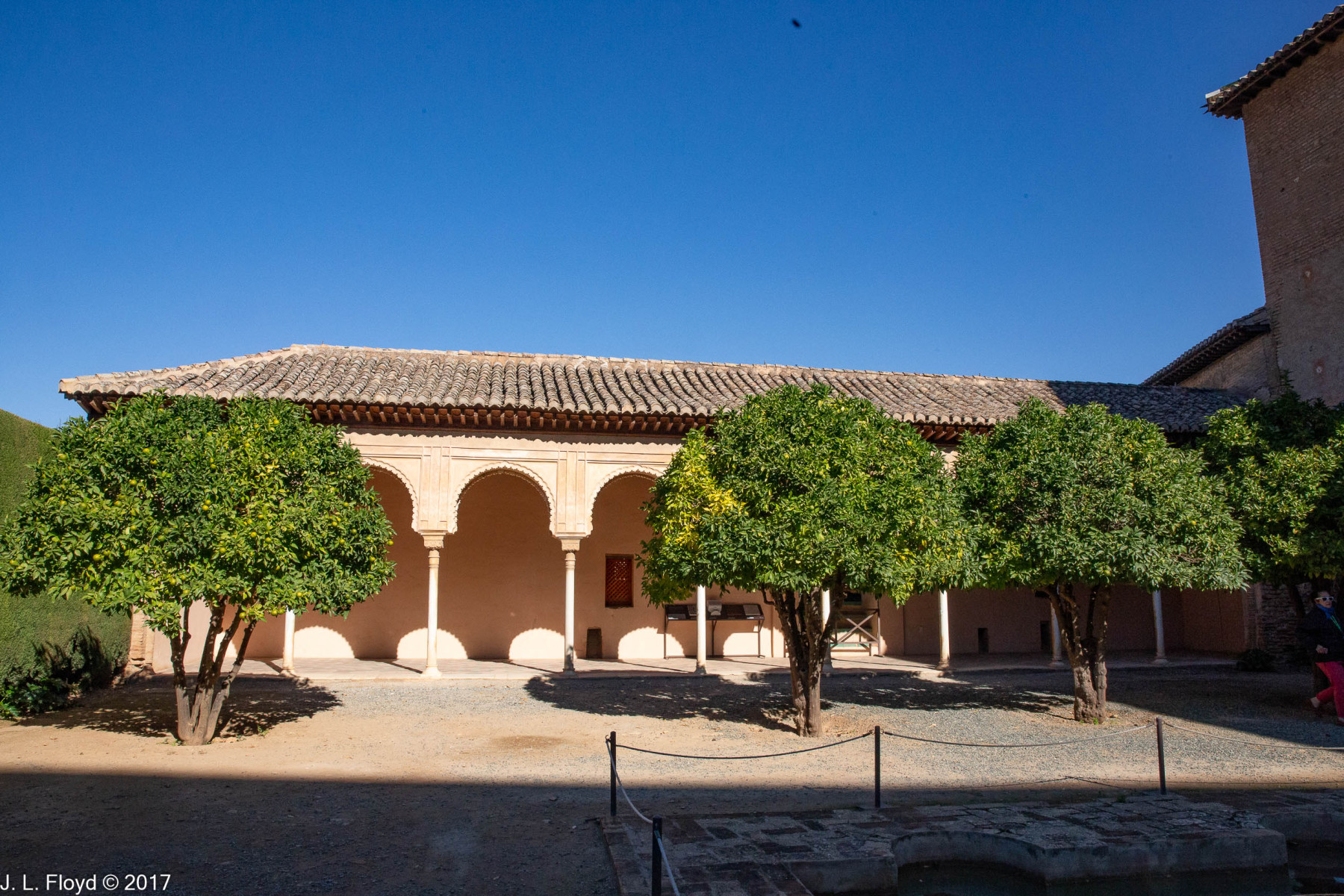
Looking east from the Patio de Lindaraja we could see the Partal Palace (El Palacio del Partal ), where we were headed next. Built by the Nasrid ruler Muhammed III (r. 1302-1309) in the early 14th century, it is the oldest surviving Nasrid palace. Unlike the other Nasrid palaces, after the conquest of Granada in 1492 it was given over to private ownership, and only reacquired by the Spanish government in 1891. By then it had undergone many changes, including partial demolition. Today only the northernmost structures – a portico and the Torre de las Damas (Tower of the Ladies) – remain, and the Partal Palace is also known as the Palacio del Pórtico. There is a pool in front of the portico, which may have been originally enclosed by other structures in the same fashion as the Court of the Myrtles in the Comares Palace. Sadly, the last private owner removed a wooden cupola ceiling from the Tower and shipped it to Germany, where it now resides in a Berlin museum.

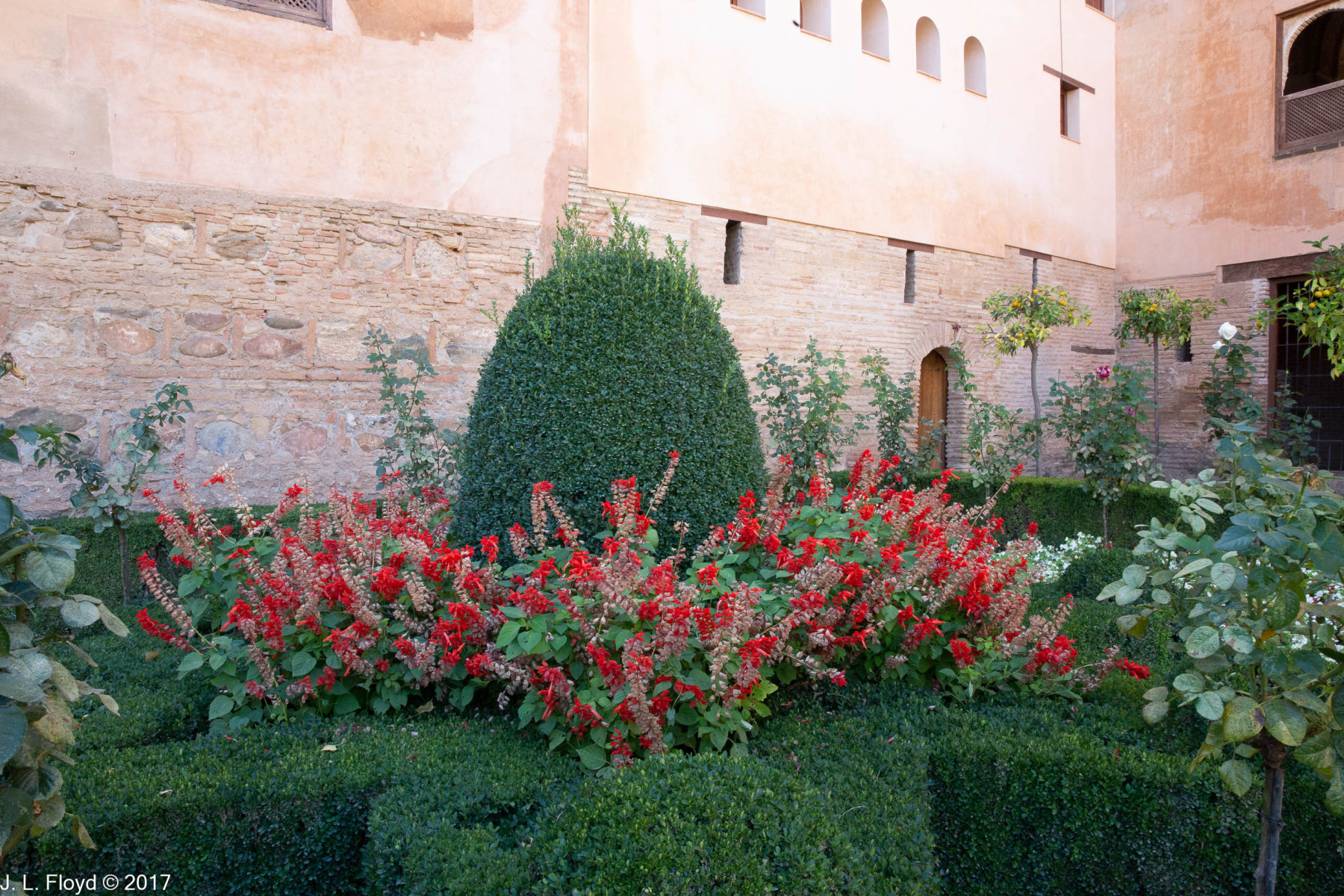
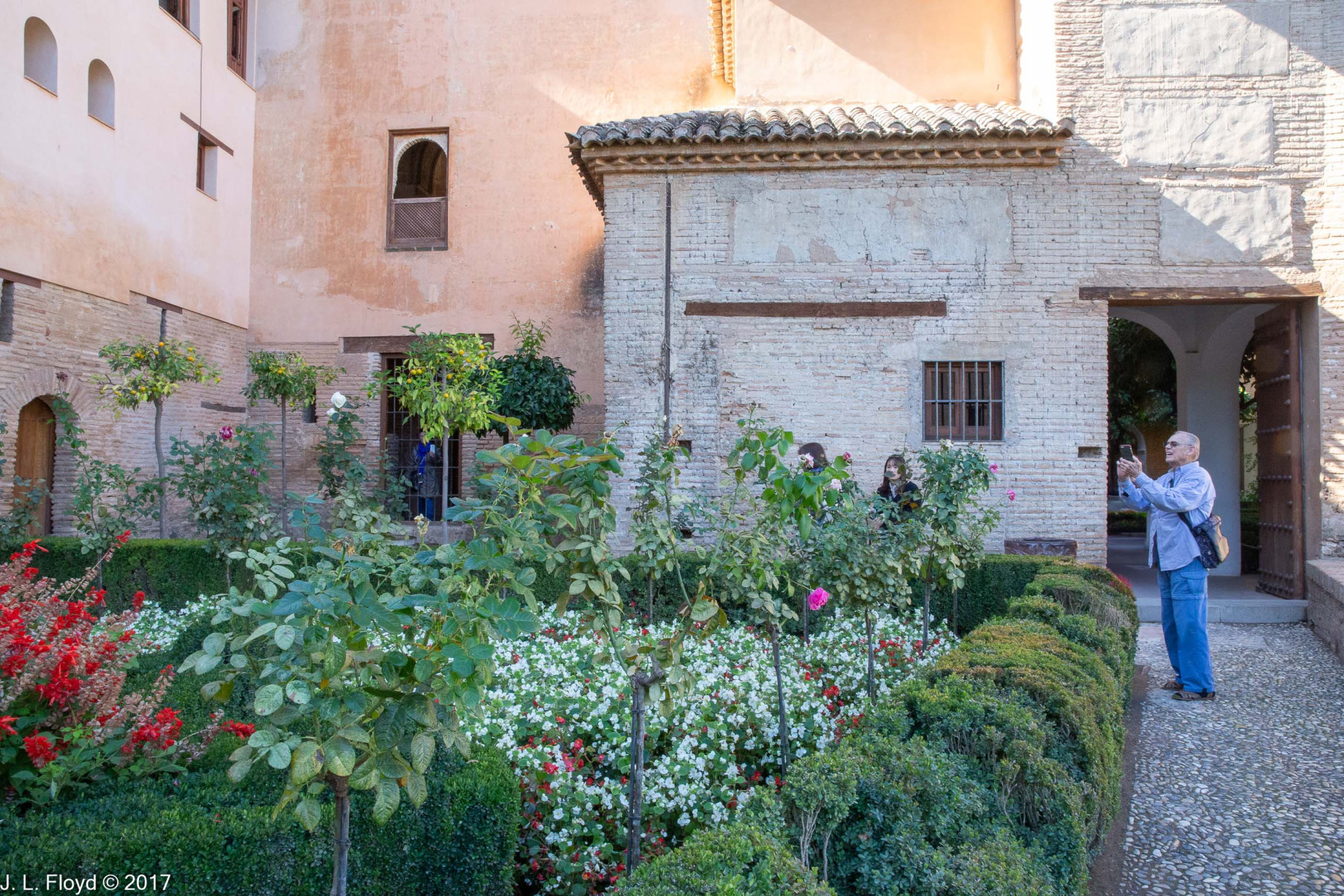
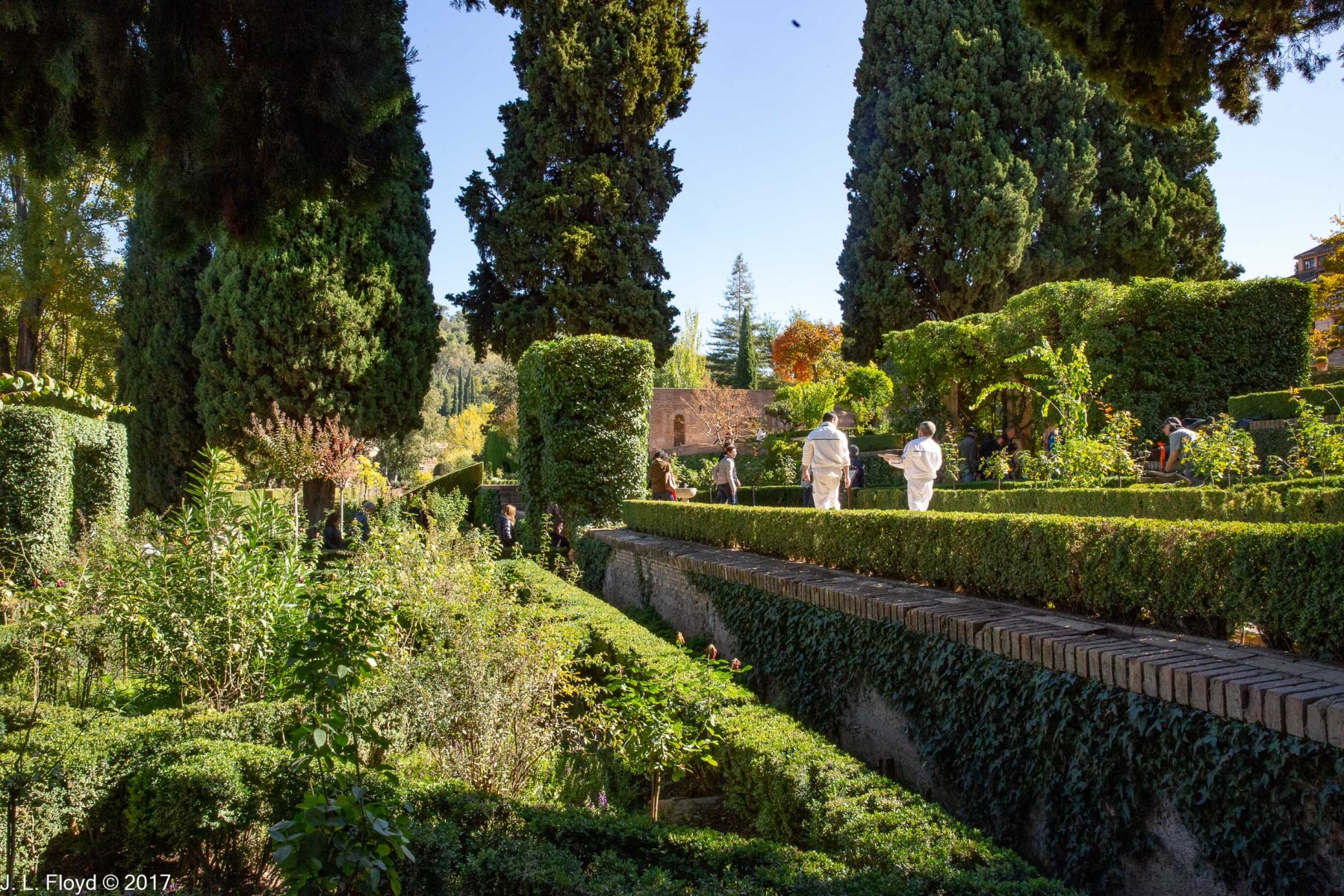
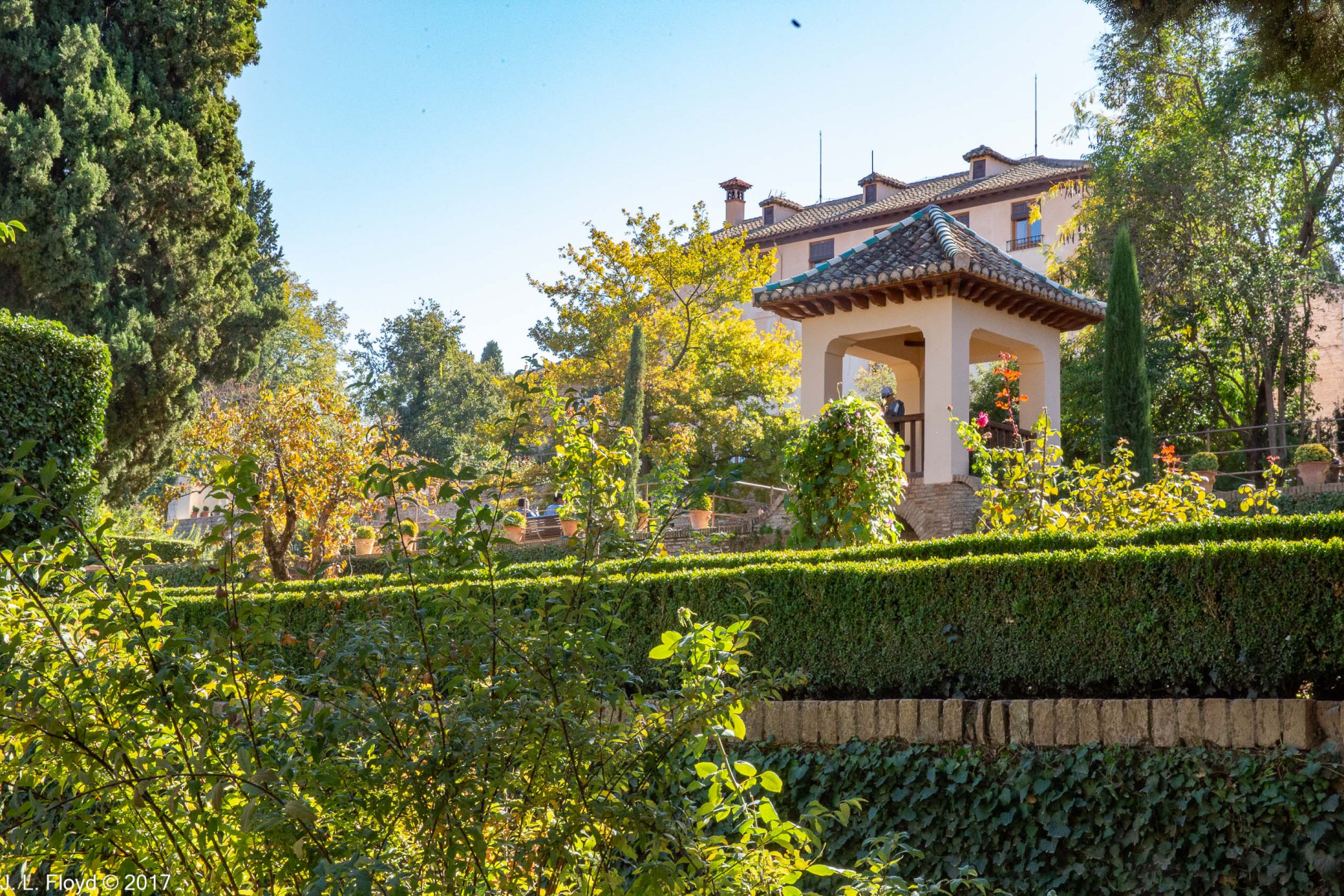
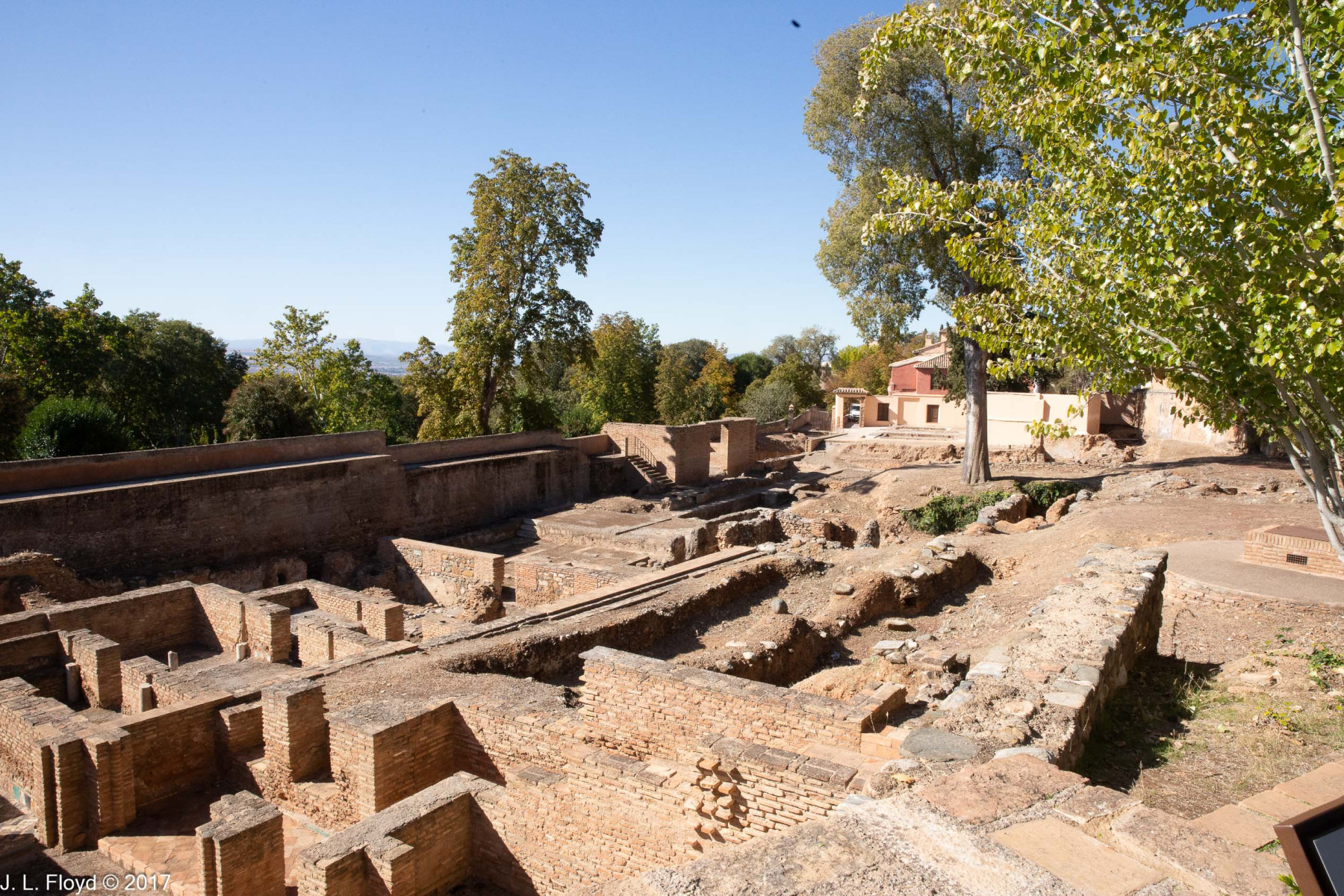
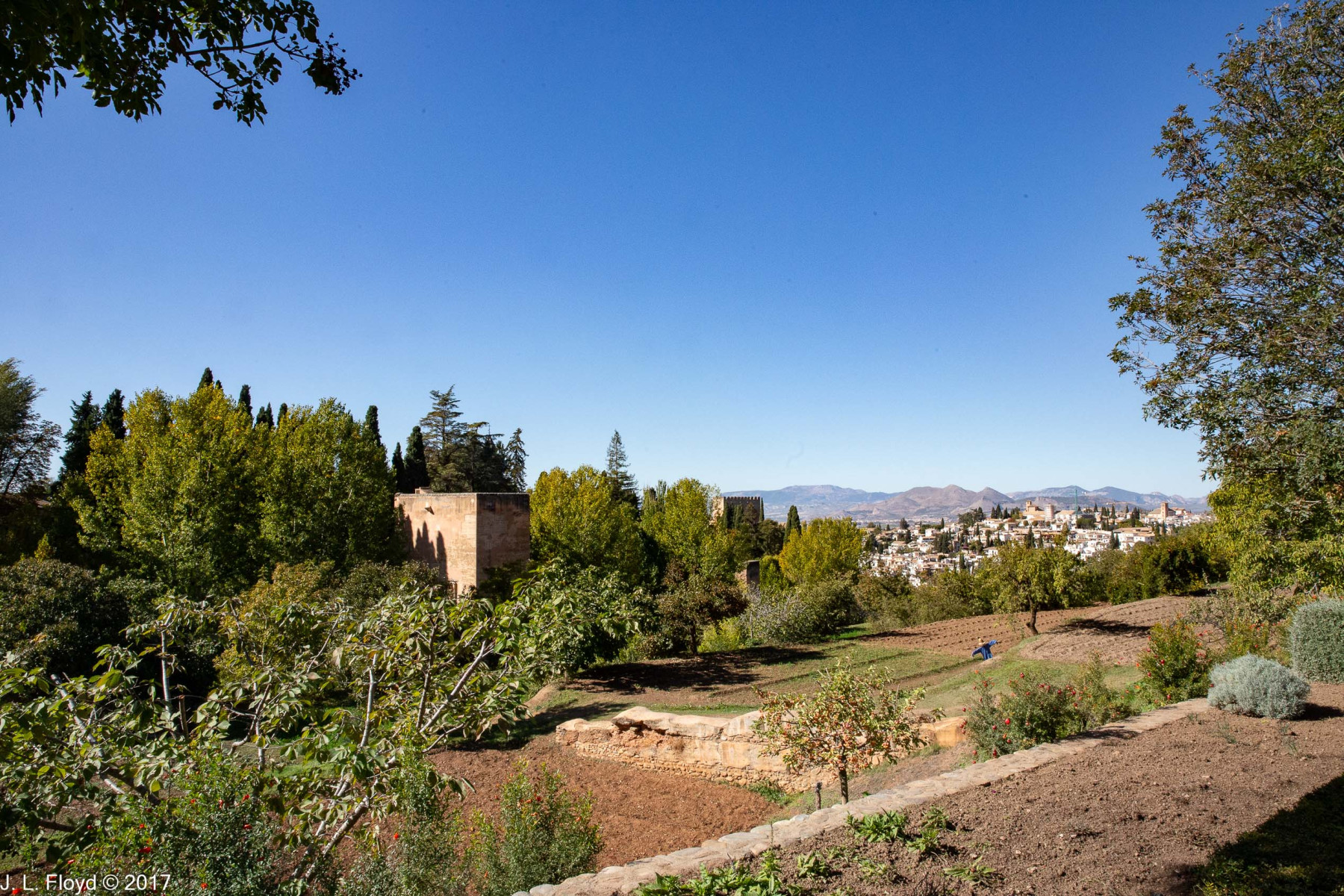
To the south of the Partal Palace, on a series of terraces rising above it, lie the Partal Gardens, a lush and idyllic bower perfect for restful strolling. It is not a holdover from Nasrid times, however; it is a twentieth-century creation, dating from the 1930s, undertaken with the purpose of improving a neglected area which become overgrown with weeds and brush — and also of facilitating archaeological activity. For the gardens occupy the site of what is now known as the Palacio del Partal Alto, or Upper Partal Palace, which preceded the present Partal Palace, sometimes called the Palacio del Partal Bajo to distinguish it from its predecessor. It was also called the Palace of Yusuf III (r. 1408-1417) because it was originally thought to have been built in his time, but now it is known to have been an earlier construction, from the reign of Muhammad II (1273–1302); Yusuf III merely remodeled it.

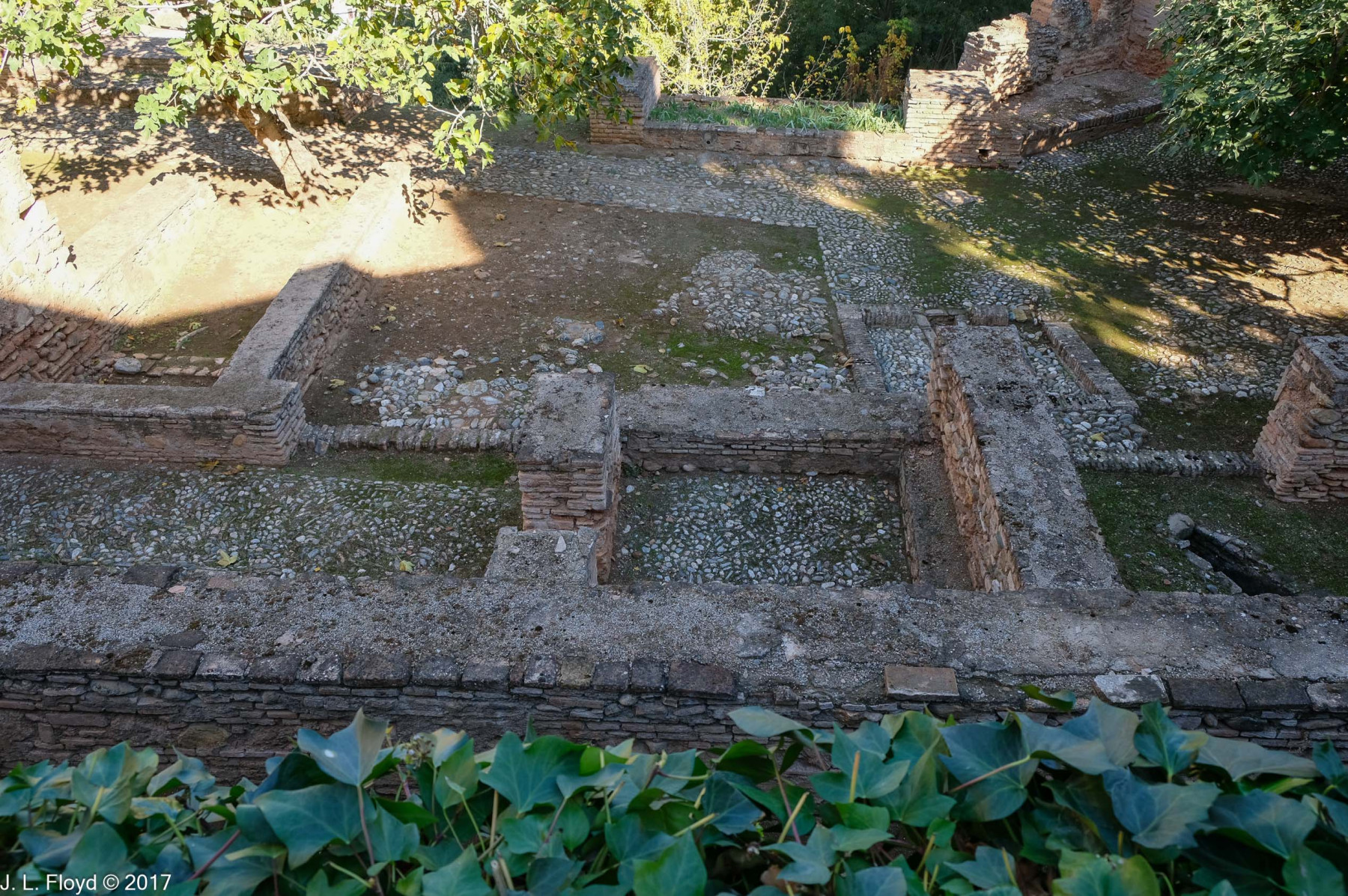
After the Christian takeover of Granada, Ferdinand and Isabella handed over the Upper Partal Palace to Iñigo López de Mendoza, first Marquis of Mondejar and second Count of Tendilla, who had served with distinction in the Granada wars, and named him Governor (alcaide) of the Alhambra and Captain General of Granada. The palace remained in the hands of the Tendilla-Mondejar family until 1717, when King Philip V fired the current Marquis, José de Mendoza Ibáñez de Segovia, abolished the office of alcaide, and confiscated all his properties. He did this in retaliation for Mendoza’s support of his rival for the Spanish throne, Archduke Charles of Austria, during the War of the Spanish Succession (1701-1714). Apparently the confiscation did not take effect immediately or was not complete, however, because Mendoza had time to sell some of the palace’s furnishings (now found in private collections) and demolish the palace itself, perhaps out of spite. (The sources currently available to me do not explain how he was able to do this after the property was confiscated.) In any case it began to be excavated in 1934, but only the foundations remain and some of them are still buried.

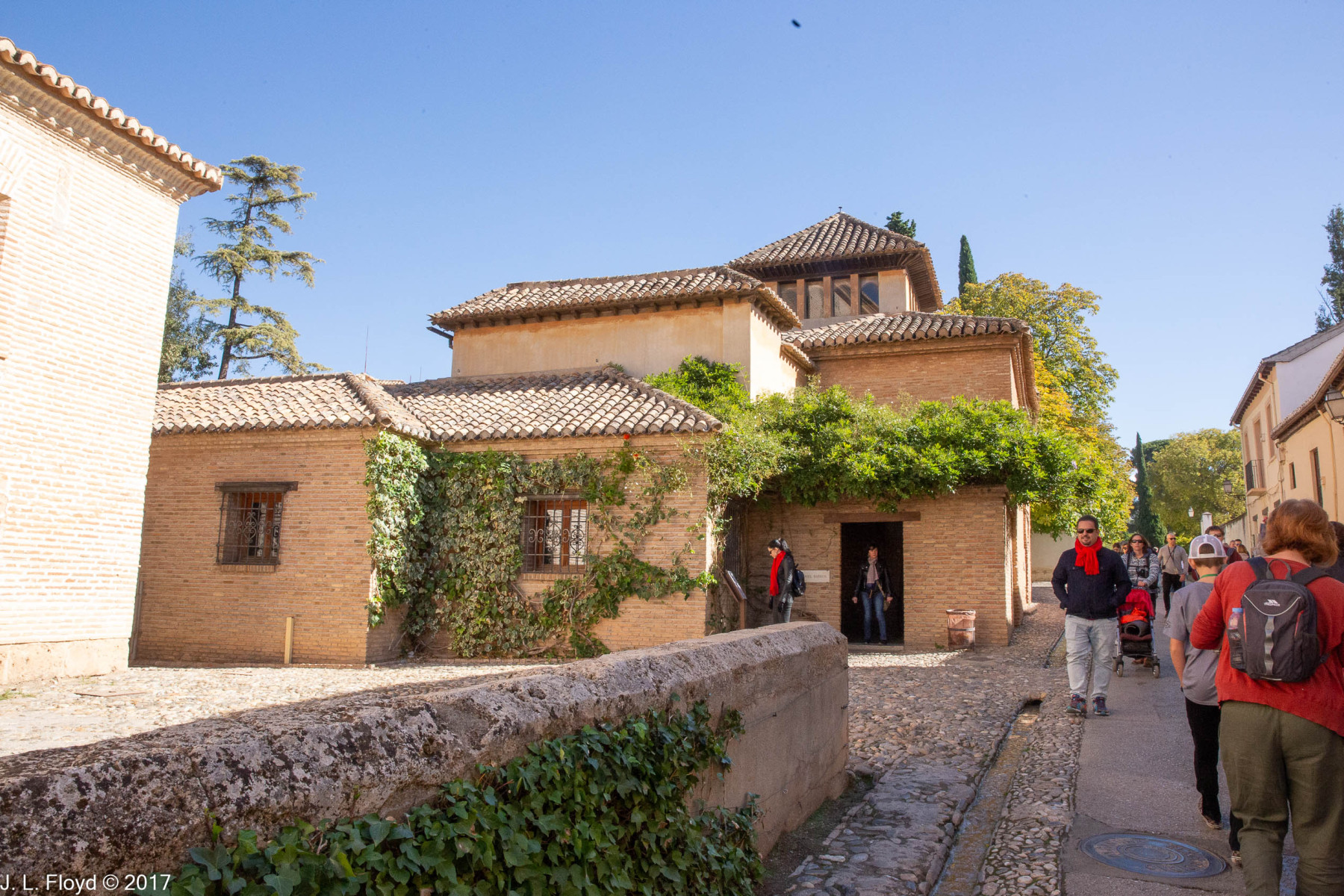
From the Partal Gardens we traipsed back toward the Charles V palace and then turned east again to follow the Calle Real de la Alhambra, past the Church of Santa Maria, the Ángel Barrios Legacy Museum, various administrative offices and the gift shop.

The Church of Santa Maria de la Encarnación stands on the site of the congregational (main) mosque of the Alhambra complex, which was commissioned by Emir Muhammad III (r. 1302-1309) and completed in 1305. After 1492 it was converted into a Christian church, but it fell into disrepair and was demolished in 1576. The present church, which belongs to the Archbishopric of Granada, was begun in 1581 and completed in 1618. The interior, which I did not visit, is furnished in Baroque style.

Ángel Barrios (1882-1964) was a Spanish composer and concert guitarist who was born in Granada, where his family apparently lived in a private house inside the Alhambra that served as a gathering place for artists, musicians and poets. The house was located next to the hammam (bathhouse) of the mosque. The hammam was partly demolished in 1534, and its remains were later incorporated into the house, which was built and/or remodeled in the 17th-18th centuries. In 1934, the architect Leopoldo Torres Balbás (1880-1960) undertook a reconstruction and restoration of the bathhouse, which coincided with the end of the Barrios family’s residence there. The house was then converted into a small and intimate museum where the instruments – piano and guitar – and personal effects of the composer are displayed next to the wall of the bathhouse; in addition, the museum incorporates an archaeological garden, with a pool recovered from the Palacio del Partal Alto, which now serves as a venue for concerts and other public events. I would have loved to visit this museum, along with the main museum in the Palace of Charles V, but that would have required another day in the Alhambra. I consider myself fortunate to have seen as much of the Alhambra as I did.

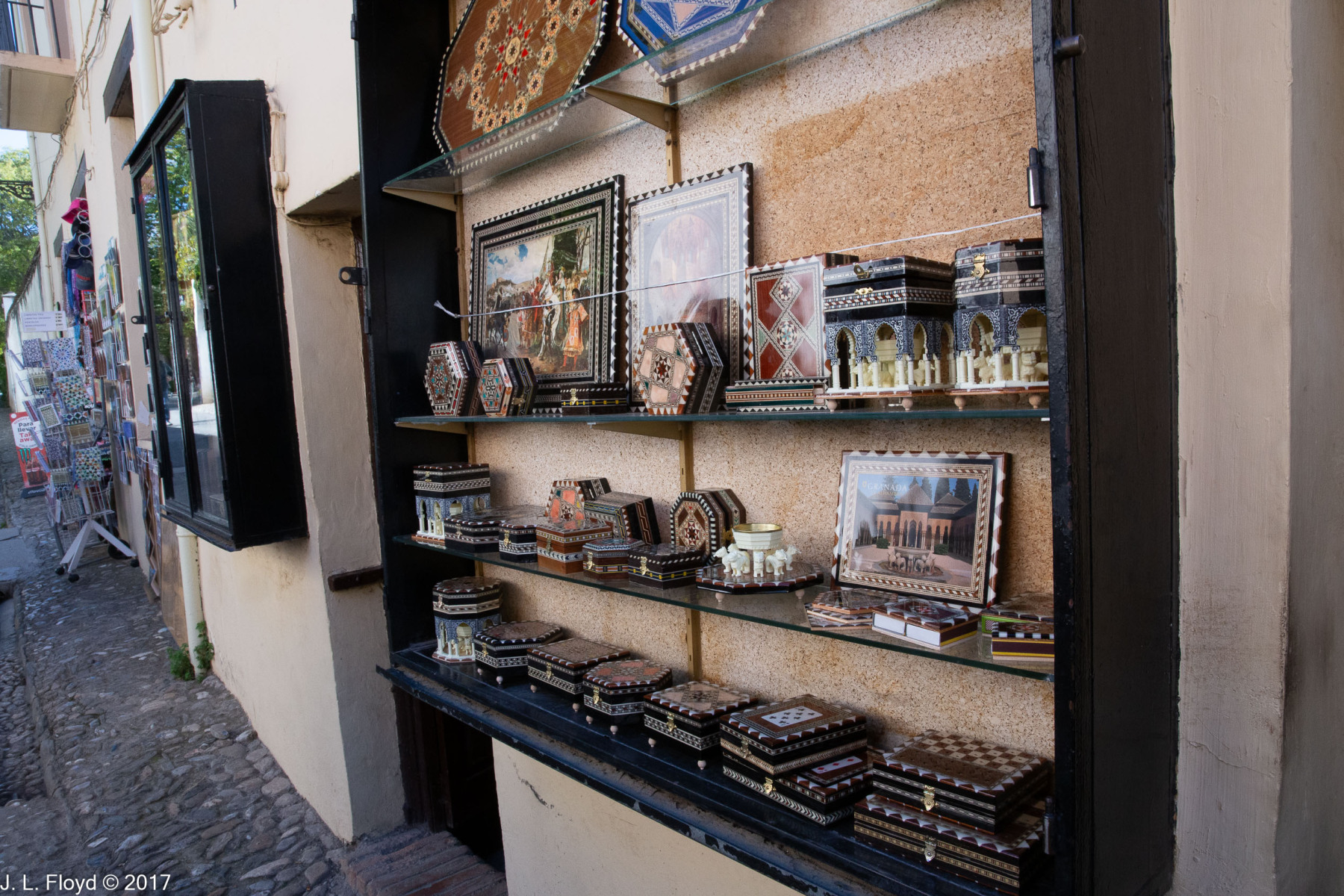
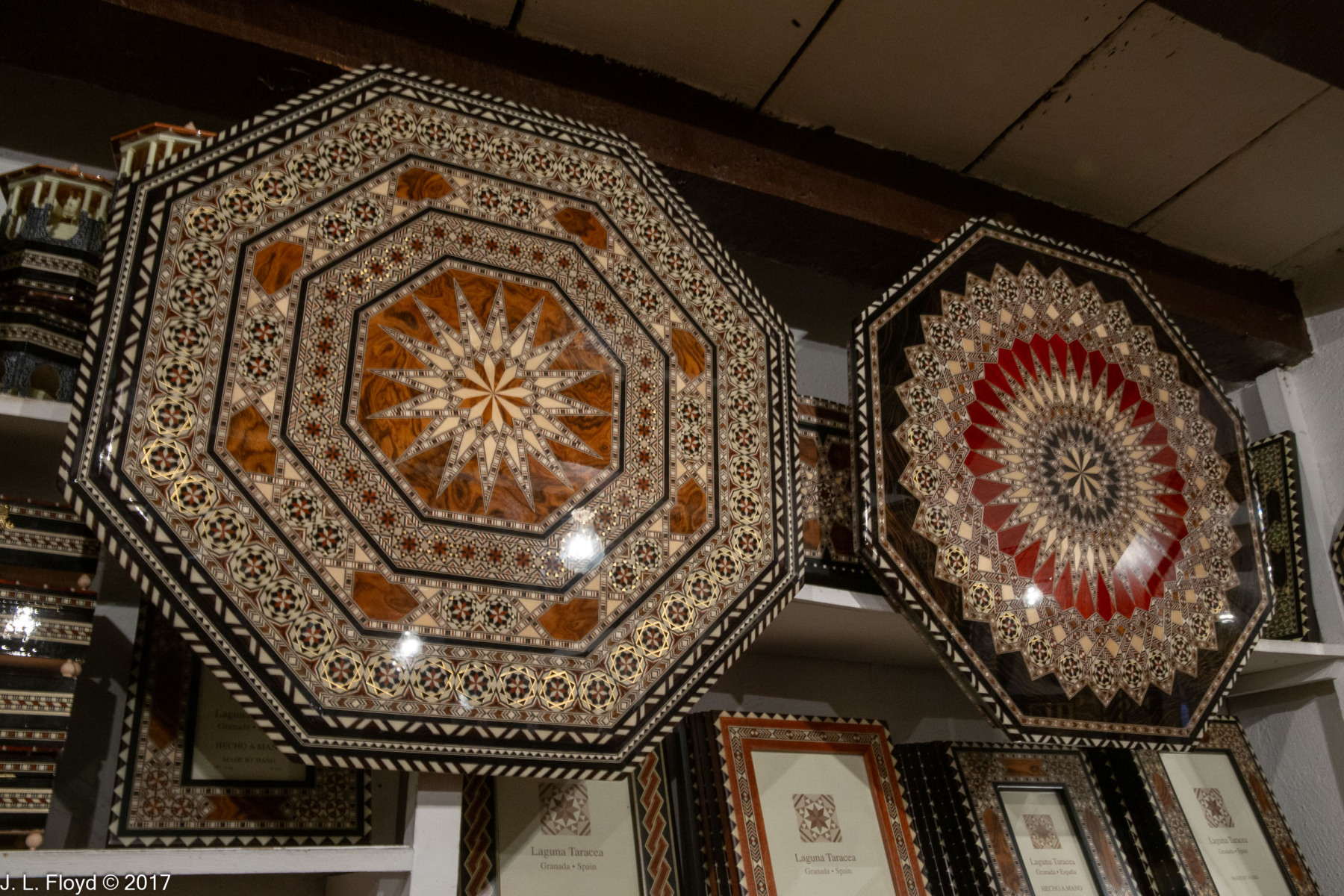
The gift shop was full of beautiful wares, most notably jewel boxes, wall plaques, picture frames and other objects lacquered with incredibly intricate and elegant designs, somewhat reminiscent of the Palekh lacquer art I had encountered in Russia, although the Alhambra offerings featured abstract geometric designs rather than the fairy-tale scenes gracing the Palekh items. All of them were exquisitely beautiful and far beyond the constraints of my budget, so I confined myself to the purchase of a few postcards and photo prints, which now hang on the walls of our home.

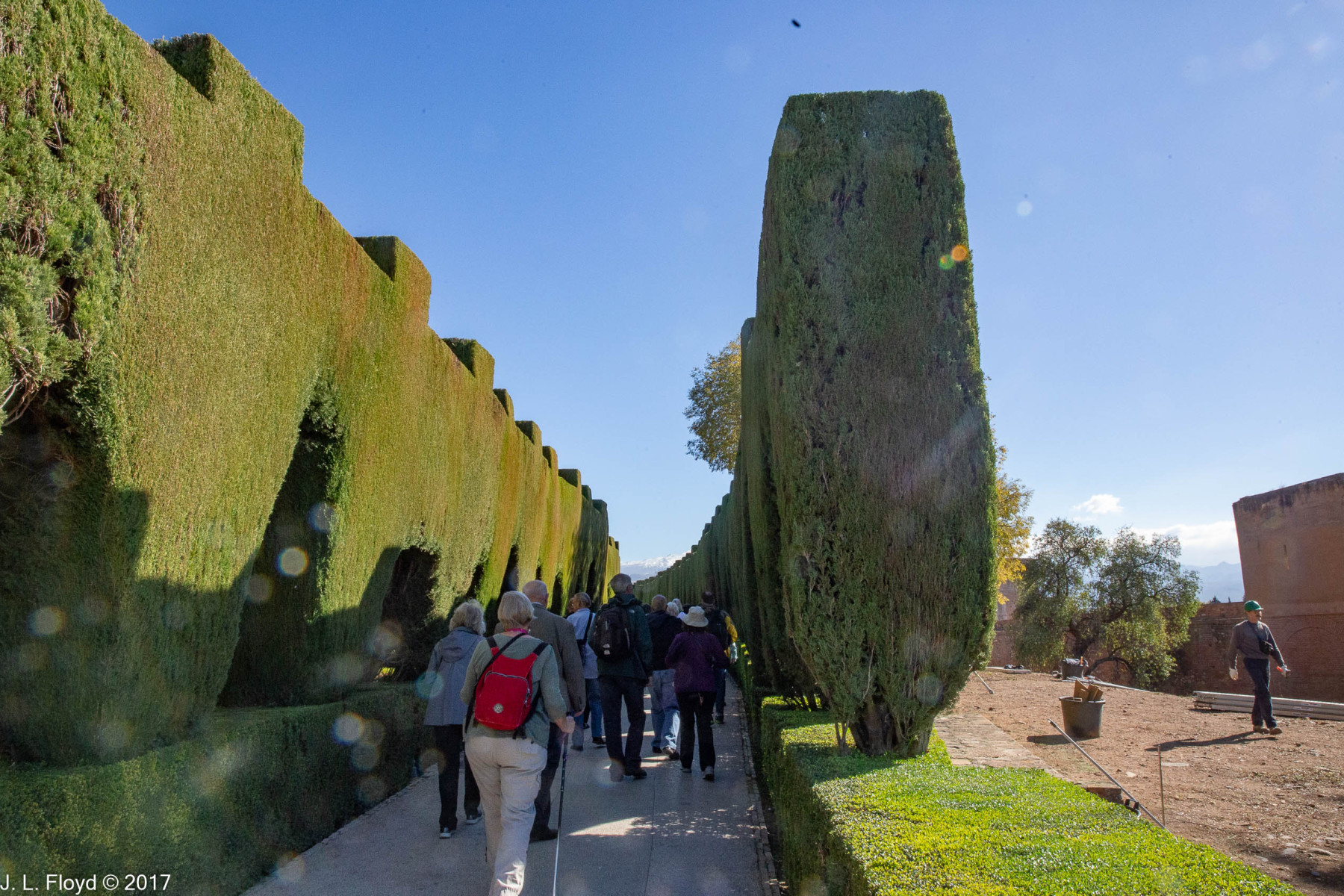
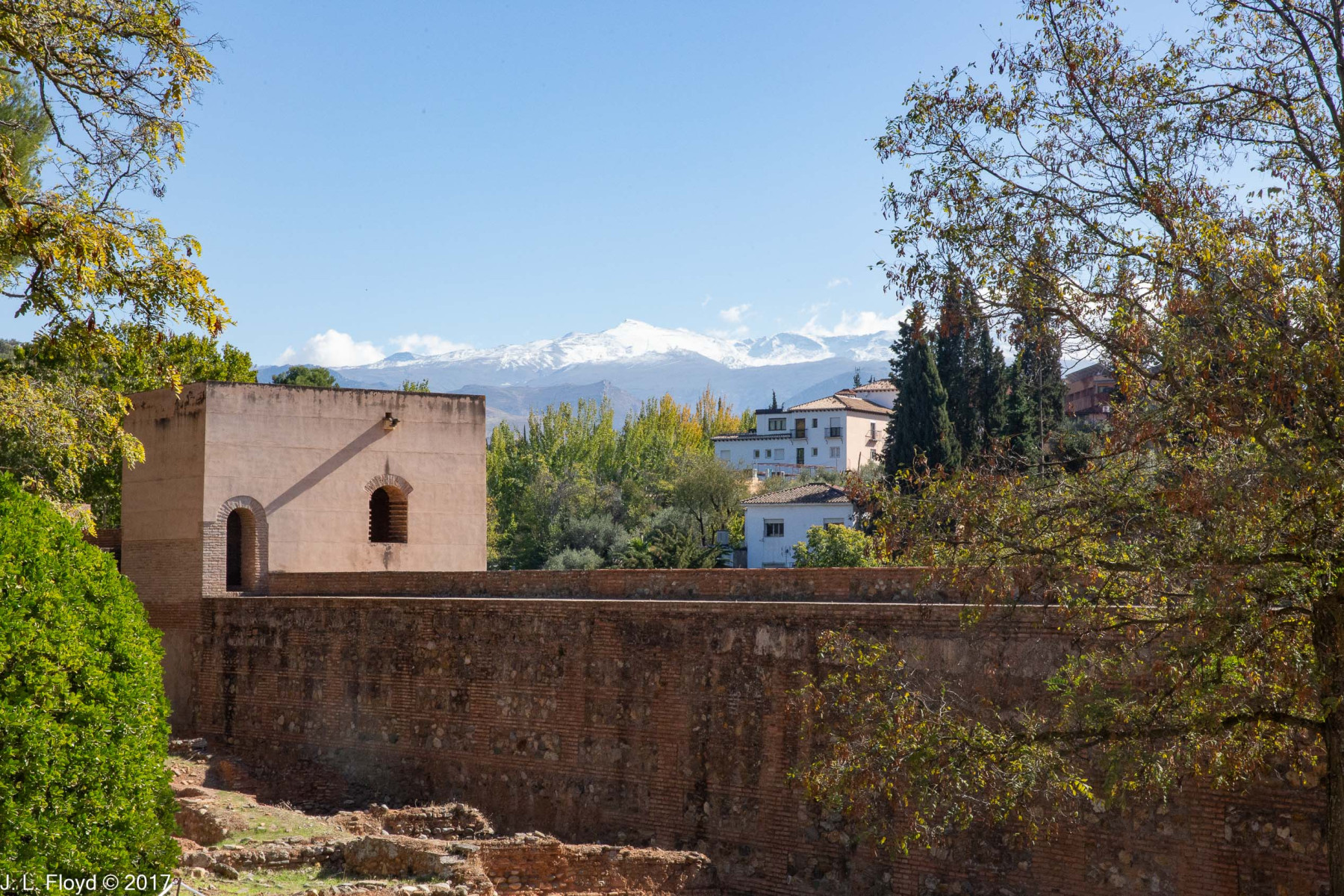
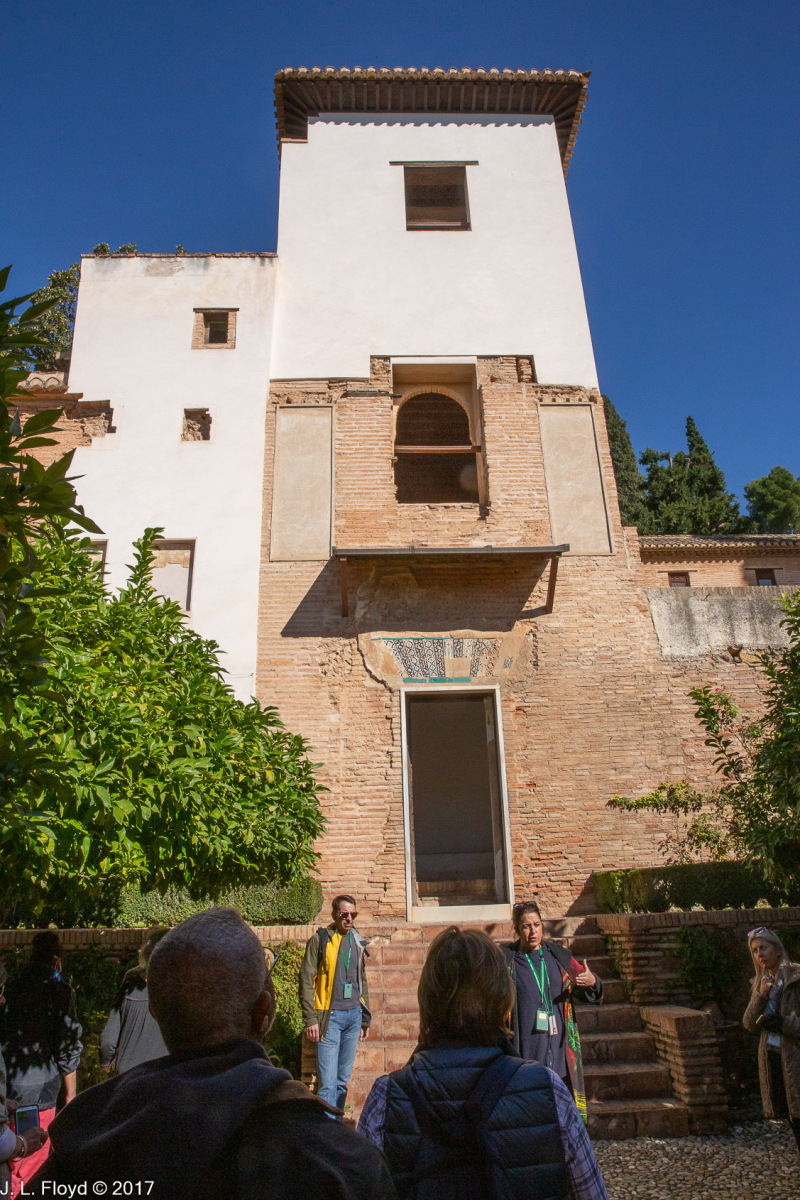
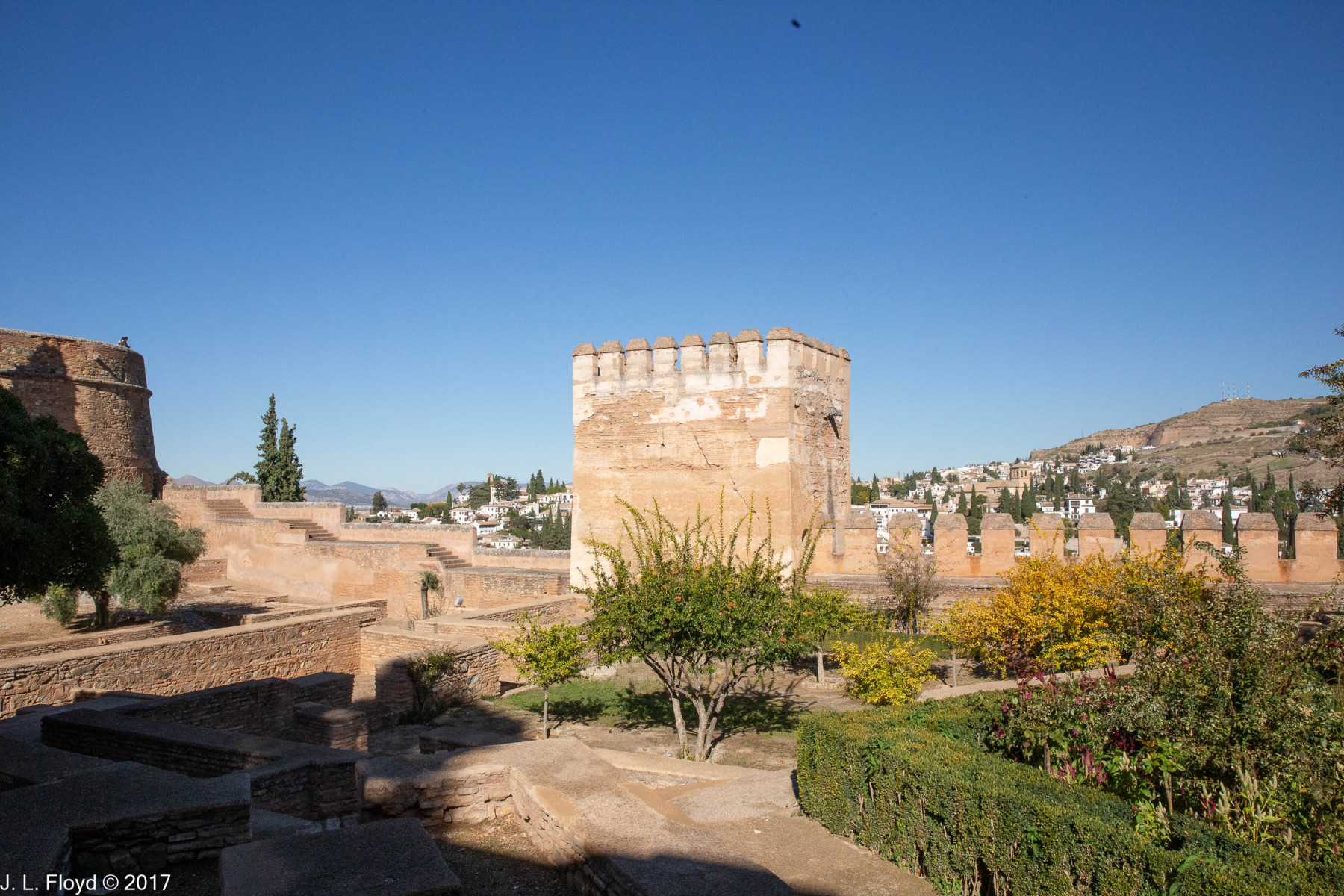
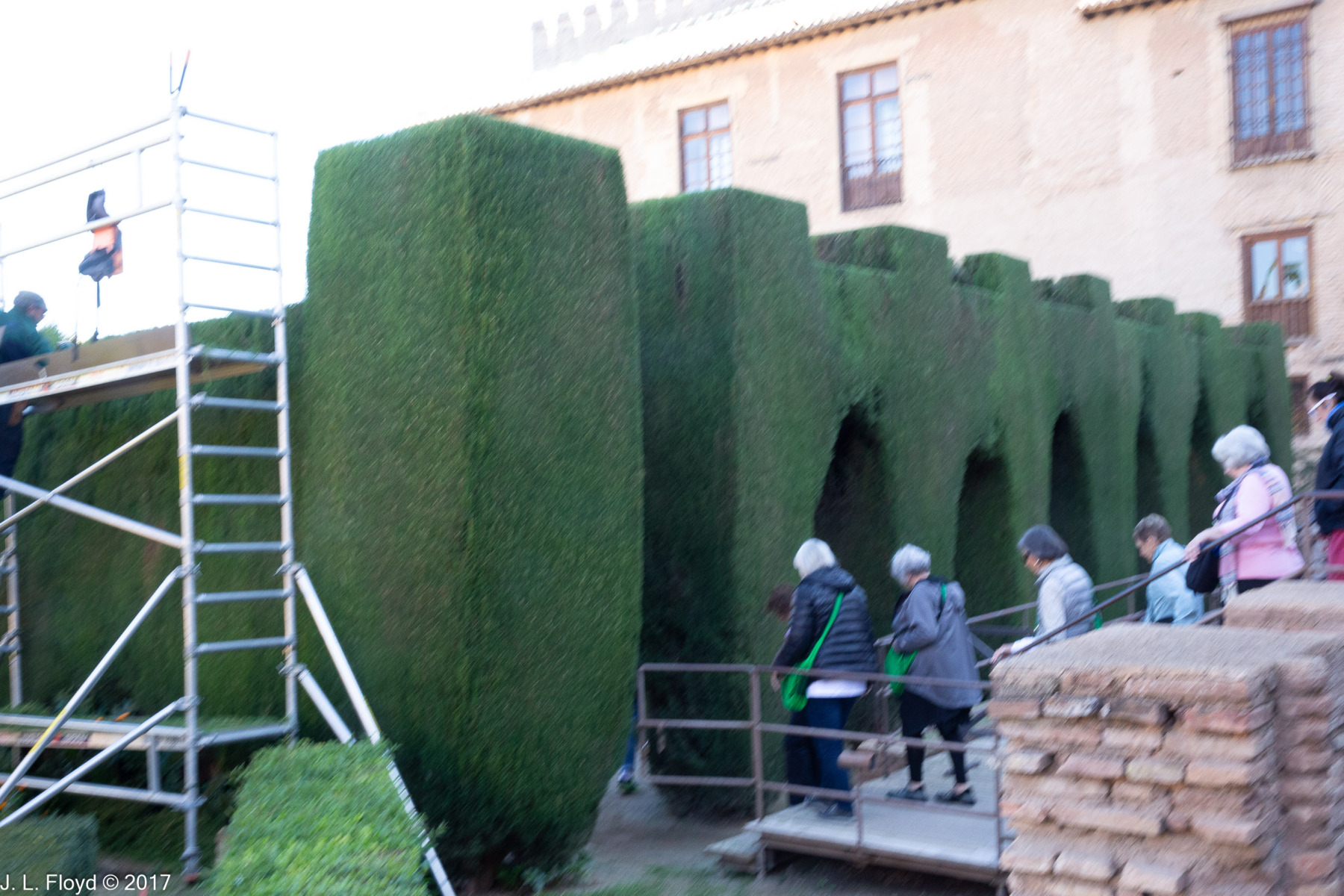
Resuming our trek eastward on the Calle Real, we passed the ruins of the Palace of the Abencerrajes, among others, until eventually the road became a narrow walkway between two towering hedges. Although this was Spain and not Crete, I expected at any moment to see the Minotaur lurking in the shadows. But eventually we emerged into an open space, where I found myself completely disoriented, without a clue as to where we were. Writing this account seven years after the trip, I’m not sure exactly how we proceeded from there; judging from the map of the Alhambra and the photos I took along the way, we trudged past the Torre de Baltasar de la Cruz before reaching the Torre del Agua at the east end of the Alhambra. There we descended some steps to the foot of the tower and found ourselves next to a structure which resembled an aqueduct. Indeed it turned out to be the the terminus of the Acequia Real de la Alhambra, which supplied water to the Alhambra from the Darro River, 6 kilometers away. From there we embarked on the path to the Generalife, the idyllic summer palace of the Nasrids.

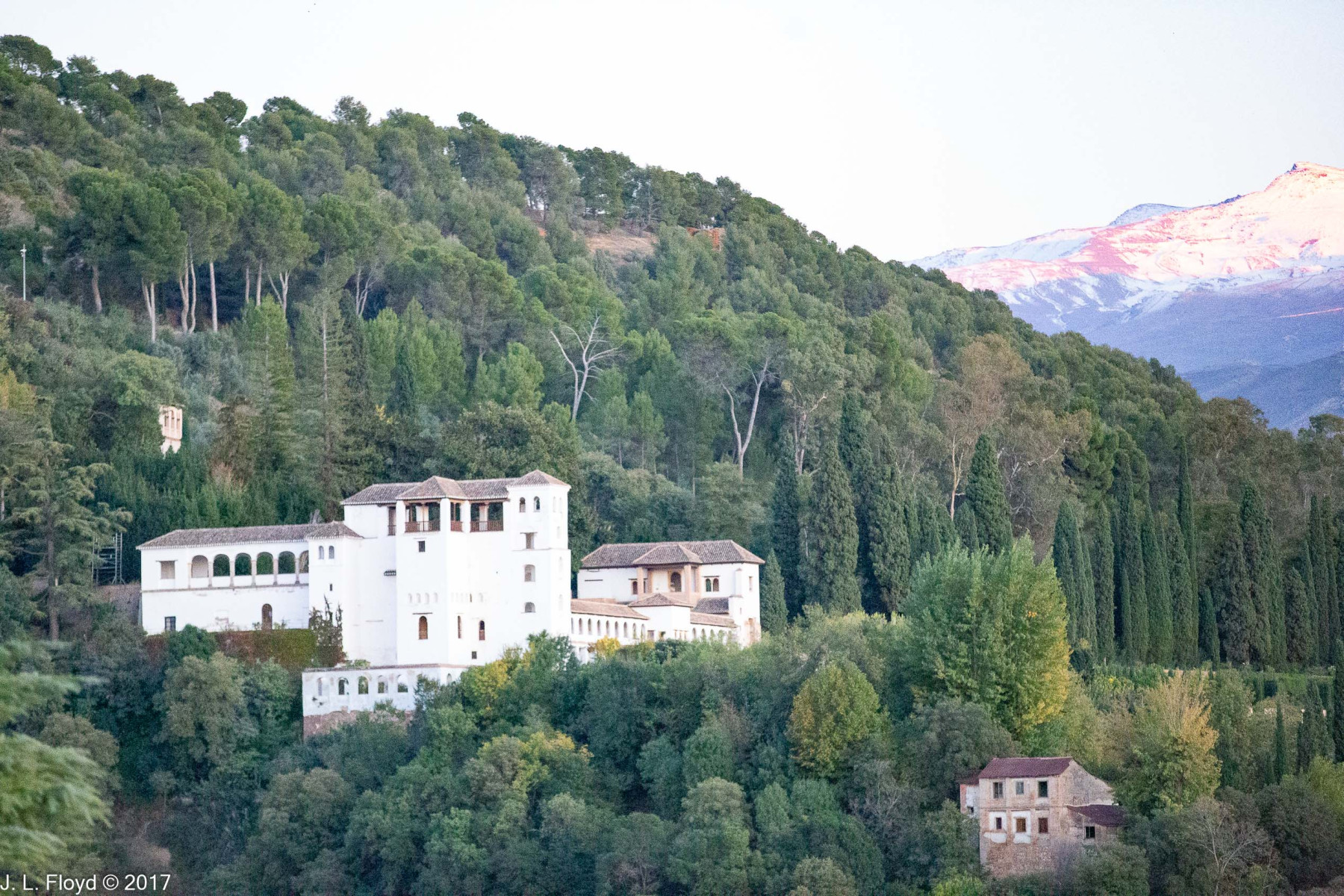
The derivation of the name is disputed, but there is a tradition that Generalife is a Spanish rendition of the Arabic phrase jannat al-‘arīf, meaning something like “garden of the artist.” Its origins are also murky, but it is thought that the initial construction took place around the turn of the 14th century; in any case, it was frequently remodeled, redecorated and enhanced over the following centuries, both by Muslim and Christian owners. It was built as a private retreat and pleasure palace for the Emir and his family. From the start it was surrounded by extensive gardens, which provided sustenance as well as esthetic enjoyment for the inhabitants.

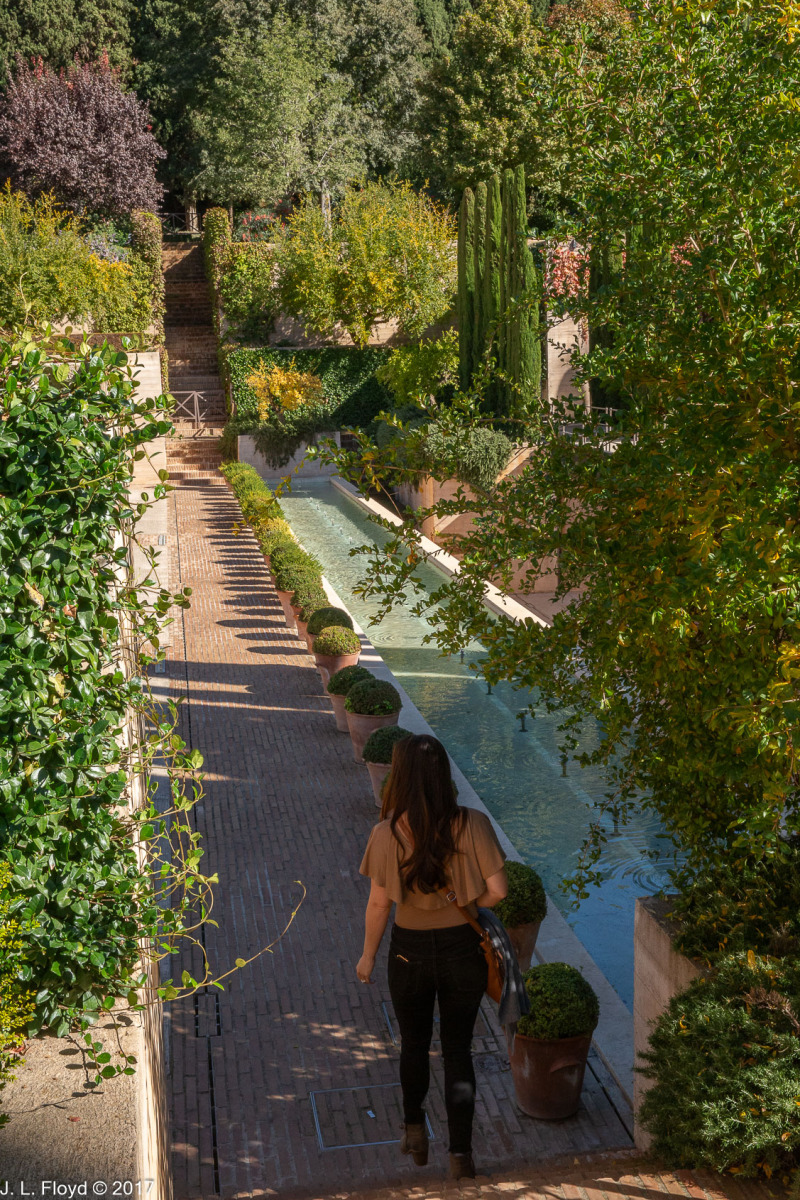
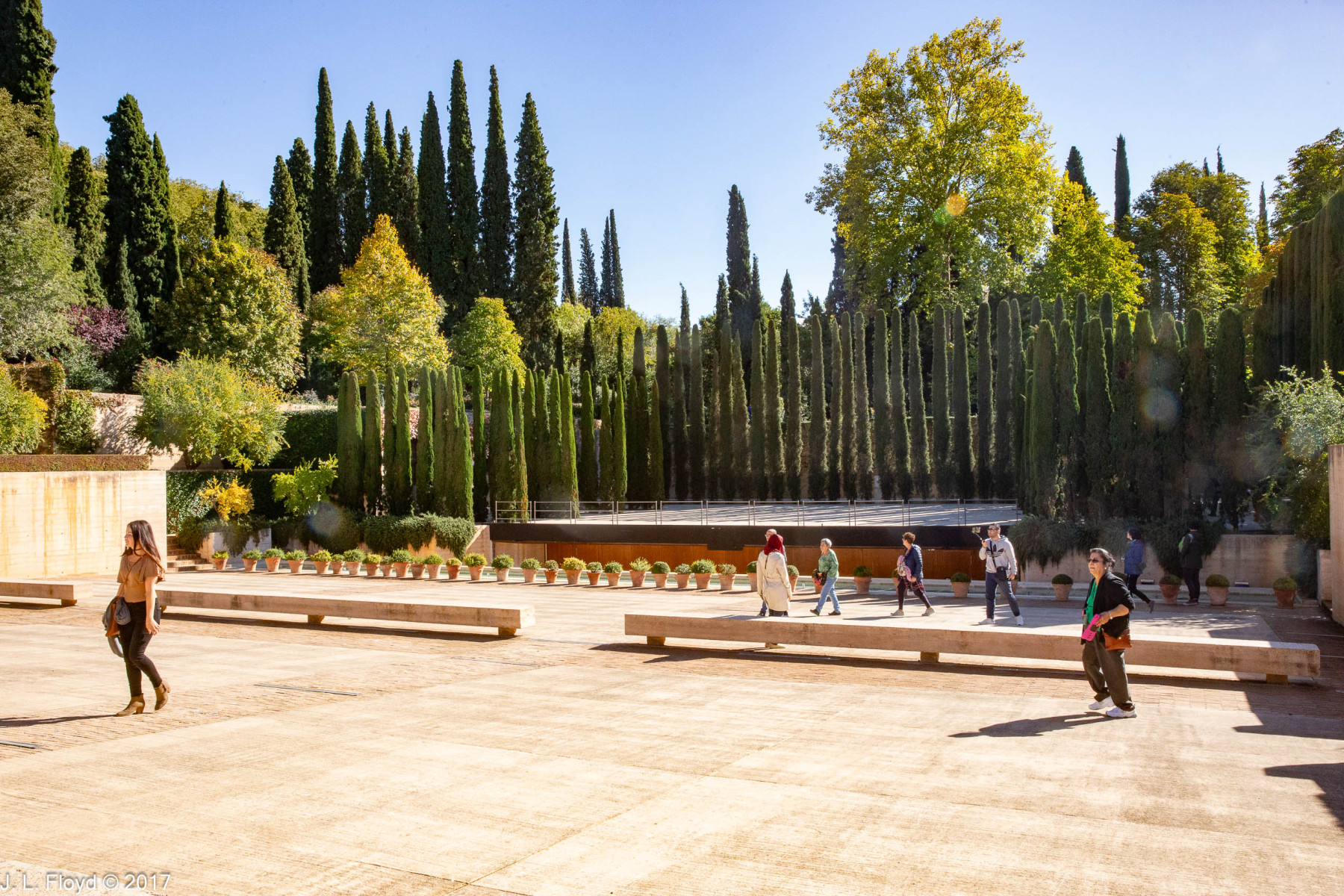
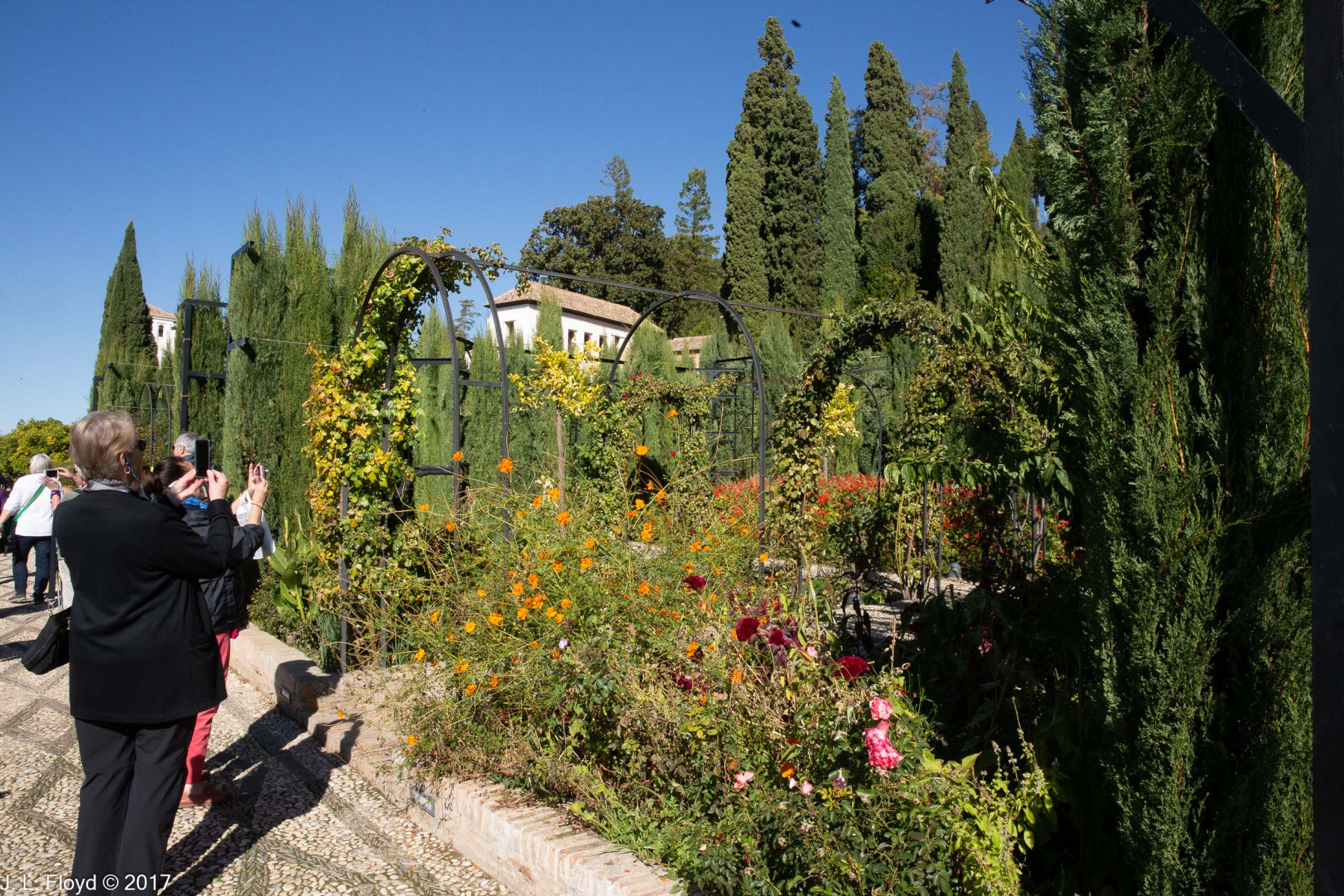
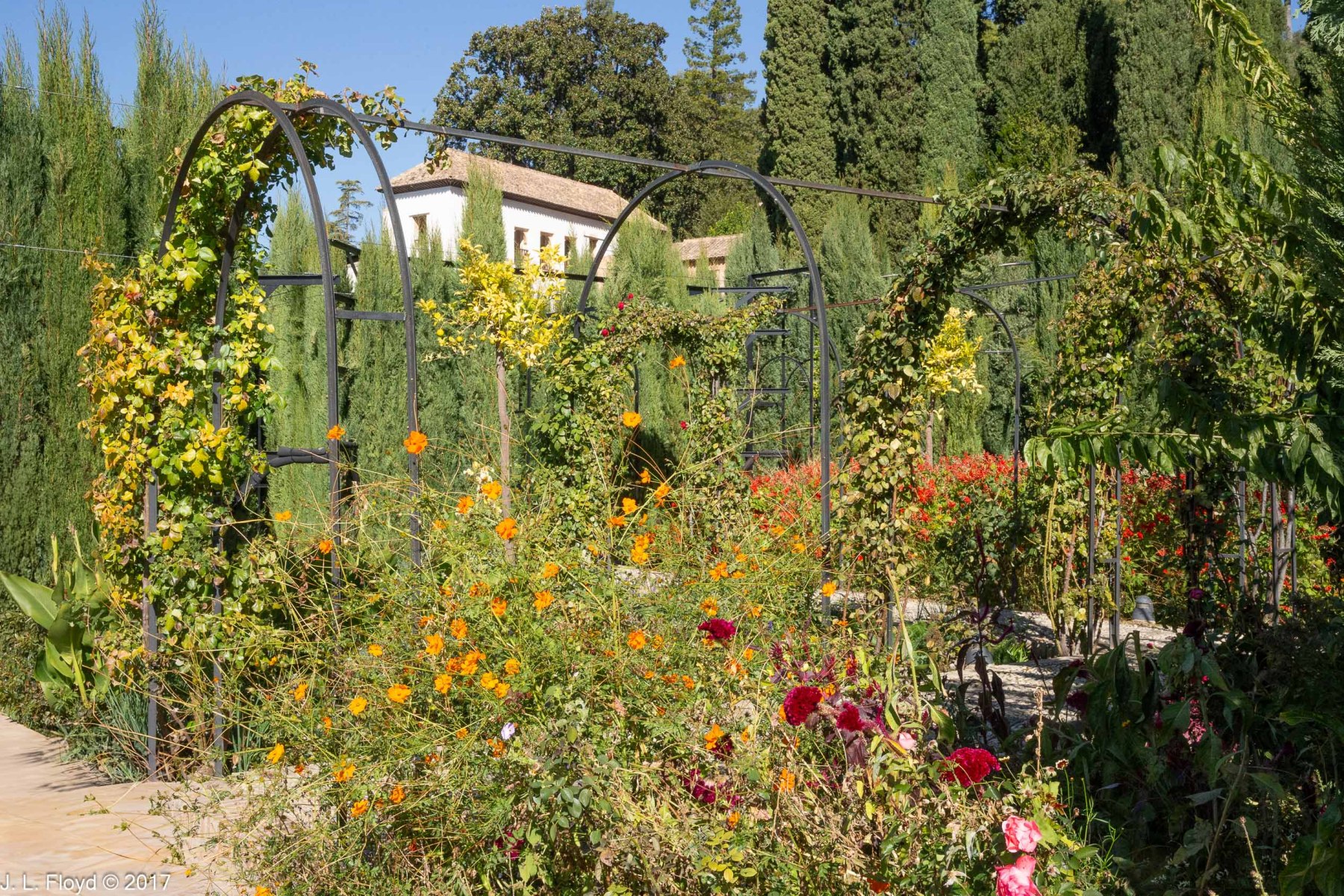
From the Torre del Agua, one reaches the Generalife by walking north on the Paseo de los Nogales, the Promenade of the Walnut Trees, which passes by the west side of the palace grounds. At the south end of the property we encountered the Teatro del Generalife, an open-air theater designed to serve as the main venue for ballet performances at the Granada International Festival of Art and Dance. It was opened in 1954 and has gone through several renovations since, including a major one in 2005. On its north side is a set of steps that leads to a wall of cypress hedges with archways that open into a panoply of gardens. These are known as the Jardines Nuevos, or New Gardens, to distinguish them from the older market gardens, known as Las Huertas, on the terraced hillside between the Generalife and the walls of the Alhambra. The Jardines Nuevos in their present form are a twentieth-century feature and have little in common botanically with their Nasrid predecessors. Regardless, they do convey an extremely satisfying esthetic experience.

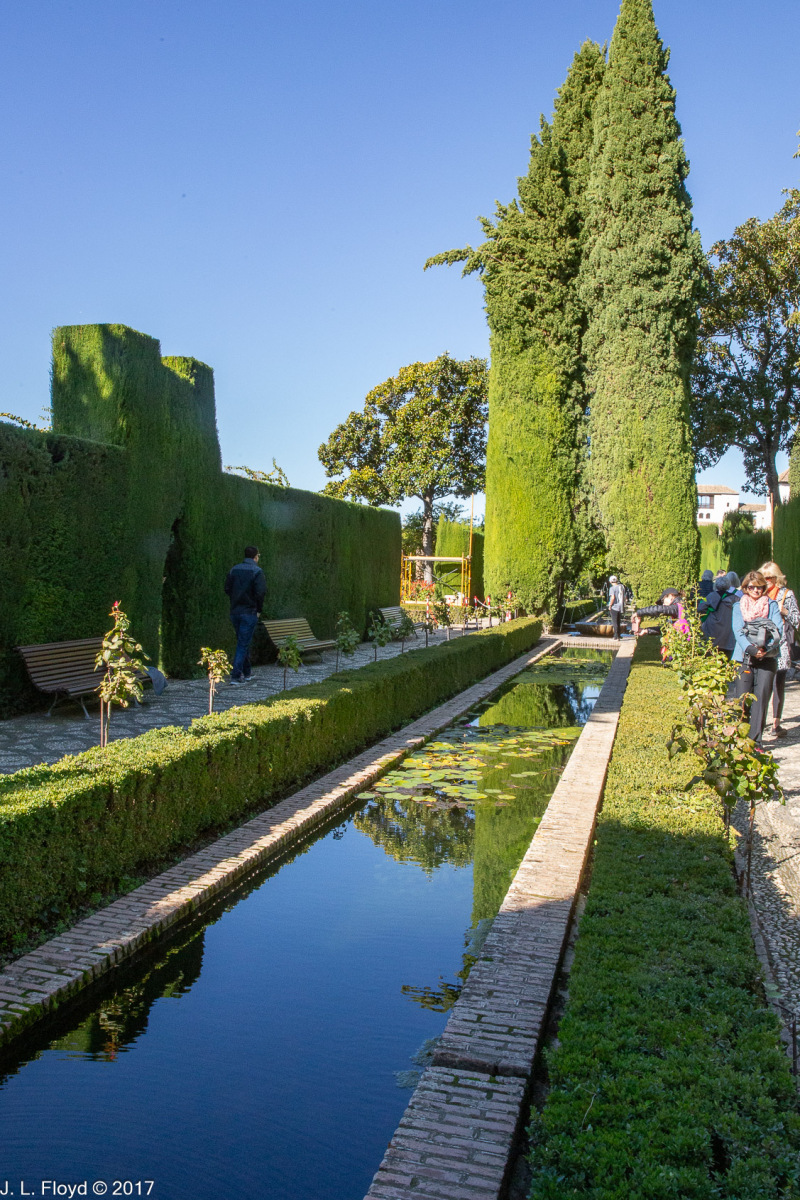
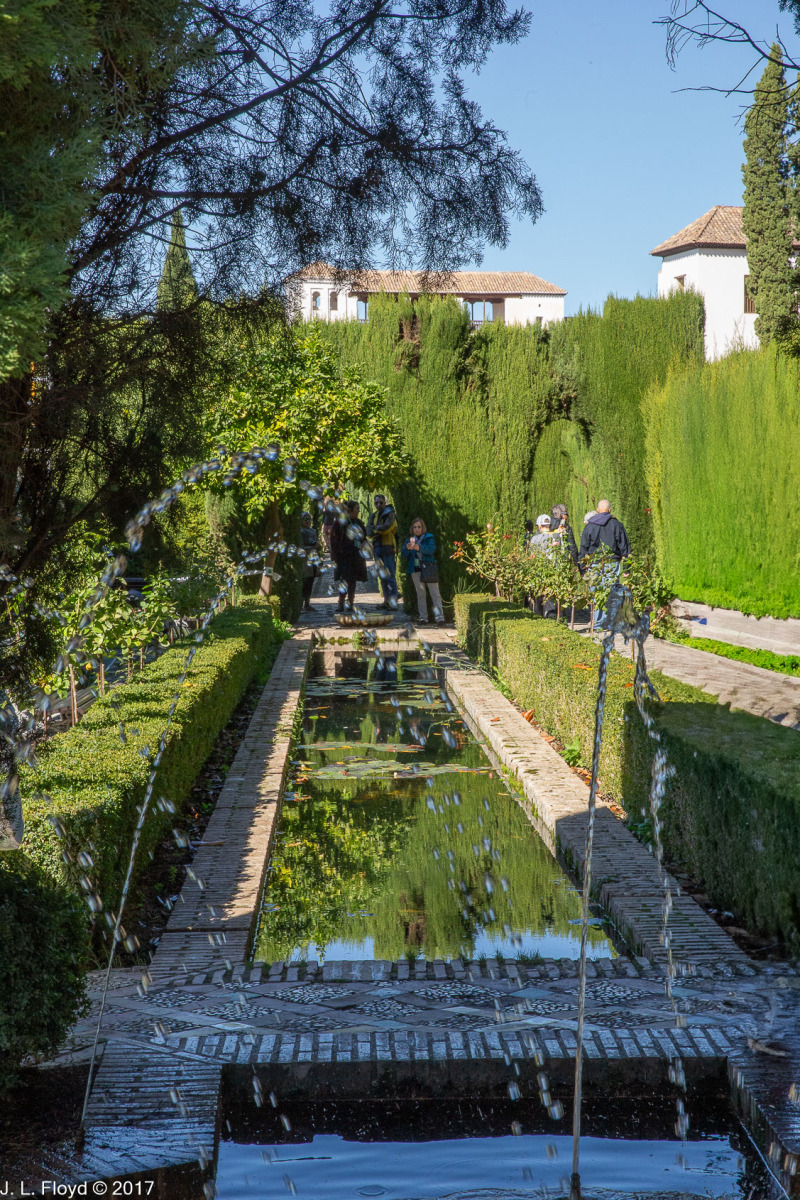
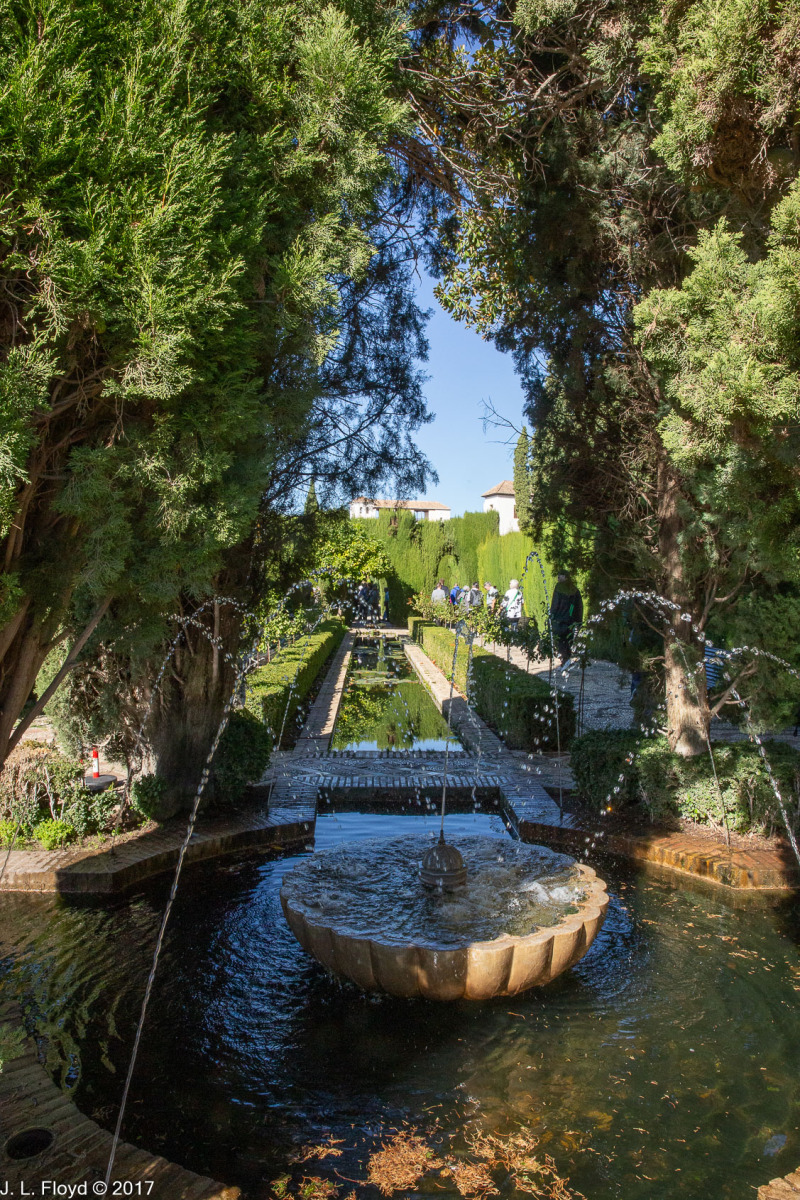
The New Gardens consist of two sections, northern and southern. The former was designed by Leopoldo Torres Balbás in 1931 and the latter by Francisco Prieto Moreno in 1951. The southern garden is arranged around a long central rectangular pool or canal, similar in orientation to the Court of the Myrtles in the Comares Palace. At its southern end, on a raised terrace, is a spectacular fountain, surrounded by cypresses. I couldn’t find out a name for the fountain, so I suggest that the explorer Ponce de Leon, who set out to seek the Fountain of Youth in the New World, actually found it but kept it a secret and somehow dismantled it, brought it back to Spain, and then reassembled it at the Generalife. Unfortunately, he couldn’t bring its water source with him, so it didn’t work any more – at least it didn’t work for me, when I tried it.

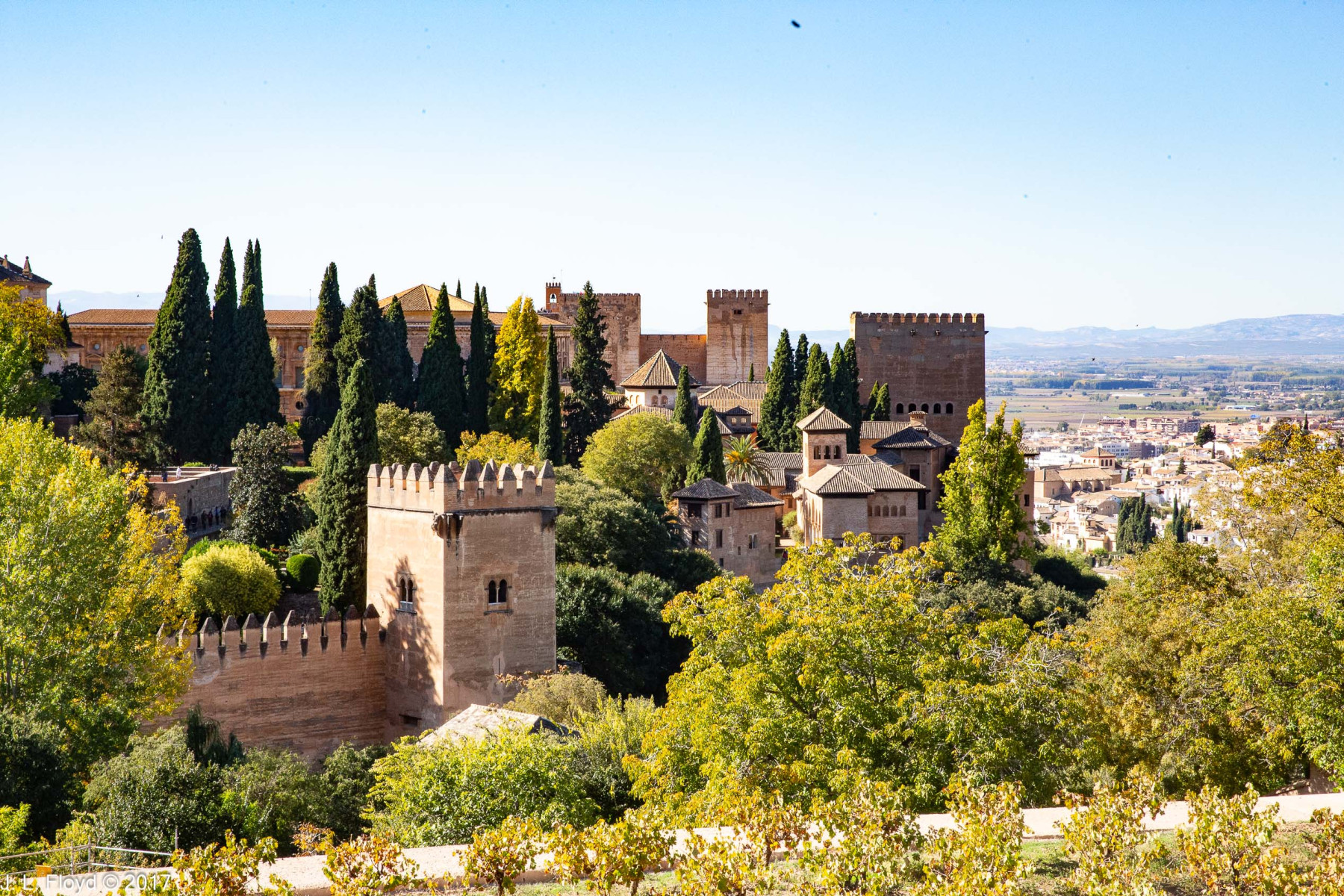
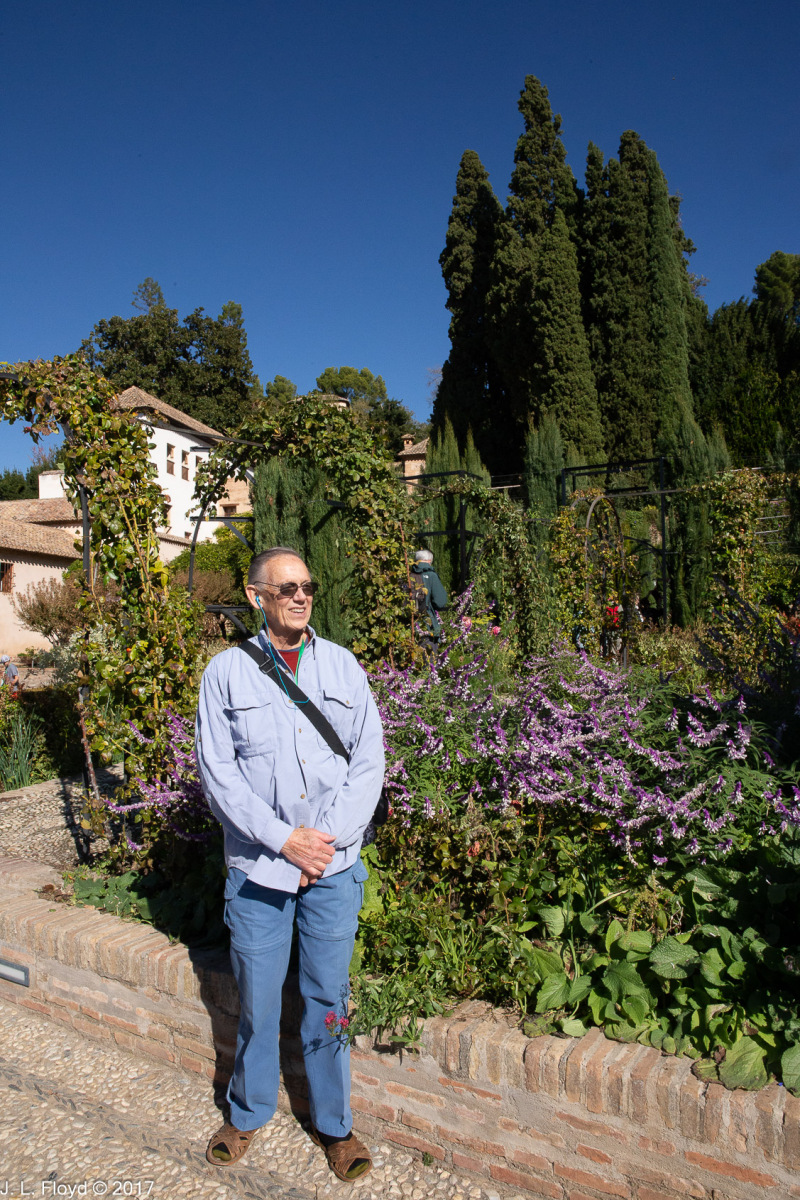
The northern section of the gardens features a riotous collection of flowers, which was especially noteworthy because we saw it in November, a month which is not normally associated with floral flamboyance. I also noted that the walkways throughout the Generalife gardens were paved with strikingly elegant mosaic-style stonework, composed of pebbles embedded in a cement matrix. I subsequently found out that the pebbles are sourced from the rivers of Granada – white ones from the Darro and black ones from the Genil. We were allowed some time in which to wander around the gardens and relax; I took advantage of the opportunity to take photos not only of the floral displays but also of some of our fellow-travelers – most especially Chuck and Elouise Mattox, but also some of our other favorites such as Jim and Joan Hinds. I also shot some nice views of the northeast quarter of the Alhambra.

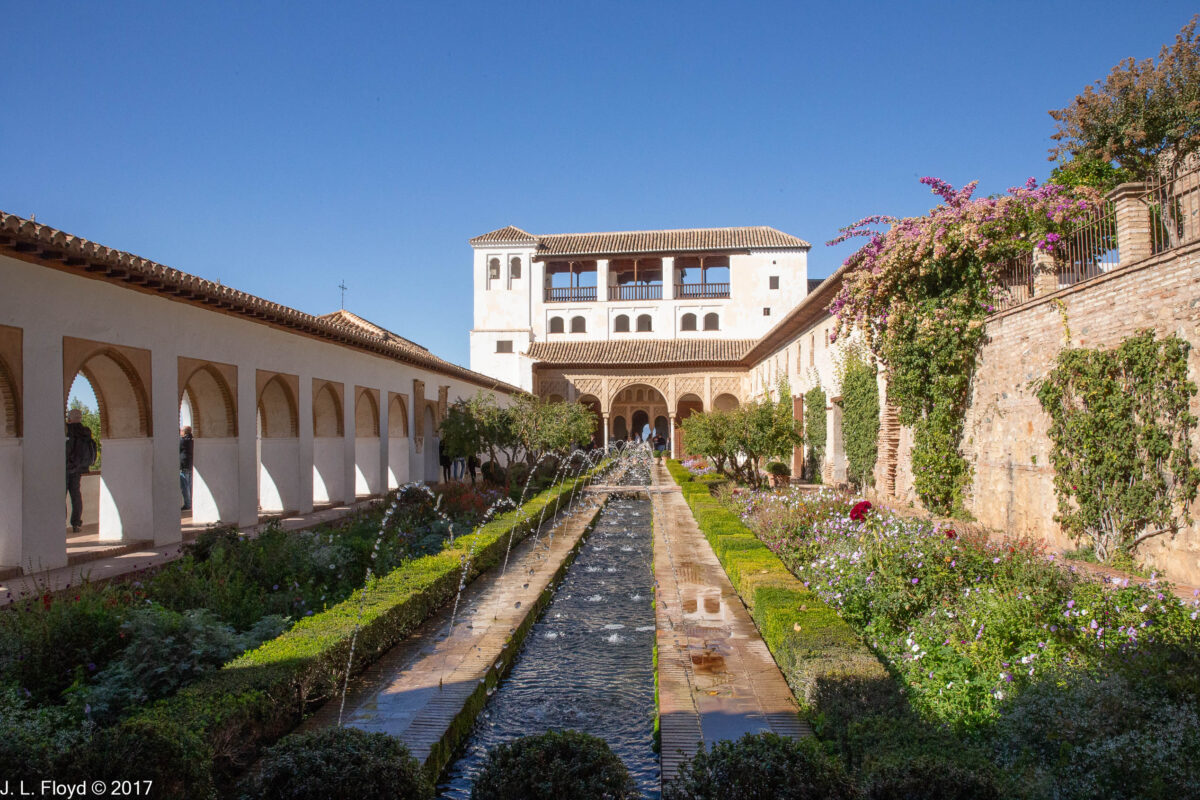
After roaming in the gardens for a bit, we entered the Generalife Palace itself via a couple of small courtyards at its southwest corner — the Patio de Desmontaje (dismounting) and the Patio de Polo. The latter, in addition to being completely covered in pebble-mosaic paving, featured a central Nasrid-style fountain in white marble with channels representing the four rivers of Eden radiating from it. After passing through the Patio de Polo, we found ourselves in the central courtyard of the Generalife, the Patio de la Acequia (“Courtyard of the Water Canal”). The canal runs the entire length of the courtyard but is split in the middle by a platform that crosses over it. There, on the west wall, is also a mirador with views of the gardens and the Alhambra. At either end of the courtyard stands a pavilion – the Pabellón Sur and the Pabellón Norte. We spent little time at the South Pavilion, which is less well preserved than the North Pavilion, and in any case the light was unfavorable for photographing it.

The North Pavilion is fronted by a five-arched portico, behind which is a gallery leading to the main room, the Sala Regia (“Royal Chamber”). At the northwestern corner rises the Torre de Isma’il, erected by the Emir Isma’il I (r. 1314-1325) to commemorate a 1319 battle in which he had repelled an invasion by the Castilians. At that time the Generalife consisted of only one floor; the second, essentially extending the Tower of Isma’il across the entire width of the North Pavilion, was added by the Catholic Monarchs in 1494. Since then there have been many modifications and restorations of the Generalife, with the magnificent result that we saw in 2017.

Above the Patio de la Acequia on its northeast side, extending to the south of the right wing of the North Pavilion, is the Patio de los Cipreses de la Sultana — Courtyard of the Sultana’s Cypresses — a post-Nasrid addition consisting of a rectangular pool with a large island within it, all surrounded by greenery, a fabulously beautiful area right out of the Arabian Nights —one expects to see Scheherazade entertaining the Sultan with her stories of Sinbad the Sailor, Aladdin’s Lamp, etc.

On the northeast side of the Patio de los Ciprises is the Escalera del Agua (“Water Stairway”), a set of flights of stairs with balustrades containing open mini-aqueducts on each side. At each landing of the staircase there is a small round pool with a fountain.

The time allotted for our visit to the Alhambra was now running short, and in order not to miss our bus we had to begin our trek back to the parking lot. Hence not enough time remained for me to obtain decent photographs of the Patio de los Ciprises and the Escalera, let alone the Mirador Romántico, a 19th-century pavilion located on a hill nearby which is said to offer wonderful views of the entire area. So for these I’ll refer the reader to Wikipedia, which has an article on the Generalife with gorgeous photos of all its attractions, including the ones I missed.

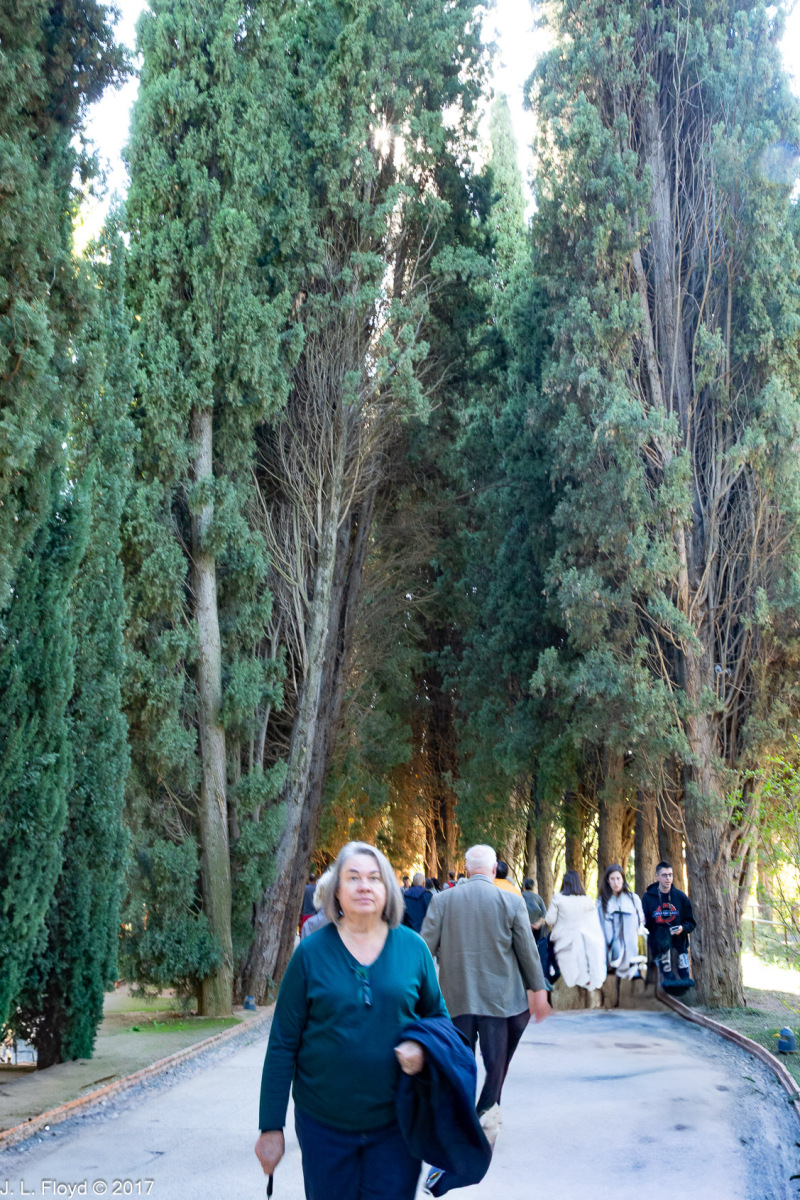
The way back to the parking lot led along the Paseo de las Adelfas, the Path of the Oleanders, a walkway lined with oleander bushes trained to grow in an idyllic archway covering the pavement. This led to the equally splendid Paseo de los Cipreses and finally to our bus stop.

We would see more of Granada that day, and it is a memorable city, among the most beautiful I have visited. But nothing for me will ever match the splendor and beauty of the Alhambra.

Categories
Spain, Portugal and Morocco, November 2017

Granada, November 9, 2017: The Palaces of the Alhambra

When I was nine years old, my mother gave me a history book with a picture of the Alhambra on one of its pages. I was immediately seduced by the beauty of the place; ever since then it was at the top of all the places in the world I wanted to visit. On November 9, 2017, I was finally able to turn that hope to reality.

I was exceptionally fortunate in being able to enjoy the experience in company not only with my wife Sandie, but also my treasured lifelong friends Chuck and Elouise Mattox, who had invited me to join them on the tour in the first place.

At this point it is appropriate to provide a bit of background about the Alhambra. The Emirate of Granada, the last independent Muslim state in Western Europe, was founded in 1232 by Muhammad Ibn Yusuf Ibn Nasr, later known as Muhammad I Ibn al-Amar. This was a time when the Muslim dominion in Spain, established by conquest in 712 CE, was in terminal decline. The Christian armies were on the march, taking Córdoba in 1236 and Seville in 1248. Yet the polity founded by Muhammad I Ibn al-Amar managed to hang on for over two centuries – though it did so as a vassal of Castile – until the rulers of a united Christian Spain decided to put an end to it. During the limited period of its existence the Emirate of Granada was able to enjoy considerable prosperity, for a limited time, and to generate the last great cultural flowering of Moorish Spain.

Muhammad I had already settled in Granada by 1328 and began the construction of the Alhambra in that year. His successors continued to expand and enhance it. The dynasty he founded is known as the Nasrids.

On January 2, 1492, Ferdinand of Aragon and Isabella of Castile accepted the surrender of the last Emir of Granada, Muhammad XII, also known as Boabdil, and made their triumphal entry into the Alhambra. Although the terms of the surrender guaranteed that the Muslims would be allowed to continue practicing their religion, the Catholic monarchs, under the influence of the Archbishop of Toledo and Chancellor of Castile, Francisco Jiménez de Cisneros, reneged on their promise. Cisneros conducted a mass forced conversion, burning their books and suppressing their ensuing revolt; in 1500 he declared that there were no more Muslims in Granada. But the Moriscos, as the unwilling converts were called, continued practicing their religion sub rosa, and in 1609, after suppressing several more rebellions, the government of Philip III issued a decree expelling all the remaining Moriscos from Spain.

After taking possession of the Alhambra, the Spanish monarchs used it as a royal residence and made a number of alterations – both additions and demolitions – to it. The most important of the additions was the Palace of Charles V, begun in 1527. But later, in the 17th and 18th centuries, the Alhambra ceased to be a focus of attention and it was severely neglected. During the Napoleonic Wars, the French occupied Granada, and when they were finally driven out, they attempted to blow up the Alhambra, and actually succeeded in destroying parts of it before being foiled by a heroic Spanish soldier, José Garcia, who disabled the fuses on the charges and thereby saved the rest of the fortress. In the 19th century there was a revival of interest in the Alhambra, and efforts to preserve and restore it were undertaken and have been continued over the years since.

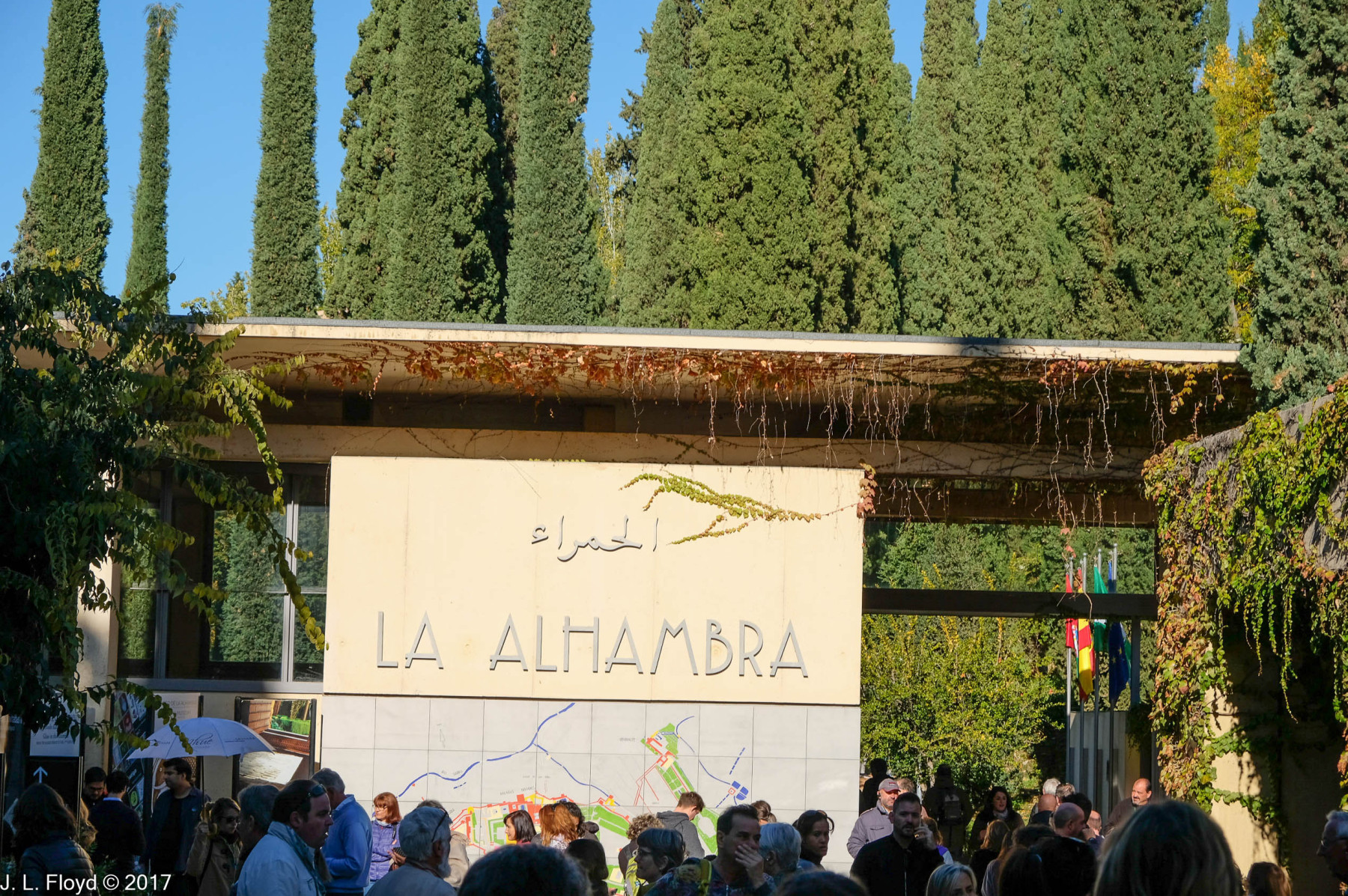
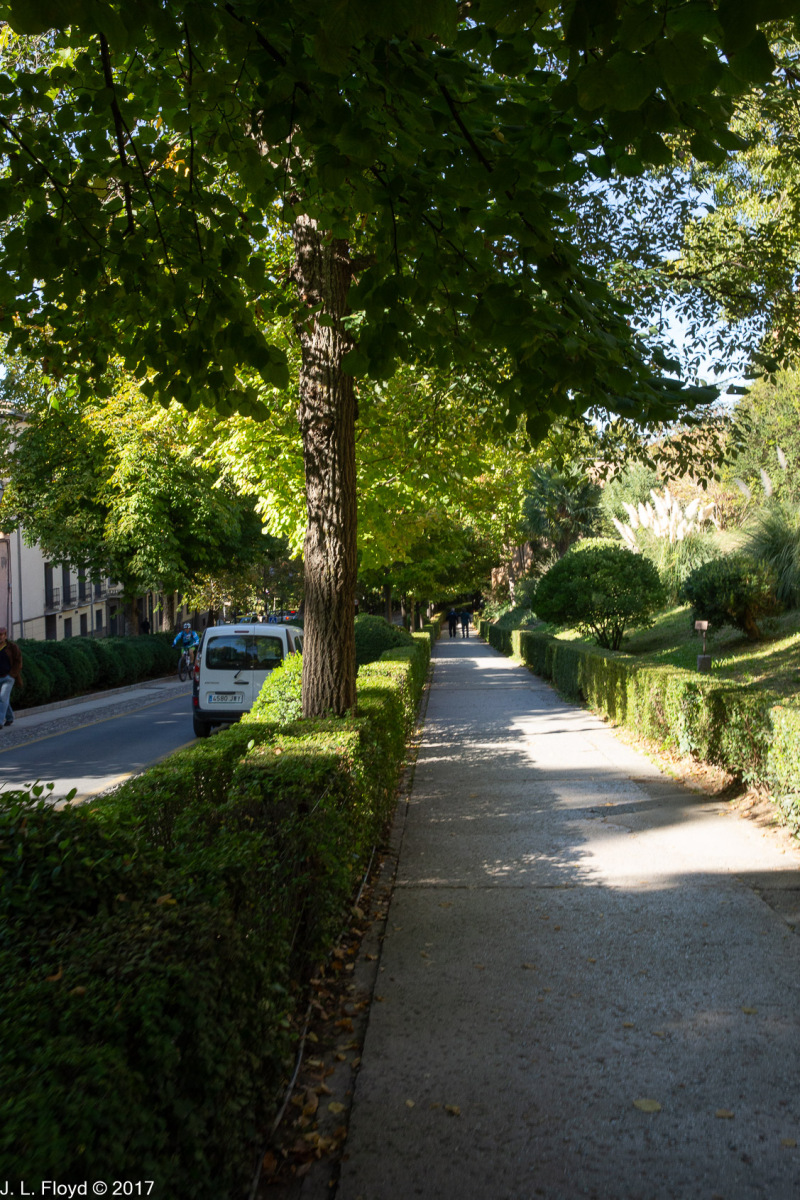
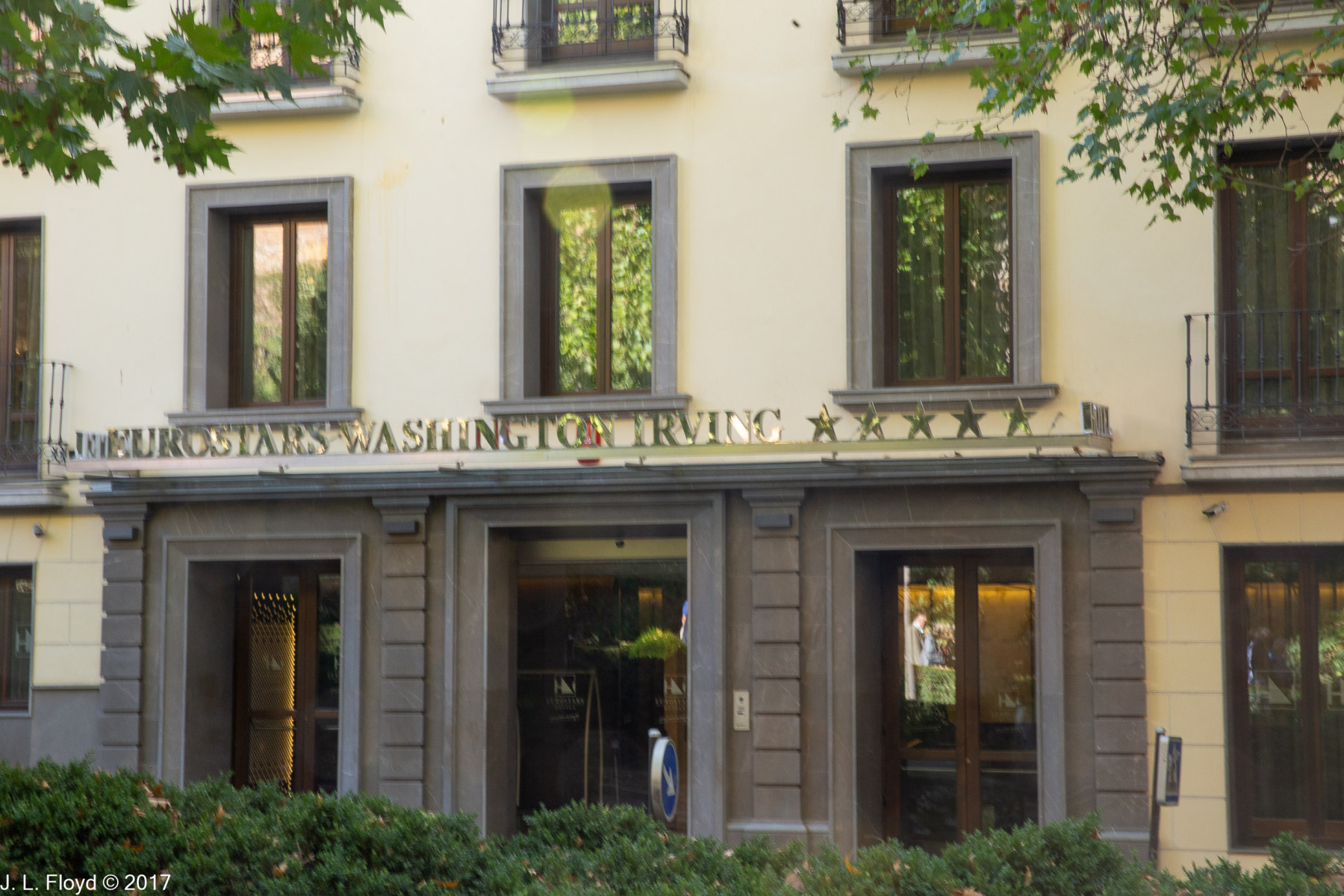
Although our tour bus dropped us off close to the walls of the Alhambra, it was still a fairly long walk from the parking area to the entry point at the Puerta de las Justicias – the Justice Gate. It was nevertheless a very pleasant walk along a shady tree-lined avenue, the Paseo Bosque de la Alhambra, and it took us past the Hotel Washington Irving, named after the American author (famous for the short stories “Rip van Winkle” and “The Legend of Sleepy Hollow”) who spent several months living in the Alhambra in 1829 and wrote Tales of the Alhambra in the aftermath of his stay. Irving was one of the people most responsible for stimulating public interest in the Alhambra and for sparking efforts to preserve and restore it.

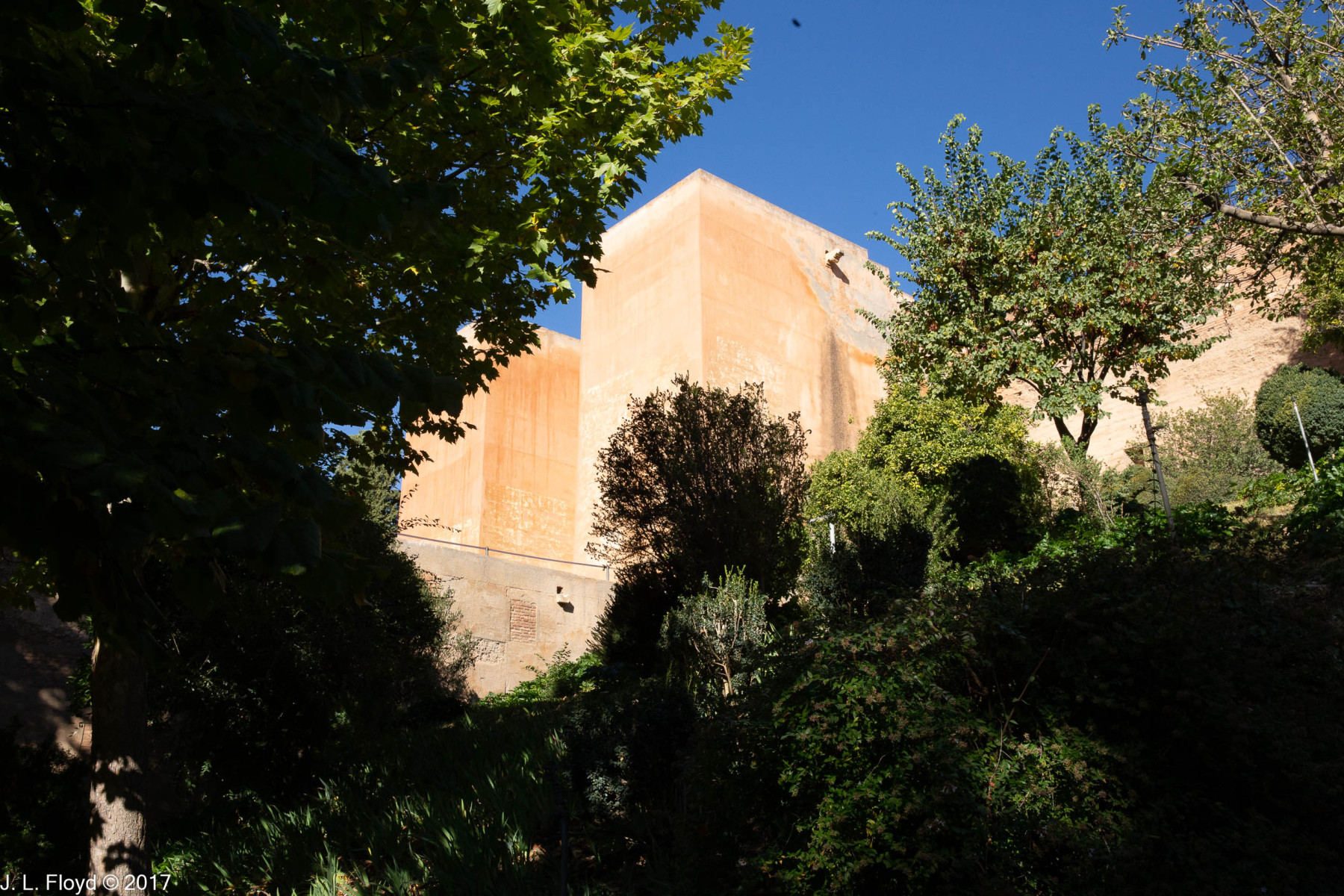
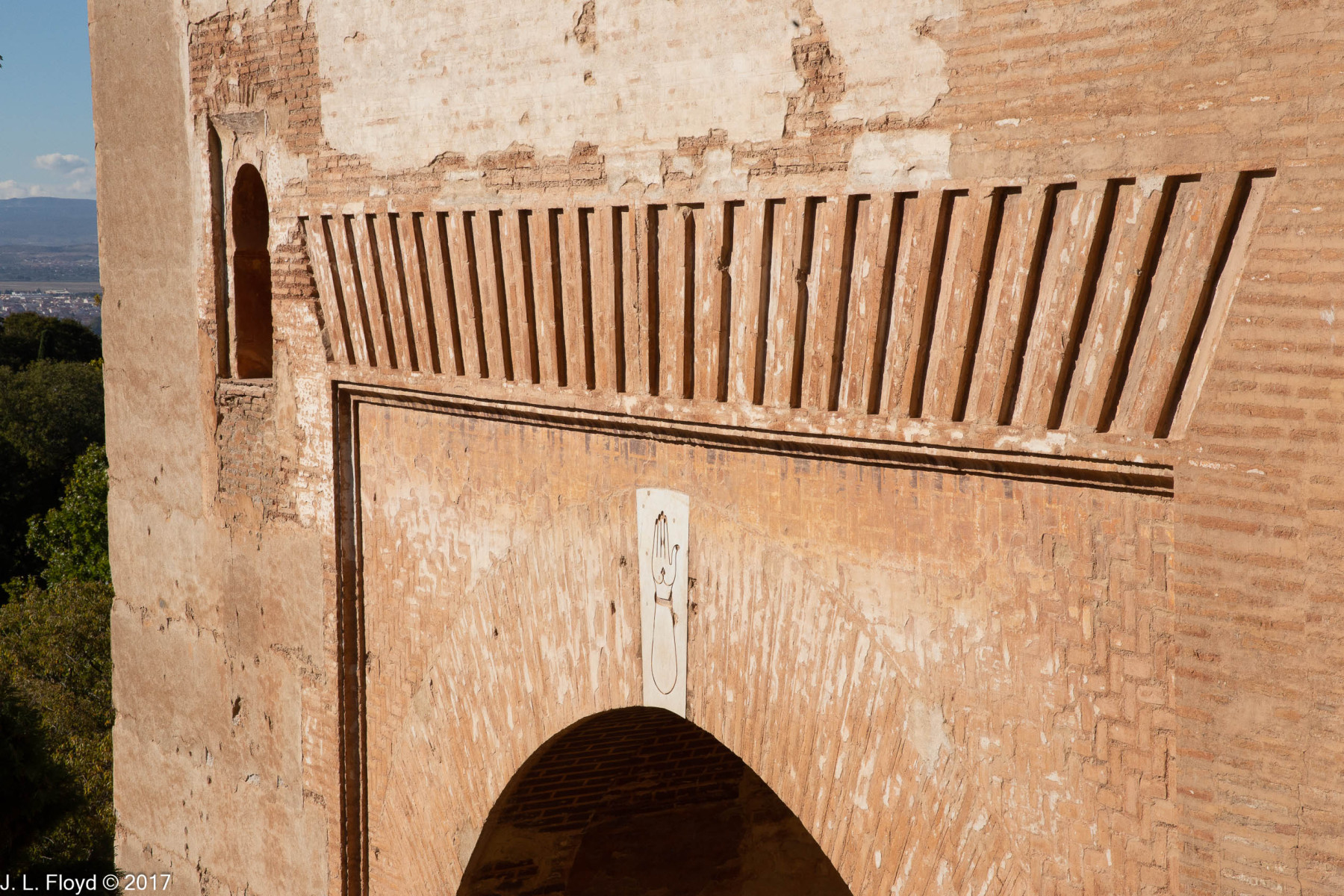
The Puerta de las Justicias was known as the Bab al-Shari’a, Gate of the Law, in Arabic. It was built in 1348, during the reign of Emir Yusuf I, and provides entry first through a large horseshoe arch, above which is a carving of an upraised human hand. This symbolizes the Five Pillars of Islam, which are the Muslim creed (“No God but God, and Mohammed is His Prophet”), praying to Mecca five times a day, charity to the poor, fasting in the holy month of Ramadan, and the pilgrimage to Mecca. I had seen the same symbol at the Alhambra Gate in the Pena Palace in Sintra, Portugal, earlier in the trip; as the name implies, it was copied from the Alhambra.

After passing under the arch, one climbs up a steep ramp and then makes a couple of turns through successive right-angled passageways to enter the fortress. The passageways were designed so that defenders of the fortress could shower arrows and boiling oil on any attackers trying to enter through this route. On the inner side of the Justice Gate is a carving of a key, another symbol of the Islamic faith.

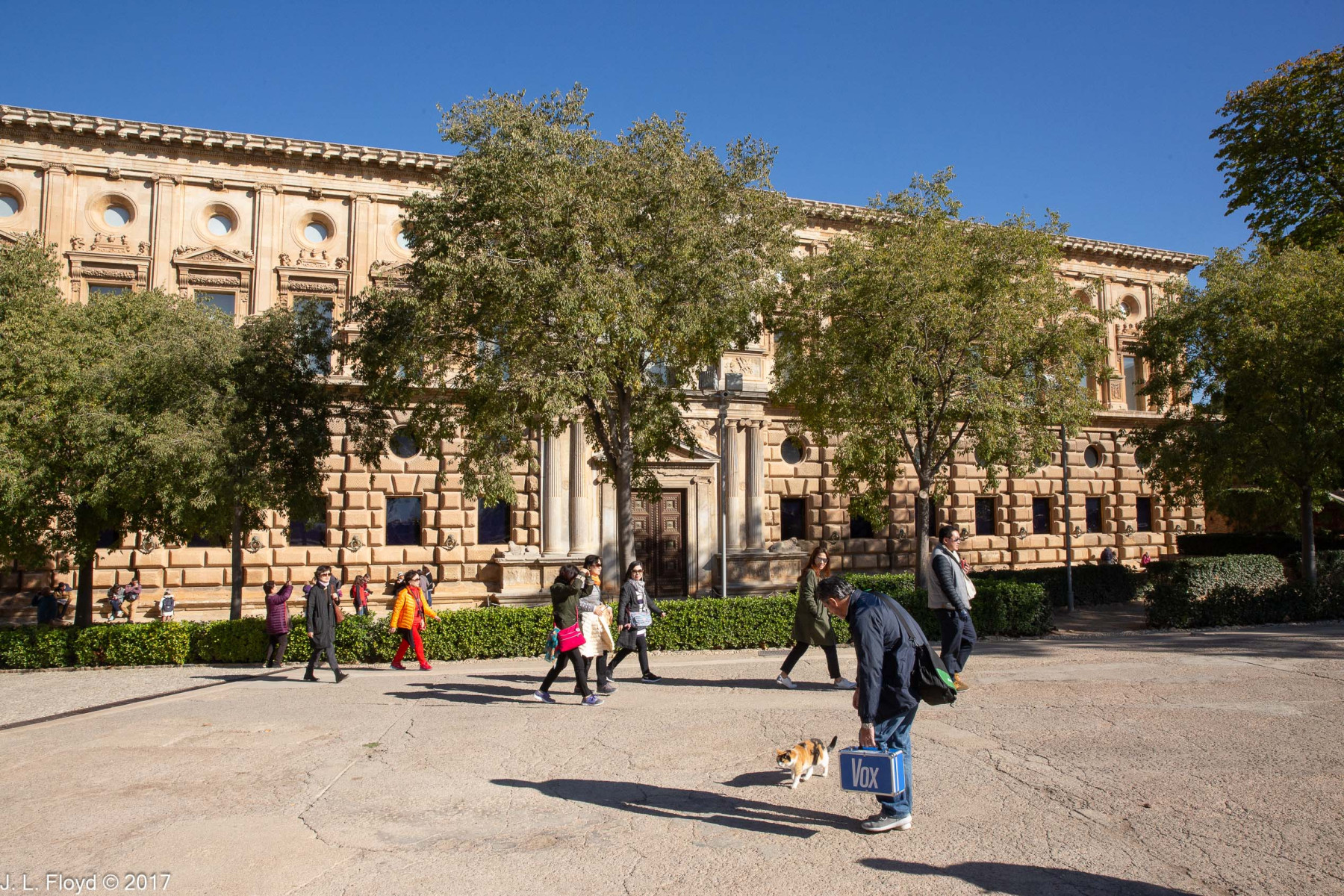
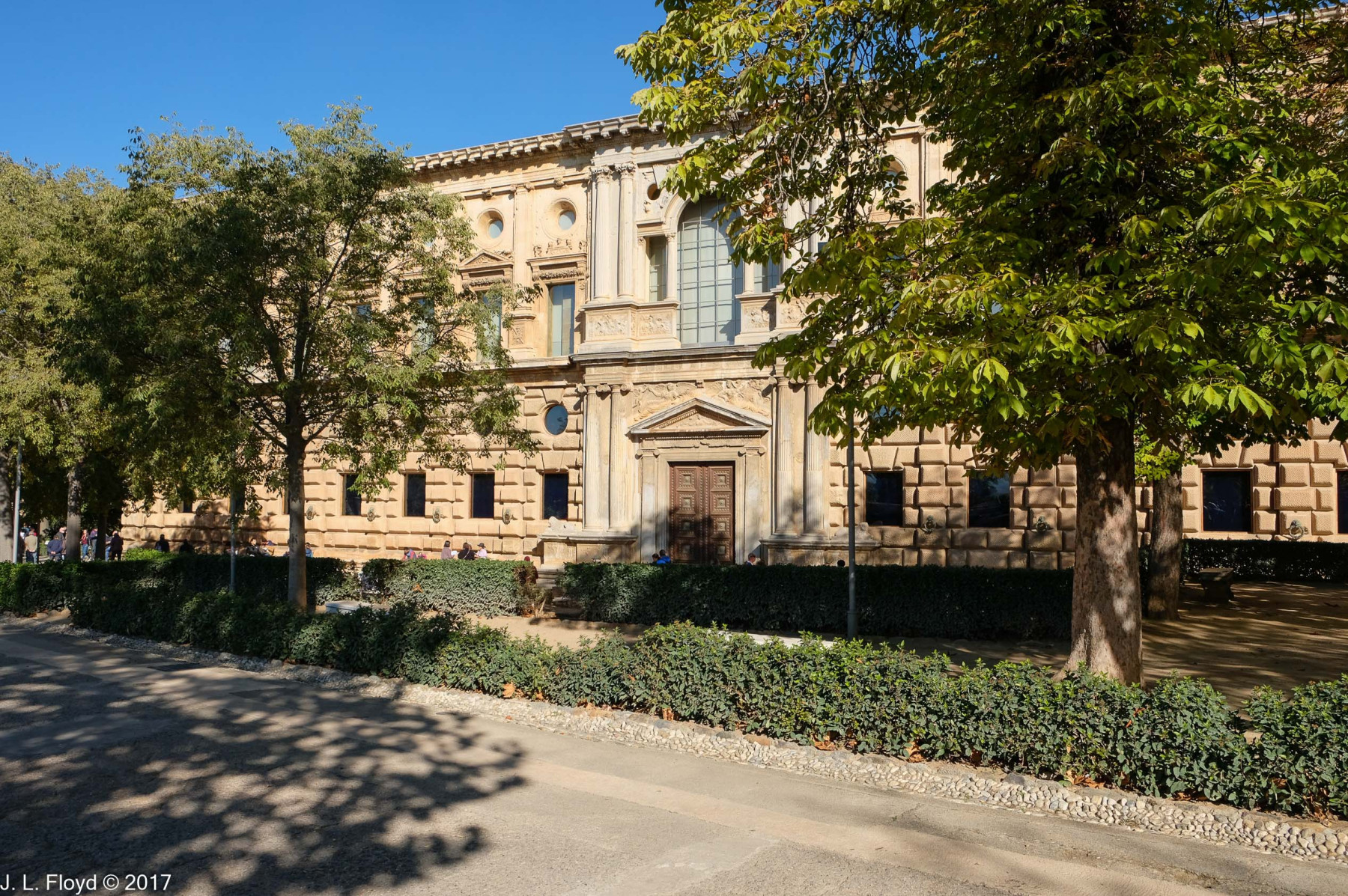
Having passed through the Justice Gate, we found ourselves in a courtyard facing the Palace of Charles V. After succeeding to the thrones of Castile and Aragon as Carlos I in 1516, Charles was elected Holy Roman Emperor in 1519. (Charles is the French and English form of his name. In Spanish he is Carlos, and in German Karl.) He visited Granada in 1526 with his wife, Isabella of Portugal, and decided to make the Alhambra one of his royal residences. He had some of the former Nasrid palaces demolished to make way for a huge new Renaissance-style palace of his own, which was begun in 1527. However, it was not finished during Charles’ lifetime. Charles V spent most of his reign crisscrossing his domains, which included not only Spain but also the Netherlands, parts of Italy and, of course, Austria and Germany, fighting wars against France and the Ottoman Turks, and trying to suppress the Protestant Reformation. He rarely stayed in one place for long. His son and successor as King of Spain, Philip II, was different; he seldom left Spain, but he made his capital permanently at Madrid and did not reside at the Alhambra. Instead he lavished his attention – and his finances – on building his own palace-cum-monastery, the Escorial, near Madrid. Construction of the Palace of Charles V consequently dragged on and was frequently interrupted due to financial exigencies and rebellions, such as the Morisco Rebellion in Granada in 1568. Work on the palace ceased altogether in 1637, at which time not even the roof had been finished. Over the following three centuries, it was at times used as a storehouse and a barracks (e.g. by the French during the Napoleonic Wars), and in general left to deteriorate. However, in the 20th century interest in restoring and finishing it revived, and the roof was eventually completed – in 1967. Nowadays the Palace houses a museum.

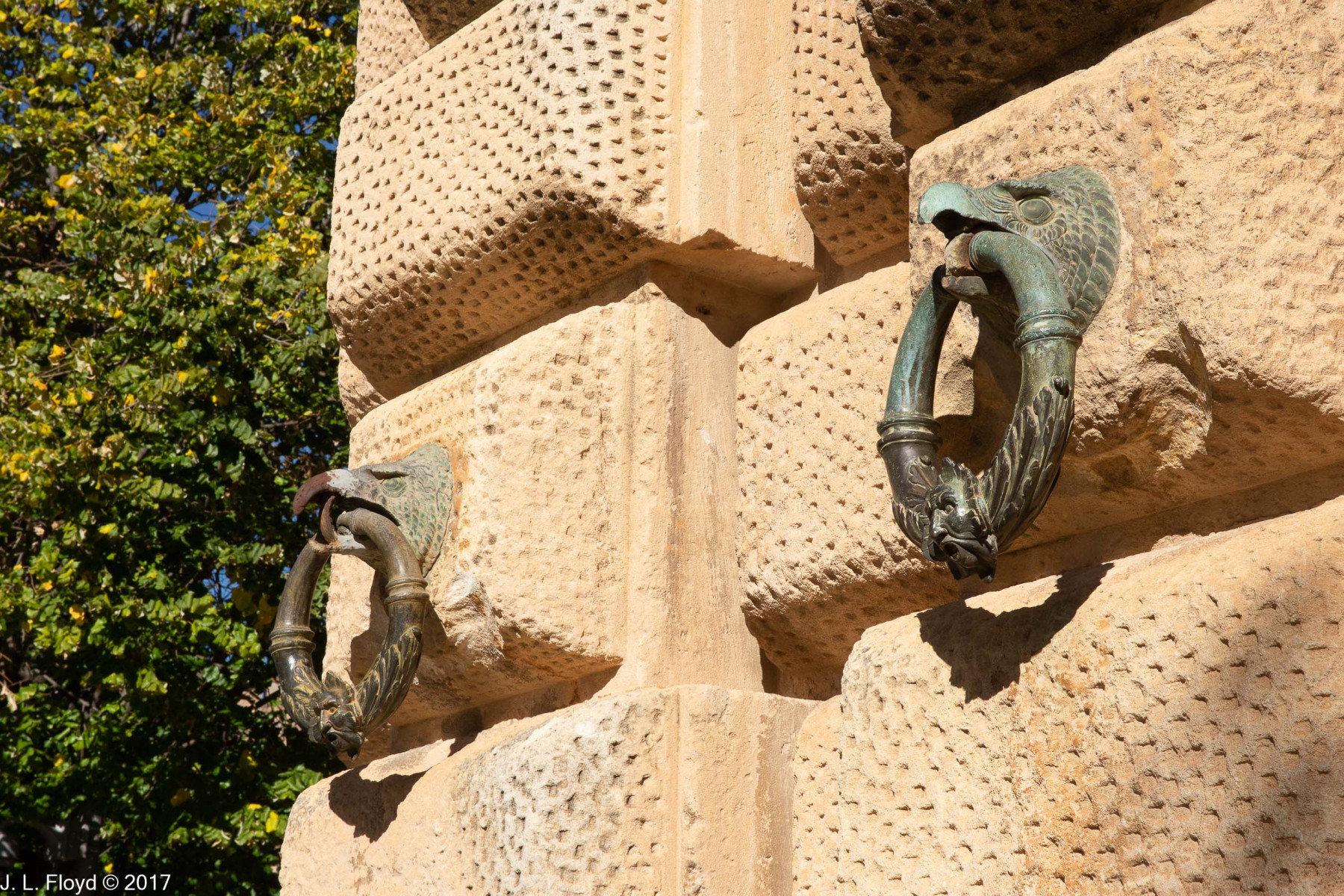
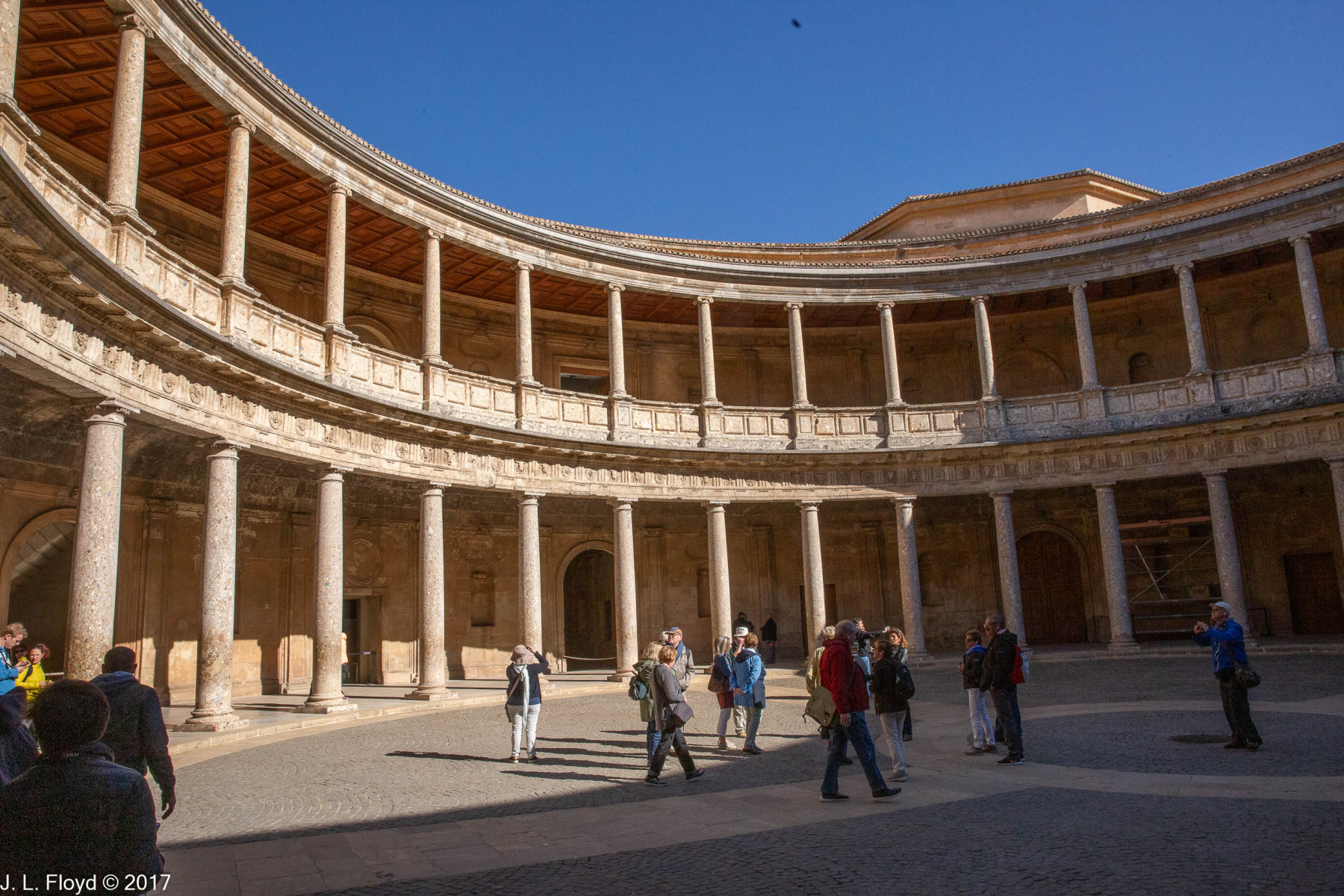
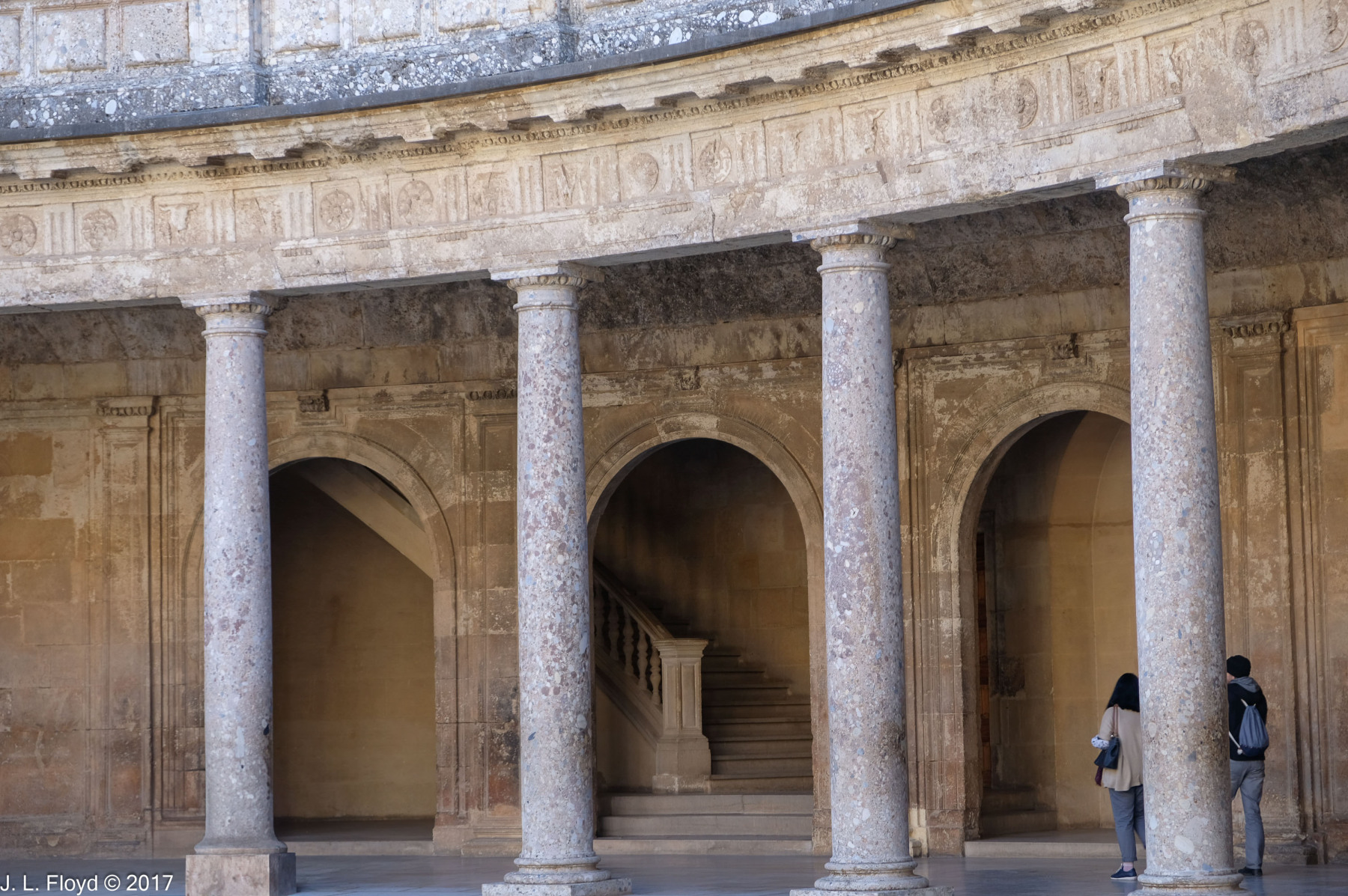
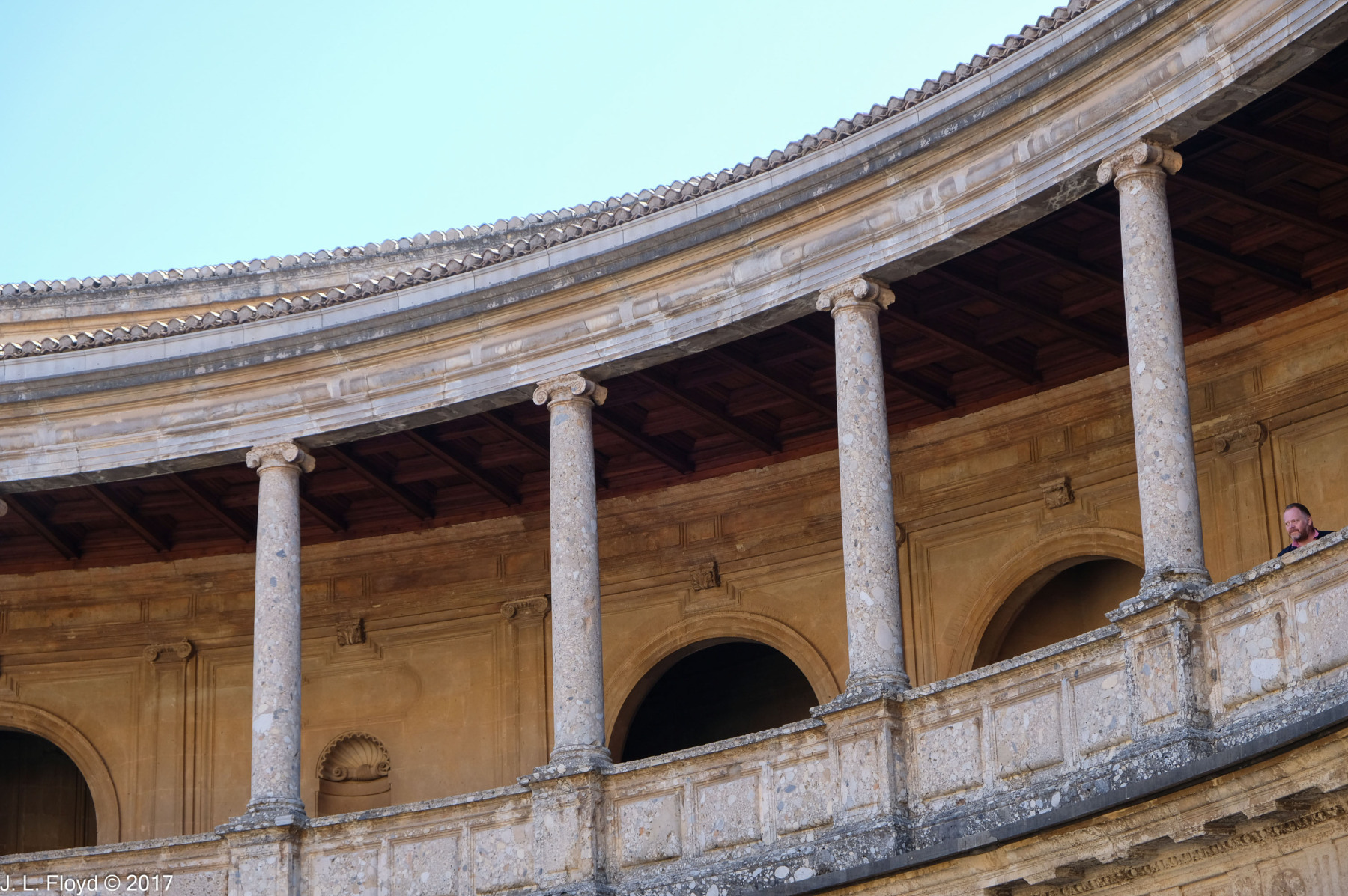
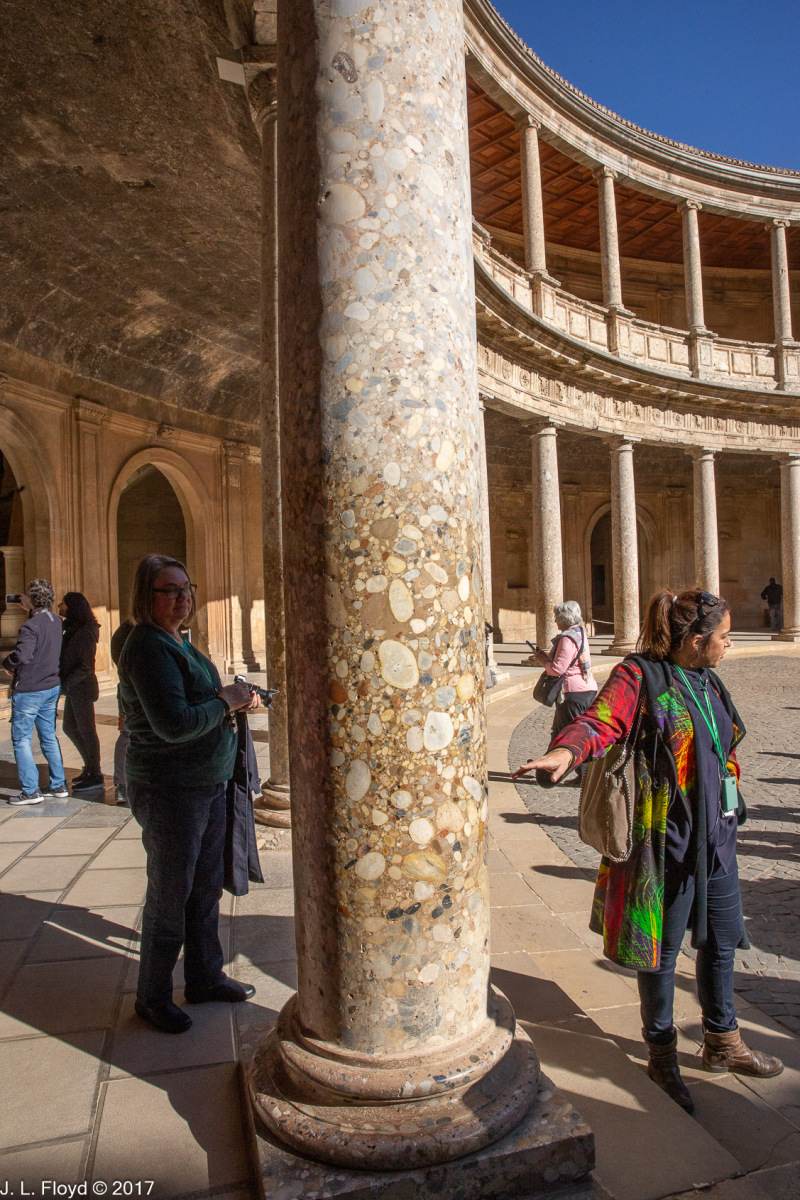
The architecture of the Palace of Charles V is rather idiosyncratic. It is square in form, but with an inner circular courtyard, a feature unique for its time. It has two stories; the ground floor is in the Tuscan order, with plain unfluted Doric columns and a simple entablature, while the upper floor is in the more elaborate Ionic order. The inner court repeats the pattern, but with a Doric colonnade made of conglomerate stone and surmounted by an elaborate classical entablature.

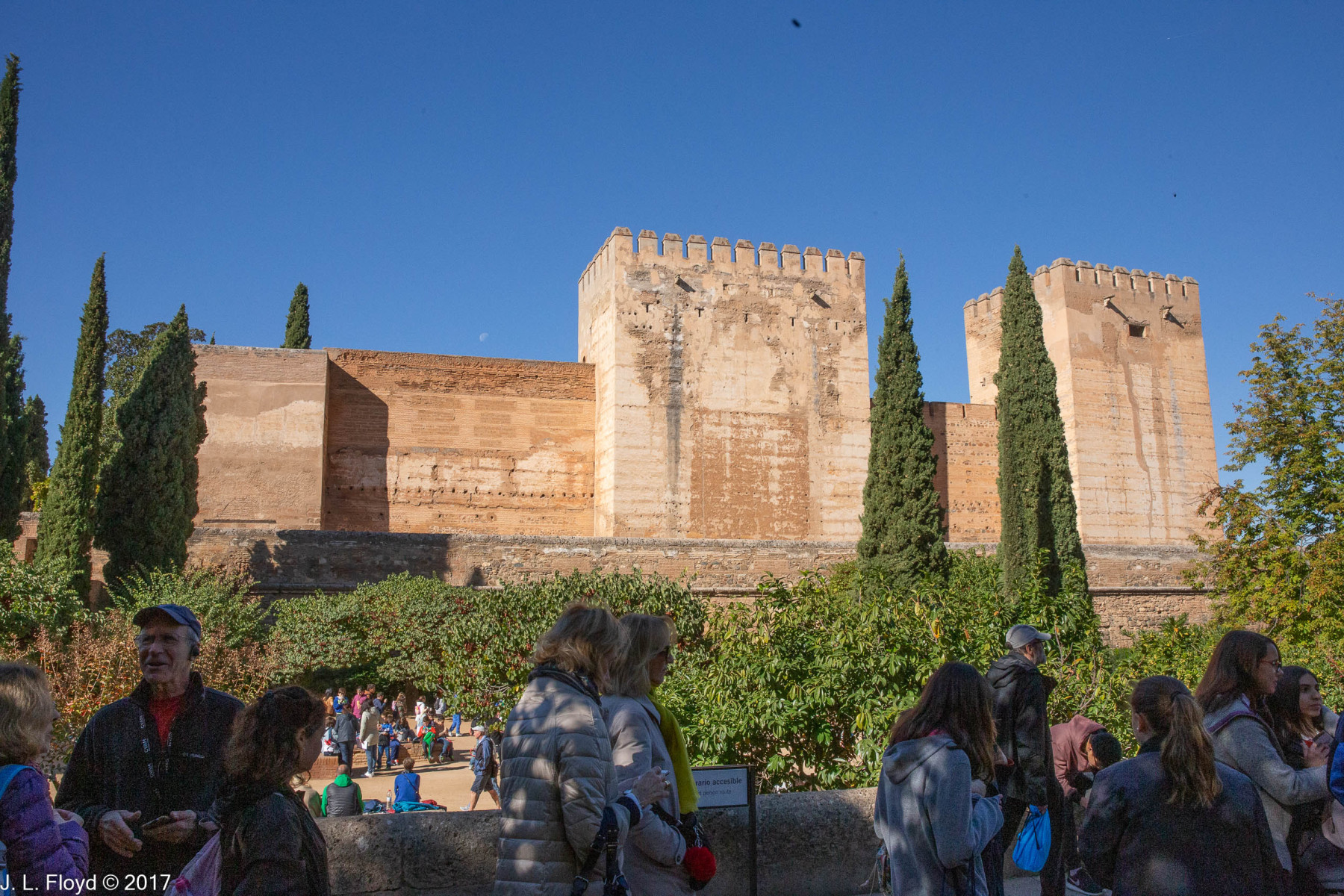
Exiting the courtyard of the Charles V Palace, we found ourselves in the Plaza de los Aljibes, looking west toward the Alcazaba, the oldest part of the Alhambra. There were fortifications there long before Muhammad I Ibn al-Amar founded the Alhambra, but he greatly expanded and strengthened them to create the Alcazaba, which then became the citadel or keep of the Alhambra. We did not enter the Alcazaba; although its towers have been restored, the area within its walls contains mostly excavated ruins of houses and other structures used by the soldiers who guarded the citadel in days of yore. Instead we turned east to explore the chief glory of the Alhambra, the Nasrid palaces.

We entered the oldest and westernmost of the Nasrid palaces, the Mexuar, through two successive courtyards, the first being the Patio de la Mezquita, so named because it used to be the site of a small mosque, along with a series of secretarial offices. Only the foundations of these structures remain now. Passing through a high cypress hedge, we then entered a second courtyard, the Patio de la Machuca, named after an architect who resided there in the 16th century while working on the Palace of Charles V. In Nasrid times it was surrounded on the north, south and west sides by a portico, but nowadays only the north portico remains, the south and west components having been replaced by the cypress hedges. In the center of the patio is a rectangular pool with six semi-circular extensions on the sides; it formerly held a fountain featuring two lion statues, but these too have vanished. The east side of the Machuca is occupied by the Mexuar Palace itself. One enters it on the south side through a passageway paved with beautiful floral mosaics.

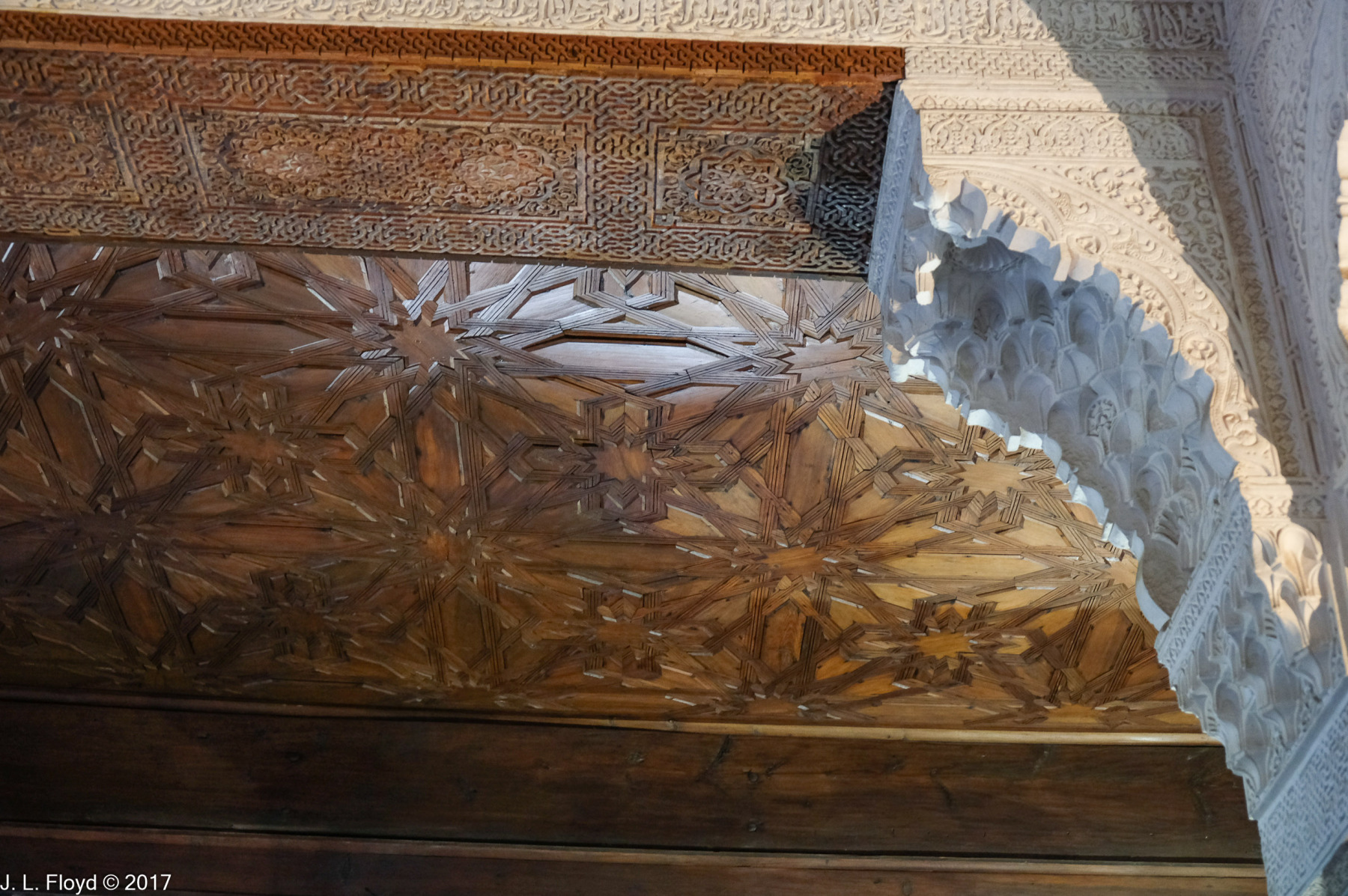
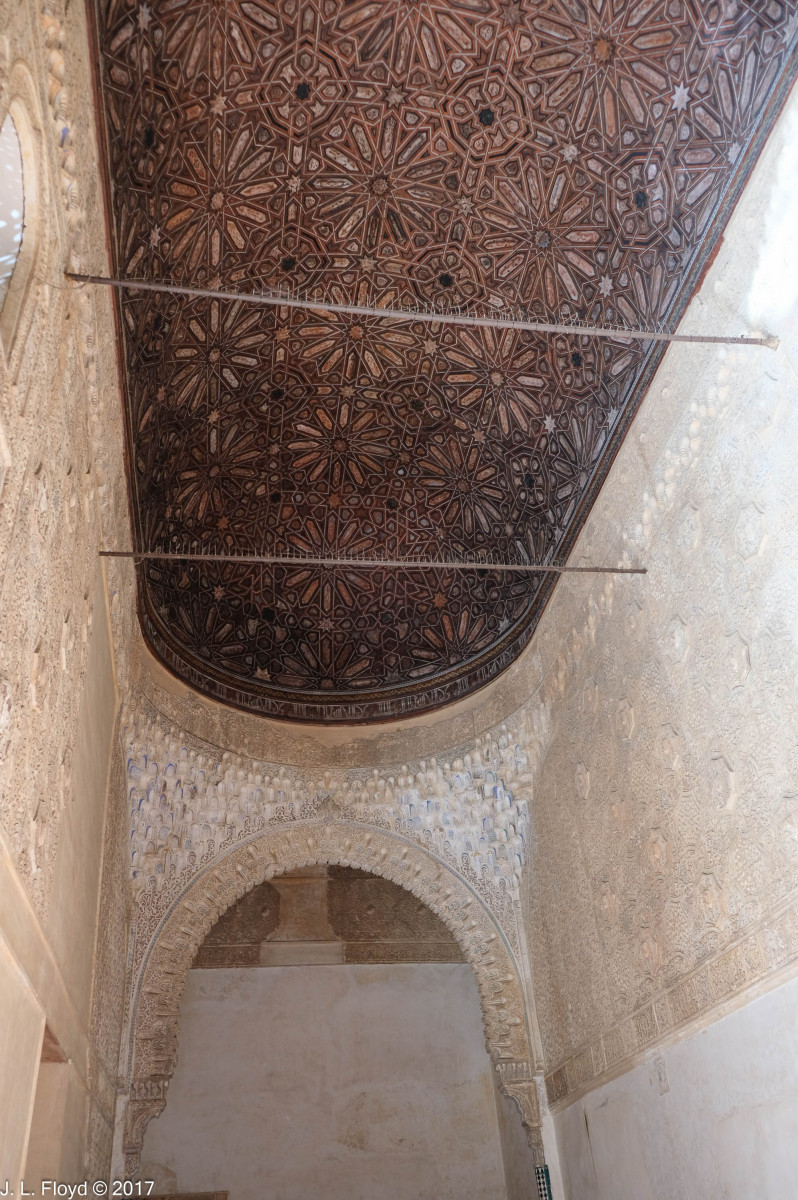
Upon entering the palace, we found ourselves in its main room, the Sala del Mexuar, or Council Room as it was known in Nasrid times, when it served as a throne room and audience chamber for the emir. After the Christian conquest it was converted into a chapel. Regrettably I was unable to obtain any decent photos of the entire hall, but there are some nice ones available on Wikipedia. The walls of the Sala del Mexuar are sumptuously decorated with carved stucco panels and tilework skirting, and in the center of the chamber stand four marble columns enclosing a space formerly reserved for the throne of the emir. The columns uphold a wooden ceiling with capitals and consoles (bracket-like support structures) featuring elaborate muqarnas (honeycomb-vault adornments). The capitals of the columns retain their original polychrome decoration. This central space was originally covered by a dome, but that was removed in the 16th century to make way for a new upper chamber to be built over the Sala del Mexuar; it was replaced by a wooden ceiling, which however preserves the geometric designs characteristic of Muslim architecture.

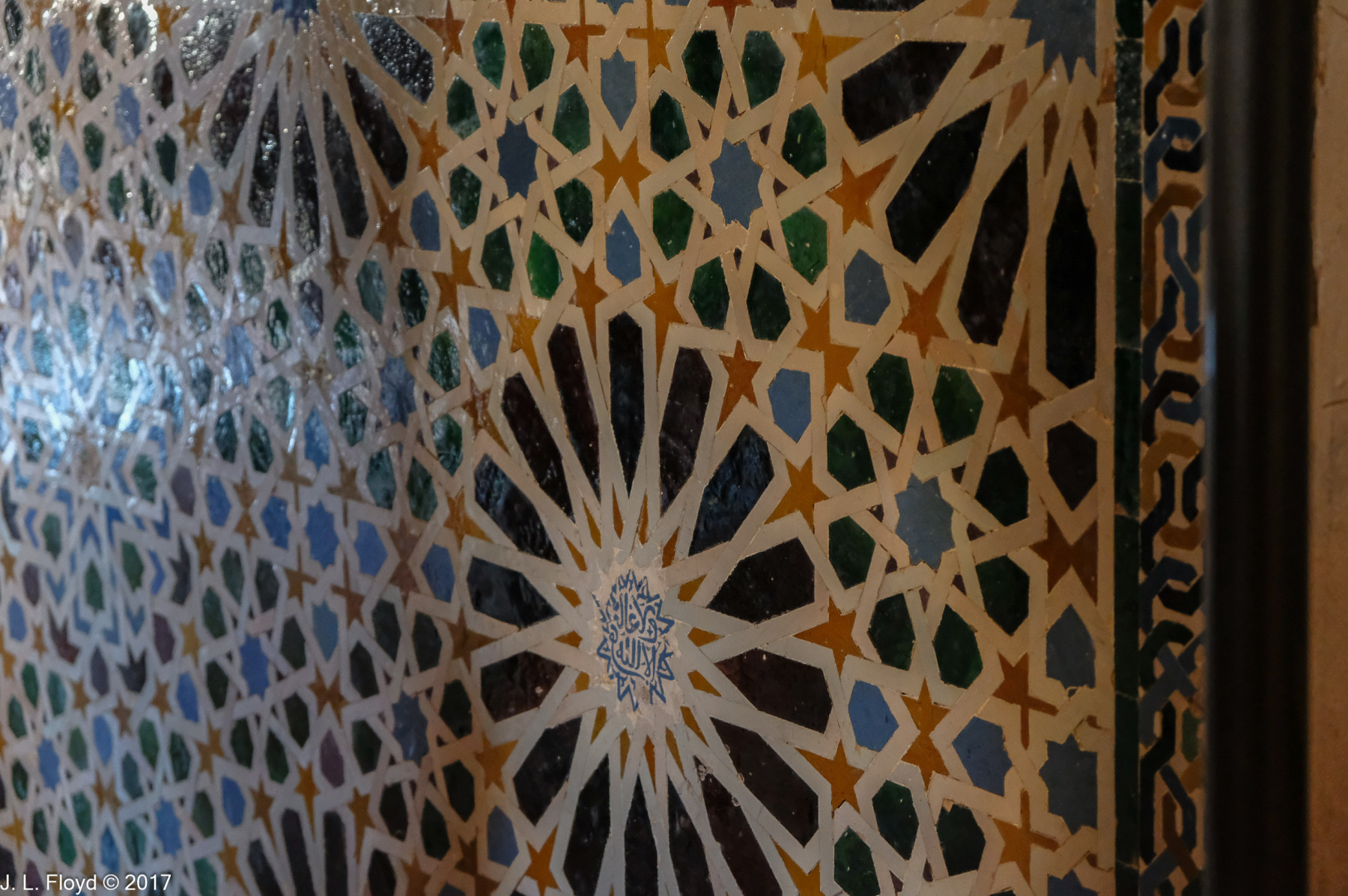
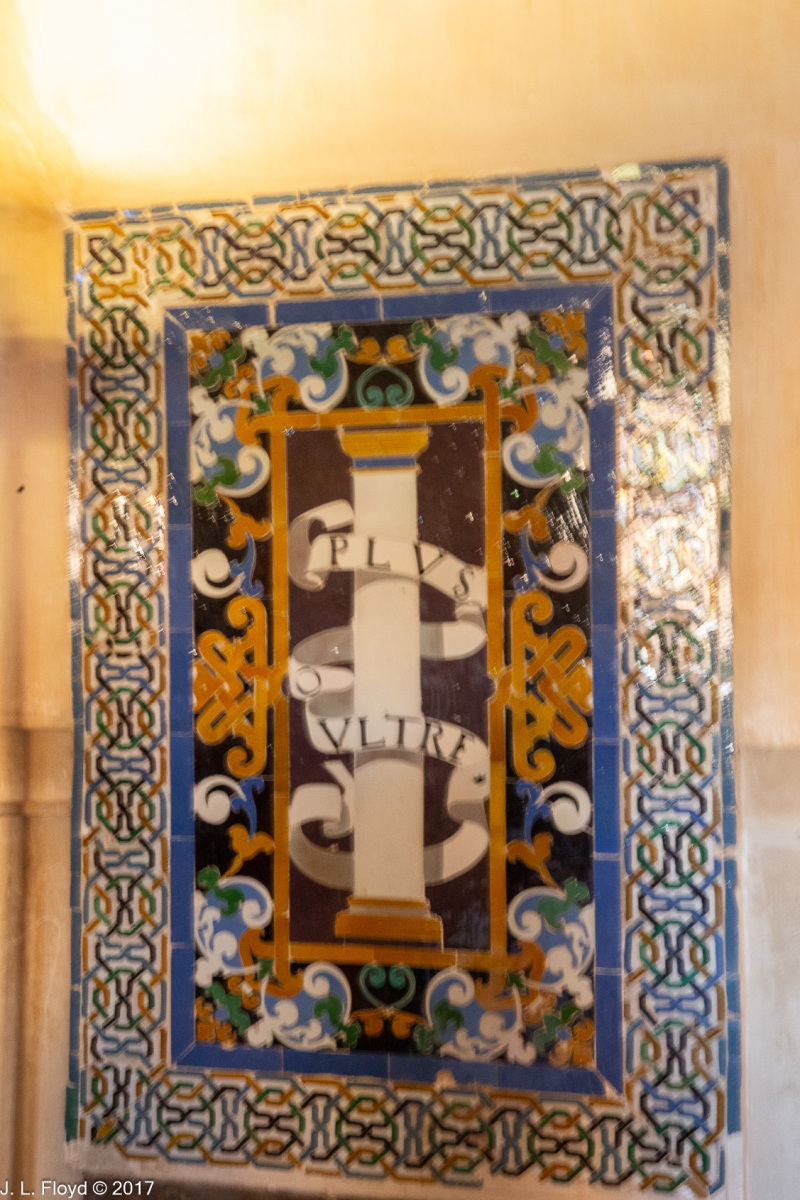
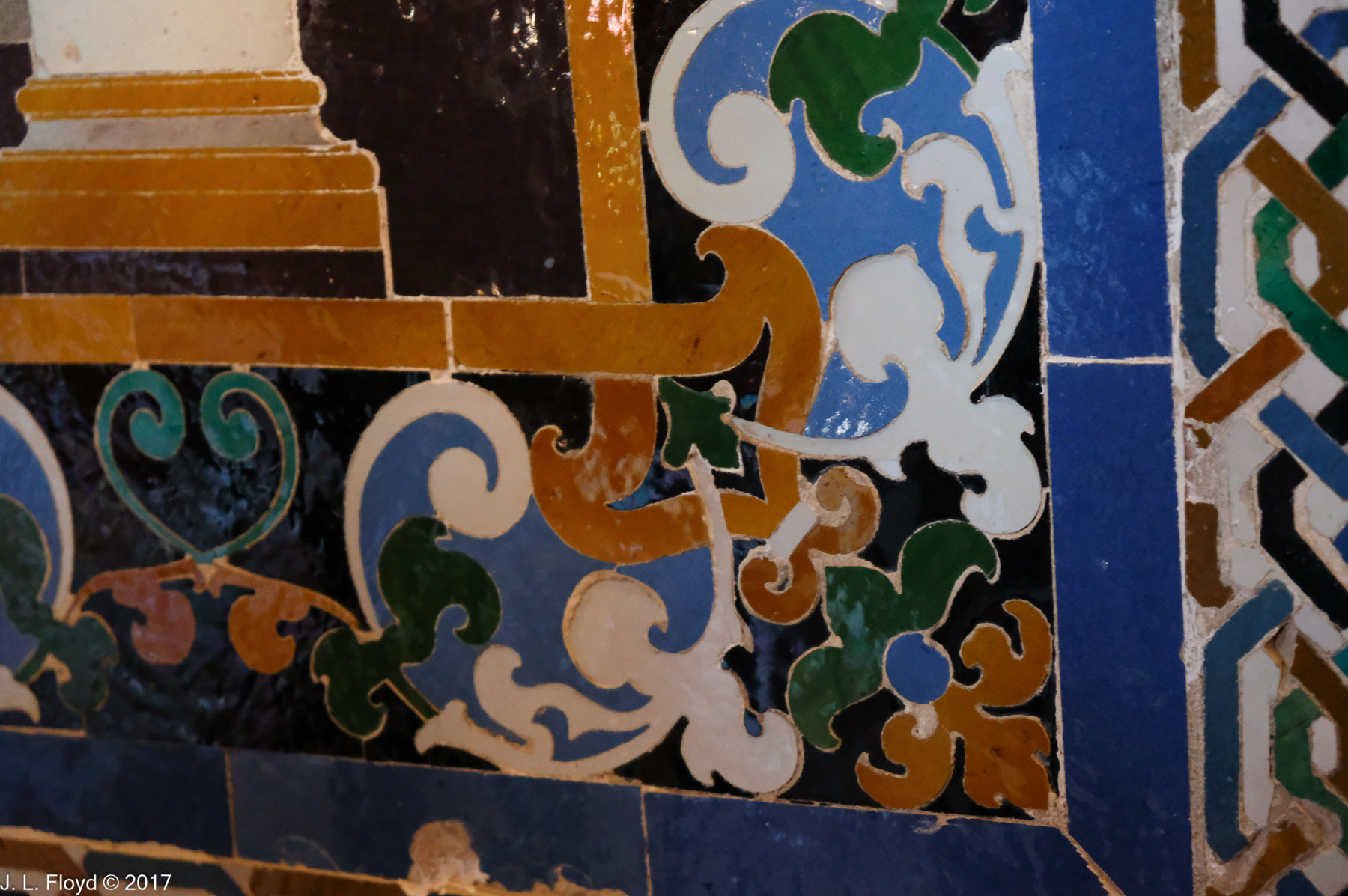
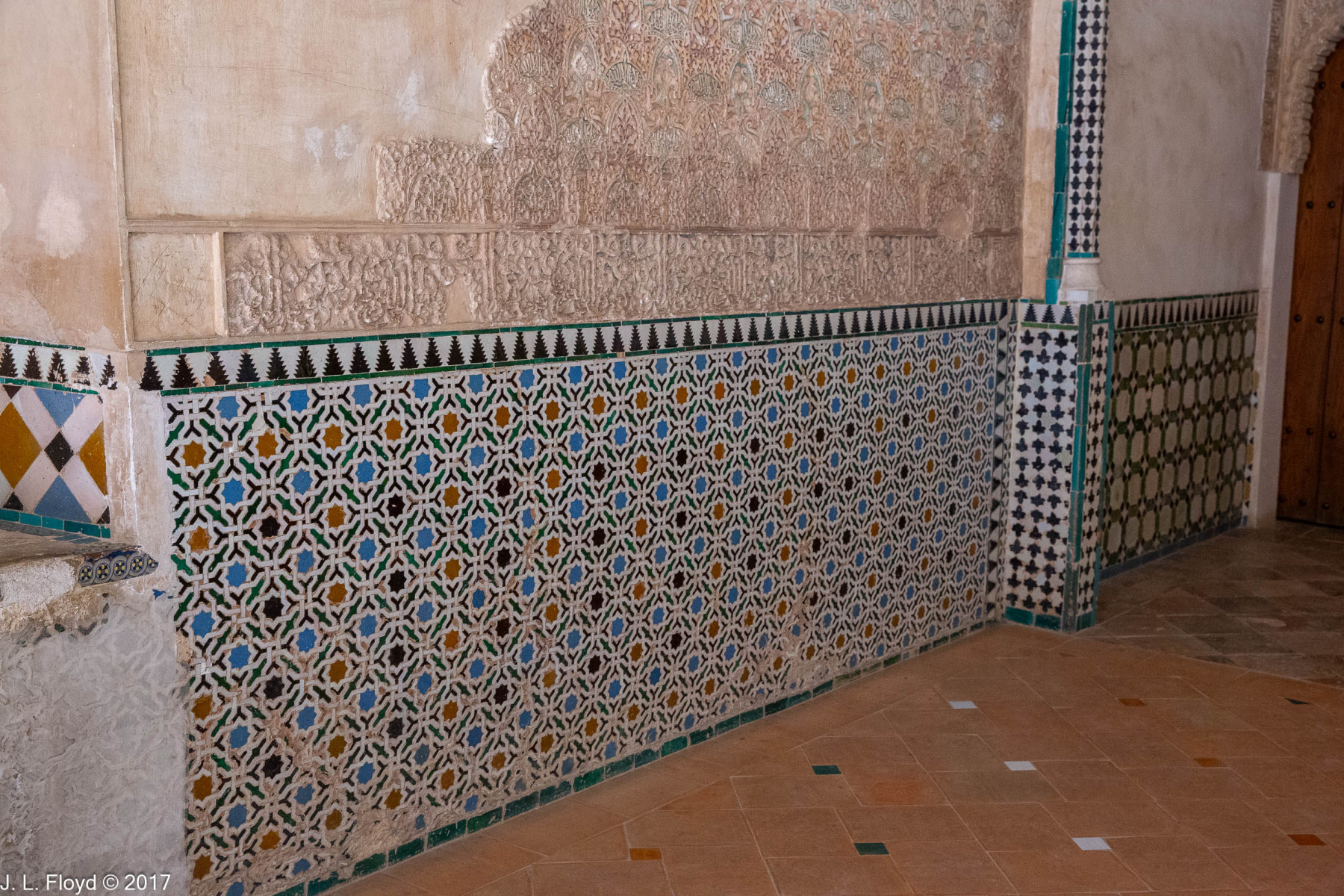
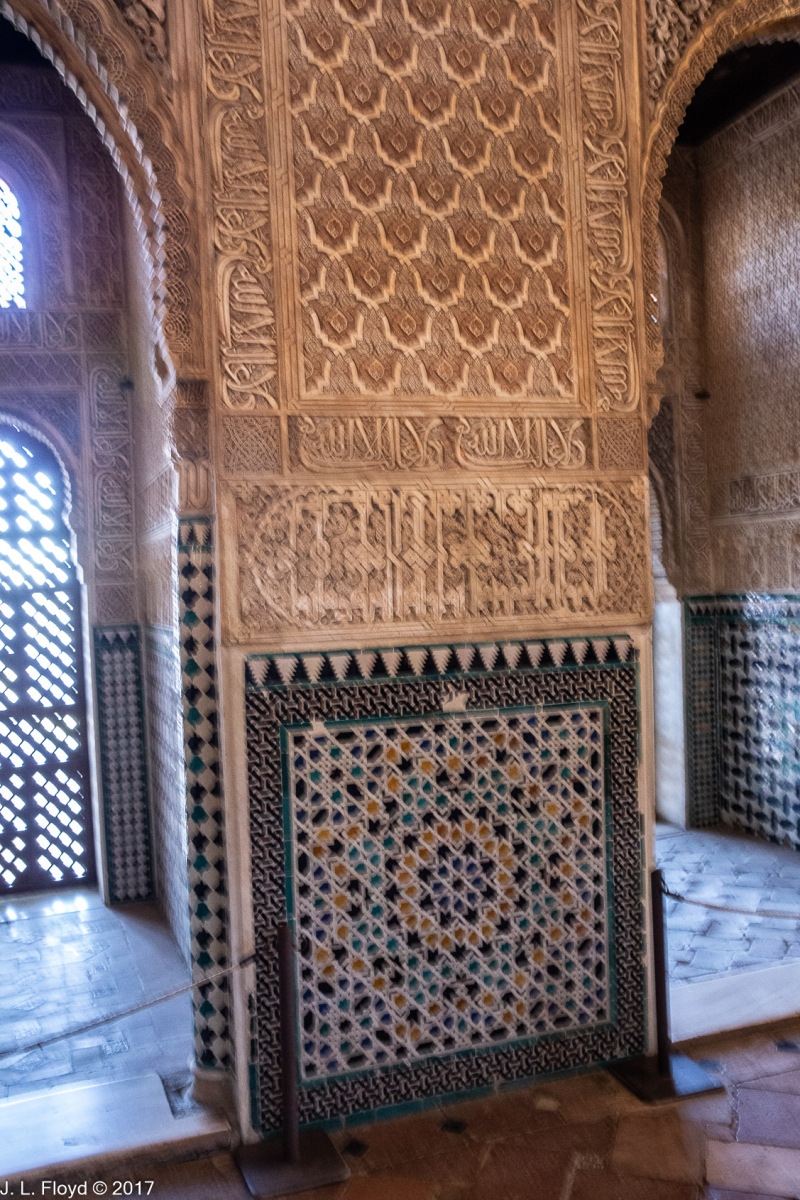
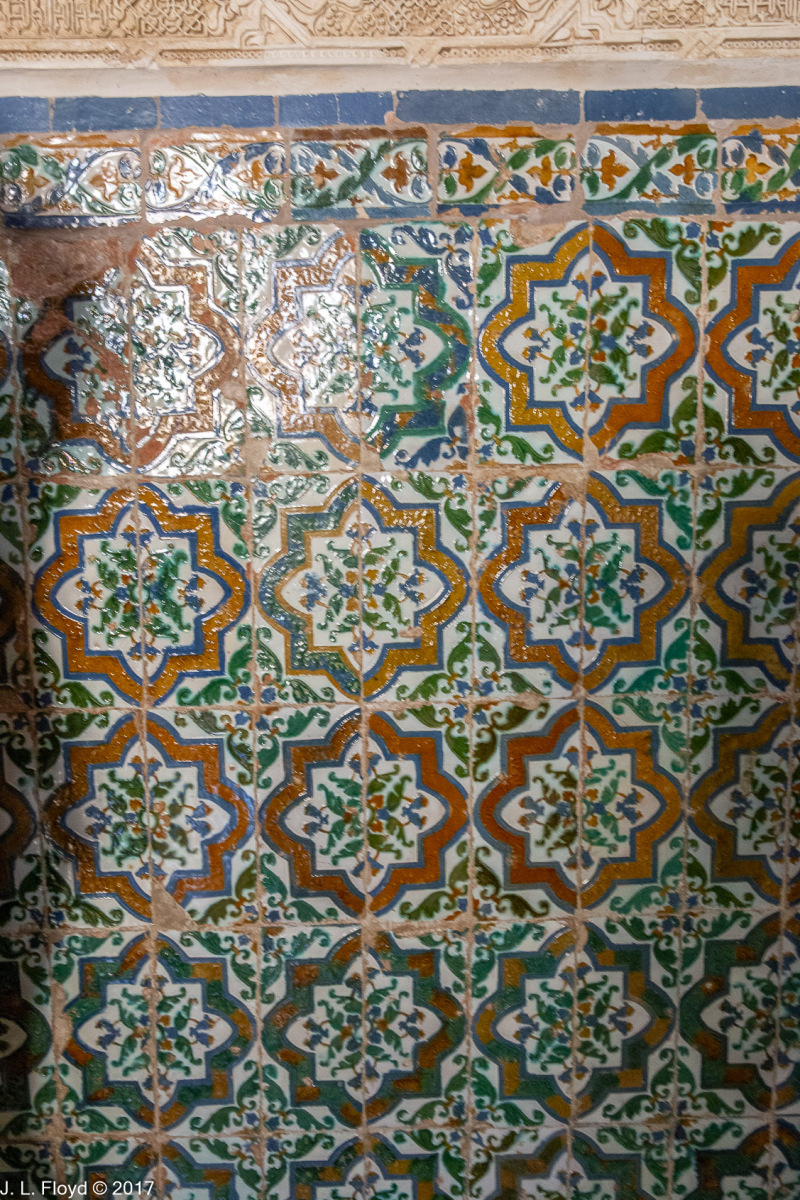
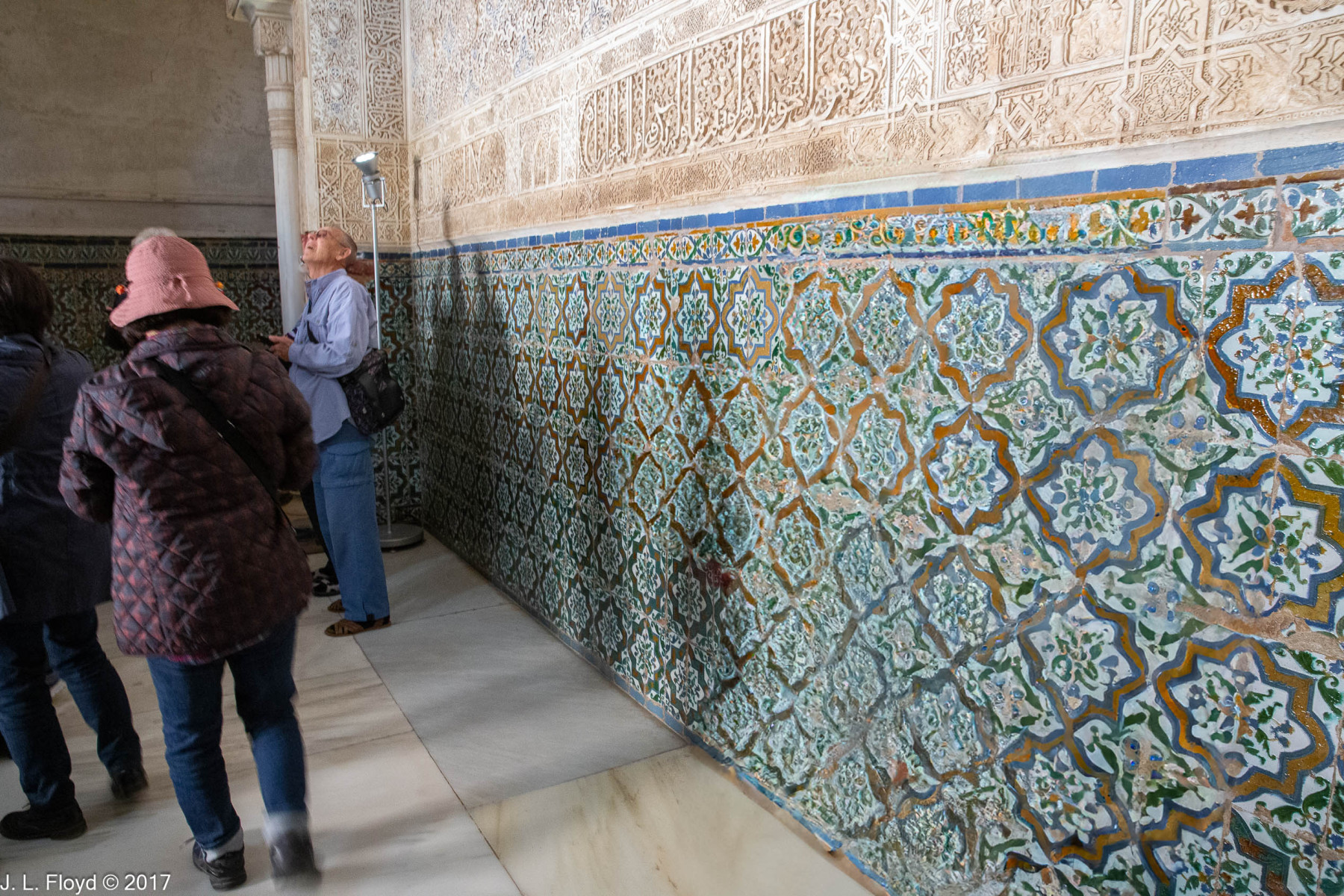
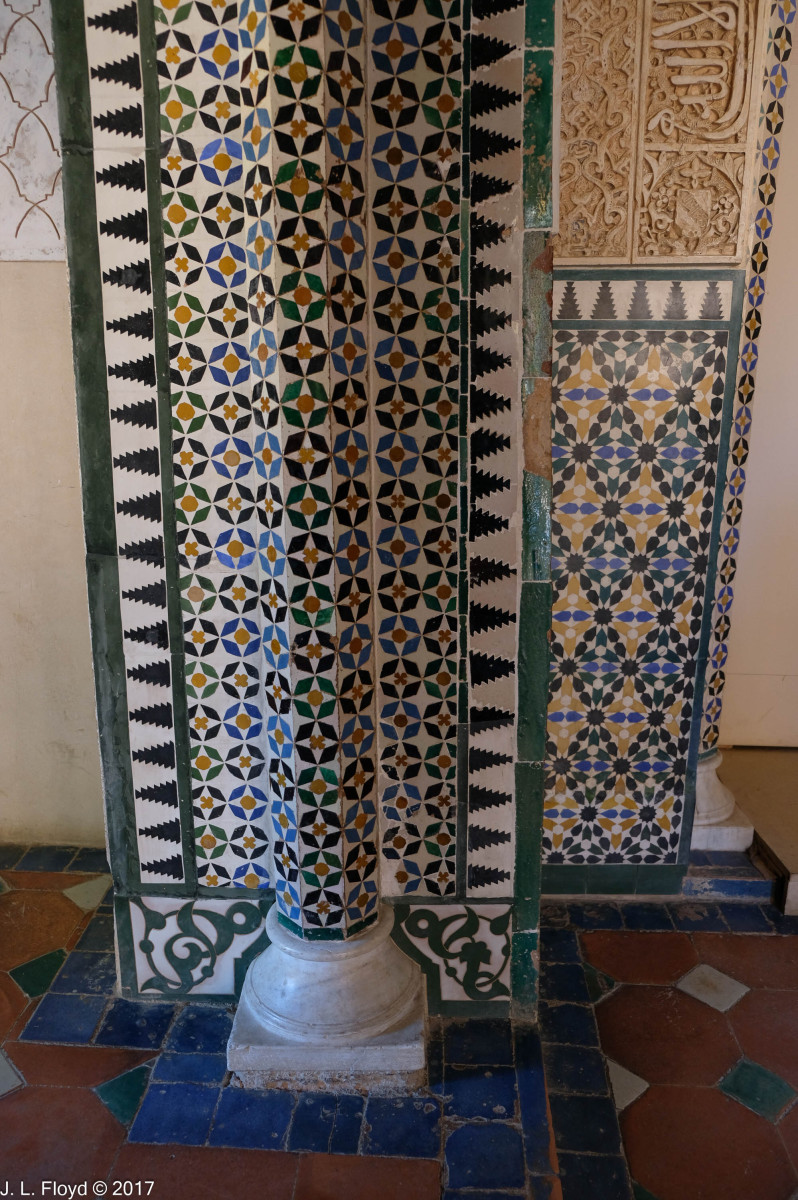
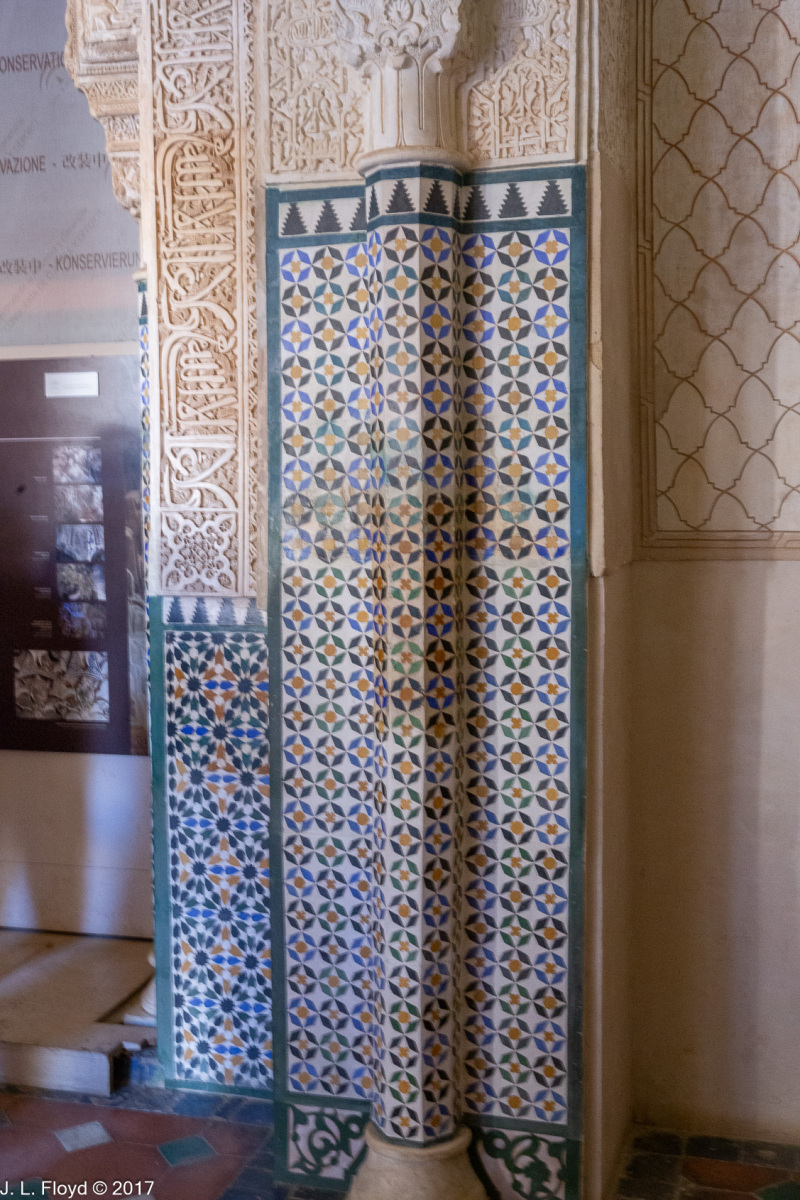
And speaking of geometric designs, mosaic tilework (known in Arabic as zellij) is ubiquitous throughout the Nasrid palaces, not excepting the Mexuar; it is found mostly in the form of tile skirting on the lower walls. The Christian rulers continued to use Moorish artists to work in the Alhambra after the 1492 conquest, and on one of the walls of the Sala del Mexuar is a tile mosaic with the words “Plus Ultra” (Further Beyond), the motto of King Carlos I/Emperor Charles V, who ruled Spain from 1519 to 1556. The words allude to the Latin saying “Ne plus ultra” which was for many centuries a warning to sailors to go no further beyond the Pillars of Hercules marking the Straits of Gibraltar, for there lay the vast unknown waters of the Atlantic Ocean, the mysterious, unknown edge of the world, where fearsome dangers awaited those who ventured thither. The Spanish explorers had dared to do so, and their daring had secured vast new territories, with limitless riches for the country and its monarchy. Also appearing in the some of the tile mosaics is the motto of the Nasrids, “And there is no victor but God”.

Adjoining the Sala del Mexuar is a small room which served as an oratory, or private prayer room for the ruler. It contains a mihrab (prayer niche) and features elaborate carved stucco decorations covering the walls. The multiple double-arched windows provide superb views of the landscape and the city of Granada below the walls of the Alhambra.

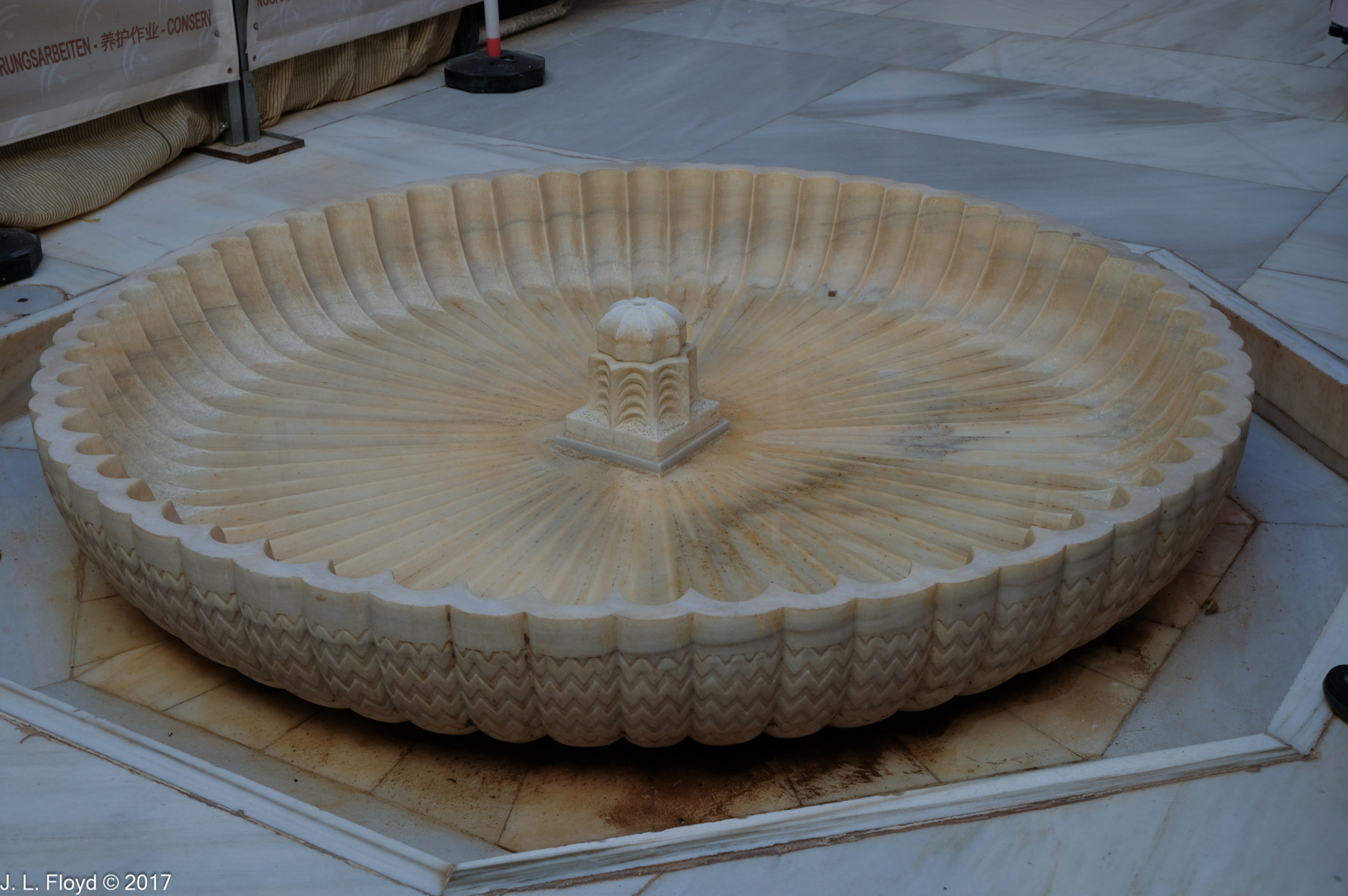
After passing through the Oratory, we arrived at the final chamber of the Mexuar Palace, the Cuarto Dorado, or Gilded Room. This is a relatively small space, which in the Nasrid era was used as a waiting room for people queuing for audiences with the emir, but after the Christian conquest was adapted for residential purposes. This remodeling included the creation of a gorgeous ceiling decorated in gold leaf, hence the gold in “Cuarto Dorado.” However, even more spectacular than the chamber itself is its adjoining courtyard, the Patio del Cuarto Dorado, which provides a transitional space to the Comares Palace. The north side of the patio features a fine three-arched portico providing access to the Gilded Room; the capitals of the supporting columns are decorated with elaborate stucco carvings in a style favored by the Almohads, the predecessors of the Nasrids. In the middle of the courtyard is a simple but elegant scalloped stone basin.

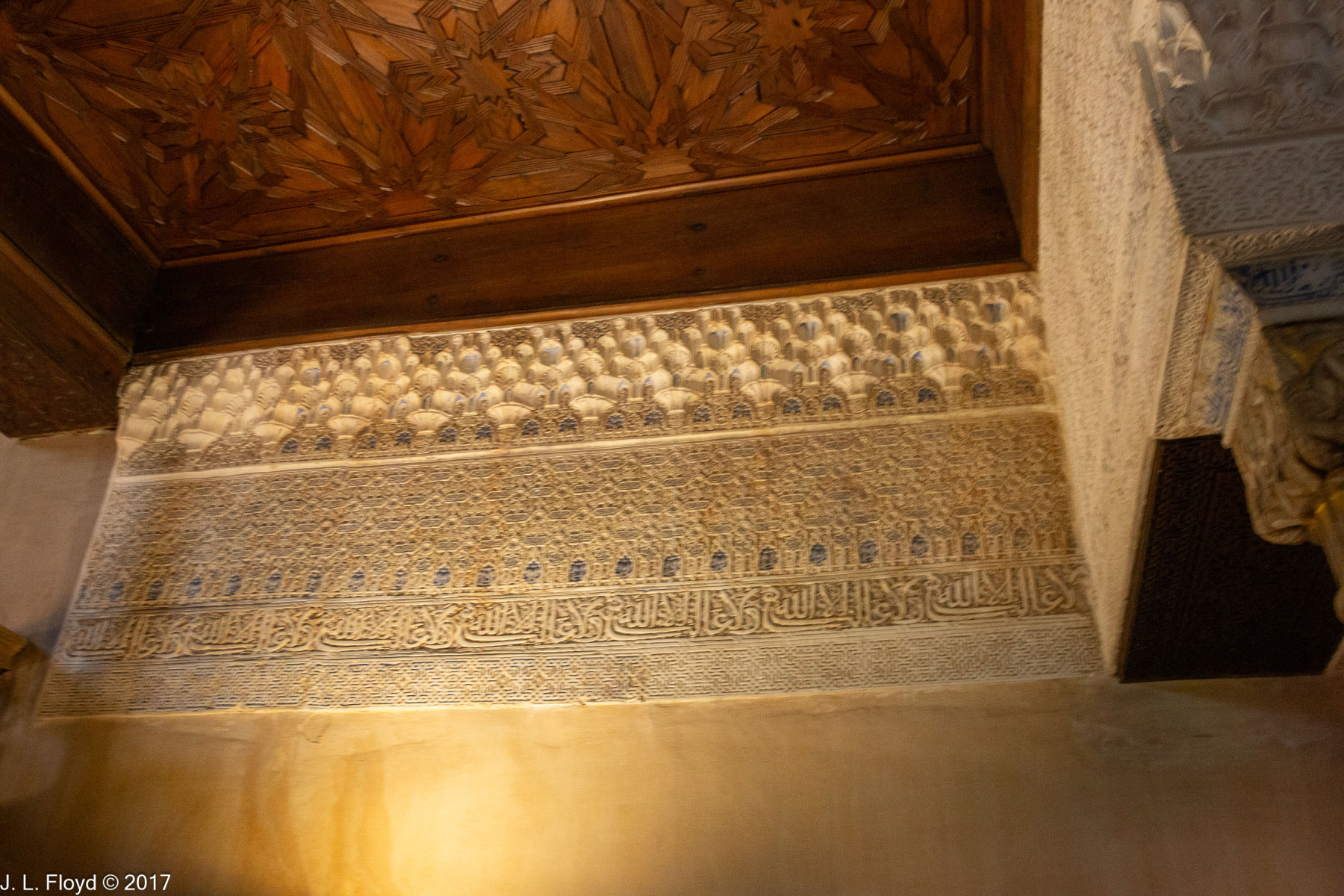
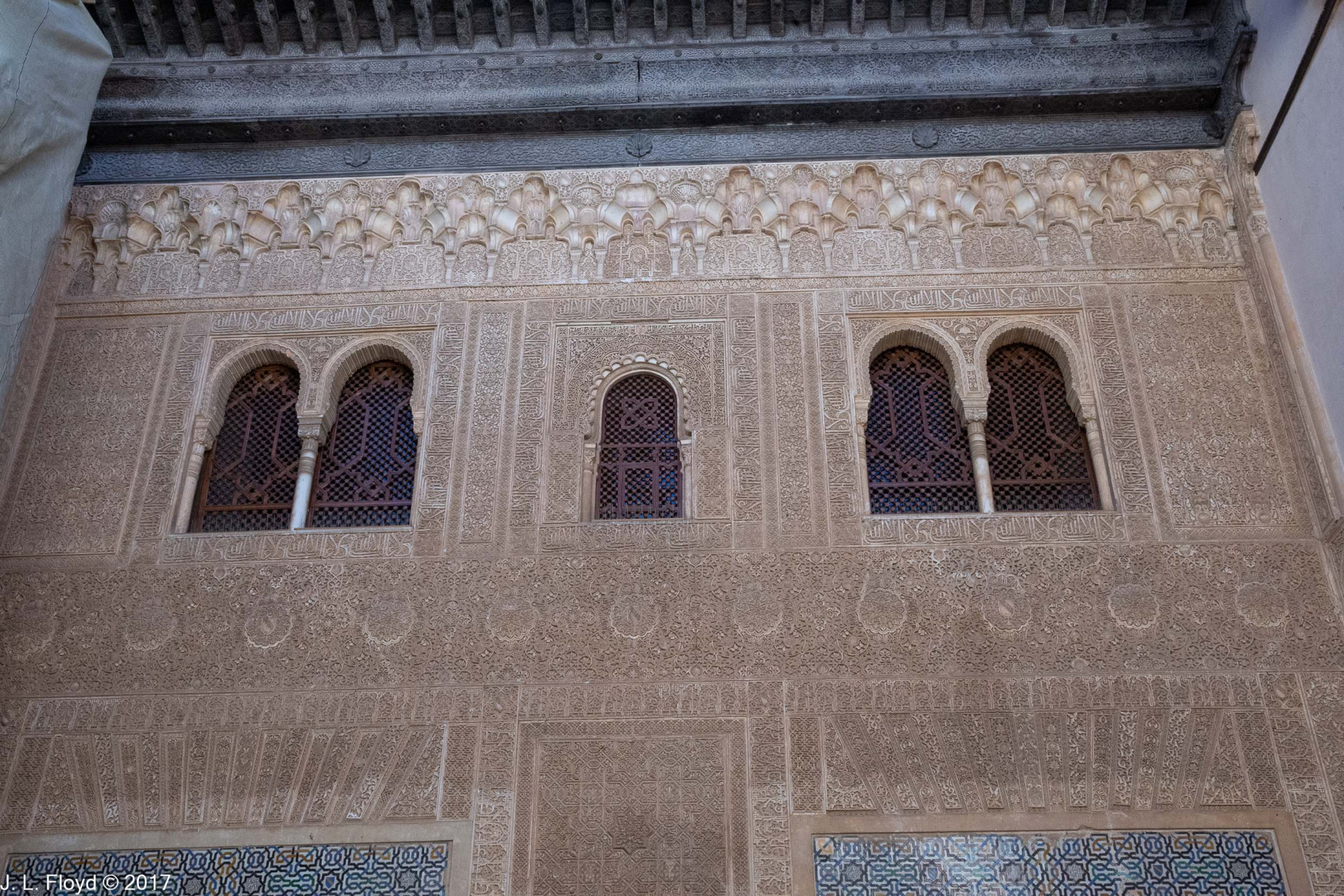
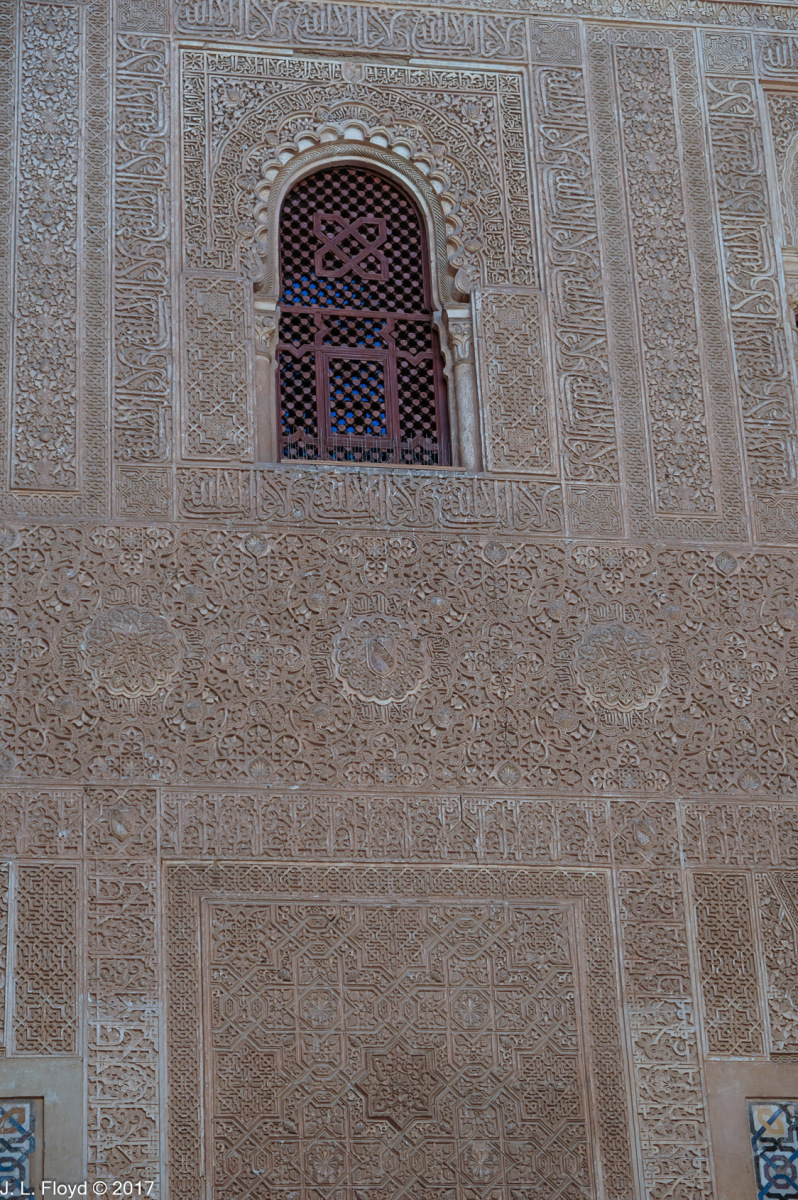
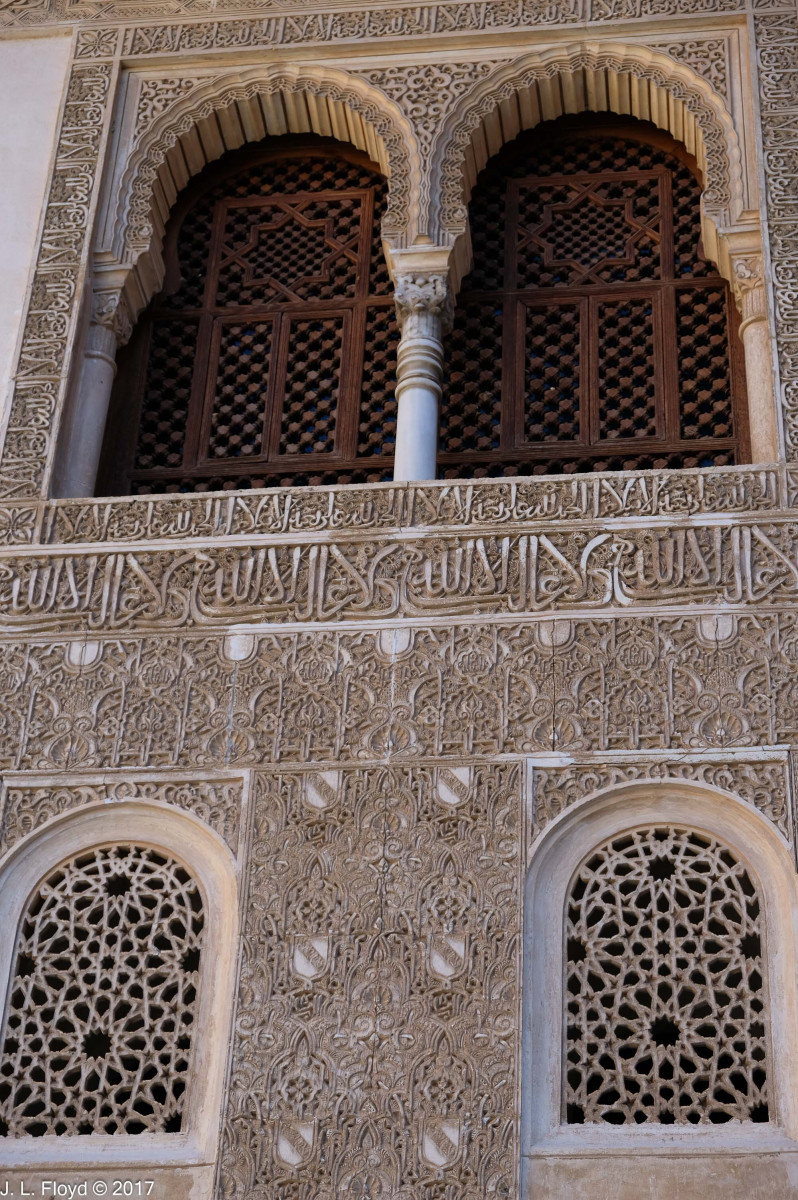
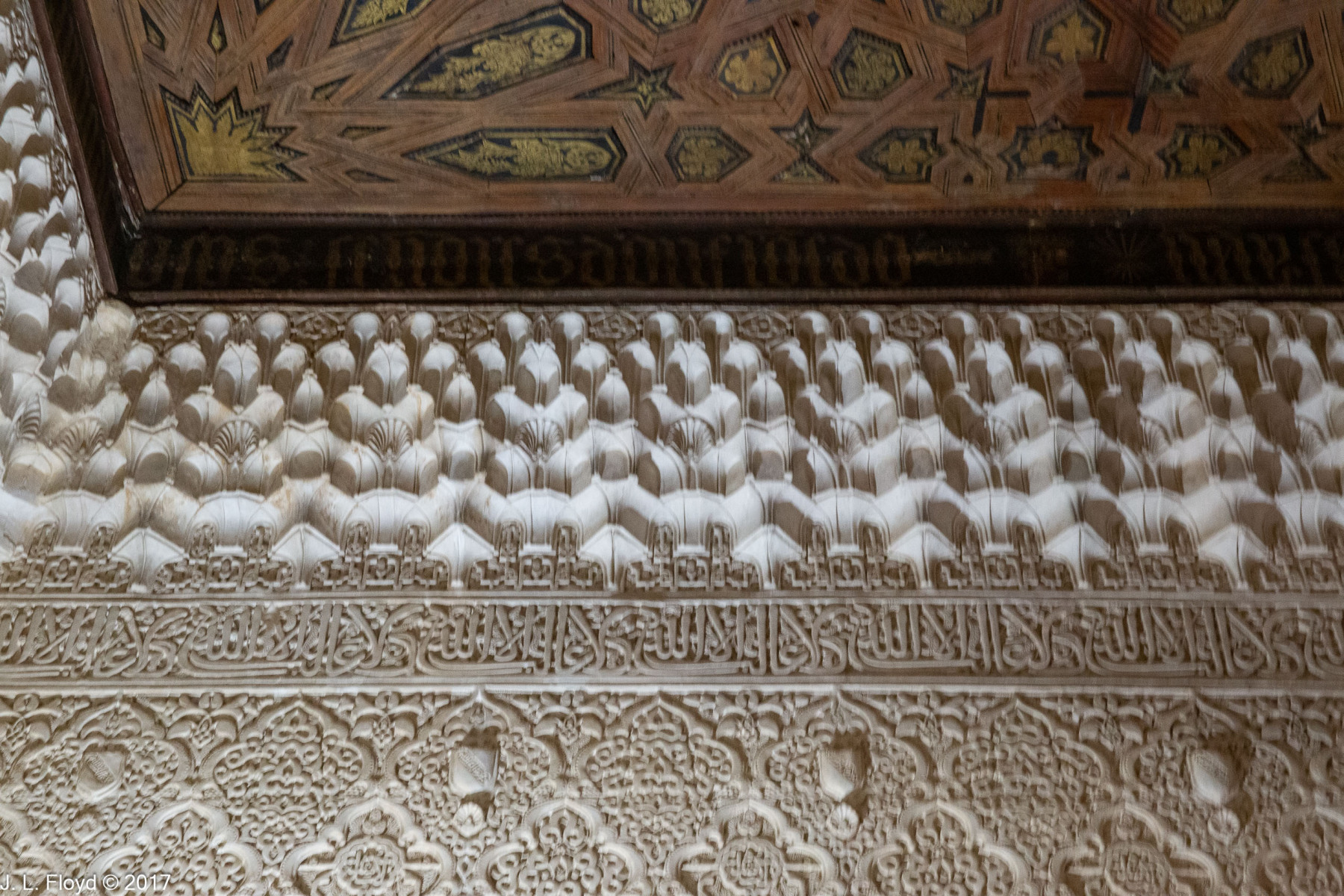
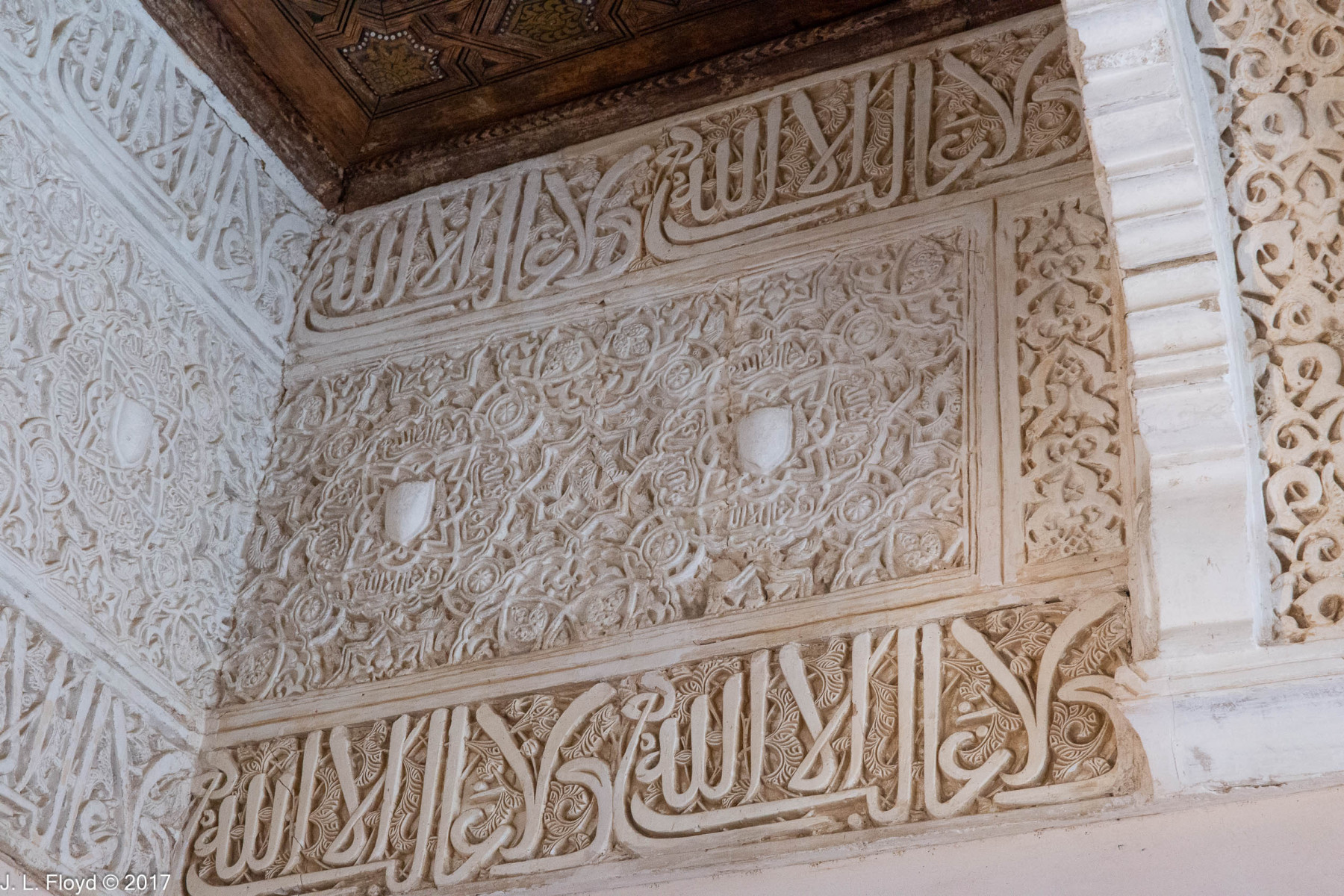
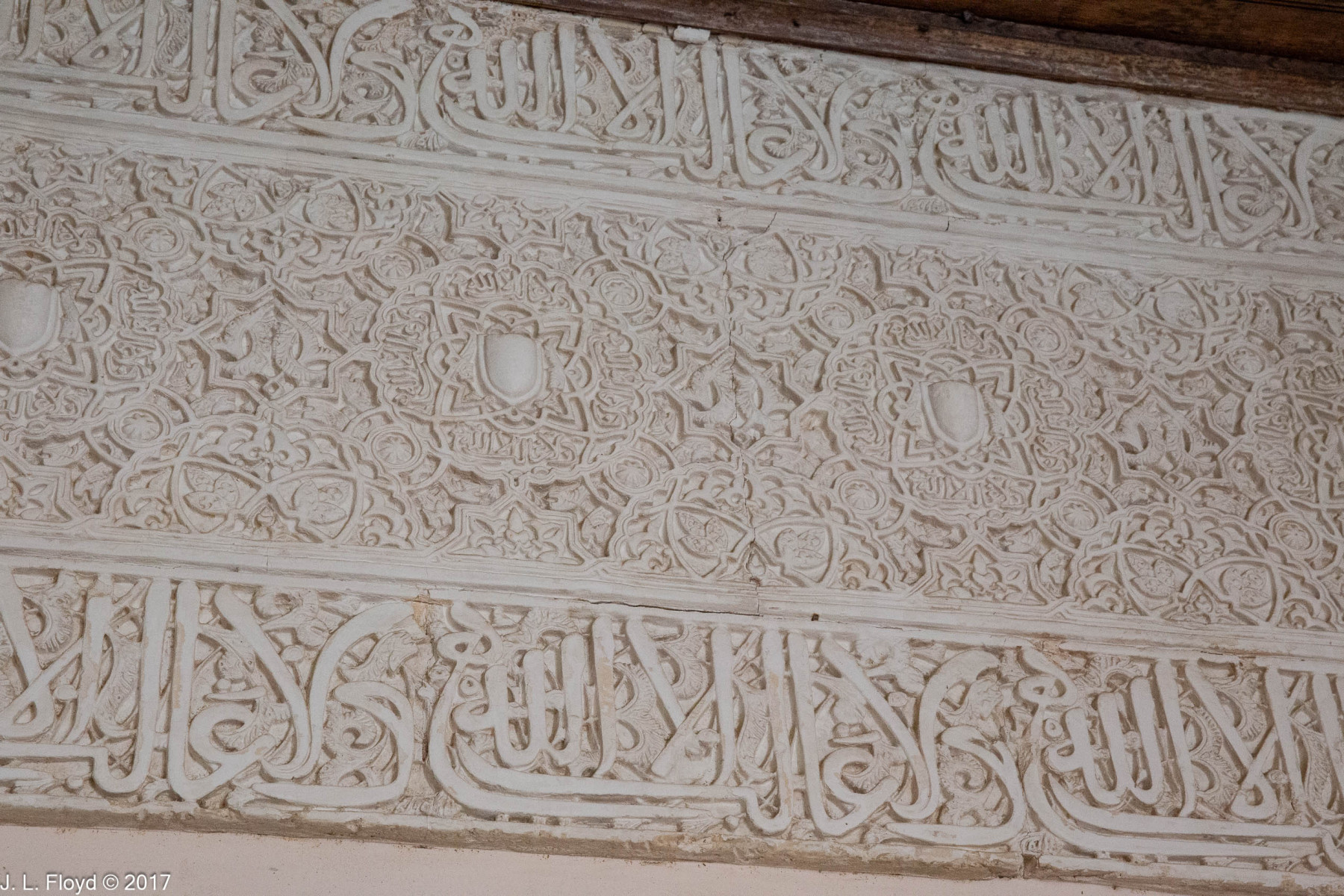
On the opposite (south) side of the Patio de Cuarto Dorado is the imposing façade of the Comares Palace. This was erected in 1370 by Emir Muhammad V to celebrate his conquest of the important city of Algeciras, the key to the control of the Strait of Gibraltar. It has two identical doors, framed in colorful zellij tiles, the one on the left leading to the Comares Palace, the other connecting back to the Mexuar. Except for tile skirting at the bottom, and three windows on the second floor, the façade wall is decorated entirely with stucco, carved with elaborate designs and inscriptions in Arabic calligraphy, such as verses from the Koran.

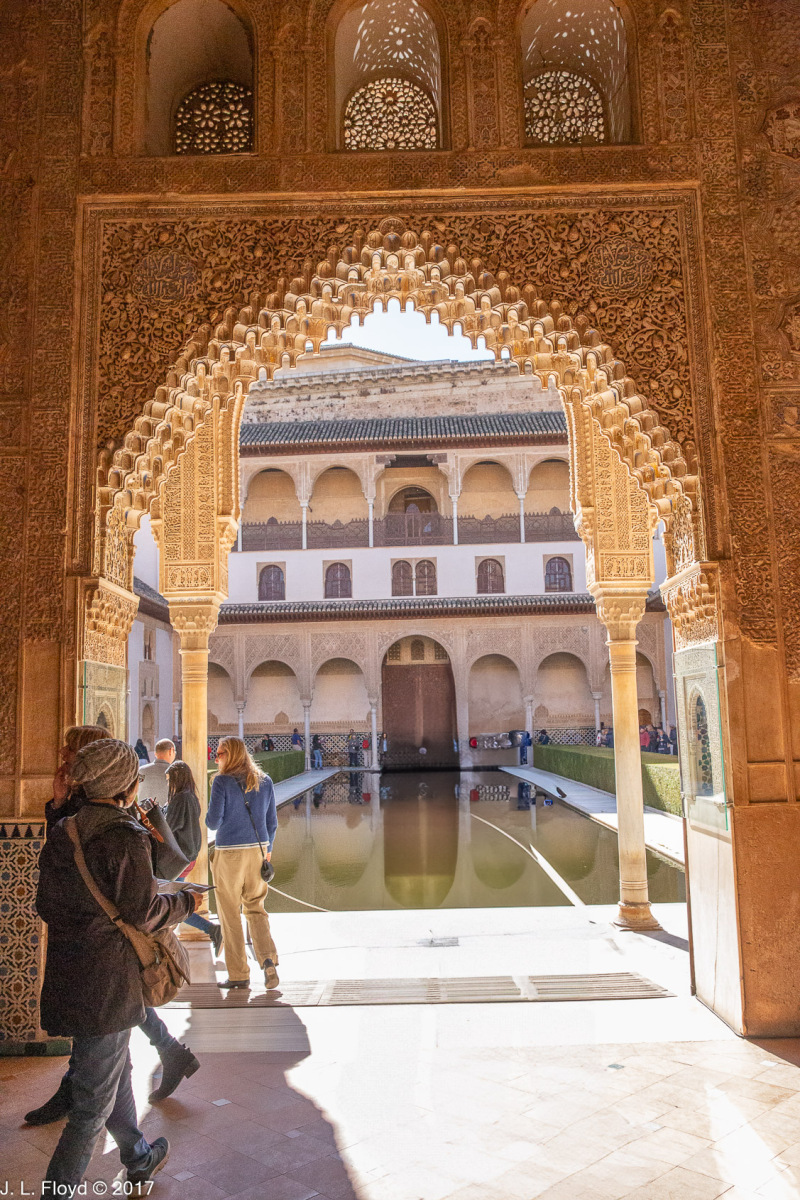
Entering the door on the left, we threaded our way through a narrow passageway, from which we emerged to find ourselves in the Court of the Myrtles, the iconic central element of the Comares Palace.

The Comares Palace was begun in the reign of Isma’il I (r. 1314-1333), expanded by his successor Yusuf I (r. 1333-1354) and completed under Muhammad V (r. 1354–1359 and 1362–1391), though of course it was further modified by the Christian conquerors after 1492.

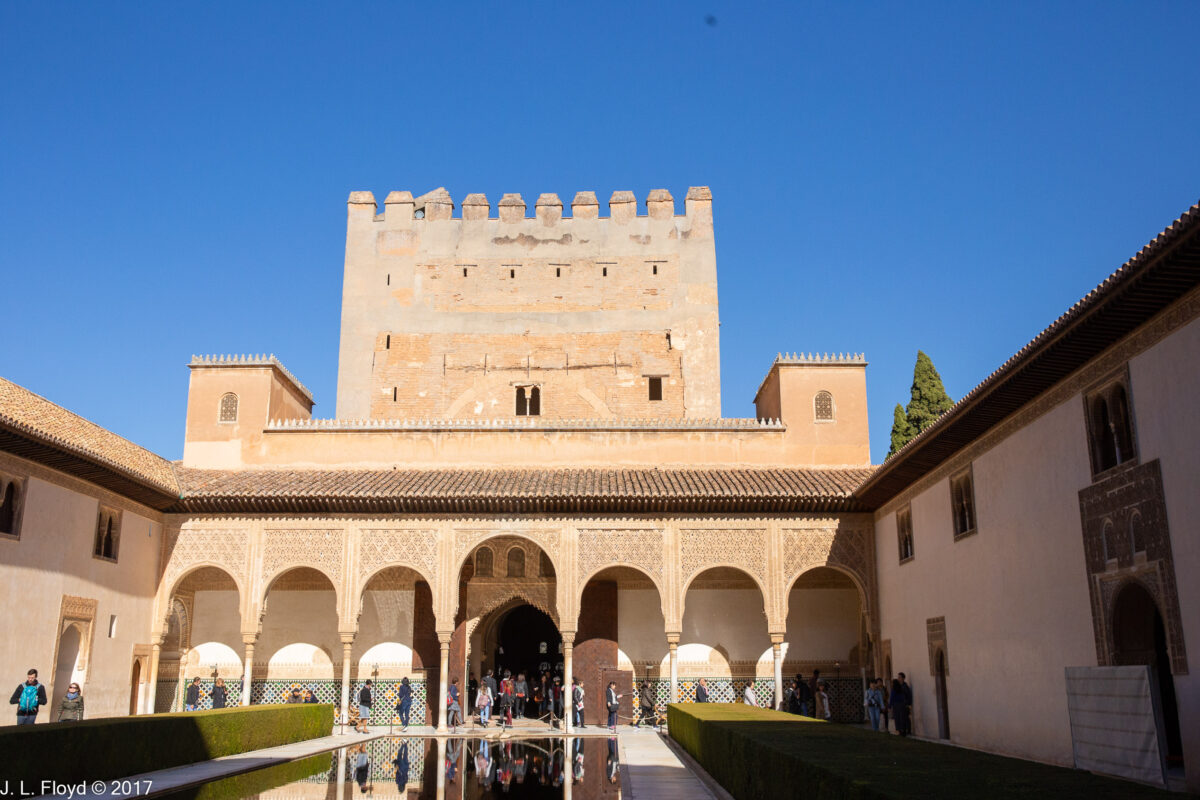
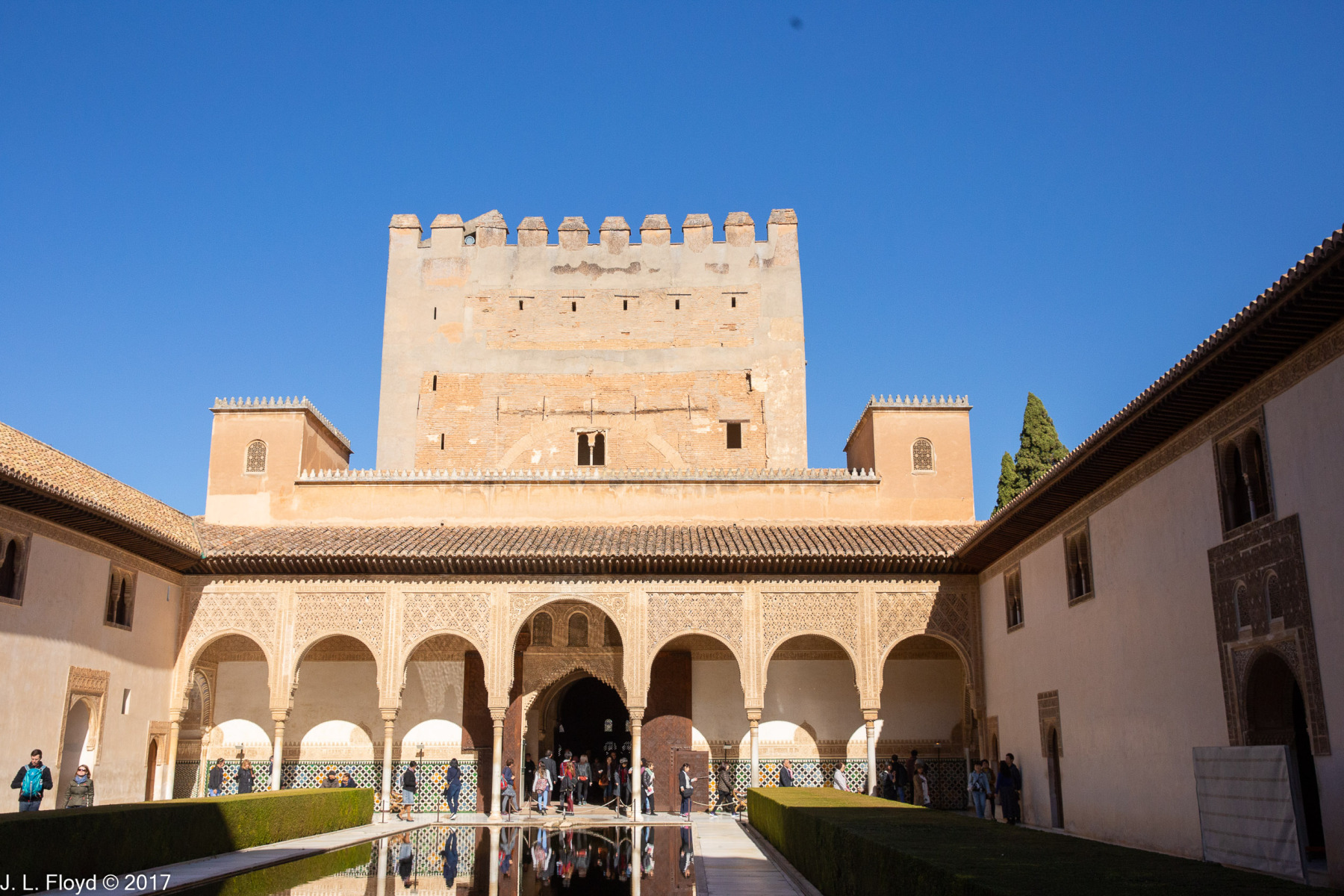
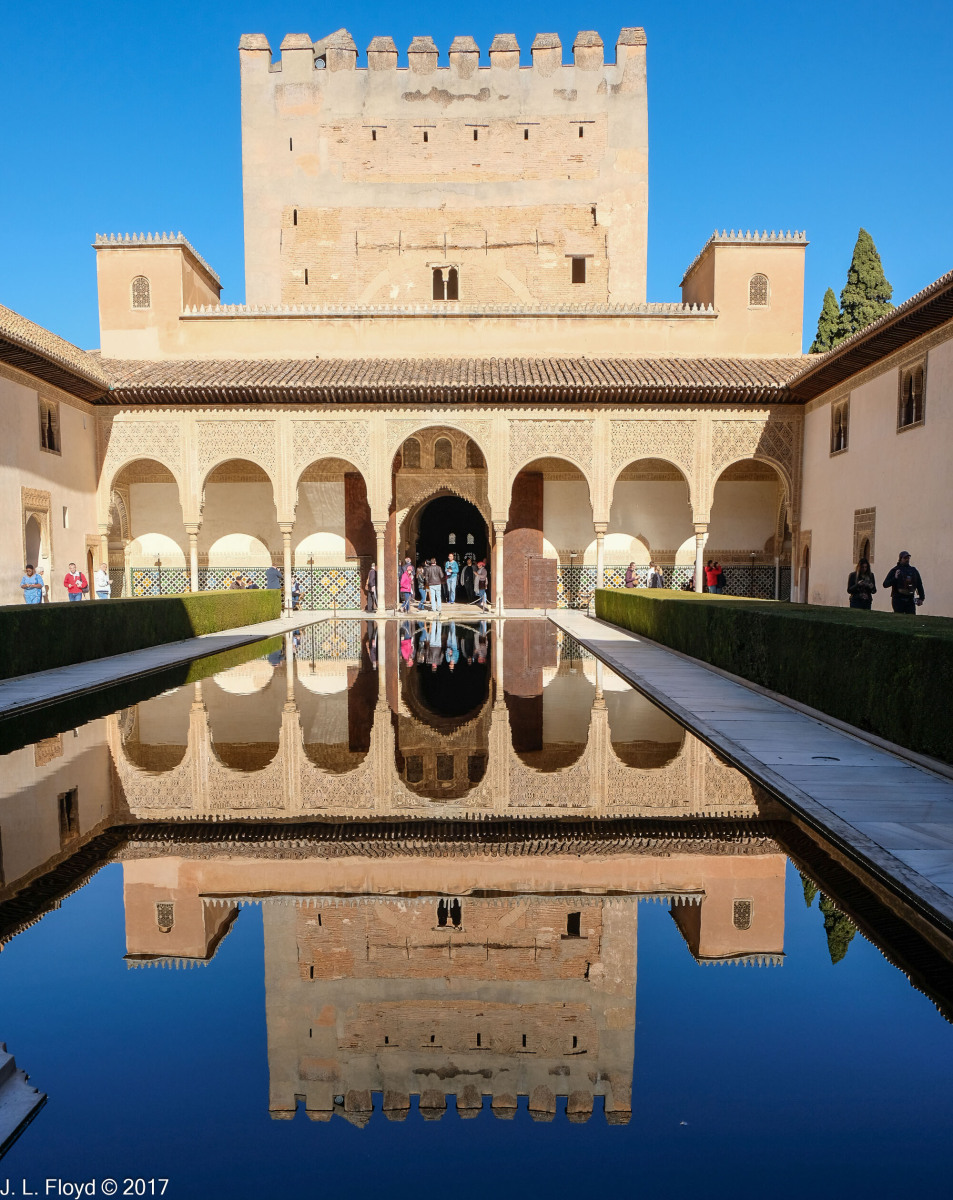
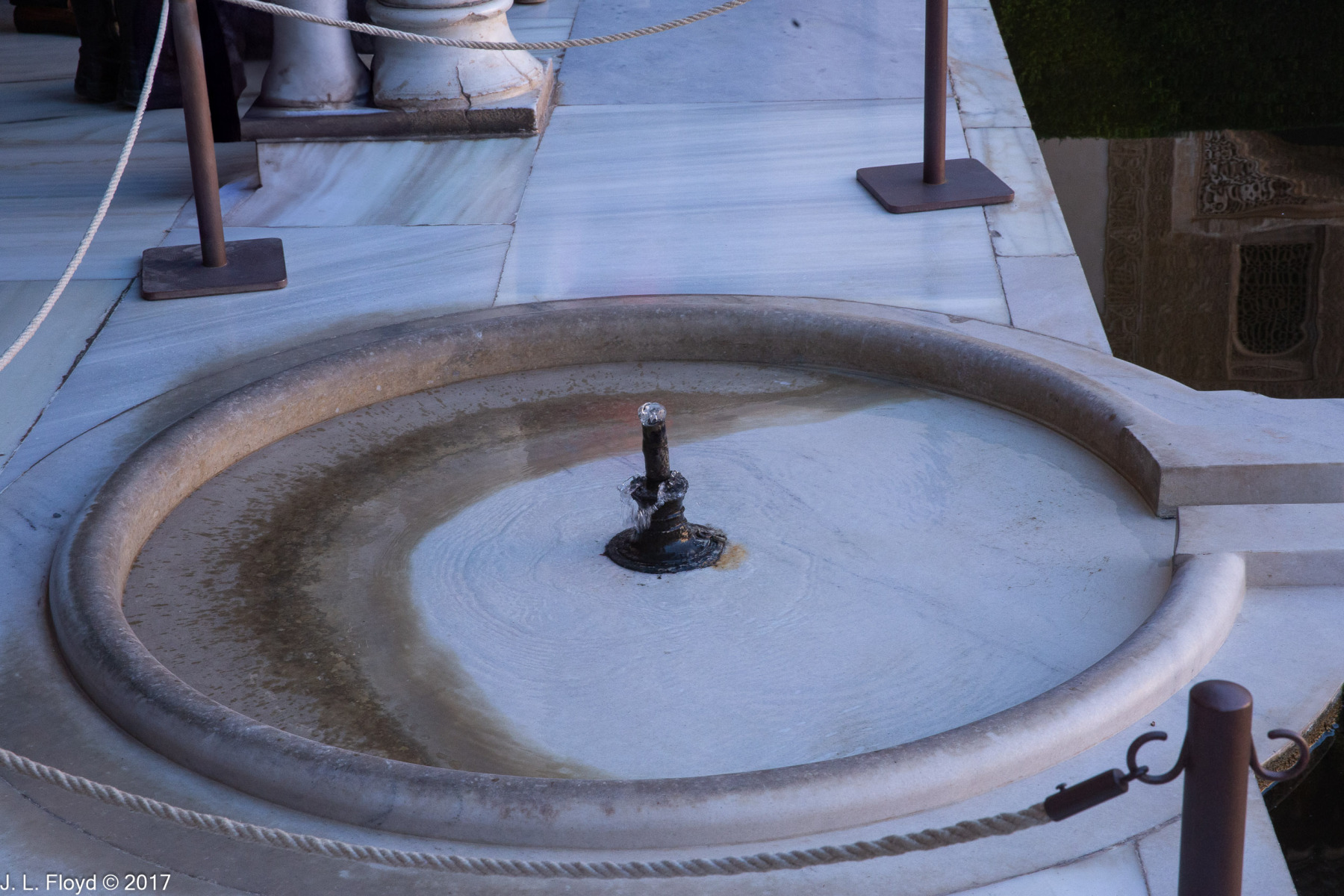
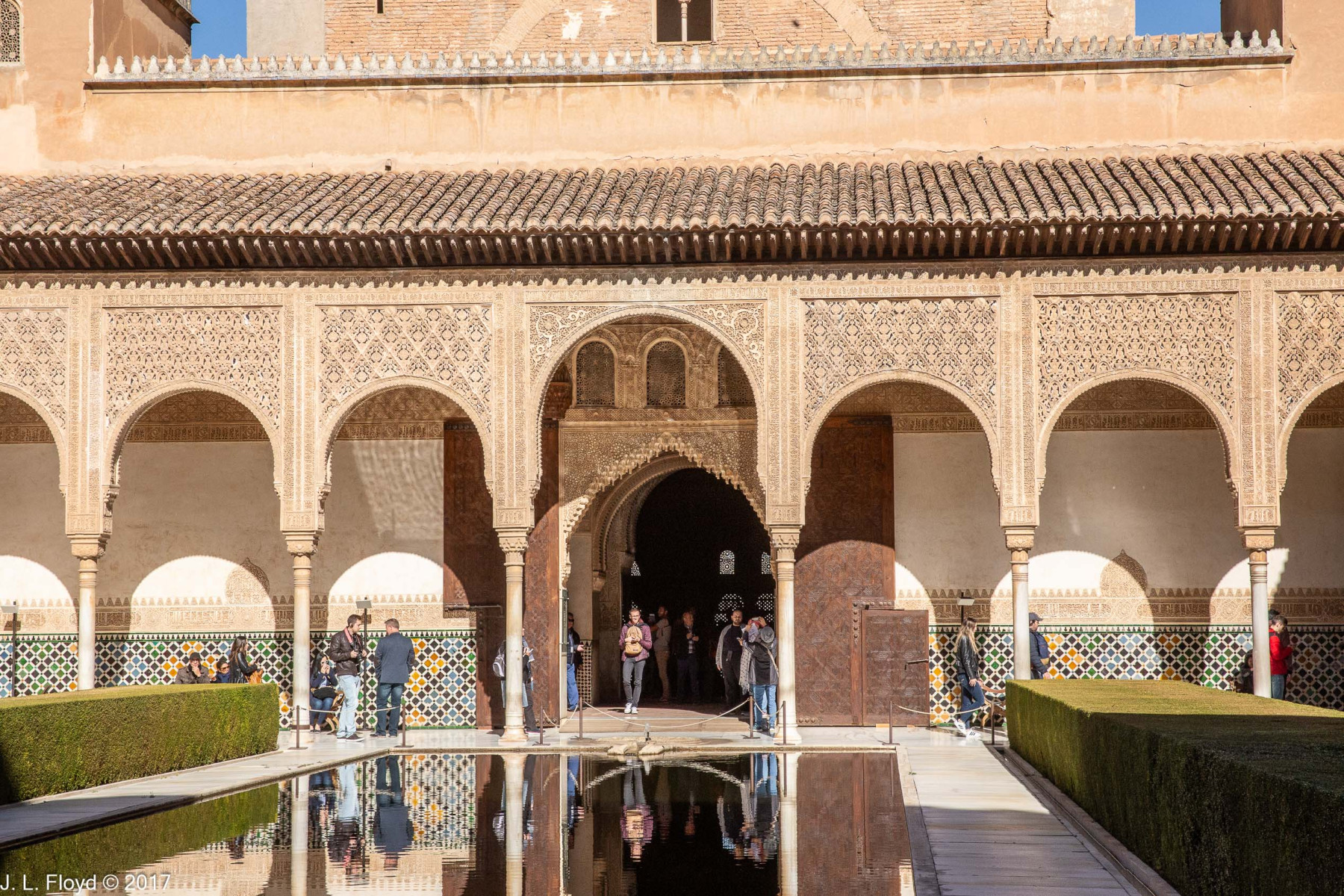
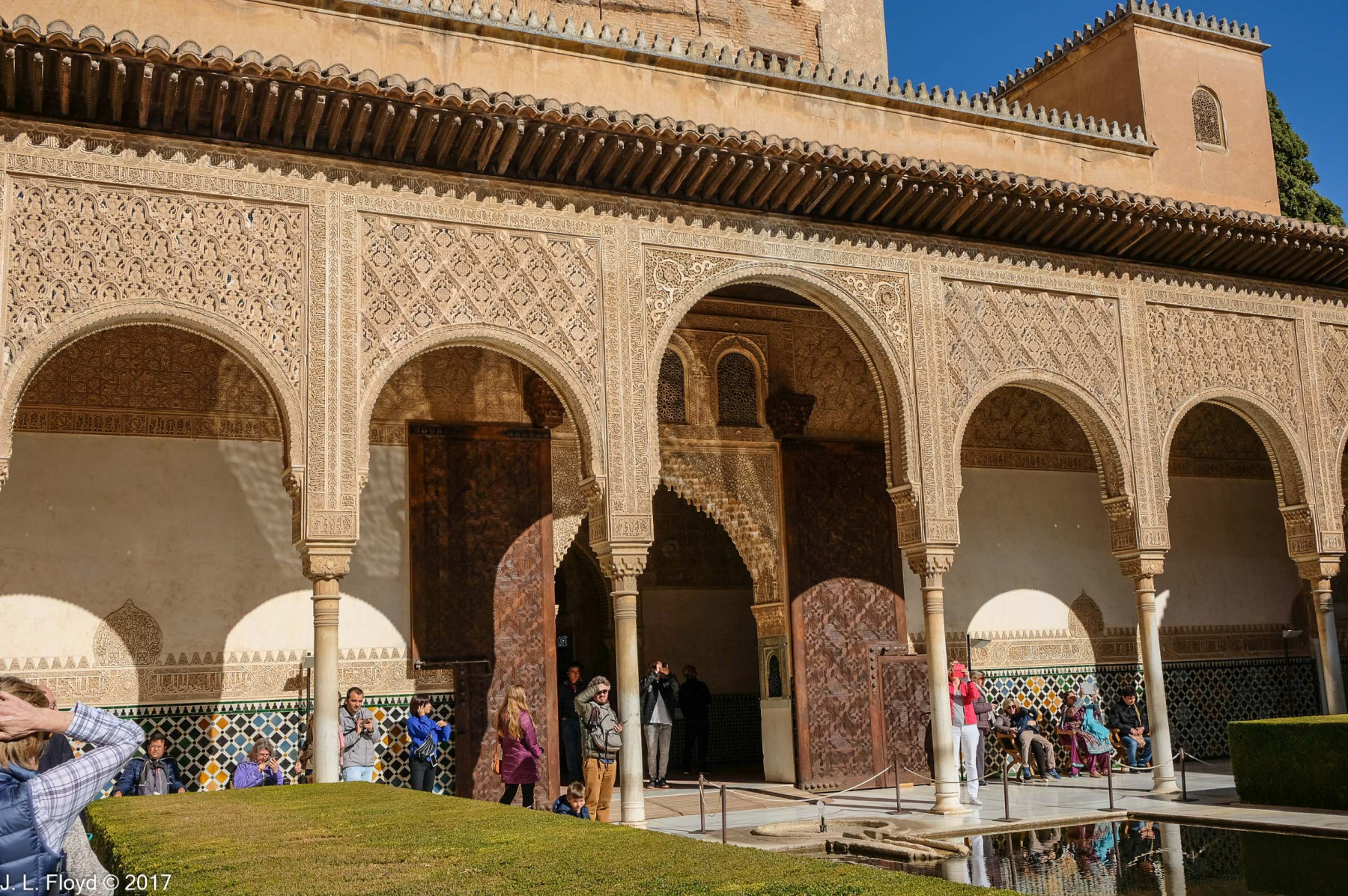
The Court of the Myrtles is a rectangular space 36 meters (121 feet ) long by 23 meters (75 feet) wide, with the long side oriented along a north-south axis. In the middle is a pool, also rectangular, 34 metres (112 feet) long and 10 meters (33 feet) wide. Water flows into the pool from two circular basins at either end; their design was cunningly calculated to make the water flow so slowly that it does not make ripples in the pool, the surface of which remains so still that the pool is perfectly reflective, as illustrated by the accompanying gallery photos. Myrtle hedges running along the the east and west sides of the pool give the courtyard its name.

The Comares Palace is built around the courtyard, with multistory pavilions at both north and south ends, connected by two-story structures on the long sides. In front of each pavilion is a portico with a wide central arch flanked by three arches on each side. The arches are lavishly decorated with designs in stucco, and the galleries behind them are resplendent with zellij tile skirting and muqarnas vaulting. The lateral structures on the long sides are austere by comparison, with a few widely-spaced windows and doors decorated with stucco framing. The doors lead either to residential quarters or to passages connecting with the Cuarto Dorado, the Comares Baths, and the Palace of the Lions.

The north pavilion is the heart of the Comares Palace, consisting of the Sala de la Barca and the Comares Tower with its vast Hall of Ambassadors, also known as the Throne Room.

The south pavilion was originally built as residential quarters for the royal family, but it was mostly demolished in the 16th century to make way for the Palace of Charles V, leaving nothing but the façade, which is nevertheless quite imposing. It consists of three levels. At ground level there is a portico and gallery similar to those at the north end. The second level has seven windows with wooden latticework performing the same function as venetian blinds in other cultures. The third and top level features a lavishly decorated gallery with seven arches and a large central doorway.

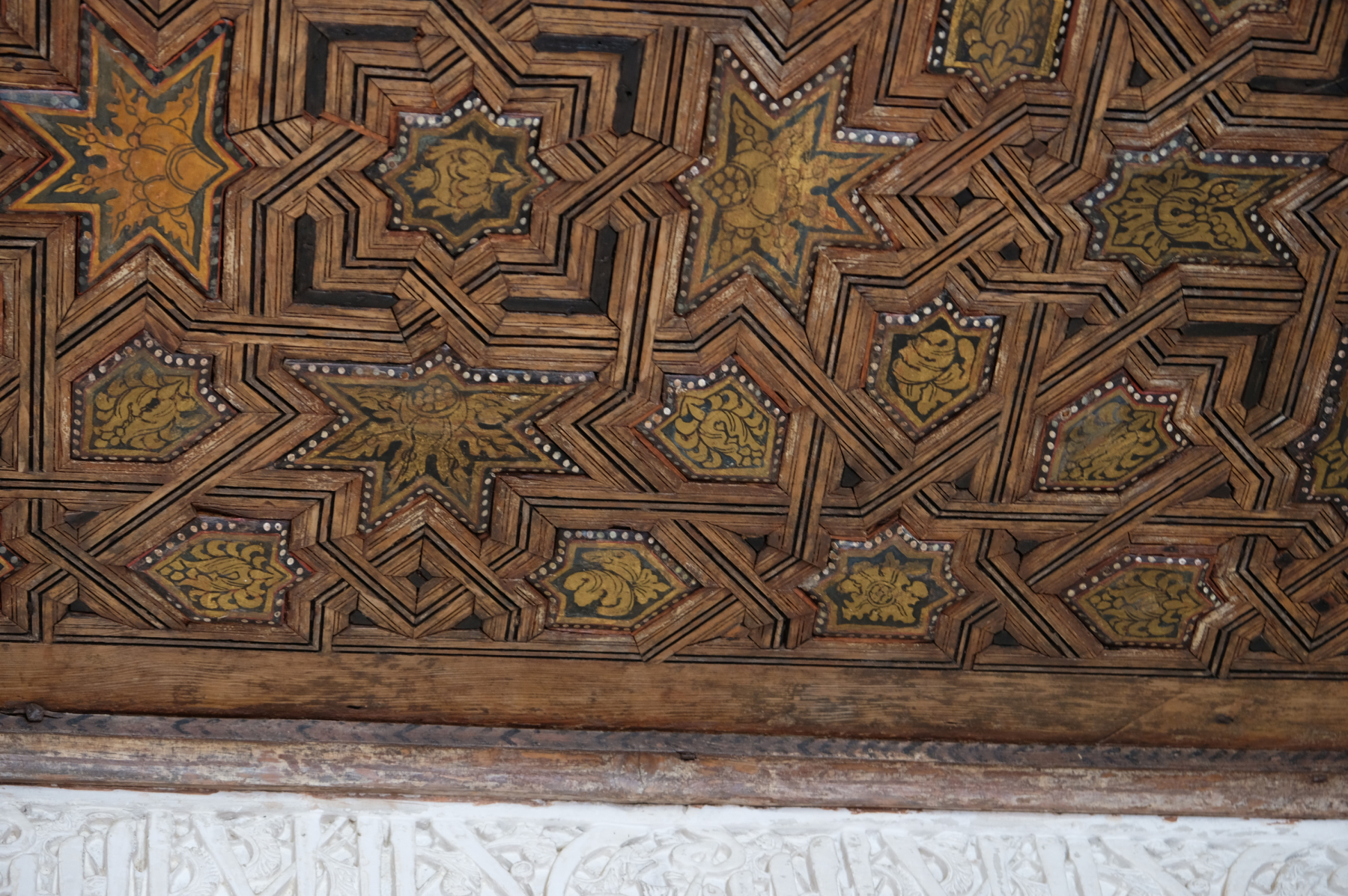
The Northern Pavilion is entered via the Sala de la Barca. The name, meaning “Room of the Ship,” does not seem to be associated with any nautical motif but is thought to be derived from the Arabic word baraka, meaning “blessing,” which is found on inscriptions in the room. (The resemblance to the given name of an American president is duly noted.) It is believed to have served as a waiting room for persons seeking audience with the emir. The hall has an ornate wooden ceiling decorated with elaborate geometric figures; it was destroyed by a fire in 1890 but later rebuilt with the aid of surviving fragments.

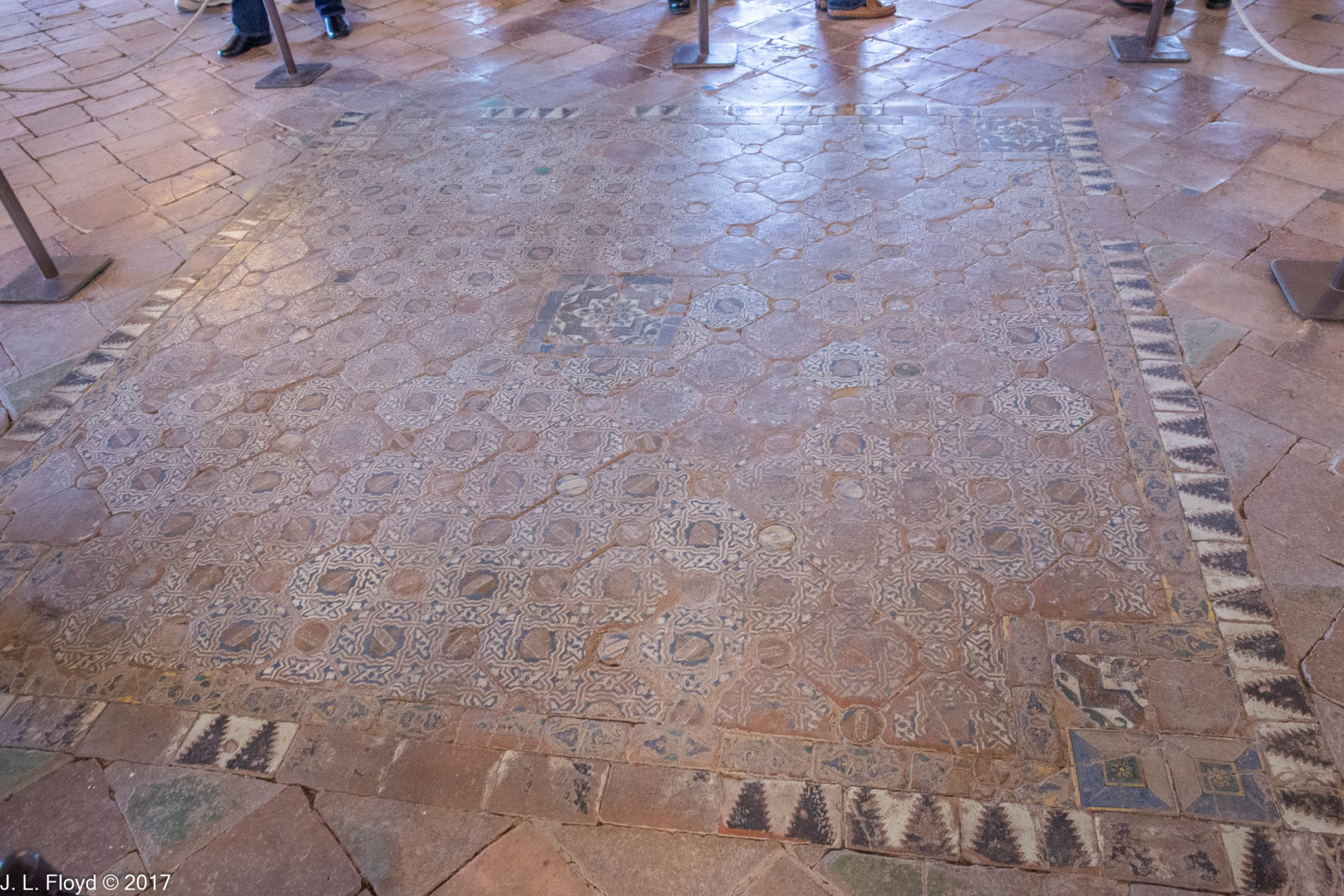
Upon entering the Throne Room, or Hall of Ambassadors as it is also known, one is immediately overwhelmed by its vastness. It is the largest room in the Alhambra, 18.2 meters (60 feet) high and 11.3 meters (37 feet) on each side. The ceiling, composed of 8017 pieces of wood fitted together to form a complex geometrical pattern, is 125 square meters (1346 square feet) in area. Floor space is 127.7 meters (1375 square feet). The central part of the floor is paved with lusterware tiles, so called because they are made with a metallic glaze that produces an iridescent effect.

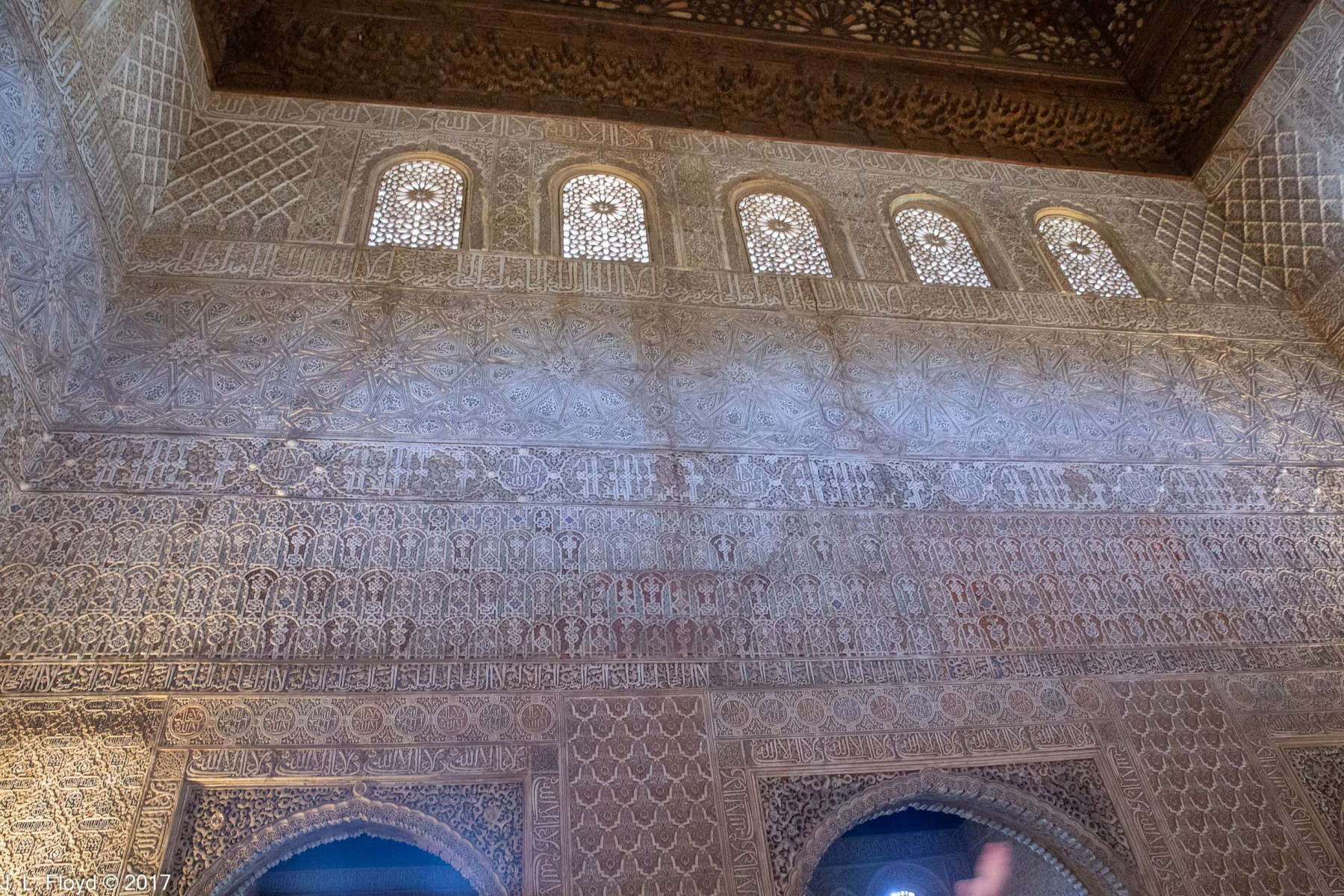
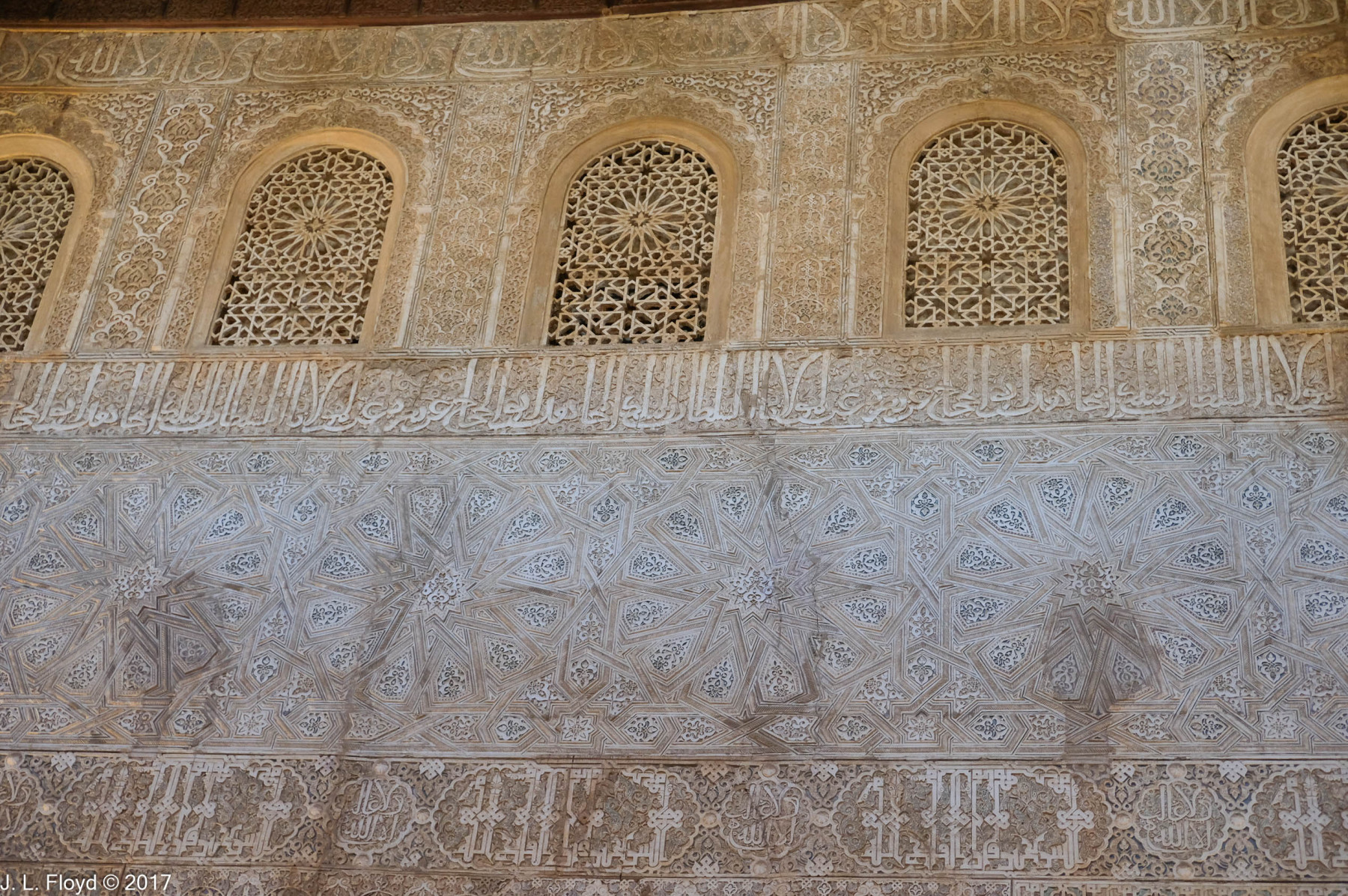
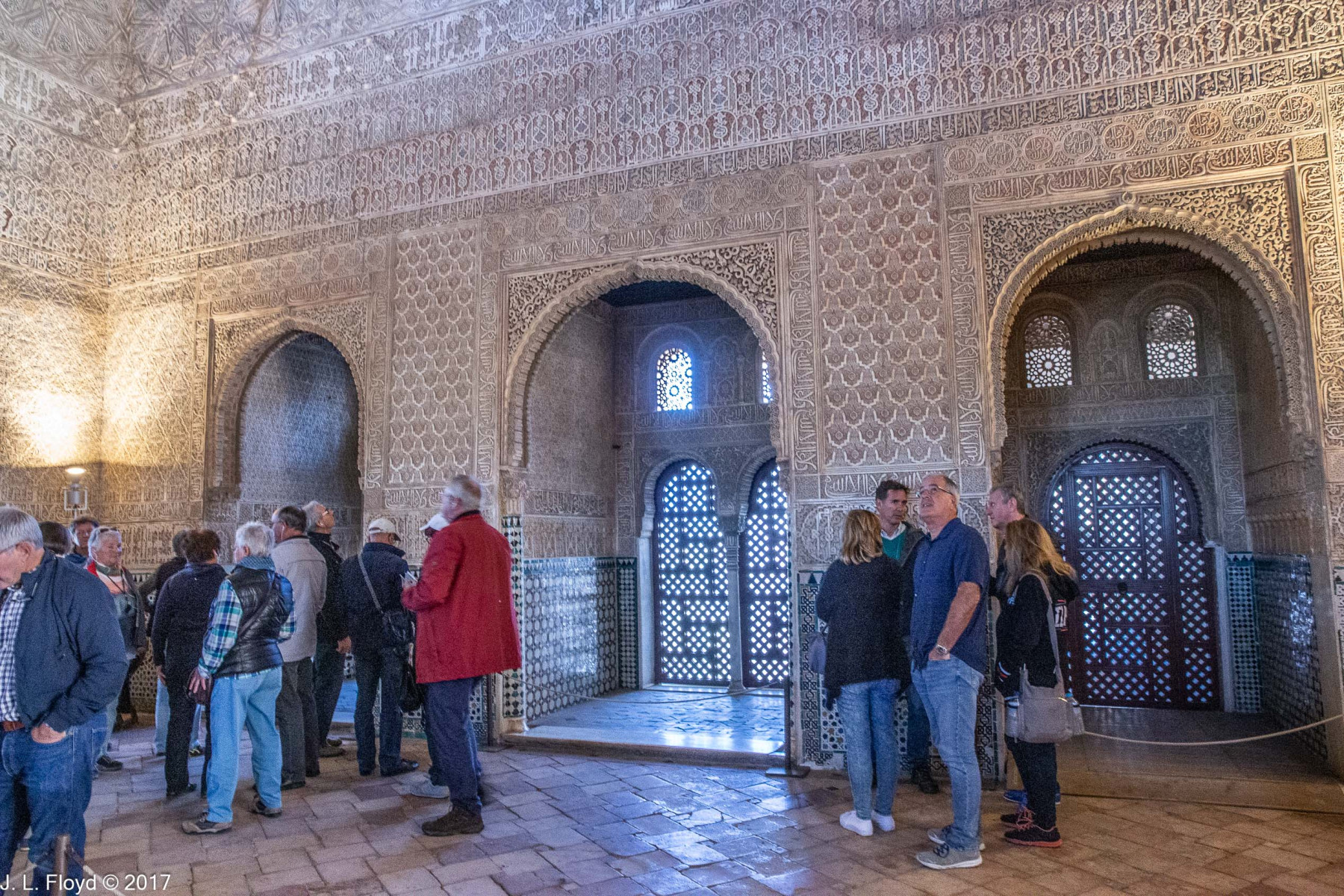
Like most of the chambers in the Nasrid palaces, the Throne Room’s upper walls are smothered in detailed stucco decoration, while the lower walls are covered with zellij tiles displaying various brightly colored geometric designs. At the top of the walls are windows with lattice grilles. At ground level, three of the walls have three alcoves each, with lattice-grille windows; in each case the center alcove is larger, with double windows, and the central alcove on the north wall, facing the muqarna-festooned entrance archway, is the most elaborately decorated, since the throne of the emir was located there.

The baths of the Comares Palace, located on the east side of the Court of the Myrtles, are said to be the best-preserved medieval Muslim baths in the Iberian peninsula, and judging from the photographs I have seen of them, are quite attractive. However, in order to keep them that way, they are closed to tourists. So next on our itinerary was the Palace of the Lions, also on the east side of the Court of the Myrtles, next to of the baths.

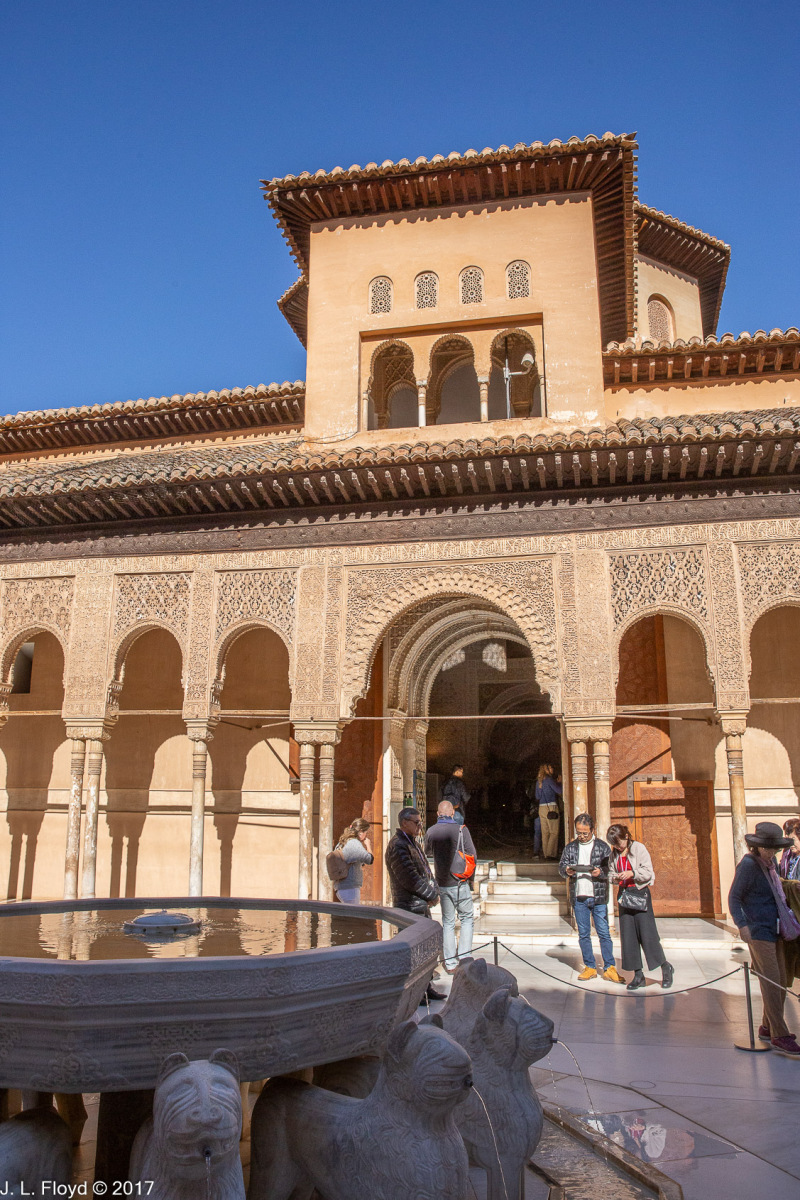
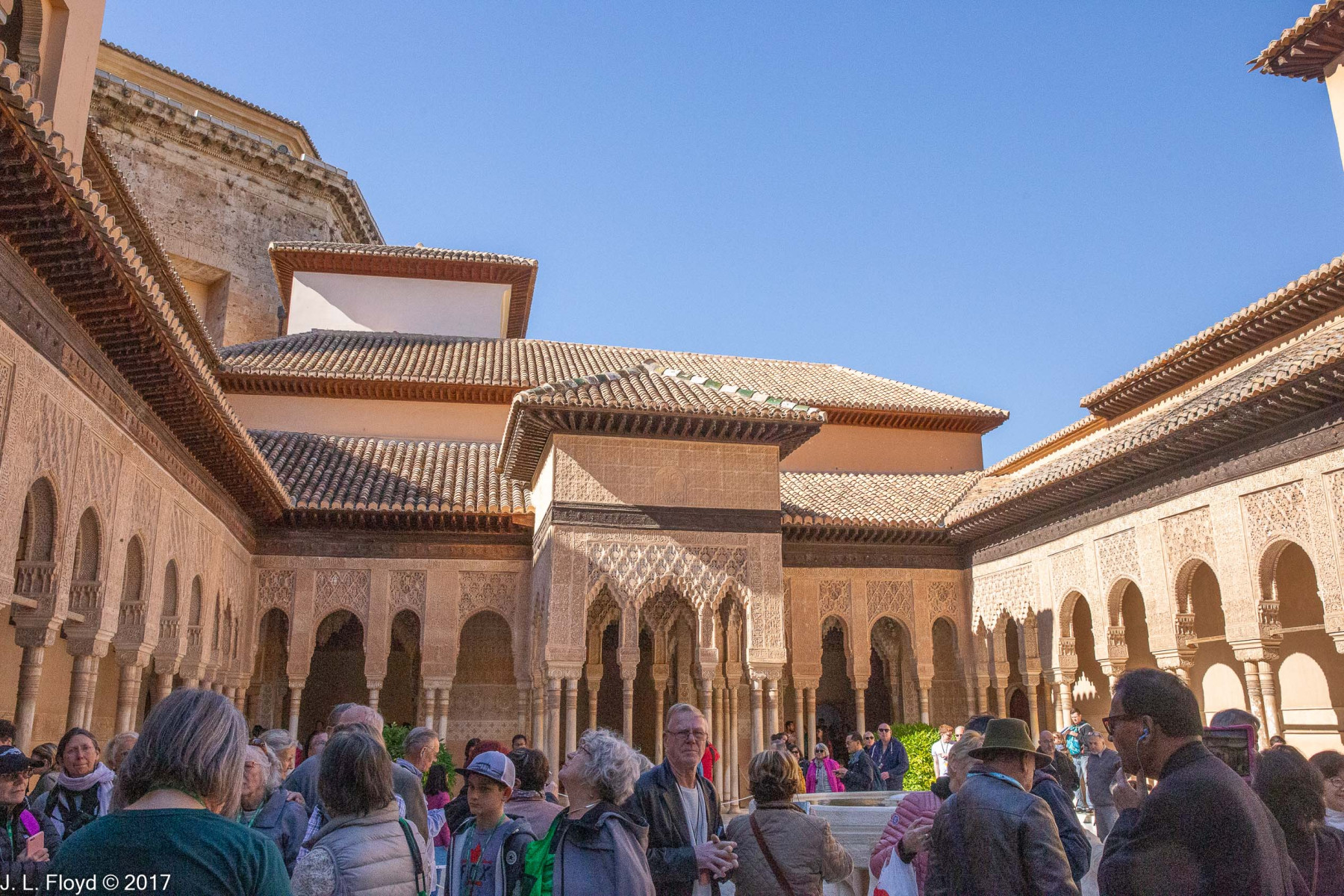
Like the Comares Palace, the Palace of the Lions is built around a central courtyard. Rather than a pool, however, the centerpiece is a fountain surrounded by twelve stone lions. Also, in contrast to the Court of the Myrtles, the Corte de los Leones – measuring 28.7 meters (94 feet) long by 15.6 meters (51 feet) wide – has its long axis oriented east-west rather than north-south.

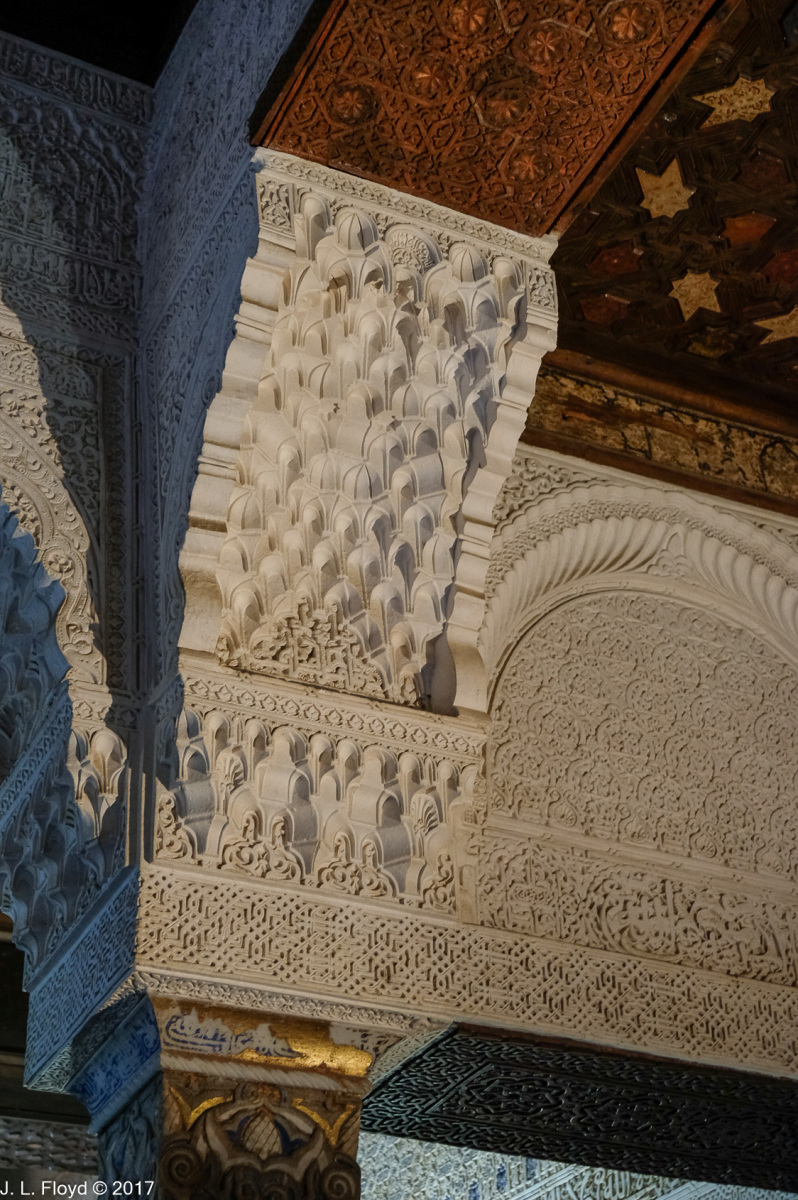
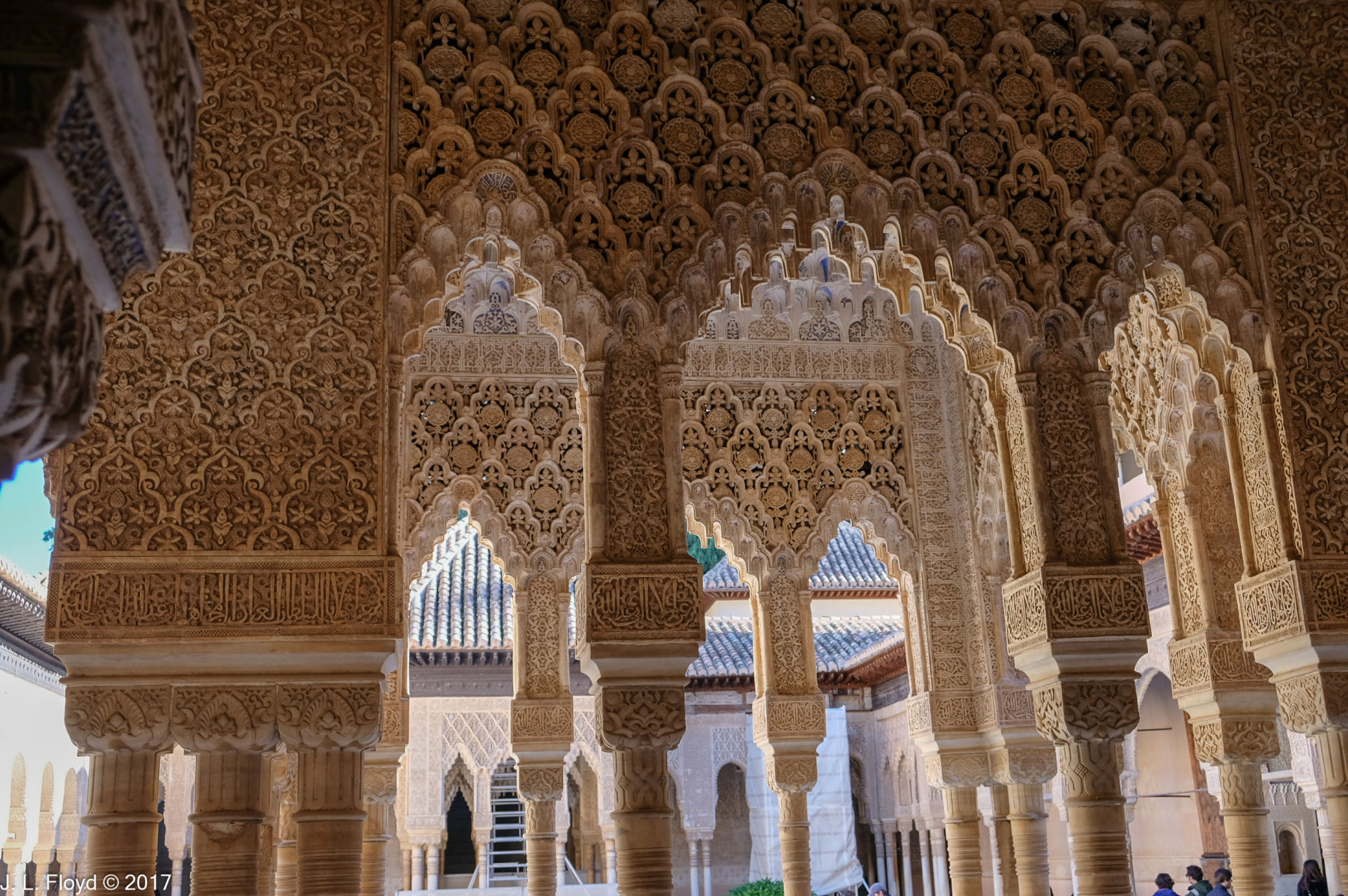
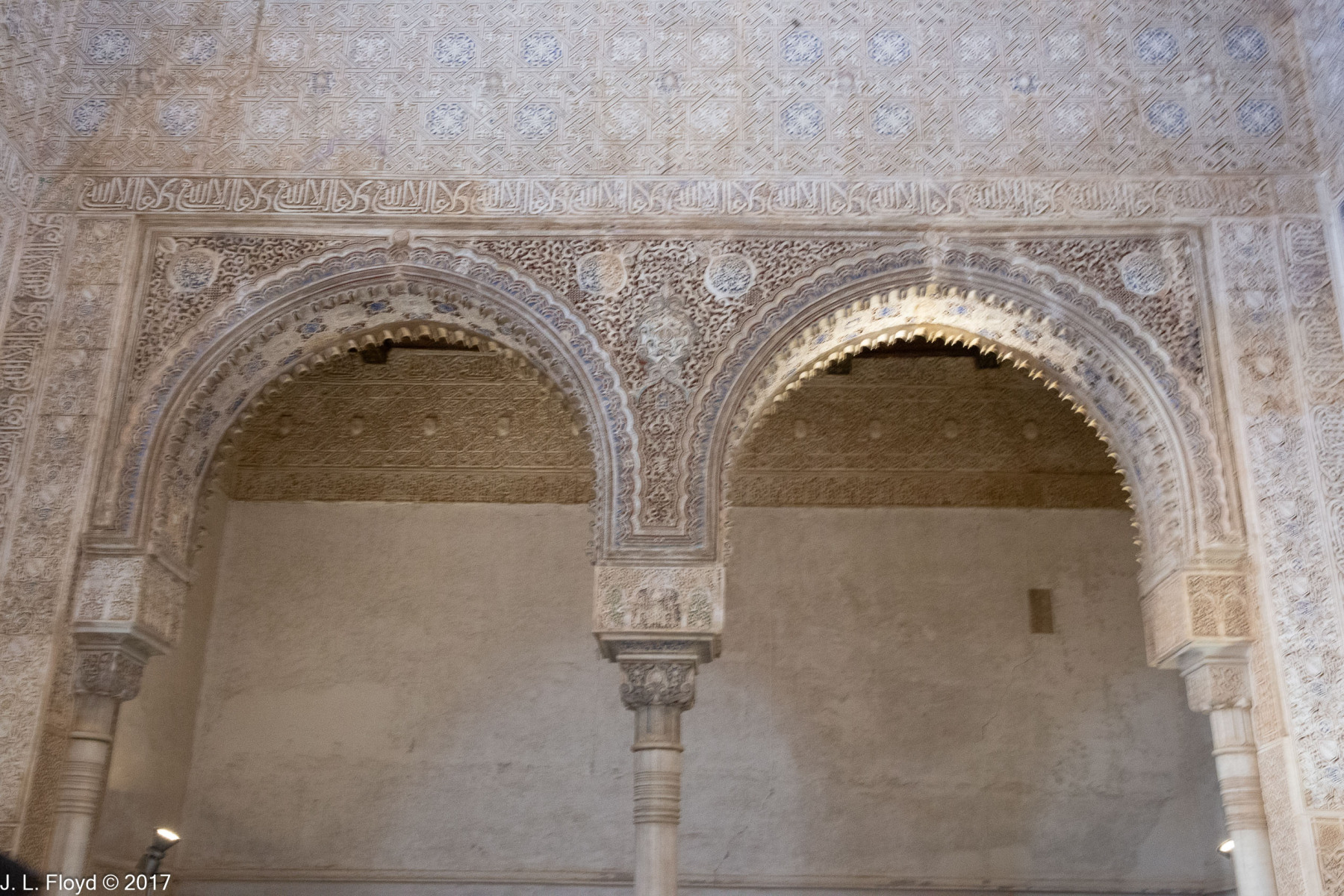
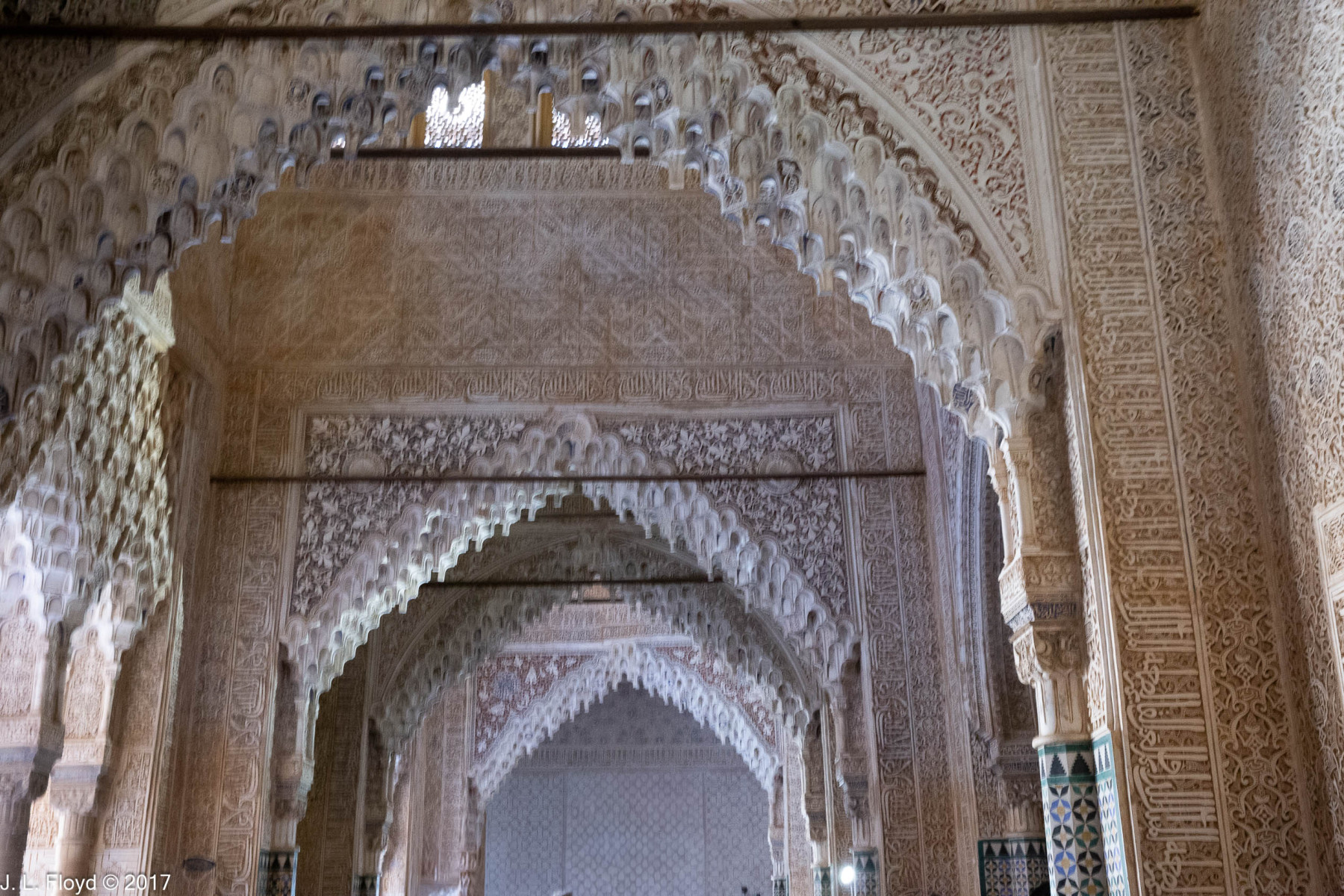
The Palace of the Lions was built during the reign of Muhammad V, between 1362 and 1390, when Nasrid architecture is considered to have reached its high-water mark. The archetypal feature of this period was the extensive use of muqarnas – stalactite-like honeycomb vaulting – or mocárabes, as they are known in Spanish – and it was precisely here, in the Palace of the Lions, that they attained their supreme expression.

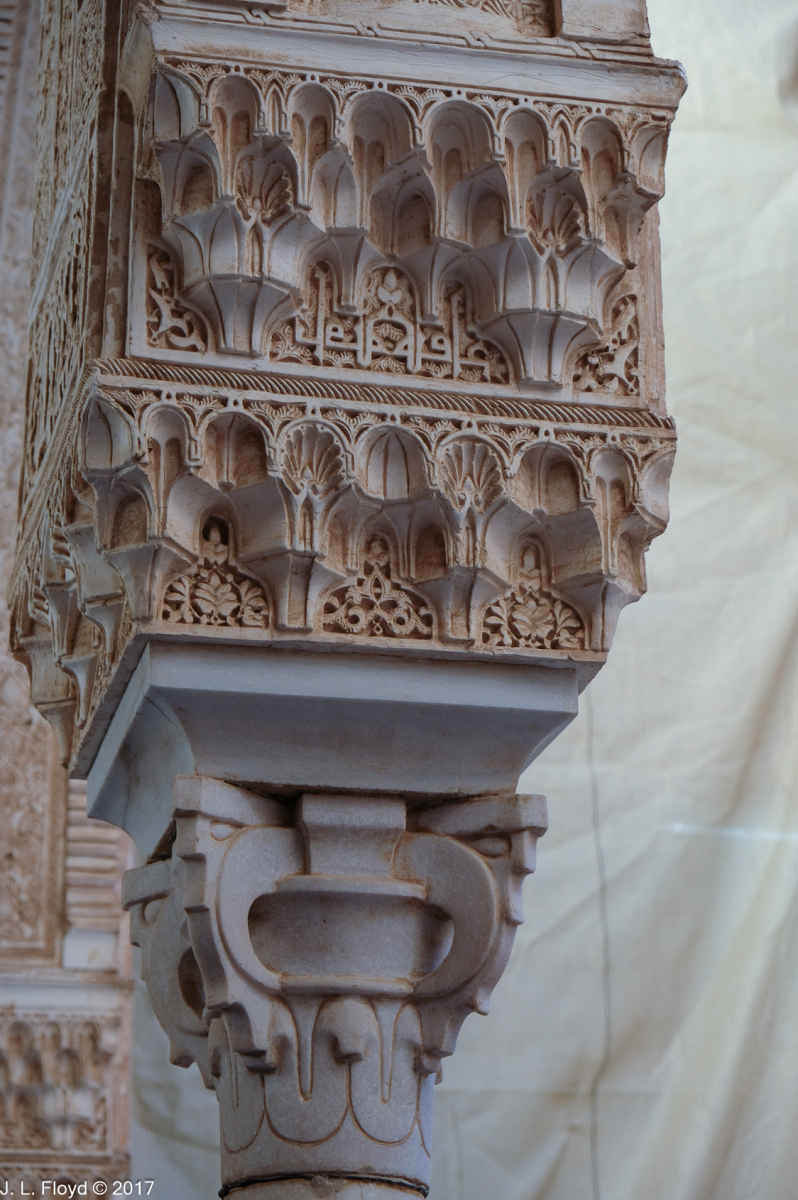
The Court of the Lions is surrounded on all sides by a portico supported by arches and columns arranged in a pattern that alternates single columns with two pairs of double columns, with the purpose of highlighting various parts of the façade. Two pavilions, one on the east side of the courtyard and another on the west, extend outward from the portico, supported by slender columns in an arrangement similar to the portico. The arcades of both portico and pavilions are decorated with elaborately carved or molded stucco designs. The design on the capital of each column is unique to that column.

Behind the portico are the four main halls of the Palace of the Lions: the Sala de los Mocárabes (Hall of the Muqarnas) on the west, the Sala de los Abencerrajes (Hall of the Abencerrajes) on the south, the Sala de los Reyes (Hall of the Kings) on the north, and the Sala de Dos Hermanas (Hall of Two Sisters) on the north. It should be noted that most if not all of the names of the Nasrid palaces and their components were conjured up by the Spaniards after the 1492 takeover; the pre-Conquest Arabic names are mostly forgotten.

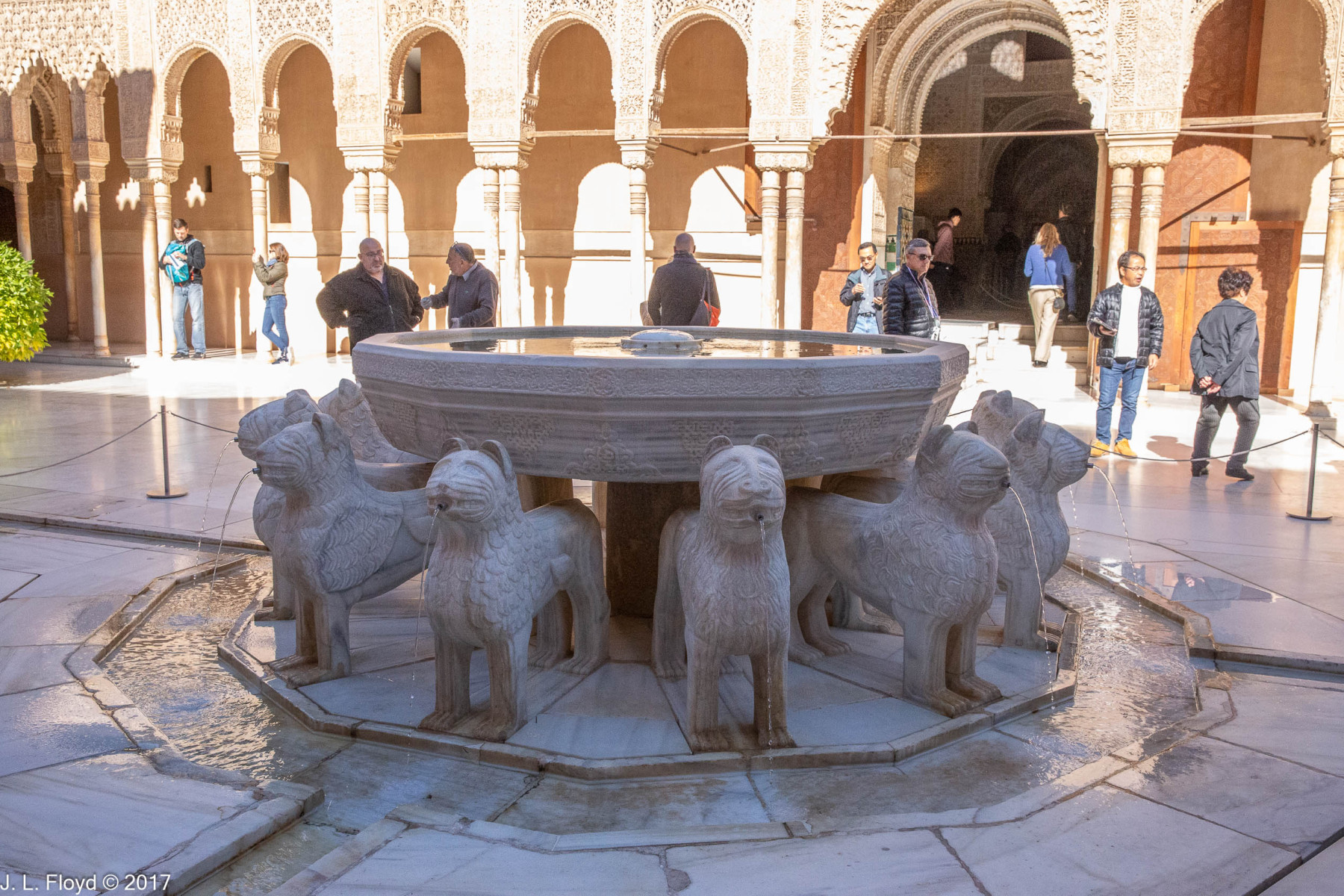
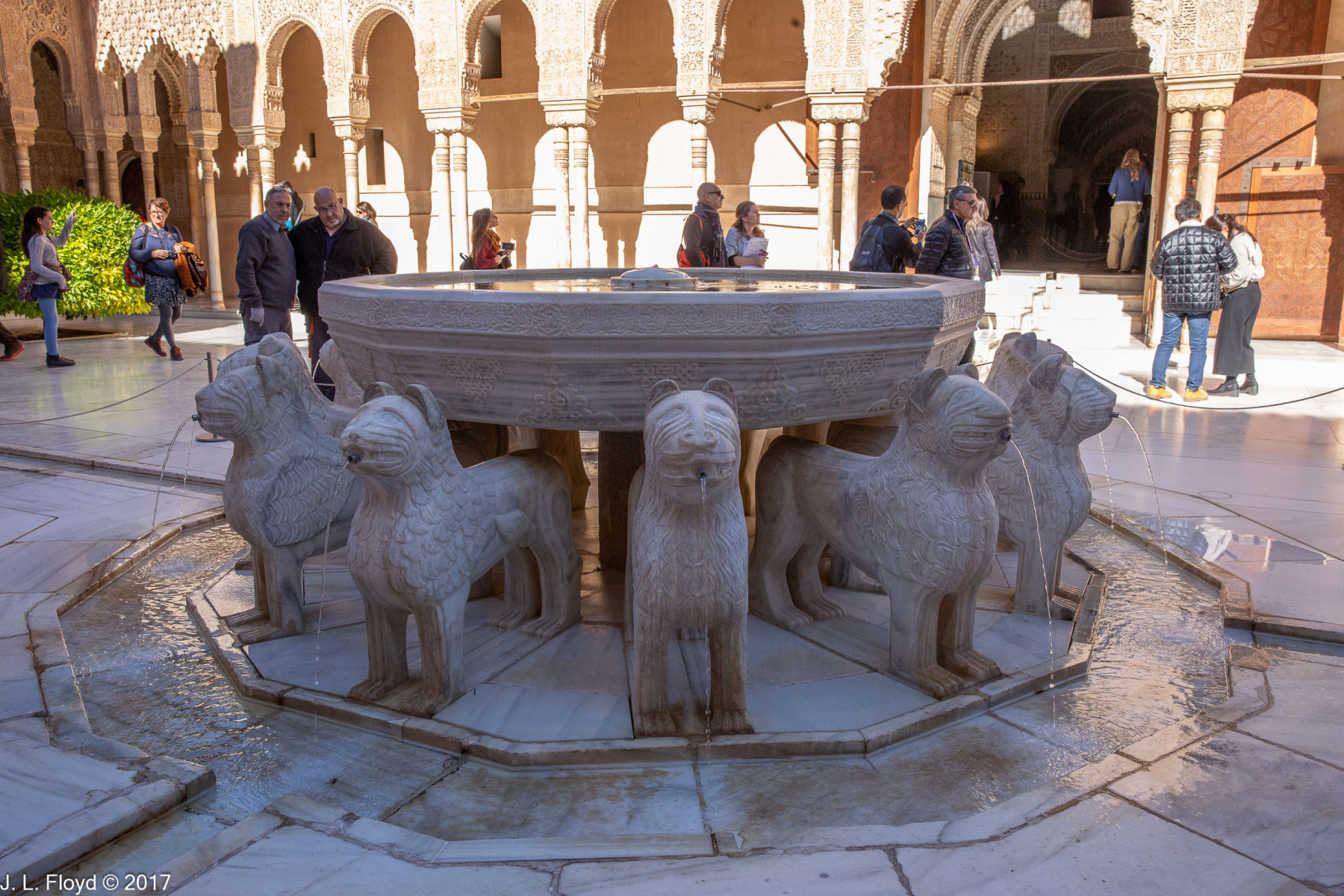
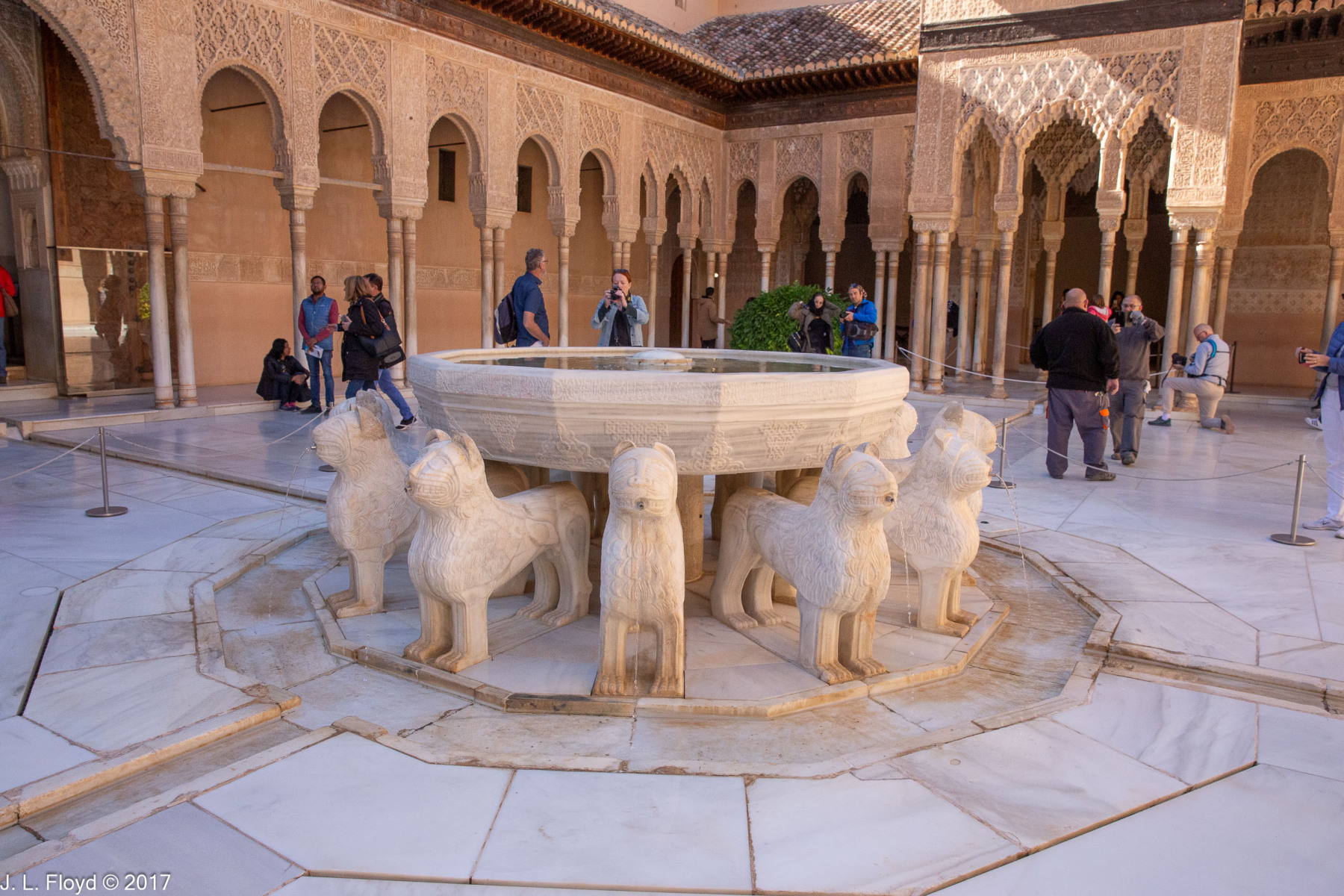
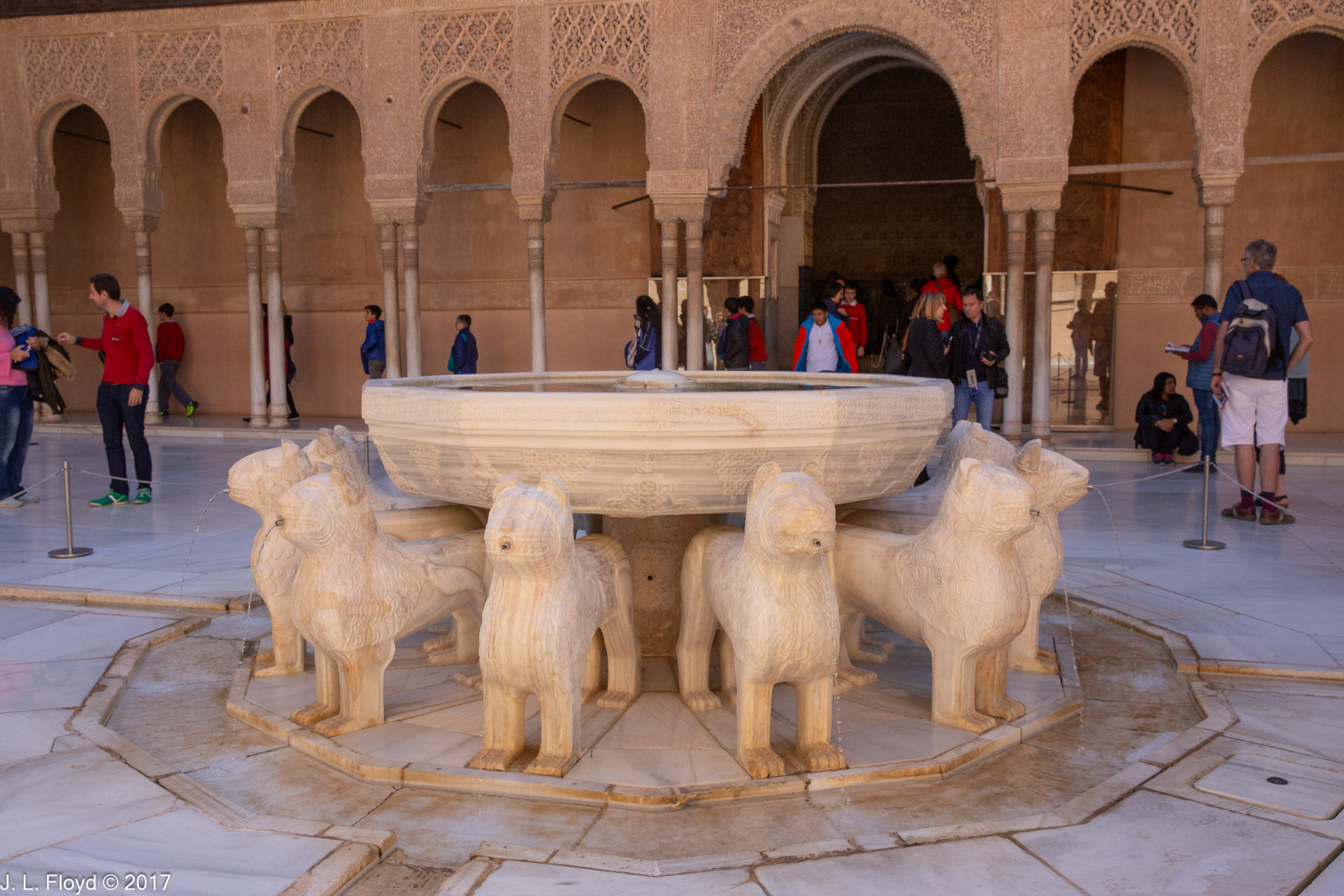
The central element of the palace, the Fountain of the Lions, consists of a large basin sitting on the backs of twelve stylized marble lions (each one unique, a little different from the others) streaming water into an encircling moat through spouts in their mouths. As with the pool in the Court of the Myrtles, the Fountain of the Lions displays the highly sophisticated Nasrid knowledge of hydraulic engineering. Water was maintained at a constant level in the basin at all times. The water spewed by the marble lions flows from the moat into four gutters, representing the four rivers of Paradise (Euphrates, Nile, Sihran and Jihran) in Islamic (and Christian) lore, which then flow to round basins with fountains in each of the four main halls. Apparently lacking pumps of any kind, not to mention electric power, the system relied entirely on gravity to maintain and regulate the water flow. To my mind this was a rather impressive achievement for its time.

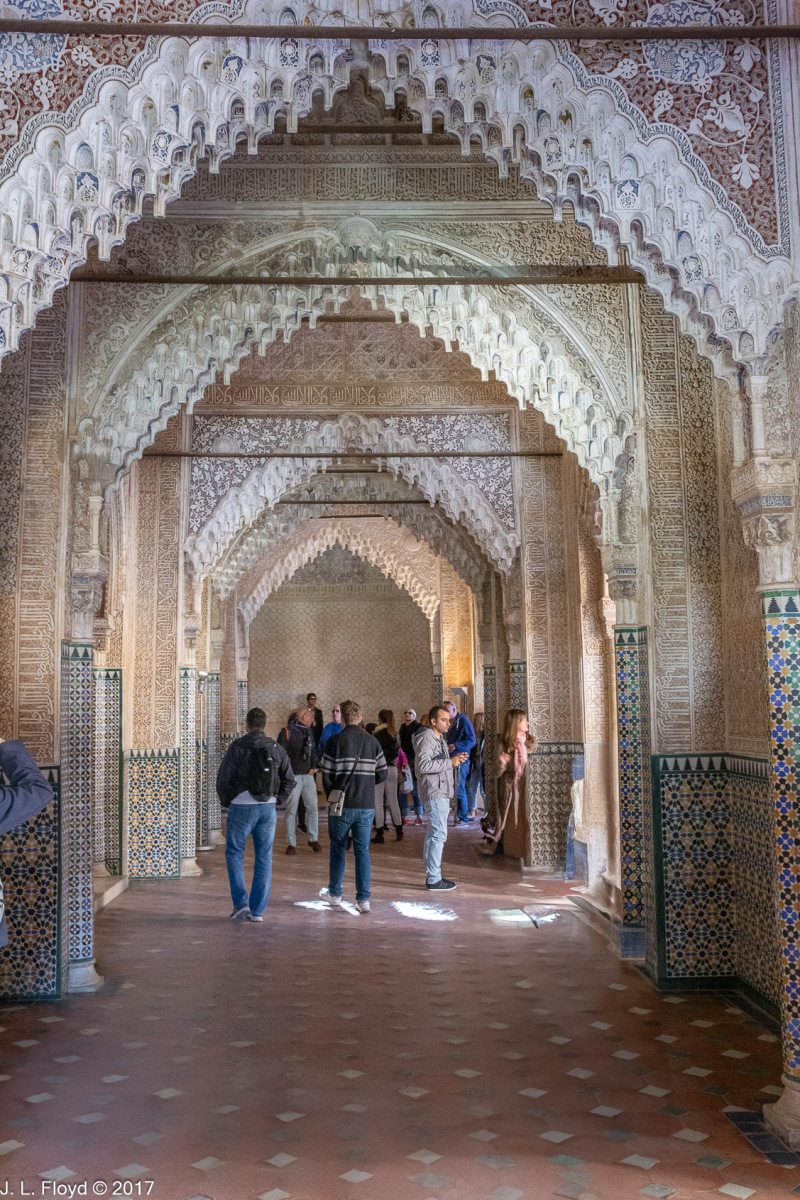
We explored each of the main halls of the Palace of the Lions in turn, starting with the Sala de los Mocárabes. However, we spent little time there, because in 1590 an explosion in a gunpowder magazine (why was that there?) destroyed it and it has never been reconstructed, except for part of the ceiling. We soon found ourselves in the Sala de los Abencerrajes, which was named after a powerful family of the Emirate of Granada. Known in Arabic as the Banu Sarraj, they played a prominent role in the politics of the kingdom, but according to legend they aroused the ire of the Emir and were all massacred in the hall that bears their name. As far as can be determined the legend has no basis in fact, and the name of the hall in Arabic translates to “the Western Dome.” It does indeed have a dome, with a cupola shaped like an eight-pointed star, so that it has 16 sides and the same number of windows, one on each side. The dome and the ceiling around it are lavishly decorated with complex muqarnas. Intricate stucco decoration covers the upper walls, and colorful zellij tiles skirt the lower walls. The total effect is astounding, a sybaritic feast for the eyes, as well as a preview of what we were to see in the other two halls of the Lion Palace, in their distinct variations.

Circling around the Corte de los Leones counterclockwise, we next visited the Sala de los Reyes, on the east side of the courtyard. This is a long and wide hall, running the entire length of the east side of the Corte, but it is divided into seven sub-halls – three large and square, four smaller and rectangular – by muqarnas arches. The small and large spaces alternate in their order, so that there are two smaller spaces between the three larger ones and one small unit on each end. Each unit, small or large, has its own muqarnas-vaulted ceiling. The three larger chambers have rounded vault ceilings made of wooden planks but covered with leather painted with scenes of court life. These represent a motif fairly uncommon in Muslim art, because of the traditional Islamic strictures against depicting human and animal figures. It is thought that they were most likely executed by Christian artists borrowed from the court of Mohammed V’s contemporary Pedro the Cruel of Castile – who, it should be remembered, built the Alcazar in Seville with the help of Muslim craftsmen from Granada. Perhaps there was some sort of cultural exchange going on there. One of the paintings depicts the Emir in council with some of his officials; it is this that gives rise to the name of the hall, which, to risk belaboring the point, is a Christian rather than a Nasrid appellation. Conditions in the hall prevented me from obtaining legible photos of these paintings, but there are examples available on the web from Wikipedia and other sources.

In Nasrid times, the Hall of the Kings was a place for celebrations and feasts, with the smaller units serving as bedchambers. After the 1492 conquest, it was used as a Christian chapel. Ferdinand and Isabella held their first celebratory Mass there after the surrender of the Alhambra.

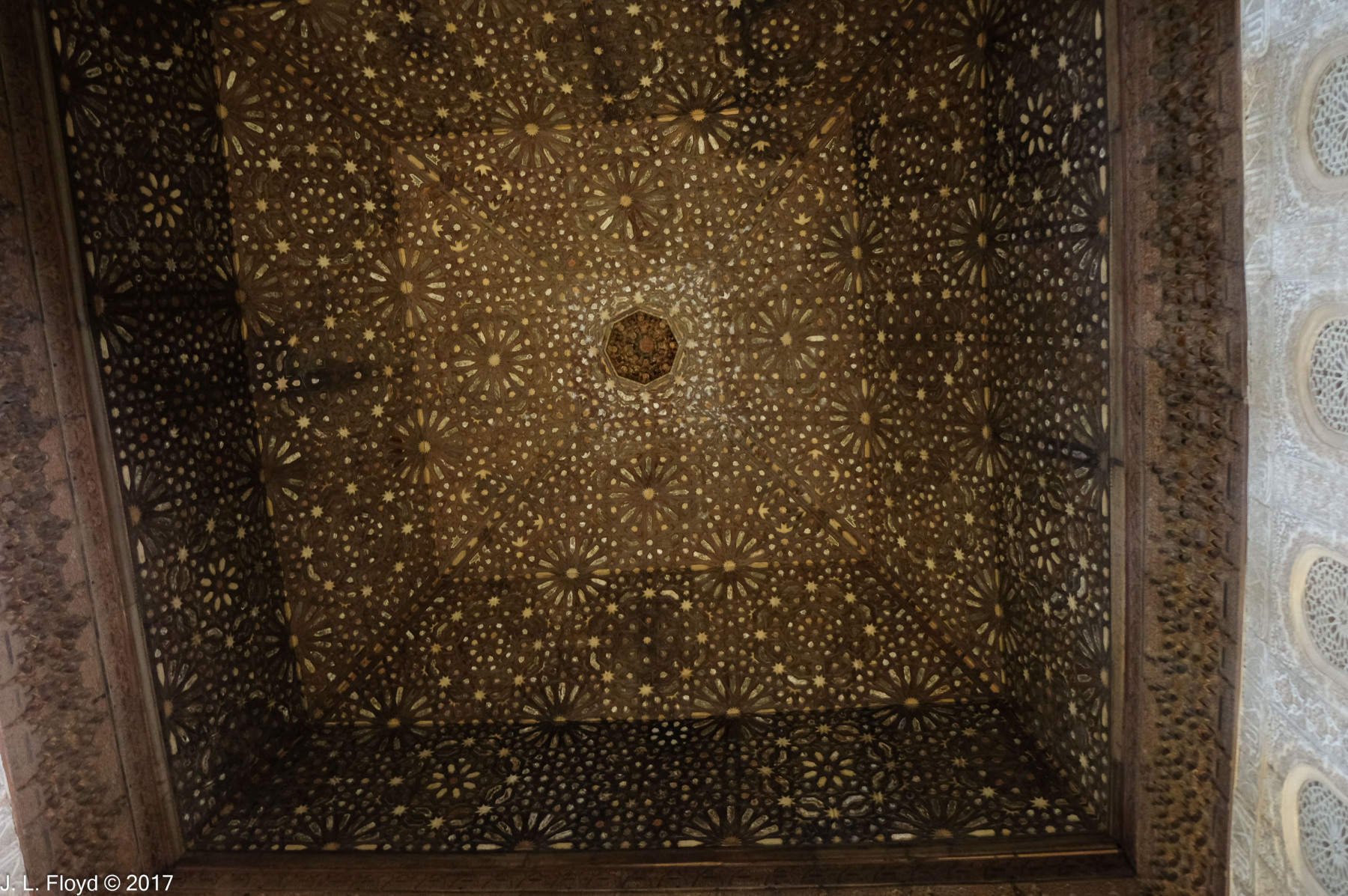
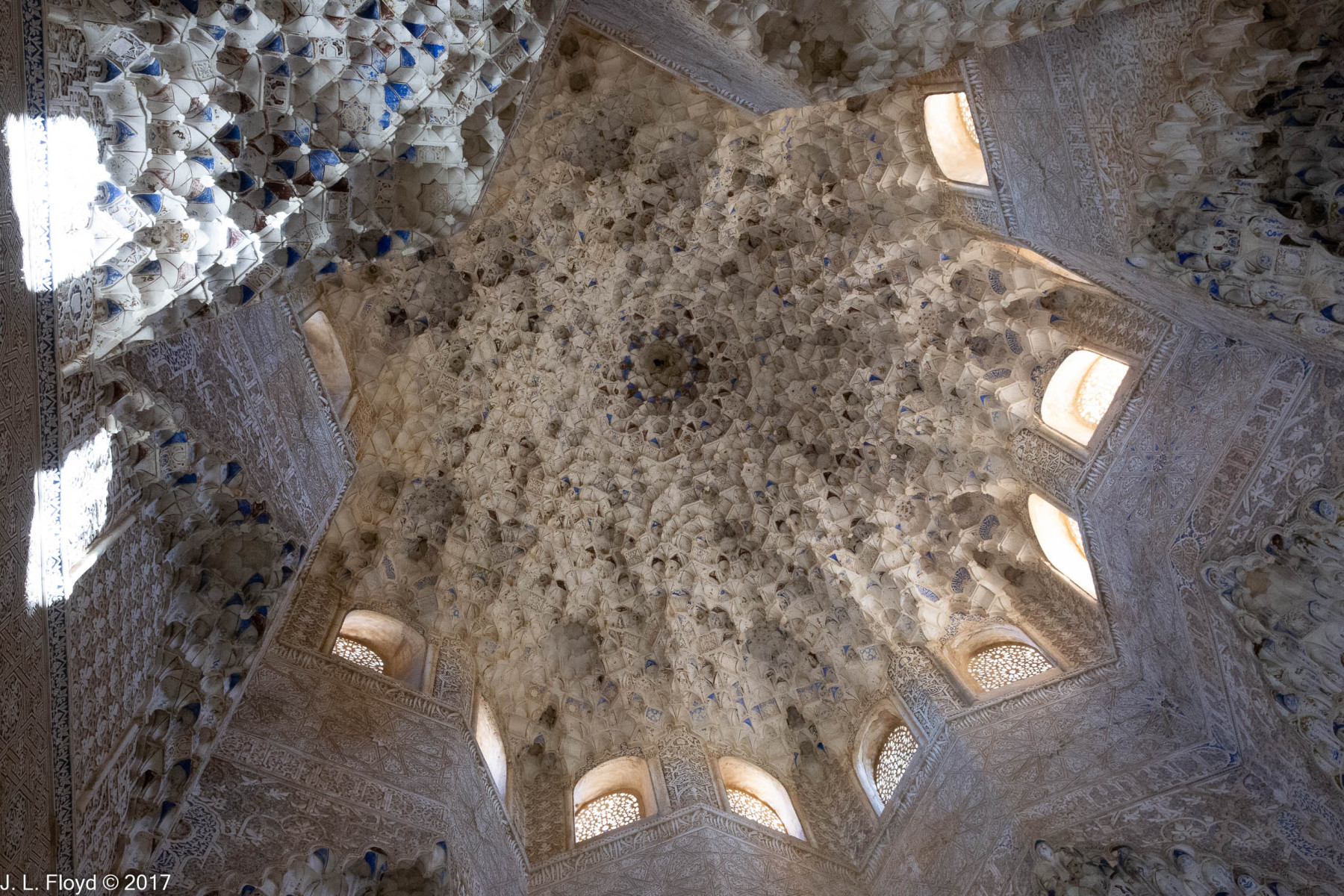
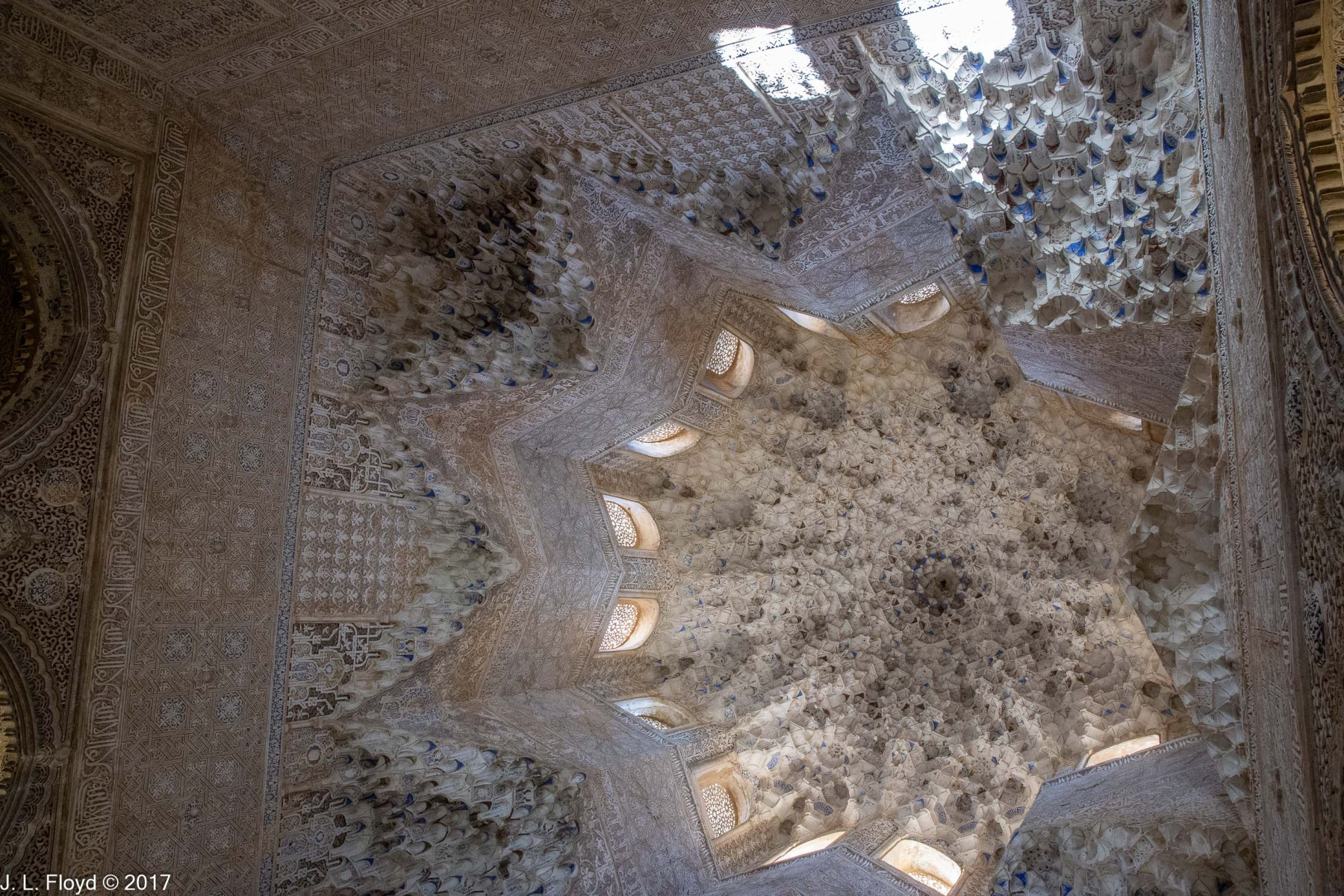
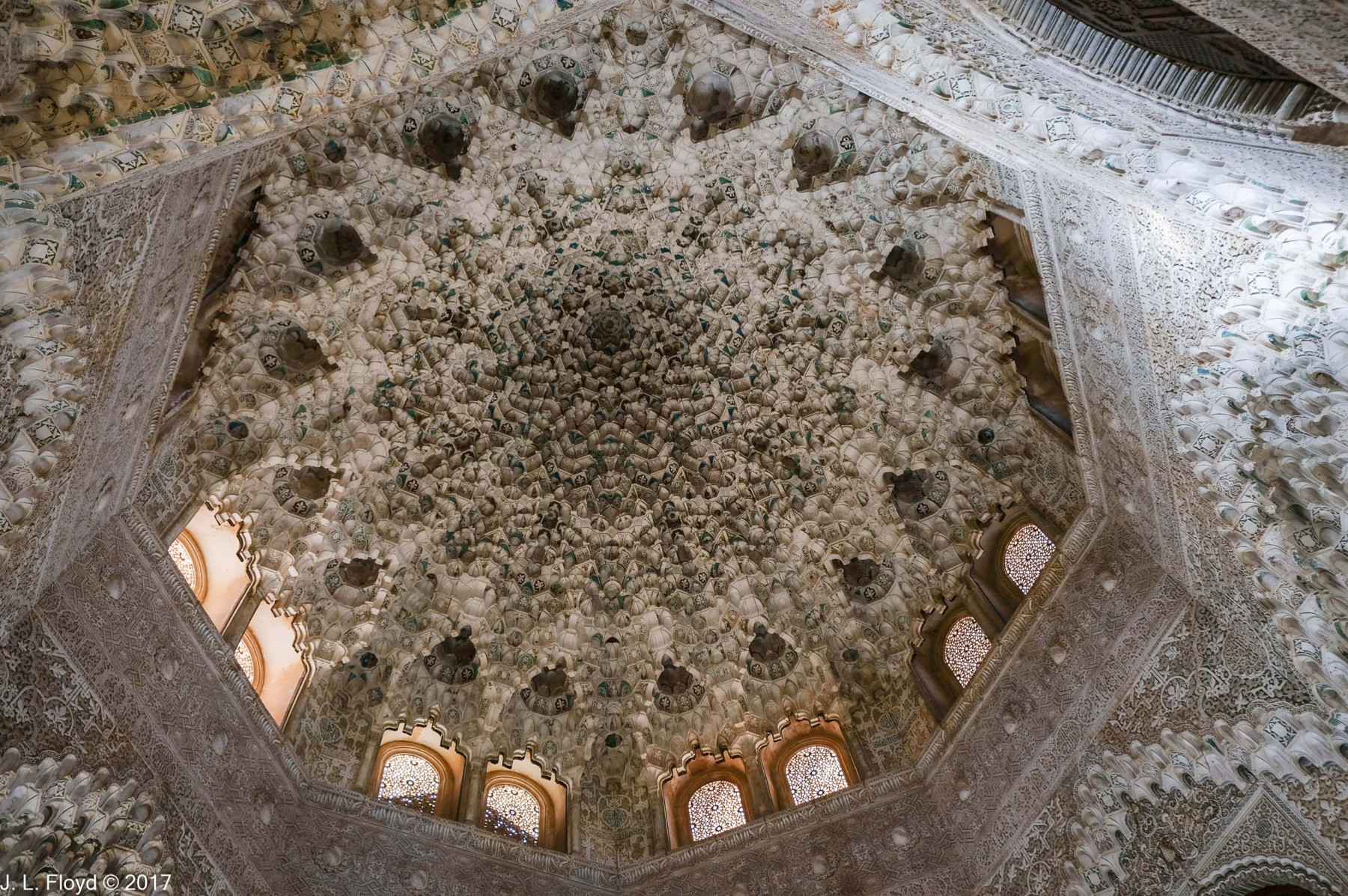
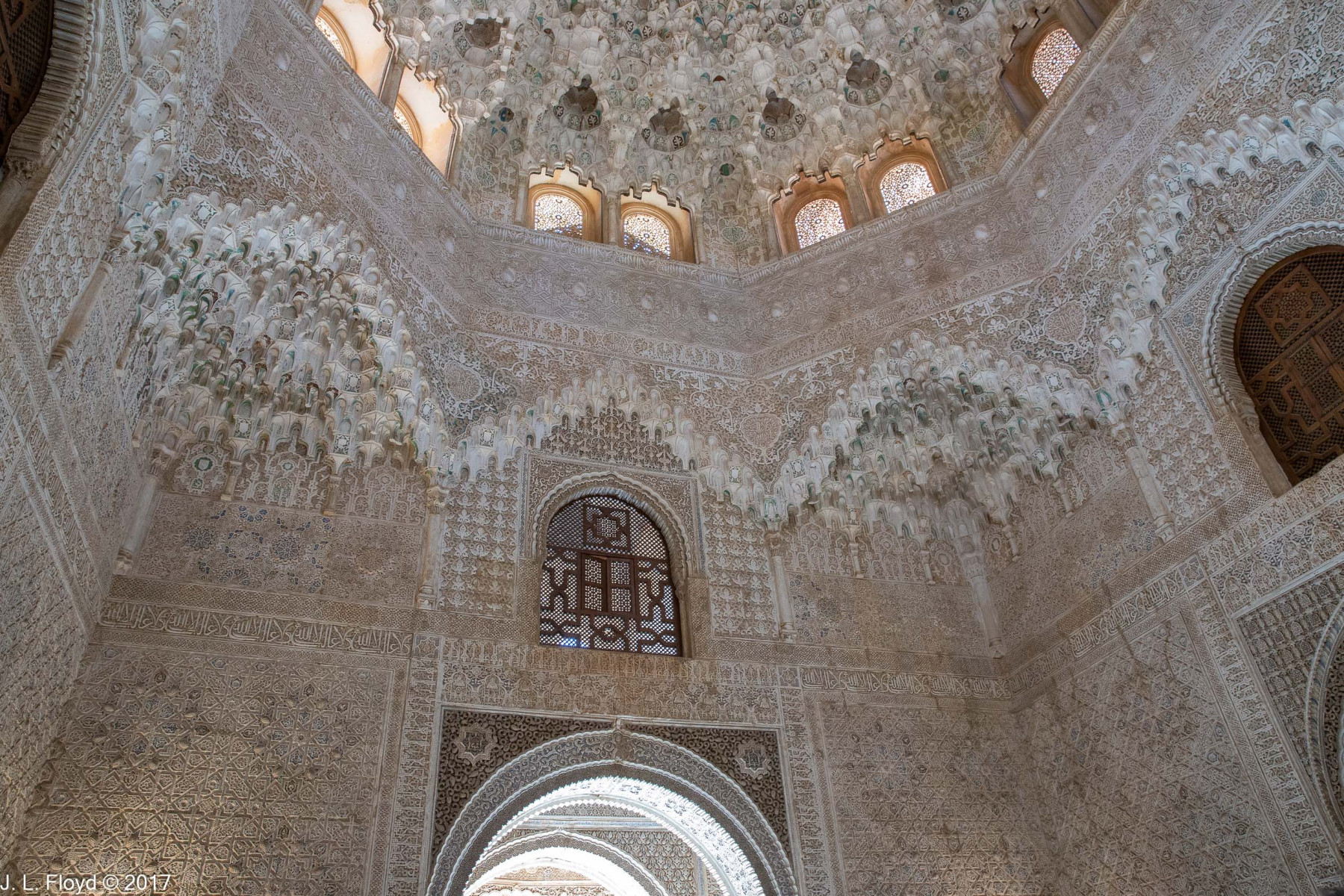
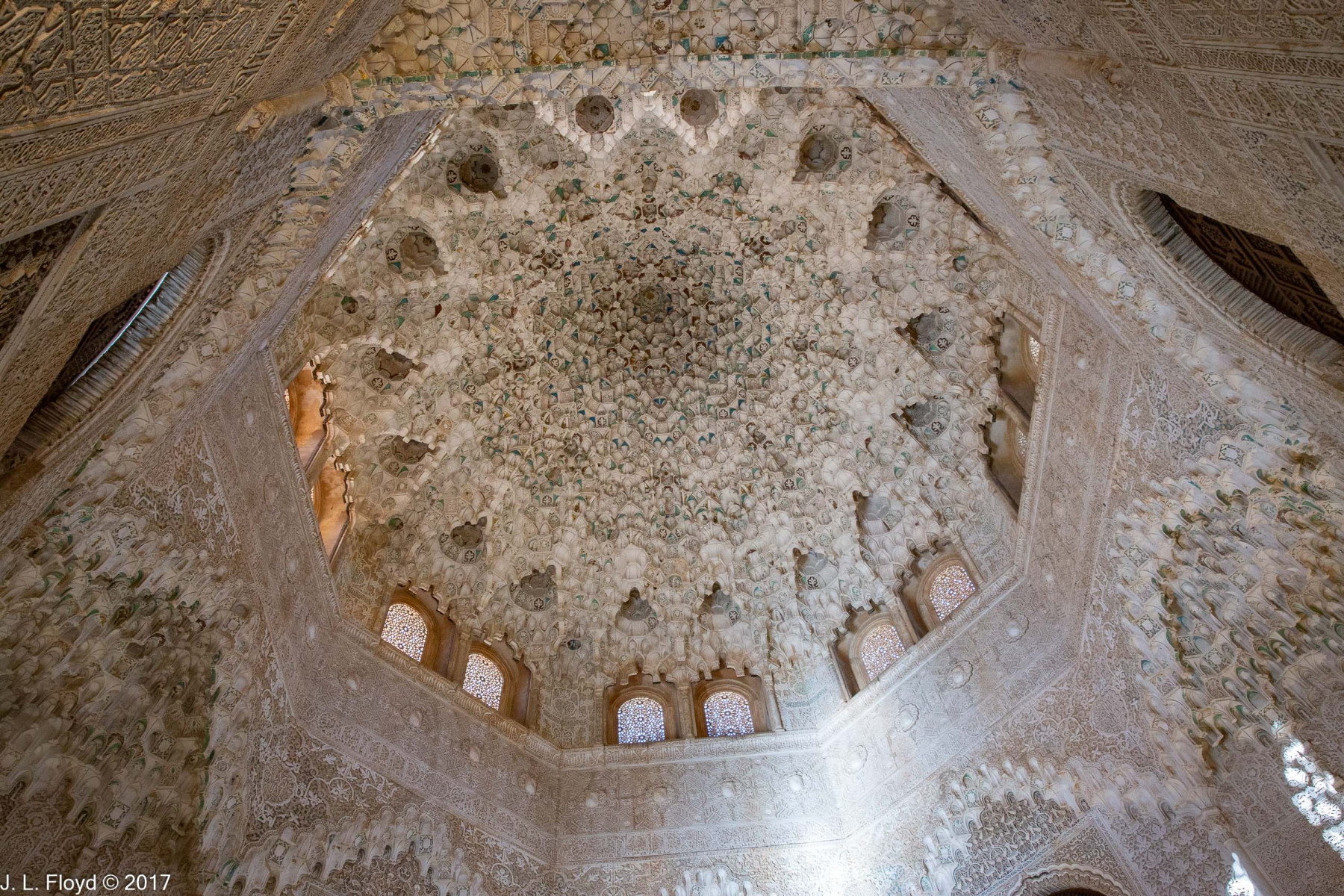
The Sala de Dos Hermanas, which was next on our itinerary, has traditionally been thought of as a private residential space for Mohammed V and his family, although some scholars think that it might have been used as a meeting place for the Royal Council. The sisters for whom it is named are not members of the royal family but rather two slabs of marble used to pave the floor. The Nasrid/Arabic name for it was al-Qubba al-Kubrā (“the Great Dome”), possibly likening the muqarnas dome over the hall to the vault of the heavens. And indeed that dome is reminiscent of a starry cosmos. The muqarnas vaulting, composed of over 500 prismatic pieces, seems to radiate outward from the top in concentric waves before flowing around 16 miniature domes at the periphery, where their spicules merge into a surrounding web of muqarnas. The ensemble is enclosed within a cupola 8 meters in diameter, with eight sides, with two windows to each side, their combined illumination causing the honeycomb structure of the muqarnas to sparkle with reflected light. The ceiling around the cupola opening is sculpted with muqarnas contrived to form the shape of an eight-pointed star, standing out from the background of additional honeycomb vaulting filling the spaces between the ceiling and the walls.

The upper walls, as in most of the other halls of the Nasrid palaces, are covered with intricately carved stucco. Encircling the room, approximately at eye level, is an inscription band with poetry comparing the hall’s dome to the Pleiades. On the lower walls, again in conformity with the usual practice, are elegant zellij tiles – but here they are the originals, not replacements from later periods as in some of the other halls.

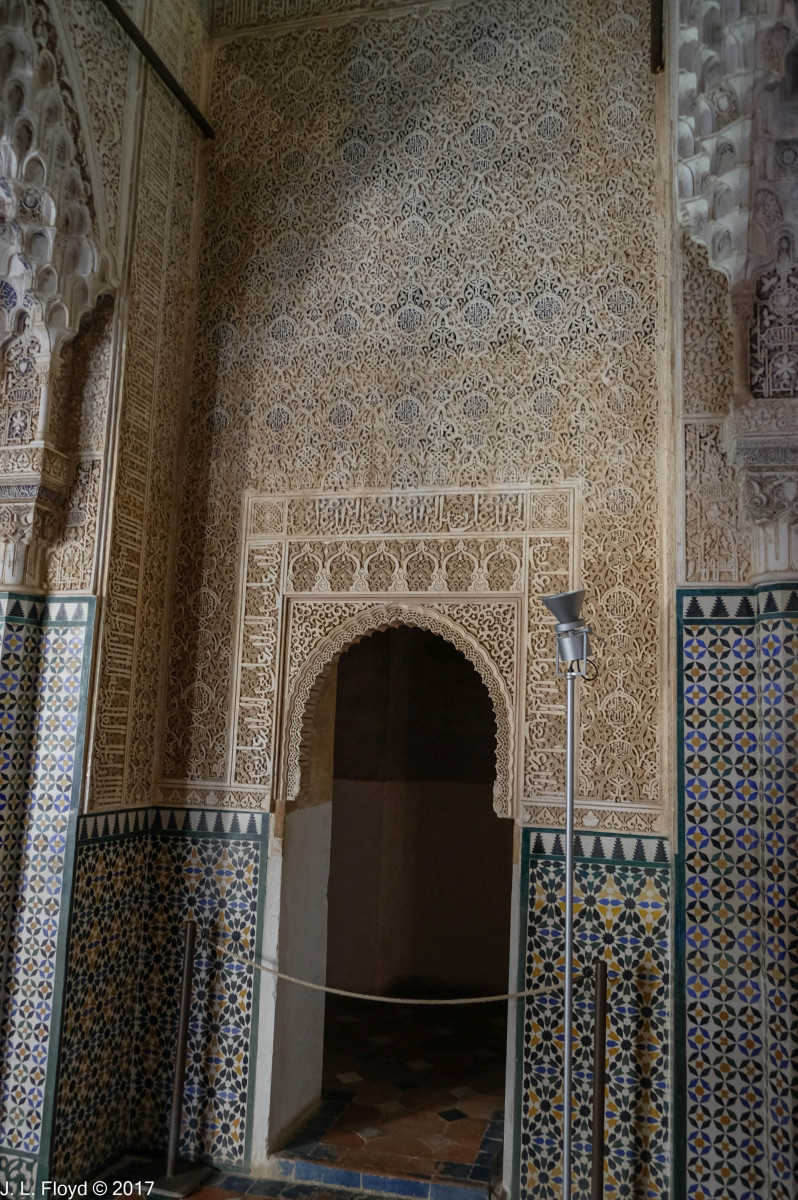
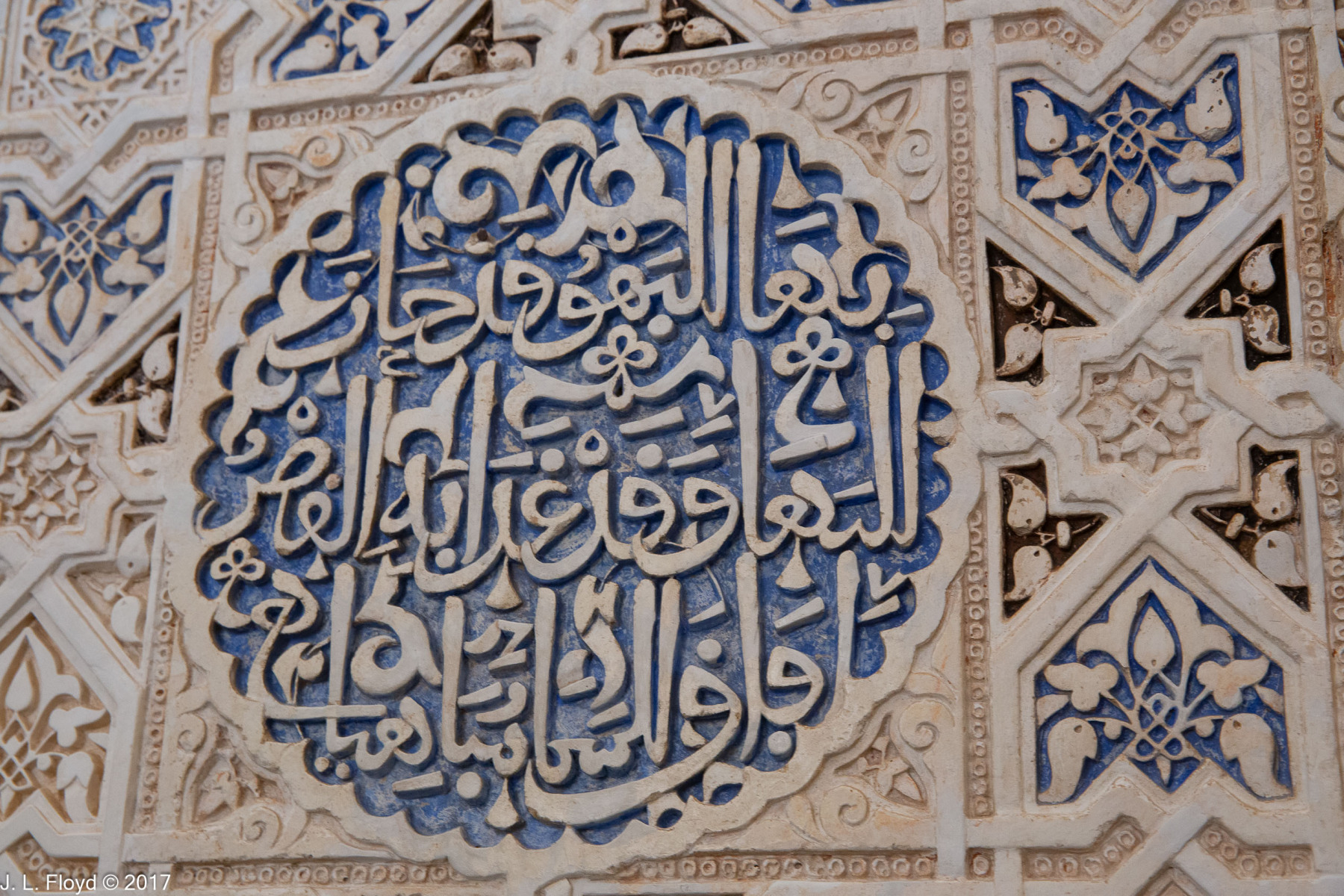
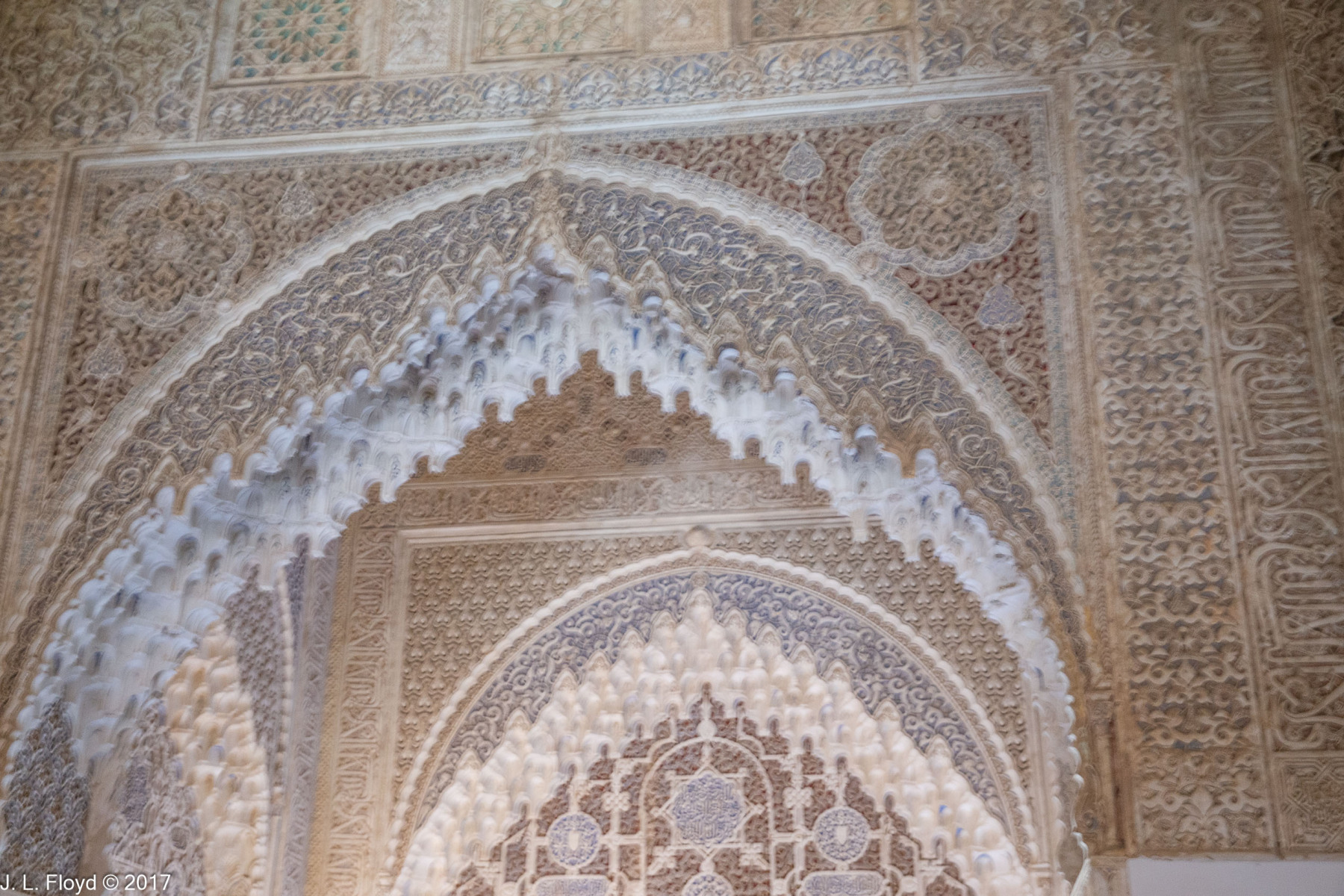
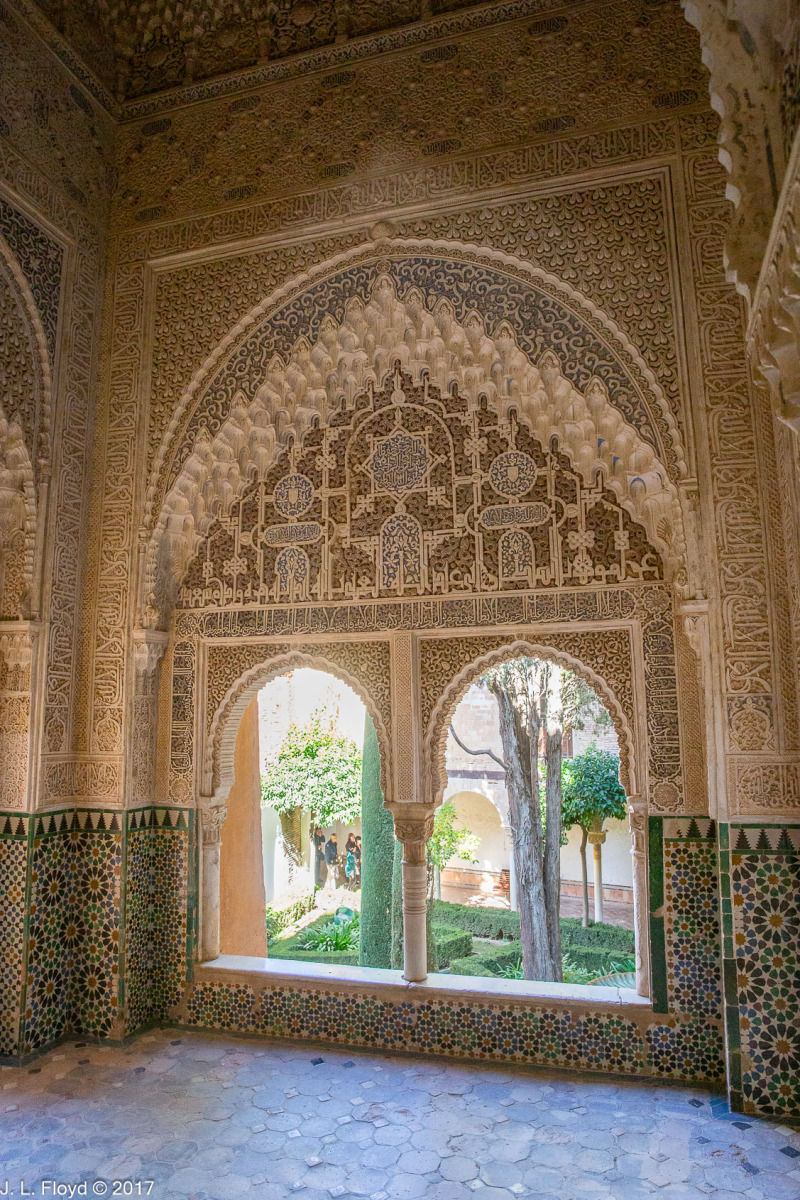
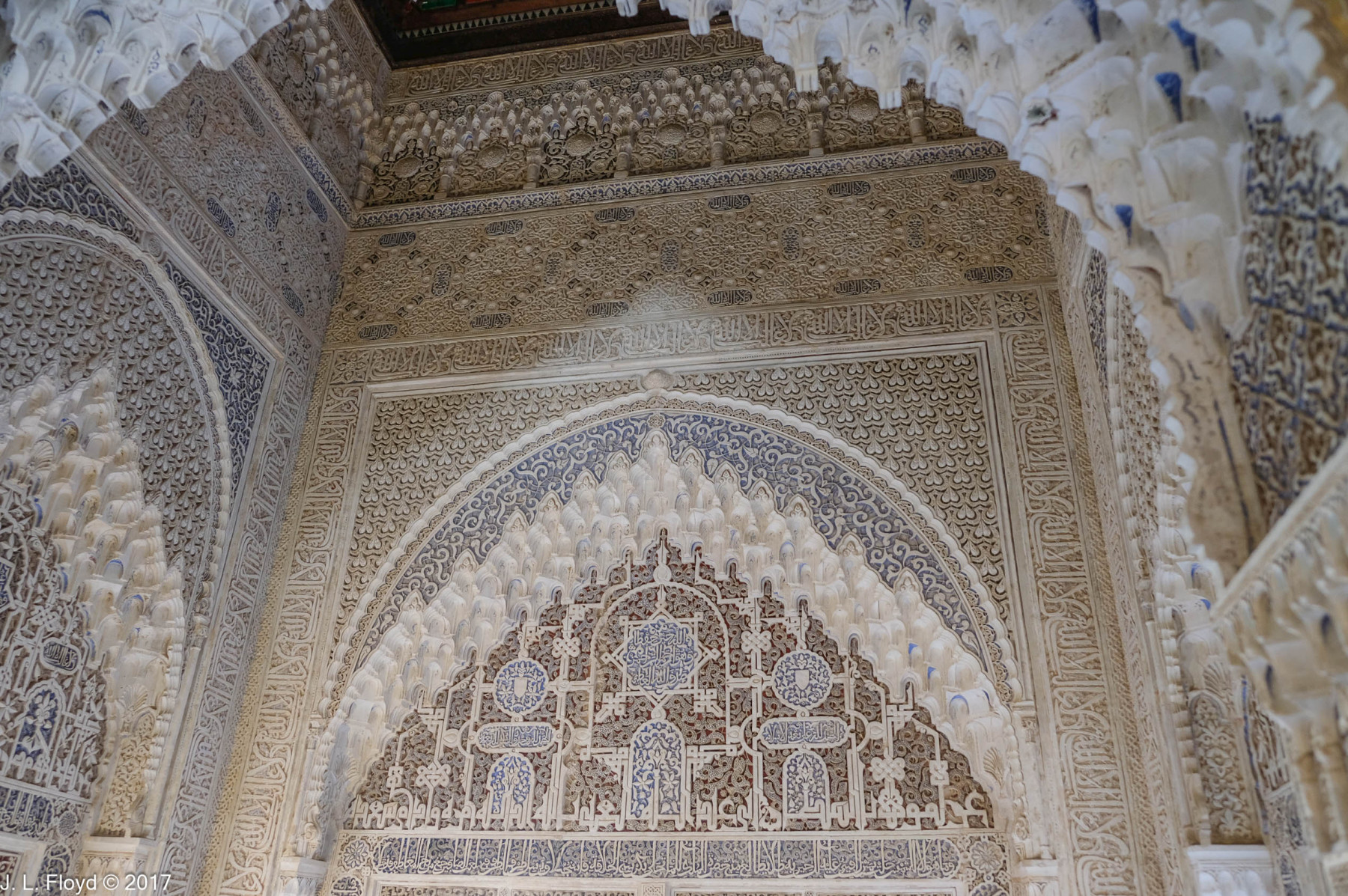
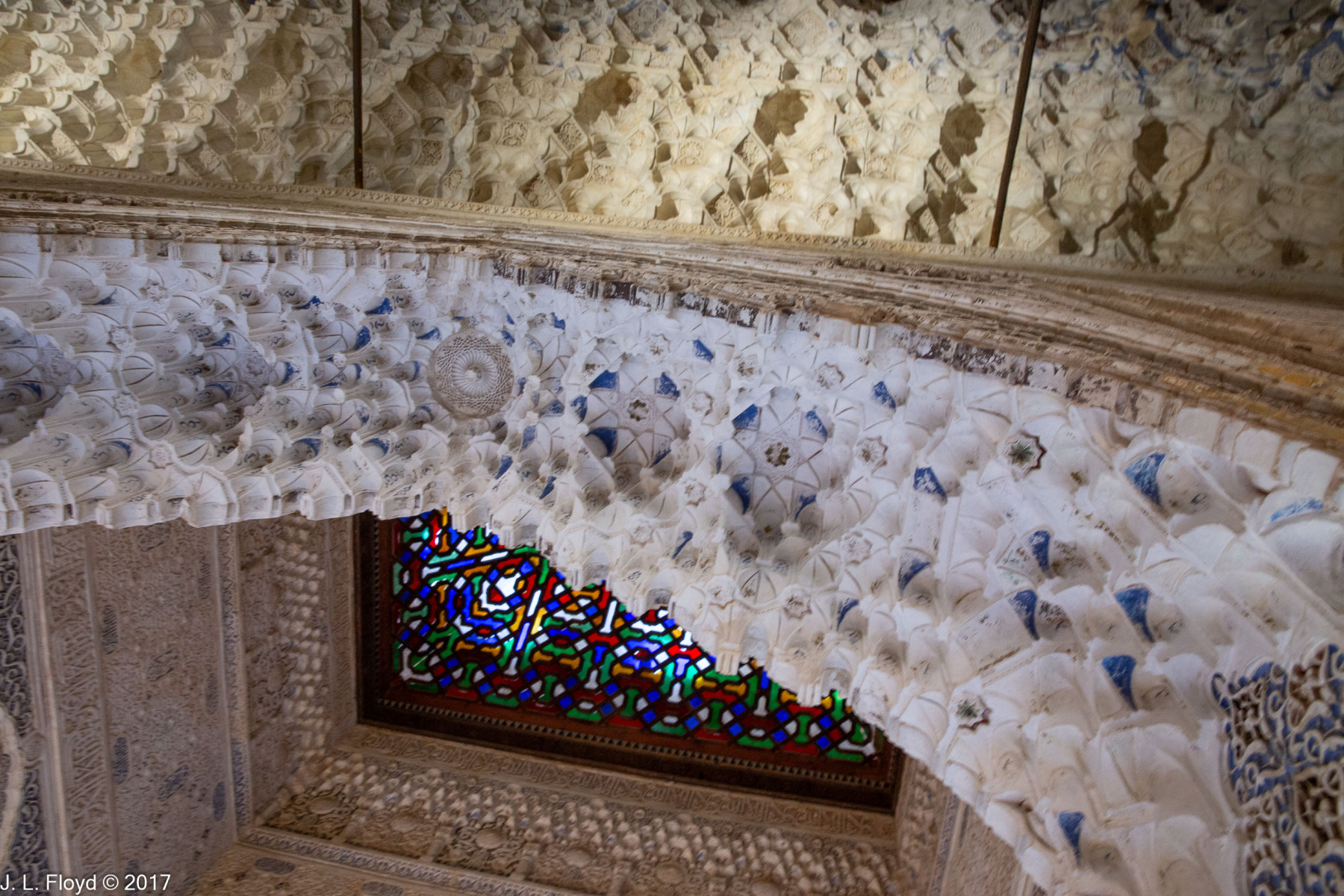
Adjoining the Sala de Dos Hermanas on the north is a smaller chamber, the Sala de los Ajimeces or “Hall of the Mullioned Windows” – a mullion being a vertical or horizontal bar, vertical in this case, that separates units of a window (I had to look that up). Its distinctive feature, other than the windows, is a vault ceiling composed of multiple consecutive muqarnas domes merging into one another. On its north side is a much smaller but more striking room, the Mirador de Lindaraja. In Spanish a mirador is a lookout or scenic viewpoint. “Lindaraja” is a corruption of the Arabic phrase Ayn Dar Aixa, “Eyes of the House of Aisha”, referring to a tradition that the room was the preferred hangout of Muhammad V’s favorite wife, Aisha. The Mirador de Lindaraja is a small square structure projecting outward from the Sala de los Ajimeces into the garden outside the palace. The windows on the three sides of the room are installed low enough so that the garden is visible to people sitting on the floor. Indeed the garden, known as the Patio de Lindaraja, is worth a look, and we were to explore it in person a bit later. The Mirador arguably boasts the most elegant carved stucco paneling in the Alhambra, not to mention the mosaic tilework on the lower walls, featuring poetic inscriptions in fine Arabic calligraphy. It is also remarkable for its ceiling, which is a wooden lattice framework embedded with pieces of stained glass – a type of skylight, in other words, also known as a lantern vault. It is the only one of its kind surviving in the Alhambra.

In my travels I have seen some amazing sights, including some of the most magnificent works of art produced by human hands; but in my judgment none of them surpass the Nasrid palaces of the Alhambra, and I consider it a great privilege and gift to have seen them in person.

At this point in our tour, we were not done with the palaces, but the remaining ones were dispersed amidst the gardens of the Alhambra, which will be the focus of my next post.
Categories
Spain, Portugal and Morocco, November 2017

Spain, November 8, 2017: The Road to Granada

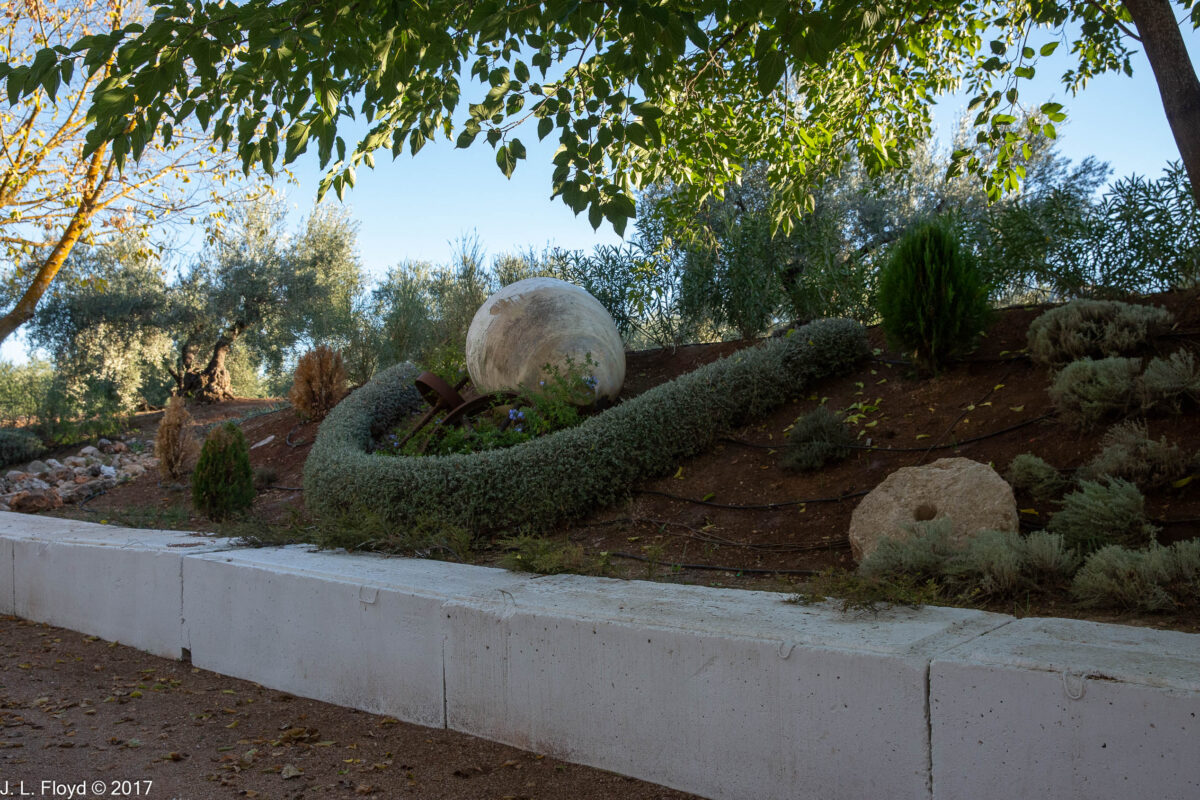
The trip from Córdoba to Granada was generally uneventful, but had its noteworthy moments nonetheless. En route to Granada we passed through a district of the province of Andalusia known as la Subbética, which as far as I know includes no major cities or major tourist attractions other than the Sierras Subbéticas Natural Park, which we were not fortunate enough to visit, but which is home to a wide diversity of plants and animals, and a stronghold of the peregrine falcon. Our encounter with la Subbética was limited mainly to a rest stop on the N-432 highway at Nicol’s Restaurant, near the town of Luque. However, this proved to be of great interest to me as a showcase, as it were, of small-town Spanish life. The closest analogy I can think of is a roadside cafe in Midwestern America. But this was an area primarily devoted to the cultivation of olive trees and the production of olive oil, and Nicol’s was a market for that commodity as much or more than a roadside diner.

The olive groves and factory where the oil was produced were close behind the restaurant. Between the roadhouse and the olive groves there was a parklike area suitable for strolling, relaxing and picnicking according the needs of the moment. Although there was no railroad line, there were two railroad cars in back of the establishment, which puzzled me until I figured out that they provided the refrigerator for the business. Judging from the remains of an old horse trough, stone benches and other antique artifacts adorning the site. this place must have functioned as a travelers’ stop from time immemorial.

Resuming our journey, we continued across the rolling Andalusia countryside with its endless olive groves. Racing the oncoming twilight, we were able to catch late-afternoon views of picturesque towns and castles such as Castro del Rio and its hilltop fortress, until the curtain of darkness ended the show.

Categories
Spain, Portugal and Morocco, November 2017

Córdoba, November 8, 2017: Mihrab, Maqsura and Patio

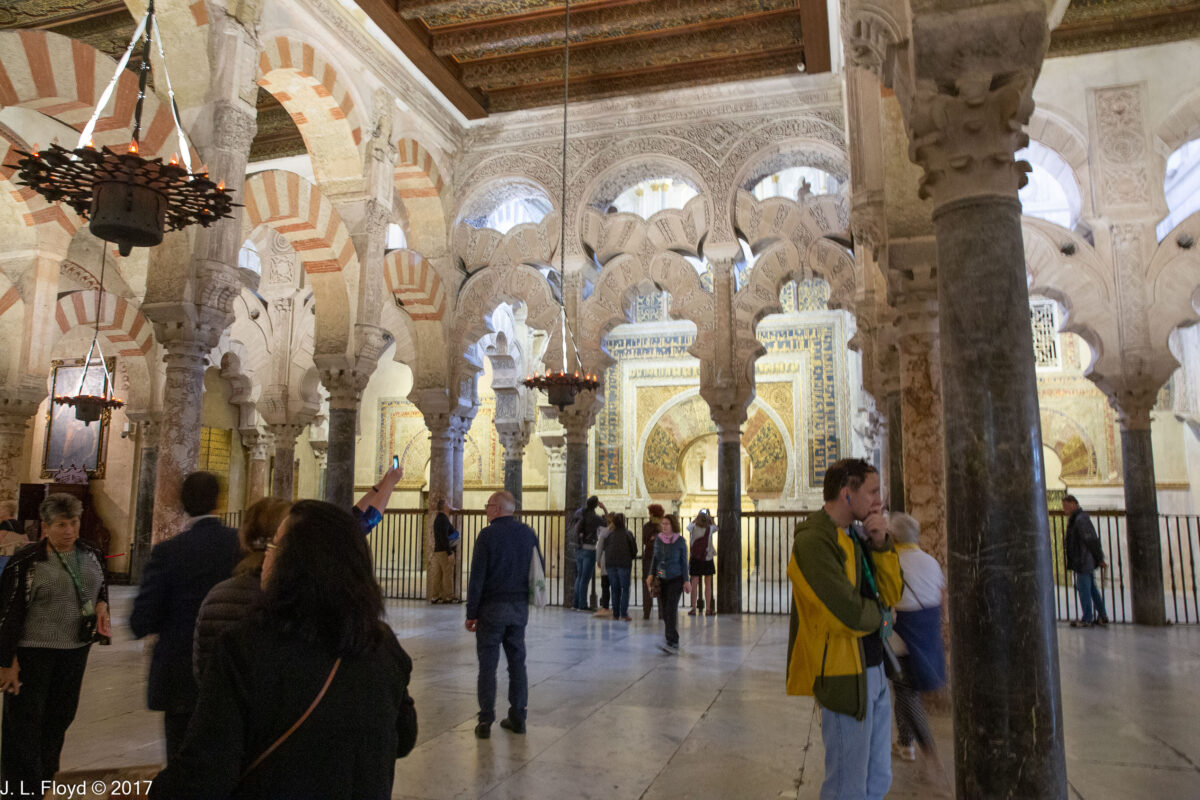
The mihrab, the holiest place in a Muslim mosque, is ordinarily a semicircular niche in a wall indicating the qibla, the direction of the Kaaba in Mecca towards which Muslims face when praying. The wall on which a mihrab appears is therefore known as the ‘qibla wall’. The mihrab in the Mezquita is an exception to the usual pattern in that it is a small room behind a lavishly decorated door. The caliphs also added a maqsura, a screened-off prayer space in front of the mihrab, reserved for the ruler, intended to ensure his privacy and protect him from assassination.

The Castilians of the Reconquista era unaccountably felt no obligation to pray to Mecca, and they had insufficient appreciation of the esthetic value of the mihrab as well. In the 14th century they converted it into the chapel of Saint Peter, where the consecrated host was stored before the completion of the new Capilla Mayor in the 17th century.

In the 19th century, however, the Spanish began to rediscover the cultural heritage left by the Moors, and restoration work began on the mihrab and maqsura that has continued to the present; so visitors are now able to see it in its full glory.

The mihrab is located at the south wall of the Mezquita just to the west of the Chapel of St. Teresa. On either side of it are two doors. The door on the left (facing the wall) of the mihrab, called the Bab Bayt al-Mal, led to the mosque treasury, which of course is now the cathedral treasury. The one on the right, the Bab al-Sabat, led to a passage (sabat) connecting the mosque to the caliph’s palace. The mihrab and the doors are lavishly decorated with mosaics and inscriptions from the Quran. The maqsura encloses the area in front of the doors in a set of intricate polylobed interlocking arches, which also serve to bear the weight of the three domes covering this space. No words can possibly convey the esthetic impact of viewing this astounding ensemble, which must be viewed in person to be fully appreciated. The pictures shown here can convey only a pale shadow of the reality. It was the culmination of our visit to the Mezquita and to the fabulous city of Córdoba.

Before leaving the Mezquita, I want to present a few glimpses of some of the detail-work of the walls and arches that has perhaps been neglected elsewhere. These serve as a reminder of the capabilities of the Moorish and Mudéjar craftsmen who built the mosque and continued its maintenance and transformation after the Christians took over, up until they were expelled from Spain in the 16th and 17th centuries.

We exited the Mezquita as we had entered, via the Patio de los Naranjos. As we emerged I caught sight of a young couple making out on the patio, and took a quick shot of them; the muchacho, probably an American, took a shot right back at me with his phone camera.

On our way out of the Patio de los Naranjos, Sandie took four superb photos of the Mezquita’s magnificent Campanario (Bell Tower). This began as a minaret, completed in 958 under the auspices of Abd al-Rahman III, the first Caliph. Although the Christians converted it into a bell tower after the Reconquista of 1236, they made few substantial changes at first, other than to put a cross on top. But in 1589 the tower was badly damaged in a storm, and rather than merely repairing the damage, the authorities decided to redo it in Renaissance style. They entrusted the work to Hernán Ruiz III, the latest member of the dynasty who had begun the new Capilla Mayor. The Ruiz family seem to have been singularly unlucky in completing their projects, since Hernán III, impeded by the neglect of his sponsors to fund his work, died in 1606, leaving it unfinished. The reconstruction was completed under another architect in 1617. But even that was not final; serious flaws in the construction, and further extensive damage storms and earthquakes, ensured that major modifications would continue throughout the 17th and 18th centuries. One significant enhancement, in 1664, involved the placement of a new cupola on top, crowned by a statue of Saint Raphael.

From the Mezquita, we embarked on the final phase of our visit to the wondrous city of Córdoba – an exploration of the Old Quarter. For that, a new post is in order.

Categories
Spain, Portugal and Morocco, November 2017

Córdoba, November 8, 2017: A Cathedral inside a Mosque

The Mezquita of Córdoba contains a traditional cruciform cathedral inside a Muslim mosque. How that came to be is a story worth telling.

By 1523 Carlos I was both King of Spain and Holy Roman Emperor as Charles V. The Bishop of Córdoba (and later Inquisitor General as well as Cardinal), Alonso Manrique de Lara, wanted to build a new cathedral in Renaissance style. The Córdoba city council vehemently opposed this idea. The bishop appealed to Charles V, who, being a devout Catholic, gave him the go-ahead. Later, upon seeing the (unfinished) result in 1526, Charles V is supposed to have said something like “You have built what you or anyone else might have built anywhere; to do so you have destroyed something that was unique in the world.” I very much doubt whether Charles V said anything of the sort; he was responsible for demolishing a Moorish palace in the Alhambra in order to build a Renaissance residence for himself, so it seems unlikely that the Córdoba project vexed his esthetic sensibilities. But somebody said something like it, and I agree: the cathedral, occupying the central section of the mosque, is a worthy endeavor, considered one of the best in Spain, but one can see similar achievements in Seville or Burgos, and I would rather have seen the Mezquita in its pre-1523 state. In any case Charles V did not see the final result, since it was not completed in his lifetime.

On the other hand, it has been observed that had the cathedral not been built inside the mosque, as opposed to another location in the city, the mosque might not have survived at all; making it a Christian holy place ensured its sanctity.

In any case, the architect chosen to design the cathedral, Hernán Ruiz, fortunately had a high regard for Moorish architecture and displayed considerable sensitivity in preserving as much of the mosque as possible while fulfilling the prescriptions of the sponsors. He started the construction of the nave, but died in 1547, leaving his son, also named Hernán Ruiz, to continue his work. Hernán Ruiz II built the walls of the transept, but he died in 1569, leaving the project still unfinished, and it was then entrusted to Juan de Ochoa, who completed the ceilings of the nave and transept in 1607. But even this was not the end result; the Capilla Mayor still needed an altarpiece, which was begun in 1618, and finished in 1653. During this prolonged period of construction, artistic fashions evolved considerably, so that the cathedral incorporated several different architectural styles – Gothic, Renaissance, Baroque.

As a consequence of all these changes, the number of columns in the Mezquita was reduced from 1250 to a mere 856.

The cruciform cathedral has four main sections: the Capilla Mayor, which contains the High Altar; the Choir; the Transept, which forms the arms of the cross and contains the Crucero, or Crossing, separating the Capilla Mayor from the Choir; and the Trascoro, or retro-choir, a space at the back of the choir for the clergy and altar-ministrants to assemble.

We first encountered the cathedral by way of the Trascoro. The wall separating it from the choir is decorated with a set of columns framing two doors presumably connecting to the choir, presided over by a relief nestled in an upper alcove depicting St. Peter seated in a chair at the heavenly gates.

The orientation of Ruiz father and son was primarily Gothic, and this is reflected in the high vaults and walls of the cathedral. But it was Ochoa who completed the choir ceiling and the dome over the transept, and he was a Mannerist. I won’t attempt to explain Mannerism here, but in short, it was an outgrowth of Renaissance styles characterized by elongated proportions, highly stylized poses, and lack of clear perspective. To me, Ochoa’s ceilings appear simply as Renaissance art.

Yet the final appearance of the choir section is neither Gothic nor Renaissance, because it was only finished in the 1750s, when the Baroque sculptor Pedro Duque Cornejo installed 53 intricately decorated choir stalls which he had carved in mahogany wood. The west end of the choir is dominated by an episcopal throne, also by Duque Cornejo, dated 1752, and designed like an altarpiece, with three aisles and a depiction of the Ascension of Christ into heaven on the upper vault, topped off by a statue of the archangel Rafael.

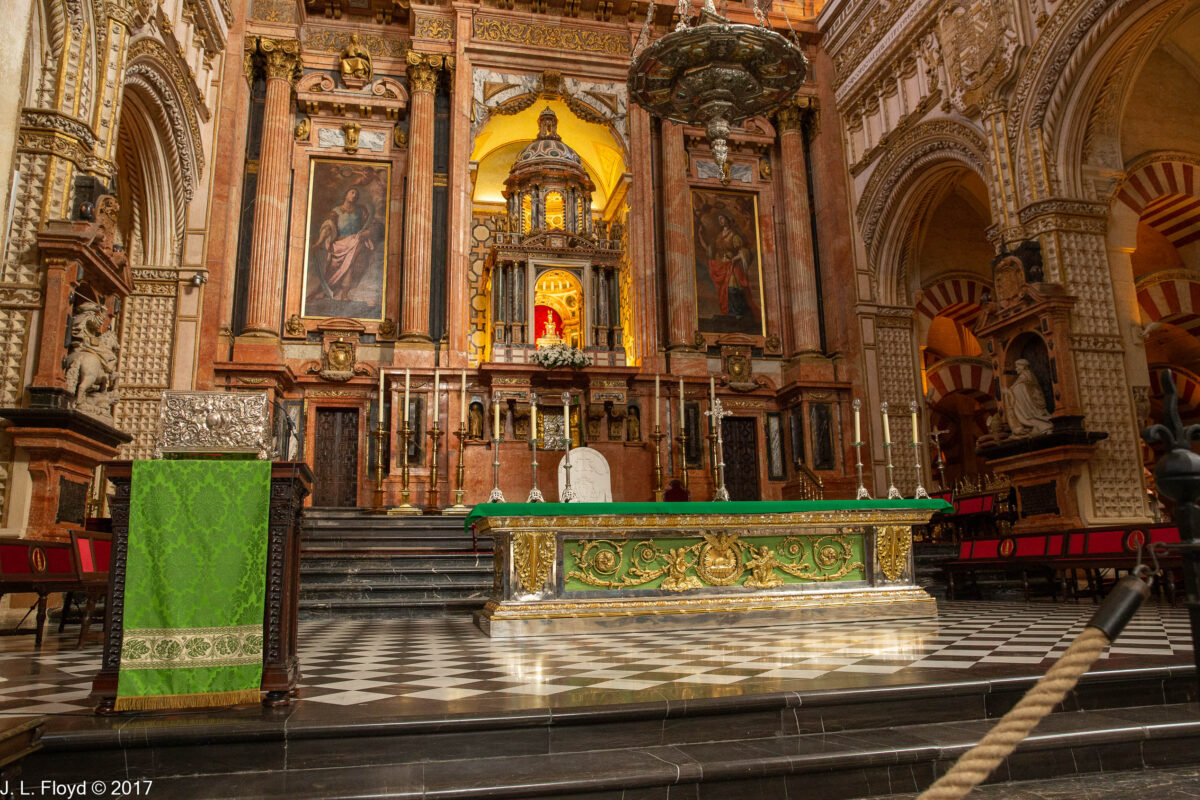
The altarpiece of the Capilla Mayor, begun in 1618, was not finished until 1653, and even then changes were made later. A Jesuit, Alonso de Matias, designed it in the Mannerist style, structuring it in three aisles separated by dual composite capital columns, and two levels above the base. Occupying the central bay of the altarpiece is a towering splendid Tabernacle, which displays the consecrated Host. Directly above the tabernacle is a painting of the Assumption of Mary, while the side bays are filled with canvases featuring martyrs of the Church, all by Antonio Palomino, a court painter from Madrid. Palomino received his commission for these paintings in 1713, when Europe was already well into the Baroque era, and they replaced originals which were also Baroque in style.

Just outside the Capilla Mayor, on either side of the transept, are two imposing Baroque pulpits carved in black marble, mahogany and bronze by a French sculptor, Michel Verdiguier, who completed them in 1779. They are dedicated to the writers of the Gospels: the one on the right, to Matthew and Mark, the one on the left to Luke and John.

Every proper cathedral has to have a sacristy or treasury, and the one in the Mezquita is located on its south side, in the Capilla de Santa Theresa, where we headed after viewing the Capilla Mayor. The Chapel of Saint Teresa was a late addition, having been founded in 1697 by the Bishop of Córdoba at the time, Cardinal Pedro de Salazar. He was a devotee of St. Teresa of Avila (1515-1582), the great Spanish mystic and religious reformer, and patron saint of those who suffer from headaches. Salazar intended it to be a funerary chapel for himself and his family, as well as a sacristy, and he is indeed buried there. He located the chapel, appropriately, in the same place where the treasury of the mosque had been centuries before.

The most striking of the many sacred objects displayed in the Treasury is the Processional Custody of Corpus Christi. This is a gold and silver monstrance, a container where the consecrated Host is displayed for veneration during ceremonial processions. It was the creation of two artists, one of whom, Enrique de Arfe (1475-1545), was of German origin (birth name Heinrich von Harff), but apparently worked all his professional life in Castile. He is credited with introducing Renaissance innovations in precious metalworking to Spain. In the seventeenth century the Spanish silversmith Bernabé García de los Reyes augmented Arfe’s work with a new base and other additions, completing the monstrance in its present form.

A number of other historically significant and precious gold and silver sacred objects were on display – processional crosses, reliquaries, scepters, etc. No less imposing were the paintings and sculptures in the Treasury. Almost all of them are products of the Baroque era, late 17th and early 18th century. There are eight statues of saints and church fathers by the celebrated sculptor José de Mora Exposito of Granada, placed between the arches of the chapel. And of course there had to be a sculpture of Saint Teresa of Avila, also by de Mora, which presides over the altarpiece of the chapel. I don’t have a photo of it, but a better one than I could have obtained may be seen here. She is depicted holding a book with a dove on her shoulder.

Two famous but anonymous paintings, located over the chapel doors, represent The Immaculate Conception and The Assumption of Mary. But I was more drawn to three canvases by Antonio Palomino illustrating scenes from the history of the city of Córdoba: The Martyrdom of Saint Acisclus and Saint Victoria, The appearance of Saint Raphael before Father Roelas, and The conquest of Cordoba by Fernando III the Saint. The last of these is the only one associated with a verifiable historical episode: it depicts the triumphant entrance of King Ferdinand (Fernando) III into Córdoba in 1536. We did not photograph it, but you may see it here. The other two deal with episodes which I would describe as legendary, but which Córdobans certainly believed to be true. The Appearance of St. Raphael to Father Roelas is the last of several occurrences in which the guardian angel of Córdoba is supposed to have revealed himself to local clerics to announce his divine appointment as custodian of the city. The Martyrdom canvas depicts an episode from 304 CE, during the persecutions of Diocletian, in which the Roman prefect of Córdoba had the youth Acisclus and his sister Victoria tortured and killed for refusing to abjure their Christian faith. They were later made patron saints of the city.

Before leaving the Treasury, I want to show a few items we observed there which were of less exalted character than the sacred objects pictured above, but which we found intriguing for one reason or another. I have not been able to find out much about these more mundane pieces, but they are worth presenting nonetheless.

The Treasury is situated next to the Mihrab, which I’ll deal with in the next post, where I conclude our visit to the Mezquita.

Categories
Spain, Portugal and Morocco, November 2017

Córdoba, November 8, 2017: The Judería

Leaving the Mezquita, we immersed ourselves in the narrow streets of the Judería, the old Jewish quarter of Córdoba, and arrived in front of a building which proclaimed itself to be the Faculty of Philology and Letters of the University of Córdoba. It’s difficult to know where the demarcation between the Judería and the rest of Córdoba lies, since for about 500 years no Jews lived there, and few live there today. In any case, there are many establishments in the Judería that have no obvious Jewish associations, such as the University of Córdoba. But it was a quiet and welcoming place to begin our tour of the Judería, as the black cat sleeping beneath a nearby tree confirmed.

It was only a short distance from the University to the Plaza Maimonides. This square, of course, is named after the medieval Jewish scholar and physician Moses ben Maimon, generally known as Maimonides, who was born in Córdoba in 1138. He did not live there long, but there is a monument to him in the square. In 1148 the Almoravids, the Berber dynasty which had ruled al-Andalus for a century, were replaced by a less tolerant regime, that of the Almohads, who demanded that all Christians and Jews in Córdoba either convert to Islam or emigrate. The family of Maimonides emigrated – first to the city of Fez in Morocco, then to Palestine and finally Egypt. He was trained as a physician and eventually became the court physician to the Islamic ruler Saladin. In the meantime he also became the leader of the Jewish community in Egypt and completed a series of writings which established him as the pre-eminent Jewish scholar and philosopher of the Middle Ages. It’s not surprising that Córdoba would want to claim him as a native son.

Plaza Maimonides is filled with attractive houses, which made it worth a look regardless of its illustrious past associations. In addition to the statue of Maimonides, there is a bust of Muhammad ibn Aslam Al-Ghafiqi (died 1165), an Andalusian-Arab physician and oculist who is credited with the invention of eyeglasses (still called gafas in Spanish).

You wouldn’t expect a Jewish neighborhood to host a bullfighting museum. But that’s where we found the Museo Taurino de Córdoba- in an elegant mansion owned by aristocrats in the 16th century. We also found the Iglesia San Bartolomé. In the year 1391, a huge anti-Jewish pogrom broke out which decimated Jewish communities all over Spain, not least in Córdoba. Many Jews converted to Christianity or emigrated. In the aftermath, with many Jewish houses vacated, a new Christian parish church was established in the Judería on Calle Averroes. It is considered one of the finest examples of Mudéjar art in Spain. Unfortunately, it was closed when we were there, so we were only able to take pictures of the exterior, but a stunning photo of the interior can be found here.

Near the Plaza Maimonides we were ushered into a handsome two-story apartment complex, both stories fronted with arcades formed by elegant arches, surrounding a spacious courtyard paved with river-stone, dotted with trees and shrubs ensconced in graceful planters fashioned from brick-and-wrought iron, and graced with an exquisite fountain near the entry passage. Blue flowerpots, reflecting the Jewish heritage of the location, hung from the railings between the second-floor arches. The complex seemed to epitomize the life-style not only of the old Judería, but of medieval – and modern – Andalusia in general. We should all be so lucky.

The Córdoba Judería incorporates not only residential districts but also part of the downtown area of the city, and we soon found ourselves making our way down a busy street bedecked with hotels, bars, restaurants, boutiques and, of all things, the Museum of the Inquisition. Having been a familiar of the Spanish Inquisition in my salad days, I was anxious to get a look at it, although we did not have time to explore it at length.

Almost before we knew it, we found ourselves back at the Plaza de San Rafael, boarding the bus to continue on to Granada. I regretted having so little time to explore the city which was for many years the supreme jewel of Spain, but I was also thrilled to have beheld it once in my lifetime.

Categories
Spain, Portugal and Morocco, November 2017

Córdoba, November 8, 2017: From Mosque to Cathedral

The Mezquita-Catedral de Córdoba – Mosque-Cathedral of Córdoba – formally titled the Catedral de Nuestra Señora de la Asunción (Cathedral of Our Lady of the Assumption), but commonly just called the Mezquita, is one of the wonders of the world. I had wanted to see it for many years, ever since I saw a photo of the interior in a book of European history, and would not have gone on a trip that didn’t have it on the itinerary.

At the northeast corner of the Plaza de San Rafael, we saw what looked like an upscale apartment building with balconies overlooking the street. It turned out that these balconies were built into the south wall of the Mezquita in the 18th century to improve the illumination inside the walls. They do not provide entry to the Mezquita; for that we had to walk to the north end, along the Calle Torrijos, to the Patio de los Naranjos, the Courtyard of the Orange Trees. Confusingly, one enters the mosque through what is called the “south wall,” i.e. the south wall of the Patio, which is actually the north wall of the mosque. It is lined with 17 horseshoe arches which formerly provided access to the mosque, but nowadays only one of them, the Gate of the Palms (Puerta de las Palmas), is open.

Crossing the threshold of the Puerta de las Palmas, the visitor is transported back to another age, the world of medieval Islam. It was Abd al-Rahman I, founder of the Emirate of Córdoba, who initiated construction of the Mezquita in 785 CE. His successors expanded and enhanced the mosque, and later, when the Christians took over, they left it essentially intact. When they did start making their own additions, they did so in Mudéjar style (at first), so that the visitor’s initial impression is that of an overwhelmingly Moorish ambience with a few Christian accoutrements.

Proceeding down the length of the vast entrance hall, which runs all the way to the south end, one encounters a glass floor through which are visible excavations of Roman ruins – on top of which the Mezquita was built. Turning to the right or left, visitors find themselves, as we did, in one of the several prayer halls, all of which are so expansive and so similar that you cannot keep track of which one you are in at the moment.

The founding builders of the Mezquita – the architect is unknown – made extensive use of material from those Roman ruins, especially columns, but the columns were not tall enough to build the ceiling of the prayer hall to the height deemed proper, so the Muslim engineers made up the difference by adding not only column extensions but arches in multiple tiers. The effect is astounding. Row upon row, tier upon tier, a forest of columns stretches off into what seems like infinity.

The first Christian addition, as one might expect, was an altar; in Spanish churches the altar is enclosed in a space called the Capilla Mayor, or main chapel. The original Capilla Mayor, now known as the Capilla Villaviciosa, was created between 1357 and 1372 by appropriating a space under a dome in the mosque extension added by Caliph al-Hakam II in the 10th century. The artisans who built the altar made few if any architectural changes to accommodate it. A Gothic nave was added later, in 1489, and much later a Baroque altarpiece and other furnishings, but these did not encroach on the splendid 10th-century dome or the incredible interlacing archwork at the chapel entrance; and they were removed in 20th-century restoration work. The Villaviciosa Chapel continued to serve as the Capilla Mayor until 1607, when the new Capilla Mayor was completed.

A more substantial modification to the mosque came with the construction of the Capilla Real, the Royal Chapel, completed in 1371. This was done under none other than Henry (Enrique) II, murderer of Peter the Cruel and persecutor of the Jews, who intended it as a funerary chapel and transferred to it the remains of his father, Alfonso XI, and grandfather, Ferdinand IV. Those remains are no longer there, but the chapel is still known as the Capilla Real. Despite its Christian sponsorship, the Capilla Real was constructed in Mudéjar style by Moorish craftsmen. The Spanish Christians of the Reconquista era remained heavily under the spell of Moorish art and architecture and needed the skills of its practitioners to emulate them.

But this did not last. In the fifteenth century the successes of the Reconquista fueled a growing self-confidence, cultural identity and religious fervor in the Iberian kingdoms, manifested in the conquest of the last remaining Muslim strongholds, the final expulsion of the Jews, and the Voyages of Discovery. This was accompanied by increased integration into the European political and economic sphere and, most notably, exposure to the influences of the Italian Renaissance.

In the sixteenth century the consequences of these changes would come into full force. I’ll deal with that in the next post.
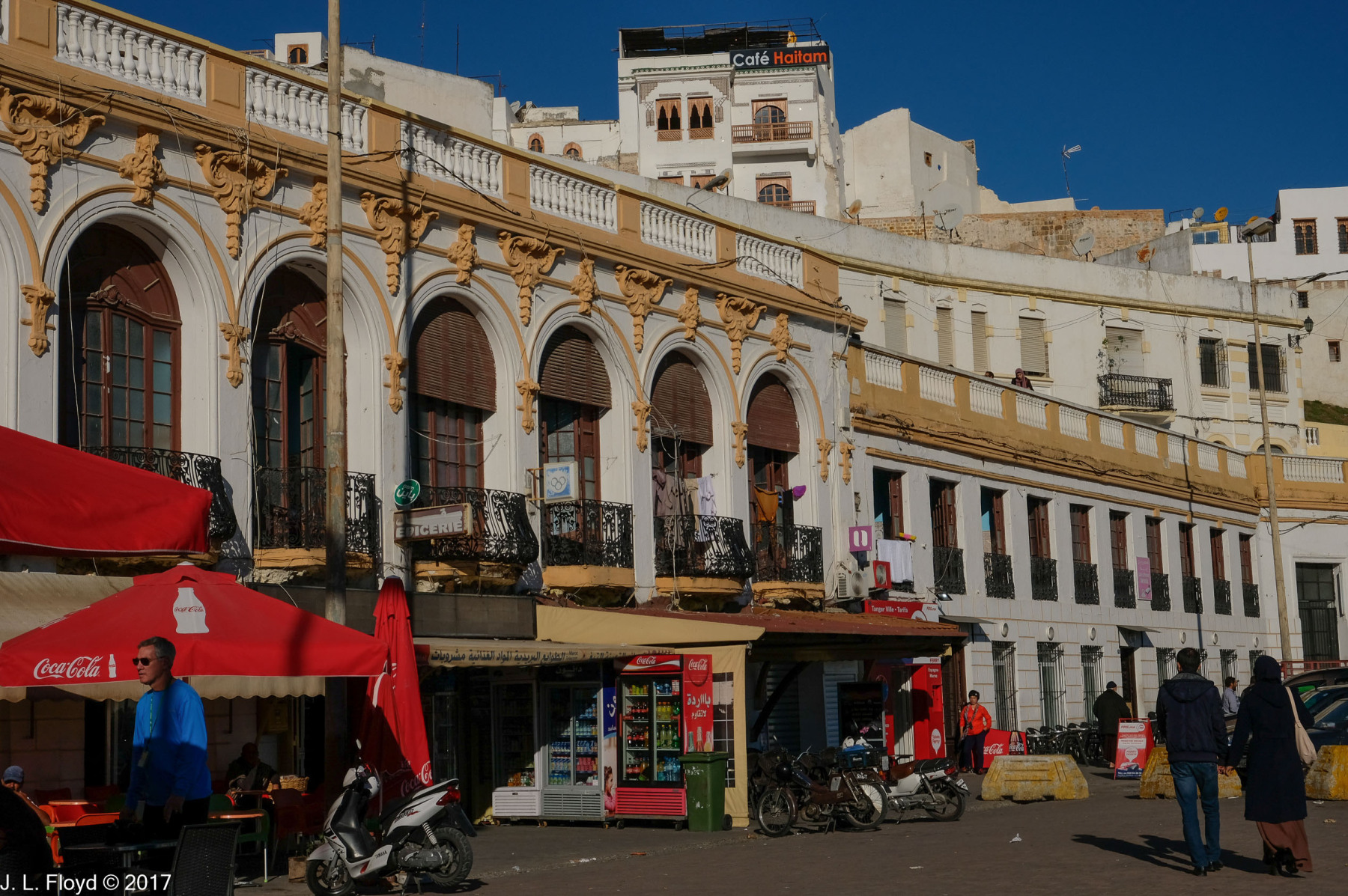
Categories
Spain, Portugal and Morocco, November 2017

Córdoba, November 8, 2017: City of San Rafael

Córdoba was for a time one of the largest and most populous cities in the world. The time was circa 800-1000 CE, when its main rivals were Constantinople, Baghdad and Chang-an. Chang-an, for readers unfamiliar with China, was the capital of the Tang dynasty, which ruled the greatest empire in the world of that day. Chang-an was a long way from Baghdad and Constantinople, and the inhabitants of the western world knew nothing about China then. But they did know about Córdoba.

In 712 CE the armies of Islam conquered the Iberian peninsula. At that time the center of power in the Islamic world was the city of Damascus, ruled by the Umayyad Caliphate. But in 750 the Abbasid family overthrew the Umayyads and massacred nearly all of them. One of the few survivors, Abd al-Rahman, escaped and established an emirate in Iberia, al-Andalus, making his capital in Córdoba. While the new Abbasid Caliphate made Baghdad their capital, the successors of Abd al-Rahman proclaimed their own caliphate in Córdoba, and from there dominated Iberia as well as North Africa for the following two centuries.

Under the successors of Abd al-Rahman Córdoba became both an economic powerhouse and the leading center of learning in the Western world. Muslims, Christians and Jews congregated and worked there, with the Christians absorbing the lost scholarship of antiquity, transmitted to them by Muslim and Jewish scholars, and then disseminating that learning to the unlettered barbarian kingdoms of northern Spain and France.

Those northern Spanish barbarian kingdoms had almost immediately begun to coalesce and expand after the Muslim conquest of the eighth century. At first they made little headway against the power of the Caliphate of Córdoba, which dominated the south but tended to disregard the northern regions as poor and backward. But eventually, in the eleventh century, civil war tore apart al-Andalus and the relentless advance of the Reconquista began in earnest. In 1236 the forces of Ferdinand III of Castile took control of Córdoba once and for all.
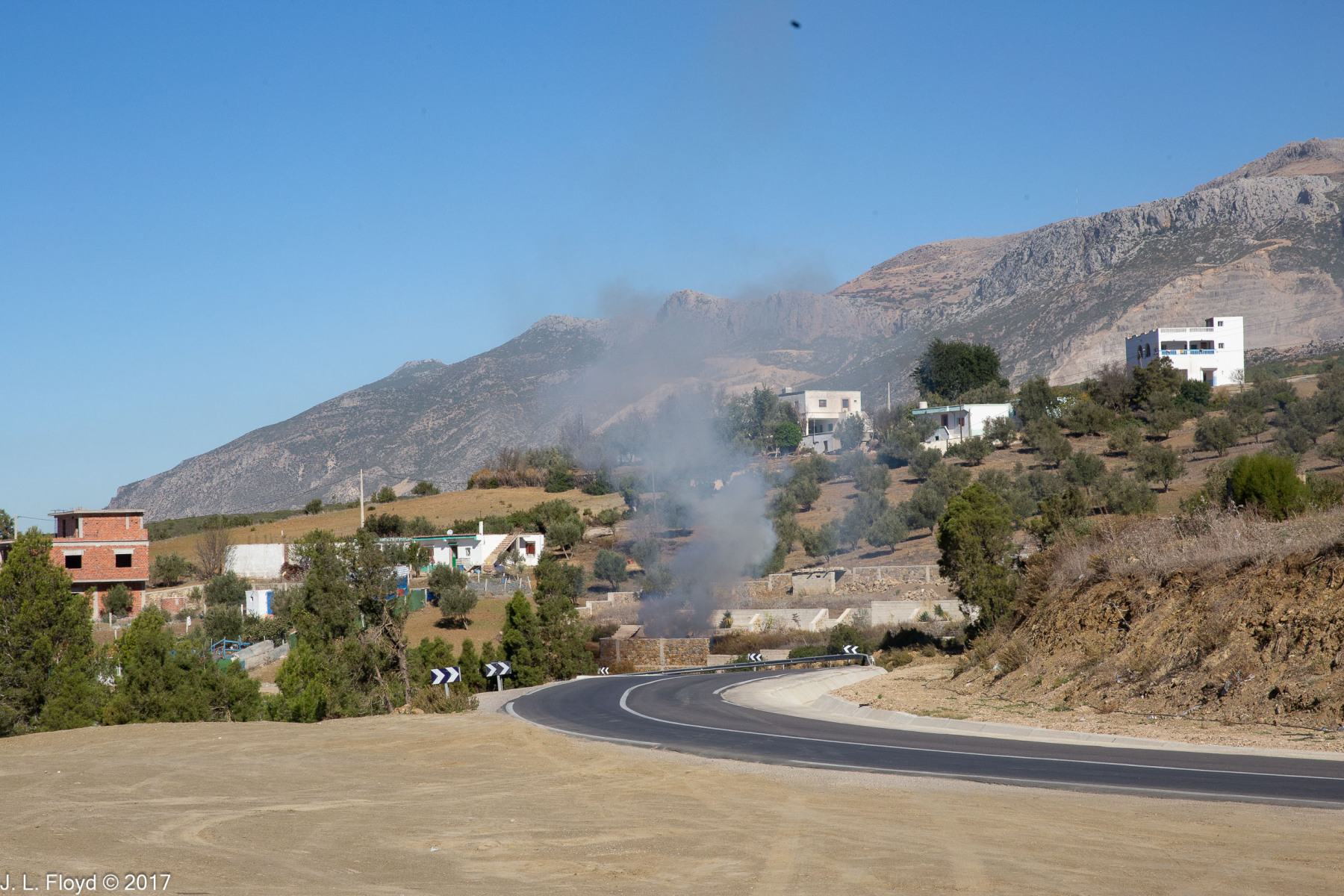
For a while Córdoba continued to prosper under the Christian kings. The first Córdobans whose fortunes took a turn for the worse were the Jews, who had experienced a golden age under the Islamic caliphate. Especially after the ascent of Henry II to the throne of Castile, the Jews of Castile experienced increasing discrimination and persecution, and in the pogroms of 1391 the Jewish community of Córdoba was decimated. Until the late sixteenth century, however, Córdoba remained a large and thriving city; after that, a long decline ensued, and was reversed only in the twentieth century. Nowadays it is a city of medium size, with 325,708 inhabitants in 2018.

Our visit to Córdoba began on the west bank of the Guadalquivir River, where the heart of the old city lies. At that point the river is spanned by a fabled stone bridge which has been in existence at least since the first century BCE, though it has been rebuilt, restored and repaired many times over the centuries. For two thousand years, until the 20th century, it was the only bridge over the Guadalquivir at Córdoba. Now there are several, and the Old Roman Bridge has been restricted to pedestrian traffic since 2004. The Moorish rulers built two towers, one at each end of the bridge. The tower at the east end, called the Calahorra Tower, still stands in something like its original form.

A little way downstream of the Roman bridge on the west bank of the Guadalquivir stands the Albolafia Mill, another relic of antiquity. It may have originally been built by the Romans, along with several others, but in its present form it dates from the days of Moorish rule. Water was extremely important to the originally desert-dwelling Arabs and their Berber co-religionists, who all made extensive use of hydraulic technology throughout their domains; their word for water-wheel, noria, was adopted into Castilian Spanish, and from there spread to English as well. In Moorish times the Albolafia noria, turned by the force of the river’s current, poured water into an adjacent aqueduct, which then piped the water into emir’s palace and the city beyond. Most of the aqueduct has not survived the vicissitudes of time, but one arch is still standing and is visible in some of our photos.

The mill survived the Reconquista, but in 1492 Queen Isabella, who was staying in Córdoba, complained that the noise of the noria gave her a headache and had it dismantled. Actually, the headache was probably also a result of the ceaseless entreaties of Christopher Columbus, who visited Córdoba at that time to present one of his many petitions to her and her husband to fund his venture to the Indies. However that may be, the noria must have been rebuilt in the following century, because the Albolafia was converted sometime during that period to serve as a flour mill, and wheels are necessary to grind flour, no? In any case, the flour mill ceased operation in the 20th century, and the city council had to hire an antiquarian architect in the ’60s to reconstruct the noria. In its current incarnation, which is supposedly an exact replica of the original, the noria is a very impressive structure, and in addition to being a major tourist attraction, the mill is a godsend to the local cats, who feast on food provided by the operators.

We disembarked from our tour bus next to the Alcázar de los Reyes Cristianos, the palace in which Ferdinand and Isabella were living when Columbus came to pester them about financing his maritime ventures. Time did not permit us to explore the interior of the palace, which was unfortunate because it is considered a prime example of Mudejar architecture; but we did take numerous photos of its rather forbidding exterior as well as of the neighborhood around it. The Córdoba Alcázar began as a fortress of the Visigoths and became the emir’s palace under Moorish rule; in 1328, about a hundred years after the Christians retook Córdoba from the Moors, King Alfonso XI of Castile ordered a new palace built on the site, so that it was thenceforth known as the Alcázar de los Reyes Cristianos, the Alcázar of the Christian Kings, even though it still looks Islamic because it was built in Mudéjar style, with sumptuous baths, fountains and gardens. Ferdinand and Isabella made it the headquarters for their assault on the last remaining Moorish kingdom in Spain, the Emirate of Granada, which they took in 1492, at which time they also finally acceded to Columbus’ pleas to be allowed to discover America (which, of course, was not his actual intention). Unfortunately, they also made it the headquarters of the Spanish Inquisition, which they had established in 1480. The Moorish baths proved useful for waterboarding – 15th-century Europeans considered bathing to be unhealthful, anyway – so they were converted into torture chambers.
The Córdoba Alcázar is a square-shaped structure with a tower at each corner. The oldest is the Torre de los Leones, at the northwest corner, where the entrance to the palace is located, as well as the royal chapel. The octagonal tower at the northeast corner originally had a clock and was known as the Clock Tower, but is now called the Torre del Homenaje, or Tower of Homage. The Torre de la Paloma, Tower of the Dove, at the southeast corner, is a reconstruction of the square-shaped original, which was demolished in the 19th century; it had also been known as the Torre de la Vela, or Watchtower. The round Torre de la Inquisición, Tower of the Inquisition, has a sinister appearance that lives up to its name, which it owes to having housed the archives of the Inquisition for centuries. It was formerly also known as the Torre de los Jardines, the Tower of the Gardens.

Most of our stay in Córdoba was quite rightly devoted to visiting the Mezquita, but just as we reached its precincts we paused to linger in the Plaza de San Rafael. San Rafael is the guardian angel of Córdoba, and there is a tall monument in the Plaza with a statue of him by a French sculptor, Michel Verdiguier, who is also responsible for some of the Mezquita sculptures, on the top. Near it, at the north-west end of the Old Roman Bridge, stands the Puerta del Puente, or Bridge Gate. This replaced an old Roman gate of the city; the occasion for its construction was a visit to Córdoba by King Philip II in 1572, but it was not actually completed until much later. It was also rebuilt in 1928 and restored anew in the 21st century.

Categories
Spain, Portugal and Morocco, November 2017

Spain, November 8, 2017: Basilippo Olive Ranch

Departing from Seville on the morning of November 8, 2017, our tour bus headed for Córdoba on the A-398 highway. stopped for lunch at Hacienda Merrha, home of the Basilippo olive oil firm.

According to a placard we encountered at the entrance, Andalusian olive oil estates are found in a limited area around Seville, and and often combine olive oil production with other agricultural and ranching activities. They are organized according to a typical and traditional pattern, which is followed at Hacienda Merrha: a central courtyard surrounded by a tool shed, the mill housing the olive press and other production facilities, and the family residence. There is also a bell tower, which traditionally is used to summon the workforce or sound alarms.

In our house Sandie and I cook mostly with olive oil, so we were quite interested to find out how olives are grown and processed. The host took us on a tour first of the groves, where he showed the various types of olive trees and explained how they differ from one another. Fortunately, although I am extremely allergic to olive tree pollen (though not to olive oil), this wasn’t the time of year when it is encountered, so I experienced no ill effects while wandering through the olive groves. Not from the olive trees, anyway. At one point a madman, probably a refugee from the local asylum, came leaping into the grove, gesticulating wildly and waving a cell phone, but he soon calmed down when offered a jar of Basilippo olives for lunch.

Our host, the proprietor of the hacienda, explained to us the varieties of olives, or cultivars, grown on the estate. There were two main cultivars, described as follows:

Manzanilla: a large, rounded-oval fruit, with purple-green skin, which originated in the Seville area. “Manzanillas” means “little apples” in Spanish. Known for a rich taste and thick pulp, it is a prolific bearer, grown around the world.

Zorzaleña: an alternate name for Lechín de Sevilla, an important variety in Andalusia, grown predominantly in the province of Seville, but also cultivated in the bordering provinces of Cordoba, Cadiz, and the Málaga. The oil has a fruitiness with the presence of green, bitter, light almond, and pungent attributes that is slightly astringent and smooth on the palate.

We observed pickers at work in the groves, but they turned out to be cardboard cutouts. Nowadays, our host explained, they had machines that grabbed the trees by the trunk and shook them until the ripe olives fell off into bins placed around the trees.

Next our host ushered us into the ranch house, which on a traditional olive ranch would provide the living quarters of the proprietor’s family; but here it is the company showroom, where the host gives talks and shows videos of the olive oil production process. There are also displays of the estate in miniature illustrating the various steps of production, as well as actual equipment used in earlier times, i.e. before the advent of modern machinery.

The ranch house was also the setting for lunch, which culminated the tour of the estate. We were served a traditional Mediterranean-style lunch consisting of bread, cheese, and other goodies which included, of course, wonderful Basilippo-grown olives.

After lunch we re-boarded the tour bus and resumed our journey toward Córdoba. Somewhere along the way we saw a bright star in the distance, just above the horizon. Since it was broad daylight, this was an attention-getter. We soon discerned that it was an advanced type of solar power station which uses mirrors to focus sunlight upon a central tower, somewhat resembling a lighthouse, where the sunlight is concentrated and turned into electricity. Later I was able to look it up online and found out that this was the Gemasolar concentrated solar power project, inaugurated in 2011, in the town of Fuentes de Sevilla. It was the first solar plant in the world to use molten salt heat storage technology as a means for converting the energy of sunlight into electricity. According to its web page it was built by Torresol Energy Investments, a joint venture of Abu Dhabi-based renewable energy firm Masdar and Spanish engineering firm Sener, who own the plant in a 60-40% relationship, respectively. It is a small-scale operation, generating about 20 megawatts and providing electricity for 25,000 homes; but in pioneering this technology it paved the way for much more large-scale plants to come, such as a 690-megawatt plant near Las Vegas, Nevada. I was elated to find out that Spain is at the forefront of this technology, which potentially can provide enormous reductions in greenhouse gas generation over fossil fuels; the small-scale Fuentes de Sevilla plant alone reduces about 30,000 tons of carbon dioxide emissions per year.