We arrived in Madrid late on November 16 after a five-hour flight from Marrakesh. Our tour schedule called for a two-day stay in Madrid, but the second of those days was to be devoted to an “optional” day-trip to nearby Toledo, and there was no way we were going to miss Toledo; thus we had only a day to take in Madrid, and inevitably we were limited to hitting only the “mustest” and closest of the must-see attractions. In particular, I had wanted to see the Escorial, Philip II’s 16th century monastery-palace, which is not in Madrid itself but is located in the town of San Lorenzo, 45 kilometers or 28 miles northwest of the capital. But our schedule just didn’t allow for that, so we left the Escorial for a hoped-for “next time.”
Our day in Madrid began with a morning bus ride to one of the most majestic sights of the city, the monument to Miguel de Cervantes, Spain’s most famous writer. His masterpiece, Don Quixote, is widely regarded as the first modern novel and one of the greatest works of world literature. Born in Alcalá de Henares near Madrid in 1547, Cervantes lived in an era often called “the golden century of Spain,” when the country rose to supreme heights of power and glory, and he personally witnessed some of its greatest events. In the 1570s he served in the Spanish Navy as what we would call a “marine” nowadays, and participated in the great naval battle of Lepanto in 1572, when the Spanish won a great victory over the Turks. He was severely wounded in that battle, losing the use of his left arm, and was later captured by Barbary pirates and held for five years before being ransomed. After returning to civilian life, he continued to serve the Spanish Crown, first as a purchasing agent – his duties included obtaining provisions for the ill-fated Invincible Armada of 1588 – and then, from 1592, as a tax collector. During that time he also began his literary career. After several early and largely forgotten plays and romances, he eventually achieved renown – and financial success – with the publication of the first part of Don Quixote in 1605. The second part was published in 1616, the year of his death.
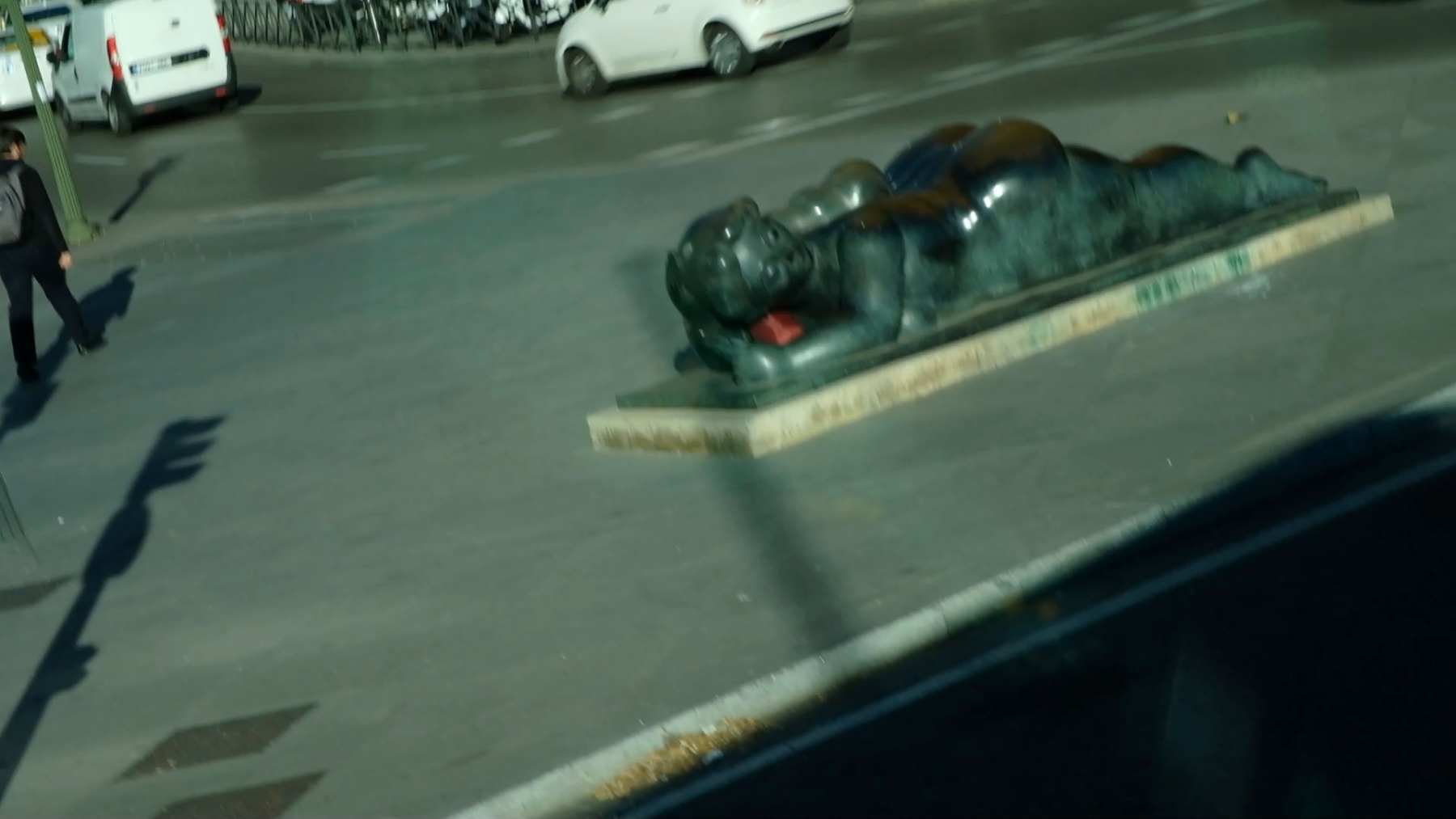
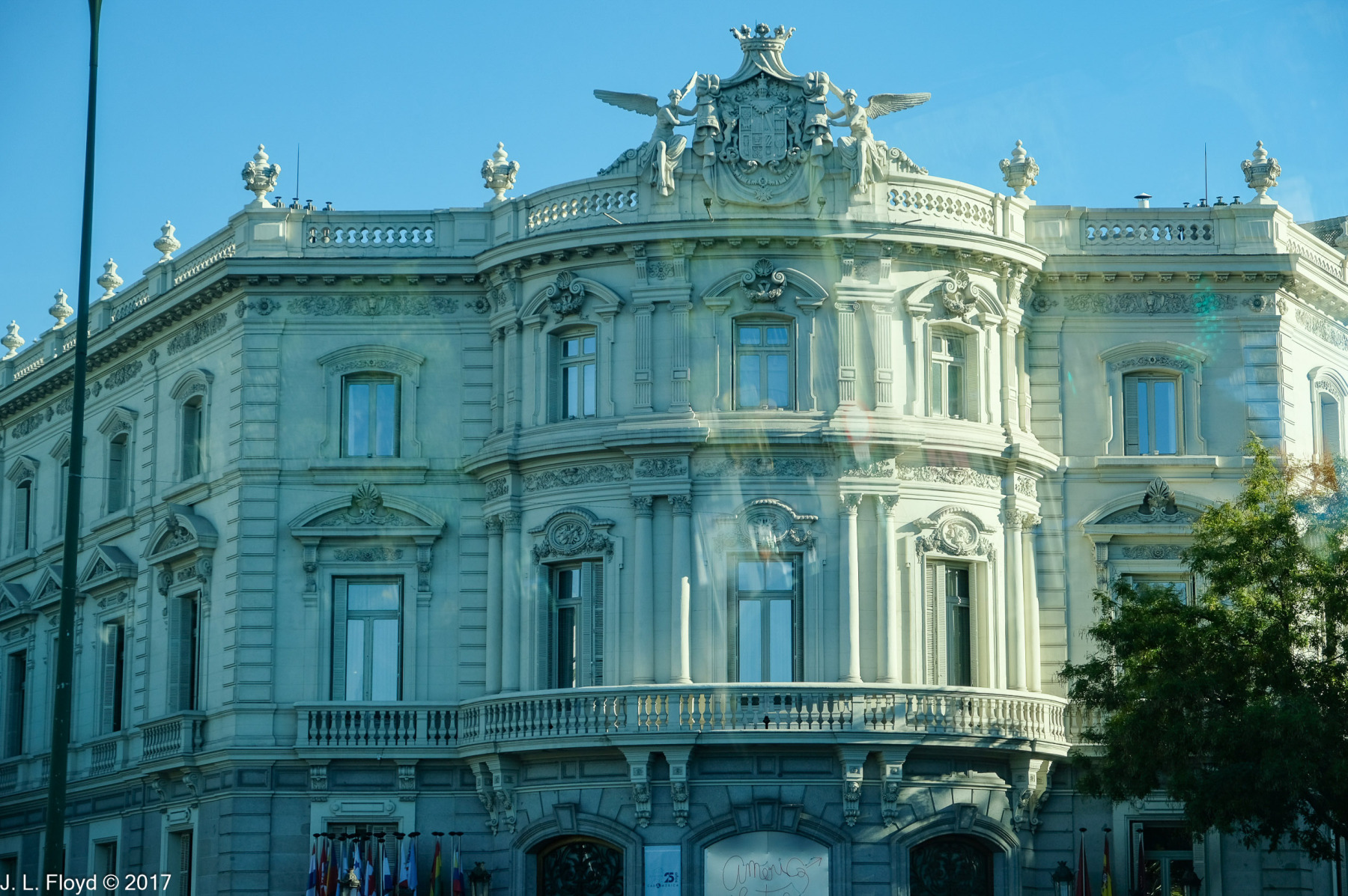
On the way to the Cervantes Monument, we caught fleeting glimpses of some noteworthy landmarks, some of which Sandie was able to snap through the bus window with her little Fujifilm mirrorless camera. One of these was a sculpture of a naked woman, of fairly generous proportions, lying face-down on a traffic island on the Calle de Génova at the entrance to the Plaza de Colón. She is depicted as looking in a mirror which she is holding in her hand, hence the title of the piece, Mujer con espejo (Woman with a Mirror). The sculpture was donated to the city in 1992 by its creator, the Columbian artist Fernando Botero.

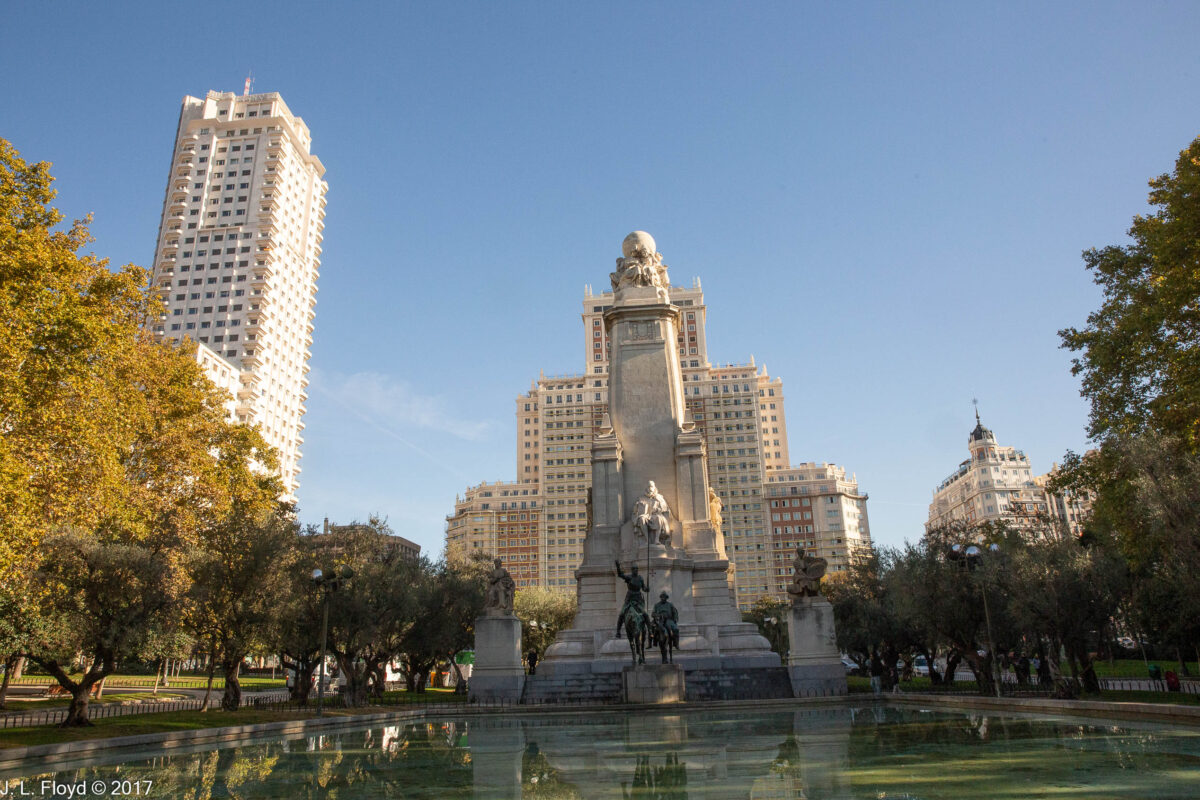
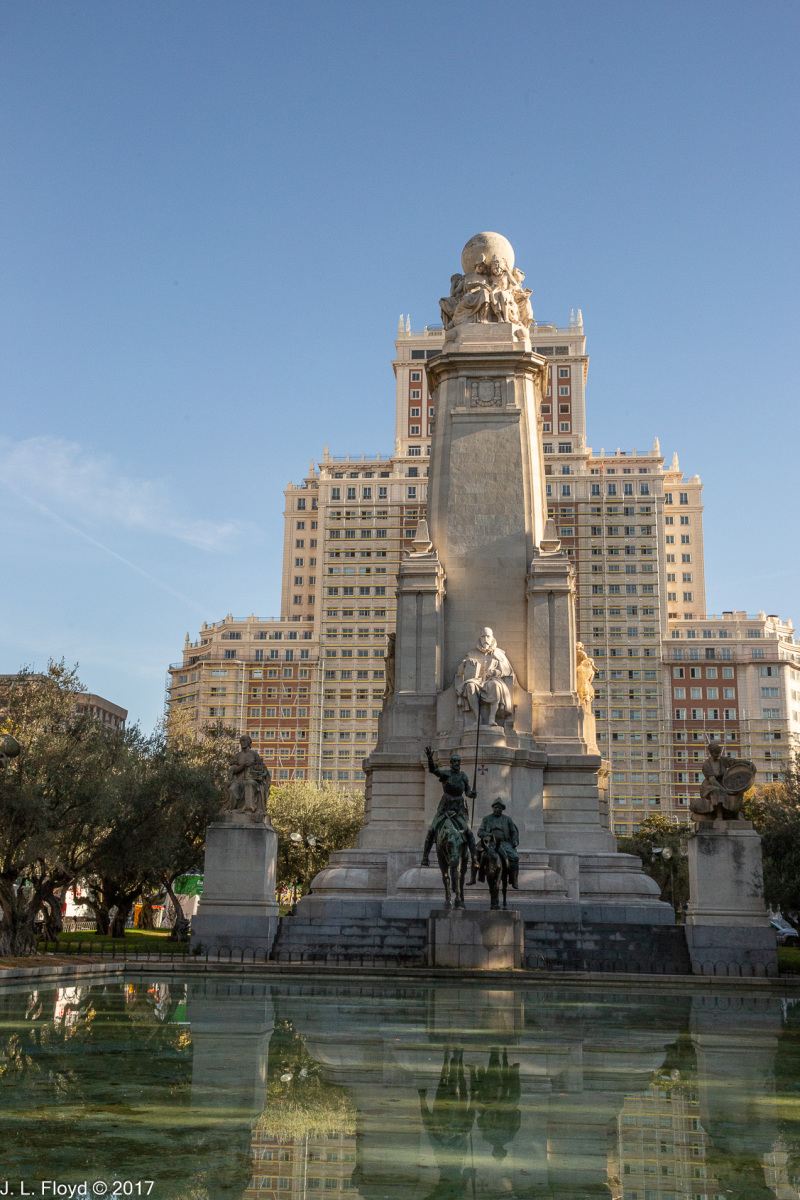
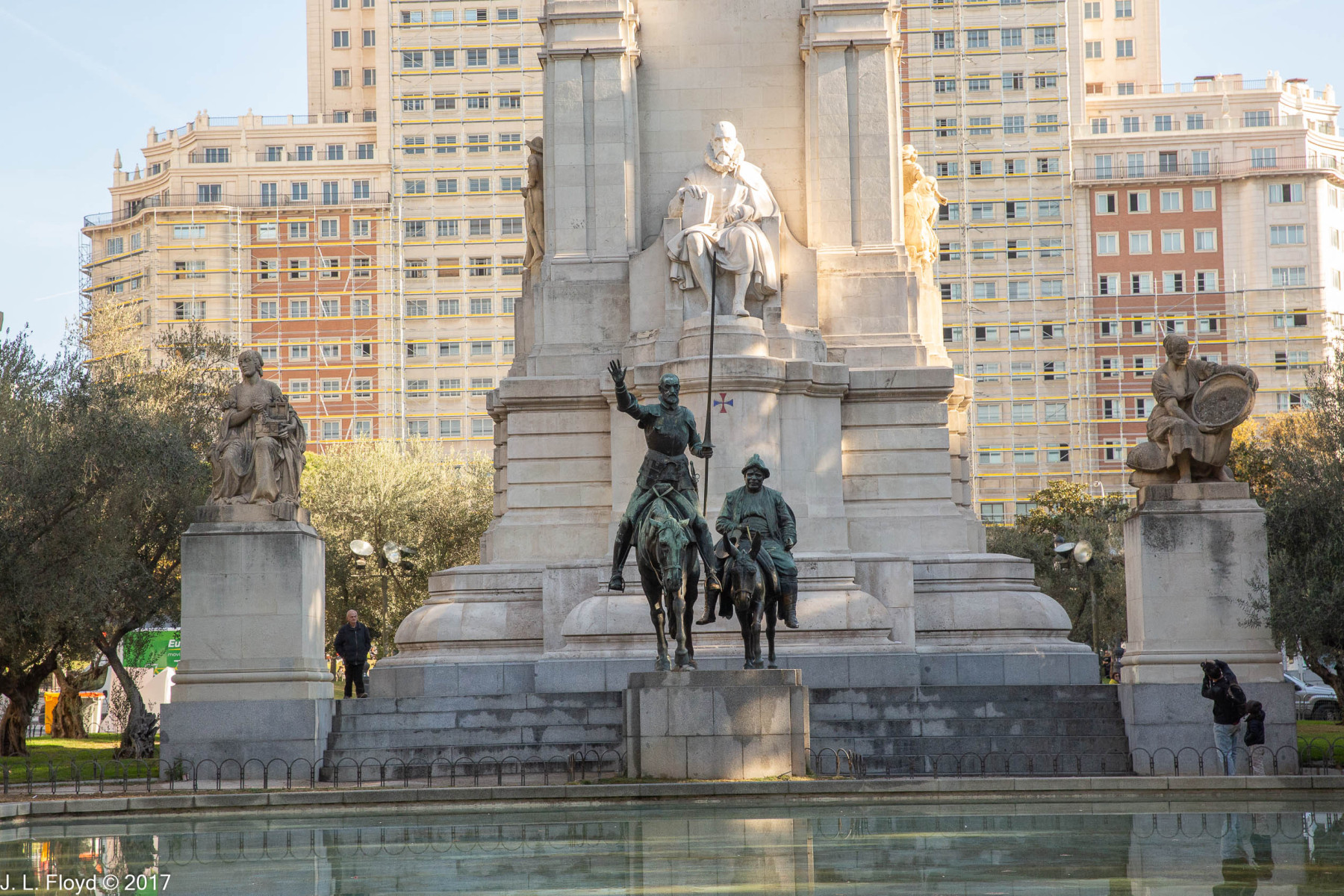
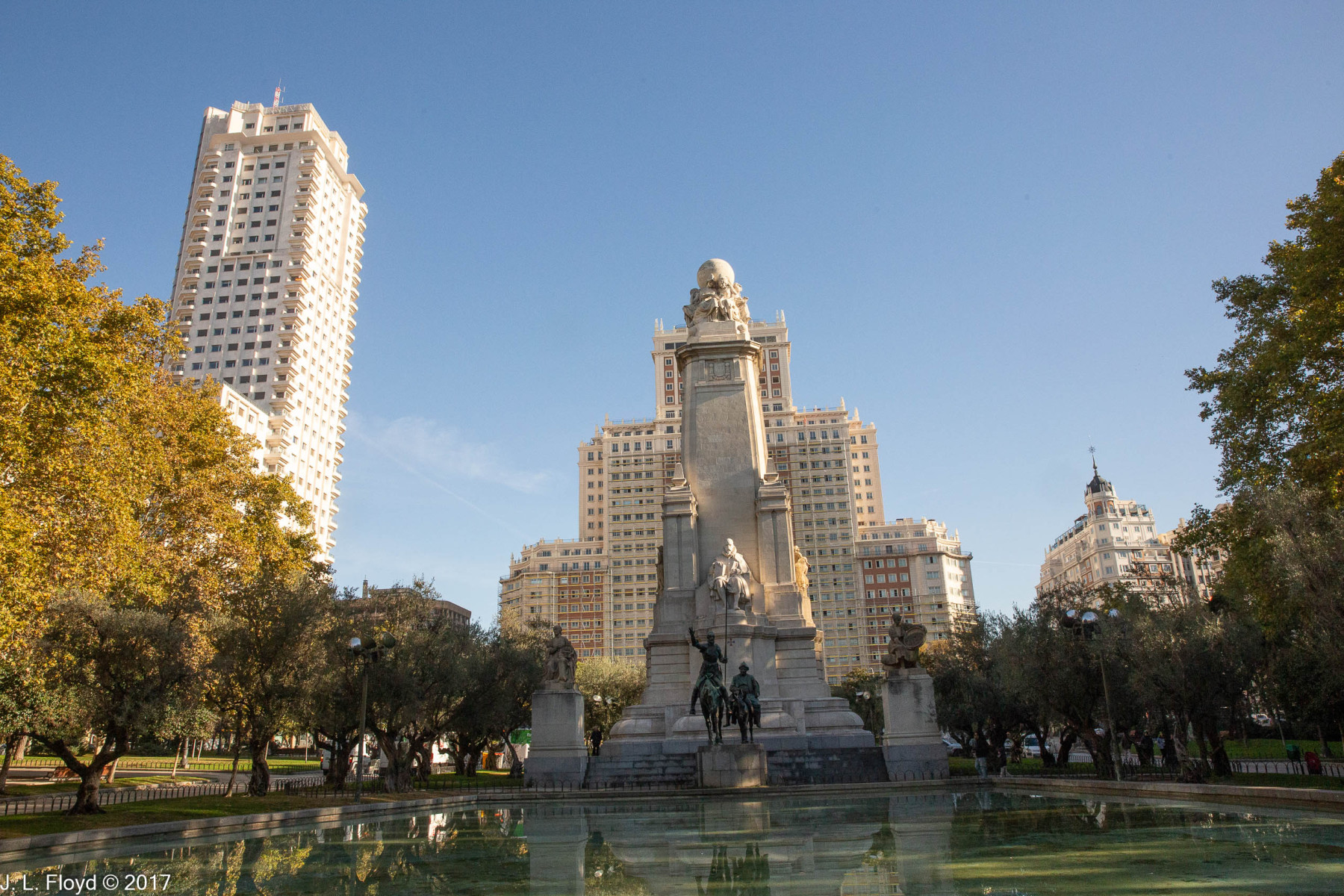
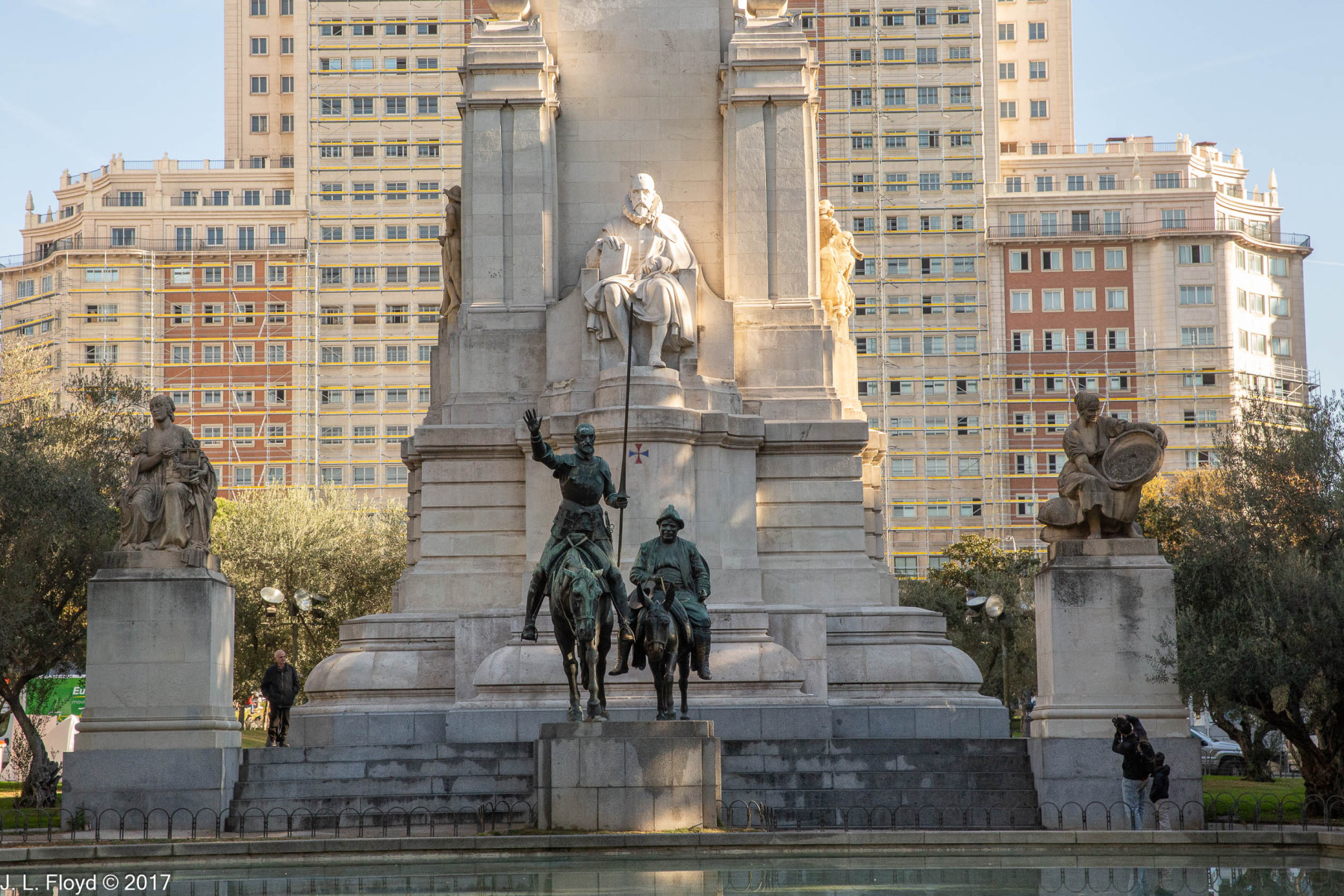
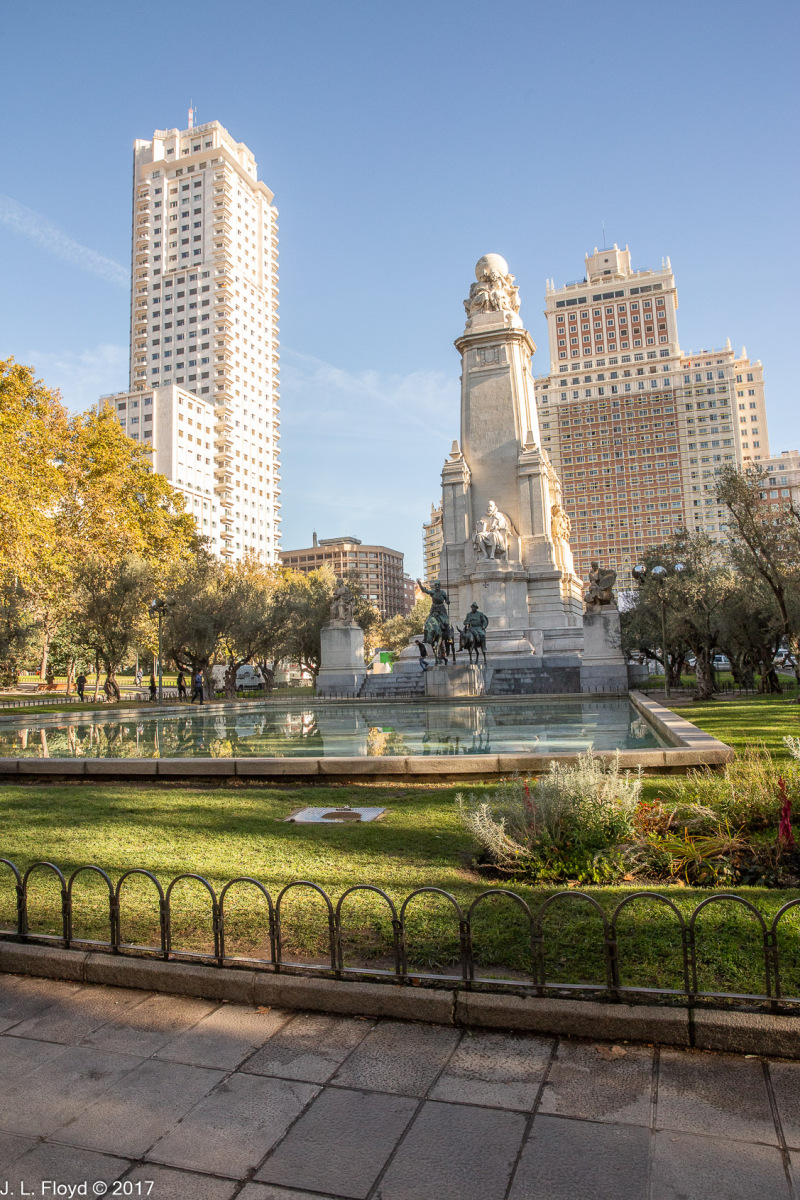
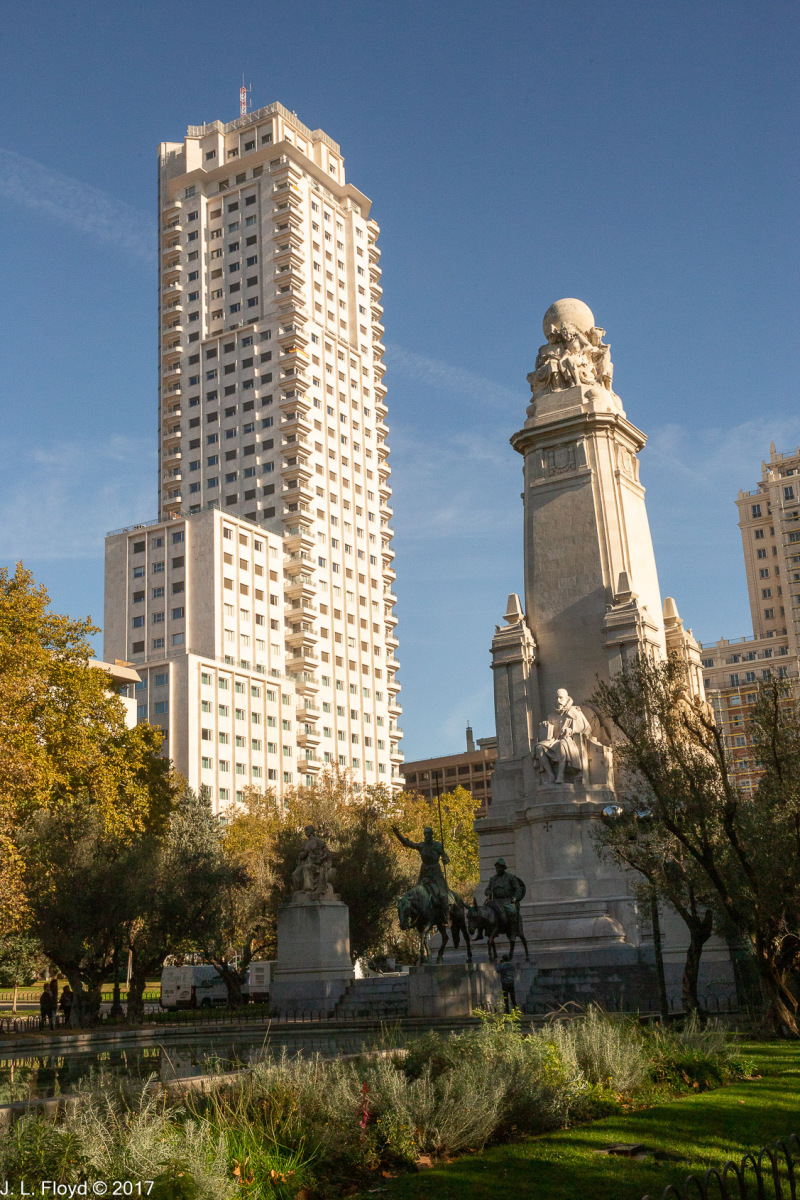
Before long we arrived at our first point of debarkation, the Plaza de España, where the Monumento a Cervantes stands. It consists of a monolith 34 meters (112 feet) high, topped with an earth globe surrounded by five women, representing the five continents on which Spanish is spoken. At its base is a statue of a seated Cervantes. Out in front of the monolith stands a detached bronze sculptural group depicting the two most famous characters from Cervantes’ works, Don Quixote and Sancho Panza, on horseback, presumably riding out to tilt at windmills. Flanking the monolith are pedestals hosting sculptures of other characters from Cervantes’ work.
The monument was begun in 1915 after a public contest resulting in the award of the project to a highly controversial proposal. It was inaugurated after many controversies and construction delays in 1929, at which time it was still unfinished, some of the sculptures being added later.
In back of the Cervantes Monument, and overshadowing it in my photos, is the Edificio España, a 25-story building in a Spanish neo-baroque architectural style. At 117 meters (384 feet), it was the tallest building in Spain when it was completed in 1953. It is now the eighth tallest. It was built as a showcase of modernization and prosperity in Francoist Spain; it houses a hotel, offices, apartments and shops.
Nearby, on the northwest corner of the Plaza de España, stands another skyscraper, the Torre de Madrid, which superseded the Edificio España in height when it was completed in 1957. At 142 meters (466 feet) it was the tallest building in Spain until 1982, when it was surpassed by the Torrespaña communications tower at 232 m (761.15 ft), also in Madrid. Like the Edificio España, it houses a hotel, apartments and offices.
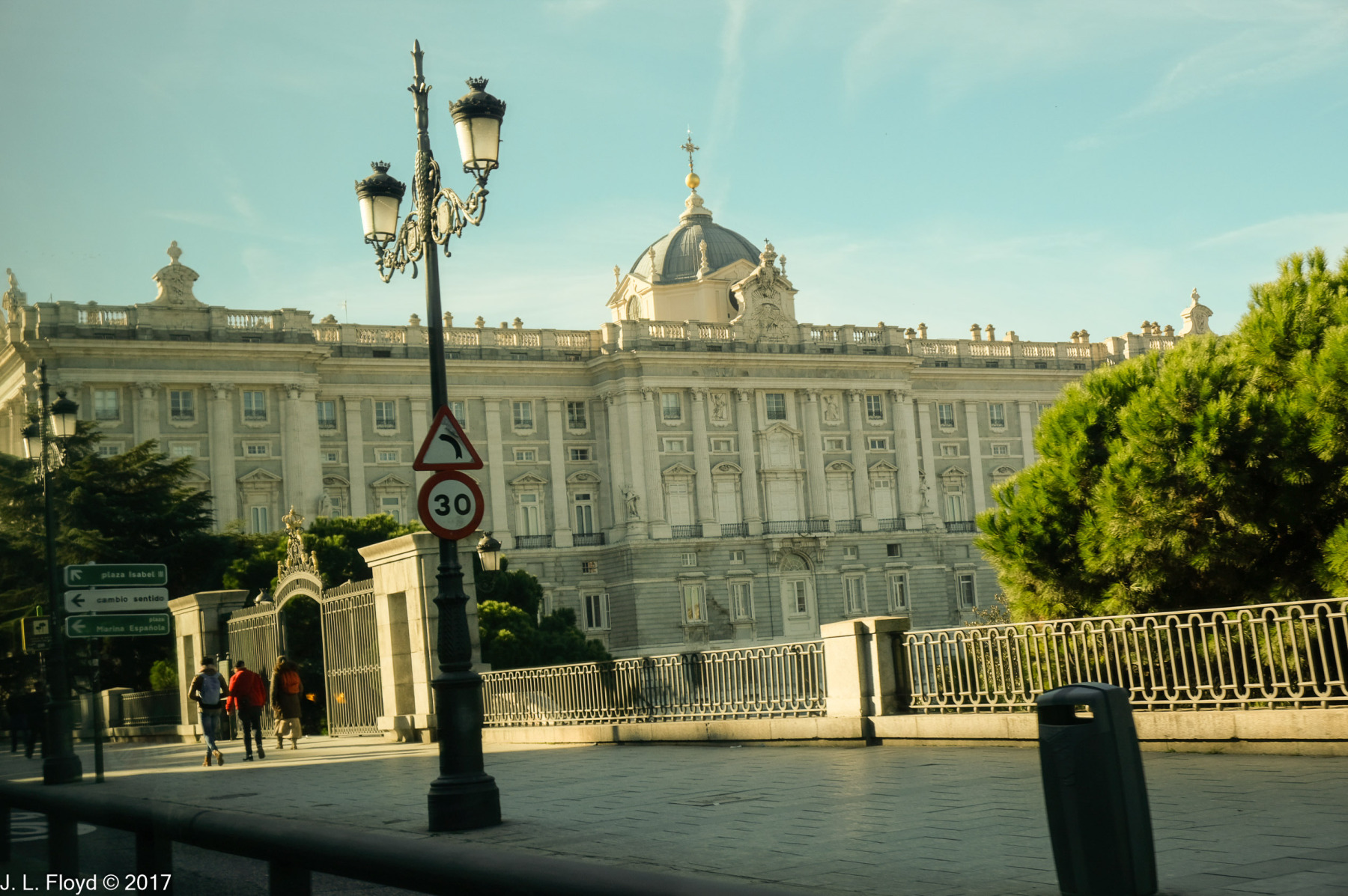
From the Plaza de España it was but a little way to the Palacio Real (Royal Palace), our next destination. I was surprised to find out that it is the largest palace in Western Europe – I always thought Versailles was larger – and one of the largest in the world, at 135,000 square meters (1,450,000 square feet), with 3,418 rooms. It is an 18th-century construction, having been built between 1738 and 1755 on the site of a previous palace, the Alcázar Real de Madrid, which burned down in a fire in 1734. Although the Palacio Real is the official residence of the Spanish royal family, they do not actually live there, preferring the Zarzuela Palace on the outskirts of Madrid.
Although the Royal Palace is open to the public, we did not tour inside owing to time constraints; we saw the palace from its east side, at the Puerta del Príncipe (Prince’s Door), the main entrance.
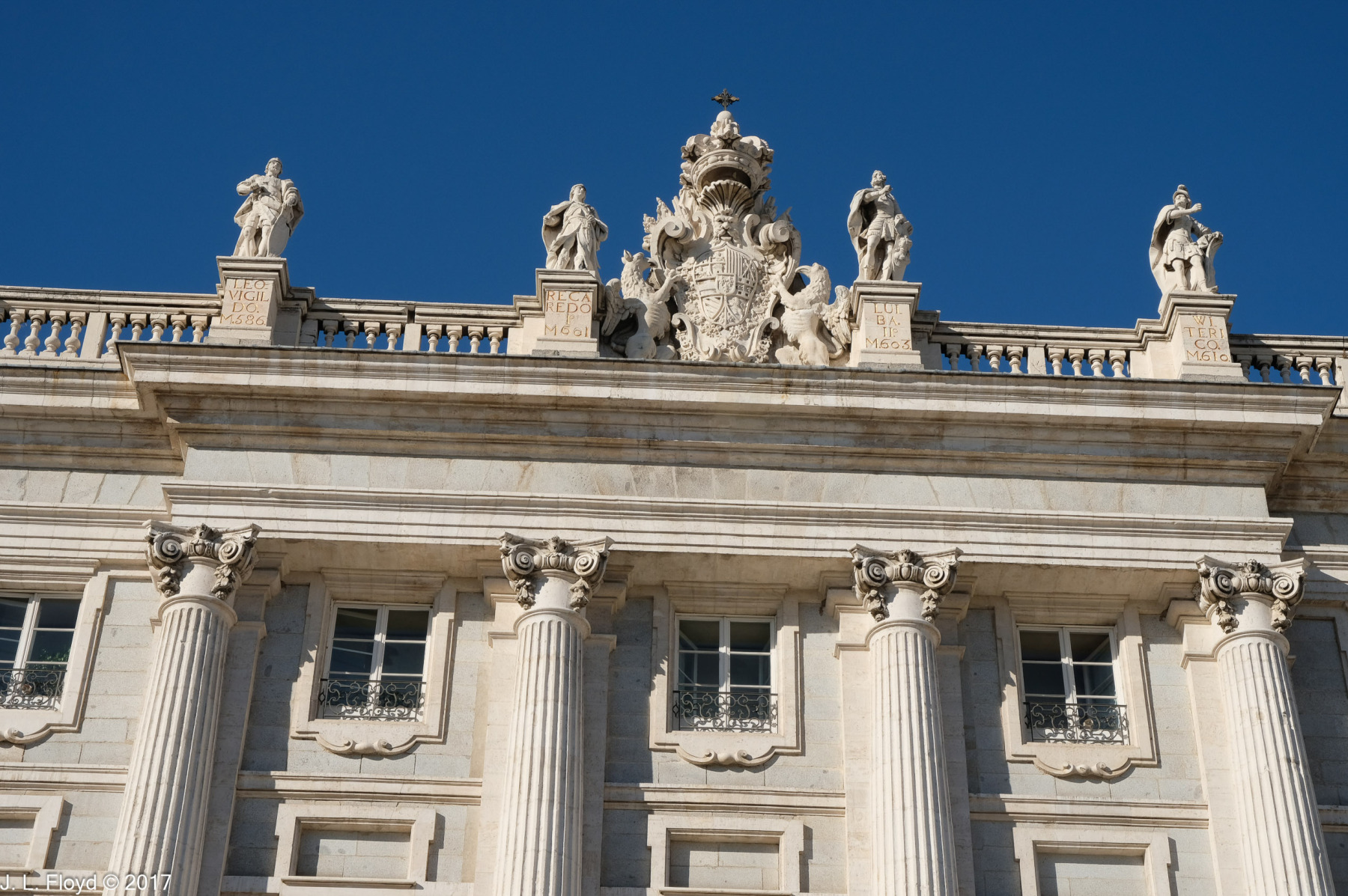
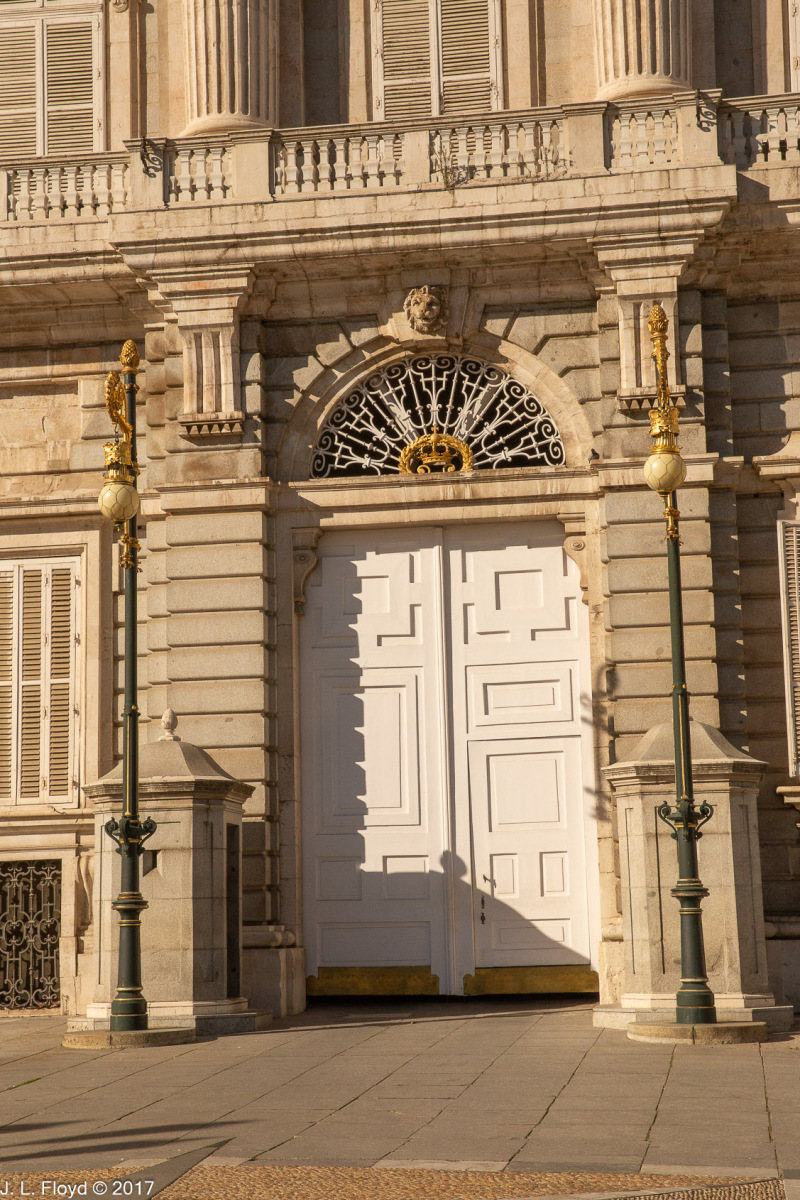
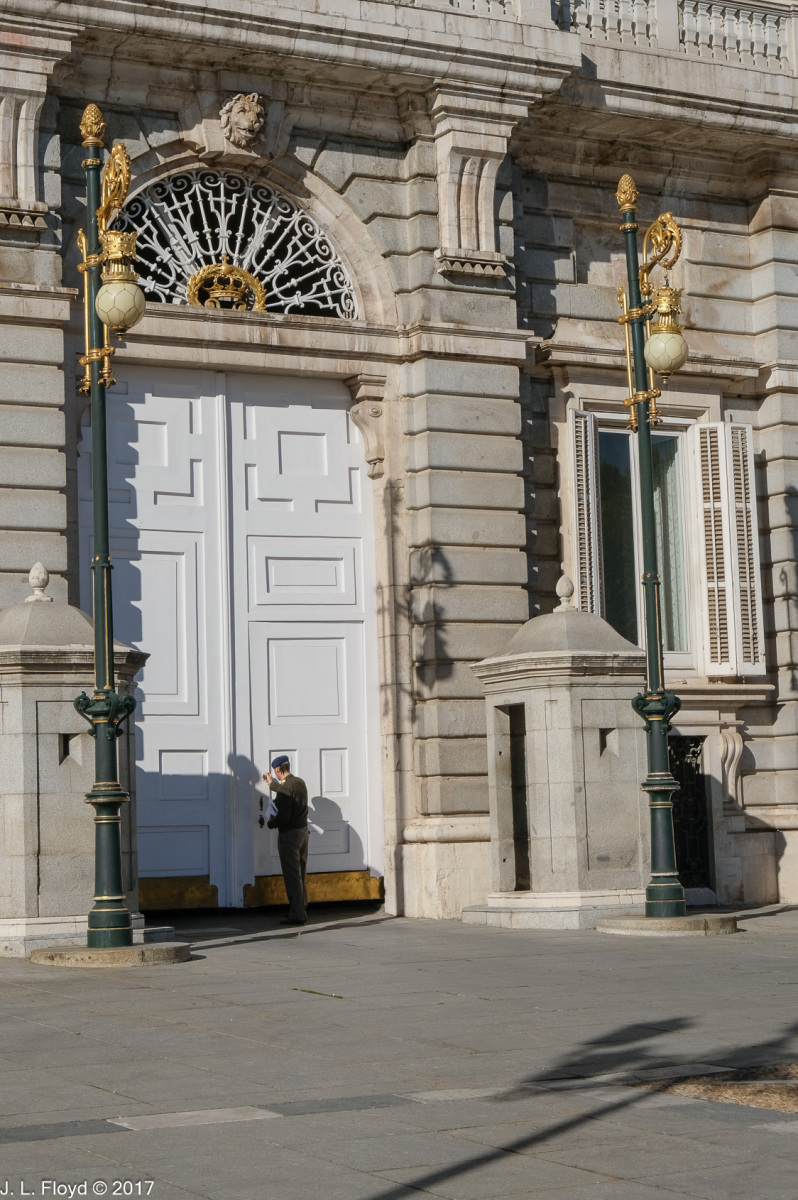
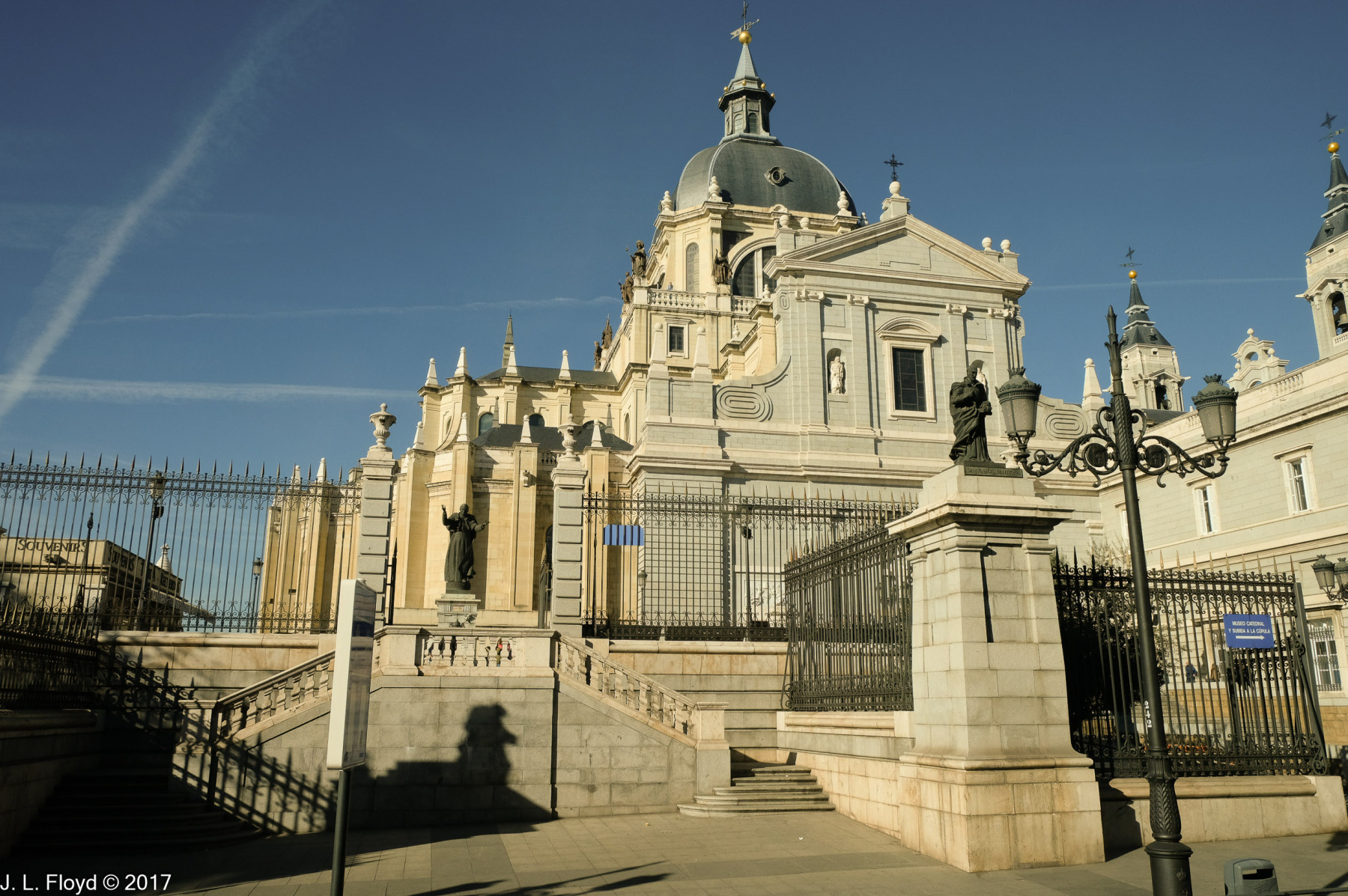
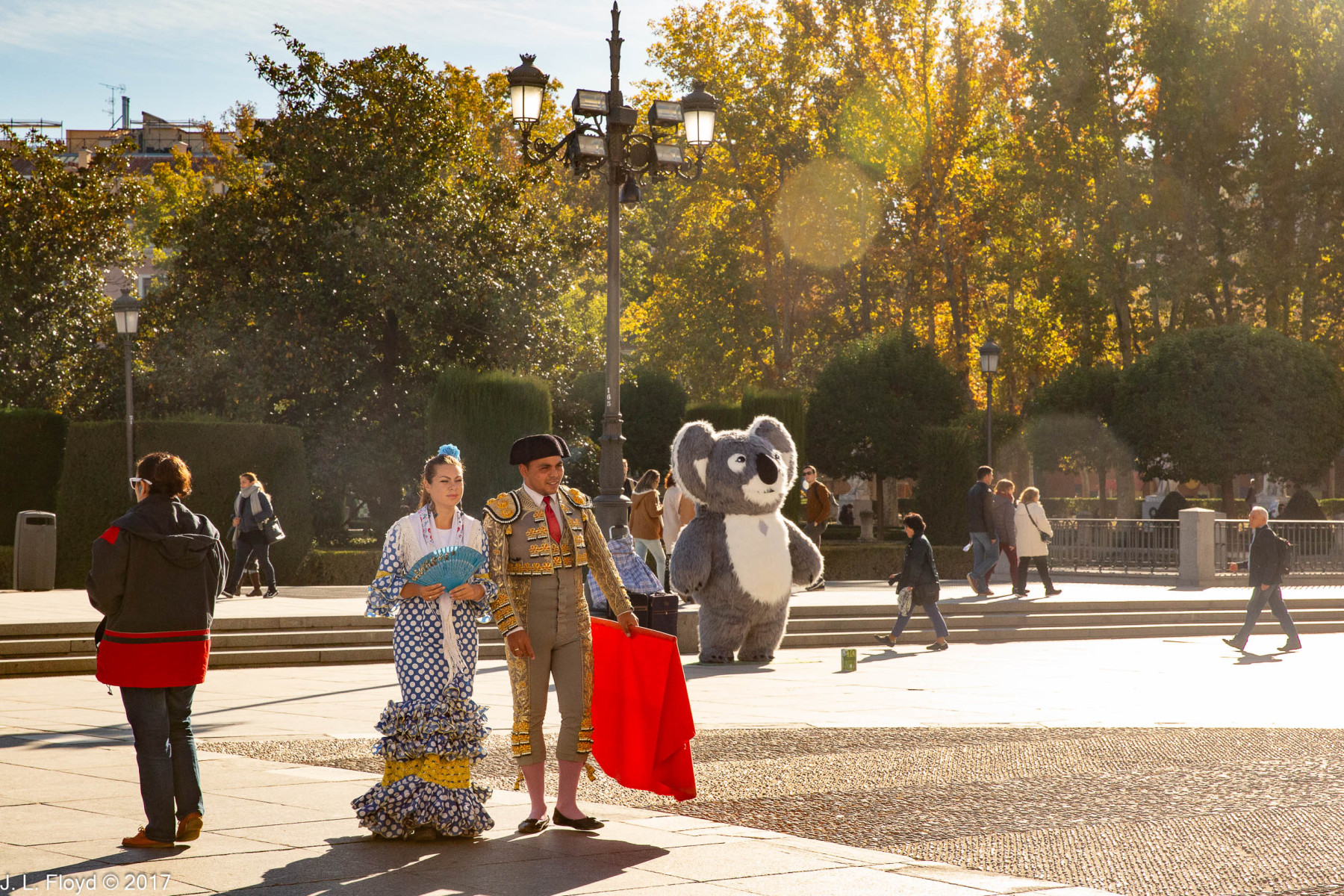
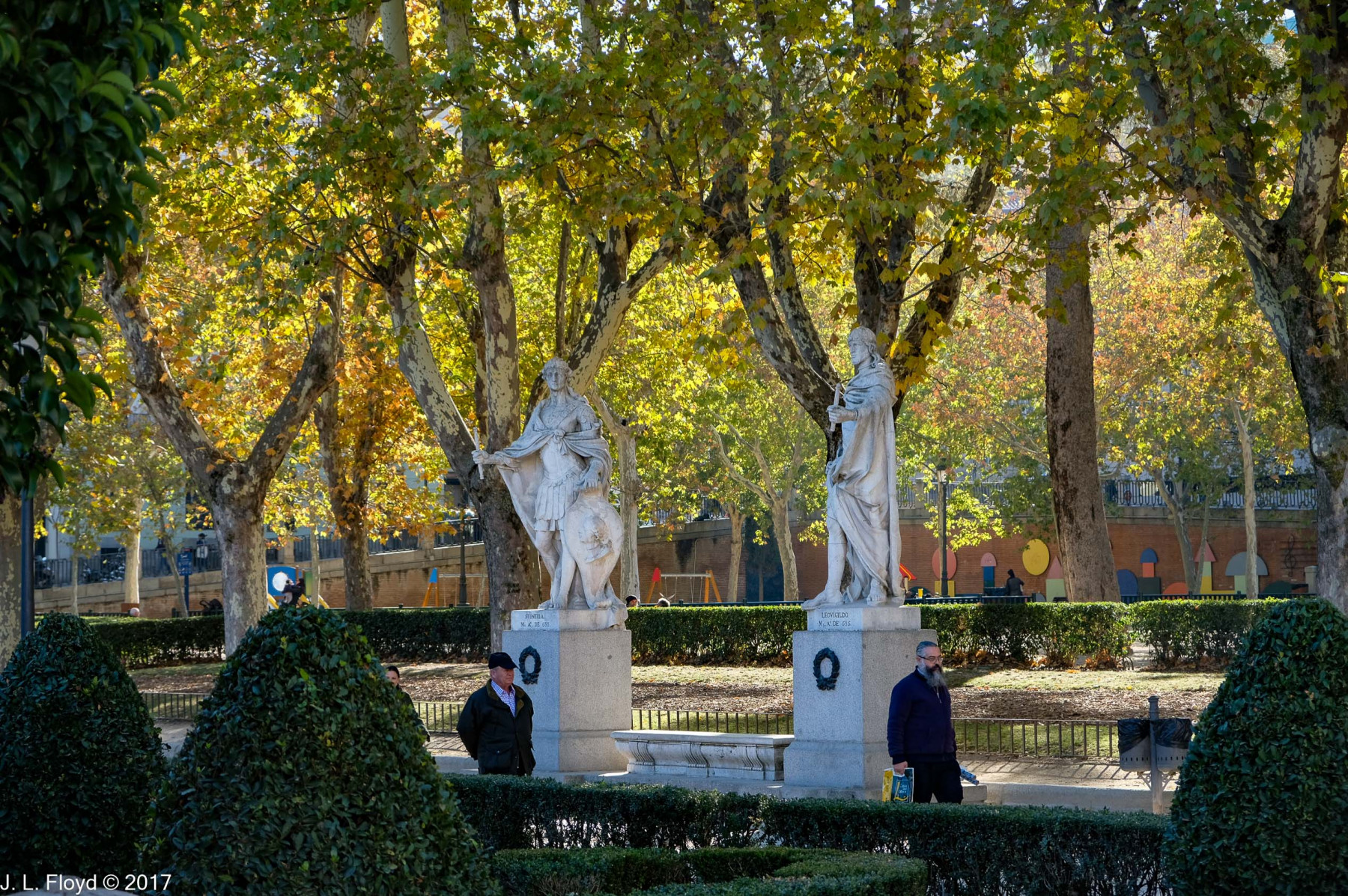
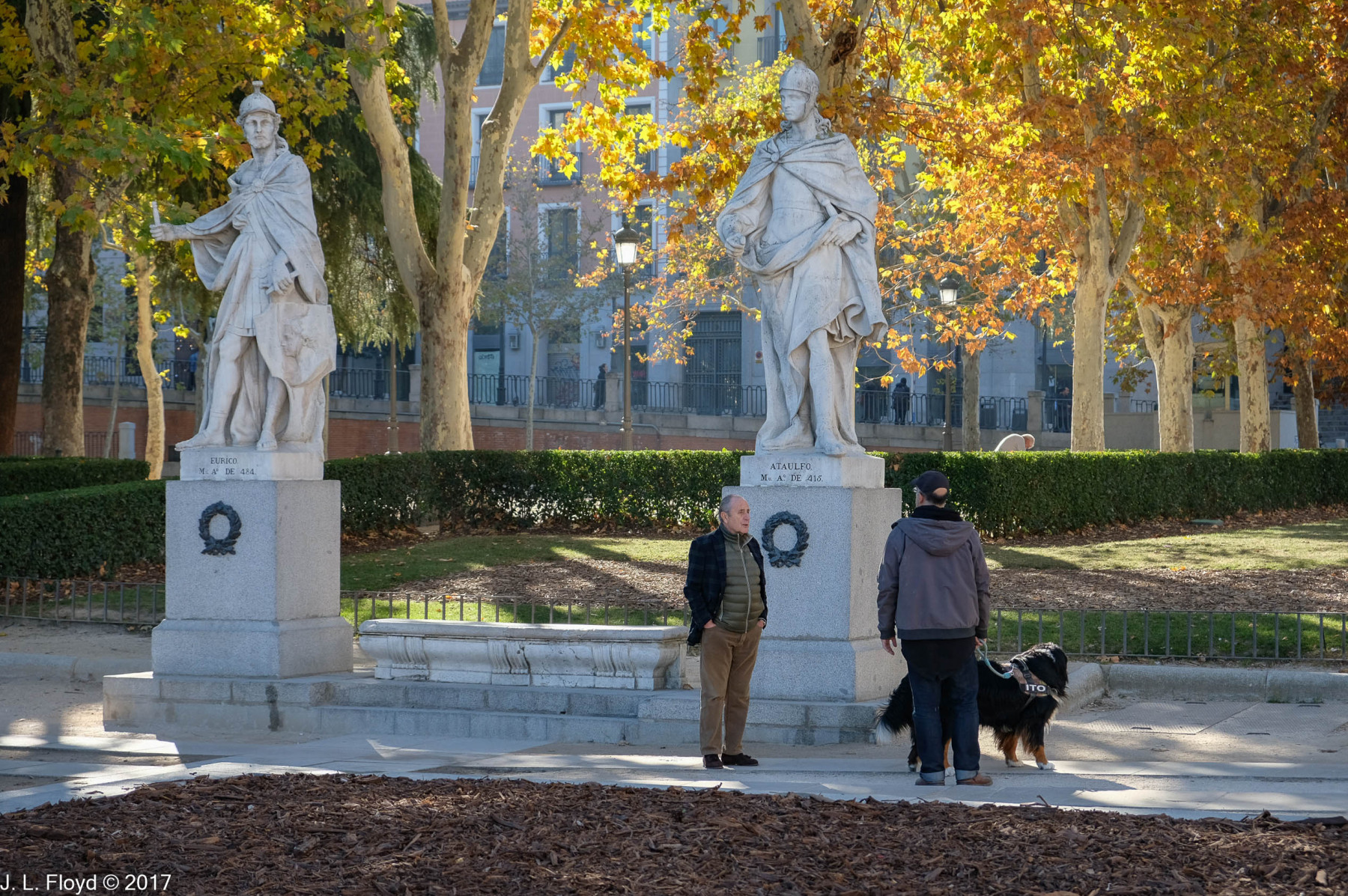
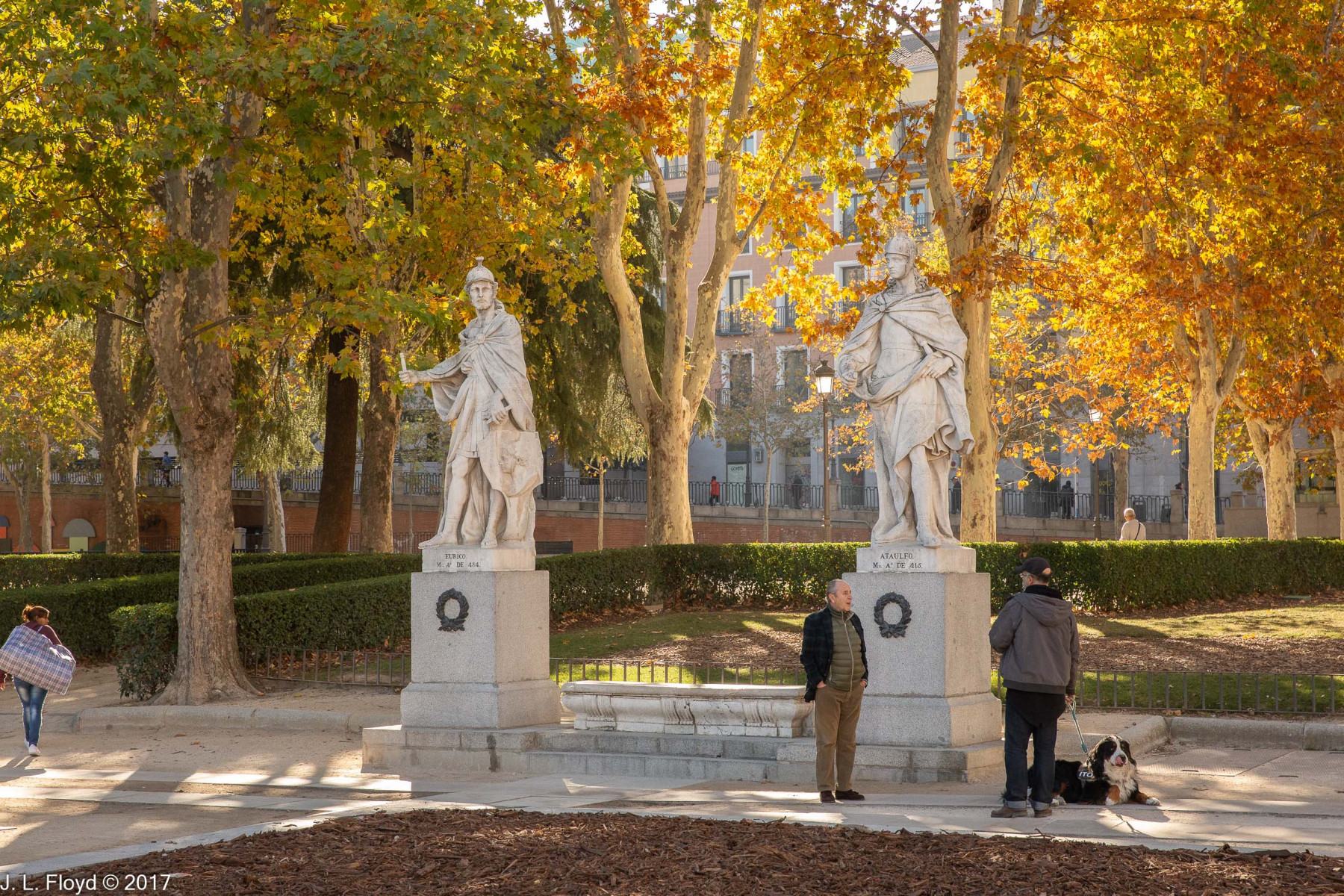
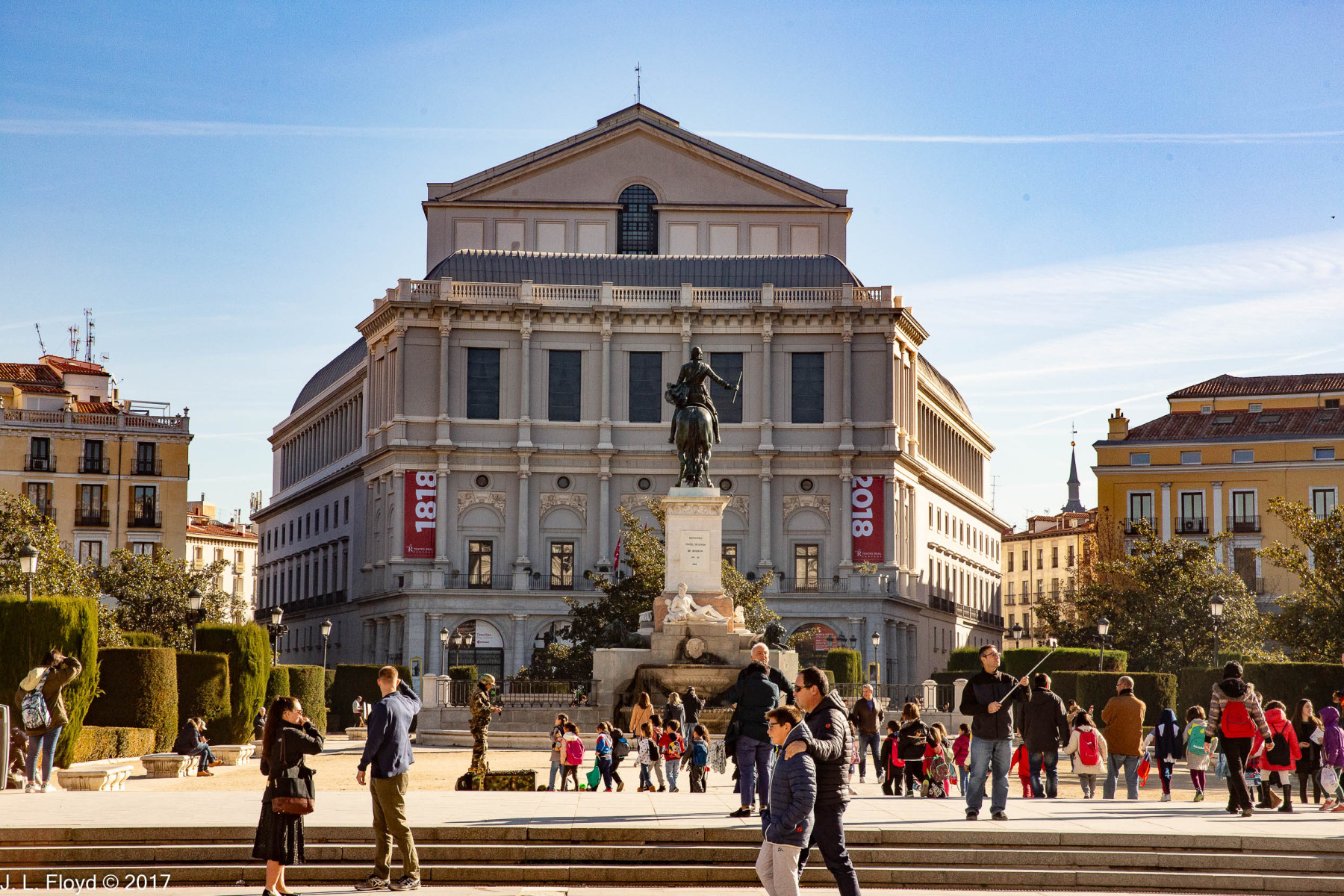
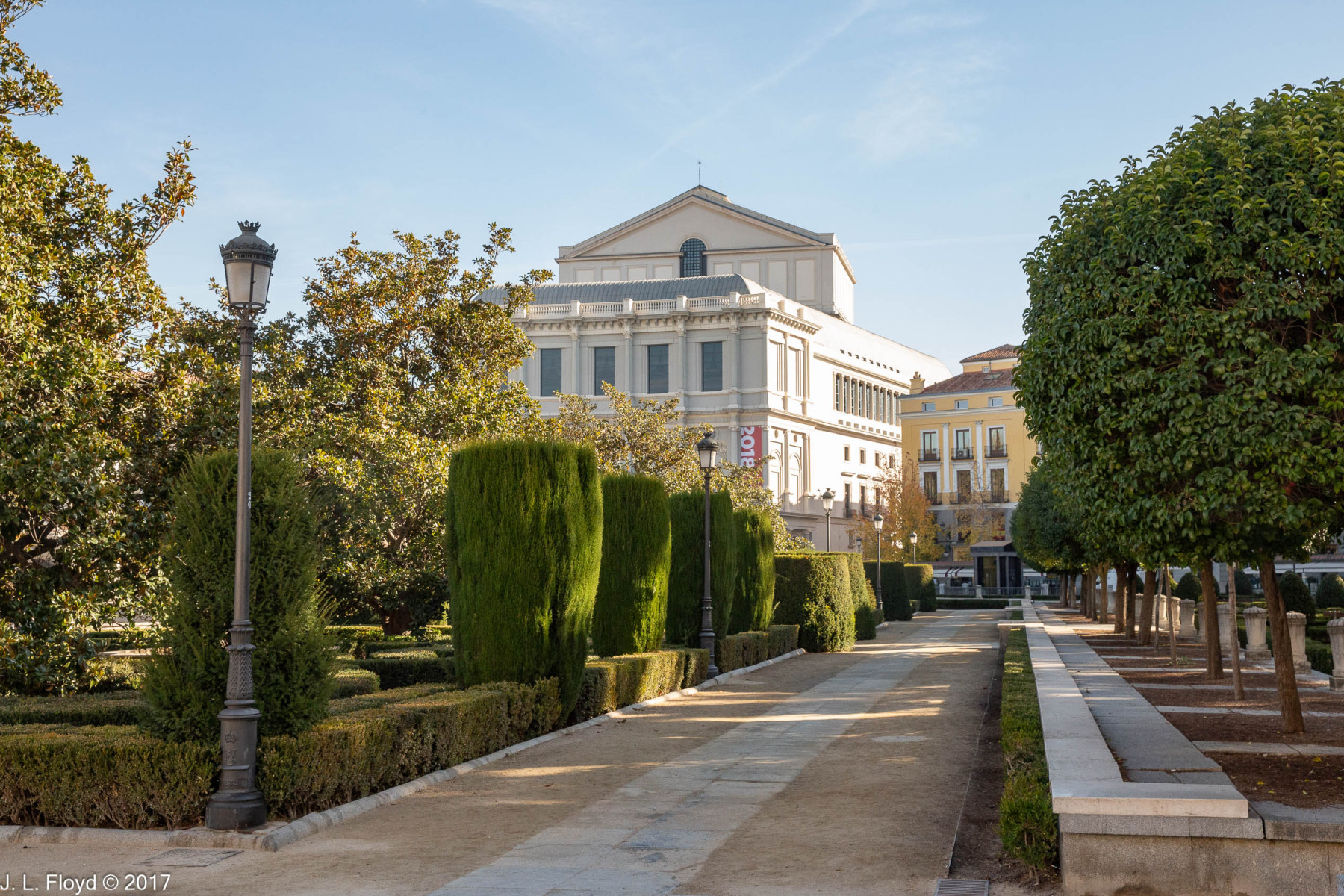
Opposite the east façade of the Palace, across Calle de Bailén, is the Plaza de Oriente, which is a legacy of the 19th century, begun in 1808 and completed in 1844. It is actually a large park that consists of several gardens; in the center stands an equestrian statue of Philip IV, King of Spain from 1621 to 1665. To the east of Philip IV, facing the palace across the Plaza de Oriente, is the Teatro Real, one of the great opera houses of Europe. We had time to stroll in the gardens, and on one pathway, the Paseo de las Estatuas, we found statues of some of the kings of Spain, including a couple of the early Visigothic monarchs, who reigned between the fall of the Roman Empire in the fifth century AD and the Islamic conquest of the eight century.
From the Royal Palace we went to the prime destination of the day, the Museo Nacional del Prado. Prado means meadow in Spanish, so this is the Museum in the Meadow; but nobody ever calls it that in English – it’s just the Prado. If I had been allowed to see only one attraction in Madrid, it would have been the Prado. It is one of the great art museums of the world, rivalling such treasuries as the Louvre in Paris, the Vatican Museum in Rome, and the British Museum in London. Its collections contain 7,600 paintings and 1,000 sculptures, as well as countless drawings, prints and documents. About 1,300 works are actually on display, with the rest being either on loan to other institutions or in storage.
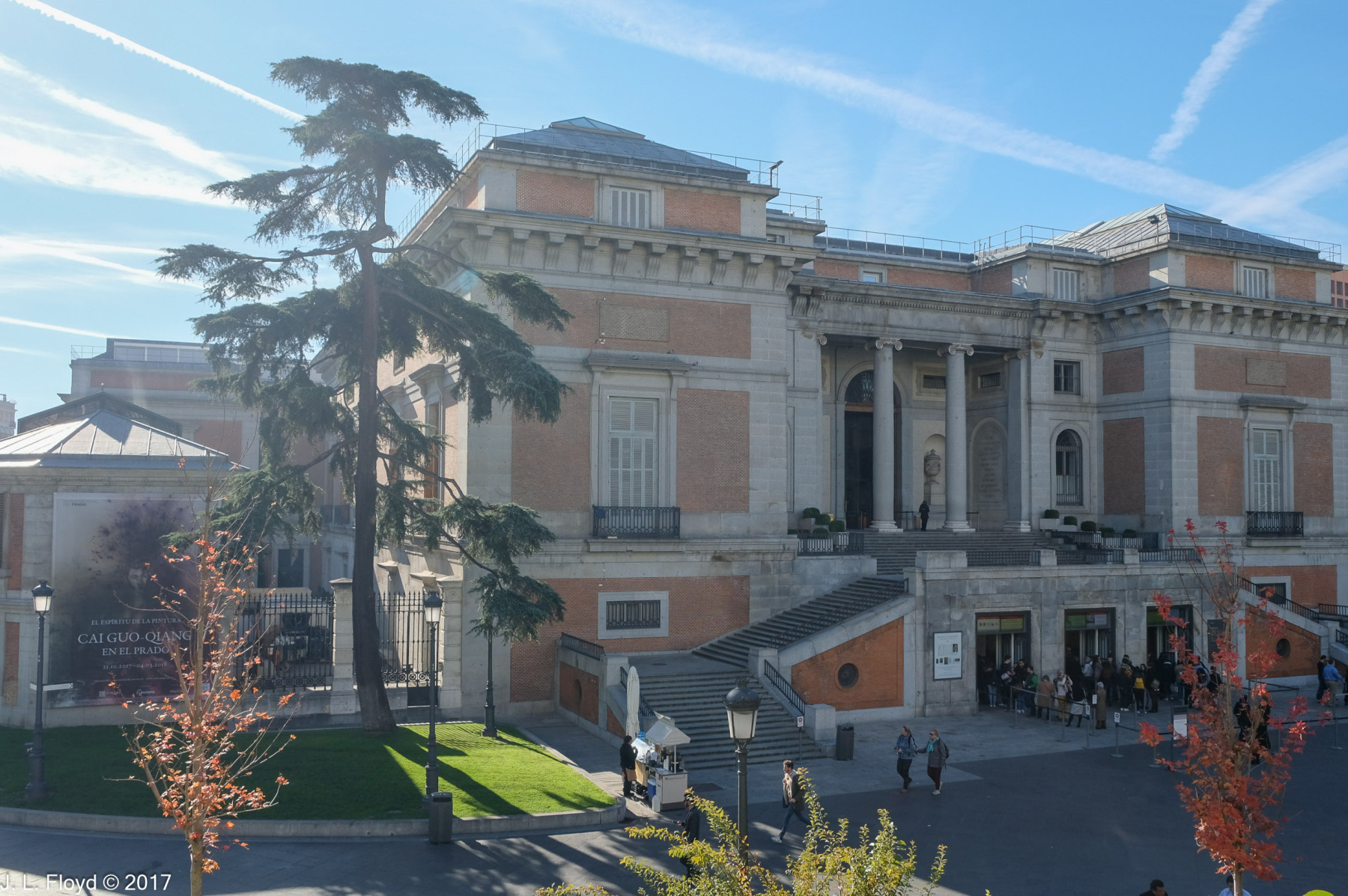
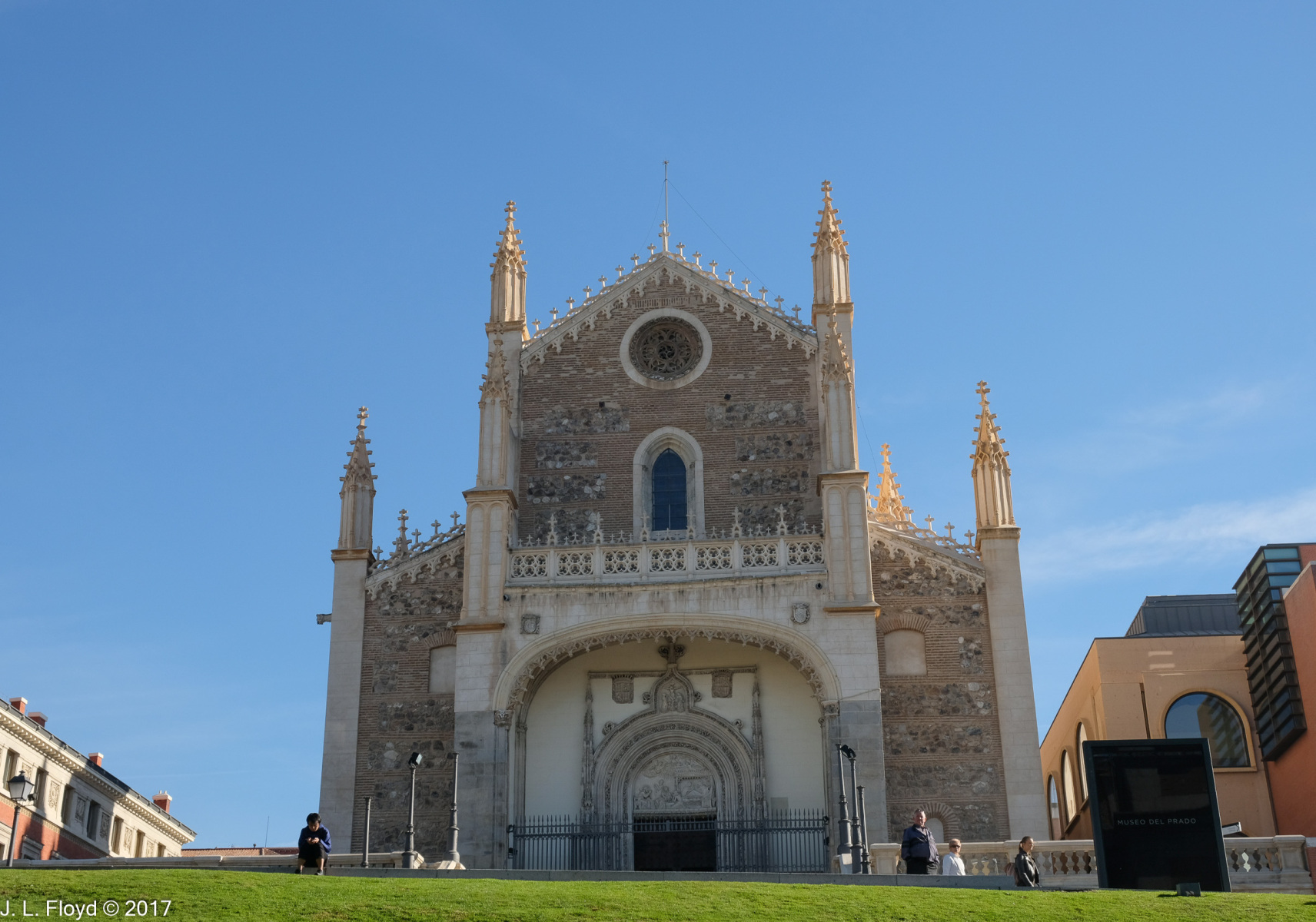
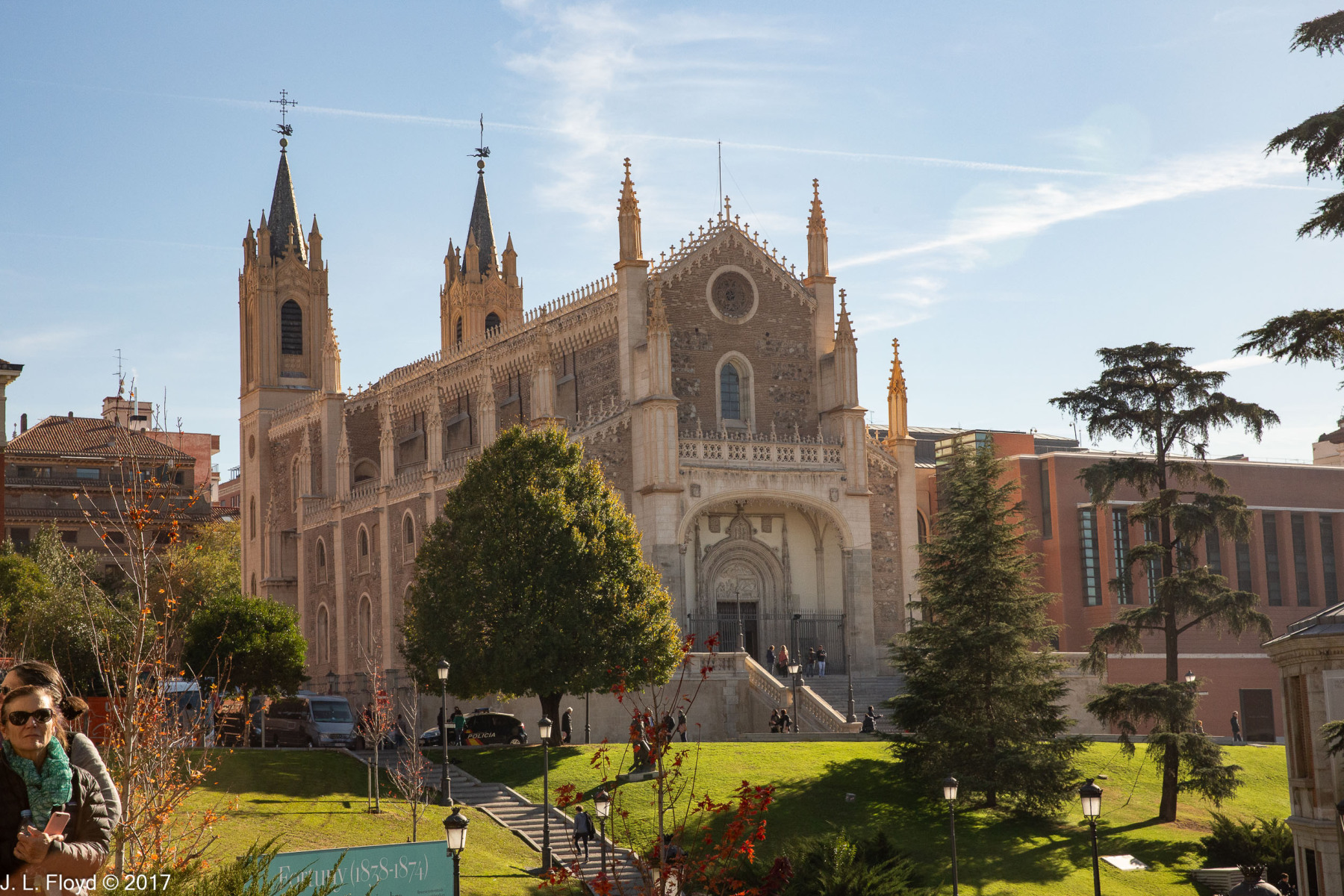
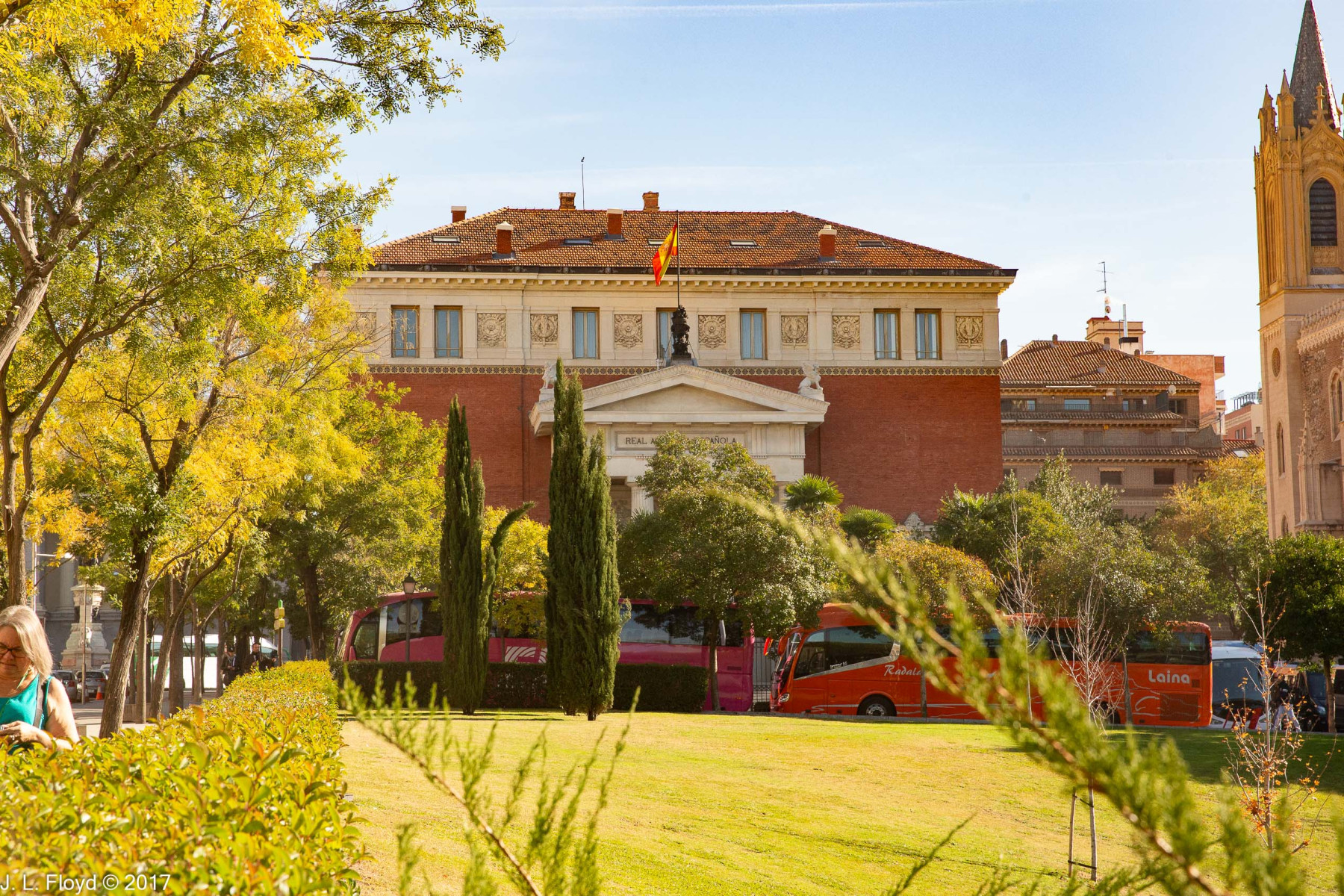
Photography is not allowed inside the Prado, and any photos I might have taken there would be superfluous anyway, because you can find much better images on the web than any I could have captured. So my offerings are limited to the exterior of the museum and its environs, which included the Iglesia de San Jerónimo el Real (Church of St Jerome the Royal), the Real Academia Española (Spanish Royal Academy) and various monuments.
The Church of St Jerome is now just a parish church, but in bygone days it belonged to one of the most important monasteries in Madrid; moreover, in the 16th and 17th centuries both the church and monastery were closely linked to the Spanish royal court, especially since the royal palace in those days, the Buen Retiro, stood next to the monastery on the south, and the king could hear Mass from his bedroom. Royal weddings, funerals, proclamationis and even trials of heretics were held in the church.
The Buen Retiro palace and the monastery were badly damaged in the Napoleonic Wars, and while the monastery was restored, the palace was mostly demolished, and much of the area it occupied is now a garden, called Retiro Park (Parque del Retiro).
The church and monastery, by contrast, were restored and remodeled several times, most recently at the beginning of the 21st century. Not only that, but the Archdiocese of Madrid transferred both of them to the Spanish Ministry of Culture, which turned the cloister into an extension of the Prado Museum, connecting them by an underground passage.
On the north side of the Church of St. Jerome stand the headquarters of the Real Academia Española, an official royal institution which has the mission of preserving the stability of the Spanish – i.e. Castilian – language. To this end, it has joinded forces with the national language academies of 22 other Hispanophone nations in an effort to promote linguistic unity by ensuring a common standard. It was founded in 1713 by Juan Manuel Fernández Pacheco y Zúñiga, Duke of Escalona and Marquess of Villena, under the aegis of King Philip V. A grandson of Louis XIV, the Sun King of France, Philip was the first Bourbon monarch of Spain, and with his French background, he felt it necessary to have an equivalent of the Académie Française, the official institution regulating the French language, founded by Cardinal Richelieu in 1635.
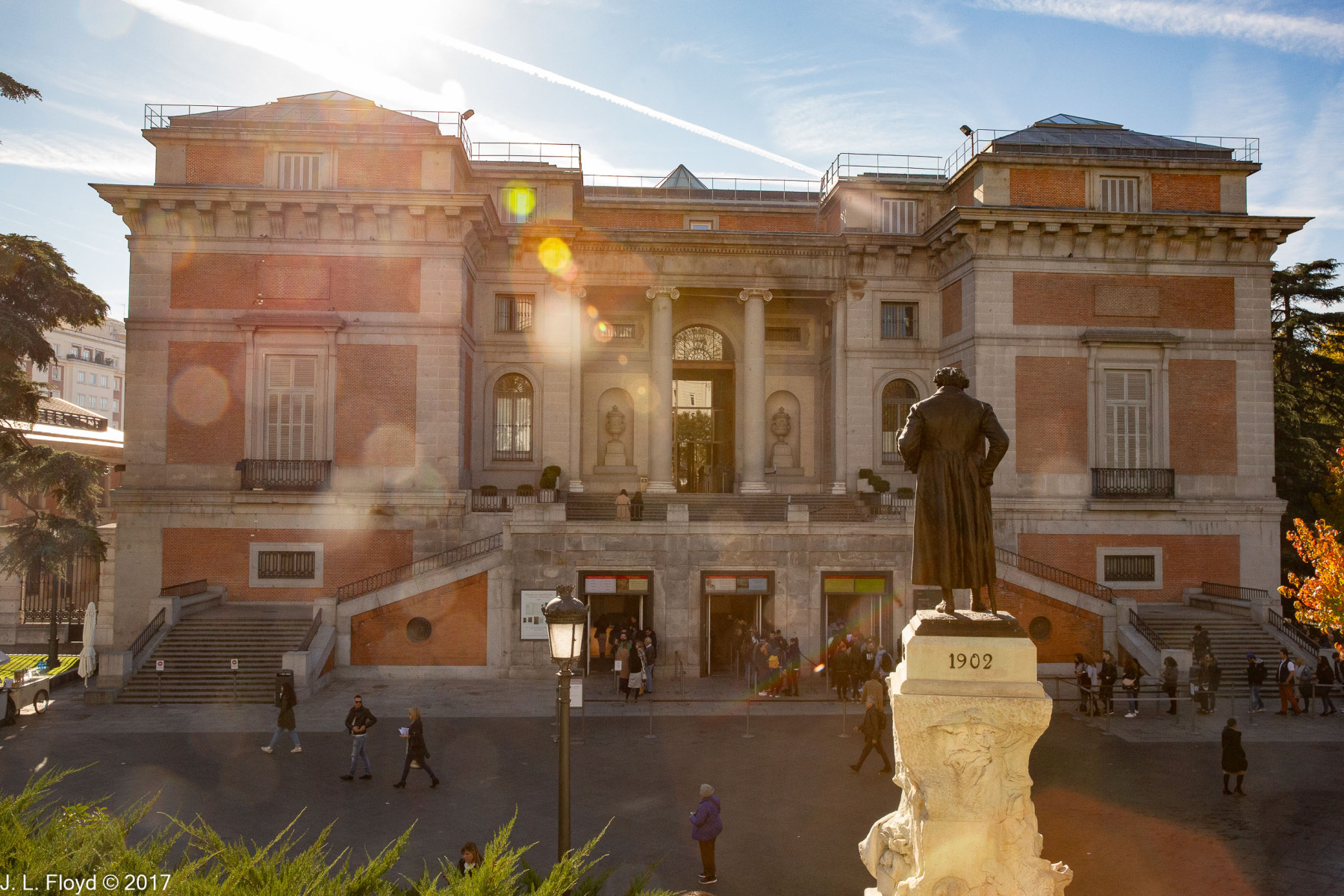
On to the Prado. Each side of the Prado Museum has its own entrance, with three named for one of the great Spanish artists: Velazquez on the west, Murillo on the south, Goya on the north, and the Puerta de los Jerónimos on the east. There are statues of Velazquez, Goya and Murillo at their respective entrances, with a medallón (disk portrait) of the sculptor José Álvarez Cubero (1768-1827) embedded above the east entrance. Our tour group entered the Prado via the Goya Entrance, at the north end of the building.
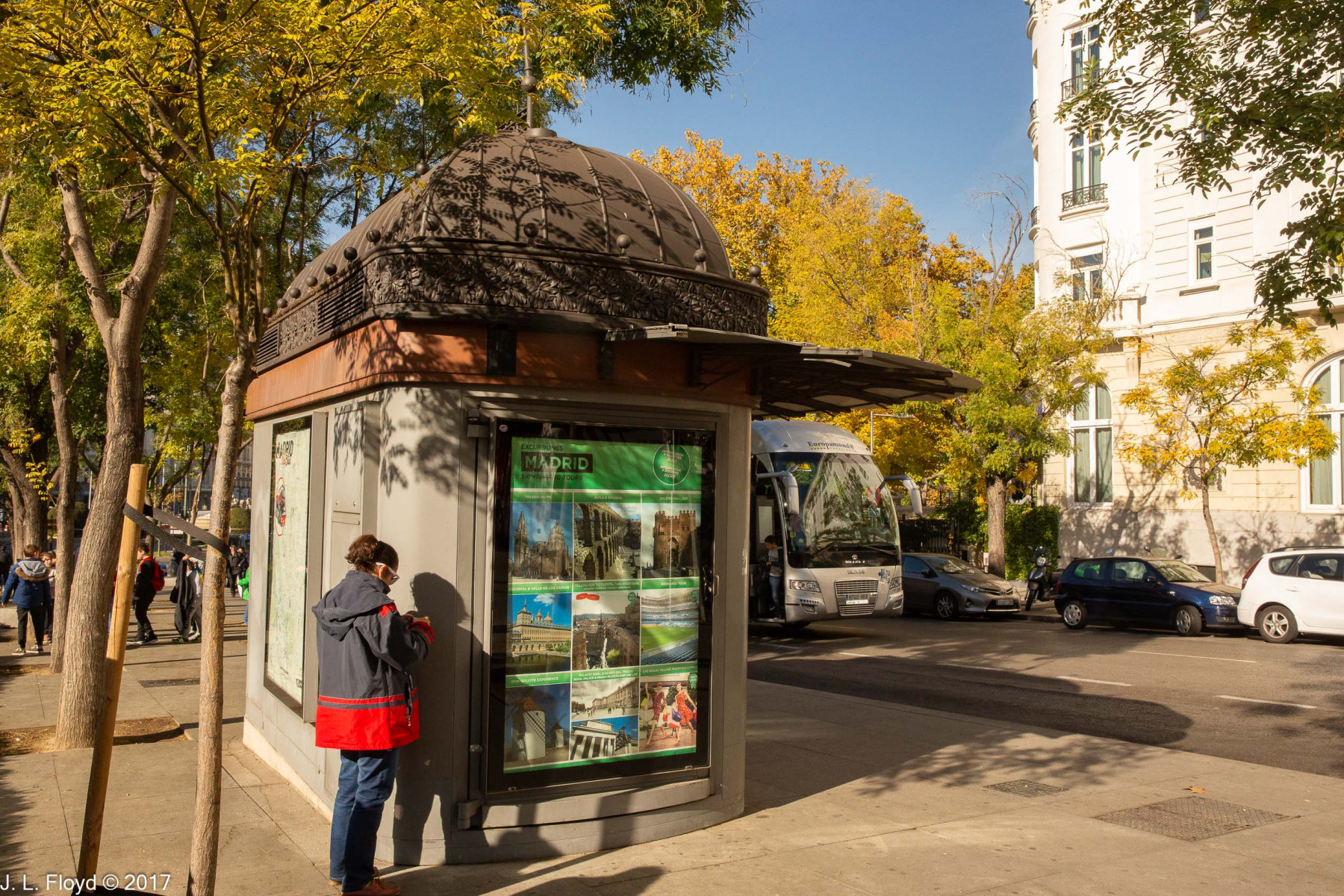
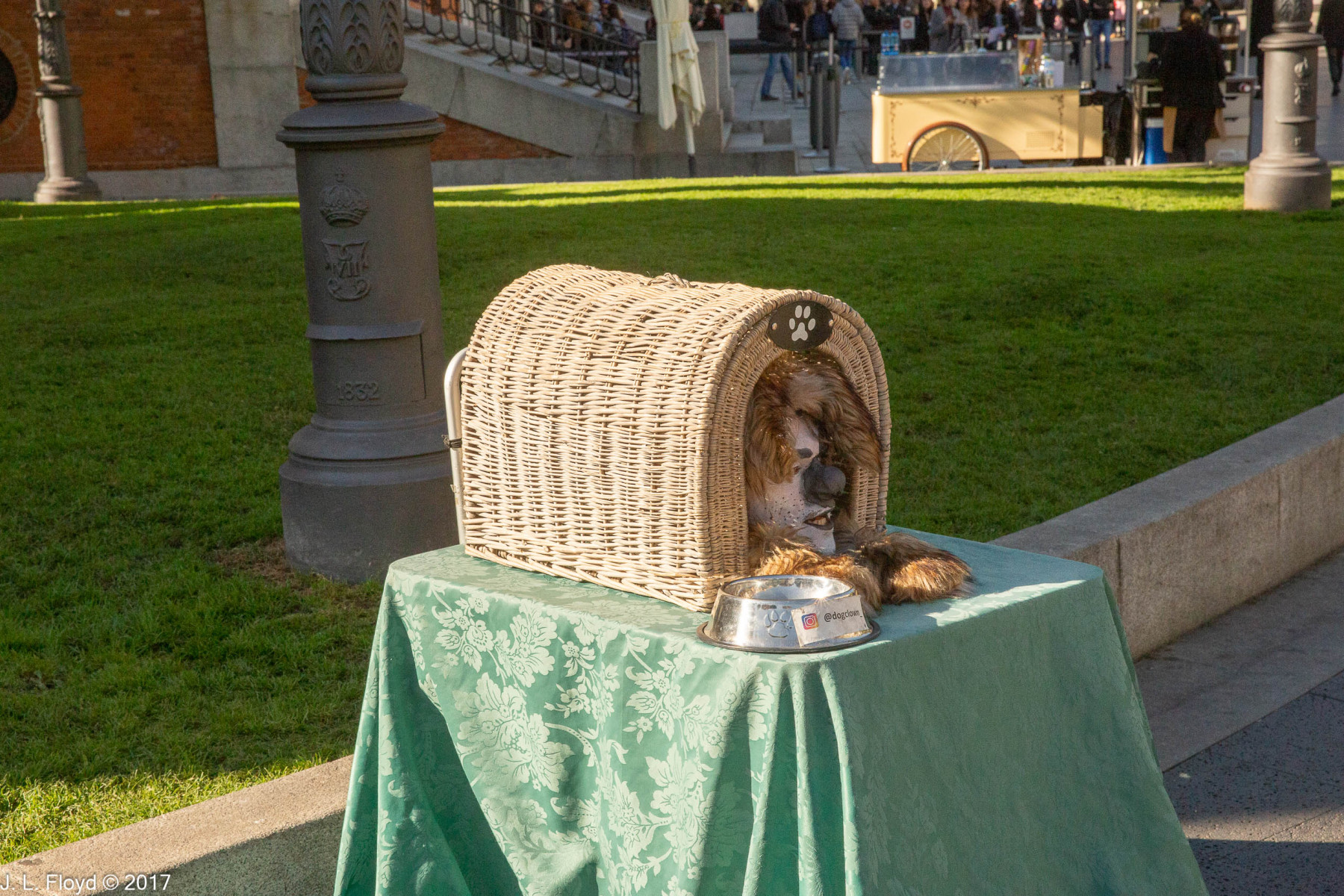
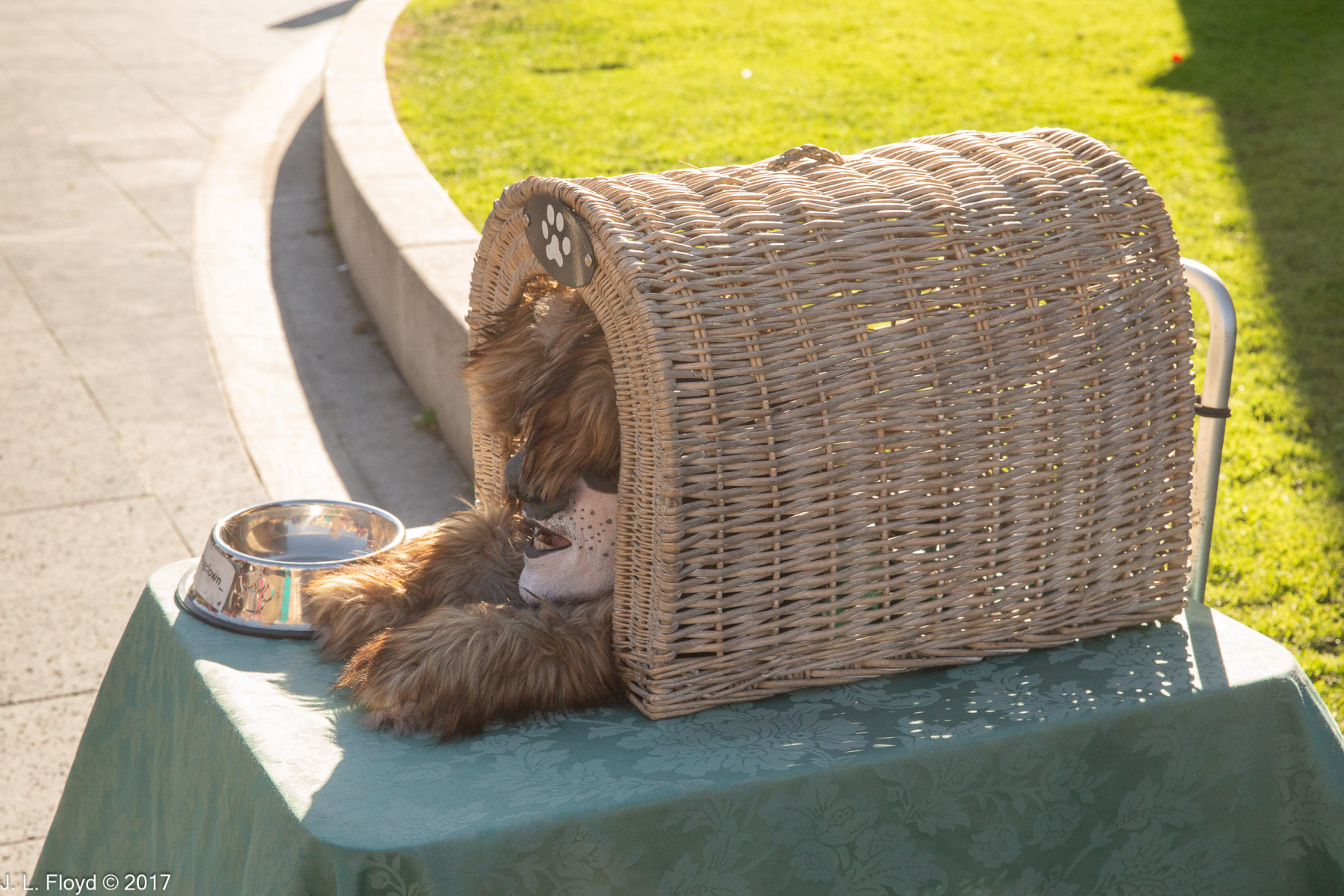
As with any famous attraction visited by hordes of tourists, the approaches to the Prado are haunted by a number of individuals – cranks, eccentrics, performers, hustlers, etc. – with various offerings and importunities. Most, of course, are trolling for donations. I found the most interesting of these to be a dog of uncertain (but very appealing) breed whose human had dressed it up in a clown mask and had it sit on a table inside of a wicker doghouse. I don’t know how the dog felt about this, but since it wasn’t trying to escape, I assumed it was copacetic with the situation (of course, it could have been drugged). Anyway, I felt it was worth a couple of pictures, for better or worse. I even left the person a donation, so he could feed his dog.
Inside the museum, we were given a tour by a museum guide, who hit the highest of the high spots, explaining what they were famous for, and describing in-depth the ways in which the artists had exercised their skills to produce their extraordinary effects. First up was the triptych The Garden of Earthly Delights by Hieronymus Bosch (c. 1450-1516), who not coincidentally happened to be the favorite painter of Philip II. Also known as the Garden of Lusts, it dates from around the beginning of the 16th century, before the Protestant Reformation, when the Netherlands was still devoutly Catholic. Little is known about Bosch’s life or his actual religious beliefs, but the Garden triptych is generally considered to warn of the dangers of surrendering to earthly desires. The left panel depicts a scene from the Garden of Eden; the center panel, the largest, portrays humanity as a crowd of mostly naked men and women heedlessly engaging in pleasure-seeking activities, and the right-hand panel demonstrates the consequences of their disregard of divine commands, i.e. Hell. I remember receiving a postcard with a reproduction of this triptych from a friend who visited the Prado many years ago, and ever since then I had wanted to go see it in person.
Our guide also gave a fascinating discourse on a painting by Diego Velazquez (1599-1660), Las Meninas (“The Ladies in Waiting”), considered by some critics to be his greatest masterpiece. Velazquez was a leading painter at the court of Philip IV, and Las Meninas, painted in 1656, depicts the Spanish royal family in a room in the Alcázar, the royal palace in Madrid which burned down in 1734.
To my great embarrassment, especially since Francisco Goya (1746-1828) is my favorite Spanish painter, I don’t remember which of his paintings our Prado guide held forth on. I do remember, however, that my most gratifying experience in the Prado was finally being able to view in person a painting by Titian, Emperor Charles V at Mūhlberg. I first saw a print of this work in a history book in college, many years prior. It was much larger than I expected, 335 centimeters × 283 centimeters (132 inches × 111 inches), and dominates a section of the wall at the end of a long passage. In 1547 Emperor Charles V, attempting to roll back the spread of Protestantism in Germany, engaged forces of the Protestant princes at the Battle of Mūhlberg, where he won an overwhelming victory. It did him absolutely no good at all. He was unable to follow up and a few years later was forced to sign the Treaty of Augsburg (1555), which gave the German princes the right to select either Lutheranism and Catholicism as their own religion and that of their subjects. But the Italian painter Tiziano Vecellio, commonly known as Titian, nevertheless immortalized Charles (who of course was also Carlos I, King of Spain) by depicting him on horseback, with a lance, as if riding out to charge against the enemy. In reality, Charles V suffered from gout and had to watch the battle from a litter on which he was carried to the field.
When we finished our tour of the Prado, many members of our tour group were exhausted, including Sandie, who opted to return to the hotel and rest up for the remainder of the afternoon. I, however, chose to see more of Madrid on foot, and together with Chuck and Elouise Mattox headed up the Paseo del Prado to the Fuente de Neptuno (Neptune Fountain), where they treated me to hot chocolate and pastry in a café nearby. After that we went our separate ways, and I headed up the Paseo de la Cortes to see what I could see.
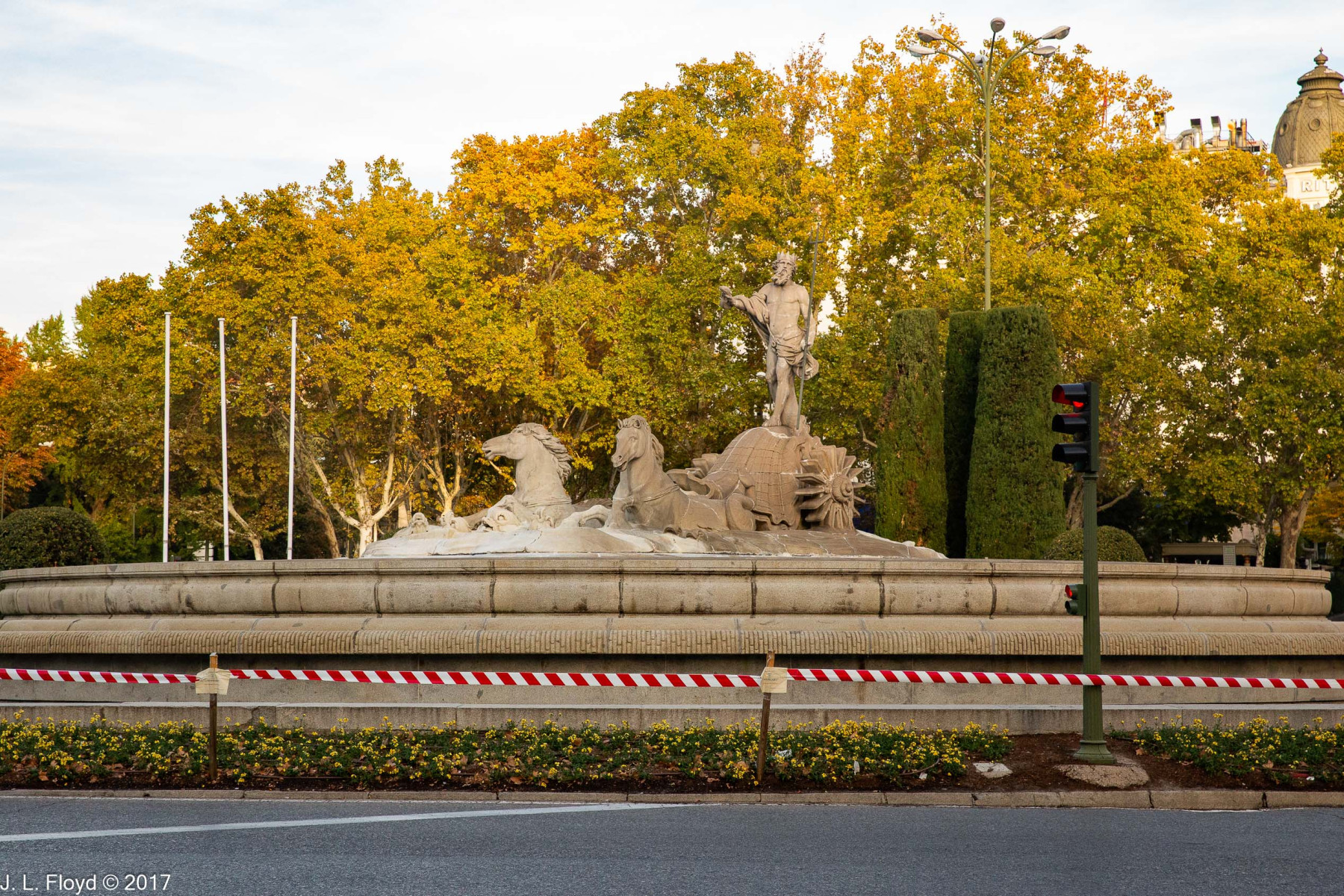
The Fuente de Neptuno is a neoclassical sculpture situated on a roundabout (traffic circle) where the Paseo del Prado meets the Plaza de la Cortes. Completed in 1784, it depicts Neptune, the Roman god of the sea, standing in a chariot drawn by hippocampi (half horse, half fish), with a trident in one hand and a snake in the other.
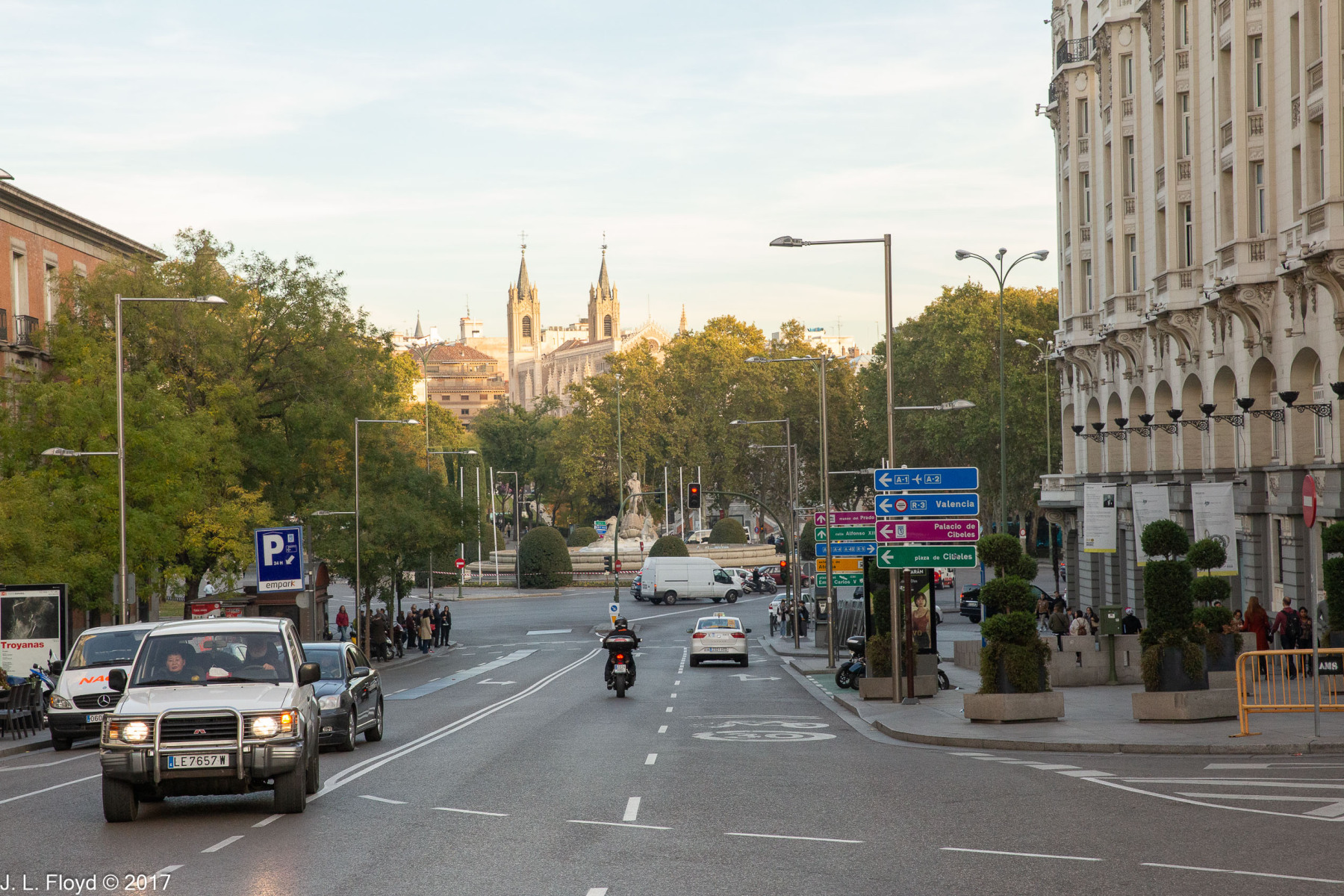
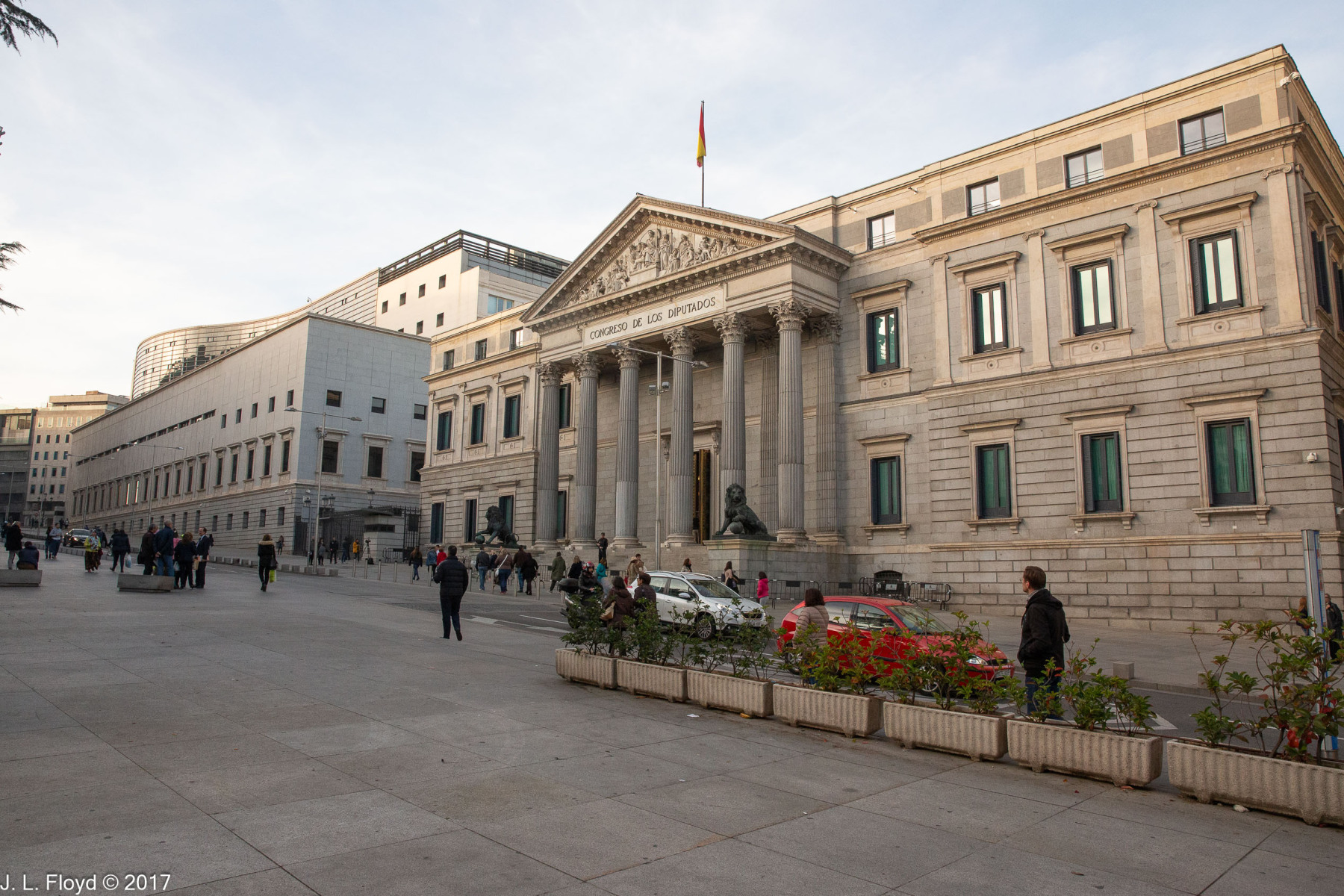
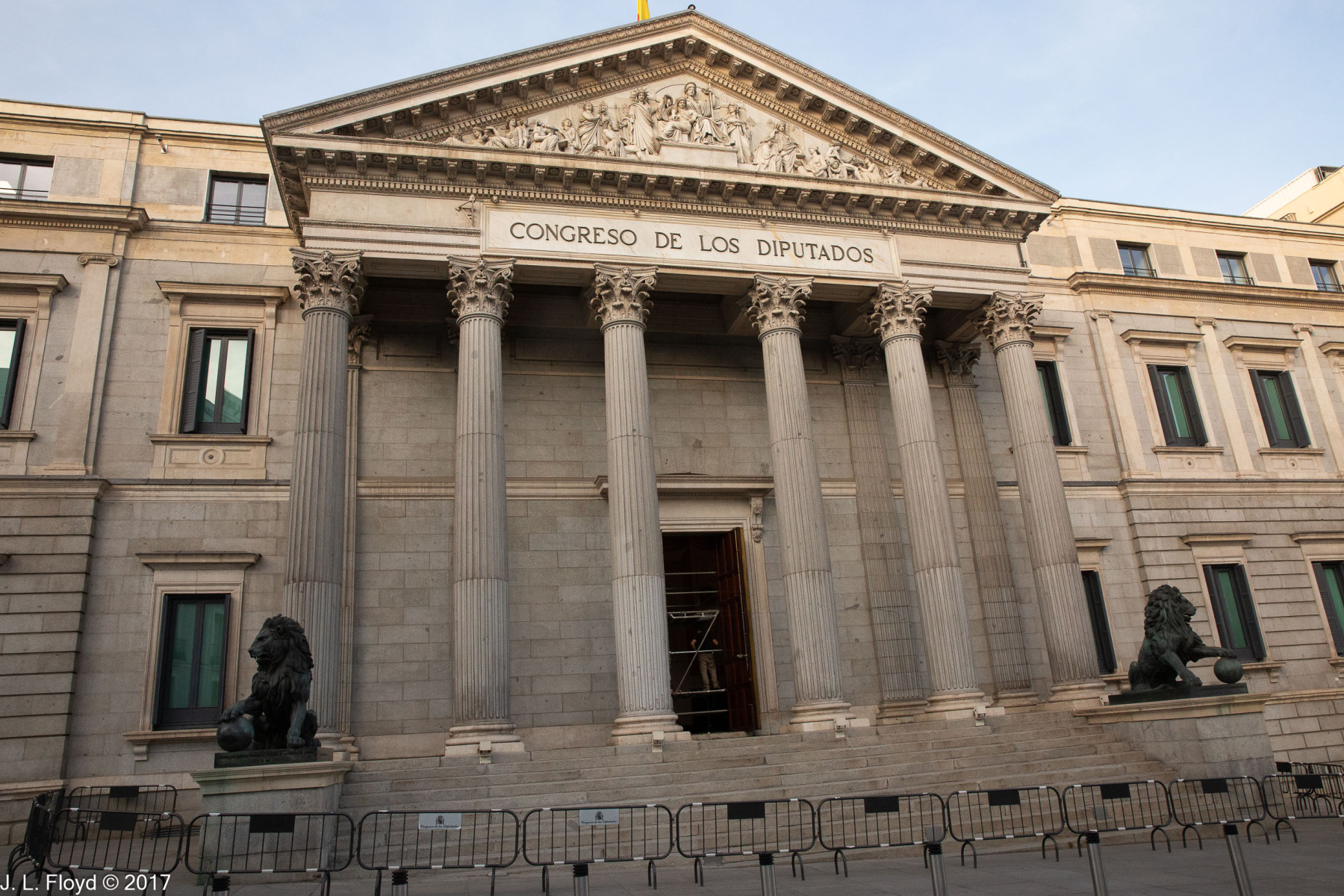
Traversing the Plaza de la Cortes from the Neptune Fountain to its northwest corner, where it meets the Carrera de San Jerónimo, I encountered the Palacio de las Cortes, the meeting-place of the Congreso de los Diputados (Congress of Deputies), the lower house of the the bicameral Spanish national legislature, the Cortes Generales. There is also of course a Senado (Senate), which meets in the Palacio del Senado, near the Royal Palace of Madrid. The Palacio de las Cortes is an impressive neoclassical building, completed in 1850 in the reign of Isabella II; it is considered to be the masterpiece of its architect, Narciso Pascual y Colomer. He designed the façade in the style of a Renaissance palace, with a grand entrance consisting of a large portico with six Corinthian columns supporting a triangular pediment adorned with a bas-relief depicting Spain and its Constitution, accompanied by allegorical figures depicting various virtues – Justice, Liberty, Peace, etc. The building is entered via a grand staircase flanked by two fierce-looking bronze lions named Daoiz and Velarde after heroes of the Spanish uprising of 1808 against the French.
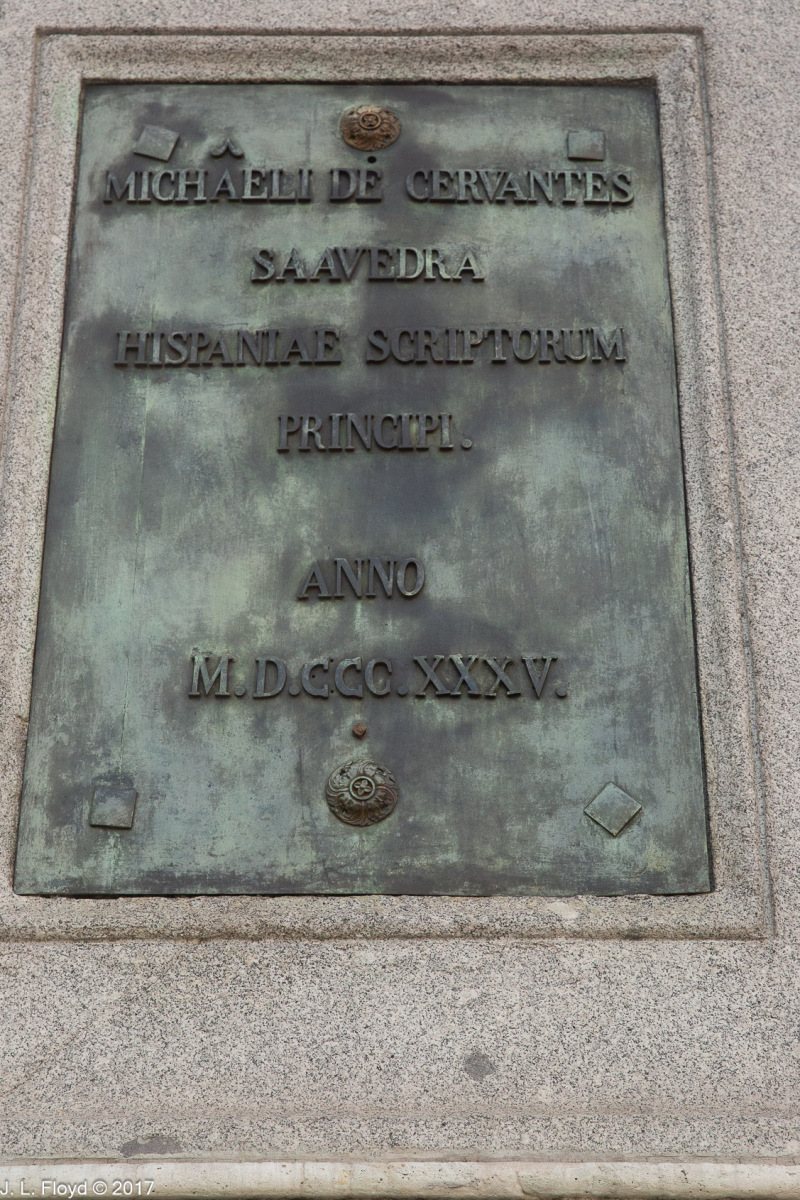
Across the street from the Palacio de las Cortes, in front of the Hotel Villa Real, stands another monument to Cervantes, much smaller than the one in the Plaza de España. This one depicts Cervantes as standing, dressed in Spanish breeches, jacket and ruff, holding papers in his right hand with his left resting on the pommel of his sword. It was erected in 1835.

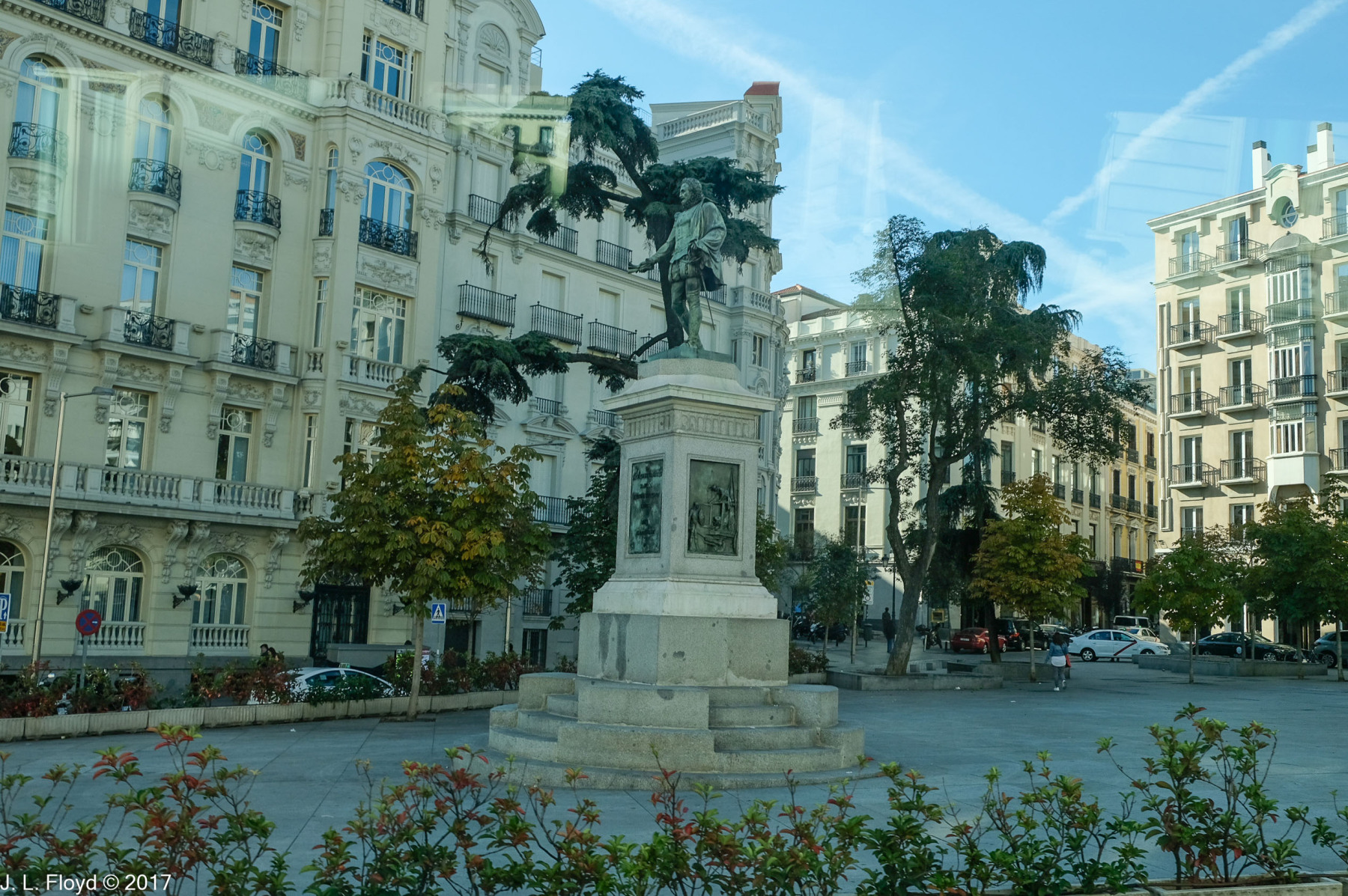

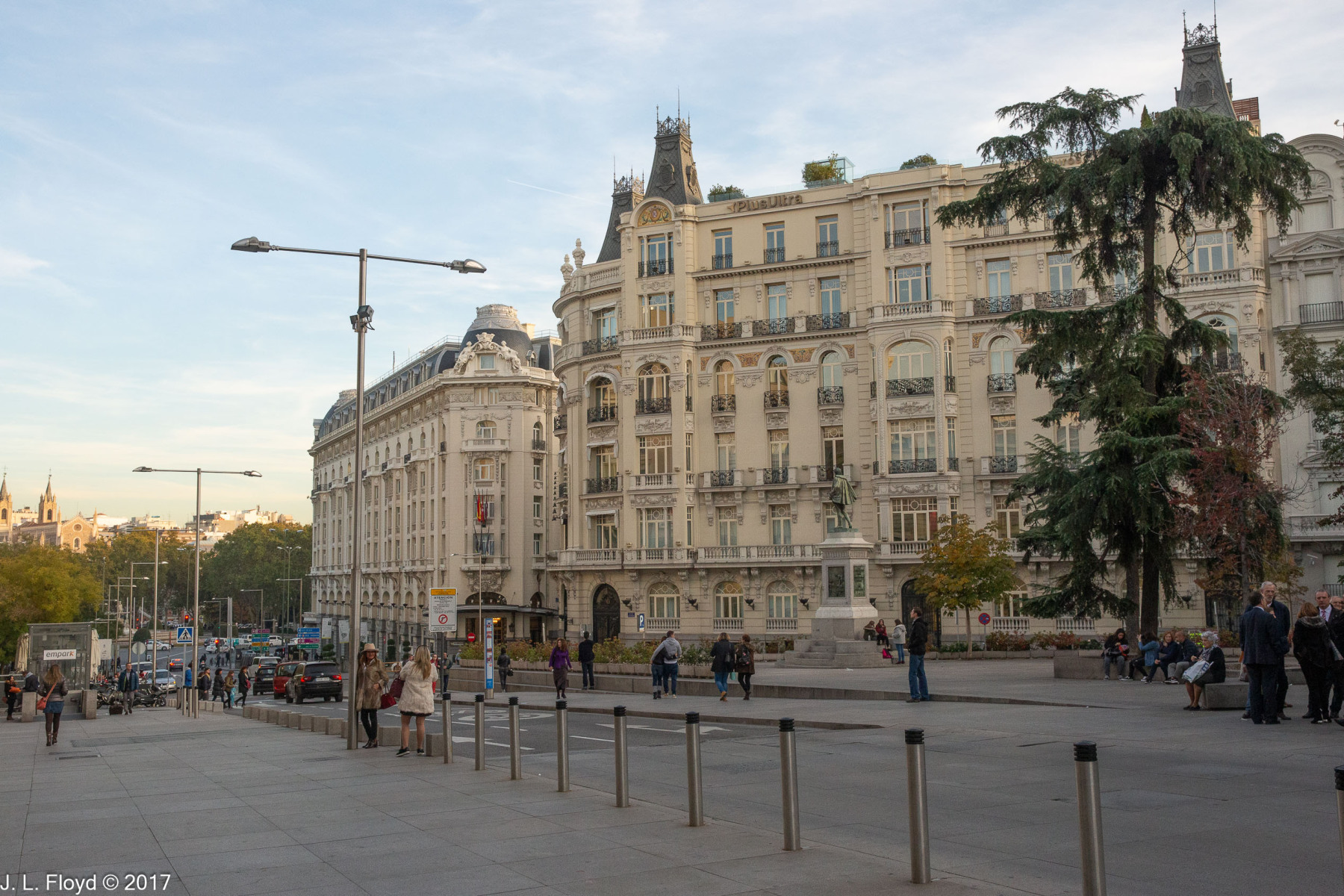
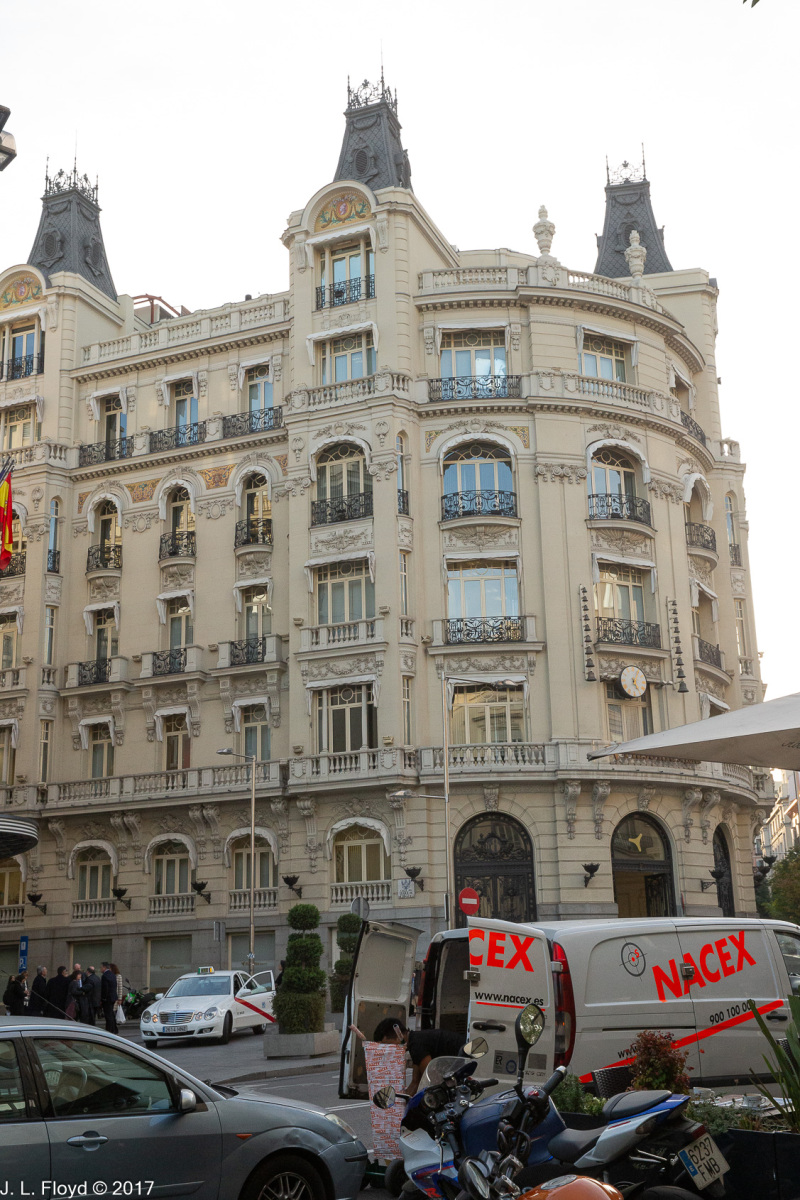
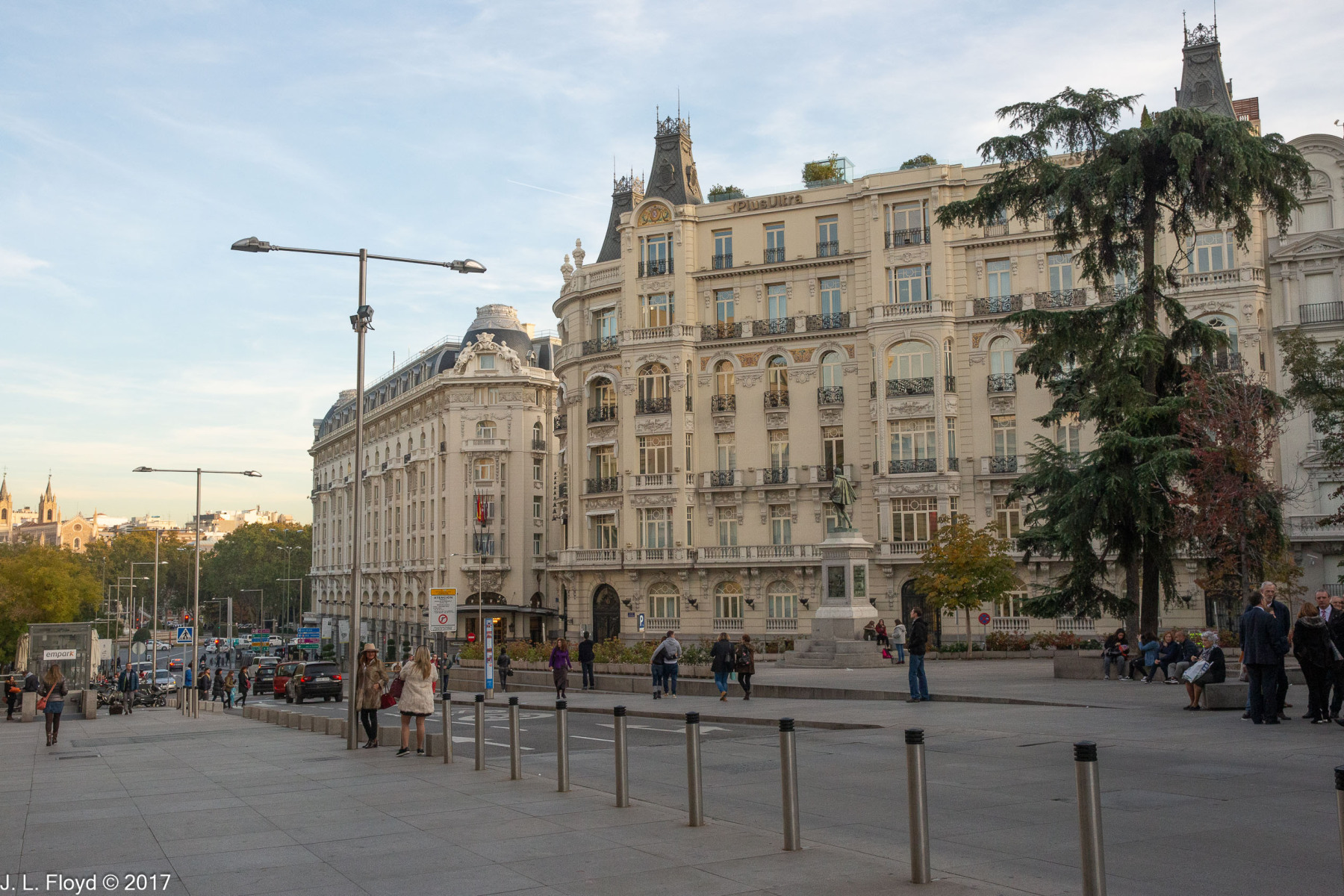
On another corner of the Plaza de las Cortes stands the extraordinary Plus Ultra (formerly Groupama) Building, named for the insurance company that owned it for many years (since 2015 it has been owned by another insurance company, Catalana Occidente). Aside from housing the company’s offices, it hosts a wonderful carillon (automated bell-playing instrument). I was unaware of it at the time I photographed the building and did not get to witness it play, but I later found out – too late to go back and see it – that it plays every day at 12 noon, 3 PM, 6 PM and 8 PM. While playing various classical tunes, it presents a show of five historical figures dressed as in the time of Goya, including King Carlos III and Goya himself.
From the Plaza de las Cortes I traipsed along the Carrera de San Jerónimo for a while until I emerged on the Puerta del Sol, Gate of the Sun, a vast square serving as a meeting place and gossip hub for all of Madrid, or so it seemed. It is called a gate (puerta) rather than a square (plaza) because in days of yore it was in fact the location of a gate in the wall of Madrid. The gate faced east and caught the rising sun in the morning, hence the “sol”. It was originally much smaller, but in the 18th century a post office, the Casa de Correos, was built on it, and in the 19th, when the Post Office became the headquarters of the Ministry of the Interior, the square was considerably enlarged by demolishing a number of the houses on it.
Also in the 19th century the Puerta del Sol became a venue for political protests, and up to the 1930s served as a meeting place for left-wing political movements. At the end of the Spanish Civil War, the victorious Franco regime, disdaining the square’s leftist associations, for a while weighed plans for urban renewal that would “disappear” the square and the Post Office, but in the end dropped the idea as too costly. Instead they made the Post Office the headquarters of the Directorate of State Security. Nowadays it is the seat of the Presidency of the Community of Madrid, and is officially known as Government House. And the Puerta del Sol has again become a hotbed of political protest.
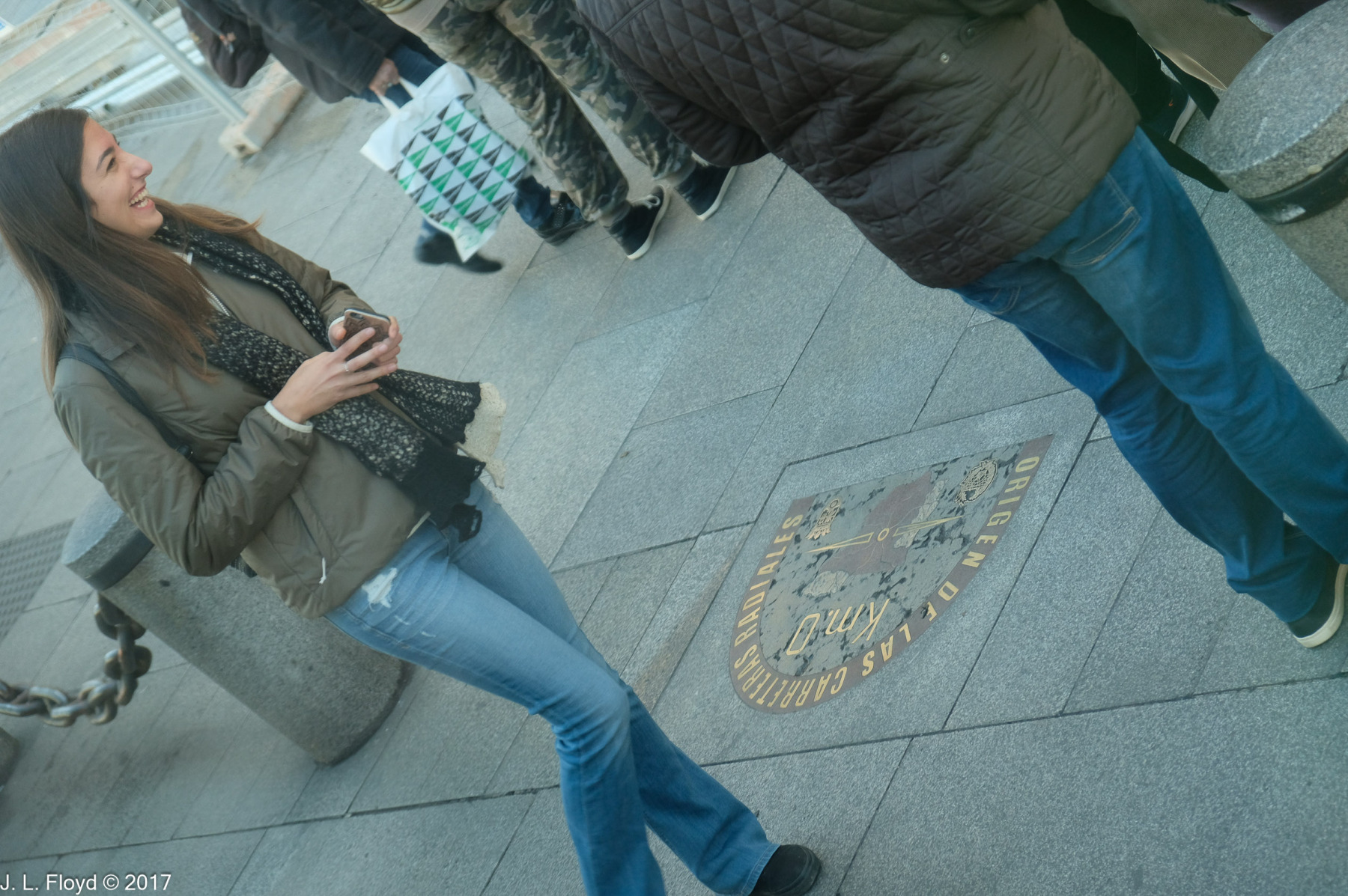
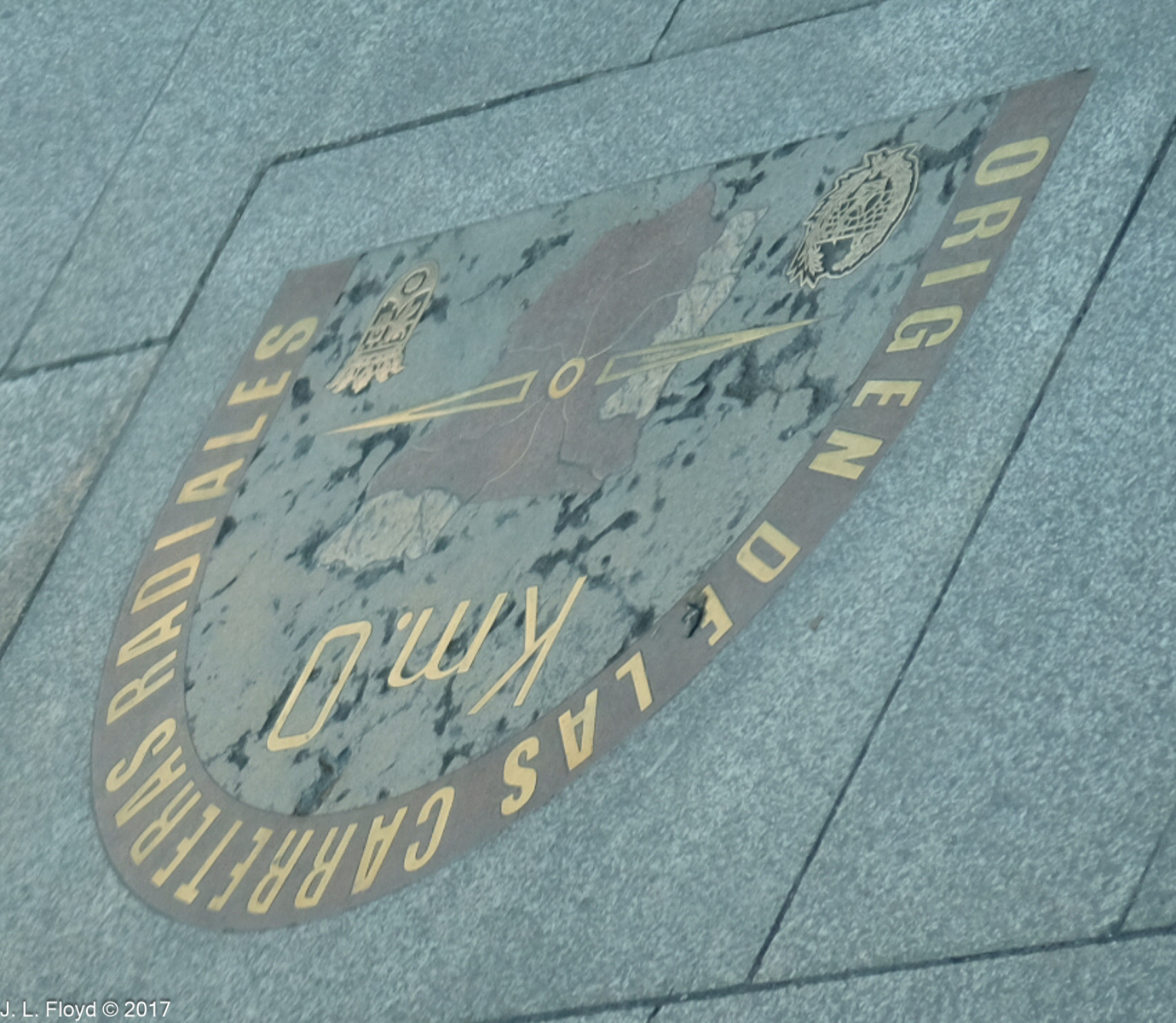
But that is by no means all the Puerta del Sol is noted for. It is also a transportation hub, boasting a huge metro station located underground nearby, with an igloo-shaped entrance on the square. Moreover, it is the location of “Kilometer Zero” for the radial roads of Spain, which run out from Madrid – conveniently located in the middle of Spain – to all parts of the country.
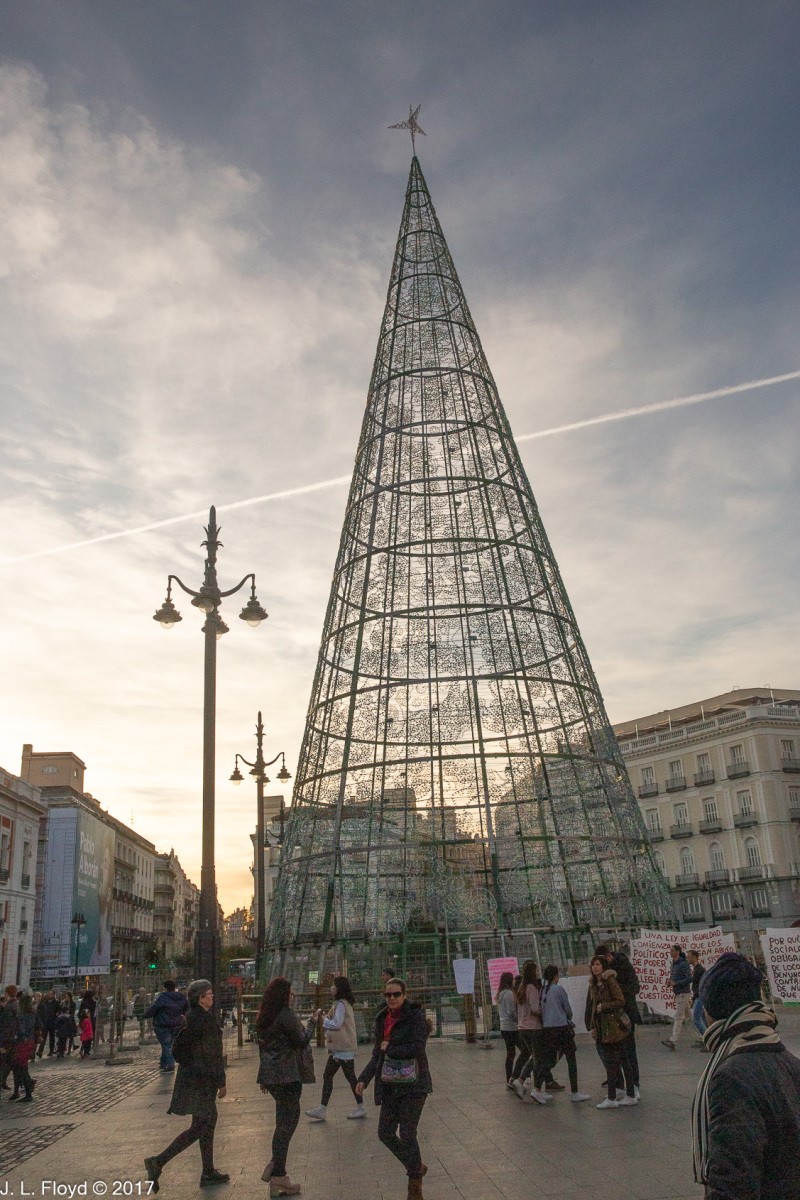
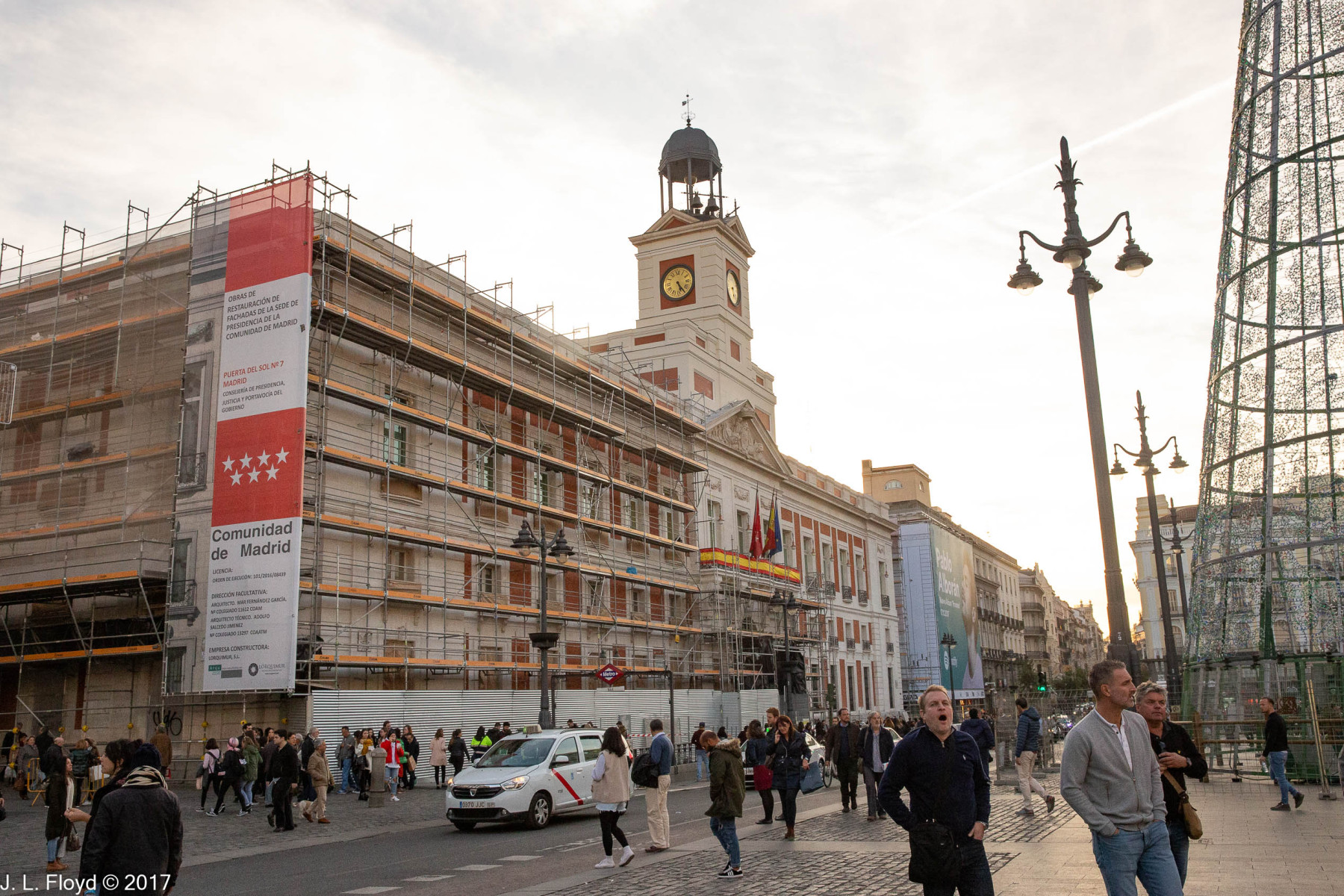
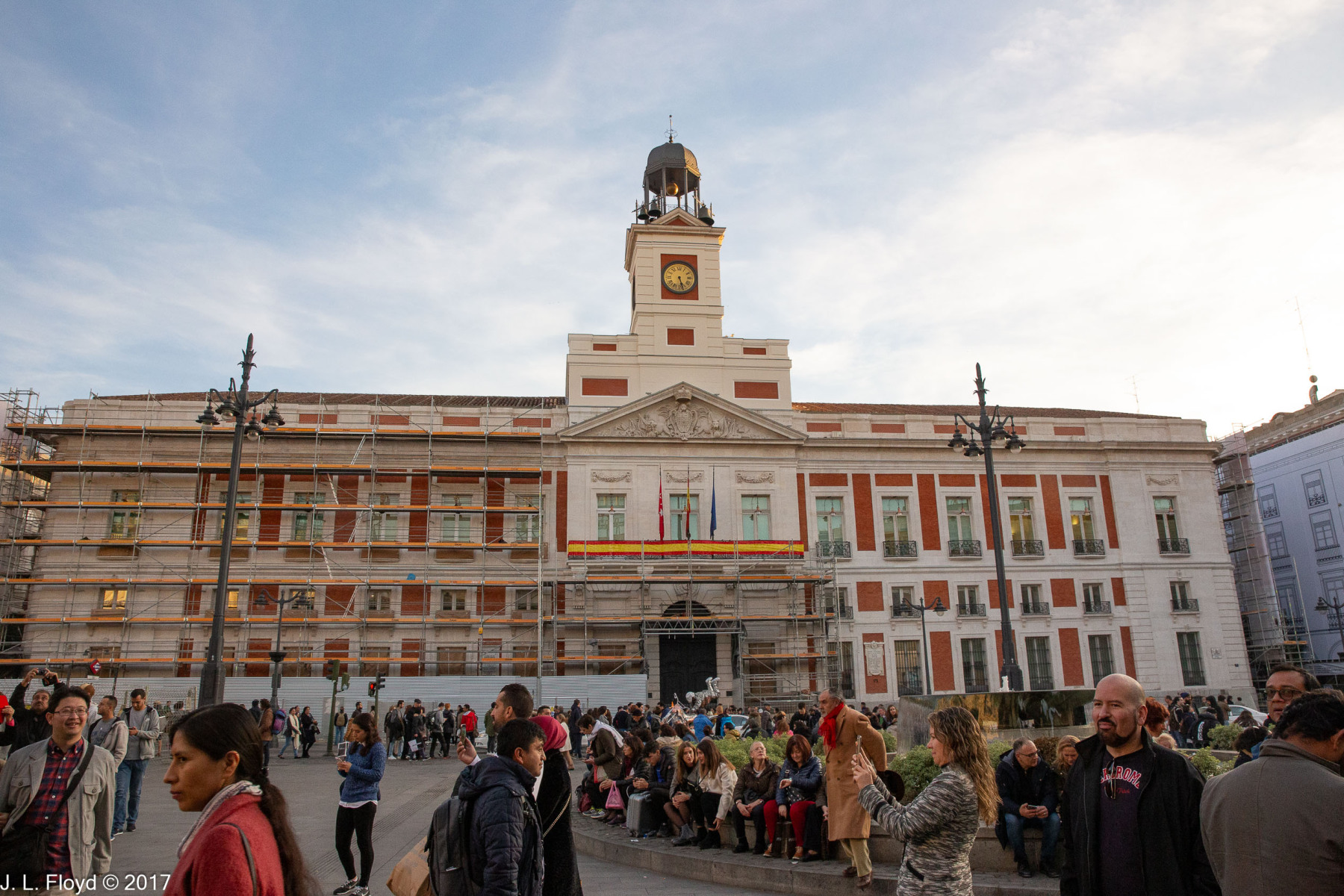
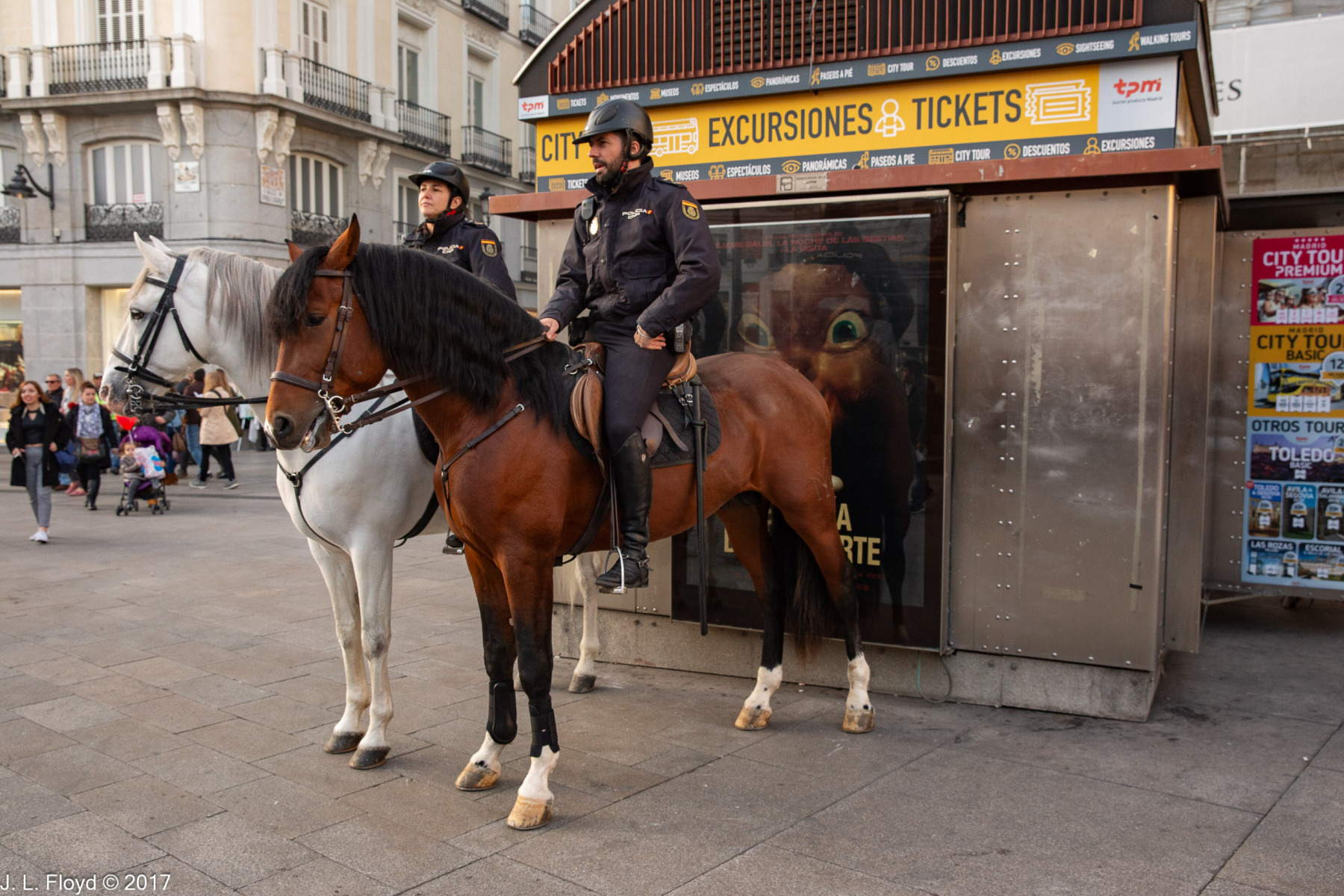
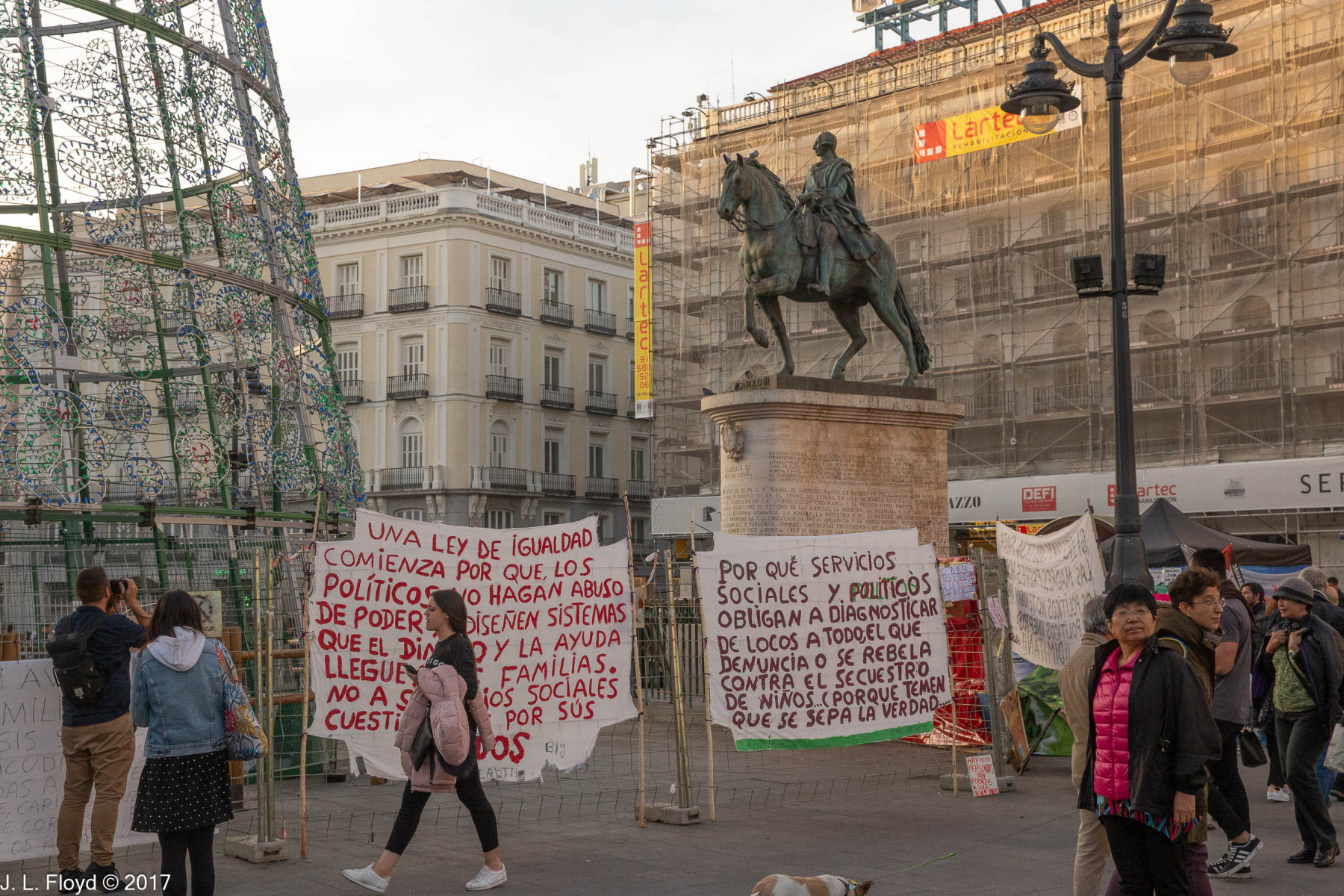
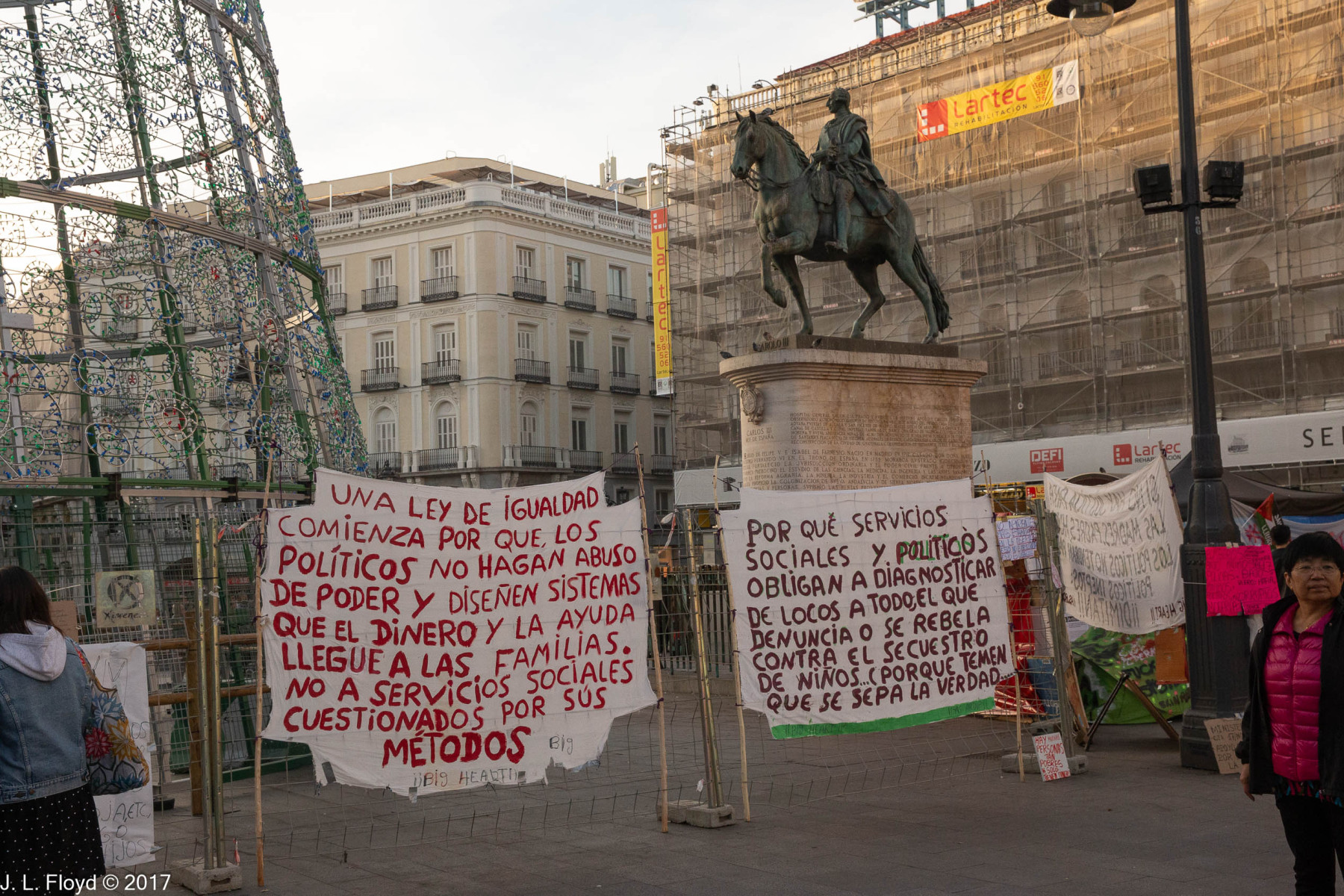
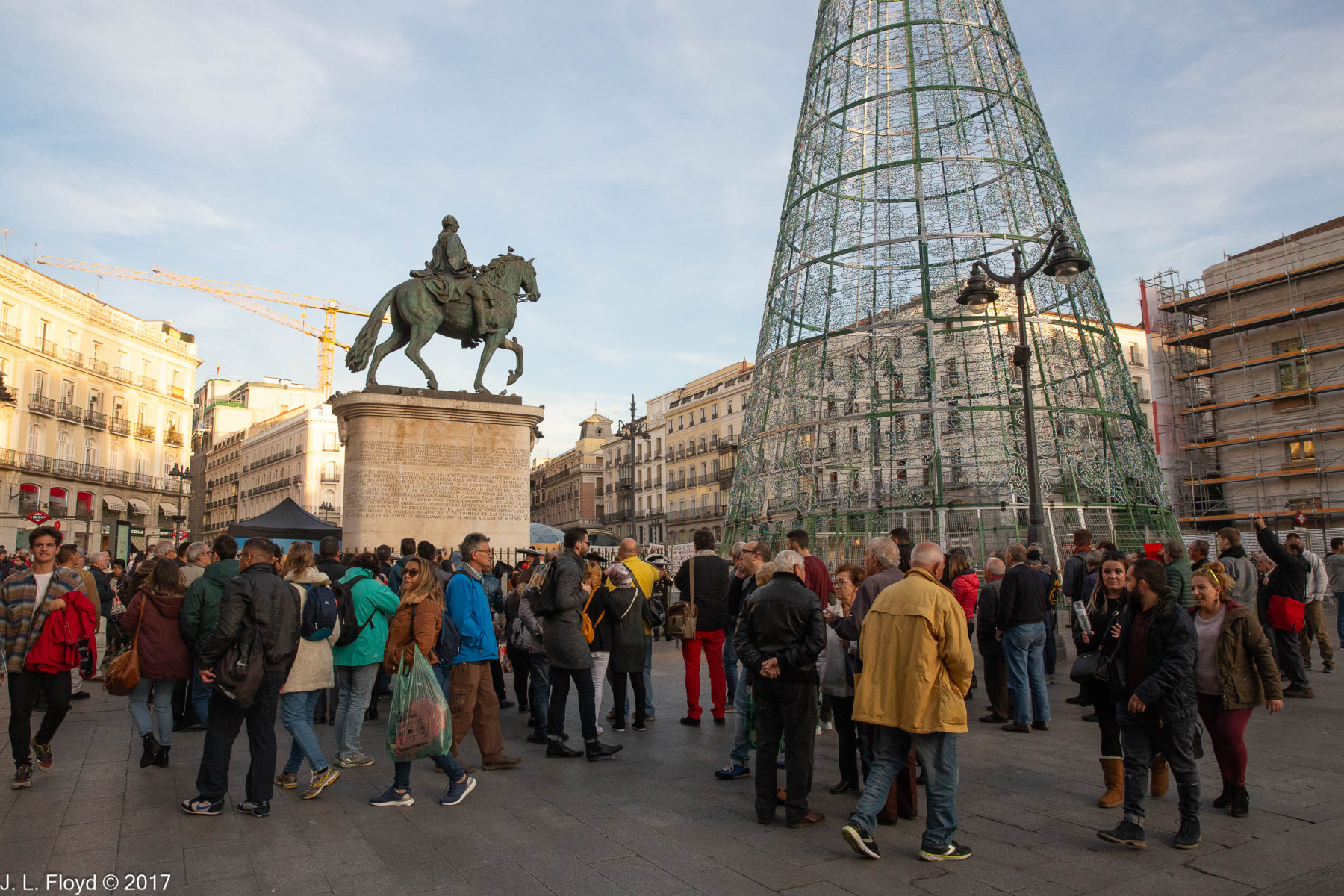
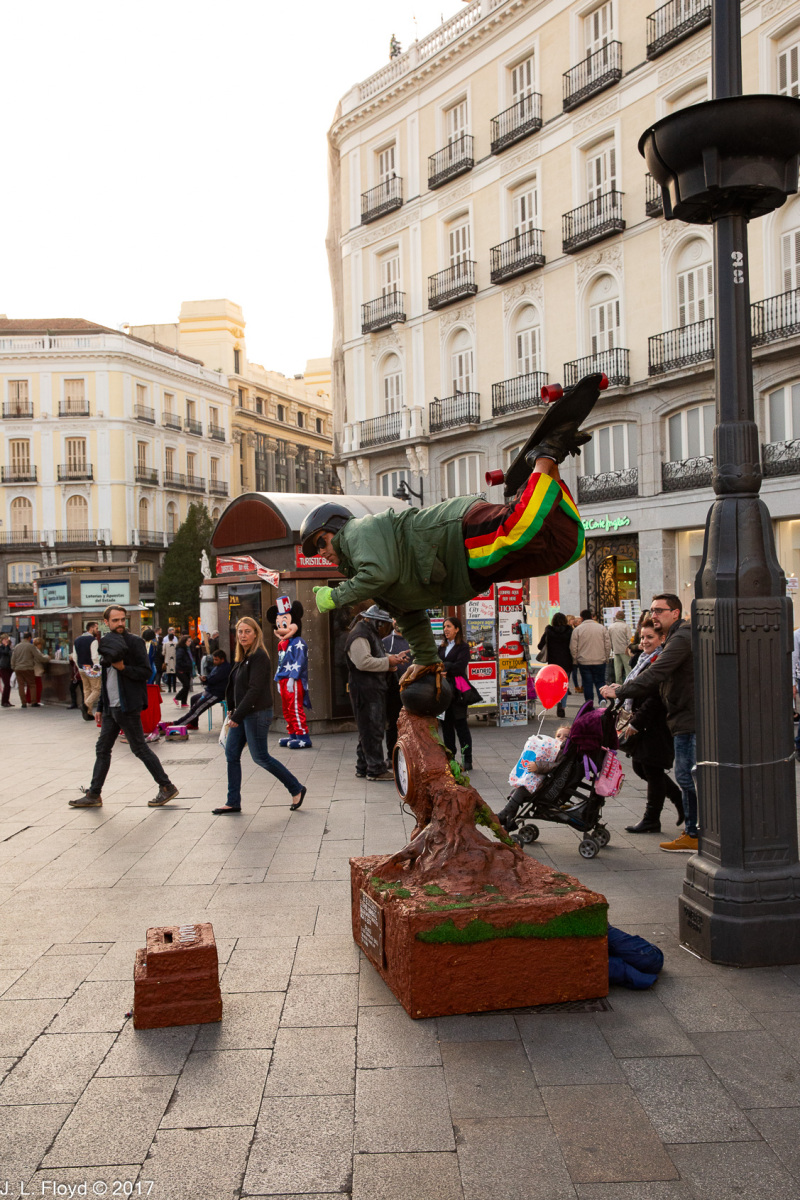
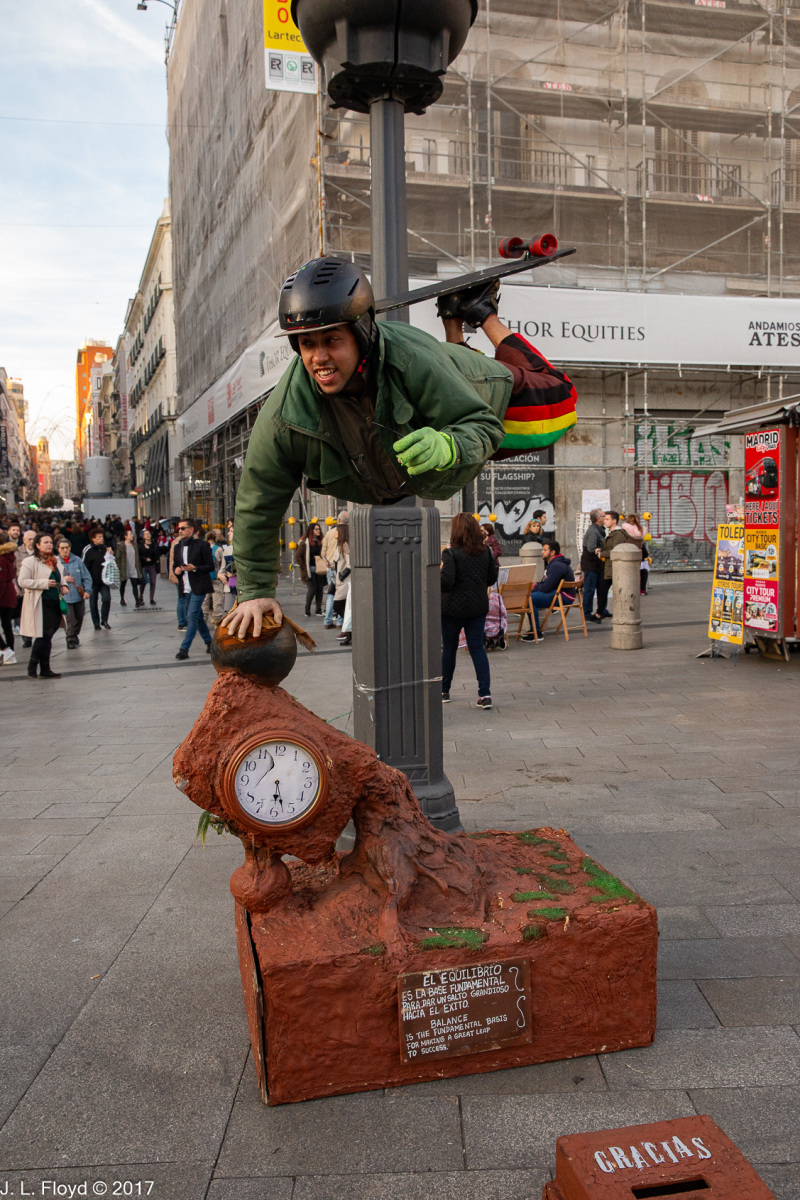
When I visited the Puerta del Sol, in mid-November, there was a giant artificial Christmas tree out in front of the Post Office. It stood close by an equestrian statue of the reforming 18th-century monarch Carlos III, which serves as a focal point for political protests, as the proclamations festooning the square witnessed. In this case the protesters were a very mild-mannered bunch, in fact it was hard to tell them apart from the people just hanging out in the square. The general atmosphere was one of amity. Mounted policemen (one of whom was a policewoman) stood watch, surveying the crowd with benign calm. A youthful acrobat demonstrated his ability to support himself for an incredibly long time on a pedestal with one arm while the rest of his body stretched out horizontally; on the pedestal he had inscribed the words “Balance is the fundamental basis for making a great leap to success”, in both Spanish and English.
In addition to the Post Office, the Puerta del Sol is the location of a number of historic landmarks. Unfortunately I missed the well-beloved statue of the Bear and the Strawberry Tree, which stands on the eastern side of the square. Erected in 1967, it was intended to represent the heraldic arms of the City of Madrid. I did not know that strawberries grew on trees.
I did manage to bag another famous landmark, the Tío Pepe (Uncle Pepe) sign. This is a neon-illuminated advertisement for a well-known brand of sherry that was first erected in 1936 on the Hotel Paris, the most exclusive hotel in Madrid, in another location on the square. Underneath the brand name appear the words “Sol de Andalucía embotellado” (Bottled Sun of Andalucía) and the name of its maker, González Byass. Displayed on the left of the sign is the company logo, a bottle of Tío Pepe sherry dressed up as an Andalusian gentleman, with his typical wide-brimmed hat and short red waistcoat, holding a guitar in his hand. The city council eventually banned commercial advertising signs on the plaza, but made an exception for the Tío Pepe sign because it was a popular favorite of Madrileños. However, in 2006 the Hotel Paris closed, and the new owners ended up dismantling the sign. A huge uproar ensued, with the eventual result that the sign was re-erected on another building opposite the Old Post Office.

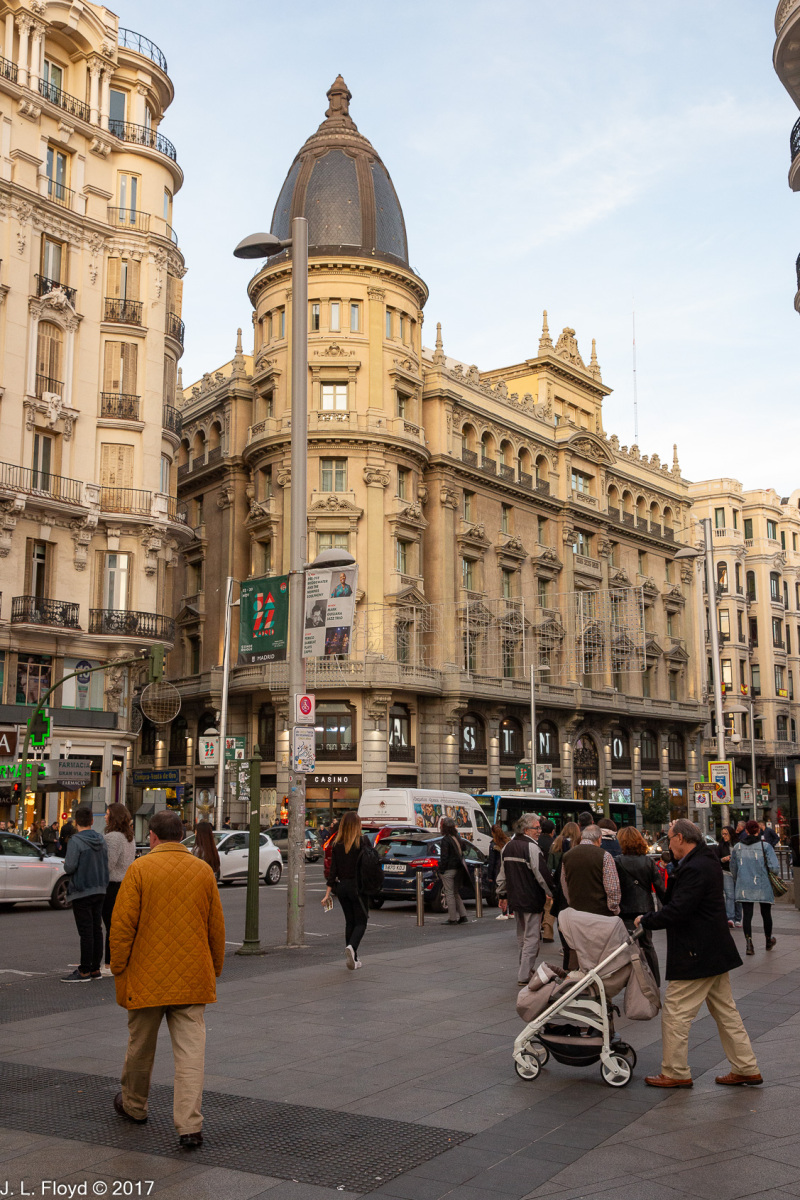
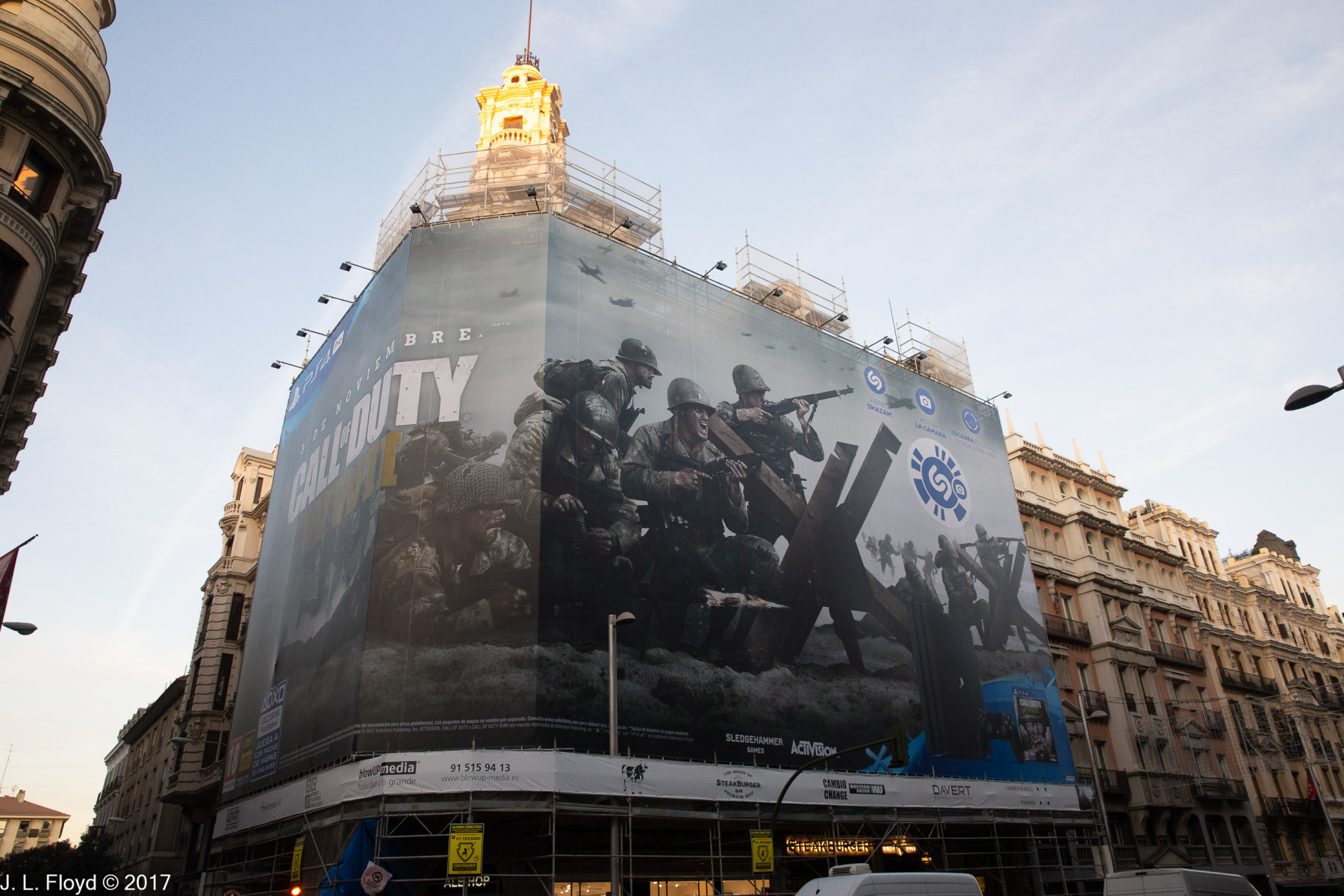
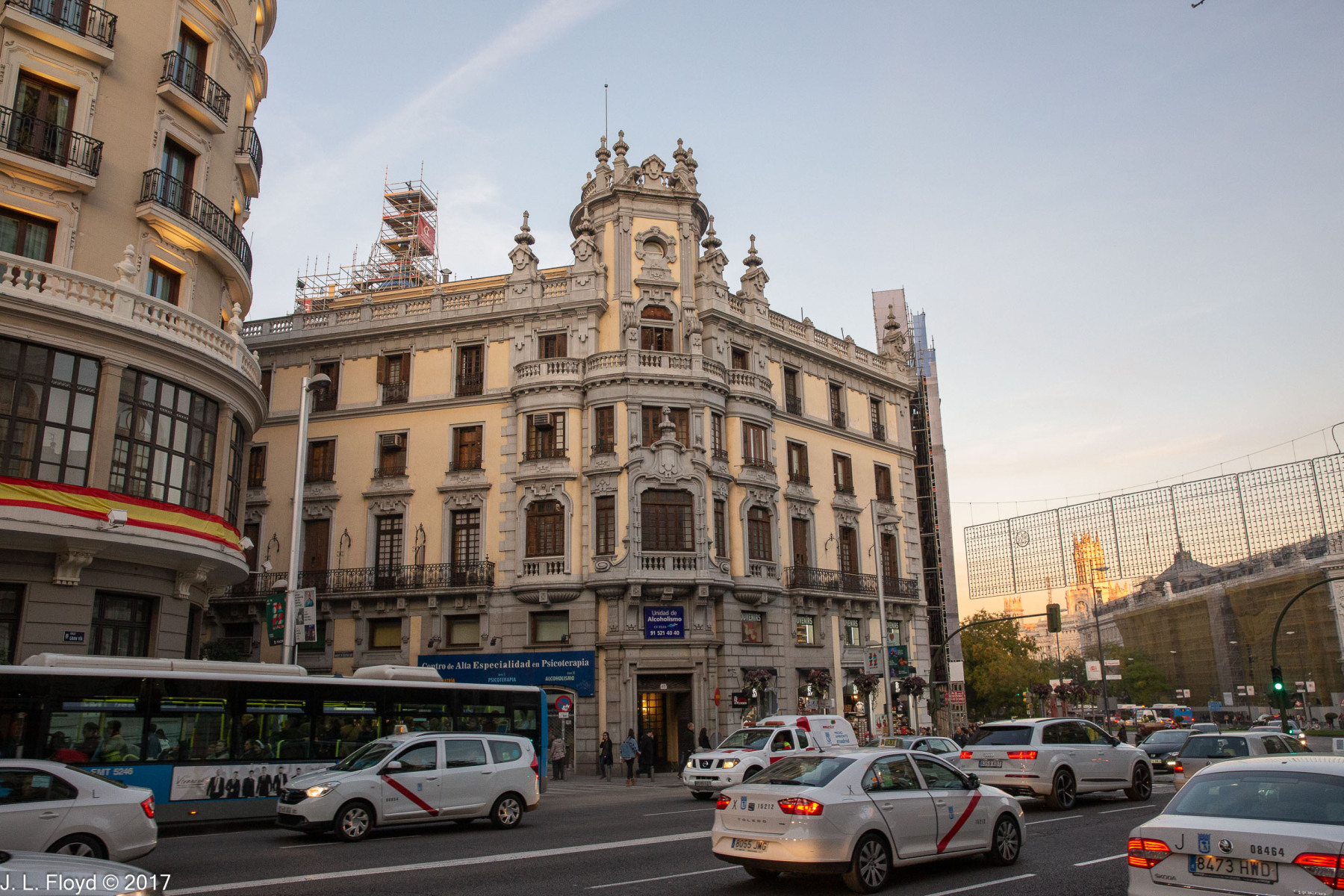
From the Puerta del Sol I headed north, without any clear purpose, but when I came to the Gran Vía, a major shopping and nightlife artery sometimes called the “Spanish Broadway”, I decided that it was time to start the trek back to the hotel before darkness made it too difficult to find my way. I didn’t have a good idea how to get back to the hotel, but I knew it was on Calle O’Donnell, somewhere not terribly far from the Madrid Ayuntamiento (City Hall) on the Plaza de Cibeles, which we had passed on the bus in the morning. So I trudged down the Gran Vía, which leads to the Plaza de Cibeles. On the way I continued to snap pictures of the more interesting, and some of the less interesting, sights that presented themselves.
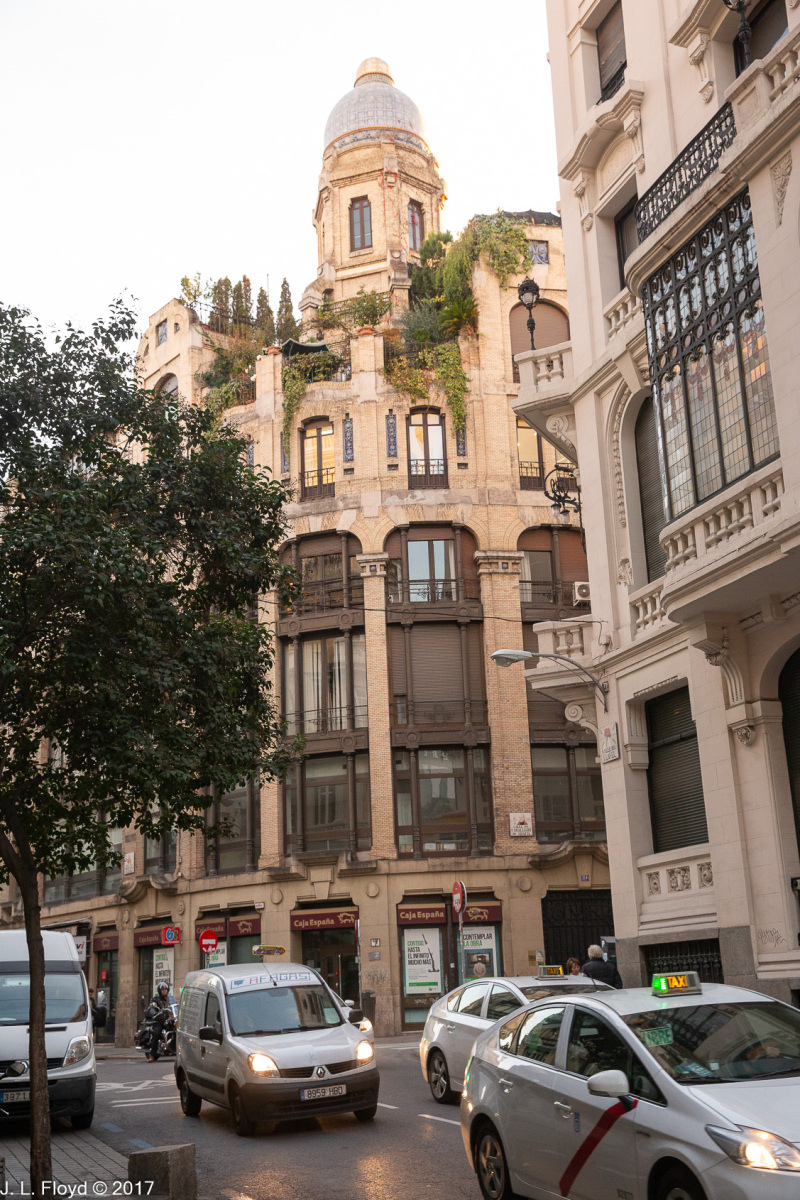
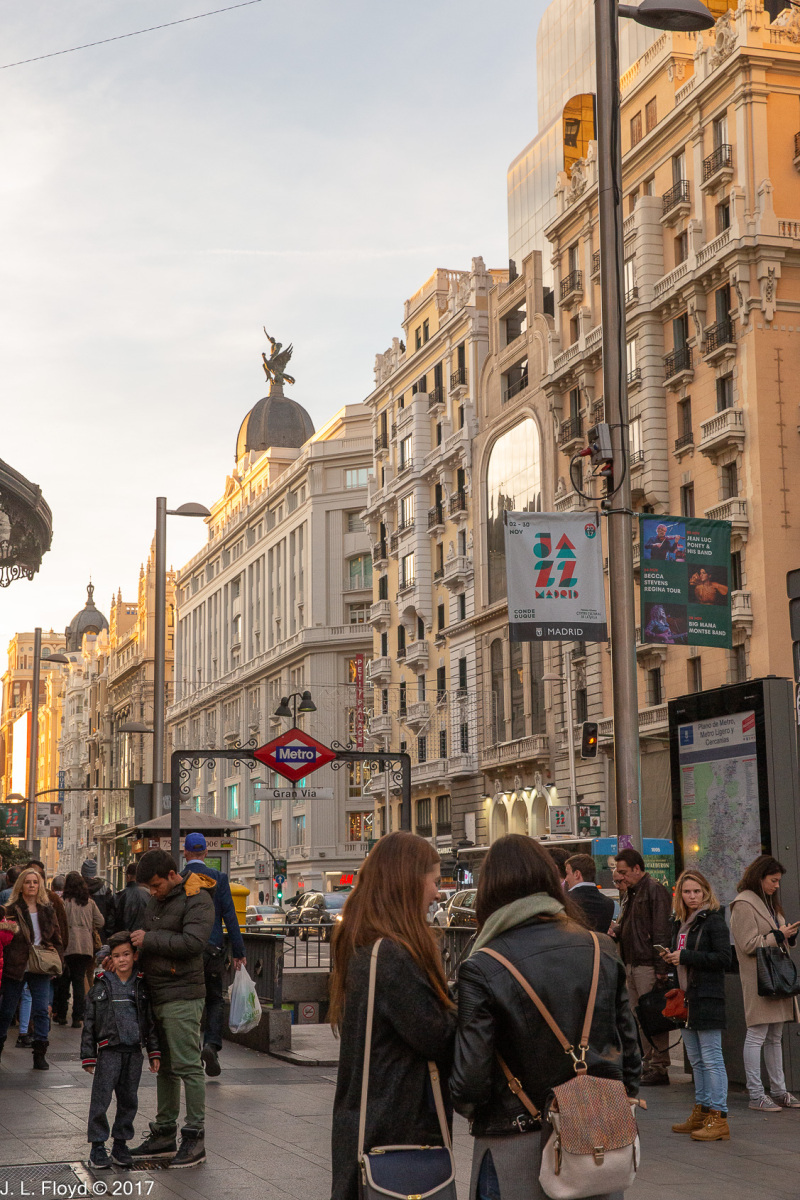
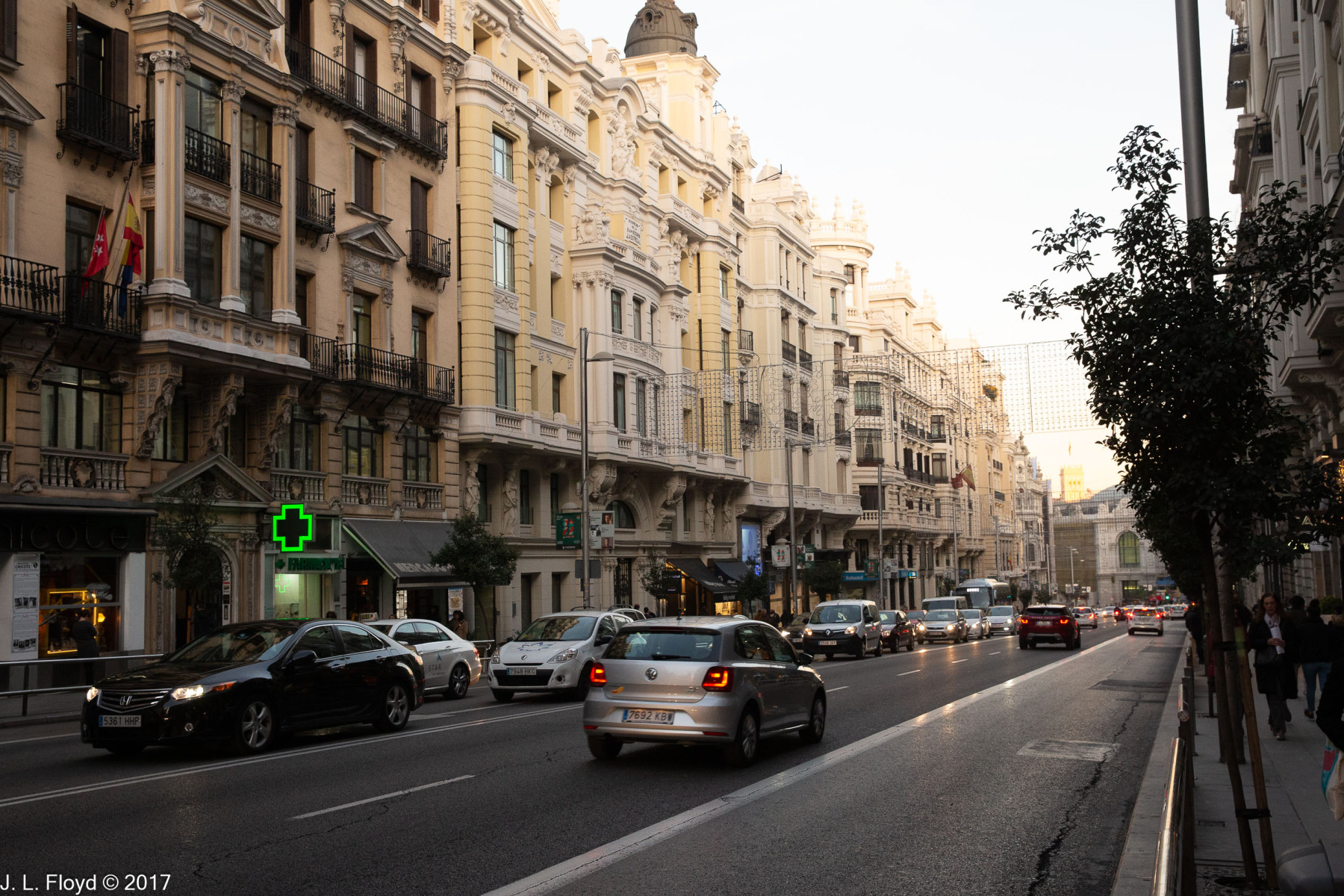
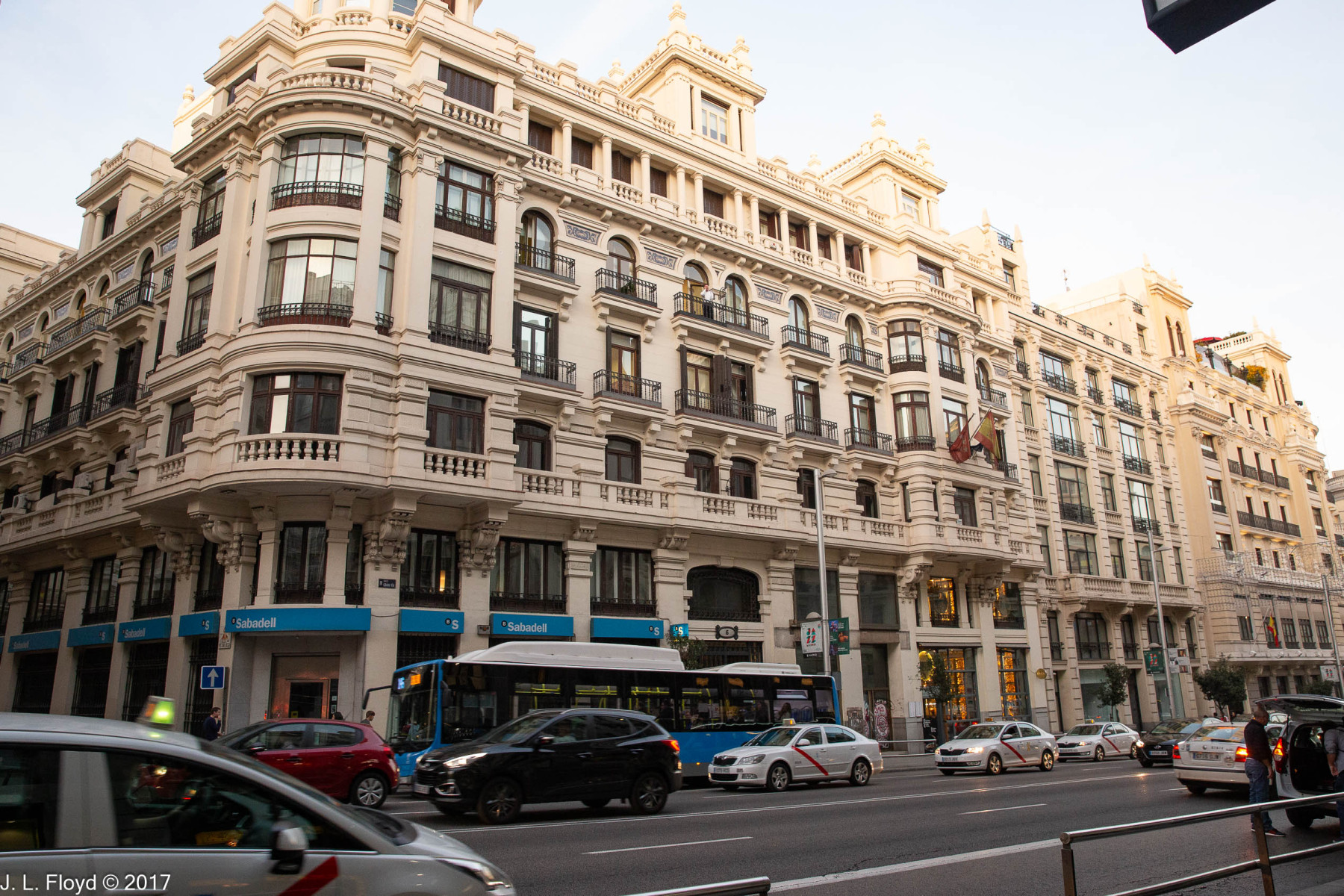
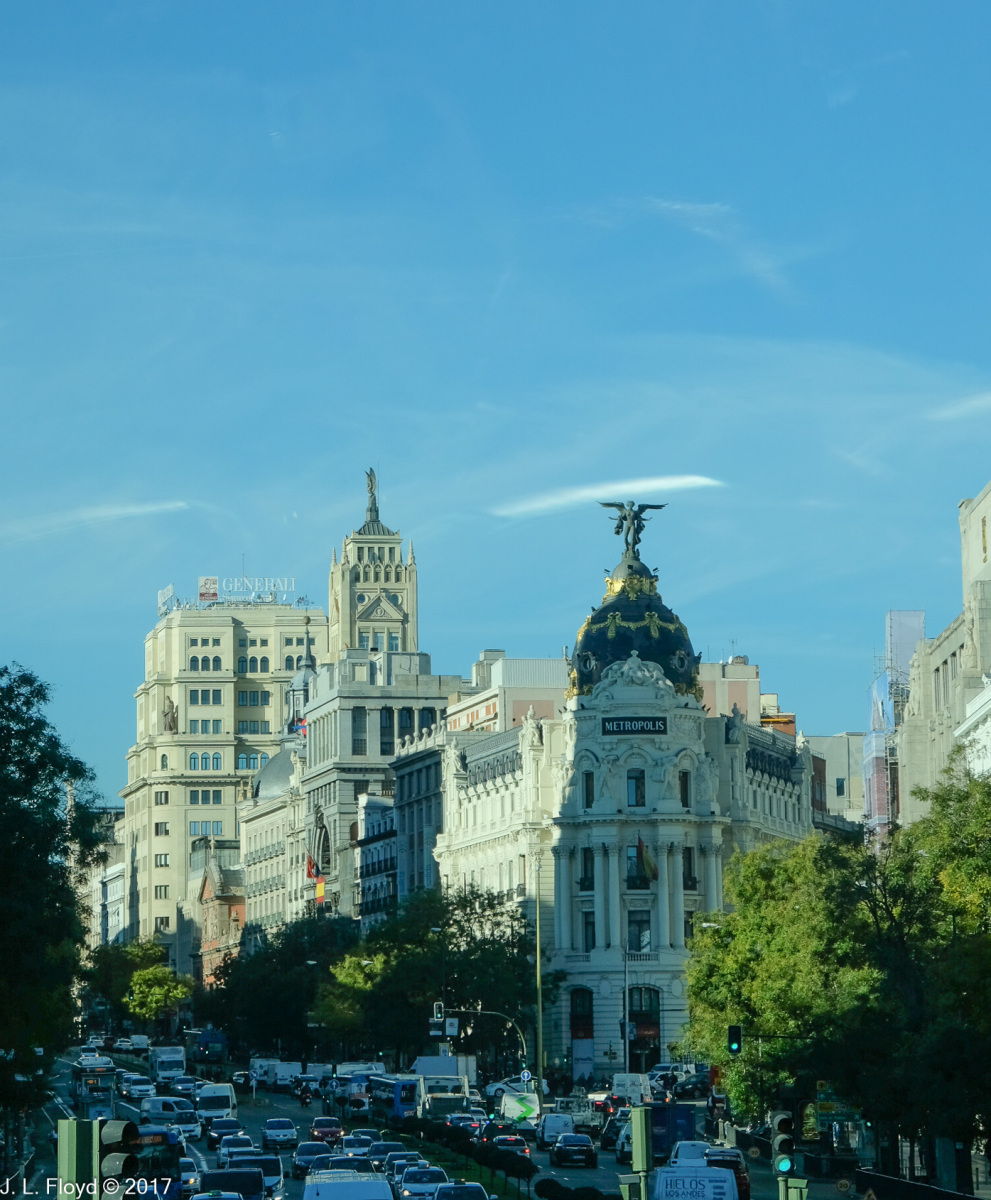
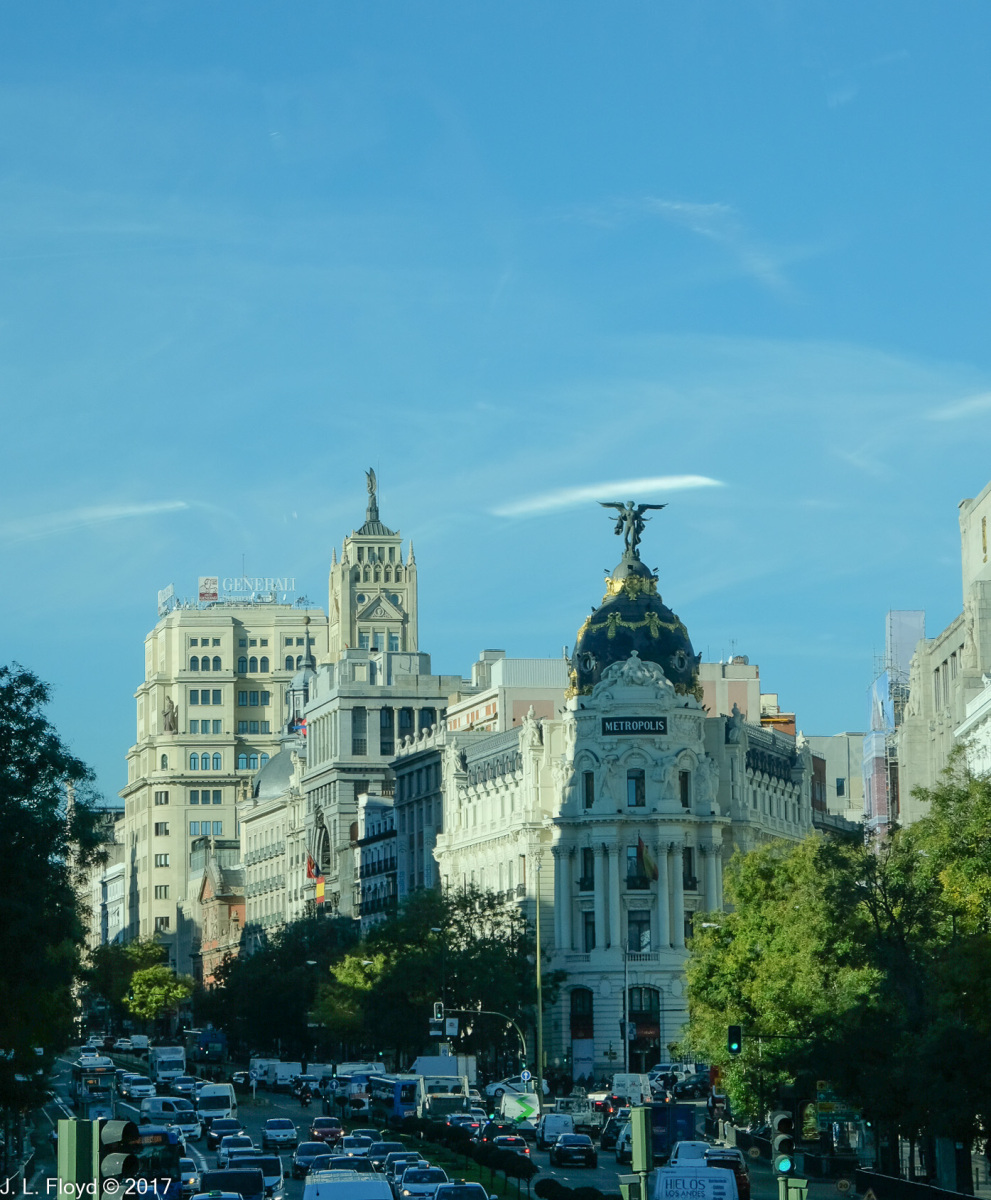
The Gran Vía ends at the Calle de Alcalá, just before the latter reaches the Plaza de Cibeles. This area is architecturally quite interesting, with several impressive structures to note. One is the Edificio Metrópolis, or Metropolis Building, at the corner of the Calle de Alcalá and Gran Vía. No, Superman does not hang out there. This is another building built by one insurance company and currently owned by another. A French architect, Jules Février, designed it for the La Unión y el Fénix company, in the Beaux-Arts style, and it was completed in 1911. On top of the building there was a statue depicting the mythological bird Phoenix, apparently in the process of abducting the youth Ganymede to serve as the cupbearer (and lover) of Zeus on Olympus. In 1972 Metrópolis Seguros acquired the building, and the previous owners removed the statue to take with them to their new premises. This caused a good deal of angst, but fortunately the new owners undertook to restore the building, which had greatly deteriorated, to its pristine condition, which included installing a replica of the original statue.
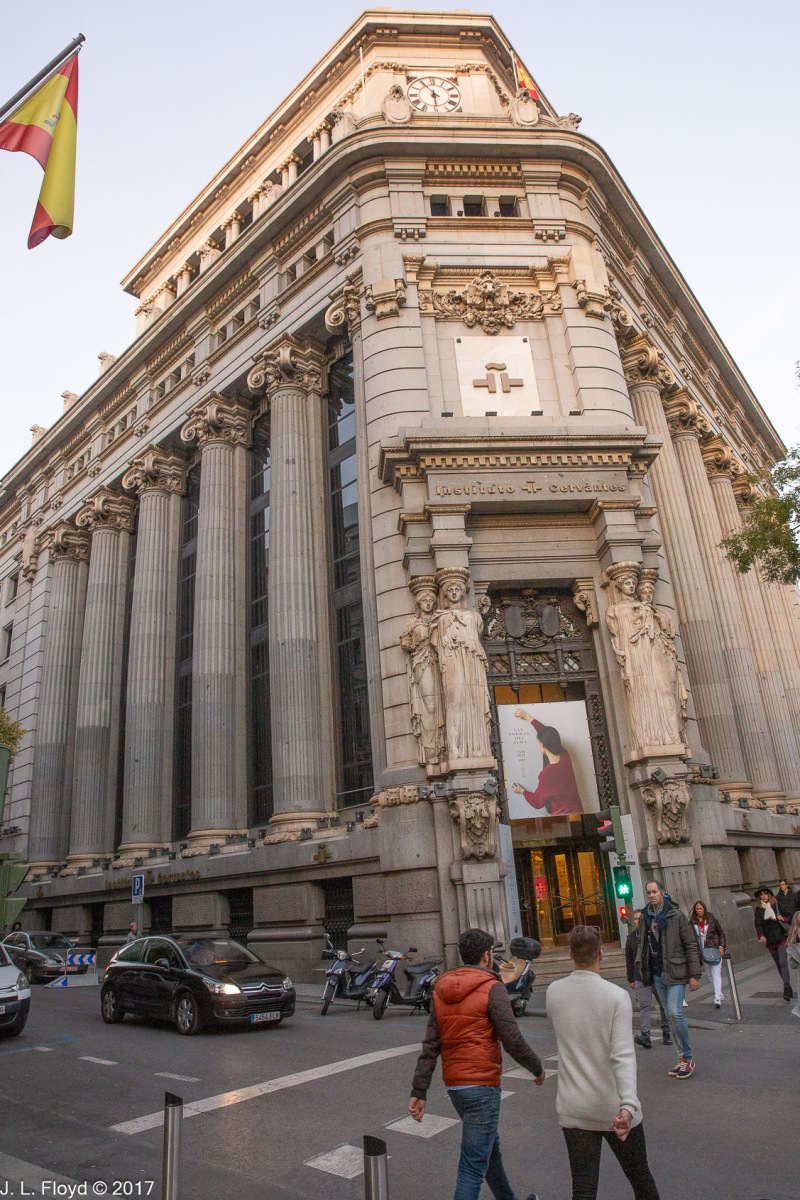
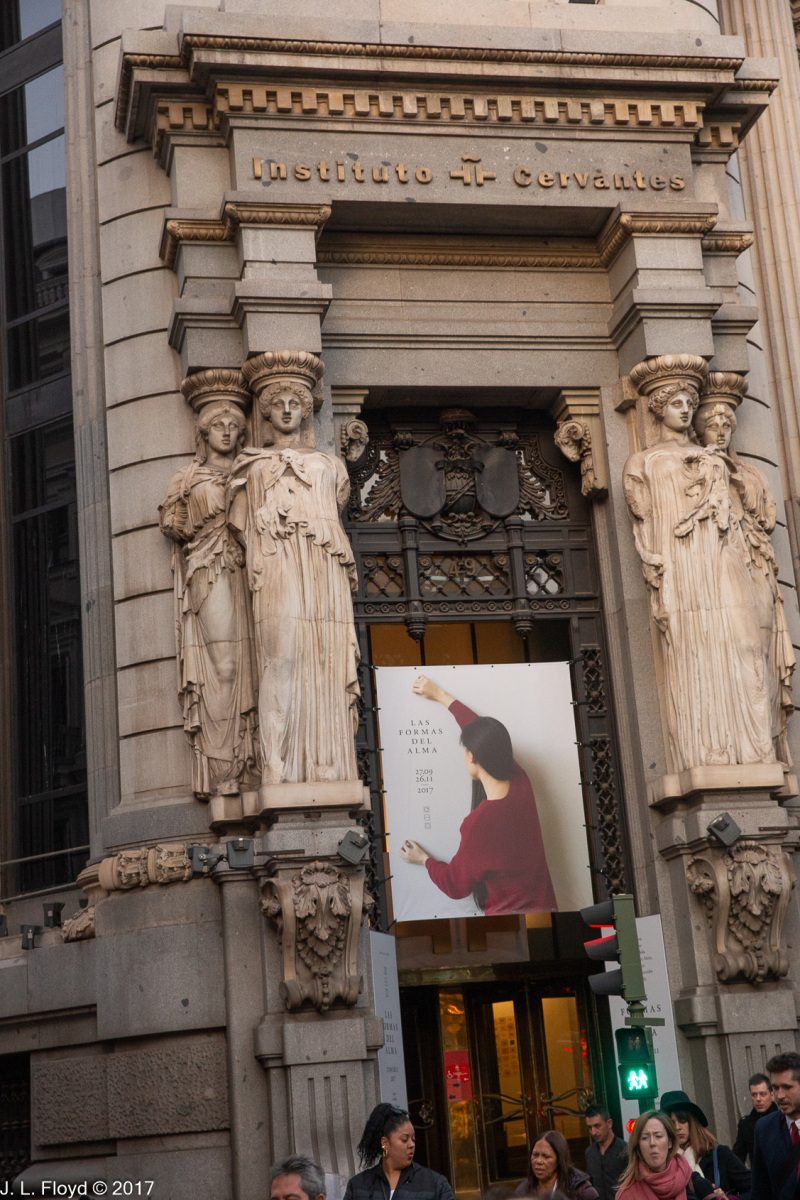
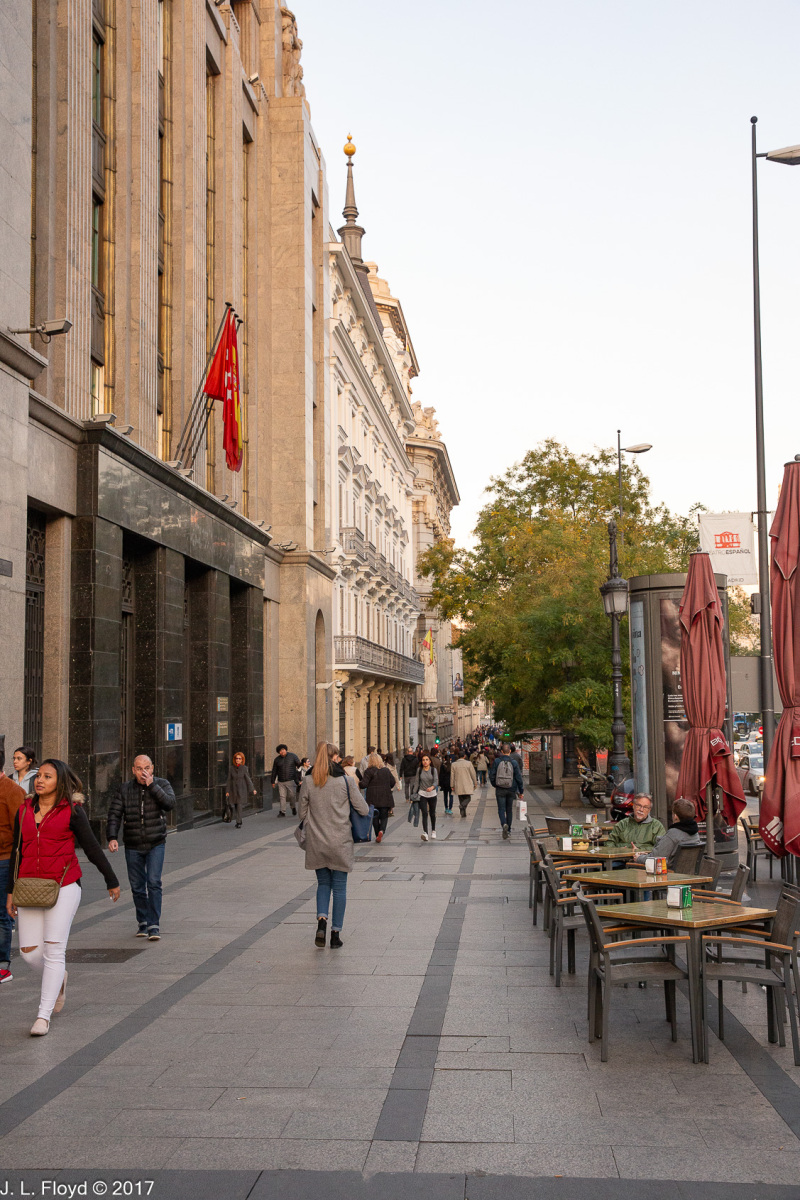
Also noteworthy is the Edificio de las Cariátides, or Caryatid Building, at 49 Calle Alcalá, so called because of the two imposing classical caryatids – columns in the form of women – flanking the main entrance. It is also notable because it is the headquarters of the Instituto de Cervantes (Cervantes Institute), a Spanish public organization under the Ministry of Foreign Affairs, devoted to the promotion and teaching of the Spanish language and the dissemination of Spanish culture. Originally it was a bank building, built in 1918 to be the headquarters of the Spanish-Argentine Banco Espanol del Rio de la Plata. Since then it has changed hands many times, finally becoming headquarters of the Cervantes Institute in 2006. The architectural style is eclectic, but basically Greek neoclassical.
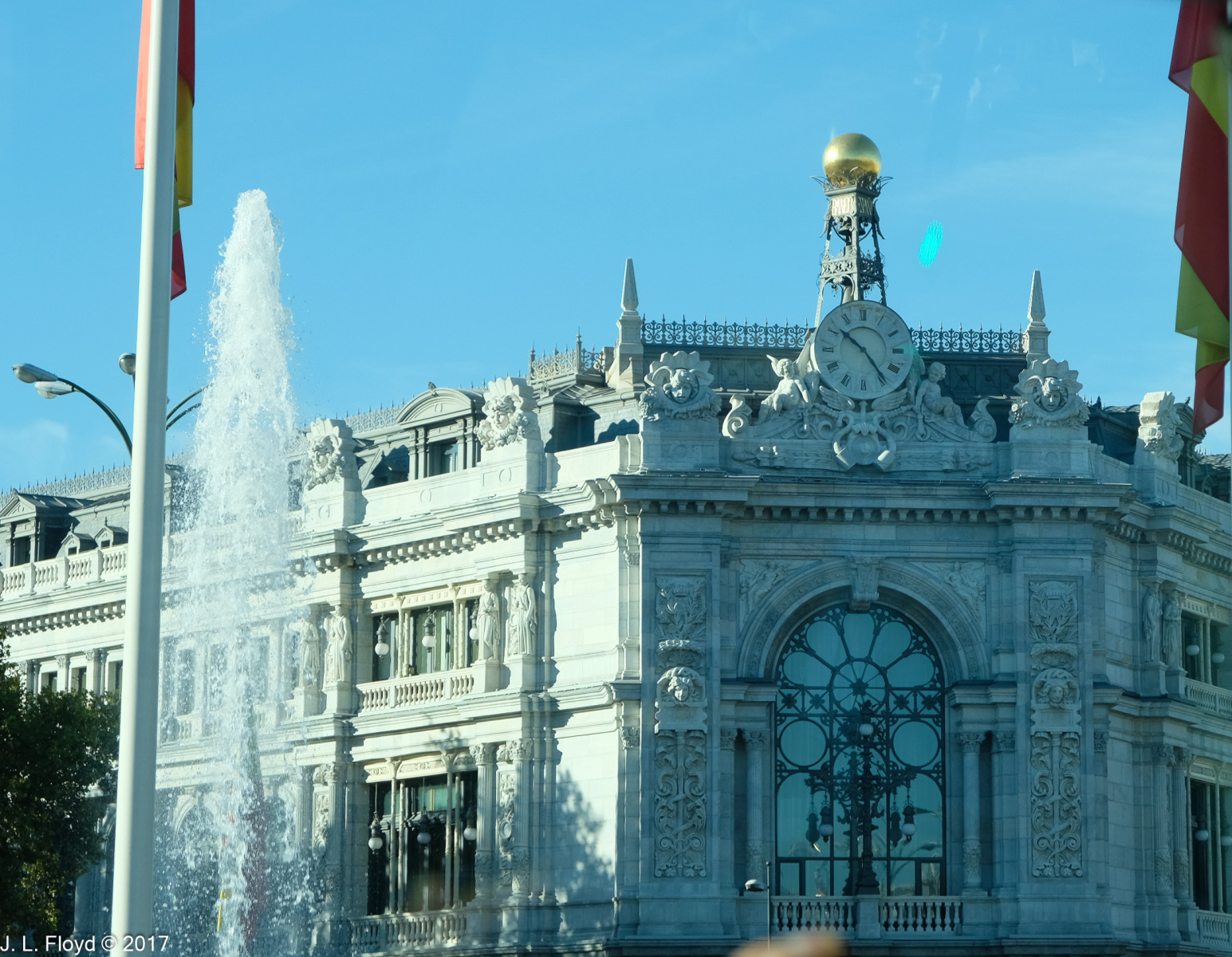
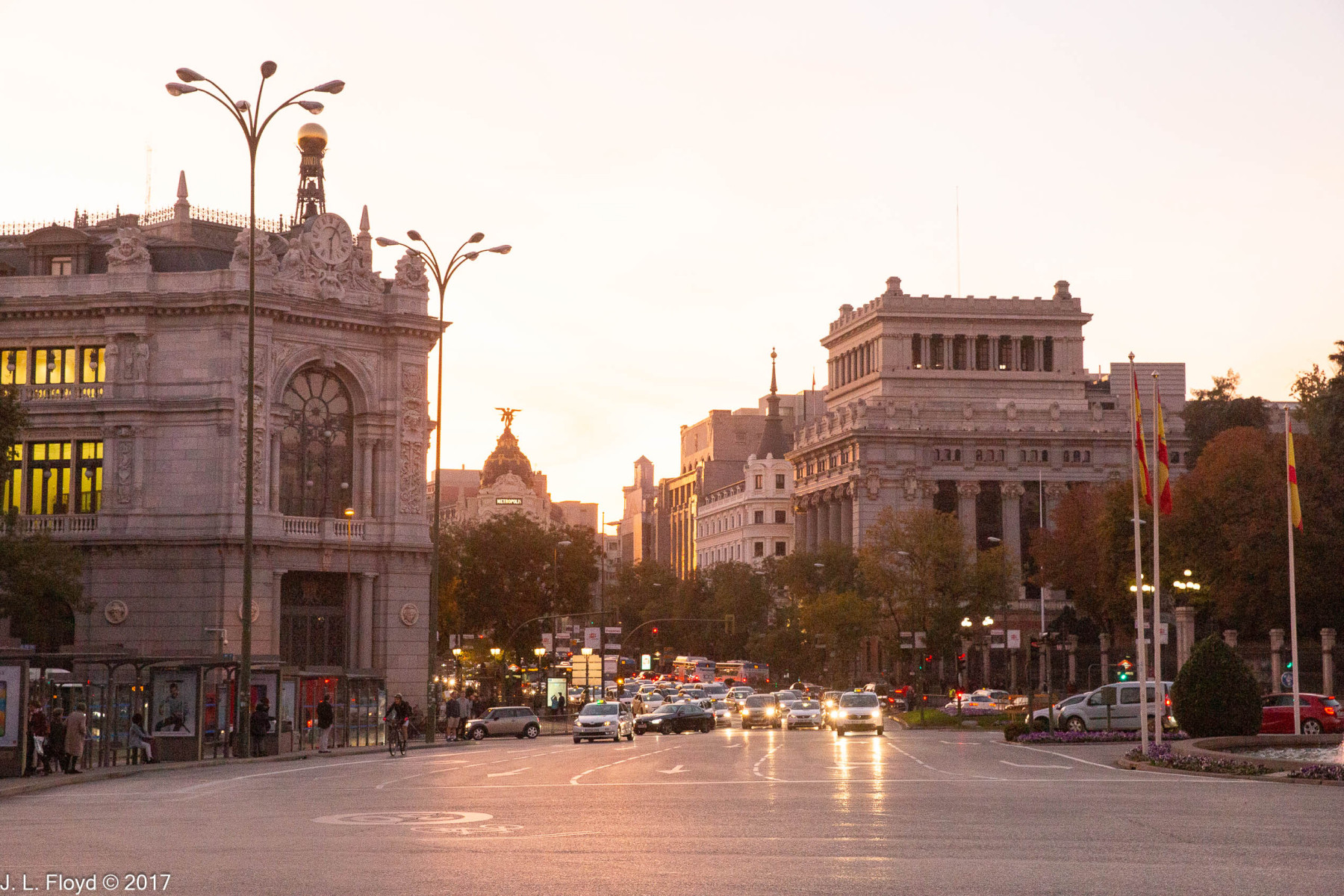
In the same area, where the Calle de Alcalá meets the Paseo del Prado, is the Bank of Spain (Banco de España) building, completed in 1891. Since then it has undergone several expansions, most recently in 2006. It is remarkable for its monumental Carrara staircase and stained-glass windows.
Shown in one of the photos in the gallery below is the entrance to the Bank of Spain Metro Station, which is found on the sidewalk by the Cervantes Institute. I did not take the subway, preferring to do my sightseeing above ground, but I was interested to find out that the Madrid Metro System, with a total length of 296.6 kilometres (184.3 mi), is the sixth longest in the world outside of China, and the third longest in Europe, behind Moscow and London. It was first opened in 1919, expanded many times thereafter, and by 2024 was carrying over 700 million riders per year.
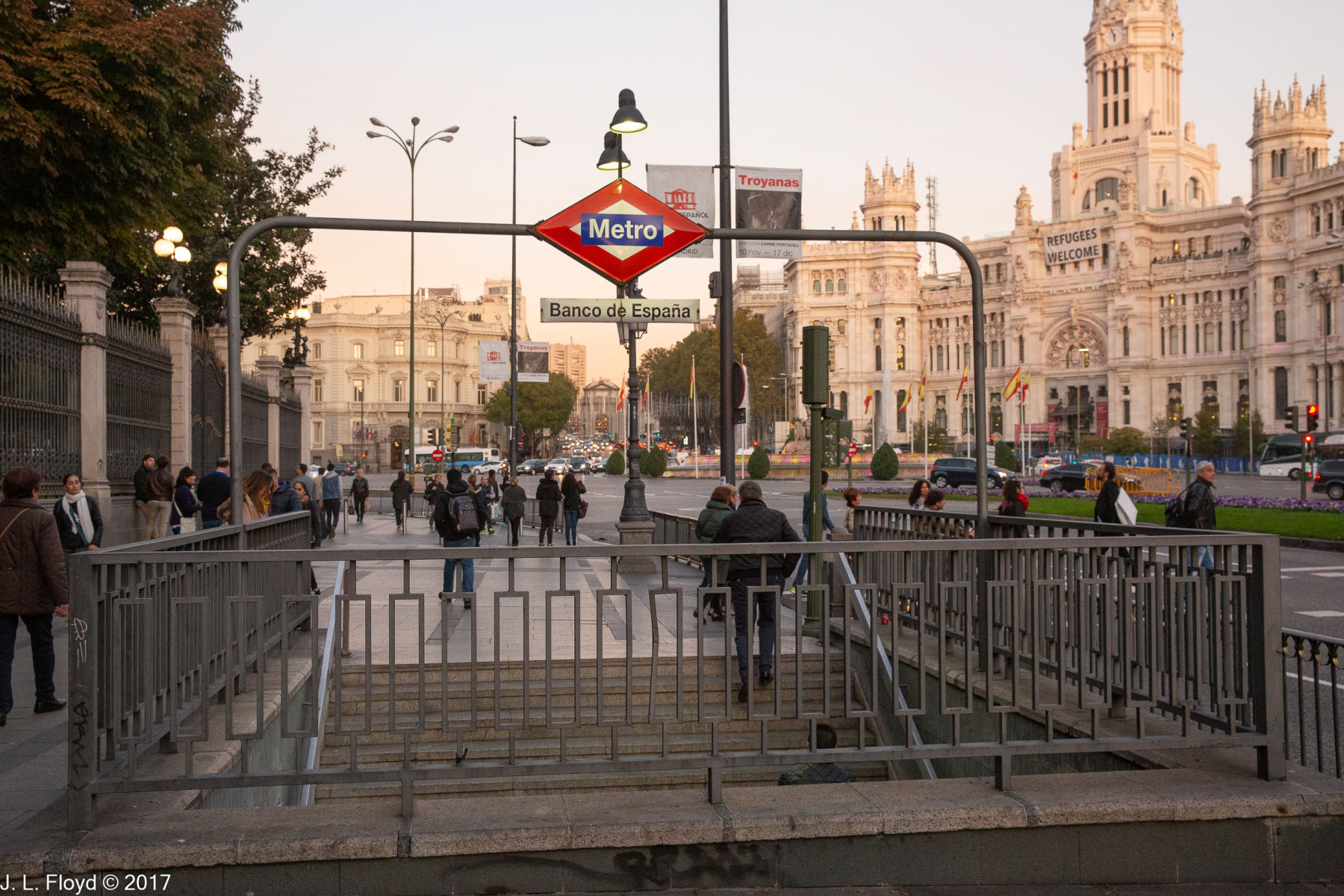
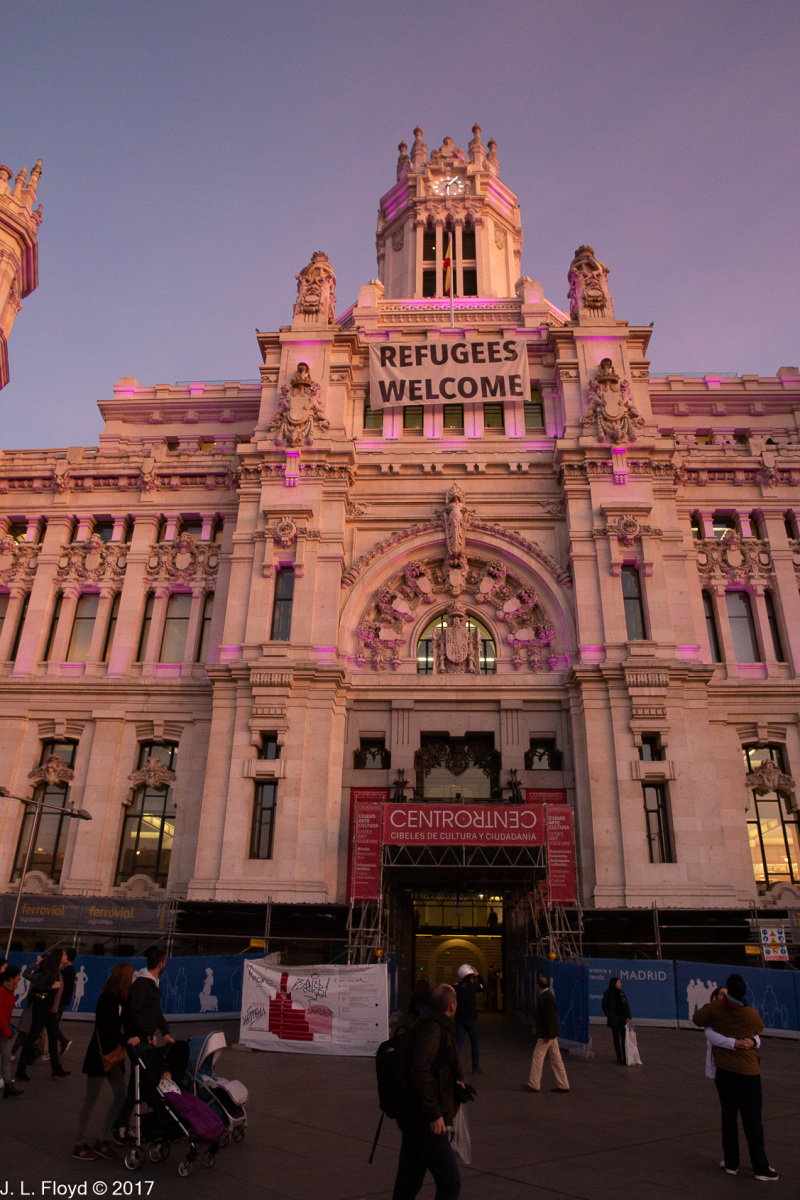
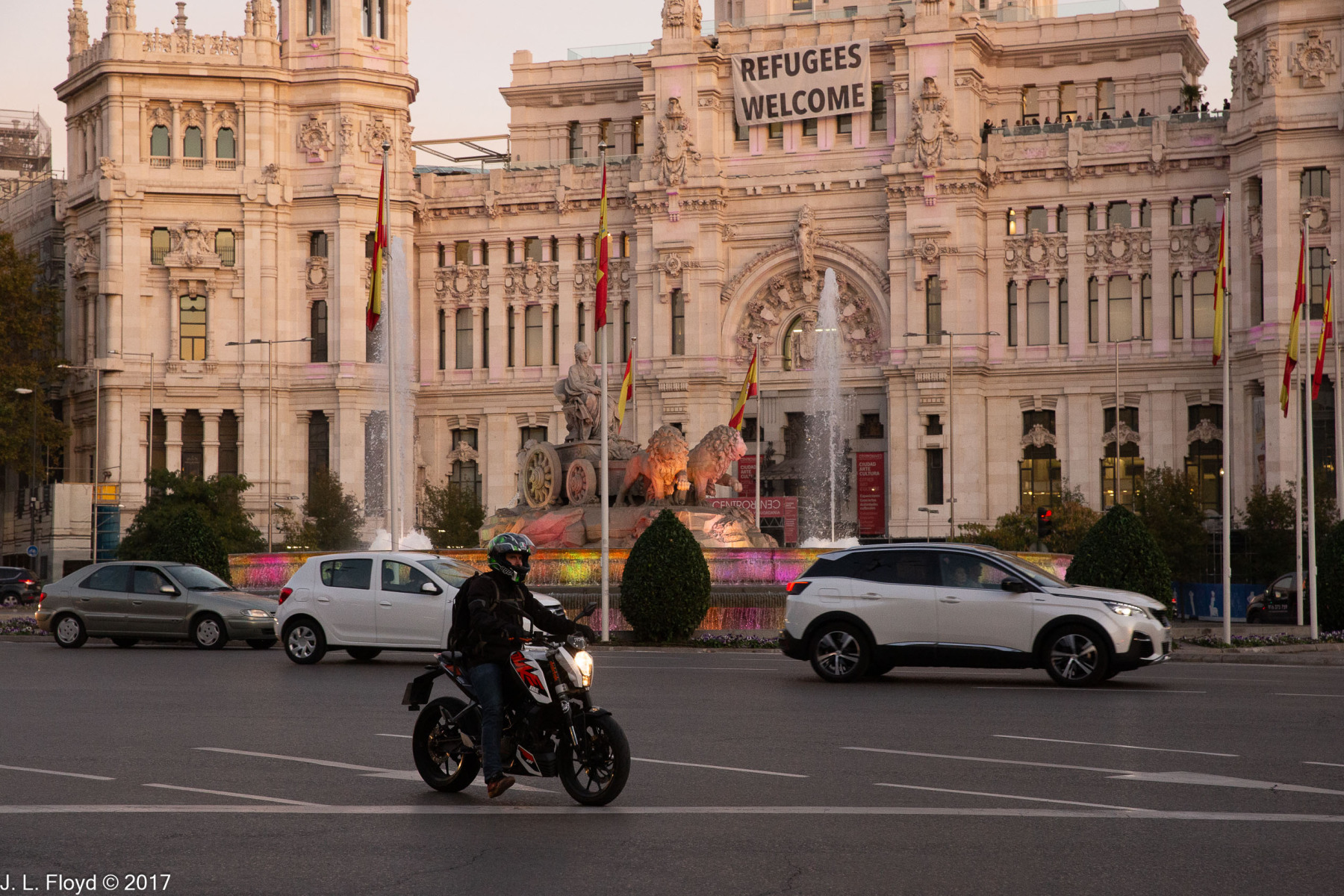
At last I came to the Plaza de Cibeles, home to the fountain which gave the square its name. Overshadowing the fountain, however, and visible from afar, is the Palacio de Cibeles (Cibeles Palace), the tall building that houses the Ayuntamiento de Madrid, in effect the City Hall. Prior to 2011 it was the main post office and telephone and telegraph headquarters of Madrid. Nowadays, as well as hosting the Mayor’s Office and City Council, it is occupied by the public cultural center CentroCentro.
The Palacio de Cibeles was designed in the early 20th century by architects Antonio Palacios and Joaquín Otamendi, who also designed the Edificio de las Cariátides as well as the Edificio de España and Torre de Madrid on Plaza de España. It took twelve years to build, the construction being delayed by architectural and financial issues as well as political disputes. It was finally inaugurated by King Alfonso XIII in 1919 and began operating as the Catedral de las Comunicaciones, later the Palacio de las Communicaciones. It continued in this role for many years, but by the early 21st century, postal traffic was in serious decline and the Palacio was becoming underused. However, meanwhile the organs of the city administration had outgrown their traditional quarters in the Plaza de la Villa, so beginning in 2007 the City Council and Mayor’s Office were relocated to the much grander Palacio on the Plaza de Cibeles.
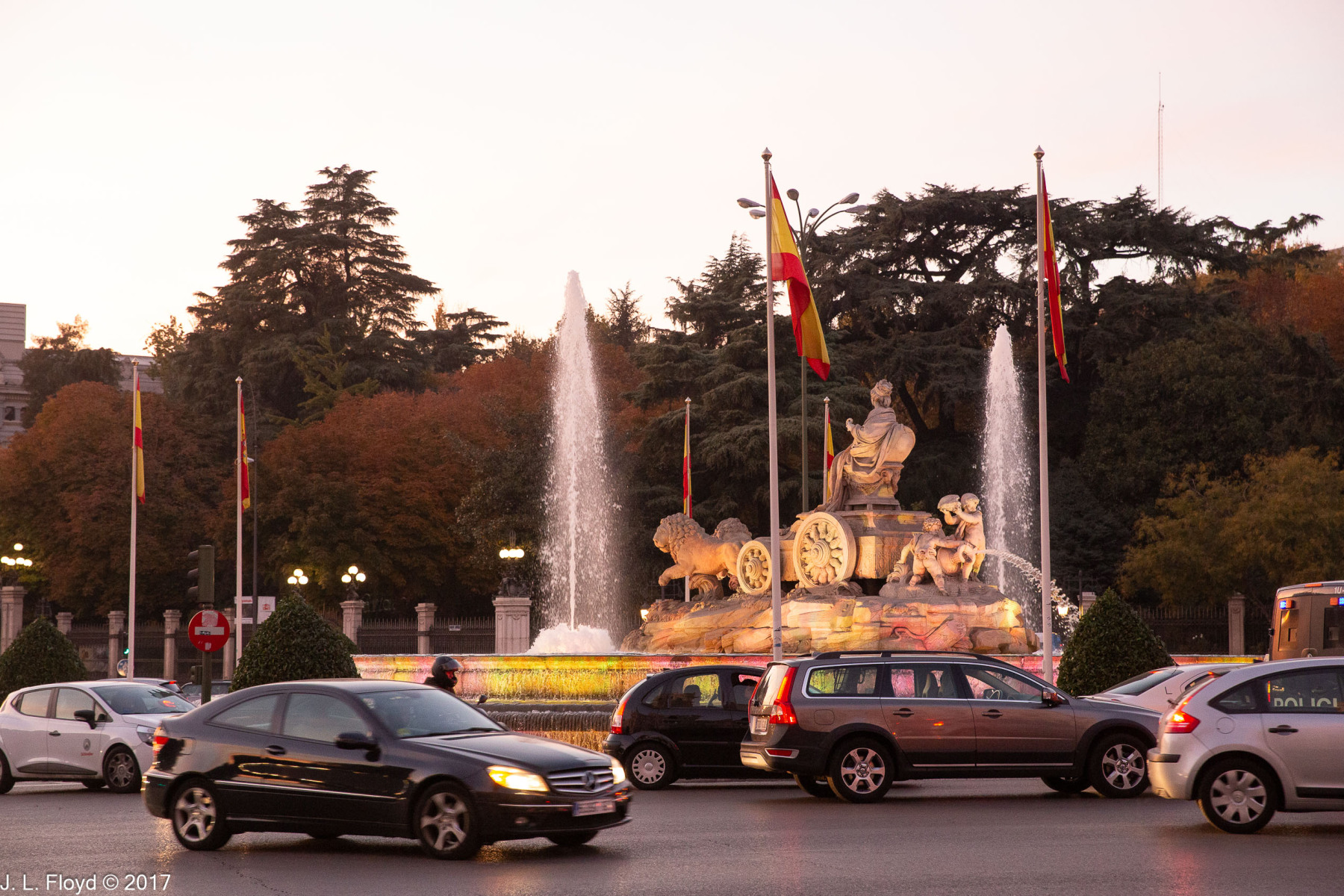
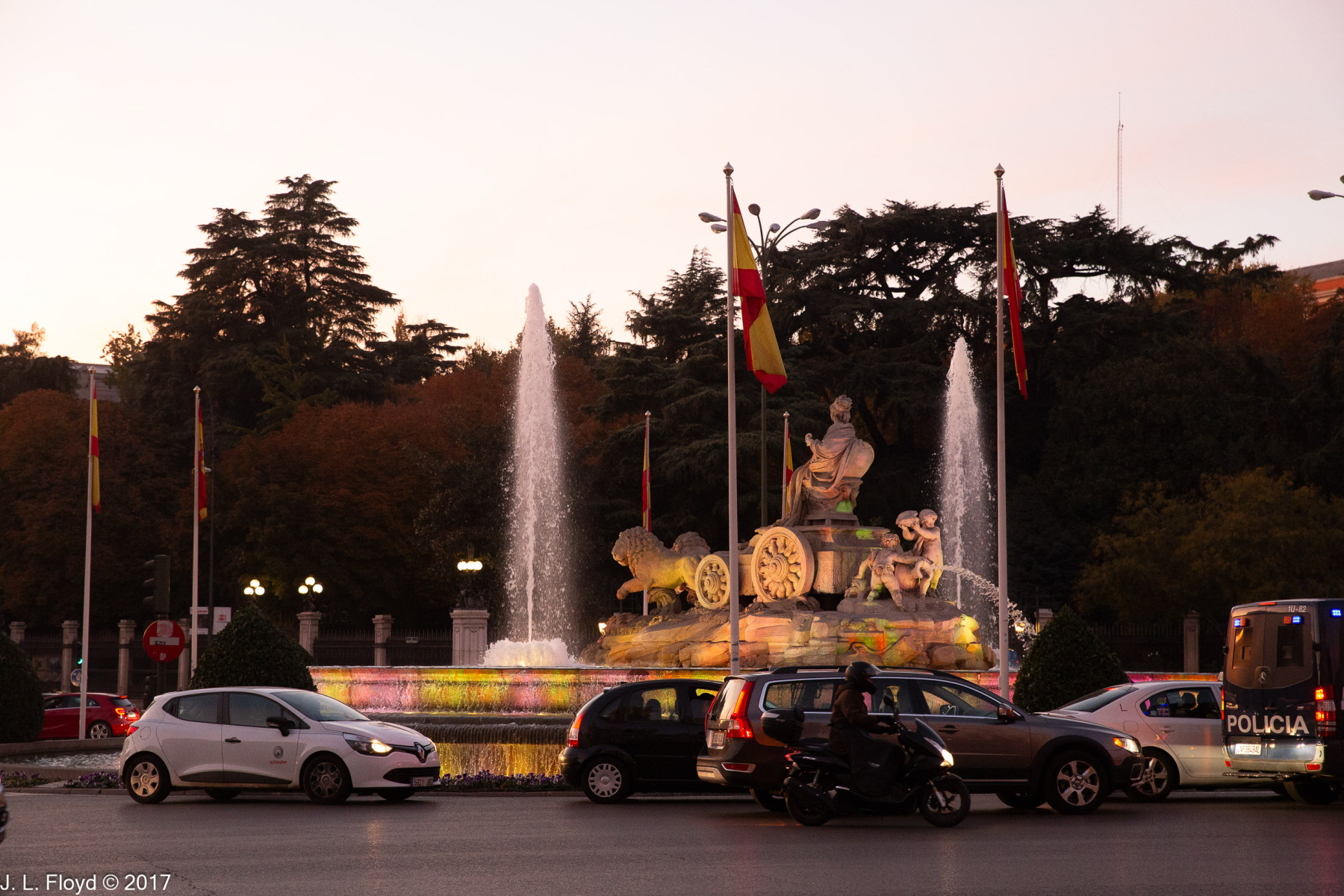
I arrived at the Plaza de Cibeles about sunset and shot most of my photos there as daylight was fading. Cars had their lights on, and the Fountain of Cybele was illuminated with colored lighting. The Palacio towered over everything, and on its facade was a large banner displaying the words “REFUGEES WELCOME” in English. This was the first year of the first Trump administration and I could not but reflect on how unlikely it was to see such a banner on a government building in Washington, D.C. It seems even less likely now.
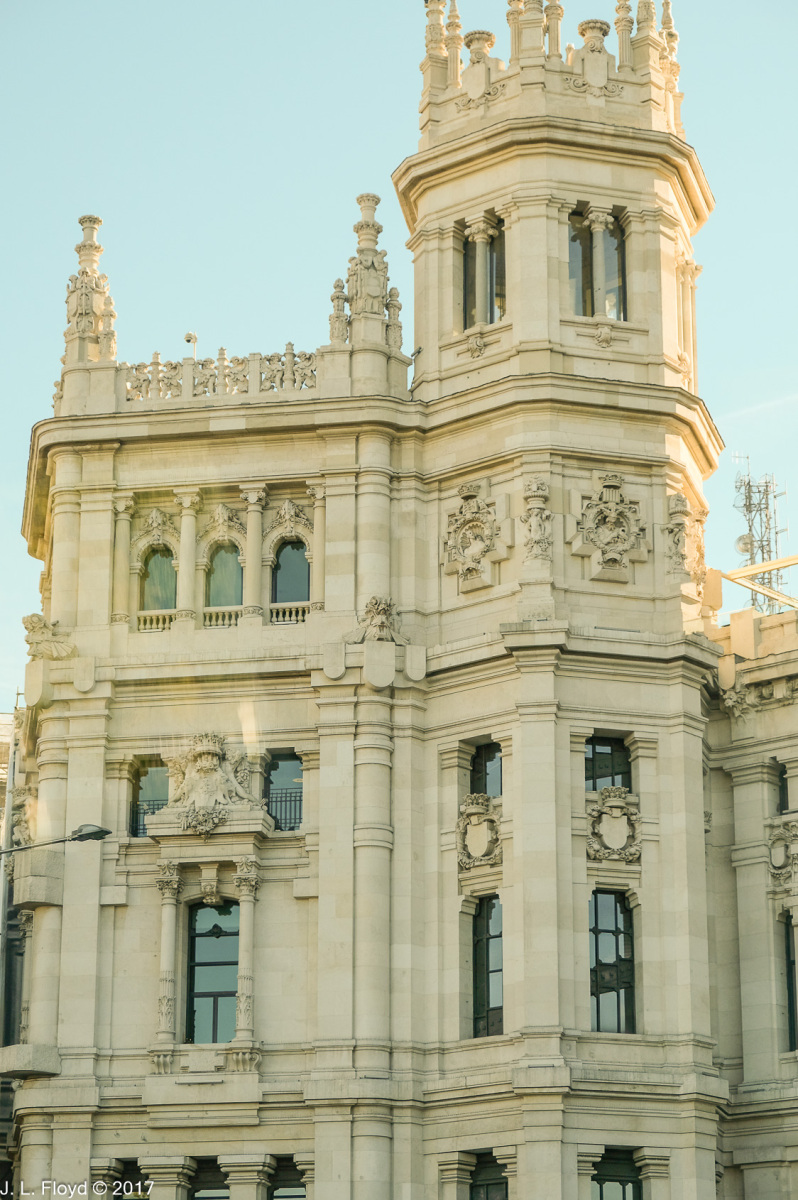
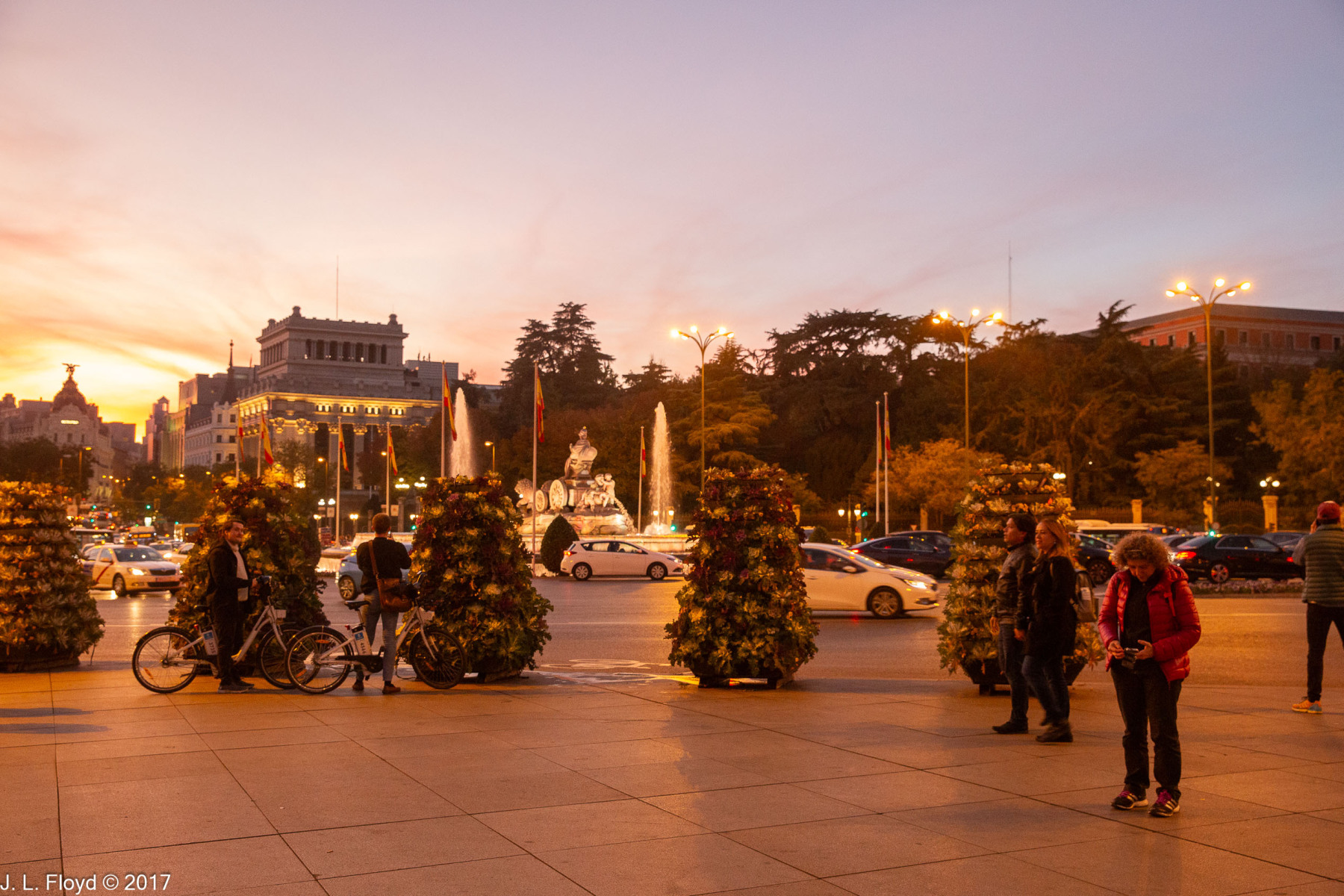
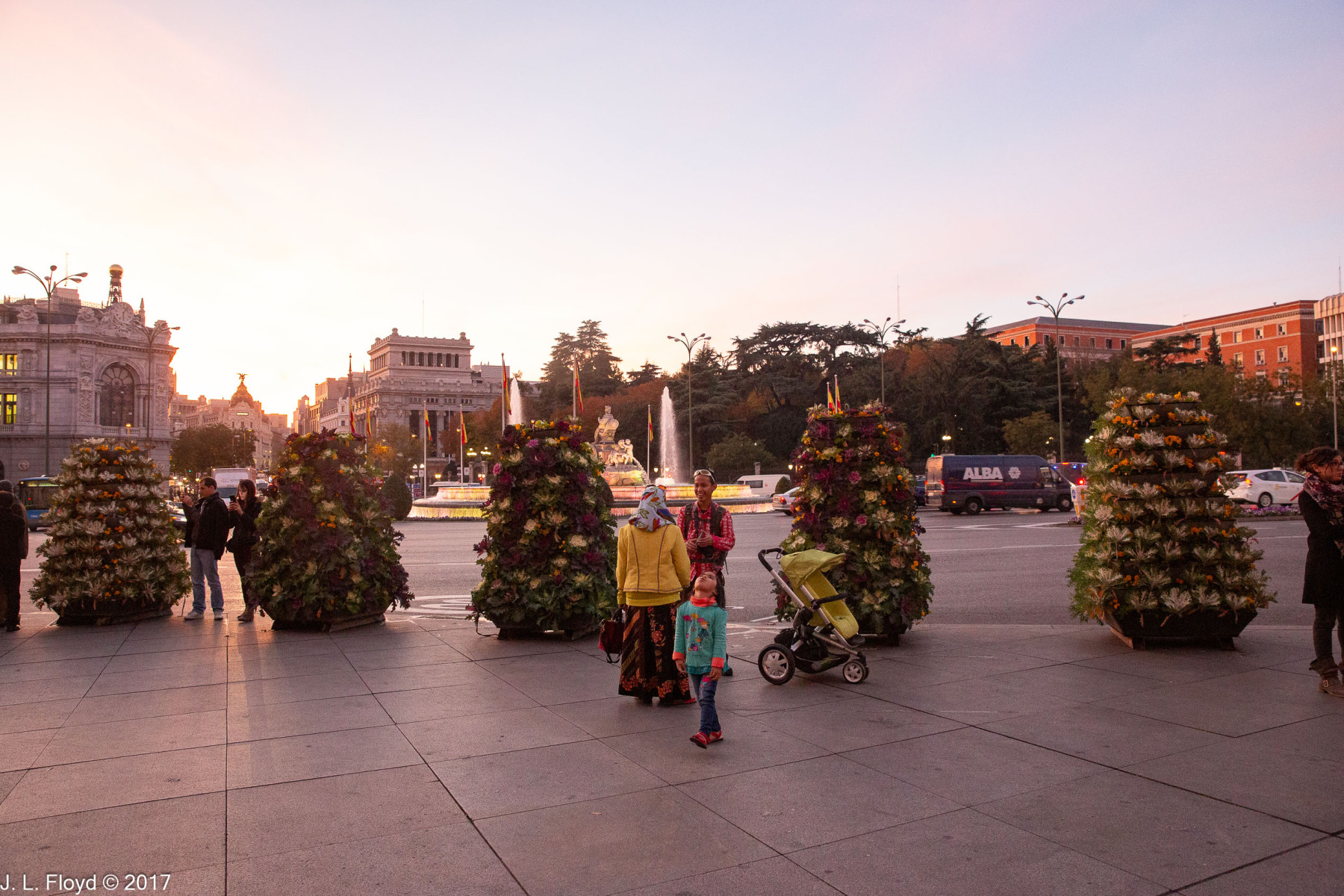
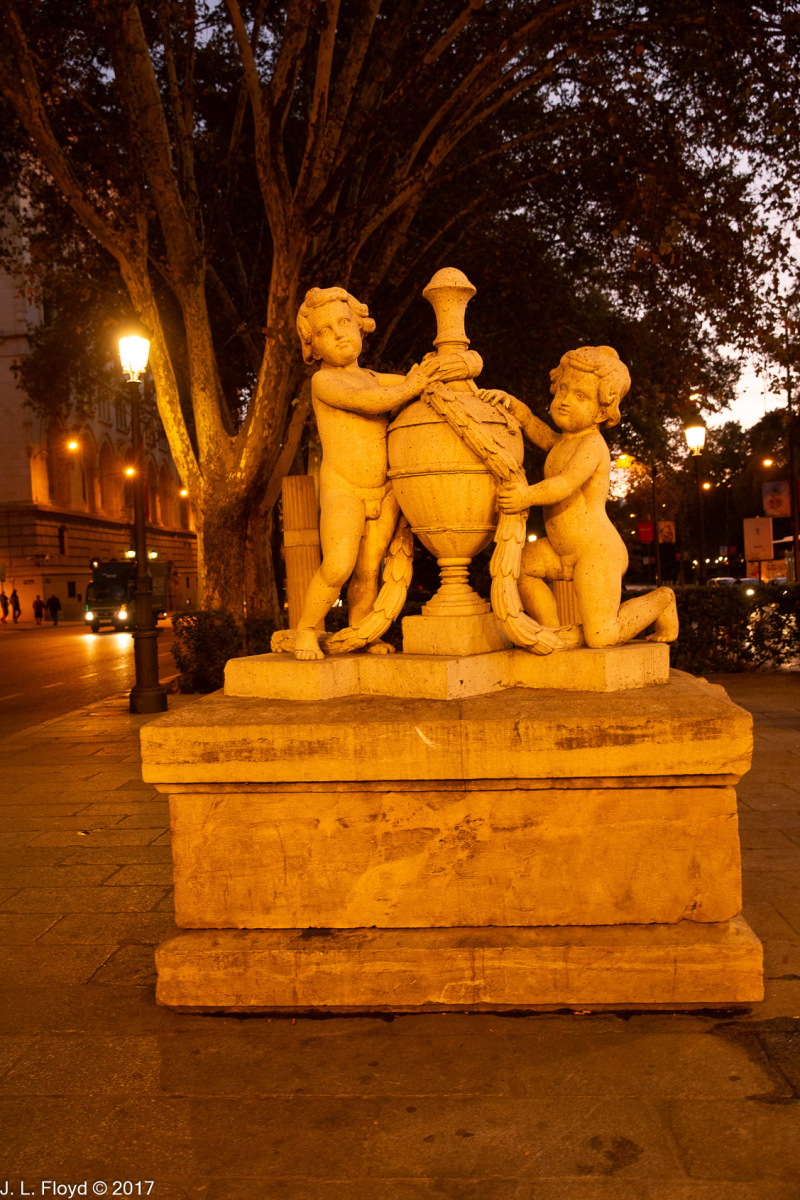
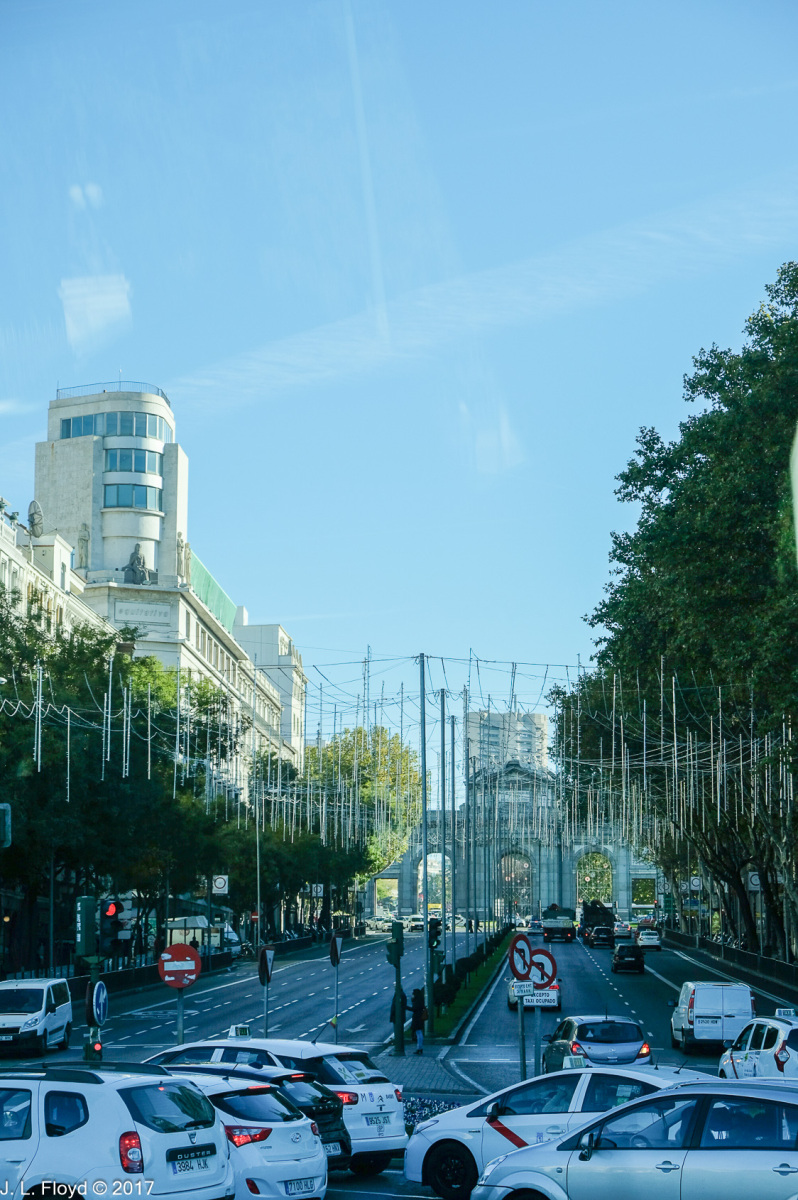
The Fuente de Cibeles was created as part of an urban renewal project commissioned by King Carlos III (r. 1759-1788) in the 18th century. The king heavily favored the then-dominant neoclassical style and was bent on deploying it for the beautification of Madrid. One way in which he did so was to commission the construction of new buildings, such as the one housing the Museum of Natural History, which eventually became the Prado. Another was the erection of monuments such as the Puerta de Alcalá (1778). I have included a photo of it, taken by Sandie from the tour bus in the morning from a distance, in the first gallery of this post; it is a triumphal gate with five arches, located on the Plaza de la Independencia, where the Calle de Alcalá – Madrid’s longest street – is joined by two other major avenues, the Calle de Alfonso XII and Calle Serrano, before continuing on out toward Alcalá de Henares, Cervantes’ birthplace.
A special category of monuments commissioned by Carlos III consists of three sculptured neoclassical fountains representing figures from Greco-Roman mythology: The Fuente de Neptuno, which I have already touched on; the Fuente de Apolo o de las Cuatro Estaciones (Fountain of Apollo or the Four Seasons), located on the Paseo del Prado north of the Neptune Fountain; and, of course, the Fuente de Cibeles. We missed capturing the Apollo Fountain photographically, probably because the bus passed it too quickly; it depicts the Apollo, the Greek god of light and the arts, atop the monument, while four allegorical figures representing the Four Seasons sit on a pedestal beneath.
The Fuente de Cibeles depicts Cybele, originally an Anatolian mother goddess, riding in a chariot drawn by two lions. Her cult was adopted by Greek colonists in Asia Minor around the sixth century BC and thence transmitted to Greece itself, where Cybele became identified to some extent with Rhea, mother of the Olympian gods Zeus, Poseidon and Hades, and other deities. The cult ultimately made it to Rome, where she was called Magna Mater, and became notorious for the practice of self-castration by her priests (the Galli), which was outlawed. No comparable associations have ever been noted in devoutly Catholic Spain, but a modern tradition has developed whereby the fans of the Real Madrid soccer team gather in the Plaza de Cibeles to celebrate its victories. They have not been known to castrate themselves.
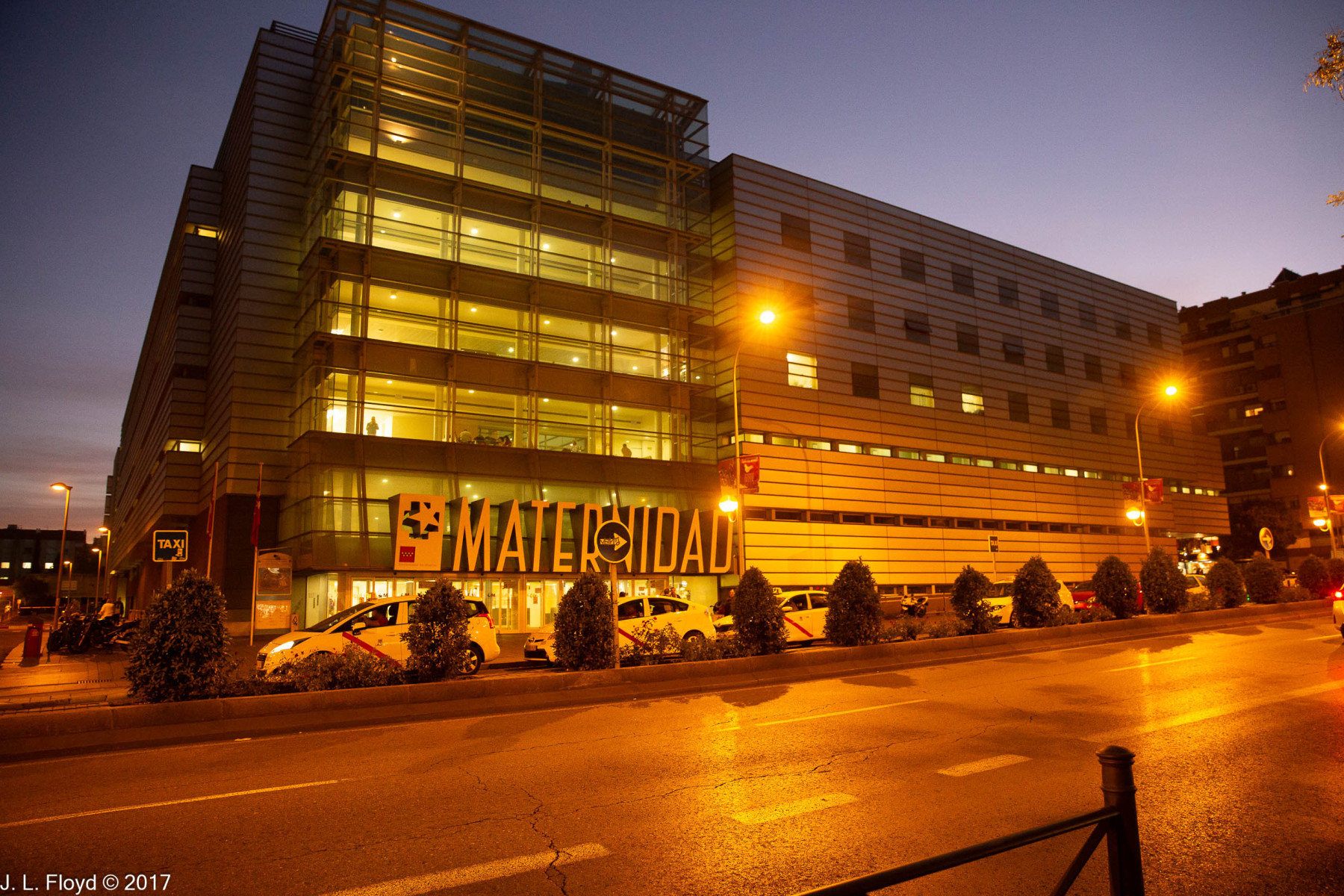
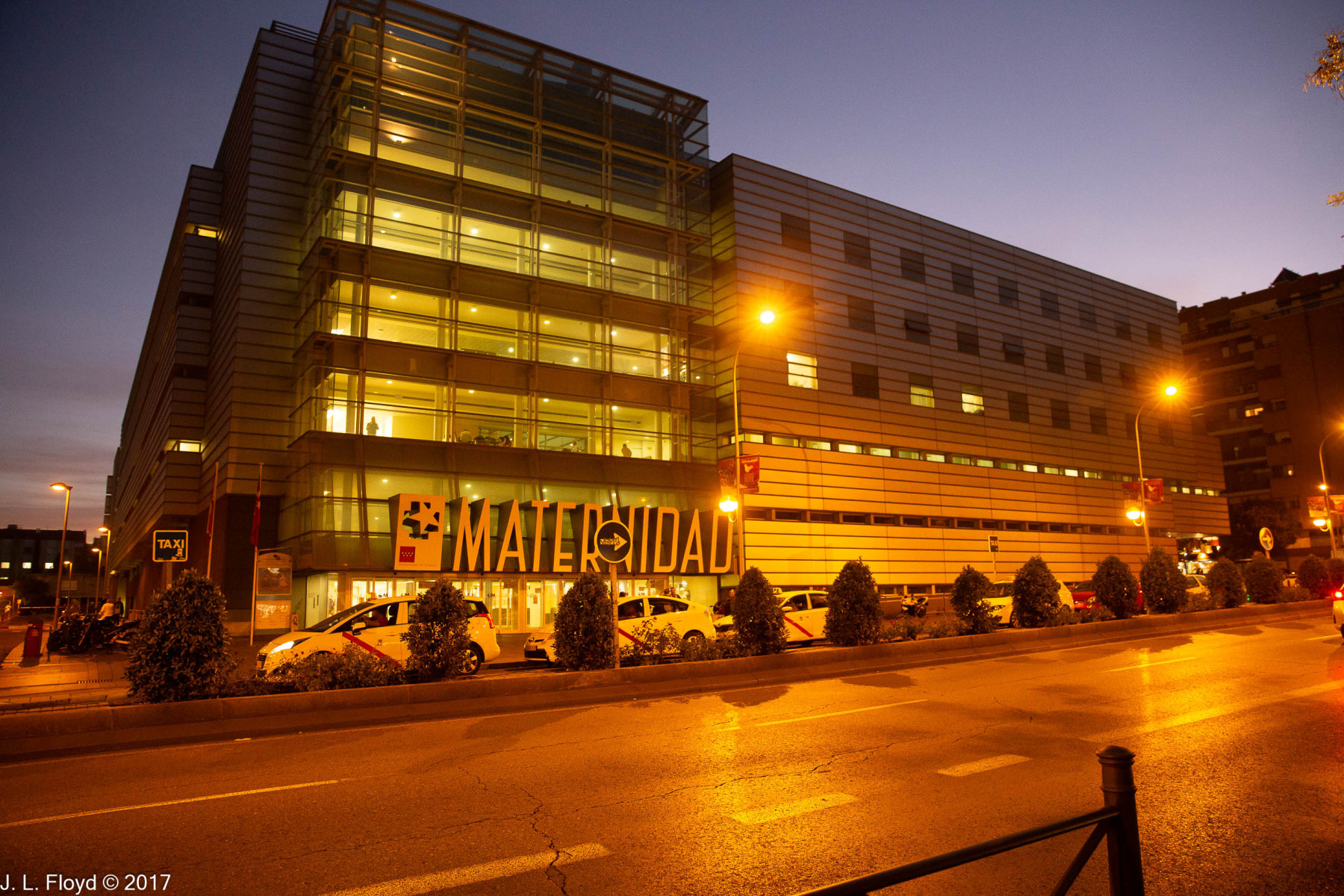
By the time I finished my picture-taking on the Plaza de Cibeles, night was falling, and I began to despair of finding my way back to the hotel on Calle O’Donnell in the dark. I dealt with this by summoning a taxi, which took me back to the hotel little faster than I could have walked the distance, had I known the way. Our Novotel lodging was located next to a maternity hospital, which appears in the photo below.
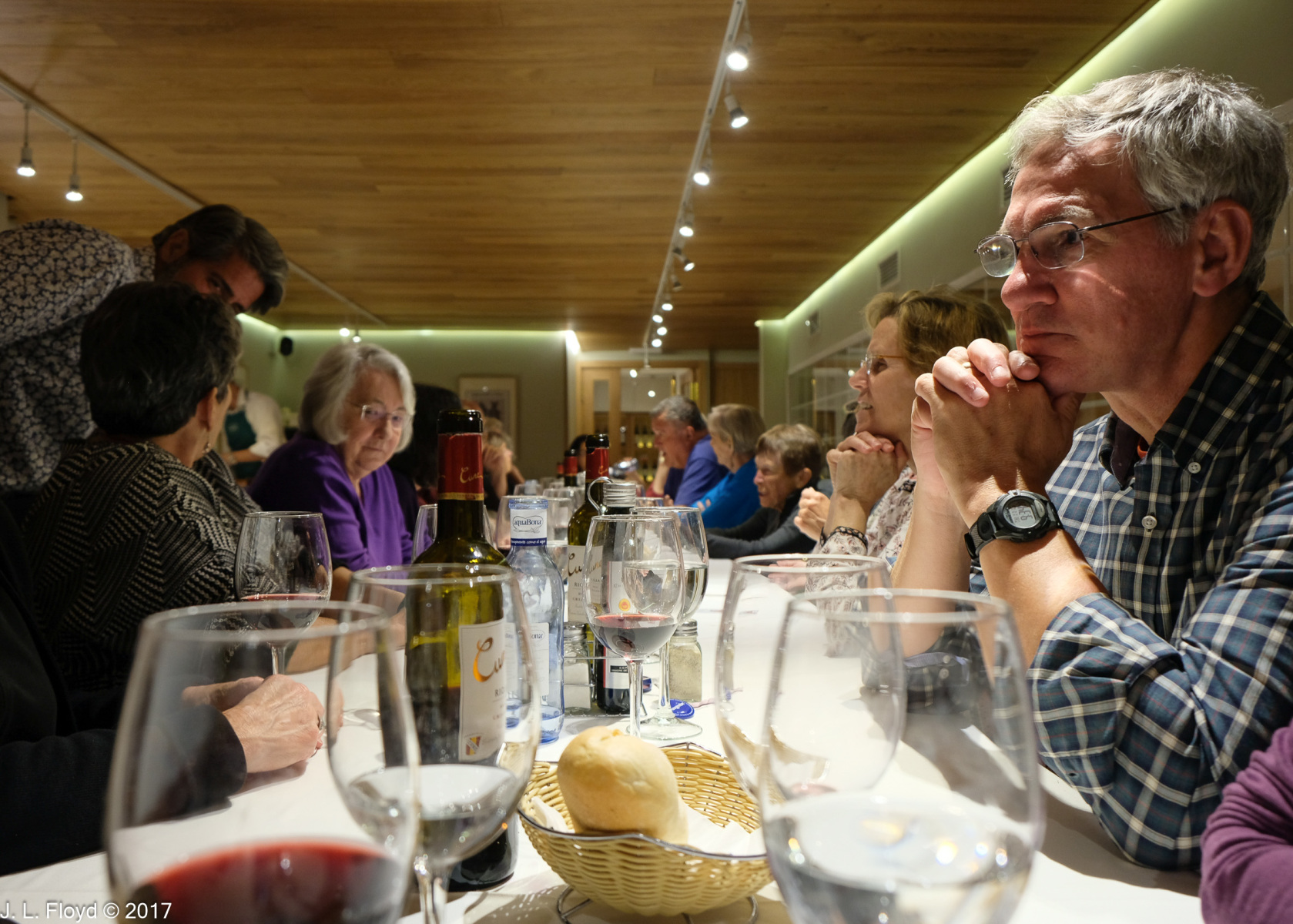
I arrived back at the hotel in time for dinner, which was not to be missed, because it was also a grand-finale celebration of our tour. It was held in Madrid on the 17th because there were a number of people who were not taking the optional extensions to Toledo and Barcelona, and we needed to bid them farewell. Also, it gave us a chance to meet Manuel Sueiras’ family (wife, son and daughter). It proved a thoroughly gala and memorable occasion; the cuisine was delectable, the wine flowed freely, and a grand time was had by all.