Categories
Spain, Portugal and Morocco, November 2017

Toledo, November 18, 2017: Plaza Zocodover

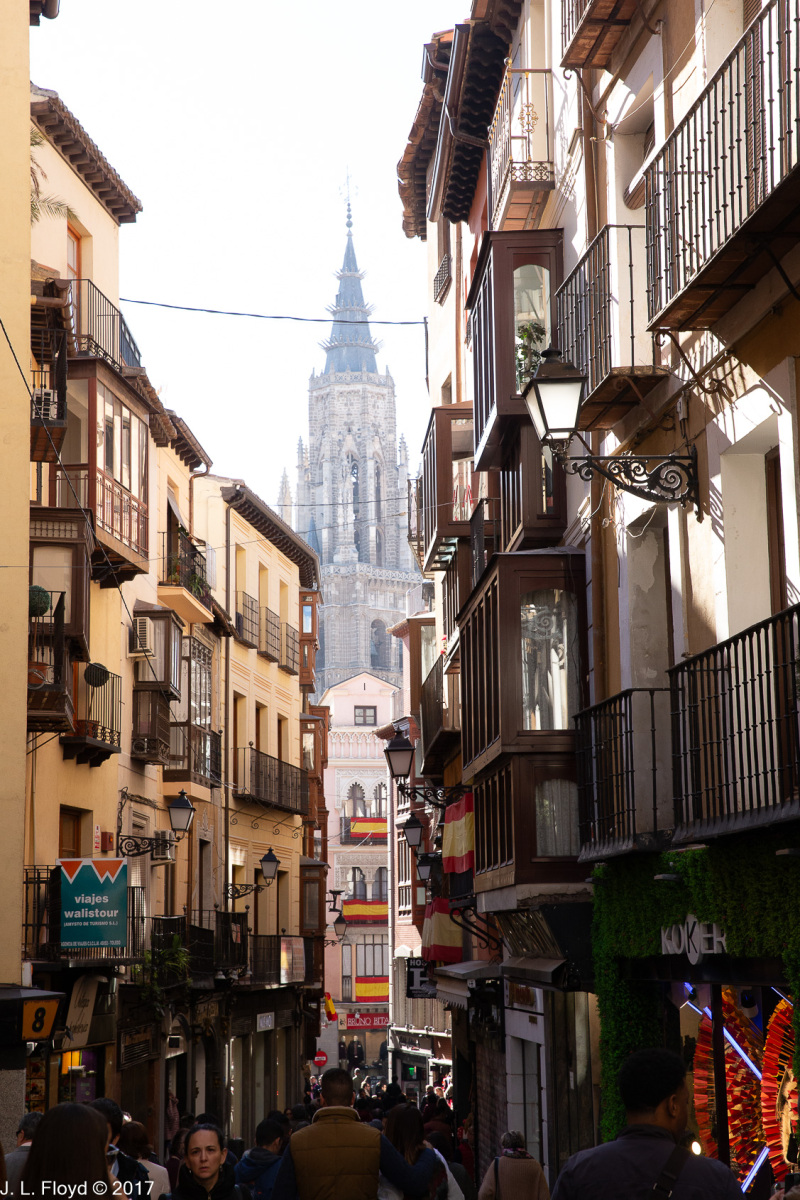
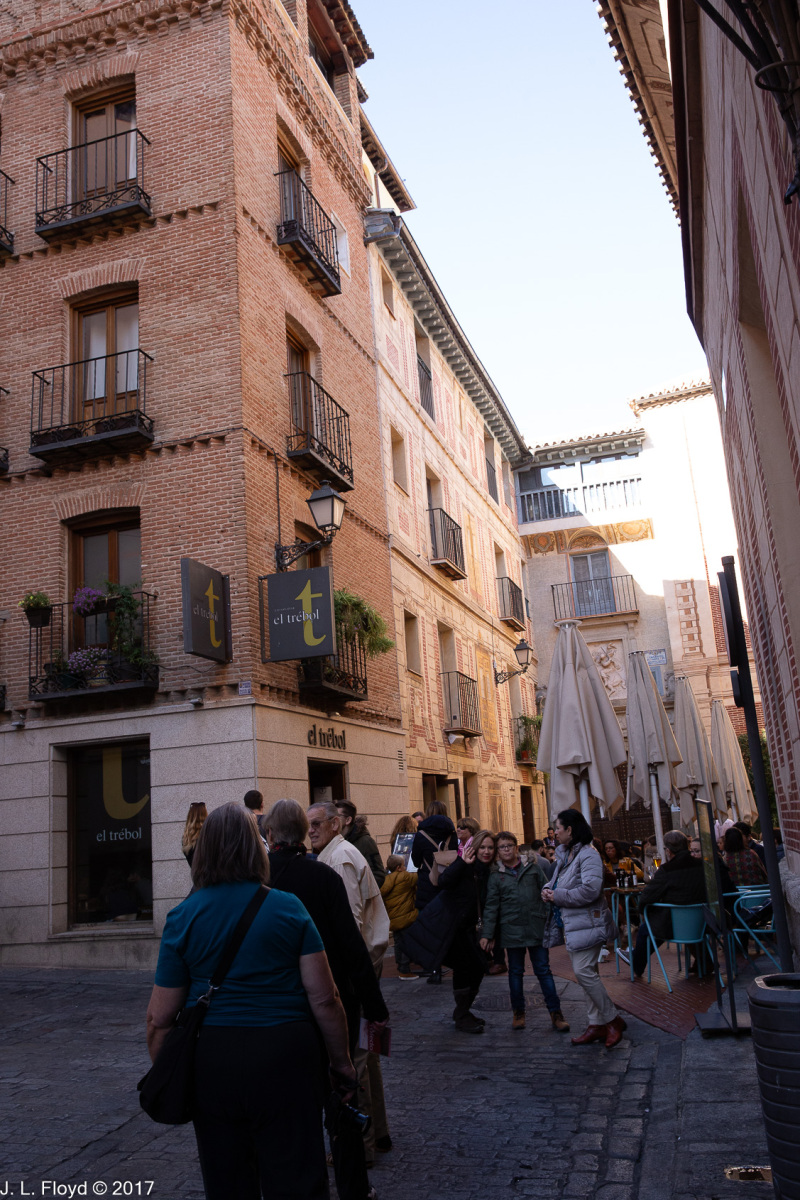
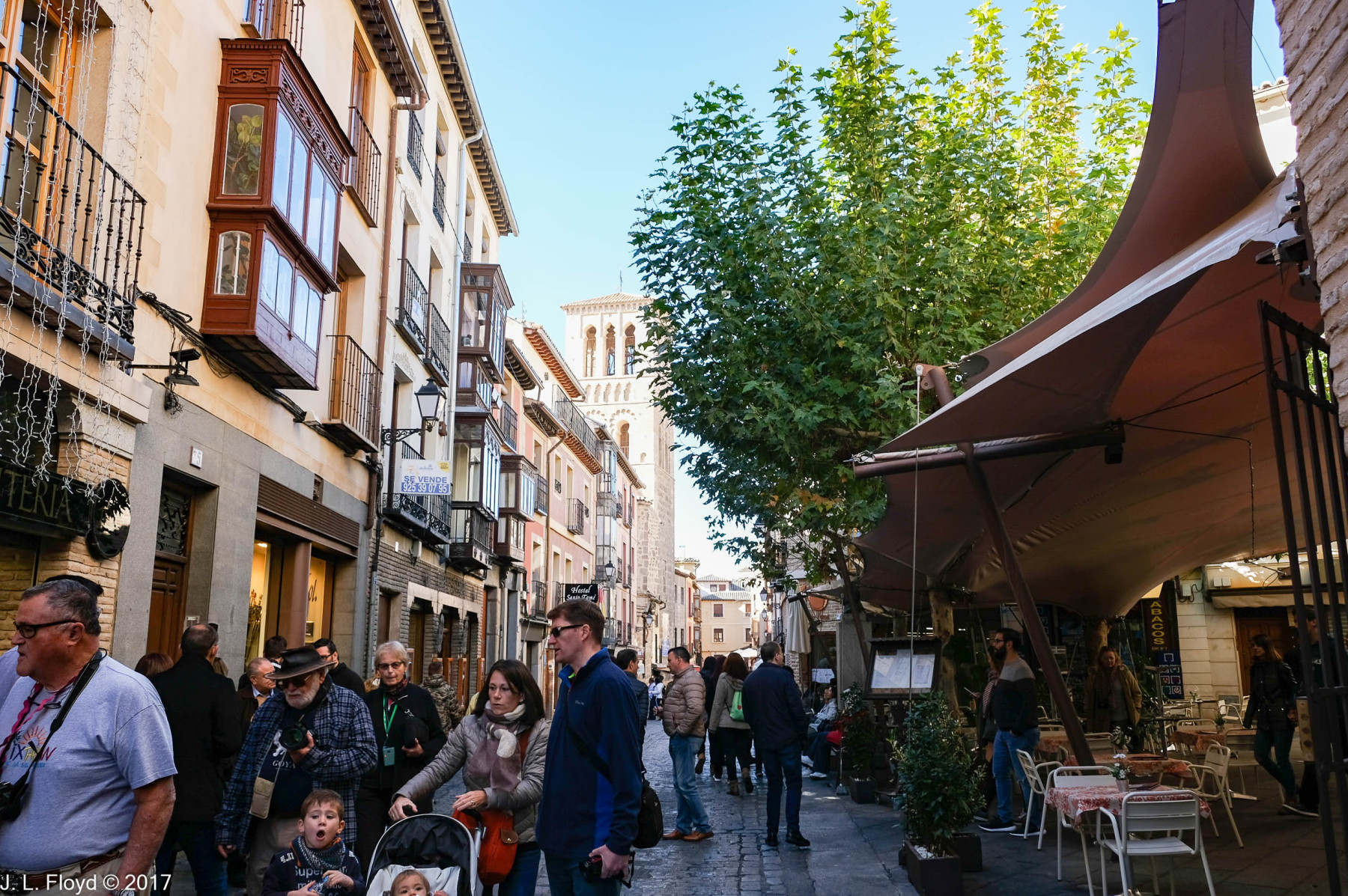
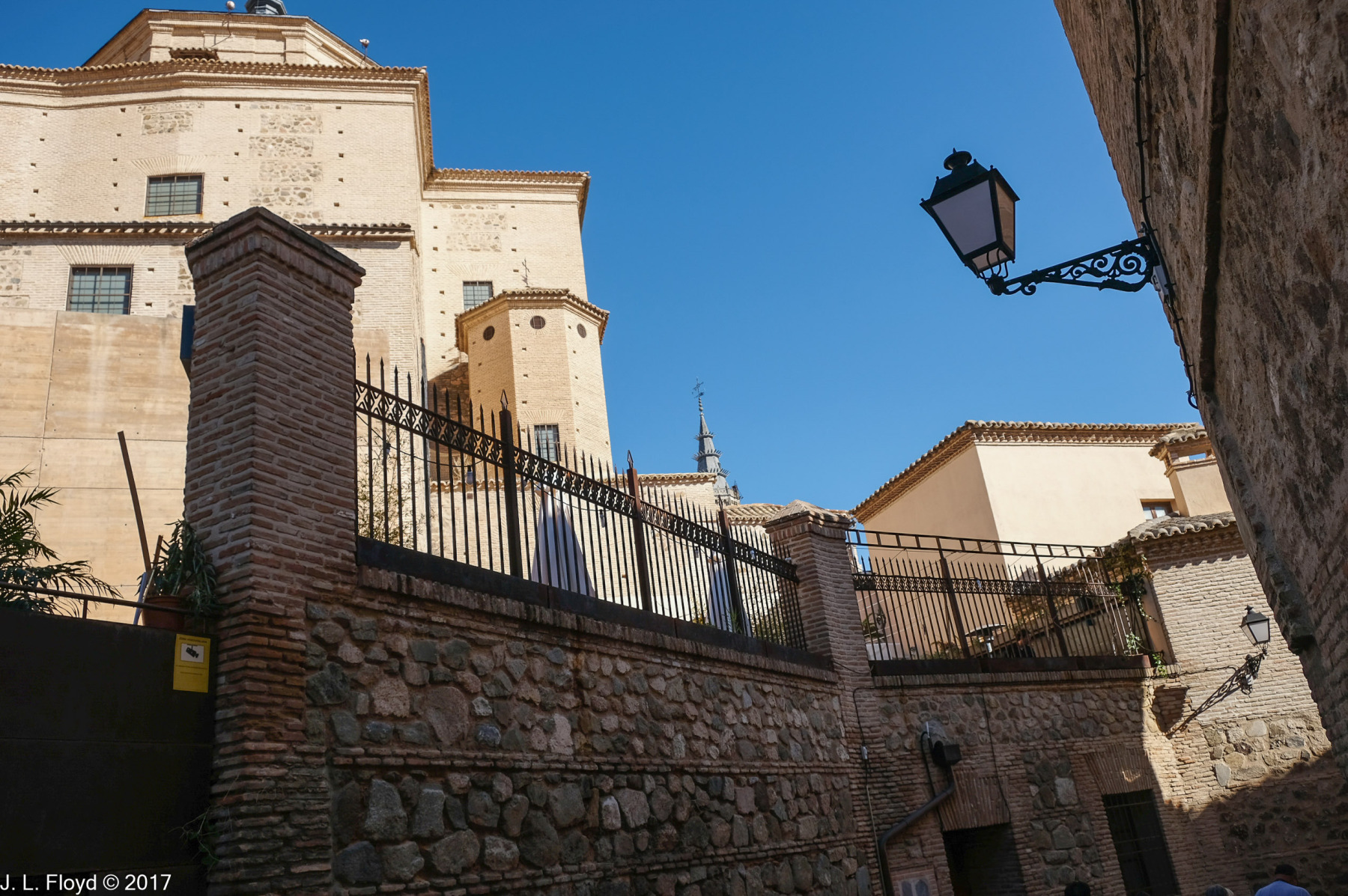
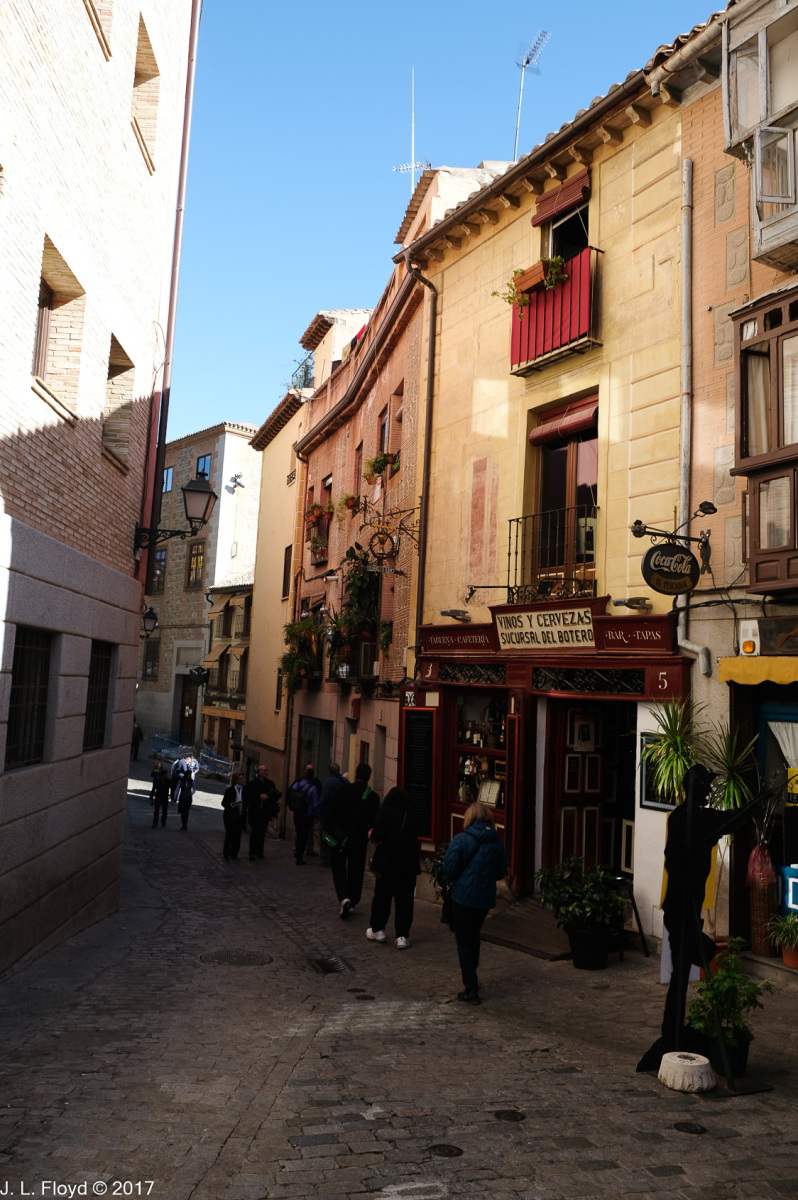
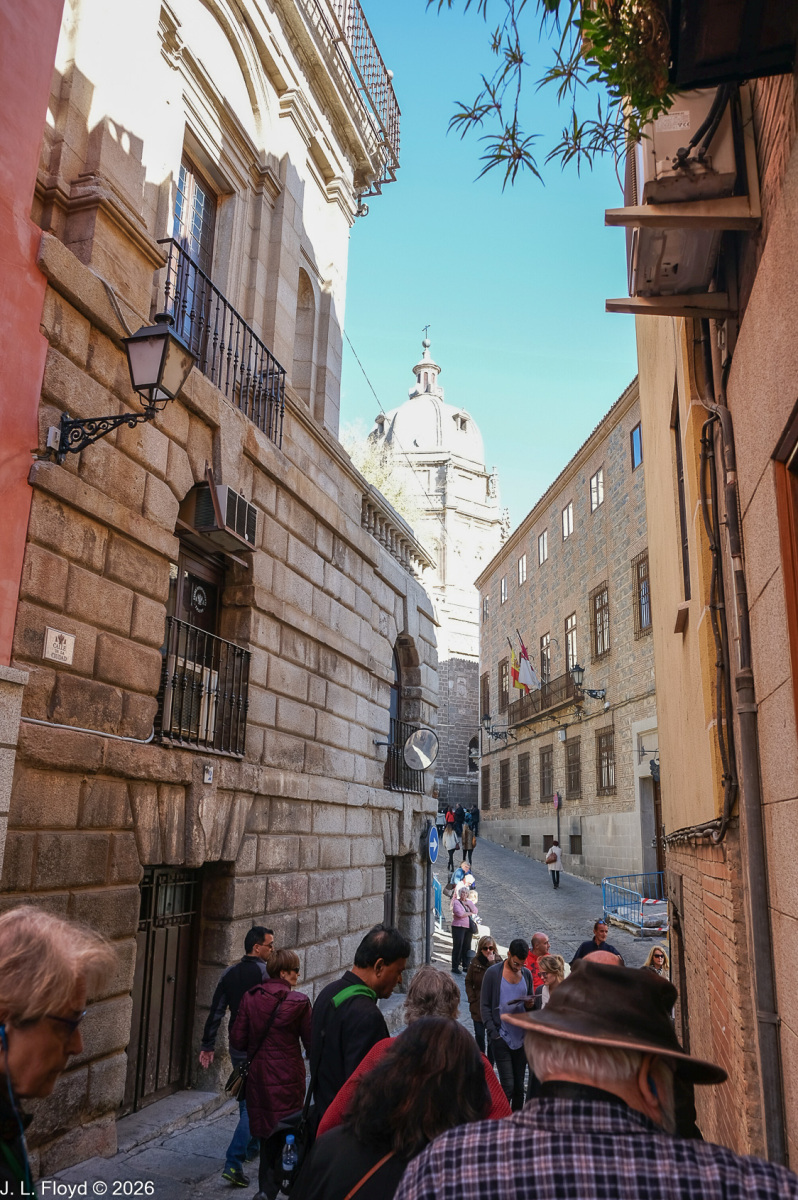
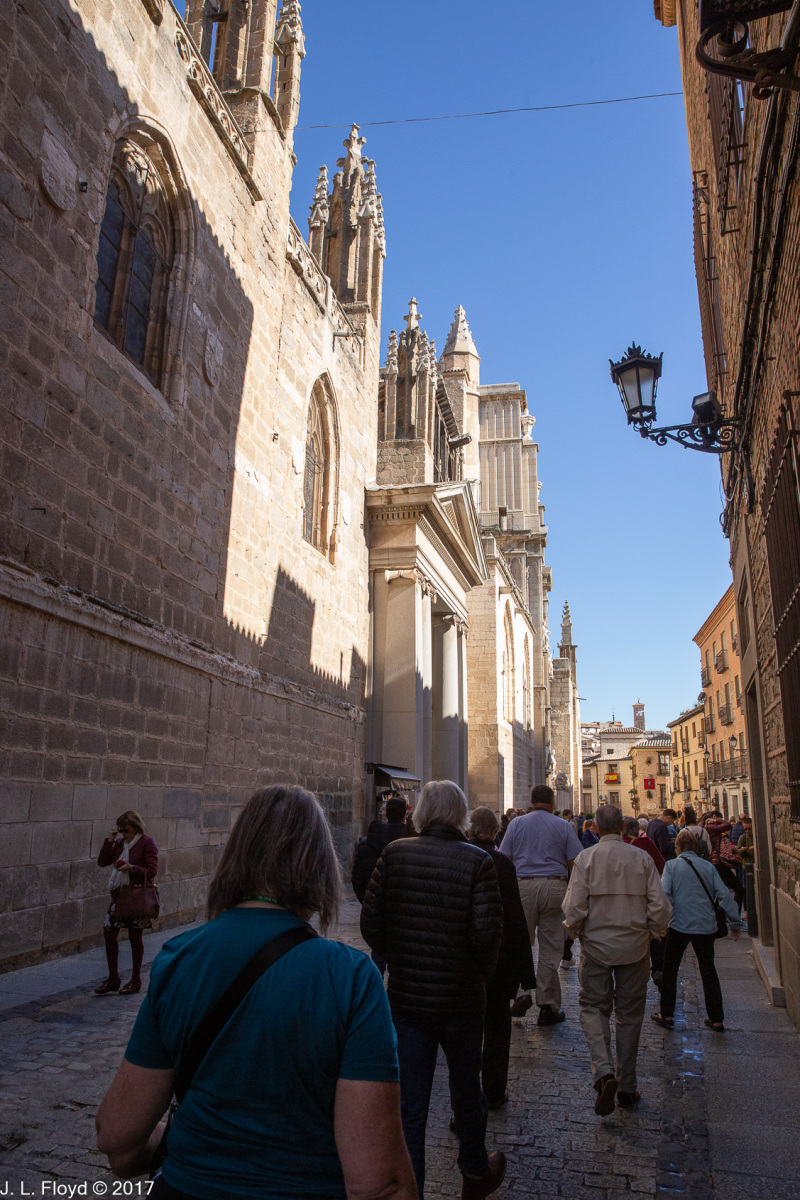
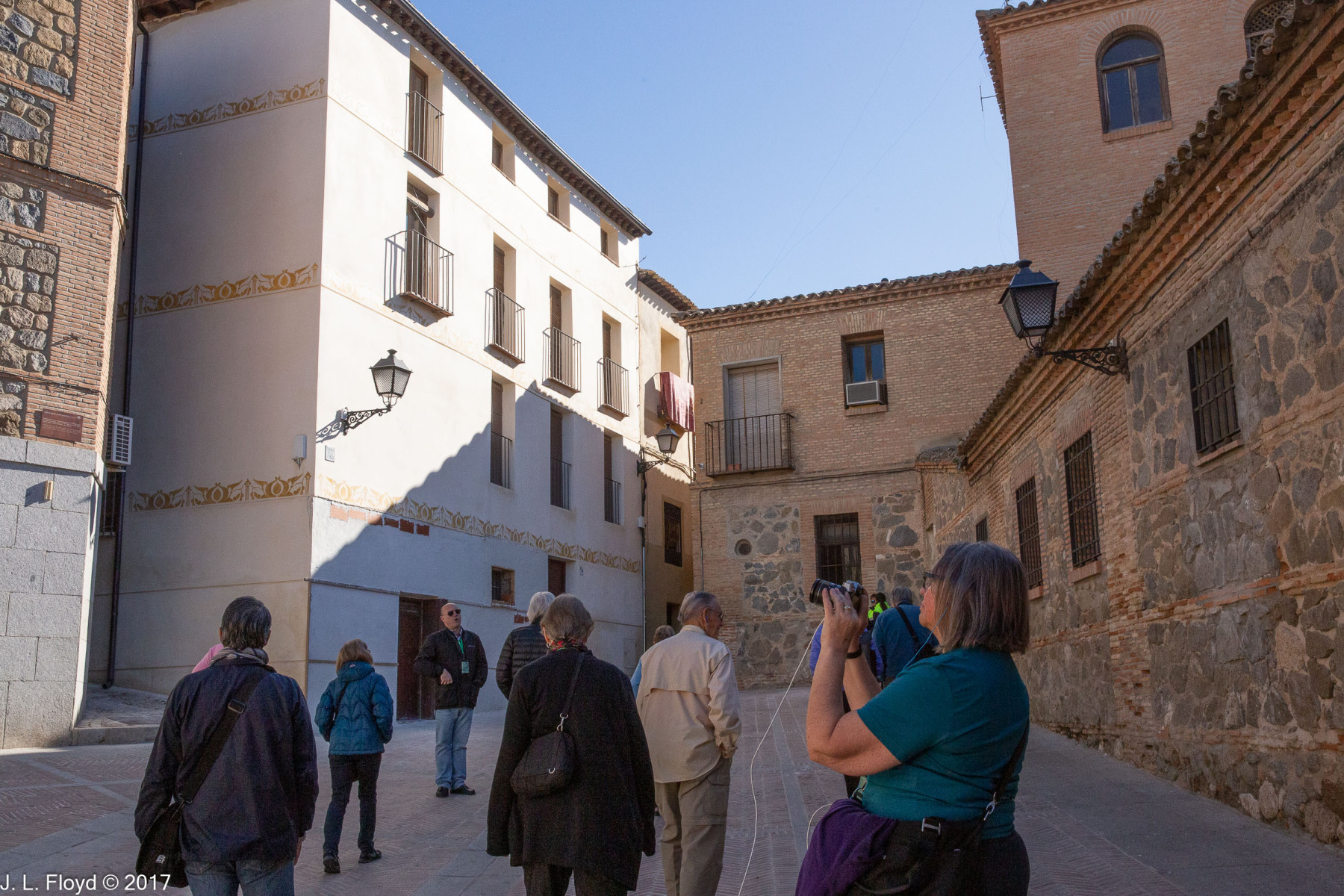
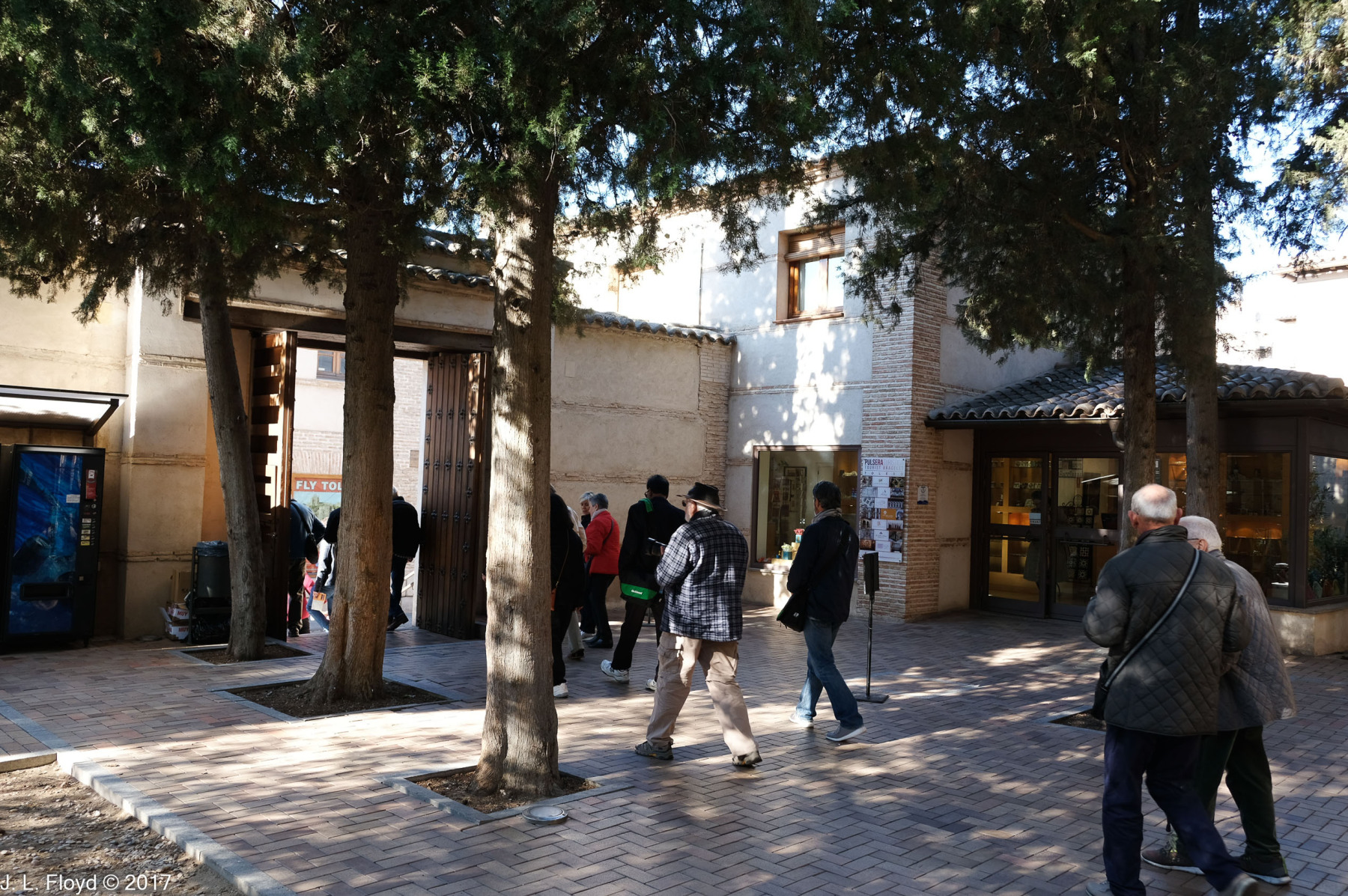
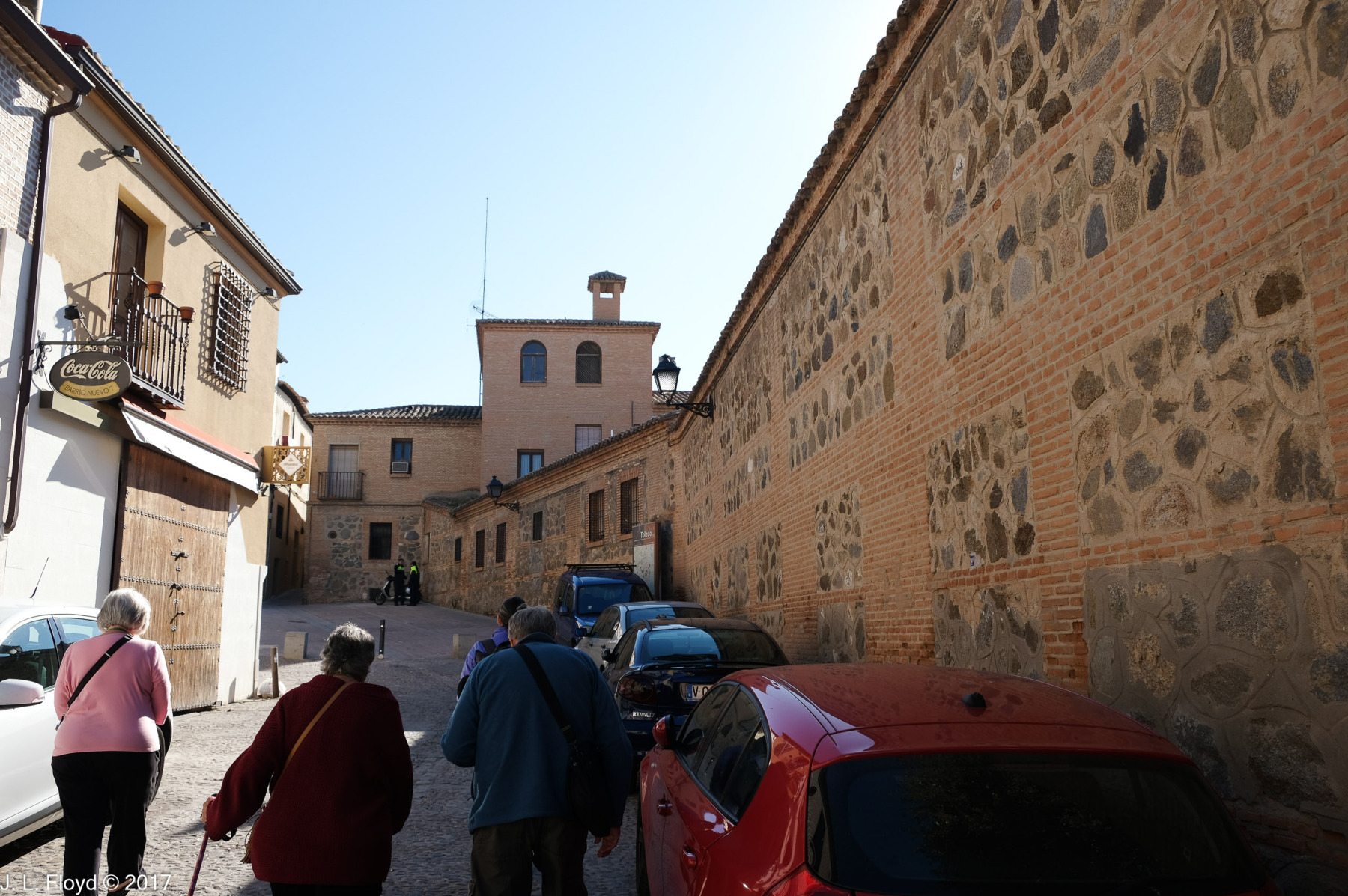
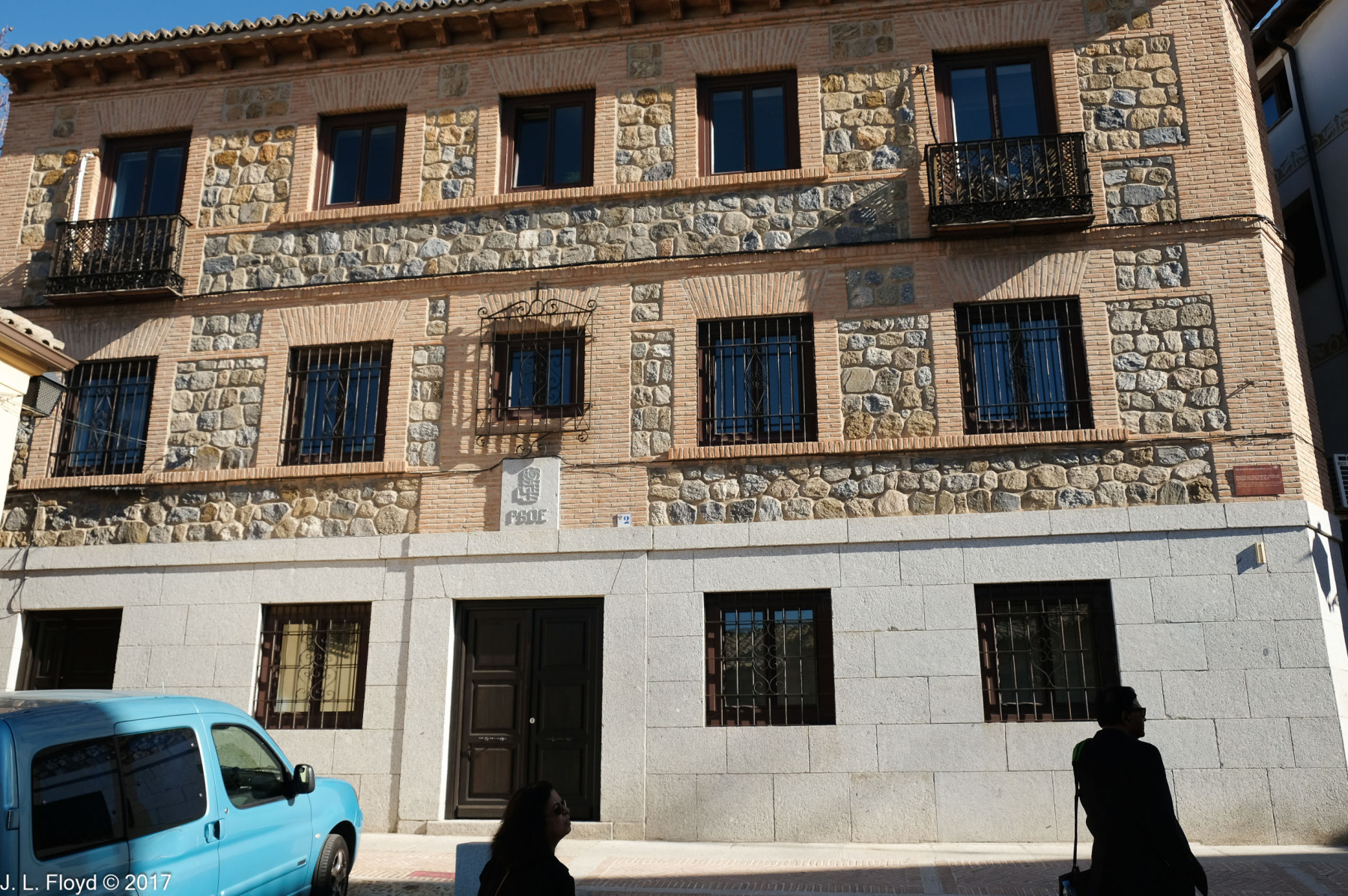
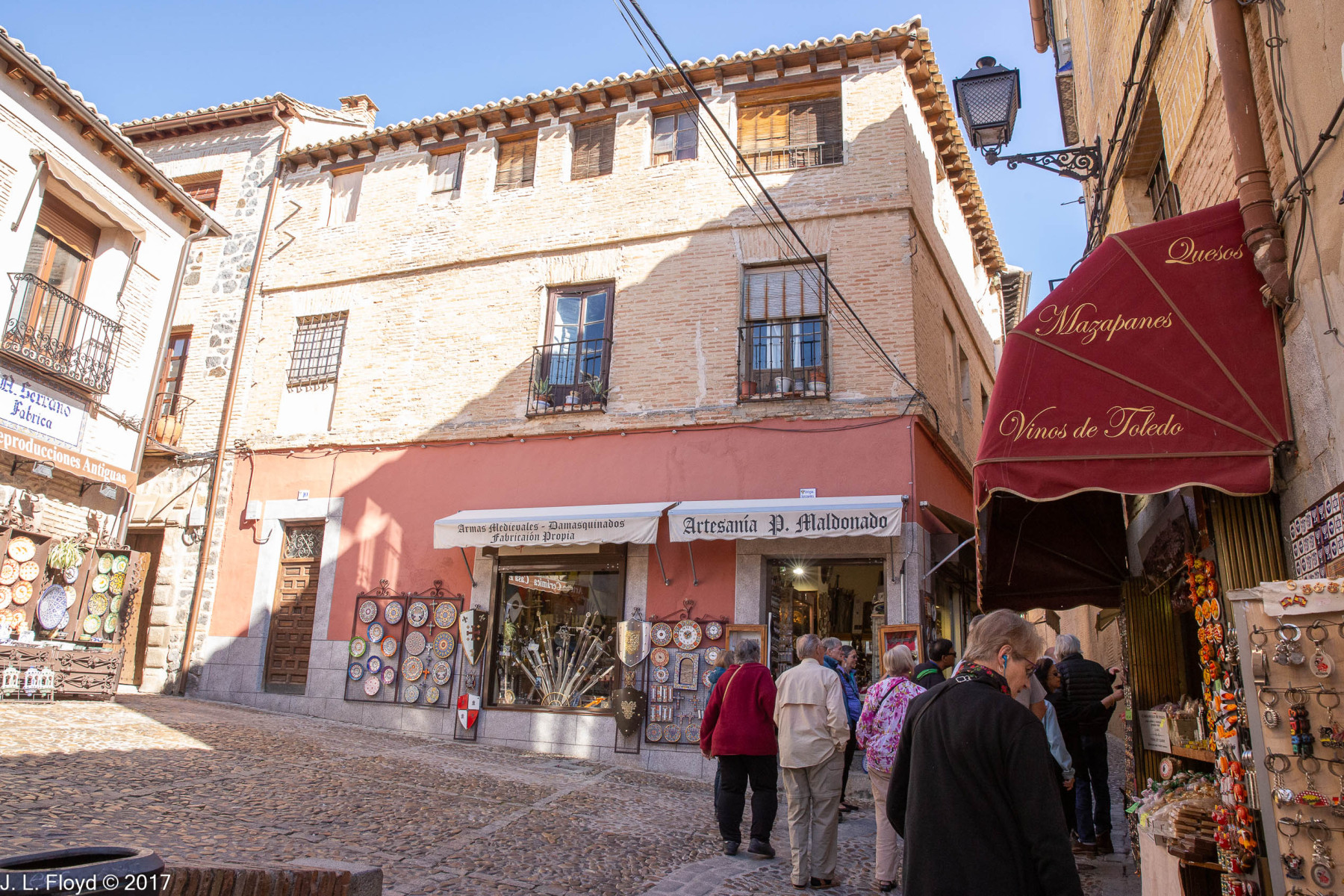
Leaving the Cathedral, we headed toward our last stop in Toledo, the Plaza de Zocodover. Our route led along the Calle del Comercio, a street which lived up to its name since it was lined with shops of all kinds. I paused now and then to look back and was able to shoot some nice pictures of the Cathedral with its spire framed in the narrow opening between the two sides of the street.

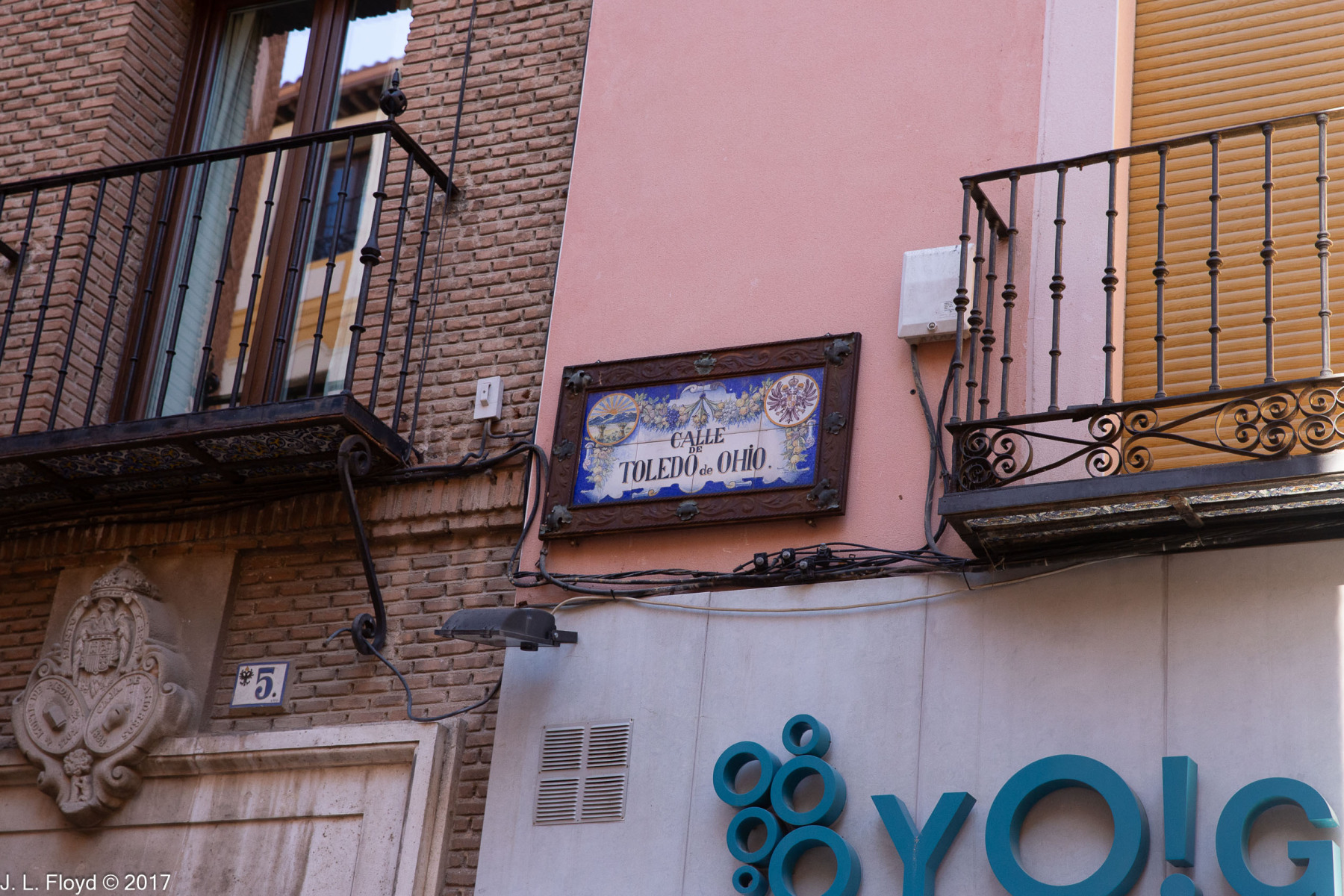
Drawing near to the Plaza de Zocodover, we came to a street with the improbable name of Calle Toledo de Ohio. I am quite certain that this was not the original name of the street, and was probably not its name much earlier than the twentieth century, but I never found out how the American city of Toledo – which took the name in 1833, for reasons unknown – came to be represented in the heart of its medieval ancestor.

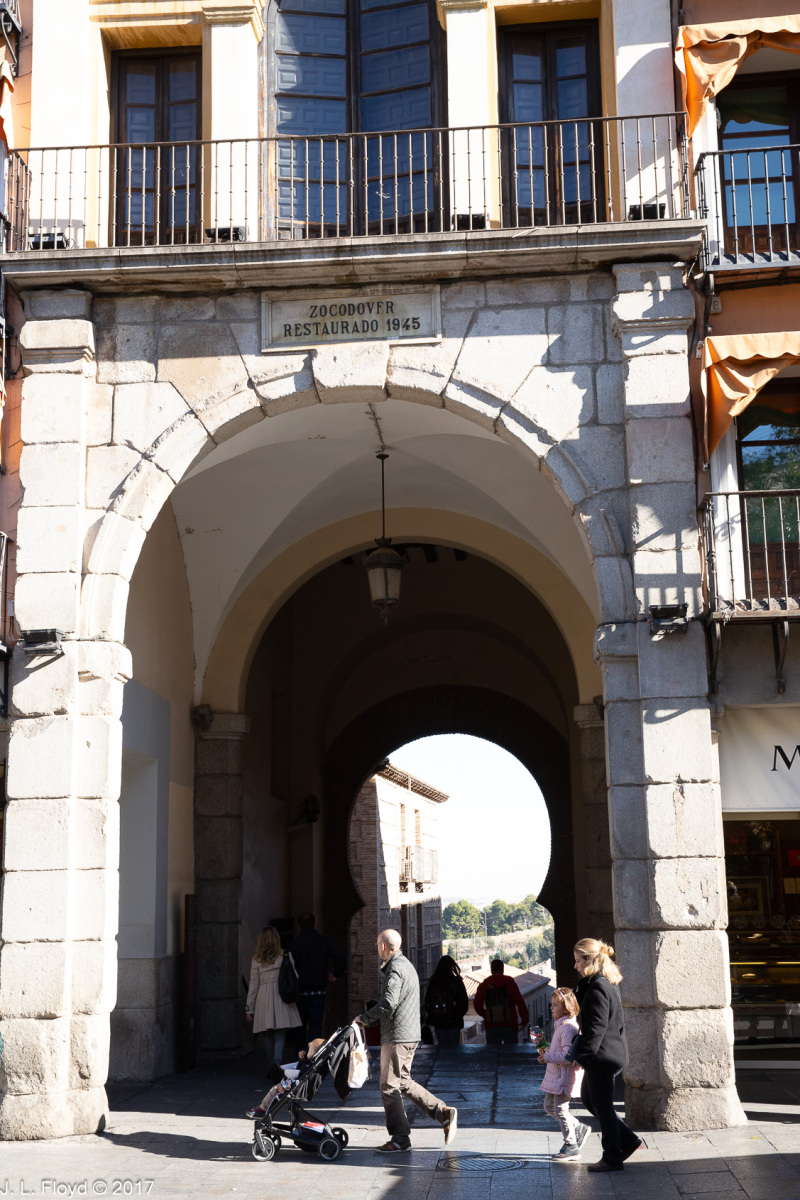
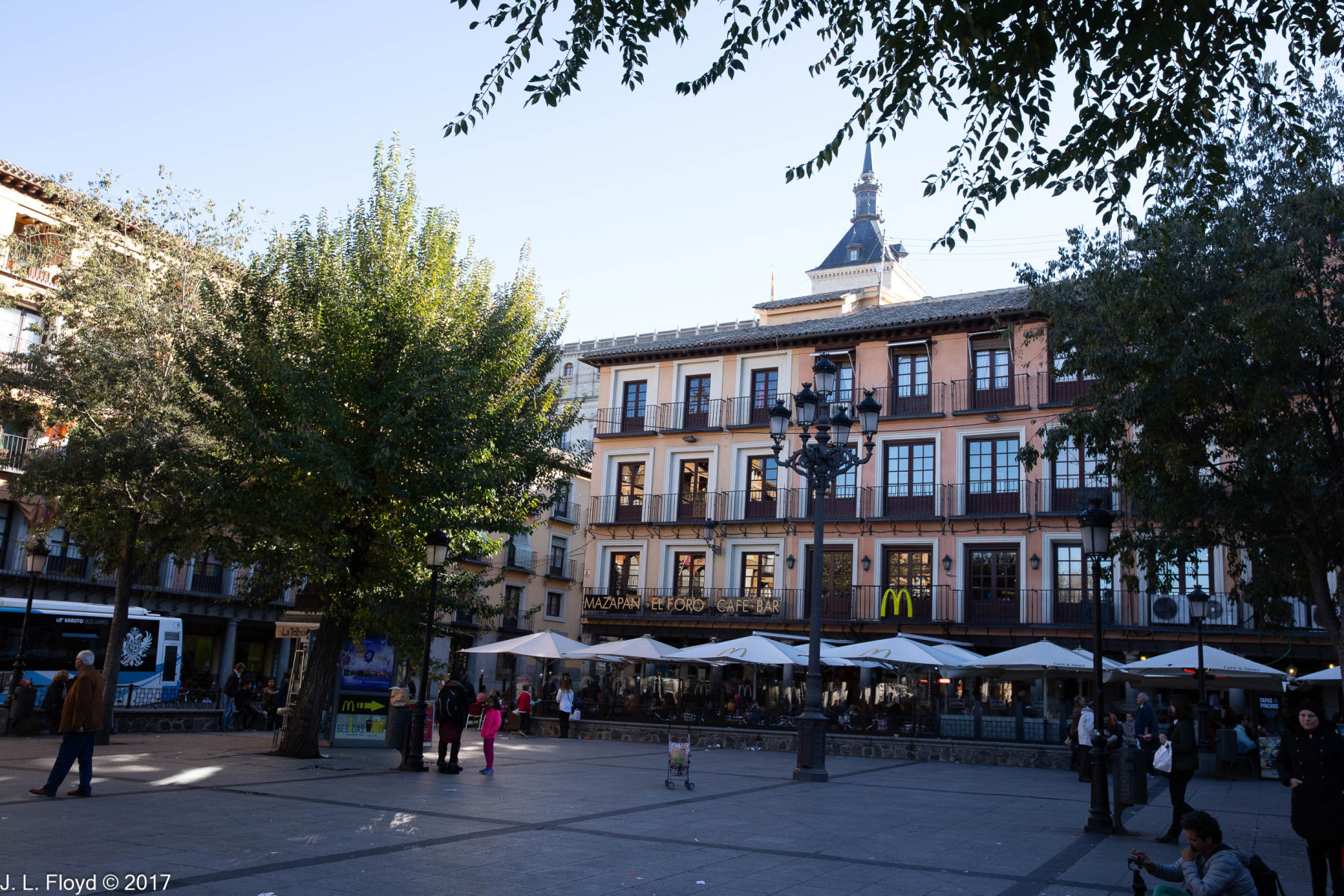
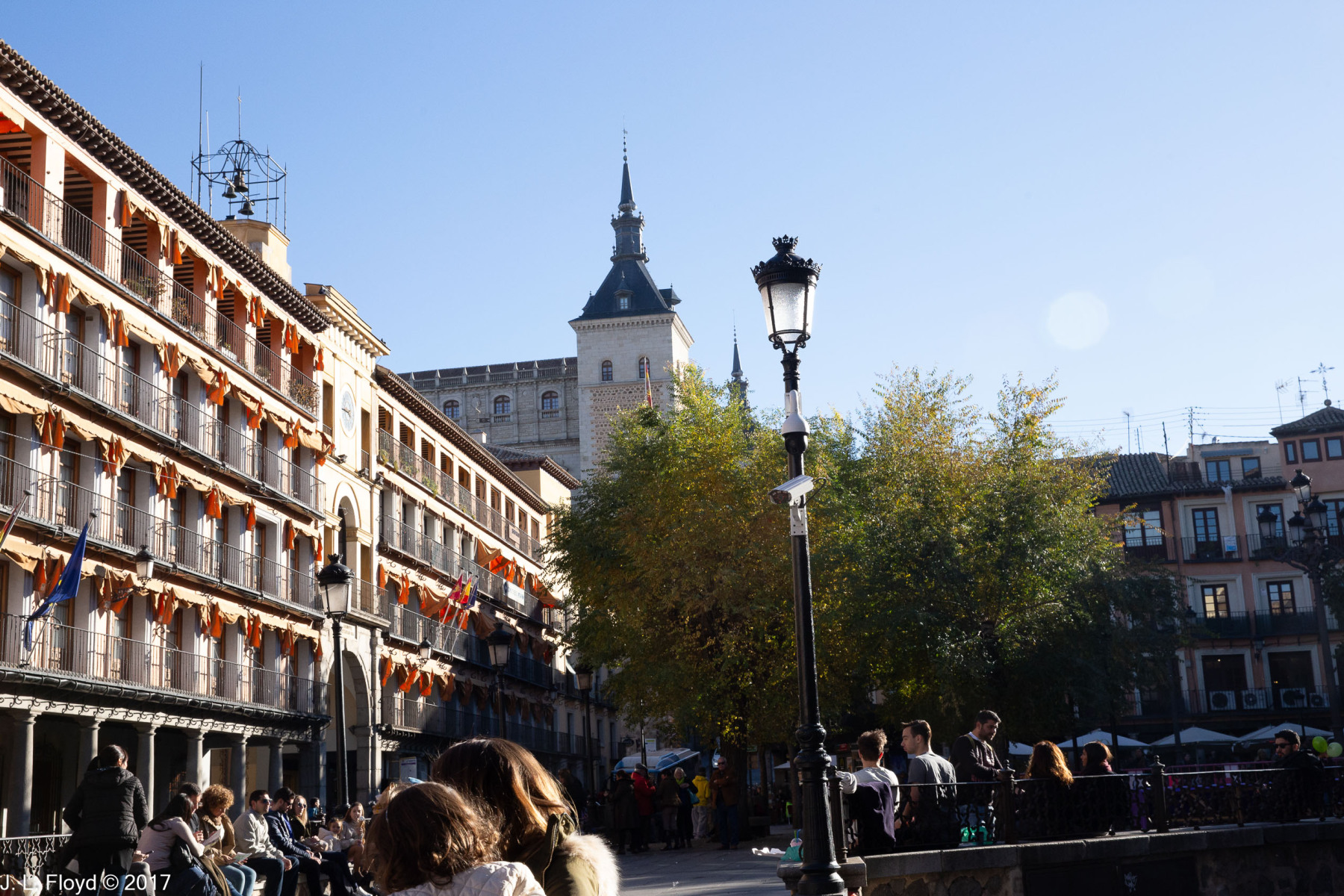
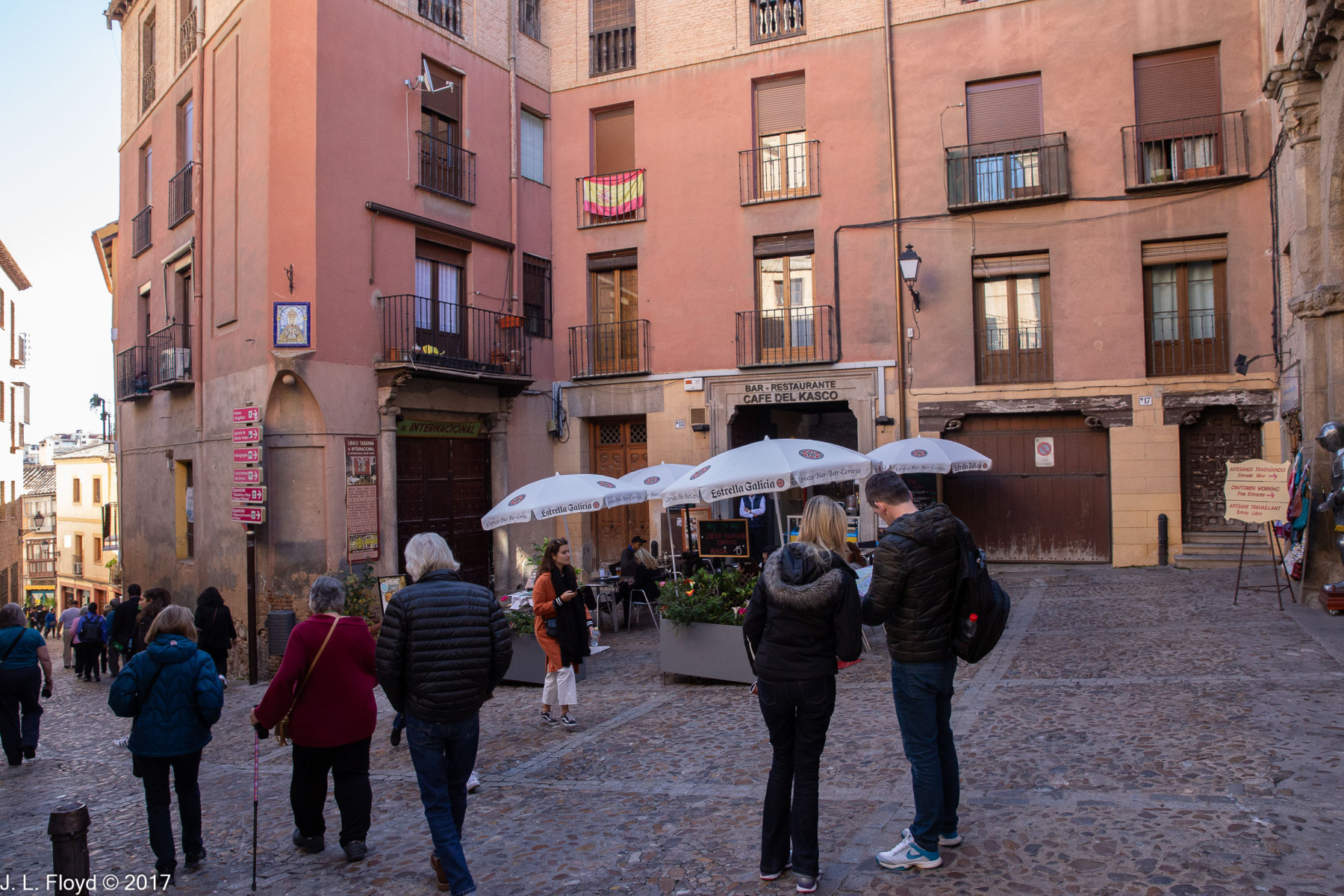
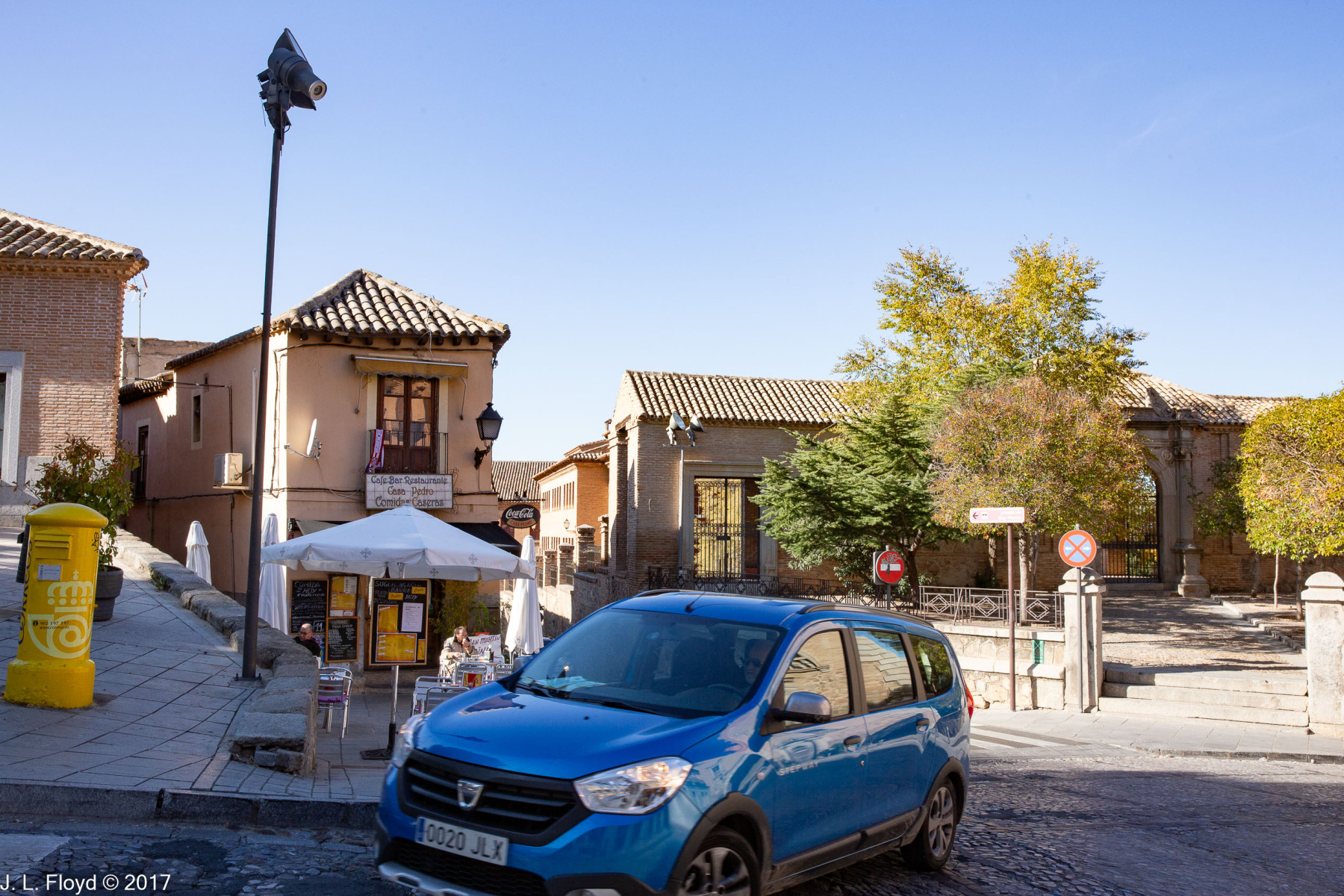
Finally we came to the Plaza de Zocodover, which for most of Toledo’s history has been its main square. The name is Arabic in origin, a corruption of sūq ad-dawābb, “market of burden beasts.” The square was not only the hub of the city’s social life, but also the place where public executions and autos-da-fé were held.

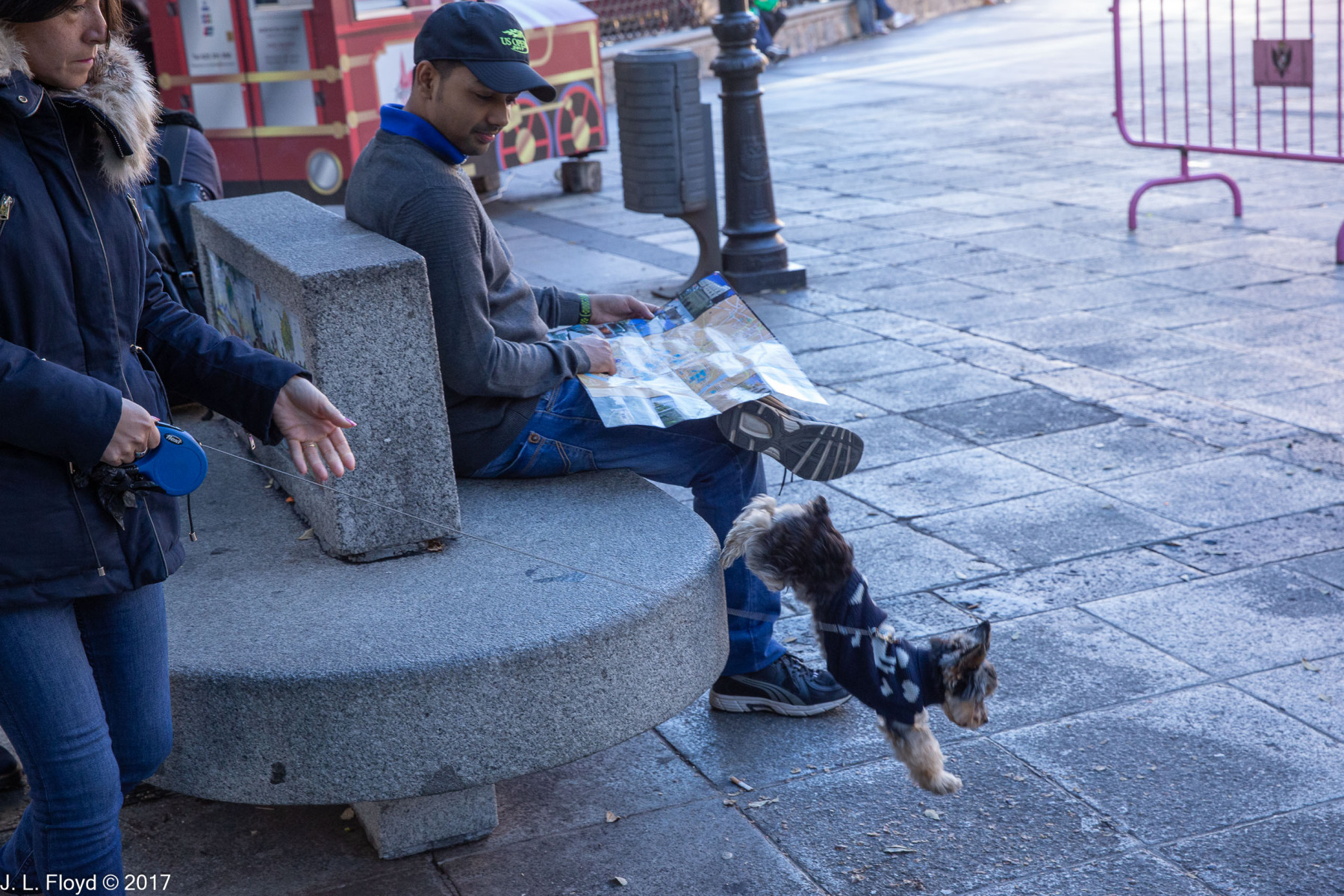
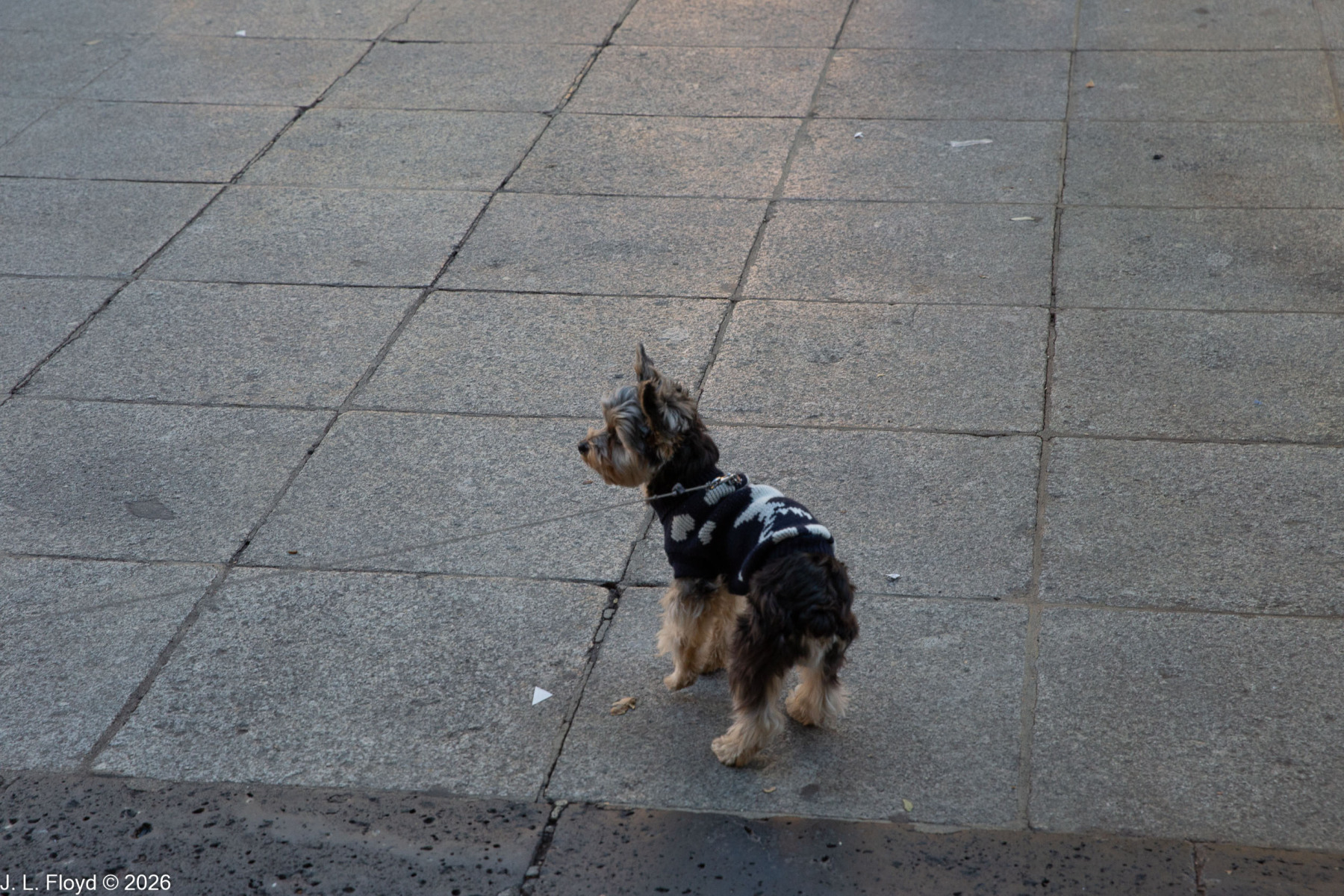
An encounter with a woman walking a small and very lively terrier reminded me of a story by Anton Chekhov, “Lady with a Dog,” (Дама с собачкой), written in 1899. However, I had no reason to think that the woman in Toledo had anything in common with the one in the story, and in any case the dog was the more captivating of the pair.

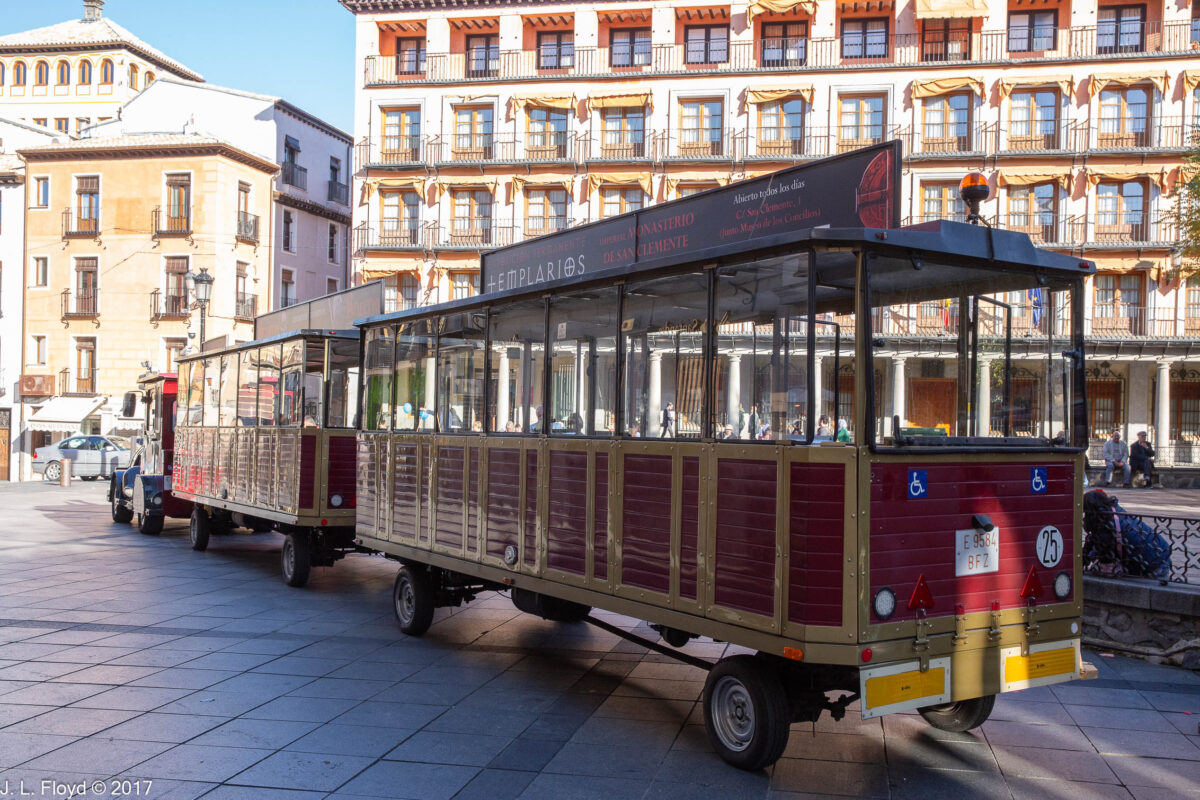
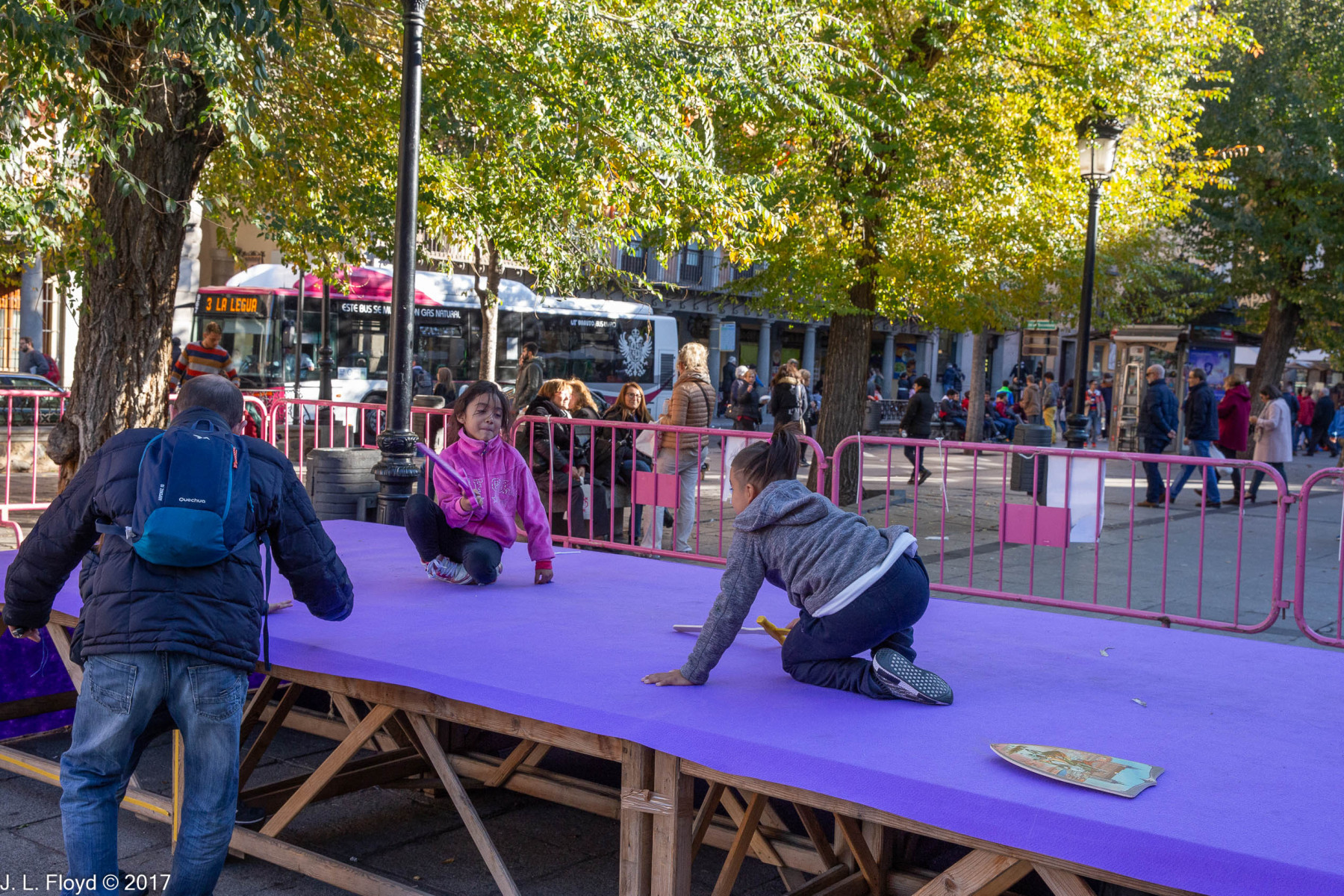
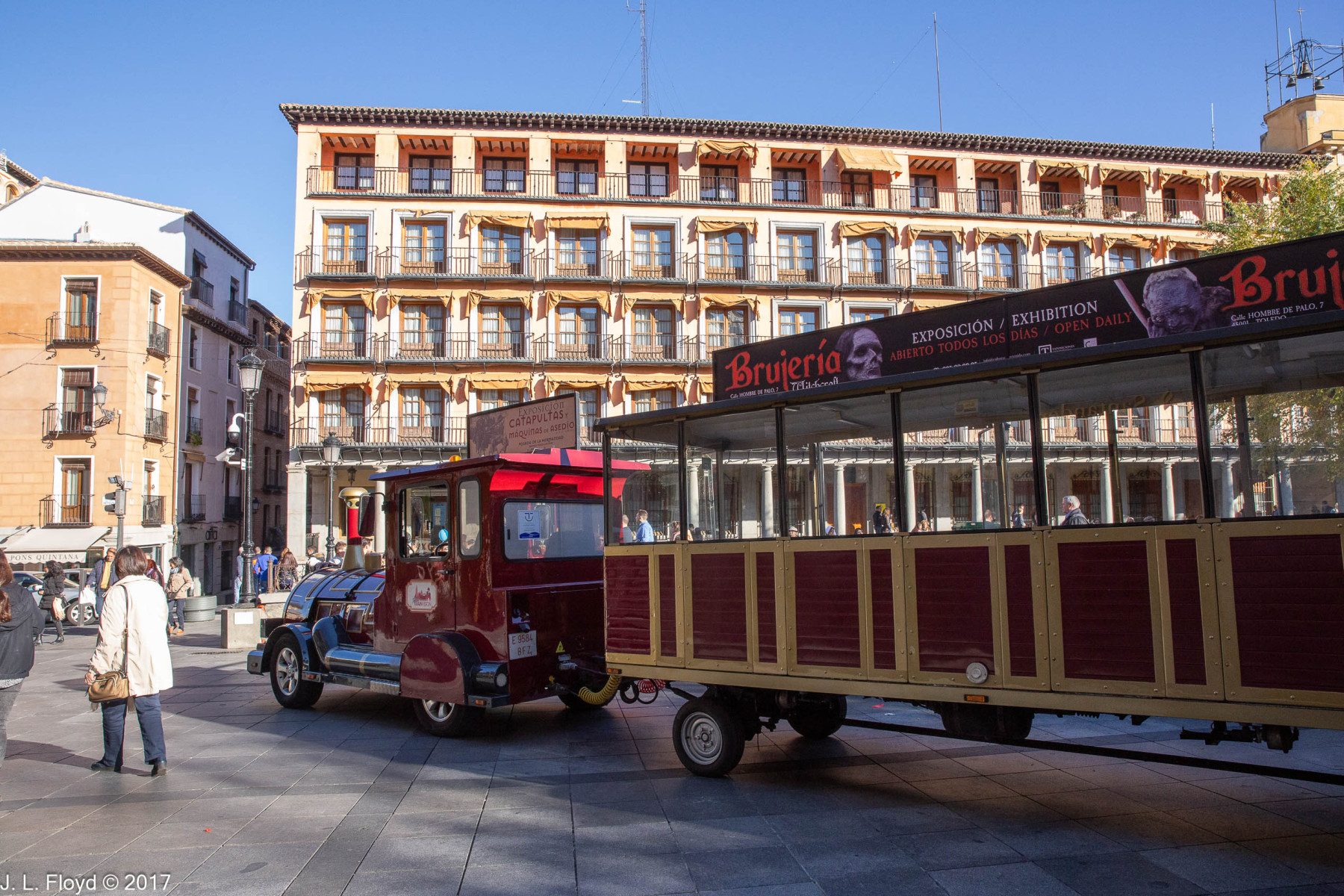
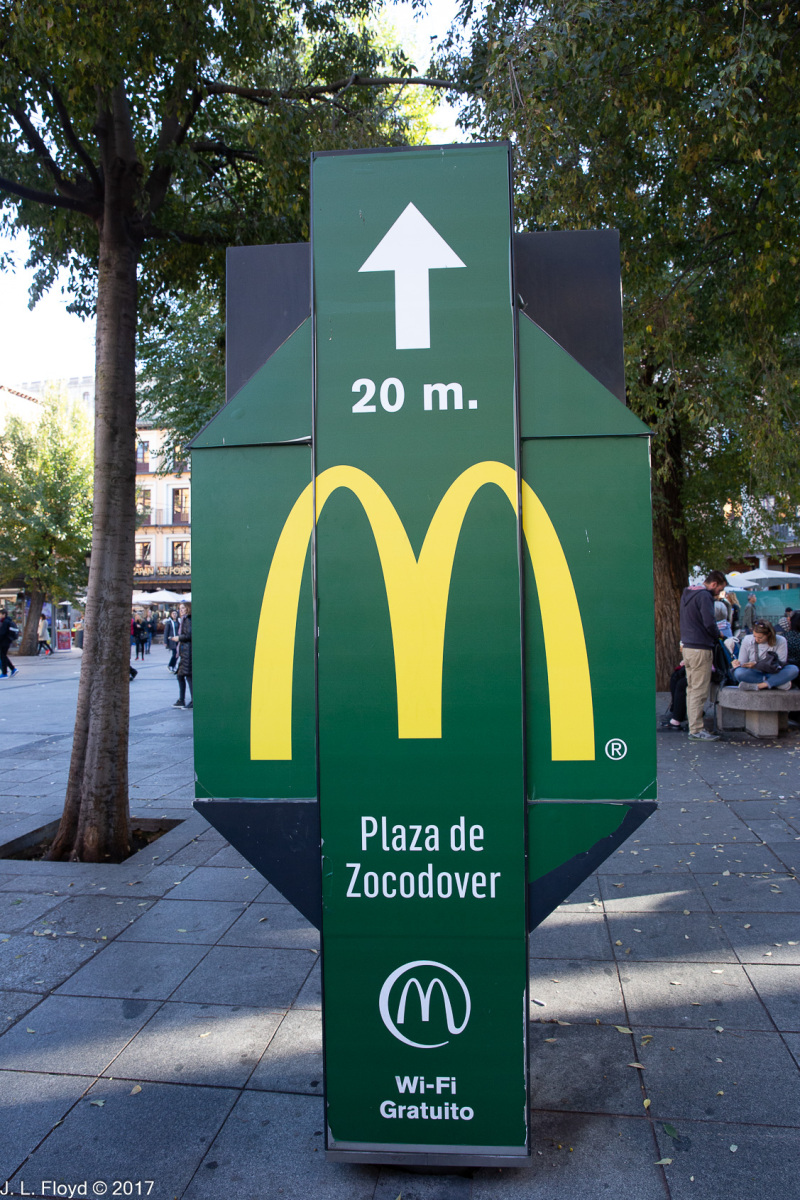
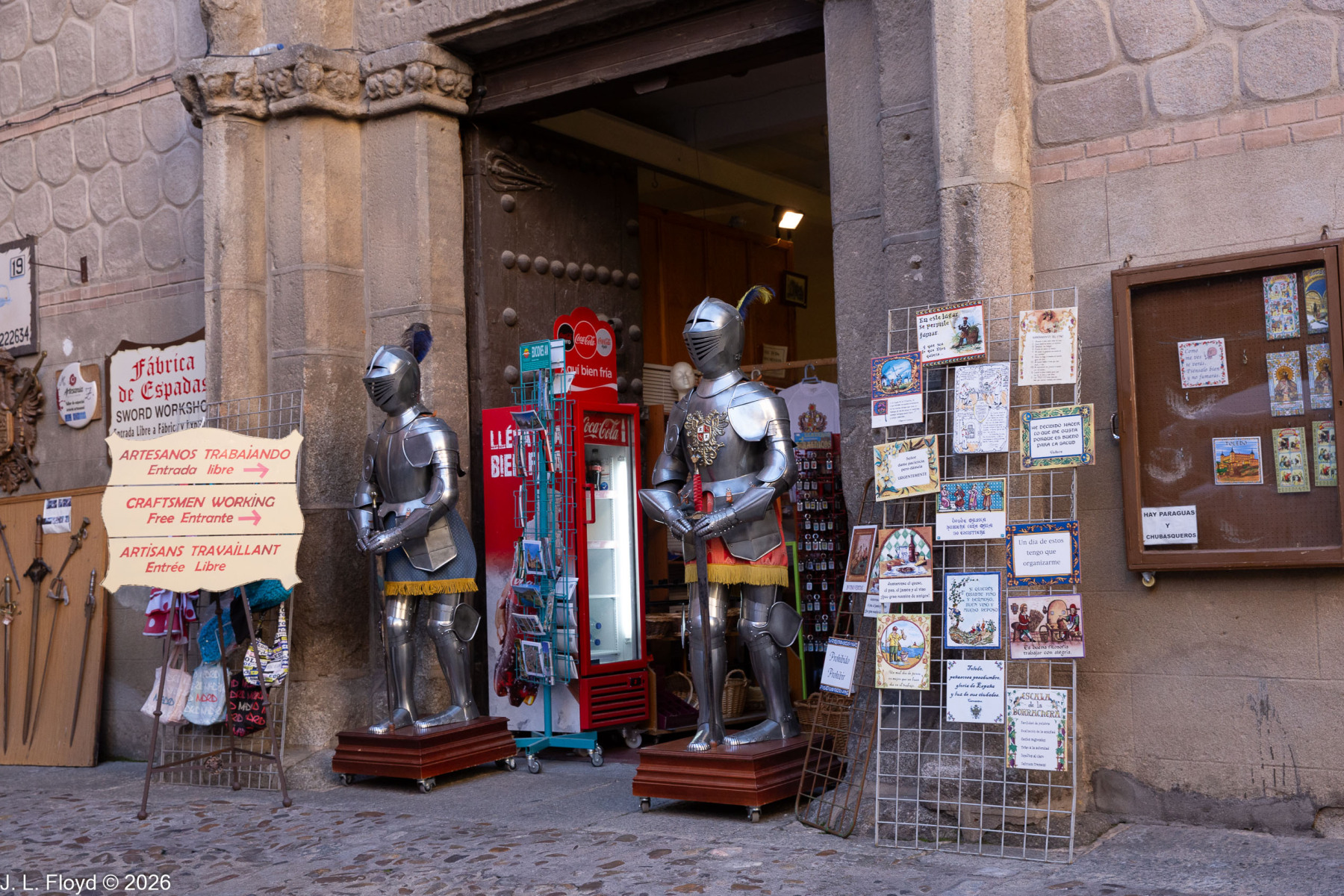
Nowadays the Plaza de Zocodover is overrun with tourists like us. The square is the departure point for many sightseeing tours, such as those conducted in trams like the one I drove during summer work in the Disneyland parking lot many years ago. But many local residents also come to the Plaza de Zocodover to hang out on the numerous benches and enjoy the ambience, which unfortunately is diluted by the presence of very un-Toledoish fast-food outlets like McDonald’s and Burger King. However, there are plenty of cafés and bars with local flavor to enjoy, and we had lunch in one such establishment.

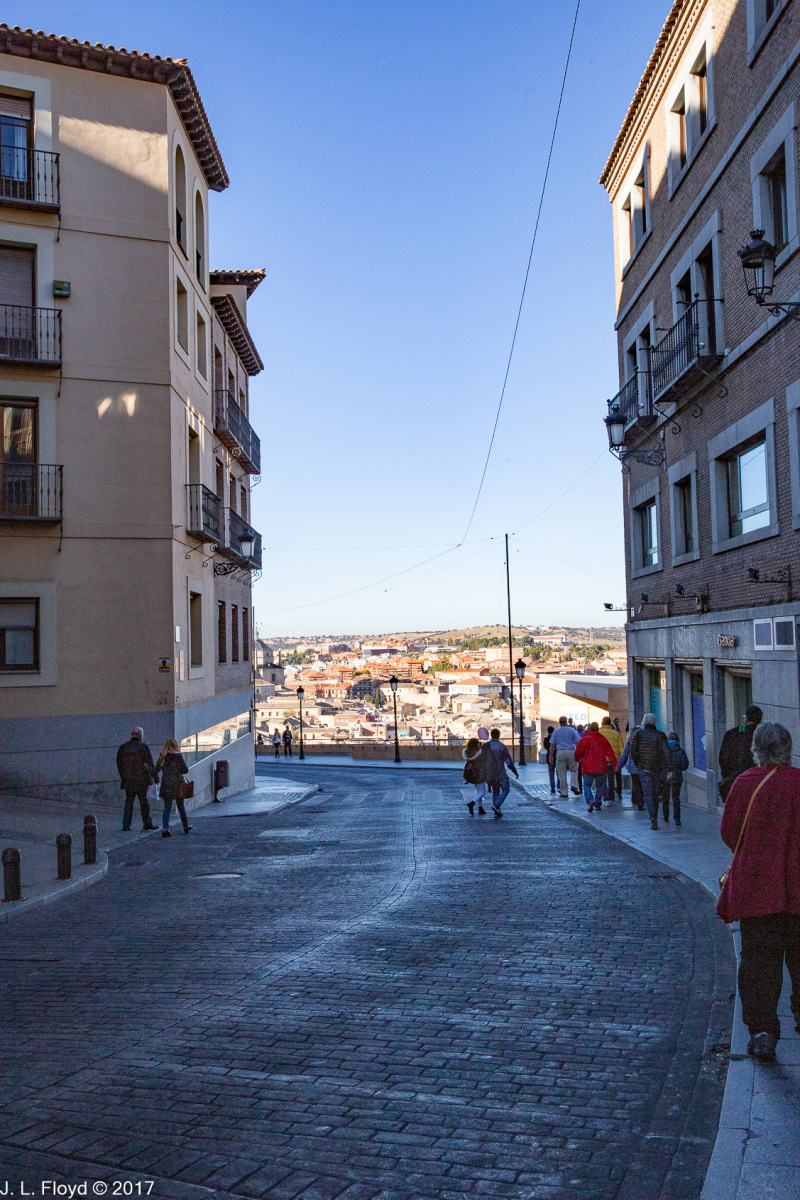
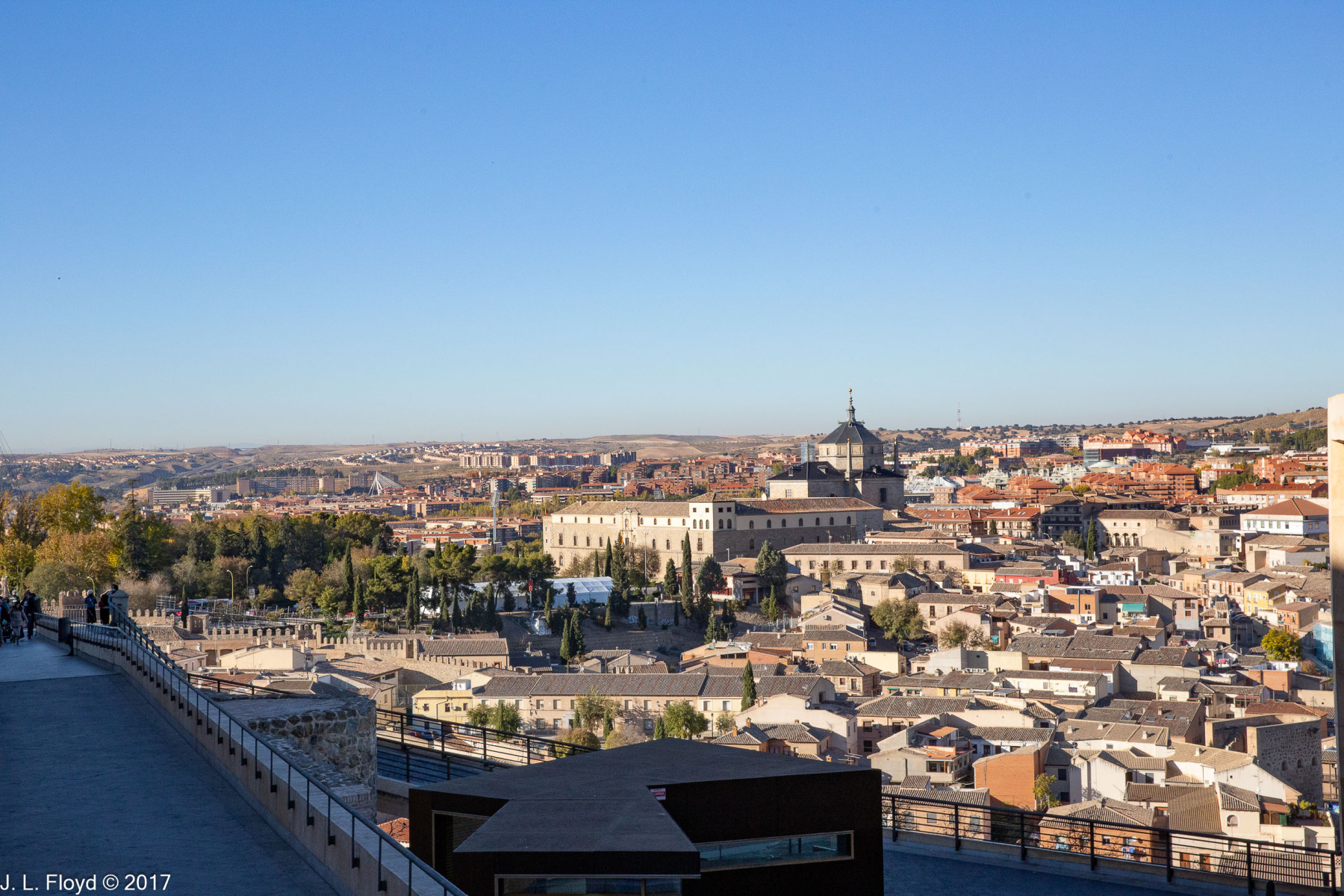
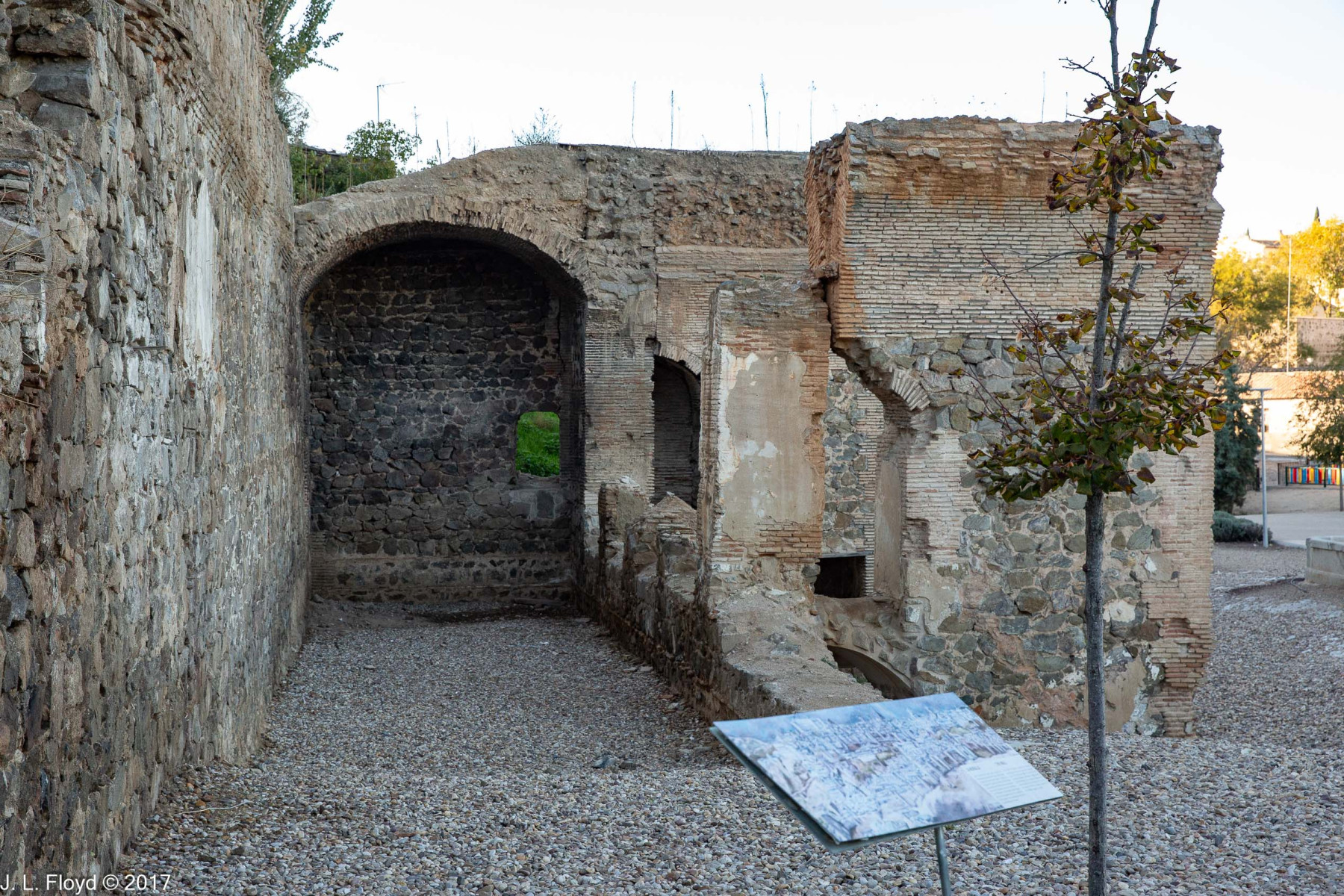
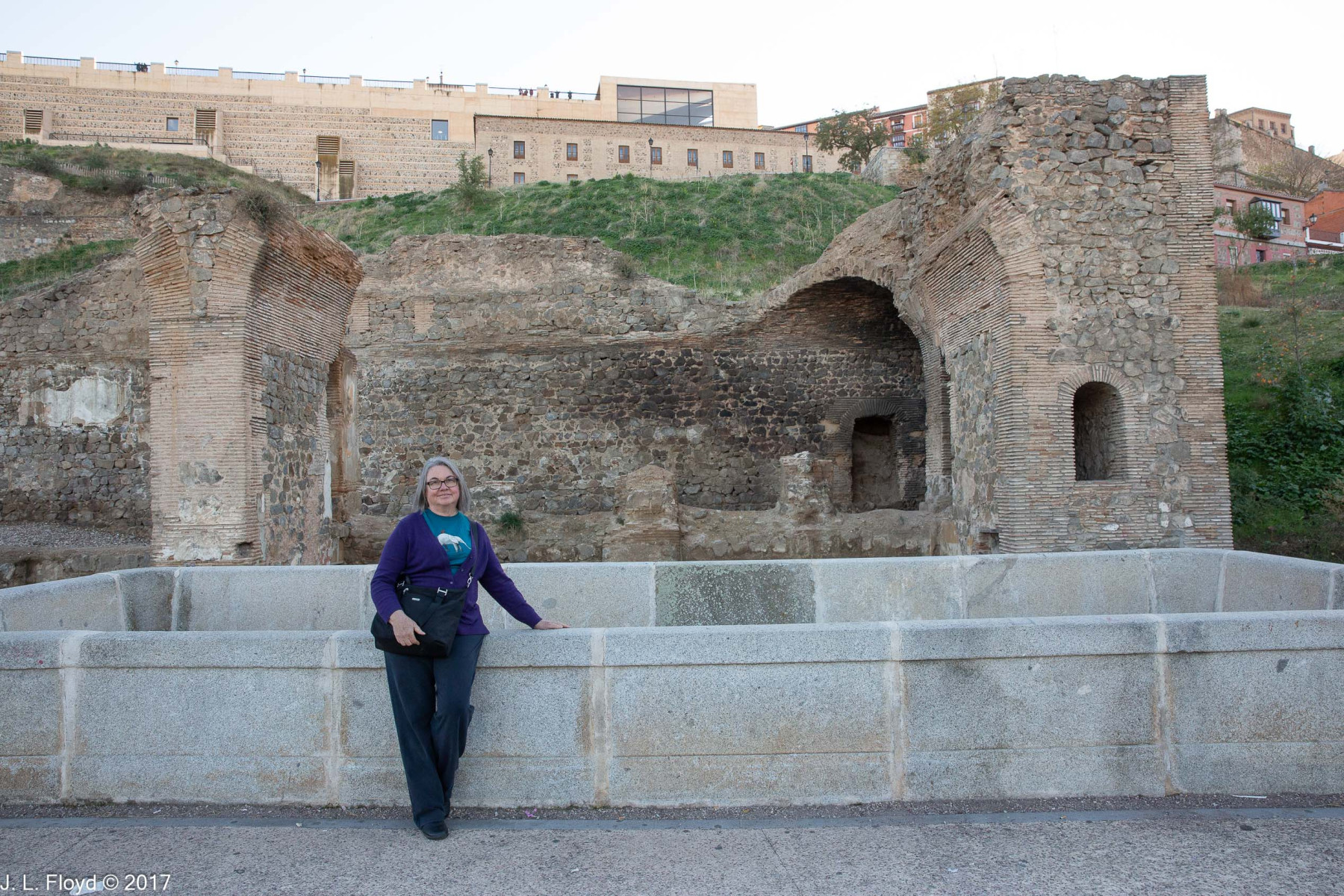
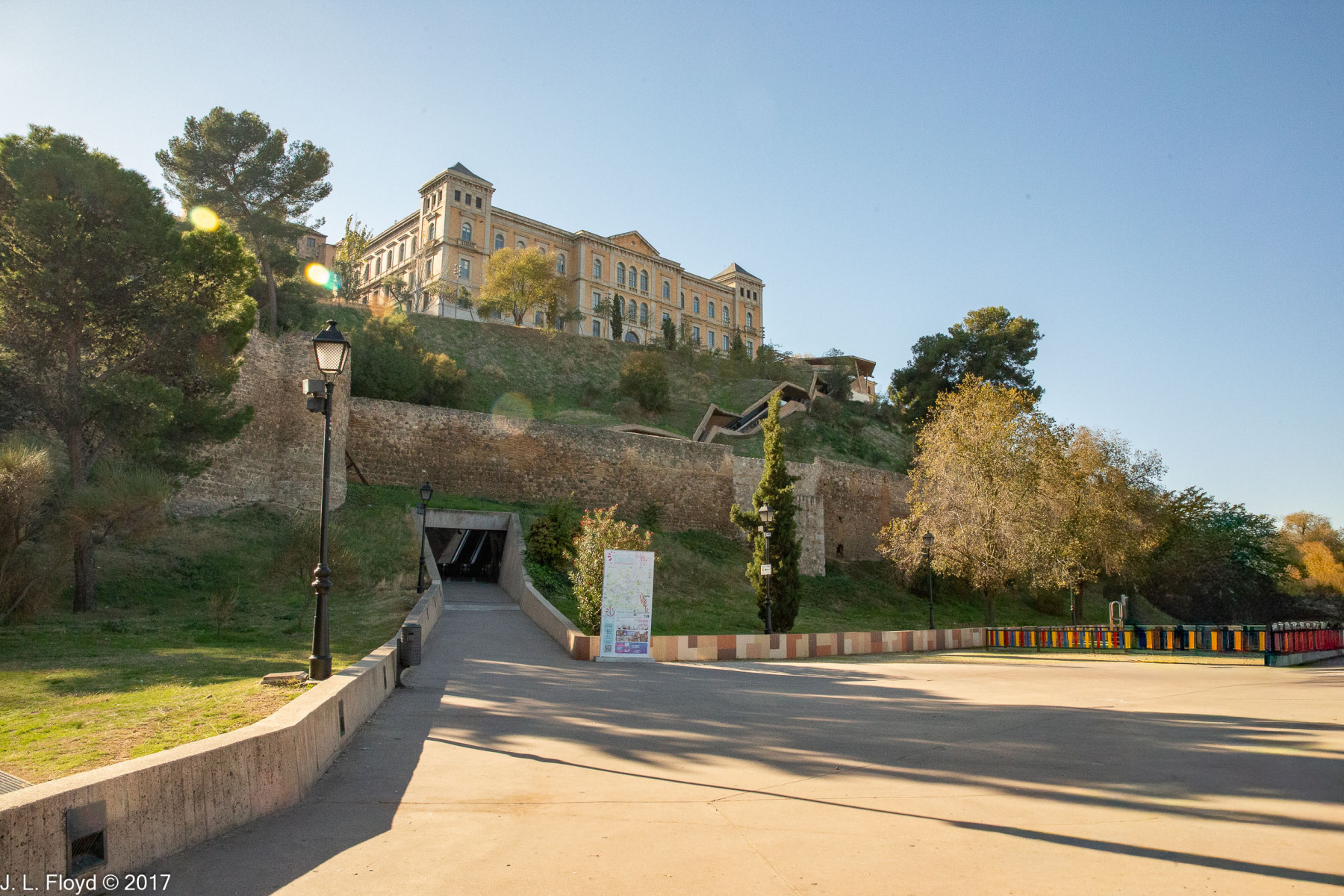
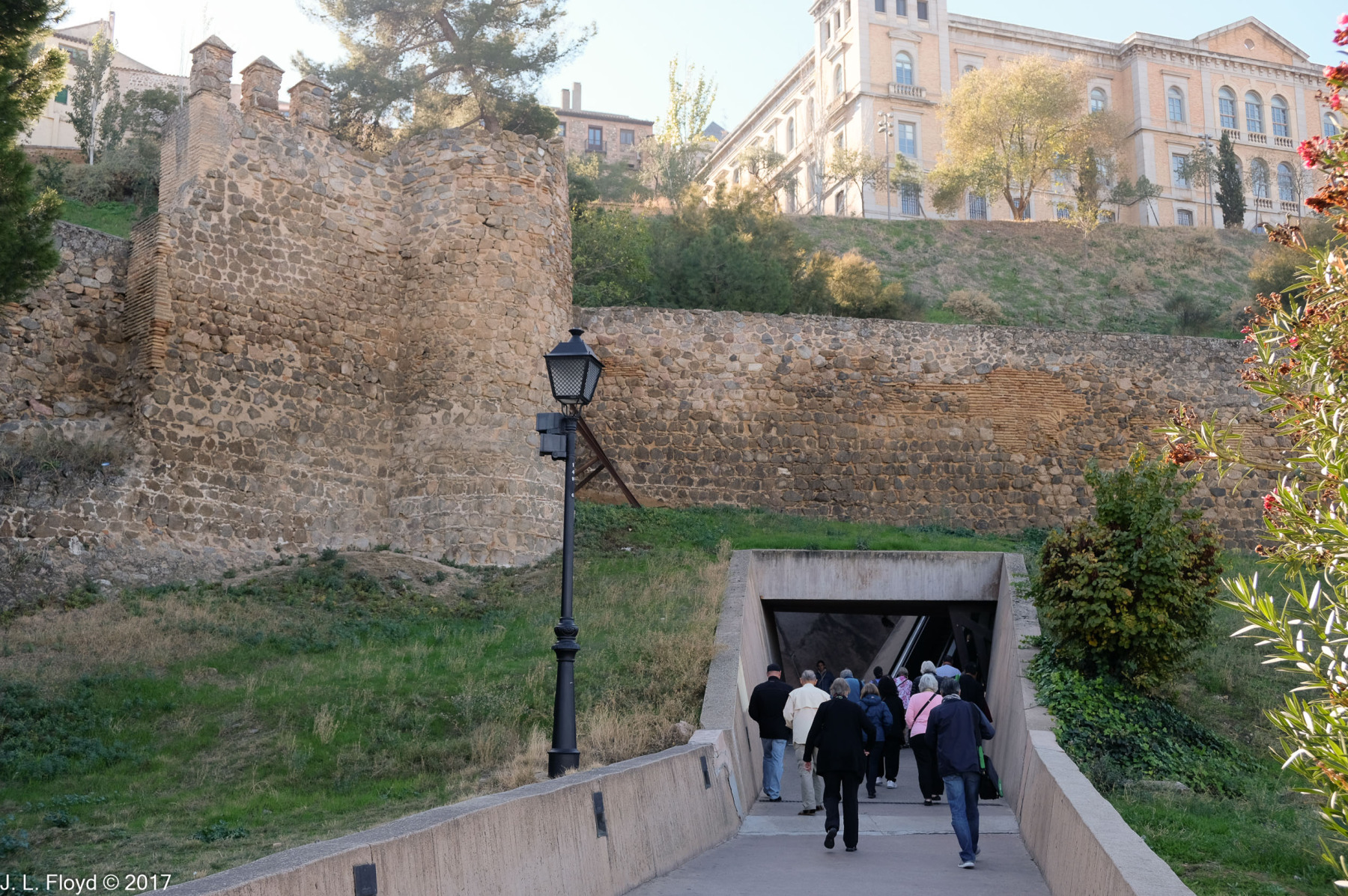
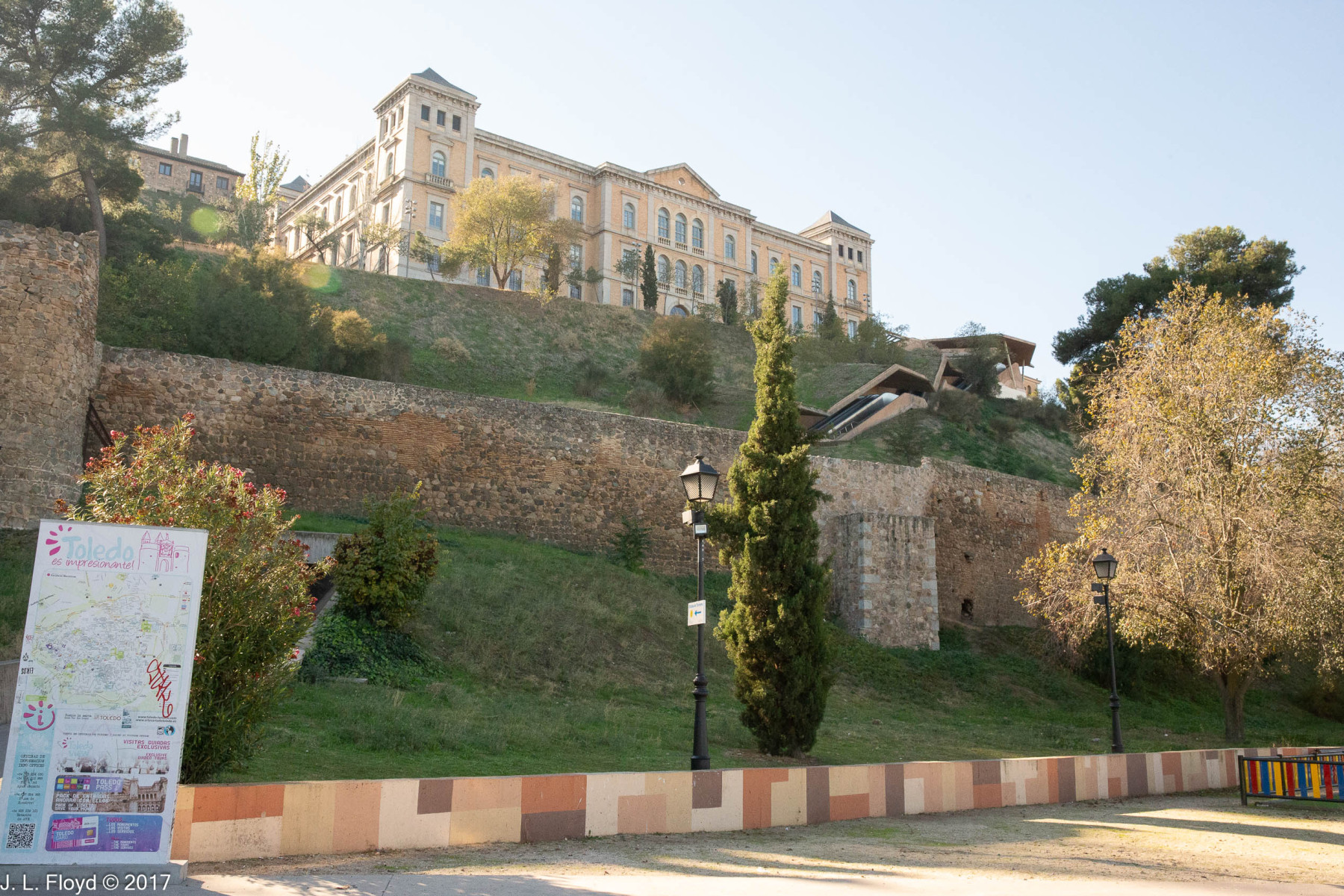
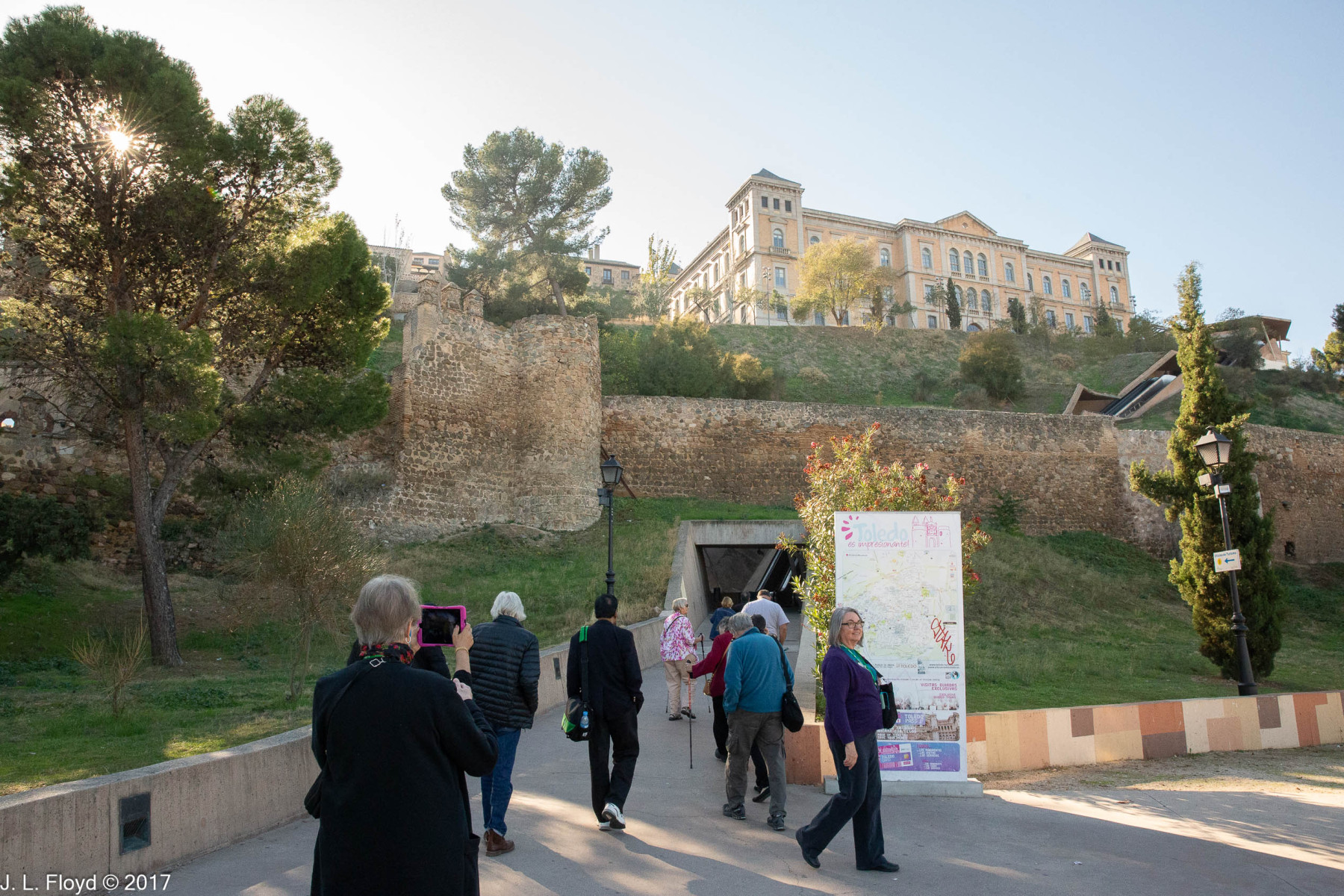
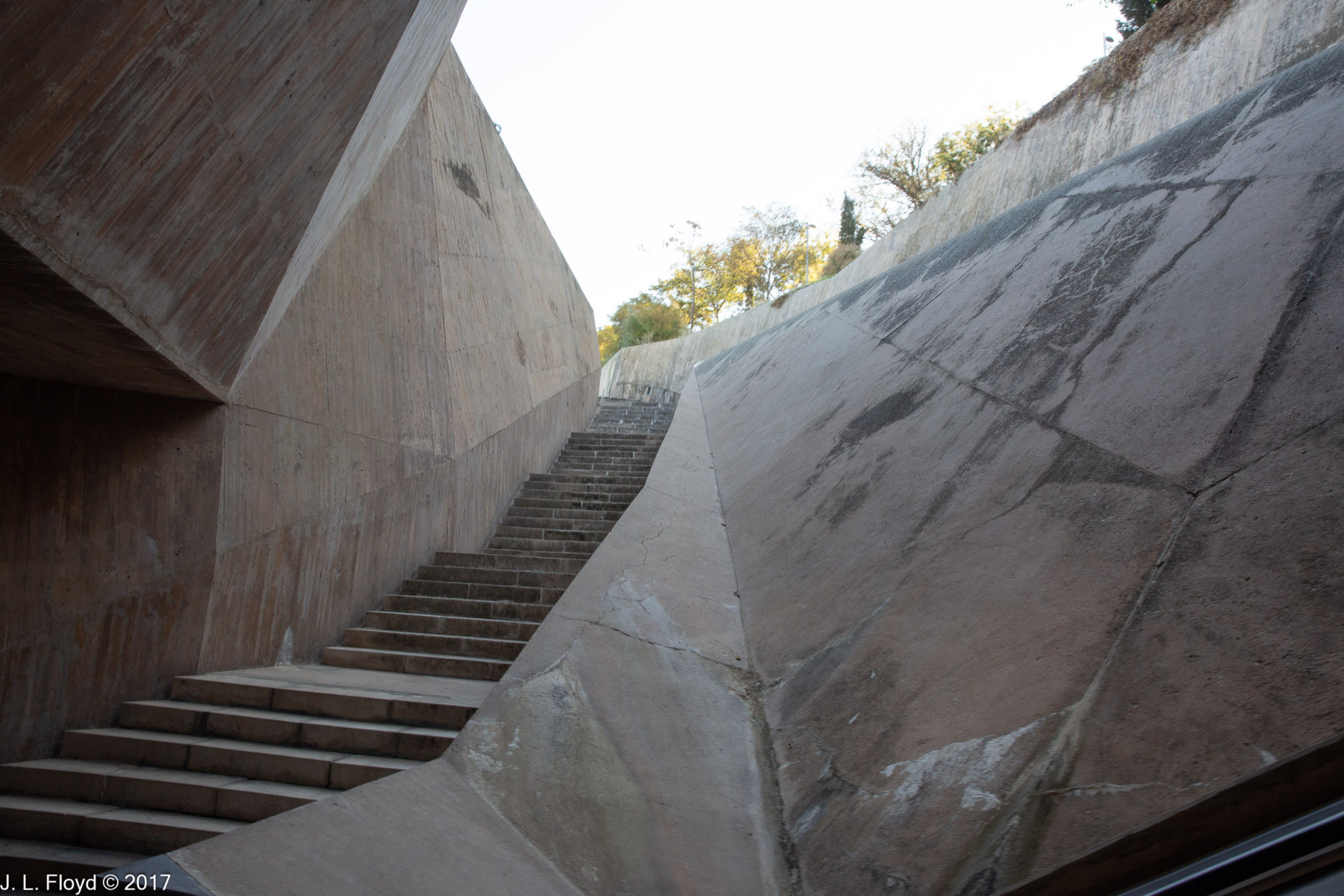
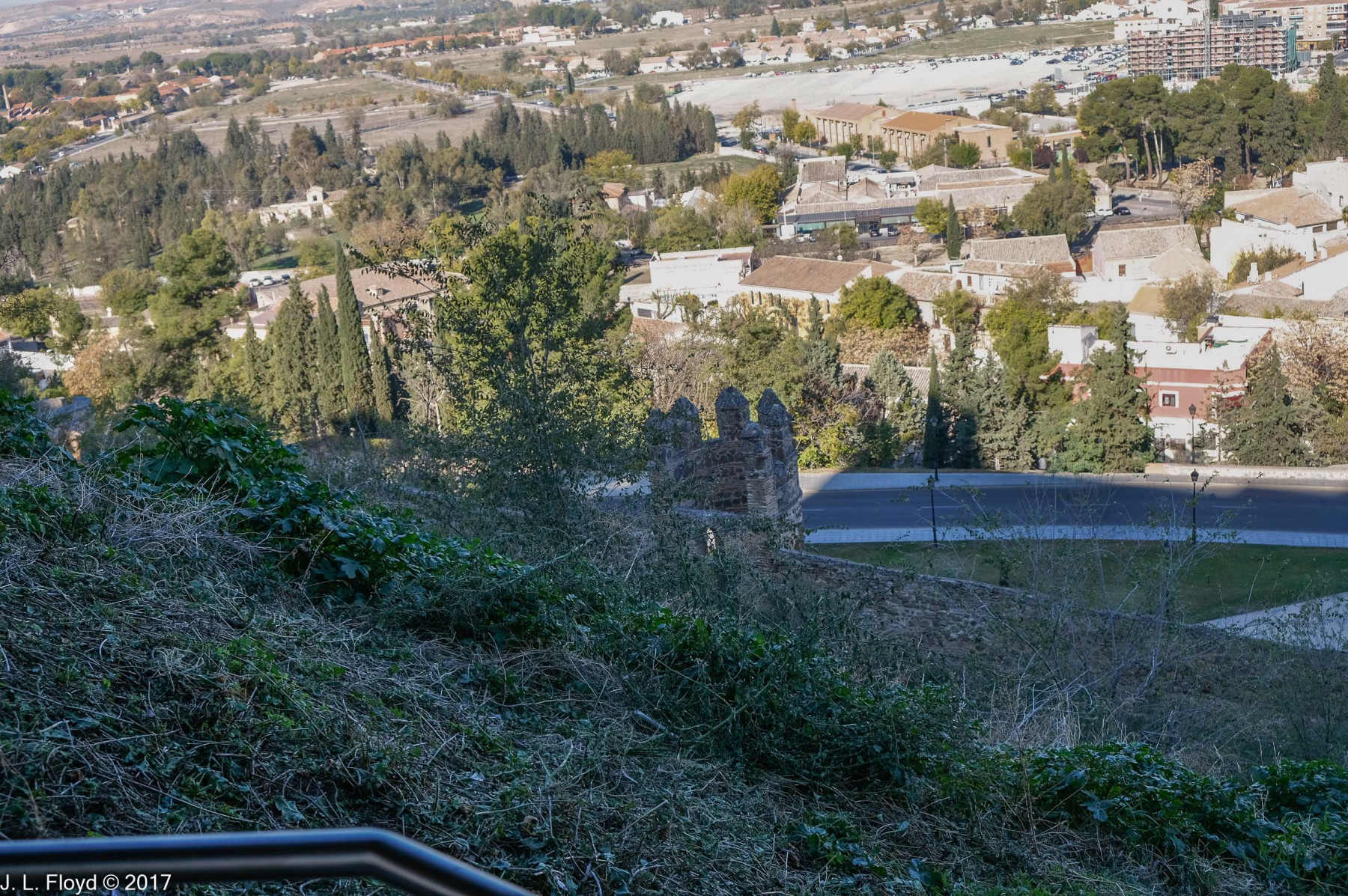
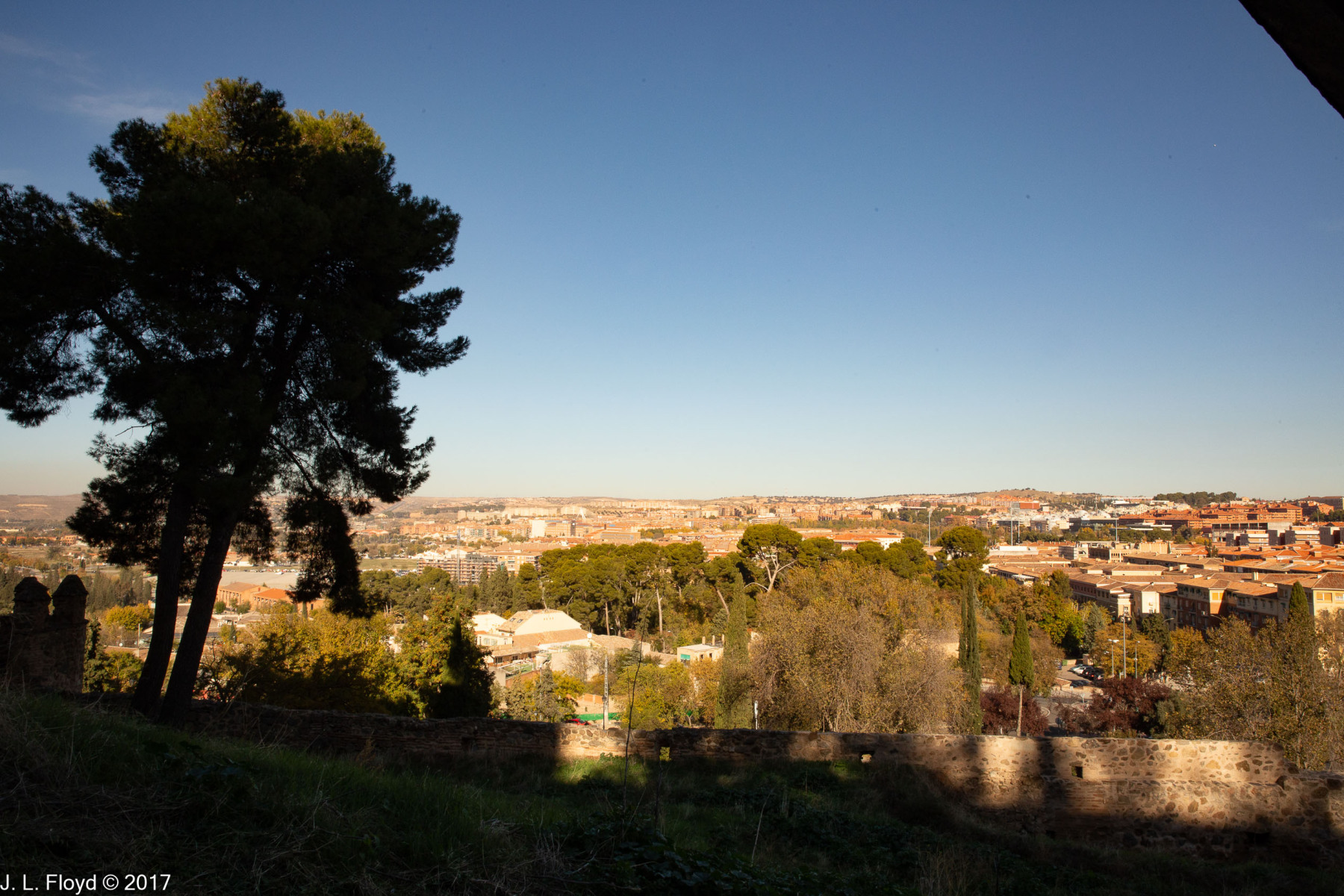
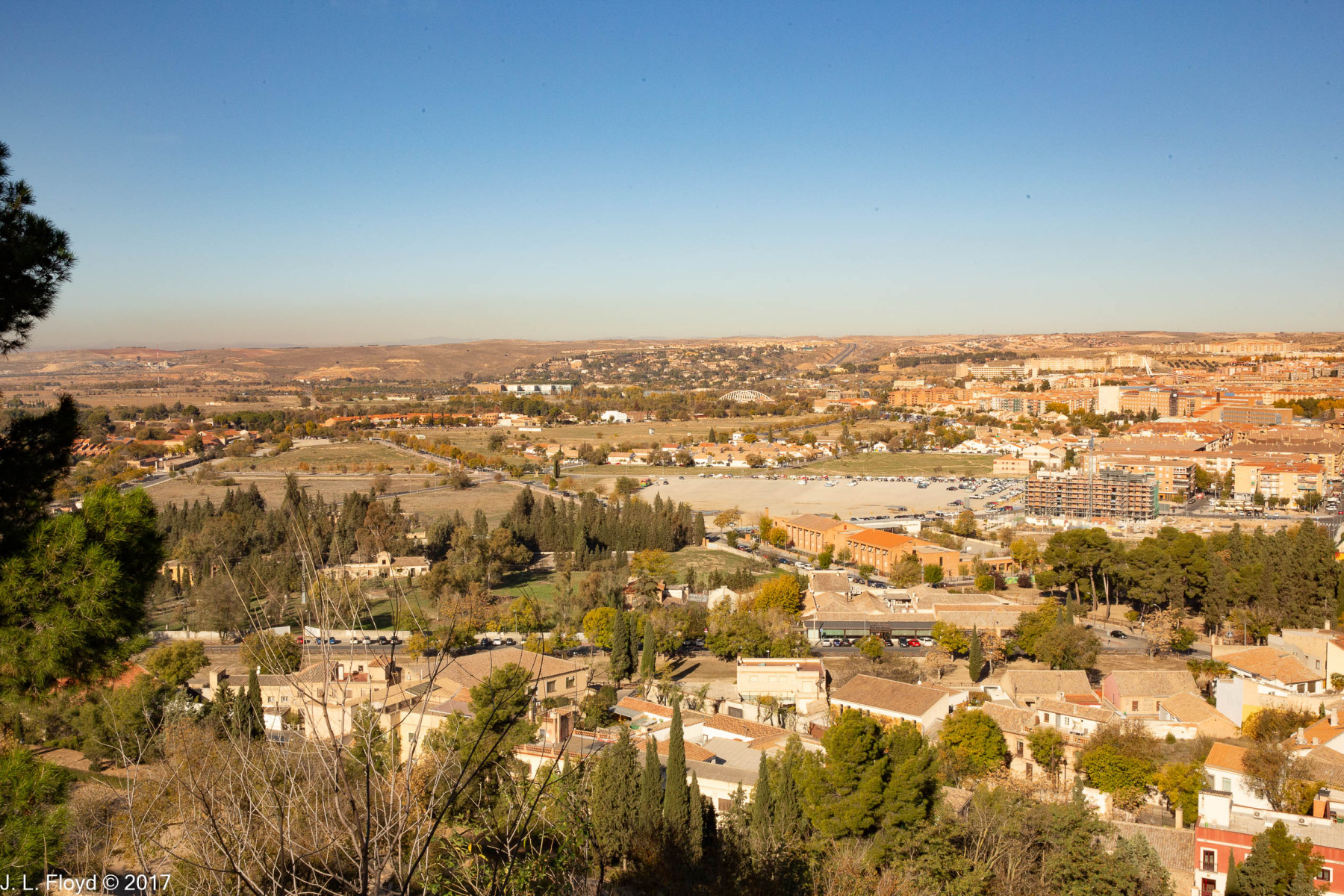
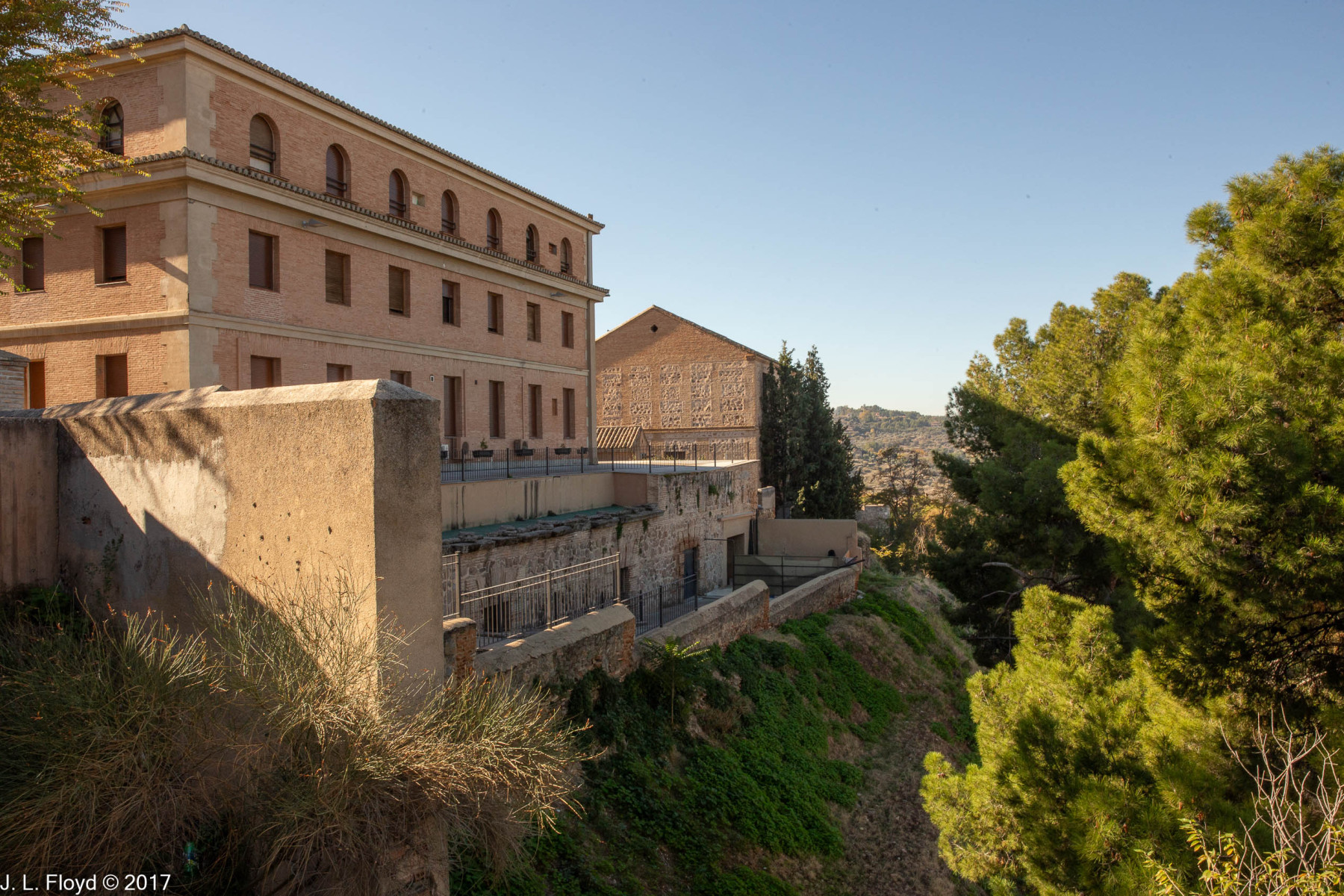
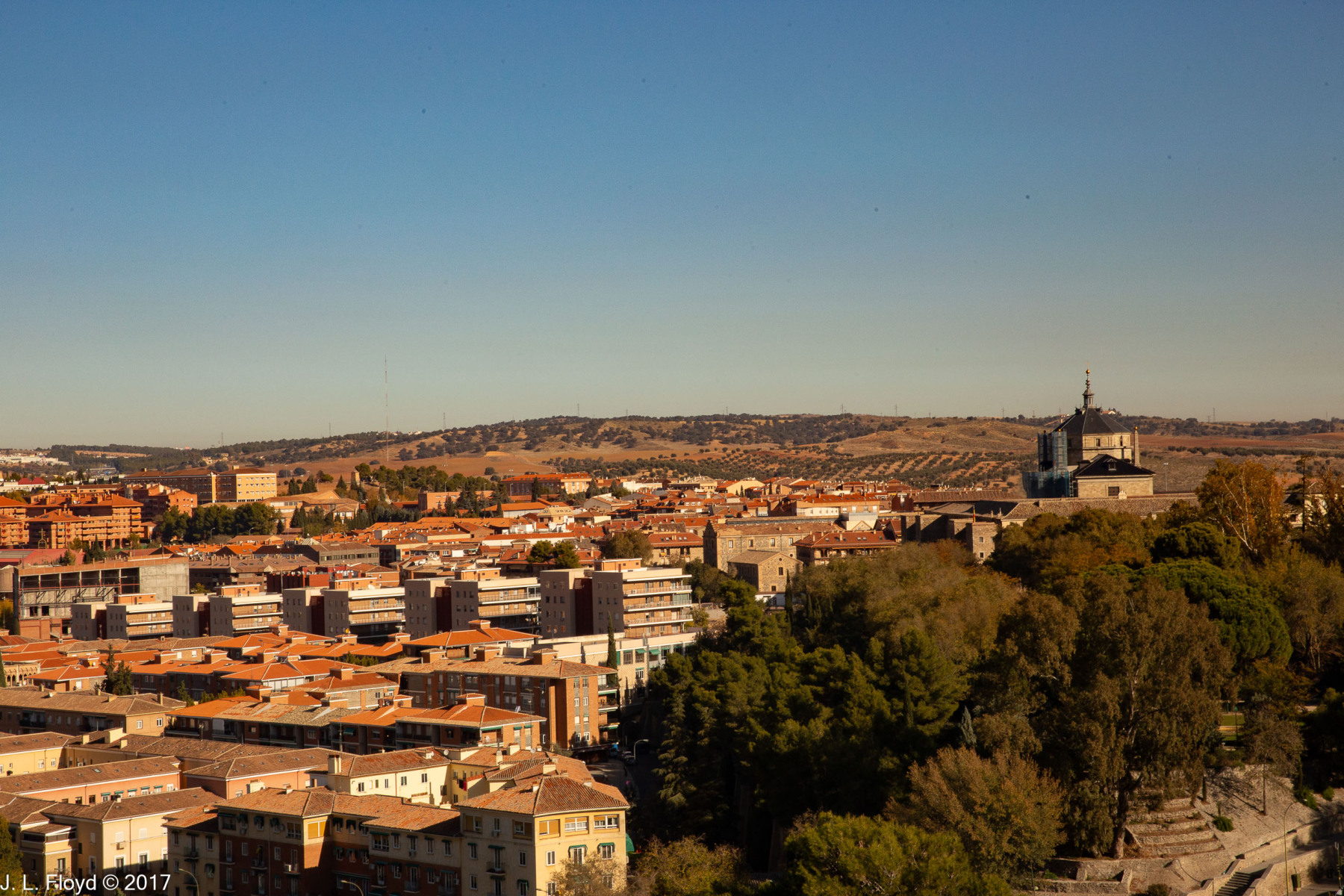
After lingering for a while in the Plaza de Zocodover, we were summoned to reboard our bus for the return to Madrid. Trekking back to the escalator by a different (and much shorter) route than the one by which we had arrived, we enjoyed some last late-afternoon views of the city before descending to the parking lot. While waiting for the bus, we were able to inspect the ruins of an ancient Roman bathhouse located near the portal to the escalator, which we hadn’t had a chance to do in the morning.

Toledo, once the capital of Spain, now boasts a population of around 87,000, not much larger than my current city of residence, Hemet, California, and tiny by comparison with Madrid (3.4 million), Barcelona (1.6 million) or even Seville (700,000). But its cultural influence and historical significance is nevertheless enormous, far out of proportion to its size. Although a one-day visit hardly does it justice, I departed with a profound sense of fulfillment, and I found that my life was greatly enriched by our brief sojourn there.

Categories
Spain, Portugal and Morocco, November 2017

Toledo, November 18, 2017: The Cathedral

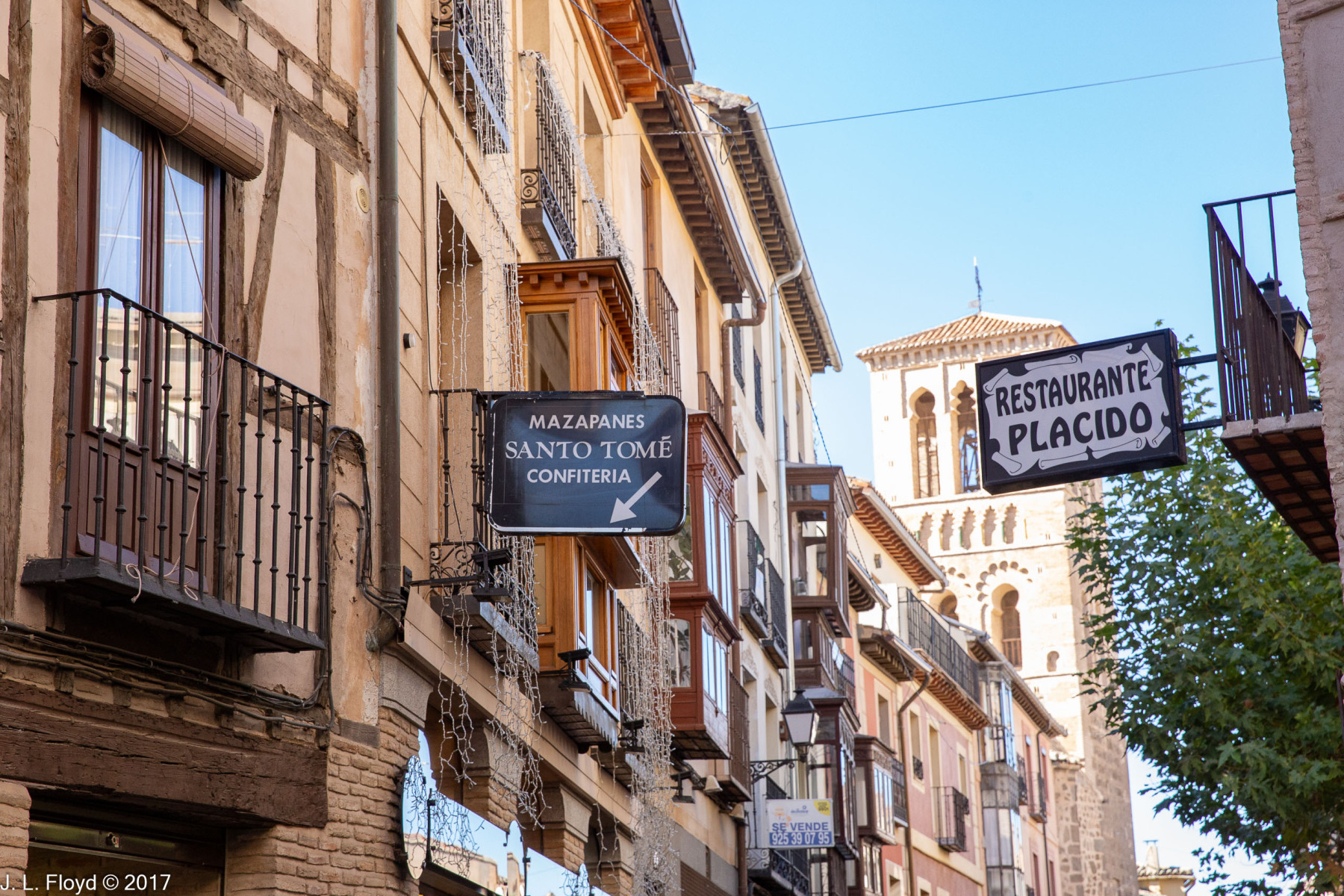
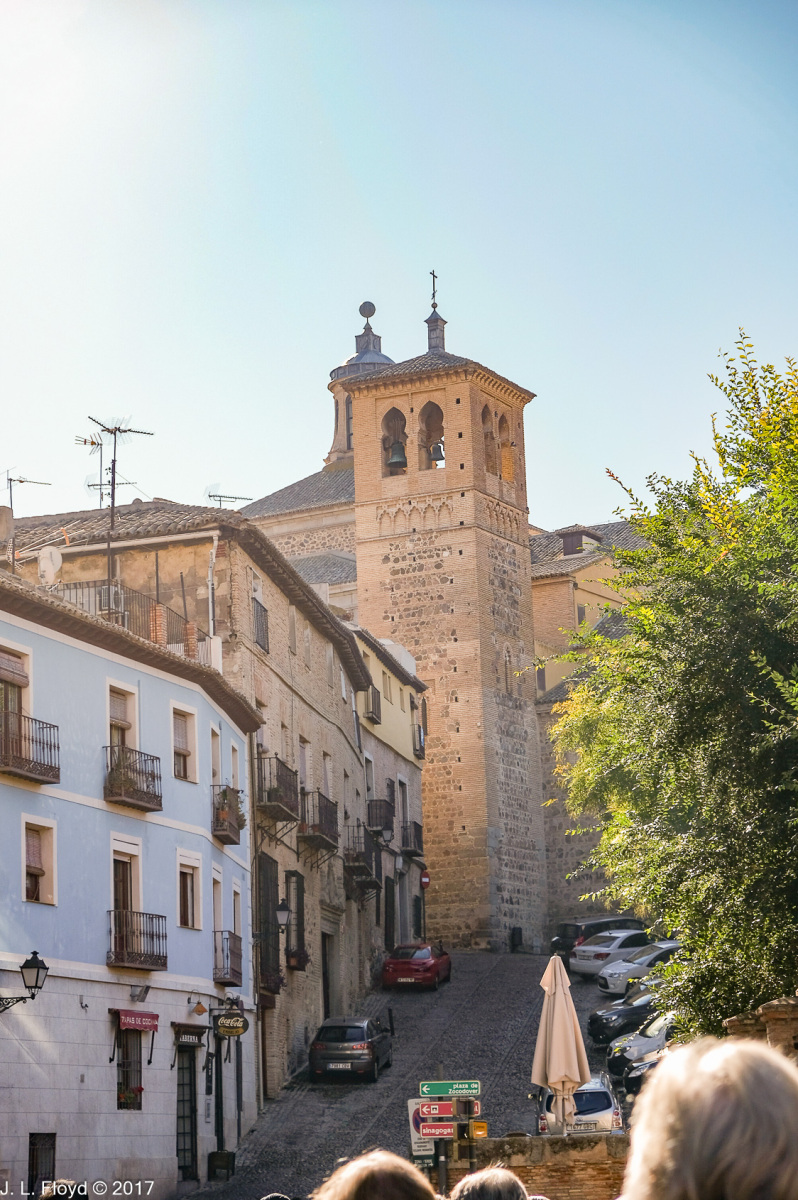
On our way out of the Jewish Quarter, we arrived at the Iglesia de Santo Tomé – Church of St. Thomas – which was founded after the reconquest of this city in 1085 by King Alfonso VI of León. Actually it was a Muslim mosque taken over by the Christians and converted into a church. However, after the reconquest it gradually fell into ruin until, at the beginning of the 14th century, Gonzalo Ruiz de Toledo (1260-1323), Count of Orgaz and mayor of Toledo, undertook to have it restored. Under his aegis the old minaret of the mosque was transformed into a majestic bell tower, in Mudéjar style.

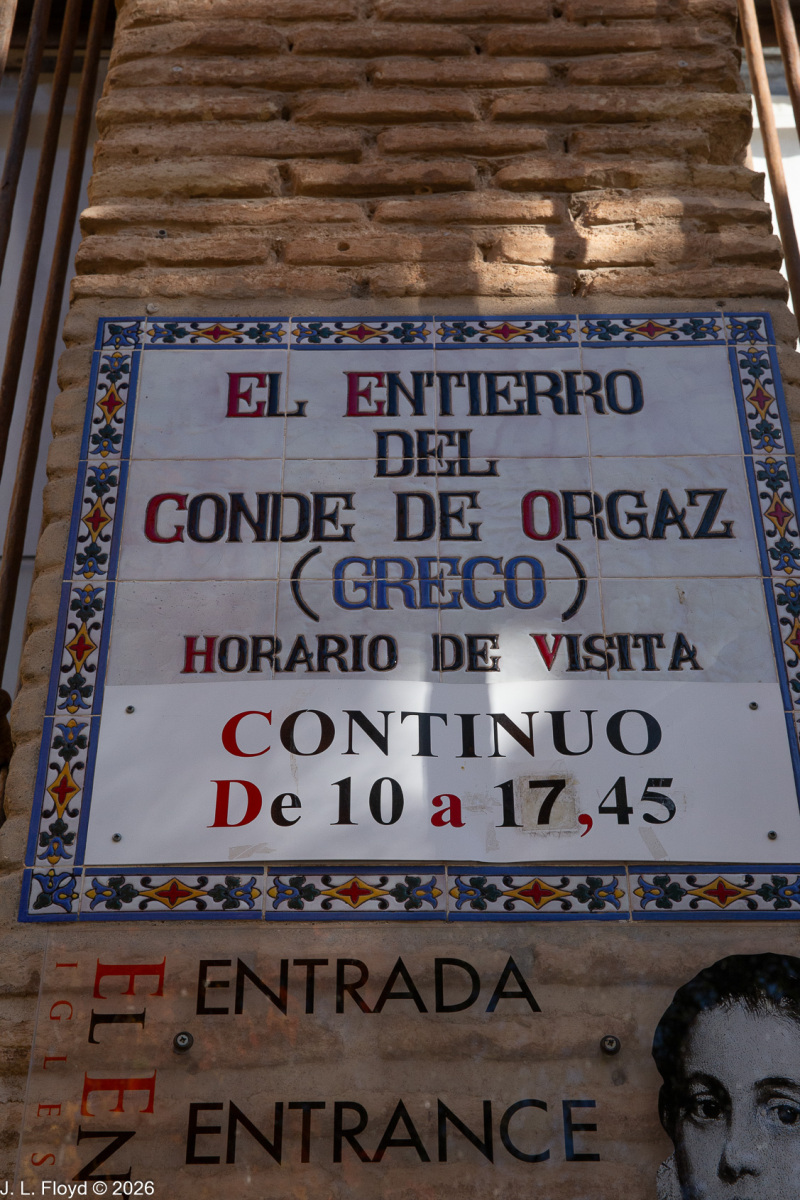
We did not visit the main part of the church, which is said to be quite beautiful, and where the Count of Orgaz is buried; instead we entered, via the back door, the chamber which houses the painting The Burial of Count Orgaz, the great masterpiece of the Spanish Renaissance artist Doménikos Theotokópoulos (1541-1614), commonly known as El Greco. He was in fact Greek by origin, having been born in Crete, which was held by Venice at the time (it was conquered by the Ottoman Turks in the 17th century). But he worked mostly in Venice, to which he emigrated in 1567, then Rome (1570) and finally Spain (from 1577).

The painting is the main attraction of the church and viewing it is the reason why most visitors go there. I am personally not a great fan of El Greco – I much prefer Velazquez and Goya – but the talk by the museum guide gave me a much greater appreciation of the genius of El Greco and made it clear why the Burial of Count Orgaz is considered one of the great masterpieces of Spanish Renaissance art.

We were not permitted to take photos inside the church, so I have none to offer and can only refer the reader to the web sites where they can be found.

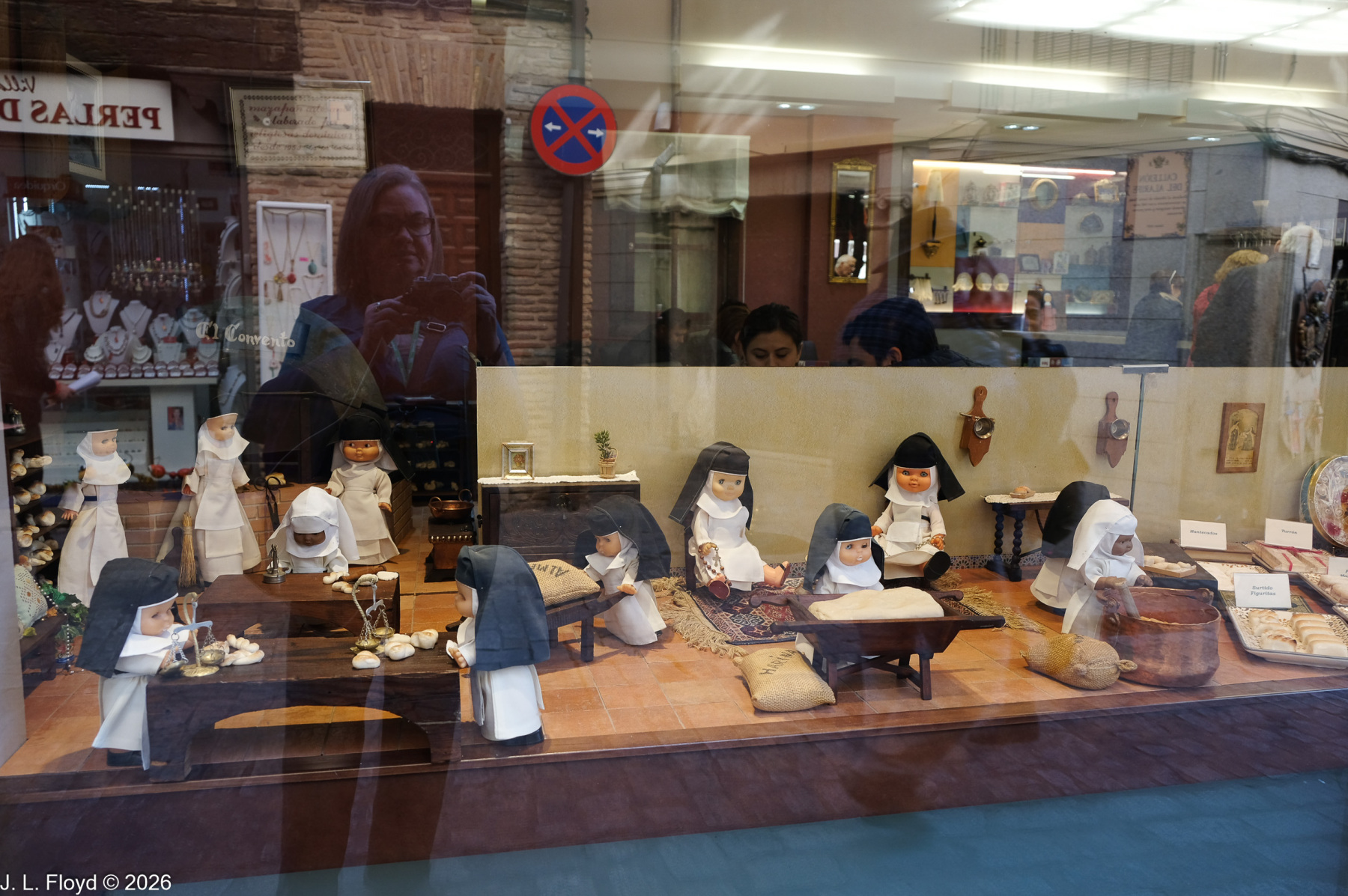
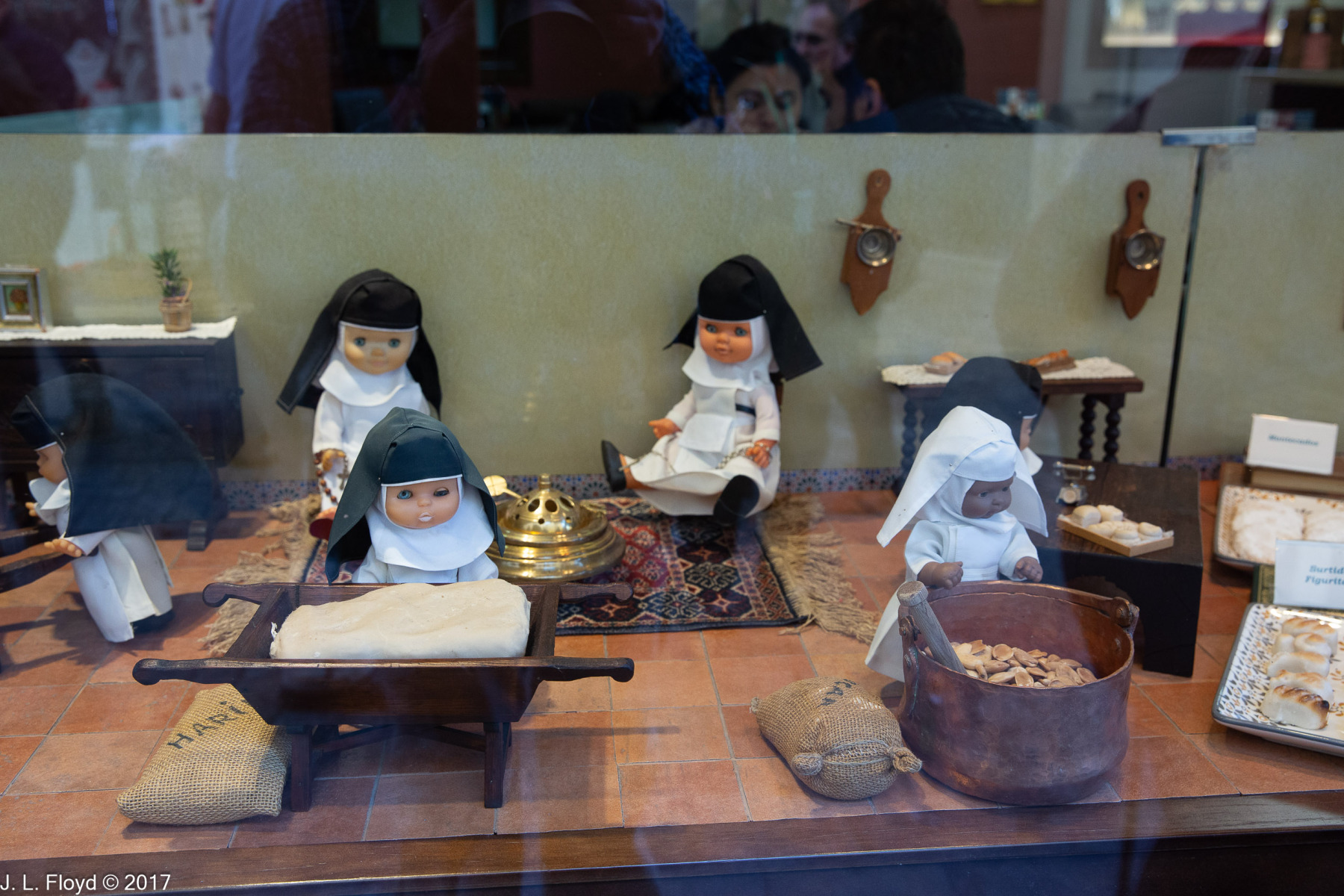
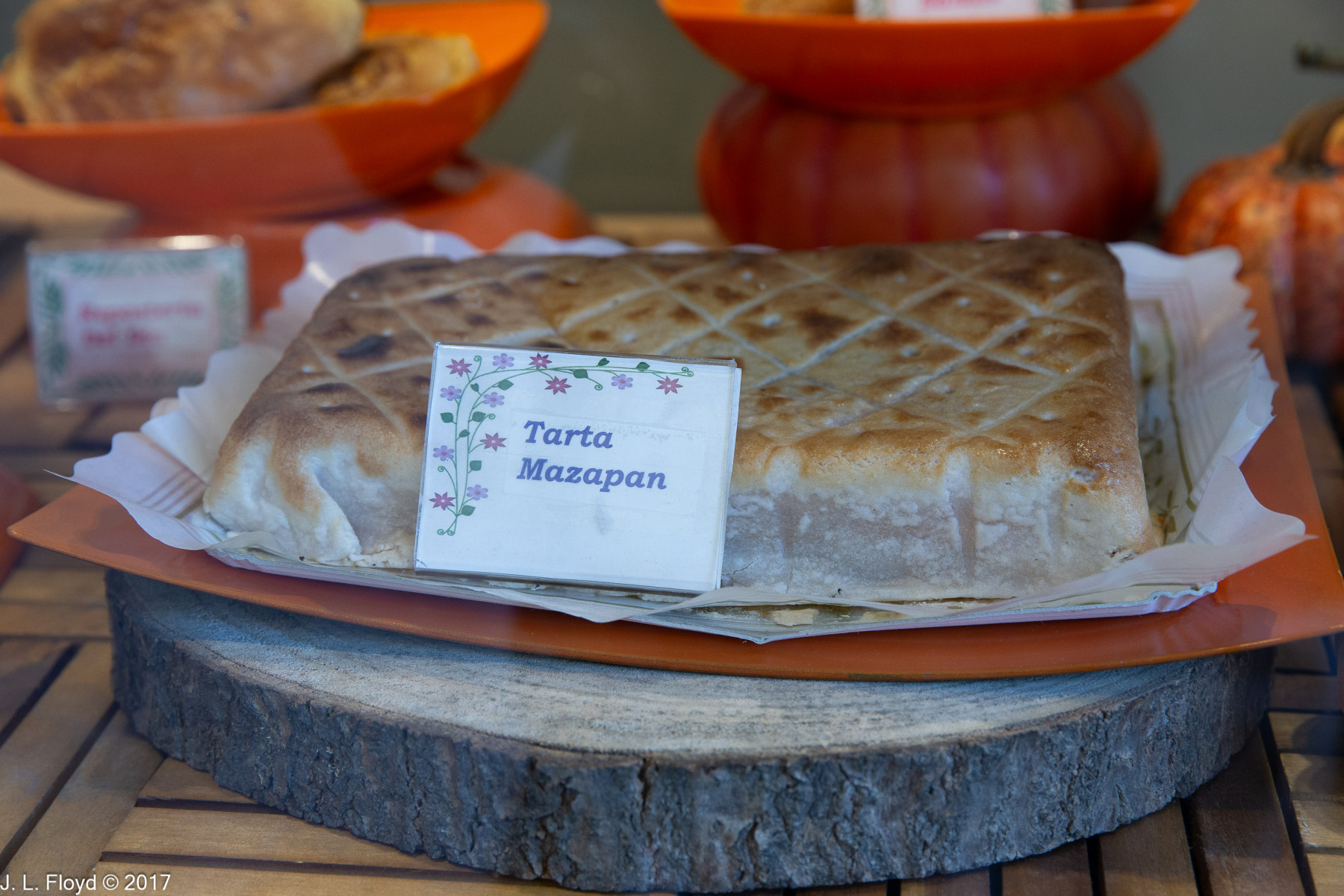
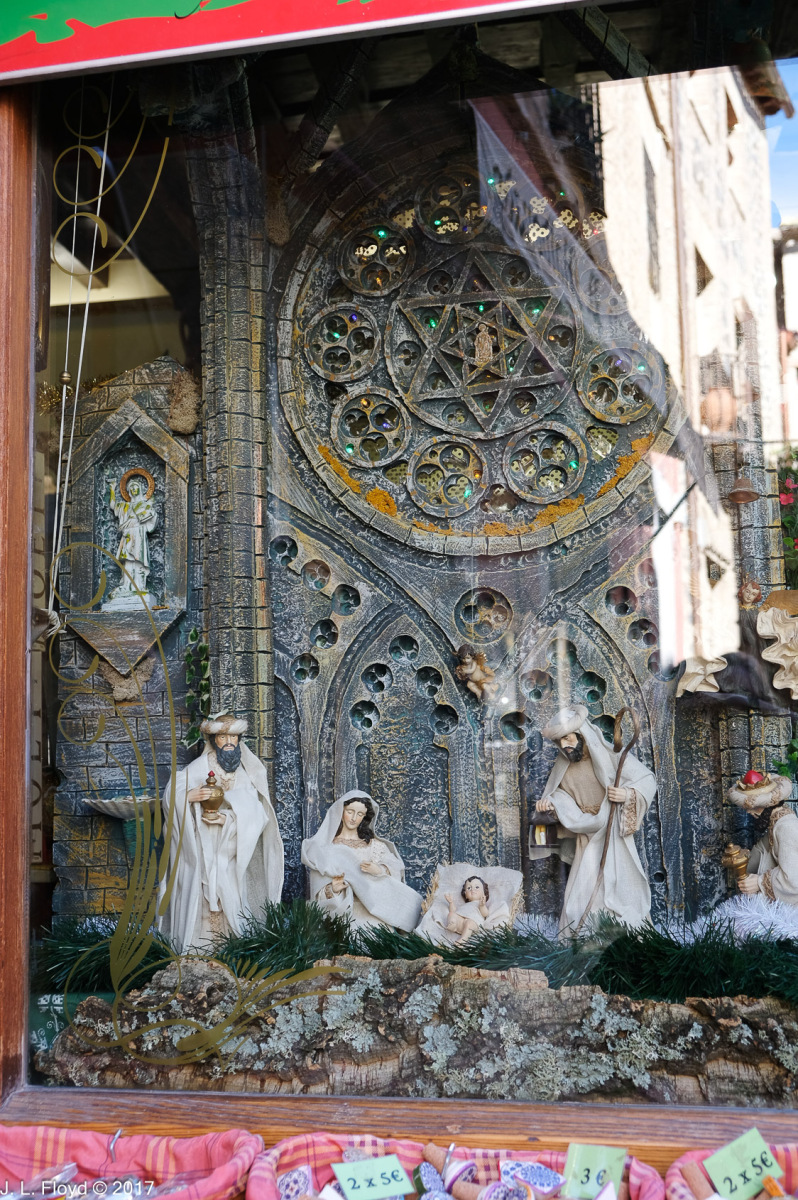
After viewing The Burial of Count Orgaz, we strolled down the street named for the church, window-shopping several attractive boutiques as we went. The most interesting was the Santo Tomé Confitería, which sells marzipan confections made by the Cistercian nuns of the Royal Convent of San Clemente. That convent was founded in the 13th century and is now housed in a large Spanish Renaissance cloister on Calle San Clemente in Toledo. Among its other attractions, it features a museum devoted to marzipan. We did not have time to visit the convent itself, but the shop window featured a charming display of minature nuns making marzipan as well as samples of the products.

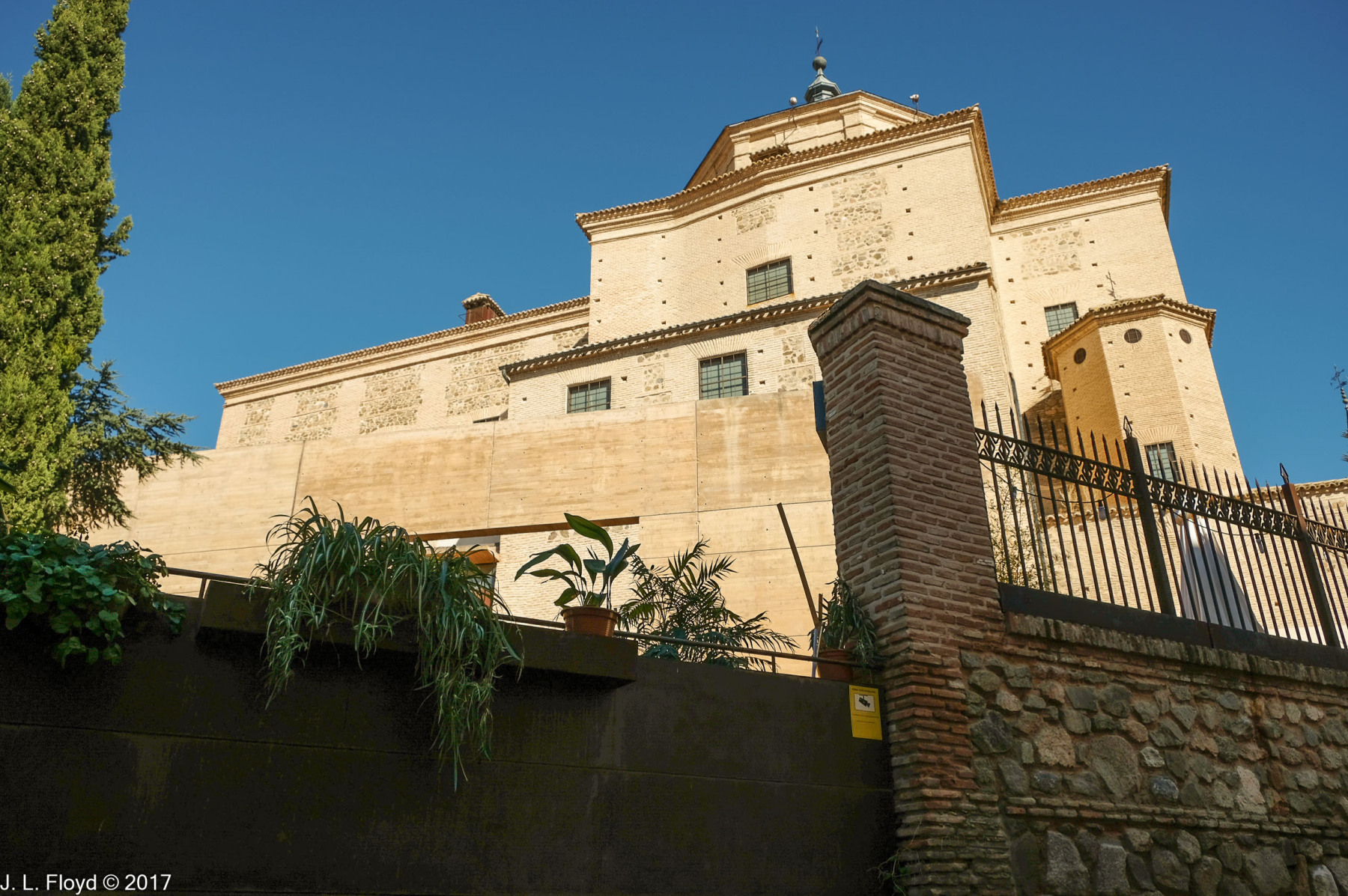
At the end of the Calle de Santo Tomé lies the Church of San Marcos, built in the 17th century as part of the Convent of the Holy Trinity. Construction began in 1628 based on plans drawn up by Jorge Manuel Theotocópuli (1578-1631), son of El Greco, who was Master Builder, sculptor and architect for the Toledo Cathedral, and was involved in a number of other projects such as the Casa Consistorial (City Hall) of Toledo. However, the main chapel and the dome above the transept were not completed until much later, in 1693. We did not visit the interior of the church, which has been described as Spanish Baroque in style, while the exterior is Toledan Mudéjar.

In the late 20th century the convent of which San Marcos is a part was remodeled and extended to become the Centro Cultural San Marcos, or San Marcos Arts Center in English; and it now houses the Toledo Municipal Archive as well as an art gallery, auditorium and the Historic Interpretation Centre of Toledo. However, as far as I could tell the interior of the church itself has not been changed.

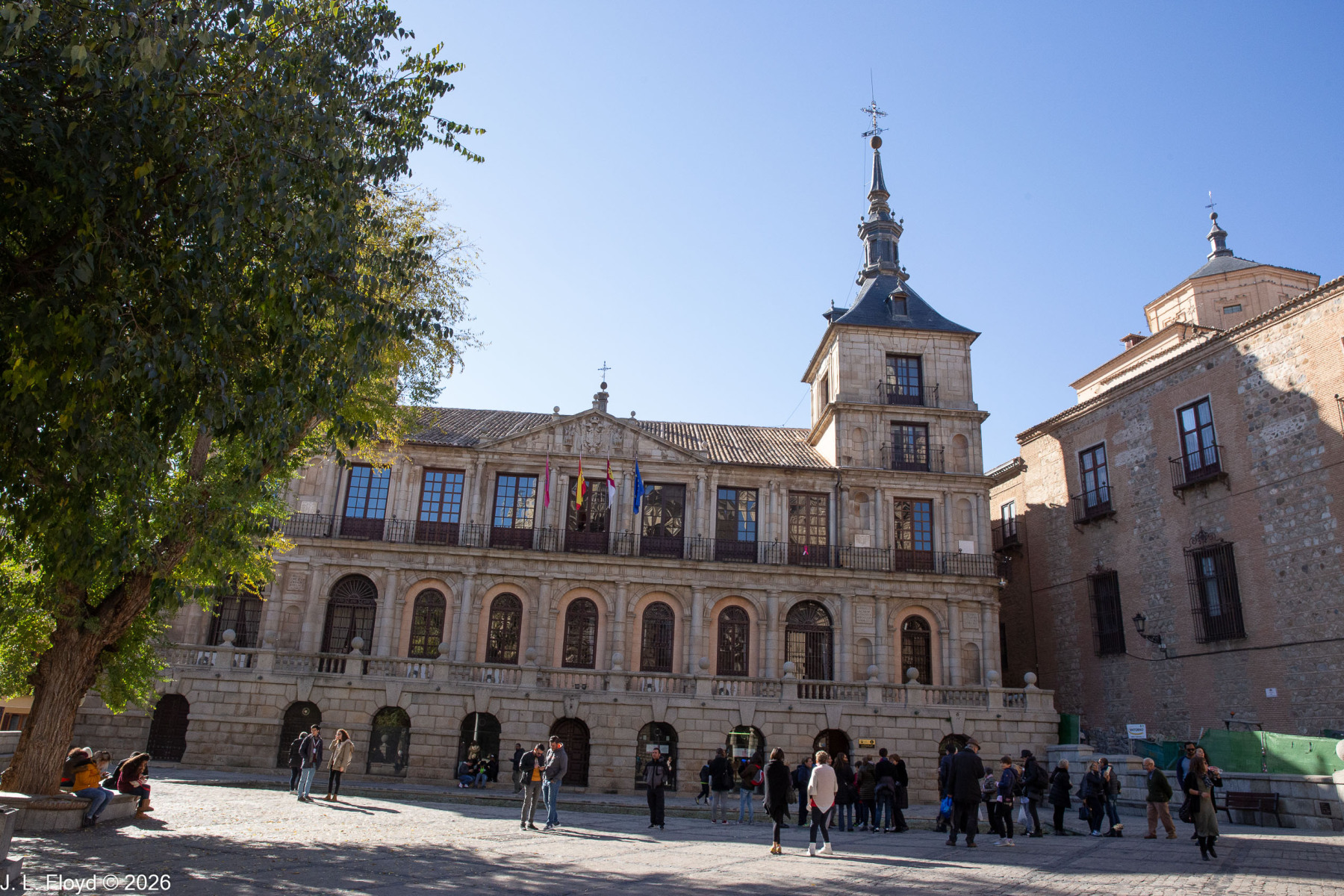
At San Marcos we took a right turn at Calle de El Salvador, then a left at onto the picturesque Calle de la Ciudad, which, after a short hike, led us to the Plaza del Ayuntamiento, the site of the Toledo City Hall. In 1575 the city elders decided that they needed a “civic palace” to match the grandeur of the Cathedral. They entrusted the design to Juan de Herrera (1530-1597), the same architect who directed the construction of Philip II’s Escorial. But he died before the project was finished, and the work dragged on until 1703. Nevertheless, the finished structure, featuring an “austere but elegant” façade with twin towers at either end, is an impressive example of the sober, geometric Herrerian style.

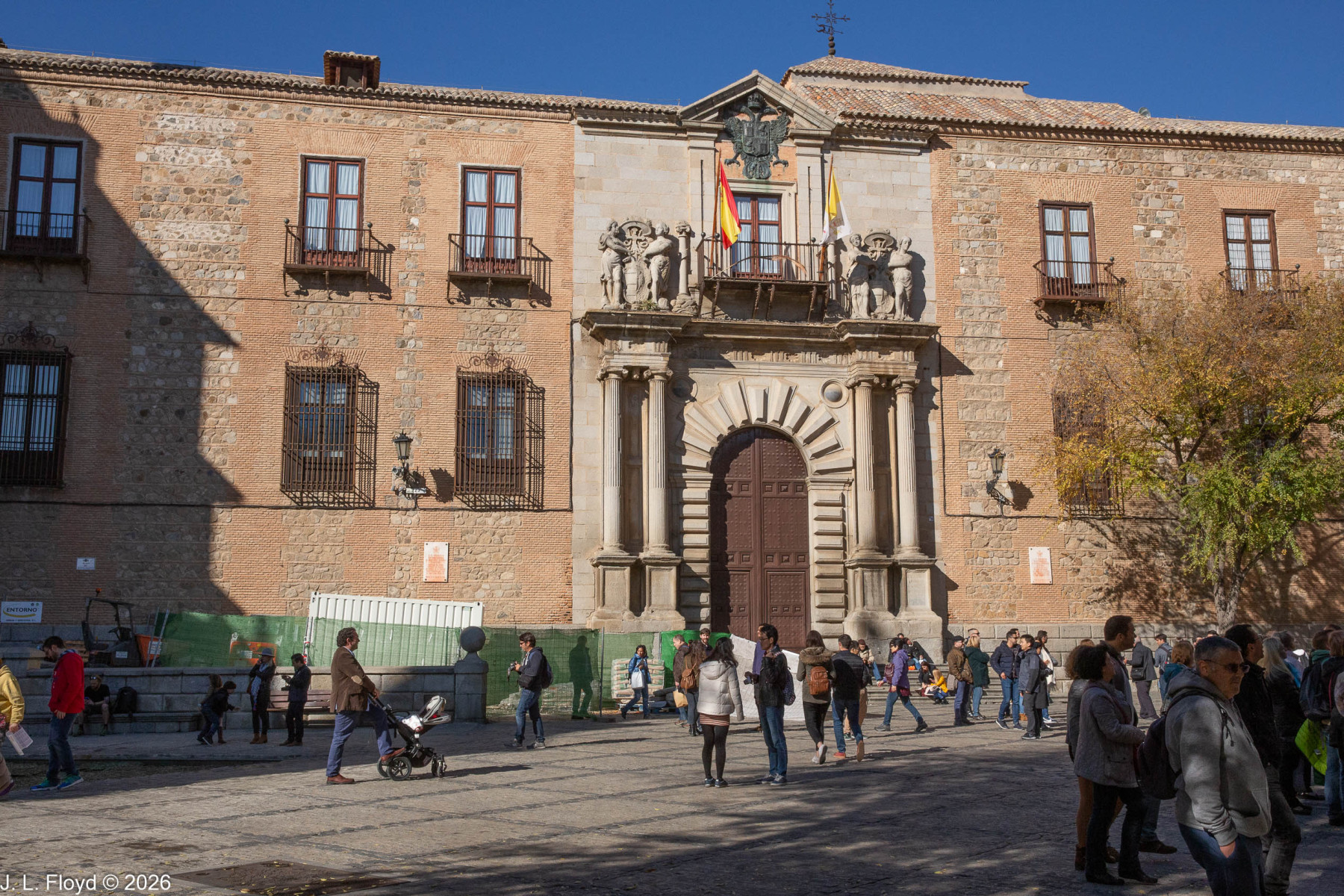
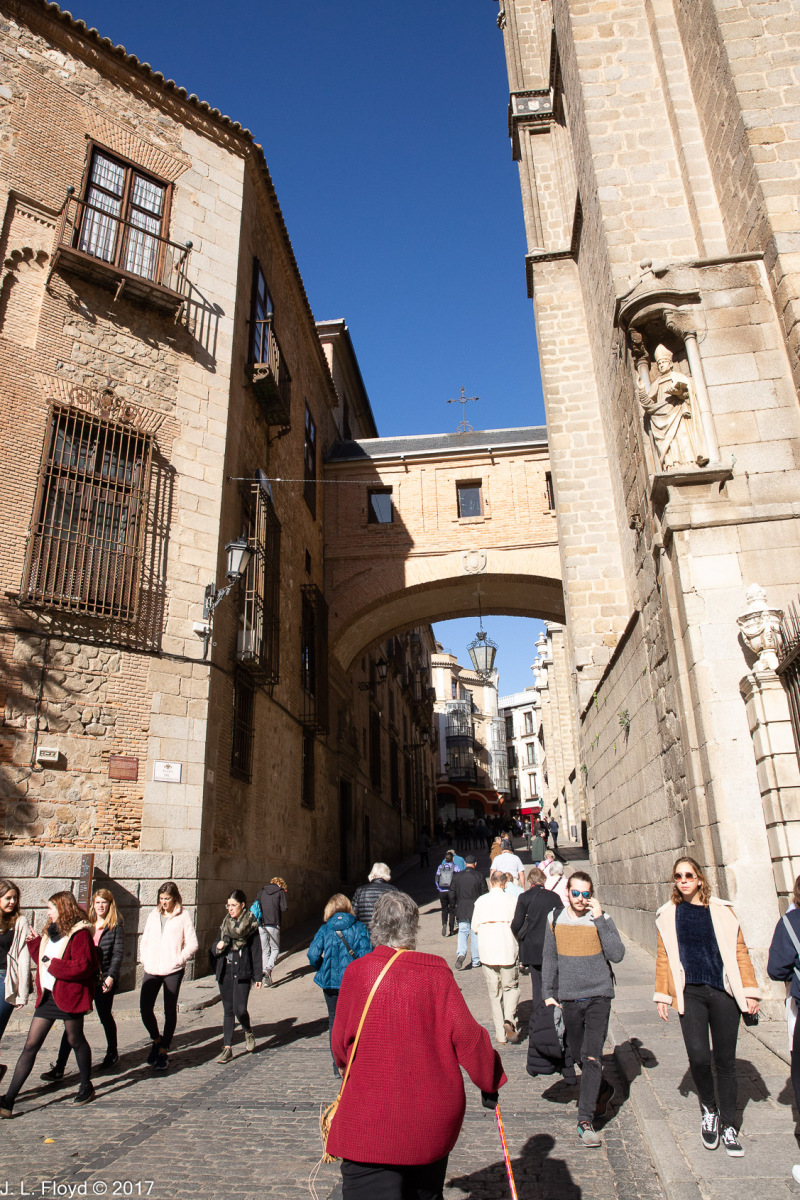
On the north side of the Plaza del Ayuntamiento, next to the Cathedral, is the Palacio Arzobispal de Toledo, the Archbishop of Toledo’s Palace. This is another edifice which took centuries to construct, and in which the son of El Greco was involved: he donated the land. The Archbishop’s Palace is connected to the Cathedral by a bridge crossing over the street between them, which, appropriately, is named Calle Arco de Palacio.

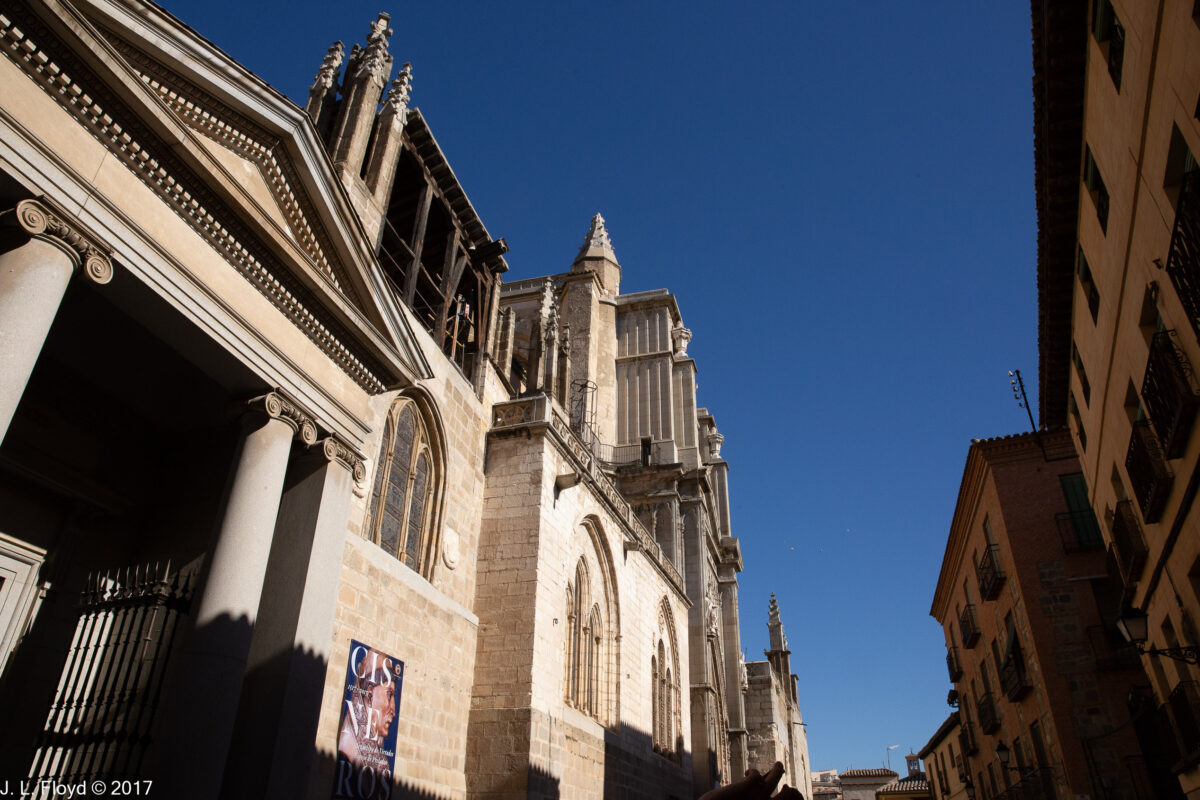
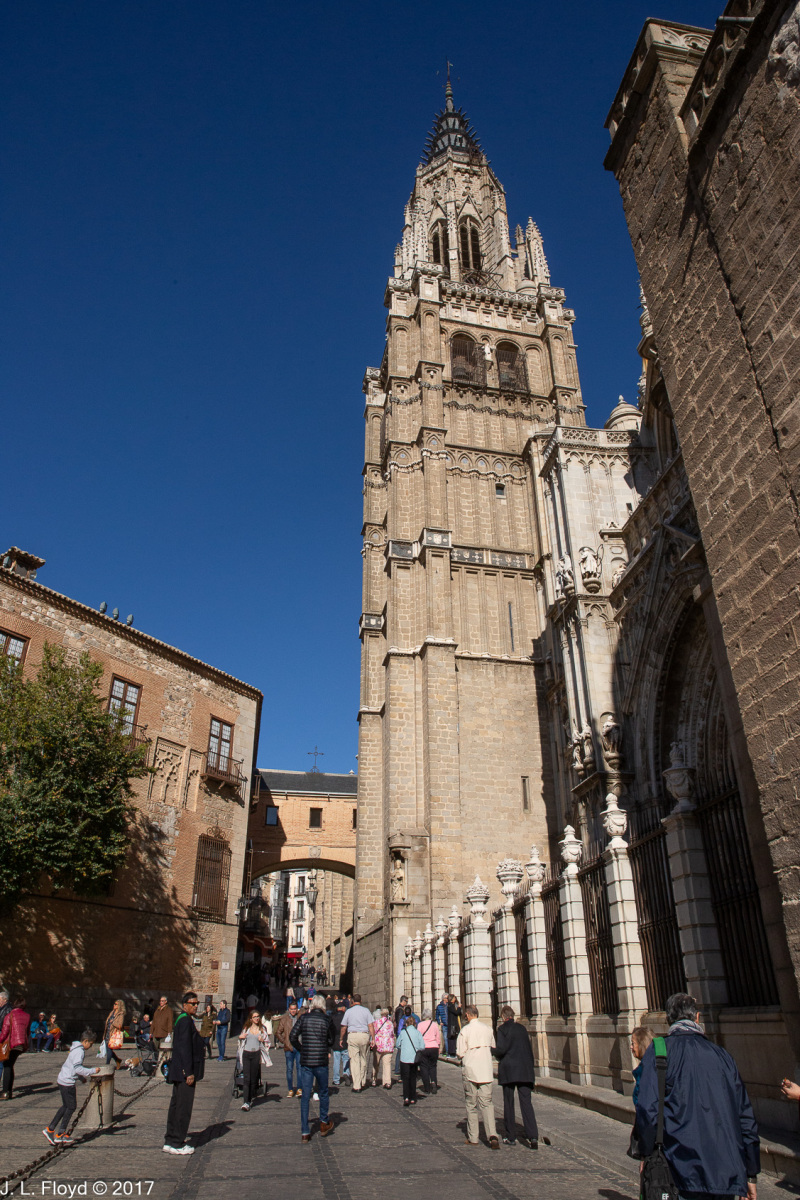
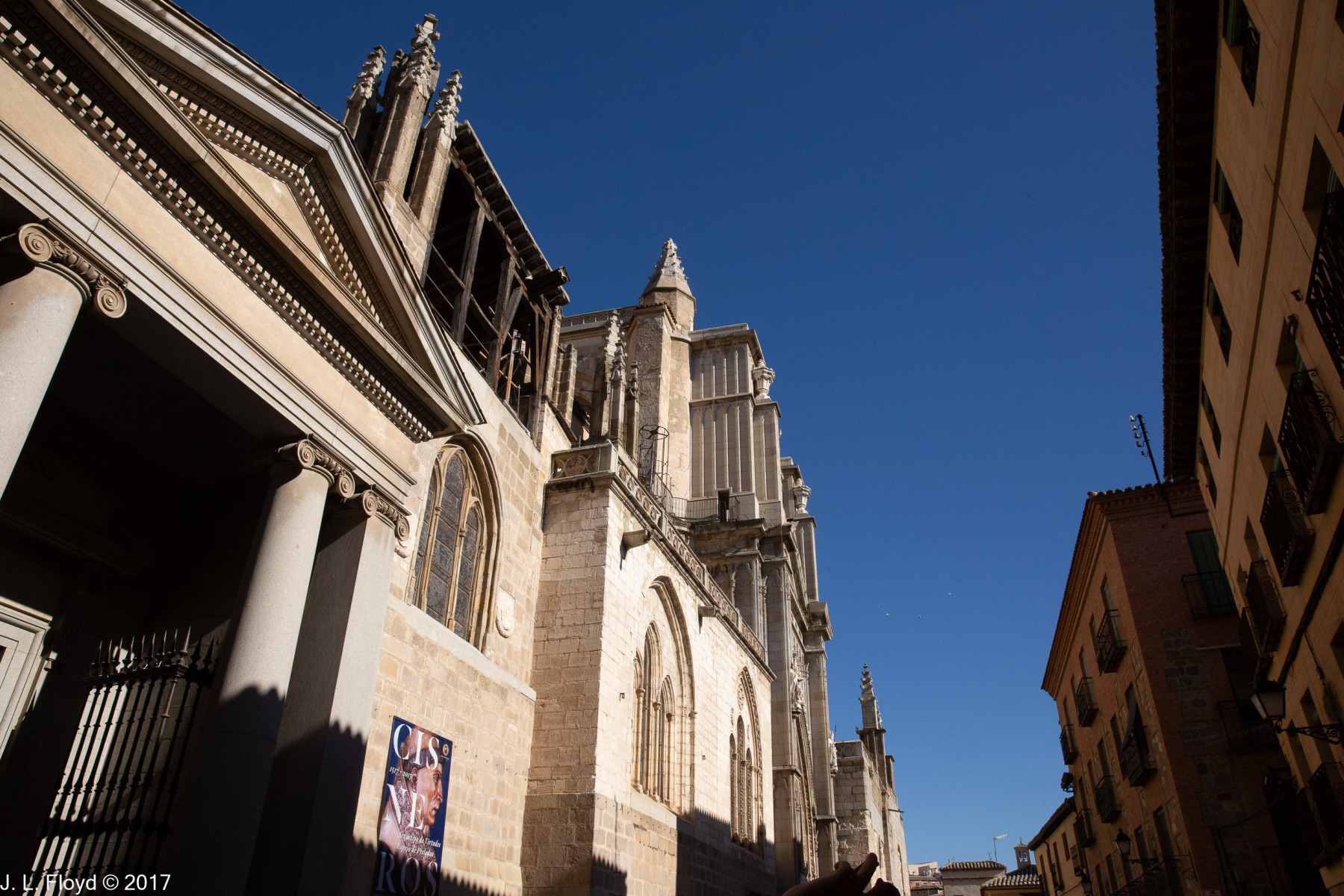
Crossing the Plaza del Ayuntamiento, we turned right onto the Calle Cardenal Cisneros, which runs along the south side of the Cathedral. Its formal name is the Catedral Primada Metropolitana de Santa María de la Asunción – in English, the Primatial Metropolitan Cathedral of Saint Mary of the Assumption. The honorific title of “Primatial,” granted by the Pope, means that it is the top-ranking cathedral of the Iberian peninsula, first among all the rest.

There has been a church on the present site of the Cathedral in Toledo at least since Visigothic times. Toledo was the episcopal seat of Visigothic Spain and several ecumenical church councils were held there. When the Muslims conquered Iberia in the 8th century, they did not suppress the archbishopric, but they tore down the existing Church of St. Mary and built the main mosque of the city on the site. In 1085, when King Alfonso VI of León and Castile reconquered the city from the Moors, among the terms of the capitulation that he signed was a promise to respect and preserve the Muslim religious and educational institutions, including the mosque. However, as soon as he left the city on state business, his queen and the fanatical Archbishop of Toledo, Bernard of Cluny, broke the promise, occupied the mosque by force, and converted it into a Christian church. The king was enraged when he found out about it, and threatened to execute everyone involved, but was dissuaded from doing so by the local Muslim leader Abu Walid, who also graciously persuaded his co-religionists to accept the legitimacy of the conversion. In 1088 Pope Urban II – who also instigated the First Crusade – designated the church to be the primatial cathedral of Castile.

But the Cathedral in its present form only began to take shape in the 13th century, when Rodrigo Ximénez de Rada (c. 1170 – 1247), Archbishop of Toledo from 1208 to 1247, having observed that the existing mosque-cathedral was falling into decrepitude, determined to build a new one worthy of the Toledan See. The early 13th century was a watershed period in Spanish history. In 1212 the combined Christian forces of Castile, Navarre and Aragon broke the power of the Almohad Caliphate once and for all in the Battle of Las Navas de Tolosa. Ferdinand III, who became King of Castile in 1217, became one of the most successful rulers in Spanish history, permanently uniting the crowns of León and Castile and going on to reconquer, in concert with the other Christian kings of Spain, most of the remaining Moorish areas, until only Granada was left to the Muslims. (In 1617 he was canonized by Pope Clement X. The San Fernando Valley in Southern California is named after him.)

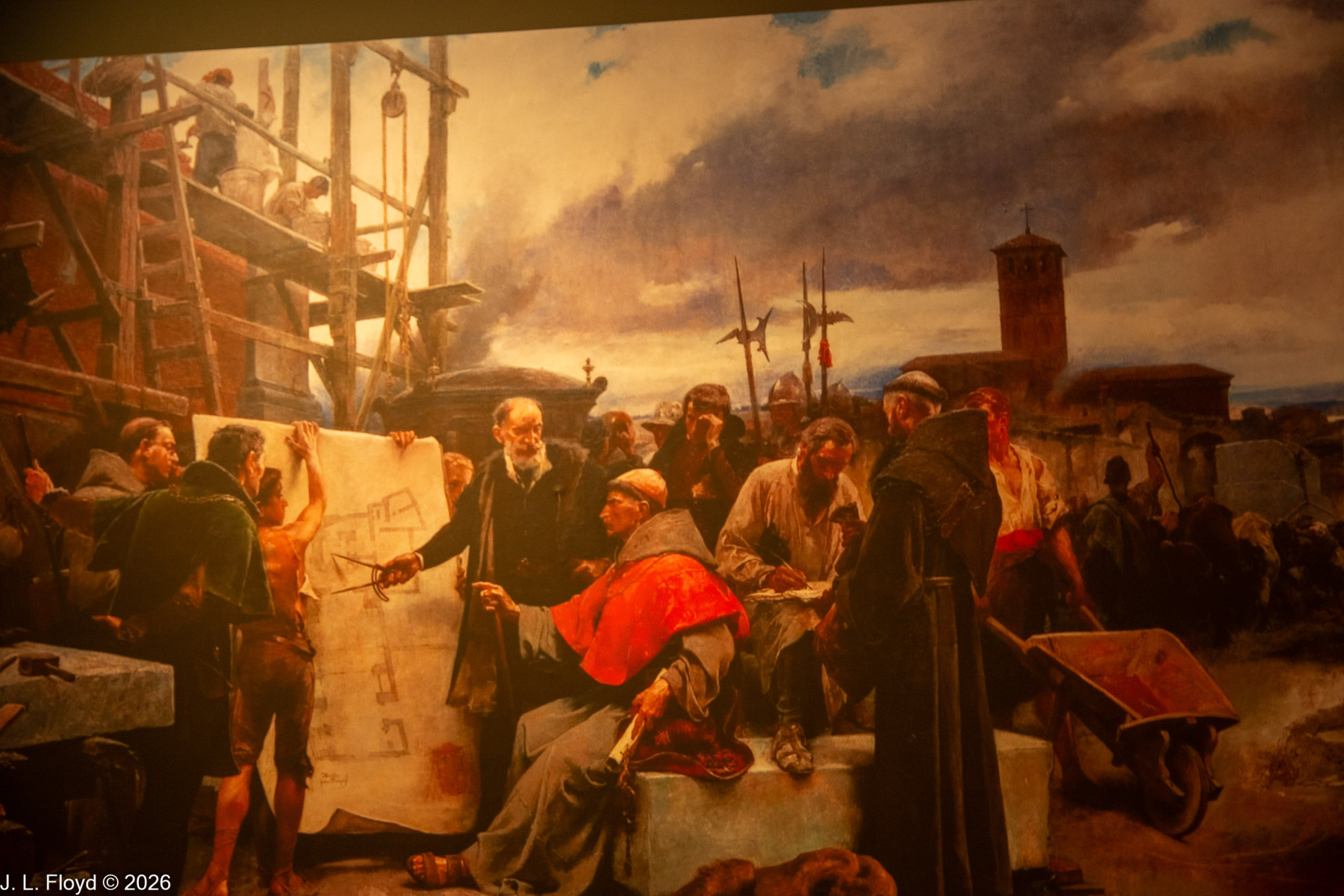
Meanwhile, back in Toledo, Archbishop Ximénez de Rada was about to realize his dream of building a new Gothic cathedral. He was delayed for a while by the need to have King Ferdinand tear himself away from affairs of state long enough to be present at the laying of the cornerstone. This happened in 1227.

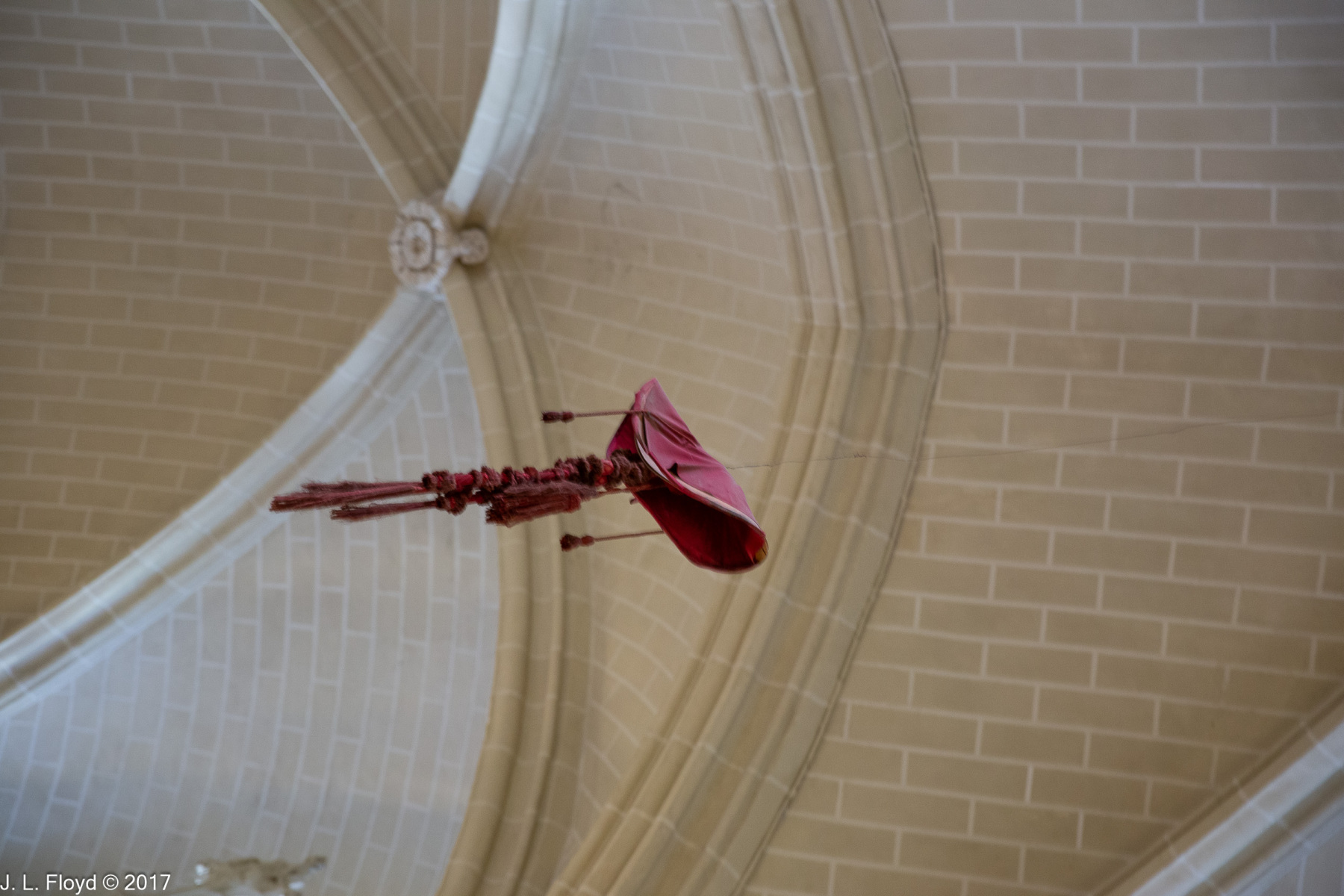
The new cathedral was modeled after the High Gothic cathedral of St. Stephen in Bourges, France, but incorporated some features of Mudéjar provenance as well, as an adaptation to Spanish tastes. Like all the great European cathedrals, it took many years, centuries in fact, to complete. The official year of completion was 1493, in the time of Ferdinand and Isabella, when the vaults of the central naves were finished, under the supervision of Pedro González de Mendoza (1428 – 1495), Cardinal-Archbishop of Toledo, Primate of Spain and Chancellor of Castile. Even after its nominal completion, significant additions, modifications and alterations were performed during the following centuries. Some of the most important of these were completed in the early 16th century under Mendoza’s successor, Cardinal Francisco Ximénes de Cisneros (1436-1517), whose name was given to the street from which we entered the cathedral. We encountered mementos of these two prelates, who were both key figures in Spanish history, at every turn during our tour of the cathedral.

The cathedral is 120 meters (390 feet) in length, 59 meters (194 feet) wide and 44.5 meters (146 feet) high. It consists of five naves with a transept (crosswise passage) between the choir and the main chapel, and a double ambulatory encircling the latter.  It has one spire, at the northwest corner, 92 meters (302 feet) high. The original plan called for an identical tower to be built at the southwestern corner, but while the north tower was under construction, the builders discovered that an underground water stream made the south side too unstable to hold the weight of another tower, so that idea was abandoned. Later, around 1500, a major chapel, the Mozarabic, was built in that location; this was the doing of Cardinal Cisneros.

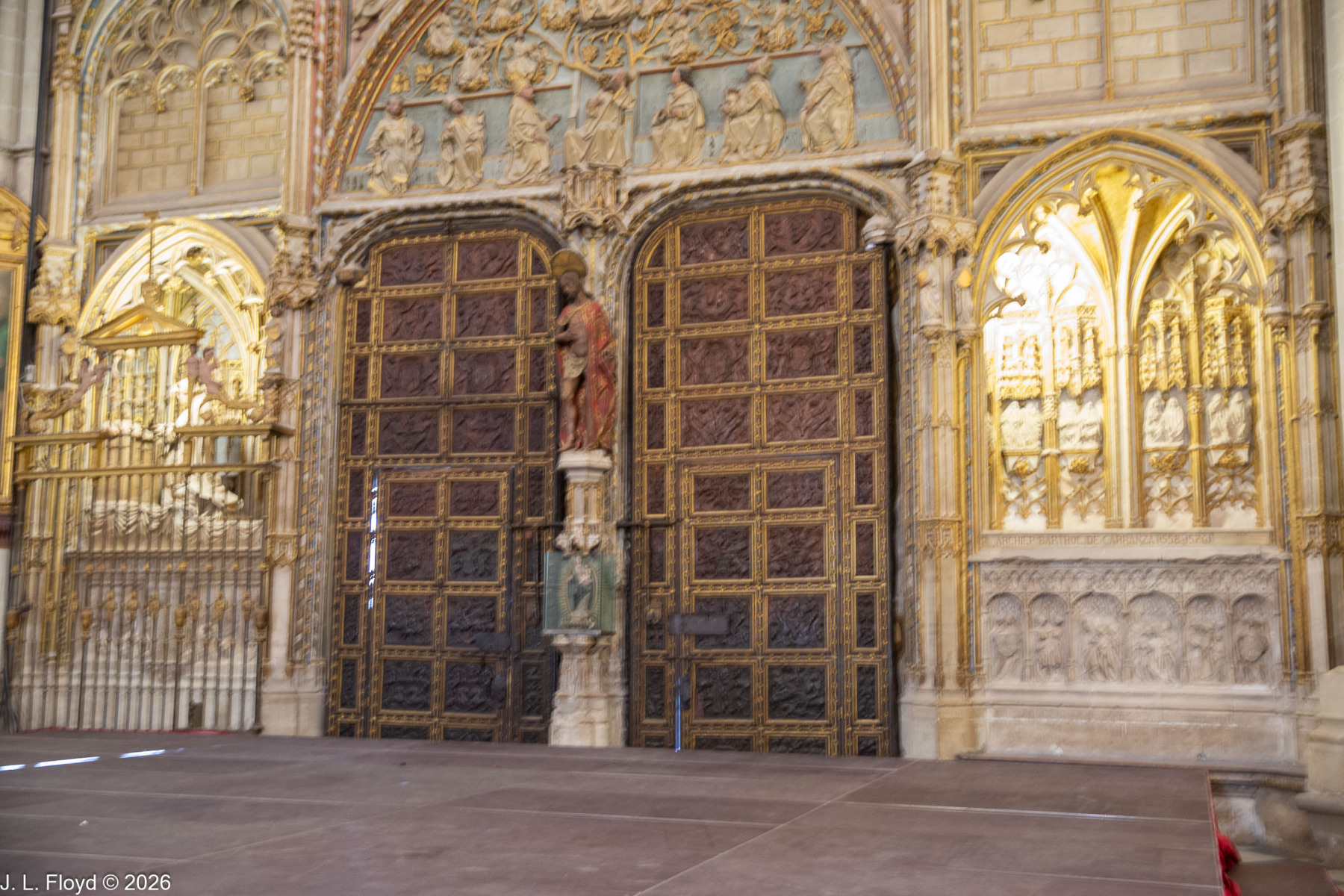
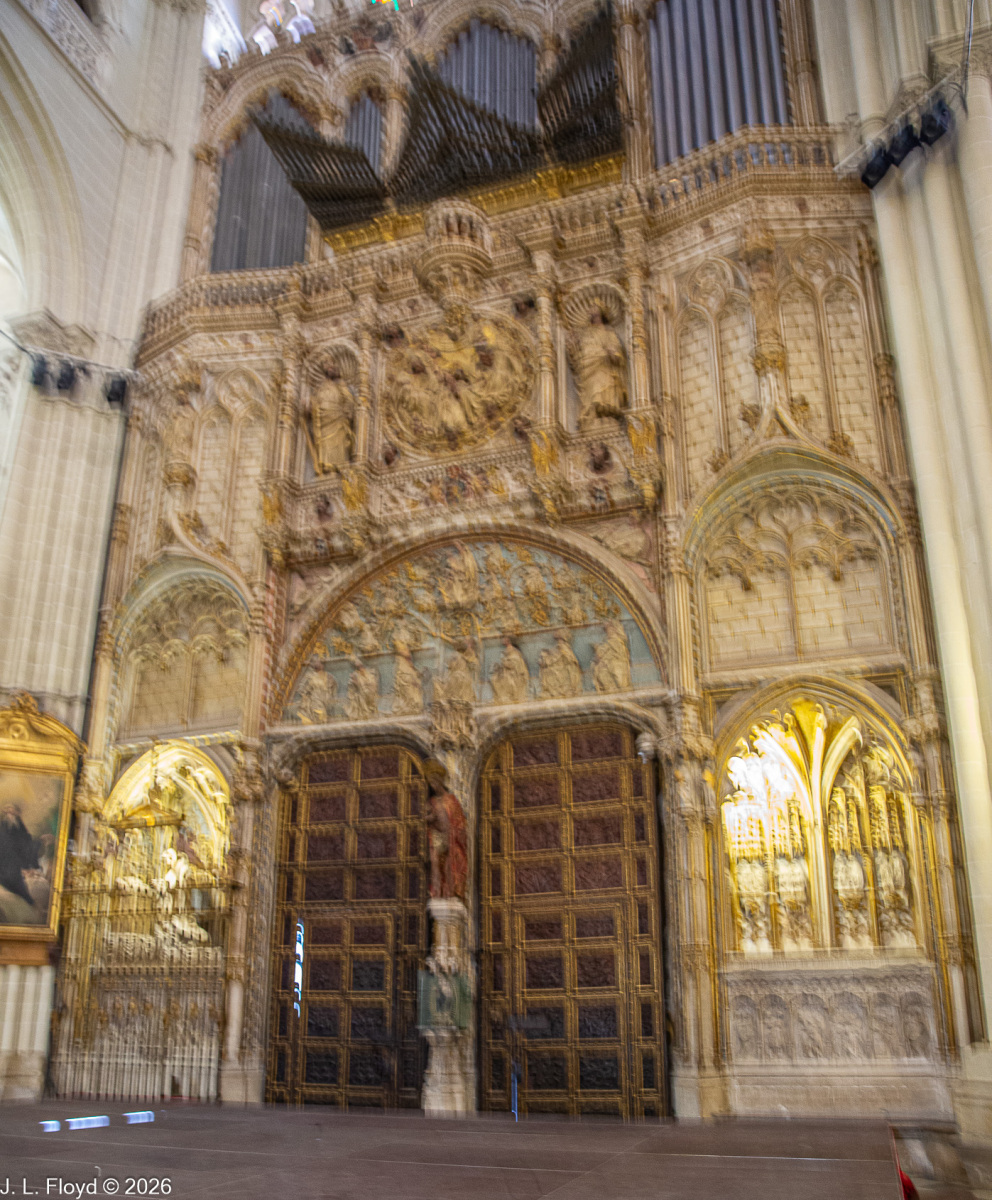
The Calle Cardenal Cisneros provides two entrances to the Cathedral. We first passed the Puerta Llana, the Level Portal, of neo-classical style, added in 1800, and so called because it is level with the street and has no steps; it was customary for processions to exit through it. We entered through the second portal on the south side, the great Puerta de los Leones or Lions’ Gate. This was built between 1460 and 1466, on the order of  Archbishop Alfonso Carrillo de Acuña. The design, in a late Hispano-Gothic style, was conceived and executed by Flemish masters from Brussels.

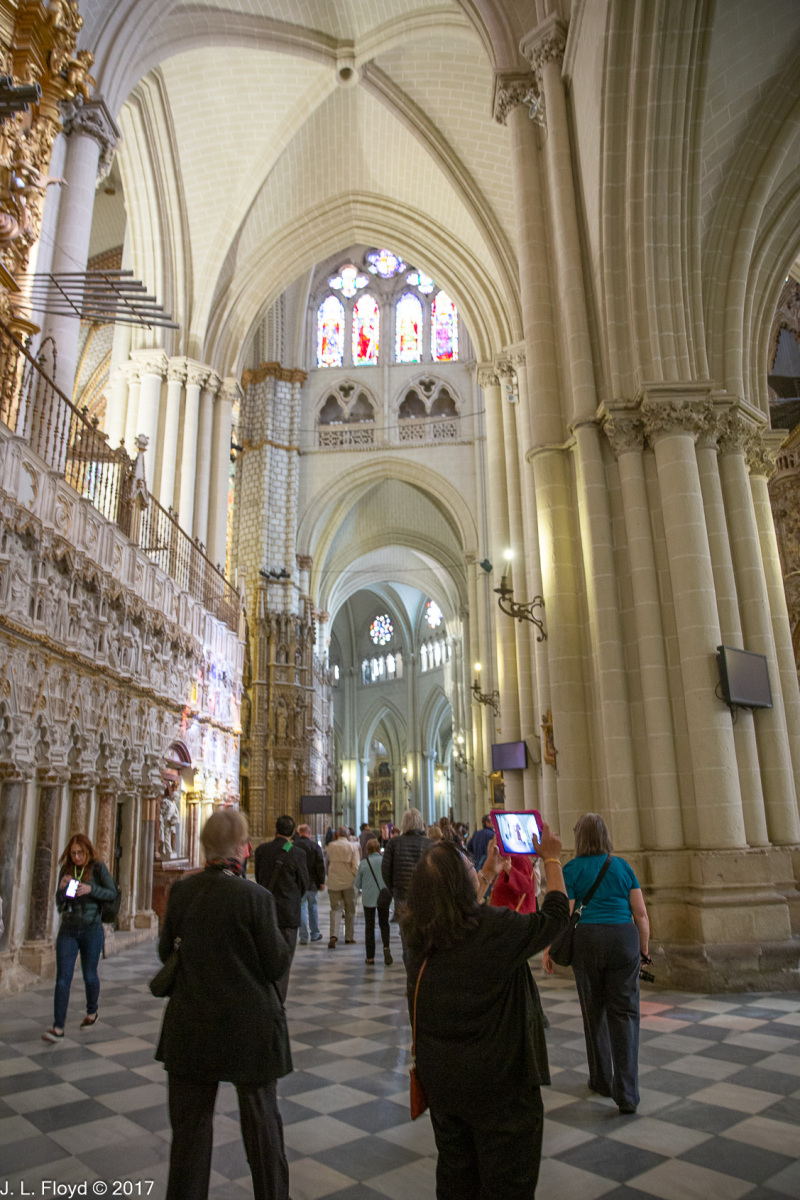
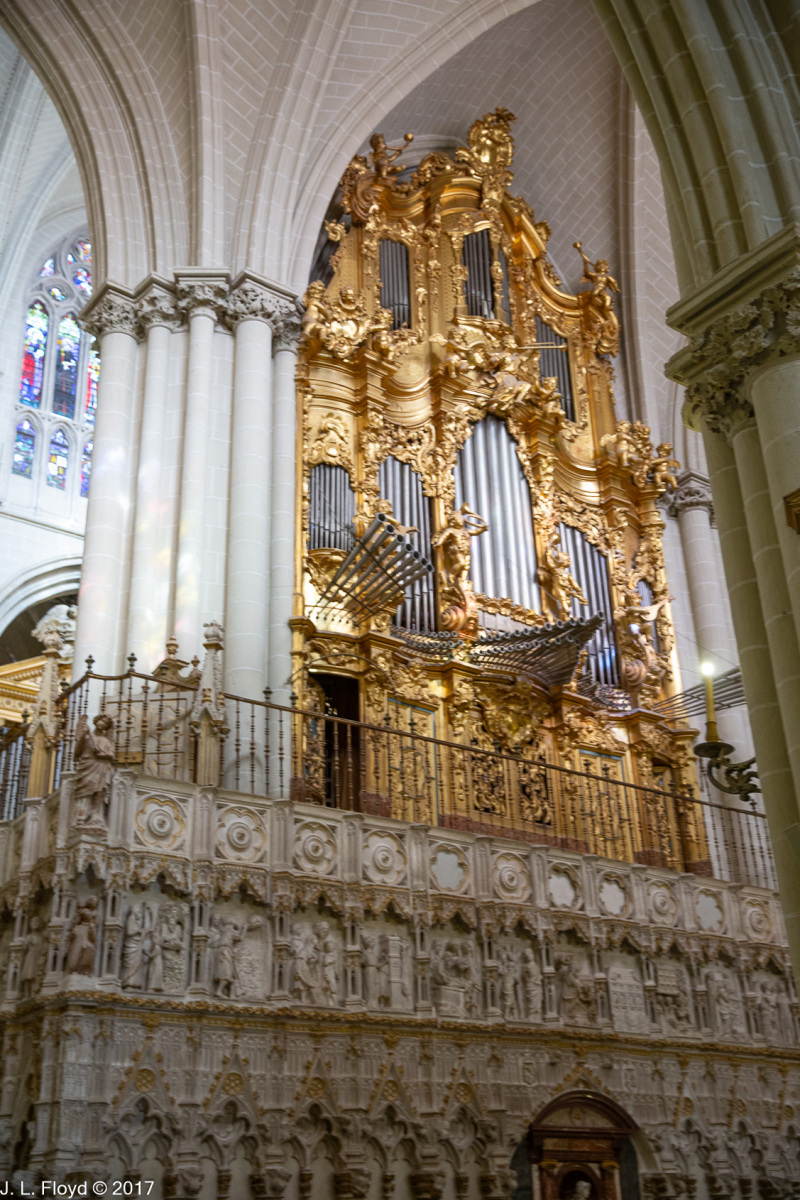
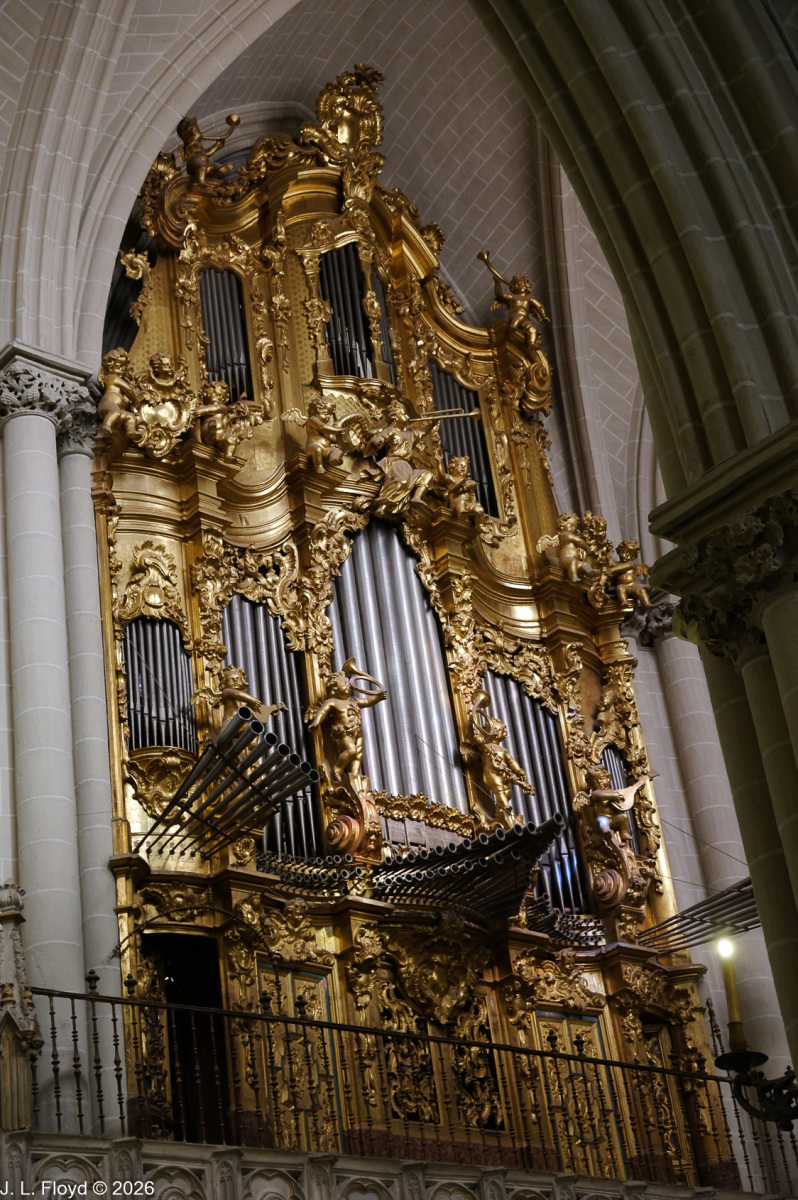
Entering the cathedral, we found ourselves on the south side of the transept. On an ornate balcony to the left was one of the many (nine, by my count) organs in the cathedral. It was a very impressive organ, but not the largest; that distinction belongs to the so-called “Emperor” organ, located above the Puerta de los Leones, which we had just passed through. It sits on a very tall balcony with balustrade, far above the doors of the portal, and the distance makes it look relatively small; until I found out differently, I thought that the Emperor organ was the one on the lower balcony, but that may be the one called the “General” (one of two in the choir) instead.

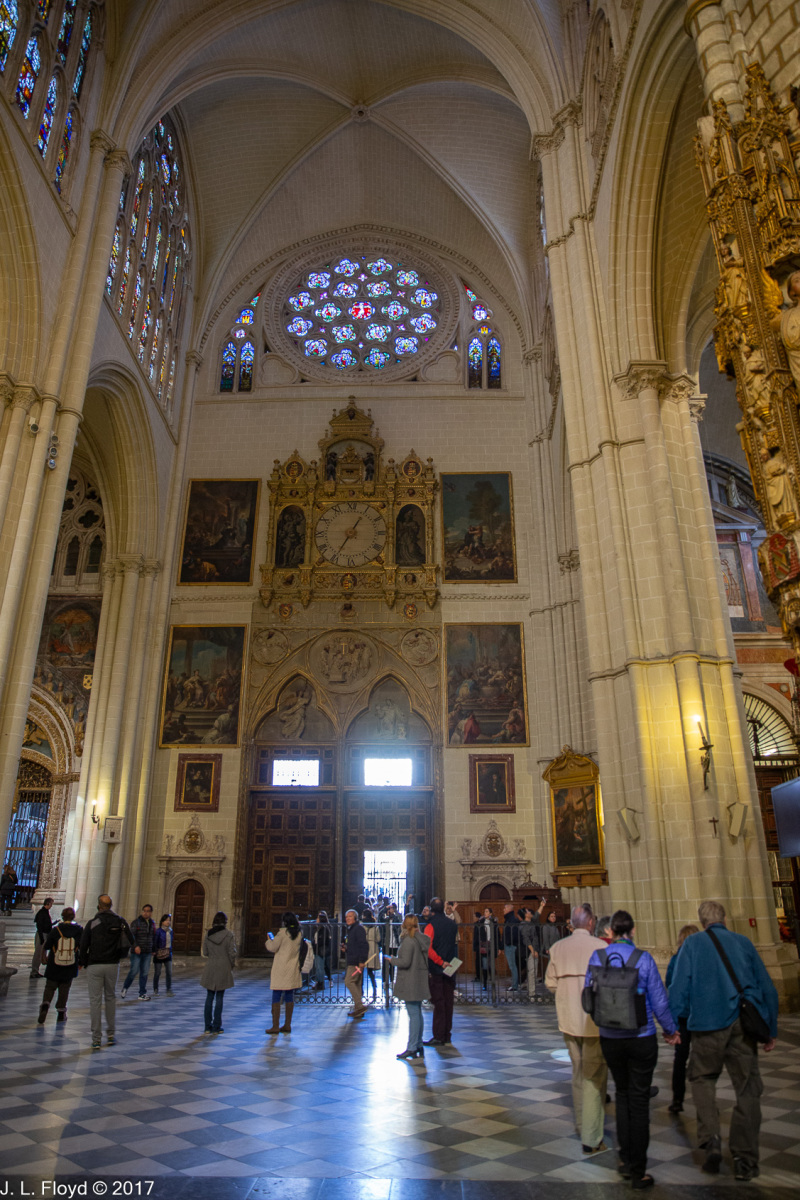
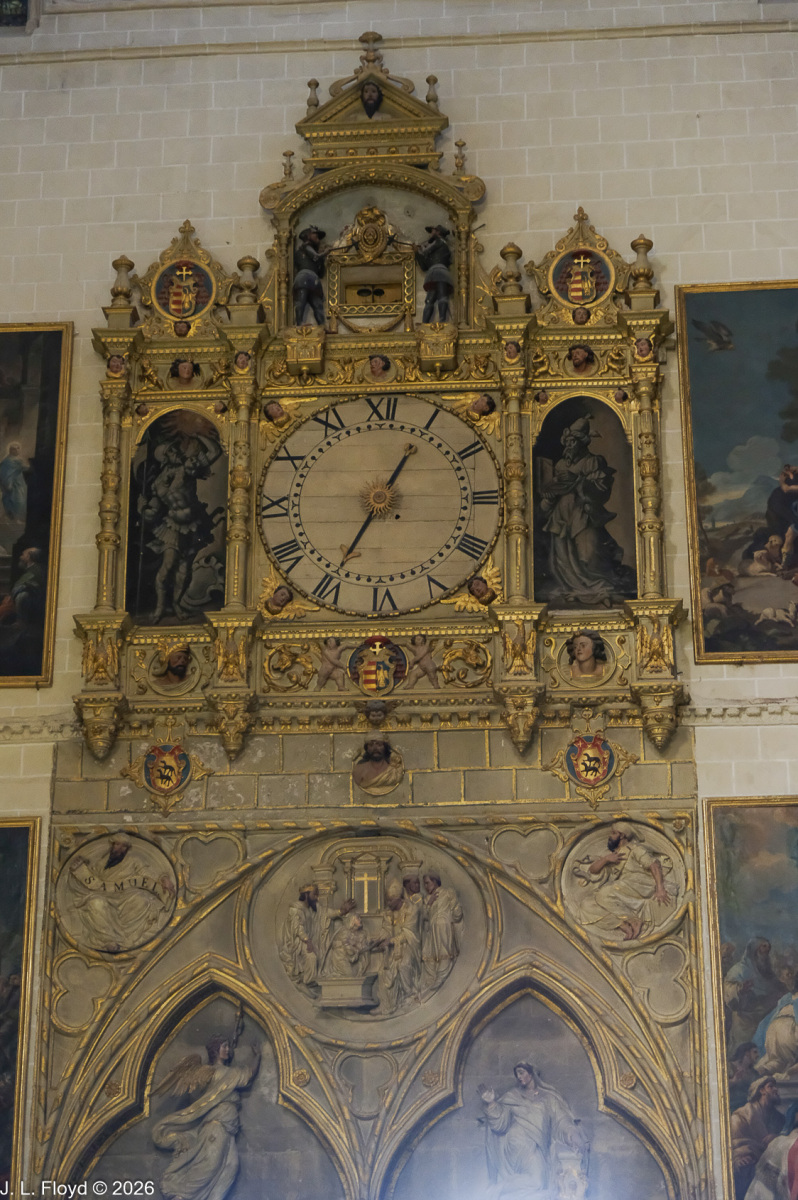
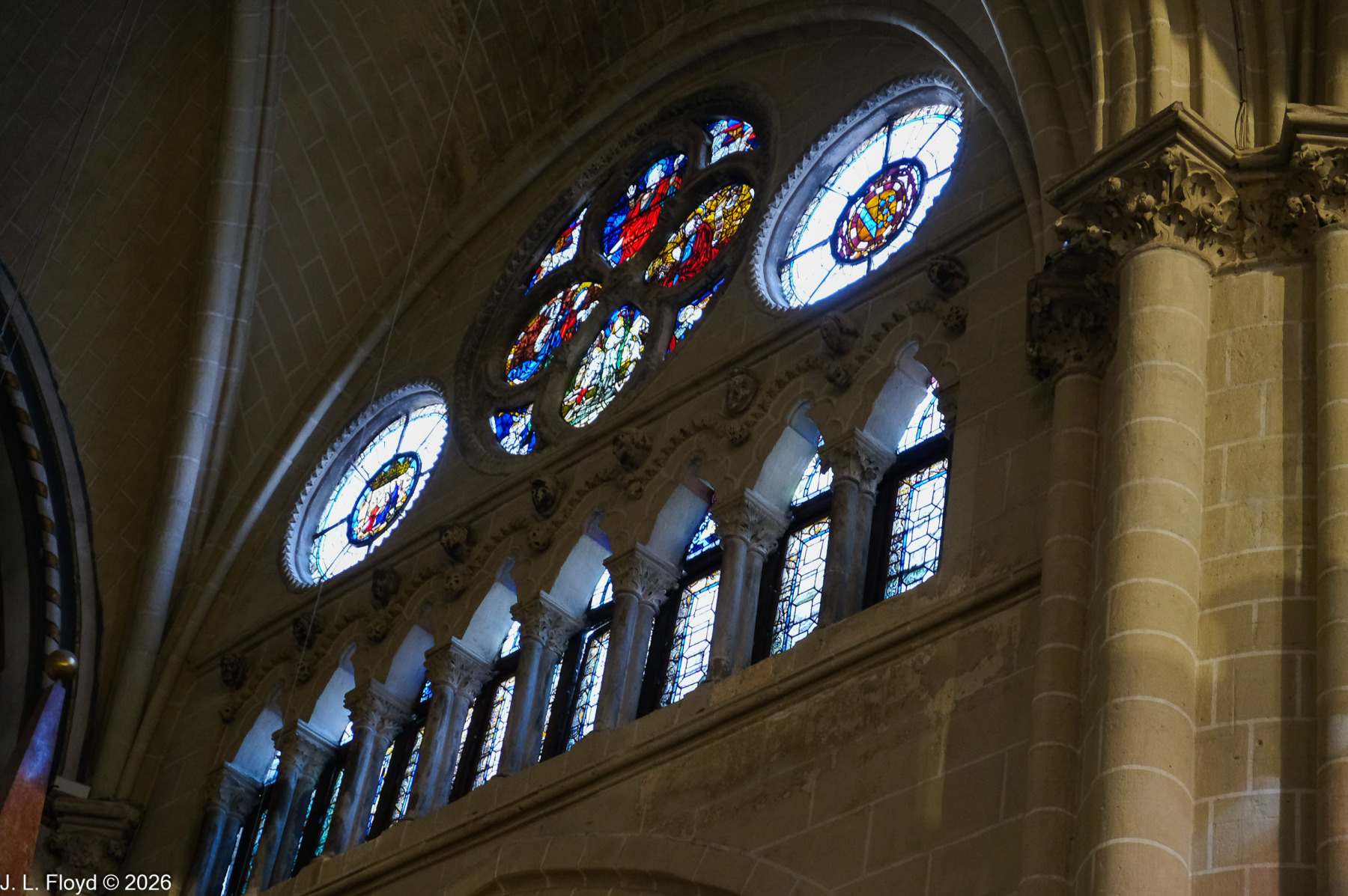
On the opposite (north) side of the transept, we saw the great Puerta del Reloj (Portal of the Clock), which does indeed have a clock above the doorway. Above the clock is the 13th-century Rose Window, the oldest stained-glass window in the cathedral. It has a counterpart above the Portal de los Leones; that is the work of by Nicolás de Vergara el Mozo (1540 – 1606), who as Master of Works was also responsible for several chapels and other celebrated additions to the cathedral.  Unfortunately, I failed to scale my photo of the Puerta de Los Leones with the Emperor Organ to include the window.

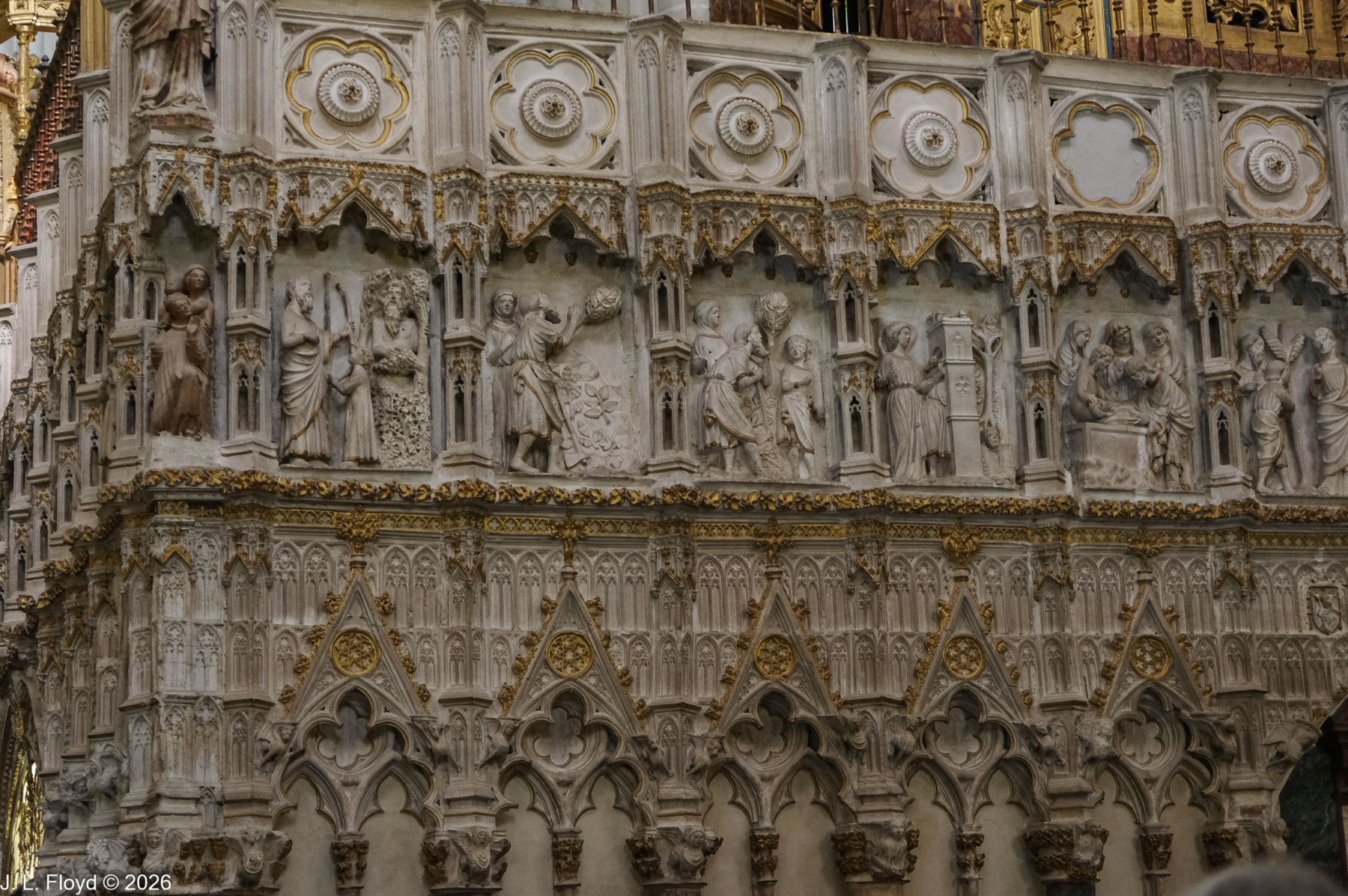
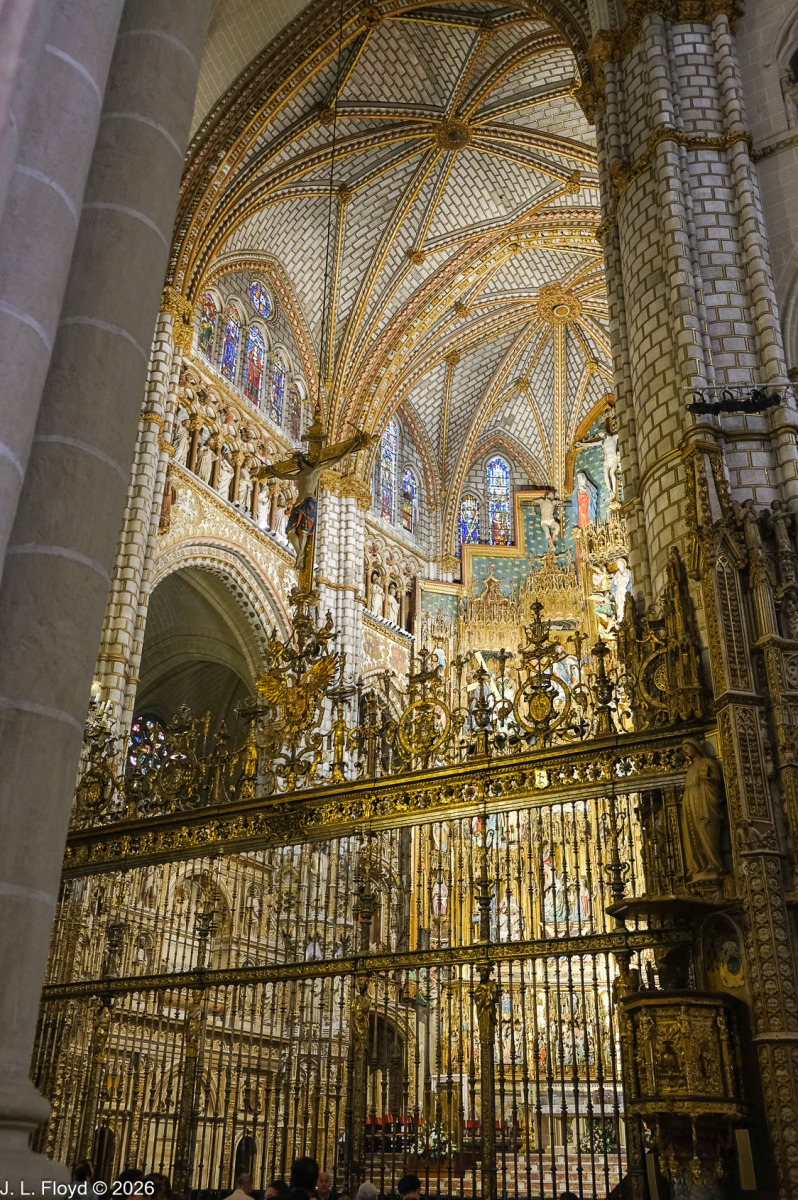
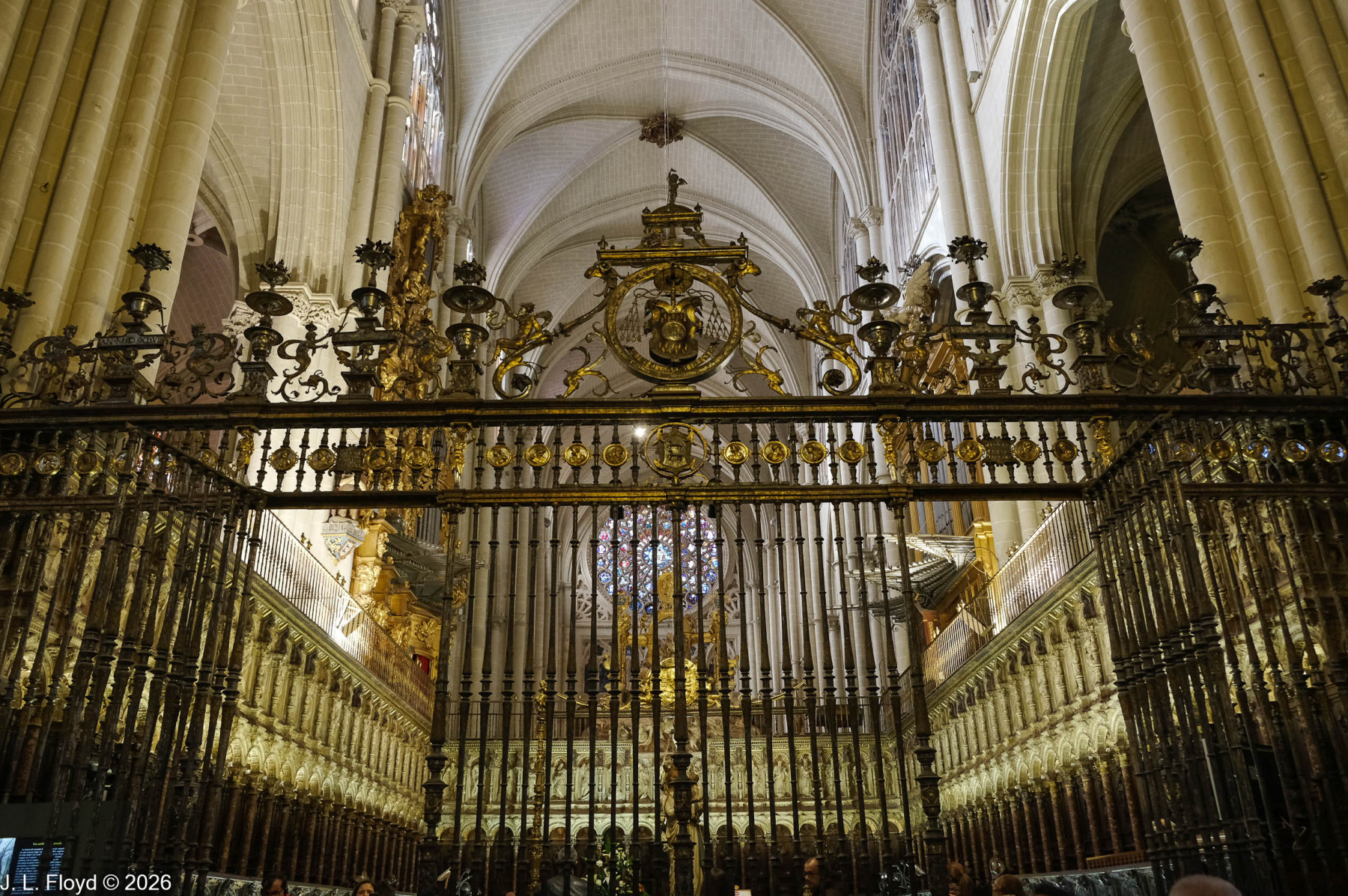
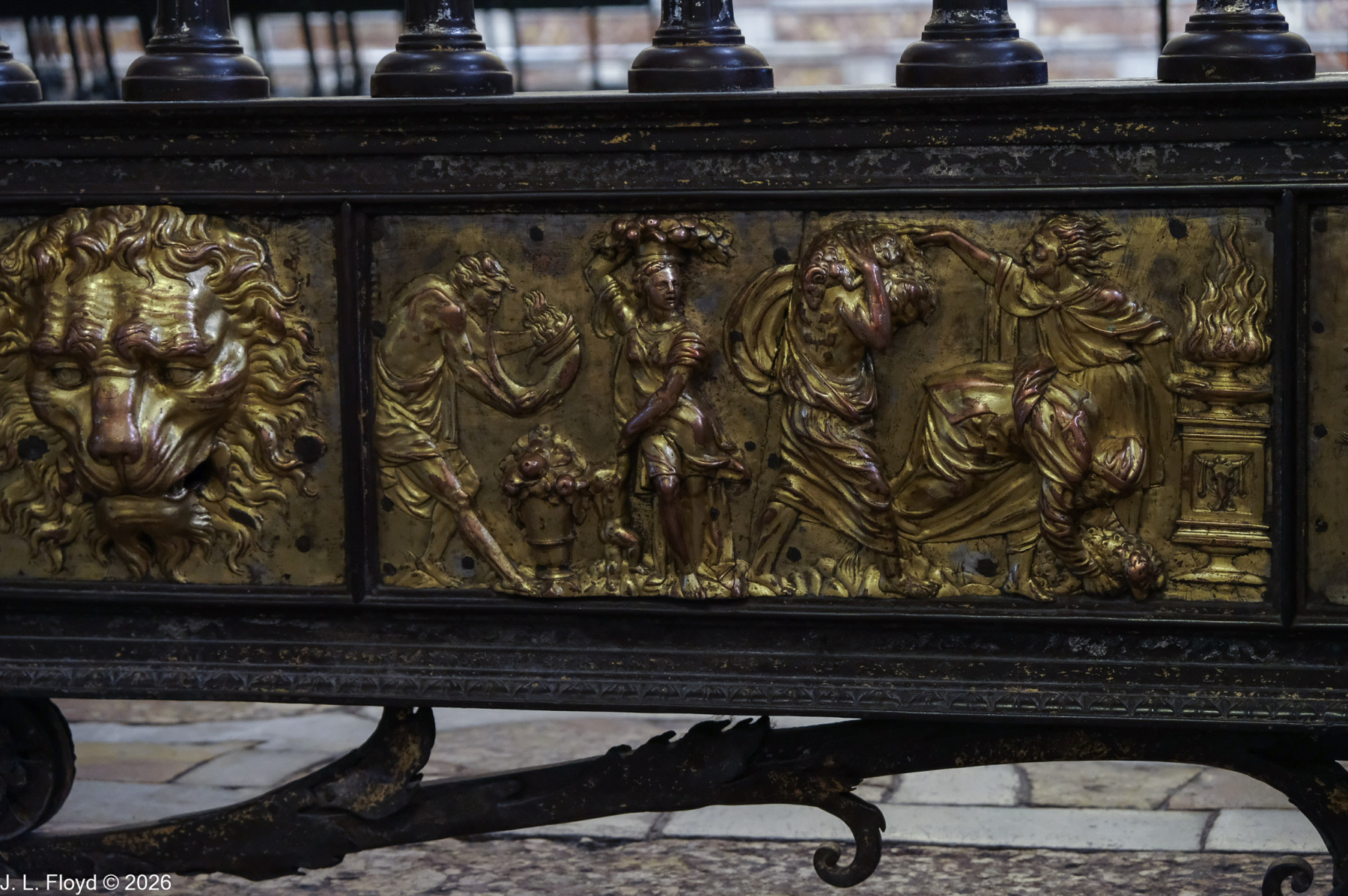
While many great paintings, sculptures and other works of art are displayed in Toledo Cathedral, I was particularly enthralled by the rejería, or grillework. Rejas are decorative ironwork screens placed in front of the choir, the chapels and sometimes the altars. The ones in Toledo Cathedral were made mostly in the 16th century in Spanish Renaissance style by highly skilled craftsmen who specialized in reja-making. First forged in iron, they were then plated with gold or silver and adorned with mythological figures, medallions, candelabra, etc.

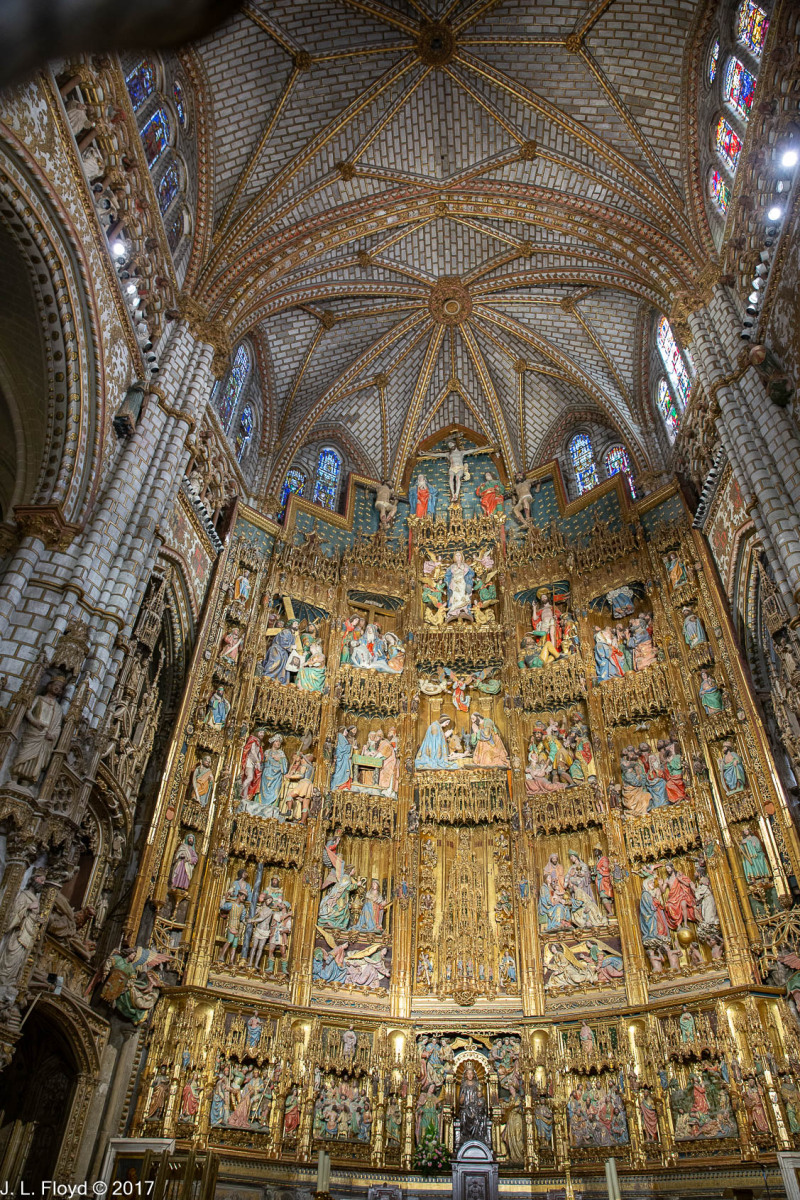
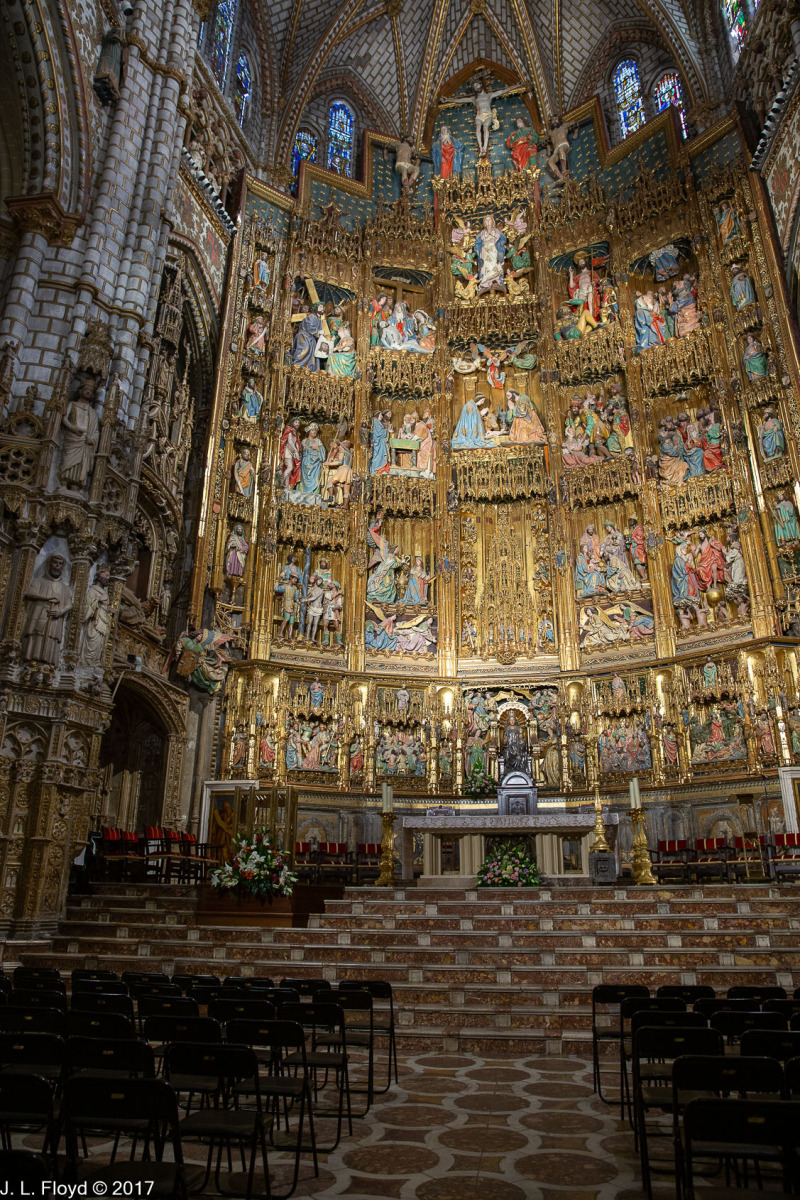
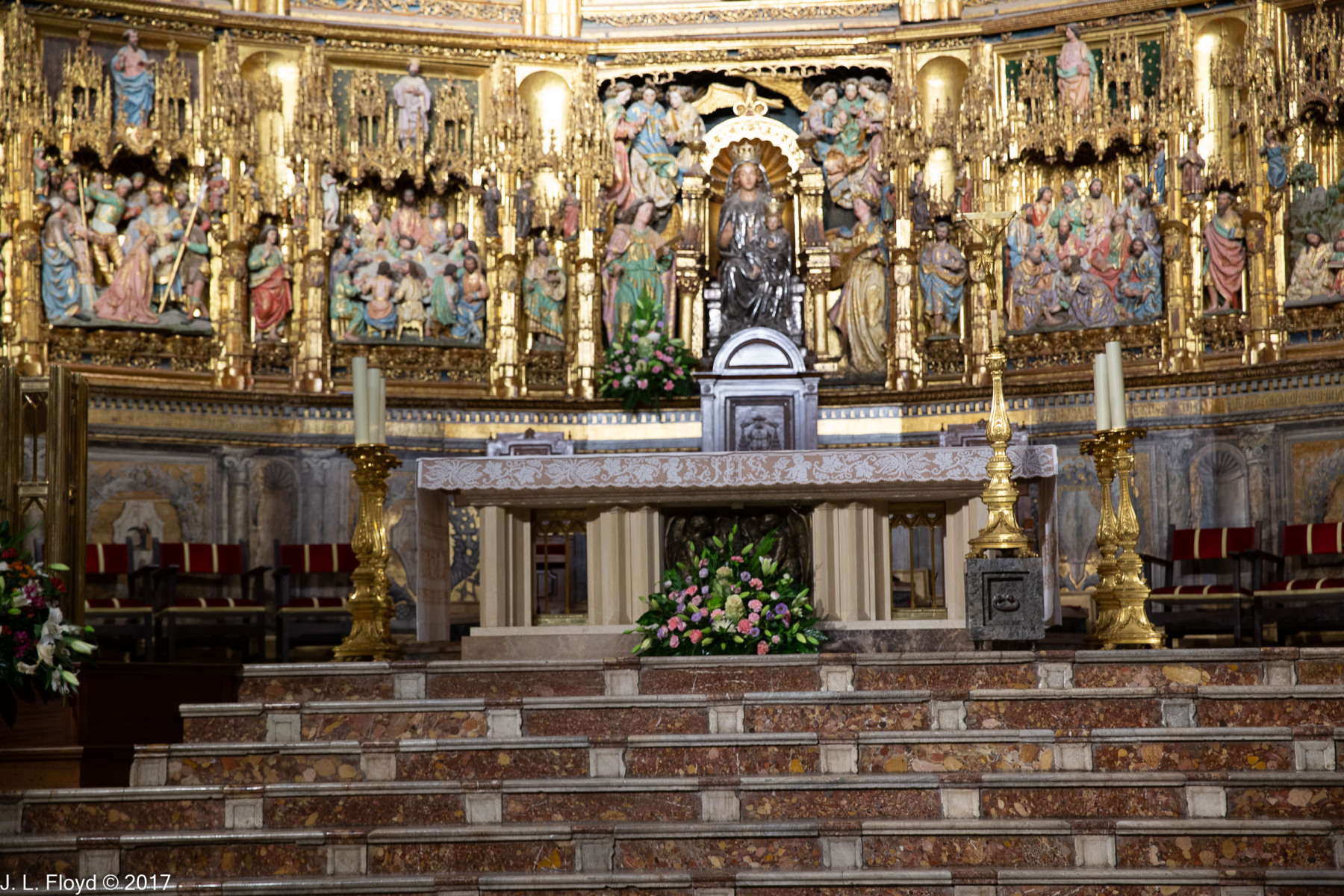
One of the most elaborate and beautiful of the rejas screens off the Capilla Mayor (Main Chapel) of the cathedral, which houses the High Altar and its retable (altarpiece), as well as the tombs of several Castilian kings. The altar and altarpiece were commissioned by Cardinal Ximenez de Cisneros. The existing Capilla Mayor was too small for the altarpiece that Cisneros wanted, so he called for it to be demolished and a new, expanded version to be built in its place. The cathedral chapter (governing body) strenuously objected to this, but Cisneros – as he demonstrated in Granada around the same time – was not one to take no for an answer, and he got his way.

Work on the retable he commissioned began in 1497 and was completed in 1504. It is one of the last great masterpieces of Spanish Gothic art, which was beginning to give way to Renaissance forms in that period. It is made of wood, intricately carved, painted and gilded; it is five stories tall, and depicts episodes from the life of Christ and the Virgin Mary, culminating in a monumental scene of the Crucifixion at the top.

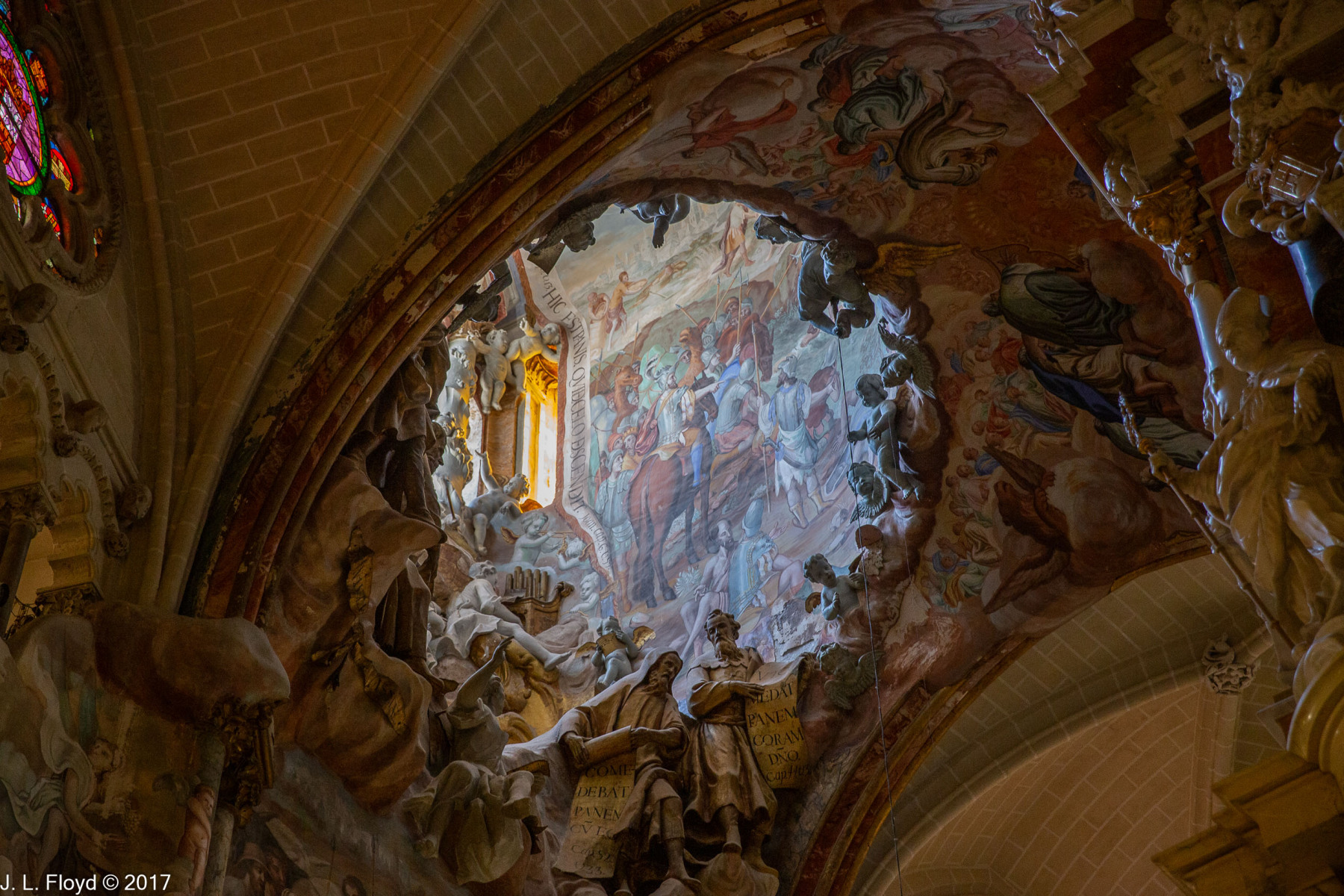
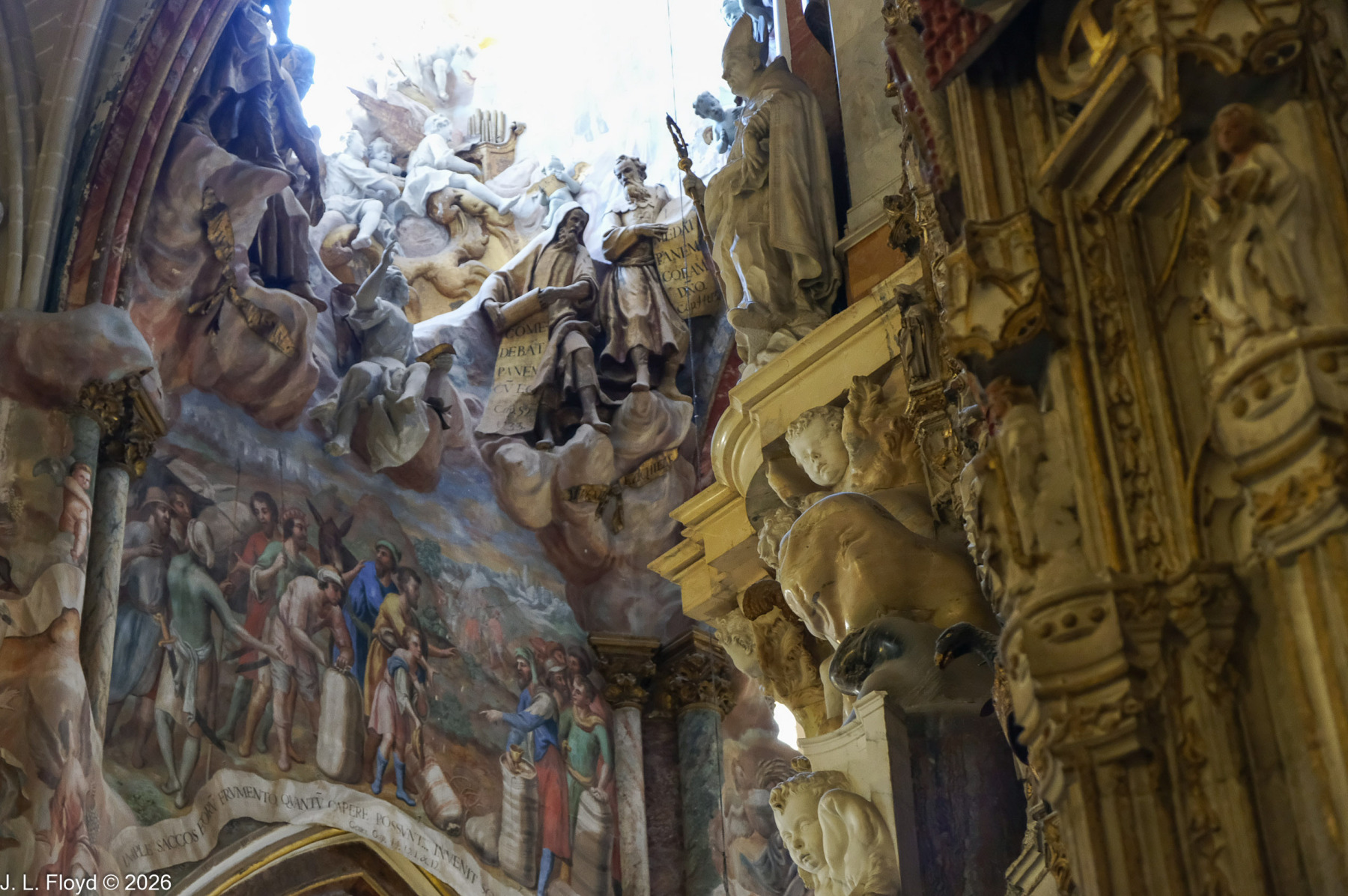
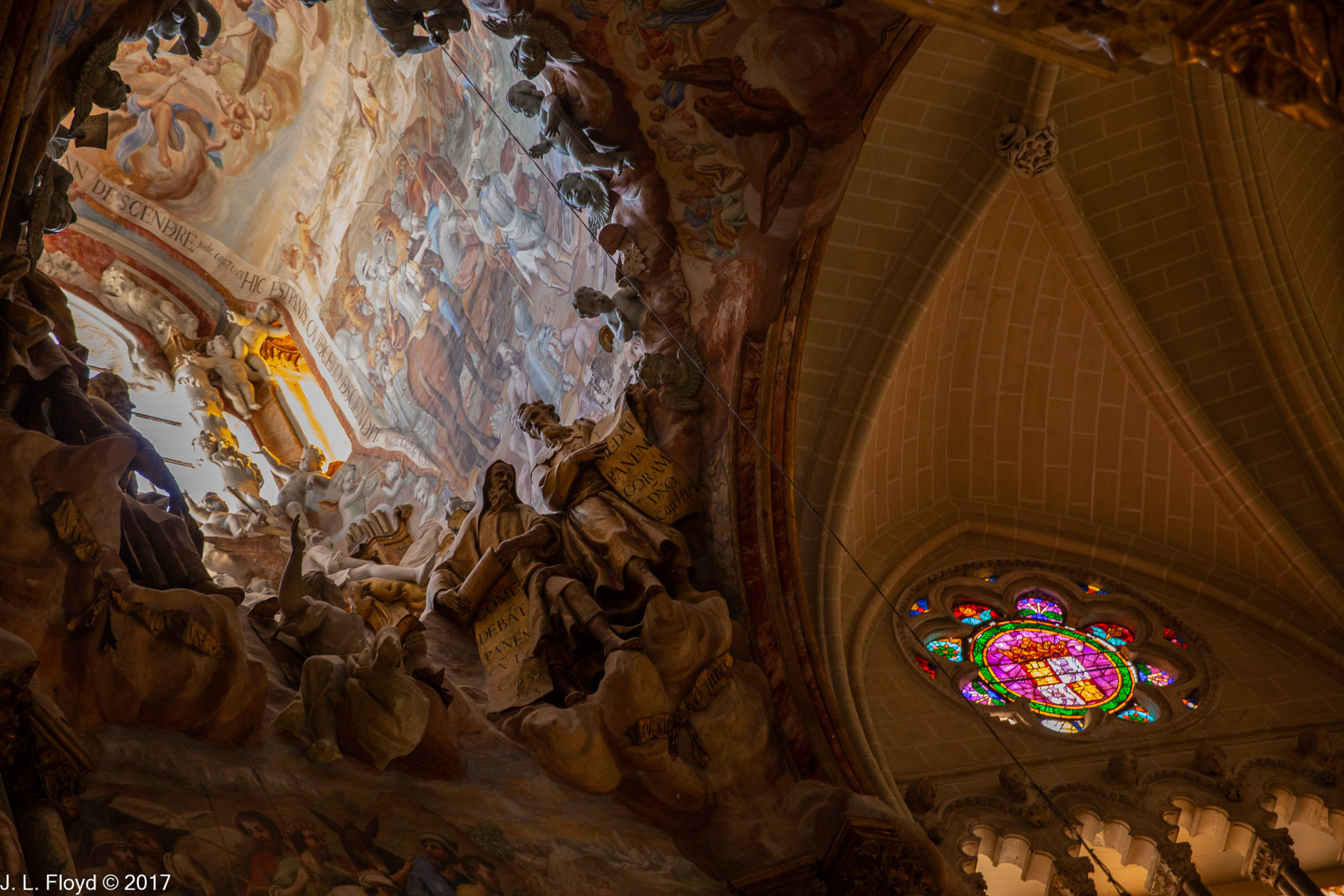
Venturing into the ambulatory, behind the Capilla Mayor, we encountered another of the chief glories of the Toledo Cathedral, a Baroque altarpiece known as El Transparente. This was a late addition, created in 1729-1732 by Narciso Tomé and his four sons. El Transparente is several stories high and has been described as a mixed-media masterpiece, with fantastic figures done in stucco, paint, bronze castings, and multiple colors of marble. However, it was not the altarpiece itself which captured my attention, but rather the manner in which it is illuminated. Two oculi (holes), one high up in the ambulatory, the other cut into the back of the altarpiece itself, allow shafts of sunlight to play over the area, producing a magical effect. Indeed, Sandie and I were so mesmerized by the view through the “skylight” oculus that we forgot to photograph the altarpiece itself. But there is a good image of it on Wikipedia.

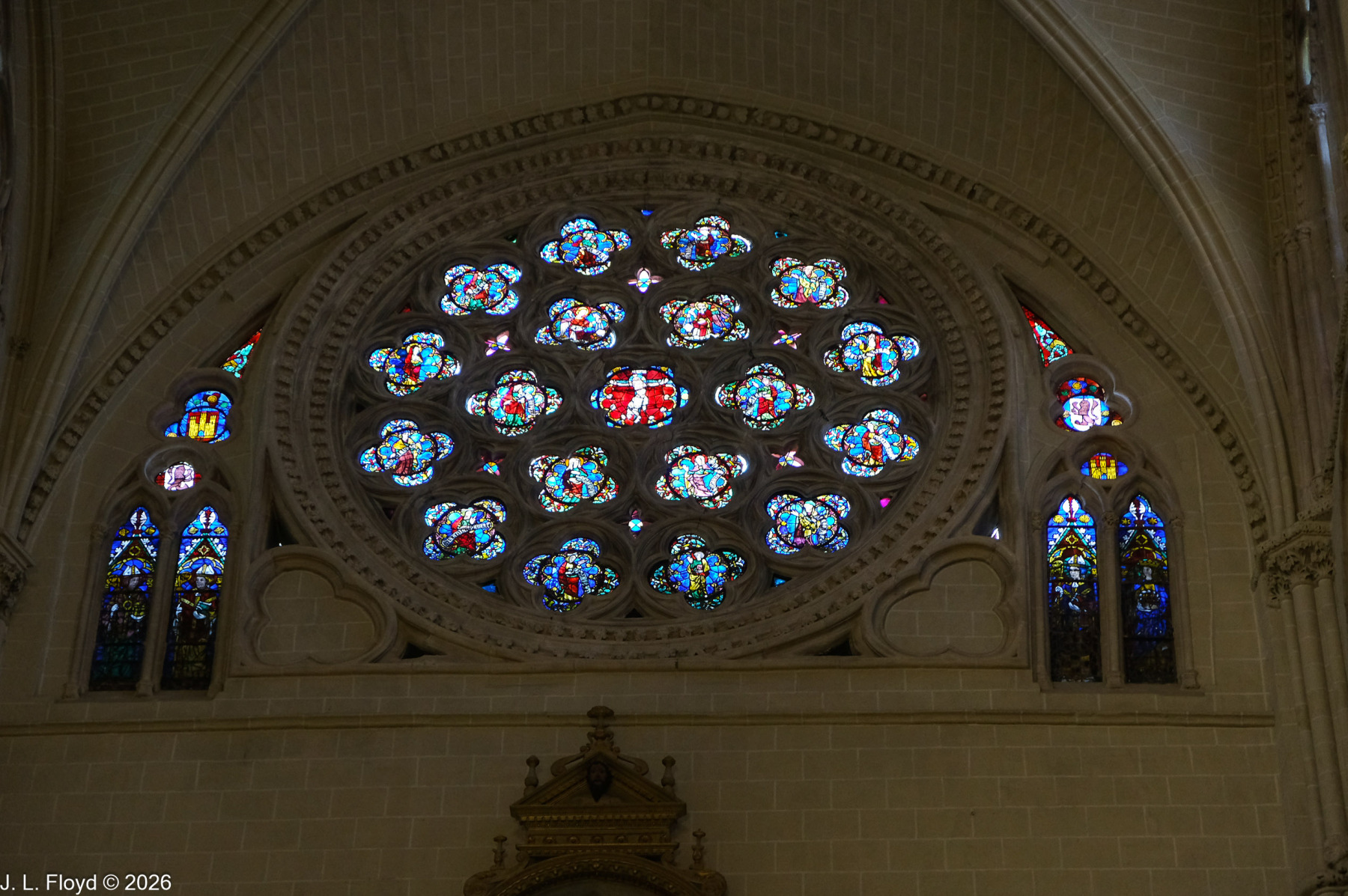
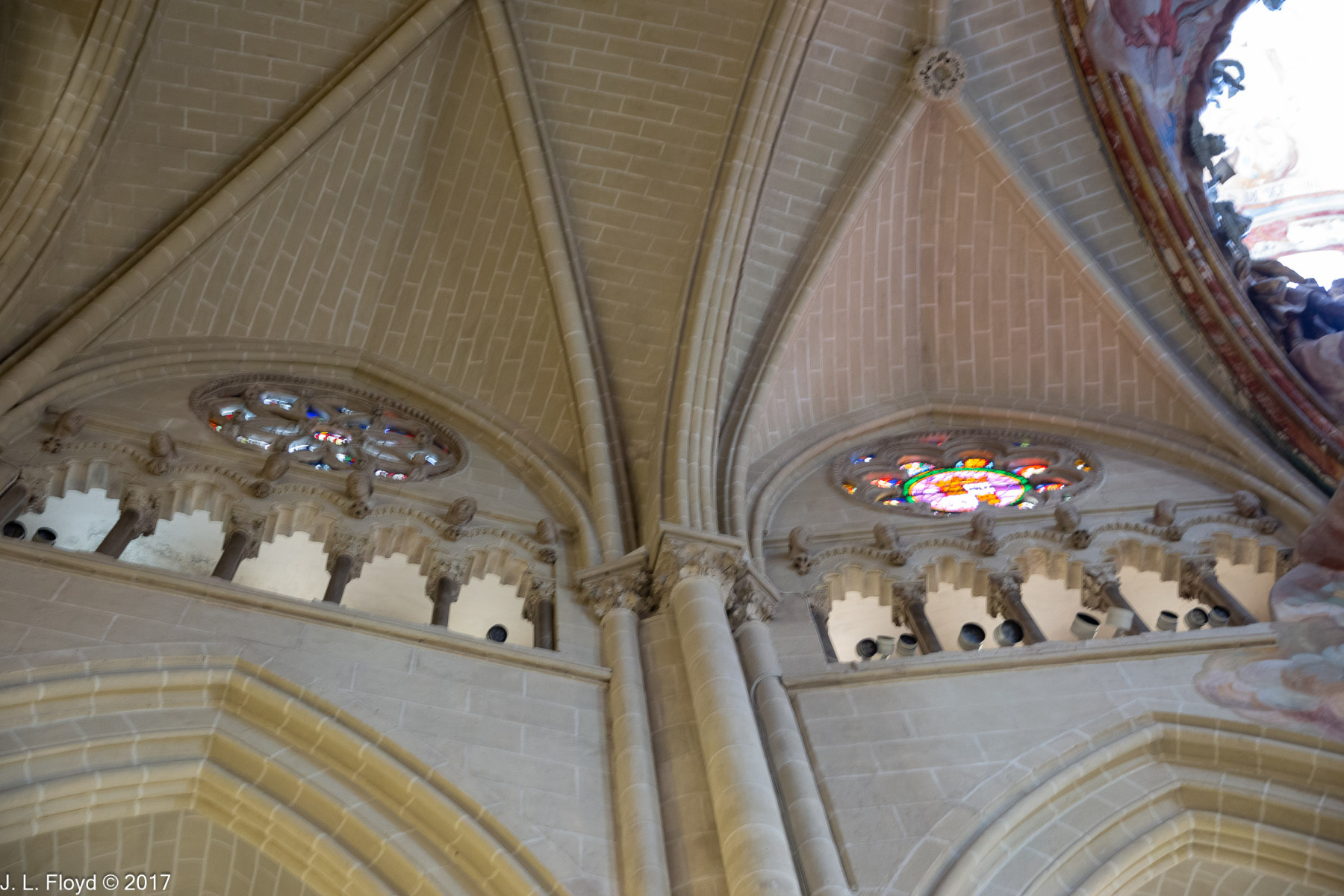
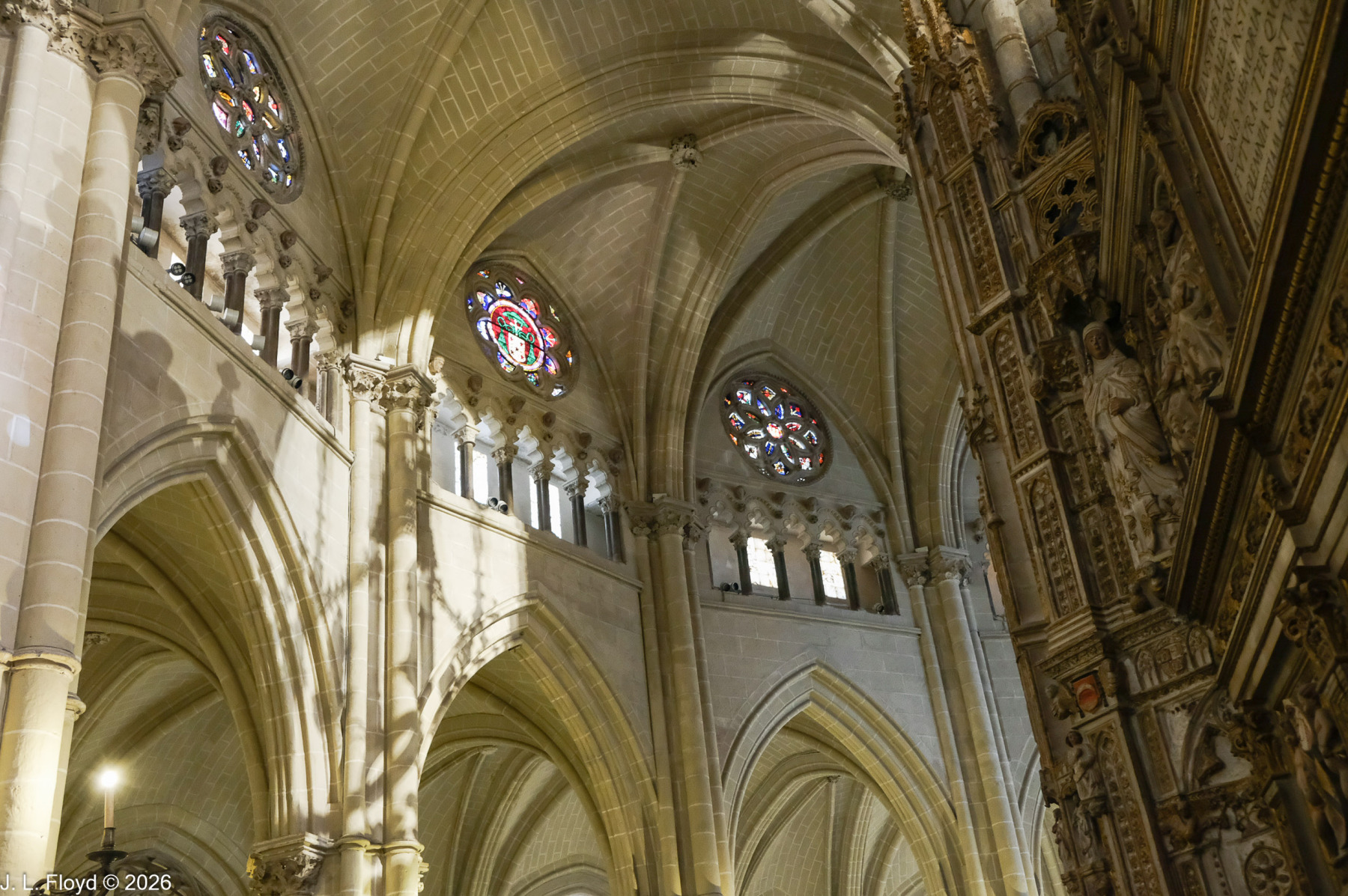
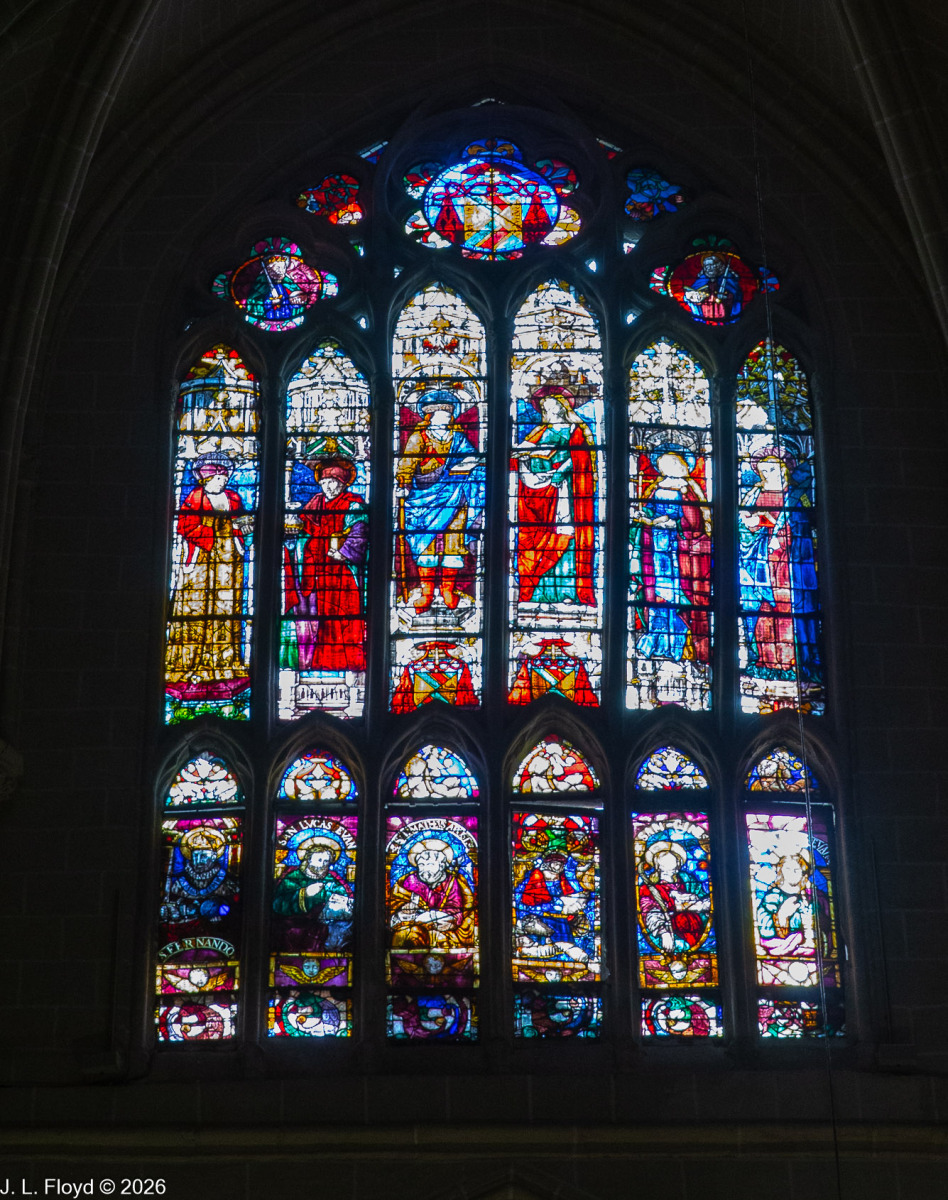
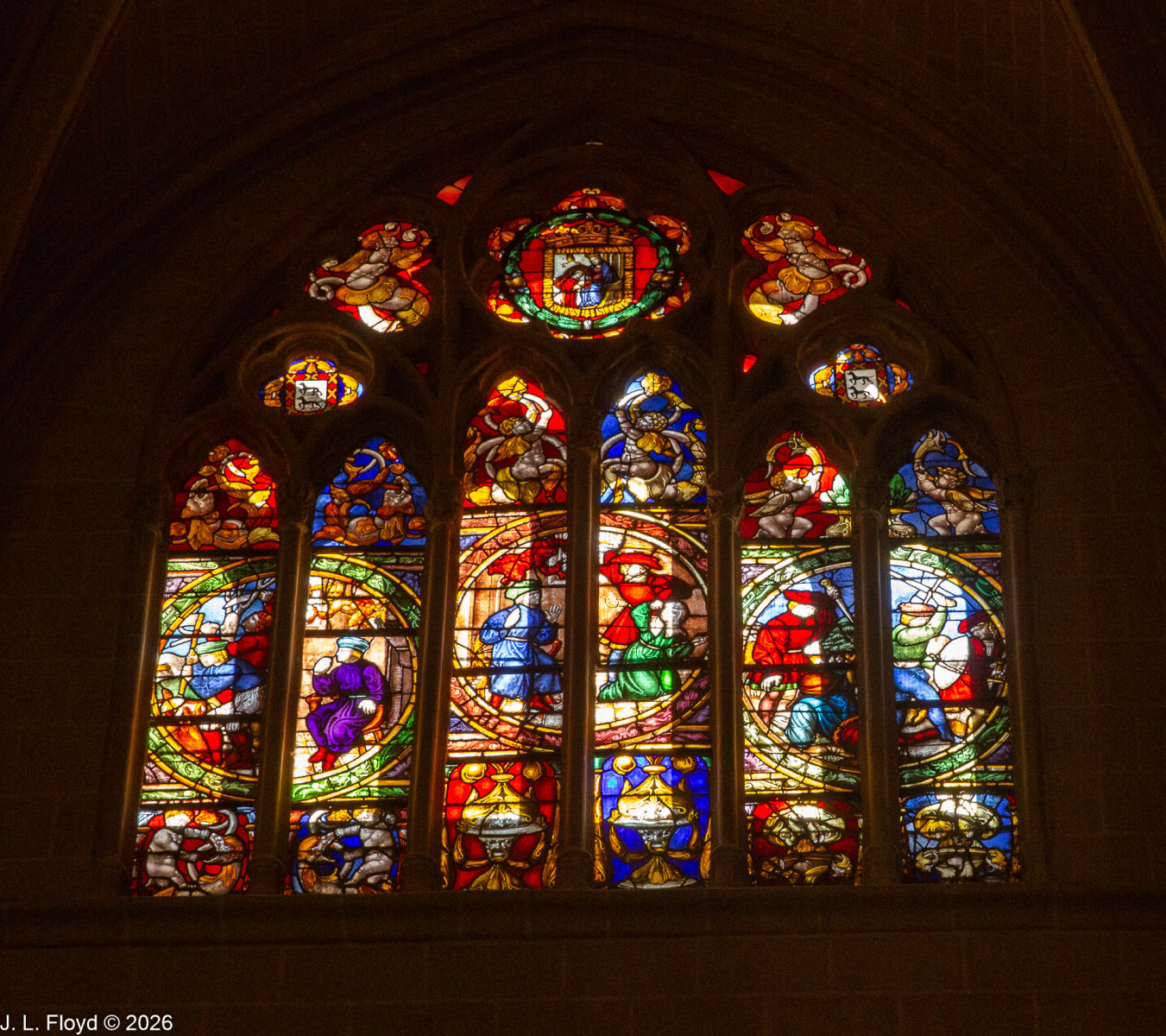
The Toledo Cathedral presents a collection of stained-glass windows that is second to none in Spain. Most of them were produced in the 14th through 17th centuries and many were restored and renovated in the 18th. The most famous and spectacular is the Rose Window in the transept, over the Portal of the Clock, but others are also awe-inspiring, especially those of the ambulatory, the main chapel and the north aisle of the east side of the transept.

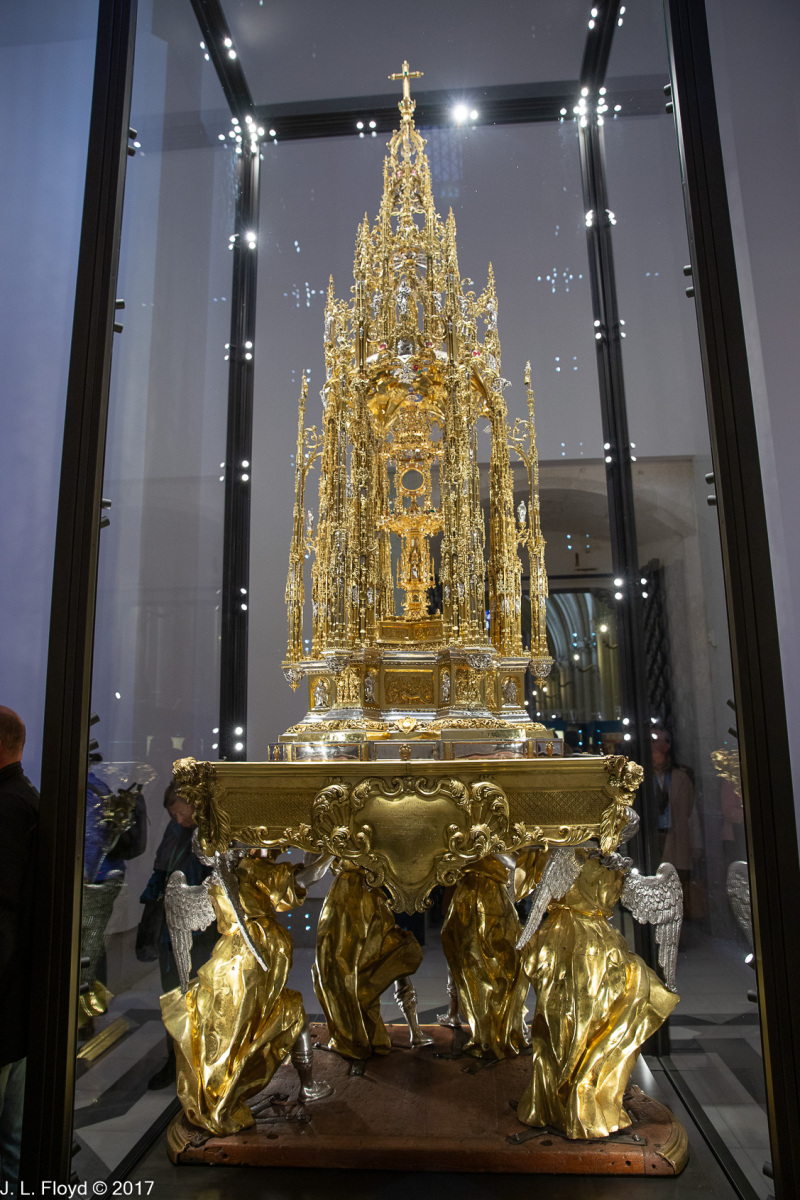
Unlike a certain public figure who shall remain unnamed here, I have no affinity for gold or other precious metals, but because of its fame and artistic worth, I cannot pass over in silence one of the chief treasures of the Toledo Cathedral, the Great Monstrance (La Gran Ostensoria de Toledo in Spanish) of Enrique de Arfe. A monstrance is a sacred vessel used in the Roman Catholic Church to display the consecrated Eucharistic host during Adoration or processions. Most famously, the Great Monstrance of Arfe is paraded through the streets of Toledo during the Feast of Corpus Christi, observed on the Thursday after Trinity Sunday (60 days after Easter).

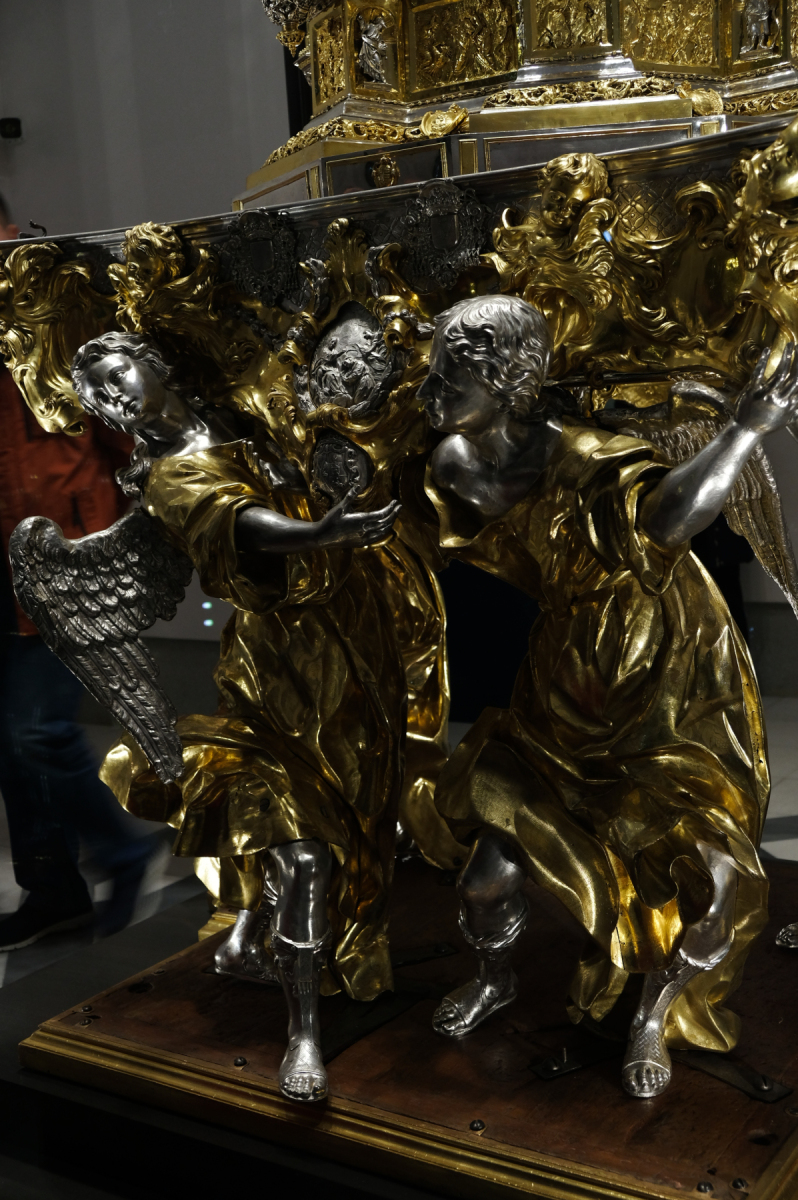
The Great Monstrance was commissioned by (who else?) Cardinal Ximenez de Cisneros, who wanted to outshine Queen Isabella’s patronage of the arts. For this purpose he hired the German silversmith Heinrich Harff, known as Enrique de Arfe in Spain. Beginning in 1517 and finishing in 1524, he produced an exquisitely detailed tower in the form of a late Gothic temple on a hexagonal base, supported by figures of angels and saints, ten feet tall in toto. It consists of 5,600 different pieces held together by 12,500 bolts and is extravagantly adorned with precious gems. Originally made of silver, the monstrance was gilded with gold in 1595, and topped with a cross in the 17th century. We viewed it in the Cathedral’s Chapel of the Treasure, stored in a bulletproof glass case and guarded by high-tech security systems. When it is removed from the case to be displayed in a festival, it is transported on a specially constructed float with an adjustable leveling mechanism.

The monetary value of the Great Monstrance is difficult to estimate, but as presently constituted it consists of 18 kilograms (about 40 pounds) of 18-karat gold and over 183 kilograms (over 400 pounds) of silver. As of this writing, 18 kg of gold is worth $2,655,360 and 183 kg of silver is worth $514,000, but these figures do not account for the value of the jewels adorning the monstrance, let alone the artistic worth of the piece.

Categories
Spain, Portugal and Morocco, November 2017

Toledo, November 18, 2017: The Jewish Quarter

We had been in the Jewish Quarter (Judería) of Toledo ever since we entered the Old City, but up to this point we had seen little evidence of a Jewish presence. This was not surprising since all the Jews had been expelled five centuries earlier and to this day the Jewish community of Toledo is virtually nonexistent.

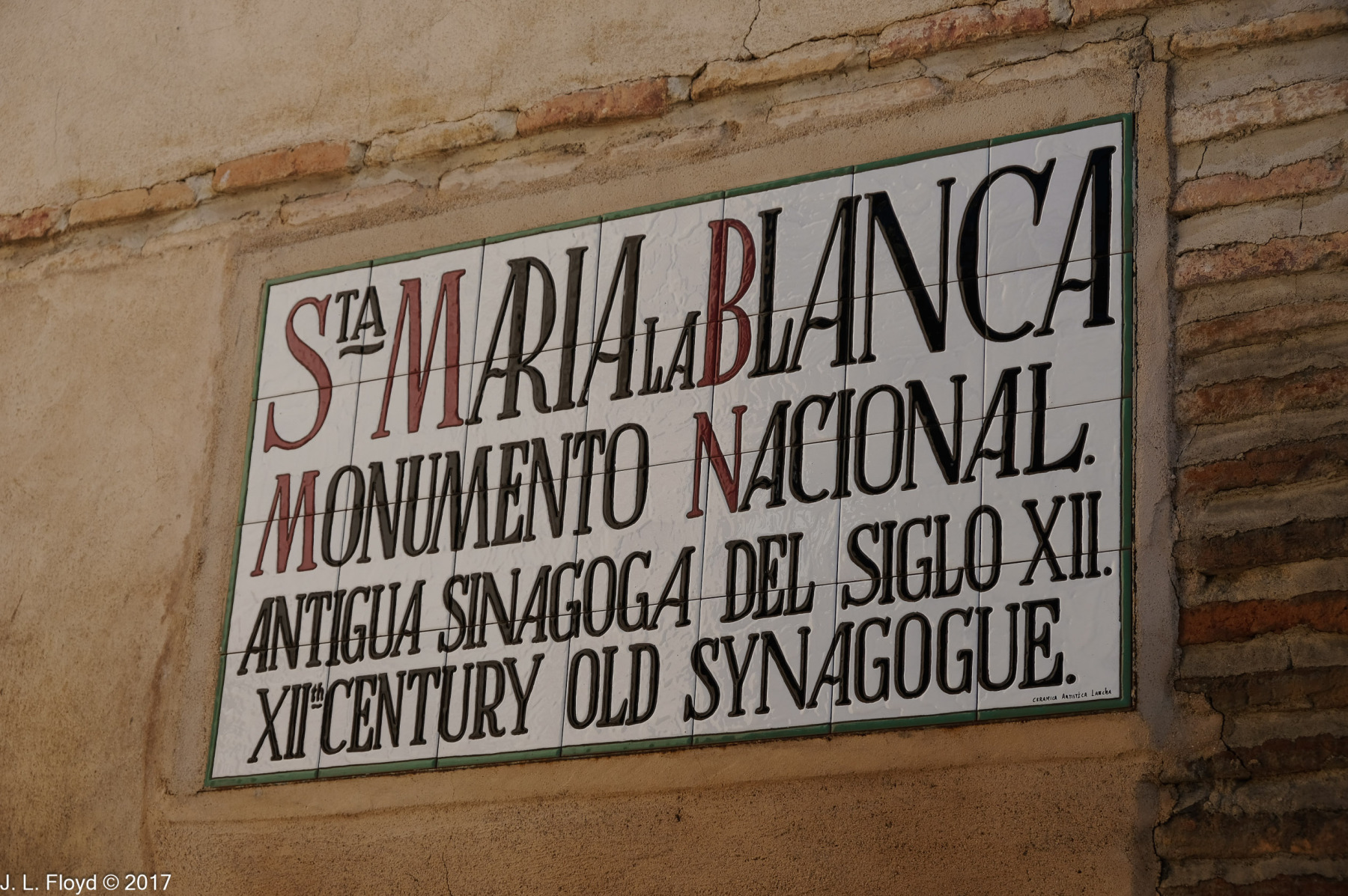
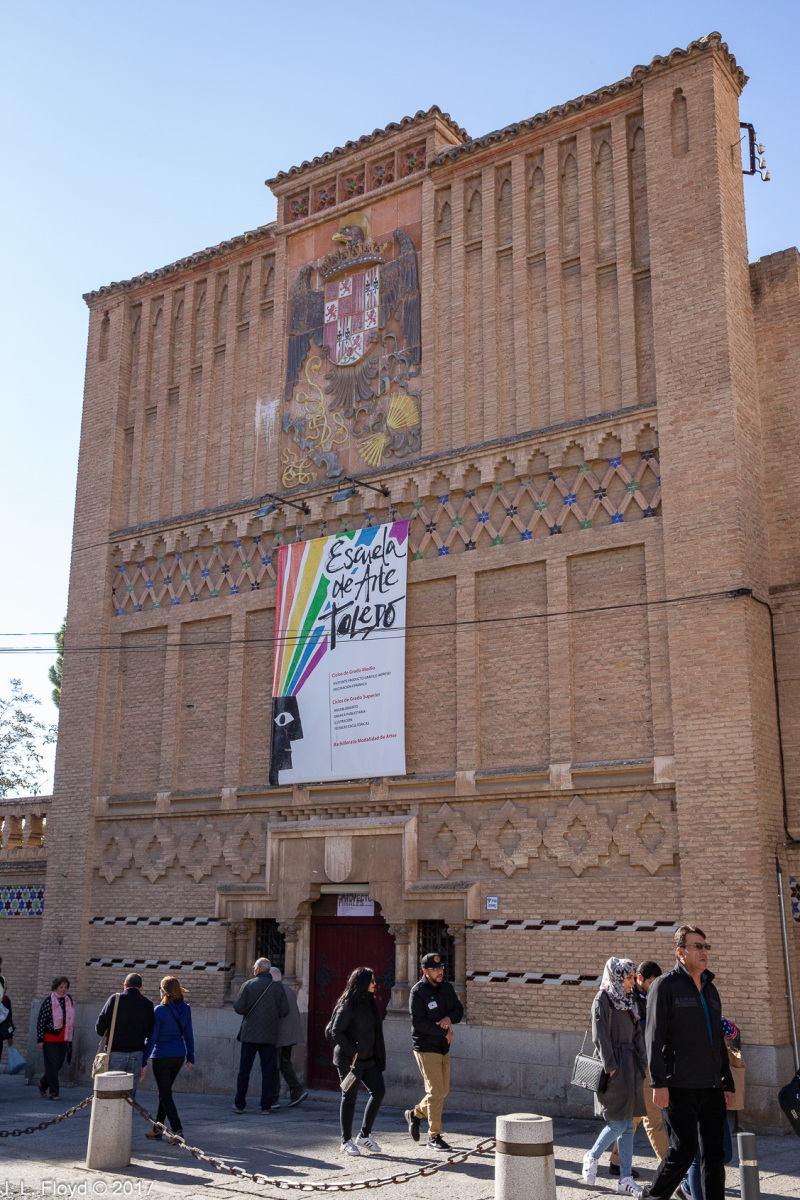
But all that changed with our arrival at the Synagoga de Santa Maria la Blanca – the Synagogue of Saint Mary the White – just past the Monastery of San Jose de los Reyes and the Escuela de Arte. It proved to be a stunning reminder of what was once the wealthiest and most populous Jewish community of the Kingdom of Castile.

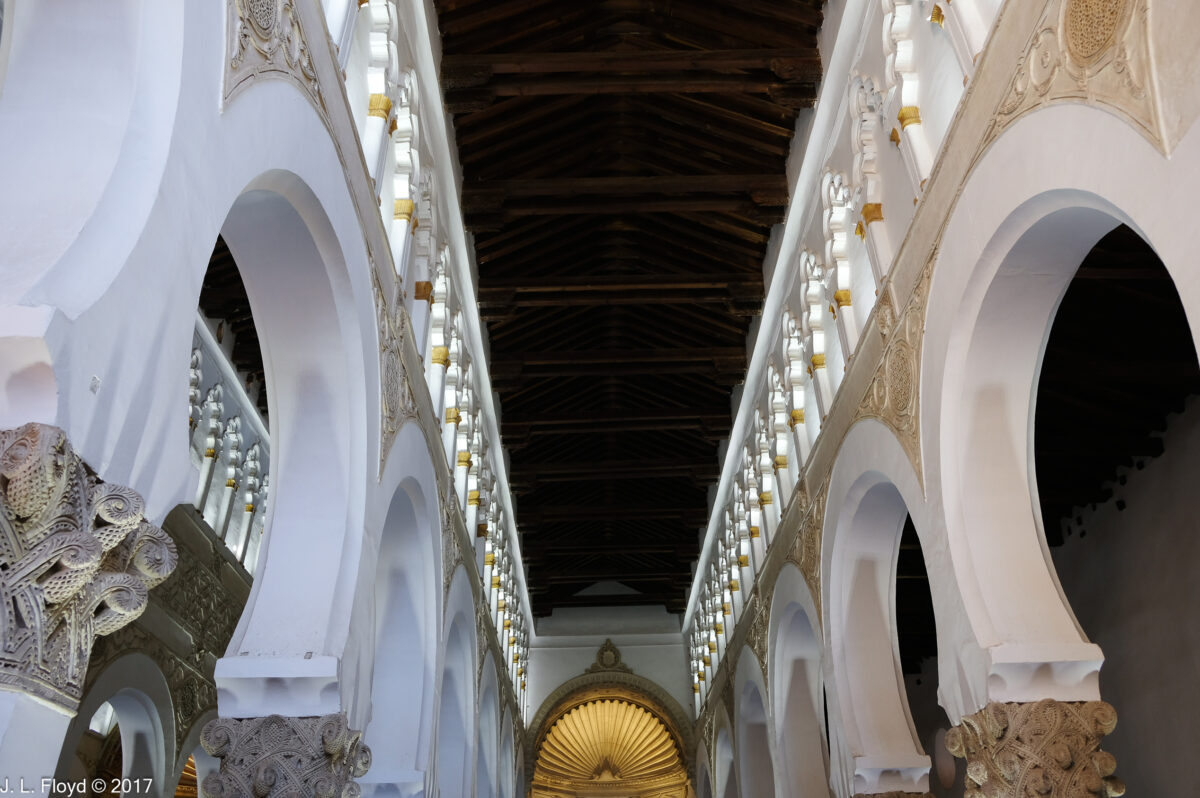
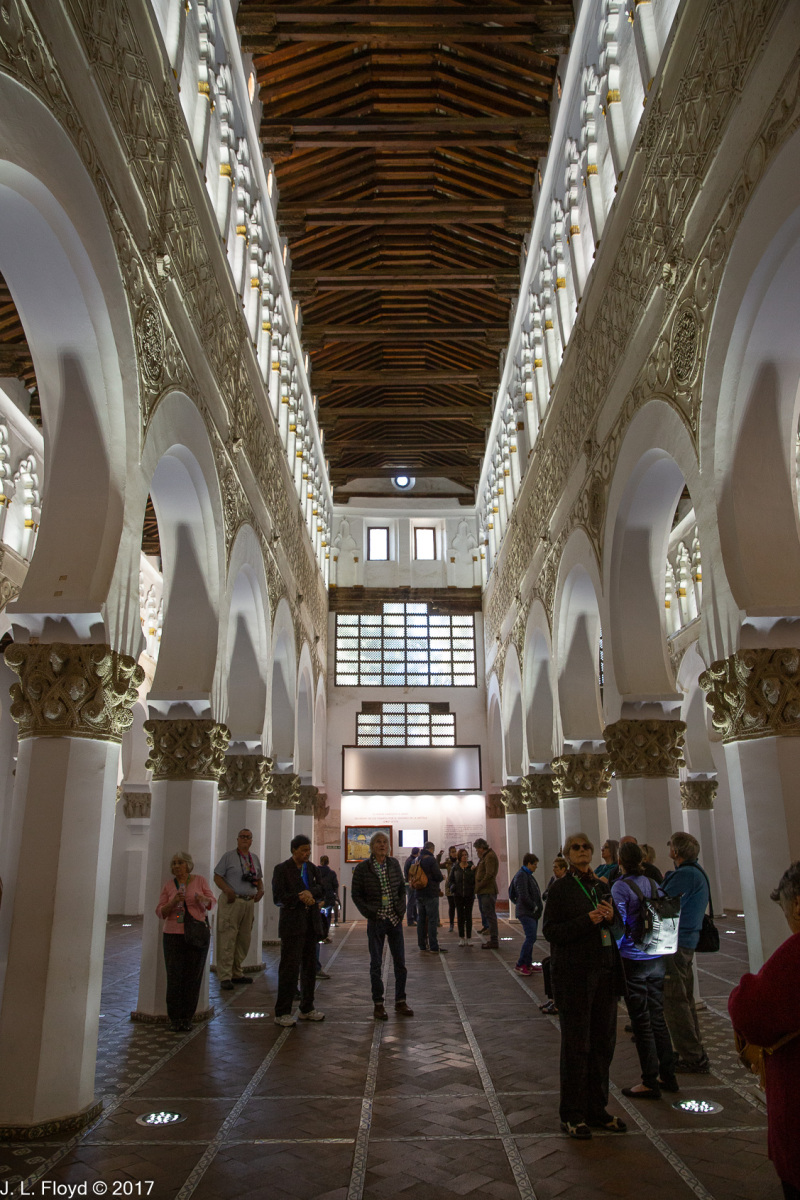
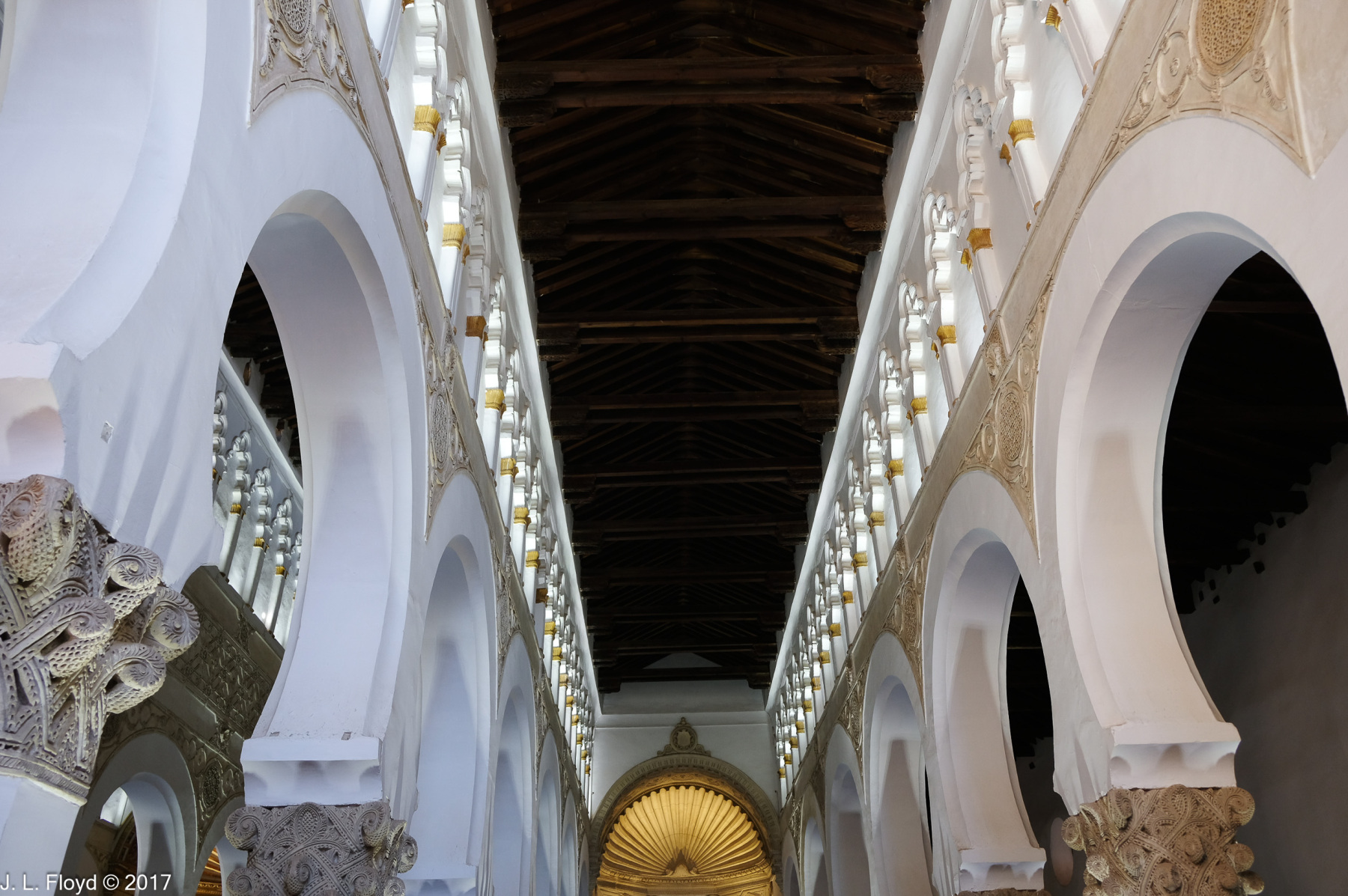
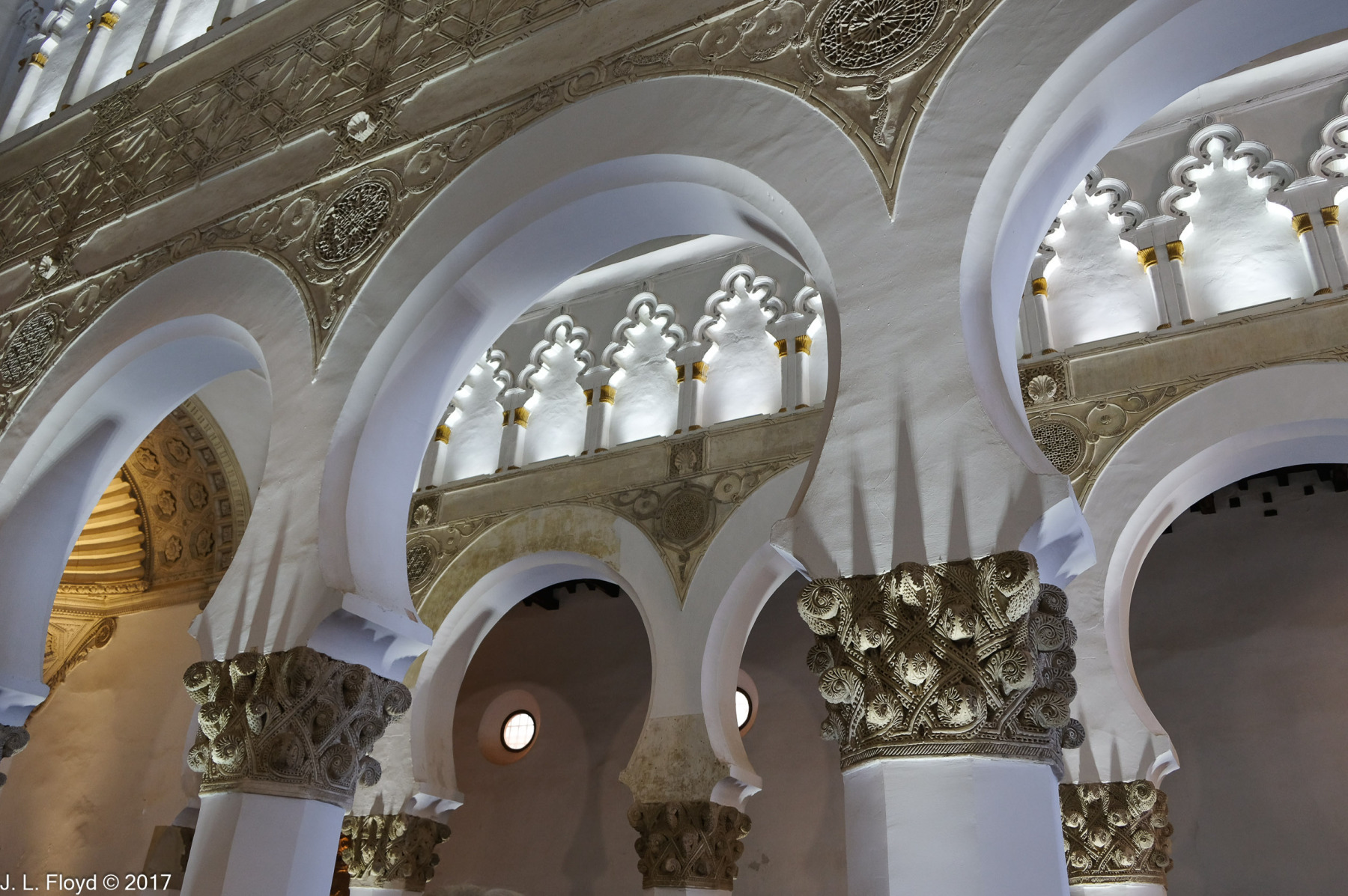
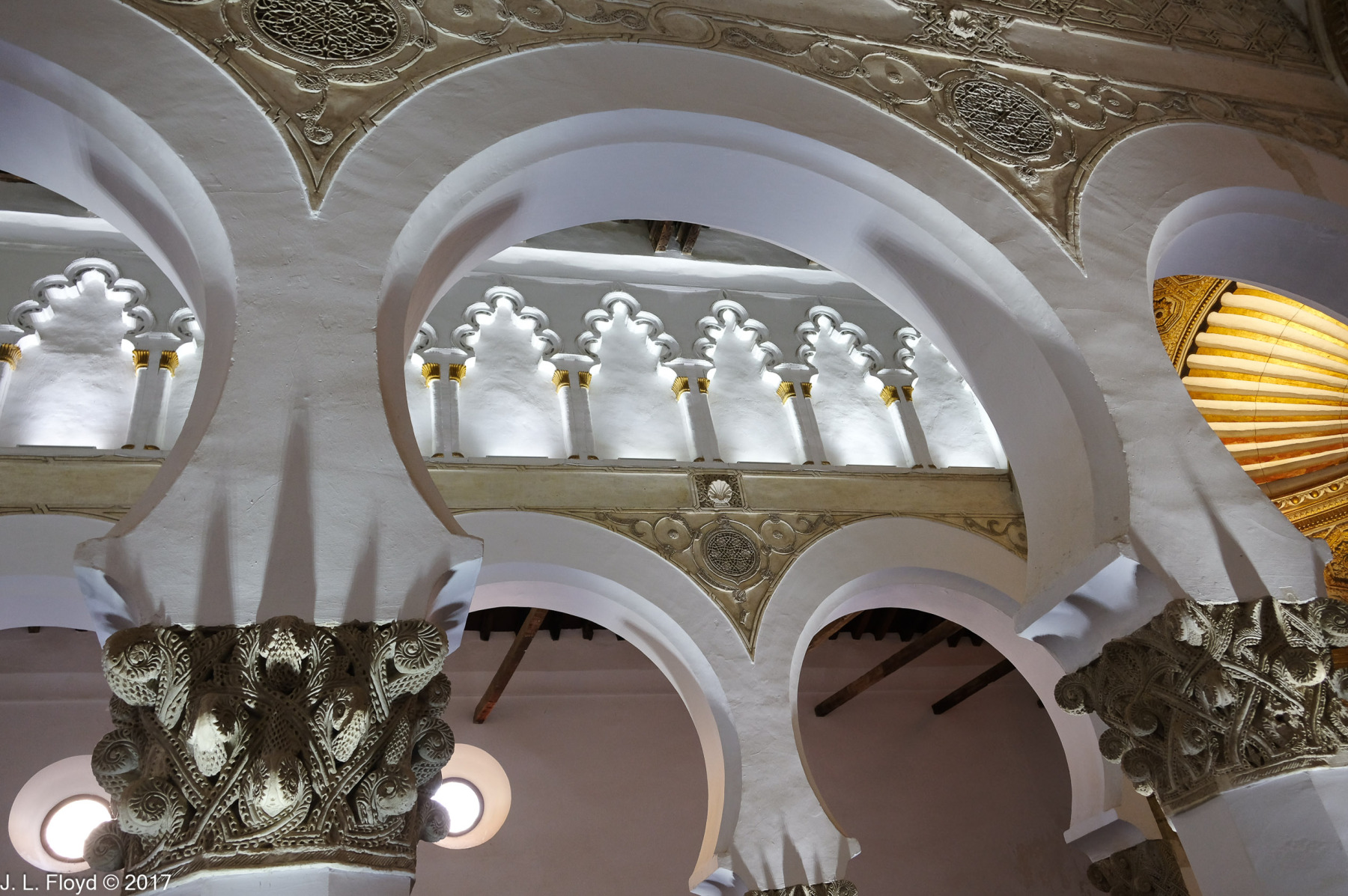
The Synagogue is a masterpiece of Mudéjar architecture. Although Toledo had been taken by the Christians from the Moors in 1085, at the time the Synagogue was built – probably sometime between 1180 and 1205 – the Berber dynasty of the Almohads still ruled southern Spain, and their architectural influence is evident in the plain white interior walls, the soaring arcades of horseshoe arches and the use of brick pillars instead of marble columns. Although constructed as a synagogue, Santa Maria la Blanca has much in common with a mosque.

The current name of the place, which seems incongrous – synagogues are Jewish places of worship, whereas “Santa Maria” is a Christian name – is a result of historic circumstance. About a century after its construction, in 1391, a terrible pogrom erupted in Toledo, in the aftermath of which the Catholic Church expropriated the Synagogue and consecrated it as a church. An effigy of the Virgin Mary was placed in the church, and that was the origin of the name Santa Maria la Blanca.

Nowadays, although Santa Maria la Blanca no longer serves as a church, it is still under the aegis of the Archdiocese of Toledo, which maintains it as a museum and tourist attraction. It is the third most visited such attraction in Toledo.

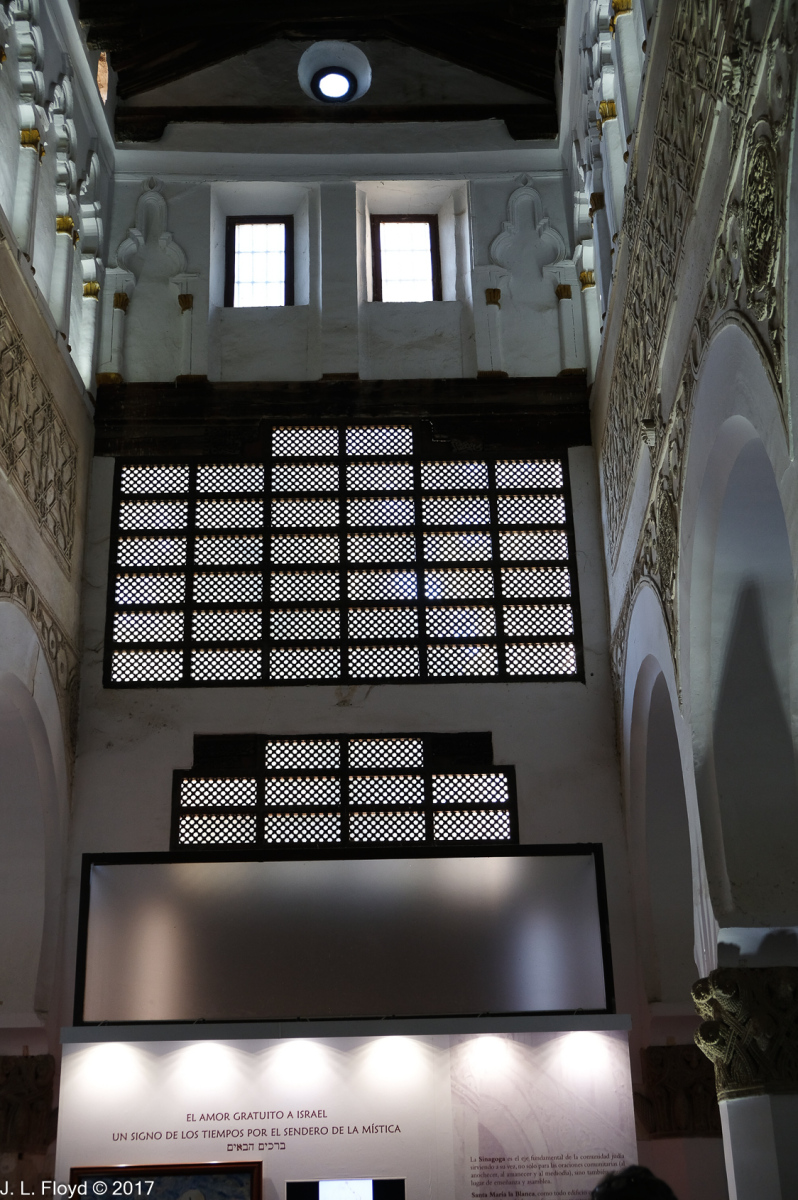
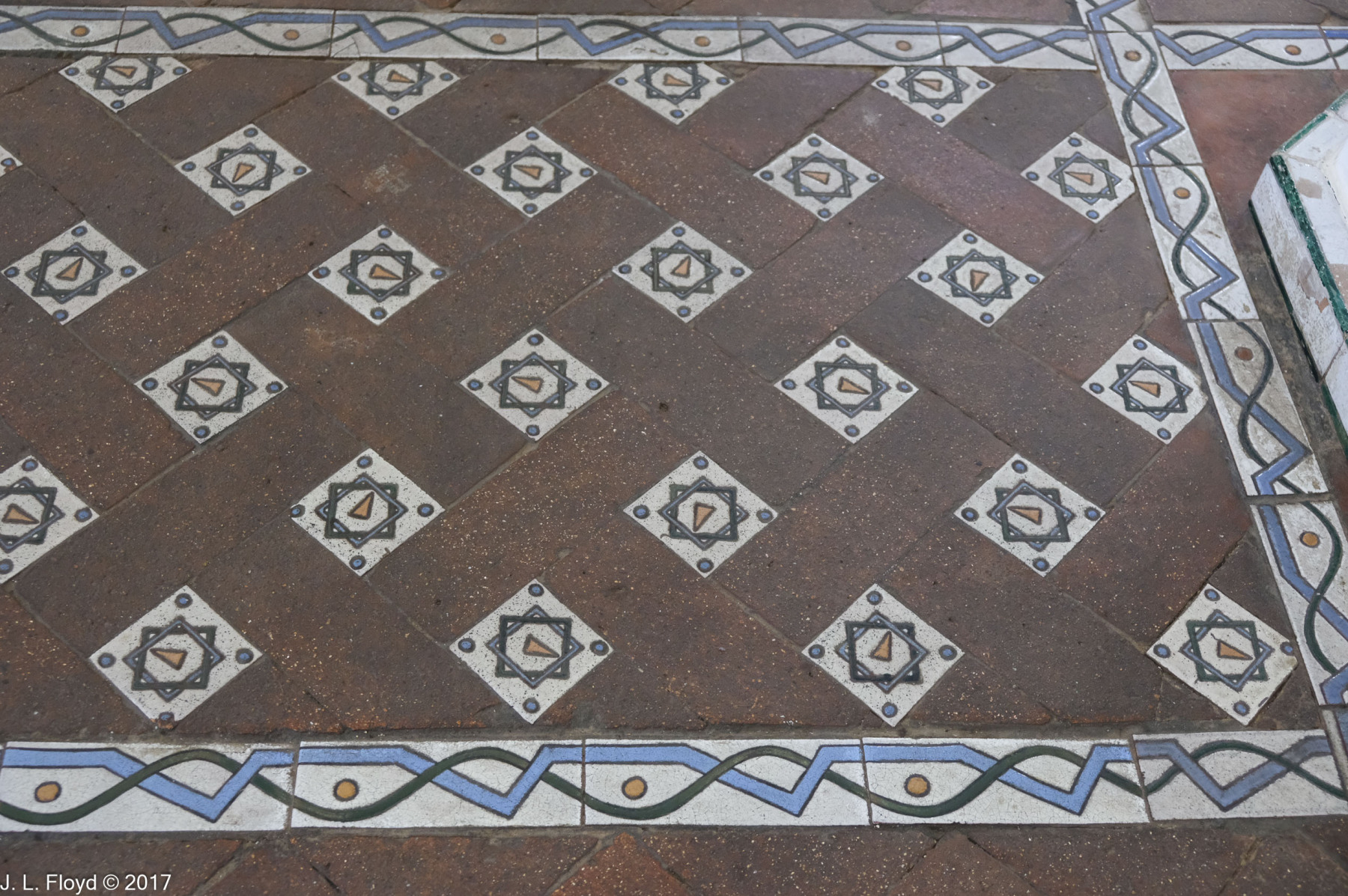
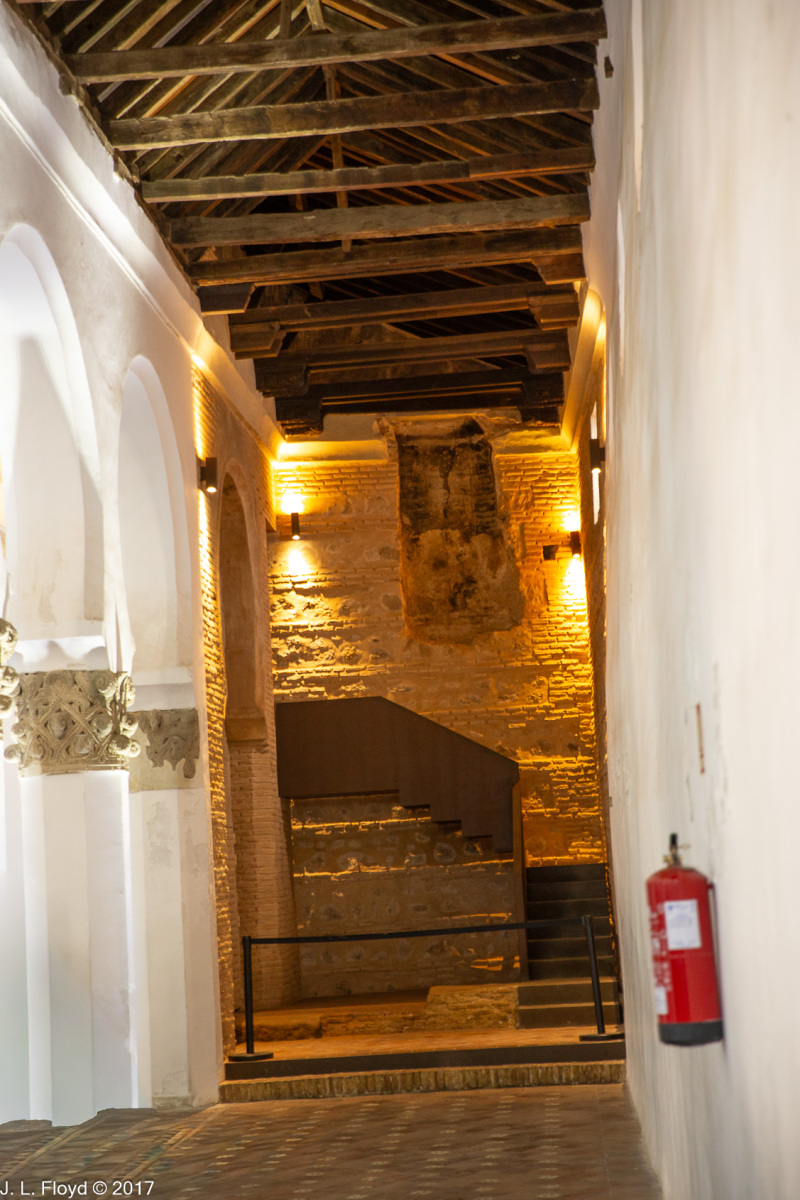
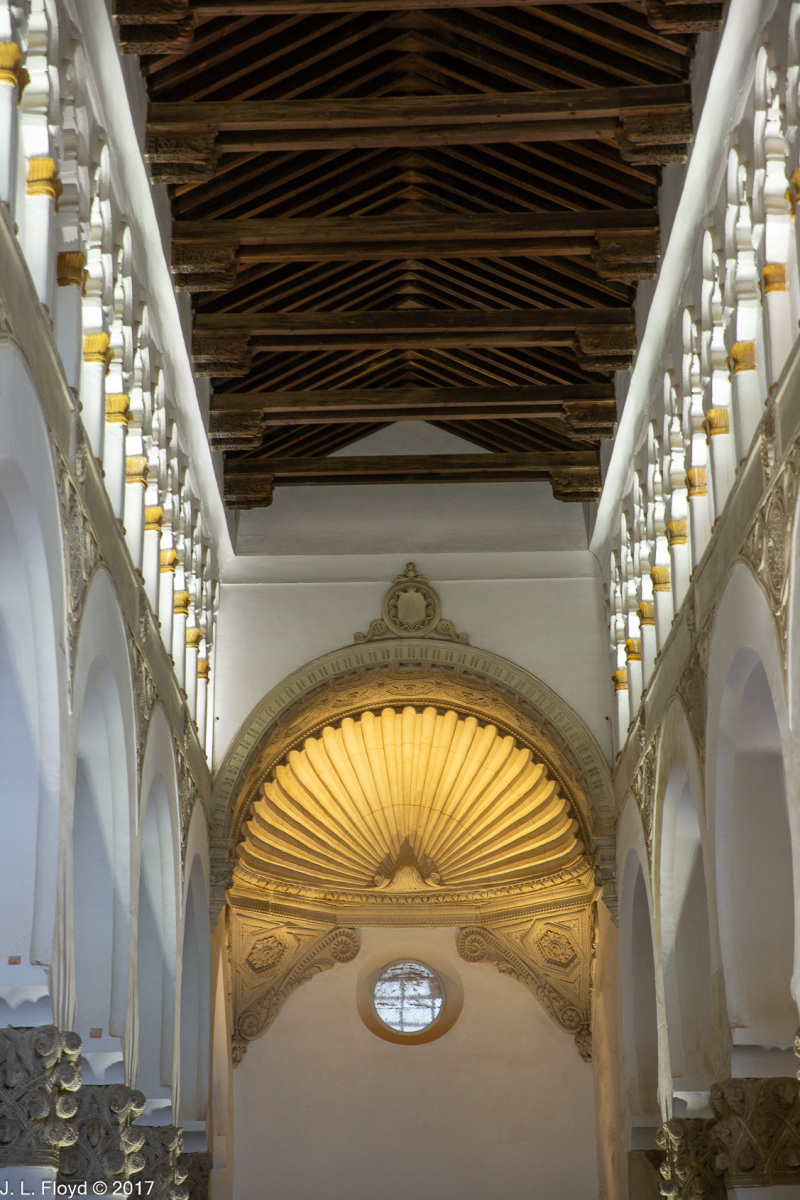
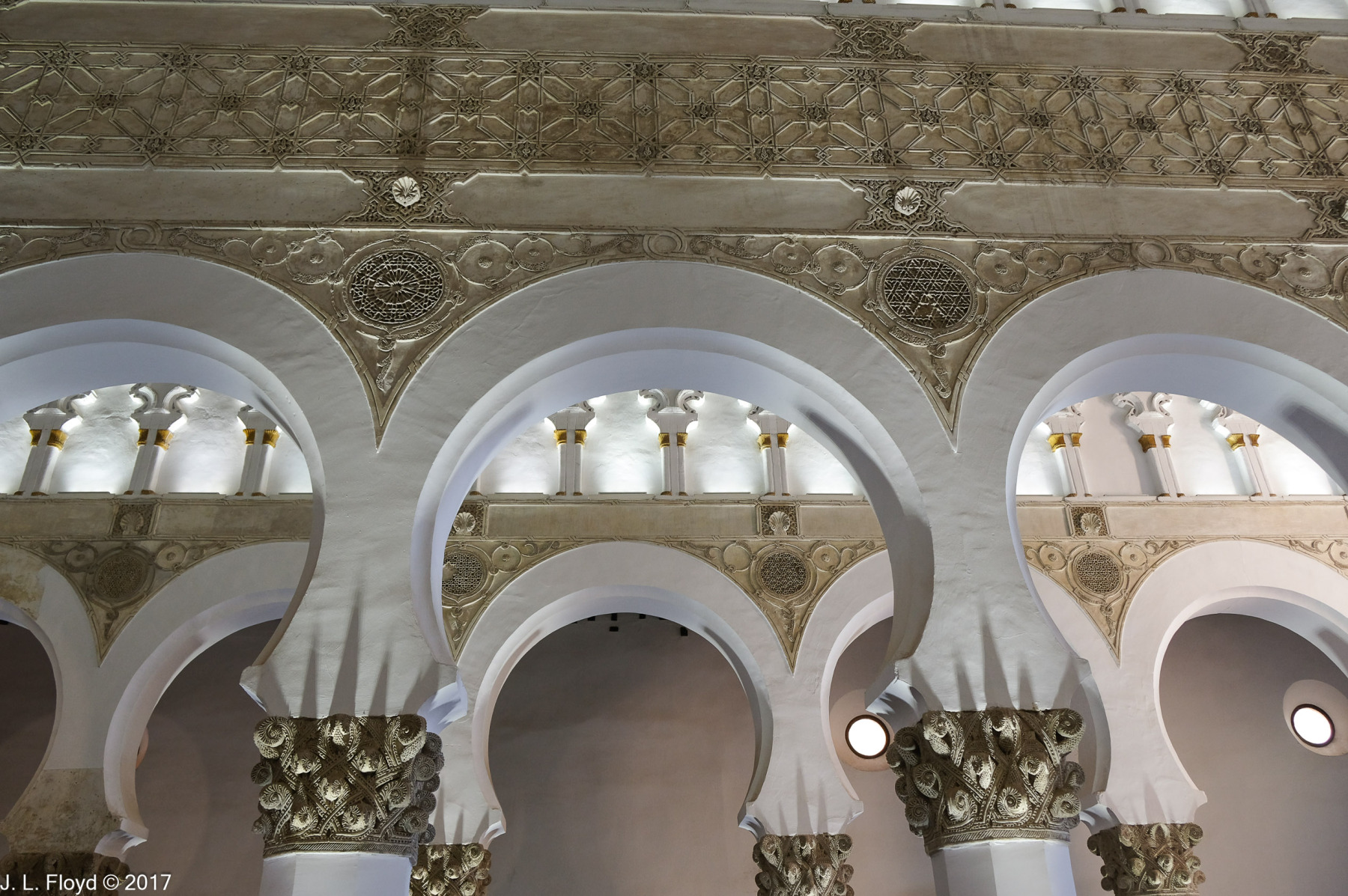
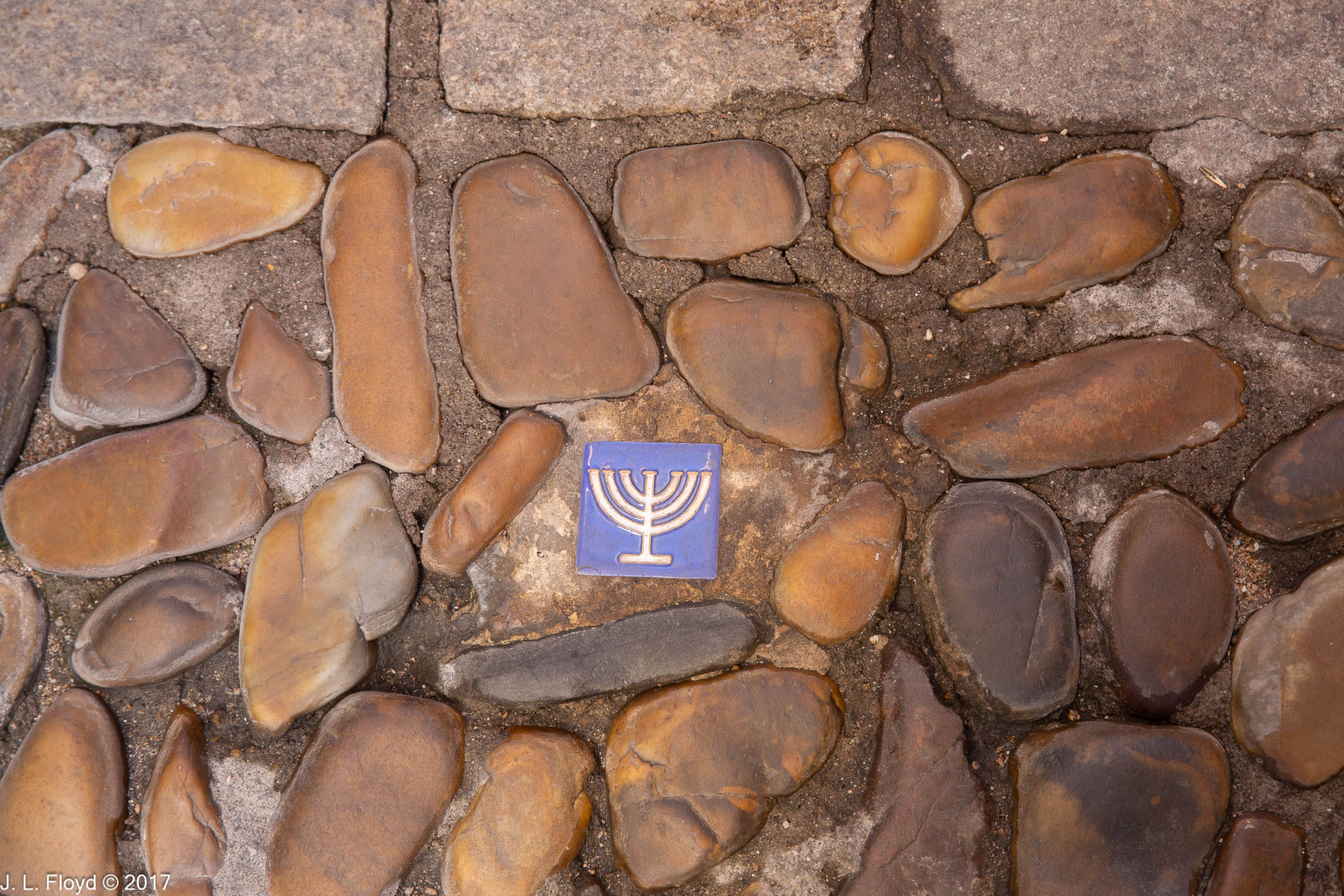
As one approaches the Synagogue, nothing unusual is visible – a squarish brick building with plain walls. Only an attractive tile name-plaque near the entrance, obviously of modern vintage, identifies the place. Stepping inside, however, the visitor encounters astonishing splendor. The floor plan is an irregular quadrilateral, with the east side slightly longer than the west. The interior seems much more spacious than the actual dimensions – length of 26–28 meters (85-92 feet) and width of 19–23 meters (62-75 feet) would suggest. It is divided into five parallel naves, with the central one slightly larger than the remaining four.  The naves are separated by four rows of octagonal piers (as distinguished from columns, which are cylindrical) which support arcades of horseshoe arches.

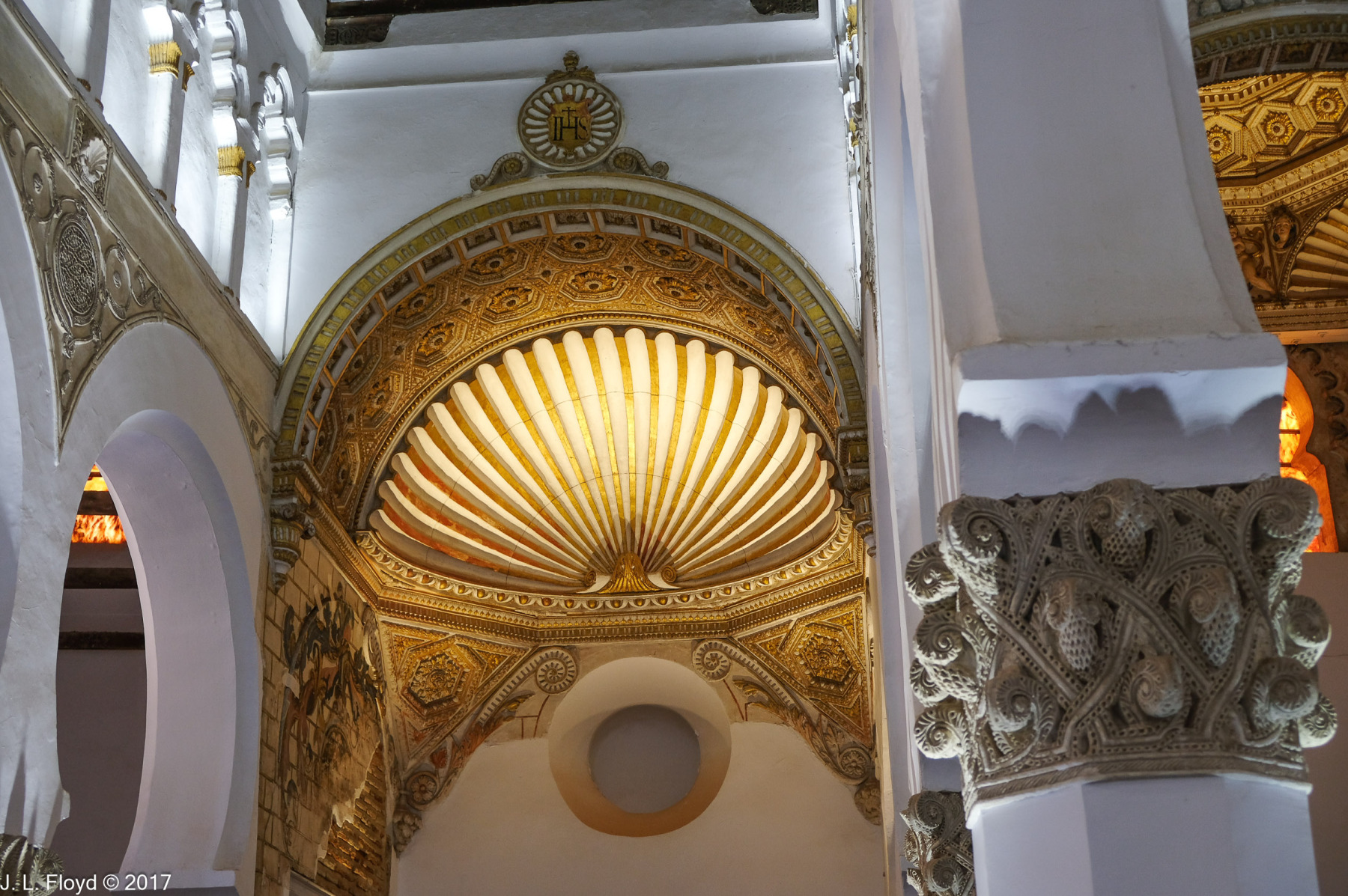
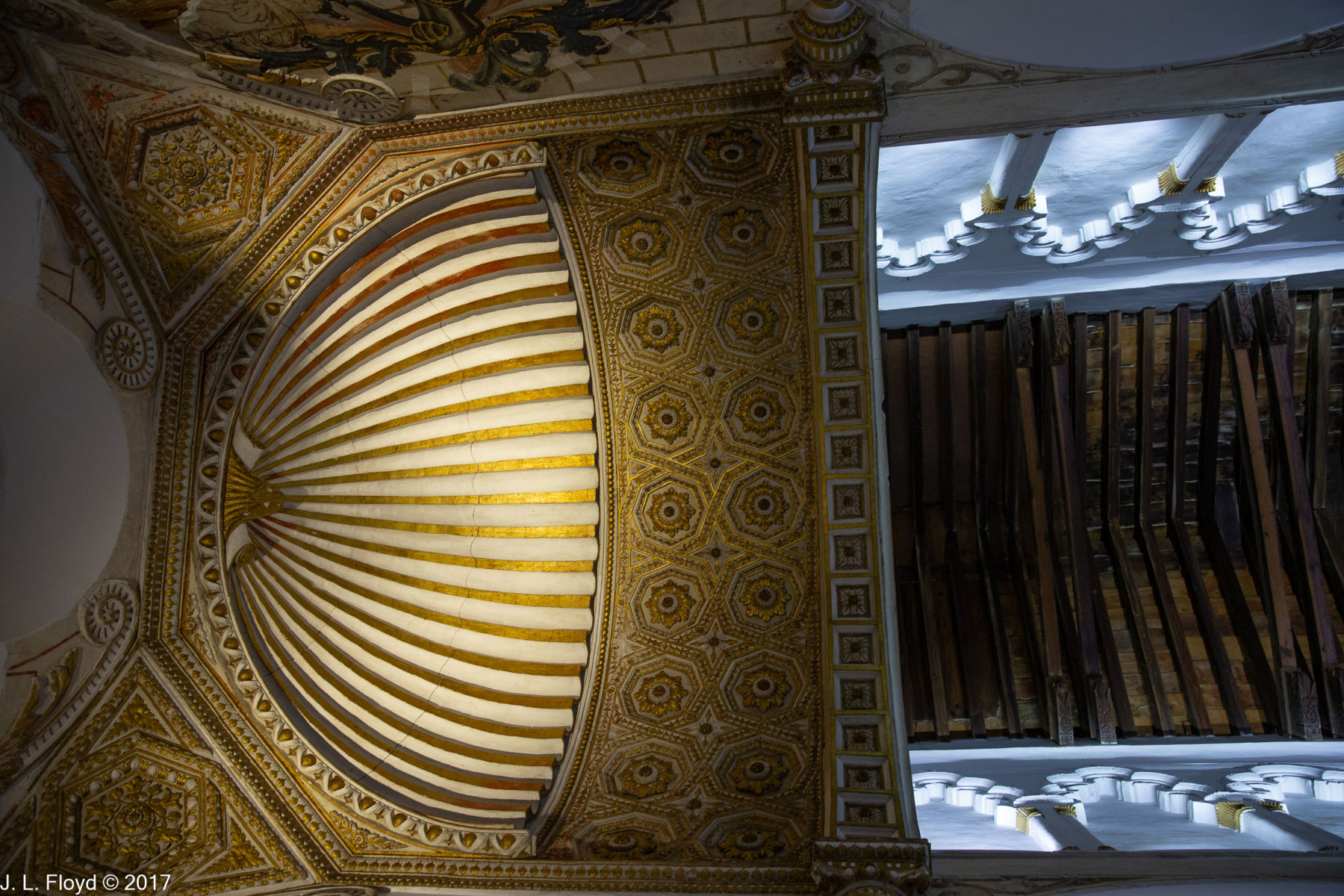
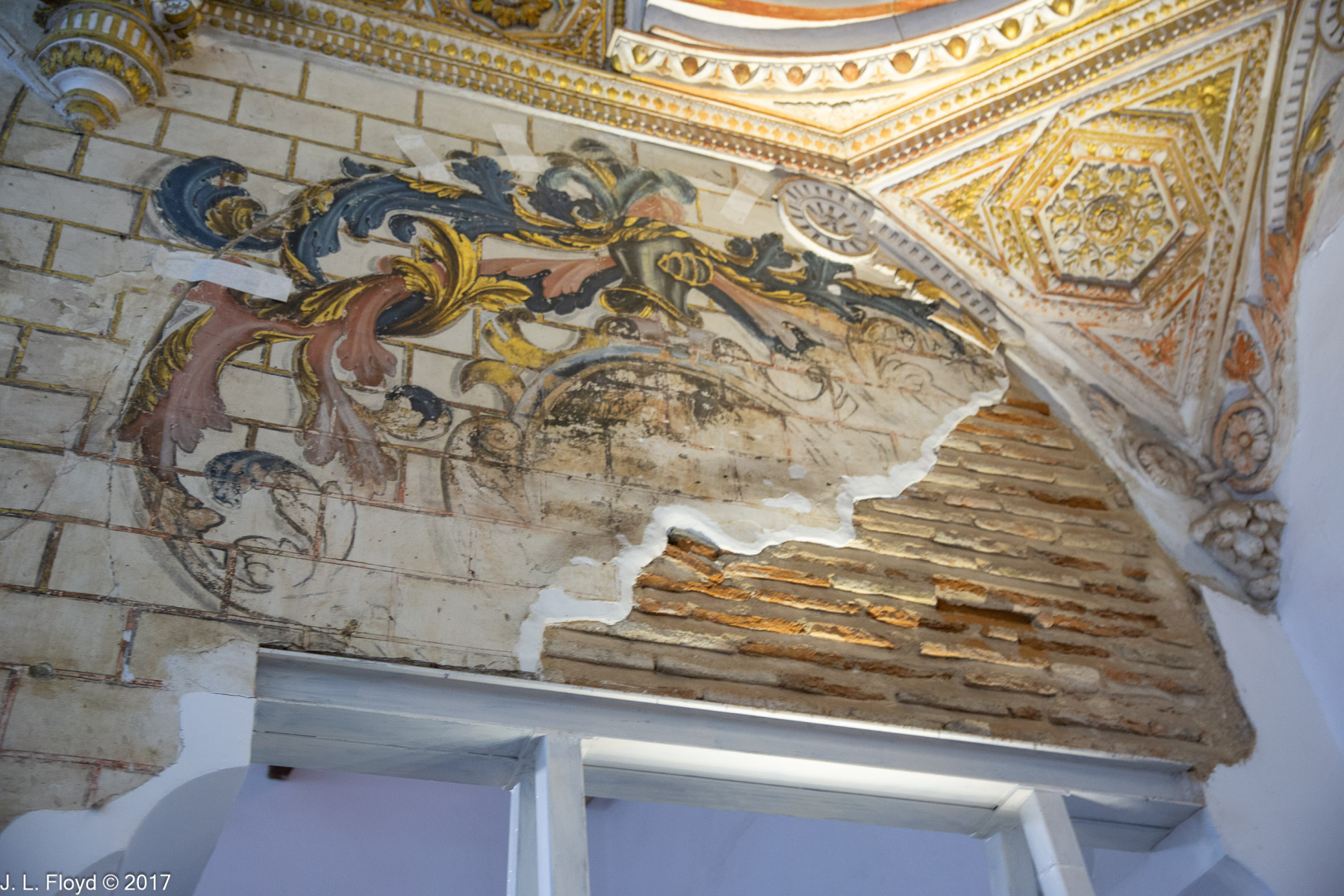
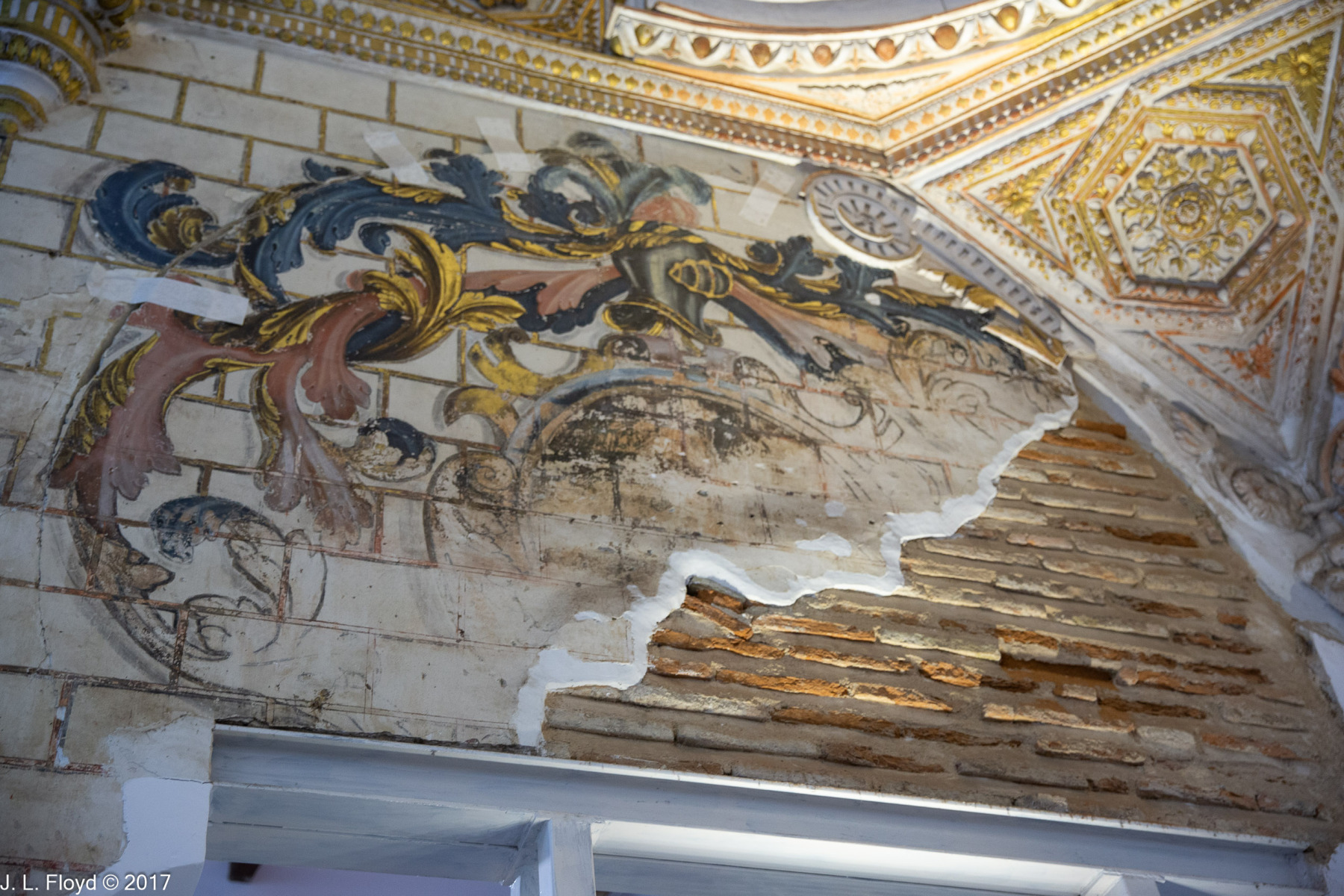
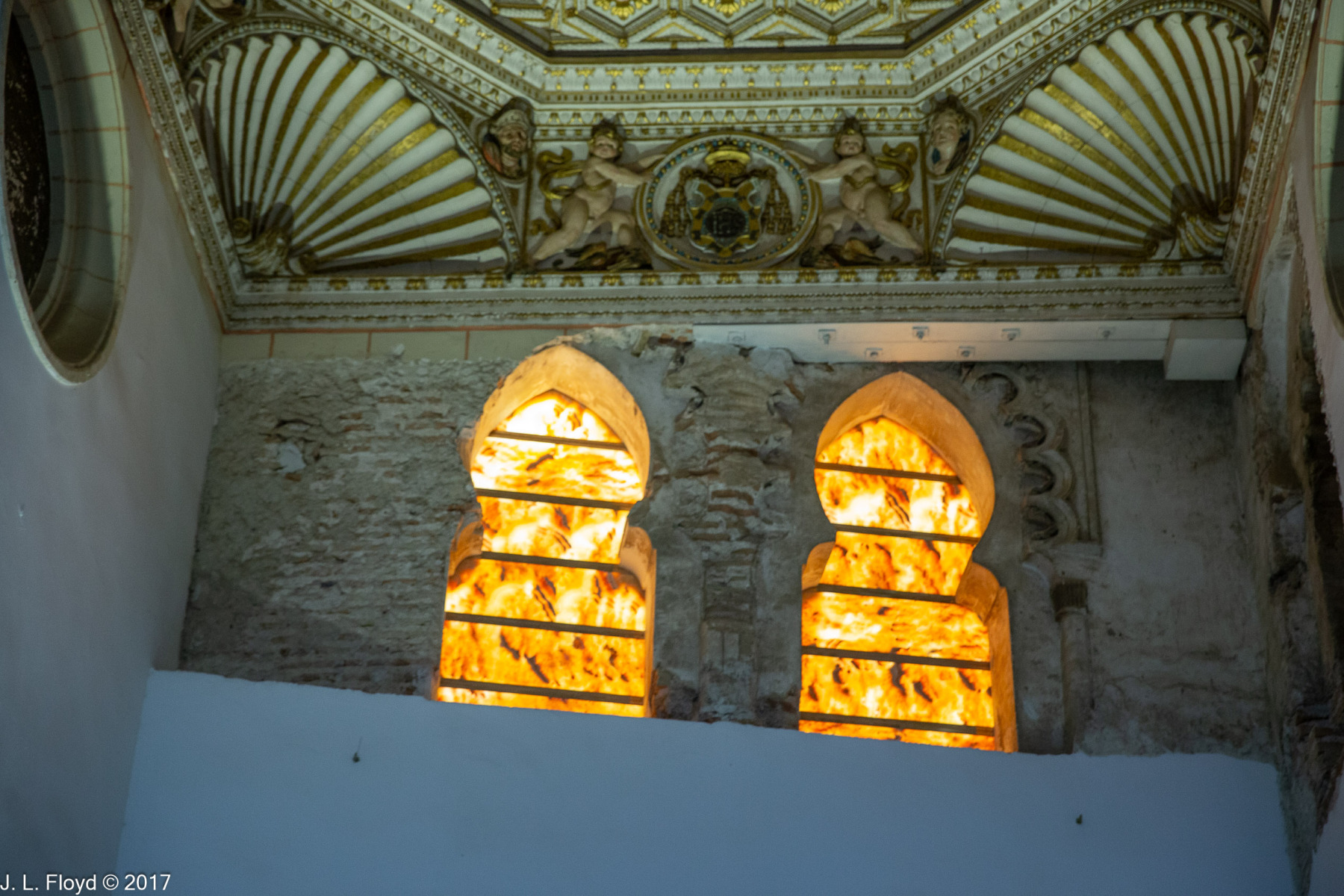
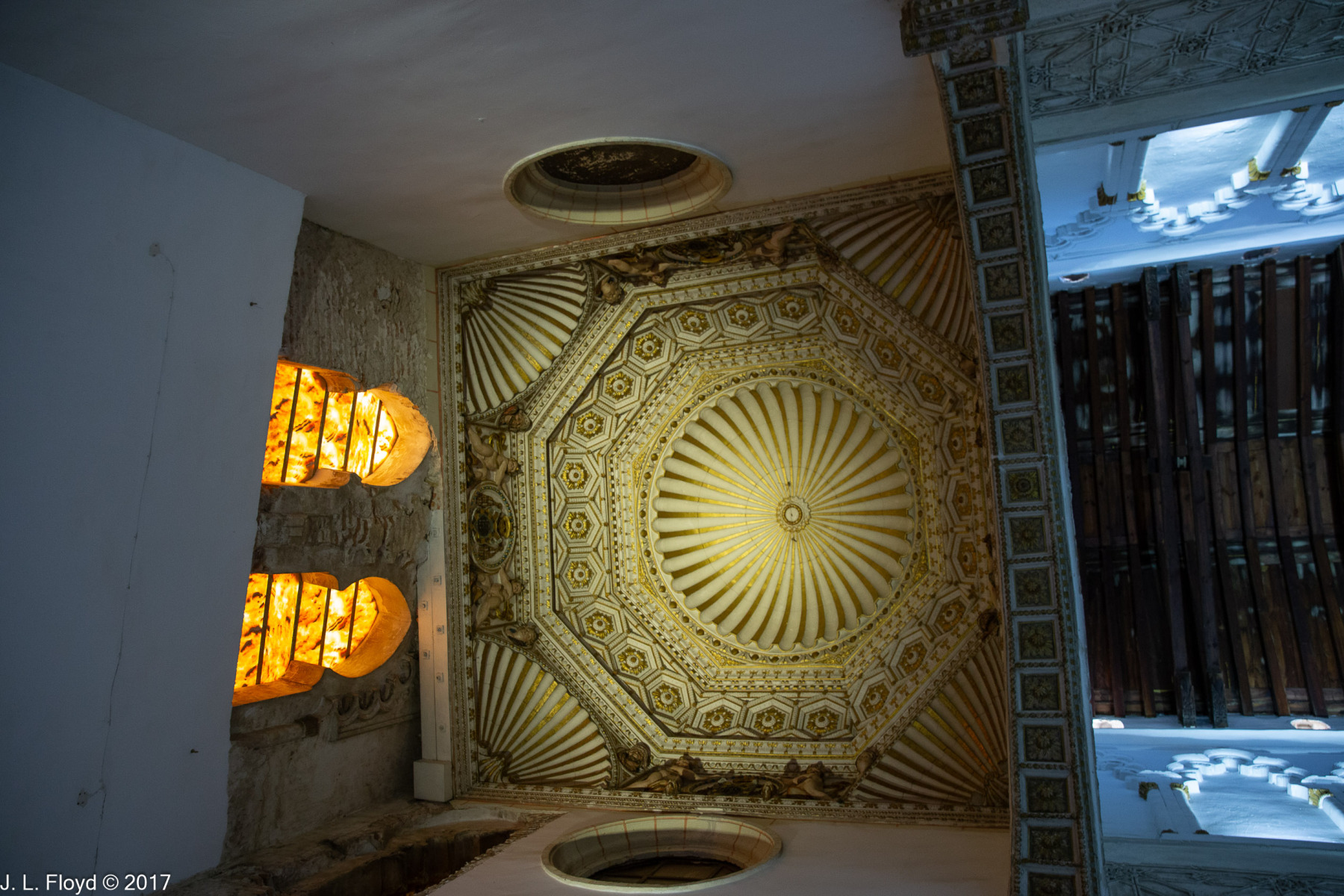
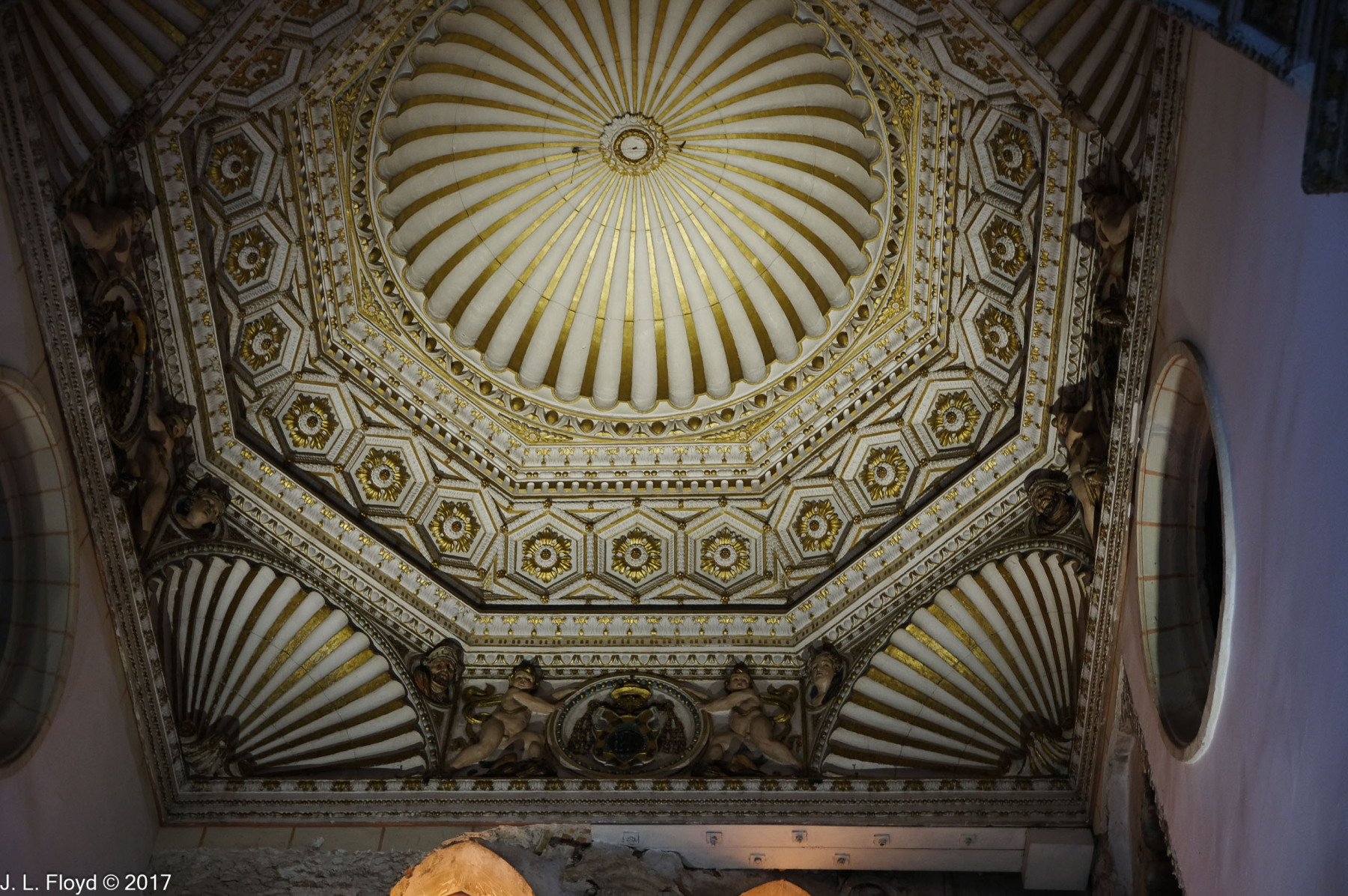
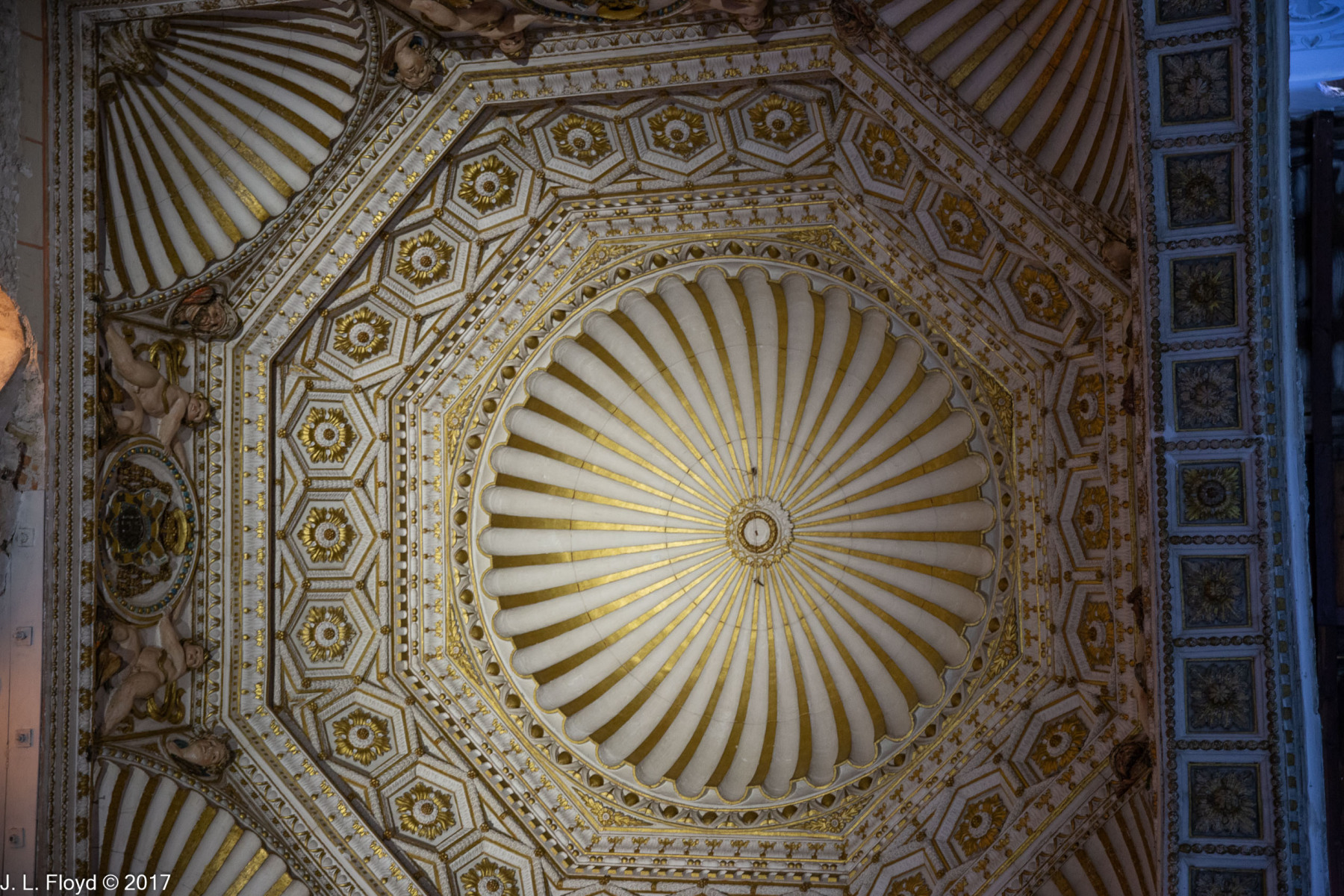
Sometime in the 16th century, probably between 1550 and 1556, three small Renaissance-style apses were added to the back of the building to serve as chapels. The apses feature scalloped ceilings, elaborate decoration and in some cases vegetal fresco-type artwork (maybe retained from the original Mudéjar decor?).

The largest and most elaborate of the apses is distinguished from the others by a Christian cross over the entry, and by two Mudéjar-style stained-glass windows illuminating the interior; it also boasts a quite extraordinary ceiling.

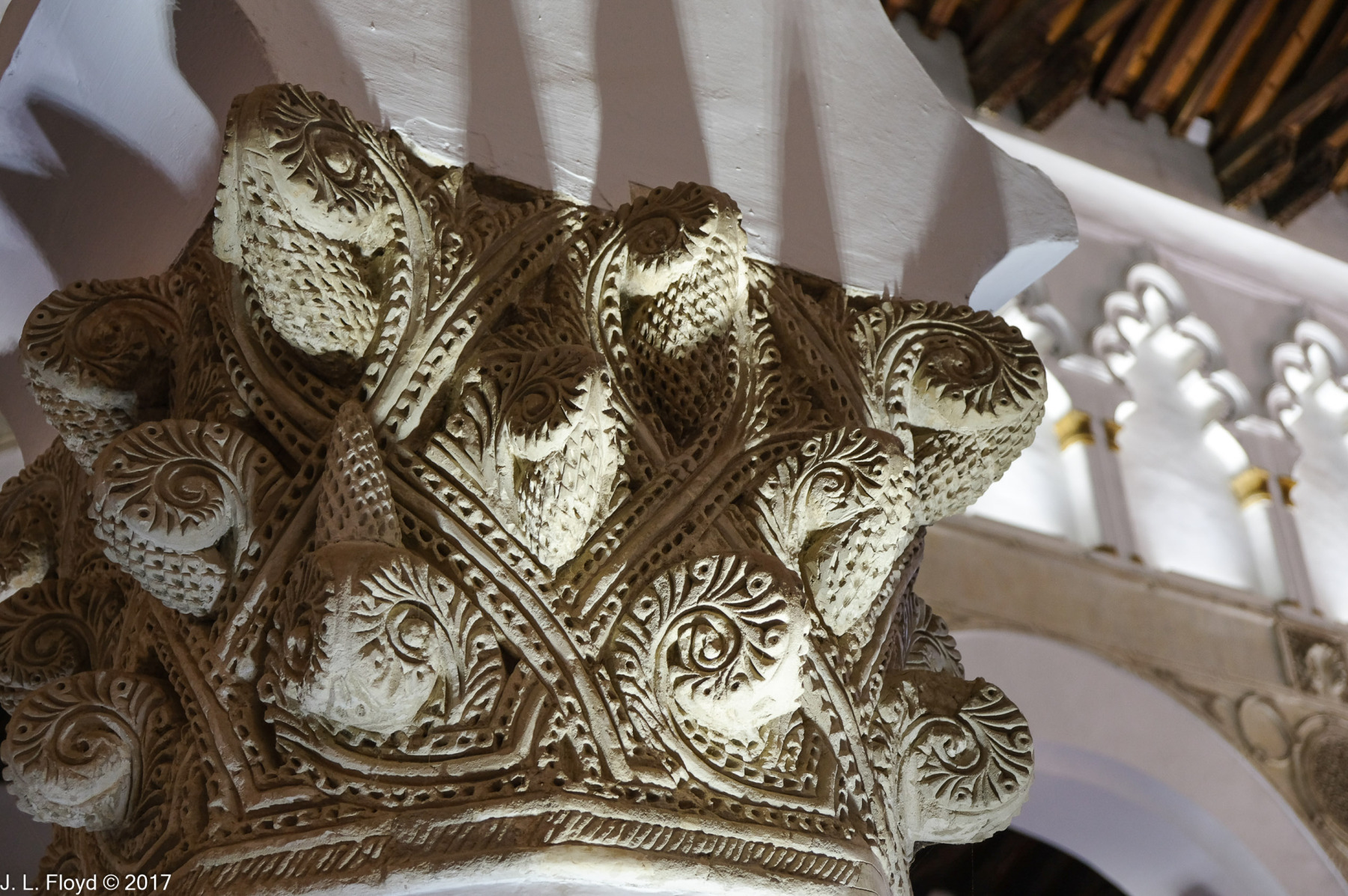
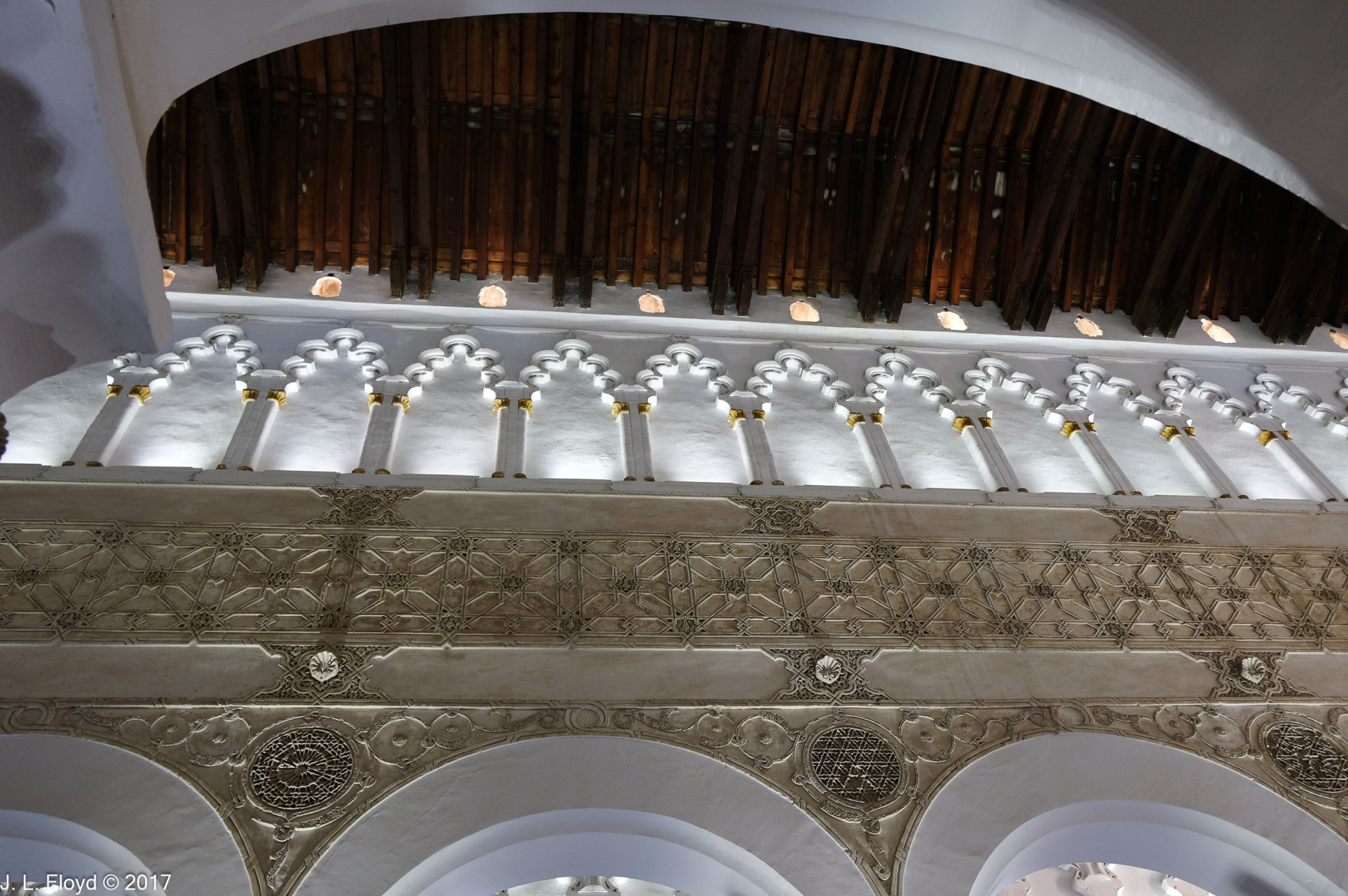
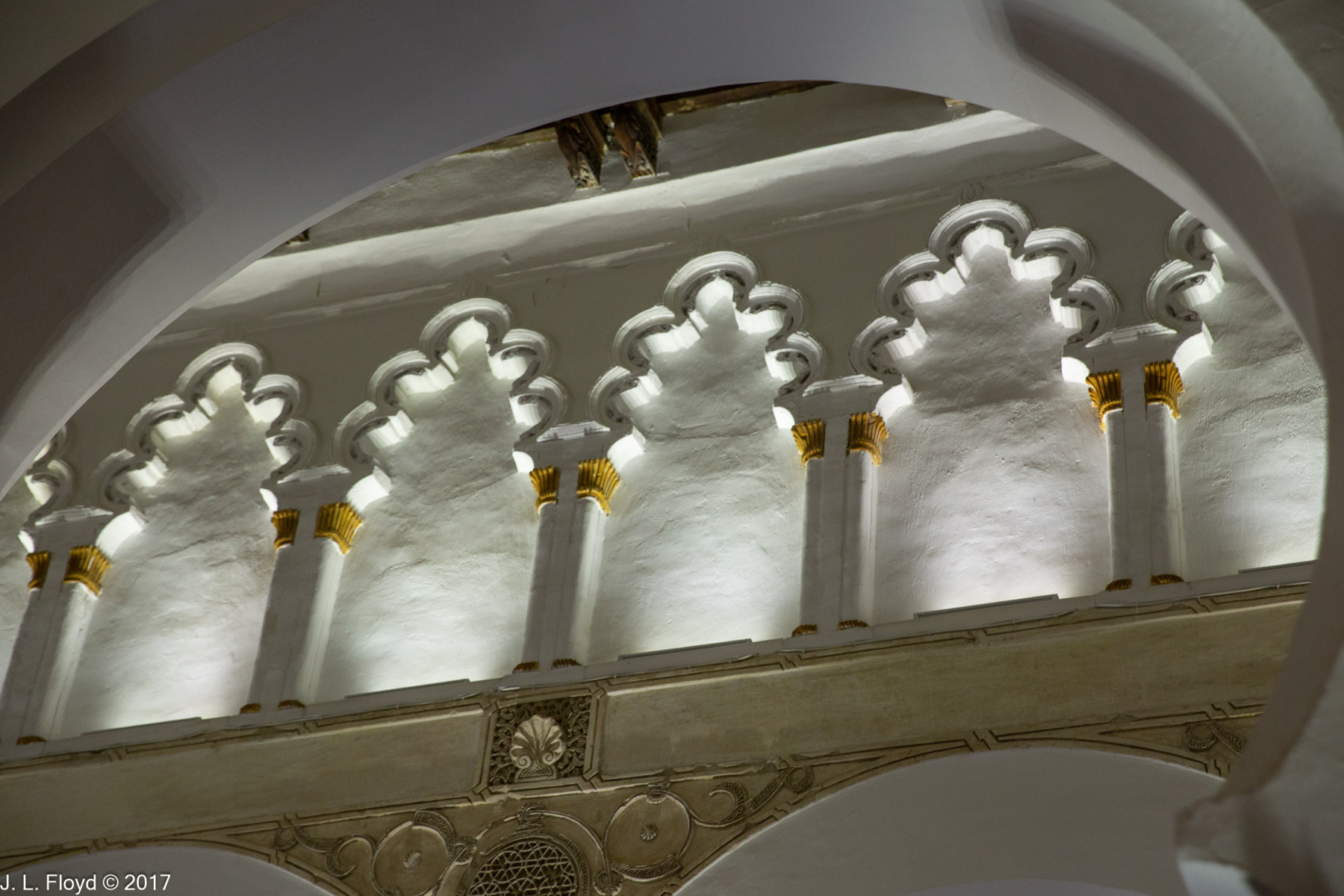
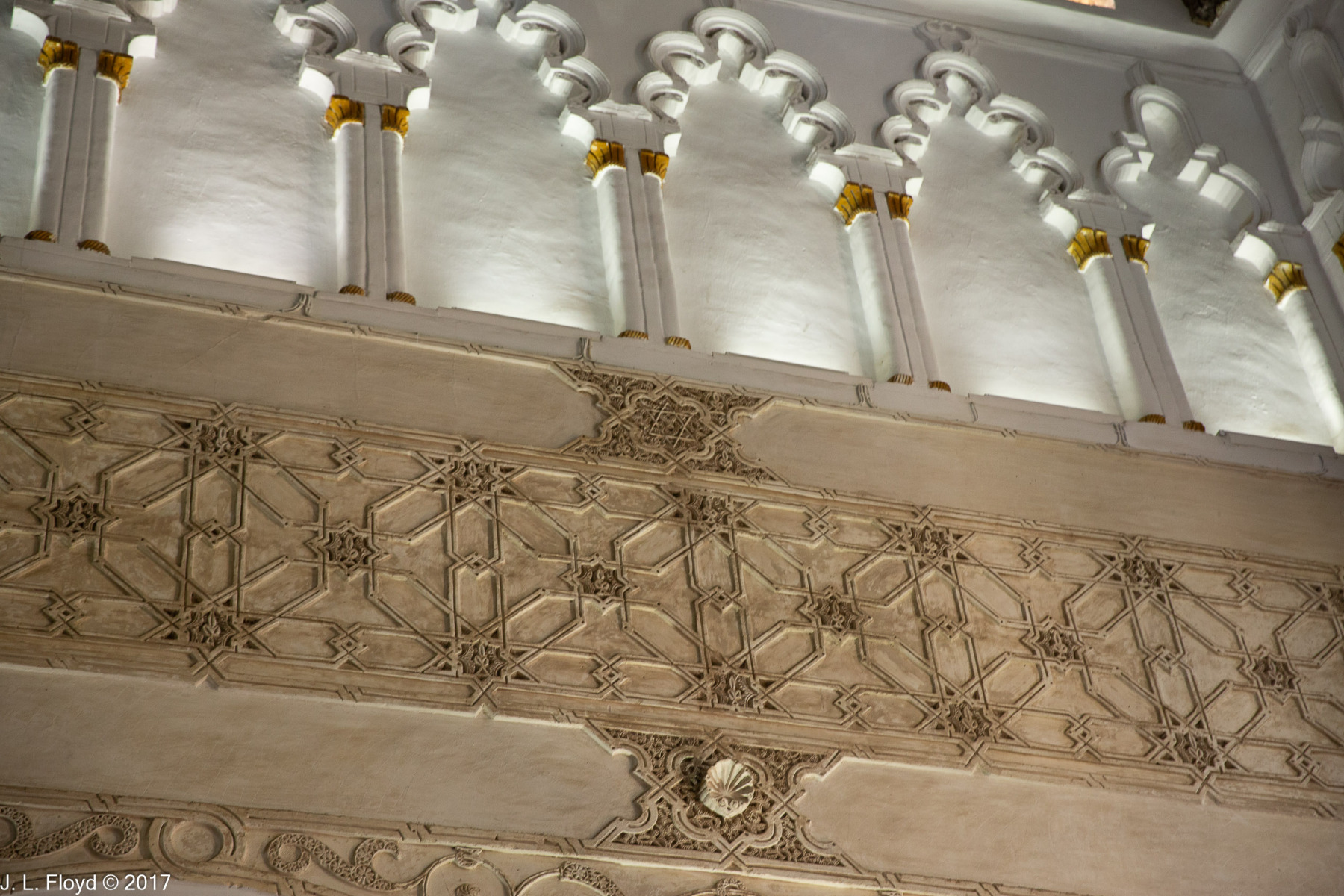
There are two sets of arcades, the lower and the upper. The octagonal piers supporting the lower arcades are topped by ochre-colored capitals, vaguely Corinthian in style but decorated with large stucco pinecones and volutes – spiral scrolls that project from the body of the capital (they look somewhat like snails).

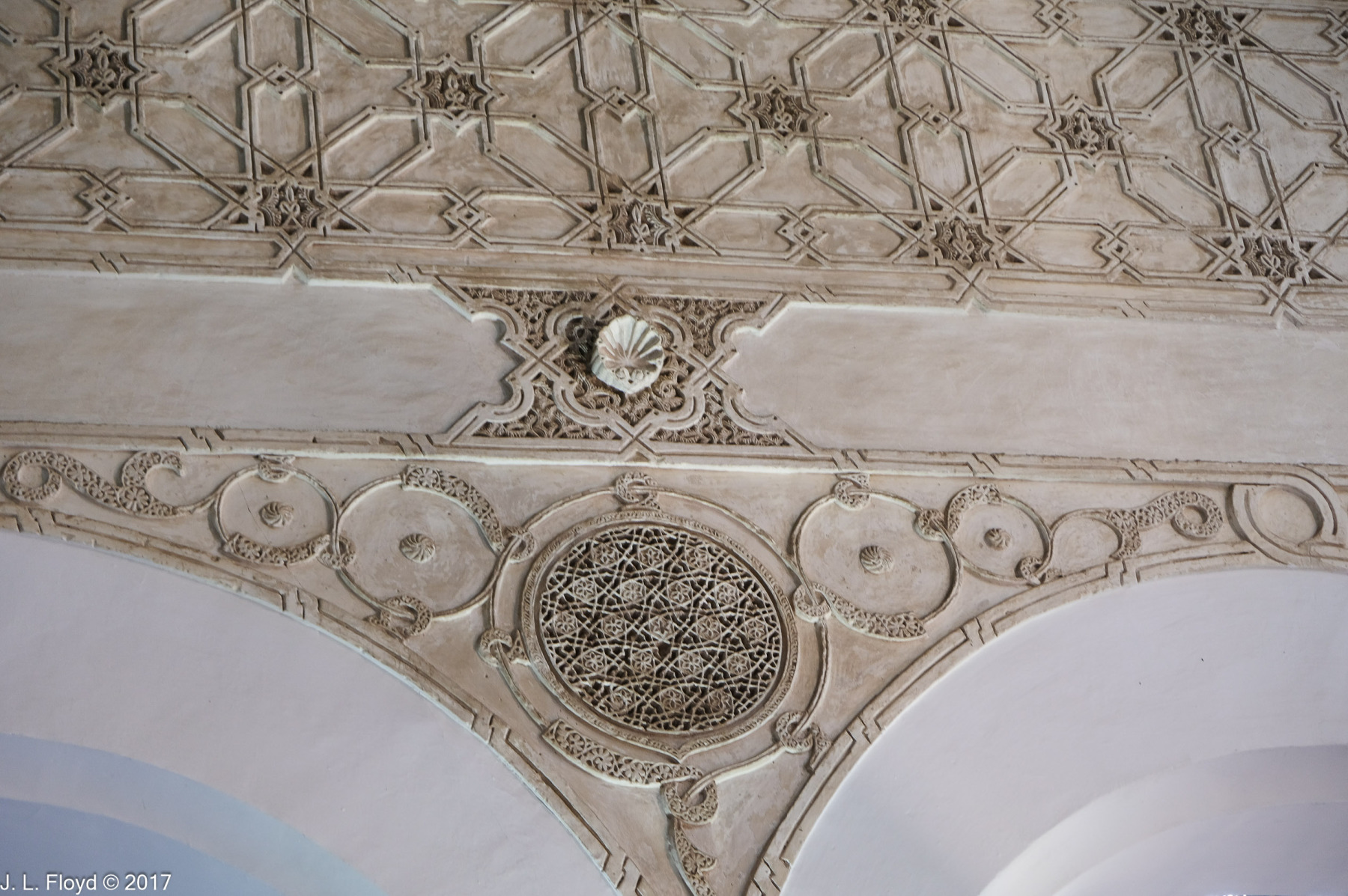
Above the horseshoe arches are walls with layers of low-relief decorations – stucco tendrils and roundels (round decorative figures), scallop shells and geometric interlacing. On top of the walls are piers supporting the upper arcades, which feature polylobed arches, and look as if they might have galleries behind them but in fact are blind, i.e. filled in.

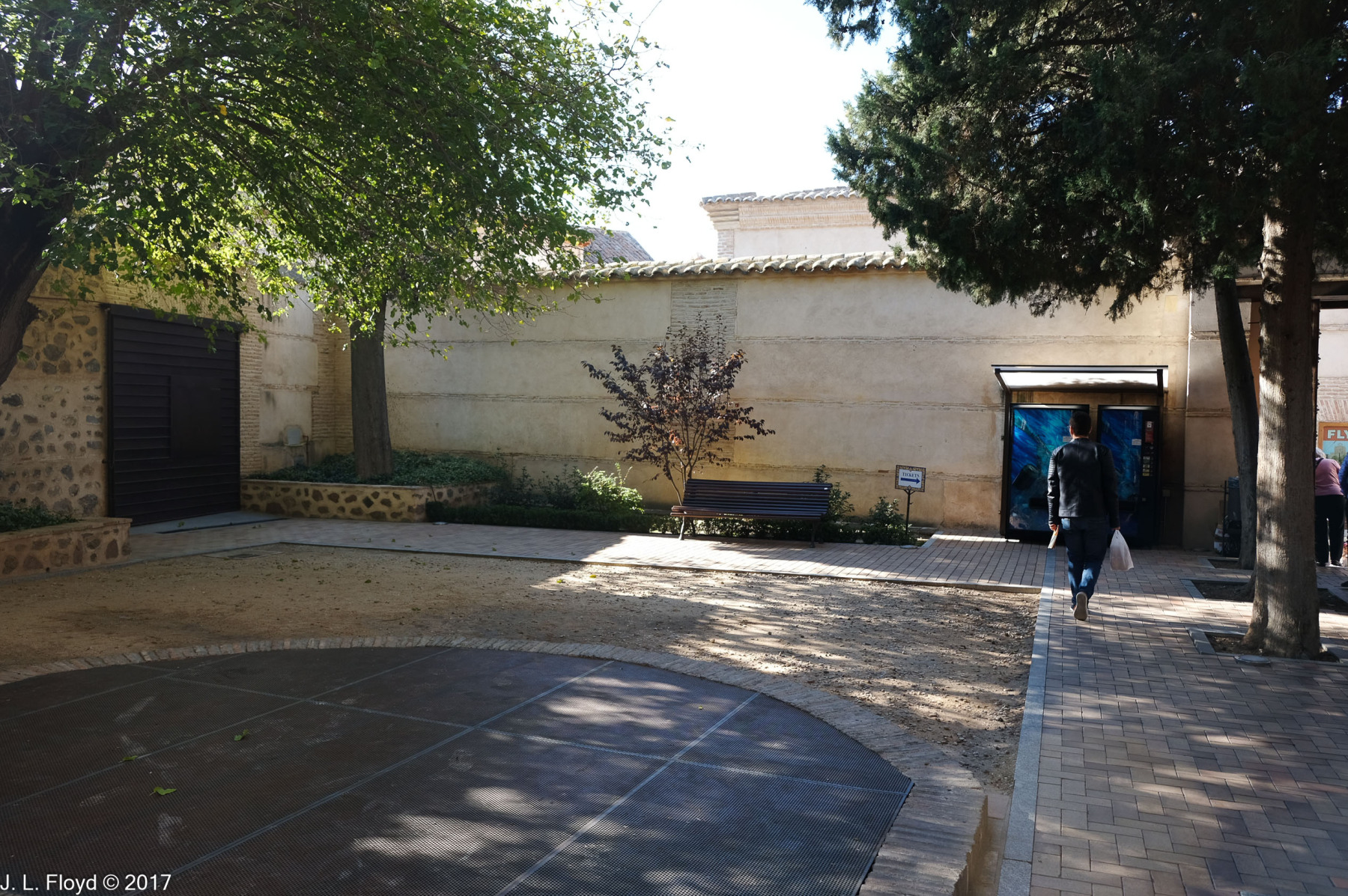
After viewing the interior of the synagogue, we exited to a courtyard, around which were buildings which had once held the Rabbi’s residence, a ritual bath, a study hall, and other facilities serving the Jewish community.

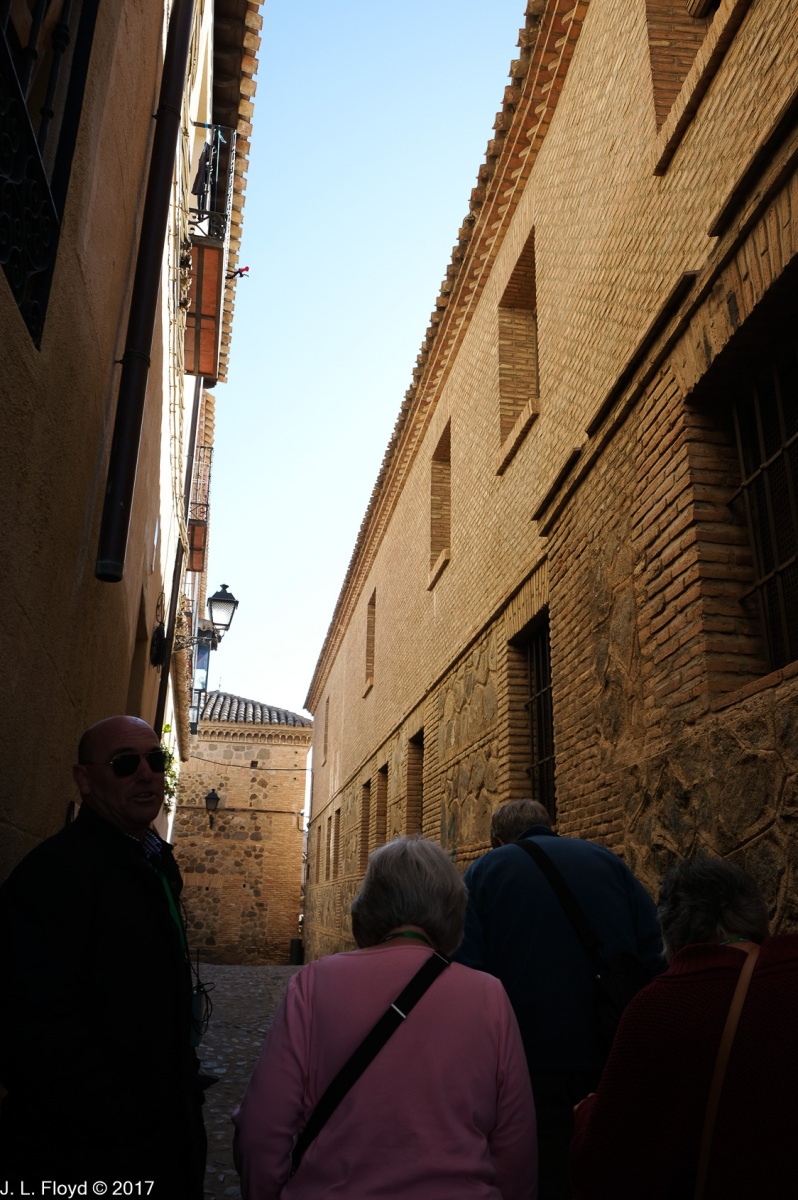
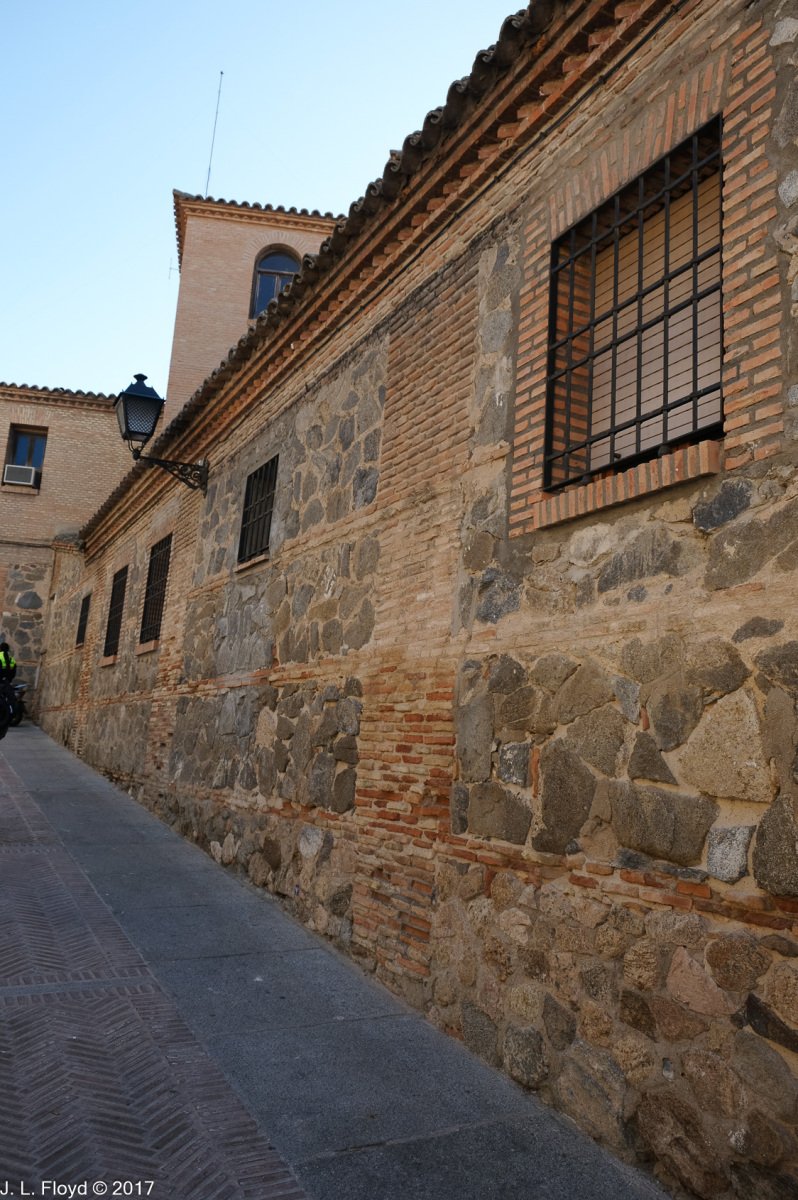
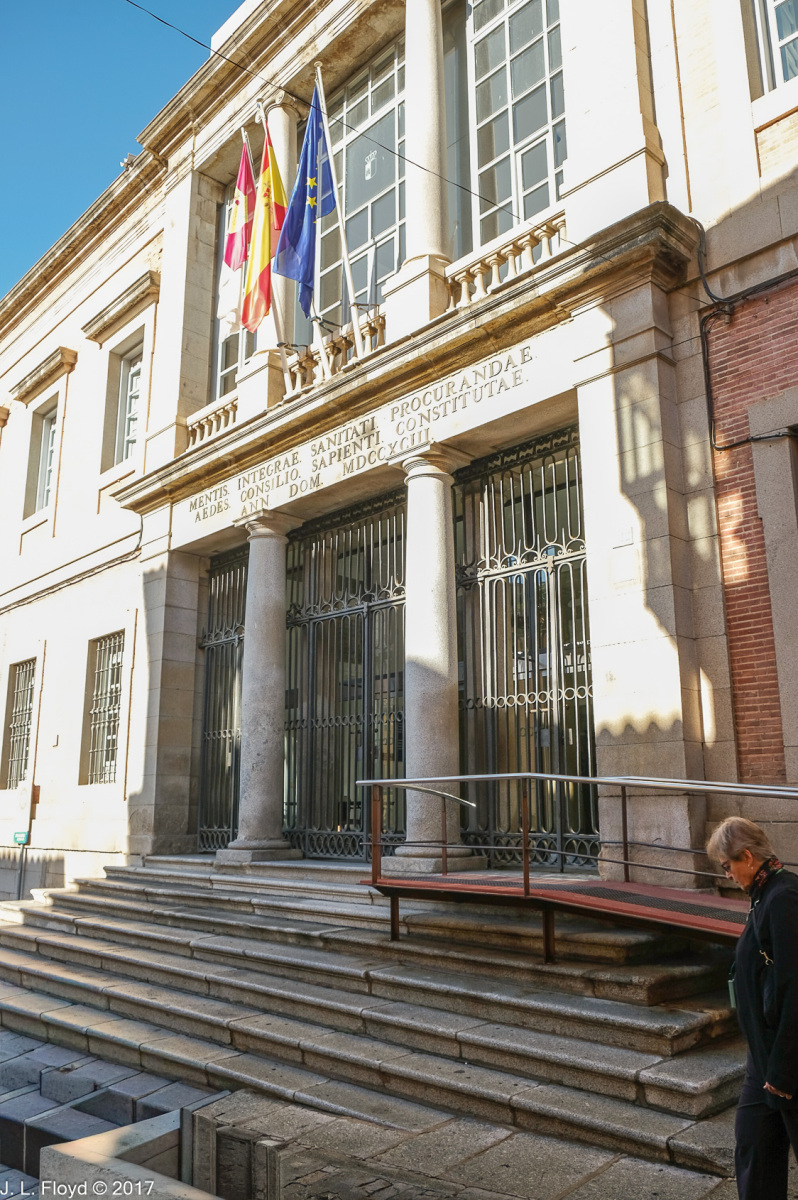
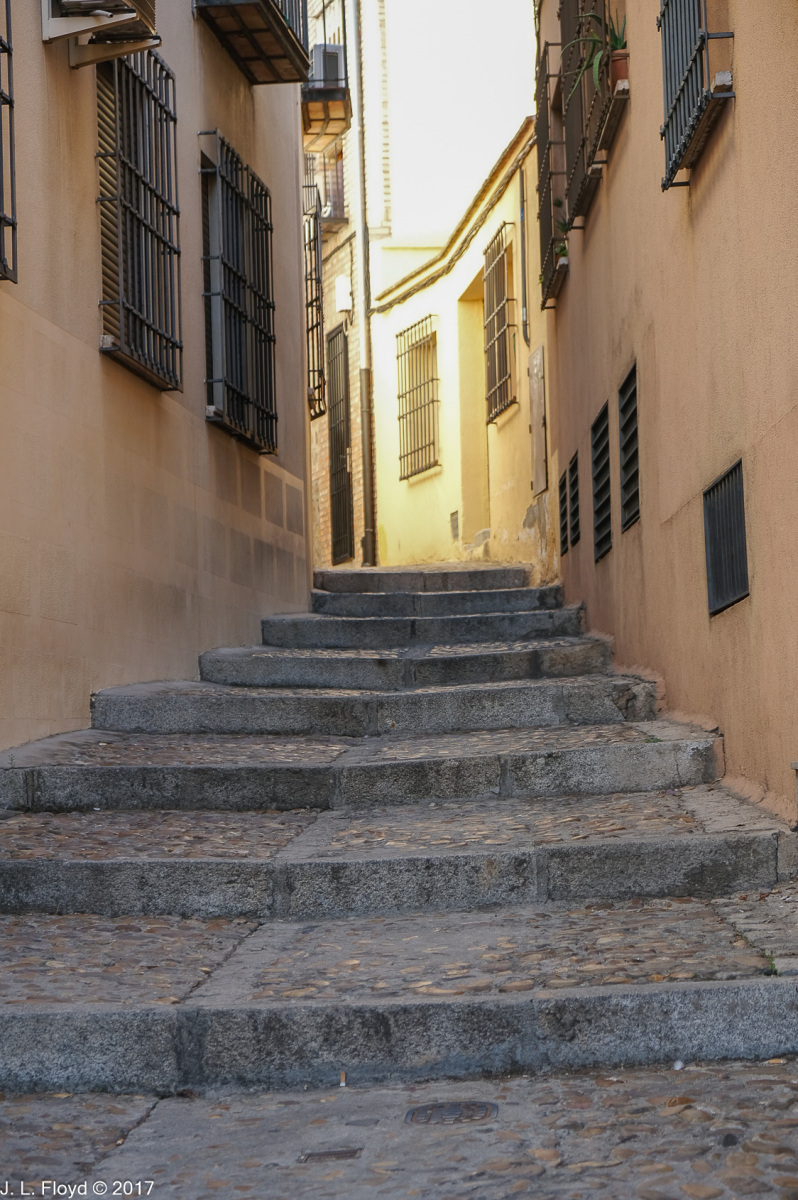
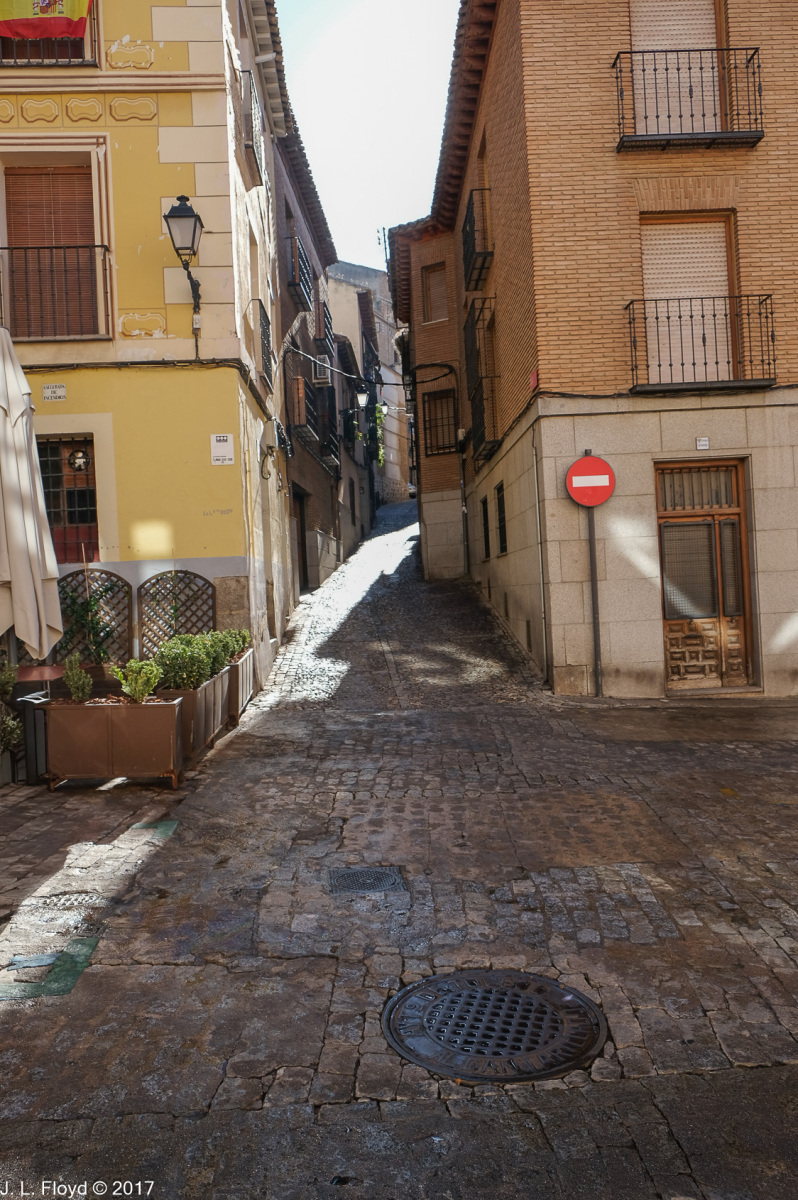
From the Synagogue we continued traipsing through the Jewish Quarter, enjoying views of the well-maintained streets, shops and houses. One particularly elegant structure with bars on the windows had a stone marquee above the door reading simply “PSOE”. I later found out that stood for Partido Socialista Obrero Español – Spanish Socialist Workers’ Party – of which the building housed the regional headquarters. The bars, which I originally thought were intended to keep out Christian pogromists, were likely there to ward off rock-throwing by members of rival political parties.

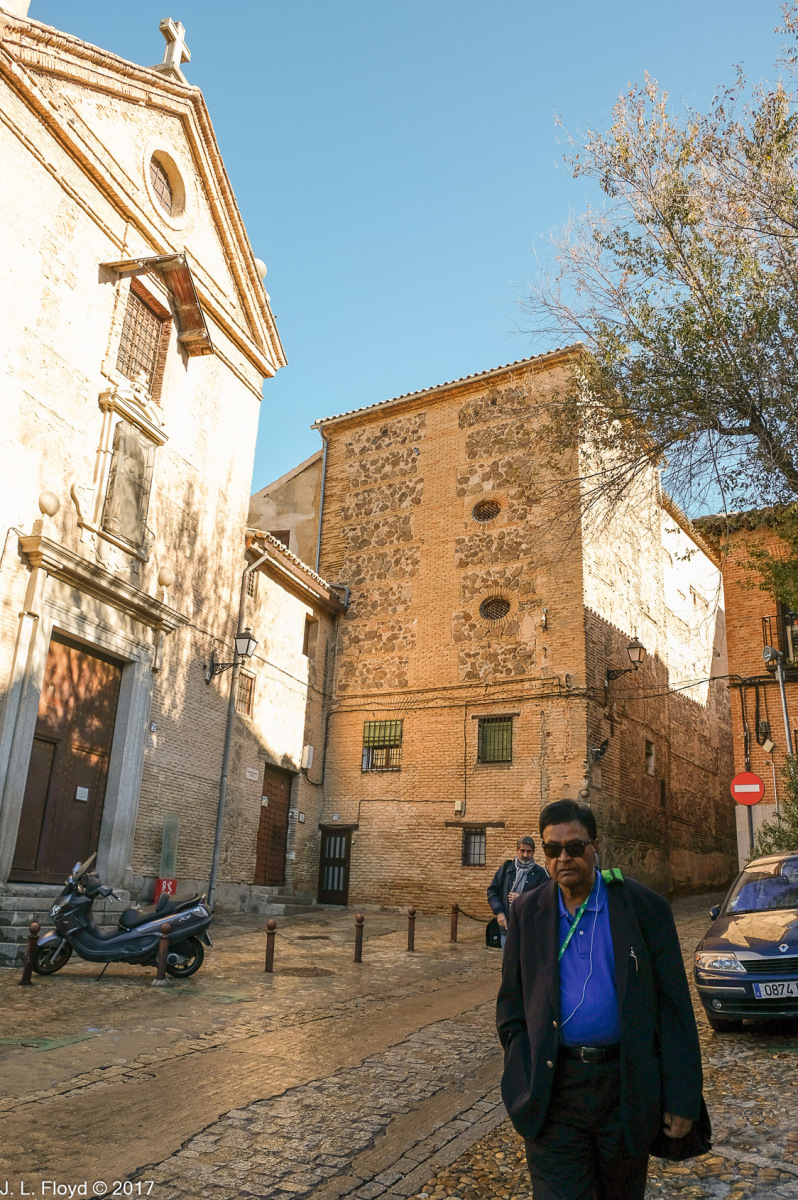
Eventually, at the end of the Travesía a Judería (Crossing to the Jewish Quarter, where we exited the Jewish quarter) we reached the Iglesia de Santo Tomé, where we were to view the famous painting of the Burial of Count Orgaz by El Greco. And with that, it’s time to begin a new post.

Categories
Spain, Portugal and Morocco, November 2017

Toledo, November 18, 2017 – Miradors and Monasteries

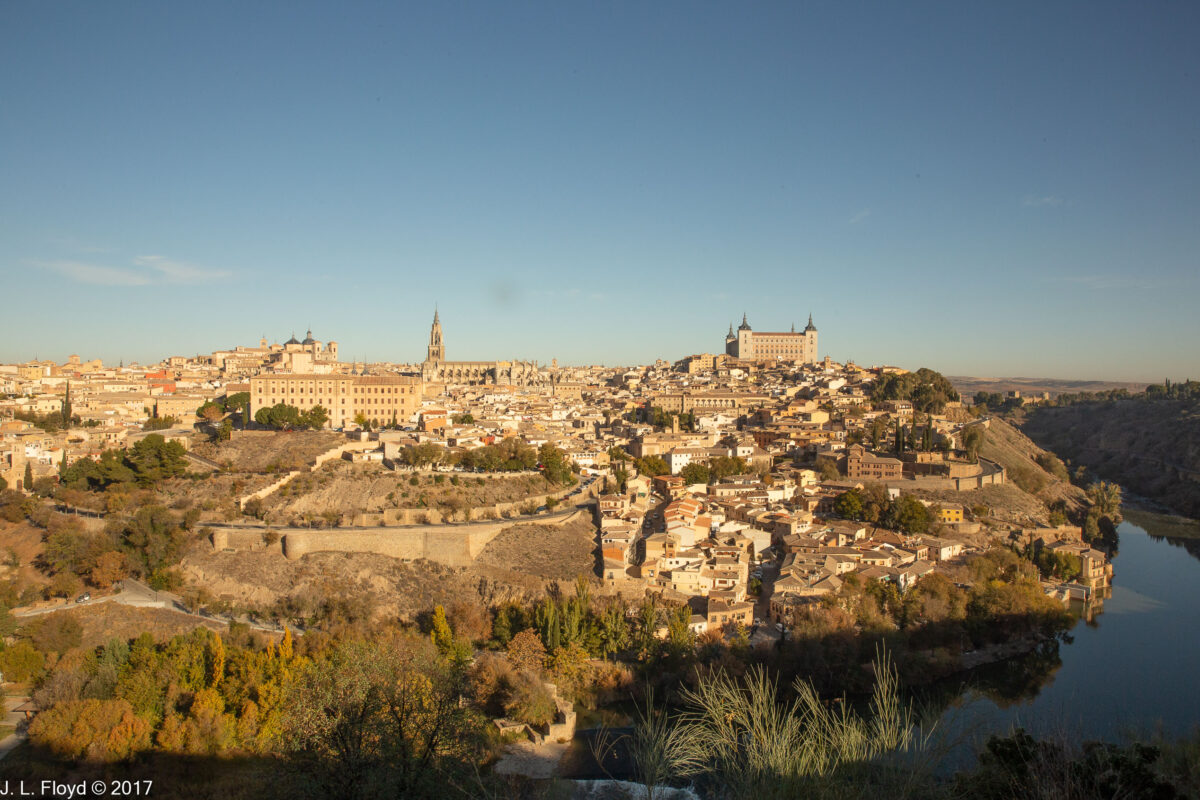
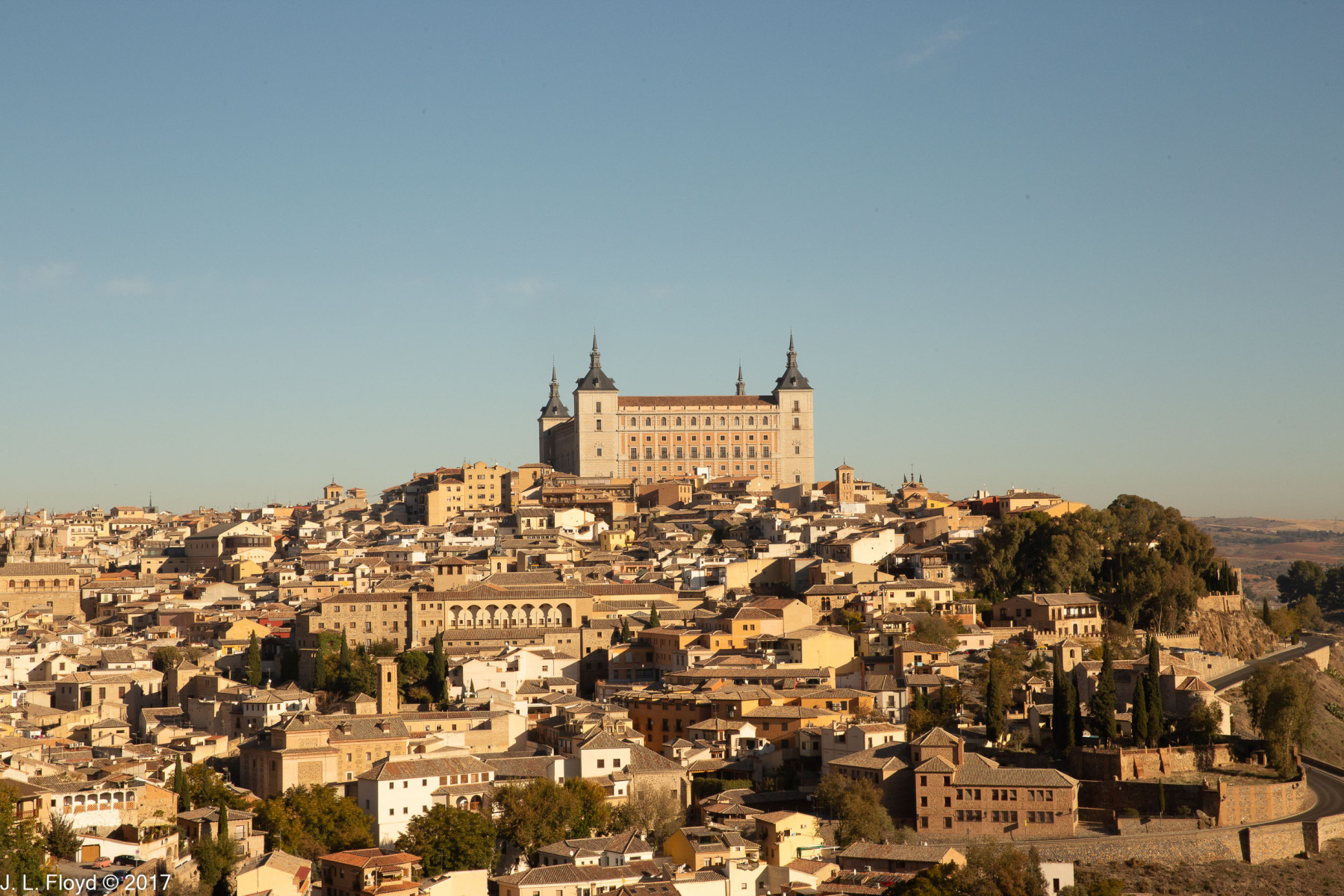
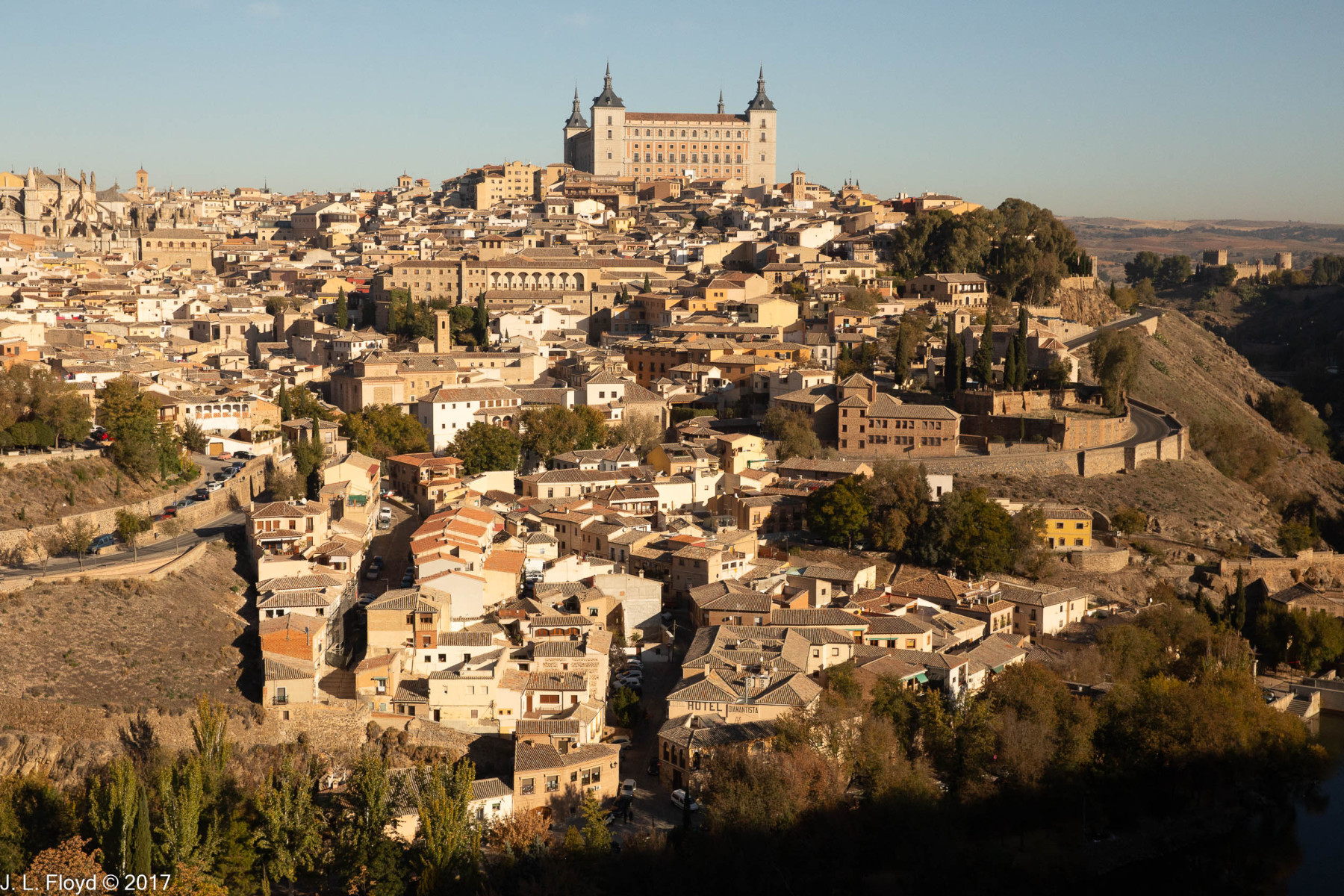
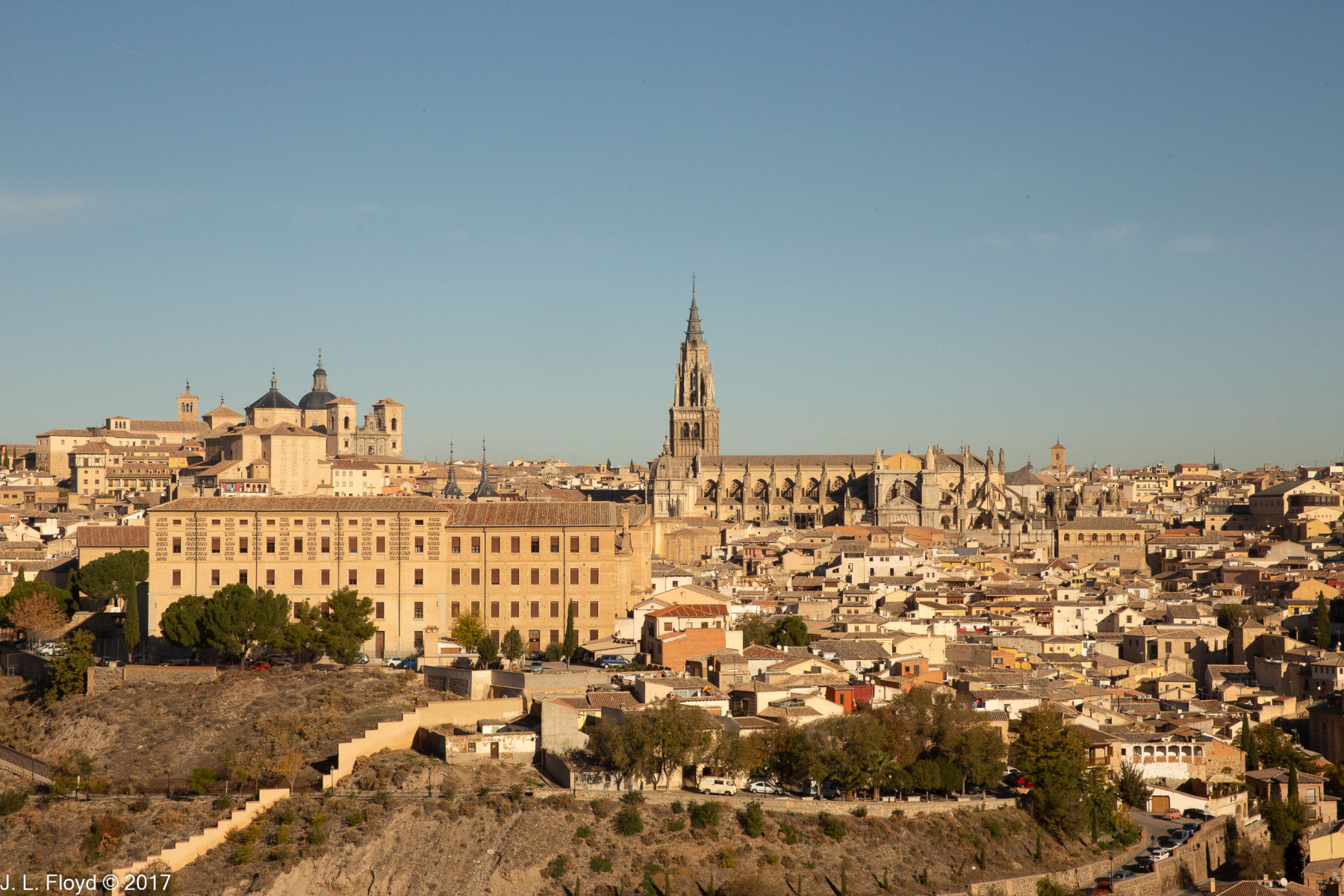
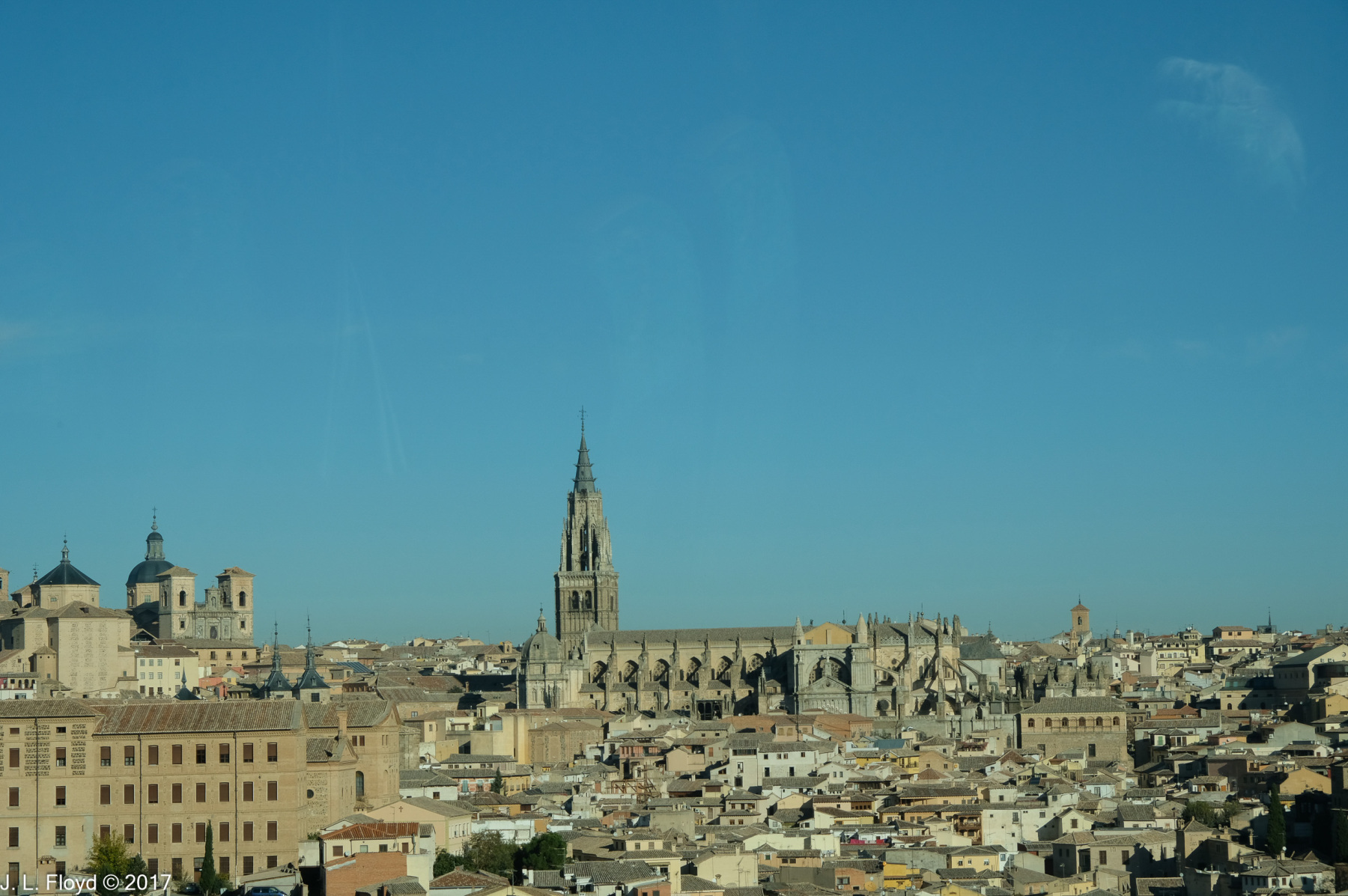
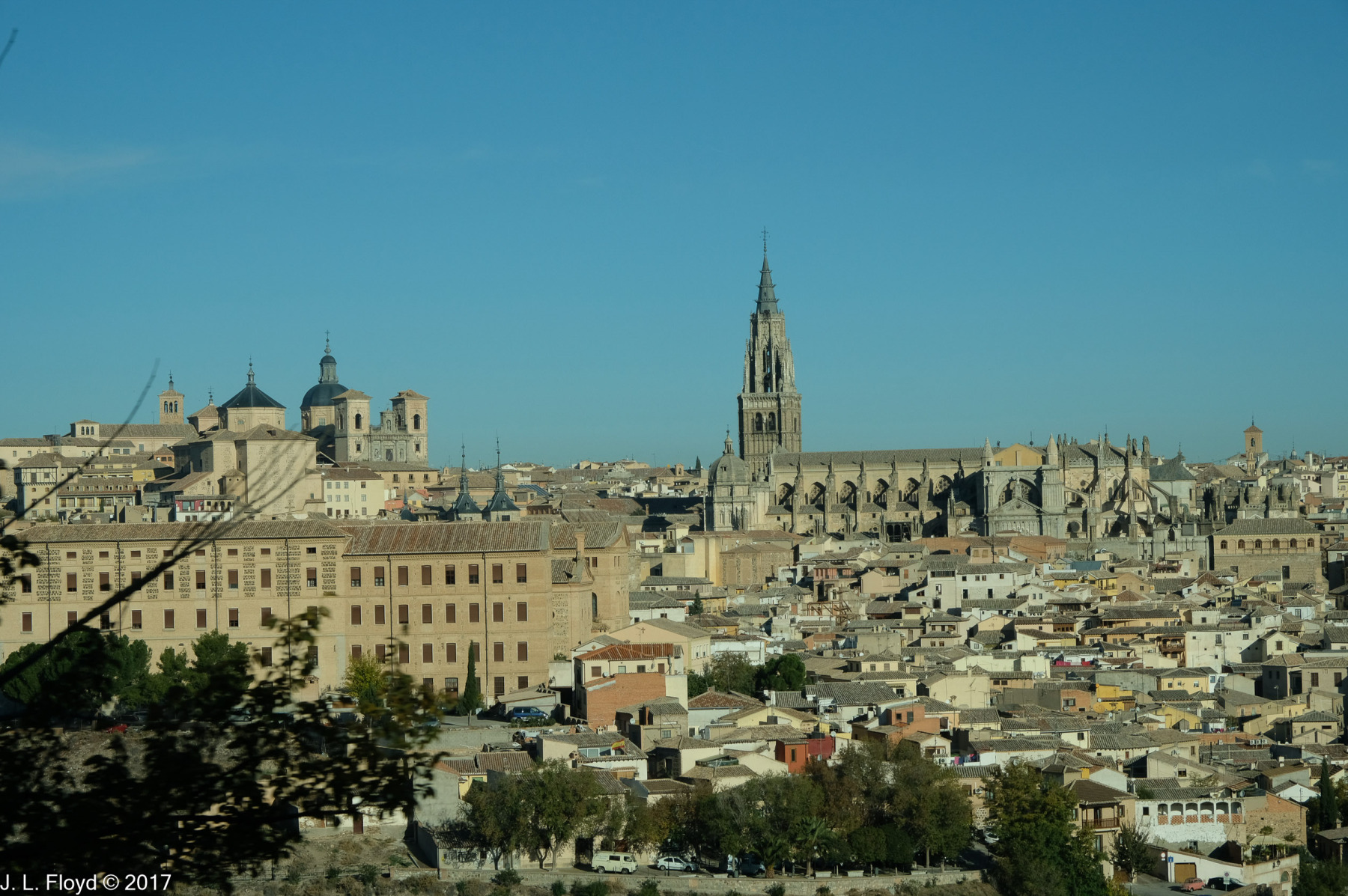
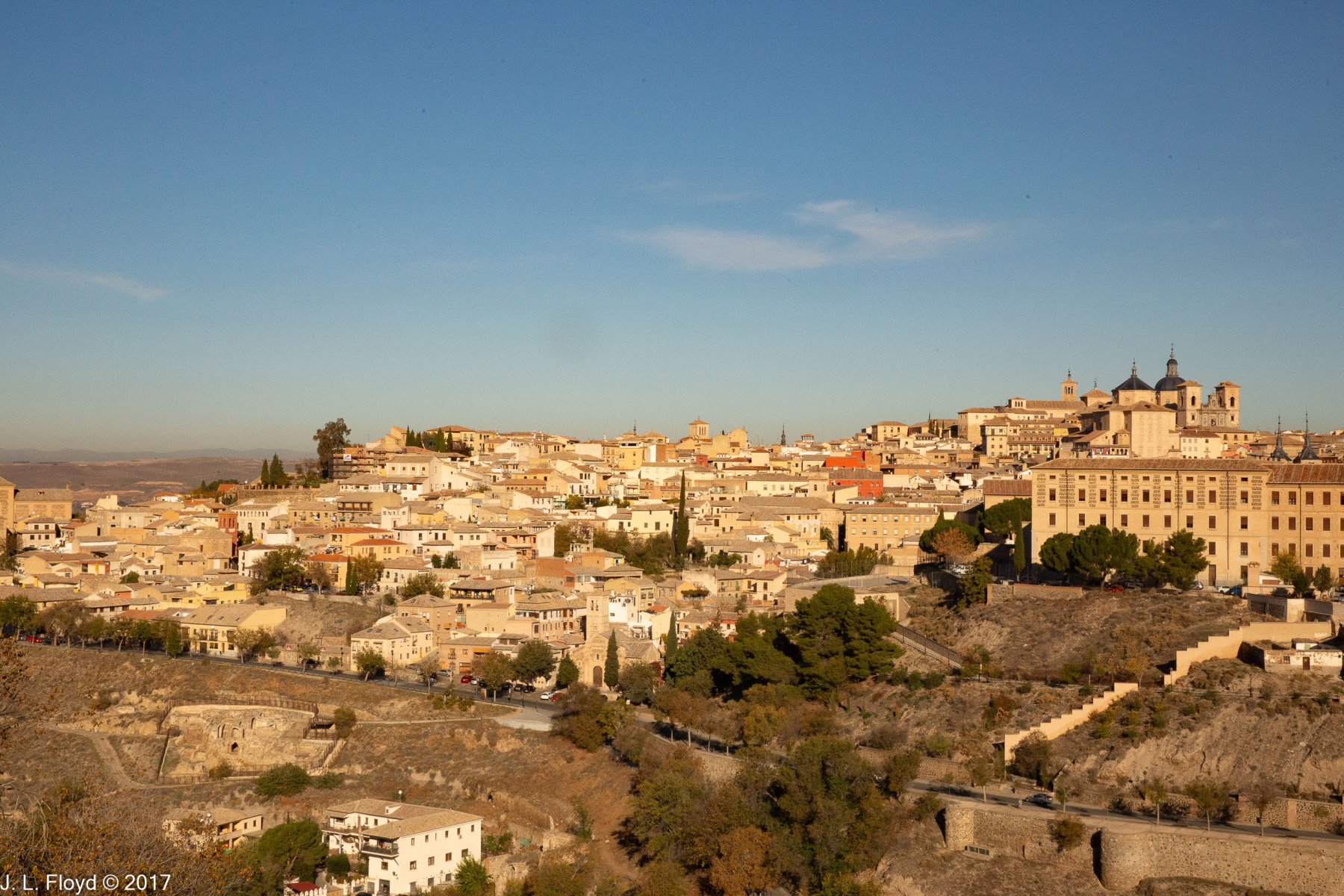
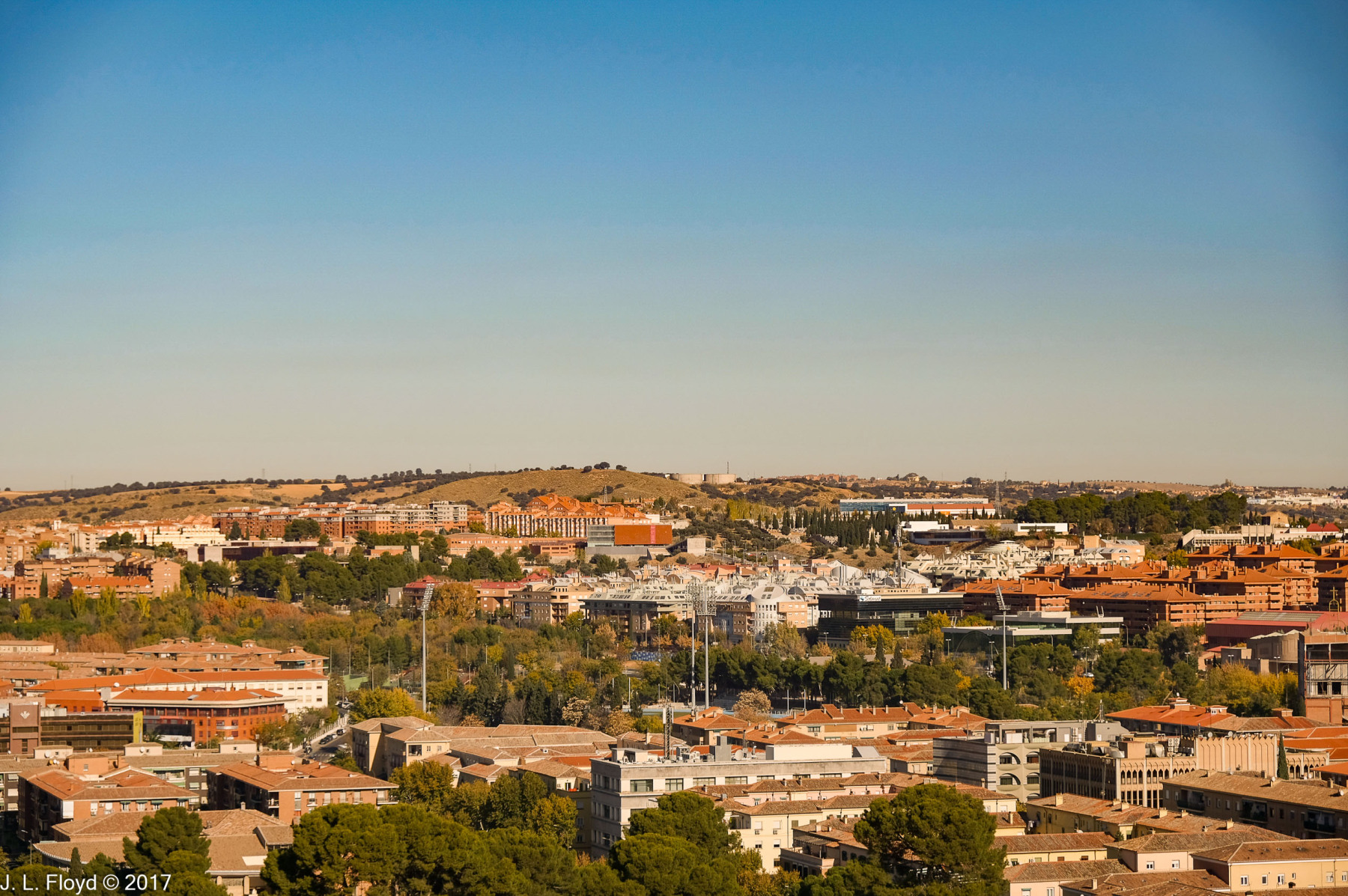
Toledo, whether viewed from nearby or afar, is the most strikingly photogenic city I have ever seen. The Old City sits on a hill about 100 meters (328 feet) high and is quite compact. On its south side are several hills with miradors – vantage points – from which it is possible to capture stunning panoramic views. And our bus driver, circling the city as we arrived early in the morning, made sure we had plenty of opportunities to do so.

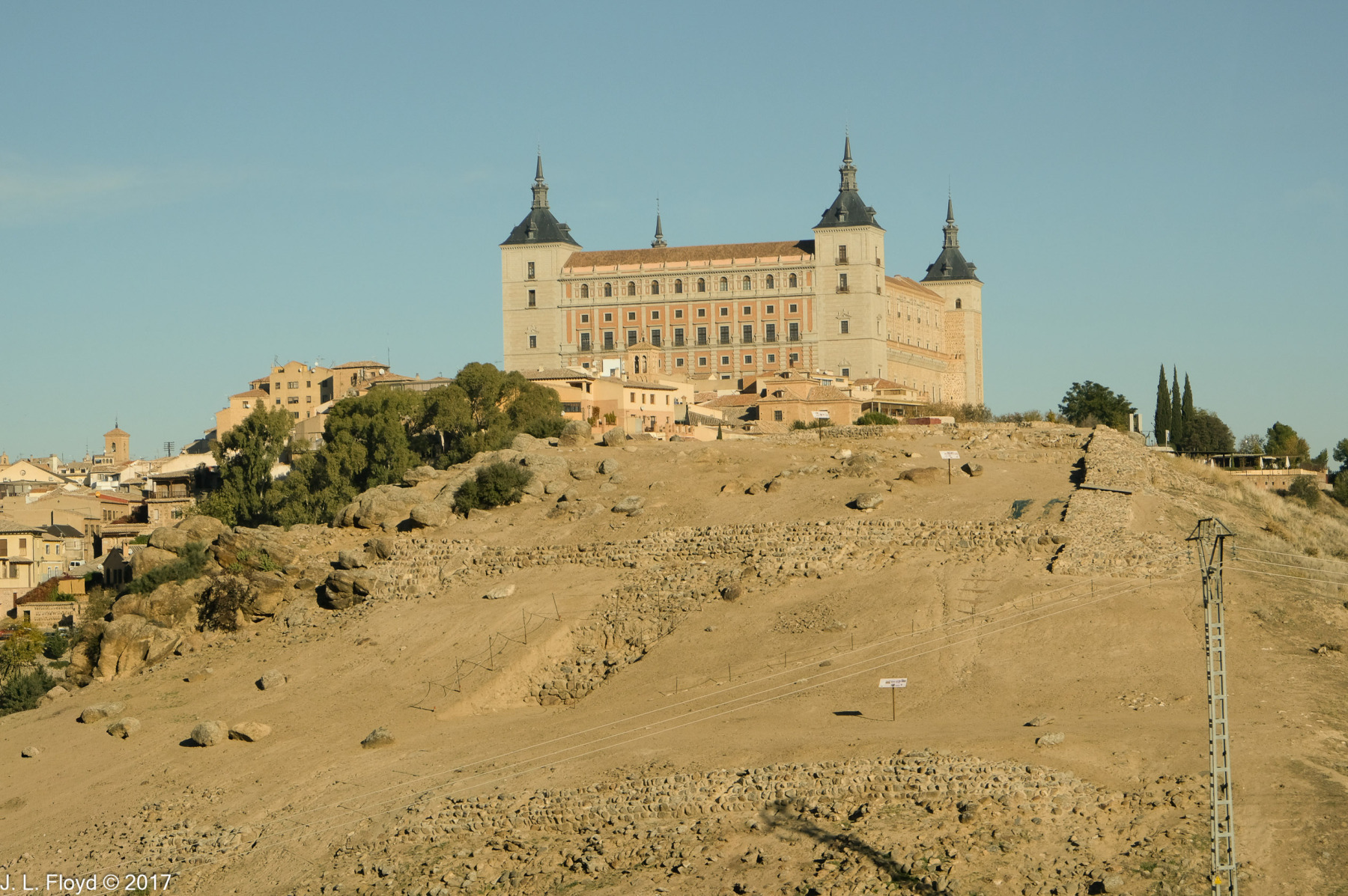
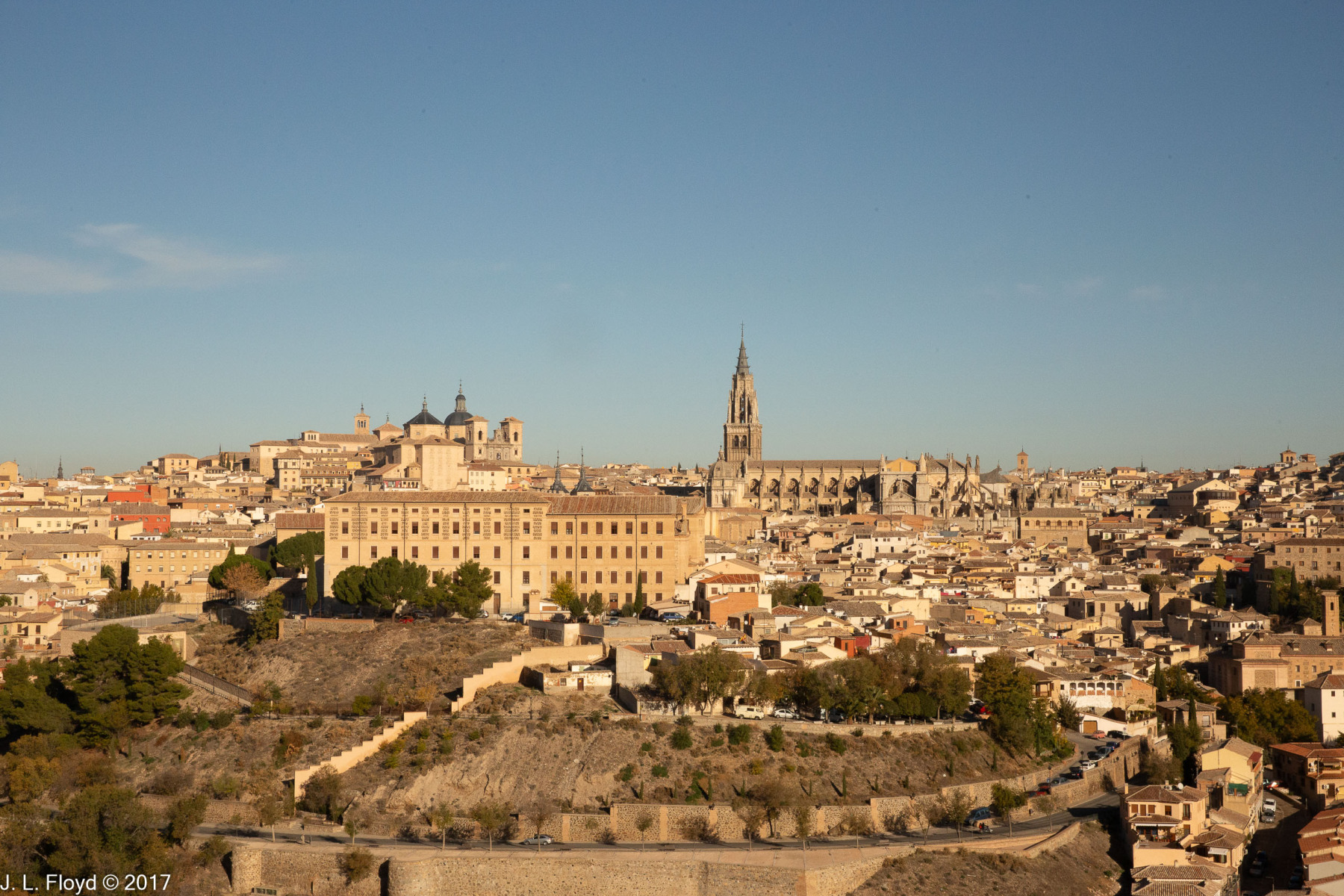
Viewing the city from the Mirador de Toledo, where the bus stopped for picture-taking, two structures stand out above all others and catch the eye immediately. Toward the eastern part of the city stands the Alcázar, an ancient fortress dating back to Roman times. It does not look ancient, however, because it was rebuilt many times over the centuries, most recently between 1939 and 1957, to repair the damage it suffered during the Spanish Civil War of the 1930s. It is a large quadrangular stone building, 60 meters on a side; at each corner there is a tower topped by a Madrid spire – a quadrangular pyramid with a metallic sphere, weather vane and metal cross on top. We did not visit the Alcázar in our tour of Toledo, but we did visit the other most prominent landmark, the Toledo Cathedral, seen to the left (west) of the Alcázar. Its 92 meter (301 feet) tower soars above the surrounding structures, making it easy to identify.

Visible to the west of the Cathedral was a cluster of structures which, although not rivalling the Cathedral or the Alcázar in height, nevertheless attracted attention. These included the churches of San Ildefonso, San Bartolomé and the Centro Cultural de San Marcos.

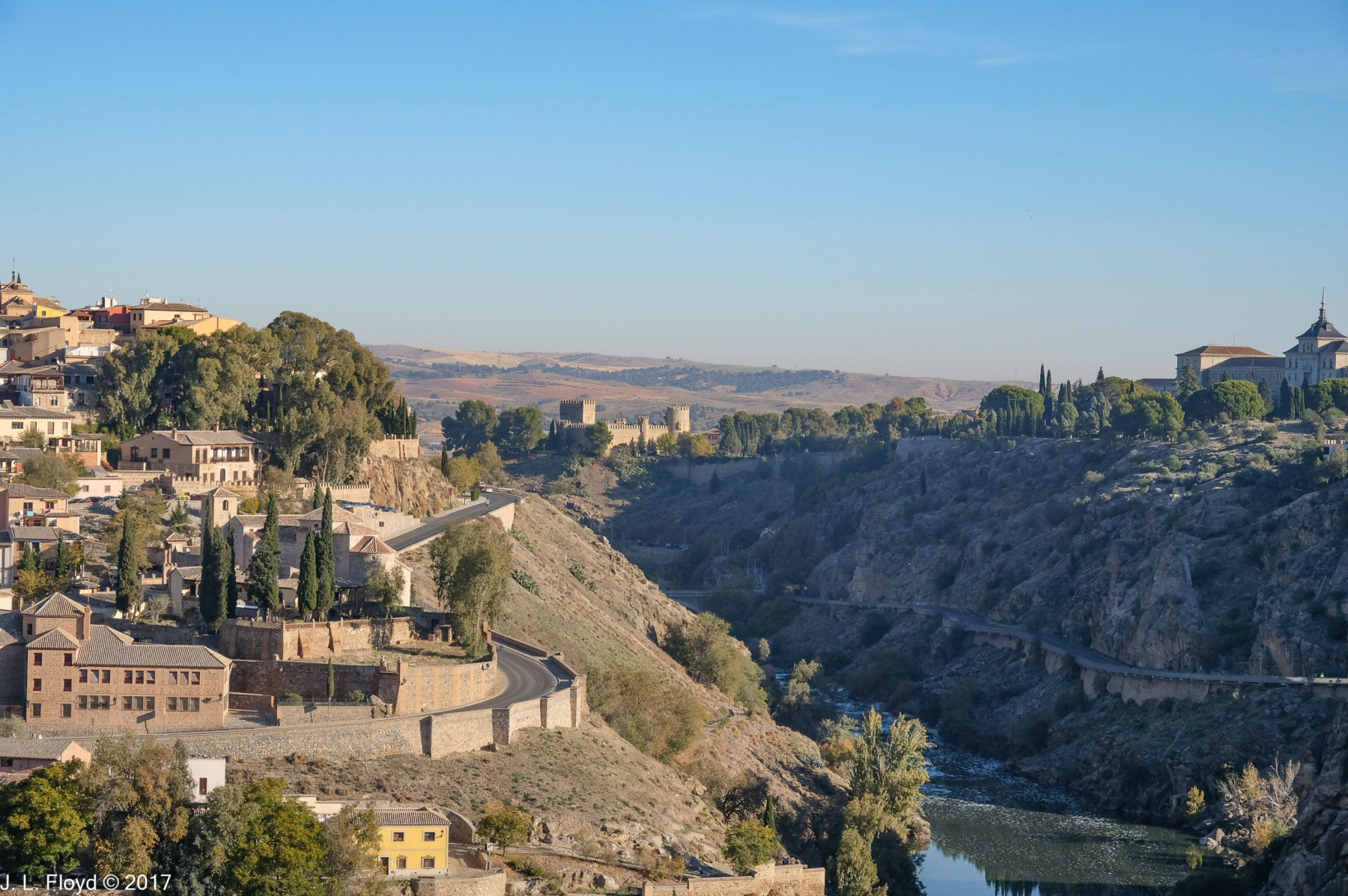
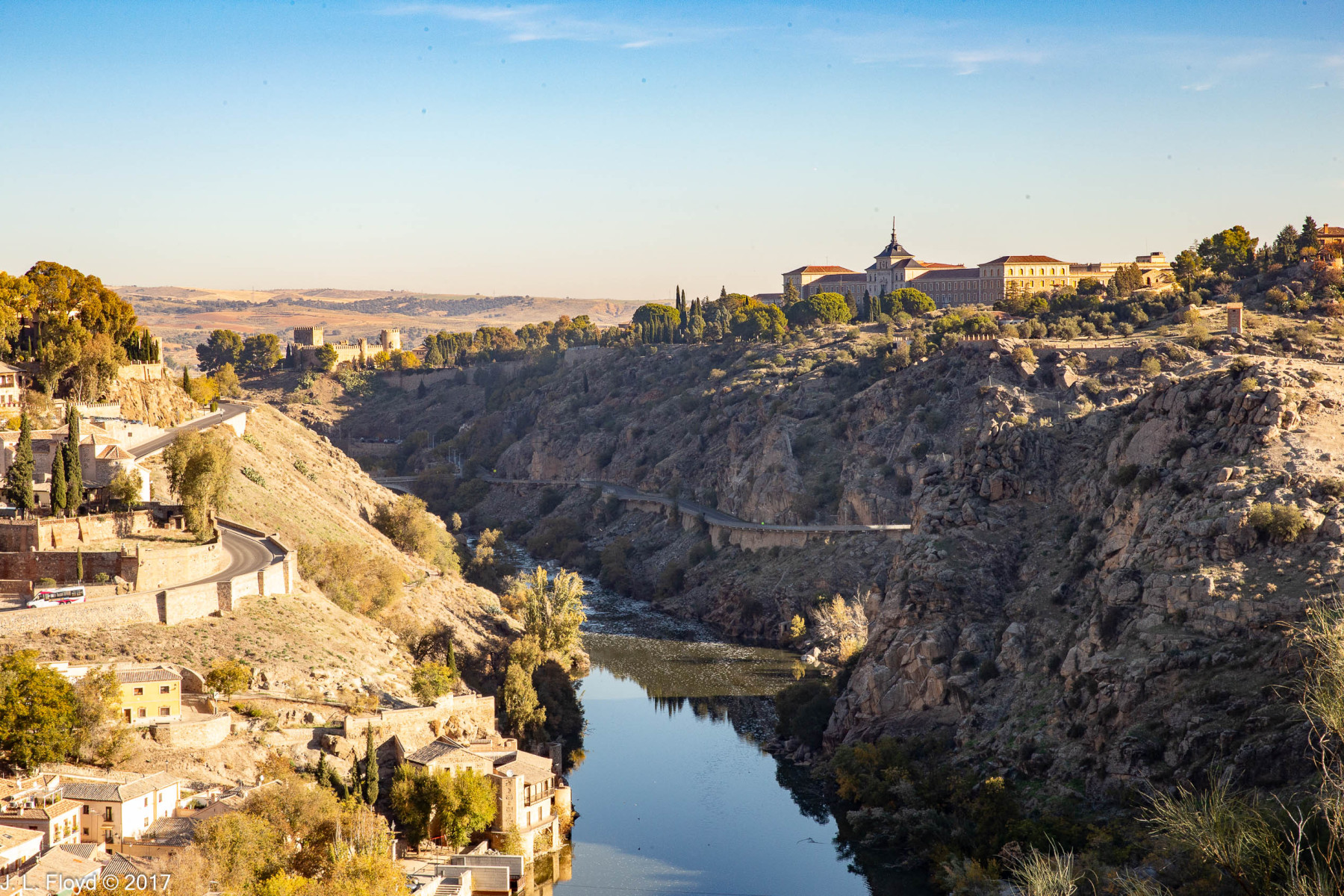
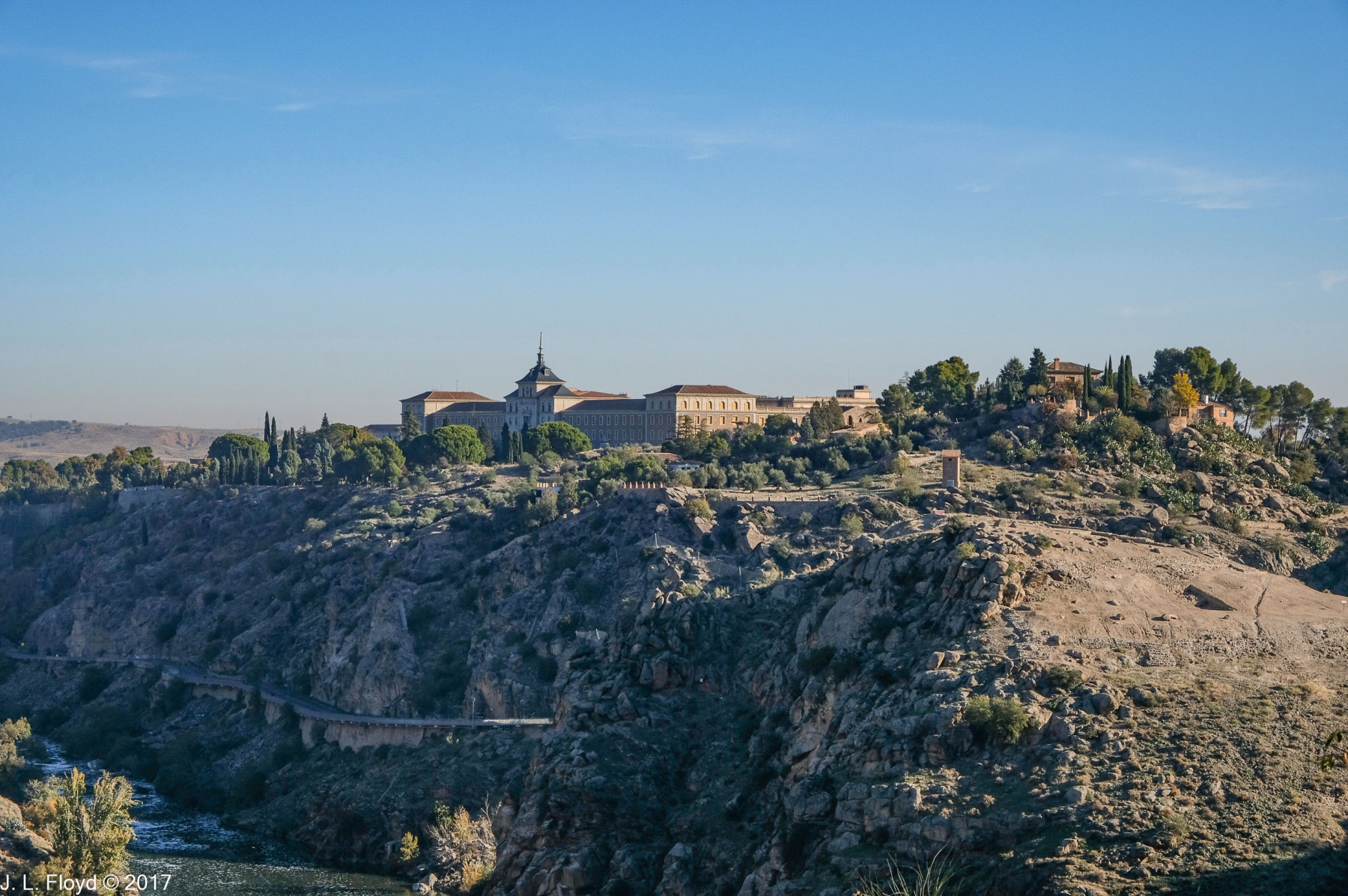
The Tagus River (Rio Tajo in Castilian Spanish) is the longest river in the Iberian Peninsula, flowing 1,007 kilometers (626 miles) from eastern Spain to its mouth at Lisbon in Portugal. On its way it curves around the city of Toledo in a sharp meander known as the Torno del Tajo, carving a spectacular gorge, most prominently on the eastern side of the city. We had an excellent view of the river from our mirador. To the east of the Alcázar the ground drops sharply to the river, and the opposite bank rises in a near-vertical cliff. On the side of the cliff, about one-third of the way up, is a rather precarious-looking road, the Ronda de Juanelo; perched at the top of the cliff is the Escuela Central de Educación Física  (Central School of Physical Education), which belongs to the Spanish Army. Farther to the north, lower down, we could make out the Castle of San Servando, which was originally built as a monastery on the order of Alfonso VI, King of Leon and Castile, after his conquest of Toledo from the Moors in 1085. The castle also served as a fortress to guard the Alcántara Bridge against Moorish attempts to reverse the conquest. Nowadays it hosts a provincial hospital.

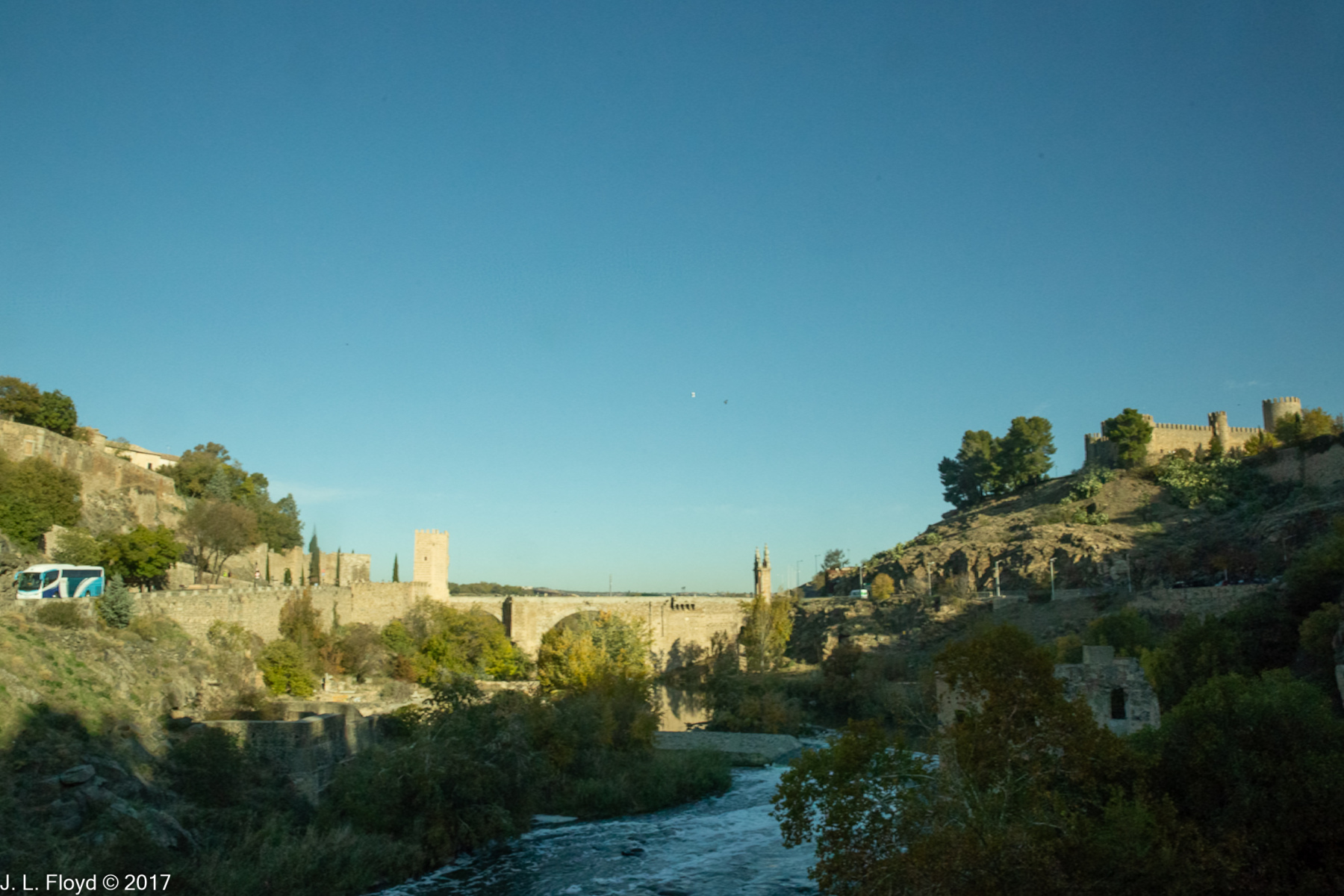
The Alcántara Bridge, a stone double-arch structure, was originally built by the Romans, although of course it has been rebuilt and repaired many times throughout the ages. It was the main point of access to Toledo for hundreds of years, and the only one through which pilgrims were allowed to cross into the city in medieval times.

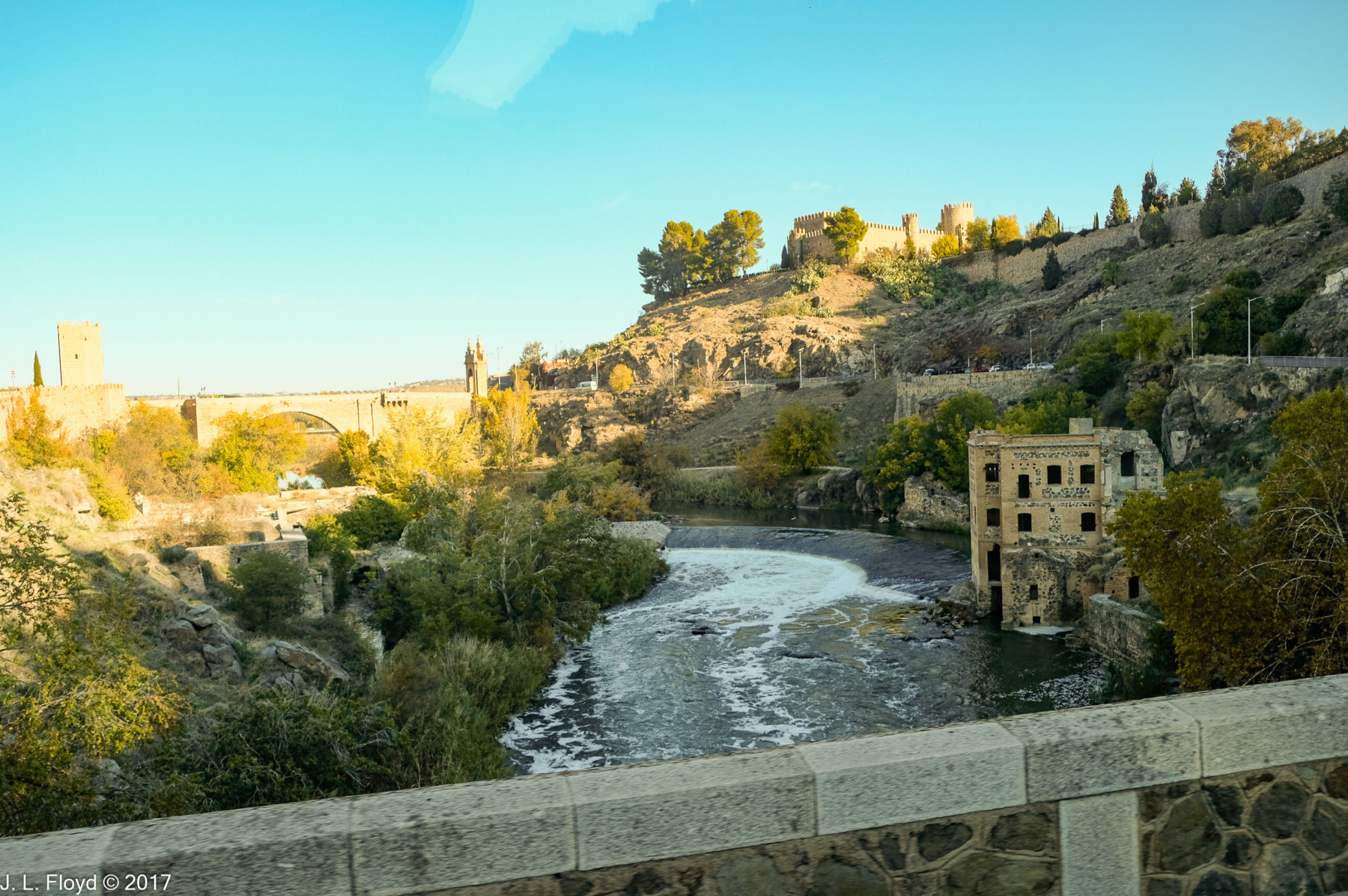
We modern-day pilgrims did not enter Toledo via the old Alcántara Bridge; instead our bus we used the New Alcántara Bridge, which is south of the old one. As we crossed the river, we could see some ruined buildings on both banks of the river, along with what looked like a kind of dam, between the two bridges. Later I found out that the ruins were the remains of a complex built in the 19th century to harness the hydraulic power of the Tagus River to generate electricity. Known as the Vargas Turbines, this facility was demolished in 1999, presumably because it became obsolete, and now there remain only the ruins we saw.

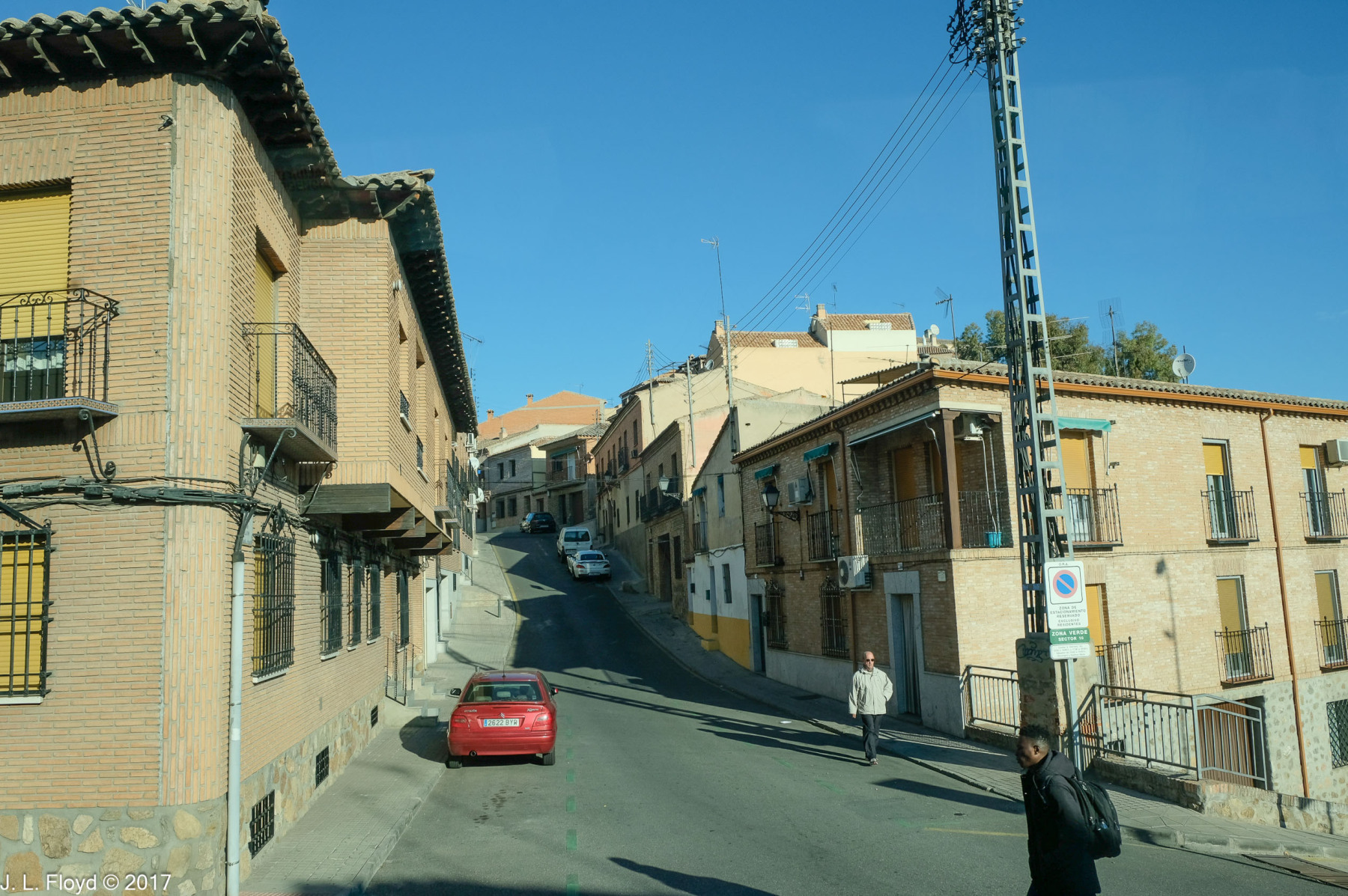
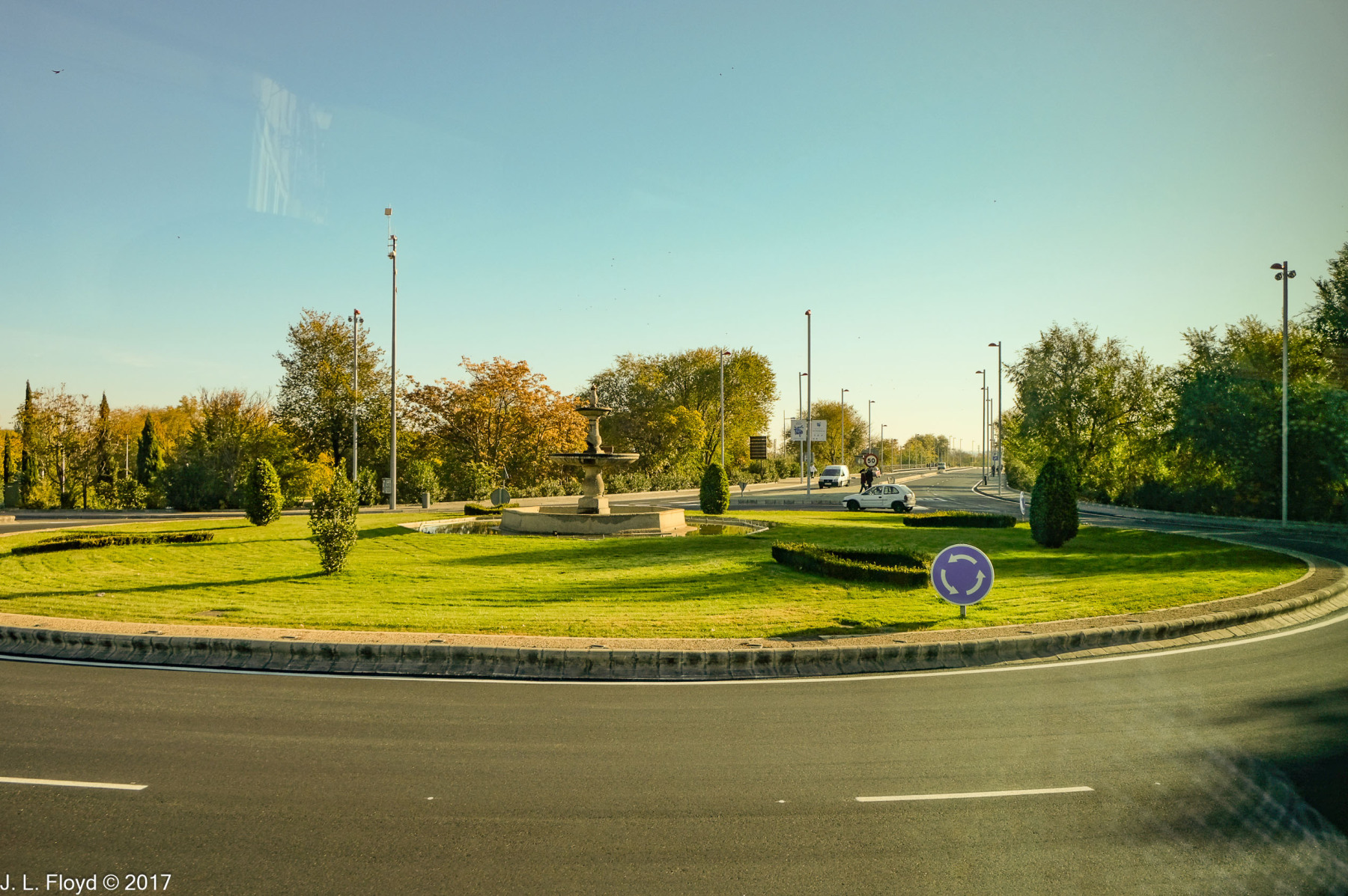
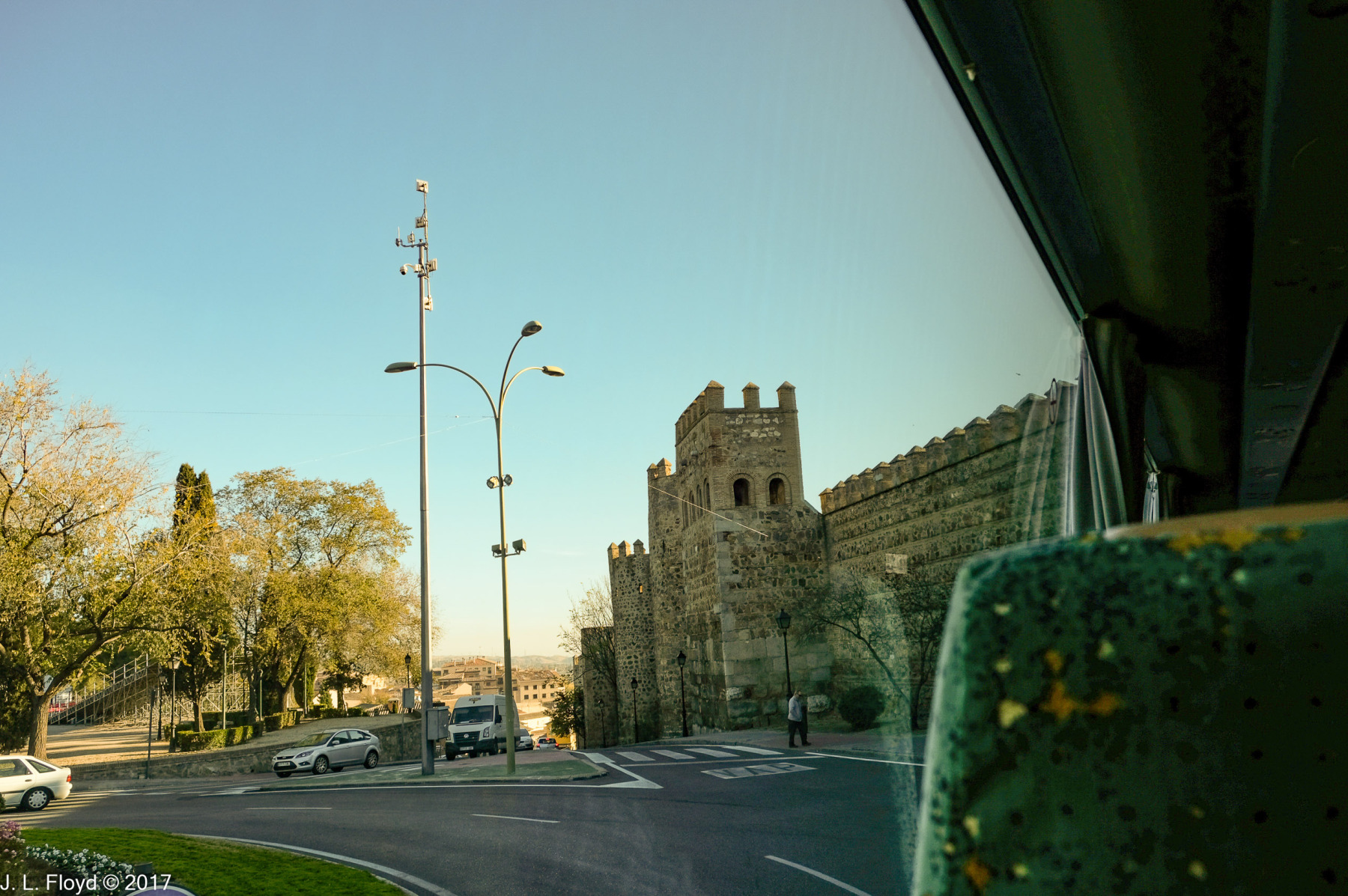
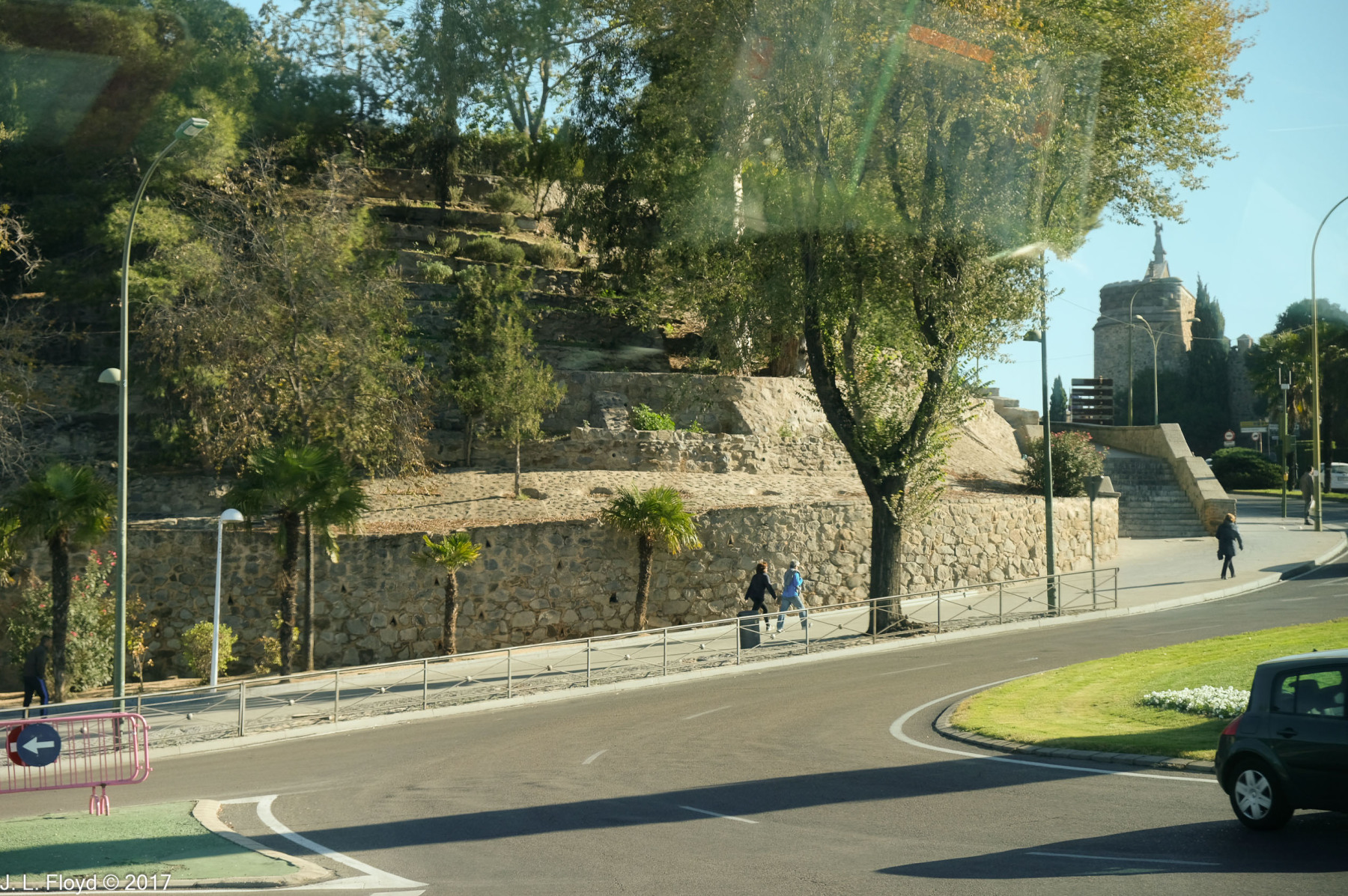
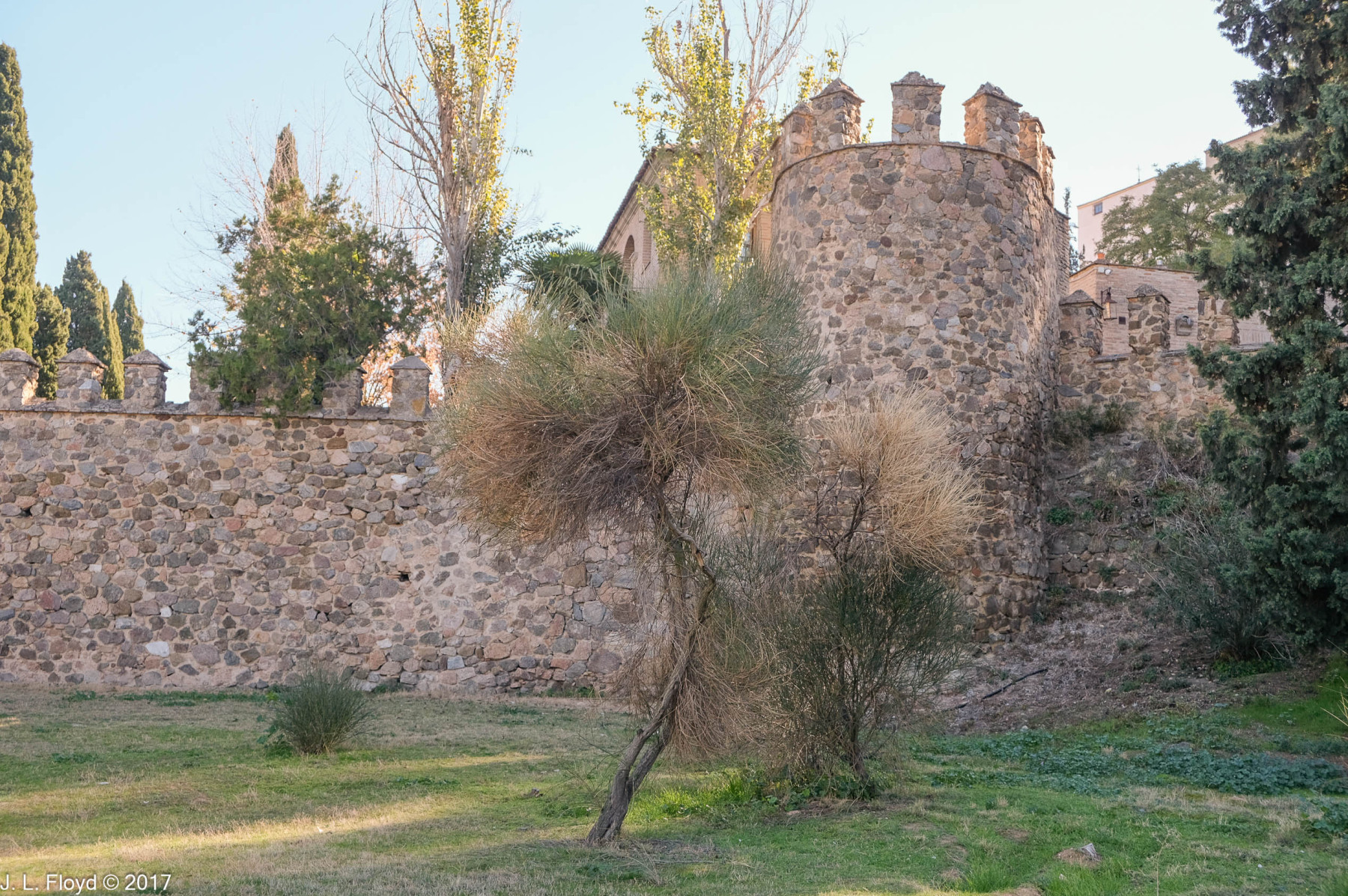
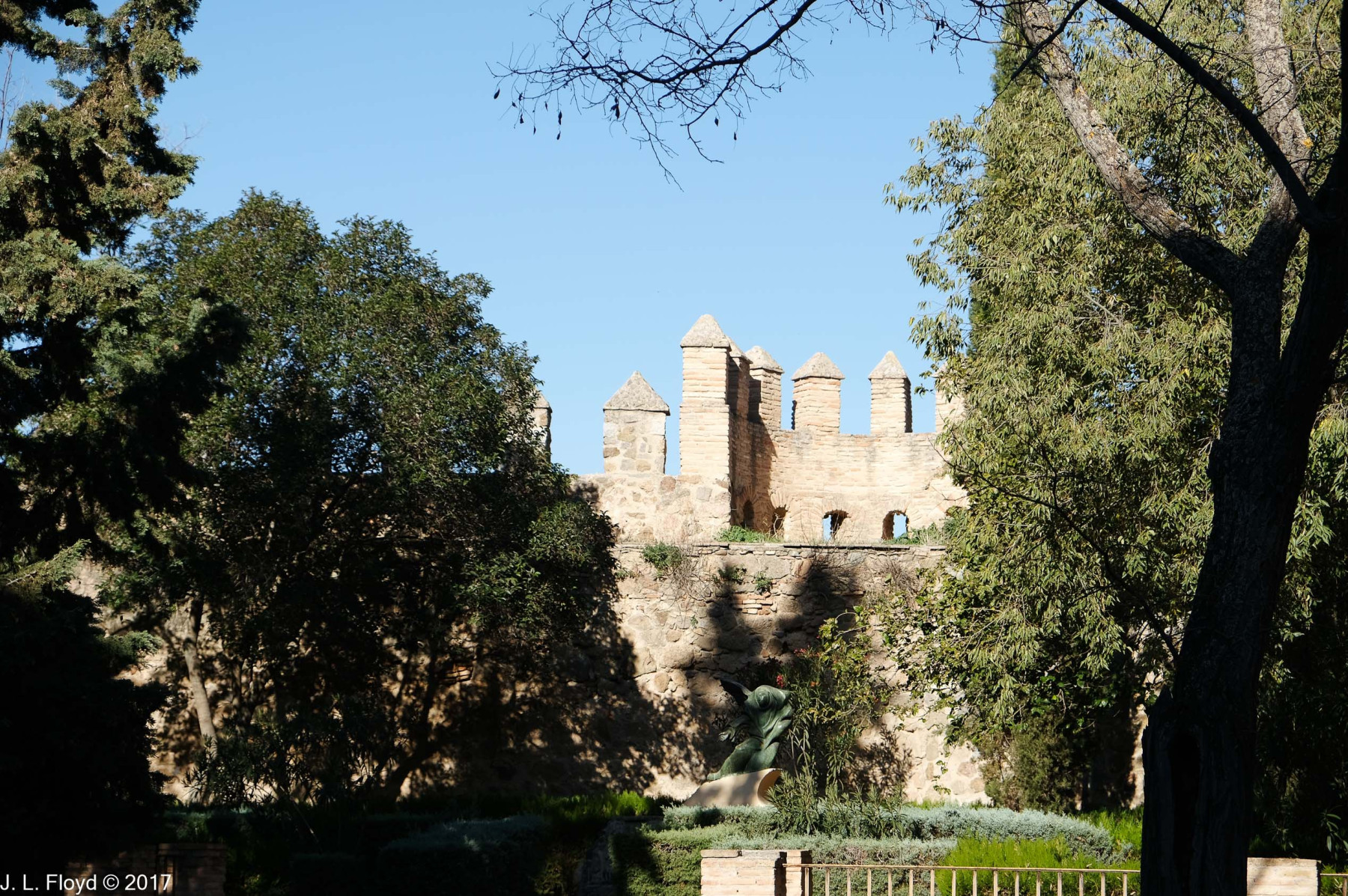
After crossing the river, our bus proceeded via a devious route to the north side of the Old City. Along the way we encountered several roundabouts – rotondas in Spanish – which seem to be ubiquitous in Spain, but add to the attractiveness of the views; we also passed close to the walls of the Old City, studded with picturesque towers which whetted our appetite for the experience to come.

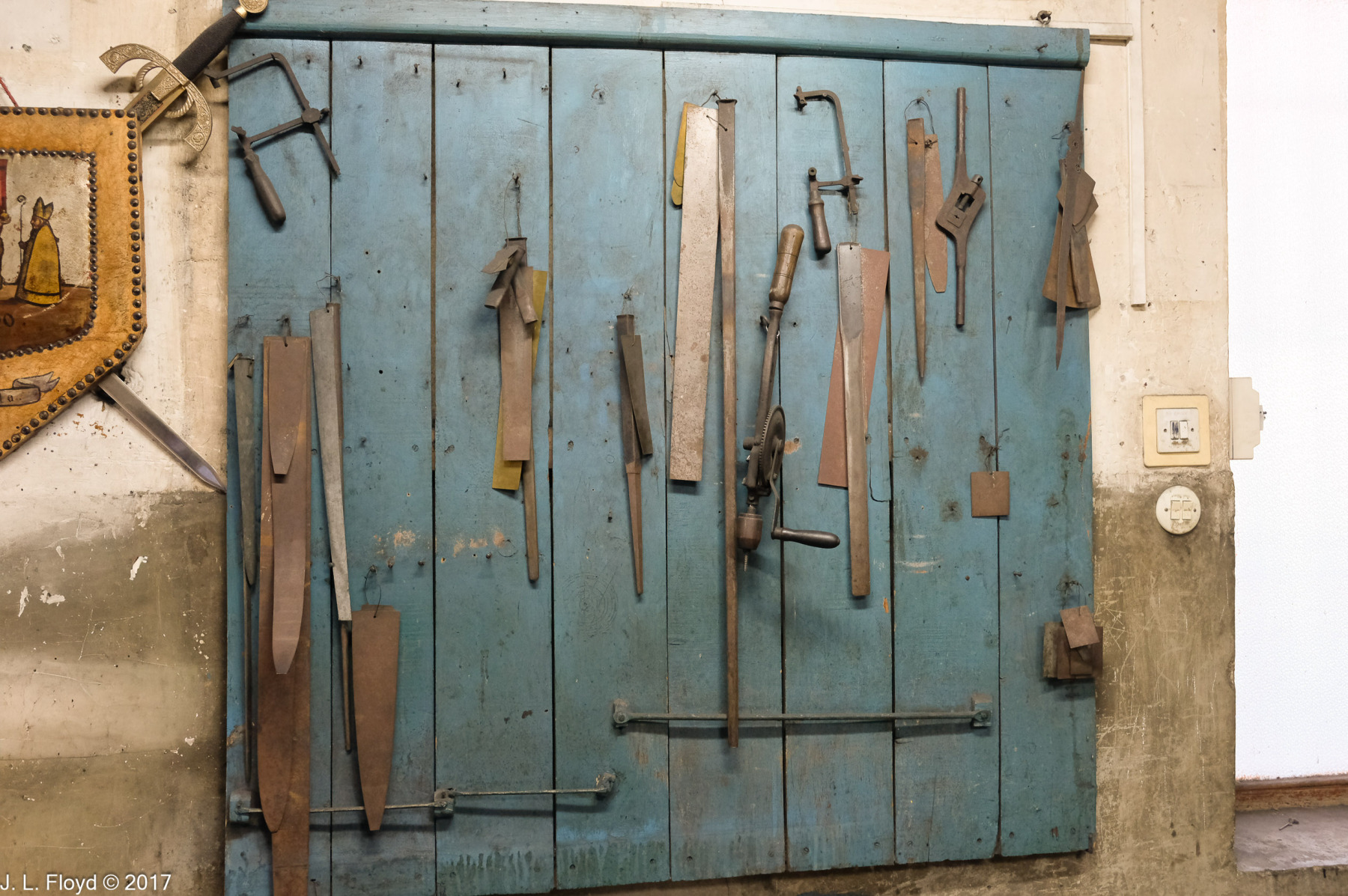
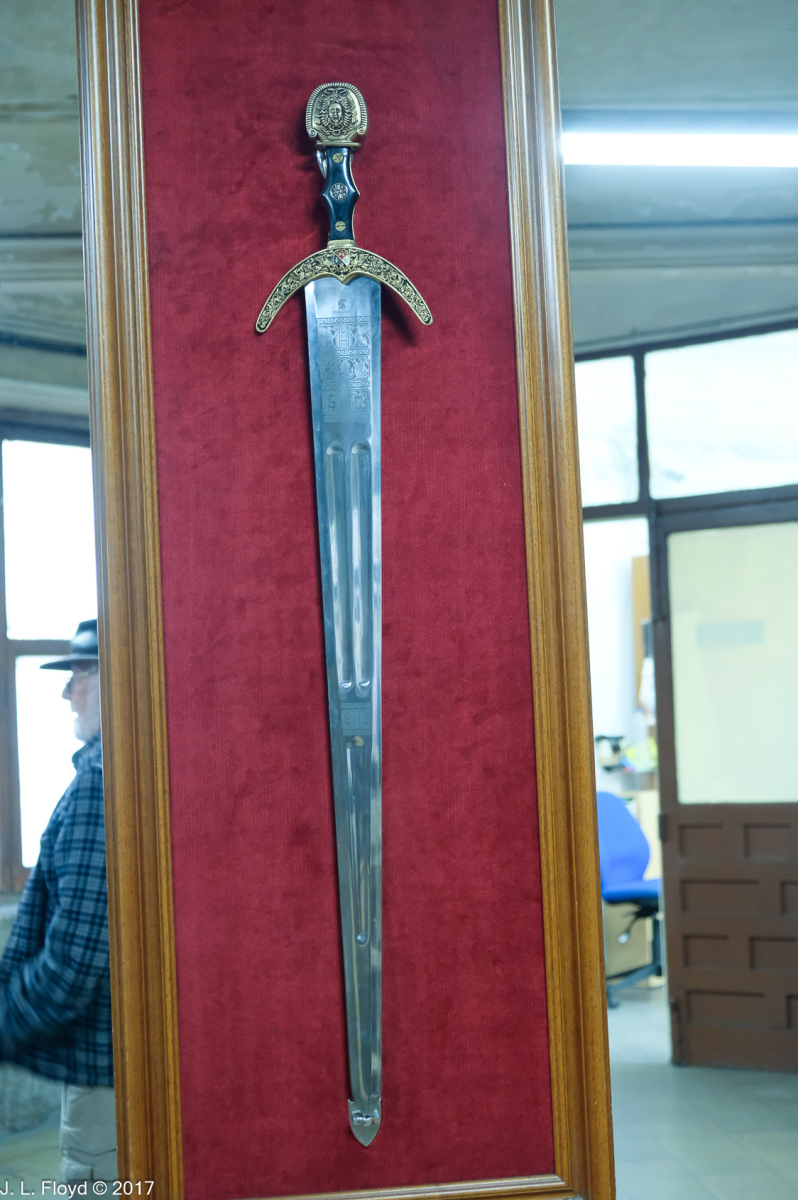
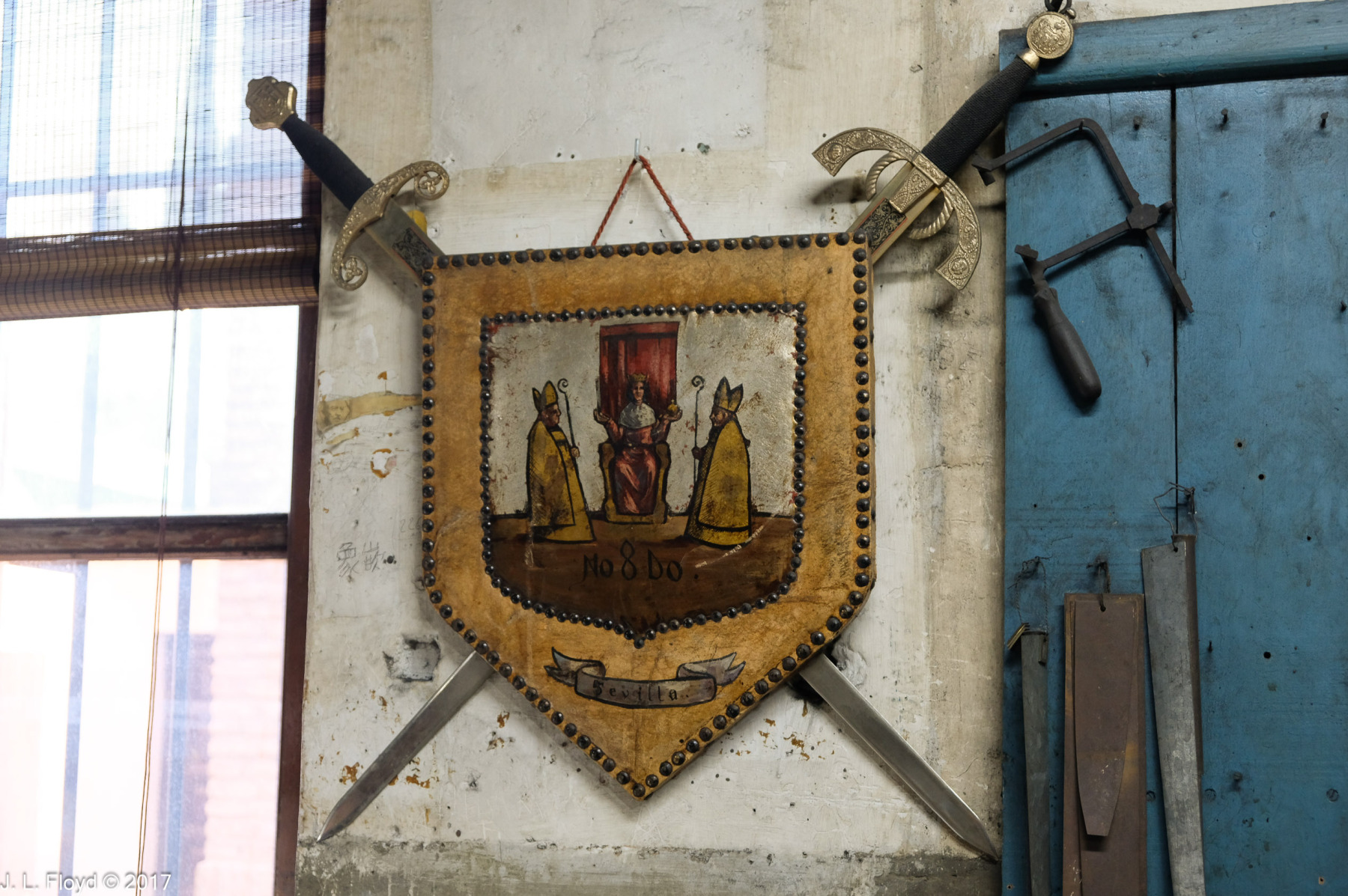
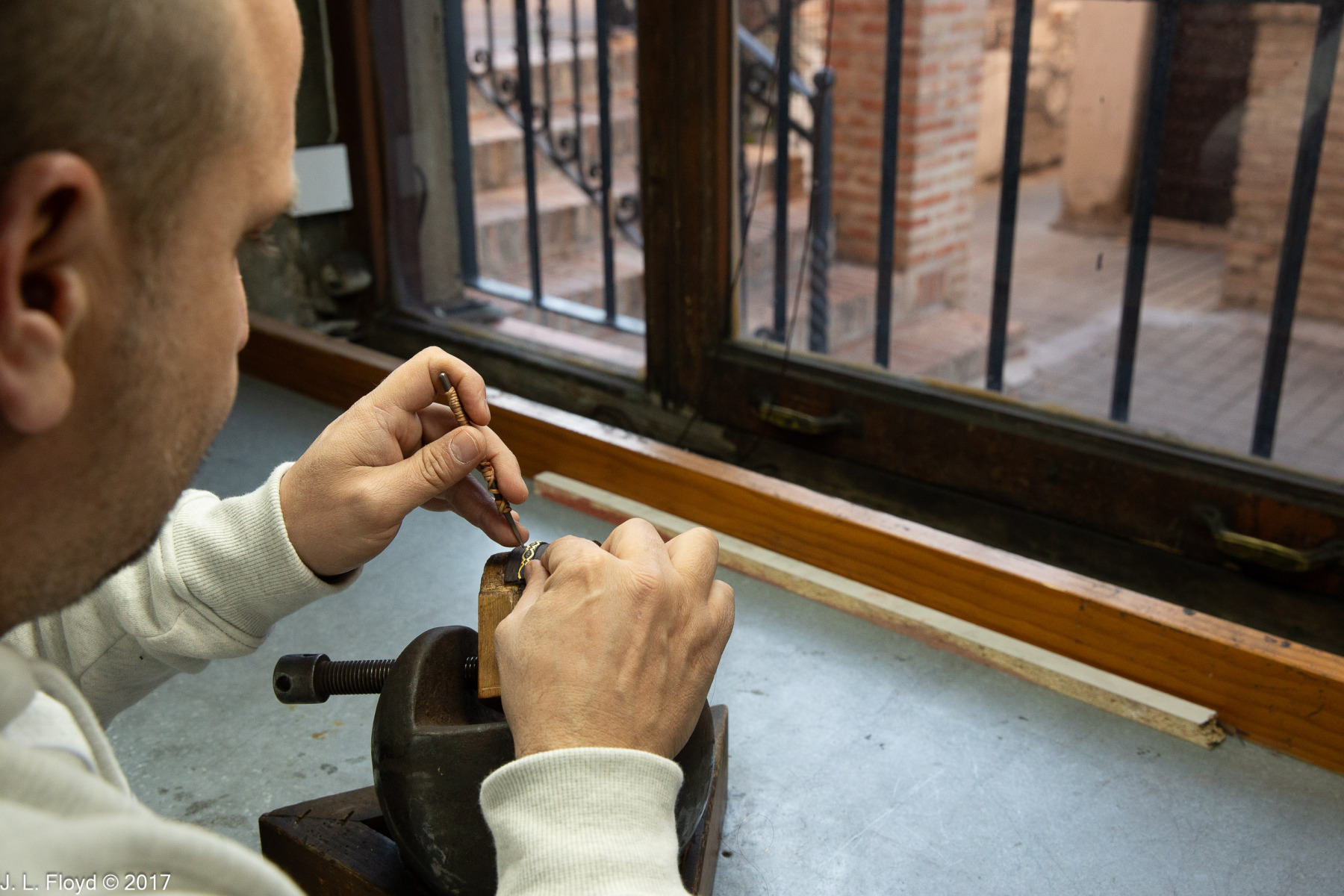
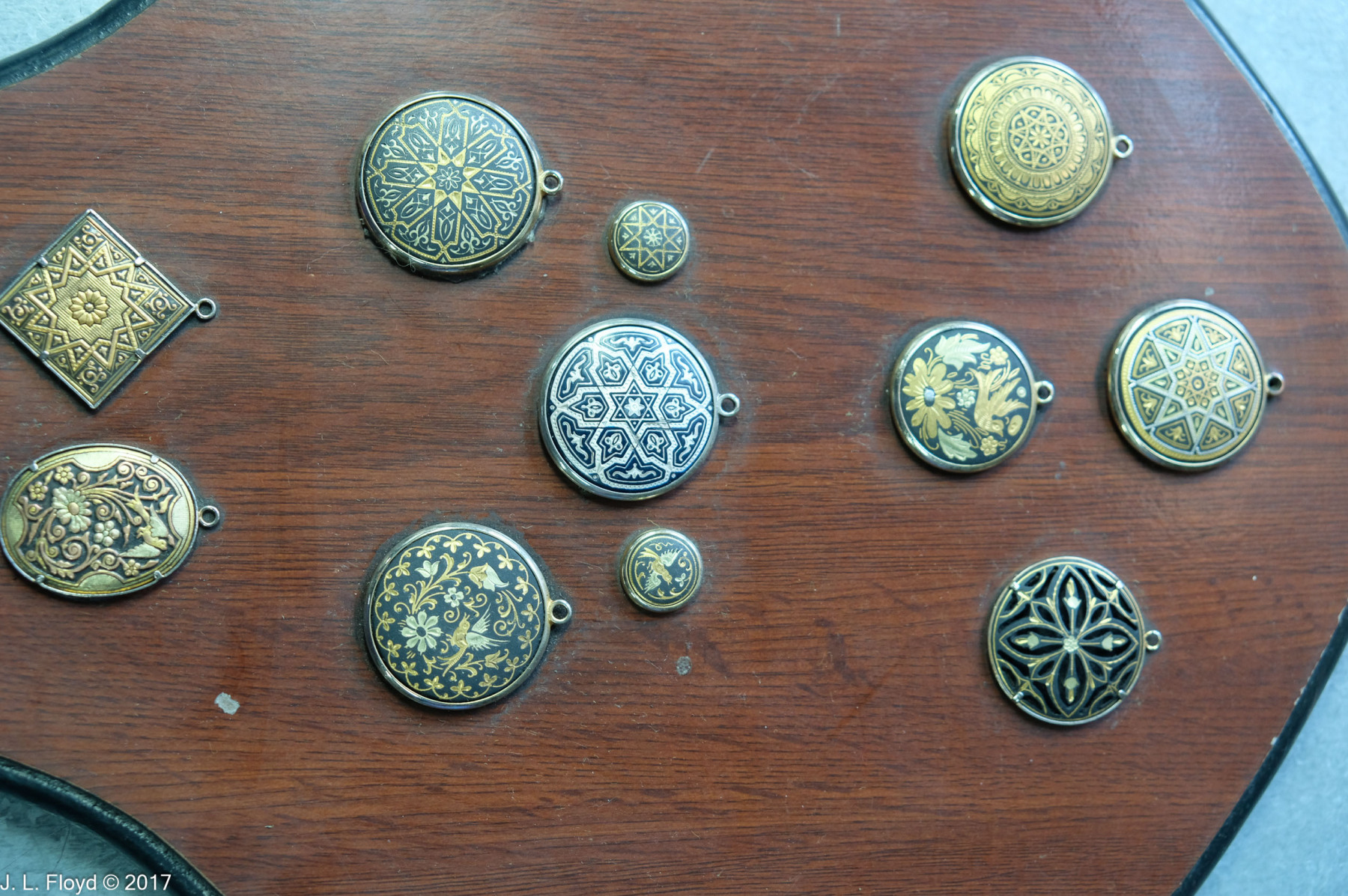
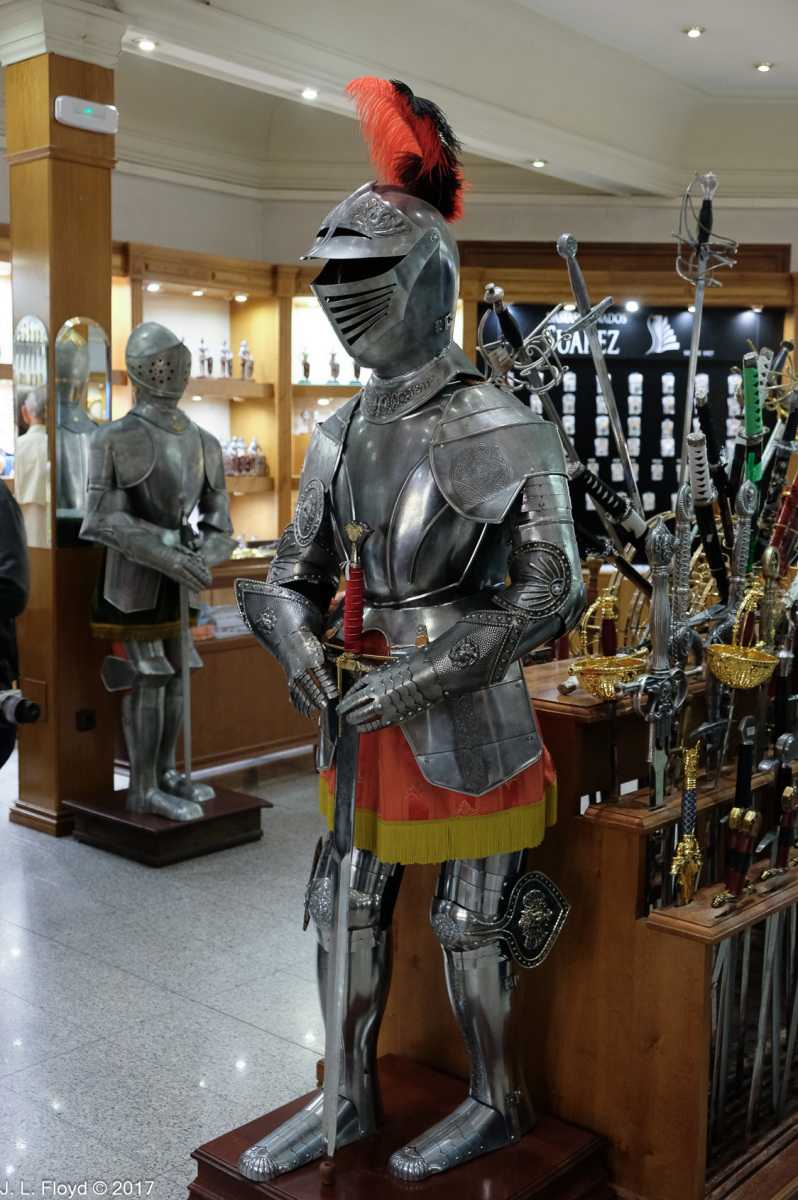
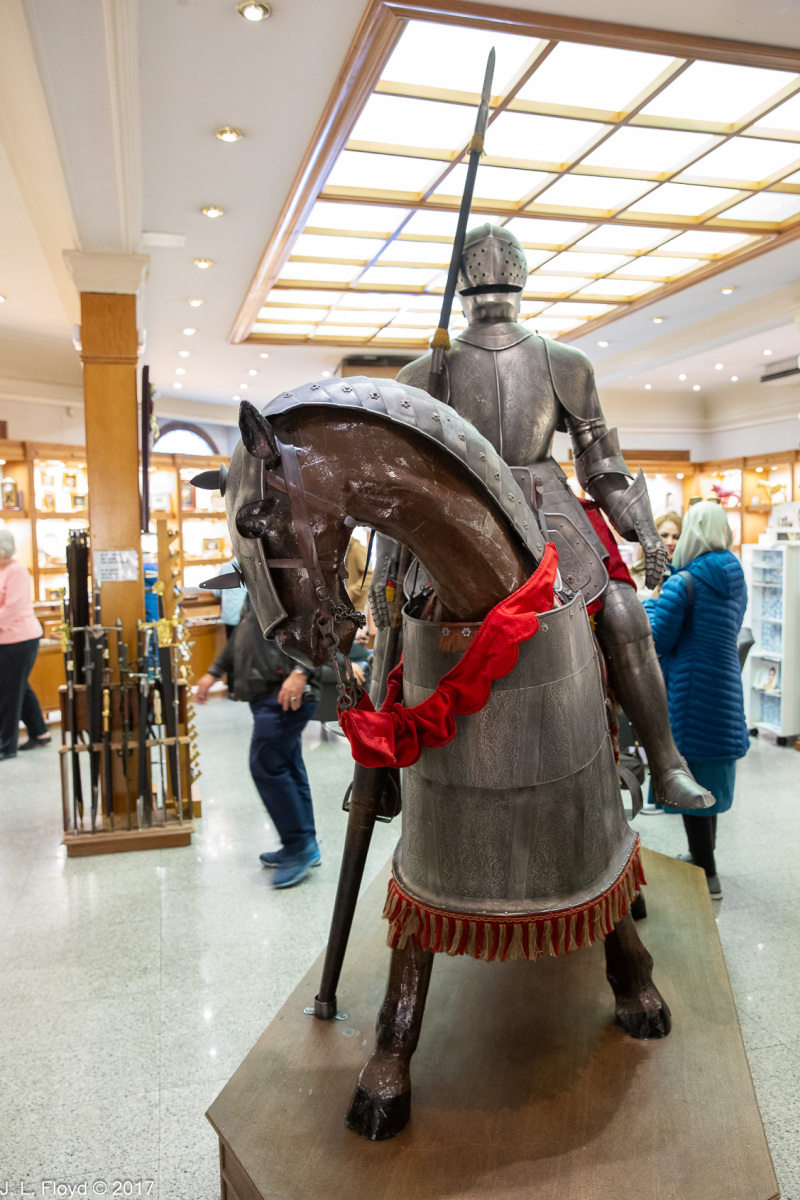
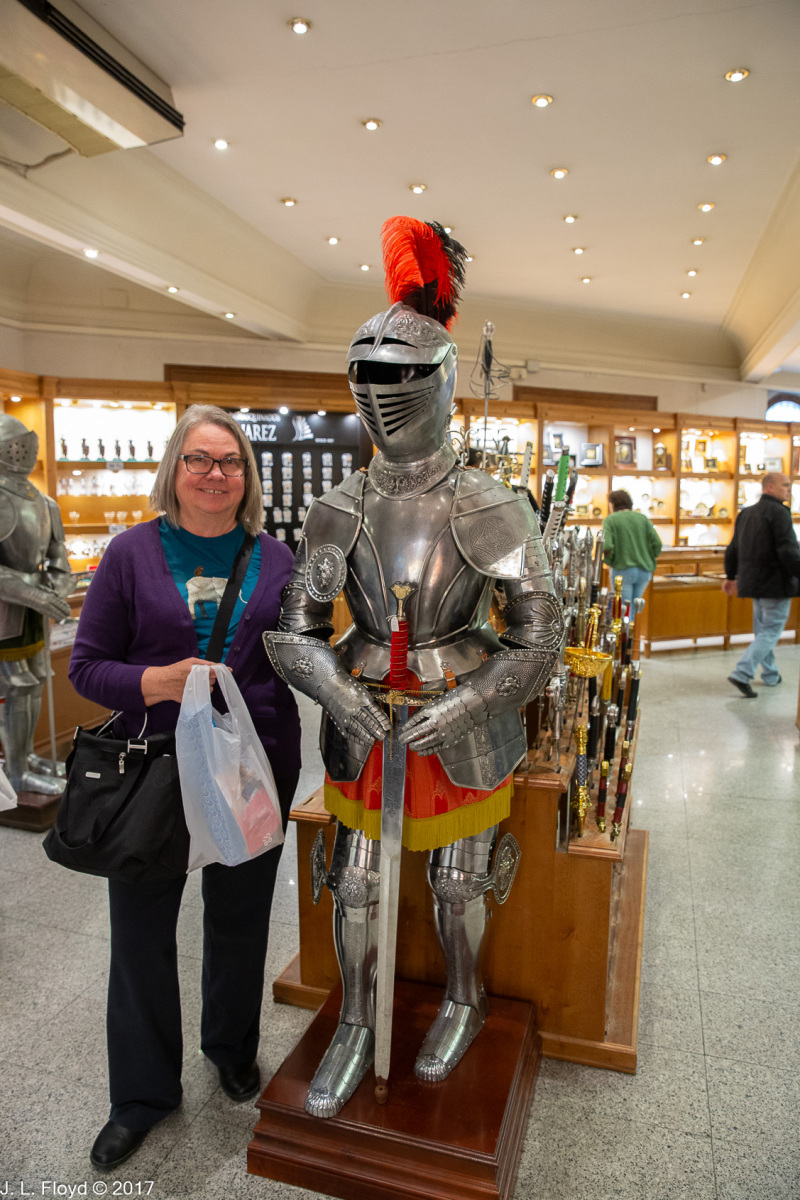
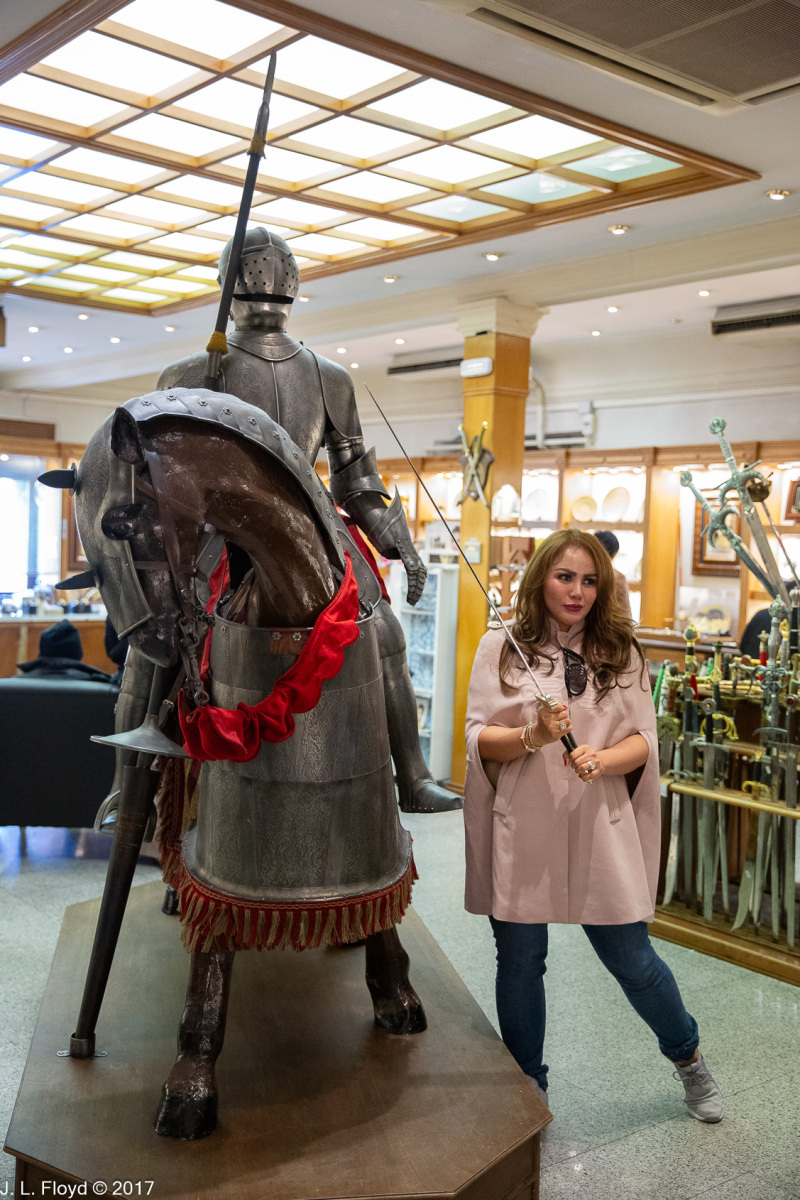
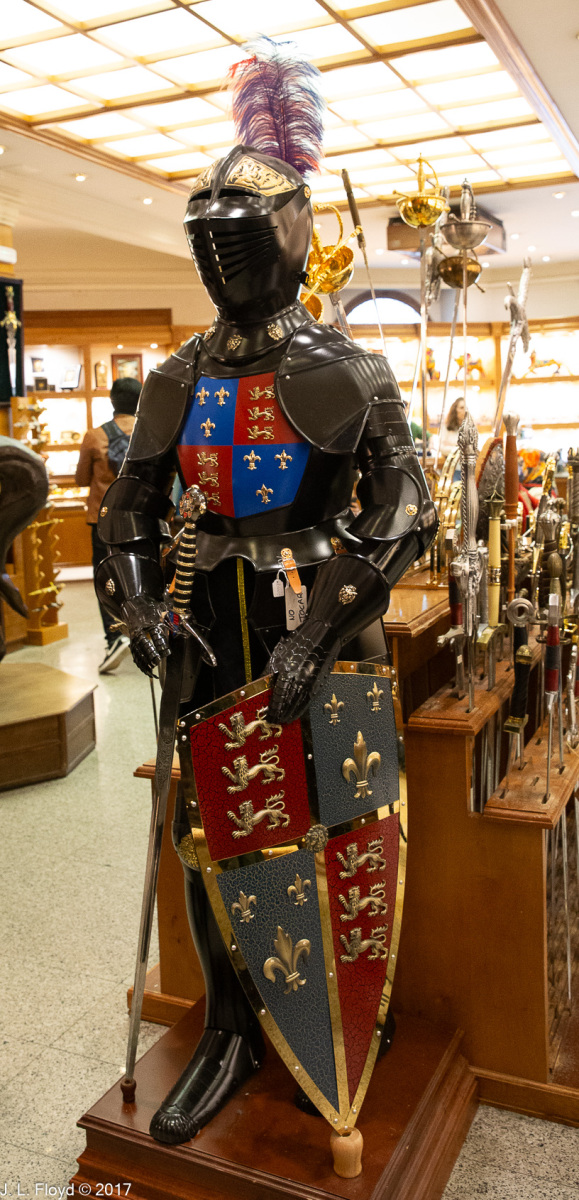
But before we entered the Old City, we had one stop to make, which was at an establishment called Damasquinados Suárez. It is awkward to render this name in English. Suárez is of course a Spanish family name, i.e the name of the family that presumably owns the place. The “Damasquinados” part translates as “Damascene” and refers to the fact that many of the wares sold in the shop are made of Damascene steel. But the term also connotes metalworking in general, and the artifacts produced by Damasquinados Suárez include not only swords and knives, and even medieval suits of armor, but also jewelry of various types.

Toledo steel was prized even in ancient times, and it was an important source of weaponry for the Roman legions. With the arrival of the Moors in the 8th century C.E., the Toledo metalworking industry profited and prospered by the acquisition of techniques and skills imported from Damascus. When the Christians regained Toledo in 1085, Toledo and its guild of swordsmiths became a vital asset in the Reconquista, and by the 16th century Toledo steel was regarded as the best in Europe.

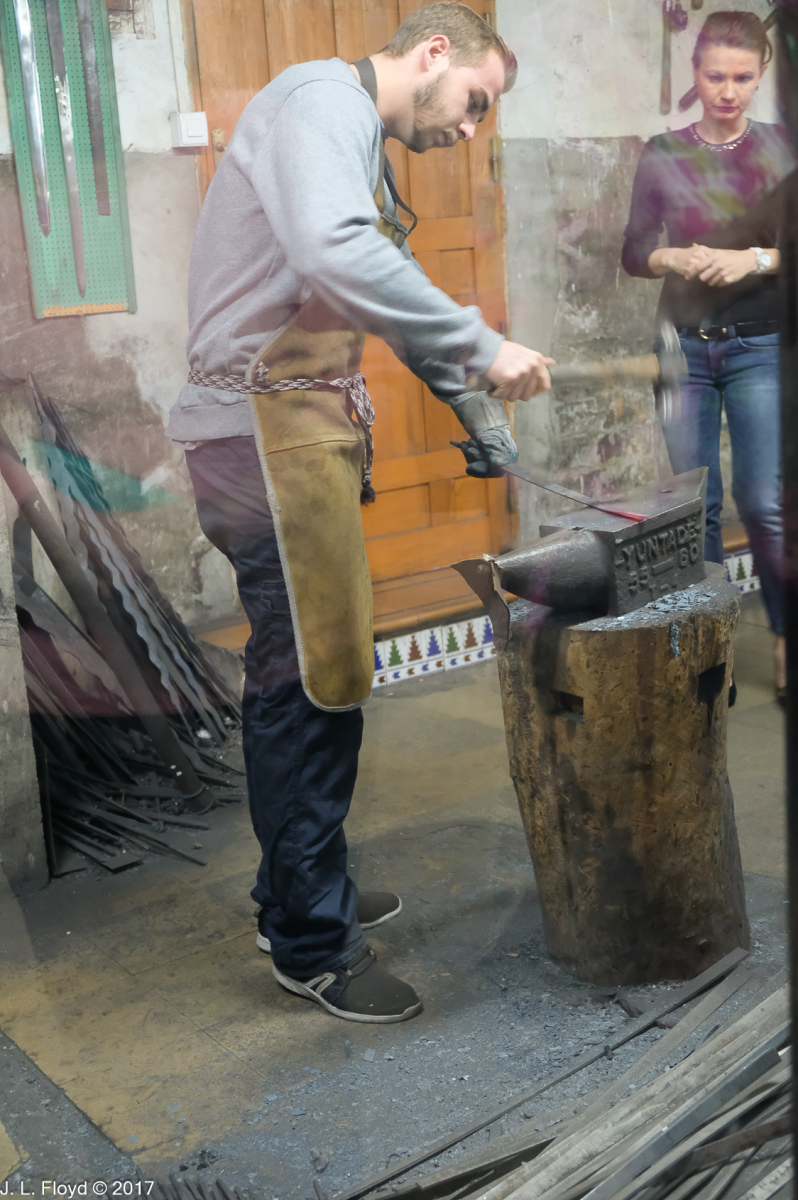
At Damasquinados Suárez we were able to watch demonstrations of sword-forging and jewelry-making before visiting the showroom, where a vast array of wares were on display. These included, in addition to swords, cutlery and jewelry, suits of armor of the kind worn by medieval knights.

I would have been tempted to purchase a sword had it not been for the fact that I already have one, a legacy of my days as a naval officer (we were required to purchase ceremonial swords for full-dress inspections, which if I remember correctly happened once in my entire naval career). Instead I bought a kitchen knife.

From Damasquinados Suárez it was but a short hop to the Parque Recaredo, where we entered the Old Town of Toledo via a very long escalator.

The escalator took us to a viewpoint called the Mirador de la Escaleras, near the Diputación Provincial de Toledo (Provincial Legislature building). From there we had spectacular views of the city of Toledo, both old and new.

From the Mirador de las Escaleras we set out into the labyrinth streets of the Old City of Toledo. We began by strolling up a street called the Subida Granja, past the provincial legislature buildings (Diputación Provincial de Toledo), to the Plaza de la Merced (Mercy Square), where we had a view of the Iglesia (church – or Parroquia, parish church) de Santa Leocadia. Saint Leocadia of Toledo was a Spanish saint who was martyred during a persecution conducted by the Roman emperor Diocletian in 304 CE. Tradition maintains that the church was built on the site of the house where she was born. This church dates from the 13th century, although there may have been a previous church on the same site.

Behind the Church of Saint Leocadia we could see the tower of a larger structure, the Convent of Santo Domingo el Antiguo. Originally built during Visigothic times (6th-7th century CE), it was reconstructed after the conquest of Toledo in 1785 on the order of King Alfonso VI, and subsequently (12th century) it became a Cistercian nunnery.  It is notable for an altarpiece executed by the painter El Greco in the late 16th century.

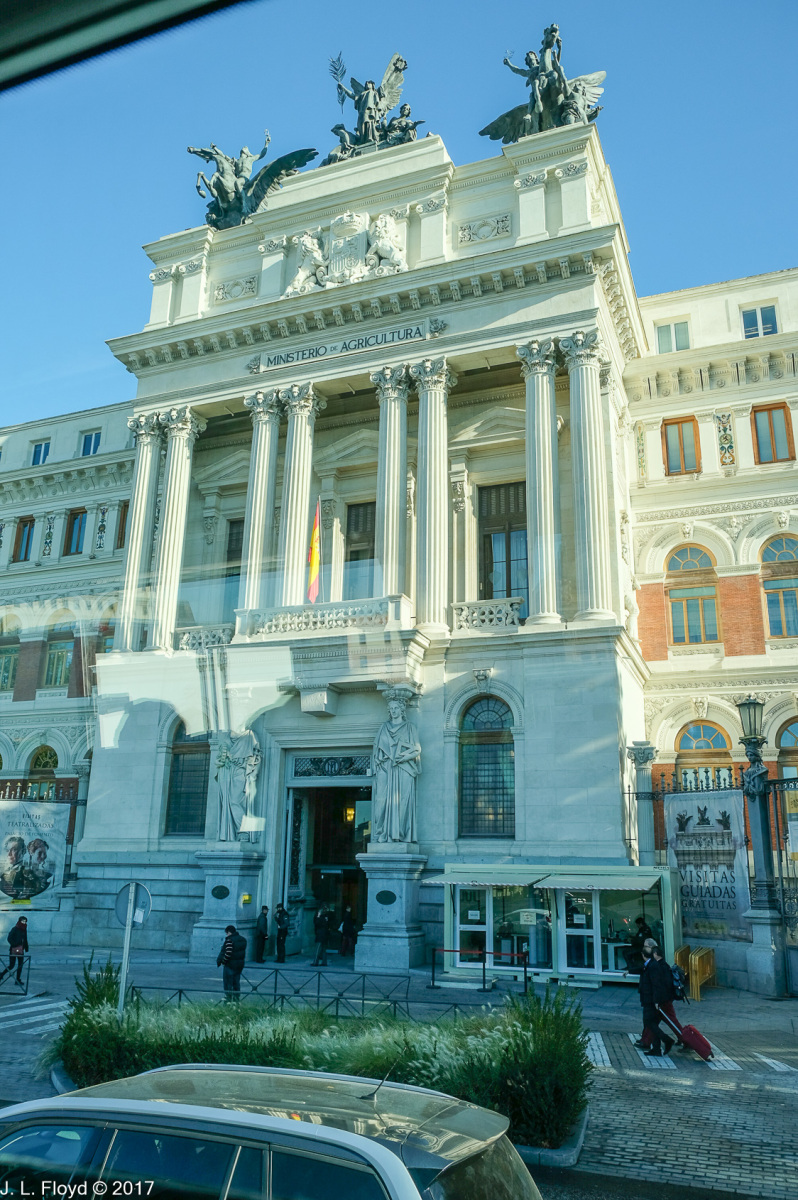
At Plaza de la Merced we turned right and headed down Calle Real past the Consejería de Hacienda (Ministry of Finance), a handsome neoclassical building which was formerly the Antiguo Hospital del Nuncio Nuevo, the Old Hospital of the New Nuncio. A nuncio is a papal ambassador, and the nuncio in question was one Cardinal Lorenzana, who commissioned the construction of the edifice toward the end of the 18th century to serve as a lunatic asylum. Some say that it continues to fulfill that function along with its modern role.

Calle Real soon morphs into the Calle de Carmelitas Descalzas, the Street of the Barefoot Carmelites, which brought us to the Convento de San José – Carmelitas Descalzas, founded by St. Theresa of Avila in the 16th century. Next to the convent was the Plaza Santa Teresa de Jesús, and there also was a garden where we caught sight of a modernistic sculpture of the saint.

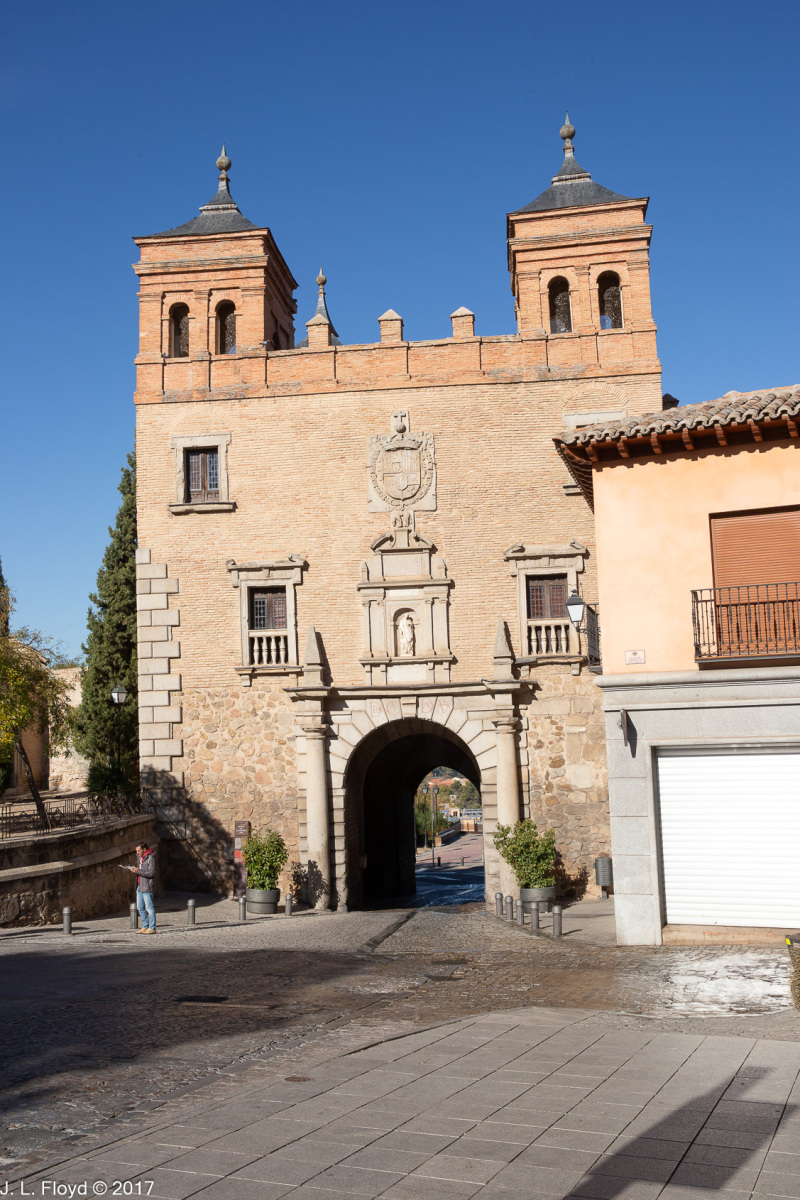
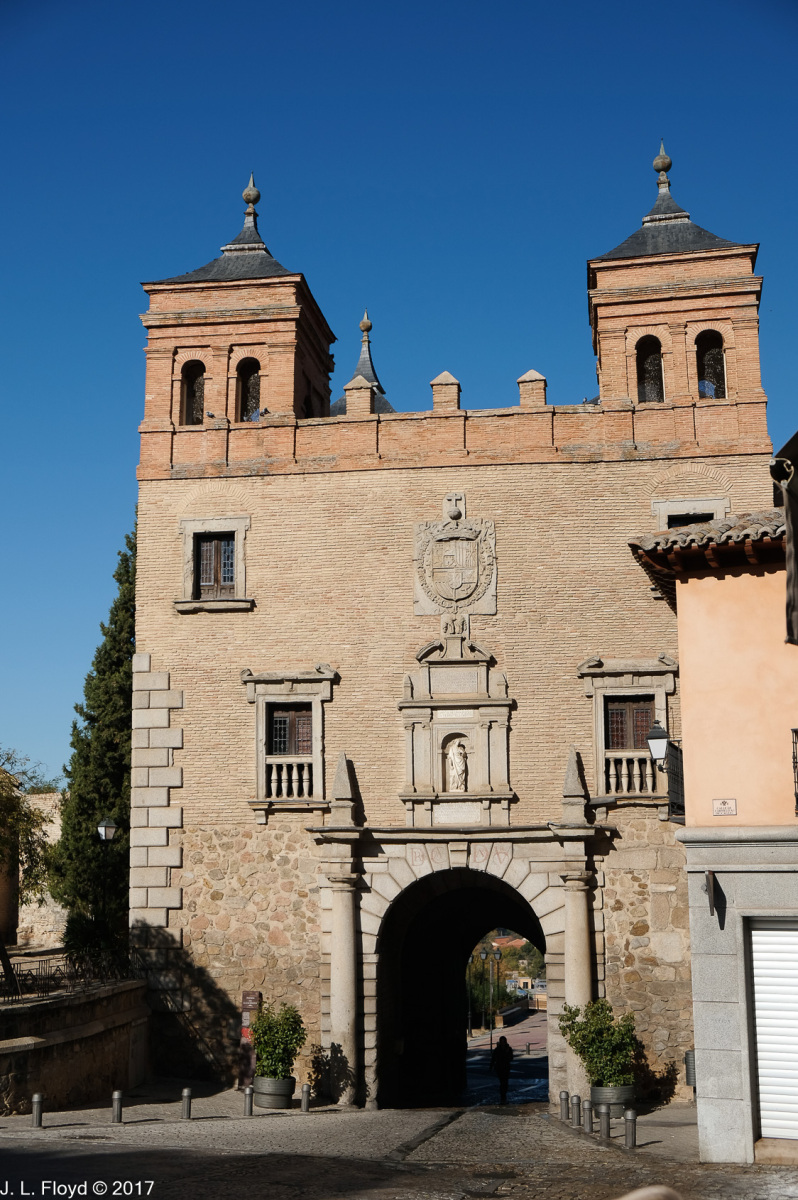
Finally we reached the Puerta del Cambrón, a historic city gate which is said to date from Visigothic times, though its current Renaissance-style edition was built in the 16th century. It owes its name to thorny shrubs called cambroneras that used to grow nearby. It is a stone and brick structure with two towers and two arches, and it is also known as the Gate of the Jews (because it opens to the old Jewish quarter) and the Gate of Santa Leocadia (because the interior façade showcases a statue of that saint).

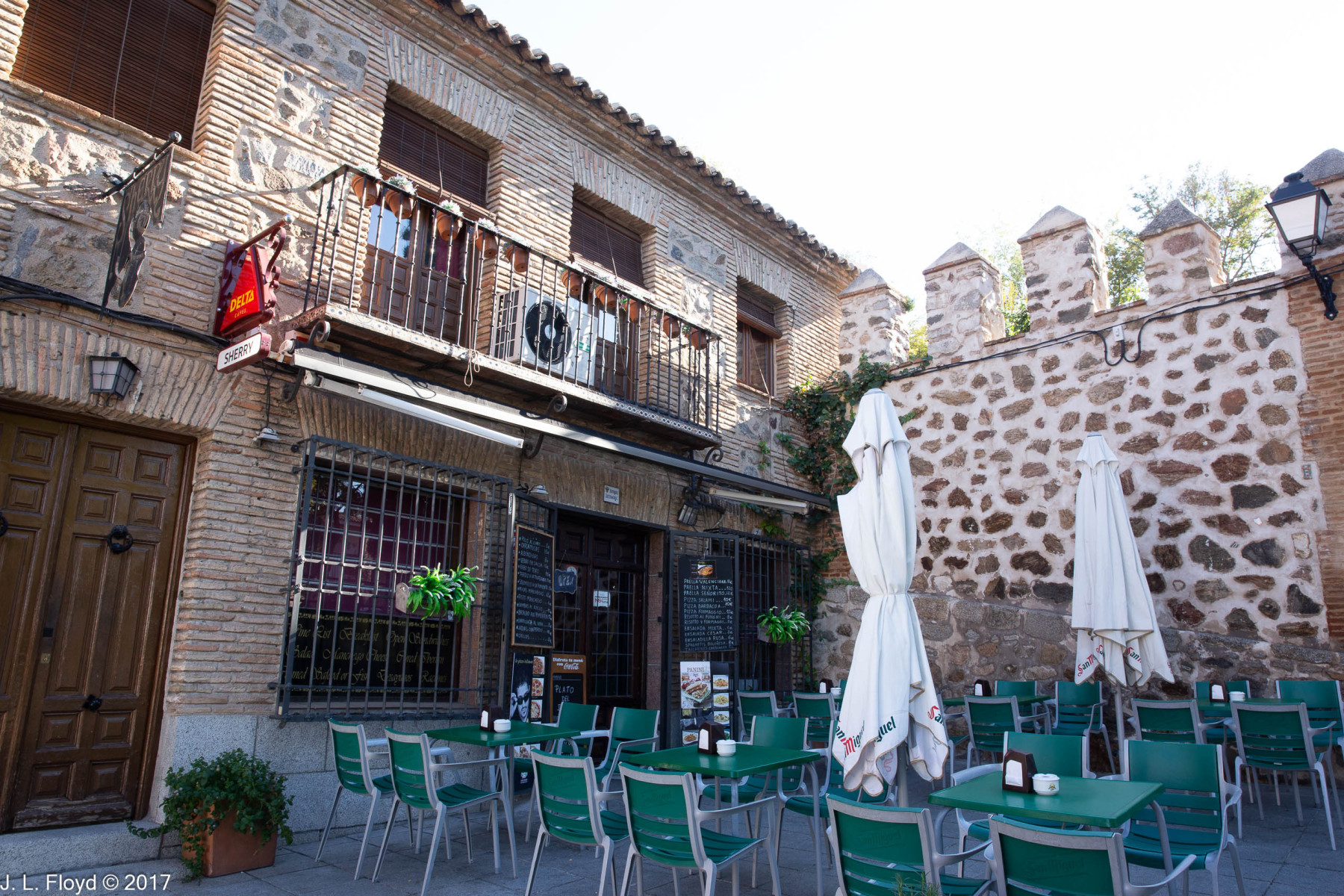
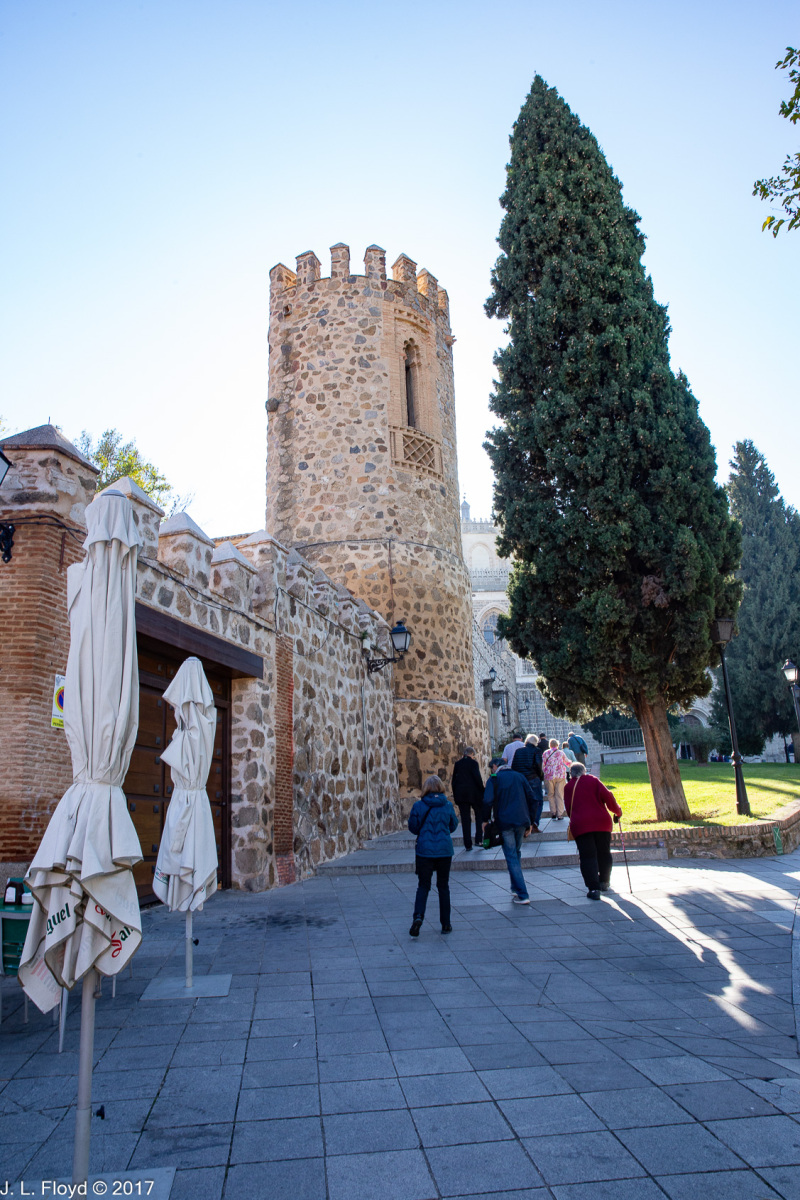
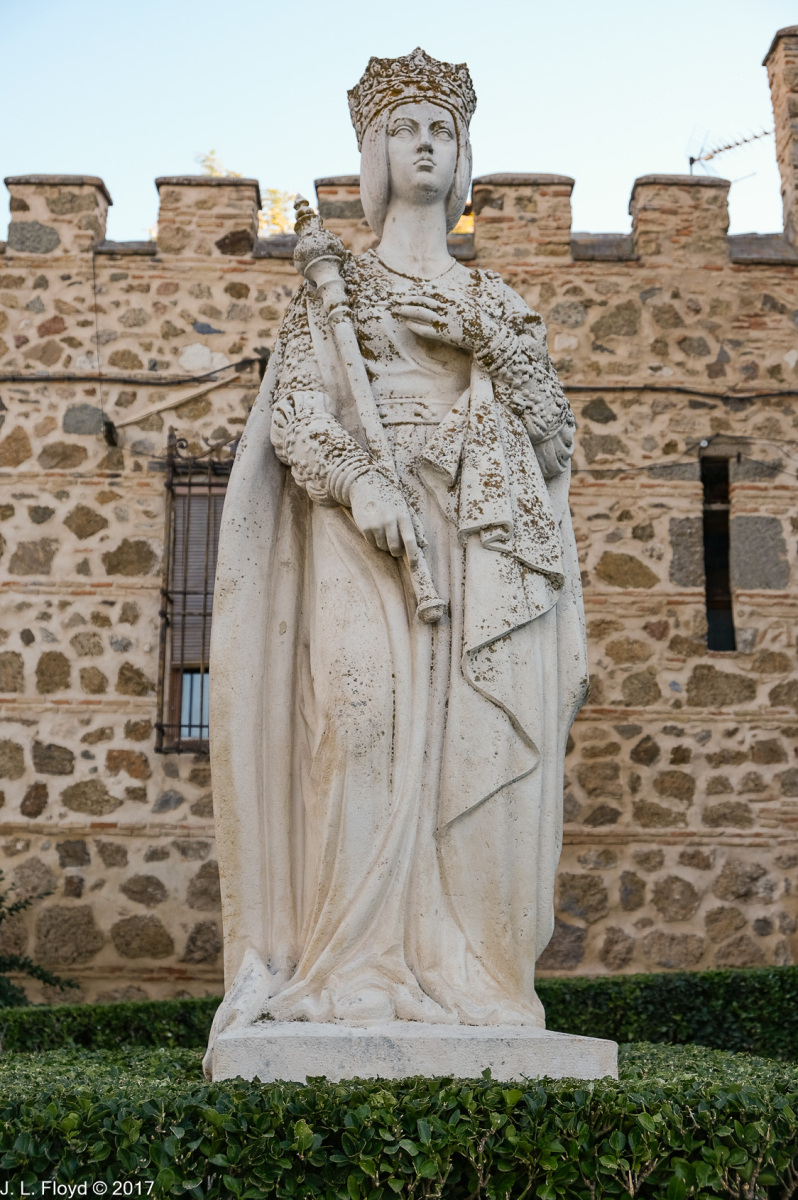
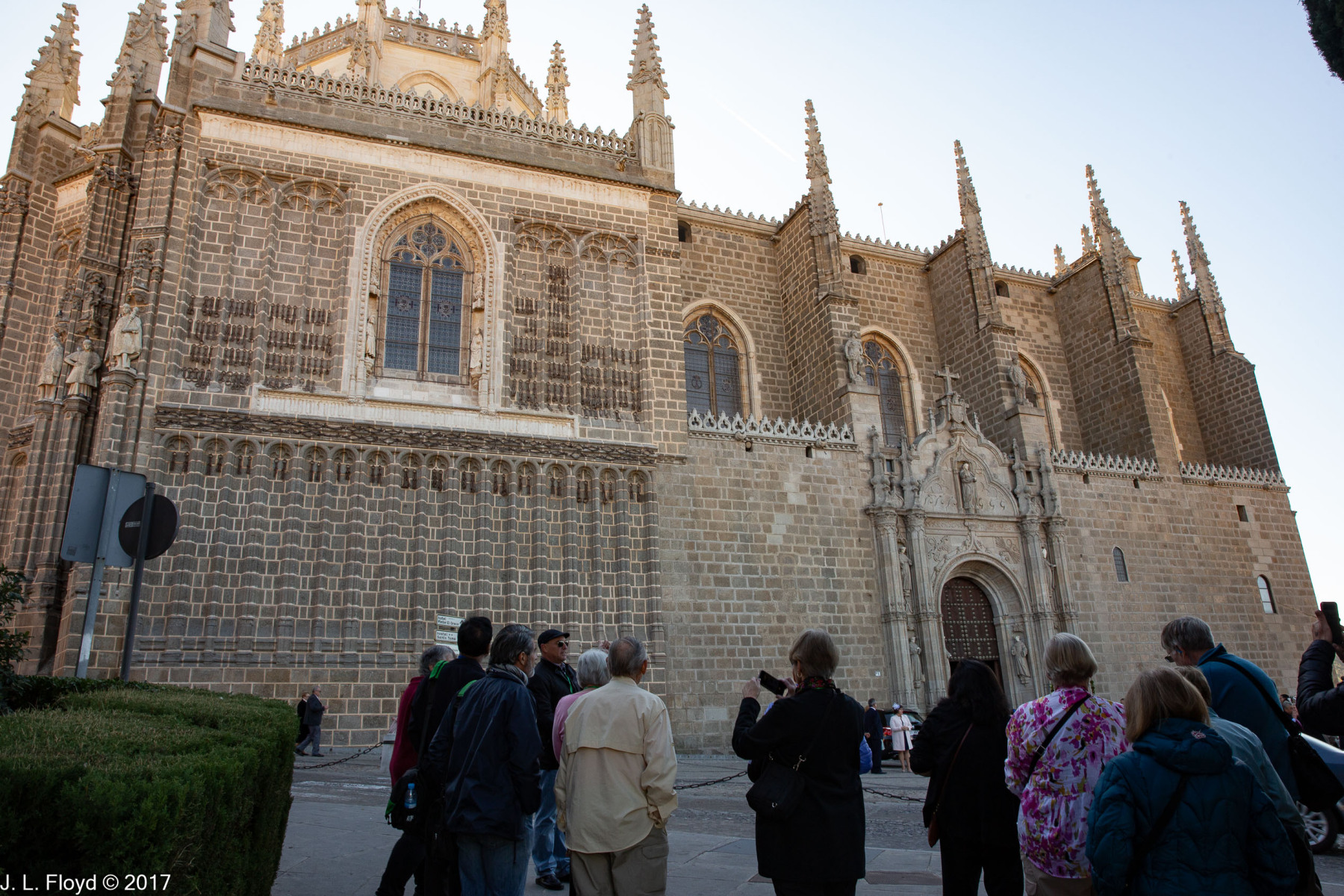
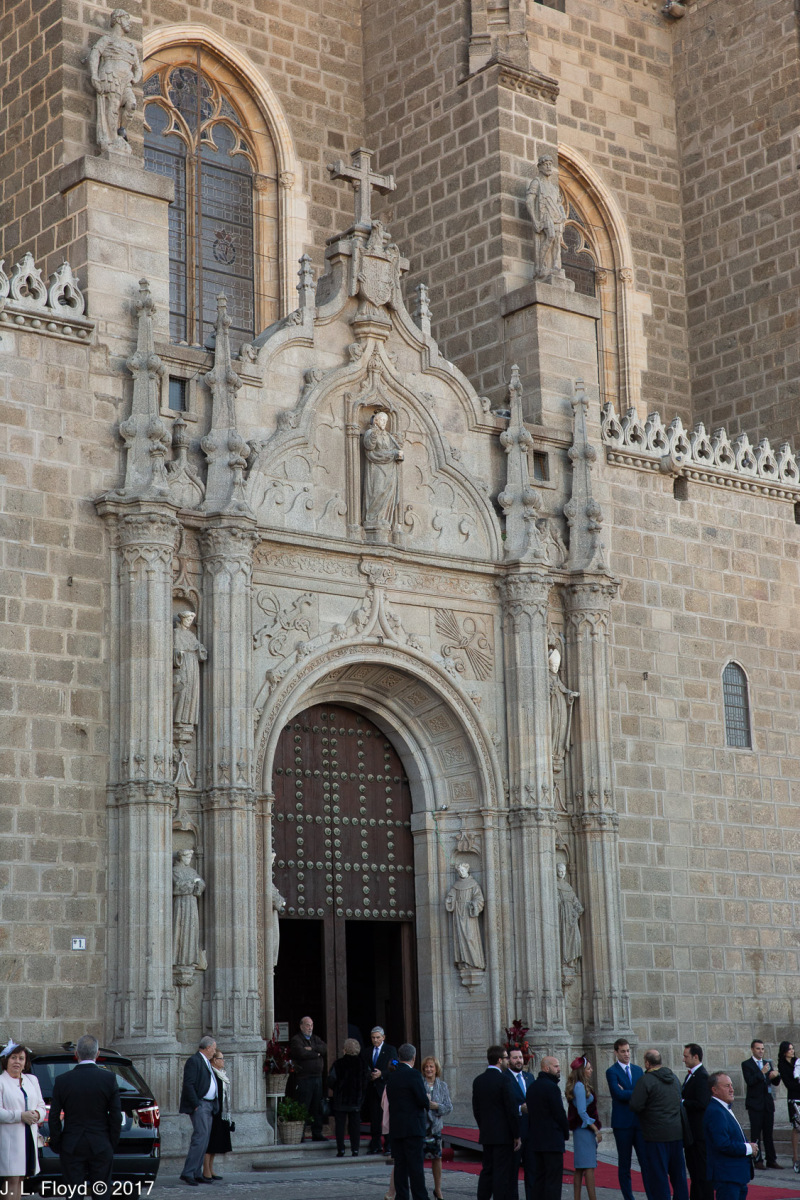
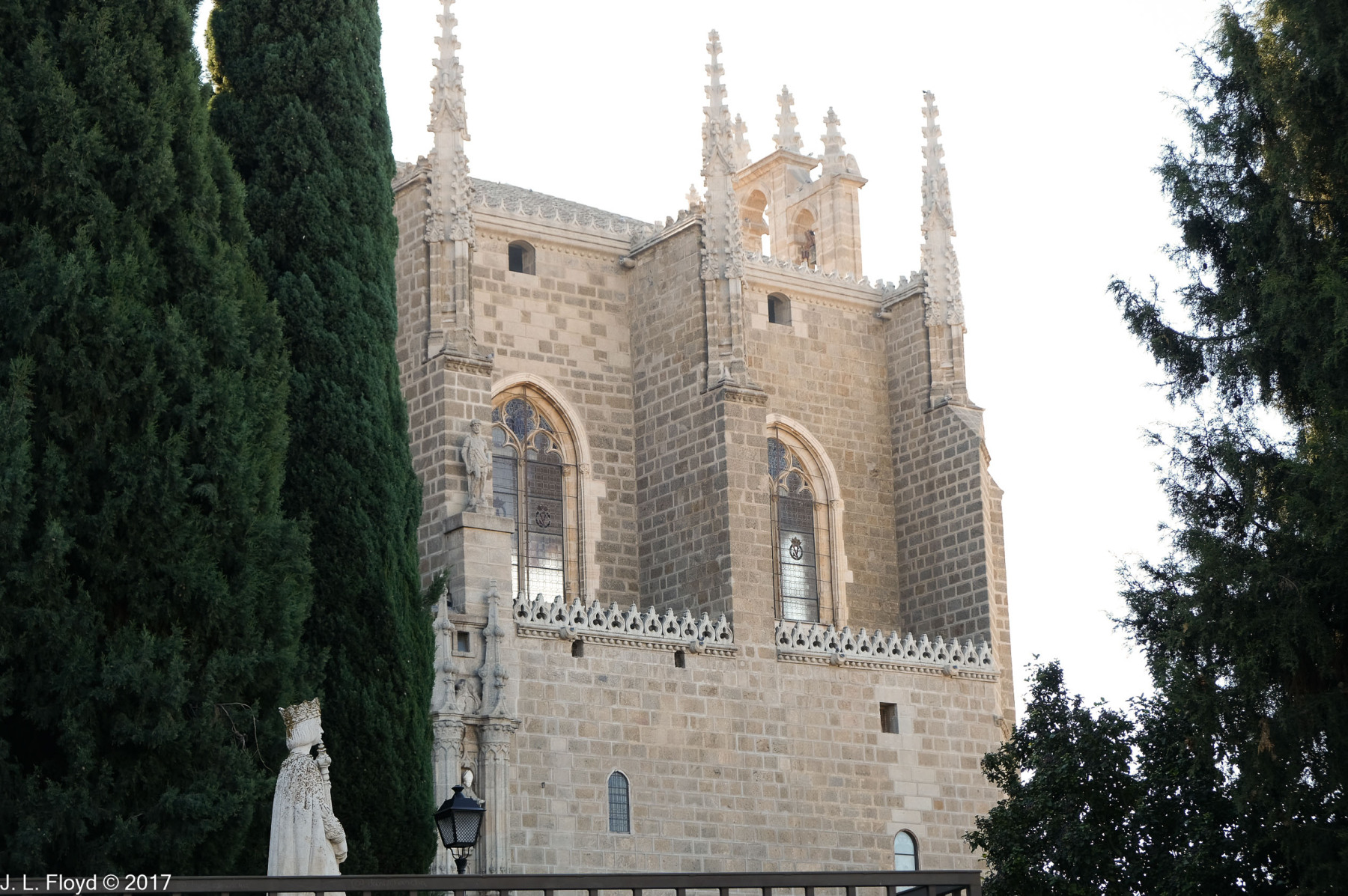
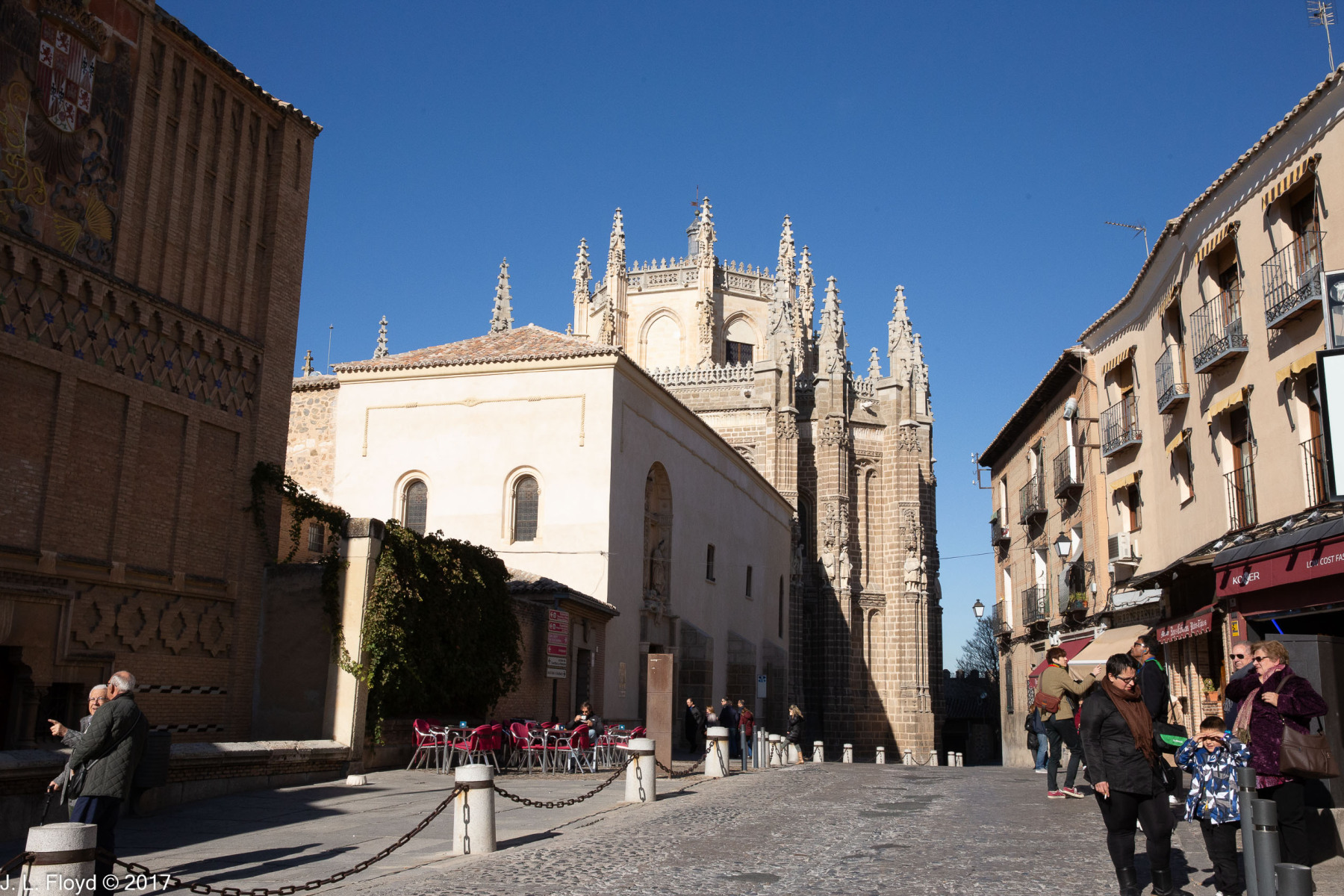
At the Puerta del Cambrón we turned left and headed down the Plaza de San Juan de los Reyes, toward the monastery of the same name. On our left was the Palacio de la Cava, a private residence built between the 16th and 18th centuries by the Cardenas family, who held the title of Dukes of Maqueda. Just before reaching the monastery, we passed a statue of Isabella I, Queen of Castile (1451-1504) standing in the yard of the Palacio. Isabella, along with her husband Ferdinand, King of Aragon, founded the Monastery of San Juan de los Reyes to commemorate the birth of their son Juan as well as their victory over the forces of King Afonso V of Portugal in the Battle of Toro (1476). Ferdinand and Isabella originally planned to make the Monastery of San Juan their burial place, but they changed their minds after conquering Granada in 1492 and are buried in the Royal Chapel there.

Construction of the monastery began in 1577 and was completed in 1504, the year of Isabella’s death. It was built in the dominant architectural style in Castile during her reign, named after her, and also known as Castilian Late Gothic. The Isabelline style is considered to be transitional between late Gothic and Renaissance architecture. It represented a fusion of the Castilian Gothic tradition with Flemish as well as Mudéjar elements.

The monastery was named after St. John the Evangelist (writer of the Gospel of John) and entrusted to the Franciscans. In 1809 it was badly damaged by French troops during their occupation of Toledo, leading to its abandonment in 1835. Restoration work began in 1883 and continued until 1967.

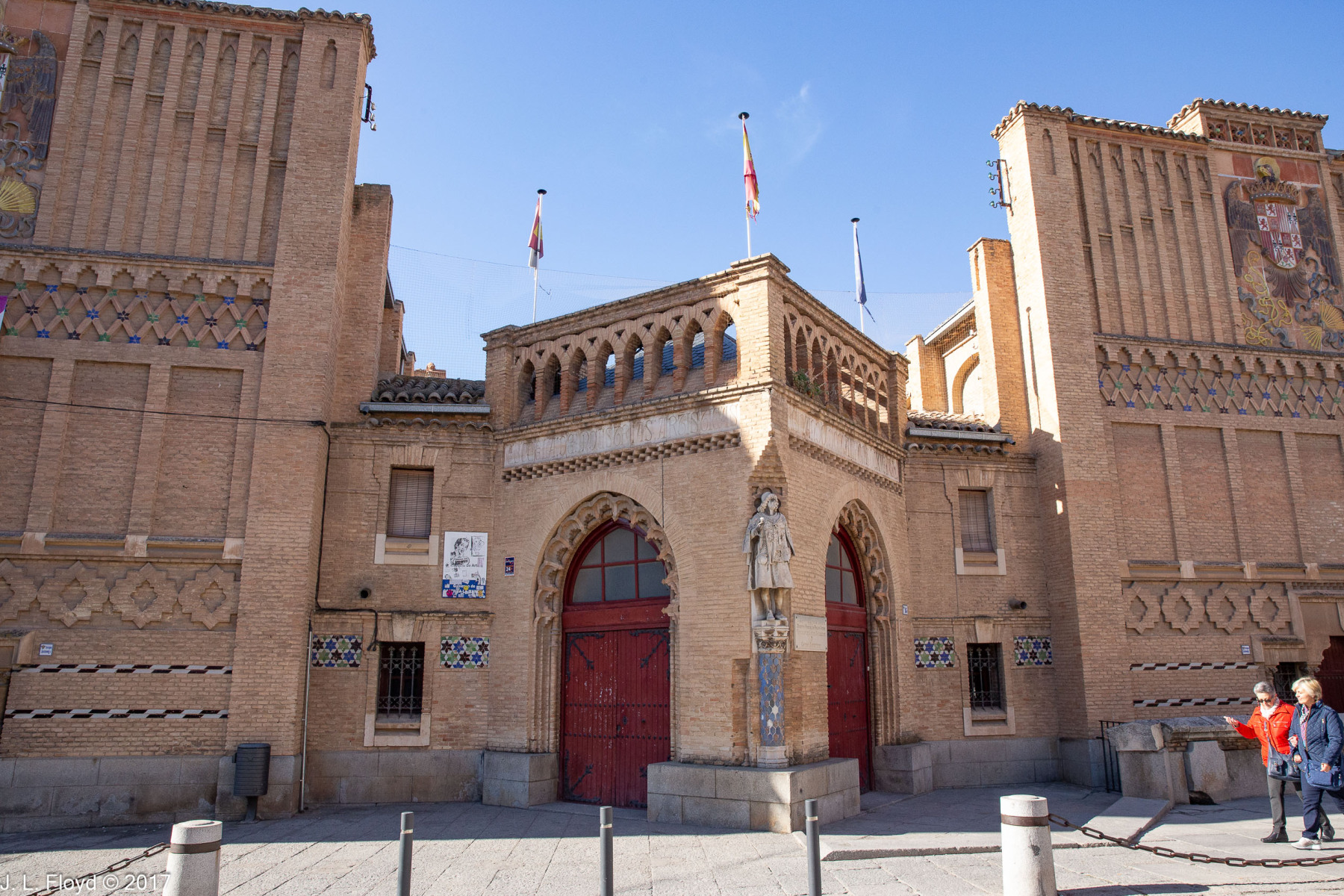
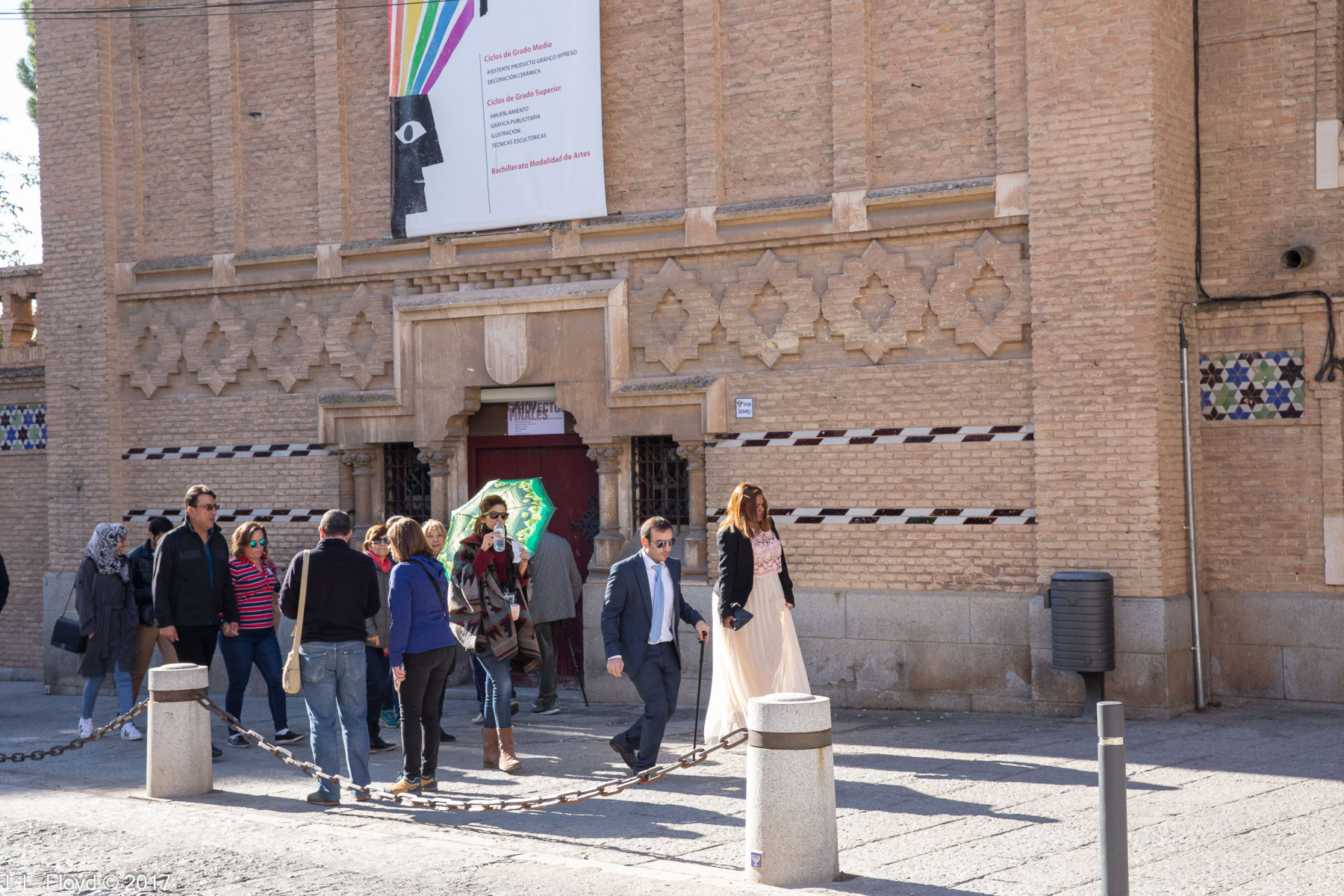
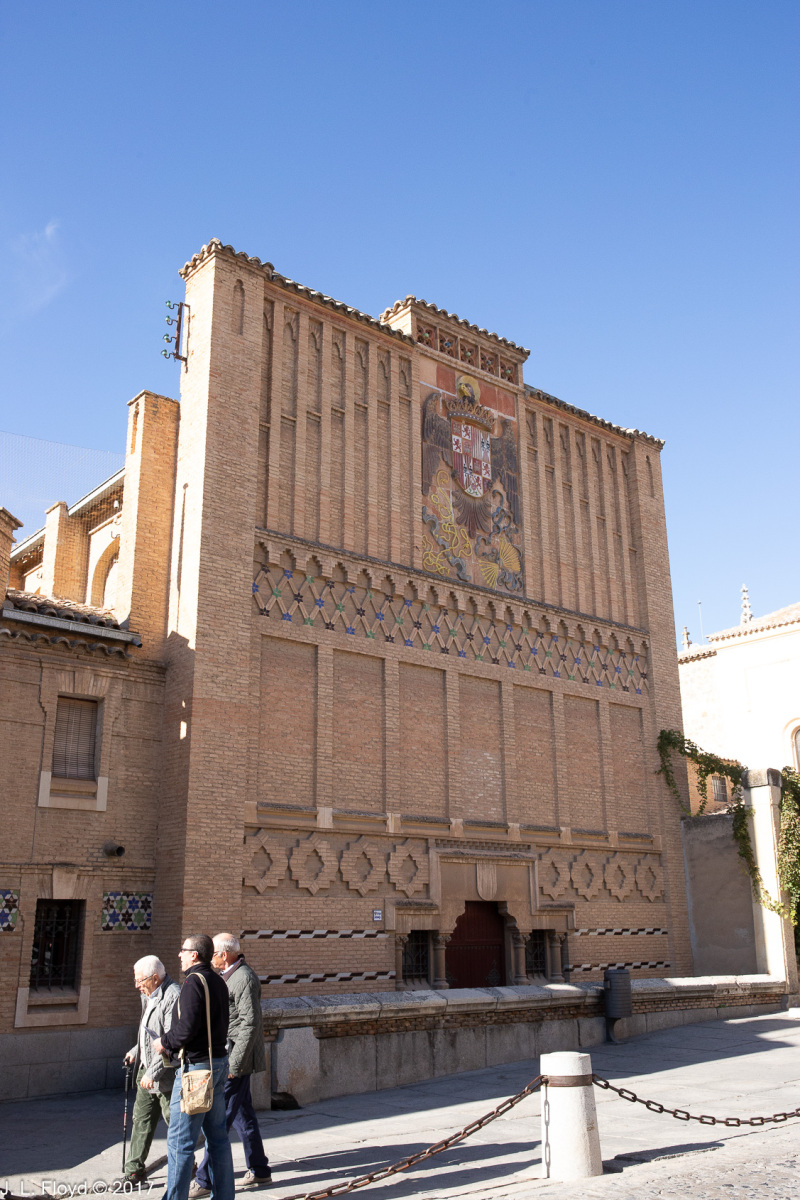
The second cloister of the monastery had been completely destroyed during the French occupation. Rather than rebuilding it, the decision was taken to repurpose the site for a new educational institution for the training of artists and craftsmen in the city of Toledo. Its design was entrusted to the same architect responsible for the restoration work on the monastery, Arturo Mélida y Alinari. Construction of the School of Arts and Crafts of Toledo (Escuela de Arte Toledo) began in 1882, proceeding simultaneously with the restoration work on the monastery. The result is a striking building in the Neo-Mudéjar architectural style (also known as “gothic hispanoflaminco“), featuring a symmetrical façade with two main entrances. Ornate decorations of masonry and tile adorn the façade, including the Catholic Monarchs’ coat of arms with the eagle of Saint John.

Our next stop was the Synagogue of Santa Maria la Blanca, and that calls for a new post.

Categories
Spain, Portugal and Morocco, November 2017

Madrid – November 17, 2017

We arrived in Madrid late on November 16 after a five-hour flight from Marrakesh. Our tour schedule called for a two-day stay in Madrid, but the second of those days was to be devoted to an “optional” day-trip to nearby Toledo, and there was no way we were going to miss Toledo; thus we had only a day to take in Madrid, and inevitably we were limited to hitting only the “mustest” and closest of the must-see attractions. In particular, I had wanted to see the Escorial, Philip II’s 16th century monastery-palace, which is not in Madrid itself but is located in the town of San Lorenzo, 45 kilometers or 28 miles northwest of the capital. But our schedule just didn’t allow for that, so we left the Escorial for a hoped-for “next time.”

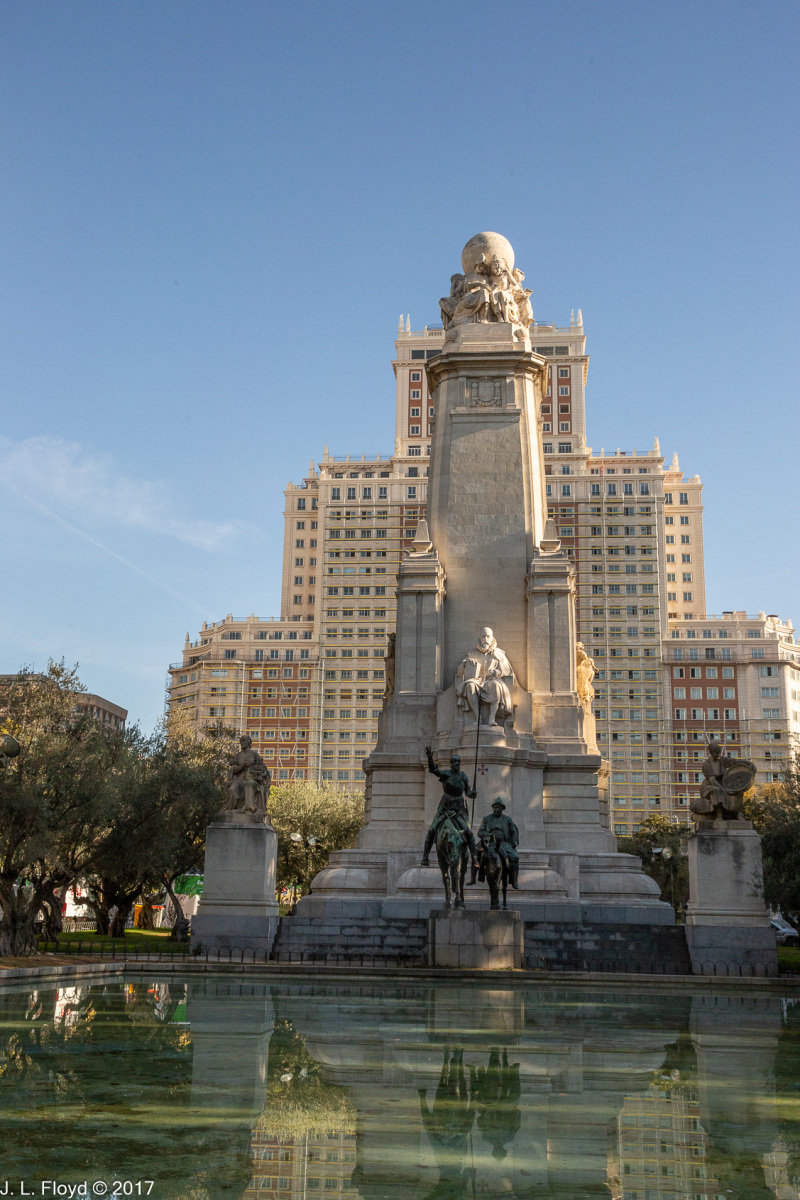
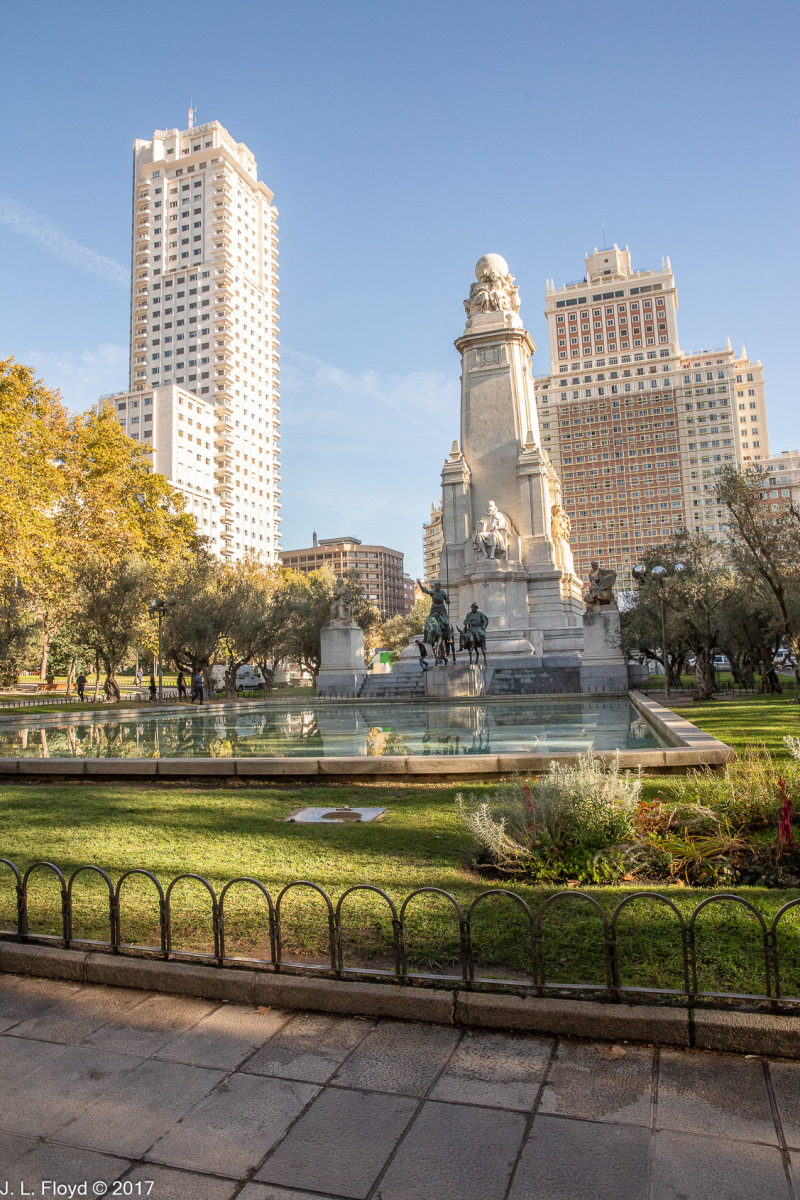
Our day in Madrid began with a morning bus ride to one of the most majestic sights of the city, the monument to Miguel de Cervantes, Spain’s most famous writer. His masterpiece, Don Quixote, is widely regarded as the first modern novel and one of the greatest works of world literature. Born in Alcalá de Henares near Madrid in 1547, Cervantes lived in an era often called “the golden century of Spain,” when the country rose to supreme heights of power and glory, and he personally witnessed some of its greatest events. In the 1570s he served in the Spanish Navy as what we would call a “marine” nowadays, and participated in the great naval battle of Lepanto in 1572, when the Spanish won a great victory over the Turks. He was severely wounded in that battle, losing the use of his left arm, and was later captured by Barbary pirates and held for five years before being ransomed. After returning to civilian life, he continued to serve the Spanish Crown, first as a purchasing agent – his duties included obtaining provisions for the ill-fated Invincible Armada of 1588 – and then, from 1592, as a tax collector. During that time he also began his literary career. After several early and largely forgotten plays and romances, he eventually achieved renown – and financial success – with the publication of the first part of Don Quixote in 1605. The second part was published in 1616, the year of his death.

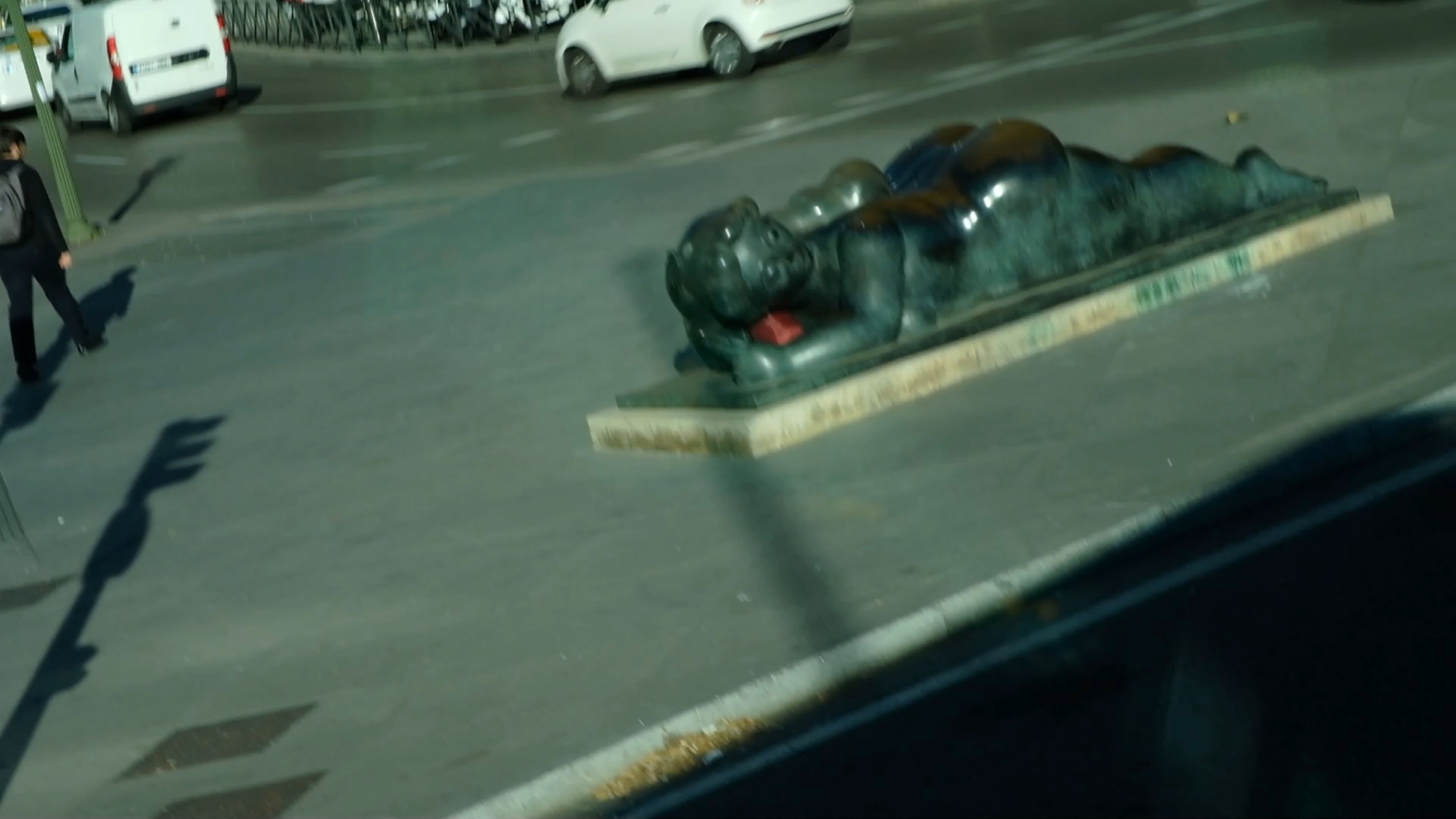
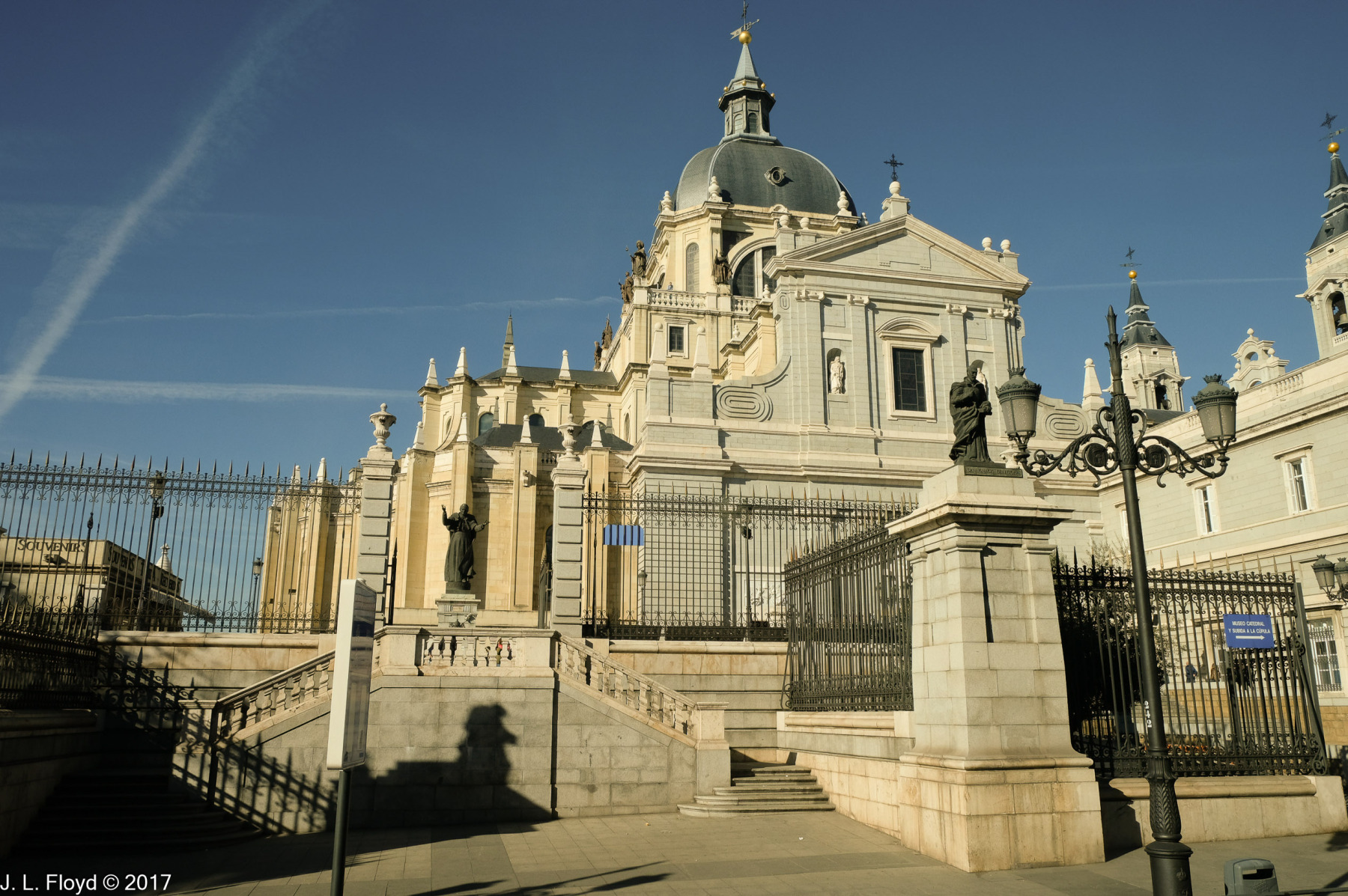
On the way to the Cervantes Monument, we caught fleeting glimpses of some noteworthy landmarks, some of which Sandie was able to snap through the bus window with her little Fujifilm mirrorless camera. One of these was a sculpture of a naked woman, of fairly generous proportions, lying face-down on a traffic island on the Calle de Génova at the entrance to the Plaza de Colón. She is depicted as looking in a mirror which she is holding in her hand, hence the title of the piece, Mujer con espejo (Woman with a Mirror). The sculpture was donated to the city in 1992 by its creator, the Columbian artist Fernando Botero.

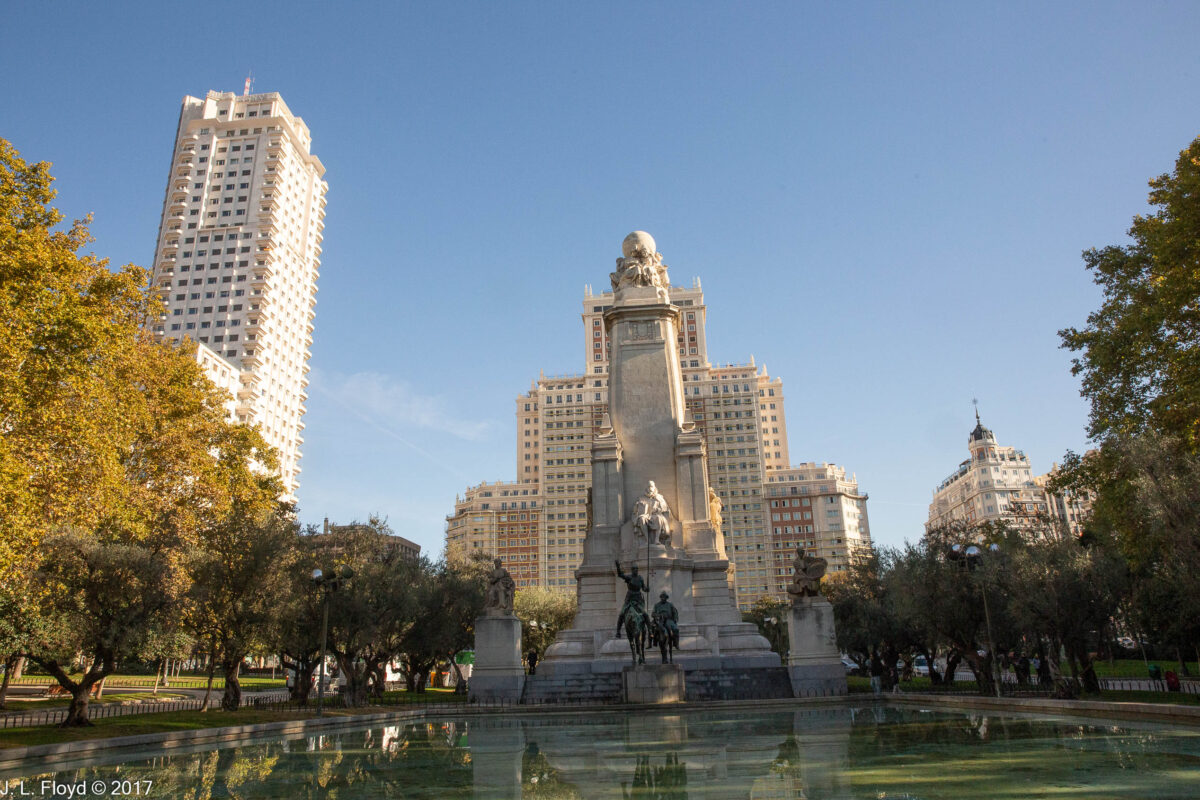
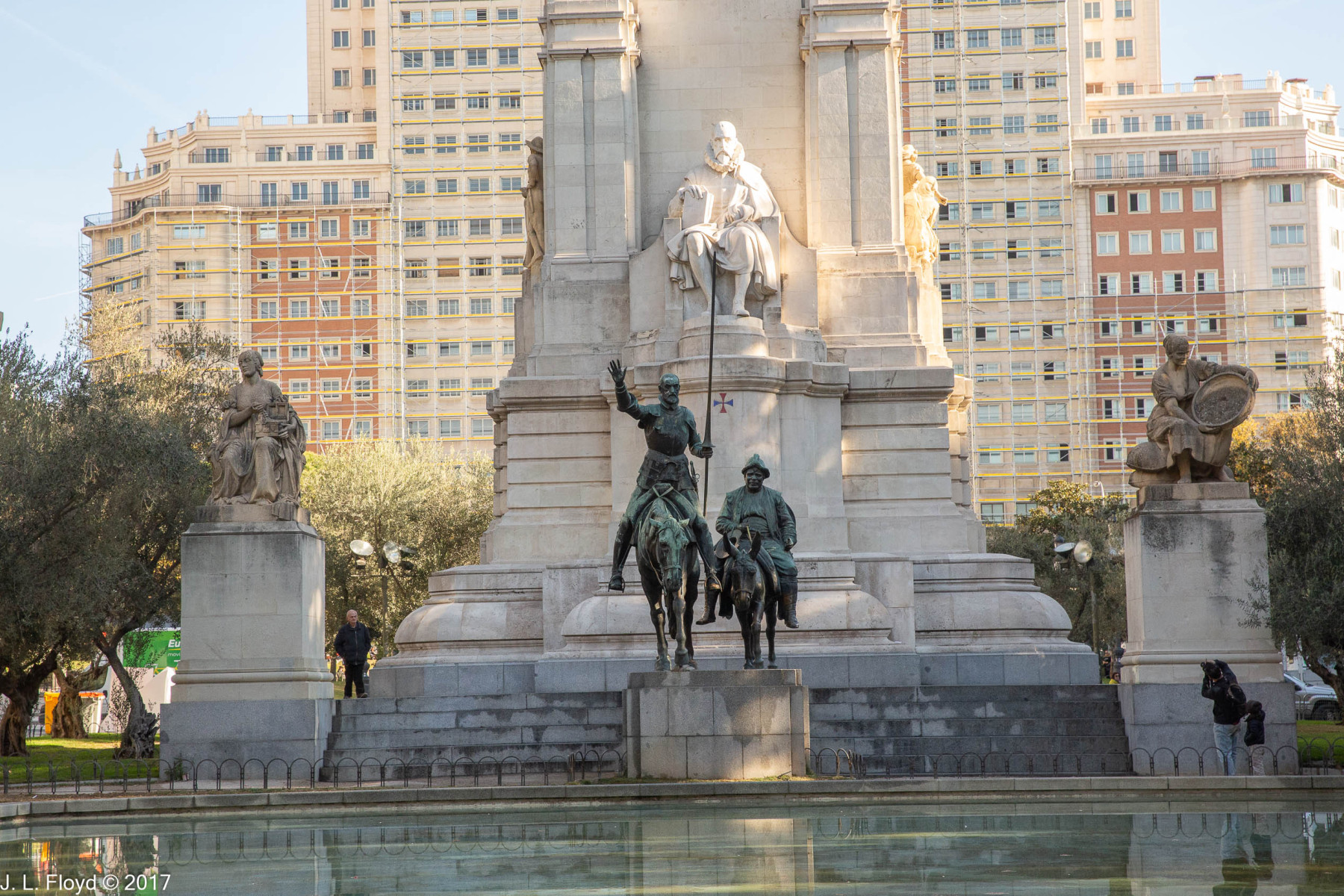
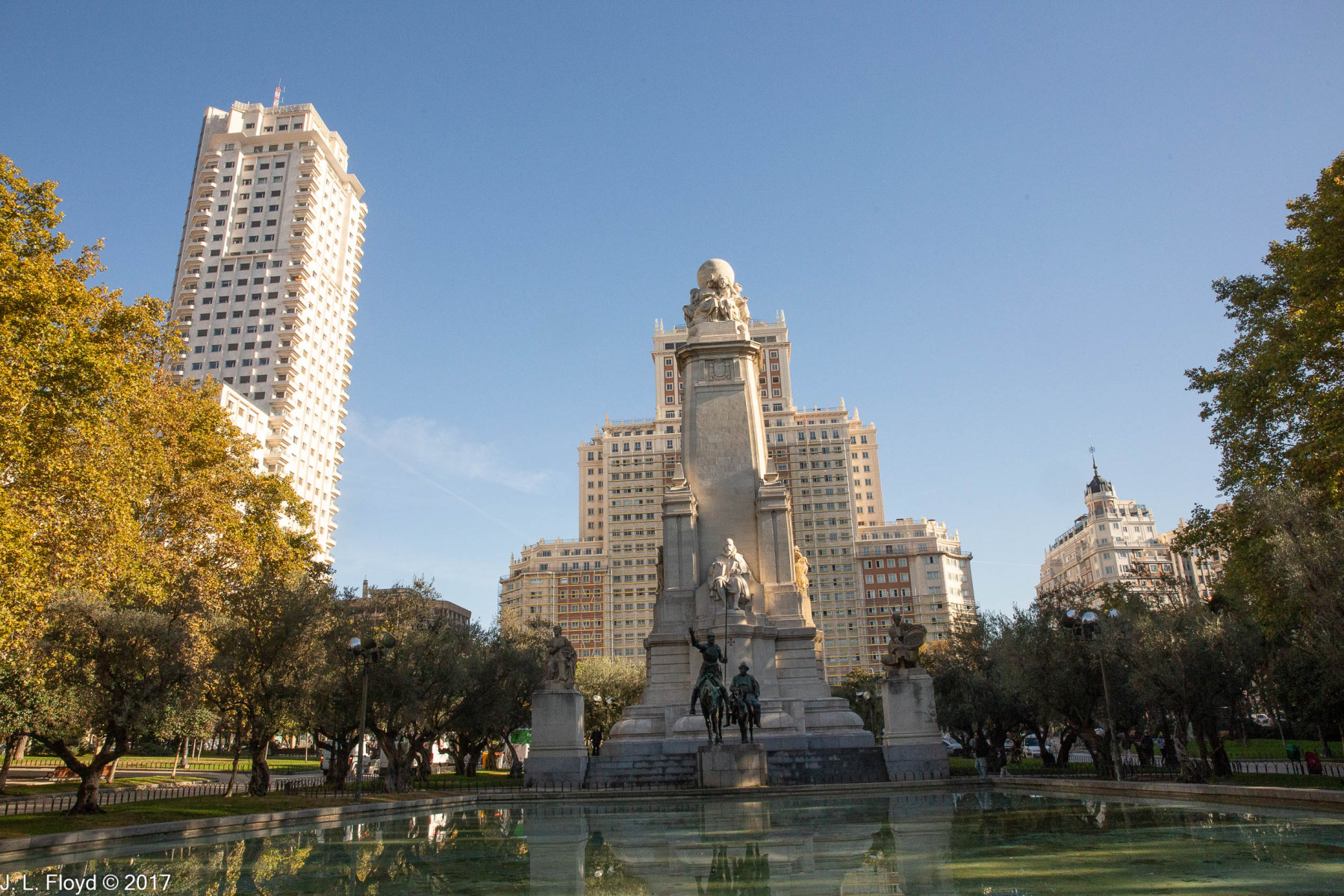
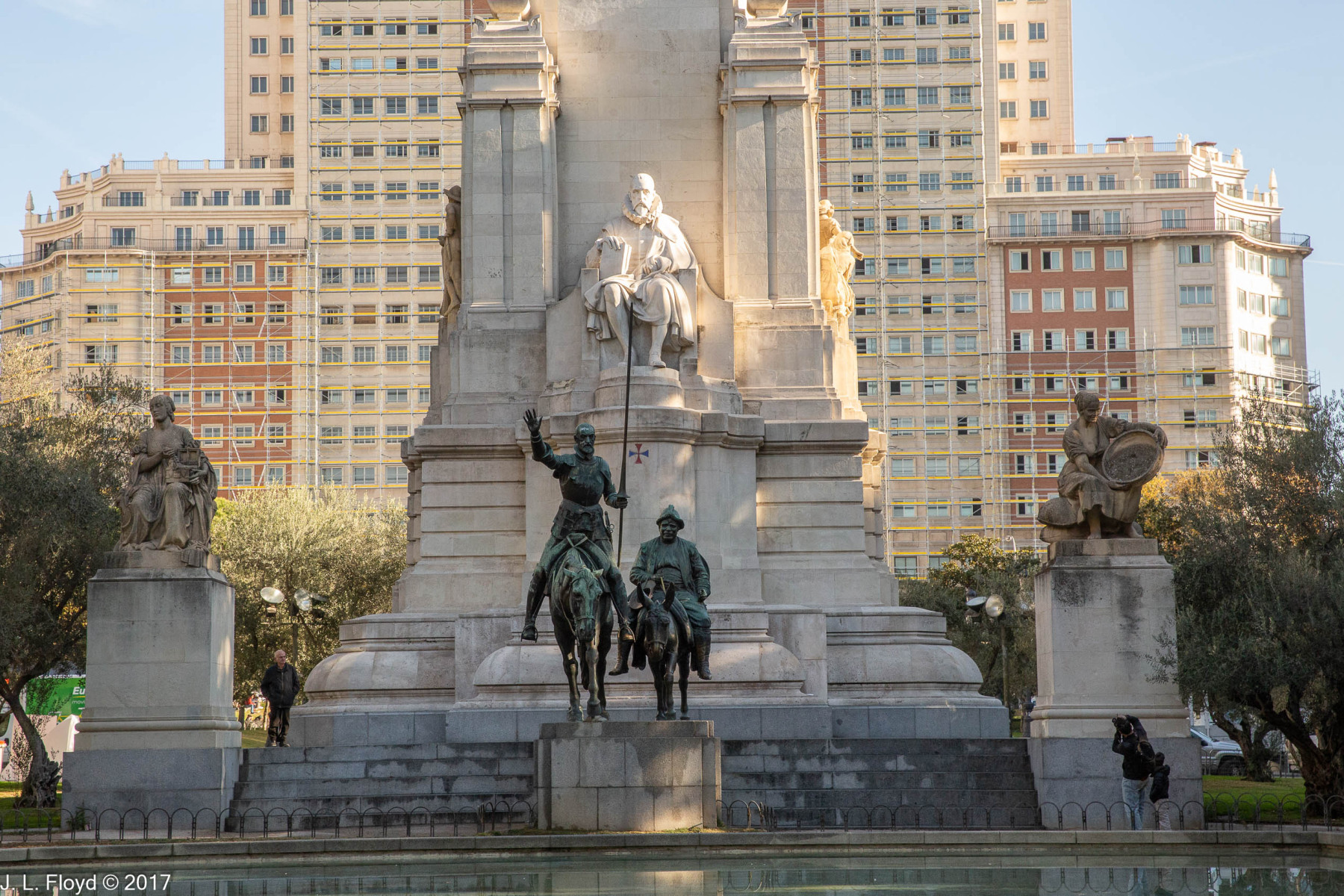
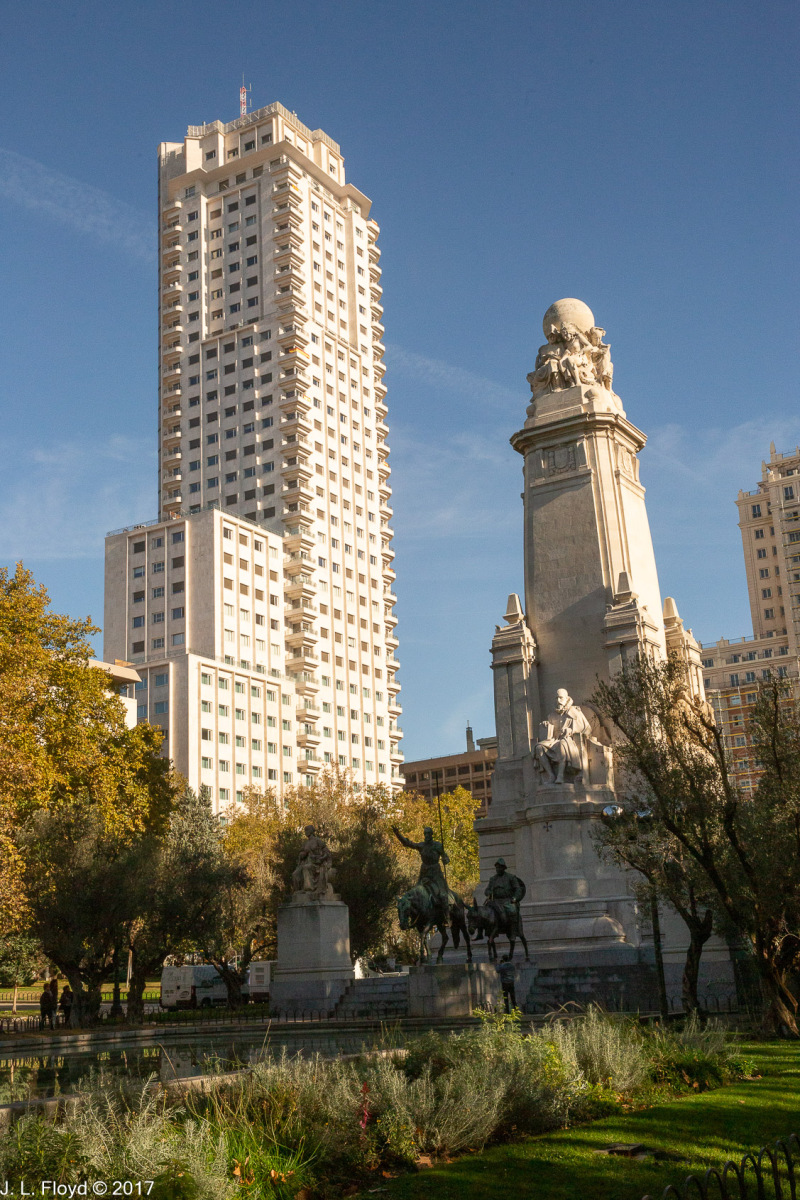
Before long we arrived at our first point of debarkation, the Plaza de España, where the Monumento a Cervantes stands. It consists of a monolith 34 meters (112 feet) high, topped with an earth globe surrounded by five women, representing the five continents on which Spanish is spoken. At its base is a statue of a seated Cervantes. Out in front of the monolith stands a detached bronze sculptural group depicting the two most famous characters from Cervantes’ works, Don Quixote and Sancho Panza, on horseback, presumably riding out to tilt at windmills. Flanking the monolith are pedestals hosting sculptures of other characters from Cervantes’ work.

The monument was begun in 1915 after a public contest resulting in the award of the project to a highly controversial proposal. It was inaugurated after many controversies and construction delays in 1929, at which time it was still unfinished, some of the sculptures being added later.

In back of the Cervantes Monument, and overshadowing it in my photos, is the Edificio España, a 25-story building in a Spanish neo-baroque architectural style. At 117 meters (384 feet), it was the tallest building in Spain when it was completed in 1953. It is now the eighth tallest. It was built as a showcase of modernization and prosperity in Francoist Spain; it houses a hotel, offices, apartments and shops.  

Nearby, on the northwest corner of the Plaza de España, stands another skyscraper, the Torre de Madrid, which superseded the Edificio España in height when it was completed in 1957. At 142 meters (466 feet) it was the tallest building in Spain until 1982, when it was surpassed by the Torrespaña communications tower at 232 m (761.15 ft), also in Madrid. Like the Edificio España, it houses a hotel, apartments and offices.

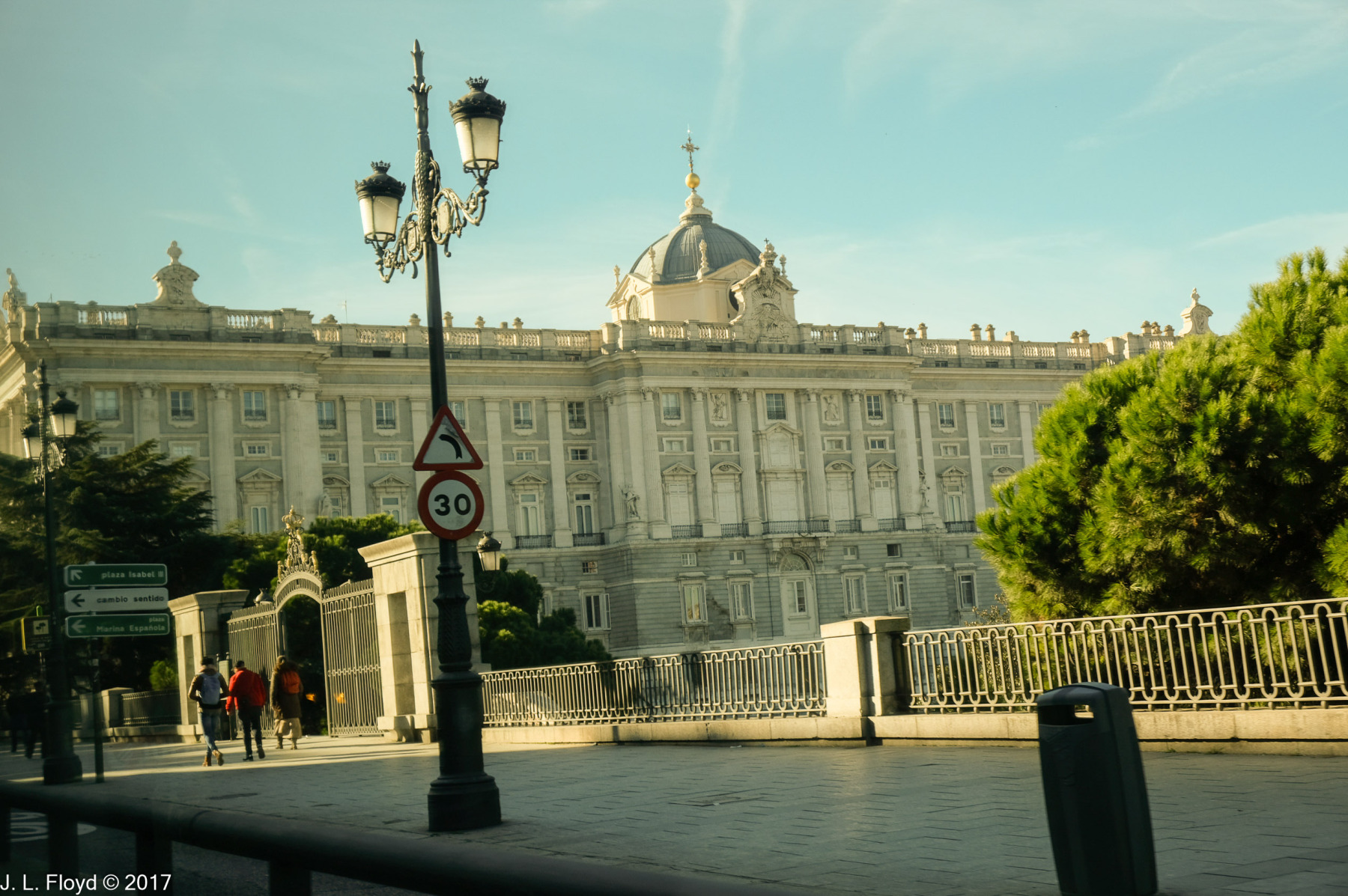
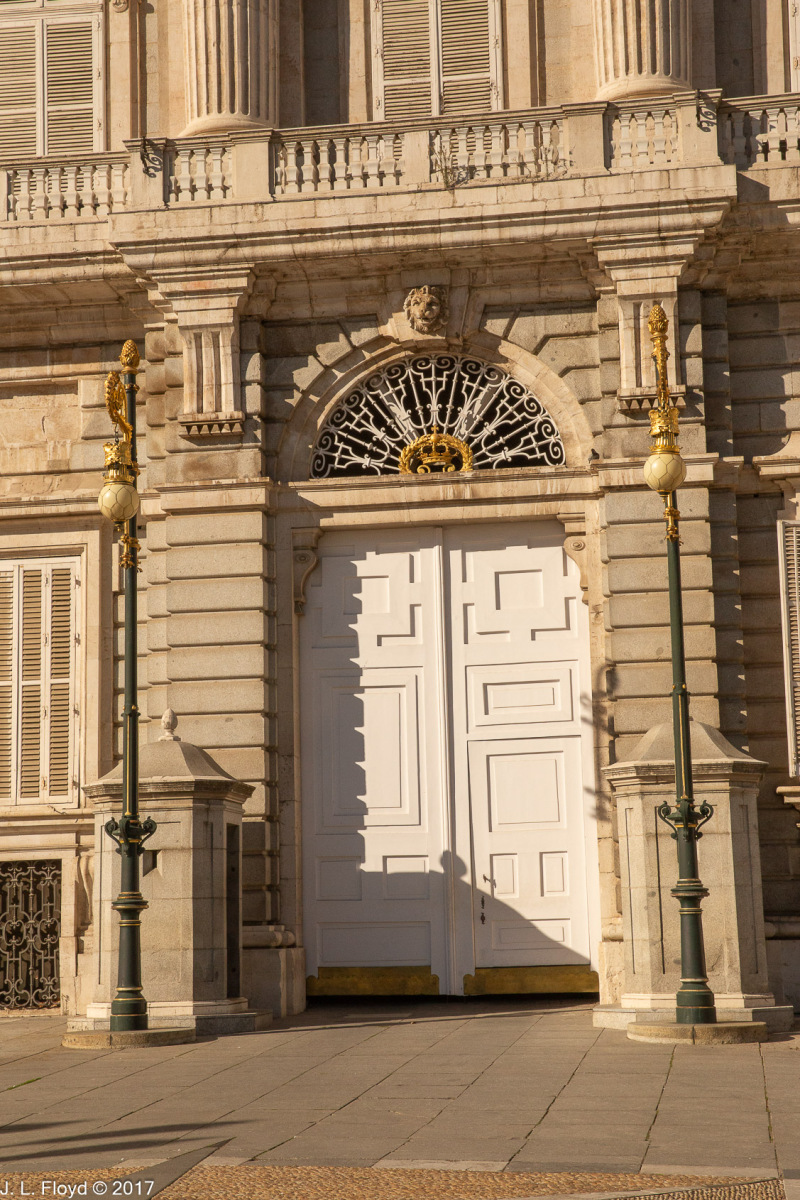
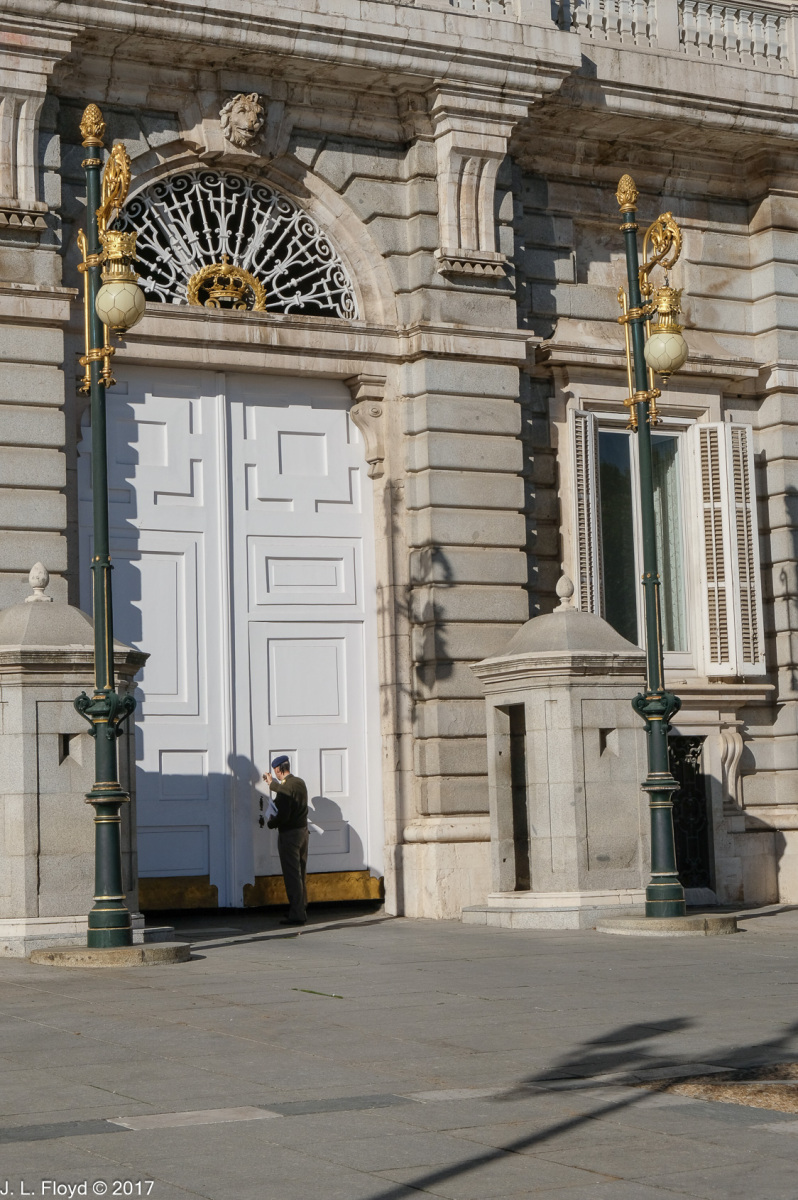
From the Plaza de España it was but a little way to the Palacio Real (Royal Palace), our next destination. I was surprised to find out that it is the largest palace in Western Europe – I always thought Versailles was larger – and one of the largest in the world, at 135,000 square meters (1,450,000 square feet), with 3,418 rooms. It is an 18th-century construction, having been built between 1738 and 1755 on the site of a previous palace, the Alcázar Real de Madrid, which burned down in a fire in 1734. Although the Palacio Real is the official residence of the Spanish royal family, they do not actually live there, preferring the Zarzuela Palace on the outskirts of Madrid.

Although the Royal Palace is open to the public, we did not tour inside owing to time constraints; we saw the palace from its east side, at the Puerta del Príncipe (Prince’s Door), the main entrance.

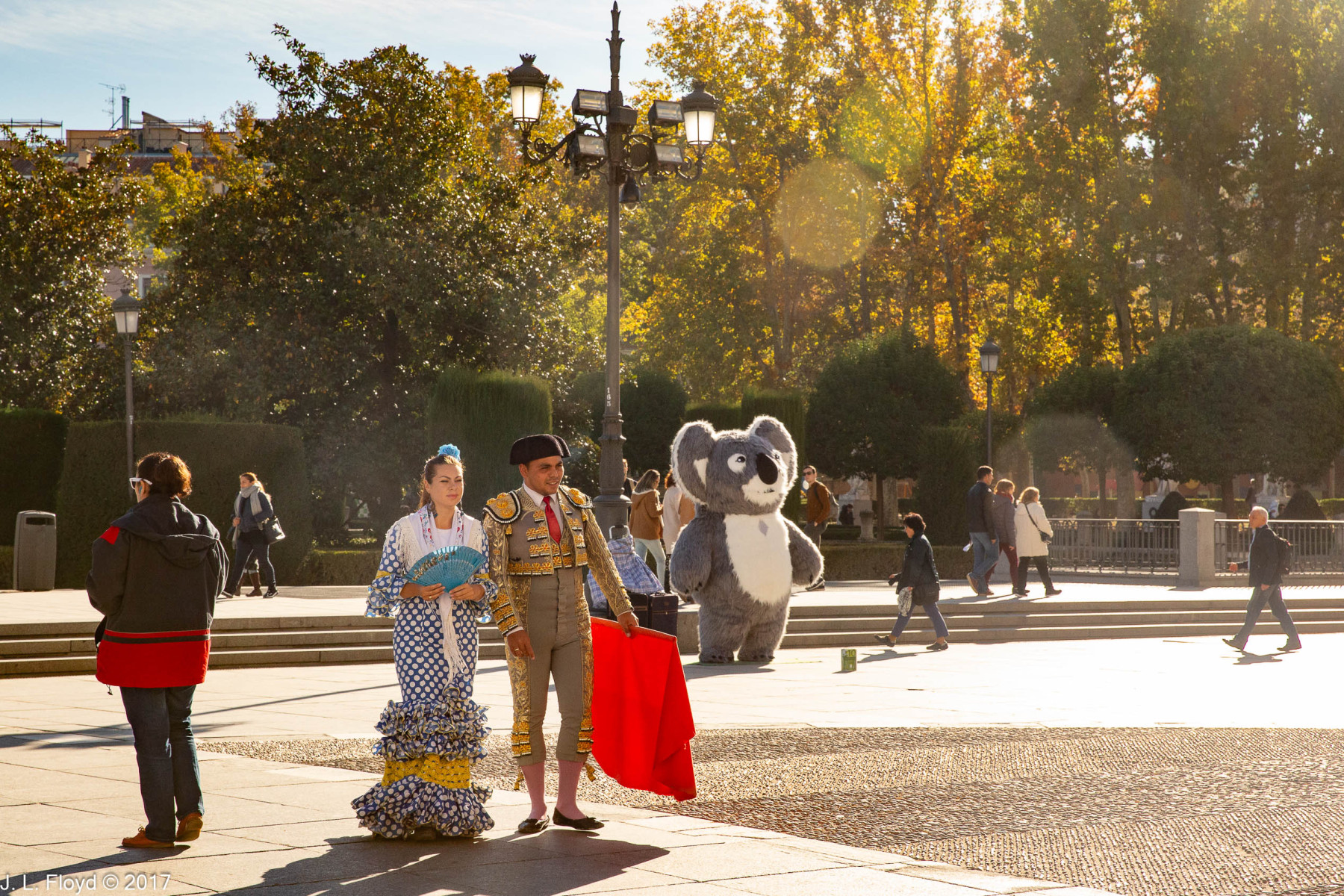
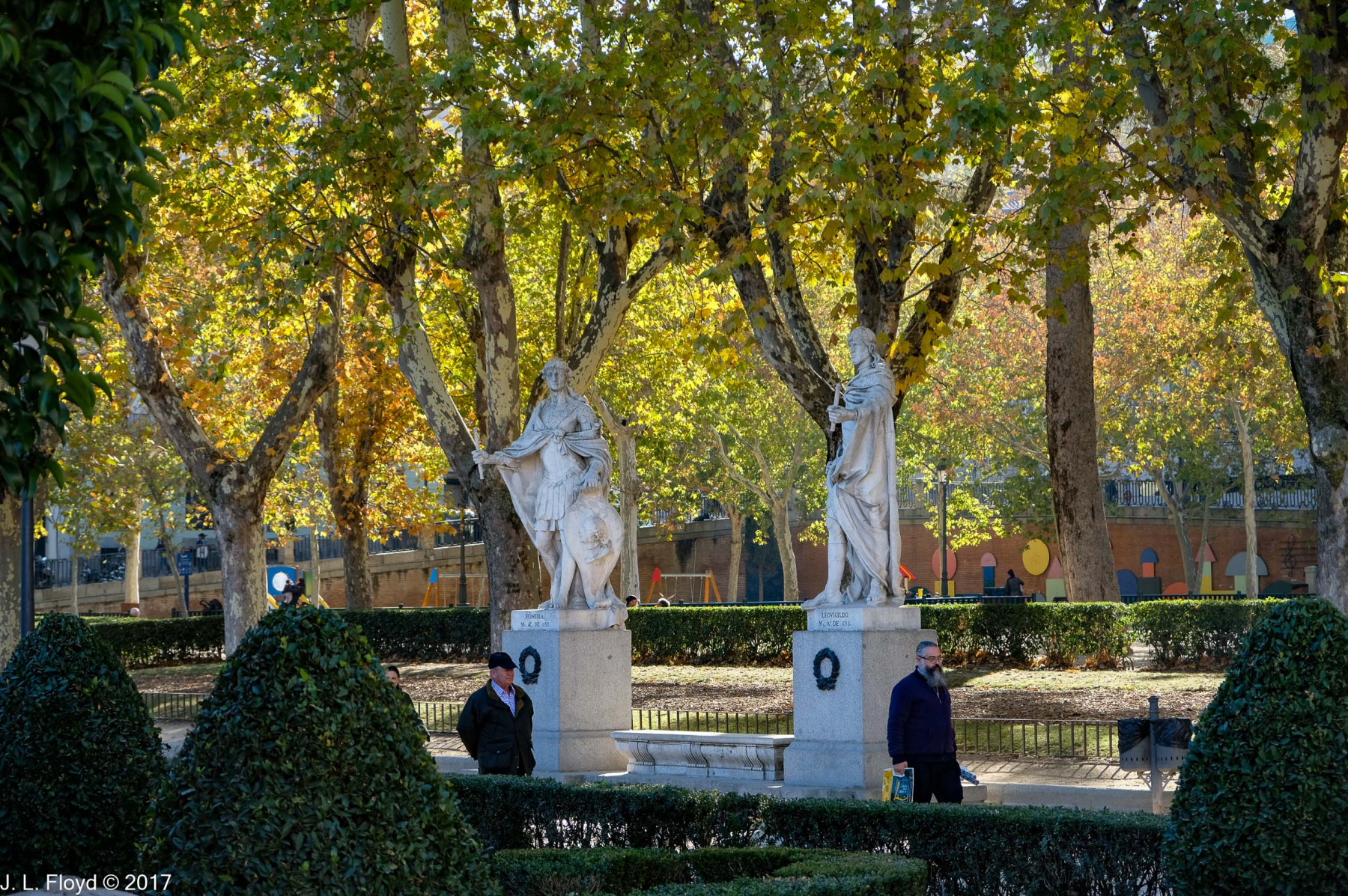
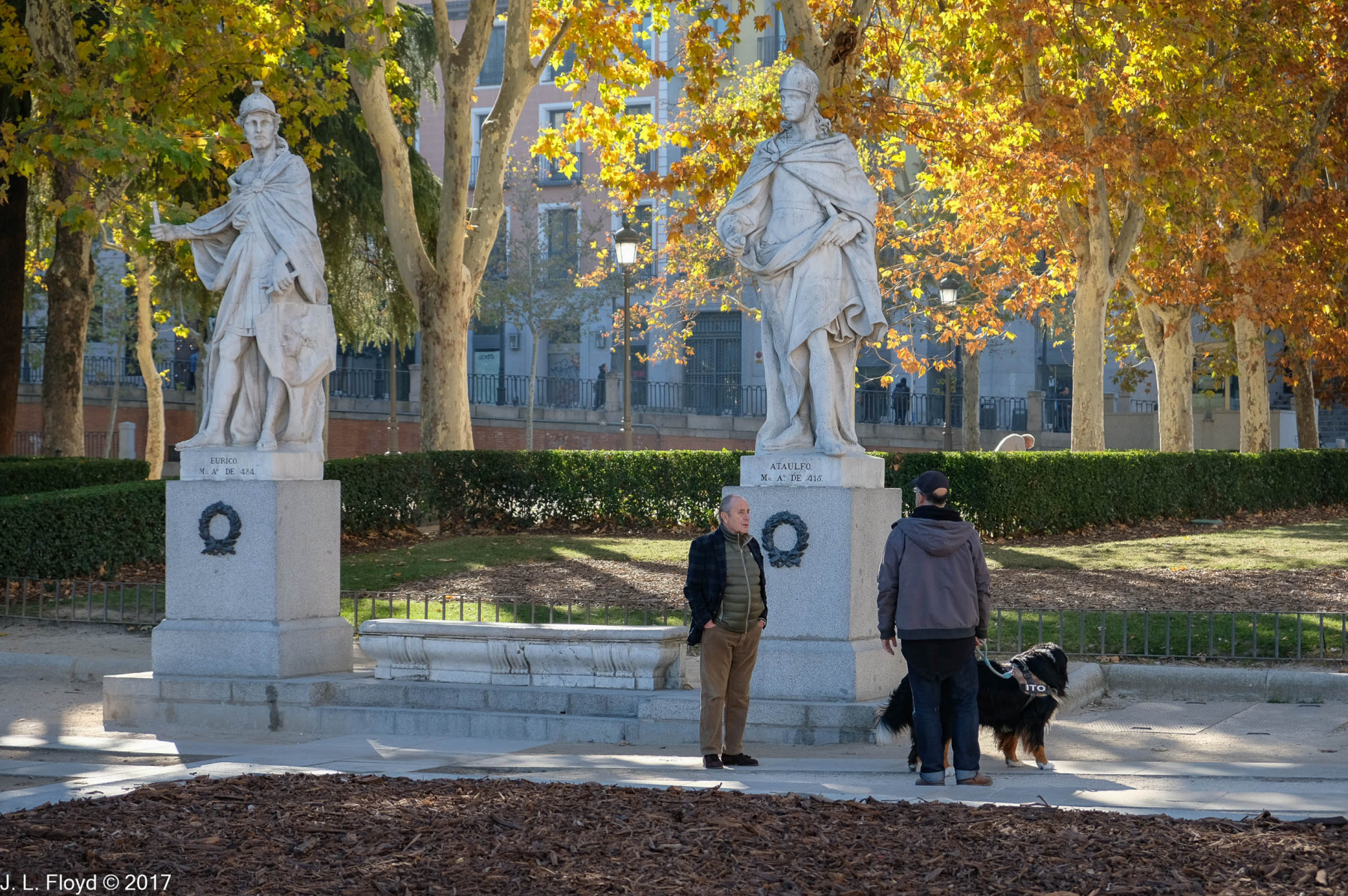
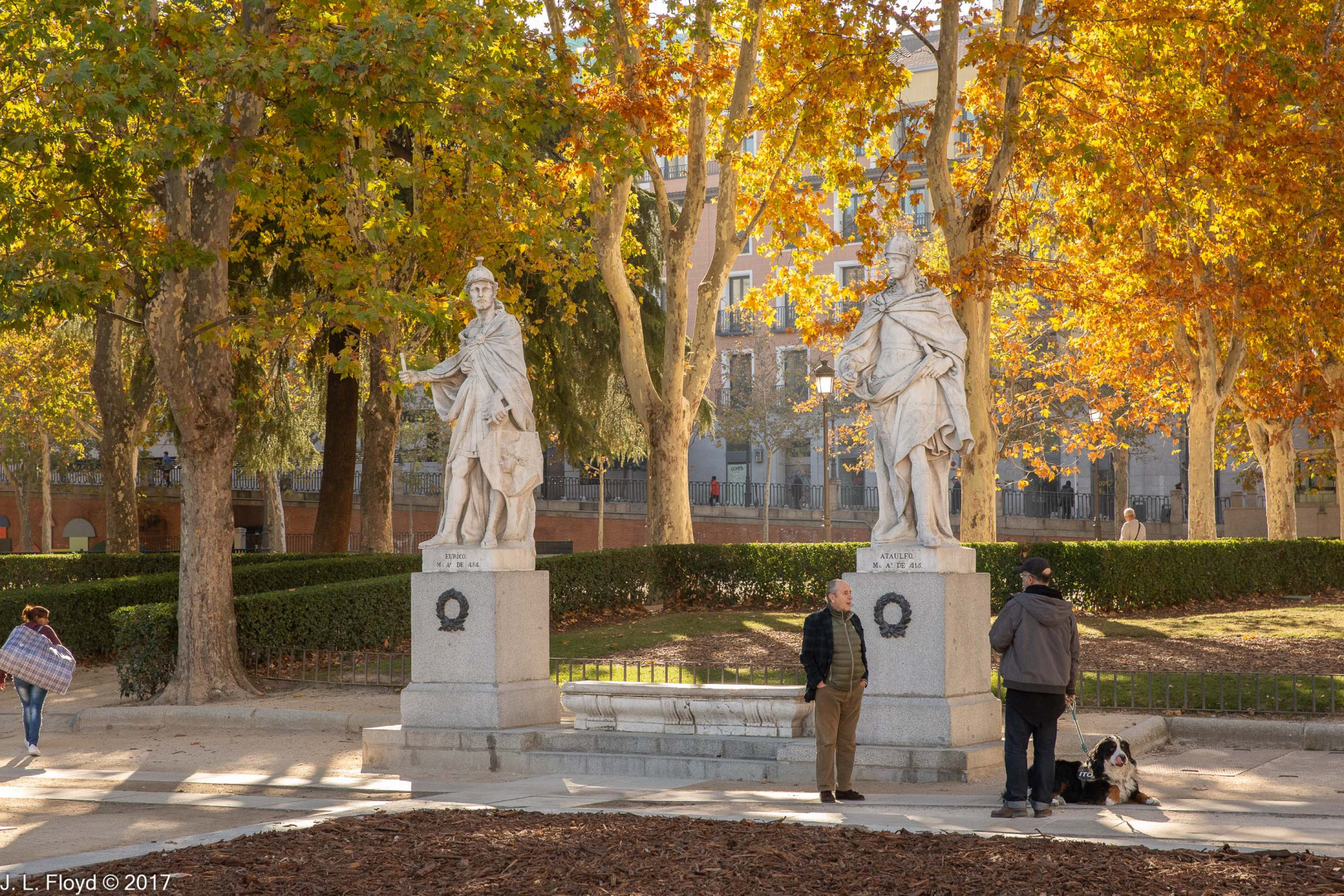
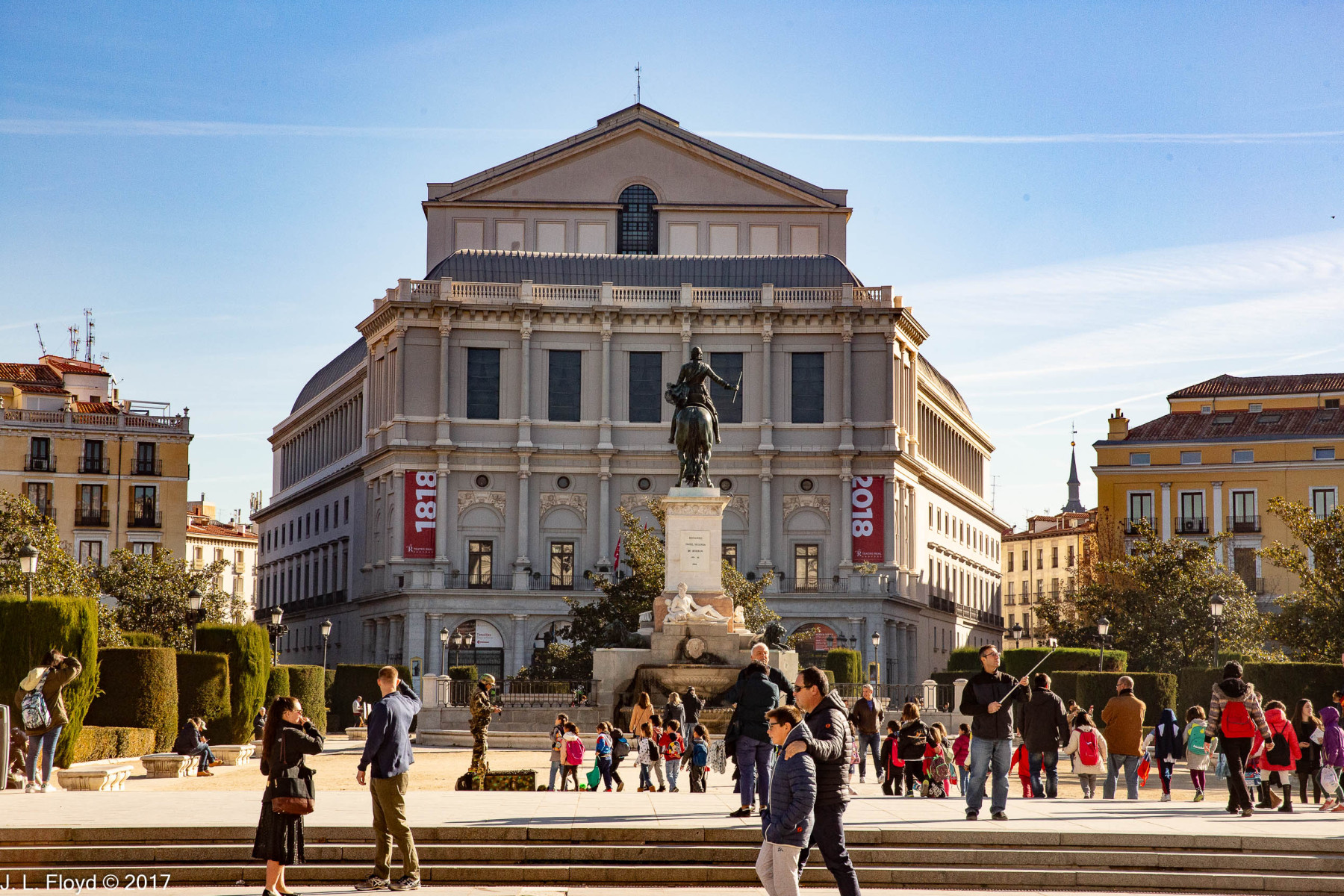
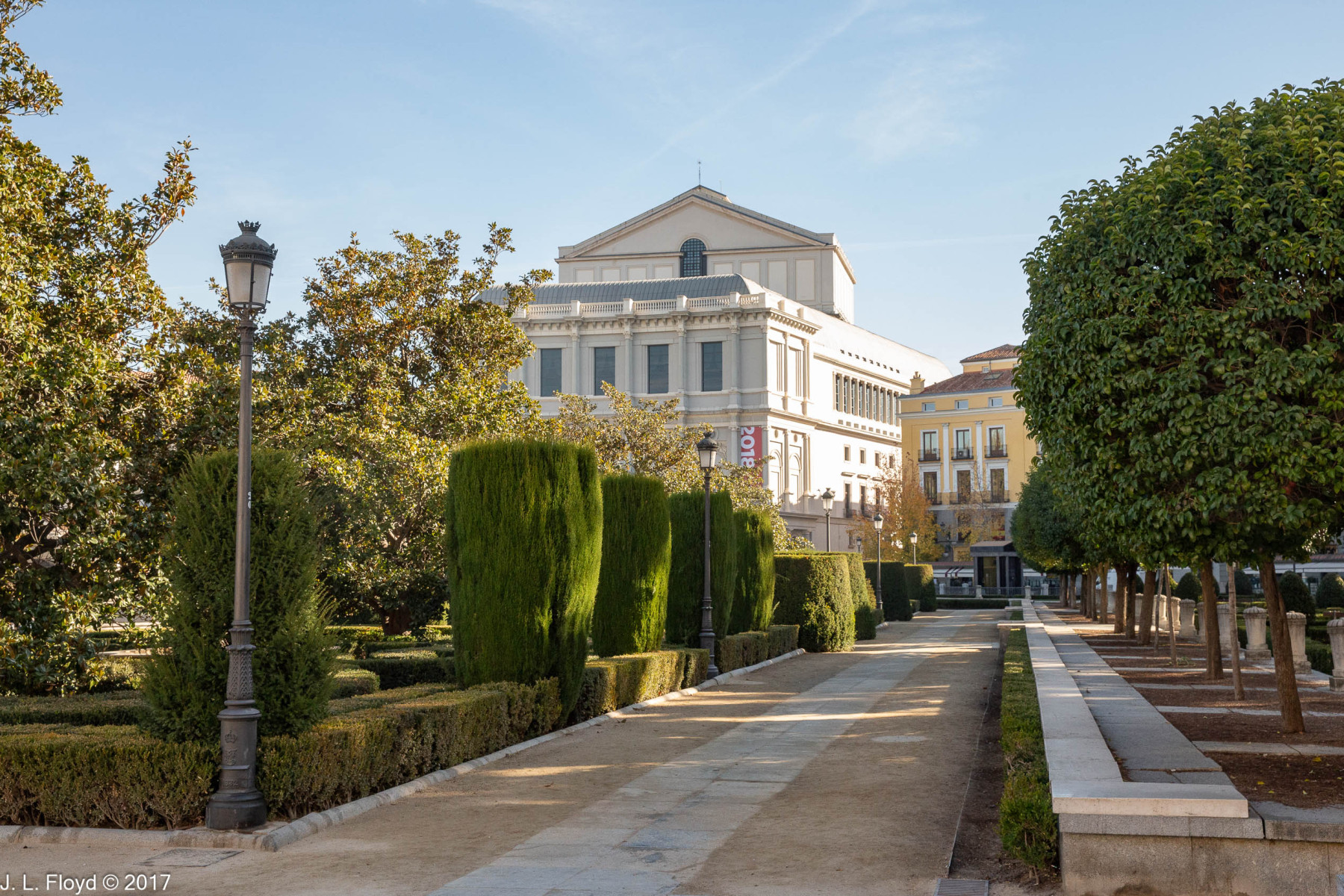
Opposite the east façade of the Palace, across Calle de Bailén, is the Plaza de Oriente, which is a legacy of the 19th century, begun in 1808 and completed in 1844. It is actually a large park that consists of several gardens; in the center stands an equestrian statue of Philip IV, King of Spain from 1621 to 1665. To the east of Philip IV, facing the palace across the Plaza de Oriente, is the Teatro Real, one of the great opera houses of Europe. We had time to stroll in the gardens, and on one pathway, the Paseo de las Estatuas, we found statues of some of the kings of Spain, including a couple of the early Visigothic monarchs, who reigned between the fall of the Roman Empire in the fifth century AD and the Islamic conquest of the eight century.

From the Royal Palace we went to the prime destination of the day, the Museo Nacional del Prado. Prado means meadow in Spanish, so this is the Museum in the Meadow; but nobody ever calls it that in English – it’s just the Prado. If I had been allowed to see only one attraction in Madrid, it would have been the Prado. It is one of the great art museums of the world, rivalling such treasuries as the Louvre in Paris, the Vatican Museum in Rome, and the British Museum in London. Its collections contain 7,600 paintings and 1,000 sculptures, as well as countless drawings, prints and documents. About 1,300 works are actually on display, with the rest being either on loan to other institutions or in storage.

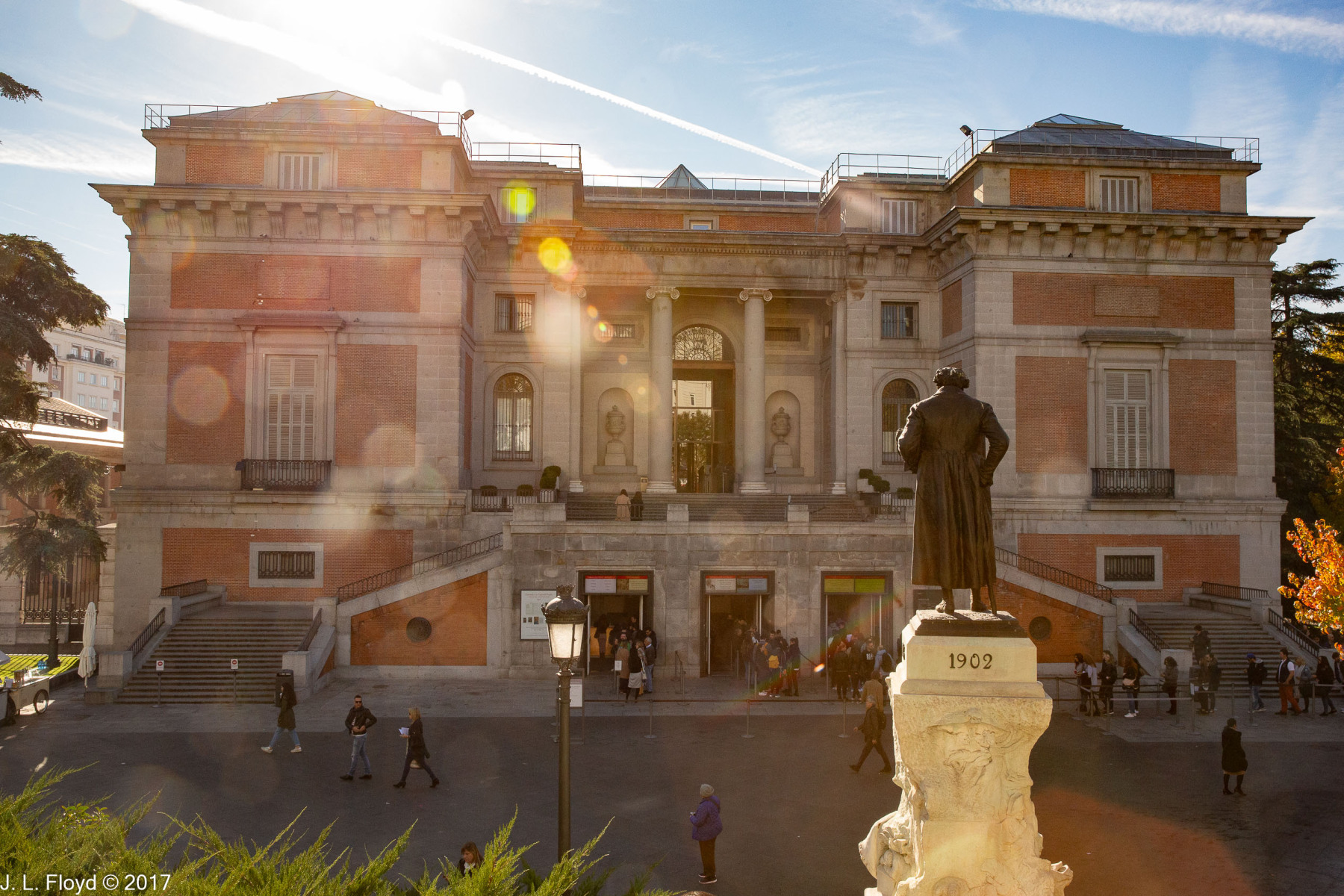
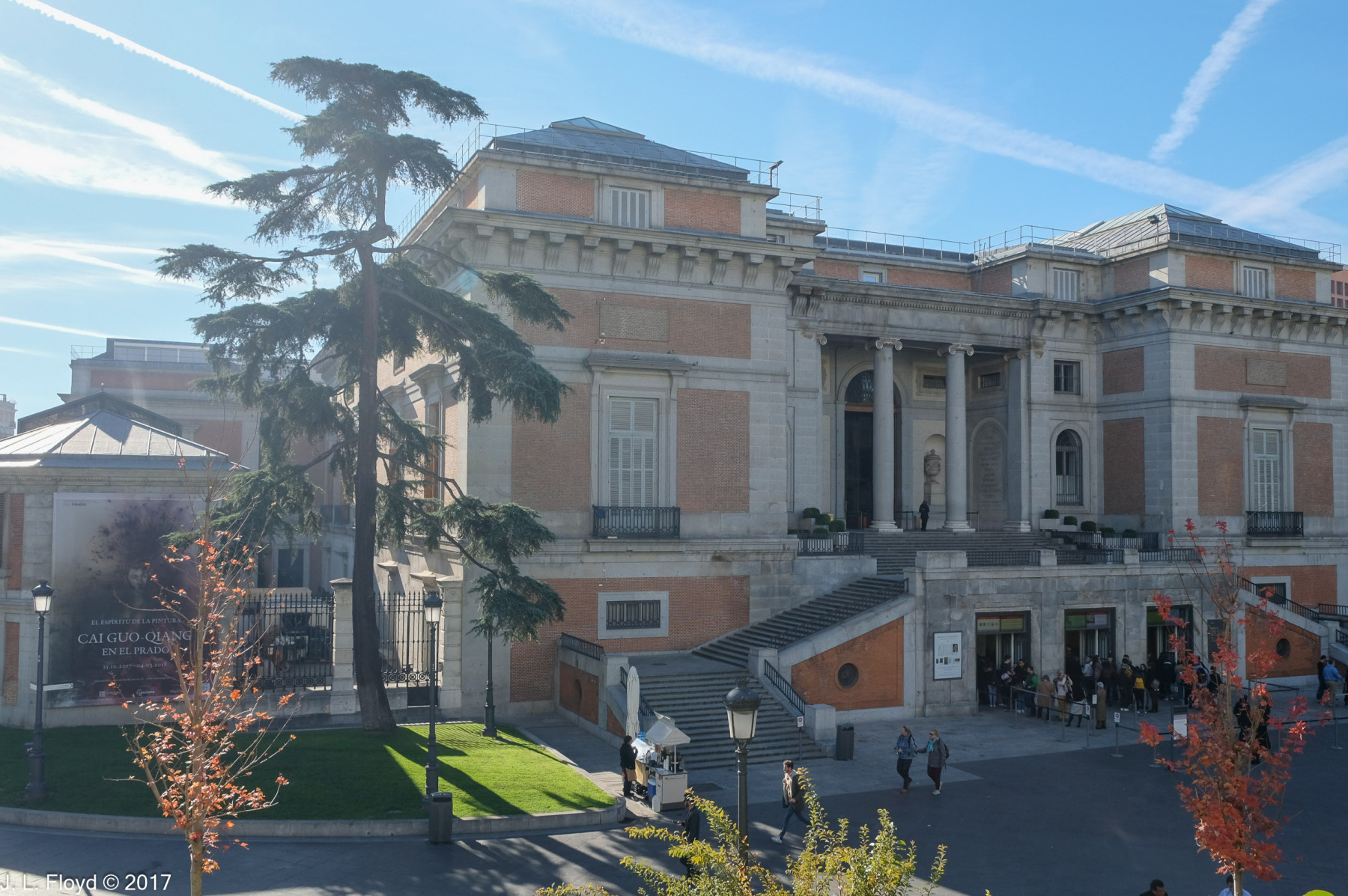
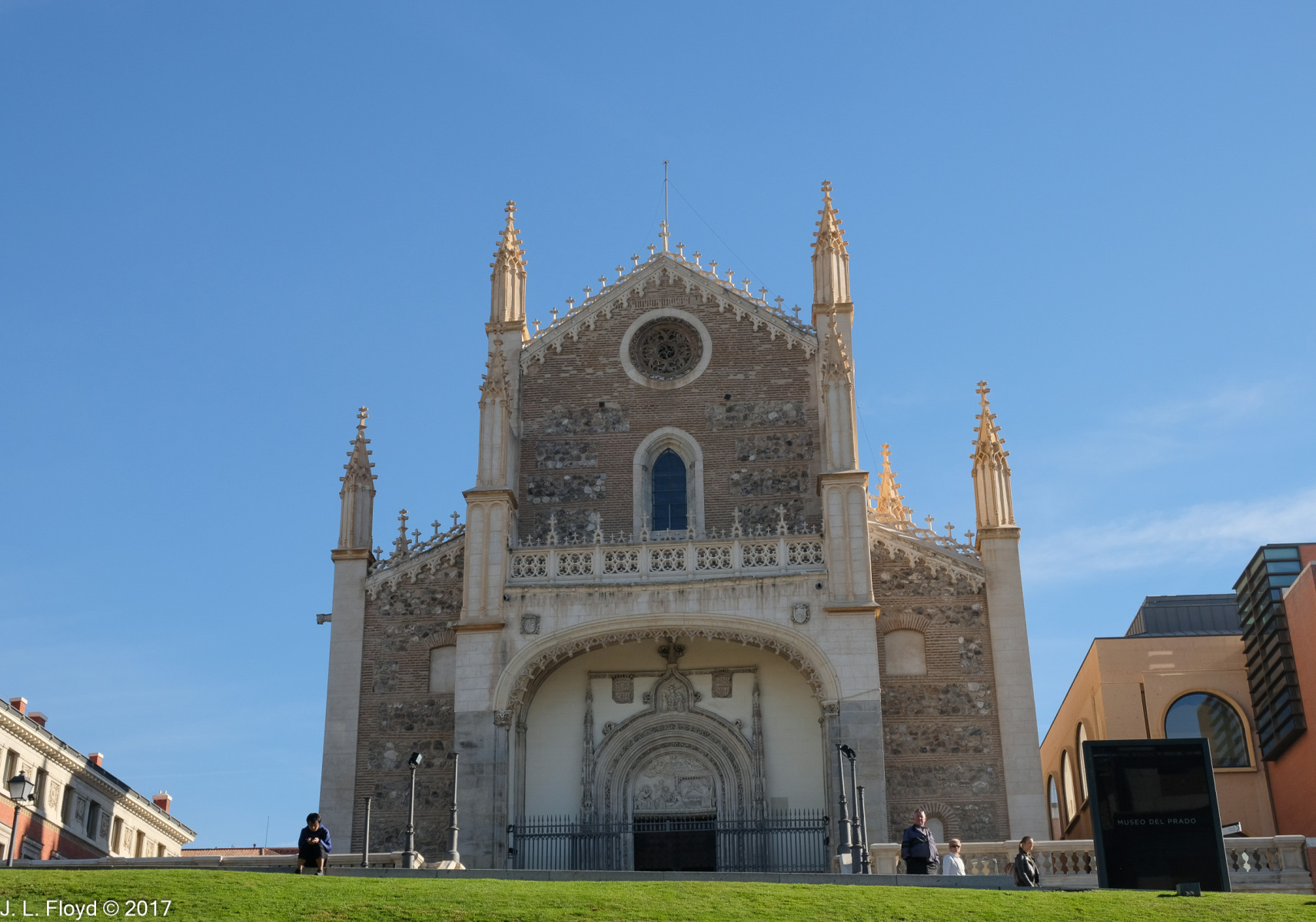
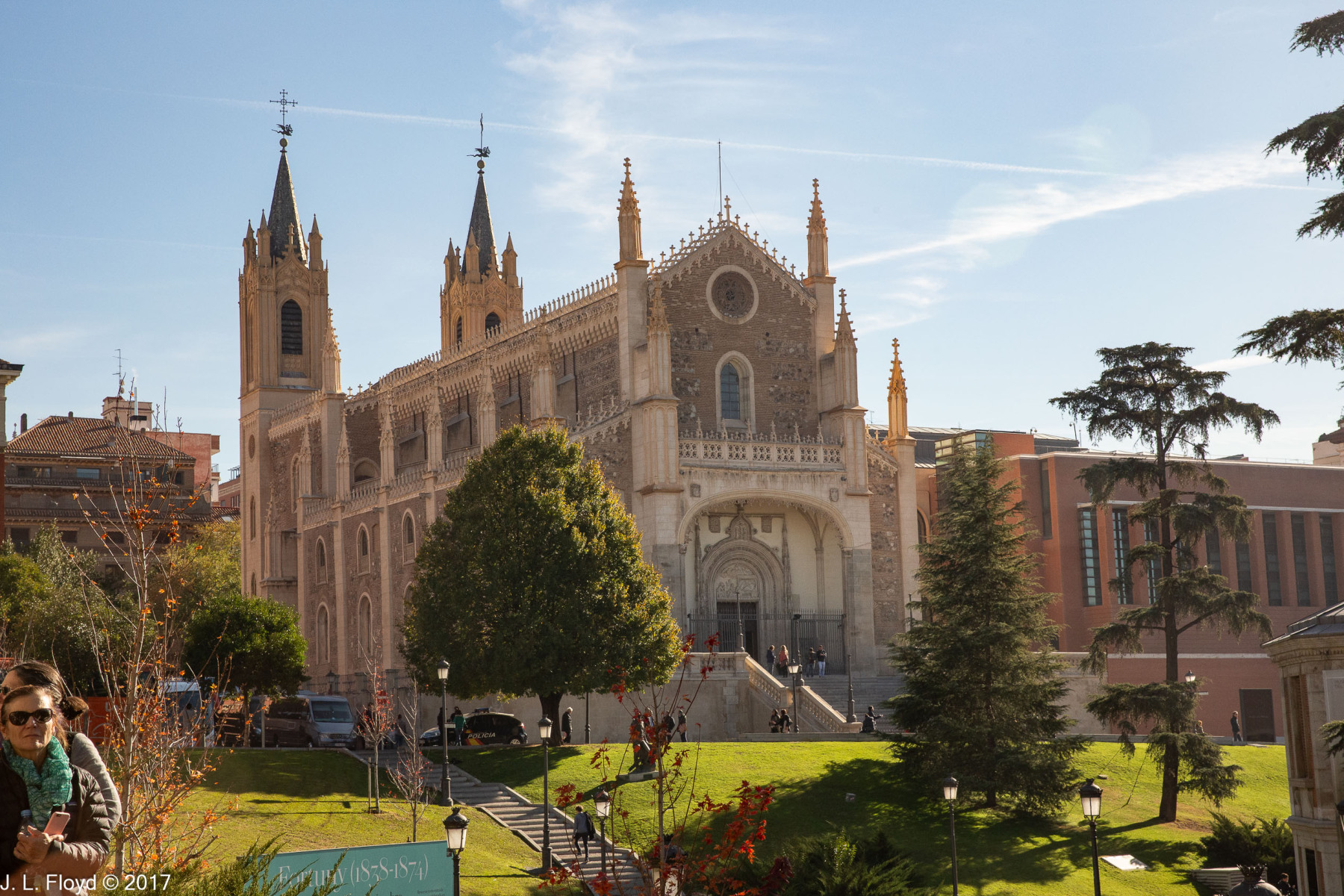
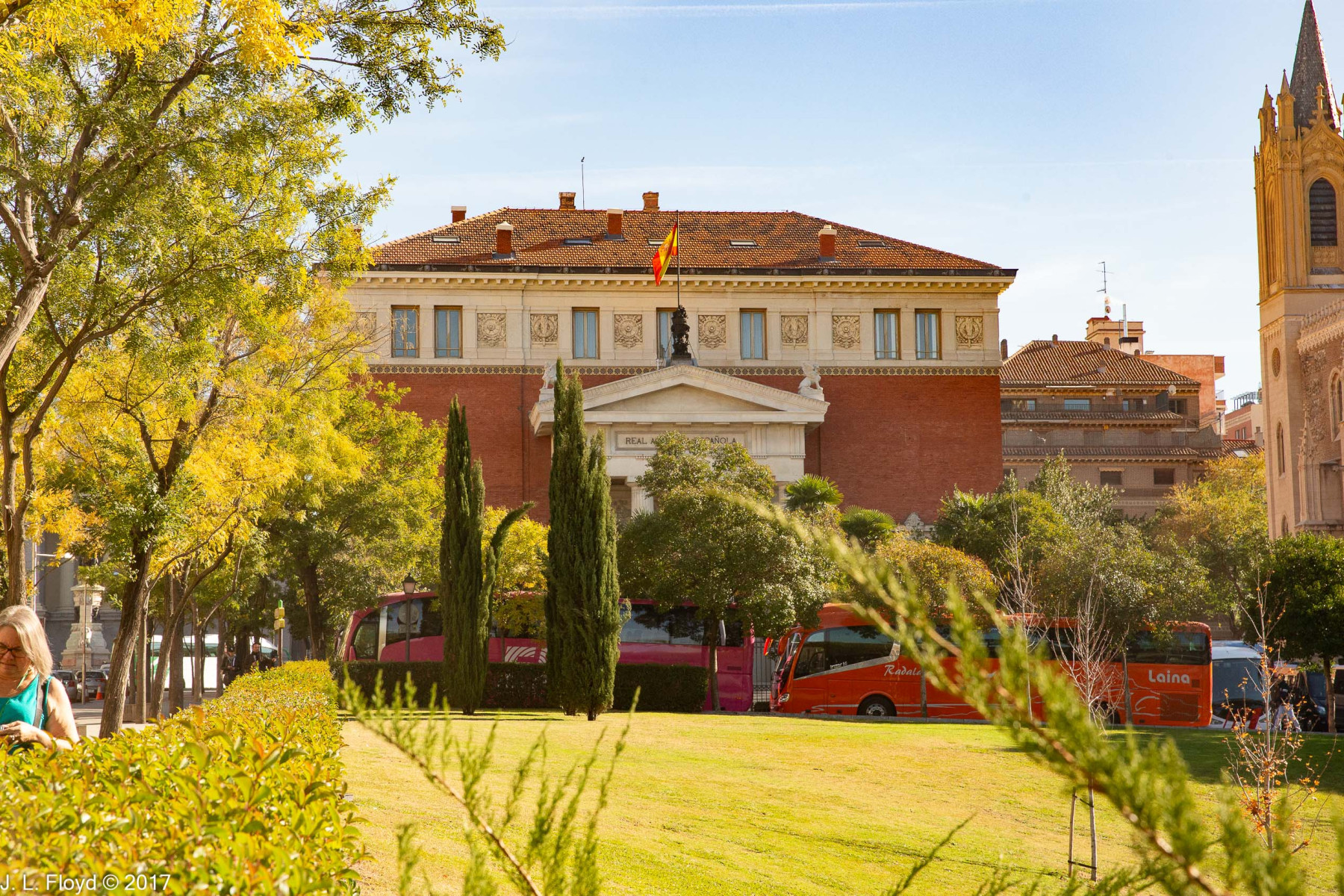
Photography is not allowed inside the Prado, and any photos I might have taken there would be superfluous anyway, because you can find much better images on the web than any I could have captured. So my offerings are limited to the exterior of the museum and its environs, which included the Iglesia de San Jerónimo el Real (Church of St Jerome the Royal), the Real Academia Española (Spanish Royal Academy) and various monuments.

The Church of St Jerome is now just a parish church, but in bygone days it belonged to one of the most important monasteries in Madrid; moreover, in the 16th and 17th centuries both the church and monastery were closely linked to the Spanish royal court, especially since the royal palace in those days, the Buen Retiro, stood next to the monastery on the south, and the king could hear Mass from his bedroom. Royal weddings, funerals, proclamationis and even trials of heretics were held in the church.

The Buen Retiro palace and the monastery were badly damaged in the Napoleonic Wars, and while the monastery was restored, the palace was mostly demolished, and much of the area it occupied is now a garden, called Retiro Park (Parque del Retiro).

The church and monastery, by contrast, were restored and remodeled several times, most recently at the beginning of the 21st century. Not only that, but the Archdiocese of Madrid transferred both of them to the Spanish Ministry of Culture, which turned the cloister into an extension of the Prado Museum, connecting them by an underground passage.

On the north side of the Church of St. Jerome stand the headquarters of the Real Academia Española, an official royal institution which has the mission of preserving the stability of the Spanish – i.e. Castilian – language. To this end, it has joinded forces with the national language academies of 22 other Hispanophone nations in an effort to promote linguistic unity by ensuring a common standard. It was founded in 1713 by Juan Manuel Fernández Pacheco y Zúñiga, Duke of Escalona and Marquess of Villena, under the aegis of King Philip V. A grandson of Louis XIV, the Sun King of France, Philip was the first Bourbon monarch of Spain, and with his French background, he felt it necessary to have an equivalent of the Académie Française, the official institution regulating the French language, founded by Cardinal Richelieu in 1635.

On to the Prado. Each side of the Prado Museum has its own entrance, with three named for one of the great Spanish artists: Velazquez on the west, Murillo on the south, Goya on the north, and the Puerta de los Jerónimos on the east. There are statues of Velazquez, Goya and Murillo at their respective entrances, with a medallón (disk portrait) of the sculptor José Álvarez Cubero (1768-1827) embedded above the east entrance. Our tour group entered the Prado via the Goya Entrance, at the north end of the building.

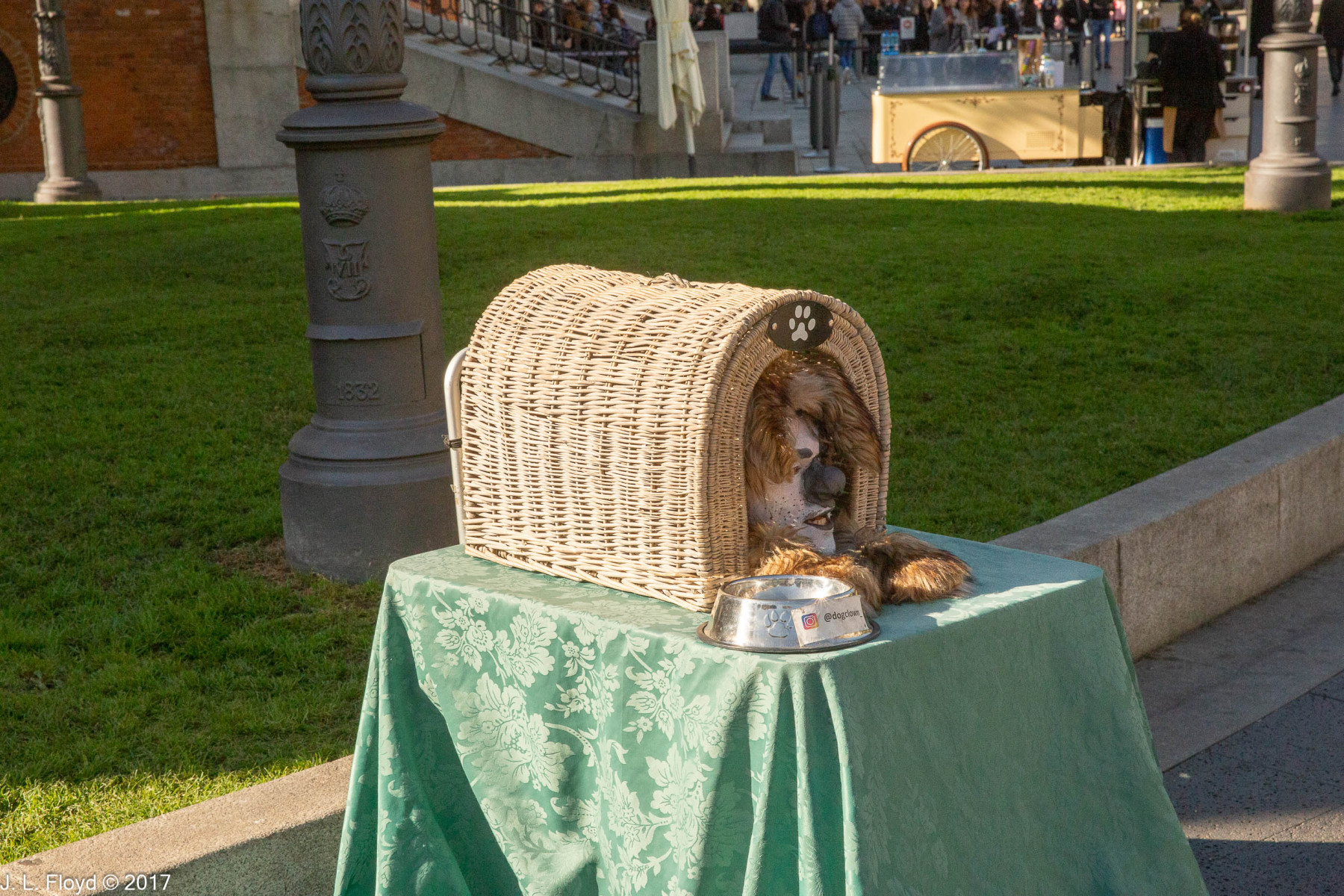
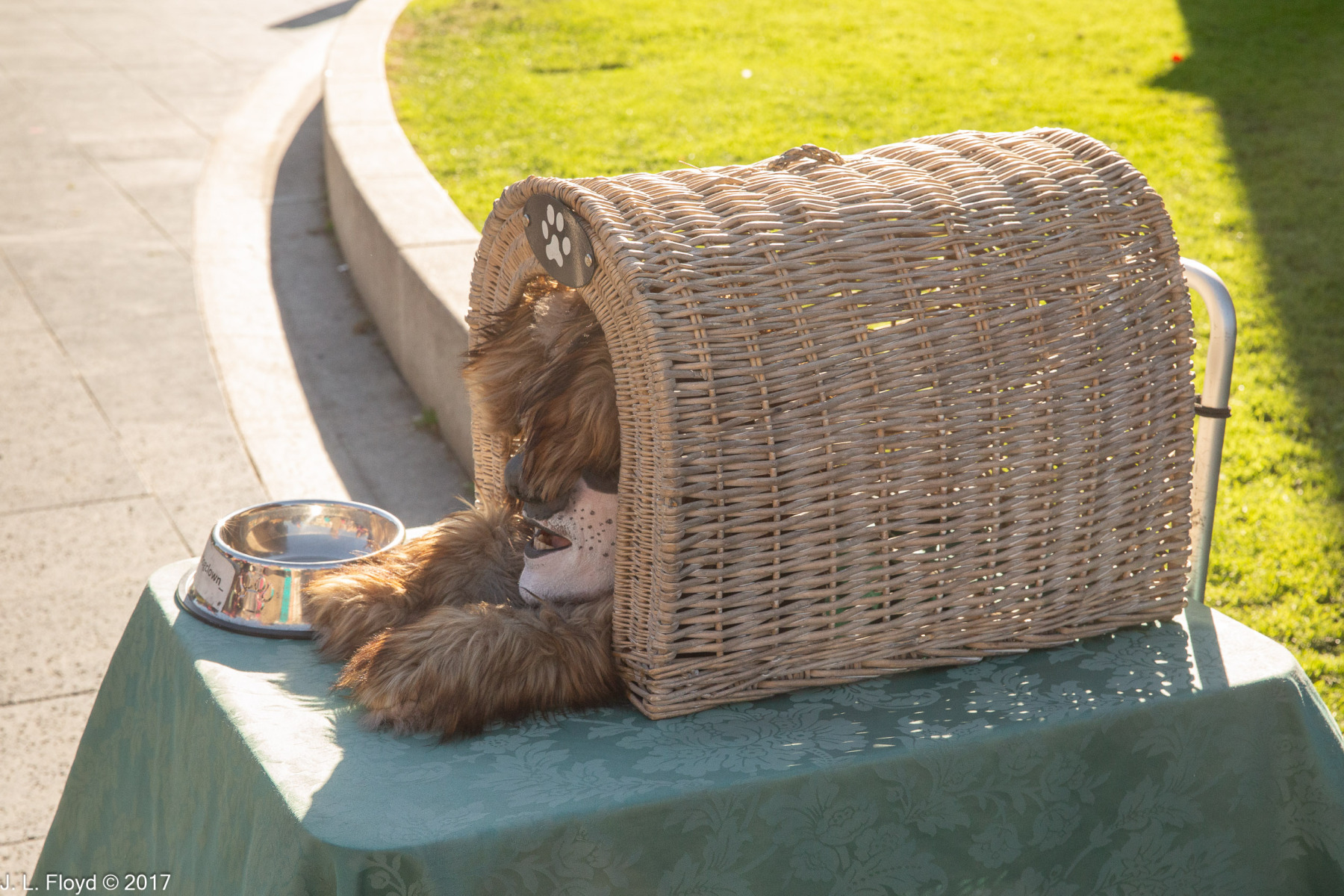
As with any famous attraction visited by hordes of tourists, the approaches to the Prado are haunted by a number of individuals – cranks, eccentrics, performers, hustlers, etc. – with various offerings and importunities. Most, of course, are trolling for donations. I found the most interesting of these to be a dog of uncertain (but very appealing) breed whose human had dressed it up in a clown mask and had it sit on a table inside of a wicker doghouse. I don’t know how the dog felt about this, but since it wasn’t trying to escape, I assumed it was copacetic with the situation (of course, it could have been drugged). Anyway, I felt it was worth a couple of pictures, for better or worse. I even left the person a donation, so he could feed his dog.

Inside the museum, we were given a tour by a museum guide, who hit the highest of the high spots, explaining what they were famous for, and describing in-depth the ways in which the artists had exercised their skills to produce their extraordinary effects. First up was the triptych The Garden of Earthly Delights by Hieronymus Bosch (c. 1450-1516), who not coincidentally happened to be the favorite painter of Philip II. Also known as the Garden of Lusts, it dates from around the beginning of the 16th century, before the Protestant Reformation, when the Netherlands was still devoutly Catholic. Little is known about Bosch’s life or his actual religious beliefs, but the Garden triptych is generally considered to warn of the dangers of surrendering to earthly desires. The left panel depicts a scene from the Garden of Eden; the center panel, the largest, portrays humanity as a crowd of mostly naked men and women heedlessly engaging in pleasure-seeking activities, and the right-hand panel demonstrates the consequences of their disregard of divine commands, i.e. Hell. I remember receiving a postcard with a reproduction of this triptych from a friend who visited the Prado many years ago, and ever since then I had wanted to go see it in person.

Our guide also gave a fascinating discourse on a painting by Diego Velazquez (1599-1660), Las Meninas (“The Ladies in Waiting”), considered by some critics to be his greatest masterpiece. Velazquez was a leading painter at the court of Philip IV, and Las Meninas, painted in 1656, depicts the Spanish royal family in a room in the Alcázar, the royal palace in Madrid which burned down in 1734.

To my great embarrassment, especially since Francisco Goya (1746-1828) is my favorite Spanish painter, I don’t remember which of his paintings our Prado guide held forth on. I do remember, however, that my most gratifying experience in the Prado was finally being able to view in person a painting by Titian, Emperor Charles V at Mūhlberg. I first saw a print of this work in a history book in college, many years prior. It was much larger than I expected, 335 centimeters × 283 centimeters (132 inches × 111 inches), and dominates a section of the wall at the end of a long passage. In 1547 Emperor Charles V, attempting to roll back the spread of Protestantism in Germany, engaged forces of the Protestant princes at the Battle of Mūhlberg, where he won an overwhelming victory. It did him absolutely no good at all. He was unable to follow up and a few years later was forced to sign the Treaty of Augsburg (1555), which gave the German princes the right to select either Lutheranism and Catholicism as their own religion and that of their subjects. But the Italian painter Tiziano Vecellio, commonly known as Titian, nevertheless immortalized Charles (who of course was also Carlos I, King of Spain) by depicting him on horseback, with a lance, as if riding out to charge against the enemy. In reality, Charles V suffered from gout and had to watch the battle from a litter on which he was carried to the field.

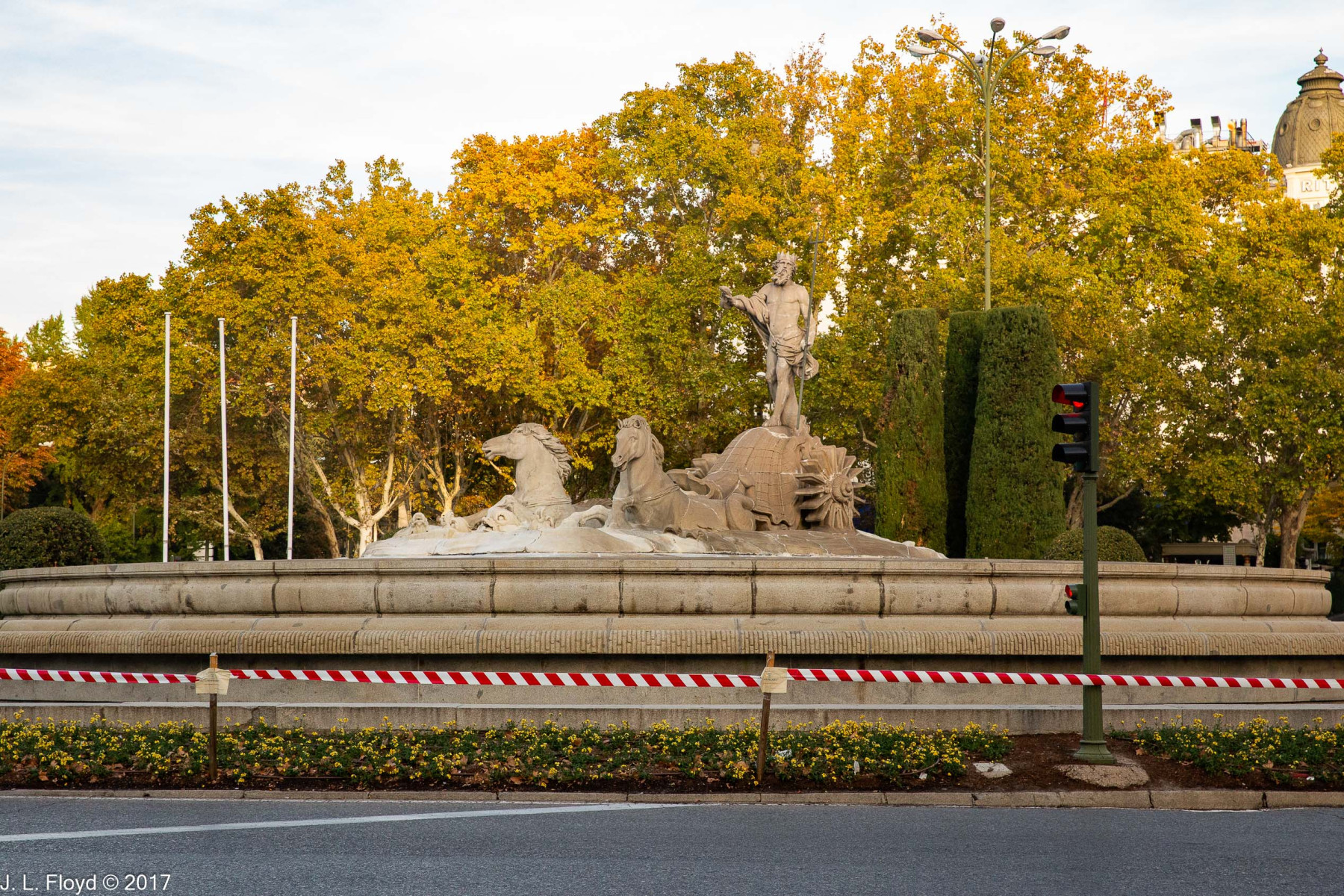
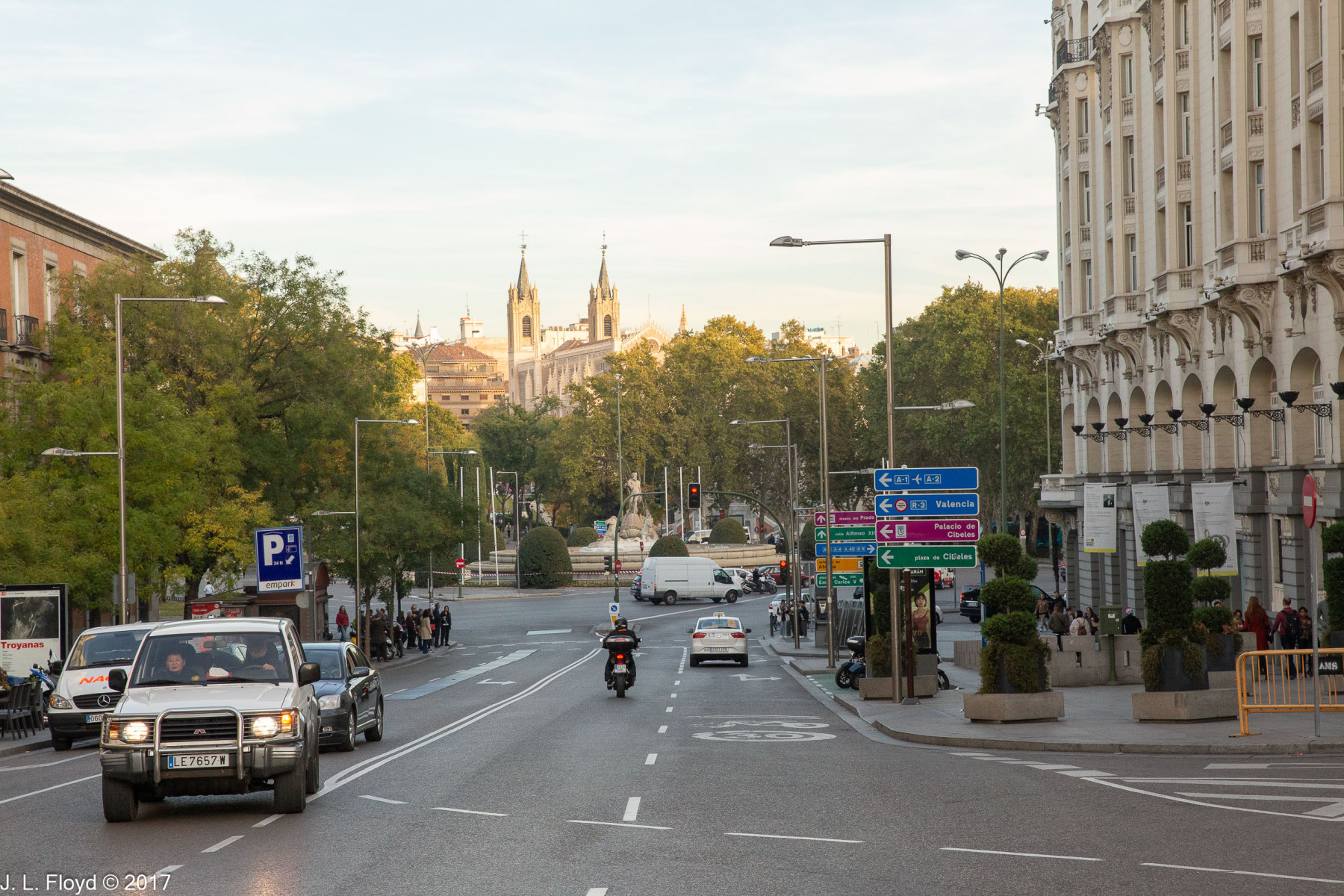
When we finished our tour of the Prado, many members of our tour group were exhausted, including Sandie, who opted to return to the hotel and rest up for the remainder of the afternoon. I, however, chose to see more of Madrid on foot, and together with Chuck and Elouise Mattox headed up the Paseo del Prado to the Fuente de Neptuno (Neptune Fountain), where they treated me to hot chocolate and pastry in a café nearby. After that we went our separate ways, and I headed up the Paseo de la Cortes to see what I could see.

The Fuente de Neptuno is a neoclassical sculpture situated on a roundabout (traffic circle) where the Paseo del Prado meets the Plaza de la Cortes. Completed in 1784, it depicts Neptune, the Roman god of the sea, standing in a chariot drawn by hippocampi (half horse, half fish), with a trident in one hand and a snake in the other.

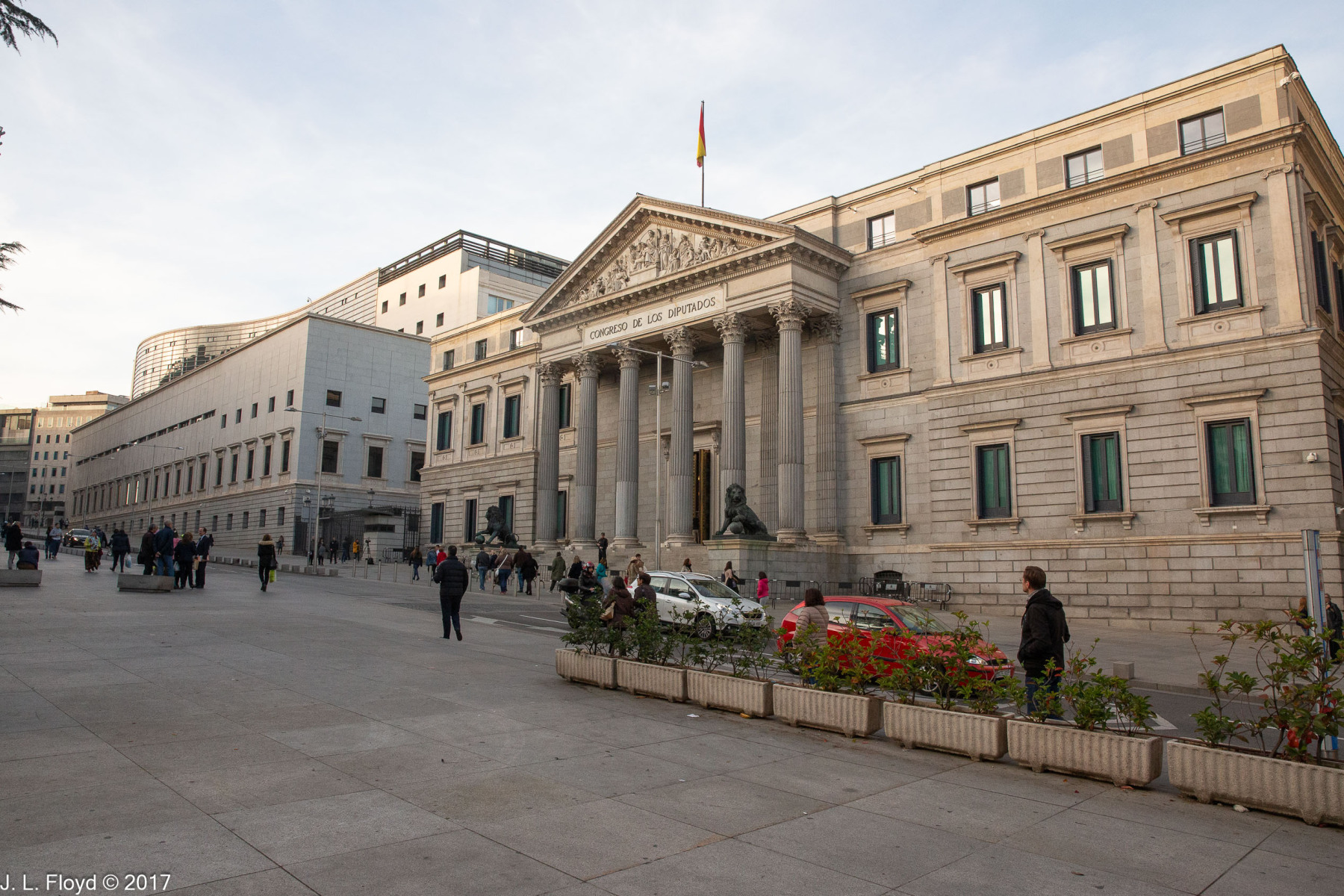
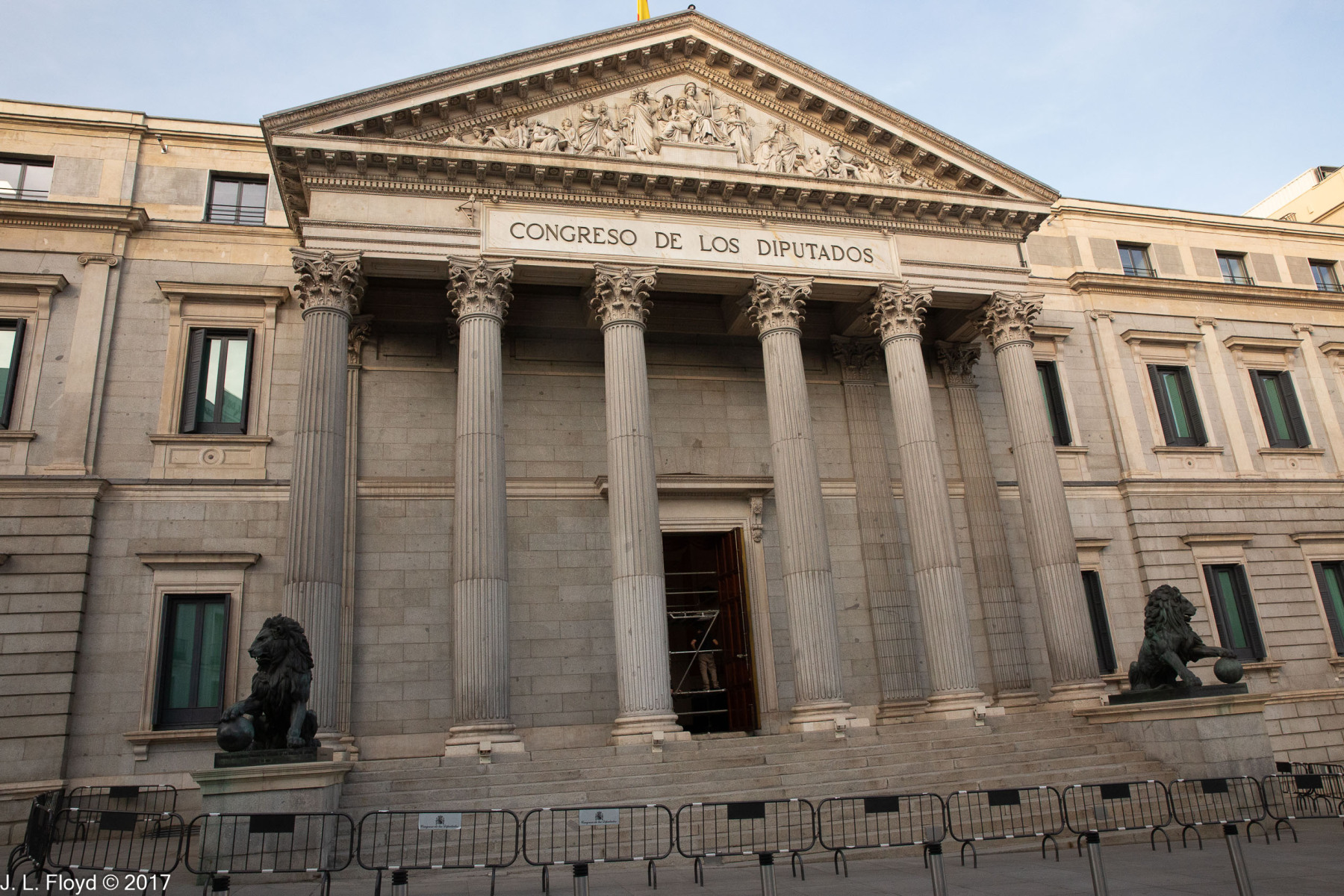
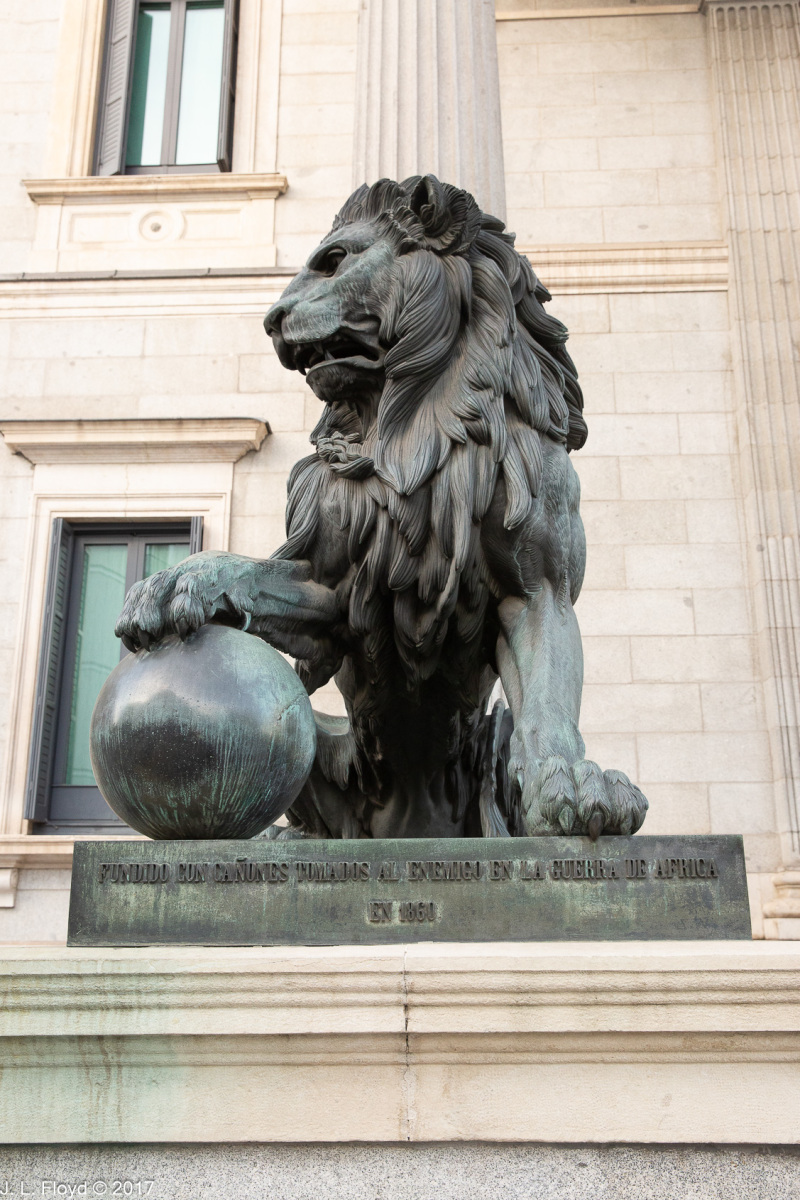
Traversing the Plaza de la Cortes from the Neptune Fountain to its northwest corner, where it meets the Carrera de San Jerónimo, I encountered the Palacio de las Cortes, the meeting-place of the Congreso de los Diputados (Congress of Deputies), the lower house of the the bicameral Spanish national legislature, the Cortes Generales. There is also of course a Senado (Senate), which meets in the Palacio del Senado, near the Royal Palace of Madrid. The Palacio de las Cortes is an impressive neoclassical building, completed in 1850 in the reign of Isabella II; it is considered to be the masterpiece of its architect, Narciso Pascual y Colomer. He designed the façade in the style of a Renaissance palace, with a grand entrance consisting of a large portico with six Corinthian columns supporting a triangular pediment adorned with a bas-relief depicting Spain and its Constitution, accompanied by allegorical figures depicting various virtues – Justice, Liberty, Peace, etc. The building is entered via a grand staircase flanked by two fierce-looking bronze lions named Daoiz and Velarde after heroes of the Spanish uprising of 1808 against the French.

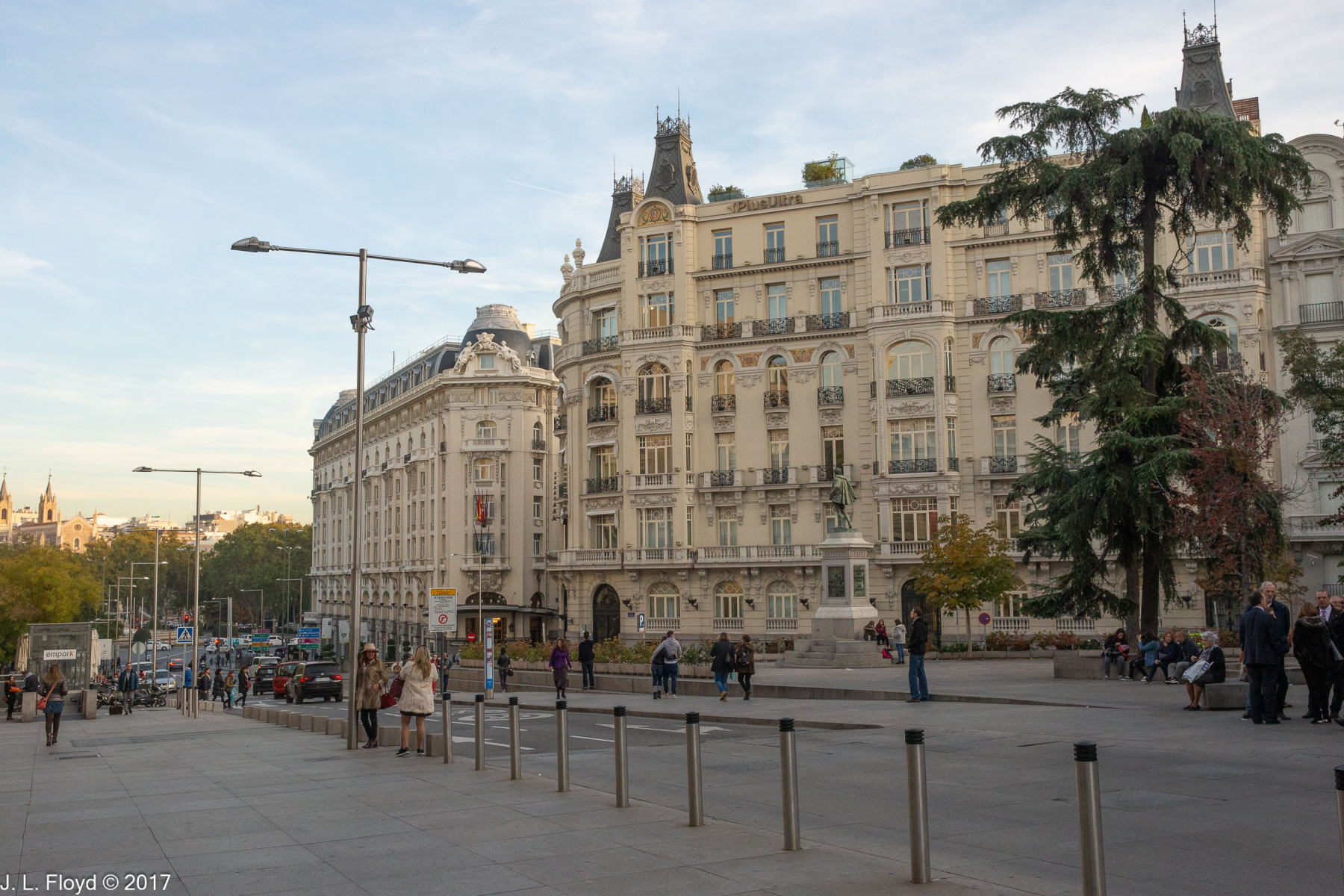
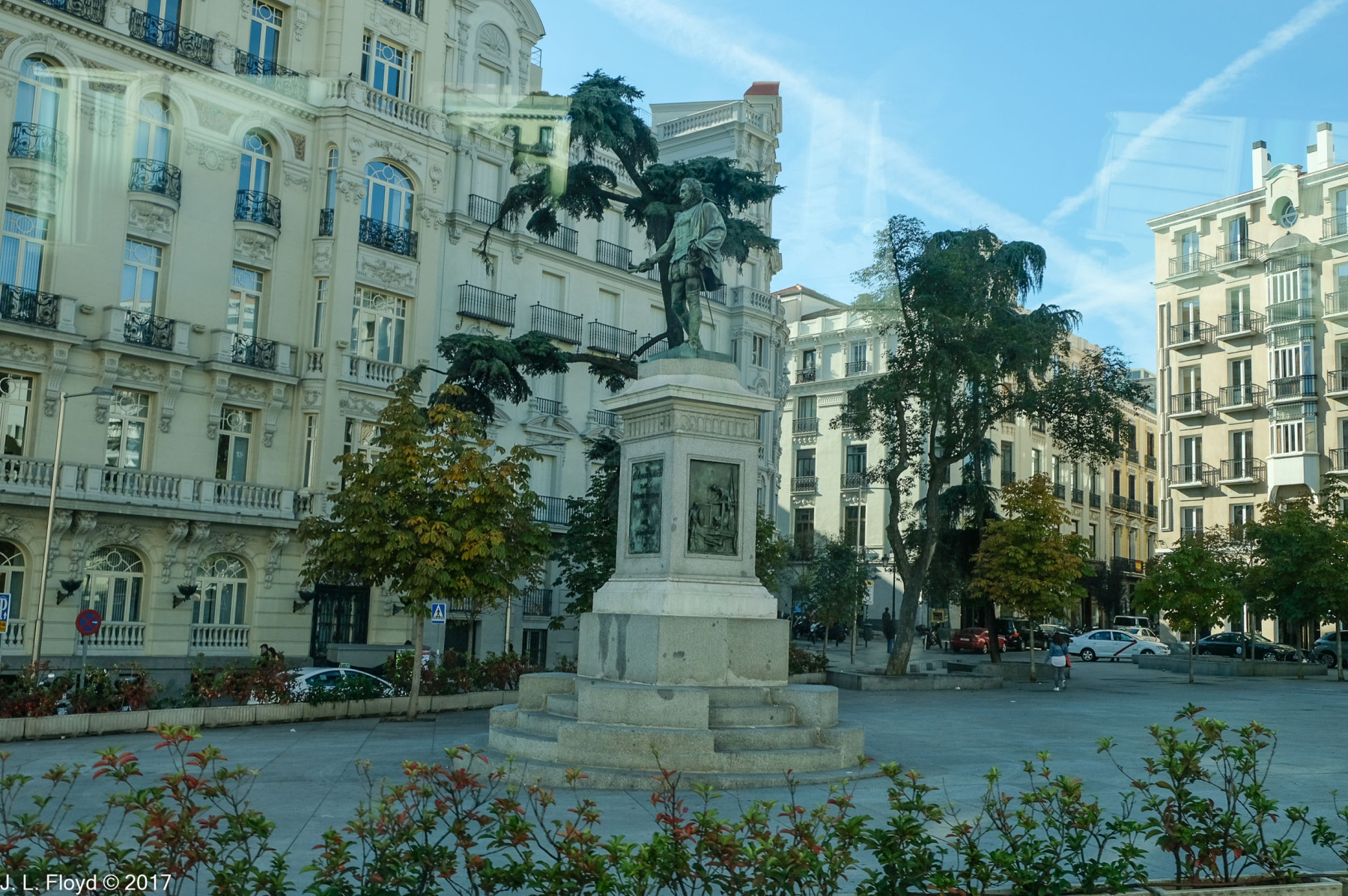
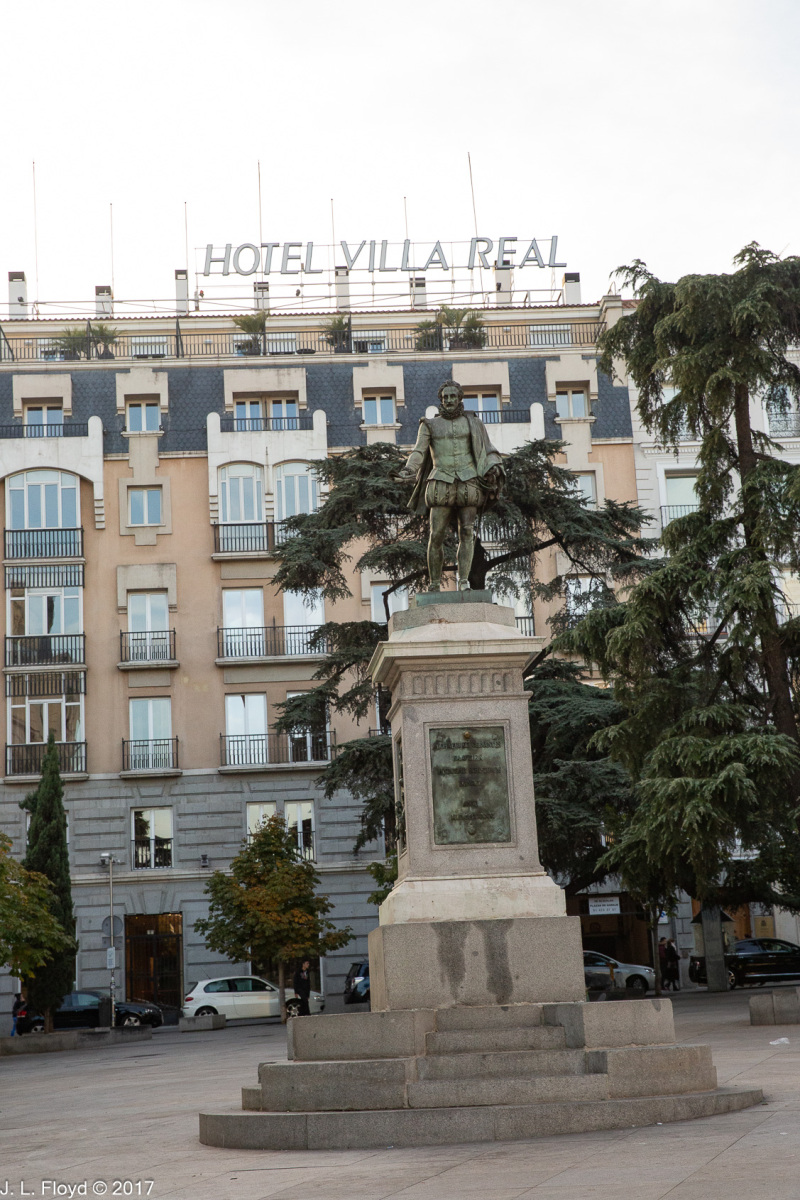
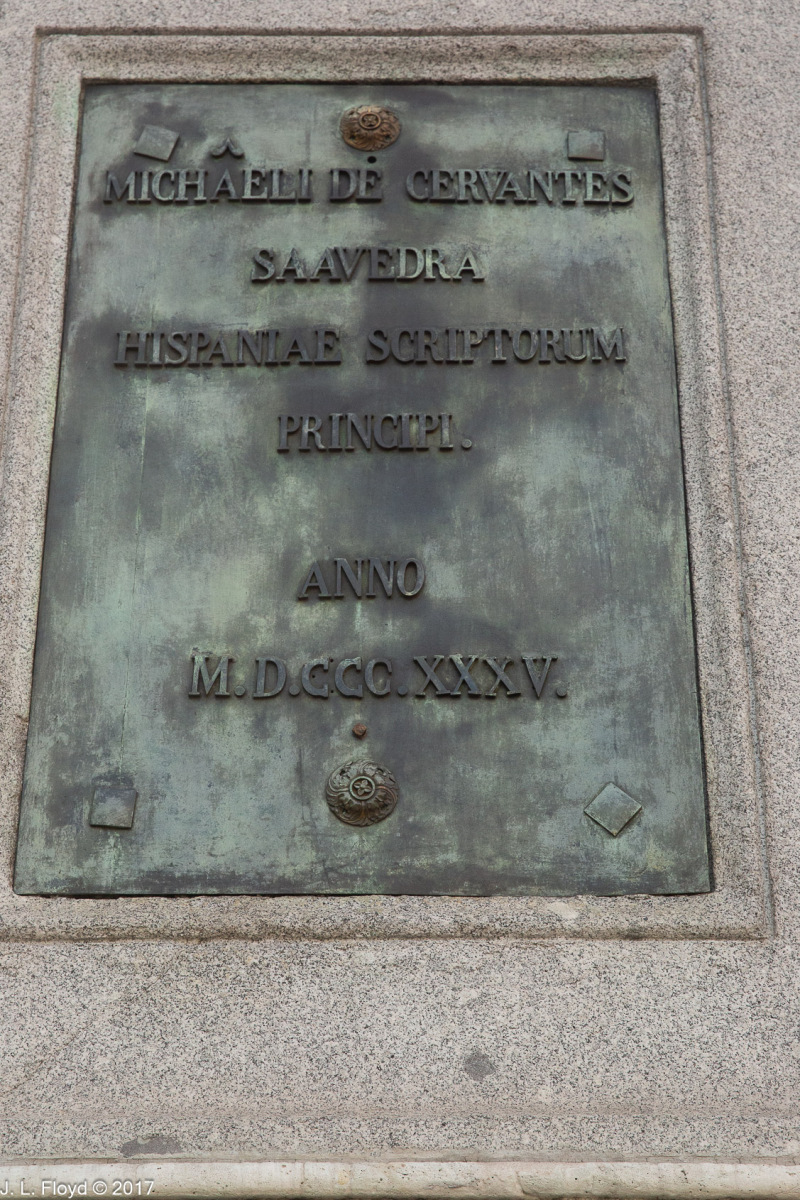
Across the street from the Palacio de las Cortes, in front of the Hotel Villa Real, stands another monument to Cervantes, much smaller than the one in the Plaza de España. This one depicts Cervantes as standing, dressed in Spanish breeches, jacket and ruff, holding papers in his right hand with his left resting on the pommel of his sword. It was erected in 1835.

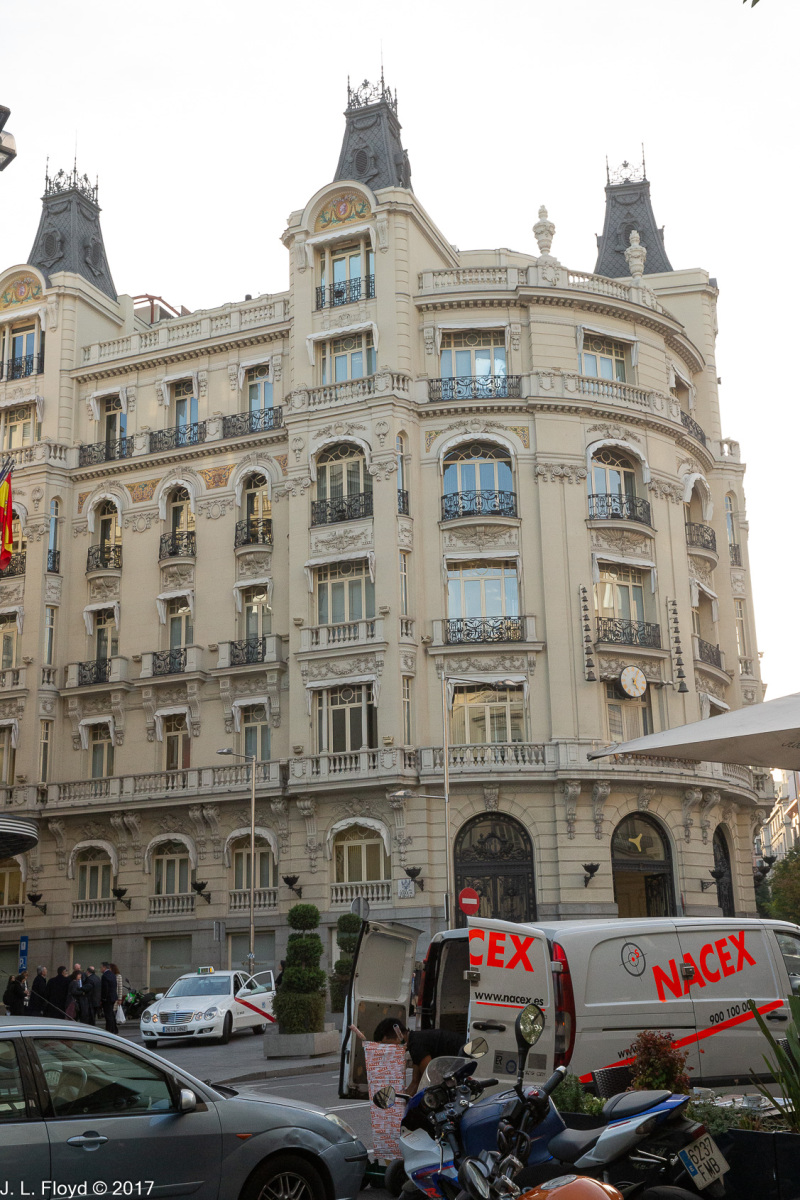
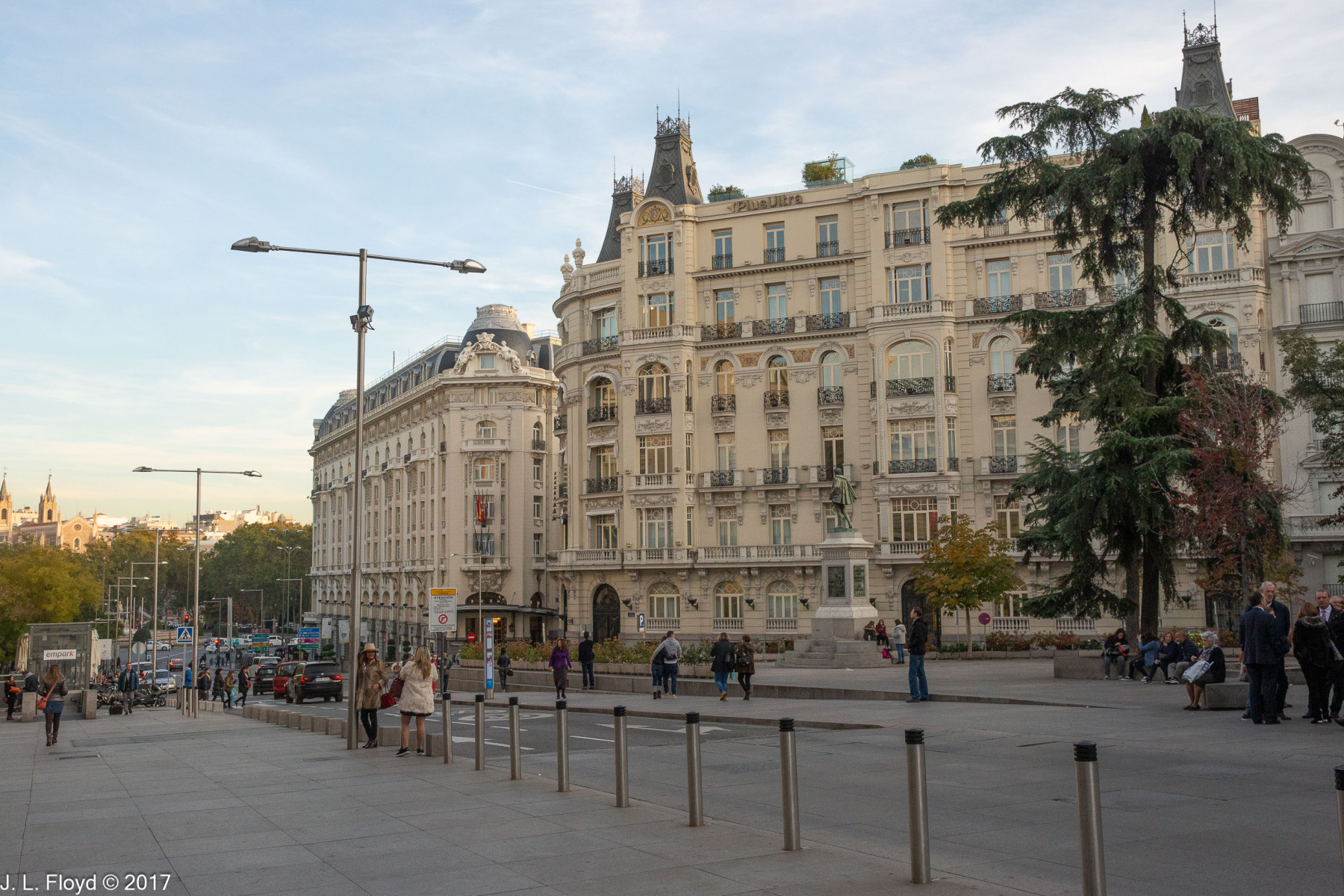
On another corner of the Plaza de las Cortes stands the extraordinary Plus Ultra (formerly Groupama) Building, named for the insurance company that owned it for many years (since 2015 it has been owned by another insurance company, Catalana Occidente). Aside from housing the company’s offices, it hosts a wonderful carillon (automated bell-playing instrument). I was unaware of it at the time I photographed the building and did not get to witness it play, but I later found out – too late to go back and see it – that it plays every day at 12 noon, 3 PM, 6 PM and 8 PM. While playing various classical tunes, it presents a show of five historical figures dressed as in the time of Goya, including King Carlos III and Goya himself.

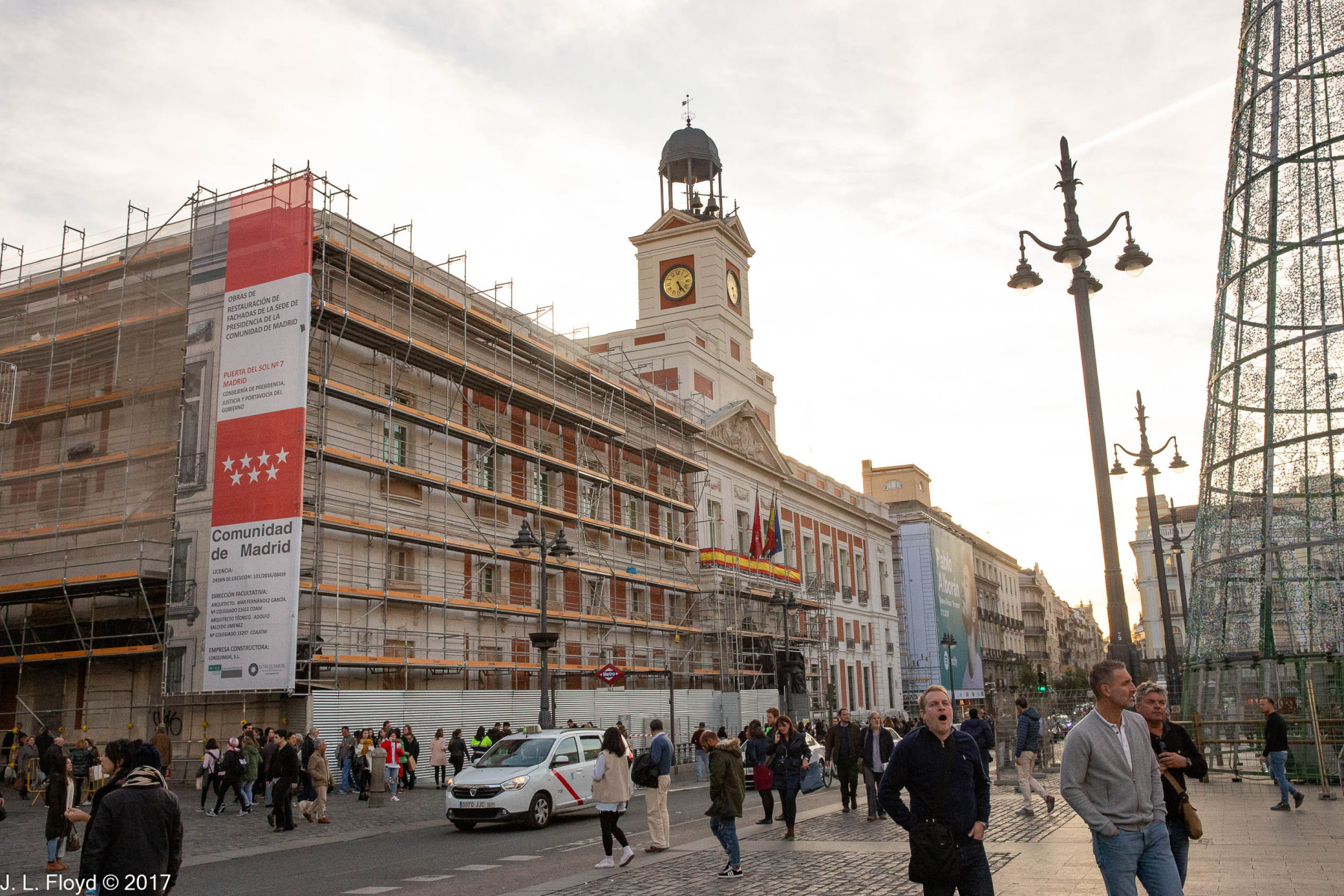
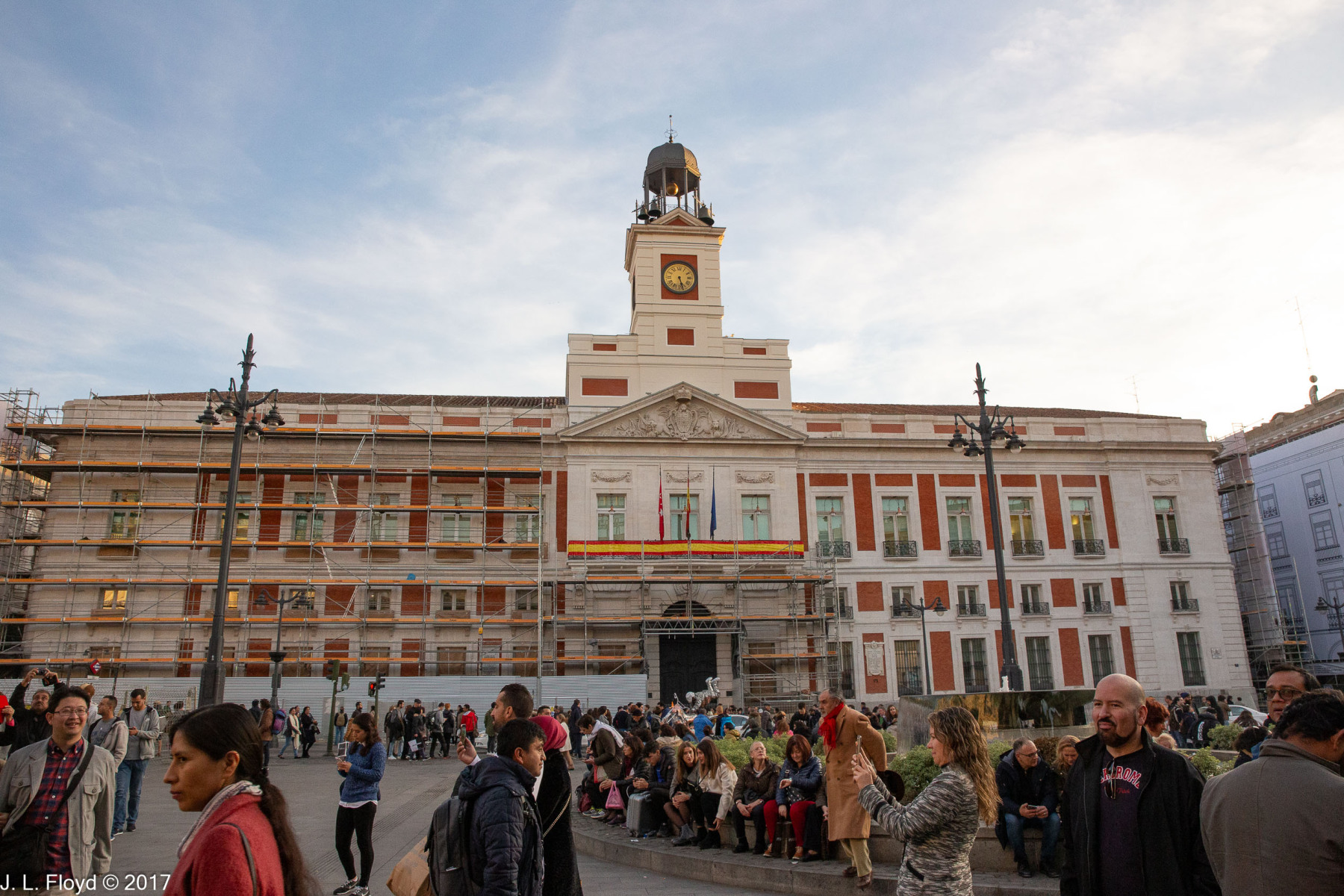
From the Plaza de las Cortes I traipsed along the Carrera de San Jerónimo for a while until I emerged on the Puerta del Sol, Gate of the Sun, a vast square serving as a meeting place and gossip hub for all of Madrid, or so it seemed. It is called a gate (puerta) rather than a square (plaza) because in days of yore it was in fact the location of a gate in the wall of Madrid. The gate faced east and caught the rising sun in the morning, hence the “sol”. It was originally much smaller, but in the 18th century a post office, the Casa de Correos, was built on it, and in the 19th, when the Post Office became the headquarters of the Ministry of the Interior, the square was considerably enlarged by demolishing a number of the houses on it.

Also in the 19th century the Puerta del Sol became a venue for political protests, and up to the 1930s served as a meeting place for left-wing political movements. At the end of the Spanish Civil War, the victorious Franco regime, disdaining the square’s leftist associations, for a while weighed plans for urban renewal that would “disappear” the square and the Post Office, but in the end dropped the idea as too costly. Instead they made the Post Office the headquarters of the Directorate of State Security. Nowadays it is the seat of the Presidency of the Community of Madrid, and is officially known as Government House. And the Puerta del Sol has again become a hotbed of political protest.

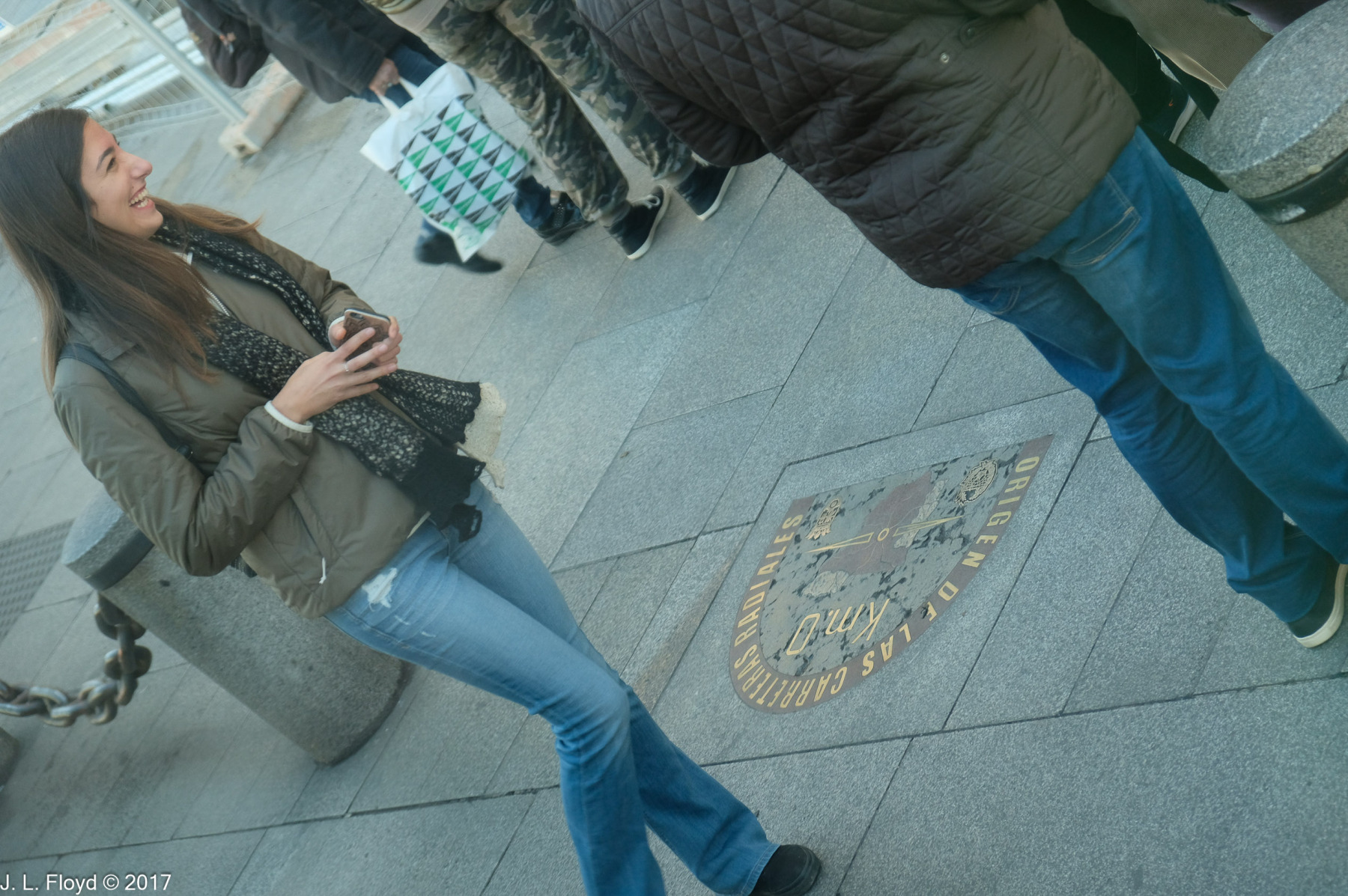
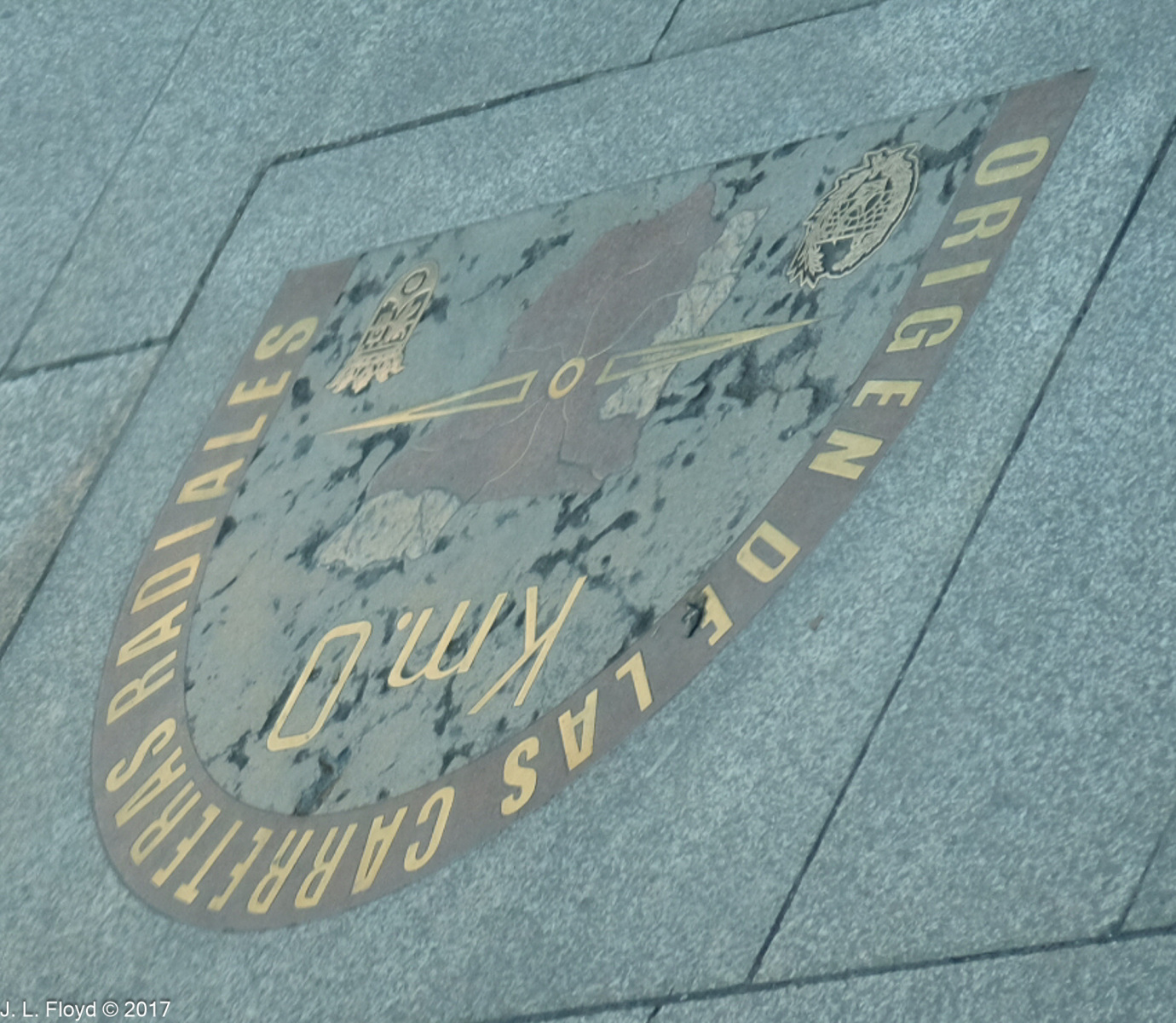
But that is by no means all the Puerta del Sol is noted for. It is also a transportation hub, boasting a huge metro station located underground nearby, with an igloo-shaped entrance on the square. Moreover, it is the location of “Kilometer Zero” for the radial roads of Spain, which run out from Madrid – conveniently located in the middle of Spain – to all parts of the country.

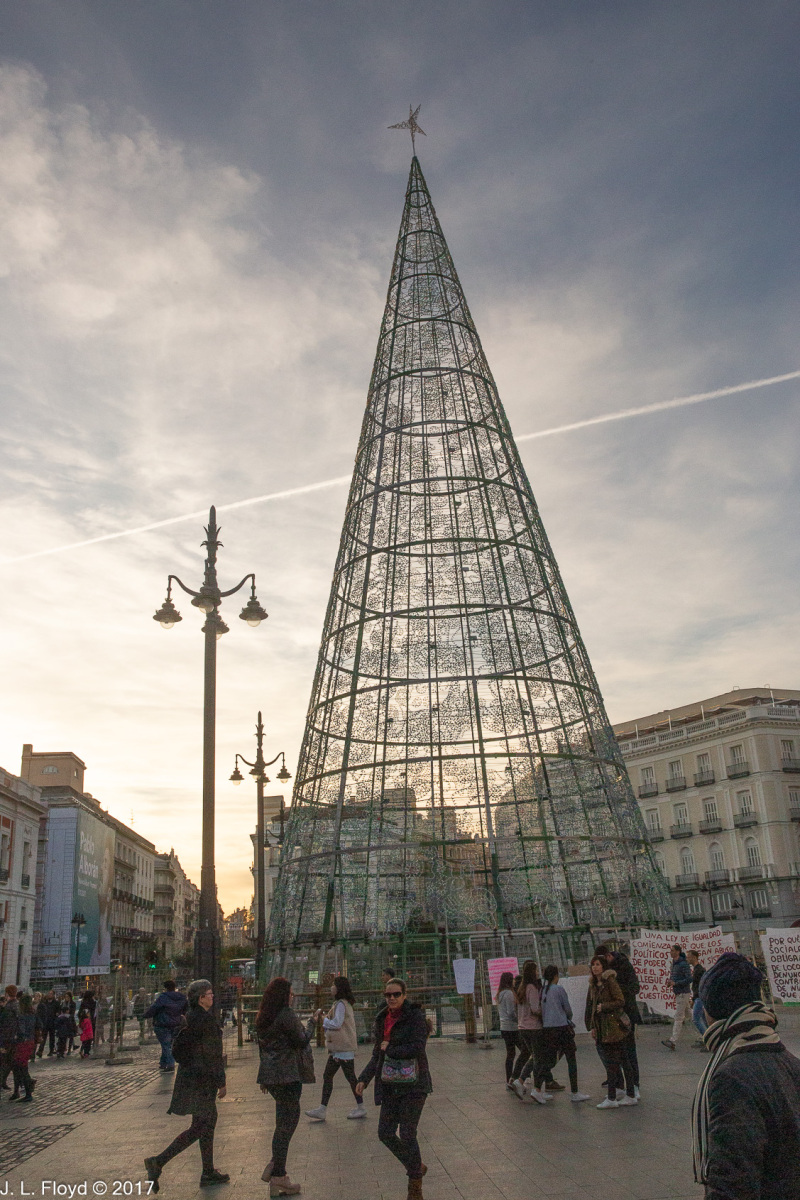
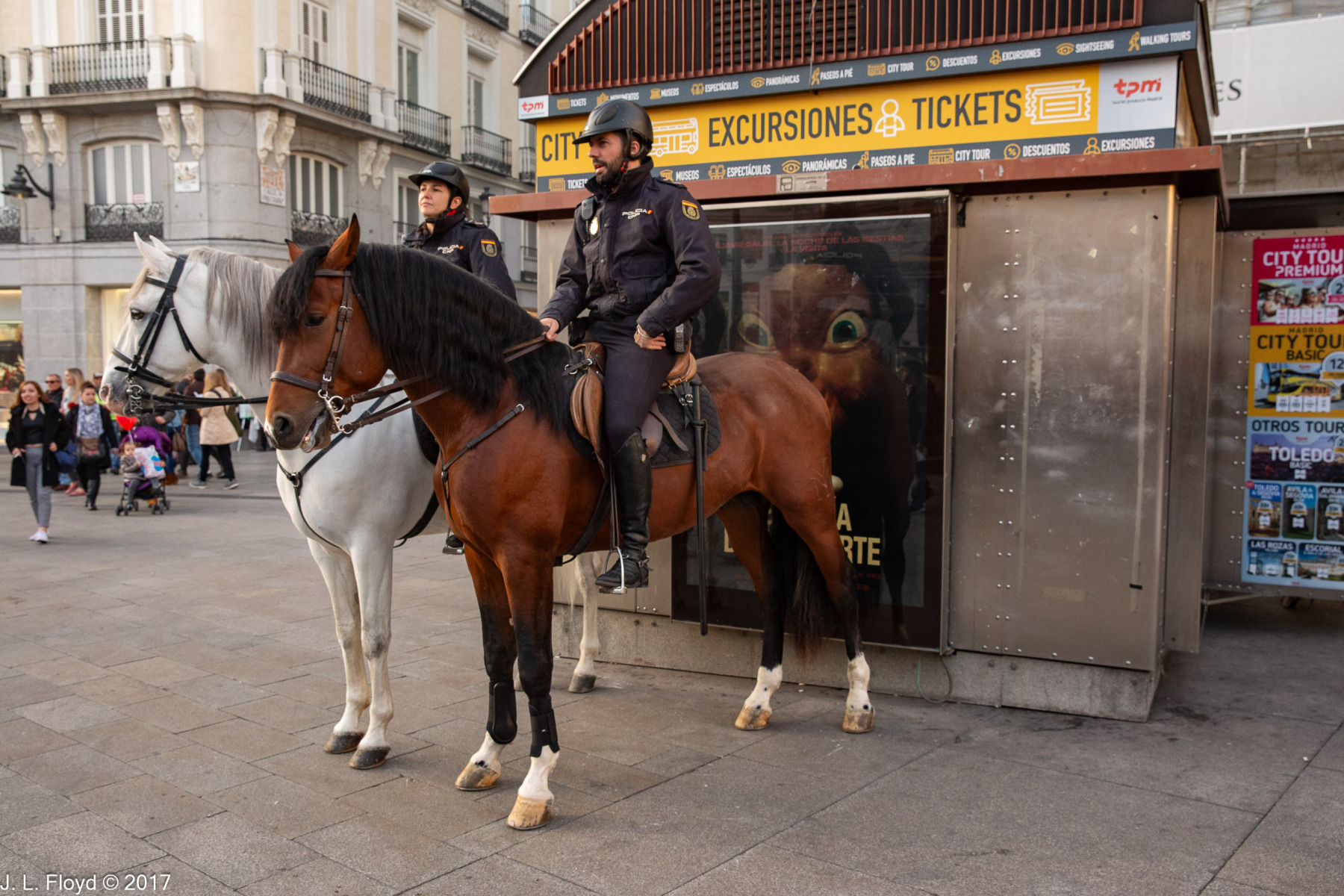
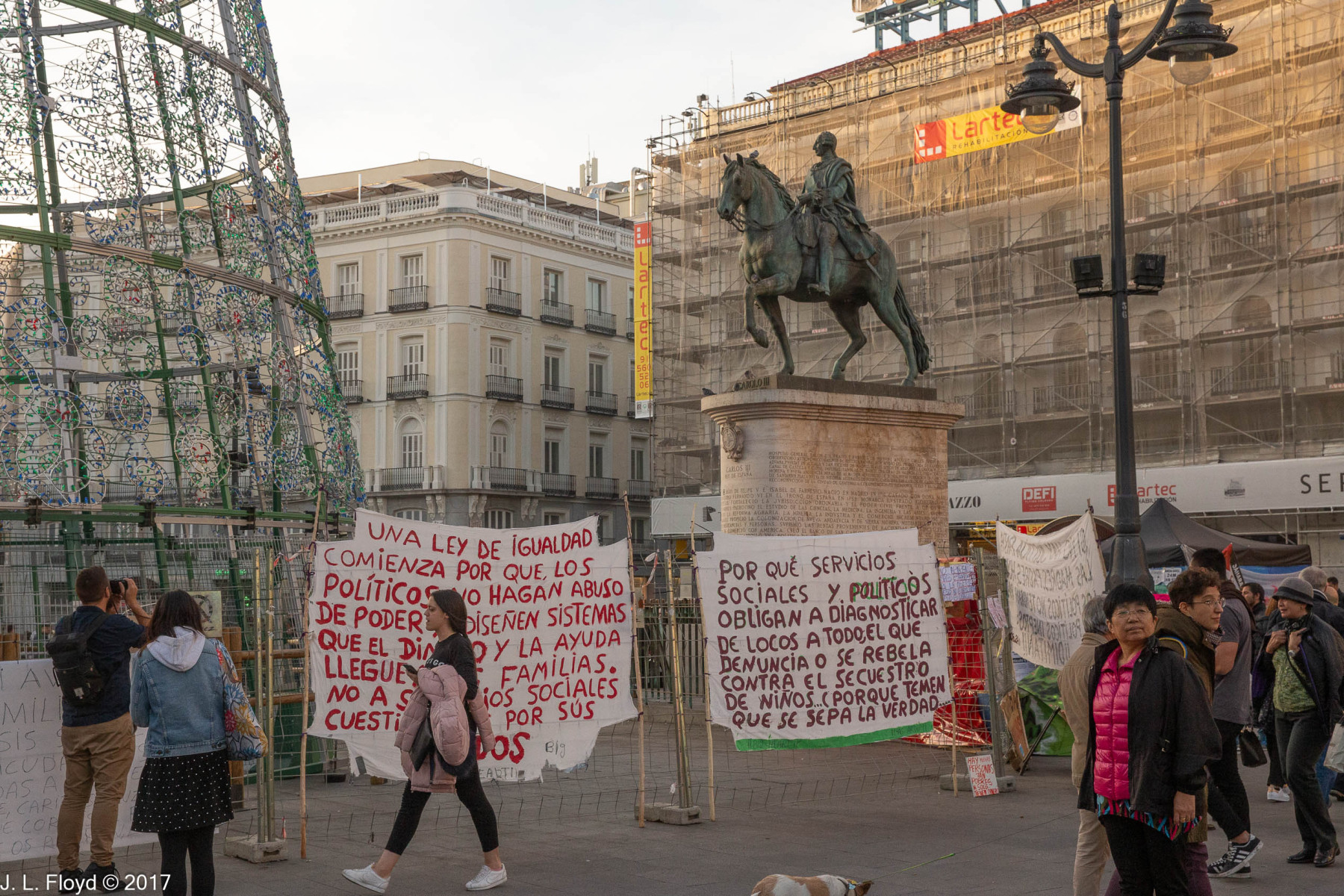
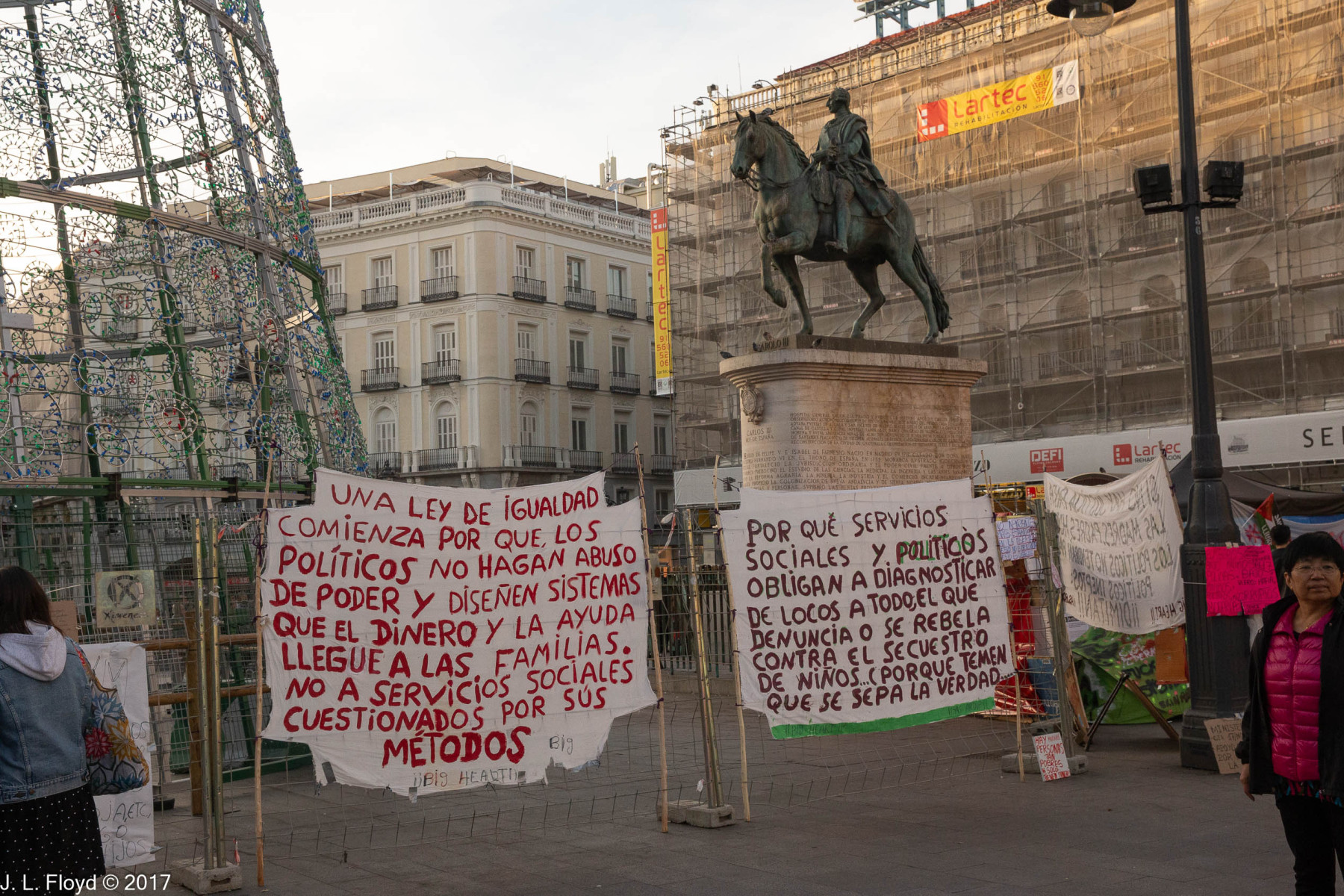
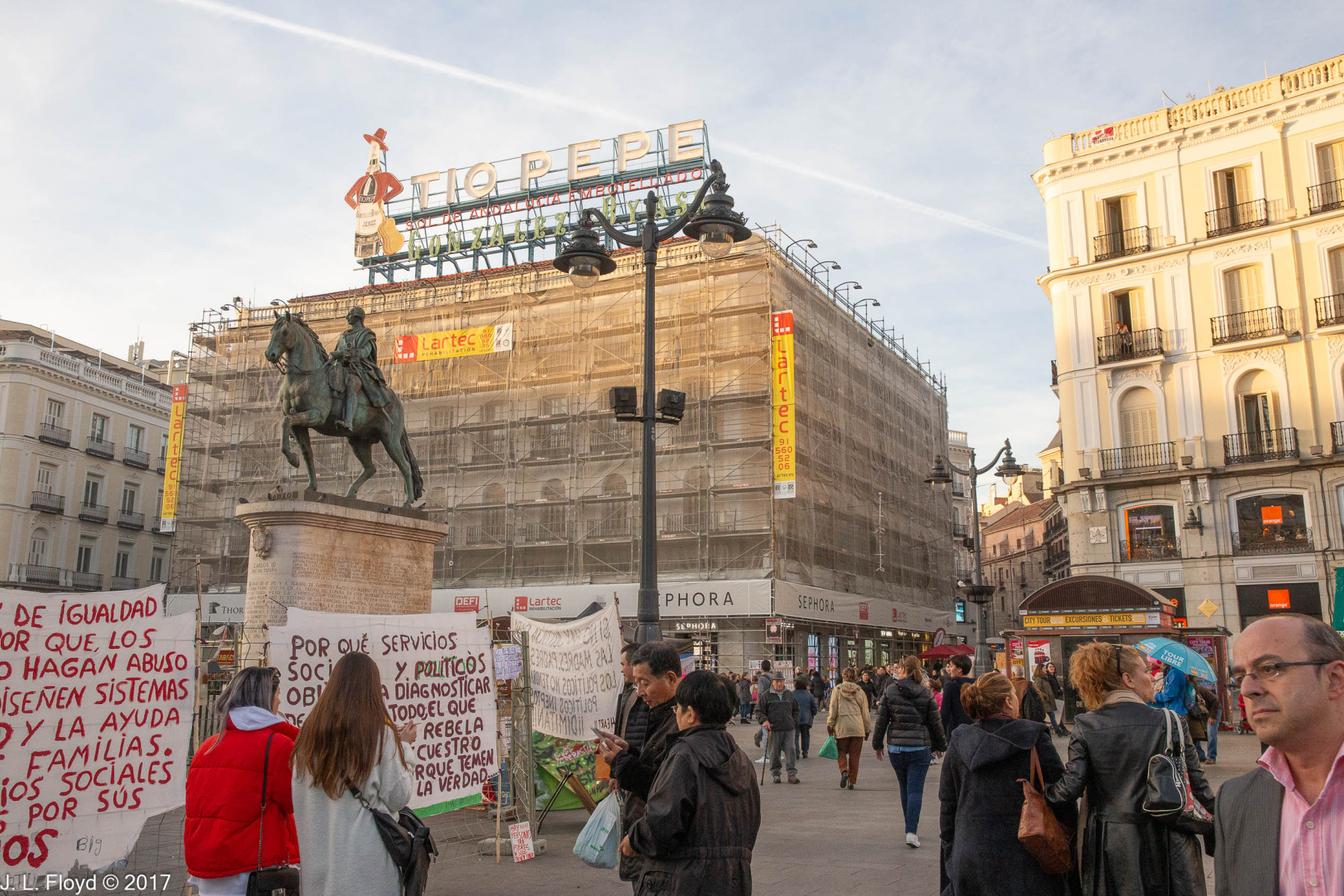
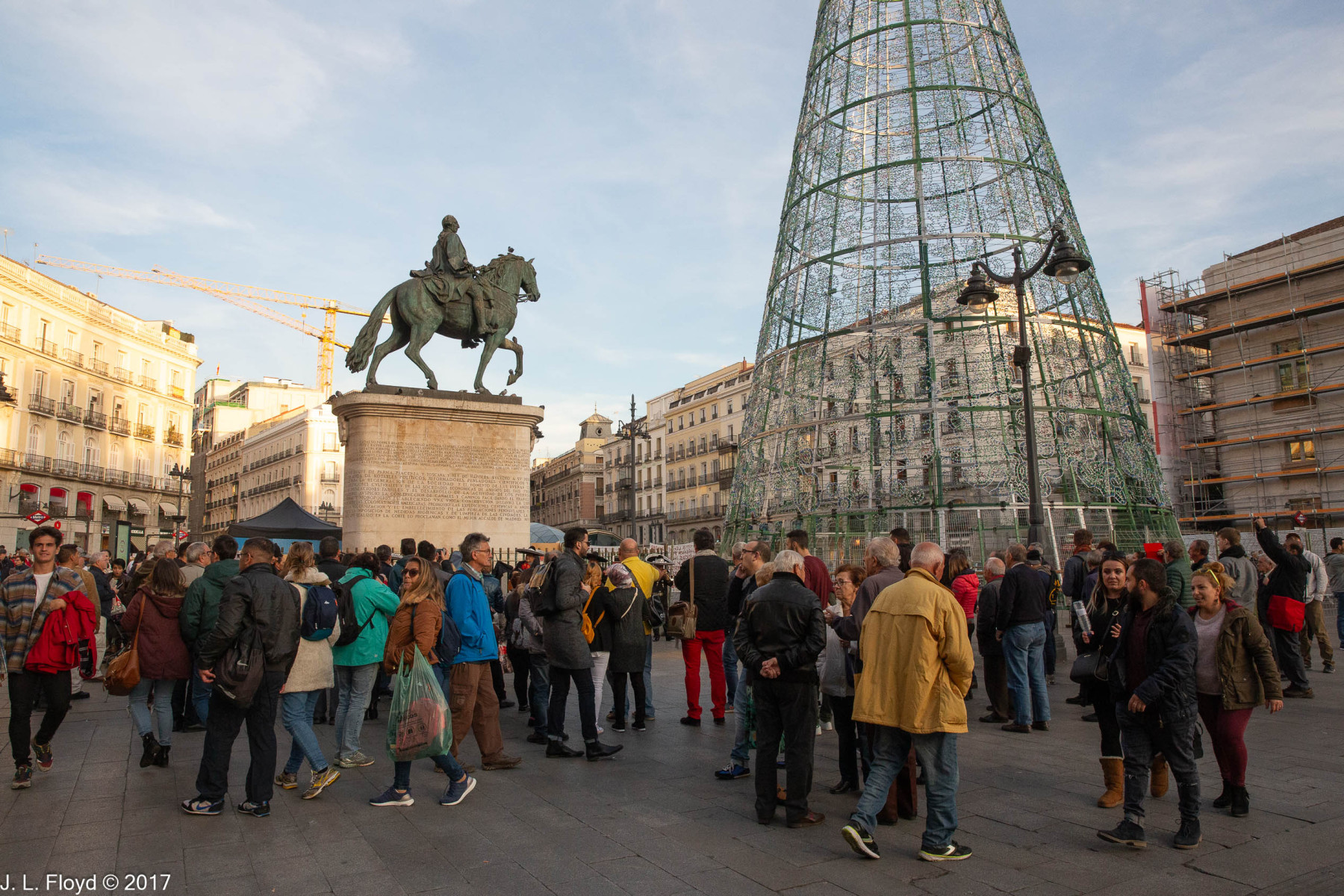
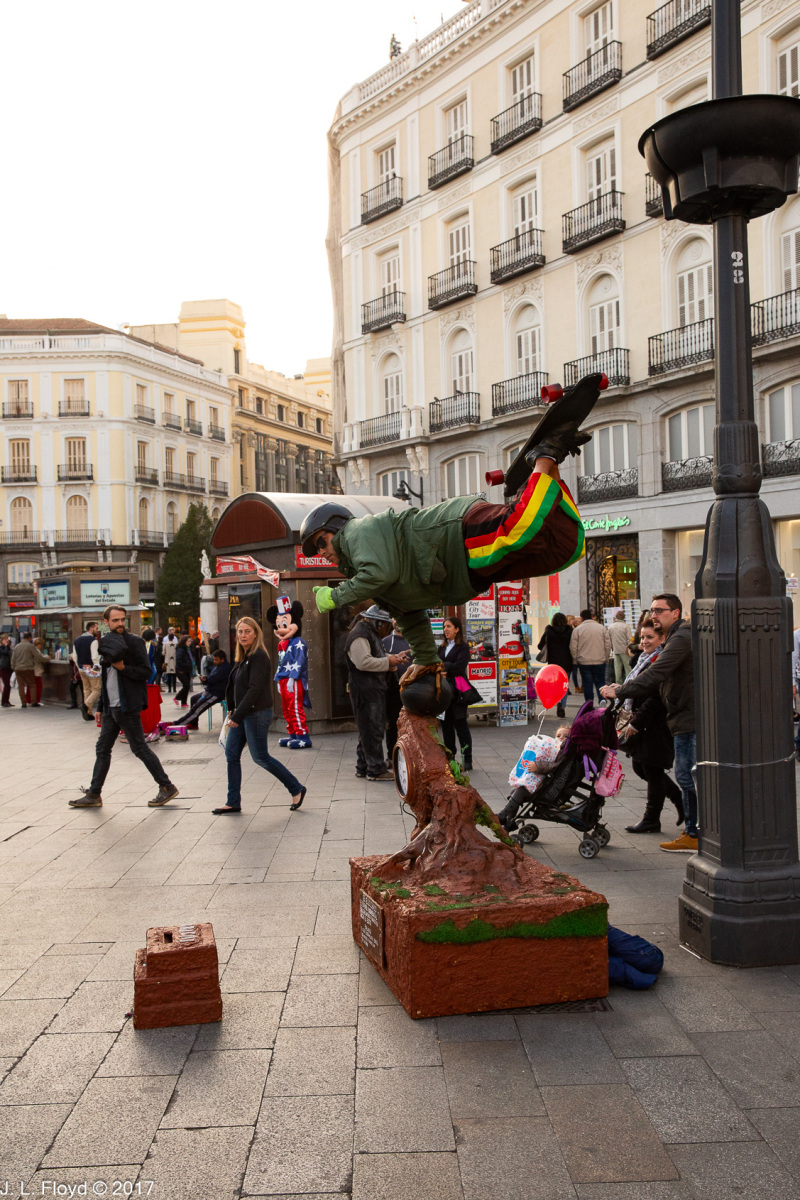
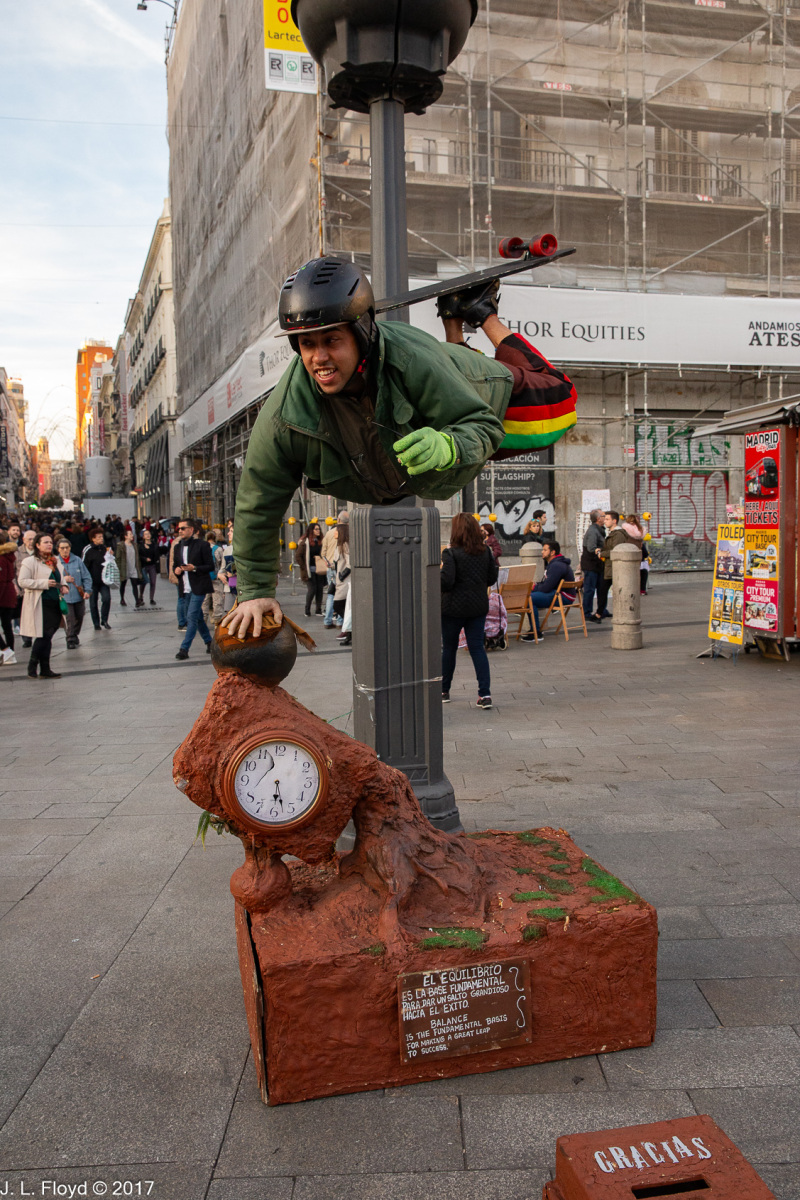
When I visited the Puerta del Sol, in mid-November, there was a giant artificial Christmas tree out in front of the Post Office. It stood close by an equestrian statue of the reforming 18th-century monarch Carlos III, which serves as a focal point for political protests, as the proclamations festooning the square witnessed. In this case the protesters were a very mild-mannered bunch, in fact it was hard to tell them apart from the people just hanging out in the square. The general atmosphere was one of amity. Mounted policemen (one of whom was a policewoman) stood watch, surveying the crowd with benign calm. A youthful acrobat demonstrated his ability to support himself for an incredibly long time on a pedestal with one arm while the rest of his body stretched out horizontally; on the pedestal he had inscribed the words “Balance is the fundamental basis for making a great leap to success”, in both Spanish and English.

In addition to the Post Office, the Puerta del Sol is the location of a number of historic landmarks. Unfortunately I missed the well-beloved statue of the Bear and the Strawberry Tree, which stands on the eastern side of the square. Erected in 1967, it was intended to represent the heraldic arms of the City of Madrid. I did not know that strawberries grew on trees.

I did manage to bag another famous landmark, the Tío Pepe (Uncle Pepe) sign. This is a neon-illuminated advertisement for a well-known brand of sherry that was first erected in 1936 on the Hotel Paris, the most exclusive hotel in Madrid, in another location on the square. Underneath the brand name appear the words “Sol de Andalucía embotellado” (Bottled Sun of Andalucía) and the name of its maker, González Byass. Displayed on the left of the sign is the company logo, a bottle of Tío Pepe sherry dressed up as an Andalusian gentleman, with his typical wide-brimmed hat and short red waistcoat, holding a guitar in his hand. The city council eventually banned commercial advertising signs on the plaza, but made an exception for the Tío Pepe sign because it was a popular favorite of Madrileños. However, in 2006 the Hotel Paris closed, and the new owners ended up dismantling the sign. A huge uproar ensued, with the eventual result that the sign was re-erected on another building opposite the Old Post Office.

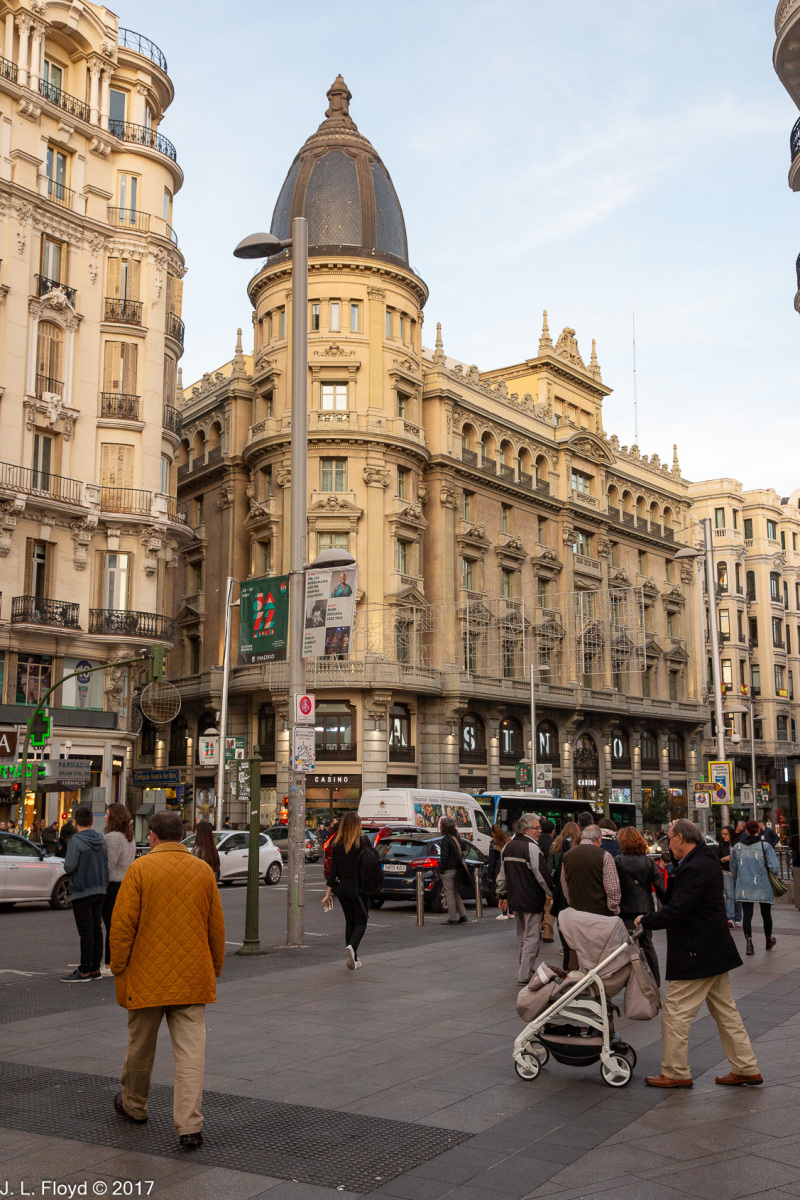
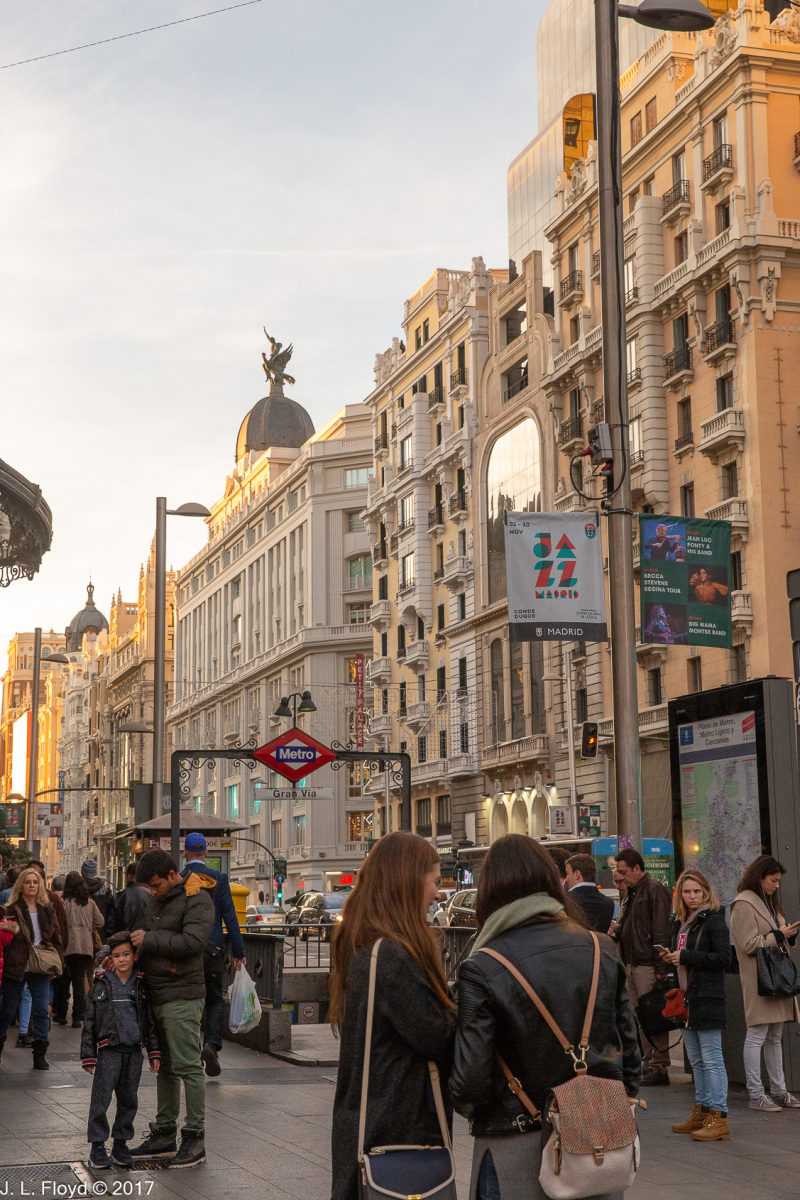
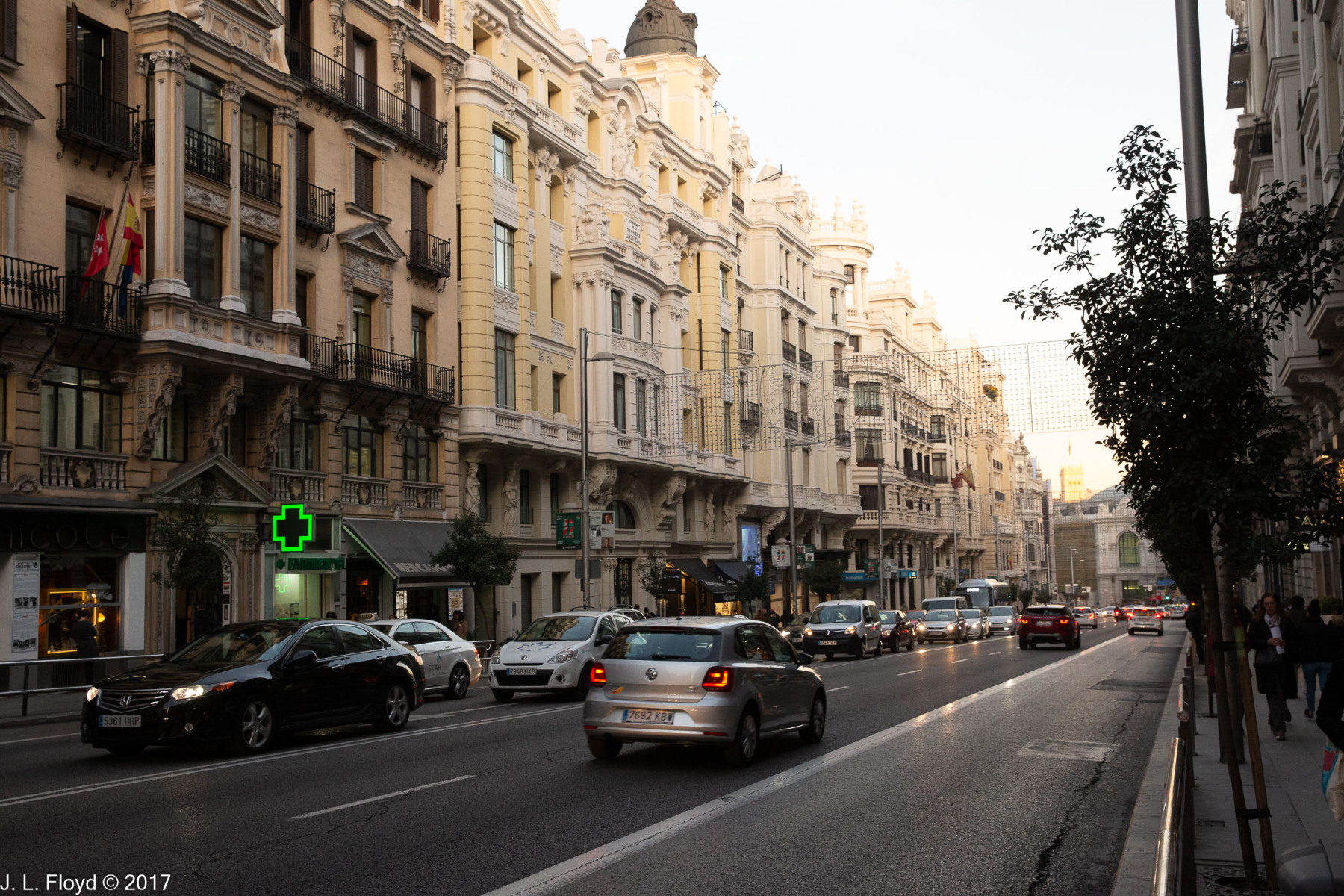
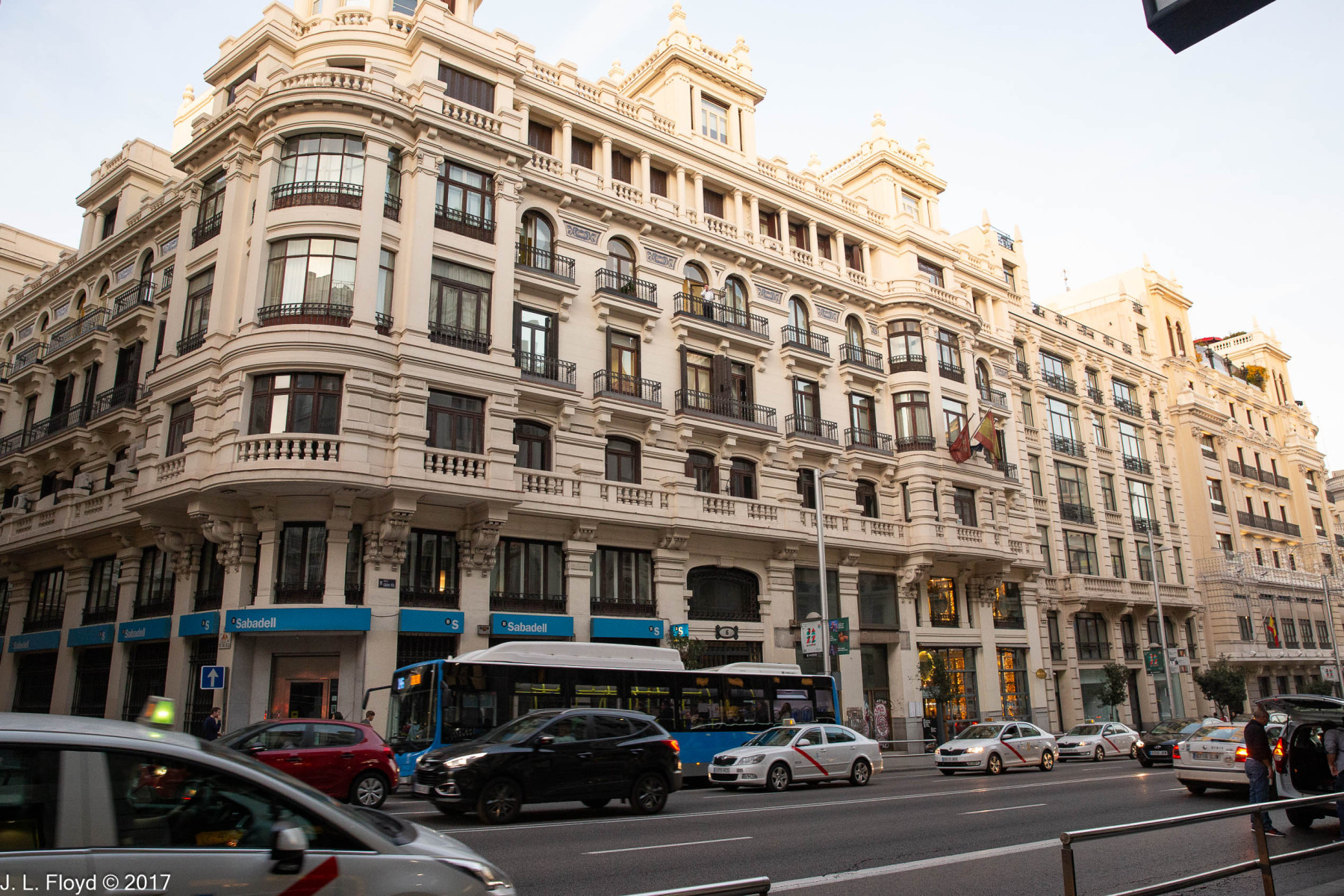
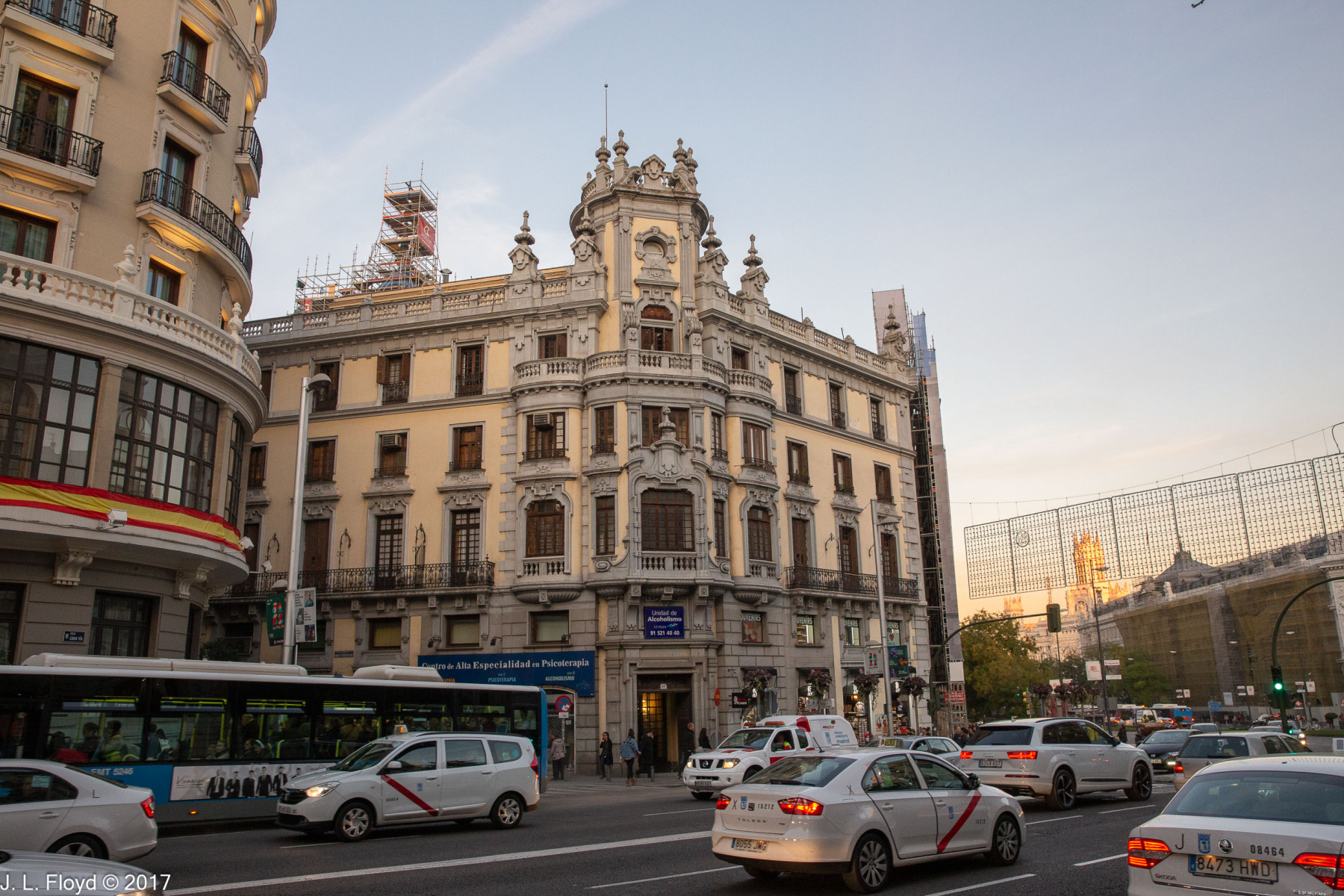
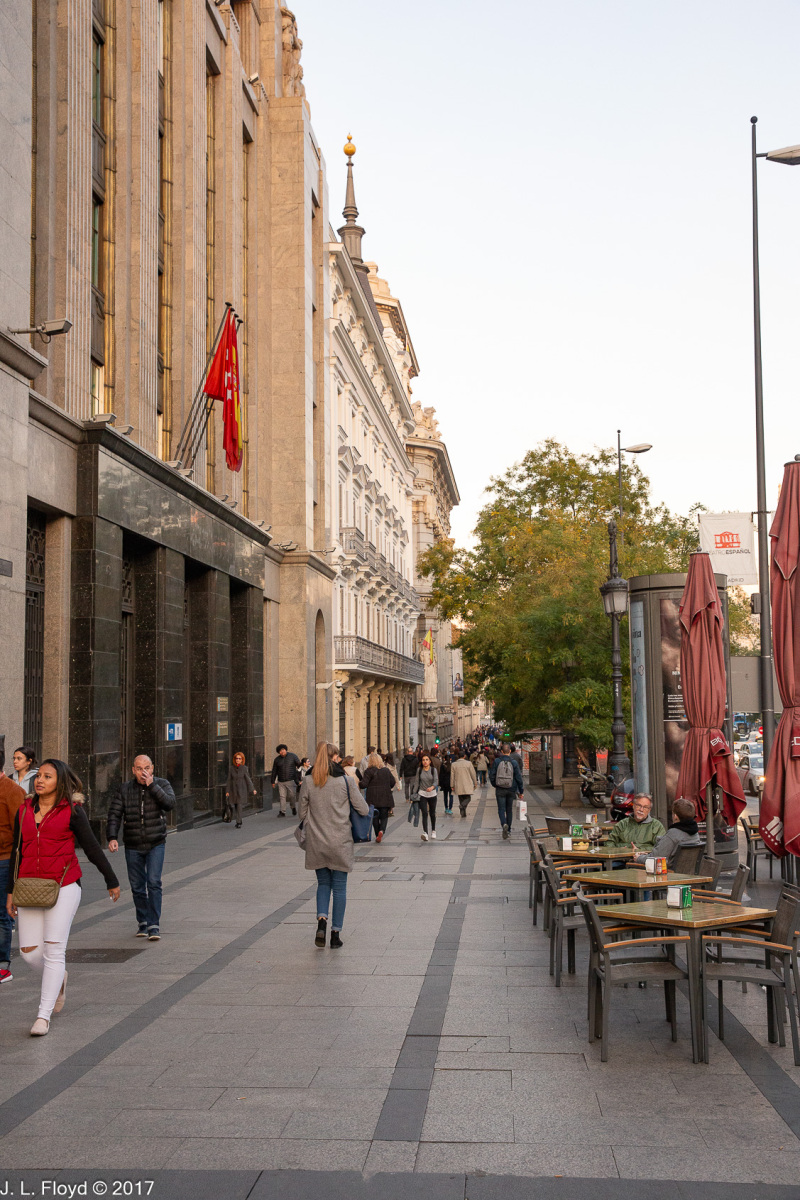
From the Puerta del Sol I headed north, without any clear purpose, but when I came to the Gran Vía, a major shopping and nightlife artery sometimes called the “Spanish Broadway”, I decided that it was time to start the trek back to the hotel before darkness made it too difficult to find my way. I didn’t have a good idea how to get back to the hotel, but I knew it was on Calle O’Donnell, somewhere not terribly far from the Madrid Ayuntamiento (City Hall) on the Plaza de Cibeles, which we had passed on the bus in the morning. So I trudged down the Gran Vía, which leads to the Plaza de Cibeles. On the way I continued to snap pictures of the more interesting, and some of the less interesting, sights that presented themselves.

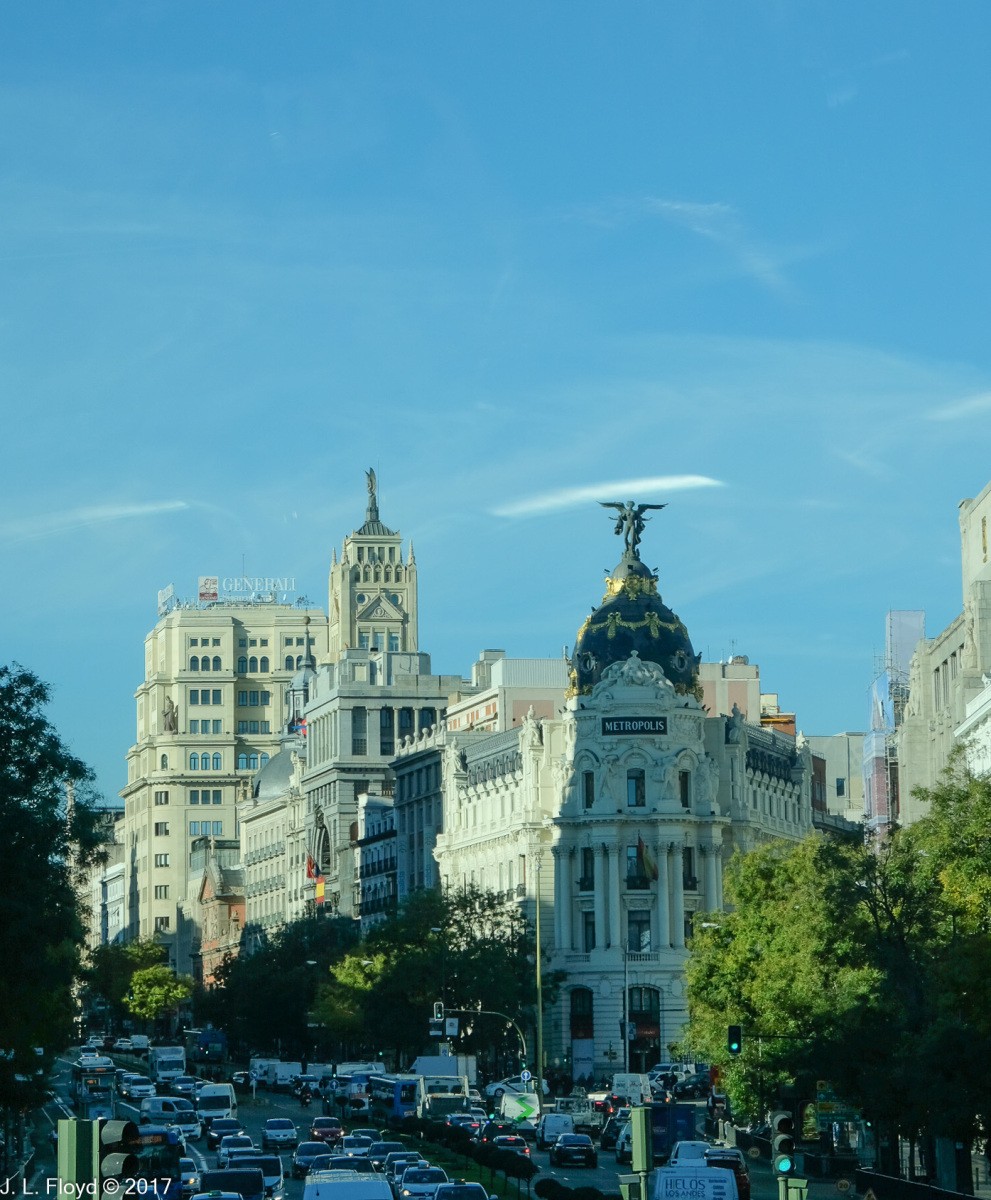
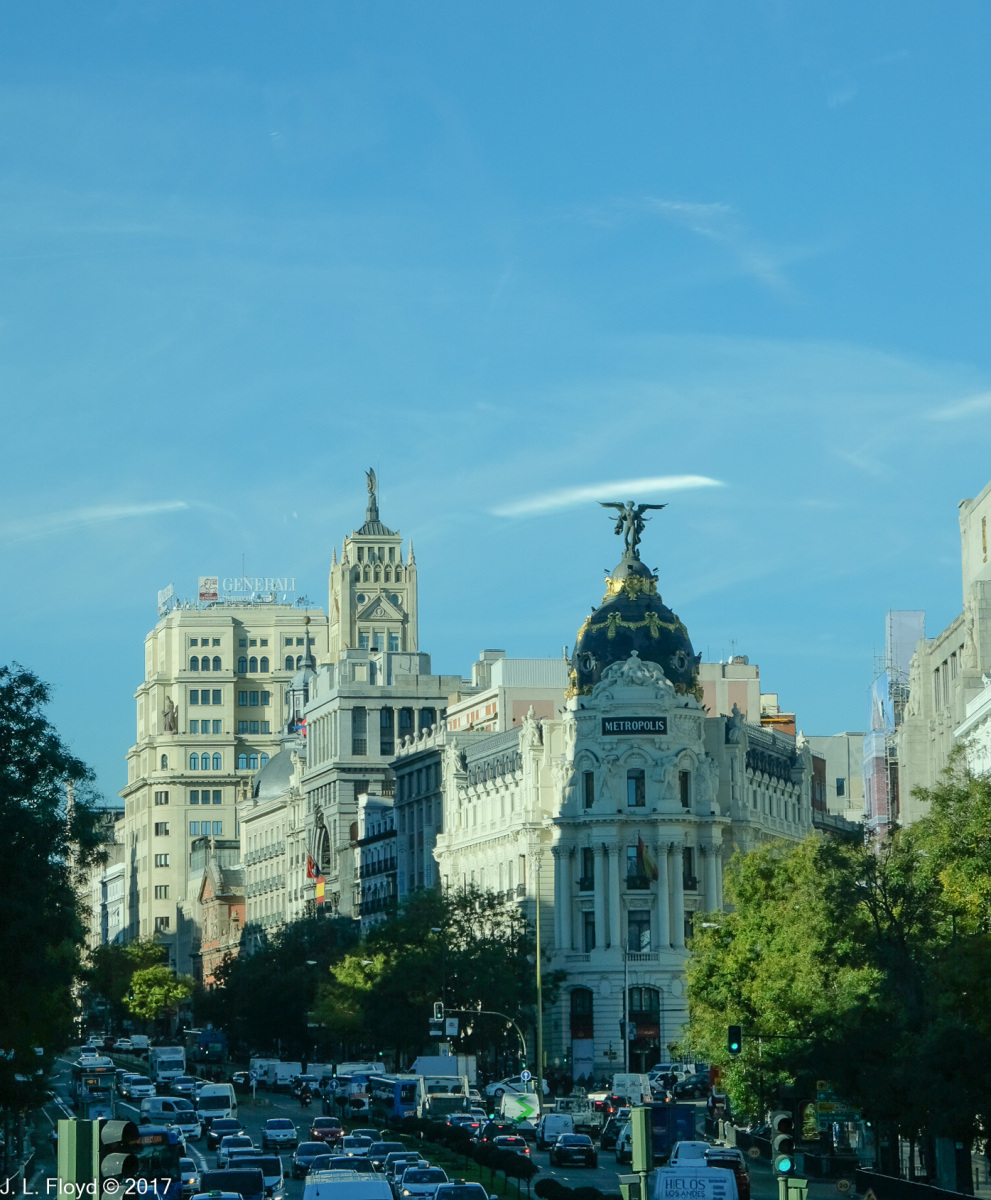
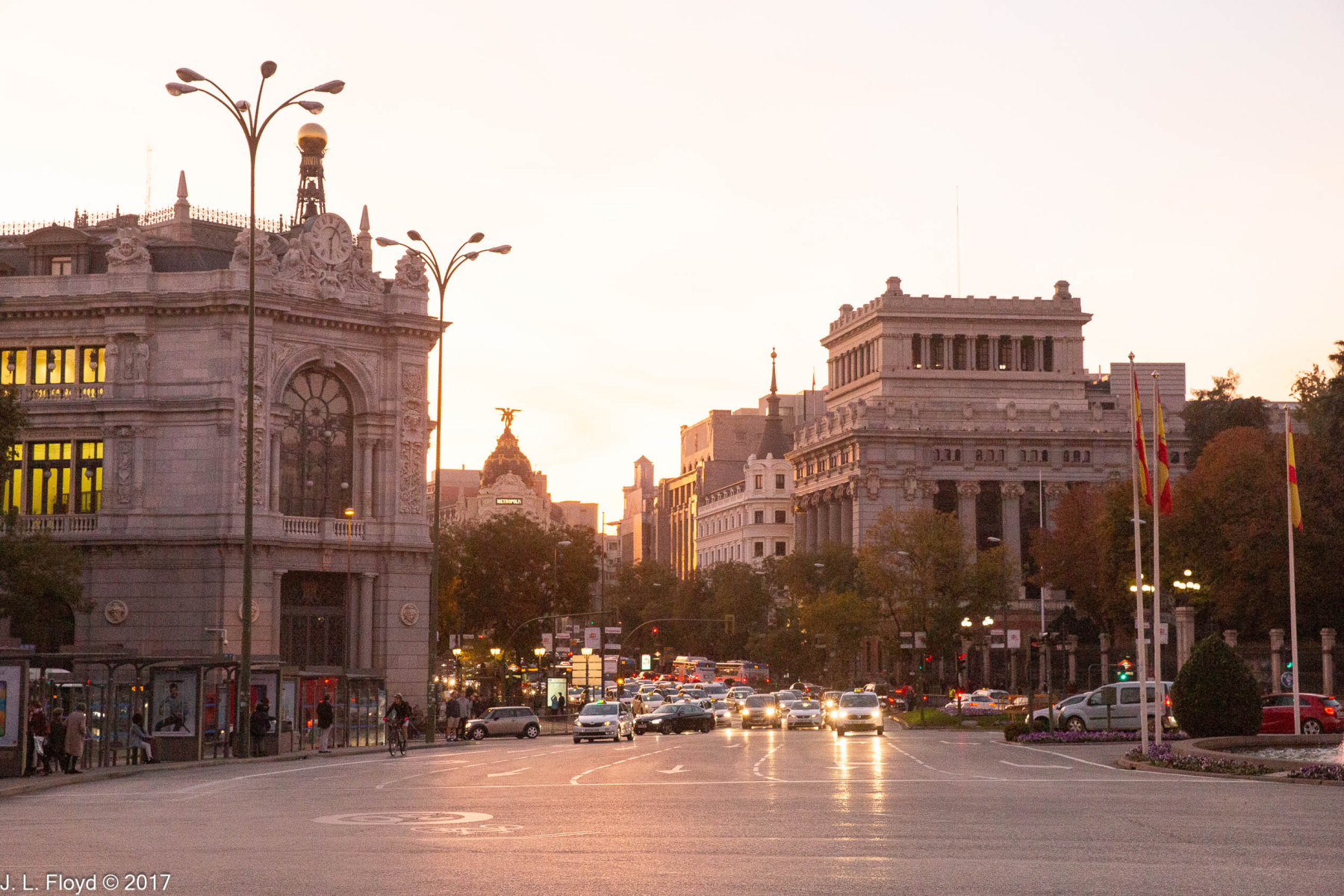
The Gran Vía ends at the Calle de Alcalá, just before the latter reaches the Plaza de Cibeles. This area is architecturally quite interesting, with several impressive structures to note. One is the Edificio Metrópolis, or Metropolis Building, at the corner of the Calle de Alcalá and Gran Vía. No, Superman does not hang out there. This is another building built by one insurance company and currently owned by another. A French architect, Jules Février, designed it for the La Unión y el Fénix company, in the Beaux-Arts style, and it was completed in 1911. On top of the building there was a statue depicting the mythological bird Phoenix, apparently in the process of abducting the youth Ganymede to serve as the cupbearer (and lover) of Zeus on Olympus. In 1972 Metrópolis Seguros acquired the building, and the previous owners removed the statue to take with them to their new premises. This caused a good deal of angst, but fortunately the new owners undertook to restore the building, which had greatly deteriorated, to its pristine condition, which included installing a replica of the original statue.

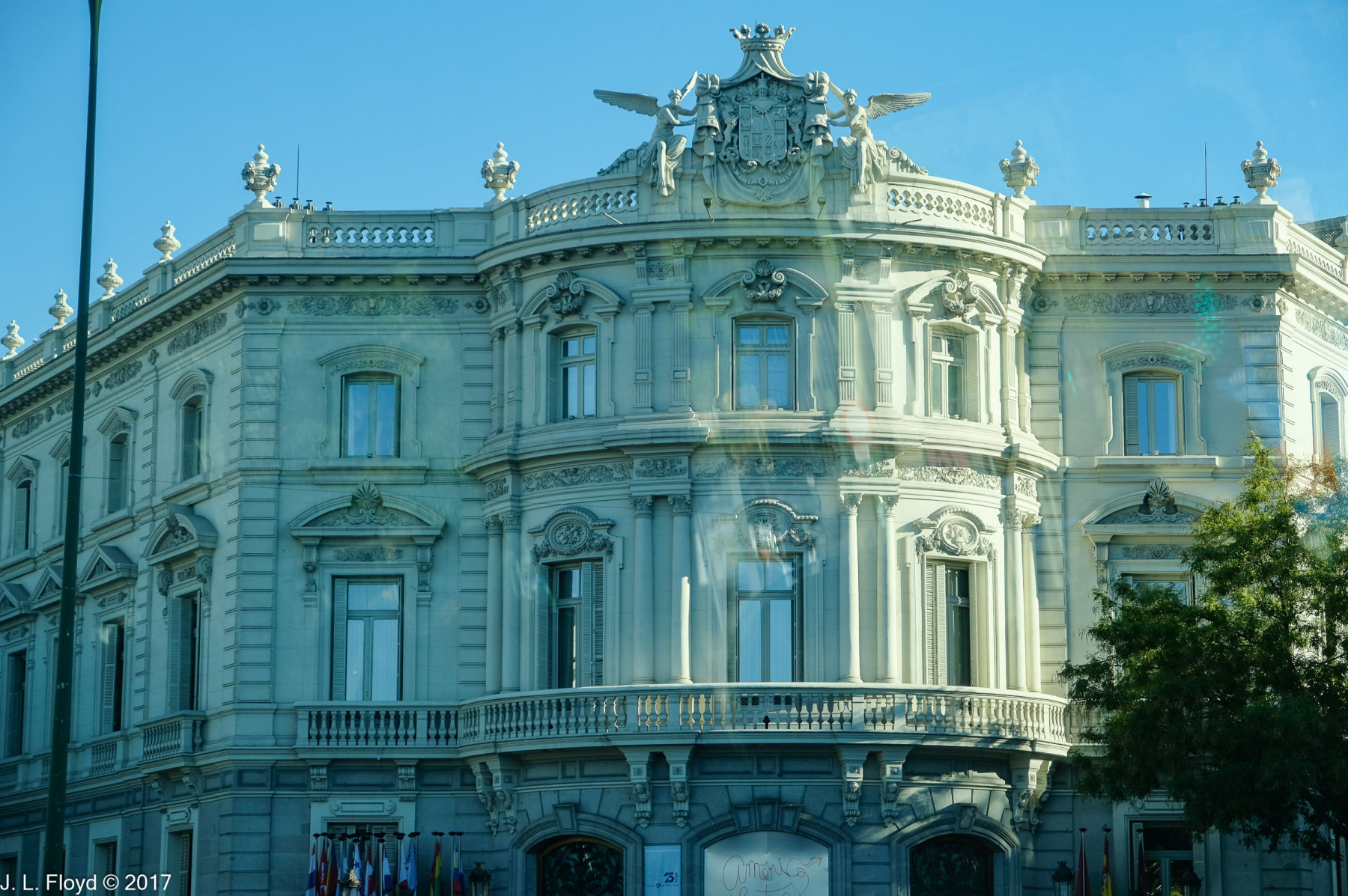
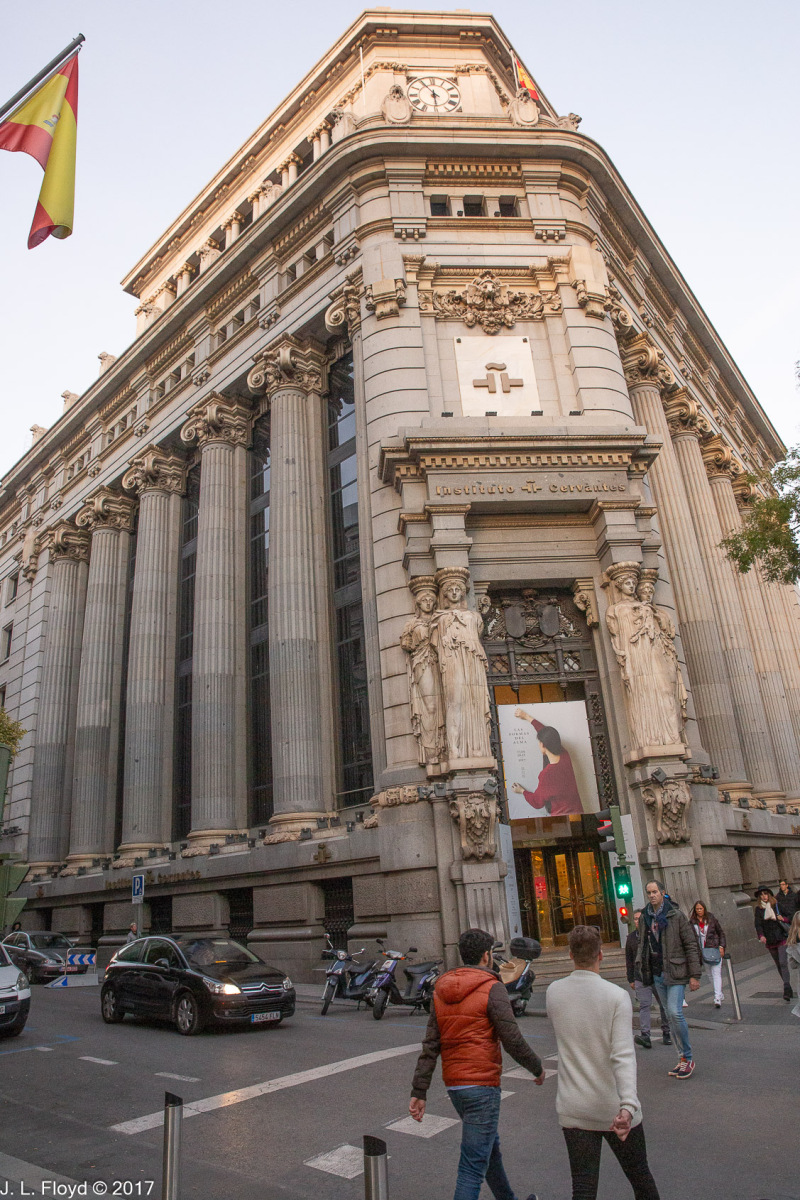
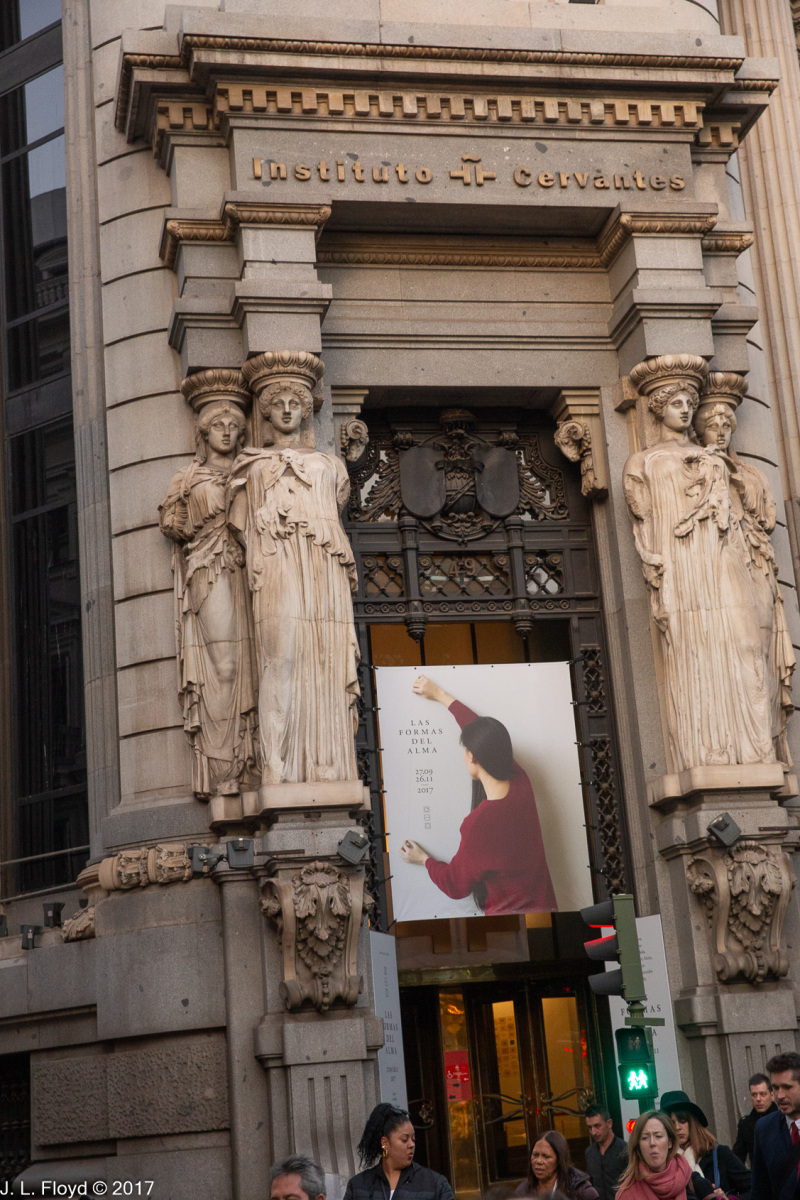
Also noteworthy is the Edificio de las Cariátides, or Caryatid Building, at 49 Calle Alcalá, so called because of the two imposing classical caryatids – columns in the form of women – flanking the main entrance. It is also notable because it is the headquarters of the Instituto de Cervantes (Cervantes Institute), a Spanish public organization under the Ministry of Foreign Affairs, devoted to the promotion and teaching of the Spanish language and the dissemination of Spanish culture. Originally it was a bank building, built in 1918 to be the headquarters of the Spanish-Argentine Banco Espanol del Rio de la Plata. Since then it has changed hands many times, finally becoming headquarters of the Cervantes Institute in 2006. The architectural style is eclectic, but basically Greek neoclassical.

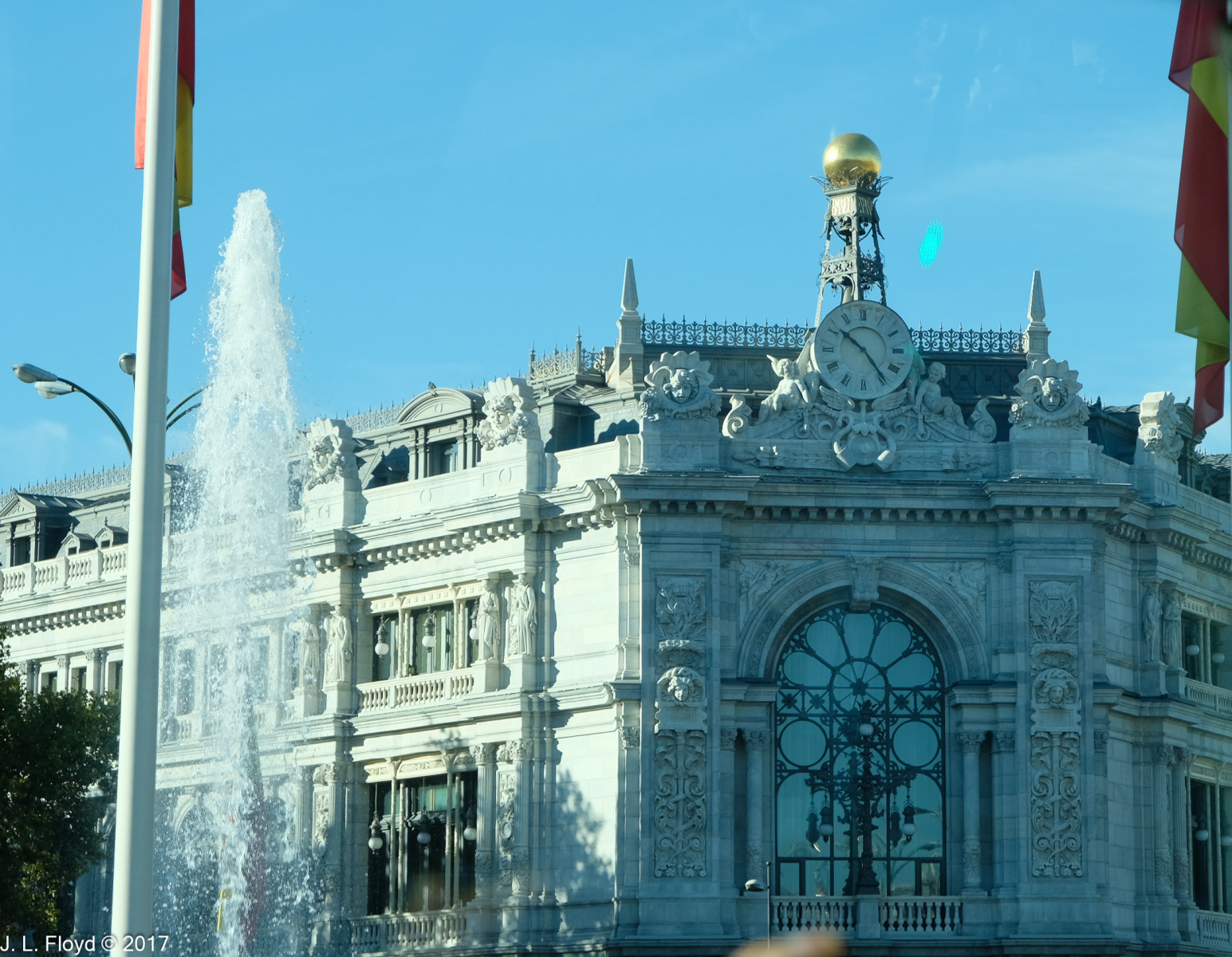
In the same area, where the Calle de Alcalá meets the Paseo del Prado, is the Bank of Spain (Banco de España) building, completed in 1891. Since then it has undergone several expansions, most recently in 2006. It is remarkable for its monumental Carrara staircase and stained-glass windows.

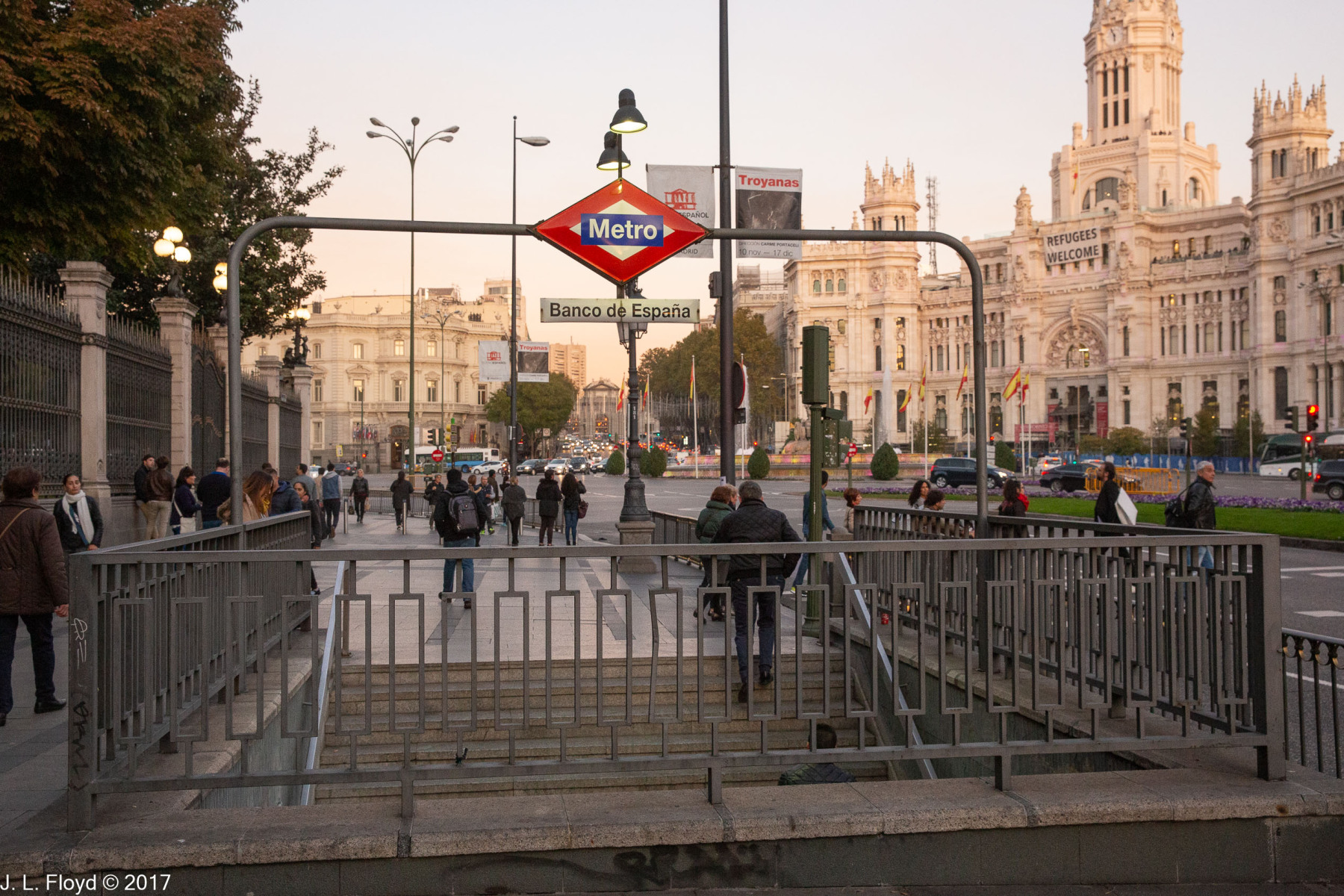
Shown in one of the photos in the gallery below is the entrance to the Bank of Spain Metro Station, which is found on the sidewalk by the Cervantes Institute. I did not take the subway, preferring to do my sightseeing above ground, but I was interested to find out that the Madrid Metro System, with a total length of 296.6 kilometres (184.3 mi), is the sixth longest in the world outside of China, and the third longest in Europe, behind Moscow and London. It was first opened in 1919, expanded many times thereafter, and by 2024 was carrying over 700 million riders per year.

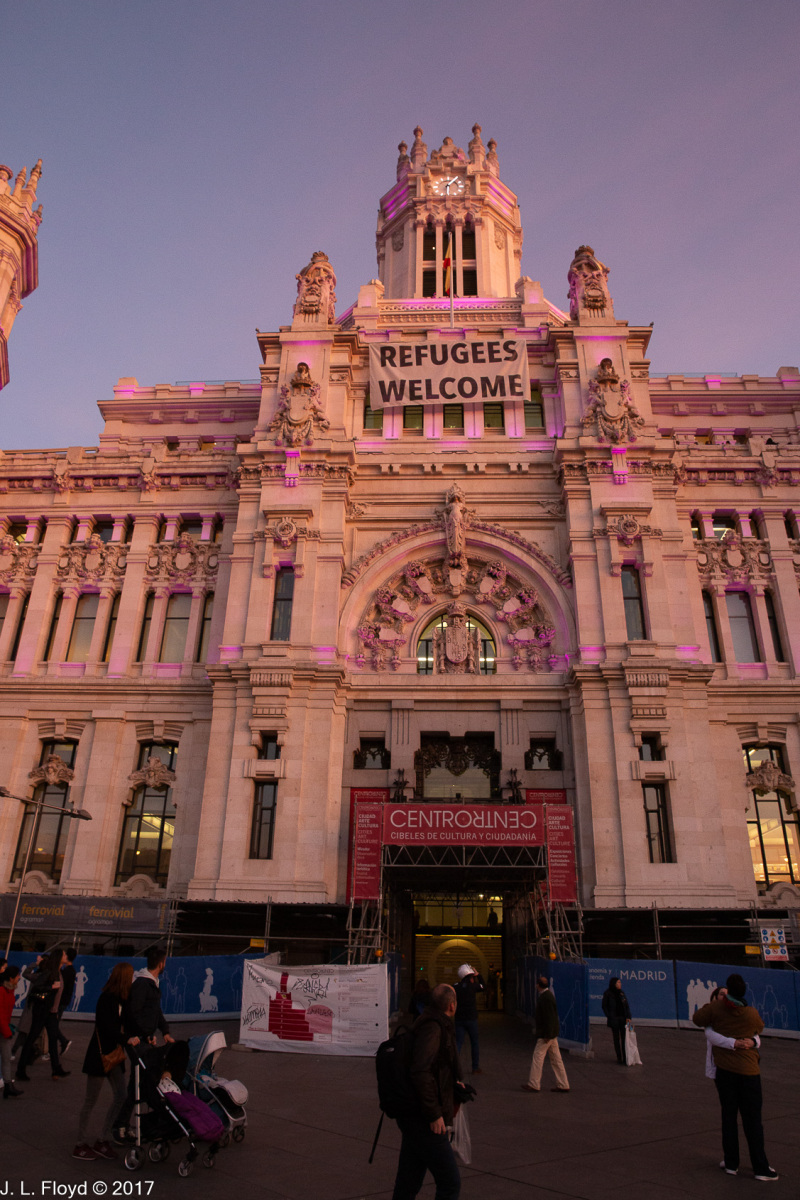
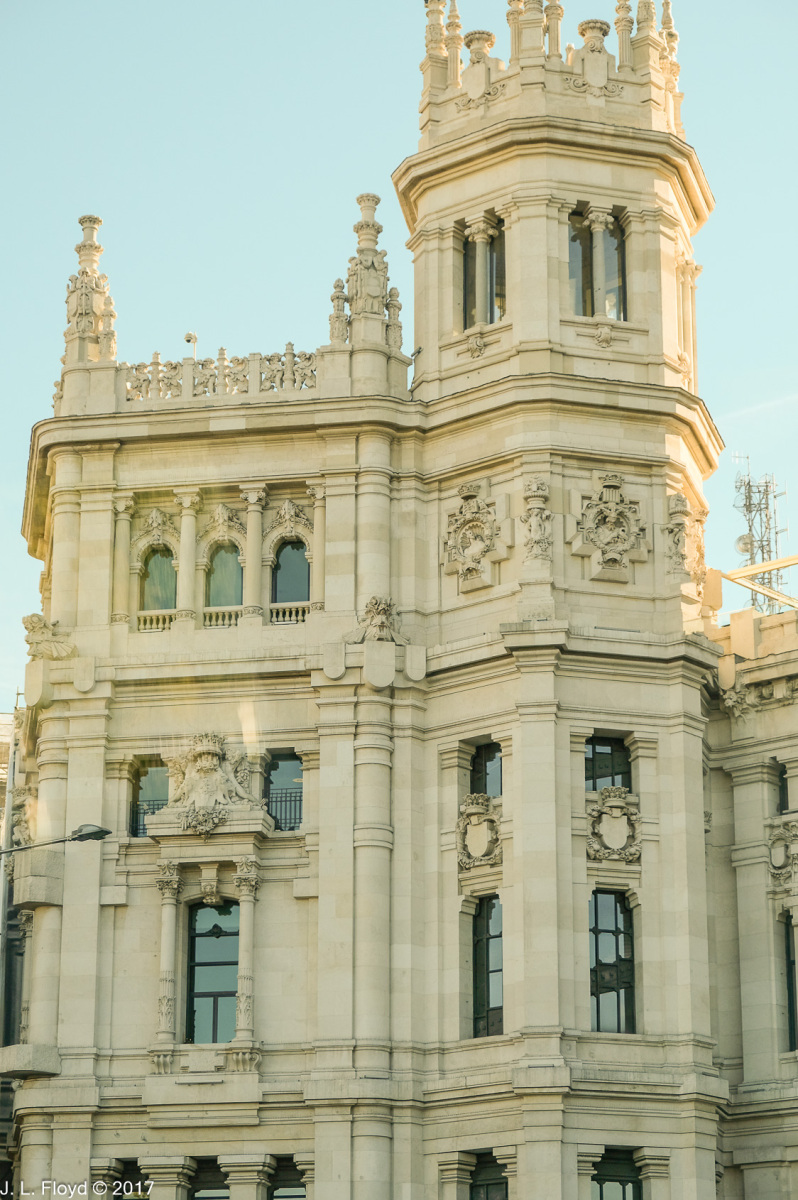
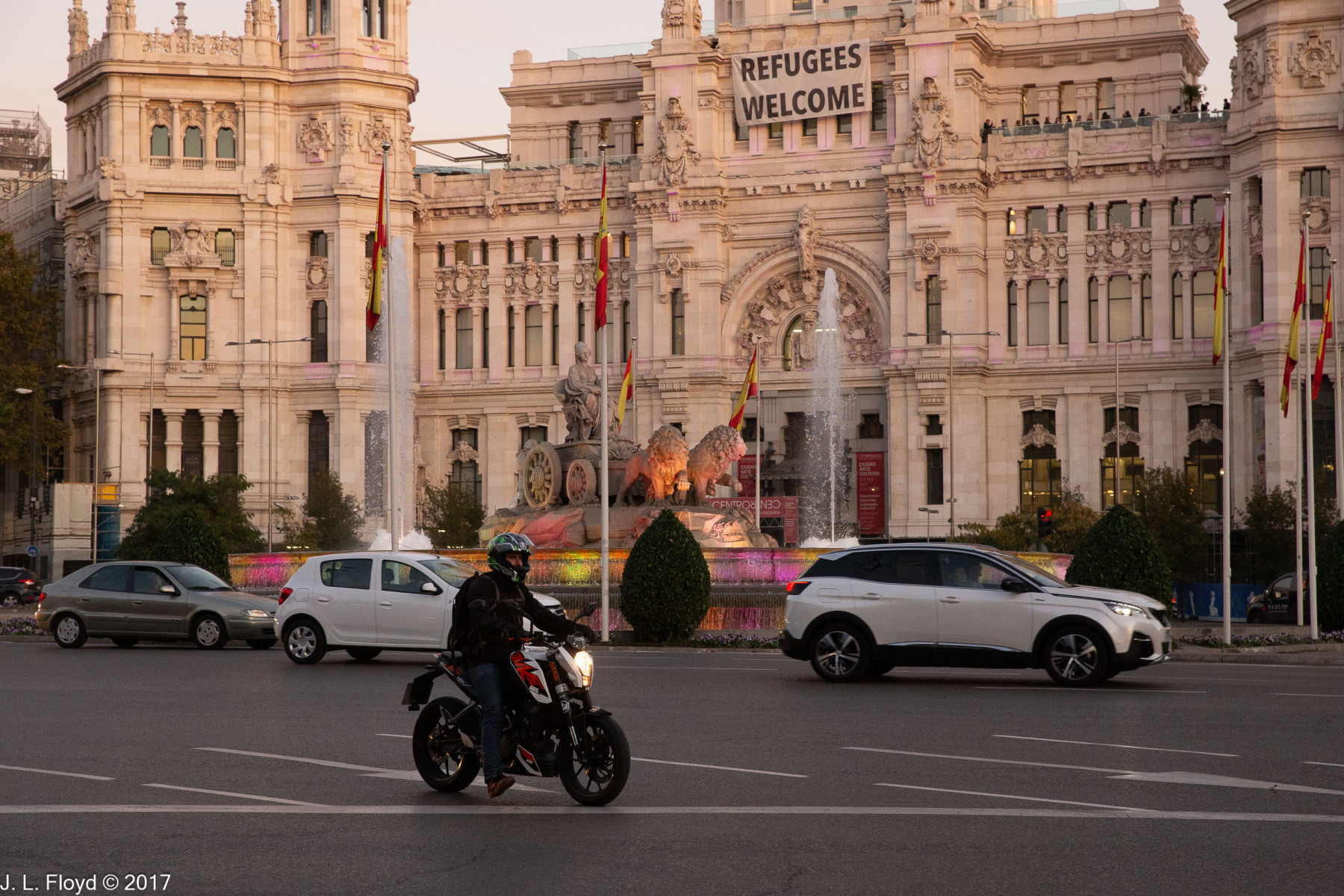
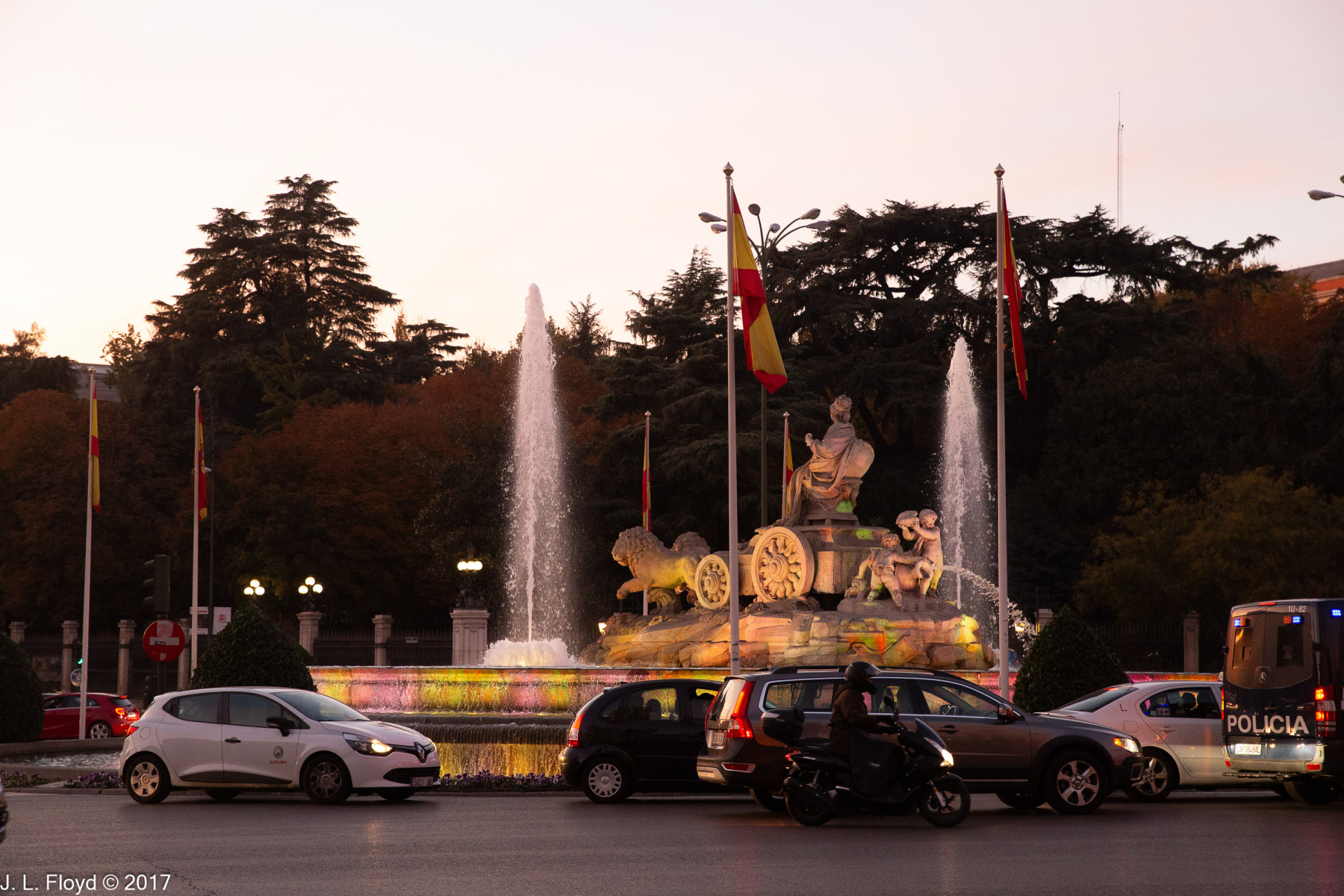
At last I came to the Plaza de Cibeles, home to the fountain which gave the square its name. Overshadowing the fountain, however, and visible from afar, is the Palacio de Cibeles (Cibeles Palace), the tall building that houses the Ayuntamiento de Madrid, in effect the City Hall. Prior to 2011 it was the main post office and telephone and telegraph headquarters of Madrid. Nowadays, as well as hosting the Mayor’s Office and City Council, it is occupied by the public cultural center CentroCentro.

The Palacio de Cibeles was designed in the early 20th century by architects Antonio Palacios and Joaquín Otamendi, who also designed the Edificio de las Cariátides as well as the Edificio de España and Torre de Madrid on Plaza de España. It took twelve years to build, the construction being delayed by architectural and financial issues as well as political disputes. It was finally inaugurated by King Alfonso XIII in 1919 and began operating as the Catedral de las Comunicaciones, later the Palacio de las Communicaciones. It continued in this role for many years, but by the early 21st century, postal traffic was in serious decline and the Palacio was becoming underused. However, meanwhile the organs of the city administration had outgrown their traditional quarters in the Plaza de la Villa, so beginning in 2007 the City Council and Mayor’s Office were relocated to the much grander Palacio on the Plaza de Cibeles.

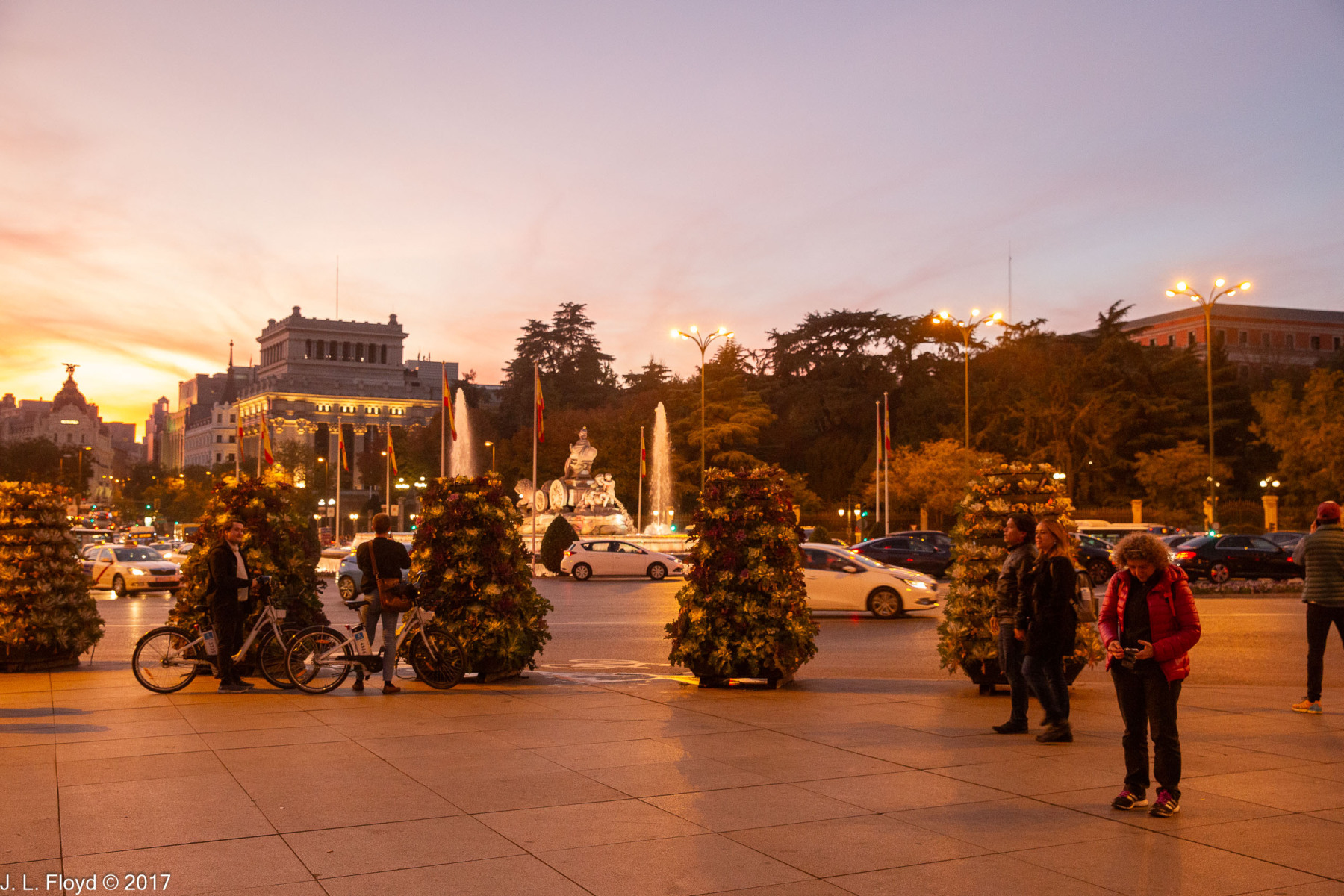
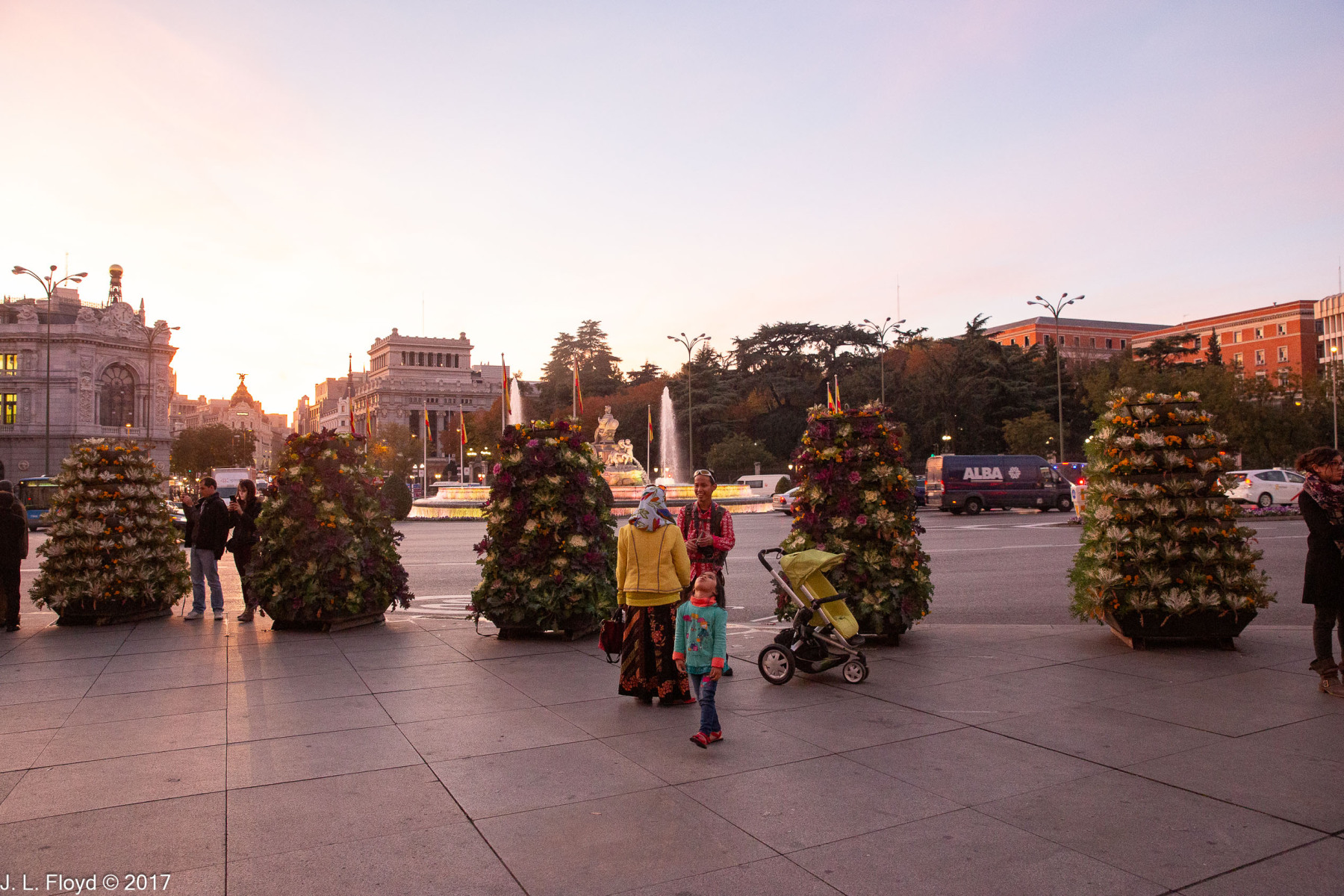
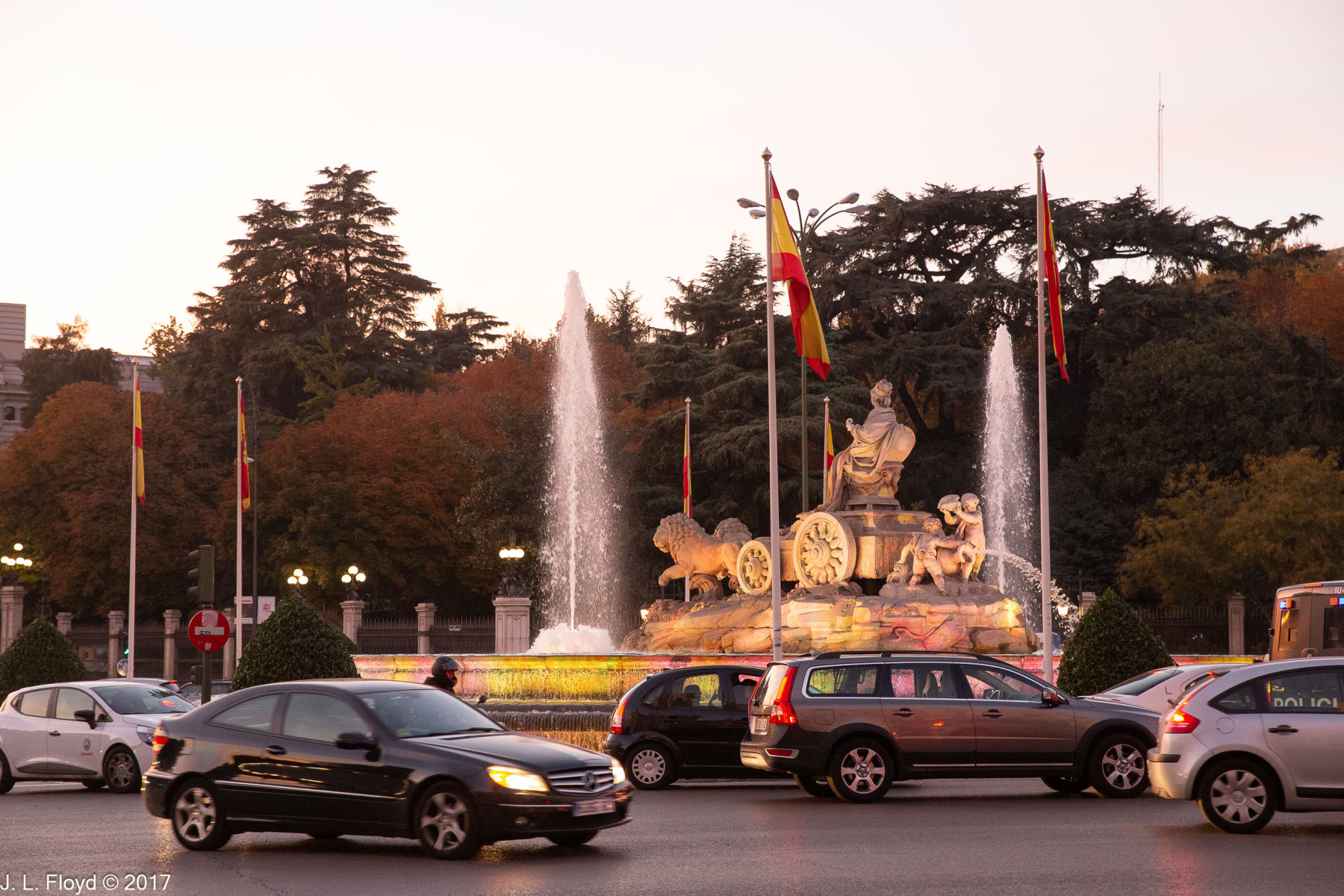
I arrived at the Plaza de Cibeles about sunset and shot most of my photos there as daylight was fading. Cars had their lights on, and the Fountain of Cybele was illuminated with colored lighting. The Palacio towered over everything, and on its facade was a large banner displaying the words “REFUGEES WELCOME” in English. This was the first year of the first Trump administration and I could not but reflect on how unlikely it was to see such a banner on a government building in Washington, D.C. It seems even less likely now.

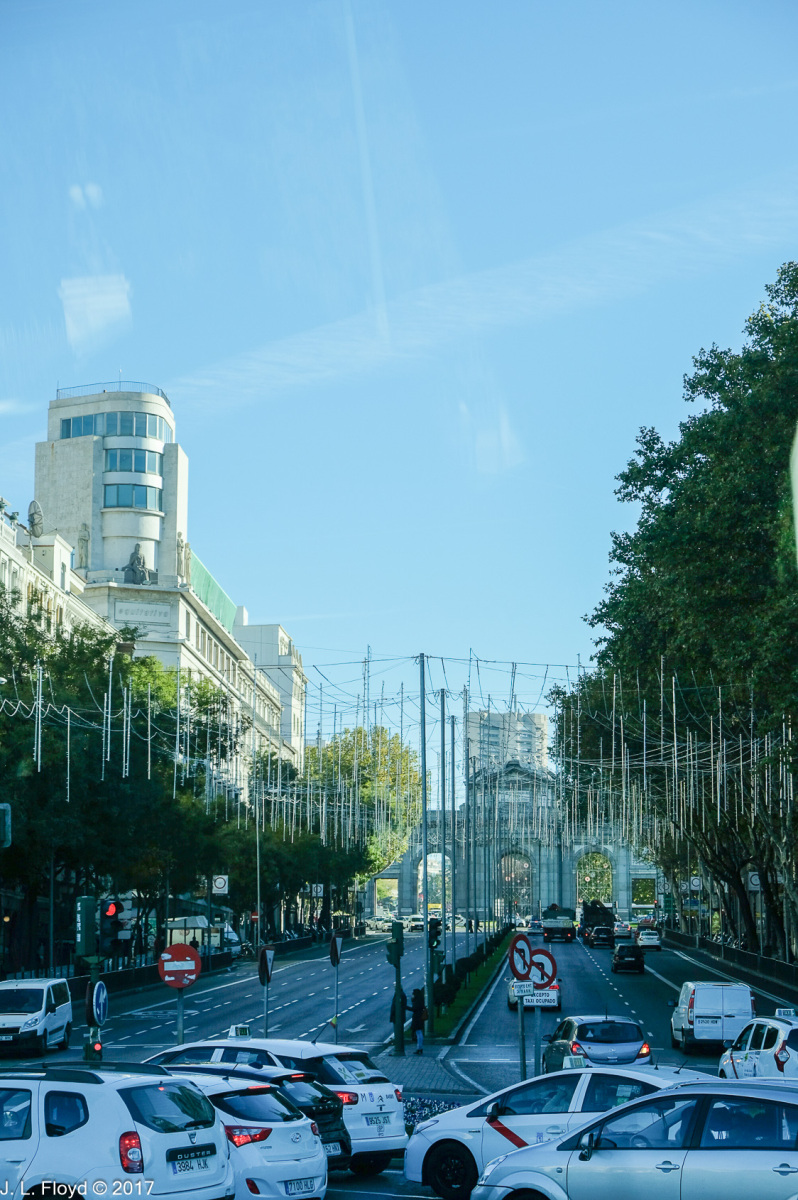
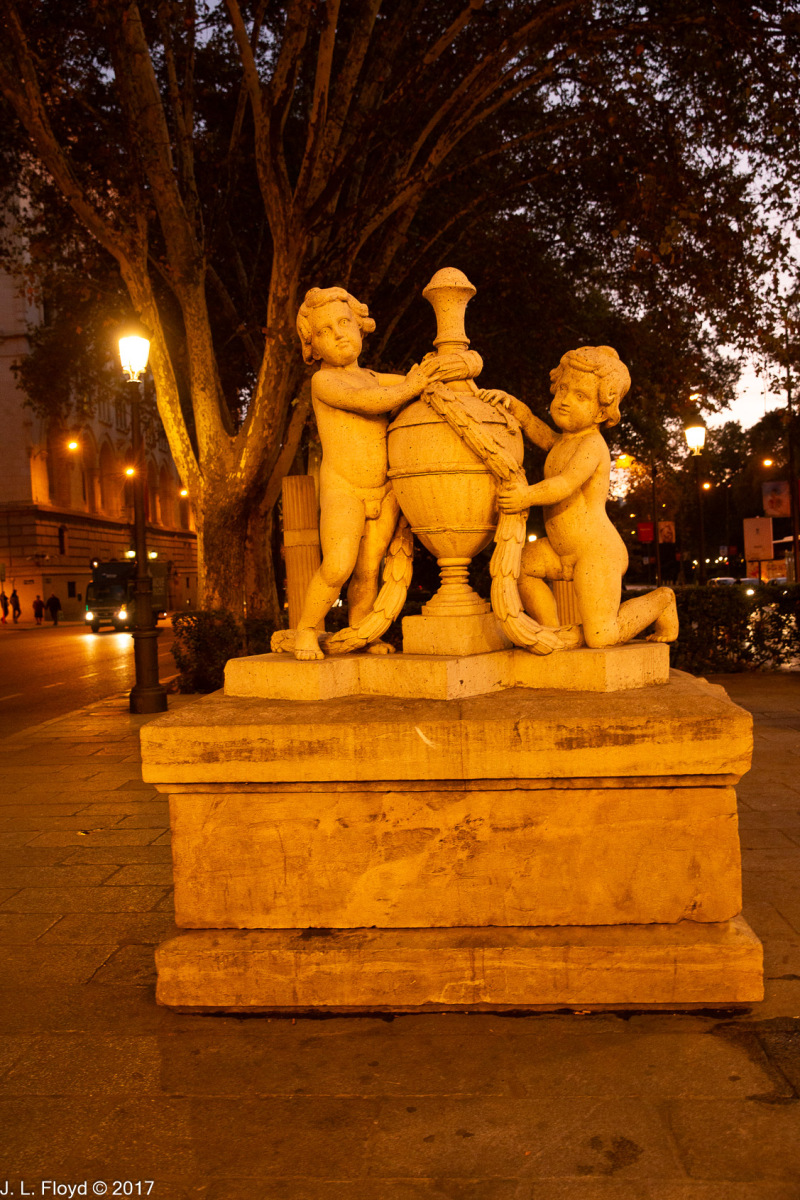
The Fuente de Cibeles was created as part of an urban renewal project commissioned by King Carlos III (r. 1759-1788) in the 18th century. The king heavily favored the then-dominant neoclassical style and was bent on deploying it for the beautification of Madrid. One way in which he did so was to commission the construction of new buildings, such as the one housing the Museum of Natural History, which eventually became the Prado. Another was the erection of monuments such as the Puerta de Alcalá (1778). I have included a photo of it, taken by Sandie from the tour bus in the morning from a distance, in the first gallery of this post; it is a triumphal gate with five arches, located on the Plaza de la Independencia, where the Calle de Alcalá – Madrid’s longest street – is joined by two other major avenues, the Calle de Alfonso XII and Calle Serrano, before continuing on out toward Alcalá de Henares, Cervantes’ birthplace.

A special category of monuments commissioned by Carlos III consists of three sculptured neoclassical fountains representing figures from Greco-Roman mythology: The Fuente de Neptuno, which I have already touched on; the Fuente de Apolo o de las Cuatro Estaciones (Fountain of Apollo or the Four Seasons), located on the Paseo del Prado north of the Neptune Fountain; and, of course, the Fuente de Cibeles. We missed capturing the Apollo Fountain photographically, probably because the bus passed it too quickly; it depicts the Apollo, the Greek god of light and the arts, atop the monument, while four allegorical figures representing the Four Seasons sit on a pedestal beneath.

The Fuente de Cibeles depicts Cybele, originally an Anatolian mother goddess, riding in a chariot drawn by two lions. Her cult was adopted by Greek colonists in Asia Minor around the sixth century BC and thence transmitted to Greece itself, where Cybele became identified to some extent with Rhea, mother of the Olympian gods Zeus, Poseidon and Hades, and other deities. The cult ultimately made it to Rome, where she was called Magna Mater, and became notorious for the practice of self-castration by her priests (the Galli), which was outlawed. No comparable associations have ever been noted in devoutly Catholic Spain, but a modern tradition has developed whereby the fans of the Real Madrid soccer team gather in the Plaza de Cibeles to celebrate its victories. They have not been known to castrate themselves.

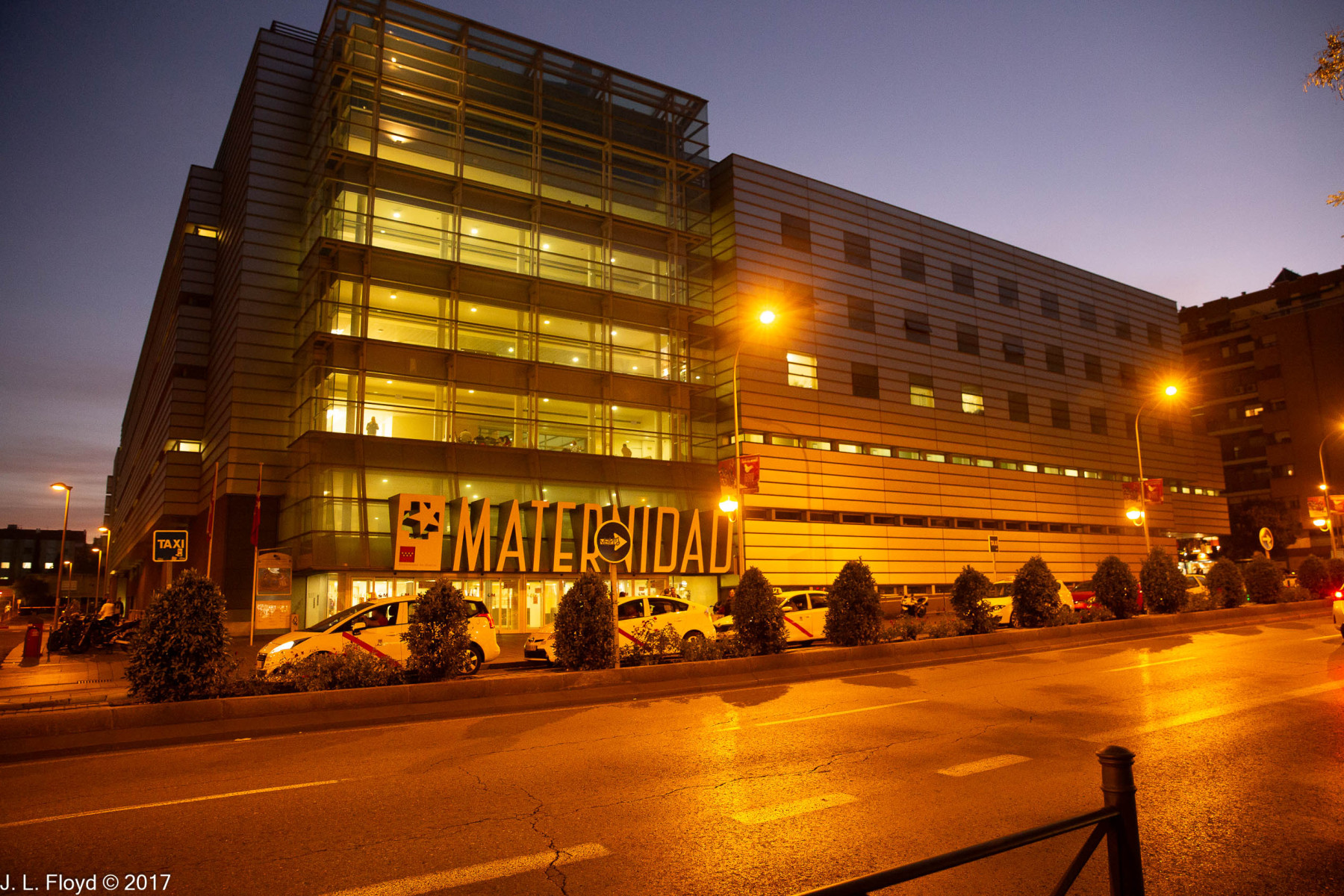
By the time I finished my picture-taking on the Plaza de Cibeles, night was falling, and I began to despair of finding my way back to the hotel on Calle O’Donnell in the dark. I dealt with this by summoning a taxi, which took me back to the hotel little faster than I could have walked the distance, had I known the way. Our Novotel lodging was located next to a maternity hospital, which appears in the photo below.

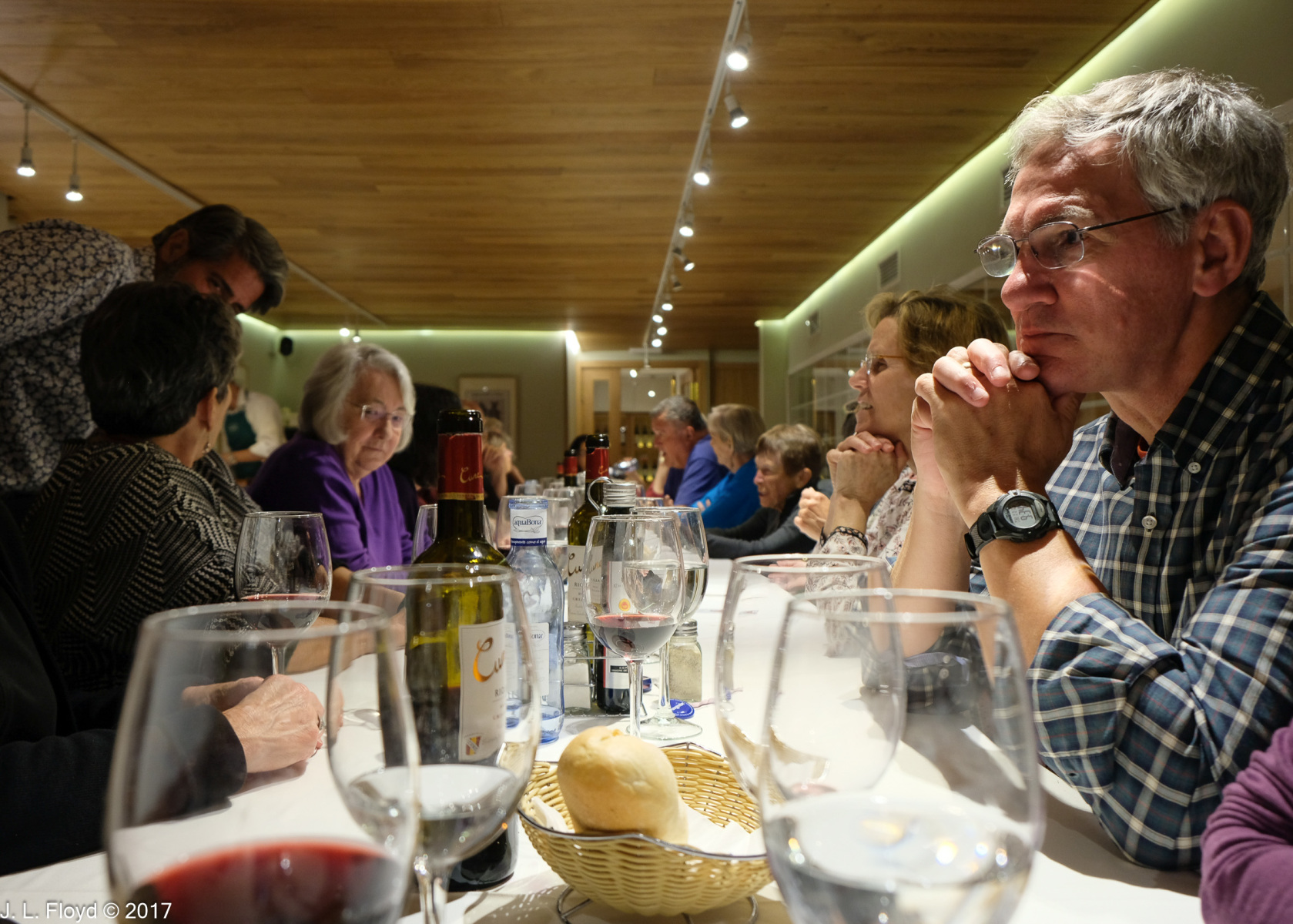
I arrived back at the hotel in time for dinner, which was not to be missed, because it was also a grand-finale celebration of our tour. It was held in Madrid on the 17th because there were a number of people who were not taking the optional extensions to Toledo and Barcelona, and we needed to bid them farewell. Also, it gave us a chance to meet Manuel Sueiras’ family (wife, son and daughter). It proved a thoroughly gala and memorable occasion; the cuisine was delectable, the wine flowed freely, and a grand time was had by all.
Categories
Spain, Portugal and Morocco, November 2017

Marrakesh, November 16, 2017: Jardin Majorelle

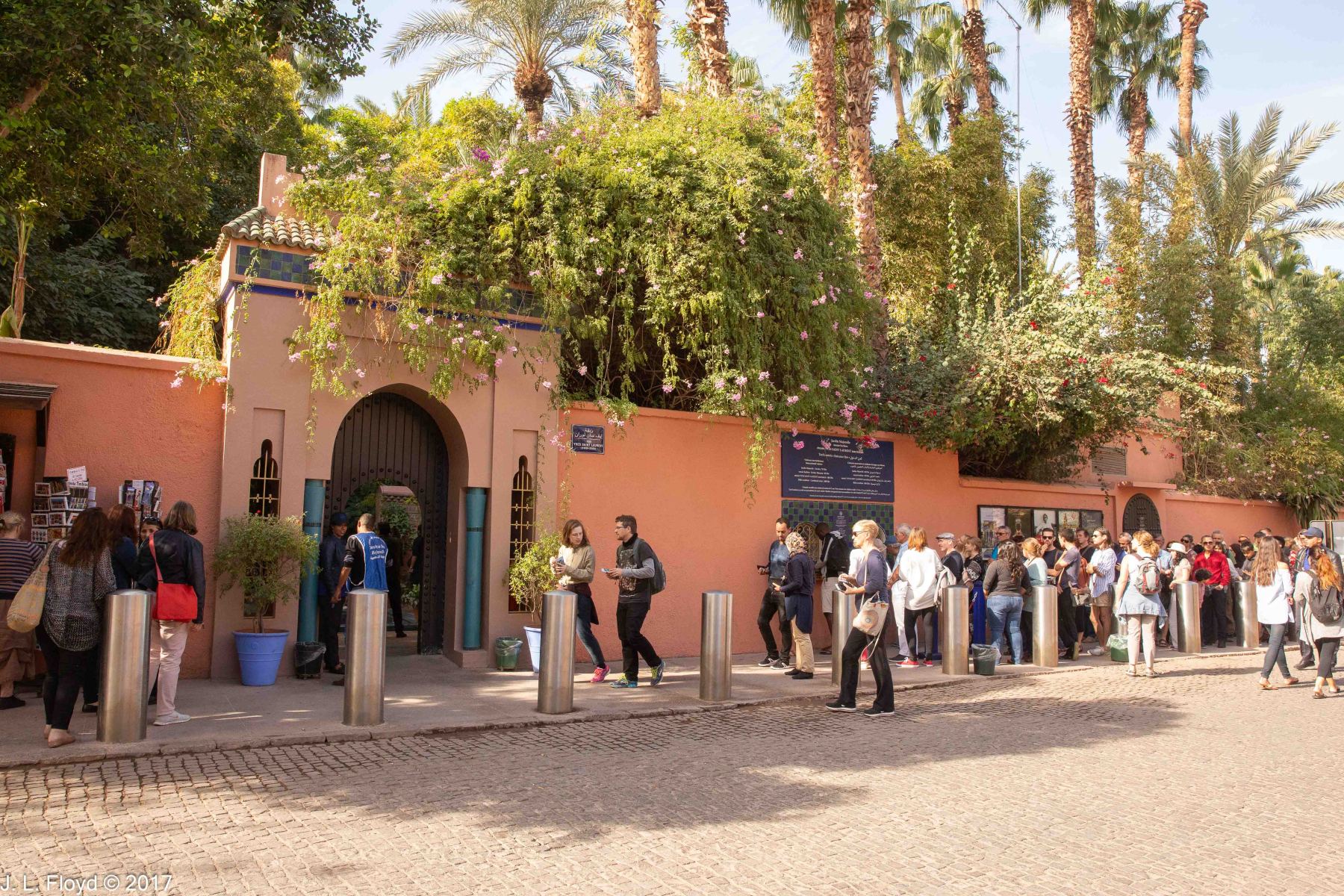
We had a full morning to spend in Marrakesh before flying out to Madrid in the afternoon, and to spend it we were offered a choice between unstructured free time and an optional visit to the Jardin Majorelle. Sandie did not feel up to much walking, so she chose the former, and I the latter. I was not disappointed.

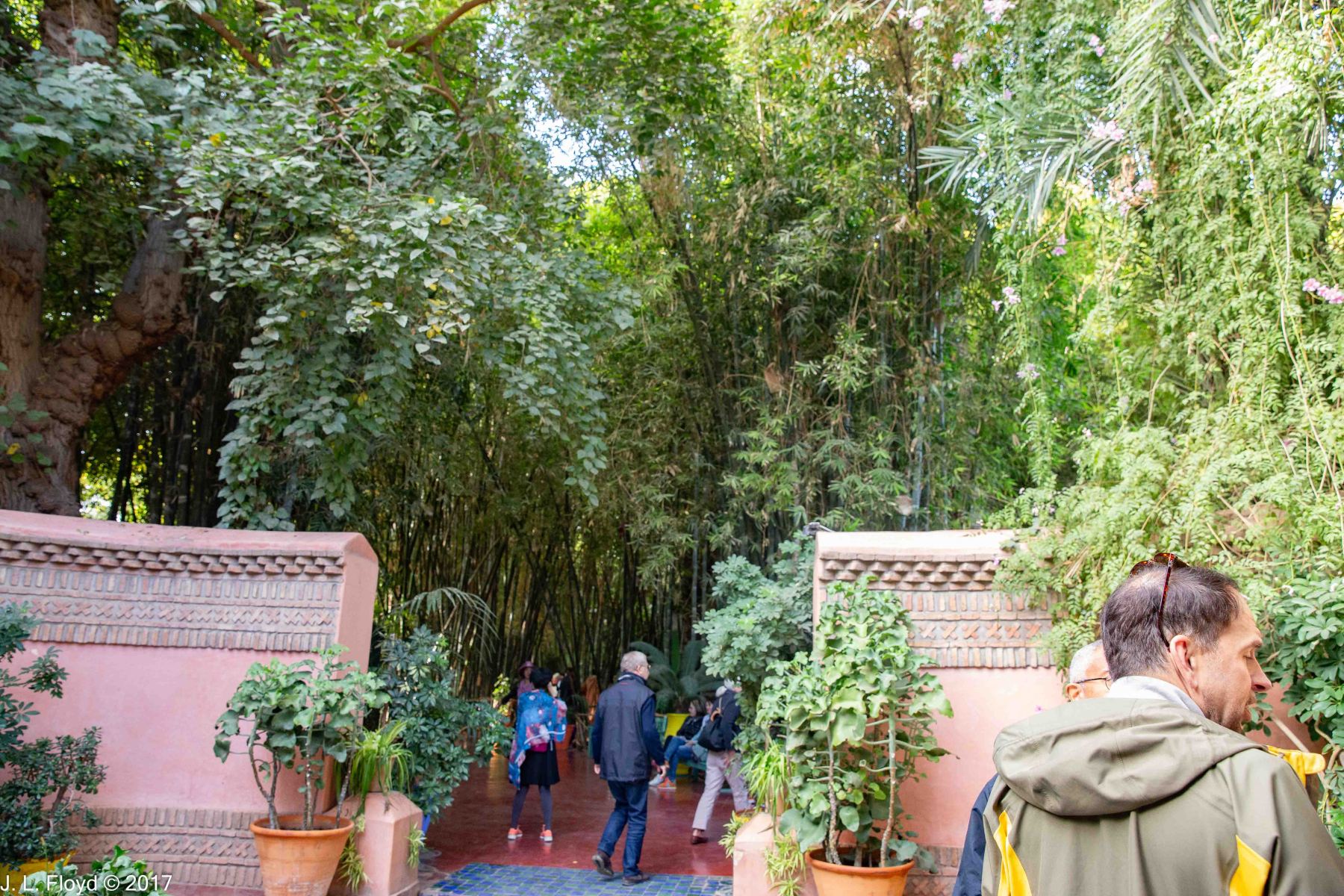
The Jardin Majorelle presented a very different prospect from the venues we had previously experienced in Marrakesh, and indeed in all of Morocco. We had been immersed in the history and culture of the country, both its ancient and modern facets, and that had been a splendid and eye-opening odyssey for all of us, I think. In the Jardin Majorelle, we encountered something totally novel: a verdant tropical garden in the midst of what is essentially a desert country, the implant of a culture quite unlike the Islamic Berber-Arab civilization we had been imbibing.

The Jardin Majorelle is the creation of Jacques Majorelle (1886-1962), a French artist who moved to Morocco for health reasons in 1917 and settled in Marrakesh. In 1923 he bought a 4-acre piece of property, had a house built and began planting a landscape garden. Over the years he continued to expand it.

The garden proved quite costly to maintain – after seeing it I can understand why – and in 1947 Majorelle was compelled to start charging admission to the public for visiting it. But the resulting income was meager, and Majorelle had to start selling parts of the property to keep out of the red. In the 1950s, following an expensive divorce, he was forced to sell the property altogether, and the new owners failed to keep it up, so it fell into decrepitude.

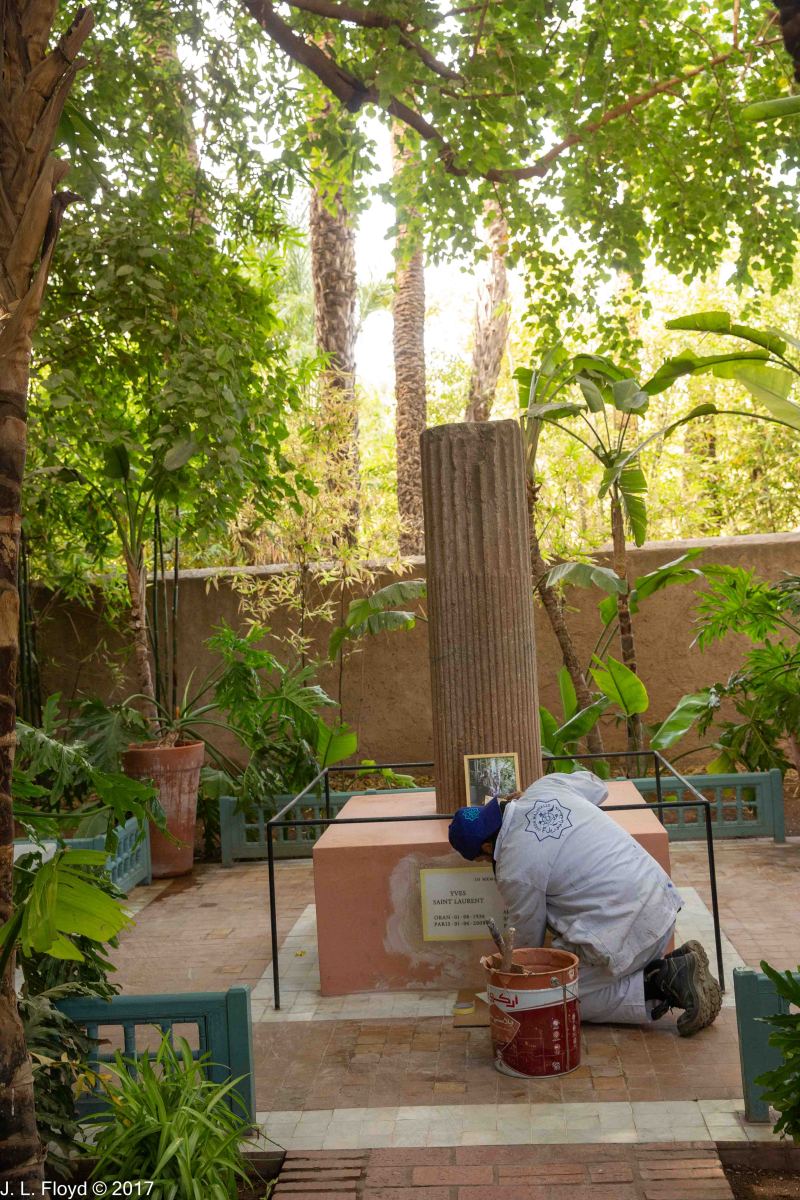
However, in the 1980s the fashion designer Yves Saint-Laurent and his partner and business manager Pierre Bergé discovered the property and fell in love with it. They bought it, restored it and opened it to the public. (They also acquired many of Majorelle’s paintings.) When Yves Saint-Laurent died in 2008, his ashes were interred in the garden. The property is now owned by the French non-profit Foundation Pierre Bergé – Yves Saint Laurent, and managed by the Marrakesh-based non-profit Foundation Jardin Majorelle.

The gardens now cover two and a half acres. Beside the villa and botanical collection, several museums are located there as well, including the Islamic Art Museum of Marrakesh, the Musee Yves St. Laurent, and the Berber Museum. I only had time to visit the last of these.  It was quite interesting, but it did not allow photography inside, so I only shot the exterior of the museum.

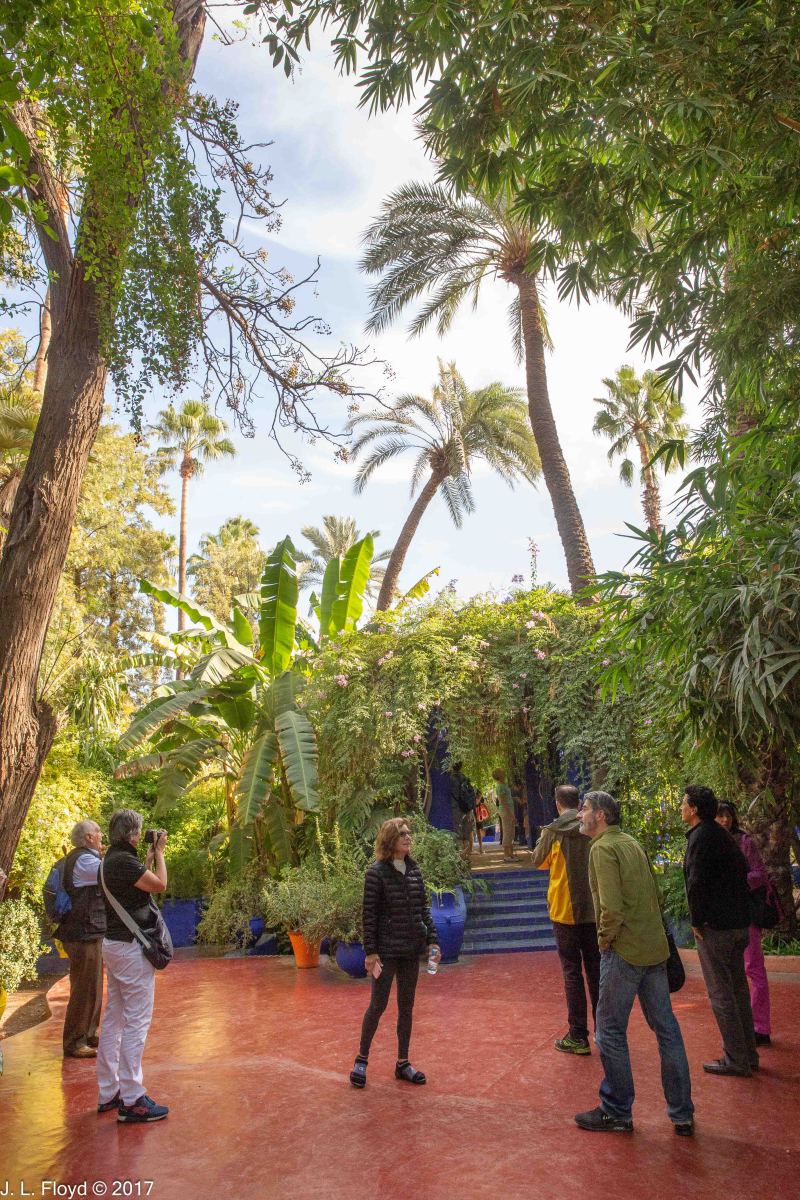
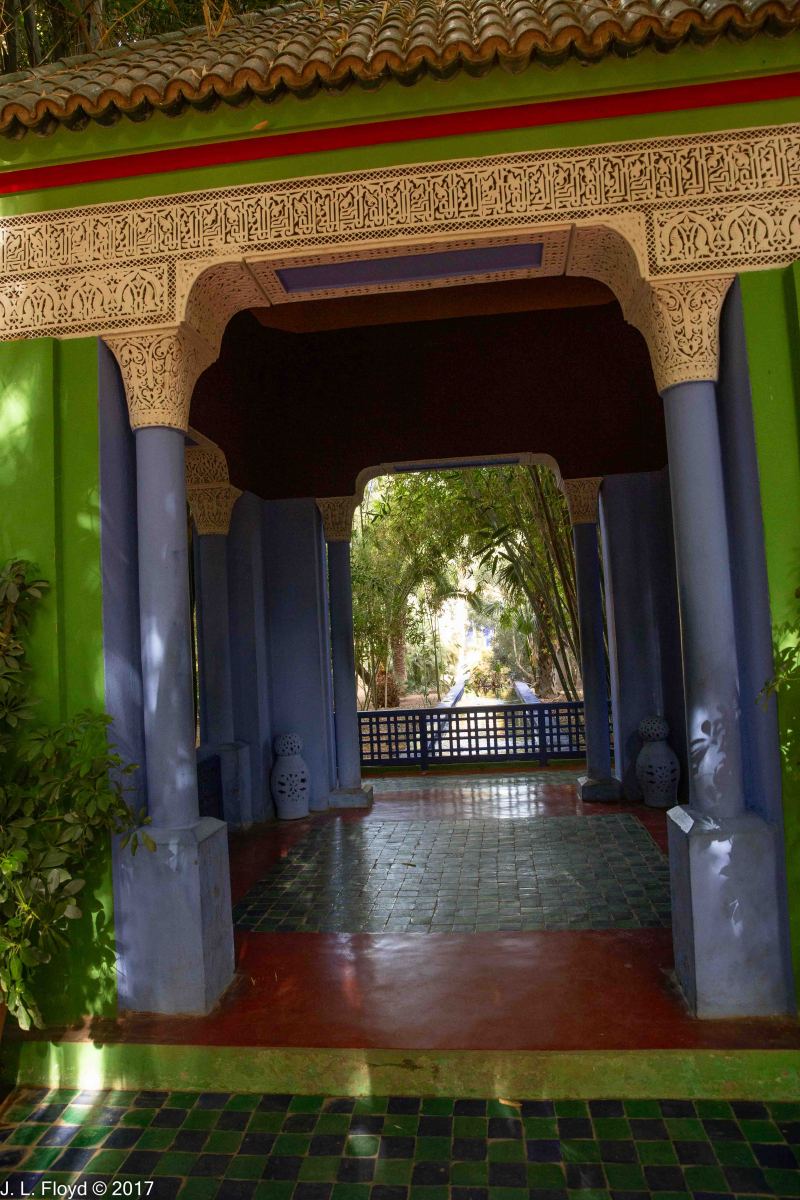
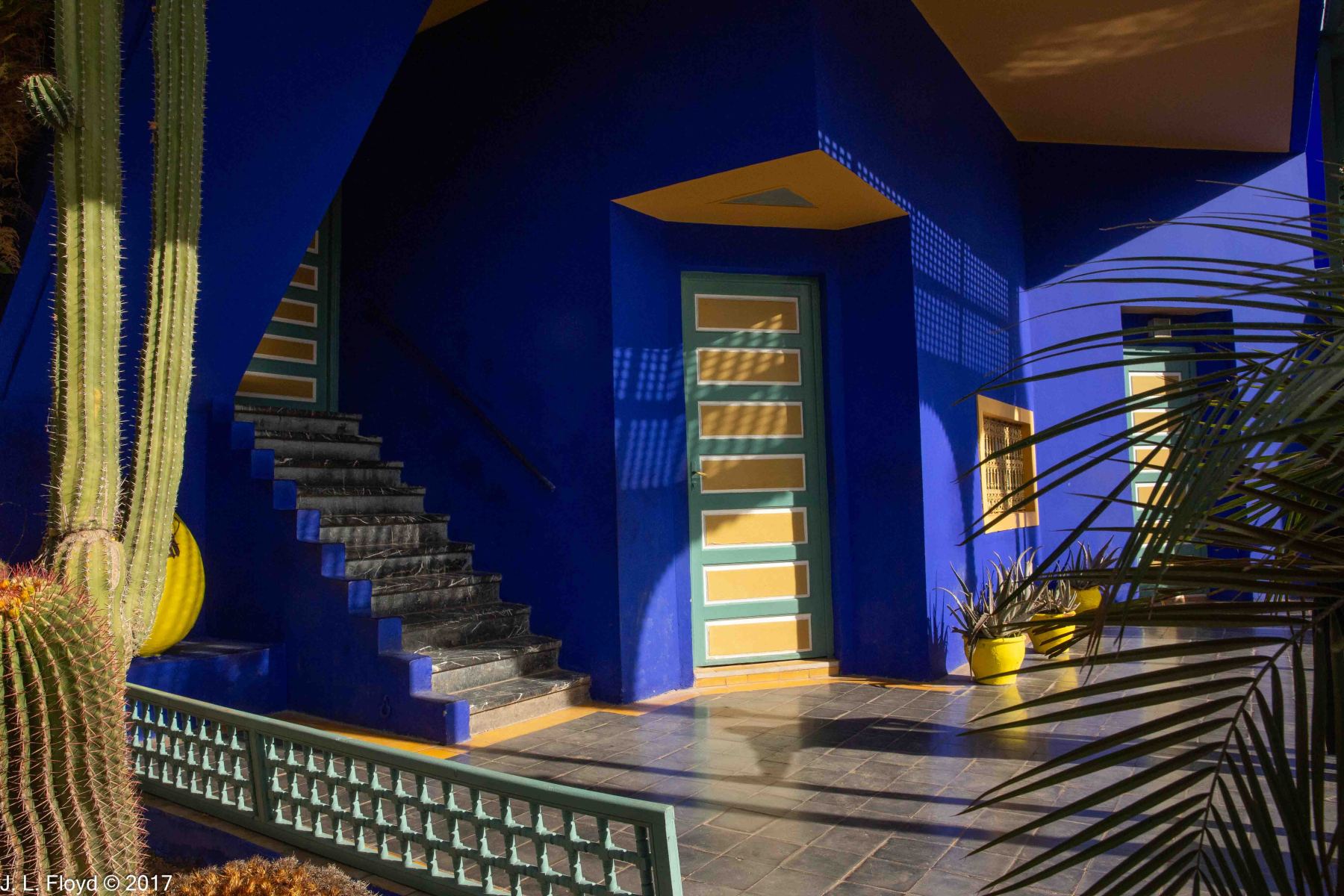
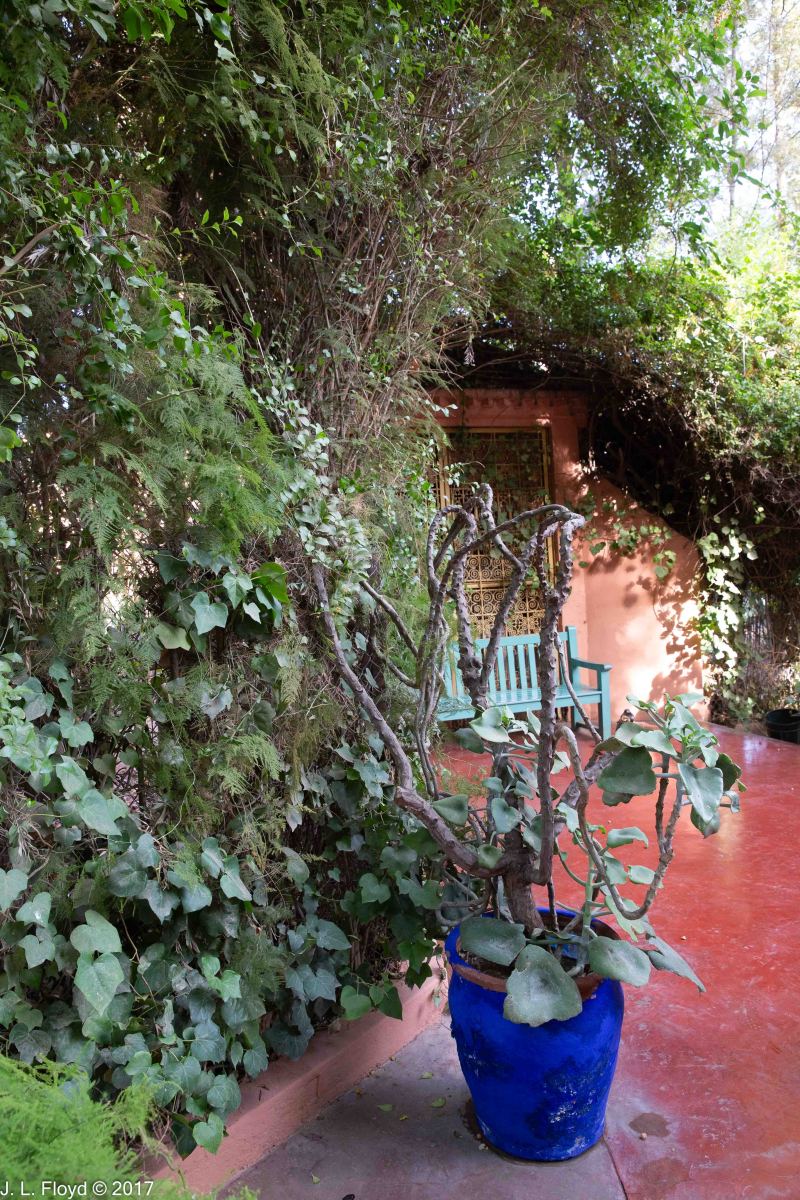
In 1931 Jacques Majorelle commissioned the architect Paul Sinoir to design a Cubist villa to replace his previous house, and he bought additional acreage to expand the garden. During these years he also became noted for his so-called “Orientalist” paintings – I would characterize them rather as “Maghrebist” because they mostly depicted scenes from the streets, souks and kasbahs of the Maghreb – Islamic North Africa – rather than Asia. In Marrakesh Majorelle discovered — and ultimately patented — a rich deep-cobalt color, now known as bleu Majorelle, using it as the color of his villa.

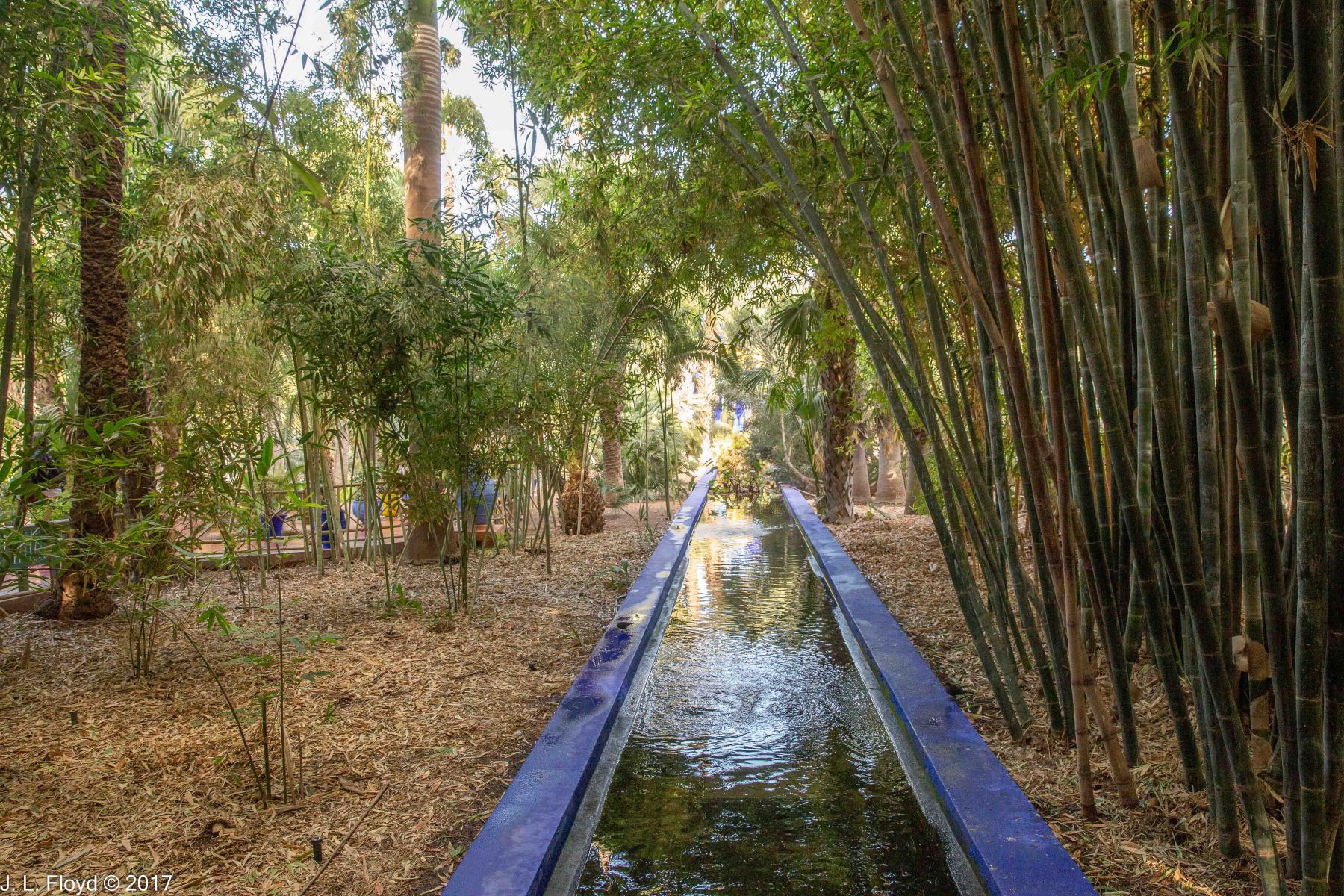
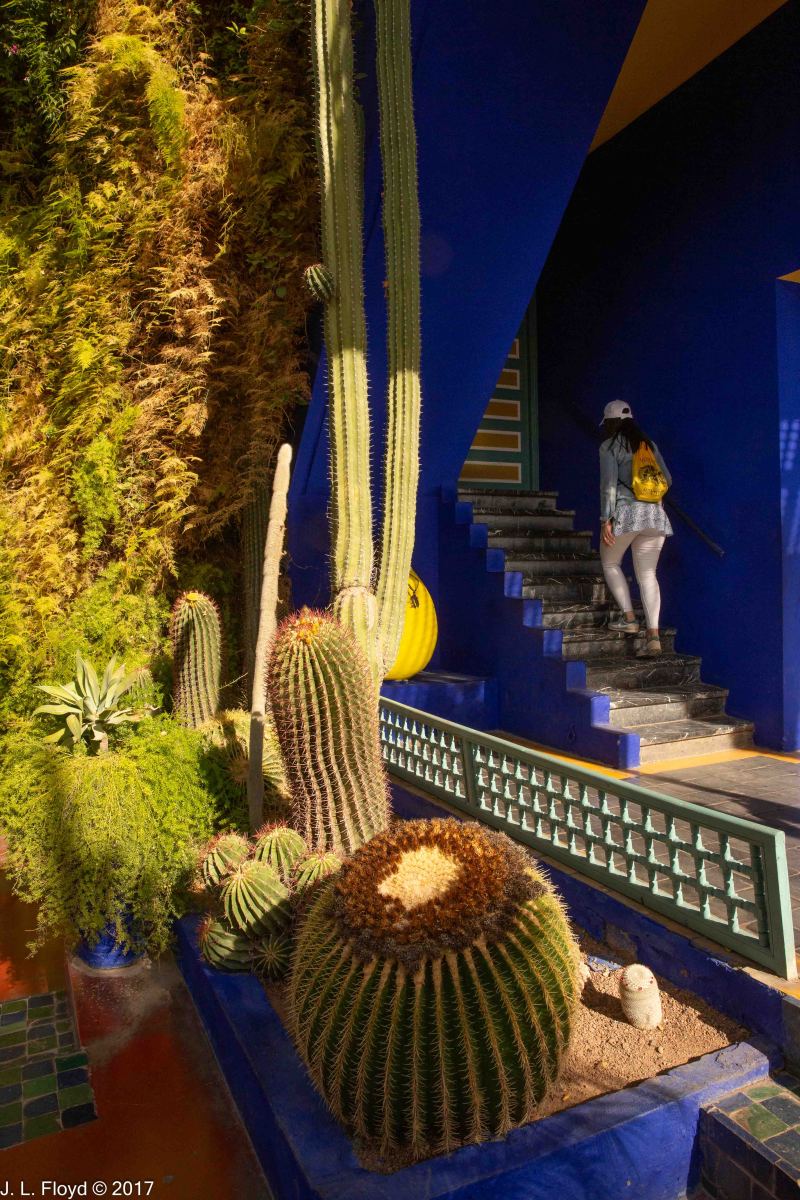
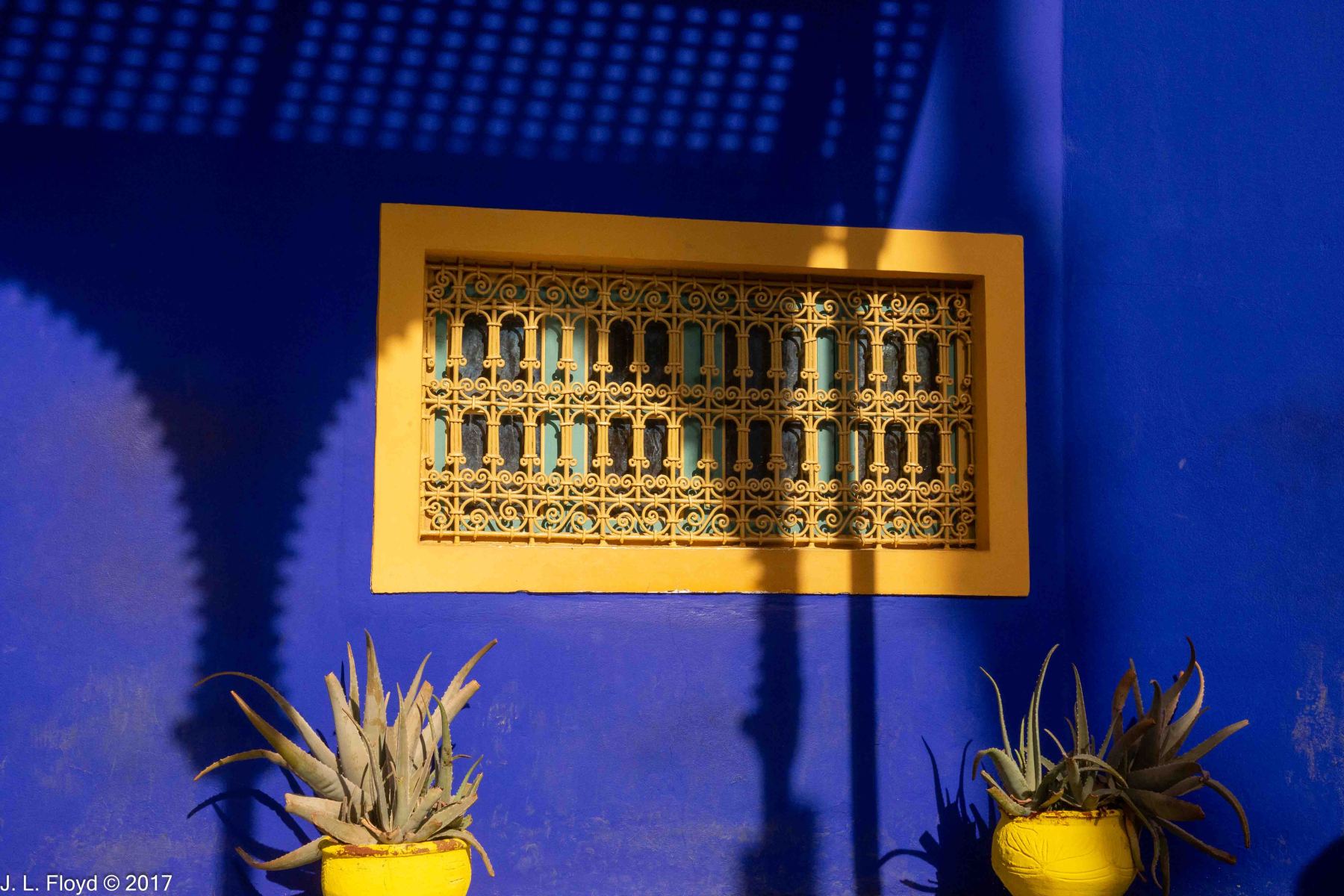
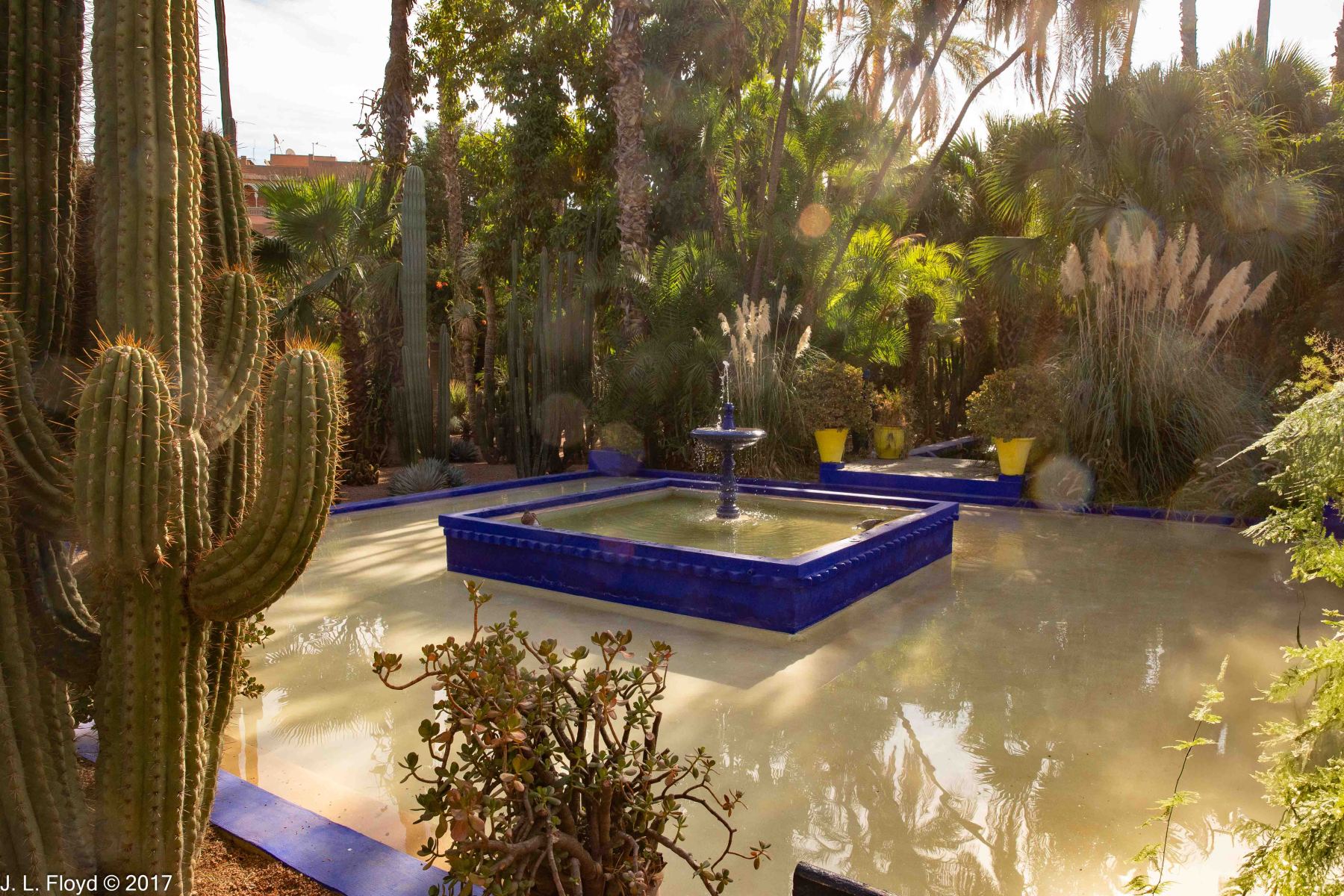
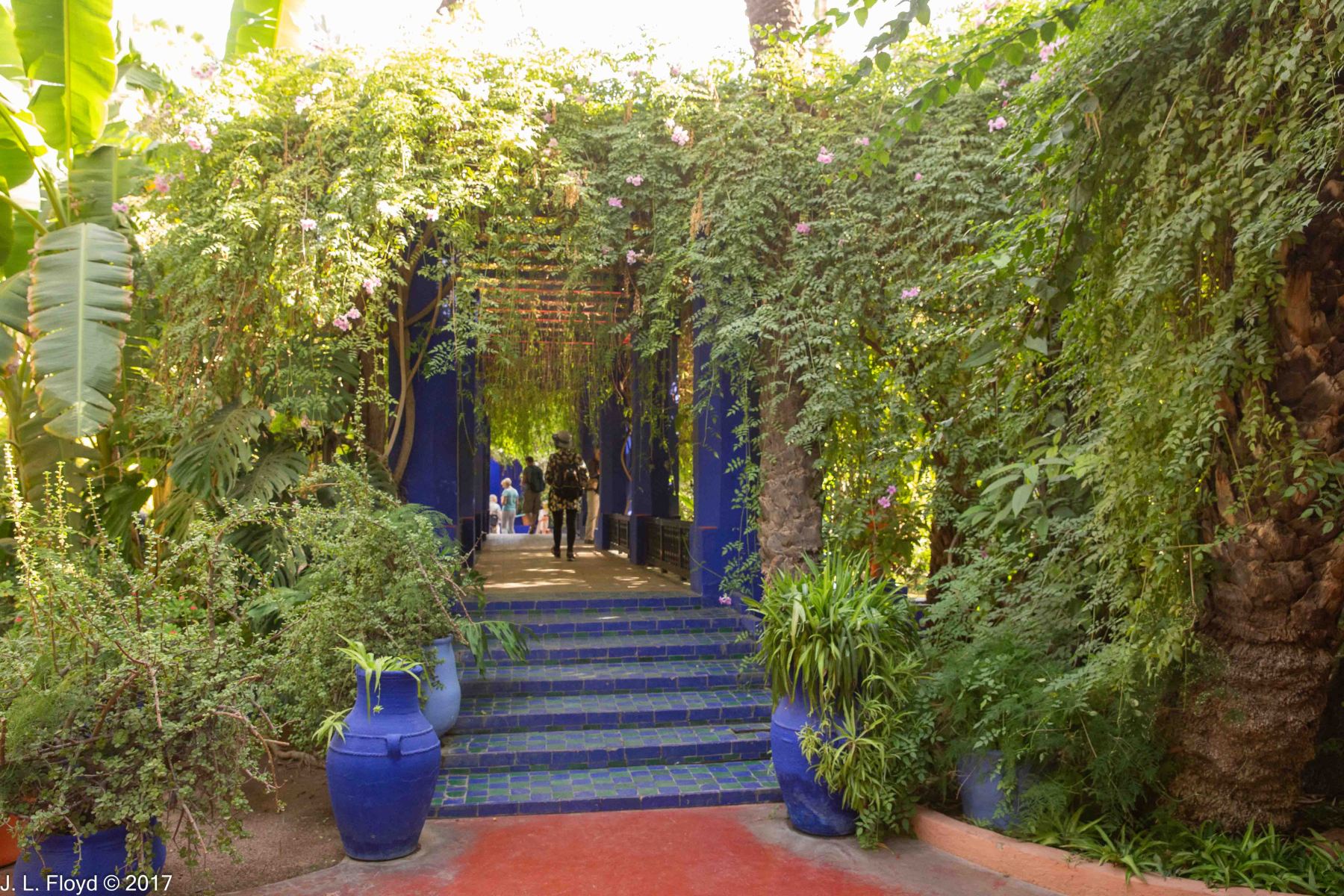
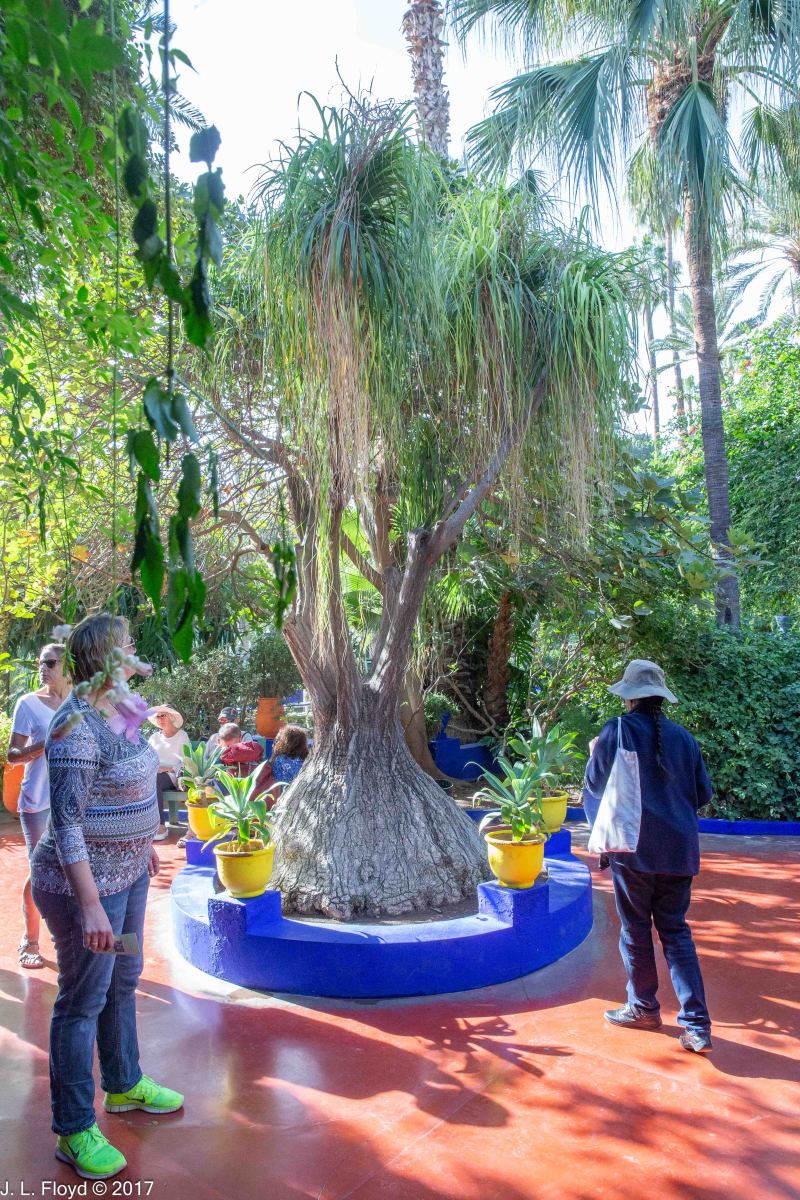
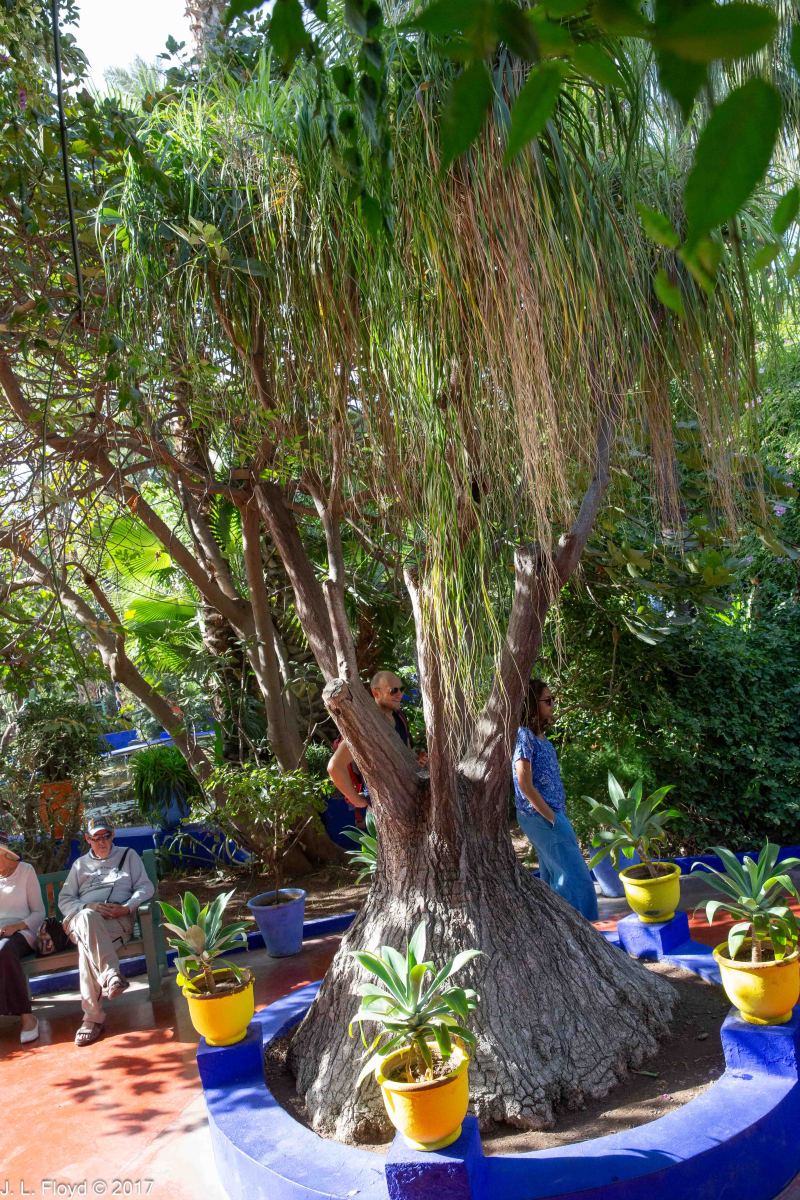
Bleu majorelle appears elsewhere throughout the garden, for example on a lushly overgrown arbor near the villa, many of the flowerpots scattered around the grounds, and the banks of the pools and watercourses.

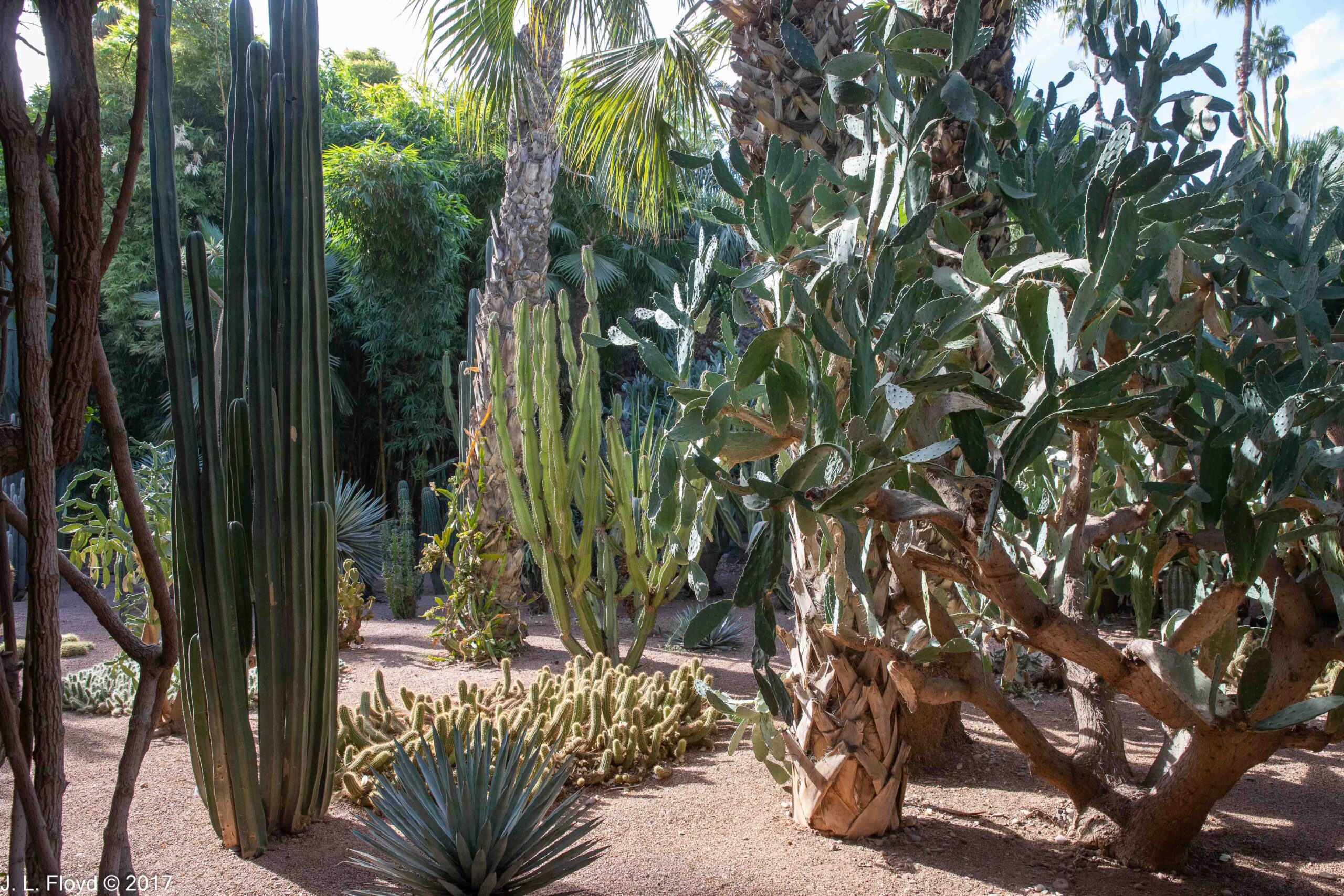
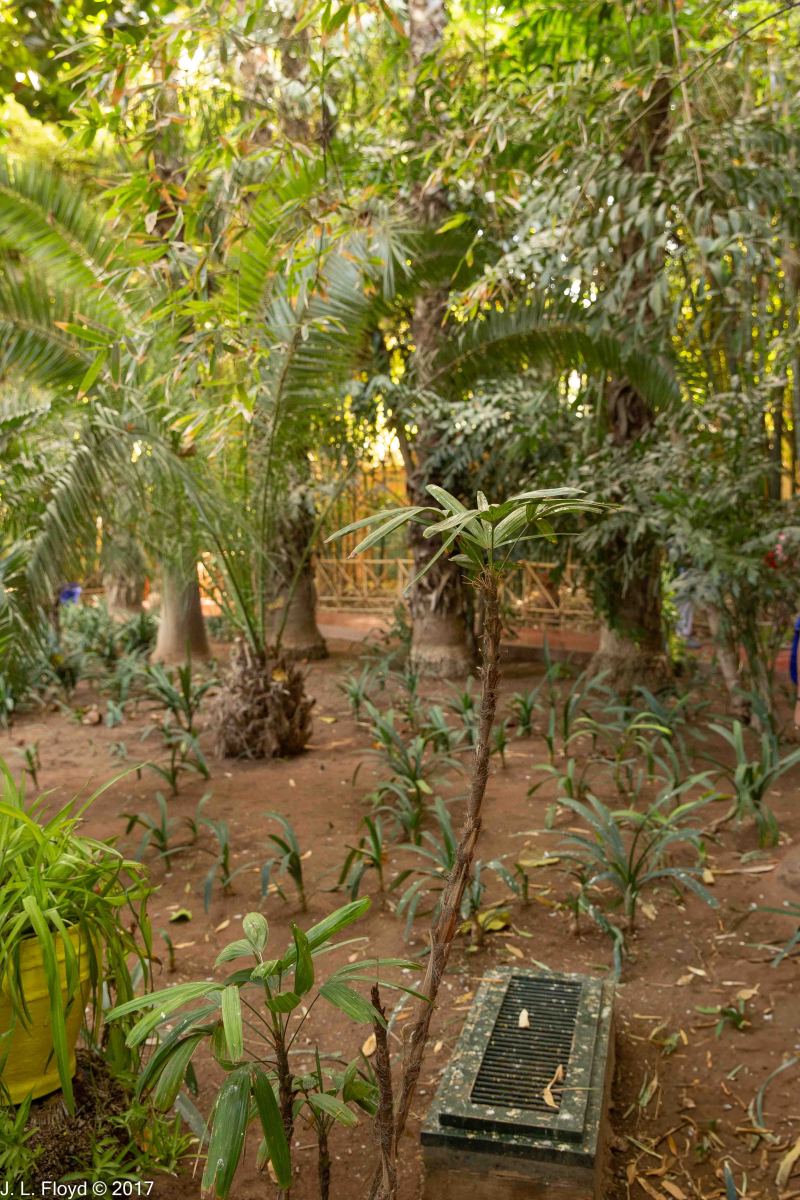
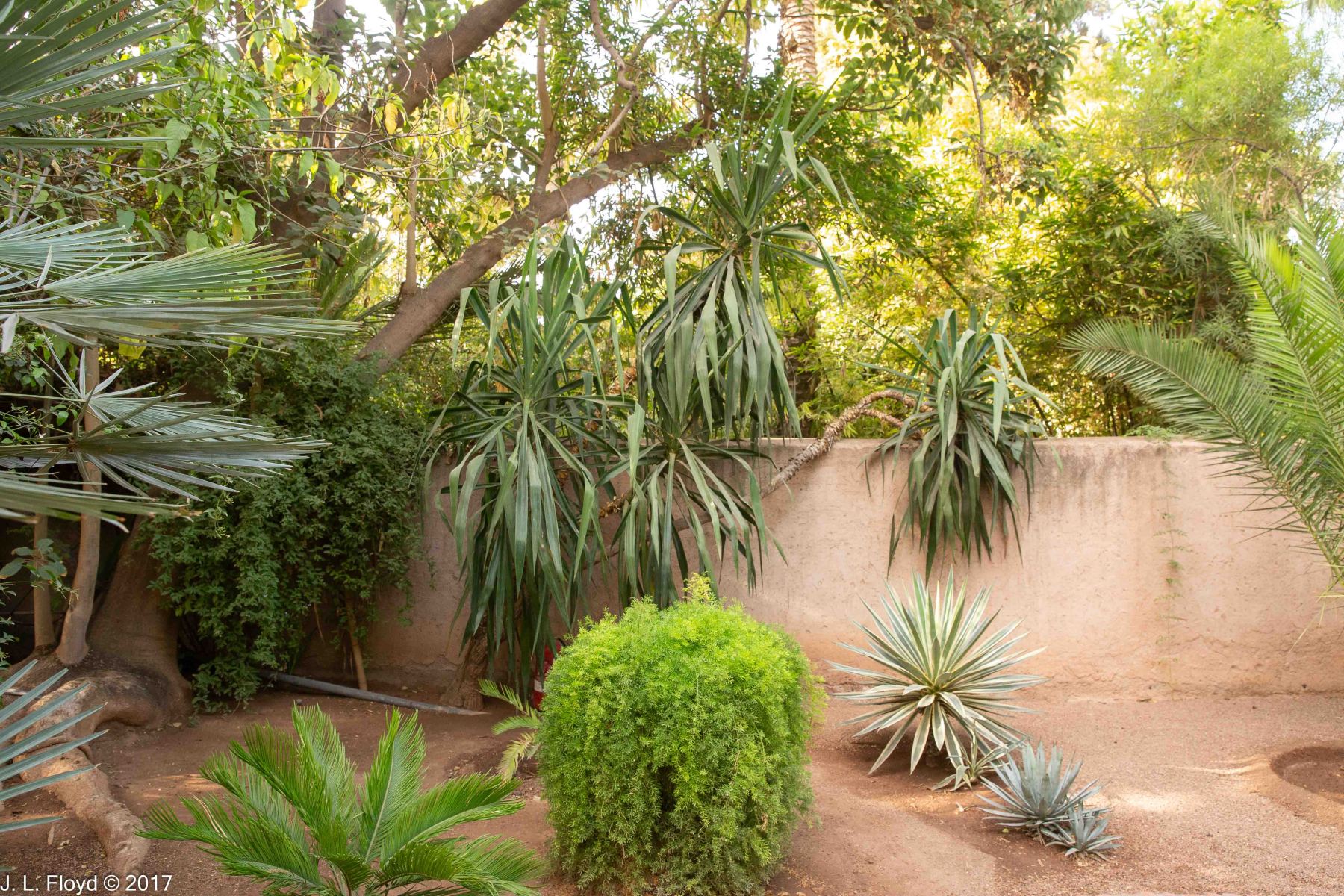
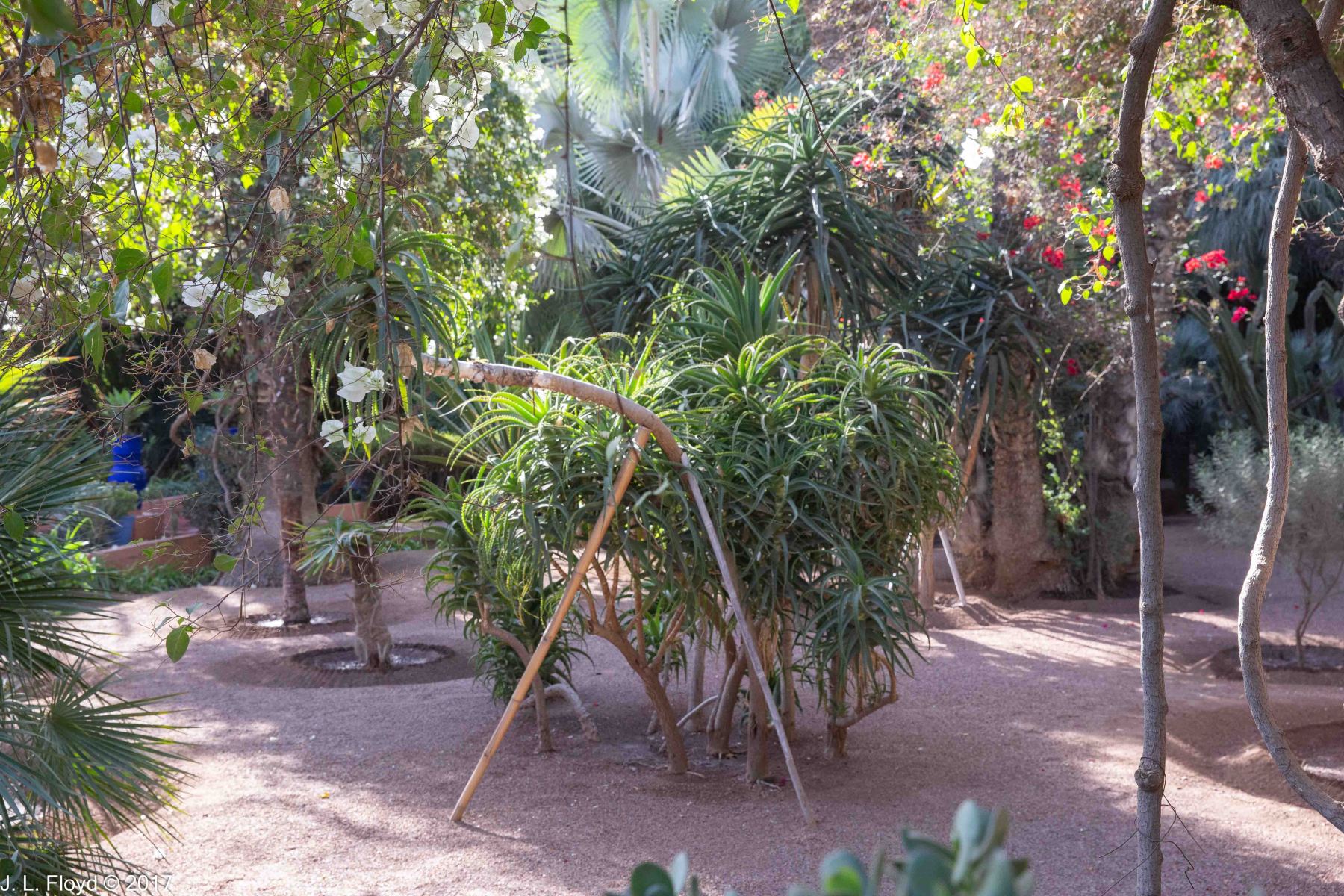
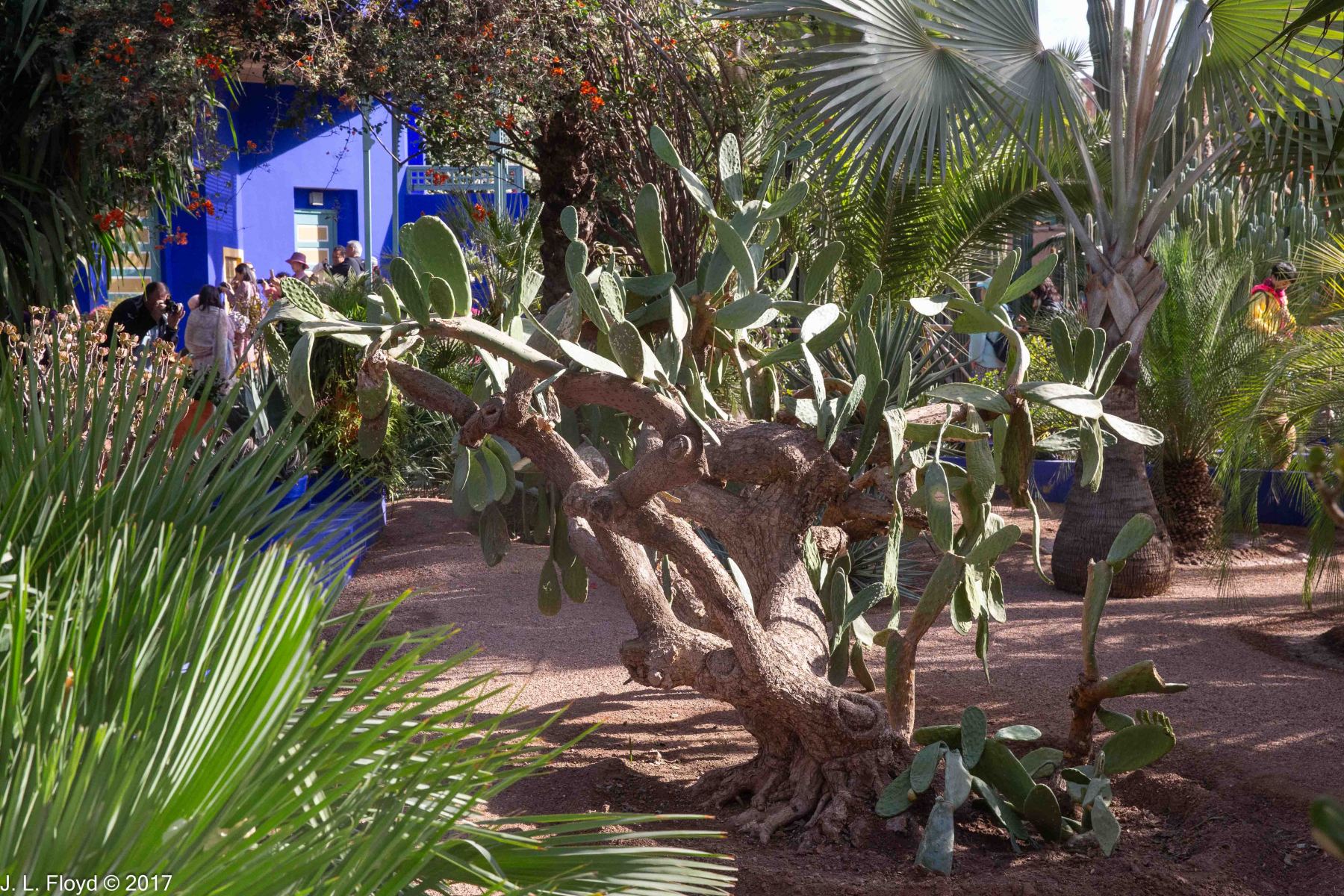
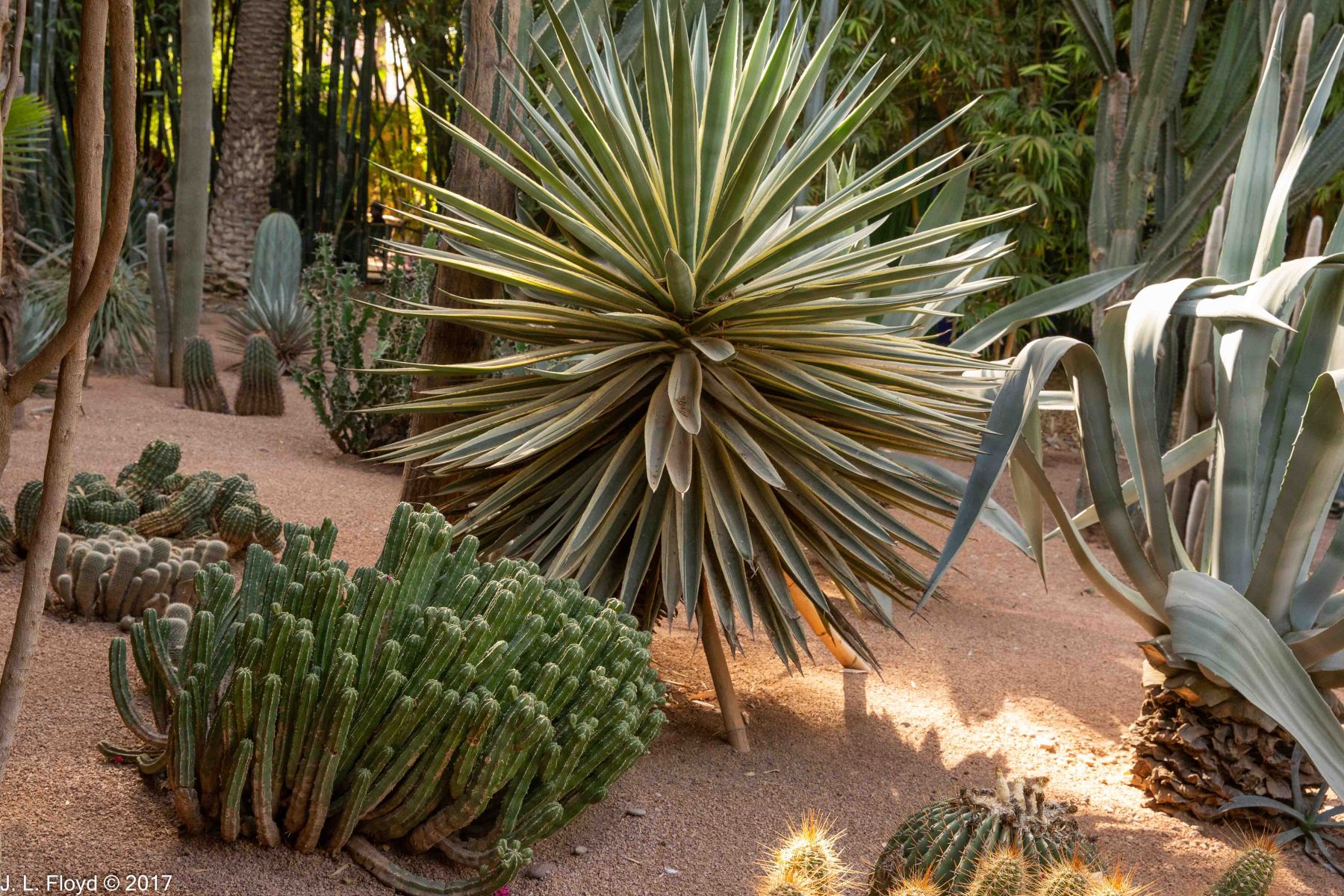
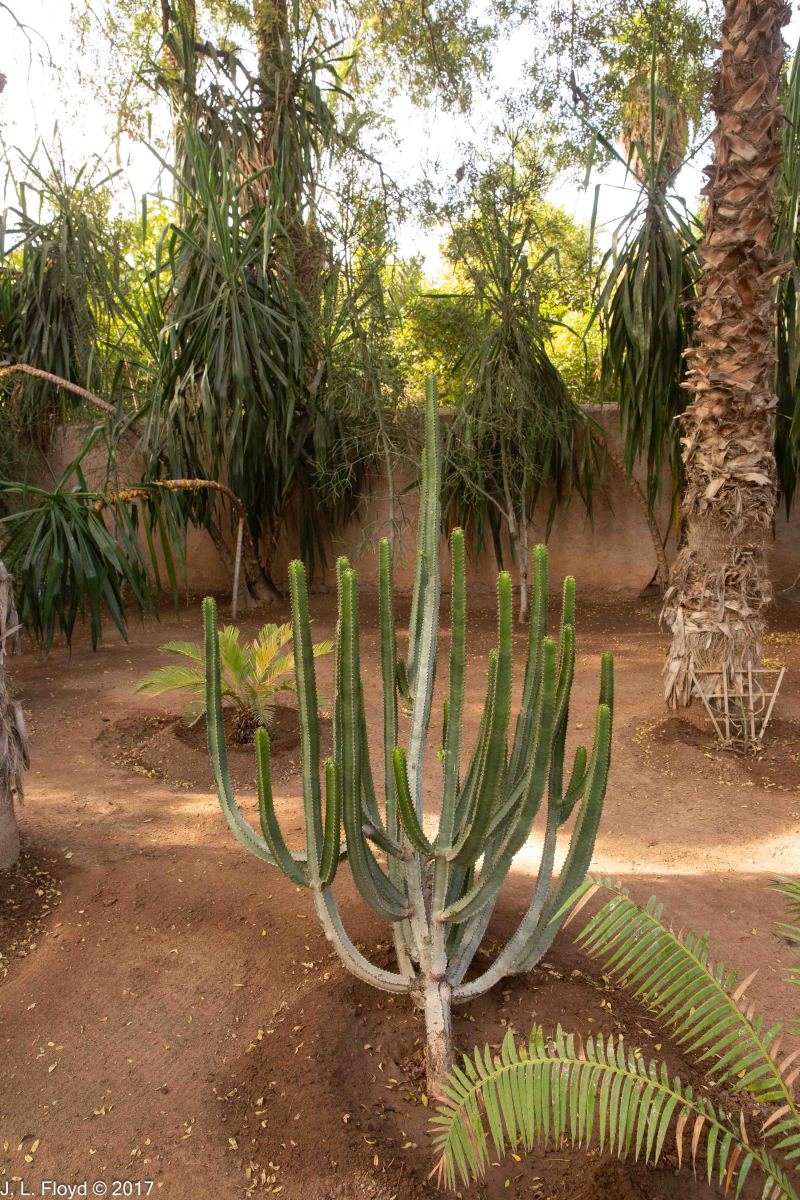
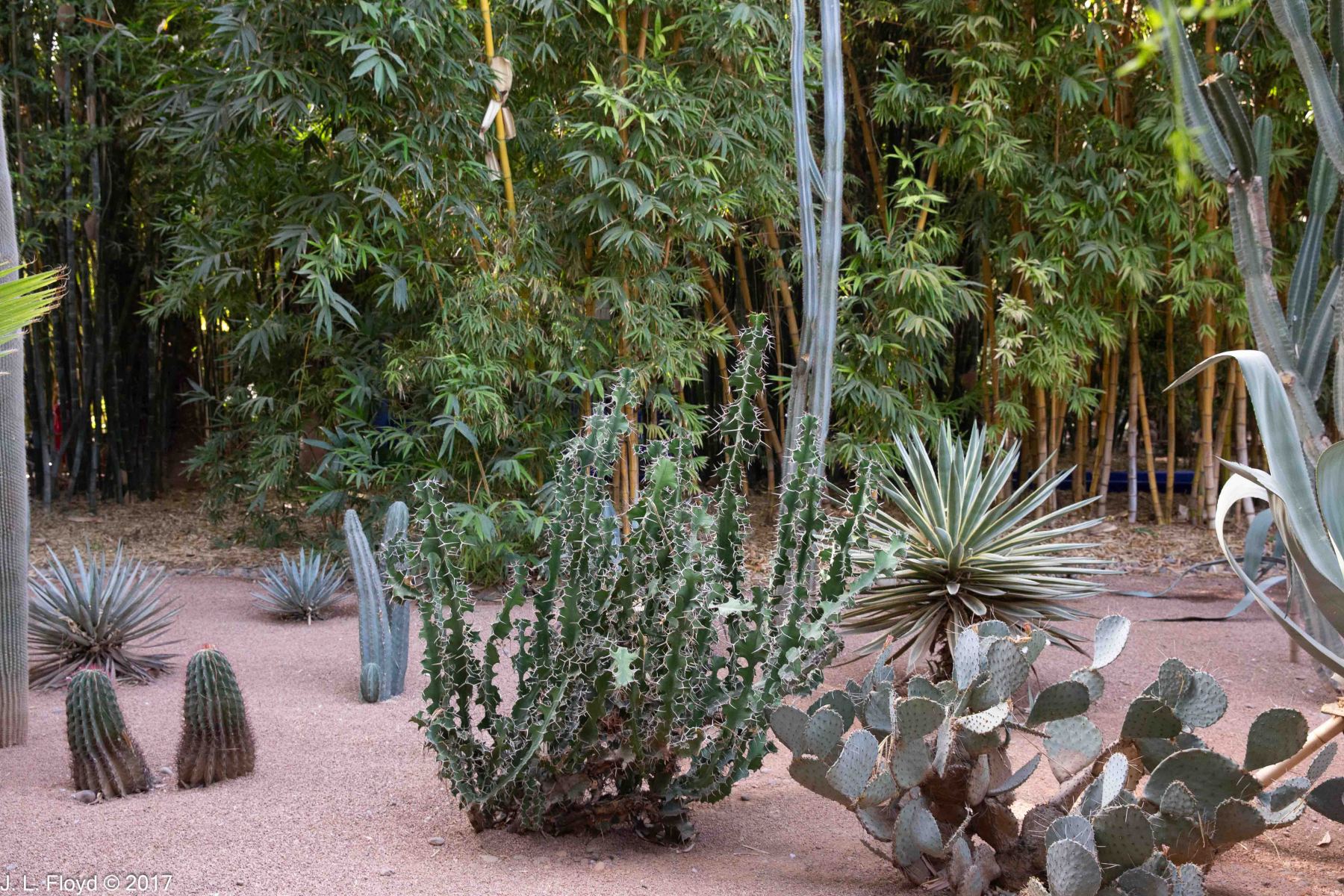
The gardens include exotic plants from all over the world, especially the tropical areas, but they are most noted for their collection of cacti, which comprise the majority of their holdings. Some people, especially from the southwestern USA and Mexico, tend to dismiss the gardens as uninteresting because they can see plenty of cactus in their own countries. Now I’m from southern California myself, and I can see plenty of cactus around where I live, and they are certainly well-represented in the Jardin Majorelle; but it also has many more varieties, from all over the world, and they include more diverse, bizarre and intriguing species than I could have ever dreamed of. For example, there are Opuntia galapageia, a tree-like cactus from the Galapagos Islands, Lepismium cruciforme or Hurricane Cactus from South America and Euphorbia canariensis from (surprise!) the Canary Islands. (Manuel Sueiras ought to know about these, since he was born there.)

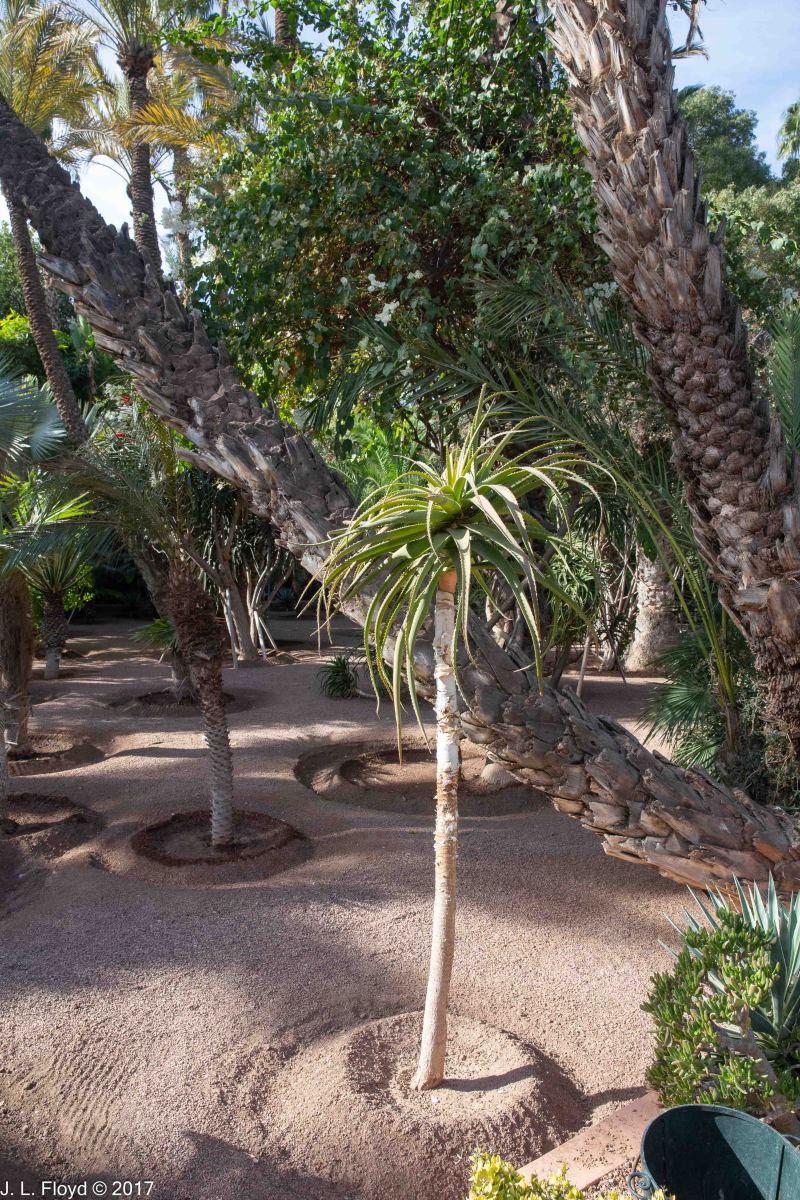
The Euphorbia canariensis especially struck my fancy because with its many offshoot branches it looked like a Jewish menorah gone crazy. As for the non-cactus plants, I most loved the pony-tail palm, also known as the elephant’s-foot tree, with its stout bulbous base which enables it to store considerable amounts of water to tide it over through dry spells. It is native to southern Mexico and Central America.

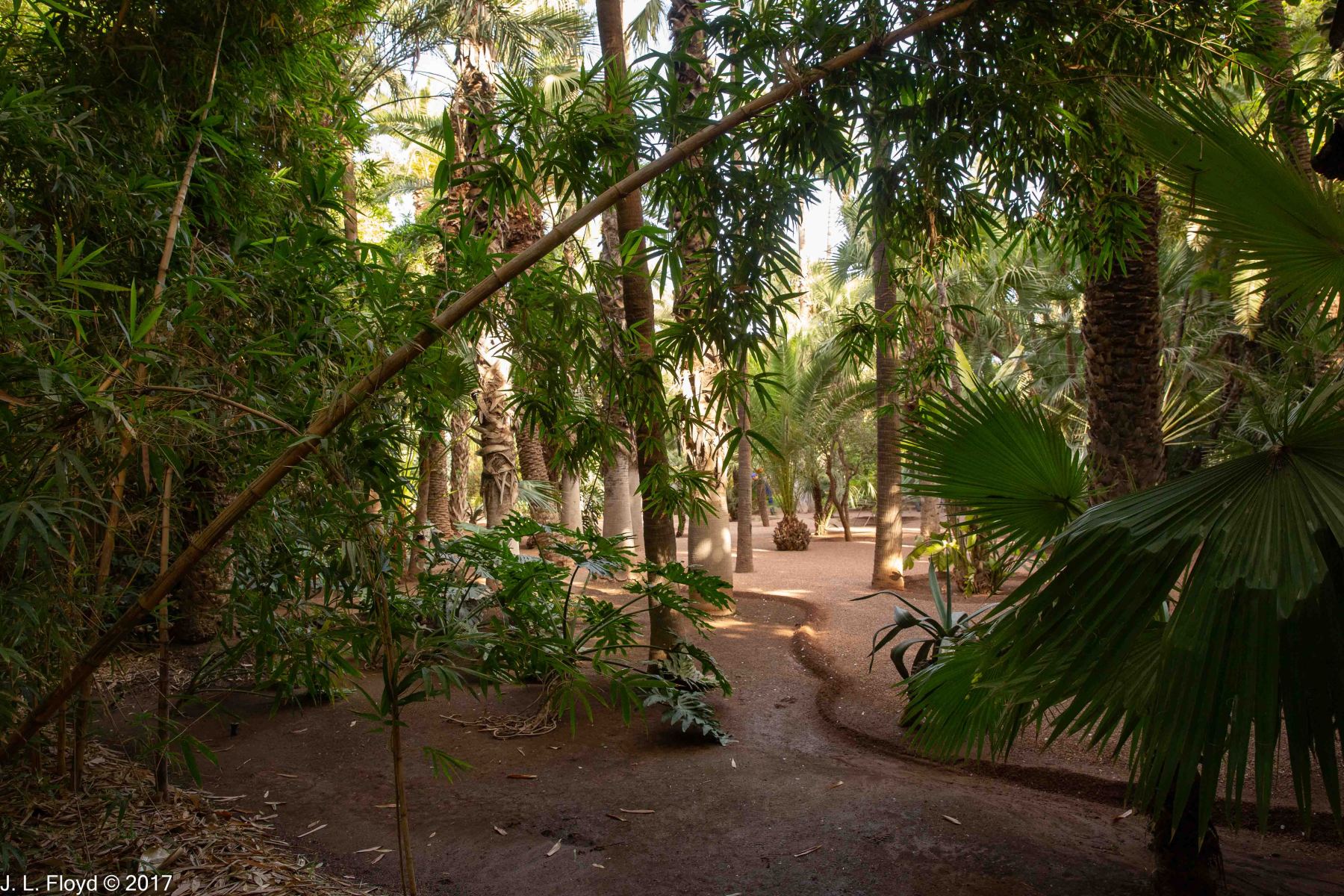
There were many other bizarre and wonderful plants that I would mention if I could, but there were not always signs or placards to identify them. At least I captured a number of them in the photos displayed above, and readers are invited to identify them and submit comments if they recognize them.

Categories
Spain, Portugal and Morocco, November 2017

Marrakesh, November 15, 2017: A Camel Ride at Dusk

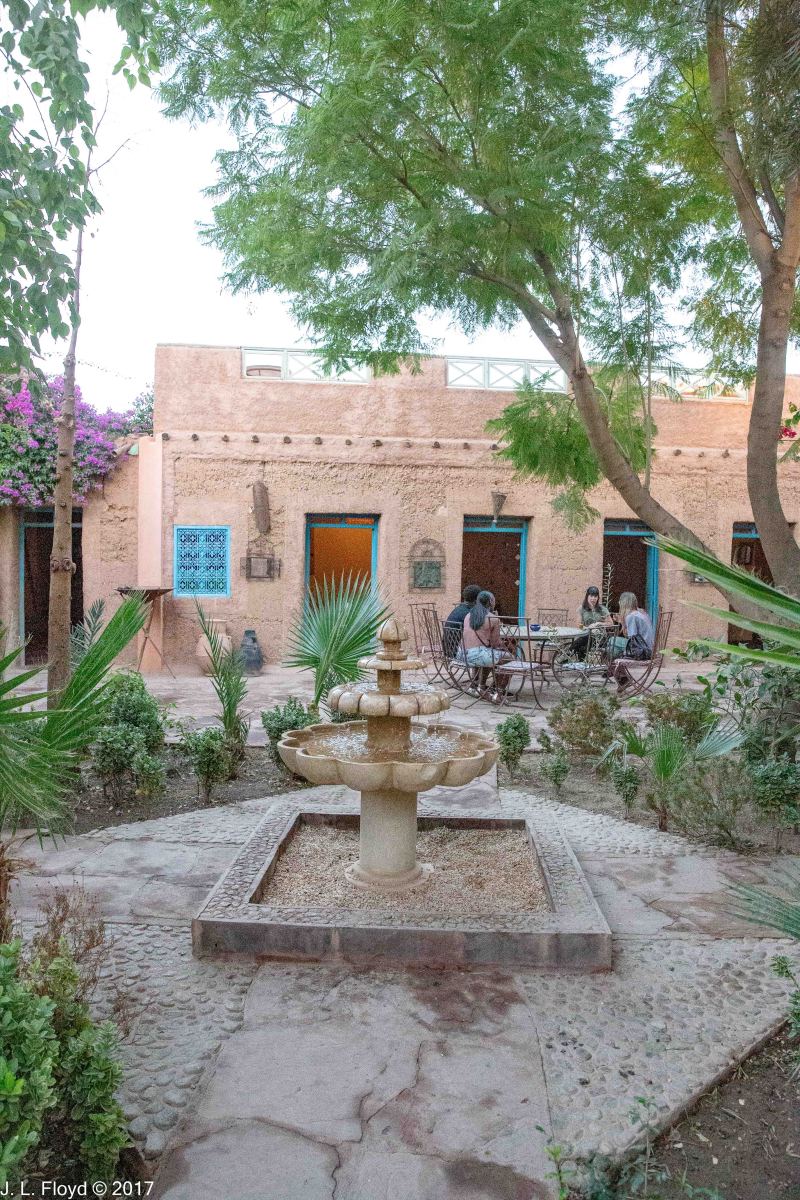
After resting up from the terrifying ordeal in the Jemaa el-Fnaa earlier in the day, we boarded the bus for a ride to a caravanserai on the outskirts of Marrakesh. The caravansarai, an institution ubiquitous in the Islamic world, was an inn providing lodging for travelers, especially merchants, accommodations for their horses and camels, and storage for their goods. It was known under a variety of names, funduq being the commonest in North Africa. Typically located along major trade routes at a distance equivalent to a day’s travel, caravanserais supported a commercial network spanning North Africa, Asia and Southeast Europe, including the famed Silk Road of central Asia.

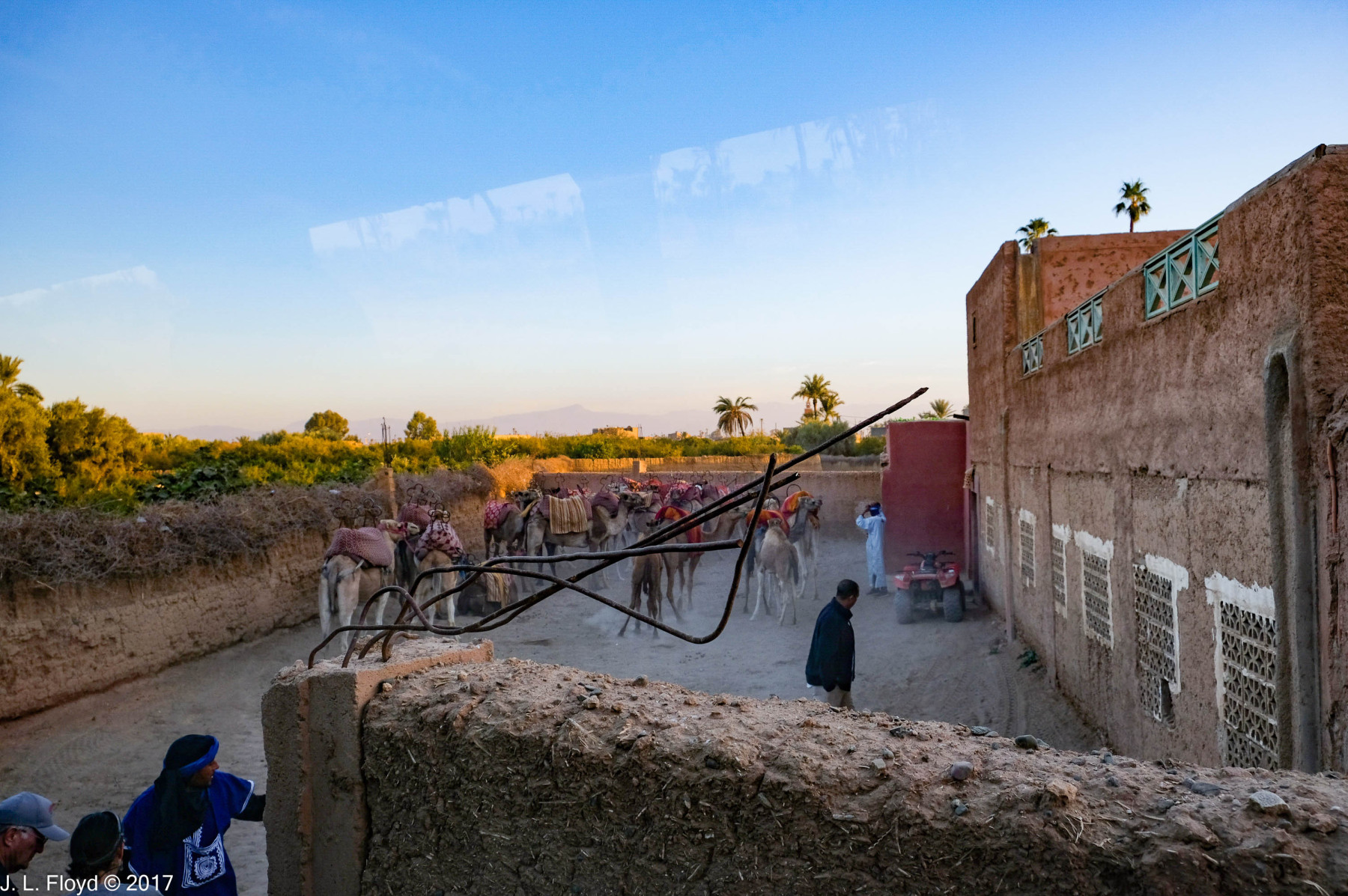
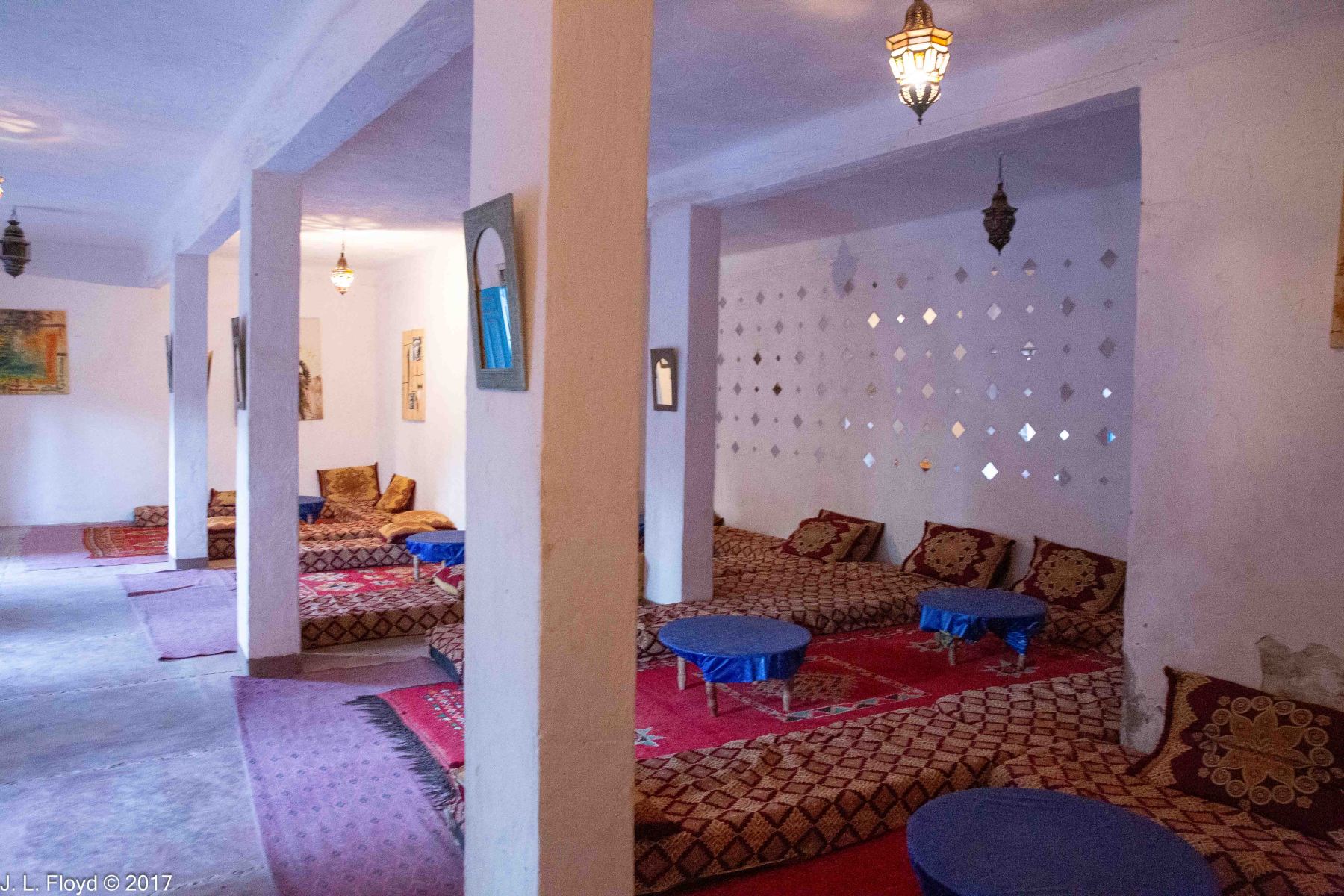
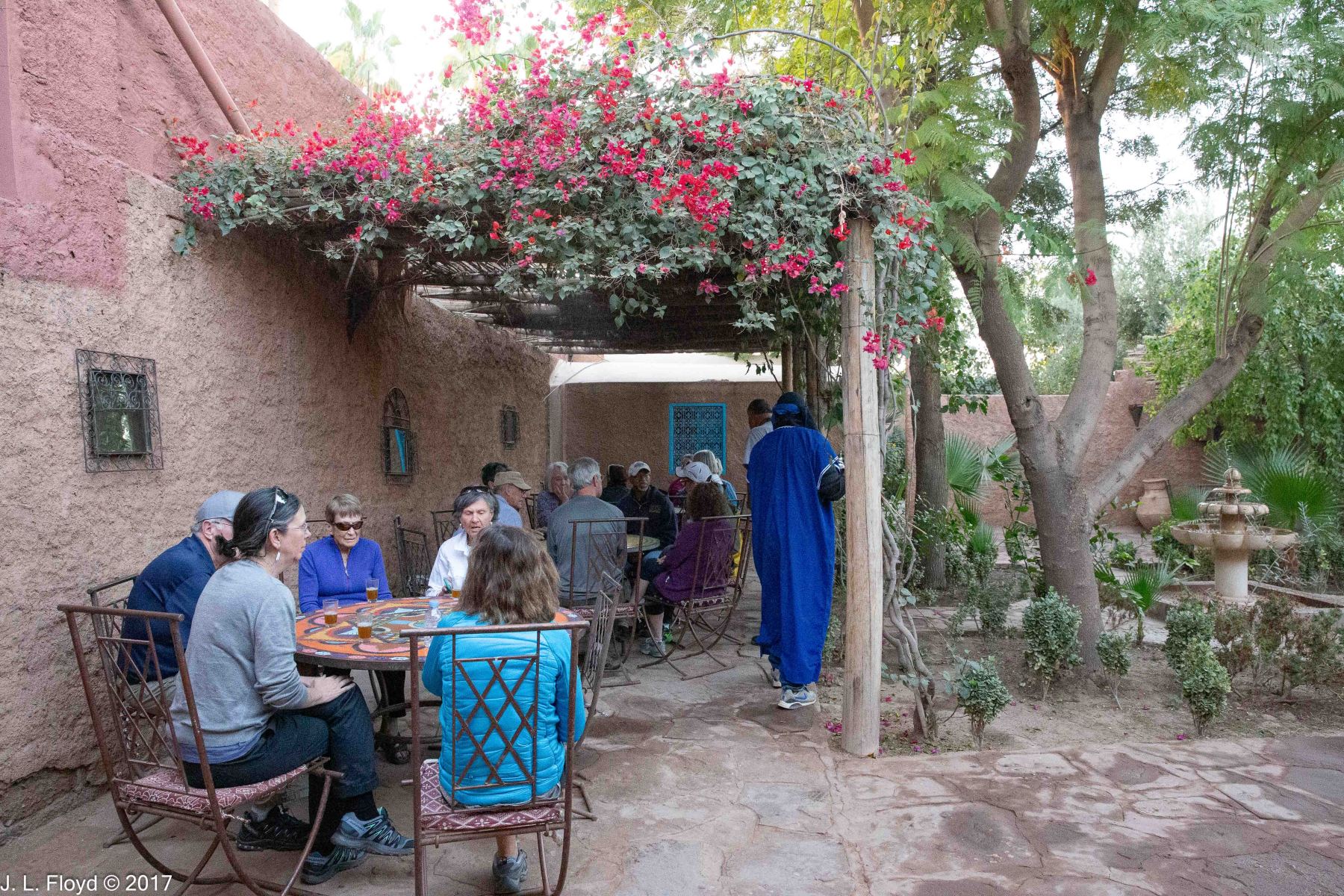
Our destination was typical of the genre – a rectangular one-story structure with one protected entrance and a central courtyard surrounded by dormitory rooms, storage rooms, kitchens and dining areas. There was also an outer courtyard where caravans assembled for departure and arrival.
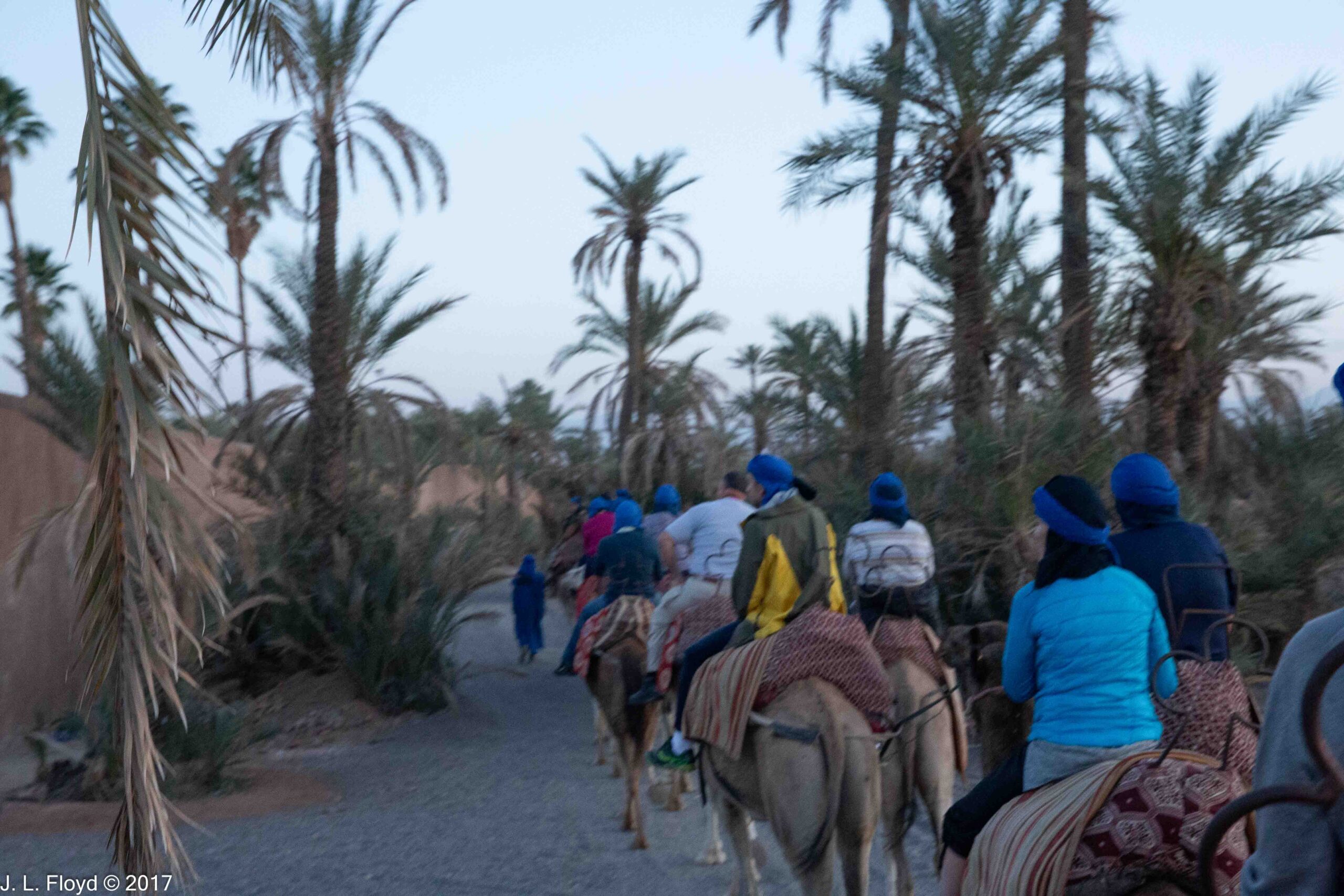
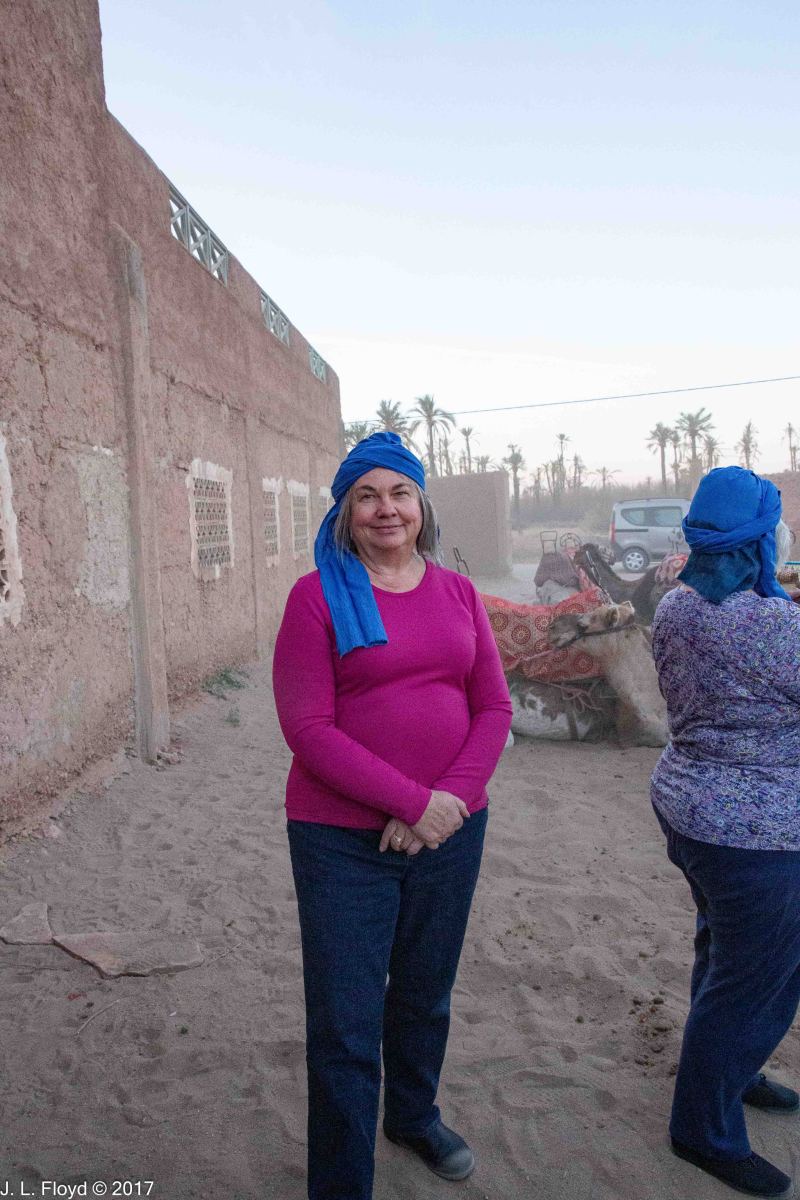
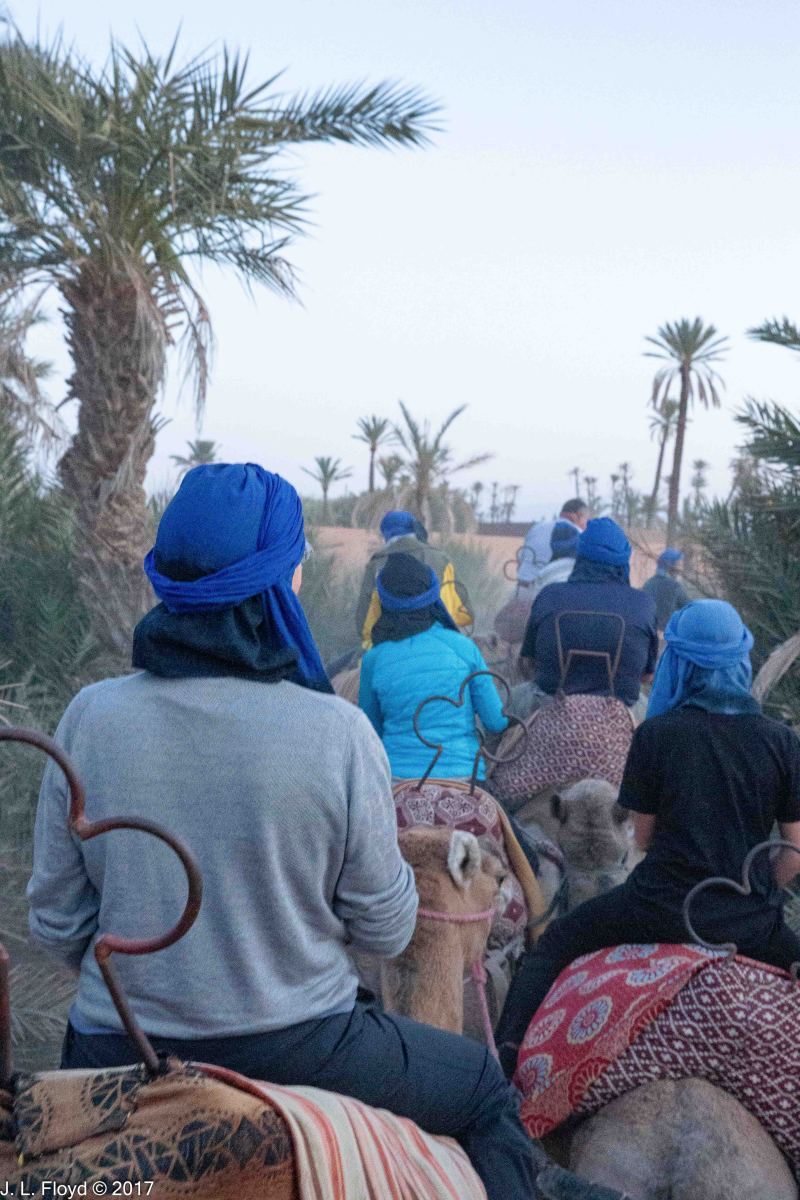
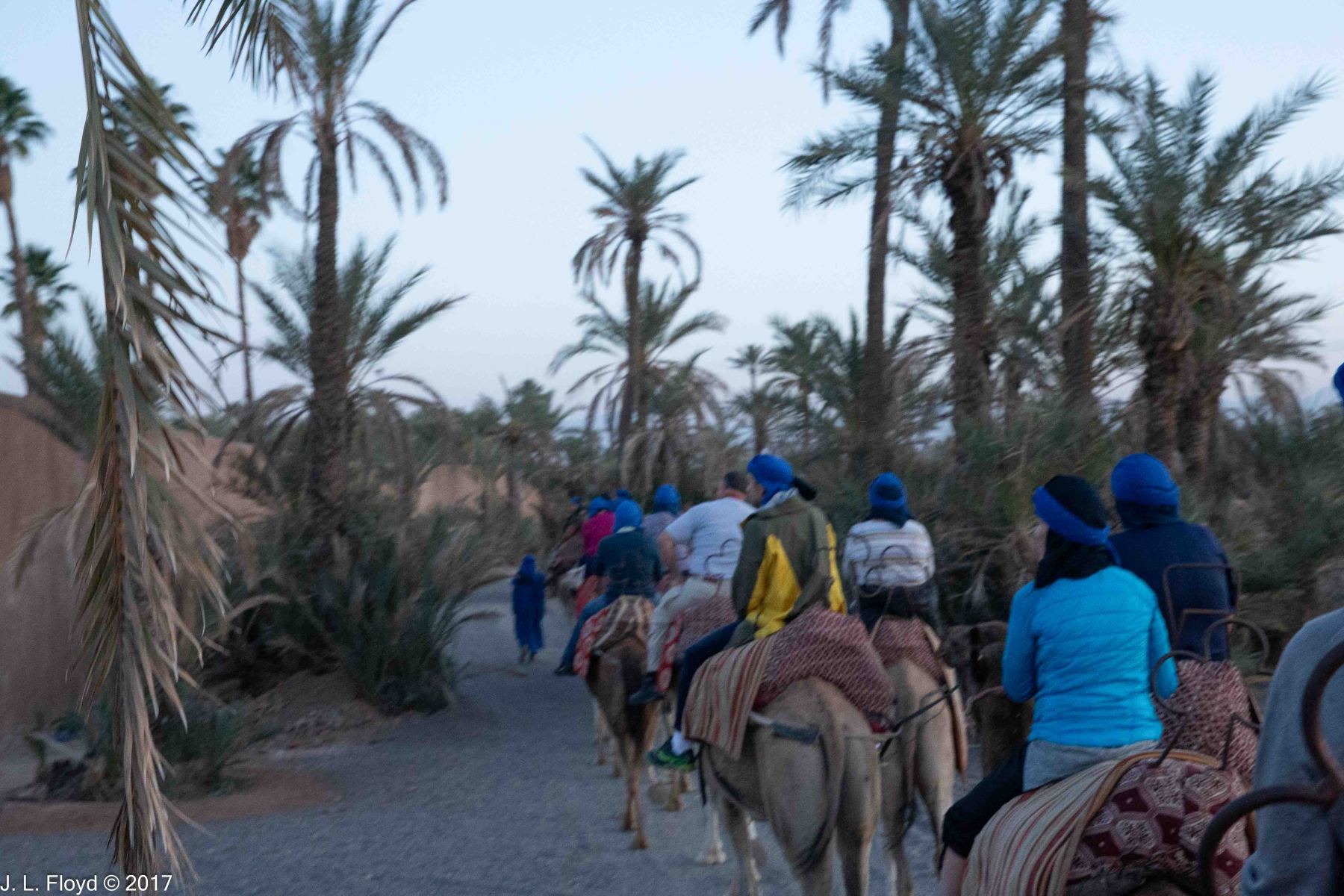
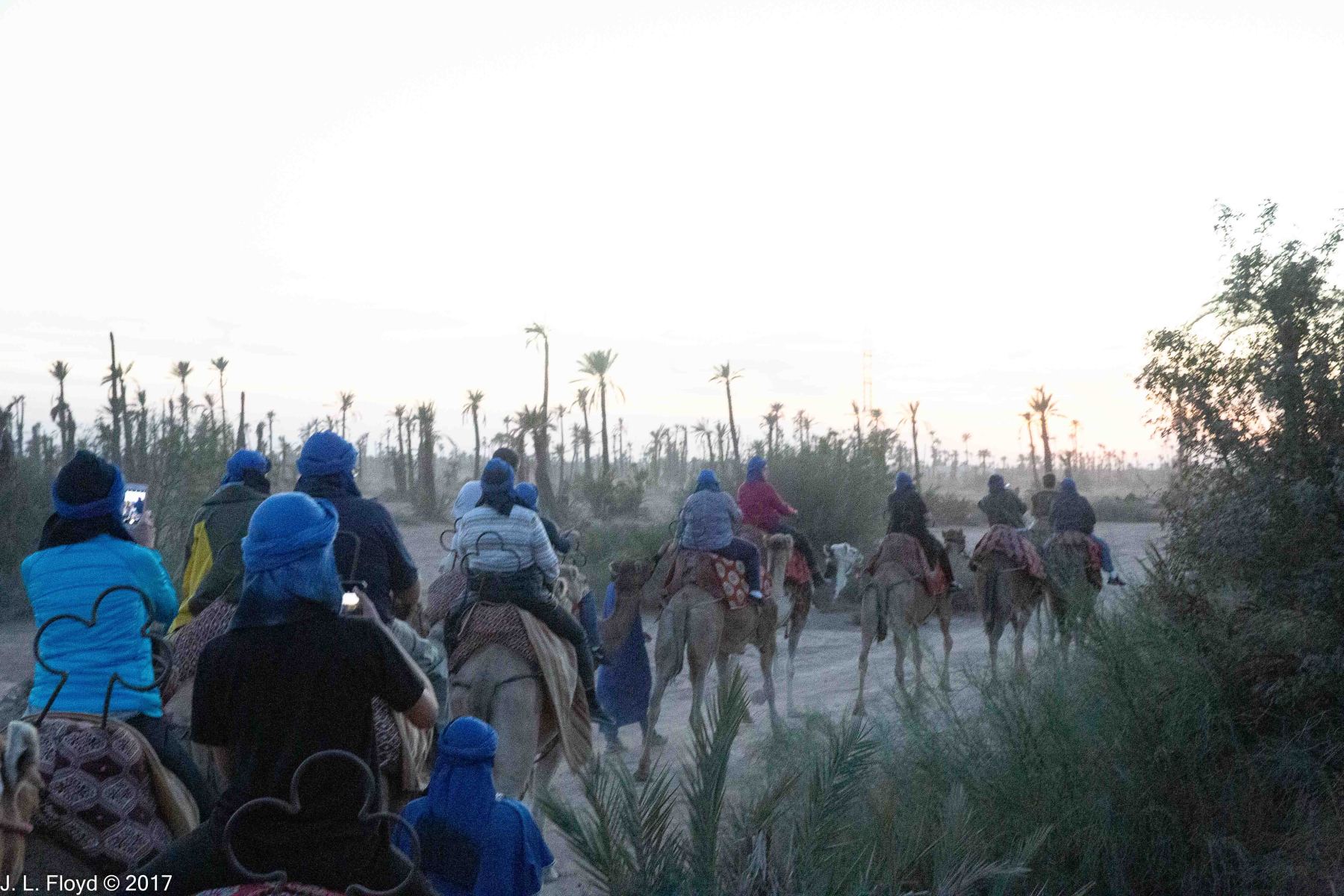
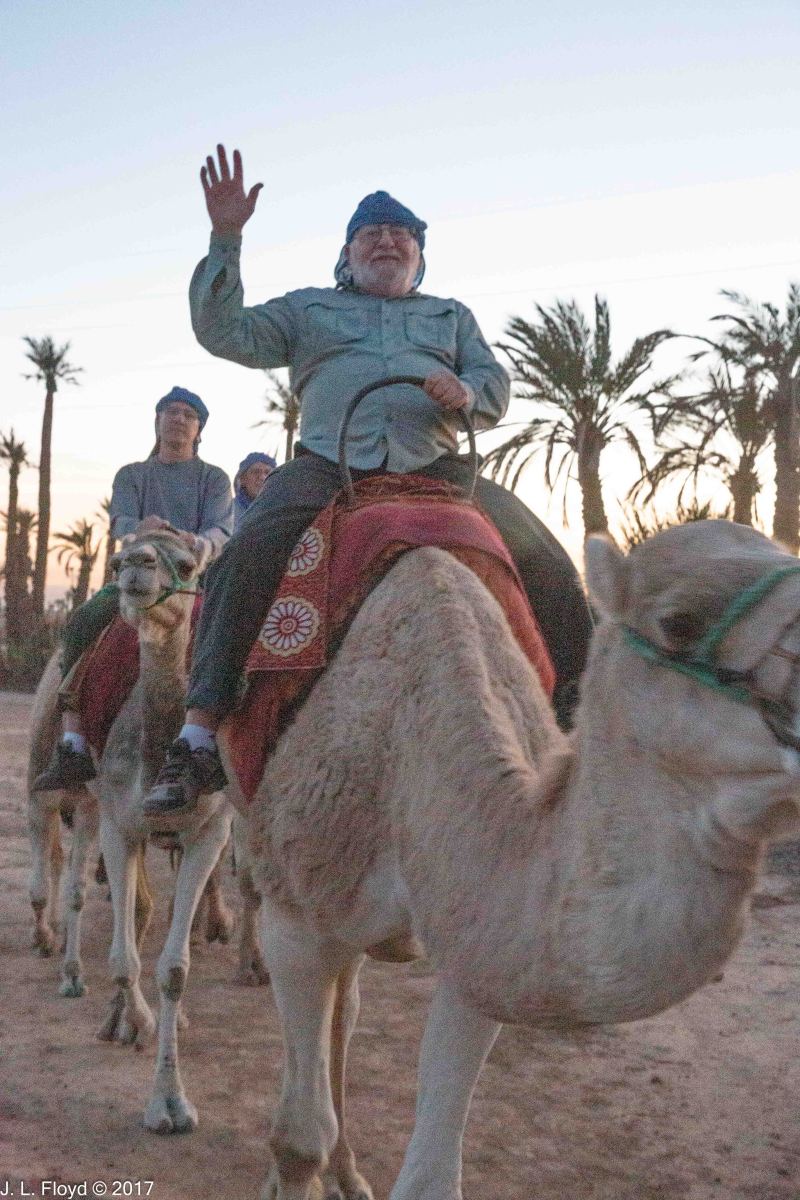
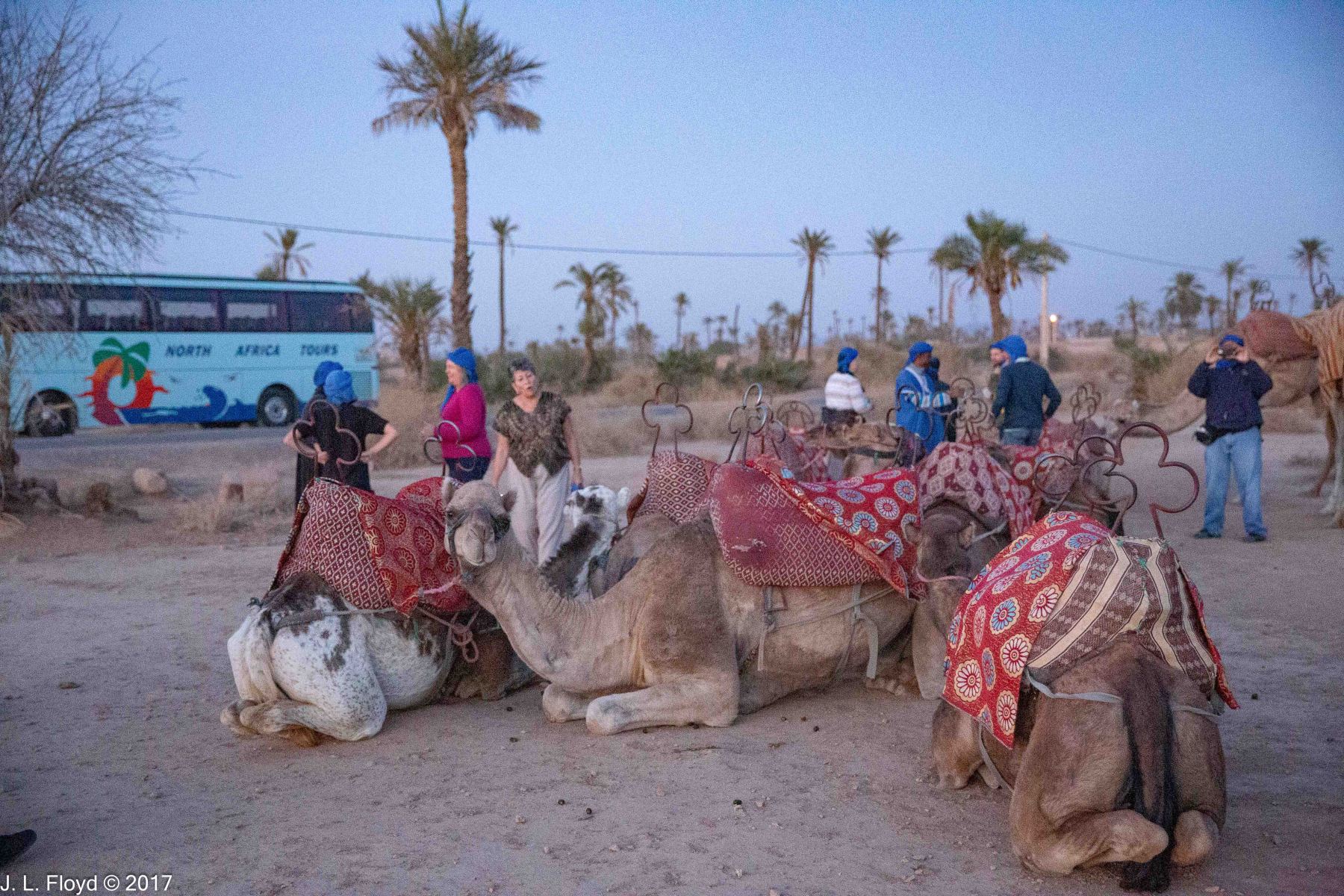
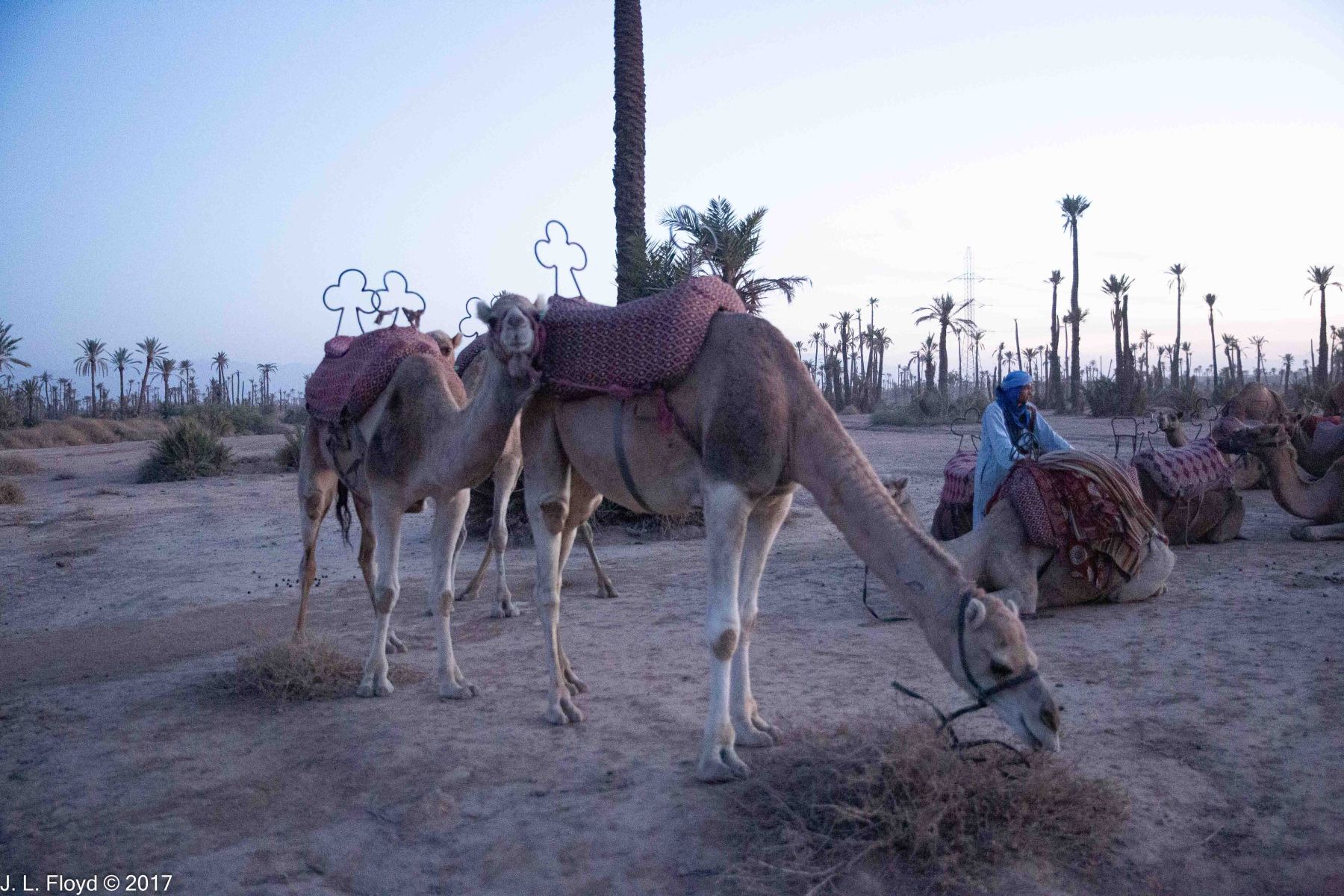
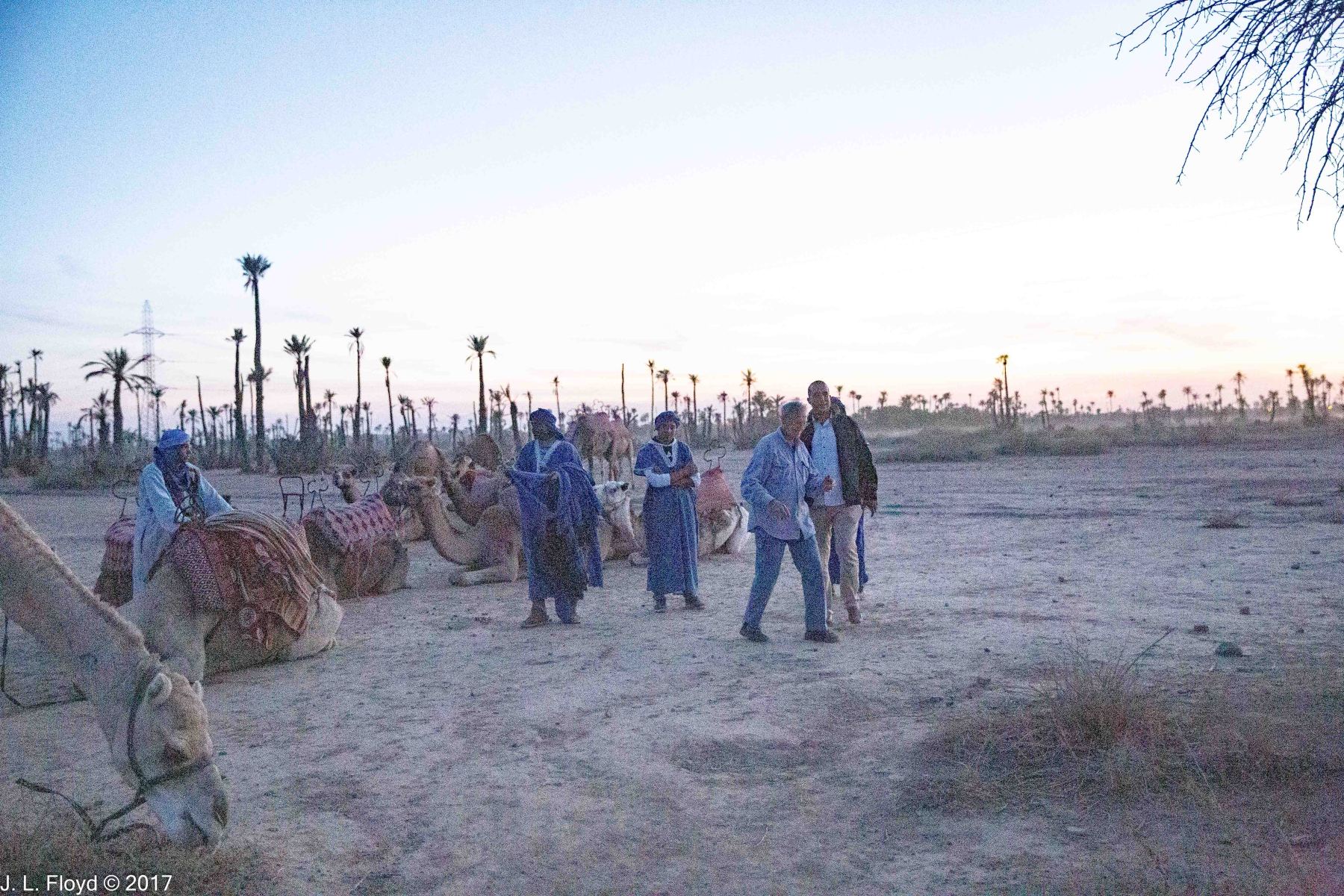
We arrived at the caravanserai just before sunset and were given a brief tour of the inn, then treated to tea and refreshments as a preliminary to our excursion. Preparations for the ride included being fitted with blue cloth turbans, which could be partially unfurled to serve as face-masks in the event of a sandstorm.
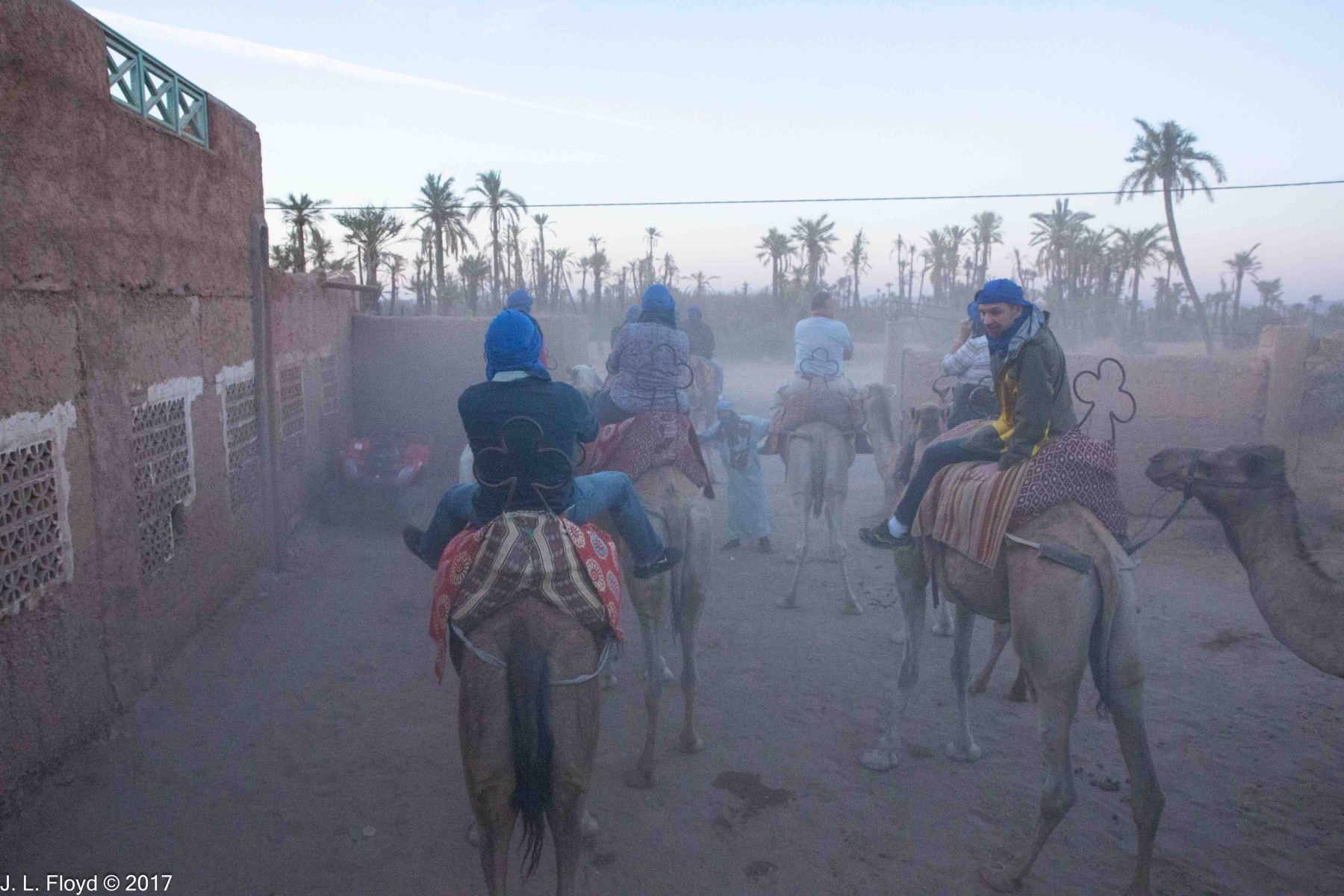
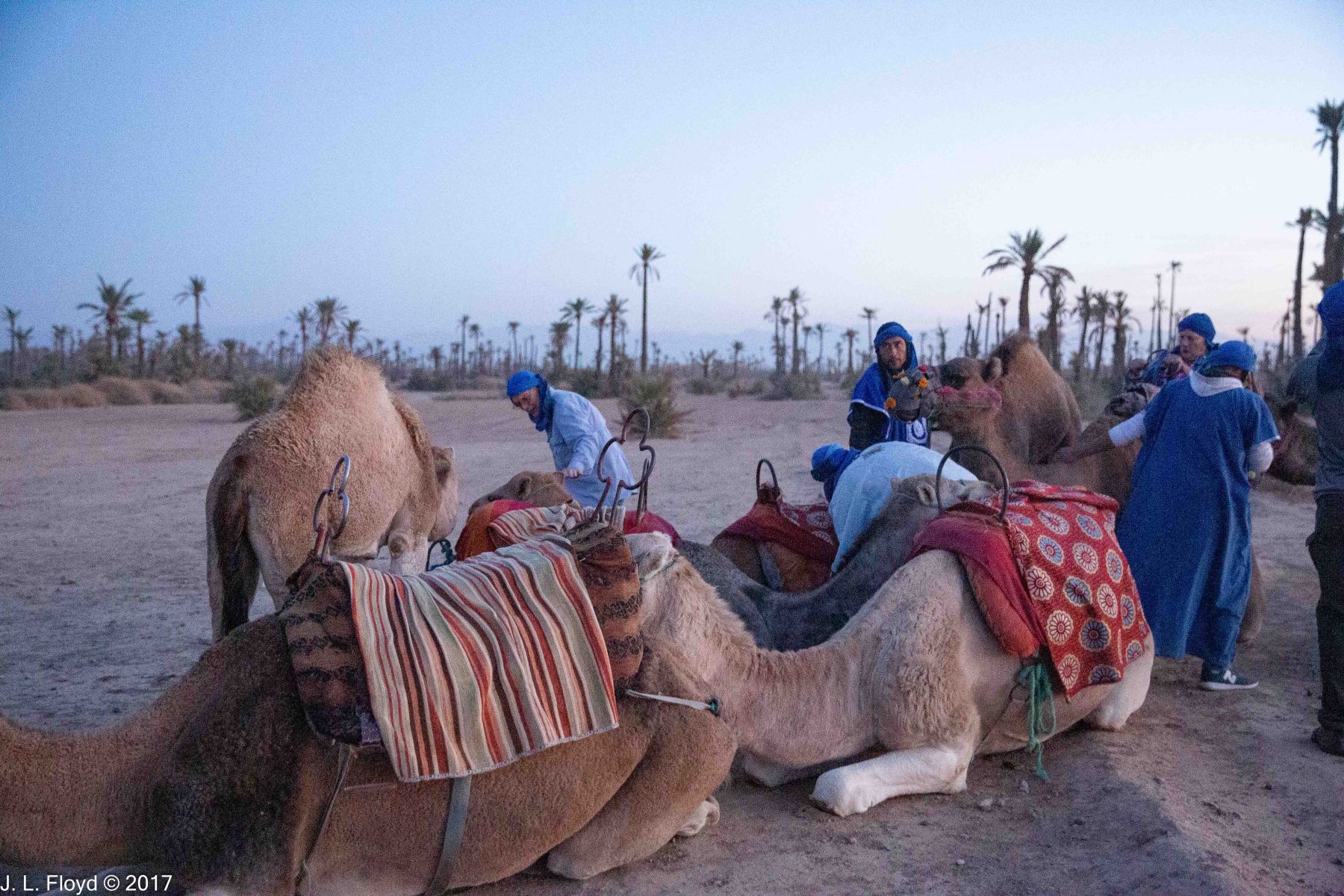
I confess I had some trepidation about mounting the camels, which I had always heard were irritable and unruly beasts. However, this went quite smoothly. It’s not like mounting a horse, where you leap up into the saddle; the camel has to be made to kneel so the passenger can climb onto its back. Here the camel-driver plays an essential role. He has to whack the camel with a stick, crying “kutsch!” as he does so. This may sound a bit cruel, and the animal-rights people would doubtless object, but the camel doesn’t seem to mind. It kneels, and then placidly accepts its burden, rising and patiently waiting for the command to set forth. Or at least that was the way it worked for us. We heard later that these were young camels, easier to work with than their elders, who get crotchety and ornery with advancing age.

Never having ridden a camel before, I was prepared for a rough and uncomfortable trip, but the camel was no bucking bronco and the ride turned out to be surprisingly smooth and comfortable. I could understand how merchants and warriors traveled hundreds of miles on them over the burning desert.

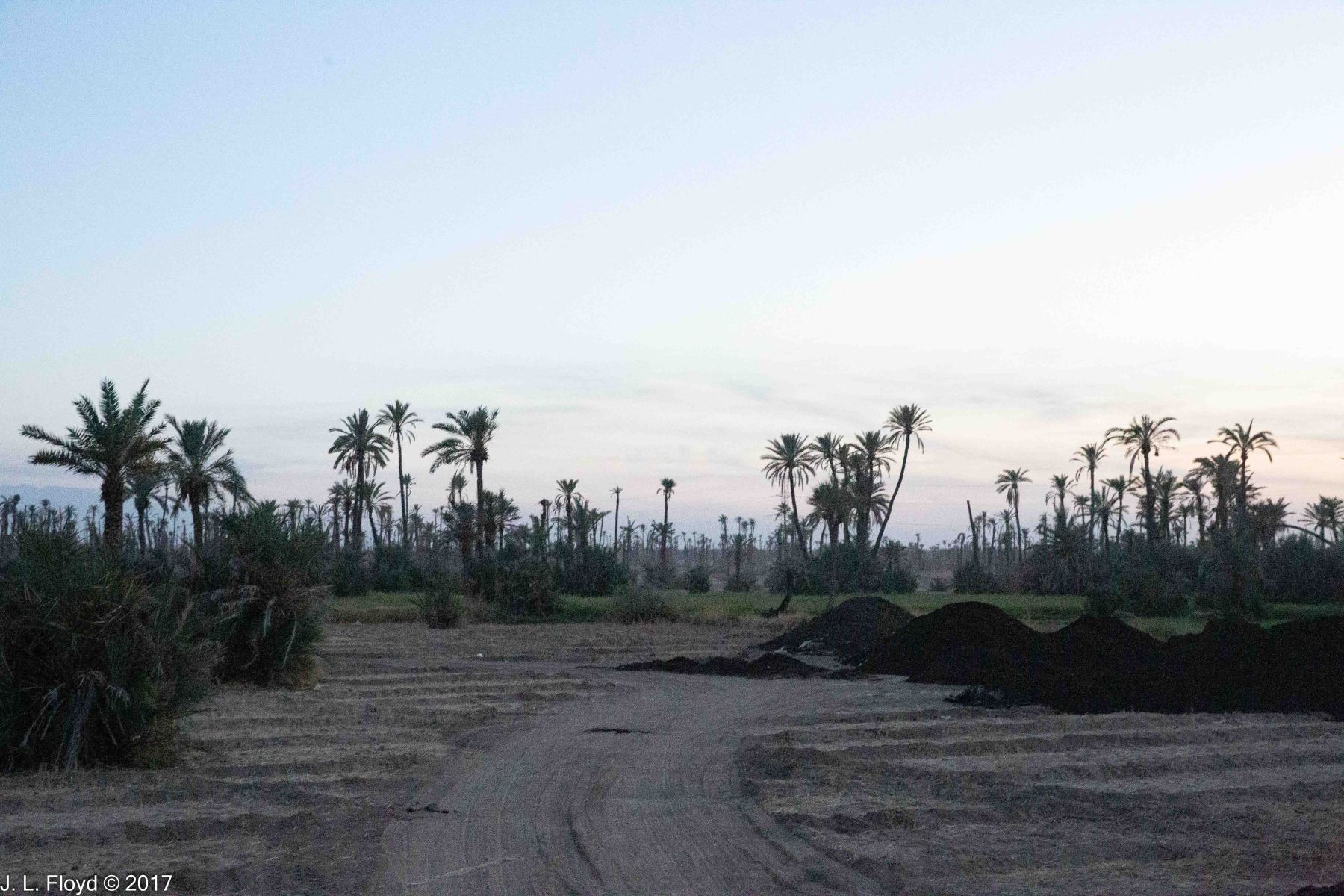
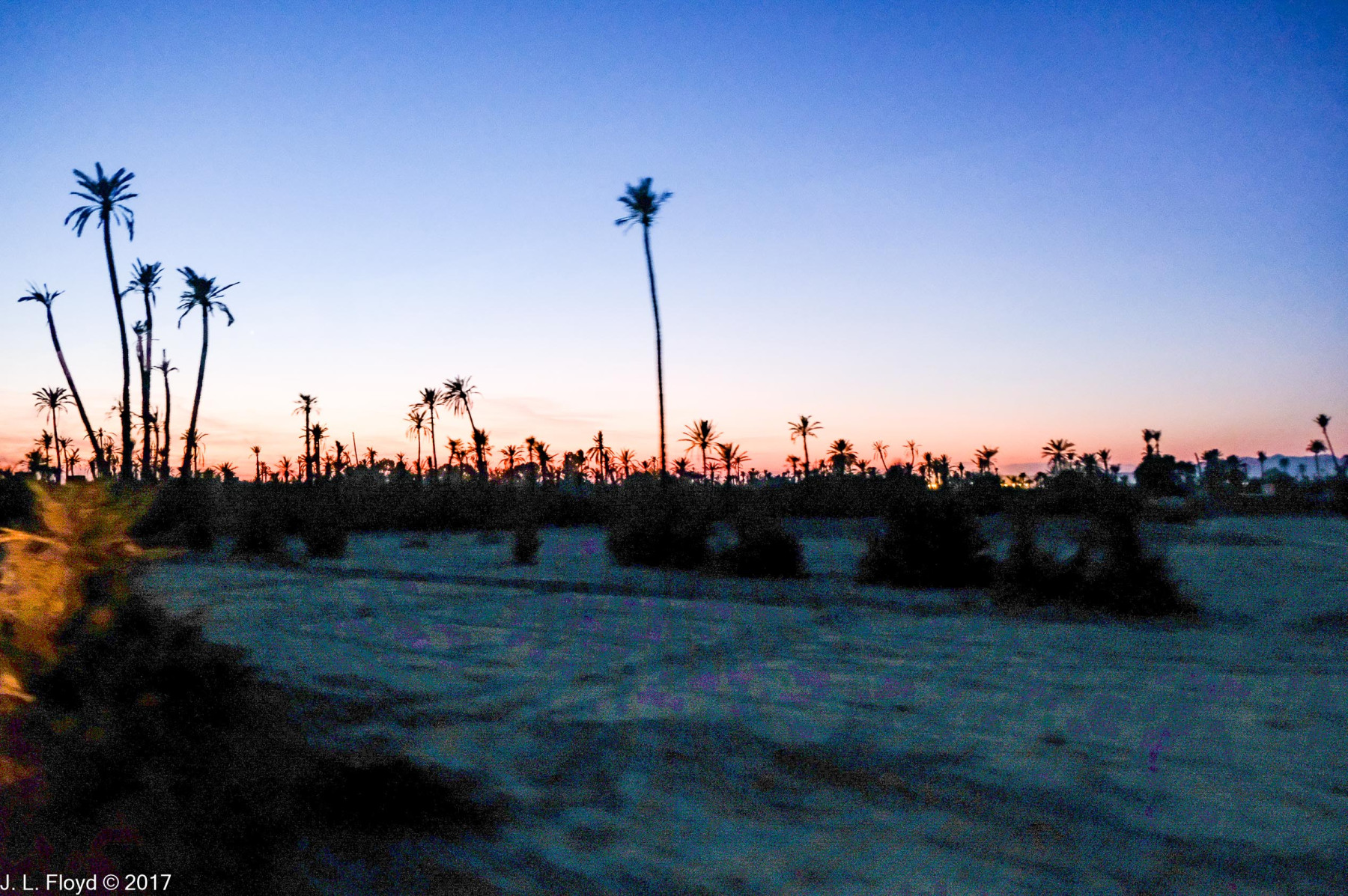
It was not long before we arrived at our destination, which was a nondescript spot off a dirt road in the middle of nowhere, but what made it welcome was that our bus was waiting to take us to dinner at the Palais Baraka in Marrakesh. The camels munched happily on the thorny desert vegetation as we dismounted and checked to ensure that we were still functional. It was the highlight of a memorable day.
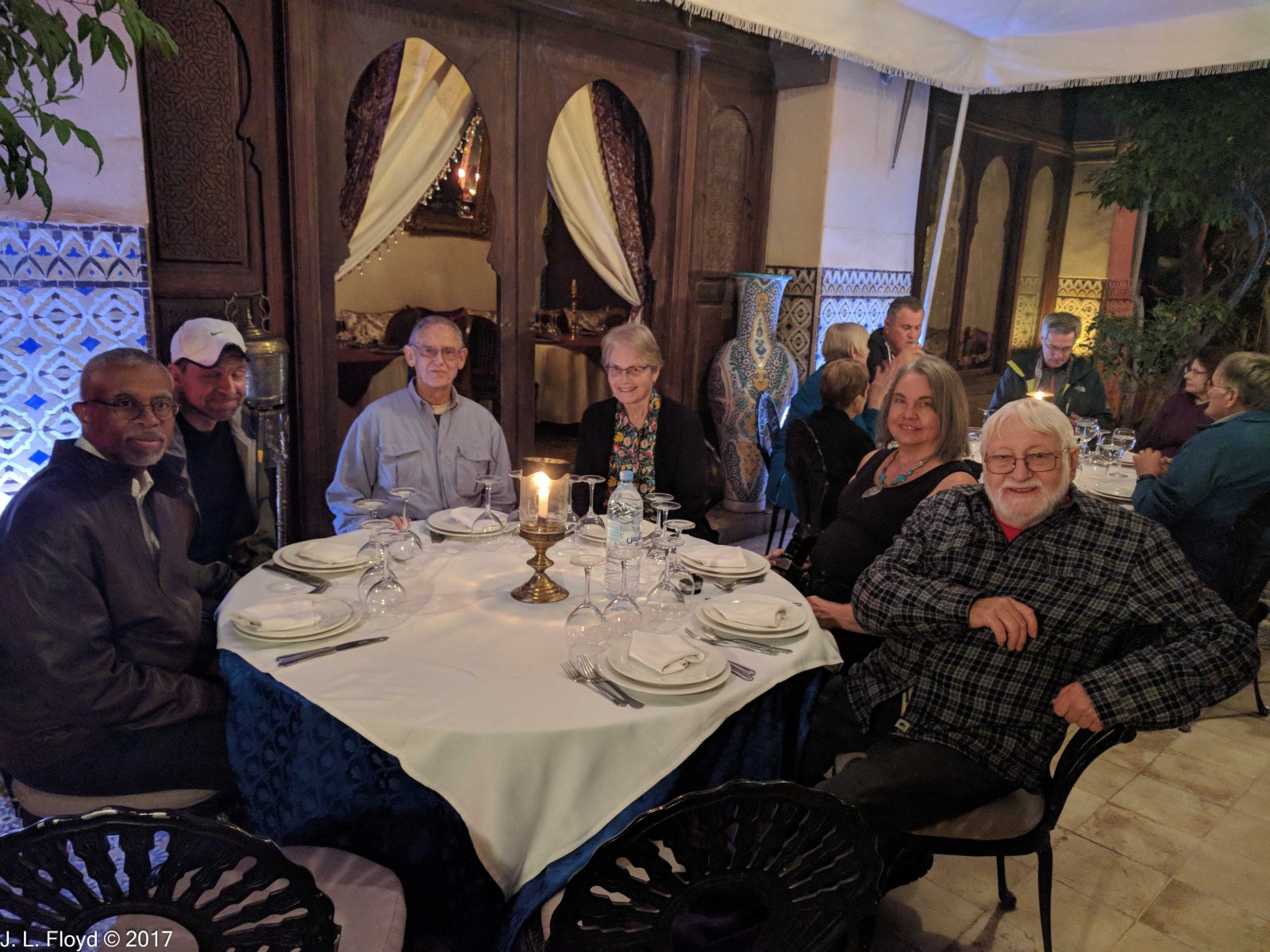
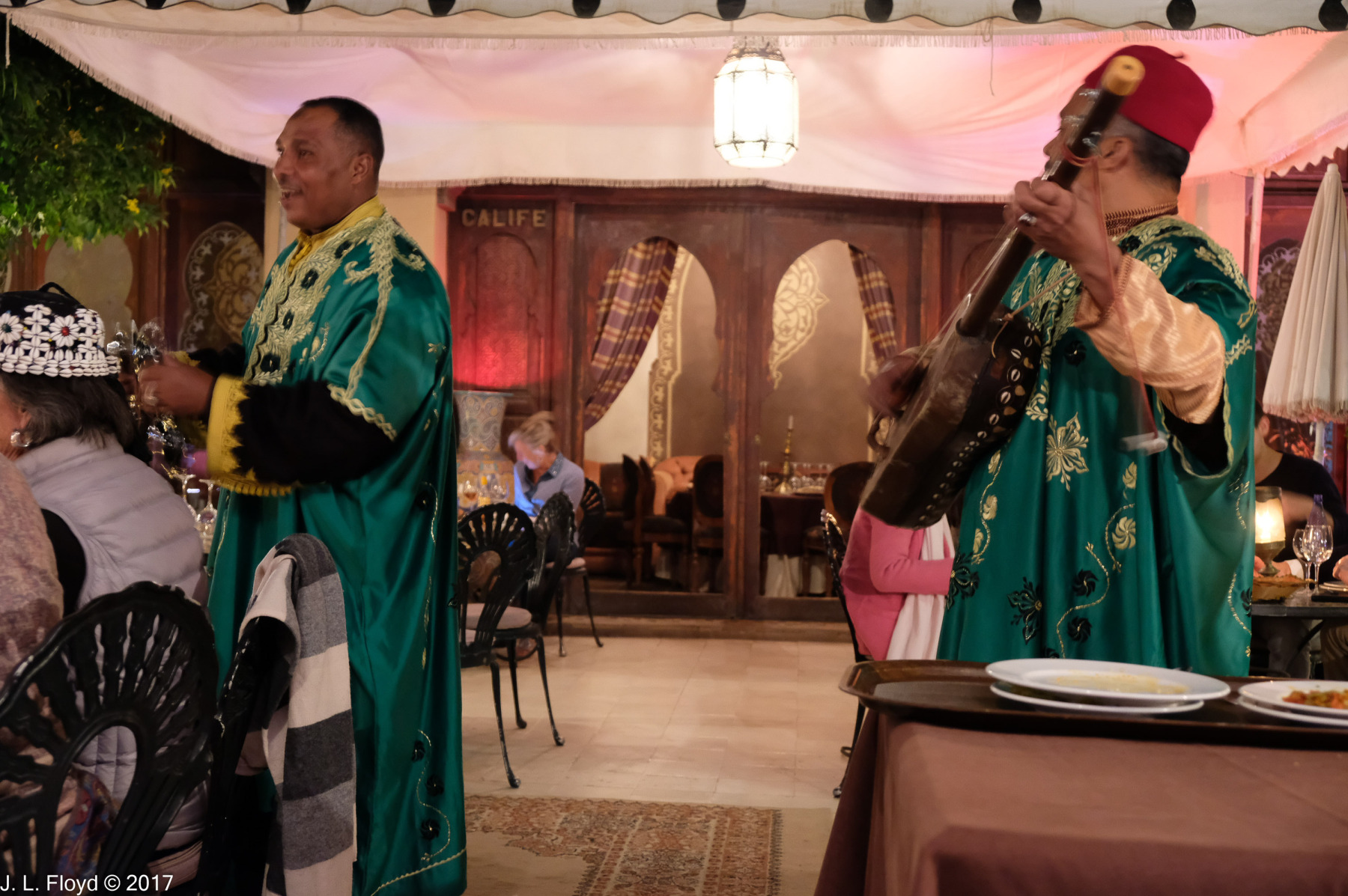
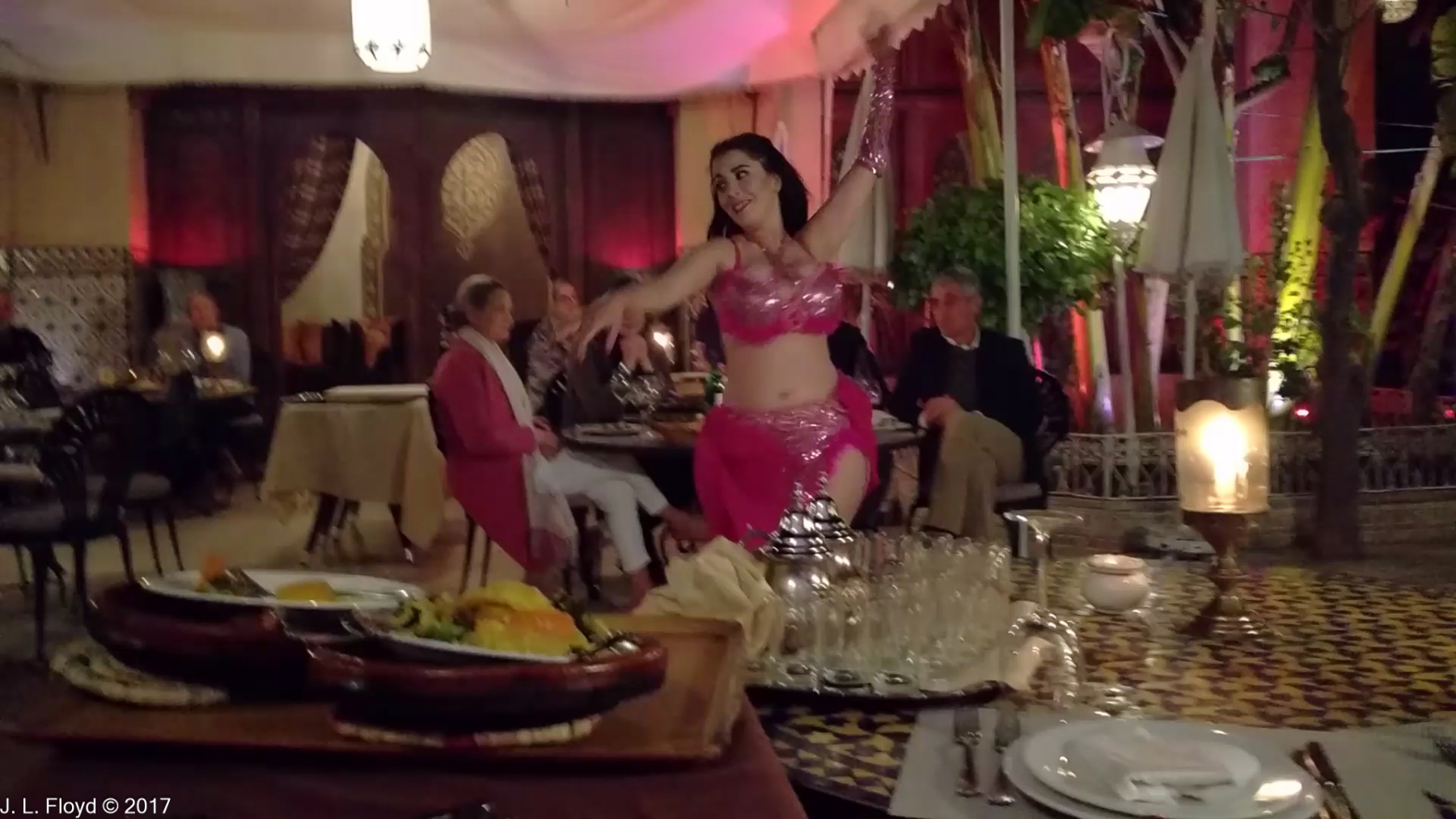
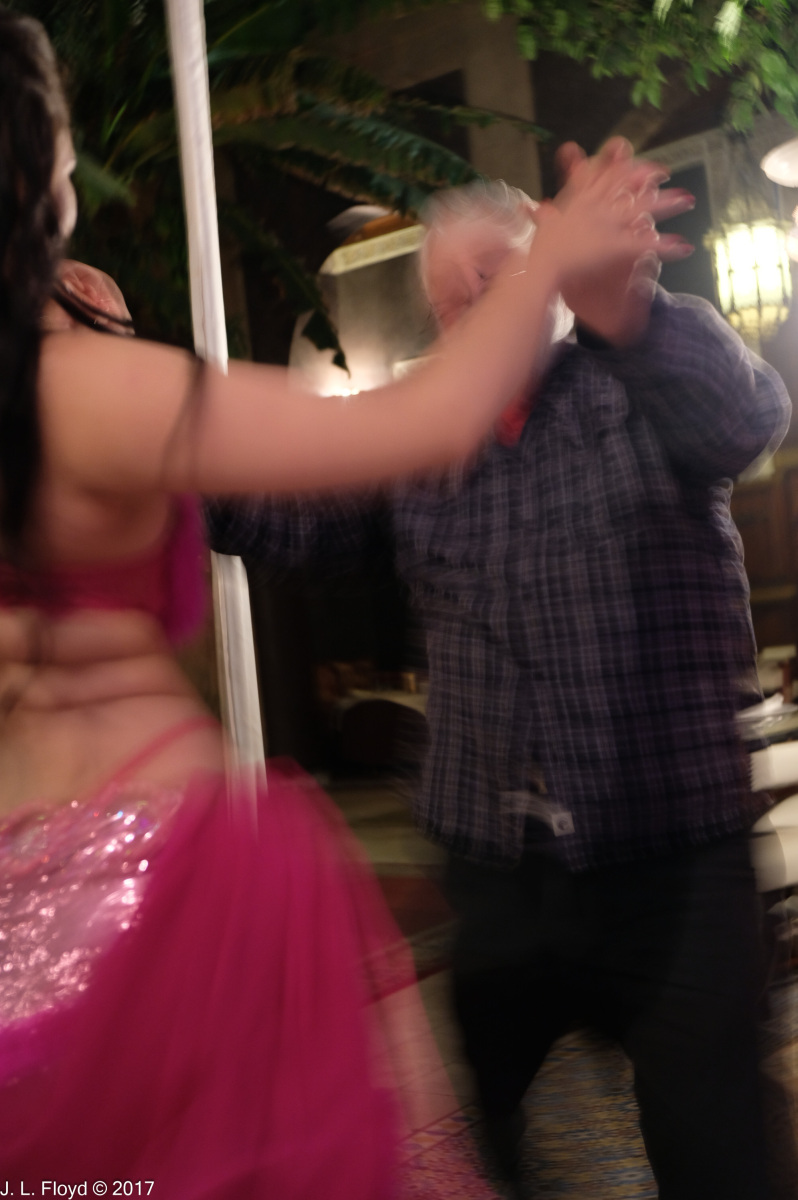
This was the longest day I can remember spending in Africa or anywhere else. We had packed a lot of adventure into that day, but it wasn’t over yet. The finale was a sybaritic dining experience that served as our sendoff from Marrakesh and Morocco. It was held in a palace that rivaled the one we had visited in the morning, and it validated the reputation of Marrakesh as a “party city.” Sandie and I were seated at a table with Chuck and Elouise Mattox, Bill Chermak and Bill Glenn. As we finished dinner, the entertainment began, which consisted of Moroccan music and, inevitably, belly dancing – the latter performed by an attractive and seductive woman who lured me into dancing with her. I’m a completely inept dancer and probably looked quite ridiculous, but it was all good fun.

We had only one full day to savor Marrakesh, but it was a memorable day. On the morrow we were scheduled to board a flight to take us to Madrid, but it departed in the afternoon, leaving us a morning to enjoy one more adventure in Marrakesh, which I’ll recount in the next post.

Categories
Spain, Portugal and Morocco, November 2017

Marrakesh, November 15, 2017: The Perils of the Jemaa el-Fnaa

Without a doubt, the Jemaa el-Fnaa provided for me the most bizarre and indelible experience of the entire trip. It is a huge open square in the middle of Marrakesh, surrounded by souks, cafés, hotels and other service establishments, such as a post office. To get to the Jemaa el-Fnaa, we had to walk from the rug shop near the Tinsmiths’ Square through a maze of narrow, crowded alleys where we inevitably became disoriented and utterly dependent on our guides’ geographical expertise. I was trying intently to keep up with the guides, but at some point I stopped to adjust my camera to the lighting conditions in the passage, and when I looked up, I was alone, with no members of the tour group visible and no indication as to which direction they had gone. There was a fork in the road, and following Yogi Berra’s advice, I took it. That is, I tried both directions in turn, but found no trace of the tour group on either path. One path led directly into the square, the other went deeper into the labyrinth. Finally I took the path that led directly into the square, figuring that the group must have gone that way. (It later turned out that the group had gone into a spice shop off that same lane, but the group was invisible from the outside, so I had missed them entirely.)

This was a very disquieting situation. Our guides had given us dire warnings beforehand about the dangers awaiting us in the Jemaa el-Fnaa, stressing the necessity of sticking together and not getting lost, and that greatly deepened my anxiety. I had no way of communicating with the tour guides or anyone else since my cell phone didn’t work outside the USA. I had no idea how to get back to the bus or the hotel. For want of anything better to do, I started wandering around the Jemaa el-Fnaa, hoping that at some point I would run across the tour group. But it was a forlorn hope given the vastness of the square and the extreme difficulty of identifying anyone amidst the crowds that thronged it.

Instead of finding the group, I shortly stumbled into a snake pit. This was actually an open area in the square where a crew of snake charmers had spread a rug on which they displayed their menagerie of deadly poisonous serpents. I dislike snakes intensely, but I am fascinated with them nevertheless. I had never before encountered snake charmers and my curiosity overcame my aversion.

If I had had any inkling of what I was getting into, I would have fled the scene forthwith. But either the guides had not warned us about the snake charmers, or I hadn’t heard the caveats. Since then, I have read a bit about the snake-charming profession and learned that it is a sordid and unsavory business. According to one source I consulted,

“…the snakes, having been caught and trapped in the countryside, then have their teeth pulled out. To prevent their captors being injured by them their mouths are usually then sewn almost completely shut. Sometimes their venom ducts are burst with a hot needle in a painful and debilitating way. The snakes you see in front of you cannot eat, are in constant pain and completely unable to defend themselves. They are prisoners and lead a sad and hopeless life. They will soon be unable to move around and will be thrown away, to be replaced with another. The only way this will end is if tourists stop pausing for photographs with these poor, sad, dying snakes. You are simply feeding a tourist industry that needs to stop. It is incredibly cruel.”

It might seem difficult to feel sorry for creatures that in the wild, with all their equipment intact, can kill you with one bite, but I do and I heartily regret having gotten involved with this scam. In my defense I can only plead ignorance. The snakes I saw did not seem to be in pain or defenseless, and the charmers did not act as if they had nothing to fear from them – at least that was true of the cobras. (But that was most likely part of the con.) Occasionally one of them would tease a cobra with his cap to get the snake to strike, but when picking a cobra up with his hands, he was careful to hold the creature in a way that the snake would not have a chance to bite him. I could not tell by looking at them that the snakes were defanged.

The snake charmers had two kinds of snakes, Egyptian cobras (asps) and puff adders. Puff adders are rather stout reptiles, generally about a meter in length as adults; their name comes not from their girth but from the fact that when bitten, their victims swell up like a balloon. Although rather sluggish, they are nevertheless aggressive and ill-tempered, and they are responsible for more fatalities than any other snake in Africa. But the ones I saw in the snake pit seemed much more docile than the cobras, quite sluggish indeed – they might have been drugged – and the men handled them rather casually, so I suspected they were indeed defanged. The cobras were more aggressive and did not seem to be in any way impaired. The charmers indeed tried to get me to handle one of the puff adders, but I declined. (Actually, as I found out later, they were probably not puff adders but rather pythons, which are non-poisonous, but I can’t tell the difference unless one bites me, which I prefer to avoid.)

The cobras, by contrast, seemed active and alert, remaining in their typical “threatened” posture, upright with their hoods spread, most of the time while I was present. I was careful not to get close to them, photographing them with my zoom lens.

After finally escaping from the clutches of the snake charmers, I wandered around the Jemaa el-Fnaa for a while, increasingly dismayed at being alone and adrift in such a place of peril. Nevertheless I did have some pleasant moments, such as an encounter with a shoe-shine boy who gave my shoes the best shine they ever had.

After about an hour of traipsing around the square, I heard Karim, our Moroccan guide, shouting my name from a sidewalk restaurant which I had just passed by unknowingly without seeing any of our group seated in plain sight — which is a lesson in the difficulty of finding people in a crowd. The guides, as well as Sandie, had become quite alarmed to find me missing, and Karim had sent two of his assistants to search for me. Our tour director, Manuel, gave me a thorough scolding for my ineptitude, but I was merely relieved at not having to find my way back to our hotel, the location of which I had no clue, on my own.

After a decent lunch, we finished our sojourn in the Jemaa el-Fna without any further misadventures, and then re-embarked on our bus to return to the hotel. On the way out I was able to get some nice pictures of the square with its pinkish-red buildings softly saturated by the November afternoon sun.

By this time we were all fairly well exhausted and needed a good rest before embarking on the next arduous adventure, which was to be a camel ride at dusk on the outskirts of Morocco, followed by a farewell-to-Marrakesh dinner in a palatial restaurant — to be related in the next post.

Categories
Spain, Portugal and Morocco, November 2017

Marrakesh, November 15, 2017: The Kasbah

When we left the Palais Bahia, we found ourselves in the Marrakesh Kasbah, a citadel and palace district on the south side of the city, dating from the time of the Almohad caliph Yaqub al-Mansur (r. 1184–1199). Wending our way through the picturesque streets, we shortly came to the Place Moulay Yazid, the site of the Kasbah Mosque, built by Yaqub al-Mansur to serve as the main mosque of the governing elite. It rivals the more famous Koutoubia Mosque, located not far away, which we did not visit. Both mosques are considered prime examples of Moroccan mosque architecture; the Koutoubia has the taller minaret, at 77 metres (253 ft), but they are quite similar in appearance.

In the late 16th century – the exact date is not recorded – a gunpowder explosion in a nearby store severely damaged the Kasbah Mosque. At that time Morocco was ruled by the Saadi dynasty, whose reigning sultan, Abdallah al-Ghalib Billah (r. 1557-1574), undertook extensive repairs to the Kasbah Mosque; it is thought that the restoration work resulted in extensive changes to the interior of the mosque, reflecting Saadian tastes and preferences. This did not matter to us, since as infidels we were not permitted to go inside, and the exterior appearance apparently remained little affected, with one major exception.

The exception was the result of the construction of a necropolis for the Saadi rulers, right up against the qibla (southeastern, in this case) wall of the mosque. It consists of two mausoleums, where the members of the ruling family were interred, as well as an exterior cemetery where tombs of the lesser dignitaries are located. The first mausoleum was begun by Abdallah al-Ghalib himself, who is buried there, along with his father, Muhammad al-Shaykh, the founder of the Saadian dynasty. This is now known as the Eastern Mausoleum. The next Saadian sultan, Ahmad al-Mansur (r. 1578-1603), a brother of al-Ghalib, greatly expanded and embellished the Eastern Mausoleum, adding two rectangular loggia rooms on its eastern and western sides, as well as a large rectangular room known as the Grand Chamber on the southern side. He had his mother buried in the Eastern Mausoleum, next to her husband, Muhammad al-Shaykh. For himself, al-Mansur built what is now known as the Western Mausoleum, where he was buried upon his death in 1603. Unlike the mosque, we were not excluded from the Saadian Tombs, and we went through them, but because of lighting issues I was only able to obtain one decent photo of the interior, a shot of the Grand Chamber.

 After touring the Saadian Tombs, we needed a rest stop, which we took in a nearby shop where various Moroccan artifacts, most notably rugs, were for sale. The vendors rolled out a number of large and beautiful rugs to display in an effort to seduce us into buying them, and I would have been tempted to do so had we not already, on our previous trip to Turkey in 2006, acquired a lovely rug which we had never dared to put on the floor because we were afraid our dogs and cats would not accord it sufficient respect; and we hadn’t been able to put it on the wall either because we couldn’t find enough space. (It now languishes in my observatory, where there is no room to put it on the floor or wall there either.) So we merely relaxed and rested up during our sojourn in the shop, and looked at some of the other wares, which were also tempting but not irresistible.

Having rested up a bit, we resumed our stroll through the Kasbah, which took us next to the most rigorous and challenging venue of the day, the great marketplace of the Jemaa el-Fnaa, the subject of the next post.

Categories
Spain, Portugal and Morocco, November 2017

Marrakesh, 11/15/2017: The Palais Bahia

Setting forth to view the wonders of Marrakesh on the morning of November 15, 2017, our Go-Ahead tour group arrived first at the Palais Bahia. Located in the middle of the Marrakesh Medina, the Bahia (“Brilliant” in Arabic) Palace is a sprawling, labyrinthine complex with around 150 rooms as well as multiple courtyards and extensive gardens. It was begun in the 1860s by Si Musa, a descendant of black slaves who became the grand vizier of the Alawi Sultan Muhammad ibn Abd al-Rahman (r. 1859-1873). Si Musa’s son, Ahmad ibn Musa, more commonly known as Ba Ahmed, became hajib (chamberlain) to Abd al-Rahman’s successor, Sultan Moulay Hassan, and upon the latter’s death in 1894, ensured the succession of his son, Abd al-Aziz. Since Abd al-Aziz was only 16 years old at the time, Ba Ahmed, was able to exercise control in his name as regent and became the de facto ruler of Morocco until his own death in 1900.

Ba Ahmed greatly expanded the palace begun by his father and made it truly worthy of a ruler. Being obese, he did not like to climb stairs, so he limited construction to the ground floor.

Upon Ba Ahmed’s death in 1900, Sultan Abd al-Aziz immediately seized control of the government and made the Palais Bahia royal property. It subsequently came under the control of the powerful el-Glaoui family, who were instrumental in the overthrow of Abd al-Aziz in 1908 and the enthronement of his successor, Moulay Abd al-Hafid. During that time some second-story additions were made to the palace.

In 1912 the French established their protectorate, whereupon the French Resident-General, Louis Hubert Gonzalve Lyautey, made the Palais Bahia his own residence and headquarters. After Morocco regained full independence in 1956, Sultan Mohammed V used it for a time as a personal residence, but his successor Hassan II turned it into a tourist attraction. It is now one of Morocco’s main draws, with over 400,000 visitors per year.

Our tour group entered the Palais Bahia through its unpretentious south gate, which led via a broad path to the Small Riad (Petit Riad). A riad in this context is a square courtyard garden divided by walkways along its two central axes. The Petit Riad was a feast for the eyes, overflowing with lush greenery.

The Petit Riad is surrounded by richly decorated galleries and chambers, one of which served as Ba Ahmed’s diwan or Council Chamber.

The smaller chambers around the Petit Riad were equally sumptuous.

After exploring the chambers around the Petit Riad, we strolled on to another court, known simply as the Small Courtyard – whereas “riad” denotes a courtyard which is also a garden, “courtyard” in this context denotes a paved patio. But it also was surrounded by decorated chambers, which we proceeded to explore in their turn.

From the Small Courtyard we graduated to the Grand Courtyard, a much larger space which is also known as the Cour d’Honneur. Built in 1896-7, it is paved with Carrara marble from Italy and surrounded by an elegant gallery decorated in an unusual blue-and-yellow color scheme which I found quite pleasing. The gallery fronts a set of apartments which are believed to have been part of Ba Ahmed’s harem. We were not told how many women dwelt in the harem, nor how they felt about being the concubines of a fat old man who couldn’t climb stairs.

Next to the Grand Courtyard, one of the newest parts of the Palais Bahia, lies the Grand Riad, which is the oldest, having been built under Si Musa in 1867. Like the Petit Riad, it is filled with lush vegetation, but is much larger, and contains some exotic plants which we could neither recognize nor identify but were certainly a feast for the eyes. Also like the Petit Riad, it is surrounded by salons and apartments, but in this case they mostly belonged to the harem.

At either end of the Grand Riad are two large salons, one of which served as the main hall of Ba Ahmed’s first and presumably most honored wife, Lalla Zaynab.

Beyond the main hall, we explored the luxuriously furnished apartments of Lalla Zaynab.

We soon became lost in the gorgeously furnished rooms of the harem, and one seemed to blend into another indistinguishably.

From the Grand Riad, we retraced our steps back through the Palais Bahia to the Medina; and there we strolled through the souk, the marketplace outside the palace, until we arrived at the great gate called the Bab Agnaou, where we began our next adventure in Marrakesh.