Categories
Europe, Summer 1964

Austria and Yugoslavia, Summer 1964

About three weeks into the summer Russian language classes in Munich, a few of us decided that we’d had enough of mind-deadening rote memorization exercises, and when an opportunity to play hooky and do something fun offered itself, we took it.  There was a fellow just out of the Army, I’ll call him Rob, who had a VW and wanted to drive down to Greece, and he wanted some company for the trip.  He already had one passenger, a very tall and personable woman named Janet.  My roommate at Frau Burge’s pension, Alan, and I were only too glad to volunteer for the third and fourth seats.  And so we set forth on what would prove to be an epic odyssey.
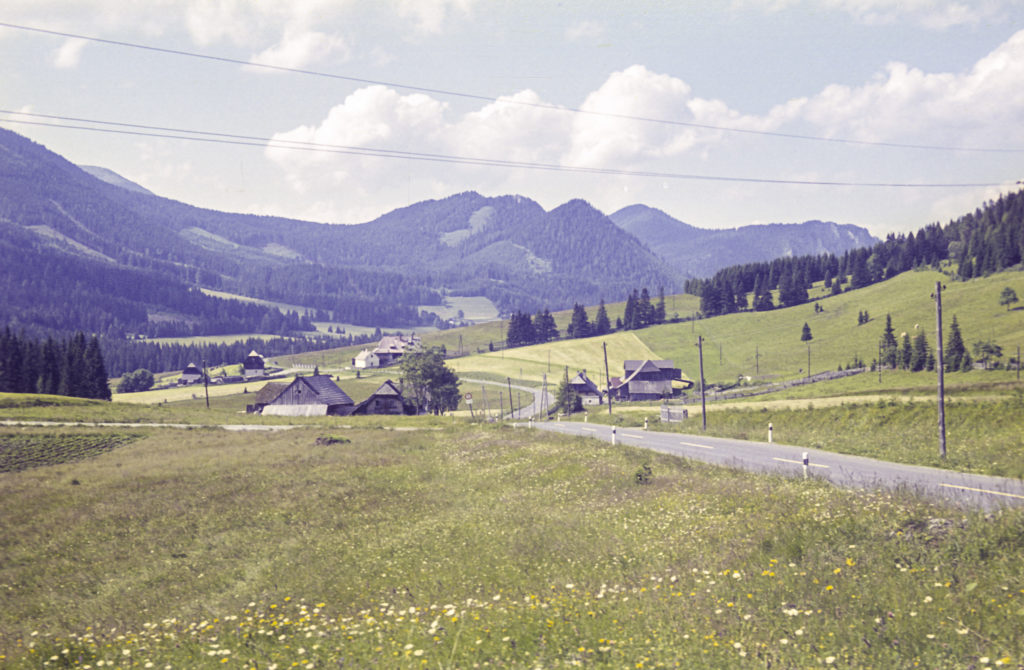
To get to Greece from Munich by car, we had to pass through Austria and Yugoslavia.  So, for the second time, I found myself riding through the beautiful Austrian countryside, which is why the first few pictures in this series were taken in Austria.
Austrian Farm Country

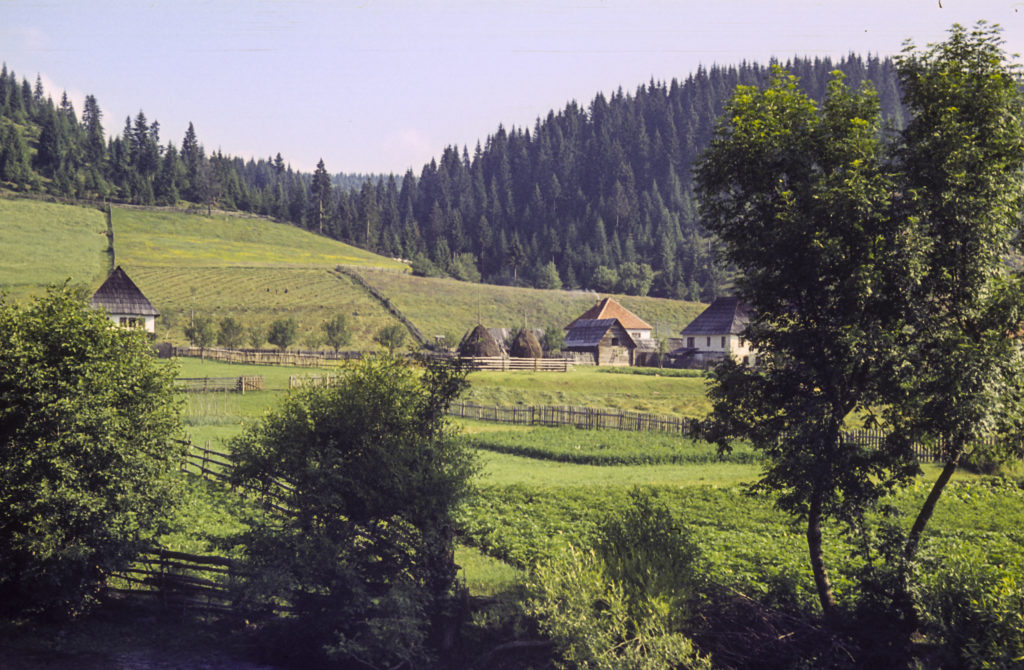
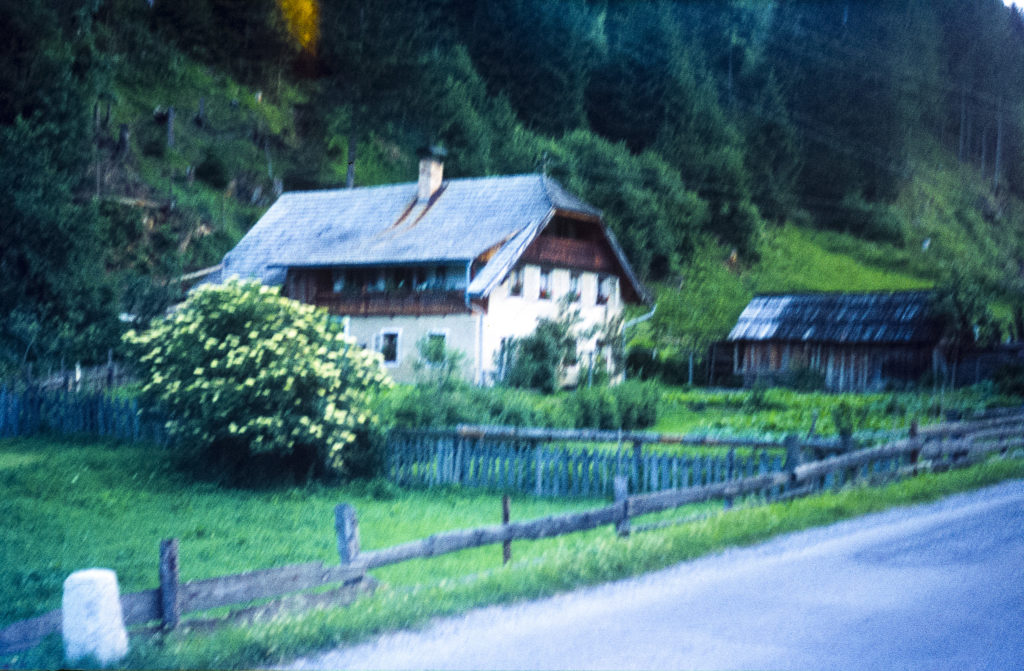
I remember that at times during our travels through Austria, I was amazed that there could be so many shades of green in one landscape.

Shades of Green
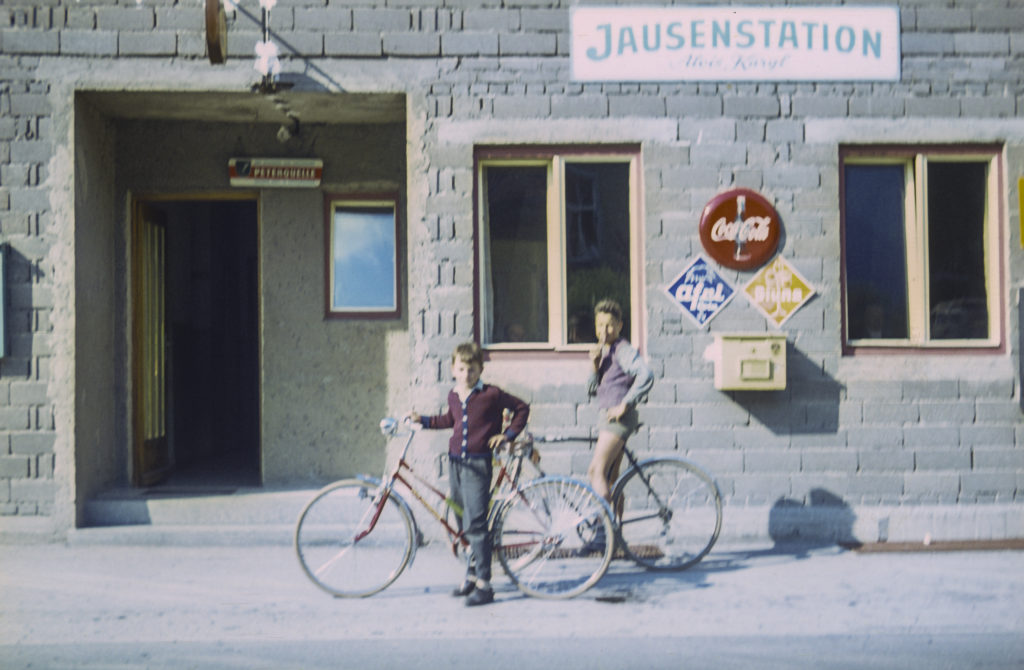
Austrian Schoolchildren on Bicycles at Bus Station

Many years after making this trip, I saw a movie called “The Last Valley,” which was about the Thirty Years’ War in the seventeenth century. The screenplay was written by James Clavell, the author of Shogun. Although the film was set in Germany, it reminded me of the mountain valleys I had seen in Austria in the summer of 1964. Austria also participated in the Thirty Years’ War, but since it was the stronghold of the Habsburg Monarchy, which was mostly an aggressor rather than a victim in that conflict, Austria suffered much less than the German lands to the north and west of it.
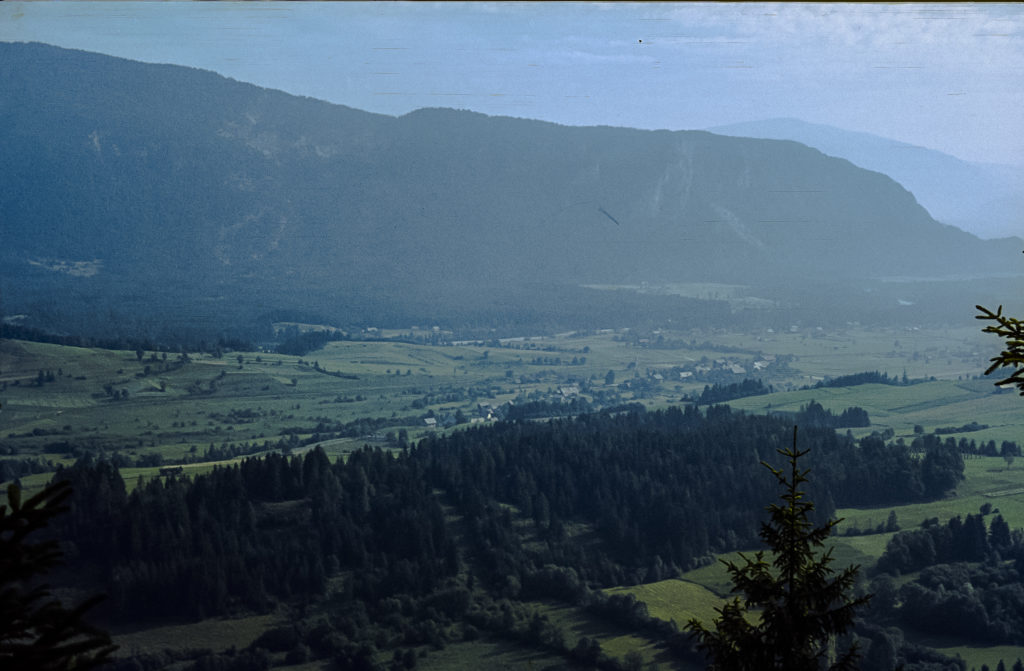
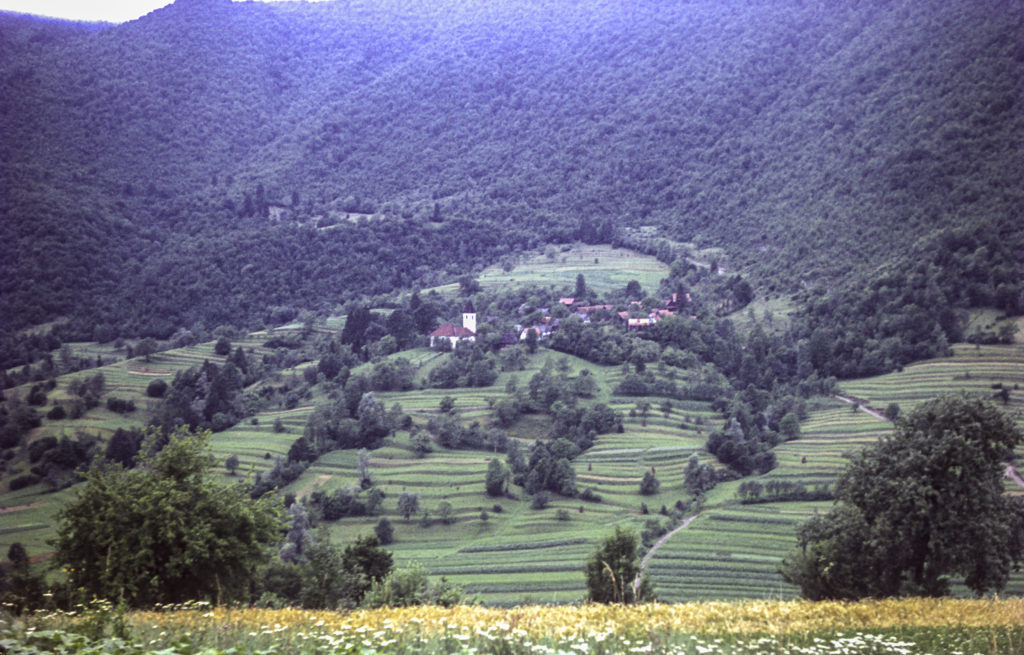
Sheltered Valley in the Austrian Alps

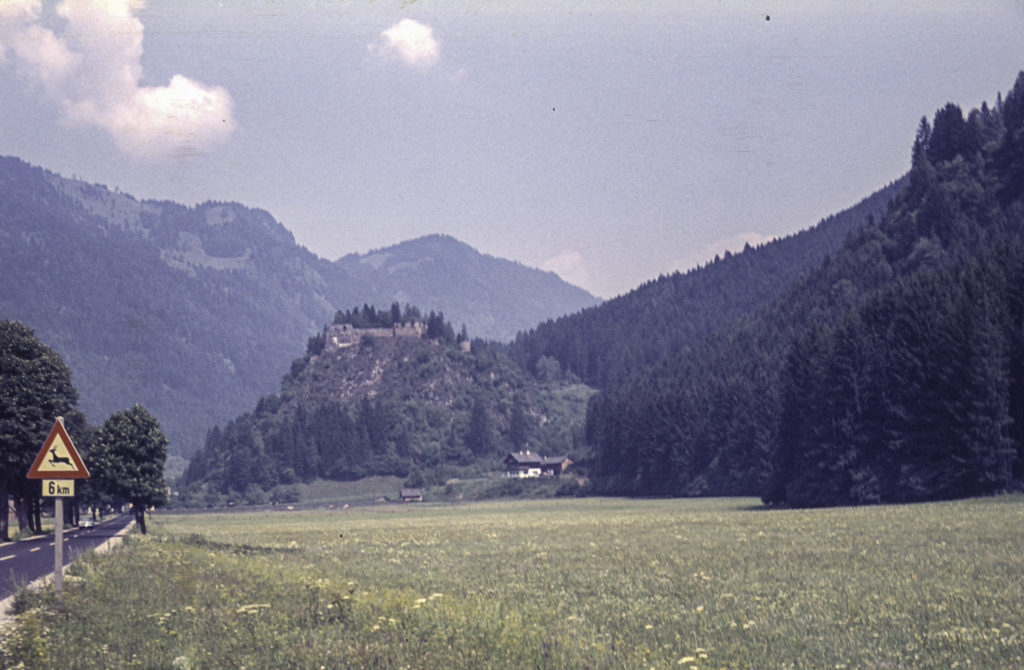
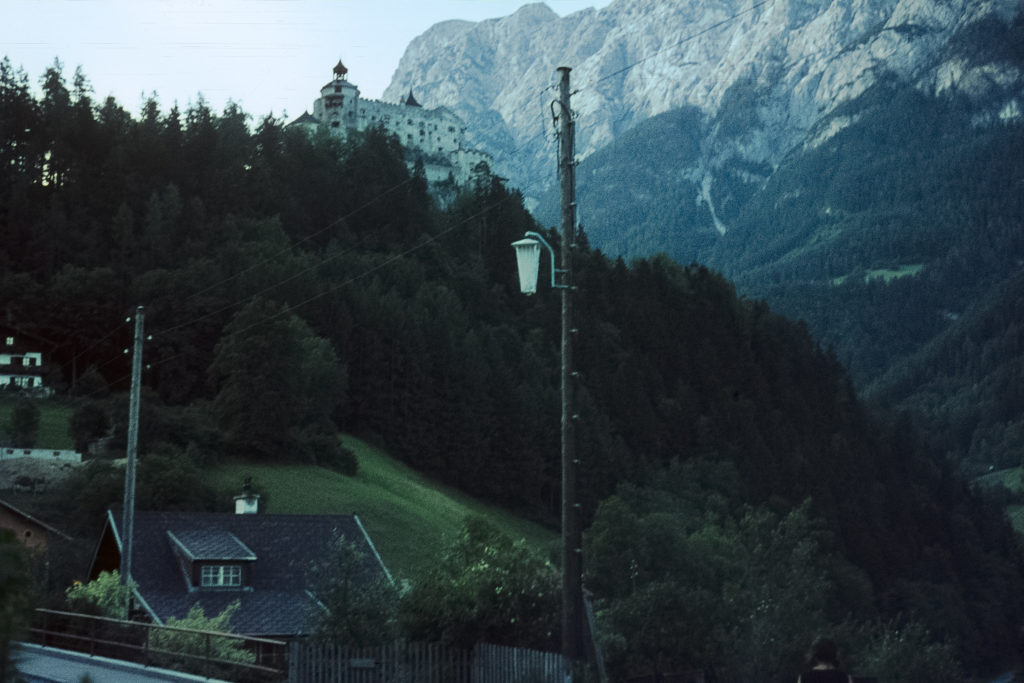
Prior to the Thirty Years’ War (1618-1648), Austria had for a while been a hotbed of Protestantism, but in the late sixteenth century, with the acceleration of the Counter-Reformation, strongly backed by the Hapsburgs, the Protestants were suppressed and Austria returned wholly to the Catholic fold. The Hapsburgs cemented their domination with castles like the one in the picture following.

Castle on Hilltop

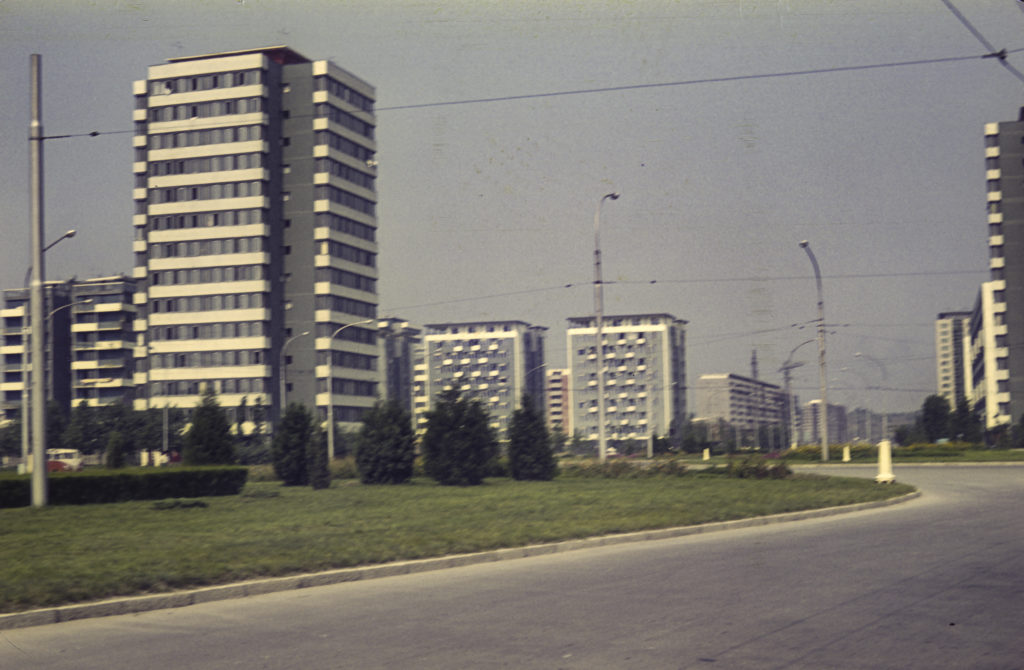
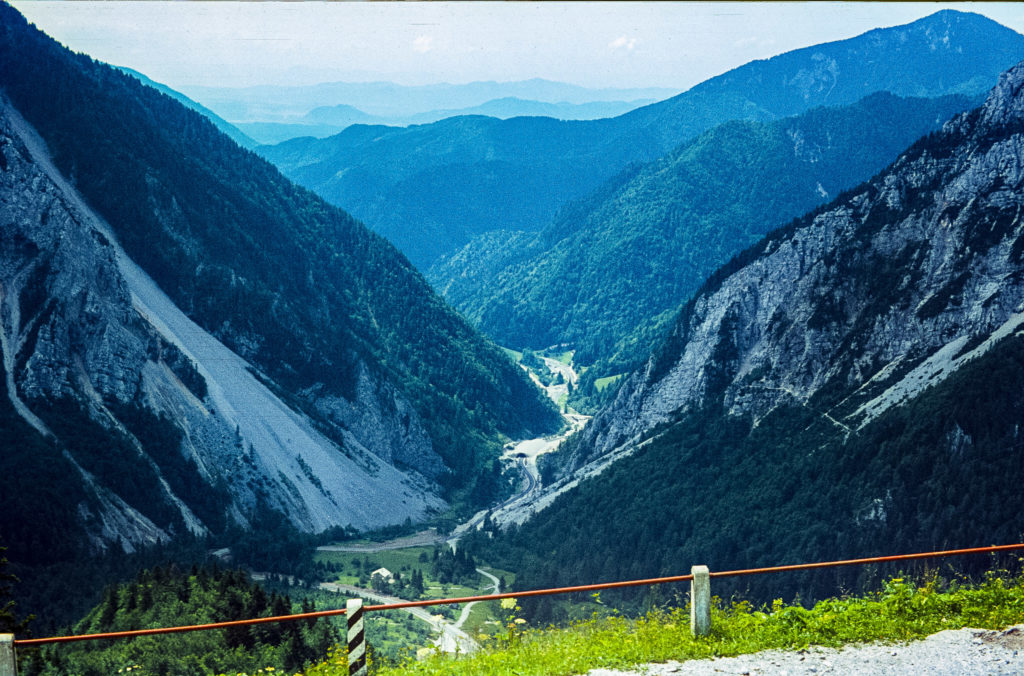
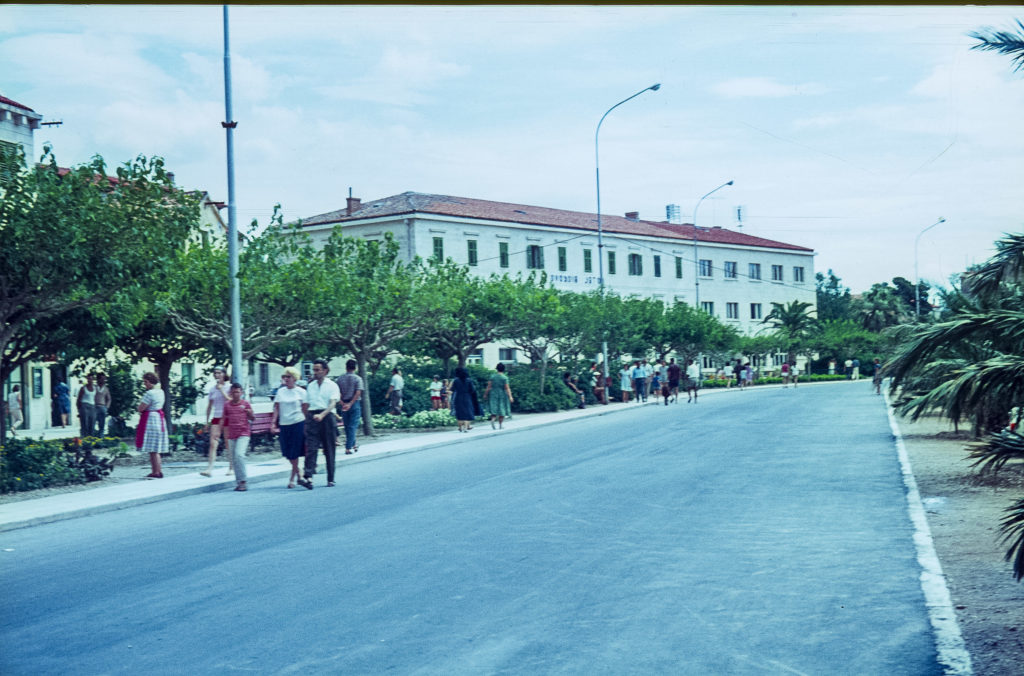
The road leading up to the Loibl Pass, where we crossed the border with Yugoslavia (the second time for me) was extremely steep and narrow. On the way up, an Alfa-Romeo driven by a madman sideswiped our VW, causing a few scratches, nothing serious. The two drivers got out and talked about it for a minute, agreed that the damage wasn’t serious enough to go to all the trouble of dealing with insurance companies, and we all went on our way without further ado. A short while after, we passed through Ljubljana – another deja vu for me – but did not tarry there, though we did stop long enough for me to take a picture of a tract of modern-looking apartment houses.

Apartment Buildings in Ljubljana

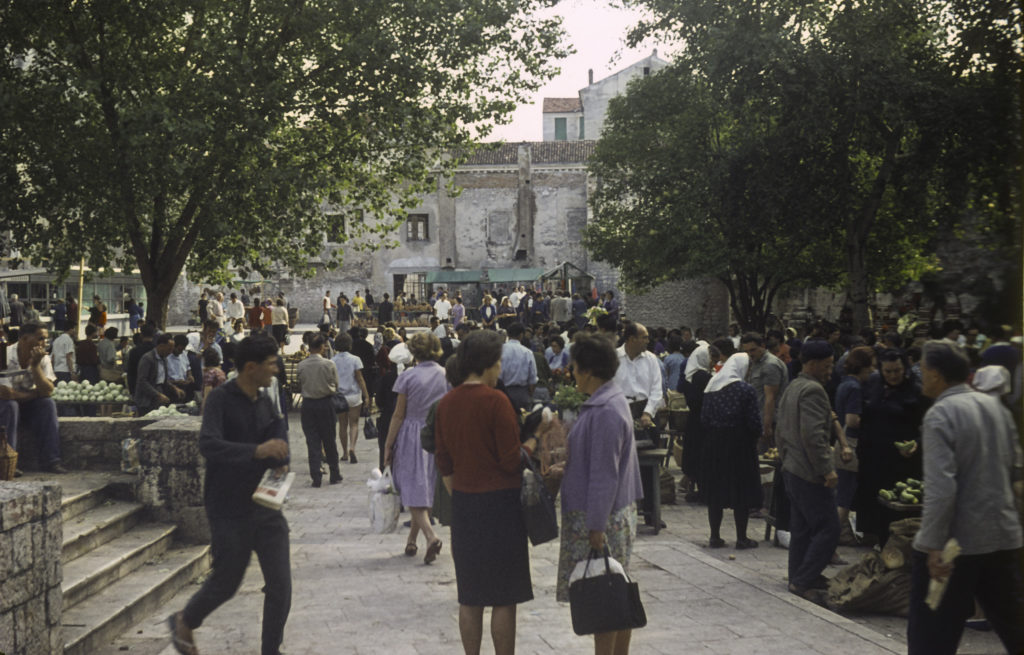
We headed toward the seaport of Rijeka, where we spent the night. We had no idea where to look for a room, but a woman came up to us in a parking lot and asked, “Wollen Sie zimmer?” – “Do you want rooms?” – assuming we were Germans, because we were driving a VW with German plates, and all the other tourists in town were German. It turned out that she lived, along with the rest of her family, in a large, roomy house that had most likely been expropriated from a bourgeois family by the Communist government of Yugoslavia after World War II and given over to multiple working-class families; that was my guess, anyway, since they clearly only occupied part of the house, and they had to sleep together in one room while we slept all together in another. But the price was right, about a dollar for the night. In the morning, we got up, found something to eat in a nearby marketplace, and went on our way. I didn’t take a picture of the house because what the occupants were doing was illegal and they didn’t want to get in trouble, but I did take a picture of the marketplace.

We spent the night in a private house not far from this square.

The quickest way to get to Greece through Yugoslavia would have been to go east via Zagreb and Belgrade before turning south, and we did come back that way, but we wanted to see other parts of Yugoslavia on the way down to Greece, so we took the Dalmatian coastal route, planning to turn inland after reaching Dubrovnik. Our map showed a four-lane superhighway all the way from Rijeka to Dubrovnik.

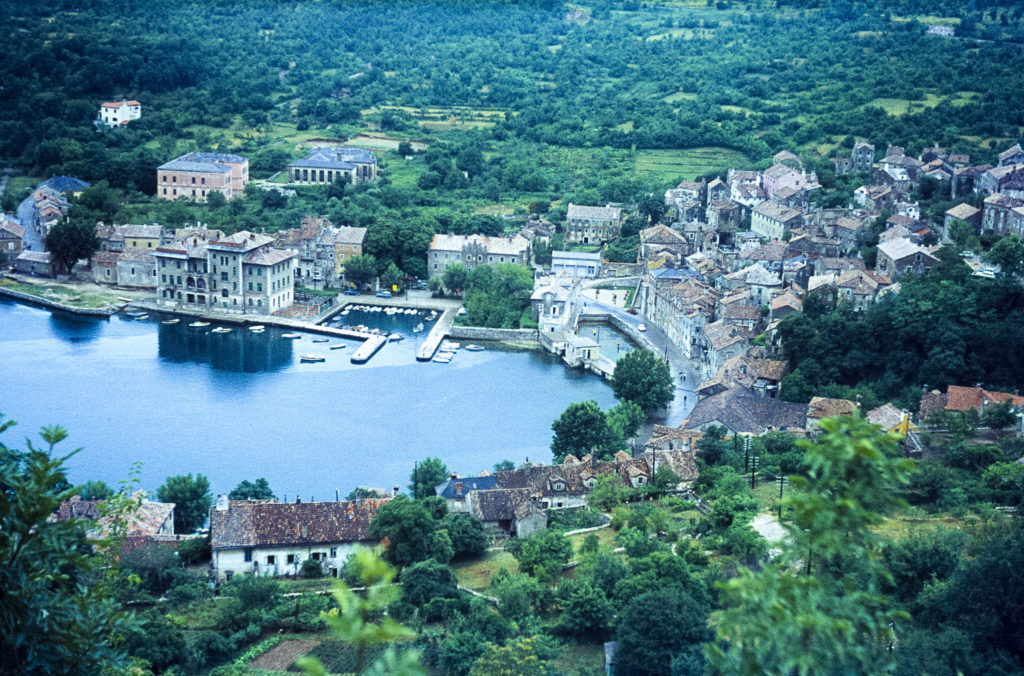
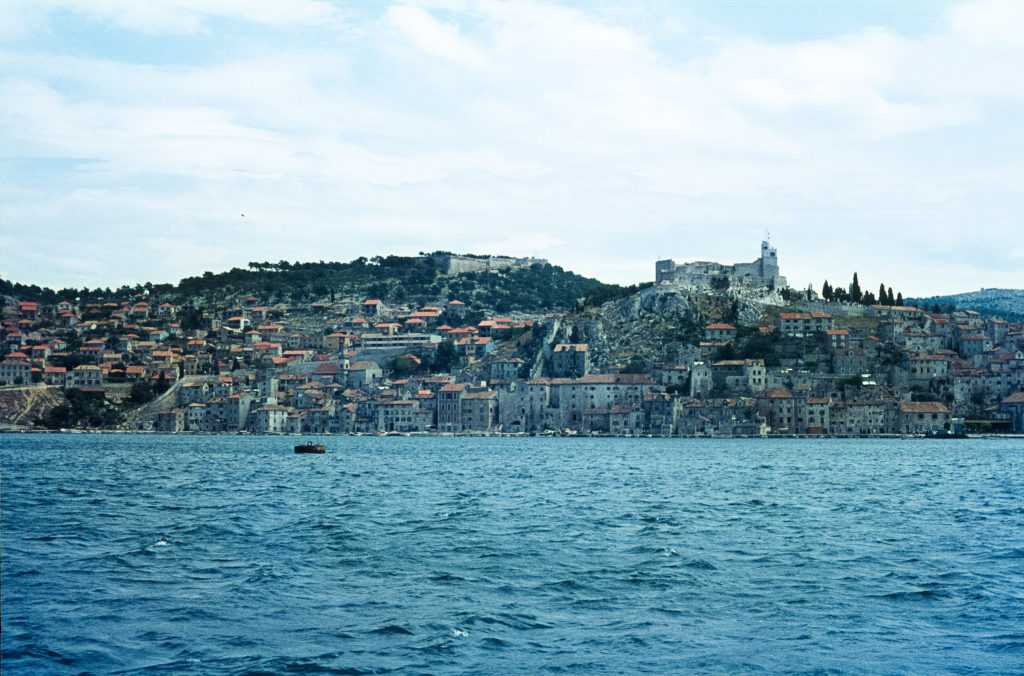
The Dalmatian coast is quite picturesque, with lots of little islands offshore which in ancient times were havens for pirates, and more recently for Partisans fighting the Italians and Germans in World War II. The major towns on the way to Dubrovnik are Zadar and Split. There are many coves, bays, and peninsulas, and it turned out that at one or two places we had to take a ferry to get across a body of water that had inconsiderately interposed itself in our way. This accounts for the blurriness of some of the next few photos.

View of Zadar from a ferry

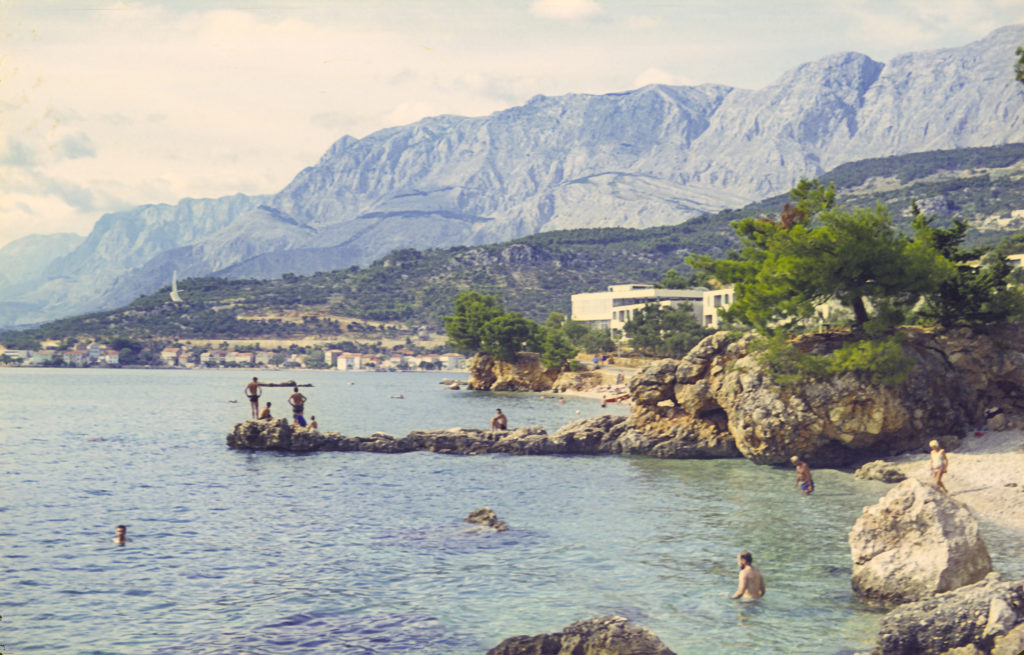
Along the coast there were some splendid rocky beaches with clear emerald-green water and a good many swimmers enjoying it, since it was the middle of summer.

Rocky beach on Dalmatian coast

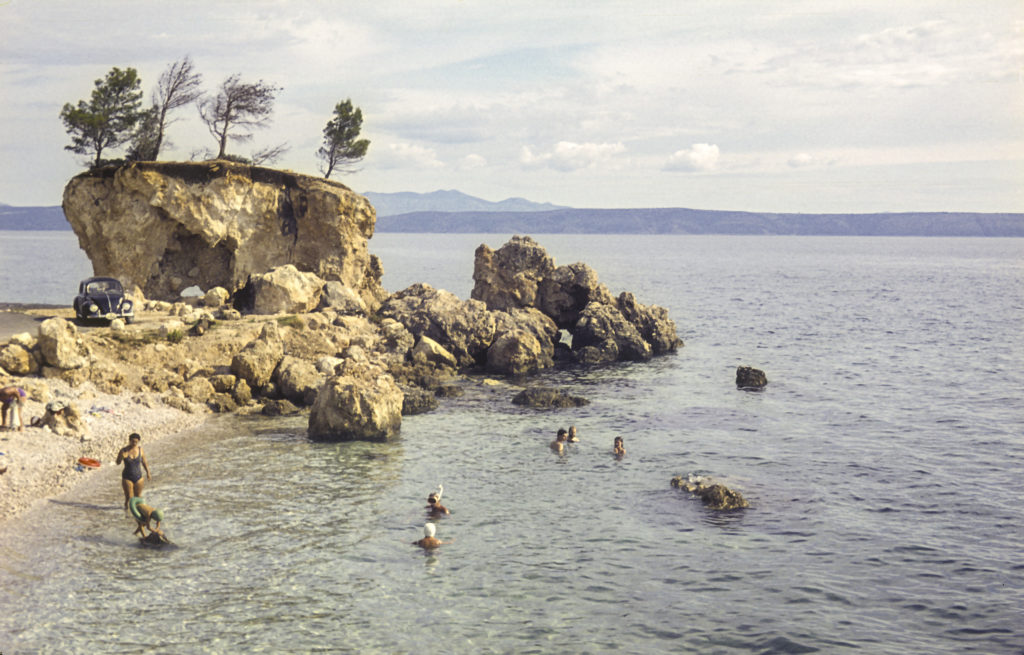
Somewhere along the way, we parked the car and went for a dip ourselves.

A beach interlude on the Dalmatian coast

An odd fact about the Dalmatian coast is that most of it is owned by Croatia. If you look at a map showing the boundaries of the countries in the area, you will note that Slovenia’s access to the sea is limited entirely to a narrow strip between Trieste, which belongs to Italy, and the Istrian peninsula, which juts out into the northeastern Adriatic and looks like it should be an extension of Slovenia but is in fact part of Croatia. Farther south, if you go just a few miles inland from the seacoast, you find yourself in Bosnia-Herzegovina, which enjoys access to the sea only via a tiny strip of land a few miles north of Dubrovnik, which thus finds itself in an enclave separate from the main part of Croatian Dalmatia. This situation is the result of a lot of complex historical events which I won’t try to relate here, but it deserves mention.

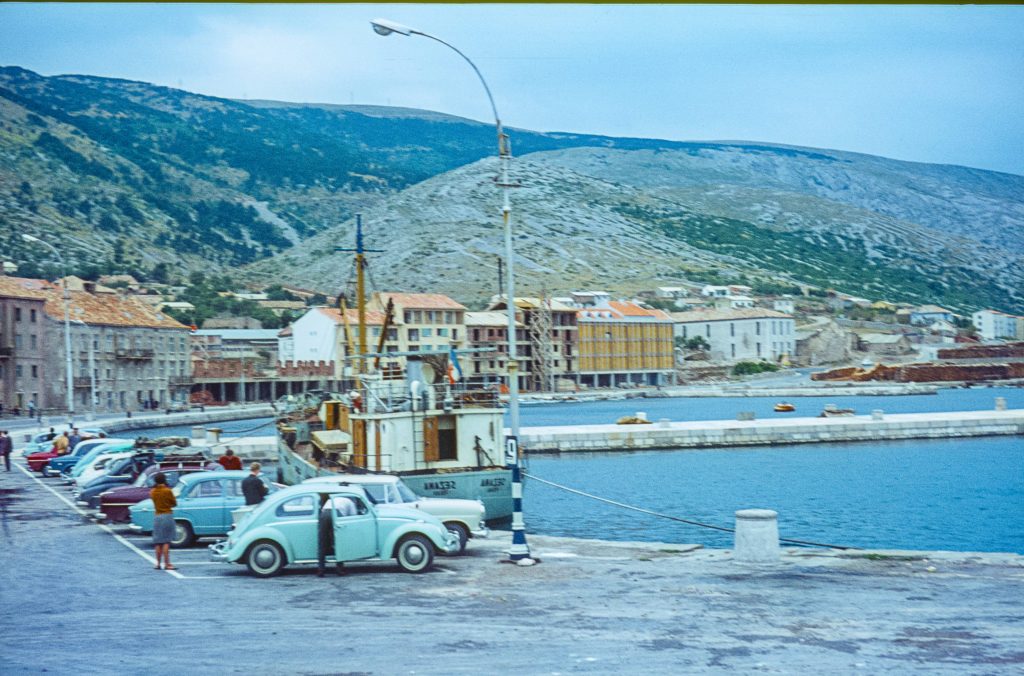
At the Harbor in Split

Somewhere south of Split, we came to a sign with the one word “ASFALT” overlain by a big red “X”, and a little way beyond, the end of the superhighway that was depicted on the map as extending all the way down to Dubrovnik. Another, smaller sign was posted next to what appeared to be a donkey path taking off up the mountain; it said “Dubrovnik >”. With some trepidation, we took it.

A dizzying view of the steep and twisting road up the mountainside from the Adriatic coast.

The donkey path took us inland, into the wilds of Bosnia. We bounced along for miles with no idea how far out of our way we would have to go to get to Dubrovnik. We saw signs pointing to Sarajevo, but we never got anywhere near Sarajevo; I think the largest town we passed was Mostar, but we only saw it from a distance and didn’t drive through it.

A view looking back over the hilly country we had to cross, with the Adriatic in the background.

It was a very dry, treeless, hilly area. We saw rock walls in some places, but little evidence of farming in the fields between them. I wondered what people did for a living in this bleak land.

The dry, rugged hills with scrub vegetation reminded me of Southern California.

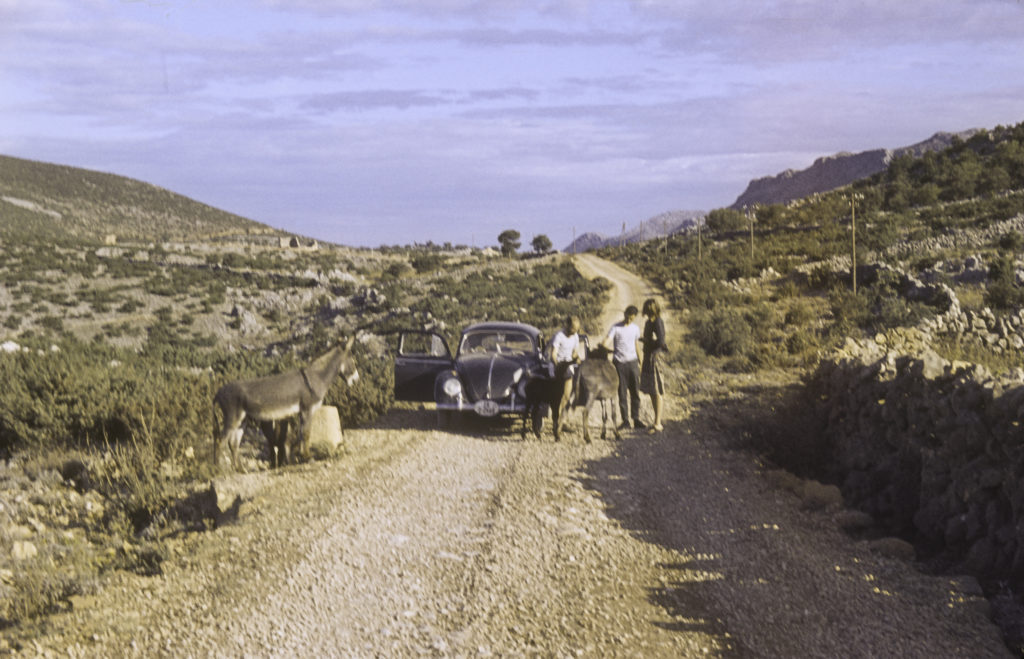
You probably thought I was kidding when I called the road a donkey path, but that was indeed what it was. At one point we had to stop for a troika of donkeys standing in the road. We didn’t mind; they were gentle creatures and we made friends with them.

Somewhere near Mostar in Bosnia, we stopped along the road to make friends with three donkeys. The people in the picture are, from left, Rob, Alan and Janet.

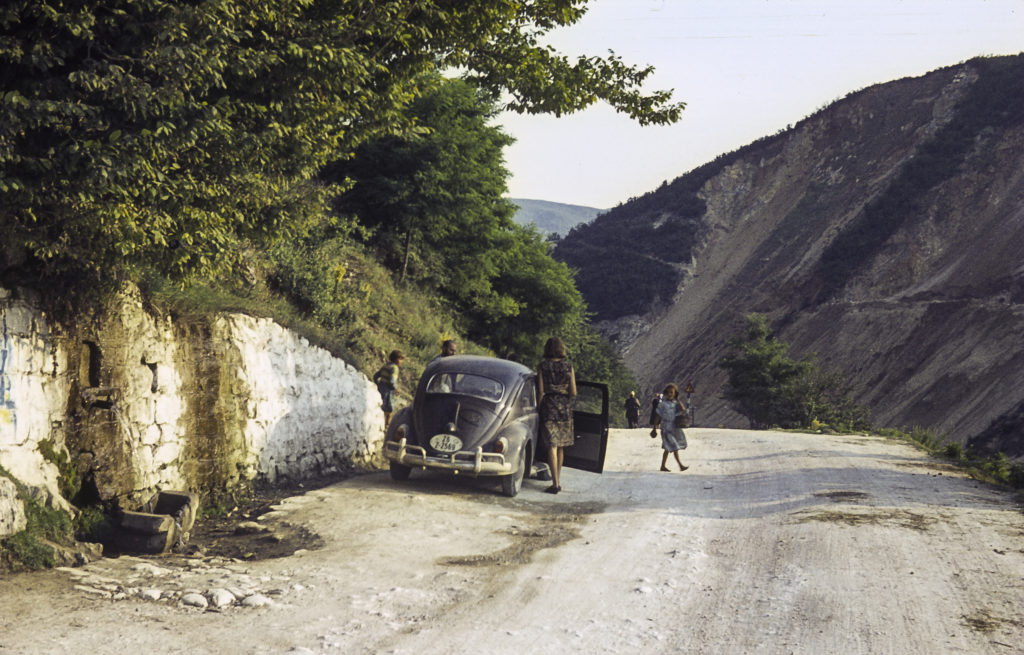
When night came on, we were still in the highlands of Bosnia far from any sign of civilization, so we simply stopped and rolled out our sleeping bags on the side of the road. In the morning, when we got up, there were several people, mostly women and children, a little way down the road, waiting for a bus. They didn’t speak English, and we didn’t speak Serbo-Croatian, but we somehow communicated with them and socialized a bit before continuing on our way.

Making friends with some of the locals. Standing next to the car on the passenger side is Janet, with Rob on the left.

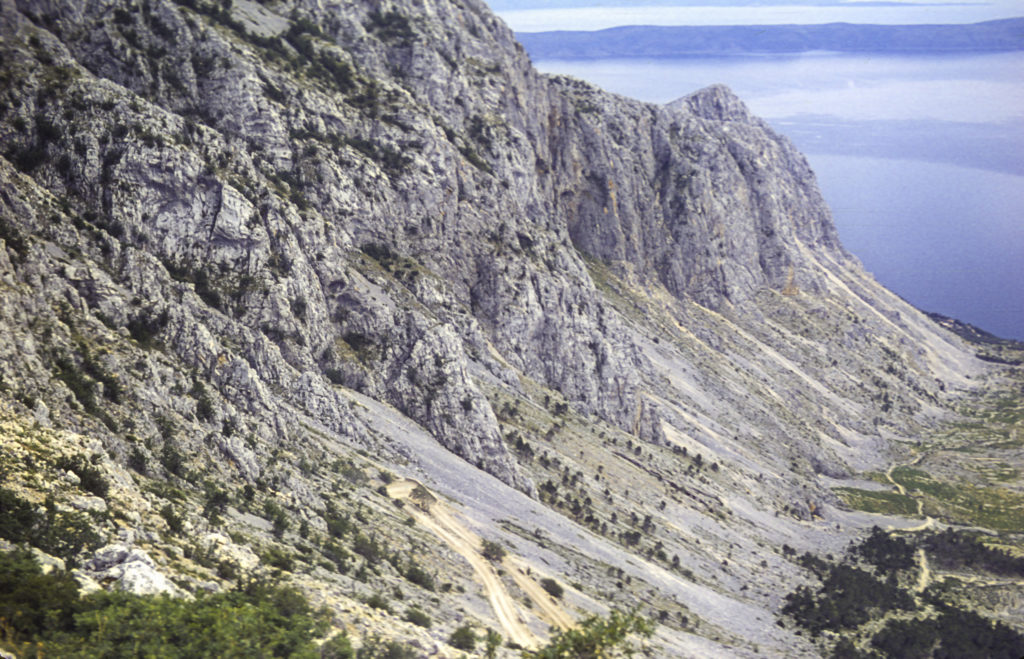
Eventually, after what seemed like a couple hundred kilometers, we made our way back to the Adriatic coastline a few miles north of Dubrovnik. We breathed a sigh of relief, little knowing what was still in store for us ahead.

The road back to the Dalmatian coast from the highlands of Bosnia

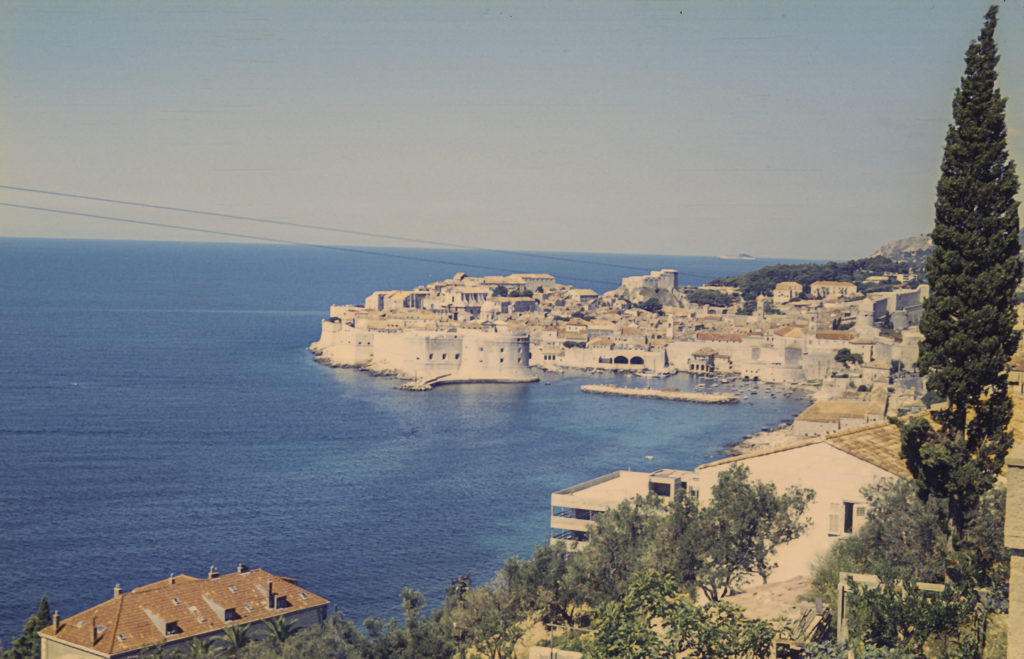
Finally we arrived in Dubrovnik, which for centuries was an independent city-state, known as the Republic of Ragusa, and a rival of Venice. I knew of it in connection with the Crusades; in 1204 Venice diverted the armies participating in the Fourth Crusade, who found themselves short of travel funds, to pay for their passage by seizing first Ragusa, then Constantinople, instead. Dubrovnik/Ragusa remained subject to Venice until 1358, when it became a vassal-state of the kingdom of Hungary and later of the Ottoman Empire, but enjoyed de facto independence in return for tribute payments. During the Napoleonic Wars, it was occupied by the French, but afterward came under the rule of the Habsburgs. With the breakup of the Austro-Hungarian Empire after World War I, the city was incorporated into the Croatian component of Yugoslavia, and remained in Croatia after the latter declared independence from Yugoslavia in 1991. It is a beautiful city and a mecca for tourists. We did tarry to savor its delights, however, because we wanted to press on to Greece before we ran out of time.

The picturesque city of Dubrovnik, formerly known as Ragusa, is the premier tourist destination on the Dalmatian coast.

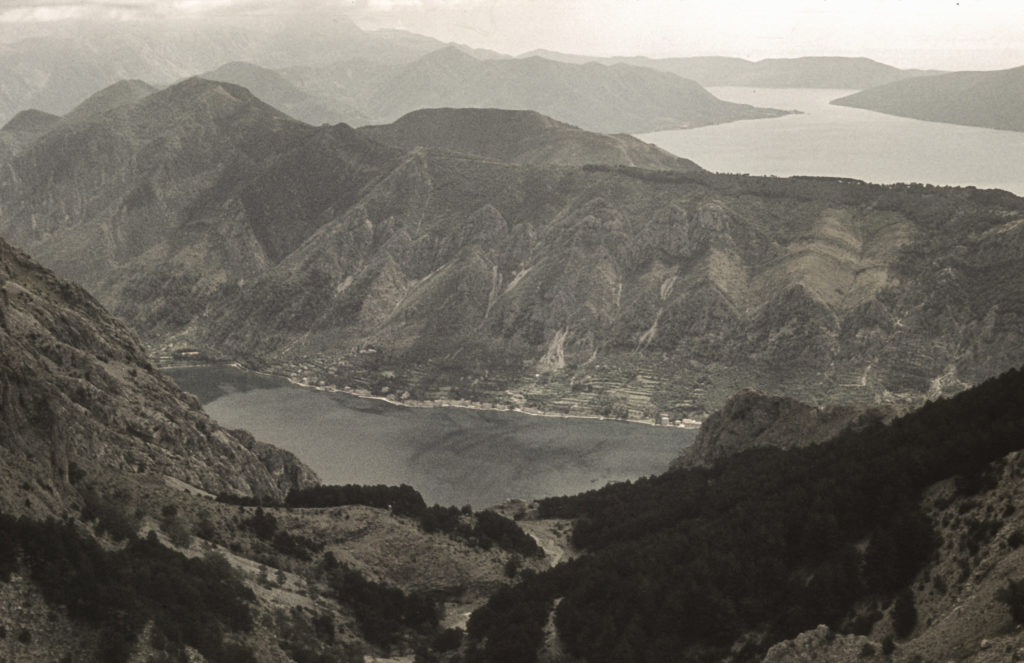
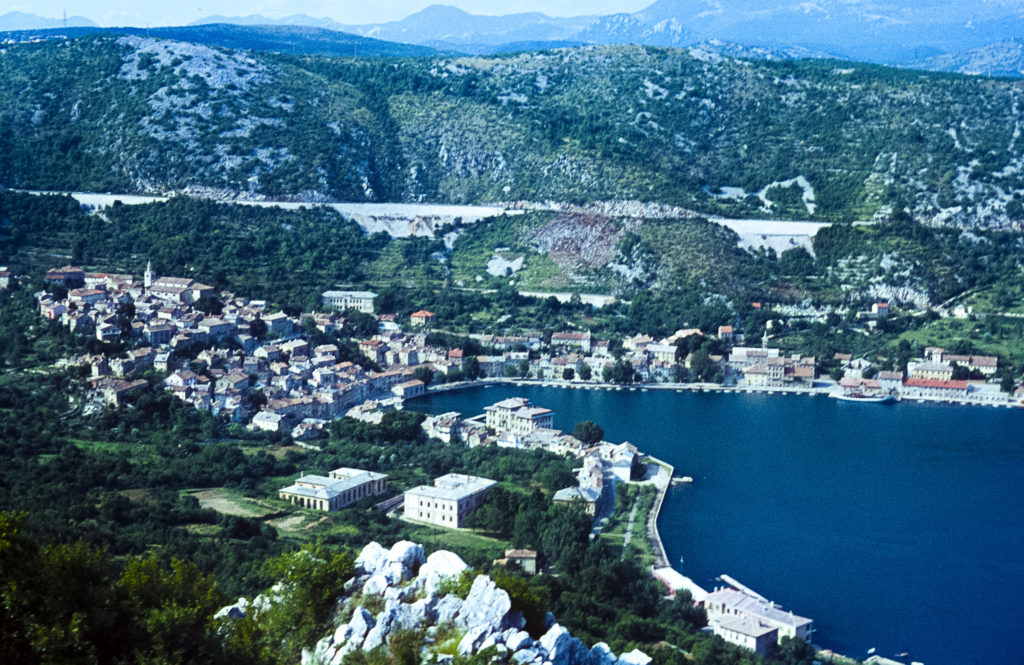
From Dubrovnik we headed south to the Bay of Kotor, which is in the mountainous country of Montenegro. This is an Italian name, not what the natives call it, which is Tsrna Gora. Both mean the same thing in English – Black Mountain. The name implies something fearsome and forbidding, and to me, knowing a little about the history of the region, it’s not entirely inappropriate. Anyway, we found ourselves faced with another steep climb up into the mountains from the Bay of Kotor, with a spectacular view awaiting us at the top.

Bay of Kotor, from the road up the mountains into Montenegro, July 1964

The road was taking us toward a town called Cetinje, which was the capital of Montenegro during the days when the country was a monarchy; nowadays the capital is Podgorica. But now we were faced with another problem – we couldn’t get anything to eat. It turned out that it was a holiday, and most shops were closed. The few that were opened mostly refused to serve us and turned us away. We eventually figured out it must be because people thought we were German, since we were driving a German car. This was 1964, only two decades after World War II, and people in that area have long memories. They hadn’t forgotten the atrocities during the occupation, when the Germans killed a hundred villagers for every one of their soldiers killed by the Partisans. Unlike the coastal areas, they didn’t get many tourists in the mountains, and they didn’t feel obliged to cater to them. We dealt with this situation in two ways. One, we scrawled “USA” in the thick coat of dust on the car; and two, we spoke to them in Russian, which is is close enough to Serbo-Croatian that we could at least convince them that we weren’t Germans and were hungry.

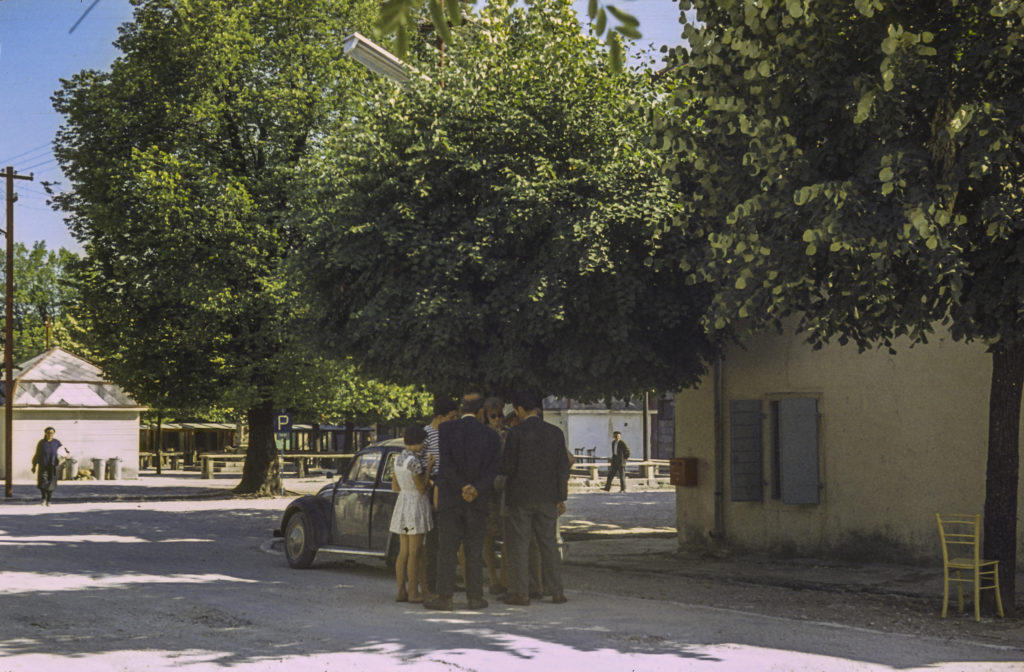
Nevertheless, there was still the fact that it was a holiday and few stores were open. But once we got to Cetinje, our luck took a turn for the better. Reaching what looked like the center of town, we parked the car and got out. An old man walking by checked out our car and said in English, “What does this USA on your car mean?” We answered, “That’s where we’re from,” and he said, “Oh, I used to live there.” It turned out that he had emigrated to the United States before the First World War, had enlisted in the US Army and fought on the American Side during the war, and after the war had returned to Cetinje and remained there ever since. But he hadn’t forgotten his English, though he said he had trouble at his age remembering things that happened yesterday. By then a crowd had gathered round us and he had to explain to them what was going on. Soon people were showing up with bread and other things to eat, and we had enough food for several days. In addition, he queried us about where we were headed and told us which roads to take and which to avoid; this turned out to be a godsend, because our map, as we had already found, was somewhat over-optimistic about the quality of Yugoslavian roads.

Cetinje – Old Royal Capital of Montenegro – July 1964

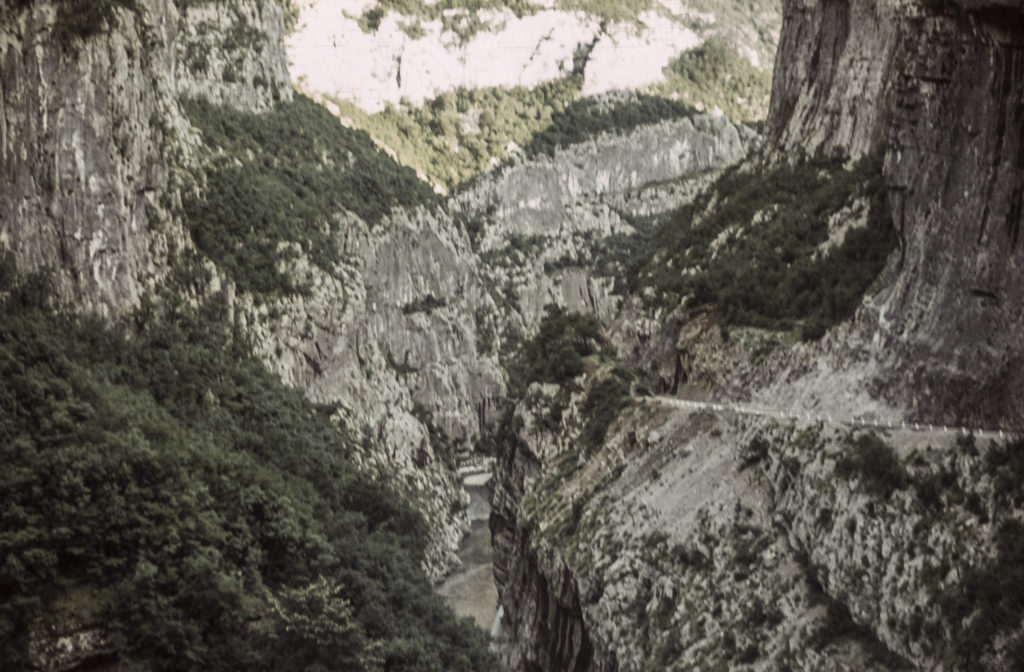
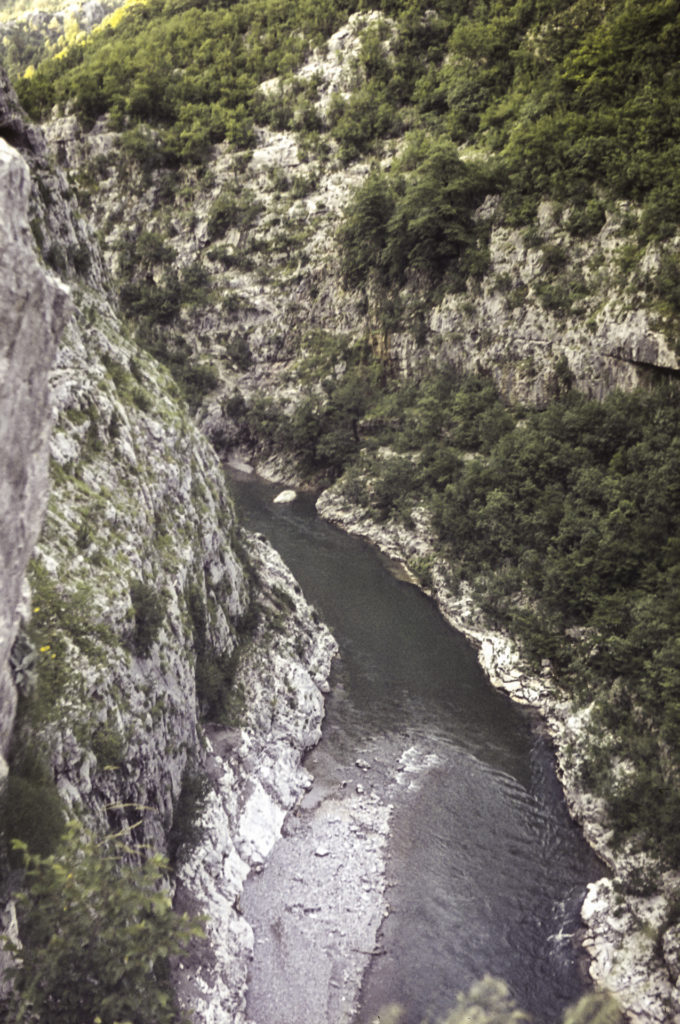
The route recommended by our benefactor sent us on took us north through the canyon of the Neretva River, on a narrow road dug into the side of the cliffs. The views were spectacular.

Neretva River Canyon, Yugoslavia, July 1964

We really didn’t want to take any risks on this road. There were few places to stop or pass, and it was long way down to the river below. I can’t imagine what the roads would have been like had we taken the more direct routes shown on our tourist map; I suspect they would have required four-wheel drive.

Neretva River Canyon, Yugoslavia, July 1964

Having miraculously emerged unscathed from the Neretva Canyon, we continued northeast, and entered the Sanjak of Novi Pazar, one of the most godforsaken places I have ever been. There were no towns, no gas stations, no cafes, and few people. The few people we did see were mostly women herding goats, and from their dress I guessed that they were Muslim. Evidently they didn’t get many outsiders in this area, because most of them gave us the sign to ward off the evil eye as we passed. We never saw the major town, Novi Pazar, because we reached our next turnoff before we got there. This took us into the region of Kosovo, which we had never heard of at the time. Then it was part of Serbia; now it is a separate country, as is Macedonia, the last part of Yugoslavia we had to traverse before arriving in Greece.

Somewhere on the road in Kosovo we had to stop for the night, and as usual we rolled out our sleeping bags at the side of the road, in what turned out to be a farmer’s field. The farmer himself came along just as we woke up in the morning, shook hands and greeted us cordially, and we made what conversation we could with him before heading down the road. Which continued to be awful; it seemed that we could only make about 5 or 10 kilometers per hour. I remember, though, seeing a Frenchman pass us nonchalantly in a Citroën pulling a trailer, going about 40; although I never had much regard for Citroëns, they obviously had better suspension than the VW. The poor Beetle’s muffler was totally destroyed by driving on Yugoslavian roads, and we had the first of five flat tires about that time – the other four occurred on the way back from Greece. We had the flat fixed at our next destination, which was the city of Skopje, capital of Macedonia.

Skopje had been hit by a tremendous earthquake (a common occurrence in the Balkans) about six months before our arrival, and it was a mess. It didn’t look like it could have been very prosperous before the earthquake, either. I hope that its fortunes have improved since Macedonia achieved independence. Anyhow, we got the flat fixed and went on to Greece.

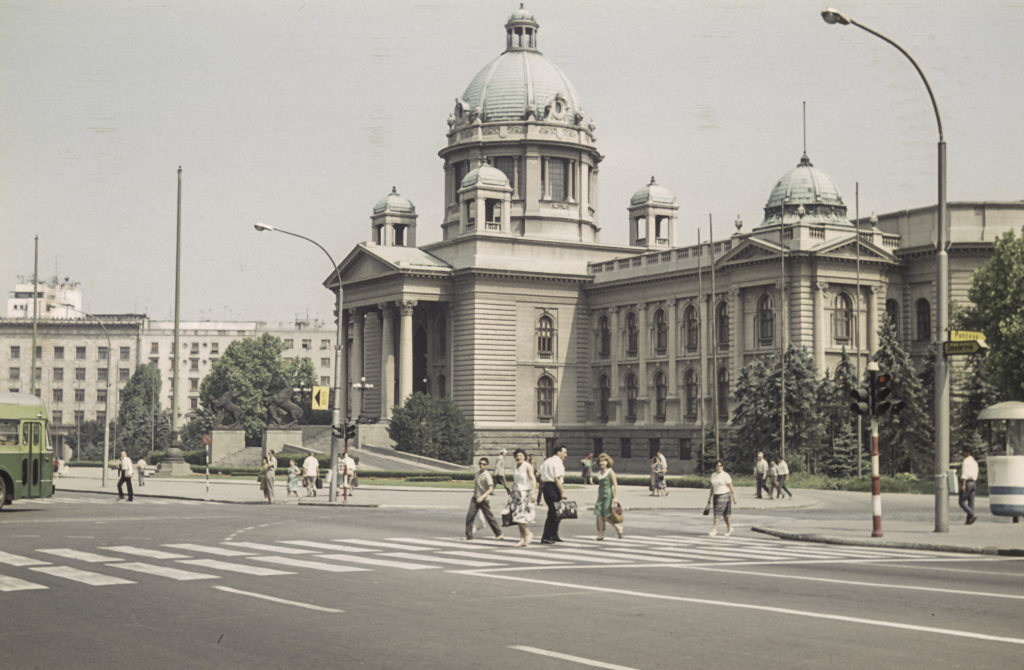
When we came back from Greece, we took a different and faster route, up the valley of the Morava, which flows north through the middle of Serbia, to Belgrade. I took few pictures on the way back because I had used up most of my film, but I did get a shot of the National Assembly building in Belgrade. From Belgrade we went west to Zagreb, and thence through Slovenia and Austria back to Munich, arriving a couple of days before our tour group’s scheduled departure for the USSR.

In 1964 this building housed the Federal Assembly of Yugoslavia. After the breakup of Yugoslavia, it resumed its role as the House of the National Assembly of Serbia, which it had been before the formation of Yugoslavia after World War I.
Categories
Europe, Summer 1964

Austria and Italy, July 1964

One weekend we drove down through Austria to Italy, cutting off a corner of Yugoslavia (Slovenia) as we went.  Our first stop was Salzburg, where Mozart was born and raised.  We did not linger there long.  Not that I would have minded, but it wasn’t my car and I wasn’t driving.  We parked in the lot pictured below and went to get something to eat.  I don’t remember exactly where in Salzburg this was; I don’t think it was Mozart Square because the statue in the photo doesn’t look anything like the statue of Mozart there.  When backing his VW out of the parking place, Bill sideswiped another car, a Mercedes.  The damage to both cars was minimal, but the owners of the Mercedes were dining on a balcony a little way off and they heard the crash; they jumped up, shouting and yelling, and began to come after us.  We got out of there fast.  Not very nice of us, but we got away with it.

Parking Lot in Salzburg, Austria, Summer 1964

We drove on through Austria, enjoying the beautiful scenery of the Austrian Alps.

Austrian Countryside, July 1964
On the Road in the Austrian Alps, July 1964
Farmhouse in the Austrian Alps, 1964
River Valley in the Austrian Alps, 1964
Chateau and Farmhouse in the Austrian Alps, 1964

Eventually we wended our way down to the Austrian border with Yugoslavia at the Loibl Pass, and thence to Ljubljana, then as now the capital of Slovenia. However, in those days Slovenia was part of Yugoslavia, whereas now it is an independent state, a member of the European Union, the UN and NATO. We spent the night in a hotel in Ljubljana, then went on our way down to the Adriatic coast at Rijeka, and up the coast to the Italian border.

Street scene in Ljubljana, near our hotel, 1964
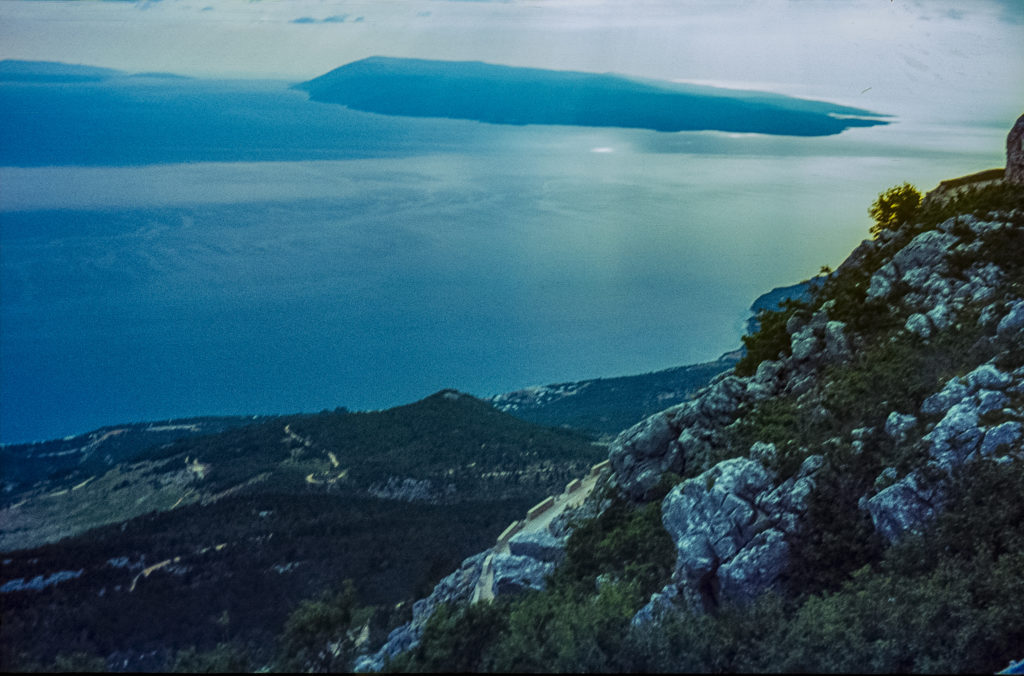
Island in the Adriatic
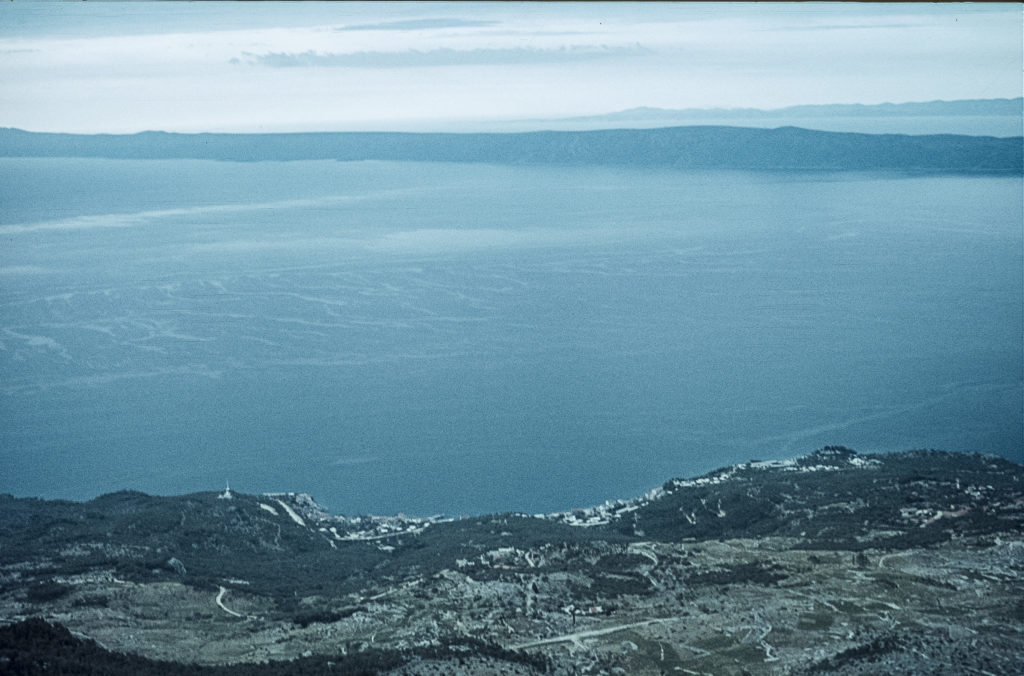
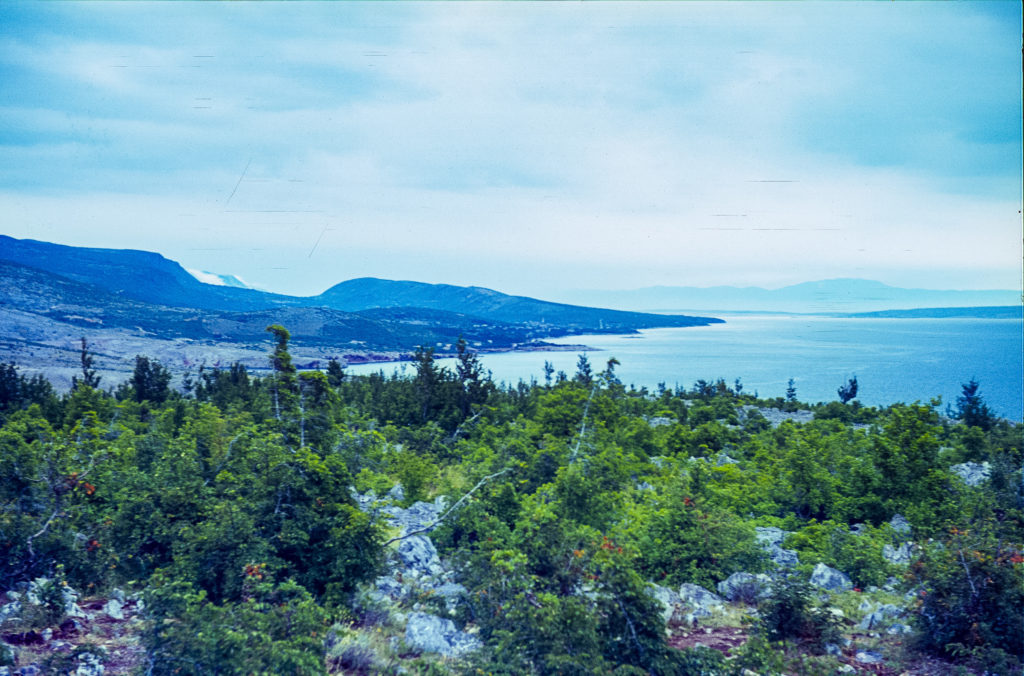
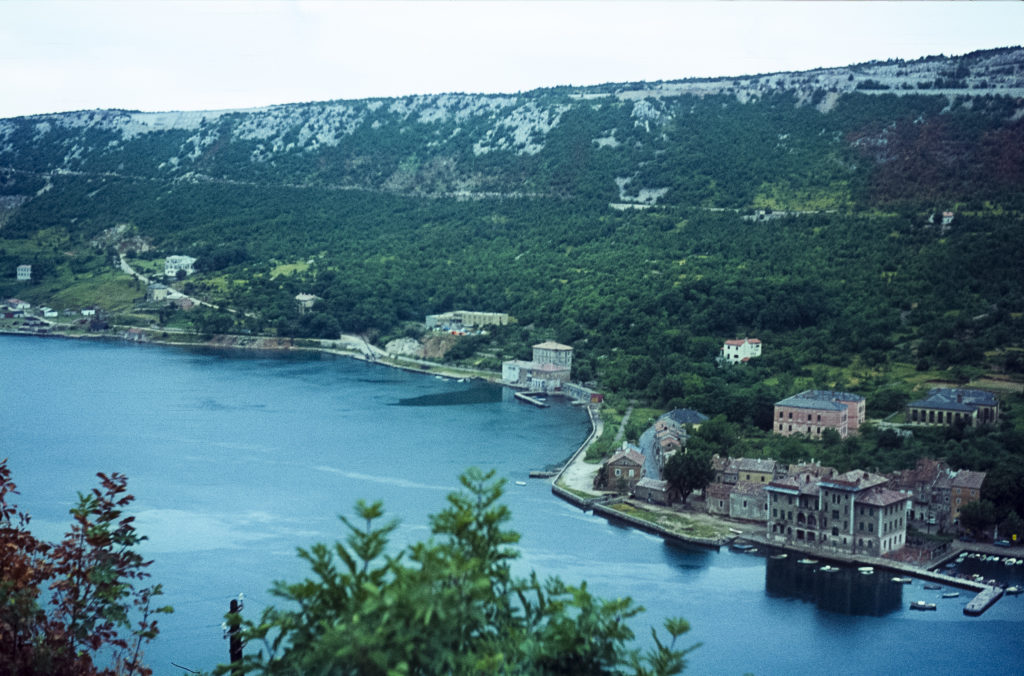
Adriatic Seacoast and Islands
Adriatic Coastline

Crossing into Italy, we arrived at the city of Trieste, a lovely city which was the major seaport of the Austro-Hungarian Empire before World War I and its fourth-largest city. With the dismemberment of the Empire after World War I, Trieste was allotted to Italy as part of the spoils of victory. During the interwar period, Italy subjected the city, which had a mostly Slovenian population until then, to forced Italianization and most of the Slovenes emigrated. During World War II, the Jewish community – which until then had the third largest in Italy – was destroyed and its members sent to death camps. After World War II, Trieste became a bone of contention between Italy and Yugoslavia. It was briefly occupied by the Yugoslavs, then by the British and Americans. In 1947 it was declared a Free City under the protection of the UN, but continued to be administered by an Allied military government until 1954, when the Free Territory of Trieste was divided between Italy and Yugoslavia, with the portion containing the city itself going to Italy and the rest, which was mostly rural, going to Yugoslavia.

The Outskirts of Trieste, July 1964

Trieste is located at the head of the Gulf of Trieste, at the northeast corner of the Adriatic Sea, across from Venice, which is at the northwest corner of the Adriatic. It is built at the foot of mountains, and the views of the city from the approach roads are stunning.

Trieste Bay from the South Side, July 1964
Trieste Bay from the North Side, July 1964

Trieste has an imposing seafront. After the dismantling of the Austro-Hungarian Empire at the end of World War I, the port went into decline until the 1930s, when Mussolini’s government poured resources into it in an attempt to develop industry there. After World War II Trieste again became somewhat of a backwater, but it appeared prosperous enough when we were there in the 1960s; and since then it has experienced an economic revival, again becoming a major trade hub with extensive container ship and oil terminal facilities. It is also considered the coffee capital of Italy, importing more than 40% of Italy’s coffee, according to Wikipedia.

Trieste Bay

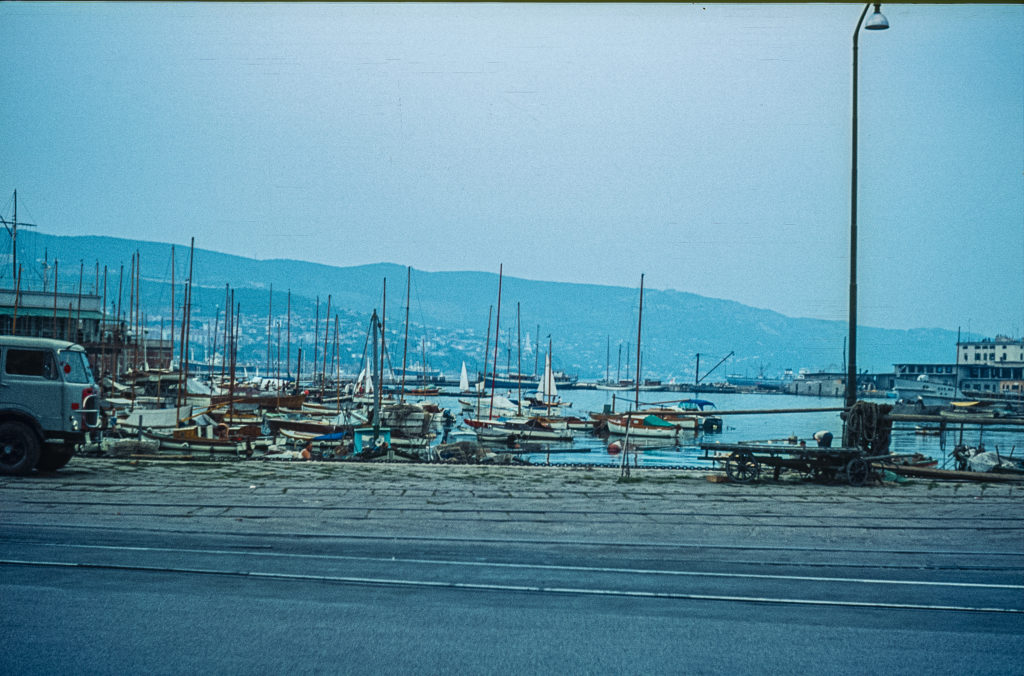
Descending the steep road down to the harbor, we parked the car and strolled around for a few minutes. We discovered that Trieste had a very fine marina with many well-appointed yachts.

Parked at water’s edge in Trieste Harbor (VW – Zoya at left, Bill just behind the VW, and Jim in the open passenger seat door)
Trieste Marina
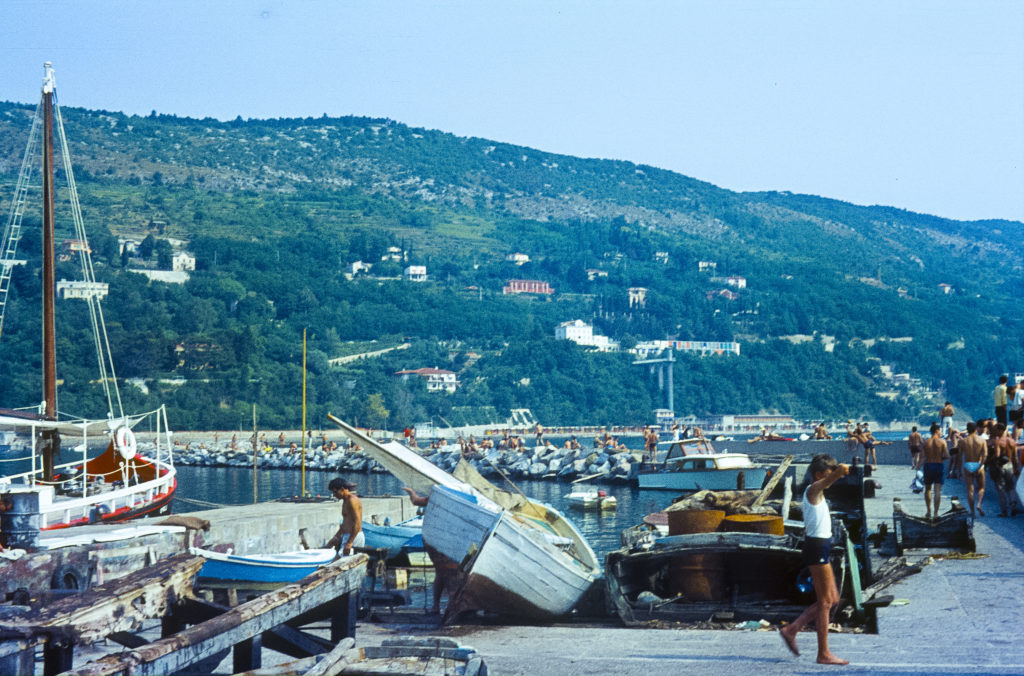
Dock and Boatyard in Trieste Marina

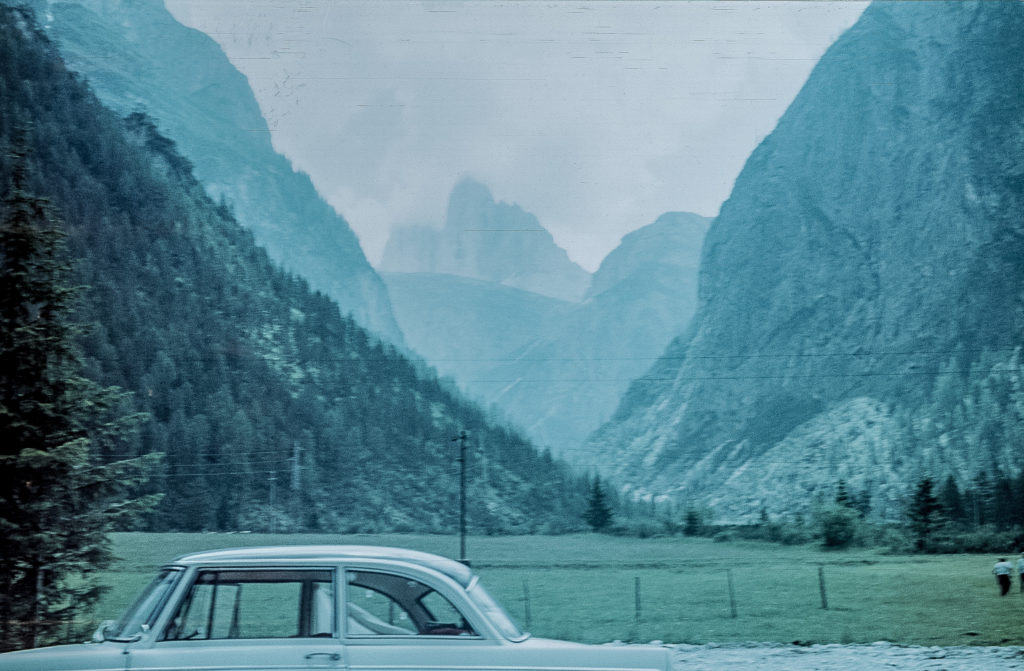
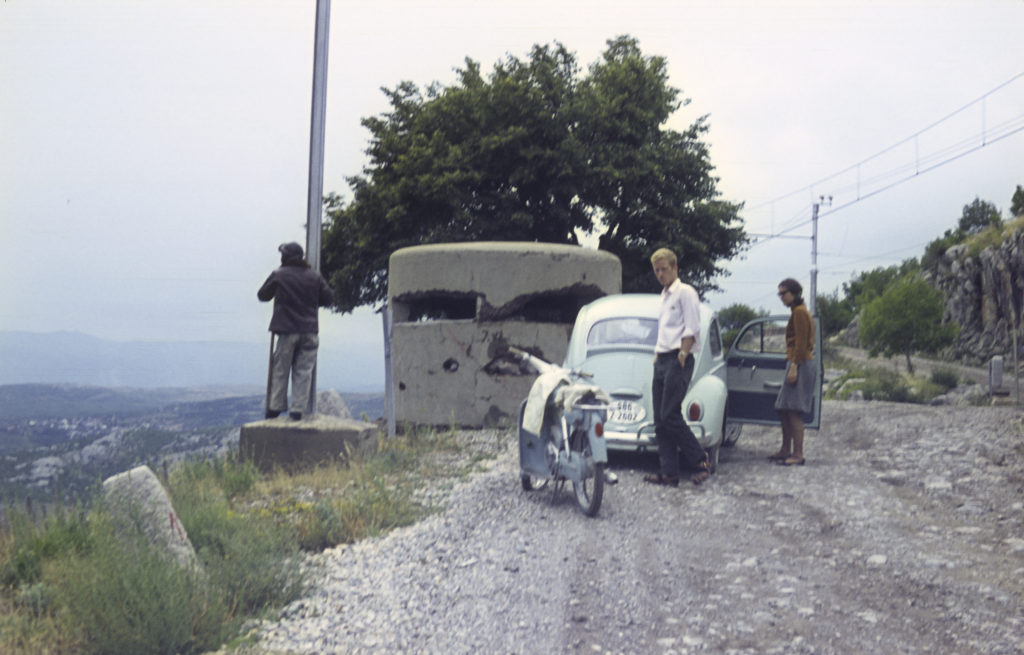
Then it was on to Venice. But somehow, on the way to Venice, we got sidetracked, or took a wrong turn, and wound up in the Dolomites, the steep and rugged peaks of Northern Italy. The area had been the scene of bitter battles between the Italians and Austrians in World War I, and I remember seeing old ruined forts and concrete pillboxes with rusty gun emplacements during the journey.

A stop along a mountain rod in the Dolomites near a pillbox left over from World War I; Bill and Zoya next to Bill’s VW, with an unidentified Italian and his moped nearby.

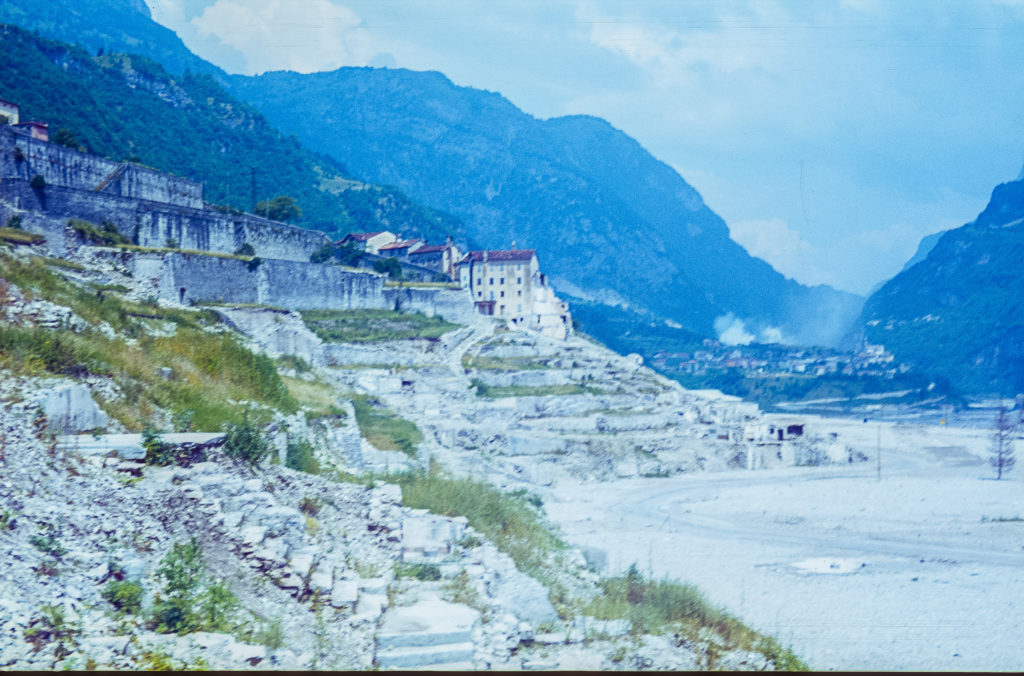
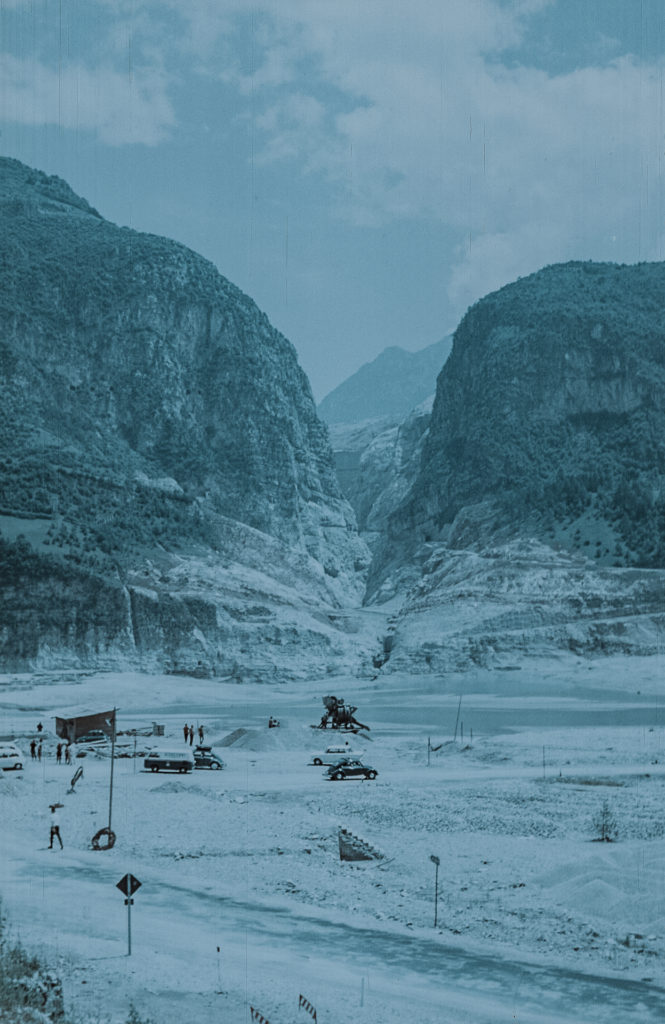
Coming south again, we happened on the town of Longarone. I had no idea we would encounter this place, but once I saw it I remembered reading in the newspapers about it. The town is located on the Piave River, a few miles below the Vajont Dam, one of the tallest in the world at 860 feet high. A few months prior to our arrival, a large section of Monte Toc, the mountain above the dam, had crumbled away and fallen into the reservoir, creating a wave that overflowed the dam and roared into the valley below, wiping out most of the town of Longarone as well as several others in its path. In an instant, over 2,000 people were swept away. When we came to the town, we saw that the huge wave of water had acted like a knife, slicing houses in two, leaving one half standing while the other was carried away. The passage of water left the bottom of the valley filled with mud, which dried into a white and bare desert, marked here and there by wreaths placed by the relatives of the dead.

Italy – Town of Longarone
Italy – Longarone flood plain

Eventually, after an exciting drive along narrow mountain roads where mad Italians continually threatened to kill us by suicidally passing us and each other in their underpowered Fiats, we descended into the Venetian plain and made our way to La Serenissima, the Queen of the Adriatic.

We were able to spend an afternoon in Venice, enough time to cruise on the canals and see a few of the major landmarks. Venice then as now was mostly closed to automotive traffic, and we made our way around on the vaporetti, motorized pedestrian ferries that are ubiquitous on the canals. We didn’t ride in any gondolas.

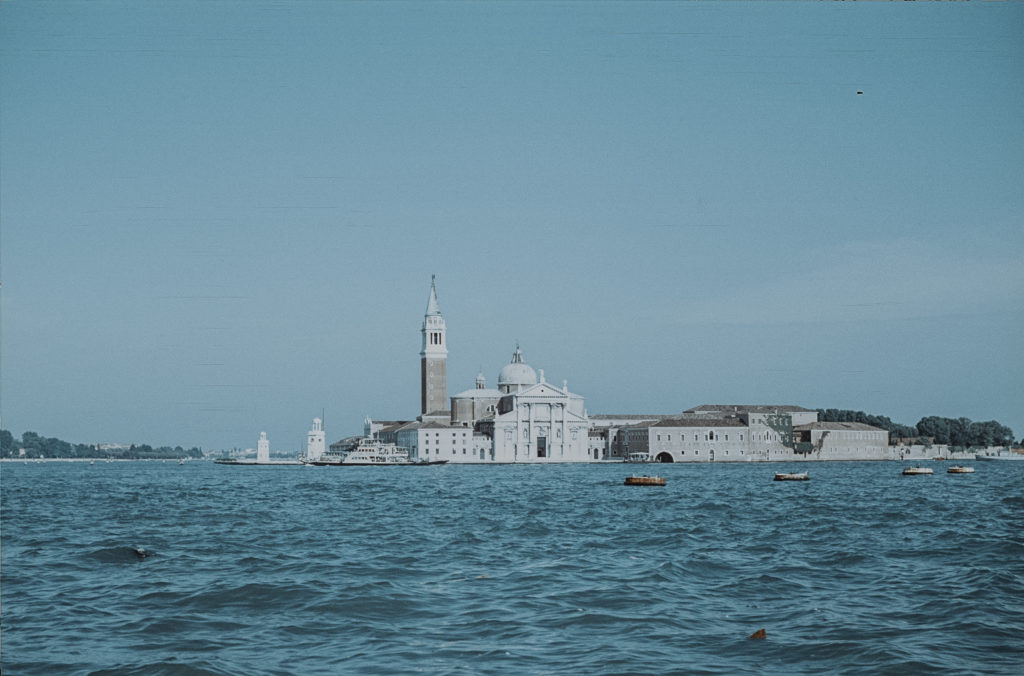
Venice – St, Mark’s Campanile, as seen from vaporetto en route to Murano
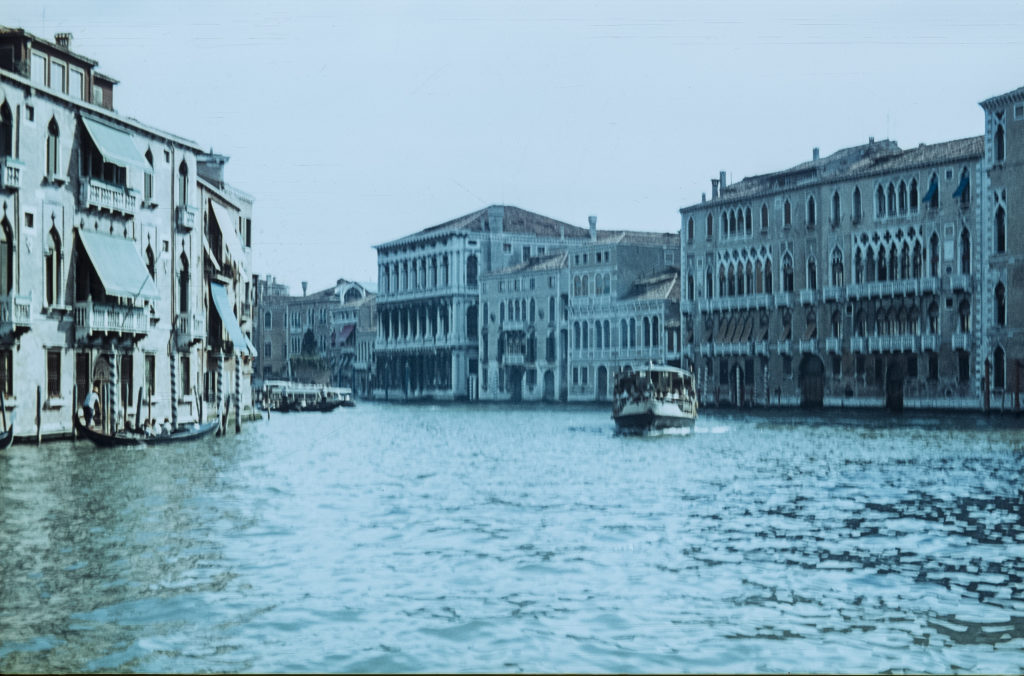
Venice – Vaporetti on Grand Canal
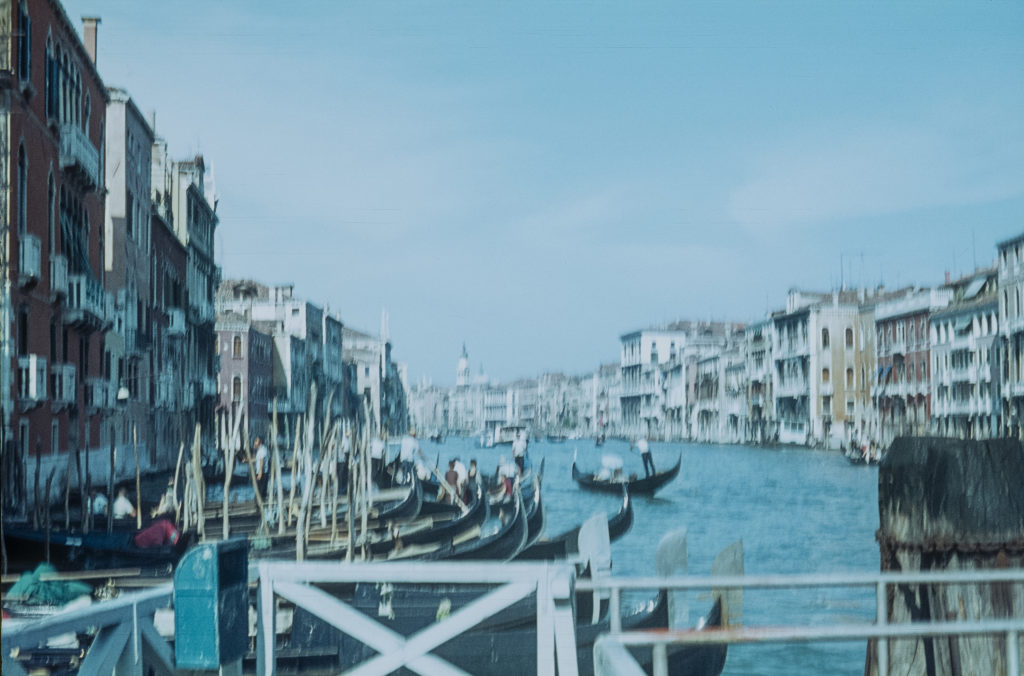
Venice – Grand Canal with Gondolas
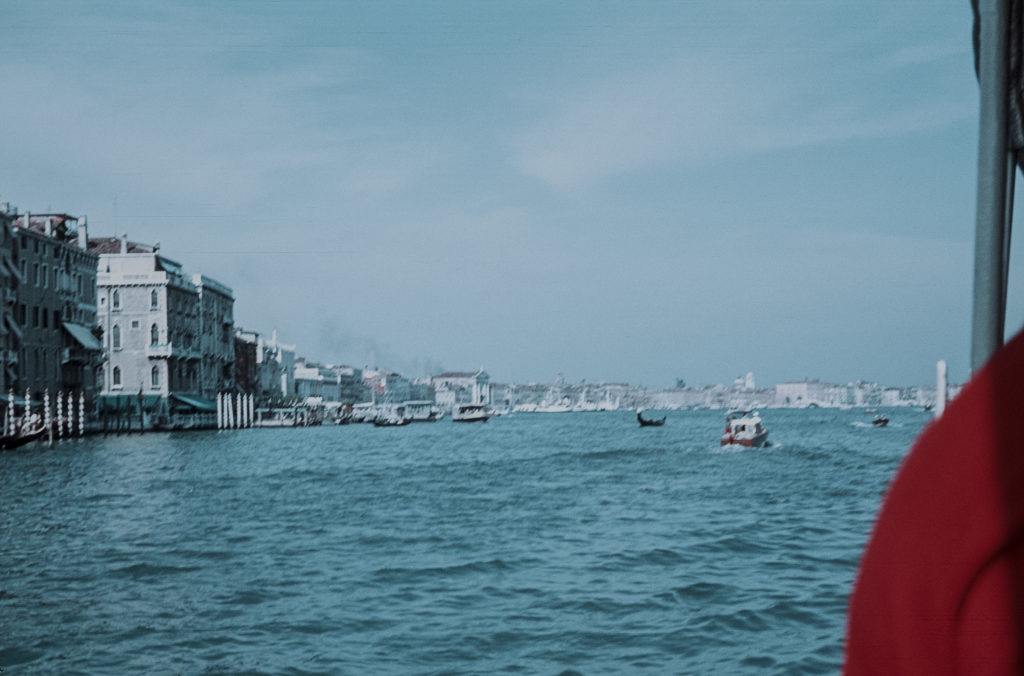
Venice – Grand Canal from Vaporetto

We didn’t venture far from the Grand Canal, but there was plenty to see on it. We did make it to Murano, the island which is famous for its glassmaking industry, and I bought some glassware there.

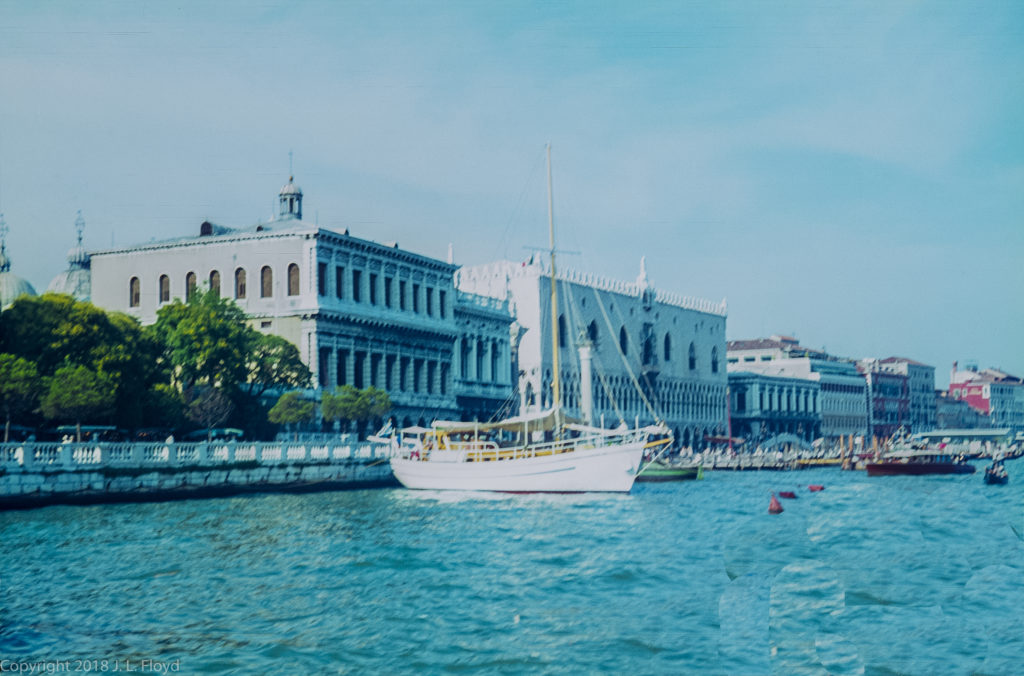
Yacht moored on the Grand Canal
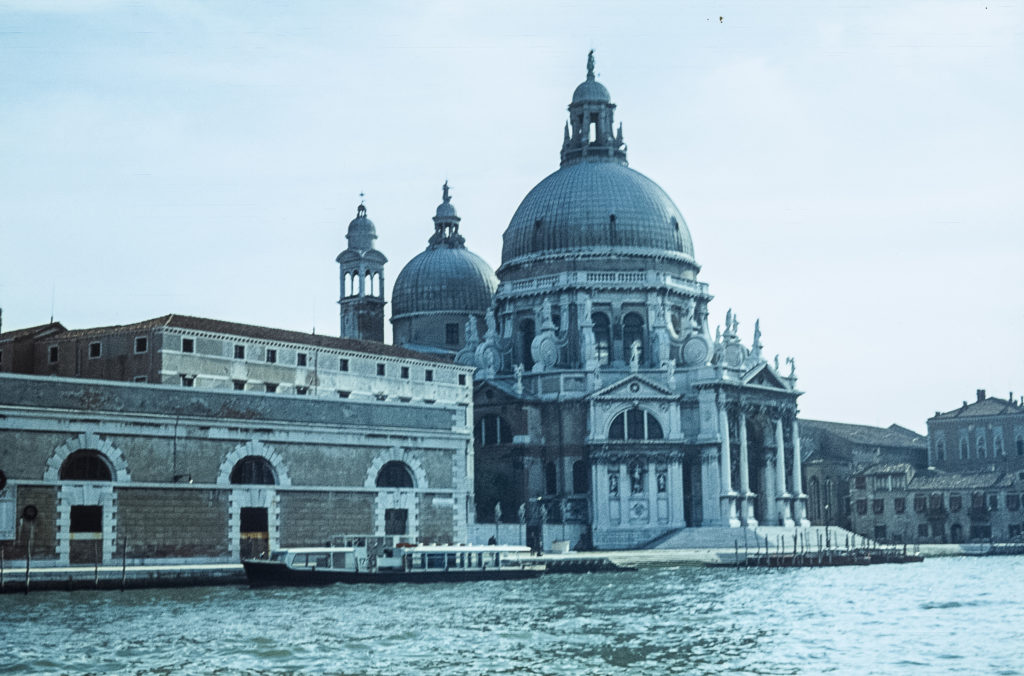
Venice – Basilica di Santa Maria della Salute
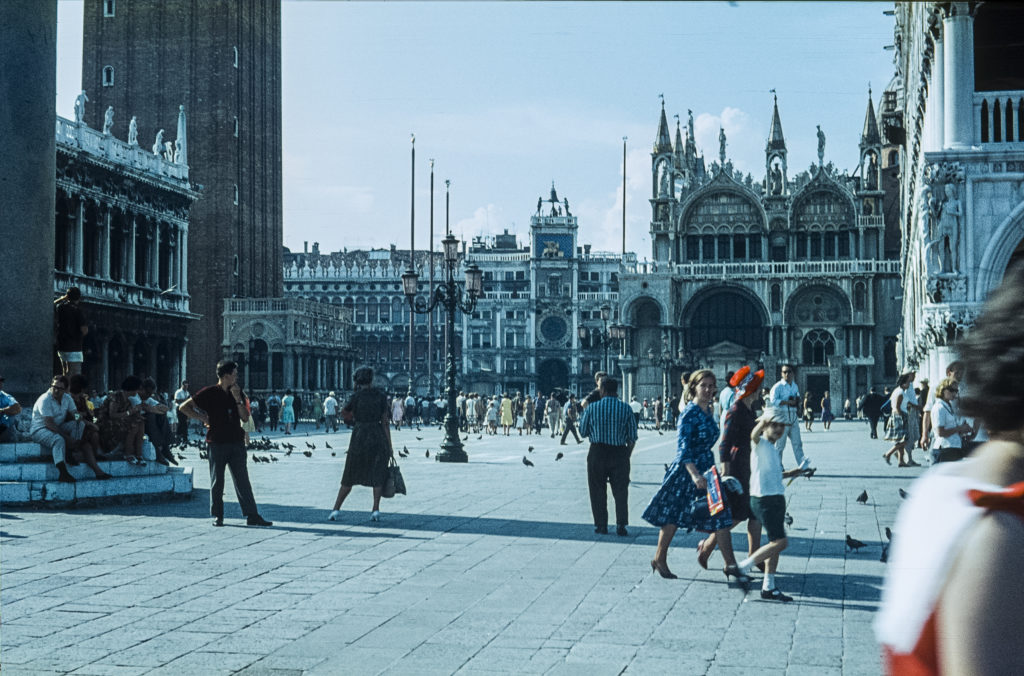
Venice – Piazza San Marco; St. Mark’s Clocktower at rear, St. Mark’s Basilica at right, Campanile at left

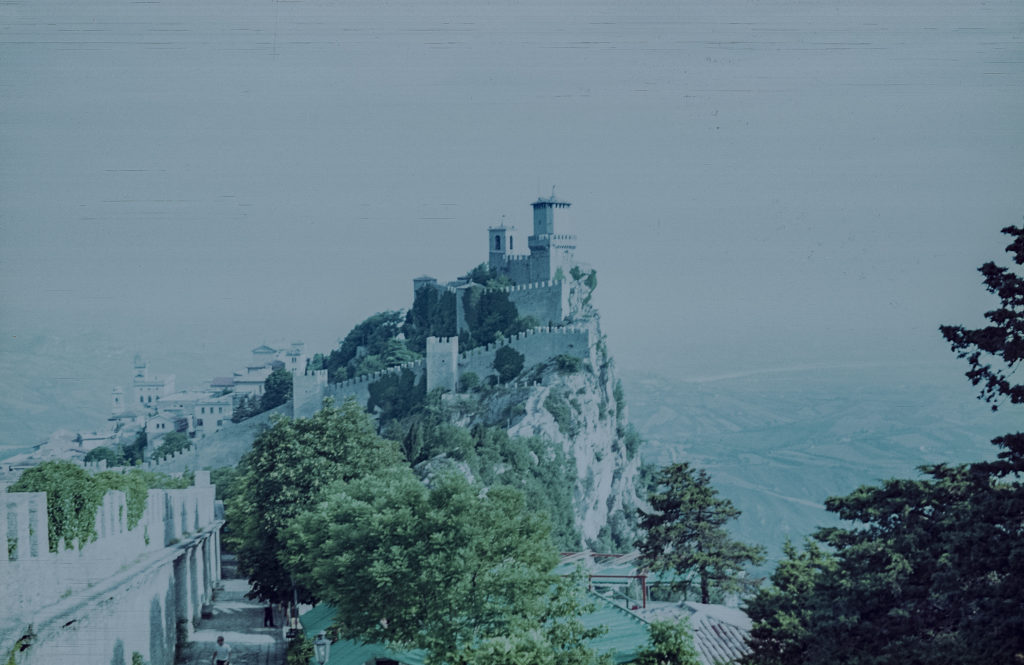
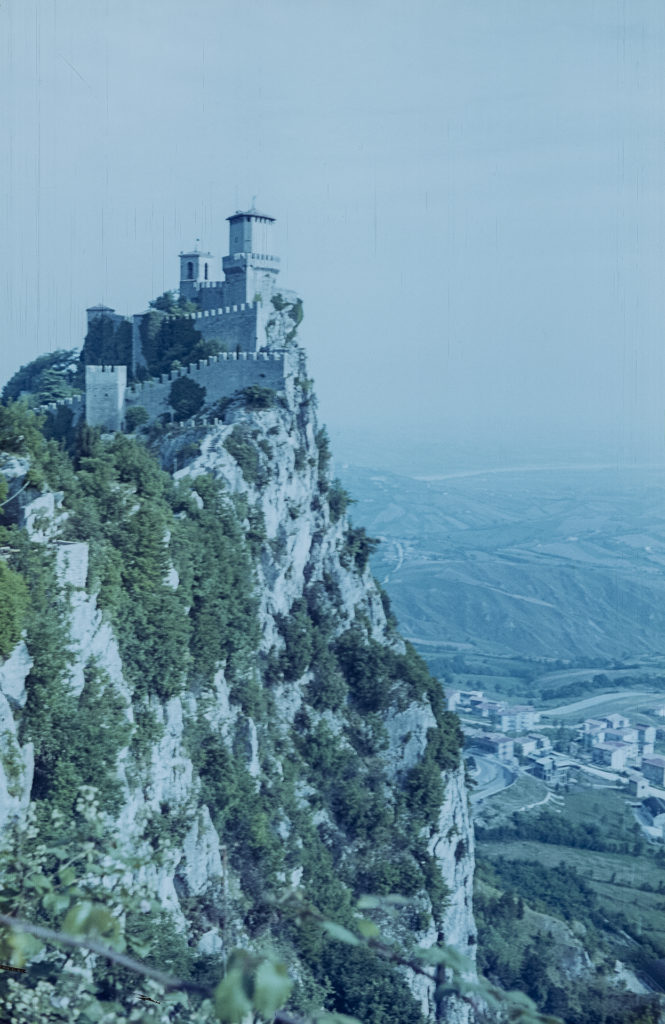
From Venice we headed south along the coast, then turned inland and arrived at a place which I had no idea existed until then – the independent country of San Marino. Completely surrounded by Italy, San Marino is like something out of a fairy tale. It is built on a mountain, Monte Titano, which towers a thousand feet above the surrounding plain. Perched atop the mountain are three castles; the oldest, Torre Guaita, pictured below, dates from the 11th century.

San Marino was founded in 301 AD and claims to be the oldest sovereign state in the world.

San Marino – Torre Guaita – San Marino’s oldest fortress
San Marino – Torre Guaita

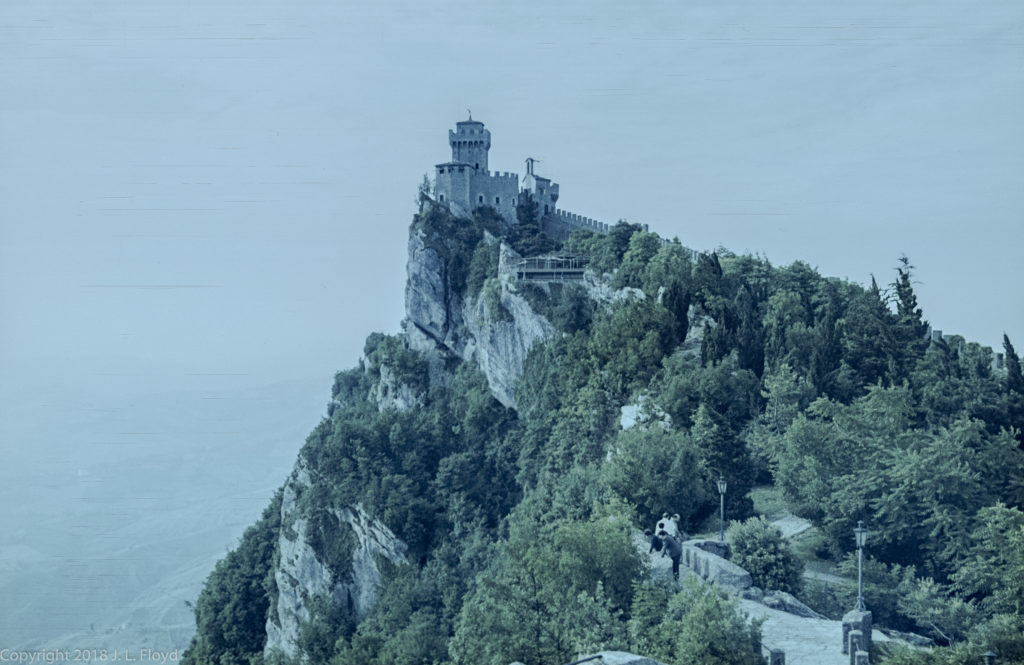
Torre Cesta, shown below, stands on the highest of Monte Titano’s three peaks. It was built in the 13th century on the ruins of an old Roman fort and now contains the Sammarinese Museum of Ancient Arms, a showcase of medieval weaponry. We did not see the third tower, the Montale, which is privately owned and not open to the public.

San Marino – Torre Cesta

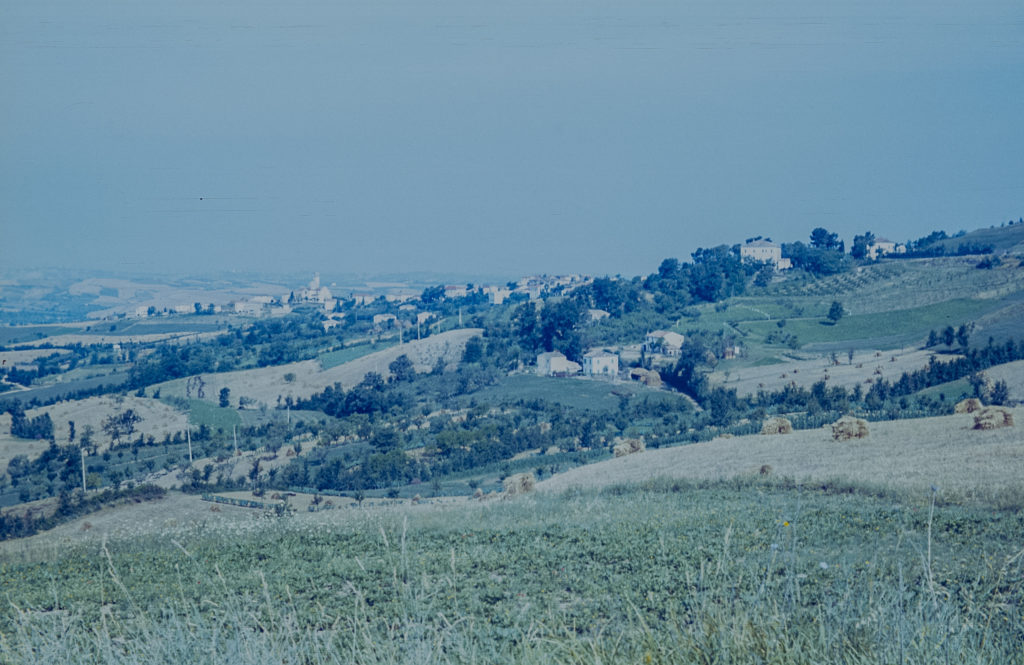
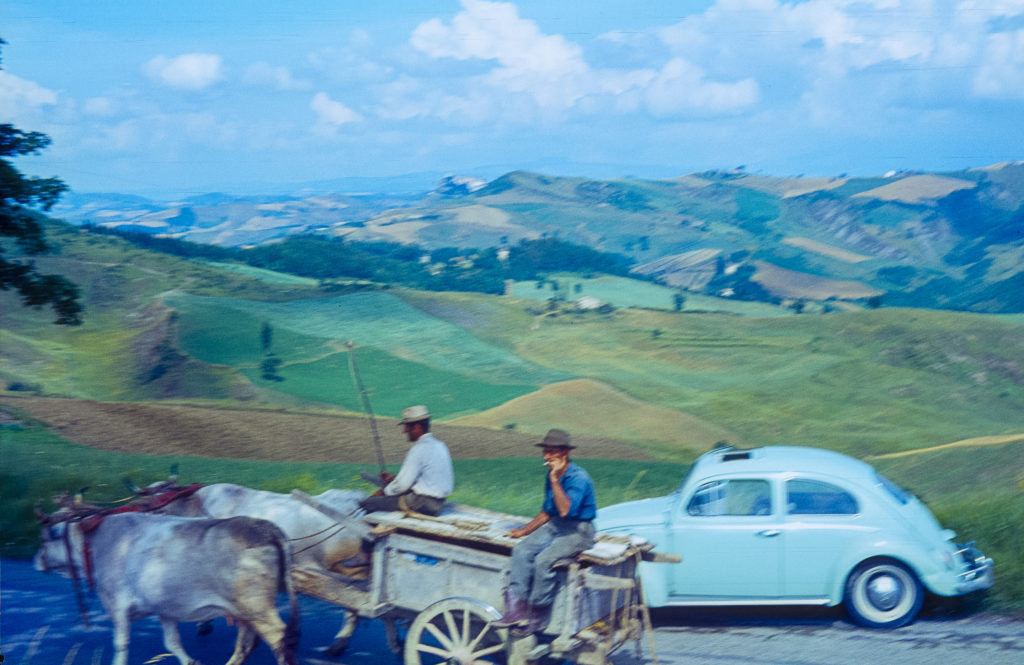
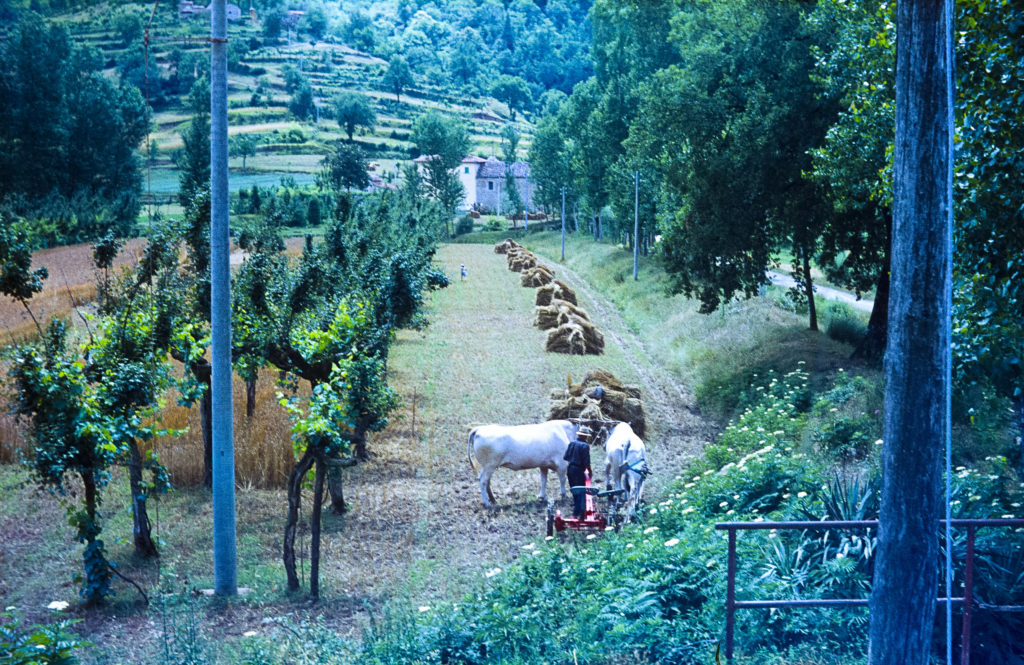
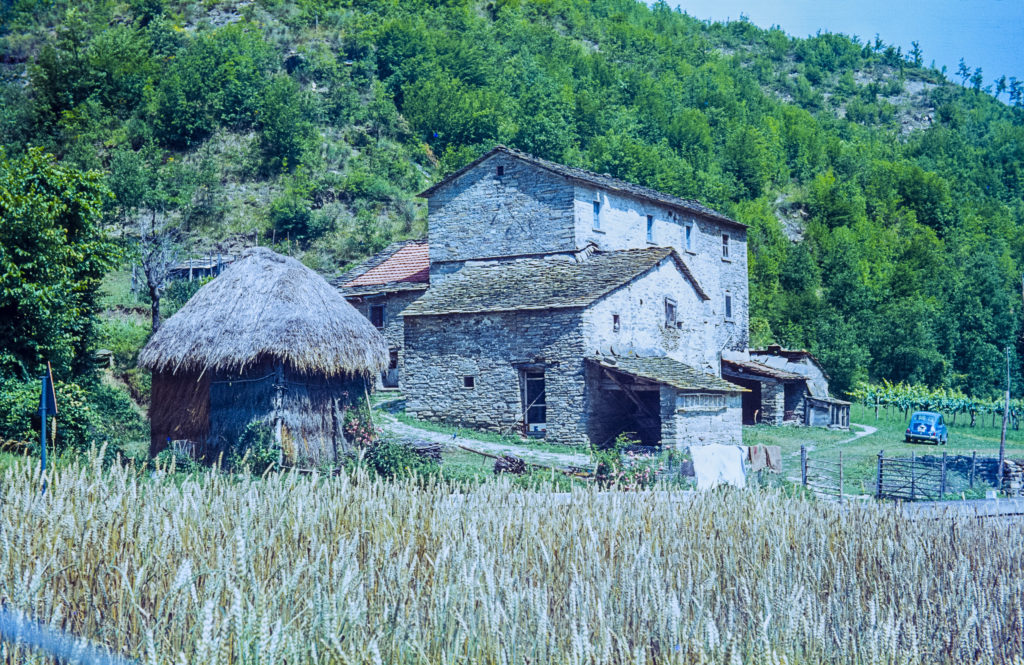
Continuing on from San Marino, we wanted to head for Tuscany, but to do so we first had to head southward to get to the main highway over the Apennine mountains, which bisect the Italian peninsula. We traversed the regions of Marche and Umbria, passing through a lot of pleasant Italian farm country along the way, and stopping occasionally to rest and take pictures.

Italian countryside
Italian farm country
River in Central Italy
Farm and Vineyard
Italian countryside
Italian Farmstead

Somewhere along the way we passed a walled city perched on a high sloping hill – I think it was Urbino, though I can’t swear to it.

Walled City in Central Italy, probably Urbino

Finally we came down from the Appenines to the plains of Tuscany and turned north toward Florence. One of the signs in the picture below points the way toward Florence – Firenze in Italian – but it’s impossible to make it out in this very blurry photo. I think I took this from the moving car, and my little Voigtländer would only go down to 1/125 second, not quite fast enough to freeze the motion. At this point we were traveling fast and not stopping much, because it was Sunday and Bill, the driver, for some reason needed to be back in Munich by Monday morning.

Town in Tuscany on the way to Florence

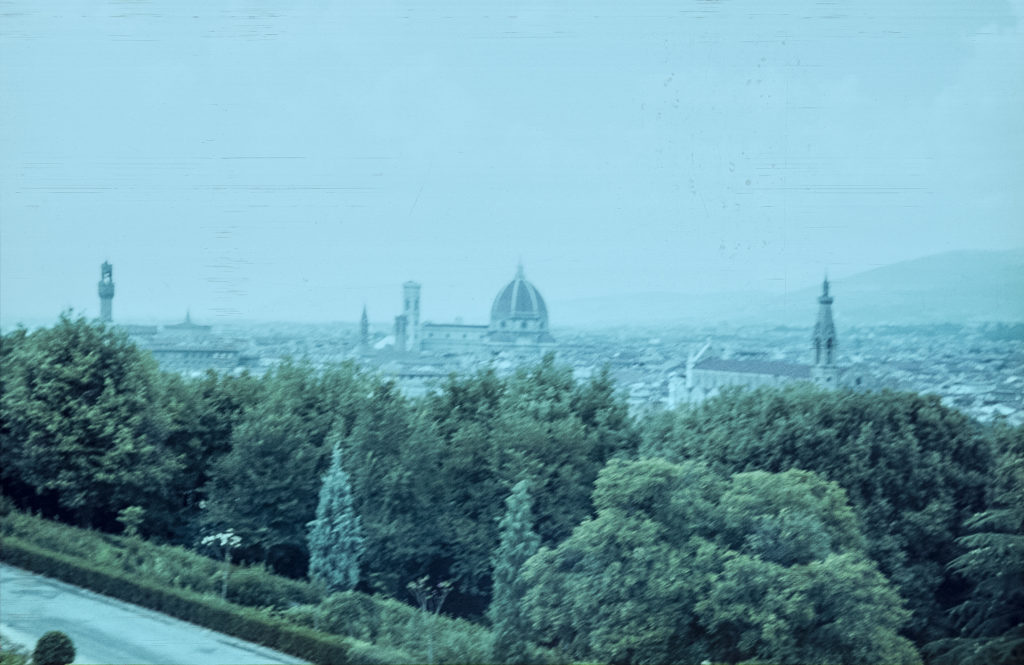
We were only able to spend a few minutes in Florence, probably less than an hour, but I did have time to shoot this picture, which features the great cathedral of Florence, the Duomo, in the center, with the tower of the Palazzo Vecchio at left.

Florence – Duomo

We headed back to Austria via Bologna, Verona and the Brenner Pass, and thence to Munich via Innsbruck, stopping nowhere along the way except for gas. We had to drive all night to get back to Munich by 9 AM Monday morning. I remember that somewhere outside Innsbruck, in the dead of night, a luminous skull and crossbones suddenly popped up in front of us, like a jack-o’lantern on Halloween, scaring us nearly to death. It was just a warning sign for a railway crossing – a very effective attention-getter. We actually had a very close shave, though, after crossing the German border on a narrow mountain road; sometime after dawn Bill nodded off at the wheel and I was startled out of a near-doze by the sight of a bus hurtling head-on toward us because we had strayed onto the wrong side of the highway. I shouted and woke up the others, we all started yelling and woke up Bill, who righted the car and got us out of harm’s way. We were pretty worried about going any further with Bill driving, but he wouldn’t let anyone else drive because it was his dad’s car and the insurance didn’t cover us. He insisted that he would be all right after that, and he was as good as his word; we arrived back in Munich that morning without further incident.

Categories
Europe, Summer 1964

Berlin, July 1964

In July 1964, at the end of the six-week Russian language summer school at the Institute for the Study of the USSR in Munich, those who had signed up for the two-week trip to the Soviet Union boarded a train for Berlin. There, after passing through the border crossing to East Germany, we caught a different train, bound for Moscow. In between our arrival in West Berlin and our departure from East Berlin, we were given a few short hours to see the sights, and we used them as best we could.

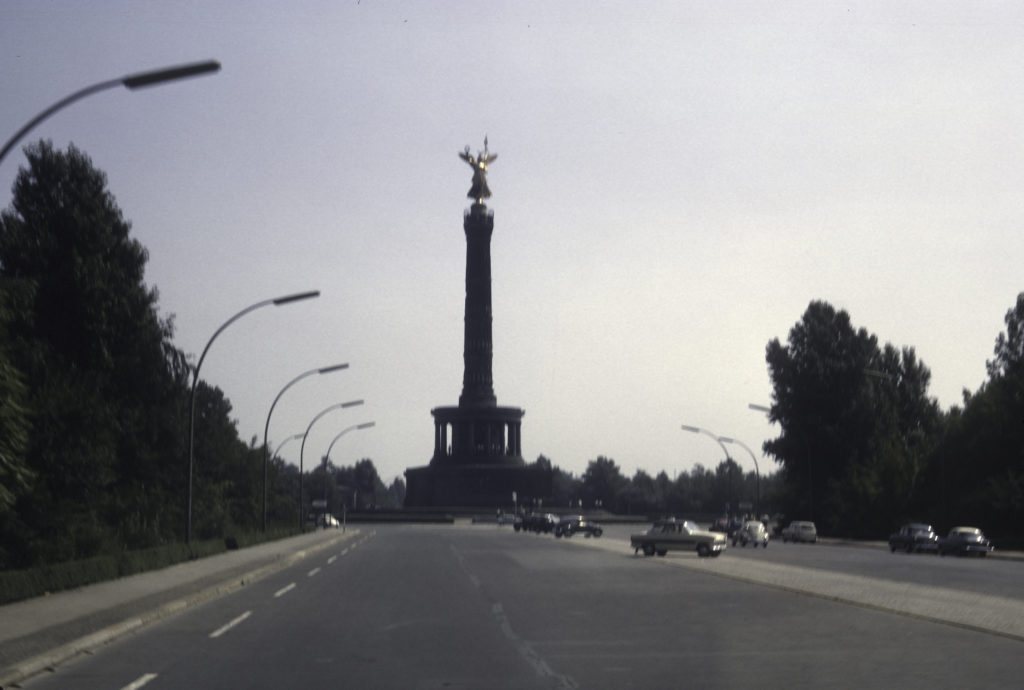
The Siegessäule (Victory Column)

The Siegessäule (Victory Column) is a 289-foot column with a gilded statue of Victoria, the Roman goddess of victory, on top. It commemorates the German victories over Denmark, Austria and France in the wars leading to German unification in the 19th century. It was originally built on the Konigsplatz near the Reichstag, but in 1939 the Nazis moved it to a different location, the center of the Tiergarten park, thus saving it from destruction, since the Reichstag area was heavily bombed and shelled in World War II. In its new location, the Siegessäule survived the war unscathed, and remains one of Berlin’s major tourist attractions.

Berlin – Victory Column (Siegessaule)
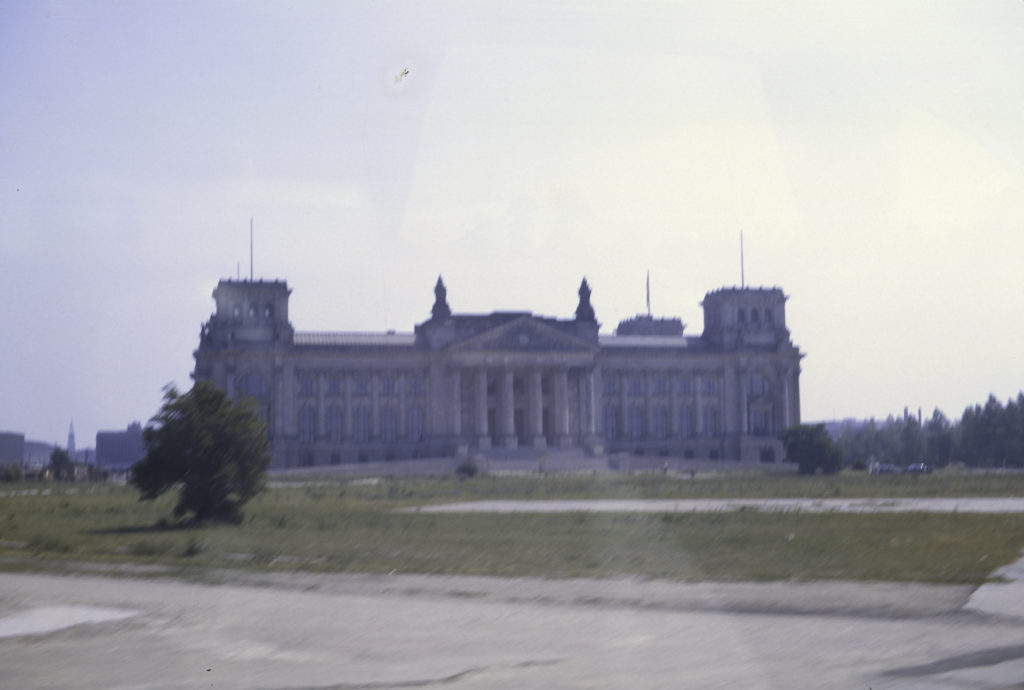
The Reichstag

The Reichstag was built in the 1890s to house the Imperial German Diet (parliament). It fulfilled the same role for the Weimar Republic after World War I, but in 1933, following Hitler’s accession to power, a fire broke out in the Reichstag, supposedly set by a Dutch communist named Marinus van der Lubbe, who was convicted and executed for the act. The fire gave the Nazis a pretext to suspend civil rights and impose a police state. The Reichstag building was not fully restored after the fire, and the legislature, having ceded its powers to Hitler, held its infrequent meetings in a nearby opera house. During World War II the building was further damaged by bombing and by the Soviet assault on Berlin in April 1945, which focused on the Reichstag as a major target. Nevertheless, it survived, and after the division of Berlin into occupation zones by the allies, it ended up in West Berlin, in the British zone. The West German government partially restored it in the early 1960s, but the dome which originally topped it was not included in the restoration, so I saw it without the dome. Meanwhile, the West German legislature, the Bundestag, met in Bonn, the capital of the Federal Republic. This state of affairs continued until German unification in 1990, after which the Reichstag was fully restored (including a large glass dome), and the Bundestag has met there since the completion of the restoration in 1999.

Reichstag as it appeared in July 1964, after partial restoration
Brandenburger Tor (Brandenburg Gate)

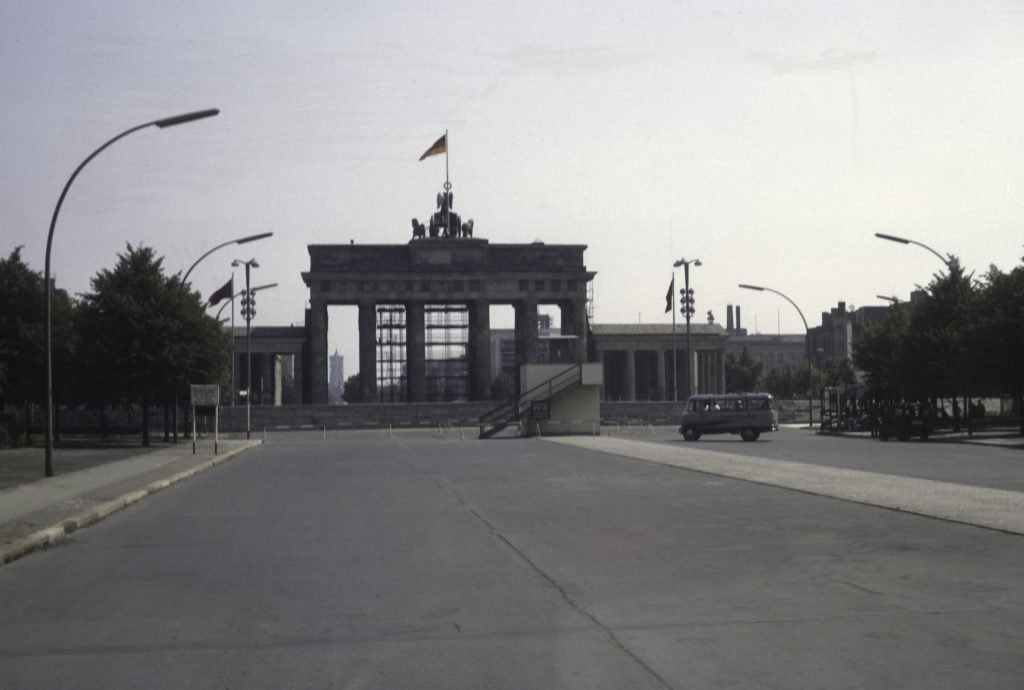
Located a block south of the Reichstag, the Brandenburg Gate is perhaps Berlin’s and Germany’s most famous monument. It was built in the late 18th century at the orders of Prussian King Frederick William II. The architectural style is neoclassical, and on top of the Gate there is a sculpture depicting four horses drawing a chariot driven by Victoria, the Roman victory goddess. The Gate was badly damaged during World War II, and the Quadriga was shattered, but after the war the governments of East and West Berlin restored it, Quadriga and all, in a joint effort. During the Cold War it marked the boundary between East and West Berlin, and until the Berlin Wall was erected in 1961, people and vehicles could pass freely through it, but when the Wall went up it was closed. It remained closed until 1989.

On June 12, 1987, U. S. President Ronald Reagan made his famous “Mr. Gorbachev, tear down this wall!” speech at the Brandenburg Gate. Two years later, after the “Peaceful Revolution” in East Germany in the fall of 1989, the Berlin Wall came down, and on December 22, 1989, the Brandenburg Gate was reopened.

The Brandenburg Gate in July, 1964
The Tiergarten – Soviet War Memorial

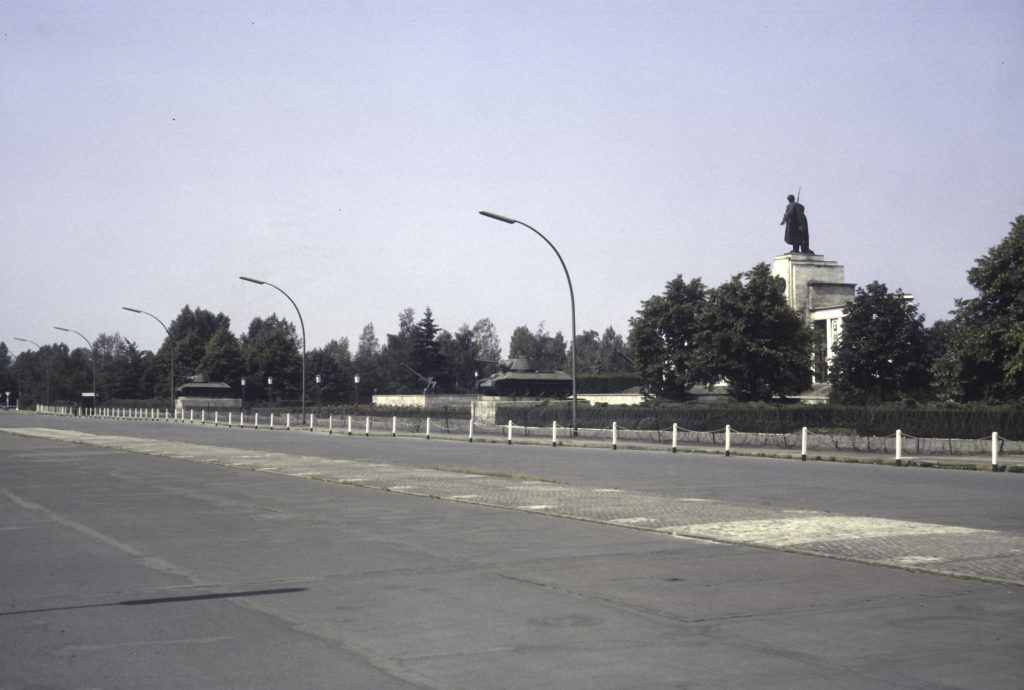
The Brandenburg Gate is located at the east end of the Tiergarten, a large inner-city park in West Berlin, 520 acres in size. The Tiergarten began as a royal hunting ground for the Elector of Brandenburg; after Brandenburg became the Kingdom of Prussia, King Frederick II (the Great), who had little interest in hunting, initiated its transition into a public park. When the Red Army took Berlin in 1945, the Soviets built a memorial to their war dead in the Tiergarten (pictured below), but unfortunately for them, when the city was divided up between the victors, the Tiergarten turned out to be in the British sector. Though the British graciously allowed the Soviets to keep an honor guard at the memorial, after the Berlin Wall went up the monument became inaccessible to East Berliners, so the Soviets had to build a new war monument in East Berlin for their edification.

Soviet War Memorial, Tiergarten

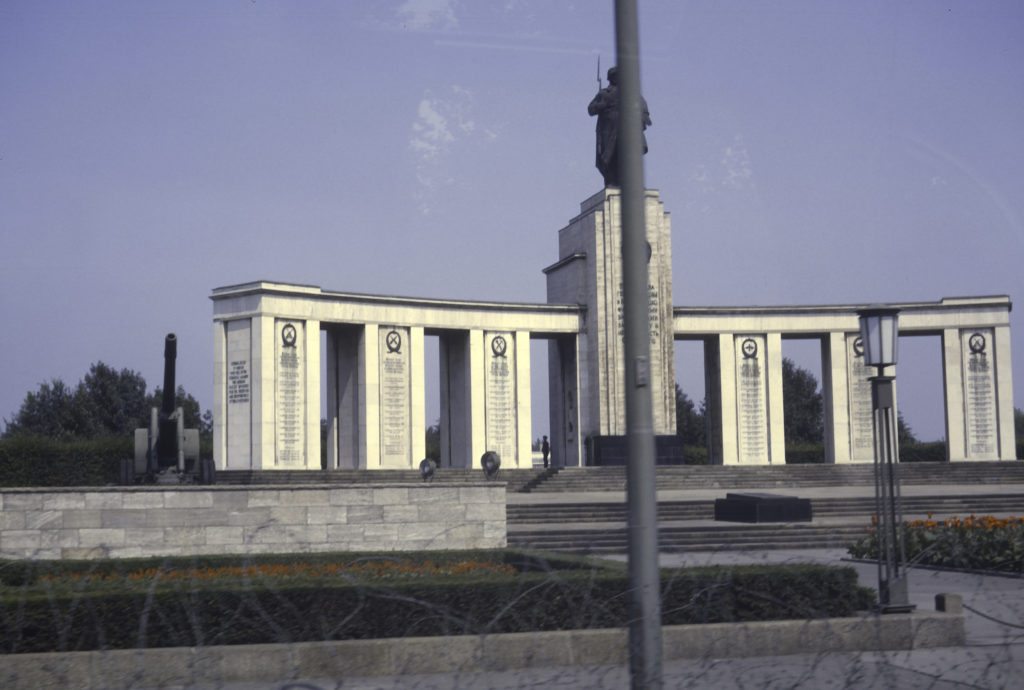
Atop the memorial there is a statue of a Red Army soldier, and there are tanks and howitzers positioned around it. The memorial also marks the burial site of 2,000 of the 80,000 Red Army soldiers killed in the assault on Berlin. (Since at least 8 million Soviet solders died in World War II, not to mention another 18 million civilians, I don’t begrudge the Russians a war memorial anywhere in Berlin.) Today the memorial is maintained by the City of Berlin. Unfortunately, I took the photo shown below in great haste, thus contriving to obscure the central section with a lamppost.

Soviet War Memorial Tiergarten
Die Mauer – the Berlin Wall

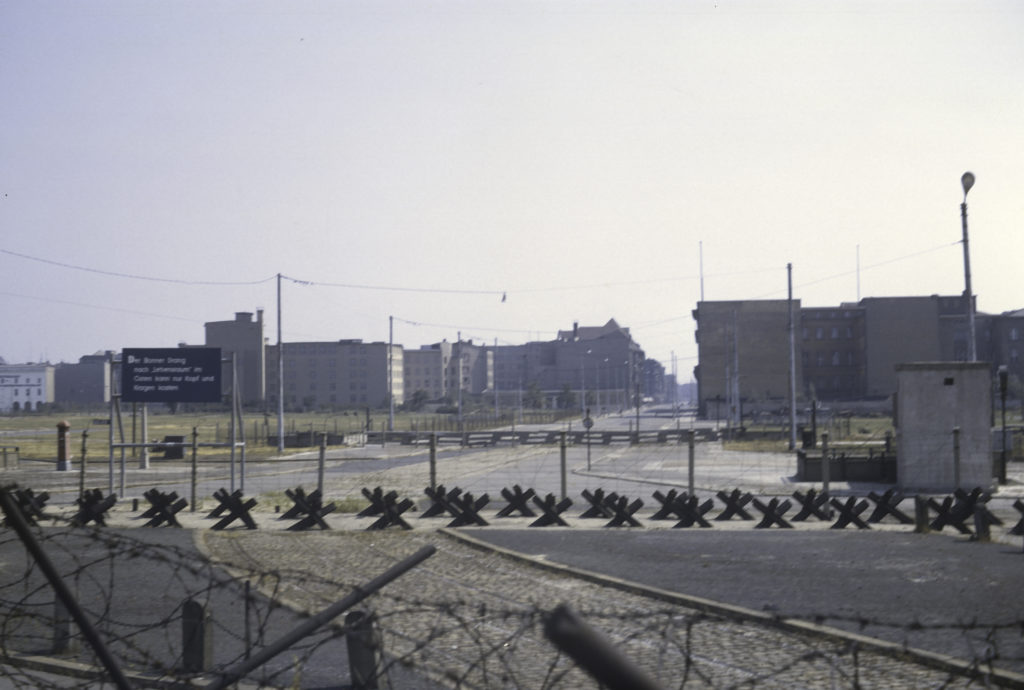
When I visited in July 1964, the Berlin Wall had been up for three years and would stand for another twenty-six. Nobody knew then if it would ever come down. You could read all you wanted about it and see programs about it on TV, but none of that ever prepared you for seeing it in person. The watchtowers and barbed wire and hedgehogs, the guards with machine guns, the crosses and wreaths marking the places where East Germans died trying to get out, really brought home to you the difference between East and West. It was ugly, dismal, depressing.

At intervals along the wall there were platforms with stairs where you could climb up and get a look at East Berlin. Most often what you saw was a wide no-man’s land between the built-up area on the east side and the wall. For the edification of Westerners, the East Germans had put up signs at intervals to assure them how miserable life was on the West side of the wall in contrast with the socialist paradise of East Germany.

View of East Berlin over the Wall

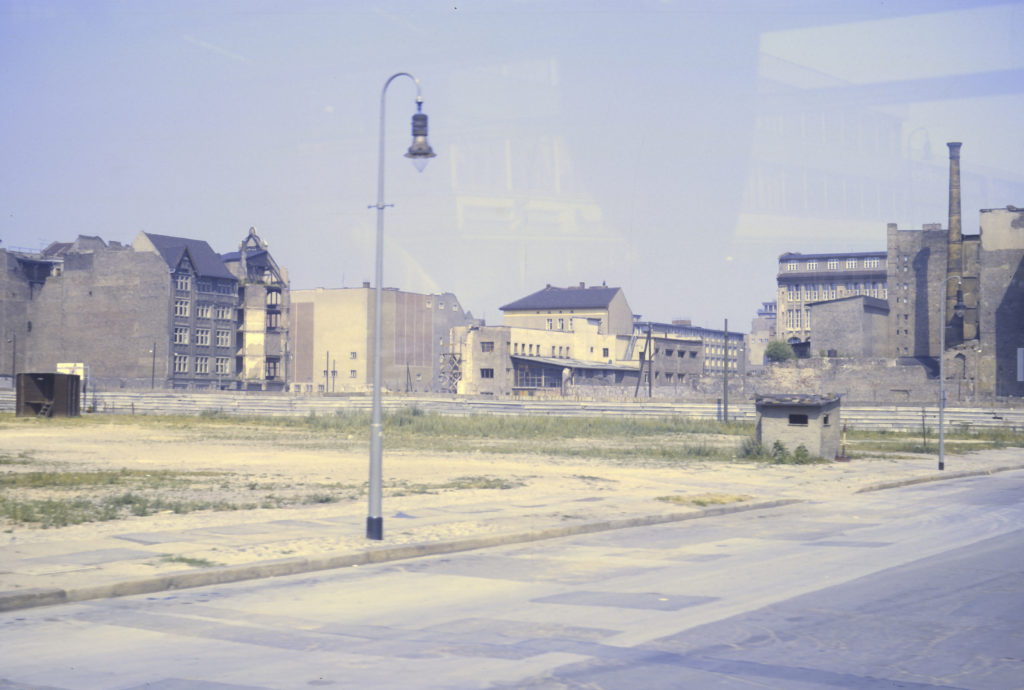
In some areas there were still buildings remaining close to the east side of the wall. These appeared to be were vacant hulks which had been gutted by bombing during WWII and had not been rebuilt after the war. There were also wide empty spaces on the Western side of the wall – my guess is that the buildings there had also been bombed in the war and that the West Berliners had cleared away the rubble afterward. In any case, all these areas look very different today.

Empty Spaces and Vacant Hulks

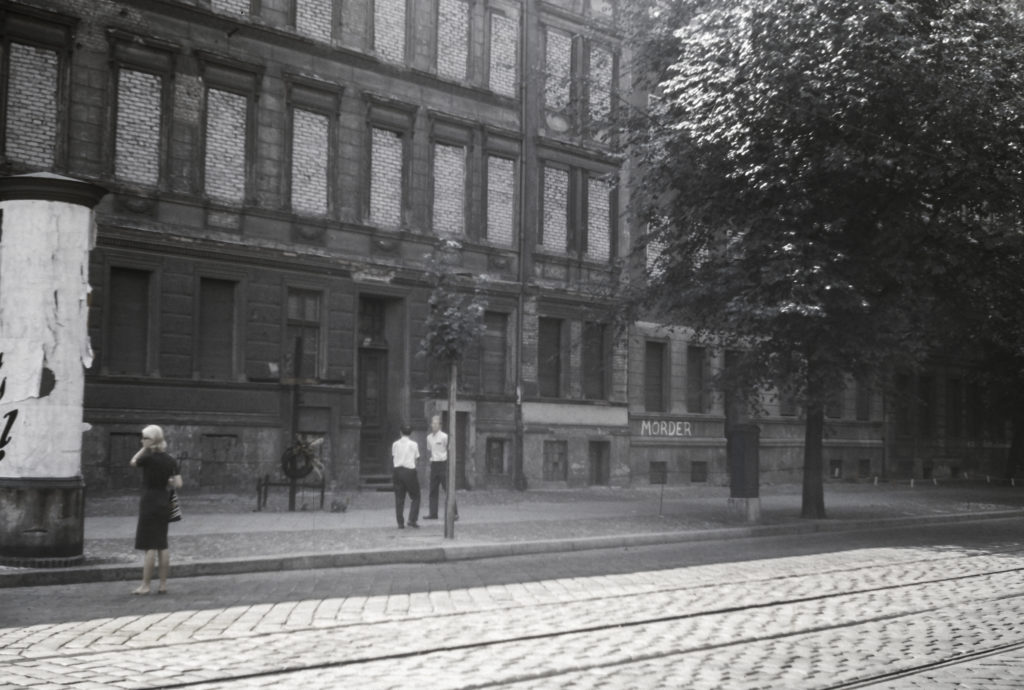
When the Wall was built, buildings directly in its path were wholly incorporated into it. The occupants were forced to leave and the windows were bricked up. In the picture below, there are two crosses and a wreath placed in memory of people who were killed trying to get over the Wall.

Wreath and Crosses by Wall (Die Mauer)

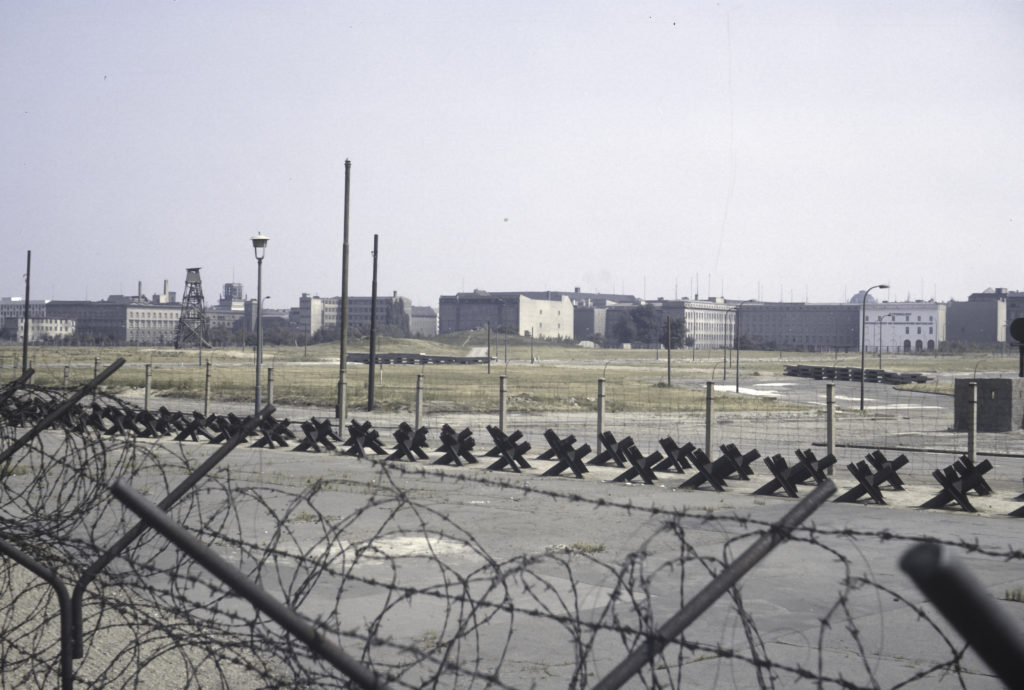
If you were in East Berlin, and you wanted to escape over the wall, you would first have to get through a wire fence, then pass through rows of steel hedgehogs (these of course were meant to stop vehicles, not people), then run across an open space and cut your way through a jungle of barbed wire, all the while being shot at by guards with rifles and machine guns. Nevertheless, many people tried; some succeeded (about 5000, according to Wikipedia) and some died (136 to 200, according to the same source).

View of East Berlin over the Wall
Checkpoint Charlie

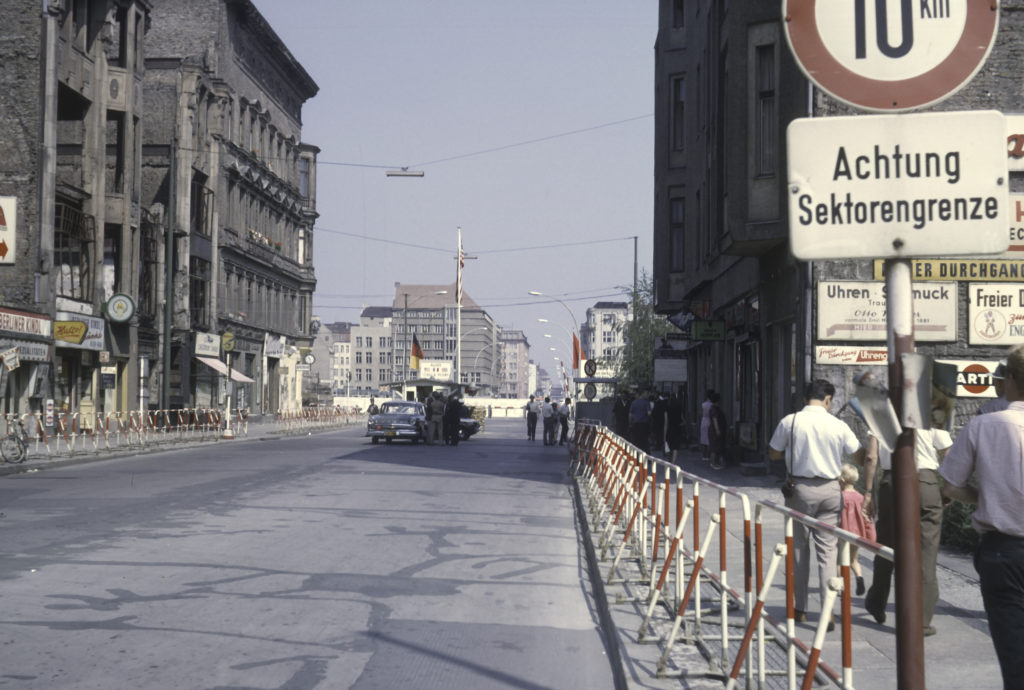
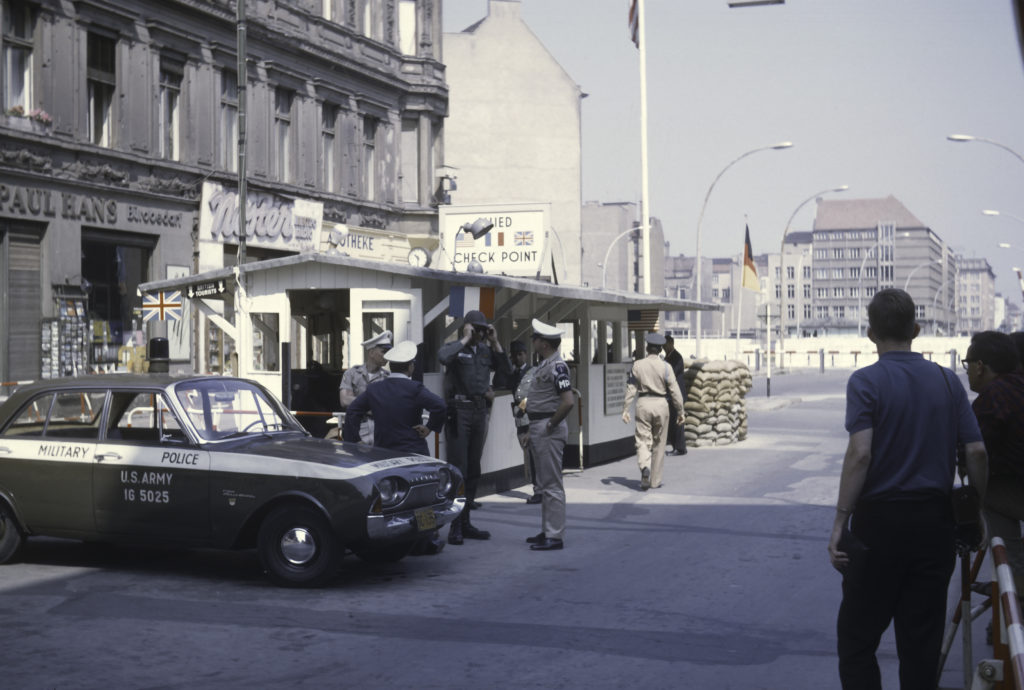
In Berlin there were two points at which Westerners could enter the Eastern sector – the Friedrichstrasse railway station and Checkpoint Charlie. Our group crossed via the railway station, since we were boarding a train there, but before we went to the station we made a stop at Checkpoint Charlie. The sign at right says “Attention – Sector Boundary.”

Checkpoint Charlie, East Berlin beyond

The Western post of Checkpoint Charlie consisted of a plain wooden shed, as seen in the picture below. On the Eastern side, there was, in addition to the Wall, a watchtower, a series of zigzag barriers, and a multi-lane facility where cars were stopped and searched. When the Wall was initially erected, the barriers were somewhat makeshift, and people had been able to escape by crashing cars through the gates, or in some cases, driving low-slung cars with windshields removed under the barriers. In response the East German government constructed the elaborate arrangements which were in place by the time I visited.

The Western “Guard Post” at Checkpoint Charlie
Categories
Europe, Summer 1964

Munich, Summer 1964

The Russian Summer School class at the Institute in Munich began in early June, forcing me to miss my college graduation ceremony on June 12 (not that I cared about that), and was supposed to last until about the middle of July, when we were to leave for the USSR.  At least that was the plan.  Actually, as I’ll explain in another post, things worked out somewhat differently.  Nevertheless, I had time to see the major landmarks in Munich, and to capture them on film.

The Institute for the Study of the USSR

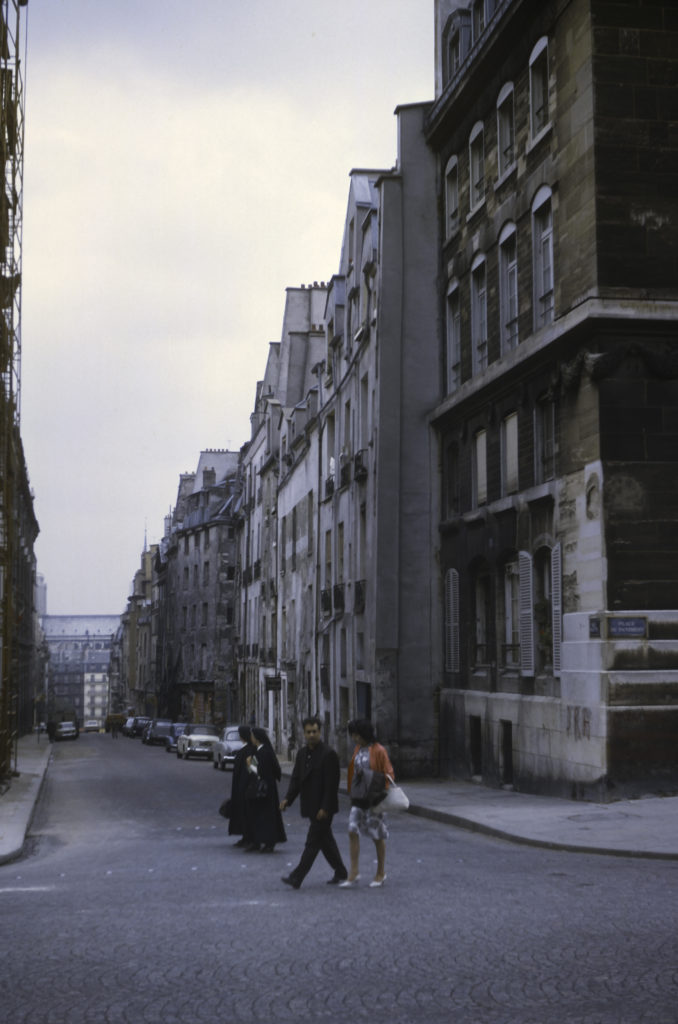
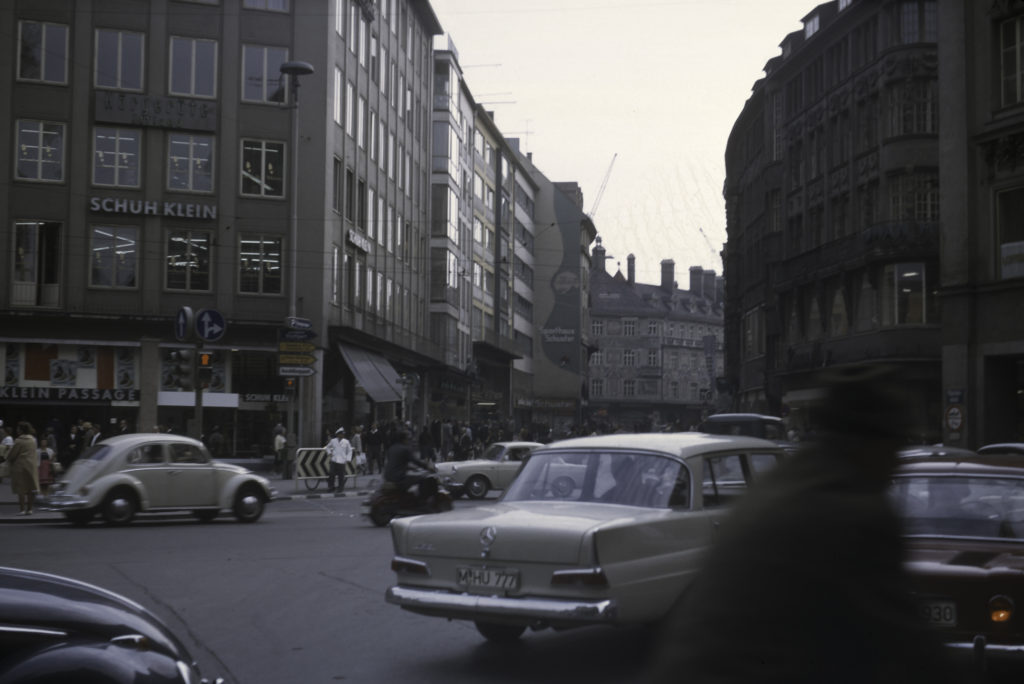
This was a CIA front, a subsidiary of Radio Liberty, which broadcast American propaganda into the USSR. It existed from 1951 to 1972, when the US Congress cut off its funding, though support for Radio Liberty continued. Staff consisted largely of Soviet emigre scholars. Its headquarters was located on Mannhardtstrasse in Munich. I’m not actually sure whether I took the following photo on Mannhardtstrasse, but it does give you an idea of what the place looked like, since all the streets in that local looked very similar.

Street Scene in Munich, Germany – July 1964
Lodgings

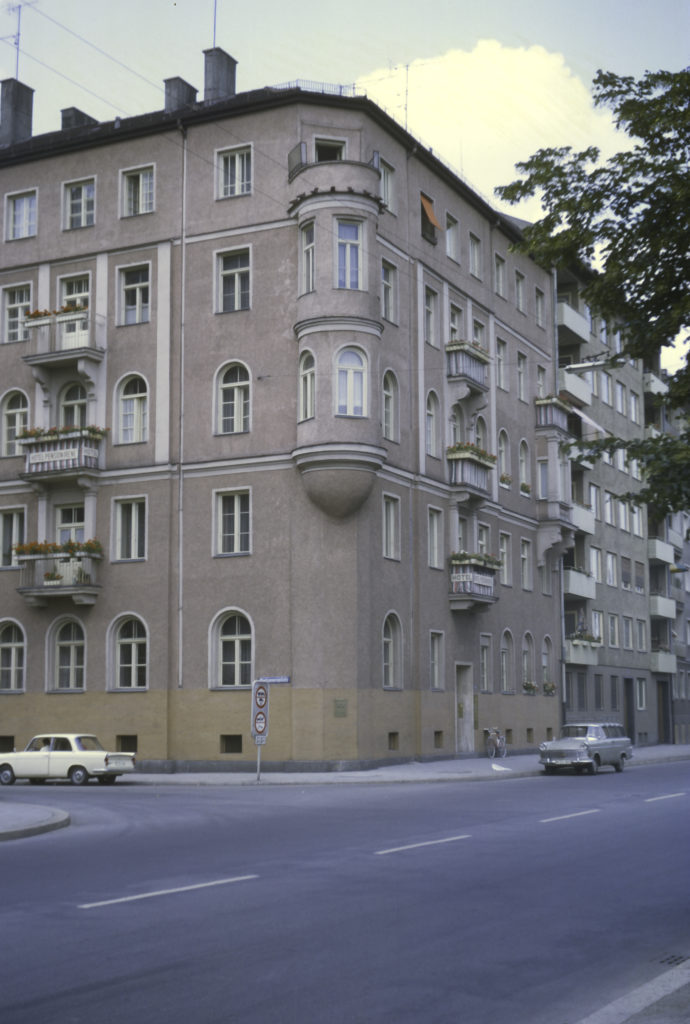
A number of us were quartered in a pension (rooming house) down by the Isar River, which flows through the middle of Munich. It was a very pleasant area, the rooms were small but adequate, and the proprietor, Frau Burge, was an efficient German hausfrau who kept the place neat and spiffy. The only thing I didn’t like about the rooms were the beds, or rather what was on them. Here I was introduced to duvets, heavy quilts which to my mind were not at all appropriate for summer; under a duvet I was hot and sweaty and found it hard to sleep.

Our Lodging – Frau Burge’s Pension

The neighborhood was quite pleasant, with the Isar River right across the street from the pension, and it was a great area to start my career as a travel photographer.

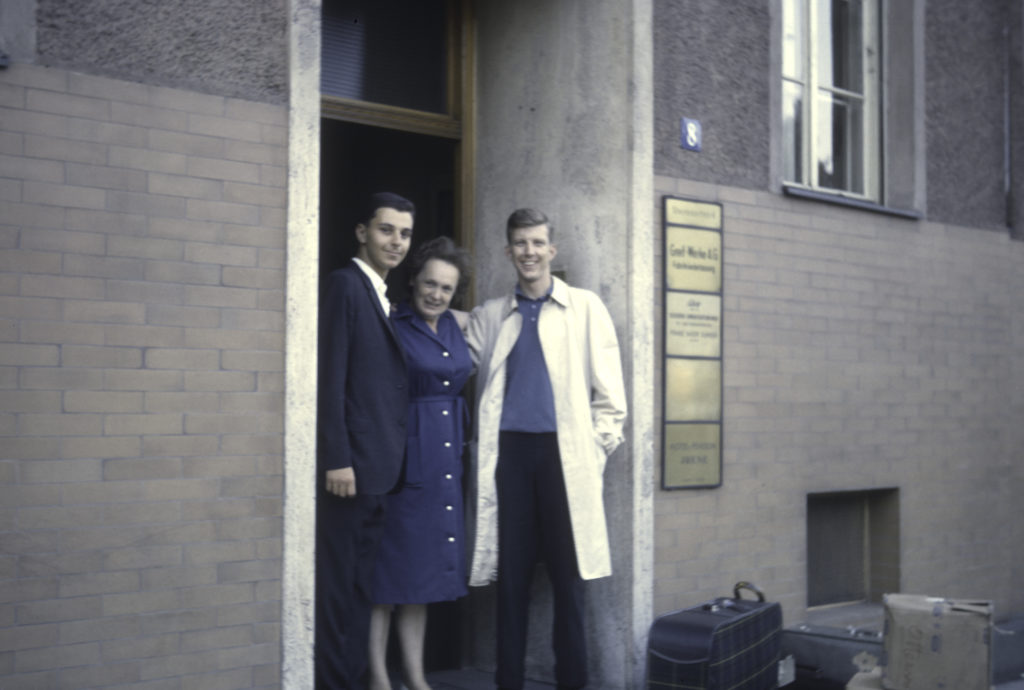
Frau Burge and two of my fellow-“pensioners” – the one on the left being my roommate, Alan, from New York City
The Isar River

Wandering the banks of the Isar was a good way to start seeing Munich. The riverside is quite picturesque, lined with parks and historical sites.

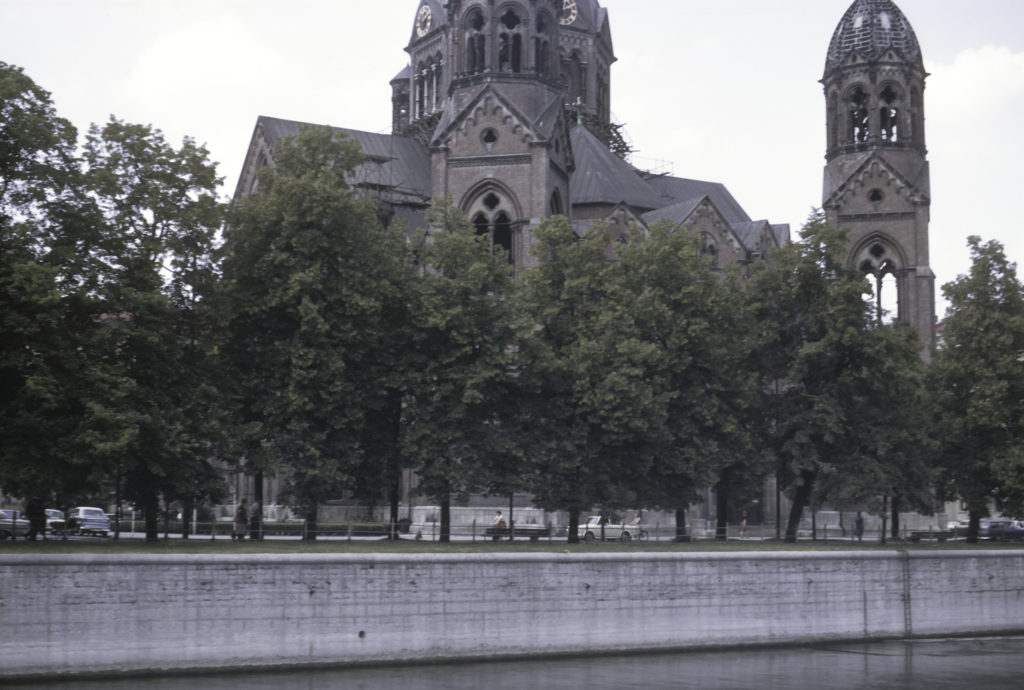
Isar River, St. Luke’s Church in distance

St. Luke’s is a Lutheran church in a historically a Catholic city where Protestants were generally unwelcome until the 19th century. It was built in the 1890s and is the largest Protestant church in Munich. It is a very imposing church, with a central dome is almost 64 meters (209 feet) high and two secondary towers that are little less tall. The architecture is a combination of Romanesque and Gothic; the architect chose these styles with the express purpose of conforming to the local traditions and catering to the preferences of the Catholic rulers.

St. Luke’s Church, on the banks of the Isar

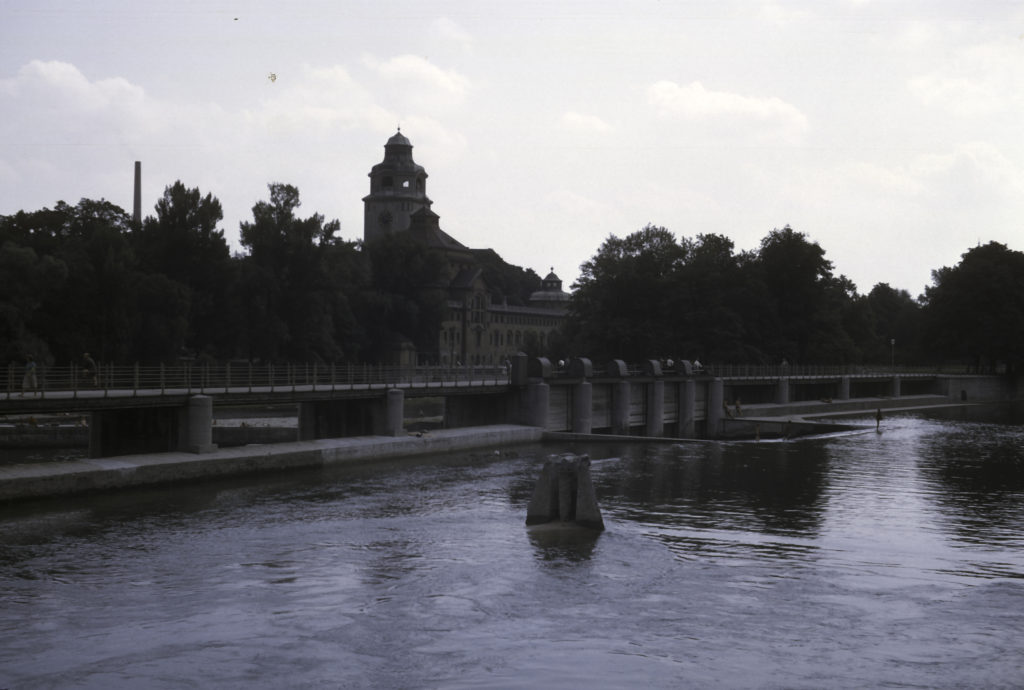
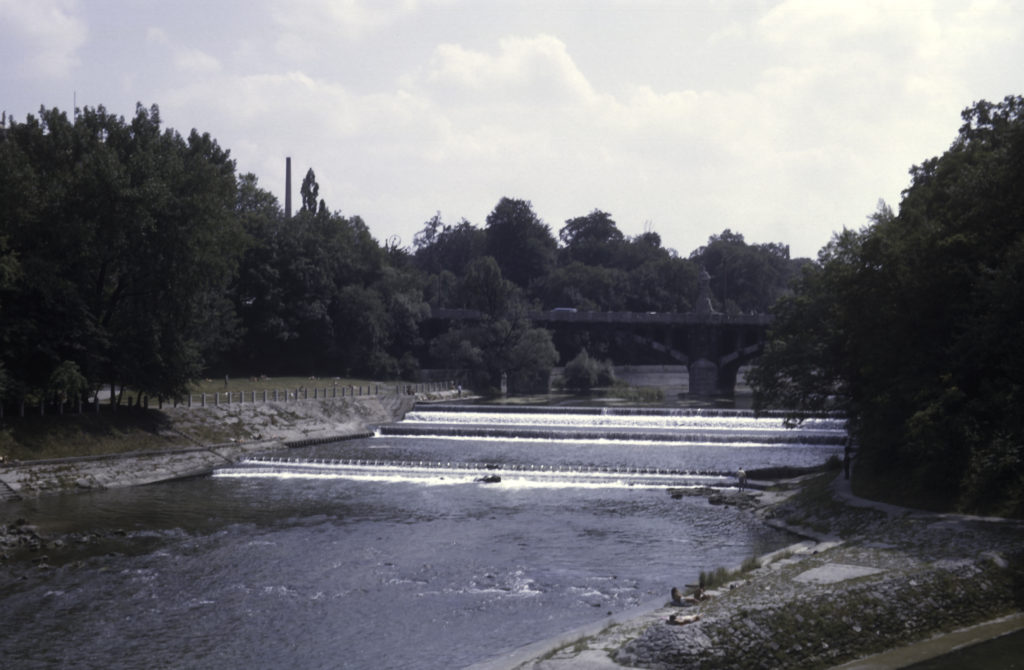
The Isar is, improbably, the birthplace of surfing in Germany. This came about in the 1970s, long after I was there, so I did not see any of it myself. It mostly happens at the Eisbach, near the English Garden, somewhat upstream of the location in the picture below, which was taken near the pension where we were staying. The salient feature of this photo is the weir – a low dam built to raise the upstream height of the river and regulate its flow. There was also a Fischentreppe – a “fish stairway” to allow fish to bypass the weir and prevent them from being trapped on the upstream side, but it is not visible in this picture. In the background is the Maximiliansbrücke (Maximilian Bridge), named after Maximilian II, King of Bavaria from 1848 to 1864.

Isar River – Maximiliansbrücke – “Maximilian’s Bridge”

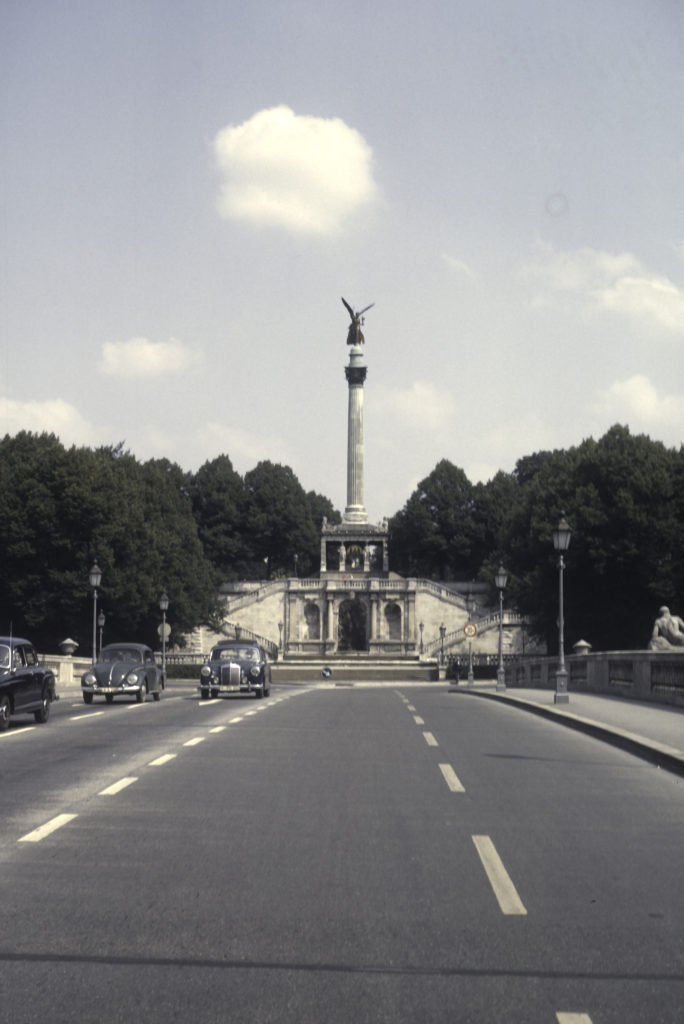
Continuing along the banks of the Isar, I came to a park called Maximiliansanlagen, and eventually to the monument shown below, which is the Friedensengel, the Angel of Peace. Originally built to commemorate the 25 years of peace following the Franco-Prussian War in 1870-71, it was completed in 1899 and is located on Prinzregentenstrasse (Prince-Regent Street), where it crosses the Isar on the Luitpoldbrücke. The gilded bronze figure atop the 82-foot column is modeled after a statue of Nike, the Greek goddess of victory, unearthed by German archaeologists at the Temple of Zeus in Olympia in 1875. In 1981 the statue fell off the column and was damaged, but it was subsequently repaired and replaced on top of the column in 1983.

Friedensengel (Angel of Peace) Monument on Prinzregentenstrasse

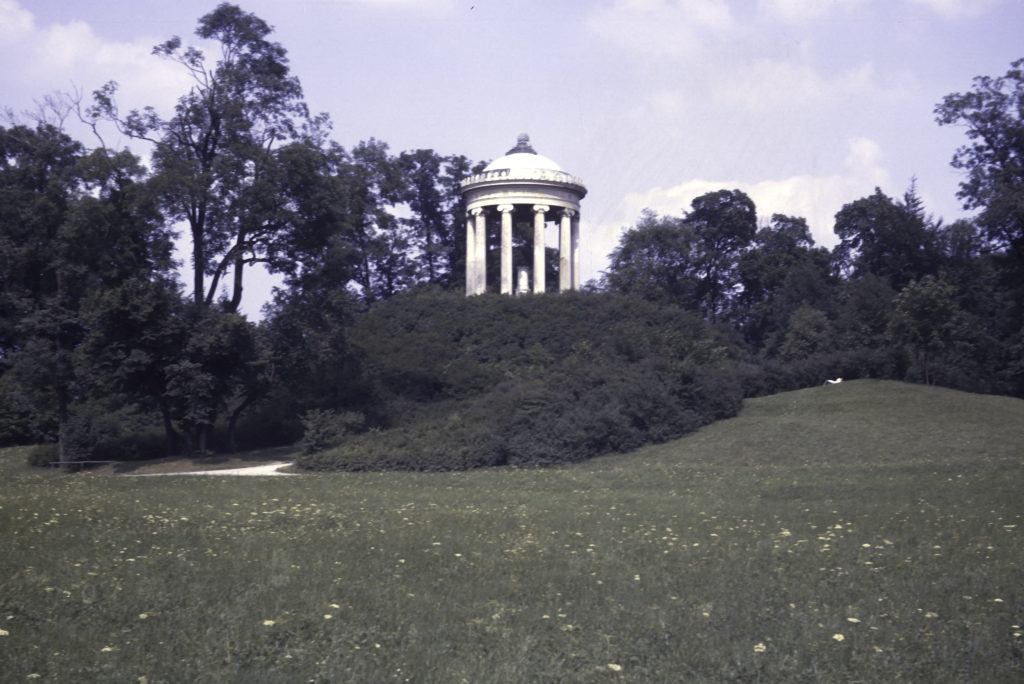
Further up along the Isar, and after crossing the river, I finally arrived at the English Garden, an enormous (900-acre) park on the Isar River, which, as already noted, is famous for river surfing, and also for naked sunbathing. It also holds a structure called the Monopteros, which is a Grecian-style bandstand located on an artificial hill, another product of King Ludwig I’s building spree in the 19th century.

Monopteros, English Garden

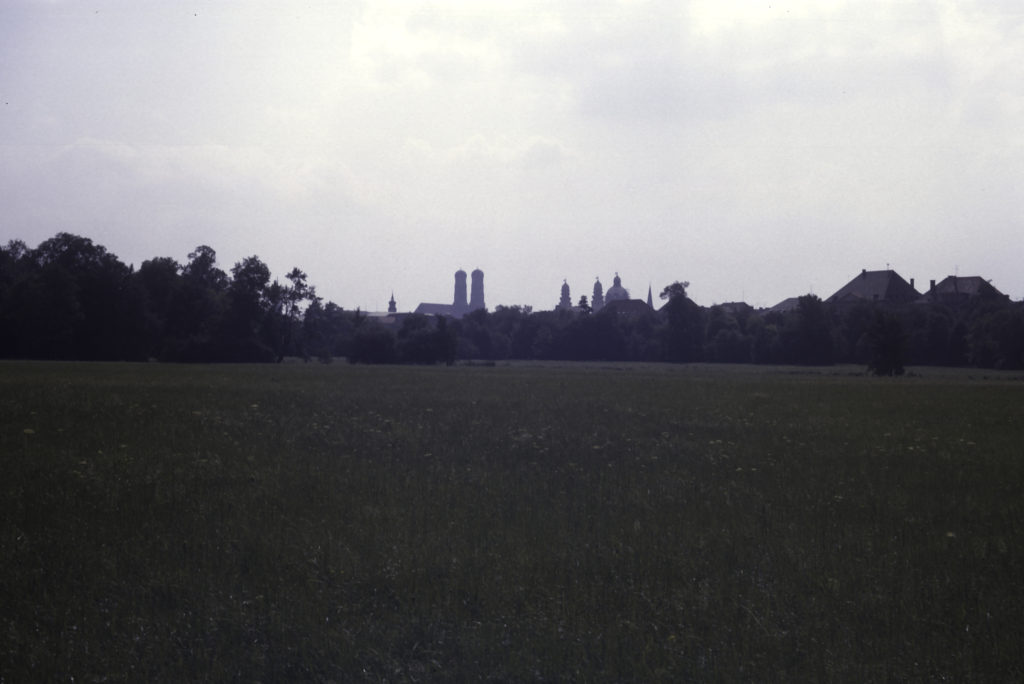
The vast open fields of the English Garden also provide a nice view of downtown Munich, as seen in the photo following. The twin towers at the center of the picture belong to the Frauenkirche (“Cathedral of Our Lady”) , the largest and most famous church in Munich. Built in the fifteenth century, it is the seat of the Archbishop of Munich and Freising and holds the tombs of a number of members of the Wittelsbach dynasty, the rulers of Bavaria from medieval down to modern times. For some reason I never took a proper picture of it while I was in Munich, but thanks to municipal restrictions on the height of buildings, it remains the tallest building in town and is visible from a long way off, dominating the city skyline.

View of Downtown Munich, with the Frauenkirche at Center

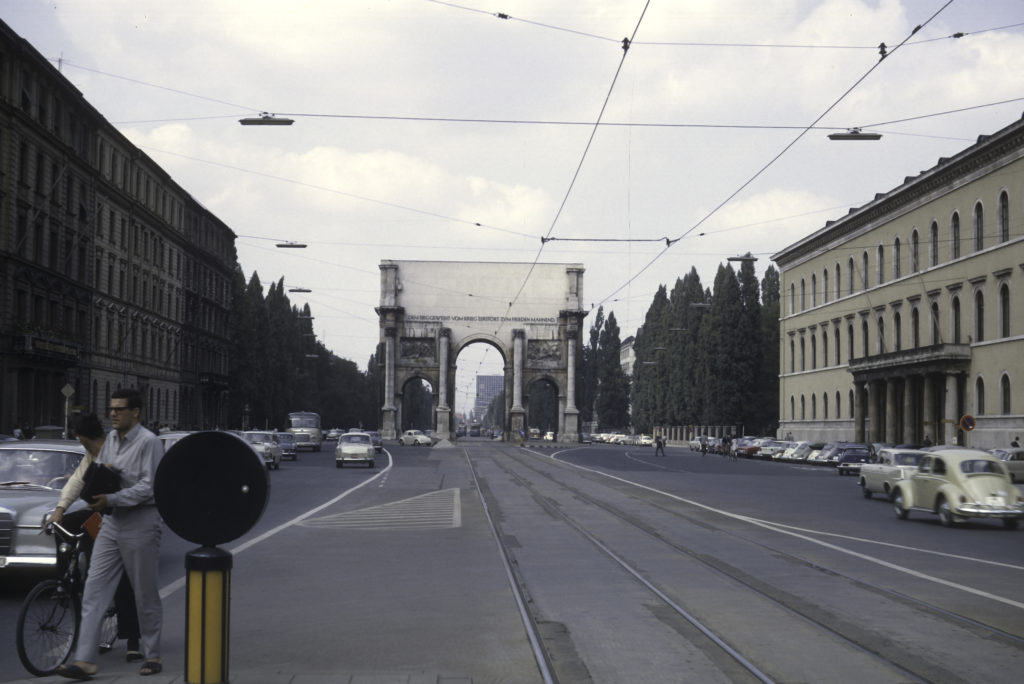
Heading west toward the city center from the English Garden, I came across another famous Munich monument, the Siegestor, (“Victory Gate”). Initially commissioned by King Ludwig I (Bavaria was an independent principality until the formation of the German Empire in 1871), the Siegestor was completed in 1852 and was dedicated to the glory of the Bavarian Army. It was heavily damaged in World War II and only partially restored by the time I saw it in 1964. The inscription above the arches reads “Dem Sieg geweiht, vom Krieg zerstört, zum Frieden mahnend, “Dedicated to victory, destroyed by war, urging peace”. I didn’t realize it at the time, but I only shot the back side of the Siegestor, not the front. Originally the Siegestor had statues on top; in the early 21st century the monument was more fully restored and the statues with it.

Siegestor

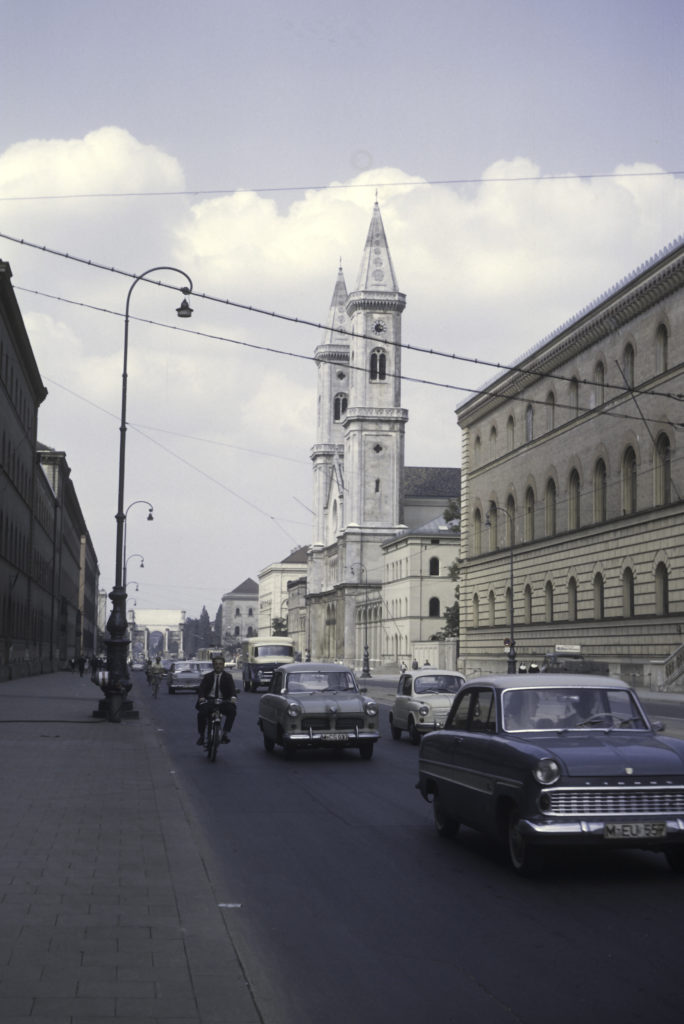
Just south of the Siegestor, on Ludwigstrasse, is the academic center of Munich, where one finds the University, formally titled the Ludwig-Maximilian University of Munich, and the Bavarian State Library. Next to the Library is another of the major Catholic churches of Munich, name of (surprise!) St. Ludwig’s. Constructed in the neo-Romanesque style and completed in 1844, St. Ludwig’s proved to be quite influential, serving as a model for numerous other churches, synagogues and even secular buildings, especially in America. It also contains a number of frescoes by the famous German painter Peter von Cornelius, one of which, depicting the Last Judgment, claims to be the second largest altar fresco in the world – 62 feet high by 38 feet wide.

The University Area
Ludwigstrasse – St Ludwig’s Catholic Church with University buildings at left and Bavaria State Library at right; Siegestor in background

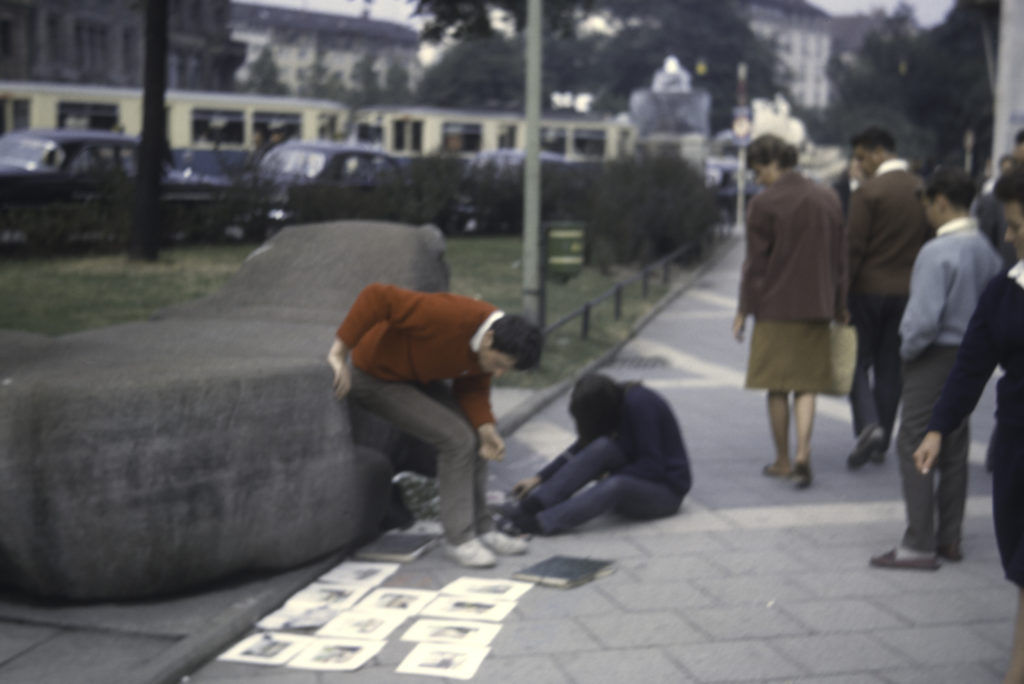
Near the University I came upon a couple of French art students hoping to sell their oeuvres to passers-by on the street. I didn’t have enough Deutschmarks with me to purchase any of them, so I wished them well and went on my way.

French Art Students

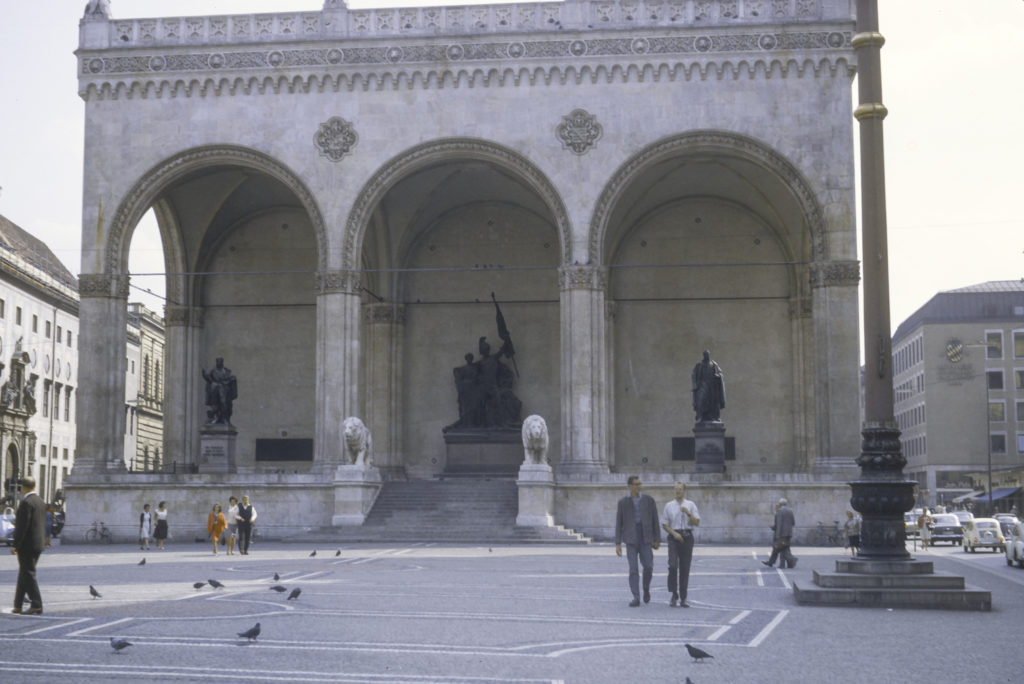
Continuing south down Ludwigstrasse, I came to Odeonsplatz, the site of the Feldherrnhalle (“Hall of Field Marshals”). This is a 19th century monument commissioned by King Ludwig I and dedicated to the Bavarian Army. The statue on the left side of the monument is of Johann Tserclaes, Count of Tilly, the commander of the forces of the Catholic League (of which Bavaria was a member) in the early years of the Thirty Years’ War. He won a series of great victories against the Protestant forces in the early years of the war, but he was not a Bavarian – he was originally from the Netherlands, and spent many years in the service of the Spanish trying to suppress the Dutch Revolt before coming to fight the Protestants in Germany. The statue on the right is of Karl Philipp Josef, Prince von Wrede, who was thus honored for being a leader in the German resistance against Napoleon in the early 19th century. However, though he was indeed a Bavarian, and the leading Bavarian soldier of his day, the distinction is dubious; at first he fought for Napoleon, and even led the Bavarian contingent in the French invasion of Russia in 1812; after the debacle in Russia, Bavaria switched sides and fought against the French, but Napoleon badly mauled Wrede’s troops at the Battle of Hanau in 1813.

Odeonsplatz, with Feldherrnhalle Monument

The sculptural group in the center of the Feldherrnhalle was added in 1892 to commemorate the German victory in the Franco-Prussian War of 1870-71, and the subsequent unification of Germany.

When the Nazis staged the abortive Beer Hall Putsch in 1923, they marched from the Bürgerbräukeller to the Odeonsplatz, where they had a brief gun battle with the Bavarian State Police, leaving 4 policemen and 14 marchers dead. The coup was suppressed and Adolf Hitler was convicted of treason and sentenced to five years in prison, of which he served only nine months. Later, after Hitler took power in 1933, the Nazis turned the Feldherrnhalle into a monument to the members killed in the Putsch, and used the Odeonsplatz for rallies and ceremonies in which new members of the SS were sworn in. After World War II, the Feldherrnhalle was restored to its pre-Nazi condition. But right-wing groups still occasionally try to use it as a venue for rallies and demonstrations.

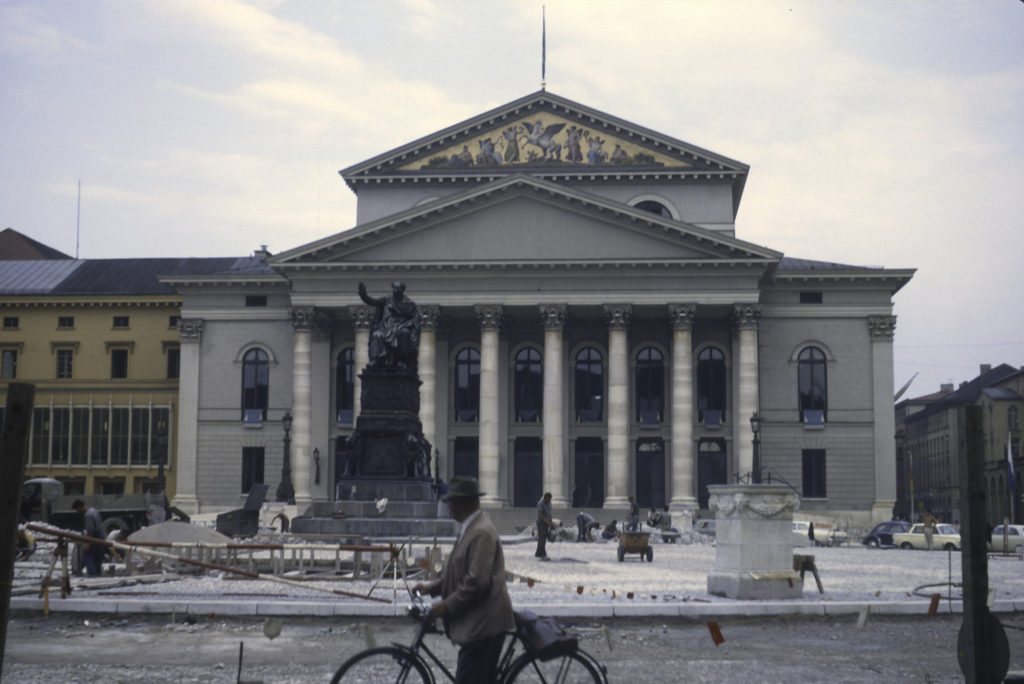
Not far from the Odeonsplatz, on Max-Joseph-Platz, stands the Bavarian State Opera House, opened in 1818. The statue in front of the Opera House is a memorial to Maximilian I Joseph, King of Bavaria from 1806 to 1825. Beneath the square there is an underground garage, and if I remember correctly, the Munich subway system was under construction at the time I was there, which would account for the work site in front of the monument.

Munich Opera House, Max-Joseph Platz

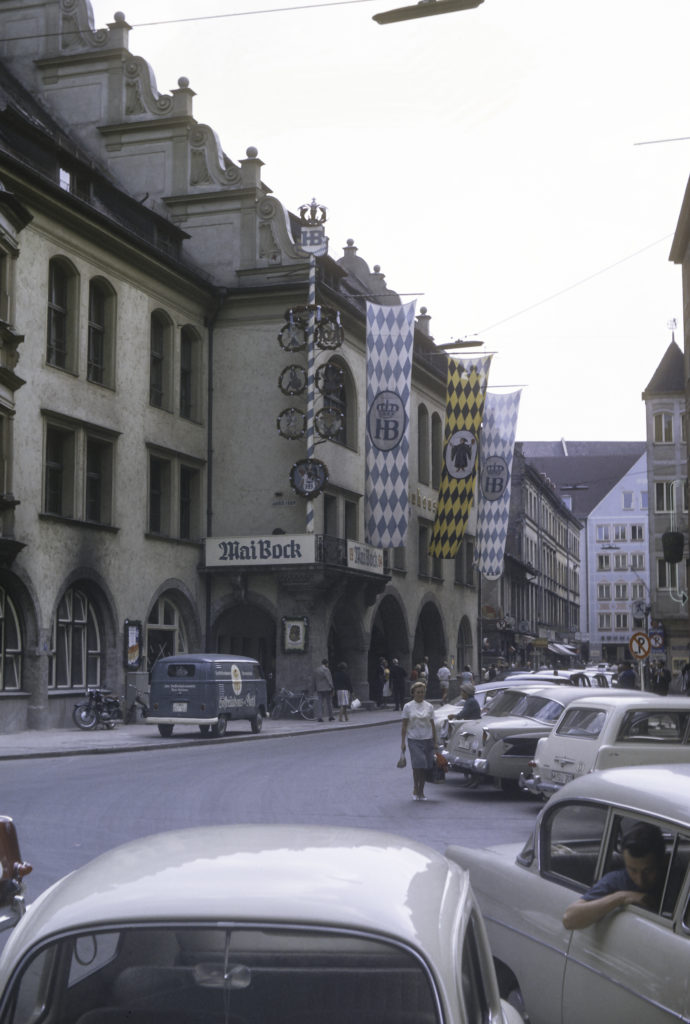
A couple blocks south of the Opera House stands the world’s most famous beer hall, the Hofbräuhaus. Founded in 1589, the Hofbräuhaus was originally a brewery; it was remodeled into a beer hall in 1897, when the brewery was relocated to the suburbs. In 1919, just after the end of World War I, it became the headquarters of the short-lived Bavarian Communist government in 1919. It was not the scene of the abortive Beer Hall Putsch of 1923 – that dubious honor belongs to another beer hall, the Bürgerbräukeller, which no longer exists – but the Nazi Party did hold a number of its early organizational meetings in the Hofbräuhaus. It was bombed heavily during World War II, but was rebuilt afterward and fully restored by 1958, long before my arrival. Besides Adolf Hitler, famous or infamous patrons and visitors across the centuries include Wolfgang Amadeus Mozart, Vladimir Ilyich Lenin, Mikhail Gorbachev, Louis Armstrong, Thomas Wolfe, John F. Kennedy and George H. W. Bush.

Hofbräuhaus am Platz, Munich

At this point, I found myself at the very center of Munich. It was a crowded, bustling area in 1964, and I doubt that it is any less so today.

Downtown Munich

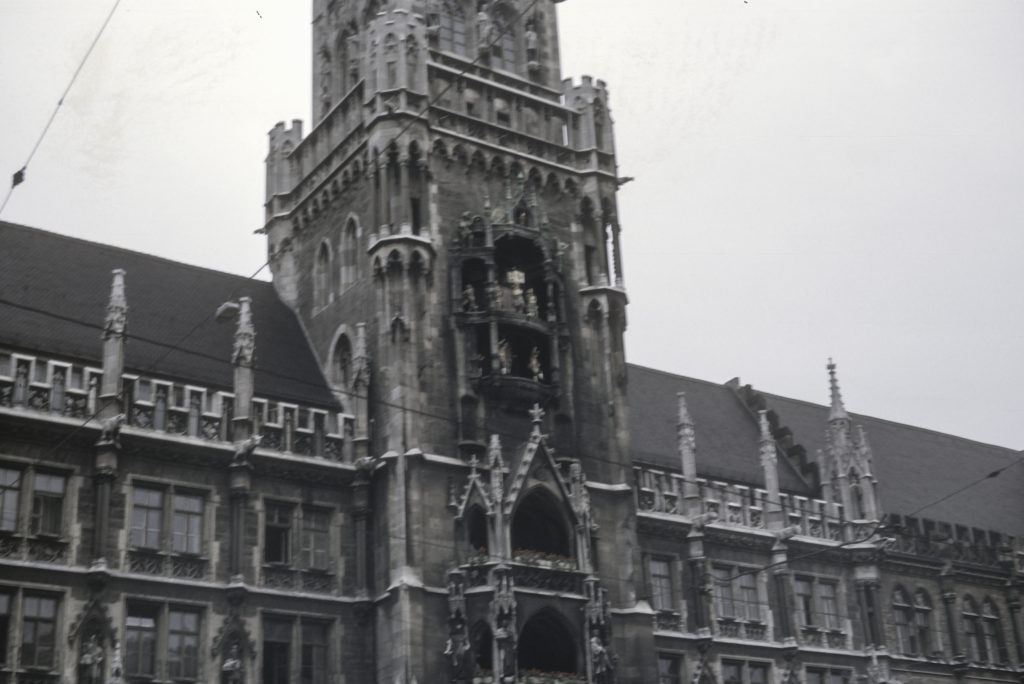
In Marienplatz, the central city square, stands the New City Council building – in German, Neues Rathaus (there is also an Old City Council building, as we’ll see shortly). (I always thought that the word “Rathaus” was most appropriate to the seat of municipal government in English as well as in German.) The Neues Rathaus is a neo-Gothic building constructed during the 19th century. The tower balcony houses the famous Glockenspiel: Three times a day, at 11 AM, 12 PM and 5 PM, little clockwork figures emerge from the tower and chase each other round and round on two levels.

Das Glockenspiel

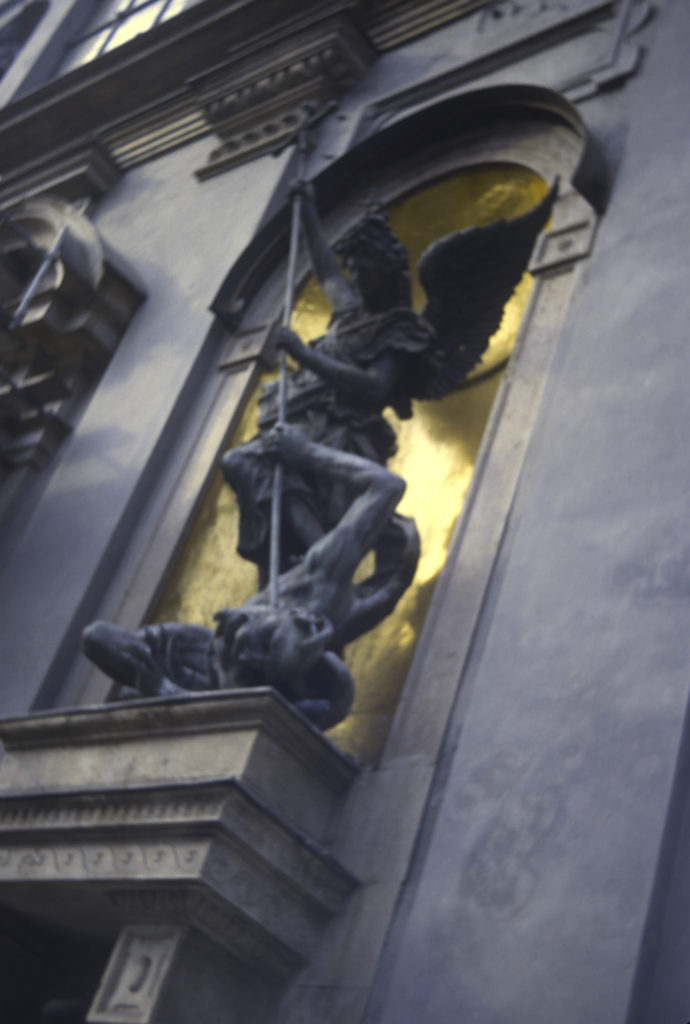
The Neues Rathaus is also adorned with sculptures and reliefs depicting various real and legendary figures, including most of the rulers of the city from its founder, Henry the Lion, and the Wittelsbach line of dukes and kings, as well as the allegorical slaying of the dragon in the picture below.

Neues Rathaus – Architectural Detail

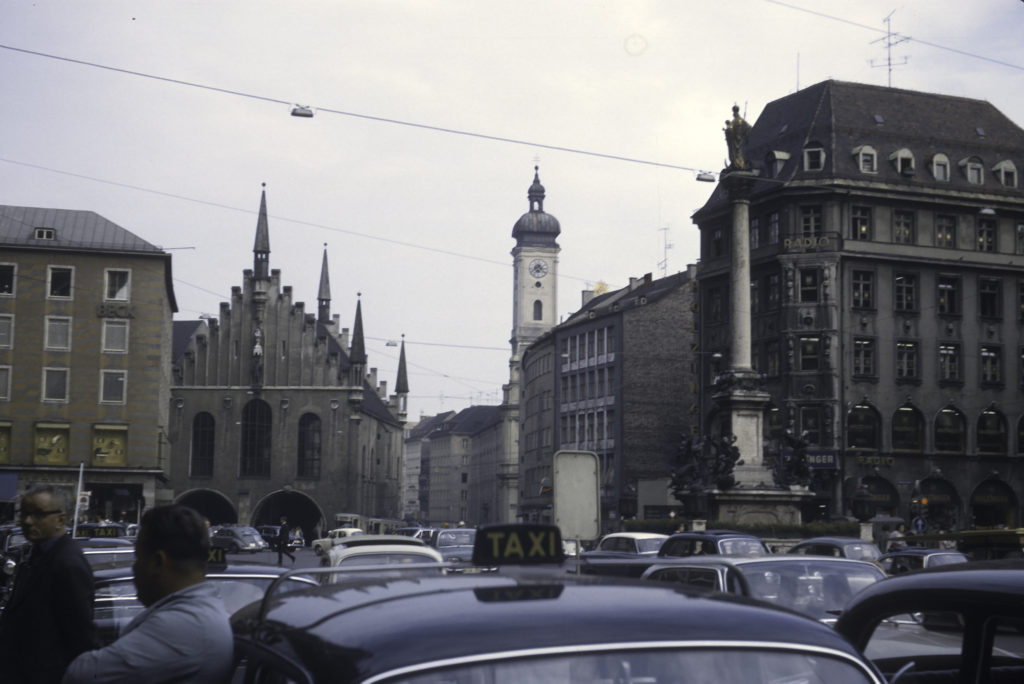
Looking away from the Neues Rathaus to the east, one sees the Mariensäule, a 68-foot column with a statue of the Virgin Mary on top; the Old Town Council House (Altes Rathaus) at left, with spires; and the Church of the Holy Ghost (with white tower, at right). The Altes Rathaus, unlike the Neues Rathaus, is indeed old, dating from the fourteenth century.

View from Marienplatz, with Mariensaule (Mary column) in foreground, above sea of taxis; Altes Rathaus in background at left, Holy Ghost Church (with tower) at right

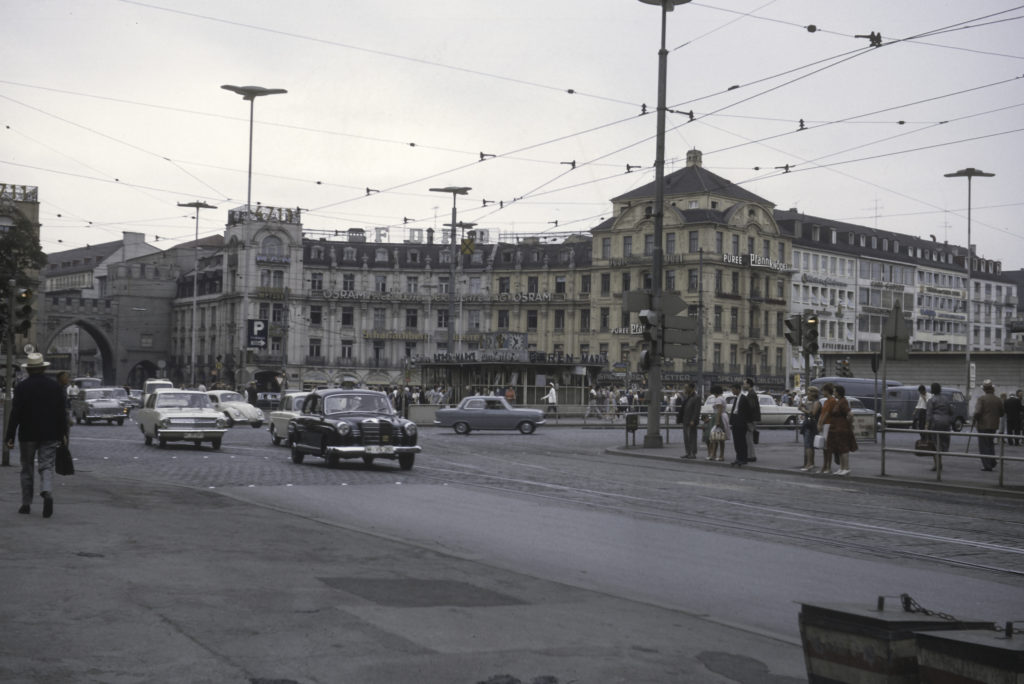
From Marienplatz, I turned west and strolled to Karlsplatz, known locally as Stachus, another major plaza in downtown Munich. It was named after Karl Theodor, Duke and Elector of Bavaria from 1777 to 1799. However, the Bavarians detested Karl Theodor and celebrated joyously when he died, and ever since they have called the square Stachus, after an old pub that previously existed there. Karlsplatz is the site of a Gothic-style gate (seen at the left of the picture below), which was part of the medieval fortifications of the city and had been known for centuries as the Neuhauser Tor until Karlsplatz was built. Judging from photos I have seen recently, the appearance of the area has changed quite a bit since 1964; there is now a fountain in front of the Karlstor, and an ice-skating rink operates there in wintertime.

Karlsplatz/Stachus as it appeared in 1964

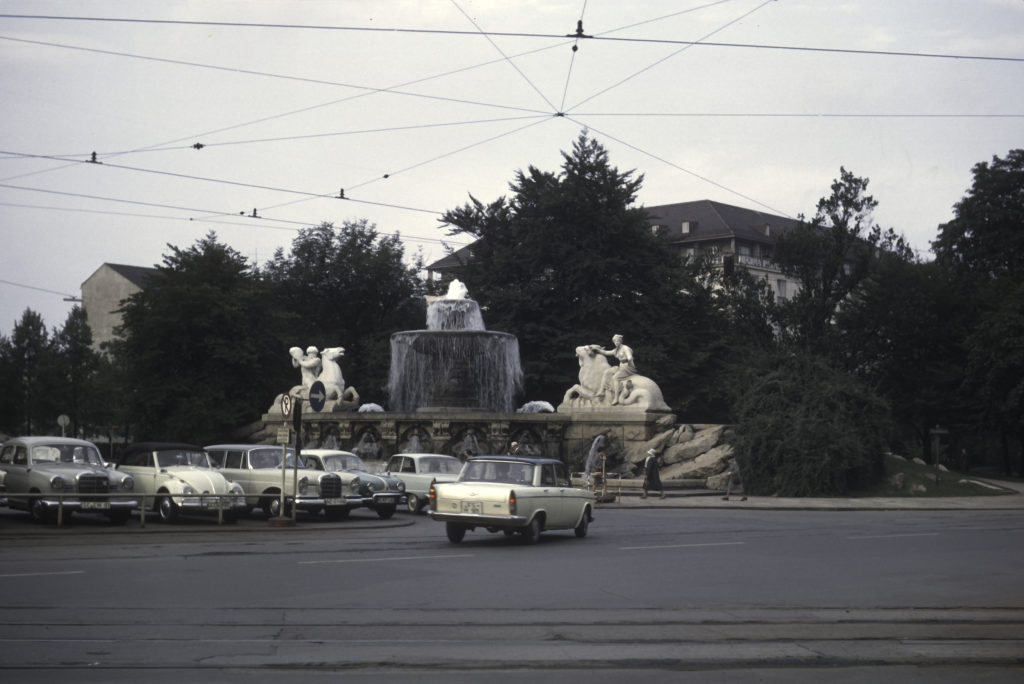
Not far from Karlsplatz/Stachus is Lenbachplatz, site of the Wittelsbacherbrünnen, a monumental fountain in neoclassical style dating from the 1890s. The fountain’s design celebrates the elemental force of water: the horseman tossing a boulder, on the left side of the fountain, depicts water’s destructive power, and on the right, the woman seated on a bull, holding a bowl, symbolizes water’s healing qualities.

Wittelsbach Fountain, late nineteenth century, on Lenbachplatz

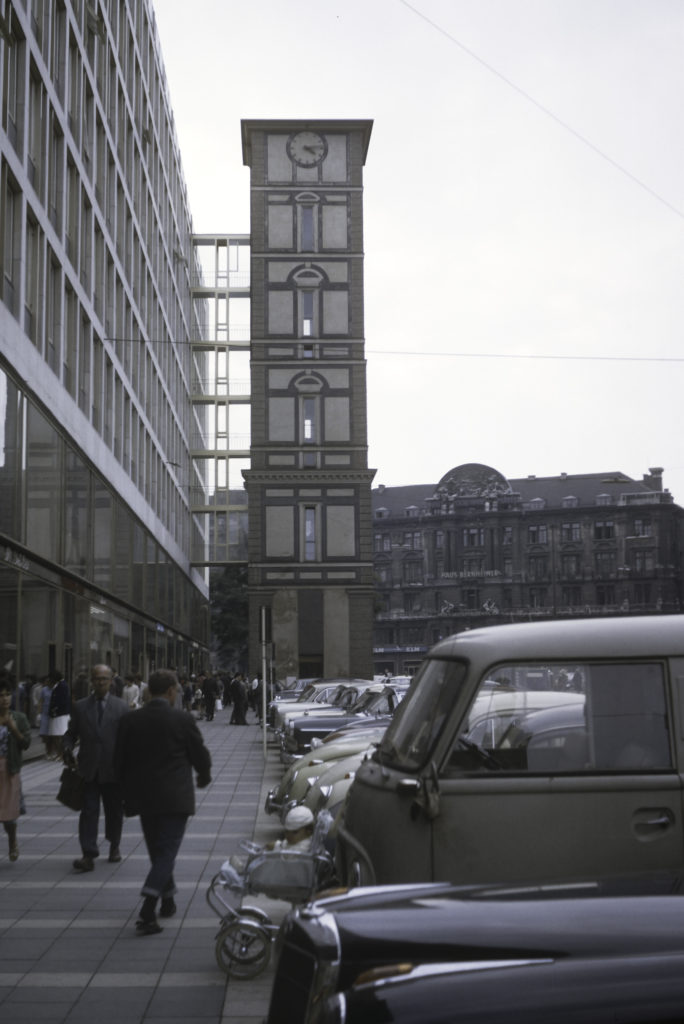
This modernistic tower on Pacellistrasse, just east of Lenbachplatz, caught my eye; it appears to be an elevator for the building next to it, which happens to be the Amtsgericht, the Munich Municipal Court.

Pacellistrasse – Amstgericht (Municipal Court); Lenbachplatz and Bernheimer Palais in background

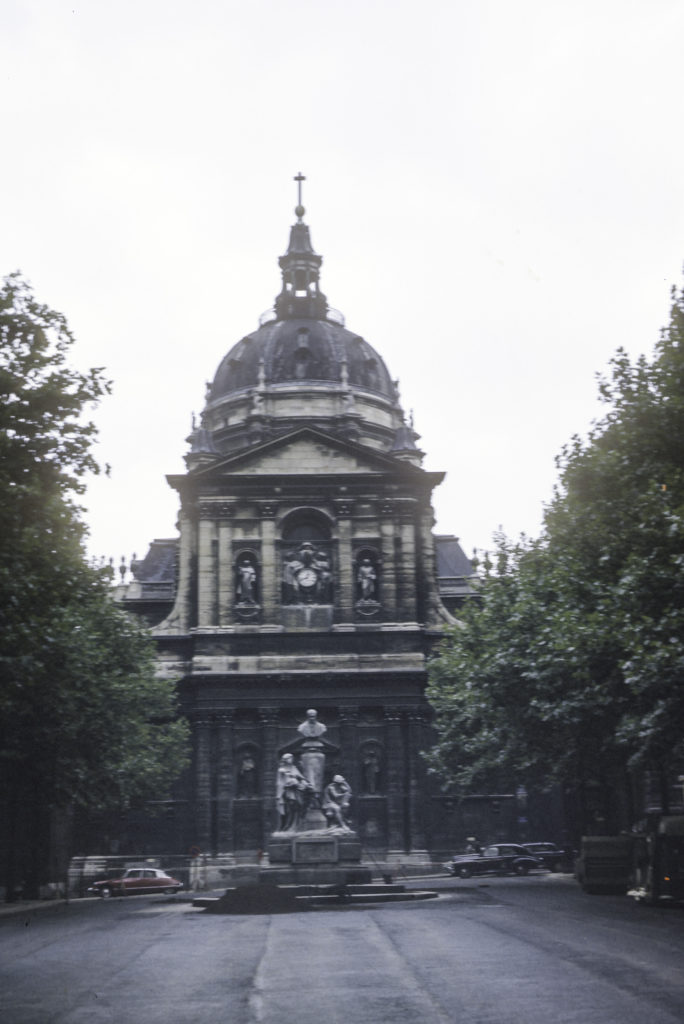
Somewhere in my Munich wanderings, I encountered this Baroque-appearing structure, which I have not been able yet to identify. A sign nearby said “Prinz-Carl-Palais,” but that name actually belongs to a Neoclassicist mansion – see https://en.wikipedia.org/wiki/Prinz-Carl-Palais.

Unidentified Baroque Palace, Munich

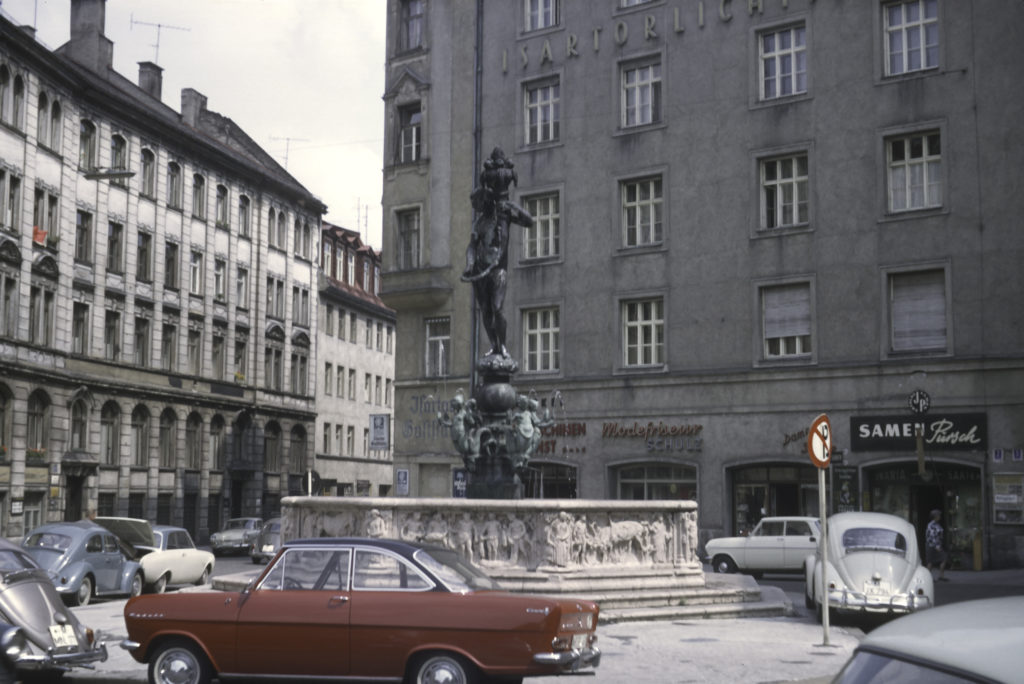
Munich is a city of many fountains – we have already encountered the Wittelsbacher Fountain on Lenbachplatz – but the one I liked best, probably because of the naked woman in the middle, is the Fortuna, which I encountered in Isartorplatz, on my way back to my pension from downtown Munich.

Fortuna Fountain, Isartorplatz