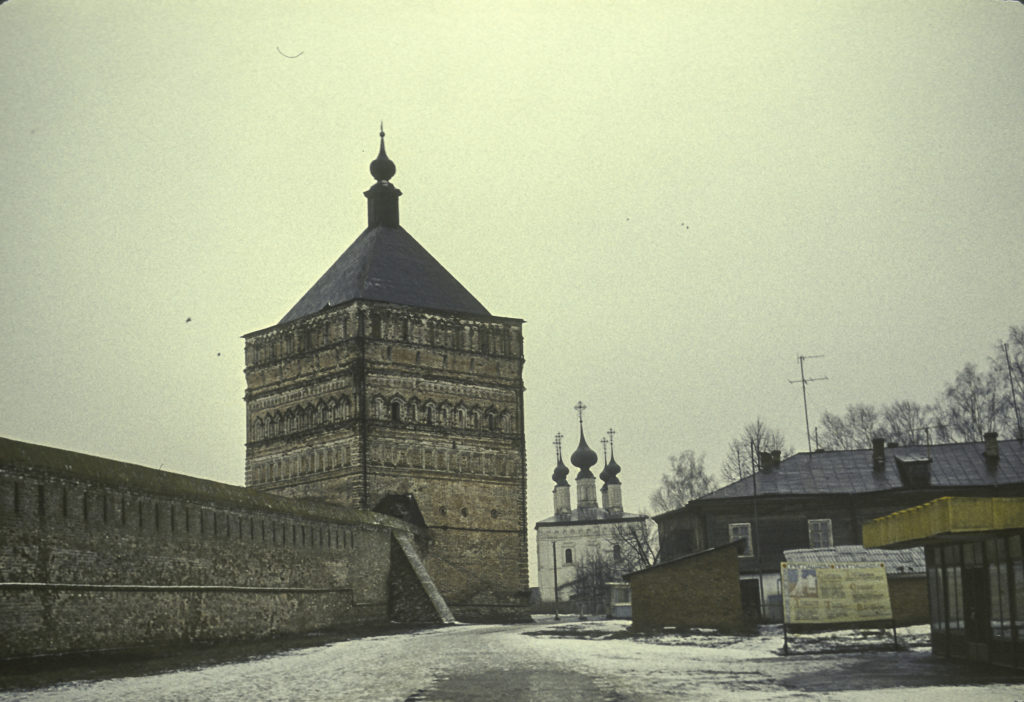
In January of 1973, I took an overnight trip with a group of other American exchange students to a couple of the old Russian towns to the northeast of Moscow. Our first stop was Rostov. There are at least two cities in Russia named Rostov. One is way south of Moscow, on the Don River. It is usually called Rostov-na-Donu “Rostov-on-the-Don” to distinguish it from the other one, which is called “Rostov Veliky” (Rostov the Great). Confusingly, Rostov the Great is a small provincial town of around 30,000 people in the hinterland of Moscow, while Rostov on the Don is a major city of over a million people, close to the Sea of Azov. But it was not always so. Rostov Veliky is one of the oldest of all Russian towns, already an important settlement in 862, according to the Russian Primary Chronicle. At one time it was the capital of the Vladimir-Suzdal principality, although it later yielded that status first to Suzdal and then to Vladimir. Like the other old Russian towns, it was eclipsed and swallowed up by Moscow (1474); it also suffered greatly from the Mongol invasions and the wars with the Poles in the 17th century. But it remained an important ecclesiastical center down through the 18th century. In the 16th century, when the Metropolitan Bishop of Moscow was elevated to the status of Patriarch, the Bishop of Rostov was promoted to Metropolitan rank.
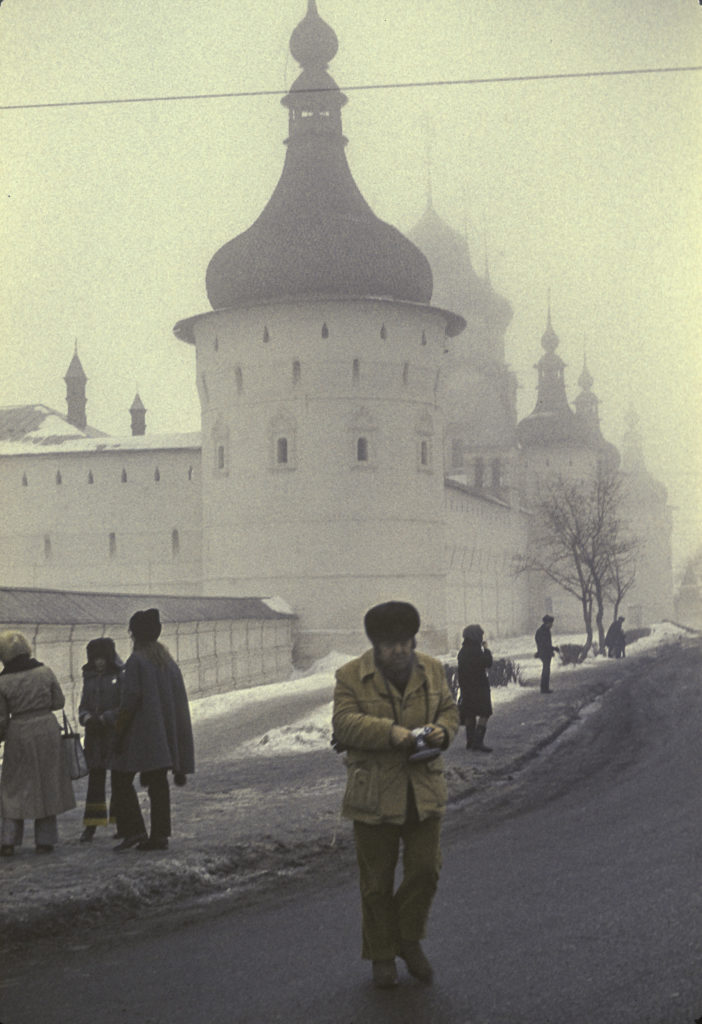
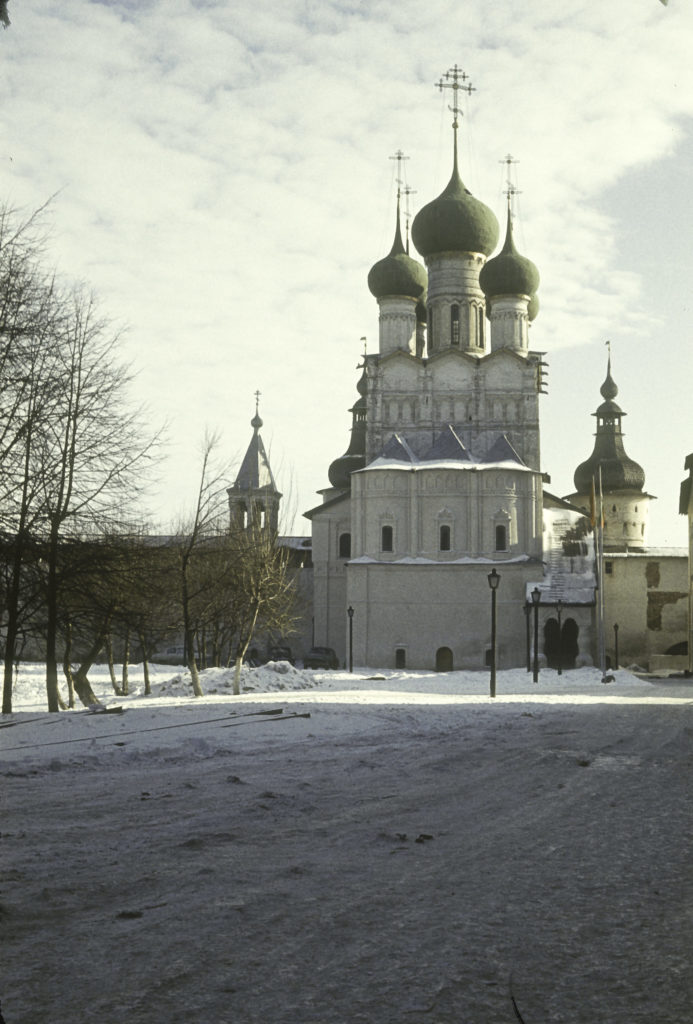
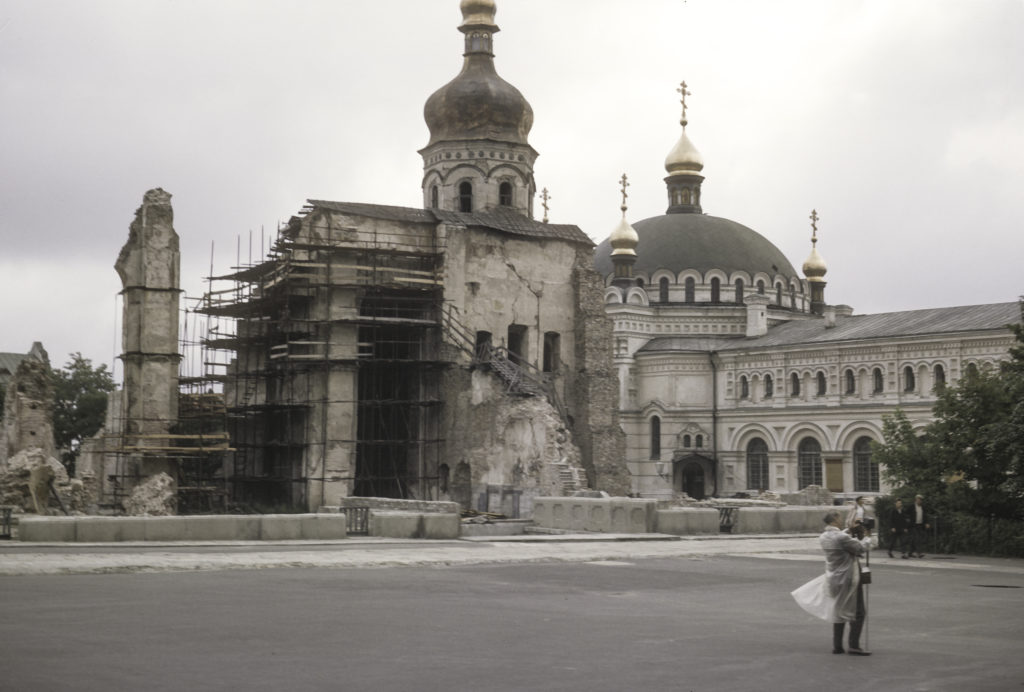
When we arrived in Rostov by train on a cold January morning, the town was shrouded in fog. The fog eventually lifted, but it remained for the most part a dreary, overcast day. But as we stumbled and groped our way from the railroad station through the center of town, suddenly there loomed up before us the Rostov Kremlin, a magnificent sight.
Larry Lerner in front of the Rostov Kremlin
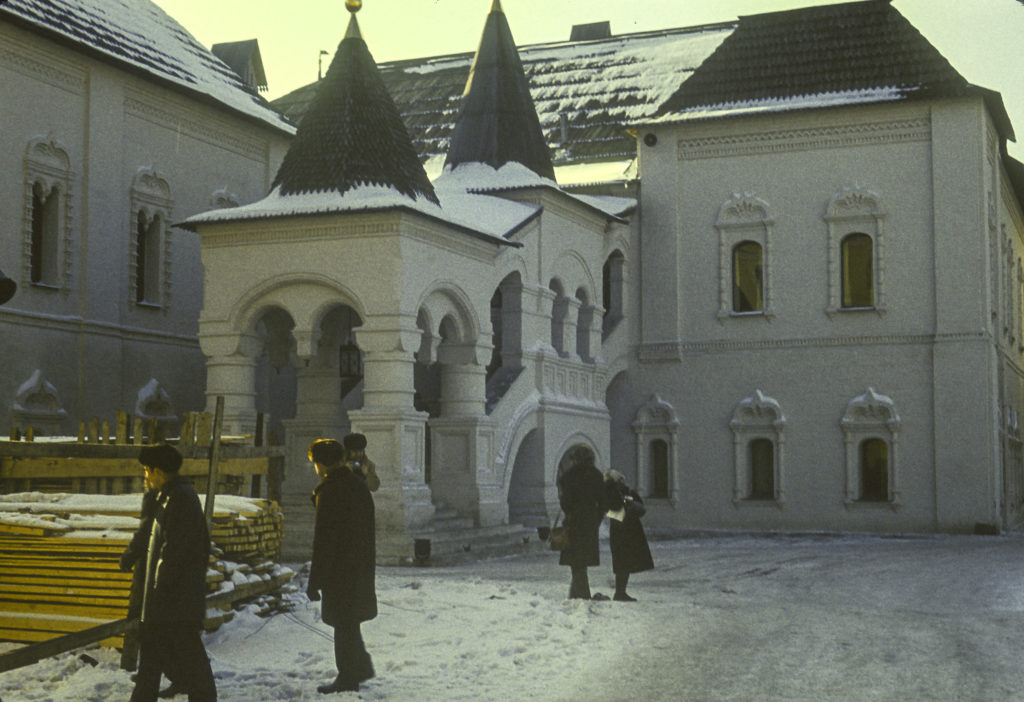
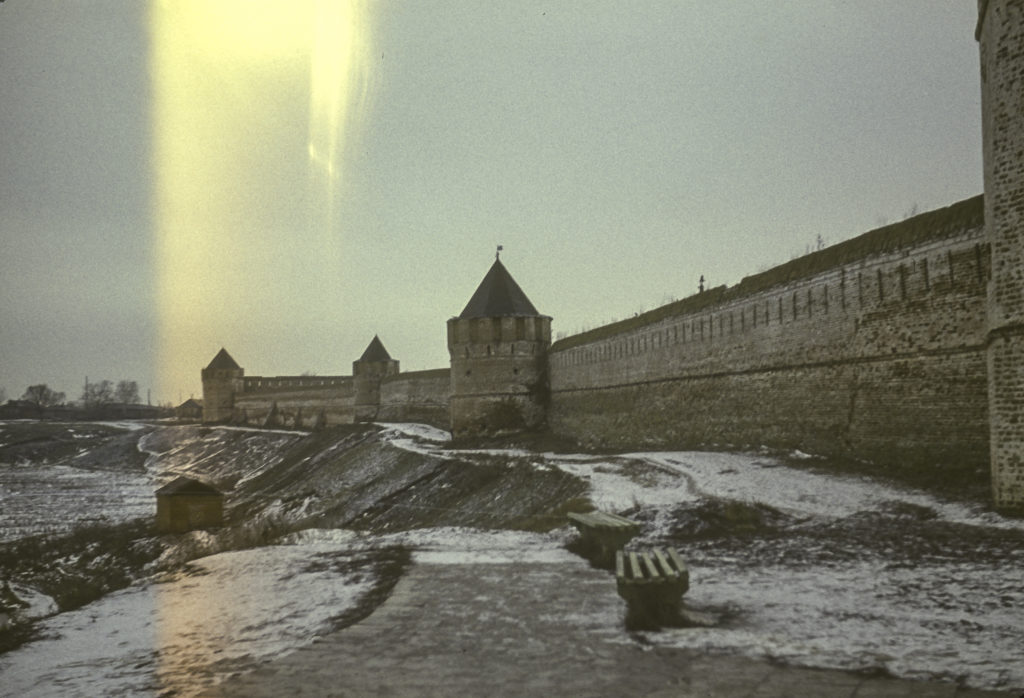
The Rostov Kremlin, unlike most of the kremlins in other old Russian cities such as Moscow, was never intended as a defensive work. It was built in the later 17th century, long after the depredations of the Mongols and Poles had ceased, by the then Metropolitan of Rostov, Jonah Sysoevich, a protege of the great Muscovite church reformer Patriarch Nikon, as a statement of the importance and grandeur of the Rostov archbishopric. His residence inside the Kremlin was the Krasnaya Palata – “Red Chamber” – which is now a museum.
Inside the Rostov Kremlin: Krasnaya Palata (museum)
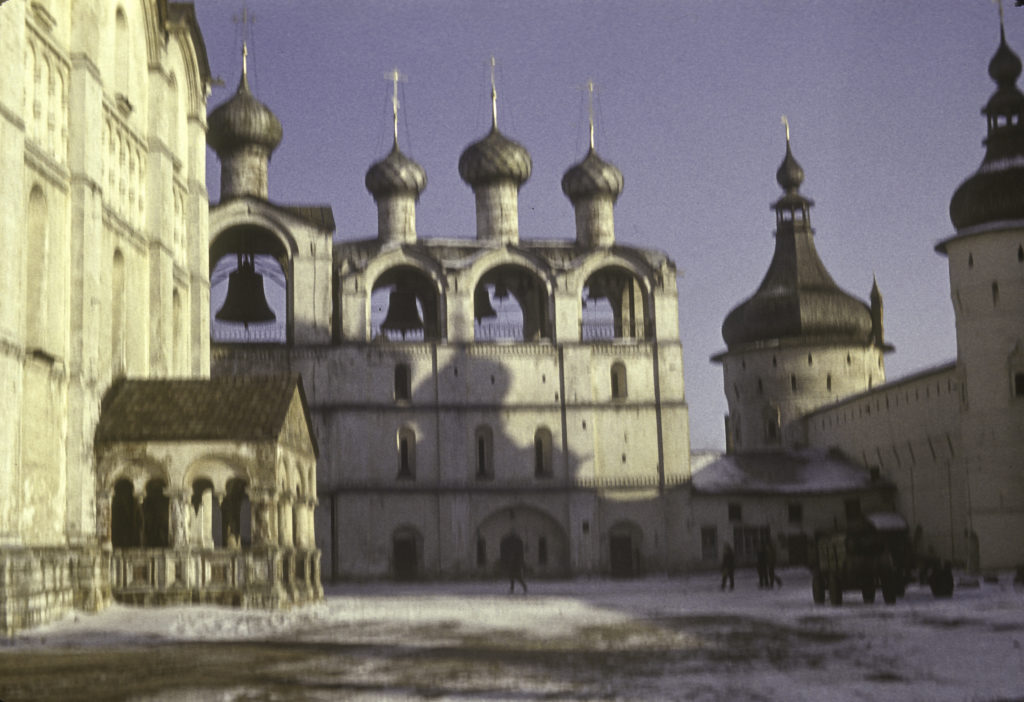
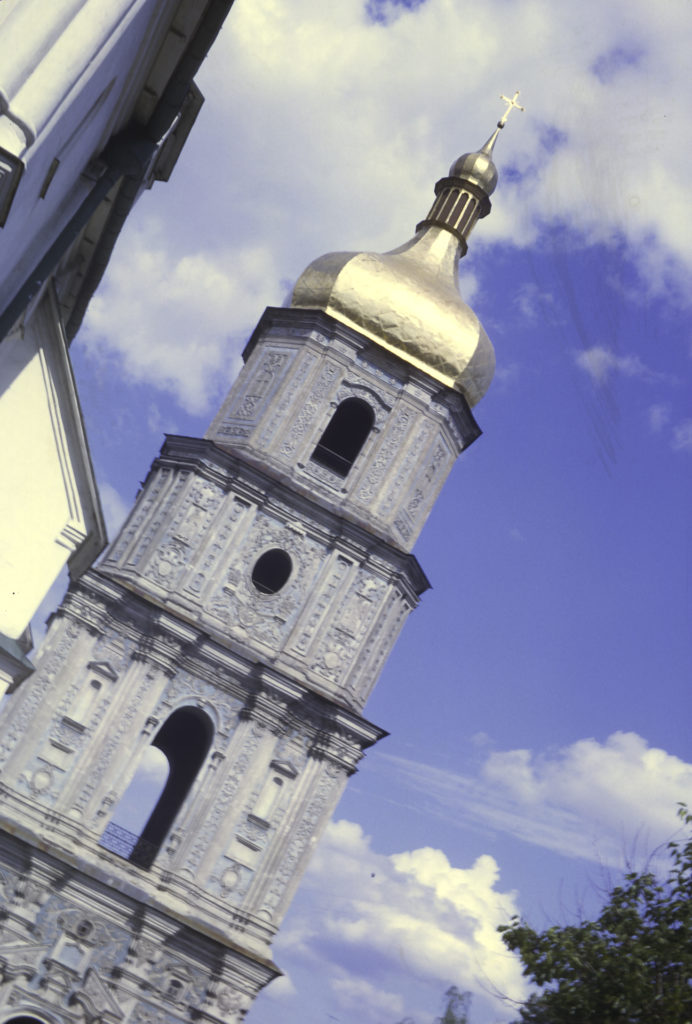
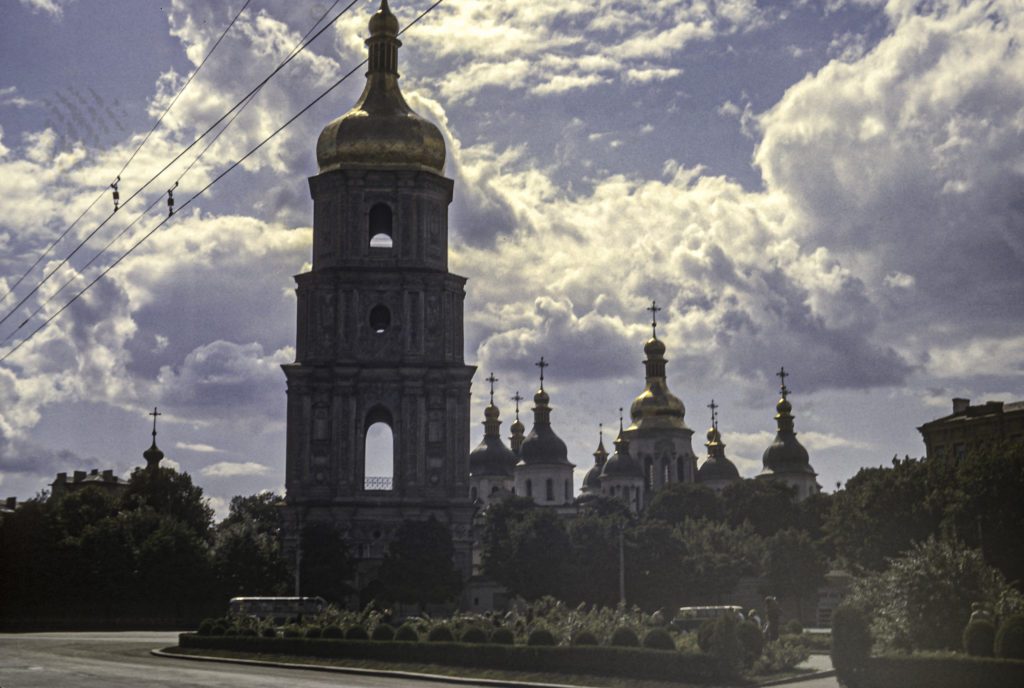
The main cathedral of the Rostov Kremlin is the Uspensky Sobor, or Cathedral of the Assumption, which resembles its counterpart in the Moscow Kremlin. Together with the Bell Tower and other structures, it presents an impression of a coherent architectural ensemble. But the construction of the original cathedral greatly predates that of the other structures. It was begun in the mid-12th century, rebuilt in the 1220s, just before the Mongol invasion (1237), again in the 1480s and yet again in 1512; and possibly further enhanced in the 1580s. The flaring onion domes were added in the late 17th century, replacing earlier low hemispherical cupolas to match the new structures built by Jonah Sysoevich. One of these was the Bell Tower. It has four bells, the largest of which weighs 35 tons; together with the three smaller bells, each of which is of a different size and has a different timbre, it constitutes a musical instrument sui generis, with a distinctive “Rostov sound.”
The Rostov Kremlin bell-tower. Uspensky Sobor at left.
Another component of the architectural ensemble is the Resurrection Church, built in 1670 at the main gate of the compound.
Resurrection Gate Church, 17th century. From inside the Rostov Kremlin.
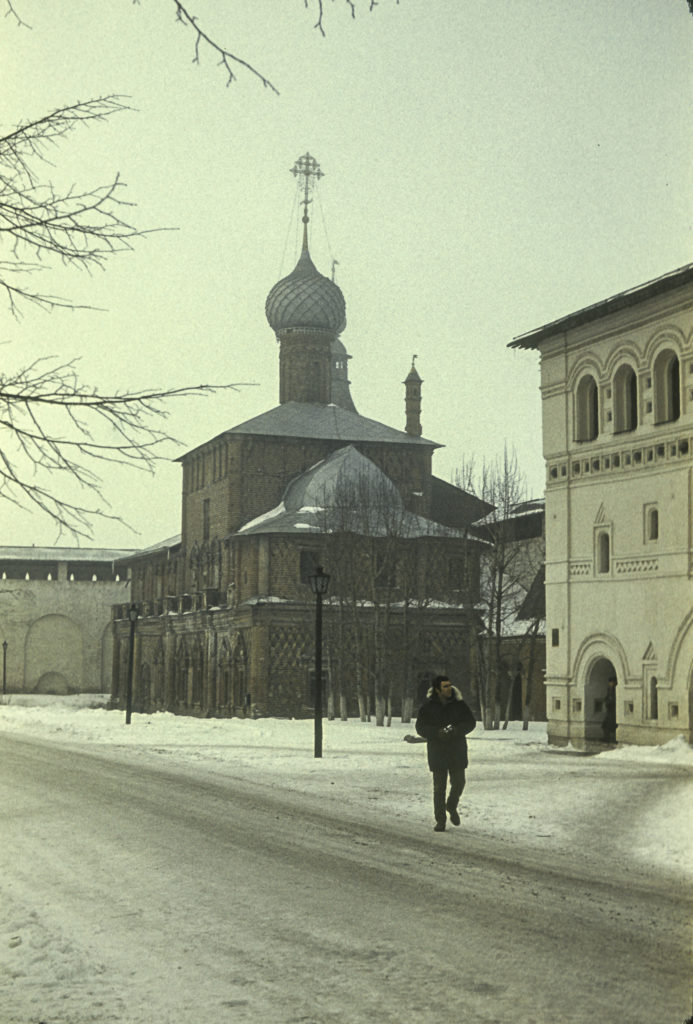
Yet another church, the Hodegetria, clashes with the style of the others; an example of the Moscow Baroque style, it is rectangular in shape, with but one dome, and an exterior decorated with diamond-shaped cladding (this is called the “diamond rust” technique).
Hodegetria Church, inside the Rostov Kremlin, with the mathematician Mel Nathanson strolling past the Church of the Resurrection next to it.
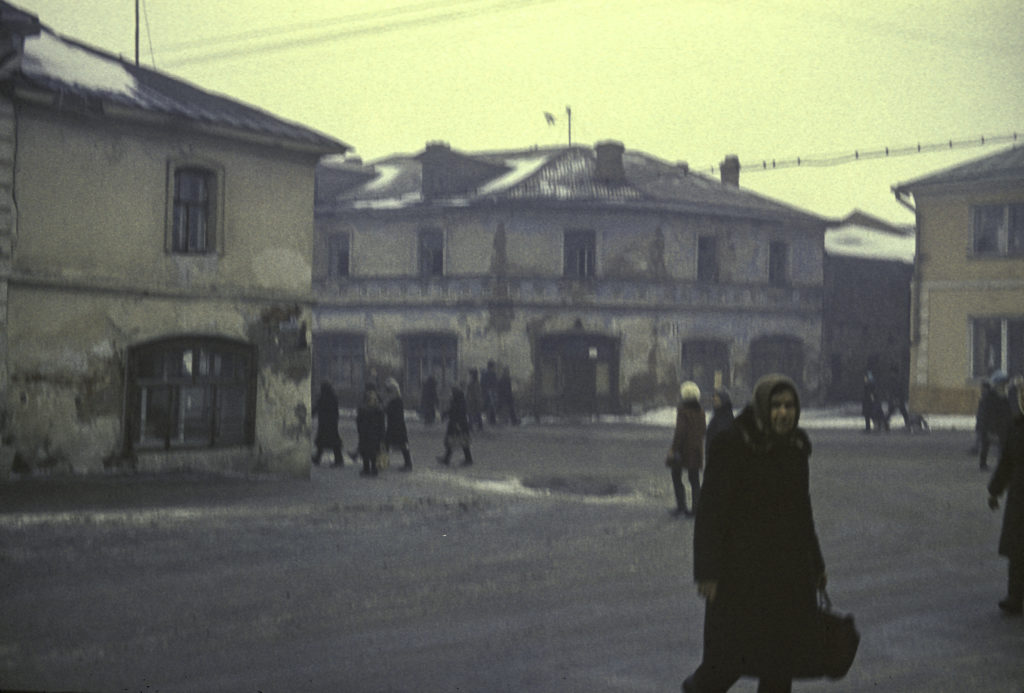
Leaving the Kremlin, we retraced our steps back through town to the train station. By this time the fog had dissipated and the sun was beginning to shine weakly on the snowy streets.
Downtown Rostov
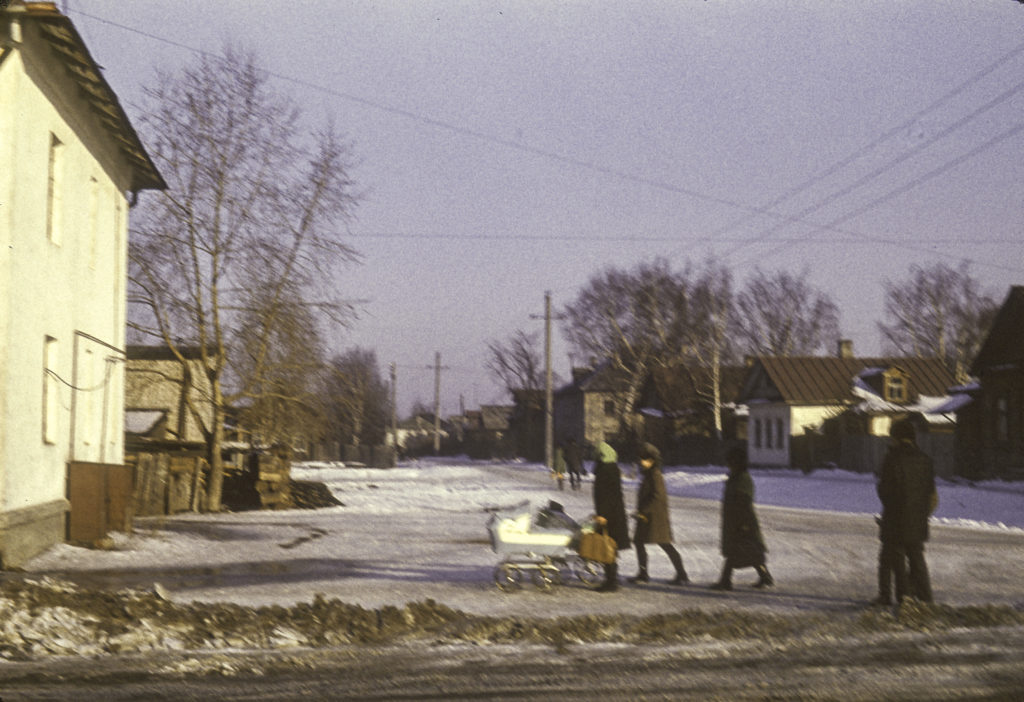
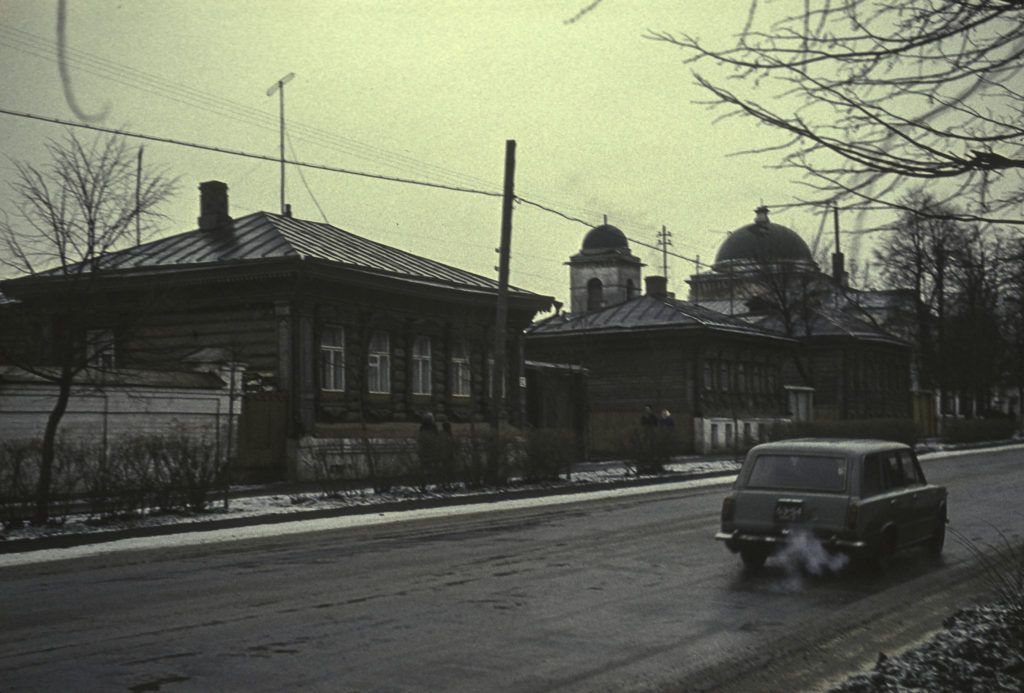
Traipsing through the downtown area, we shortly reached the residential district. By this time it was afternoon and there were a number of citizens strolling the streets, some of them pushing prams with children.
Rostov Street Scene
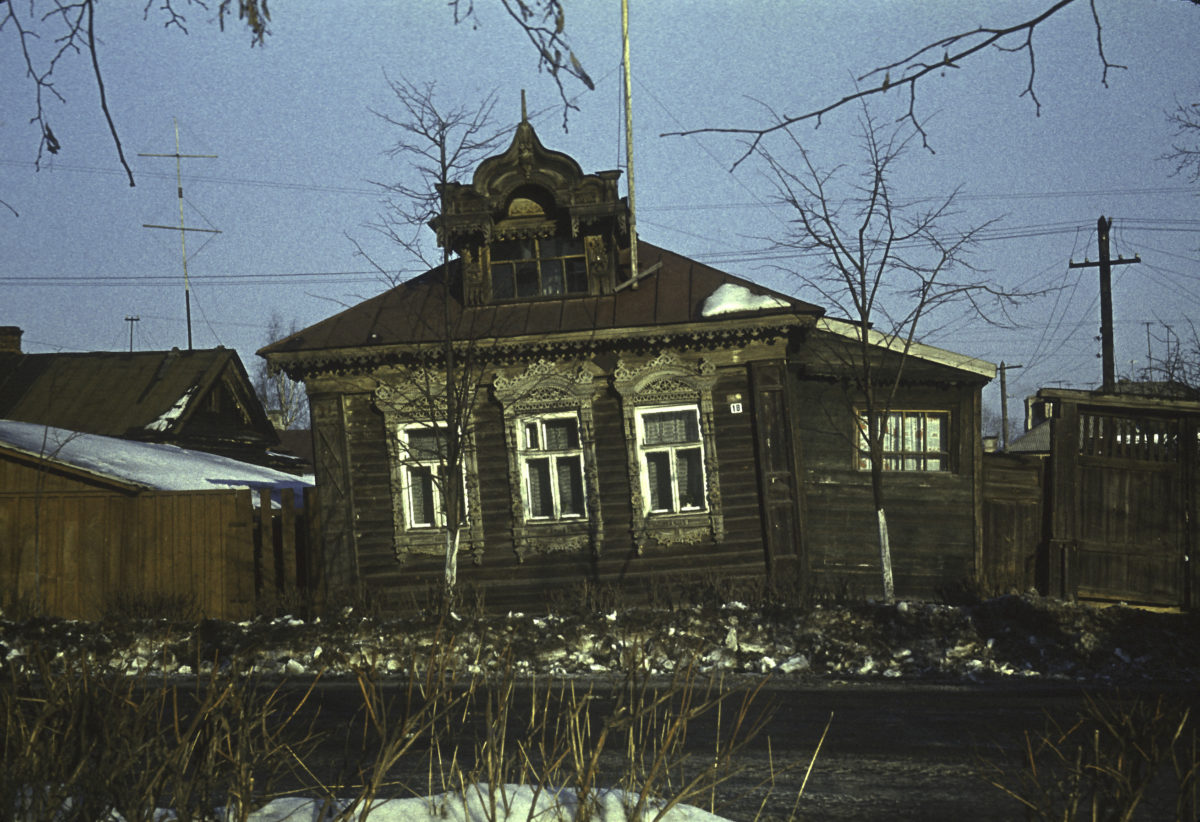
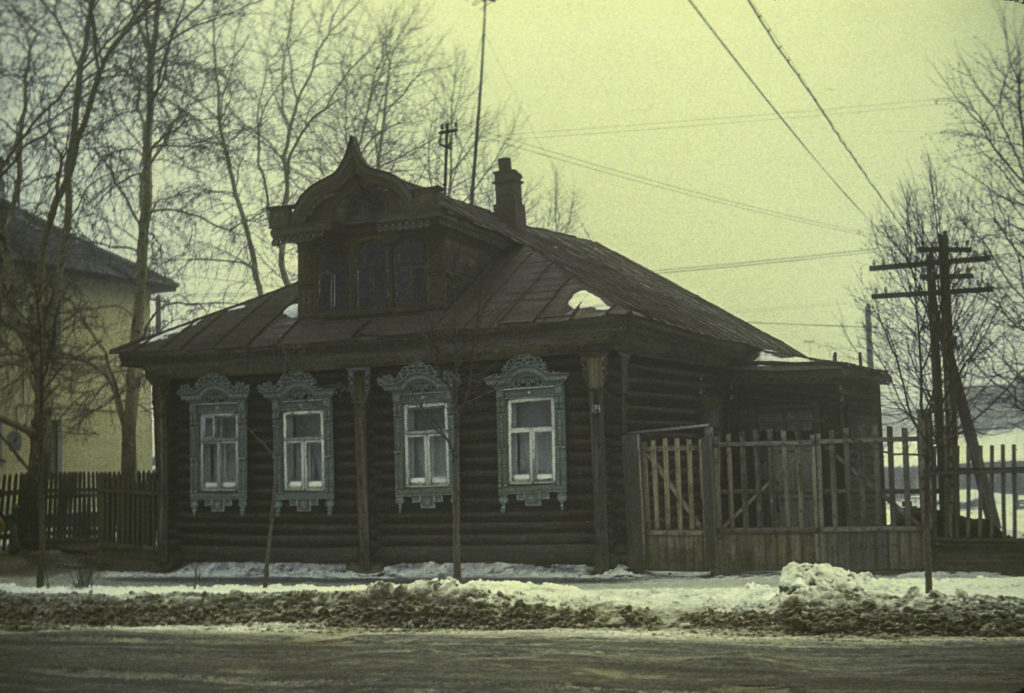
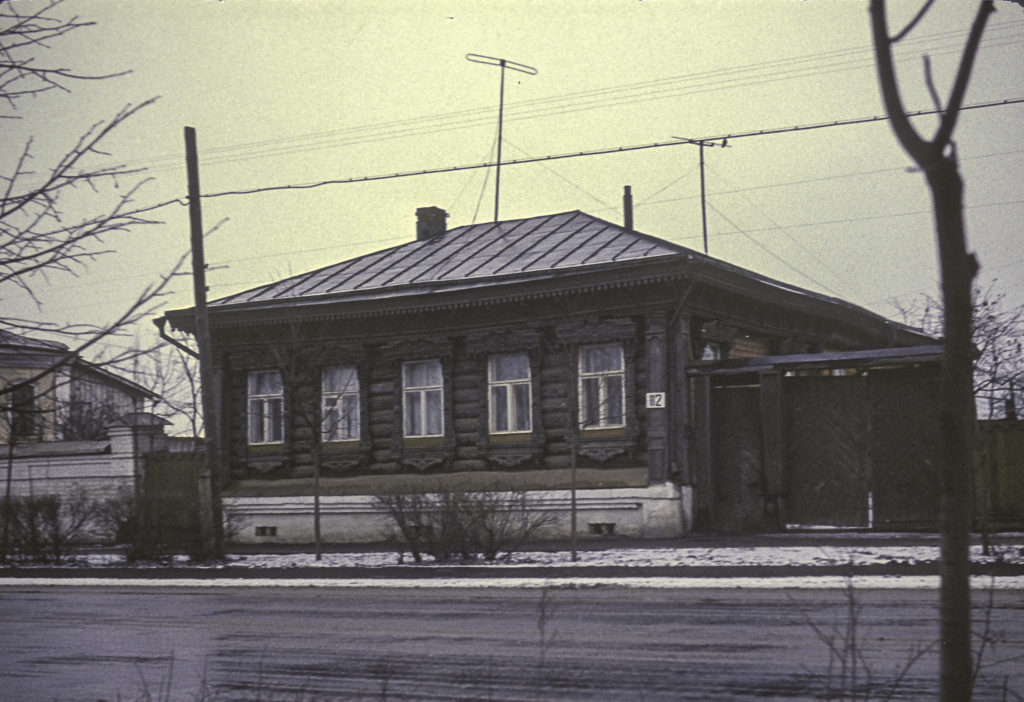
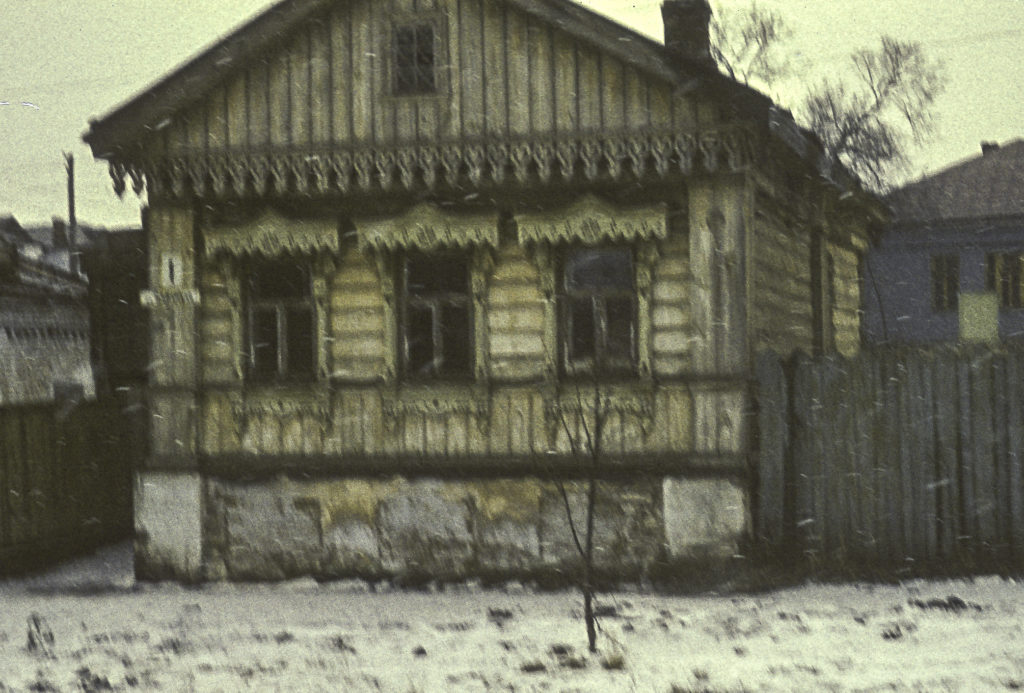
For some of us, it was our first look at a small provincial town in Russia. Wooden houses, many of them apparently built in a traditional style dating from before the 1917 revolution, predominated. Not a few of them were decorated with elaborately carved wooden window frames, which I found quite charming. Picket fences were also ubiquitous.
Rostov izba (log cabin) – elegant window frames
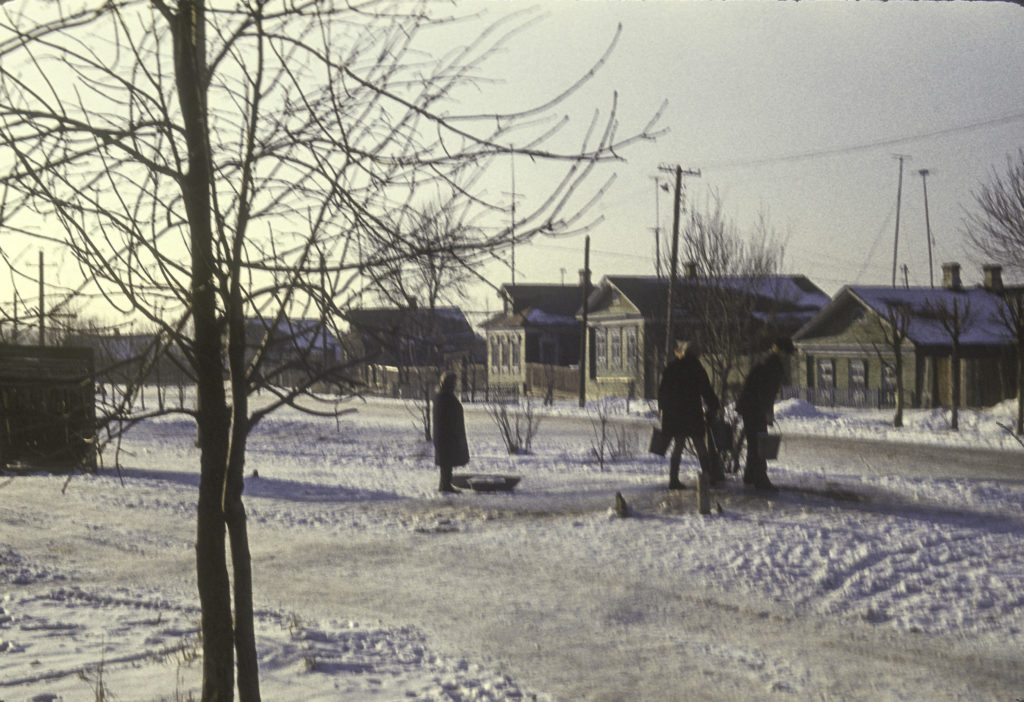
All of the houses seemed to have tall TV antennae, but they evidently lacked something I would consider still more essential: running water. This was apparent from the pumps that people clustered round to fill their buckets of water. I didn’t realize it at the time, having lived in Southern California most of my life, how much more of a luxury it is to have running water in a cold climate than in a warm one. A year or so later, after returning to the USA, I found out from a friend who was building houses in Connecticut that pipes in cold country have to be wrapped in electrical conduit to keep them from freezing and bursting in the winter. And of course the pipes have to be laid in the first place in the summer, when the ground isn’t too hard or too muddy to dig up.
People filling their buckets at the well in a Rostov residential district. Their houses did not have running water.
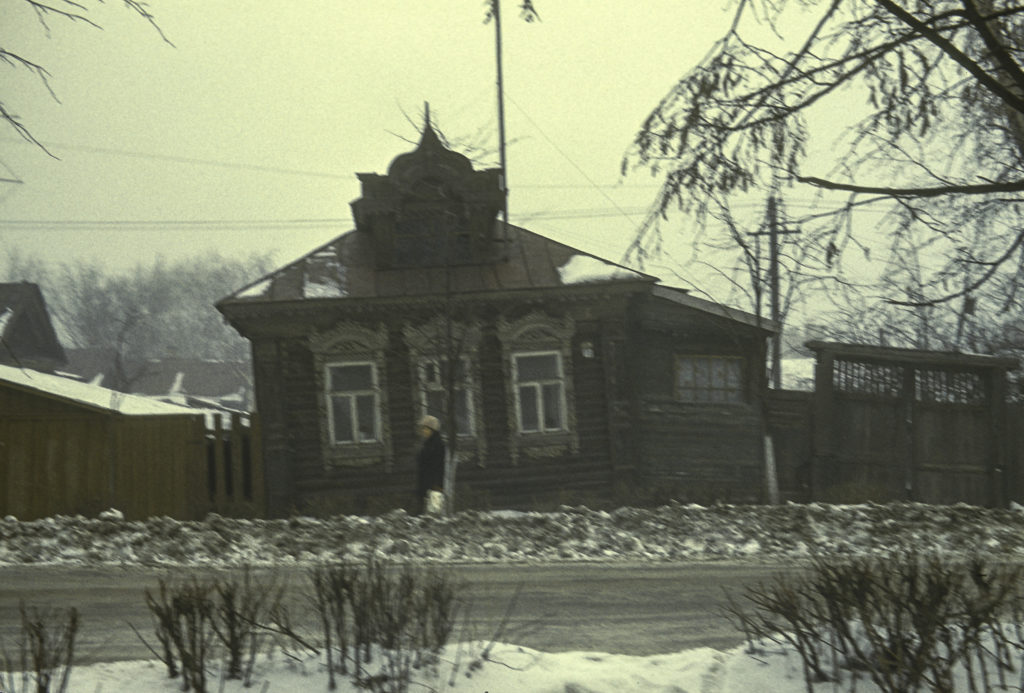
I was especially struck by this one modest dwelling which I called “the leaning cottage of Rostov” from its tippy appearance. When we were shooting pictures of this and the other wooden houses, some of the locals came up to us and said, “Don’t shoot pictures of the houses. The houses are bad. Shoot pictures of the school instead – it’s nice.”
The leaning cottage of Rostov
But we found the cottages, however humble, authentic and picturesque, while the school was quite ordinary and boring.
Rostov Schoolhouse
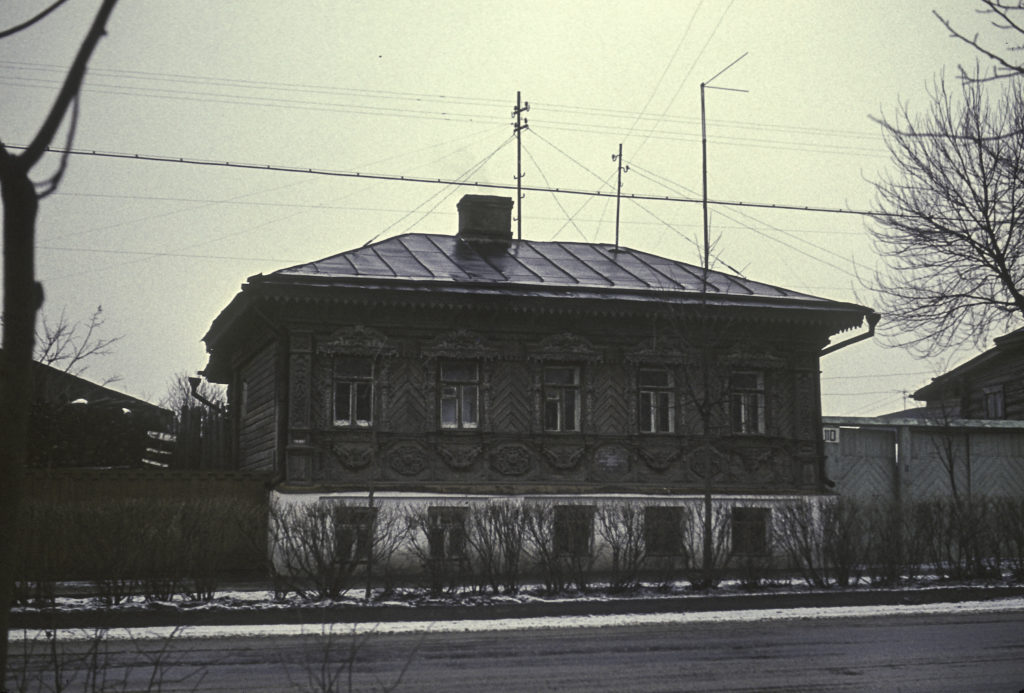
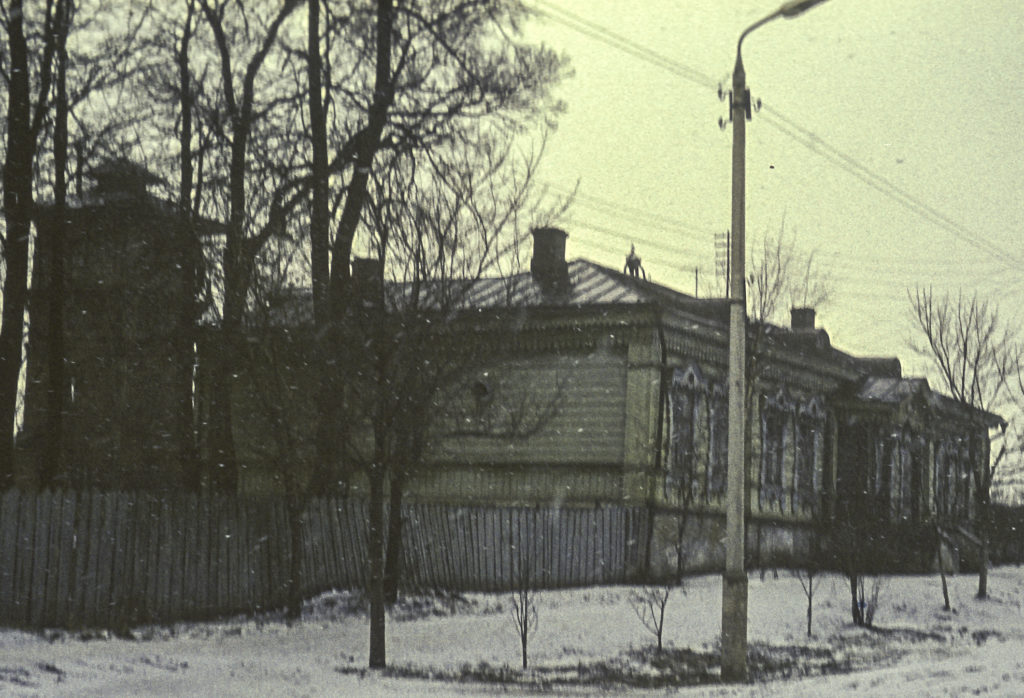
There were also some more modern and pretentious houses of more recent vintage, most likely belonging to the local notables.
Upscale house in Rostov
After blundering about in the snow for a while, and exploring the town in the pale light of a winter afternoon, we finally reached the station and boarded the train for Yaroslavl.
High-rent district in Rostov. In the background is the Spaso-Yakovlevsky Monastery, which has distinctive green domes.
I think Rostov – like most of the Golden Ring towns – is now much changed from when I was there. The impressions I have obtained from the websites that I have seen, such as Top 10 Travel and Russia Beyond, suggest that the provincial standard of living has considerably improved and that the historical monuments have been restored to a degree that was inconceivable under the Soviet regime. To what degree these impressions are correct I can only speculate, until I have a chance to return to the sites that I visited back in the dark age of 1973.
Museum of Wooden Architecture and Peasant Life: front - Resurrection Church; rear - Transfiguration Church.
In January ’73 I made a couple of trips to some of the Old Russian towns northeast of Moscow, in what had once been known as the Vladimir-Suzdal area. This region first came into prominence in the 12th century AD, as the civil wars among the Russian princes and the depredations of the steppe nomads began to sap the strength of the Kievan principality.
One trip, which I made together with my girlfriend Vera, was to Suzdal itself. Suzdal is a very small town, with a population of about 10,000 today, and probably less when we were there in 1973. But it is a very old town, and under Prince Yuri Dolgoruky, who founded Moscow in 1147, it was already the capital of its own principality, Rostov-Suzdal, later renamed to Vladimir-Suzdal when Yuri’s son Andrei Bogoliubsky transferred the capital to Vladimir in 1157. Eventually, in 1392, Suzdal was absorbed into the rising principality of Moscow. Thereafter it remained an important commercial and religious center, with an impressive number of churches, mostly built and paid for by wealthy merchants. But in the 19th century, its mercantile importance took a serious hit with the building of the Trans-Siberian Railroad, which bypassed Suzdal in favor of its rival Vladimir, 35 kilometers (22 miles) to the south.
Yet the economic eclipse of the town became its salvation as a historical and religious site. In the Soviet period it avoided industrialization and retained its character as an Old Russian provincial town, and the government reinforced this fortuitous “backwardness” by making it an officially protected site, off-limits to industrial development, in 1967. Since the end of the Soviet regime, it has blossomed into a major tourist attraction, and is considered to be the best-preserved of the Golden Ring towns.
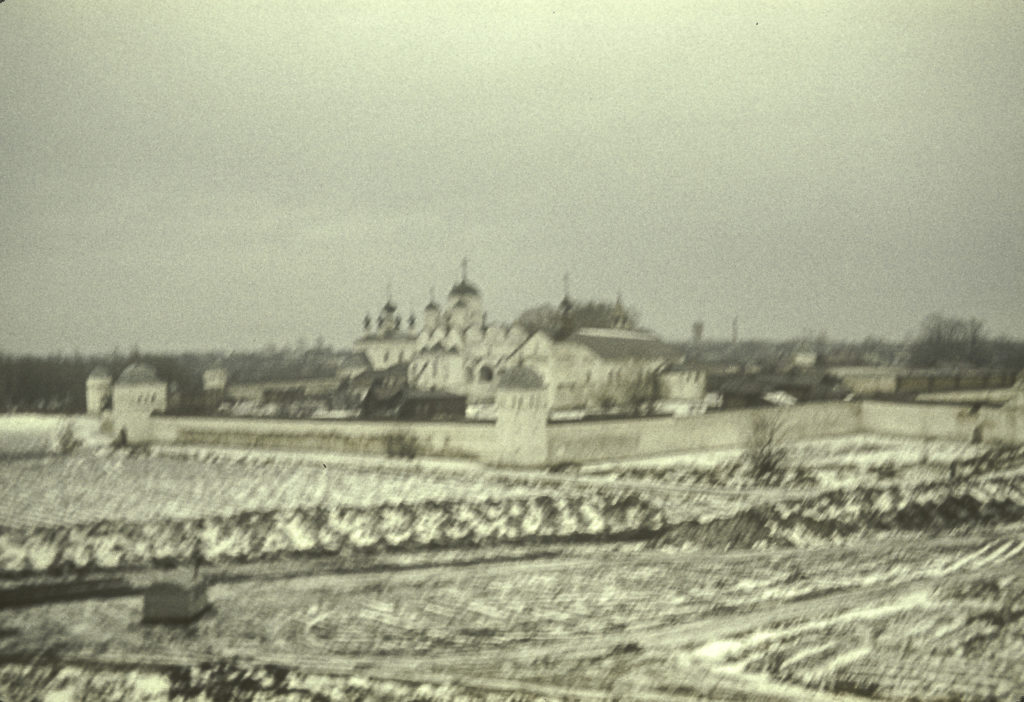
When I was there in 1973, in the dead of winter, Suzdal seemed like a typical run-down, backwater town, but despite its overall forlorn appearance there were wonderful sights to see. I don’t remember at all how we got there – it had to have been by bus – but we began our tour, which was made entirely on foot, at the north end of town. This was the domain of great monasteries and convents. The first one we came across was the Pokrovsky (Intercession) Convent. It was founded in 1364, but nothing from that time has survived, and the imposing structures currently found there date mostly from the 16th century. Beginning in the reign of Vasily III, the Pokrovsky Convent became a haven for aristocratic women taking the vows, whether voluntarily or involuntarily, and during the later 16th and 17th centuries it was one of the largest and richest convents in Russia.
Pokrovsky (Intercession) Convent, 16th Century
I’m not exactly sure why the convent was equipped with such formidable walls and towers – was it more to keep the nuns safe from the outside world, or to keep them from getting out? Whatever the case, there is less doubt about the next monastery we saw, the Spaso-Efimiev (Savior Monastery of St. Euthemius), which for much of its existence was used as a prison. Like the Pokrovsky Convent, it was founded in the 14th century (1352), but the current structures date from the 16th and 17th centuries. It benefited from donations by Vasily II, Ivan the Terrible, and the Pozharsky family, one of whose scions, Dmitri Pozharsky, was (along with Kuzma Minin, the butcher from Nizhnyi Novgorod) the leader of the national uprising that expelled the Poles from Muscovy at the end of the Time of Troubles in the early 17th century. His grave lies by the wall of the Spaso-Preobrazhensky Cathedral, inside the walls of the monastery.
Spaso-Efimiev Monastery and Smolensk Church (center), 1696-1706
The Spaso-Efimiev Monastery began as a fortress, intended for the defense of the city, to keep invaders out, but it eventually became instead a place for keeping people in, i.e. a prison. The frowning walls and grim towers of the monastery certainly give it the look of a prison. The person most responsible for turning it into one was Catherine II, who in 1766 secularized the monastery and began to use it as a place for confining religious and political dissidents, including but not limited to Old Believers. Thus it remained down to 1905, when the prison was closed; but the Soviets reopened it again in the 1930s, first using it for political prisoners, then during World War II for high-ranking prisoners of war. The German Field Marshal von Paulus, who surrendered his army at Stalingrad, was its most famous inmate.
Walls of the Savior Monastery of St. Euthemius
From the Monastery of St. Euthemius we ventured southward toward the town center. On the way we encountered traditional pre-revolutionary Russian houses like the one in the picture below, with all kinds of picturesque wood carvings adorning the exterior. I say “pre-revolutionary” because I doubt that anyone would have had the time or resources to create such obviously labor-intensive constructions while in the throes of revolution, civil war, industrialization, collectivization, World War II and post-war reconstruction efforts.
Traditional Russian wooden house, with carved wooden “icicles” handing from the eaves, carved wooden window-frames and porch railings
In my experience, with few exceptions the most interesting and attractive structures in Russia are those created before the 1917 Revolution. The house in the picture below, a veritable mansion, is another example of traditional Russian wooden residential architecture.
Another example of Russian provincial wooden architecture
As we continued south toward the center of Suzdal, I observed how the whole town preserved a rural, wide-open appearance, with clusters of buildings interspersed among empty snow-covered fields and woods.
View of Suzdal Kremlin across frozen furrowed fields
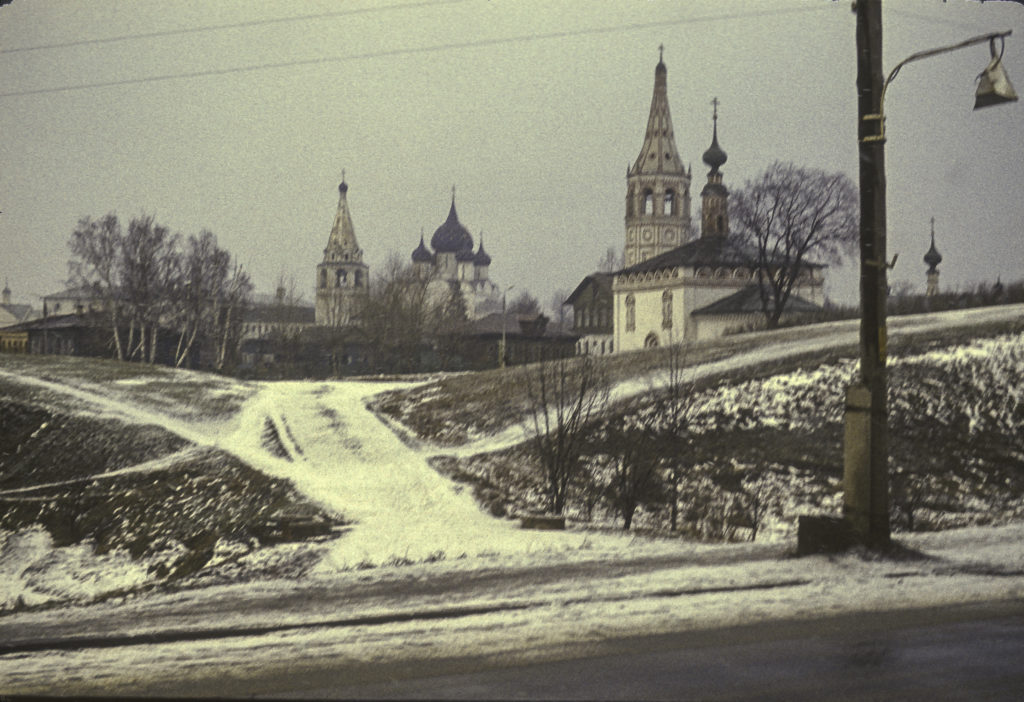
At the heart of old Suzdal was its Kremlin, dating from as early as the 10th century AD. It’s very different from the that of Moscow – it lacks the high stone walls and towers of the latter. In the 11th and 12 centuries an earthen berm was raised around it, on top of which a log stockade with wooden towers was erected. The wooden fortifications burned down in 1719, and today only the earthen berm is left. In the Suzdal Kremlin are situated the Cathedral of the Nativity of the Virgin, the bishop’s palace complex and the wooden Nikolsky Church, not to be confused with the Church of St. Nicholas, which stands outside the Kremlin next to the Church of the Nativity of Christ.
In the foreground, just to the left of the lamppost, is the Church of the Nativity of Christ, with the bell tower of the Church of St. Nicholas just behind it; in the background is the Suzdal Kremlin, with the Cathedral of the Nativity of the Virgin at center. The upper tip of the spire of the wooden Nikolsky Church can be seen to the right of the lamppost.
The Cathedral of the Nativity of the Virgin was begun around 1222. In 1445 the Kazan Tatars burned down Suzdal, destroying the upper half of the church, which was rebuilt in 1528, and remodeled again in the 17th century. The bishop’s palace complex grew up next to the cathedral over a period from the fifteenth to the eighteenth centuries and now houses a museum of local history. The wooden Nikolsky Church, a prime example of a simple and ancient form of Russian wooden construction, was built in 1766 in a village in the north of the Vladimir region, and transplanted to Suzdal in 1960.
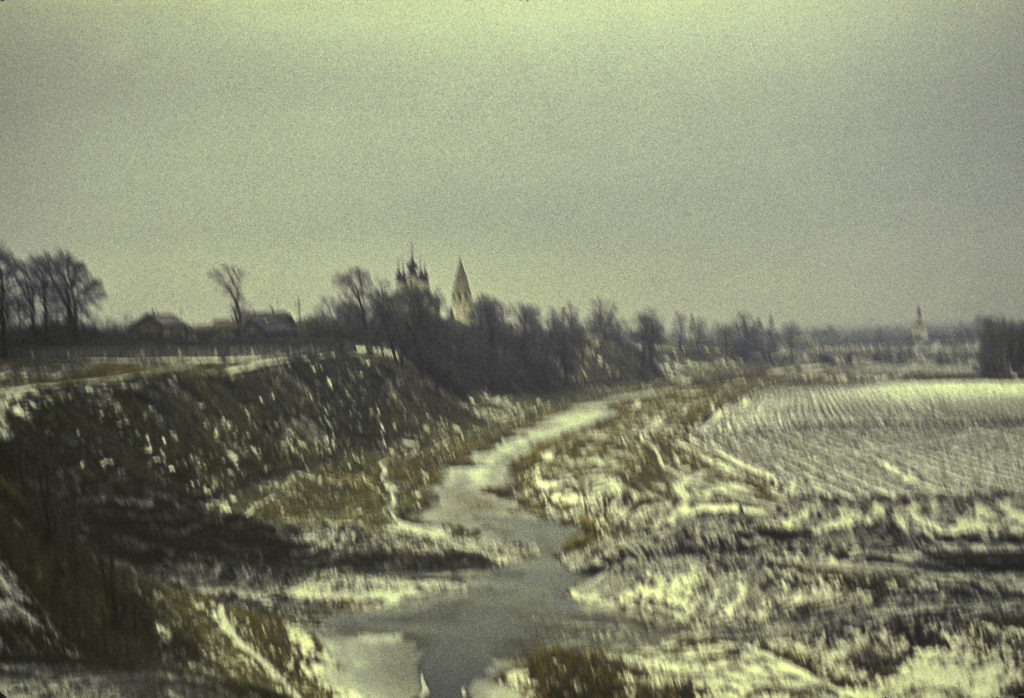
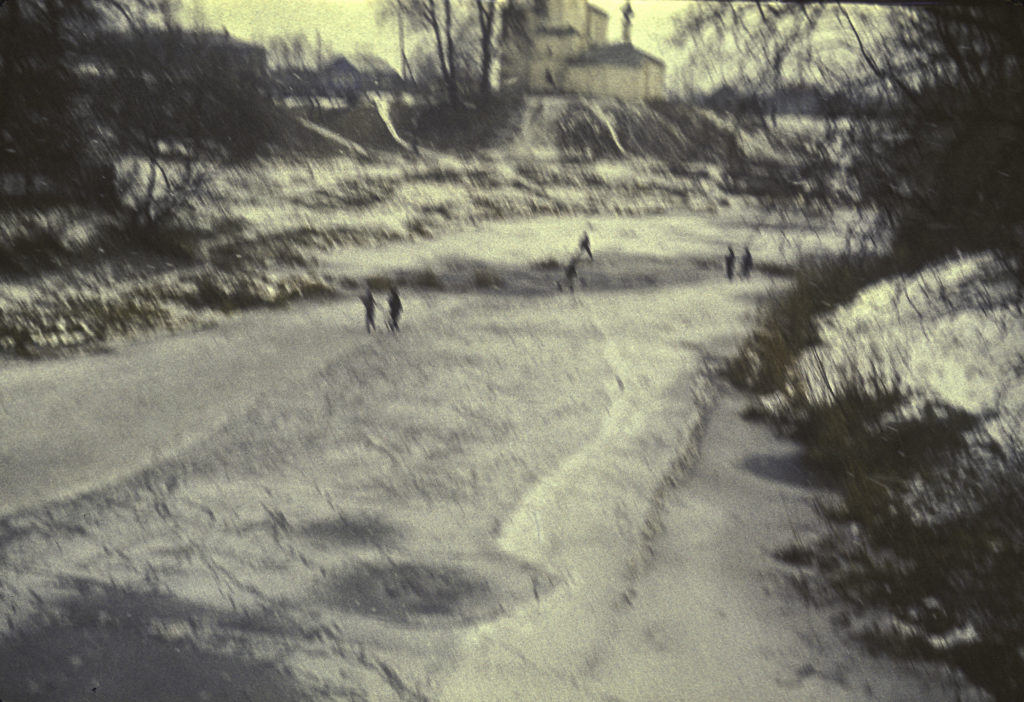
The Suzdal Kremlin is located in the bight of a bend in the Kamenka River, which flows through the town; in midwinter the river was frozen, and we strolled along the banks, watching children play on the ice.
Children playing on the frozen Kamenka River in Suzdal
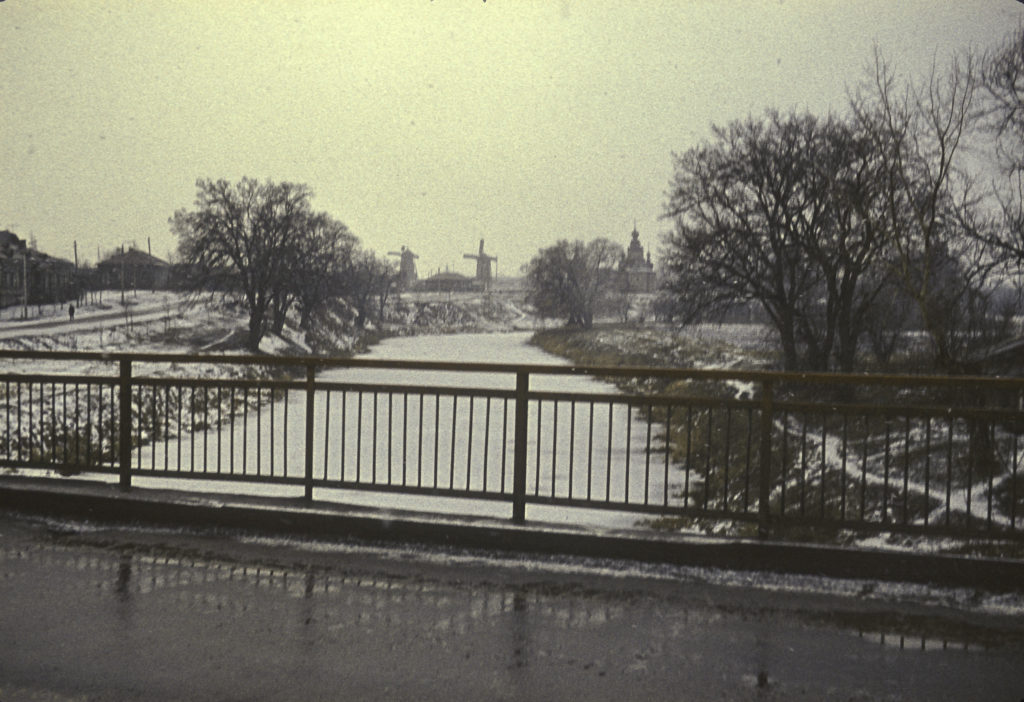
Crossing a bridge to the south bank of the river, we headed for the Museum of Wooden Architecture and Peasant Life. A light snowfall was underway as we came to the Museum. We were not able to view any indoor exhibits – I don’t recall whether it was a holiday or whether no indoor exhibits existed yet – so for us it was strictly an open-air museum.
Bridge over the Kamenka River; Museum of Wooden Architecture and Peasant Life in background
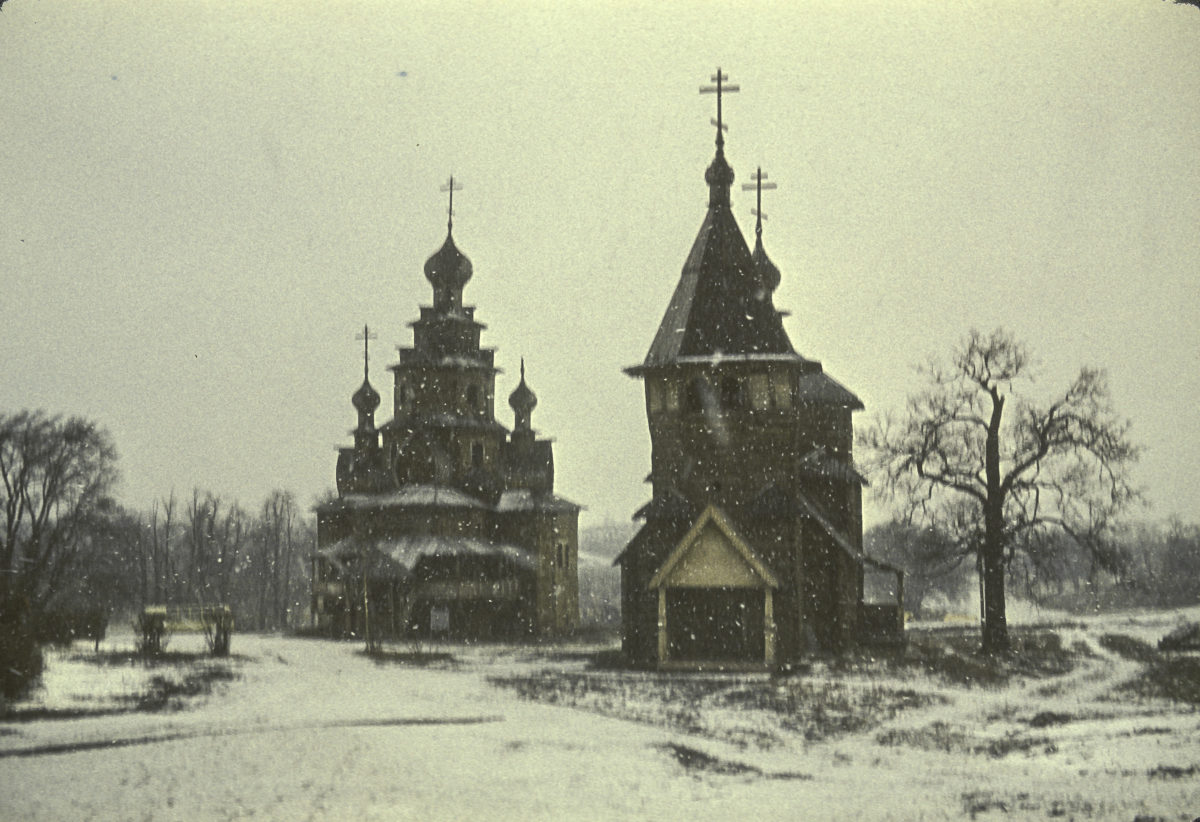
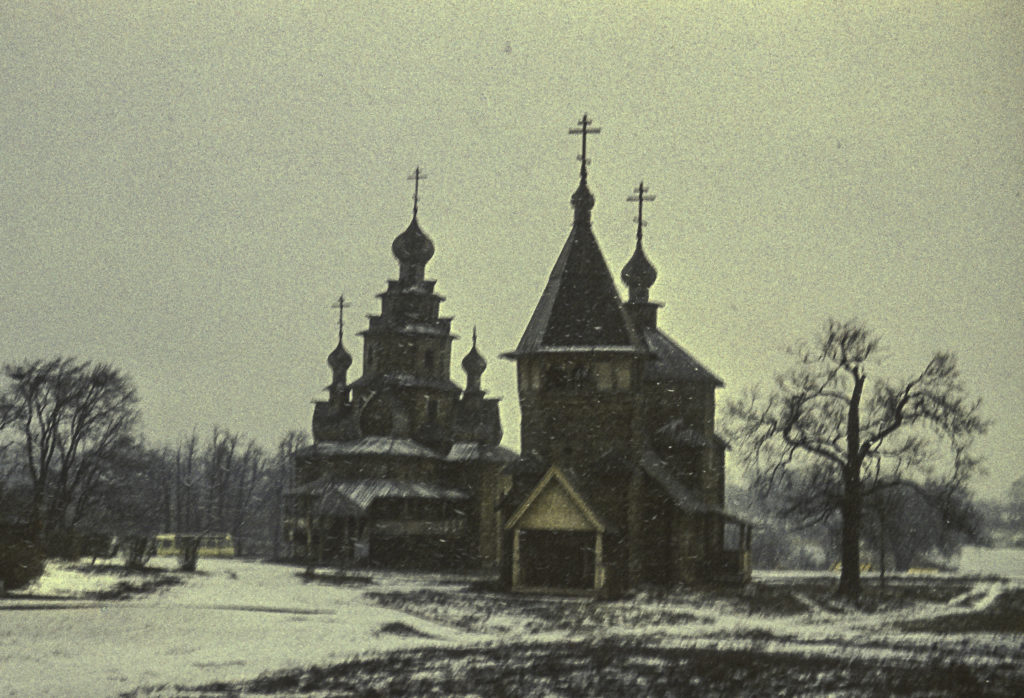
In any case, we found two wooden churches. One has a couple of towers with tiny onion domes at either end of a connecting structure, all with steeply sloped roofs; this is the Church of the Resurrection (). The other has a large central tower with a medium-size onion dome on top and four smaller onion domes on the surrounding corners. This was the Church of the Transfiguration (Tserkov’ Preobrazhenskaya Gospodnya iz Kozlyat’evo). The construction of these wooden churches – and there are many like them all over Russia – is to me amazing: they were built without nails.
Museum of Wooden Architecture and Peasant Life – Church of the Resurrection on the right; on the left, in rear, the Church of the Transfiguration
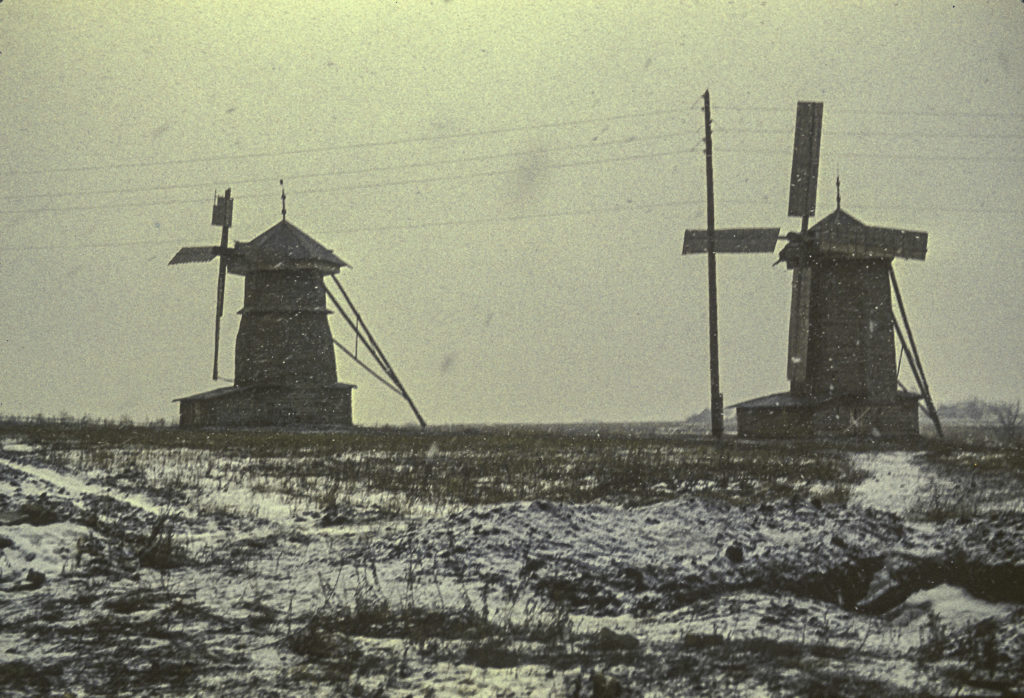
No less surprising to me were the windmills. There were two of them, with four-bladed rotors. I had no idea windmills were used in pre-revolutionary Russia, though it certainly seems like a good idea for the 19th century as well as the 21st.
Museum of Wooden Architecture and Peasant Life – The Old Windmills
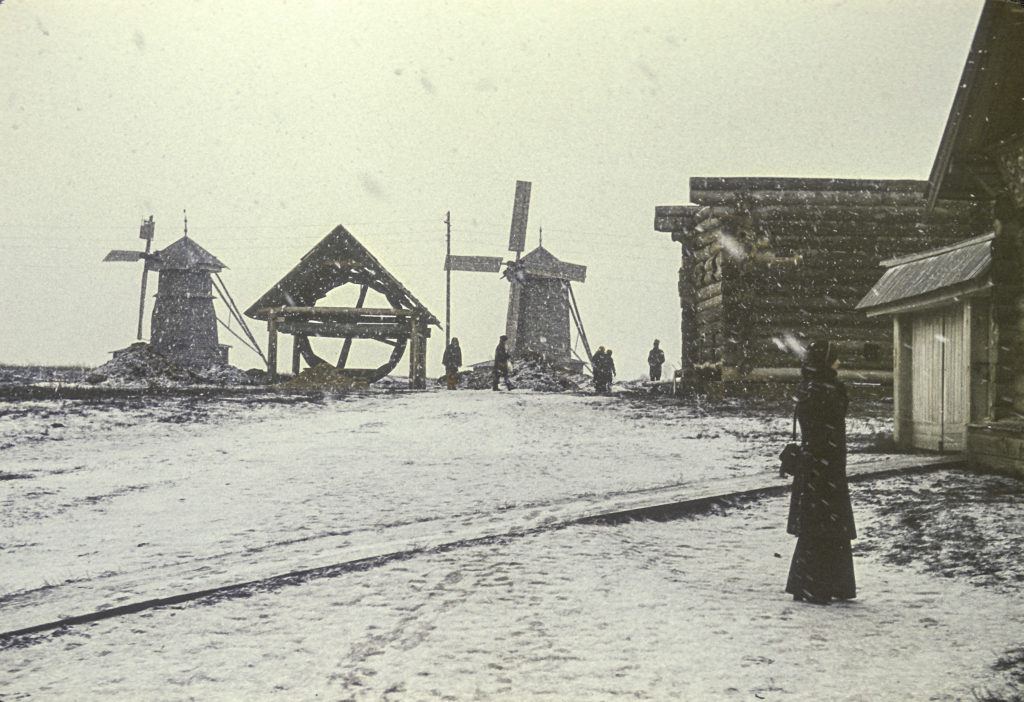
We also encountered a (to me) completely bizarre structure called a kolyosnyi kolodets or “Wheel Well”. This consisted of a large wooden wheel with chocks or steps inside which served as a treadmill. A peasant got inside the wheel and trod on the steps to make the wheel turn. Two large buckets were attached to the wheel with ropes so that they were alternately lowered into the well and brought up full of water. The device was also known as a stupal’nyi kolodets, or “step well”. This one dates from the 19th century.
Vera checks out the Museum of Wooden Architecture and Peasant Life; the Wheel Well (or step well) in the background between the two mills.
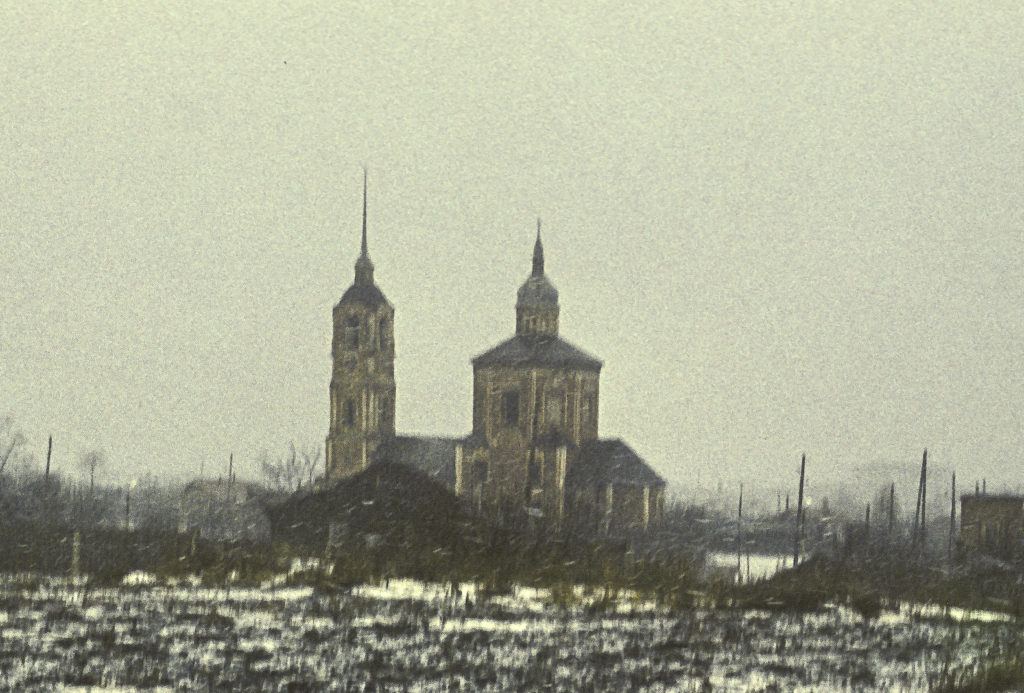
A little way past the Museum of Wooden Architecture, we came across a non-wooden structure, the Church of the Holy Blessed Princes Boris and Gleb. These were Russian princes, sons of Vladimir the Great, the ruler of Kievan Russia, who contrived to convert his subjects to Christianity in 988. Legend has it that when Vladimir died in 1015, his eldest son Sviatopolk had his younger brothers Boris and Gleb murdered to ensure his succession to the throne. Although the brothers knew of Sviatopolk’s intentions, they refused to raise their hands against him, and because they did not resist evil with violence, they became the first saints canonized by the Russian Orthodox Church after the conversion.
Church of Sts. Boris and Gleb
The date of construction of the Boris and Gleb church is uncertain; from the styles involved experts have concluded that it was most likely built at the end of the 17th century, while the bell tower was built later, around 1749. In 1923 it was closed, and it was among several churches earmarked for removal, with the intention of salvaging its remains to be used in the construction of new buildings, for example a town bathhouse. This actually happened to a neighboring church, but the Church of Boris and Gleb somehow was bypassed and survives to this day. In the early 2000s it was returned to the Orthodox Church, which undertook a renovation project in 2017.
Judging from the many photos I’ve seen on the many tourism websites devoted to the old Russian towns, Suzdal, though remaining a small town, would be almost unrecognizable were I to go there today. There are numerous private hotels, restaurants, cafes, and souvenir shops, and many churches and other establishments are now open that were closed to the public in 1973. It appears to me that whatever one may think of the present regime, the demise of communism liberated creative powers of the Russian people which had been bottled up and suppressed for many years and allowed them to find expression in ways that have proven beneficial both to themselves and to visitors like myself. I can’t wait to go back.
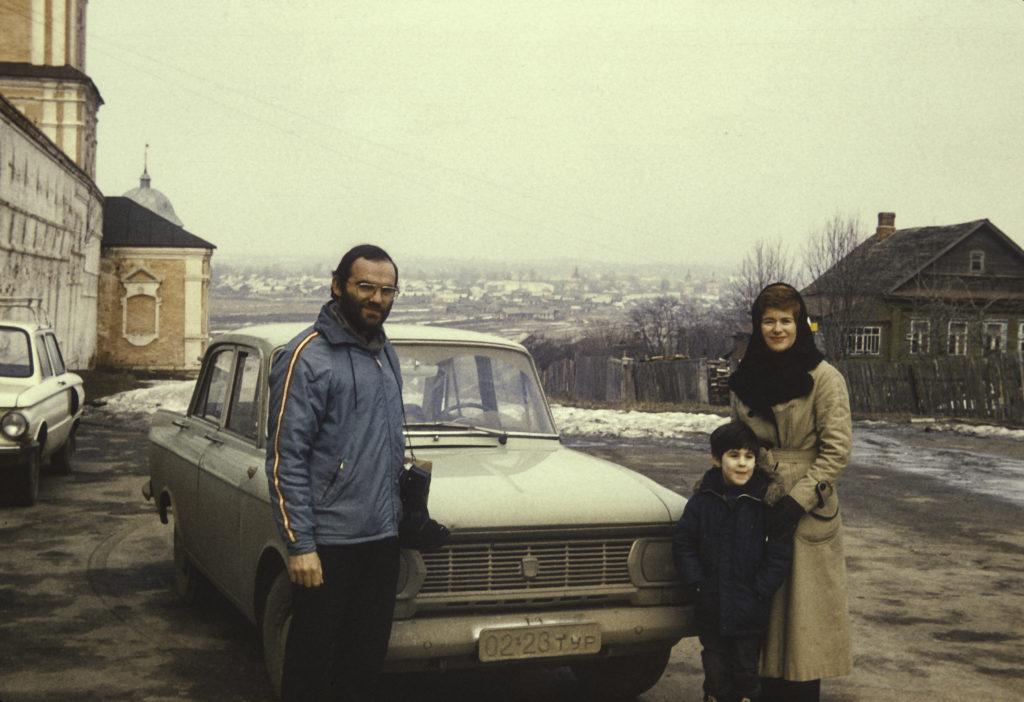
One winter day, one of my fellow American graduate exchange students, Larry Lerner, asked me if I wanted to join him in renting a car and going on an outing to Pereiaslavl-Zalessky, an Old Russian town 140 kilometers (87 miles) northeast of Moscow. I had no idea it was possible to rent a car in Moscow, and I hadn’t had the foresight to get an international driver’s license, but Larry had. Pereiaslavl-Zalessky was outside the 25-mile limit beyond which foreigners were not allowed to go without a pass, but we had no difficulty getting the pass. So, along with Larry, his wife Sue, his son Spencer, and another American graduate student, Jim Karambelas, I piled into a rented Moskvich and off we went. Except that the Moskvich broke down before we even got out of Moscow, and we had to get it fixed before we could go any further. Somehow we did get the repair done, but the delay that resulted made our stay in Pereiaslavl-Zalessky shorter than planned.
Arrival in Pereiyaslavl-Zalessky. Jim Karambelas, at left; on the right, Sue and Spencer Lerner, standing by the Moskvich we rented for the trip
So why did we want to go to this small town in the hinterland of Moscow? Pereiaslavl-Zalessky is part of the so-called Golden Ring, a set of historic and picturesque towns to the north and east of Moscow which preserve some of Russia’s most noteworthy architectural and cultural treasures. We had already visited one of these towns, Zagorsk (now Sergiyev Posad), the closest to Moscow and the site of the Trinity-St. Sergius Monastery, in the fall; Pereiaslavl-Zalessky is the second closest to Moscow, so it was a logical choice for the next excursion.
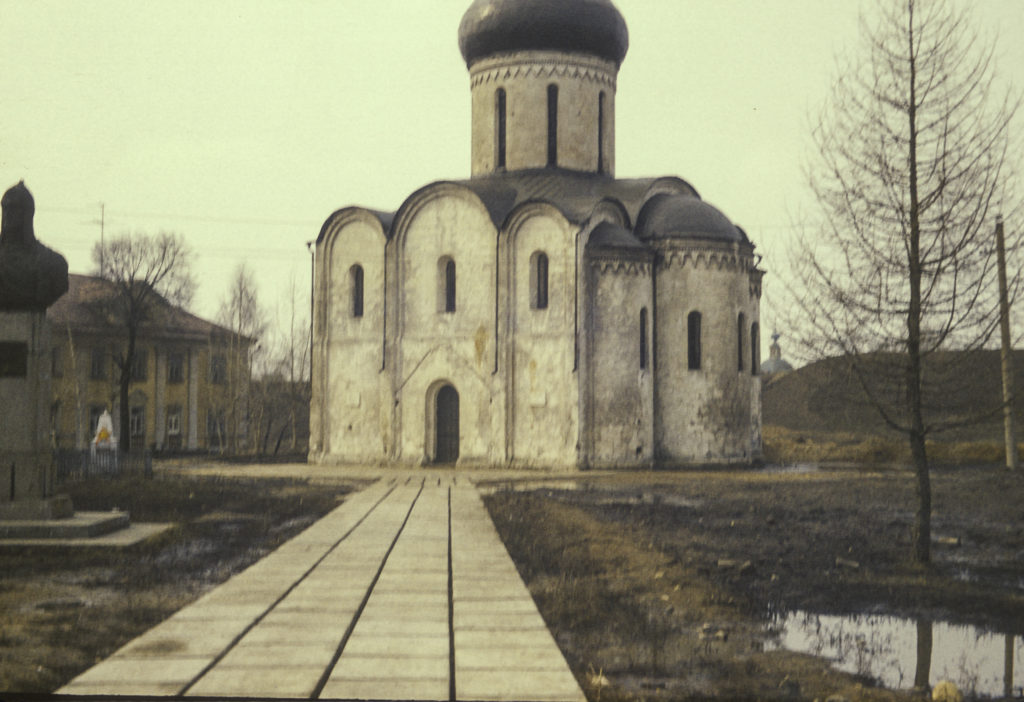
Pereiaslavl-Zalessky was founded by Yuri Dolgoruky (“long-arm”), Grand Prince of Kiev, in 1152 CE. The Spaso-Preobrazhensky Cathedral, begun in that year, is one of the earliest examples of stone church architecture in the north-eastern Russia. Yuri is also credited with being the founder of Moscow (1147) as well as several other towns in northern Russia. These activities were harbingers of the eclipse of Kiev as the center of power and culture in Russia by the Vladimir-Suzdal region in the northeast, a process which culminated in the reign of Iuri’s son Andrei Bogoliubsky (“God-loving”, best translated as “pious,”) a sobriquet which he earned by building a record number of fine churches, and which otherwise was singularly inappropriate, given that he sacked Kiev in 1169 and plundered its treasures.
Spaso-Preobrazhenskii Sobor – 12th century cathedral
Anyway, from 1175 Pereiaslavl-Zalessky was the seat of its own small principality until it was gobbled up by Moscow in 1302. Pereiaslavl-Zalessky was also the birthplace of Alexander Nevsky, the great warrior and victor over the Swedes and Teutonic Knights, and he was baptized in the cathedral. In 2012 an Alexander Nevsky Museum opened in the town, but that was forty years too late for us.
The Mongol conquest of the thirteenth century brought terror and devastation to the town, and it continued to suffer from their depredations for the next couple of centuries. Moscow was also subject to their raids but suffered less than the other cities of the area because its princes served the khans of the Golden Horde as tax collectors and “enforcers” of the Mongol hegemony. During the Time of Troubles of the early 17th century, Pereiaslavl-Zalessky also underwent pillage and destruction by Polish armies.
Spaso-Preobrazhenskii Sobor – where Alexander Nevsky was baptized
Somehow the Spaso-Preobrazhensky Cathedral survived all the vicissitudes of the Mongol conquest and the Polish invasions, though the original interior paintings have been lost, and now only bare walls remain. At one time a treasured 16th-century icon, the “Transfiguration”, was kept there, but it has been transferred to the Tretyakovsky Gallery in Moscow to ensure its preservation.
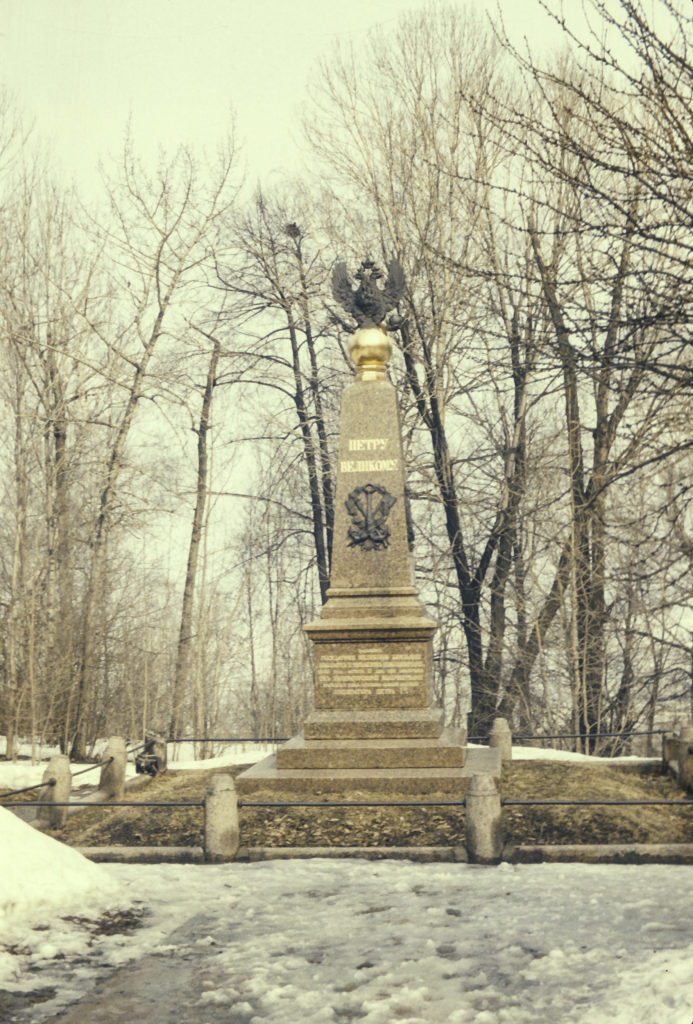
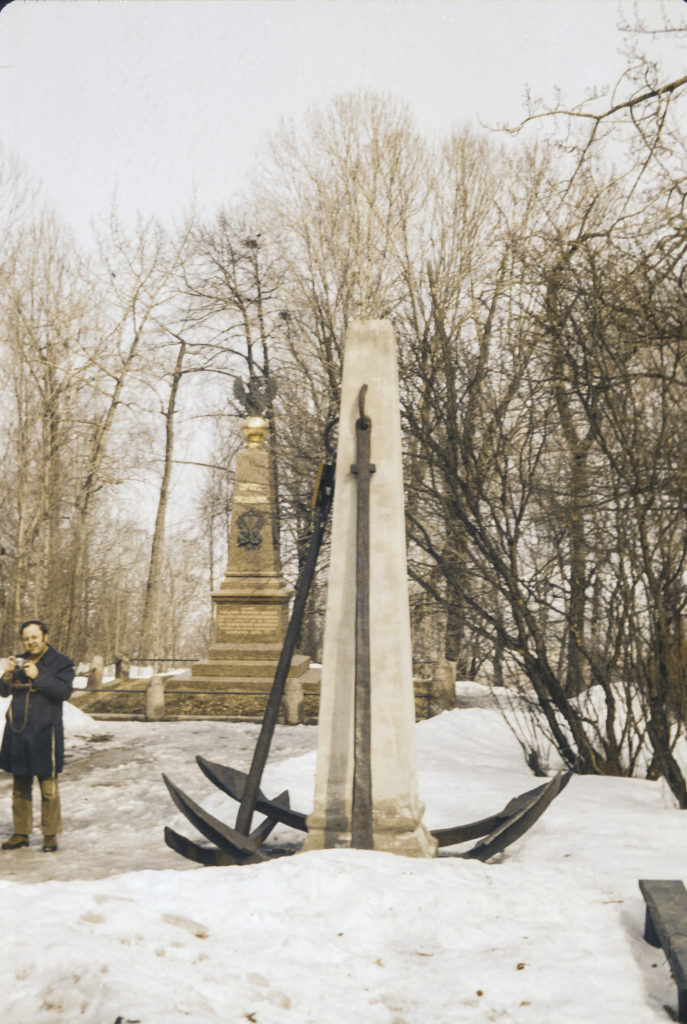
Pereiaslavl-Zalessky is located on the southeast shore of a large lake, Lake Pleshcheev, and in the late 17th century it became a playground for Peter I during the years when he was playing second fiddle to his half-sister, the Regent Sophia. Peter fancied himself a sailor, and he had a flotilla of boats built so he could play at maritime warfare. From these humble beginnings the Russian navy eventually evolved. There is a museum in Pereiaslavl-Zalessky which is devoted to this episode and even preserves one of the original boats.
Monument to Peter the Great as founder of the Russian Navy
Lake Pleshcheev is considered to be one of the prettiest lakes in central Russia and is a big tourist draw for the area. There are numerous campsites, hotels and guesthouses on its shores, and in summer people come to go fishing, water-skiing and parasailing on the lake. They weren’t doing any of that when we were there in 1972, of course, except maybe ice-fishing.
Larry Lerner at left, next to the monument to Peter the Great and his Little Ships.
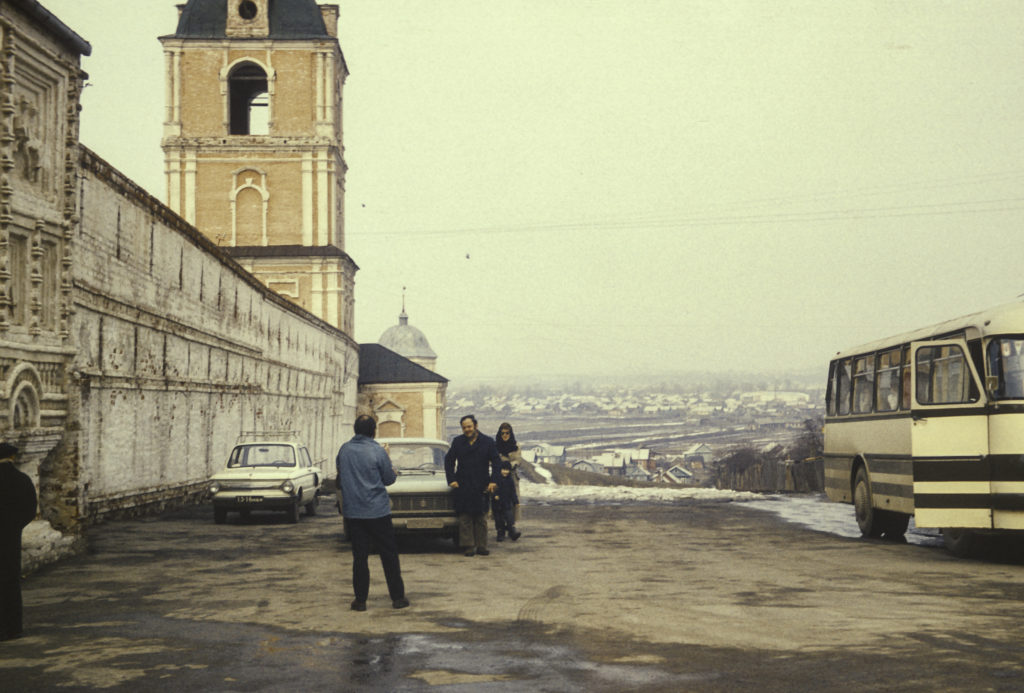
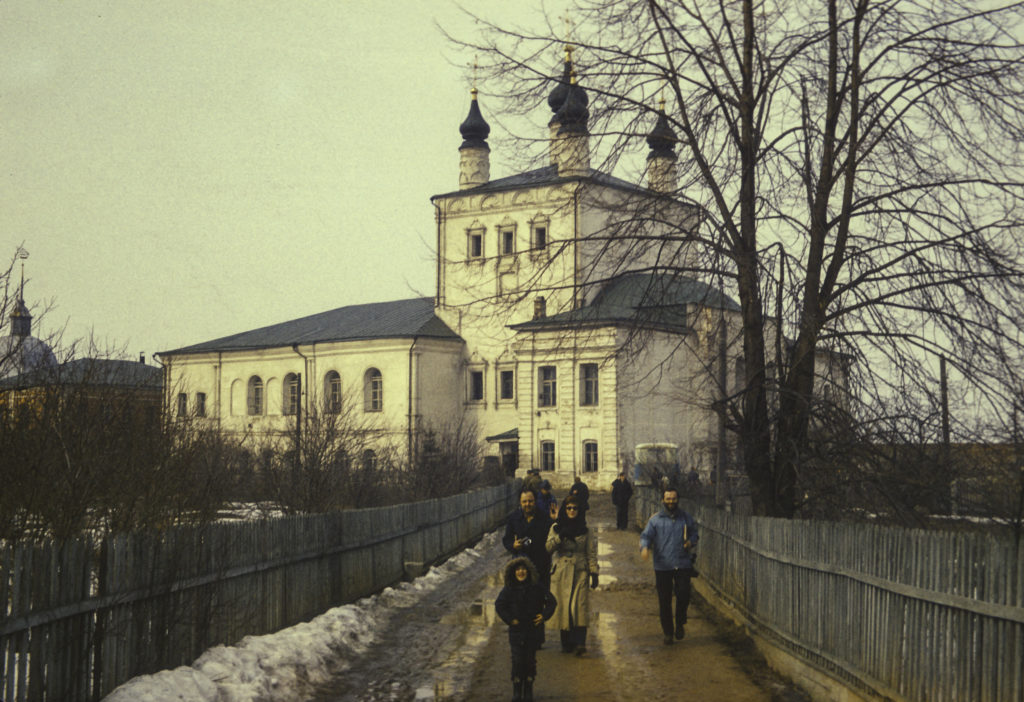
When we were in town in 1972, the main attraction, other than the Spaso-Preobrazhensky Cathedral, was the Goritsky Monastery, which was actually not a working monastery and had not been since the 18th century. Now, as in 1972, it is part of the Pereslavl Museum Reserve, a great open-air museum which encompasses the Spaso-Preobrazhensky Cathedral, the “Little Boats of Peter I” museum, an art gallery, an exposition hall and other churches and museums.
Jim Karambelas taking a picture of the Lerners next to the wall of the former Goritsky Monastery with the Epiphany Church and Bell Tower in view
In fact, a whole slew of museums have sprung up in Pereiaslavl-Zalessky in the last few years, according to online sources. There is a museum of locomotives, of radios, of sewing machines, of kettles, of flatirons (!), a museum of peasant household furnishings called “Horse in an Overcoat”, and a museum of fairy tales. There is even a Museum of Cunning and Wit. None of these were there in 1972; they are all private establishments, which were not permitted under Soviet rule.
The Lerners (Larry, Sue and Spencer, at left) and Jim Karambelas (right); in the background is the State Museum of Historical Art and Architecture
The Uspensky Cathedral of the Goritsky Monastery, now part of the State Museum Reserve.
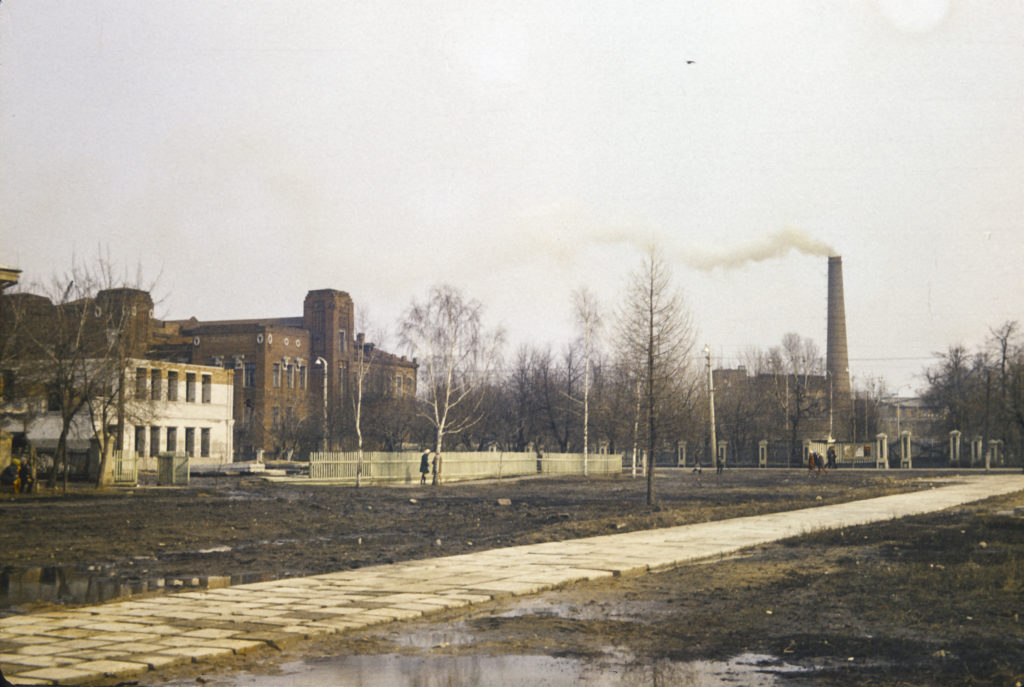
School (brown building left of center) and factory (right)
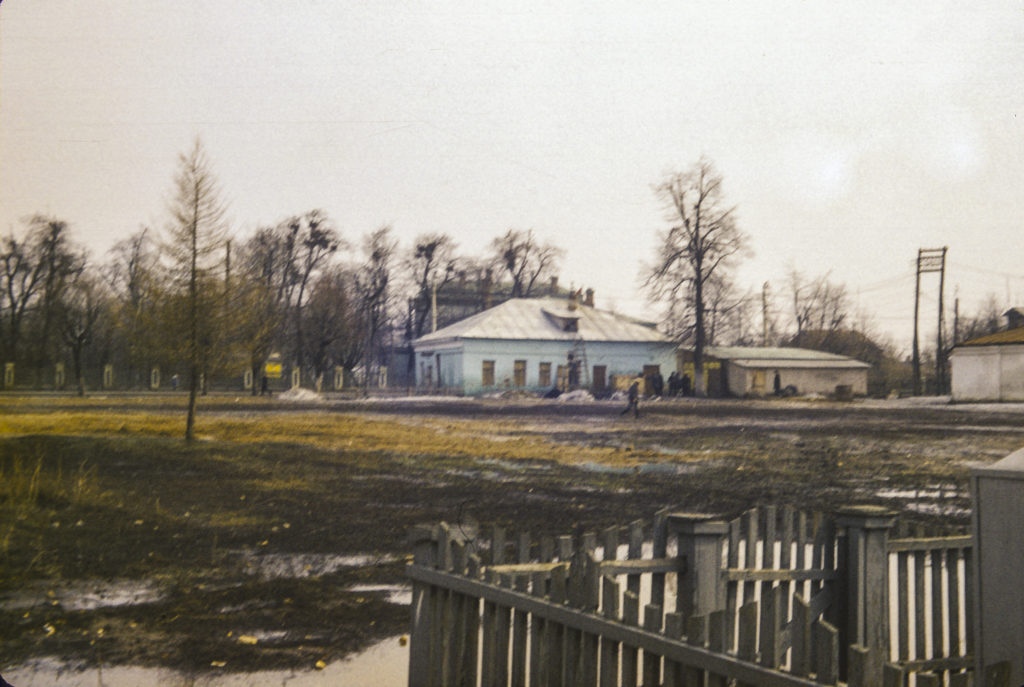
When we visited during a relatively warm spell in the winter of 1972, there was a lot of melting snow and any ground that wasn’t paved was a sea of slush and mud. The mud, along with the winter, was important in slowing down the Nazi advance on Moscow in 1941 – so one must admit it has its benefits.
Street scene in winter
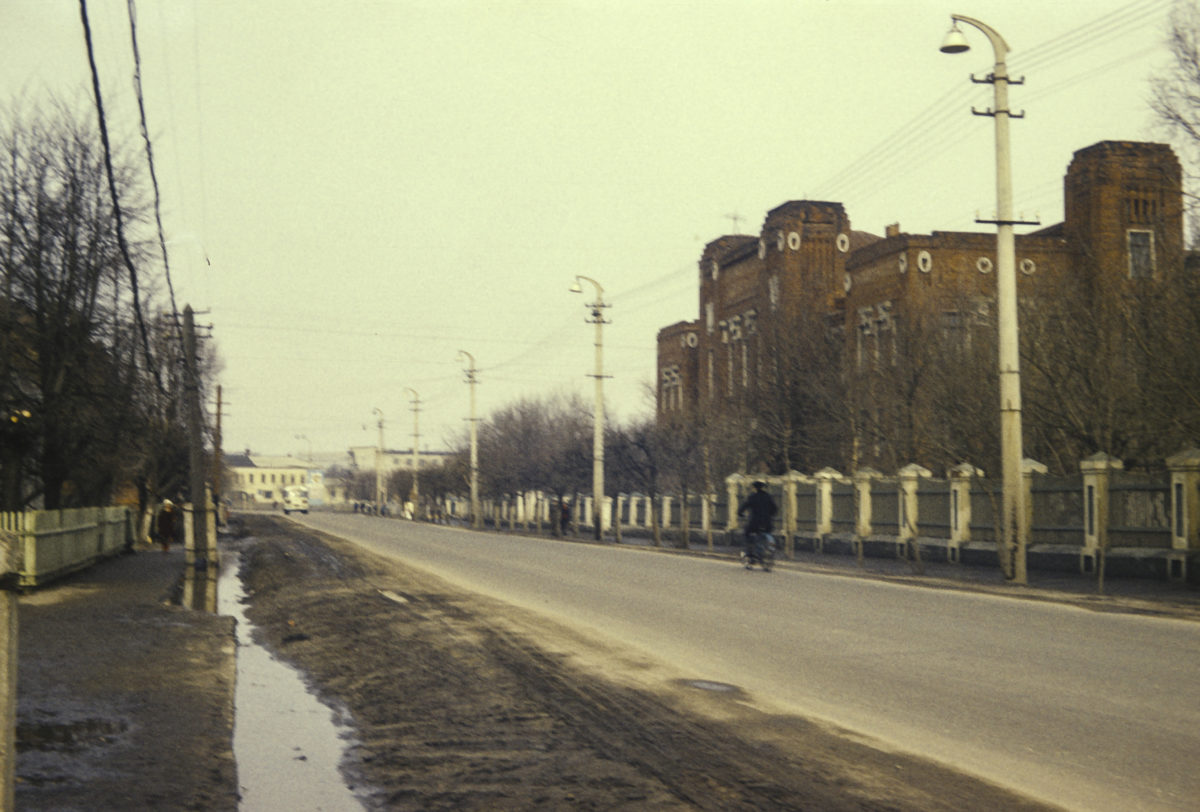
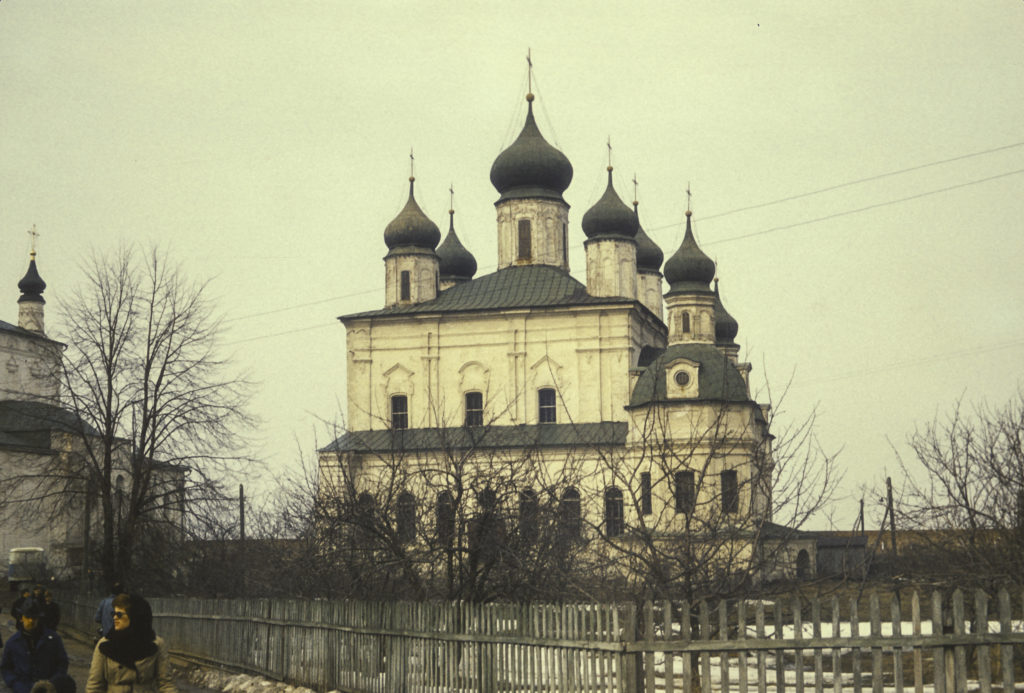
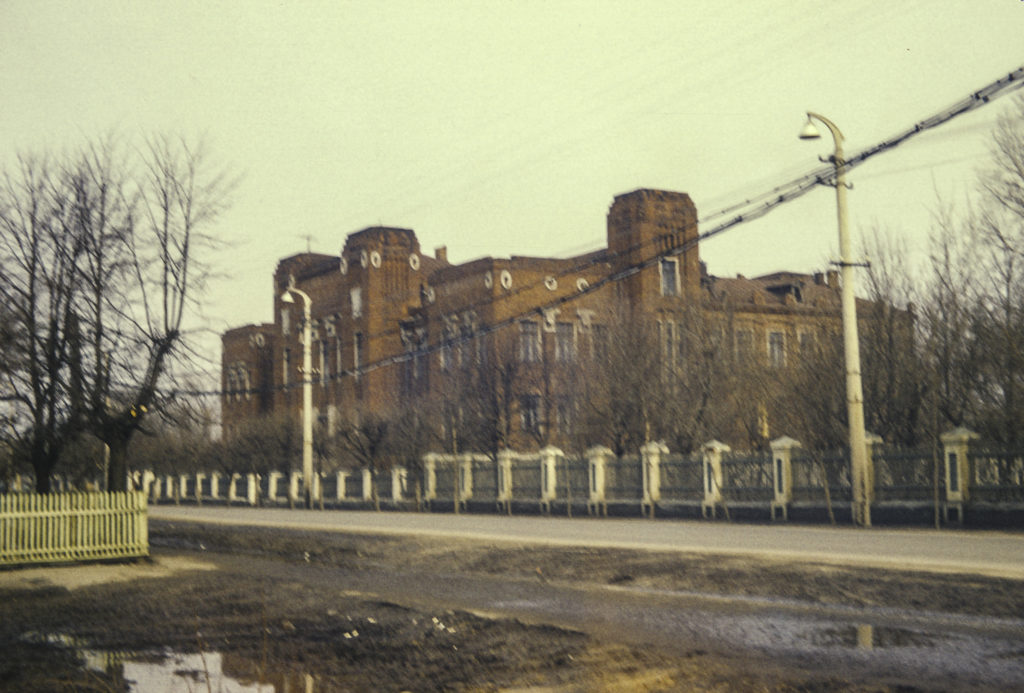
The most imposing building in town when we were there was a solid-looking brown multistory structure which, we were told, was a school. We never found out its name.
School
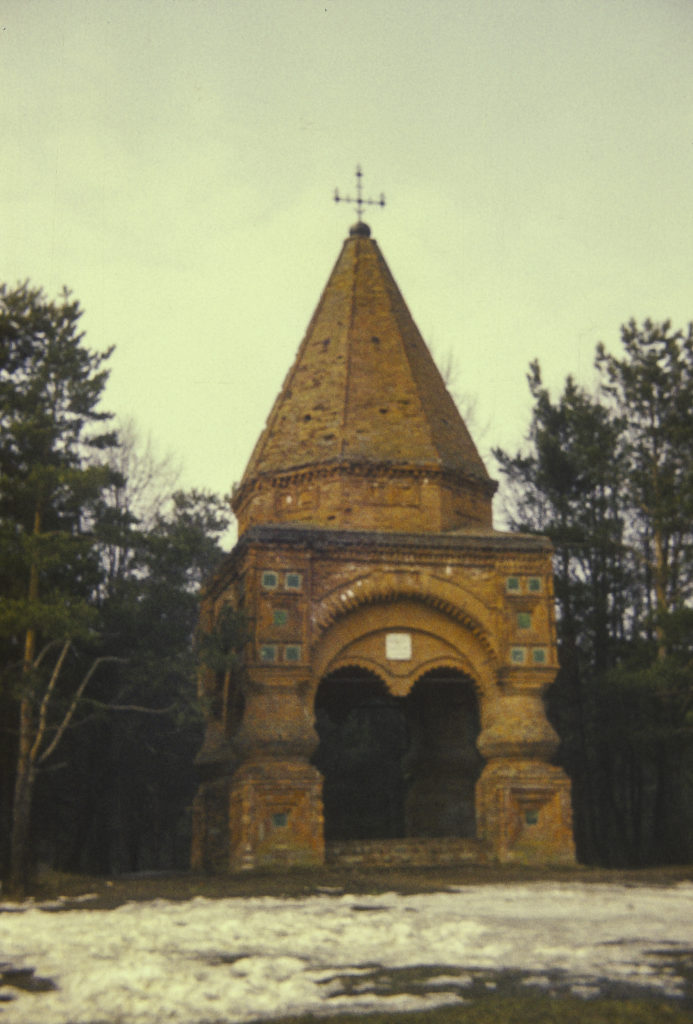
Along the road we also found this conical-capped structure, which looked like some sort of shrine or memorial. However, it may have marked the boundary of a botanical reserve or arboretum. There is in fact an arboretum in present-day Pereiaslavl-Zalessky, and it may have been there in 1972.
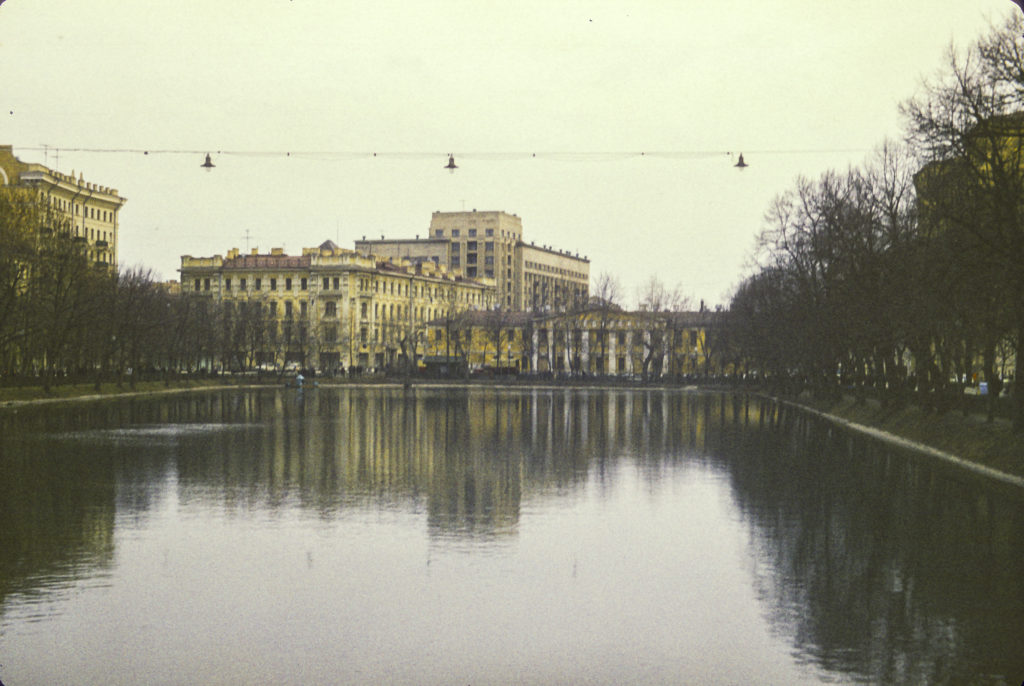
One cold day toward the end of winter, I went with my girlfriend Vera and our Norwegian friend Sidsel Larsen for a stroll in the area of Chistye Prudy (“Clean Ponds”), in the Basmanny district of Moscow. Despite the name, there is only one pond visible; the others are now all underground, as is the small Rachka river that feeds them. In the seventeenth century they had a different name – Griaznye Prudy, “Dirty Ponds,” because Muscovites used them as a garbage dump. In 1703 Prince Alexander Menshikov, Peter the Great’s crony, bought them, cleaned them up and gave them their present name. Chistye Prudy reminds me of another Moscow pond, Patriarch’s Ponds, which I’ve seen only in pictures (I was once told that it no longer exists, but that turns out not to be true), but which serves as the opening scene of my favorite Russian novel, Mikhail Bulgakov’s The Master and Margarita.
Chistye Prudy – Pond in the Basmanny District of Moscow – 1973
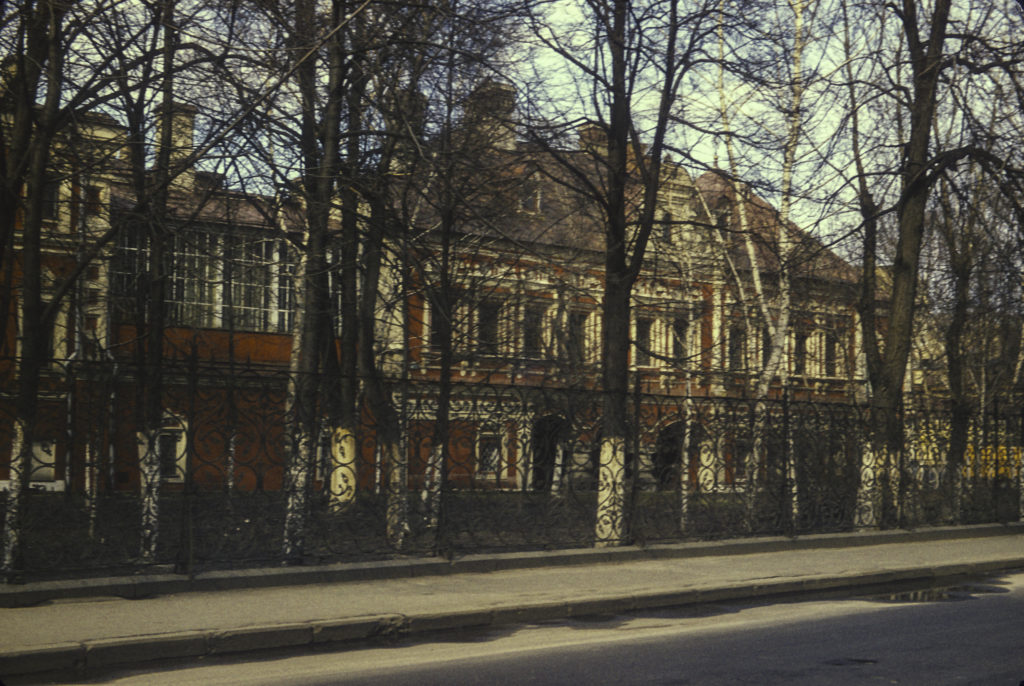
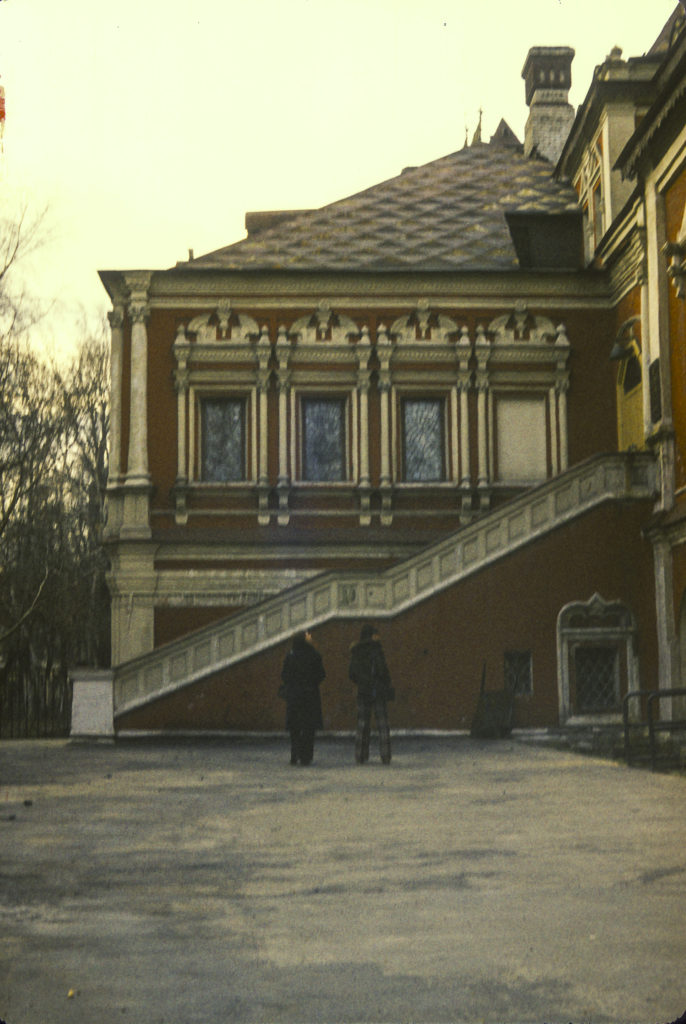
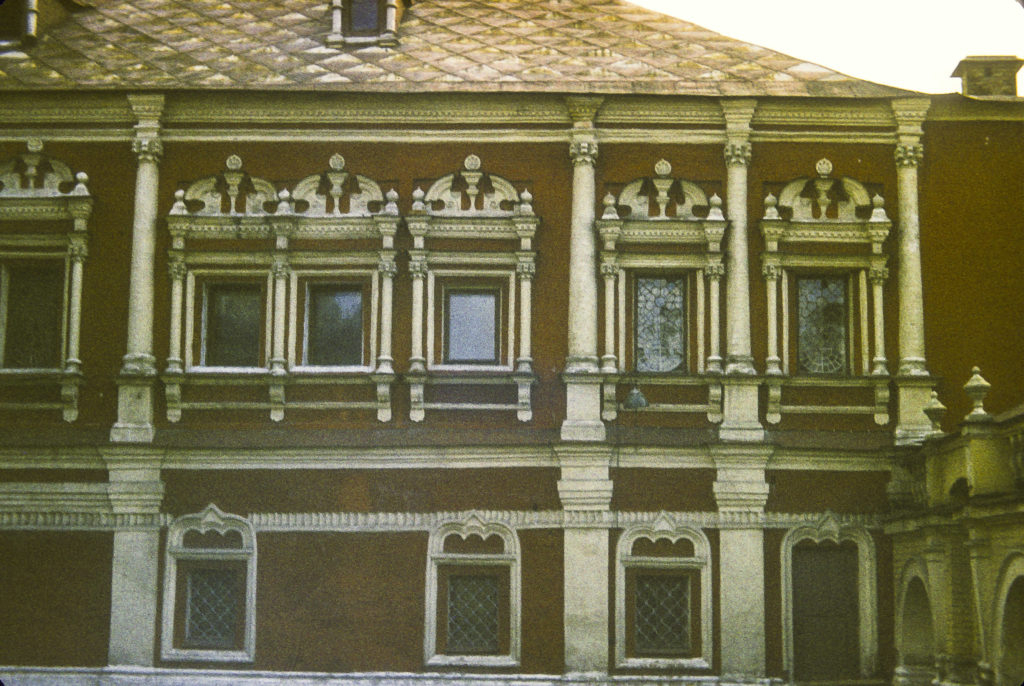
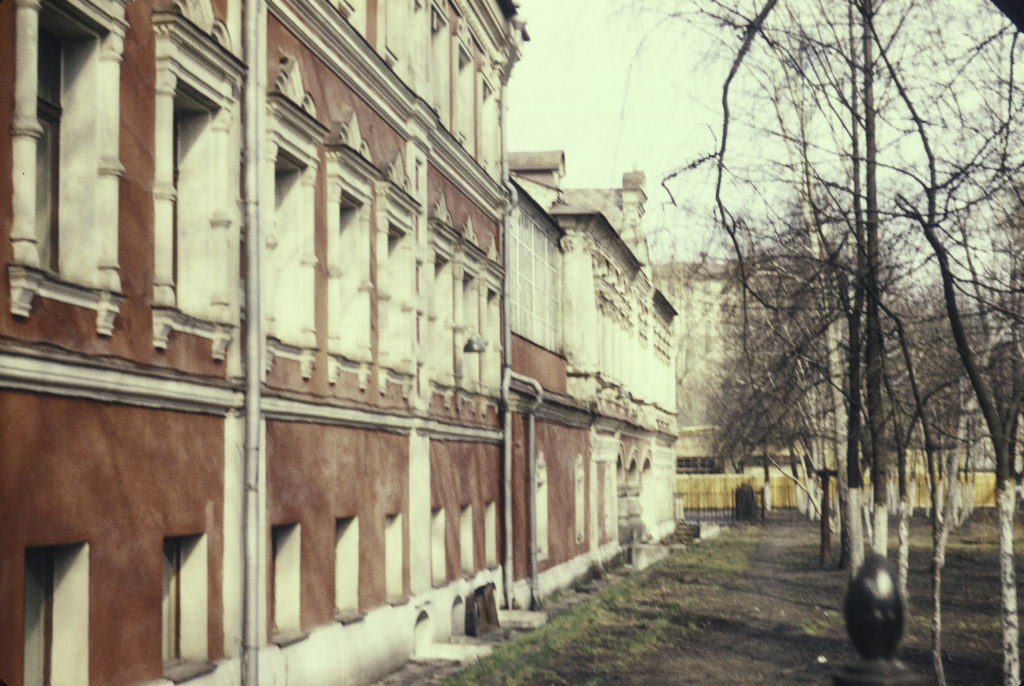
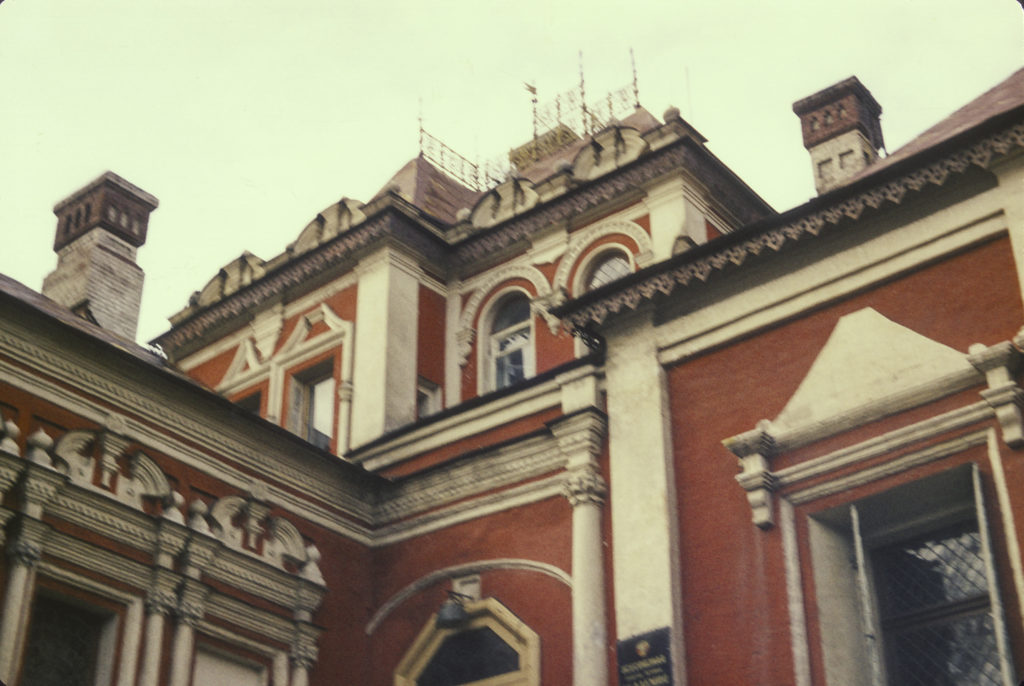
Our main objective on this excursion was a historic structure known as the “Palace of the Boyar Volkov” because it had supposedly been built in the 17th-century by a boyar (magnate of pre-Petrine Russia) named Volkov. In 1973 it was not open to the public. You could only snoop around the outside. Since then, it has opened as a museum, which has its own web page, in Russian. There is even information online in English about the place, although it is a bit sketchy and of poor quality. Without doing exhaustive research, I’ve been able to piece together some of the history of the palace. Legend has it that in the 16th century, a hunting lodge belonging to the tsar had occupied the site, from which Ivan the Terrible issued forth in disguise to spy on his subjects; but there doesn’t seem to be any documentary evidence to support this. Still, I suspect that it existed in some form prior to the usual date given for its construction, in 1698, during the reign of Peter the Great. Peter conferred it first on his vice-chancellor, the diplomat Peter Shafirov, and later on the head of his secret service, Count Peter Tolstoy.
Moscow – Palata Boyarina Volkova – Boyar Volkov’s Palace, 17th Century, as it looked in 1973.
When Peter the Great died in 1725, his widow came to the throne as Catherine I, but Prince Alexander Menshikov, who had been Peter’s right-hand man, ran the show for her; he gave the palace to one of his minions, Alexei Volkov, the Chief Secretary to the Military Board. This was how the palace got the name “Palace of Boyar Volkov,” though Volkov was not a boyar (the appellation had fallen out of use by then) and owned it only about a year. Catherine I died in 1727, and for a little while Menshikov dominated her successor, Peter the Great’s grandson Peter II, who was only twelve years old. But Peter II detested Menshikov and soon got rid of him, exiling him to Siberia. After the fall of Menshikov Peter II apparently purged Volkov too, and gave his palace to Prince Grigori Dmitrievich Yusupov. Thereafter the palace remained in the hands of the Yusupov family until the Revolution of 1917.
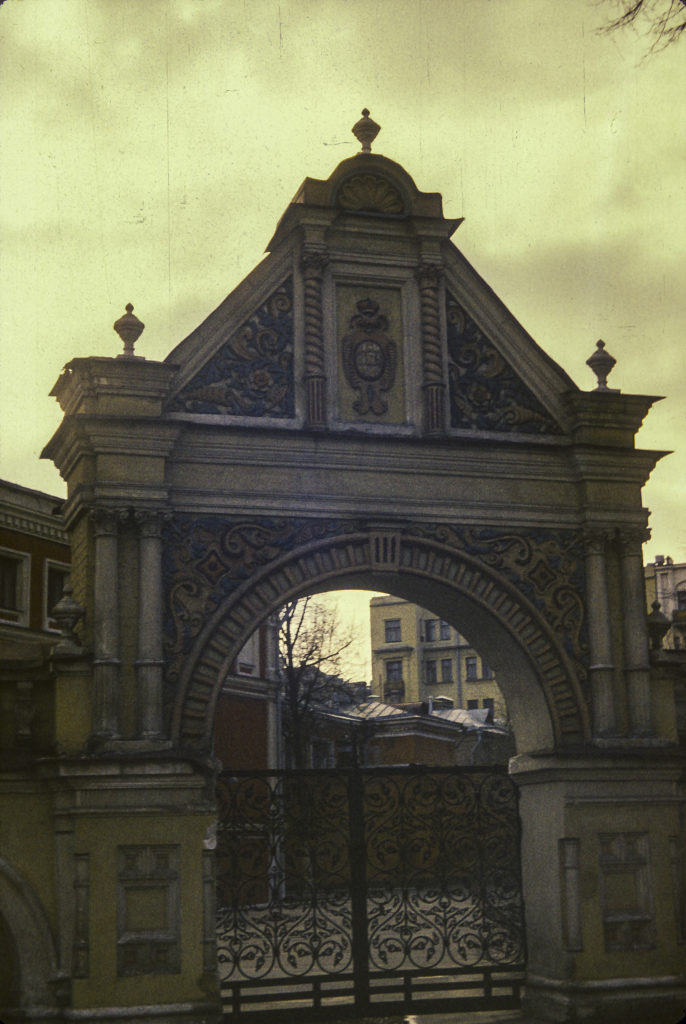
The elaborate gateway to the grounds of the Volkov-Yusupov Palace, with its wrought iron gate.
The Yusupovs were the descendants of Tatar princes of the Nogai horde who had converted to Orthodox Christianity in the 17th century. They were quickly absorbed into the Russian aristocracy and were one of the richest families in Imperial Russia. By the end of the eighteenth century they owned 675,000 acres of land and 40,000 serfs. However, the male line ended in 1891 with the death of Nikolai Borisovich Yusupov, leaving his only daughter, the famous beauty Zinaida Nikolaevna (1861-1939), as heiress. She had married Count Felix Felixovich Sumarokov-Elston (1856-1928) in 1882. Count Felix became commander of the Imperial Guards Cavalry under Nicholas II, and later served as Governor-General of Moscow in 1914-15. After his father-in-law’s death, Tsar Alexander III granted Count Felix the title of Prince Yusupov and the right to pass it on to the couple’s heirs. Their older son, Nikolai, was killed in a duel in 1908; the younger, Felix Felixovich, married a niece of Tsar Nicholas II. He lived primarily in St. Petersburg, where in December 1916 his house became the scene of the murder of Rasputin – in which he participated. For this he was exiled to one of his estates. But after the Tsar’s abdication in February 1917, the Yusupovs went to the Crimea, then emigrated to the West. They lived in Paris, where Felix died in 1967.
Sidsel Larsen and Vera Antonova check out the entrance to the Volkov-Yusupov Palace or Mansion, 21 Bol’shoi Kharitonovskii Pereulok, Moscow, 1973.
In the early nineteenth century (1801-1803), Sergei Lvovich Pushkin, the father of the poet Alexander Sergeevich Pushkin (1799-1837) rented an apartment in the Volkov-Yusupov Palace, and Alexander himself lived there for a while.
In the 1890s Princess Zinaida Nikolaevna Yusupova undertook extensive restoration, including renewal of the stoves with genuine antique tiles.
17th-century palace at 21 Bol’shoi Kharitonievskii Pereulok, Moscow, 1973.
After the Revolution, the Palace housed a series of Soviet institutions, of which the Lenin All-Union Academy of Agricultural Sciences (VASKhNIL) had the longest tenure. But finally, in 2010, after a period of reconstruction, the Palace was reopened as one of the newest museums in Moscow, in one of its oldest buildings; thus its lavishly furnished interior chambers, restored to their former opulence, are now open to the public.
The Volkov-Yusupov Palace, according to its website, is one of the best-preserved residential buildings surviving from Muscovite Russia (15th-17th century). Most such structures, of which there are several dozen, survive only in fragments or else have been reconstructed and remodeled so often that they are now unrecognizable. By contrast, the Volkov-Yusupov Palace is preserved in its original form, with its vaulted ceilings and tiled stoves. There are a few later additions, such as chimneys, but these do not detract from the overall impression of a 17th-century Muscovite dwelling.
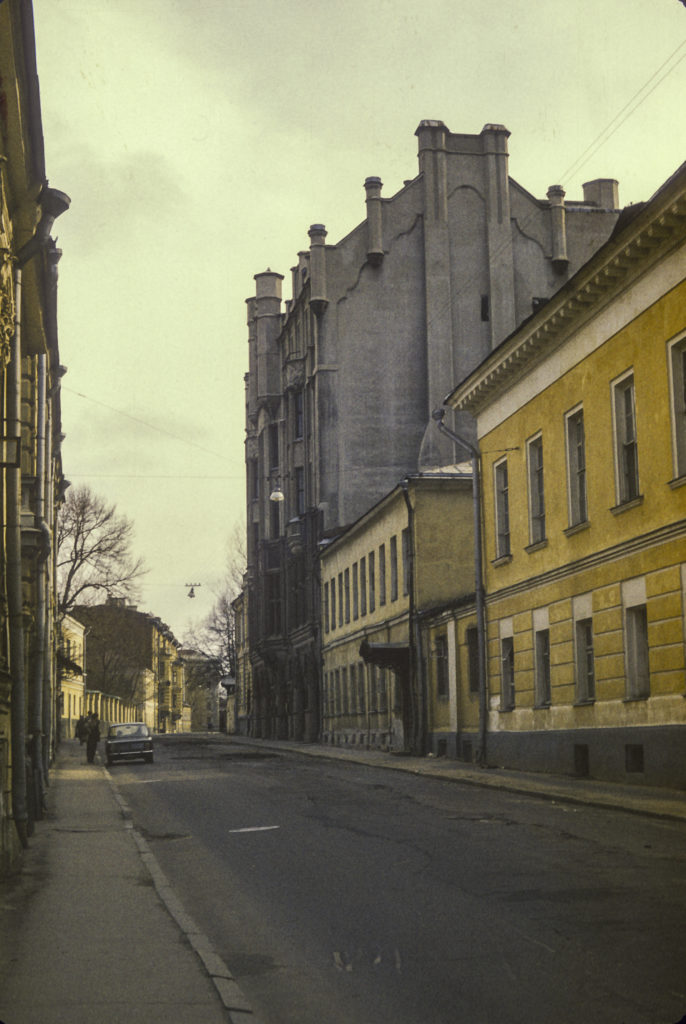
Street scene in Basmanny District, near Chistye Prudy
We continued to explore in the Chistye Prudy area for a little while before heading back to Moscow University. The surrounding neighborhood is said to be venerable and prestigious, and appeared to be relatively well-kept.
Basmanny District, near Chistye Prudy.
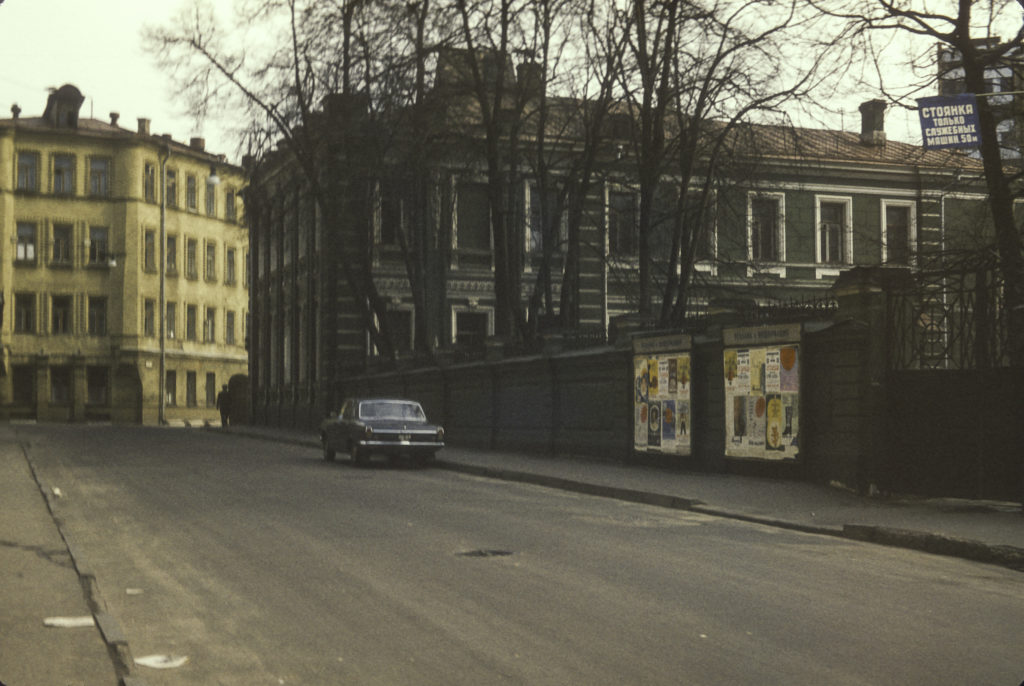
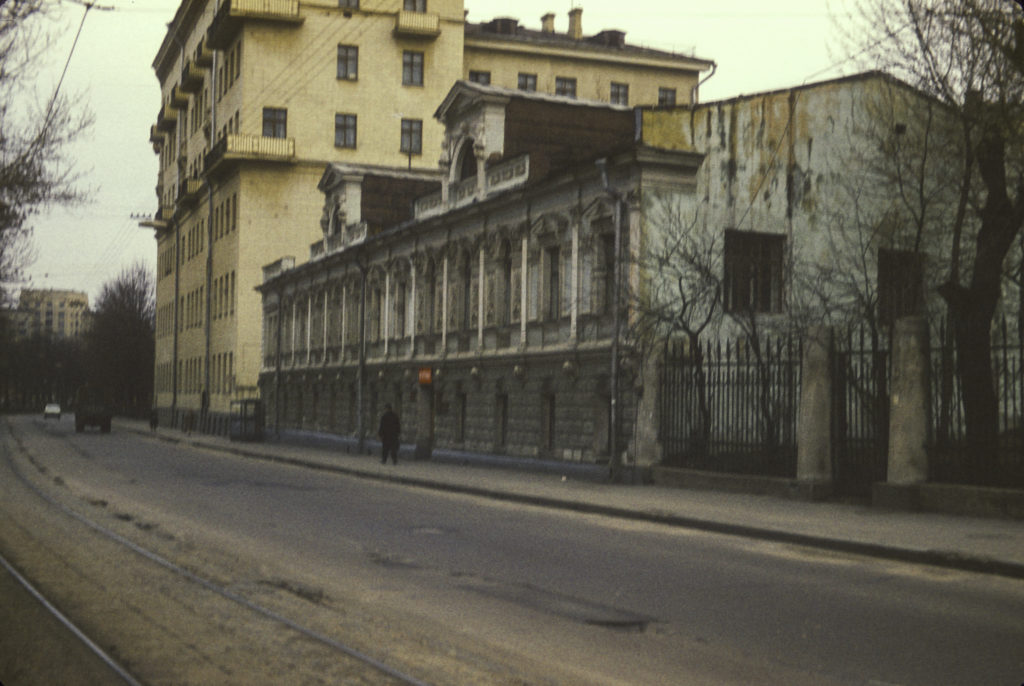
We encountered a few interesting items in our wanderings. For example, the building in the following photo was clearly of pre-revolutionary construction and quite likely had an impressive pedigree, but there was nothing on it in the way of identification.
Basmanny District, near Chistye Prudy. Clearly a historic building, but I don’t know anything about it.
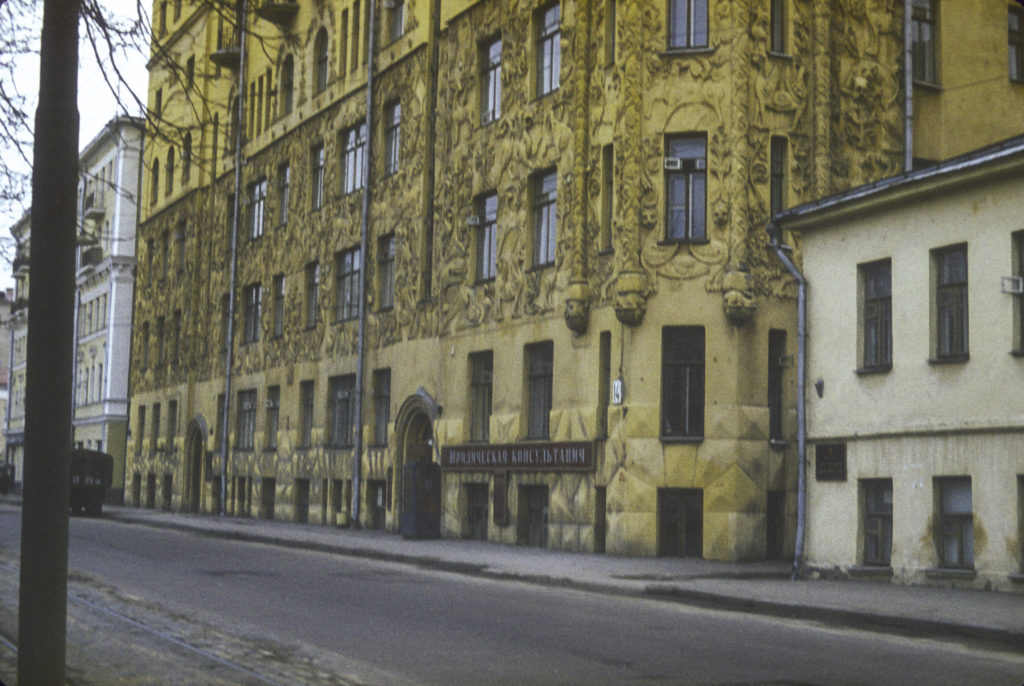
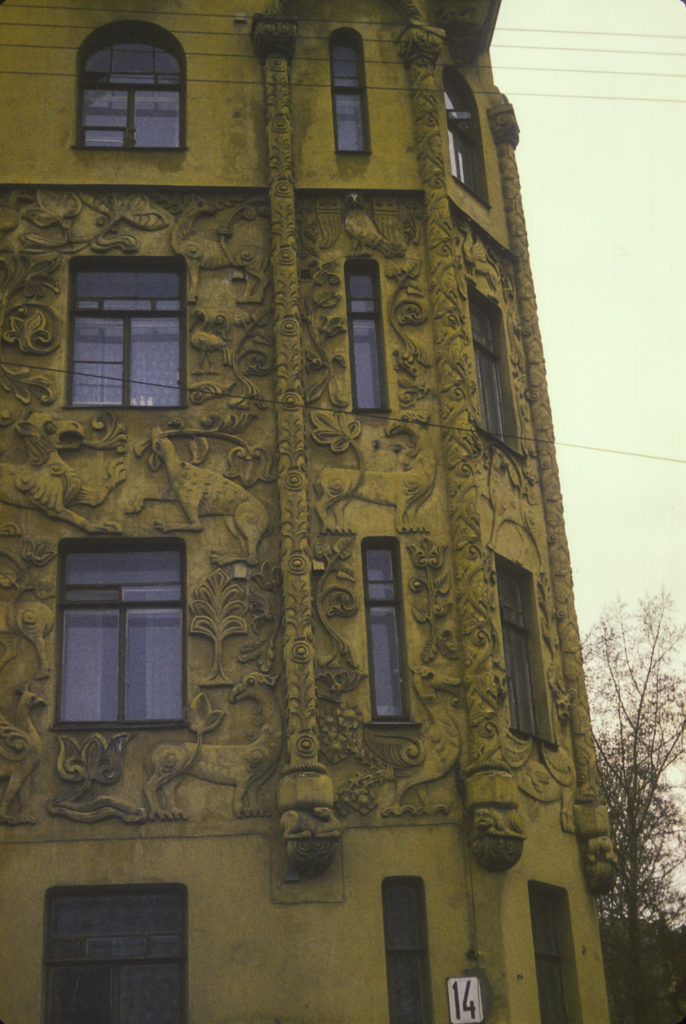
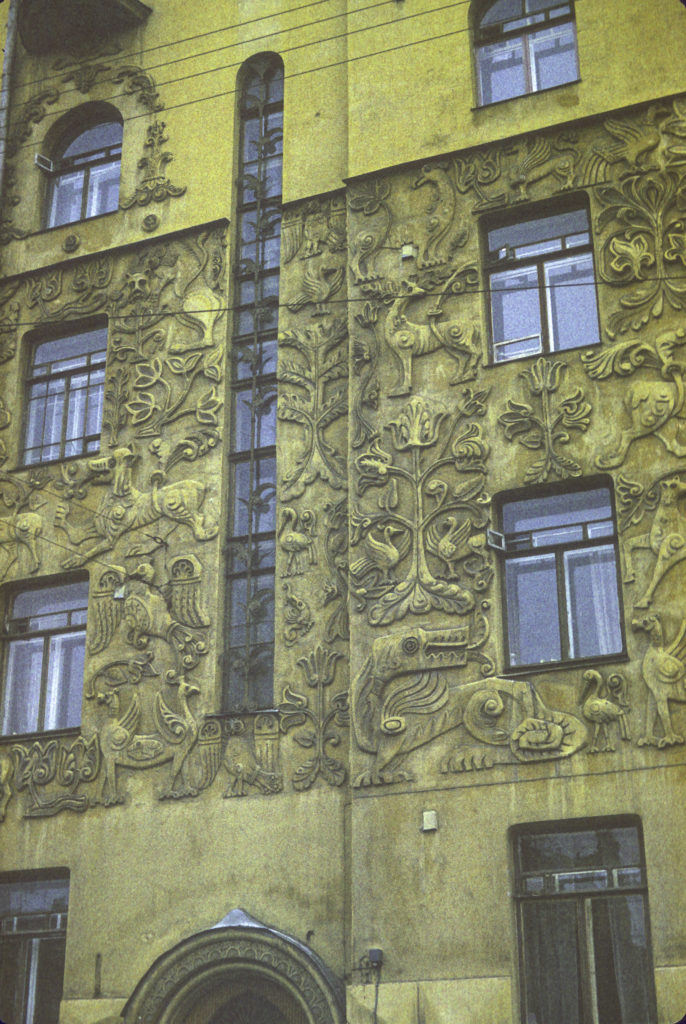
The same was true of the structure in the following few pictures. It appeared to be an apartment building with legal offices on the ground floow. Its salient feature was the elaborate and striking decoration around the second and third stories.
Apartment and office building near Chistye Prudy. The sign on the ground floor reads “Juridical Consultation.”
It would have been nice to find out who built this structure and especially who was responsible for the artistry, but there was nothing to provide any clues about it.
Detail of elaborately decorated apartment building in Basmanny District, near Chistye Prudy
I imagine that the people who lived and worked here led comfortable lives by Soviet standards. I haven’t given up trying to find out more about it, and if nothing else, someday I hope to go back to Moscow and find out more about this and some of the other sights that remained “incognito” in 1973.
I’m still trying to find out who was responsible for the artistic bas-relief type ornamentation on this structure.
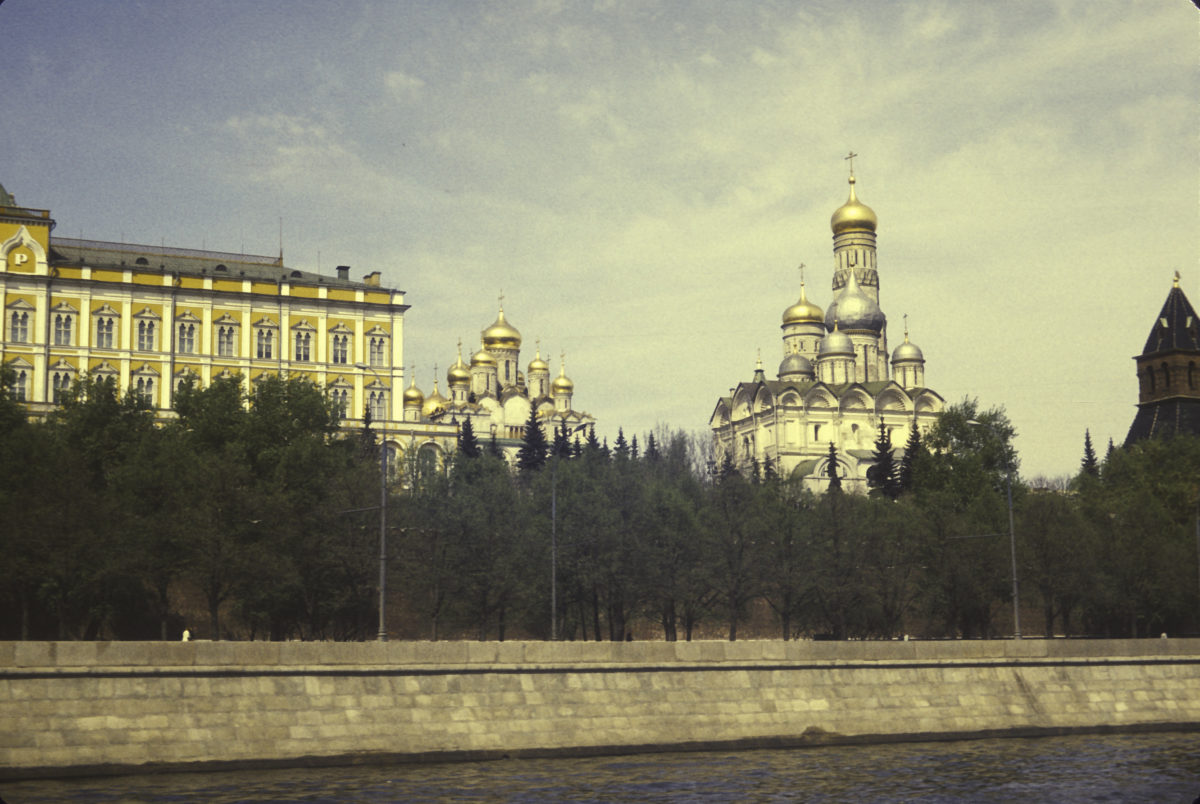
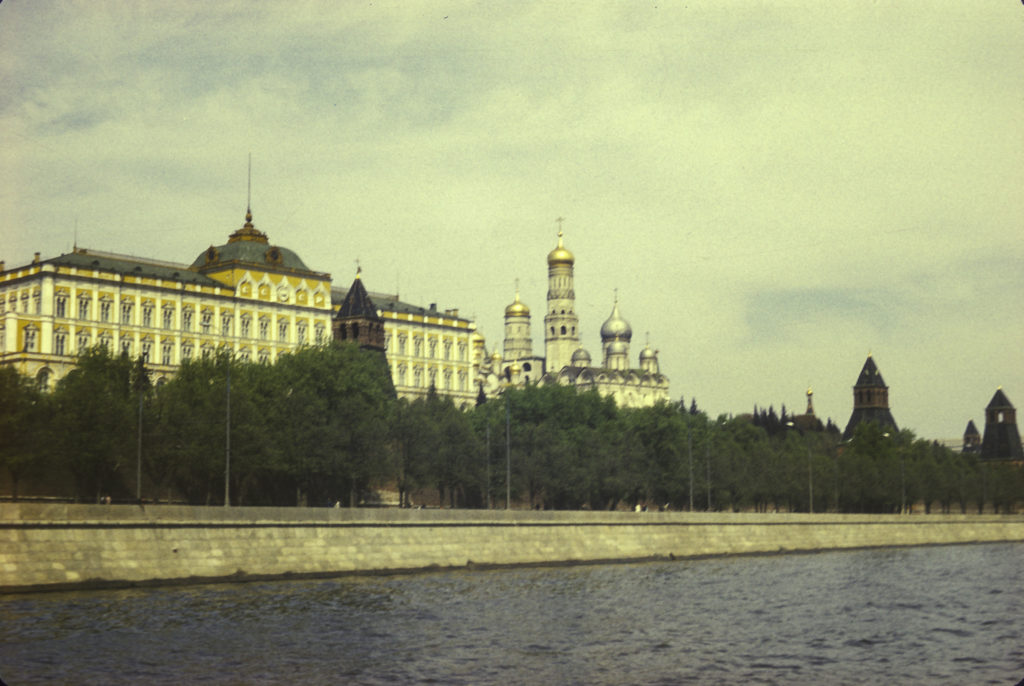
Grand Kremlin Palace on the left; center, Annunciation Cathedral; right, Cathedral of the Archangel and Ival the Great Bell Tower behind it; extreme right, Tainitskaya Tower on the Kremlin Wall.
Early on during my year in the Soviet Union, I took a sightseeing cruise down Moscow River. This is a good way to become acquainted with the layout of the city and some of the major landmarks. Of these the most famous and spectacular is, of course, the Kremlin, with its towers, palaces and cathedrals. But the cruise also provided me an opportunity to become acquainted not only with the major tourist attractions by the river, but also with a number of less well-known sights which don’t make it into the usual “must-see” lists but profoundly enriched my experience of Moscow.
The Moscow River meanders through the city from northwest to southeast in a series of great loops. Moscow University, where I was based, lies at the south end of one of these loops, and the Kremlin lies at the north end, where the river turns south again to form another great loop. Just before the river turns from south to north to form the loop that runs by the University, it passes the Novodevichy Convent, and that is where I’ll begin.
Novodevichy Convent. Right of center is the Cathedral of Our Lady of Smolensk, with the octagonal bell tower behind it;
The Novodevichy Convent dates from 1524, when Grand Prince Vasily III founded it to commemorate his conquest of Smolensk, and indeed the oldest structure and main church, which was built at that time, is named the Cathedral of Our Lady of Smolensk. It soon became the preferred place for the Muscovite aristocracy to send sisters, daughters, etc. whom they found inconvenient for one reason or another. One of its most famous residents was Peter the Great’s half-sister, Sofia Alexeevna, whom Peter forced to retire there after seizing power and ending her regency in 1689. Peter’s first wife, whom he divorced, also lived there toward the end of her life. It was Sofia Alexeevna who had the bell tower, the tallest structure in the convent, built in the 1680s.
The Soviets closed down the convent and turned it into a museum, but during World War II Stalin, in an effort to rally the Orthodox Church in support of the war effort, allowed it to resume a presence there, and since 1994 nuns have again been living in the convent.
Outside the south wall of the convent lies the Novodevichy Cemetery, which is the most fashionable place in Russia to be buried. Such notables as Anton Chekhov, Nikita Khrushchev, Sergei Prokofiev, Dmitri Shostakovich, Boris Yeltsin and Mstislav Rostropovich are interred there.
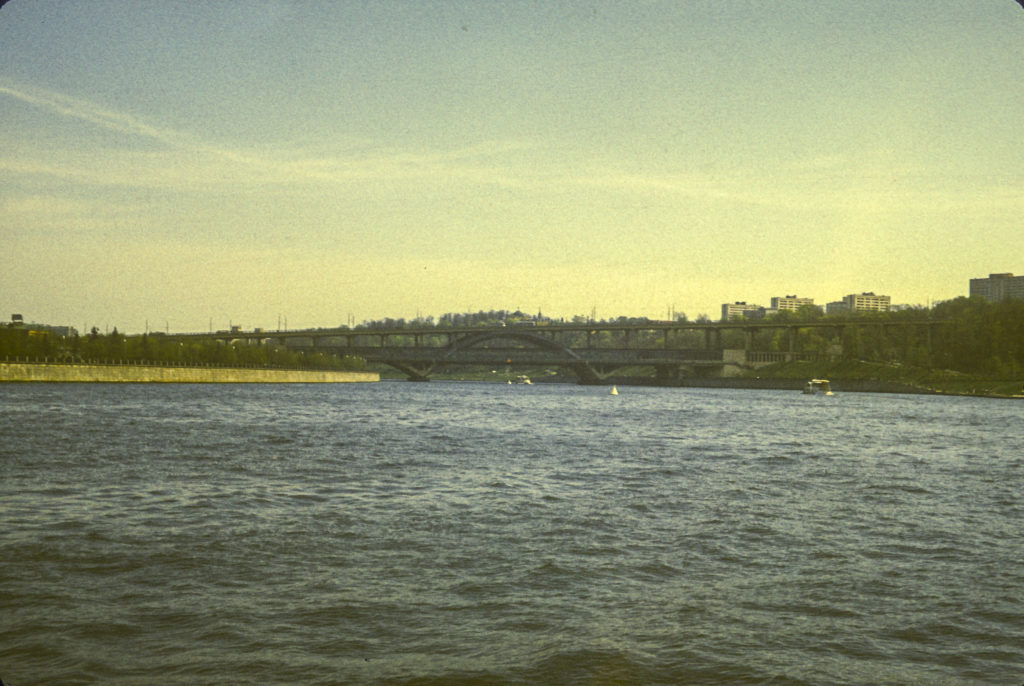
Continuing on around the bend of the river, past Moscow University, you come to the Luzhniki Metro Bridge (Luzhnetsky Metromost), a bridge which accommodates subway trains on the lower level and autos on the upper. It crosses the river from Sparrow Hills (the locale of Moscow University) on the south to the area of the Luzniki sports complex on the north side of the river, in Khamovniki district.
Moscow River – the Luzhnetsky Metromost (Luzhniki Subway-Auto Bridge)
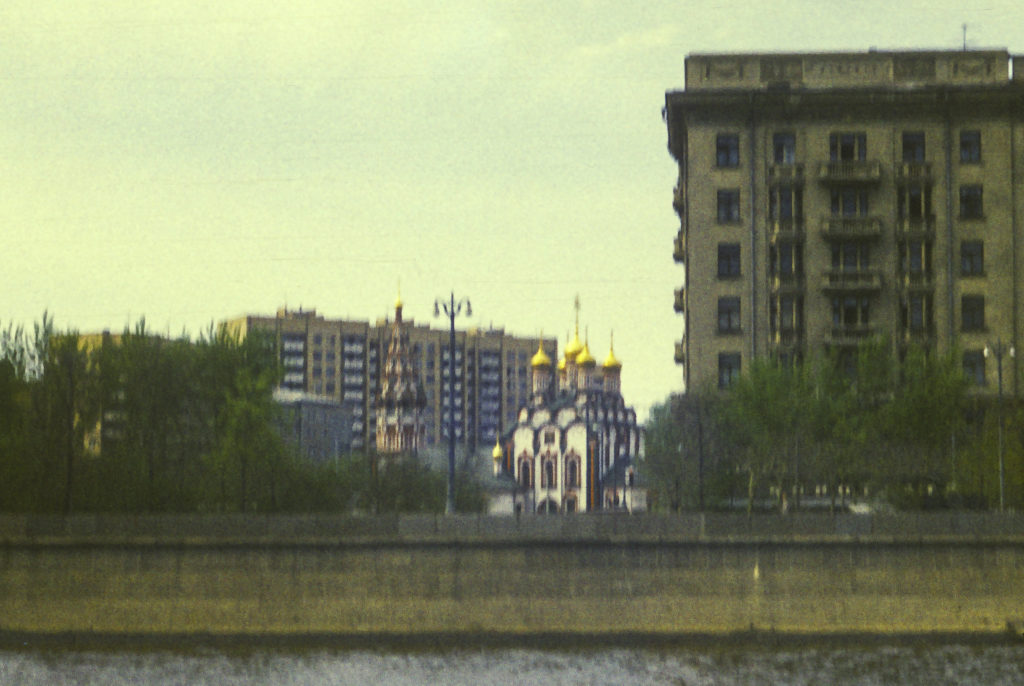
Continuing on up toward downtown Moscow, I passed the Church of Saint Nicholas in the Khamovniki district. This church is a prime example of a flamboyant architectural style flourishing in the later 17th century, featuring rows of tightly packed gables called kokoshniki, in which each arch represents a heavenly fire, and the ensemble of rows taken together symbolizes the throne of God. This type of church is called ognyonnyi khram (bonfire temple) in Russian. The church of St. Nicholas in Khamovniki was built in 1679-82; the bell tower, which retains the tented-roof style popular in the late 16th and early 17th century, was added in the 1690s. The church suffered badly in the fire following the Napoleonic occupation of Moscow in 1812 and was closed until 1849, but after that it remained open continuously, even during the Soviet period, during which it was said to have always been full.
Church of Saint Nicholas in Khamovniki
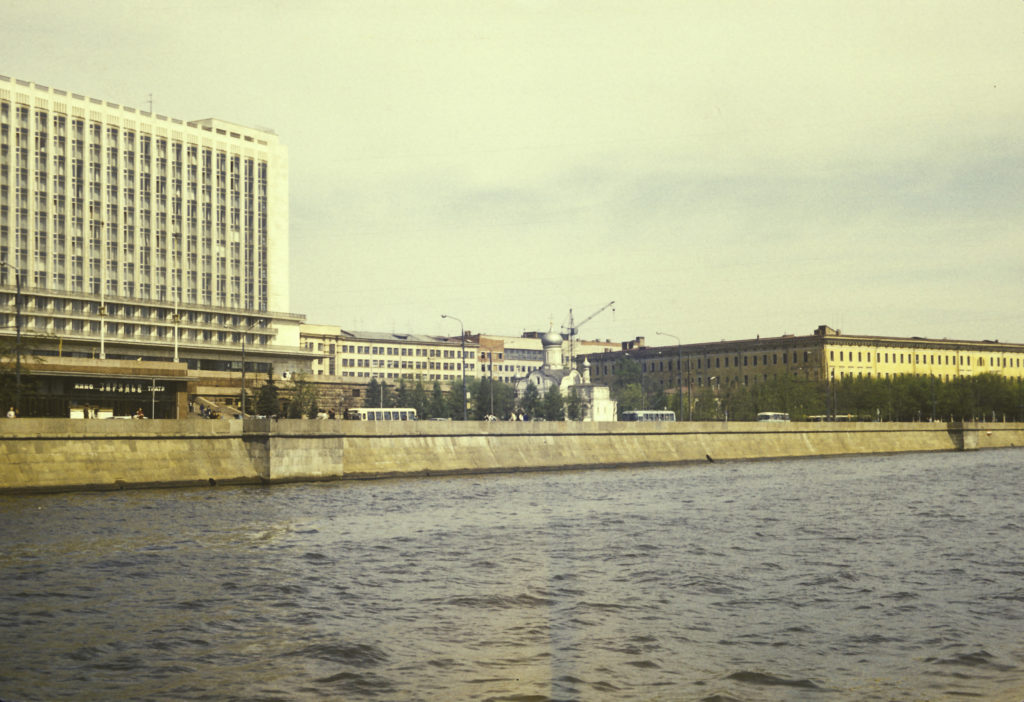
As you approach the center of Moscow, you come to an island in the river known variously as Bolotnyi (Swamp) Island or Balchug. This is an artificial island, created as a by-product of eighteenth-century flood control engineering. After a catastrophic flood in 1783, the main flow of the river was diverted into its present channel and the old riverbed was converted into what is now the Vodootvodnyi (Water Bypass) Canal. The Island sits between the two channels and constitutes the northernmost section of the Zamoskvorechye District. Situated directly across the river from the Kremlin, it contains some of the most expensive and sought-after real estate in Moscow.
The south end of the Island, known as Bersenevka, is now marked by a gigantic (322 feet high) monument to Peter the Great, designed by the sculptor Zurab Tsereteli to commemorate the founding of the Russian navy by that monarch. It consists of several ships piled atop one another with Peter himself standing on the topmost ship. It has been voted one of the ugliest monuments in the world and is said to be generally unpopular among Muscovites, who haven’t forgotten that Peter the Great hated Moscow and moved the capital to St. Petersburg.
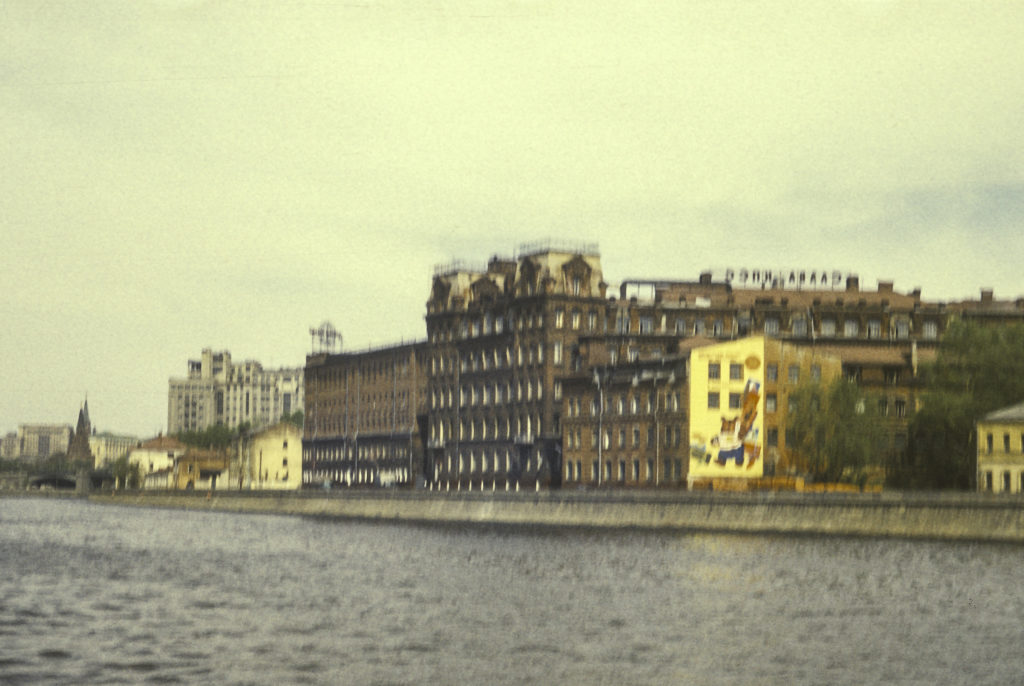
The central portion of the Krasnyi Oktyabr chocolate factory. The factory was relocated to the outskirts of Moscow in 2007, and the building now houses shops, studios and other businesses, including the headquarters of the news service Snob.ru.
But that monument was erected in 1997, 27 years after I was there, so I have never seen it in person. A little way north of where it now stands, I photographed a set of brown buildings with a sign on top proclaiming “Glory to the Communist Party of the Soviet Union” (which sounds as ridiculous in Russian as it does in English). This was the Red October chocolate factory. It was founded in the 19th century by a German named von Einem and supplied confectionery to the Russian Imperial court until the Revolution of 1917, when it was nationalized by the Bolsheviks and renamed to Red October. After the collapse of the Soviet regime it was privatized. In 2007 the factory itself was relocated to the outskirts of Moscow, and today the old factory building houses various shops, restaurants, studios and offices, including the Deworkacy Red October coworking space, the Digital October Conference Center, the Boy Cut Red October barbershop, the Moscow Point Red October Hotel, and the news service Snob.ru. It has of course been spruced up a bit since then.
The Krasnyi Oktyabr (Red October) chocolate factory in the Bersenevka area of Bolotnyi Ostrov. The sign on the top of the highest building says “Slava KPSS”, i.e. “Glory to the Communist Party of the Soviet Union.” In the distance are visible some of the Kremlin towers and the gray House on the Embankment, formerly an apartment building housing members of the Soviet elite.
Downriver from the Red October) chocolate factory stood (and still stands) an apartment complex known today as the House on the Embankment (Dom na naberezhnoi in Russian), but formerly known as “Government House” (Dom Pravitelstva). This is a Constructivist-style structure built in 1931 to house civil servants, especially high-ranking ones, in apartments that were considered luxurious for the time. The architect was Boris Iofan, who also designed the Palace of Soviets, which was to be built on the site of the Cathedral of Christ the Savior (Khram Khrista Spasitelya), but became the site of the Moscow open-air swimming pool instead. Government House became notorious for the frequent and unremarked disappearances of its residents during the later 1930s – fully a third of them are said to have vanished without trace. Nowadays, the complex has shops and movie theaters as well as apartments. Although their amenities have been eclipsed by newer developments, the apartments are still very much in demand due to their location.
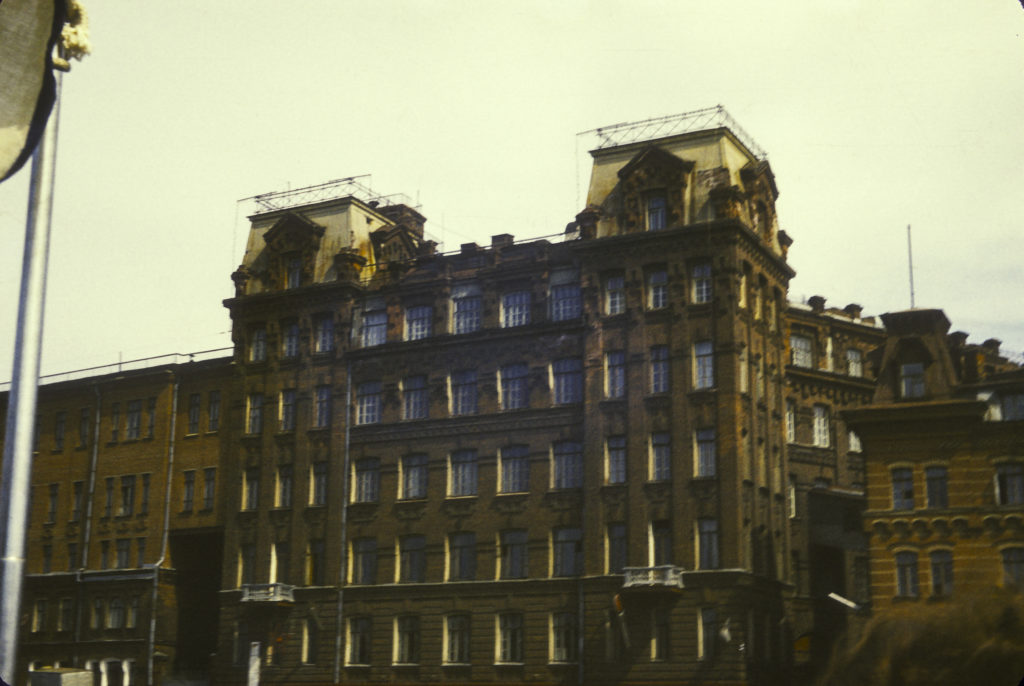
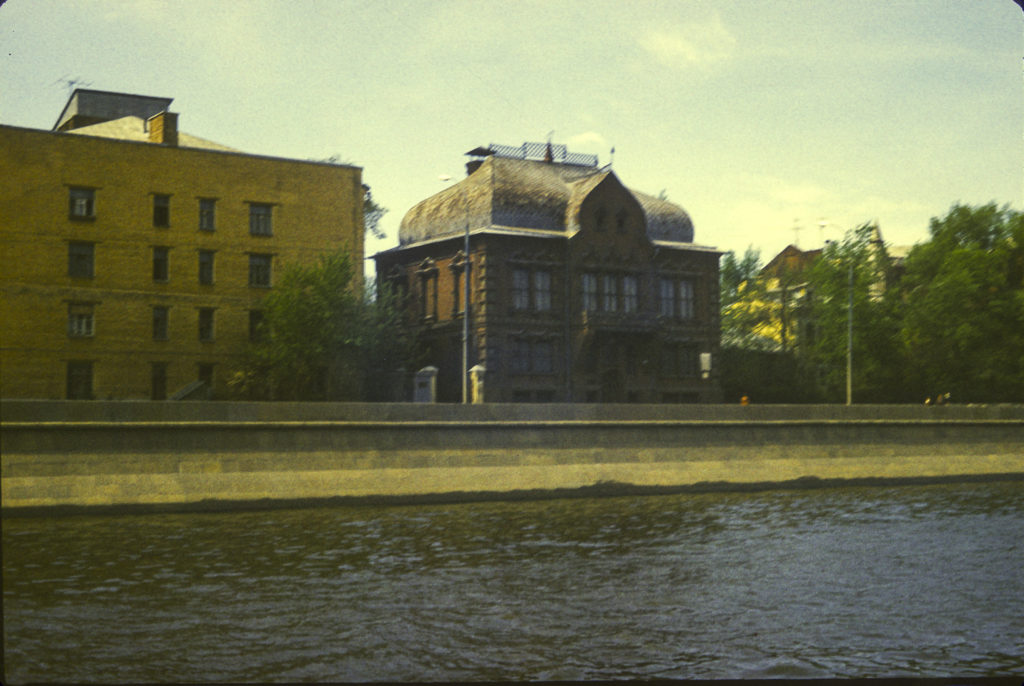
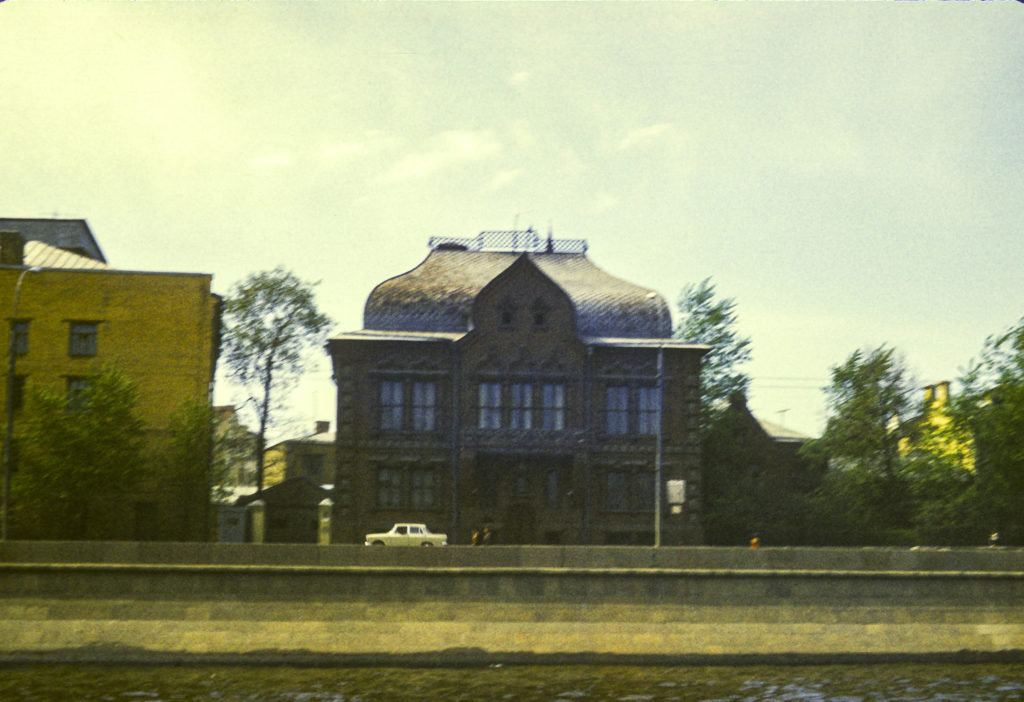
On the opposite side of the river from the Red October chocolate factory I observed an unusual mansion, which I was unable to identify at the time, but subsequent research has revealed it was built by a wealthy art collector named Ivan Tsvetkov in 1900 to house his collection of paintings.
Osobnyak Tsvetkova (Tsvetkov Mansion). Built 1901 by Ivan Evmeniyevich Tsvetkov to house his art collection. Now serves as office of the French Defense Attaché.
During World War II, the Tsvetkov Mansion was assigned to a military mission representing a Free French combat aviation unit, the Normandy-Niemen regiment, formed in the Soviet Union. Currently, the mansion houses the office of the French defense attaché as well as an exposition devoted to the history of the Normandy-Niemen regiment.
Another view of the Tsvetkov Mansion.
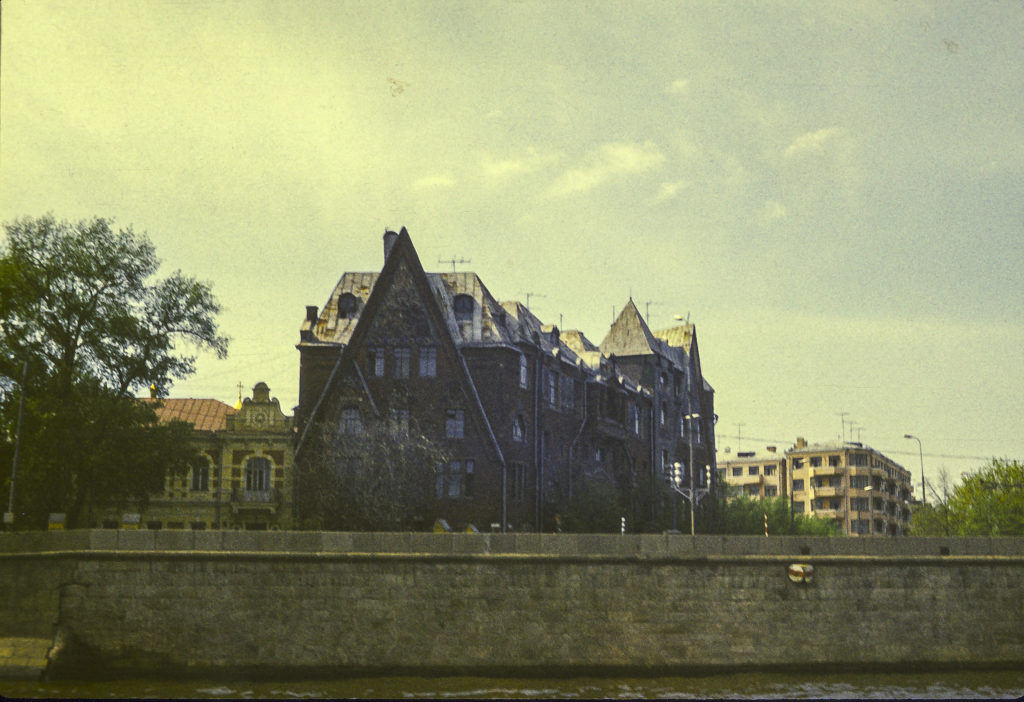
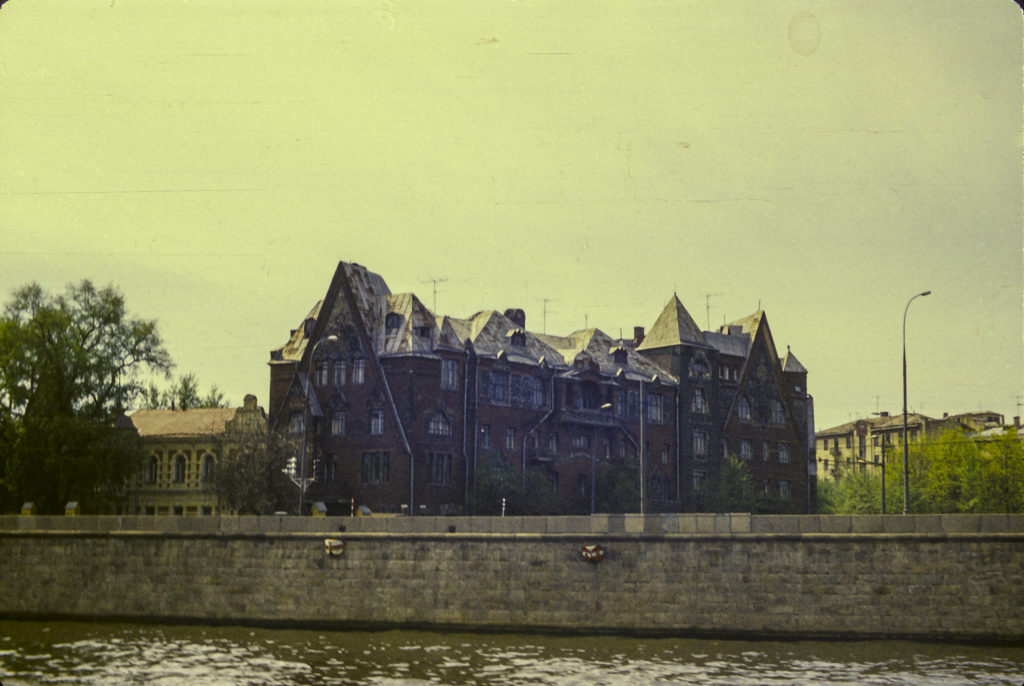
A few doors downstream from the Tsvetkov Mansion, I encountered an even more unusual house, which I was told was occupied by the Ethiopian Embassy. I doubt whether this was accurate, but I’ve since discovered that the house was built in 1905-07 by a well-to-do railway magnate named Petr Nikolayevich Pertsov, who intended it as a guest-house with residential apartments and workshops for artists and theatrical people.
Dom Pertsova (House of Pertsov) – guest-house with residential apartments and workshops for artists and theatrical people. Built 1905-1907.
Tsvetkov may have sold or given Pertsov the land on which to build the house in return for a promise to make it a showcase of Russian art. In any case, it turned out to be a prime example of the flourishing of the art nouveau movement in Russia. If I had had a telephoto lens, I could have captured some of the extraordinary mosaics, figures of birds, animals, fantastic creatures and other decorations adorning the exterior of the building; you can view a few of them on Marina Pavljuk’s web page, which is a source for some of the information presented here. The artist responsible for the artwork was Sergei Maliutin, who is credited with originating the nested wooden Matryoshka dolls.
Another view of the Pertsov House, which is now occupied by the Russian Foreign Ministry and is closed to the public. The building next to it on the left houses the Embassy of Madagascar.
After the Revolution of 1917, the Bolsheviks confiscated the Pertsov house, as they did everything else, and turned it into a hostel for military officers. Nowadays it houses offices of the Foreign Ministry of the Russian Republic, so the interior remains closed to the public.
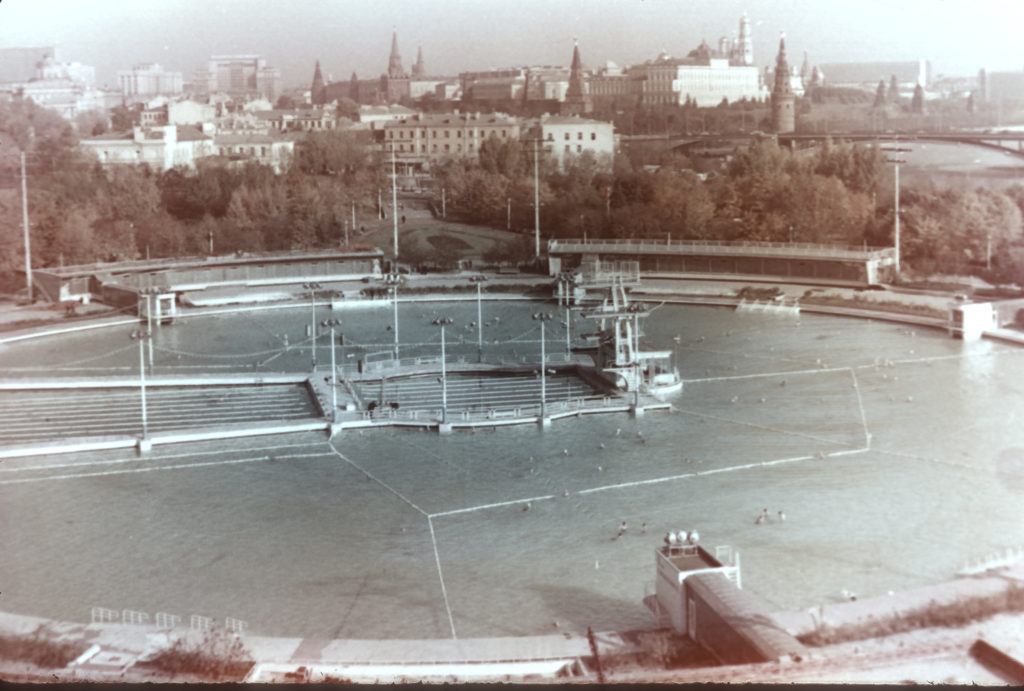
The Pertsov house is just a hop, skip and jump away from the next big attraction on the Moscow River, which is the Cathedral of Christ the Savior, but that, as I’ve noted elsewhere, did not exist when I was in Moscow in 1972-3. What did exist was the enormous outdoor swimming pool, which was not visible from Moscow River but which I had photographed in my earlier visit in 1964. I’ve included one of the badly faded color slides I bought in Moscow while I was there, just for laughs.
The Moscow Swimming Pool, with the Kremlin in the background (photo not taken by me)
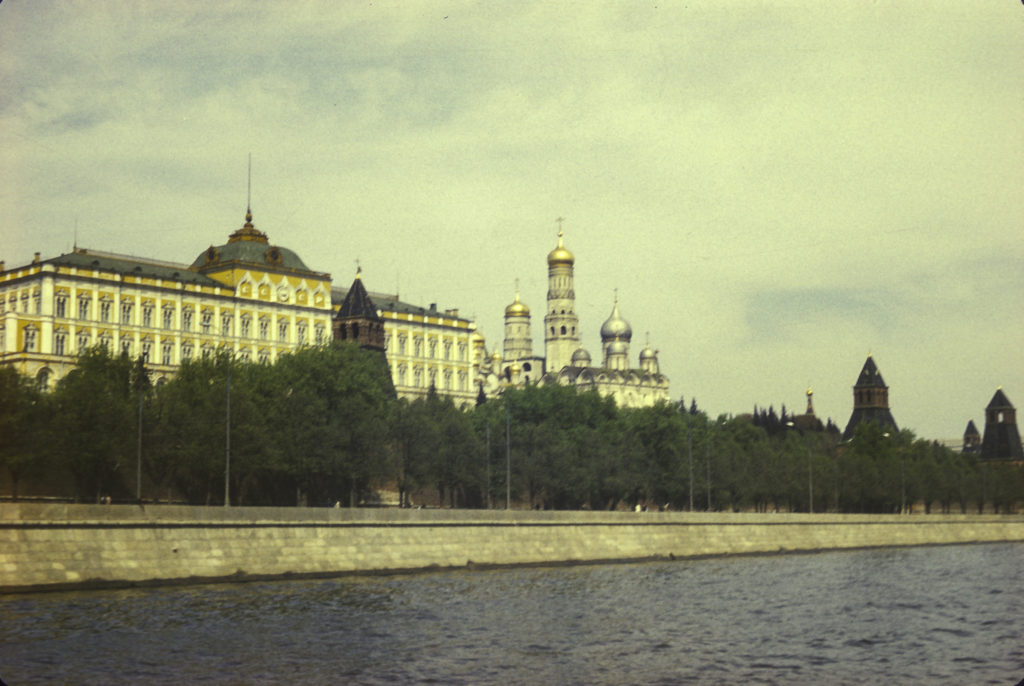
And so, after passing under the Big Stone Bridge (Bol’shoy Kamennyi Most), I came to the Kremlin. I had, of course, been inside the Kremlin walls in 1964, and had photographed the wonders within; in 1972-73 I went inside the Kremlin several times, but seeing it from the river provides a different perspective. Most immediately you notice the towers on the Kremlin wall, because they are right in front of everything else. Each tower has a name and its own story.
The Moscow Kremlin. Grand Kremlin Palace on the left, Blagoveshchenskaya (Annunciation) Tower in front of it on the Kremlin Wall; center, Annunciation Cathedral, Cathedral of the Archangel Michael and Ivan the Great Bell Tower; right, Tainitskaya Tower and Vtoraya Tower on the Kremlin Wall.
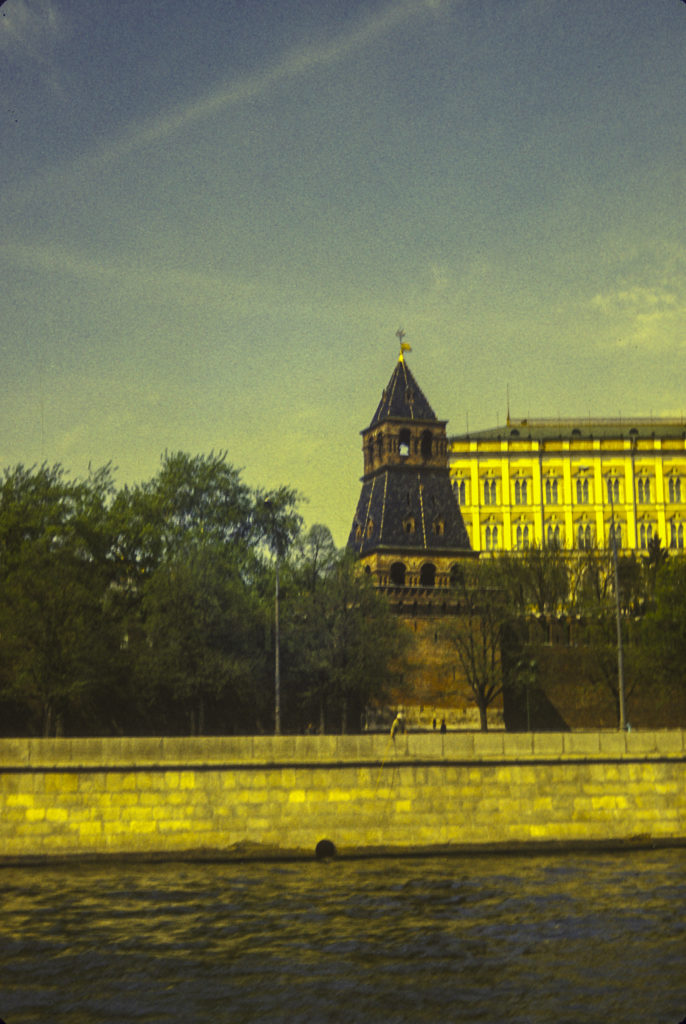
For example, the Blagoveshchenskaya Tower, pictured here, was built in 1488 and named for a miracle-working icon which was kept there. Ivan the Terrible used it as a prison. (Actually, there are two unnamed towers, but even these have names – the First and Second Unnamed Towers, respectively.)
Blagoveshchenskaya (Annunciation) Tower on the Kremlin Wall
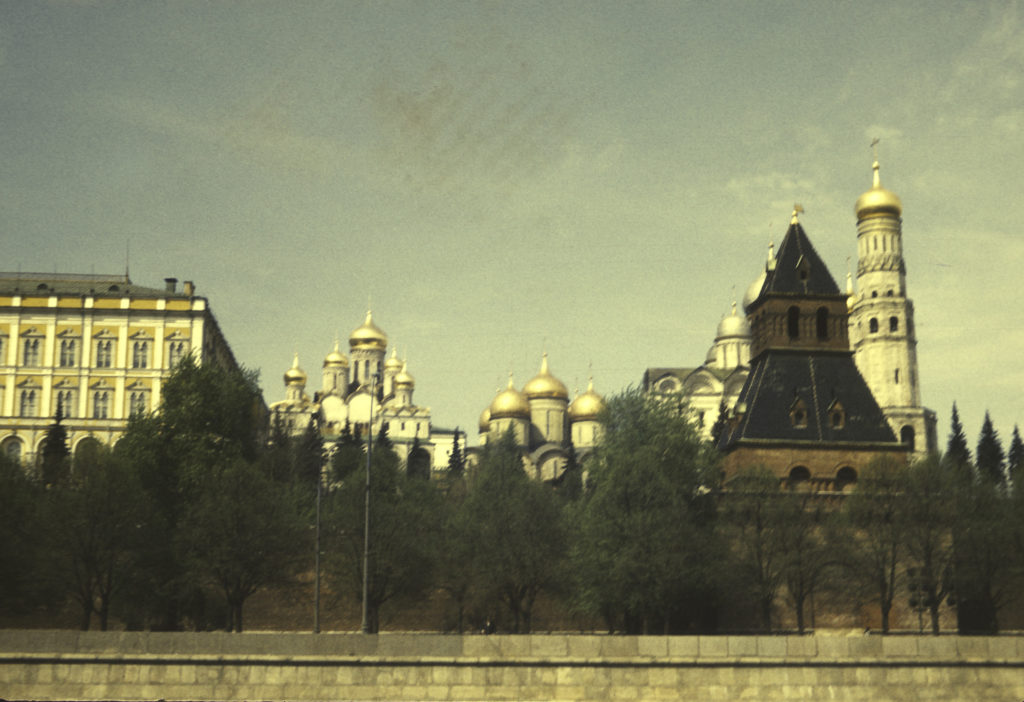
The Tainitskaya Tower, shown in the next picture, was so named (taina = “secret”) because it had a secret well, fed by a tunnel from the Moscow River. It was built in 1485. Like the Tainitskaya, the First and Second Unnamed Towers were built in the fifteenth century.
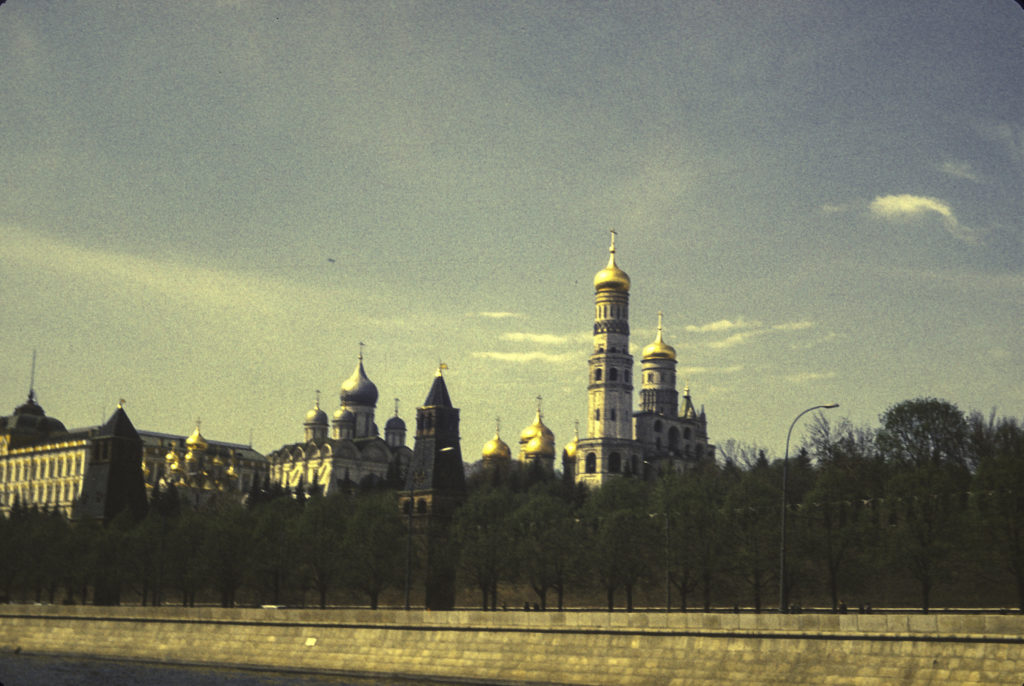
Grand Kremlin Palace on left, Cathedrals of the Annunciation, Dormition and Archangel Michael in center, Ivan the Great Bell Tower at right, the last two partially obscured by Tainitskaya Tower on Kremlin wall.
The Grand Kremlin Palace (Bol’shoi Kremlyovskyi Dvorets) was built during the reign of Nicholas I to be the Moscow residence of the Emperor; construction lasted from 1837 to 1849. The chief architect was Konstantin Andreevich Thon (or Ton), who also fulfilled that role for the Kremlin Armory and the Cathedral of Christ the Savior. I was surprised to find out that the Palace, which appears to have three stories, actually has only two, and that the two upper rows of windows both belong to the second floor. The Grand Kremlin Palace has an area of 25,000 square meters, over 700 rooms and five major reception halls. In the picture below, one may see the letters “CCCP” (which would be “SSSR” in the Latin alphabet, standing for “Soyuz Sovetskikh Sotsialisticheskikh Respublik”, i.e. Union of Soviet Socialist Republics) embedded between the pointed arches in the center section, between the windows and the roof; these were removed after the collapse of the Soviet Union.
Grand Kremlin Palace on the left, with Blagoveshchenskaya (Annunciation) Tower in front of it on the Kremlin wall; in the center, Annunciation Cathedral, Cathedral of the Archangel Michael and Ivan the Great Bell Tower; right, Tainitskaya Tower and the Pervaya Bezymyannaya (First Unnamed)Tower on the Kremlin Wall.
Of the three cathedrals in the Kremlin which are visible in the pictures displayed here, the oldest is the Uspensky Sobor (Cathedral of the Dormition), built between 1475 and 1479. It has five golden domes, symbolizing Christ and the Four Evangelists. It was the official venue for the coronation of Russian rulers from 1547 to 1896.
The next to be built was the Blagoveshchensky Sobor (Cathedral of the Annunciation), completed in 1489. Although it has nine golden domes, four more than the Uspensky, it is the smallest of the three major Kremlin cathedrals. It is the one immediately next to the Grand Kremlin Palace and is actually connected to the Palace. Ivan III had it built as his personal chapel, and from the time of Ivan IV it was the church where members of the royal family were baptized and got married.
The largest of the three, the Cathedral of the Archangel Michael, was begun in 1505 and completed in 1509. Ivan III died in 1505 and was buried there, as were his successors until the time of Peter the Great, when the Peter-Paul Cathedral in St. Petersburg became the burial place of the Russian rulers. The exception was Peter II, who died in Moscow and was buried in the Archangel Michael Cathedral.
The tallest structure in the Kremlin is not a cathedral but the Bell Tower of Ivan the Great. (Ivan III was called Ivan the Great because of his enormous appetite for gobbling up the lands of his neighbors – he tripled the territory of the Muscovite state – as well as for throwing off the Mongol yoke once and for all, promulgating a new law code and renovating the Kremlin.) Like the Archangel Cathedral, it was begun in 1505 and completed after Ivan’s death, in 1508. It has 22 bells, 18 small and 4 large. Napoleon Bonaparte tried to blow it up in 1812, but failed.
On the Kremlin wall, the Tainitskaya and Pervaya Bezymyannaya Towers; Grand Kremlin Palace at left; Annunciation, Dormition and Archangel Michael Cathedrals in center; right of center, Ivan the Great Bell Tower
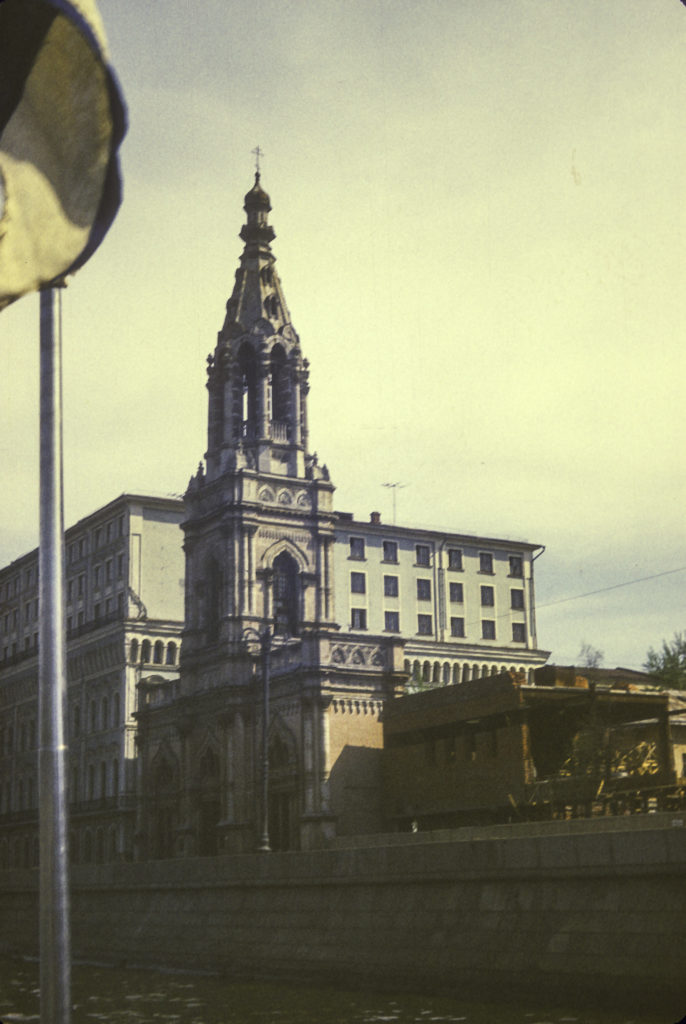
On Bolotny Island, directly opposite the Kremlin, stands the Saint Sophia Church in Middle Sadovniki (Khram Sofii Premudrosti Bozhiyey V Srednikh Sadovnikakh). Actually, from the river only the bell tower of the church is visible; the main part of the church is hidden behind the bell tower and obscured on either side by large waterfront buildings. I don’t know what was in the flanking structures in 1972, but today the headquarters of Rosneft (Russian Oil), the world’s largest publicly traded oil company and the third largest company in Russia (Gazprom and Lukoil being first and second respectively), occupies the right-hand building, while the one on the left belongs to the Ministry of Defense. The St. Sophia Church dates from the mid-17th century and is thought to have been established by merchants from Novgorod, where St. Sophia’s is the main center of worship. The church gave its name to the Sofia Embankment of the Moscow River, on which it stands. The Soviets closed the church in 1930 and turned it into communal apartments. It was reopened as a church in 2004 and now has its own web page.
Mid-17th century; stands on Sophia Embankment opposite the Kremlin; building next to it is Rosneft HQ
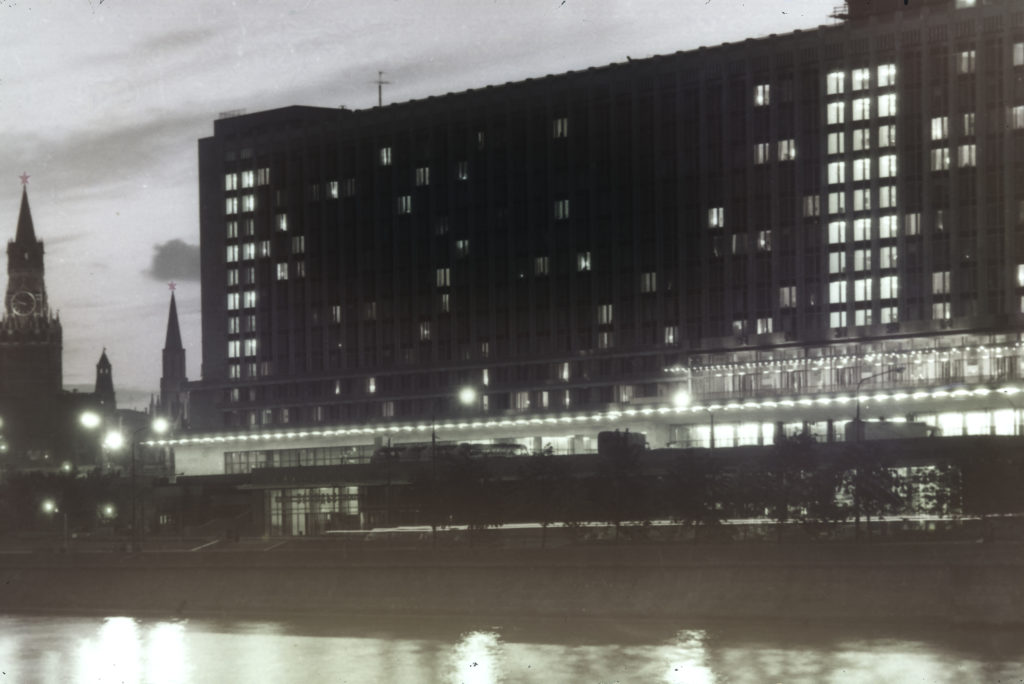
Continuing on past the Kremlin, I encountered the Hotel Rossiya. This was a gigantic hotel built in the Sixties, on the site of what was originally intended for the construction a Stalin-era skyscraper similar to Moscow University, the Hotel Ukraine and the other so-called “Seven Sisters.” The Zaryadye Administrative Building, as it was to be called, would have been the eighth Sister, but that project was canceled after Stalin’s death.
Hotel Rossiya at dusk from Moscow River; Kremlin at left. I did not take this picture; it is one of the Soviet tourist slides I purchased in Moscow, which have lost their color over the five decades since.
The Rossiya as finally built had 3,000 rooms, 245 half-suites, and a 2500-seat concert hall. Counting the central tower, which however was quite small in square footage compared to the main part of the hotel, it had 21 stories. It was designed to accommodate about 4,000 guests and was the largest hotel in the world until 1990, when it was topped by the Excalibur in Las Vegas, but it remained the largest in Europe until 2006.
One of its salient design peculiarities, dictated by the paranoiac Soviet emphasis on security and surveillance, was the paucity of exits. (I encountered the same situation in Moscow State University while I lived there.) This was intended to make it as difficult as possible for guests to enter or leave the building unseen, thereby making it easier for the hotel staff and security forces to keep track of their movements. But this feature had lethal consequences in 1977, when a major fire broke out in the hotel, resulting in the deaths of 42 people, some of whom perished because they couldn’t make it to the few available exits in time.
The hotel had other problems as well. It was noted for surly service, lousy food, ubiquitous cockroaches, bad beds, and radios that received only one station and could be turned off only by unplugging them. It was also considered an architectural blight, tasteless and ugly as well as incompatible with surrounding landmarks, such as the Kremlin. Finally, in 2006, it was demolished. At first the city government contemplated replacing it with another hotel, but eventually the site was converted into a park, which it remains today.
Hotel Rossiya with the Church of the Conception of St. Anna in the Corner on the Moat at right.
Next to the Hotel Rossiya, there stood and still stands a charming little Orthodox church with the improbable name of the Church of the Conception of St. Anna in the Corner on the Moat. I have not been able to find out much about this church, other than that it was built in 1493, and the picture I took of it is not very good; but you can see better pictures of it on the internet. The church survived both the construction of the hotel and its demolition, and now stands by itself in Zaryad’ye Park.
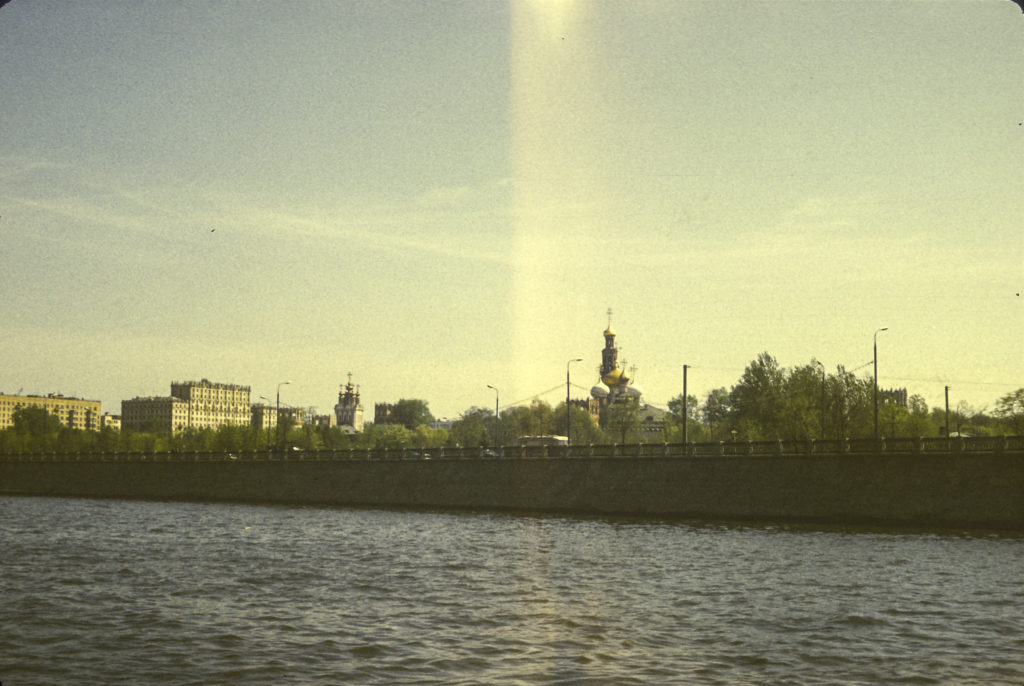
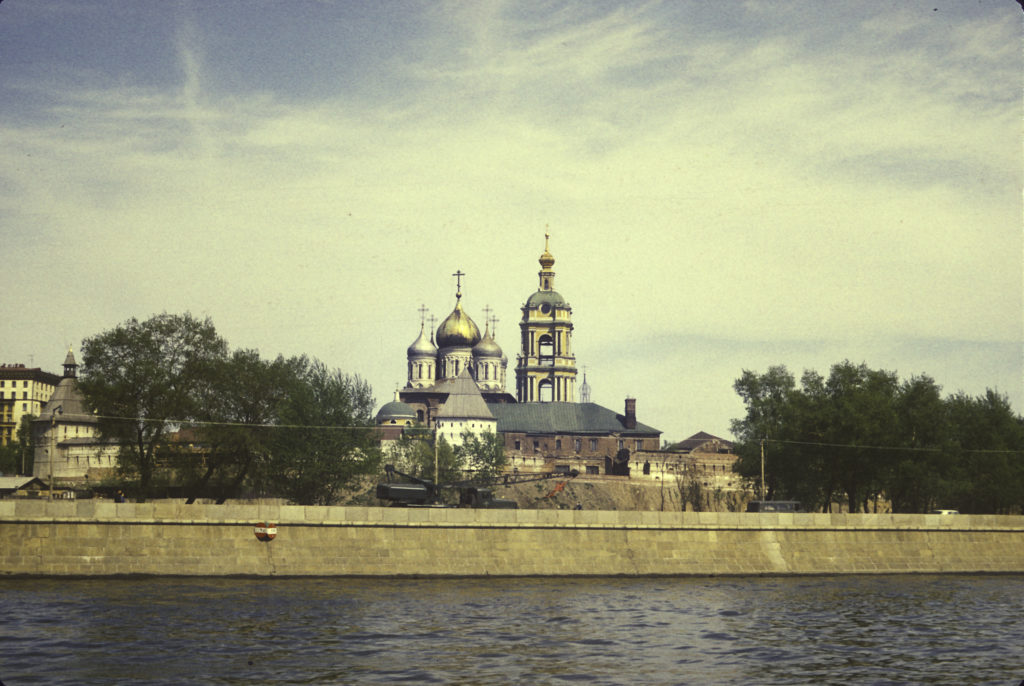
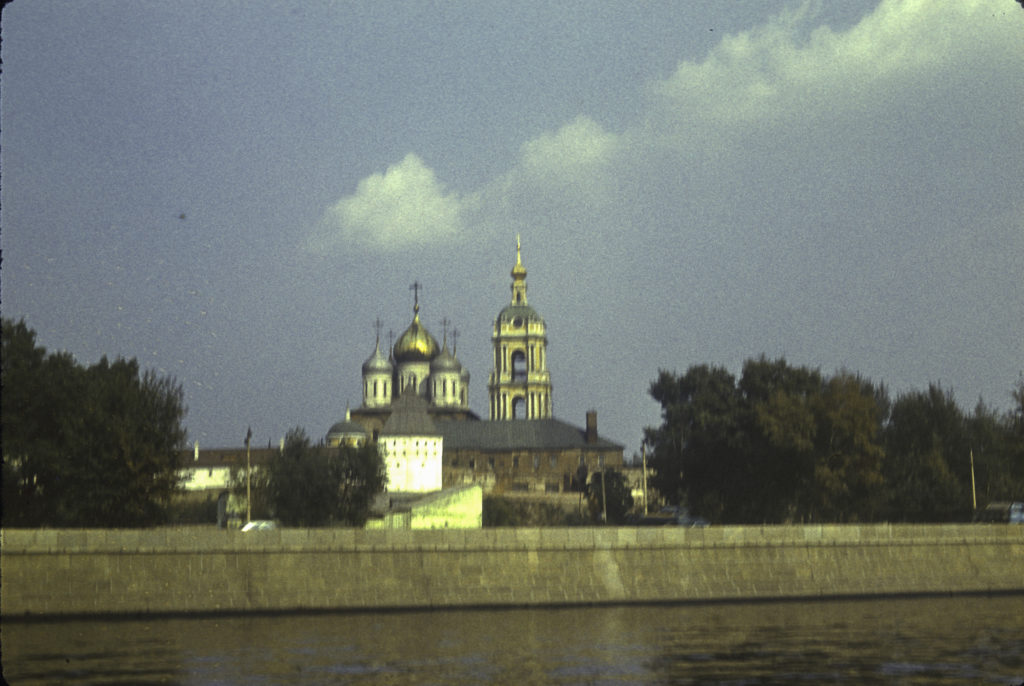
The last couple of photos from my Moscow River cruise are of the Novospassky (“New Savior”) Monastery. The “New” refers to the monastery rather than the Savior, and denotes the fact that it had an antecedent in the Kremlin. The Novospassky dates from 1491, but most of the buildings currently standing were erected in the 17th century. The Romanov family patronized the monastery in the 16th century, and it served as their burial ground. It was heavily fortified (note the white defensive towers anchoring the corners of the walls in the pictures) and withstood sieges by the Crimean Tatars, who sacked Moscow in 1571 and attacked again in 1591.
The Novospassky Monastery, on the banks of Moscow River in the Taganka district
But the Novospassky really came into its own after the Romanovs became the ruling family of Muscovy in the 17th century. In the 1640s they commissioned the construction of the main cathedral of the monastery, the Preobrazhenskii Sobor (Cathedral of the Transfiguration), and other structures followed, including the grandiose bell tower in the 18th century.
Novospassky Monastery: the round white structure with the tent roof is one of the towers that anchor the corners of the wall, with the Cathedral of the Transfiguration (Preobrazhensky Sobor) behind it and the bell tower rising above all in back.
The Soviets used the monastery as a prison and a police drunk tank until the 1970s, when it was turned over to an art restoration institute; but it was returned to the Orthodox Church after the Revolution of 1991.
This post is about two excursions I took in the Moscow area in the spring of 1973 – one to a former royal estate called Kolomenskoye, the other to the Donskoy Monastery in southeast Moscow.
The name Kolomenskoye (accent on the second syllable) owes itself to its location, several kilometers to the southeast of central Moscow on the road leading to the ancient town of Kolomna (now an industrial center; the Kolomna 37D diesel engine was the standard powerplant for Soviet submarines in World War II and after).
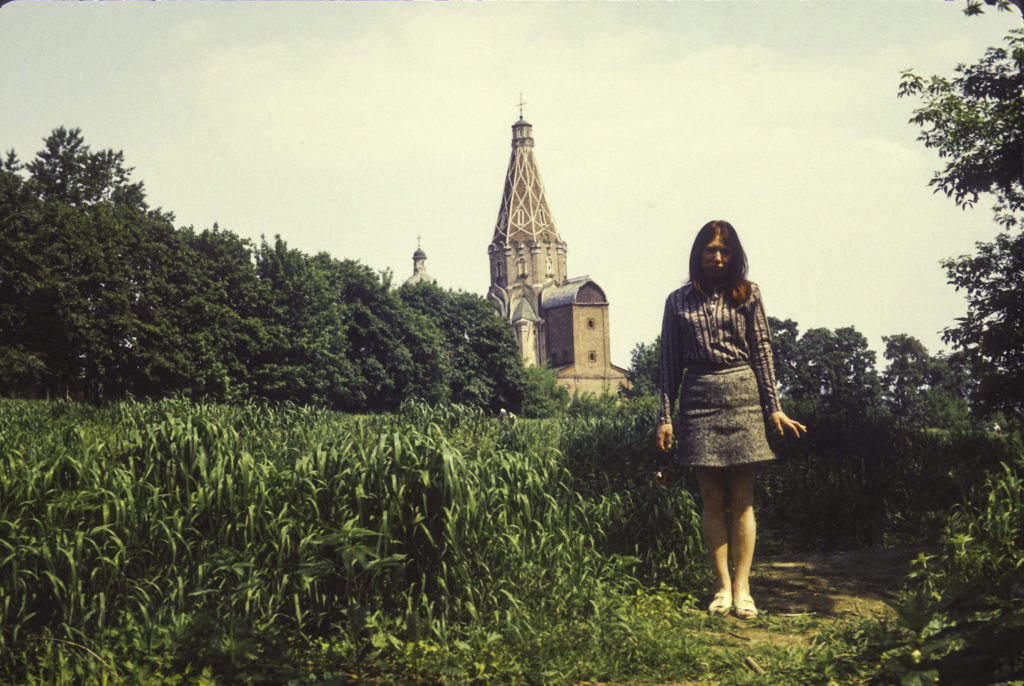
Vera posing in a field in front of the Church of the Ascenion at Kolomenskoe, spring 1973.
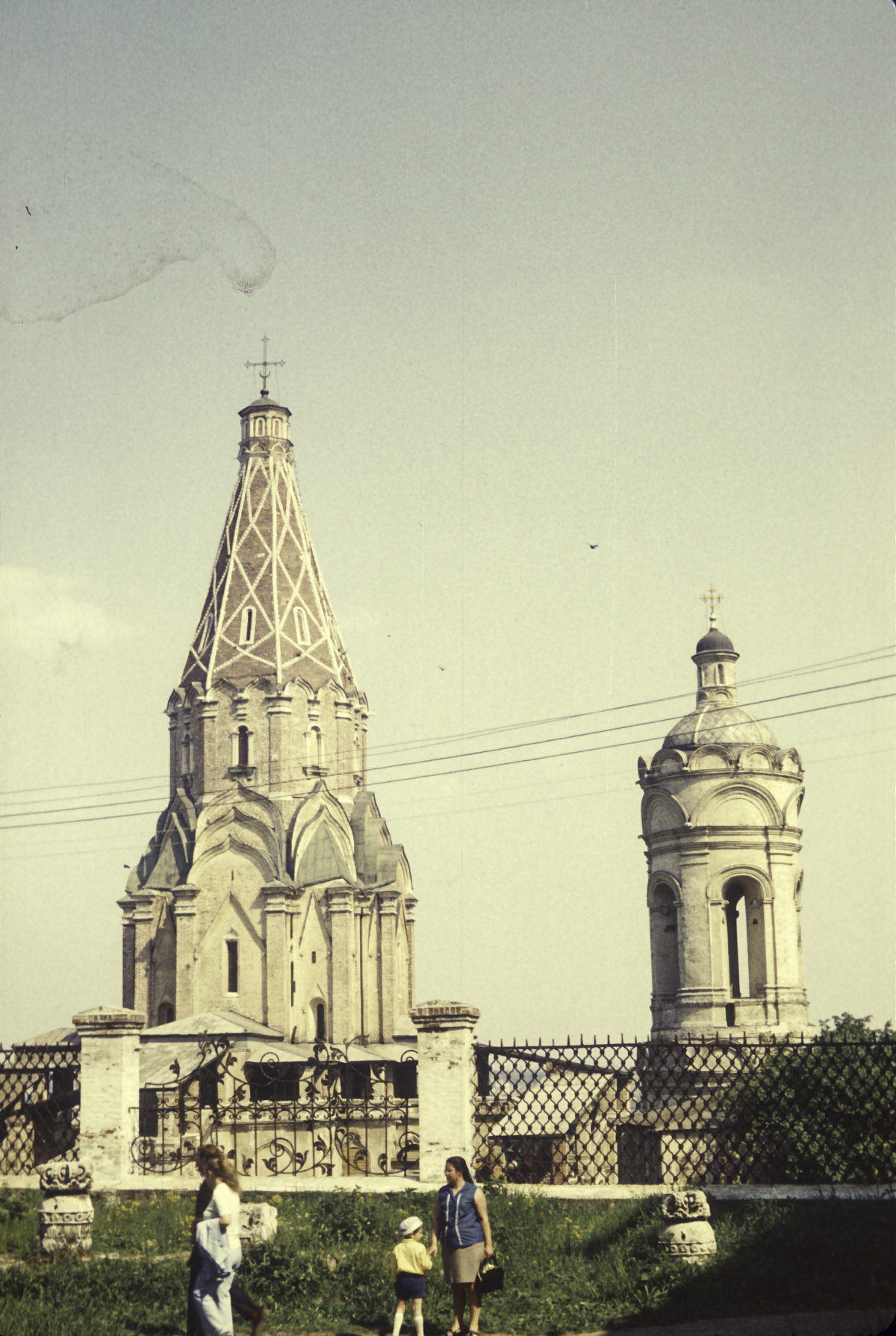
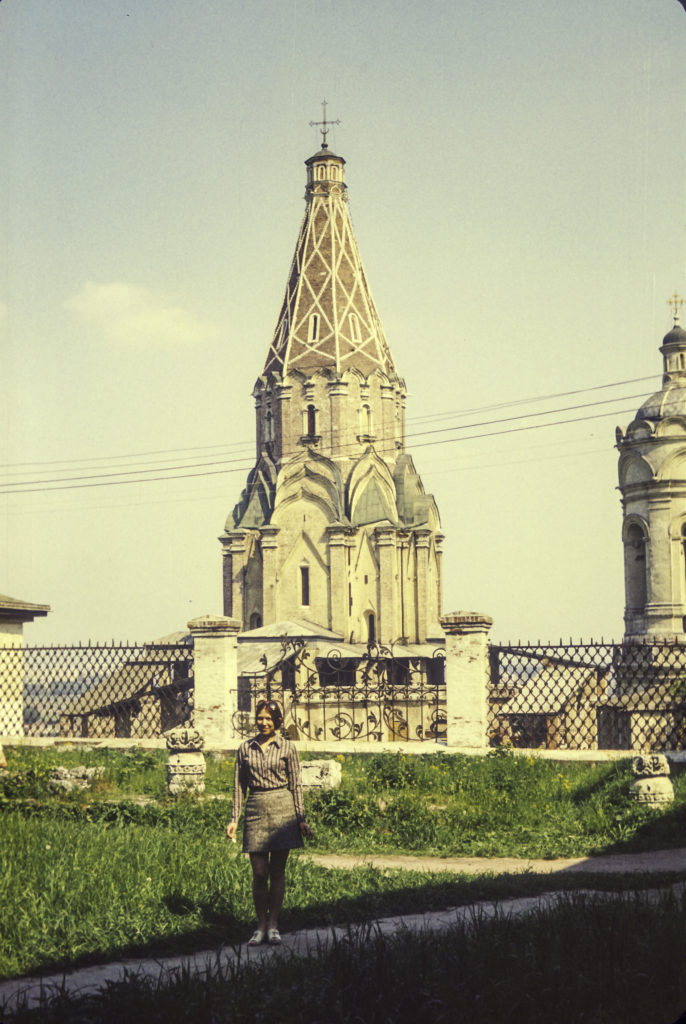
Kolomenskoye came to prominence as the site of the Church of the Ascension, built in 1532, toward the end of the reign of Grand Prince Vasily III of Muscovy, to commemorate the birth of an heir to the throne, who grew up to be Ivan IV – the Terrible. The church represented a dramatic departure from previous Russian tradition, which relied on Byzantine models, though with distinctive Russian features such as onion domes. The Church of the Ascension drew its inspiration from small wooden parish churches of the Russian north country, which were built with tent-shaped roofs to prevent snow from building up on them during the hard winters. The construction of the Ascension Church in Kolomenskoye started a trend, with tent-roofed churches becoming widespread during the reign of Ivan the Terrible and afterward; it is represented in St. Basil’s Cathedral on Red Square. The trend came to a halt in the mid-17th century with the advent of Patriarch Nikon, who considered tented roofs to be un-canonical. He favored a more flamboyant style with rotundas and rows of corbel arches called kokoshniki, as exemplified in the Church of St. Nicholas at Khamovniki.
Church of the Ascension, built in 1532 during the reign of Grand Prince Vasily III of Muscovy to commemorate the birth of an heir to the throne, who turned out to be Ivan the Terrible
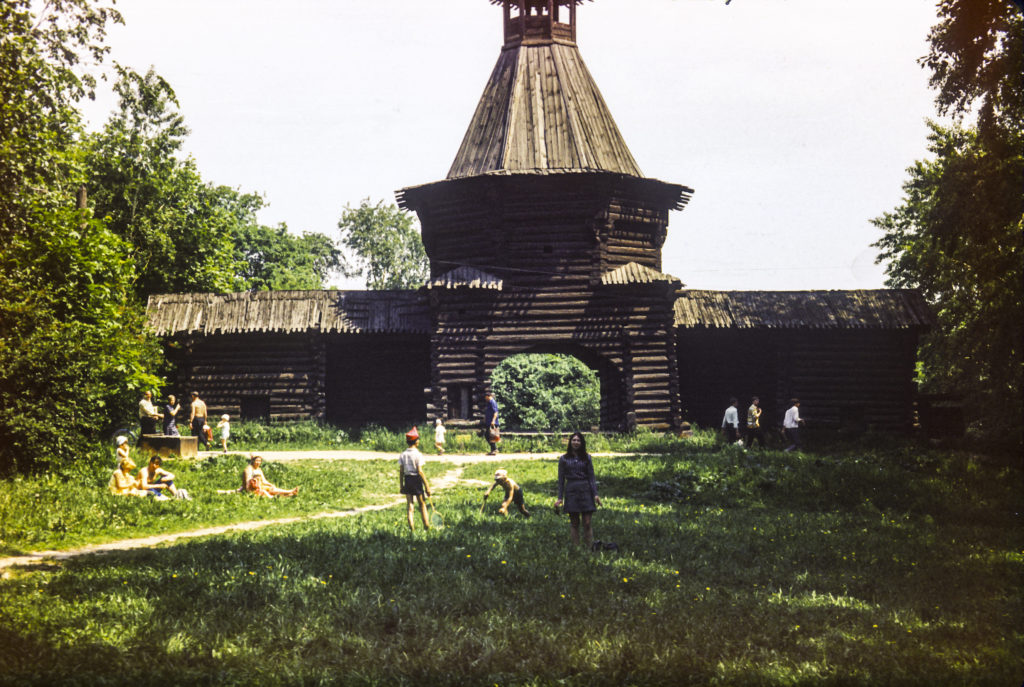
During the Soviet period, a number of old wooden buildings and other objects of historical significance were relocated from various regions of the USSR to Kolomenskoye to ensure their preservation. One such building was the barbican (gate) church of the Nikolo-Karelskoe Monastery. Located in the far north of Russia, in the port of Severodvinsk on the coast of the White Sea, this monastery was one of the first places encountered by English sailors on the Chancellor expedition of 1553 in their quest to open trade with Muscovy. The monastery still exists, but the wooden gateway, which contains a small church, is now in Kolomenskoe Park.
Barbican Church of the Nikolo-Karelskoe Monastery, transported from Severodvinsk by the Soviets
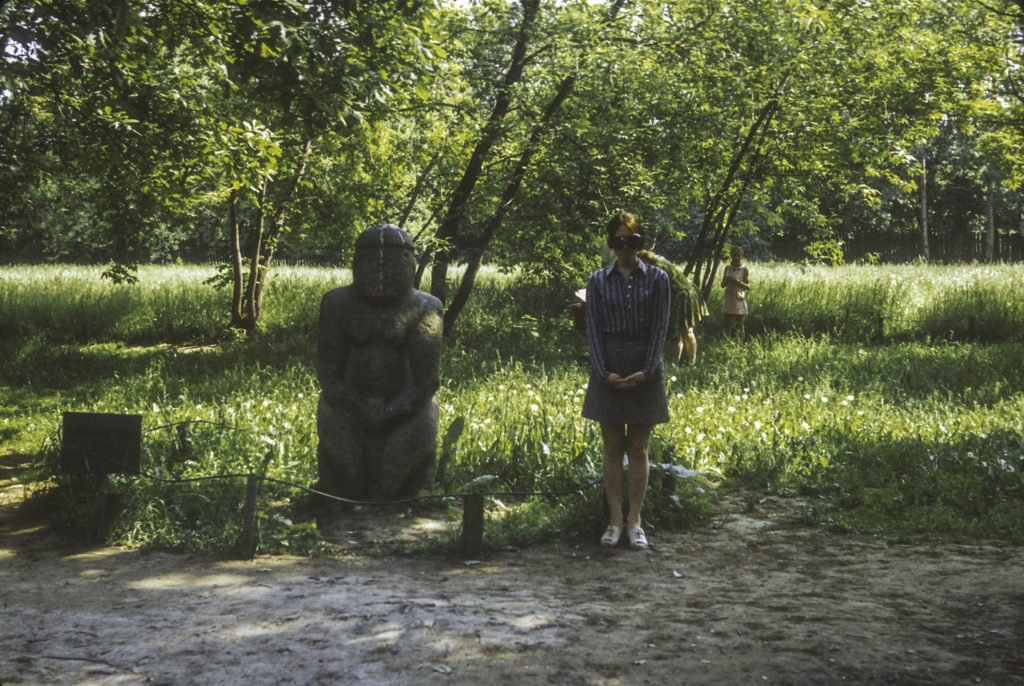
Another object which I suspect was transported from elsewhere, most likely the Far East, was a stone Buddha-like figure standing off by itself in a remote corner of the park. Vera posed next to it with her hands folded just like the statue. Unfortunately I didn’t write down the words on the sign next to it, so I don’t have any information about its provenance, and there is nothing about it on the Kolomenskoye website. Sometime I’ll go back there and rectify that omission.
Vera emulating the pose of the statue. Kolomenskoye Park, spring 1973.
Tsar Alexei Mikhailovich, who reigned from 1645 to 1676, built a great wooden summer palace at Kolomenskoye, which became his favorite residence. Peter the Great, despite his aversion to Moscow, spent time in Kolomenskoye, and his daughter, the future Empress Elizaveta Petrovna, was born in the palace in 1709. Sadly, in 1768 Catherine the Great tore down the palace, which by her time had fallen into decrepitude. She built a new, less grandiose stone-and-brick palace, but it in turn was demolished in 1872. The post-Soviet Moscow city government undertook a full-scale restoration of the 17th-century wooden palace and finished it in 2010, and next time I visit Moscow I’ll be sure to see it.
Donskoy Monastery
The Donskoy Monastery was founded in 1591 on the site where a church holding a famous icon, Our Lady of the Don, had previously been located. The monastery was founded to commemorate the deliverance of Moscow from a raid by the Crimean Tatars. However, it remained a stepchild for many years. The first cathedral was on the humble side – after the cataclysmic upheavals of the reign of Ivan the Terrible, resources were lacking for grandiose building projects. But in the late 17th century, new and generous donations of land and serfs began to flow in, and in 1684 the Regent Sofia Alekseevna began the construction of a much more pretentious cathedral, known as the New or Great Cathedral.
The New or Great Cathedral, built in the late 17th Century
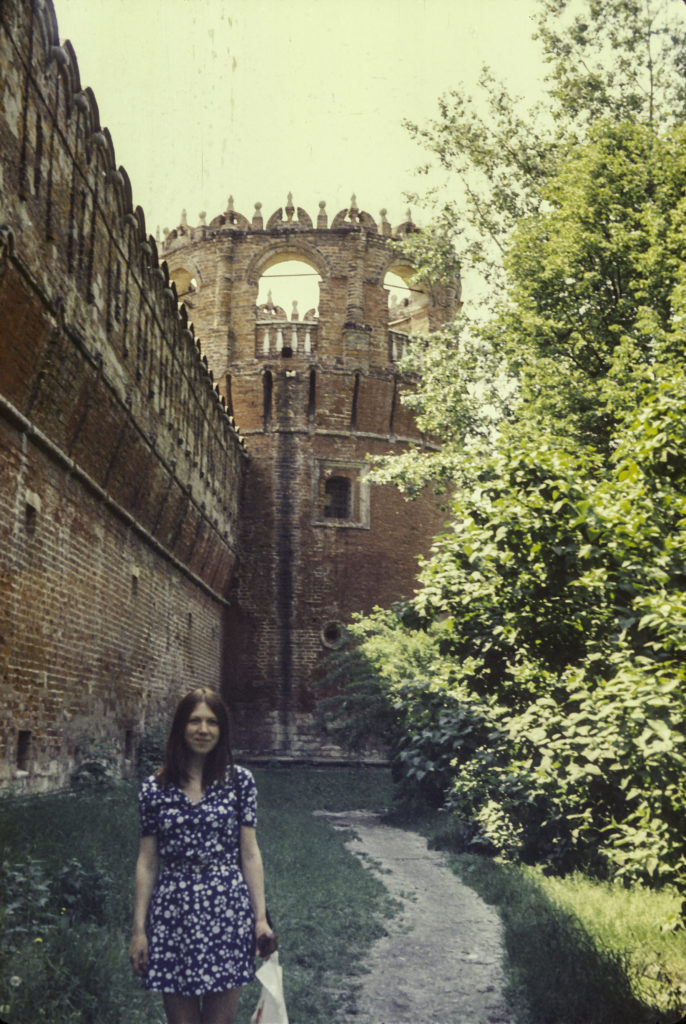
The imposing walls of the monastery, with their stout crowned towers, date from 1686-1711.
Vera standing next to the monastery wall, near one of the corner towers.
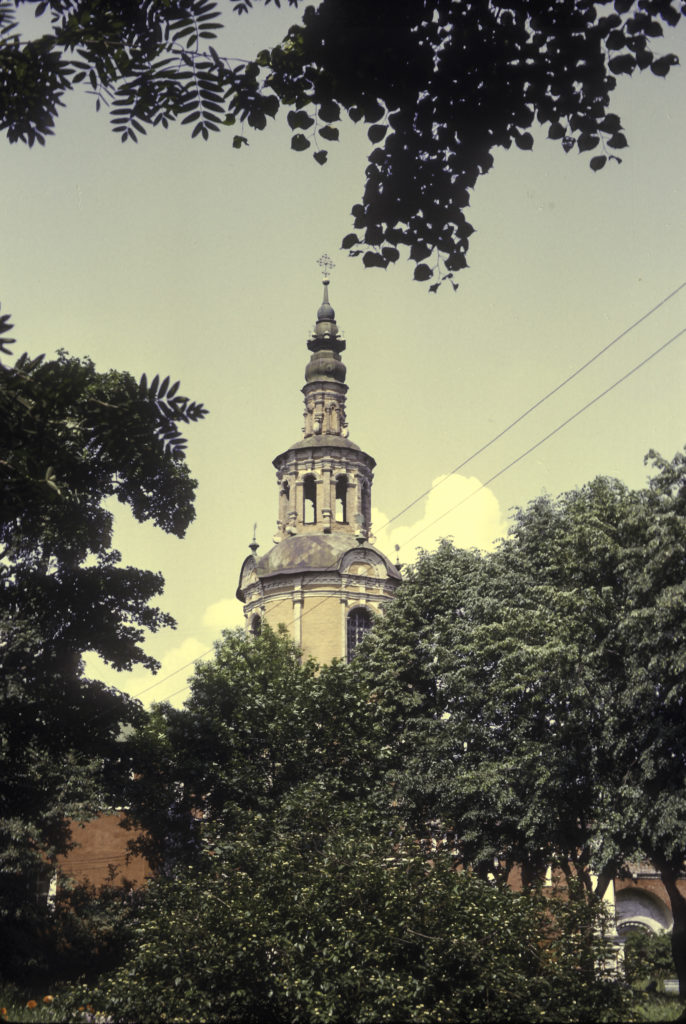
The Donskoy Monastery has two gate churches, but I only photographed one of them, the Gate Church of the Tikhvin Icon, which was built in 1713-14. You can see pictures of the other one, the Barbican Church of Sts. Zachary and Elizabeth with its bell tower, on the monastery’s Wikipedia web page.
Gate Church of the Tikhvin Icon, Donskoy Monastery
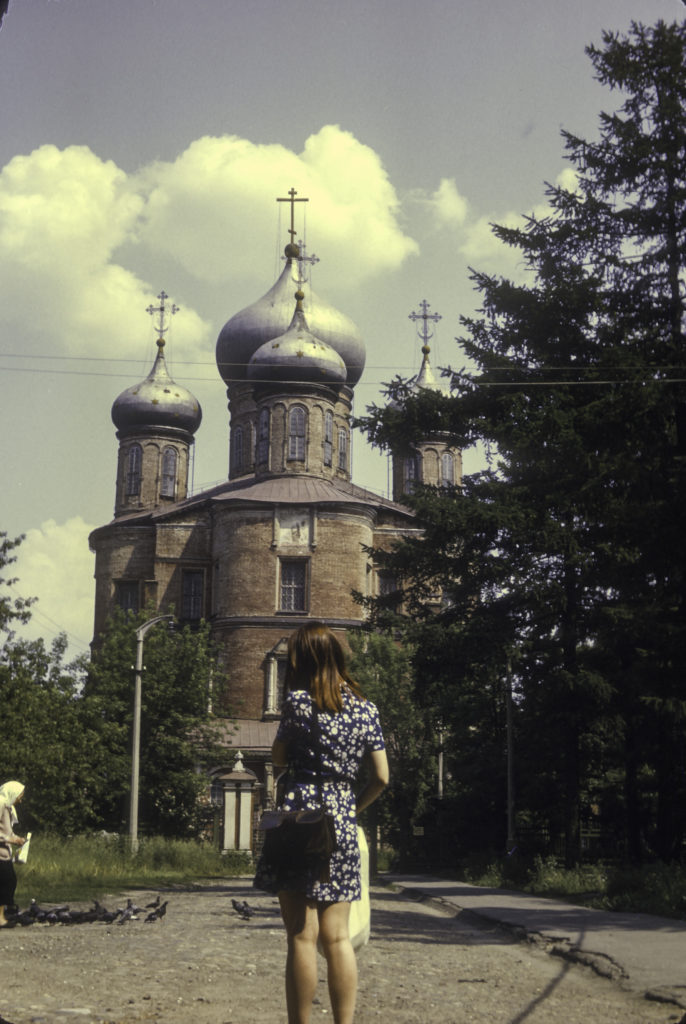
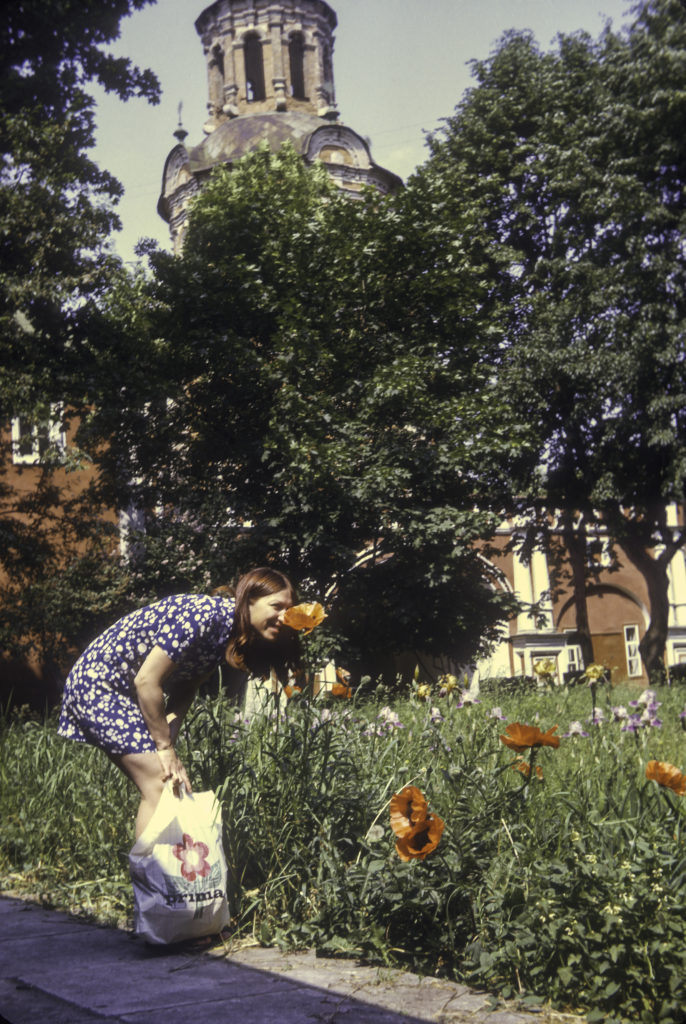
The flowers in bloom at the Donskoy Monastery were extraordinarily beautiful, and I took a shot of Vera sniffing one of them with the Tikhvin church as background.
Stopping to sniff the flowers at Donskoy Monastery, Spring 1973
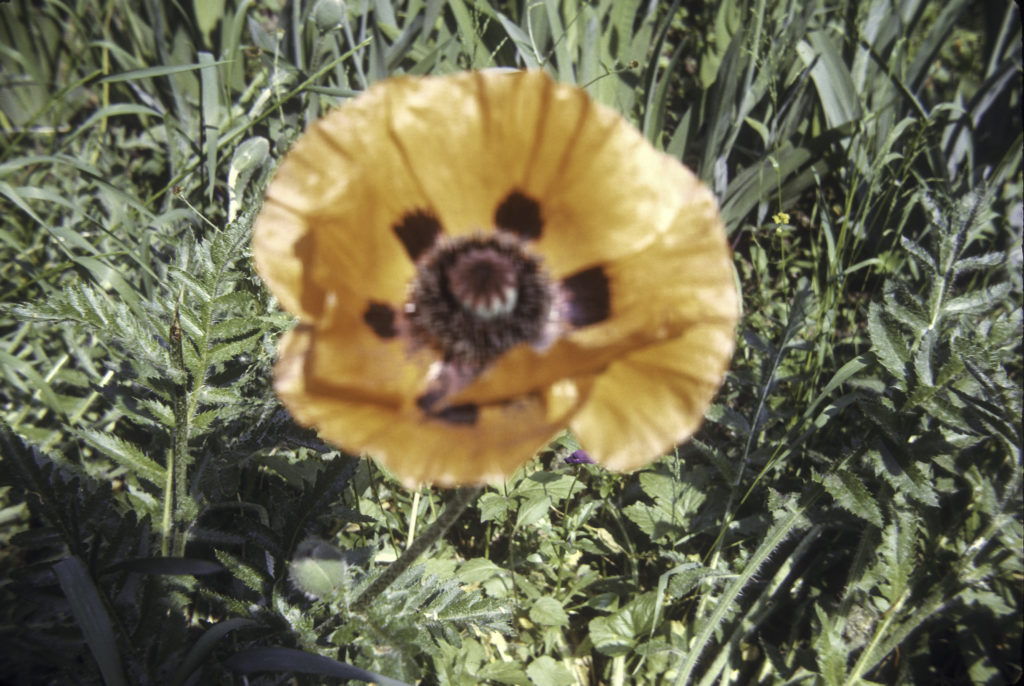
I never found out what kind of flowers these were, although my guess is that they are a type of poppy.
Spring flower in bloom at Donskoy Monastery
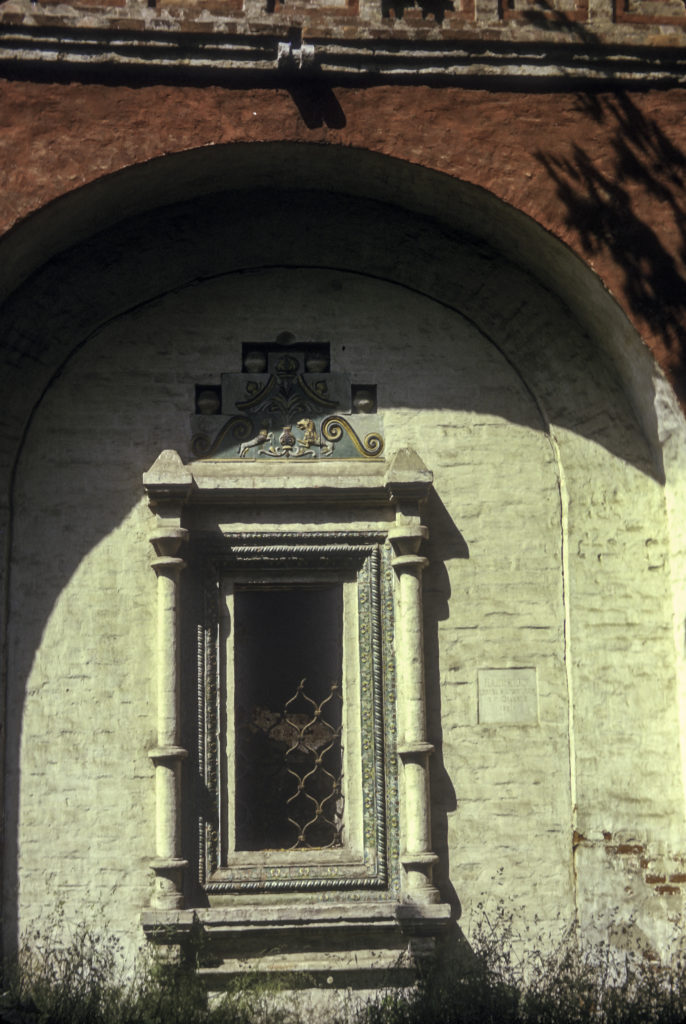
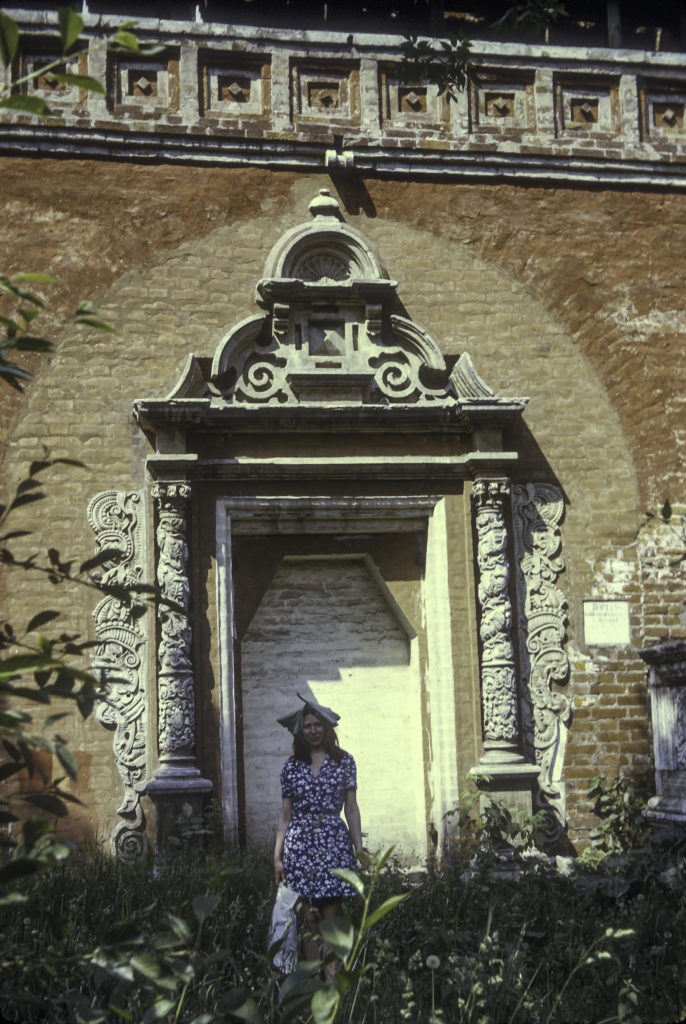
Like Kolomenskoye, Donskoy Monastery was one of those places where people brought items that they had salvaged from churches and other historical sites demolished by the Soviets to make way for their own typically dreary and banal construction projects. Among these salvaged items were elaborate door and window frames, which were physically inserted into niches carved into the walls of the monastery, with their provenance recorded in plaques embedded in the walls next to them. (Unfortunately, I didn’t note what was written on the plaques.)
Framed Window, Donskoy Monastery
In one of these niches, in which an ornate door-frame was embedded, Vera posed with a funny hat she made from an elephant-ear leaf.
Vera posed in this doorway with an unusual hat that she made from a leaf.
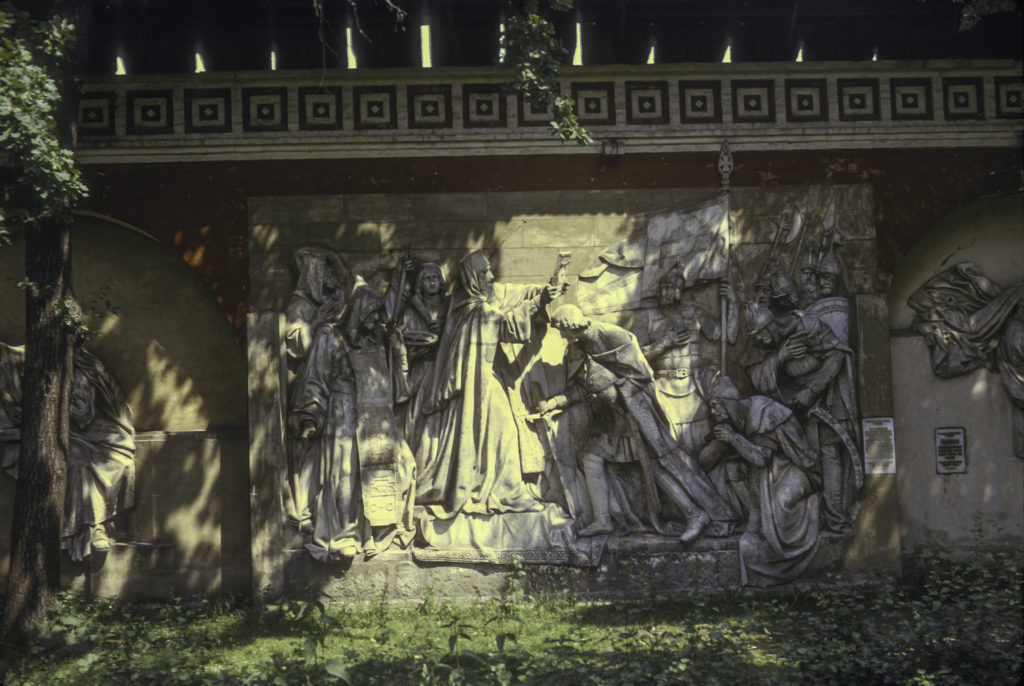
But to me the crowning glory of these reclaimed treasures was the relief of Sergei of Radonezh blessing Dmitry Donskoi. It’s worth relating some of the historical background of this sculpture, for those viewers unacquainted with the events that inspired it.
By 1380, Russia had been under the domination of the Mongol Golden Horde for over a century. But in the 1370s the Golden Horde was weakened by factional rivalries, with several contenders vying for the throne. Meanwhile, Grand Prince Dmitri Ivanovich, ruler of Moscow since 1359, had been acquiring new territories and increasing his power. One of the claimants to the throne of the Golden Horde, a general named Mamai, decided to bolster his authority by taking Dmitry down a peg or two, and went on the attack, meeting the Muscovite forces on Kulikovo Pole near the Don River in September 1380.
In 1380, the most revered spiritual leader in Russia was Sergei of Radonezh, founder of the great Trinity-St. Sergei Lavra (monastery) near Moscow. He generally avoided politics, but he made an exception in 1380. He conferred his blessing on Grand Prince Dmitri and sent two warrior-monk champions to his aid. One of these, Alexander Peresvet, opened the Battle of Kulikovo Pole by riding in single combat against the Tatar champion, Temir-murza. The two killed each other in the first charge. Then the real battle began. After a savage struggle, the Tatars were routed. Grand Prince thereafter became known as Dmitry Donskoi, Dmitry of the Don.
Relief of Sergius of Radonezh blessing Prince Dmitry Donskoy – removed from the Church of Christ the Savior when Stalin had it torn down in the ’30s
Ironically, the person to benefit most from the Russian victory at Kulikovo Pole was Mamai’s strongest rival, Khan Tokhtamysh, to whom the survivors of Mamai’s army transferred their allegiance afterward. Tokhtamysh attacked and burned Moscow in 1392, forcing Dmitry Donskoi to reaffirm his vassalage to the Golden Horde. But Dmitri kept the coveted patent to act as tax-collector of Russia for the Mongols, and thereafter the power of the Grand Prince of Moscow only continued to grow. A century after the Battle of Kulikovo Pole, the Russians under Ivan the Great threw off the Mongol yoke altogether.
The relief St. Sergei blessing Dmitri Donskoy on the eve of the Battle of Kulikovo Pole was created for the Cathedral of Christ the Savior in Moscow in 1849 by sculptor A. V. Loganovsky. On December 5, 1931, the Cathedral was demolished, and Loganovsky’s relief sculpture was rescued and brought to the Donskoy Monastery, where it remains to this day. Although the Cathedral of Christ the Savior was rebuilt after the collapse of the Soviet Union, the original relief of St. Sergei blessing Dmitry Donskoi was not restored to it; instead a version replicated in bronze was installed.
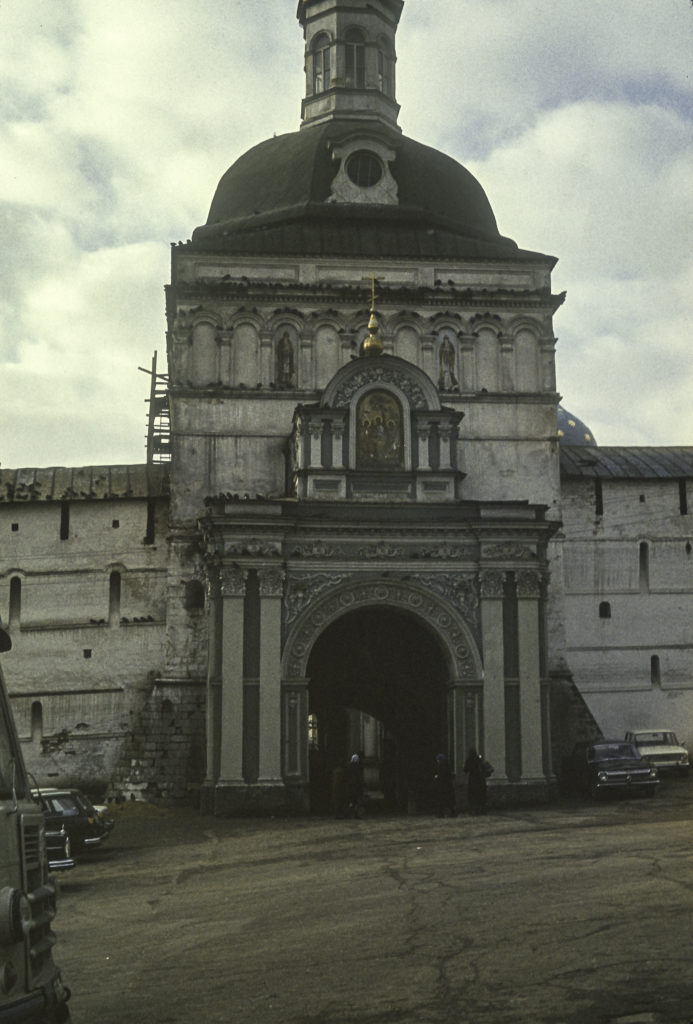
Pyatnitskaya Bashnya at left, Svyatye Vrata (Holy Gate) - entrance - in center
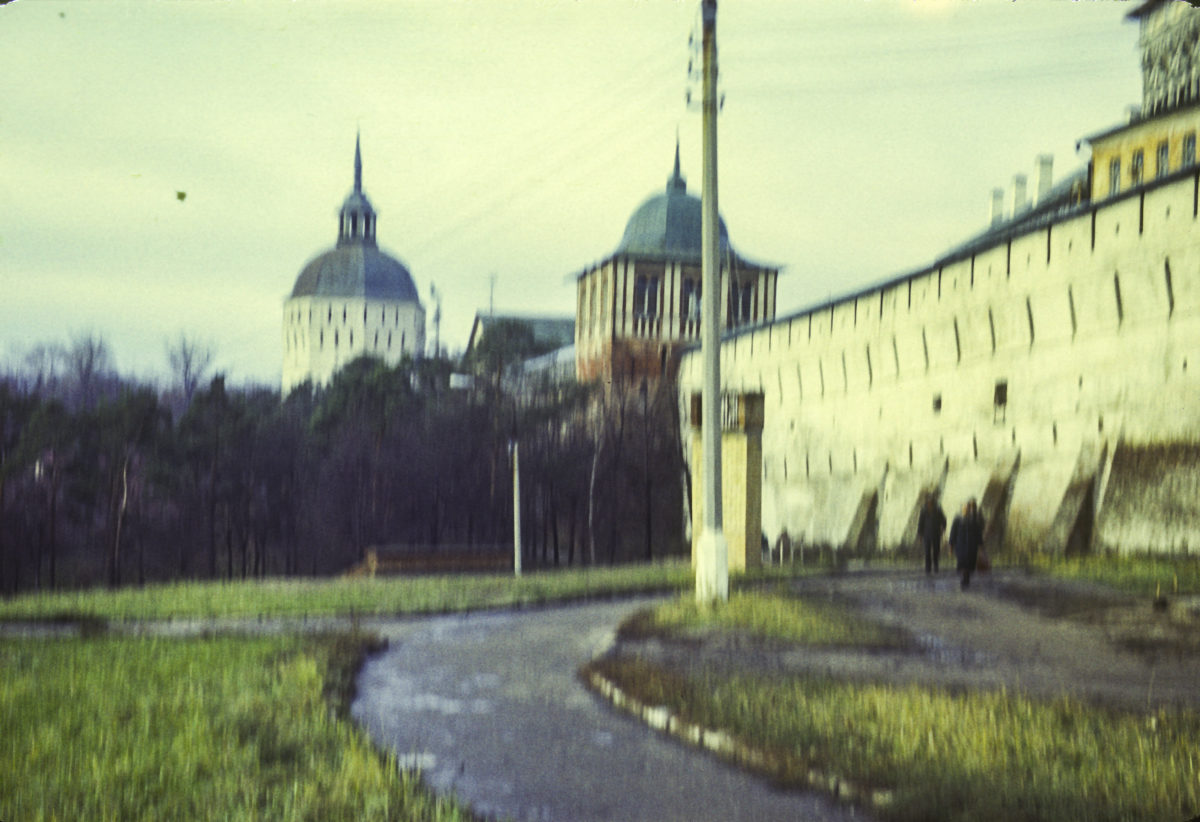
In the fall of 1972 – I don’t remember what month it was exactly, but the leaves had all fallen from the trees and the days were growing very short – I went with my fellow American exchange students on our first trip outside Moscow. Our destination was the Trinity-St. Sergius Monastery, located about 70 kilometers from Moscow in a town then called Zagorsk. The pre-Revolutionary name of the town was Sergiev Posad. The Bolsheviks didn’t like this name because of its religious connotations, so they renamed it to Zagorsk to honor a revolutionary martyr named Vladimir Mikhailovich Zagorsky, who had served for one year as head of the Bolshevik Party in Moscow before being assassinated in September 1919. (After the collapse of the Soviet Union in 1991, the town reverted to its pre-Soviet name.)
Street scene in the town of Zagorsk, which has since reverted to its pre-revolutionary name of Sergiyev Posad.
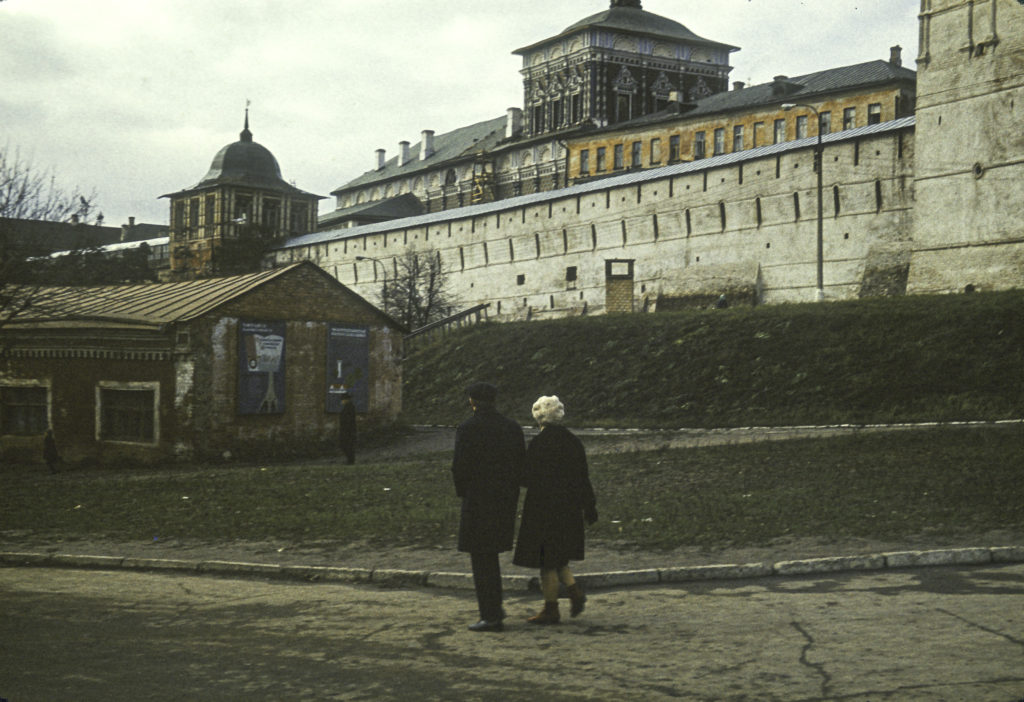
The Trinity-St. Sergius Monastery occupies a pre-eminent position among all the religious institutions of Russia. It was founded in 1337 by the monk St. Sergius of Radonezh (1314-1392), who became the patron saint of Muscovy in 1422. In that year also the wooden church that he built was replaced by a stone cathedral. A second cathedral was added in 1476, and a third was completed in 1584. In 1550 the wooden palisade walls were replaced by stone walls. This helped the monastery to survive the catastrophic years of the late 16th and early 17th centuries largely unscathed; it survived an 18-month siege by the Poles in 1608-10 and a shorter one in 1618. All the while the monastery continued to accumulate land and peasants, and it eventually became the wealthiest landlord in Russia.
Entrance tower at left. Sushil’naya Bashnya at right. At center, behind the wall, is the tower of the Refectory.
Tsar Peter the Great, in the days before he became great, used the monastery as a refuge when he was feared that the minions of his half-sister Sofia were coming after him.
The Trapeznaia Palata (Refectory) at Trinity-St. Sergius Monastery
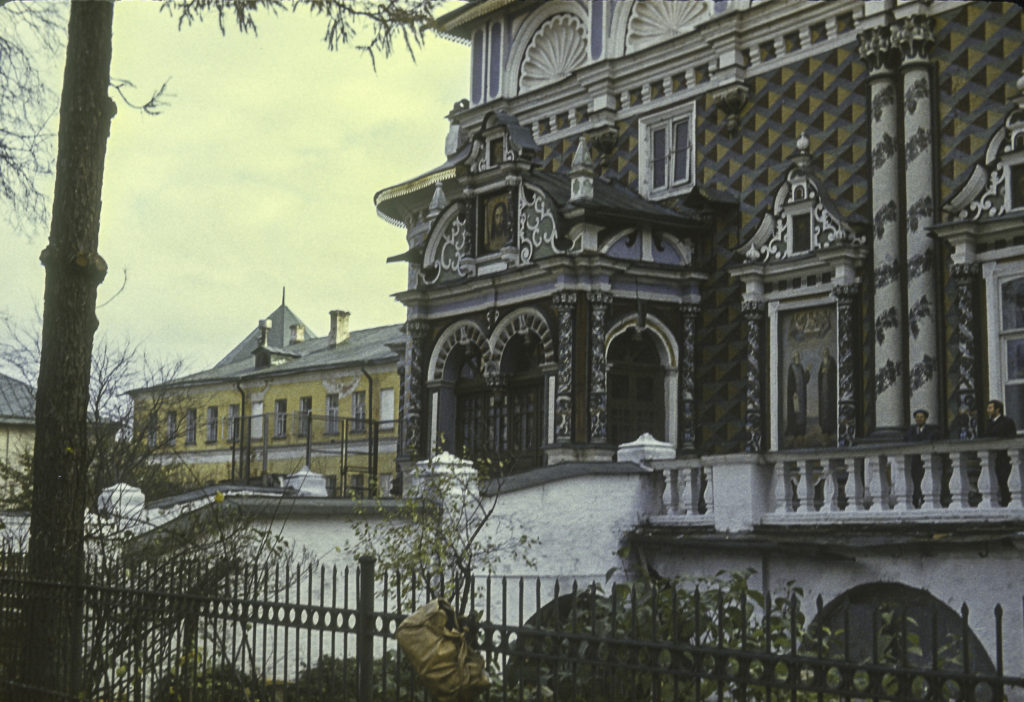
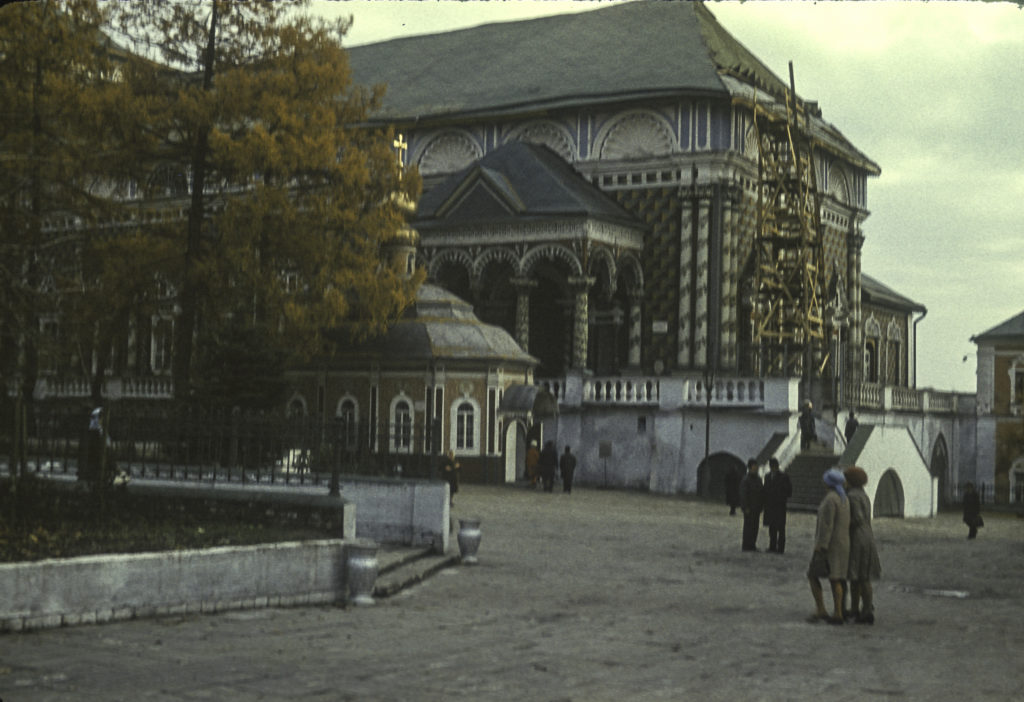
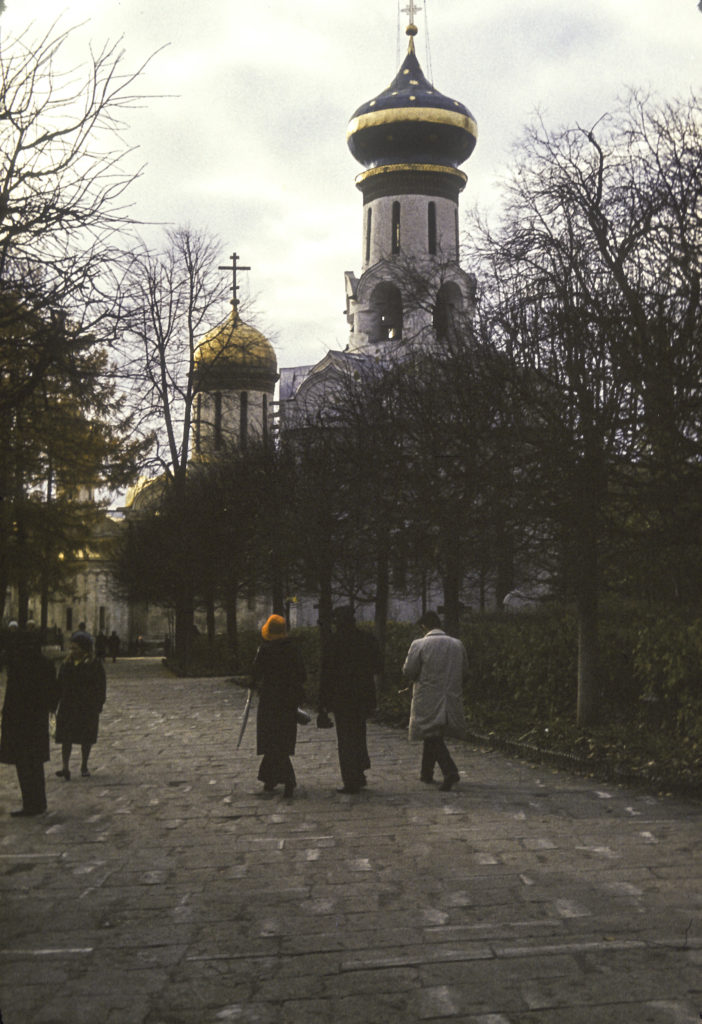
The first structure we encountered on entering the monastery was the huge Refectory, or dining hall. Built in the late 17th century, it occupies over 500 square meters and is painted in a striking checkerboard design.
Another view of the Refectory. The small building in front of it with cross on top is the Refectory Church.
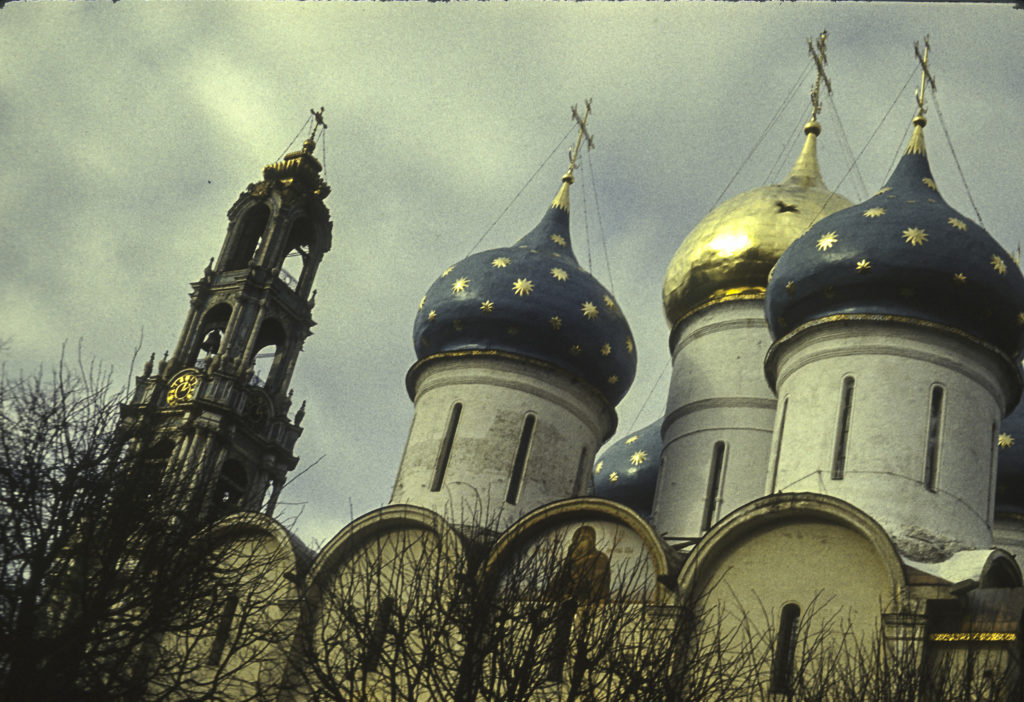
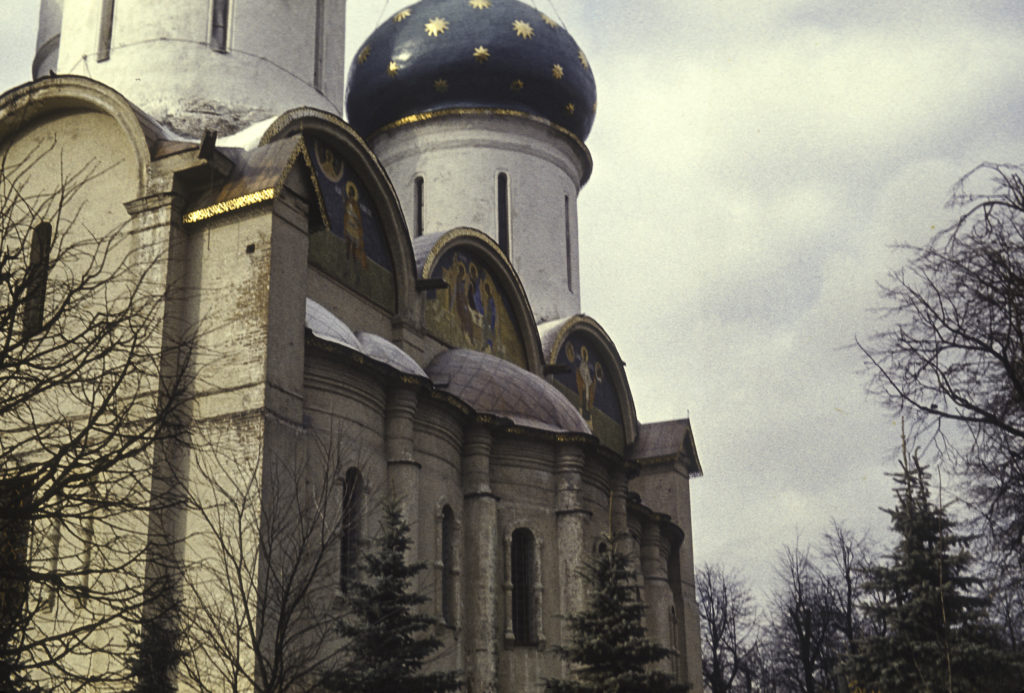
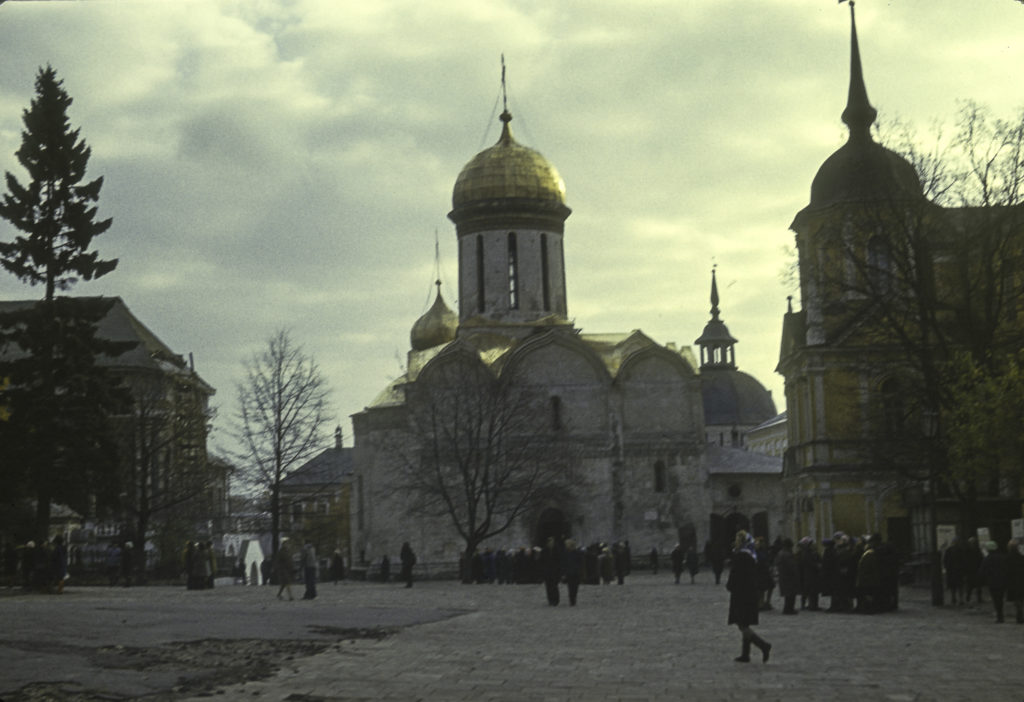
Proceeding further, we came to the imposing Annunciation Cathedral (Uspensky Sobor). (For those unfamiliar with the terminology, the Annunciation signifies the announcement of the Incarnation of Jesus to Mary by the angel Gabriel [Luke 1:26–38]). It is much larger than the Uspensky Sobor in the Moscow Kremlin.
Uspensky Sobor – Assumption Cathedral. The structure at left is the monastery’s bell tower, erected in the 18th century.
Ivan IV commissioned the Uspensky Sobor in 1559, but it was not completed until 1584 – 26 years later. It has a celebrated iconostasis featuring an icon of the Last Supper painted by Semen Ushakov, which is considered his masterpiece.
Detail of the Uspensky Sobor – frescoes under the arches
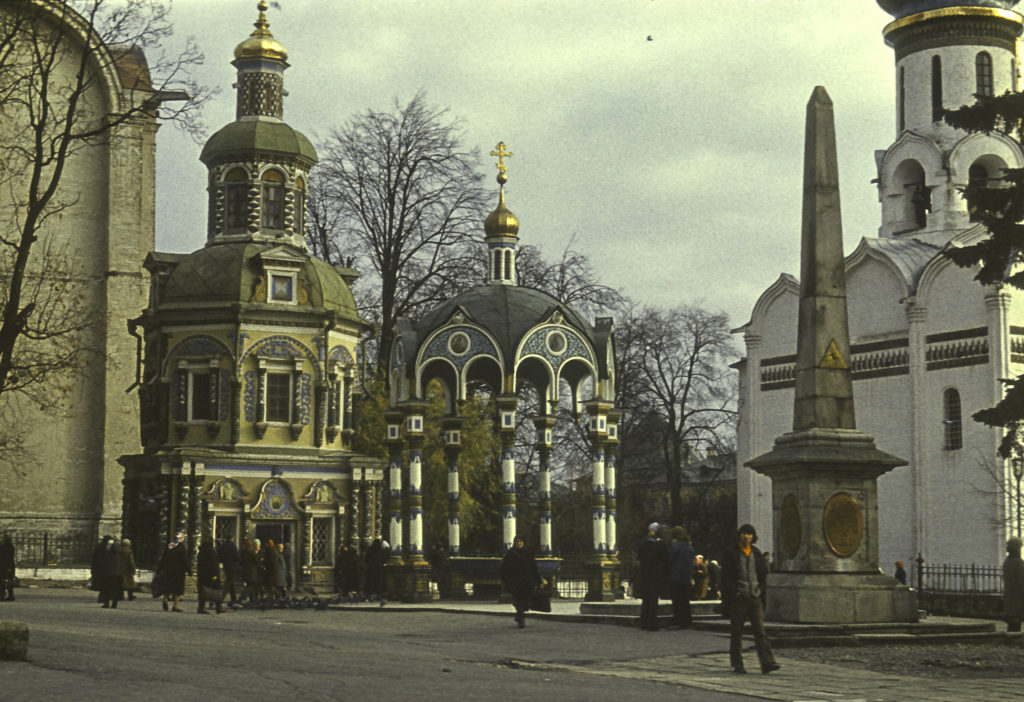
In 1644, monks digging a trench in connection with repairs being made to the southwest corner of the Uspensky Sobor unexpectedly found water flowing which, according to legend, was subsequently found to have healing powers. One monk was miraculously healed of blindness, the story goes, while a servant who expressed disbelief was stricken dead. Other miracles followed, and in the late 17th century a chapel was built over the spring in Moscow Baroque style.
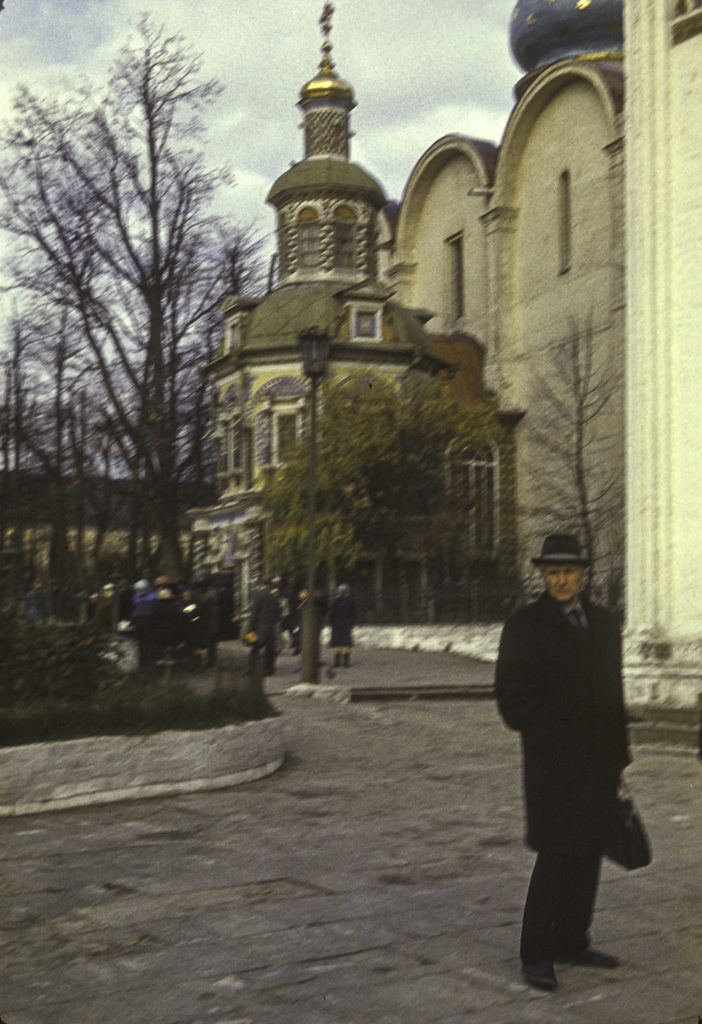
The Assumption Wellspring Chapel (Vodosvyatnaya Chasovnya-Sen’), next to the Uspensky Sobor. I don’t know the identity of the man in the hat; he was probably just a KGB agent sent to keep tabs on us.
Later, a well was dug near the chapel and a canopy or gazebo was erected over it; a cast-iron cup was provided so that people could draw drinking water from the well. According to one account, when the Bolsheviks closed the monastery in 1920, the gazebo was removed, but restored when Stalin allowed the monastery to be reopened in 1945. In any case, it was there when I visited in 1964.
The gazebo over the Assumption Wellspring, with the Wellspring Chapel at left and the Cathedral of the Holy Spirit at right. I don’t know anything about the monument in front of the cathedral.
Continuing on, as if moving backward in time, we encountered the Church of the Holy Spirit (Dukhovskaya Tserkov). To build this church, Grand Prince Ivan III invited craftsmen from Pskov; they introduced the use of glazed tiles for decoration. It has a bell tower on top, one of the few surviving Russian churches with this feature; bell towers in Russia are usually separate from the church itself.
Dukhovskaya Tserkov’ (Духовская церковь), commissioned by Ivan III in 1476. The Trinity Cathedral is in the background.
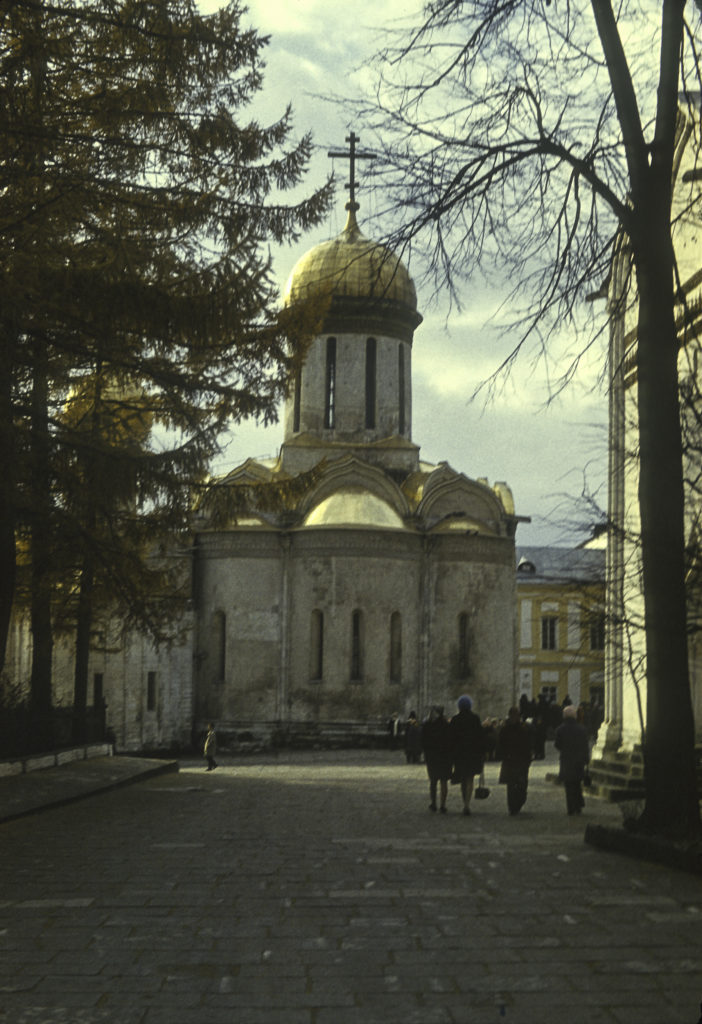
Finally we arrived at the original stone cathedral, the Trinity. In 1389, a fateful battle took place between the forces of the Ottoman Turks and the Serbian army of Prince Lazar, in the aftermath of which the Ottomans absorbed Serbia into their empire. Some Serbian monks, refusing to serve a Muslim ruler, sought refuge in Russia, and made their way to the Trinity-St. Sergius Monastery, where they ended up building the Trinity Cathedral in 1422.
Trinity Cathedral (Troitskii Sobor) – built 1422-23 – the oldest church in the monastery.
The great Russian icon painters Andrei Rublev and Daniil Chornyi also became involved, contributing their matchless frescoes. The Trinity Cathedral became the final repository of the relics of St. Sergius, who had died in 1392.
Another view of the Trinity Cathedral, looking back toward the Refectory from the Bell Tower.
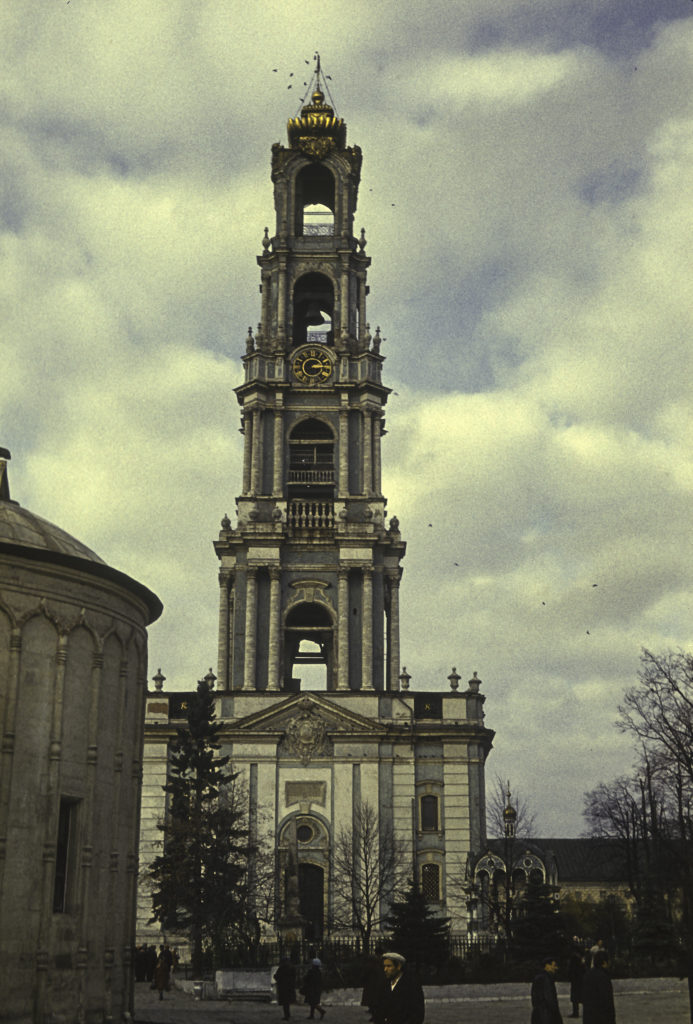
Retracing our steps back past the Uspensky Sobor, we came to the bell-tower. Peter the Great’s daughter Elizabeth, who became Empress of Russia in 1741, greatly favored the monastery and even made annual pilgrimages there on foot. She elevated the monastery to the status of a lavra (premium-grade monastery), and commissioned a baroque bell tower, which however was not completed until 1770. But at 88 meters (288 feet) high, it was taller than the Ivan the Great bell tower in the Kremlin.
Baroque bell tower, commissioned by Empress Elizabeth in the 1740s and completed in 1770
Also added to the monastery during Elizabeth’s reign was the Church of Our Lady of Smolensk, begun in 1746 and completed in 1753. This church was built to house an ostensibly wonder-working stone-carved icon, the original of which is now kept in the Sergiev Posad Historical-Artistic Museum, with a copy substituted for it in the Smolensk Church.
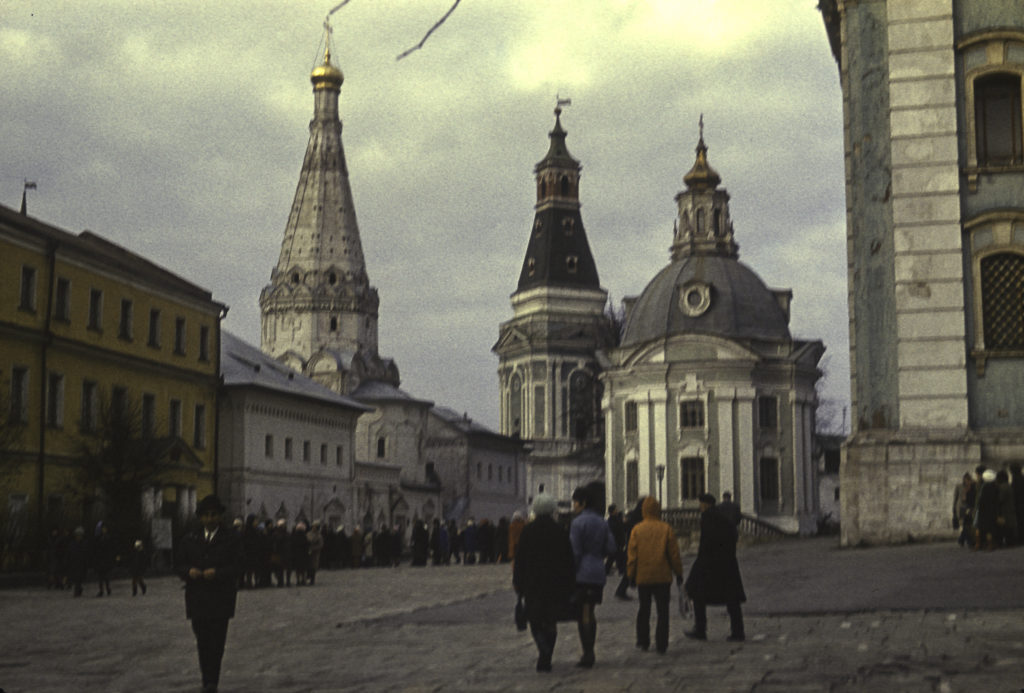
Left of center, tent church of Zosima and Savvaty; center, Kalichya Tower; right, Church of Our Lady of Smolensk
Visible behind and to the left of the Smolensk Church in the picture above is another 18th-century addition, the Kalichya Tower, on the northern wall of the monastery. This was completed around the same time as the Bell Tower and resembles it in architectural style and many details. The green tiles covering the roof were added later, in 1793, and are a feature shared with the Troitskaya Tower of the Kremlin. Like the Utochya Tower, it is a gated tower.
There is a third structure in the picture above, which also shows up in the center of the next photo. This is the tent church of Zosima and Savvaty, built in 1635-37, oddly enough on the top of the monastery hospital building. It was named for two of the founders of the Solovetsky Monastery on islands in the White Sea in the far north of Russia. Unfortunately, it leaves out the person who was mostly responsible for the establishment of the church, the Cellarer (Master of Provisions) Alexander, who migrated from the Solovetsky monastery after the Time of Troubles and worked tirelessly over the decades following to repair the destruction wrought by the Polish sieges and other disorders of that grim era.
Here the tent church of Zosima and Savvaty is seen in the center, with the top of the Carpenter Tower (Plotnichaya Bashnya) visible above the building to the left of it, and part of the Bell Tower on the right.
As I already mentioned, the Soviet regime shut down Trinity-St. Sergius Monastery in 1920, distributing its buildings among various government agencies or turning them into museums. The Soviets also removed many of the valuables and especially the bells. However, the sacristy collections and the relics of St. Sergius were saved, largely through the efforts of Pavel Florensky, an Orthodox priest and theologian as well as a mathematician and electrical engineer, who after the 1917 Revolution had worked for the Soviet government as an electrical engineer. For these crimes, as well as others such as publishing a monograph on geometry in which he drew a religious link to imaginary numbers, and being recommended for a job by Leon Trotsky, he was arrested and eventually executed in 1937.
During World War II, the Soviet government made some gestures in the way of improving relations with the Orthodox church, culminating in the return of the Trinity-St. Sergius Monastery to the church in 1945 and the resumption of services in the Assumption Cathedral in 1946.
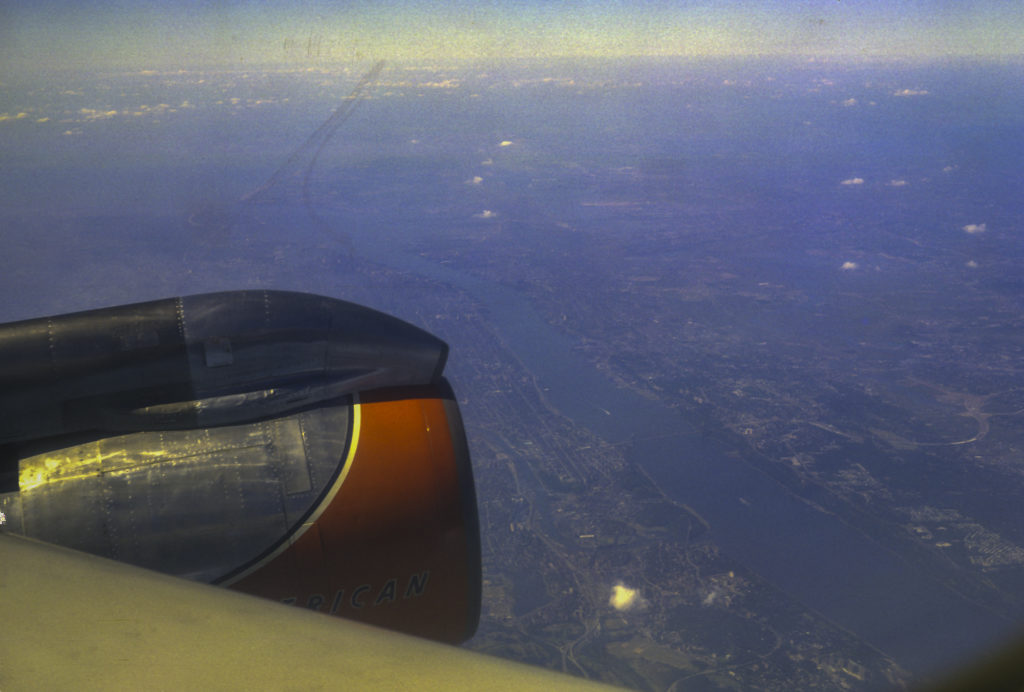
I arrived in Moscow on a flight from Paris one day in August, 1972 and was immediately ejected and tossed on the plane going back to Paris.
I had committed the unforgivable sin of arriving without a visa. The International Research and Exchanges Board in New York, the agency that oversaw the academic exchanges between the USA and the USSR, was responsible for procuring the visas for the exchange participants. To ensure that they would be able to send the visas to the right addresses at the right times, they required the participants to keep them informed of their movements during the summer prior to departure.
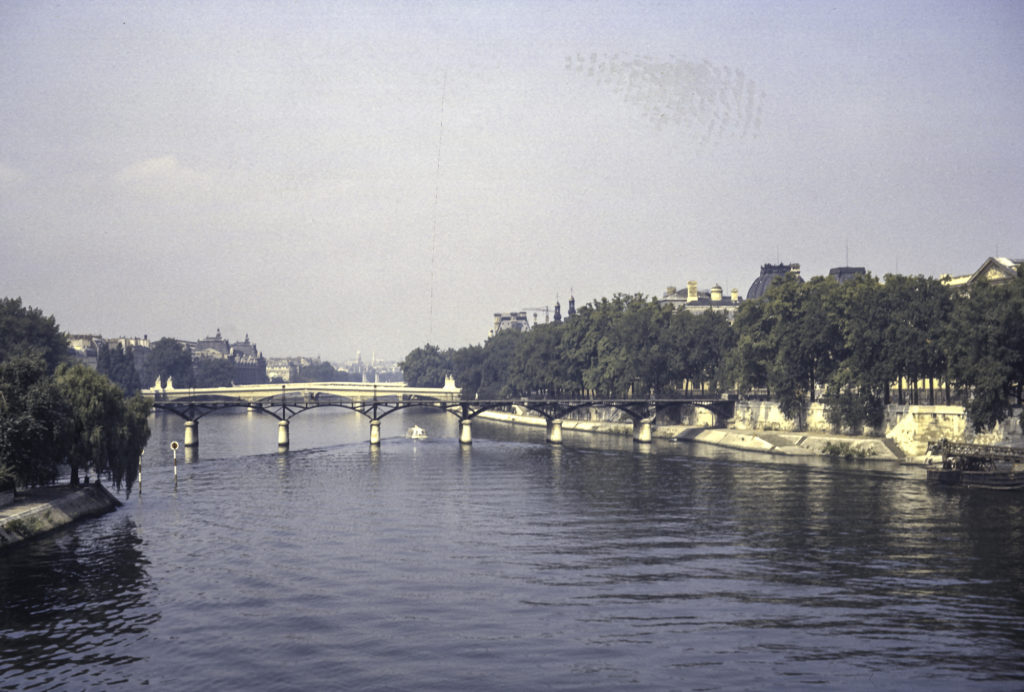
I was living in Washington, D.C. during June and July 1972, doing research in the Library of Congress on my dissertation topic. I took a short vacation to Southern California in late July, then flew to Paris. All the participants were to take the same flight from Paris to Moscow. I hadn’t received my visa by then, but I wasn’t worried about it. I figured that IREX would send the visa with their representative on the flight to Moscow. That was the procedure which had been used on my previous visit to the USSR in the summer of 1964. I spent a day or so visiting Alan Williams, a fellow graduate student from Yale, who was spending his year abroad doing dissertation research in Paris, before catching the plane to Moscow.
The joke was on me. When we arrived at Sheremetevo Airport in Moscow, everyone pulled out their visas – except me. Nobody came running up to me on the plane with my visa.
We were met at the airport by representatives of the Ministry of Education, who quickly took in the situation and contacted their superiors at the Ministry to get a copy of my visa. They knew I had one, I was on their list. While we were waiting for the visa to arrive, some jerk of a border guard lieutenant, turning a deaf ear to the Ministry’s reps, grabbed me and tossed me back on the plane.
Back in Paris, I contacted IREX to find out what was going on. It turned out that they had sent my visa to American Express in Paris, but had neglected to tell me about that. I guess they expected me to figure it out on my own. I retrieved the visa and booked another flight to Moscow. IREX covered it, but they said that I would have to pay them the money back – both for the return flight from Moscow to Paris, for which I had to sign a promissory note, and the second flight from Paris to Moscow. That was kind of a distressing prospect, because as a graduate student I didn’t have a lot of money and the repayment would cut heavily into my finances.
As it turned out, I never had to reimburse IREX for the extra flights. I did have to write them an explanatory letter, and they eventually figured out that they had dropped the ball, or at least thrown it to the wrong base.
That was the inauspicious beginning to my year in the Soviet Union. When I finally arrived at the airport for the second time, I was whisked off to a temporary hostel somewhere in Moscow for a few days while awaiting assignment to permanent quarters in Moscow University. I was “entertained” by a group of young men who purported to be students. They all spoke excellent English and some of them claimed to have lived in the USA as sons of diplomats. I figure they were assigned to evaluate me and determine what kind of threat I represented to the Soviet regime. No matter – they were genial and hospitable, and I passed the time well in their company.
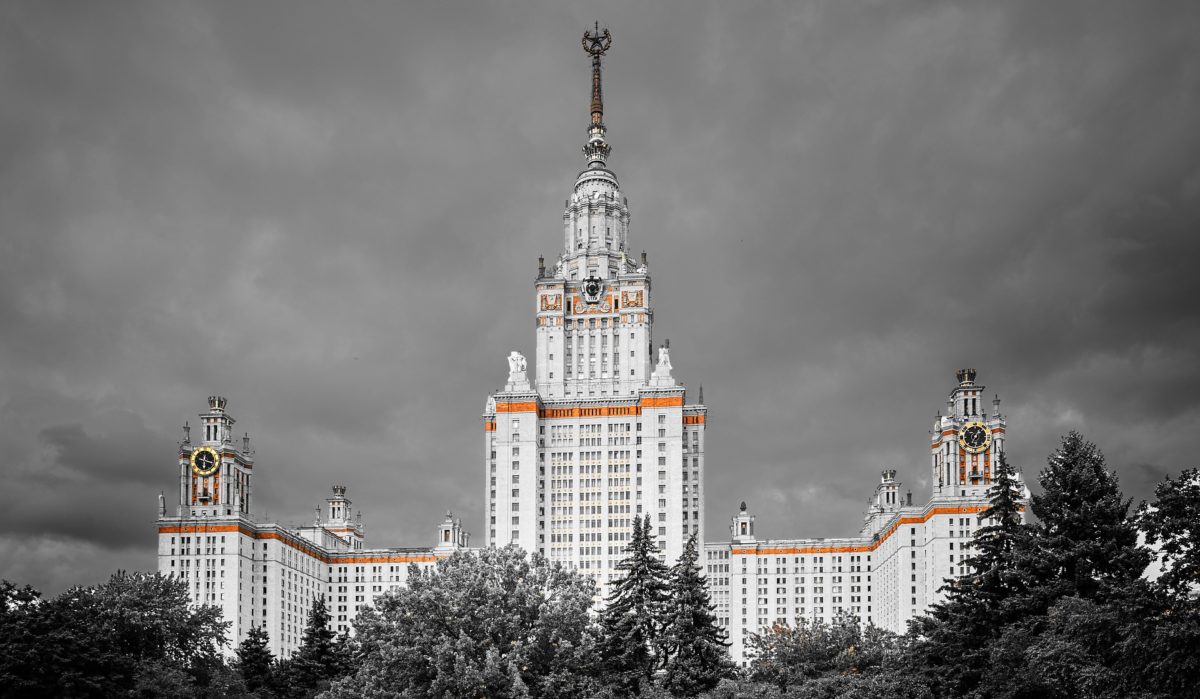
After a few days I was able to move into my room on the 5th floor of Zona V of the main building of Moscow State University (abbreviated MGU after its Russian initials) in Sparrow Hills. The rooms in MGU were grouped into “blocks”, two rooms to a block, sharing a common entrance, toilet and shower. The rooms were quite small, and the Soviet students were assigned two to a room, four to a block, so their quarters were rather cramped. The exchange students, such as me, had one room to themselves, so that our roommates were really block-mates, and we had relative privacy. I had even more privacy at first since my assigned block-mate didn’t arrive until I had been there a month or so.
The main building of MGU consists of a central tower of 36 stories flanked by two huge wings that branch out like tuning forks. The place is gigantic, with 33 kilometers of corridors and 5000 rooms. It was one of the “Seven Sisters” – giant skyscrapers which Joseph Stalin ordered to be constructed around Moscow during the post-World War II era, in his favorite architectural style, a combination of Russian Baroque and Gothic, sometimes characterized as “Stalinist wedding-cake.” It was built in 1953 using gulag convict labor, and it had some of the features of a prison. Access was strictly limited. There was a fence around the building with entrances manned by babushki – older women who provided much of the clerical and menial labor for the Soviet workforce and whose duty was to check everybody’s passes to make sure that no unauthorized persons got in or out. Further control points were distributed inside the building at the entrance to each korpus (ward or section). You had to show your pass to get on an elevator to go to your room. Out of as many as eight elevators for each ward, only one or two would be kept running at a time, so that you generally had to wait in line to get into an elevator to go to your room. Moreover, for the corner towers of each ward the elevators were staged – that is, if you had a room in one of the corner towers you would have to take one elevator to get to the top floor of the lower ward, then another to get to your room in the tower. Luckily, I and the other American students had rooms in the lower floors, which were easy to access.
Moscow University courtyard, 1972. At some point during the year a staircase at one of the entry points to the building collapsed. Luckily it happened in the middle of the night and nobody was hurt.
There was more. Although the building had been constructed with portals allowing people to pass from one wing to another on each floor, all of these were sealed off, so that if you wanted to visit someone who lived in a different wing, you had to exit your ward, and sometimes even the building, go to another entrance, show your pass, explain where you were going and why or try to sneak past the guards, and then wait for the elevator.
Despite the controls, unauthorized people did manage to get in, and it was known that there were many, perhaps hundreds, of people living there whose student status had expired or who had never even been students in the first place. To deal with this situation, the authorities conducted random sweeps, unannounced in advance, to check the passports of everybody in the building. These were conducted by student officials. The same persons also conducted pre-announced periodic military-style inspections of the student rooms for cleanliness and good order. I recall that on one occasion, a gigantic Arab, at least six and a half feet tall, came to inspect my room with white gloves. He ran his glove over the top of the door and found dust on it. He then proceeded to act as if he had unearthed some heinous crime. I thought he was going to haul me off to the brig. He relented and became more courteous when he discovered that I was a foreigner and an American. It also turned out that he was an officer in the Egyptian army as well as a student at MGU.
The first month of our stay, all the American students were required to attend a class to bring us up to speed on our command of Russian. Most of us needed it. There were two instructors, both women. They were extremely competent and very personable. I improved my fluency in Russian a great deal in the class and thought it was in some ways the best part of the year.
Sometime in that first month, I started getting visits from a youngish woman in a short skirt and high leather boots, who said she was looking for a graduate student named Ronald Feldstein from Princeton, who had been there the previous year. This was clearly a pretext to come in and talk, and maybe drum up some trade. She said her name was Laima and she was from Latvia. Each time she showed up, she stayed and talked a while. She began by telling be how bad my Russian was. I already knew that. She also liked to tell me how brilliant and extraordinary Ronald Feldstein was. I never did find out how well she had known Feldstein, and I figure she was probably just using his name to get her foot in the door. She also liked to tell sex jokes, which to me was a clear indication of what her game was. She was not bad-looking, but her manner put me off, and it was easy to imagine she was there for some nefarious purpose, like perhaps trying to get some compromising information that the KGB could use to blackmail me with. I didn’t bite, and her visits soon ceased. She also visited other Americans in our party, who told much the same story. We called her Crazy Laima.
At the end of the first month, I got a roommate. I think I was the only American who got a roommate who wasn’t from the Soviet Union. His name was Waldemar Ariel Camaño-Brañas and he said he was from Uruguay but had gone to university in Brazil. When I asked him how he had ended up in MGU, his reply was a bit vague – something to the effect that the Soviets accepted students from all over the world. Ariel, as he preferred to be called, was very personable, outgoing, and generous. He helped me as well as some of the other American students get acquainted with the university facilities, with Moscow, shopping, dining, in general learning the ropes. He got to know some of the other foreigners in the ward, including some Scandinavian exchange students, and introduced us to them. (They had great parties and were in general lots of fun.) He even took me to the Uruguayan embassy and introduced me to some of the people there. He got us great coffee from the Brazilian embassy. And so on.
It soon became apparent that he was really disillusioned with the Soviet Union. He had nothing good to say about it. He was paranoid about being spied upon. He kept looking for microphones in the rooms, and thought he found where they were embedded in the wall. One time the American Communist professor Angela Davis came to Moscow University to give speeches supporting, among other things, the Soviet invasion of Czechoslovakia in 1968. We could see her in the auditorium where she was speaking from our dorm windows. Ariel grabbed an imaginary AK-47 and mimicked shooting at her.
Of course it turned out in the end that he was working with the KGB. Not that he was doing it voluntarily, at least not by the time I got there. As far as I could gather, when he first came to the Soviet Union, he had been a dedicated Communist, and the Soviets took care of his finances. As time went on his enthusiasm for Communism had withered, but to keep his stipend he had to perform services for the regime, which involved reporting on other foreign students to the KGB. But he didn’t feel good about it, and he wanted out. The trouble was, by that time he couldn’t go back to either Uruguay or Brazil; he was persona non grata to the authorities there, and they either wouldn’t let him in or would clap him in jail once he got there – it wasn’t clear which. But his handlers in the KGB had by that time gotten wind of his distaste for his assignments, and they cut off his stipend in the middle of the school year. At the time he told us that they had said to him something like “You people are all alike. You lose faith [in communism] and you go and sell yourselves to the Pope!” So he was in a dilemma. He had no money, and he could neither go nor stay.
He resolved the situation in an interesting way. One of the women he was involved with – there were several – was from Denmark, and he made known his situation to her. She invited him to come to Denmark and live with her and her husband until he could find a job. Around the end of December, I think it was, he left. I gave him $100 to help out with expenses. A few months later I heard from him again. He said that he was going to Sweden under the auspices of the same organization that helped the American draft-dodgers to find refuge there, and he needed more money, and could I send him some? I couldn’t. Later I heard from some of the other Danes and Norwegians who knew the couple he had been living with that he hadn’t shown much motivation, hadn’t really tried to find a job, etc., and finally decided to seek greener pastures. I never heard his side of the story, so I don’t really have a good idea of what his situation was in Denmark. In any case, I never heard from him again. I hope he finally found a niche somewhere.
After Ariel left I knew that I would be assigned a new roommate sooner or later; it would probably be a male Soviet student, and for various reasons I didn’t particularly relish the prospect. Around the same time, another member of our American IREX contingent, Chris Buck, a fellow graduate student from Yale, had a change in his circumstances. His wife Michelle left to go back to New Haven – they were en route to a divorce – and like me, he didn’t relish the idea of having to adjust to an unknown new roommate either. So we applied to the university administration to become roommates with one another, our request was immediately approved, and I moved into the second room of his block on the third floor. This made matters very convenient for us. I had a Russian girlfriend, Chris very shortly acquired one of his own, and if the powers that be wanted to listen in to our activities via microphones in the walls, assuming there were any, that was fine with us, but we preferred not to have roommates who might report on our comings and goings.
By then I also had contacts outside Moscow University that would not have been especially palatable to the Soviet regime. One of my fellow graduate students in Russian history and his wife had been on the IREX exchange in the spring of 1972, and they passed on to me one of their acquaintances, Boris Khazanov, who worked for the Soviet Academy of Sciences as a computer economist. He was Jewish and wanted to emigrate from the Soviet Union. This was the era when the Brezhnev regime was in theory letting Jews emigrate but putting all kinds of obstacles in their path. One way of making it difficult was to simply drag their heels on processing the application; another was to raise all kinds of legal obstacles, such as prior employment in jobs that gave access to sensitive military or scientific employment. Fortunately Boris didn’t have to worry about that. Still another way was to make would-be emigres pay for the education they had received at state expense, and since all education in the Soviet Union was at state expense, that could add up to a considerable sum of money, depending on how much education one had obtained. Boris of course had a lot, and I think the fee for him was about 90,000 rubles, which at the official ruble-to-dollar exchange ration of 1:1.3 or so would have been $117,000, a hefty sum of money. (Not that the official rate meant much in those circumstances; even though Soviet salaries were low, rubles were not so hard to come by via borrowing because there wasn’t much worth spending them on.) When Boris applied to emigrate, just before I arrived in Moscow, he was fired from his Academy position, which would have made it hard for him to stay afloat financially, were it not for the fact that the regime neglected to fire his wife from her job as an English teacher, so they were able to eke out a living on her salary. But the financial aspect was the lesser of his worries; the major obstacle was simply the bureaucratic refusal to grant him the foreign passport. That was where he was when I showed up. The role I inherited from my predecessors was to pass Boris’ letters to people in the West who might help him get out by raising a fuss in academic and scientific circles and thereby embarrassing the Soviets – people like the famous economist Paul Samuelson. If Boris sent his appeals via the regular Soviet post, they would be subject to scrutiny or censorship, or quite likely simply trashed. I was able to send out his letters unhindered through the American Embassy’s secure diplomatic post, to which we as exchange students had access.
In return for my help, which to be honest involved little effort or risk on my part, Boris did a lot to make my stay in the Soviet Union more pleasant and edifying. He took me on walking tours of Moscow and showed me sights that I would never have found on my own. He got me tickets to concerts, plays and ballets, including the Bol’shoi Theater and the Moscow Conservatory, which I would not have been able to obtain otherwise. He also passed me on to a friend of his named Oleg in Leningrad who showed me around that city when I was there. I’ll have more to say about Oleg when I get to the post on Leningrad.
But while I was hobnobbing with Boris, in the fall and winter of 1972, a curious episode occurred which, although it doesn’t reflect well on me, I’ll relate anyway, omitting the names of most of the participants to protect the guilty. One day out of the blue I received a letter from a fellow graduate student at Yale, who informed me that she was dating a guy, I’ll call him Sam, who had also been on the IREX exchange in spring 1972 and who knew Boris. He had told her that Boris, contrary to what he had told me, had actually been involved in highly classified work with the Academy of Sciences, that the Soviets would therefore never give him permission to emigrate, and that Boris was not to be trusted and I could get in big trouble with the authorities for associating with him. Needless to say I was dismayed to hear this. It was all the more believable since Sam was himself Jewish and could be expected to at least feel some empathy with persons of similar ethnic background. I wrote to the couple at Yale who had passed Boris on to me, asking for clarification, and in the meantime told Boris that something had come up and I would have to stop seeing him for a while. A few weeks passed before I got a reply from my friends at Yale. They berated me in no uncertain terms, and rightly so, for believing hearsay and for abandoning Boris. They also had a few things to say about Sam – to put it as kindly as possible, he was apparently prone to pose as an authority on subjects he knew nothing about. It turned out that Sam, indeed, knew not whereof he spoke; I shortly resumed relations with Boris and continued to pass on his letters, with no adverse consequences. The Soviet authorities finally did relent and allow Boris to emigrate – he left the USSR with his wife and daughter in the spring of ’73, while I was still in the Soviet Union – and subsequently settled in Boston, where he immediately found a job and, as far as I know, lived happily ever after.
After that episode, and Ariel’s departure, things settled down a bit. And it was during the remainder of the winter and the spring – January through May of 1973 – that I did most of my traveling in the Soviet Union. But I also continued to explore Moscow, and that is where this photographic odyssey sets forth.
Our four-day sojourn in Paris was intended, I think, as a time to unwind and relax after an intense, sometimes stressful, two weeks in the USSR and a grilling on our experiences there by the emigre scholars of the Institute for the Study of the USSR in Munich after our return. It didn’t entirely turn out that way.
Seine – Pont des Arts in foreground, Pont du Carrousel in back
It’s well known that August is not the best time of the year to go to France. Most French people insist on taking vacation the entire month, or as much of it as they can, and those who can’t, e.g. because they have to stick around to cater to tourists foolish enough to venture to France in August, are generally not in a jovial mood, and even less inclined than usual to be nice to stupid Americans who can’t speak or understand French perfectly – people like me.
Musee d’Orsai – Formerly a railroad station, now houses art collections.
That said, I still had a good time in Paris and, although I found the Parisians sometimes curt and impatient, I encountered no outright rudeness or hostility. What I did encounter was more bizarre and unexpected, and I’ll be relating that shortly.
Sculpture by Baron Charles-Arthur Bourgeois, 1868. Encountered in Le Jardin du Luxembourg, Paris.
I didn’t try to take in all the major tourist sights while I was in Paris. Instead I spent much of the time wandering around the streets, either alone or in company with my fellow-students from the Munich Institute and the USSR trip.
One place where I did encounter a bit of outright rudeness was not in Paris itself, but in the Air France Boeing 707 on the way there from New York – that was before Munich and the USSR trip. At one point I asked for a glass of champagne, and received a curt “Non” in response (and I was not under-age; I was 23 at the time). I think the stewardess was just too busy at the time. Far more unpleasant was the person in the seat behind me, an American woman, who became enraged when I reclined my seat slightly, and started pounding on the back of it with her fist. I retaliated by reclining my seat all the way back, upon which she shouted “ARE YOU CRAZY?” I replied “Yes, and crazy enough to do you serious harm if you continue in this vein,” or words to that effect. Actually, I didn’t really say that, because before I could, the flight attendants stepped in and calmed her down, explaining that everyone had the right to lean their seat back. And this was in the days when seats in jet airliners weren’t quite the cattle-feed-lot cages that they are now, and you had a lot more space to move around.
Place Saint-Michel – Site of the Font Saint-Michel
I found Paris itself delightful, enjoyed strolling along the Seine and seeing the parks, monuments and fountains. One fountain that caught my fancy was the Font Saint-Michel, dating from 1860, depicting the Archangel St. Michel and the four cardinal virtues. On either side there is a dragon which spews water into the fountain.
So I didn’t visit the Louvre or ascend the Eiffel Tower on this visit (in fact I still haven’t done either). But on the second day I did take the train out to Versailles, along with Diane, one of the girls from the USSR trip. All of my remaining Paris photos – at least those which have survived – are from Versailles.
Diane and Andrei at the Palace, Versailles
Diane and I sat opposite one another on the train, in window seats. I was reading a copy of the English-language Paris edition of the New York Herald-Tribune. This was 1964, and there was a front-page article about race riots in Patterson, New Jersey. A young couple came and sat down in the seats next to us and started talking volubly in French. The woman sat next to me, the man next to Diane. Diane, who had complained a lot about the conditions on the trip in the USSR, said to me, “These French stink almost as bad as the Russians do.” She hadn’t noticed that the girl also had a copy of the Herald-Tribune and said at one point, regarding the article about race riots, “Je pense que c’est une étude bourgeoise.” A few minutes later she turned to me and said, “I’m from Patterson, New Jersey.” It took me a minute to realize that she was speaking English and when I didn’t say anything immediately, she repeated, “I’m from Patterson, New Jersey.”
Parterre du Midi – Gardens of Versailles
The girl’s name, as it turned out, was Sharon Gordon. She was indeed an American and I presume that her claim to be from Patterson, New Jersey, was genuine, though it could have been just a conversational ploy to get my attention. What definitely was phony was that she claimed to be working for the “Socialist” Party in Paris. As we got to know each other, during the course of a long day in Versailles, it became increasingly clear that she had more than socialist leanings – she was seriously pro-Soviet. Moreover, her boyfriend, as I took him to be, was also not French: he was Soviet, his name was Andrei, and he claimed to be from Moldavia, the son of a captain in the Soviet Navy.
Versailles: Bassin (Pool) et Escaliers (staircases) de Latone
Diane, who had been put off by the couple from the start, was increasingly less interested in keeping company with them as the day wore on; also it was a warm day, she became overheated and tired, and before long she made her excuses and headed back to Paris. I continued to wander around Versailles with Sharon and Andrei, and got to know them a little better, especially Andrei.
Ornate marble vase in the gardens at Versailles
Andrei – I don’t remember his last name, or even whether he ever told us what it was – turned out not to be Sharon’s boyfriend, at least not on a permanent basis – it was clear that they had been sleeping together, but apparently only on a casual basis. In fact he claimed to have another American girlfriend, whom he wanted to marry. He said that he would like to get together with me again while I was in Paris, and before we parted we made arrangements to meet the following day.
Flowerbed, gardens of Versailles
Meanwhile I continued my explorations of Versailles. After touring the main palace, I strolled through the gardens roundabout. These were and are formal French parterre gardens, which are highly structured and elaborately designed, featuring flowerbeds and hedges shaped into intricate geometric patterns and symmetrically distributed amidst pools and pathways.
Statue of Laocoon and his sons being strangled by snakes sent by Poseidon to keep him from blowing the whistle on the Trojan Horse. This is a copy; the original is in the Vatican. The couple to the right are Sharon Gordon and her friend Andrei.
From the French gardens, I continued on to the outlying areas of the Domain de Versailles, in particular Le Grand Trianon, Le Petit Trianon and Le Hameau de la Reine. The Grand Trianon was built initially as a retreat for Louis XIV, in which he could escape the constricting etiquette of the Palace (nevermind that it was he who had established the elaborate and rigid protocols of Versailles in the first place). The Petit Trianon is a much smaller chateau, built during the reign of Louis XV for the King’s mistress, Madame de Pompadour. She died before it was finished in 1668, but upon its completion Louis XV bestowed the Petit Trianon on his next mistress, Madame du Barry. When Louis XVI succeeded to the throne in 1774, he gave it to his Queen, Marie Antoinette, who was responsible for the next addition to the Versailles complex, Le Hameau de la Reine – the Queen’s Hamlet, a rustic retreat near the Petit Trianon.
Temple de l’Amour, near Le Petit Trianon, Versailles
The first structure I encountered on my way to the Hamlet was the Temple of Love, a classical rotunda built in 1777, well before the Hamlet itself, which was constructed between 1783 and 1785. The Temple is situated in an English garden, which is less ordered and more natural-looking than the formal, highly stylized and “manicured” French gardens that surround the main Chateau of Versailles. Since the Temple was merely a rotunda with columns and provided no privacy, I doubt whether much love actually took place there.
Temple de l’Amour, Le Hameau de la Reine, Versailles
Le Hameau de la Reine was created as a place for Marie Antoinette to meet informally with her friends and to amuse herself by playing at being a peasant, while nevertheless being surrounded by all the comforts of aristocratic life. It includes among other things a working dairy farm, which supplied the Queen with milk and eggs; vineyards, orchards and vegetable gardens; streams, fishing ponds and meadows; a mill; and a barn which doubled as a ballroom.
La Maison de la Reine (Queen’s House), the largest building at Le Hameau de la Reine, a rustic retreat built for Marie Antoinette in the park of Versailles.
The buildings of the Hamlet are done in a peculiar style that combined Norman-French with Flemish elements. The largest building in the Hamlet is La Maison de la Reine, which contained the Queen’s private quarters, parlors and salons.
Doorway of Queen’s House in Le Hameau de la Reine
La Maison de la Reine actually consists of two buildings connected by a covered gallery. The first contains, on the ground floor, a dining room and “game room” used for playing backgammon. The upper floor contains a salon where the Queen could meet with her guests; an anteroom known as the “Chinese Cabinet”; and a living room with a harpsichord which the Queen herself played. The second building has a billiard room and a five-room apartment with a library.
Le Moulin – The Mill. The mill wheel is a fake, having been put in for appearances only. There was no mechanism for grinding grain in the structure.
Though the Mill had an operating waterwheel which was turned by a stream flowing from one of the ponds, no grain was ground there, because no mechanism for that purpose was installed inside the building. The waterwheel was for decoration only. The building actually housed the Hamlet’s laundry facilities.
Le Boudoir, an intimate meeting place for the Queen and one or two friends.
The smallest structure at Le Hameau de la Reine was known as Le Boudoir, which provided the Queen a place for solitude or for intimate meetings with a few of her friends. Le Boudoir probably contributed to the image in the popular mind of Le Hameau as a place where the Queen held wild orgies and cavorted with various male and female lovers (which was not true).
Back in Paris, I met up again with Andrei and Sharon, and became more closely acquainted with them (or at least with Andrei) than I would have preferred. I’ve already mentioned that Andrei claimed to have an American fiancée. He further related that while in Paris she had a nervous breakdown and had to return to the States, where she had been committed to a hospital, and could not now return to France. For his part, as the son of a high-ranking Soviet military officer, he could not go to the US except on a tourist visa, under which marriage was not allowed. He asked me whether I had any idea how he could find a way around this obstacle. I was at a complete loss as to how to respond to him, and furthermore his story seemed rather dubious to me. If his girlfriend was a nut case, why would he want to marry her? And why was he involved with Sharon, and what was she all about? It had already become apparent that she was, if not a Communist Party member, at least an outspoken Soviet sympathizer. Every time I made a remark about our trip to the Soviet Union which could be interpreted in any way as disparaging, Sharon would immediately jump to their defense, following with disparaging comments about the USA and Western Europe. By contrast, Andrei at one point assured me that “Mon amie est beaucoup plus Marxiste que moi.” But the question remained of what he was doing in Paris in the first place. He claimed to be studying at a technological institute. In the first place, the Soviet Union had excellent technical colleges of its own; but more to the point, Soviet citizens didn’t get to go abroad to study, or for any other purpose, unless they were exceptionally well-connected. When I commented on this to Sharon, she simply retorted, “Destalinization.” No. Destalinizaton never went that far. Andrei was obviously a member of a privileged elite, and as such he would have been sent abroad for other purposes than just to study.
I introduced the couple to some of the other Americans in our party, including Professor Frey, who immediately discerned that this was no chance encounter and that they were suspicious characters, to say the least. I remained nonchalant about it because I didn’t want to jump to any conclusions, and they didn’t seem to pose any particular threat. Of course it was obvious by now, if it hadn’t always been, that they were Soviet plants – what, really, are the chances of two American tourists just returned from the USSR encountering an American Commie and a Soviet military brat in Paris by coincidence? — And was it just by chance that they happened to sit down in seats next to us on the train? Yeah, right. Still — for what purpose were they set on us? It wouldn’t be likely that they were going to pry any key secrets out of us, because we didn’t have any. Nor would it be to prevent us from indulging in any further nefarious (from the Soviet point of view) activities in Paris, because there was nothing there to do except see the sights. My take on it was and is that the KGB had put them on us just to needle us a little, let us know that they were watching, that they were aware of our association with the Institute and Radio Liberty, and they would keep track of us for future reference. There were of course other possibilities, but they seemed unlikely. Maybe Andrei’s remark to the effect that Sharon was much more Marxist than he as possibly an attempt to disarm me a little, get me to drop my guard by playing the “good cop” as opposed to Sharon’s “bad cop” act. Maybe he hoped I could help him find some way of infiltrating the USA for espionage purposes. Maybe the KGB knew I was about to go into the Navy and wanted him to try to recruit me as a potential spy. At the time I dismissed all of these thoughts as excessively paranoid, and still do. On the other hand, as Henry Kissinger famously said about Muammar Qaddafi, “Even paranoids have enemies.” I’ll never know for sure – the encounter in Paris with Sharon and Andrei had no further consequences that I knew of, I never heard anything from or about either of them again, and the whole episode remains an enigma to this day.
Kiev, the last stop in our two-week tour of the USSR, is known as the “Mother of Russian cities”. Its significance for the emergence of Eastern Slavic civilization is gauged by the name by which the first Russian state is known to history – Kievan Rus. In the 9th and 10th centuries CE Kiev was the seat of powerful rulers who converted the Eastern Slavs to Christianity, subdued the nomadic tribes of the steppe, and carried on trade with the Byzantine Empire, which became their cultural paradigm. Eclipsed for centuries by the rise of rivals to the north and the Mongol conquests of the 13th century, Kiev eventually regained prominence as a provincial capital of the Russian Empire, of which it was the third largest city after Moscow and St. Petersburg. In the Soviet Union Kiev became the capital of the Ukrainian Soviet Socialist Republic; and after the collapse of the Soviet Union in 1991, Ukraine became an independent state, with Kiev as its capital.
A shot of the Ukrainian countryside en route to Kiev, taken in defiance of Soviet rules against shooting photos from trains.
Kiev is a very green city, with lots of trees and parks. I wouldn’t have expected this, because I always think of the Ukraine as being a treeless steppe. Not so Kiev.
Kiev – a view of the Left Bank from the Right Bank of the Dnepr River
Kiev was originally built on the west (“right”) bank of the Dnepr River, and did not expand to the east (“left”) bank until the 20th century. The city center and most of its attractions are on the right bank, with the left bank (at right in the picture below) consisting of residential and industrial districts.
Bridge across the Dnepr River at Kiev
We spent our first day in Kiev visiting its two major historical and religious sites, the Pecherskaia Lavra and the Cathedral of St. Sophia.
Kiev – Pecherskaia Lavra
Pecherskaia Lavra is best translated as “Monastery of the Caves.” Founded in the eleventh century CE, it soon became one of the most important centers of Orthodox Christianity in Eastern Europe, and has remained so ever since. It functions both as a museum and a working monastery, the headquarters of the Ukrainian Orthodox Church.
Pecherskaia Lavra – Bell Tower at center, domes of monastery churches to left of center
There are indeed caves at the Pecherskaia Lavra, and the monks lived in them and are buried in them. We toured the caves, as well as the rest of the complex, and viewed the remains and relics of the monks in the catacombs as well as various objets d’art – icons, crucifixes, chalices, textiles, etc. – in the museum collections.
Restoration work; large dome at right belongs to Refectory Church
The monastery suffered extensive damage during World War II; its main church, the Dormition Cathedral, was destroyed, and for years afterward the Soviets dragged their heels on restoration work – the cathedral was not fully reconstructed until 1995, after the Ukraine became independent. But the Refectory Church, shown at right in the picture above, dating from the nineteenth century, was impressive.
Babushki and a youth visiting the Pecherskaia Lavra
While strolling the grounds of the monastery, I was able to sneak a shot of some citizens who might not have consented to be photographed if I had asked. It was mostly old retired folks, especially elderly women, who frequented churches and other religious institutions in the Soviet era. Young people usually avoided them, since it could hurt their career or employment prospects if they were found to have religious inclinations. But there were exceptions, of course, and in any case the monastery was a tourist site as well as a religious institution.
Bell tower at Pecherskaia Lavra, Kiev
The crowning glory of the Pecherskaia Lavra is its bell tower, seen in the picture above. I had to take the picture at an angle because that was the only way I could get the tower to fit in the frame from my vantage point – and even then I had to chop off part of the bottom. In the next picture, which I took from a vantage point further away, I managed to squeeze in the entire tower, except for the cross on top. Also, I was facing into the sun, so that the tower is shaded, and the streetcar wires got in the way. But it was the best I could do with the time and equipment I had.
Bell tower of Pecherskaia Lavra (Cave Monastery) in Kiev, with other structures of monastery in background
Our next stop was the Cathedral of St. Sophia. First built in the early eleventh century, only a few decades after the Kievan Grand Prince Vladimir initiated the conversion of his realm to Orthodox Christianity, the cathedral was inspired by the church of Hagia Sophia in Constantinople. Somehow it survived the myriad episodes of pillage and destruction which afflicted Kiev in the ensuing centuries, though only barely, and in an advanced state of decrepitude. In the seventeenth century efforts to restore the cathedral began, and the exterior was rebuilt in the Ukrainian Baroque style. The work continued into the eighteenth century, with new additions such as a bell tower being added.
Our Sputnik tour group has just debarked from the bus to visit St. Sophia Cathedral.
In the 1930s the Soviet regime confiscated the cathedral and laid plans to demolish it and turn the grounds into a park, but in the end was dissuaded from this course by the pleas of prominent scientists and historians. Instead, the regime converted the cathedral complex into an architectural and historical museum, which it remains to this day, although the Ukrainian government has allowed Orthodox services to be conducted in it at times.
Facade of St. Sophia Cathedral
Both the St. Sophia Cathedral and the Pecherskaia Lavra are considered part of the same UNESCO World Heritage site, although the two are located in different districts of the city of Kiev.
One of the cathedral doors.
By the seventeenth century much of the territory today known as Ukraine had become a possession of the Commonwealth of Poland-Lithuania, then the most powerful state in Eastern Europe. But the inhabitants found Polish rule oppressive, and meanwhile another power was arising on the steppe – the Cossacks, bands of freebooters who welcomed into their ranks the castoffs of all the neighboring lands. In 1848 a dispossessed landowner, Bohdan Khmelnitsky, was elected Hetman – leader – of the Cossacks of the Zaporozhian Host and raised the standard of revolt. After a series of victories, Khmelnitsky entered Kiev with his forces just before Christmas, and the cheering townspeople greeted him on Sophia Square, then the main square of Kiev. In 1888, the monument featured in the photo below was installed on Sophia Square to commemorate the events of 1848.
Monument to Bohdan Khmelnitsky in Sophia Square, Kiev. The building at the right has since been replaced by a Hyatt Hotel.
Khmelnitsky’s uprising began a long and incredibly complicated series of conflicts involving all the countries of Eastern Europe, and in the end leaving Poland and Lithuania destitute and no longer a Commonwealth, and Ukraine under the sway of Moscow, soon to be transformed into the Russian Empire under Peter the Great.
Monument to Taras Shevchenko, Ukrainian national poet, in the Kiev park named after him. In the background is a building of the university which is also named him.
Taras Shevchenko (1816-1861) was born a serf in a Ukrainian village. By hook or crook he managed to obtain a smattering of elementary education and also discovered a talent for painting. His master, a wealthy landlord, once had him whipped for painting a portrait surreptitiously, without permission, but later, realizing that he could use Shevchenko’s talent for his own gain, sent him to study in a studio in St. Petersburg. There Shevchenko met other artists and intellectuals, who helped him buy his freedom in 1838. Shevchenko also began writing poetry as a serf, and his first collection of poems was published in 1840. Over the next few years, while still residing in St. Petersburg, Shevchenko made several trips to the Ukraine, and, finding himself distressed by conditions in his homeland, became involved with a secret society called the Brotherhood of Sts. Cyril and Methodius, dedicated to Ukrainian national rebirth and independence. The society was soon exposed and suppressed by the Tsarist regime, and Shevchenko, whose case was personally investigated by Tsar Nicholas I, was sent into exile as a private in the Imperial Russian army, and for good measure forbidden to write or paint. The long exile, under harsh conditions, broke his health; although he was given amnesty in 1857 by Tsar Alexander II, he died in St. Petersburg in 1861, at the age of 47. Although famous in life both as a painter and a poet, he is now mostly known for his literary impact; though he had important predecessors, he is nevertheless considered to be the founder of the modern Ukrainian language. In an ironic turn of historical justice, the university founded in Kiev by Shevchenko’s persecutor Nicholas I, is now named the Taras Shevchenko National University of Kiev.
Kiev Opera House, where Stolypin was assassinated in 1911
The Kiev Opera was established in 1867. After the first building in which it was housed burned down (1896), a new one was built, which opened in 1901. It was considered to be one of the finest in Europe, and was patronized by the Imperial family. On September 14, 1911, a performance of Nikolai Rimsky-Korsakov’s opera The Tale of Tsar Saltan was held there. Attending the performance were Tsar Nicholas II, two of his daughters, and a number of high officials including Pyotr Stolypin, Prime Minister and Minister of the Interior since 1906. During an intermission, despite the presence of 90 guards, a man named Dmitry Bogrov, a revolutionary who also happened to be a double agent working for the Okhrana, the Tsar’s secret police, shot Stolypin, who died a few days later. Bogrov was quickly tried and hanged. The episode has been shrouded in mystery and controversy ever since, especially regarding the motives and actions of the assassin. Stolypin had been conducting a somewhat successful agrarian reform program aimed at assuaging discontent among the agrarian population and creating a class of peasant landowners who would support the regime; his efforts were anathema to both the revolutionaries, who aimed at maximum destabilization, and the most right-wing elements in the government, who found Stolypin too liberal. In killing Stolypin, was Bogrov trying to fulfill the agenda of the revolutionaries, or of the reactionaries, or both? Nobody really knows for certain, and the question remains unresolved to this day.
Sputnik did not maintain a full schedule while we were in Kiev, and we were fortunate to have some time to explore the city and become acquainted with parts of it not associated with the usual tourist attractions. One evening Bob Barrett, our group leader, took a couple of us with him to visit a friend in his Kiev flat inside one of the typical post-World-War-II Soviet apartment block-buldings (see picture below). I don’t remember the name of the friend or how Bob had become acquainted with him in the first place. But I do remember his television set, which was one of those ancient tiny-screen models with a magnifying glass in front of the screen to make the picture look bigger. And I remember him telling us that he was happy with the way things were going, because he was enjoying what he considered a decent standard of living and his situation had been improving year after year.
We went to visit someone who lived in one of these typical post-WWII Soviet-style apartment blocks.
Our tour group actually had two leaders. One was the aforementioned Bob Barrett, who was an Uzbek specialist, and the other was Professor William Frey from Pennsylvania (I don’t remember which institution he was associated with). Actually, Professor Frey was supposed to have taught the Russian class in Munich, but he had to cancel out because his wife was ill. He did manage to come for the USSR trip, though, and he proved to be a jolly fellow and an excellent guide. He appears on the left of the following photo, which I shot in front of a Kiev bakery, where people were queued up waiting to purchase their daily bread.
Professor William Frey (at left) in front of a Kiev bakery
Professor Frey had a birthday while we were in Kiev, and the group wanted to get him a present. Kitty, one of the women in the tour group, volunteered to buy the present, and I agreed to keep her company, since she didn’t want to wander alone through downtown Kiev. In order to buy a present, though, she needed to get hold of some additional Soviet currency, because she didn’t have enough for a proper gift; and when we went to the bank to exchange some dollars for rubles, we found that it was a holiday and the bank was closed, though stores in general remained open. I was ready to quit and go back to the hotel, but Kitty insisted that there must be someplace or some way we could change money, so we wandered around the downtown area for hours looking searching in vain. I don’t remember whether we ever somehow came up with a birthday present for Professor Frey, but I did take the opportunity to snap a photo of downtown Kiev.
Street scene in downtown Kiev, Summer 1964
One of the high points of our stay in Kiev was a visit to the beach. Being from Southern California, surfing capital of the world, I wouldn’t have expected to find much of a beach in Kiev, but there were beaches on the banks of the Dnepr, complete with umbrellas, cabanas and sand though not with surf; and one afternoon Bob, Bill, Kitty, Jan, Diane and I went to one of them.
Excursion to a beach on the Dnepr River in Kiev. From left, standing: Bill, Diane, Bob; seated, Kitty and Jan.
Whether it was because Bill did something annoying or just on general principles, we decided to bury Bill in the sand. Bill graciously went along with his own interment; Bob, Jan and Diane did the digging, while I shot pictures and Kitty read a book.
Bill annoyed everyone, so Jan, Bob and Diane buried him in the sand, while Kitty (hidden behind Jan) recused herself from our criminal activities.
Having buried Bill in the sand, we debate whether to leave him there, while Kitty ignores it all.
From Kiev we took a train back to Brest-Litovsk, which had also been our entry point to the Soviet Union. We expected the reverse of the process we had encountered upon our entry: we would debark from the train, go through customs and re-embark on the same train once the railroad-car “uppers” had been transplanted from the wide-gauge Soviet platforms to the narrower-gauge Western ones. This was not what happened, as it turned out.
First of all, going through outbound customs proved to be a more arduous process than on the inbound direction. Rather than a cursory examination of the contents of our suitcases on the train, we were subjected to a meticulous inspection in a closed room, where the border guards went through our suitcases item by item, asking searching questions about each piece they didn’t immediately recognize. This included tampons and feminine napkins, which apparently were not available in the USSR at that time (or for years afterward; I never saw evidence of them in 1972-3 either). The same was true for condoms. It was embarrassing, especially for the women, to have to explain the usage of these articles in our mostly inadequate Russian to the border guards. We thought that we were perhaps being subjected to extra scrutiny (not to mention irritation) because of our association with the Institute in Munich, but as it turned out, we got off easy compared to some of the other Western tourists.
The worst part, though, was being told that our nice train with its sleeping cars was being expropriated for the use of people more important than us, and that we would be put on a different train, which was not yet available, so we had to wait for the better part of a day in a hot, uncomfortable (not air-conditioned, of course) train station. I endured the ordeal by drinking lots of a sweet, mediocre sparkling wine, which was pretentiously labeled “Soviet Champagne”. At last, in the late afternoon, we were told that we could board our train. It turned out to be a bare-bones Polish train with no sleeping cars; we got to sit upright on hard wooden benches while the train clattered all night through Poland and into East Germany. We boarded the train at the same time as a British group, one of whose members had his camera taken away by the customs officials. In response to his bitter protests, they promised him that they would develop the film onsite to verify that he had taken no illegal pictures during his stay in the USSR, and if they found nothing incriminating, they would return the camera and film before his train left. When the time came to board the train, they still had not done so. He threatened to lie down on the track in front of the train if they didn’t give him the film before the train left. Finally, literally at the last minute, as the train was starting to pull out of the station, a border guard showed up and handed him the camera and the film, to everyone’s great relief. But then, as the train left the station behind, he took a look at the developed film. It was color film, and the Soviets had processed it as if it were black-and-white, wrecking it, so he lost all his pictures.
Leaning out of the window of a Polish train departing from Brest-Litovsk
I don’t remember anything about the trip back from Berlin to Munich, probably because I was so groggy after not getting much sleep on the Polish train from Brest. I do remember that, after we got back to Munich, the staff of the Institute for the Study of the USSR took us to a beer hall and plied us with beer and pretzels while they pumped us for all the information they could get out of us on current conditions in the Soviet Union. So that’s the brief history of my career as a spy for the CIA.