Categories
Spain, Portugal and Morocco, November 2017

Granada, November 9, 2017: The City Center and the Albaicín

When we finished our tour of the Alhambra in the early afternoon of November 9, we were given the choice of going back to the hotel or seeing a little of the rest of the city of Granada via a guided walk through the downtown area. The long trek on foot through the Alhambra had worn Sandie out and and she chose to return to the hotel. I was almost dead tired myself, but nevertheless I opted to go on and I’m glad I did. Granada is a beautiful city and full of history. It would be worth a visit even if the Alhambra had been razed to the ground. Yet for all its historic significance, Granada is surprisingly petite, with a population of only a quarter of a million, about half the size of my home town of Long Beach, California. That, in combination with the higher population density that is typical of European cities, makes it possible to see many attractions in a brief walking tour.

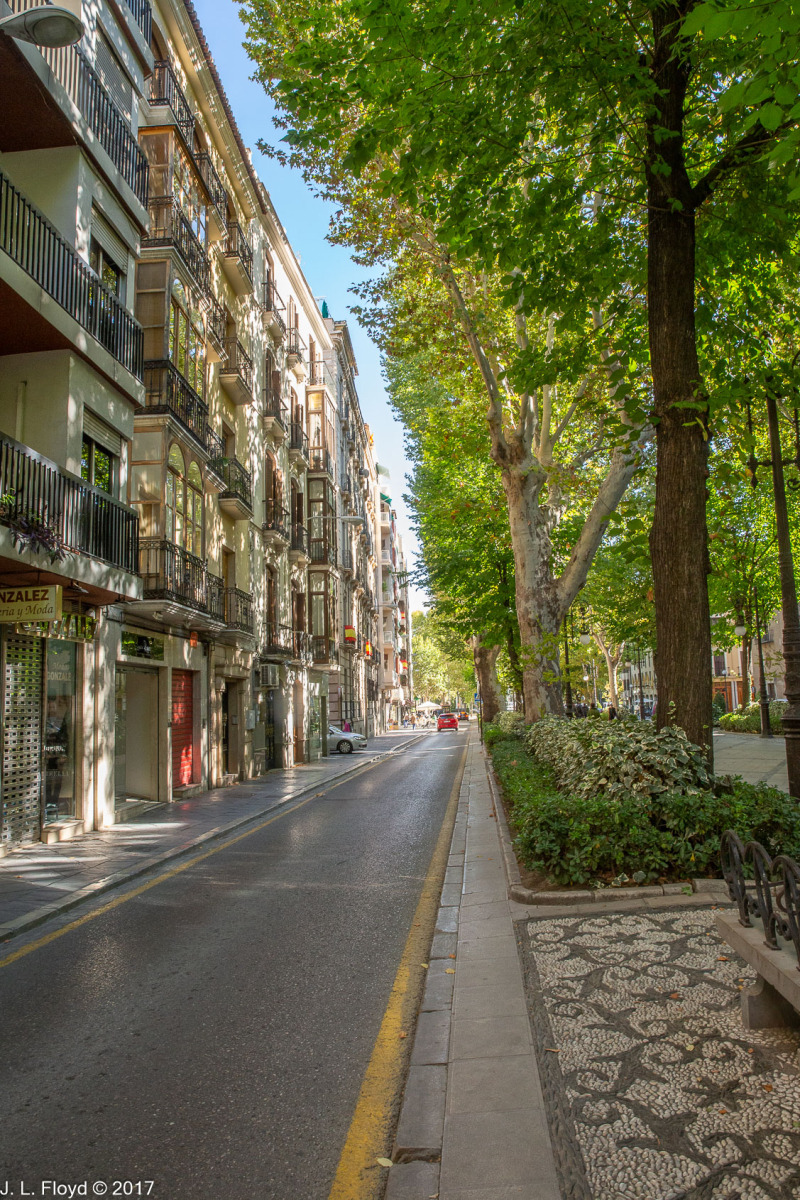
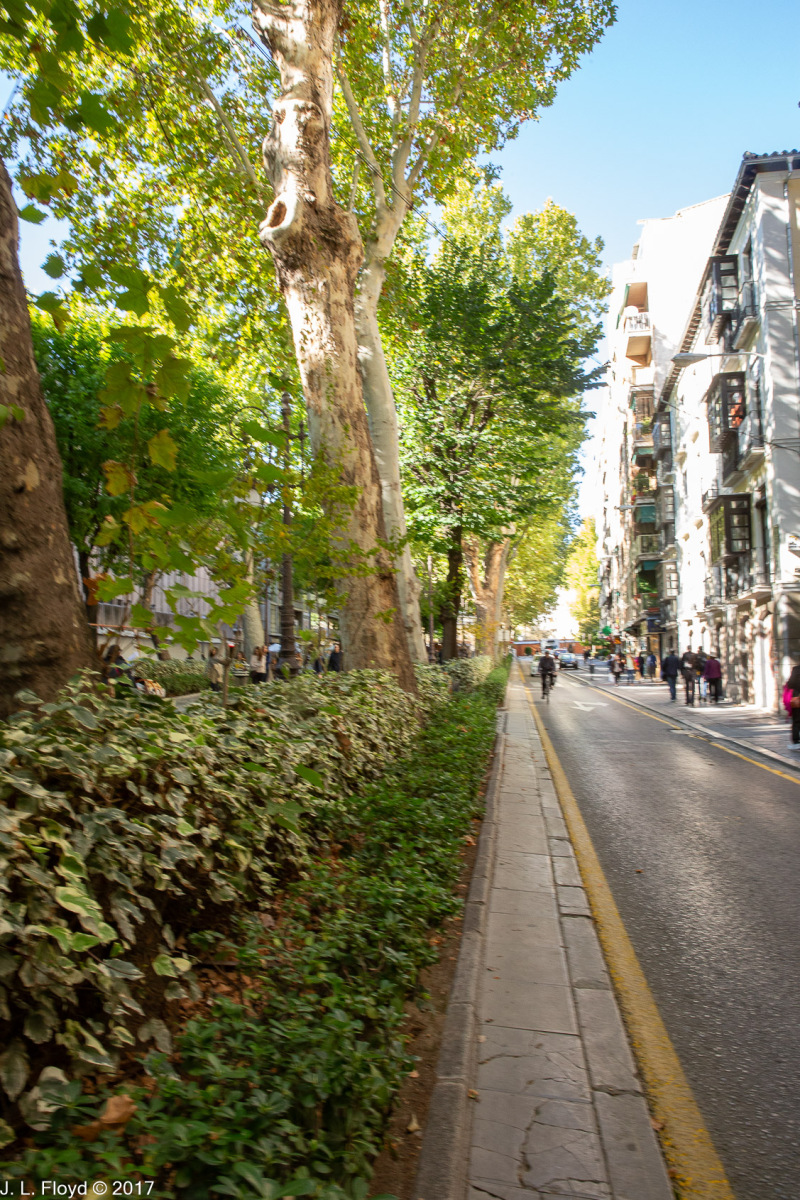
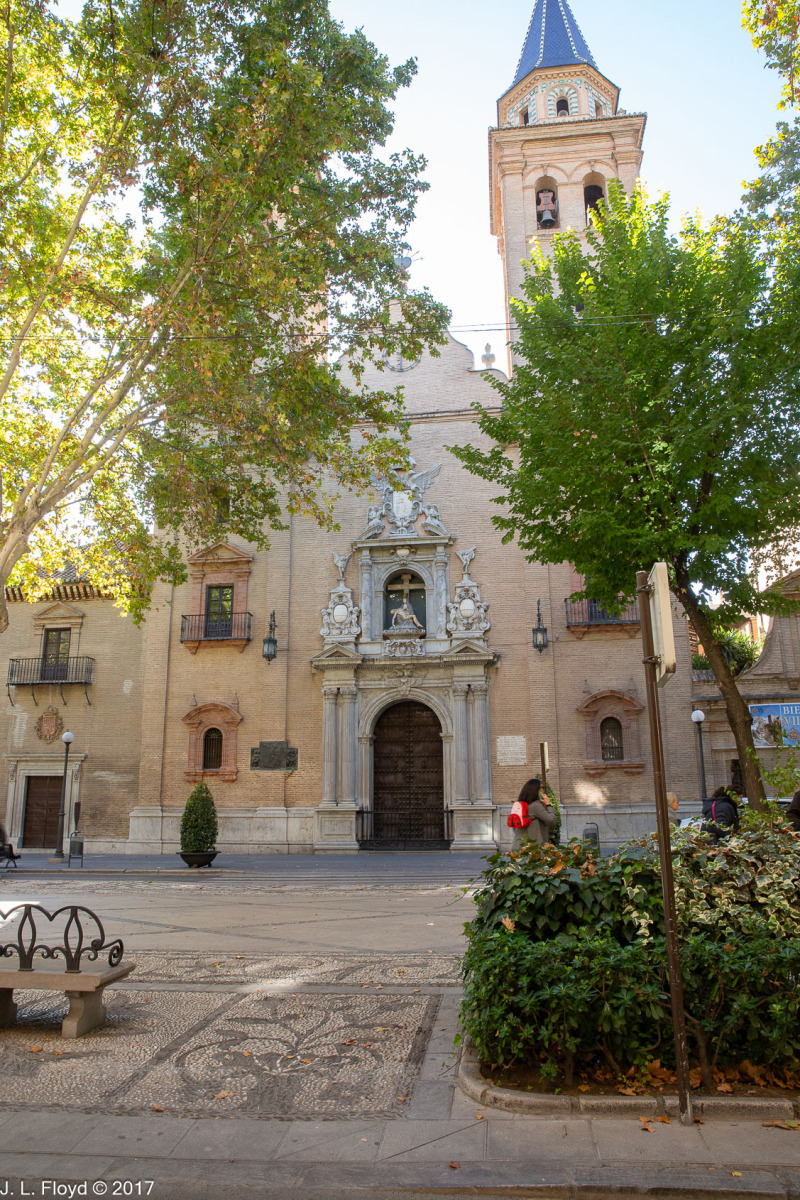
We began our walk in the downtown area, on the Carrera de la Virgen, a wide boulevard divided by a shady, tree-lined pedestrian median and lined with stately apartments and upscale businesses such as El Corté Ingles department store. We paused along the way to view the Basilica de las Angustias, a Baroque church which was begun in 1617 on the site of an old hermitage to provide a home for an image of the Virgin of Sorrows, donated by Queen Isabella the Catholic, which now graces the altarpiece of the church. The Virgin of Sorrows is considered the patron saint of Granada, as was officially recognized by Pope Leo XIII in 1887.

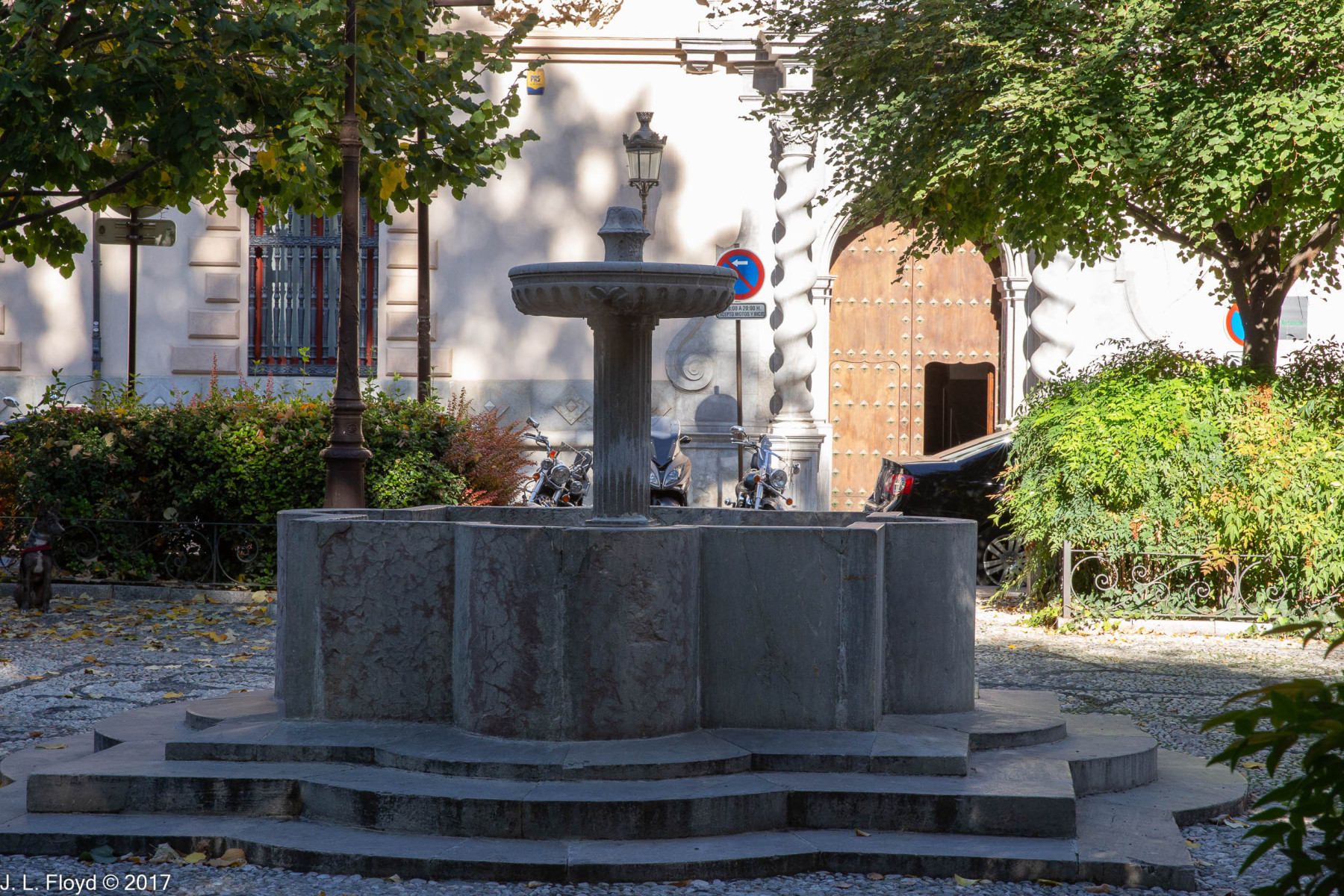
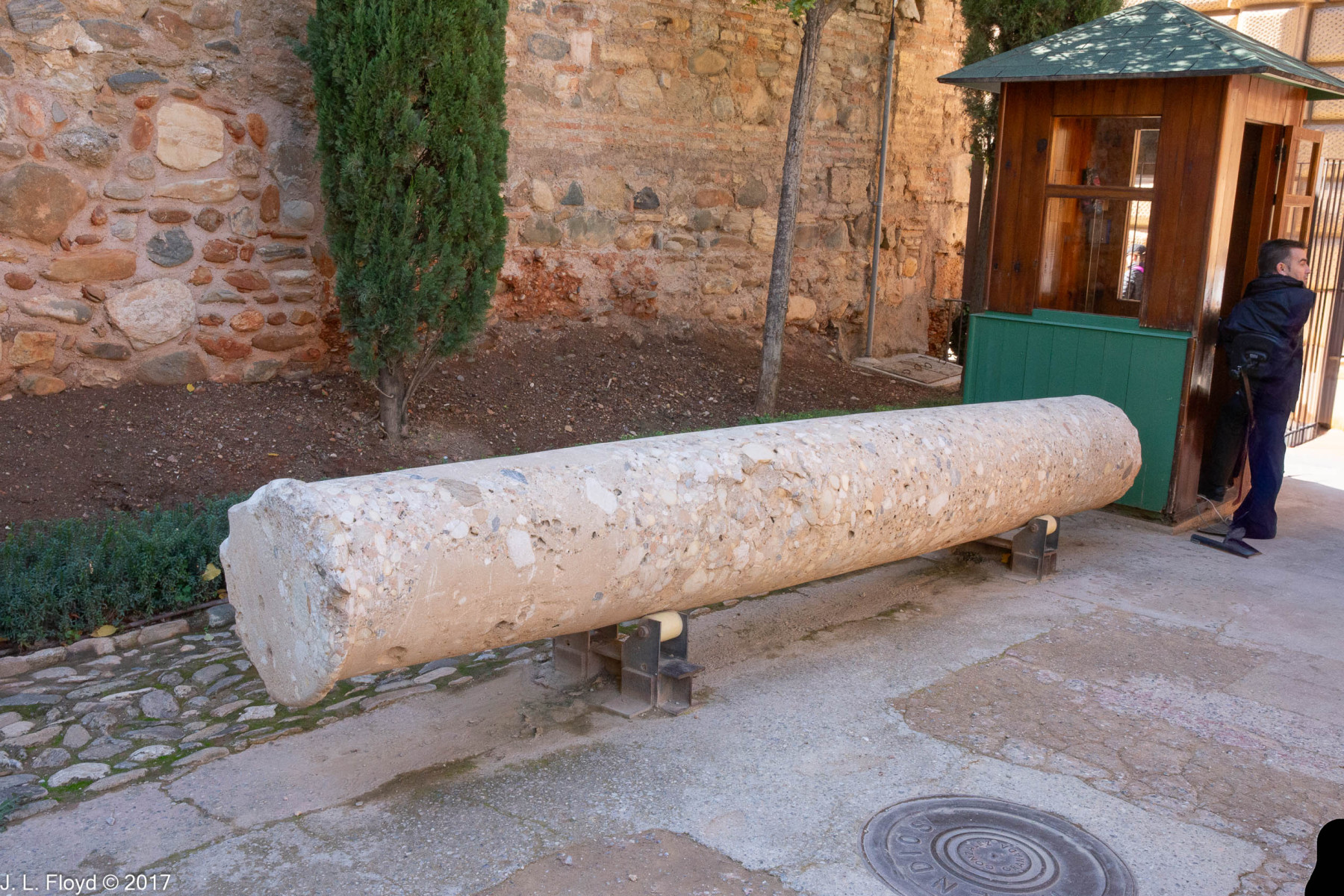
Before long we reached the end of the Carrera de la Virgen at the Plaza Bibataubín, where we encountered a fountain and a palace. The name is a corruption of “Bab al-Tawwabin,” Arabic for “Bricklayers’ Gate,” denoting that in Nasrid times it was the location of one of the city’s main gates, in a district inhabited by the stonemasons who built the gate. That was in the 12th century, in pre-Nasrid times, when the Almohads still ruled the area. The Nasrids reinforced the gate, but after the conquest of 1492 the Catholic monarchs decided to build a castle on the site to enhance the defenses of the city. In the 18th century the castle became an obstacle to the city’s growth, and it was converted to a barracks, a transformation which involved demolishing the existing edifice and rebuilding it with a facade made of premium-quality Sierra Elvira stone and featuring helical columns with a twisting spiral structure like a corkscrew. These are known as Solomonic columns because they were thought to have originated in the original Solomon’s Temple in Jerusalem (the one which was destroyed by the Babylonians in 586 BCE, and no remains of which have ever been found, so that nobody knows what it really looked like, or even if it really existed). These columns had originally been carved for the Church of the Sagrario (which we saw later) but had been rejected by its architect, so they were installed at the barracks instead. The building continued to serve that purpose until 1933, when it was given over to the Provincial Council of Granada. This led to a series of further remodelings and modifications, culminating in 2009 when the Provincial Council turned the edifice over to the Consejo Consultivo de Andalucía (Advisory Council of Andalusia), for which it now serves as headquarters.

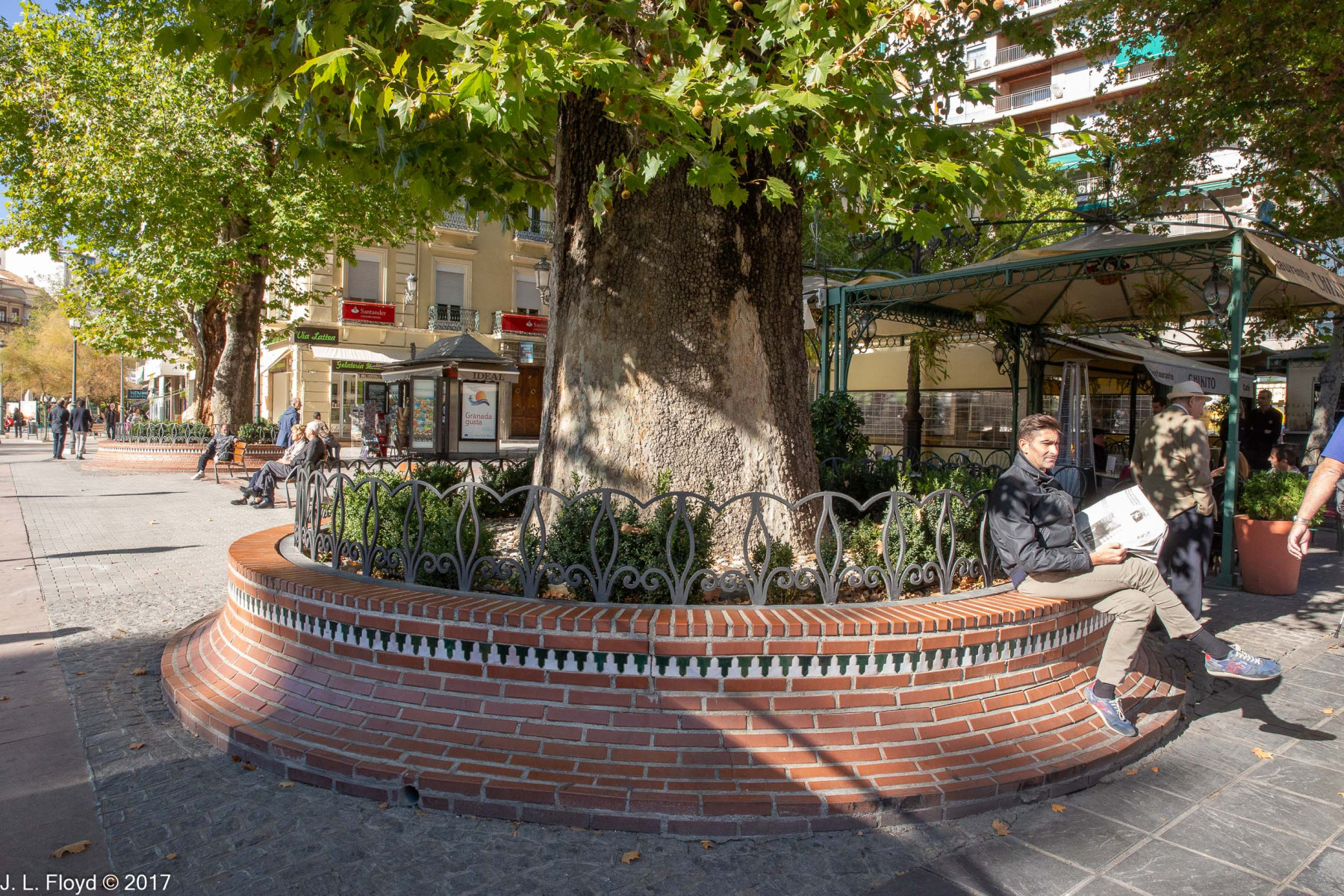
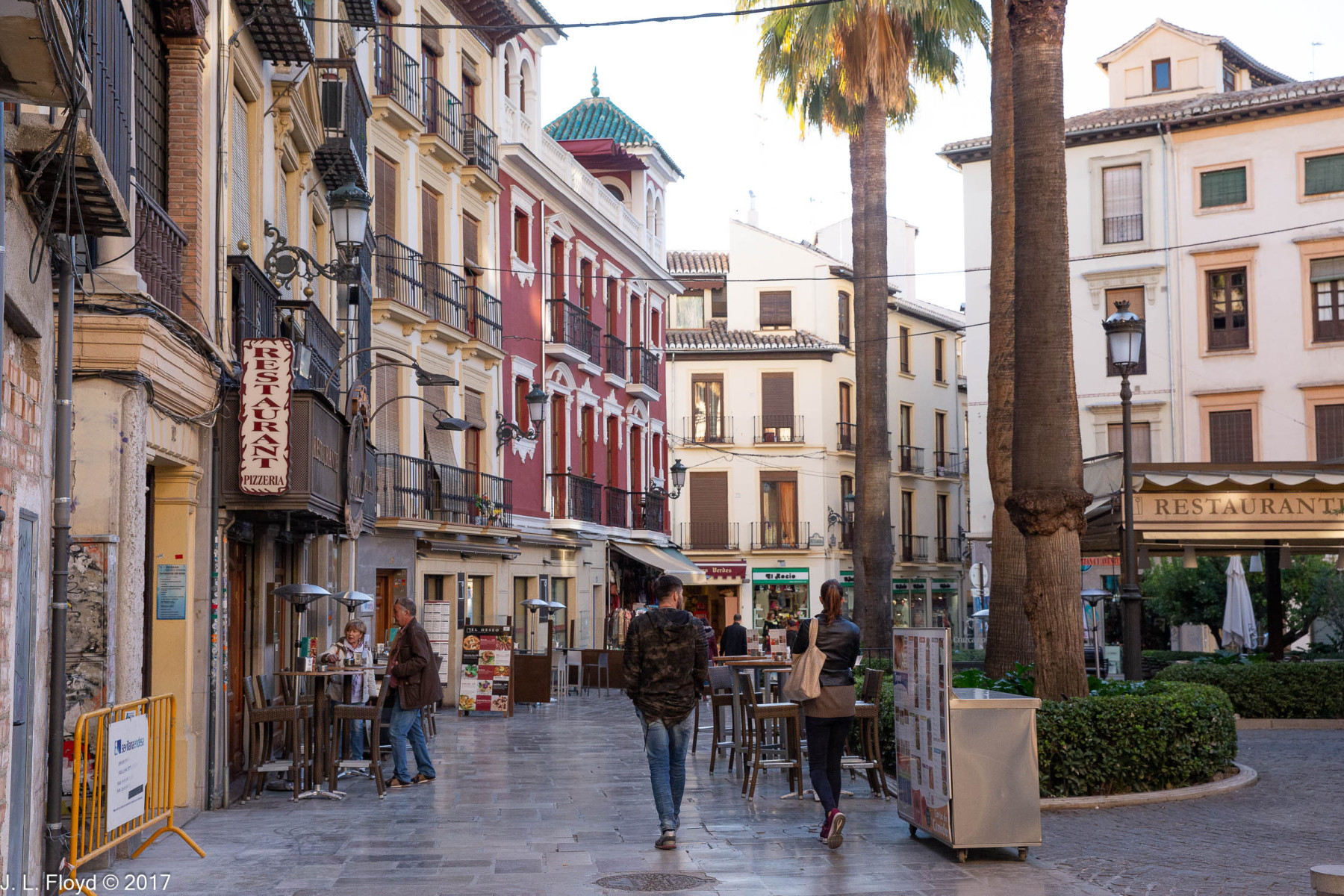
Next to the Palacio de Bibataubín on the north is another square, Plaza del Campillo, a pleasant locale with a newsstand, several enticing restaurants, and an attractive fountain. I was especially taken with a circular brick planter surrounding a huge, venerable old tree; the planter also served as a bench for passers-by to sit and rest their weary feet, and perhaps to contemplate dining at the nearby Restaurante Chikito.

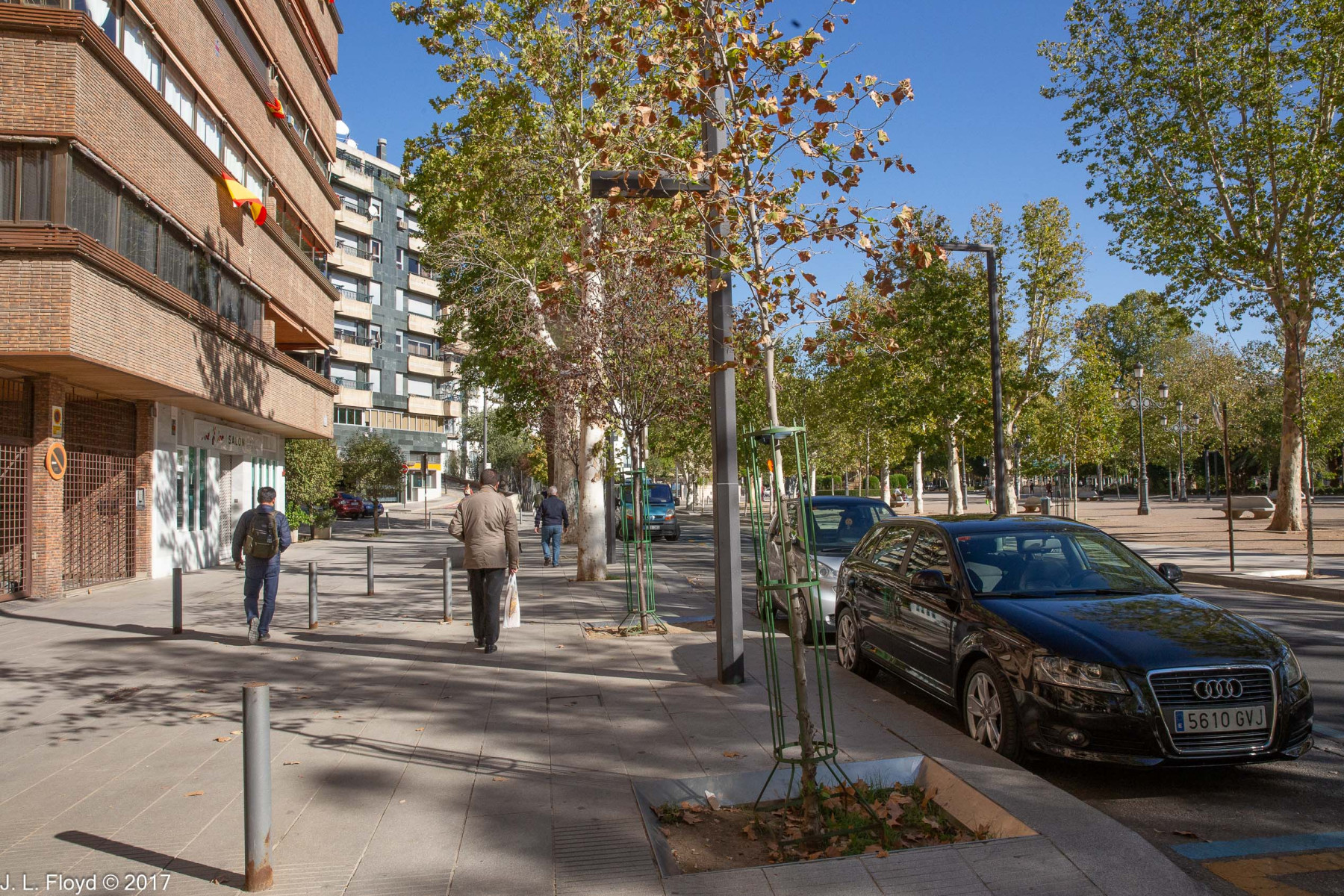
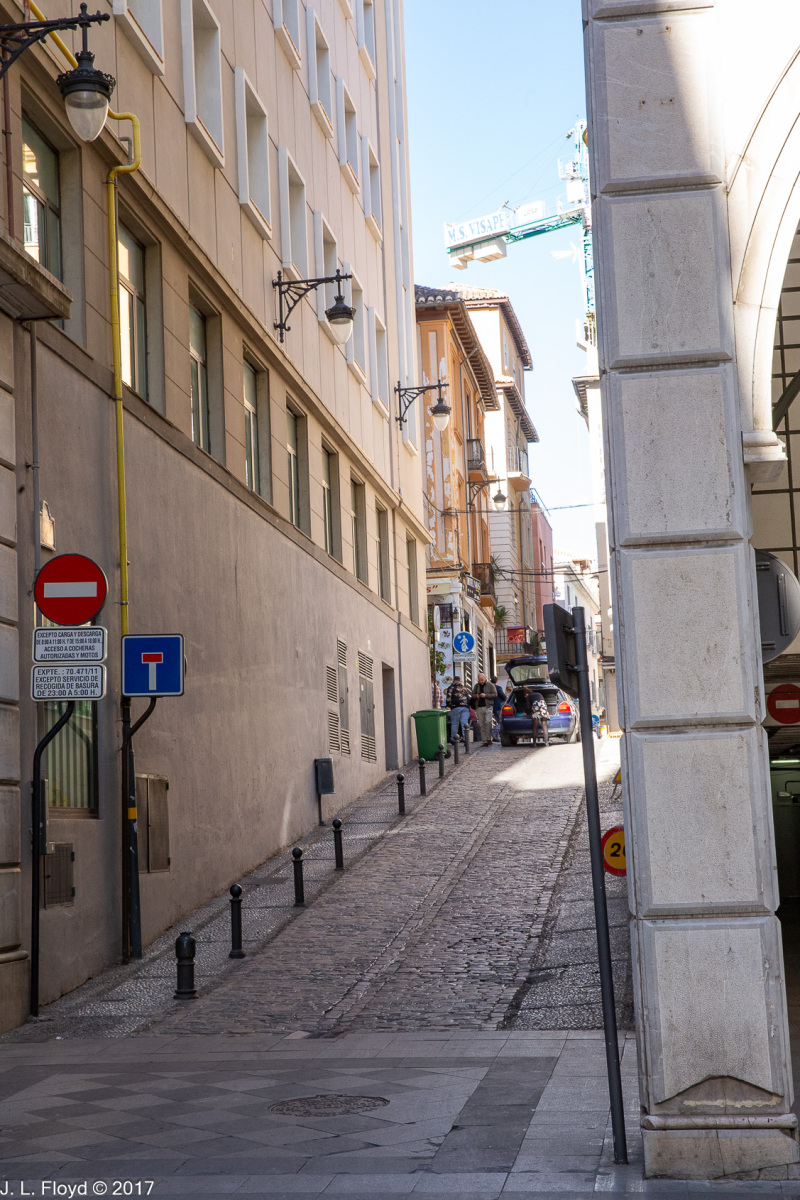
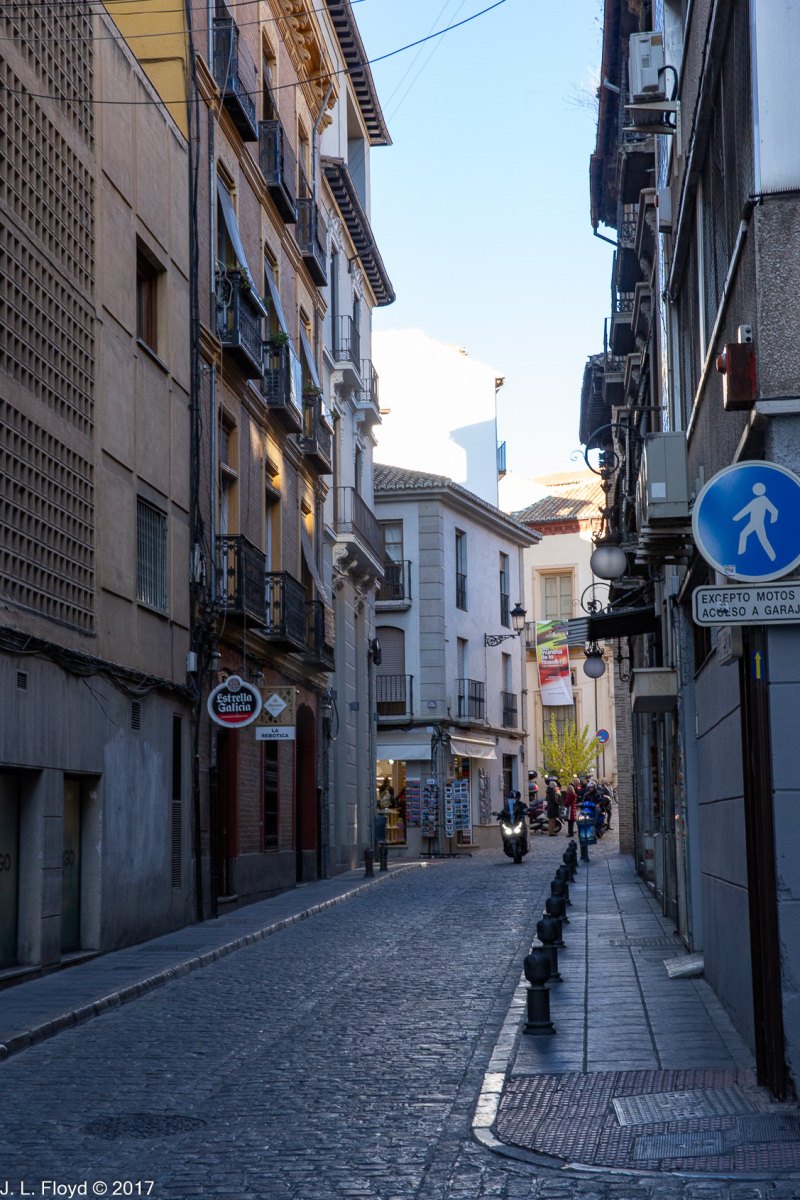
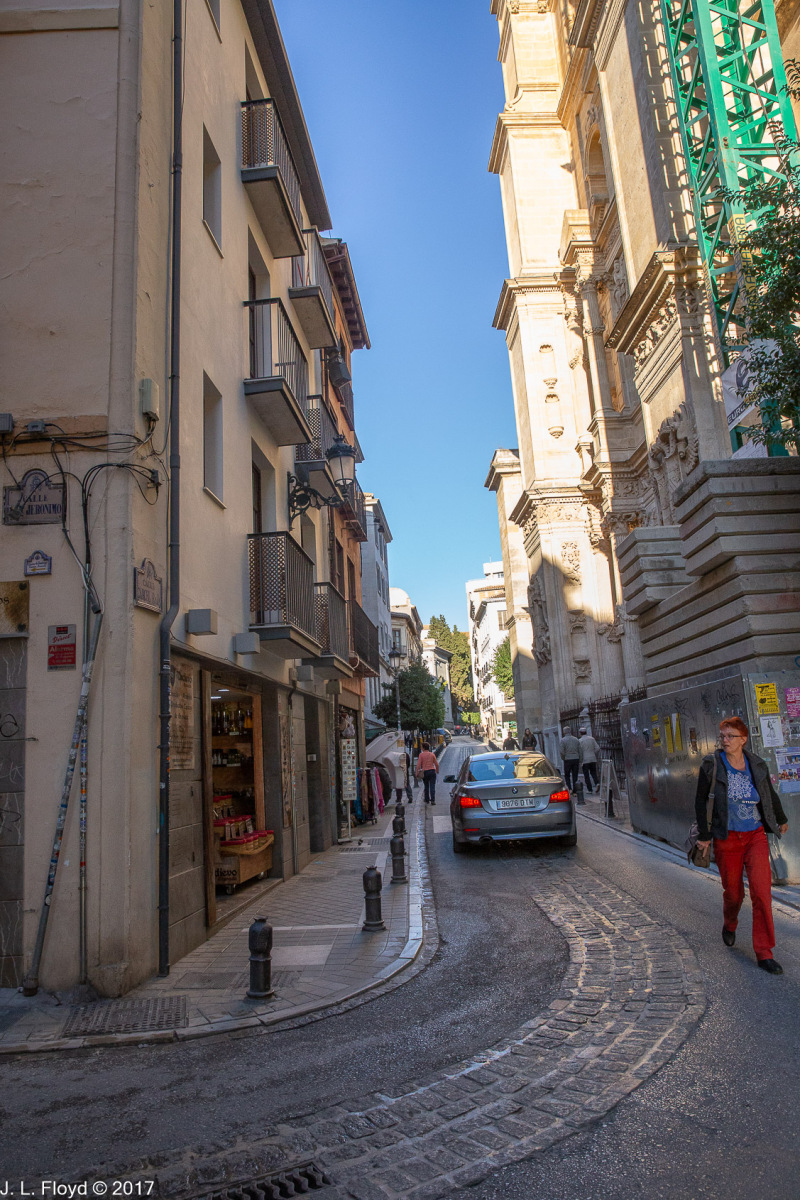
I must admit that I am hopelessly confused as to how we proceeded next. We ended up at the Ayuntamiento de Granada, which is the City Hall, in the Plaza del Carmen, but exactly how we got there I have no idea. My photos of the places we encountered aren’t very helpful since they don’t seem to comport with any logical route we could have taken. But it doesn’t really matter; the streets were well-kept and worth seeing in themselves.

The Ayuntamiento de Granada proved to be one of the most strikingly attractive town halls I saw in Spain, or anywhere else. It was originally built between 1572 and 1627 as a convent for nuns of the Discalced Carmelite order, and consisted of two enclosures: an old convent and a new convent, with a church attached to the latter . In the 19th century, the Spanish government conducted what it called a desamortización – confiscation – of ecclesiastical properties with the object of obtaining funds to pay off state debt and promote economic growth. In the aftermath of the expropriation, in 1858 the old convent and the church were demolished, and the Ayuntamiento offices were moved from their previous location to the undemolished new convent. The Casa Consistorial de Granada, as the building is formally known, is a two-story neoclassical structure with a high arched doorway and a balcony above it on the second floor. It has a beautiful patio, which however I have only seen in photos on the web, since we didn’t enter the building. The most striking feature of the Casa Consistorial, as far as I could see at the time, was the statue atop the building, which depicts a naked man on horseback; the man carries a golden globe, while the horse has two feet planted on identical globes. I have not been able to find out whom or what this sculpture is supposed to represent, but it is an impressive piece of work.

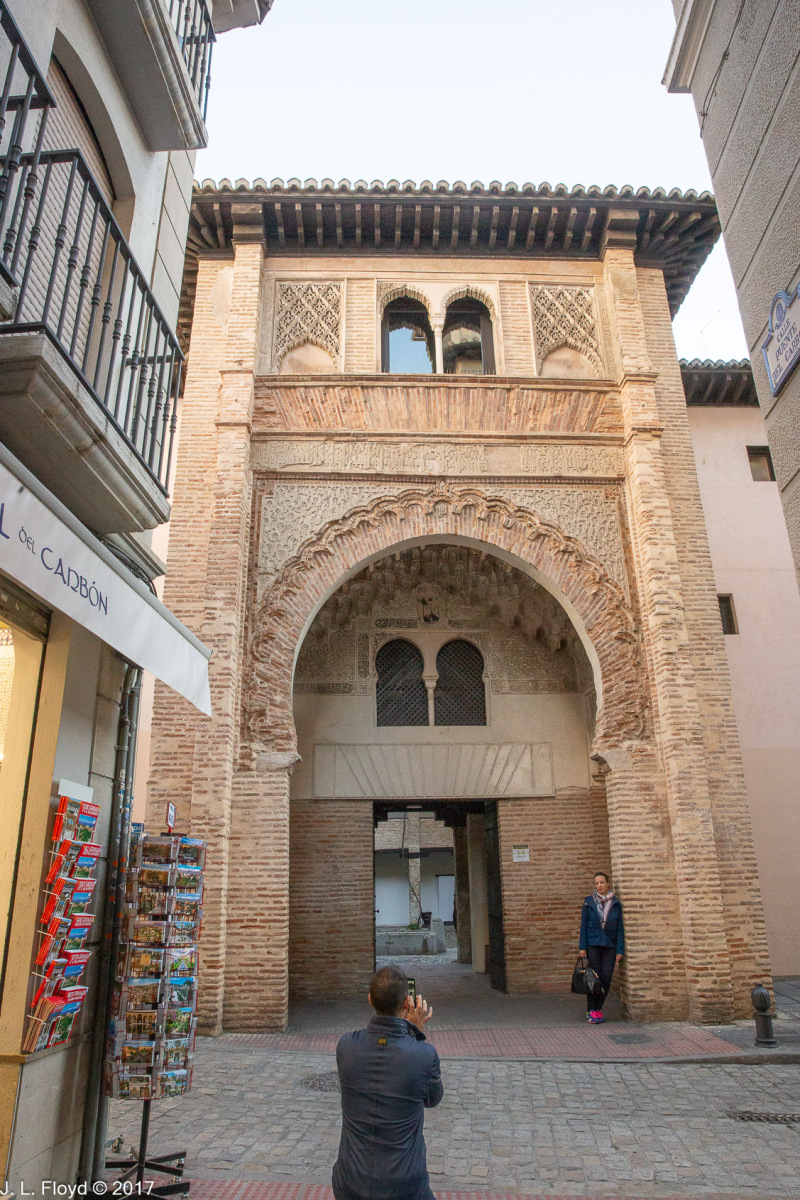
No less remarkable was our next stop, the Corral del Carbón. This is a survival of pre-Christian conquest Granada – in fact it is said to be the only structure of its kind surviving from the Nasrid period in the Iberian peninsula. It was built probably in the early 14th century as a caravanserai, a commercial and trading center serving as a warehouse for grain and as an inn and storage facility for traveling merchants. This type of establishment is known as a funduq in al-Andalus (Muslim Spain) and Morocco, and as an alhóndiga in Spanish. Its Arabic name was al-Funduq al-Jadida. After the 1492 conquest it was sold to private owners, who used it first as a theater, then converted it into an apartment building and also used the courtyard as an area for weighing and storing coal – hence the current name, which means “Courtyard of Coal.” By the twentieth century it had become quite dilapidated, but in 1928 the curator of the Alhambra, Leopoldo Torres Balbás, arranged to have the government purchase it with the proceeds of ticket sales from the Alhambra (which evidently was a major tourist attraction even then). The 36 tenant families still living in the building were ruthlessly evicted. Subsequently it underwent several restorations, the last one in 2006, and today it houses offices of the International Festival of Music and Dance of Granada and the Orchestra of the City of Granada.

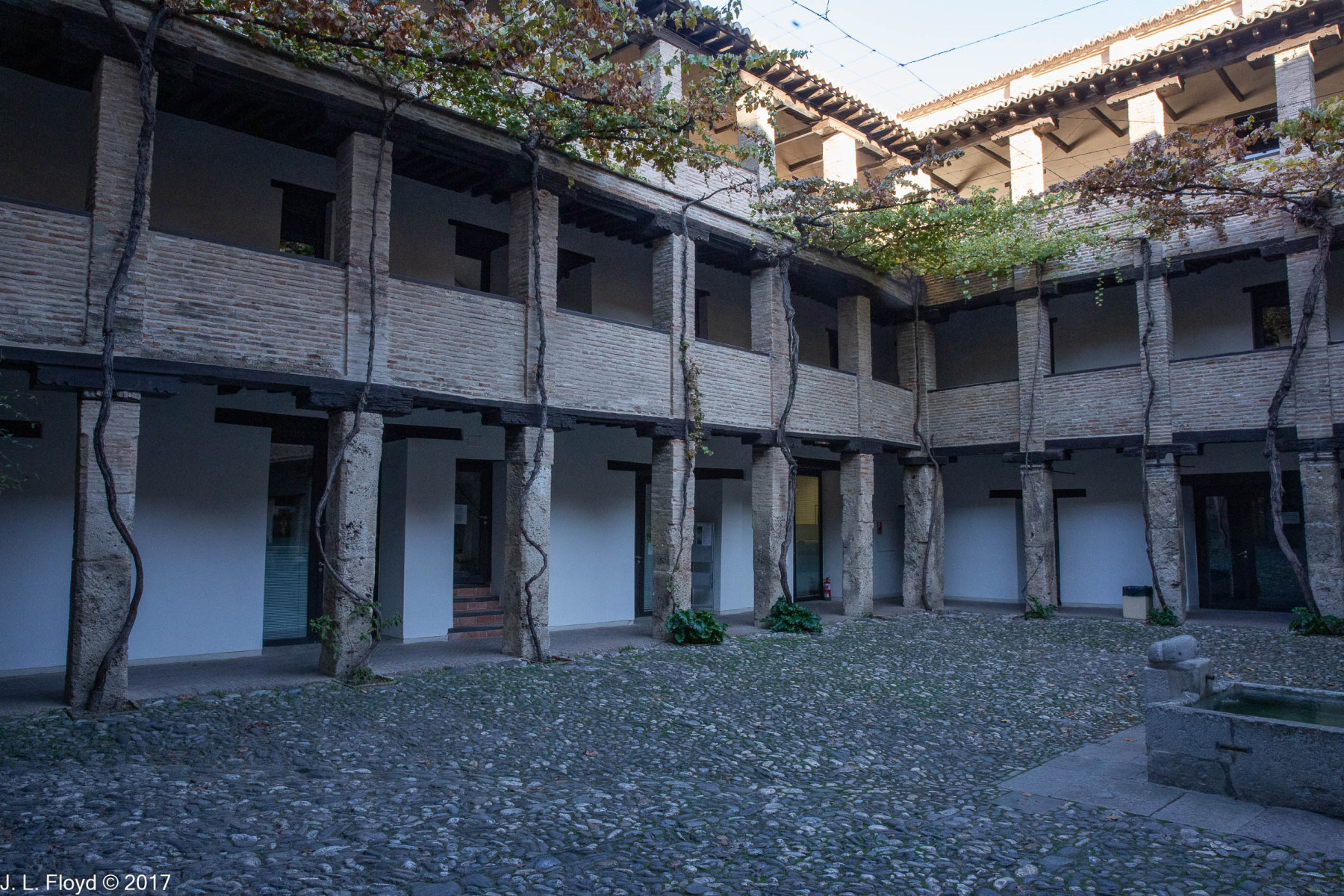
The most striking feature of the Corral is its monumental entrance façade, which has its roots in Sassanian Persian architecture but also displays typically Moorish and Nasrid characteristics such as double-arched windows, panels of decorative plaster with elaborate patterns and Kufic inscriptions, and muqarnas sculpting in the archway. The interior is more spartan. The central courtyard is surrounded on all sides by a three-story gallery, with the bottom floor containing storage facilities and the upper two serving as living quarters. In the center of the courtyard is a large stone basin with two water inlets, one on each side, which must have been used to water the camels in Nasrid times. (Actually I doubt whether camels were used in Spain, even by the Moors, but it would have served horses and donkeys equally well.) Around the sides of the courtyard are planted vines which rise majestically up to the third floor – I think they must be a type of wisteria, but they were not blooming in November.

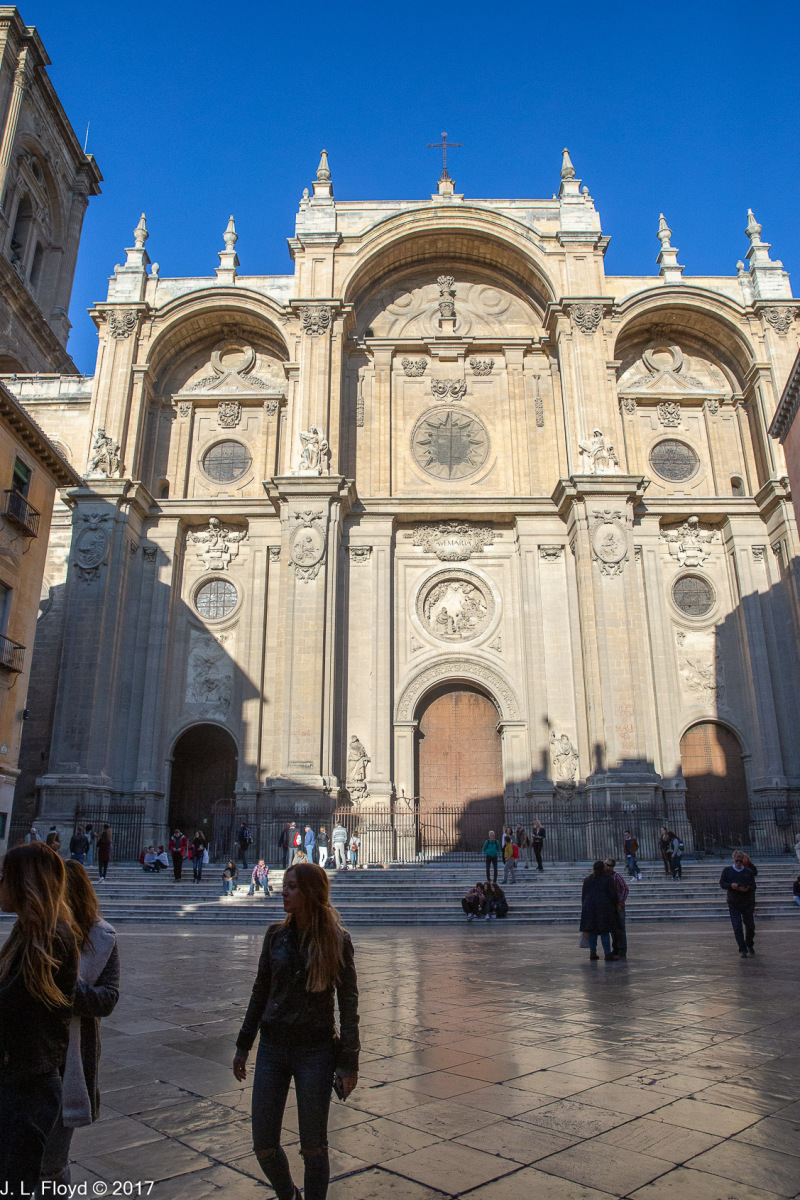
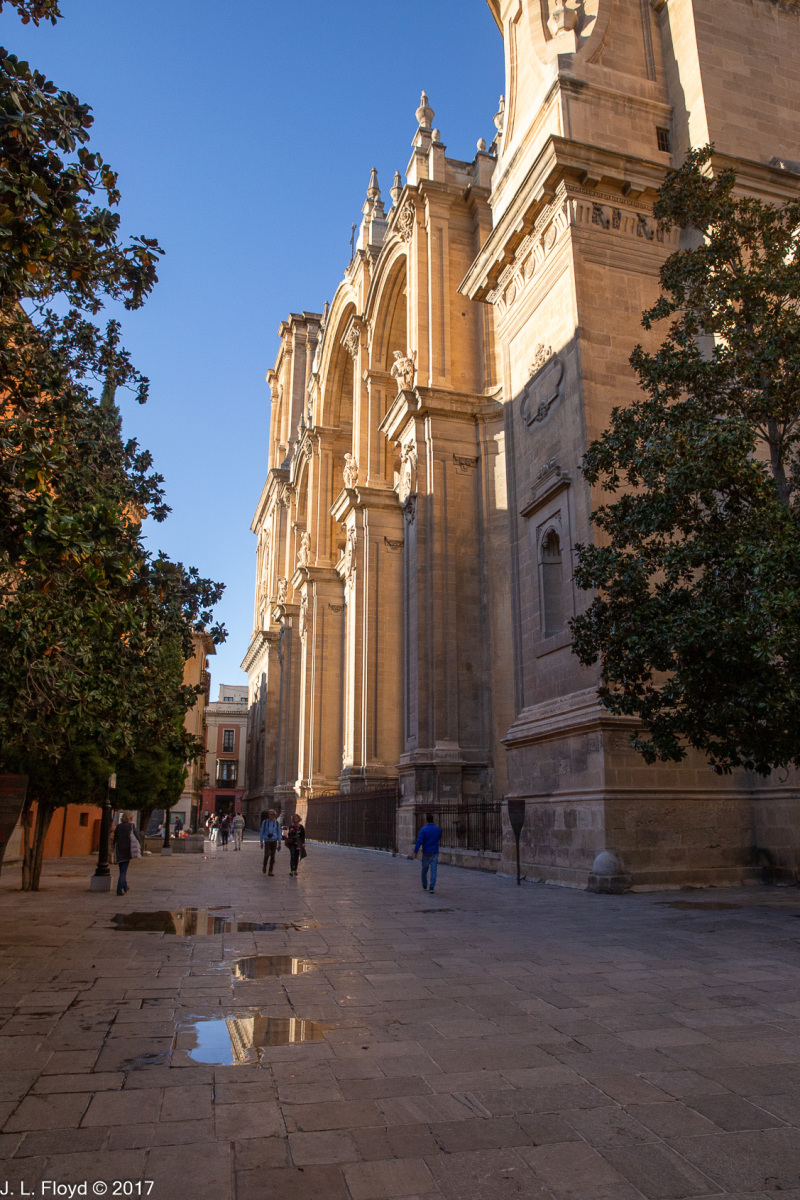
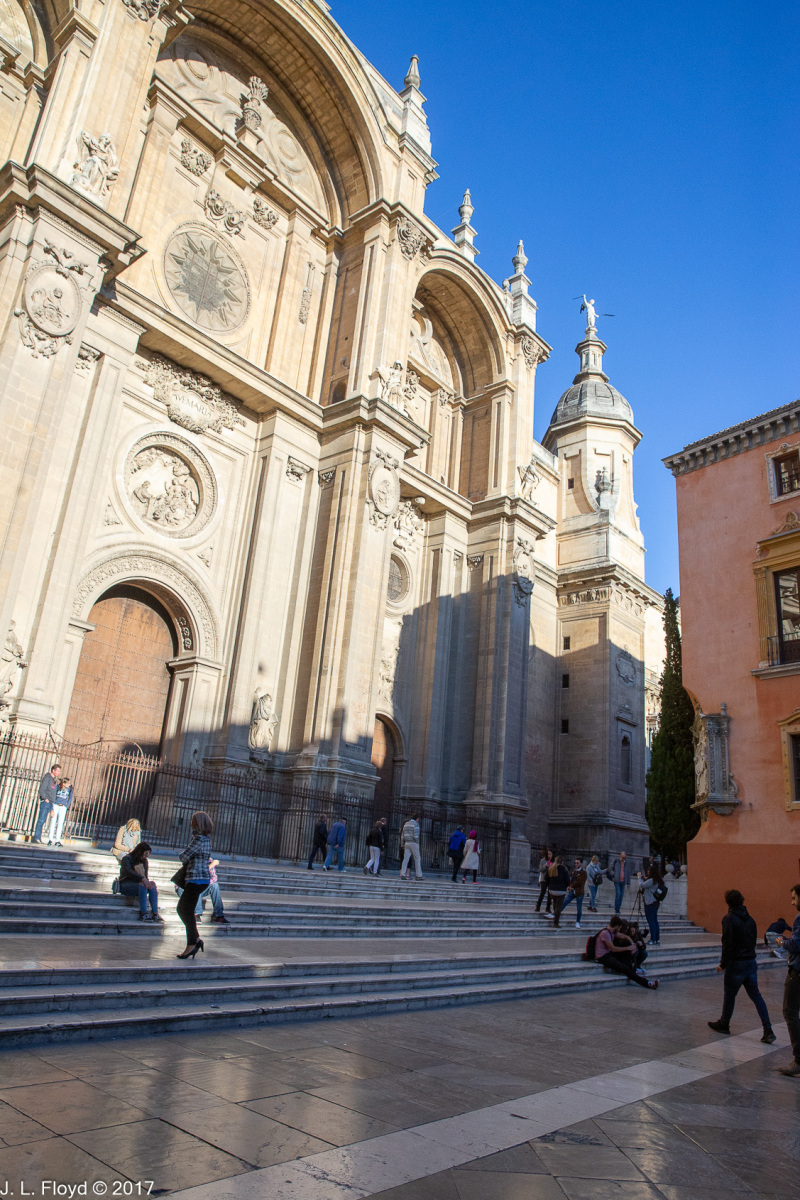
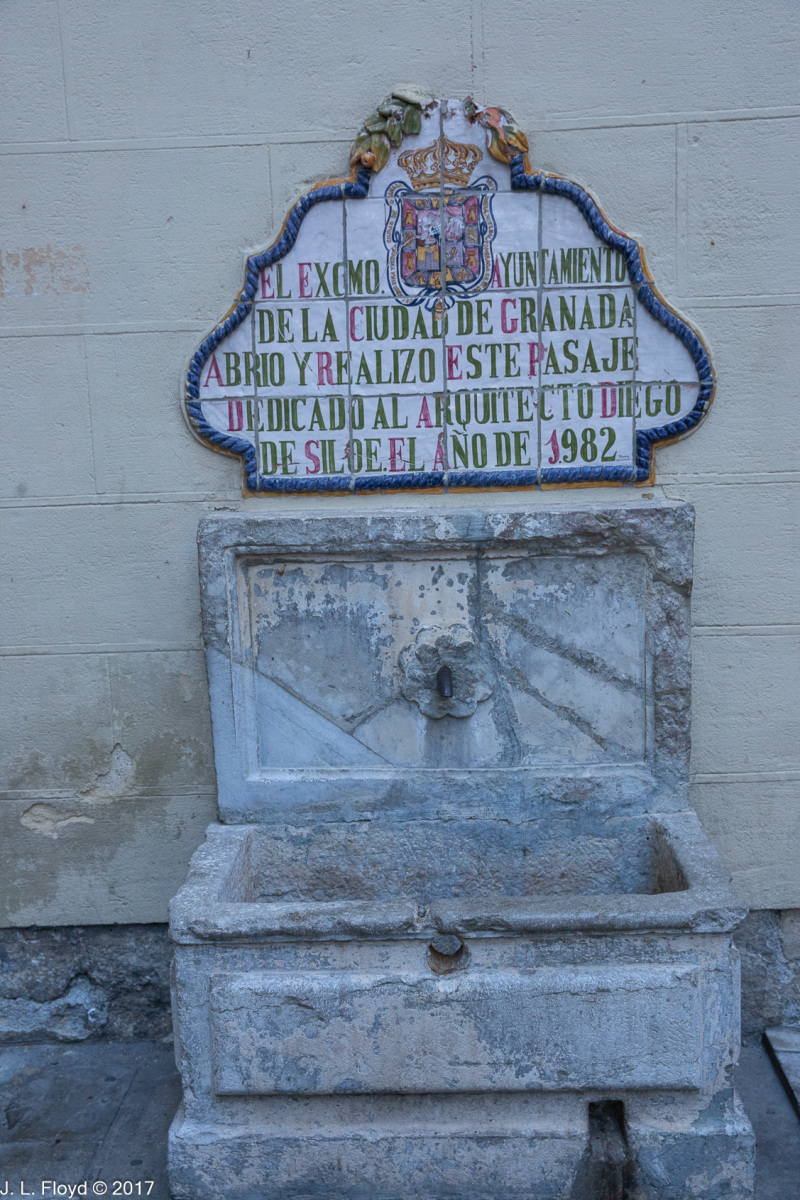
The Corral del Carbón is not far from the Granada Cathedral, and that is where we headed next. The Cathedral is part of a complex of ecclesiastical buildings which includes the Iglesia Parroquial del Sagrario, the Capilla Real de Granada and others. Formally known as Santa Iglesia Catedral Metropolitana de la Encarnación de Granada, it is the seat of the Archbishop of Granada. It was built on the site of what had been the city’s main mosque before the Reconquest. Construction began in 1518 and continued for 181 years. It was initially planned as a Gothic cathedral, but the second architect, Diego de Siloé, who replaced Enrique Egas in 1529, switched to a design reflecting the influence of the Italian Renaissance, which dominated thereafter, although Baroque elements were also added in the final years of construction. Siloé combined a Renaissance dome with a Gothic floor plan, but he also gave the cathedral five naves instead of the usual three, and he installed a circular capilla mayor (principal chapel) in place of the customary semicircular apse. Another architect, Alonso Cano, was responsible for completing the façade in its final form, an imposing tripartite triumphal arch, and that represented the Baroque influence.

The Royal Chapel of Granada (Capilla Real de Granada), on the south side of the cathedral, is actually older than the cathedral itself. It was built between 1505 and 1517 as the burial place of the Catholic monarchs, Ferdinand and Isabella. The chief architect was Enrique Egas, who designed it in a style known as Isabelline Gothic or Castilian late Gothic, a sort of transitional style between traditional Castilian Gothic and early Renaissance architecture, incorporating Flemish, Mudejar (Moorish) and Italian influences.

Also on the south side of the cathedral is another church, the Iglesia Parroquial del Sagrario or Parish Church of the Tabernacle. This was built much later than the cathedral, between 1705 and 1759, on the site of the mosque prayer hall, with a Greek cross floor plan. We did not see the interior, but it has what is said to be a “sensational” baptismal font and is filled with notable 15th and 16th-century works of art.

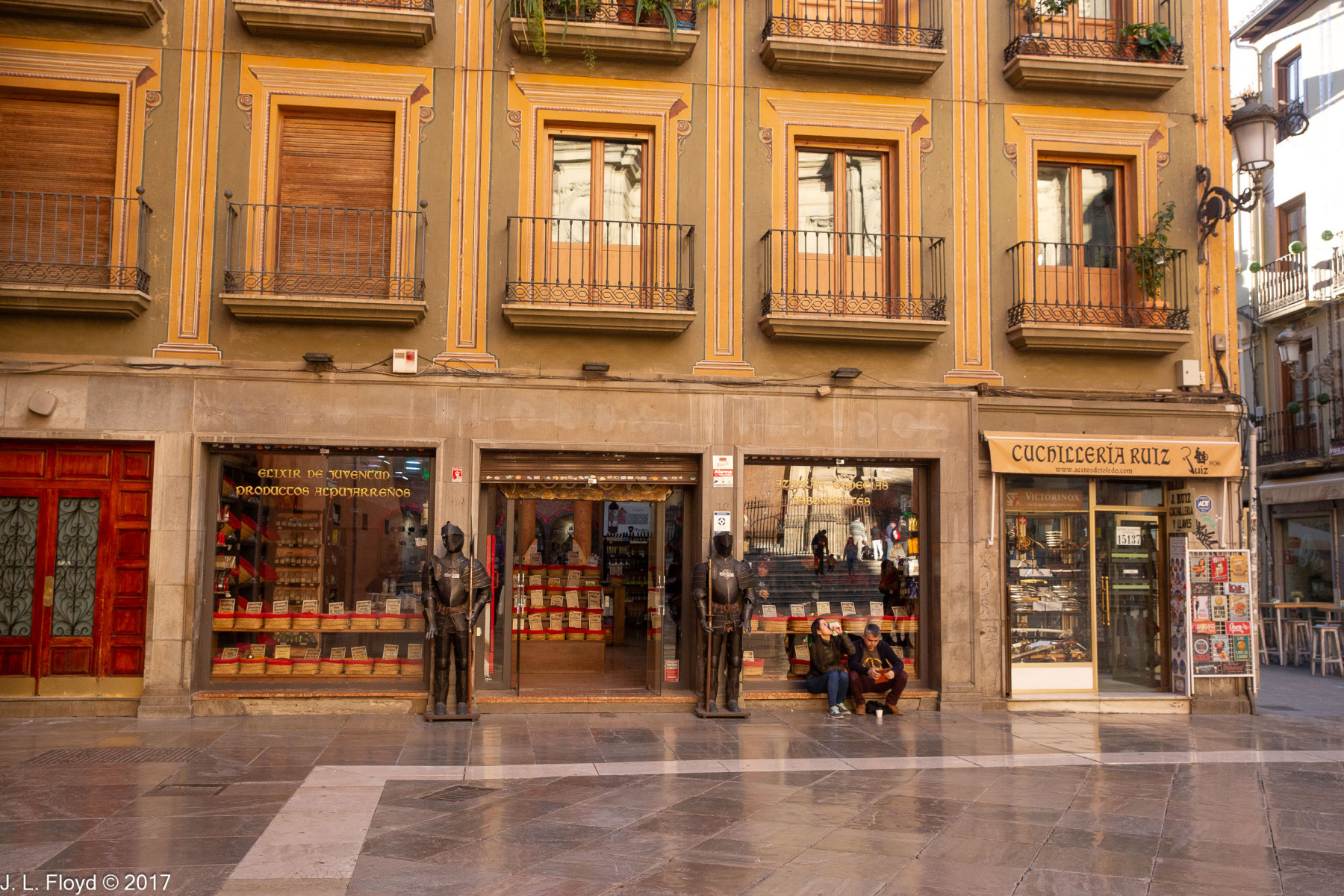
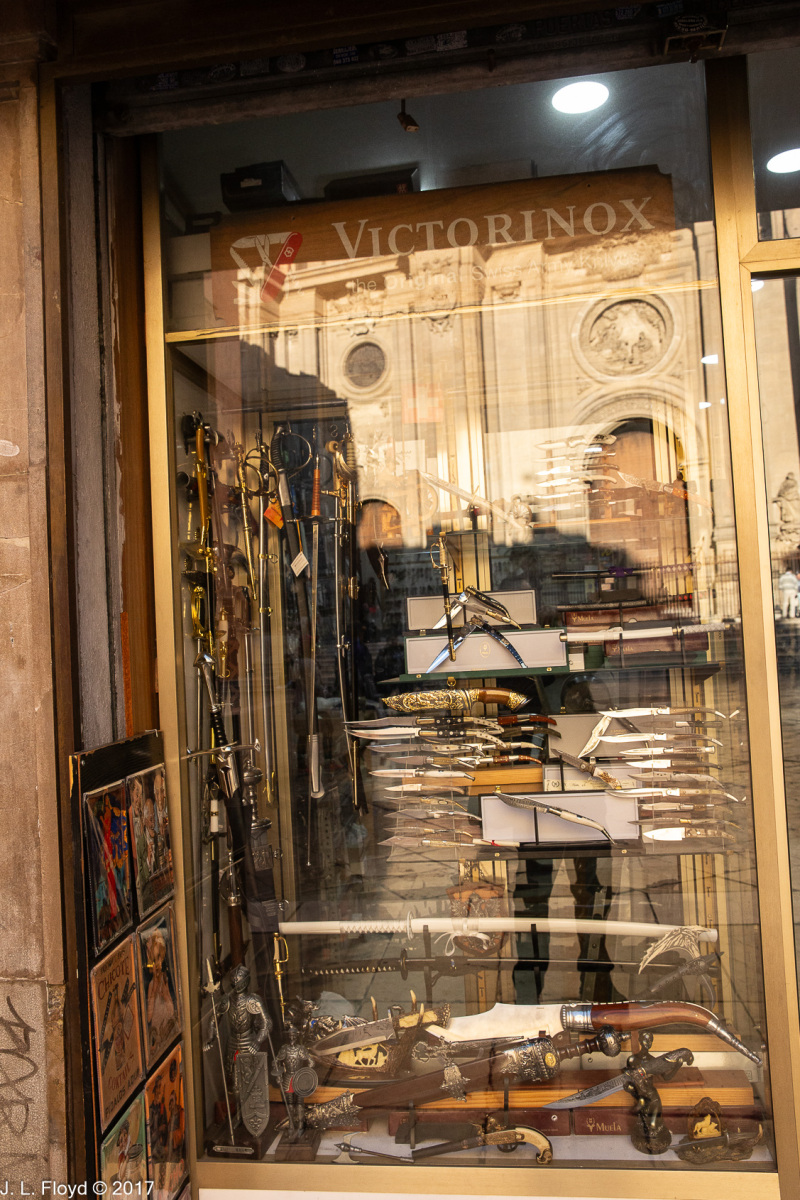
I also enjoyed snooping around in the area immediately surrounding the cathedral, where there were a number of interesting sights and shops. Right in front of the cathedral there is a square called Plaza de las Pasiegas; on its western edge is a series of shops – a cutlery store called Cuchillería Ruiz – El llavín de oro (“Golden Key”), a spice shop, and a café.

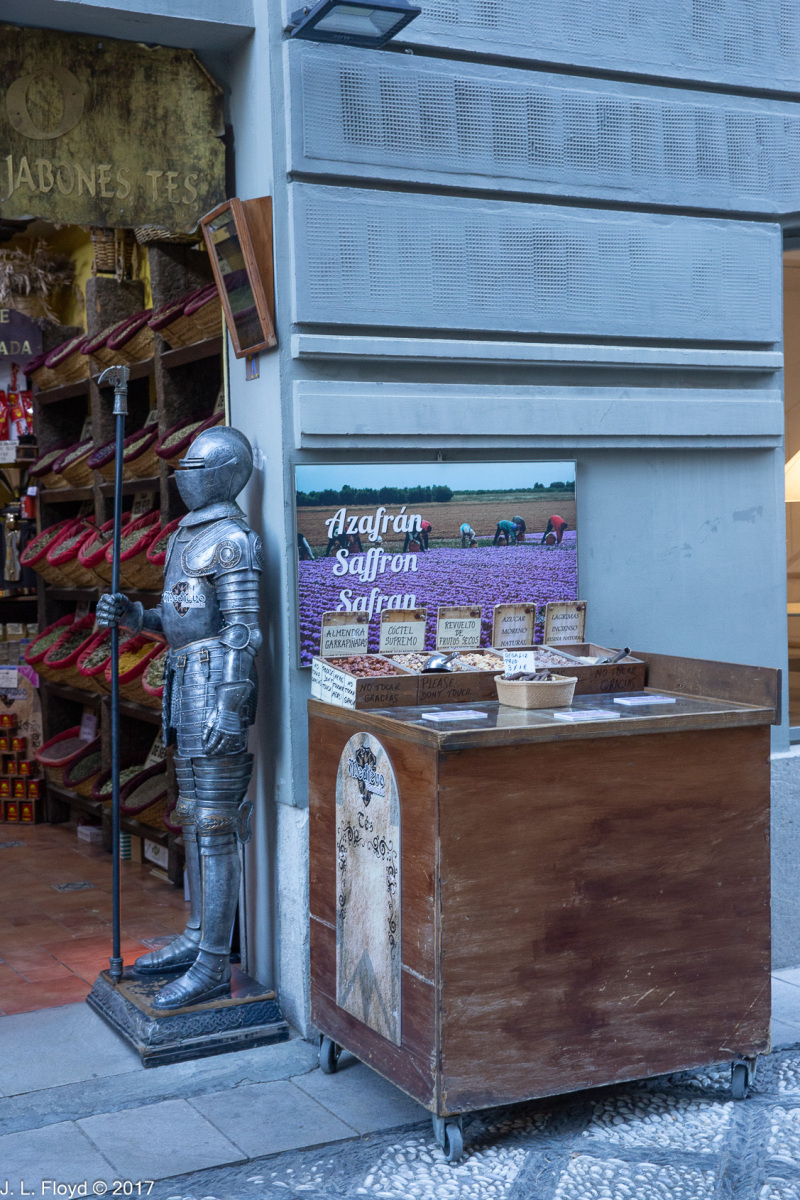
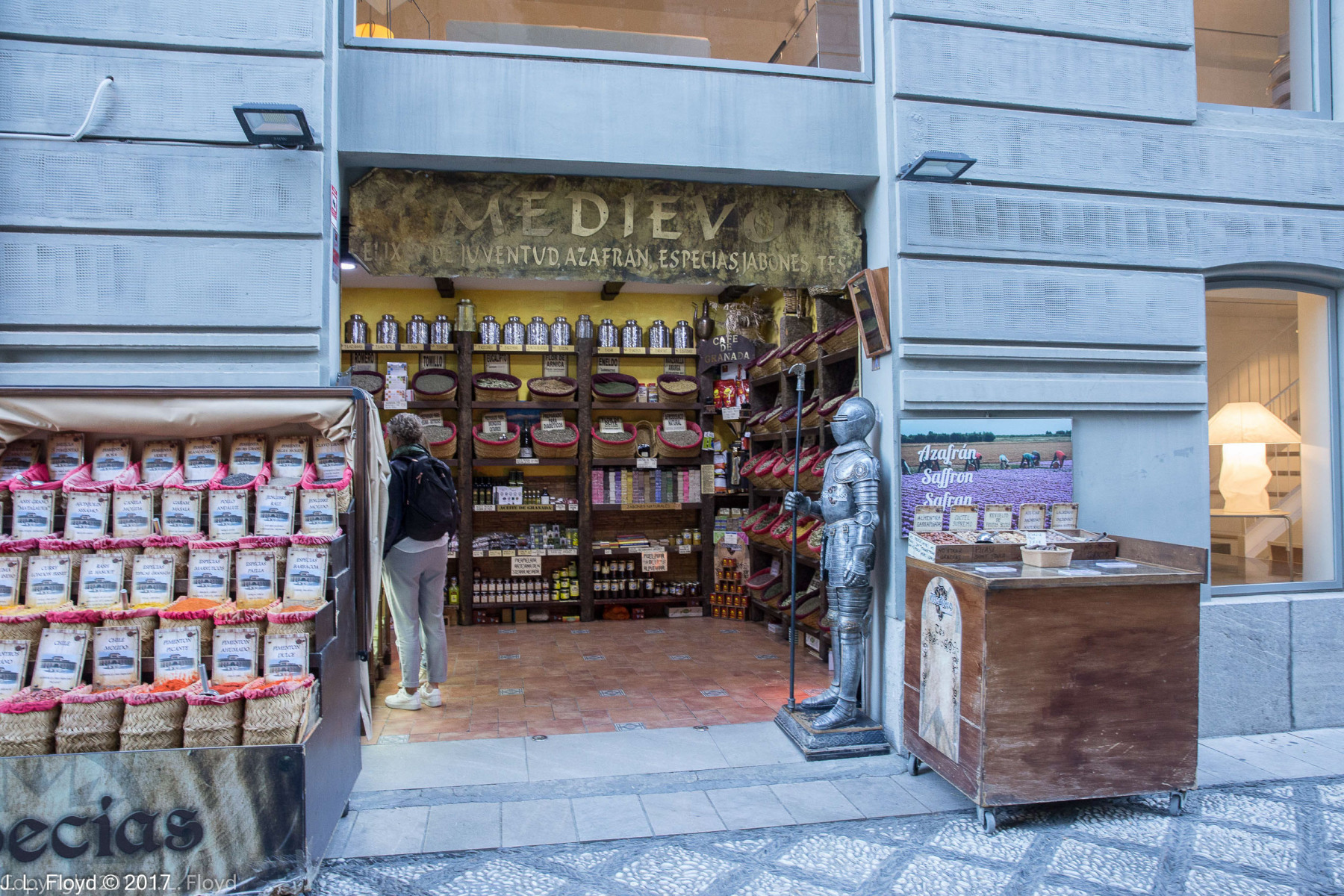
There was another spice shop on a side street not far away from the cathedral, and it was a matter of some interest to me that both of them were guarded by knights posted just outside the door – actually empty suits of armor, but formidable-looking nonetheless. It’s kind of understandable, because in early modern Europe spices were very valuable, and the quest to obtain them was what prompted the voyages of Spanish and Portuguese explorers to discover the New World and carve out empires in Asia. But it was a bit startling to see this historical moment reflected in a present-day context.

Hotels, rental apartments and airbnbs are plentiful in the cathedral neighborhood, and with good reason. The Plaza de las Pasiegas, and the major street that leads to it, is the venue of a number of processions during Holy Week, which lasts from Palm Sunday to Easter Monday. These are staged by the hermandades (religious brotherhoods) of Granada, and feature elaborate floats bearing tableaux depicting religious scenes and figures, as well as marching figures called “nazarenos”, people dressed up in white suits with pointed hoods looking alarmingly like Ku Klux Klan members. Although the nazareno garments did in fact serve as the inspiration for the KKK uniforms, the nazarenos themselves are not seeking to frighten or persecute anyone but rather to express penitence and ask for forgiveness of sins. Their processions are carried out throughout the city, but some of the most spectacular originate or terminate at the cathedral. Many outsiders come to Granada for Holy Week from all over the world as well as Spain.

Just off the northwest corner of the Cathedral is a square called the Plaza Romanilla, where I encountered the most appealing sculpture I saw in all of Granada. This was the Monumento al Aguador, Monument to the Water-Carrier, a recent work from 1999 by the sculptor Aurelio Teno. The profession of water-carrier was an essential occupation in Granada (as elsewhere) down to the twentieth century. Aguadors were itinerant figures who roamed the city, offering water to passers-by as well as houses who had no water – which would have been almost all of them in pre-modern times. (People would have been able to fetch water from fountains distributed in places around the city, but these were relatively few and far between.) All of the water for the city came from the rivers Darro and Genil, or from springs near the riverbanks. The aguadors fetched the water from these sources under the supervision of an official called muhtasib (in Arabic) or almotacén (in Spanish), who was charged with overseeing all the activities of the aguadors, including ensuring that they took the water from locations in the river which were not muddy, dirty or polluted – for all the garbage and industrial waste from the city was dumped in the rivers in those days. The aguadors typically transported the water in demijohns — large earthenware jars which they hauled on the backs of donkeys. The sculpture in the Plaza Romanilla depicts the aguador as a ragged, tired, almost emaciated figure holding a water glass, shambling alongside his heavily laden donkey, who appears surprisingly perky considering the weight he has to carry. I found this a very touching and thought-provoking portrayal. It drove home to me something that people tend to be unaware in these days of running water and flush toilets: how precarious access to water was in days of yore. Water was precious, and for those beneath the top layers of society it was very scarce. How would you wash cook your food, bathe yourself and your children, wash your clothes, and clean your house, all with the pitifully small amount of water obtained from the aguador? I find it difficult to imagine. At least you wouldn’t have to worry about washing your car. Anyway, I was very gratified to find that at last someone had created a monument to the poor and downtrodden members of society, and not just kings, emperors, nobles and churchmen like the notorious Cardinal-Archbishop Cisneros.

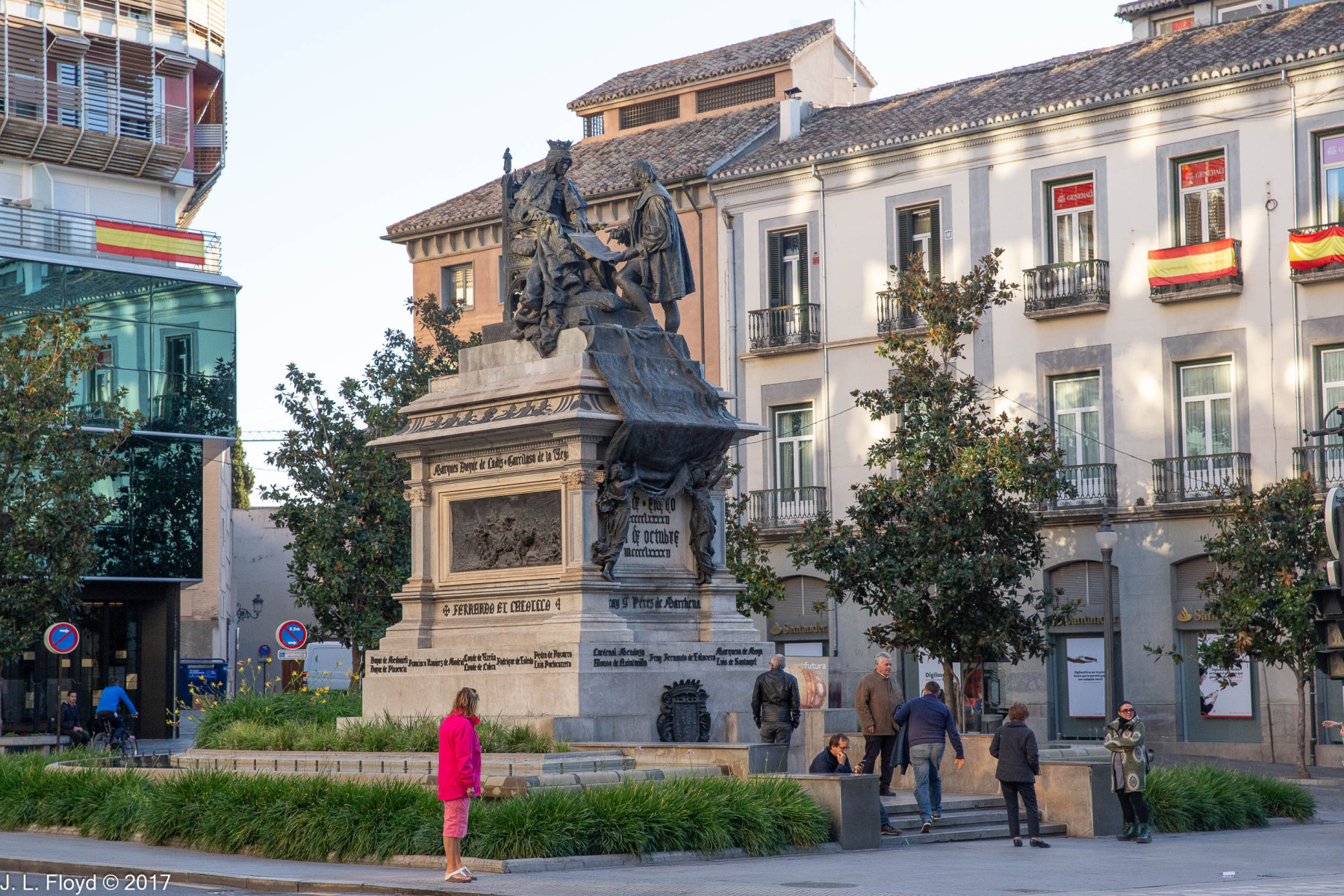
After exploring the cathedral area, we headed southeast and soon found ourselves on the Reyes Católicos, the grand east-west boulevard that runs through the heart of Granada. There, at the intersection with the Gran Vía de Colon, we emerged onto the Plaza Isabel la Católica. This is obviously the most appropriate place for a monument which depicts Queen Isabella holding an audience with Christopher Columbus – Colon being the Spanish form of his last name. The monument was built for the 400th anniversary of Columbus’ discovery of the Americas in 1892. It was originally intended to be a triumphal arch, but funds for such a grandiose project could not be raised, so the city settled for a high stone pedestal with Queen Isabella seated on her throne on top, and Columbus kneeling on steps in front of her. The pedestal is inscribed with the names of major dignitaries, including King Ferdinand of Aragon and various nobles.

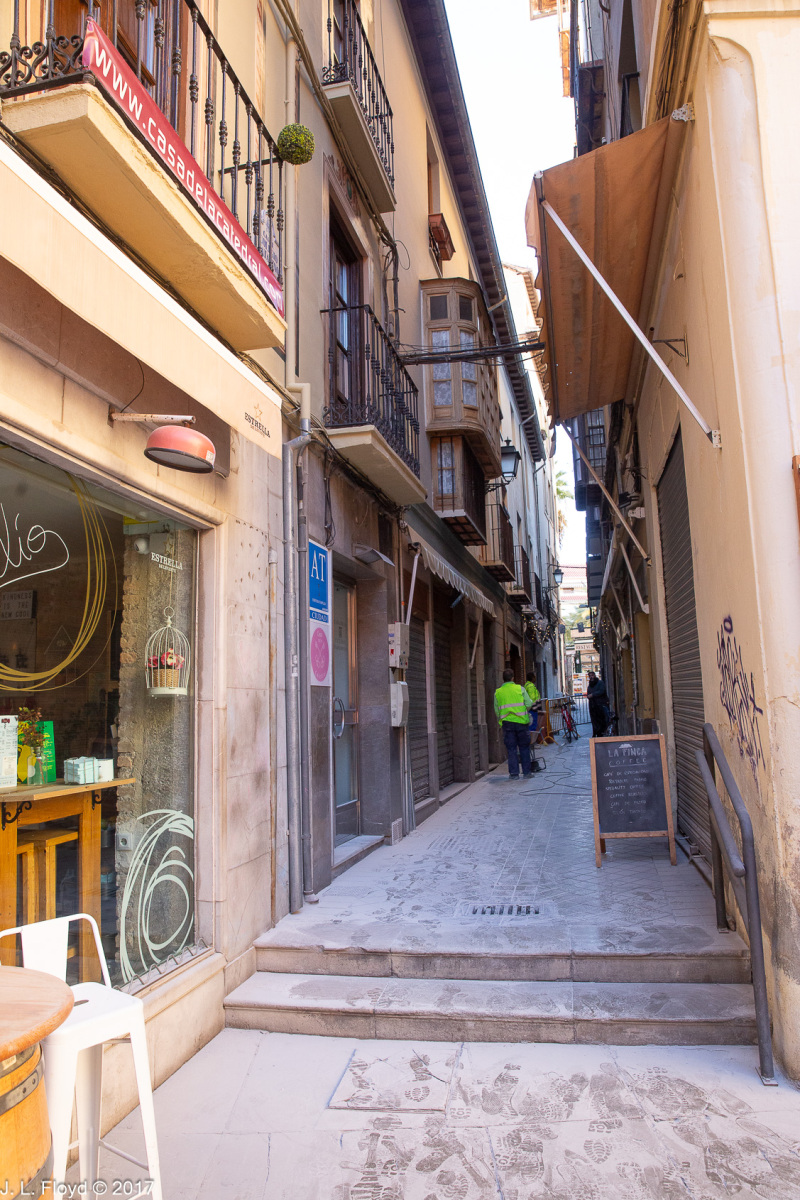
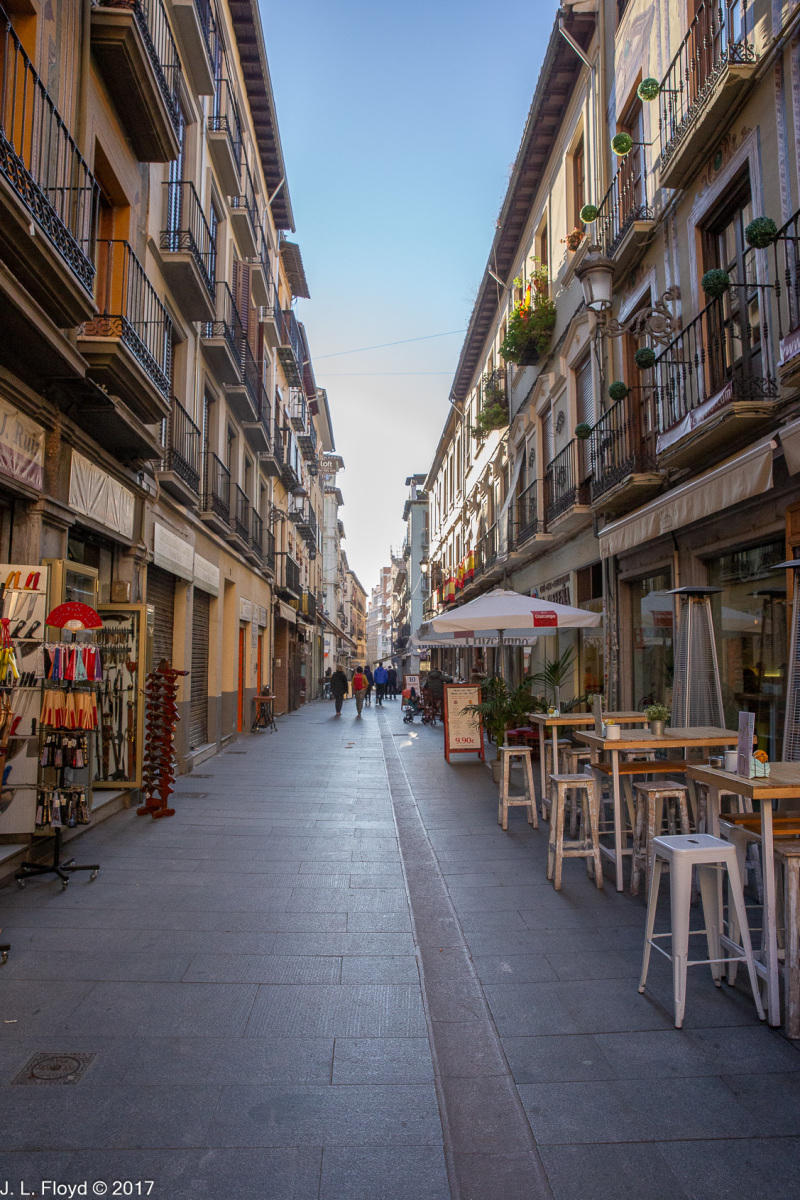
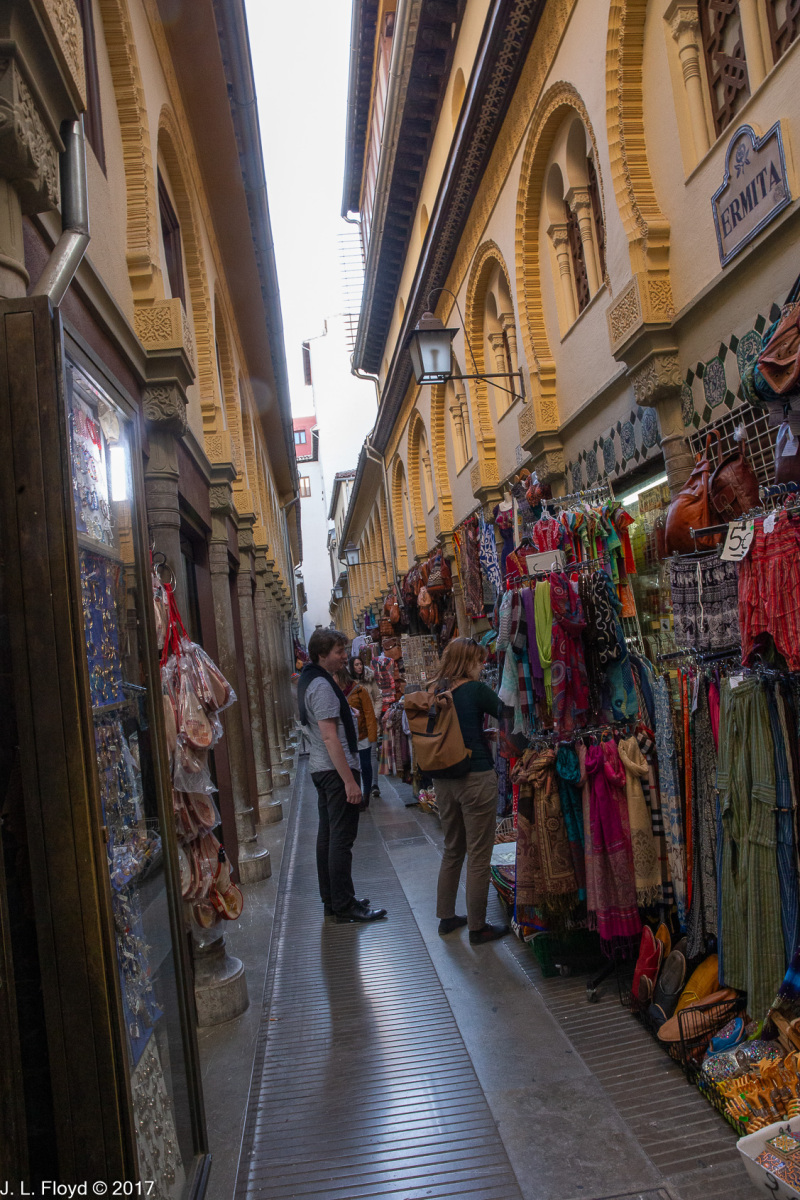
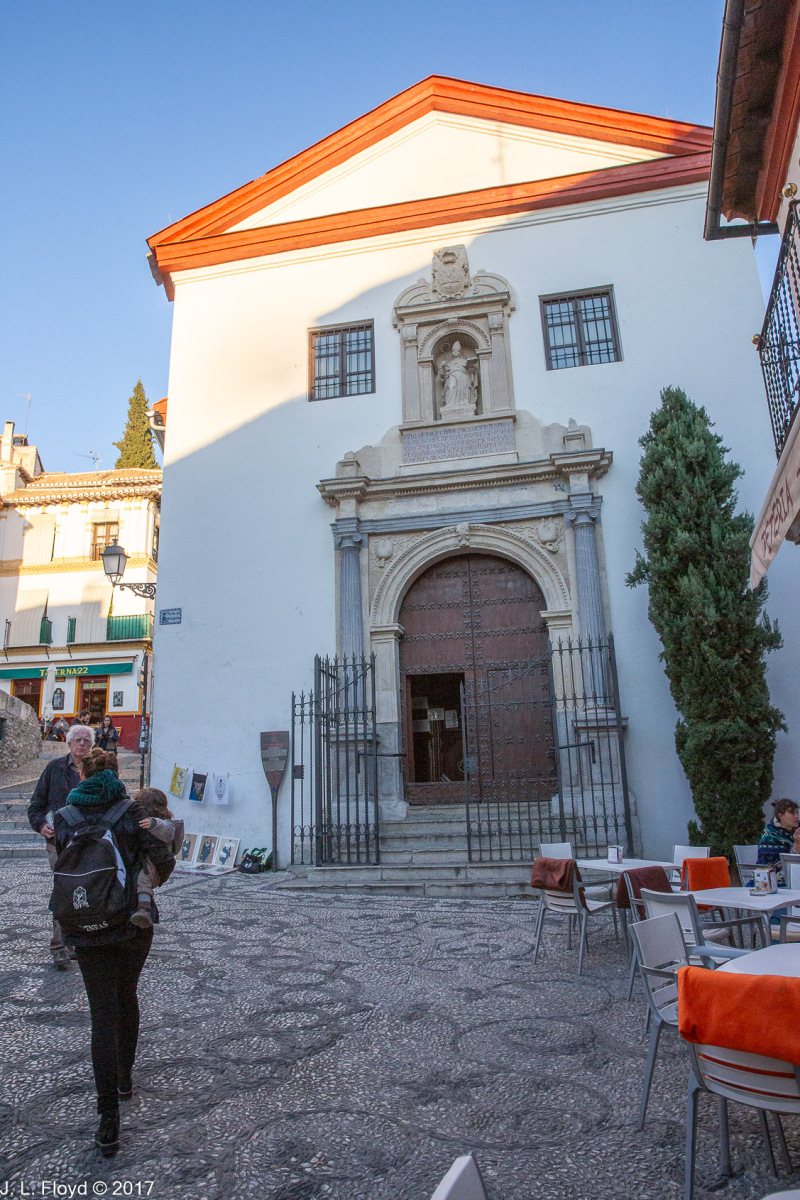
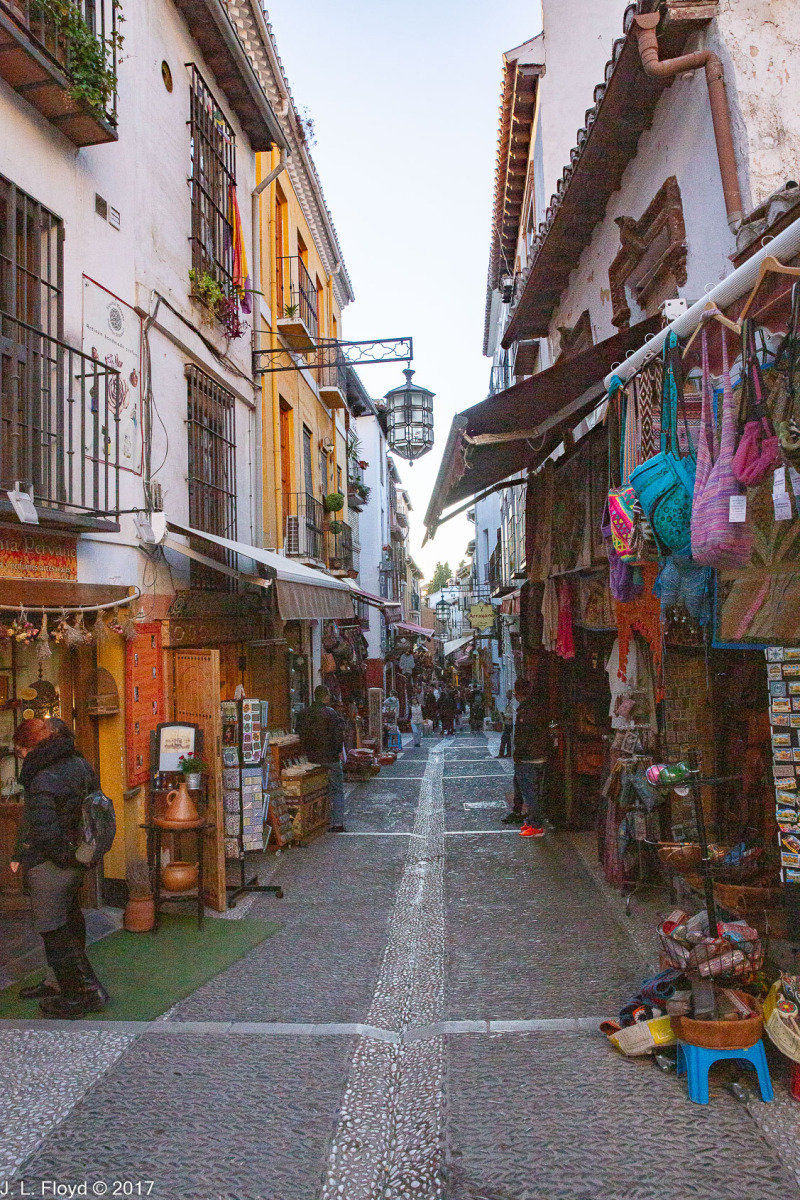
I don’t remember what route we took from the Plaza Isabel la Católica to our next stop, the Plaza de San Gregorio. We were heading in the general direction of the Mirador de San Nicolas, and by this time I was so tired that I remember very little, and would remember even less if I didn’t have the pictures I took along the way to remind me. I think we came by the Calle Calderería Nueva, since that picturesque street with its many colorful shops shows up in one of my photos. In any case, we somehow arrived at the Iglesia de San Gregorio Bético, Church of Saint Gregory the Blessed, which gives the square its name. The church began its existence as a small hermitage, founded by the Catholic Monarchs after the conquest of Granada in 1492 in honor of two Christian monks who tried to preach their faith at the mosque of Granada in 1397, and for their pains were tied to the tails of horses and dragged through the streets of the city to a dungeon, located where the present church now stands, for execution.

In the 16th century the hermitage was expanded into a church, with an adjoining convent. After the desamortización (confiscation of church properties) in 1835-1837, it was used variously as a wine and coal warehouse, a dance hall and a brothel. But in 1887 the secularization was reversed, with the congregation of nuns of Sancti Spiritus taking over management of the church. It was burned down in 1936, during the Civil War, but later rebuilt, and is currently occupied by an order of cloistered nuns known as the Poor Clares.

Architecturally, the church is distinguished by its Ionic style façade, done in Sierra Elvira marble, and by the location of its main tower at the back of the building, an unusual position in Granada. The interior is a mixture of Renaissance and Baroque styles. It has only one nave, which is divided in two halves, the back for ordinary worshipers and the front one, which includes the main chapel, for the nuns. It also boasts some celebrated frescoes in the presbytery and the dome.

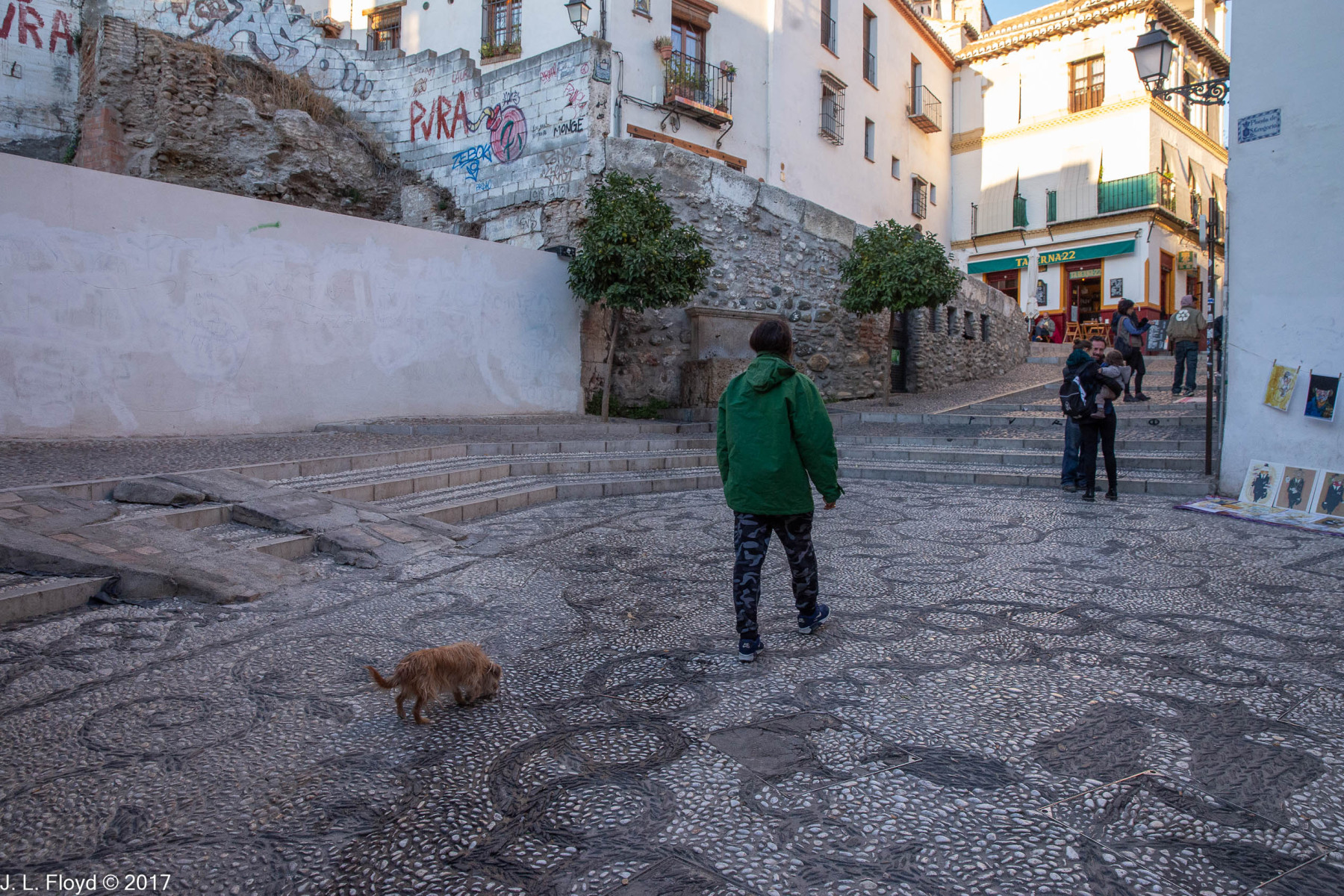
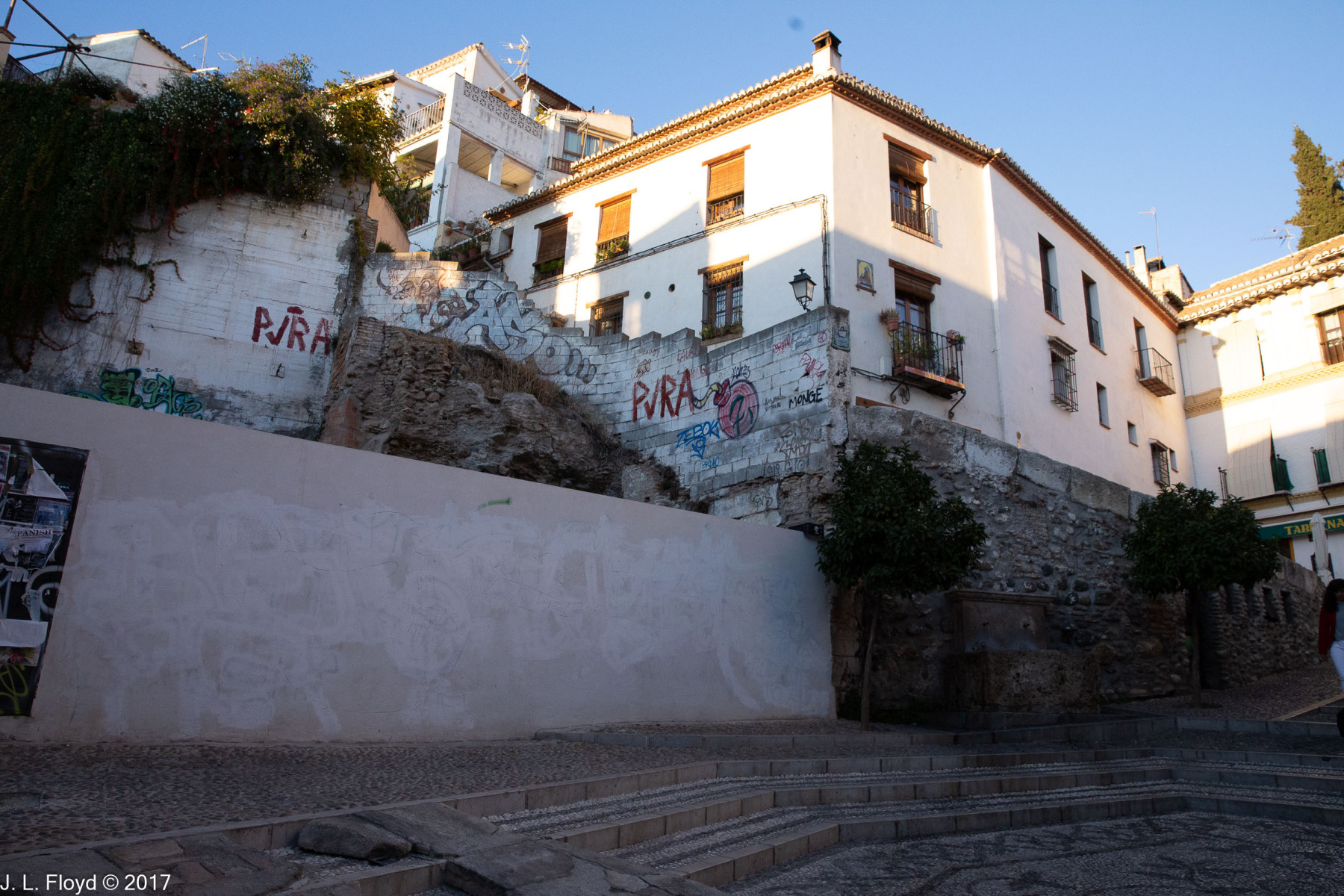
The square to which the church gives its name was also quite pleasant, with beautiful stone mosaic pavement and upscale houses all round. Here as elsewhere in Granada some of the walls were adorned with graffiti, but these were not nearly as prolific or as obtrusive as in another city of my acquaintance, founded in 1781 as El Pueblo de Nuestra Señora la Reina de los Ángeles del Río de Porciúncula.

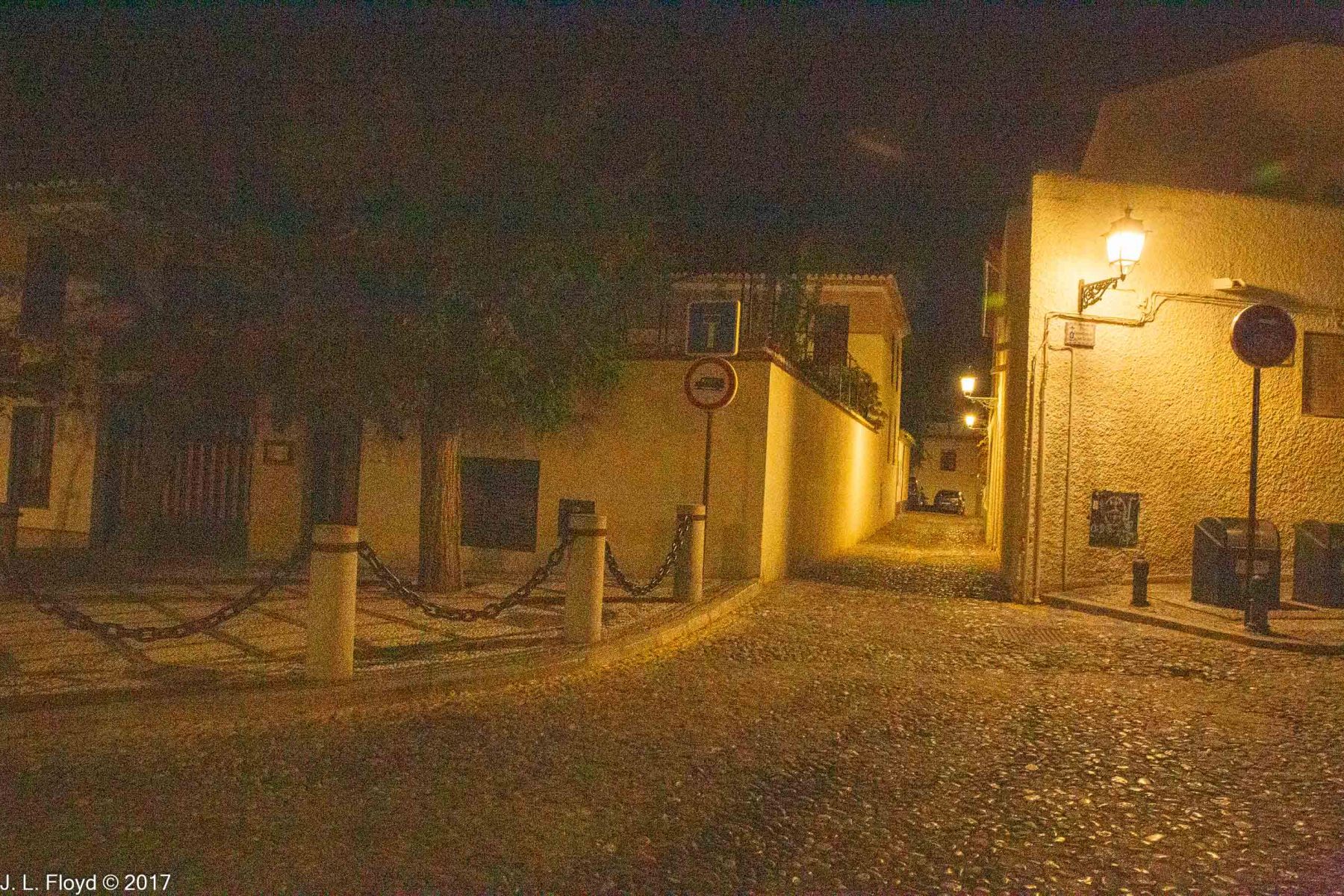
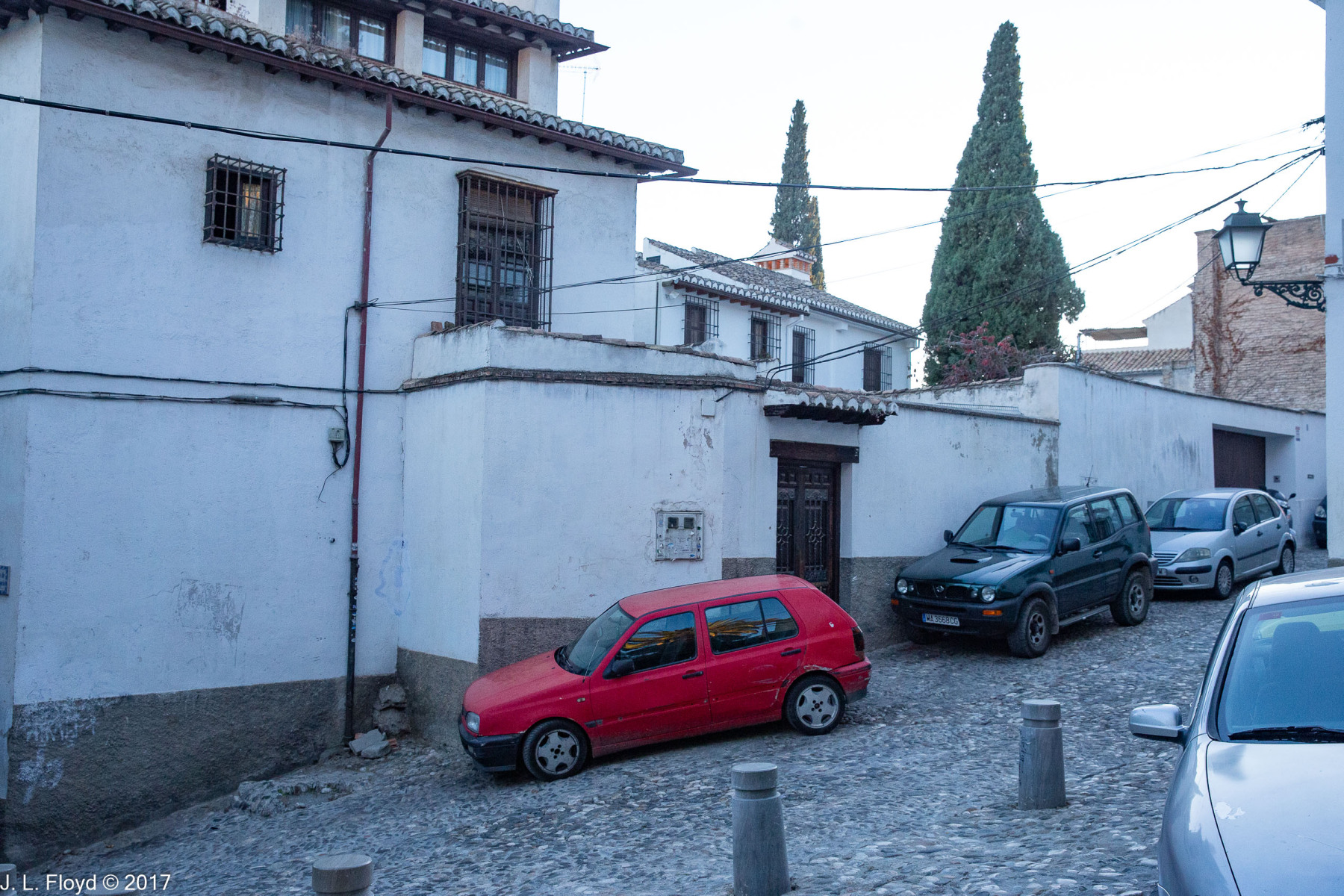
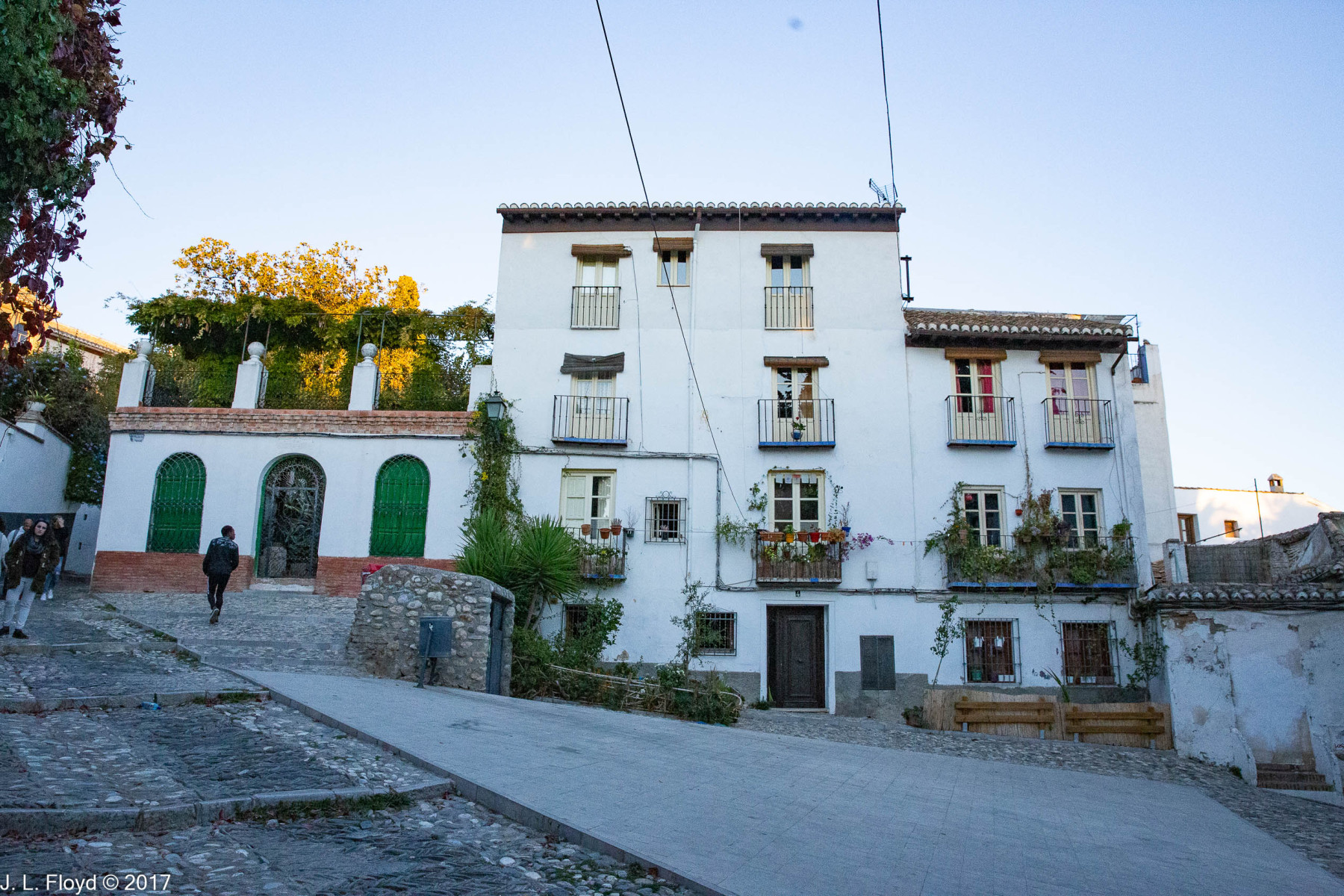
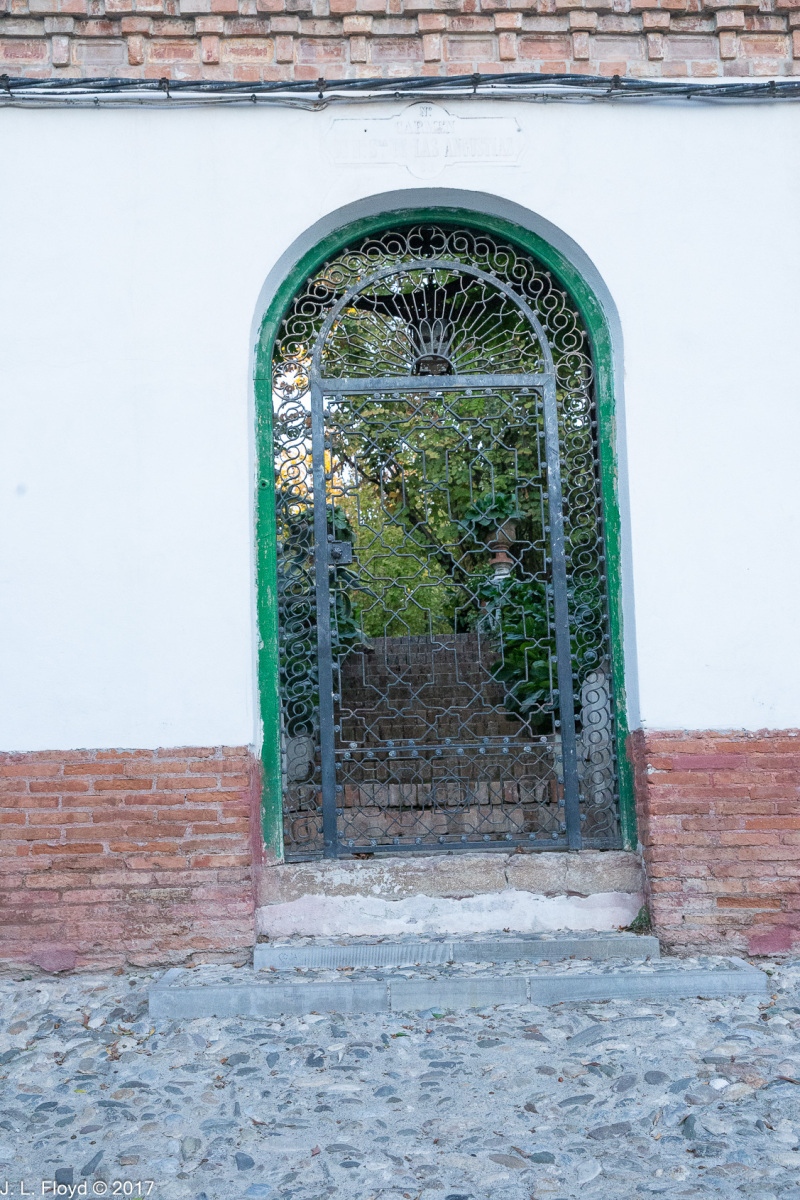
From the Plaza de San Gregorio I continued on to the Mirador de San Nicolas. The guided walking tour may have ended by then, but all I can remember now is that I was very tired and nobody was with me when I reached the Mirador. Fortunately I wasn’t too tired to take pictures along the way. The quiet streets of the Albaicín quarter were quite charming, lined with elegant houses and walled gardens, the only caveat being that they were so narrow that any car being driven in my vicinity was a mortal threat.

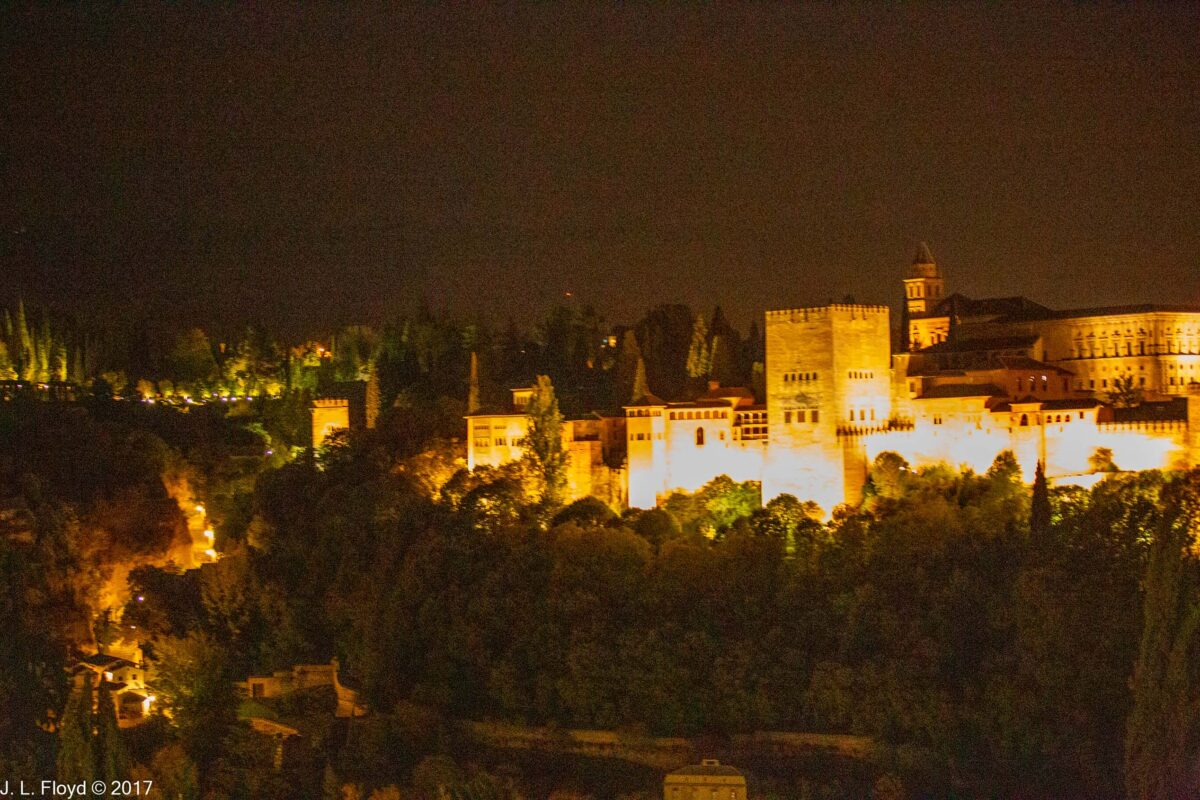
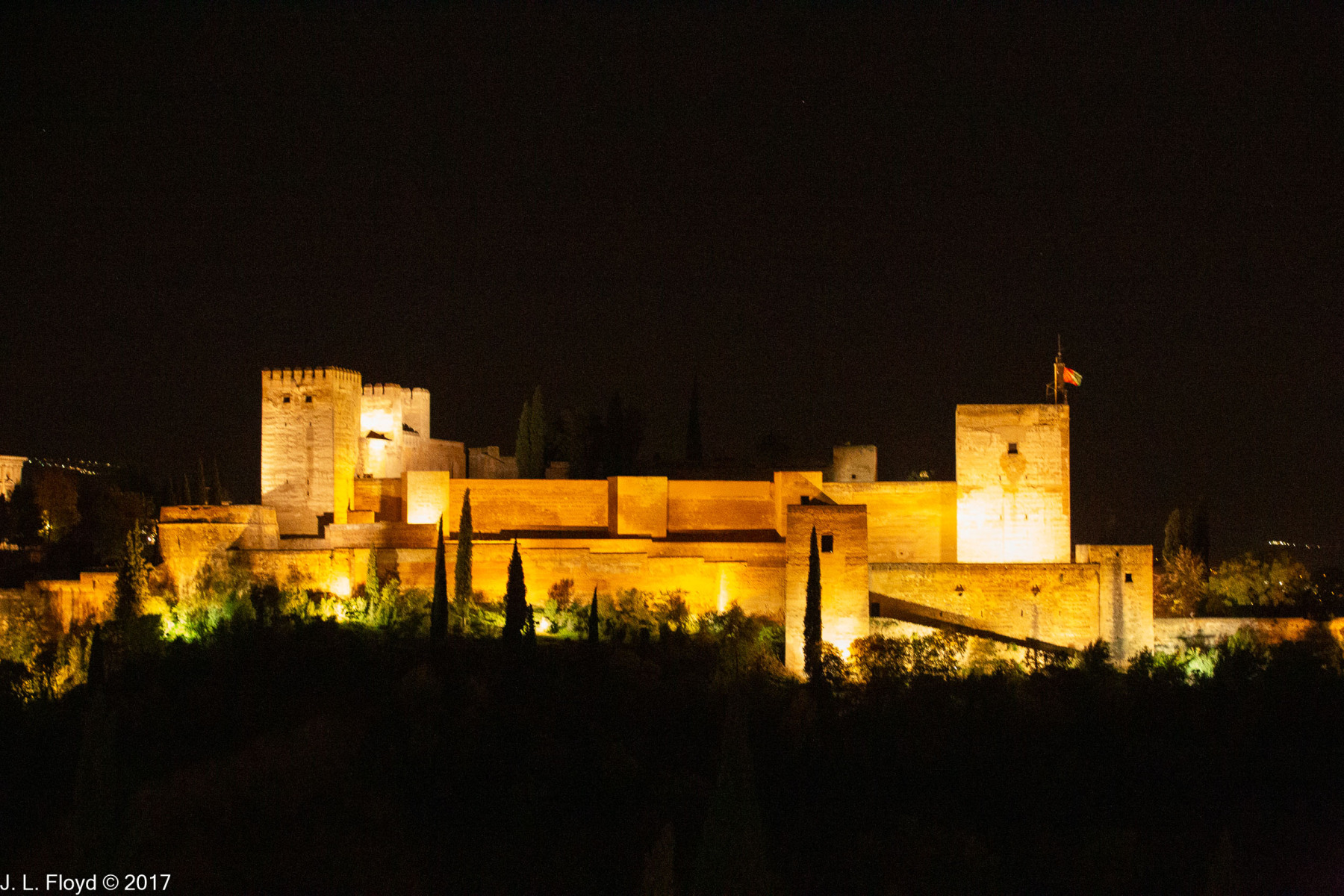
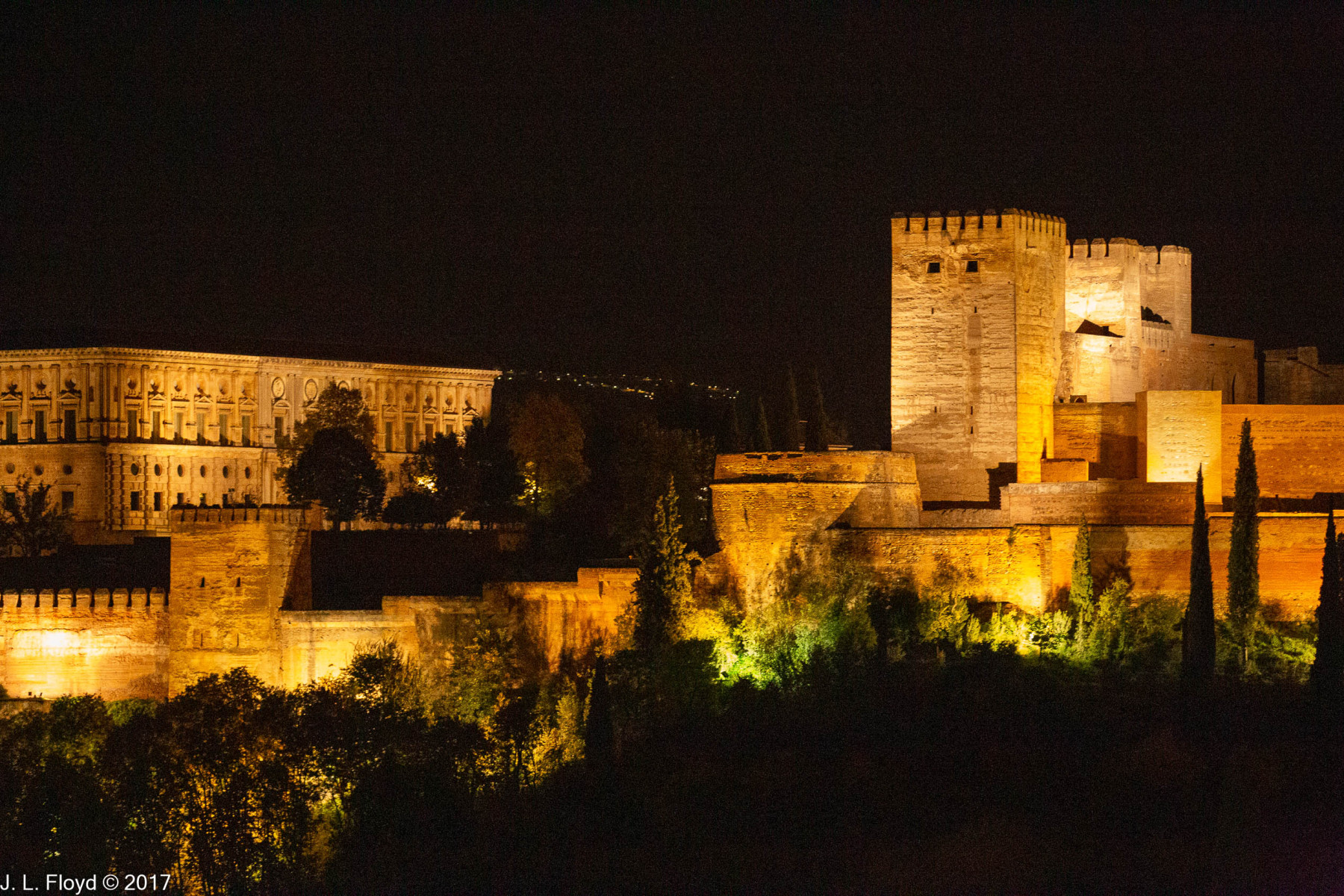
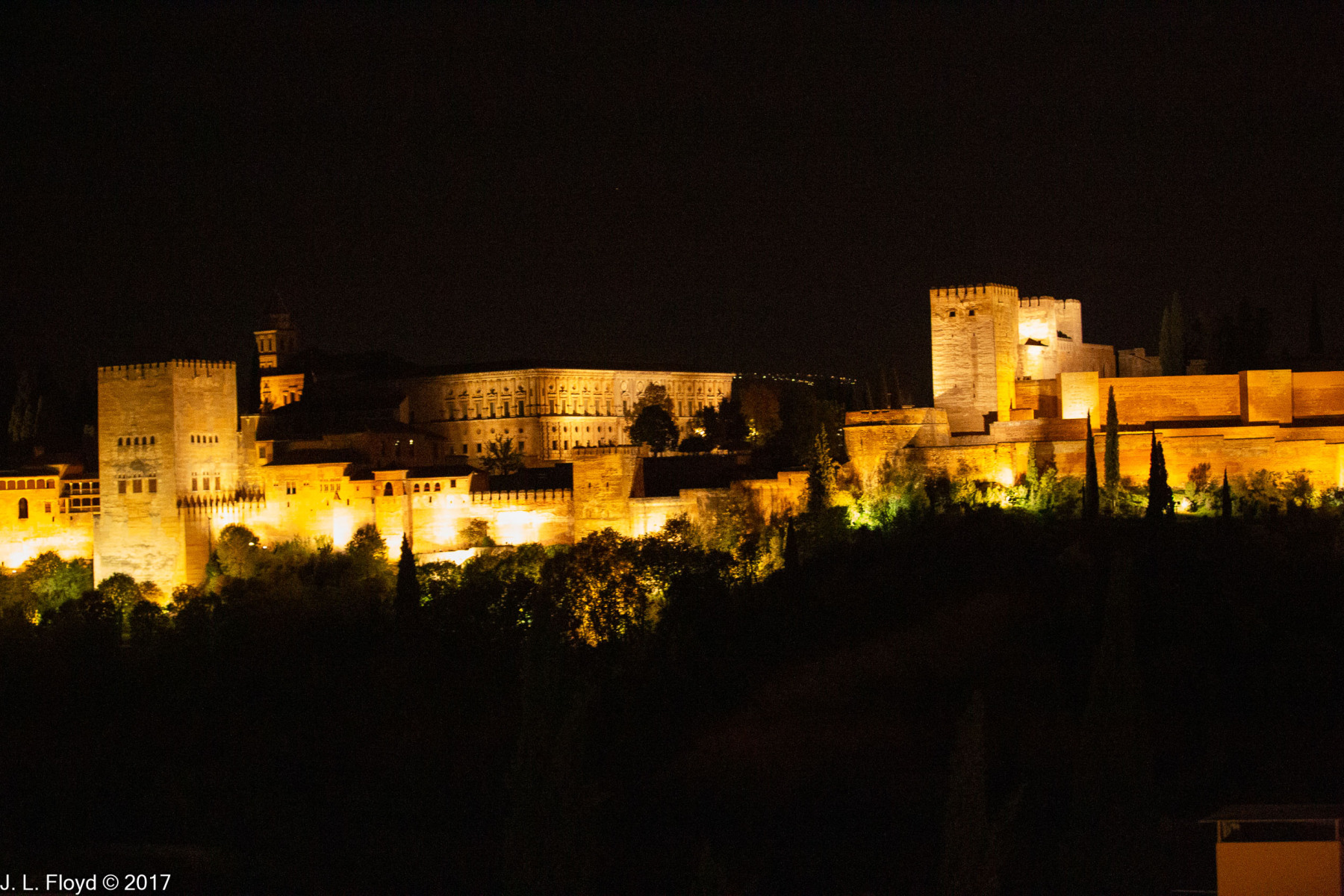
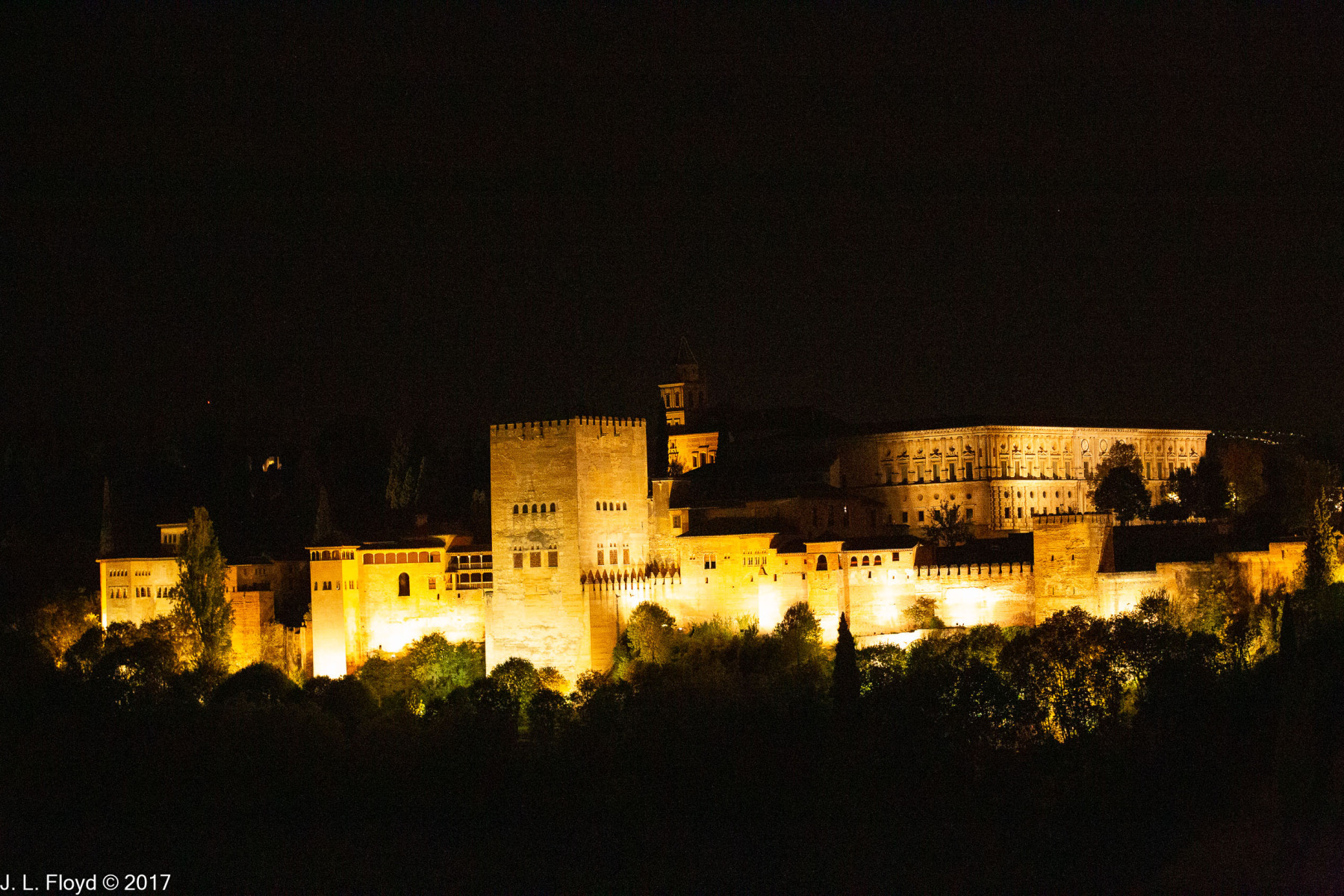
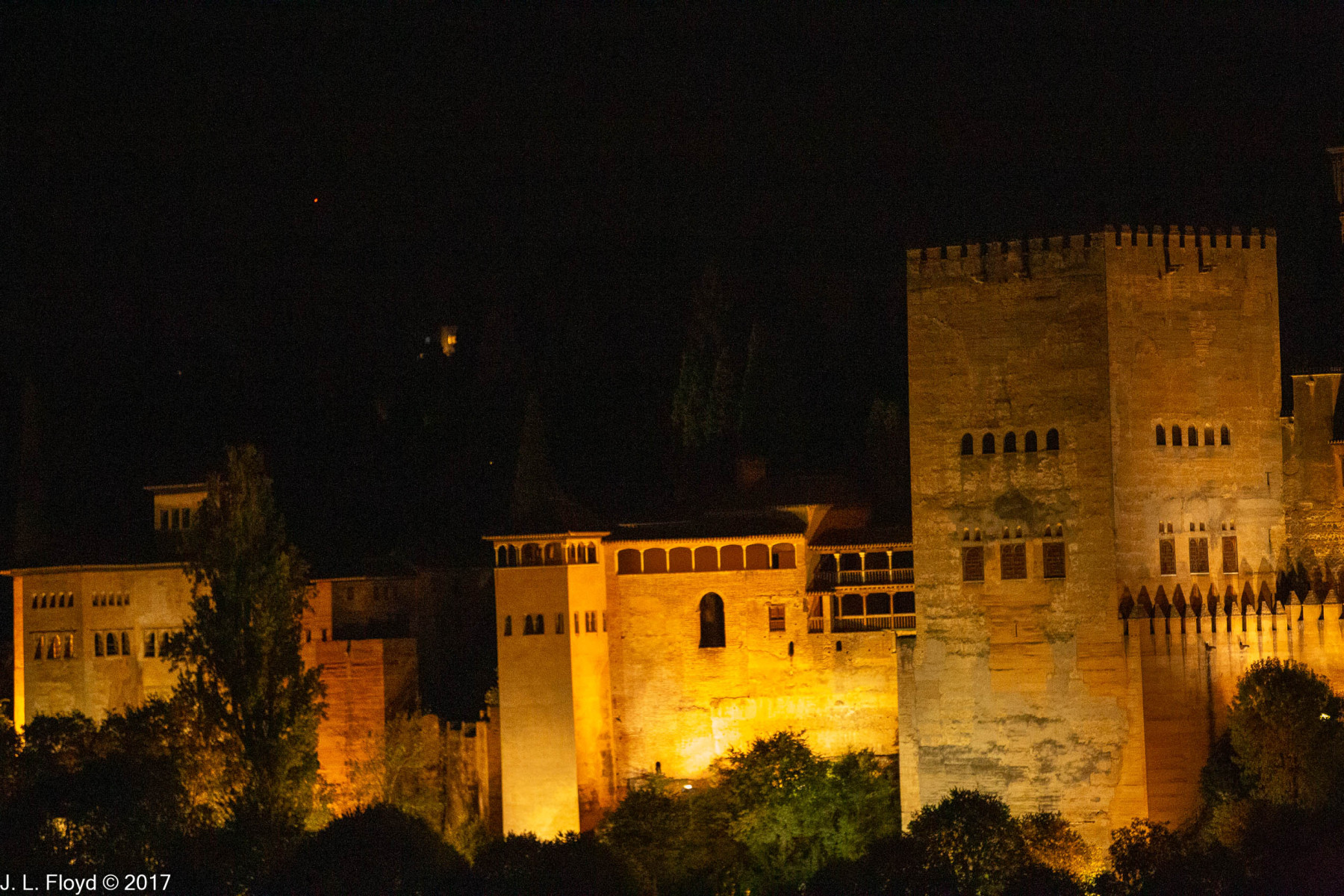
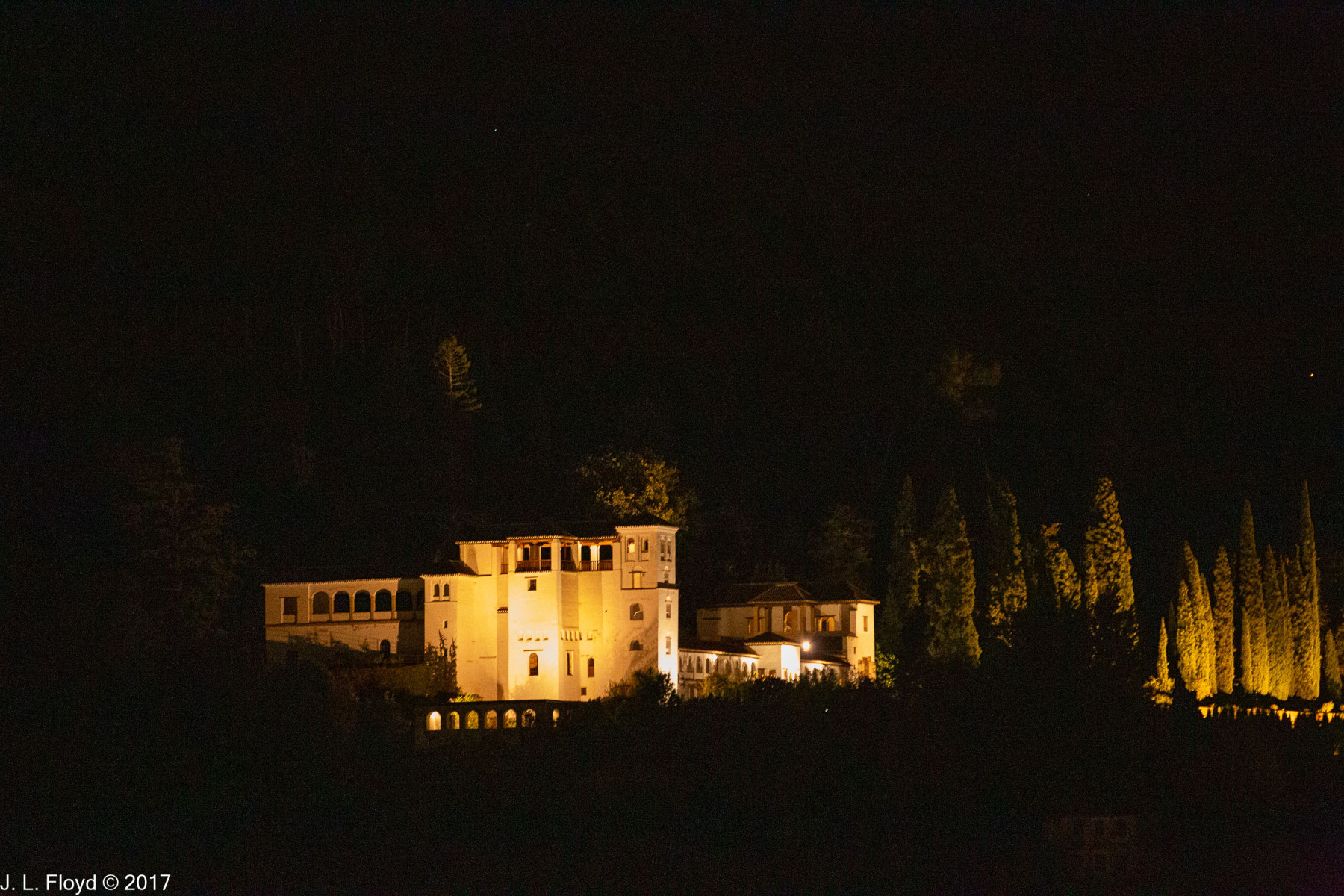
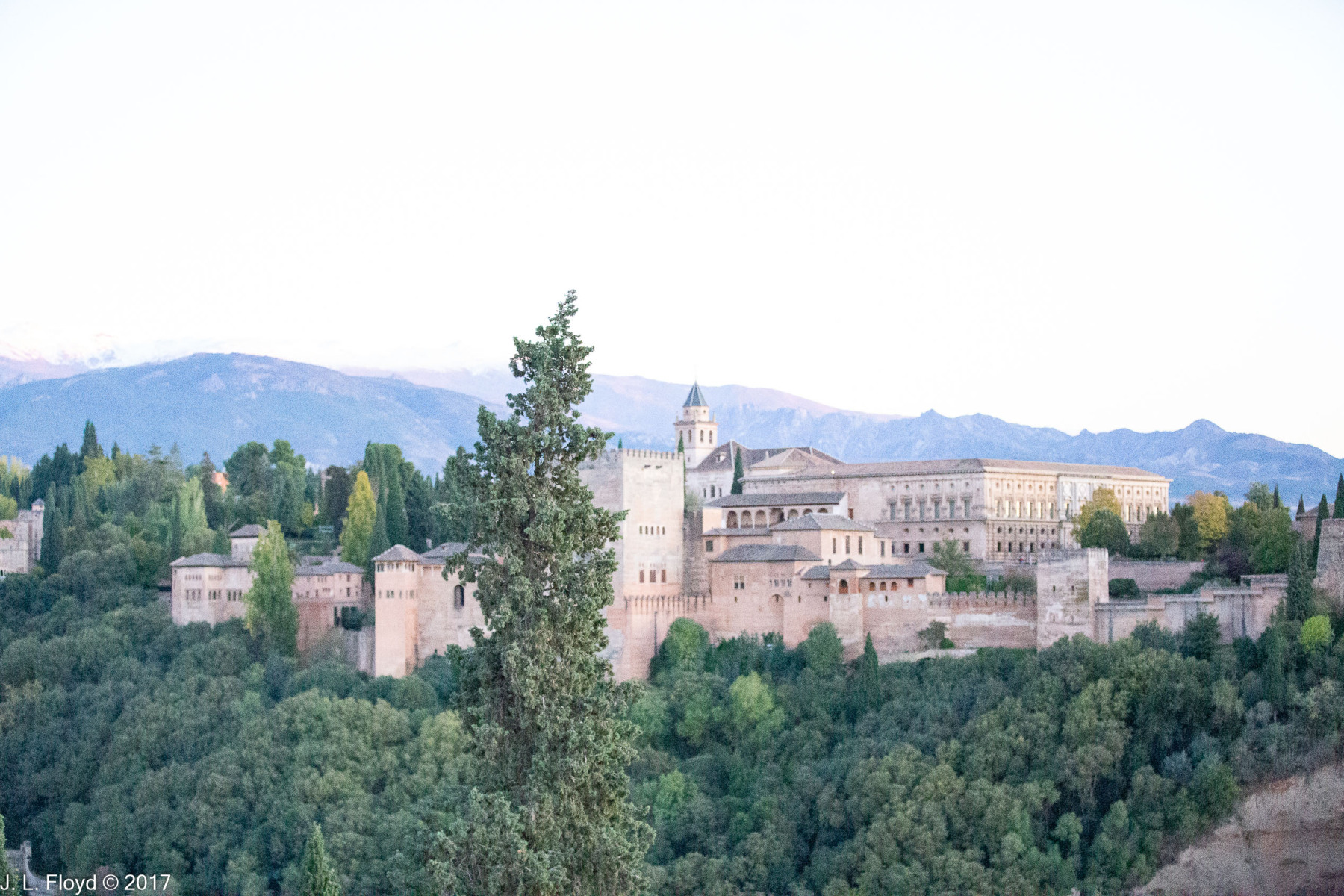
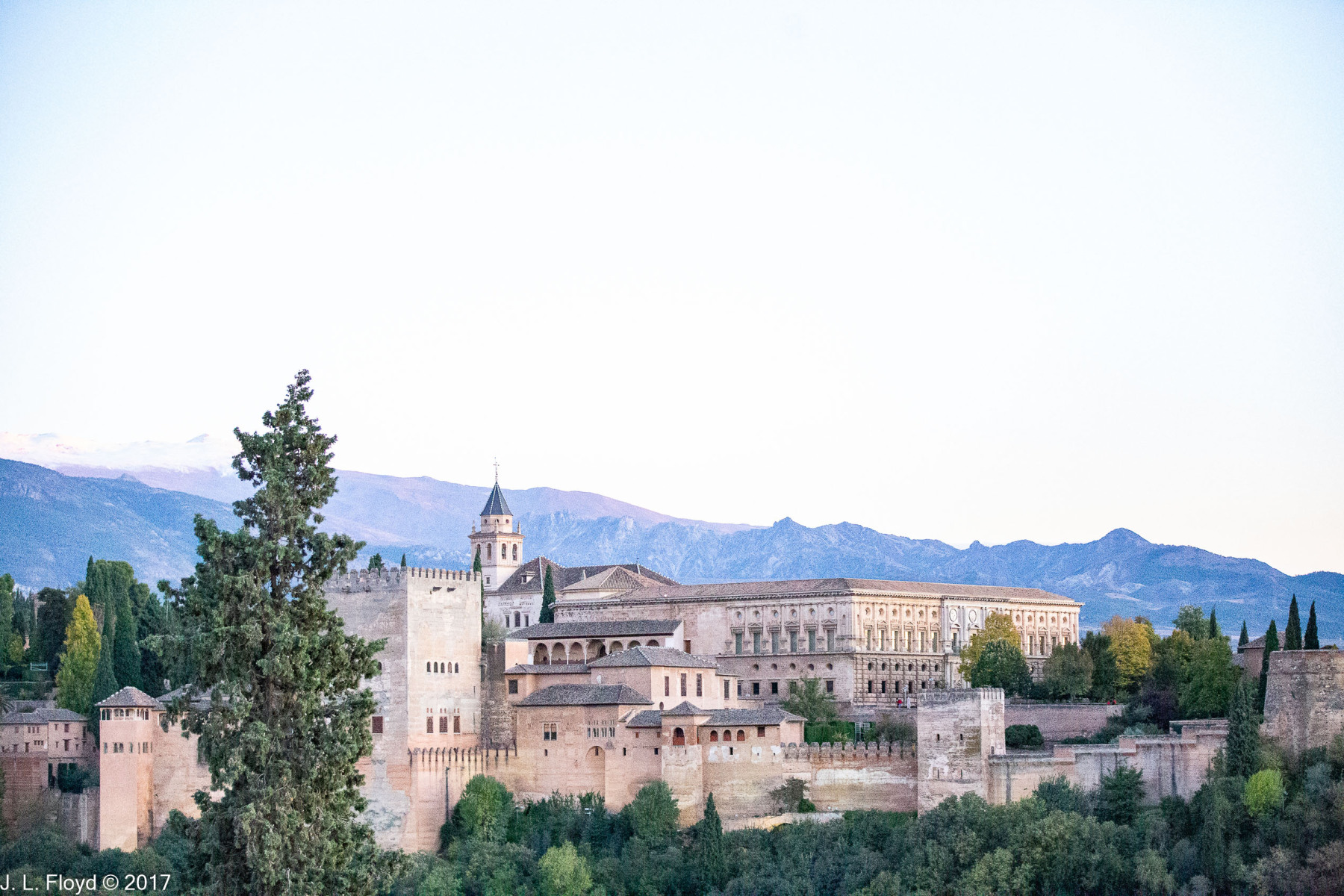
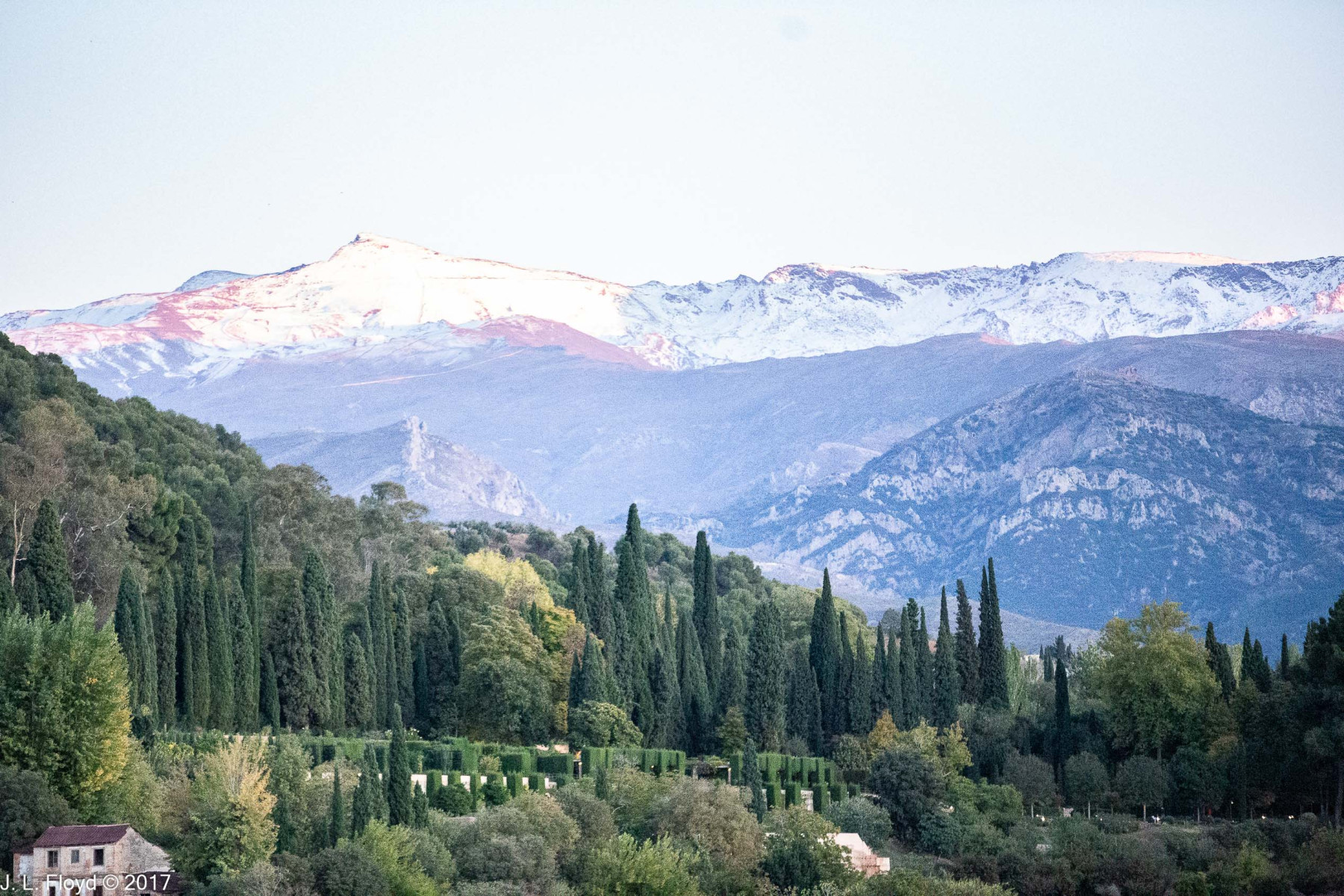
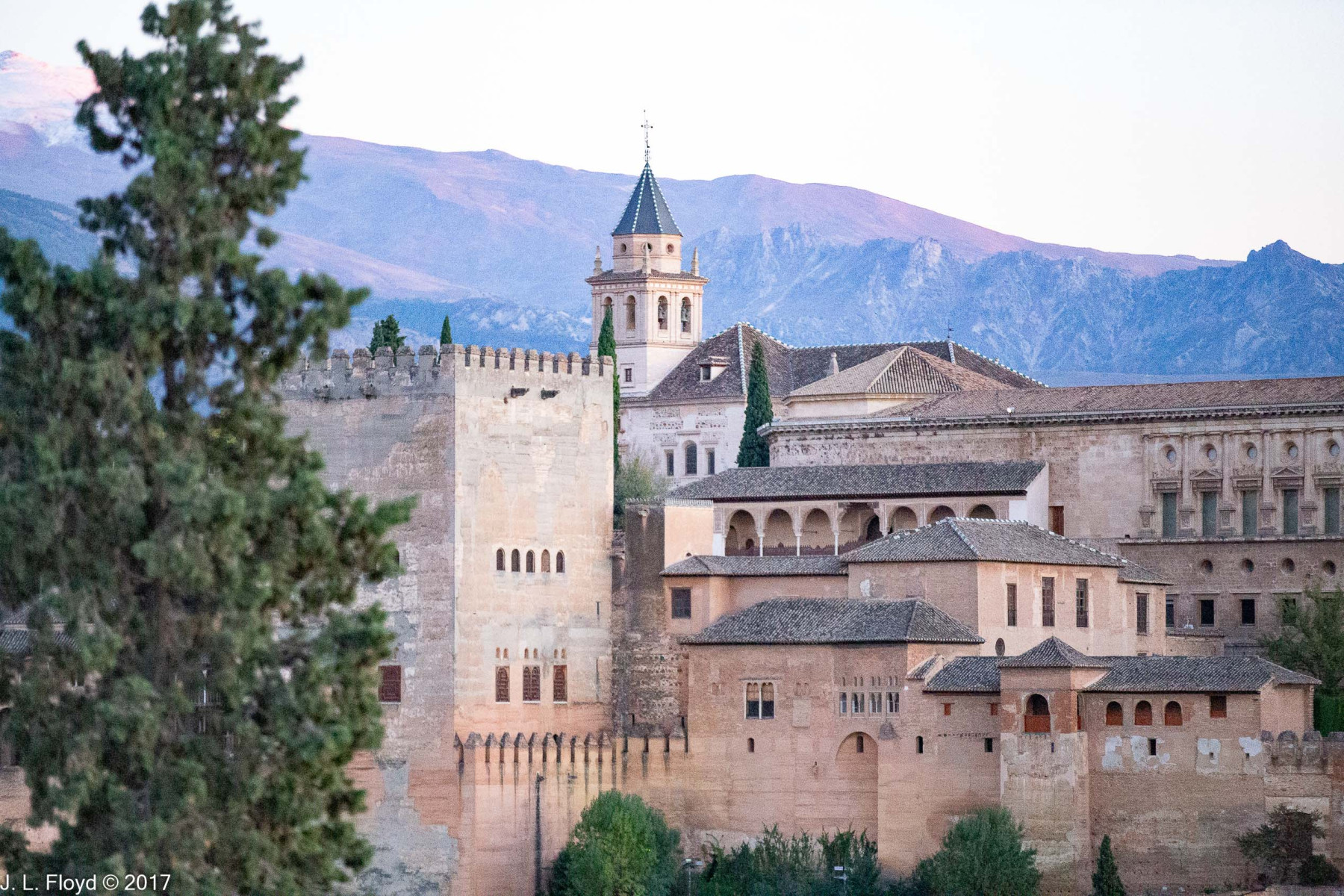
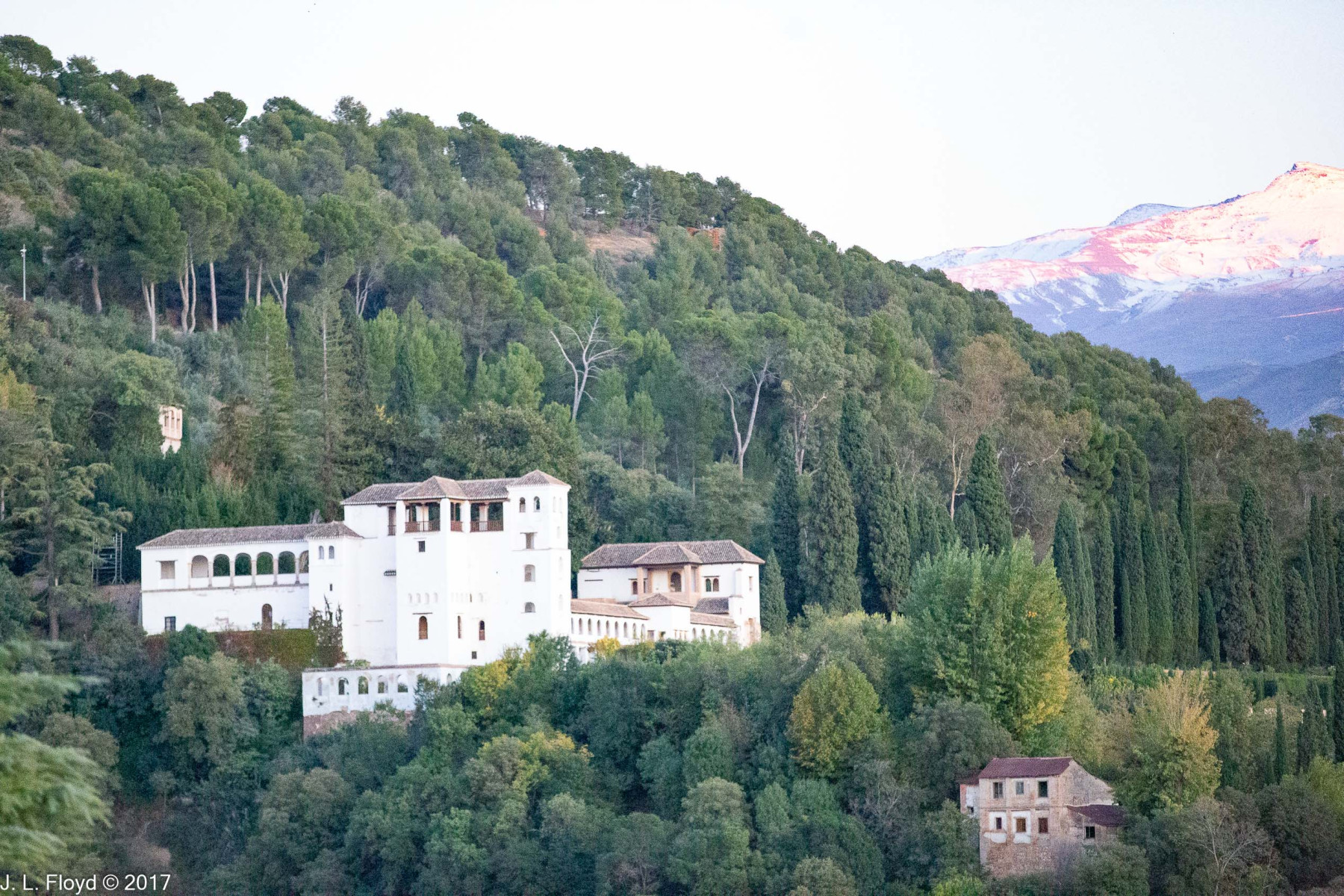
Somehow I made it to the Mirador de San Nicolas and was rewarded by stunning views of the Alhambra in the last light of day. After a few moments’ rest I was able to attach my 70-200mm telephoto zoom lens to my Canon EOS-6D DSLR and to shoot a panoply of pictures of that amazing fortress. I don’t remember how I made it back to the hotel from there, but having done so, I was able to recuperate for a few hours before we were whisked off to our after-dark adventure, which will be the subject of my next post.

Categories
Spain, Portugal and Morocco, November 2017

Granada, November 9, 2017 — The Alhambra, from the Gardens to the Generalife

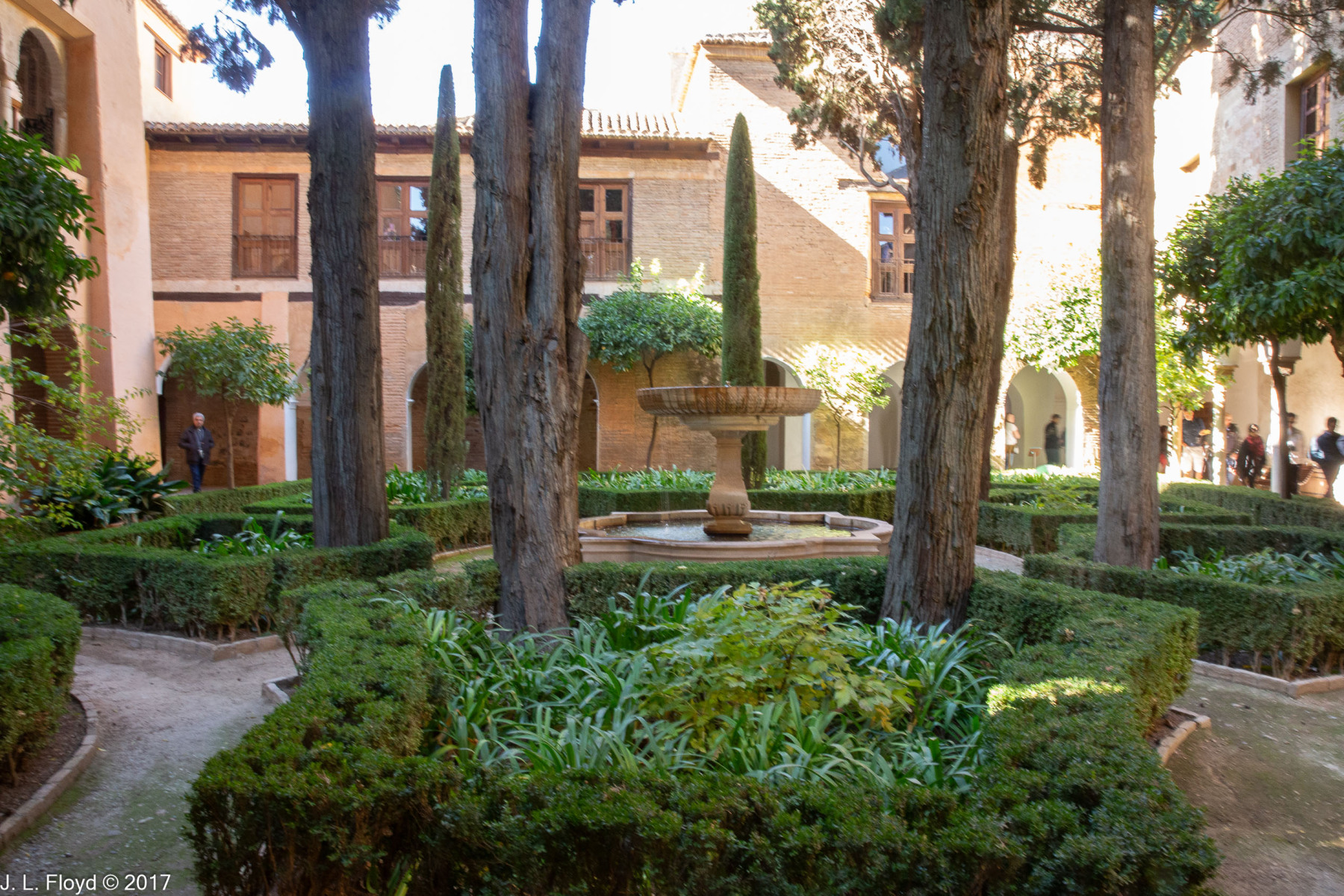
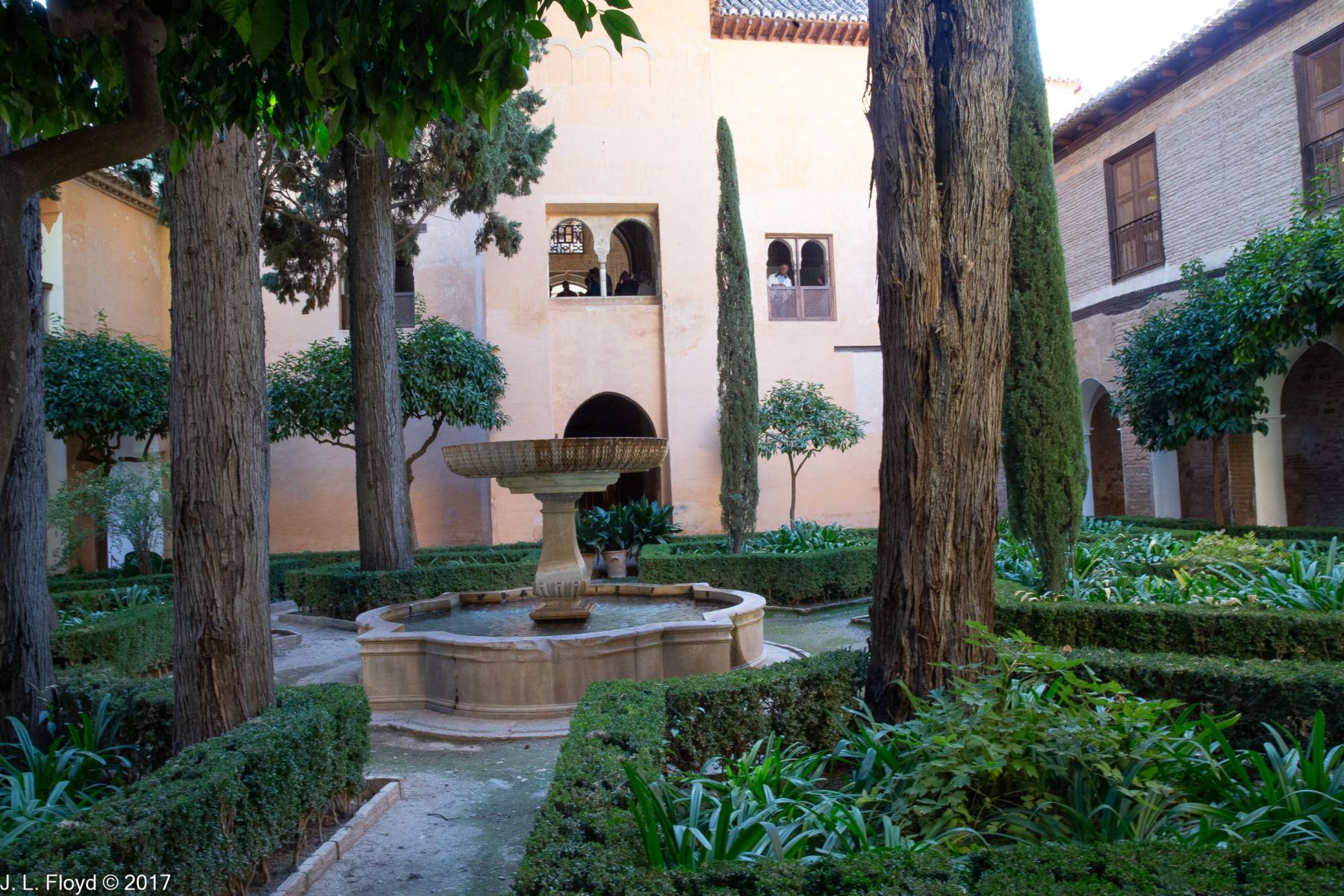
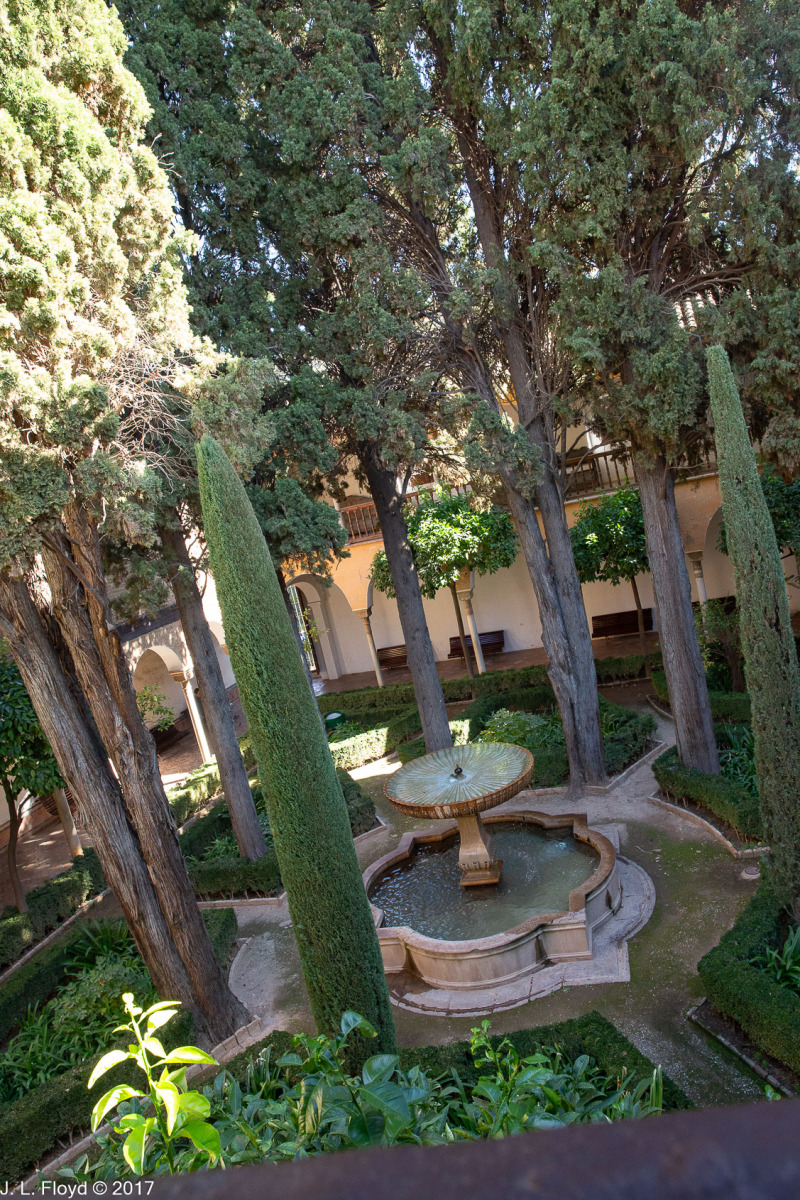
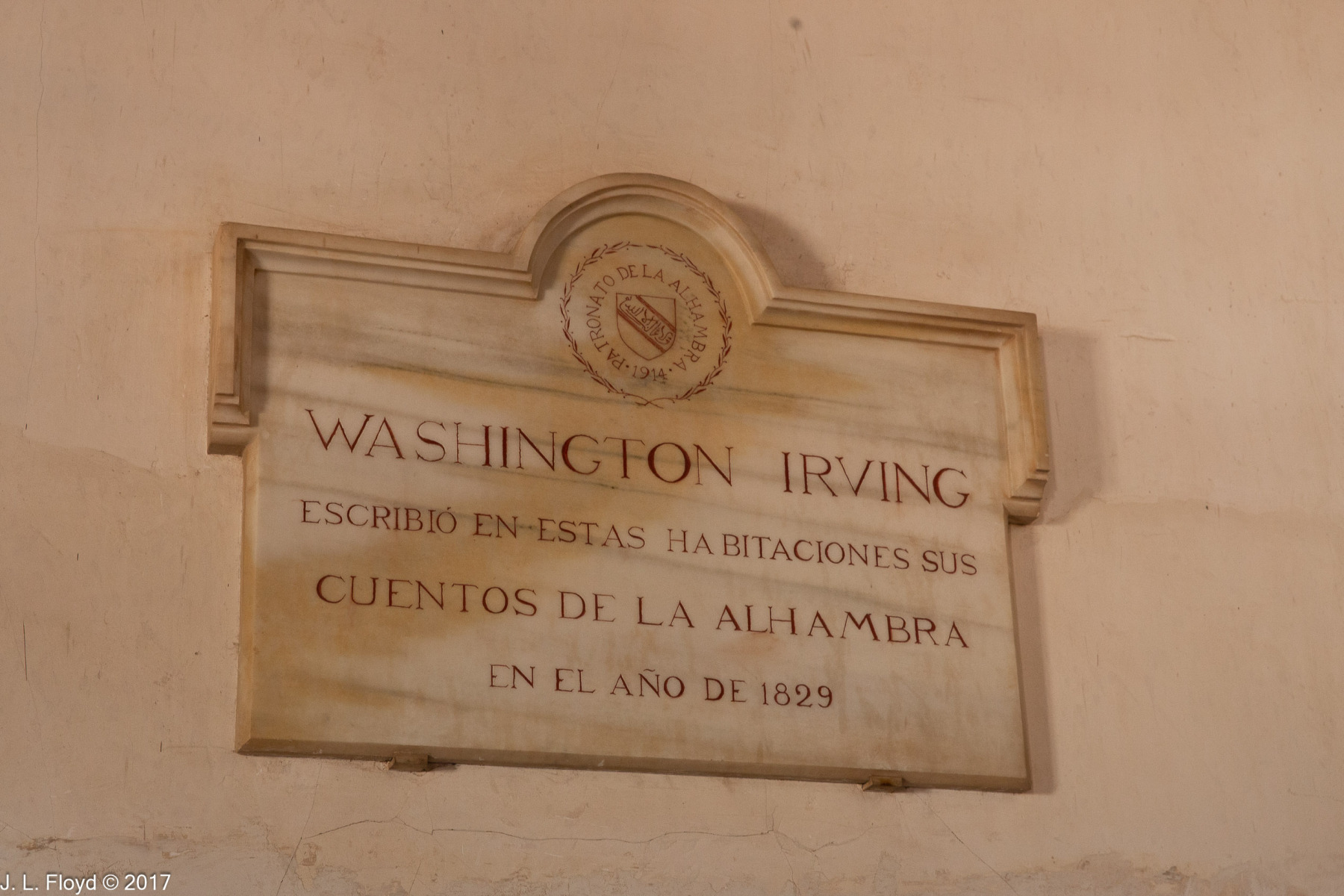
After viewing the Patio de Lindaraja from above, we descended into it and strolled through its garden on the ground level. Except for the Palace of the Lions on its north side, the enclosing structures are of Christian origin. In Nasrid times the gardens had occupied the entire space between the Palace of the Lions and the wall of the Alhambra. But in the 16th century the Emperor Charles V, after deciding to make his royal residence in the Alhambra, had a series of apartments built around the courtyard to serve as provisional quarters while the planned Renaissance palace was being built. Of course the latter mostly remained a mirage in his lifetime, and he was so busy traveling around the Holy Roman Empire fighting his wars that he rarely had time to stay in the Alhambra anyway; but subsequent generations were able to benefit from the construction. Washington Irving, for example, stayed in the Emperor’s chambers in 1829.

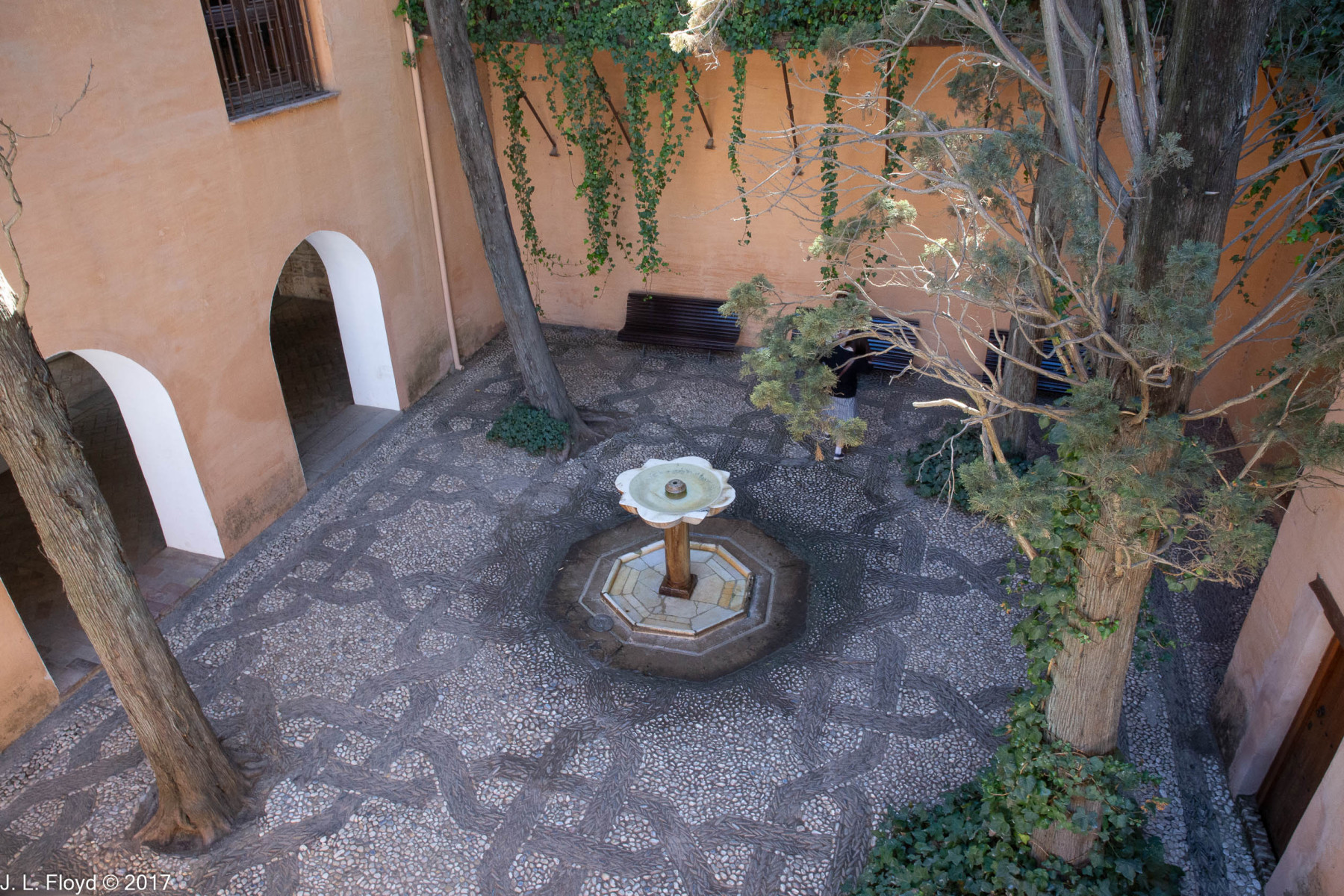
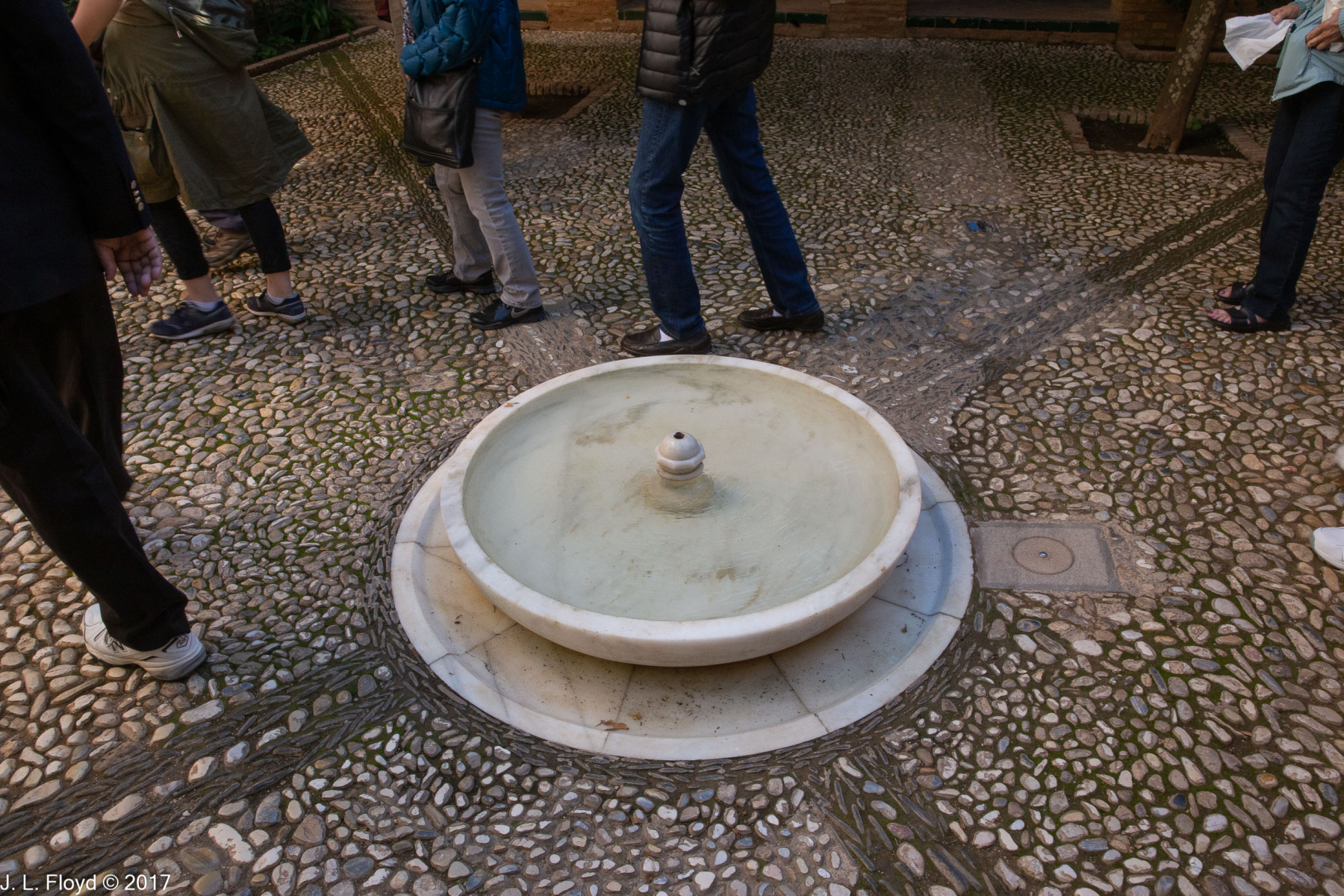
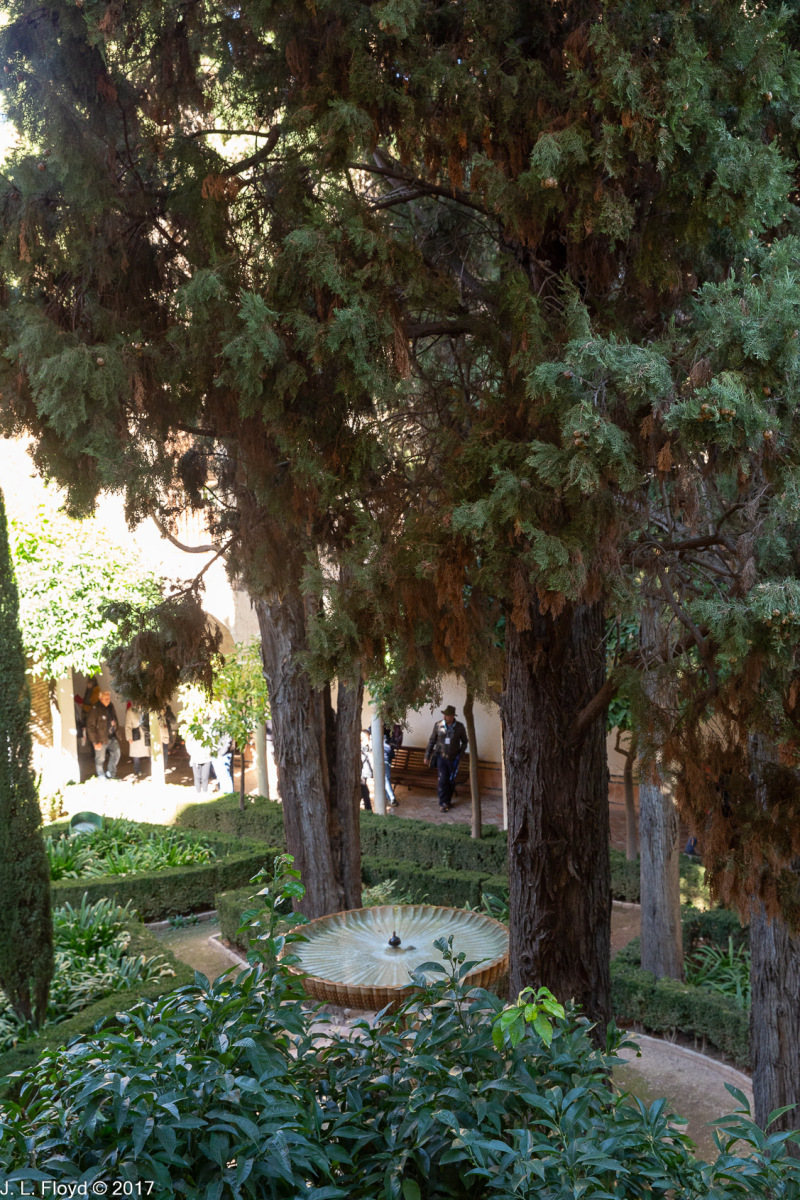
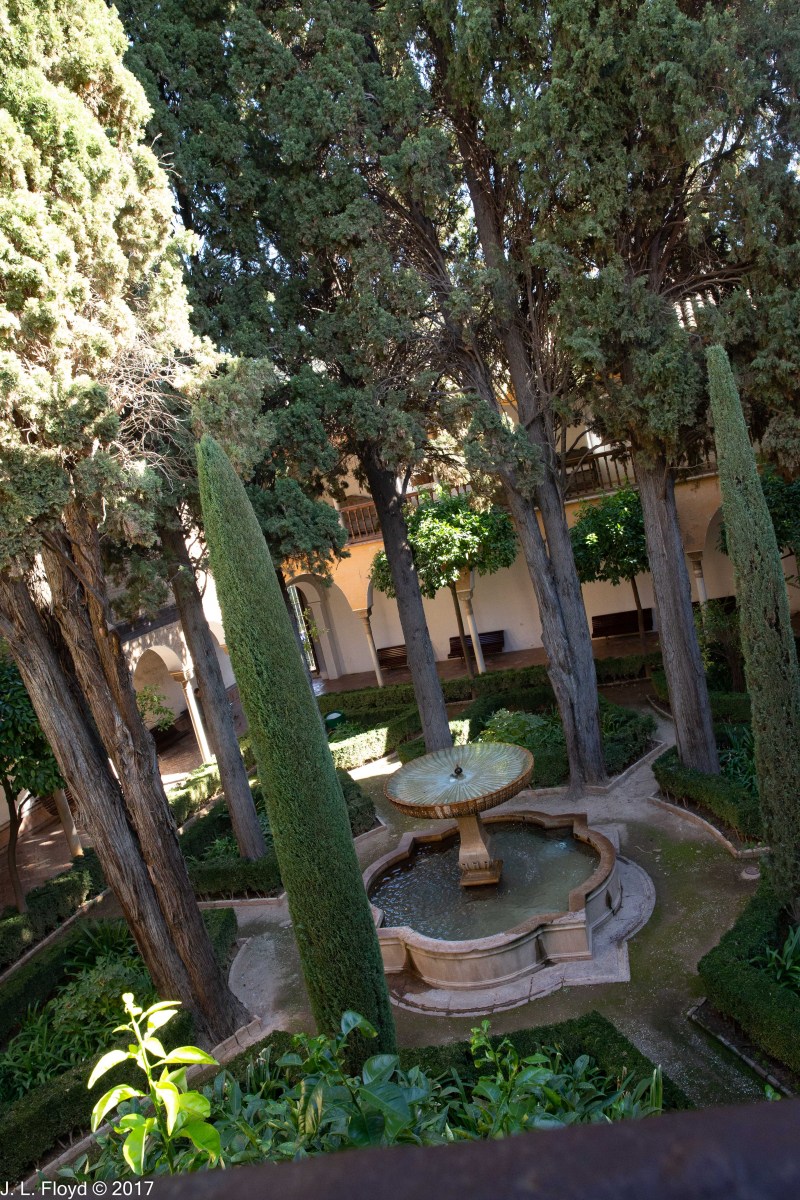
The Patio de Lindaraja is surrounded by an arcaded gallery, of which the supporting columns are of Nasrid origin. In the middle of the patio is a large but simple fountain, surrounded by garden plots filled with tall cypresses and bordered by well-tended hedges. Adjacent to the Lindaraja there is another, smaller courtyard known as the Patio of the Grated Window owing to a wrought iron balcony on the south side. It also has a gallery with Nasrid-era columns as well as an exquisite white marble fountain and elegant mosaic paving composed of stones forming geometric designs.

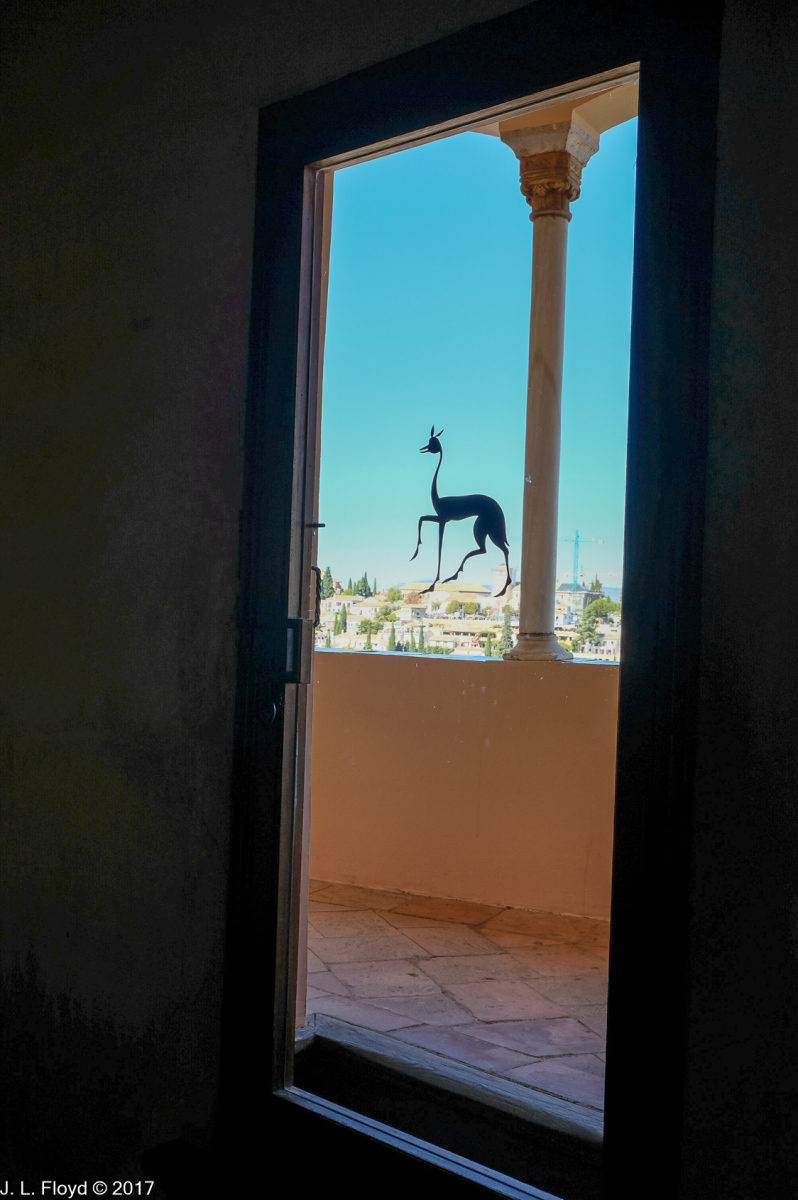
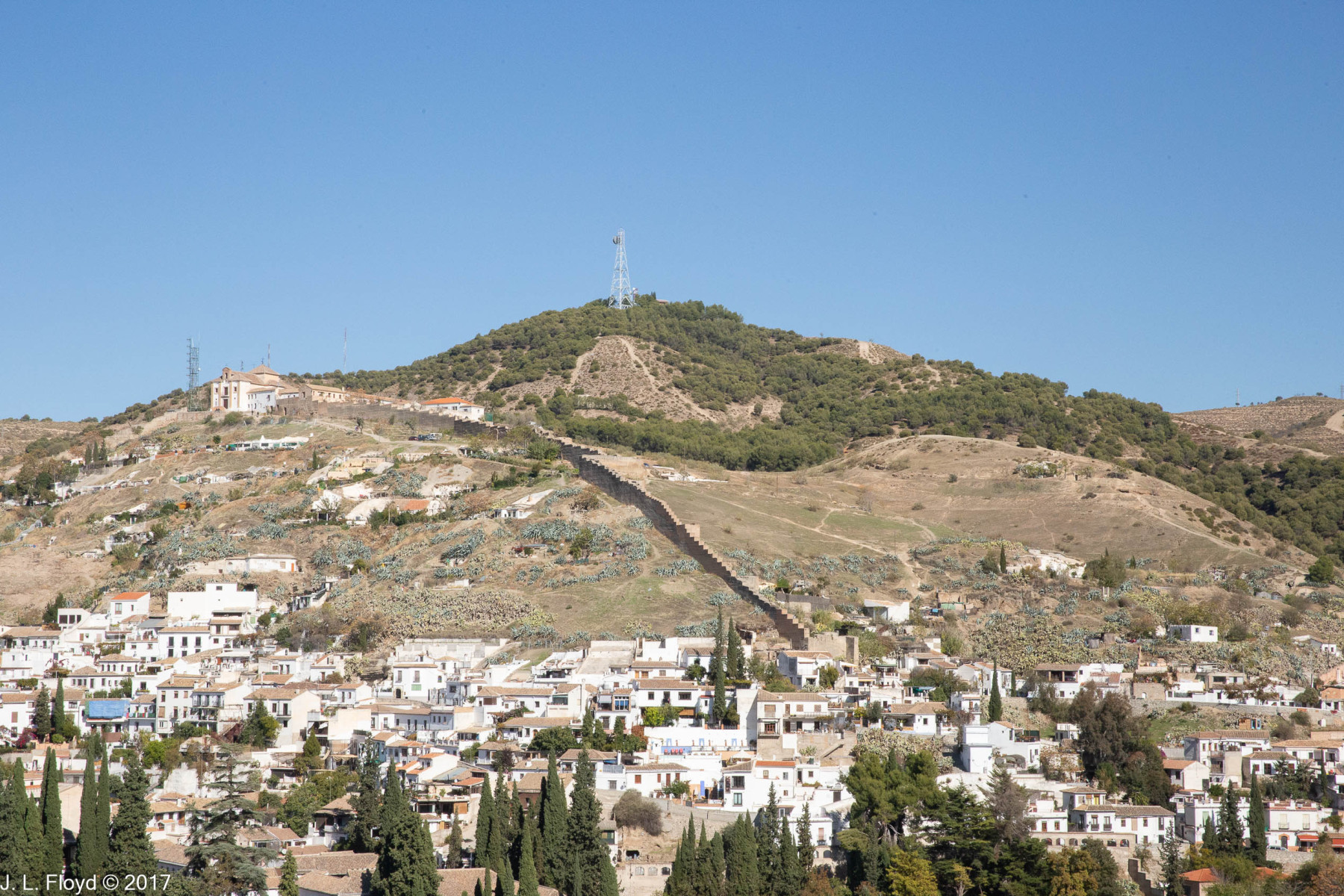
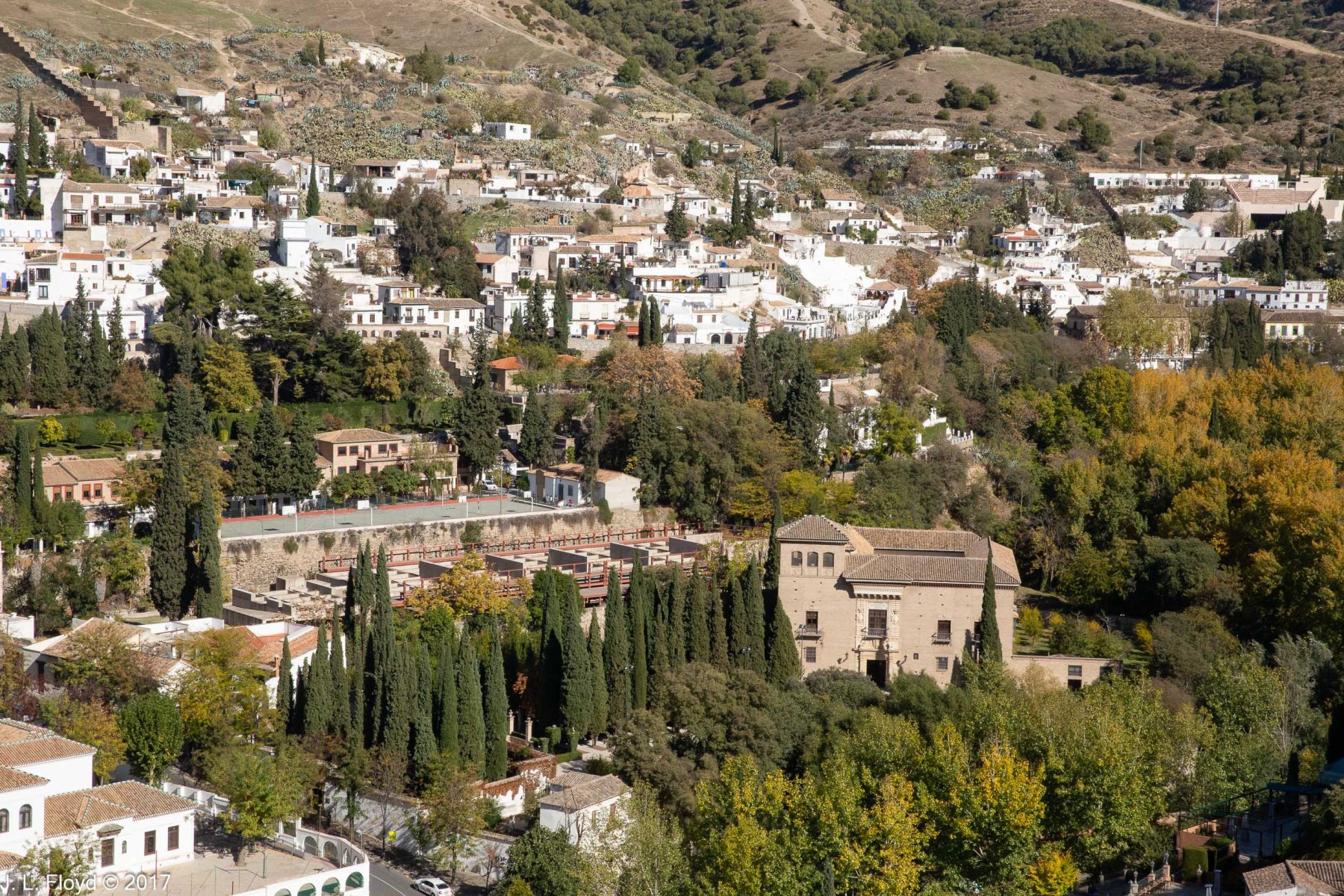
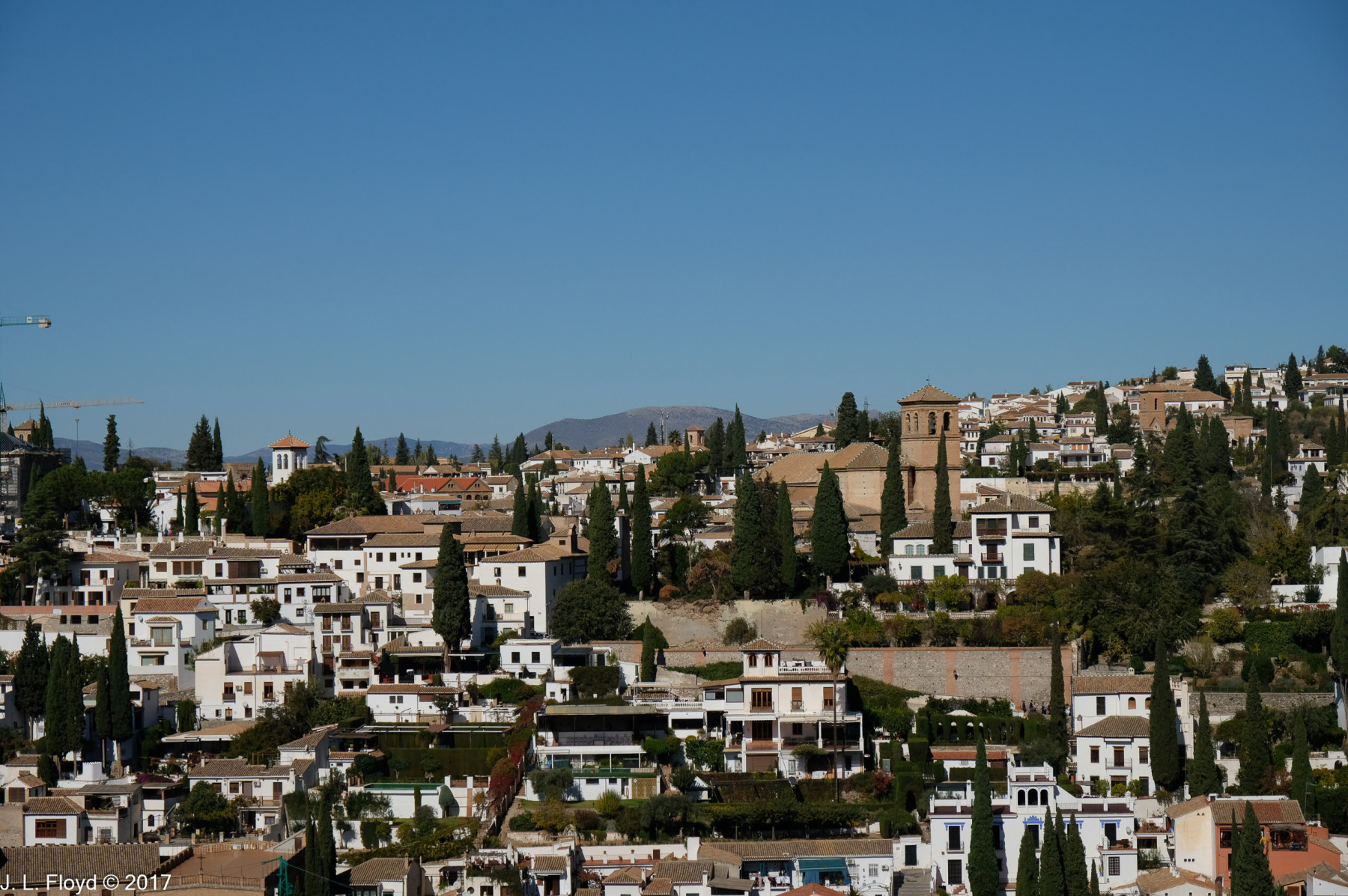
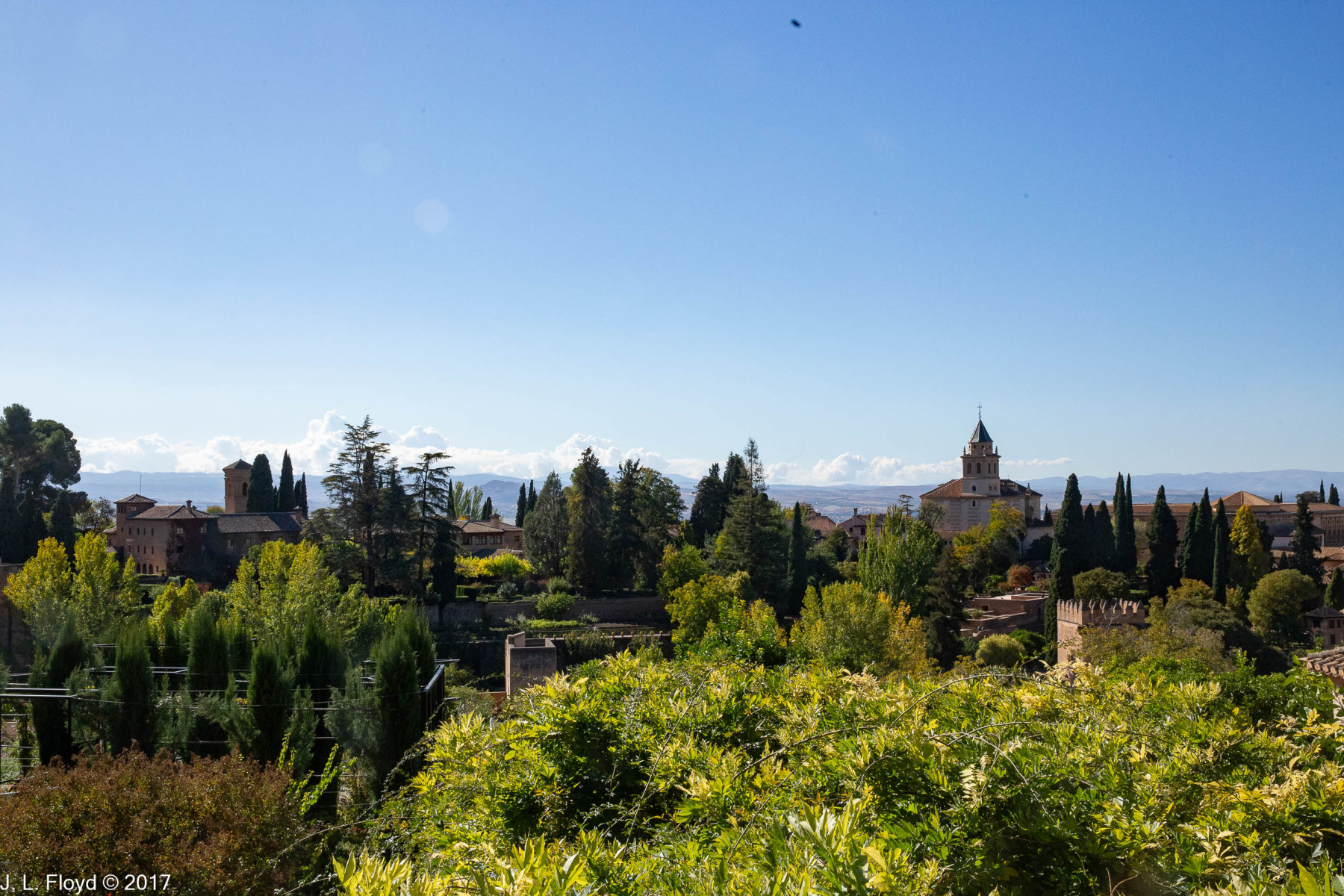
From the Patio as well as the Mirador of Lindaraja there are wonderful views to be had of the city of Granada. To the north, the Albaicín hill rises majestically over the Albaicín and Sacromonte districts. Turning a little to the west, one sees the Cathedral of Granada with its stately bell-tower, the Royal Monastery of St. Jerome (Real Monasterio de San Jerónimo) and other landmarks in the heart of the city. We would see more of those sights later that day.

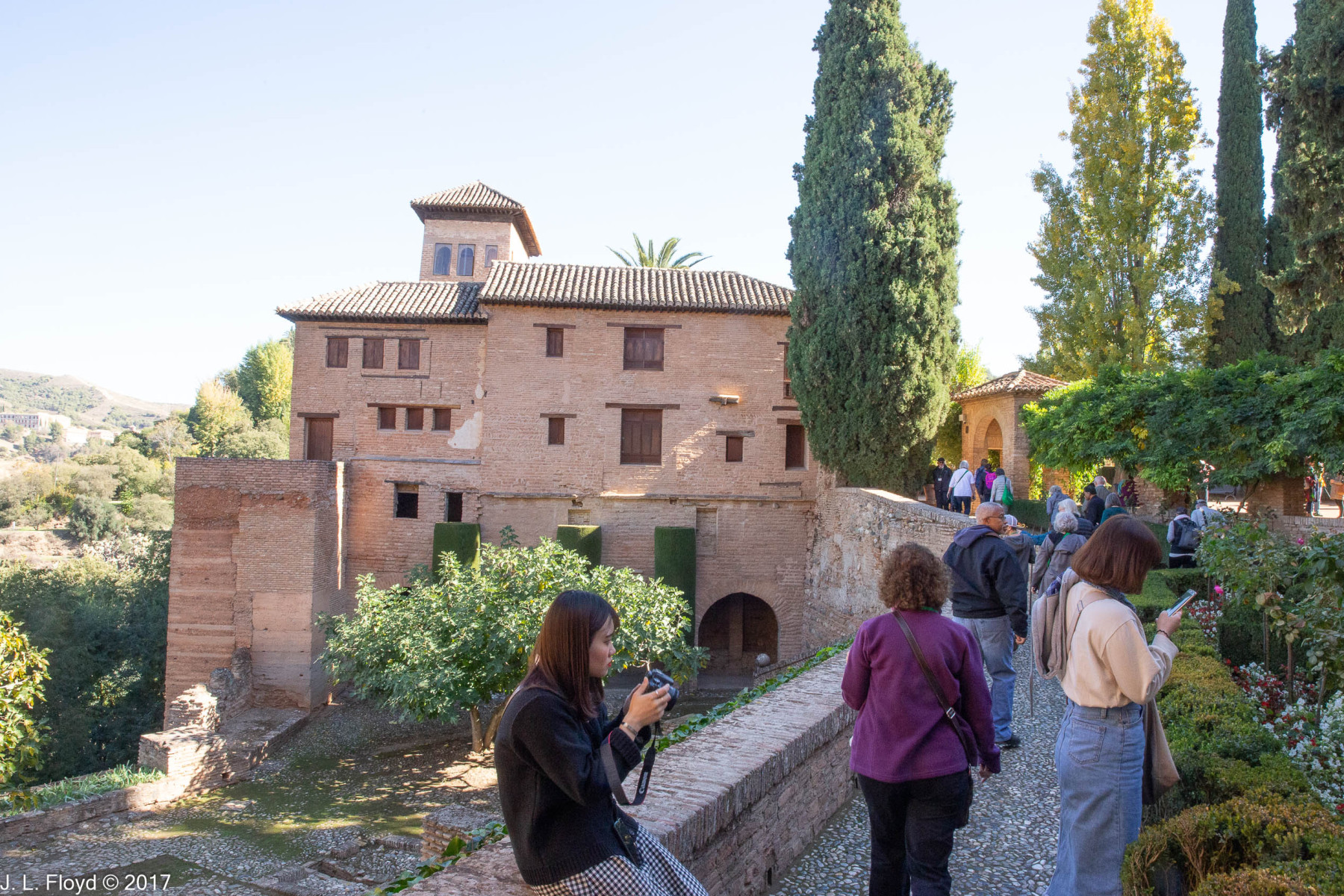
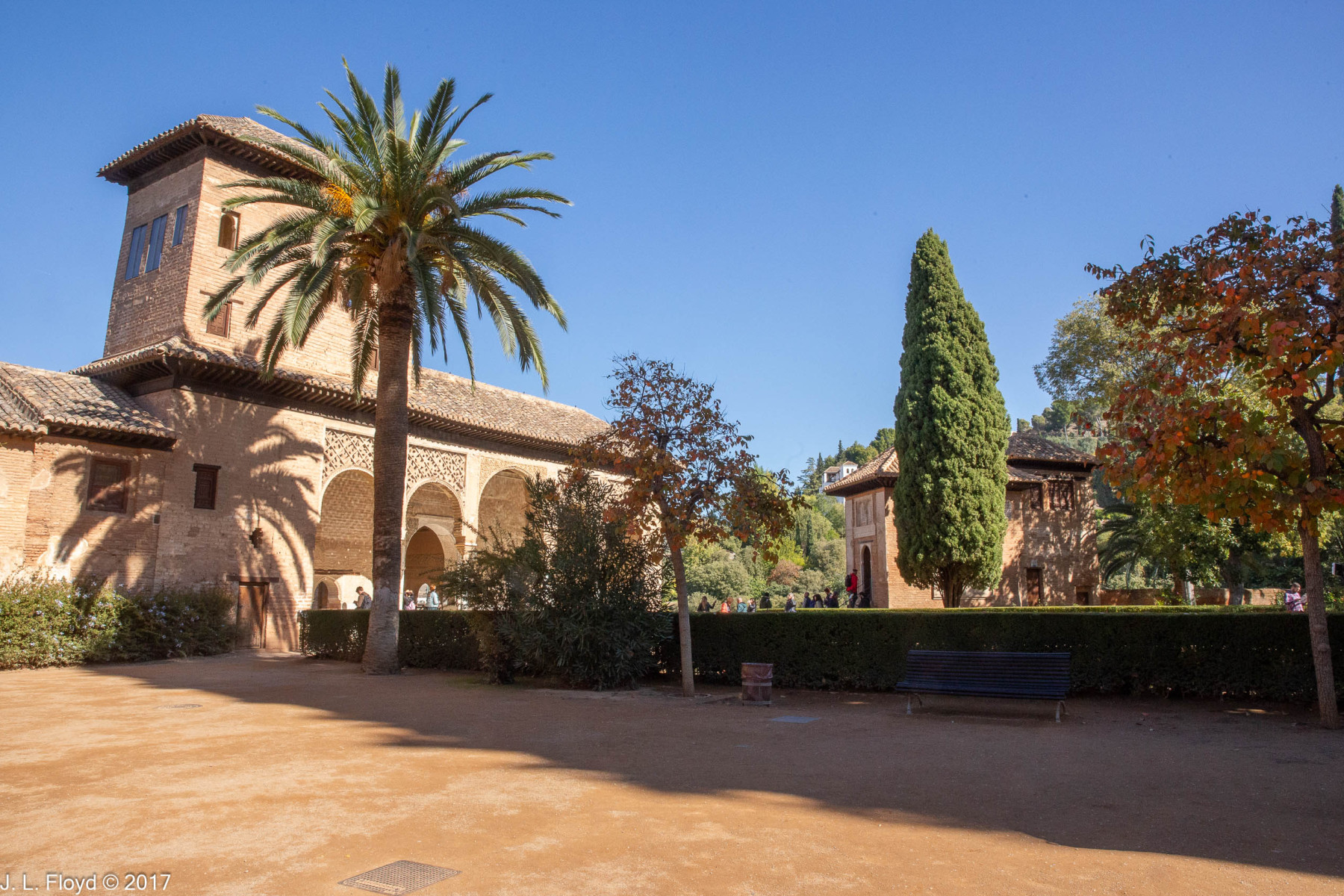
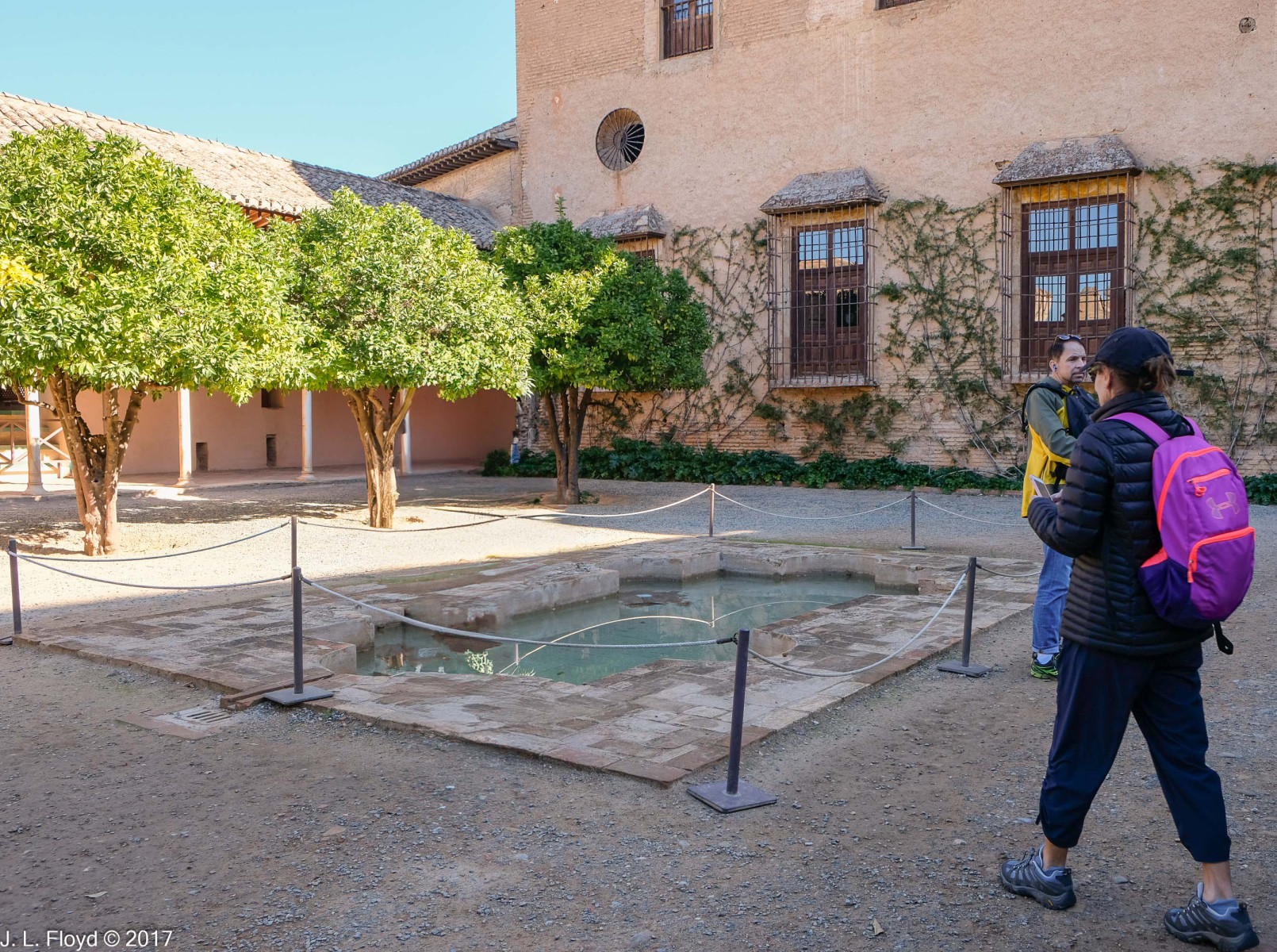
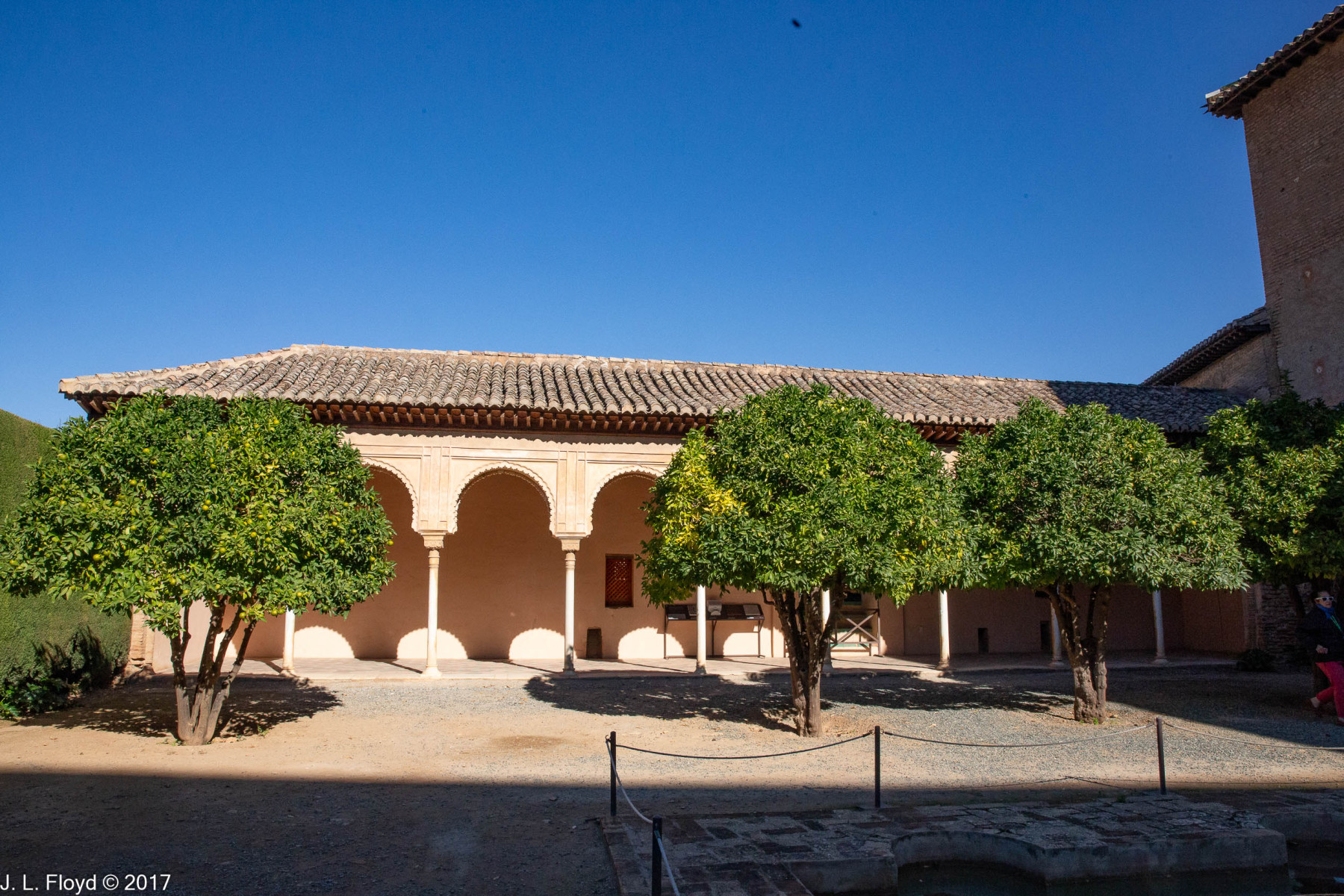
Looking east from the Patio de Lindaraja we could see the Partal Palace (El Palacio del Partal ), where we were headed next. Built by the Nasrid ruler Muhammed III (r. 1302-1309) in the early 14th century, it is the oldest surviving Nasrid palace. Unlike the other Nasrid palaces, after the conquest of Granada in 1492 it was given over to private ownership, and only reacquired by the Spanish government in 1891. By then it had undergone many changes, including partial demolition. Today only the northernmost structures – a portico and the Torre de las Damas (Tower of the Ladies) – remain, and the Partal Palace is also known as the Palacio del Pórtico. There is a pool in front of the portico, which may have been originally enclosed by other structures in the same fashion as the Court of the Myrtles in the Comares Palace. Sadly, the last private owner removed a wooden cupola ceiling from the Tower and shipped it to Germany, where it now resides in a Berlin museum.

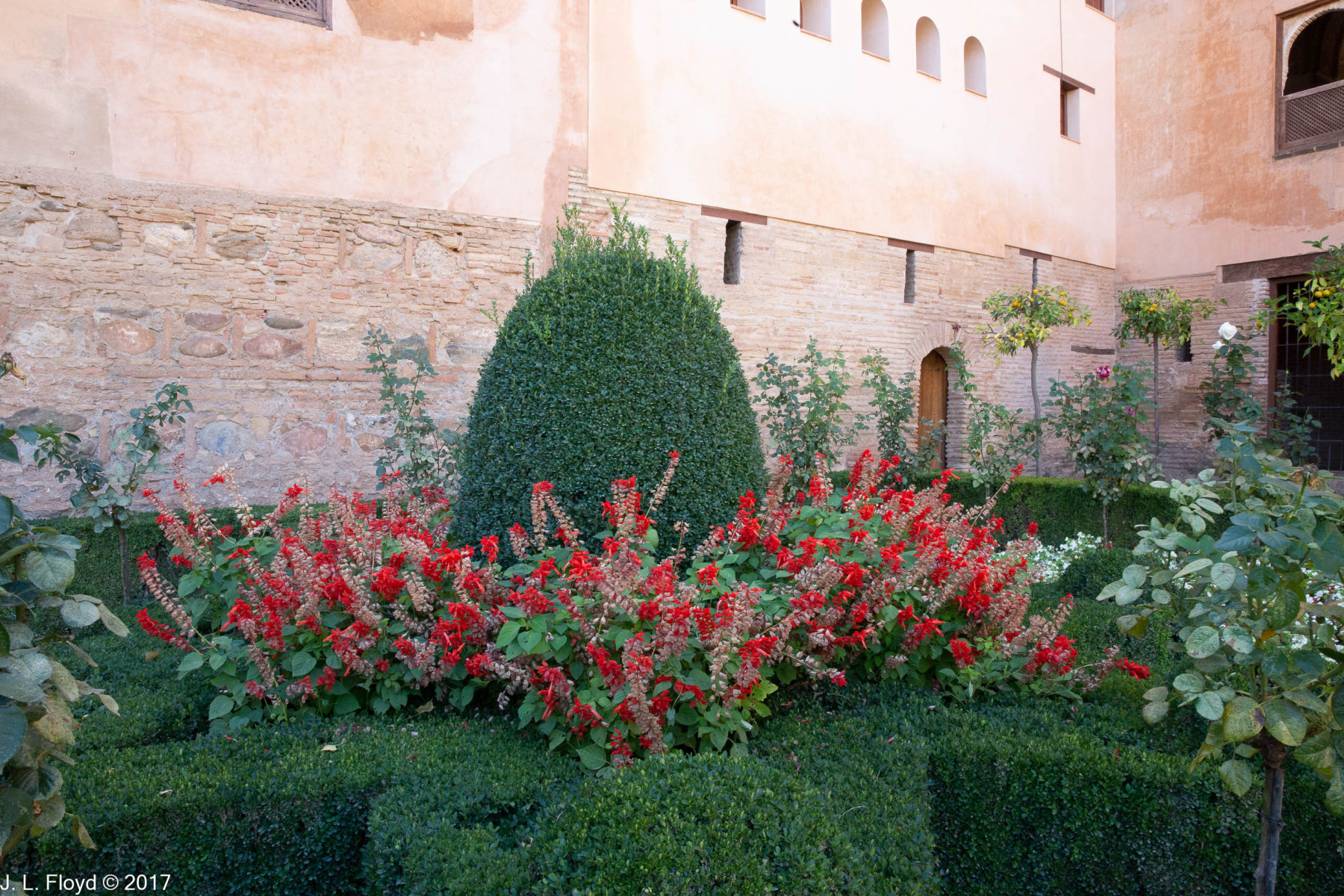
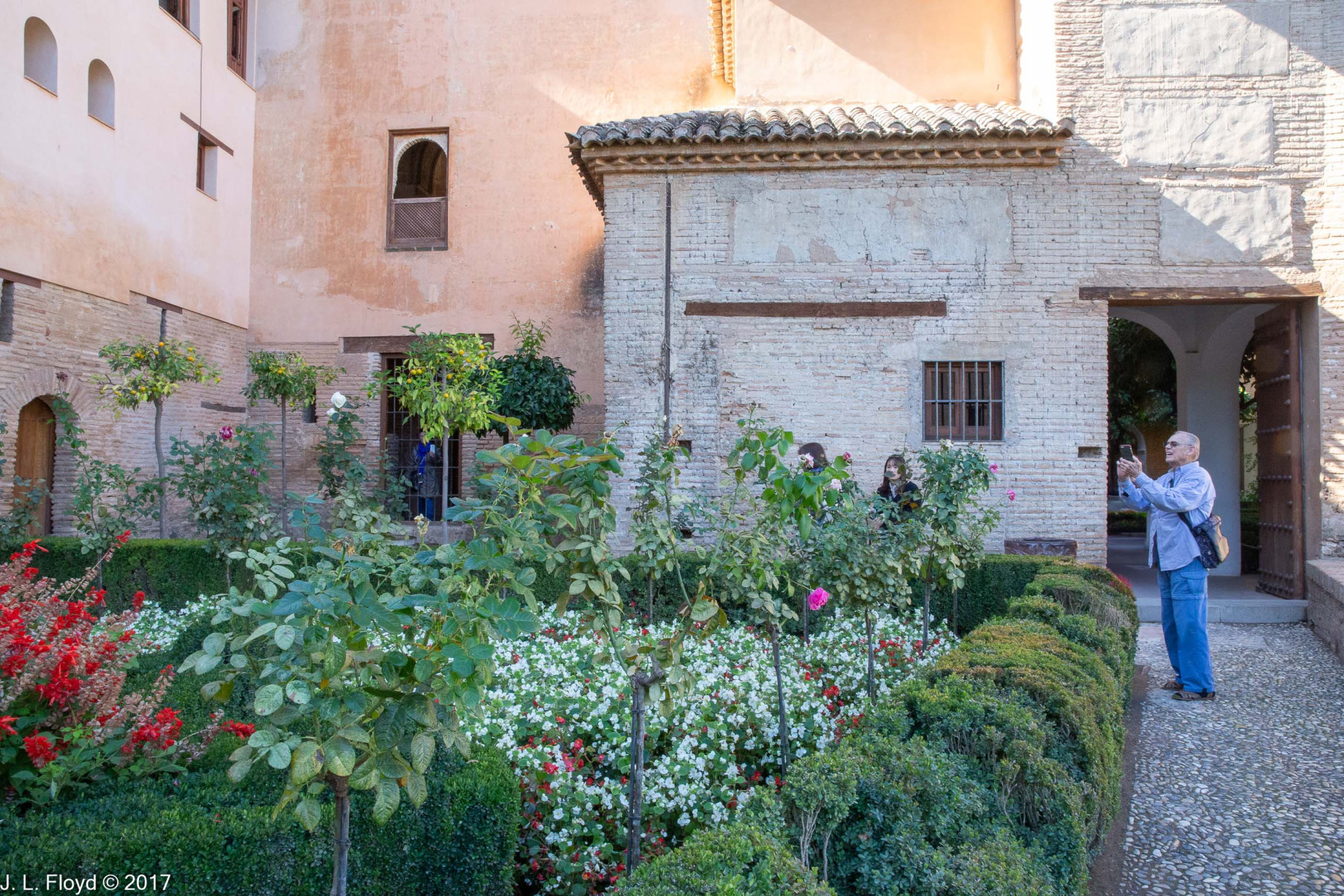
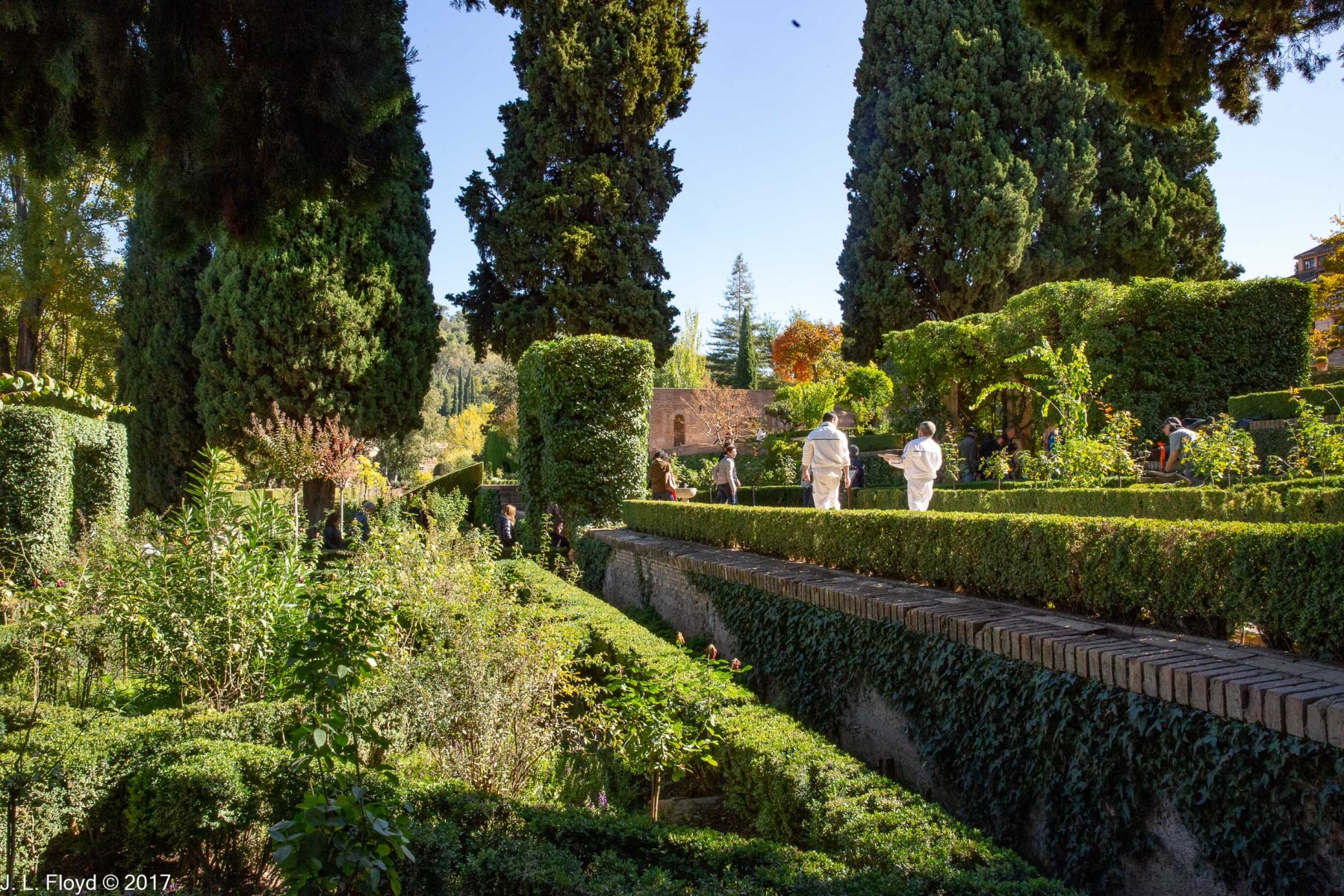
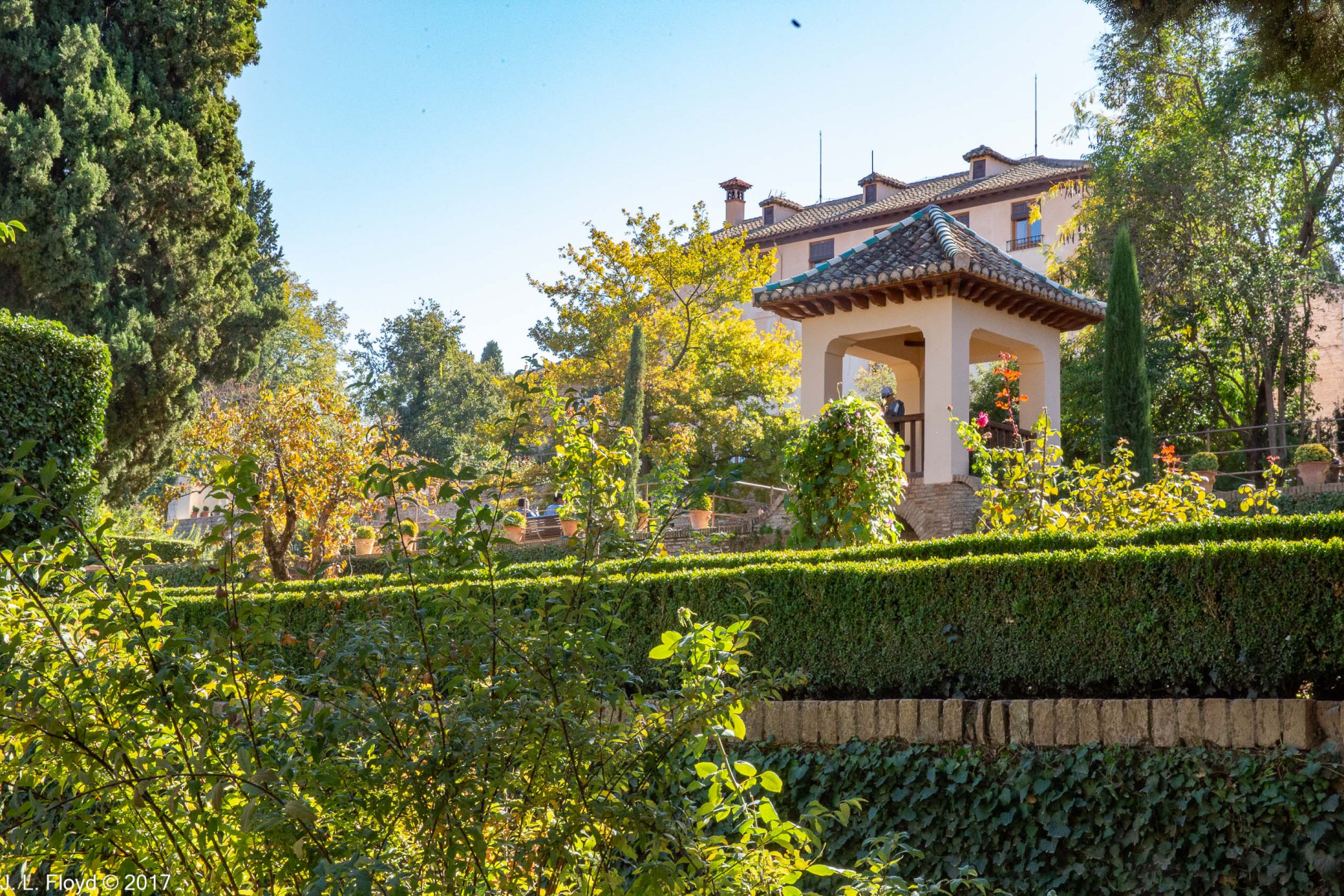
To the south of the Partal Palace, on a series of terraces rising above it, lie the Partal Gardens, a lush and idyllic bower perfect for restful strolling. It is not a holdover from Nasrid times, however; it is a twentieth-century creation, dating from the 1930s, undertaken with the purpose of improving a neglected area which become overgrown with weeds and brush — and also of facilitating archaeological activity. For the gardens occupy the site of what is now known as the Palacio del Partal Alto, or Upper Partal Palace, which preceded the present Partal Palace, sometimes called the Palacio del Partal Bajo to distinguish it from its predecessor. It was also called the Palace of Yusuf III (r. 1408-1417) because it was originally thought to have been built in his time, but now it is known to have been an earlier construction, from the reign of Muhammad II (1273–1302); Yusuf III merely remodeled it.

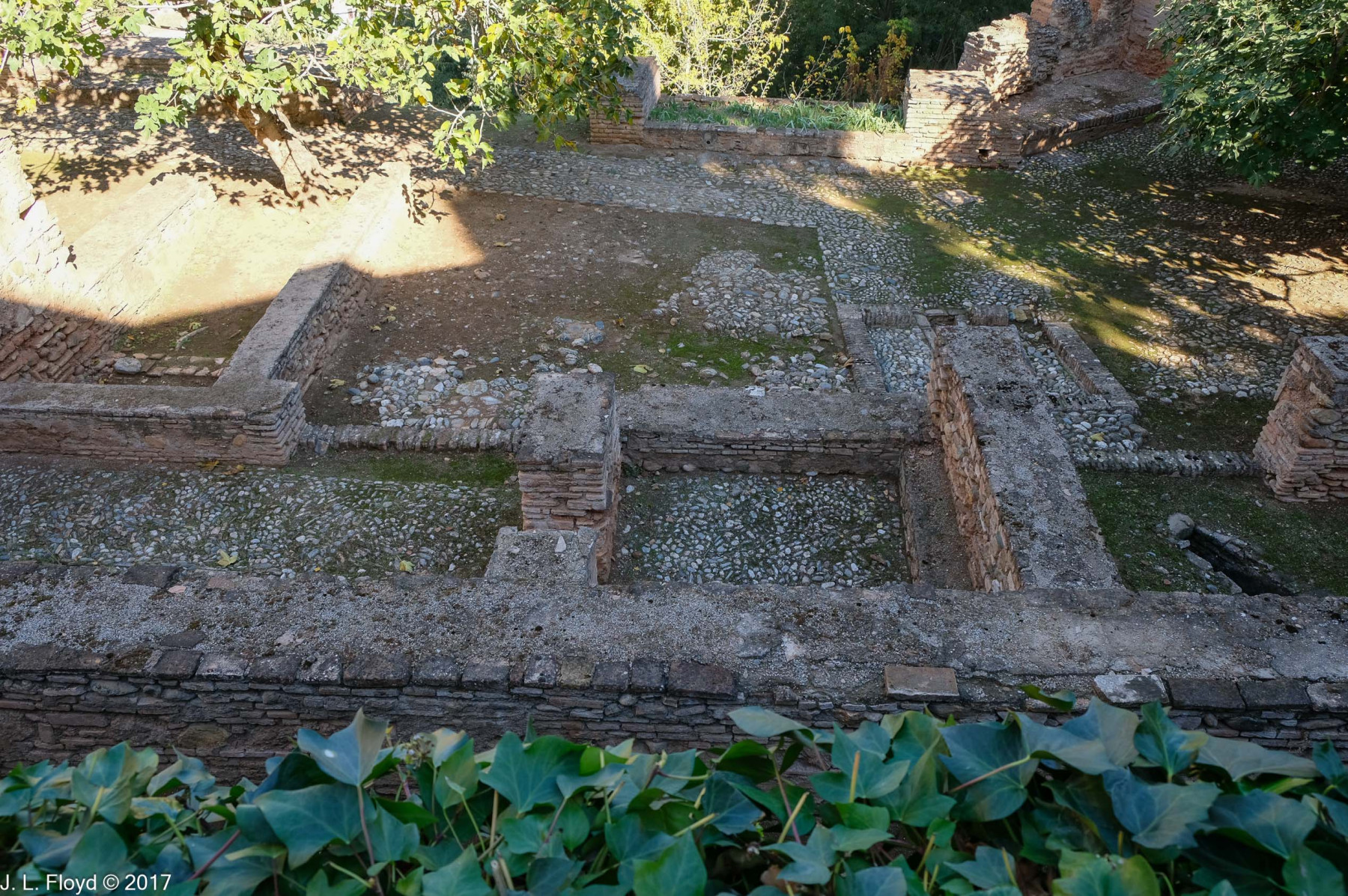
After the Christian takeover of Granada, Ferdinand and Isabella handed over the Upper Partal Palace to Iñigo López de Mendoza, first Marquis of Mondejar and second Count of Tendilla, who had served with distinction in the Granada wars, and named him Governor (alcaide) of the Alhambra and Captain General of Granada. The palace remained in the hands of the Tendilla-Mondejar family until 1717, when King Philip V fired the current Marquis, José de Mendoza Ibáñez de Segovia, abolished the office of alcaide, and confiscated all his properties. He did this in retaliation for Mendoza’s support of his rival for the Spanish throne, Archduke Charles of Austria, during the War of the Spanish Succession (1701-1714). Apparently the confiscation did not take effect immediately or was not complete, however, because Mendoza had time to sell some of the palace’s furnishings (now found in private collections) and demolish the palace itself, perhaps out of spite. (The sources currently available to me do not explain how he was able to do this after the property was confiscated.) In any case it began to be excavated in 1934, but only the foundations remain and some of them are still buried.

From the Partal Gardens we traipsed back toward the Charles V palace and then turned east again to follow the Calle Real de la Alhambra, past the Church of Santa Maria, the Ángel Barrios Legacy Museum, various administrative offices and the gift shop.

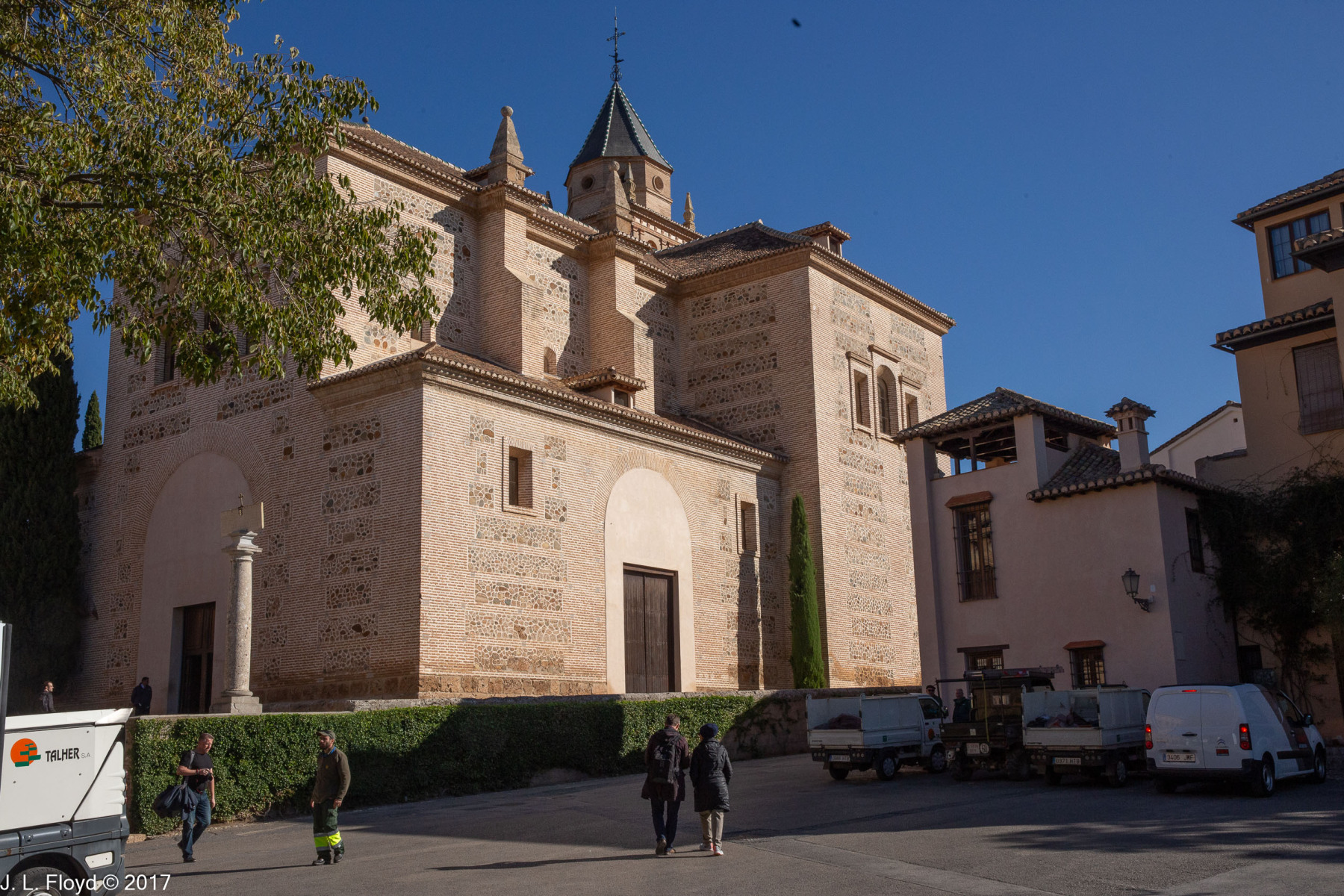
The Church of Santa Maria de la Encarnación stands on the site of the congregational (main) mosque of the Alhambra complex, which was commissioned by Emir Muhammad III (r. 1302-1309) and completed in 1305. After 1492 it was converted into a Christian church, but it fell into disrepair and was demolished in 1576. The present church, which belongs to the Archbishopric of Granada, was begun in 1581 and completed in 1618. The interior, which I did not visit, is furnished in Baroque style.

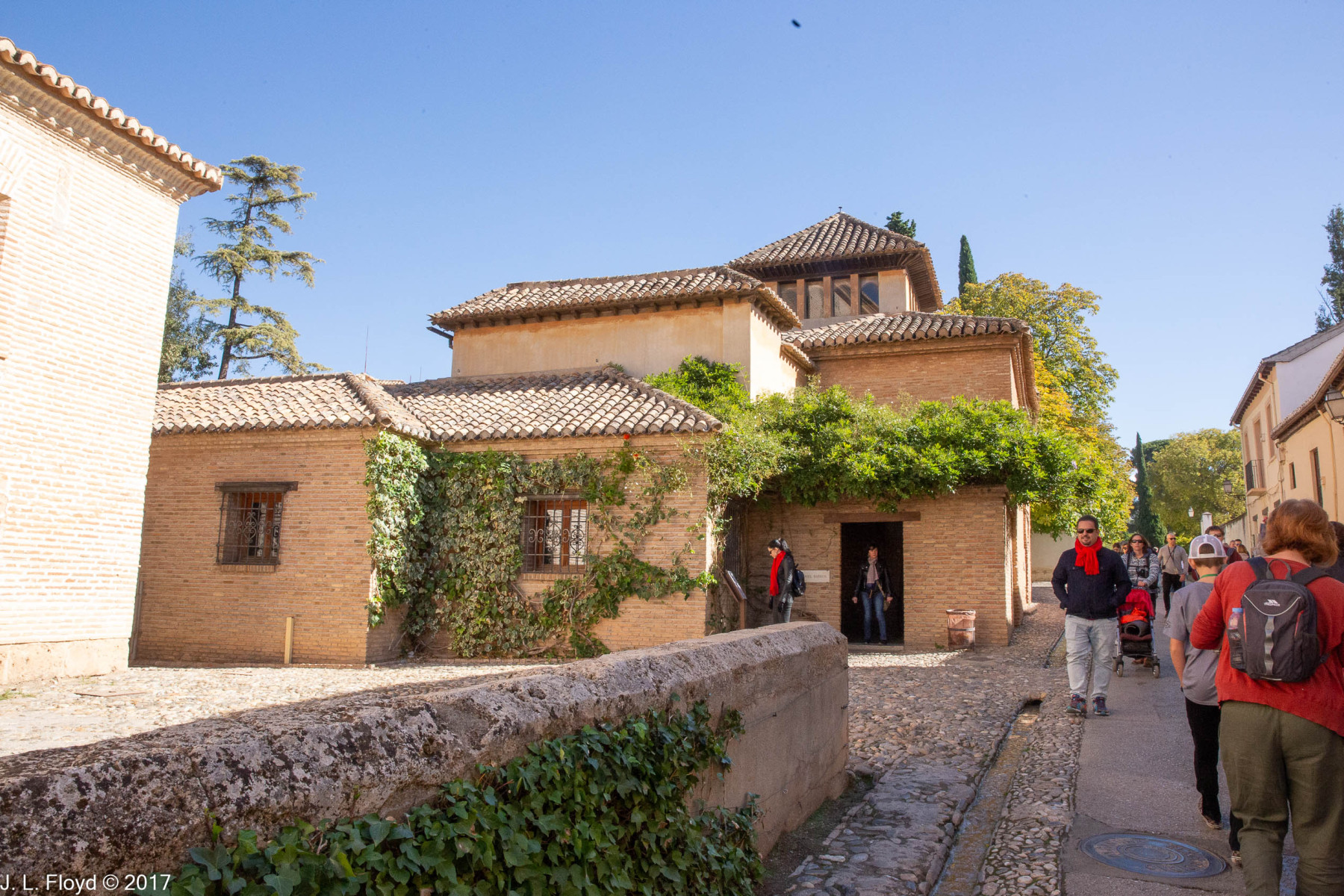
Ángel Barrios (1882-1964) was a Spanish composer and concert guitarist who was born in Granada, where his family apparently lived in a private house inside the Alhambra that served as a gathering place for artists, musicians and poets. The house was located next to the hammam (bathhouse) of the mosque. The hammam was partly demolished in 1534, and its remains were later incorporated into the house, which was built and/or remodeled in the 17th-18th centuries. In 1934, the architect Leopoldo Torres Balbás (1880-1960) undertook a reconstruction and restoration of the bathhouse, which coincided with the end of the Barrios family’s residence there. The house was then converted into a small and intimate museum where the instruments – piano and guitar – and personal effects of the composer are displayed next to the wall of the bathhouse; in addition, the museum incorporates an archaeological garden, with a pool recovered from the Palacio del Partal Alto, which now serves as a venue for concerts and other public events. I would have loved to visit this museum, along with the main museum in the Palace of Charles V, but that would have required another day in the Alhambra. I consider myself fortunate to have seen as much of the Alhambra as I did.

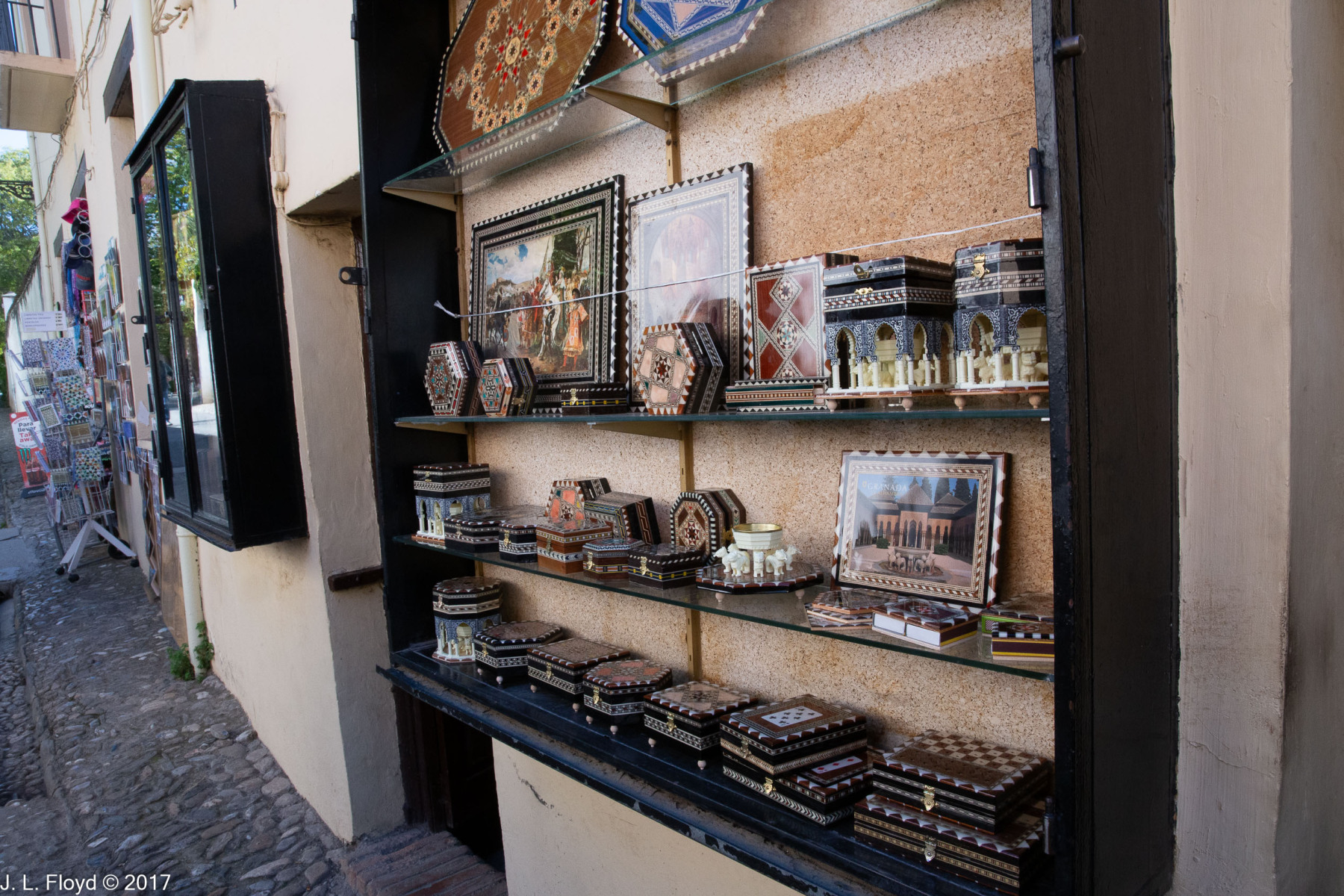
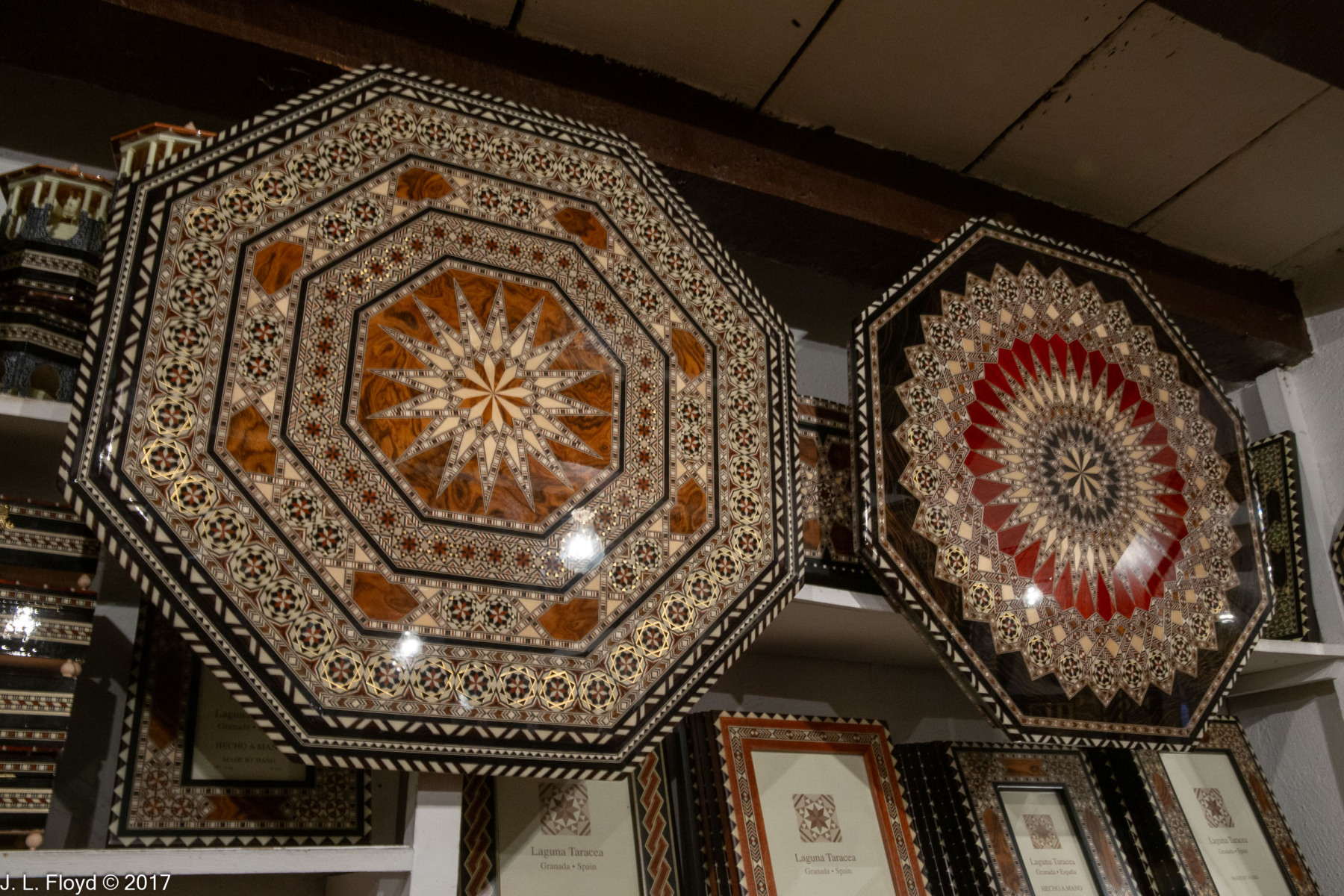
The gift shop was full of beautiful wares, most notably jewel boxes, wall plaques, picture frames and other objects lacquered with incredibly intricate and elegant designs, somewhat reminiscent of the Palekh lacquer art I had encountered in Russia, although the Alhambra offerings featured abstract geometric designs rather than the fairy-tale scenes gracing the Palekh items. All of them were exquisitely beautiful and far beyond the constraints of my budget, so I confined myself to the purchase of a few postcards and photo prints, which now hang on the walls of our home.

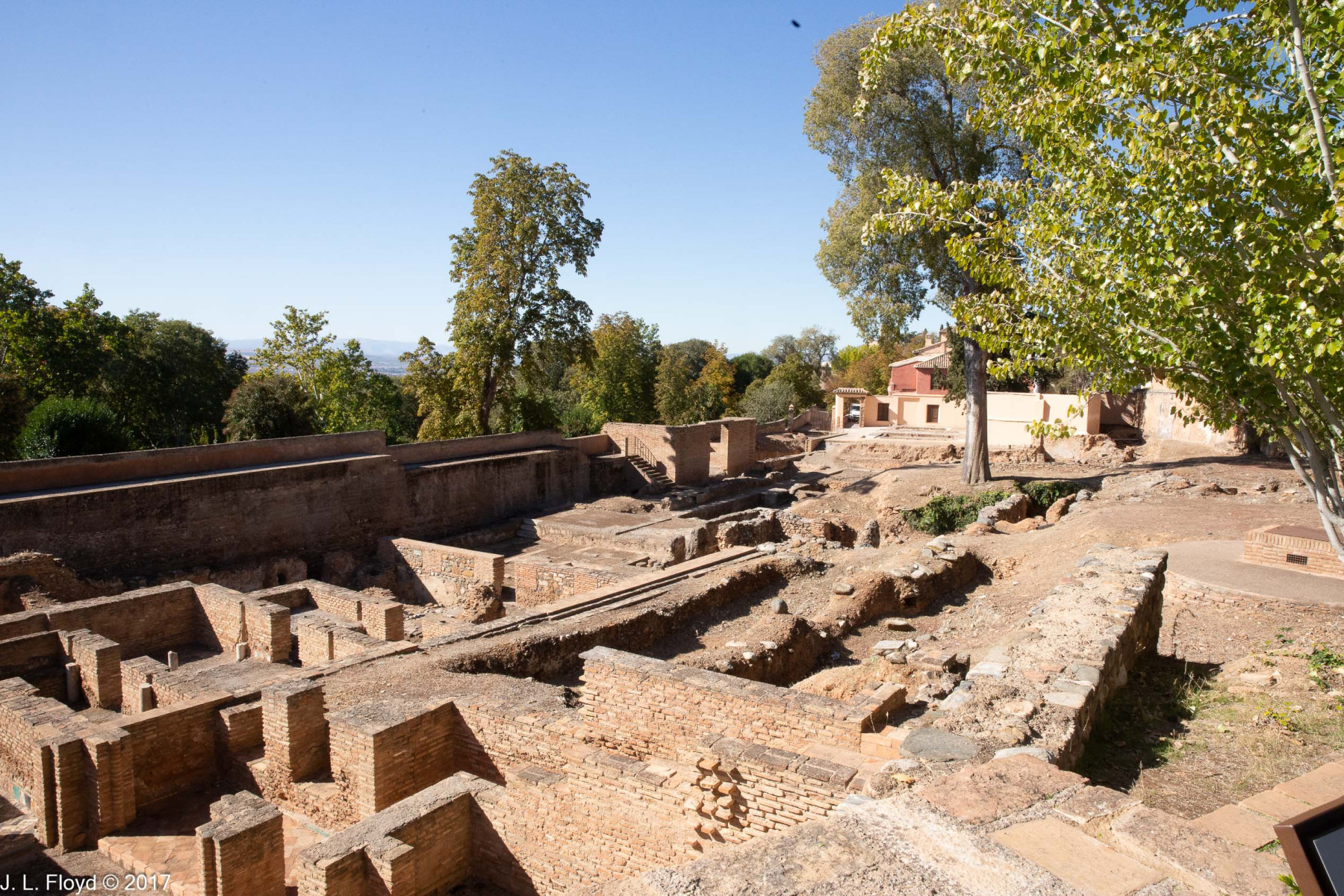
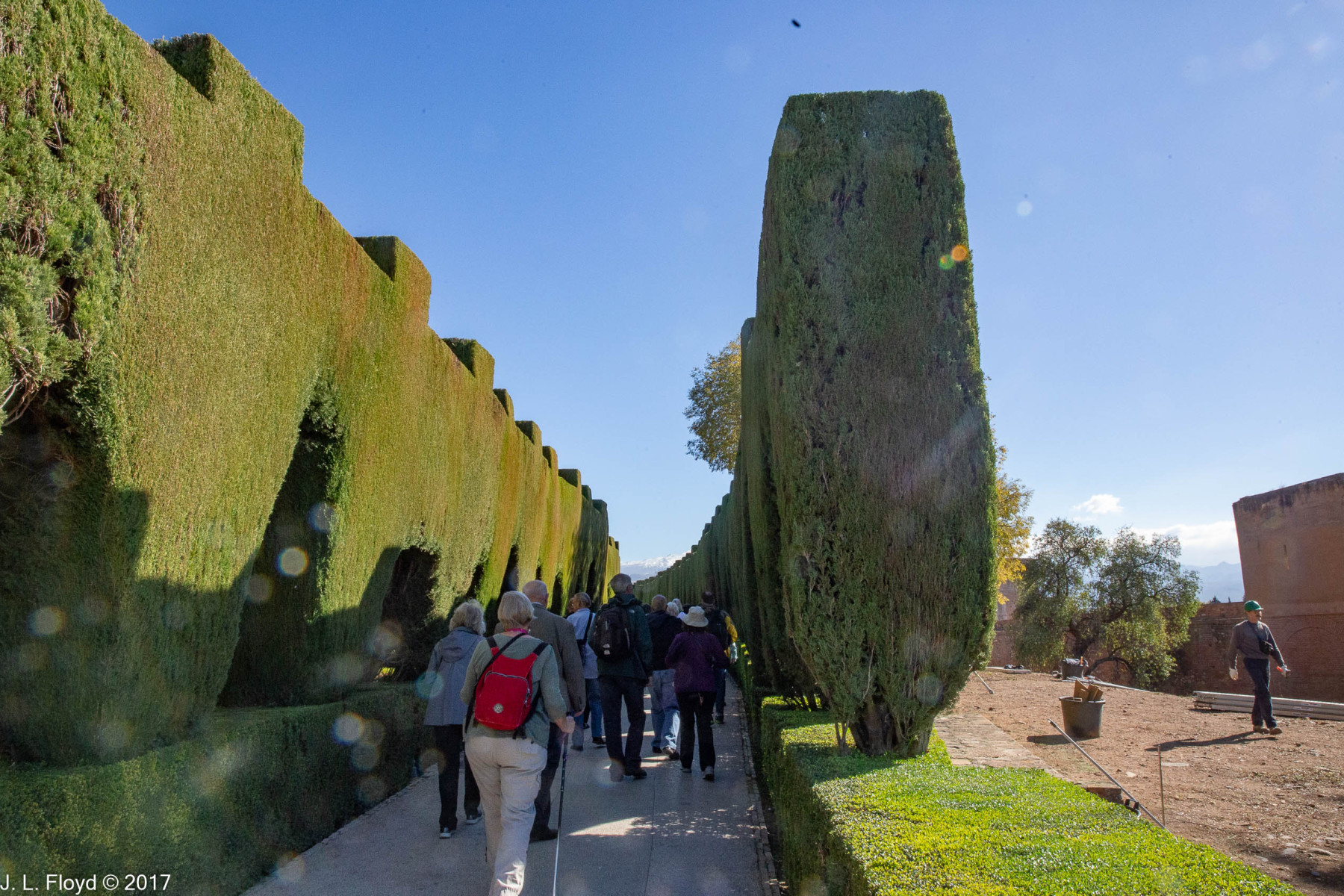
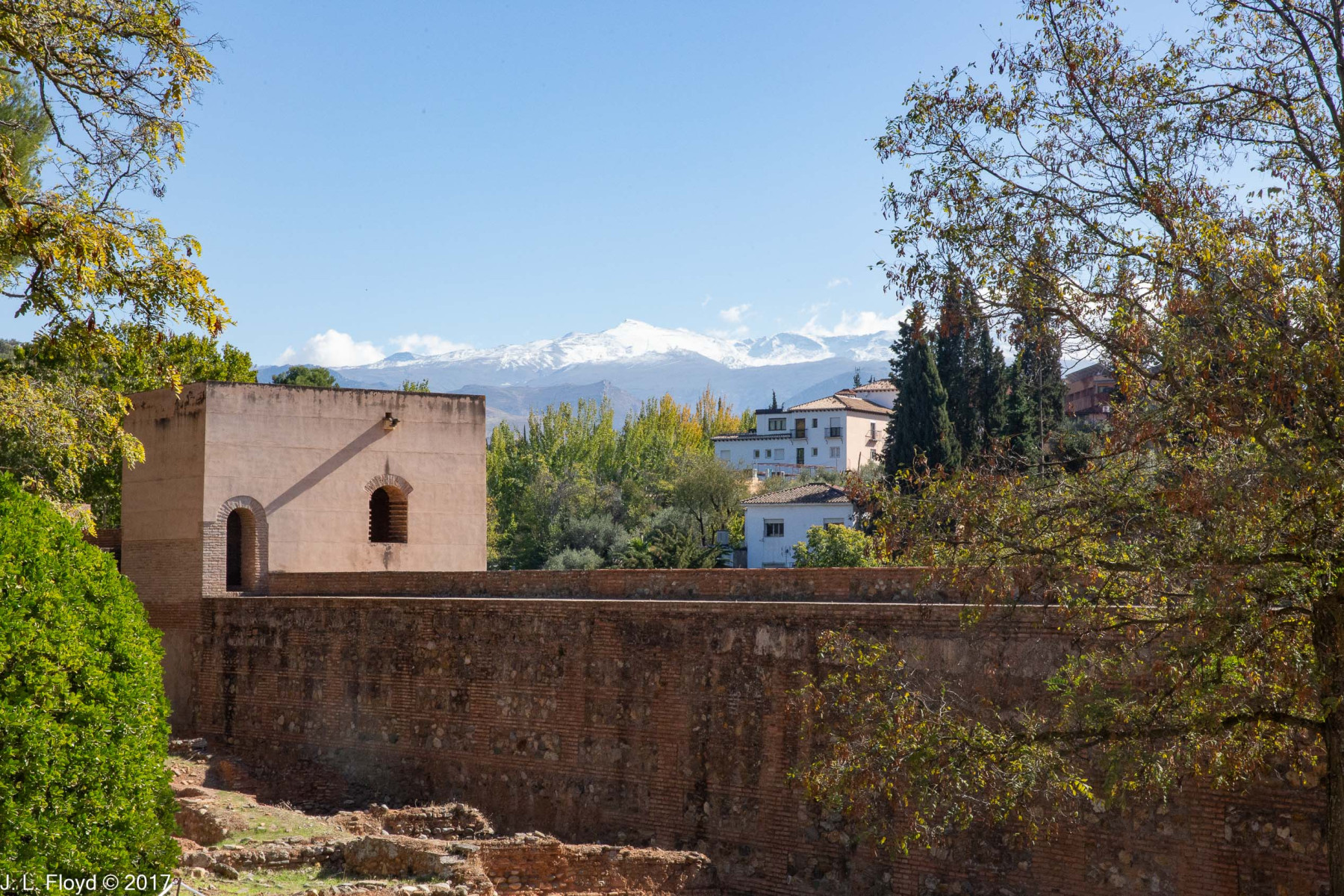
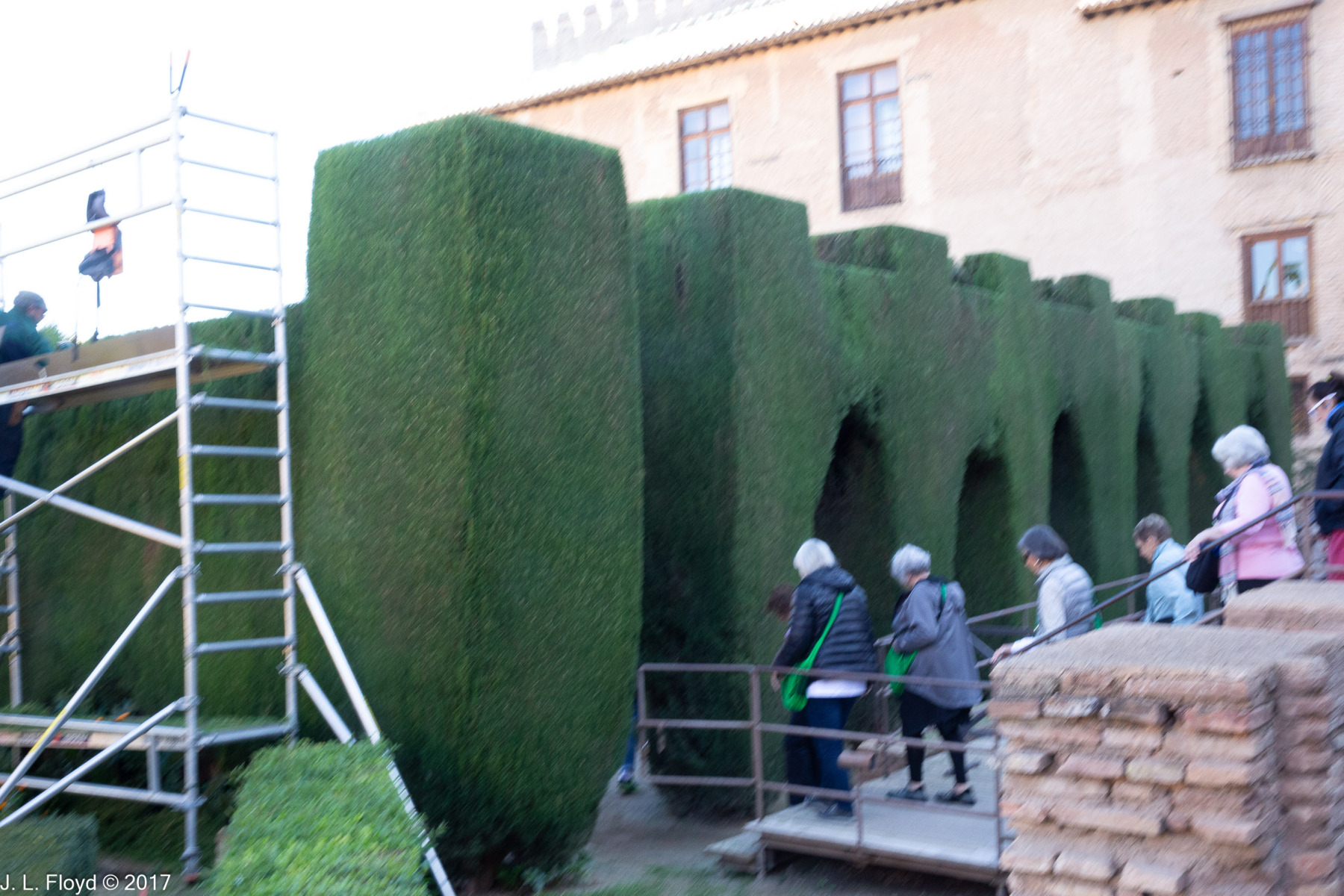
Resuming our trek eastward on the Calle Real, we passed the ruins of the Palace of the Abencerrajes, among others, until eventually the road became a narrow walkway between two towering hedges. Although this was Spain and not Crete, I expected at any moment to see the Minotaur lurking in the shadows. But eventually we emerged into an open space, where I found myself completely disoriented, without a clue as to where we were. Writing this account seven years after the trip, I’m not sure exactly how we proceeded from there; judging from the map of the Alhambra and the photos I took along the way, we trudged past the Torre de Baltasar de la Cruz before reaching the Torre del Agua at the east end of the Alhambra. There we descended some steps to the foot of the tower and found ourselves next to a structure which resembled an aqueduct. Indeed it turned out to be the the terminus of the Acequia Real de la Alhambra, which supplied water to the Alhambra from the Darro River, 6 kilometers away. From there we embarked on the path to the Generalife, the idyllic summer palace of the Nasrids.

The derivation of the name is disputed, but there is a tradition that Generalife is a Spanish rendition of the Arabic phrase jannat al-‘arīf, meaning something like “garden of the artist.” Its origins are also murky, but it is thought that the initial construction took place around the turn of the 14th century; in any case, it was frequently remodeled, redecorated and enhanced over the following centuries, both by Muslim and Christian owners. It was built as a private retreat and pleasure palace for the Emir and his family. From the start it was surrounded by extensive gardens, which provided sustenance as well as esthetic enjoyment for the inhabitants.

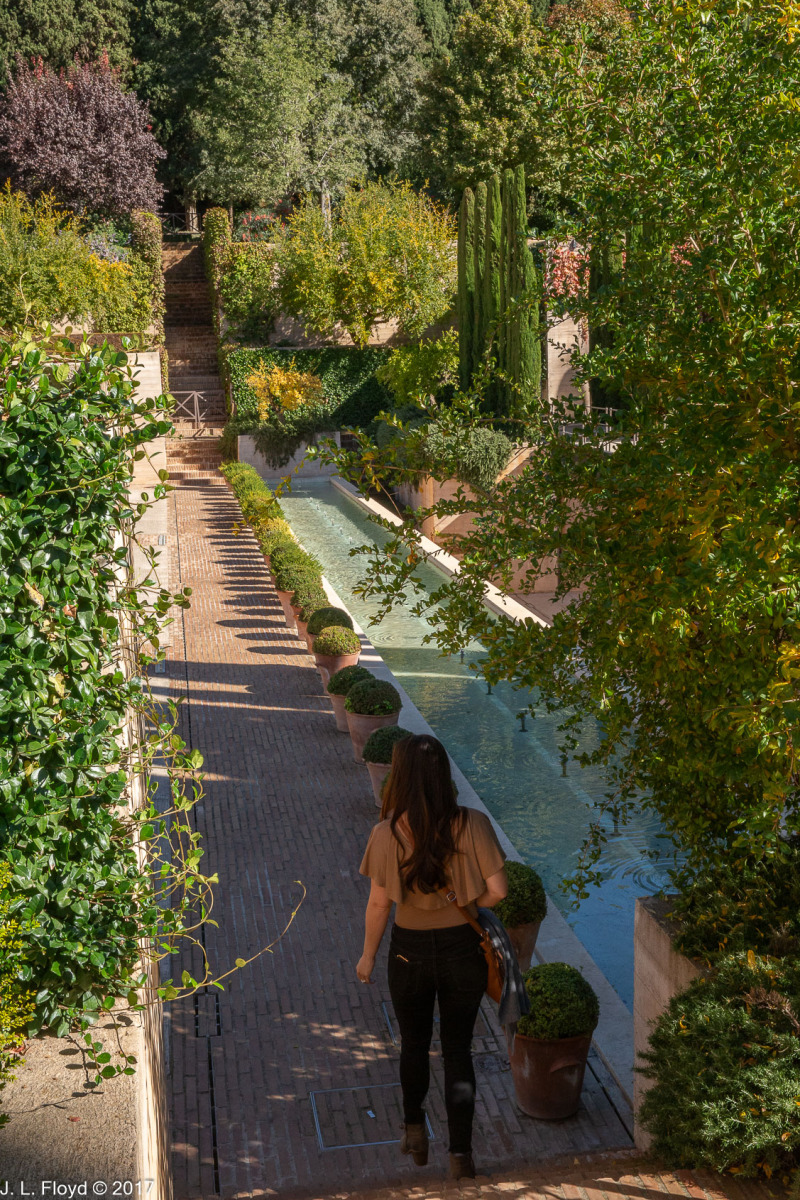
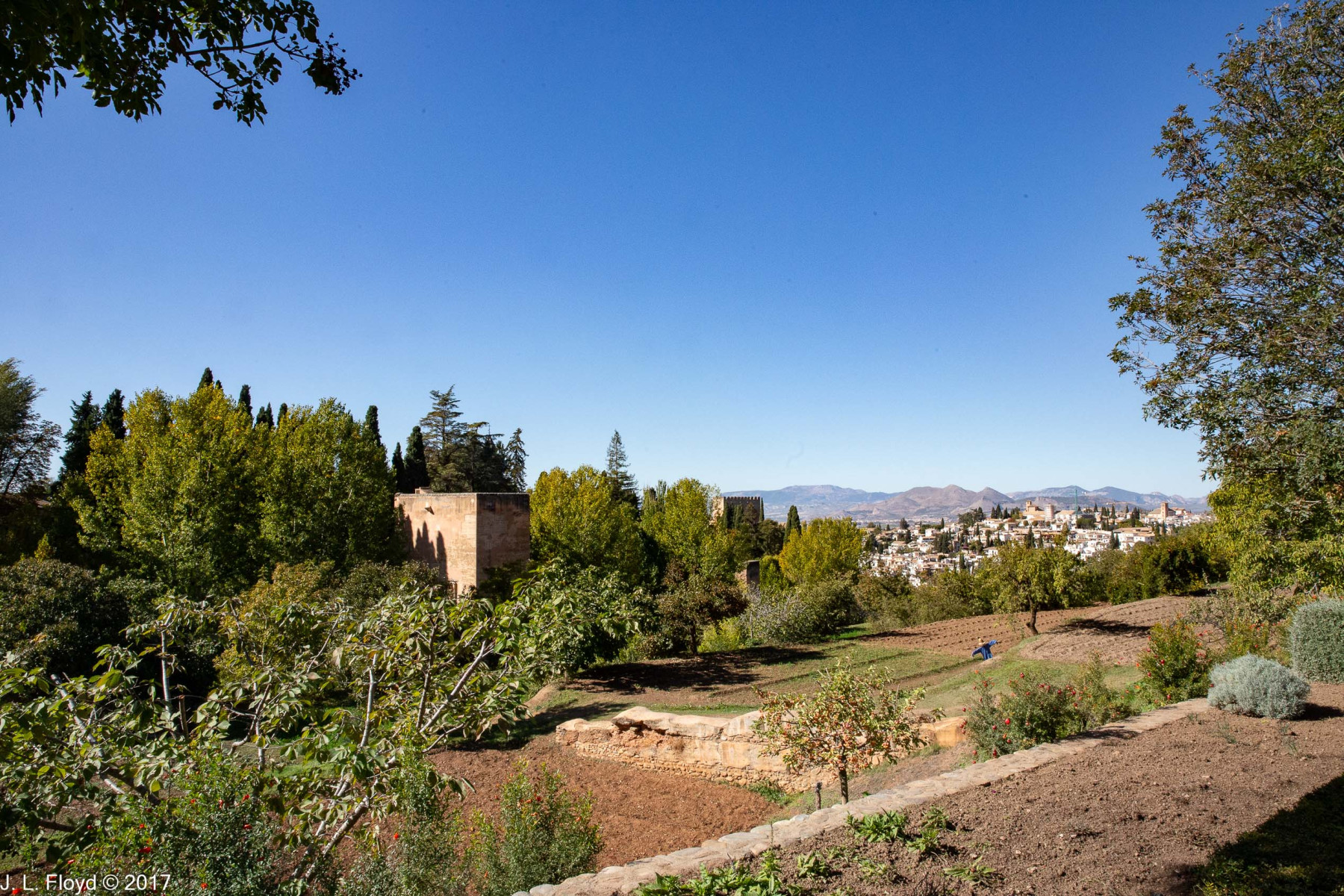
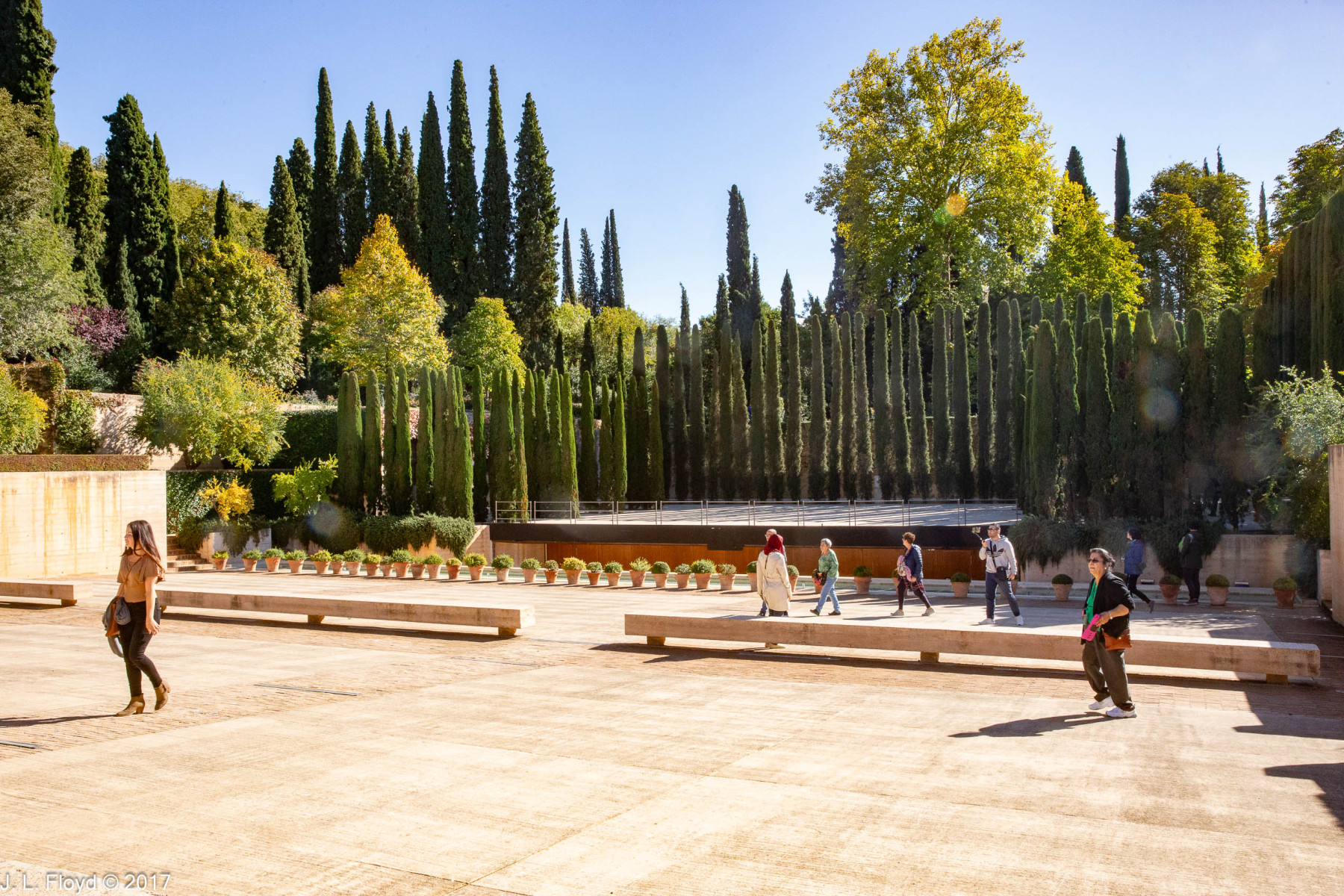
From the Torre del Agua, one reaches the Generalife by walking north on the Paseo de los Nogales, the Promenade of the Walnut Trees, which passes by the west side of the palace grounds. At the south end of the property we encountered the Teatro del Generalife, an open-air theater designed to serve as the main venue for ballet performances at the Granada International Festival of Art and Dance. It was opened in 1954 and has gone through several renovations since, including a major one in 2005. On its north side is a set of steps that leads to a wall of cypress hedges with archways that open into a panoply of gardens. These are known as the Jardines Nuevos, or New Gardens, to distinguish them from the older market gardens, known as Las Huertas, on the terraced hillside between the Generalife and the walls of the Alhambra. The Jardines Nuevos in their present form are a twentieth-century feature and have little in common botanically with their Nasrid predecessors. Regardless, they do convey an extremely satisfying esthetic experience.

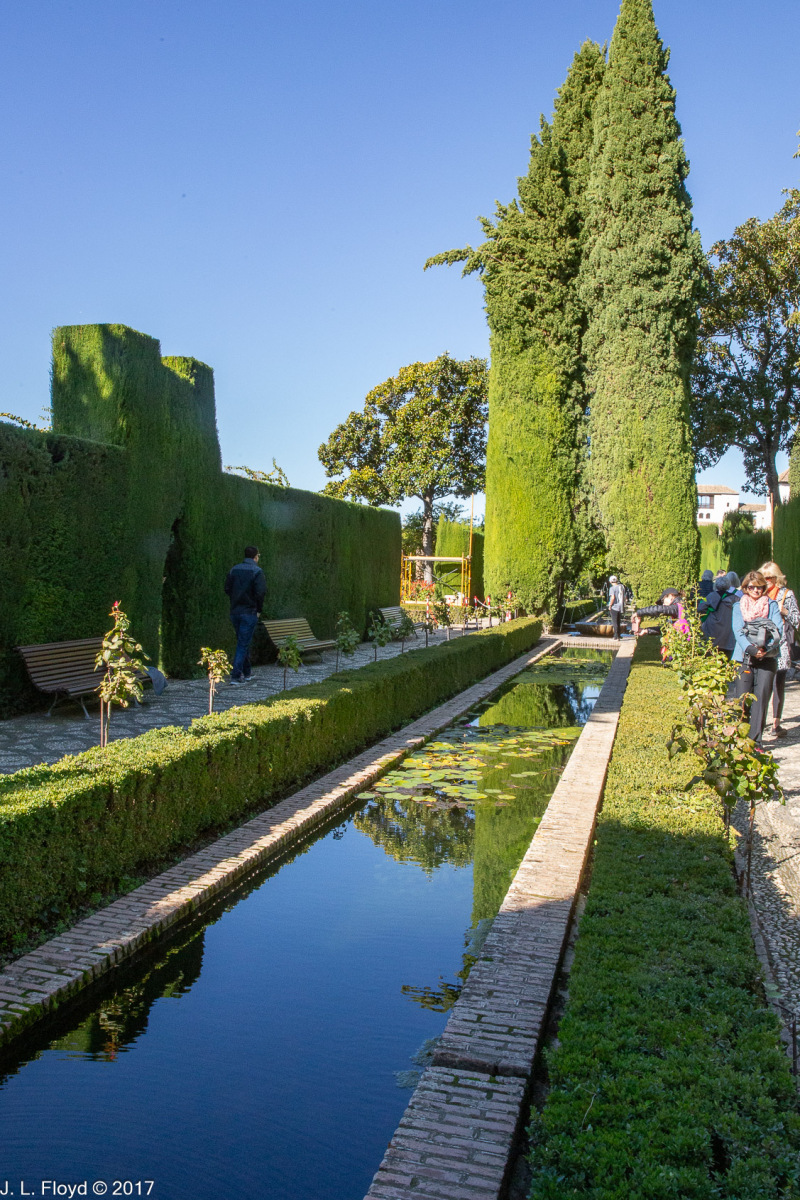
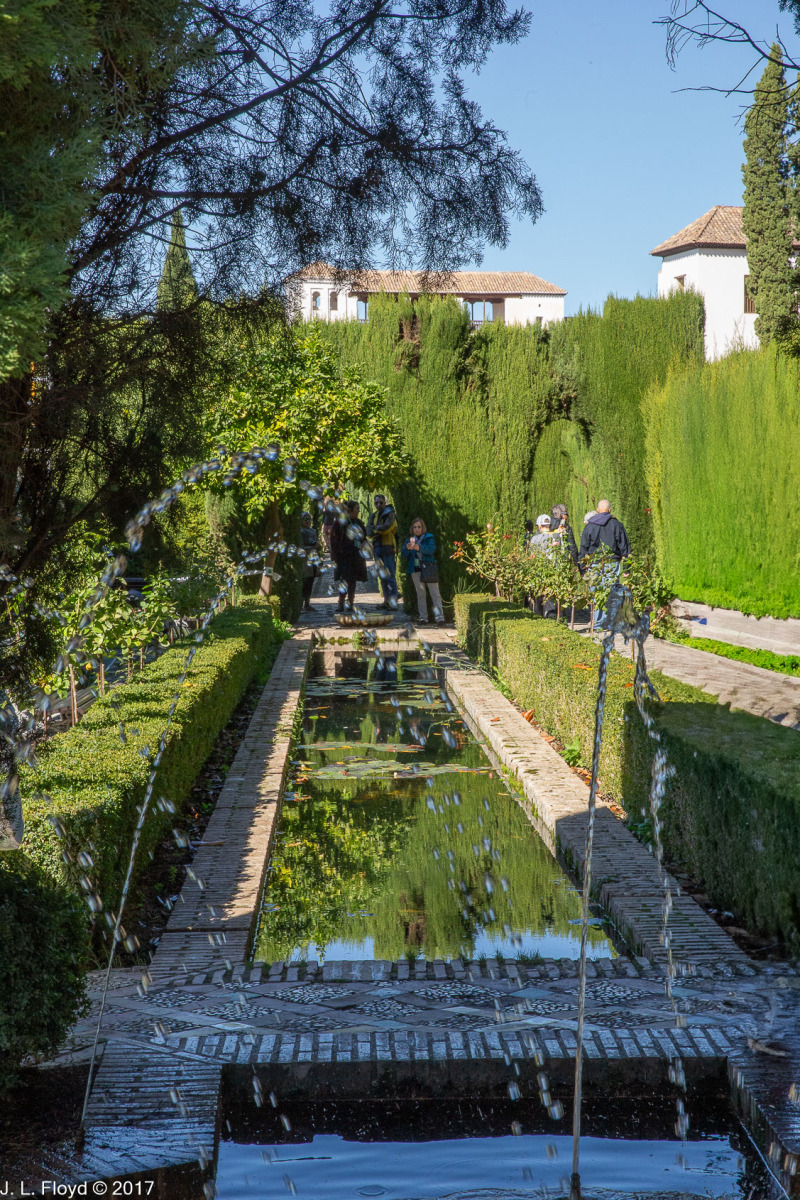
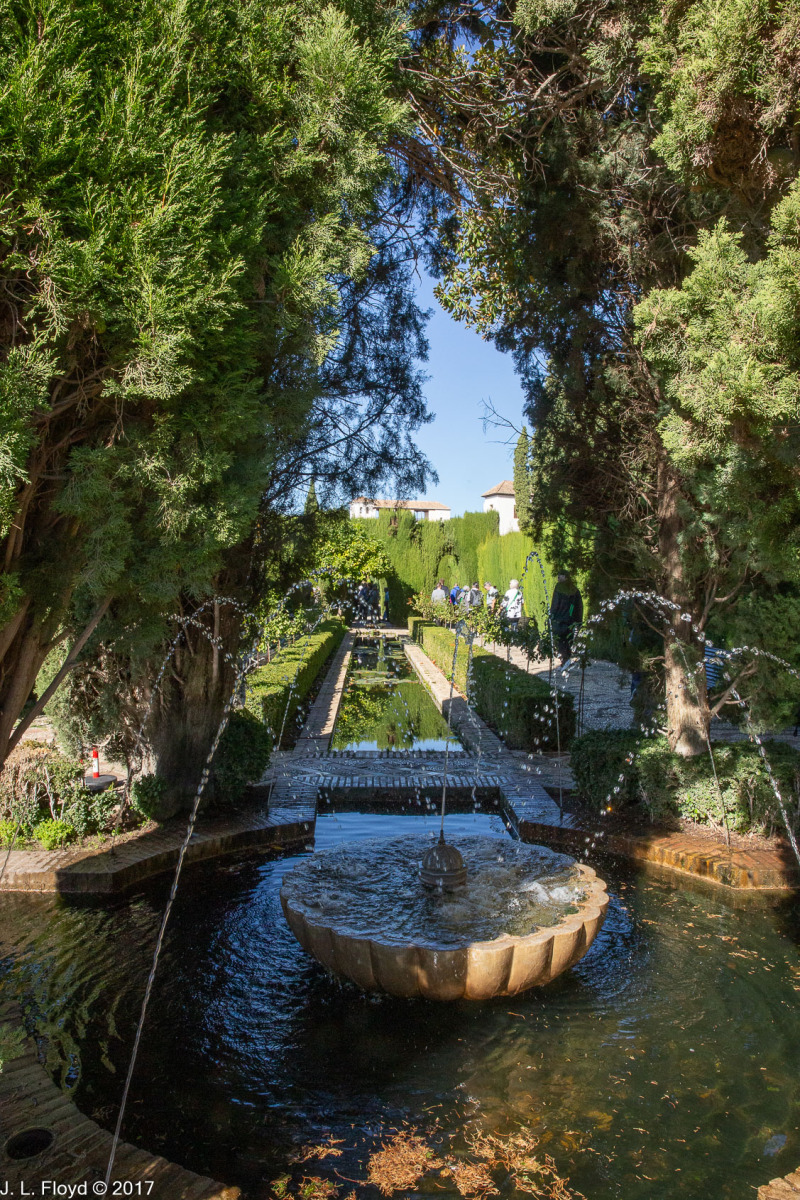
The New Gardens consist of two sections, northern and southern. The former was designed by Leopoldo Torres Balbás in 1931 and the latter by Francisco Prieto Moreno in 1951. The southern garden is arranged around a long central rectangular pool or canal, similar in orientation to the Court of the Myrtles in the Comares Palace. At its southern end, on a raised terrace, is a spectacular fountain, surrounded by cypresses. I couldn’t find out a name for the fountain, so I suggest that the explorer Ponce de Leon, who set out to seek the Fountain of Youth in the New World, actually found it but kept it a secret and somehow dismantled it, brought it back to Spain, and then reassembled it at the Generalife. Unfortunately, he couldn’t bring its water source with him, so it didn’t work any more – at least it didn’t work for me, when I tried it.

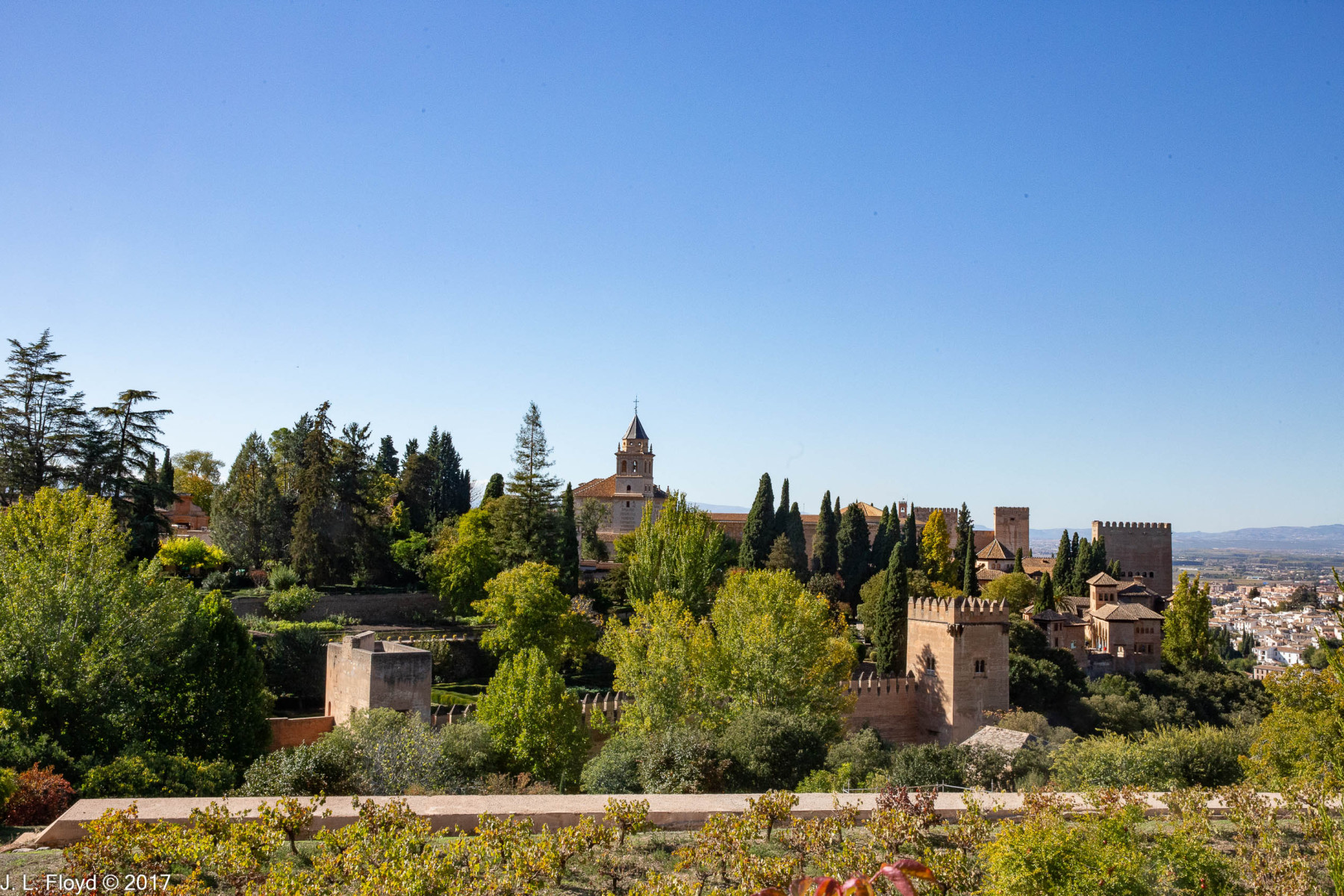
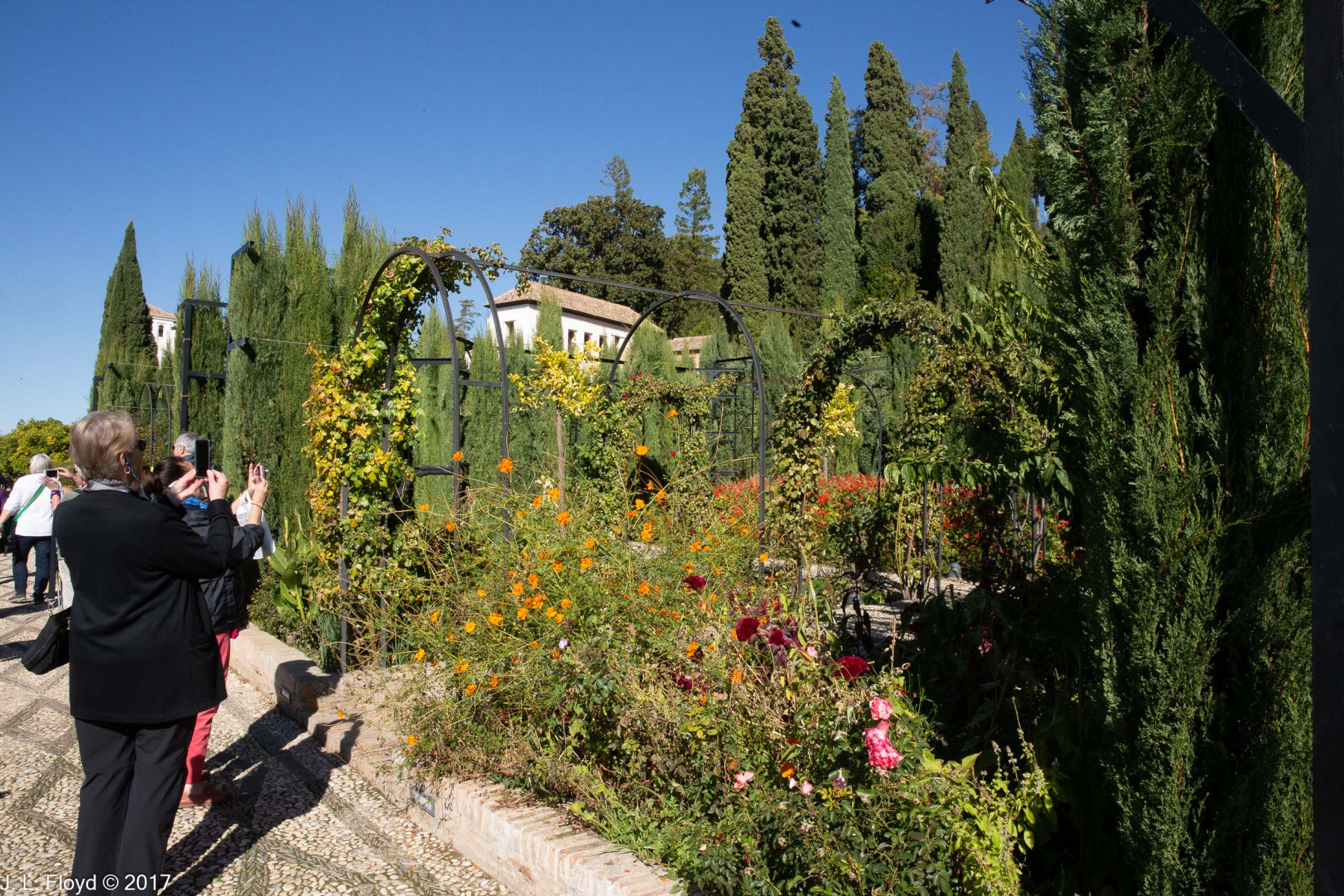
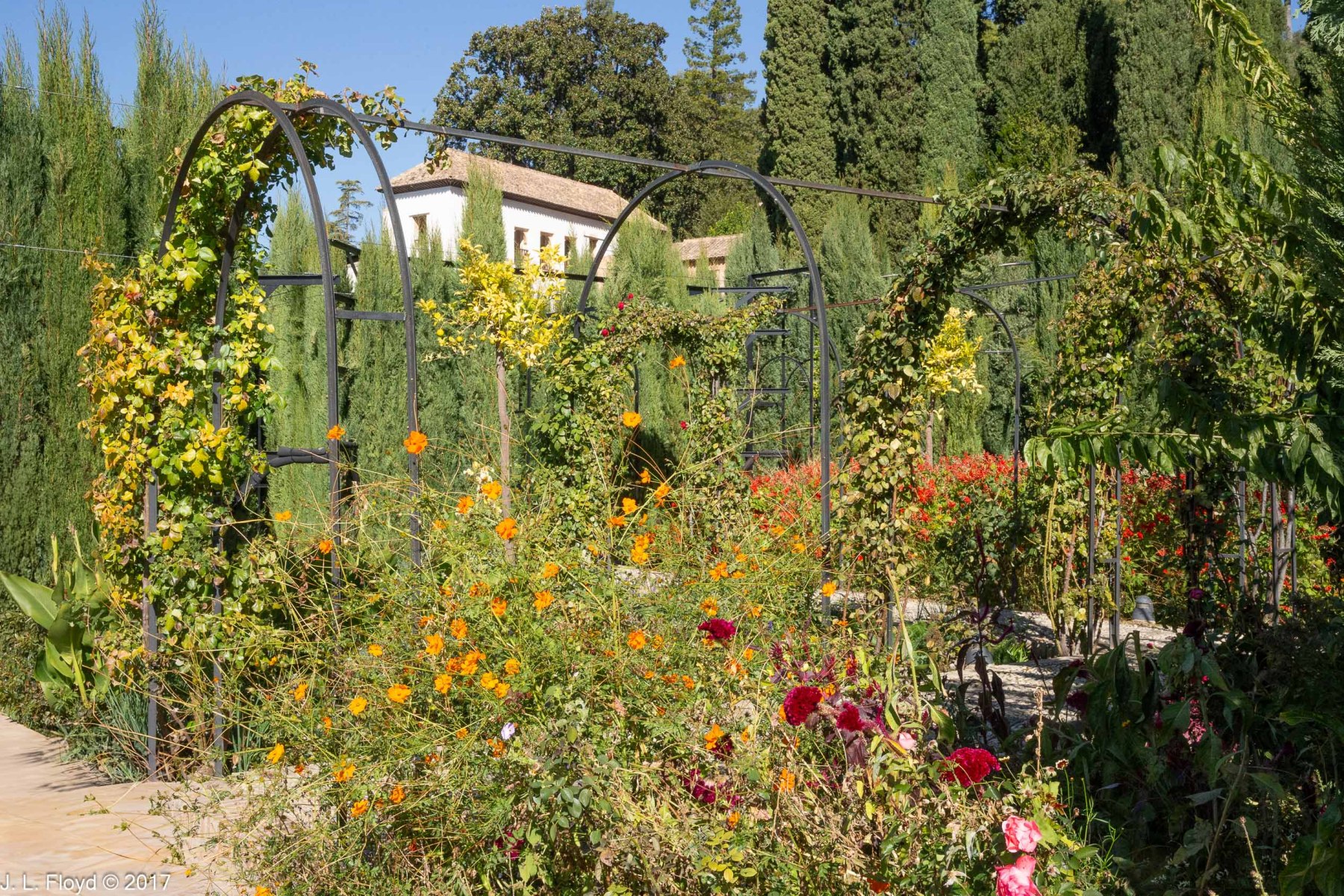
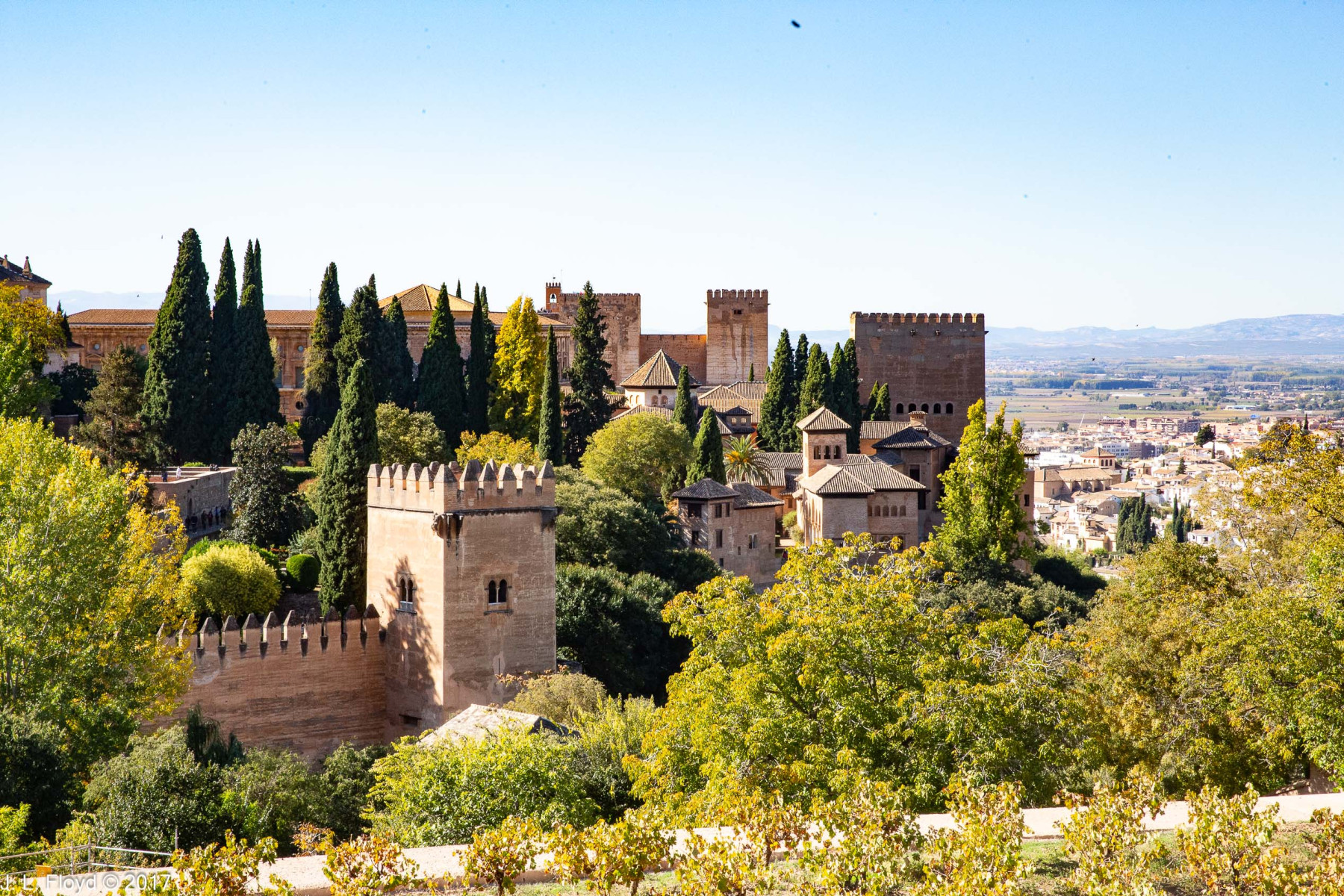
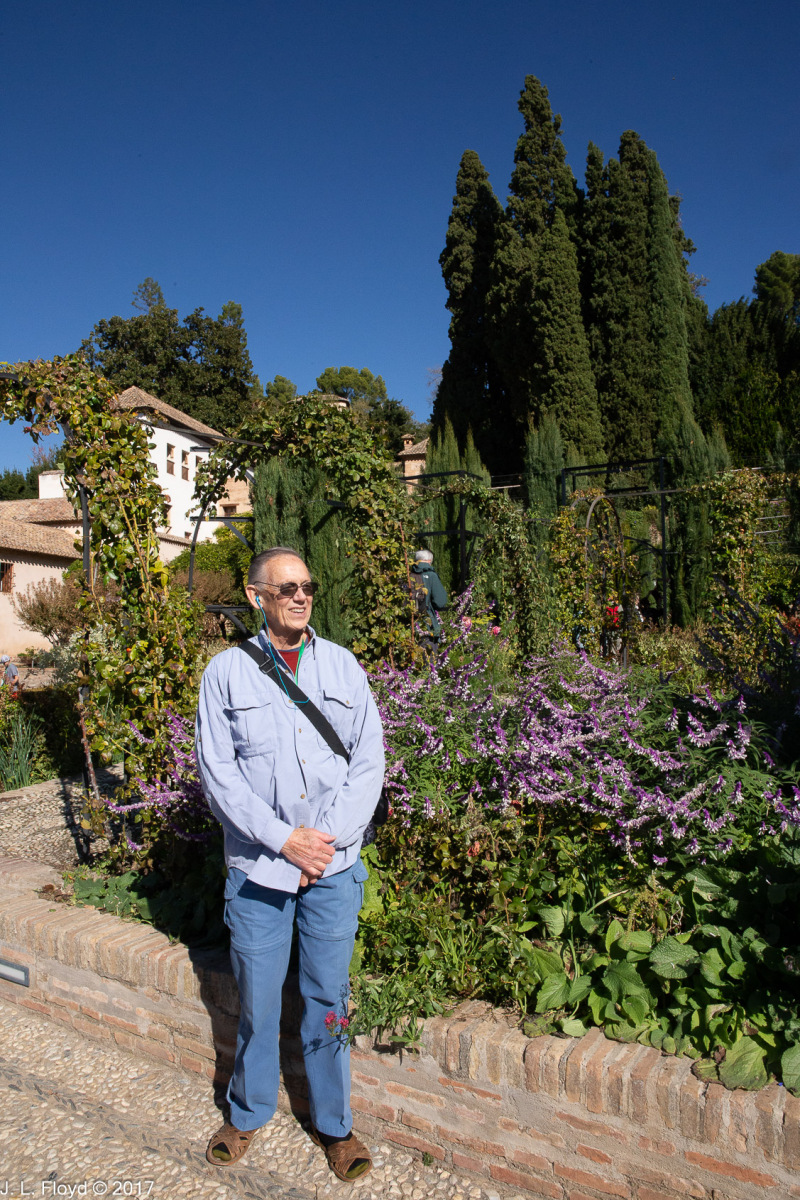
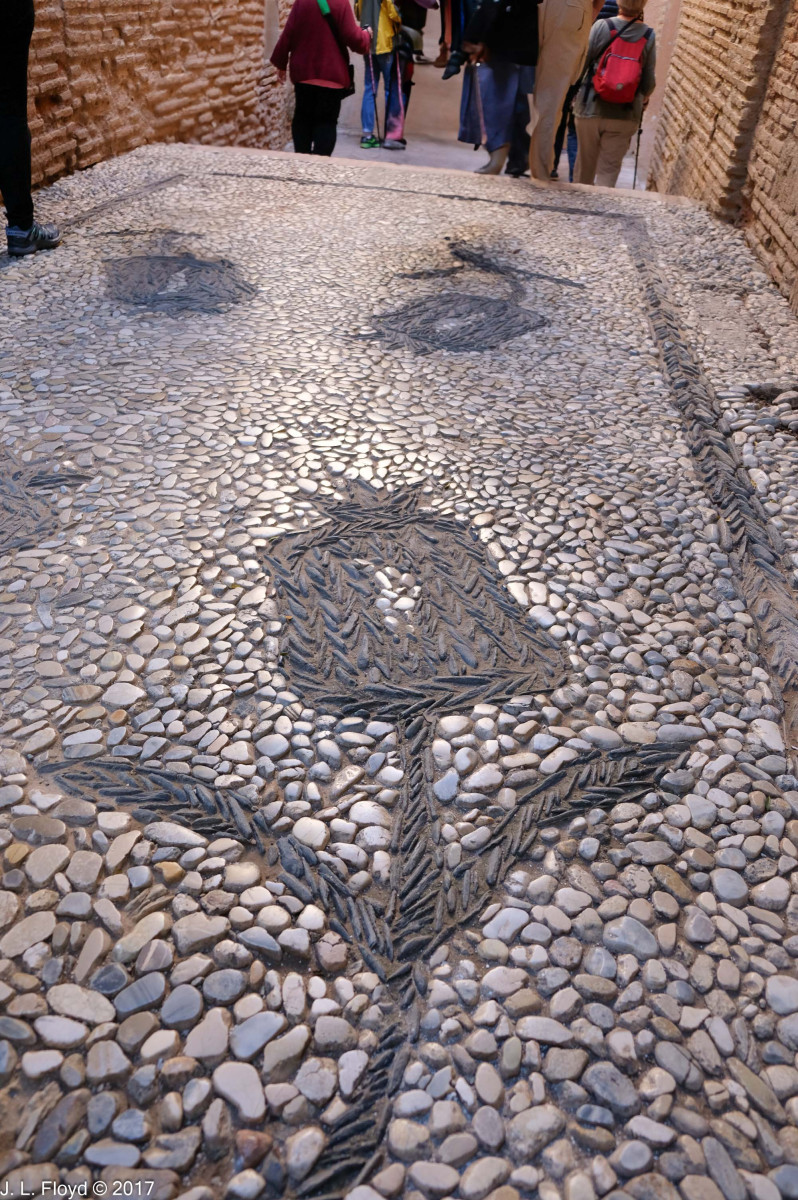
The northern section of the gardens features a riotous collection of flowers, which was especially noteworthy because we saw it in November, a month which is not normally associated with floral flamboyance. I also noted that the walkways throughout the Generalife gardens were paved with strikingly elegant mosaic-style stonework, composed of pebbles embedded in a cement matrix. I subsequently found out that the pebbles are sourced from the rivers of Granada – white ones from the Darro and black ones from the Genil. We were allowed some time in which to wander around the gardens and relax; I took advantage of the opportunity to take photos not only of the floral displays but also of some of our fellow-travelers – most especially Chuck and Elouise Mattox, but also some of our other favorites such as Jim and Joan Hinds. I also shot some nice views of the northeast quarter of the Alhambra.

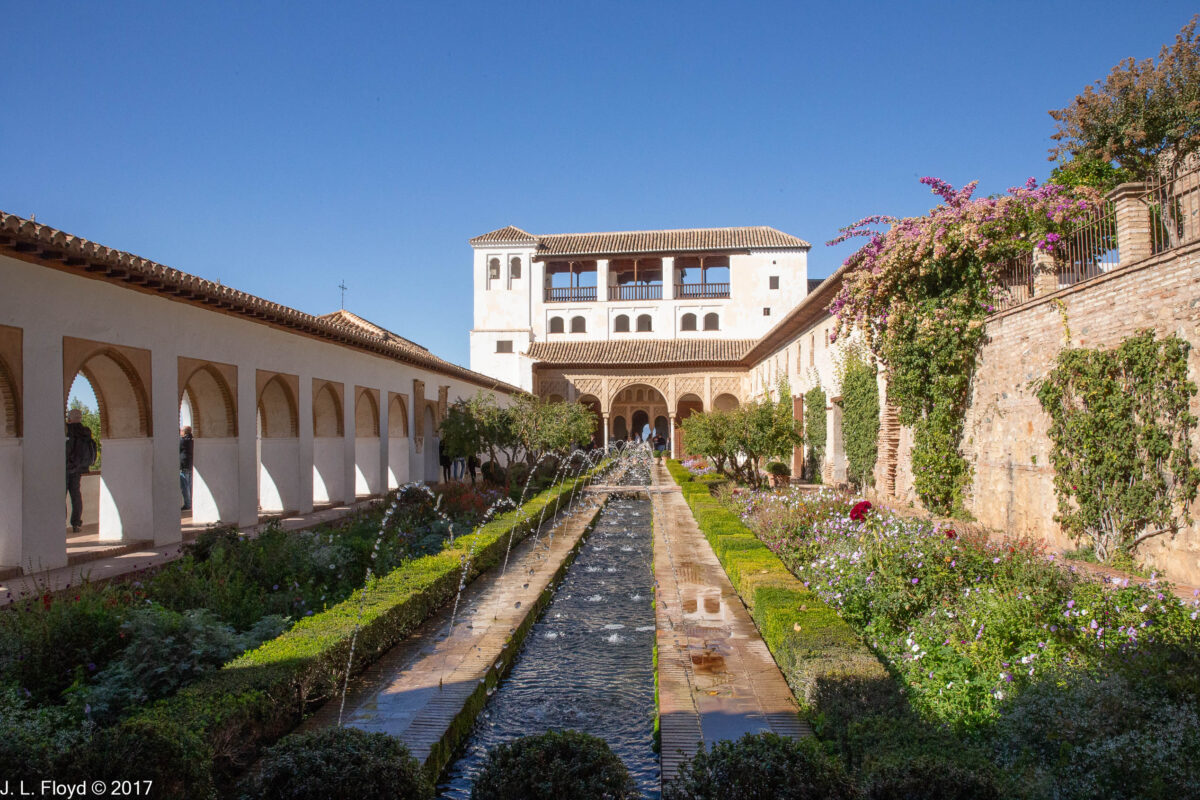
After roaming in the gardens for a bit, we entered the Generalife Palace itself via a couple of small courtyards at its southwest corner — the Patio de Desmontaje (dismounting) and the Patio de Polo. The latter, in addition to being completely covered in pebble-mosaic paving, featured a central Nasrid-style fountain in white marble with channels representing the four rivers of Eden radiating from it. After passing through the Patio de Polo, we found ourselves in the central courtyard of the Generalife, the Patio de la Acequia (“Courtyard of the Water Canal”). The canal runs the entire length of the courtyard but is split in the middle by a platform that crosses over it. There, on the west wall, is also a mirador with views of the gardens and the Alhambra. At either end of the courtyard stands a pavilion – the Pabellón Sur and the Pabellón Norte. We spent little time at the South Pavilion, which is less well preserved than the North Pavilion, and in any case the light was unfavorable for photographing it.

The North Pavilion is fronted by a five-arched portico, behind which is a gallery leading to the main room, the Sala Regia (“Royal Chamber”). At the northwestern corner rises the Torre de Isma’il, erected by the Emir Isma’il I (r. 1314-1325) to commemorate a 1319 battle in which he had repelled an invasion by the Castilians. At that time the Generalife consisted of only one floor; the second, essentially extending the Tower of Isma’il across the entire width of the North Pavilion, was added by the Catholic Monarchs in 1494. Since then there have been many modifications and restorations of the Generalife, with the magnificent result that we saw in 2017.

Above the Patio de la Acequia on its northeast side, extending to the south of the right wing of the North Pavilion, is the Patio de los Cipreses de la Sultana — Courtyard of the Sultana’s Cypresses — a post-Nasrid addition consisting of a rectangular pool with a large island within it, all surrounded by greenery, a fabulously beautiful area right out of the Arabian Nights —one expects to see Scheherazade entertaining the Sultan with her stories of Sinbad the Sailor, Aladdin’s Lamp, etc.

On the northeast side of the Patio de los Ciprises is the Escalera del Agua (“Water Stairway”), a set of flights of stairs with balustrades containing open mini-aqueducts on each side. At each landing of the staircase there is a small round pool with a fountain.

The time allotted for our visit to the Alhambra was now running short, and in order not to miss our bus we had to begin our trek back to the parking lot. Hence not enough time remained for me to obtain decent photographs of the Patio de los Ciprises and the Escalera, let alone the Mirador Romántico, a 19th-century pavilion located on a hill nearby which is said to offer wonderful views of the entire area. So for these I’ll refer the reader to Wikipedia, which has an article on the Generalife with gorgeous photos of all its attractions, including the ones I missed.

The way back to the parking lot led along the Paseo de las Adelfas, the Path of the Oleanders, a walkway lined with oleander bushes trained to grow in an idyllic archway covering the pavement. This led to the equally splendid Paseo de los Cipreses and finally to our bus stop.

We would see more of Granada that day, and it is a memorable city, among the most beautiful I have visited. But nothing for me will ever match the splendor and beauty of the Alhambra.

Categories
Spain, Portugal and Morocco, November 2017

Granada, November 9, 2017: The Palaces of the Alhambra

When I was nine years old, my mother gave me a history book with a picture of the Alhambra on one of its pages. I was immediately seduced by the beauty of the place; ever since then it was at the top of all the places in the world I wanted to visit. On November 9, 2017, I was finally able to turn that hope to reality.

I was exceptionally fortunate in being able to enjoy the experience in company not only with my wife Sandie, but also my treasured lifelong friends Chuck and Elouise Mattox, who had invited me to join them on the tour in the first place.

At this point it is appropriate to provide a bit of background about the Alhambra. The Emirate of Granada, the last independent Muslim state in Western Europe, was founded in 1232 by Muhammad Ibn Yusuf Ibn Nasr, later known as Muhammad I Ibn al-Amar. This was a time when the Muslim dominion in Spain, established by conquest in 712 CE, was in terminal decline. The Christian armies were on the march, taking Córdoba in 1236 and Seville in 1248. Yet the polity founded by Muhammad I Ibn al-Amar managed to hang on for over two centuries – though it did so as a vassal of Castile – until the rulers of a united Christian Spain decided to put an end to it. During the limited period of its existence the Emirate of Granada was able to enjoy considerable prosperity, for a limited time, and to generate the last great cultural flowering of Moorish Spain.

Muhammad I had already settled in Granada by 1328 and began the construction of the Alhambra in that year. His successors continued to expand and enhance it. The dynasty he founded is known as the Nasrids.

On January 2, 1492, Ferdinand of Aragon and Isabella of Castile accepted the surrender of the last Emir of Granada, Muhammad XII, also known as Boabdil, and made their triumphal entry into the Alhambra. Although the terms of the surrender guaranteed that the Muslims would be allowed to continue practicing their religion, the Catholic monarchs, under the influence of the Archbishop of Toledo and Chancellor of Castile, Francisco Jiménez de Cisneros, reneged on their promise. Cisneros conducted a mass forced conversion, burning their books and suppressing their ensuing revolt; in 1500 he declared that there were no more Muslims in Granada. But the Moriscos, as the unwilling converts were called, continued practicing their religion sub rosa, and in 1609, after suppressing several more rebellions, the government of Philip III issued a decree expelling all the remaining Moriscos from Spain.

After taking possession of the Alhambra, the Spanish monarchs used it as a royal residence and made a number of alterations – both additions and demolitions – to it. The most important of the additions was the Palace of Charles V, begun in 1527. But later, in the 17th and 18th centuries, the Alhambra ceased to be a focus of attention and it was severely neglected. During the Napoleonic Wars, the French occupied Granada, and when they were finally driven out, they attempted to blow up the Alhambra, and actually succeeded in destroying parts of it before being foiled by a heroic Spanish soldier, José Garcia, who disabled the fuses on the charges and thereby saved the rest of the fortress. In the 19th century there was a revival of interest in the Alhambra, and efforts to preserve and restore it were undertaken and have been continued over the years since.

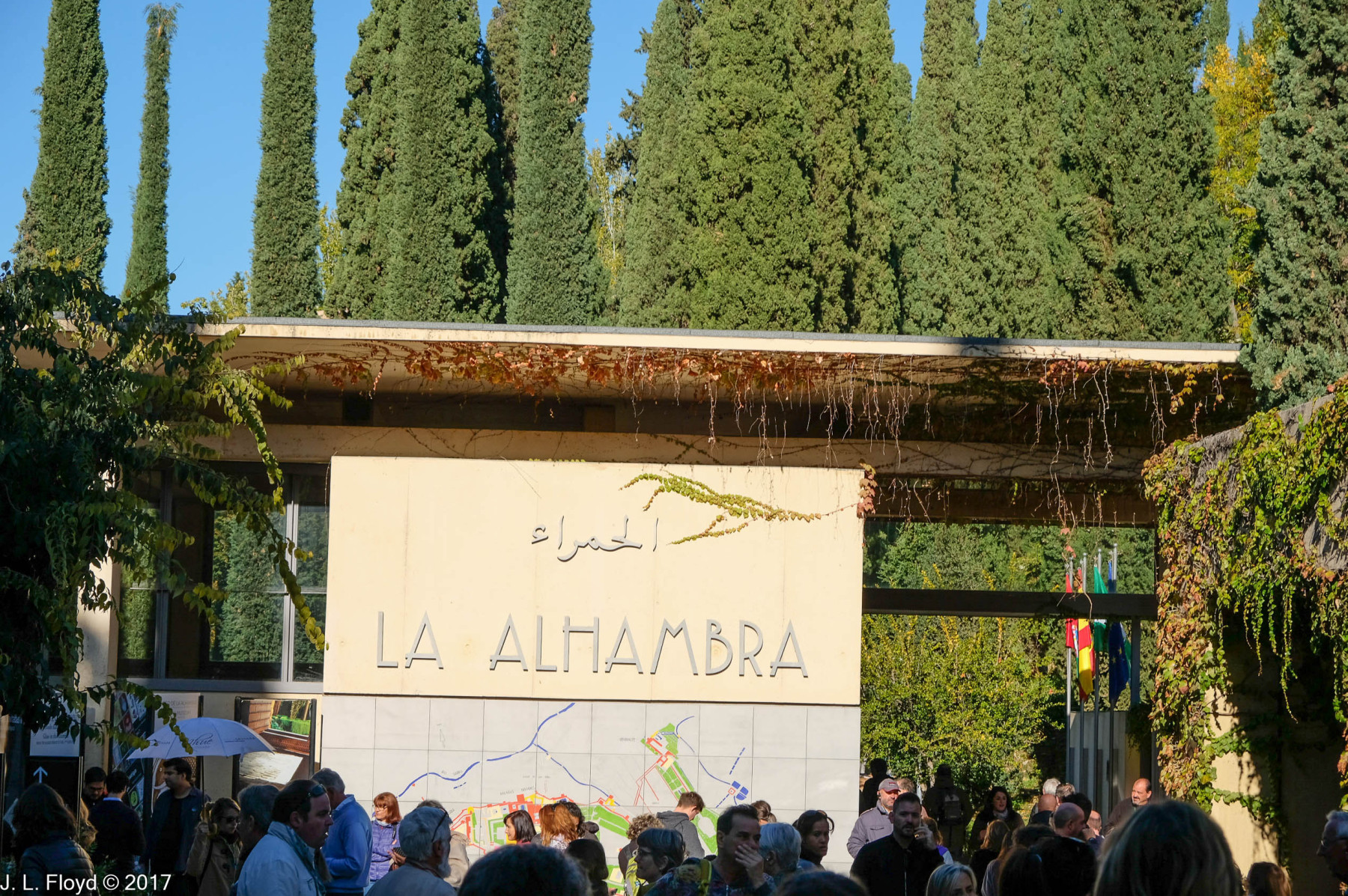
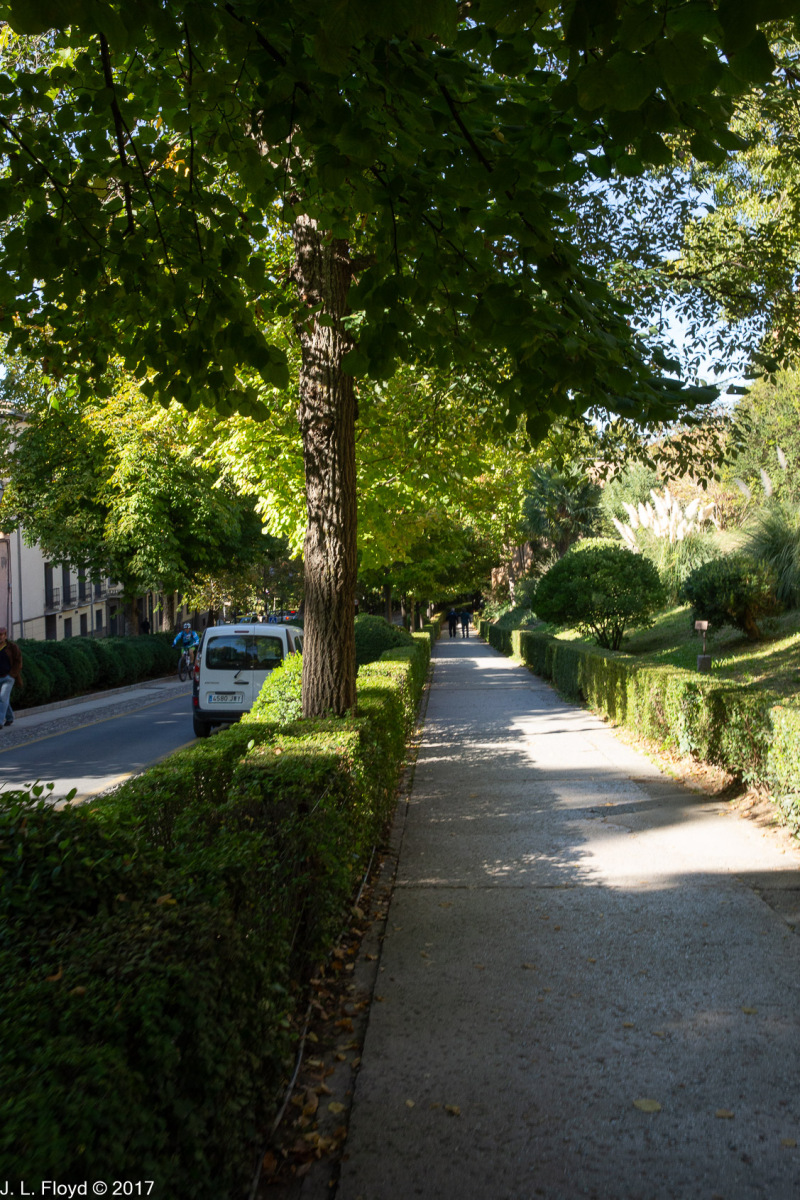
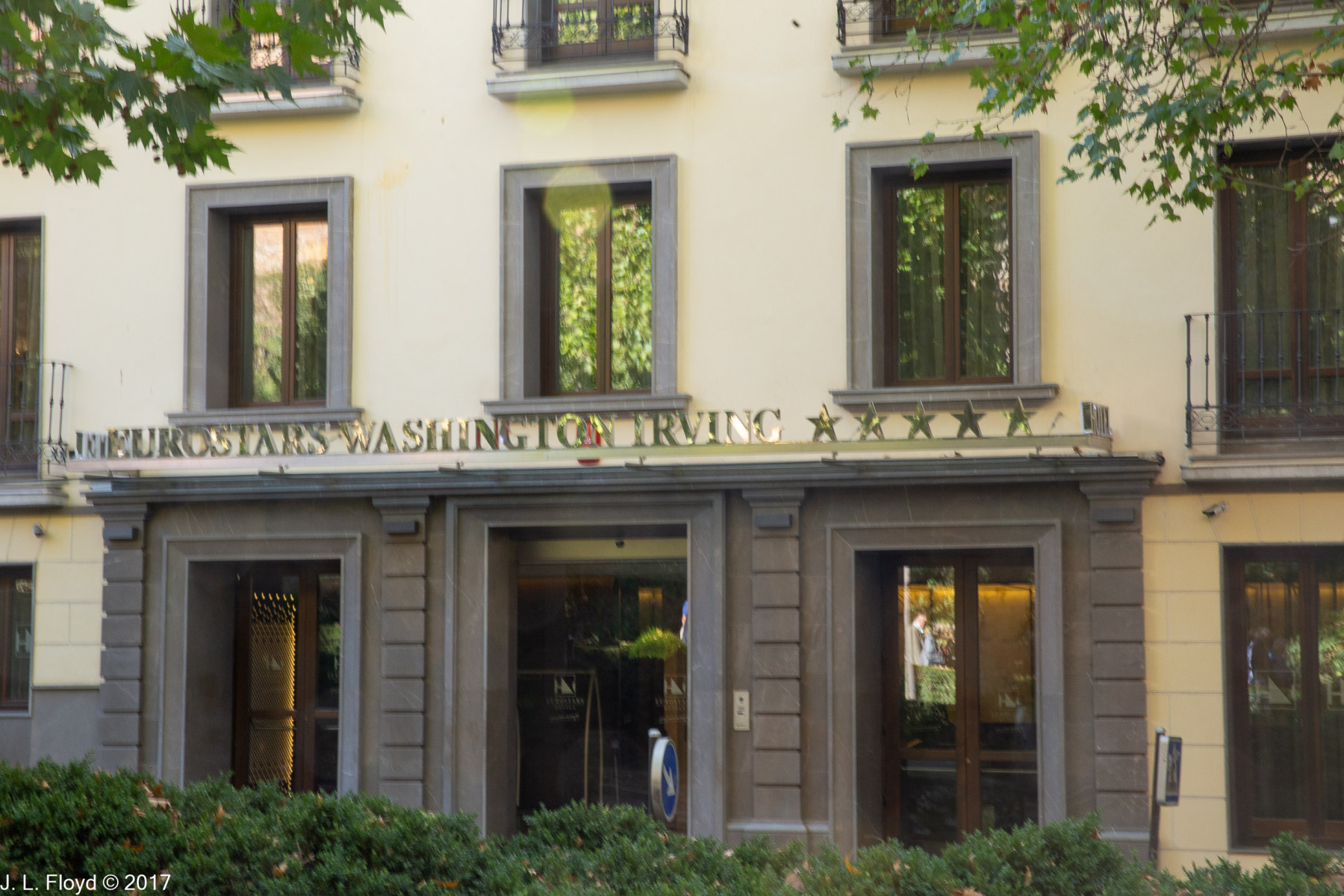
Although our tour bus dropped us off close to the walls of the Alhambra, it was still a fairly long walk from the parking area to the entry point at the Puerta de las Justicias – the Justice Gate. It was nevertheless a very pleasant walk along a shady tree-lined avenue, the Paseo Bosque de la Alhambra, and it took us past the Hotel Washington Irving, named after the American author (famous for the short stories “Rip van Winkle” and “The Legend of Sleepy Hollow”) who spent several months living in the Alhambra in 1829 and wrote Tales of the Alhambra in the aftermath of his stay. Irving was one of the people most responsible for stimulating public interest in the Alhambra and for sparking efforts to preserve and restore it.

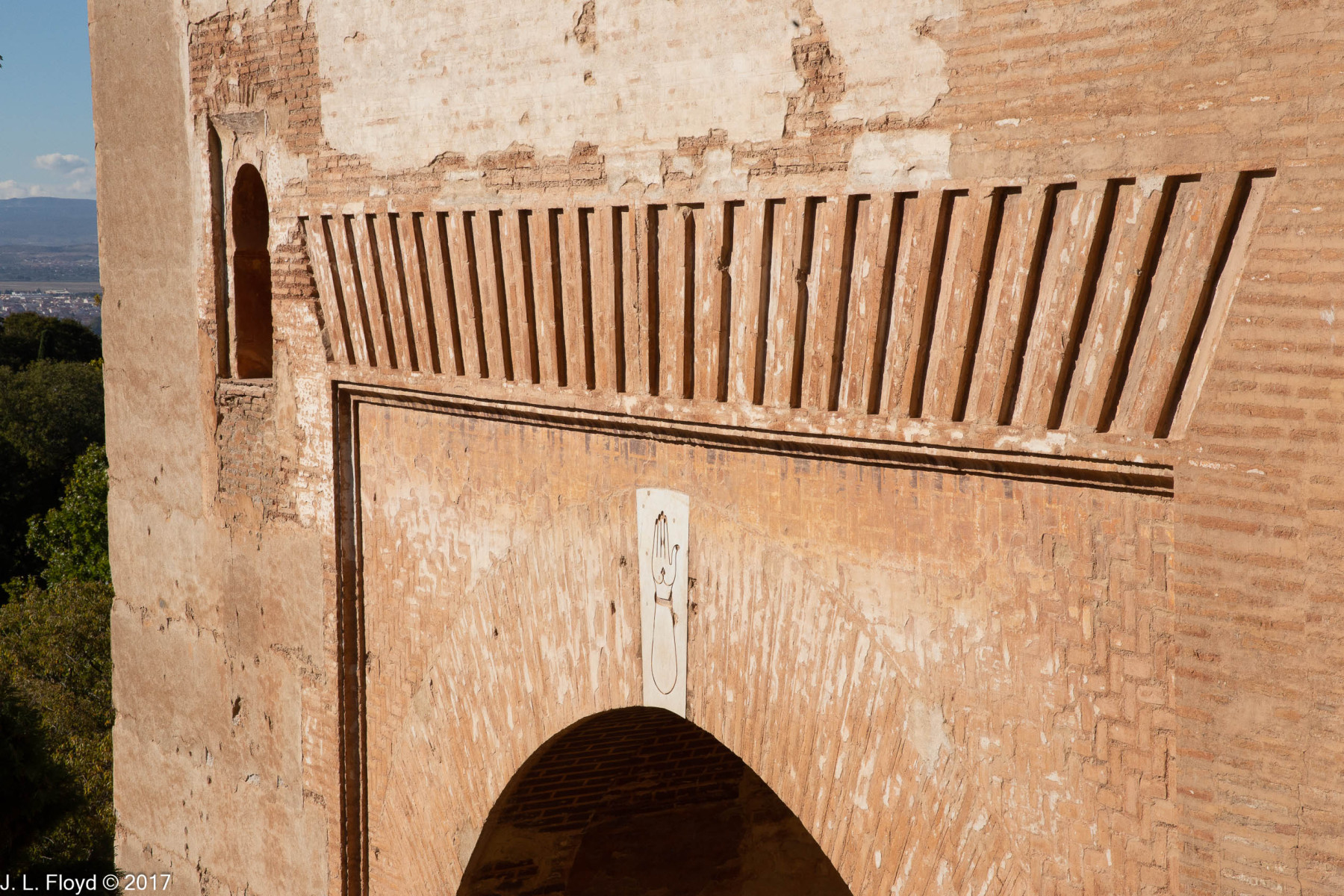
The Puerta de las Justicias was known as the Bab al-Shari’a, Gate of the Law, in Arabic. It was built in 1348, during the reign of Emir Yusuf I, and provides entry first through a large horseshoe arch, above which is a carving of an upraised human hand. This symbolizes the Five Pillars of Islam, which are the Muslim creed (“No God but God, and Mohammed is His Prophet”), praying to Mecca five times a day, charity to the poor, fasting in the holy month of Ramadan, and the pilgrimage to Mecca. I had seen the same symbol at the Alhambra Gate in the Pena Palace in Sintra, Portugal, earlier in the trip; as the name implies, it was copied from the Alhambra.

After passing under the arch, one climbs up a steep ramp and then makes a couple of turns through successive right-angled passageways to enter the fortress. The passageways were designed so that defenders of the fortress could shower arrows and boiling oil on any attackers trying to enter through this route. On the inner side of the Justice Gate is a carving of a key, another symbol of the Islamic faith.

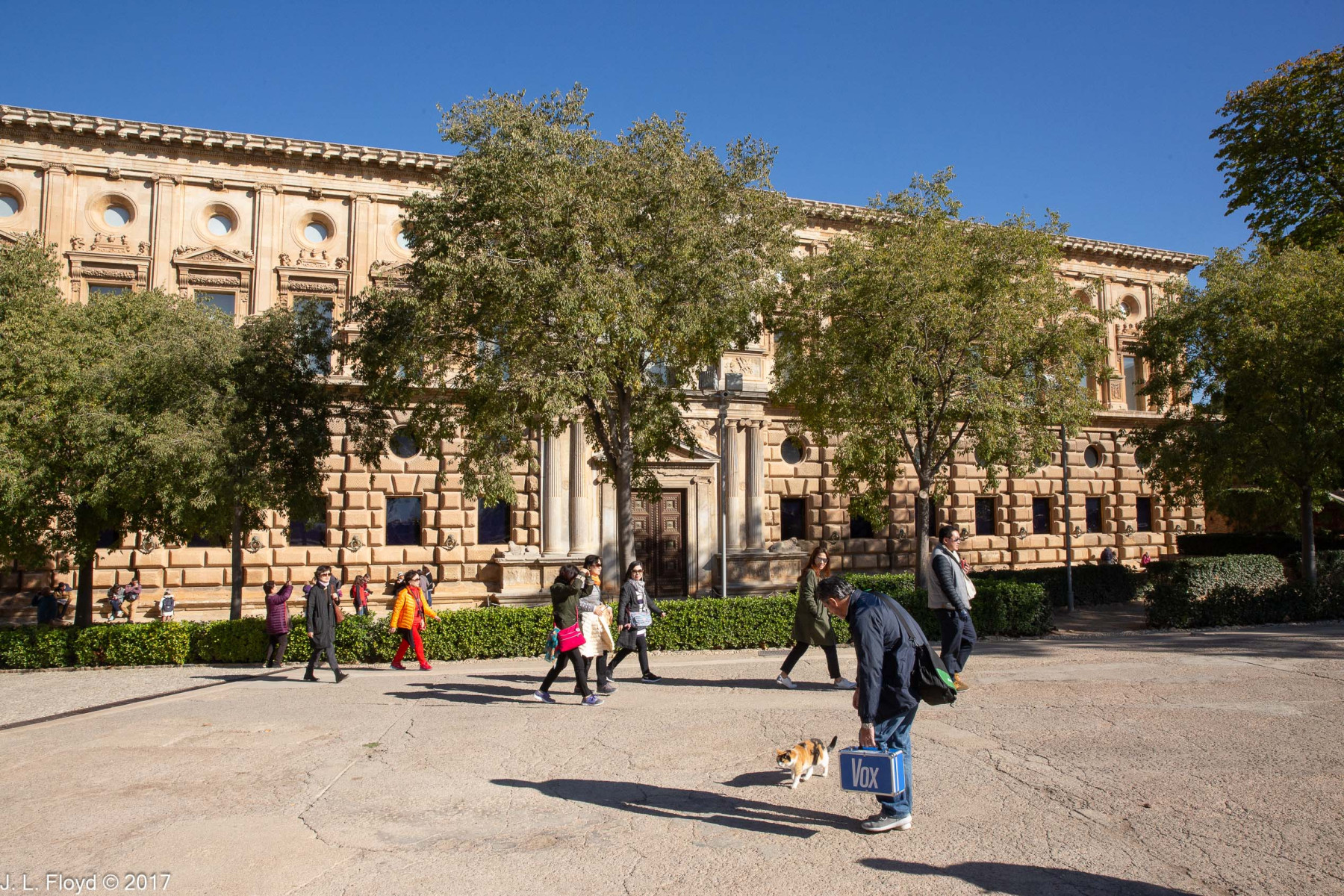
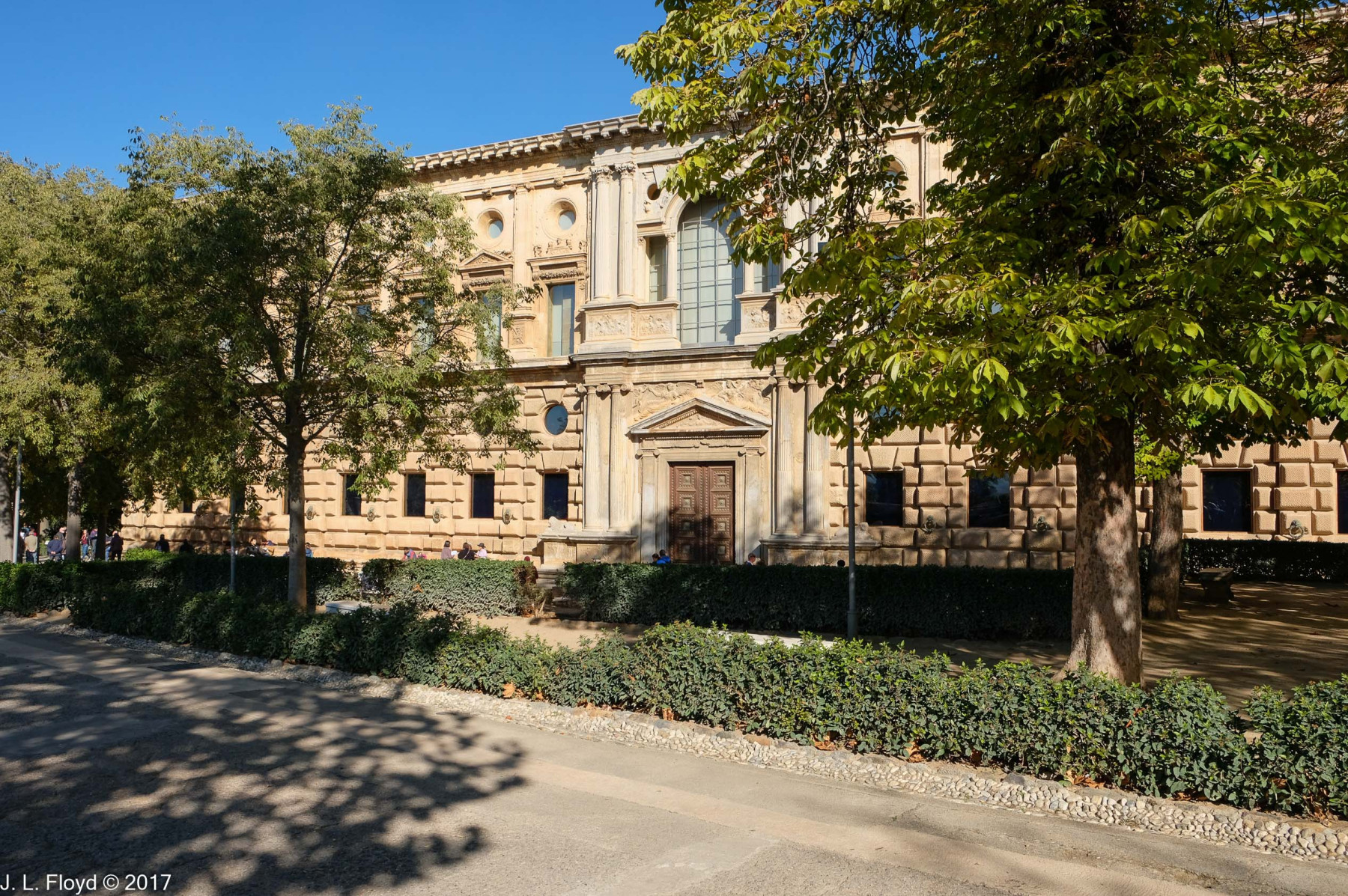
Having passed through the Justice Gate, we found ourselves in a courtyard facing the Palace of Charles V. After succeeding to the thrones of Castile and Aragon as Carlos I in 1516, Charles was elected Holy Roman Emperor in 1519. (Charles is the French and English form of his name. In Spanish he is Carlos, and in German Karl.) He visited Granada in 1526 with his wife, Isabella of Portugal, and decided to make the Alhambra one of his royal residences. He had some of the former Nasrid palaces demolished to make way for a huge new Renaissance-style palace of his own, which was begun in 1527. However, it was not finished during Charles’ lifetime. Charles V spent most of his reign crisscrossing his domains, which included not only Spain but also the Netherlands, parts of Italy and, of course, Austria and Germany, fighting wars against France and the Ottoman Turks, and trying to suppress the Protestant Reformation. He rarely stayed in one place for long. His son and successor as King of Spain, Philip II, was different; he seldom left Spain, but he made his capital permanently at Madrid and did not reside at the Alhambra. Instead he lavished his attention – and his finances – on building his own palace-cum-monastery, the Escorial, near Madrid. Construction of the Palace of Charles V consequently dragged on and was frequently interrupted due to financial exigencies and rebellions, such as the Morisco Rebellion in Granada in 1568. Work on the palace ceased altogether in 1637, at which time not even the roof had been finished. Over the following three centuries, it was at times used as a storehouse and a barracks (e.g. by the French during the Napoleonic Wars), and in general left to deteriorate. However, in the 20th century interest in restoring and finishing it revived, and the roof was eventually completed – in 1967. Nowadays the Palace houses a museum.

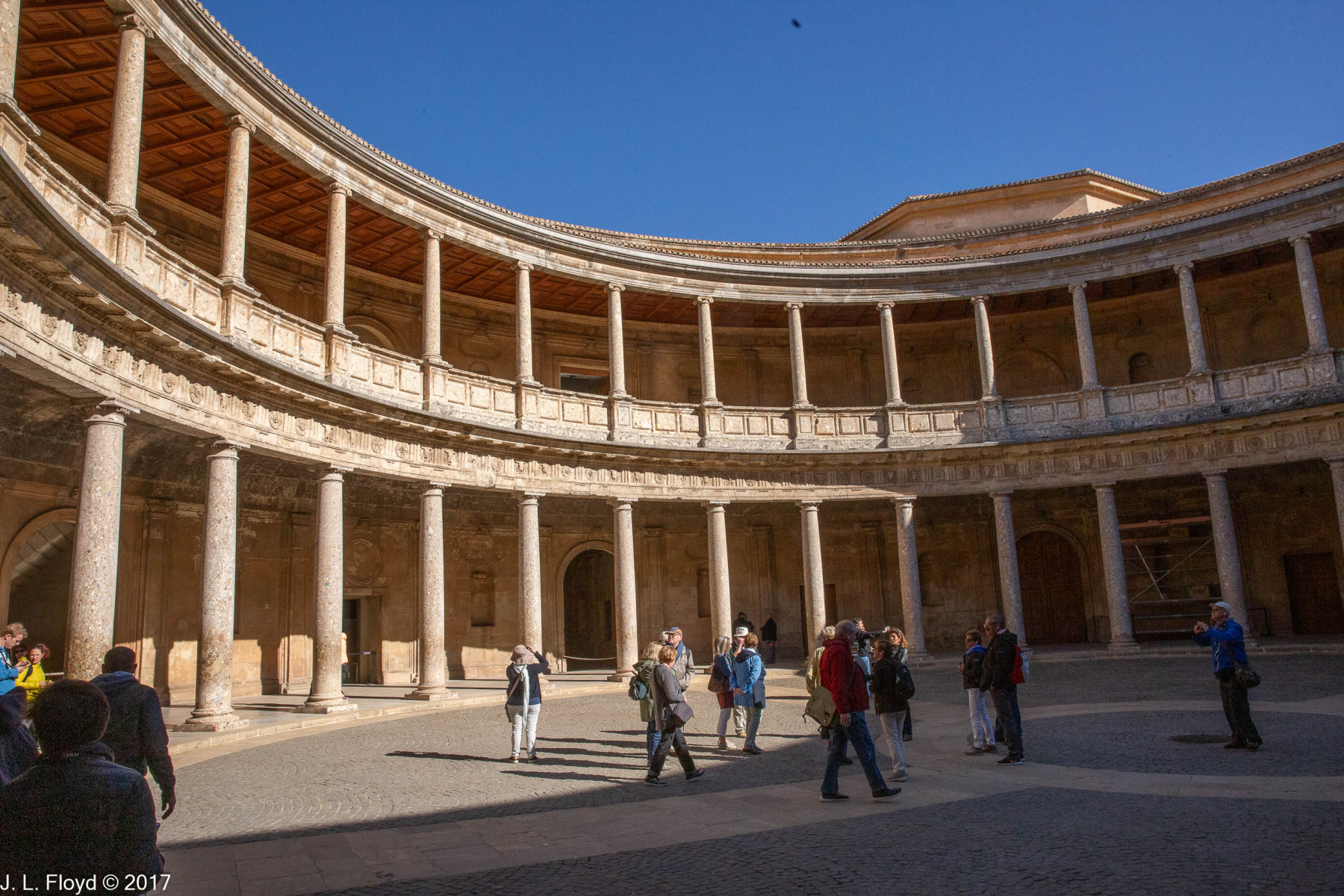
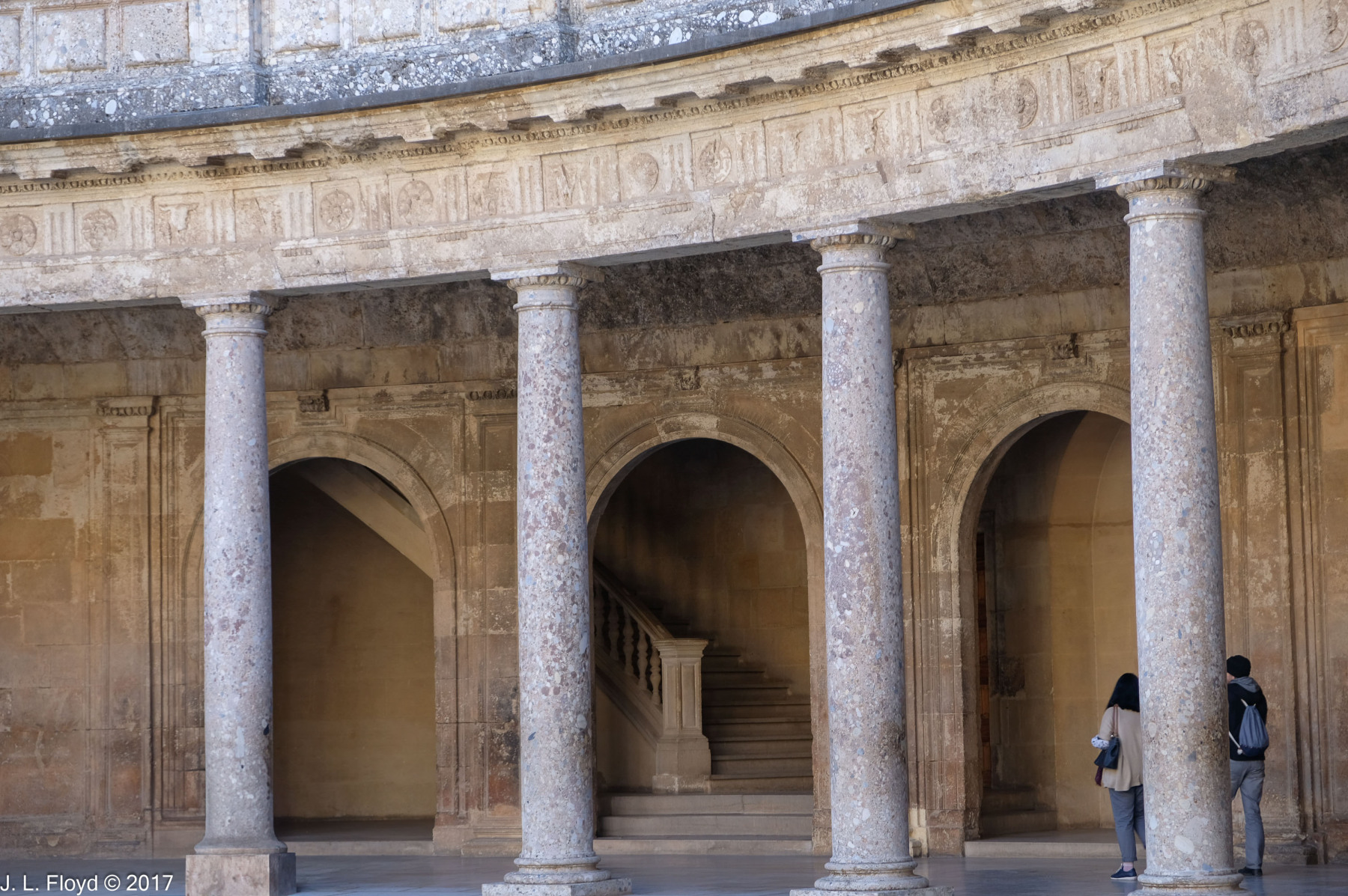
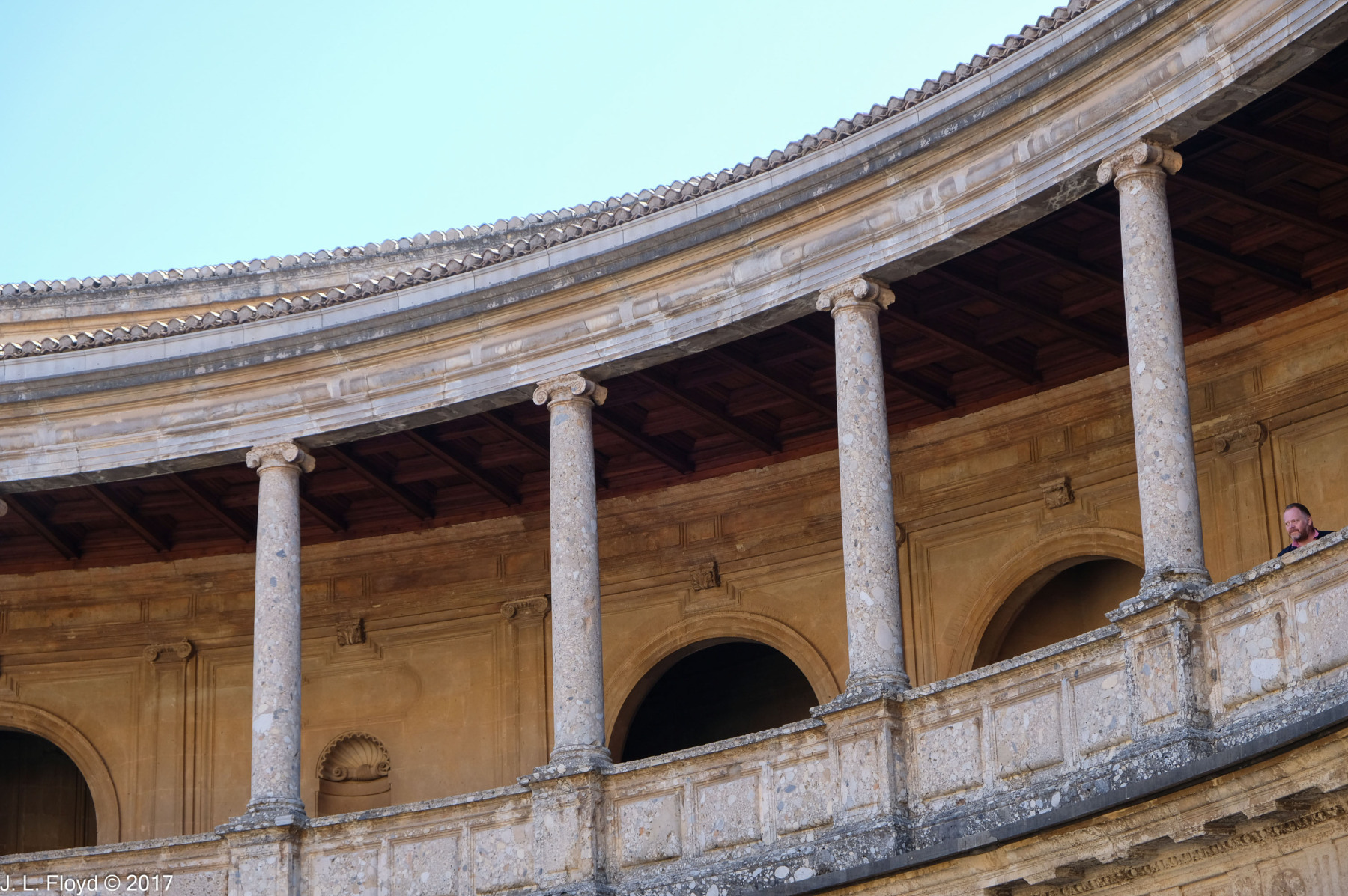
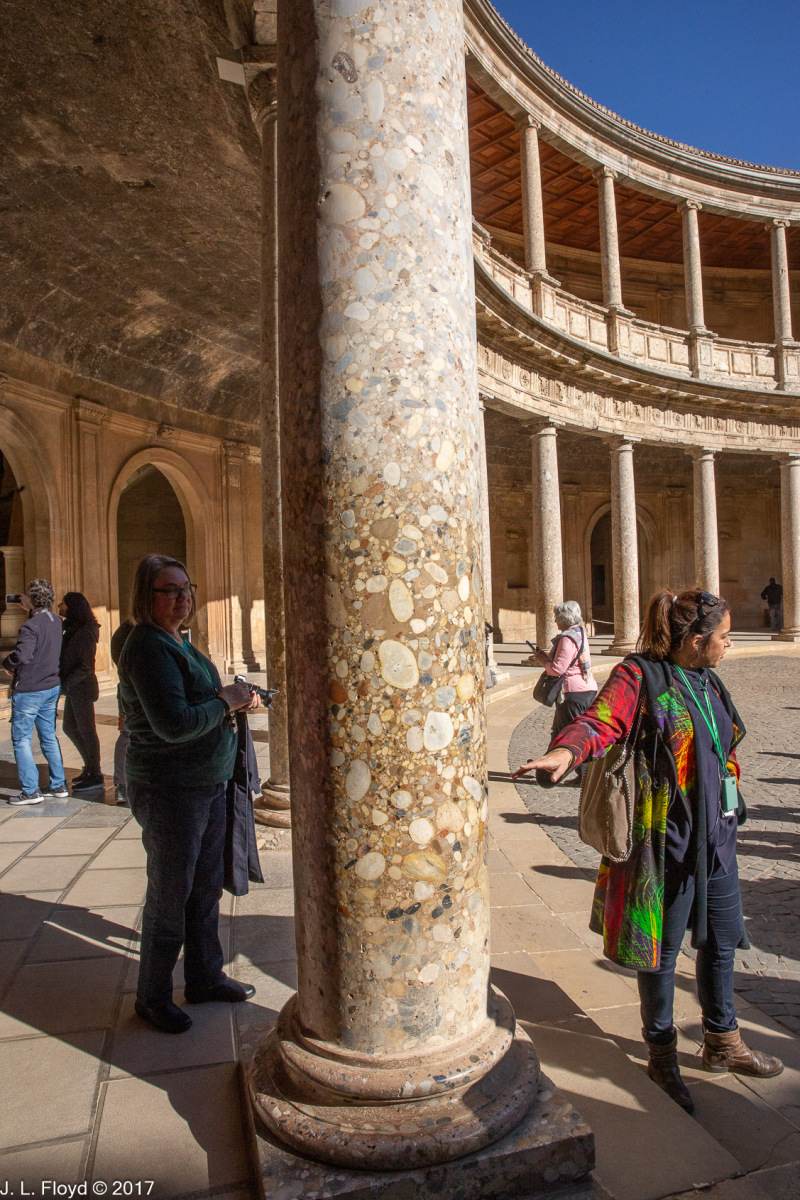
The architecture of the Palace of Charles V is rather idiosyncratic. It is square in form, but with an inner circular courtyard, a feature unique for its time. It has two stories; the ground floor is in the Tuscan order, with plain unfluted Doric columns and a simple entablature, while the upper floor is in the more elaborate Ionic order. The inner court repeats the pattern, but with a Doric colonnade made of conglomerate stone and surmounted by an elaborate classical entablature.

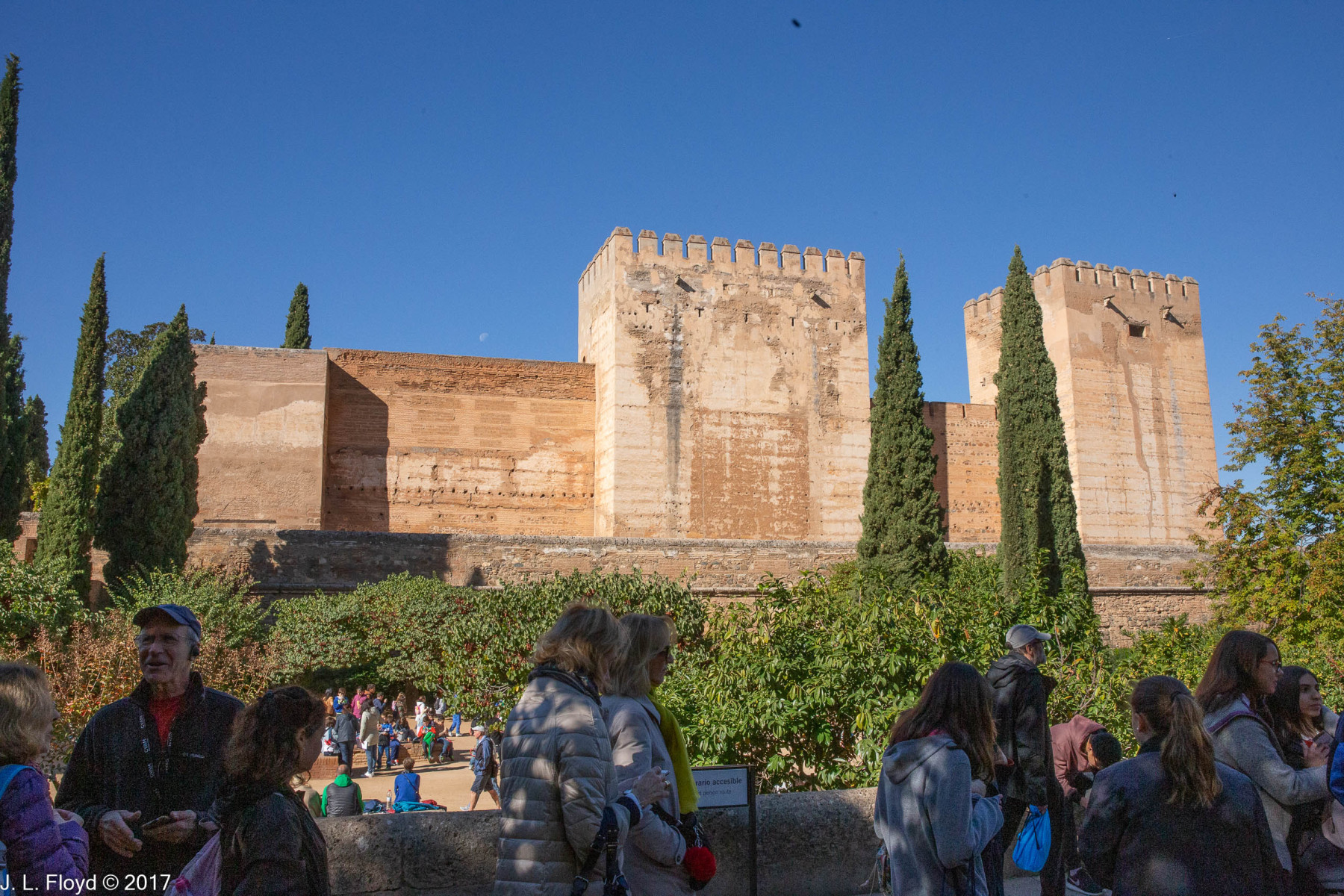
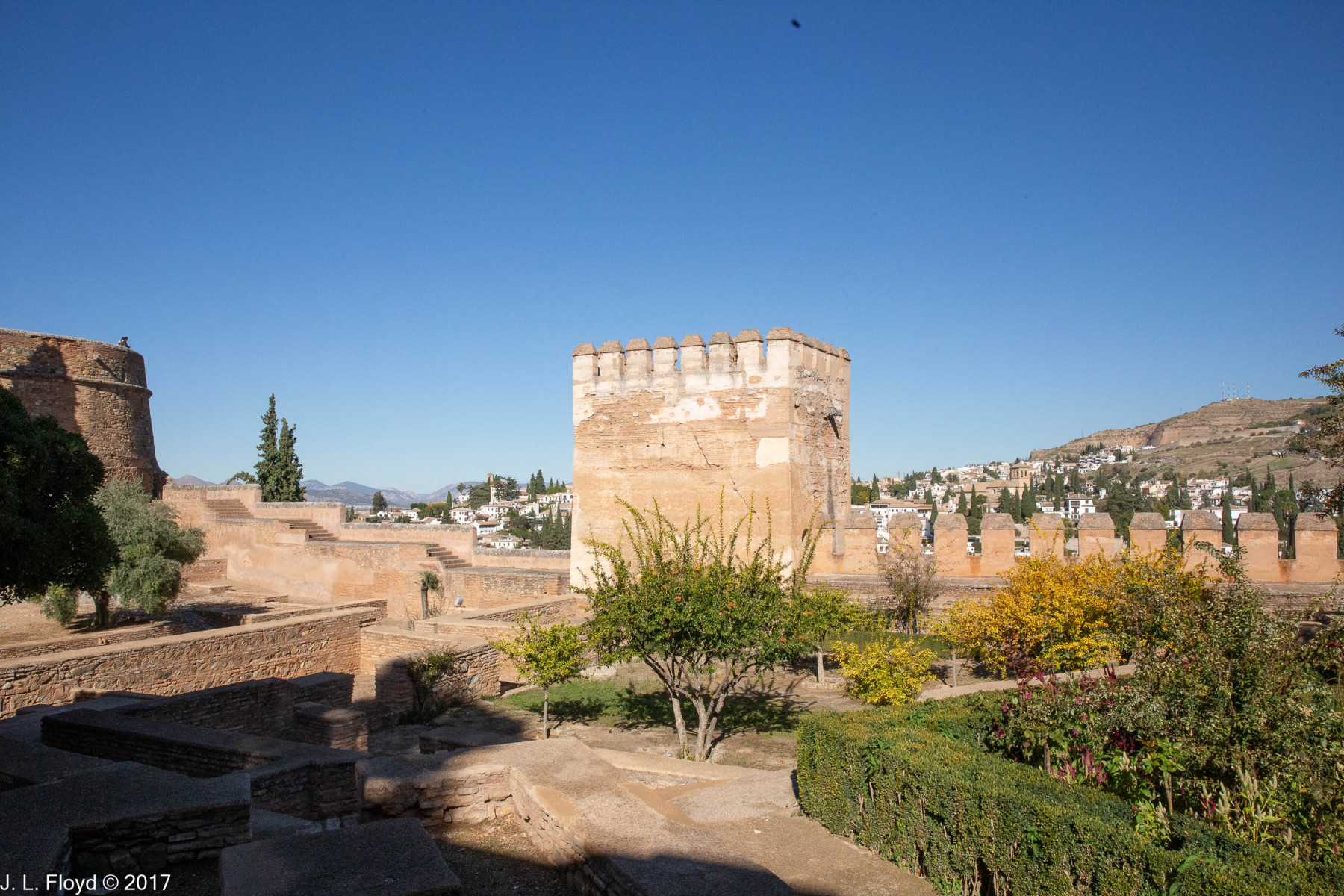
Exiting the courtyard of the Charles V Palace, we found ourselves in the Plaza de los Aljibes, looking west toward the Alcazaba, the oldest part of the Alhambra. There were fortifications there long before Muhammad I Ibn al-Amar founded the Alhambra, but he greatly expanded and strengthened them to create the Alcazaba, which then became the citadel or keep of the Alhambra. We did not enter the Alcazaba; although its towers have been restored, the area within its walls contains mostly excavated ruins of houses and other structures used by the soldiers who guarded the citadel in days of yore. Instead we turned east to explore the chief glory of the Alhambra, the Nasrid palaces.

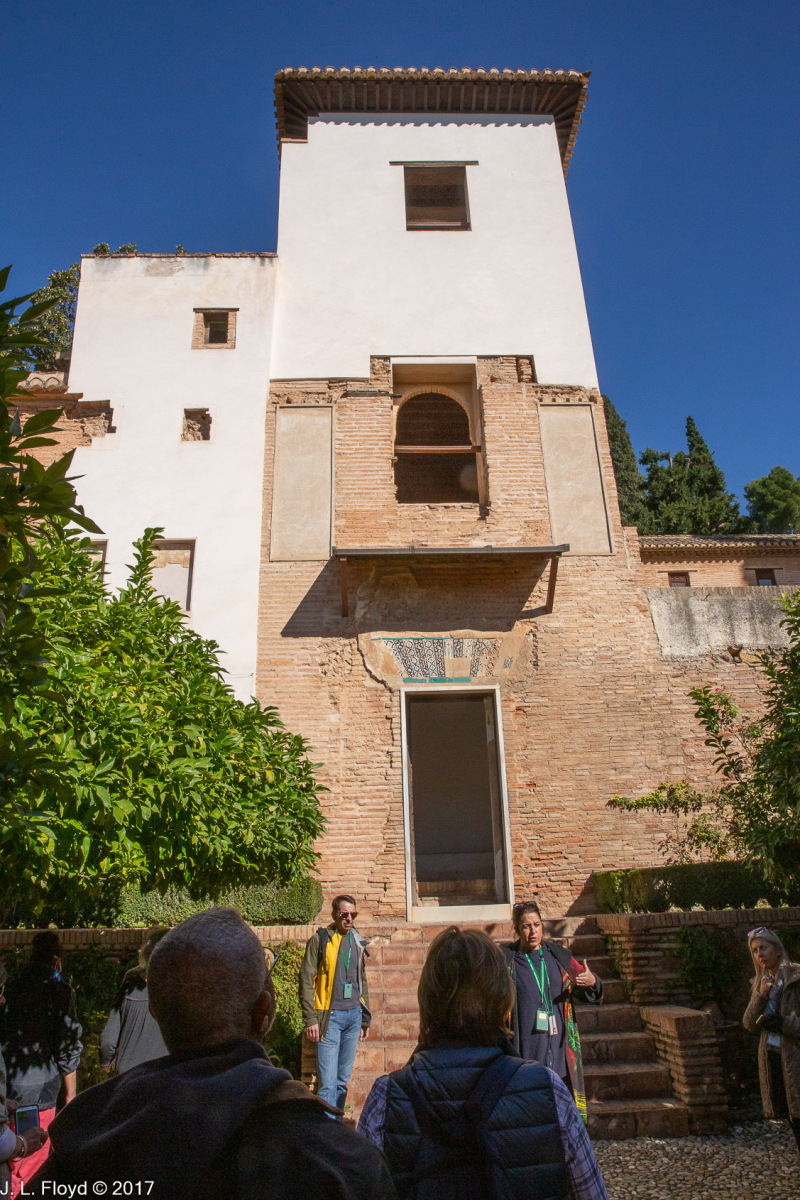
We entered the oldest and westernmost of the Nasrid palaces, the Mexuar, through two successive courtyards, the first being the Patio de la Mezquita, so named because it used to be the site of a small mosque, along with a series of secretarial offices. Only the foundations of these structures remain now. Passing through a high cypress hedge, we then entered a second courtyard, the Patio de la Machuca, named after an architect who resided there in the 16th century while working on the Palace of Charles V. In Nasrid times it was surrounded on the north, south and west sides by a portico, but nowadays only the north portico remains, the south and west components having been replaced by the cypress hedges. In the center of the patio is a rectangular pool with six semi-circular extensions on the sides; it formerly held a fountain featuring two lion statues, but these too have vanished. The east side of the Machuca is occupied by the Mexuar Palace itself. One enters it on the south side through a passageway paved with beautiful floral mosaics.

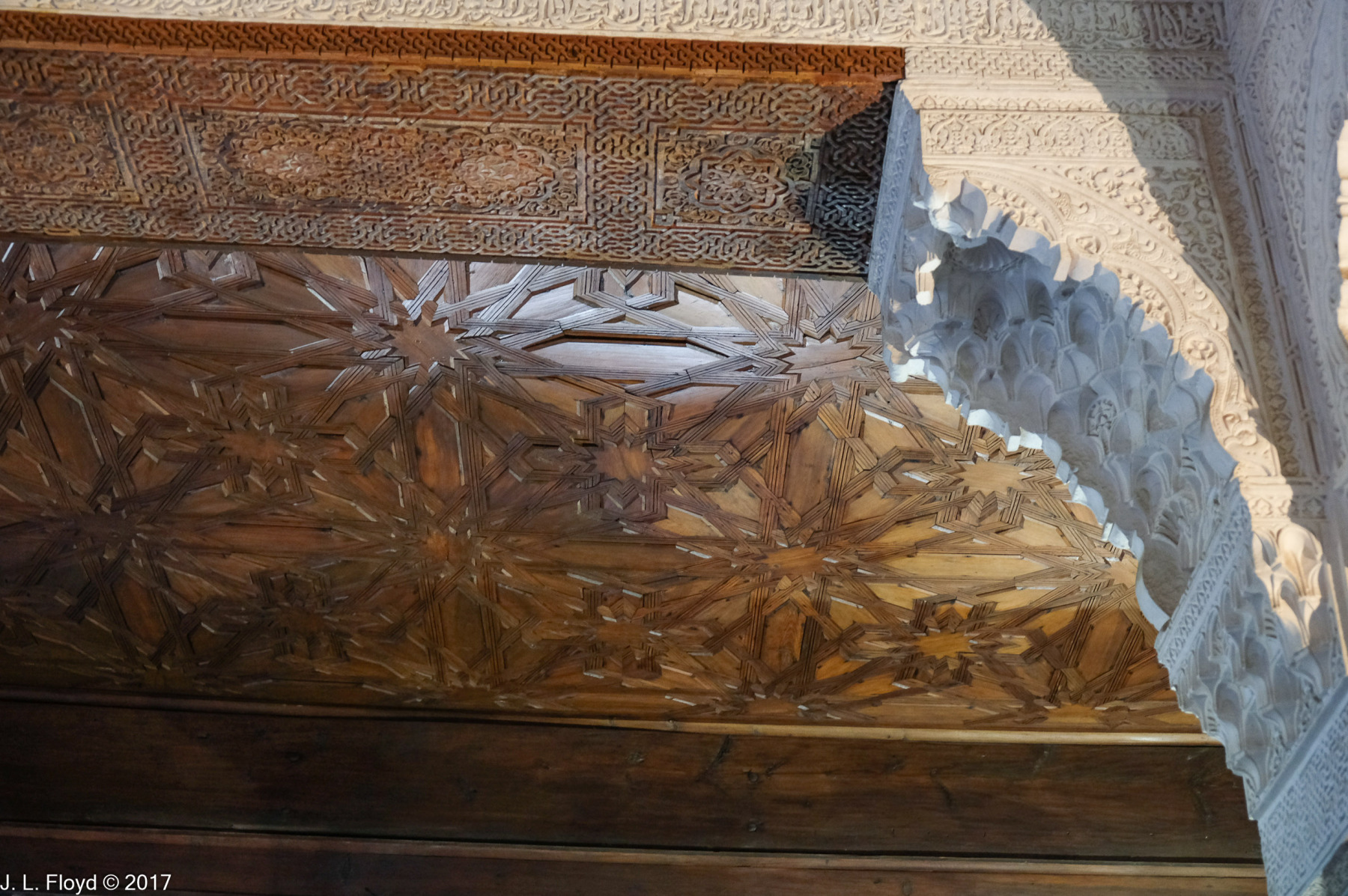
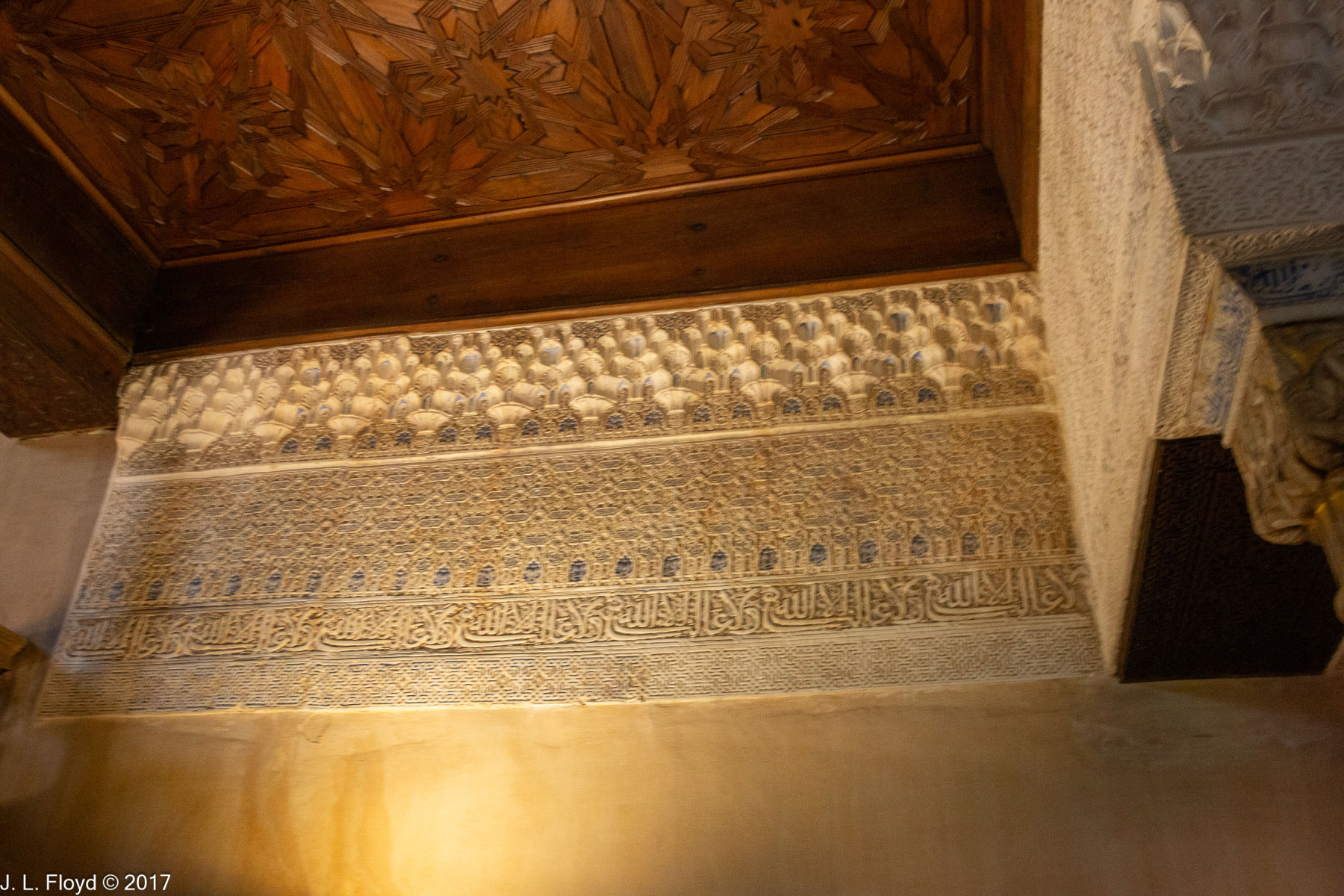
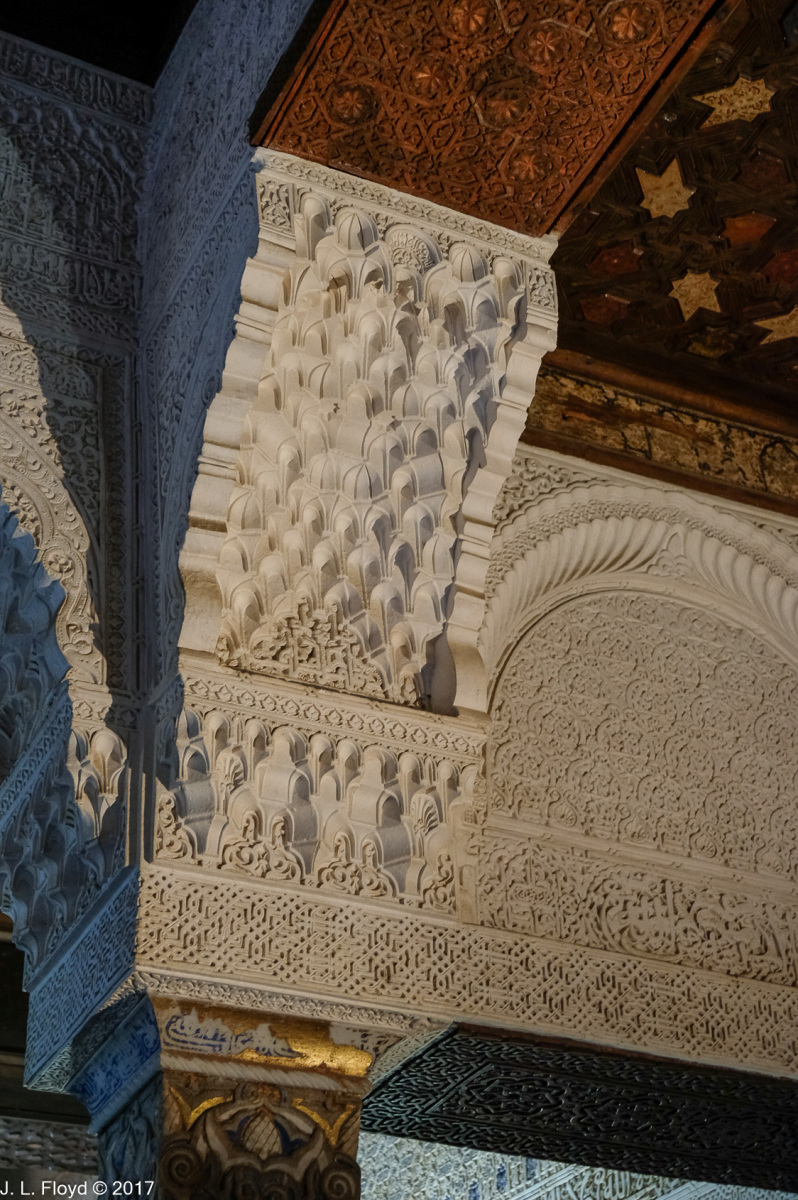
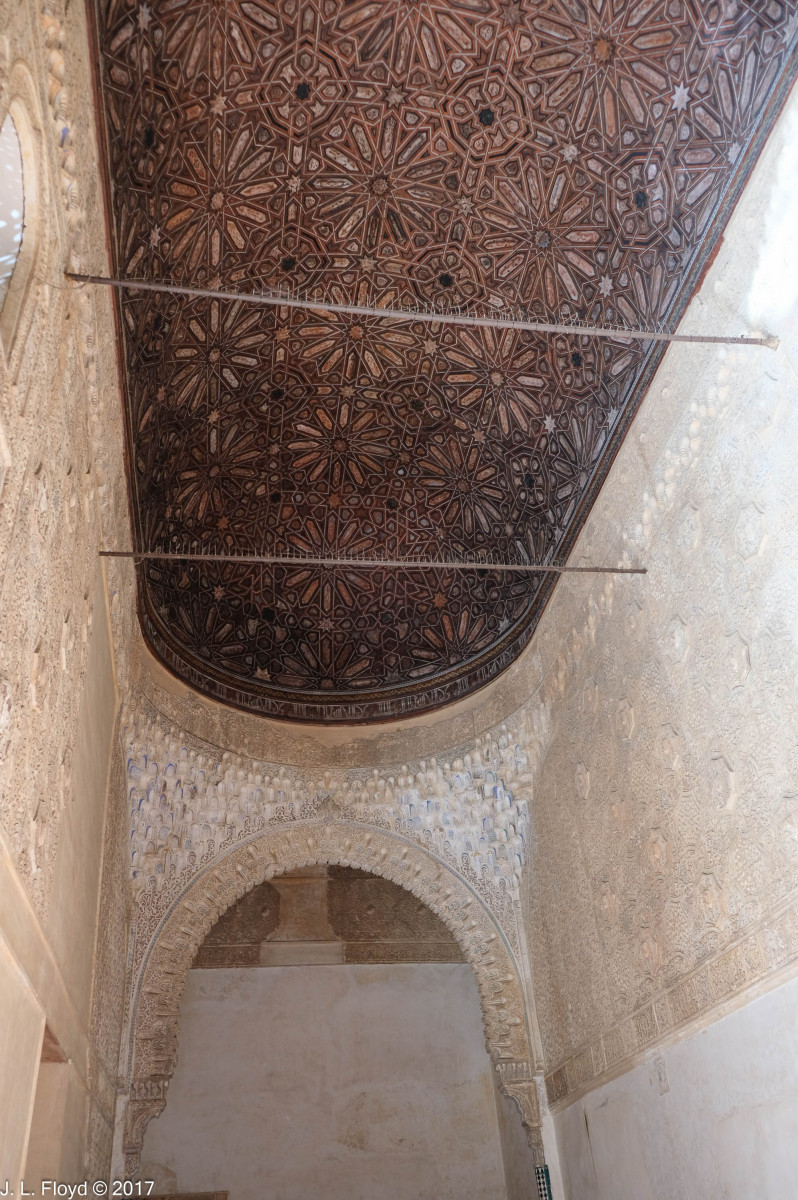
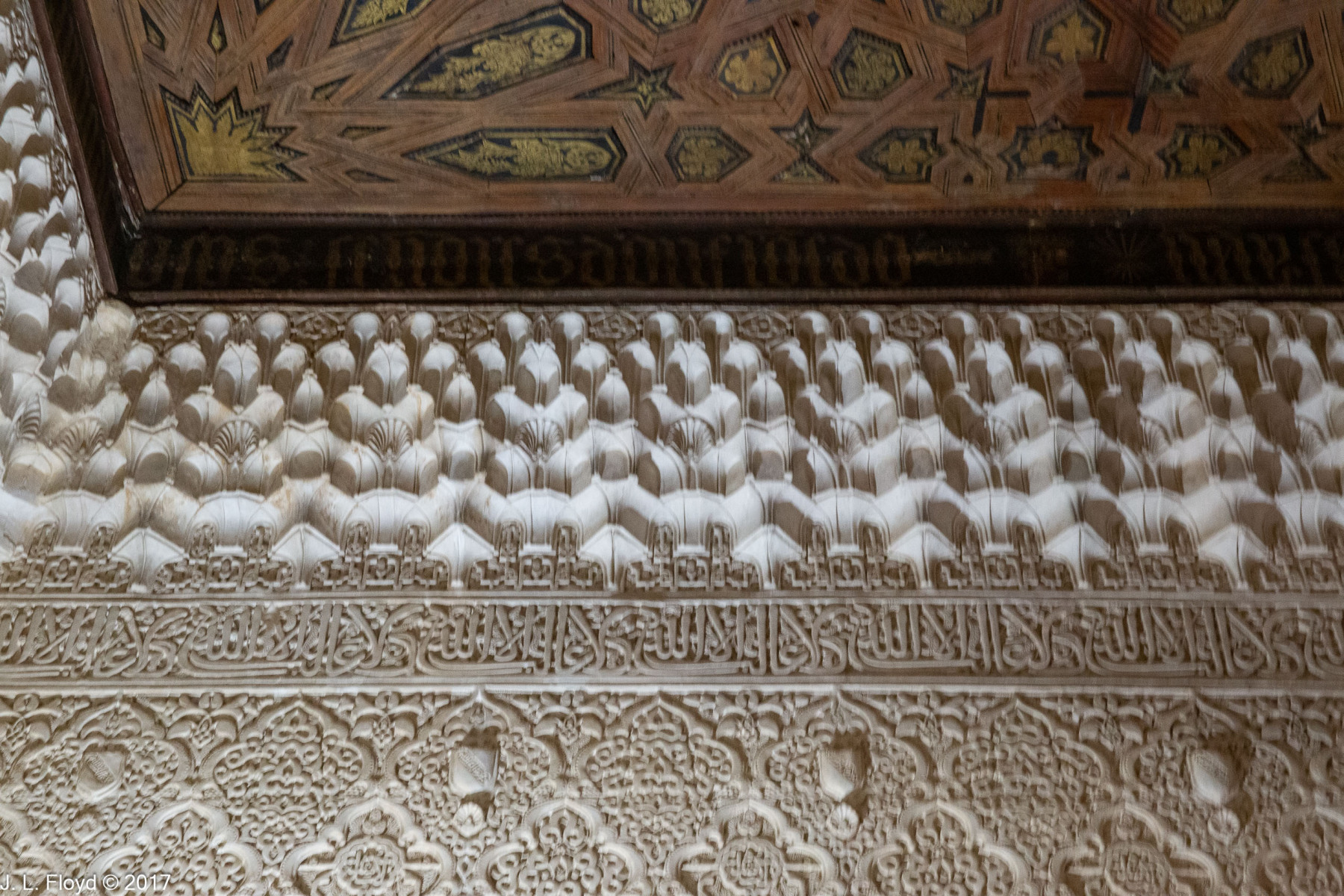
Upon entering the palace, we found ourselves in its main room, the Sala del Mexuar, or Council Room as it was known in Nasrid times, when it served as a throne room and audience chamber for the emir. After the Christian conquest it was converted into a chapel. Regrettably I was unable to obtain any decent photos of the entire hall, but there are some nice ones available on Wikipedia. The walls of the Sala del Mexuar are sumptuously decorated with carved stucco panels and tilework skirting, and in the center of the chamber stand four marble columns enclosing a space formerly reserved for the throne of the emir. The columns uphold a wooden ceiling with capitals and consoles (bracket-like support structures) featuring elaborate muqarnas (honeycomb-vault adornments). The capitals of the columns retain their original polychrome decoration. This central space was originally covered by a dome, but that was removed in the 16th century to make way for a new upper chamber to be built over the Sala del Mexuar; it was replaced by a wooden ceiling, which however preserves the geometric designs characteristic of Muslim architecture.

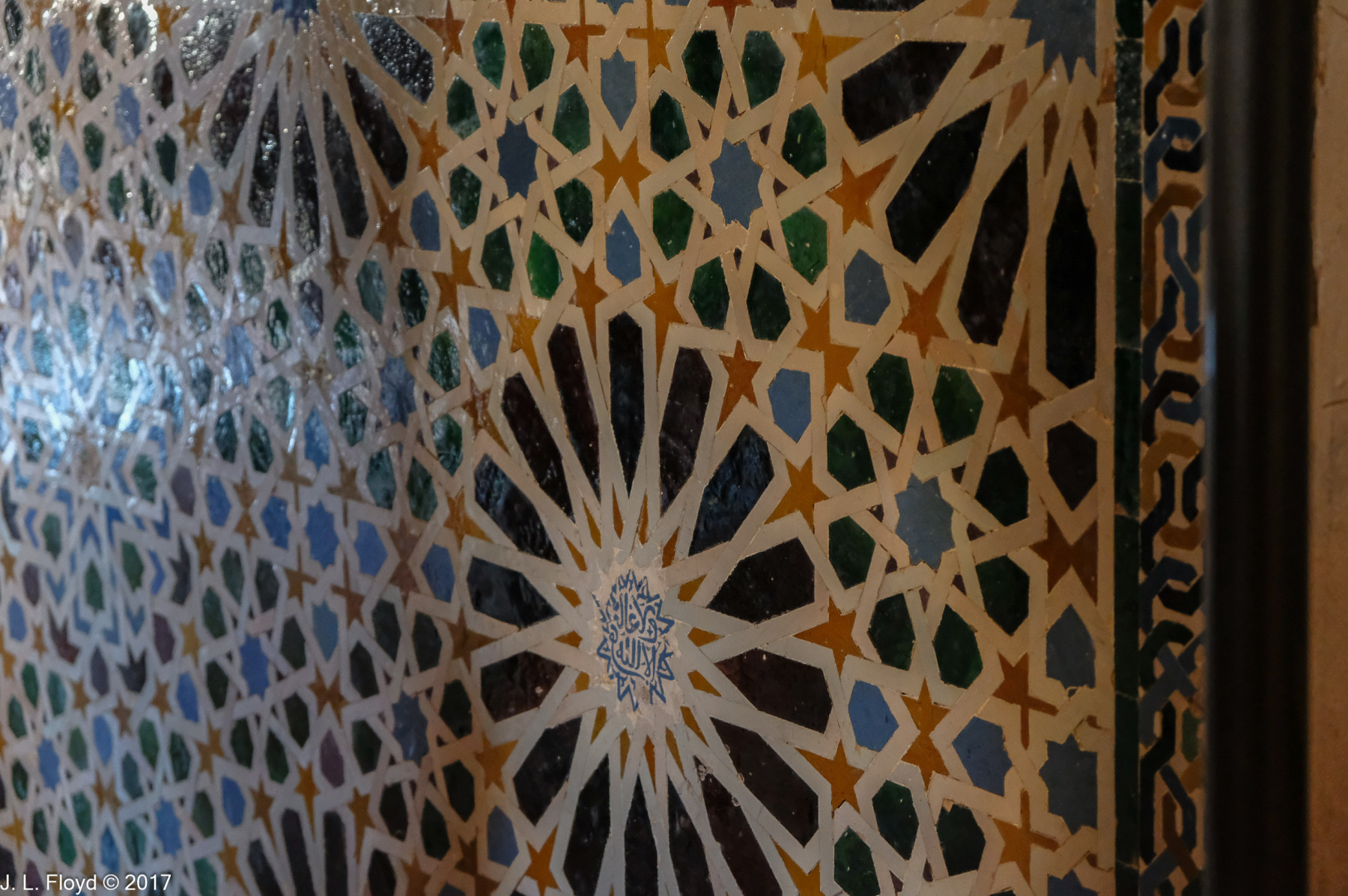
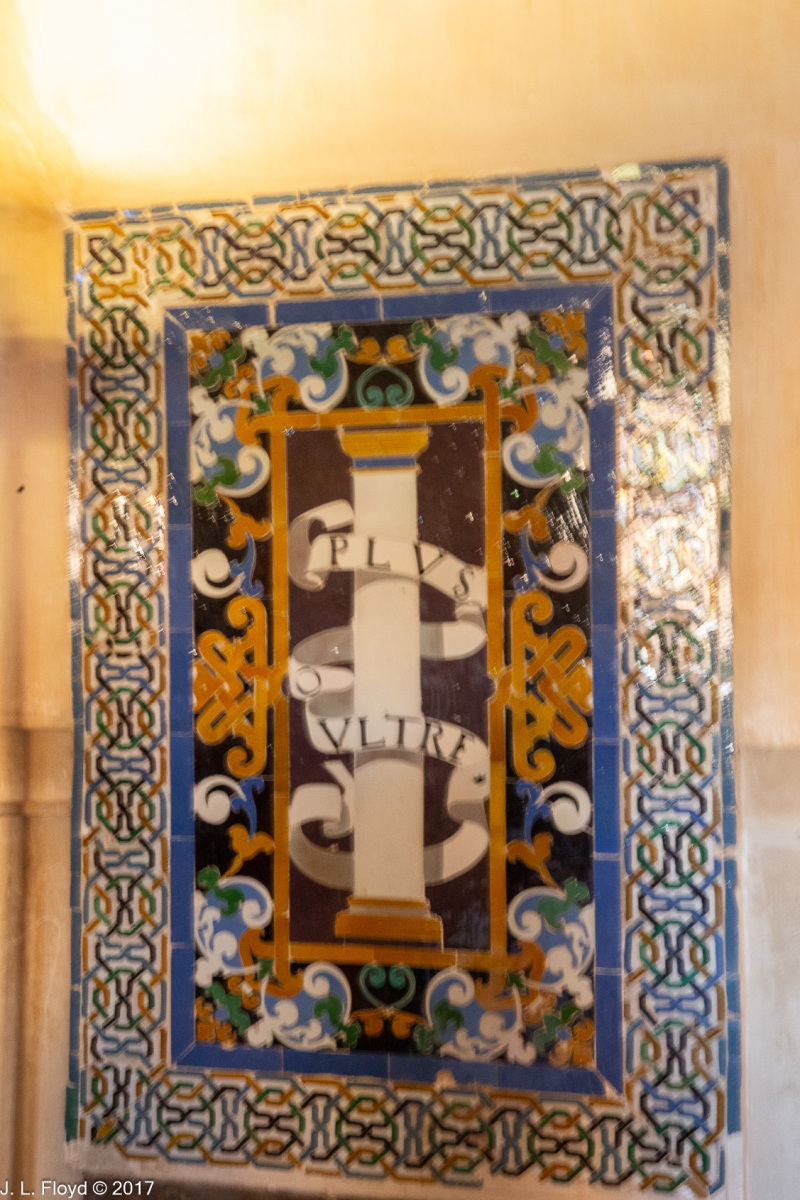
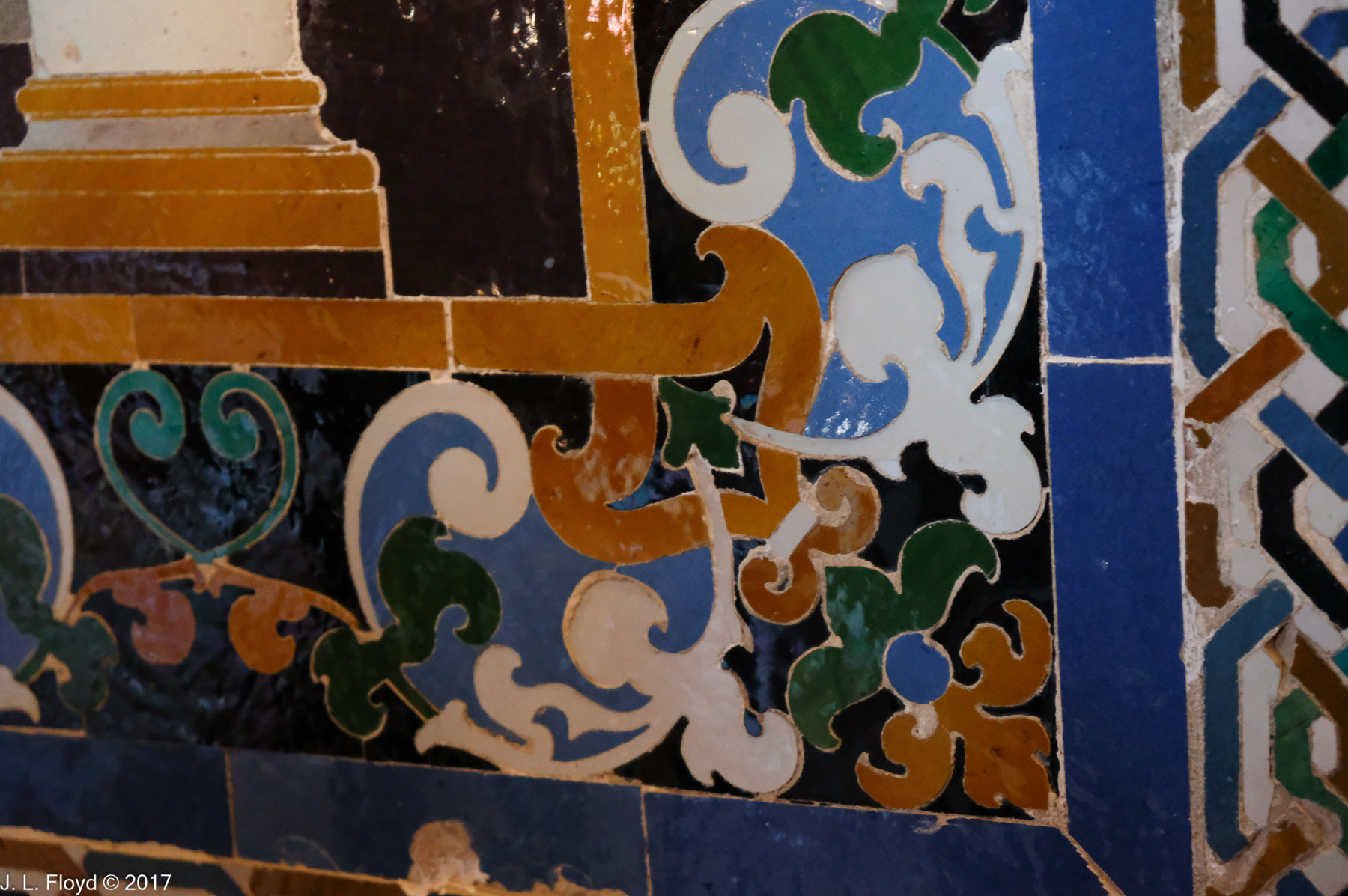
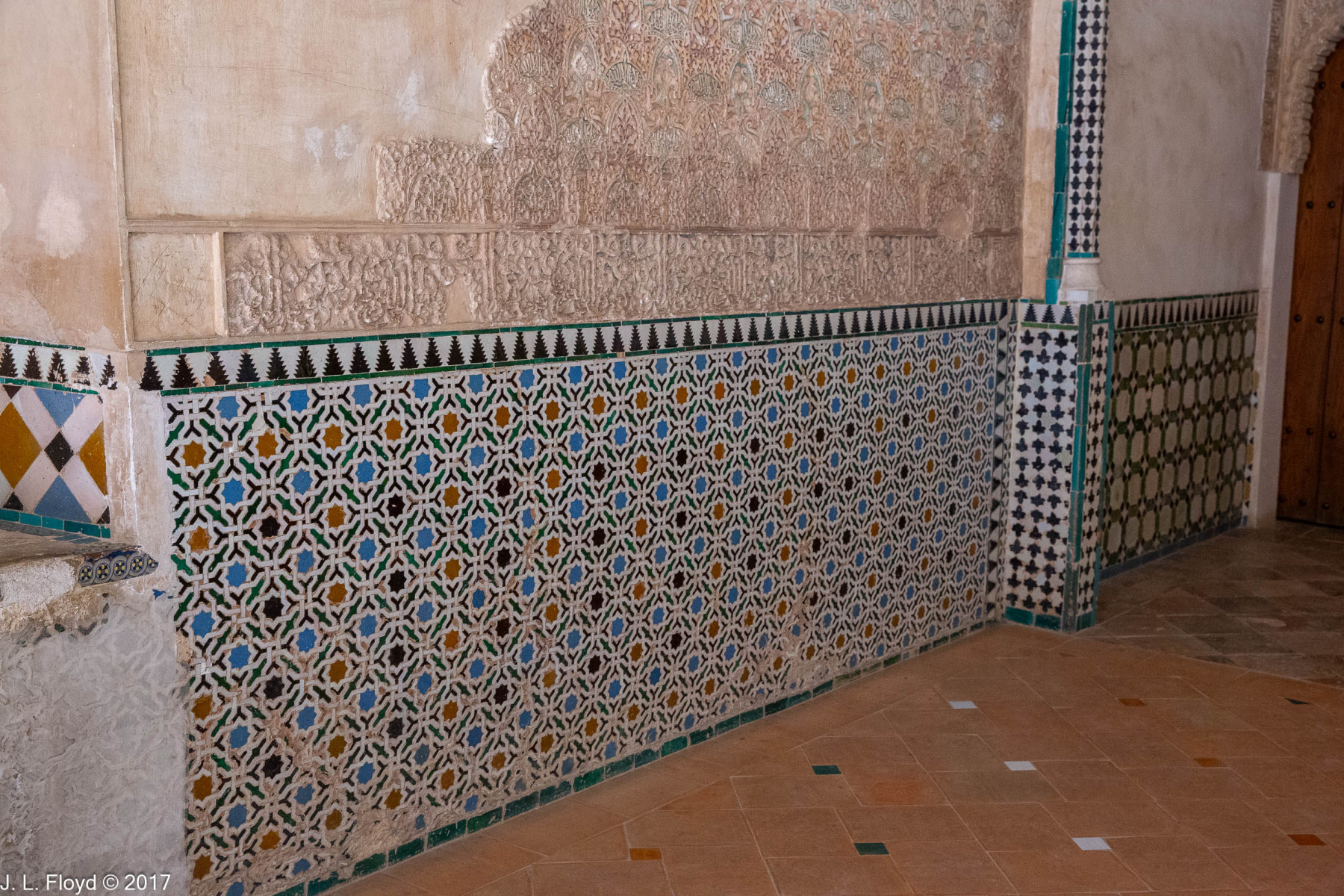
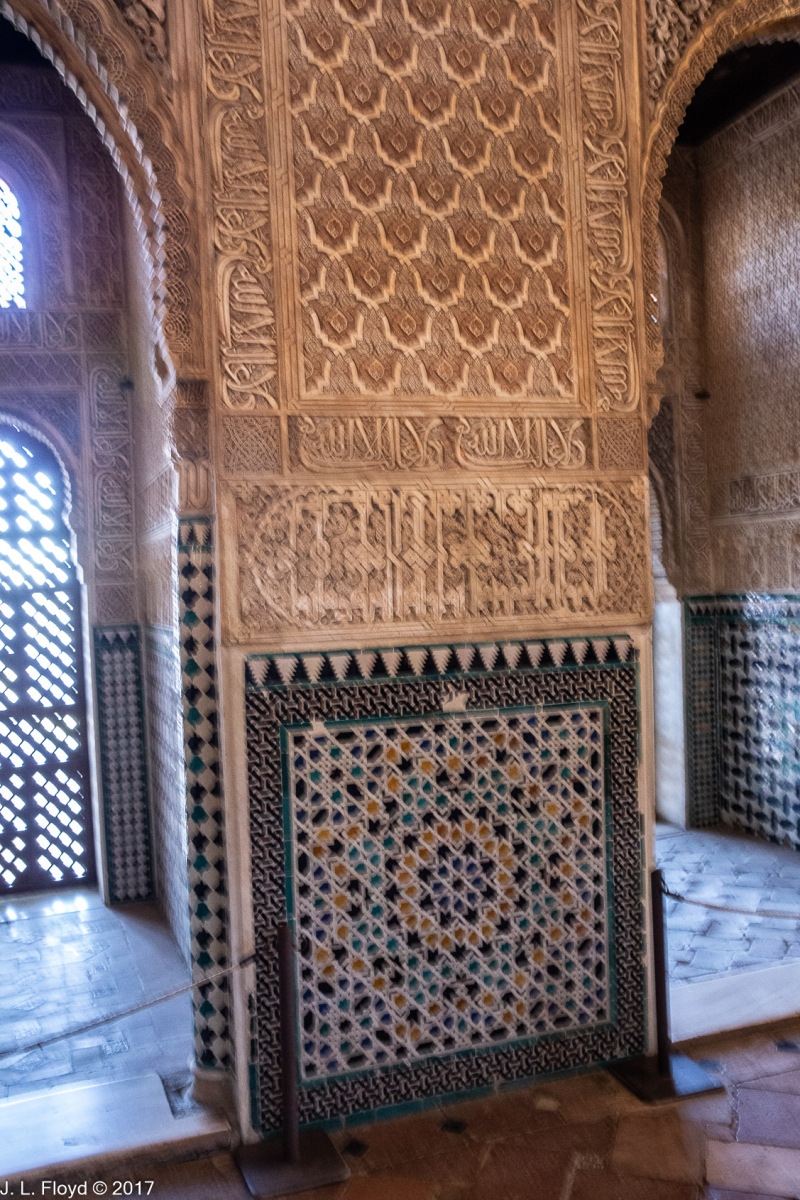
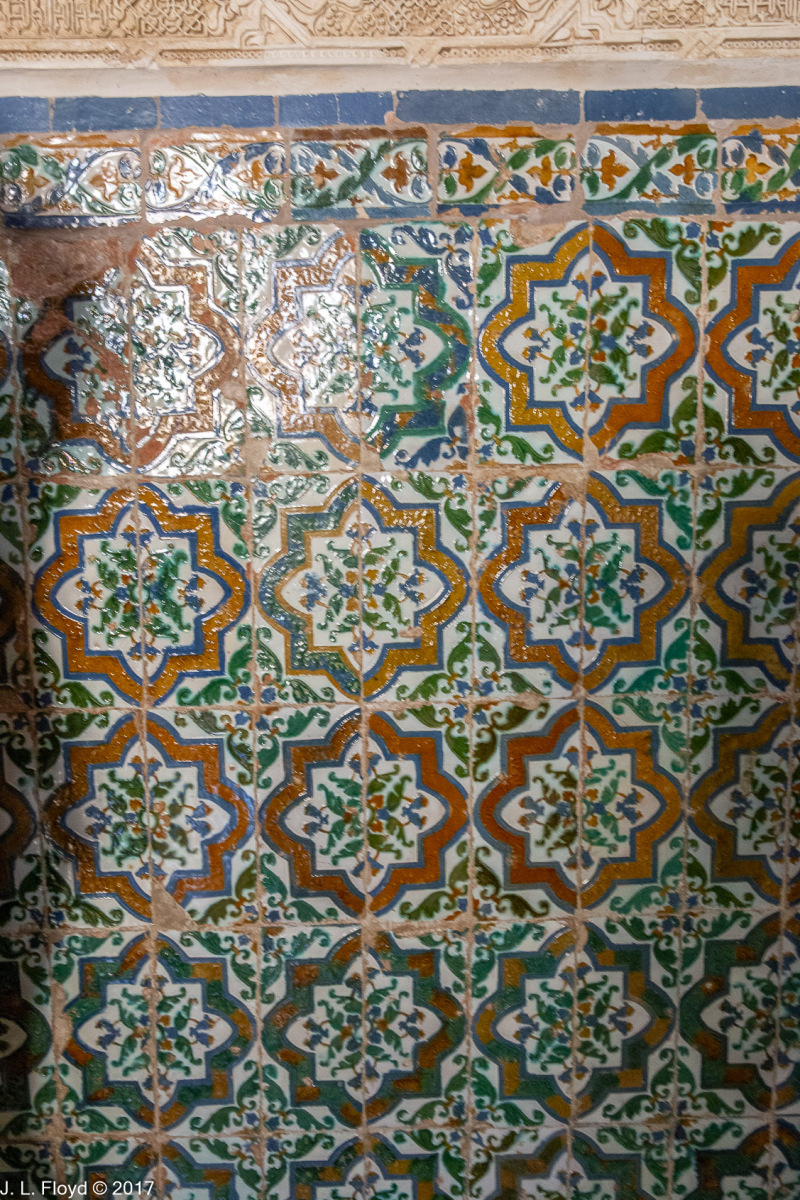
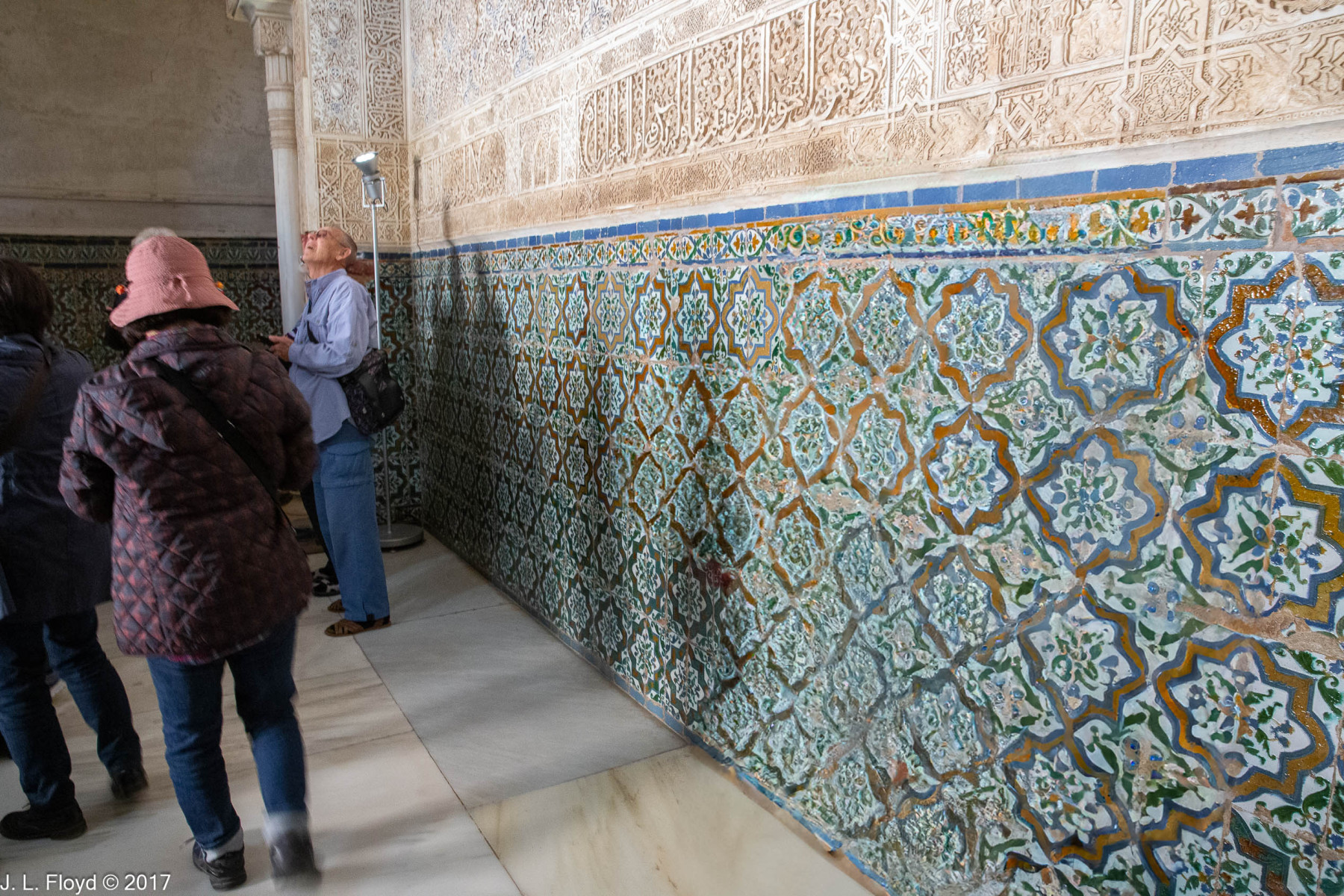
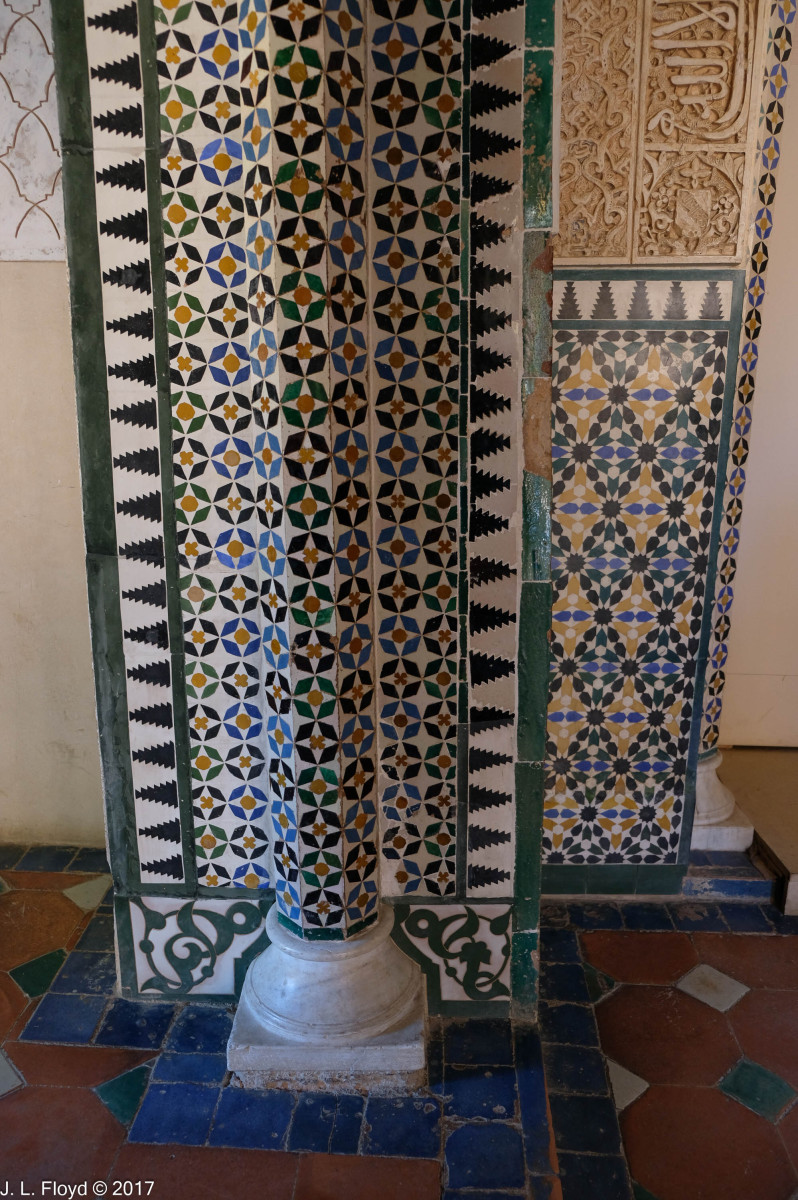
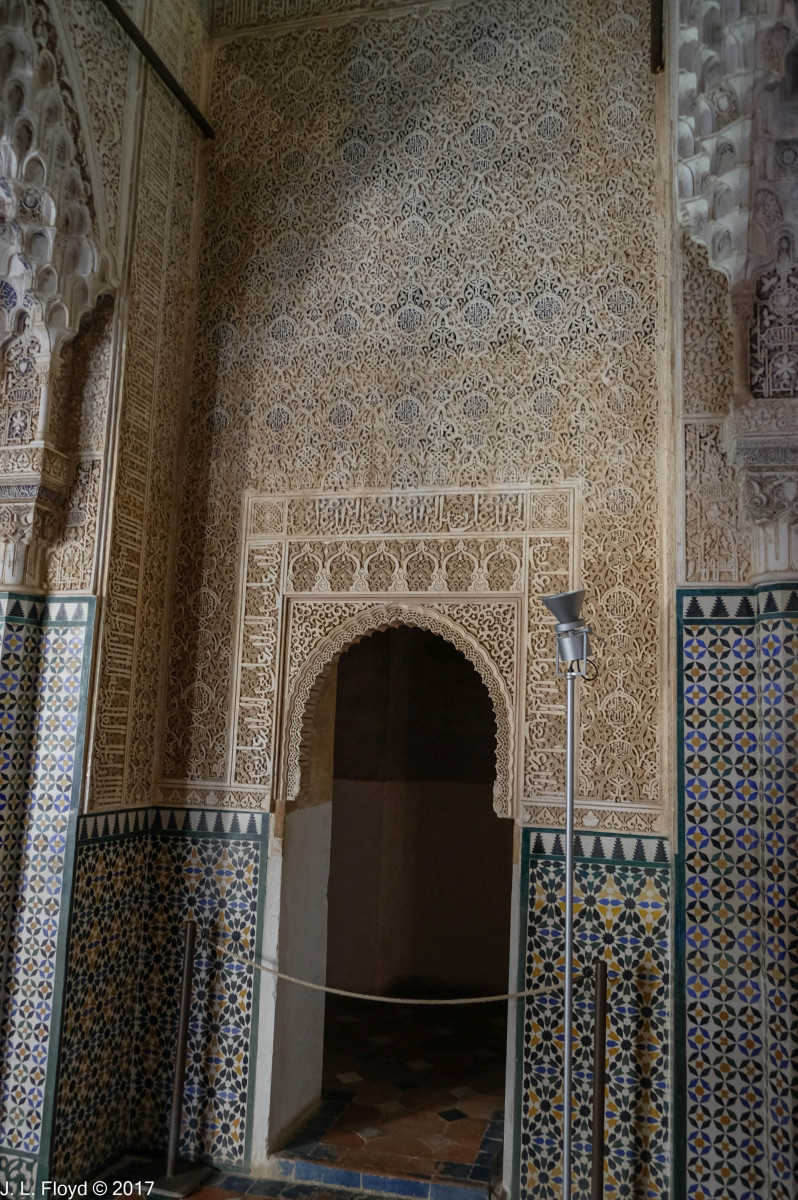
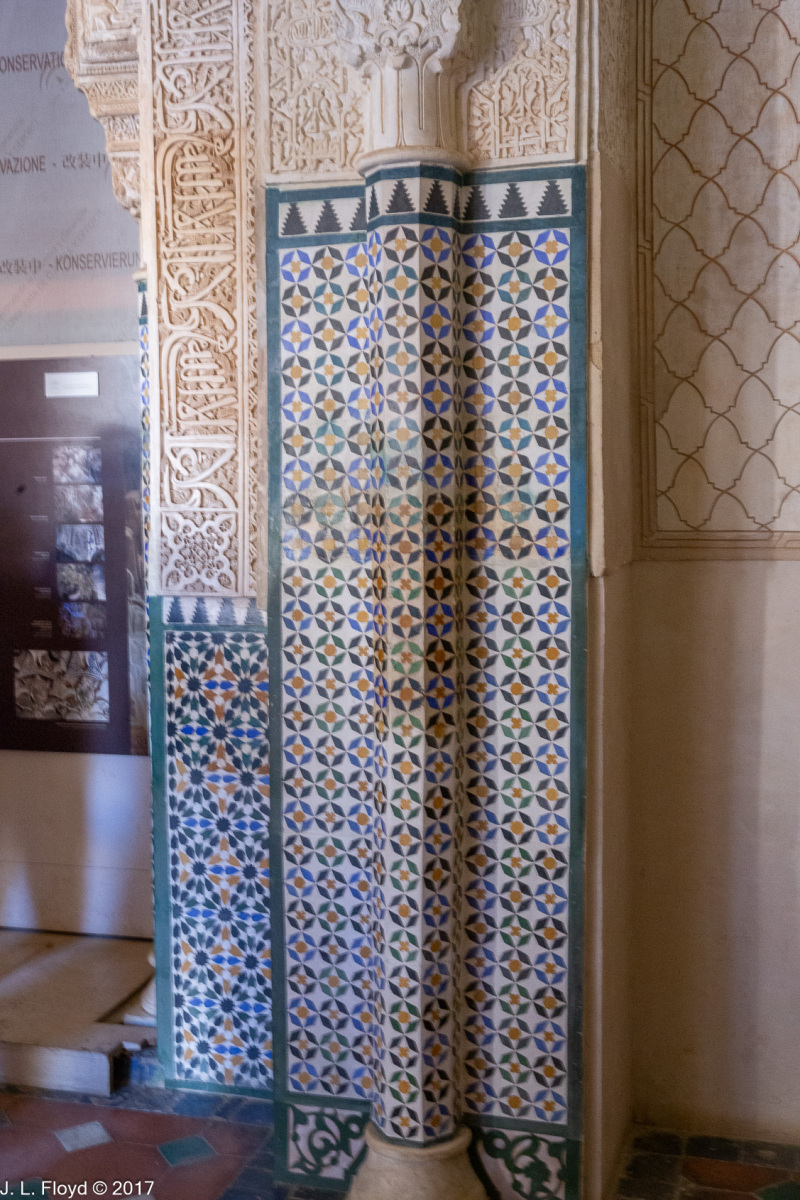
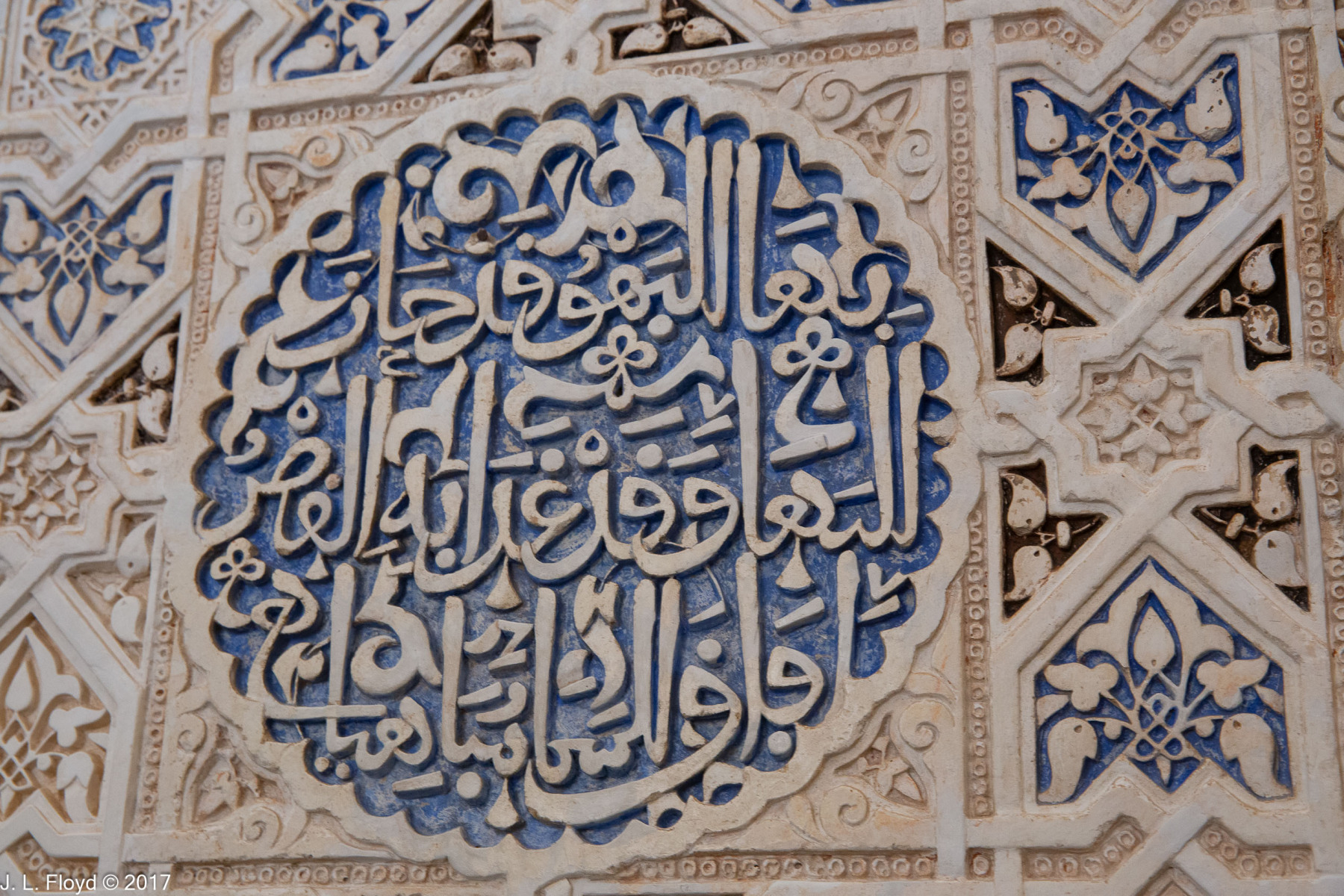
And speaking of geometric designs, mosaic tilework (known in Arabic as zellij) is ubiquitous throughout the Nasrid palaces, not excepting the Mexuar; it is found mostly in the form of tile skirting on the lower walls. The Christian rulers continued to use Moorish artists to work in the Alhambra after the 1492 conquest, and on one of the walls of the Sala del Mexuar is a tile mosaic with the words “Plus Ultra” (Further Beyond), the motto of King Carlos I/Emperor Charles V, who ruled Spain from 1519 to 1556. The words allude to the Latin saying “Ne plus ultra” which was for many centuries a warning to sailors to go no further beyond the Pillars of Hercules marking the Straits of Gibraltar, for there lay the vast unknown waters of the Atlantic Ocean, the mysterious, unknown edge of the world, where fearsome dangers awaited those who ventured thither. The Spanish explorers had dared to do so, and their daring had secured vast new territories, with limitless riches for the country and its monarchy. Also appearing in the some of the tile mosaics is the motto of the Nasrids, “And there is no victor but God”.

Adjoining the Sala del Mexuar is a small room which served as an oratory, or private prayer room for the ruler. It contains a mihrab (prayer niche) and features elaborate carved stucco decorations covering the walls. The multiple double-arched windows provide superb views of the landscape and the city of Granada below the walls of the Alhambra.

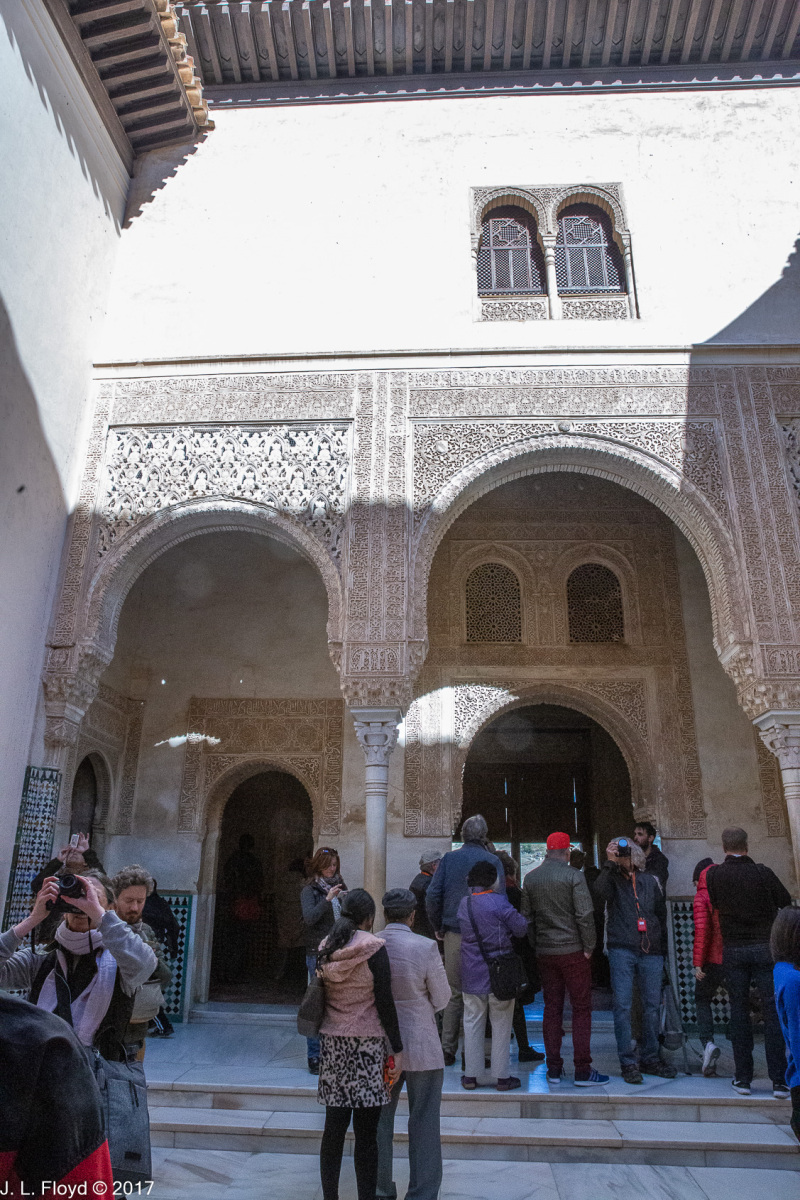
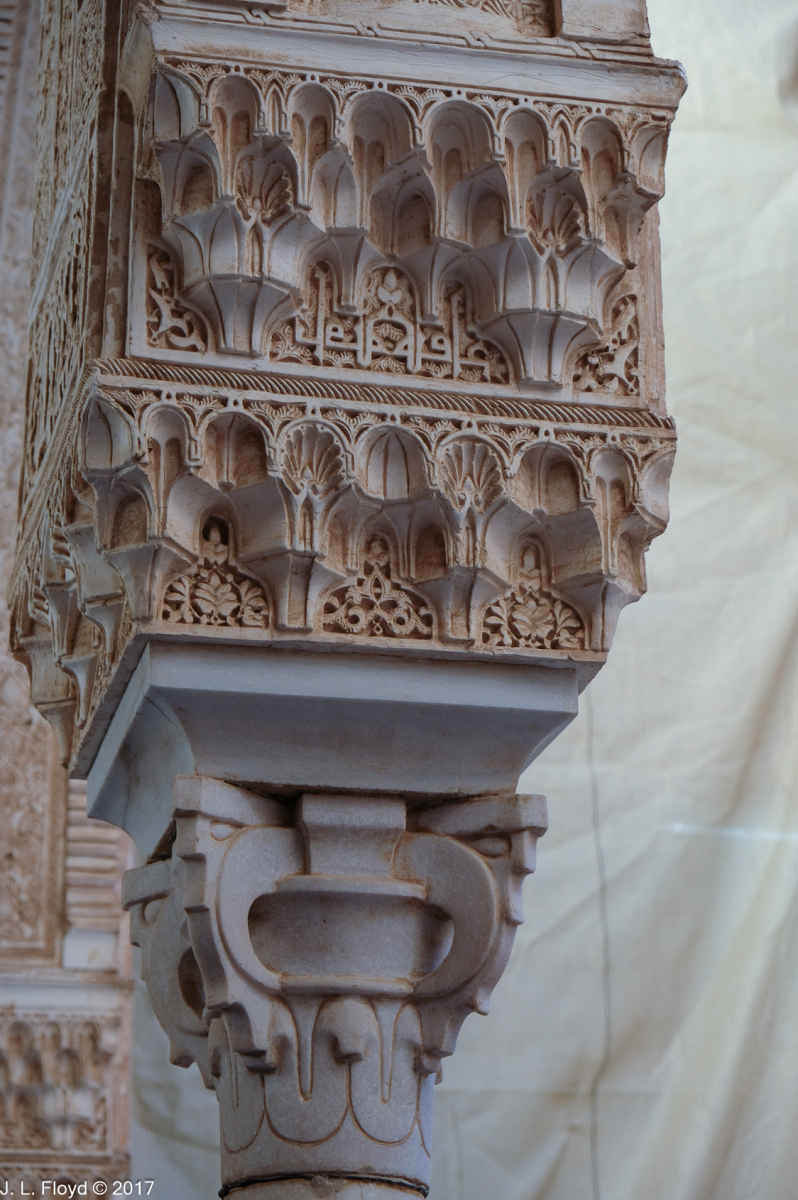
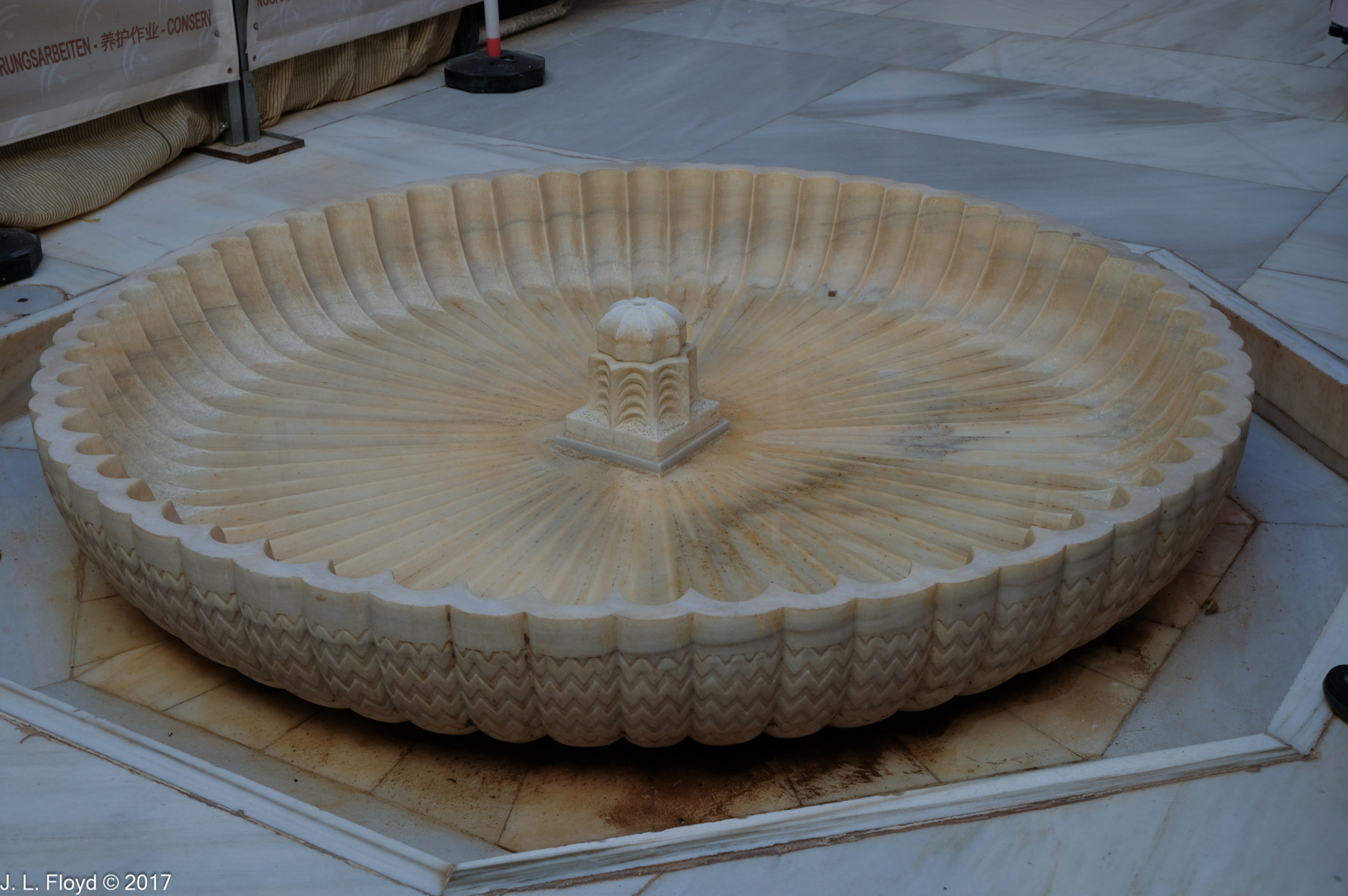
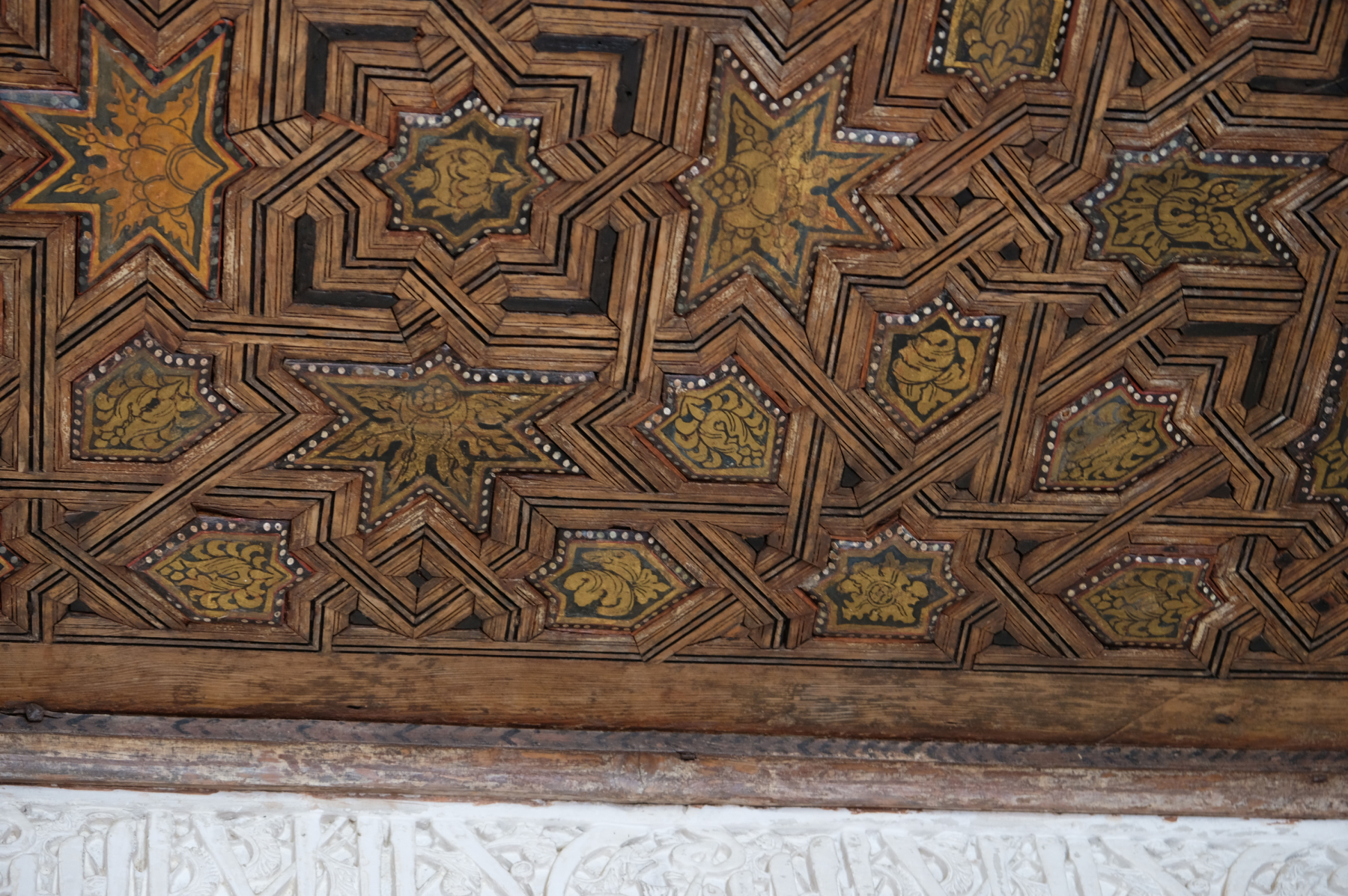
After passing through the Oratory, we arrived at the final chamber of the Mexuar Palace, the Cuarto Dorado, or Gilded Room. This is a relatively small space, which in the Nasrid era was used as a waiting room for people queuing for audiences with the emir, but after the Christian conquest was adapted for residential purposes. This remodeling included the creation of a gorgeous ceiling decorated in gold leaf, hence the gold in “Cuarto Dorado.” However, even more spectacular than the chamber itself is its adjoining courtyard, the Patio del Cuarto Dorado, which provides a transitional space to the Comares Palace. The north side of the patio features a fine three-arched portico providing access to the Gilded Room; the capitals of the supporting columns are decorated with elaborate stucco carvings in a style favored by the Almohads, the predecessors of the Nasrids. In the middle of the courtyard is a simple but elegant scalloped stone basin.

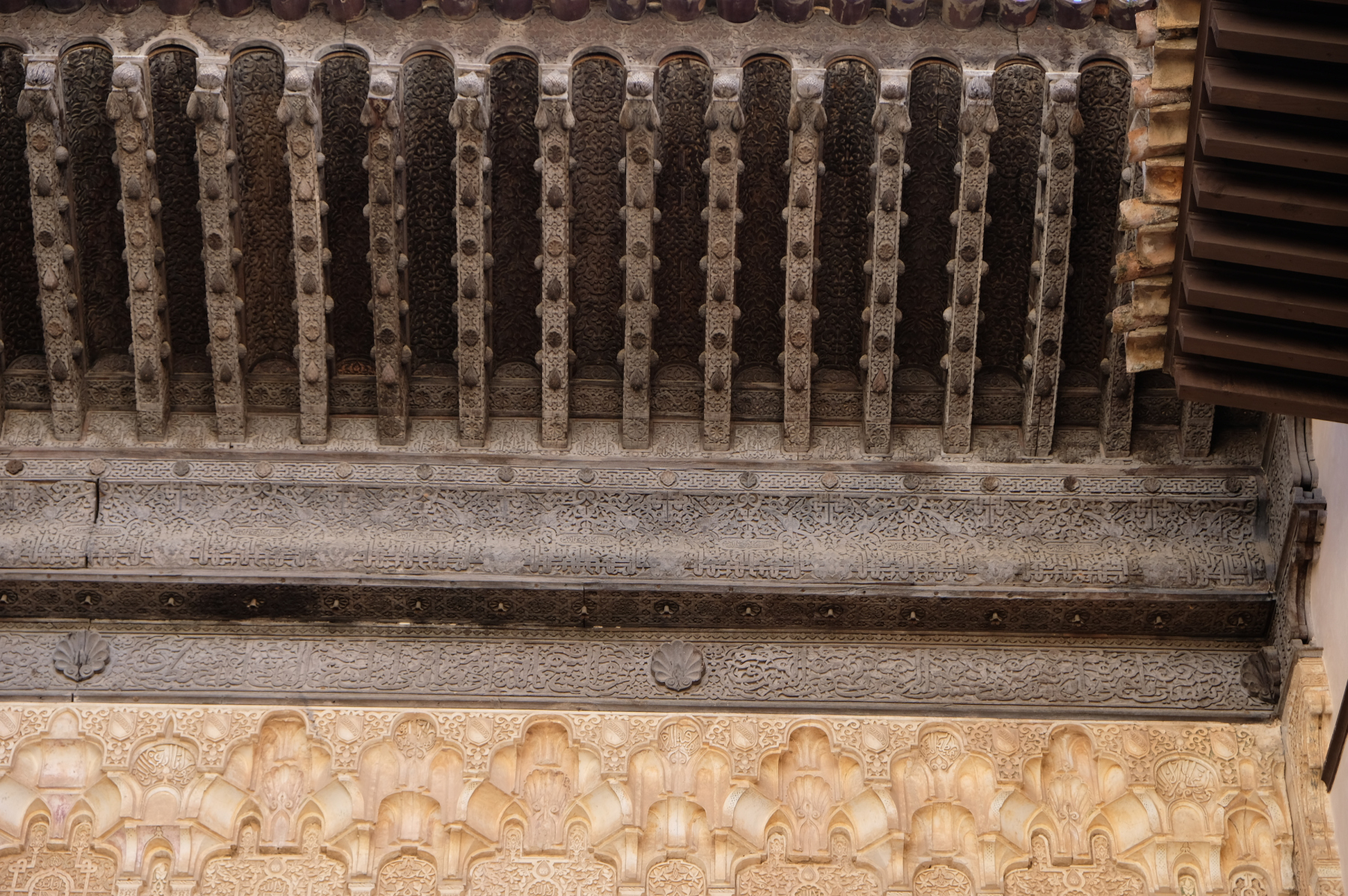
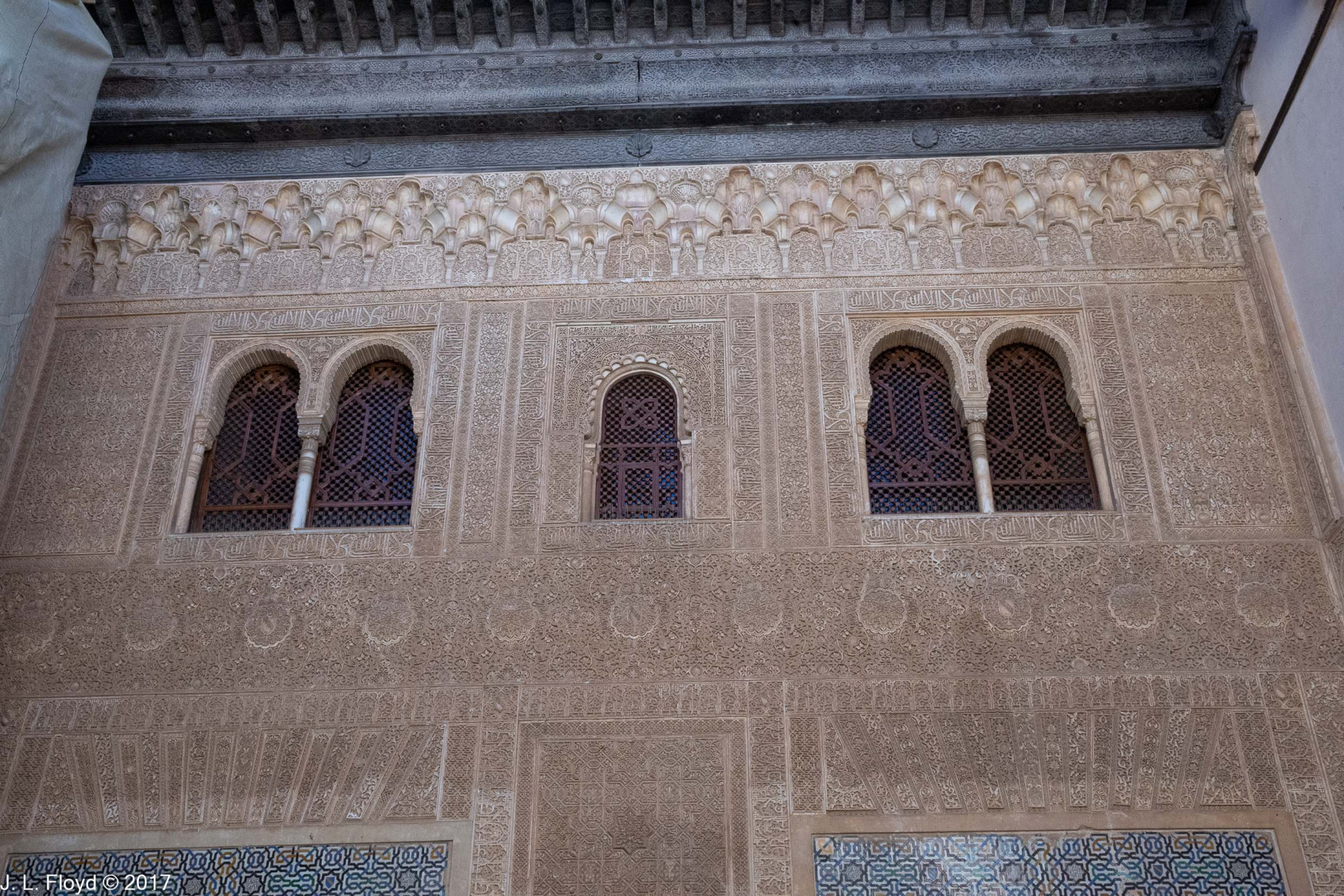
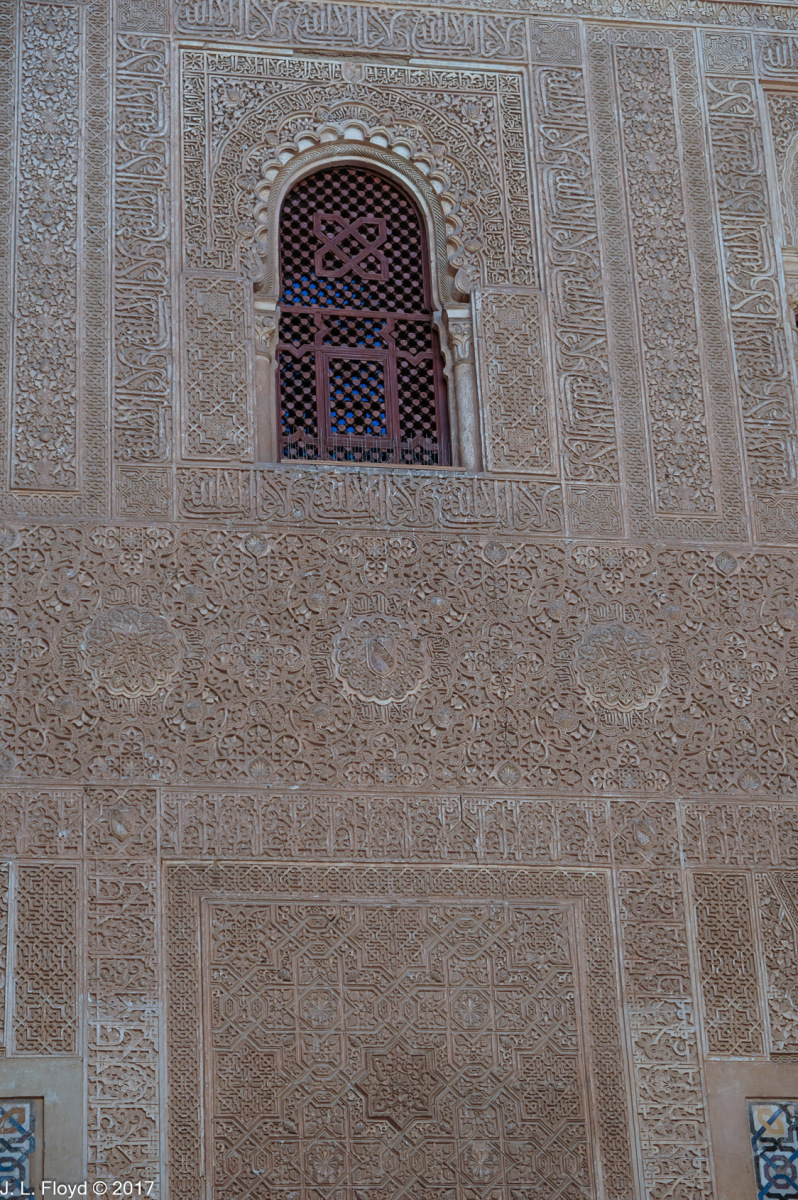
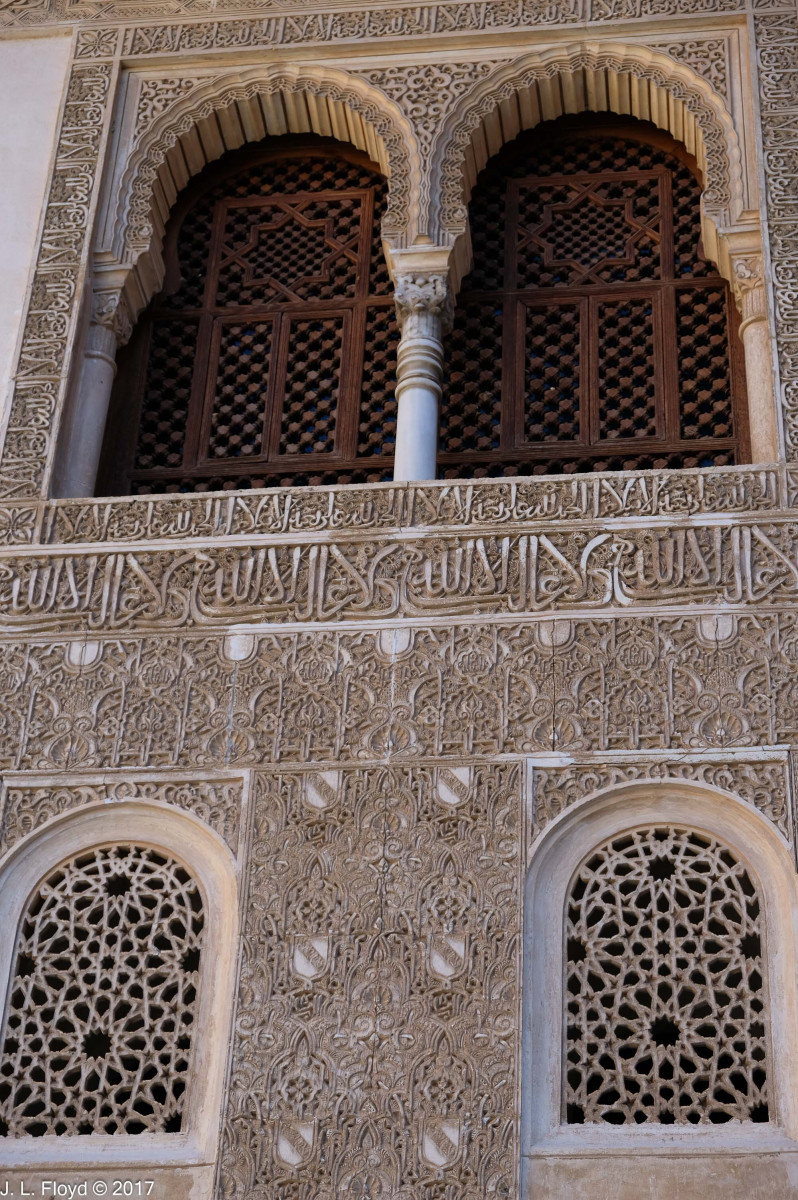
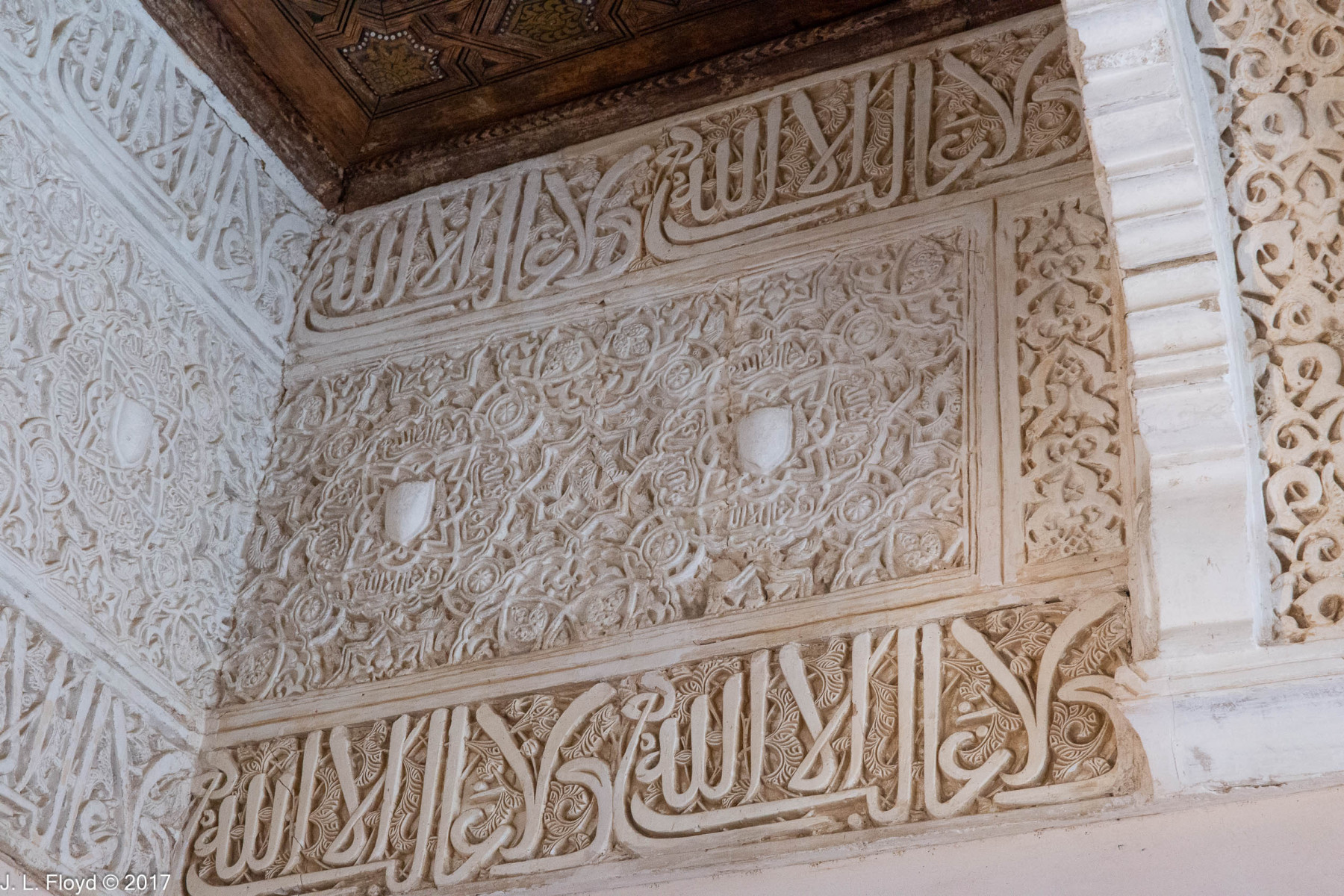
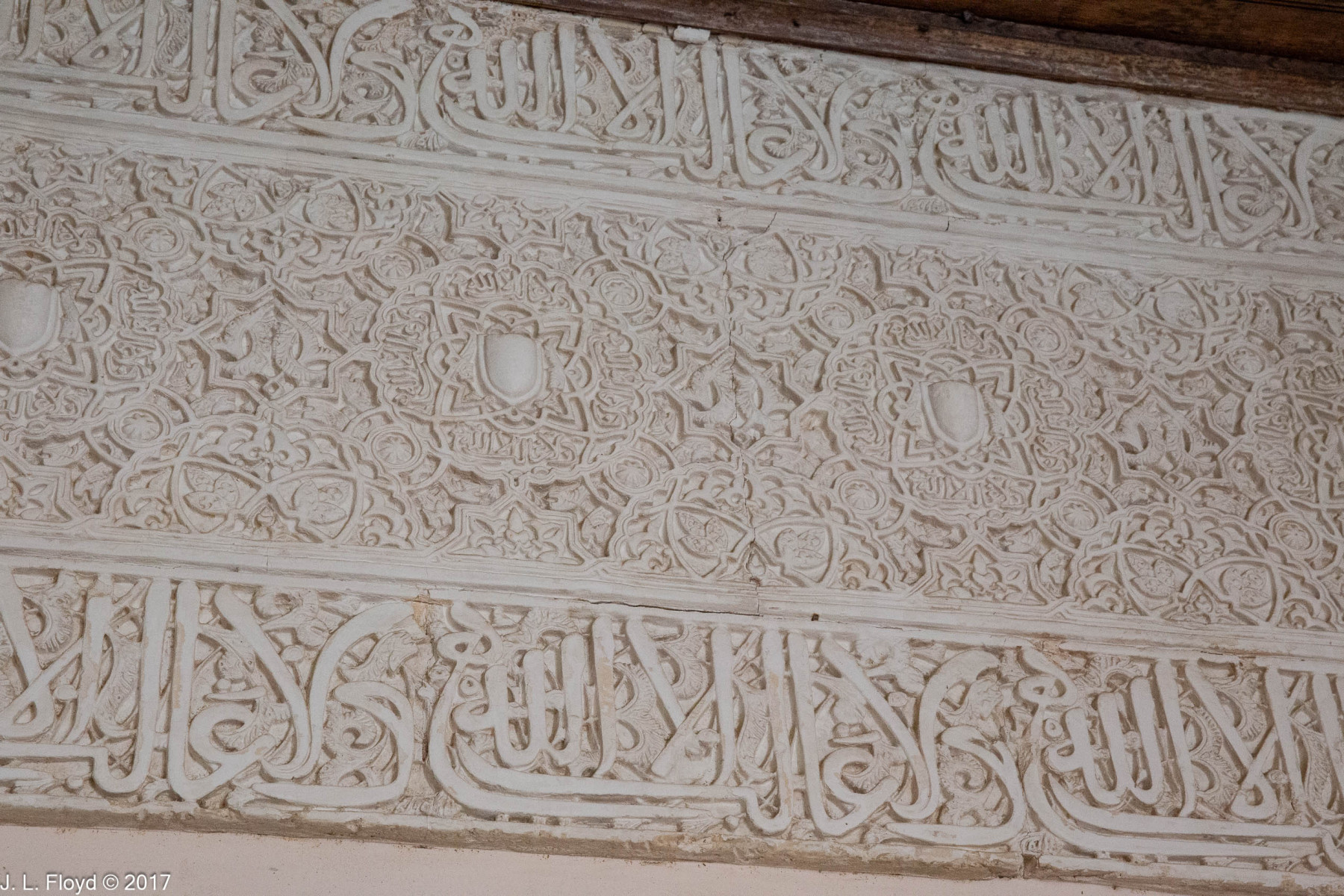
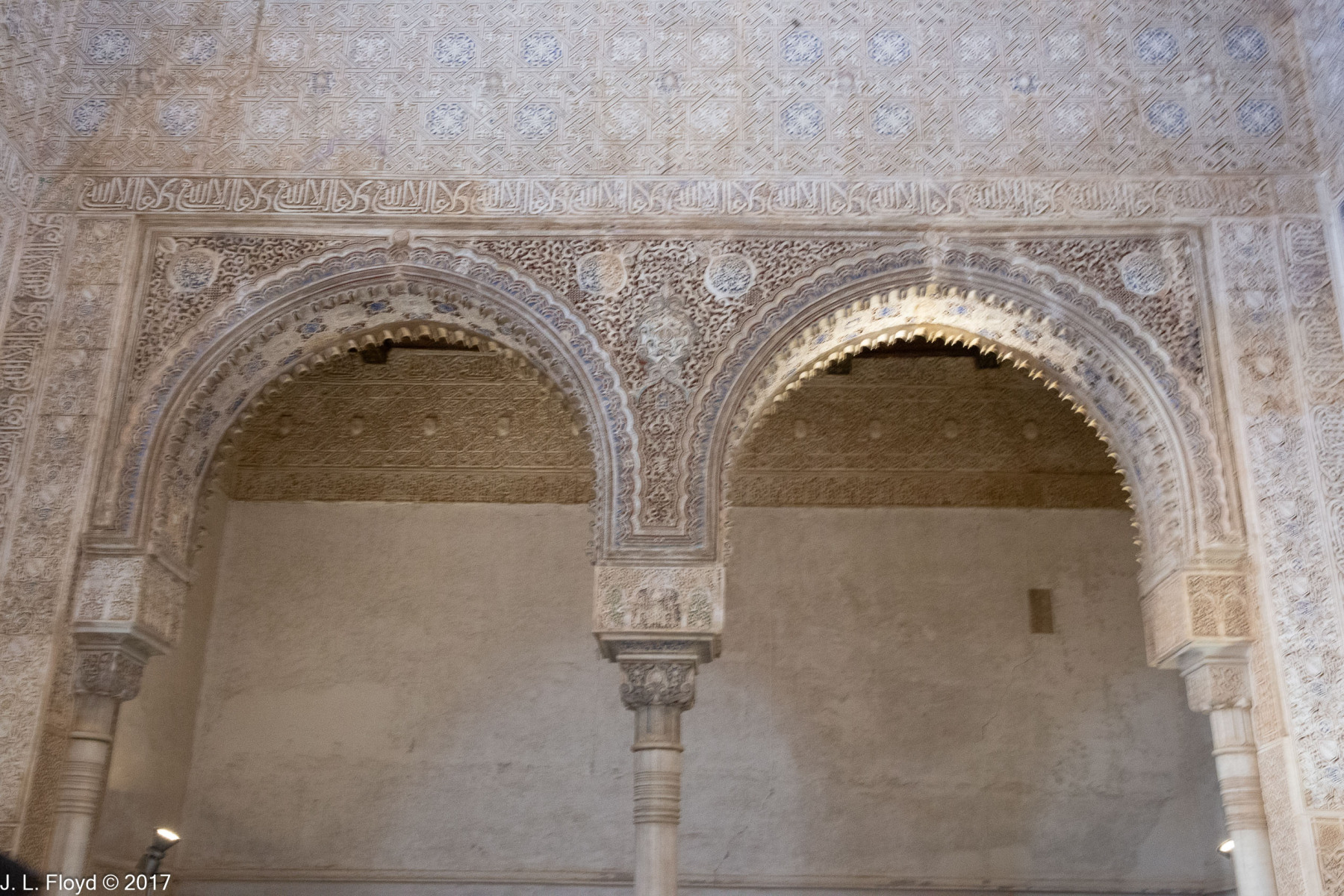
On the opposite (south) side of the Patio de Cuarto Dorado is the imposing façade of the Comares Palace. This was erected in 1370 by Emir Muhammad V to celebrate his conquest of the important city of Algeciras, the key to the control of the Strait of Gibraltar. It has two identical doors, framed in colorful zellij tiles, the one on the left leading to the Comares Palace, the other connecting back to the Mexuar. Except for tile skirting at the bottom, and three windows on the second floor, the façade wall is decorated entirely with stucco, carved with elaborate designs and inscriptions in Arabic calligraphy, such as verses from the Koran.

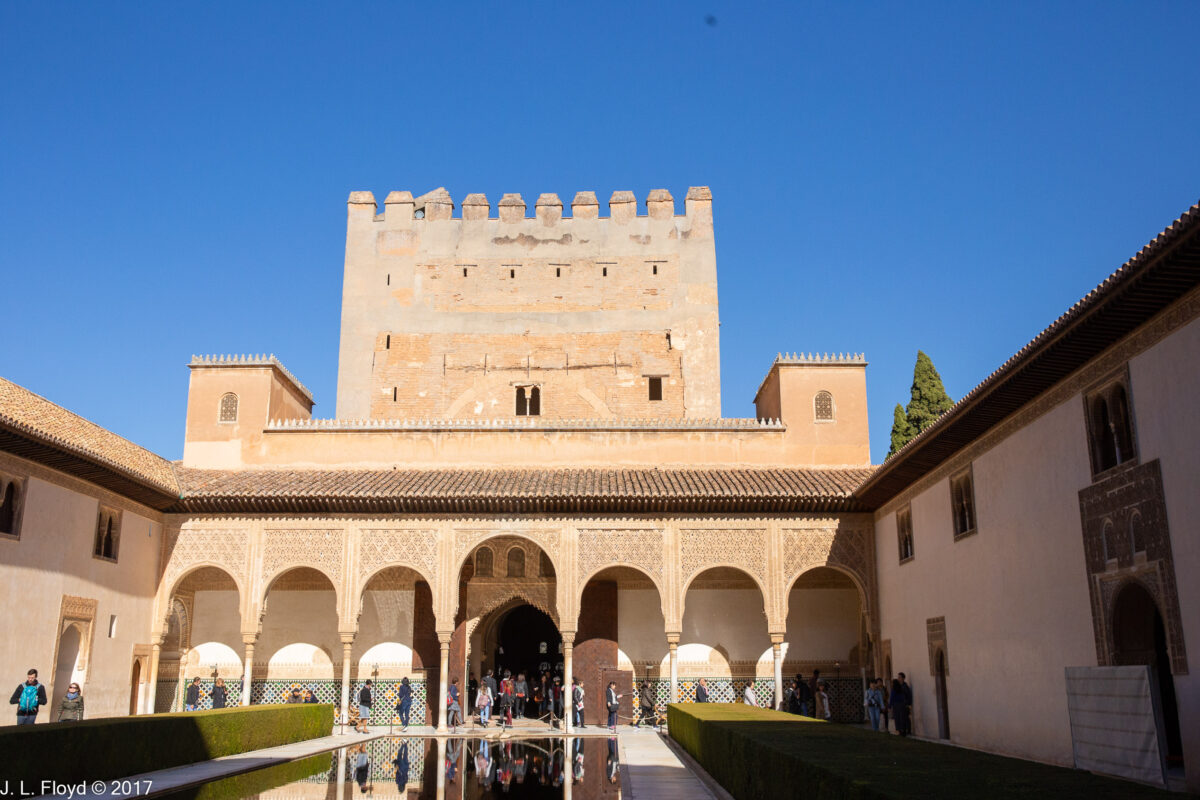
Entering the door on the left, we threaded our way through a narrow passageway, from which we emerged to find ourselves in the Court of the Myrtles, the iconic central element of the Comares Palace.

The Comares Palace was begun in the reign of Isma’il I (r. 1314-1333), expanded by his successor Yusuf I (r. 1333-1354) and completed under Muhammad V (r. 1354–1359 and 1362–1391), though of course it was further modified by the Christian conquerors after 1492.

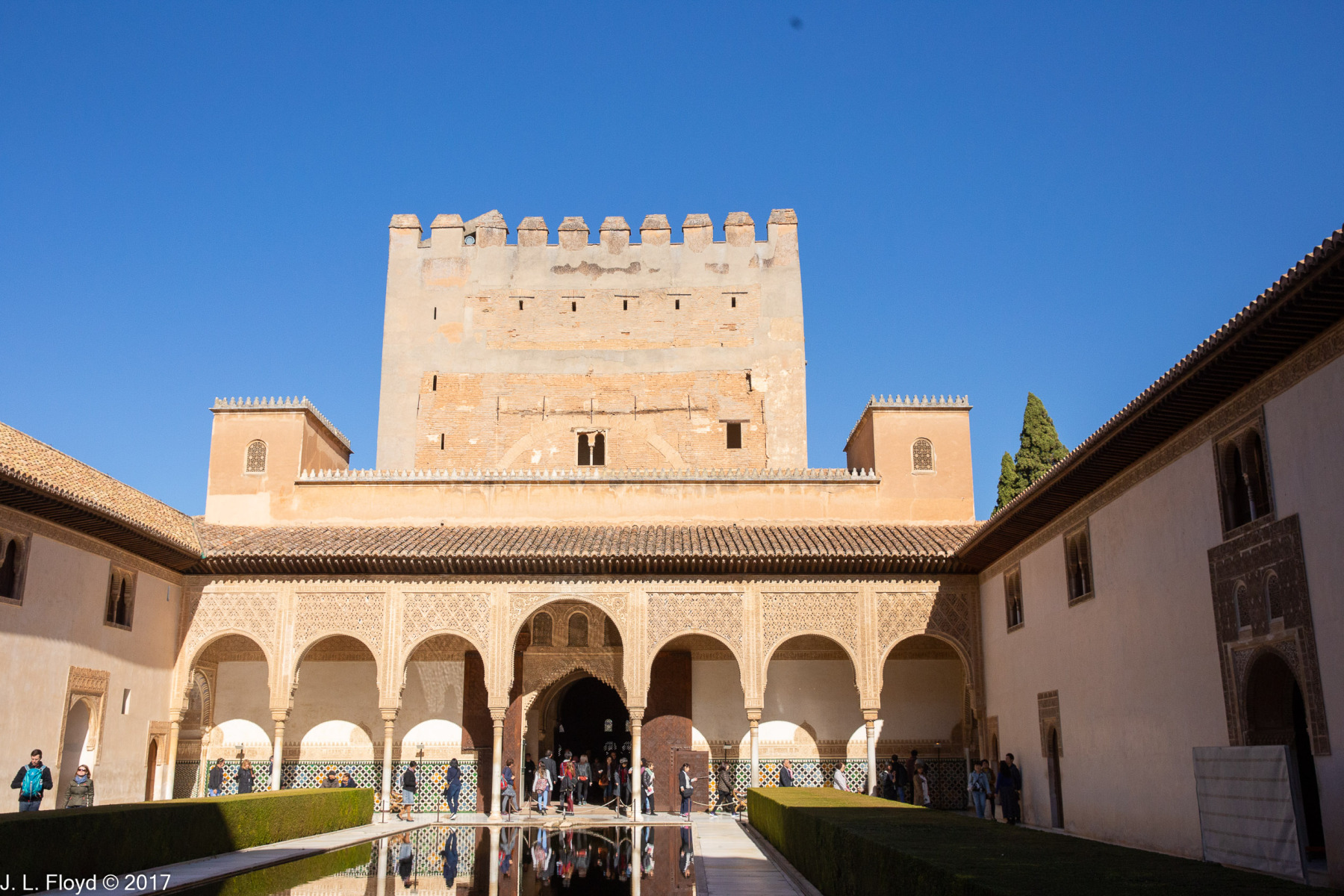
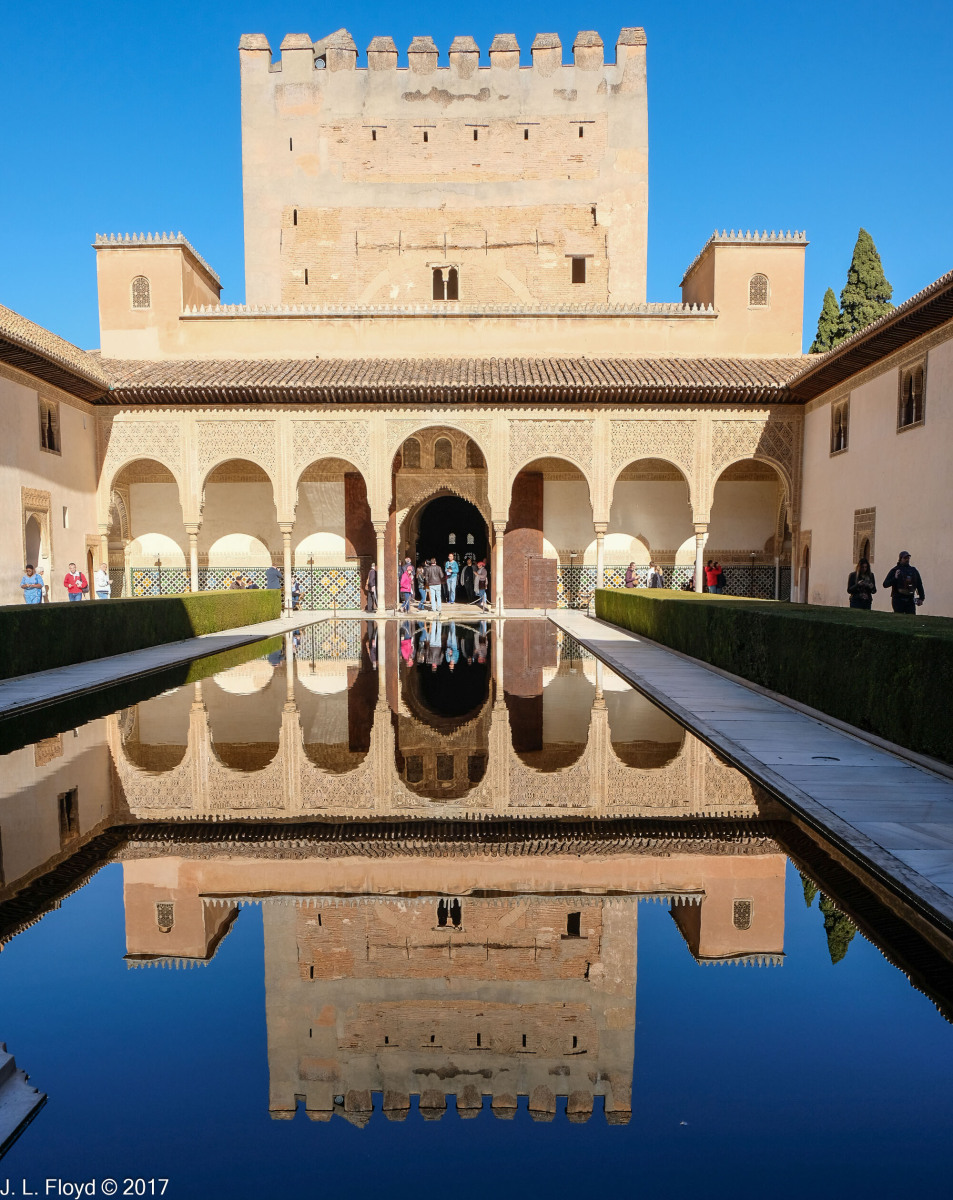
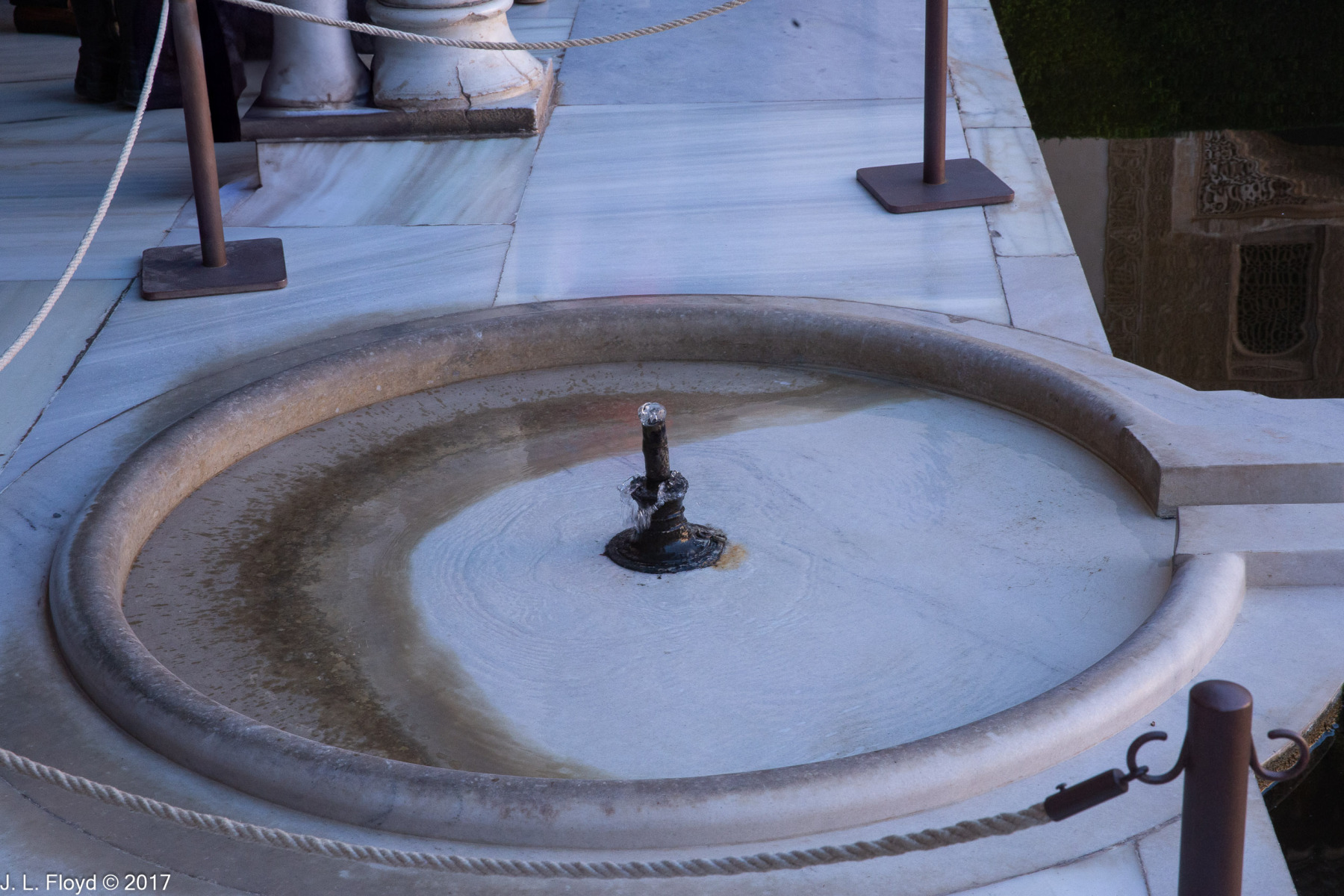
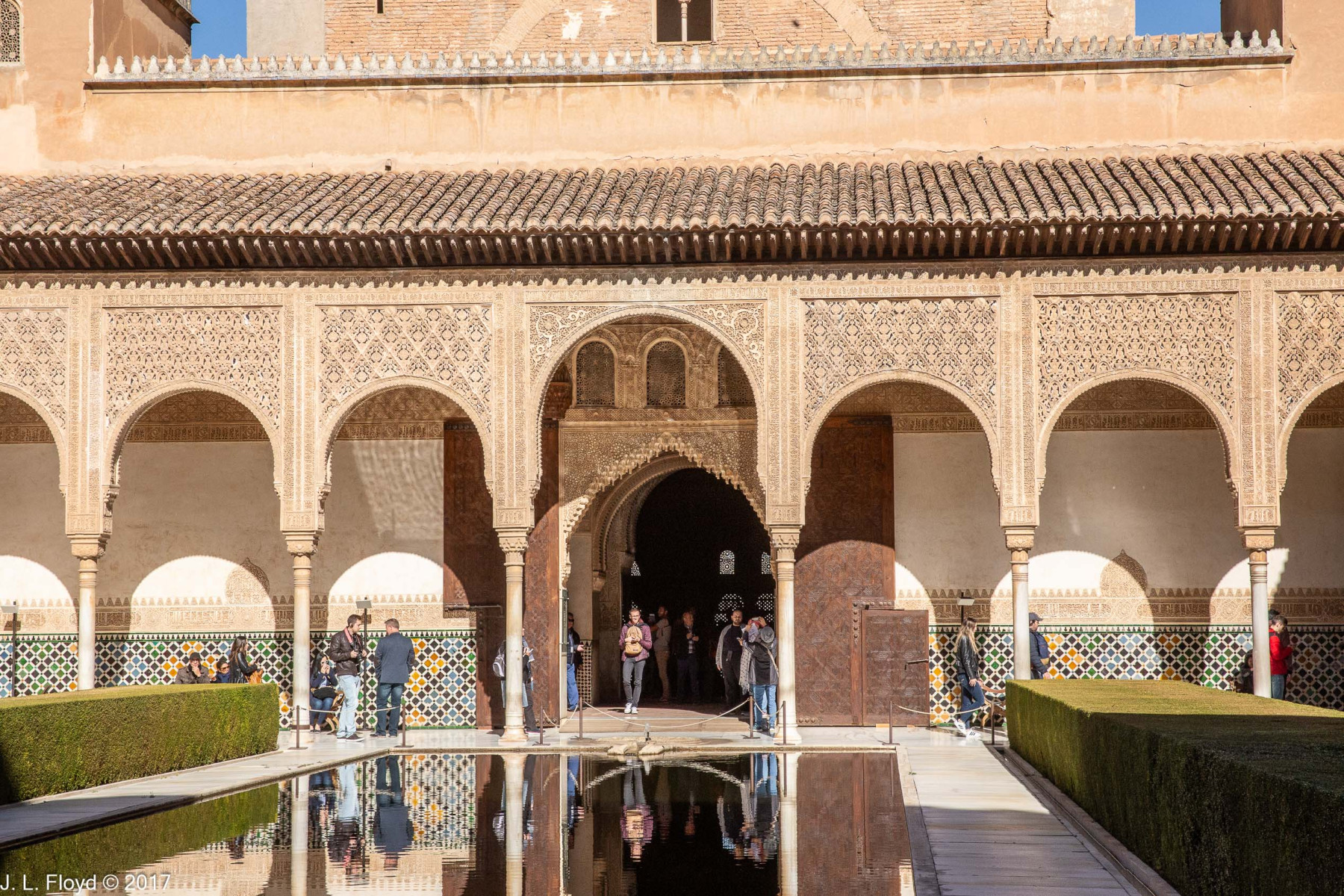
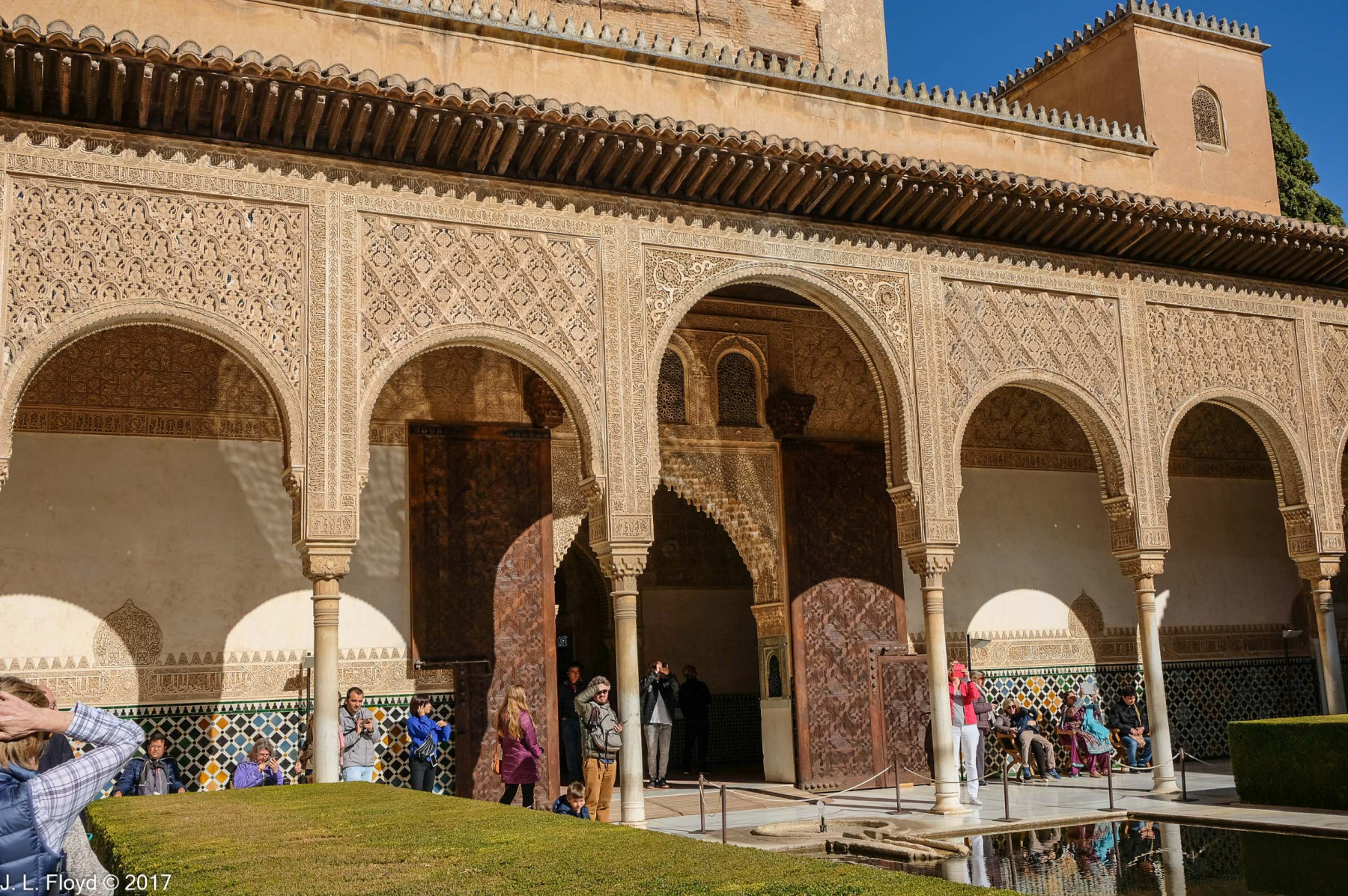
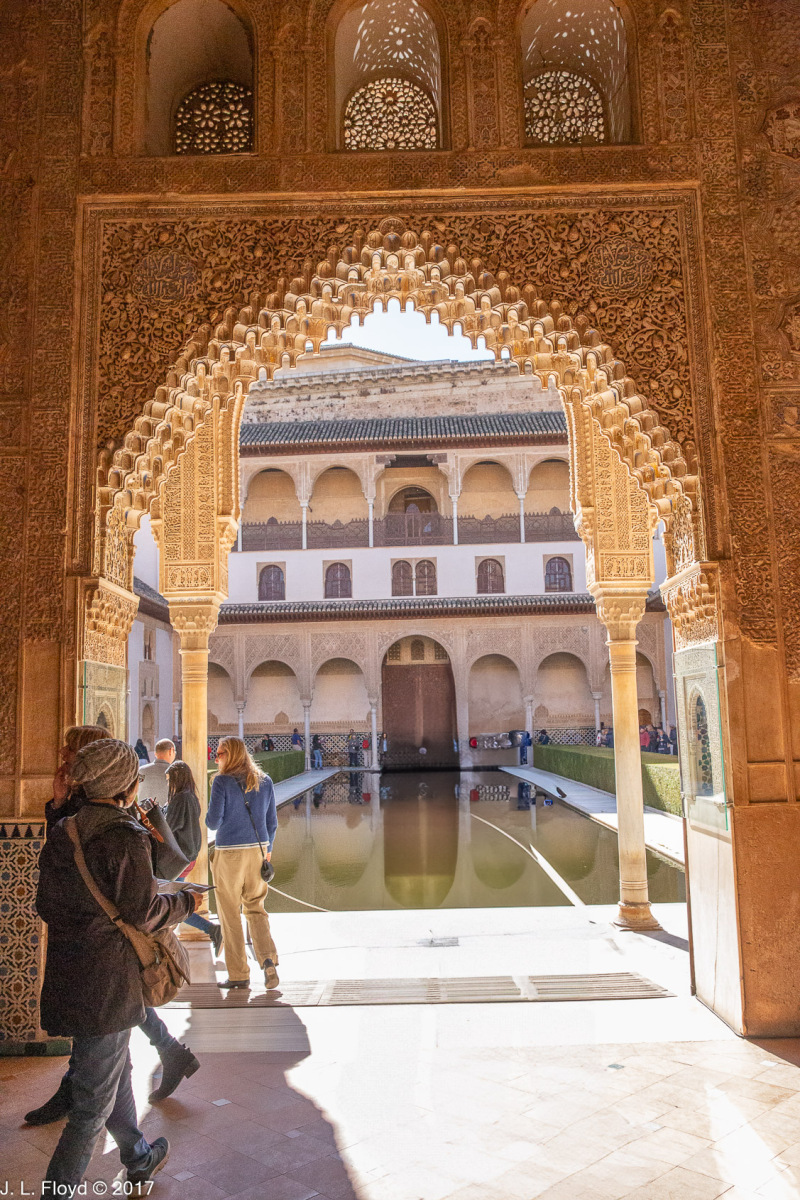
The Court of the Myrtles is a rectangular space 36 meters (121 feet ) long by 23 meters (75 feet) wide, with the long side oriented along a north-south axis. In the middle is a pool, also rectangular, 34 metres (112 feet) long and 10 meters (33 feet) wide. Water flows into the pool from two circular basins at either end; their design was cunningly calculated to make the water flow so slowly that it does not make ripples in the pool, the surface of which remains so still that the pool is perfectly reflective, as illustrated by the accompanying gallery photos. Myrtle hedges running along the the east and west sides of the pool give the courtyard its name.

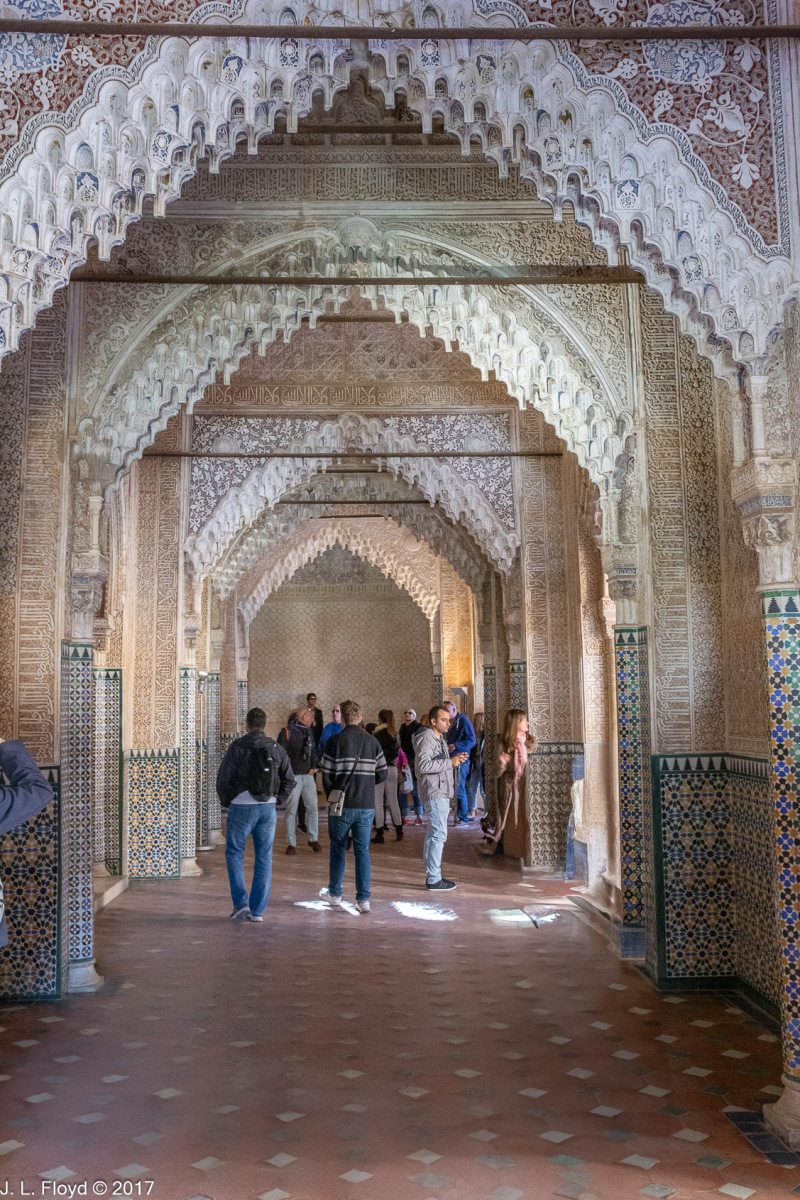
The Comares Palace is built around the courtyard, with multistory pavilions at both north and south ends, connected by two-story structures on the long sides. In front of each pavilion is a portico with a wide central arch flanked by three arches on each side. The arches are lavishly decorated with designs in stucco, and the galleries behind them are resplendent with zellij tile skirting and muqarnas vaulting. The lateral structures on the long sides are austere by comparison, with a few widely-spaced windows and doors decorated with stucco framing. The doors lead either to residential quarters or to passages connecting with the Cuarto Dorado, the Comares Baths, and the Palace of the Lions.

The north pavilion is the heart of the Comares Palace, consisting of the Sala de la Barca and the Comares Tower with its vast Hall of Ambassadors, also known as the Throne Room.

The south pavilion was originally built as residential quarters for the royal family, but it was mostly demolished in the 16th century to make way for the Palace of Charles V, leaving nothing but the façade, which is nevertheless quite imposing. It consists of three levels. At ground level there is a portico and gallery similar to those at the north end. The second level has seven windows with wooden latticework performing the same function as venetian blinds in other cultures. The third and top level features a lavishly decorated gallery with seven arches and a large central doorway.

The Northern Pavilion is entered via the Sala de la Barca. The name, meaning “Room of the Ship,” does not seem to be associated with any nautical motif but is thought to be derived from the Arabic word baraka, meaning “blessing,” which is found on inscriptions in the room. (The resemblance to the given name of an American president is duly noted.) It is believed to have served as a waiting room for persons seeking audience with the emir. The hall has an ornate wooden ceiling decorated with elaborate geometric figures; it was destroyed by a fire in 1890 but later rebuilt with the aid of surviving fragments.

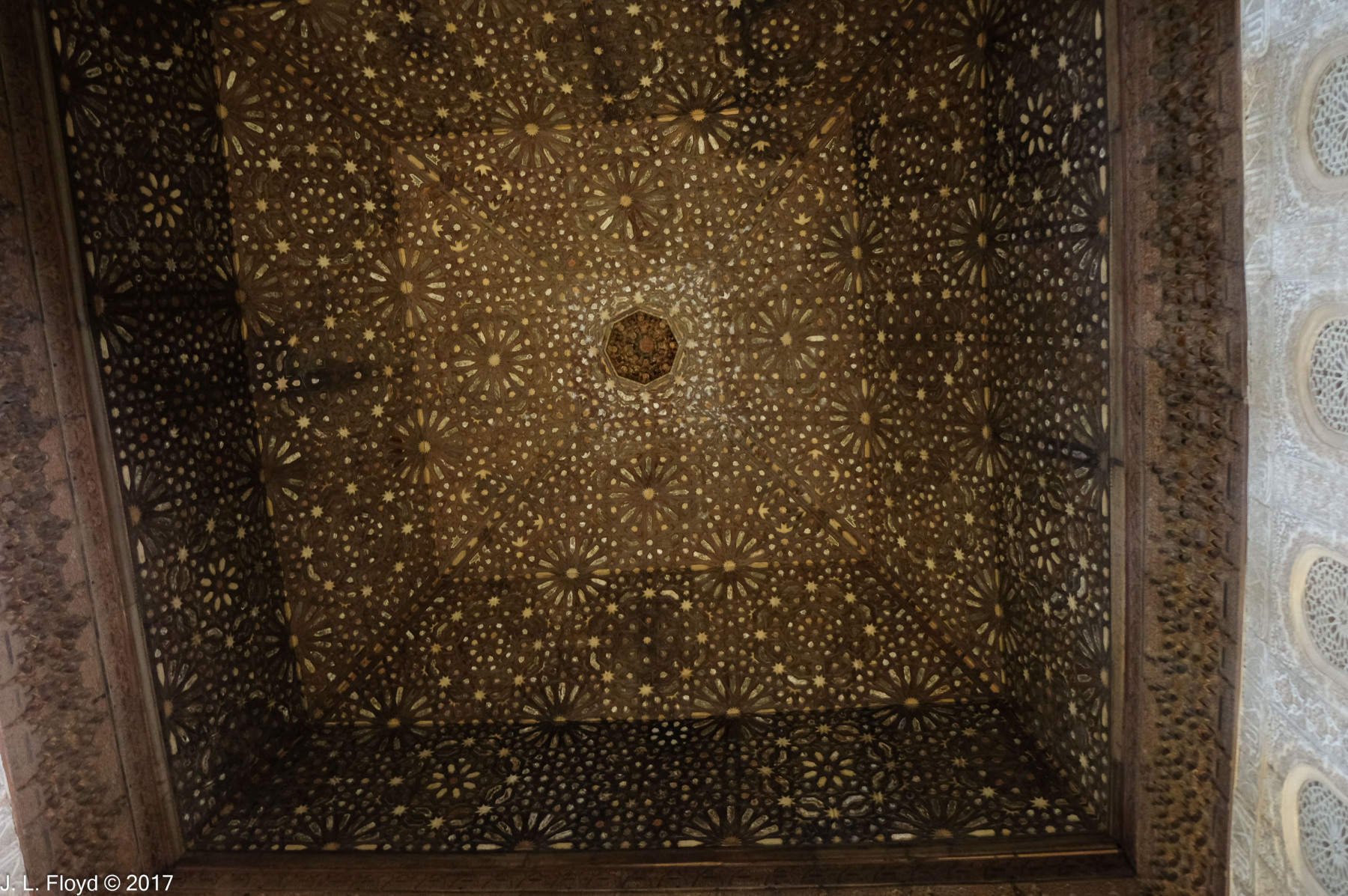
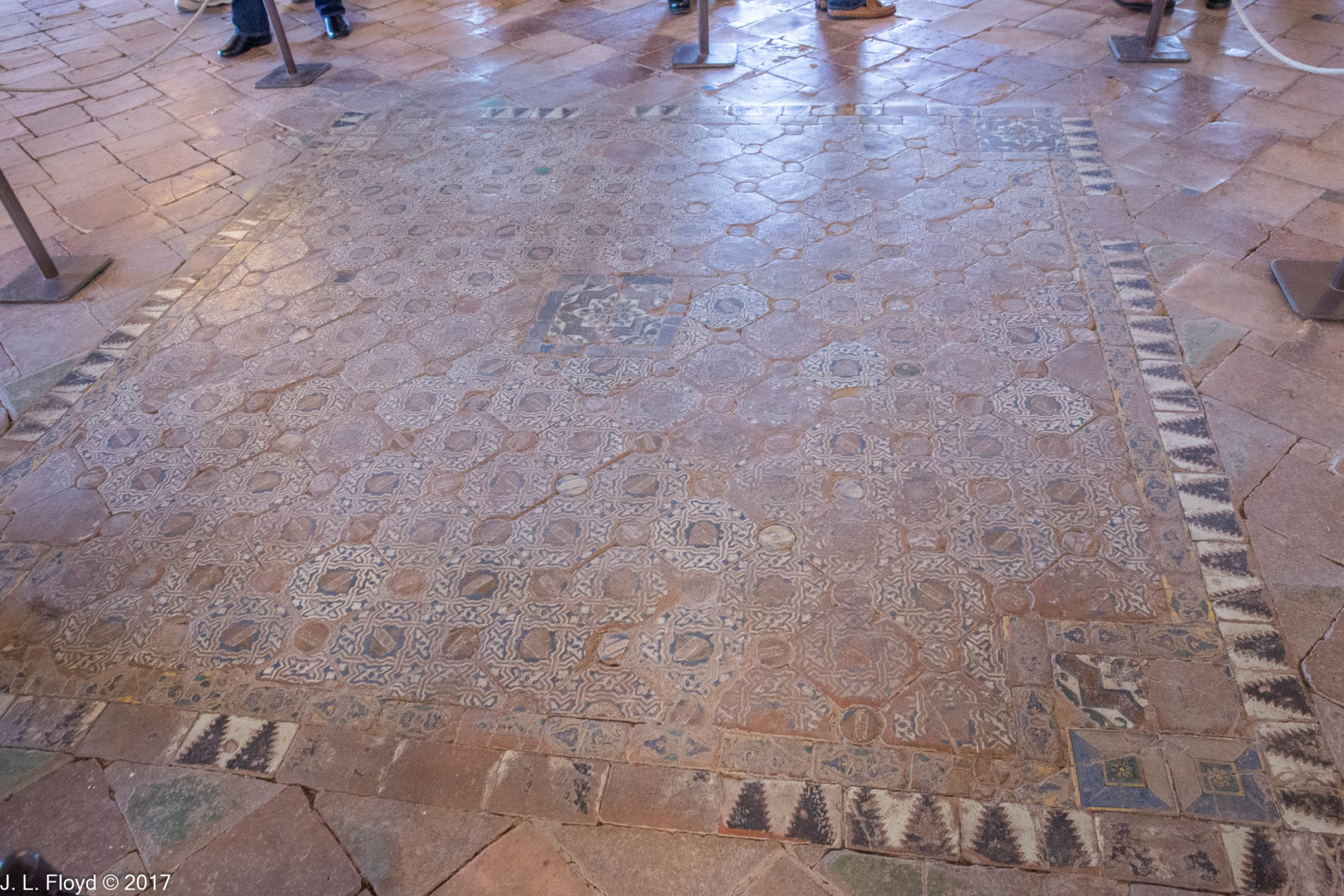
Upon entering the Throne Room, or Hall of Ambassadors as it is also known, one is immediately overwhelmed by its vastness. It is the largest room in the Alhambra, 18.2 meters (60 feet) high and 11.3 meters (37 feet) on each side. The ceiling, composed of 8017 pieces of wood fitted together to form a complex geometrical pattern, is 125 square meters (1346 square feet) in area. Floor space is 127.7 meters (1375 square feet). The central part of the floor is paved with lusterware tiles, so called because they are made with a metallic glaze that produces an iridescent effect.

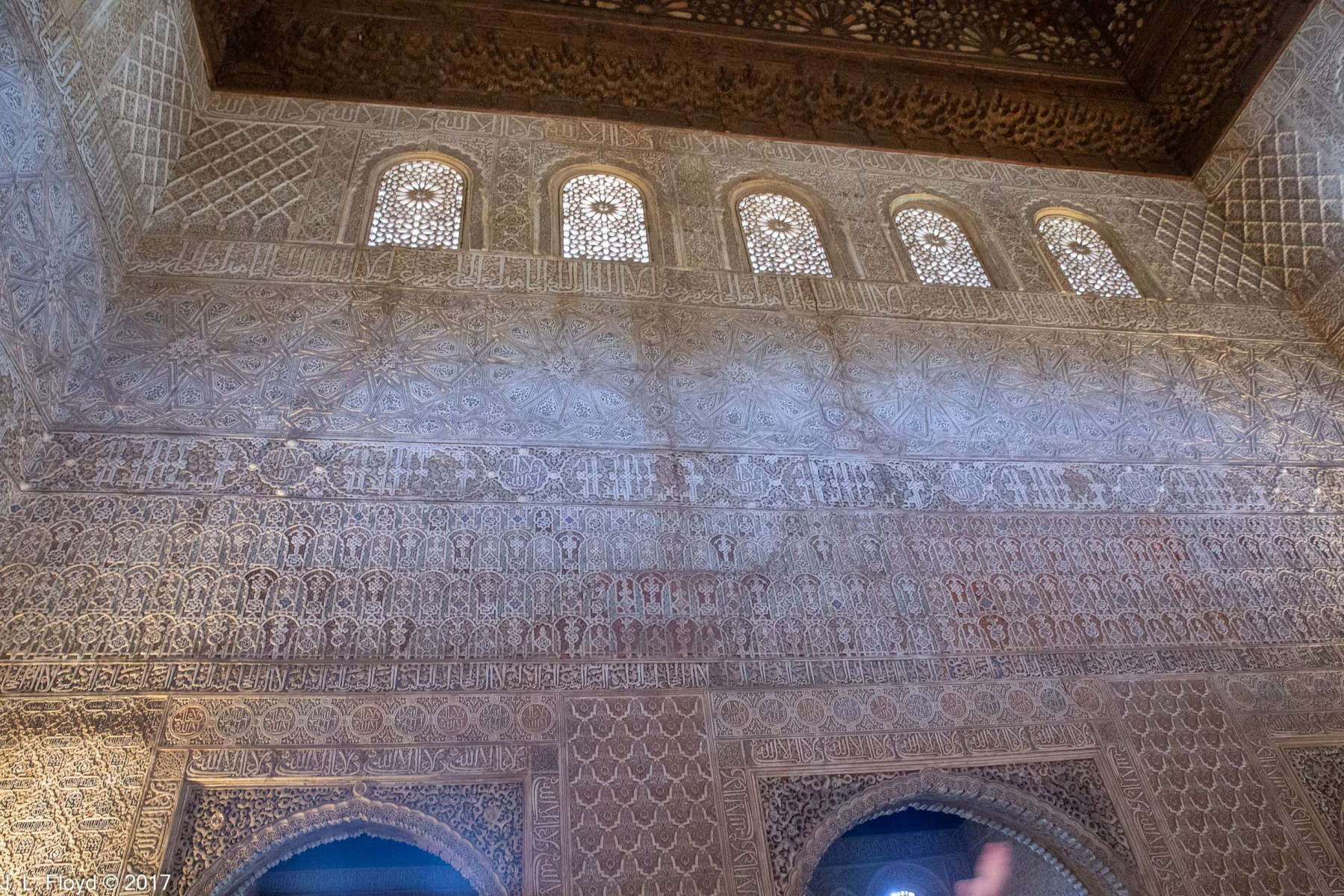
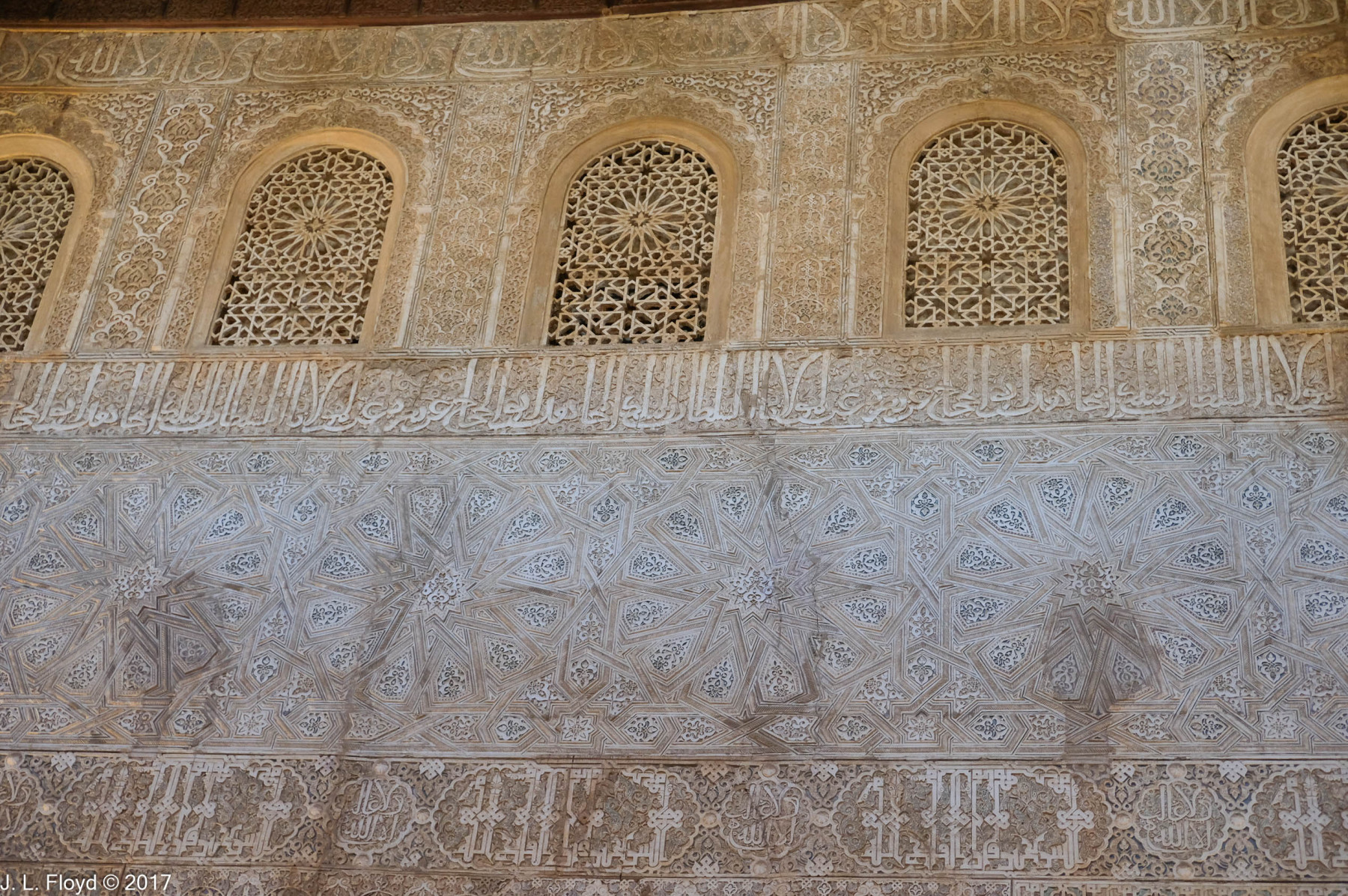
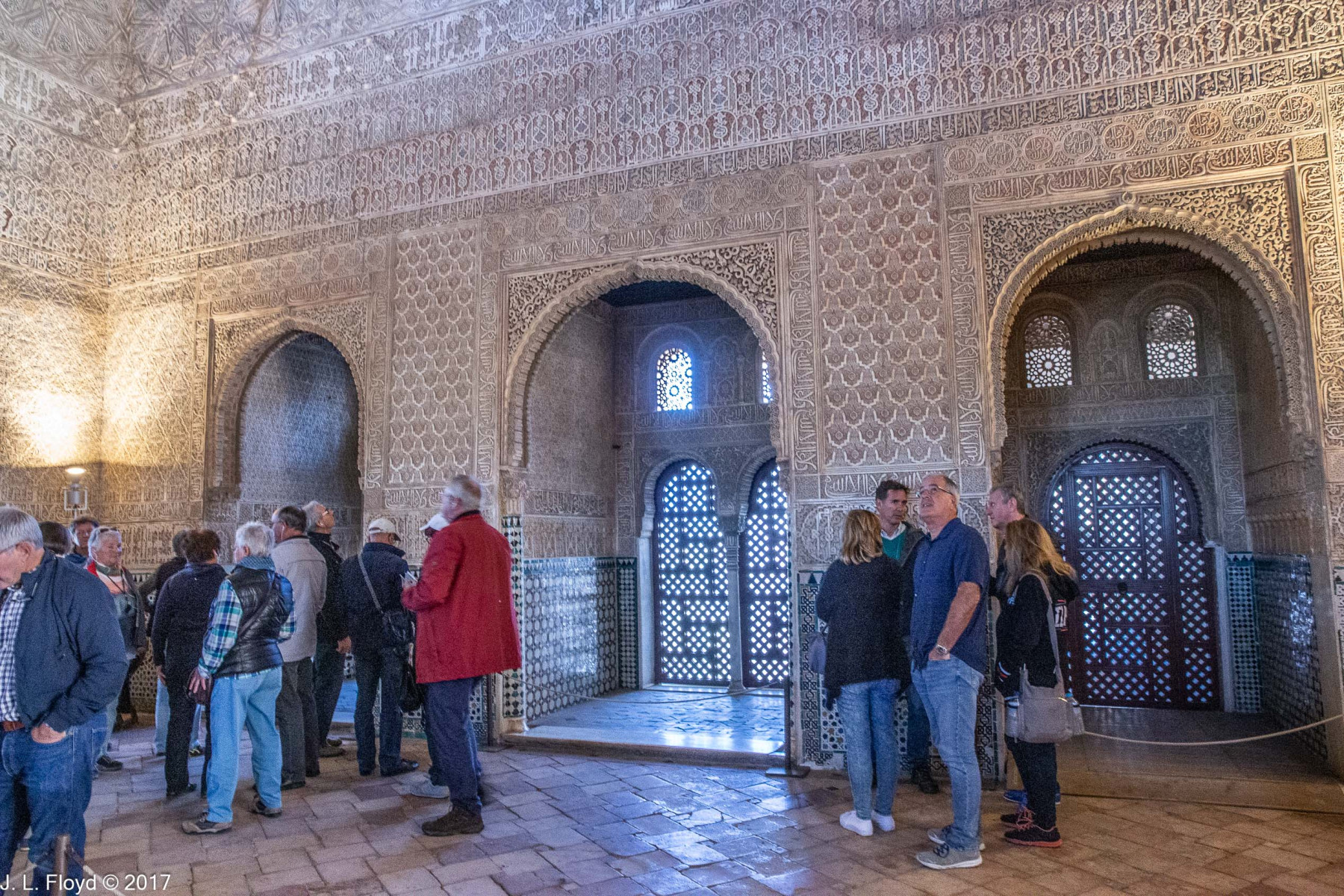
Like most of the chambers in the Nasrid palaces, the Throne Room’s upper walls are smothered in detailed stucco decoration, while the lower walls are covered with zellij tiles displaying various brightly colored geometric designs. At the top of the walls are windows with lattice grilles. At ground level, three of the walls have three alcoves each, with lattice-grille windows; in each case the center alcove is larger, with double windows, and the central alcove on the north wall, facing the muqarna-festooned entrance archway, is the most elaborately decorated, since the throne of the emir was located there.

The baths of the Comares Palace, located on the east side of the Court of the Myrtles, are said to be the best-preserved medieval Muslim baths in the Iberian peninsula, and judging from the photographs I have seen of them, are quite attractive. However, in order to keep them that way, they are closed to tourists. So next on our itinerary was the Palace of the Lions, also on the east side of the Court of the Myrtles, next to of the baths.

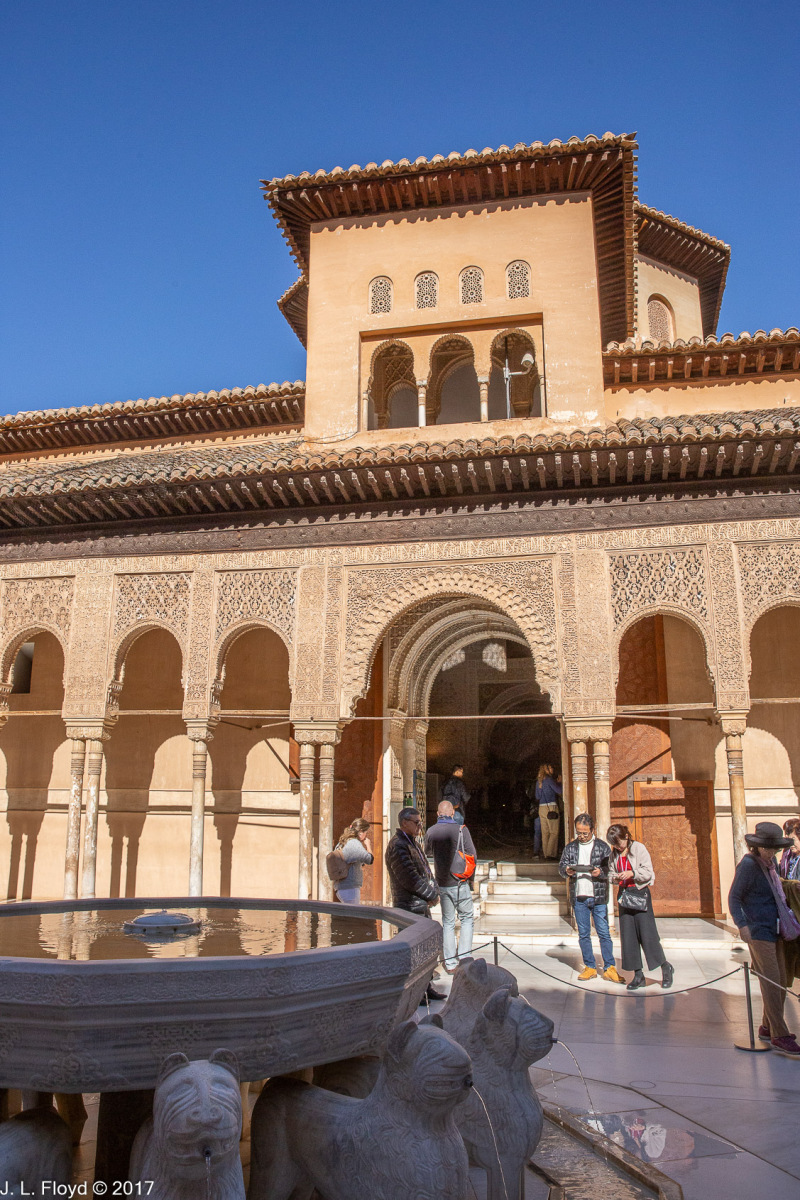
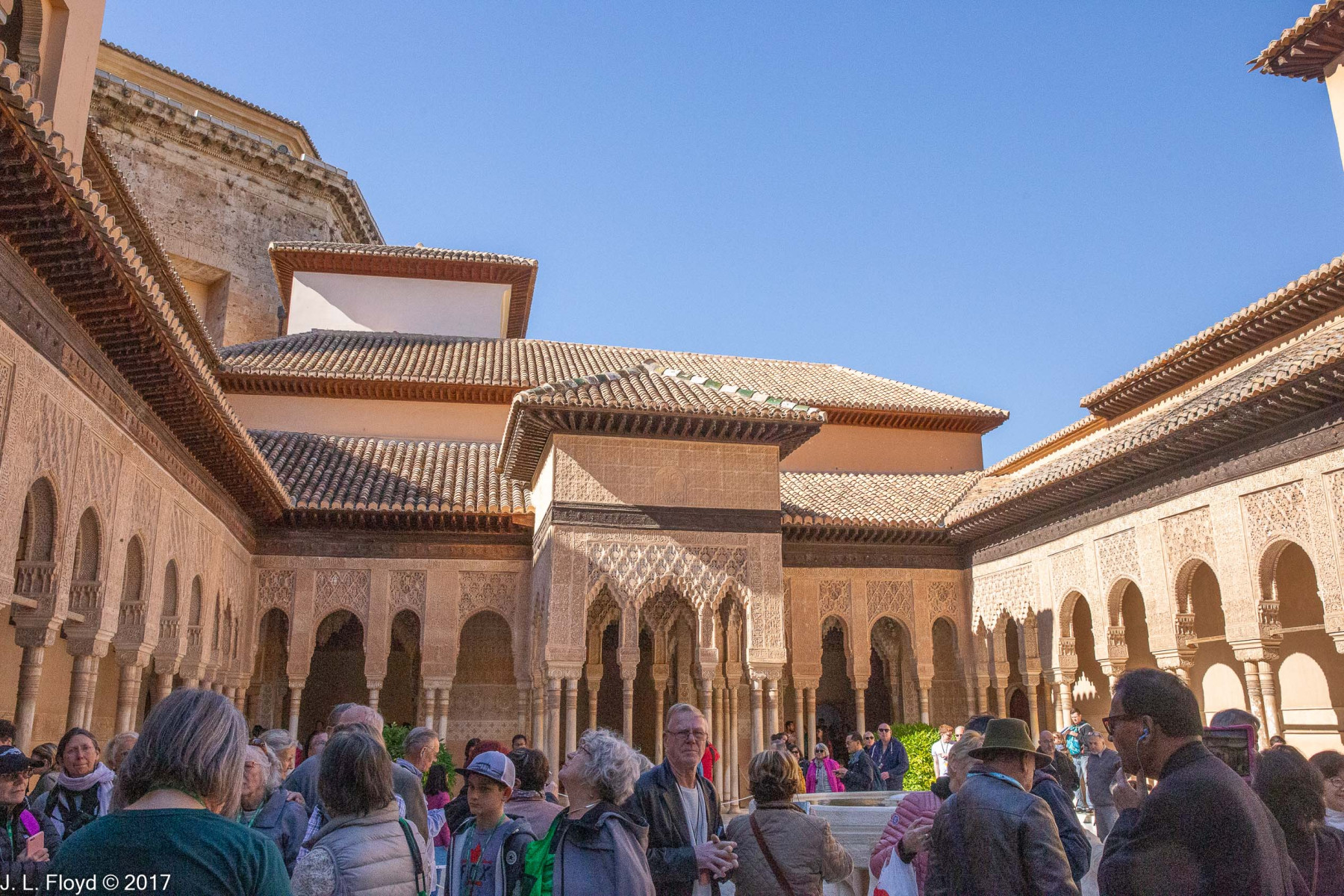
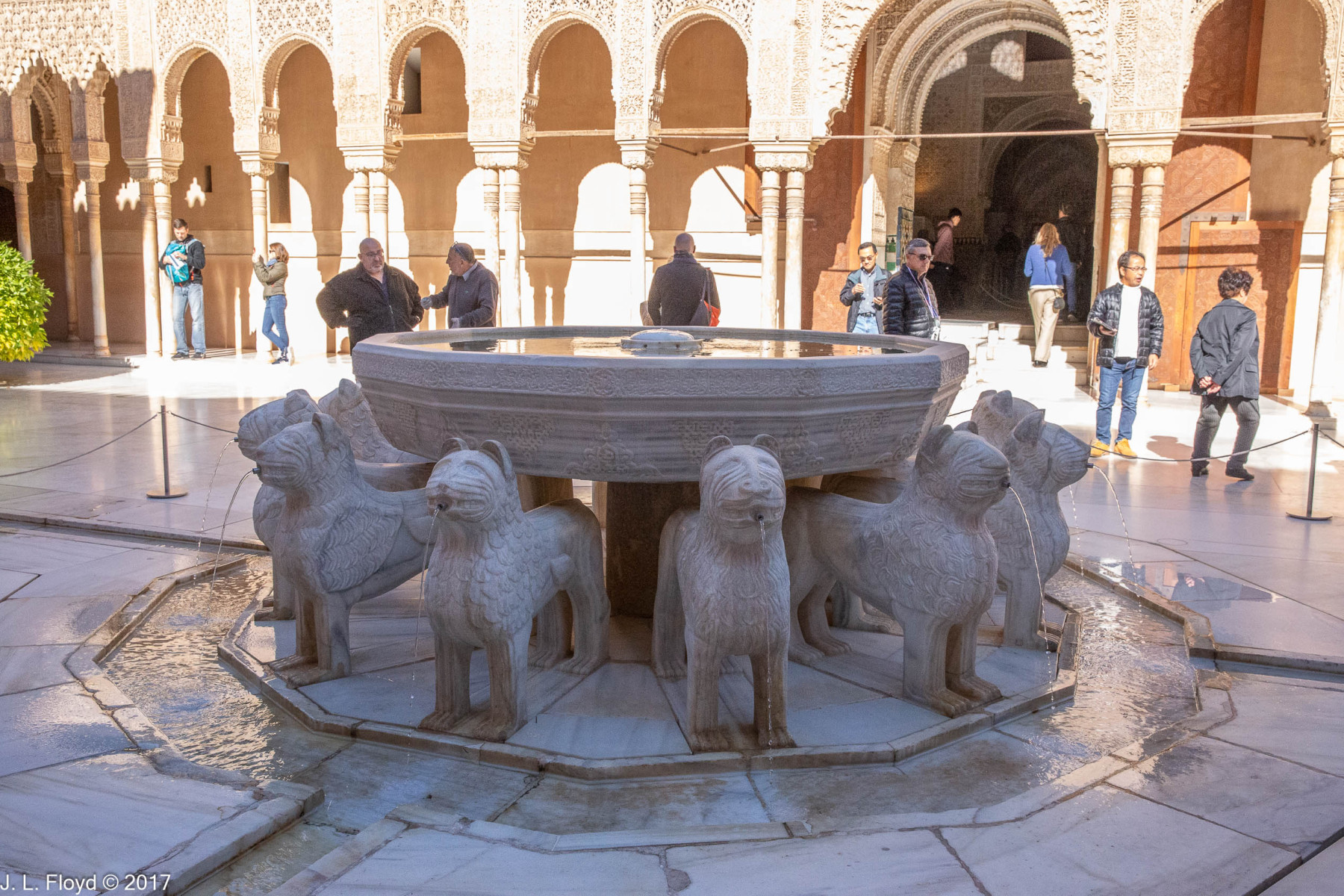
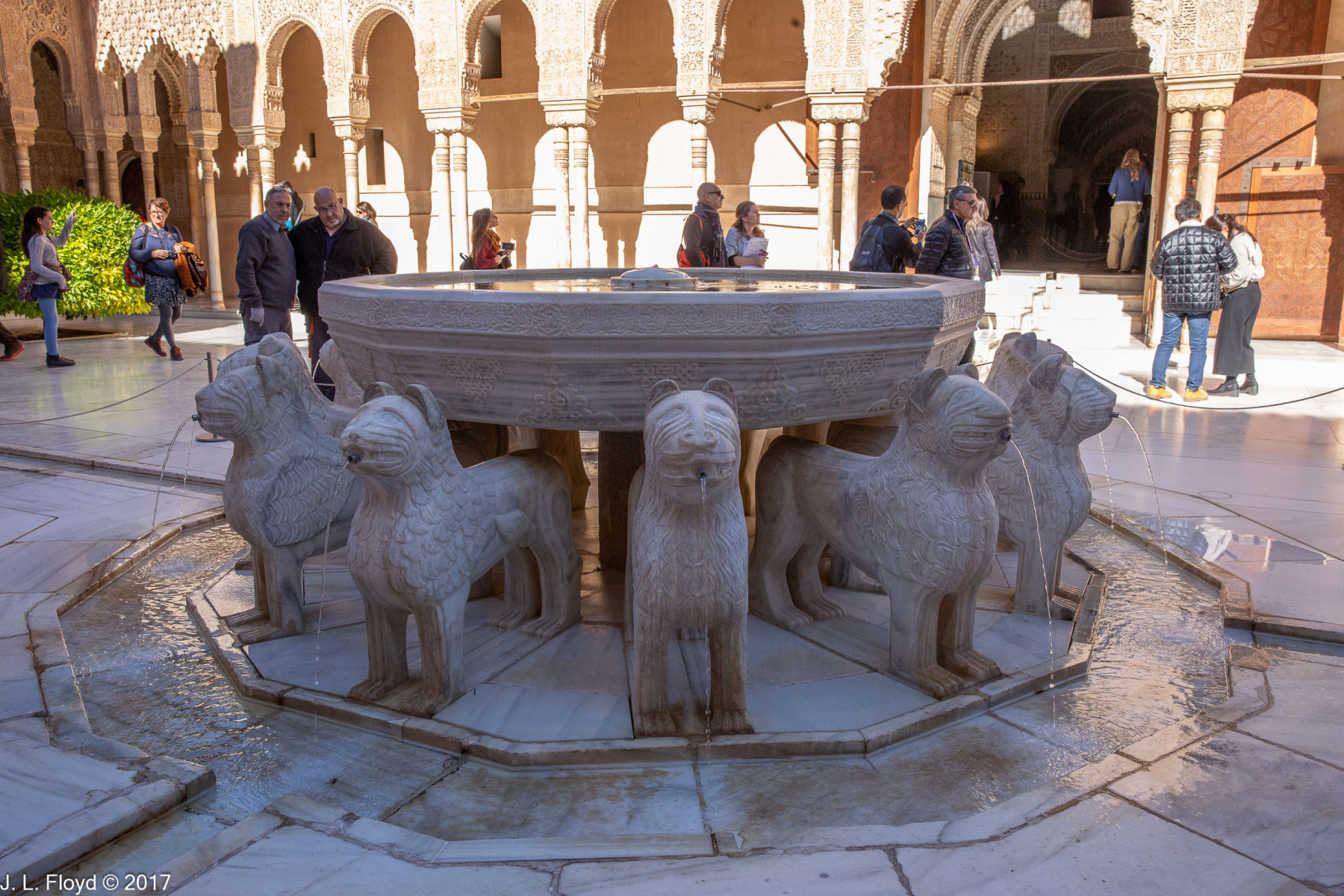
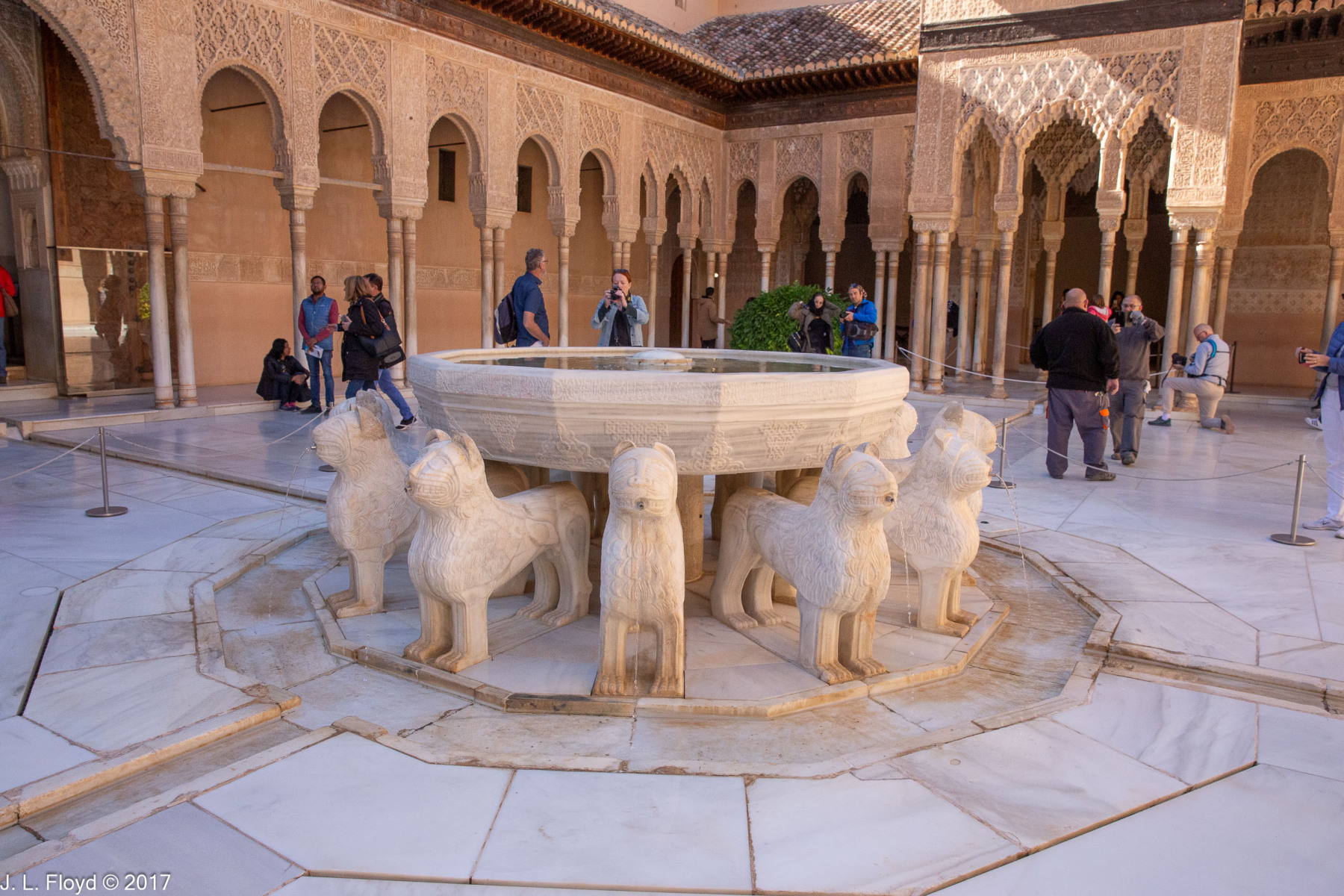
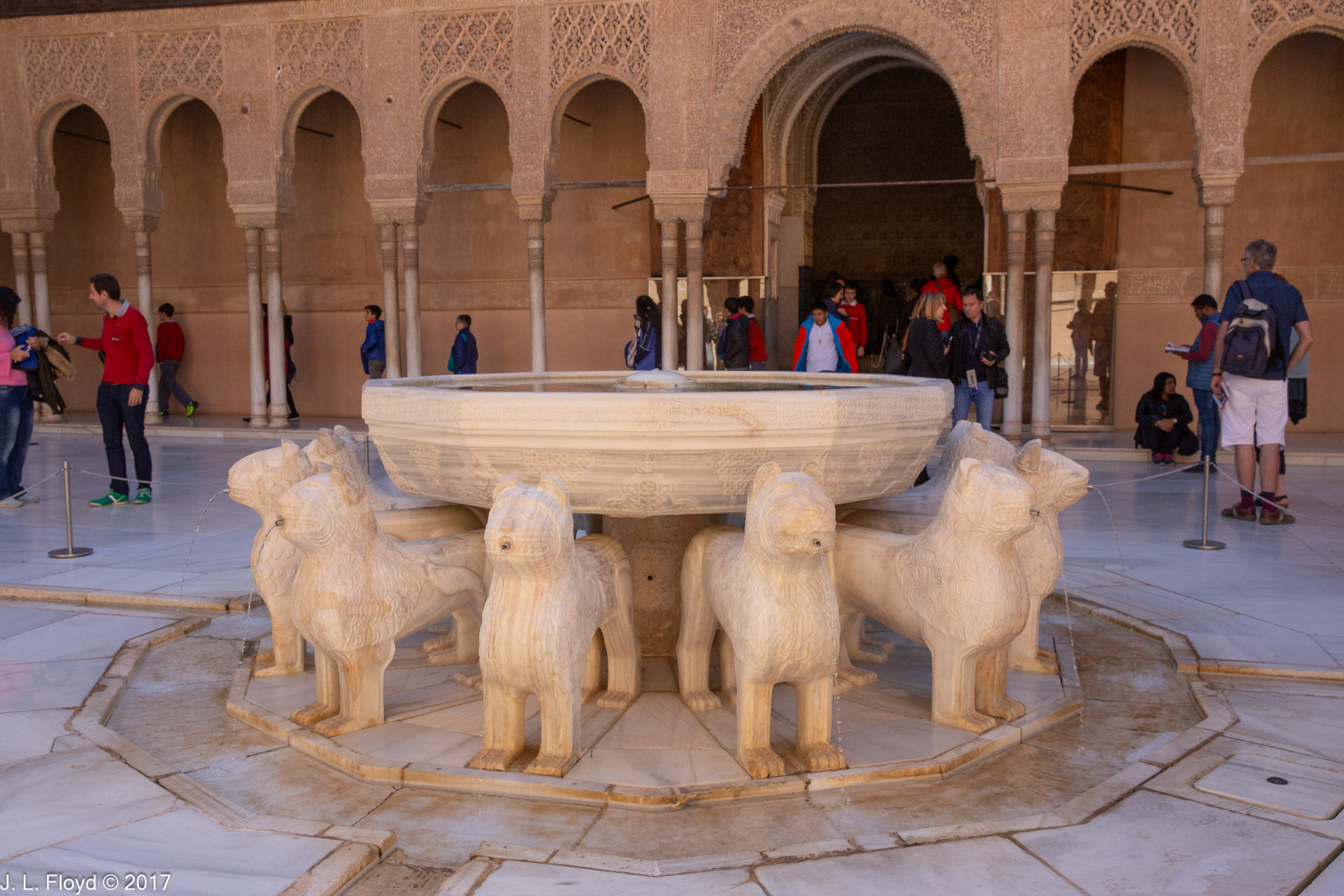
Like the Comares Palace, the Palace of the Lions is built around a central courtyard. Rather than a pool, however, the centerpiece is a fountain surrounded by twelve stone lions. Also, in contrast to the Court of the Myrtles, the Corte de los Leones – measuring 28.7 meters (94 feet) long by 15.6 meters (51 feet) wide – has its long axis oriented east-west rather than north-south.

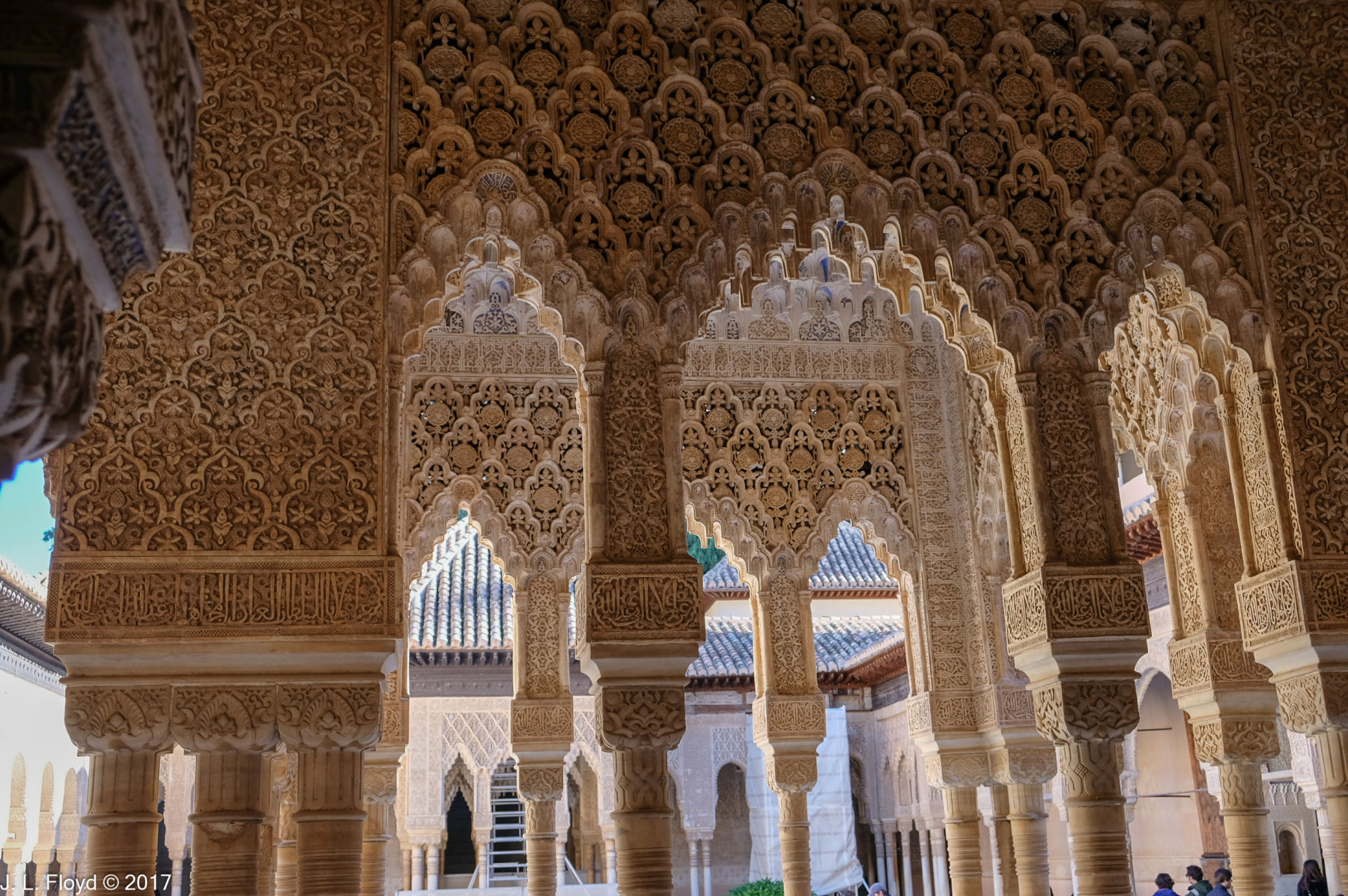
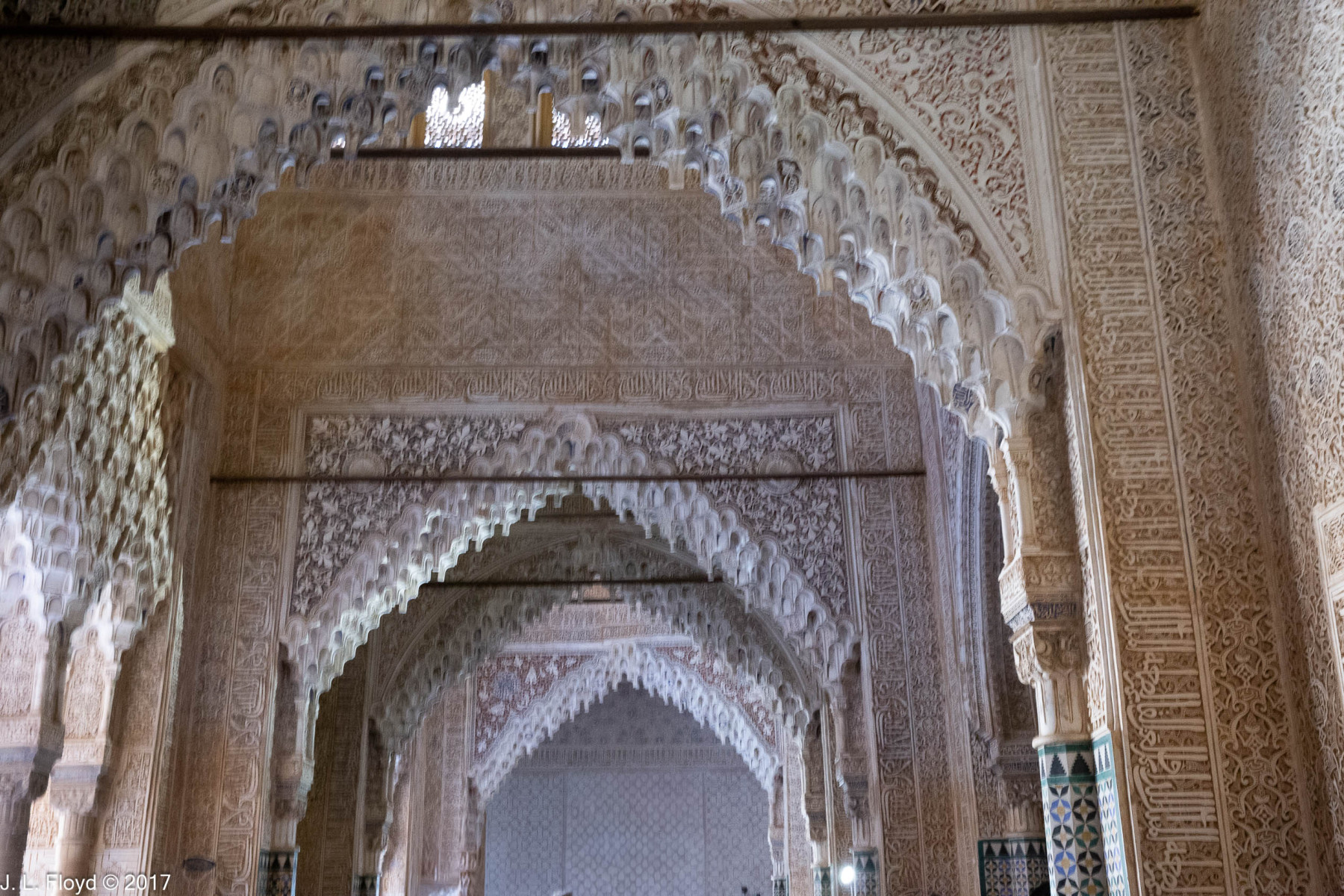
The Palace of the Lions was built during the reign of Muhammad V, between 1362 and 1390, when Nasrid architecture is considered to have reached its high-water mark. The archetypal feature of this period was the extensive use of muqarnas – stalactite-like honeycomb vaulting – or mocárabes, as they are known in Spanish – and it was precisely here, in the Palace of the Lions, that they attained their supreme expression.

The Court of the Lions is surrounded on all sides by a portico supported by arches and columns arranged in a pattern that alternates single columns with two pairs of double columns, with the purpose of highlighting various parts of the façade. Two pavilions, one on the east side of the courtyard and another on the west, extend outward from the portico, supported by slender columns in an arrangement similar to the portico. The arcades of both portico and pavilions are decorated with elaborately carved or molded stucco designs. The design on the capital of each column is unique to that column.

Behind the portico are the four main halls of the Palace of the Lions: the Sala de los Mocárabes (Hall of the Muqarnas) on the west, the Sala de los Abencerrajes (Hall of the Abencerrajes) on the south, the Sala de los Reyes (Hall of the Kings) on the north, and the Sala de Dos Hermanas (Hall of Two Sisters) on the north. It should be noted that most if not all of the names of the Nasrid palaces and their components were conjured up by the Spaniards after the 1492 takeover; the pre-Conquest Arabic names are mostly forgotten.

The central element of the palace, the Fountain of the Lions, consists of a large basin sitting on the backs of twelve stylized marble lions (each one unique, a little different from the others) streaming water into an encircling moat through spouts in their mouths. As with the pool in the Court of the Myrtles, the Fountain of the Lions displays the highly sophisticated Nasrid knowledge of hydraulic engineering. Water was maintained at a constant level in the basin at all times. The water spewed by the marble lions flows from the moat into four gutters, representing the four rivers of Paradise (Euphrates, Nile, Sihran and Jihran) in Islamic (and Christian) lore, which then flow to round basins with fountains in each of the four main halls. Apparently lacking pumps of any kind, not to mention electric power, the system relied entirely on gravity to maintain and regulate the water flow. To my mind this was a rather impressive achievement for its time.

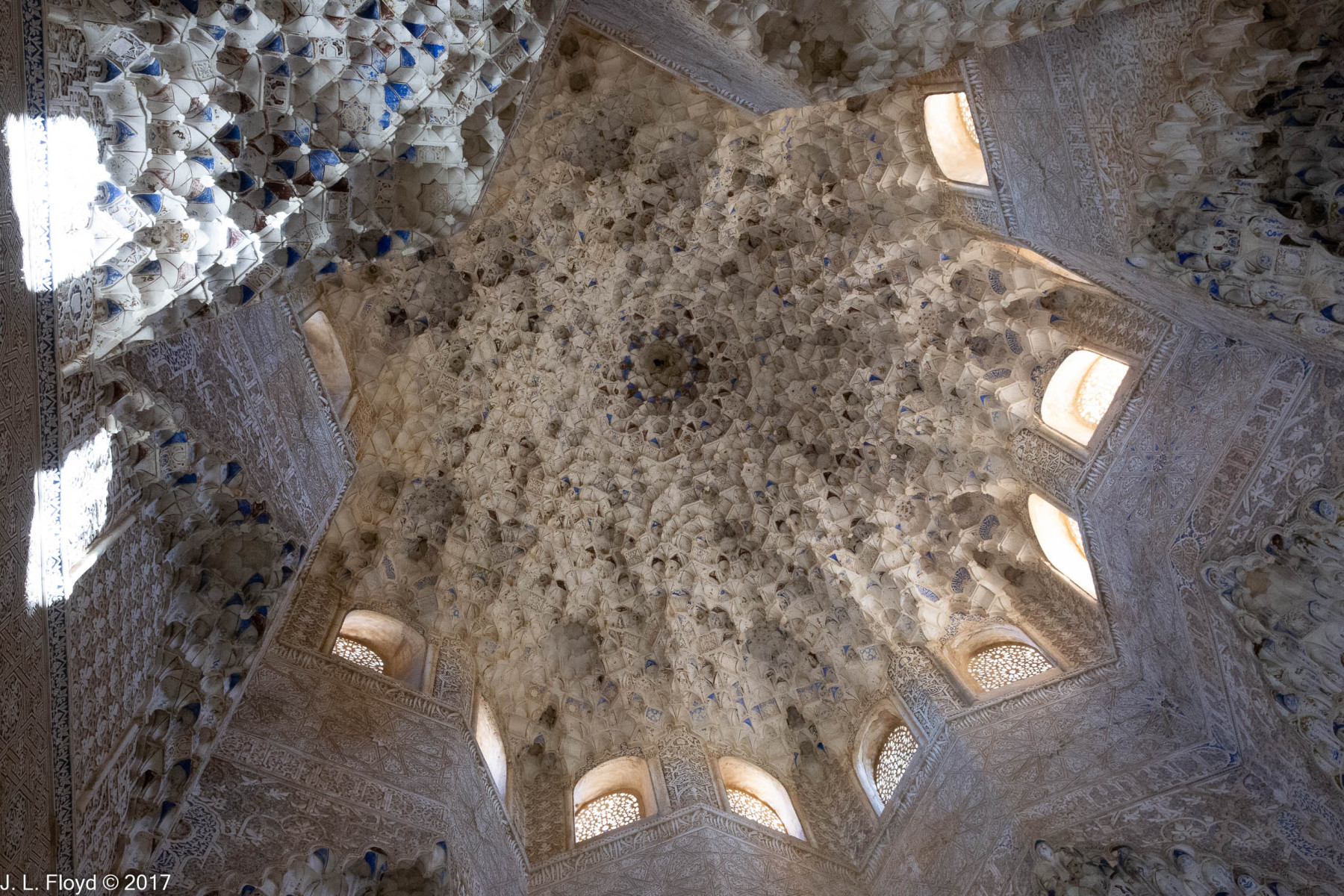
We explored each of the main halls of the Palace of the Lions in turn, starting with the Sala de los Mocárabes. However, we spent little time there, because in 1590 an explosion in a gunpowder magazine (why was that there?) destroyed it and it has never been reconstructed, except for part of the ceiling. We soon found ourselves in the Sala de los Abencerrajes, which was named after a powerful family of the Emirate of Granada. Known in Arabic as the Banu Sarraj, they played a prominent role in the politics of the kingdom, but according to legend they aroused the ire of the Emir and were all massacred in the hall that bears their name. As far as can be determined the legend has no basis in fact, and the name of the hall in Arabic translates to “the Western Dome.” It does indeed have a dome, with a cupola shaped like an eight-pointed star, so that it has 16 sides and the same number of windows, one on each side. The dome and the ceiling around it are lavishly decorated with complex muqarnas. Intricate stucco decoration covers the upper walls, and colorful zellij tiles skirt the lower walls. The total effect is astounding, a sybaritic feast for the eyes, as well as a preview of what we were to see in the other two halls of the Lion Palace, in their distinct variations.

Circling around the Corte de los Leones counterclockwise, we next visited the Sala de los Reyes, on the east side of the courtyard. This is a long and wide hall, running the entire length of the east side of the Corte, but it is divided into seven sub-halls – three large and square, four smaller and rectangular – by muqarnas arches. The small and large spaces alternate in their order, so that there are two smaller spaces between the three larger ones and one small unit on each end. Each unit, small or large, has its own muqarnas-vaulted ceiling. The three larger chambers have rounded vault ceilings made of wooden planks but covered with leather painted with scenes of court life. These represent a motif fairly uncommon in Muslim art, because of the traditional Islamic strictures against depicting human and animal figures. It is thought that they were most likely executed by Christian artists borrowed from the court of Mohammed V’s contemporary Pedro the Cruel of Castile – who, it should be remembered, built the Alcazar in Seville with the help of Muslim craftsmen from Granada. Perhaps there was some sort of cultural exchange going on there. One of the paintings depicts the Emir in council with some of his officials; it is this that gives rise to the name of the hall, which, to risk belaboring the point, is a Christian rather than a Nasrid appellation. Conditions in the hall prevented me from obtaining legible photos of these paintings, but there are examples available on the web from Wikipedia and other sources.

In Nasrid times, the Hall of the Kings was a place for celebrations and feasts, with the smaller units serving as bedchambers. After the 1492 conquest, it was used as a Christian chapel. Ferdinand and Isabella held their first celebratory Mass there after the surrender of the Alhambra.

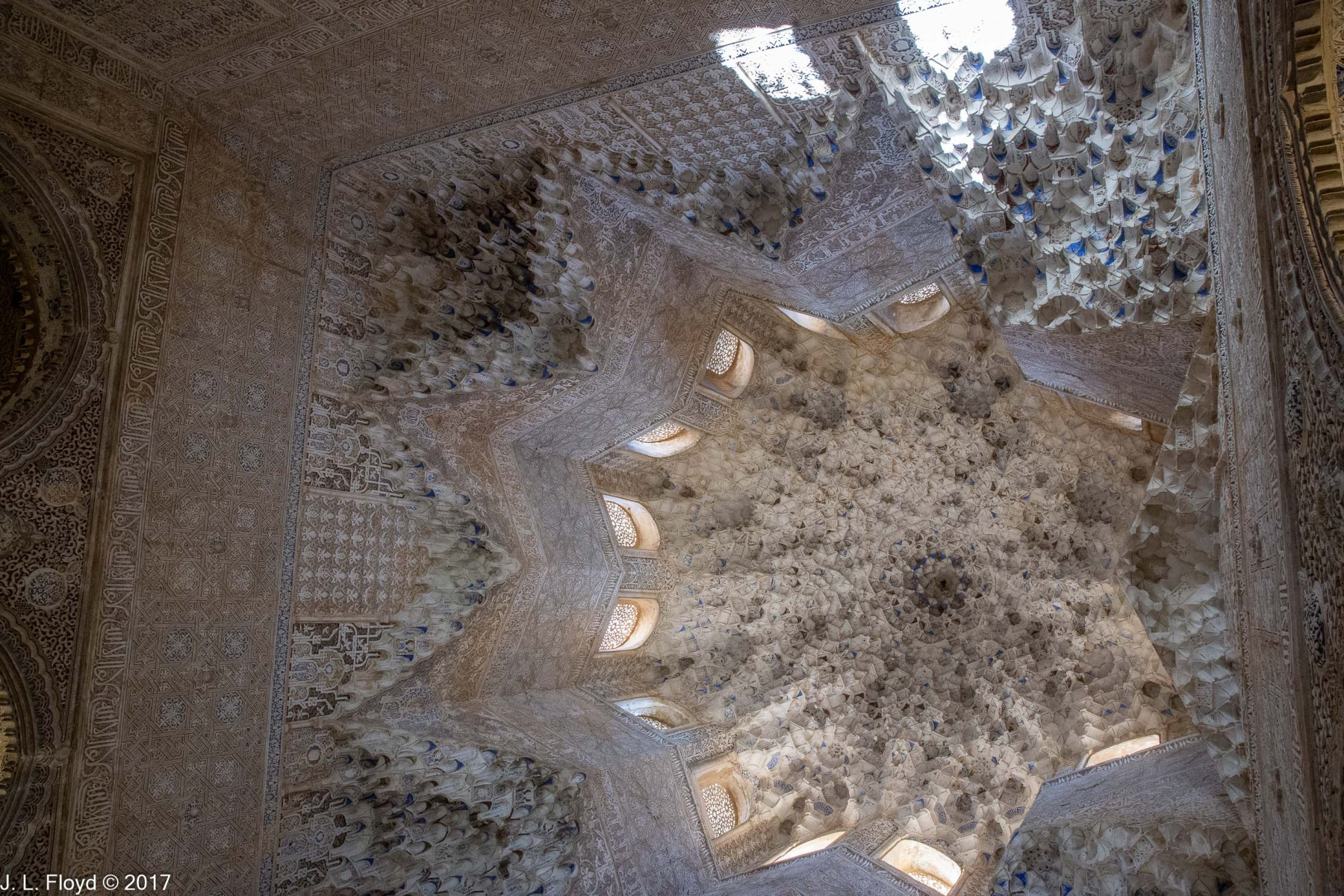
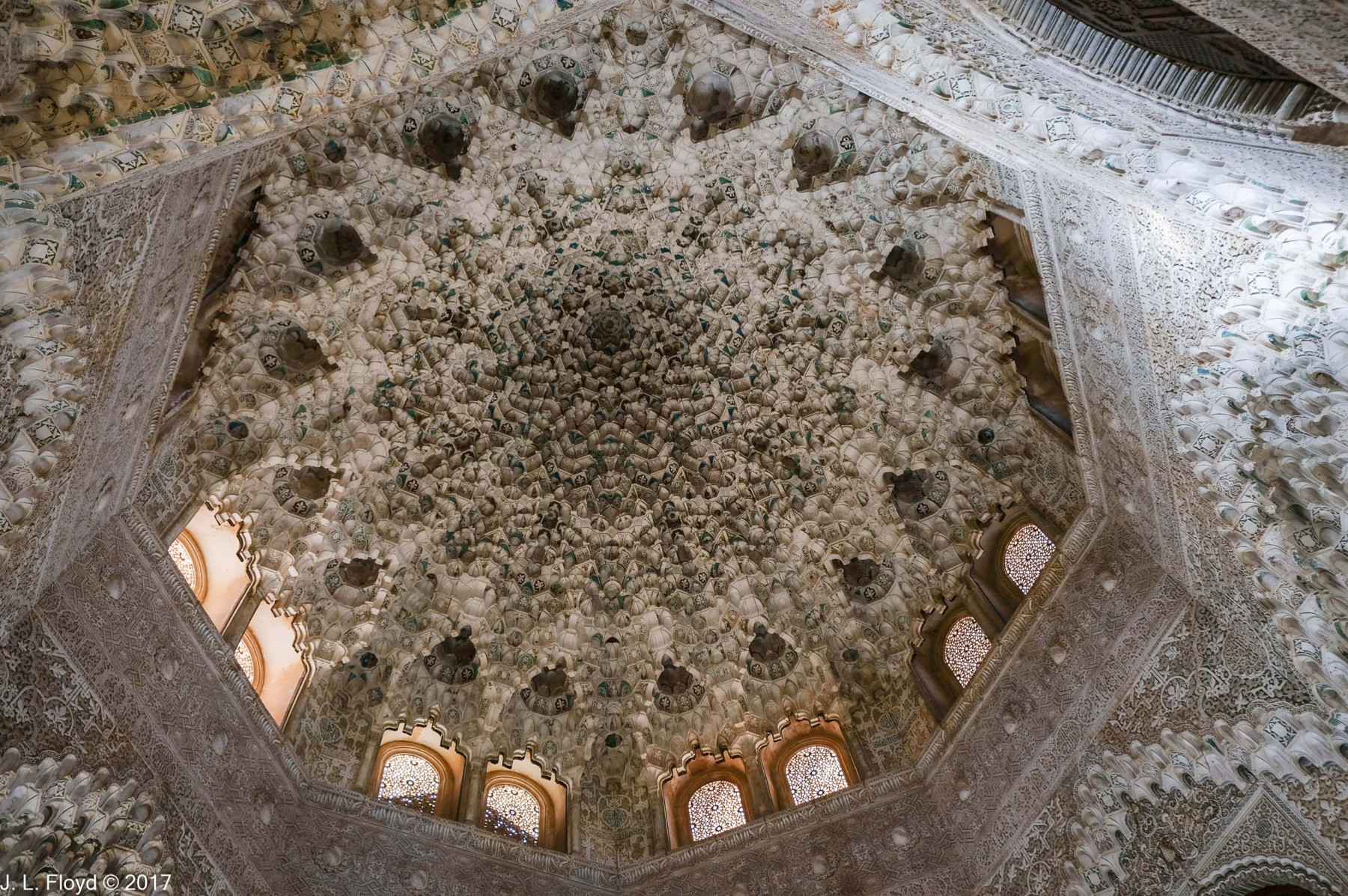
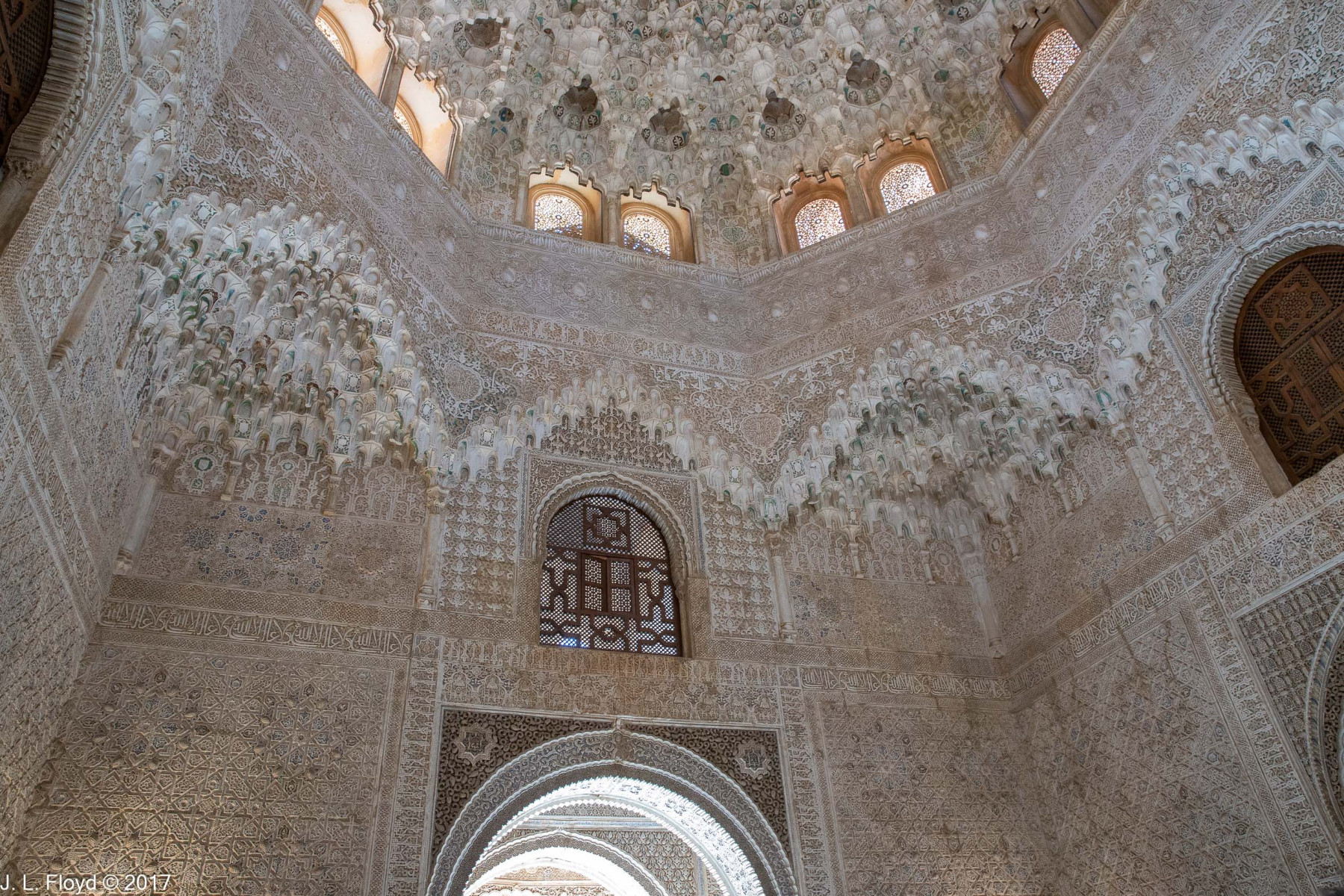
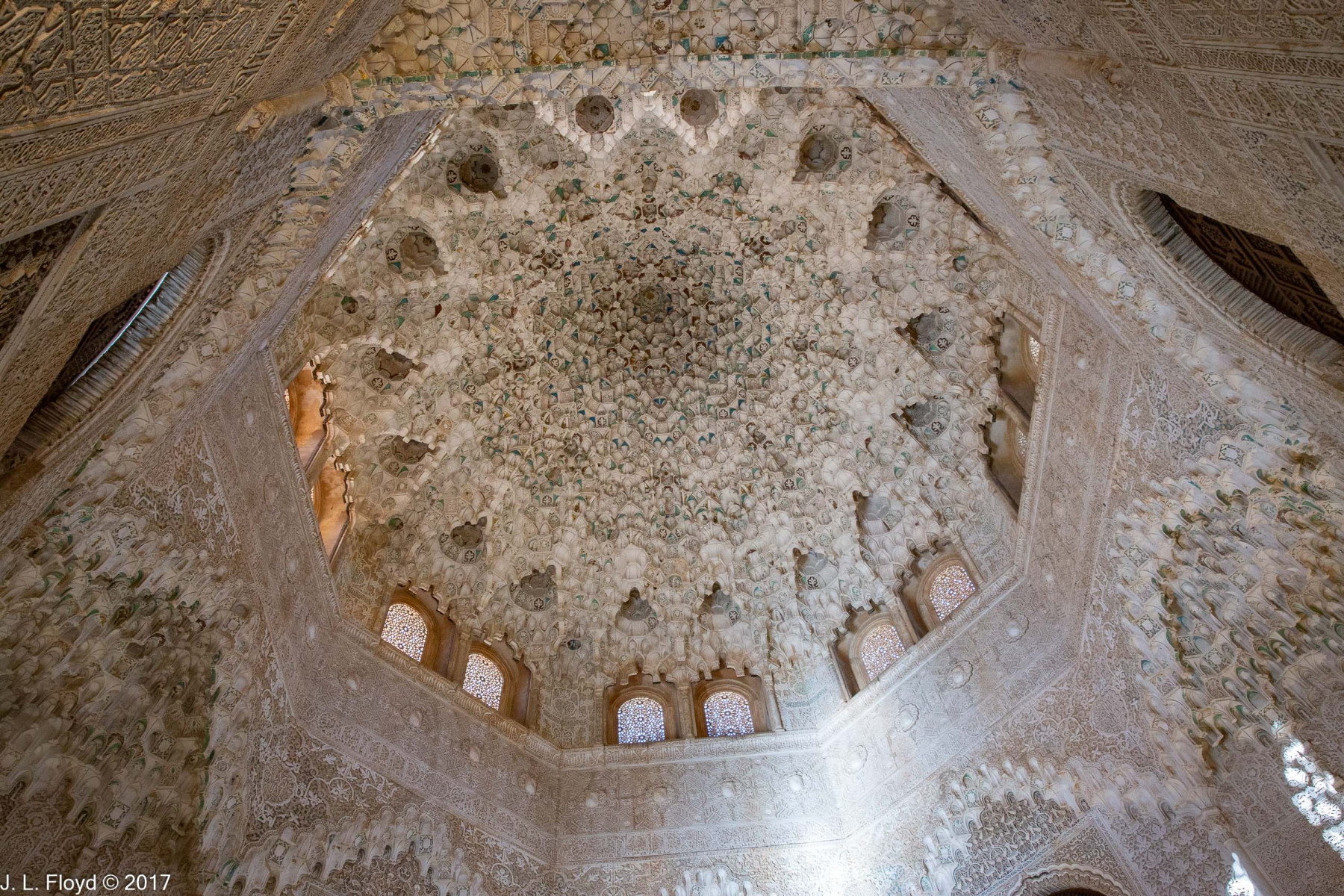
The Sala de Dos Hermanas, which was next on our itinerary, has traditionally been thought of as a private residential space for Mohammed V and his family, although some scholars think that it might have been used as a meeting place for the Royal Council. The sisters for whom it is named are not members of the royal family but rather two slabs of marble used to pave the floor. The Nasrid/Arabic name for it was al-Qubba al-Kubrā (“the Great Dome”), possibly likening the muqarnas dome over the hall to the vault of the heavens. And indeed that dome is reminiscent of a starry cosmos. The muqarnas vaulting, composed of over 500 prismatic pieces, seems to radiate outward from the top in concentric waves before flowing around 16 miniature domes at the periphery, where their spicules merge into a surrounding web of muqarnas. The ensemble is enclosed within a cupola 8 meters in diameter, with eight sides, with two windows to each side, their combined illumination causing the honeycomb structure of the muqarnas to sparkle with reflected light. The ceiling around the cupola opening is sculpted with muqarnas contrived to form the shape of an eight-pointed star, standing out from the background of additional honeycomb vaulting filling the spaces between the ceiling and the walls.

The upper walls, as in most of the other halls of the Nasrid palaces, are covered with intricately carved stucco. Encircling the room, approximately at eye level, is an inscription band with poetry comparing the hall’s dome to the Pleiades. On the lower walls, again in conformity with the usual practice, are elegant zellij tiles – but here they are the originals, not replacements from later periods as in some of the other halls.

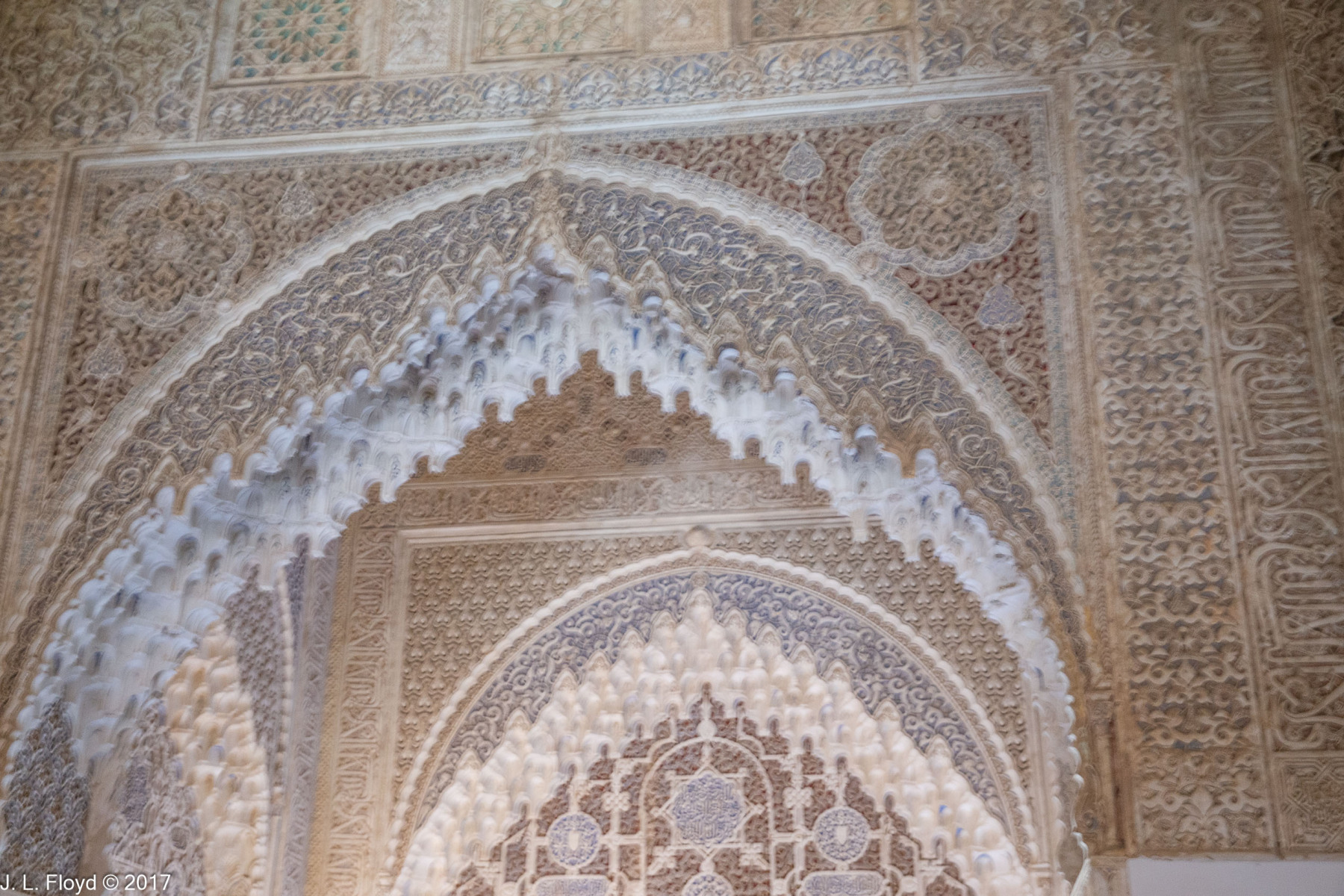
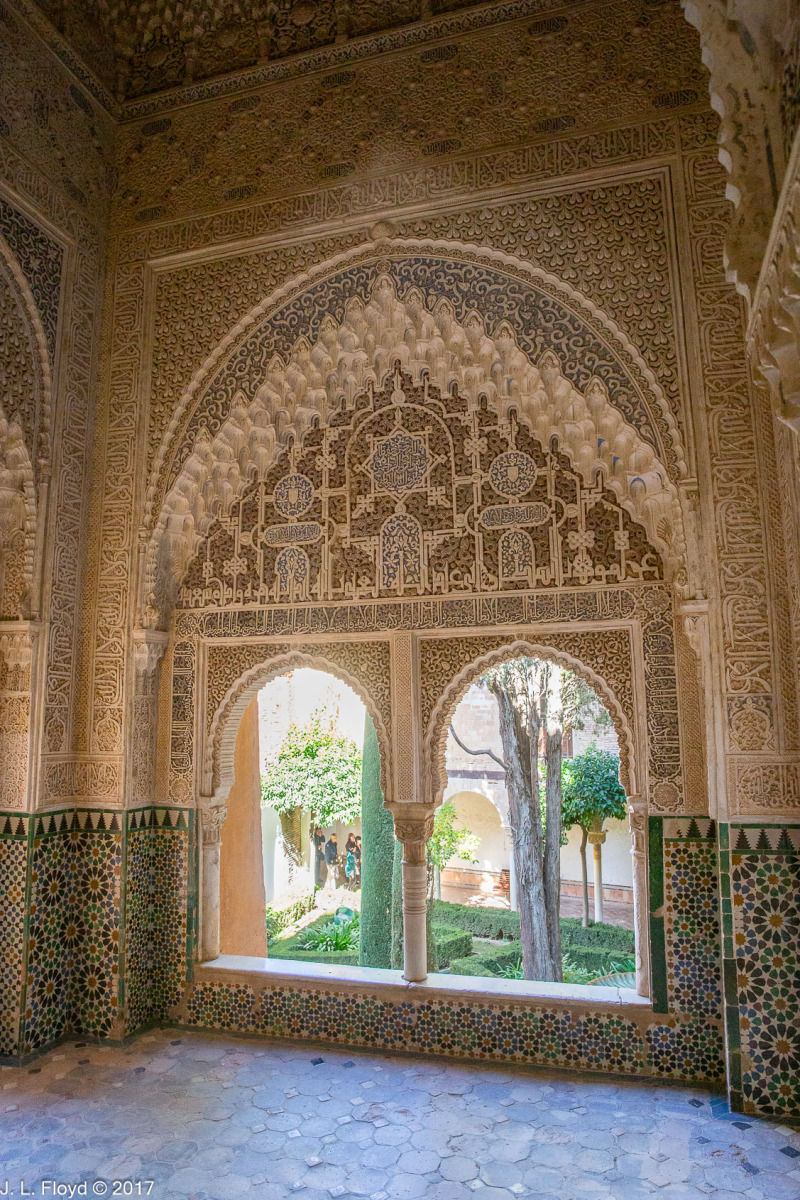
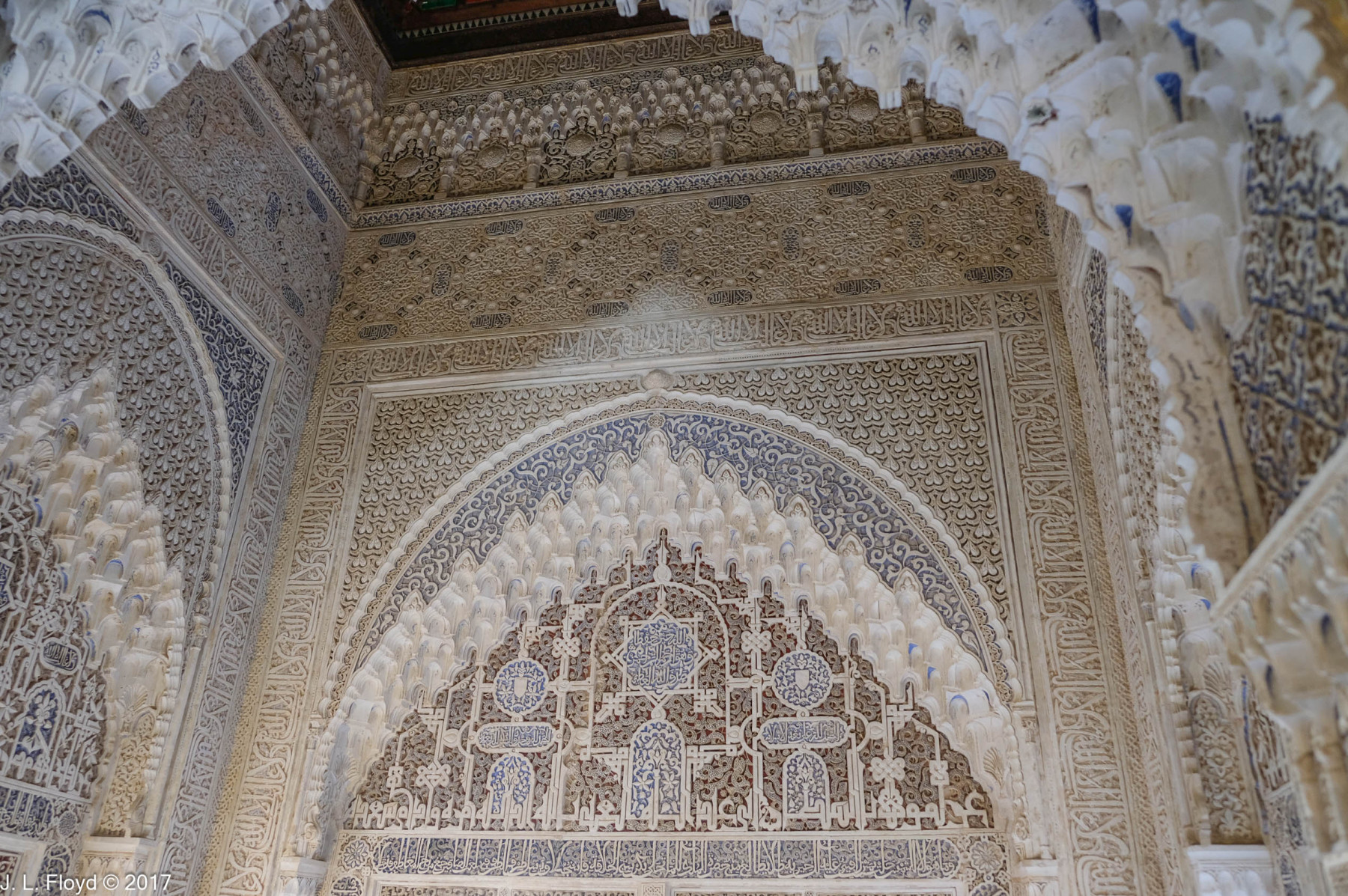
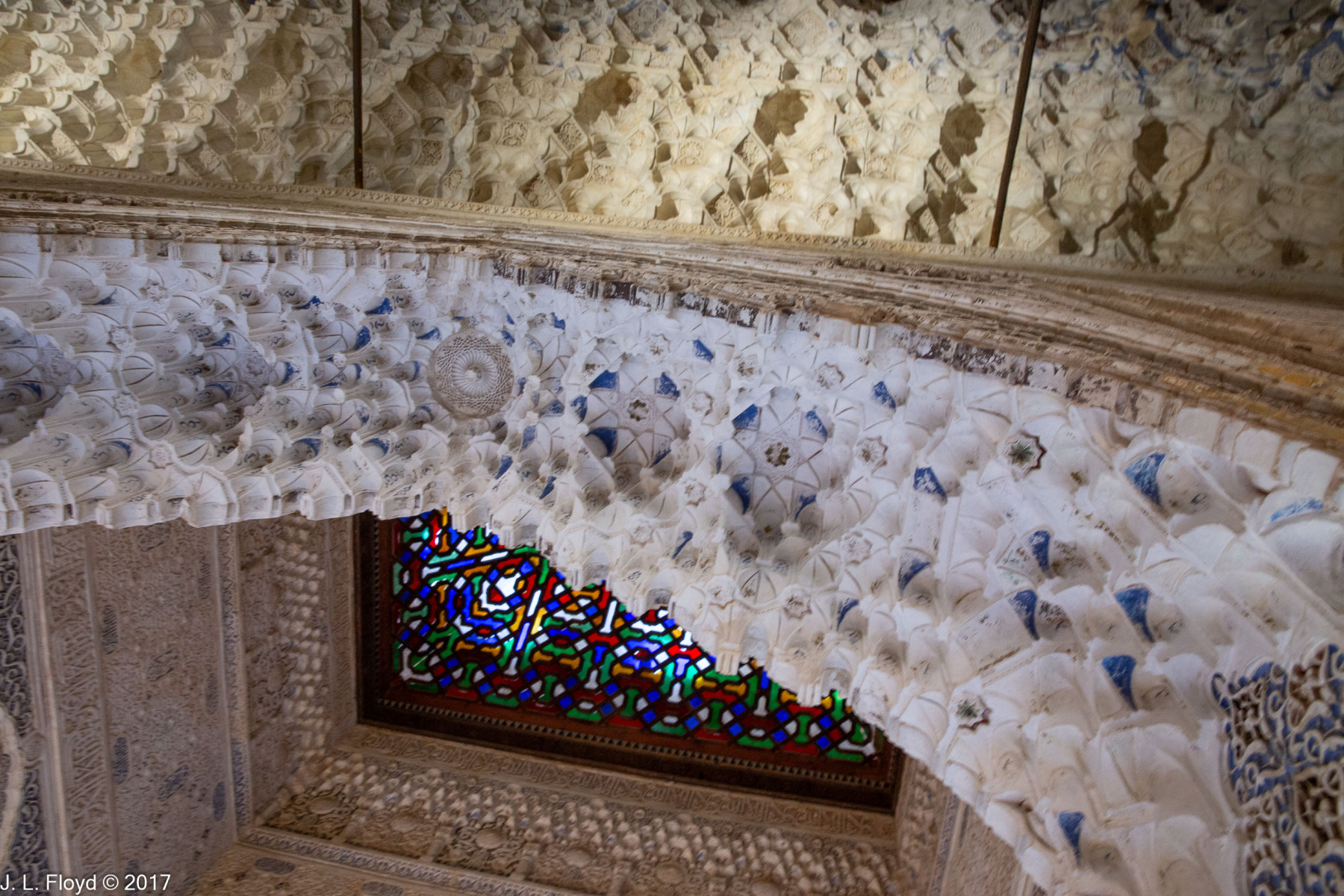
Adjoining the Sala de Dos Hermanas on the north is a smaller chamber, the Sala de los Ajimeces or “Hall of the Mullioned Windows” – a mullion being a vertical or horizontal bar, vertical in this case, that separates units of a window (I had to look that up). Its distinctive feature, other than the windows, is a vault ceiling composed of multiple consecutive muqarnas domes merging into one another. On its north side is a much smaller but more striking room, the Mirador de Lindaraja. In Spanish a mirador is a lookout or scenic viewpoint. “Lindaraja” is a corruption of the Arabic phrase Ayn Dar Aixa, “Eyes of the House of Aisha”, referring to a tradition that the room was the preferred hangout of Muhammad V’s favorite wife, Aisha. The Mirador de Lindaraja is a small square structure projecting outward from the Sala de los Ajimeces into the garden outside the palace. The windows on the three sides of the room are installed low enough so that the garden is visible to people sitting on the floor. Indeed the garden, known as the Patio de Lindaraja, is worth a look, and we were to explore it in person a bit later. The Mirador arguably boasts the most elegant carved stucco paneling in the Alhambra, not to mention the mosaic tilework on the lower walls, featuring poetic inscriptions in fine Arabic calligraphy. It is also remarkable for its ceiling, which is a wooden lattice framework embedded with pieces of stained glass – a type of skylight, in other words, also known as a lantern vault. It is the only one of its kind surviving in the Alhambra.

In my travels I have seen some amazing sights, including some of the most magnificent works of art produced by human hands; but in my judgment none of them surpass the Nasrid palaces of the Alhambra, and I consider it a great privilege and gift to have seen them in person.

At this point in our tour, we were not done with the palaces, but the remaining ones were dispersed amidst the gardens of the Alhambra, which will be the focus of my next post.
Categories
Danube River Cruise, June 2023

Prague – Charles Bridge and Old Town, June 25, 2023

At the end of our Sunday morning tour of Mala Strana we arrived at the Charles Bridge, which spans the Vltava River from Mala Strana to the Old Town of Prague.

While writing this post, I learned that my lifelong friend Charles (Chuck) Mattox had passed away in Bend, Oregon. I had known Chuck for over 60 years, since we met in 1960 while we were both at Long Beach State College (now California State University at Long Beach). After graduating from college and serving in the army, he had moved to Oregon for graduate study at the University of Oregon in Eugene, where he met Elouise Foiles; they were married in 1965, and I served as best man at their wedding. Since then we had remained in touch. I visited them in Bend whenever I could, and after Sandie and I were married in 2002, we had taken several fabulous trips along with Chuck and Elouise to view solar eclipses. A few years before, Chuck and Elouise had taken a Danube cruise very much like ours, and Chuck had stood on the Charles Bridge, just as I did on the morning of June 25, 2023. This post is dedicated to his memory.

In my last post I mentioned the Judith Bridge, which was built in 1172 and which was protected by a chain associated with the Church of Our Lady under the Chain; in 1342 that bridge was wrecked by a flood, and construction on a new bridge began in 1357, in the reign of Charles IV. The new bridge was called the Stone Bridge at first, but since 1870 it has been known as the Charles Bridge. Instead of a chain, the bridge was protected by towers, two on the Mala Strana side and one on the Old Town side. It was completed in 1402.

The Charles Bridge is 516 meters (1,693 feet) long and nearly 10 metres (33 feet) wide. Thirty sculptures line its sides, replicas of originals mostly erected from the late 17th through the 19th centuries. I tried to photograph them all; I did not succeed and got lost in the process, but I did shoot most of them. I won’t try the patience of the reader by presenting all of those I did shoot on this page, but I will show a few of the best.

It was a sunny (and hot) Sunday in June, and as one might expect, the bridge was packed with tourists like us. It was hard to get an unobstructed picture of anything, but I did my best.

In fact, I became so absorbed in taking pictures that by the time I came to the Old Town end of the bridge, I had lost touch with my tour group. I looked around for a few minutes and when I didn’t see any of them, I thought they must have left me behind. I didn’t know which way they had gone, so I just went straight ahead on Karlova (Charles) Street, which comes off the bridge. After a few blocks I hadn’t found them, so I turned back and returned to the bridge tower. It turned out that they were all there, looking for me.

So again I set off, this time together with the tour group, down Karlova Street through the Old Town of Prague. First we had to pass through Crusader Square (Křižovnické náměstí), so named because the monastery of the crusading order of the Knightly Order of the Crusaders with the Red Star, along with its associated Baroque church of St. Francis of Assisi, borders the north side of the square. Another Baroque church, that of St. Salvator, stands on the east side of the square, and on the south side is the historic and imposing Colloredo-Mansfeld Palace, formerly a residence for aristocratic families. In the middle of the square is a neo-Gothic monument to King and Emperor Charles IV, unveiled in 1851.

Karlova Street proved to be a touristy shopping district, not as high-end and snooty as Paris Street, which we had seen the day before, but more lively and affordable.

At 4 Karlova Street we passed a house where the astronomer Johannes Kepler lived from 1607 to 1612, while he was Court Astronomer to Emperor Rudolf II.

Karlova Street is full of inviting boutiques, cafes, pubs and other establishments, too numerous to catalogue. Again I could not help but marvel at how American-oriented (or Anglo-oriented, same difference) Prague has become. Many of the names and signs on the shops were in English: there was the Mad Rabbit ice-creamery, the Golden Crown jeweler, a Local Artists gallery, the Duck Boutique and my favorite, the Fat Cat pub, which had a sign (in English) advertising “Husband Day Care”.

Karlova Street twists and winds tortuously for several blocks through the heart of Old Town Prague before ending at Malé náměstí, “Little Square,” which is an adjunct to Old Town Square to its east.

Thus it was that at the end of our walking tour of Mala Strana, our Gate1 group ended up in Old Town Square, the same place where we had finished the previous day’s tour. So I had another chance to shoot some scenes in this amazing place, of which I couldn’t get enough, and I experienced a somewhat different perspective of it than on the first day. Most notably, on Sunday there was a major demonstration against the Chinese Communist Party, with placards reading “Chinese Communism is evil!”, “NO to Chinese gulags!” and “400 million Chinese quit the Communist Party!” I doubt whether the demonstrators caused much dismay for Xi Jin-ping, but I was impressed by their fervor.

Our Gate1 tour group disbanded in Old Town Square, and we were free to go our separate ways; I took the option of walking back to the Cosmopolitan Hotel to rest up and get ready for the final adventure of our visit to Prague, which was in store for Sunday afternoon.

Categories
Danube River Cruise, June 2023

A Sunday Afternoon Motor Tour of Prague, June 25, 2023

Sandie felt poorly the entire time we were in Prague and was mostly confined to our hotel room, unable to manage the excursions, which involved a lot of walking. So for our final afternoon, I arranged for us to be taken on a two-hour motor tour. It was a bit pricey at 250 euros, but it was the only way Sandie would be able to see a bit of Prague, and I didn’t want her to miss out completely on one of the grandest and most memorable cities I’ve ever seen.

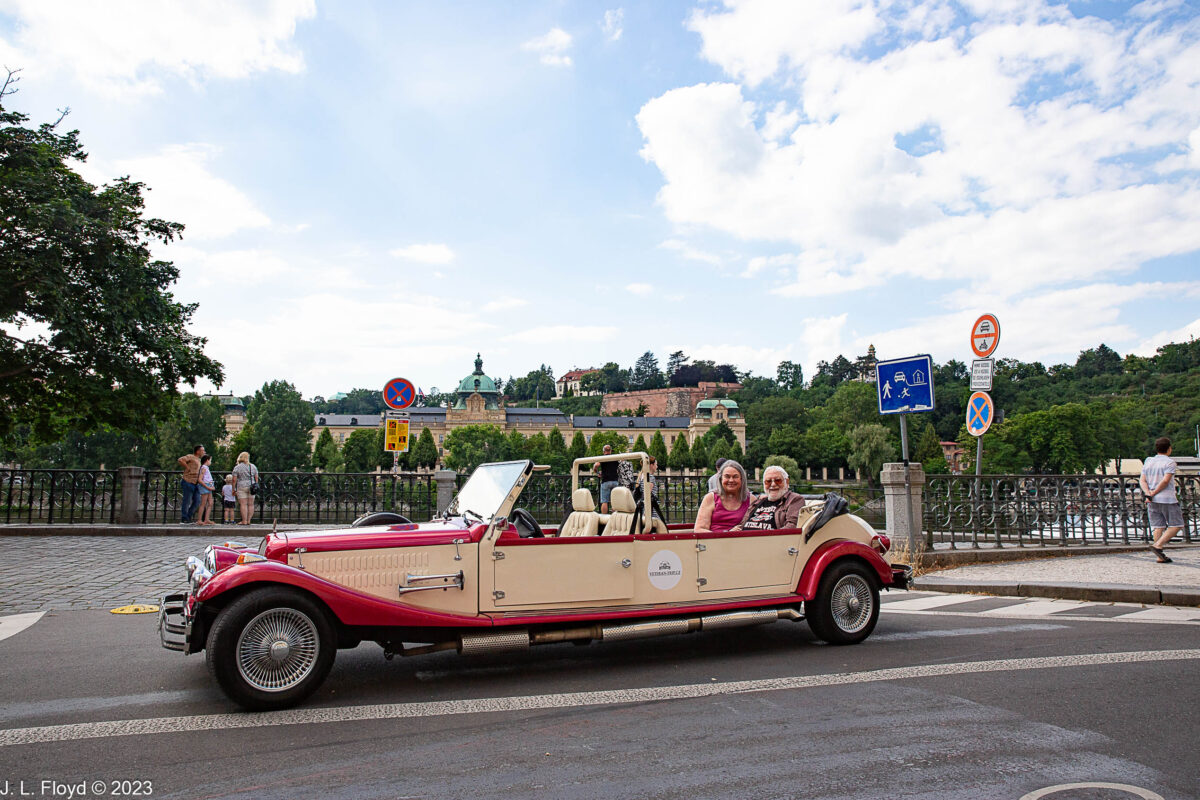
The tour outfit I booked with uses replicars for their excursions. These are replicas of vintage Mercedes-Benz, Alfa-Romeo and other classic automobiles that look like exact duplicates of the originals, but are equipped with modern engines and drive trains. Our vehicle turned out to be a copy of a 1947 Alfa-Romeo. It was completely open to the sky and the weather was sunny and warm. The driver (sadly, I’ve forgotten his name) was a jovial twenty-something fellow who spoke fluent idiomatic English (it seems that nearly everyone speaks English in Prague) and knew the city well. He appeared to have a standard itinerary but was also quite flexible and willing to entertain special requests about places to visit. He took us to some attractions that I had already seen, but Sandie hadn’t, and I wanted her to see them; but he also took us to places I hadn’t yet been on the Gate1 walking tours, which made for a rich experience for us both.

Our driver picked us up at our hotel and drove up Na Poříčí Street to Republic Square. I had seen plenty of Republic Square already, since it was near our hotel, but I was able to appreciate its sights better with the help of the driver’s comments, and we were able to add some new photos to those I had taken already.

Republic Square is the site of a number of significant attractions. The most prominent is the Powder Tower (Prašná brána), which was actually one of the original city gates of the Old Town. Its construction began in 1475, in the reign of Vladislav II (r. 1471-1516). At that time it was called simply the New Tower. In the 17th century it was used to store gunpowder, hence the current name. Coronation processions for Czech kings traditionally began at the Powder Tower and ended at Prague Castle.

Also on Republic Square is the Palladium Department Store, actually a huge indoor shopping mall, which I had explored a bit the day before. Prior to the 1990s it had been the Josef Army Barracks building. It was repurposed, rebuilt and opened as a shopping mall in 2007, and now contains 170 shops and 30 restaurants, as well as a considerable amount of office space.

Unfortunately, I unaccountably failed to notice that the Kotva Department Store, one of the examples of Brutalist architecture modeled in Holubička Park, which I had seen in Malá Strana earlier that day, is located across the street from the Palladium, so I don’t have a photo of the actual building, only the model in Holubička Park. I did get a photo of the headquarters of the Czech National Bank (Česká národní banka, abbreviated ČNB), also found on Republic Square.

Next to the Powder Tower, just to its north, stands Municipal House (Obecní dům), a splendid structure built in the Art Nouveau style in the early 20th century. It occupies the site of a vanished royal palace, where the Kings of Bohemia lived until 1485, when they moved to the Prague Castle. It was the site of the Czech Declaration of Independence in 1918. The building houses Smetana Hall, a major concert venue, as well as a ballroom, civic facilities, a café and a French restaurant. It is also adorned both inside and outside with outstanding artworks, including a mosaic called Homage to Prague over the entrance and allegorical sculpture groups on either side. Unfortunately our photos don’t do justice to these, so I’ll refer the reader to the pictures on the Municipal House website.

Prague is a veritable treasure-house of Art Nouveau, which was a great pleasure for me since it’s one of my favorite styles. From Republic Square we drove to Wenceslaus Square, and on the way we passed the Prague Main Railway Station, first built in 1871 in the Neo-Renaissance style bearing the name of Emperor Franz Josef. By the end of the 19th century it was sorely in need of expansion, so it was rebuilt in 1901-1909 in Art Nouveau style according to a design by architect Josef Fanta, and extensively decorated with statues and other works featuring Art Nouveau motifs.

Wenceslaus Square (Václavské náměstí) is named after Václav I (907-935), the patron saint of Bohemia and the subject of the Christmas Carol “Good King Wenceslaus.” He was Duke of Bohemia (which did not officially become a kingdom until 1198) from 921 to 935, and was later canonized for his good works and his martyrdom at the hands of his brother Boleslav in 935. I don’t know how the Czech name Václav became Latinized to Wenceslaus, which sounds ridiculous to me, but the square was established in 1348, during the reign of Charles IV, as a market for trading horses, so its original name was the Horse Market. It was renamed St. Wenceslaus Square in 1848. It is a very large square, 750 meters (2460 feet) long by up to 63 meters (207 feet) wide, and has been the scene of a number of key events in Czech history, most notably demonstrations against the Soviet invasion of 1968 and the inception of the Velvet Revolution of 1989.

Near Wenceslaus Square, though not actually on it, is the Prague State Opera House, originally opened in 1888 as the New German Theater, created in response to a desire for the German community in Prague for a theater of its own. Since 1992 it has been part of the National Theater of the Czech Republic, in association with the other main Prague opera house, the National Theater (Národní divadlo) located on the east bank of the Vltava River. With its magnificent auditorium and elaborate neo-rococo décor, it is considered one of the great opera houses of the world.

At the east end of Wenceslaus Square is the main building of the Czech National Museum. Established in 1818, the Museum was initially located in the palace of its founder, Count Kaspar von Sternberg, but was moved to its present location in 1891, when the building was completed. At first the focus of the museum was on natural sciences, since its founder was a botanist, mineralogist and phytopaleontologist (phytopaleontology is the branch of paleontology concerned with ancient plants). Later, however, in the 1830s and 1840s, the museum began to acquire historical and cultural objects, a reflection of the Romantic movement, which emphasized the importance of historical influences; and it became instrumental in the 19th-century revival of Czech language and culture and the ensuing growth of Czech nationalism.

The main building on Wenceslaus Square was built between 1885 and 1891 by the Czech neo-renaissance architect Josef Schulz. It was damaged by a bomb in World War II, but the collections had been moved to secure locations, so they were not harmed. However, in 1968 when the Soviet troops fired on the demonstrators in Wenceslaus Square, the museum façade was damaged by machine-gun bullets. Although repairs were made, it is said that the marks made by the bullets can still be seen, although I didn’t get close enough to notice any myself.

An equestrian statue of St. Wenceslaus created in 1912 by Josef Václav Myslbek stands in the square in front of the museum’s main building.

From Wenceslaus Square our driver took us to Charles Square, where the New Town Hall (Novoměstská radnice) is located. The oldest part of the building, the eastern wing, was built between 1377 and 1398 in Gothic style. A south wing was added after 1411. The salient feature of the hall, the tower, was built later, between 1452 and 1456. Although it is newer than the Old Town Hall, the New Town Hall was the scene of the First Prague Defenestration in 1419, which initiated the Hussite Wars. In the 16th century, modifications were made in the Renaissance style, and the western and northern wings were added. The New Town Hall served as an administrative center until 1784, when the reforms of Emperor Josef II concentrated all municipal administrative functions in the Old Town Hall. Afterward it housed the main criminal court and a prison.

Charles Square, as one might guess, was founded by Emperor Charles IV, who intended it to be the main square of the New Town of Prague. It was the largest town square of medieval Europe and is still one of the largest city squares in the world. But it was originally called the Cattle Market and was only named after its founder in 1848. The central part of Charles Square has been turned into a park, similar to Central Park in New York.

Not far from Charles Square we drove by the Quadrio shopping mall, where we saw the Head of Franz Kafka. This is a bizarre sculpture by David Cerny, 10.6 meters (35 feet) tall, depicting the head of…someone – I can’t say that I would recognize it as Franz Kafka. Anyway, the head is composed of 42 stainless steel panels which are mechanized and rotate individually, causing the head to deform and reform itself. It’s a controversial but intriguing piece and helps to maintain Prague’s reputation as a center of avant-garde art.

Our next stop was no less contentious — the Dancing House (Tančící dům) on the Rašínovo Embankment near Jiráskovo Bridge. Built on the site of an apartment house destroyed by American bombing in 1945, it was financed by a Dutch insurance company, which bought the land in 1992 and hired the Czech-Croatian architect Vlado Milunić and the Canadian-American architect Frank Gehry to design the building. The architects were given carte blanche, and the result was a structure consisting of two towers, one of glass, the other of concrete. The glass tower narrows in the middle and is supported by curved pillars; the concrete tower is straight, but features wavy moldings and out-of-alignment windows. The towers have been nicknamed Ginger and Fred, after the American dancers Ginger Rogers and Fred Astaire – Ginger represented by the glass tower and Fred by the concrete tower. The Czech-British architect Eva Jiřičná designed most of the interior of the building, which has has nine floors, with two underground. The building contains a hotel, an art gallery and a restaurant, named “Ginger and Fred,” of course. Although the Dancing House has won several awards, including a Time Magazine design prize in 1997, it has been heavily criticized as being inappropriate and outlandish in a city where most of the architecture is Gothic, Baroque, or Art Nouveau.

Next we crossed Jiráskovo Bridge and headed up to Prague Castle for a brief stop near the Powder Bridge entrance, where our tour bus had brought us the day before. The castle grounds are closed to motor traffic, so Sandie wasn’t able to see all the sights I had seen that morning, but at least she was able to get some idea of the scale and grandeur of the place.

From the Castle we continued on to the top of Petřín Hill, arriving at the colossal Great Strahov Stadium, which claims to be the world’s largest. It was not, as one might expect, a product of the Communist era but was built before World War II with the special purpose of showcasing displays of synchronized swimming. It has a capacity of 250,000, but is no longer used for competitive sports events. Instead it serves as a training ground by the Sparta Prague professional football team, and as a venue for rock concerts.

On the way up to the stadium I spotted and photographed an apparently very decrepit house on the hillside which was plastered with graffiti and looked abandoned. It appeared to have a “Hotel” sign but I’m not sure whether this was actually associated with the house or on another building above it on the hill. I haven’t able to find out any information about it, so I’ve chosen to call it the Strahov Haunted House.

We stopped for a while at Strahov Stadium to take a break, shoot some pictures and stretch our legs. The stadium is poorly maintained and rather decrepit, but the views of Prague from the hilltop are superb. Also it turned out that there is a motor vehicle tunnel running under the stadium, called the Strahov Tunnel, for which ventilation is provided by two immense towers standing next to the stadium. The control room for the tunnel and its towers is also located on the hill nearby. In fact, the hills of Prague appear to be honeycombed with vehicular tunnels and one wonders how they manage to keep the city from caving in on itself.

As we headed back down the hill to our next stop, we spotted a large tractor by the side of the road, upended with its front wheels sticking up in the air, and painted a flamboyant shade of pink. It turned out to be another David Cerny piece, the Monument to Visací Zámek. Visací zámek means padlock in Czech, and indeed one of the front wheels had been fashioned into the shape of a padlock. Visací zámek is the name of a Czech punk rock band founded in 1982, before the fall of Communism; it was highly influential in the opposition movement that led to the fall of the Husak regime in 1989. It has remained active in the years since then, and the monument was erected in 2022 to commemorate its 40th anniversary.

Returning through the Hradčany (Castle) district, we stopped at Loreta Square, where the Loreta Monastery pilgrimage site is located. The monastery was founded in 1626, but the present Baroque building with its imposing clock tower, designed by the famous father-son team of Christoph and Kilian Ignaz Dientzenhofer, dates from the early 18th century. The tower has a famous chime which consists of 30 bells and has been operating since 1695.

Across the square from the monastery we saw the Czernin Palace, largest of the Baroque palaces of Prague, built in the 1660s for the wealthy aristocrat Humprecht Jan Czernin, the Habsburg ambassador to Venice and Rome. Since the 1930s it has served as headquarters of the Czech Ministry of Foreign Affairs.

A little farther on, on Loreta Street closer to Hradcany Square, we came across a rather stark Romanesque building painted in kind of a peachy shade of yellow. This was built in the early 18th century as a residence for the ambassador of the Vatican. In the 19th century it served as a military hospital. Nowadays it serves as the barracks of the Prague Castle Guard (Hradní stráž), a special autonomous unit of the military forces whose main task is to guard and defend the seat of the President of the Czech Republic at Prague Castle. I found the site interesting mainly because of the eight-armed cast-iron gas lamppost with sculptural decoration that stands on a stone plinth in front of the building. It was one of sixteen such gas lampposts installed in the mid-19th century. At that time hundreds of less elaborate four-armed, three-armed and one-armed lampposts installed throughout the city, but they went away after the advent of electric lighting; now only three survive, two of them eight-armed and one with four arms. (The other eight-armed lamppost stands in nearby Hradcany Square, but somehow I had missed it when I was there the day before.) The eight-armed models were cast in 1867 or 1868 in the Komárovské ironworks, are 8.5 meters (feet) tall and weigh 5 tons. From the base of the lamppost, on the stone plinth, rises a column surrounded by four female figures in antique clothing; above them the eight baroque arms with lamps radiate out from the column, which rises to a height of several more feet and has an allegorical figure of Prague at the top.  

From the Castle Guard Barracks we drove up to the Military Church of St. John of Nepomuk, another Dientzenhofer masterpiece. It was built in 1729 to serve a convent of the Ursuline Order of Catholic Nuns, but the religious reforms of Joseph II shut the church down in 1784, and it was handed over to the military, which used it as a salt warehouse. But in 1861 it was reopened as a church, serving the military garrison of Prague. In 2002 it was opened to the public. Statues by the Baroque sculptor Matthias Wenzel Jäckel adorn the façade, and the interior is decorated with frescoes by Wenzel Lorenz Reiner illustrating the life of St. John of Nepomuk.

Descending the hill into Malá Strana, we were able to see some of the locations which I had visited there in the morning, as well as a few that were new to me. Sandie had to miss the Wallenstein Palace and Gardens, which are open only to pedestrians, but she was able to enjoy Malá Strana Square with its exquisite St. Nicholas Church, the supreme achievement of the Dientzenhofer father-son architect team. I was able to correct an oversight by photographing the Holy Trinity Column on the west side of the church, which I had missed that morning. It is another example of a pestsäule or plague column, erected in 1715 in gratitude for averting the plague epidemic of 1713. The column is simpler and to my mind more attractive than many of the others I had seen. It sits on a stepped plinth surrounded by a balustrade with putti and vases. On the plinth are statues of the Virgin Mary and several of the Czech saints; above them is a representation of the Trinity, and on top is a three-sided obelisk with a symbol of the Eye of God at the apex.

Of course we dropped by the Knights of Malta Commandery, the Church under the Chain, and the Lennon Wall, so Sandie would have a chance to see them. But one attraction I would never have been aware of had the driver not brought it to my attention was the street known in Czech as the  Vinárna Čertovka, and in English as the Narrowest Street in Prague. This is easy to miss because at first sight it appears to be no more than a tiny space between two buildings. But it is officially a street, though limited of course to pedestrian traffic, and so narrow that it can accommodate only one person at a time, so that traffic lights are needed to control access and ensure that people do not collide with one another.

Not more than a block away from the Narrowest Street we found the Franz Kafka Museum, which I had also not seen earlier. Dedicated to the life and work of the famous writer, it features copies of first editions of Kafka’s works and some of his correspondence. Two permanent exhibitions are focused on exploring the role of Prague in his work, which is enigmatic because he never identified the places he described in his writings, though various locations in the city are unmistakably present in the background. The designers of the museum strove to create a place in keeping with the dark and surreal atmosphere of Kafka’s works, so they created exhibits that are often outlandish and bizarre – sometimes even “goofy,” according to one reviewer – such as open file cabinets, piles of coal, even a torture machine from his Penal Colony story. I must confess that I have never properly appreciated Kafka’s works, having read only one of them, The Metamorphosis, which I was assigned to read in a college history class, and which I found repellent. (Somebody wakes up one morning to find that he has turned into a giant cockroach overnight, and nobody even wonders why?) I also started reading The Trial but found it so dreary and boring that I could not get very far in it. But I regret not having had a chance to tour the museum – we only had time to view it briefly from the street – especially because I missed the famous David Cerny statue in the courtyard of two men peeing into a pool. It is only partially visible in my photograph, and I didn’t notice it at the time I shot the picture. However, you can see a good picture of the sculpture on Wikipedia.

We did manage to see and photograph the surrealist statue of Franz Kafka by Jaroslav Róna which stands in the Jewish Quarter. It depicts Kafka riding on the shoulders of a headless (and handless) figure, an allusion to his short story “Description of a Struggle,” published in 1912.

We concluded our motor tour with drive-bys of some of the other essential Prague landmarks, such as the Rudolfinum concert hall and the National Theater (Národní divadlo) opera house. We also had our driver take pictures of us seated in the Alfa-Romeo on the riverbank near Manes Bridge, with Strakov Academy on the opposite bank of the Vltava as a backdrop.

Although in two days I had managed only to scratch the surface of all there is to see and do in Prague, and I was sad that Sandie didn’t get to see more of the city, I was nevertheless elated that I had finally managed to set foot in a place I had yearned to visit for so many years, a city of endless sights and spectacles and a monument to the immemorial human striving for liberty and enlightenment.

Categories
Danube River Cruise, June 2023

Prague – Wallenstein Gardens, June 25, 2023

In a previous post I related the tale of the three Defenestrations of Prague, the last of which, in 1618, started the Thirty Years’ War. Following that incident, both the Catholics and the Protestants began amassing their forces for what they knew would be a hard-fought struggle. The Bohemian Estates, controlled by the Protestants, voted to depose King Ferdinand and invited a Calvinist prince, Frederick V of the Palatinate, to replace him. Frederick happened to be married to the daughter of James I, King of England, for whatever that was worth, which proved to be very little. Unwisely, and against his father-in-law’s advice, he accepted the Crown of Bohemia. He arrived in Prague in October 1619. Meanwhile Ferdinand II had been elected Holy Roman Emperor in Frankfurt.

Frederick and the Protestants appeared to be in a strong position at first. They had powerful supporters, including England, the Dutch Republic and the Protestant League of German princes, formed by Frederick’s father. Ferdinand II, by contrast, was broke and had to go begging for aid from his Spanish cousins, but they were spending all their money on trying to subdue the Dutch.

Yet the Bohemian Protestants’ advantages turned out to be illusory. The powerful Duke of Bavaria, Maximilian Wittelsbach, was no friend of Ferdinand, who had been his rival for election as Holy Roman Emperor; but he was even less a friend to Frederick or any Protestant. And in 1609 he had formed a league of Catholic princes which he now summoned to action. In 1620 the forces of the Catholic League stormed through the Protestant territories in Austria, then marched on Bohemia. In the Battle of the White Mountain near Prague, in November 1620, the Catholics routed the Bohemian forces and then entered Prague. Frederick fled. The Bohemian Protestant leaders were rounded up and 27 of them were executed on Old Town Square on June 21, 1621. This was the start of a program of what might be called the 3 Rs – retribution, re-distribution, and re-Catholicization, with Germanization thrown in for good measure. Protestant nobles were expelled en masse from Bohemia; their estates were confiscated and awarded to Catholics, mostly Germans. The German language was made an official tongue of Bohemia and was widely spoken among the aristocracy and the urban inhabitants; Czech was mostly relegated to the rural areas. Bohemia became a staunchly Catholic country and remains so today.

One of the people most instrumental in restoring Catholicism and Habsburg rule in Bohemia was a man known to history as Albrecht von Wallenstein. He was born in 1583 into a family of poor Protestant nobles, the Waldsteins (Wallenstein is a variant of the name commonly used in English-language publications), but in 1506 he converted to Catholicism, probably to enhance his prospects in Imperial service. He became wealthy by two marriages to rich heiresses. When the Bohemian Revolt began in 1618, he used his wealth to equip troops to fight on the Catholic side. The rebels confiscated his estates in Moravia, but he recovered them after the Battle of the White Mountain, in which he distinguished himself. The Emperor Ferdinand rewarded him with new estates and grandiloquent titles, including Count Palatine, Prince and Duke. In turn Wallenstein supplied the Emperor with loans and raised armies, which he commanded, to fight the Protestants. In the late 1620s Wallenstein’s armies went from one victory to another, carrying all before them, and it seemed that Ferdinand’s dream of restoring Catholicism throughout the Holy Roman Empire was on the verge of realization.

Then the Swedes struck.

Nowadays Sweden is justifiably thought of as a peaceful, democratic country, having been neutral in two world wars. But in the 17th century Sweden was the terror of Northern Europe. Its king from 1611 to 1632, Gustav Adolf, was something of a military genius. In 1630 he invaded Germany in support of the Protestant cause and won a series of victories that completely reversed the balance of power in the Thirty Years’ War.

However, even before this development Ferdinand II had already begun to have doubts about Wallenstein, who was becoming something of an over-mighty subject. In September 1630 he dismissed Wallenstein, who retired to his estates. But the Swedish victories soon forced Ferdinand to recall Wallenstein. In November 1632, the Swedish and Imperial armies met in the climactic battle of Lützen. The result was a tactical victory for the Swedes, but a strategic defeat, for King Gustav Adolf was killed. Again the balance of power had changed, this time favorably for the Habsburgs.

Yet the Swedes were not finished; they renewed the fight under other commanders, with financial support from France, and the Thirty Years’ War continued in full fury. In 1633 Ferdinand discovered that Wallenstein was negotiating with the enemies of the Habsburgs, including Sweden and France, and determined to oust him once and for all. In 1634 he had Wallenstein assassinated. Ferdinand II himself died in 1637, but the Thirty Years’ War raged on. Peace was not concluded until 1648.

In the years of his ascendancy, between 1623 and 1630, Wallenstein had a grandiose Baroque palace built for himself in the Malá Strana district of Prague. On the last day of our stay in Prague, our Gate1 tour group began its tour of Malá Strana with a visit to the Wallenstein Palace and its extensive gardens. We debarked from our tour bus a few blocks away, at Letná Hill, an outcrop of rock dating from the Ordovician period, which lasted from 485 to 443 million years ago; it contains fossils of ancient creatures such as trilobites, brachiopods, graptolites and conodonts (early vertebrates).

Proceeding past the Kunsthalle Praha, a museum for modern art, and the Czech Geological Survey headquarters, we came to a small park, the Holubička (Dove) Park. There we found a famous statue, Girl with a Dove, by Václav Šimek (1958), as well as several models of buildings erected or planned during the years of Communist rule (1948-1989). I was intrigued by these structures, which proved to be examples of Brutalism, an architectural style that emerged during the 1950s and was characterized by minimalist constructions that showcase the bare building materials and structural elements in preference to decorative design; it makes use of exposed, unpainted concrete or brick, angular geometric shapes and a predominantly monochrome color palette. It found favor under the Communist regime, and gave rise to a number of interesting projects, but these have largely been rejected by post-1989 Czech society because of their Communist associations. Some of the planned structures were never erected, and some of those actually built have been demolished or scheduled for demolition. Despite its association with the Communist period, the term Brutalism has nothing to do with brutality, but is derived from the French word brut, meaning “rough”. Although it’s not exactly my favorite architectural style, I thought that the examples I saw in Prague were worth preserving, at least for historical reasons.

From Holubička Park, we entered the Valdštejnská zahrada, the garden of the Wallenstein Palace. The eastern side of the garden is enclosed by a large structure which was built as the Waldstein Riding School but is now part of the National Gallery of Art. Most of the east end of the garden area is occupied by a large pool, or small lake, with a circular island in the middle, on which is a sculpture of Hercules beating a dragon with a club; figures of naiads (water nymphs) decorate the banks of the island. Along the north side of the garden runs a large greenhouse. Westward from the pool run three paved walkways, lined with sculptures of figures from classical antiquity, including, including Diana, Apollo, Bacchus, and others. These are copies of original works by the famous Dutch Mannerist sculptor Adriaen de Vries (1556-1626). In 1648, while negotiations were underway for the Peace of Westphalia, which ended the Thirty Years’ War, the Swedes made one last assault on Prague, which they sacked. They looted the Wallenstein palace and gardens and carried the statues off to Sweden, where they still grace the grounds of Drottningholm Palace, the Swedish royal residence. In the twentieth century, copies of the originals were made and installed in the garden. The copies are said to be inferior to the originals, but I would not be able to distinguish between them, so I didn’t mind.

Proceeding westward toward the palace, we encountered a fountain which, unlike the others in the gardens, was unadorned with any sculptures or other decor. It was called the Středová kašna, or “Central Fountain” in Czech. However, středá, meaning “center”, also means “Wednesday” in Czech (Wednesday is after all the middle of the week), so středová kašna could also mean “Wednesday’s Fountain.” From this I deduced that the lack of decoration was possibly the result of the sculptors taking Wednesdays off. An alternative explanation could be that the Swedes stole whatever embellishment was originally associated with the fountain and it was never replaced.

Wending our way through the tall hedges, in the southwest corner of the gardens we came upon the Dripstone Wall, a unique structure consisting of roof tiles cooked in such a manner as to form artificial stalactites. The effect is striking. Integrated with the Dripstone Wall is an aviary, consisting of the same material and housing a number of exotic birds, including two pairs of Eurasian eagle owls, similar to the famous Flaco who escaped from the Central Park Zoo in 2023.

The west end of the palace gardens is dominated by the Sala Terrena, a garden pavilion (or loggia, to use the Italian term). Designed by the Italian architect Andrea Spezza in 1627, it consists of three arcades supported by double columns and is decorated with frescoes by the Florentine artist Baccio Bianco depicting scenes from Greek and Roman mythology. Wallenstein could dine there while enjoying the view of his gardens. Directly in front of the Sala Terrena he would have seen a statue of Venus accompanied by Cupid and a dolphin, adorning a bronze fountain, which he had acquired in 1626. Like the other statues in the garden, the original, which was the work of the German bronze-caster Benedikt Wurzelbauer, was looted by the Swedes in 1648; but unlike the others, it was returned by Sweden in 1890. However, the original now resides in the National Gallery, safely out of reach of Swedish tourists, while the one in the garden is a copy.

Our excursion did not include a tour of the interior of the palace, which is the seat of the Czech Senate, so from the garden we exited to Waldstein Square (Valdštejnské náměstí) in front of the palace.

From Waldstein Square we trekked down Tomášská Street, a picturesque narrow lane lined with venerable and attractive structures such as the Three Storks Hotel and the Golden Stag Townhouse, to Malá Strana Square (Malostranské náměstí).

Categories
Danube River Cruise, June 2023

Prague – Mala Strana, June 25, 2023

After touring the Wallenstein Gardens, our Gate1 tour group made its way to Malá Strana Square. Malá Strana literally means “little side” in Czech, but this is more loosely translated as “Lesser Town.” It was originally a separate municipality, founded by King Ottokar II in 1257. Malá Strana Square is the old marketplace and the center of the district.

Dominating the square is the Church of St. Nicholas (Kostel svatého Mikuláše), an 18th-century Baroque edifice which is the masterpiece of the Bavarian architect Christoph Dientzenhofer and his son Kilián Ignác Dientzenhofer. Construction was begun in 1703 and finished in 1752 with the completion of the dome and bell tower. During the communist era, the security police used the bell tower as an observation post from which to keep tabs on the nearby embassies of the USA and other countries.

From Malá Strana Square, we headed south on Karmelitská Street, passing several inviting cafes and beer halls which I would have loved to try if there had been time. There was also a Subway sandwich shop, one of several I saw in Prague, and I could not help but marvel at how pervasive American influence has become there; many of the signs, such as the “House For Sale” sign on one building we encountered, are in both Czech and English.

As we traipsed south along Karmelitská Street, we came to an inconspicuous archway, through which our guide led us to an elongated courtyard. This was the entrance to the Vrtba Garden, one of several High Baroque gardens situated on the slopes of Petřín Hill in Malá Strana. The courtyard belongs to a company named Casus Direct Mail, which as the name implies is primarily engaged in postal and printing services but also has diversified into the operation and management of properties such as the Vrtba Garden. (Why the City of Prague, which owns the Vrtba Gardens, would have entrusted its operation to a mail services outfit is not clear to me.) The courtyard was graced with roses and other flowering plants and supervised by a black cat. In the middle of the courtyard there is an archway, on the top of which stands a statue of Atlas holding the world on his shoulders. Beyond the archway is a ticket booth and the entrance to the garden itself. Our schedule did not permit us to tour the garden, but we were able to get a good look at it from the courtyard. On the hill above the garden we could see the American flag waving from the embassy there. Like the Waldstein Garden, the Vrtba hosts a frescoed Sala Terrena, an aviary and a number of sculptures with classical motifs.

Continuing south on Karmelitská Street, we came to the Church of Our Lady Victorious and the Infant Jesus of Prague, also known as the Church of Our Lady of Victories (Kostel Panny Marie Vítězné). We were encouraged to enter the church, where services were in progress, and I was able to capture a few nice shots of both the interior and the exterior.

It was originally built in 1611 as a Lutheran church, but after the suppression of the Bohemian Revolt Emperor Ferdinand II transferred it to the Order of Discalced (barefoot) Carmelites. In 1628 Princess Polyxena von Lobkowicz donated a statue of the Infant Jesus holding a globus cruciger (orb and cross, a symbol of Christian authority) to the Carmelite order. The statue originated in Spain in the 16th century and had come into possession of the von Lobkowicz family through marriage. In 1631, during their first occupation of Prague, the Swedes plundered the Carmelite monastery and trashed the statue, but it was later recovered, restored and eventually placed in an alcove in the Church of Our Lady Victorious, where it has remained ever since. It has drawn devotees from all over the world; many copies of it have been made and exported to other countries.

Turning the corner from Karmelitská onto Prokopská Street, we passed the Napa Bar and Gallery and shortly found ourselves in Malta Square. There we found the Japanese and Danish Embassies, a venerable statue of John the Baptist created by the sculptor Ferdinand Maxmilián Brokoff (1688-1731), and several inviting eateries, including the Painters (U Malířů), which claims to have been established in 1543.

The main attraction on Malta Square, though, is the Commandery of the Order of the Knights of Malta on the east side of the square. The Knights of Malta originated in the First Crusade as a monastic brotherhood, the Sovereign Military Order of Hospitallers of Saint John, with a mission of caring for the sick as well as fighting for the faith. In time they evolved into a primarily military organization based on the island of Malta in the Mediterranean, taking its name as their own; but they also established outposts or “commanderies” in many countries throughout Europe, including Bohemia. In the 19th century they lost their stronghold in Malta, which came under British rule, but retained many of their properties in Europe.

In the 12th century the Commandery in Prague, founded by King Vaclav I, began building a Romanesque basilica in Malá Strana, as part of a fortified complex guarding the Judith bridge, a predecessor of the Charles Bridge across the Vltava River. A chain was installed nearby to control access to the bridge, so the basilica eventually became known as the Church of Our Lady under the Chain. Later the church was rebuilt in Gothic style, with twin towers, producing the façade we see today.

Next to the church stands the Grand Priory Palace, the Czech headquarters of the Knights of Malta, which nowadays operates Maltese Aid, a charitable organization providing services to the needy, especially to sick people, the disabled and the elderly.

In back of the Grand Priory complex is a small square, the Grand Priory Square (Velkopřevorské namestie), to which our guide led us next. On one side of the square is the French Embassy; on the other is the Lennon Wall.

In the 1960s, around the time of the time of reform known as the Prague Spring, which ended with the 1969 Russian invasion of Czechoslovakia, people began writing poems and short messages criticizing the Communist government on what was then an ordinary wall in a secluded area. In 1980, after the assassination of John Lennon, an anonymous artist painted a portrait of Lennon on the wall and added some of the Beatles’ lyrics, and it then became known as the Lennon wall. It was a source of considerable irritation and embarrassment to the Communist regime, which tried repeatedly to paint over the graffiti and prevent people from writing on it, but to no avail; students and others continued to use the wall as a forum for protest and anti-regime agitation. Since the fall of communism in Czechoslovakia in 1989, the Lennon Wall has continued to function as an open-air gallery and has become a major tourist attraction as well. In recent years chaos and vandalism have increased to the extent that the Knights of Malta, who own the wall, have had to take measures to mitigate abuse, such as prohibiting the use of spray cans, limiting marking to the use of pencil, markers and chalk, and monitoring the wall to prevent vandalism.

From the Lennon Wall, we set out for the Charles Bridge nearby. To get to it we had to cross the Čertovka, a narrow inlet branching off from the Vltava River. Next to the little bridge over the Čertovka is a large water wheel, 8 meters in diameter, and on the platform holding the water wheel in place sits a curious figure smoking a pipe. This is a vodnik, which in Czech means “water man”, but is usually translated as “water demon.” But I prefer to translate it more succinctly as “troll.” This troll’s name was Kabourek. Czech water demons can be benevolent or mischievous, depending on circumstances; if they are treated with respect, they are usually benign.

After crossing the Čertovka, we came to a low-lying area next to the Charles Bridge, where the Wall Pub is located. This area is subject to flooding, and over the centuries the high-water levels of each flood have been inscribed on the wall of the Pub. The highest level was reached in 2002, when the entire first floor of the Pub was underwater and the water almost breached the second floor of the building.

The Wall Pub is only a few feet from the Charles Bridge, which is about 15 feet high at that point, and two flights of steps have been thoughtfully built on the side of the bridge so that one doesn’t have to go all the way back to the start of the bridge to cross the river. The Charles Bridge is one of the most iconic places in Prague, and it would be unthinkable not to visit it. That will be the subject of the next post.
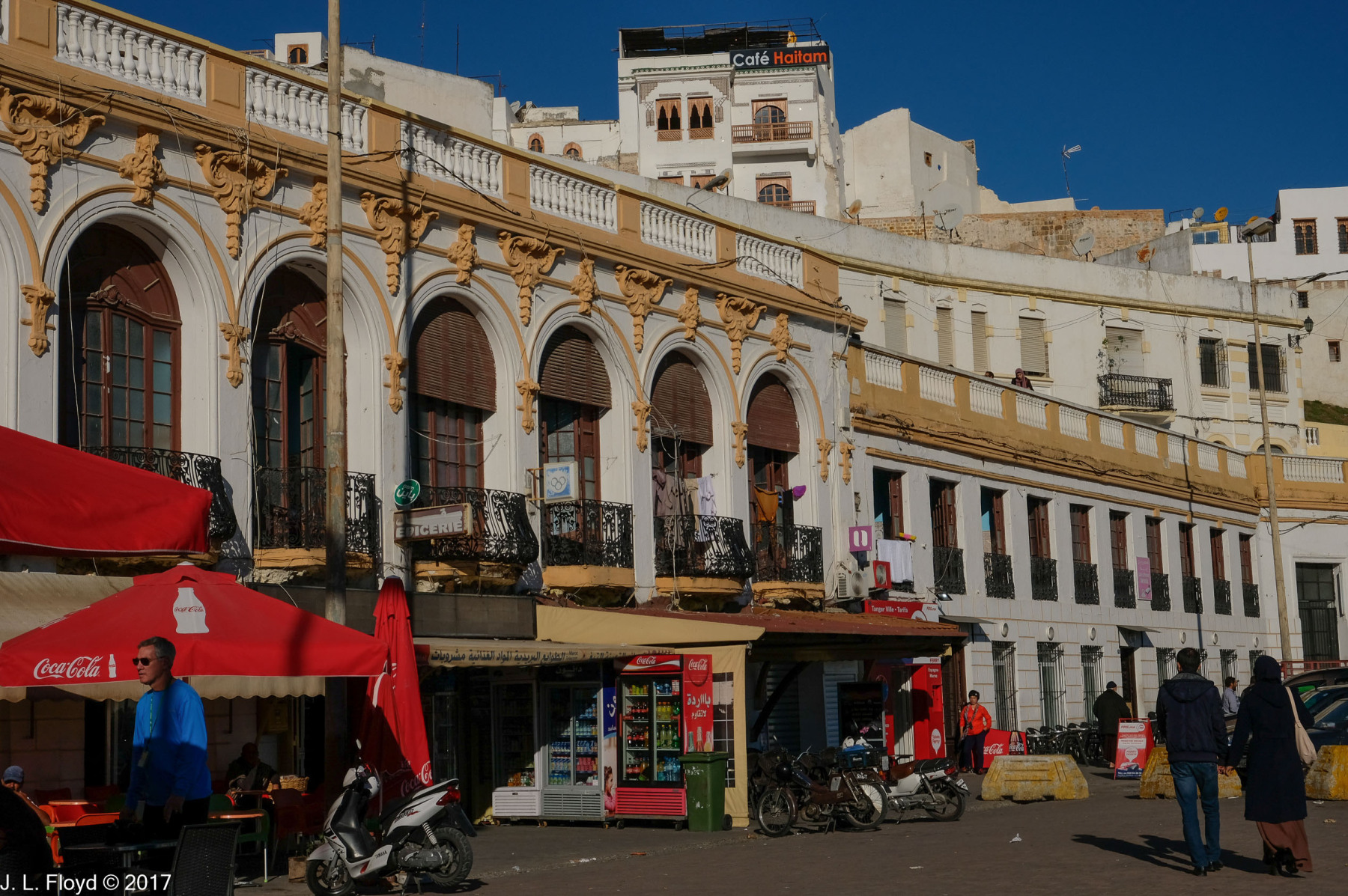
Categories
Danube River Cruise, June 2023

Prague – The Old Town and the Jewish Quarter, June 24, 2023

Reboarding our tour bus at Prague Castle, we went on to our next stop, which proved to be on the west bank of the Vltava River, near Čech Bridge. Before leading us across the bridge, our local guide Alexandra explained to us that on the hillside directly above the end of the bridge had once stood a 15.5 meter (51 feet) granite statue of Joseph Stalin. Erected in 1955, it was the world’s largest representation of the Soviet dictator. It was demolished in 1962. The plinth on which it stood was left vacant until 1991, when a 23-meter (75-foot) tall silent metronome was erected there. The metronome was not visible from where we stood, so I didn’t get a photo of it. You can find a picture of it on its website.

The Čech bridge is named after Svatopluk Čech (21 February 1846 – 23 February 1908), a nineteenth-century Czech writer, journalist and poet. Not as famous as the Charles Bridge upstream, it is nevertheless a beautiful bridge, with elegant lighting standards on the sidewalks, and at either end pairs of soaring columns, topped with sculptures of the Roman goddess Victoria. It is also the only example of a large Art Nouveau bridge in the Czech Republic. The original design of the bridge called for sculptures of hydras and female torch-bearers to be installed with gas pipes in them so they could shoot flames on festive occasions. This feature was omitted when the bridge was built in 1908, but plans are afoot to complete its addition by 2025.

At the Čech Bridge, we were able to photograph some gorgeous views of the Vltava River and attractions on its banks. The western riverfront in this area is known as the Beneš Embankment, after the longtime president of Czechoslovakia; the eastern riverfront is called the Dvořák Embankment, after the great Czech 19th-century composer.

On the western side, near the bridge, stands the Chapel of St. Mary Magdalene, which has a rather unusual history. It was originally constructed in the 1630s as an oval rotunda, in the middle of a vineyard, according to the design of Italian architect Giovanni Battista de Barrifis. In 1648 it was captured by Swedish troops, who used it as a redoubt from which to bombard the defenders of the Old Town. Having survived that episode, it was demolished in 1783 in connection with the religious reforms of Joseph II and used as a timber yard. In 1908, when the Čech bridge was built, the site was acquired by the City of Prague, and the church was then restored to its original form. At that time it stood right in front of the entrance to the bridge. But in 1956 it was again threatened with destruction. The Communist regime had placed a gigantic statue of Joseph Stalin on the hillside above the bridge in 1955, and then decided to build a huge staircase to provide access to the statue. This in turn required clearing away the Chapel of St. Mary Magdalene so that traffic could continue to access the bridge. To stave off the demolition of the chapel, an academic named Stanislav Bechyne came up with an audacious plan to pick up the chapel and move it 30 meters upstream on the riverbank. Somehow the government was persuaded to approve this project, and we now see the chapel a bit to the left of the bridge when viewing it from the opposite bank. In my picture of the chapel you can see the tip of the Metronome protruding from the trees in Letna Park on the hillside above.

From the same location – just west of the bridge on the Dvořák Embankment – a little to the left (west) of the Chapel, is the Prague Civic Swimming Pool (Občanská Plovárna). According to its website, it was “sensitively restored to its present form” in 2019. However that may be, today it is a multi-purpose pavilion hosting a venue for many types of events such as family gatherings, business conferences and concerts. It has a restaurant, bars, a glass gallery for enjoying the river views, and boat docks for catching river cruises.

On the hill above the Municipal Swimming Pool I caught sight of an exotic structure which looked to me like a cross between a Rococo church and an Art Nouveau bower. It turned out to be neither. According to its website, it is a splendid place to have a glass of wine. It was built in 1891 in Neo-Baroque style (really?) for the Prague Jubilee Czech Exhibition, in Holešovice district, somewhere east of its present location, to which it was relocated after the exhibition ended. It was named after the owner, Prince Vilem Hanavsky, who donated it to the City of Prague upon its completion. Currently it is home to an exclusive tourist-oriented restaurant; wonderful views of Prague may be had from its location, but the food and service are reputed to be so-so. 

Farther still to the west one may discern a massive Neo-Baroque building with a green dome in the middle. This is the Straka Academy, designed by the architect Václav Roštlapil and built between 1891 and 1896 with the purpose of providing a residence for impoverished children of the Czech nobility. It is now the seat of government of the Czech Republic. From my vantage point on the Dvořák Embankment, it provided a stunning vertical montage together with the Hradschin Palace and St. Vitus Cathedral perched on the hill directly above it.

Crossing the Čech to the east bank, i.e. the Dvořák Embankment, on the left side one sees the massive bulk of the Fairmont Golden Prague Hotel, formerly known as the InterContinental Prague. The hotel was designed by a Czech architect, Karel Filsak, in Brutalist style and built by the state travel firm during the Communist era, opening in 1974. After the fall of the Communist regime it went through a number of owners and renovations, and now belongs to R2G, the investment group of Czech billionaire Oldřich Šlemr. Originally intended as a pricey luxury hotel for foreign diplomats, businessmen and celebrities, it is currently closed for still another renovation which promises to make it even more posh and pricey; it is scheduled to reopen in 2024.

To the north of the Čech Bridge is the Charles University Law School, and beyond it stands the Na Rejdišti Theater (Divadlo Na Rejdišti), a performing arts center, and the Concert Hall of the Prague Conservatory.

From the Čech Bridge, we continued southeast through Curie Square, named after Marie and Pierre Curie, the French-Polish scientists who discovered radium and won three Nobel prizes between them (two by Marie). This took us to Pařížská (Paris) Street, Prague’s most chic and expensive shopping district, but instead of continuing along that way we took a right onto Maiselov Street and plunged into the heart of the Josefov, the Old Jewish Quarter.

Maiselov Street is named after the 16th-century philanthropist and community leader Mordecai Meisel, who was so rich that he was not only able to rebuild the Prague Jewish ghetto but even to serve as Minister of Finance for the Austrian emperors and finance their wars against the Ottoman Turks. In his time the Jewish quarter reached the height of its prosperity. Conditions deteriorated in the 17th and 18th centuries. The Jews generally supported the Hapsburgs during the Thirty Years’ War, but in return for protection the emperors exacted sizeable loans from them, which depleted their wealth, and afterward, no longer needing their financial help so much, the Habsburgs turned hostile. In 1744 Maria Theresa expelled all the Jews from Prague, even though they constituted a quarter of the population there; this was so disastrous for the city’s economy that she was forced to allow them to return in 1748, but she also imposed onerous taxes and social restrictions on them. This situation began to change in 1781, with the accession of Joseph II to the Imperial throne. Joseph abrogated some restrictions on the Jews with the aim of increasing their usefulness to the state. Other strictures he left in force, though these were gradually abolished during the nineteenth century, especially in the wake of the revolution of 1848.

Following the issuance of Joseph’s Toleration Edict of 1781, the Jewish ghetto of Prague – the Židovská čtvrť – was renamed Josefov in his honor. Toward the end of the 19th century, a major civic project was initiated to remake Prague in the image of Paris. Its impact fell mainly on Josefov, where 600 dwellings were demolished to make way for a new street plan featuring a wide, tree-lined boulevard to be named after the reigning Russian Tsar, Nicholas II, who would not have been regarded as a very sympathetic personage by most of the Jews of Prague, or anywhere else. It is now known as Paris Street.

The redevelopment of Josefov, which began in 1893 and lasted until the outbreak of World War I, resulted not only in the creation of Paris Street but also the erection of numerous new and noteworthy landmarks throughout the old Jewish quarter. Maiselov Street, though not untouched, was less affected by the new construction than other streets, so to savor the atmosphere of what is left of old Josefov, one must make a detour to it.

At the north end of Maiselov, on the connector to Paris Street, stands a 7-story white tower with a red roof known as The First Redoubt (U První Reduty), home to an exclusive and well-reputed eatery called Les Moules Belgian Restaurant. The First Redoubt is the work of Bedrich Bendelmayer, a Prague architect who built edifices in the Viennese Secession spirit, an offshoot of the Art Nouveau movement. To be honest, I can’t always tell Art Nouveau from Baroque or Rococo, but the Redoubt looked quite impressive to me, and I wished I had the opportunity to try Les Moules also. Oh well, maybe next time.

When we turned the corner onto Maiselov Street, we encountered another Art Nouveau structure, though of a more restrained character. This is known simply by its address, Maiselova 41/21, and finding out more information about it wasn’t very easy. According to one source, the architecture “eschews art-nouveau floweriness for the more restrained motifs of the German ‘Biedermeyer’ style.” A team of two architects, Richard Klenka and František Weyr, were responsible for this as well as several other outstanding landmarks in Josefov, including the Old Synagogue Restaurant on Paris Street, which I missed because we detoured around it; but you can see beautiful pictures of it on the web. Maiselova 41/21 is an apartment building, completed in 1911, with lovely tile inlays featuring Jewish motifs around the windows, and a subdued but elegant entrance flanked by statues of Jewish figures, representing whom is uncertain; there is speculation that they might be Mordecai Maisel and his wife Frummet, but they both look like women to me.  

On the opposite side of Maiselov Street, there is a quiet garden with a statue of Moses (which I could not see from the street), and just to the south of the garden is the so-called Old-New Synagogue (staronová synagoga). We are now plunging into the authentic pre-modern Jewish quarter. The Old-New Synagogue was built in 1270 and is Europe’s oldest active synagogue. The name “Old-New” alludes to the existence of an older synagogue in Prague, a few blocks away on Dušní Street, which was demolished in 1867 to make way for the Spanish Synagogue. The Old-New Synagogue was one of Prague’s first Gothic buildings and is considered an architectural treasure. There is an urban legend that a rabbi of the Renaissance era, Jehud Löwa ben Bezalel (1512 – 1609), created a golem which was stored in an attic of the building, and during World War II a Nazi agent tried to enter the attic and fell victim to the golem. But there is no confirmed evidence that any Nazis tried to enter the attic, and subsequent investigations of the attic have failed to find a golem. However, those results are inconclusive because none of the investigators who went into the attic ever came out again.

Well, that last sentence is my invention. But the next landmark after the Old-New Synagogue, at the corner of Maiselov and Ĉervená Streets, is the Jewish Town Hall, also known as Maiselov’s Town Hall since he was responsible for its construction in 1577. He also financed the construction in the same year of the High Synagogue, which is located just east of the Town Hall on what is now Paris Street. The original structure was Renaissance in style, but in 1689 a fire in the Jewish quarter damaged the building, and it was subsequently reconstructed in Baroque style. In 1754, after another destructive fire, the Town Hall façade was redone in Rococo style, and this time it was joined to the building just south of it, which then became part of the Town Hall. In 1908, during the Josefov redevelopment period, the razing of old houses left the next plot to the south of the Town Hall vacant, and a new addition to the Town Hall was built on the property.

There are two clocks on the oldest section of the Town Hall. One is a traditional clock using Roman numerals to indicate the hours and is mounted on a tower atop the building. The other is a Hebrew clock, installed in the gable; it uses Hebrew letters for the hours and runs backwards from what we normally consider clockwise. The Hebrew clock was installed in 1764 and still uses the original hand-wound clock mechanism.

Continuing south, we came to the corner of Maiselov and Široká Streets, where we encountered another imposing early-20th-century Art Nouveau building. Like Maiselova 41/21, it displayed no information other than the address Široká 56/10, plus a few shop names, and it was even more difficult to find information on. I eventually was able to determine that it was built in 1906-7 and that the architect was Josef Kovařovič (1875-1941). He is almost forgotten now, but in his day he was a prolific Prague architect credited with a number of late Art Nouveau apartment houses and commercial buildings throughout the city. The Široká 56/10 building is characteristic of his earlier style, with typical Art Nouveau features such as tropical scenes with nymphs and floral decorations; but he later moved on to a more “sober” and geometric style, and began incorporating Cubist elements into his designs.

When we reached Široká Street, we ended our detour and turned left to return to Paris Street. The ritzy shopping district of Josefov is not limited to Paris Street, but extends for a block or two either side of it. Široká Street in particular is lined with high-end boutiques. Since I care nothing for Rolex watches or Gucci footwear, and am a pauper anyway, I would normally never go near these kinds of shops; and in any case it was the architecture here which was interesting, not what kind of goods were for sale. Striding down the streets of Josefov, I was overwhelmed by Late Baroque, Rococo, Art Nouveau, Cubist and other styles in the towering structures on both sides of the street. As with Maiselova 41/21, there was nothing to identify the architect or the year of completion, and there were too many elegant edifices to research even a sizeable fraction of them; so I am merely presenting my photos here without any detailed descriptions.

Walking south on Paris Street, we shortly came to its spectacular end at the Old Town Square (Staroměstské náměstí). There we passed, on our right, the Temple of St. Nicholas, a Late Baroque church built between 1732 and 1737 on the site of a 14th-century Gothic church. That church had been taken over by the Hussites, but of course it was reconverted to a Catholic church during the Thirty Years’ War. In 1689 it was ravaged by fire, and the decision was made to tear it down and build a new church, but that was delayed until the 18th century. A famous Baroque architect, the younger of the illustrious father-son team of Christoph and Kilian Ignaz Dienzenhofer, was hired for the purpose and the new church was completed in 1737. (Kilian Ignaz Dienzenhofer was also the architect of Prague’s other Church of St. Nicholas, in Mala Strana.)

In 1871 the St. Nicholas temple was transferred to the Eastern Orthodox Church, which continued to use it until 1914. The Russian Tsar donated a crystal chandelier made of fine Bohemian Harrachov Crystal to it. After World War I, in 1920, the establishment of the Hussite Church of Czechoslovakia was proclaimed there, and since then it has remained the main Hussite Church of Prague. Right where Pařížská Street ends at Old Town Square, there is a fountain formed by sculpting the intertwined bodies of three dolphins, created in 1906 by the architect Rudolf Kříženecký, and by sculptor František Hnátka, who carved the dolphins. I found it quite enchanting, and it was a harbinger of many marvels found on Old Town Square.

The centerpiece of the square is a large monument to Jan Hus, sculpted by Ladislav Šaloun. The foundation stone was laid in 1903 and the monument was finally unveiled in 1915, on the 500th anniversary of Hus’ execution, in the middle of the World War I. The government – still the Habsburg monarchy of old – forbade holding any public celebration of the event. The dominant feature of the monument is a large statue of Jan Hus facing the Church of the Virgin Mary before Týn on the east side of the square. Also depicted on the monument are other figures of the era, including Hussite leaders, people martyred or forced into exile after the Battle of the White Mountain, and a young mother who symbolizes the rebirth of the Czech nation.

The Church of the Virgin Mary before Týn, in my admittedly untutored view, is the most unusual of all the churches I saw in Prague. It is also known as the Týn Church. The phrase in the church name “before Týn” evidently refers to the immediate area in which it is situated, which used to be called the Týnské dvor or “fenced courtyard.” It would be vulgar and in bad taste to make any remarks here about Týn gods, so I won’t do that. Anyway, it is a Late Gothic church with two towers, both 80 meters (262 feet) high, with eight smaller spires arranged in two groups of four on each of the main spires, creating a thorny appearance which is what makes it so unique. There appears to be some disagreement about the identity of the designers, whether he/they were local talent or the same men who designed St. Vitus – i.e. Matthias of Arras and Peter Parler. However, they and their workshops are believed to at least have had considerable influence on the design of the church. Construction began around 1360 and was mostly completed during the reign of George of Poděbrady, i.e. sometime between 1450 and 1471, though the southern tower was finished later, in 1511. A sculpture of George of Poděbrady was installed on the gable, below a huge golden chalice, the symbol of the Hussites.  During that period the church was in fact controlled by the Hussites.

In 1626, during the re-catholicization of Bohemia, the statue of George of Poděbrady was replaced by an image of the Madonna, and the golden chalice was melted down to make a halo for the Madonna. However, these changes appear to have been rectified in modern restorations, at least it appears so to me – the chalice is definitely there, and the image above it looks more like a warrior king than a Madonna.

As with other old and venerable churches, the Týn church has suffered its share of wear and tear over the centuries, making repairs and remodeling necessary. In 1679, a lightning strike caused a terrible fire and burned out the Gothic vault of the nave, which was then replaced by a lower Baroque vault. In 1819, lightning struck the north tower and caused a fire which melted the bell there. However, neither of these mishaps, nor the various renovations, resulted in any Baroque or other non-Gothic modifications to the exterior, which has remained the same over the centuries. Baroque modifications did however invade the interior of the church; aside from the vault, these came mainly in the form of new altars and other accoutrements. From what I can gather, most of the original Gothic artwork remains in place.

Old Town Square is an overwhelming place. It would be overwhelming even without the crowds swarming over it, leaving one hardly any room to turn around. The square is lined with elegant five-story Baroque edifices that are painted in many different colors and contain all manner of establishments – banks, hotels, townhouses, museums, boutiques, bars, restaurants, cafés, souvenir shops, tour agencies, whatever. To identify and describe even a small fraction of the most memorable structures here would be a prodigious task, but fortunately it has already been done for me and the result is available online, along with many other details about the Old Town Square.

However, if you will indulge me, I’ll just highlight a few of my favorites. On its west side, Old Town Square is bordered by Míkulášská Street, where a pleasant little park is found, across the street from St. Nicholas Church on the north. There, where Míkulášská Street meets the Old Town Square, a left turn will take you onto Franz Kafka Square. At this corner also is found the Hotel Lippert, an unpretentious establishment which claims to be a small family hotel with a unique atmosphere and friendly staff. I can well believe the “unique atmosphere” claim since the hotel is just a few steps from the Old Town Hall itself (I’ll get to the Hall in due course). But I found the north side of the square next to St. Nicholas Church to be less crowded than the rest of Old Town Square, and the park is a nice place to relax.

On the rather more crowded southeast side of the square there is a building with a statue of St. Joseph on the second floor corner and an Erpet Crystal shop on the ground floor. This is the Ox House (the name of its 15th-century owner, Ochse, means ox in German), an early medieval edifice rebuilt in Gothic style around 1540, in Renaissance style after 1609 and in Baroque around 1740. In the 1930s it underwent still another remodeling which replaced the Gothic portal by a shop window. The original statue of St. Joseph dated from the 1750s but was lost and replaced by a copy. The Ox House is flanked by the Štěpánovský House, to which it is connected by two arches across Melantrichova Street, a narrow alley between them. Originally a Romanesque structure dating back to the 12th century, the Štěpánovský was rebuilt in Gothic style in the 14th century, again in Renaissance style in the 16th century, and finally in Baroque in the 17th, but retaining the Renaissance gables. The Gothic portal from the 14th century has also been preserved. It is colored in blue and yellow, and I thought that the its juxtaposition with the Ox House to its right, colored in contrasting shades of brown, made a pleasing combination.

My favorite, though, was the house bearing the Czech title U Minuty. This is clumsily translated in the online documentation as “House at the Minute“, or better, “Minute House.” But this label has nothing to do with time; rather it is derived from the Czech equivalent of “minute” meaning “tiny”. At one time there was a tobacco shop in the building where one could buy very finely minced tobacco, and that was the origin of the name. I much prefer an older name, “House of the White Lion”, alluding to the sculpture of a lion on the left corner of the house.

The White Lion underwent a development history similar to the buildings previously described. It was originally built in Late Gothic style in the early 15th century, remodeled in Renaissance style after 1564, and again in the Baroque period; but it is still considered a prime example of Bohemian Renaissance bourgeois architecture. In the citywide redevelopment scheme of the early 1900s, the White Lion and its neighbors were scheduled for demolition. At that time nobody knew or cared that between 1889 and 1896 the future writer Franz Kafka had lived there on the second floor with his parents. The White Lion was only saved when Renaissance sgraffiti (layered plaster engravings, similar to what we had seen on the Pilsen Town Hall) were discovered in the house next to the White Lion. The sgraffiti in the White Lion itself were only uncovered in 1919, when it was undergoing repairs. They were then restored. Some of the sgraffiti had been created sometime in the late 16th century and others in the early 17th. They depict a variety of subjects: busts of several Habsburg rulers such as Philip II of Spain and Holy Roman Emperors Maximilian II and Rudolf II; biblical scenes and scenes from Greek mythology; and even a bust of the Turkish Sultan Selim II (r. 1566-1574), known as Selim the Blond or Selim the Drunk. Selim was probably added because he signed a peace treaty with Maximilian II in 1568, though it was short-lived. Today there is an Italian restaurant, Al Minuto, on the ground floor.

In 1896 the City of Prague purchased the House of the White Lion/Minute House and annexed it along with other buildings to the Old Town Hall block.

The Old Town House itself had a similar beginning. In 1338 the Prague city councillors bought a mansion on the Old Town Square, then known as Market Square, and adapted it for their purposes. Then they bought the next house to the west and began the construction of a square tower, which was completed in 1364. Thus established, the pattern continued into modern times, culminating with the annexation of the Minute House group in 1896. The Old Town Hall is unusual as a public building, having been assembled from a number of smaller houses as well as a few newly constructed wings.

At the end of World War II, on May 7, 1945, as the Soviet and American armies were approaching Prague, the Czech resistance rose in revolt against the occupying German forces and began a battle to liberate the city. Fighting was savage and resulted in widespread damage to the city’s monuments and public buildings. It did not end until the arrival of the Soviet Red Army on May 9. (The American army was ordered not to go to the aid of the Czechs, which rather soured Czech public opinion on the Western powers after World War II and helped pave the way for the Communist takeover of 1948.) The leadership of the resistance used the basement of the Old Town Hall as a command center, and the Nazis bombarded it and set it on fire in retaliation. The east and north wings, added during the 19th century, were destroyed, and the tower and the Town Hall chapel were badly damaged. The tower and chapel have since been restored, but not the eastern and northern wings.

Since I’m an amateur astronomer, my favorite feature of the Old Town Hall, and indeed of the entire city, is naturally the Astronomical Clock (Pražský orloj), located on the south side of the tower. This is an amazing device, considering the state of science and technology when it was built – in the late medieval period, around 1410. It is the third oldest astronomical clock in the world and the oldest still in operation. It was constructed by a clockmaker named Mikuláš of Kadaň (1350-1419), who based his work on the suggestions and calculations of a Charles University professor of mathematics, Jan Šindel (ca. 1370 – ca. 1455). Šindel was a Catholic priest, and he succeeded Jan Hus as rector of Charles University in 1410. He initially supported Hus, but then returned to the Catholic fold, having an aversion to religious disputes and a passion for science. He was also a medical doctor, and later became personal physician to Emperor Sigismund.

Actually, however, the 1410 version of the clock was only the first incarnation. Only later in the 15th century, around 1490, was the calendar dial added, along with a set of gothic sculptures. Over the centuries, the clock broke down and was repaired many times, and sometimes in connection with the repairs new features were added. In the 17th century various wooden statues were installed, and after a major repair in 1787-1791 figures of the Apostles were emplaced. After another repair in 1865–1866 the golden figure of a crowing rooster was added.

Along with the rest of the Old Town Hall, the astronomical clock was severely damaged in the May 7 uprising at the end of World War II. The clock was repaired and resumed operation in 1948, but complete restoration of the associated sculpture and other artwork had to await a later time. In recent years the clock has undergone several renovations, the latest in 2018, in which the missing artwork was replaced and an electric clock drive that had been installed in 1948 was replaced by an original mechanism from 1860.

The 2018 restoration became the subject of a scandal when the Czech Ministry of Culture began receiving complaints that the restored artwork included significant changes in detail and spirit from the originals. A local heritage group found that in reproducing paintings done in 1866 by Josef Mánes, the restorer, Stanislav Jirčík, had, among other transgressions, replaced some of the original figures with likenesses of his friends and acquaintances. The Prague City Council began discussions about commissioning replacements for the offending paintings, but as far as I know a final resolution to the controversy has not been reached.

Categories
Danube River Cruise, June 2023

Prague – The Hradschin Palace, June 24, 2023

Two days is not a sufficient period of time to explore even a small fraction of the wonders of Prague, but I did as well as could be expected given the circumstances. The two walking tours led by the Gate1 local guides were a good introduction; I wouldn’t have been able to do as well on my own. Prague is an enormously complicated place.

We spent the evening of our arrival in Prague on Friday the 23rd checking into our hotel, the Cosmopolitan on Zlatnická Street, and attending an orientation briefing prepared by the Gate1 guides. The orientation was necessary, I thought, because we were overwhelmed by the vastness and complexity of the city. Even with the orientation, I was intimidated. The first challenge was to find something to eat. We were on our own for dinner and the restaurant adjacent to the hotel was booked up. Sandie was in poor straits and didn’t feel able to venture outside. I found an Italian place around the corner, the Ristorante Longiano, and asked them if I could order takeout. They were more than happy to oblige and we gorged ourselves in our hotel room before the exhaustion from the day’s travels caught up with us and put us to sleep.

Next morning, Saturday the 25th, began with breakfast in the restaurant next door, imaginatively named the Next Door, which was affiliated but not integrated with the hotel. It was a popular place and if you wanted to have dinner there it was necessary to book a table well in advance. We were able to do that for our last night in Prague.

By this time Sandie was too ill to venture out of the hotel for long, so she had to miss the excursions, the first of which went to Prague Castle. I had always known it as the Hradschin Palace, and I still find that a more descriptive name than Prague Castle, but I’ll use the latter name here since it’s easier to type. Actually it is not a mere castle but an enormous palace complex, indeed it claims to be the largest in the world.

The Gate1 tour group entered the palace by way of the Prašný Most (“Powder Bridge”). This led from the Marian Walls, where we met our local guide, a genial lady named Alexandra, who led us across the bridge, past the Royal Garden and over the Jelení příkop (Deer Moat). Along the way we enjoyed stunning views of the palace ramparts, the gardens and the north side of St. Vitus Cathedral, which towered above the walls.

Shortly we arrived at a portal flanked by two rigidly motionless sentries, who reminded me of the guards at the Kremlin. The portal took us through the former Imperial Stables, now an art gallery, and opened into the Second Courtyard of Prague Castle, enclosed by the New Royal Palace (Nový královský palác). In the courtyard stands an imposing fountain, created by the sculptor Hieronymus Kohl in 1686 and named after him; it is also known by the name of the Holy Roman Emperor during whose reign it was erected, Leopold I. It consists of three basins; the large lower basin sits on a foundation with three steps, and in its center is a column which supports the middle basin and is formed by statues of Mercury, Neptune and Hercules. The column which supports the upper basin features figures of two Tritons. The topmost column, rising from the upper basin, depicts three lions supporting a globe topped by the double-headed eagle symbol of the Habsburgs.

Also in the Second Courtyard stands the Chapel of the Holy Cross, a late Baroque edifice built between 1756-1767 as part of an effort by Empress Maria Theresa to update Prague Castle. It now houses the St. Vitus Treasure, a collection of precious historical and religious art objects formerly stored in the St. Vitus Cathedral.

From the Second Courtyard we slipped through a passage in the New Royal Palace to the First Courtyard, emerging via the Matthias Gate (Matyášova brána). This is the main western gate of the palace, completed in 1614 as a free-standing triumphal arch. At that time the New Royal Palace was a collection of separate buildings; Maria Theresa’s building program of 1753-1767 combined these into a single large structure and integrated the Matthias Gate into the west façade. Aside from that, the gate is little changed from its original appearance. It is said to have been inspired by the Escorial, the Spanish monastery-palace of Philip II, which Emperor Rudolf II greatly admired; after requesting his ambassador in Madrid to obtain the blueprints (or whatever passed for blueprints in those days), which he then gave to his court architect, Giovanni Maria Filippi. The architect then designed a gate that incorporated elements of the Escorial. But it was far from a copy; whereas the Escorial is the largest Renaissance building in the world, the Matthias Gate is considered to be the first example of secular Baroque construction in Prague. It was not completed in Rudolf’s reign, which is why it isn’t named after him but rather after his brother Matthias, who replaced Rudolf in 1612, and had his name inscribed on the entablature when the gate was finished.

In its current configuration the New Palace forms a U-shaped structure to form the First Courtyard, which is completed on its west side by a wrought-iron fence built around several masonry pillars, each with a group of sculptures on top. The sculptures nearest the palace wings consist mostly of typical Baroque subjects such as vases, putti (wingless cupids), and floral constructs; on one pillar is an eagle wearing an imperial crown, and on another a crowned lion with a scepter. The two central pillars frame the famous ceremonial gate of the courtyard, sometimes known as the Gate of the Titans. On top of these two pillars are the sculptures depicting what is commonly referred to as the Clash of the Titans, though it would not be recognized as such either by ancient Romans or by 21st-century moviegoers. The figures comprising the sculptures – sometimes called the Wrestling Titans – are not the Titans of classical mythology but rather Roman gladiators. On one pillar a fighter is brutally beating his cringing opponent to death with a large club; on the other, the victor is viciously dispatching the cowering victim with a dagger. These are intensely shocking scenes of unmitigated savagery, not suitable for viewing by small children, older children, women or adult men.

The Gate of the Titans, or Gladiators if you prefer, separates the Palace grounds from Hradschin (Hradčany in Czech) Square, an open area where one may obtain wonderful views of the city of Prague, especially Petřín Hill and the Malá Strana district. I shall have plenty to say about Malá Strana in the next post. Petřín Hill, rising about 130 meters or 426 feet above the Vltava River, is almost entirely given over to parks and is a prime recreational area for the inhabitants of Prague. On top of the hill is the Eiffel Tower, a structure which the Czechs recently purchased from the French, then hauled from Paris to Prague and erected on Petřín Hill. Fortunately, that is not what actually happened – the Petřín tower was erected in 1891 and was quite shamelessly intended to be a copy of the Eiffel Tower. We did not get a chance to visit it, but it is a must-see on my next trip to Prague, and it is easy to reach because there is a funicular railway connecting it to Malá Strana.
Hradschin Square also boasts attractions of its own. On the north of the square, next to the New Royal Palace, is the Archbishop’s Palace, originally built in the 16th century in Renaissance style, but rebuilt several times since in whatever style was in fashion at the time (the same can be said of most of the palaces of Central Europe) – Baroque, Rococo, etc.

Several of the other landmarks on Hradčany Square are former palaces of rich aristocrats. The Salm Palace, the Schwarzenberg Palace and the Sternberg Palace have all been turned into art galleries, under the aegis of the National Gallery of the Czech Republic. Others are occupied by government offices. The Czernin Palace – largest of them all – and Thun-Hohenštejnský or Tuscan Palace house offices of the Ministry of Foreign Affairs, while the Prime Minister uses the Hrzán Palace for his official functions. The New Royal Palace itself, on the eastern side of the square, houses the offices of the President of the Czech Republic. There are also a number of religious establishments on the square, including the Church of St. Benedict, the Carmelite Convent, and of course the already-mentioned Archbishop’s Palace.

After giving us an unconscionably short period of time to explore the wonders of Hradčany Square, Alexandra summoned us to retrace our steps back through the Matthias Gate and the Second Courtyard, all the way to the gate where we had first entered the palace. There she took us through a secret doorway which opened into the Third Courtyard of the Palace, the location of St. Vitus Cathedral. We immediately embarked upon a tour of the Cathedral.

St. Vitus is a latecomer to the European panoply of medieval European cathedrals, its construction having begun in 1344, during the reign of King Jan of Luxembourg. Jan was killed two years later in the Battle of Crécy, one of the key battles in the Hundred Years’ War between France and England, where he fought for the French. (He was blind at the time, which impaired his fighting prowess, but the French probably would not have won anyway.) His son, Charles IV, also fought at Crécy but escaped the English longbows to inherit the throne of Bohemia and become one of the most important monarchs in Bohemian history as well as a leading patron of the arts, continuing the work on the cathedral.

If anything in the rest of this post is to make much sense, it is necessary to have a smidgen of acquaintance with the history of medieval Bohemia. To begin with, what was Bohemia, and where did it come from? The name is derived from an ancient Celtic tribe, the Boii, who lived in the area of modern Bohemia and southern Germany during the 2nd century BC. In the first century BC the Boii emigrated to Gaul, along with the Helvetians (from what is now Switzerland), where they were annihilated by Julius Caesar. German tribes replaced the Boii in their original homeland, but the country continued to be known by the name of their Celtic predecessors; and the name persisted when the Germanic tribes in turn migrated south into the Roman Empire and were replaced in the sixth century by West Slavic immigrants, who later became the Czechs. East of the Czechs another Slavic tribe, the Moravians, became established, and their territory became known as Moravia. They established the first West Slavic state in central Europe, which was known as Great Moravia, and arose in the ninth century AD, after Charlemagne’s Franks had smashed the Avar kingdom which held sway in the area from 567 to around 822. Great Moravia did not last long before falling apart and having its eastern territories overrun by the Magyars, who arrived in the late ninth century. Those territories are now known as Slovakia. Its remaining territories coalesced into Bohemia and Moravia. Bohemia was the name applied by the Germans to the area occupied by the Czechs, but sometimes it was extended to apply to the Moravian areas as well.

After the collapse of Moravia, a dynasty of Czech rulers, the Přemyslids, rose to power in Bohemia as vassals of the Frankish rulers, the successors of Charlemagne. By this time the Western Slavs had become Christianized, which greatly facilitated their relations with their German neighbors. The Frankish empire of Charlemagne gradually evolved into separate polities – the western areas into France, the eastern into Germany, and the regions between into diverse domains subject to dispute. In the tenth century the Germans and Bohemians joined forces to stop the incursions of the Magyars at the Battle of Lechfeld in 955. After Otto I of Saxony became crowned as Holy Roman Emperor in 966, Bohemia was incorporated into the Holy Roman Empire, but remained an autonomous entity within the empire – for a while. The Bohemian rulers were at first known as dukes, but later acquired the title of king.

It is important to remember that whatever the status of the Bohemian domain throughout the centuries, it remained essentially an arrow of Slavdom thrust into the middle of Germany. The interaction of the West Slavs with the Germans varied widely in its tone and temper – sometimes benign and mutually beneficial, sometimes stormy and violent. In the Middle Ages, in the thirteenth century, large numbers of Germans began to migrate into Bohemia, Moravia, Slovakia and Hungary, encouraged by the kings, who hoped to repopulate areas devastated by the Mongol invasion of 1241. The Germans became established especially in the Sudeten mountains in the west of Bohemia, but they also lived in Prague as well as other cities. The result was that Bohemia became a bilingual kingdom and remained so until the aftermath of World War II.

This brings us to 1346, when Charles IV became King. He was also elected Holy Roman Emperor in 1355. During the preceding century Bohemia had become a rich and powerful domain, and Charles IV took advantage of the kingdom’s wealth to undertake a plethora of portentous projects. He founded the first university in Central Europe, named after himself. He did not complete the St. Vitus Cathedral, but that was because he burdened his master architect, Peter Parler, with so many other tasks that the cathedral was neglected. Parler was responsible for building the Charles Bridge across the Vltava and the New Town of Prague, as well as numerous tombs, shrines and sculptures in and around Prague. Although Parler did not finish the cathedral, he did make significant progress, completing the choir and the transept. His sons and successors continued his work after he died in 1399 and completed the Great South Tower as well as the gable that connects it with the south transept.

What actually put a stop to the work on the cathedral was the next great upheaval in Bohemian history. The kingdom had fared relatively well during the 14th century; the economy had flourished and the Black Plague, which decimated most of Europe, had largely left the Bohemians unscathed, for reasons that have never been fully understood. But the good times were not to last. In 1378 Charles IV died, and his possessions were divided up by his sons, Wenceslaus and Sigismund. Wenceslaus reigned in Bohemia and Sigismund in Hungary.
By the turn of the 15th century the Catholic Church was in a sorry state, riddled with corruption and schism, and the precursors of the Protestant Reformation were stalking Europe. In England John Wyclif challenged the church hierarchy and called for reform; his ideas were later adopted and elaborated by Jan Hus, a Czech priest, theologian and rector of Charles University. Like Martin Luther in the next century, Hus denounced the selling of indulgences as well as other shady practices. After years of controversy and contention with the Church hierarchy, he was finally summoned to an ecumenical council in Constance, Switzerland in 1415, where, despite a safe-conduct arranged by Sigismund, he was arrested, tried, condemned and burned at the stake.

King Wenceslaus IV, nicknamed the Idle, had vacillated from supporting Hus to standing aside while his brother, King Sigismund of Hungary, arranged for Hus to come to Constance under safe-conduct and then reneged on the safe-conduct, ensuring Hus’ execution. Wenceslaus died in 1419, and Sigismund, who was slated to be his successor, found it impossible to establish his rule in Bohemia. The Bohemians, enraged by the execution of Hus, had risen in revolt. In Prague, the Hussites had marched on the New Town Hall, and when someone threw a rock at them from the tower, they stormed the hall and threw the king’s representatives and the town councilors out of the windows. This was the First Defenestration of Prague. It would not be the last.
The Hussite Rebellion spread like wildfire in Bohemia. Five times Sigismund and the Pope organized crusades to crush the Hussite rebels, and five times they failed miserably. The Hussites used new weapons and tactics – including firearms and war wagons, the tanks of the time – to inflict shattering defeats on the Catholic forces. Eventually, however, the rebellion lost steam as the rebels split into rival factions, the extremist Taborites and the moderate Ultraquists, who fought each other. In 1434 the Ultraquists defeated the Taborites and in 1436 entered into a compromise with the Catholics, by which they were allowed to practice their own rites while accepting the overall authority of the Papacy and of King Sigismund, who shortly became Holy Roman Emperor. And Bohemia (sans Pilsen) remained largely Hussite for the next two centuries.

After the close of the Hussite Wars, several abortive attempts were made to resume construction on the St. Vitus Cathedral, but it was not until the 19th century that any real progress was made; and it was only fully completed in 1929.
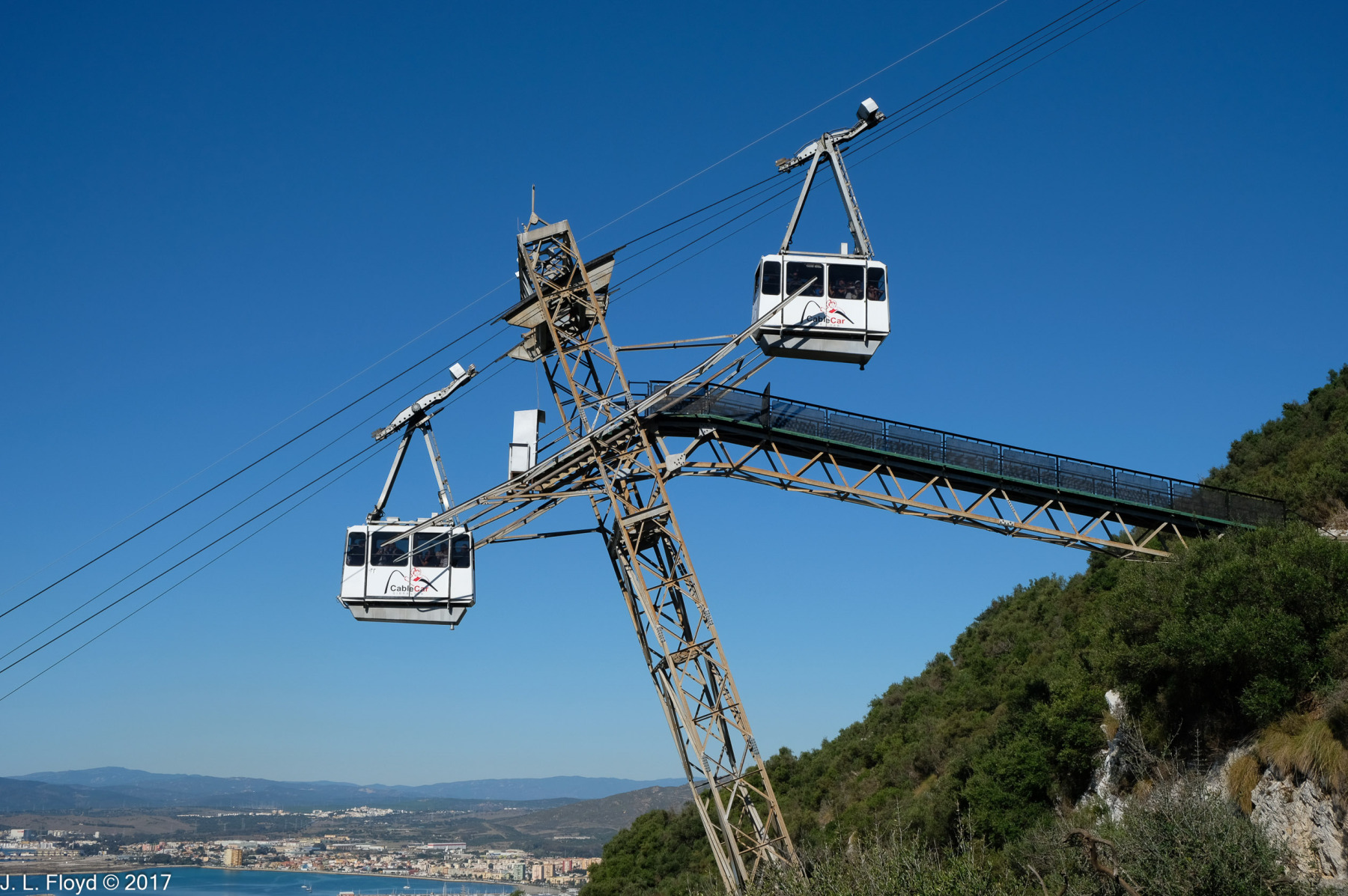
After touring the interior of the Cathedral, with its stunning stained-glass windows and net-vaulted choir, we emerged back onto the Third Courtyard of Prague Castle, where more wonders awaited. The west side of the courtyard is enclosed by wings of the New Royal Palace, and on the east side by the Old Royal Palace, to which the Cathedral is connected by an archway. On the south side of the square, in a wing of the New Palace, there is a balcony from which presidential speeches are often made. Just to the southwest of the cathedral is a post office, which I would not have expected to see on a medieval square. Just south of the post office is a 16-meter (52 feet) high granite obelisk, which was erected in 1928, on the tenth anniversary of the First Czechoslovak Republic, in memory of the Czech soldiers who perished in World War I. The obelisk was donated by Tomas Masaryk, founding father of the Republic and its first president. I don’t know where Masaryk acquired the obelisk, but it was an ill-starred object; while being transported to the Castle, it broke in half, and could not be glued together again, so only the top half was used, and it is only half as high as it should have been. In the eastern part of the courtyard, which is actually a separate space named the Courtyard of St. George, stands an equestrian statue of St. George slaying a somewhat puny dragon, and a rather humdrum fountain, the Carratiho. On the eastern side of the courtyard is the striking red façade of the Church of St. George, a Romanesque structure originally built in 920.

But all of these marvels are overwhelmed by the cathedral, which completely dominates the square. Towering over everything else (because that’s what towers do) is the Great South Tower, which was begun by Peter Parler and finished by his heirs, except for the spire, which is Baroque and was added by Nicolaus Pacassi (builder of the New Palace) between 1753 and 1775. It is 102.8 meters (337 feet) high, and can be climbed to the top by anyone willing to ascend the 280 steps involved (Parler did not provide for an elevator). I did not attempt to do so myself. To the right of the South Tower is the Golden Gate, through which the kings of Bohemia entered for their coronation ceremonies. It is also the work of Peter Parler, completed in 1371. Above the three arches of the Golden Gate is the Mosaic of the Last Judgment, which is probably what gave the Golden Gate its name. Also completed in 1371, it occupies about 1000 square feet and incorporates approximately 1 million pieces of colored glass and gold leaf. The middle panel portrays Jesus at the end of time, executing the Last Judgment. On Jesus’ right, the resurrected bodies of the righteous dead are climbing from their hillside tombs, assisted by angels. On Jesus’ left, the damned are being driven into the fires of hell. The viewer immediately notes that the mosaic shines and glitters in the sun. This was by design of the artist who created it, who is not definitely known but could have been a Venetian master – Venice was known for its glassmakers. Of course the original shine faded with time, and several attempts were made to restore it, the last in 1997-2000. As far as I could tell, it was quite successful.

A few meters past the Golden Gate there is an archway connecting the Cathedral to the Old Royal Palace. This also separates the Third Court from the Court of St. George. It is close to this point that the New Palace gives way to the Old Palace; it’s hard to tell because there is no difference in the architectural styles on the façade, only a break where the roof changes color from gray (New Palace) to red (Old Palace).

I very much wanted to see the interior of the Old Palace, because of an historical event that happened there one day in 1618. To understand the significance of that event some context is necessary. Following the Compact of 1436, a rather confused period ensued. The Ultraquist Hussites maintained their sway over large areas of Bohemia and some of the neighboring principalities; they enjoyed the support of most of the Czech population, but the Germans during this period mostly continued to adhere to Catholicism. An Ultraquist Hussite, George of Poděbrady (Jiří z Poděbrad), even became King in 1458 and made great efforts to establish peace and tolerance between Hussites and Catholics. But he could make no headway against the adamant resistance of the Pope, by whom he was excommunicated in 1466, and who tried to organize another crusade against Bohemia. This effort fizzled, but in 1468 the King of Hungary, Matthias Corvinus, invaded under the pretext of returning the Kingdom of Bohemia to Catholicism. He enjoyed considerable support among the Catholic nobles and was able to seize Moravia and other territories, but the Czech core of Bohemia mostly remained loyal to George, except for a few areas such as Pilsen. Then, in 1471, George died, and was succeeded by Vladislav II Jagiellon, a Polish Catholic, whom George had appointed as his heir. Vladislav immediately undertook efforts to re-catholicize Bohemia, starting by replacing Hussite town officials with Catholics. The townspeople of Prague expressed their opposition to these measures by throwing a number of Catholic aldermen out of the windows of the town halls of the Old City, the New City and Mala Strana (which was then a separate town) and running the others out of town. This was the Second Defenestration of Prague, which occurred on September 24, 1483. Vladislav quickly backed down, and in 1485, with his blessing, an agreement called the Religious Peace of Kutna Hora was concluded which allowed both Catholics and Ultraquist Hussites to freely practice their rites; this established an equilibrium which prevailed for the following 118 years. Vladislav II went on to enjoy a long reign in Bohemia, and he became King of Hungary in 1490 after the death of Matthias Corvinus. He made some major additions to the Royal Palace, notably Vladislav Hall, on the west end of the palace near St. Vitus Cathedral. There the architect Benedikt Ried combined Late Gothic elements with the new Renaissance style. Vladislav Hall was used for state occasions such as royal coronation ceremonies, major celebrations, knightly tournaments – there was even a special staircase, the Riders’ Staircase, which enabled knights on horseback to ride into the hall for jousting competitions. Ried also added a wing extending south, perpendicular to the main palace, which runs east-west. It was a tall 3-story structure named the Ludvig Tower, after Vladislav’s son, who would perish fighting the Turks in Hungary in 1526.

In 1517 Martin Luther nailed his 95 Theses on the church door in Wittenburg, Germany, and thereby launched the Protestant Reformation. It might be expected that given its prior history, Bohemia might be fertile ground for the spread of Protestantism, and that in fact is what happened; the Hussites enthusiastically welcomed it. However, by the 1550s the Protestants had split into a number of contentious variants, and the two dominant confessions, Lutheranism and Calvinism, both enjoyed adherents in Bohemia. Another significant development was that in 1526, after King Ludvig (or Louis, if you prefer the French version) of Bohemia and Hungary, successor of Vladislav II, was killed fighting the Ottoman Turks, the Austrian Habsburgs managed to acquire the crowns of both Bohemia and Hungary, which they were to retain until 1918.

At first the Habsburgs, notwithstanding their energetic efforts to reverse the Protestant Reformation in Germany and elsewhere, did not attempt to undo the Kutna Hora arrangements; indeed, as late as 1609 Emperor Rudolf II issued a Letter of Majesty to reaffirm the religious liberties of Bohemia. But this situation did not outlast Rudolf’s death in 1612. Both of his successors, his brother Matthias and especially Ferdinand II, were enthusiastic proponents of the Catholic Counter-Reformation, and as Regent of Austria Ferdinand had been ruthlessly expunging Protestantism from his provinces for years. Also, after 1612 the Hapsburgs moved the Imperial capital from Prague to Vienna, not an auspicious portent for Bohemia.

The Estates of the Bohemian Diet were acutely aware of the situation, and they accepted Matthias, and later Ferdinand, as King only after they agreed to guarantee the Estates’ existing privileges and liberties. Unfortunately, the Habsburgs’ understanding of the compact did not accord with that of their Protestant subjects, especially after the declining Matthias appointed Ferdinand his heir and had him elected King of Bohemia and Hungary in 1617.

Immediately upon Ferdinand’s accession, disputes between Ferdinand and the Bohemian Estates began over the extent of Protestant liberties and the scope of royal authority. In 1618 Ferdinand sent several senior officials, designated Lords Regent, to Prague to negotiate the issues with the Bohemian Protestant leaders, i.e. to impose his will on them. On May 23, 1618, they all met in the Royal Palace (the Old Royal Palace, that is; the new one did not yet exist), on the top floor of the three-story Ludvig tower. There, after a short discussion during which the Protestant leaders concluded that their counterparts were not negotiating in good faith, they seized the two most hard-line envoys, along with their secretary, and performed what had now become a traditional Bohemian ritual. But this time there was a new twist to the event. Unlike the victims of the First and Second, those of the Third Defenestration of Prague were not killed by the 21 meter (70 feet) fall from the tower; they were injured, but escaped death and went on to enjoy illustrious careers in Ferdinand’s service. Catholics immediately ascribed their survival to a miracle performed by the Virgin Mary, who was said to have caught them in mid-air; Protestants claimed that their good fortune was the result of landing in a dung heap, which cushioned their fall. Neither account has ever been convincingly verified.

The consequences of the Third Defenestration of Prague turned out to be disastrous, first of all for the Protestants, then for Bohemia, and finally for Europe: it started one of the most terrible conflicts in history, the Thirty Years’ War. I’ll have more to say about that in due course.

I wanted very much to see the site of the Third Defenestration of Prague, but it was not on the itinerary, time was short and I’m probably the only one on the tour who cared or who even knew about any of the Defenestrations of Prague. Nor was I able to see the location in the palace garden where the three victims landed after their involuntary descent from the tower, where today a monument called the Slavata Obelisk, named after the most seriously injured of the three, Count Vilem Slavata of Chlum, stands to commemorate the event. It was a big disappointment for me, but I soon got over it since there were so many other sights to see.

From the Third Courtyard of the palace we trekked back through the Second and crossed the Powder Bridge again to meet our bus, which was to take us next to the Old Town and the Josefov, the old Jewish quarter, where we were to gain a very different perspective on the history of Prague.

Categories
Danube River Cruise, June 2023

Pilsen – June 23, 2023

On Friday morning, June 23, 2023, we arose, had a final breakfast on the Monarch Queen, then said farewell to the ship which had been our home for a week and boarded our bus for Prague.

There had been a violent thunderstorm overnight and it continued to be overcast and rainy that day. The Bavarian countryside was wet and green and beautiful.

Arriving at the Czech border, the bus stopped at the inevitable gas-station plaza with its duty-free shop and American fast-food joints to refuel and give us a potty and snack break.

We were now in a country to which I’d never been before, the Czech Republic. Outwardly it was little different from Austria or Bavaria, except of course for the signs, which were all in Czech, a language I don’t know much about, except that it is Slavic like Russian, a language I do know something about. There are lots of similarities in grammar and lexicon. But whereas Russian is written in a Cyrillic script, Czech is written in a Latinate script with a lot of circumflexes, accent marks and so forth, which make it hard to guess the pronunciation from the spelling. Anyway, before long we arrived at our first stop, which was Pilsen, or Plzeň in Czech. Pilsen is the German and English spelling.

Pilsen is a city of 181,000 people, located 78 kilometers or 48 miles west of Prague. It is famous chiefly for being the home of Pilsner Urquell Brewery, which produces one of the world’s foremost beers. It is also the original home of the Škoda industrial organization, which was the leading arms manufacturer in Austria-Hungary prior to World War I. Years later, after the German occupation of Czechoslovakia, Škoda was forced to produce arms for the Wehrmacht, and their tanks were extensively used on the eastern front.

We had several hours to visit Pilsen and we also had lunch there. Our bus parked some distance from the center of the city and we had to do some walking to get there. Sandie had not been feeling well for days and wanted to stay with the bus, but in the end she was persuaded to come with the rest of the group. It was difficult for her but she was a real trooper and managed to make it through the excursion without incident.

Our local guide led us to the city’s central square, known as Náměstí Republiky or Republic Square. On the way we passed through several streets lined with venerable Baroque-style buildings, all of them well-kept and many beautifully decorated with elaborate designs and figures.

On Prague (Pražská) Street, among other attractions, we encountered the Vodárenská věž, or Water Tower, better known as the Black Tower because of its dark coloring. It is a five-story structure with a square base. Built around 1542, for years it was integrated with the city’s fortifications, until those were demolished in 1822. It continued serving as the city’s water tower until 1889, when its function was assumed by a new city water works, but then it was remodeled and used as offices for city officials. Nowadays it hosts a tattoo parlor, an art gallery, a coffeehouse and the Škoda family museum.

Heading west along Prague Street, we arrived at the northeastern corner of Republic Square. Our guide led us along the north side of the square, where we shortly found ourselves in front of the stunning Pilsen City Hall.

The Radnice města Plzně, as it is known in Czech, was built between 1554 and 1559 under the supervision of an Italian architect, Giovanni de Statia. It is thus basically an Italian Renaissance palace. But there is more. The decorations seen on the upper stories of the building, above street level, were not part of the original exterior. They were added in 1910, during a major renovation of the building, by a Czech professor and architect, Jan Koula. He used a technique called “sgraffito“, which in Italian means “scratched.” It involves putting down a base layer of some chosen material, then overlaying it with a second layer of different material, and finally engraving the top layer in such a way that the color of the lower layer emerges and forms a desired pattern or shape. In this case the patterns that emerge represent several important figures in Bohemian history, the coat of arms of the city of Pilsen, and allegorical figures associated with the town hall’s functions, such as Law and Justice. The effect produced is quite unique and striking.

Next to the Pilsen City Hall stands another noteworthy structure, which now houses the Turistické informační centrum města Plzně, or Pilsen Tourist Information Center. I have not been able to find out much information about it other than it was formerly known as the Imperial Building, indicating that it probably had some governmental function. But what is chiefly interesting about it is the statue of a knight carrying a halberd that stands on a pedestal projecting from the side of the building (is there a specific architectural term for this?). A bit of online research told me that this figure represents a “robber knight” named Žumbera, perhaps a sort of Robin Hood figure. (I couldn’t find any other names for him, or any dates associated with him.) In any case, his statue was one of three that originally stood on Republic square – in Žumbera’s case, the northeast corner, as part of a fountain. All of the three were removed, when and why is not certain, but Žumbera’s statue eventually ended up on the façade of the Tourist Center. I didn’t find out what happened to the others; however, as we shall shortly see, they were eventually replaced by modernistic sculptures. What little I was able to find out about Žumbera came from the website of a restaurant named after him, and I am very grateful to them for publishing that information. Next time I’m in Pilsen – I’d love to go there again – I’ll have dinner at the Restaurace Žumbera and thank them in person.

Dominating Republic Square is the Gothic Cathedral of St. Bartholomew. Although it is very old, having been begun around 1295, the same year as the foundation of Pilsen itself, it was not a cathedral until 1993, when Pope John Paul II created the diocese of Pilsen. Nevertheless it is no simple parish church; the spire, at 103 meters (338 feet), is the tallest church tower in the Czech Republic.

Aside from the cathedral, the most prominent structure on Republic Square is the Marian Plague Column, erected in 1681 as an expression of gratitude for the mitigation of an outbreak of plague the previous year. It is topped by a replica of the Pilsen Madonna, a 14th-century sculpture which is the most famous and valuable work of art inside the cathedral. The base of the column rests on a square platform consisting of six steps of stairs. The base itself is three-tiered; the lowest level is a balustrade consisting of pillars topped with stone balls. Also on this level are three statues, which are not part of the original monument but were added in 1714 to commemorate deliverance from a second outbreak of plague the year before:  Jesuit missionary St. Francis Xavier, Franciscan St. Peter of Alcantara, and the patron saint of accidents and good death, the martyr St. Barbara. In addition, a niche on the second level contains a sculpture representing the plague patroness St. Rosalie of Palermo, sleeping in a rocky cave.  The statues on the second level, by the sculptor Kristian Widman, are original to the column; they depict the patron saint of Pilsen, the apostle St. Bartholomew, facing the cathedral; the Czech patron saint Wenceslas (Vaclav in Czech, I hate those Latinized names), oriented towards the town hall; St. Sebastian, a protector against the pestilence; and St. Rocha, another protector against the pestilence.

The Marian Plague Column is on the northwest corner of Republic Square. Each of the other corners has a fountain. According to a largely unintelligible comment from a “local guide” on Google Maps, there were originally three fountains on Republic Square, but over time they were removed, when and why is unclear. (One of them, of course, would be the fountain with the Žumbera statue mentioned above, but the commentator apparently didn’t know that.) Eventually – again, it’s not clear when; perhaps during the 2005-2007 reconstruction – the idea was floated of having a competition to determine who could come up with the best idea for replacing the fountains. The winner was an architect named Ondřej Císler, who came up with three golden shapes based on heraldic figures appearing on the Pilsen coat of arms. I would not have been able to tell what the forms were supposed to represent if our guide had not told us. The “angel”, a shape somewhere between a “T” and a “Y”, is on the northeast corner, where we came in from Prague Street; the “camel” is on the southeast corner, and could easily be taken for many different four-footed mammals; the “greyhound” is on the southwest corner, and does vaguely resemble a sitting dog, though not necessarily a greyhound. To me the modernistic shapes seemed to clash with the 18th-century look of the square, and I would have preferred more traditional designs. But there they are.

All sides of Republic Square opposite the square itself are lined with attractive and historical Gothic, Renaissance and Baroque buildings, but aside from the Town Hall and a few others, it was hard to find any information about them. One of my favorites was the činžovní dům U zlatého kolečka, Apartment House at the Golden Ring, built in 1902 at the southeast corner of the square where Františkánská and Zbrojnicka streets meet, near the Golden Camel Fountain. The building has a tall bronze tower at its corner and is the location of a fashion accessories store named “Snowbitch.” It is not to be confused with the U zlaté koule, Golden Wheel, an apartment building dating from 1891, at the northeast corner of the square, where Prague and Roosevelt Street meet.

Soon it was time for lunch, and our local guide led us to an Italian restaurant, La Dolce Vita, on Prešovská Street, off the southwestern corner of Republic Square where the Golden Greyhound Fountain stands. As we strolled down Prešovská Street, we could see a towering structure at the end of the street resembling a Moorish castle. This was the Velká Synagoga, the Great Synagogue of Pilsen, second largest in Europe. We had already seen the largest, the Great Synagogue of Budapest, and the one in Pilsen closely resembled it, at least from a distance. The original design, done by a Viennese architect in 1888, envisioned two 65-meter (213 feet) towers, but the Pilsen City Council rejected it because they felt that its height was too close to that of the St. Bartholomew’s spire. A new design, with 45-meter (148 feet) towers, was proposed in 1890, and this time it was accepted. Completed in 1892, the synagogue served the Jewish community of Pilsen until the Second World War, when the Nazis carted all the Jews off to be exterminated. The synagogue was then turned into a storage facility and survived the war unharmed. But those Jews who came back after the war were too few, and the postwar Communist regime too unsympathetic, to maintain the synagogue properly, and in 1973 it was closed and fell into disrepair. But during the 1990s it was restored, and reopened in 1998. The Jewish community of Pilsen now numbers only about 70, compared to the 2,000 resident before World War II, so only one room is still reserved as a place of worship; the others are used for concerts, exhibitions and other non-religious functions.

The architectural style, formally known as Moorish-Renaissance Revival, is an amalgam of various elements including Russian-Orthodox style onion domes atop the towers, Arabic ceilings and an Indian-appearing Torah ark. Unfortunately, we didn’t have time to visit it or even view it from up close, as we had done in Budapest, but were only able to photograph it from afar.

After lunch, it was time to hike back to the bus to resume the journey to Prague. Traipsing back past Republic Square to Prague Street, I encountered a beautifully restored two-seater cabriolet roadster of pre-World-War II vintage, complete with a rumble seat. But try as I might, I could not find any name or emblem on it to identify the manufacturer or the model, nor was the owner around to ask, so I am still in the dark about that.

We trudged back to the bus by a route a bit different from the way we had come, passing the Black Tower on Prague Street and then turning left at the Black Angus Steak House onto a pleasant parkway with a little roundabout, where pretty little houses hid amongst the foliage nearby. After that it was only a block to the bus, though we had to dodge the traffic on busy Tyršova Boulevard to get to the parking lot. Soon we were on our way again to Prague.