Categories
Danube River Cruise, June 2023

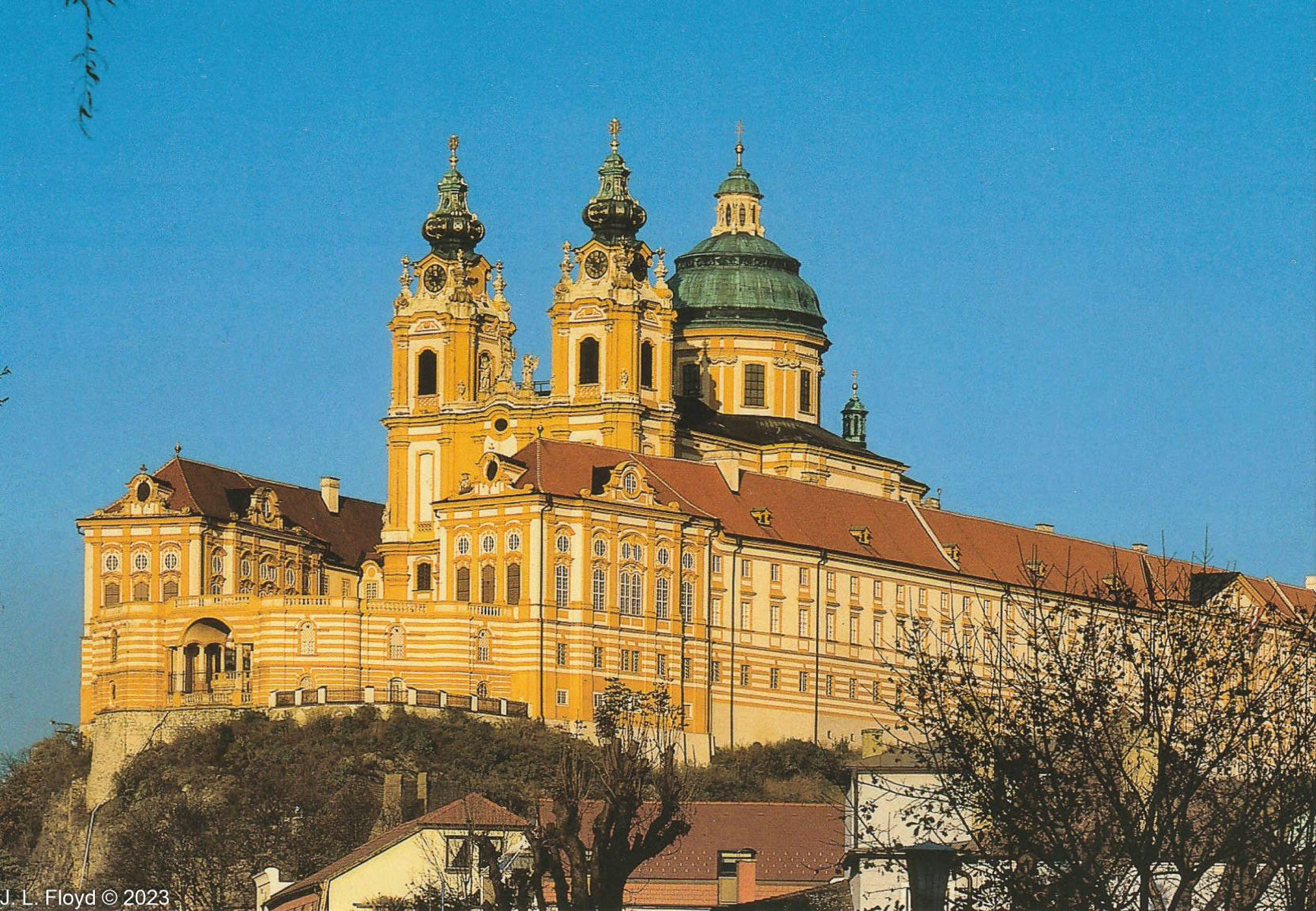
Melk Abbey, June 20, 2023

If you are journeying downstream (east) on the Danube, you will encounter Melk Abbey at the western entrance to the Wachau Valley. If you are traveling upstream, as we were, Melk Abbey is the last outpost in the Wachau Valley and marks the transition to the Nibelungengau, another scenic section of the Danube which, together with the Wachau, forms the Wachau-Nibelungengau tourism region. If “Nibelungengau” sounds familiar to fans of Wagnerian opera, it’s because the area was a setting for some of the action in the great German medieval epic of the Nibelungenlied. A word of caution: if you’re a fan of Wagnerian opera, be warned that the plot of the Ring cycle is very different from the German medieval epic. The Nibelungenlied was originally written in Middle High German around 1200 but is based on events of the 5th century CE involving the German kingdom of Burgundy and the Huns, whereas Wagner took his inspiration primarily from Norse mythology. The author of the epic poem Nibelungenlied is unknown, but is thought to have been from the region of Passau, a German city higher up on the Danube where the Monarch Queen would dock the next day. Unlike the Wagnerian Ring cycle, the Nibelungenlied poem does not envisage the end of the world. But there is plenty of sex, blood and gore in it nonetheless.

As it flows east from Passau, which is on the border of Austria and Germany, the Danube takes a turn to the northeast when it reaches the Wachau Valley. The town of Melk lies on the south bank of the Danube just as it starts to make that northeast turn, and Melk Abbey is on a rocky outcrop high above, overlooking the river. It is a striking setting.

Austria began as a defensive zone or “mark” intended to provide a bulwark against the ravages of the Magyars, who began their incursions in the late 9th century CE, paralleling (and hastening) the disintegration of the empire of Charlemagne. A series of fortified centers were built which offered protection to the local population, which in turn had to support the fortress. Melk was one such fortress, and for a time the most important, after Leopold I (r. 976-984), first of the Babenbergs, made it his headquarters in 984 and likely brought in a group of priests (termed “canons regular”) to provide spiritual guidance and jump-start the economy. The Babenbergs later moved east, eventually making their capital at Vienna. But in the meantime Melk became a spiritual center as well as a political and economic center.

In 1012 an Irish monk named Colman (Koloman in German) went on a pilgrimage to the Holy Land. To get there he took a route similar to that which Richard I the Lion-Hearted used in trying to return from the Holy Land a couple of centuries later, and met an even worse fate. Colman was mistaken for a spy at Stockerau and hanged. But following his death, reports of miracles associated with his burial site began to be reported, and the local population, perhaps in remorse for his unjust execution, began to venerate his remains. Getting wind of this, so to speak, in 1014 Henry I (r. 994-1018), Leopold I’s successor as Margrave of Austria, had Colman’s remains transferred to Melk, so that he could have a saint who would sanctify his fortress and the Austrian mark. Koloman did indeed become the patron saint of Austria, for a while; Melk became a center of his saintly cult, and its religious community continued to grow in importance from then on, aided and abetted by donations of religious relics from the Babenbergs. The next Margrave of Austria, Adalbert I (r. 1018-1055), donated a splinter supposedly from the Cross of Christ, which was set in a matrix of precious stones and is now known as the Melk Cross. The actual foundation of Melk Abbey took place in 1089, in the reign of Margrave Leopold II (1075-1095), who donated the land for the monastery.

Over the following centuries, as the Babenbergs became Dukes of Austria and then were replaced by the Habsburgs, Melk became one of the richest and most renowned monasteries in Europe. I first encountered mention of it in Umberto Eco’s novel The Name of the Rose, which was made into a film starring Sean Connery. Published in 1980, the novel has as one of its two main protagonists Adso of Melk, who accompanies a scholar named William of Baskerville (played by Sean Connery in the movie) in a quest to solve a series of murders in an Italian monastery early in the 14th century. William and Adso solve the murders, but in the end the monastery burns down and with it its magnificent library, destroying scores of precious and irreplaceable documents from antiquity. The denouement bears an eerie parallel to the fate of Melk Abbey, where the library burned down in 1297 and many important documents were lost. Unlike the fictional Italian monastery, however, Melk recovered and went on to instigate a major religious reform movement in the 15th century. The Melk Reform movement greatly reinvigorated monastic life in Austria and southern Germany, and perhaps as a result the Catholic Church in those areas was better prepared to resist and reverse the spread of Protestantism in the 16th century. In any case, Melk Abbey survived the travails of the Reformation, as well as the Thirty Years’ War (1718-1748) and the Turkish wars which followed, and managed to prosper.

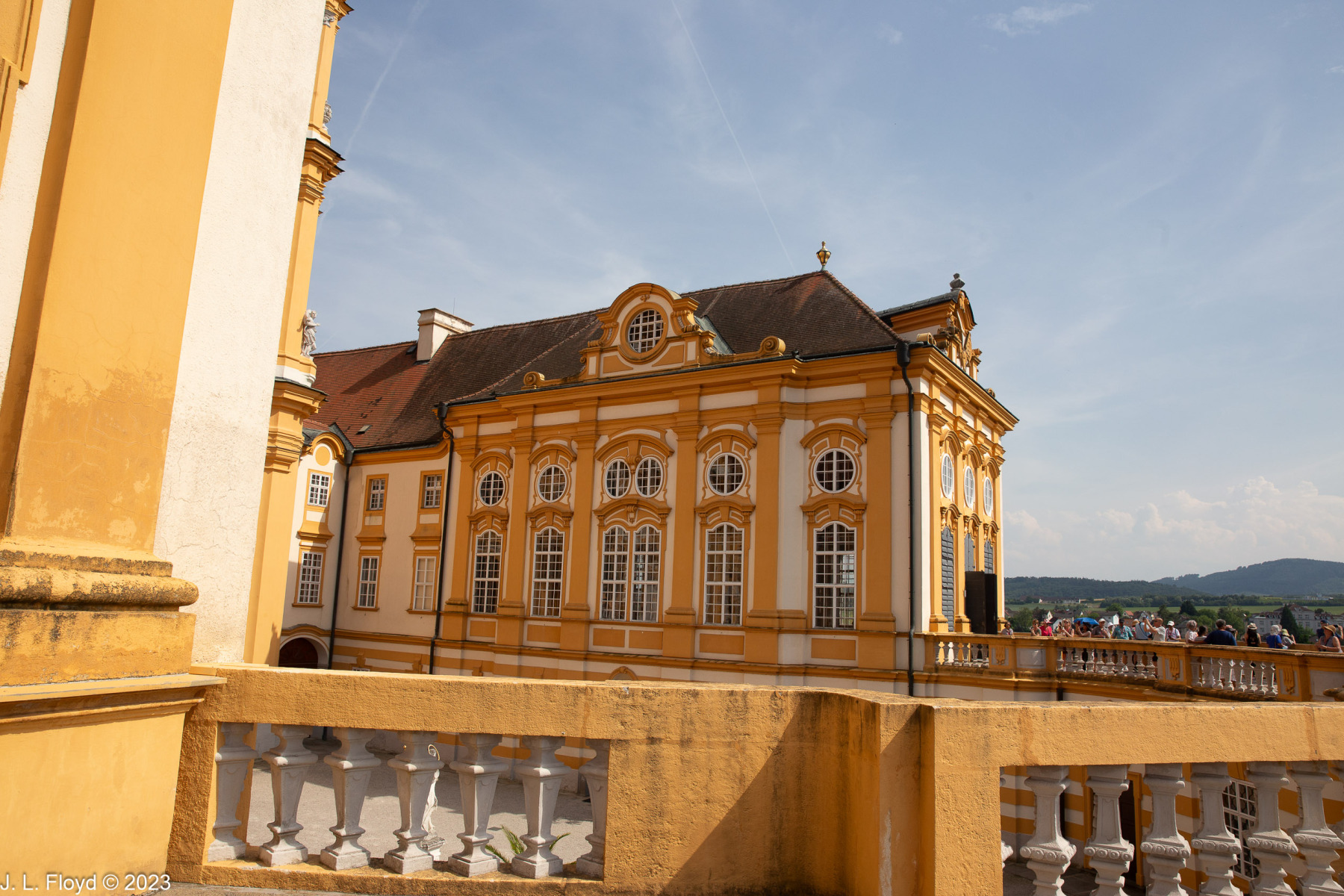
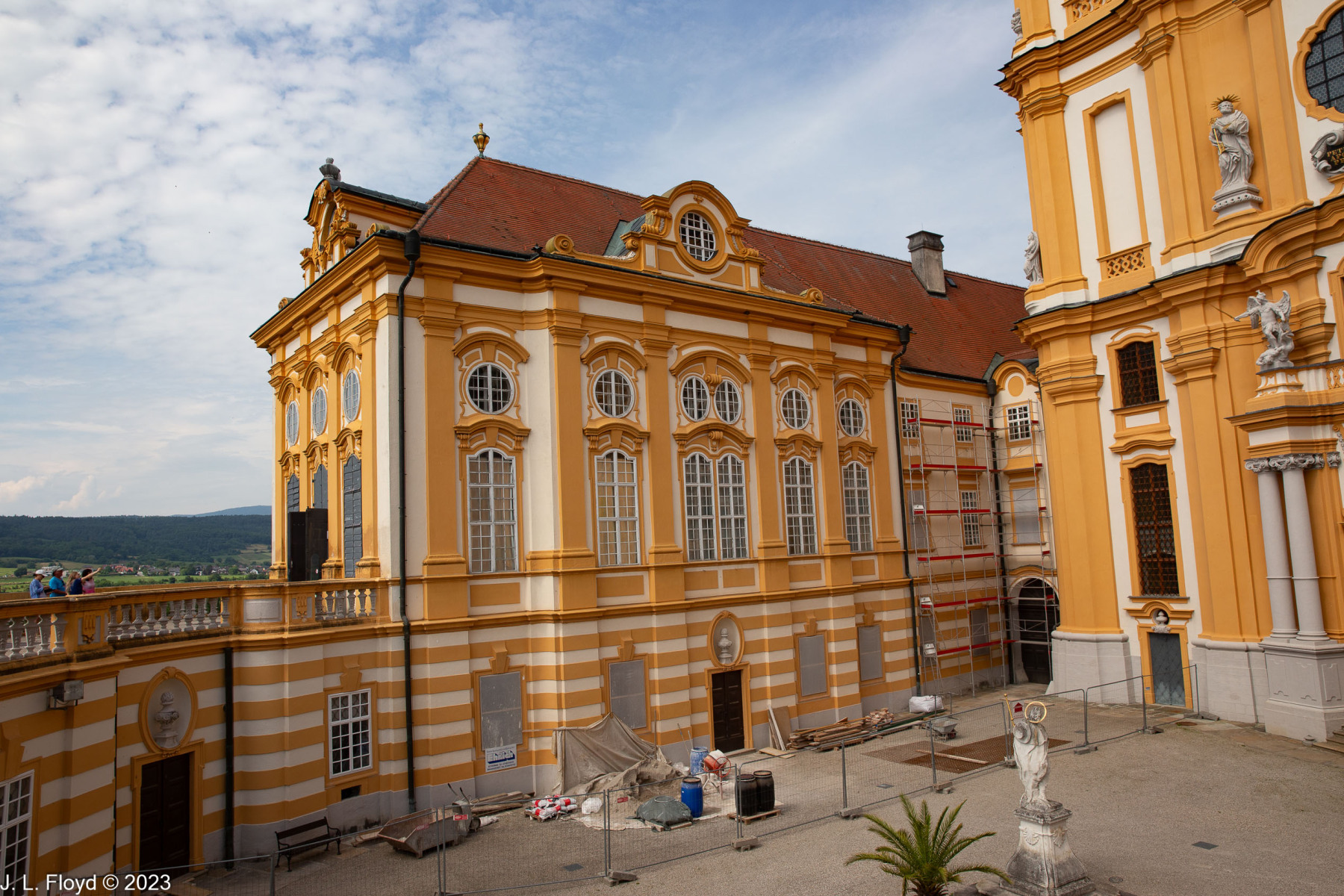
Nevertheless, its physical condition had by the end of the 17th century so deteriorated that a great deal of reconstruction and rebuilding was needed. Between 1702 and 1736 such a renewal took place under the auspices of an extremely energetic and able abbot, Berthold Dietmayr, and a talented architect, Jakob Prandtauer. This was now the Baroque era, and Melk Abbey as we see it today is a legacy of that period. It is considered one of the finest achievements of that era. Unfortunately, in 1738 another huge fire destroyed much of the new work, but it was redone in the succeeding years and in fact one of the jewels of the abbey, the Baroque Garden Pavilion, was created during this period.

Along with the reconstruction, Melk Abbey became a center of intellectual activity, especially during the time of Joseph II, when the ideas of the Enlightenment became the guiding light of the ruling regime. But this era also brought new difficulties. In an orgy of centralization the government required all theological instruction to be conducted in the main seminary in Vienna and closed Melk’s theological seminary. New “commender abbots” and other staff appointed by the emperor ran roughshod over the abbey’s traditions. Josephinian parish reforms resulted in the assignment of many new parishes to Melk, which brought new financial burdens which the abbey was not equipped to cope with, so it fell into debt.

Despite all these challenges, Melk Abbey survived the era of Joseph II. It also survived the Napoleonic wars, the end of serfdom and the manorial system (from which it derived its income) in the 19th century. Even after the breakup of the Habsburg Empire following World War I, when the abbey lost its estates in Hungary and other resources, it managed to muddle through by expedients such as selling its Gutenberg Bible. It even managed to install modern plumbing and electricity during that period.

But the advent of National Socialism in 1938 brought more serious threats to its existence. The Nazis confiscated the monastery school and most of the facilities, leaving only a small part of the complex to serve as an abbey. They drafted the able-bodied monks into the army and threatened to dissolve the monastery altogether. The defeat of Nazi Germany removed this shadow, and in the aftermath the abbey escaped serious damage from the occupying armies, although the troops stole and drank most of the wine in the cellars.

During in the postwar period Melk Abbey regained the school and other facilities expropriated by the Nazis, but then it encountered new challenges. A serious fire damaged the abbey in 1974, and a new reconstruction had to be undertaken. This occurred during a time when the abbey found that it was becoming increasingly less possible to survive on its traditional sources of income, agriculture and forestry, and had lost some of its remaining property to a Danube powerplant project. One solution was an increasing reliance on tourism as a source of income, and part of that was to build a new parking lot, which was of course where our Gate1 bus brought us, as well as new gardens and a restaurant.

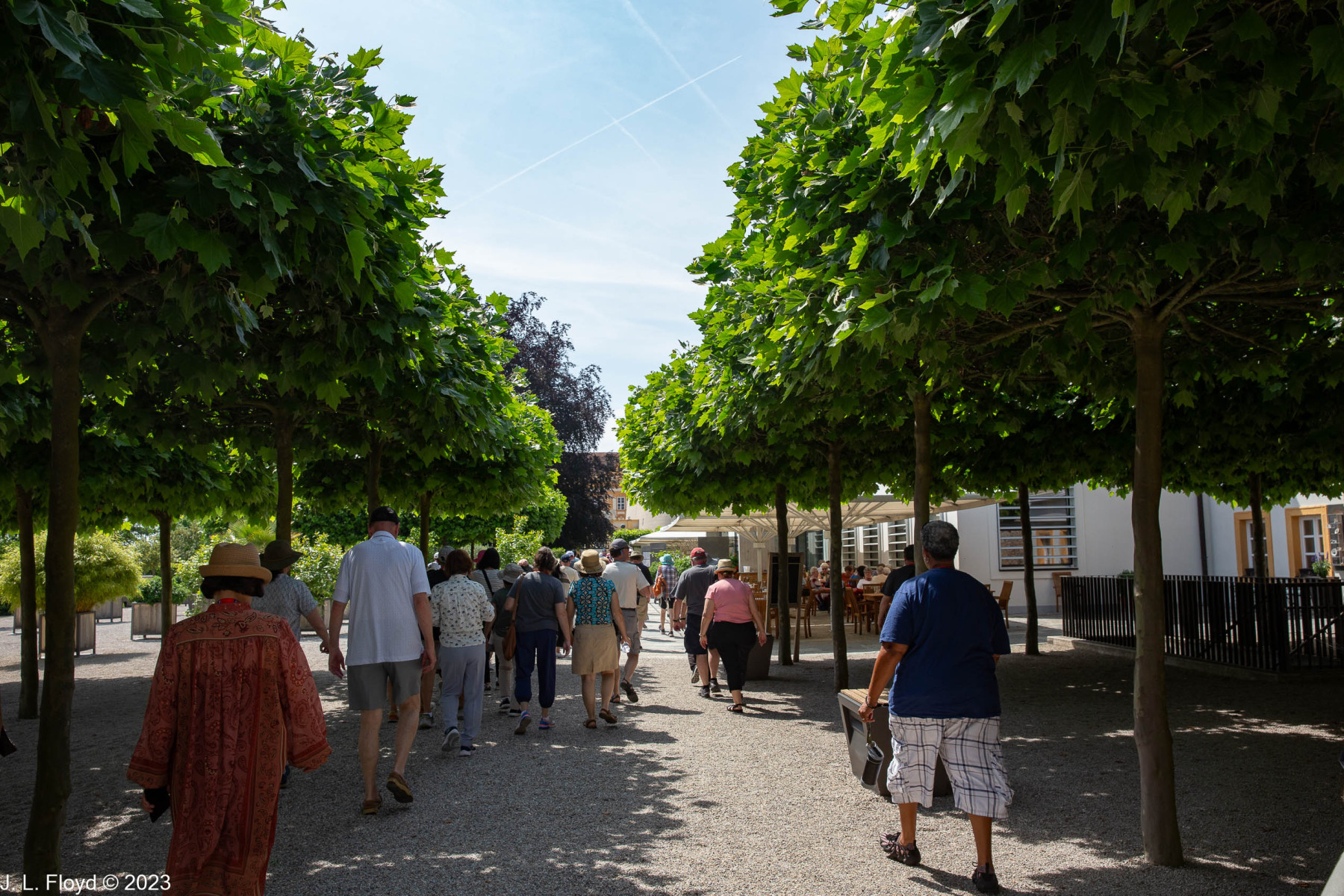
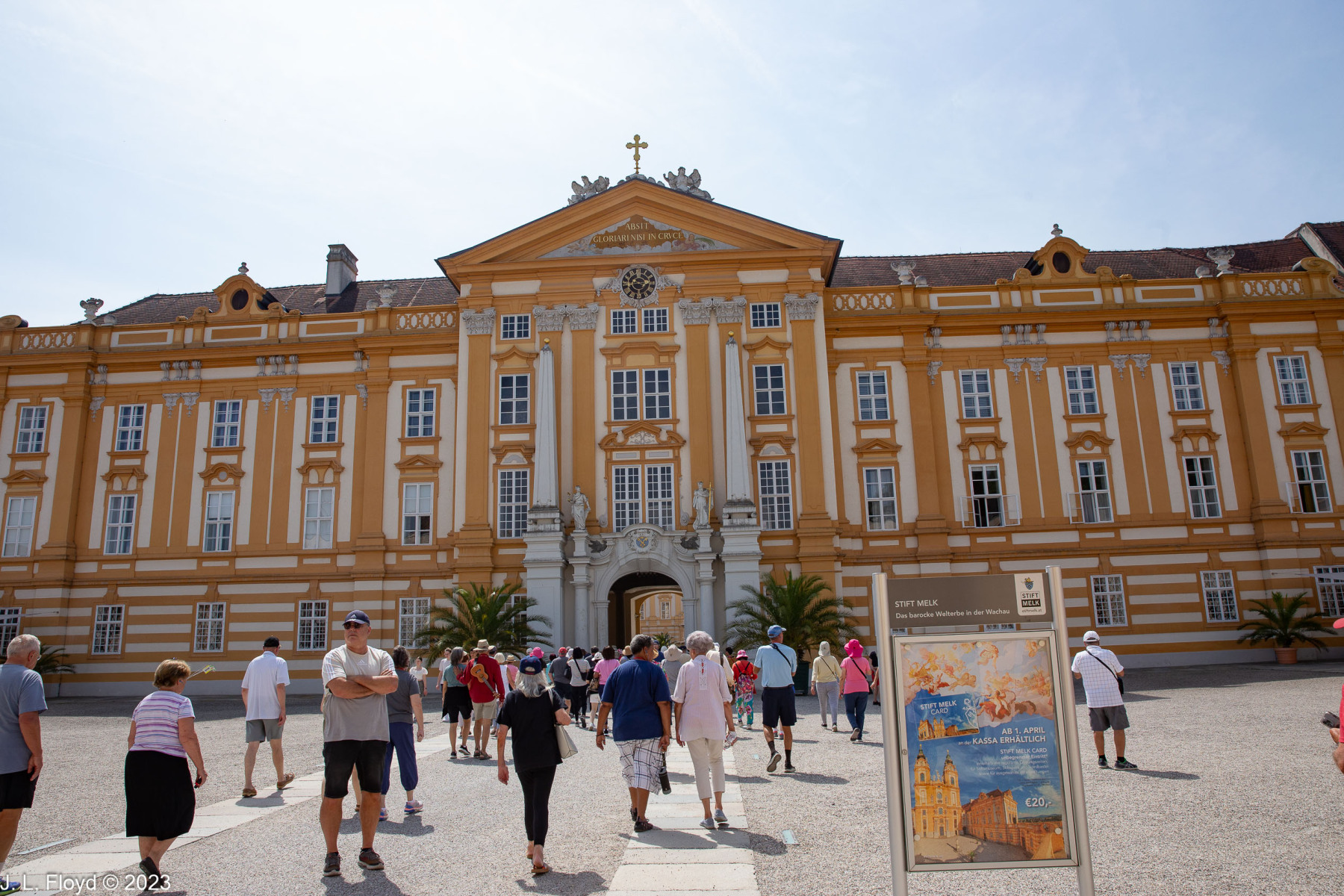
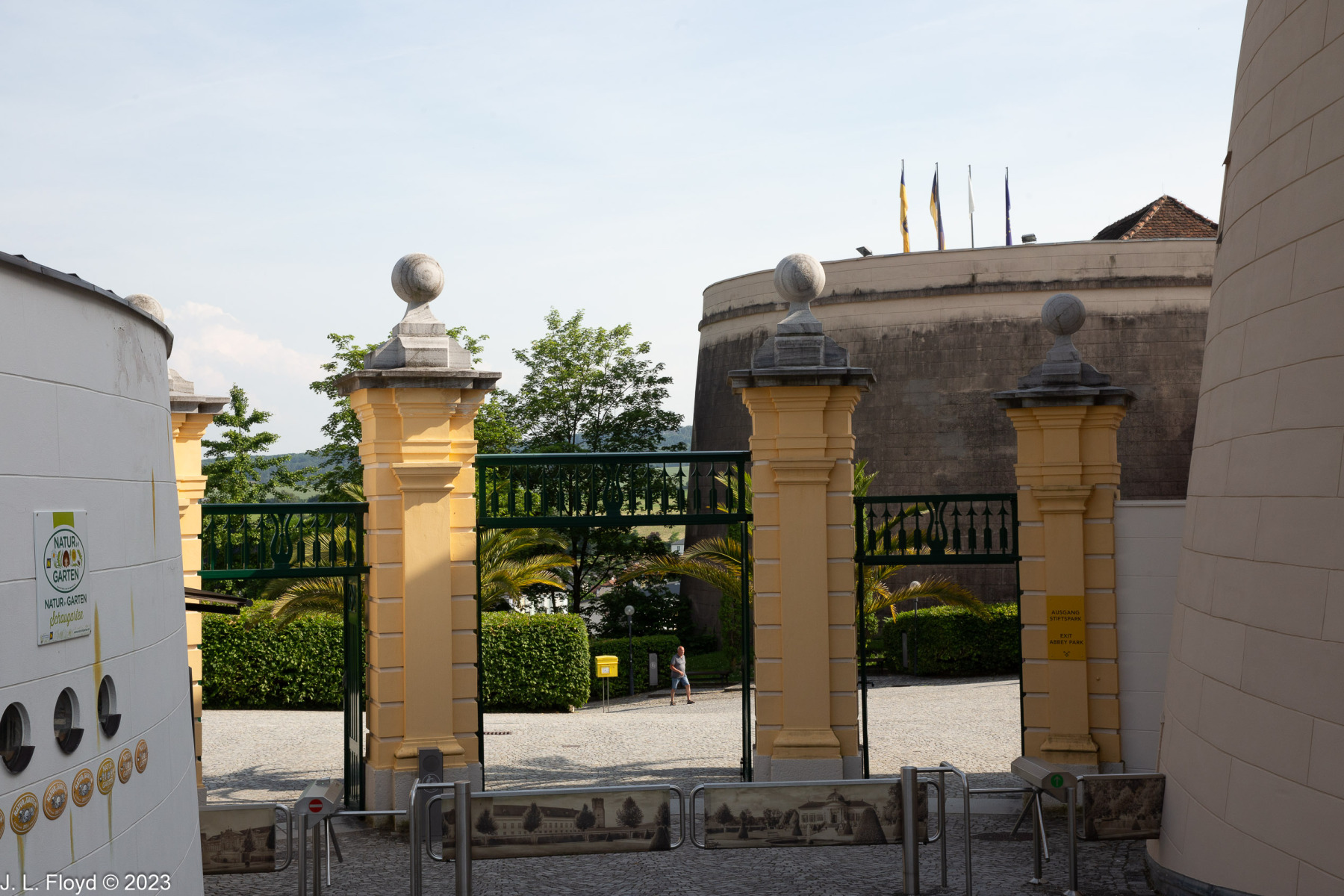
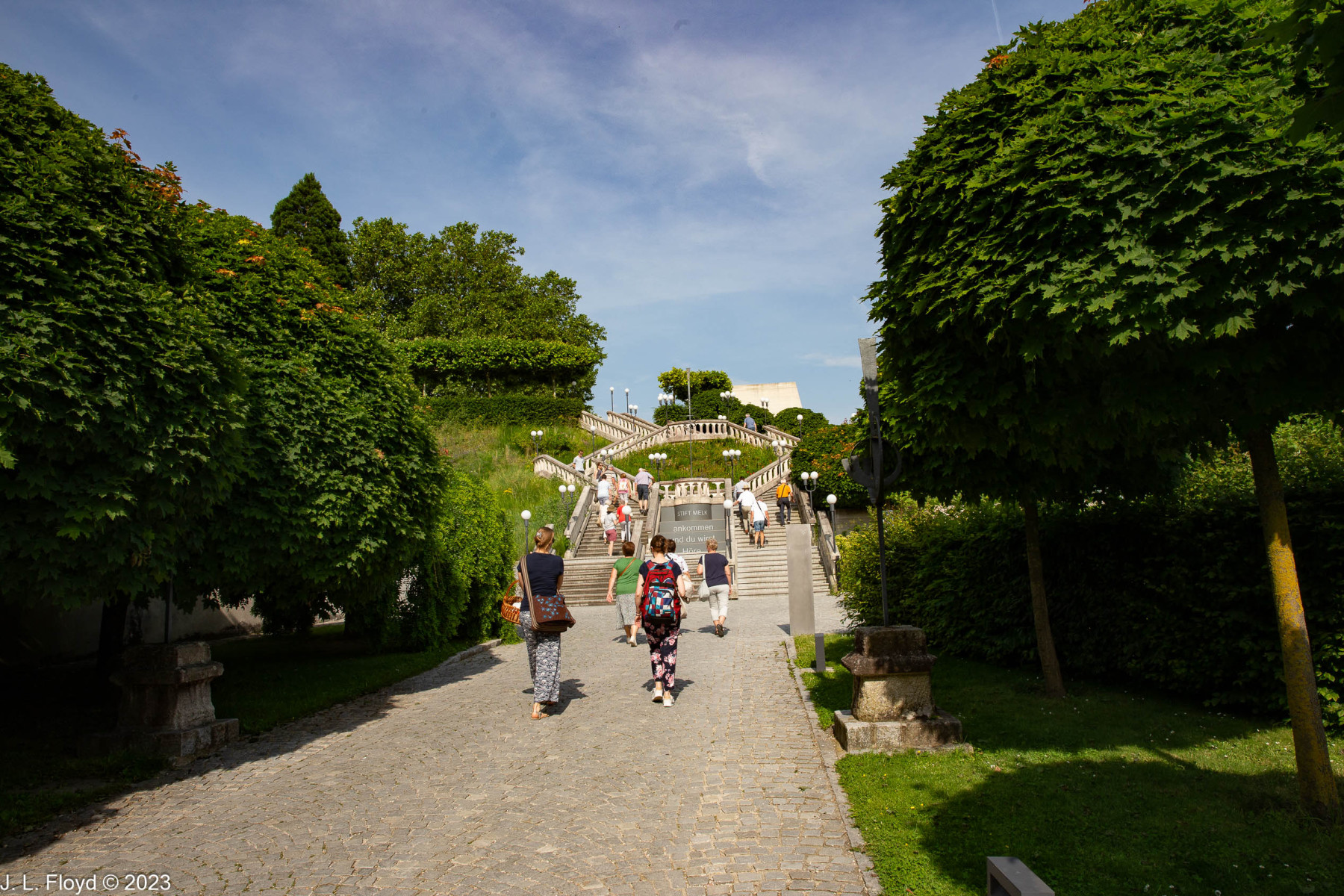
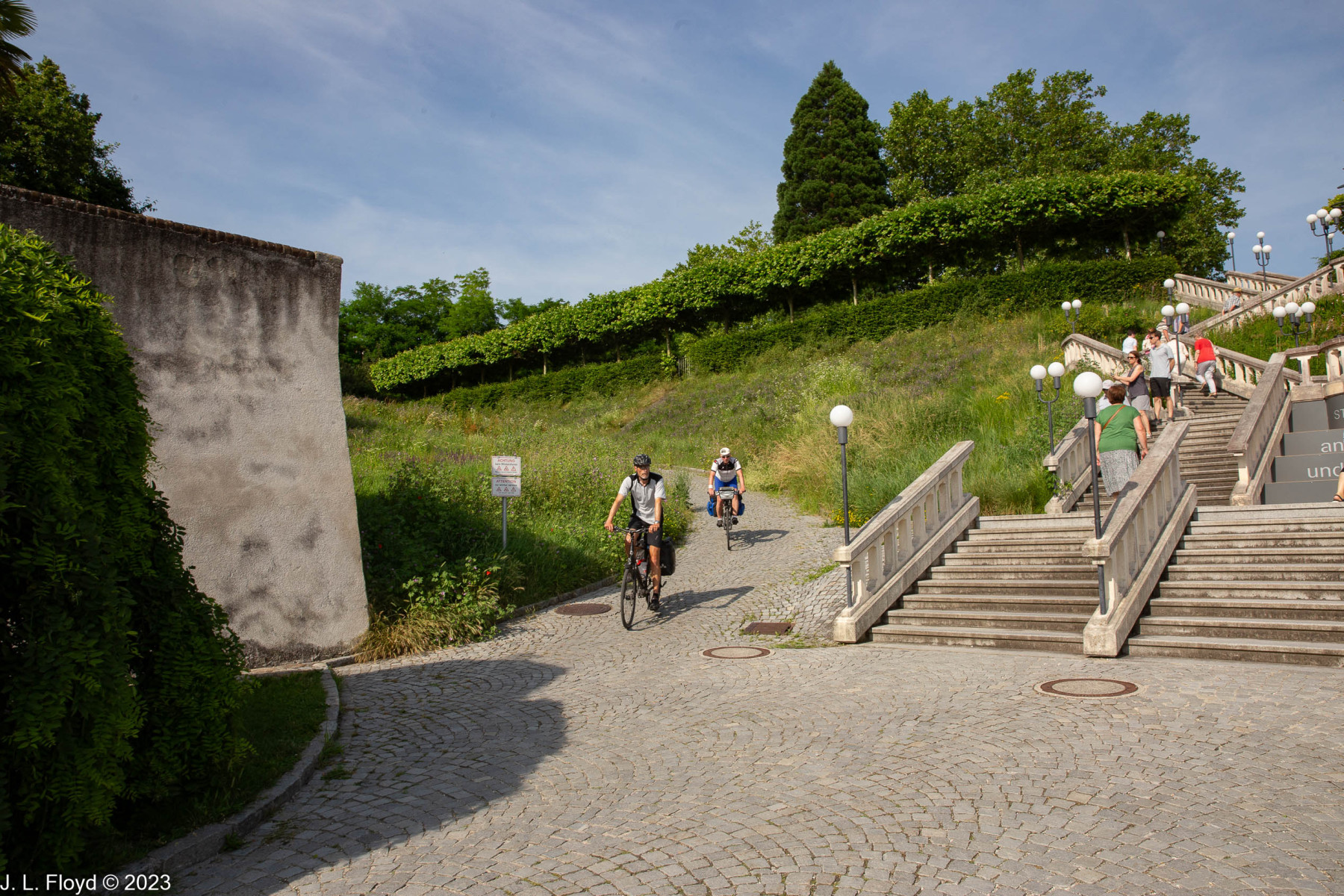
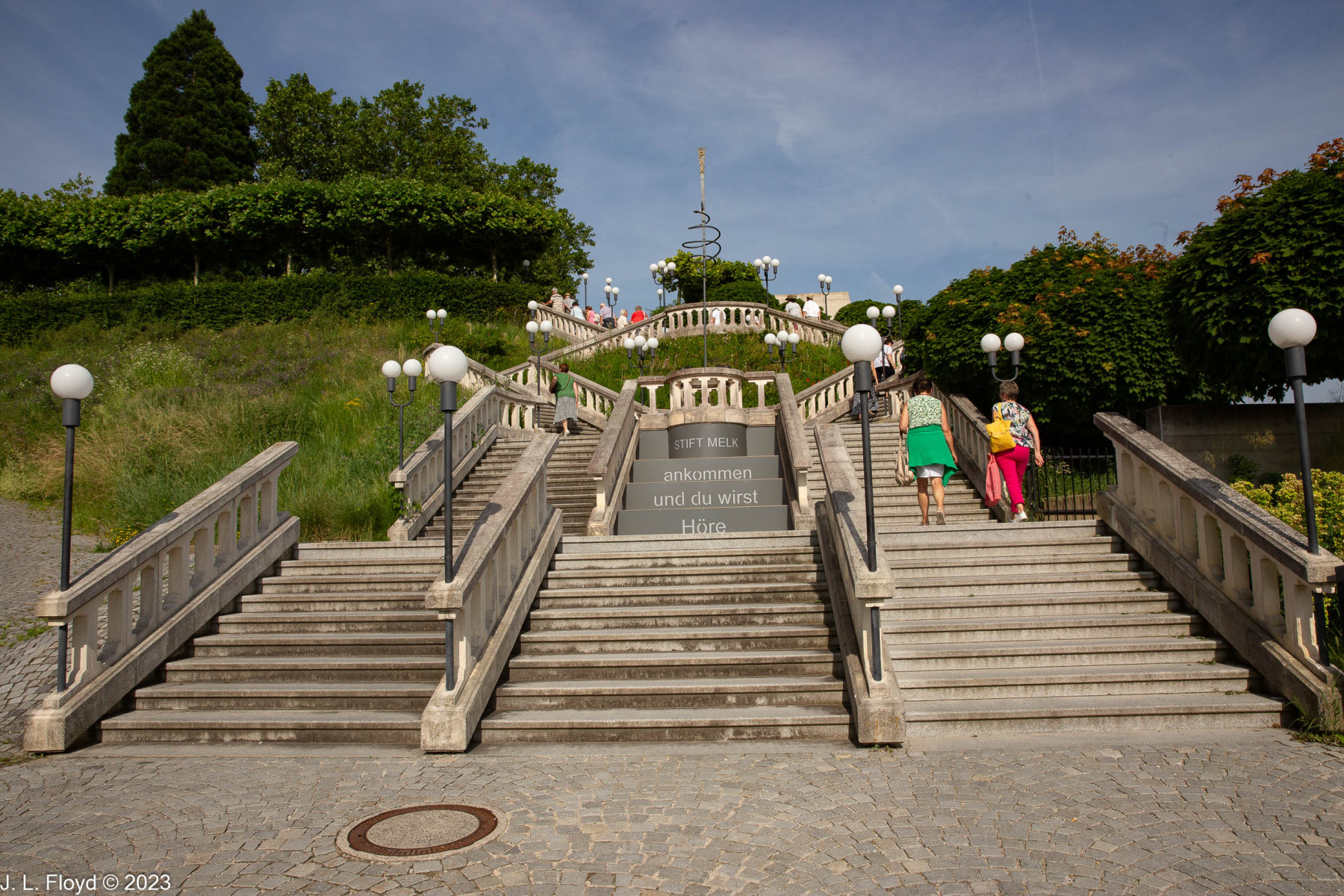
Debarking from the bus, we descended a great staircase and embarked upon a wide straight path through a garden area, passing what used to be an orangery but is now the monastery restaurant, which can accommodate up to 600 people. The path took us to the main portal of the monastery.
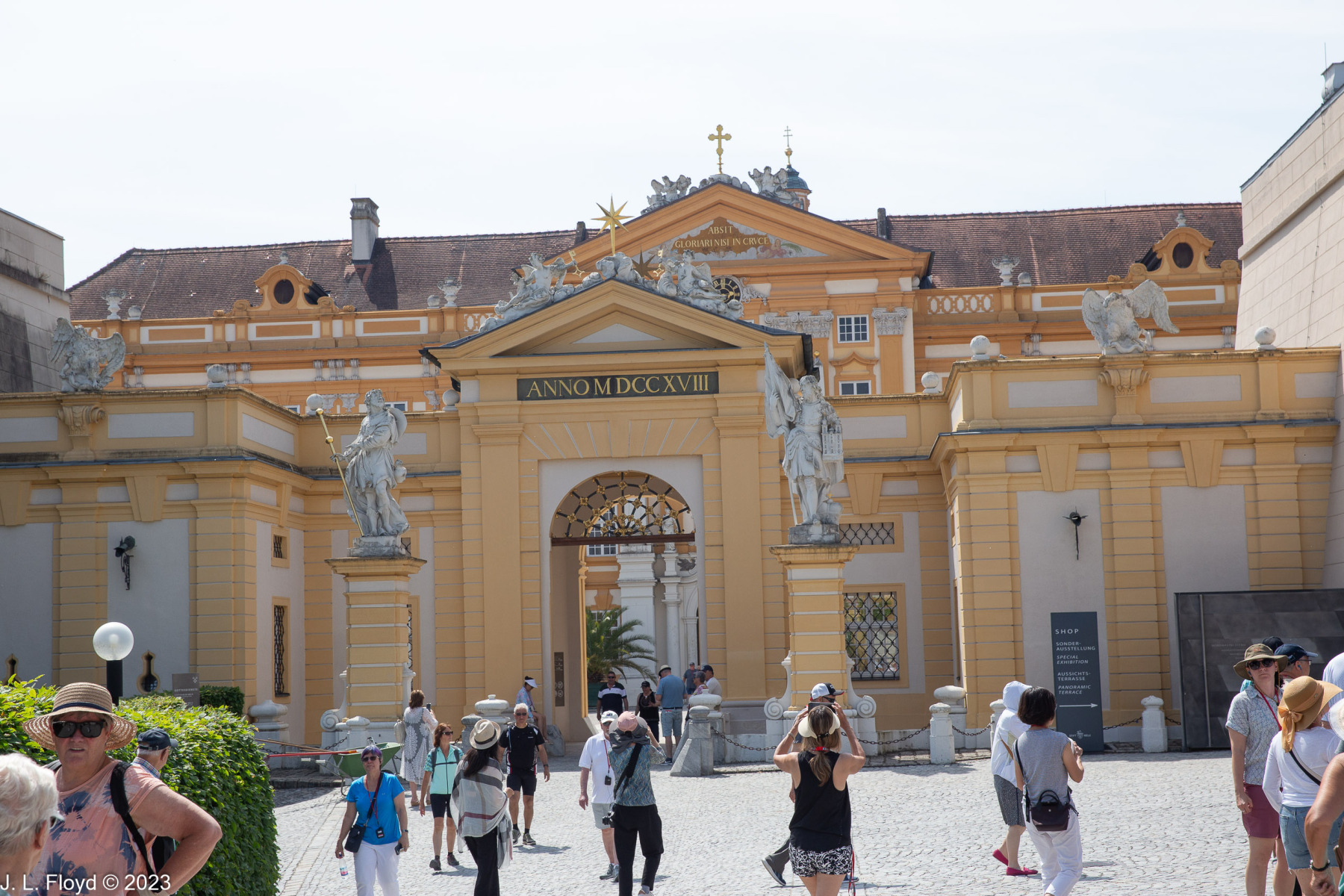
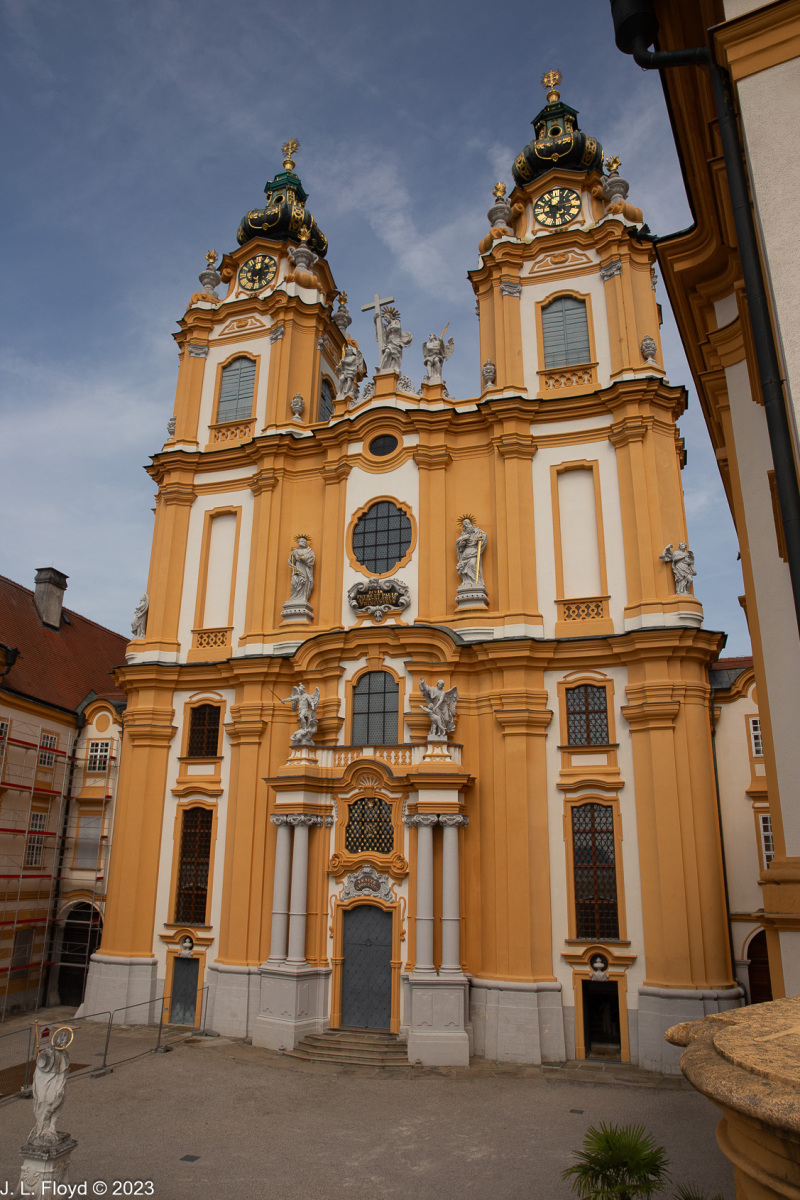
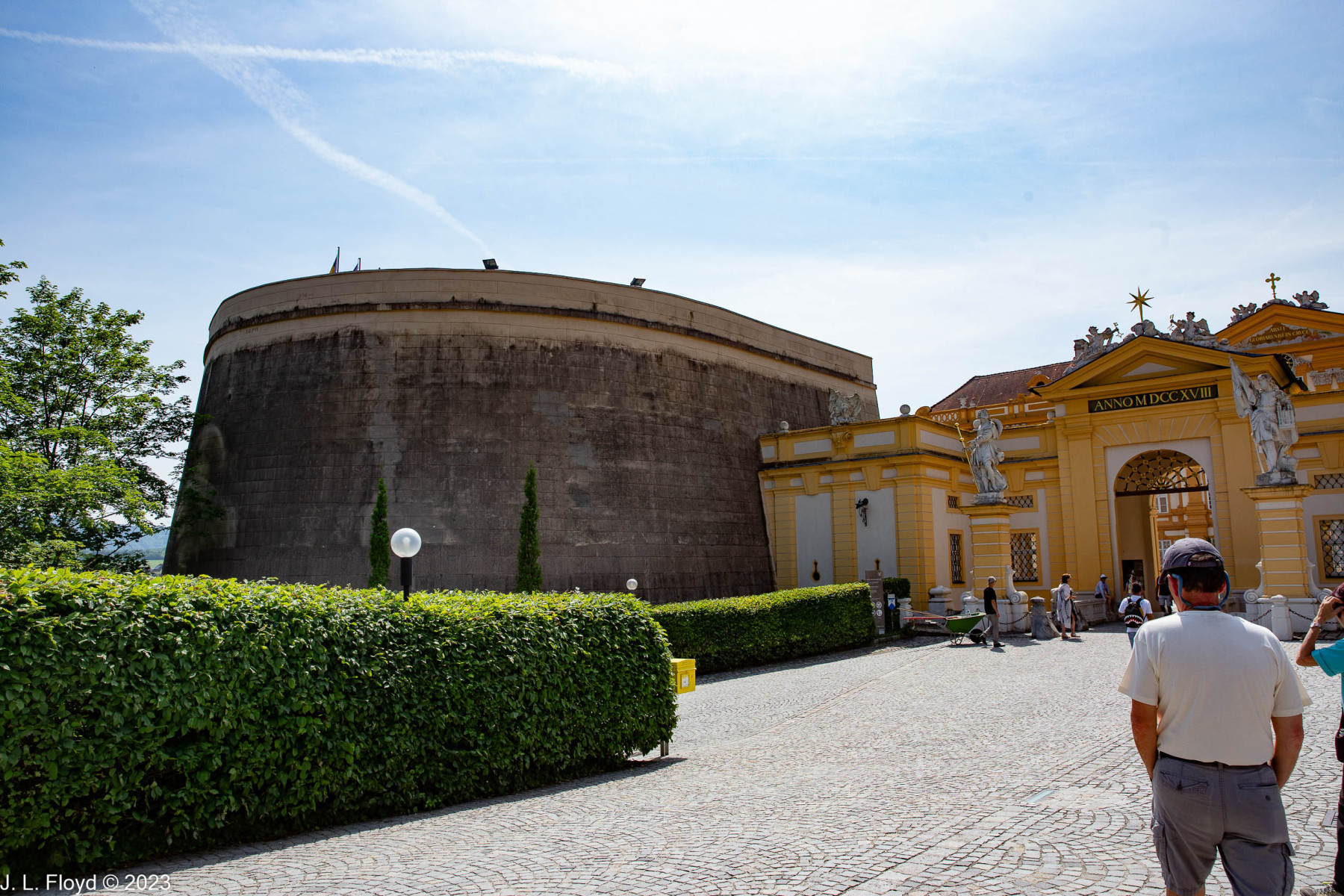
Flanking the main portal are two bulky, frowning structures which tower higher than the portal itself and almost dwarf it. The one on the left, the South Bastion, was built for defense in 1650. The Thirty Years’ War had ended in 1648, but the Ottoman Empire was still a threat from the east, and in fact the bastion served its purpose in helping to stave off the Turkish onslaught of 1683. The North Bastion was added much later for symmetry.

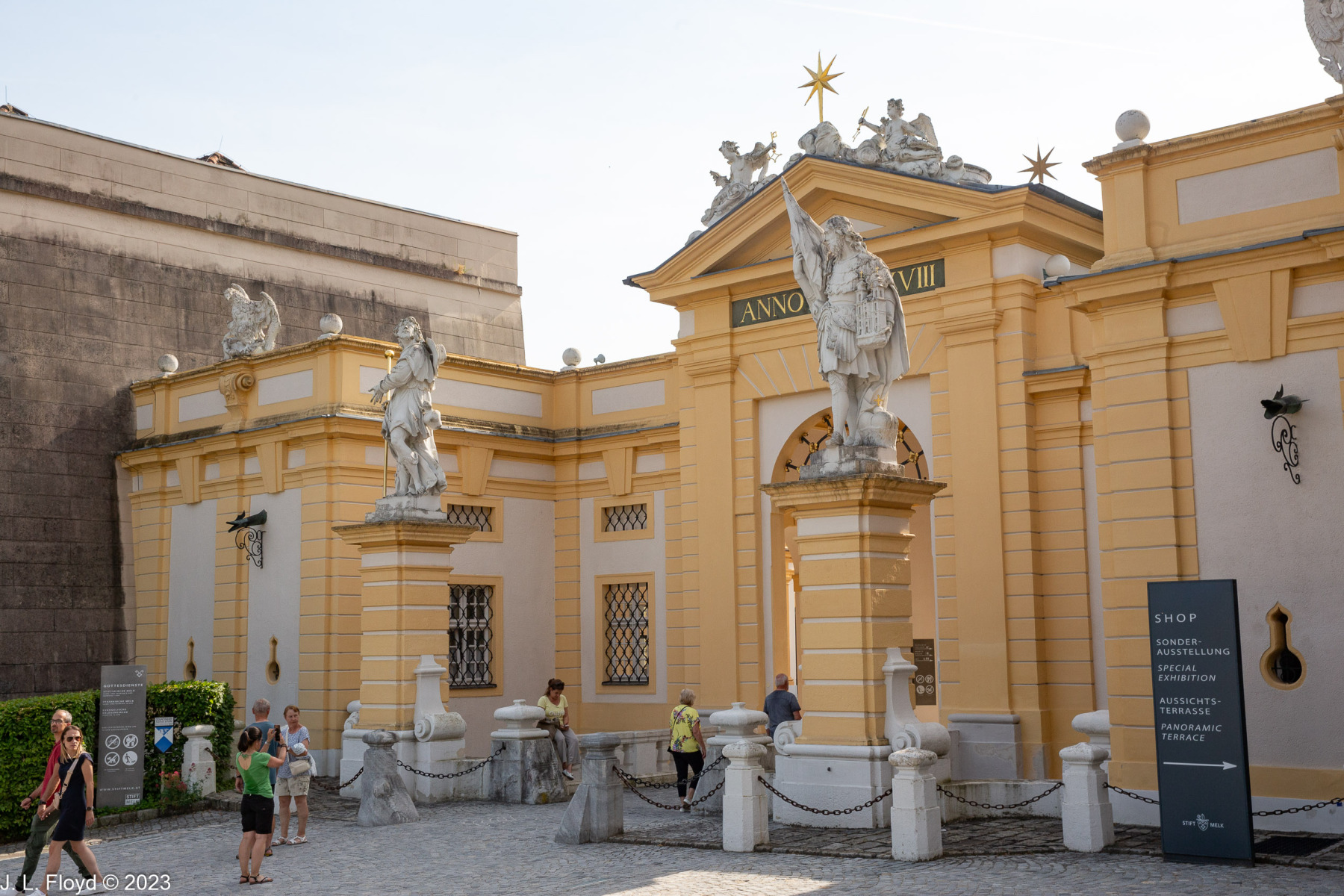
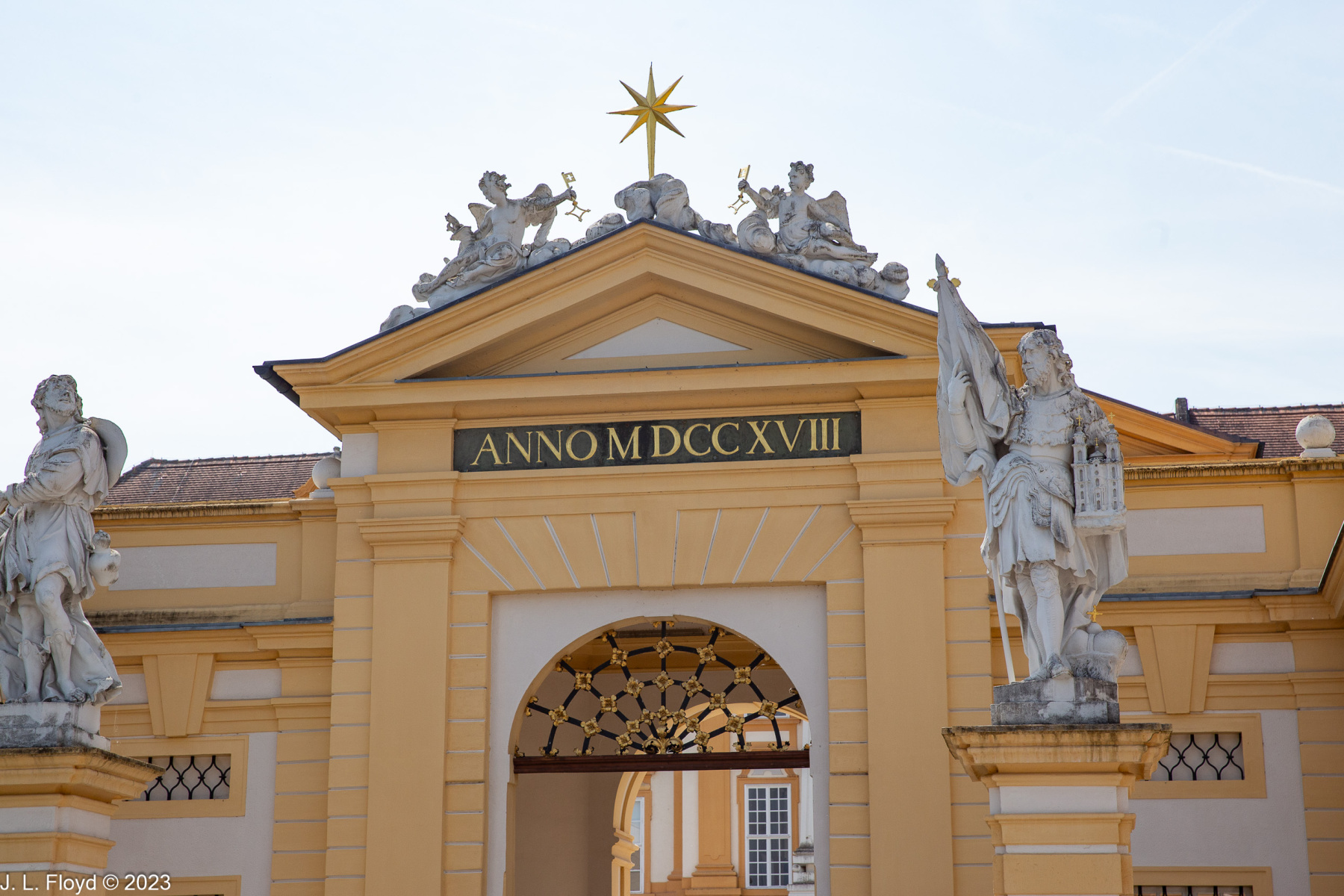
On either side of the gate are statues of the two patron saints of the Abbey, St. Koloman on the left and St. Leopold on the right. In the 17th century the Austrians decided that having an Irishman as their patron saint was unseemly, so in 1663 they replaced St. Koloman in that capacity with one of their own, Leopold III the Good (1073-1136) of the House of Babenberg, Margrave of Austria from 1095 to 1136. But St. Koloman continued to be venerated in Melk, and his remains are interred there. The statues at the Melk portal date from 1716. The portal itself was completed in 1718.

On the roof of the portal structure are two angels, each holding a key to the Abbey, and between them, on the apex, is a golden star, copied from the coat of arms of Berthold Dietmayr, the abbot responsible for the reconstruction of the Abbey in the early 18th century.
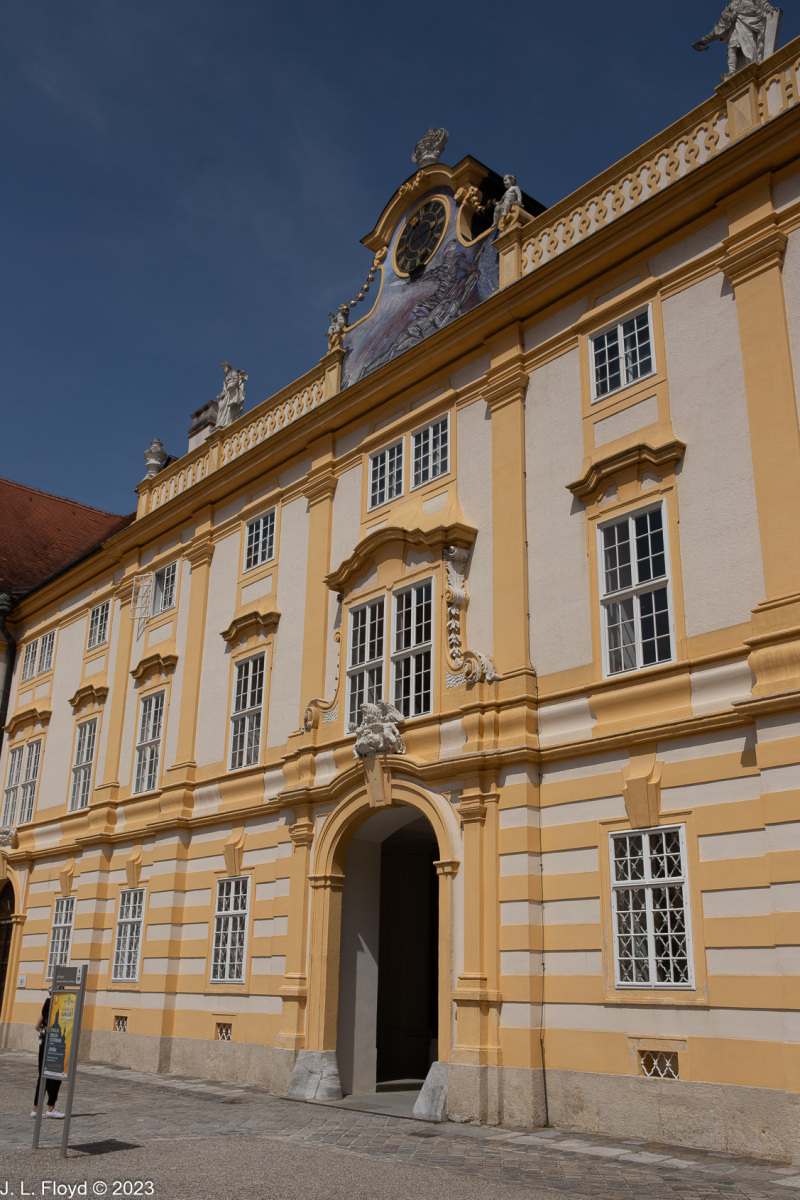
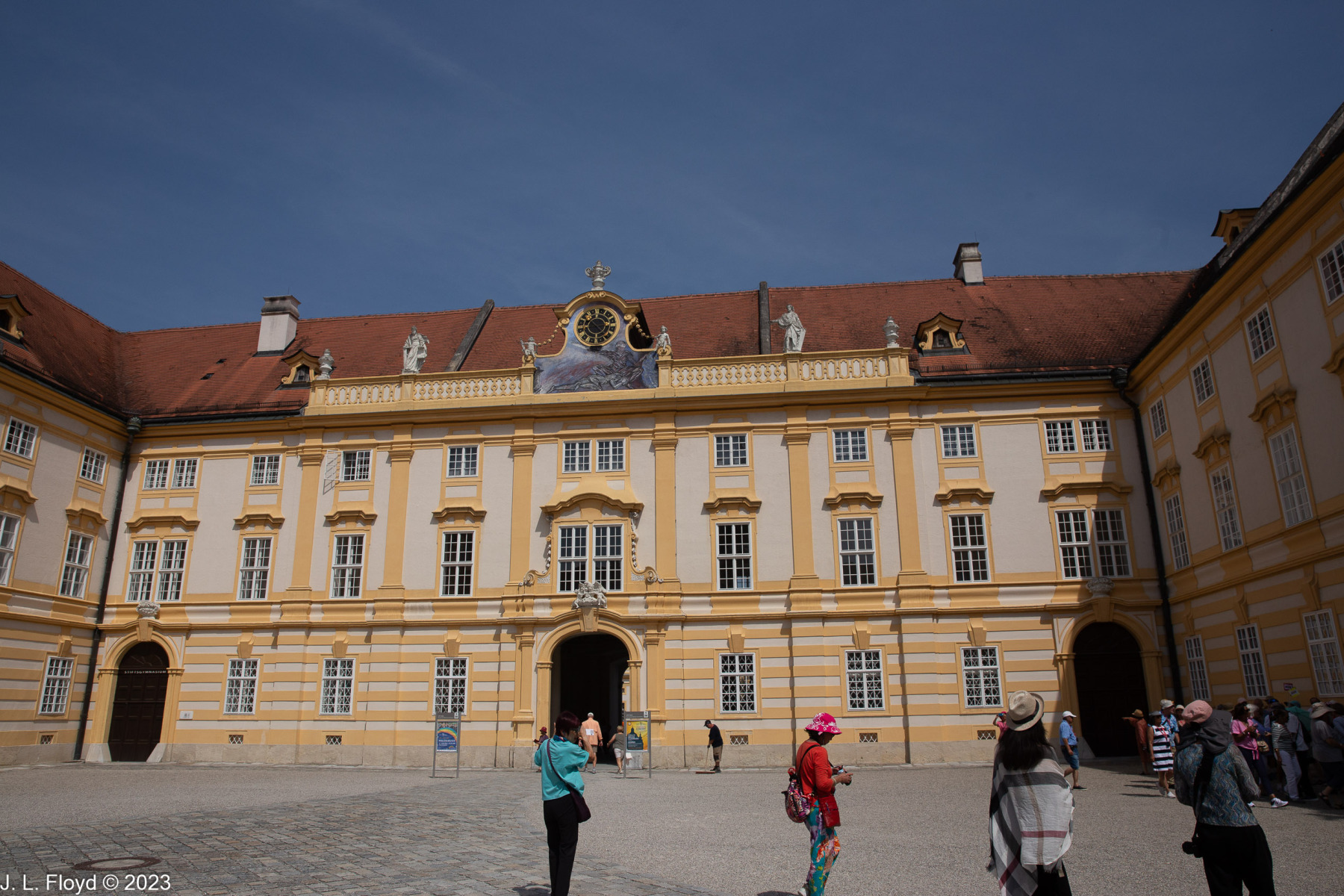
Passing through the portal, we found ourselves in the outer courtyard, known as the Gatekeeper’s Courtyard, looking at the eastern façade of the monastery. The center section has a peaked roof, and on its apex is an oversized replica of the Melk Cross. Beneath it, in the gable, is an inscription in Latin reading “Absit gloriari nisi in crucem” (“Glory is only to be found in the Cross”). The rounded entrance archway at ground level is flanked by two obelisks, with statues of Saints Peter and Paul on pedestals next to them. The Abbey’s coat of arms, two crossed keys on a blue background, is embedded at the apex of the arch, and the archway is crowned by a balcony which is used by the abbot to greet important visitors. (He did not appear to greet us, of course.)

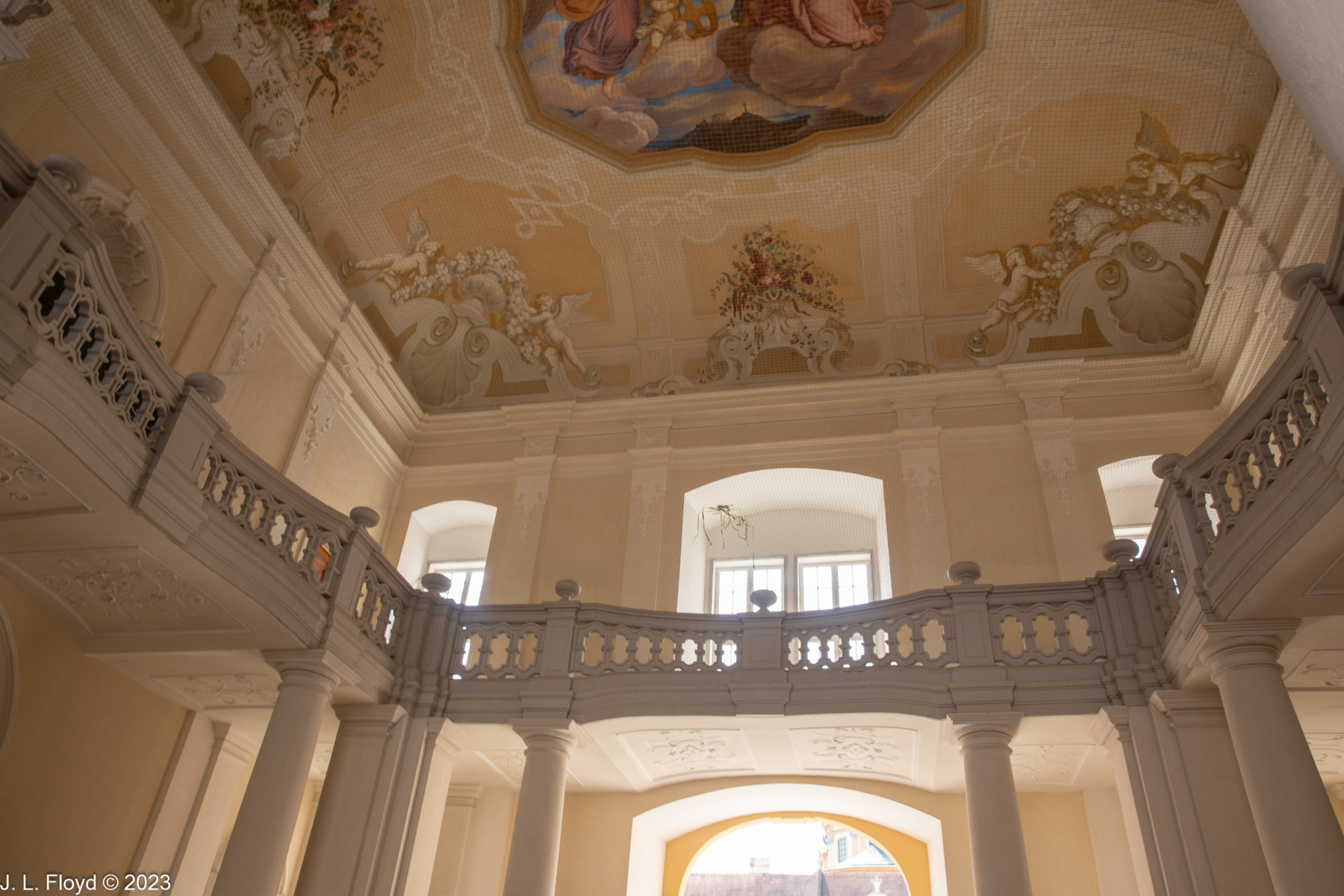
Entering through the archway, we found ourselves in Benedict Hall. Thus far I have neglected to mention that Melk Abbey belongs to the Order of St. Benedict. Benedict of Nursia (480-547 CE) is considered the founding father of Western (Latin Christian) monasticism. Most monasteries founded in medieval Europe followed the Benedictine rule. Benedict Hall in Melk Abbey is simple and elegant, two stories high with a balustrade running around the second floor. The hall is almost bare except for the ceiling, which features a splendid fresco depicting St. Benedict on top of a mountain with a temple and a cross. Unfortunately, I didn’t manage to fit all of the fresco into my photo of the hall.

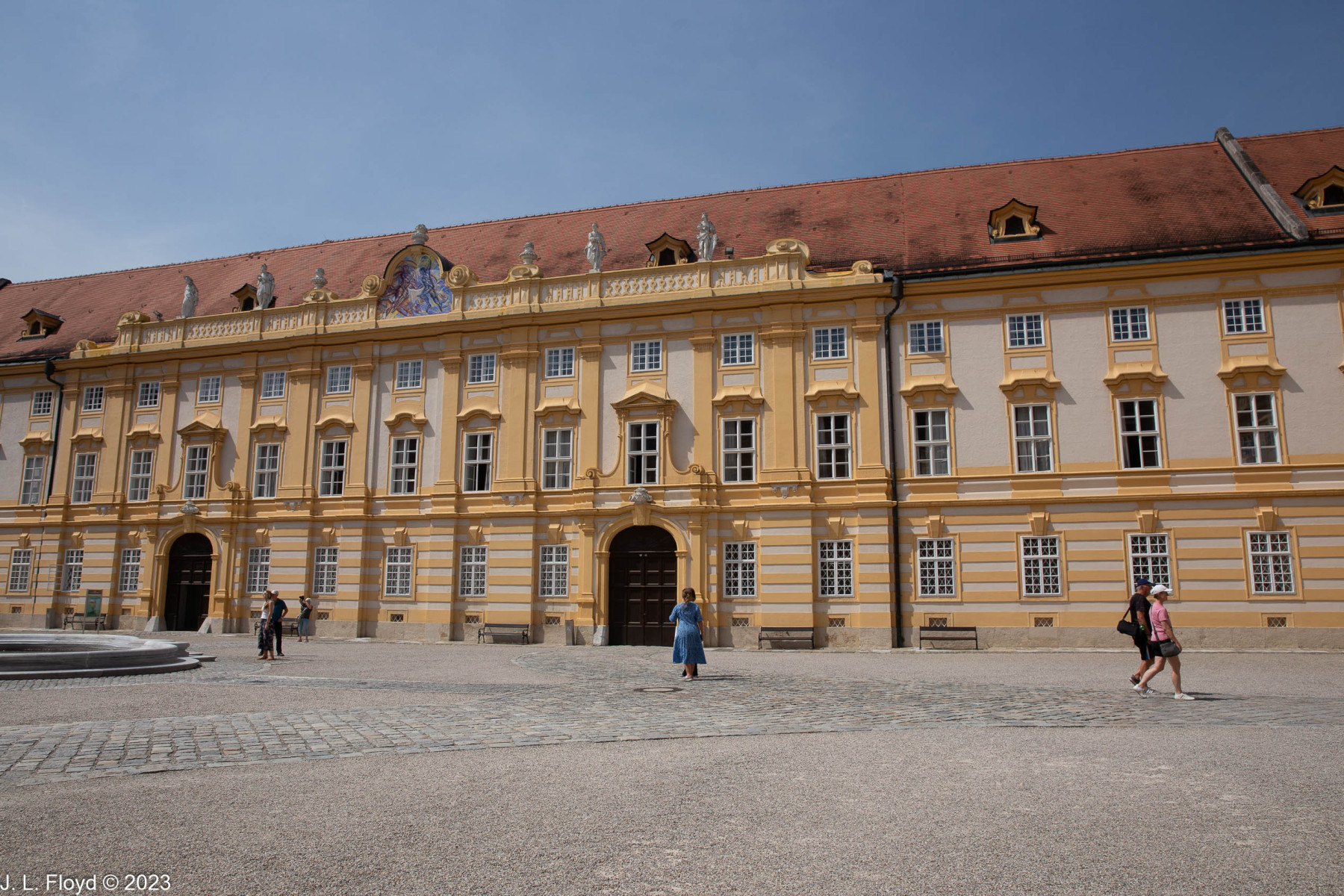
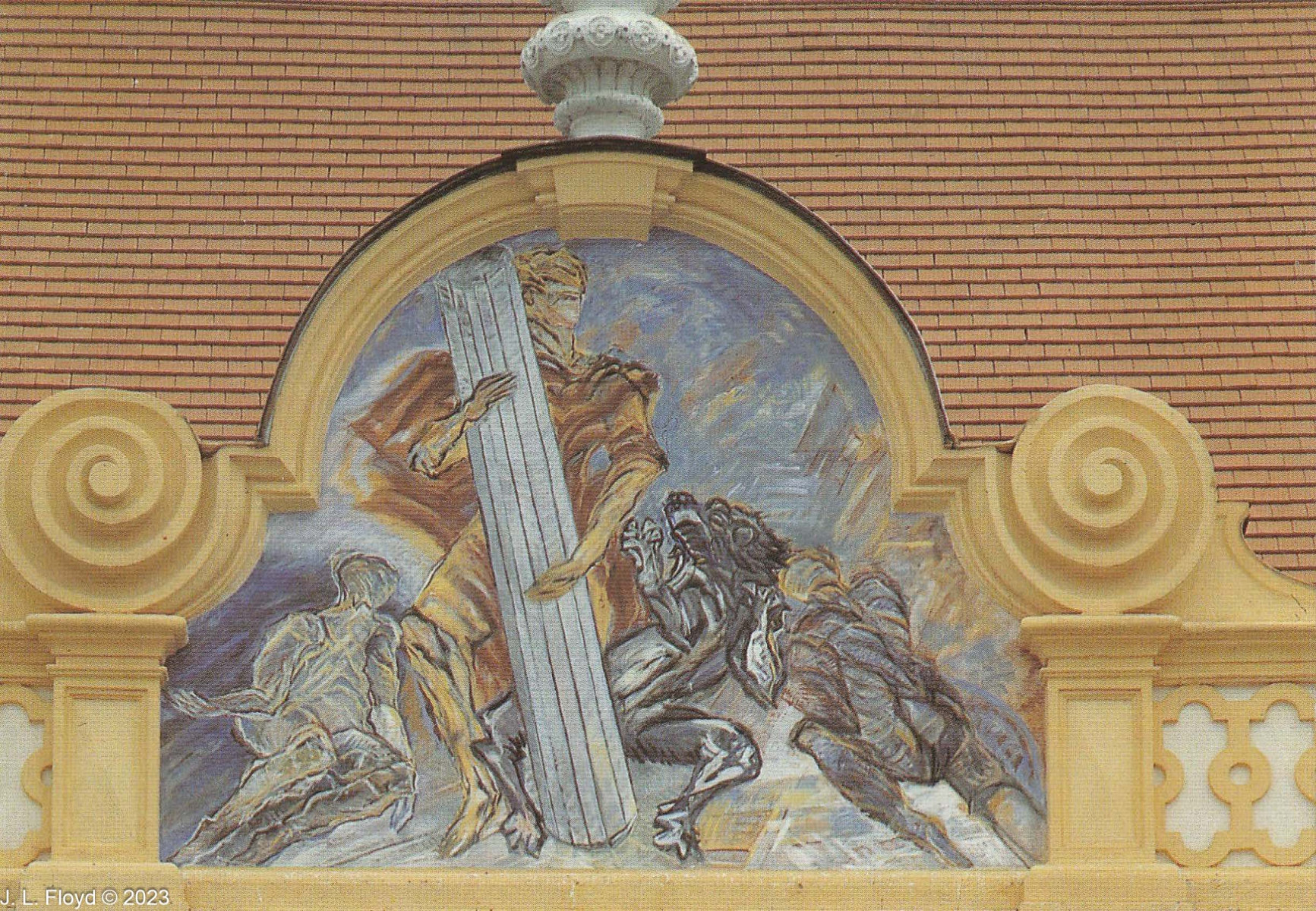
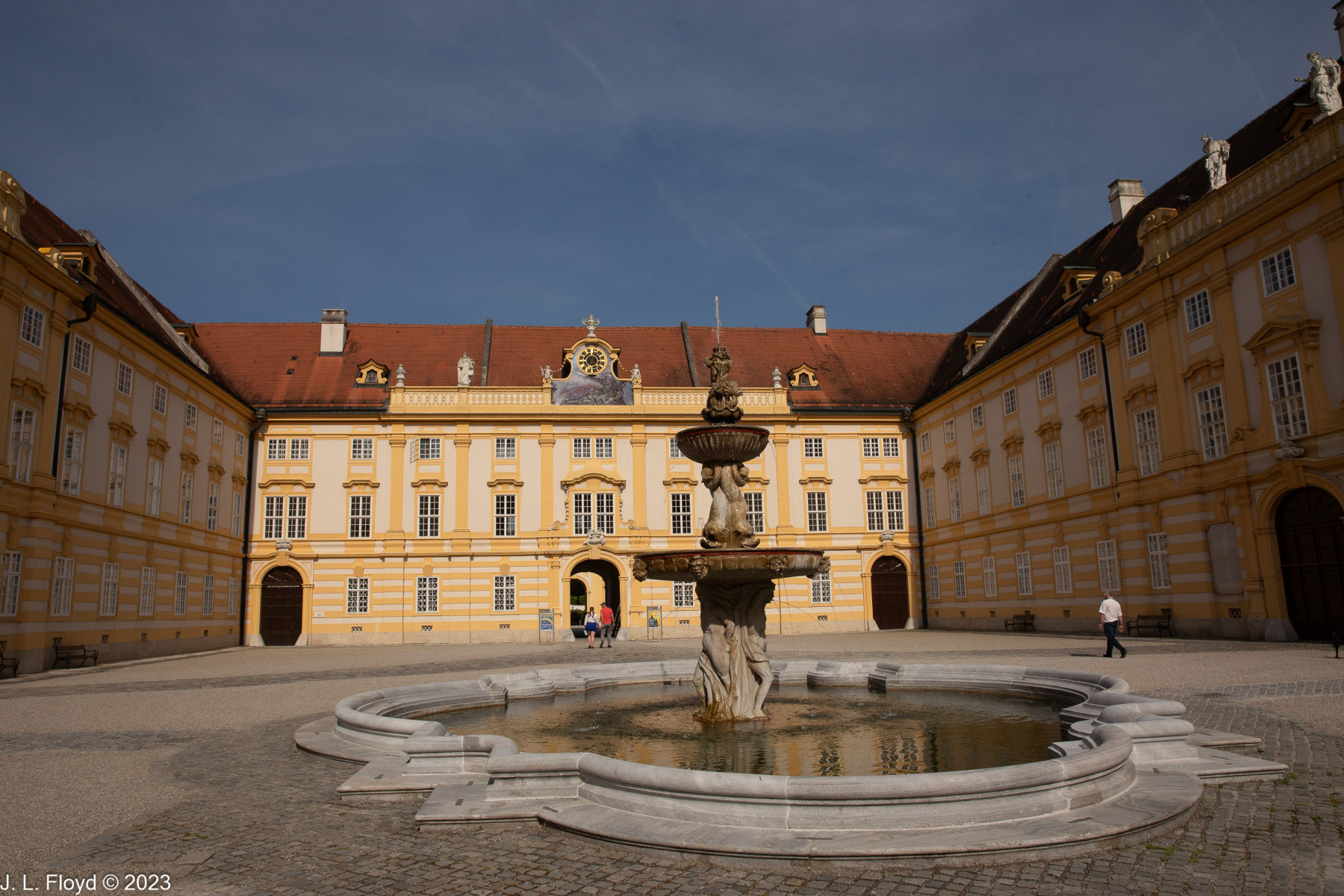
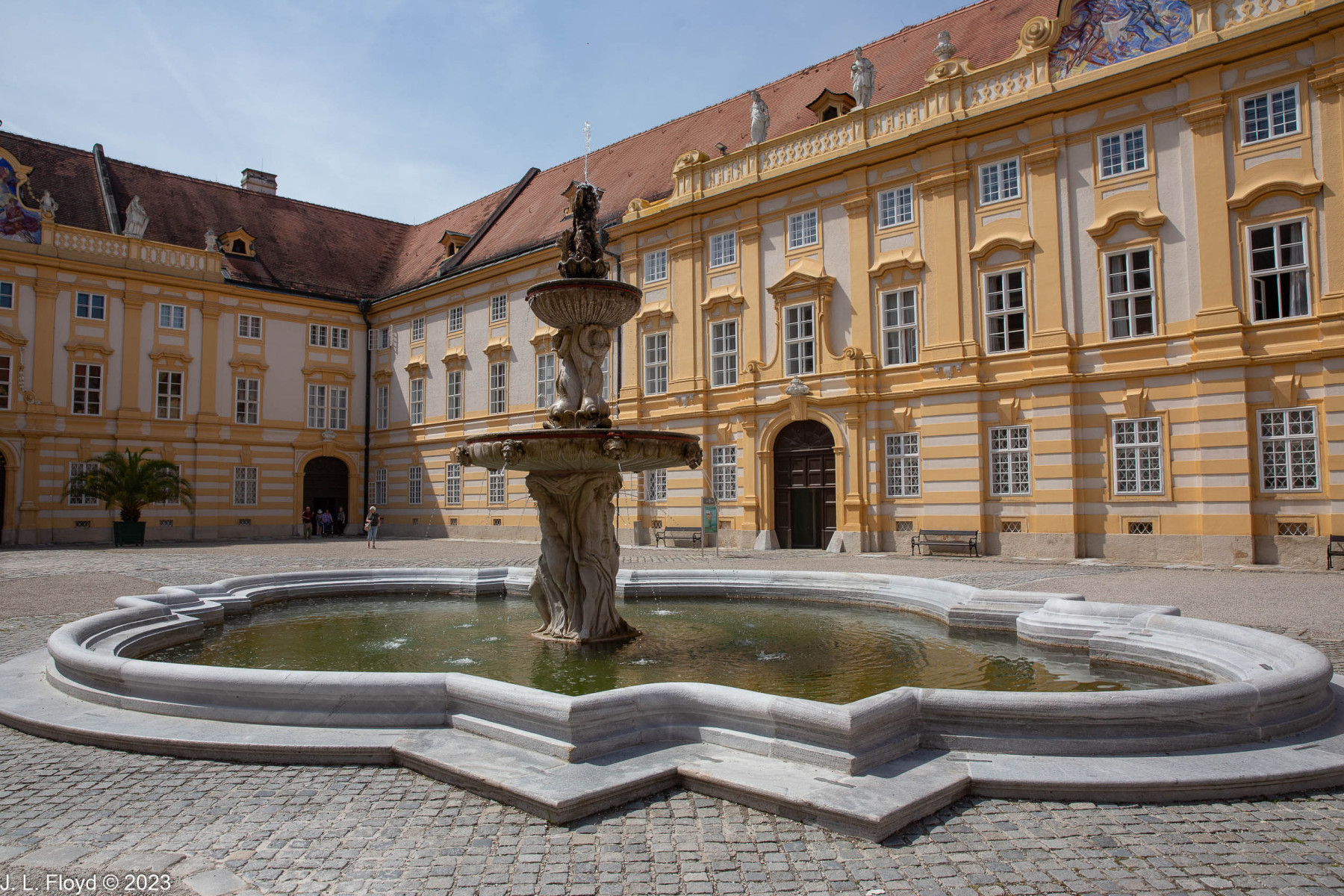
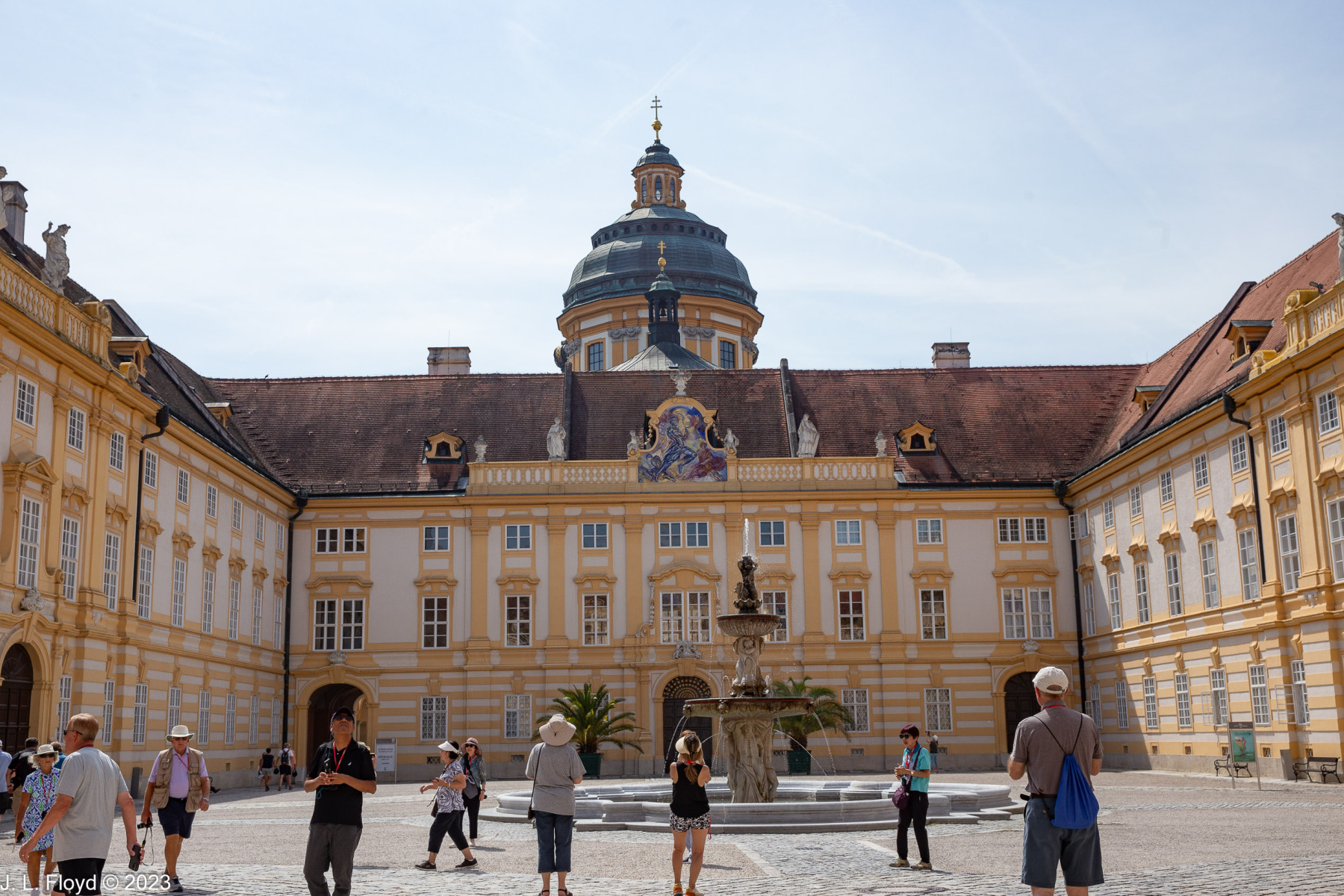
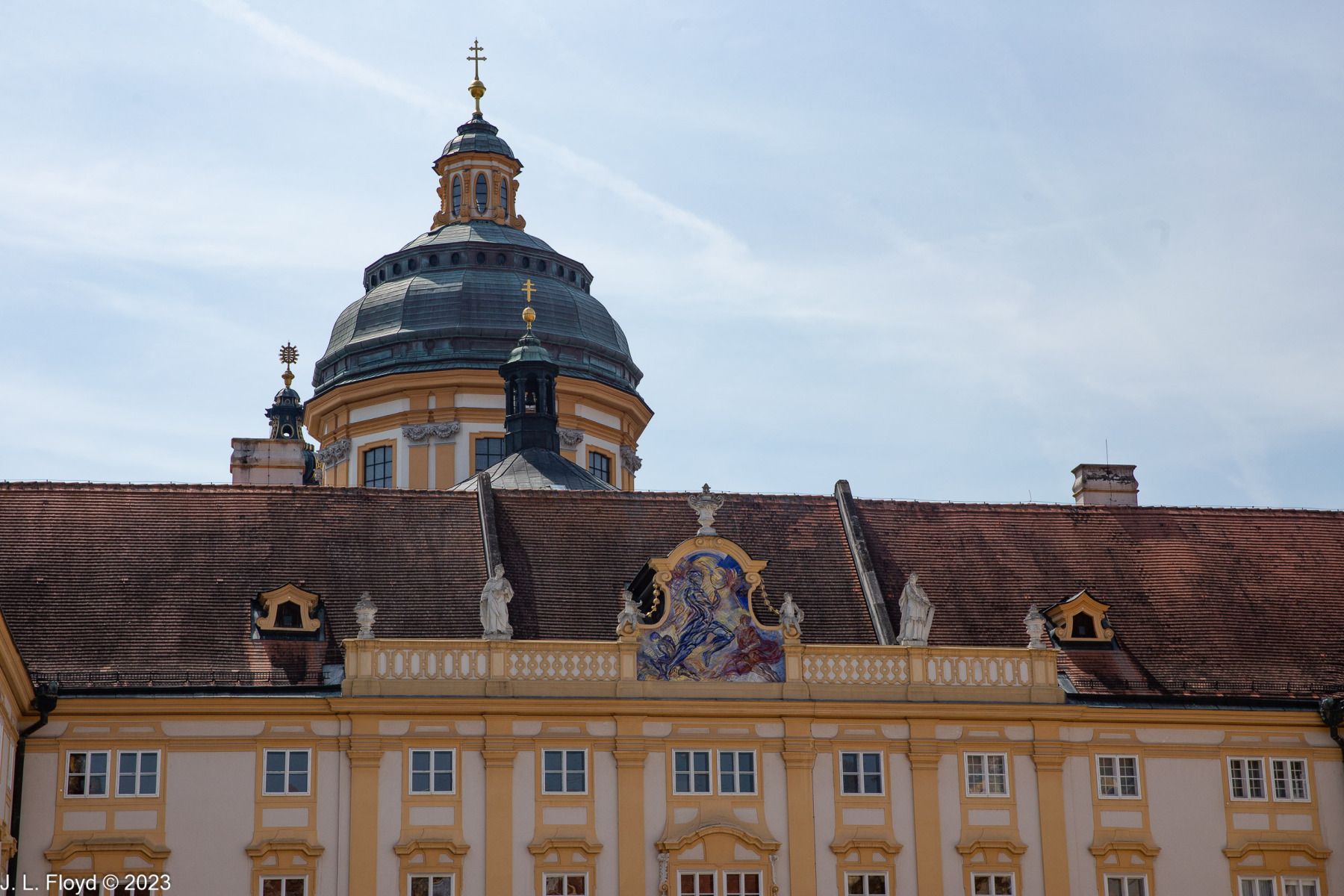
From Benedict Hall we emerged into the Prelate’s Courtyard. This is the largest courtyard and has some rather unusual features that are worth describing. Coming into the courtyard from Benedict Hall, one’s eye is first drawn to the imposing dome of the abbey church, rising above the roof on the far side of the court, then to the cornice atop the wall, which is topped with sculptures of saints and features a colorful fresco in the center. If you turn your gaze to the other walls of the courtyard, you will find that each of them has a similar cornice with its own fresco. Although the cornices with their statues are Baroque and part of the original 18th-century construction, the frescoes are modern and recent. During the restoration of the 1980s it was found that the existing Baroque frescoes had deteriorated too much to be restored, so they were replaced in 1988 by new ones created by Peter Bischoff. The original frescoes represented the four cardinal virtues, and so do the new ones: Prudence, Temperance, Justice and Fortitude. The introduction of modern art into the Baroque setting, though intended to harmonize as closely as possible, was somewhat controversial but I find that it works well enough.

The fresco on the west side of the courtyard, beneath the dome, depicts a boldly striding figure looking into a mirror, illustrating the precept “know thyself.” Two other figures appear in the scene, one reading, the other listening, and altogether they are intended to represent the virtue of Prudence.

The fresco on the north side depicts two figures pouring fire and water into an urn, with the aim of blending them into the essence of Temperance.

Fortitude, on the south side, is represented by three symbols – a column, a lion, and the figure of a human, who though sorely wounded by the lion, refuses to give up in the face of adverse circumstances.

The fresco on the east side, on the façade of Benedict Hall, represents Justice in the traditional manner, i.e. in the form of a blindfolded woman holding a sword; it also incorporates a clock, presumably to remind us that “Justice delayed is Justice denied”.

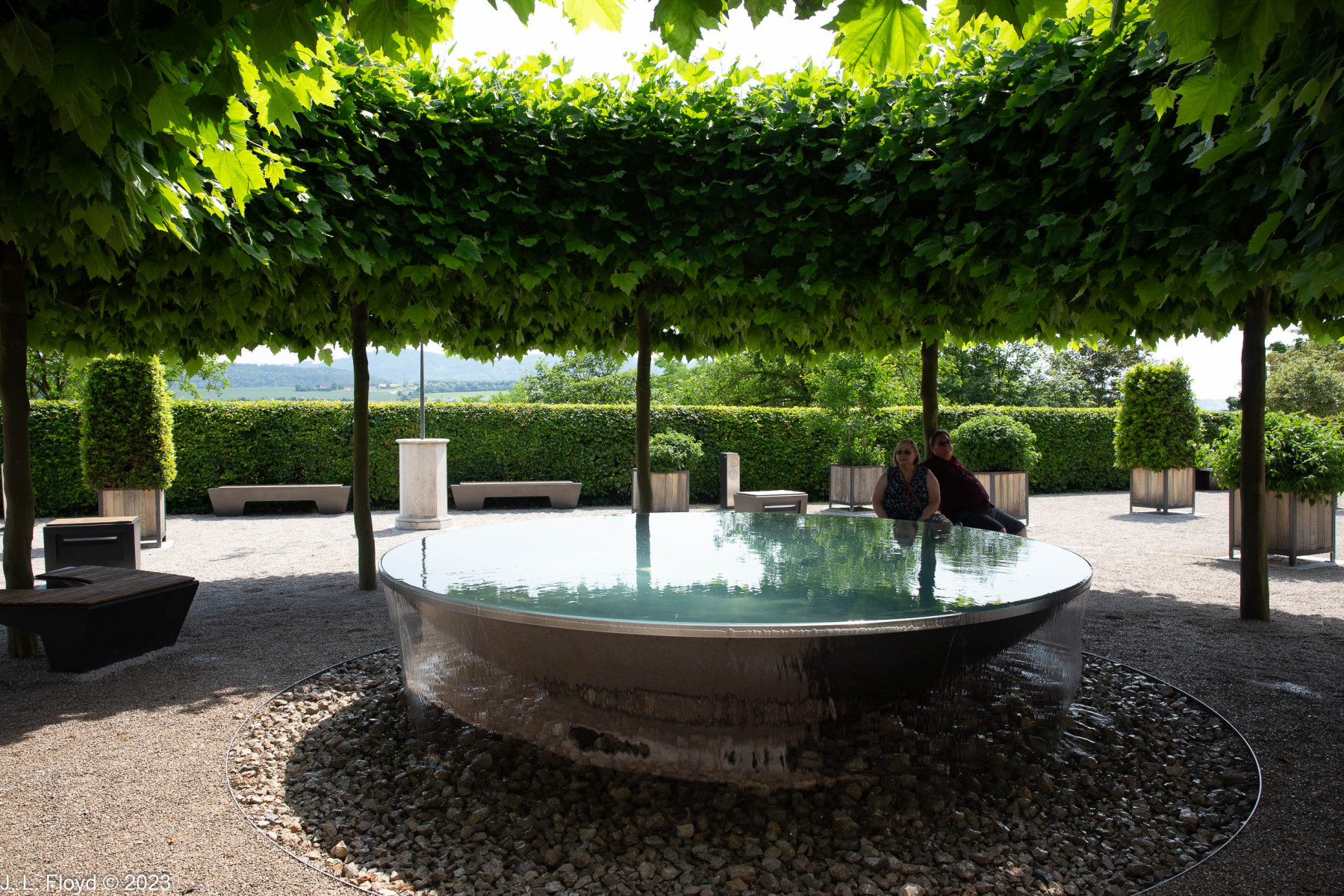
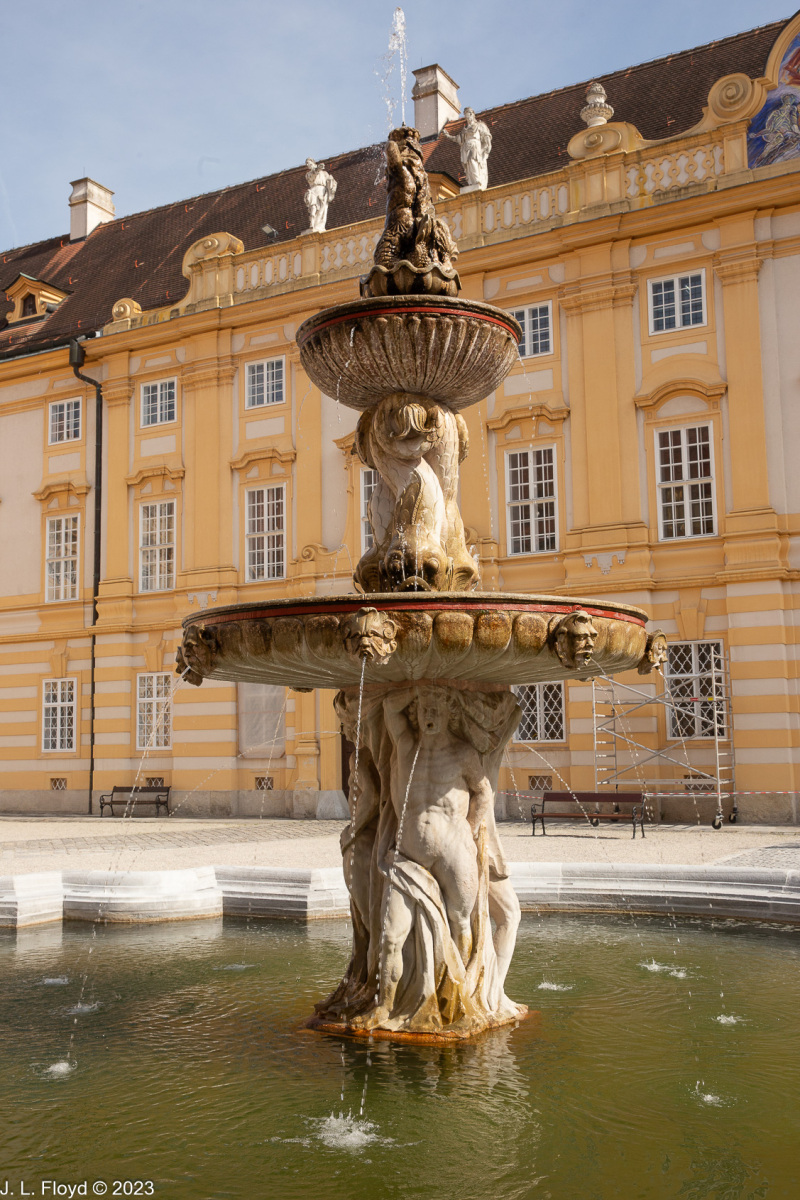
In the middle of the courtyard is a sculptured fountain. The original version, dating from 1687, depicted St. Koloman, but in 1722 the abbot gave it to the town of Melk, and today it stands on the town hall square. The fountain sculpture that stands in the courtyard today doesn’t look very much like St. Koloman, and I haven’t been able to find out what it is supposed to represent.
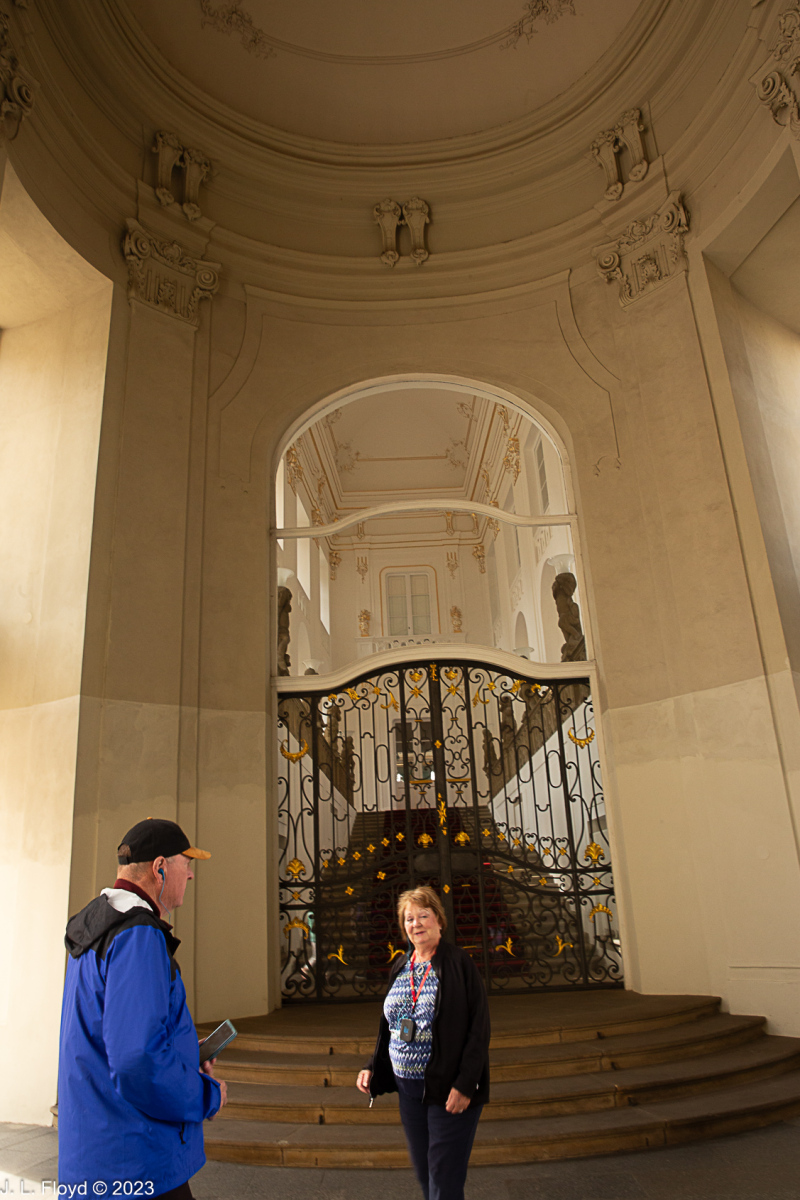
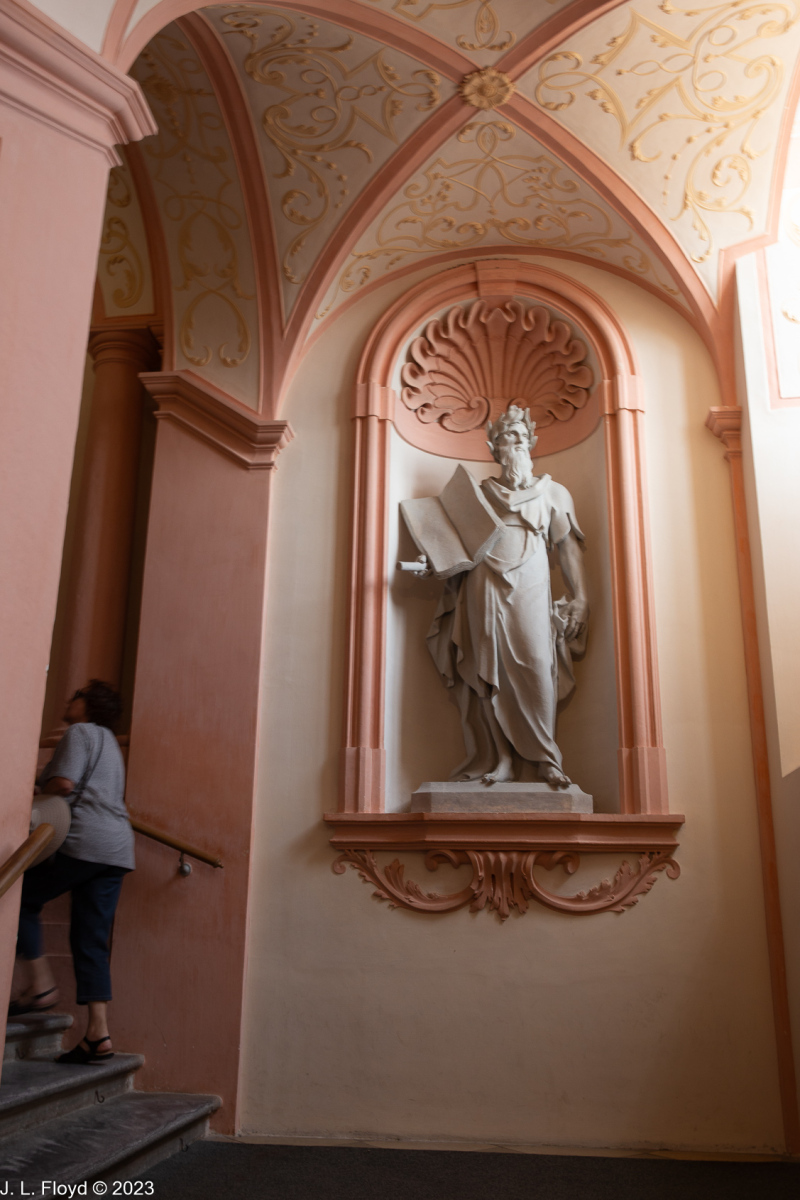
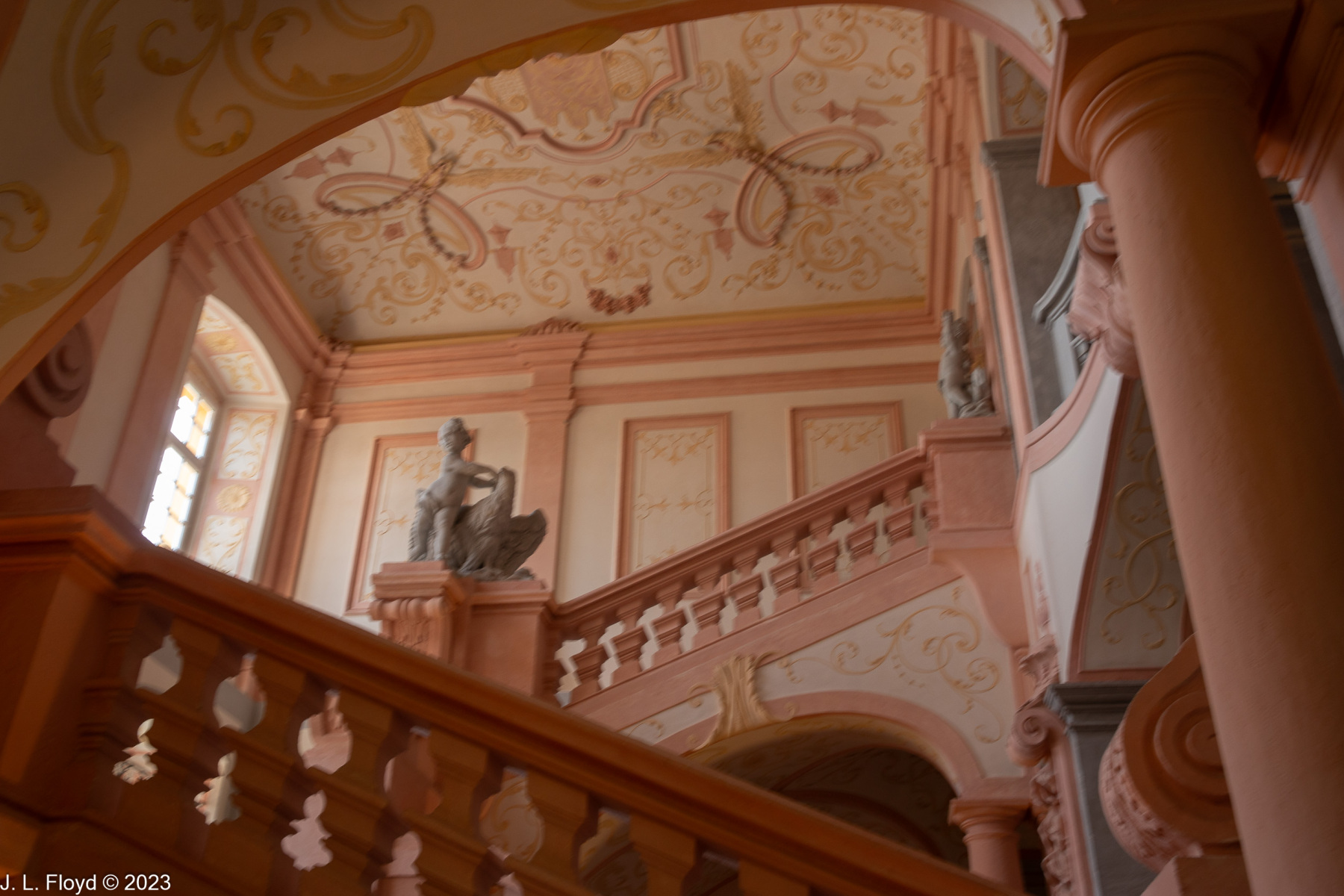
Our guided tour of the interior of the Abbey began (and ended) at the southwestern corner of the Prelate’s Court, where we entered the Imperial Wing, which used to contain rooms reserved for the imperial court, but now hosts a museum. Here we ascended the Imperial Staircase and found ourselves in the Imperial Corridor, which runs almost the entire length of the building; on its walls are portraits of the rulers of Austria down through the centuries, beginning with the first Babenberg margraves.

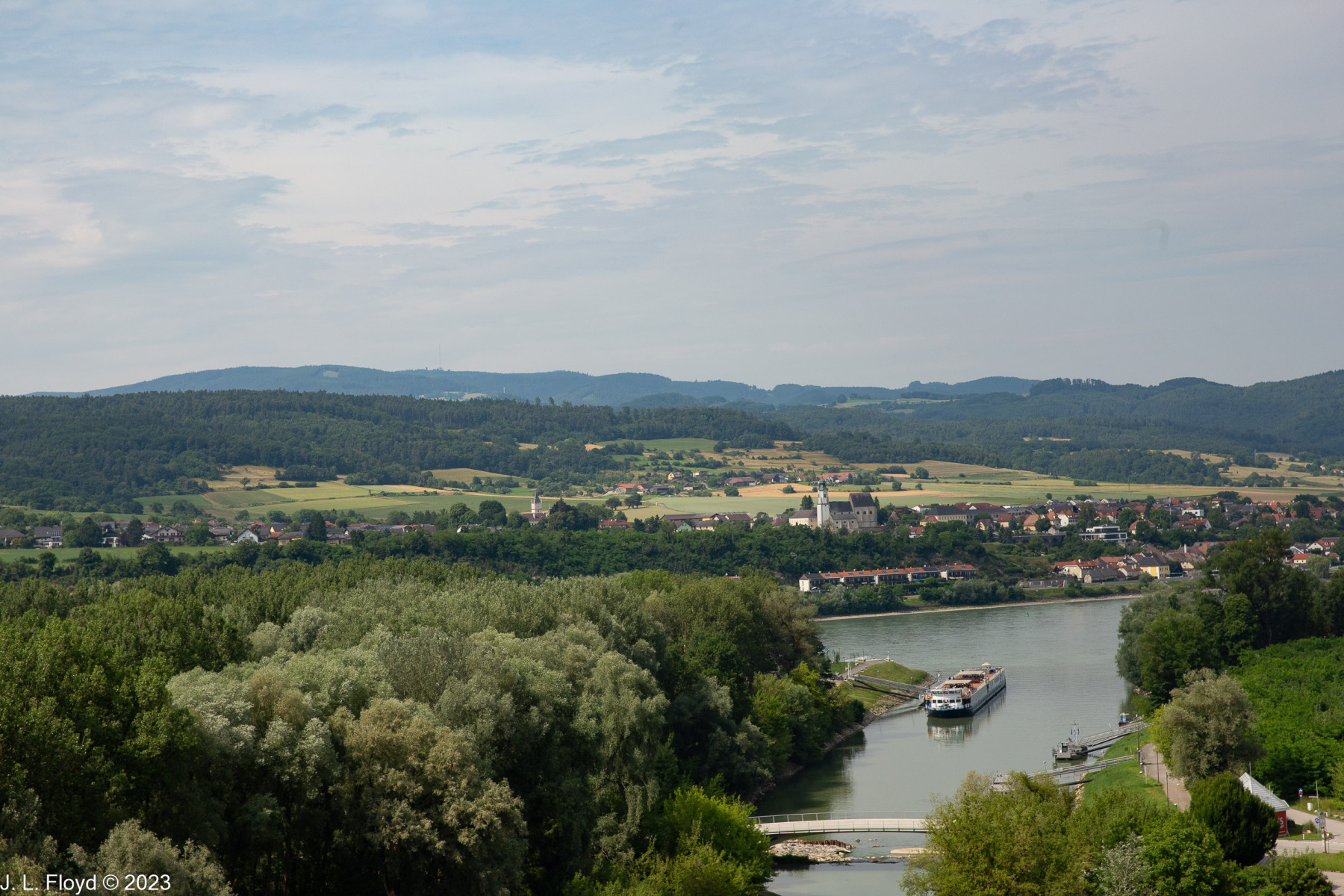
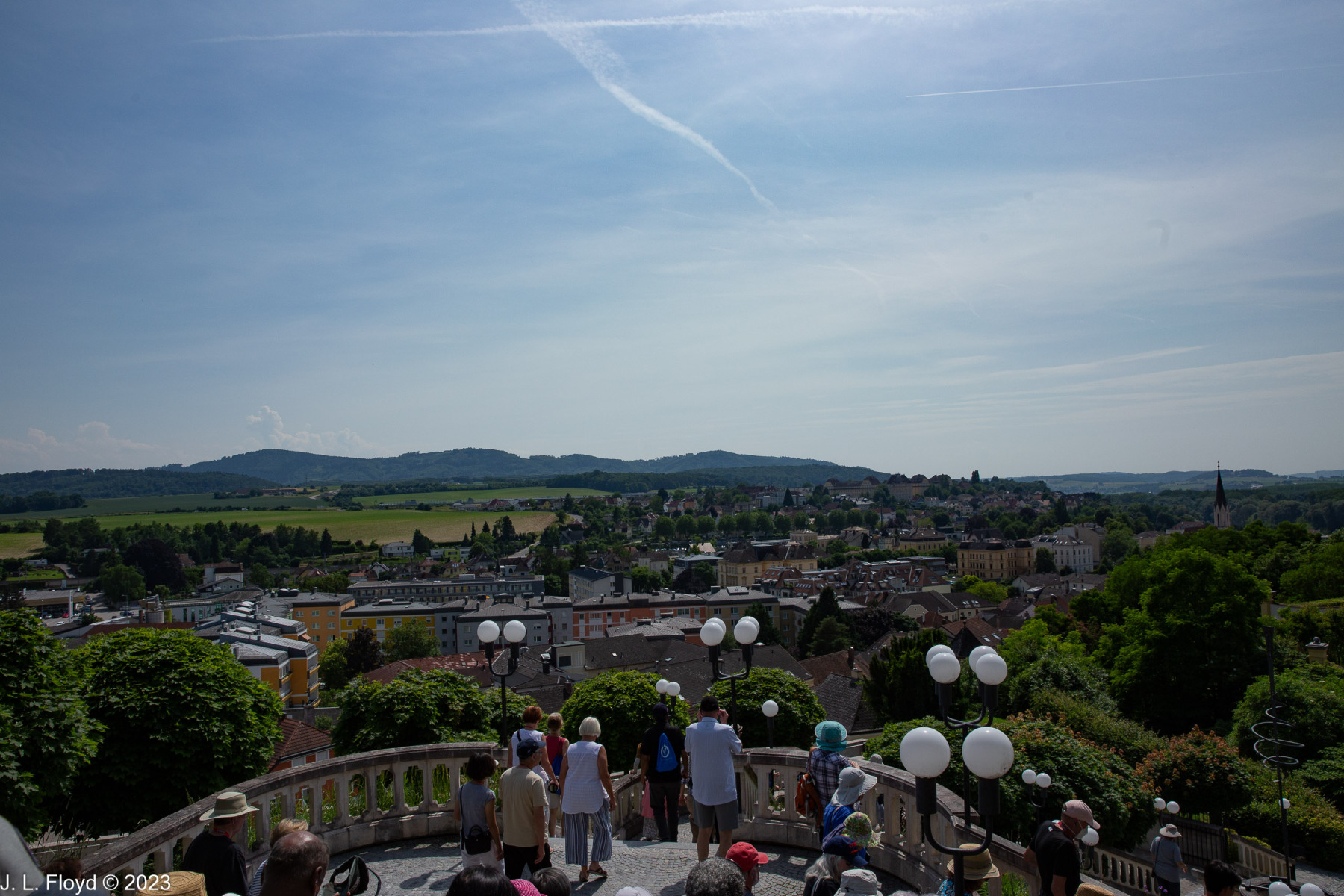
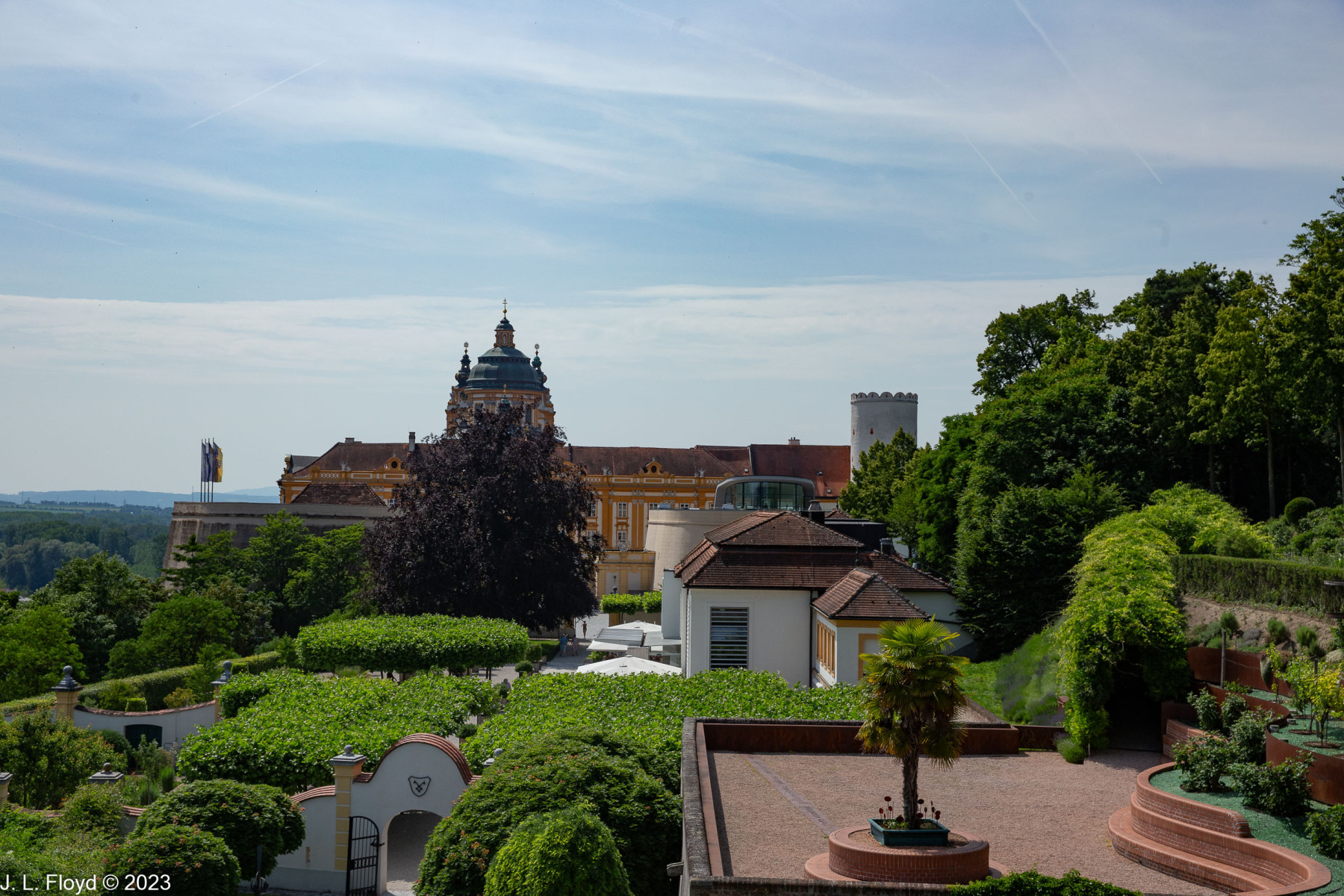
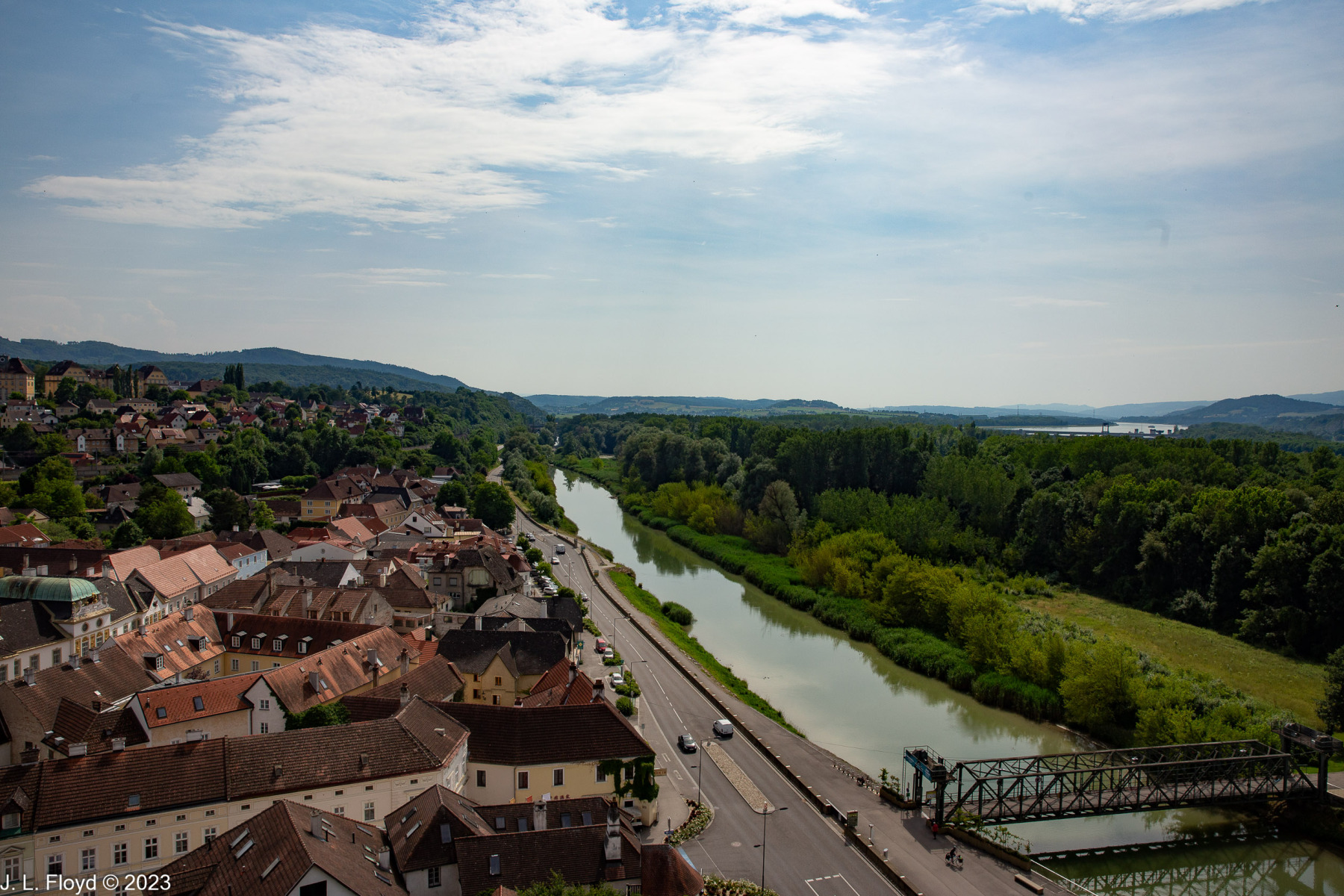
I don’t have many pictures of the interior rooms of the Abbey to show. The rooms were often dim, flash photography as usual was not allowed, and I managed to bungle the settings for low-light photos on my camera so that many of the pictures I did take did not come out well. But there were balconies in strategic locations, and from them I shot some good views of the exterior of the abbey as well as the countryside and the town of Melk.
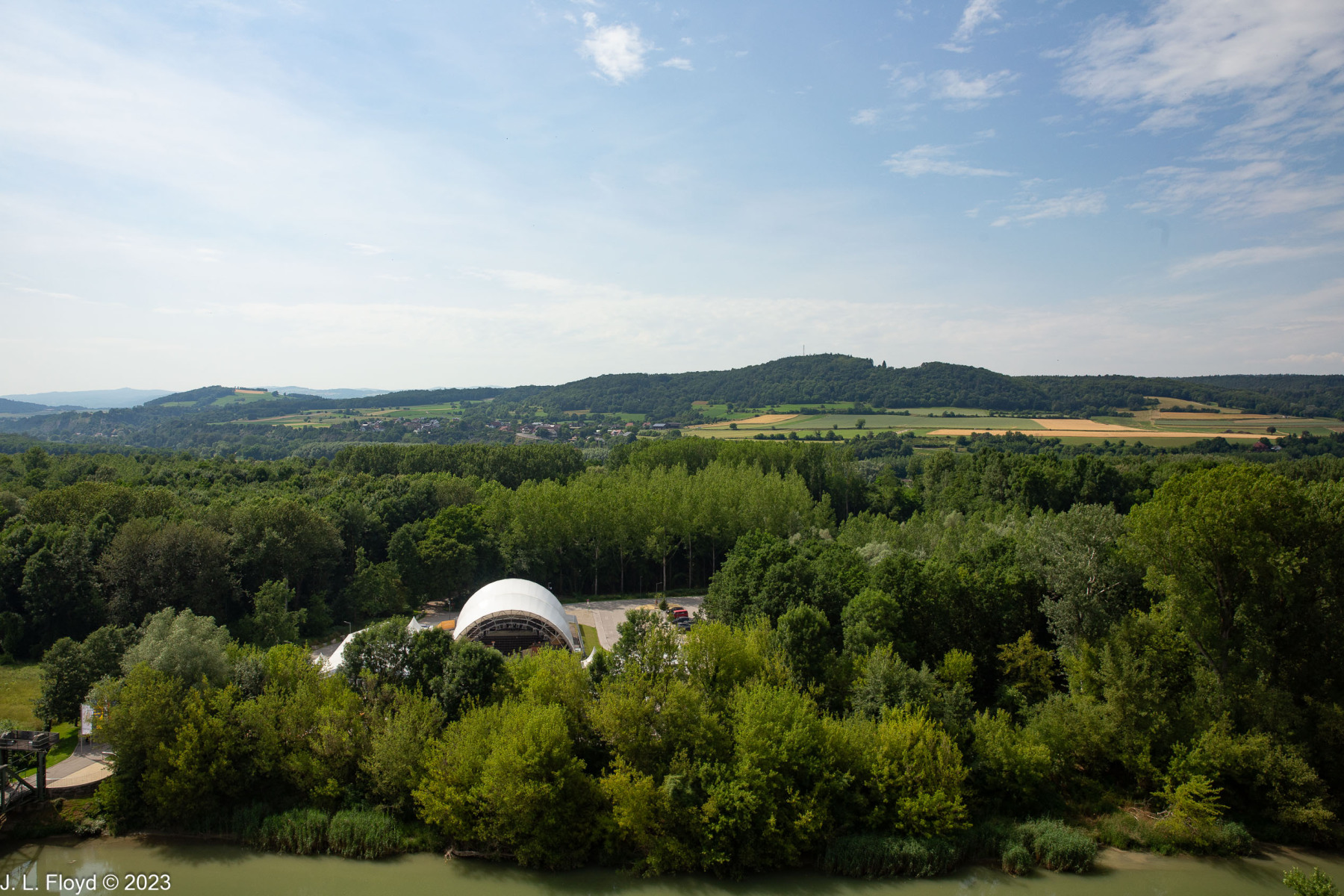
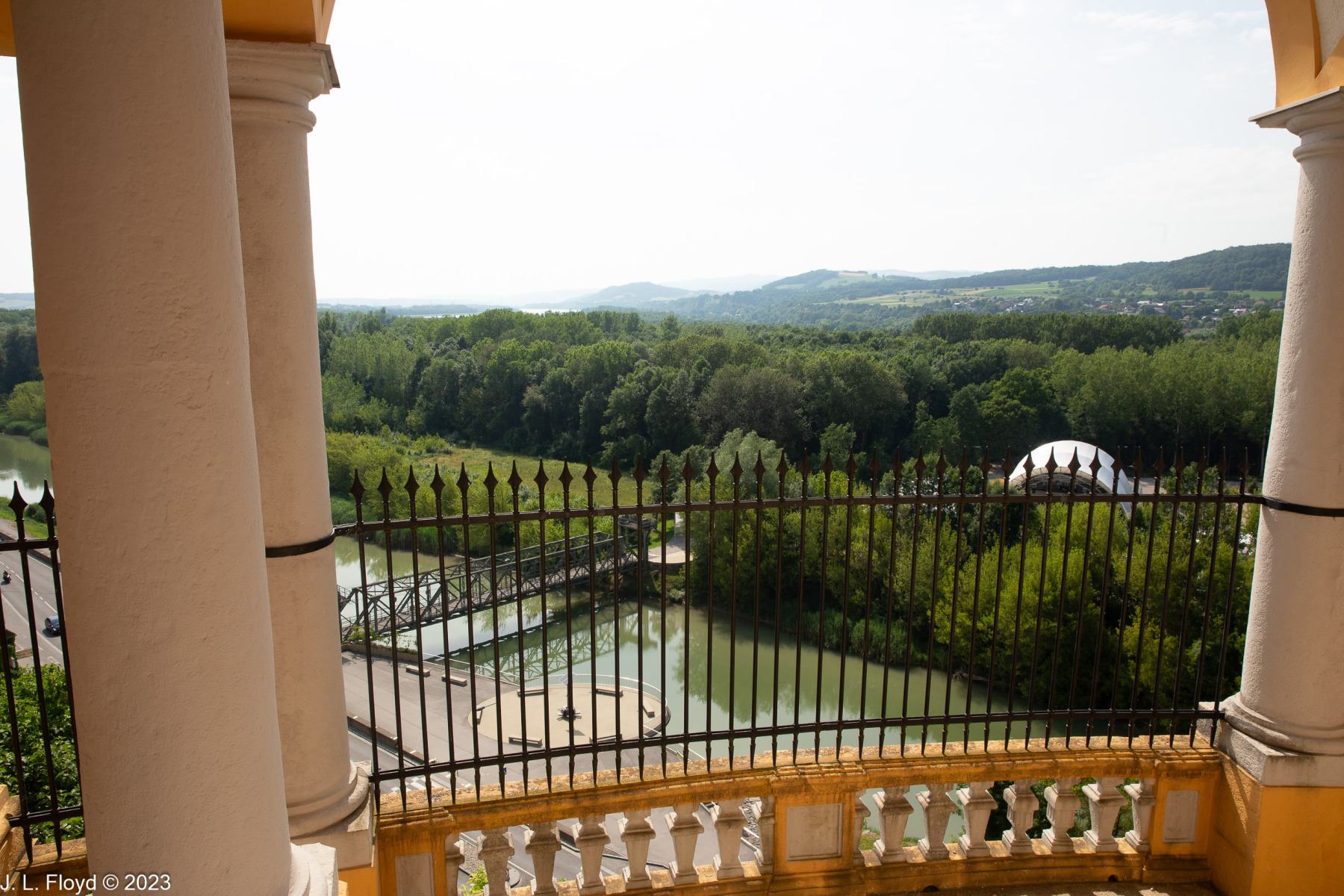
The Melk River flows almost parallel to the Danube, and through the town of Melk for a distance before it meets with the Danube. It creates a long peninsula which is part of the town of Melk but remains heavily wooded and relatively unspoiled. On the peninsula there is an arena, the Wachau Arena Melk, which is essentially a large theater tent where cultural events are hosted, most notably the Sommerspiele Melk, a drama and music festival held annually in June — sounds like a pleasant environment and experience.
Having ascended the Imperial Staircase into the Imperial Corridor, we entered the museum, which in days of yore housed the Imperial apartments. Now it holds exhibits on the history of the monastery and its current activities, including the cultural, political and economic functions which it used to serve and still serves in some regard, especially education. Some of the abbey’s most noteworthy art treasures are also found in the museum. Unfortunately many of the oldest medieval pieces, especially those containing precious metals, had to be sold off to help pay for the wars of the Habsburgs. But some of the most important documents, including chronicles of the history of the monastery and records relating to its construction, remain in the museum.

After visiting the Museum we toured two of the most imposing parts of the Monastery, the Marble Hall and the Library. I don’t have photos of the interior of either of these, only the exterior. The Marble Hall was a guest reception room and dining hall for festive occasions, especially those involving the imperial court. There are two inscriptions in Latin above its doors: “Hospites tamquam Christus suscipiantur” (“Guests should be received as if they were Christ”) and “Et omnibus congruus honor exhibiatur” (“And to each the honor given which is due”). These are quotations from the Rule of St. Benedict. I suspect they were observed more in the case of guests from the Imperial Court more than for lesser beings such as itinerant pilgrims. The ceiling of the Marble Hall features a stunning fresco done by Paul Troger in 1731, depicting the Greek goddess Pallas Athena driving a chariot pulled by lions, and also Hercules killing the Hound of Hell with his club. The allusion to Hercules was in deference to Charles VI, who was the reigning emperor in 1731 and liked to be compared to Hercules.

The Library also has a magnificent ceiling fresco by Paul Troger. But whereas the Marble Hall fresco expresses a wordly theme in alluding to the virtues of the Habsburgs, its counterpart in the Library idealizes Faith, represented by a woman holding biblical symbols in one hand and the shield of the Holy Spirit in the other. She is accompanied by angelic figures representing the four cardinal virtues of Prudence, Temperance, Justice and Fortitude. Additional paintings by Troger and others around the ceiling borders represent the arts and sciences; sculptures at the doors symbolize the four faculties of the premodern university – theology, philosophy, medicine and law. The list of artworks in the library and its adjacent rooms goes on and on, and is too lengthy for me to recite here. The bookshelves themselves are works of art, and the books are bound to match them.

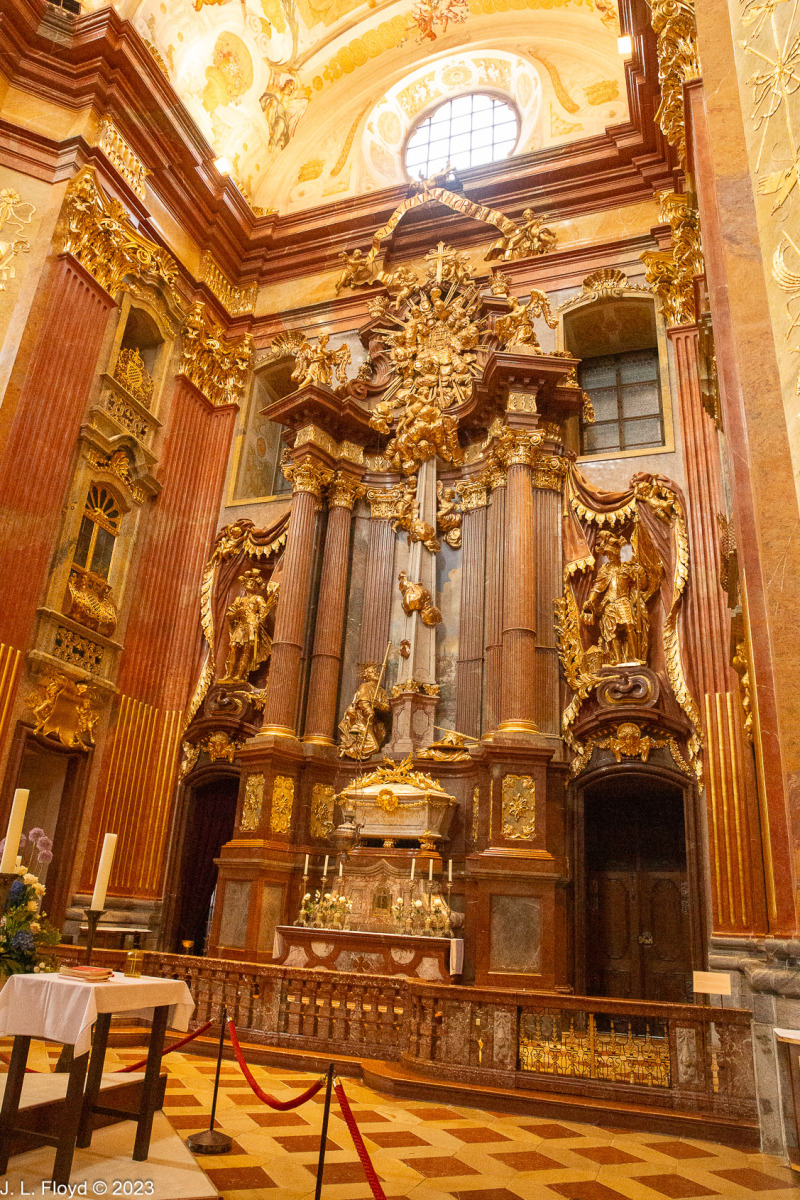
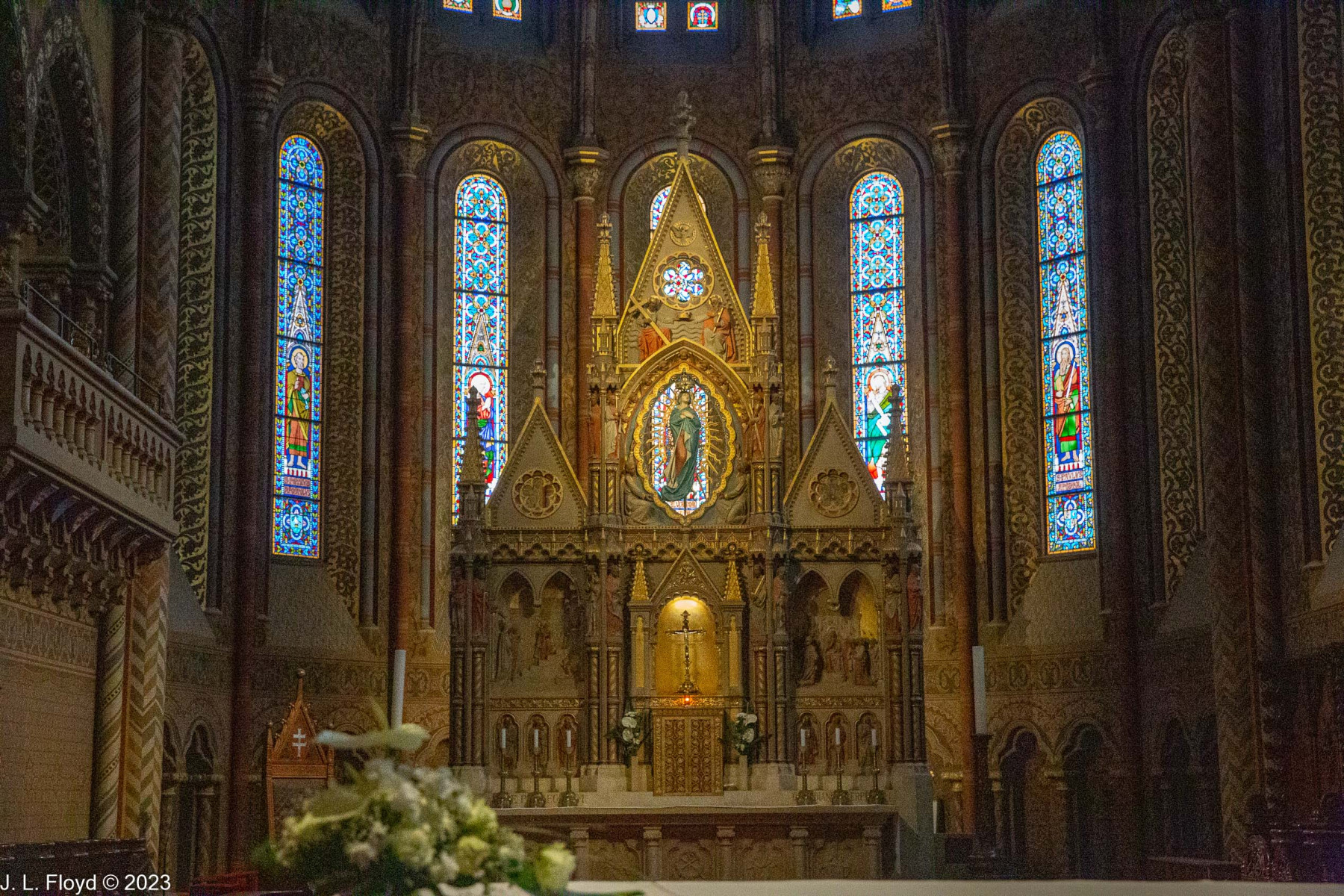
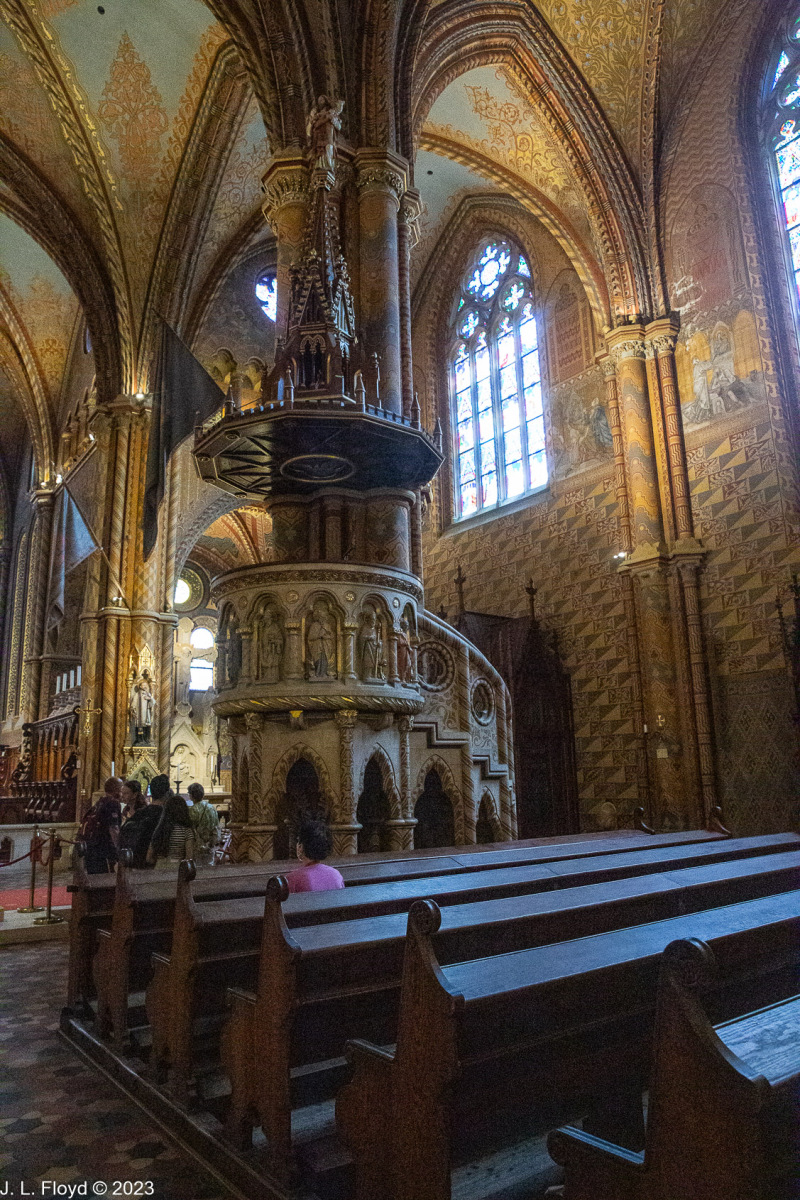
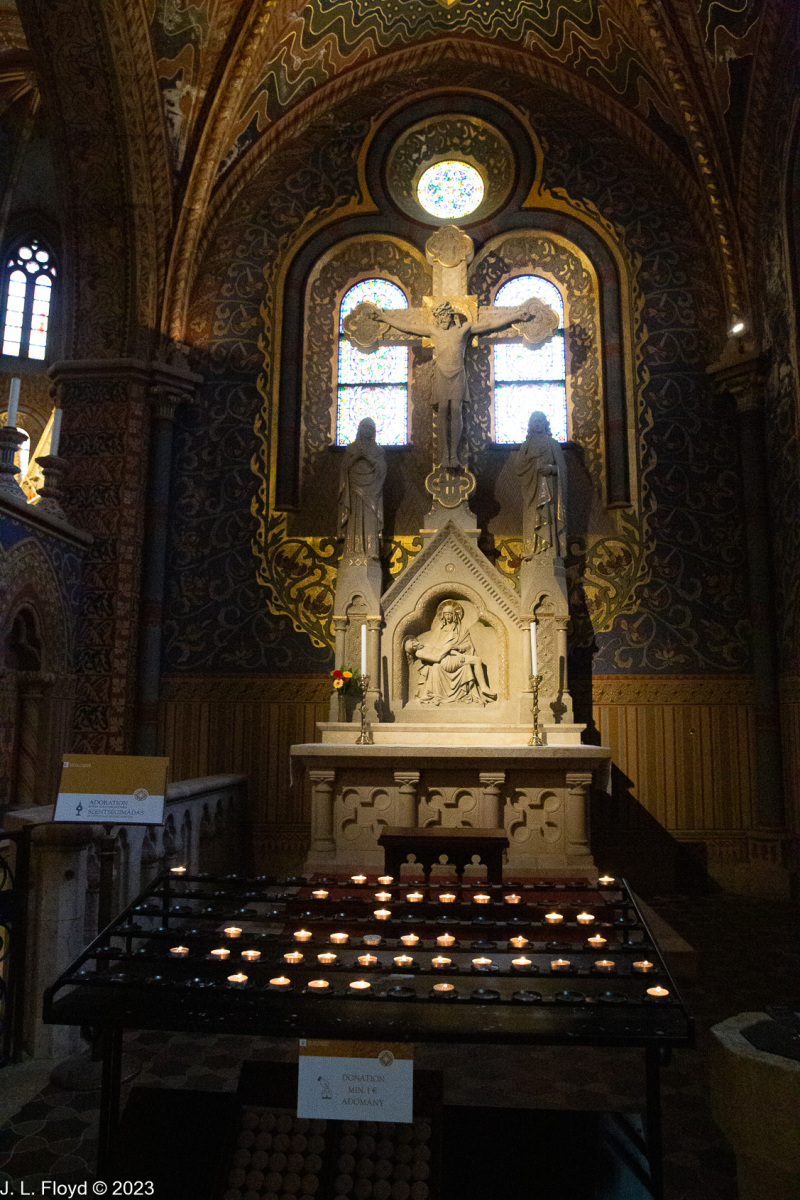
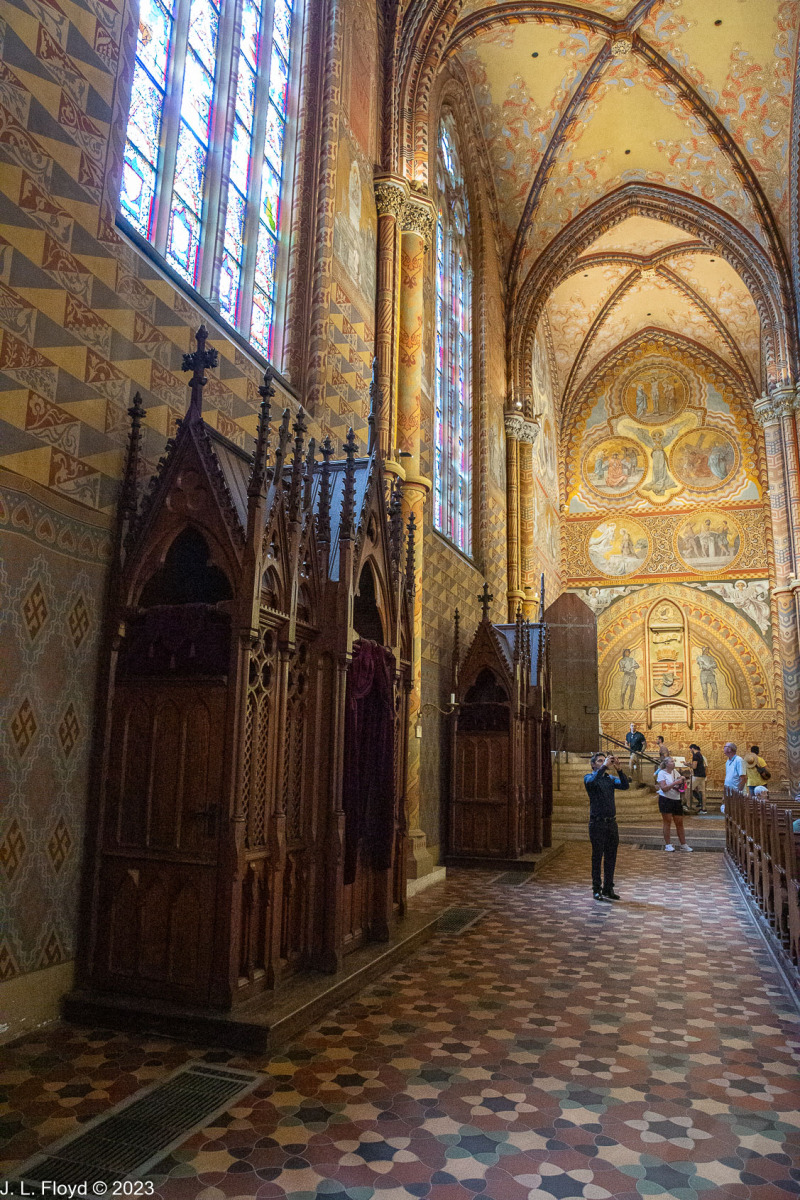
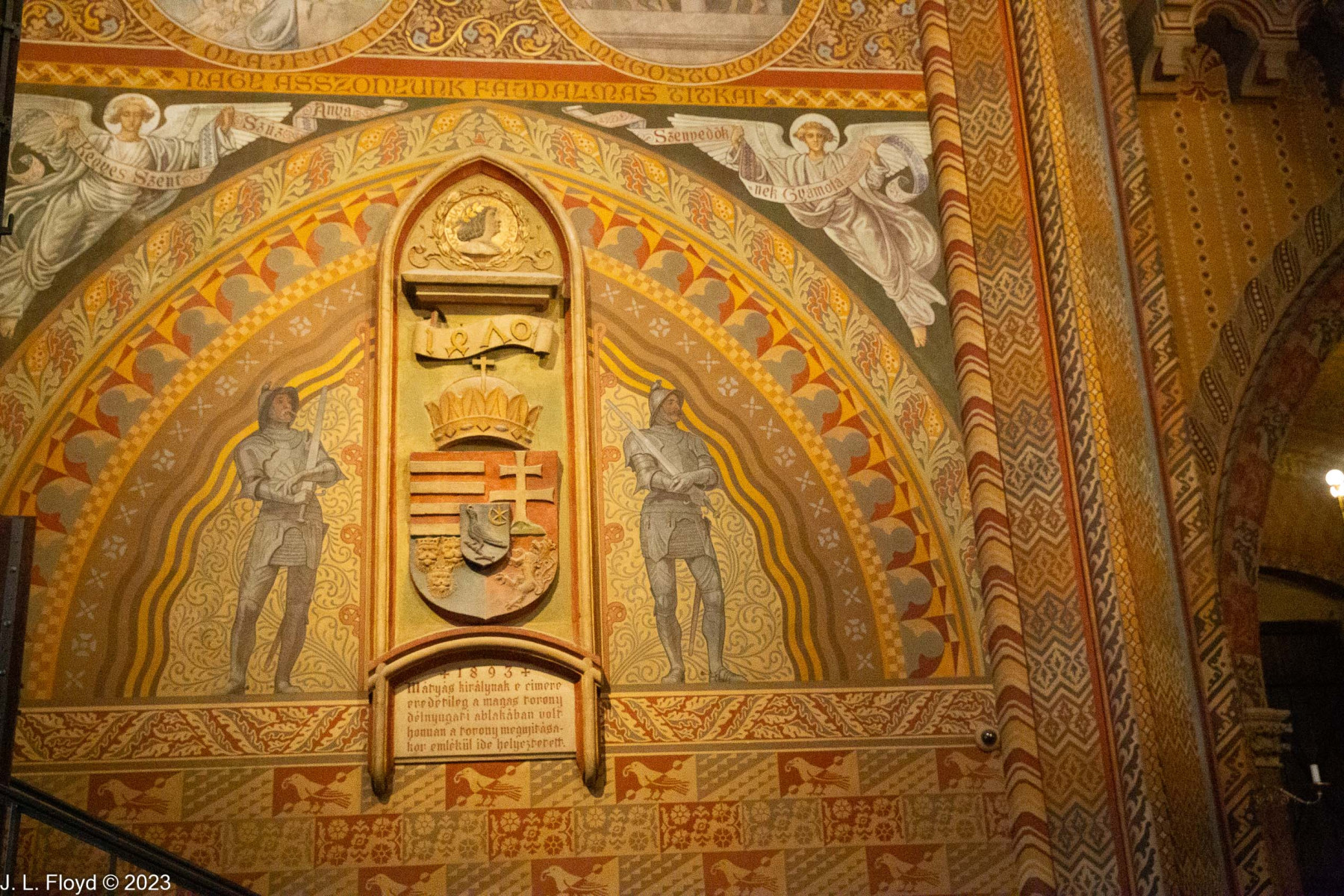
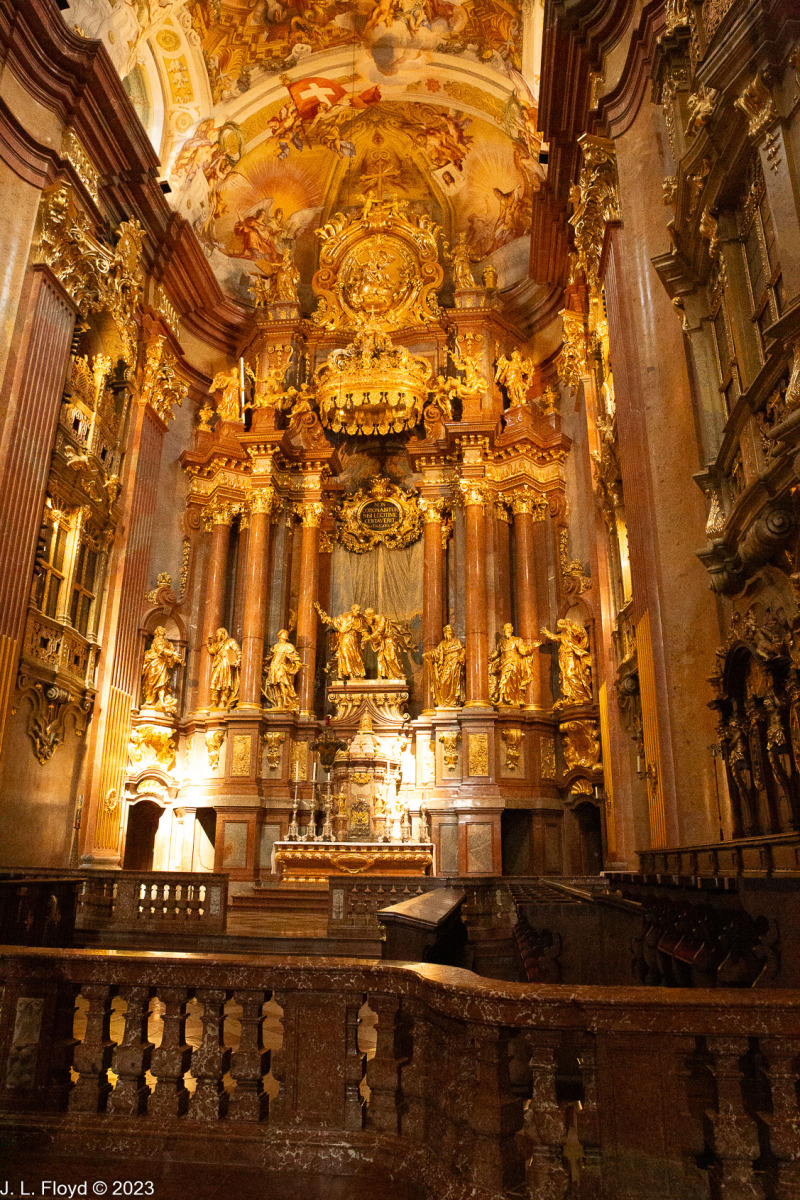
Finally, we descended via the Spiral Staircase to the Abbey Church. I managed to sneak a couple photos of the interior. One of them provides a view of the High Altar, where center stage (as it were) is taken by the figures of Saints Peter and Paul. Legend has it that they were both held in prison together during the Neronian persecution of 64 CE and were executed on the same day, Peter being crucified upside-down and Paul beheaded with a sword. They are depicted on the High Altar as shaking hands in farewell before being led out to execution. The altar also has figures depicting some of the Old Testament prophets on either side of the saints. At the center of the second level of the altar is a crown of victory, together with figures depicting battles of the Church against various evils. The third level has figures of Moses and Aaron on either side of a panel depicting God the Father. On the ceiling are frescoes by a painter from Salzburg, Johann Michael Rottmayr, completed in 1722. The dome, completed in 1717, also has frescoes by Rottmayr.

The Abbey Church has many other artistic masterpieces, too numerous to describe here (and my powers of description are inadequate to do them justice in any case). But one of the major takeaways from my visit to Melk Abbey involves the method behind the masterworks of the Baroque-era reconstruction. Abbot Berthold Dietmayr, the instigator and driving force behind the project, commissioned the greatest artists and architects available to create some of the key pieces of work, and had them sketch out the designs for others. Then he engaged local artists to execute the designs, pushing them to scale heights of skill they would never have attained otherwise. I think this was a key secret of his success and a major reason for his acclamation by posterity.
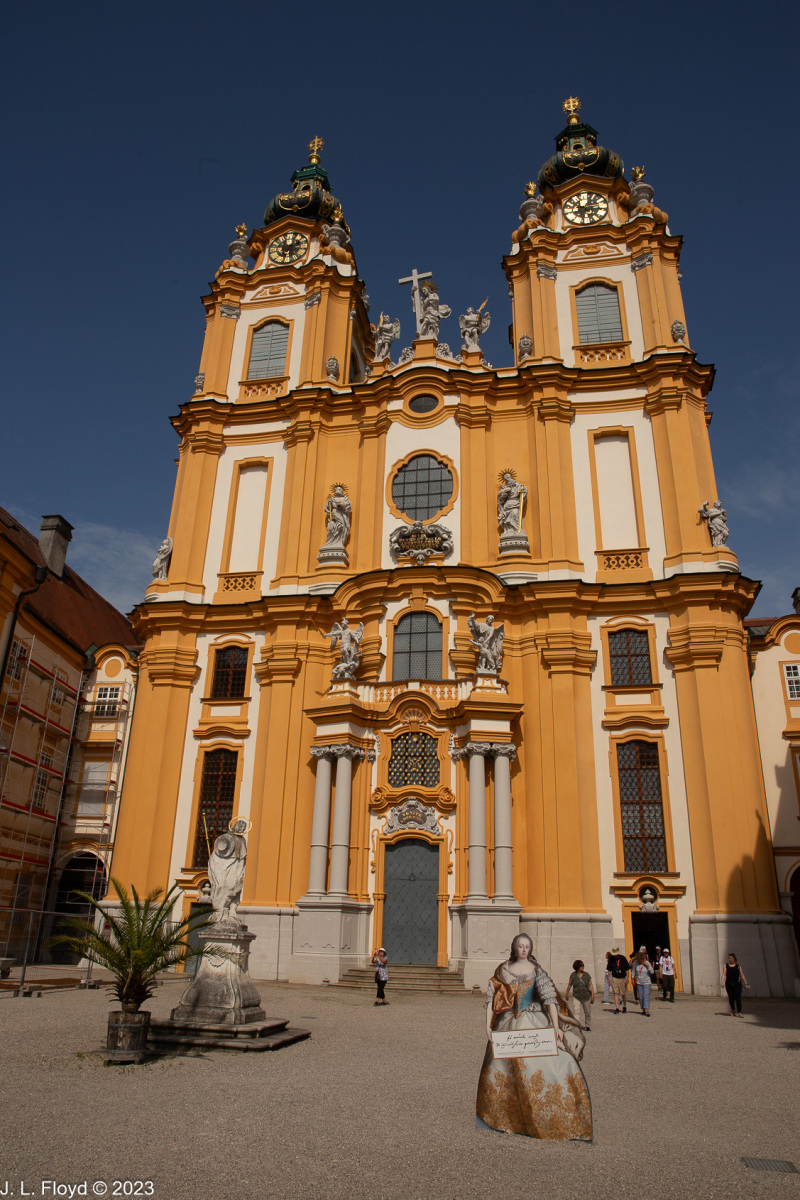
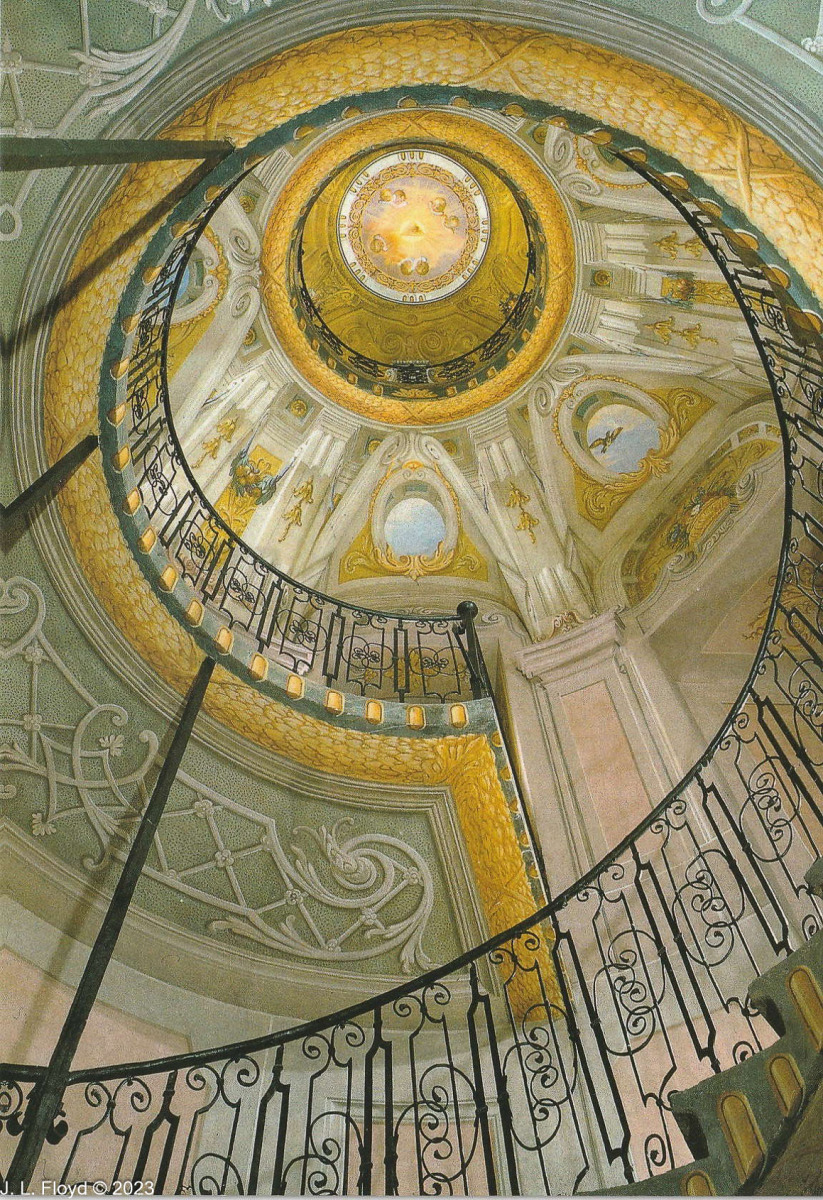
Our guided tour ended at the Imperial Corridor. There we were invited to explore the gardens of the monastery, which are quite extensive and include some additional architectural jewels (at an additional cost). I didn’t allow myself enough time to see all of the gardens because I spent too much time and money in the gift shop, where among other things I bought a little book about the abbey, which goes into great detail about its history, art and architecture as well as its current activities. Written by the abbot and other members of the abbey staff, and published by the Benedictine press, the book contains in addition to the text a great many beautiful pictures of the monastery, both its interior and exterior. I have shamelessly drawn much of the content of this post from it, while carefully abridging and paraphrasing the material to avoid charges of plagiarism. I cannot reproduce any of the wonderful photos from the book here, but there are some very nice ones to be found on the Wikipedia page for Melk Abbey. Don’t miss the photos of the church interior, the Library and above all the Spiral Staircase, which is one of the most fabulous examples of its genre anywhere. A couple from Alabama named Kevin and Amanda also have some extraordinary pictures of the Spiral Staircase on their website. (Note that I am not referring to the Imperial Staircase, a shot of which I’ve included in the gallery above, but rather the interior staircase connecting the church and the Library). See also the 365Austria Melk Abbey web page. And of course Melk Abbey’s own website has marvelous photos of most of its attractions.

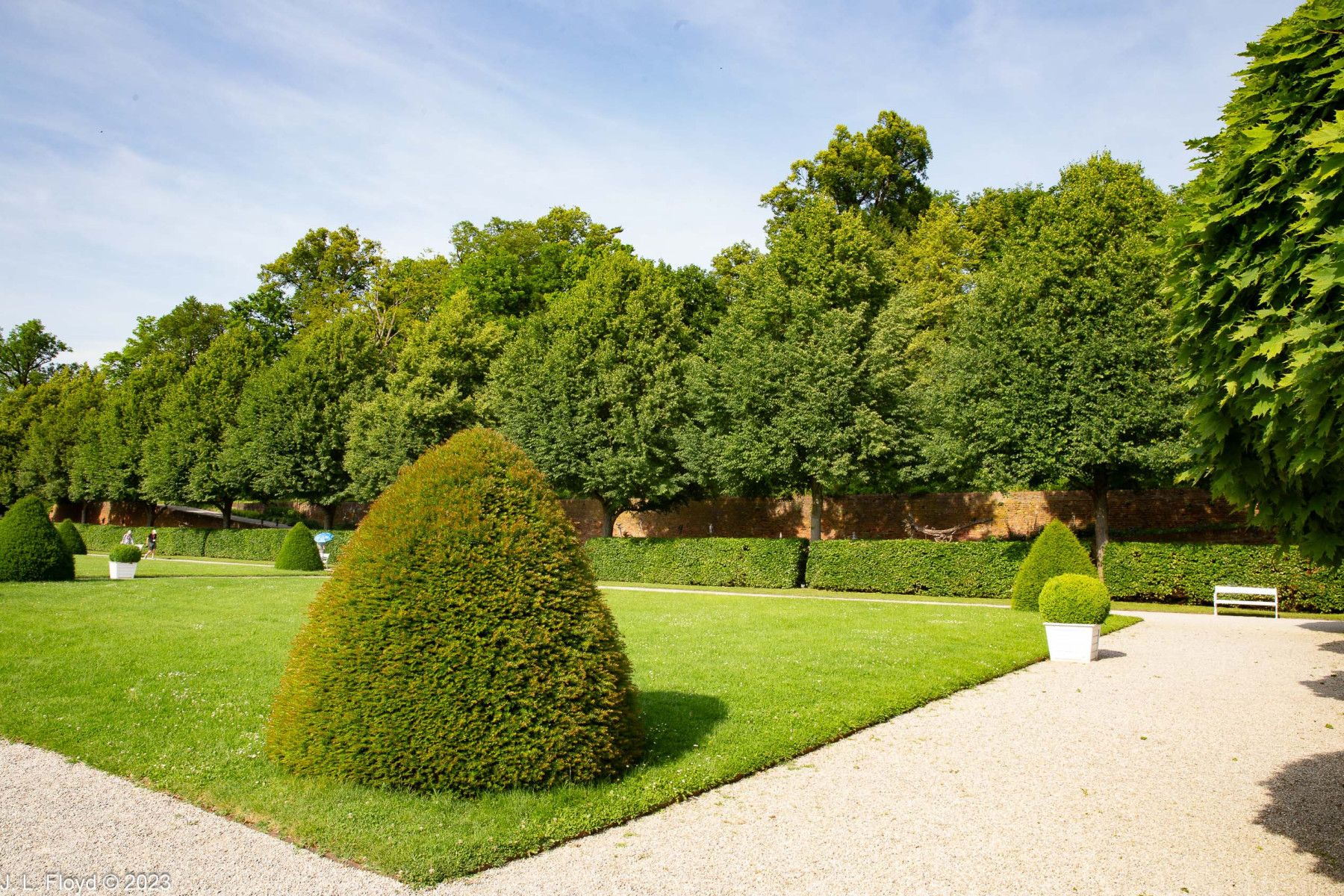
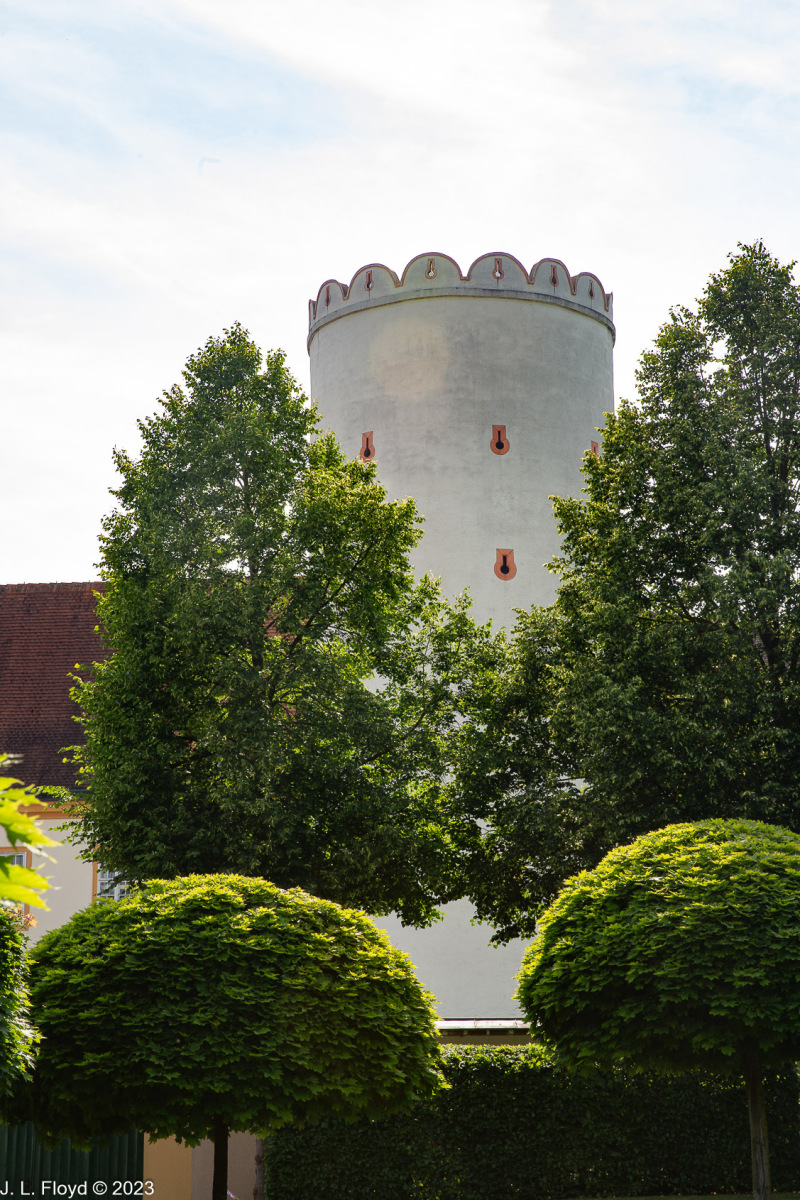
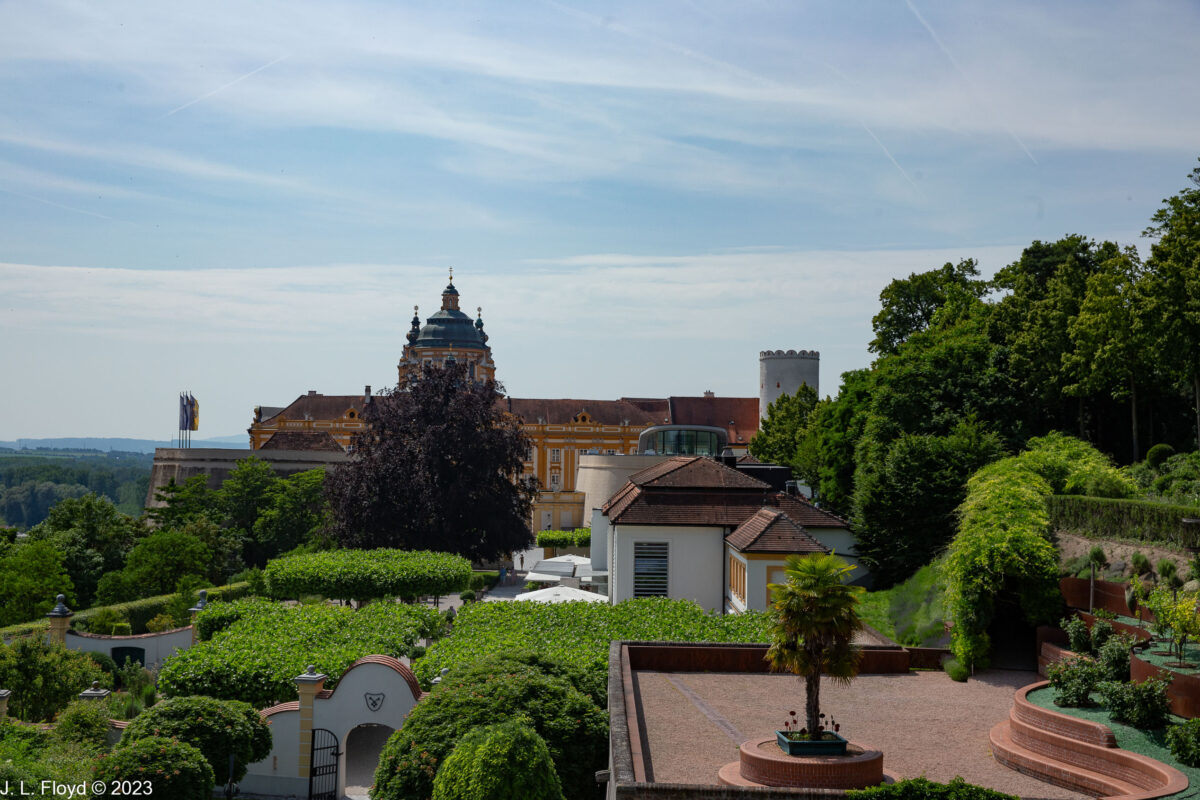
I did manage to see the Baroque Garden, which is the setting for an exquisite pavilion built in 1848 to provide rest and relaxation for the monks after their arduous exertions in fasting and praying. It contains a tea room with exotic frescoes painted on the walls by Johann Bergl, who filled his work with plants, animals, jungle themes and native people. I did not have time to explore the interior of the building, let alone take tea there, but there are some excellent photos of it on the web by a Canadian-German photographer, Nina On the Go [sic]. From the garden I was also able to get a shot of one of the Babenberg towers, part of the original castle fortifications from the 11th century.
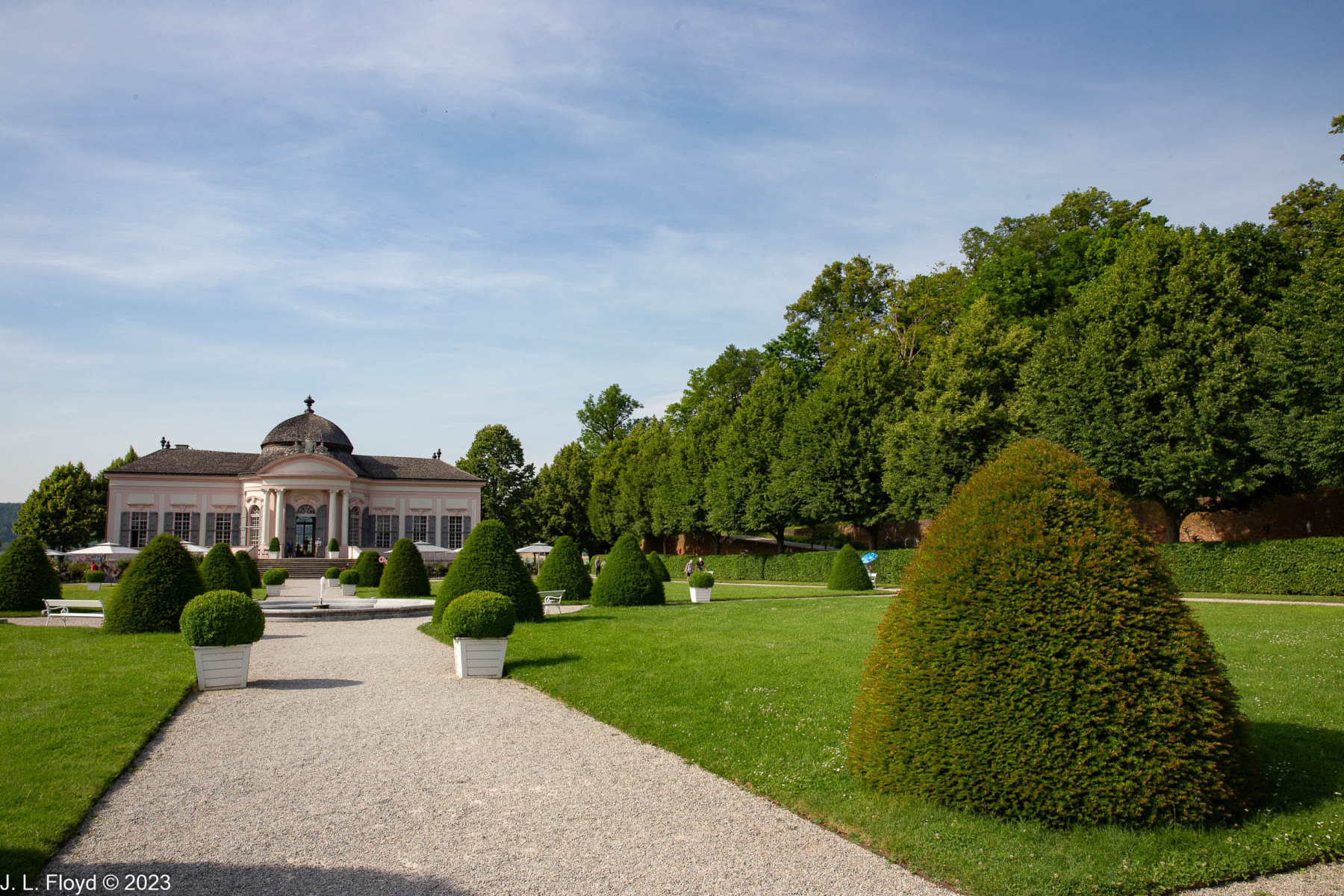
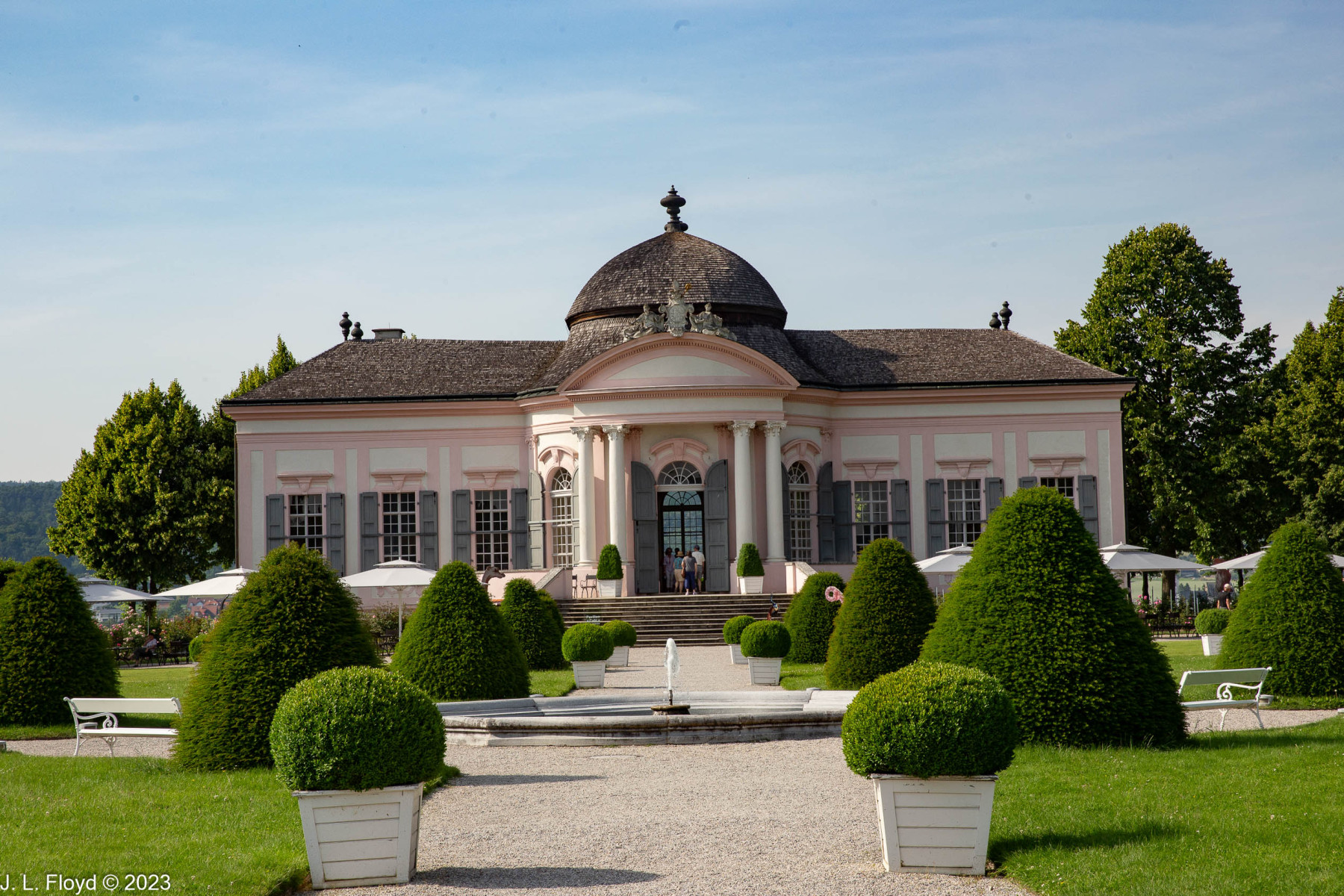
All too soon it was time to return to the Monarch Queen, which was about to begin the long journey to its next port of Aschach, the jumpoff point for the excursion to Salzburg. We climbed the same grand staircase which we had descended from the parking lot, and were bid farewell by the parting admonition carved in the stone in the midst of the steps: “Ankommen und du wirst Höre” — “Come and ye shall hear.”

Categories
Danube River Cruise, June 2023

Wachau Valley, June 20, 2023

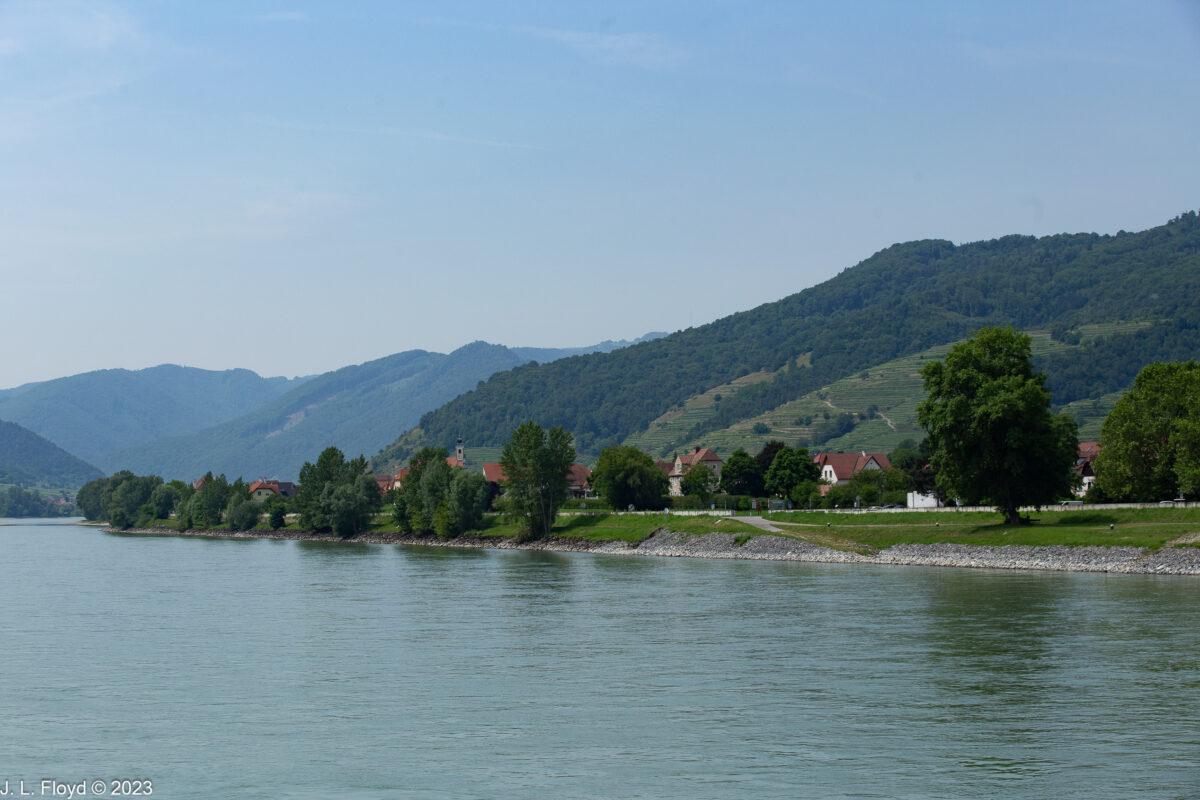
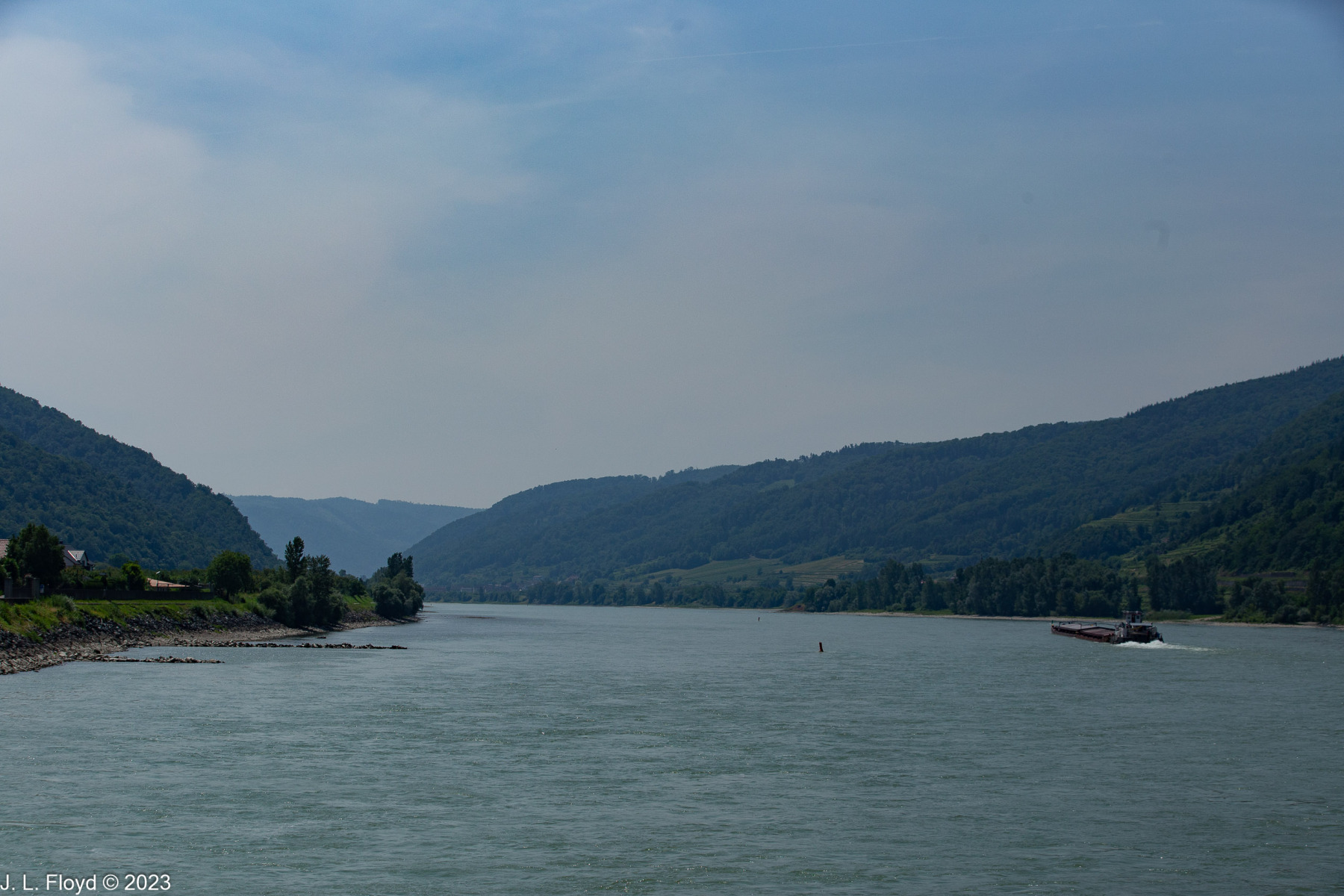
The Wachau Valley lies between the city of Krems and the town of Melk, a distance of only 36 kilometers or 22 miles. It takes only a half-hour to drive 31 kilometers by automobile from Dürnstein to Melk, at the western end of the Wachau Valley. It took the Monarch Queen about four hours. I would have been quite happy if it had taken four days, with long stops at each quay. Exploring all the towns we passed, from Krems to Melk, would have made a fabulous odyssey, and if I ever get the chance, I’ll go back and do that. For the Wachau Valley is one of the world’s idyllic places, and its pristine beauty makes one want to stay there forever.

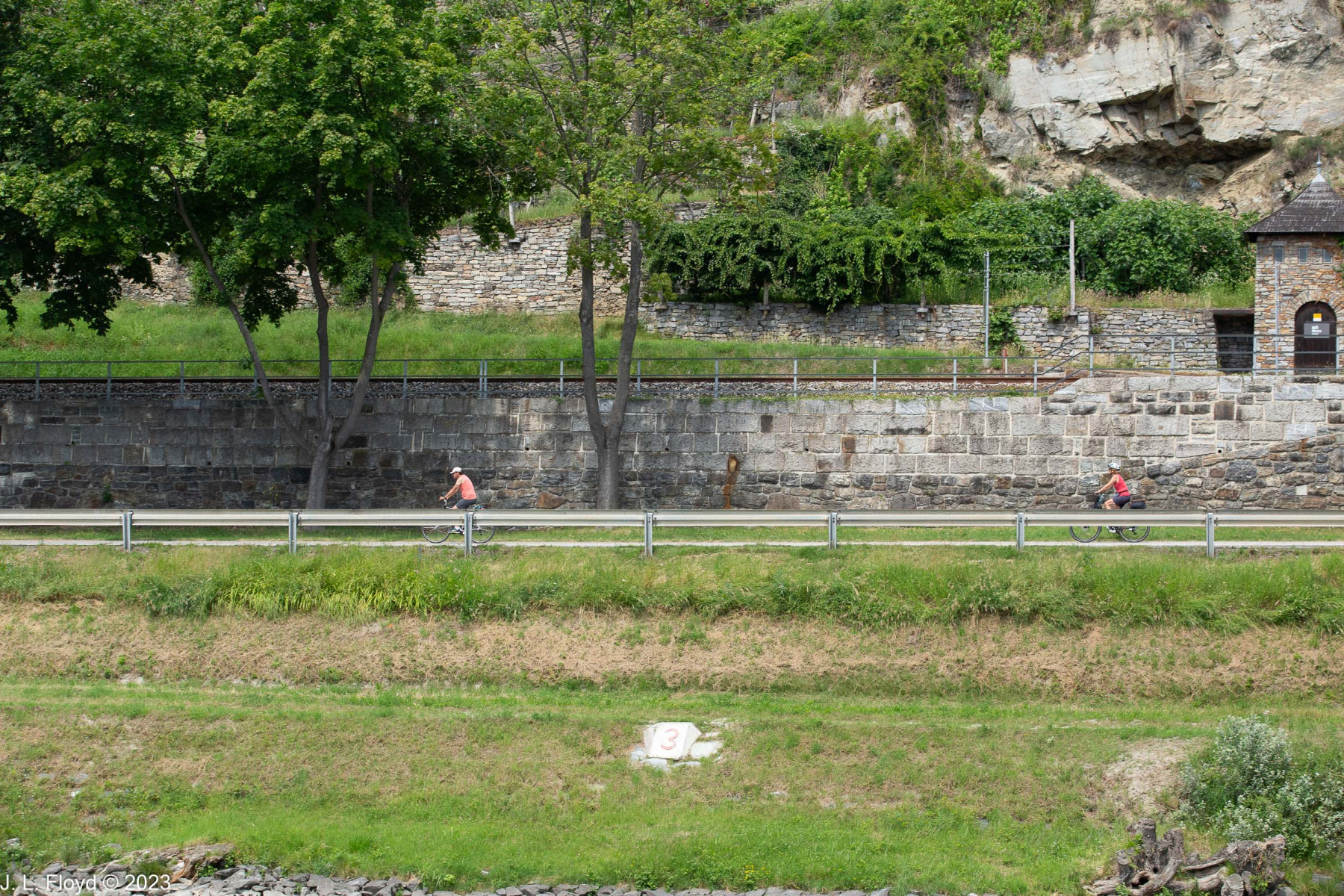
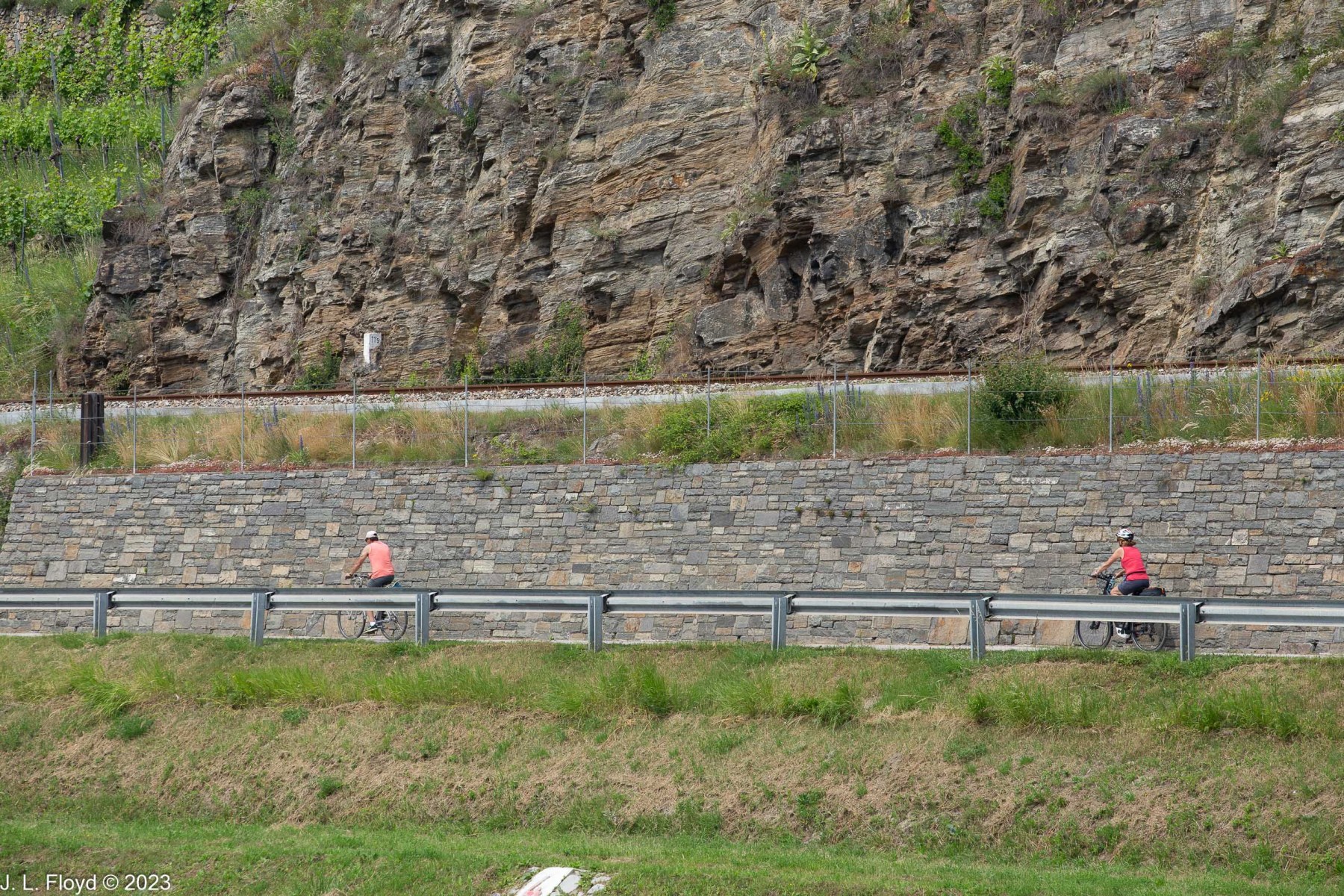
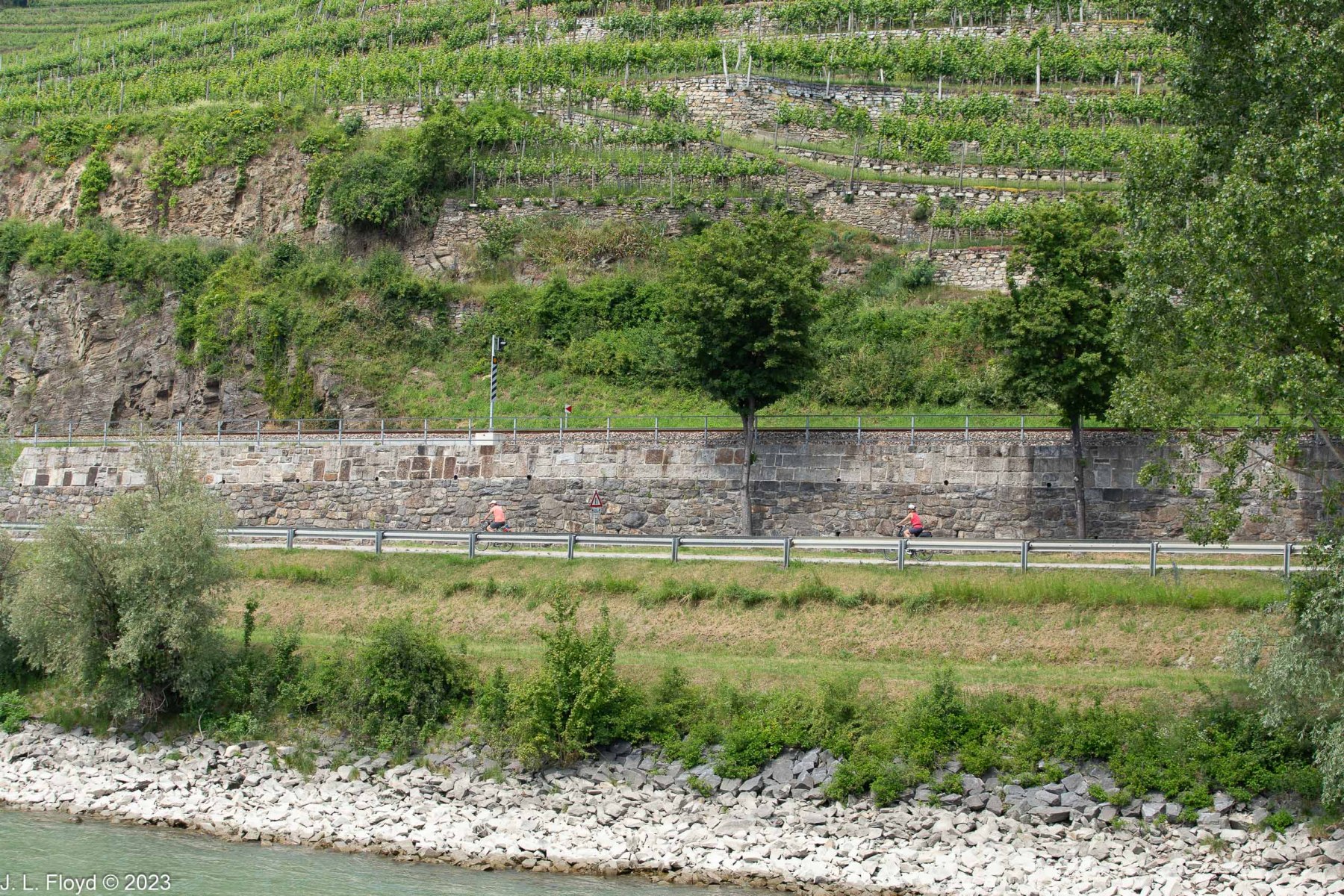
It’s easy to get around in the Wachau Valley; several means of transportation are available. Major highways and rail lines run from Vienna to Krems and Melk. Within the valley, the Donau Bundesstrasse B3 runs from Krems to Melk on the north bank, while another highway, the Aggsteiner Strasse, runs along the south bank. Both have associated bike paths; the ride from Melk to Krems is said to take 3-4 hours, but that is mostly downhill – the ride in the opposite direction would take much longer. We saw many bicyclists on the way from Dürnstein to Melk.

The Donau Bundesstrasse is part of the Austrian Romantic Route, a 380-kilometer route which runs from Vienna to Salzburg. To avoid cutting through the heart of Dürnstein, it runs through a tunnel, which when built in 1959 was the longest and most modern federal road tunnel in Austria (472 meters, 1548 feet). Of course there is bus service within the valley, and there is also a railroad line running next to (and above) the Donau Bundesstrasse, known as the Wachaubahn. The railway is operated by Lower Austria Railways, owned by the Lower Austrian provincial government, and runs from Krems to Emmersdorf, on the north bank of the Danube opposite Melk.

Not surprisingly, since we were doing it ourselves, waterborne travel is one of the major modes of transportation in the Wachau Valley. In addition to cruise lines such as Gate1 and Ama Waterways, there are regularly scheduled services between the major towns and “theme trips” available for short-distance day excursions.

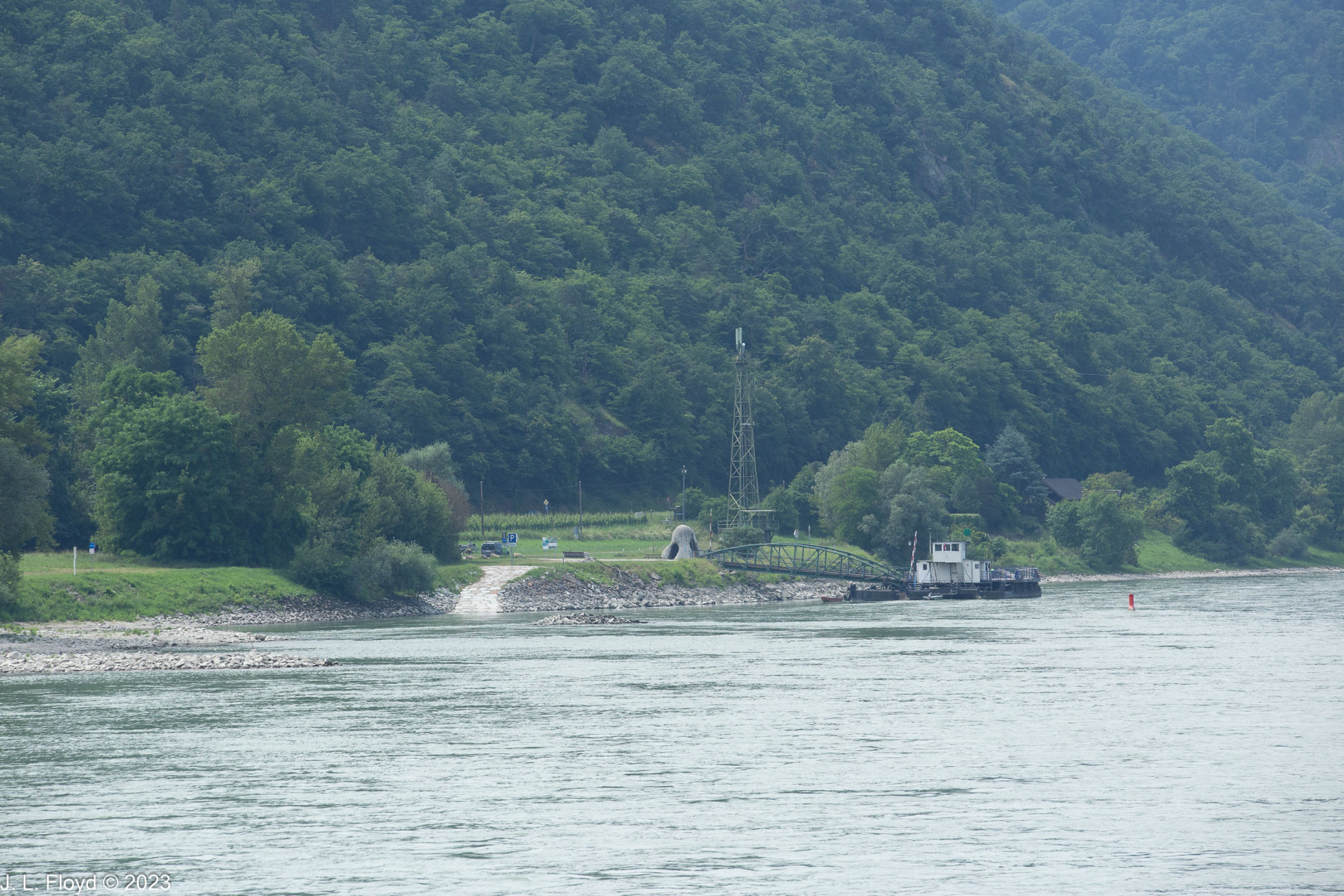
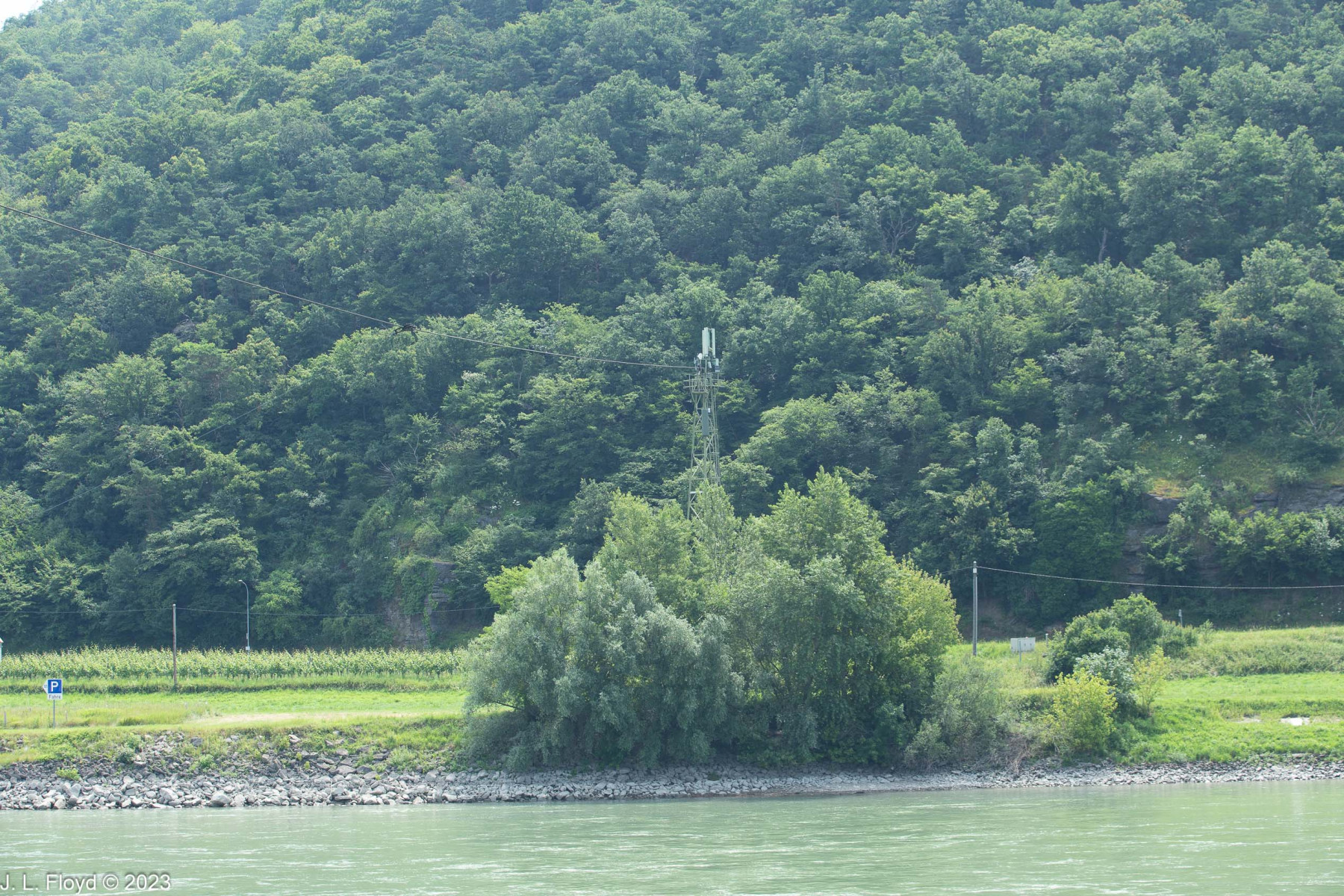
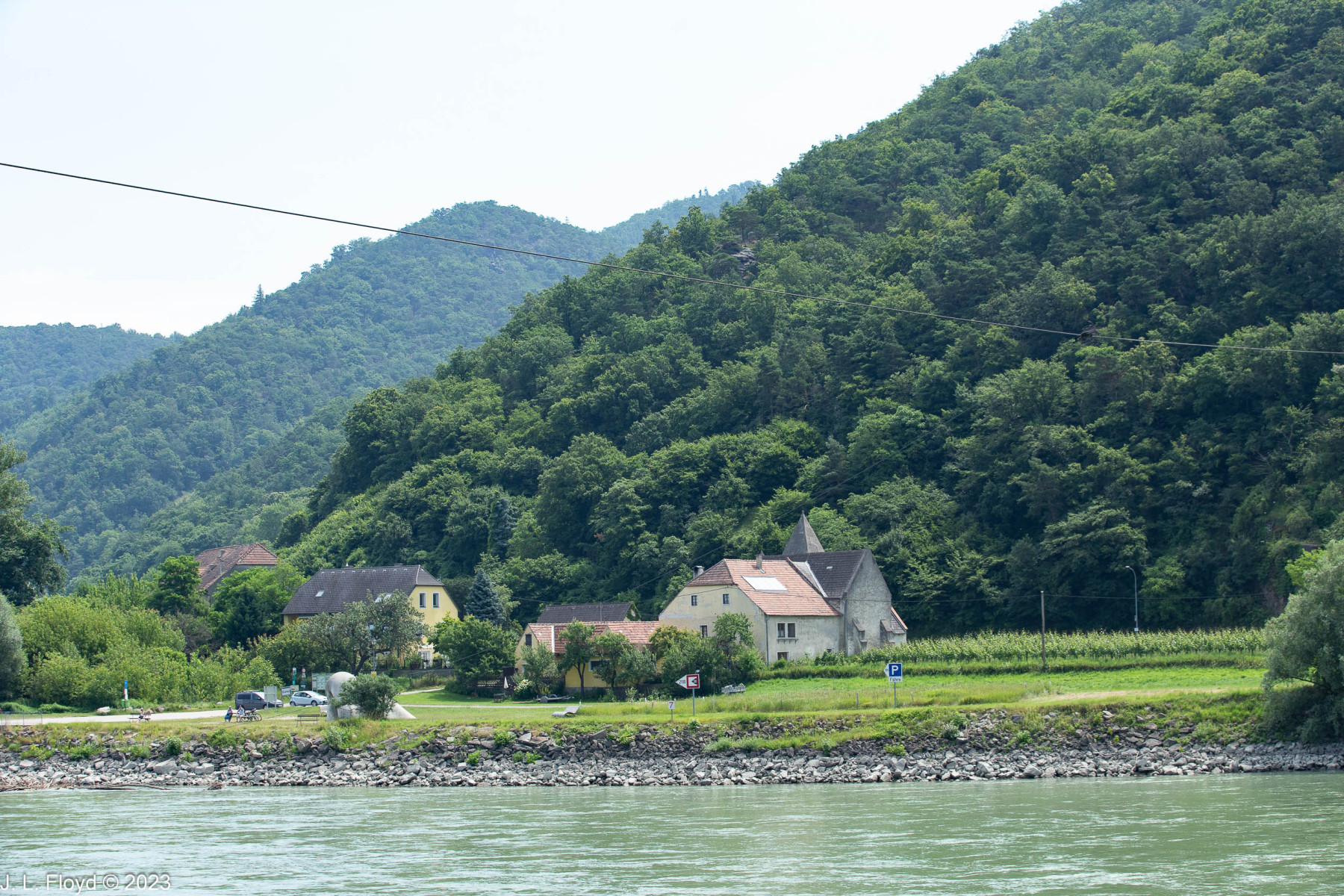
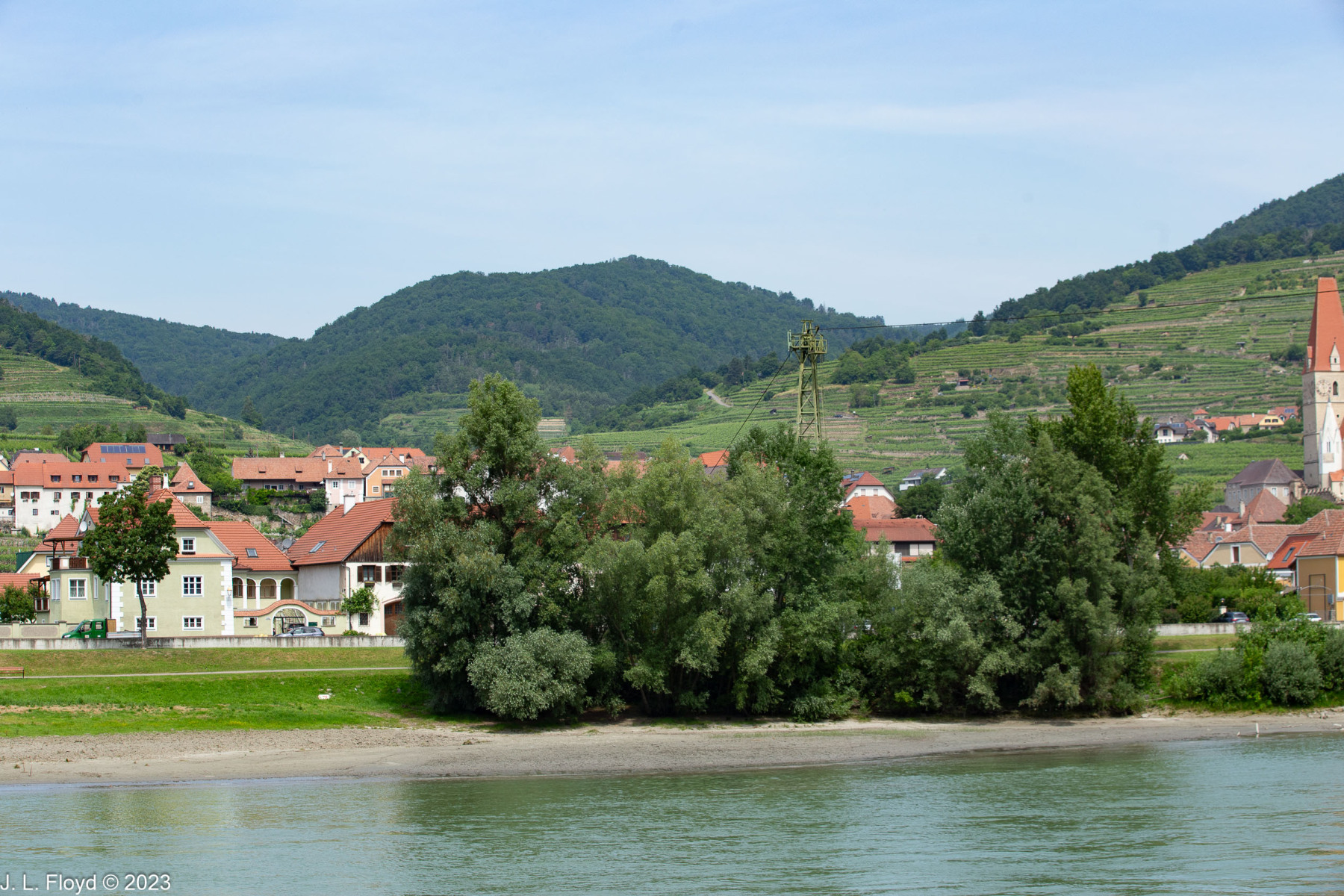
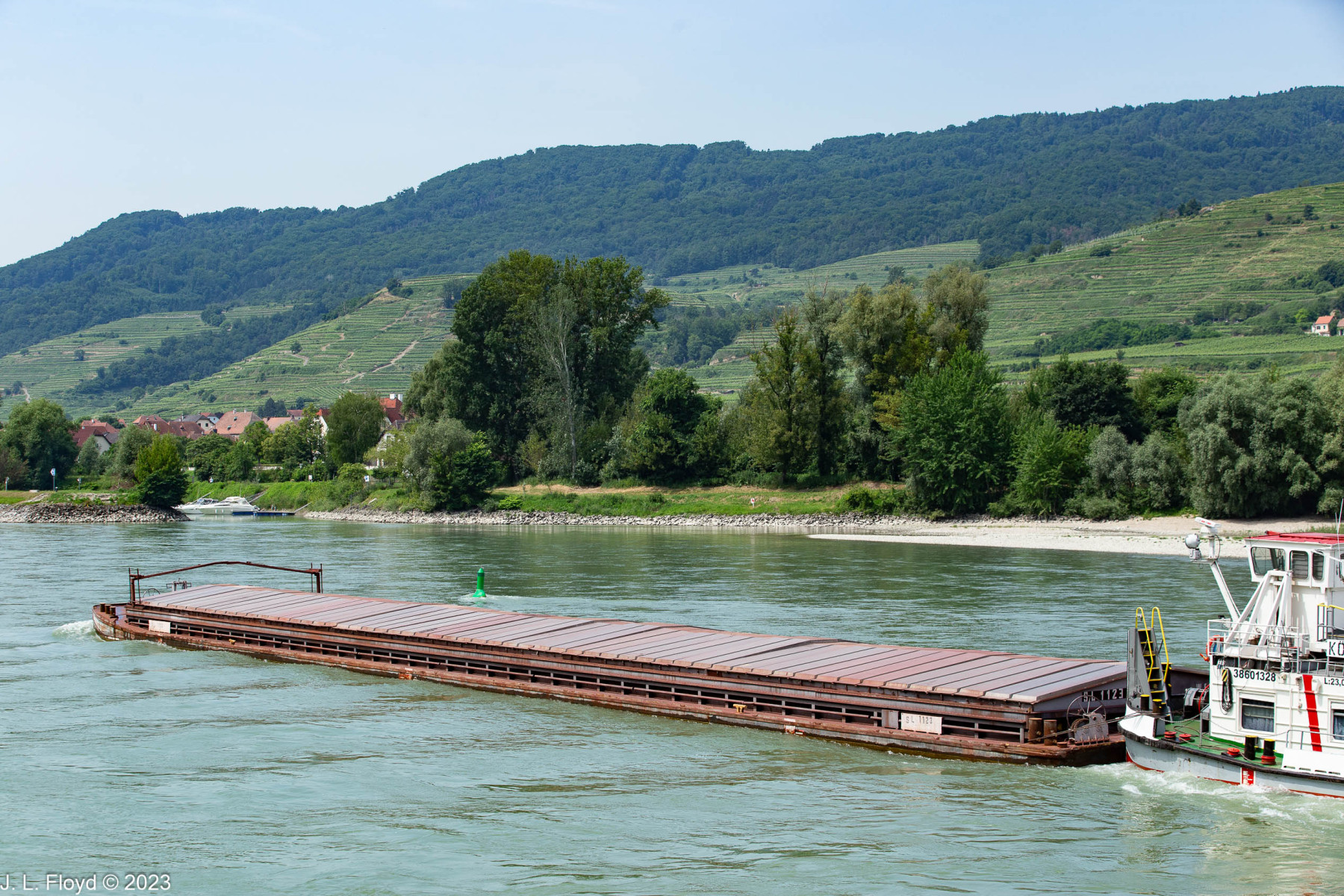
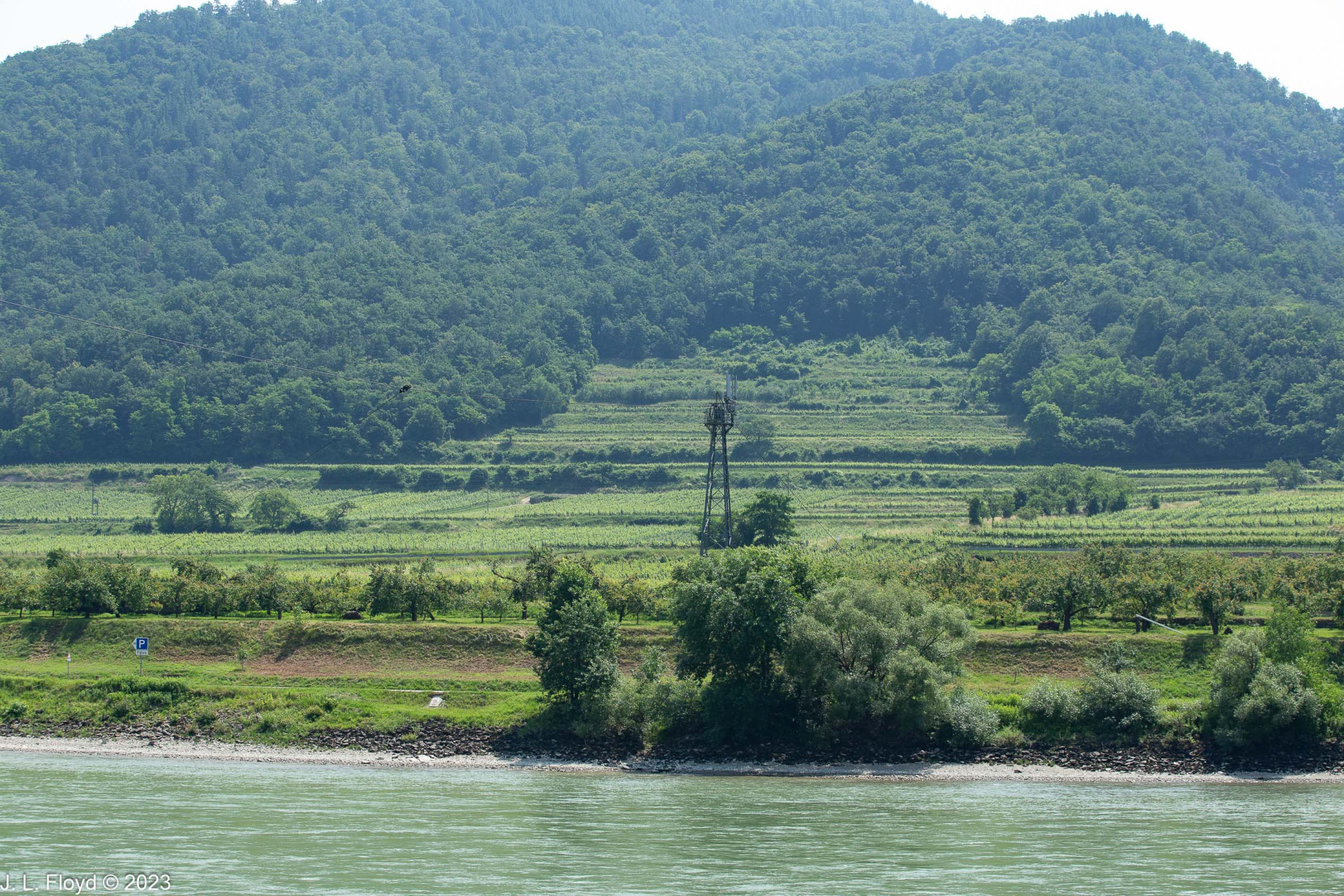
But the transport mode that caught our attention most dramatically on our journey through the Wachau was the one used to cross the river rather than follow it: cable ferries. There are no bridges over the Danube in the Wachau Valley, so these ferries are the only way to cross. In my experience they are unique. The ferryboats have neither motors nor sails (nor for that matter, oars). They have only a rudder, which is set at an angle to the river current, and the energy of the current against the rudder is what propels the ferryboat. The boat is prevented from moving downstream by being tethered to an overhead cable, strung across the river and anchored to towers on either side. This struck me as being quite an eco-friendly and energy-efficient mode of transportation and I wondered why I haven’t seen it elsewhere.

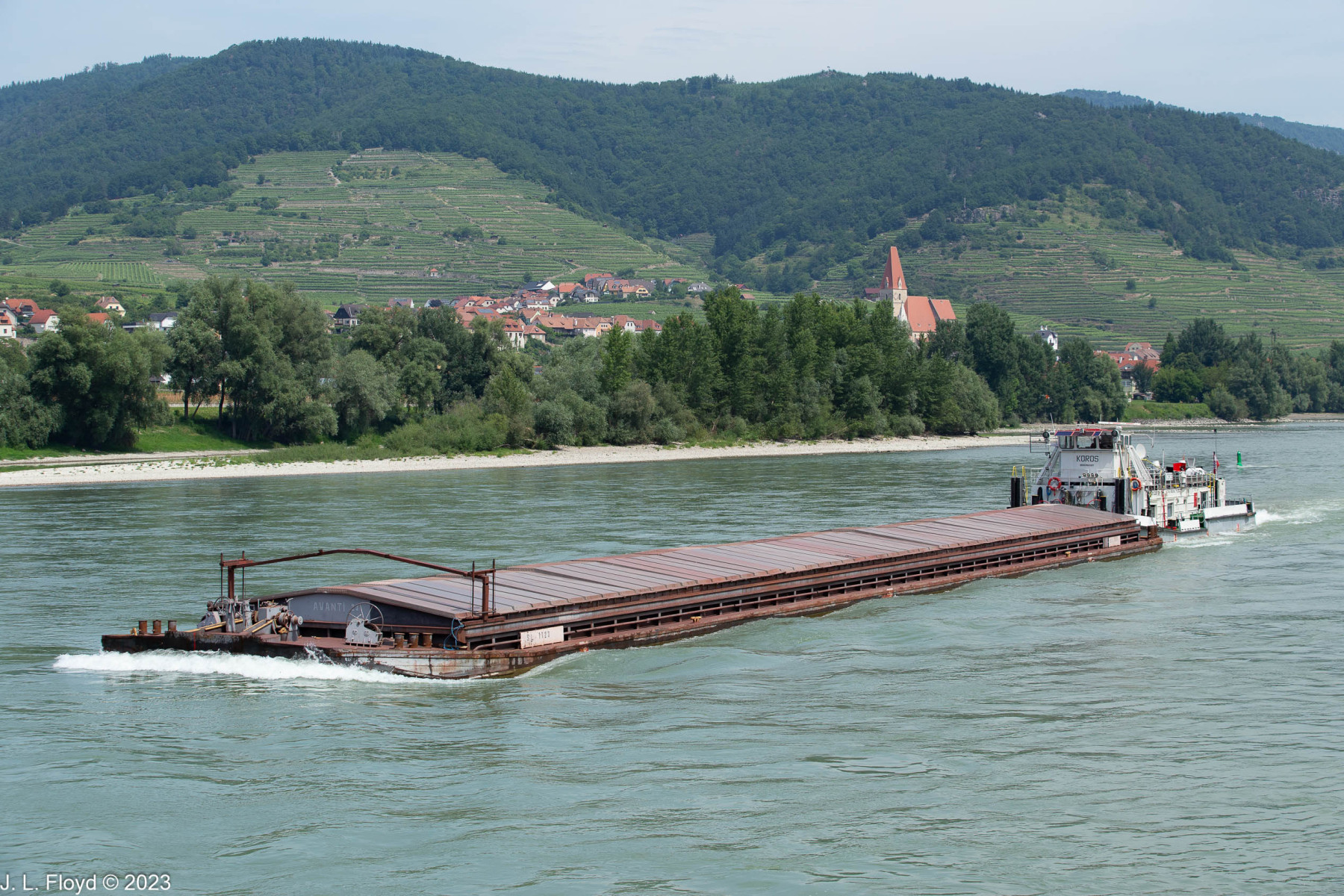
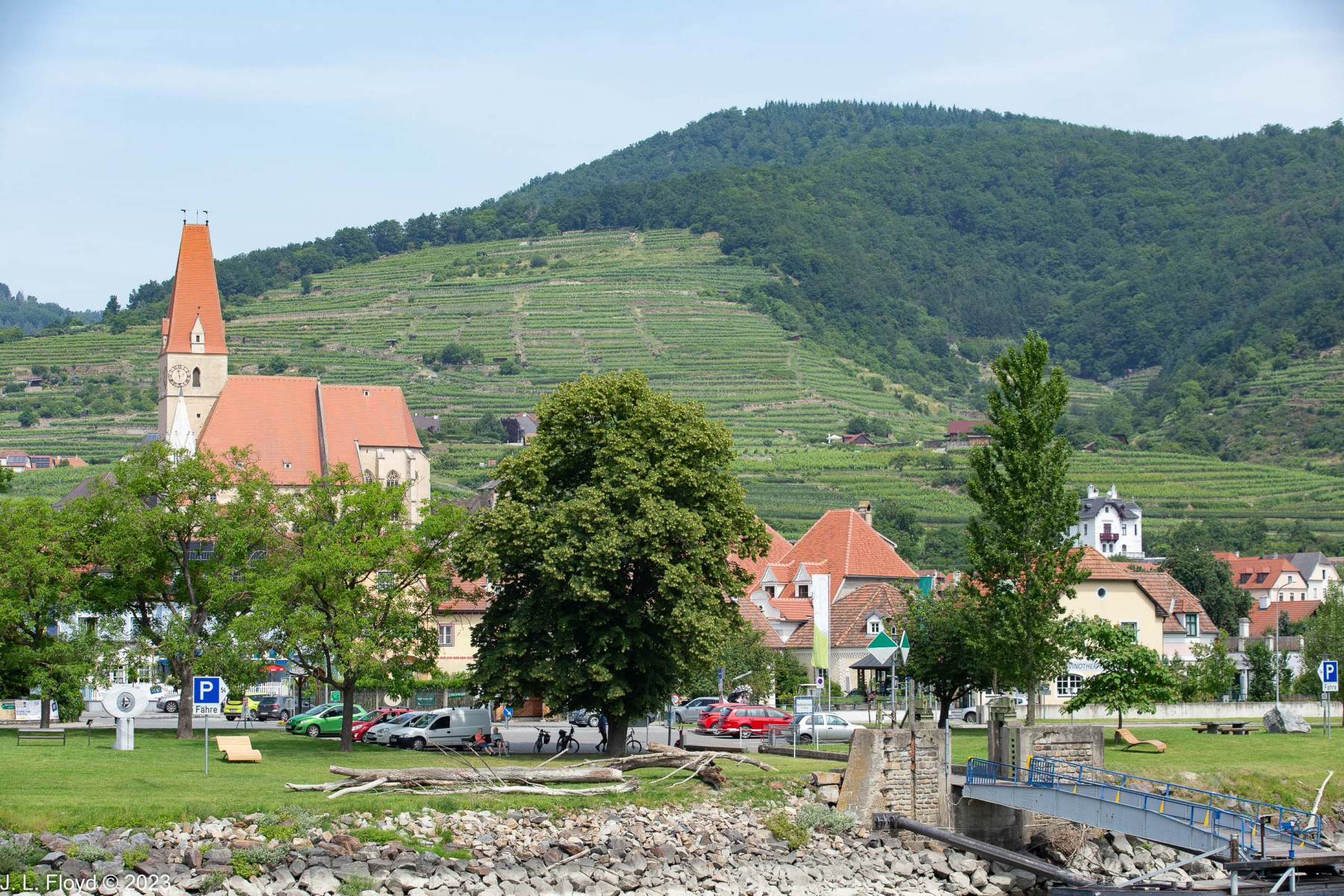
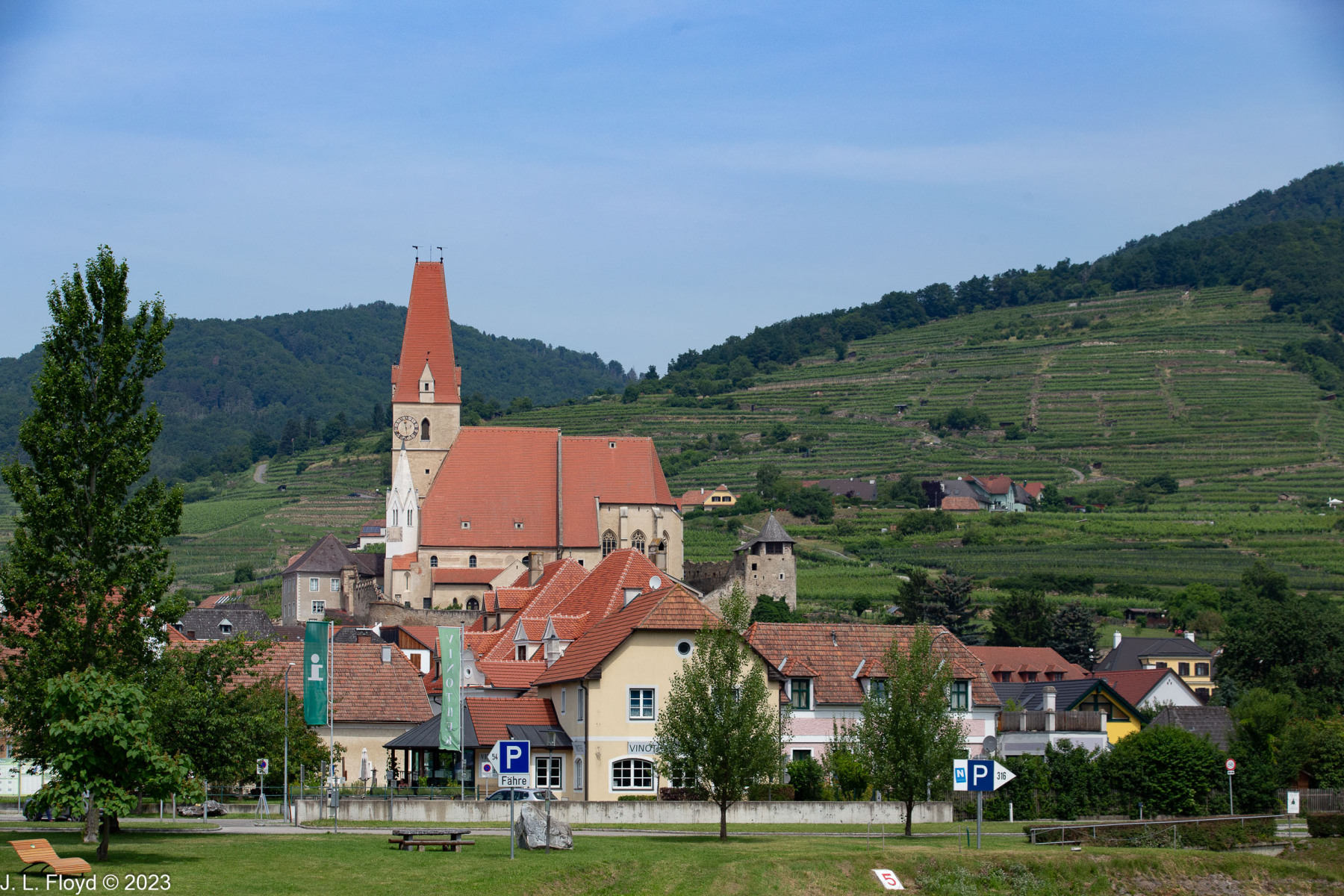
The first cable ferry we encountered was at Weissenkirchen, 6 kilometres (3.7 mi) up the Danube from Dürnstein. Weißenkirchen in der Wachau, to give it its full authentic name in German spelling, is a village of about 1600 people right in the middle of the most prolific wine-producing area of the Wachau Valley. It is also the setting of the Teisenhoferhof, a structure originally built in Gothic style as part of the fortifications of the nearby church in the 14th century, when it served as a crossbow-shooting range. In 1542, however, it was expanded with an arcaded courtyard in the Renaissance style, and today it is considered one of the most beautiful courtyards in Austria. It is a popular venue for concerts, plays and other cultural events, especially wine festivals. It also hosts the Wachau Museum and an art gallery.

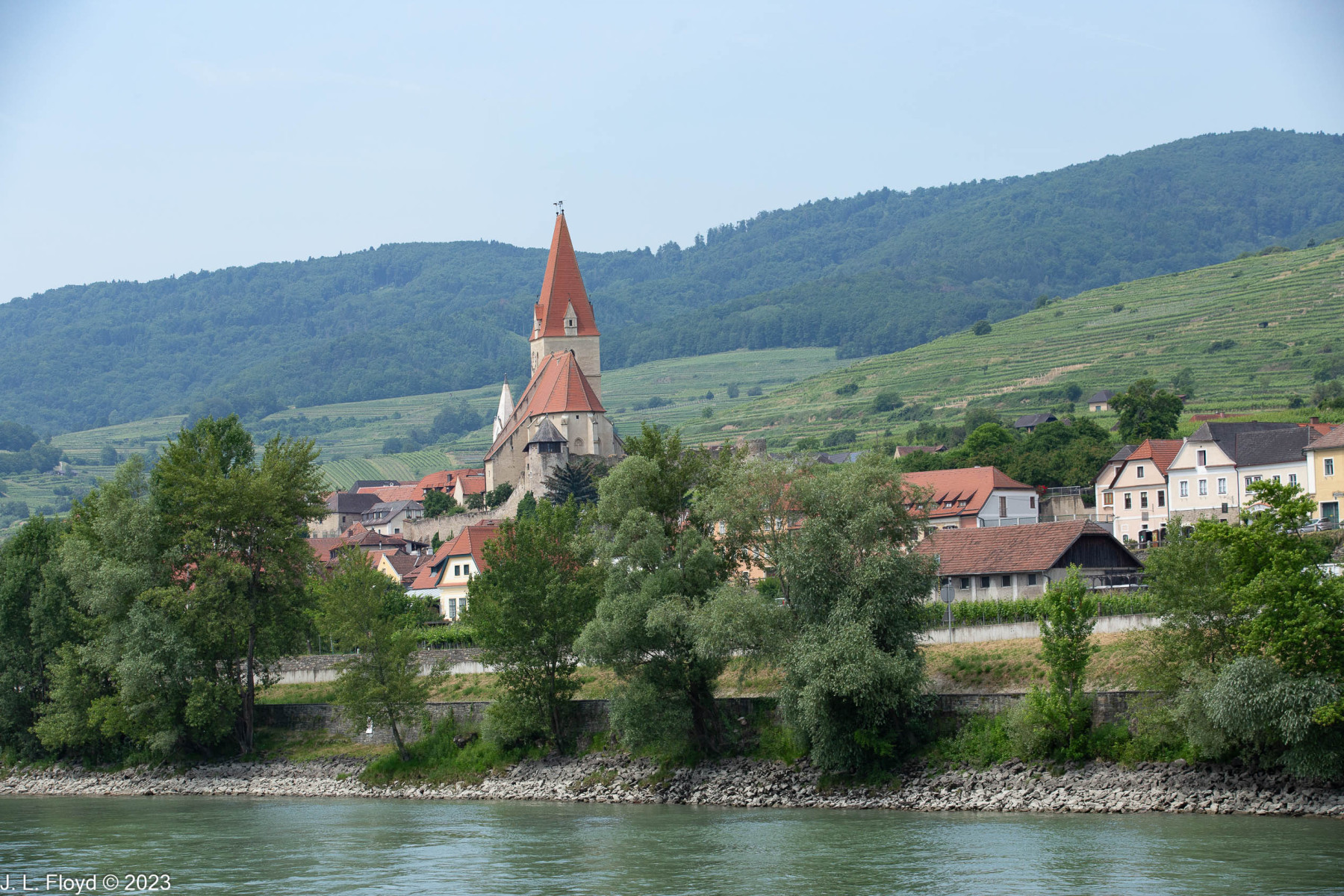
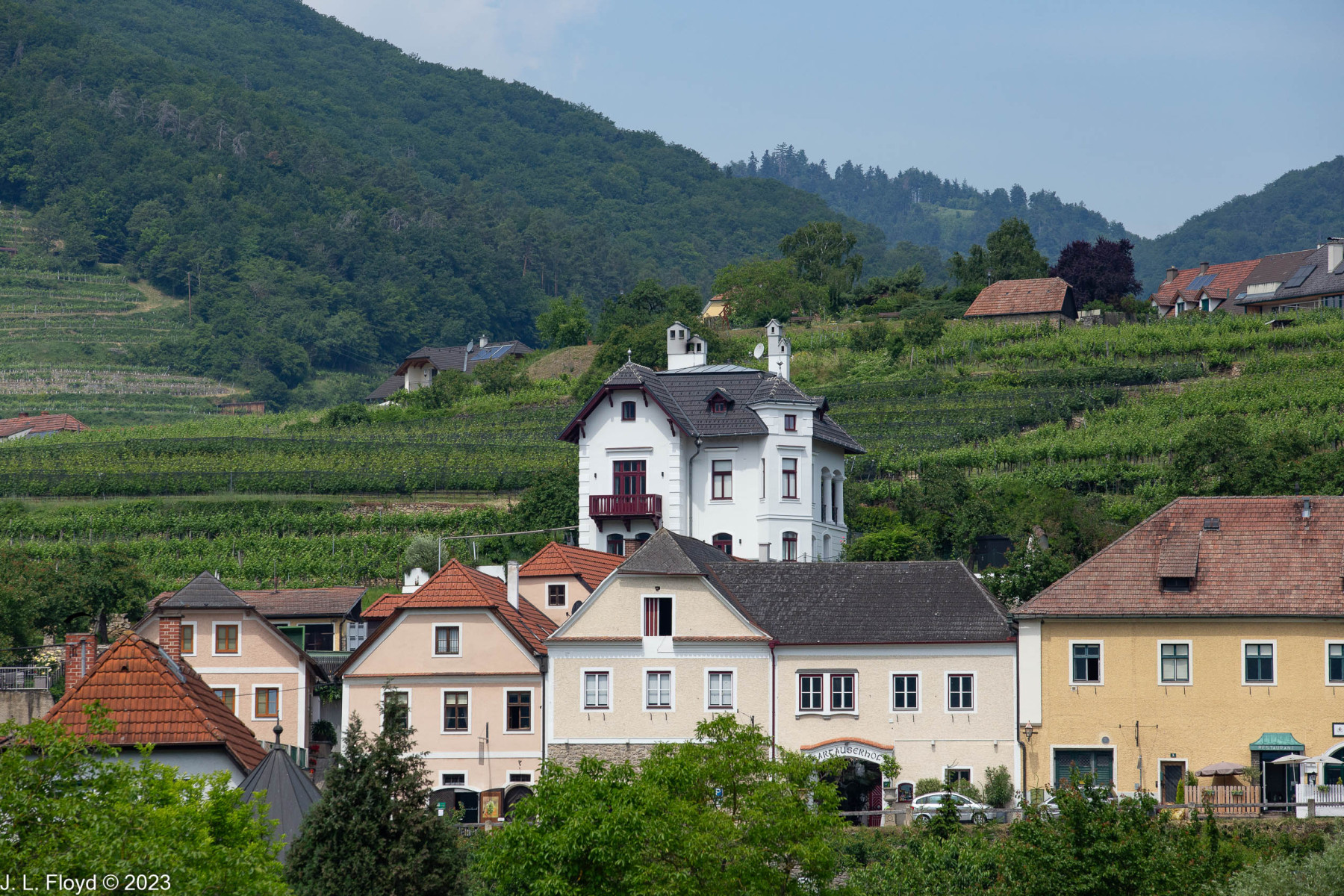
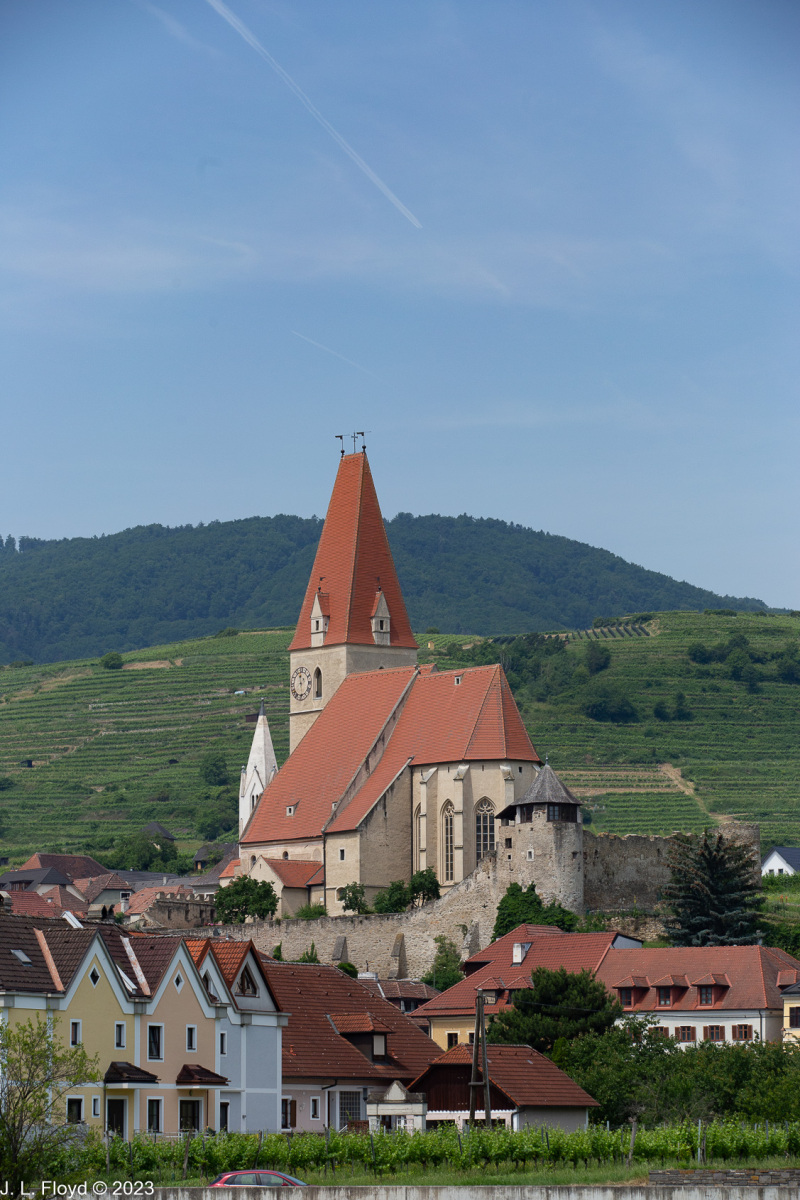
The Weissenkirchen parish church – for which I suspect the village is named – is a striking structure, easily the most prominent landmark in the village, with its steep red roof and soaring square tower. It was built in the 14th century, although its origins date from much earlier. Another highly visible landmark is a brilliant white chateau or mansion on a hill to the northeast of the church; but I was unable to identify it from the map, and since we didn’t stop at Weissenkirchen, I couldn’t find anyone who could tell me about it. I guess I’ll have to go back to Weissenkirchen sometime and find out what it is.

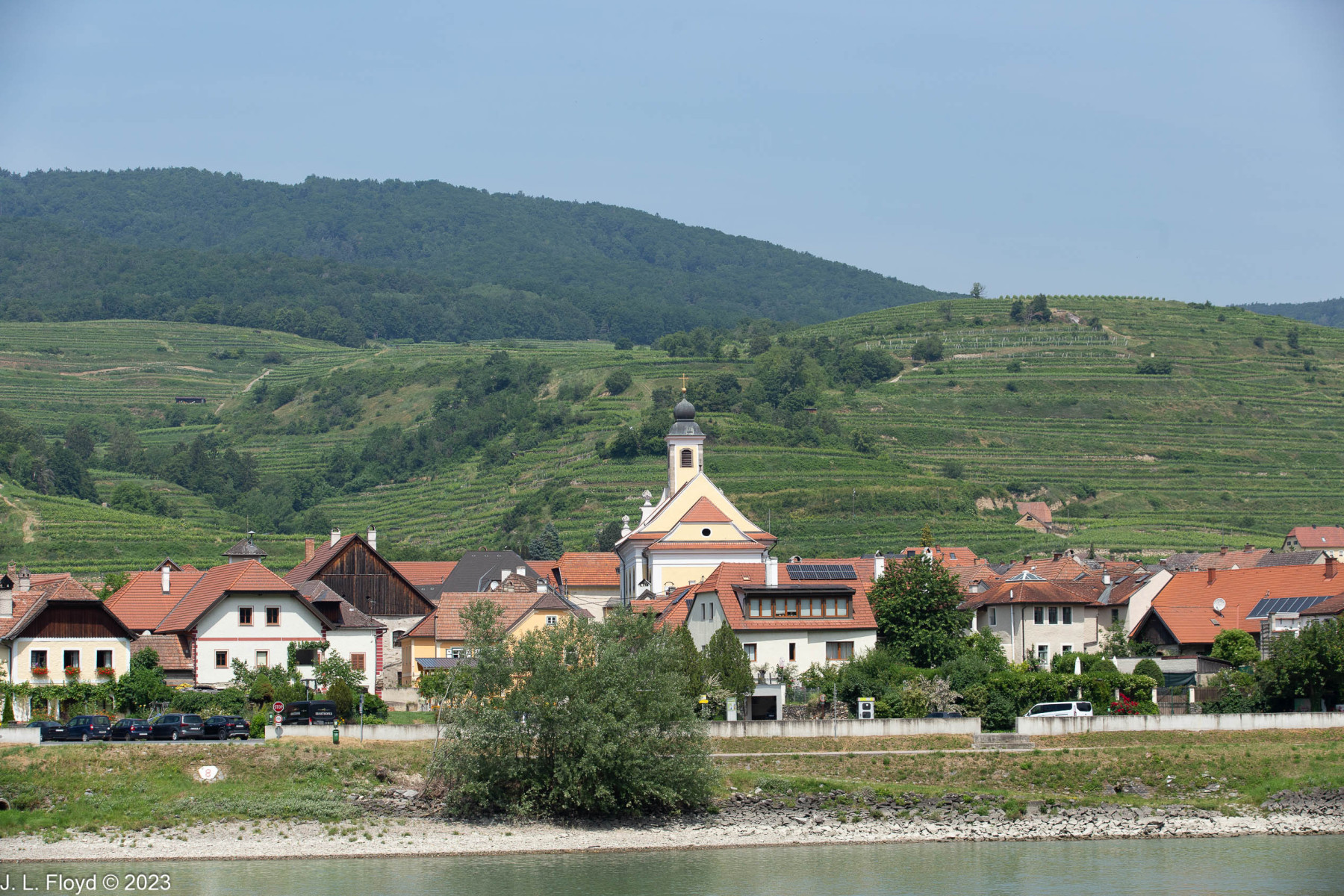
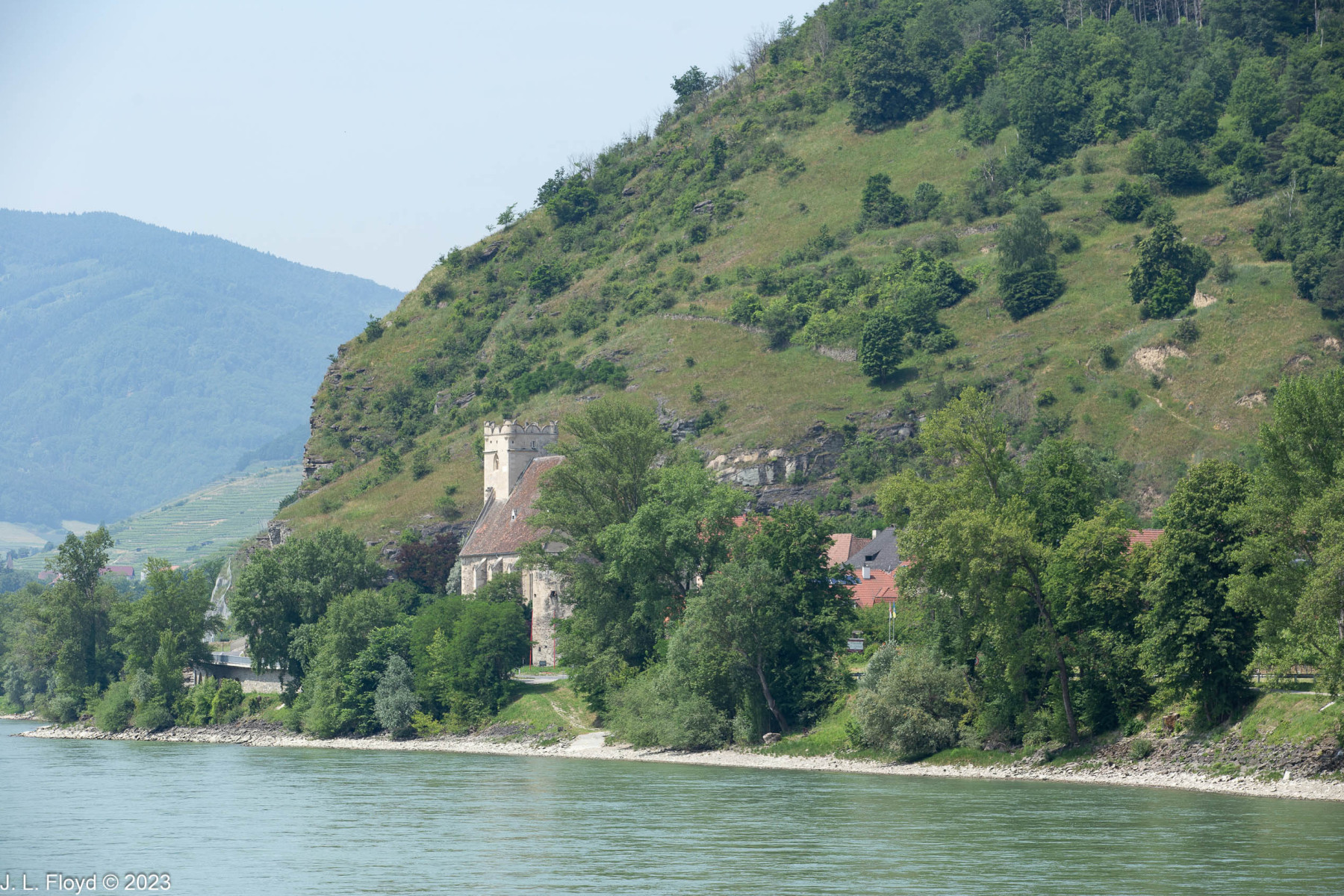
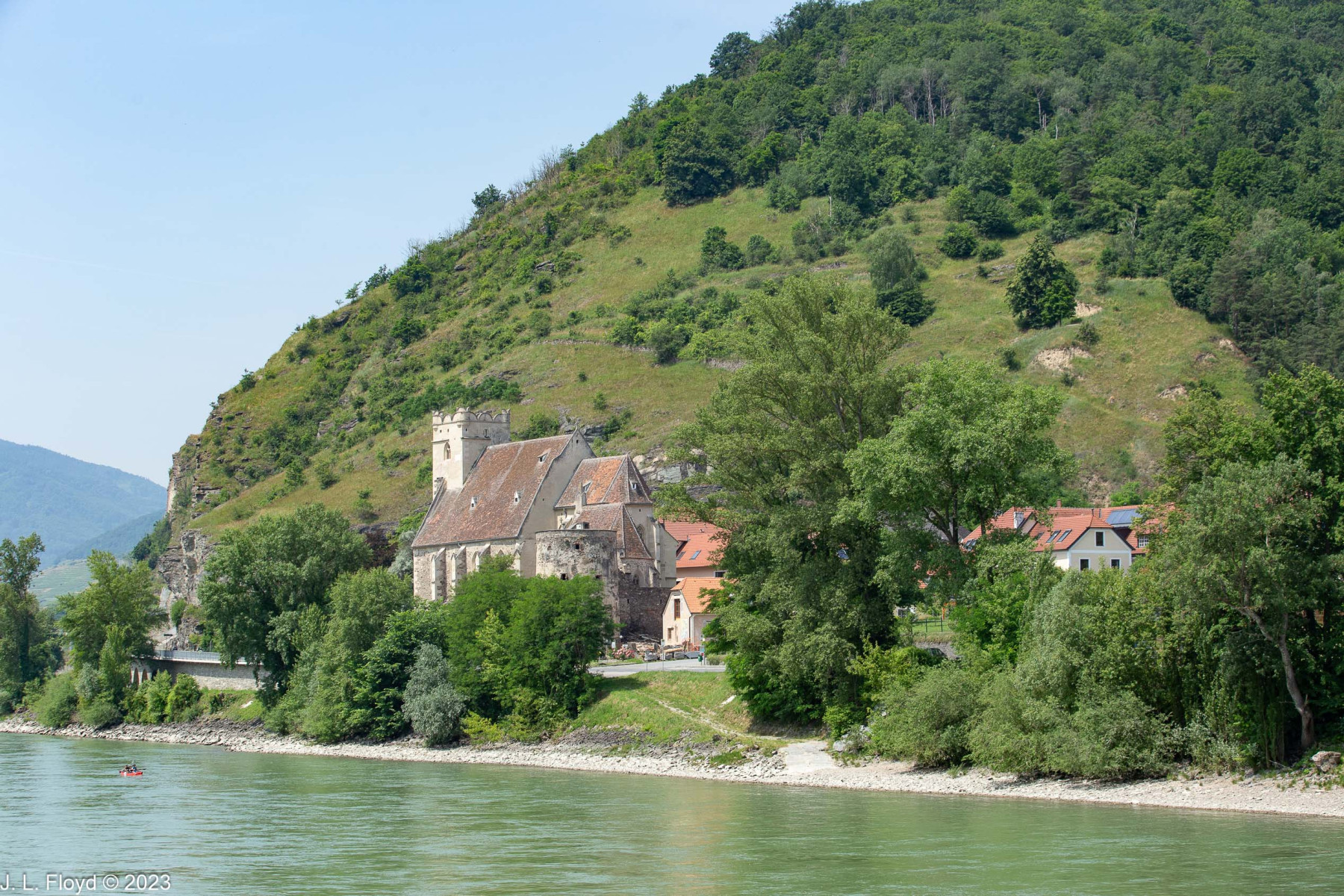
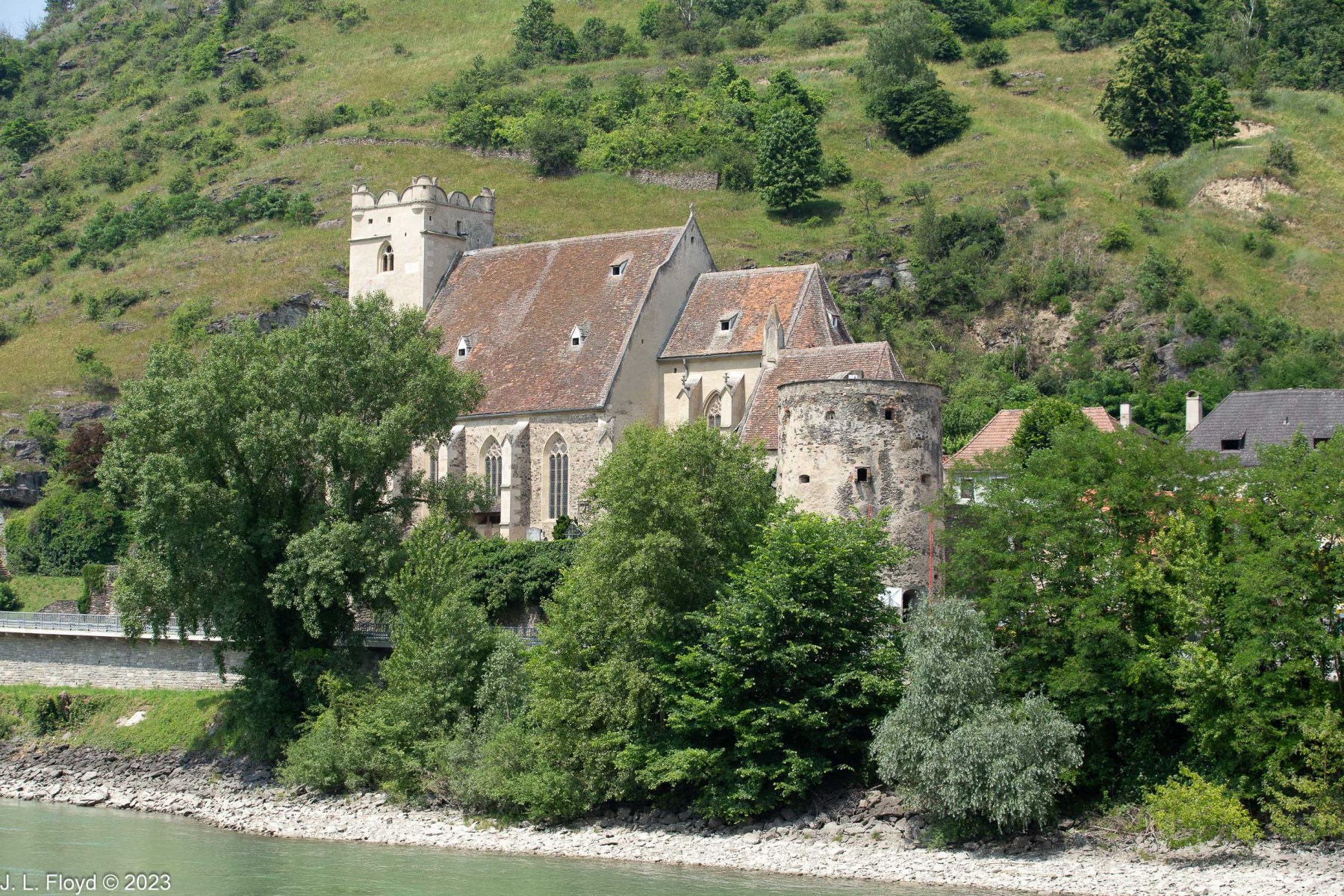
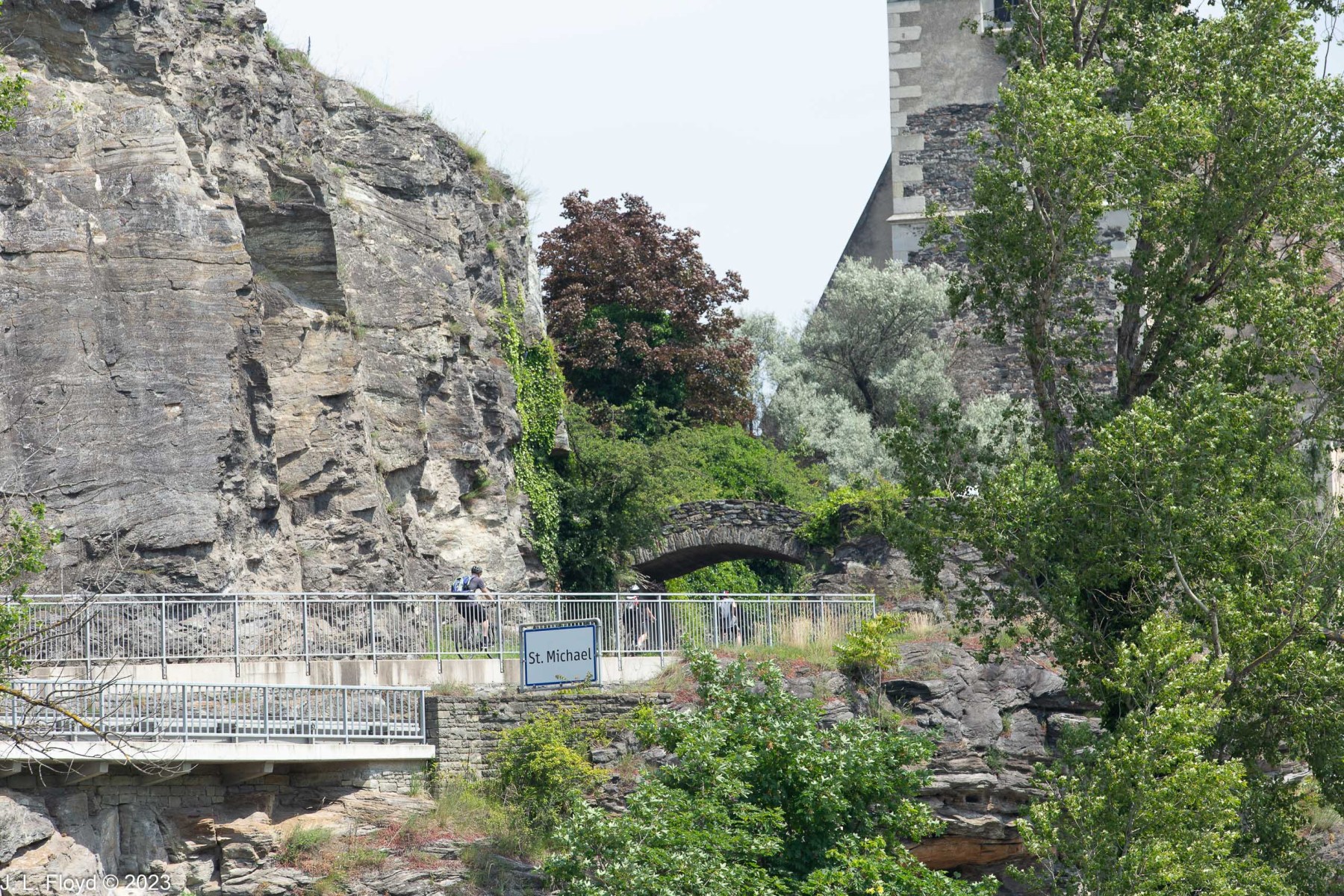
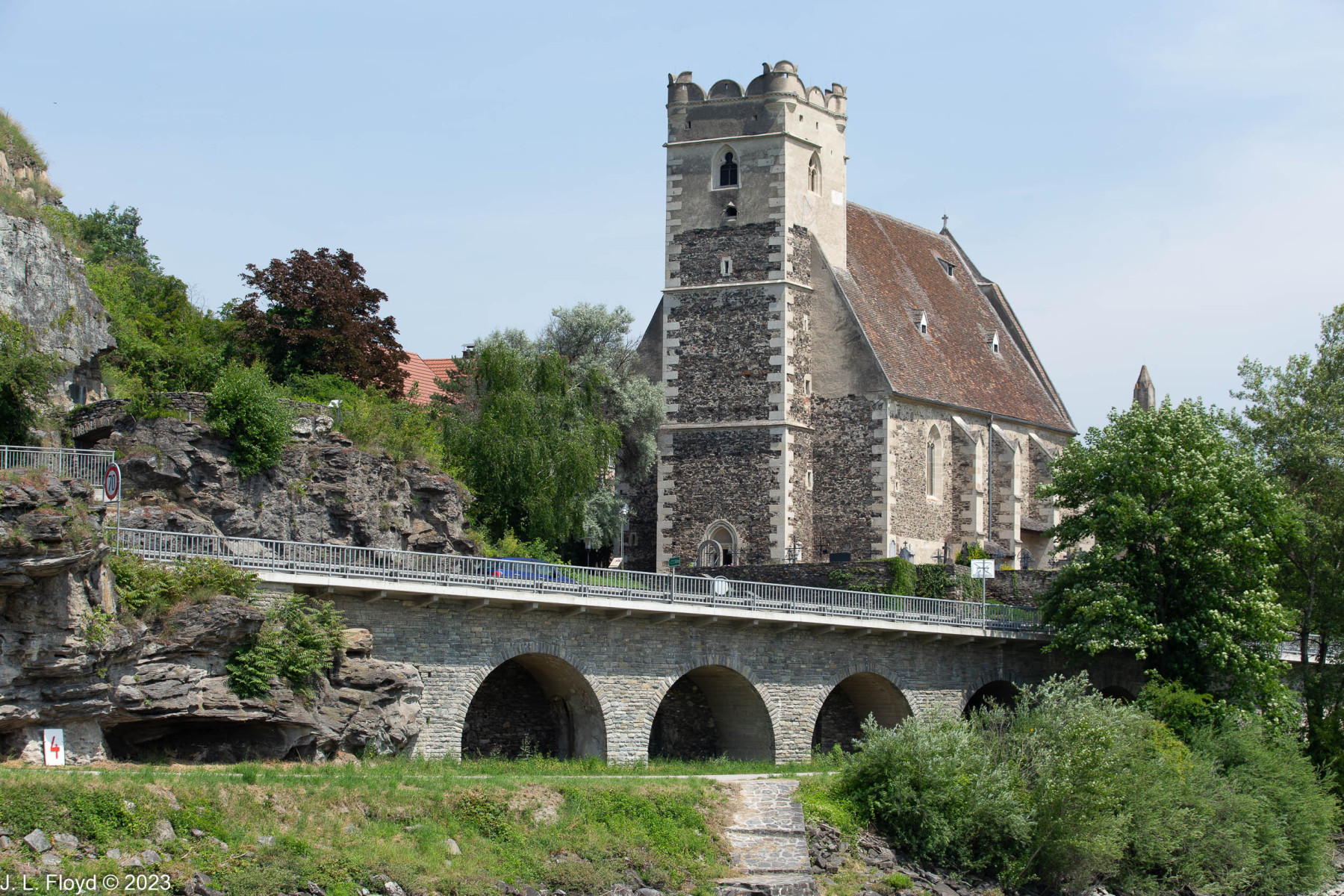
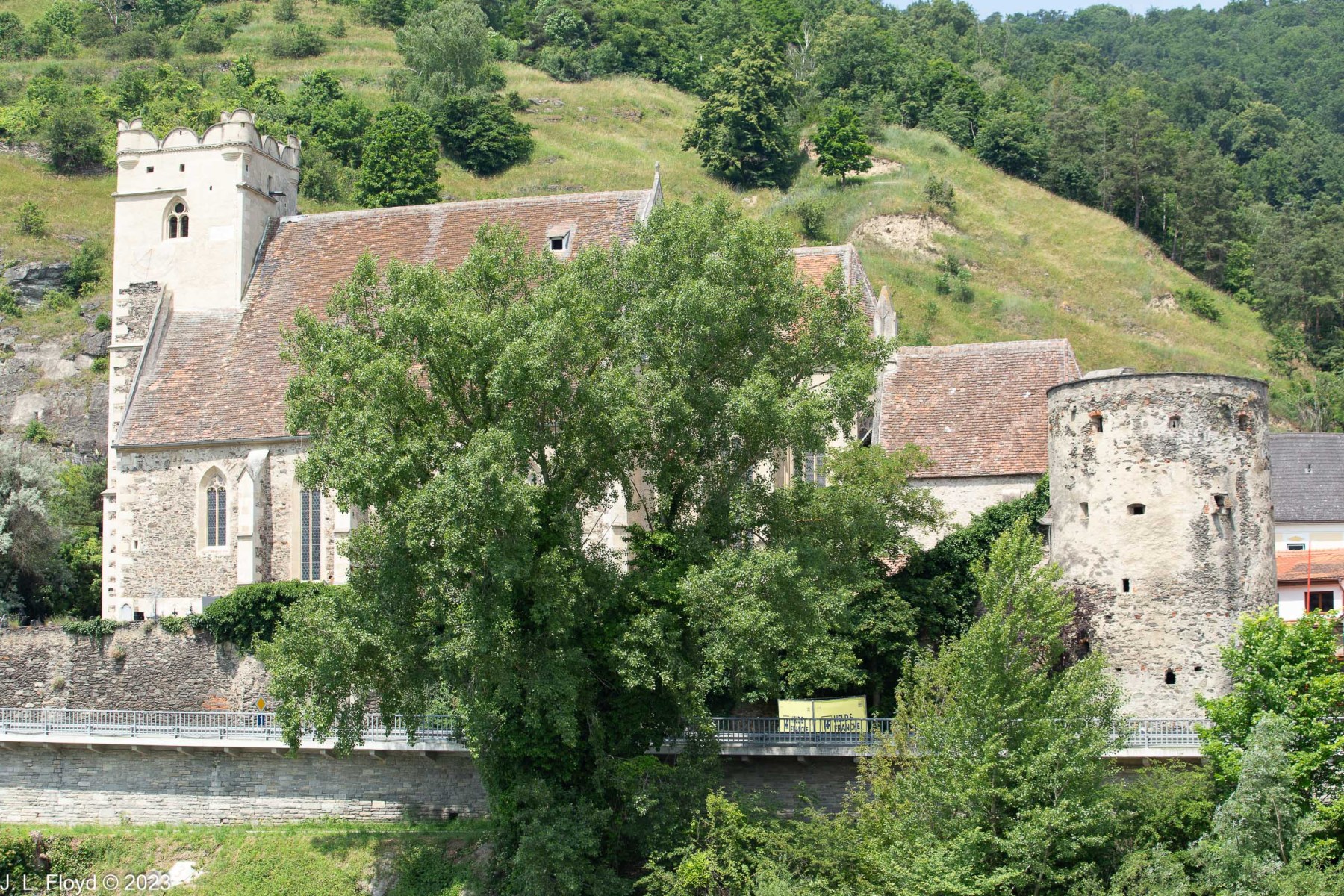
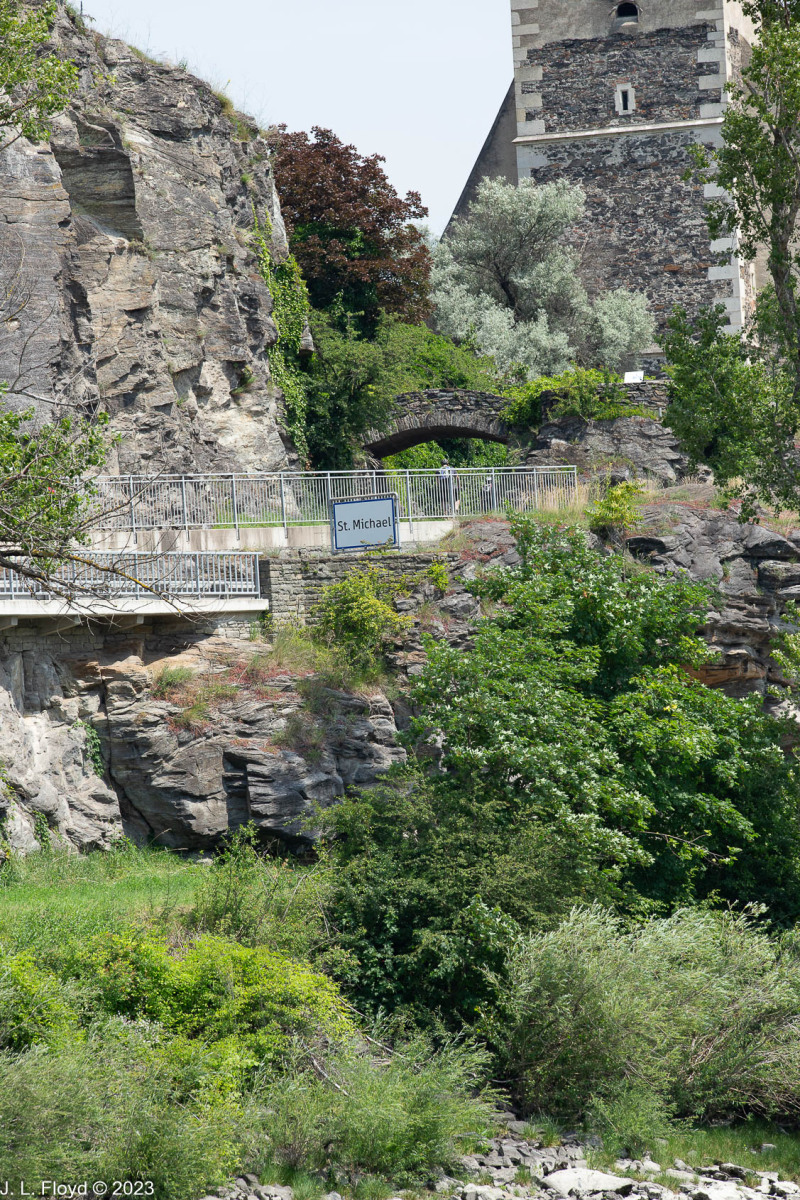
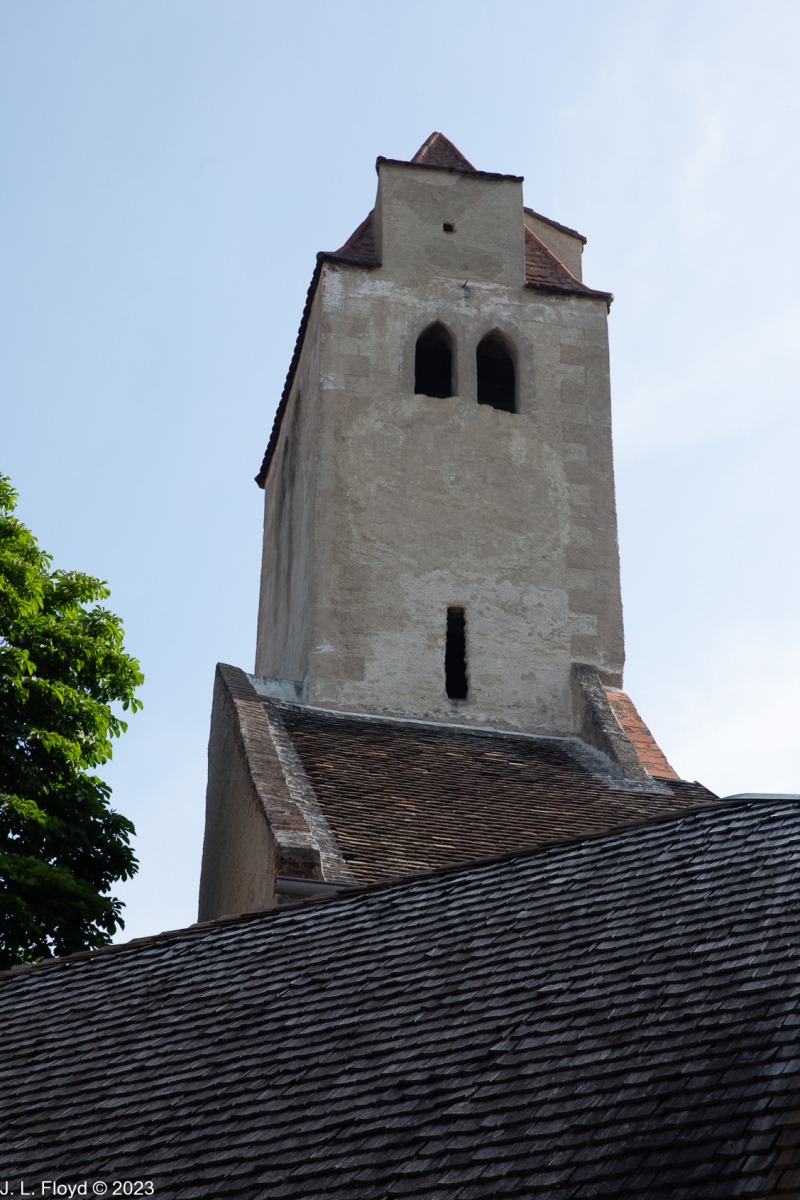
After passing Weissenkirchen’s neighbor, Wösendorf, we came to another village or hamlet, St. Michael’s, that was very different from its neighbors. Like Weissenkirchen, it had a wehrkirche (fortress church), but that church appeared to be carved out of the stone of the mountainside by giants and the rest of the village seemed to be no more than an insignificant adjunct to it. Indeed the village itself was nearly invisible, hidden in the trees, and the space between the mountainside and the Danube was so narrow that there didn’t seem to be any room for it. I found out later that there are only 13 houses in the village, but the church itself is very old and famous, dating from the tenth century in its original version. In its current incarnation it is Gothic, with a steep red roof and a square stubby tower with no spire on top. On its roof are said to be seven rabbits. I did not see them, and I can’t find them in my photos, but there is a legend associated with them: supposedly one winter’s night a blizzard filled the gap between the mountain and the church with snow, and the rabbits ran across the snow to investigate the church. But in the morning the snow melted, and the rabbits were stranded, with no way to get back to the mountain. Somebody – God, Mother Nature, whoever – felt sorry for them and turned them to stone so they could stay on the roof forever. Since I never saw the rabbits, I assumed that whoever turned them into stone later turned them back into live rabbits, and set them on the ground or gave them parachutes, so that they were then able to run away.

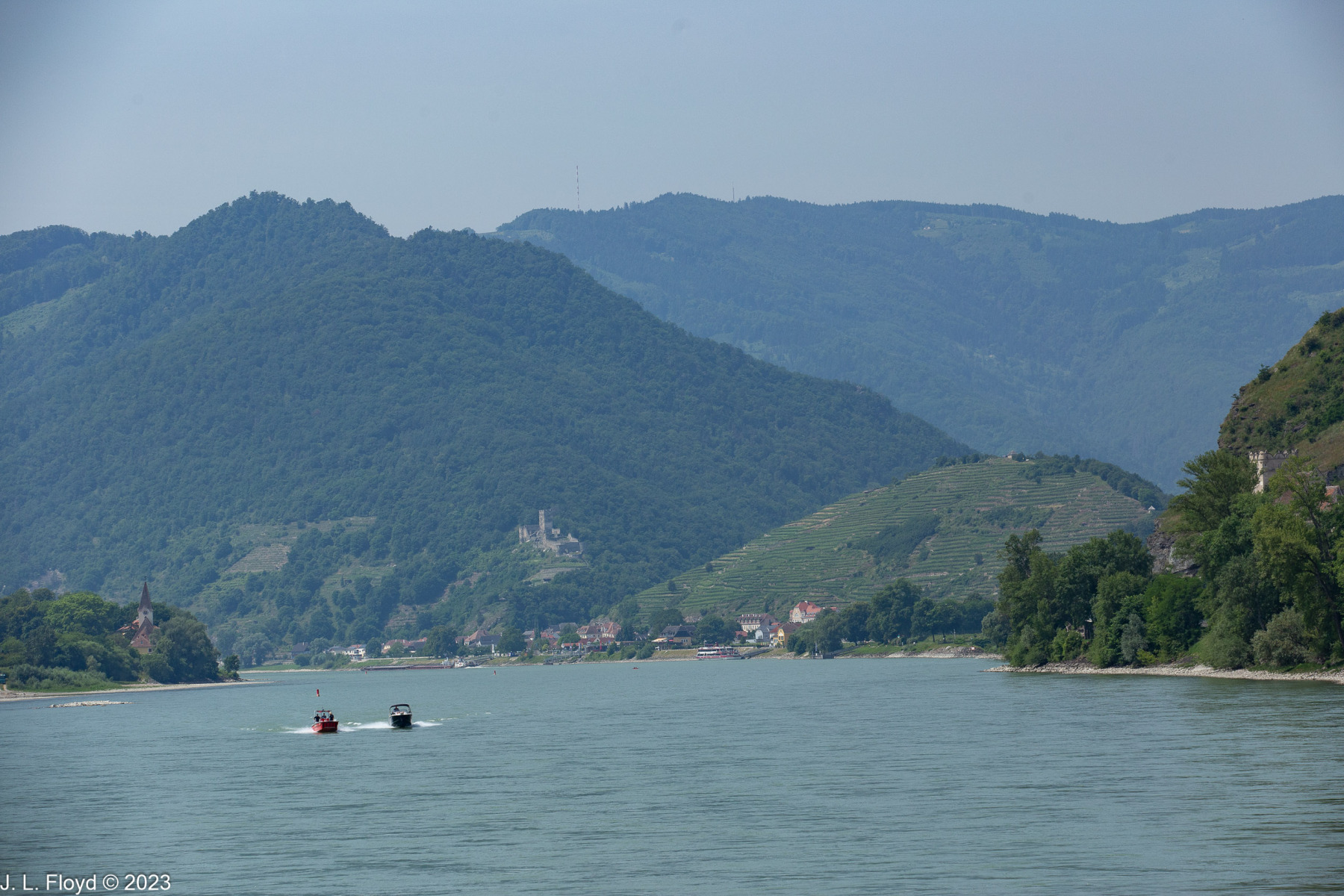
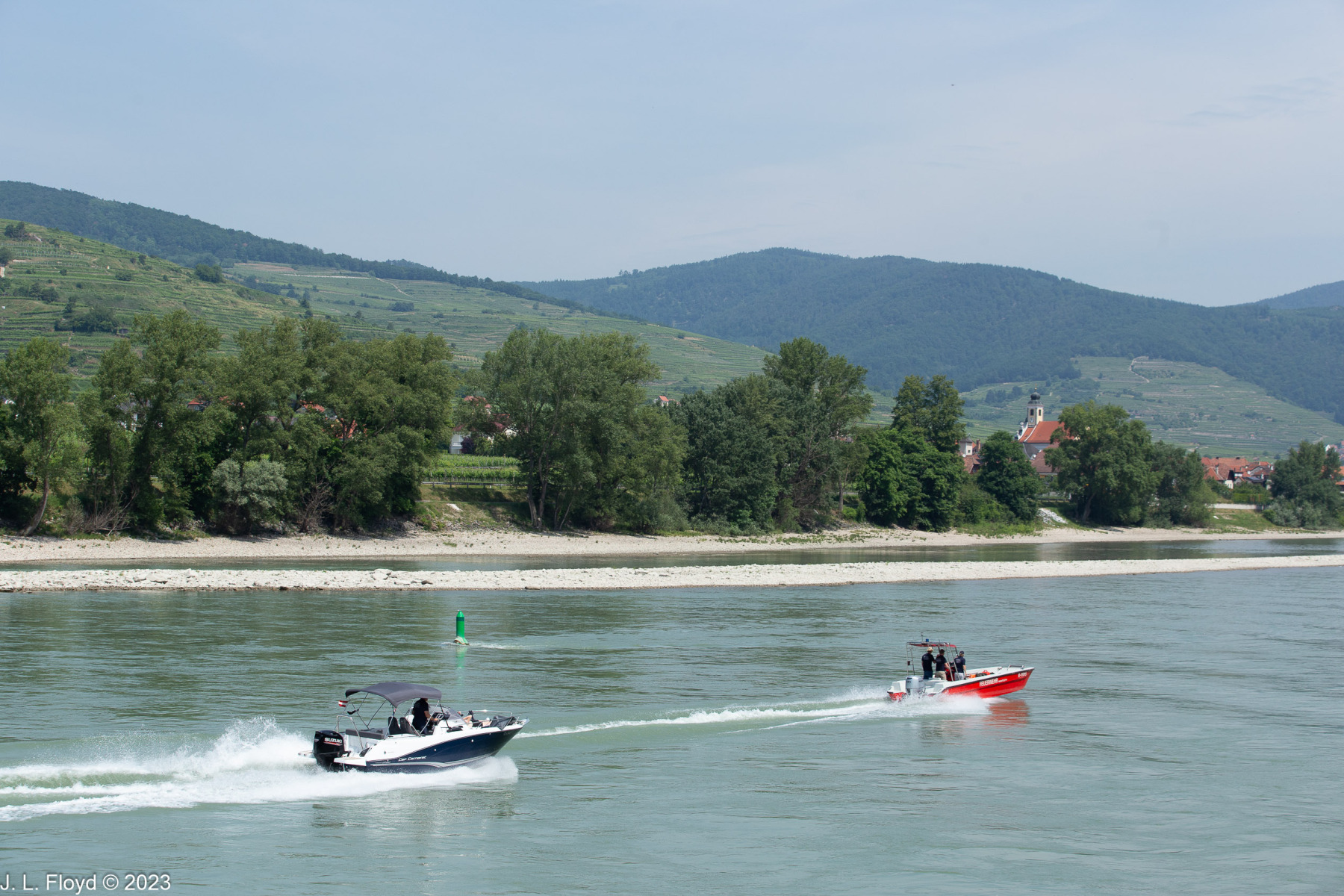
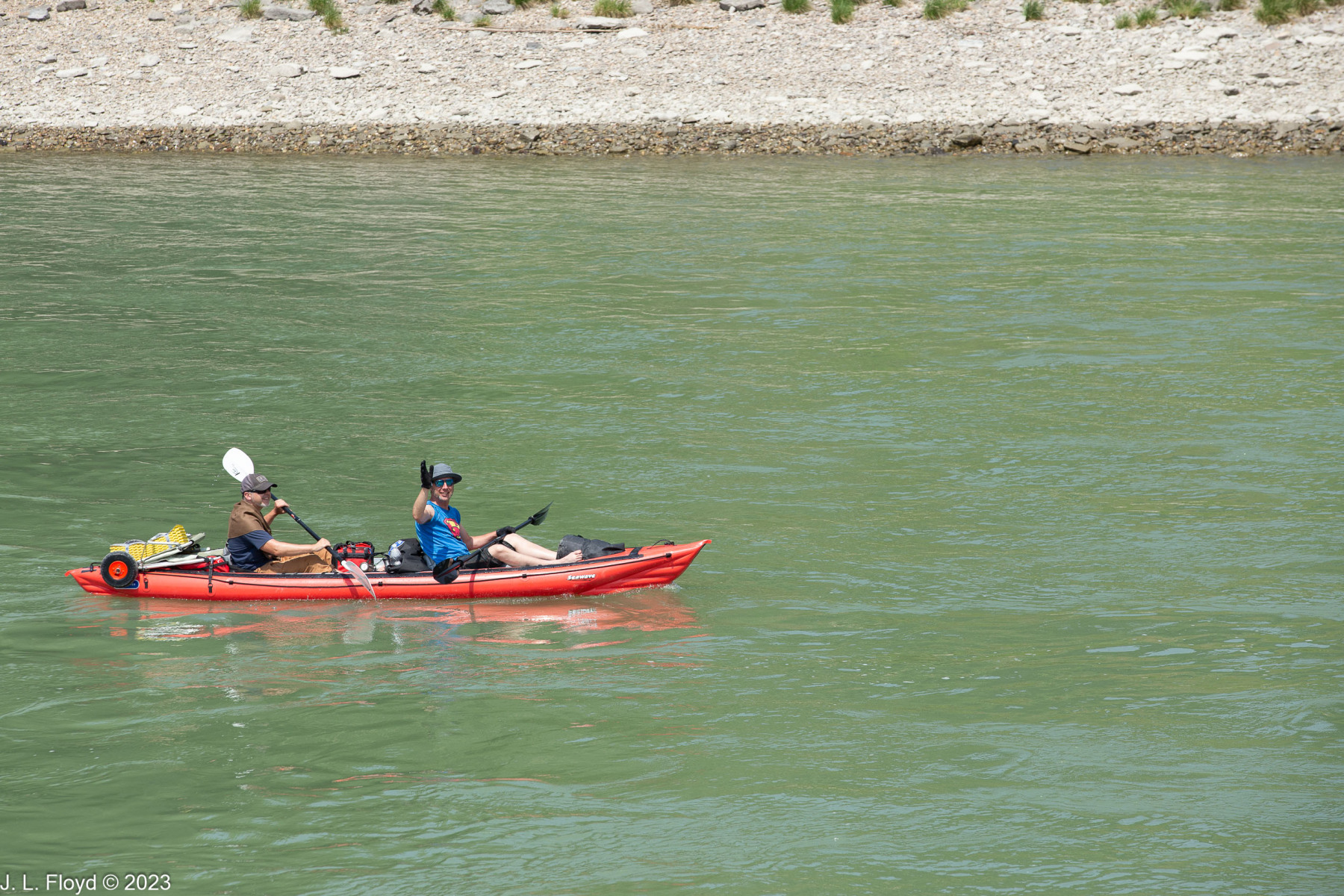
Turning my attention from the wehrkirche back to the river, I spied a couple of speedboats heading toward us. I thought they might be pirates coming to hijack us, but they sped on past, probably with bigger game in mind, such as pillaging Weissenkirchen. Meanwhile a couple of kayakers waved to us from their slender craft. In general we saw very few watercraft on the river in the Wachau Valley; I suspect that private boating is restricted to protect the pillars of the local economy – winemaking and tourism – by preserving the pristine ambience of the river. And to discourage piracy.

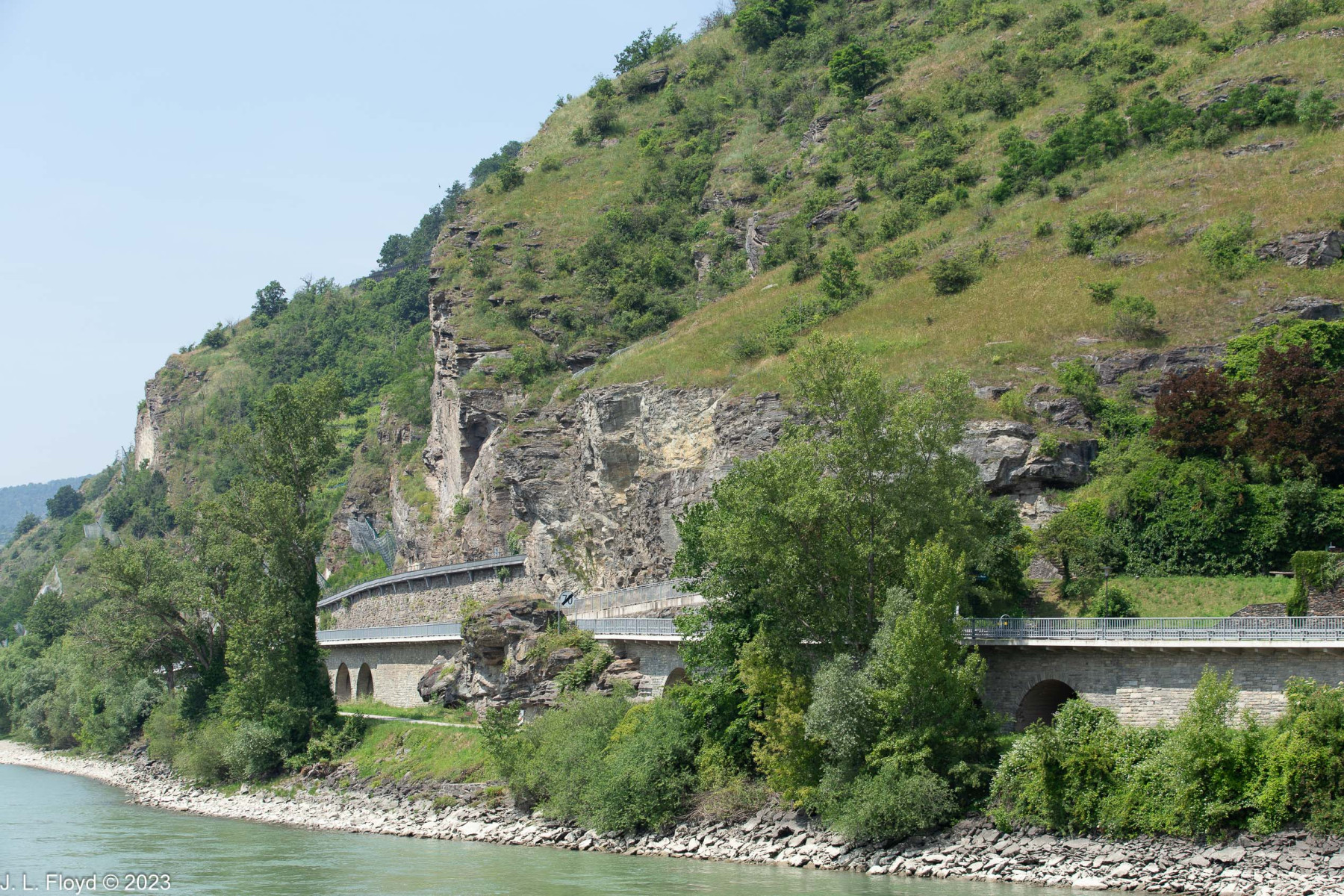
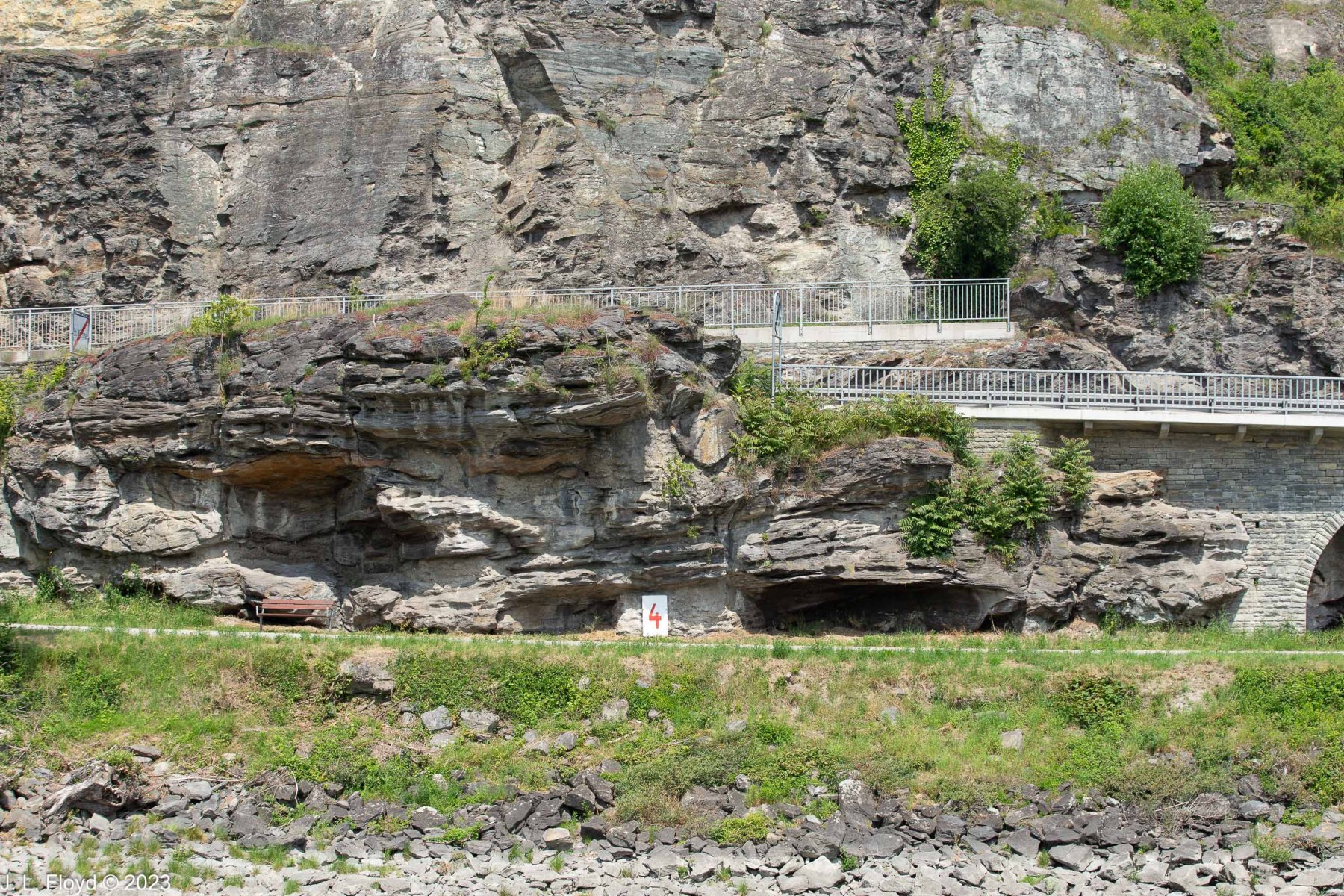
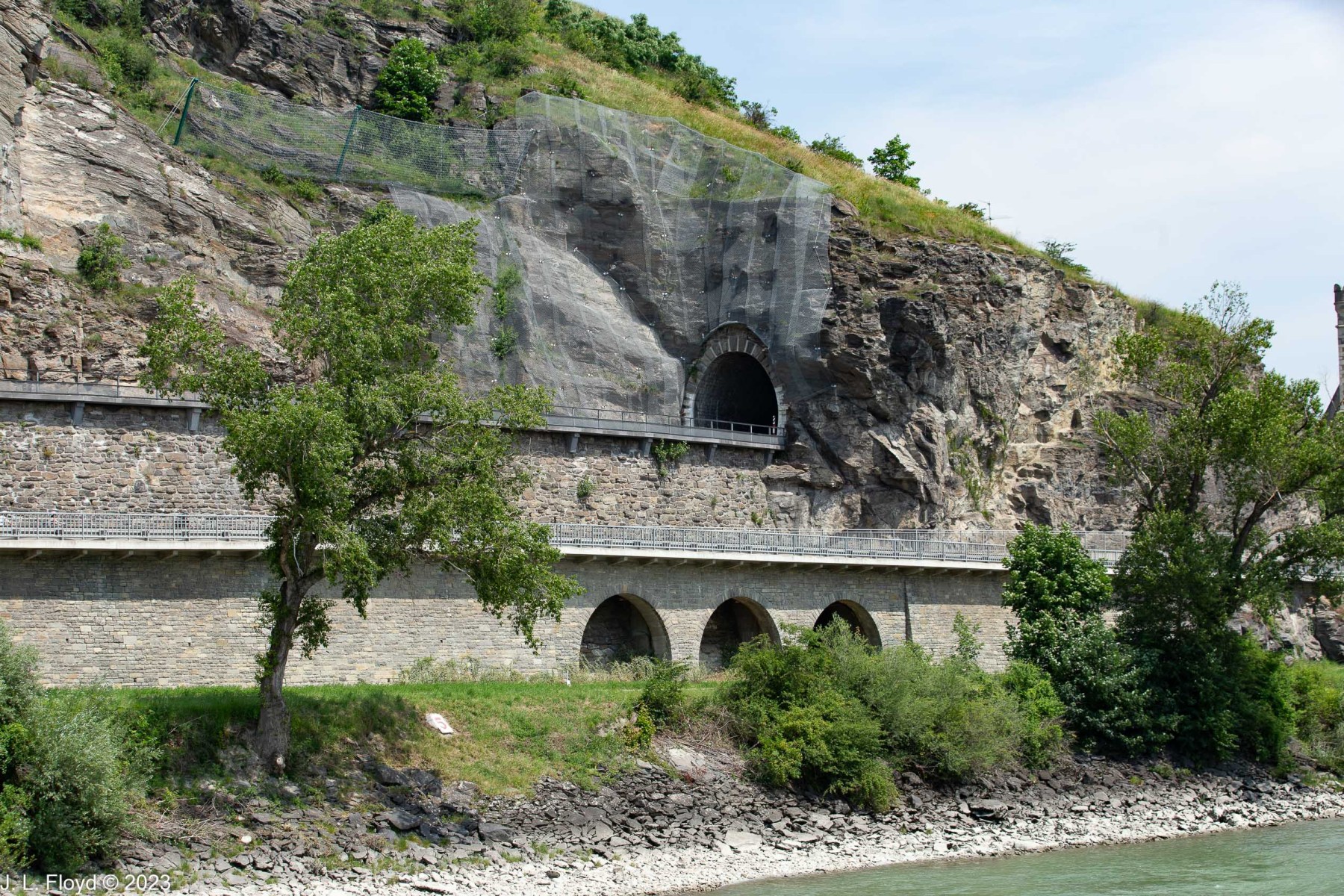
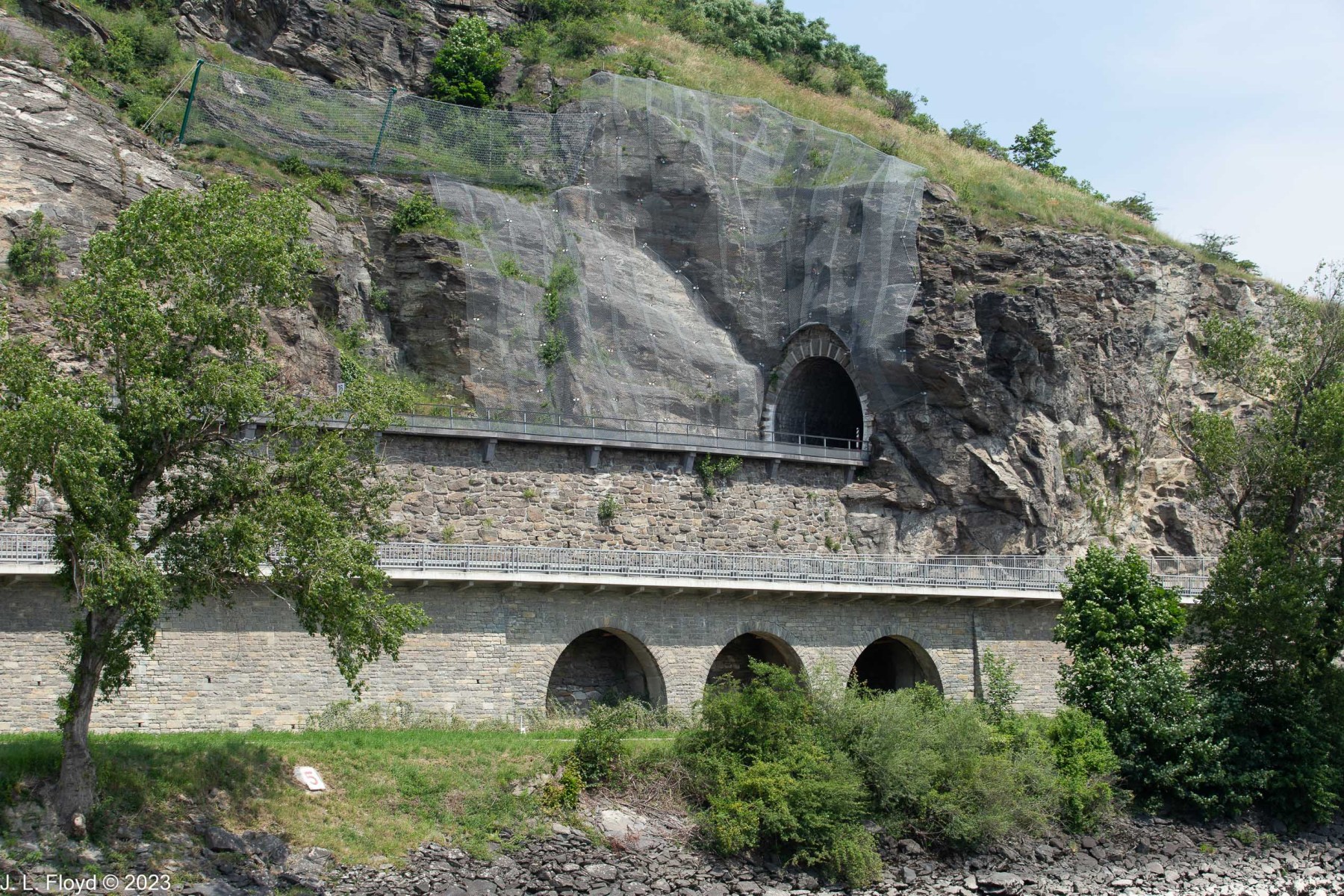
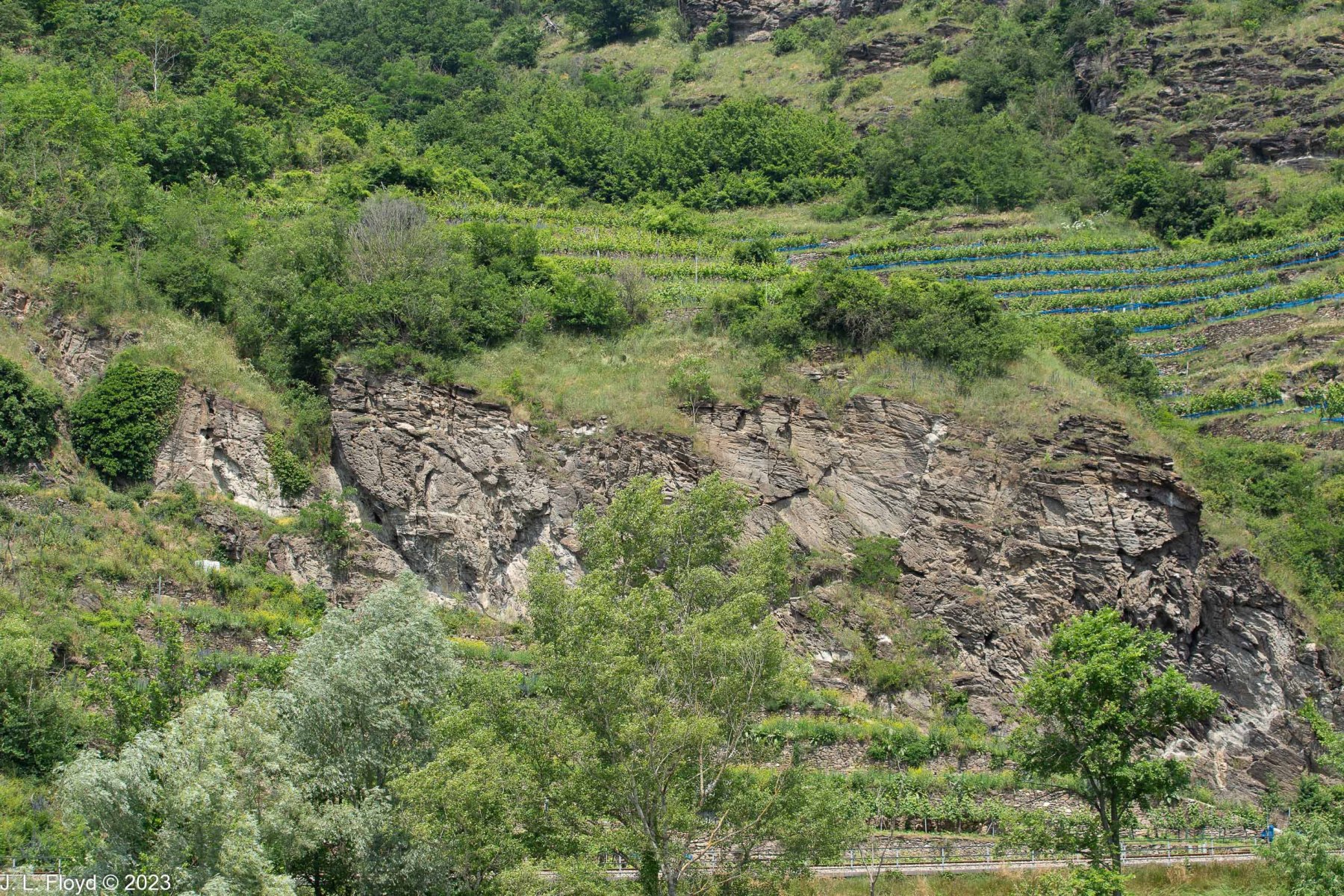
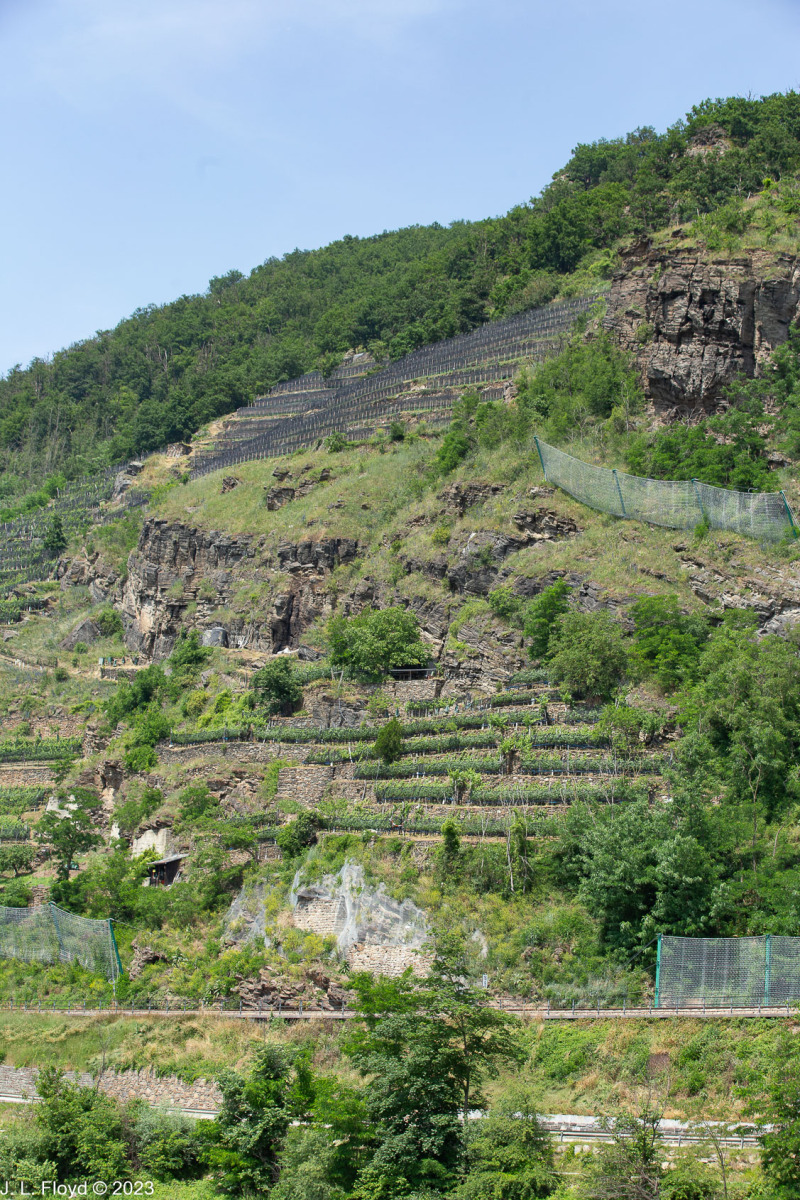
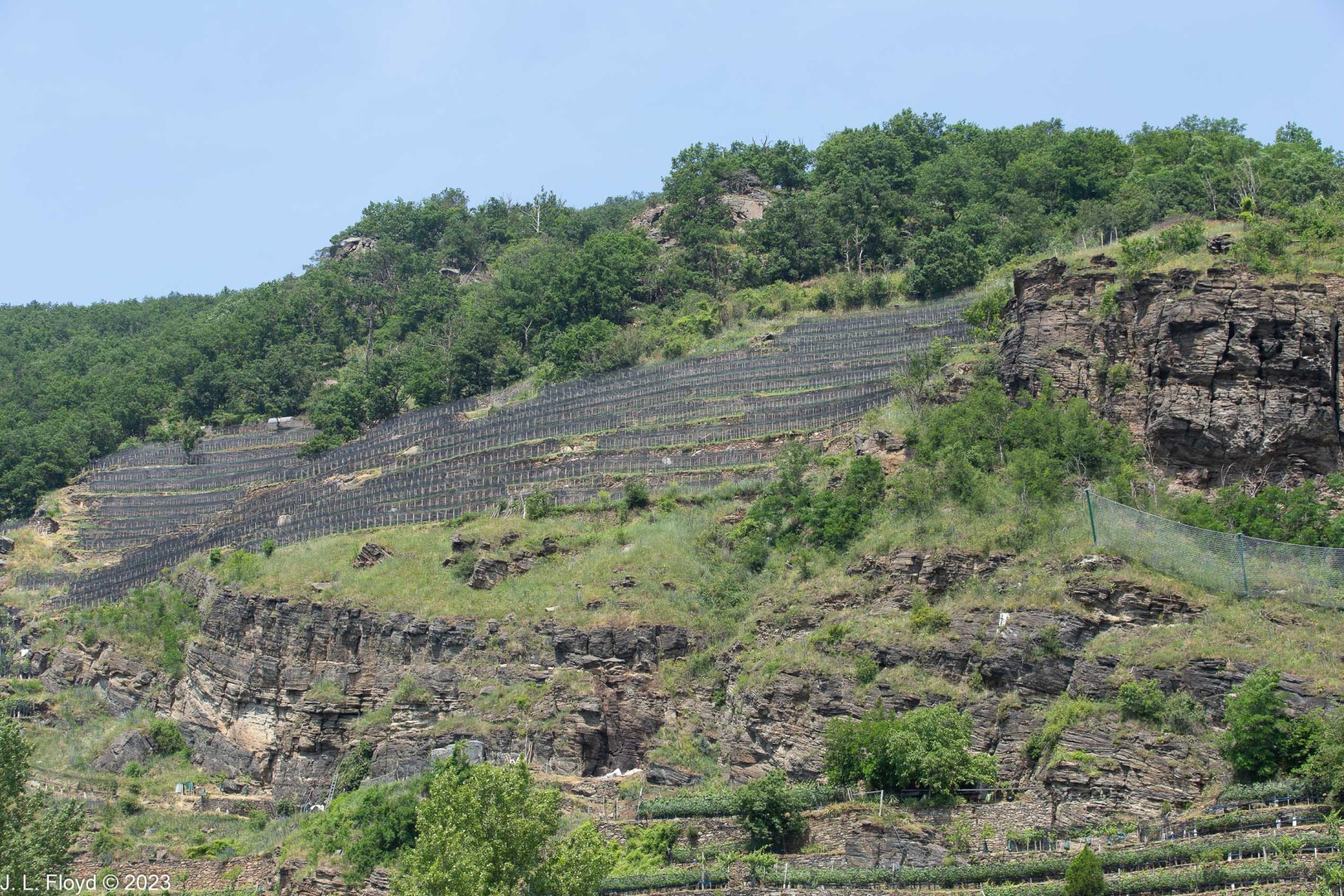
Just past St. Michael’s I noticed that the Wachaubahn railroad, which follows the Danube through the Wachau Valley, passes through a tunnel. The mouth of the tunnel is protected from rockslides by nets stretched over the mountainside above the railway. The nets also prevent rocks from falling on the Bundesstrasse highway, which runs below the railroad. For much of the way along the Danube from Dürnstein to Spitz, in the intervals between towns there is a narrow gap between the river and the towering stony cliffs, making for a rocky romance on this stretch of the Austrian Romantic Road. St. Michael’s just manages to fit in a small niche beside the road. Wherever there is any bare space on the mountainside that is not quite vertical, grapevines are planted.

There is a long history of viticulture in Austria, dating from pre-Roman times. But during the early medieval period after the fall of the Roman Empire, wine production in the area experienced a “dark age” owing to the ravages of invasions by barbarians such as the Huns, Vandals, Avars, Bulgars and Magyars. Eventually, with the pacification of the barbarians and the establishment of monasteries throughout Central Europe, agriculture and commerce began to recover. The monastic orders were particularly influential in promoting the spread of viticulture, identifying suitable sites along the banks of the Danube in the Wachau Valley and cultivating them. In the early modern period (16th-18th century) wine production in the Wachau, as well as Austria in general, made great strides, but during the second half of the 19th century the phylloxera epidemic decimated the wine industry in the Wachau as in the rest of Europe. In the twentieth century, the situation improved following the development of techniques of grafting European grapevines onto American root stock which is resistant to the depredations of the insect that causes phylloxera.

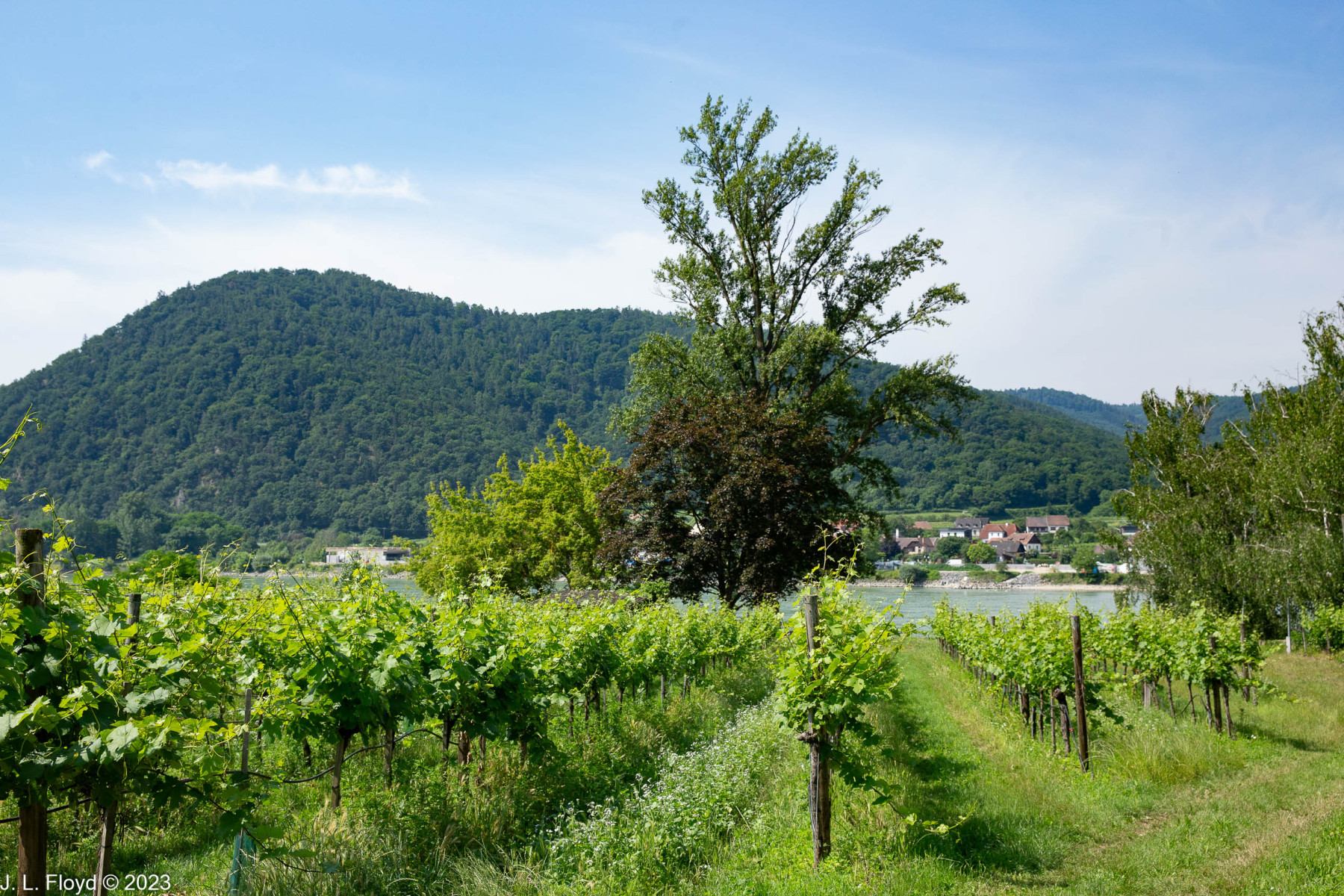
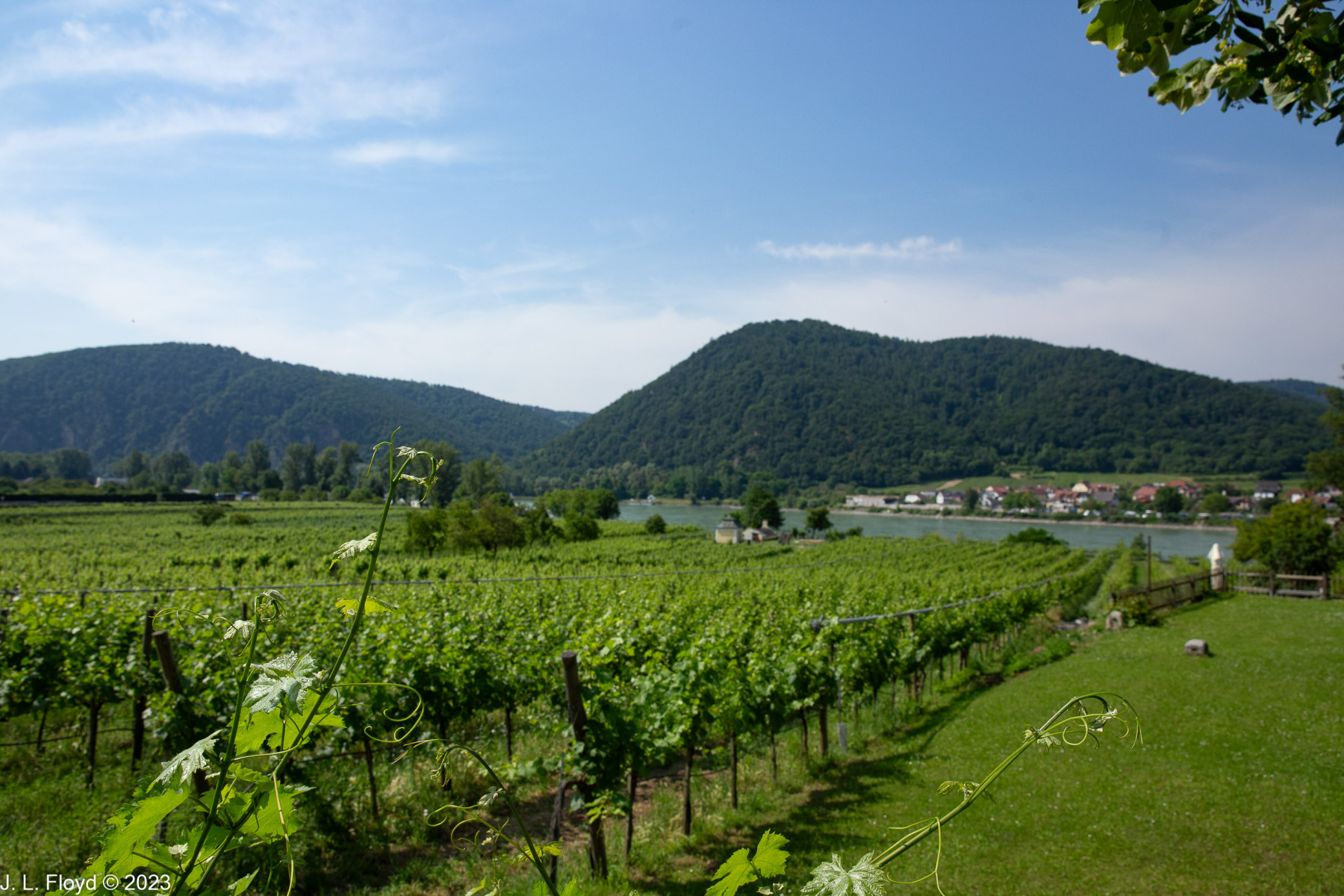
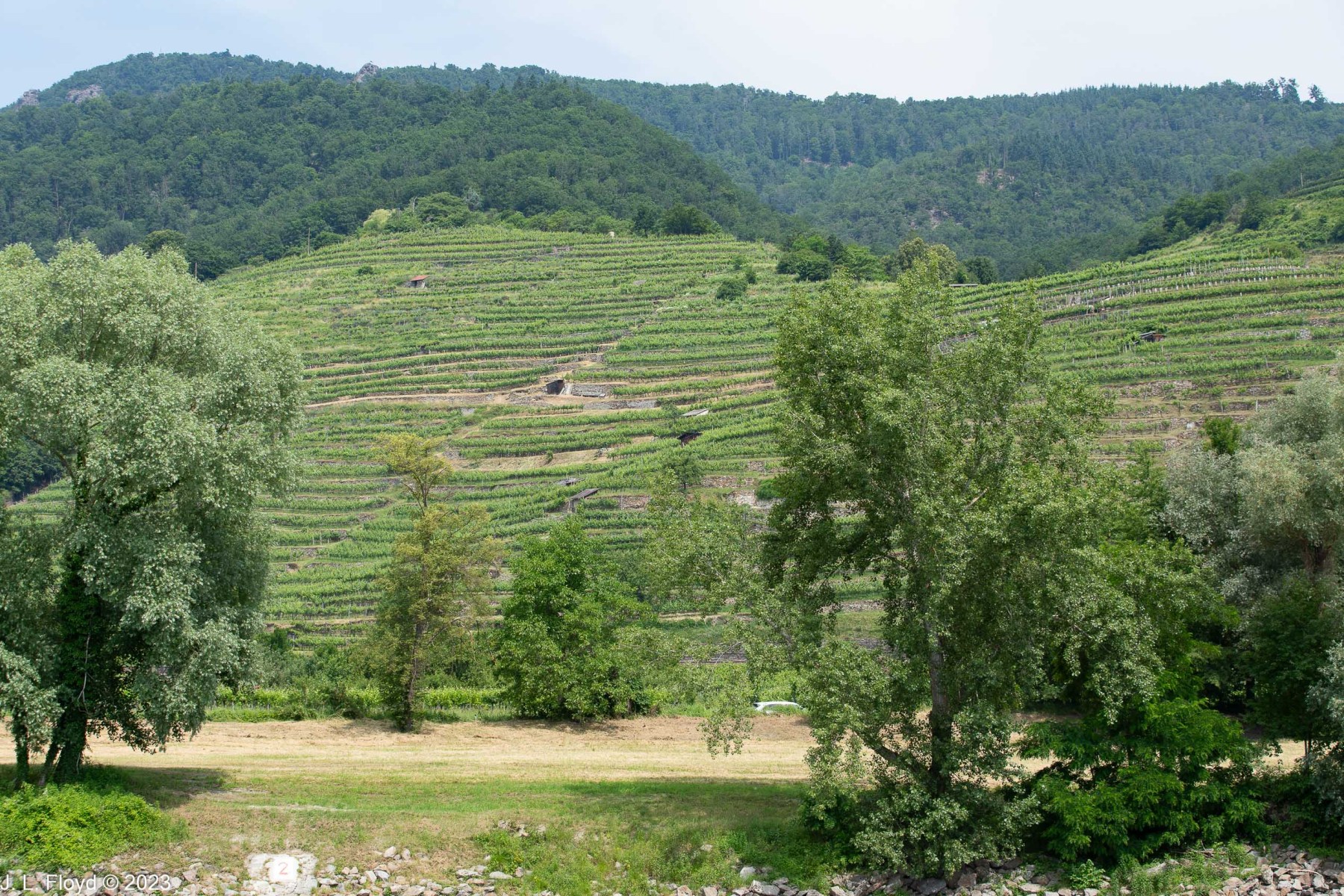
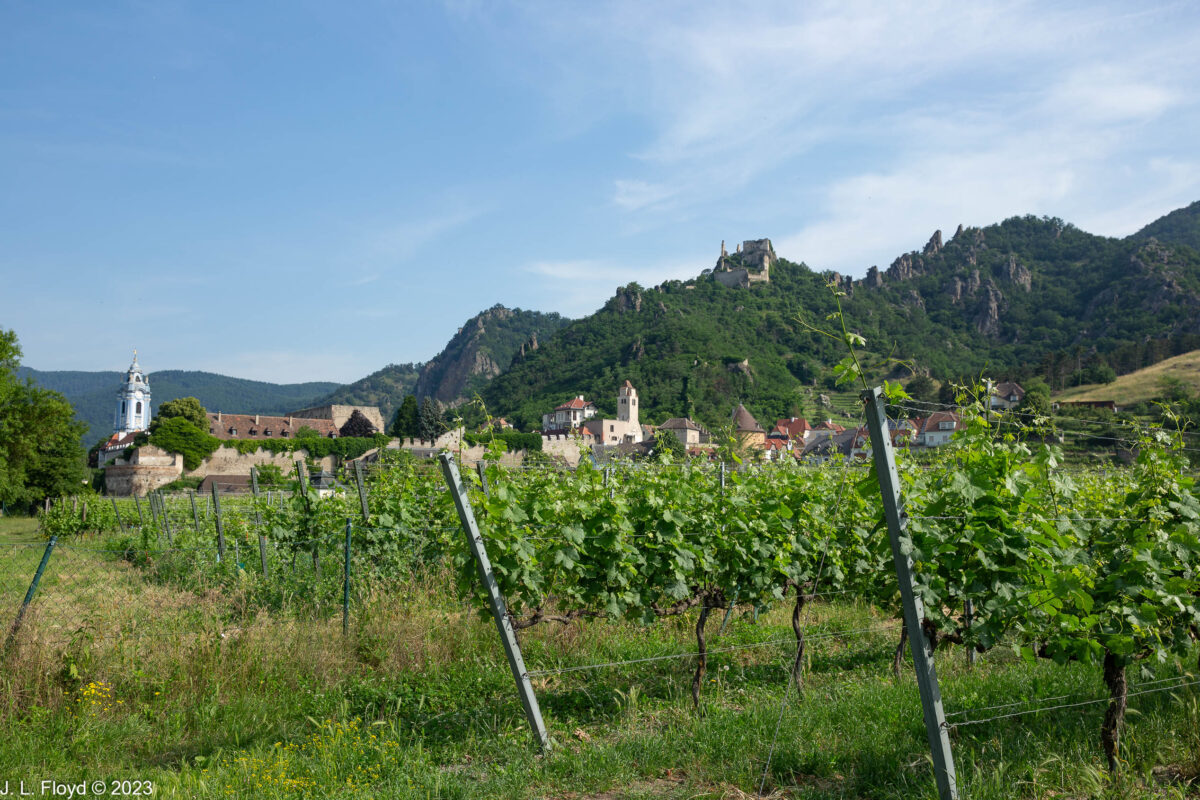
The Wachau Valley is noted for its white wines, which are produced mostly from two types of grapes, Riesling and Grüner Veltliner. The climate of the valley is particularly favorable to these varieties because of the wide diurnal temperature variations, which allow sugars and phenol compounds to accumulate during the warm daytime hours, while the much cooler nights help preserve essential acidity and fruity aromatics. The soil characteristics also play a critical role. The thin, stony soils on the hills along the riverbank are rich in iron deposits and contain mixtures of gneiss, granite and slate. Riesling grapes especially like these higher areas. Lower down, the flatter areas close to the riverbank have become overlain with a thin layer of loess, sand and gravel where the Grüner Veltliner vines thrive best. The latter is the most widely planted varietal in the Wachau Valley as well as in the rest of Austria, and is considered Austria’s most significant autochthonous grape variety. Despite its fame, Wachau is a small wine-producing region, with 124 vineyards and 650 growers cultivating 3340 acres (1350 hectares),  and accounts for only about 3% of Austria’s wine production. I suspect that this is the reason why the wines of Wachau (in my experience, at least) are not very easy to find in the USA and somewhat pricey when one does find them.

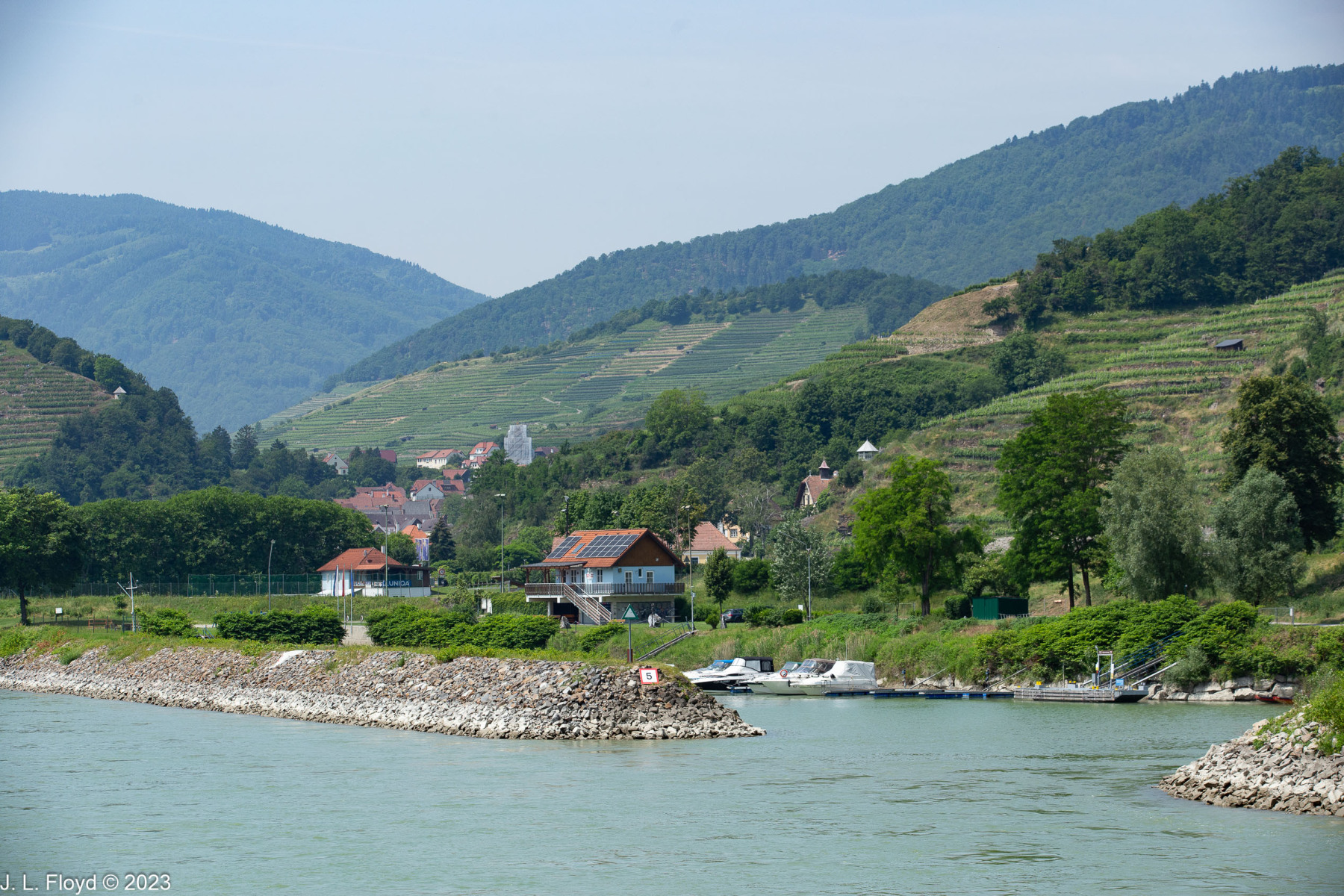
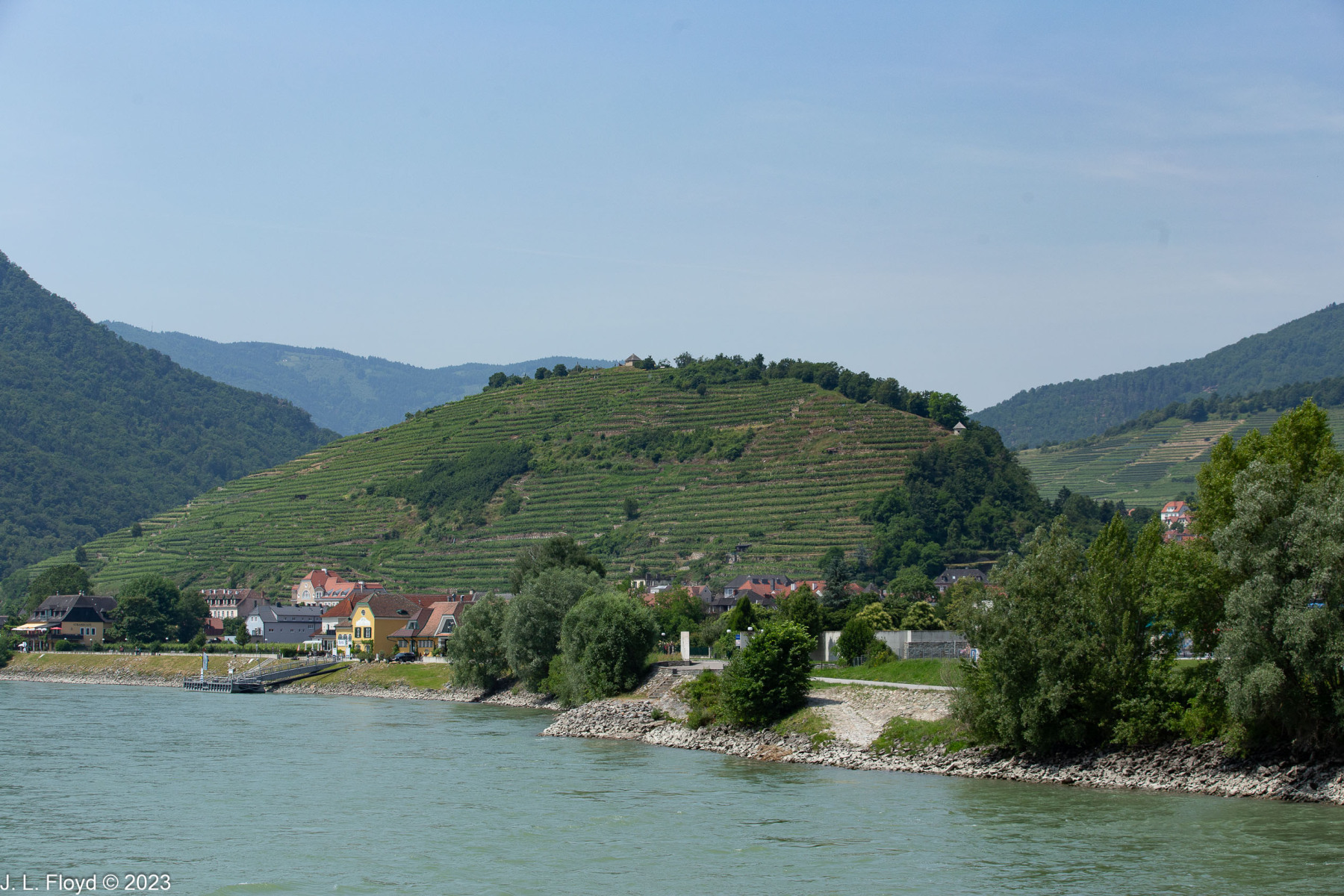
A little further upriver from St. Michael’s, we encountered Spitz, a market town of about 1,600 people, a little larger than Ferndale, California (population 1,481) but with fewer churches (Ferndale had at least 13 when I lived there in 1965). Spitz has two main landmarks. One is the Tausendeimerberg. The other is the Hinterhaus castle, which I shall deal with later.

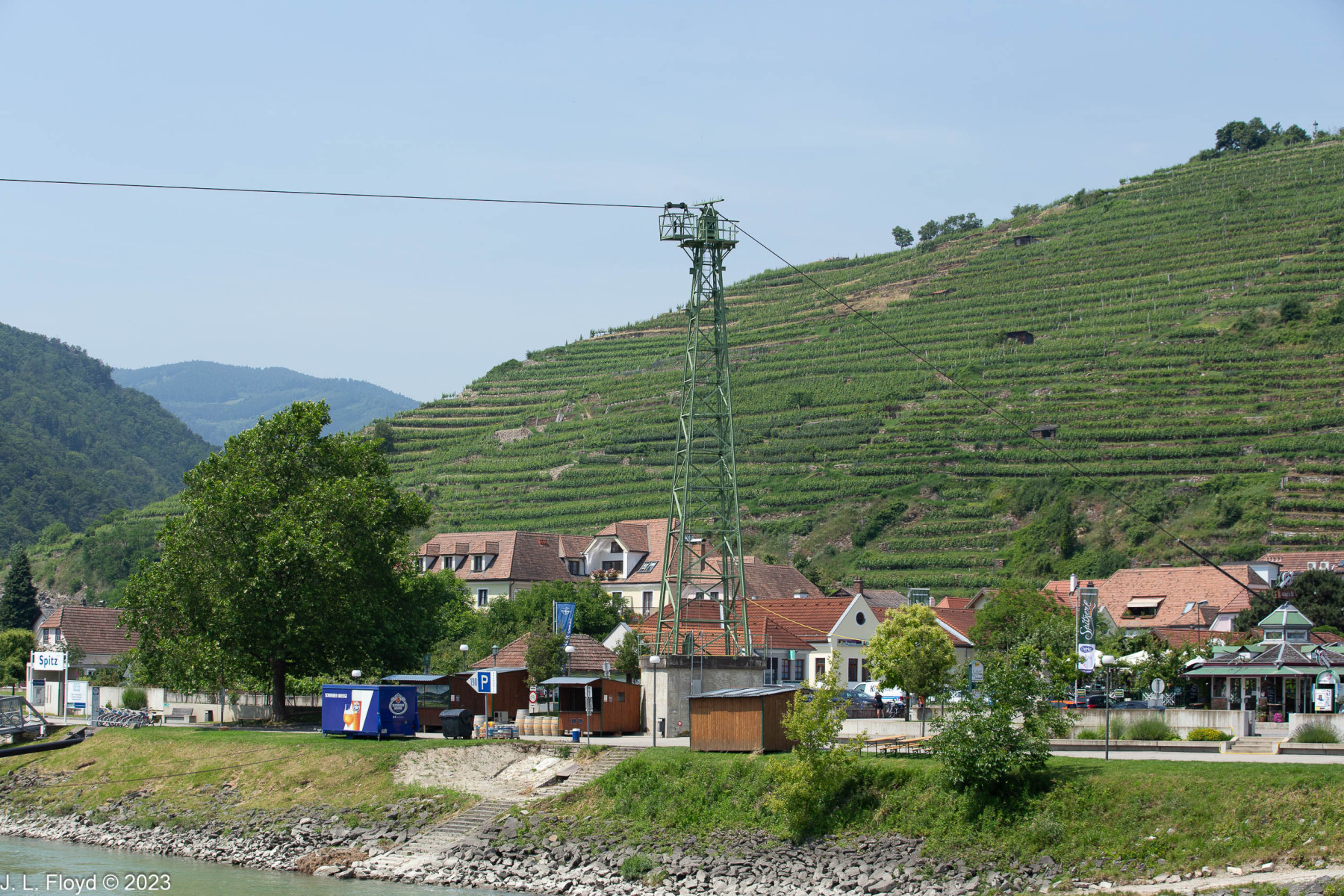
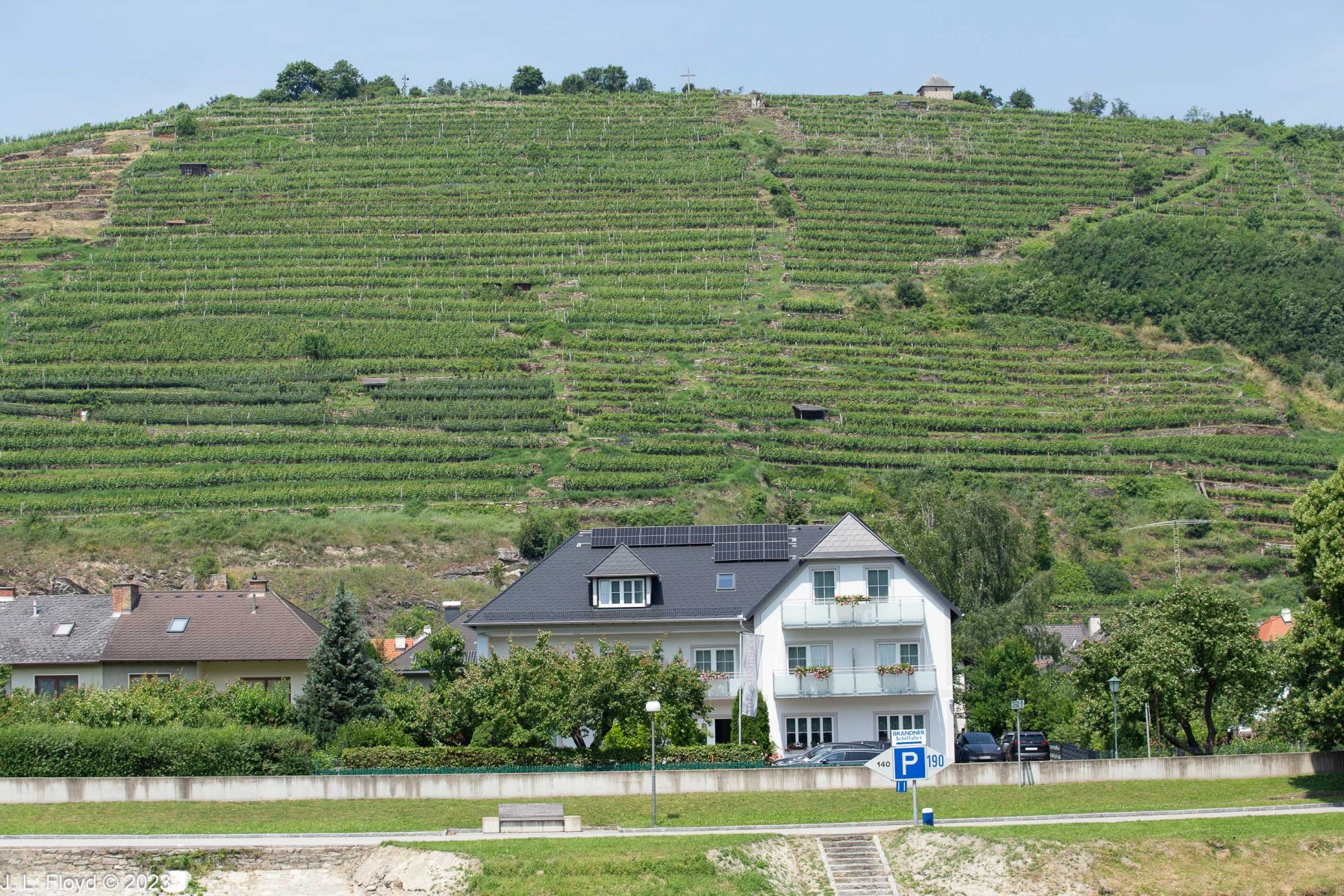
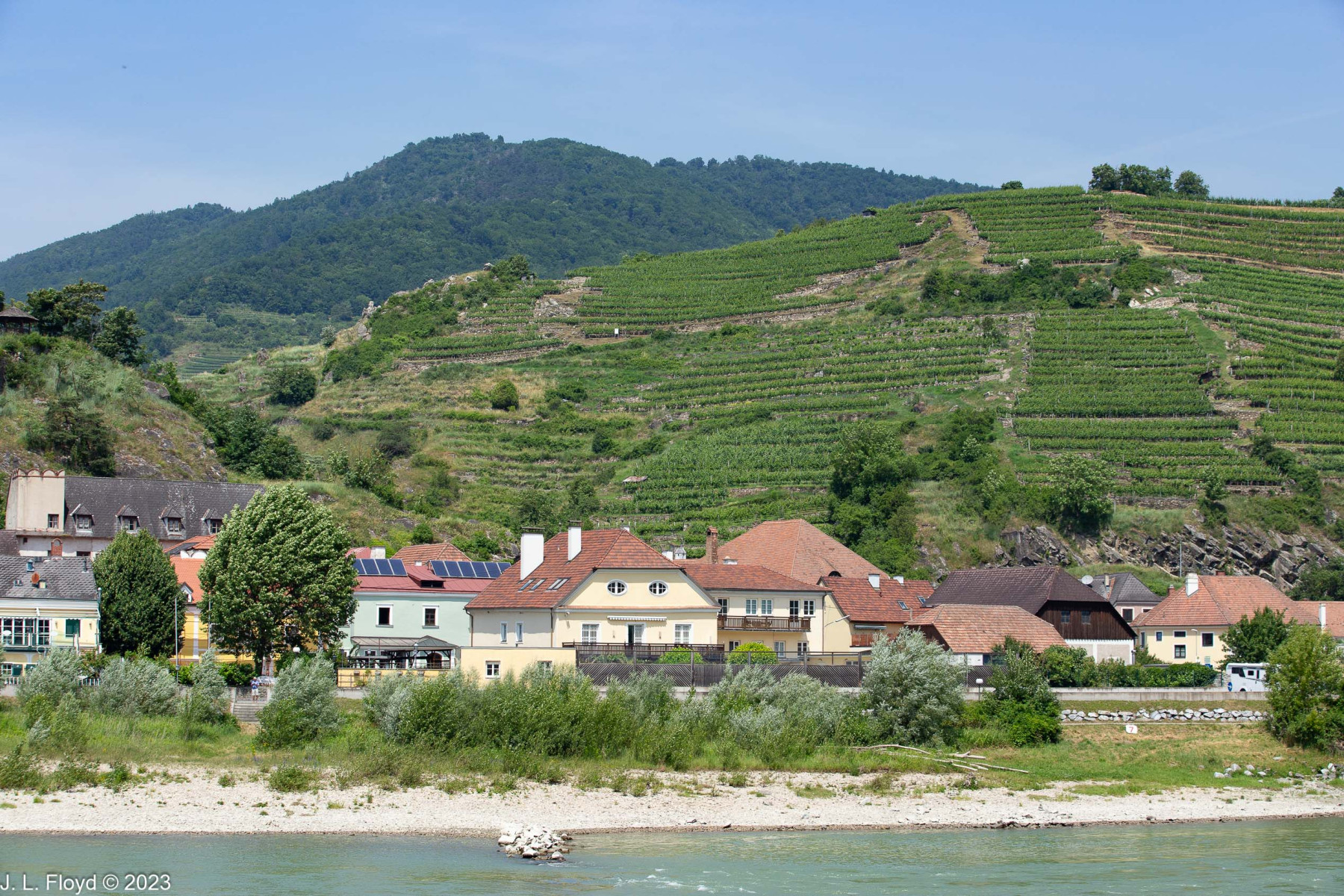
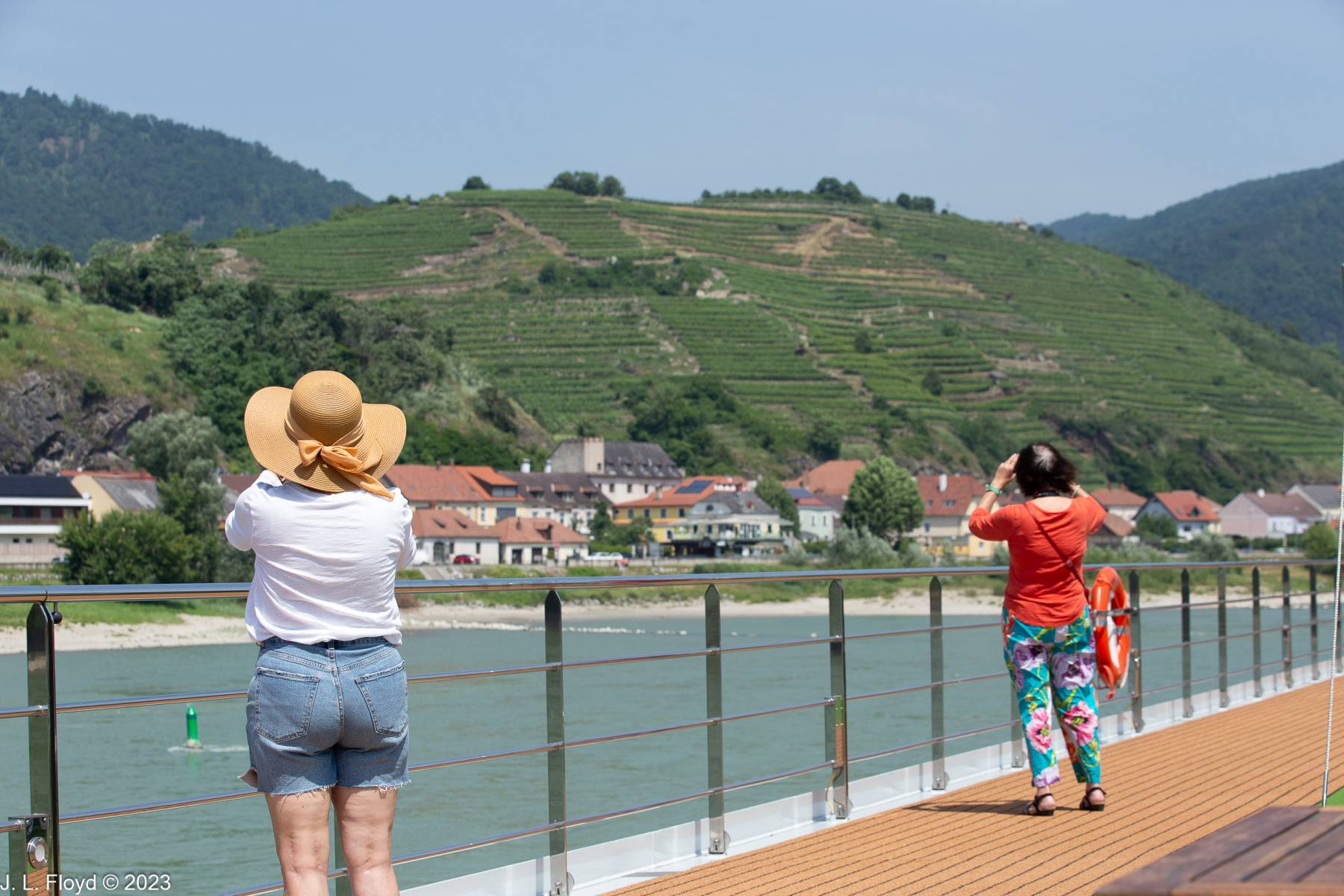
The Tausendeimerberg is a high hill in the middle of Spitz. The name means “Hill of a Thousand Buckets” because its vines produce a vast quantity of grape juice. As you will see from the pictures here, it is almost completely covered with grape vines.

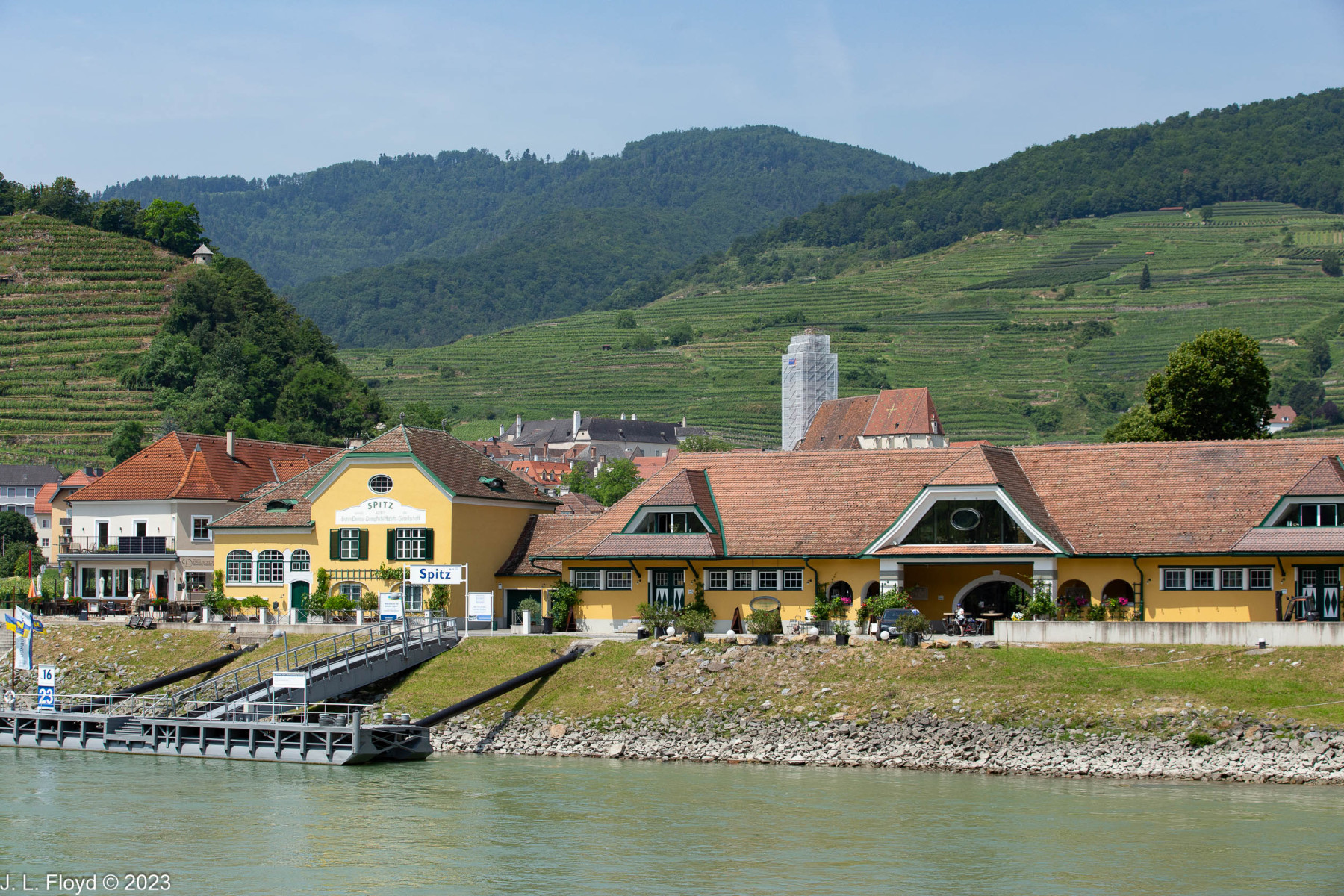
Spitz is a hub of water transport, with a yacht marina, a Donaustation (terminal) for riverboats, and a cable ferry terminal, the third we encountered in the Wachau Valley. The marquee on the riverboat terminal building reads Ersten Donau Dampfschifffahrts Gesellschaft, “First Danube Steamboat Line Company.” Known by the abbreviation DDSG, it was founded in 1829 by a couple of mad Englishmen who convinced Metternich and the Emperor that the steam engine could replace draft animals as a means of propulsion for riverboats going upstream on the Danube. (They were right, of course, but it took a while for the venture to become viable.) The steam engines initially came from Britain since Austria was not yet industrially advanced enough to build them. After some initial setbacks, and a government takeover, the DDSG eventually (by 1880) became the largest inland shipping company in the world. But the First and Second World Wars brought disaster to the DDSG as to Austria in general, and in the aftermath the company was never fully restored to profitabilty. Additionally, after World War II passenger ship traffic along the Danube could not compete very well with railroad and automobile travel because of the long wait times in the Danube locks, which were the result of the construction of new power plants along the river. (We had to go through several of these waits before and after the Wachau Valley, but the schedule was calculated so that we mostly encountered the locks at night.) As a result, the company’s passenger service became mostly a tourist business. In 1991 the DDSG was divided into two units, with one, DDSG-Cargo GmbH, handling the cargo business and the other taking care of passenger service. The former is now owned by the Ukrainian company Ferrexpo. After no single buyer could be found for the passenger service, it was broken up and solod piecemeal to several outfits, the main one being DDSG Blue Danube Schiffahrt GmbH, which focuses on the core areas of Vienna and Wachau. Spitz is of course one of the riverboat stops for Blue Danube, as well as other lines. The DDSG Blue Danube operates two cruise ships that ply the Danube through the Wachau Valley. They put in at Spitz several times a day during the high season (April-October). Another line, the Brandner Schiffahrt GmbH, stops twice a day at Spitz.

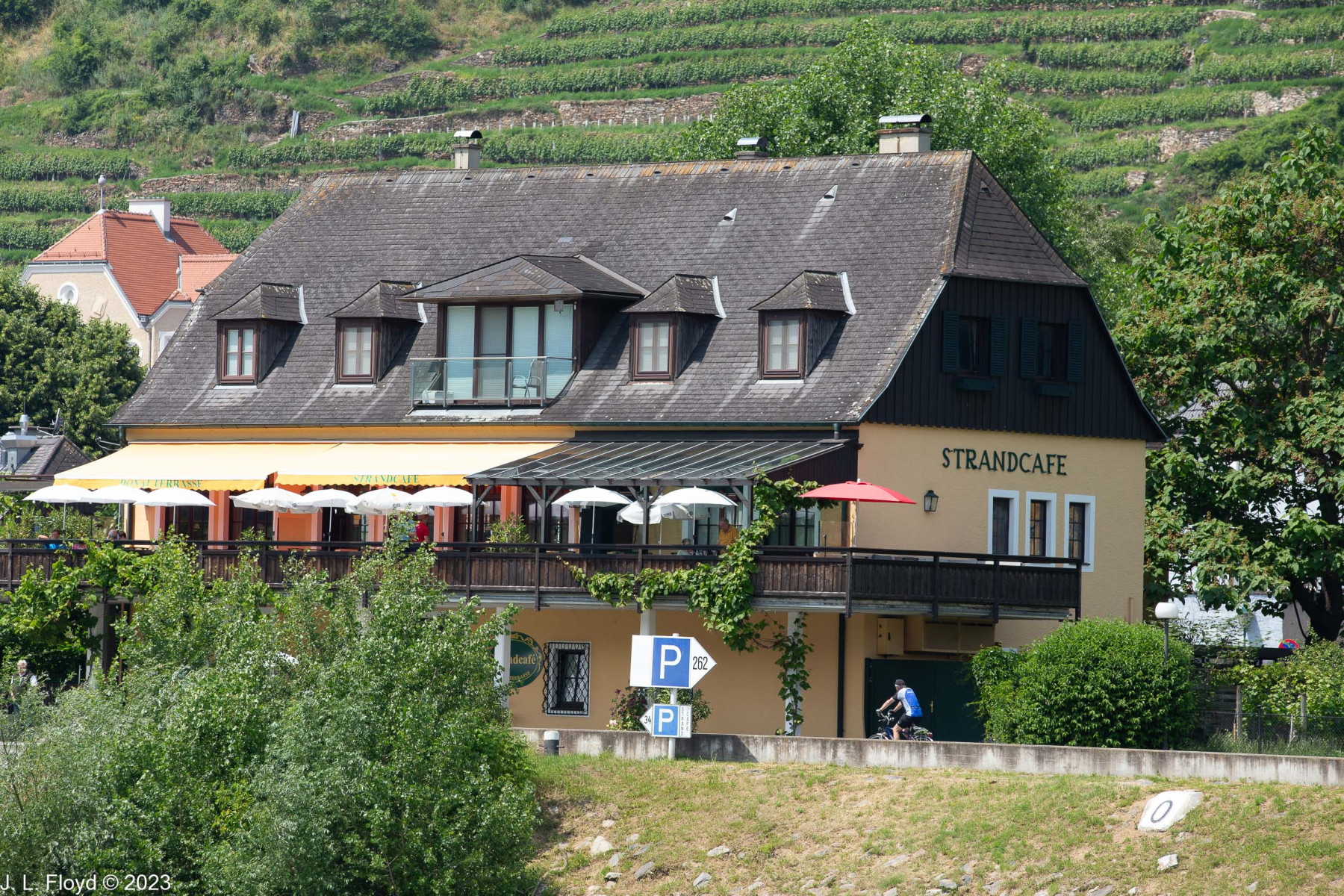
The town of Spitz lies mostly between the base of the Tausendeimerberg and the riverbank. The Monarch Queen did not stop there, but from its top deck we got a good look at its elegant mansions, verdant vineyards and enticing eateries such as the Strandcafé, where one can dine indoors or on an outdoor terrace overlooking the river. The town also has the Schifffahrtsmuseum Spitz (Spitz Shipping Museum), which offers exhibits on the technology and history of shipping on the Danube.

Spitz is a very old town. The area has been inhabited since Celtic times – 2000 BC or so. In 812 Charlemagne donated the land to a Bavarian monastery, Niederaltaich Abbey, and it remained a Bavarian enclave until 1504, when Holy Roman Emperor Maximilian I acquired it. But he sold it, and through various further transfers of ownership it passed into the grasp of Protestant counts and became a center of Reformation activity. During the Thirty Years’ War Spitz was devastated by both Catholic and Protestant troops, but eventually it wound up in the Catholic camp after its rulers, the Kuefstein family, reconverted to Catholicism.

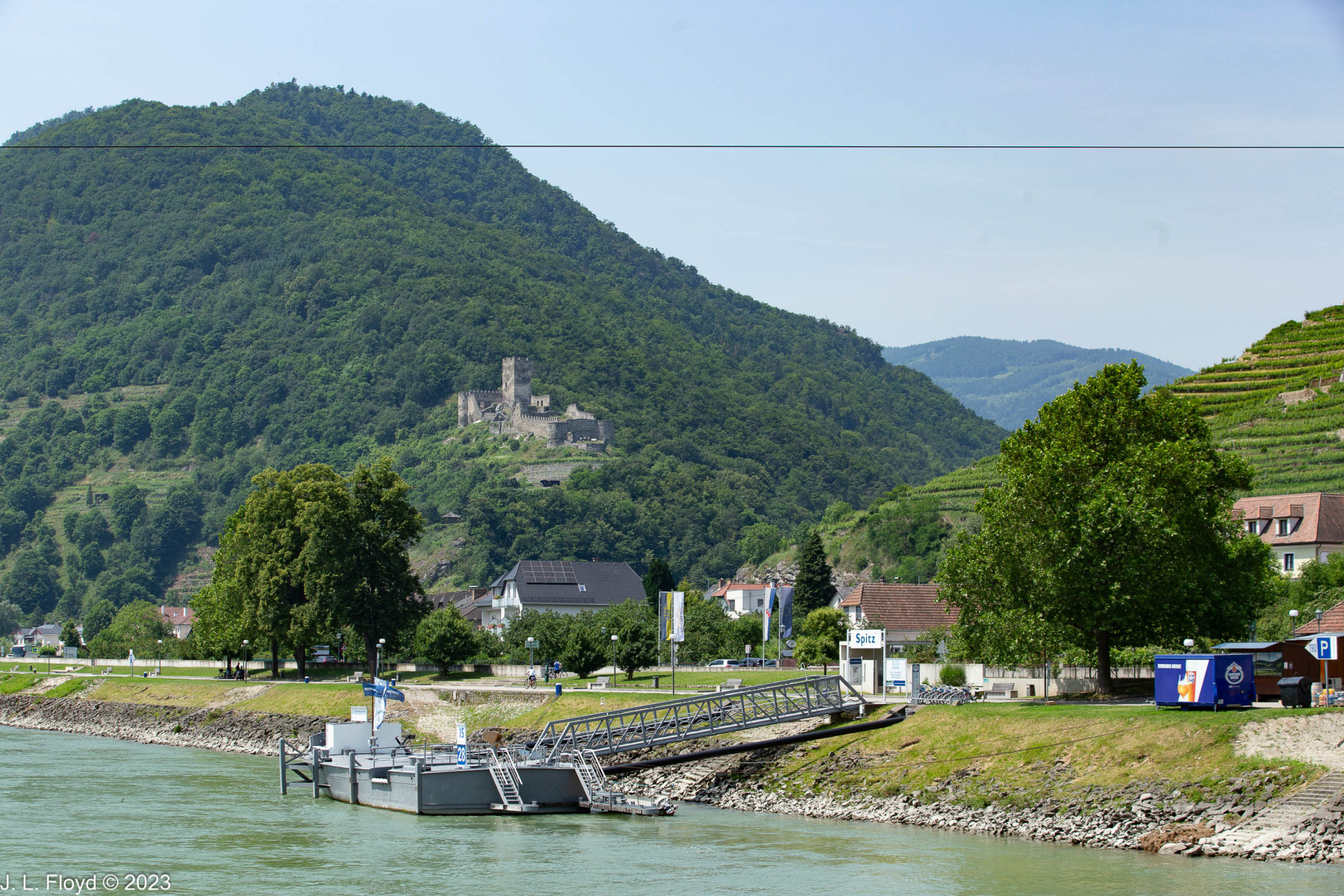
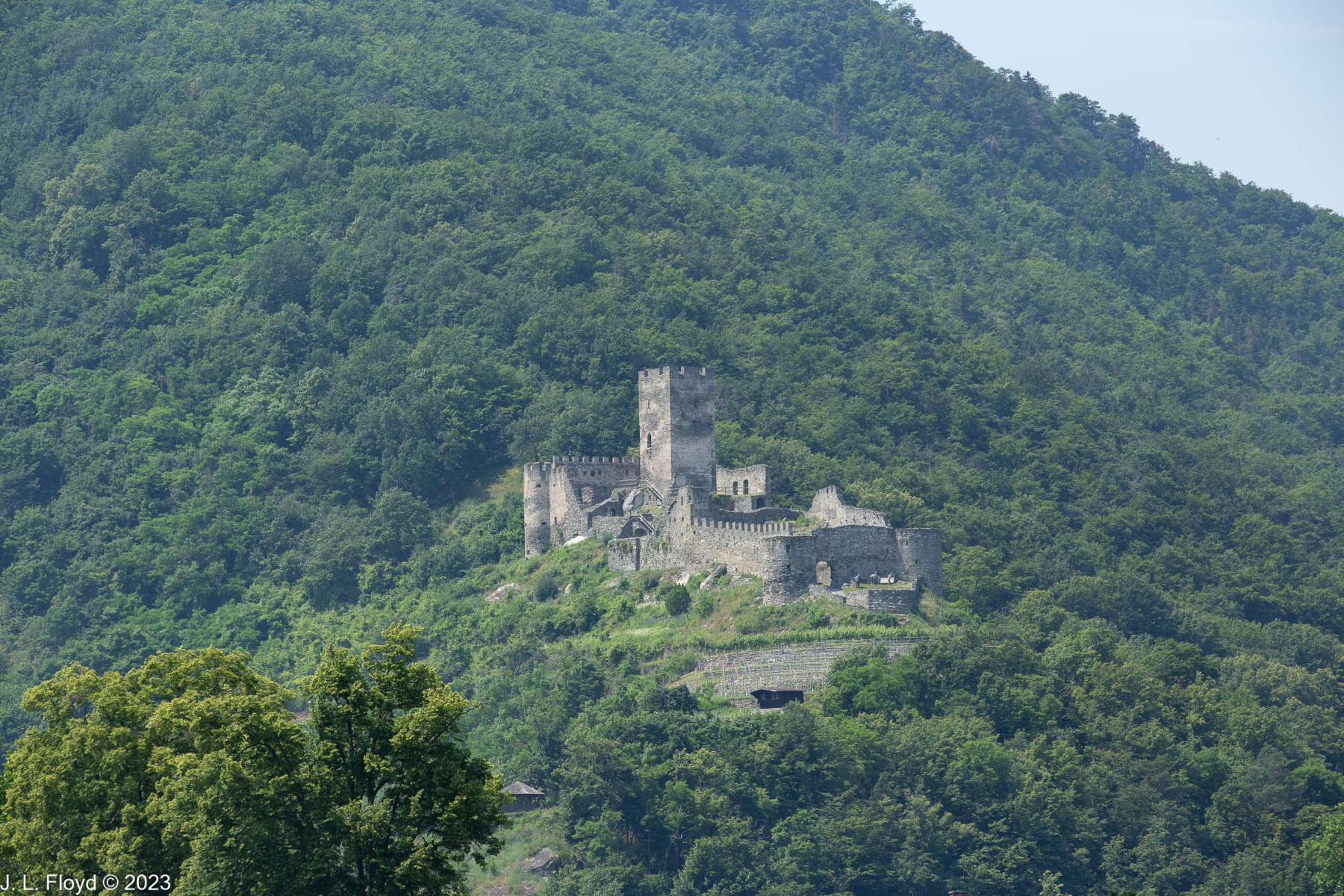
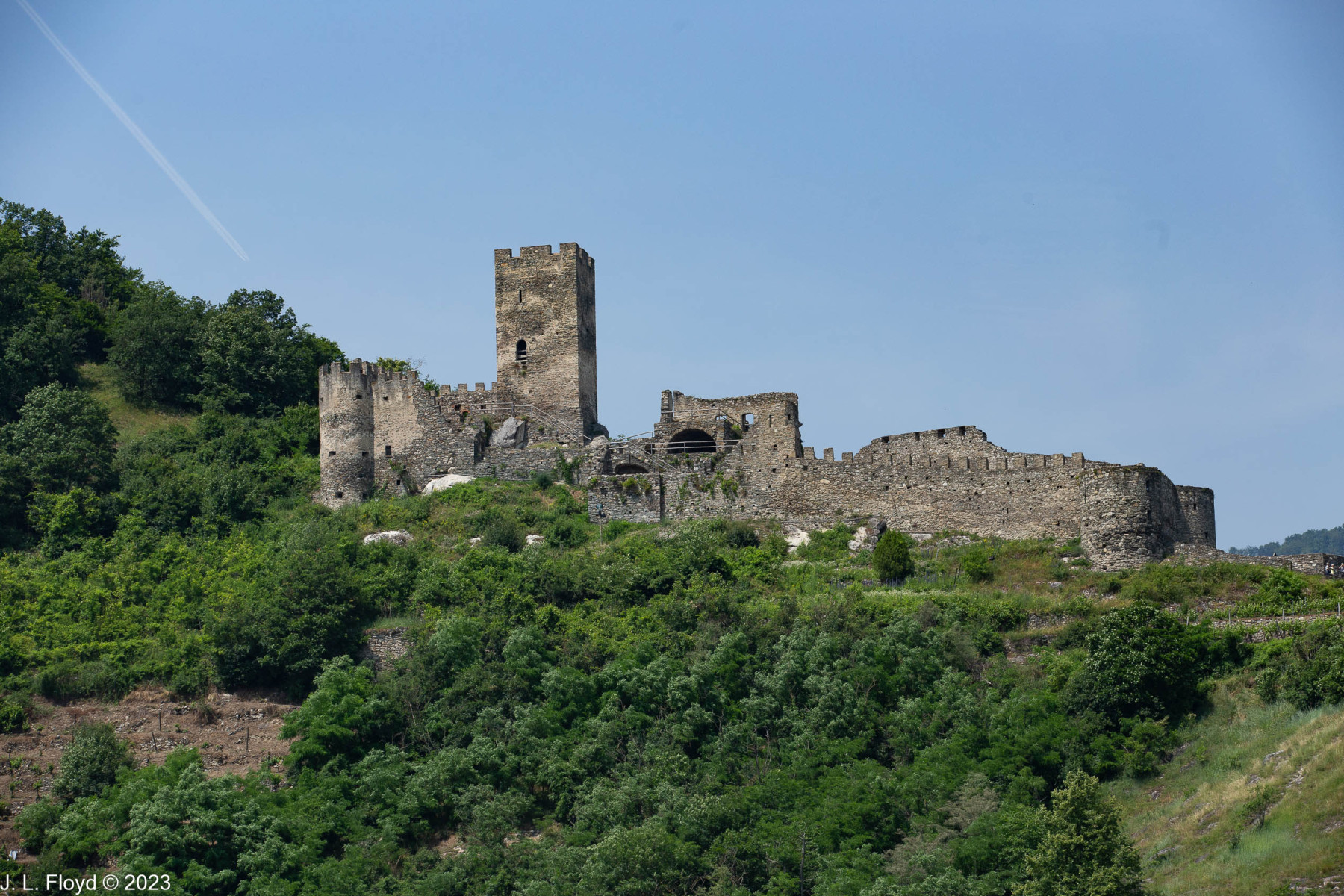
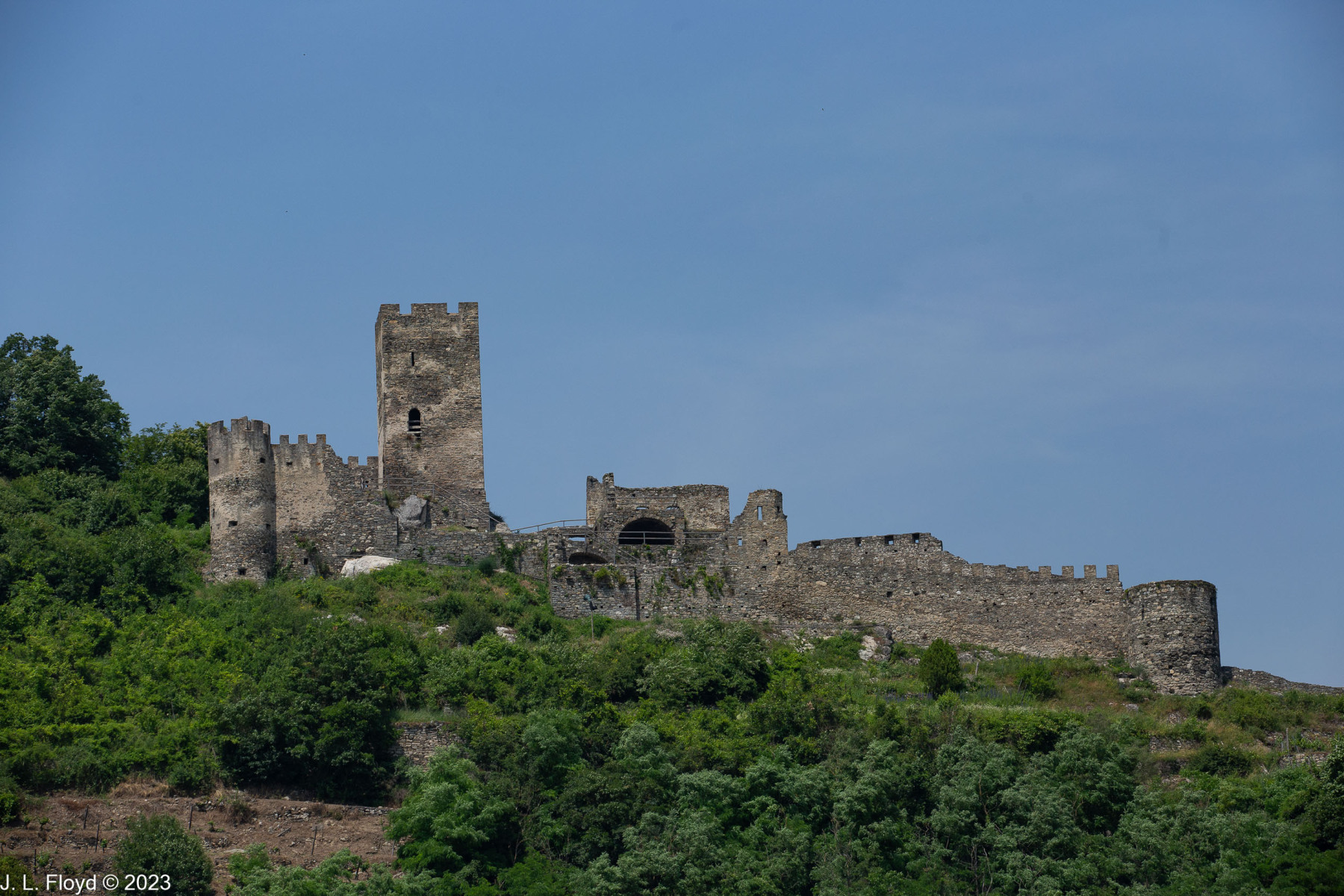
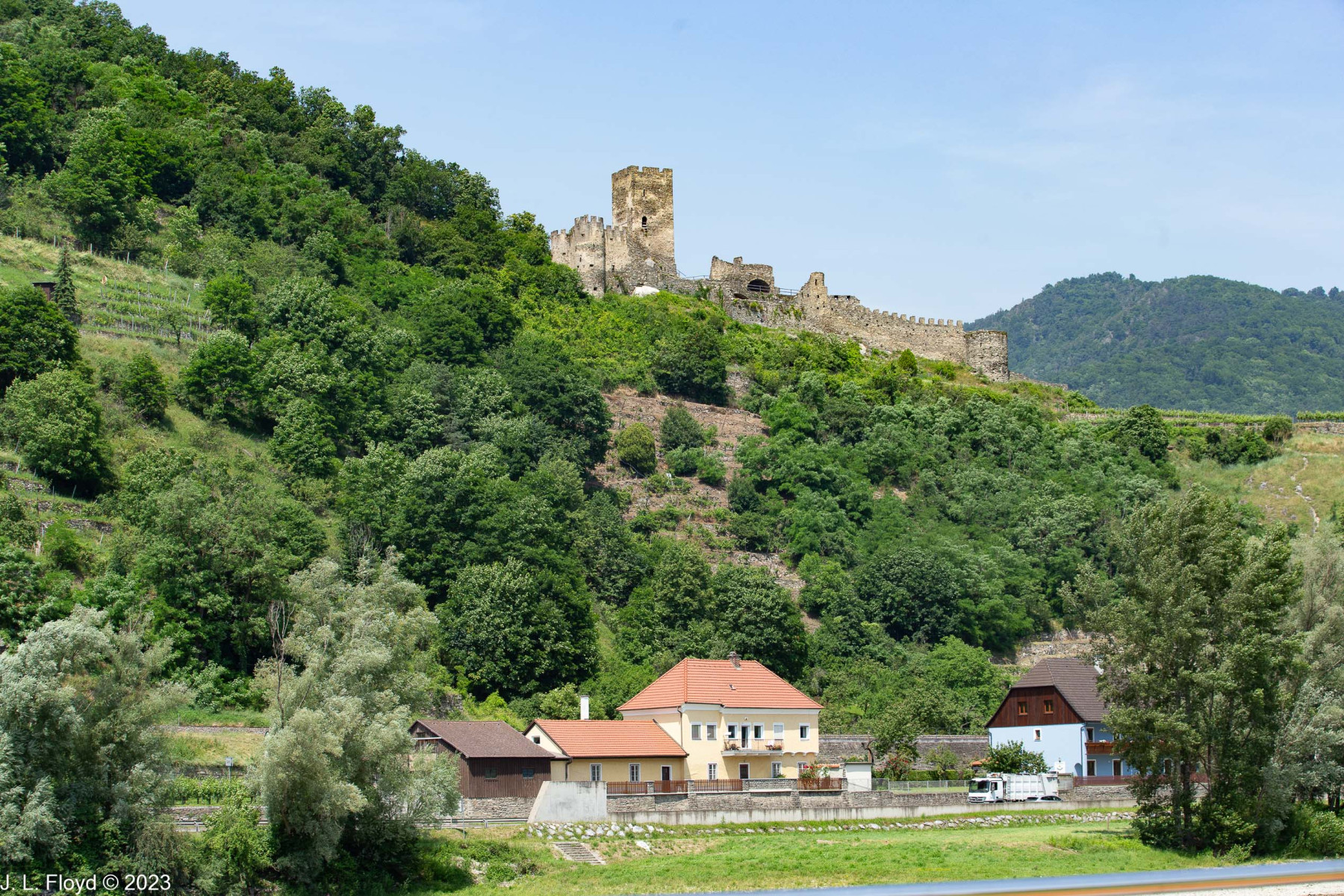
High on a mountain spur to the southwest of Spitz stands the formidable-looking ruin of the Hinterhaus castle, the town’s second major claim to fame. It’s not certain when it was first built, perhaps in the 12th century, but it first appears in medieval chronicles in the year 1243. It was then owned by the Kuenrings of Dürnstein, whom we have met already, and it is reputedly haunted by the ghost of Heinrich Iron von Kuenring’s first wife, who was outraged that her husband did not wait the prescribed period of mourning before marrying his second wife. The relationship between the castle and the town, which was owned by the Bavarian monastery while the Kuenrings ruled in the Wachau, is unclear from the sources available to me, and could be a subject for further research.

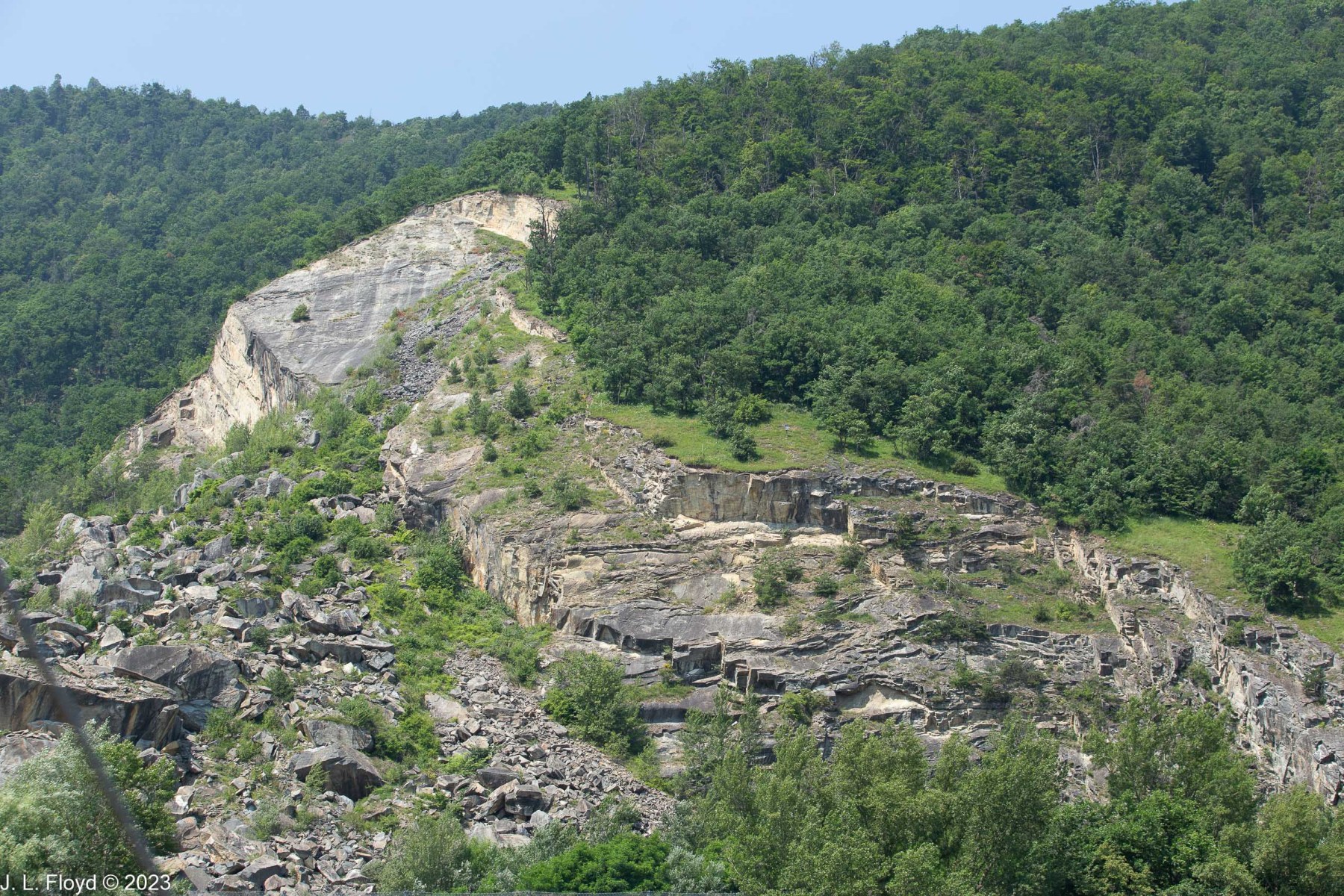
A little way upriver from the Hinterhaus, and beyond the boundary of Spitz, a spur of rock juts into the Danube. This is known as the Teufelmauer, or Devil’s Wall. According to legend, Satan wanted to build a wall or dam to flood the upper Wachau Valley, and God (for reasons unknown) gave him a single night for its construction with the proviso that if by the first cockcrow the wall was not finished it would collapse. Satan, perhaps realizing that roosters can crow at any hour and not just the break of dawn (and I know that from personal experience), bought up all the roosters from the nearby farms and slaughtered them to give himself a better chance of success. Tough luck for him – he overlooked one owned by an old woman from St Johann. Her rooster crowed and the wall collapsed. All that remains is the spur, which today is pierced by a tunnel.

After we passed the Teufelmauer, Sandie and I went below for lunch and watched the rest of the Wachau Valley go by from the ship’s windows. Thus I don’t have any photos of the towns of Schwallenbach, Willendorf, Groisbach, Aggsbach or the other towns of the Wachau Valley until we debarked at Melk. And our sojourn at Melk Abbey will be the subject of the next post.

Categories
Danube River Cruise, June 2023

Dürnstein, June 20, 2023

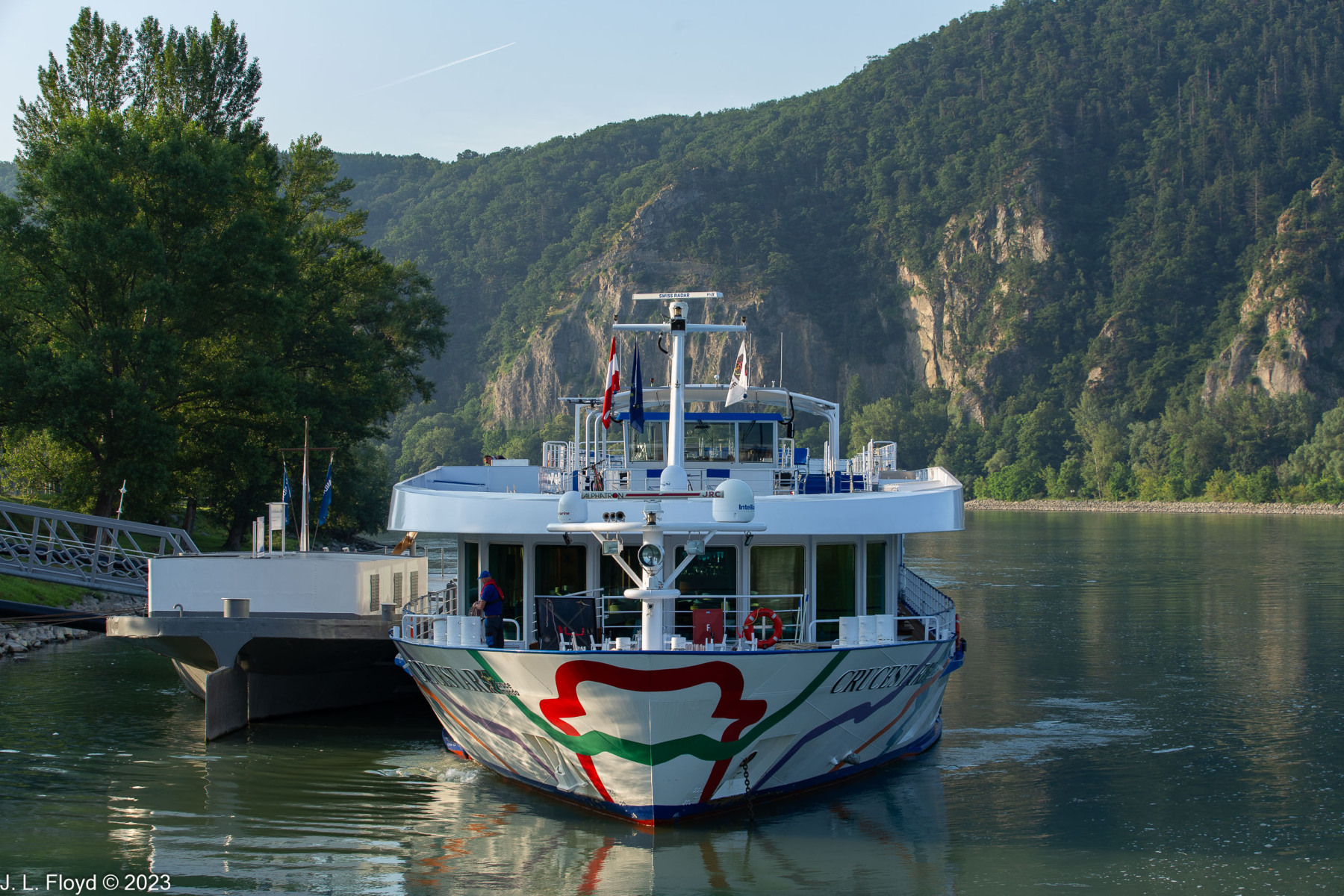
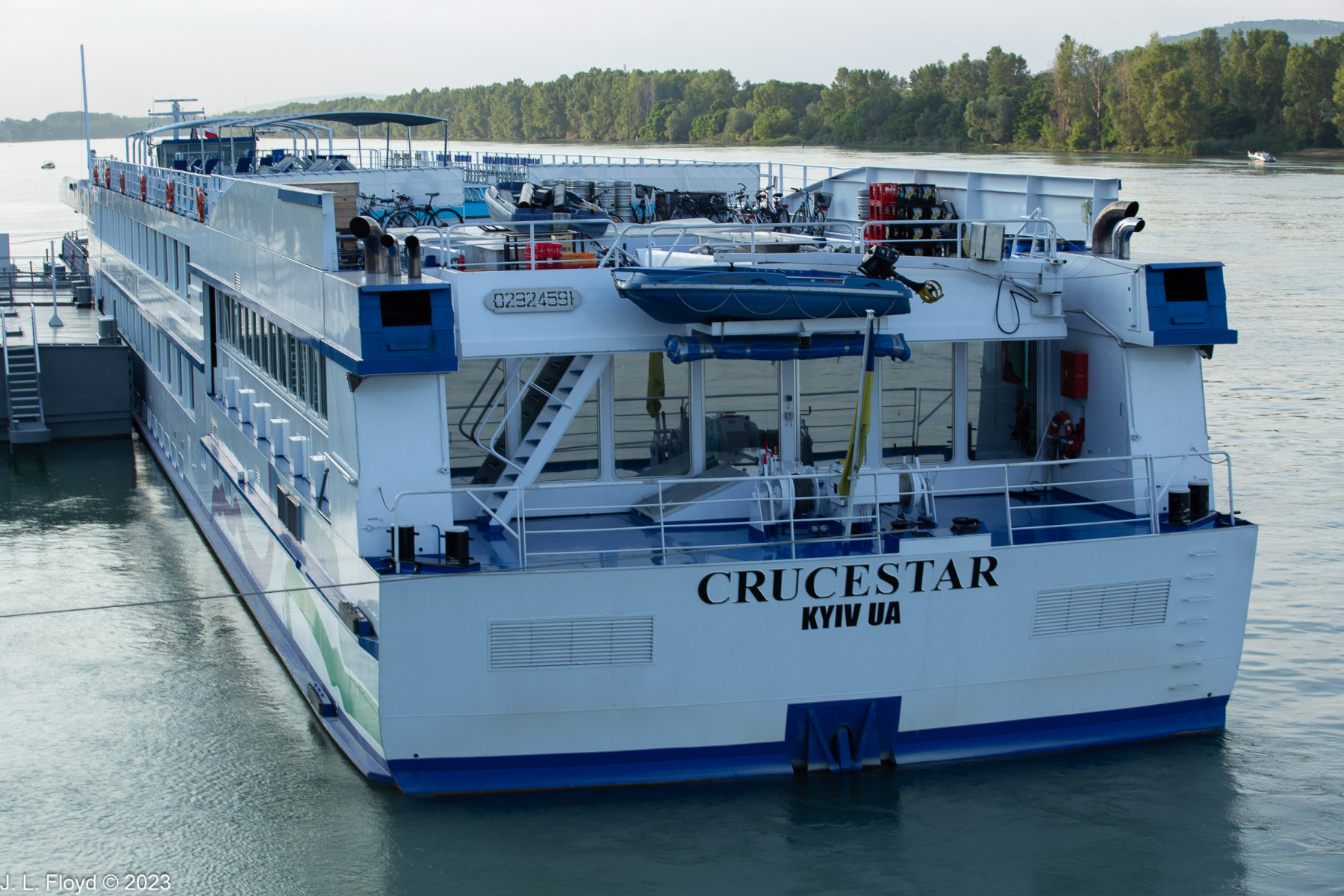
Early in the morning of June 20, the Monarch Queen tied up at the dock at Dürnstein, closely followed by the light cruiser Crucestar of the Ukrainian Navy, which had been shadowing us all night. We had entered the Wachau Valley, a spectacularly beautiful 36-kilometer (22 mile) stretch of the Danube in Lower Austria between the towns of Krems and Melk.

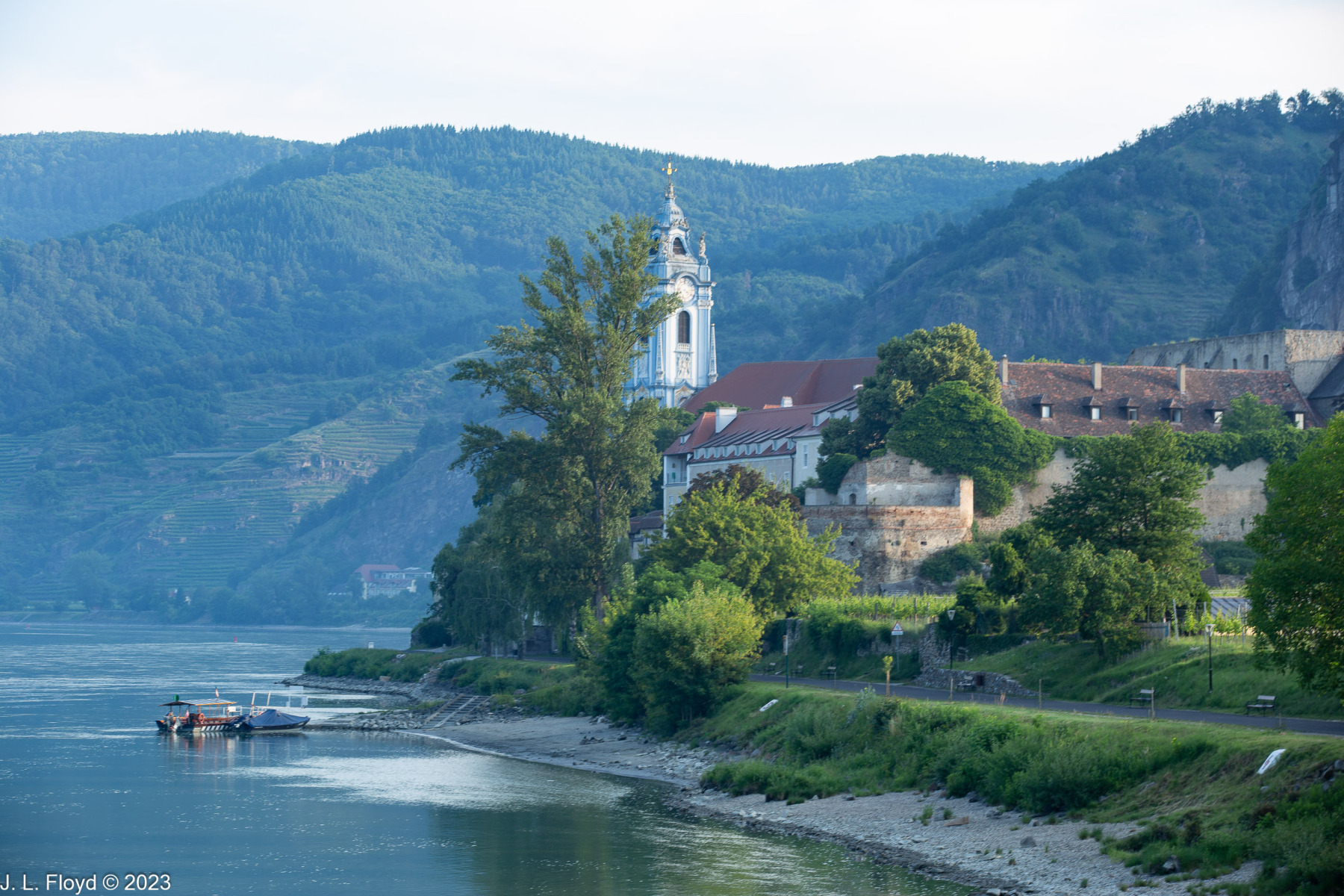
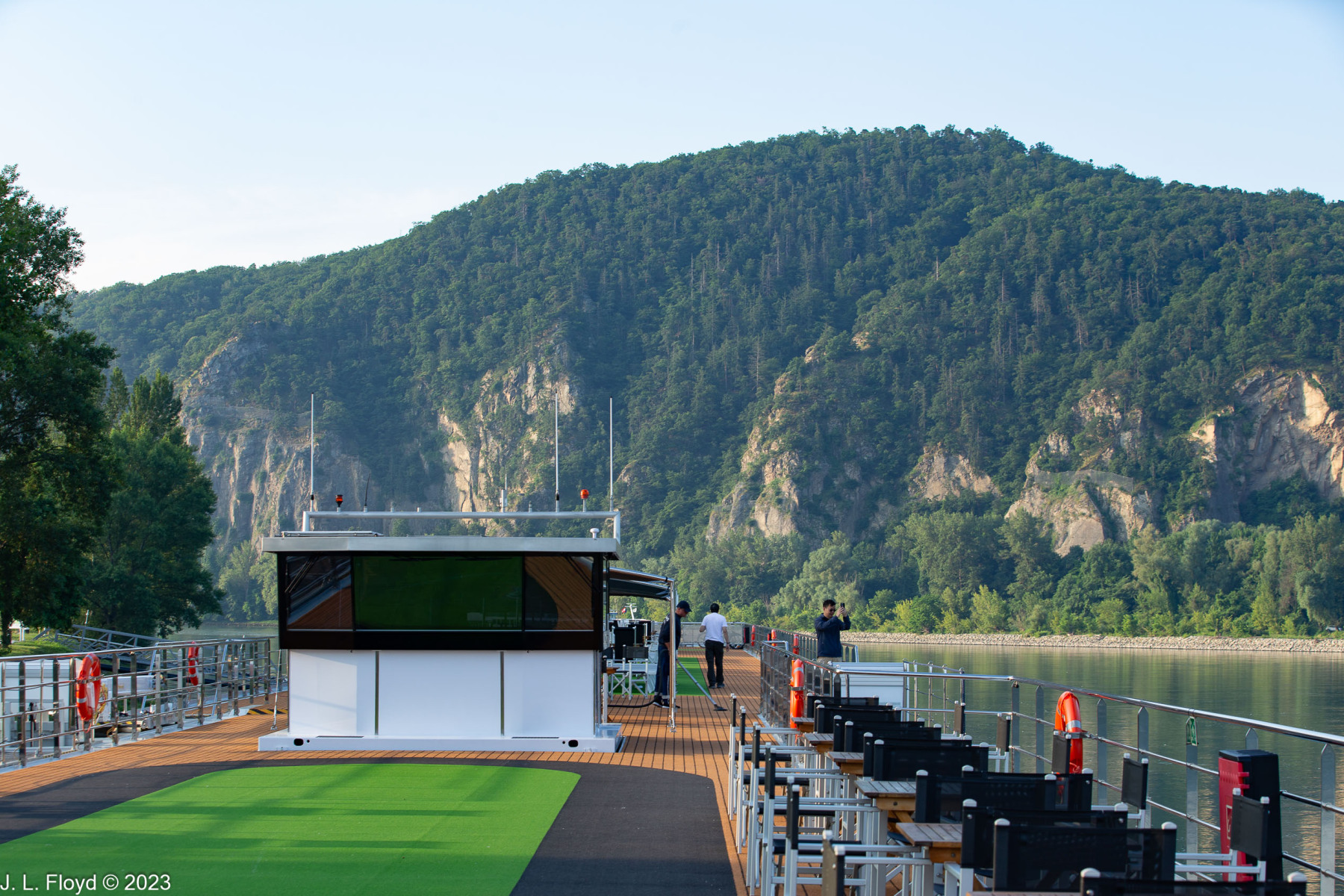
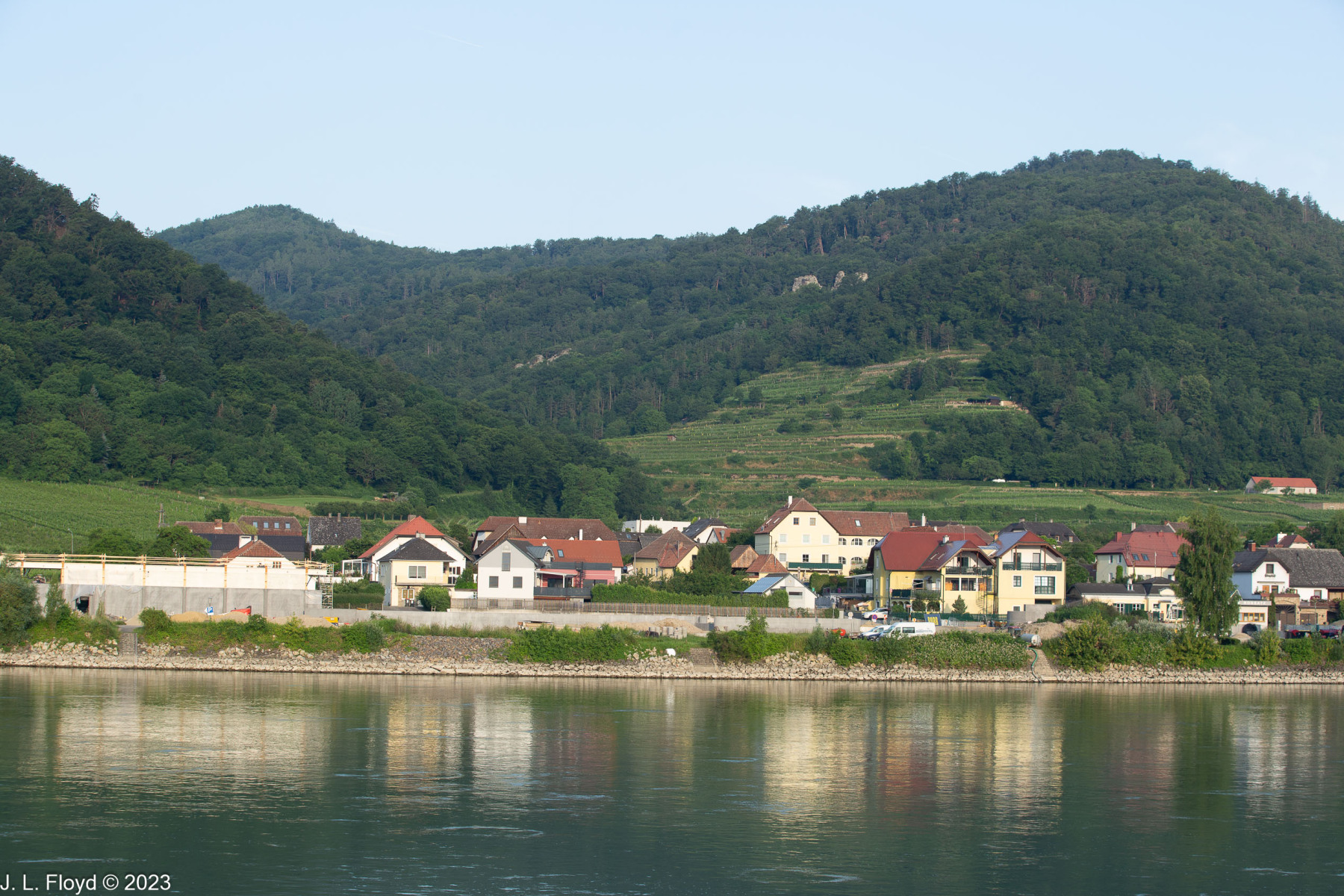
I had arisen early and while our cruise ship was docking, I went to the top deck with my Canon EOS-6D DSLR and 70-200mm telephoto lens to try to capture river scenes in the morning sunlight. The Danube is flowing north at Dürnstein and we were on the east bank; the rising sun lit up the west bank splendidly, while the east bank, with the town of Dürnstein, was still partly in shadow.

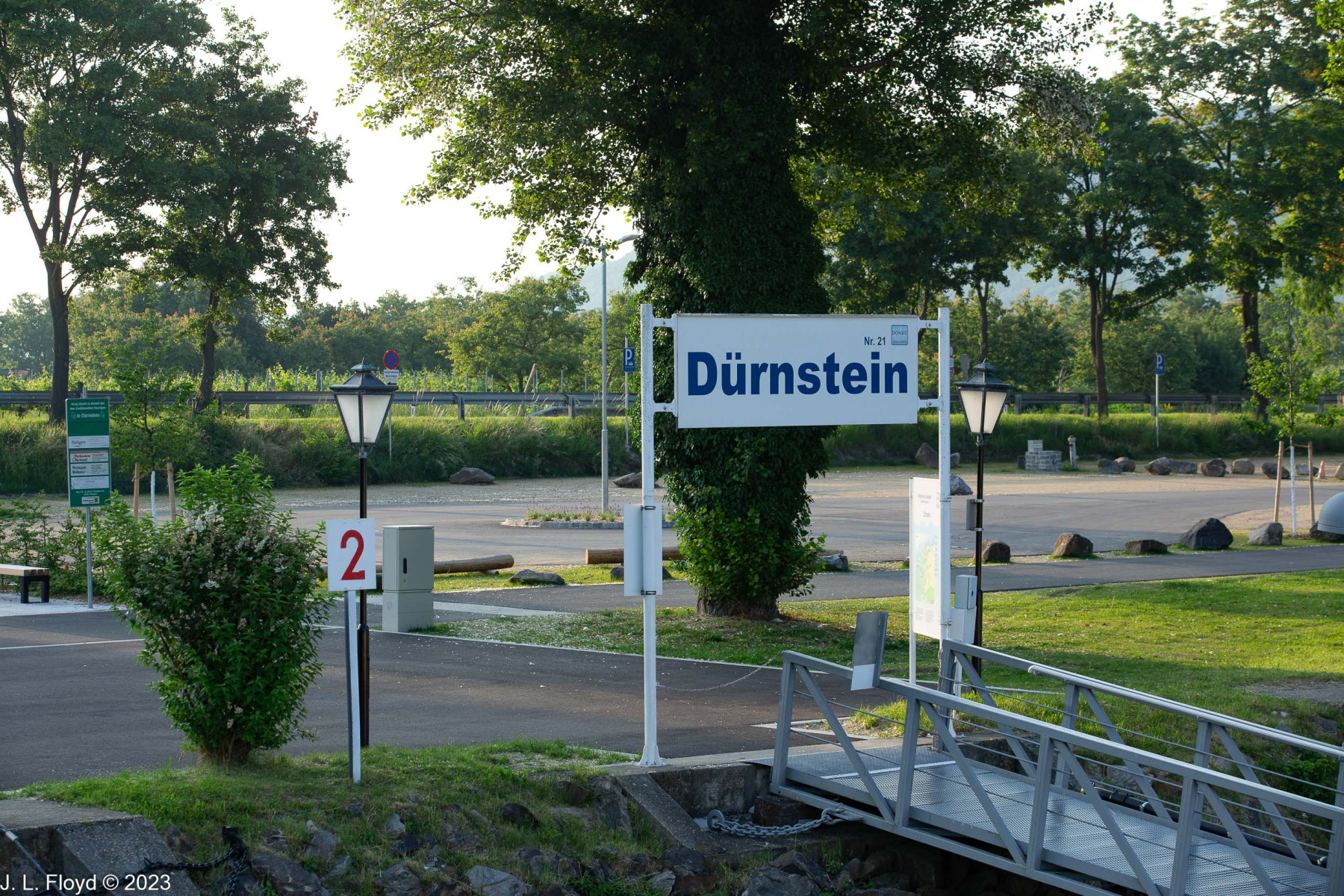
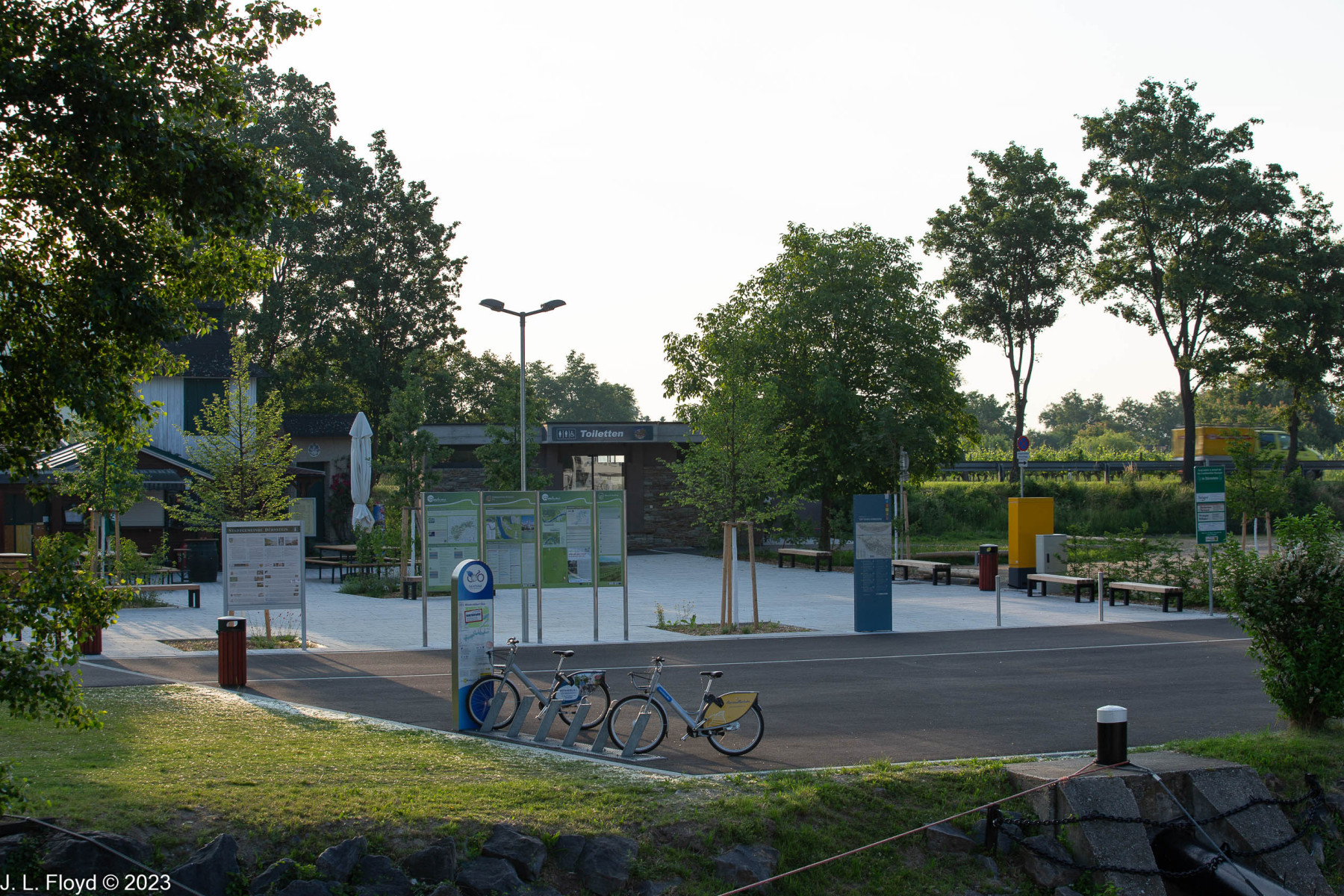
The Monarch Queen had tied up a little way downriver from the town and getting there, as well as getting around in town, was done strictly on foot. After breakfast I began the trek with the rest of the Monarch Queen group, minus Sandie, who was not up to much walking that day. We reached the town via the Treppelweg, which means towpath in English; it which runs all along the Danube in Austria and in the days before the arrival of the railroad was indeed used as a towpath to haul boats up the river against the current. It now serves as a bicycle path as well as a pedestrian walkway. From the Treppelweg we had splendid views of the west bank of the river, the town of Dürnstein and of Dürnstein castle on its hill high above.

About Dürnstein Castle. In 1190 Leopold V, Duke of Austria, of the House of Babenberg, embarked upon the Third Crusade. Frederick Barbarossa, Holy Roman Emperor, had done the same the previous year, but he drowned while trying to cross a river in Turkey and was succeeded by his son, who became Henry VI. Henry did not go on the Crusade, but Kings Richard I of England and Philip II of France did take the cross. The occasion for the Third Crusade was the capture of Jerusalem and other Christian-held areas of Palestine in 1187 by Sultan Salah ad-Din Yusuf ibn Ayyub, commonly known as Saladin. Philip and Richard were bitter enemies and each only agreed to go on the crusade if the other would also.

Upon arrival in Palestine in the spring of 1991, Duke Leopold, Philip and Richard teamed up to besiege the city of Acre. They did in fact take the city, but then they started to quarrel. At stake was who would be the next King of Jerusalem, which they intended to retake from Saladin. Philip and Leopold’s candidate, Conrad of Montferrat, who was related to them both, was the eventual winner, but he was assassinated before his coronation, and they suspected Richard of arranging the murder. Furthermore, Richard had enraged Leopold by casting down his standard from the walls of Acre on the grounds that Leopold was only a duke, not a king, and therefore not entitled to equal status with Philip and Richard, even though Leopold was the representative of the Holy Roman Emperor. So, in August 1991, Philip and Leopold left Palestine, leaving Richard to continue the Third Crusade by himself.

Richard won a couple more victories, but he did not capture Jerusalem, and he was all too aware that Philip II of France, not to mention his own younger brother John, were taking advantage of his absence to advance their own nefarious schemes, so he signed a treaty with Saladin and left for home.

Unfortunately, circumstances forced him to take a risky and uncertain route, which happened to lead through Austria, which of course was ruled by his now arch-enemy Leopold. Richard disguised himself in an attempt to avoid detection, but he was recognized and arrested anyway. Leopold V clapped into prison in — you guessed it — the castle of Dürnstein, where the local baron, Hadmar II of Kuenring, became Richard’s jailer.

Richard did not remain in Dürnstein long, however. The Pope, Celestine III, was not happy about the imprisonment of a Crusader, which was considered illegal and shameful, and he excommunicated Leopold. This was no small matter in those days, and Leopold was unwilling to endure papal wrath on his own, but also reluctant to simply set Richard free, so he handed the king over to Henry VI, the Holy Roman Emperor, who also bore Richard a few grudges and who imprisoned him in another castle. Henry also had powerful supporters in the Church, which made the Pope back off from excommunicating him. To release Richard, Henry demanded a ransom of 150,000 marks, three times the annual income of the English Crown. Richard’s mother, Queen Eleanor of Aquitaine, worked assiduously to raise the ransom, and did so, despite the machinations of John and Philip, who offered Henry VI 80,000 marks to keep Richard a prisoner. But Henry VI took the ransom, and Richard eventually went home, to find that Philip II of France had occupied Normandy in his absence. Richard forgave John for his schemes, but was eventually killed fighting in France, whereupon John became King of England anyway. And he became known as John Lackland, because Philip seized his remaining possessions in France.

Leopold V got 35,000 marks as his share of the ransom, but he did not live to enjoy it very long. To obtain absolution from the Pope, he signed up for another Crusade, but before he could go he died from gangrene resulting from a foot crushed when his horse fell on him in a tournament. Henry VI fared better, going on to conquer Sicily with the aid of the ransom money, and soon becoming the most powerful monarch in Europe; he died in 1197.

So Richard the Lionheart’s brief imprisonment in Dürnstein became its claim to fame. Hadmar II of Kuenring, the erstwhile jailer of Richard the Lionheart, lived to the ripe old age of 77. His descendants continued to rule in Dürnstein until 1355. The Kuenrings were ministeriales – in effect vassals or minions – of the Babenberg dukes of Austria, but their line died out in 1246 and was eventually replaced by the Habsburgs, who may have wanted to impose their own direct rule (the sources available to me are vague about this). Regardless, the Kuenrings continued to be powerful and influential long afterward, and their name is still remembered in Dürnstein.

During the Thirty Years’ War, in 1645, Swedish troops attacked Dürnstein castle and turned it into the ruin we see today. I did not attempt to make the steep climb up to the castle, which on that warm June day was likely to have done me in. Instead, I roamed the streets of the town until it was time to return to the ship. The only way to enter the town is by the Kremsertor, or Krems Gate, at the southeast end. There had been another gate at the northwest end of town, the Weissenkirchen Gate, but it was torn down in the 20th century. In any case, the Kremstor was always the main gate, with the heaviest fortifications, because it faced the direction from which attacks were most likely to come, whether from rival towns such as Krems, oppressive rulers or foreign intruders such as the Magyars.

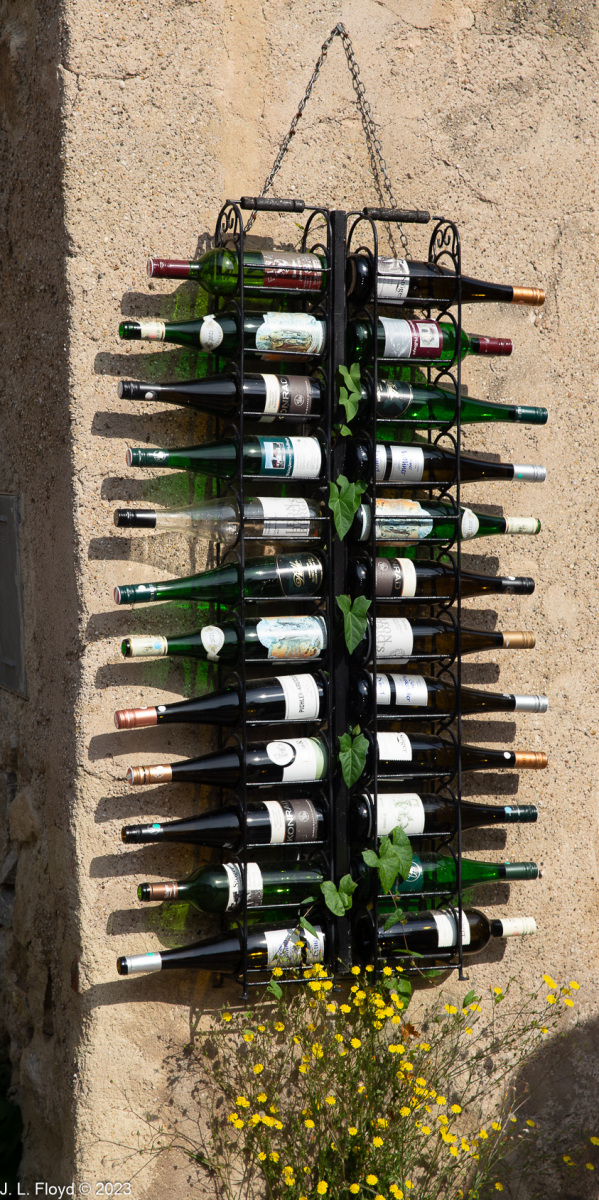
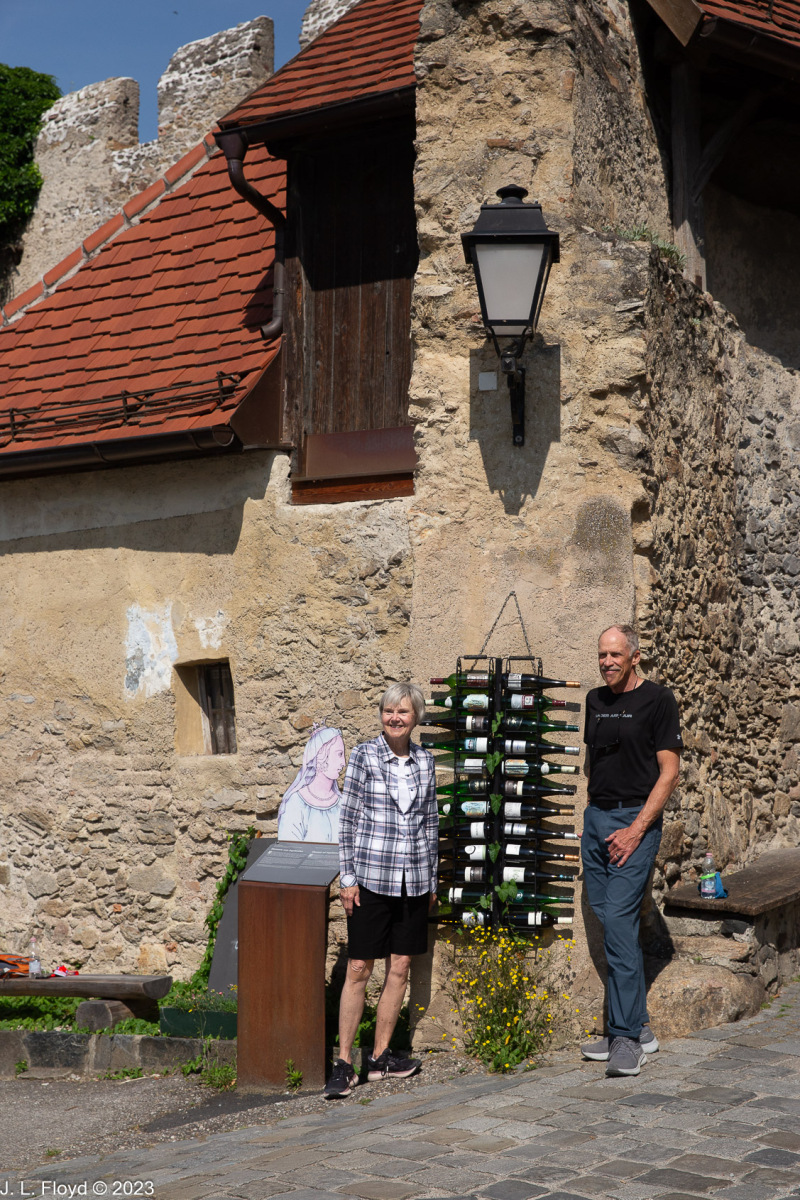
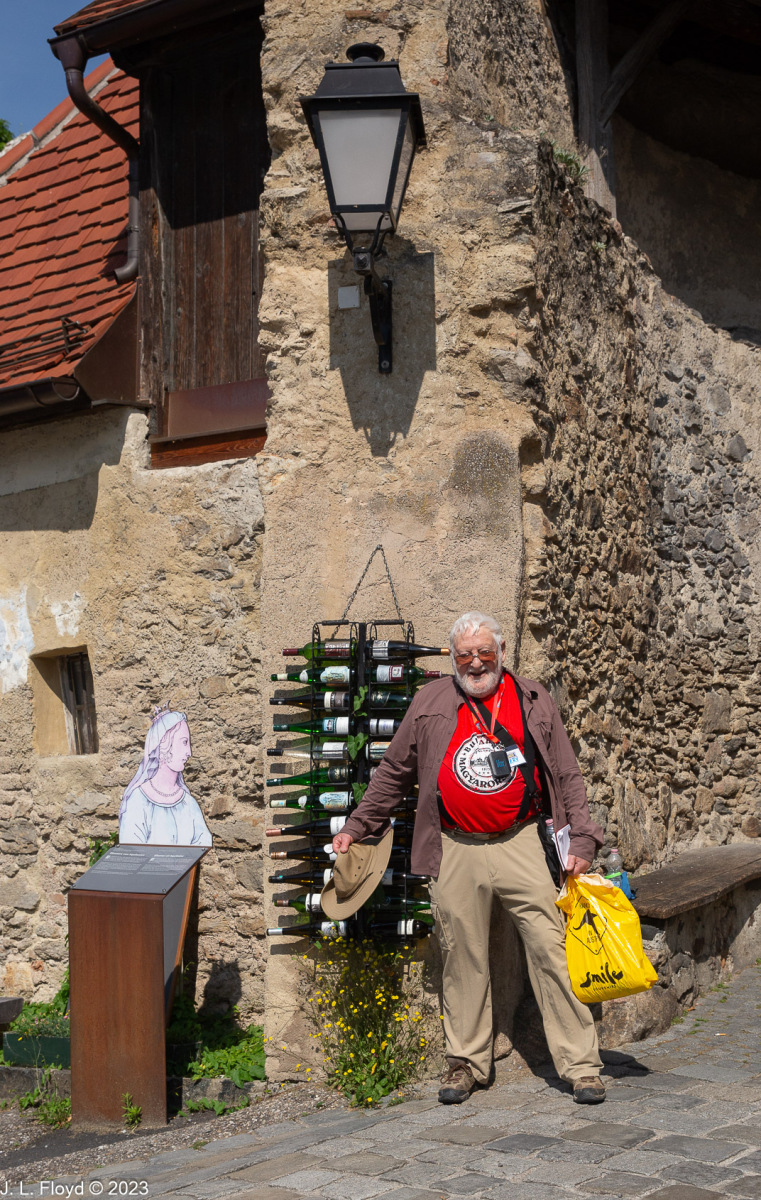
Located inside the Krems Gate is a wine shop, the Vinothek Kremstor, which displays its wares on a rack hanging on the wall outside. A couple from the Gate1 group asked me to take their picture in front of the display, and I gladly obliged; they graciously returned the favor.

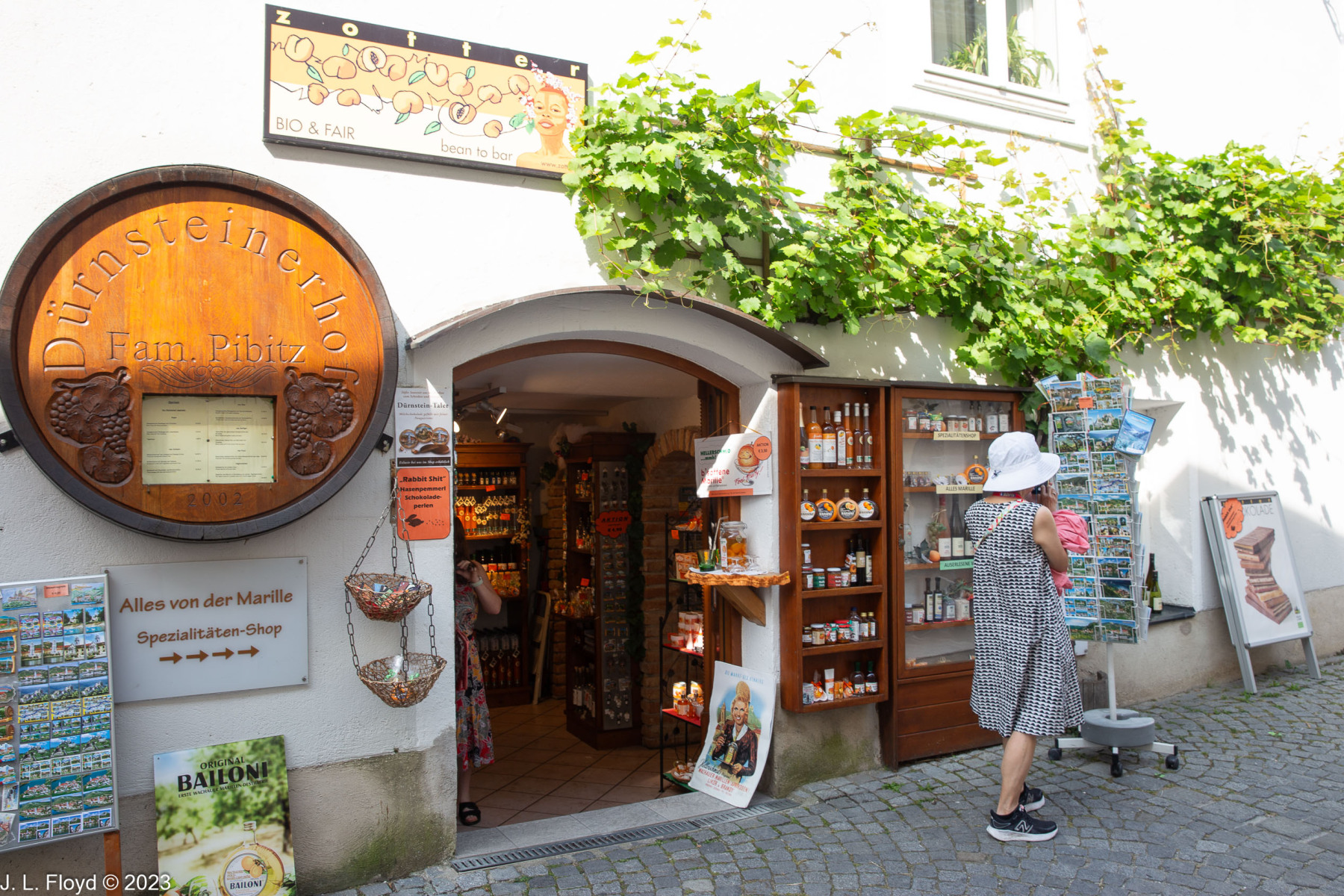
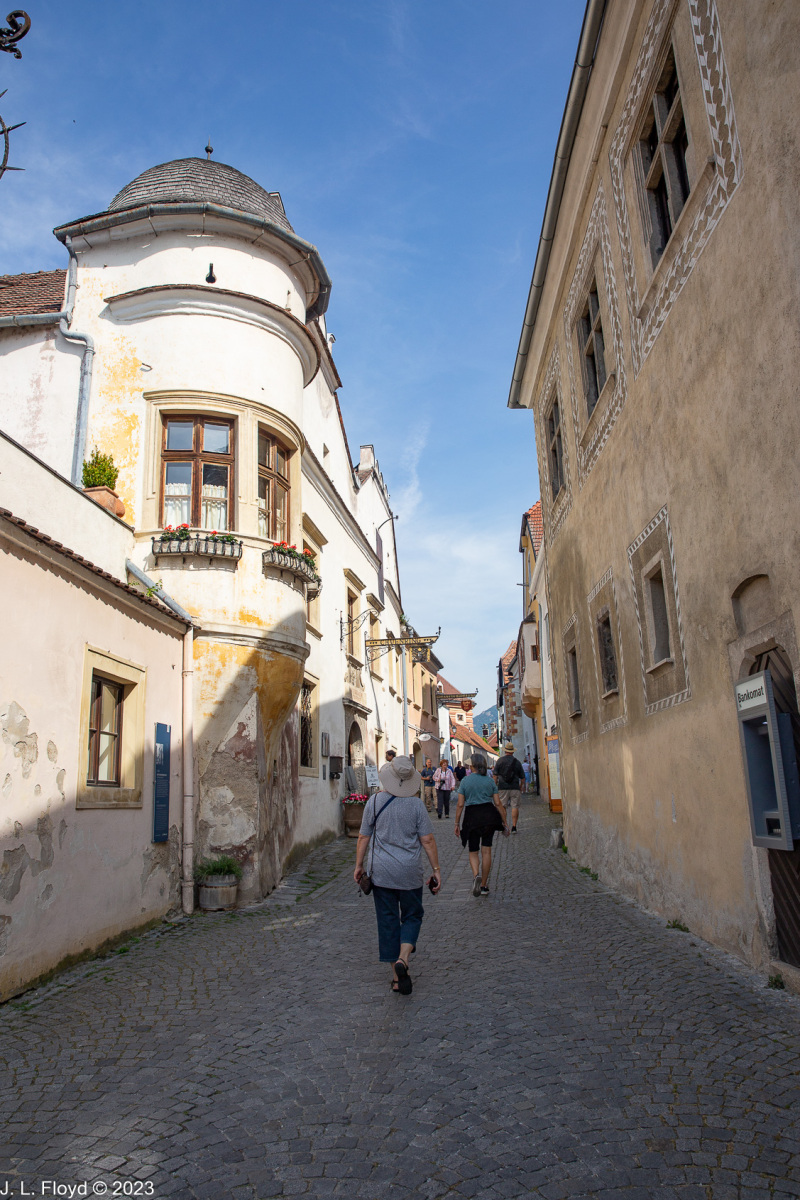
Dürnstein is a tourist trap par excellence, by which I mean that it is the best kind of tourist trap. Visitors can spend as many hours and as much or as little money as they please. I did not spend much. I bought postcards, a T-shirt for myself and a few trinkets for friends and relatives. Although the Wachau valley is famous for its fine wines, I didn’t buy any wine because the bottles would have been a heavy burden and costly to ship home. There were some enticing eating-places, but no time to enjoy them and anyway lunch was waiting on the boat. So I simply ambled from the Krems Gate down the Hauptstrasse, the main street of Dürnstein, pausing to shoot photos of the various attractions I encountered.

One noteworthy landmark was the steeple of the Kunigundenkirche, the Church of St. Cunigunde, dedicated to the wife of Emperor Henry II. It was the first parish church of Dürnstein, built by the Kuenring family in the early 13th century, not long after the incarceration of Richard the Lionheart. The Kuenrings passed it on to the Poor Clares, an order of Franciscan nuns. The church was demolished in 1783, except for the steeple; the land on which the church stood was then used as a cemetery, which is still the final resting place of deceased residents of Dürnstein.

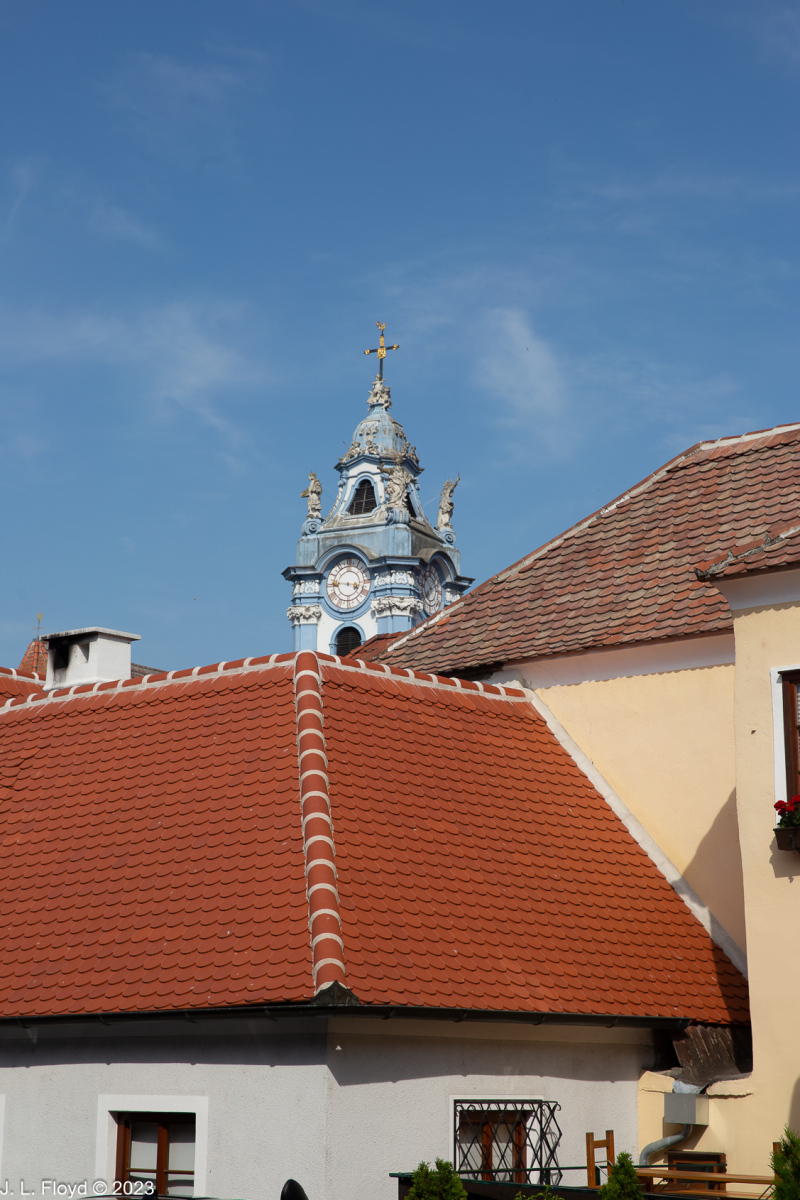
I didn’t go into Dürnstein Abbey, but contented myself with photogaphing it from afar. The abbey was begun in 1410 by the Kuenrings, who brought in Augustinian monks from Bohemia to build the church, cloister and monastery. These were all Gothic in style; the abbey did not acquire its Baroque appearance until a major renovation begun in 1710, and the magnificent bell tower was added in 1733.

Emperor Joseph II dissolved many of the monasteries during his reign, among them Dürnstein Abbey. Its properties were handed over to one of the surviving monasteries and it was essentially turned into a parish church, which it remains today.

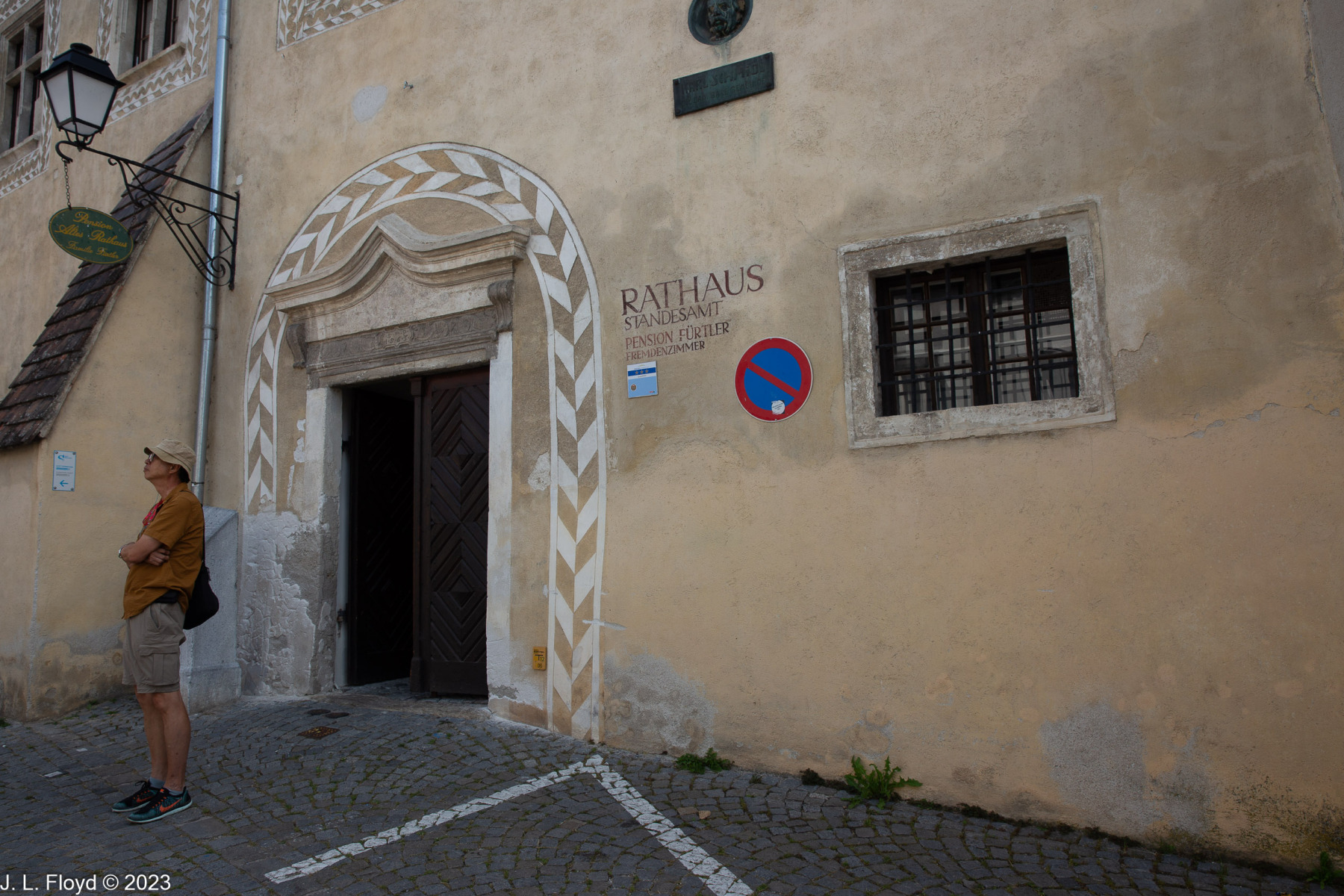
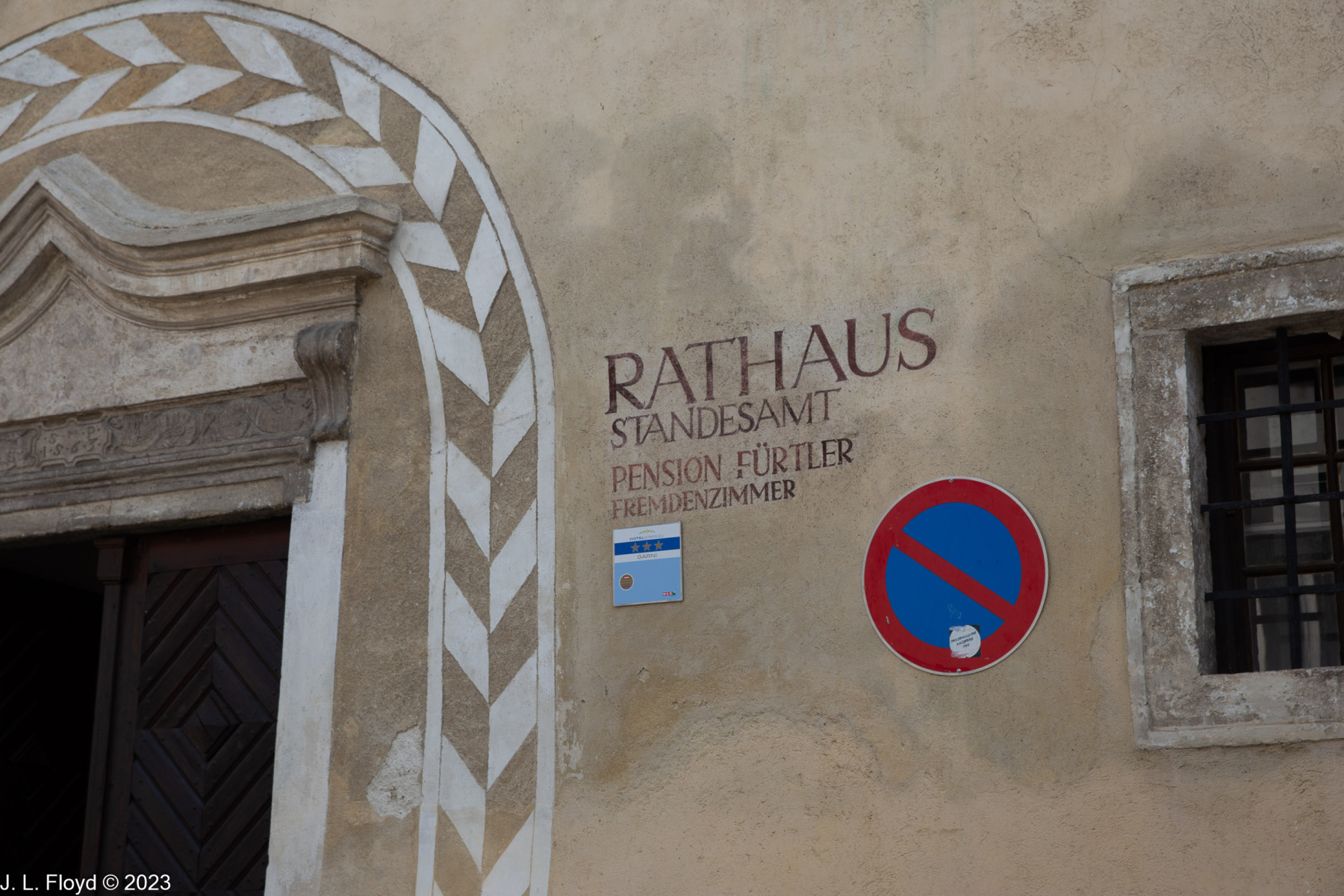
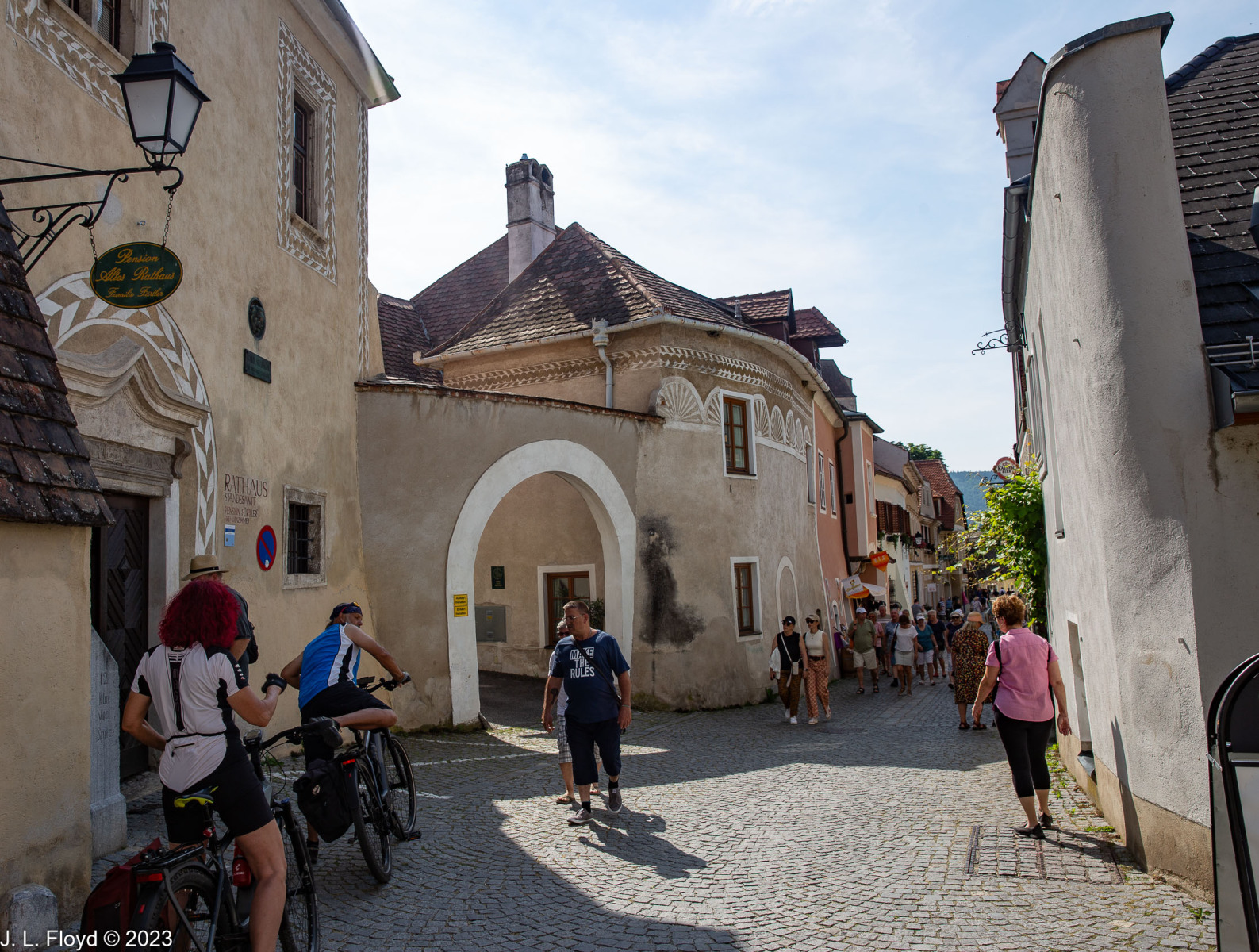
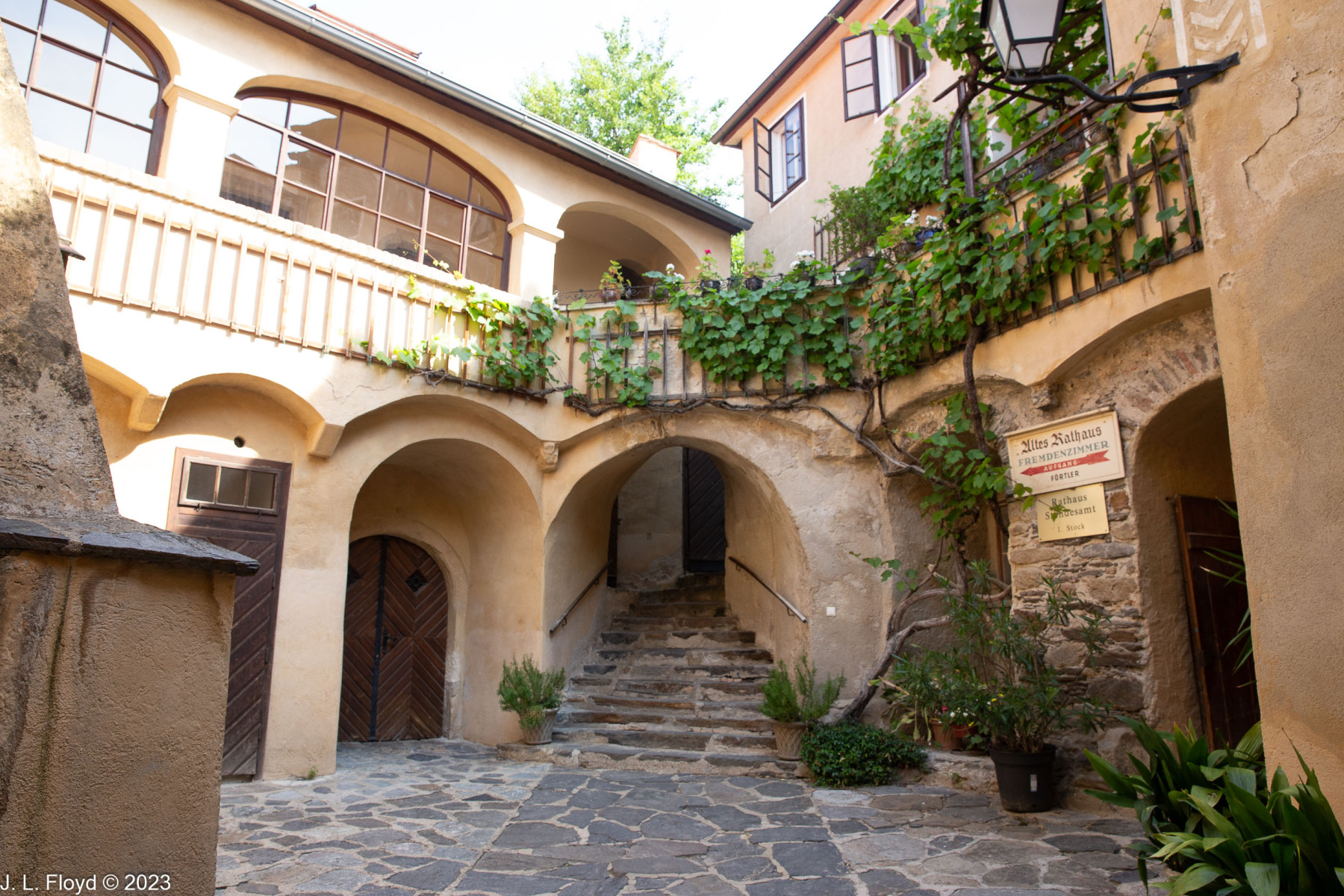
I have always found the German word for “City Hall” rather amusing because it is so suggestive: “Rathaus.” (It’s not only the English translation of “rat,” the German word for council, that provides the humor; the German word for “rat” the rodent is “die Ratte.”) In Dürnstein, the building which became the Rathaus was first built in the Gothic style in the mid-sixteenth century, and a few years later, in 1563, rebuilt in the Renaissance fashion, although the windows and doors were retained in their original Gothic form. Around 1593 the city fathers bought the structure and began to use it as a town hall. But they soon found that it was too large for their needs, and they sold the northern half to a private citizen who turned it into an inn, now known as the Altes Rathaus. The southern half, which the town retained, contains a Registry Office, where marriages are recorded, and a Conference Hall, where marriages are often performed. In days of yore, the conference hall also served as a courtroom, and rooms adjacent to it were used as a jailhouse. The ground floor used to hold a public wine press, where local vintners who did not have their own wine presses could come to squeeze their grapes. The courtyard and the steps leading to the Registry office are often used as venue for wedding photographs.

A little way up the street from the Rathaus is the Kuenringerhof, a restaurant and guest house bearing the name of the family who for centuries did so much to shape the development of the town. I haven’t been able to find out if the Kuenrings or their descendants still own it, but having their name on it helps to ensure that they are not forgotten.

All too soon it was time to return to the Monarch Queen for lunch and the next leg of our journey, which was to take us through the rest of the Wachau Valley to Melk.

Categories
Danube River Cruise, June 2023

Vienna, June 19, 2003: Schönbrunn Palace

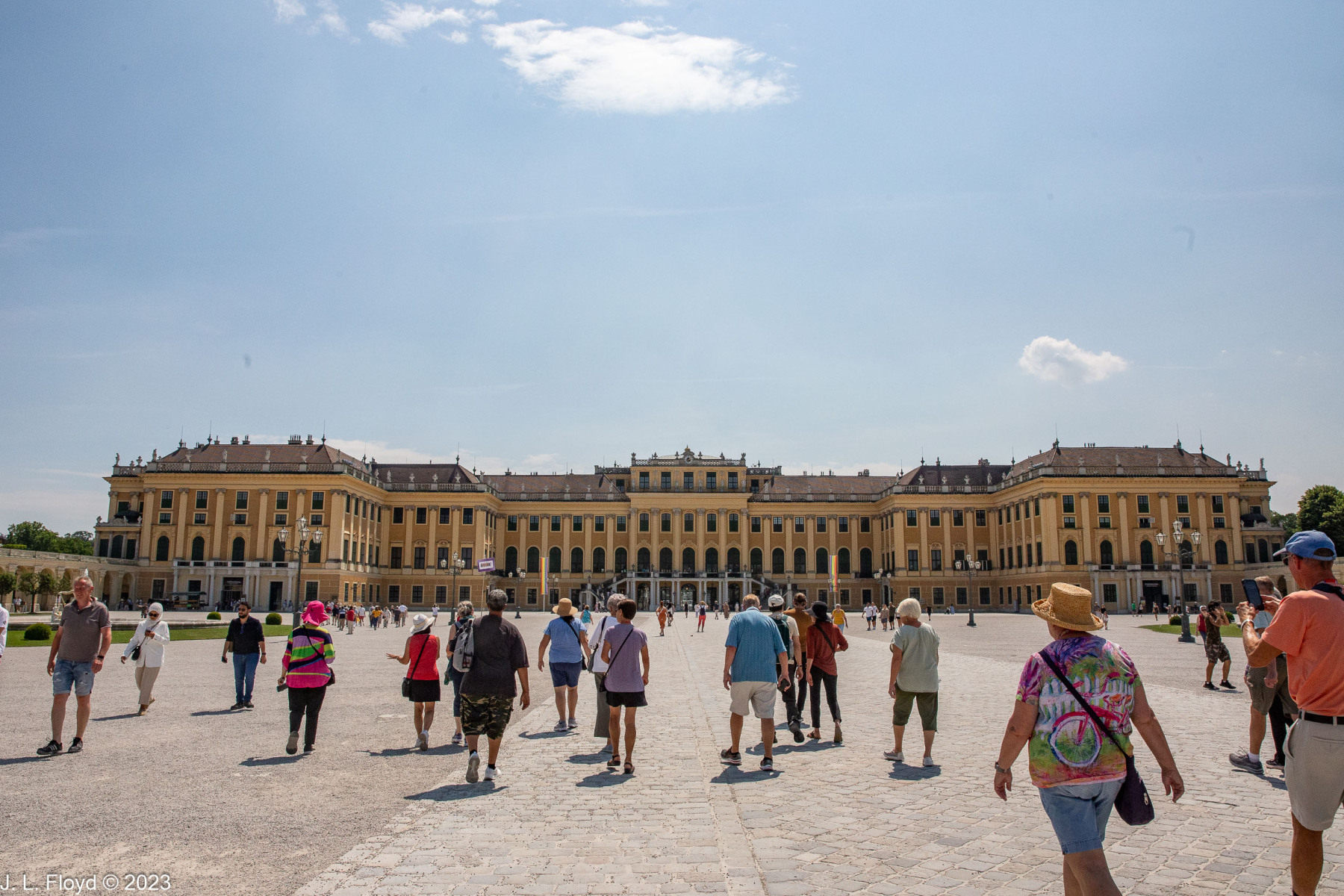
After seeing the Habsburg Winter Palace, the Hofburg, in the morning of June 19, in the afternoon I went to see their Summer Palace, Schönbrunn. It is located well to the west of the city center, in an area which was rural at the time of its inception. It began as a hunting lodge for the Habsburgs; it was only in the time of Empress Maria Theresa, the 1740s and 1750s, that Schönbrunn became a major palace, and since it was she that was mainly responsible for its construction, it’s appropriate to say a few words about her at this point.

Maria Theresa became Empress only because of a combination of unusual circumstances. Maria Theresa’s father, Emperor Charles VI, inherited the throne from his elder brother, Joseph I (r. 1705-1711). In 1703, Charles had signed an agreement called the Mutual Pact of Succession, which provided that in the absence of male heirs, Joseph’s daughters should have precedence over Charles’ in the succession to the throne. As it turned out, neither Joseph nor Charles had sons, and after Joseph died in 1711, his daughter was first in line for the throne. However, there was another obstacle: the Salic law inherited from the early medieval period precluded female inheritance. Though the Salic law no longer was considered sacrosanct, it ensured that any male Habsburg relatives who were around would contest the succession. Charles VI attempted to deal with both of these considerations by issuing the Pragmatic Sanction of 1713, which proclaimed that his daughters, should he have any (none had been born yet), would have precedence over Joseph’s in the succession. As it turned out, Charles had three daughters but no sons, so Maria Theresa, as eldest daughter, born in 1717, inherited the throne.

Issuing an edict was one thing, getting all the interested parties, both foreign and domestic, to abide by it was another. Charles spent the rest of his life trying to get all of them to sign on, and in doing so he made concessions that seriously weakened the Austrian monarchy. Worse yet, when he died in 1740, most of the major foreign signatories – France, Spain, Prussia, Saxony and Bavaria – repudiated the Pragmatic Sanction. (Why should they uphold it, when Charles himself had renounced the Mutual Pact of Succession?) The result was the War of Austrian Succession (1740-48), which began when the Prussian king, Frederick II, invaded and annexed the rich Austrian province of Silesia. Then France invaded from the west and occupied Prague.

Maria Theresa had married Franz Stephan, Duke of Lorraine, in 1736, by virtue of which he had become de jure Holy Roman Emperor Franz I, and it was expected that he would become the de facto ruler as well. However, Maria Theresa defied these expectations and clung to power for the rest of her life; after Franz I died in 1765, and their son Joseph II became co-ruler with his mother, she continued to hold the reins of government until her death in 1780. She rallied the Austrian armies, instituted important reforms, and held her enemies at bay. Then, in 1756, she made an alliance with her former enemy France as well as the Russian Empire. In the Seven Years’ War which followed, she nearly succeeded in overthrowing Frederick the Great, who was on the verge of total defeat when the sudden death of Empress Elizabeth of Russia, and the subsequent accession of the Prussophile Tsar Peter III, led to the withdrawal of the Russians from the anti-Prussian coalition just as the Cossacks were entering the outskirts of Berlin. In the end, Maria Theresa kept her domains mostly intact, though she never regained Silesia from Frederick the Great.

Maria Theresa had received the Schönbrunn estate as a wedding present, and upon her accession to the throne she entrusted her personal architect, Nicholaus Pacassi, with the transformation of the hunting lodge into a real palace. During the remainder of her reign the palace acquired the extent and form it has today, although its external appearance would later undergo significant changes.

Sandie, who was exhausted after the morning’s trek in Vienna, wasn’t up to going to Schönbrunn and stayed on the boat. Thinking that there would be no occasion for long-distance shots in the palace, and knowing that photography was not allowed there anyway, I decided not to take my 70-200 mm telephoto lens with me, much to my later regret.

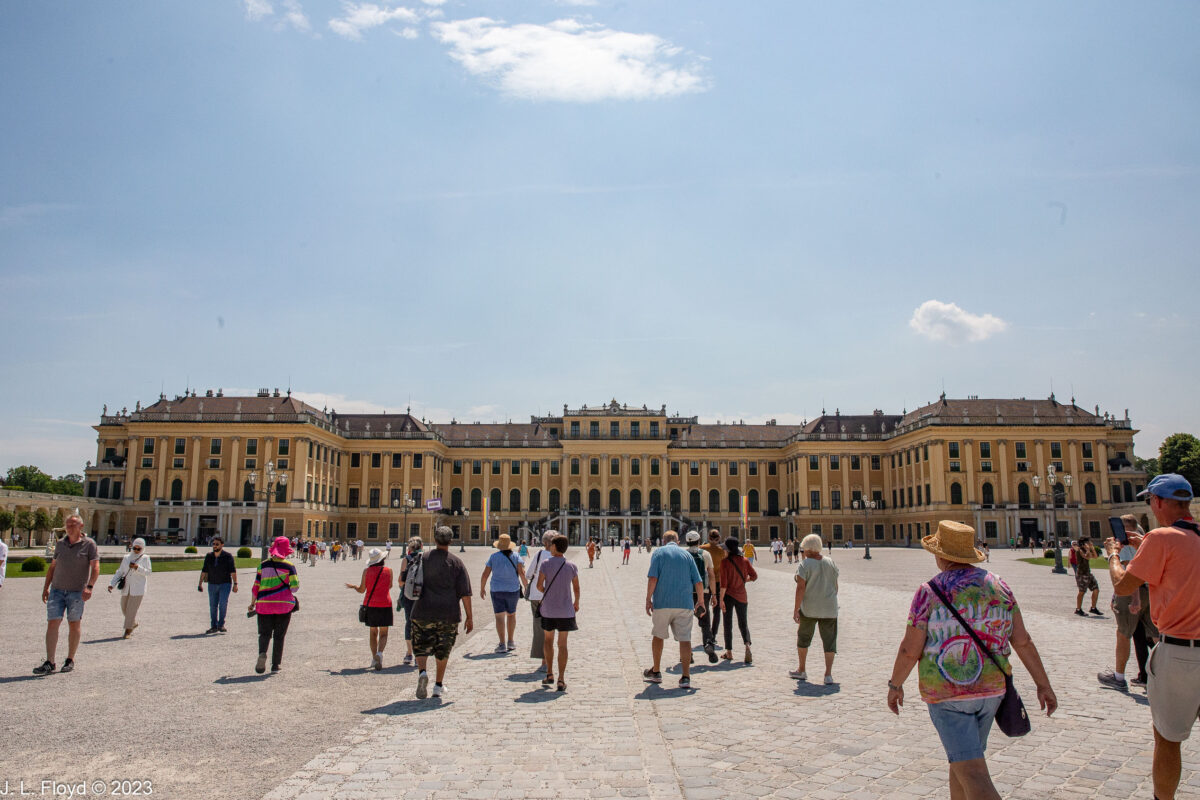
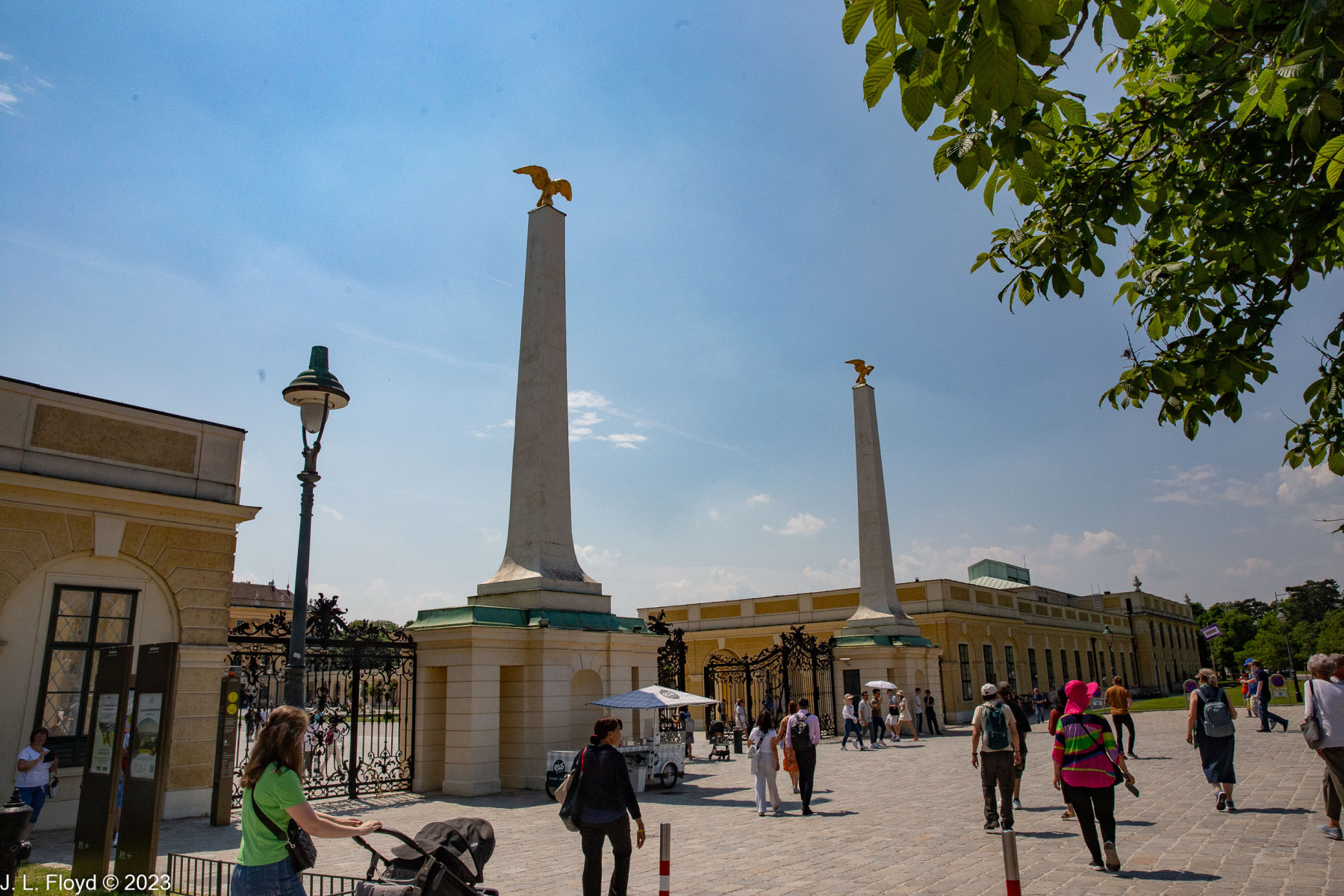
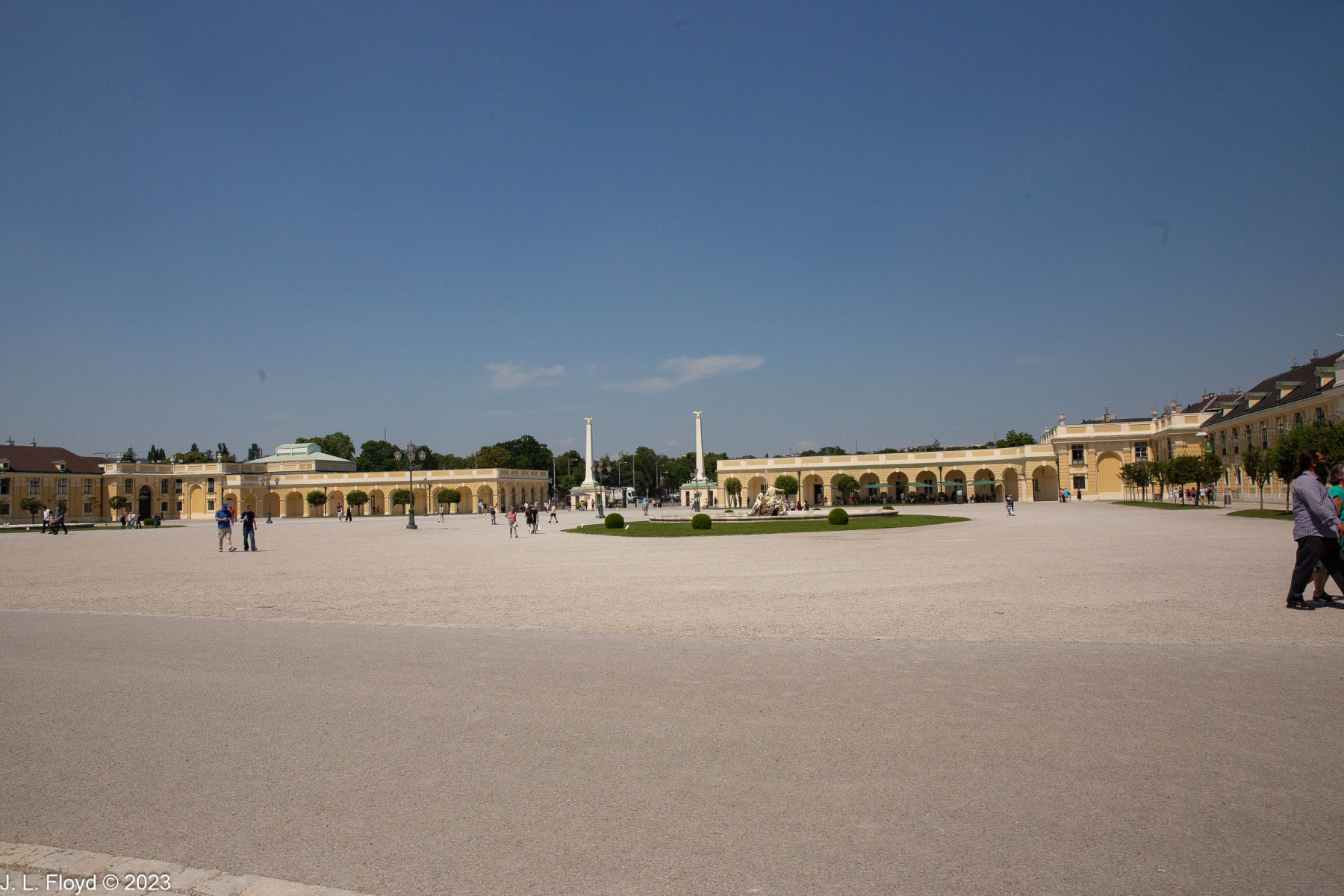
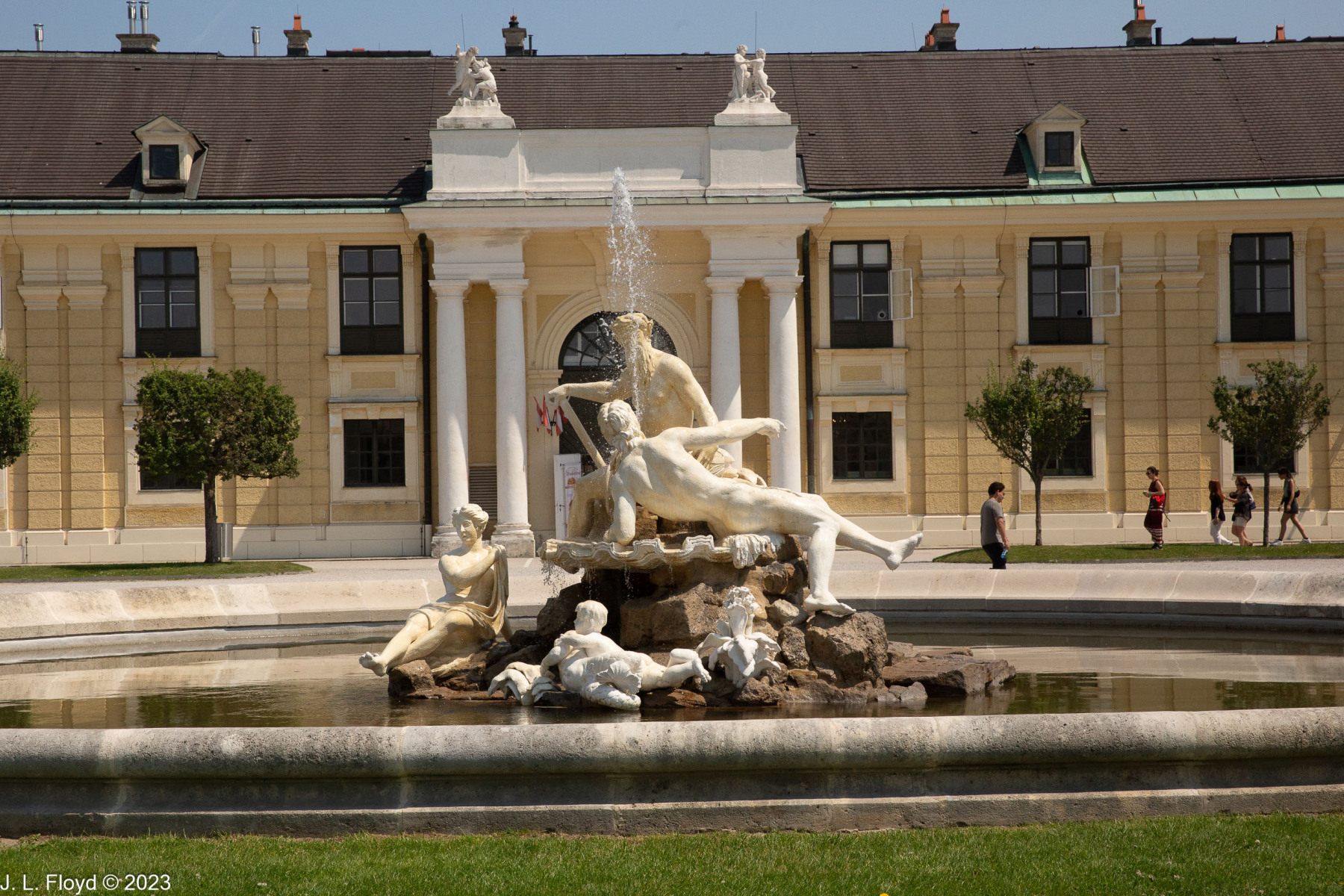
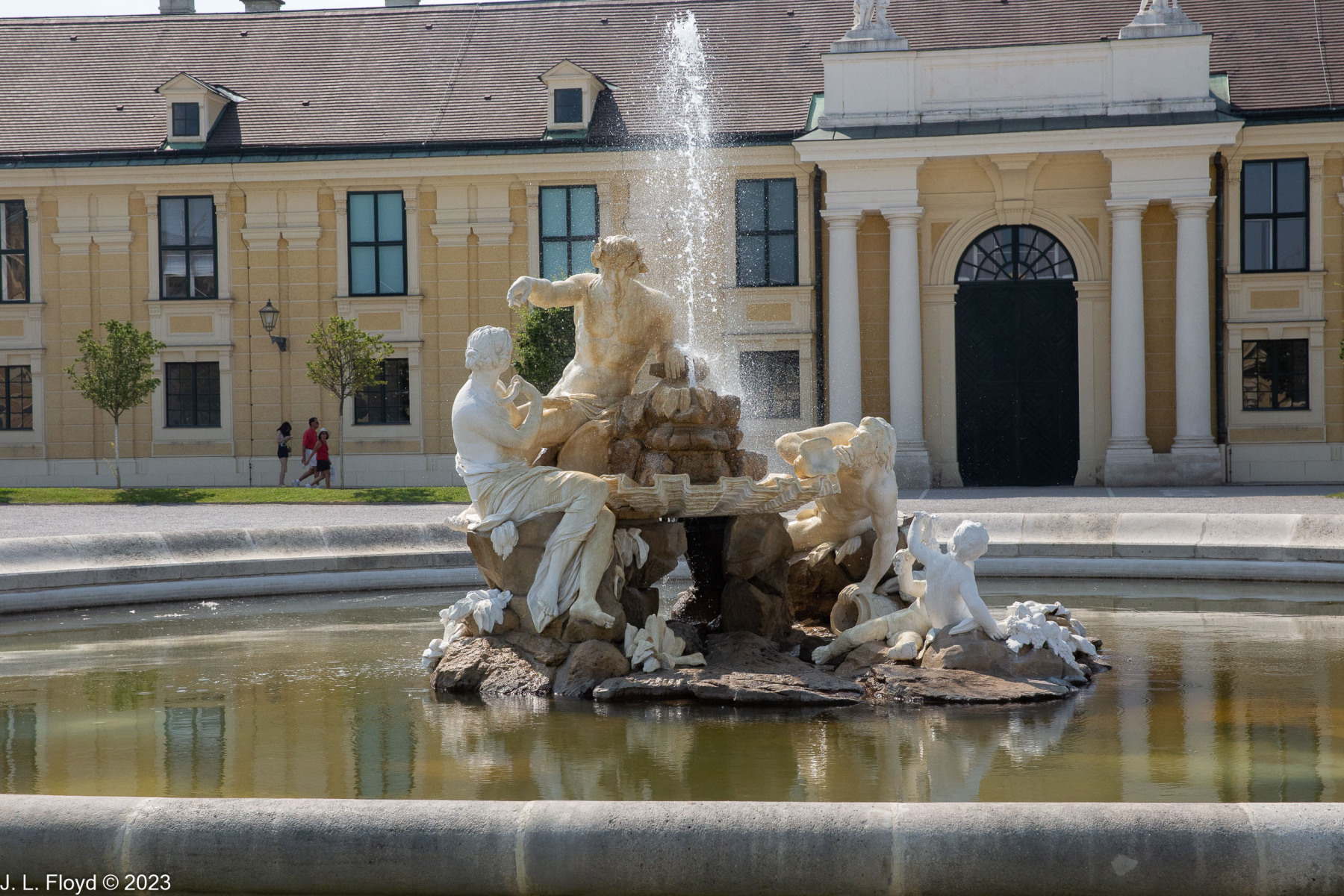
Arriving by bus in front of the main gate, flanked by two towers topped with Habsburg eagles, I was initially struck by the seemingly vast expanse of bare space in front of the palace itself, which took a while to cross. It turned out that this was a tiny fraction of the huge extent of the palace grounds. It is covered mostly with white stone and is called the “Ehrenhof,” translated either as “Court of Honor” or more loosely as “Parade Ground.” To the right as one crosses the court is a pool with a sculptured fountain. There are supposed to be two of these in the courtyard, called the Ehrenhofbrunnen, one in the east basin and one in the west, but I saw only the one in the west basin; its three main figures represent the major rivers of the area, the Danube, Ems and Inn. The fountain in the east basin supposedly features an allegorical representation of the Habsburg provinces of Galicia, Lodomeria and Transylvania, but I only saw an empty basin – perhaps the statues had been removed for refurbishing. (Note: Lodomeria is a Latinized form of “Volodymyr.” The name refers to a piece of Poland which Austria acquired along with Galicia in the First Partition of Poland in 1772. Transylvania was already a Habsburg dominion because it was part of the Kingdom of Hungary.)

Photography is not allowed inside Schönbrunn Palace, so I was limited to shooting the exterior, the Parade Court and the gardens. I bought a souvenir book full of photos at the gift shop to remind me of what the interior looks like. The book also contains very lifelike portraits of some of the various Emperors and Empresses who resided in the Schönbrunn. Not among them is Napoleon Bonaparte, who inhabited the Schönbrunn on two occasions, in 1805 and 1809, when his armies occupied Vienna. As a result of his victory in the campaign of 1809, Napoleon concluded a peace with Austria that included his betrothal to Marie Louise, the daughter of Emperor Franz I.

My pretty little Schönbrunn book also recounts an instance of historical artistic fraud. It identifies a painting in the Redoute Ballroom that includes the young Wolfgang Amadeus Mozart among the throng in attendance at the wedding of Crown Prince Joseph (later Emperor Joseph II) and Isabella of Parma in the Hofburg in 1760. The inclusion of Mozart is bogus because he was only four years old in 1760 and did not attend the wedding. The court painter, Martin van Meytens, only completed the painting years later, after the composer had become famous, and he put Mozart in then. Mozart became famous two years after the wedding, in 1762, when at the age of six, he performed with his ten-year-old sister Nannerl (Maria Anna) he gave a performance for the court on the clavier and violin in the Hall of Mirrors. Franz Stephan gave the young prodigy the task of playing with the keyboard covered, which he did with aplomb. Afterward, according to the boy’s father, he sprang onto the Empress’ lap and kissed her.

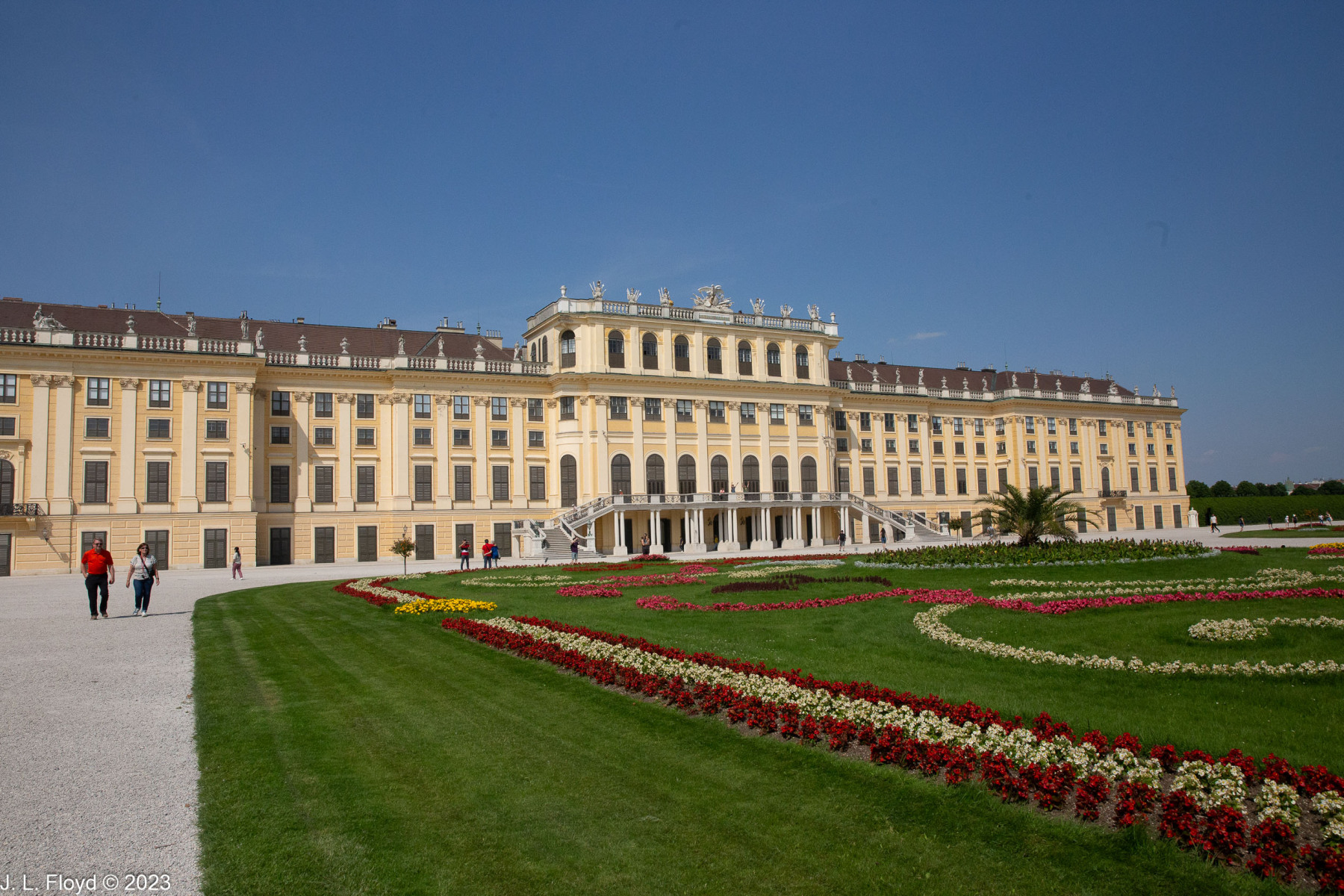
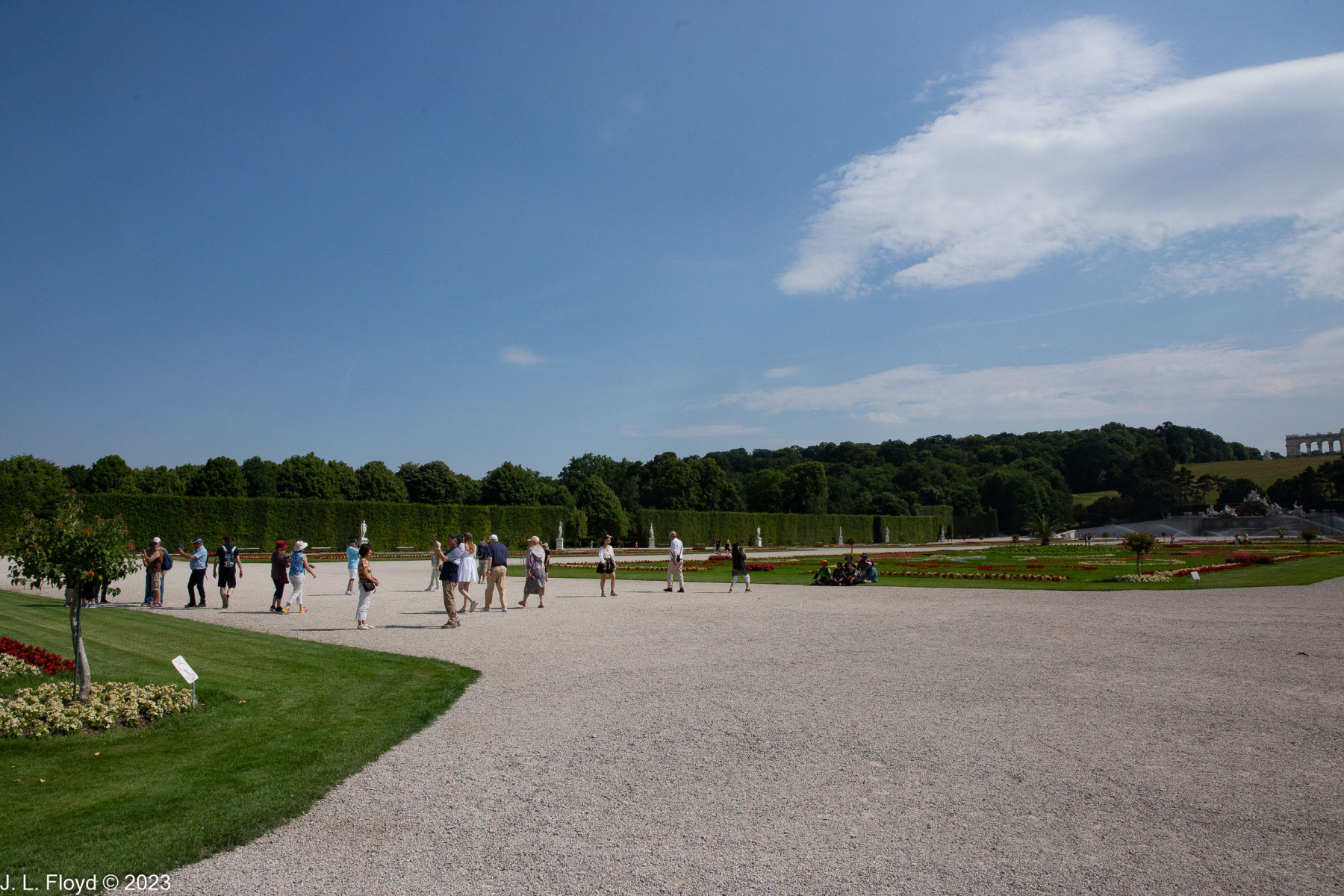
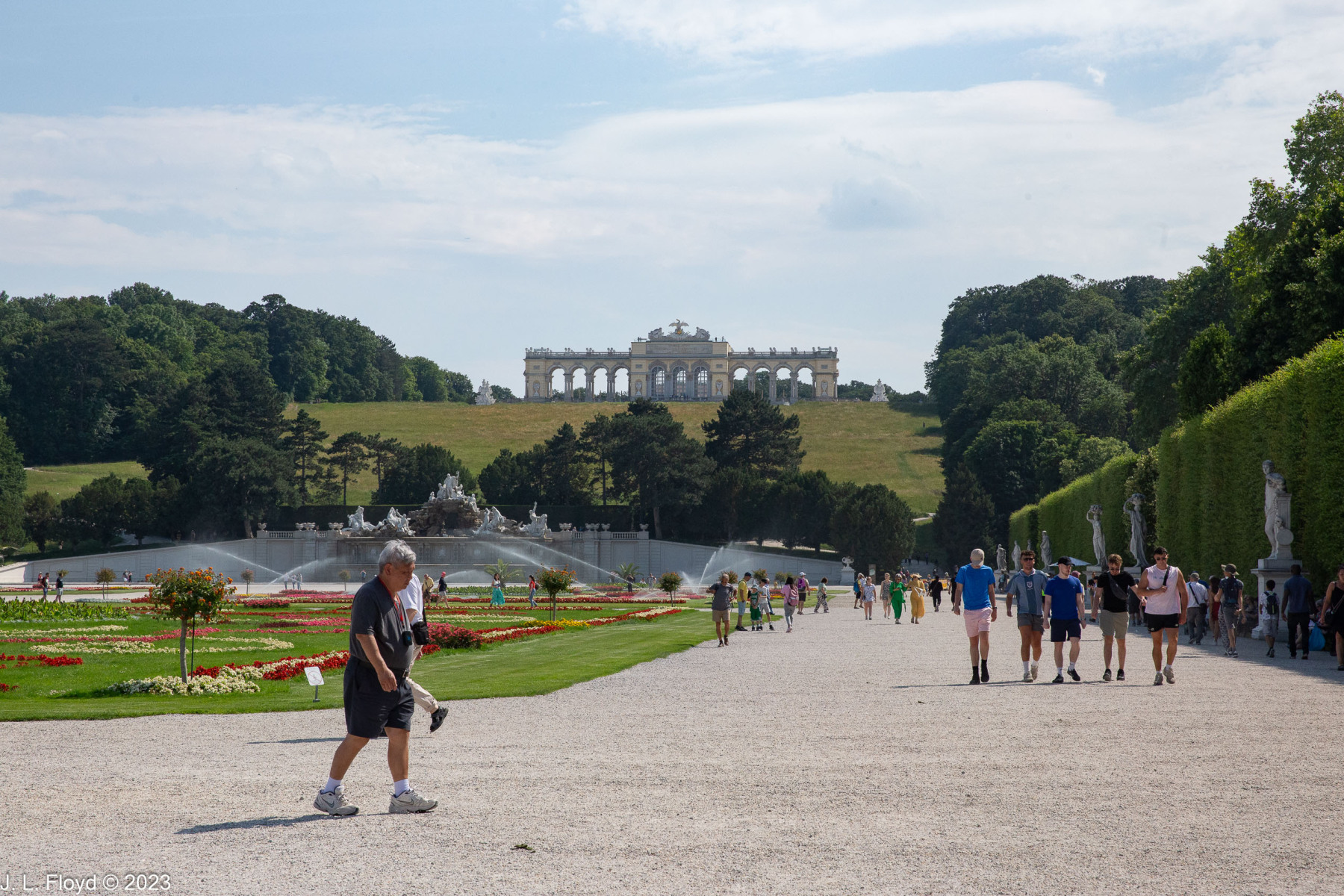
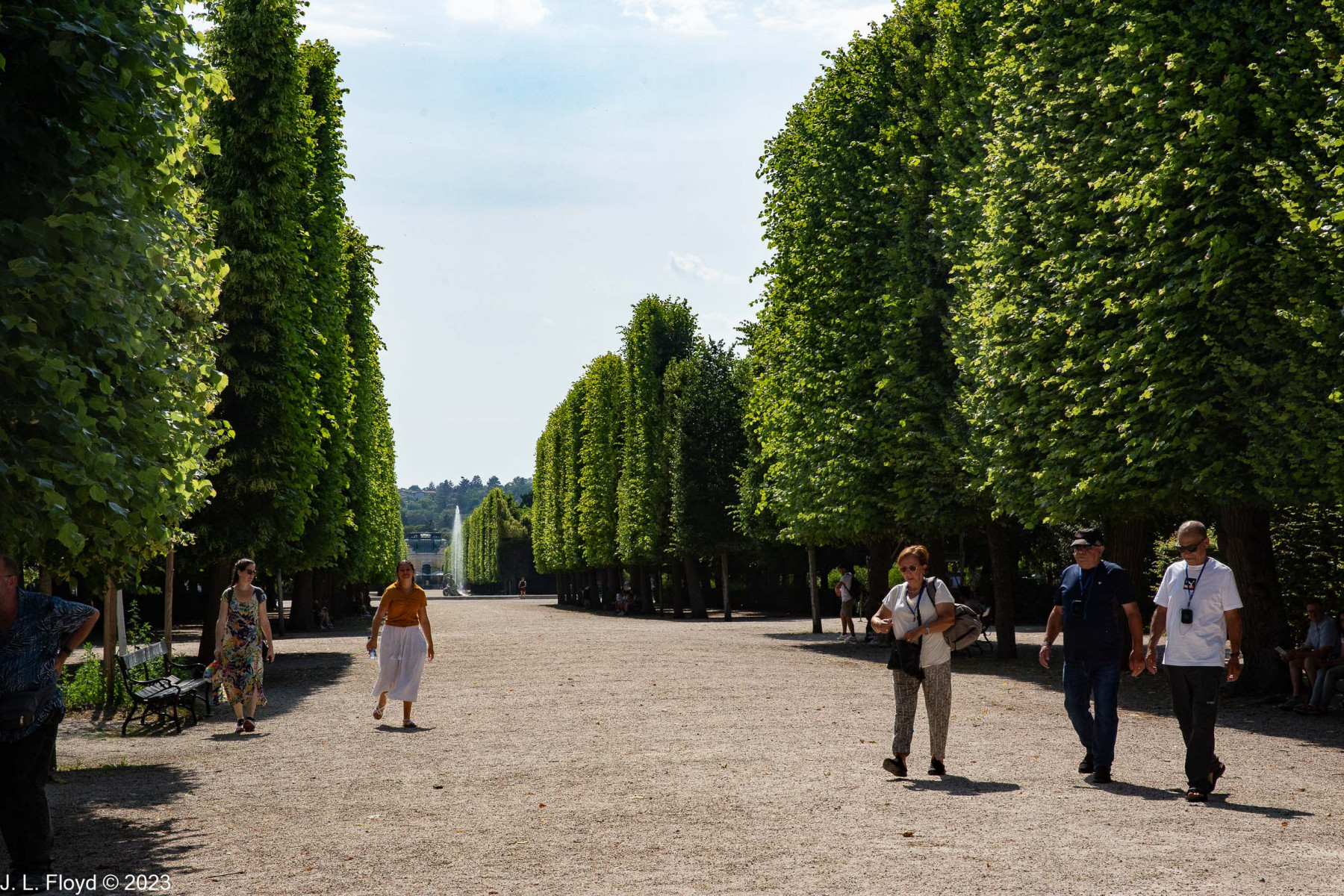
Upon finishing the tour of the palace interior, we had some free time to frolic in the gardens before meeting the bus for the return trip. Unfortunately the palace grounds are far too vast, and I was already too tired from all the trekking I had done that day, to see all but the attractions closest to the palace. Among the most accessible was the area right in back of the palace, known as the Grand Parterre, which is a large expanse of open space filled with grass, flowerbeds and walkways and bordered with tall hedges. Lining the walkways by the hedges are sculptures of figures mostly from classical antiquity. At the end of the Parterre is the fabulous Neptune Fountain, commissioned by Maria Theresa in the last years of her life and completed just before her death. It depicts the sea-god Neptune standing atop a rocky grotto in a shell-shaped chariot holding a trident, and surrounded by his entourage of demigods, nymphs and Tritons. Unfortunately, I did not get close enough to it to get a good picture, and I had left my telephoto lens behind. However, you can see a marvelous picture of the fountain here.

Beyond the Neptune fountain there is a hill, 60 meters (200 feet) high, on top of which stands a gloriette. A gloriette is a building in a garden situated on a site that is elevated relative to its surroundings. The largest known such structure is the one on the hill at Schönbrunn. Maria Theresa had it built in 1775 not only to glorify Habsburg power but also to extol the virtues of a “just war,” which she considered the wars she had waged against Frederick the Great and others to be. In an uncharacteristic moment of thrift, she ordered the builders to re-use stone from an older palace (Schoss Neugebäude) which had fallen into ruins.

The Gloriette served as an observation platform, dining hall and festival pavilion. It was furnished with decorative sculptures by the Salzburg master Johann Baptist von Hagenauer. Emperor Franz Joseph liked to take his breakfasts in the Gloriette. The Gloriette was destroyed in World War II, but afterward rebuilt, and the dining room was converted into a café. As with the Neptune Fountain, I very much regret that I did not have time to explore it and photograph it close-up; it is an imposing structure.

After Maria Theresa’s death in 1780 the palace fell into disuse until the early nineteenth century, when Franz I again began to use it as a summer residence. Napoleon made it his headquarters in his invasions of 1805 and 1809 and occupied the quarters formerly used by Maria Theresa’s husband Franz Stephan. Afterward the bedroom he slept in became known as the Napoleon Room.

In 1810, following the French victory over Austria at the Battle of Wagram, Napoleon coerced Emperor Franz I into an alliance, to be sealed by marriage to Franz I’s daughter Marie Louise. Napoleon and Marie Louise had a son, Napoléon François Joseph Charles Bonaparte, After Napoleon’s defeat and abdication, Marie Louise, returned to Vienna with her son and resided at Schönbrunn for a while. She eventually left for Italy, where she lived out her life as Duchess of Parma, but her son, who became known as Franz, was kept secluded at Schönbrunn to prevent him from following in the footsteps of his father. He resided in the Napoleon Room until his early death from tuberculosis in 1831.

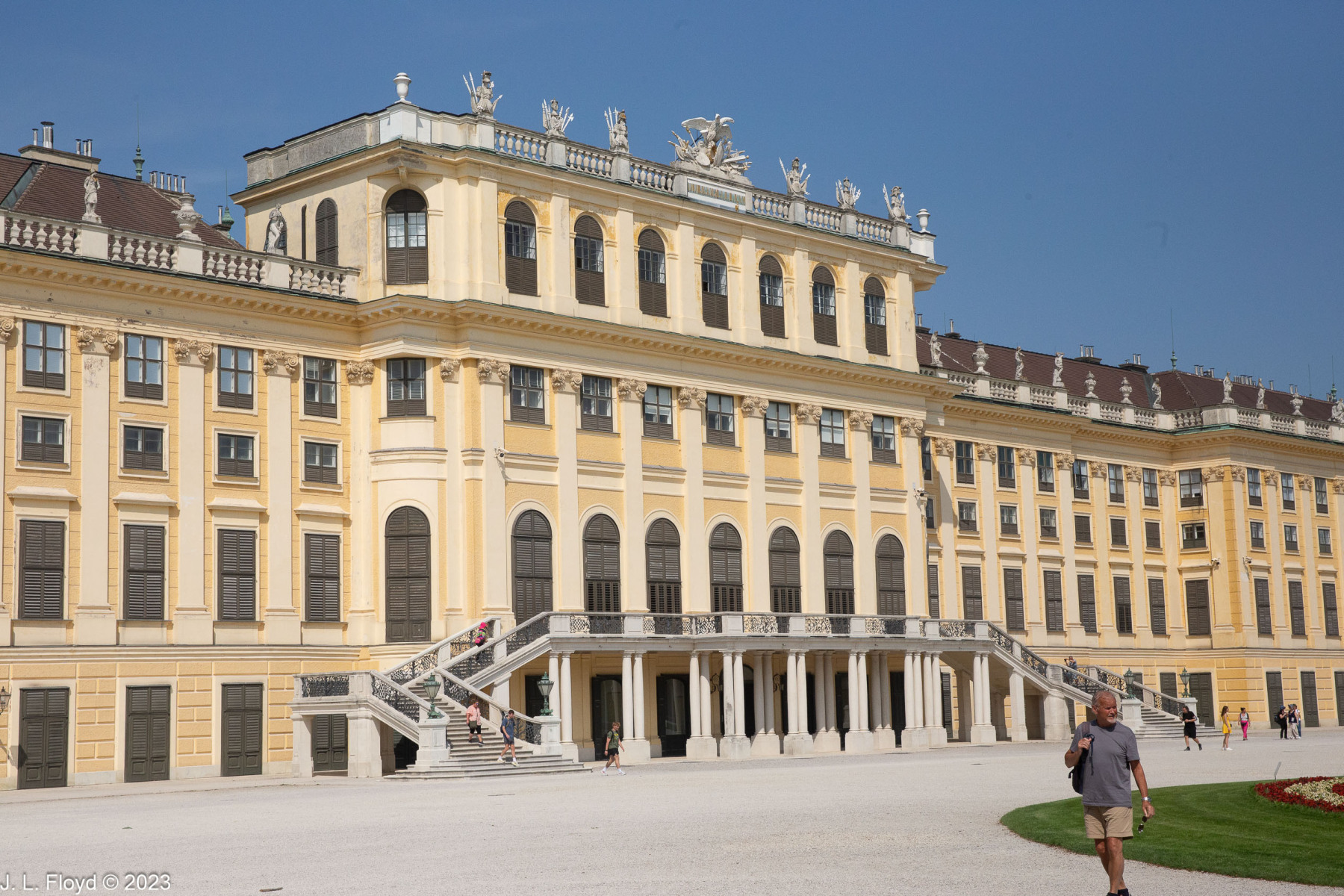
At the conclusion of the Napoleonic Wars, Schönbrunn was extensively updated and refurbished. One of the most radical changes was the replacement of the original richly ornamented Rococo façade by a more restrained Neoclassical design with only a small number of decorative elements. The color assigned at that time was a monochrome grey. Later, in the reign of Franz Joseph, the dull grey was replaced by the color which became known as “Schönbrunn yellow,” giving the façade the appearance it has today.

Franz Joseph was born in the Schönbrunn palace in 1830. He moved into apartments in the West Wing upon his accession to the throne in 1848, and died there in 1916. It was his favorite residence, and a number of extensive remodelings and additions were made during his reign.

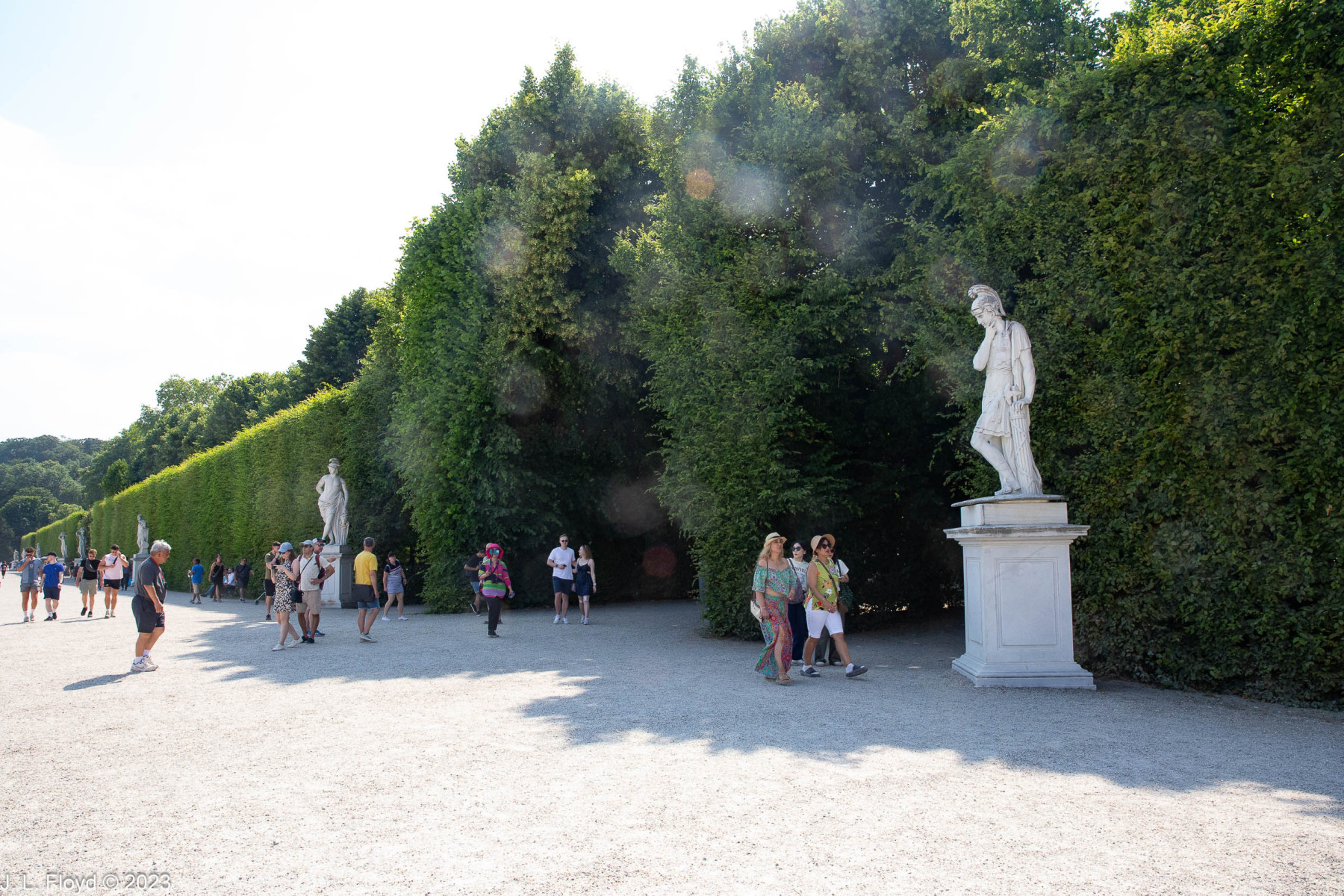
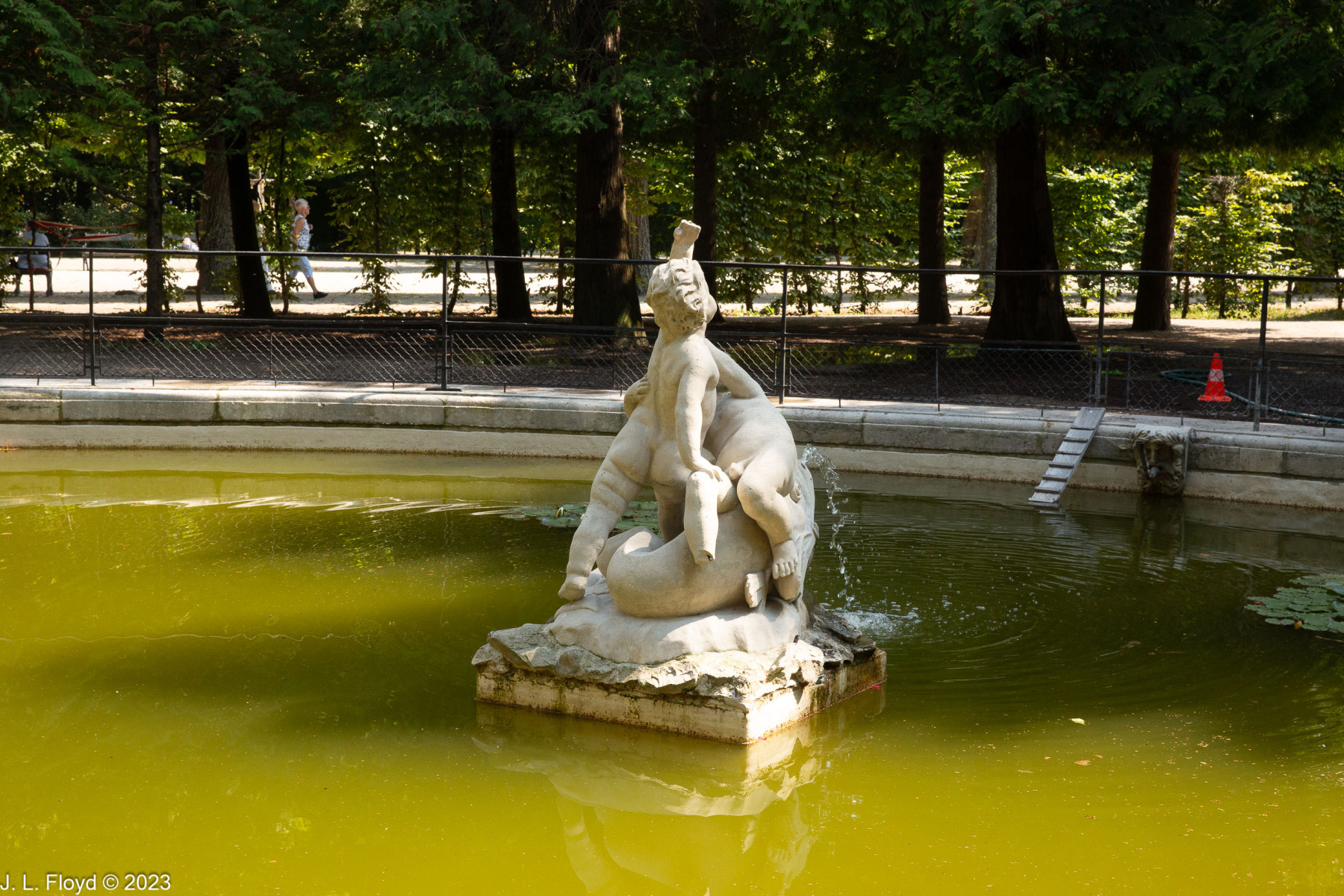
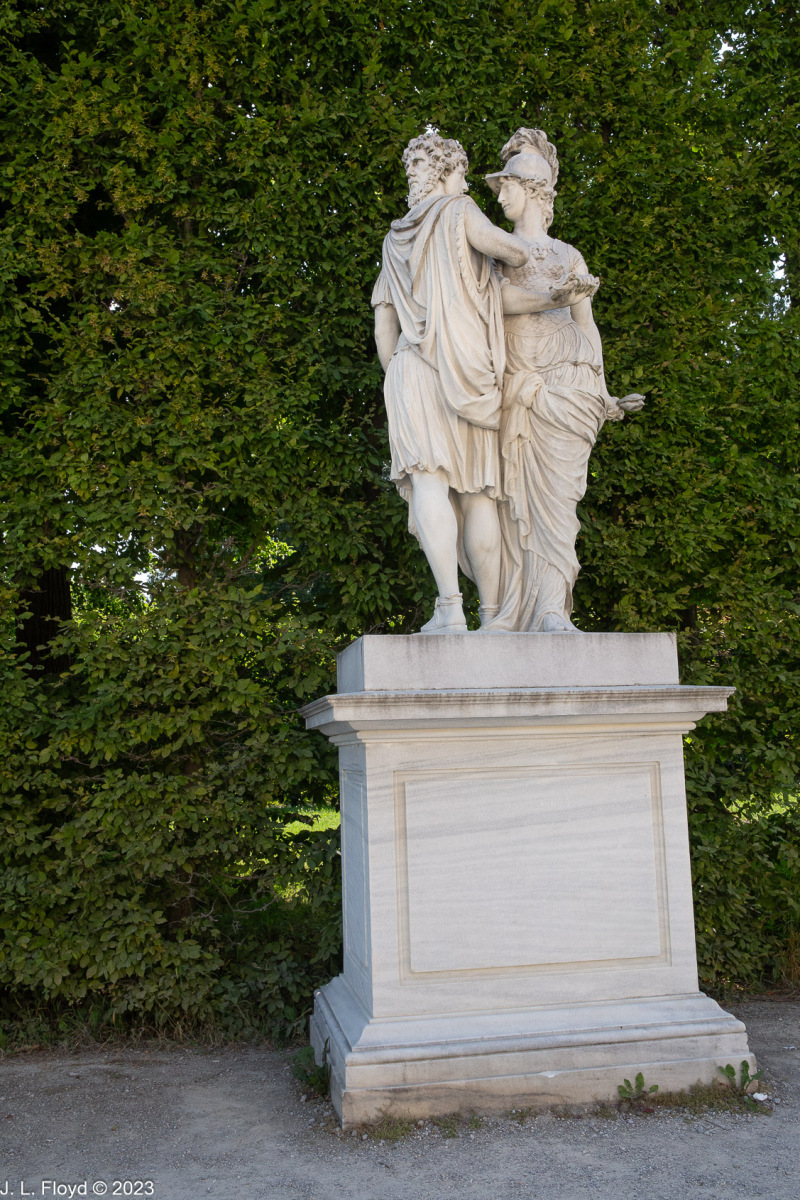
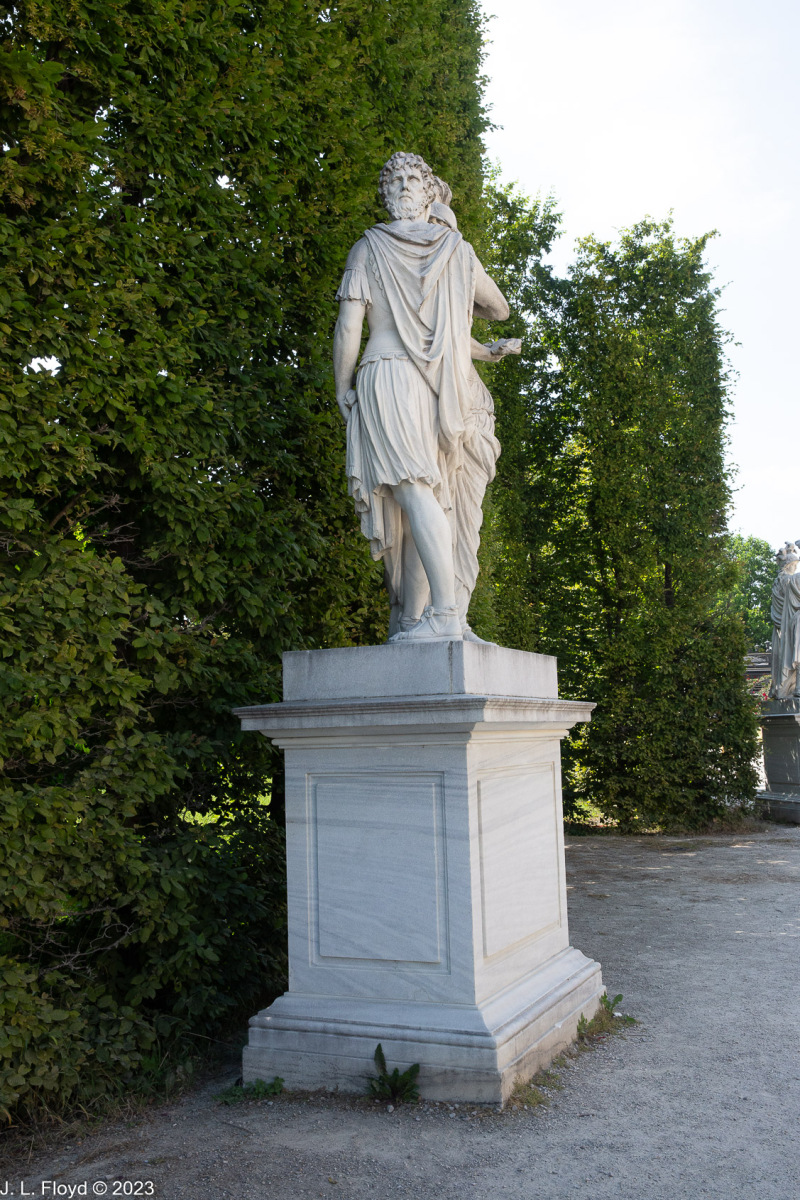
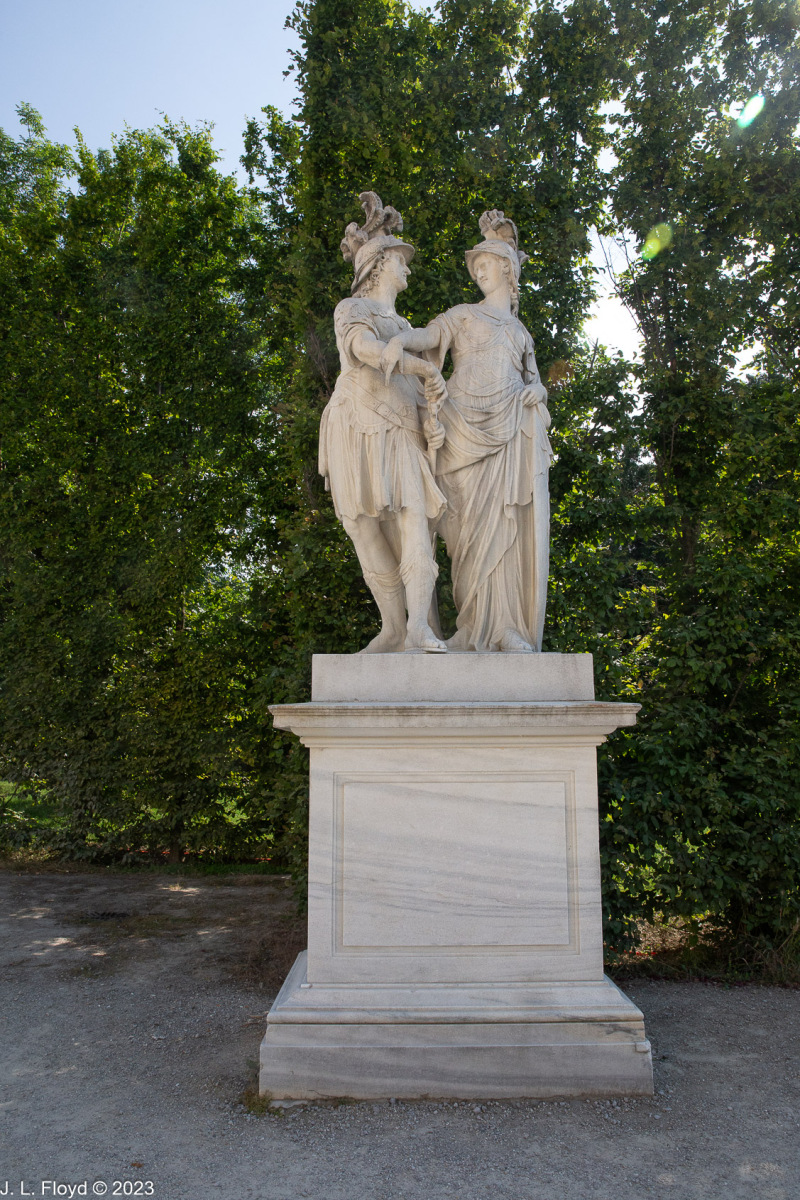
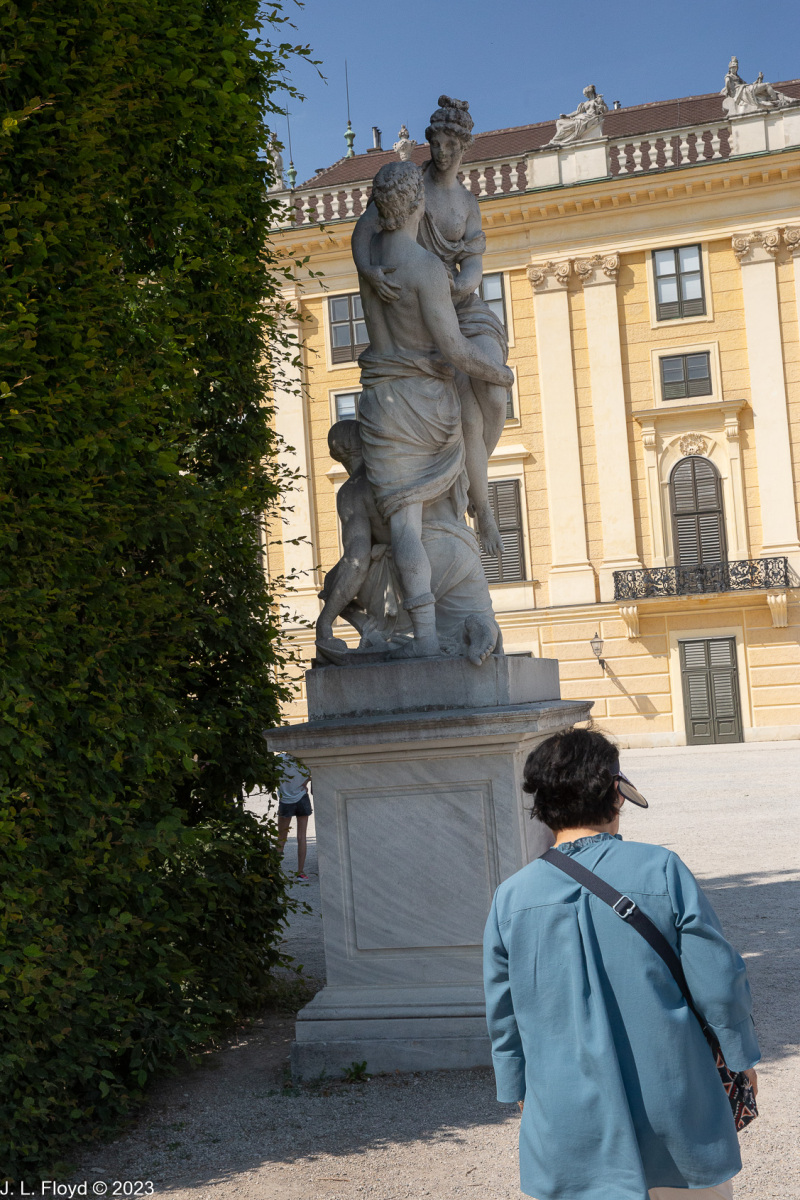
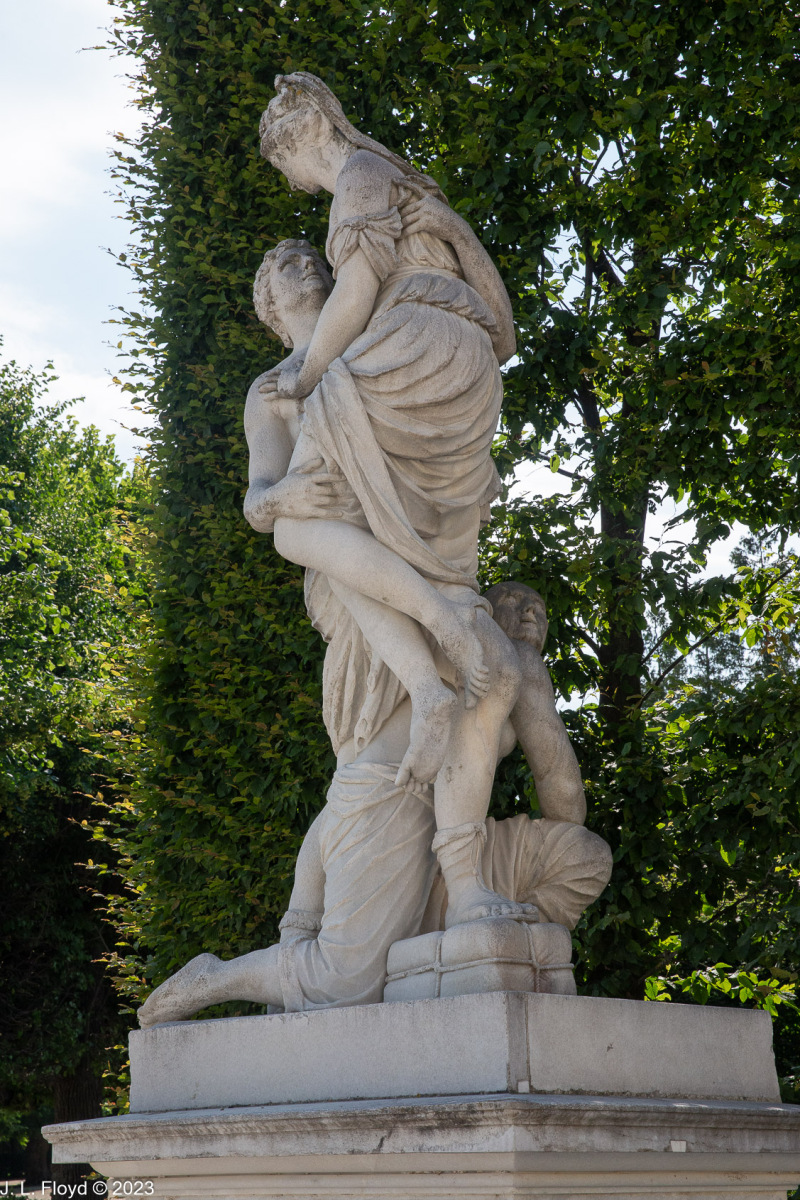
One of my favorite features of Schönbrunn was the many statues and sculptures in the palace park, most of them representing figures from classical Greek and Roman mythology. The hedges on either side of the Grand Parterre were lined with them. I was only able to photograph the closest of them, and I have included my favorites here.

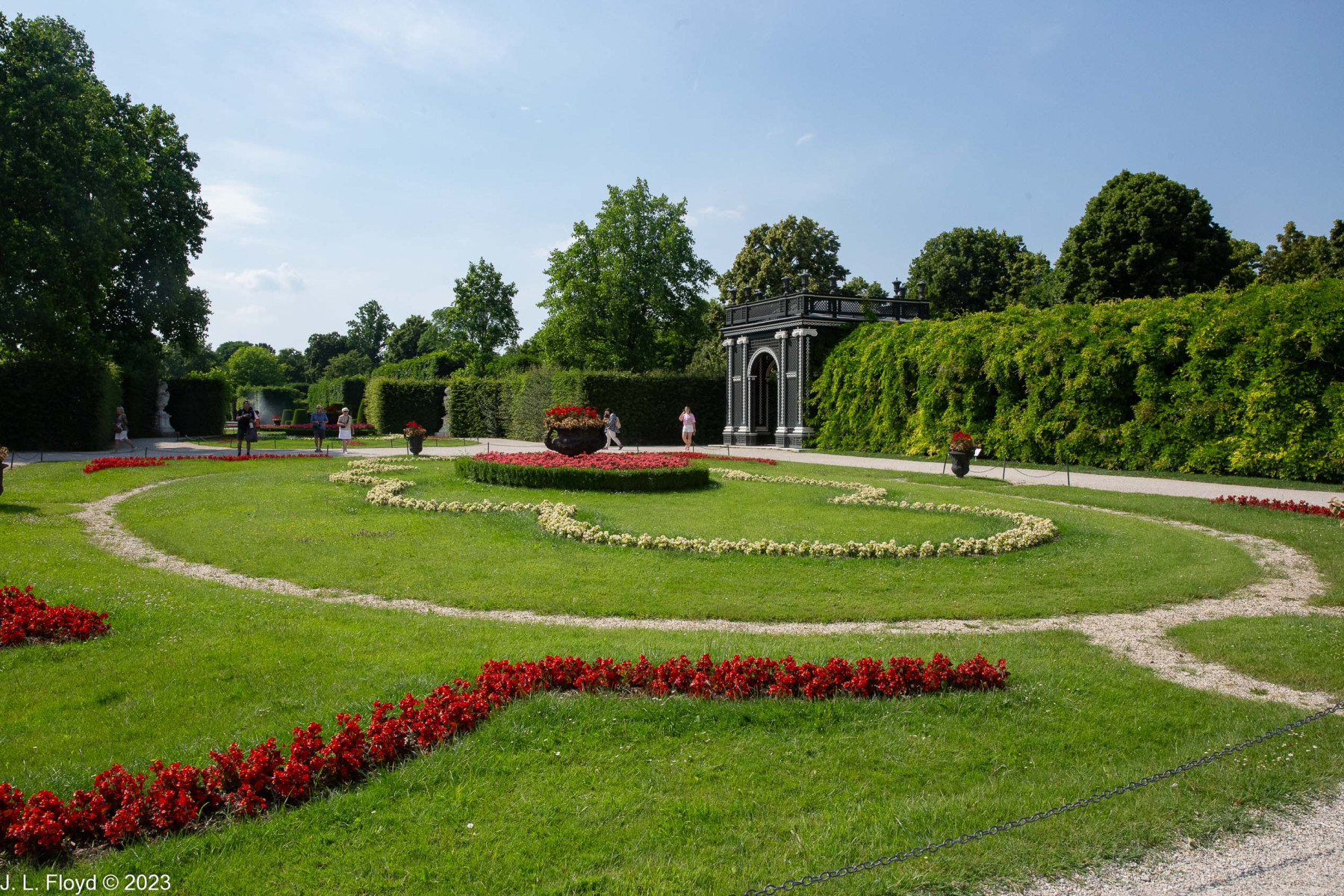
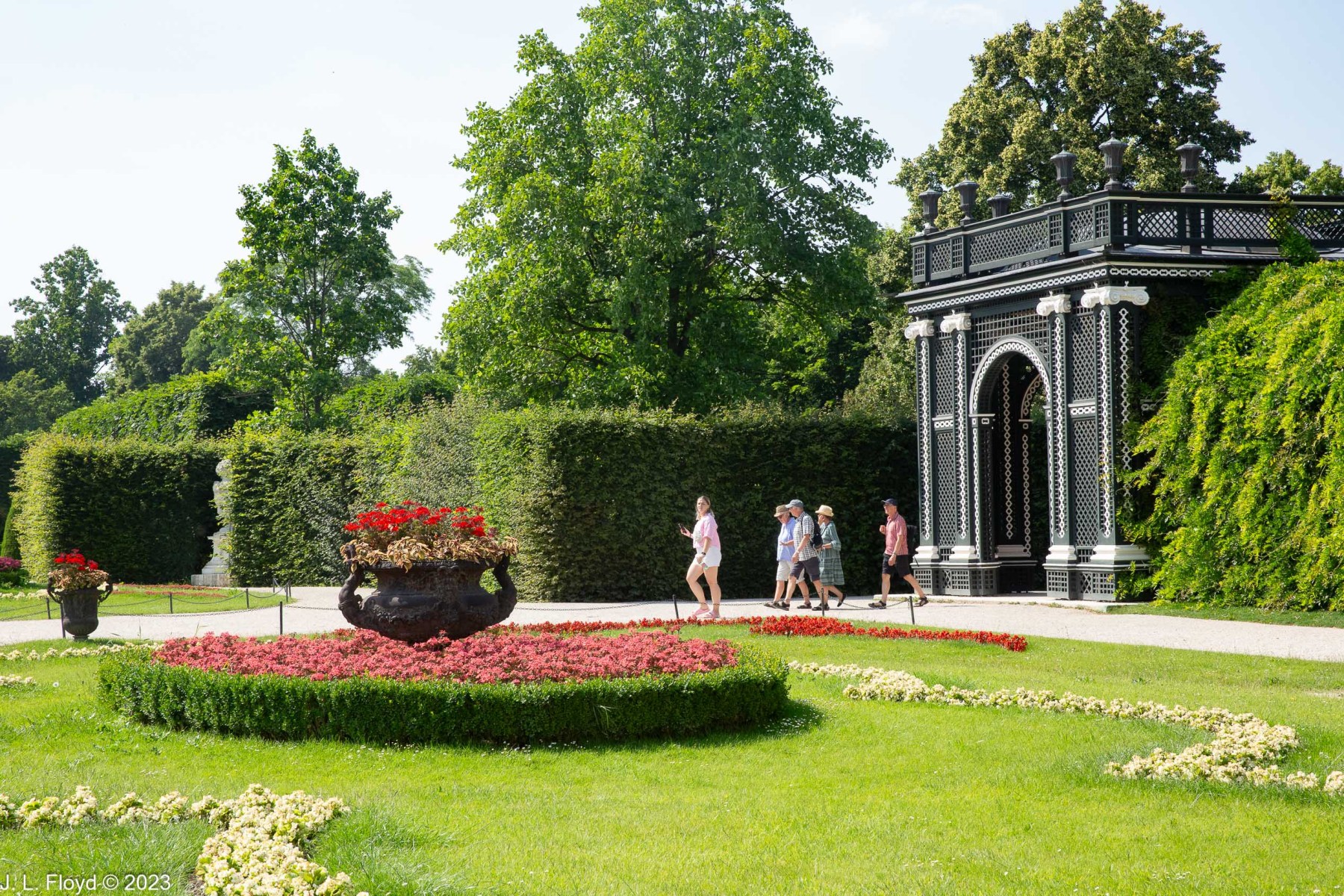
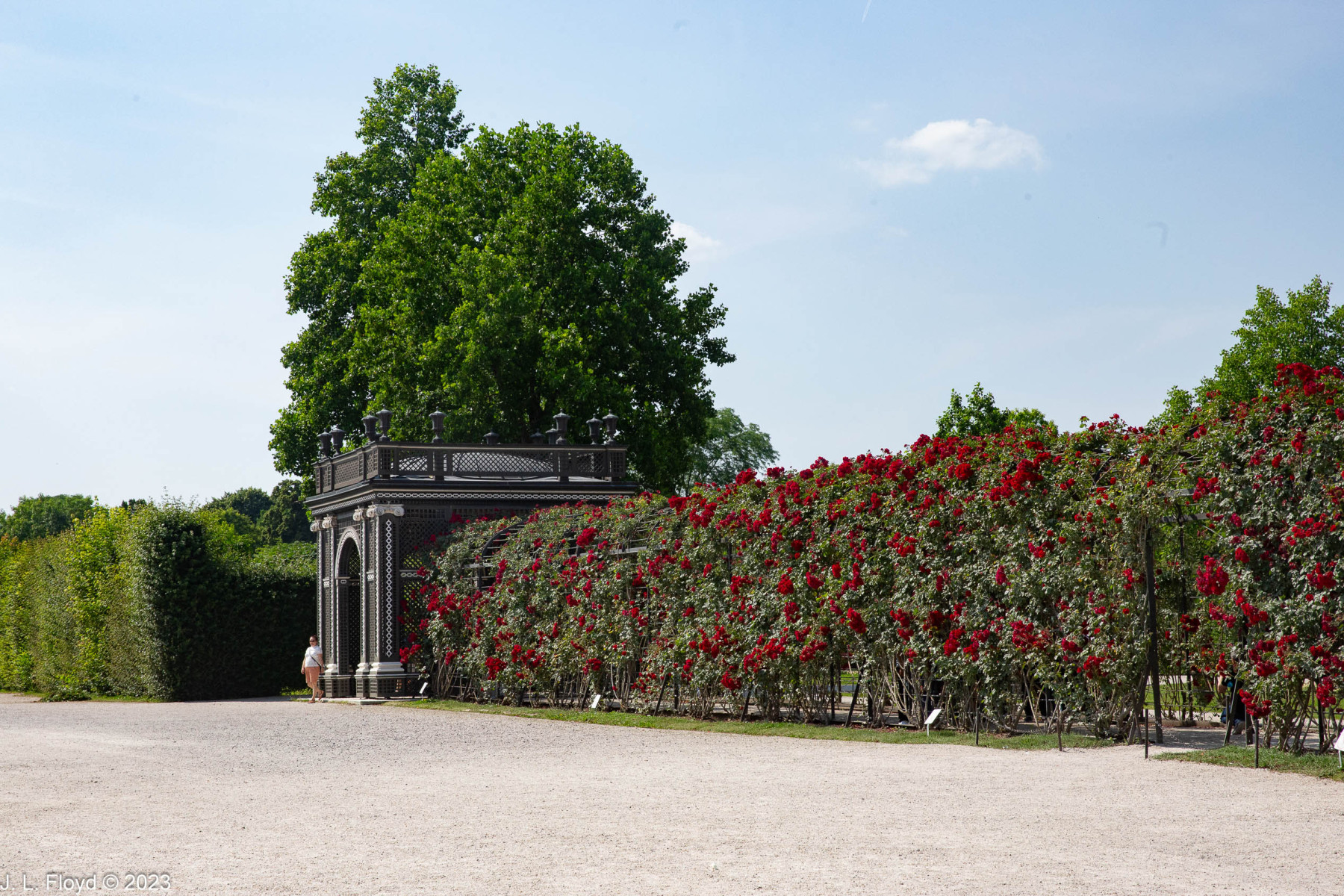
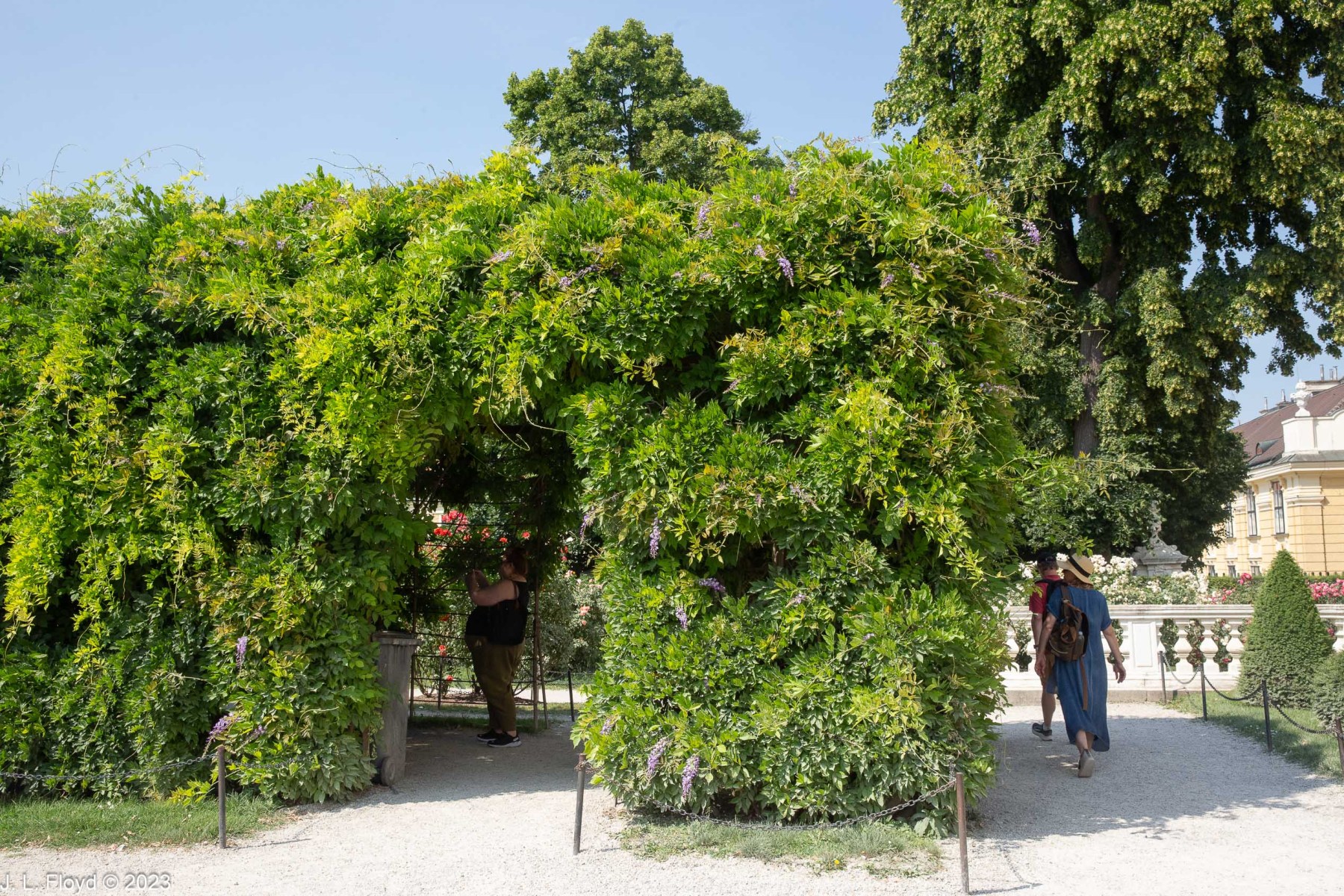
To the west of the Grand Parterre, among other attractions, is the Tiergarten, which claims to be the world’s oldest extant zoo. It was founded in 1752 by Maria Theresa’s husband, Franz Stephan. Out at the west end of the palace grounds is the Palmenhaus, a great greenhouse filled with exotic plants; the Wüstenhaus, or Desert House, another huge glass house filled with desert mammals, reptiles, birds and plants; the Setagayapark, and a Japanese garden, most of them established under Franz Josef in the late 19th century. I didn’t have time to visit any of these, but on my way back to the bus I was able to swing through the Rosarium, or Rose Garden, which is closer to the palace. It was a perfect day in June, the roses were in full bloom and it all made a superb venue for my final shots of Schönbrunn.

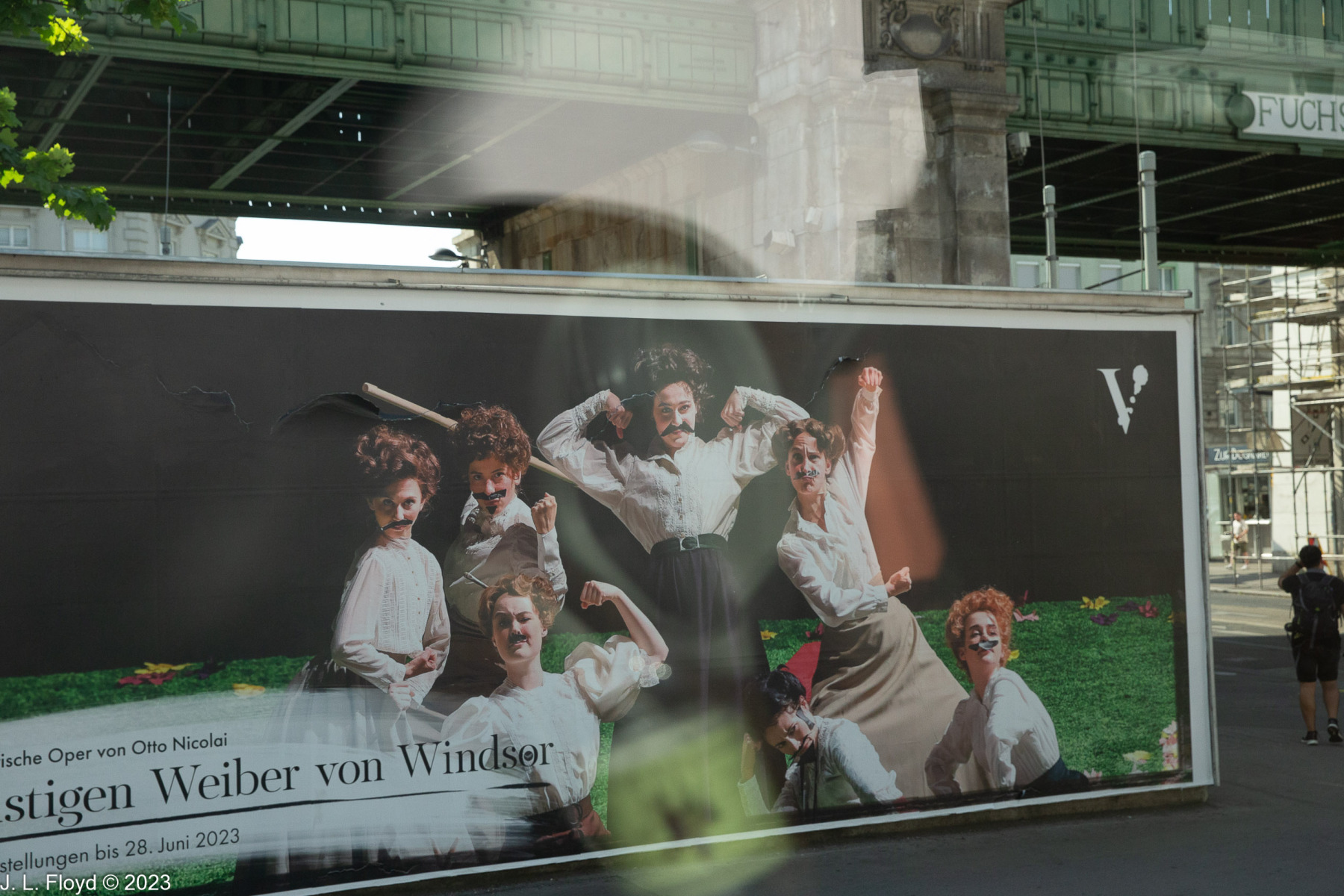
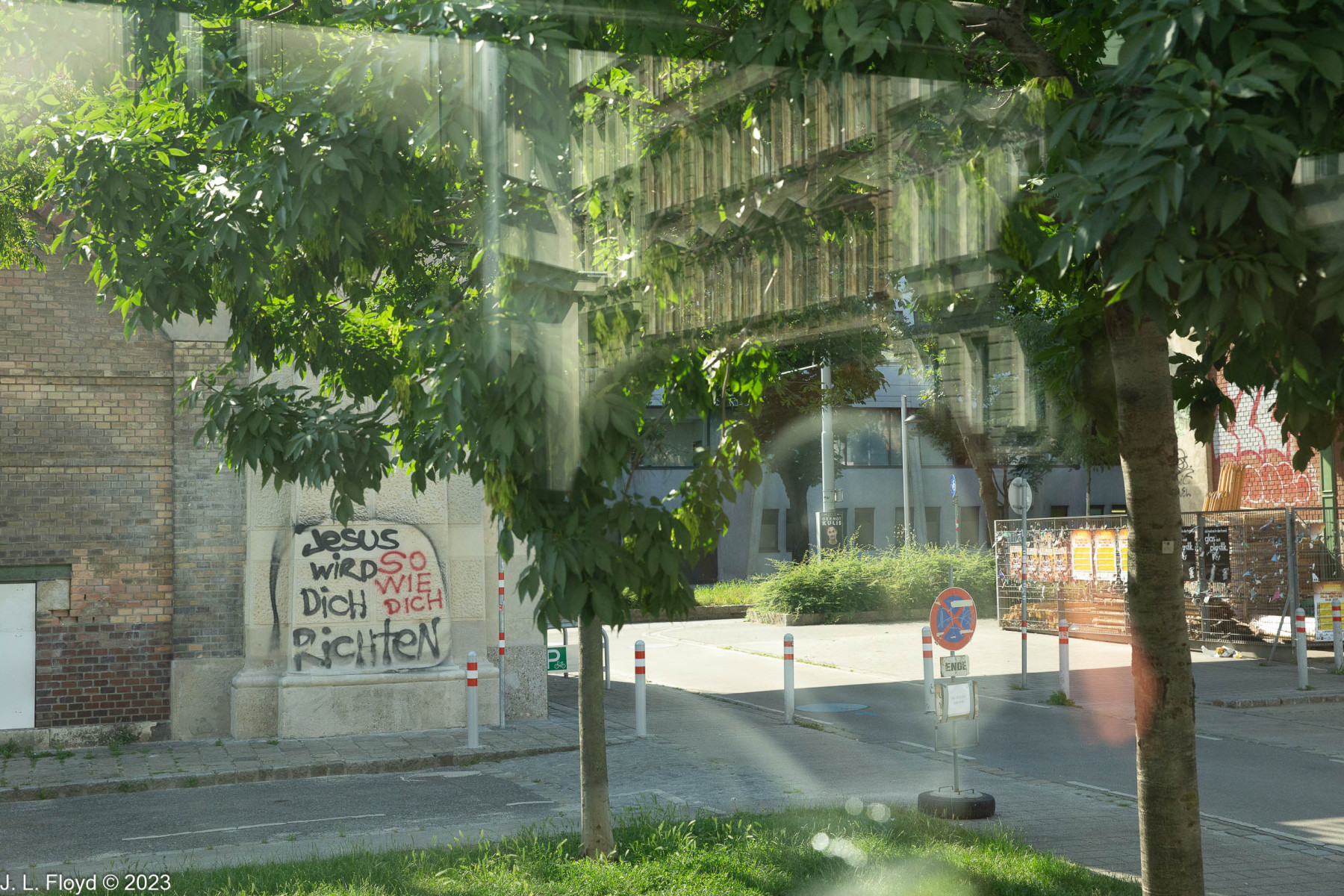
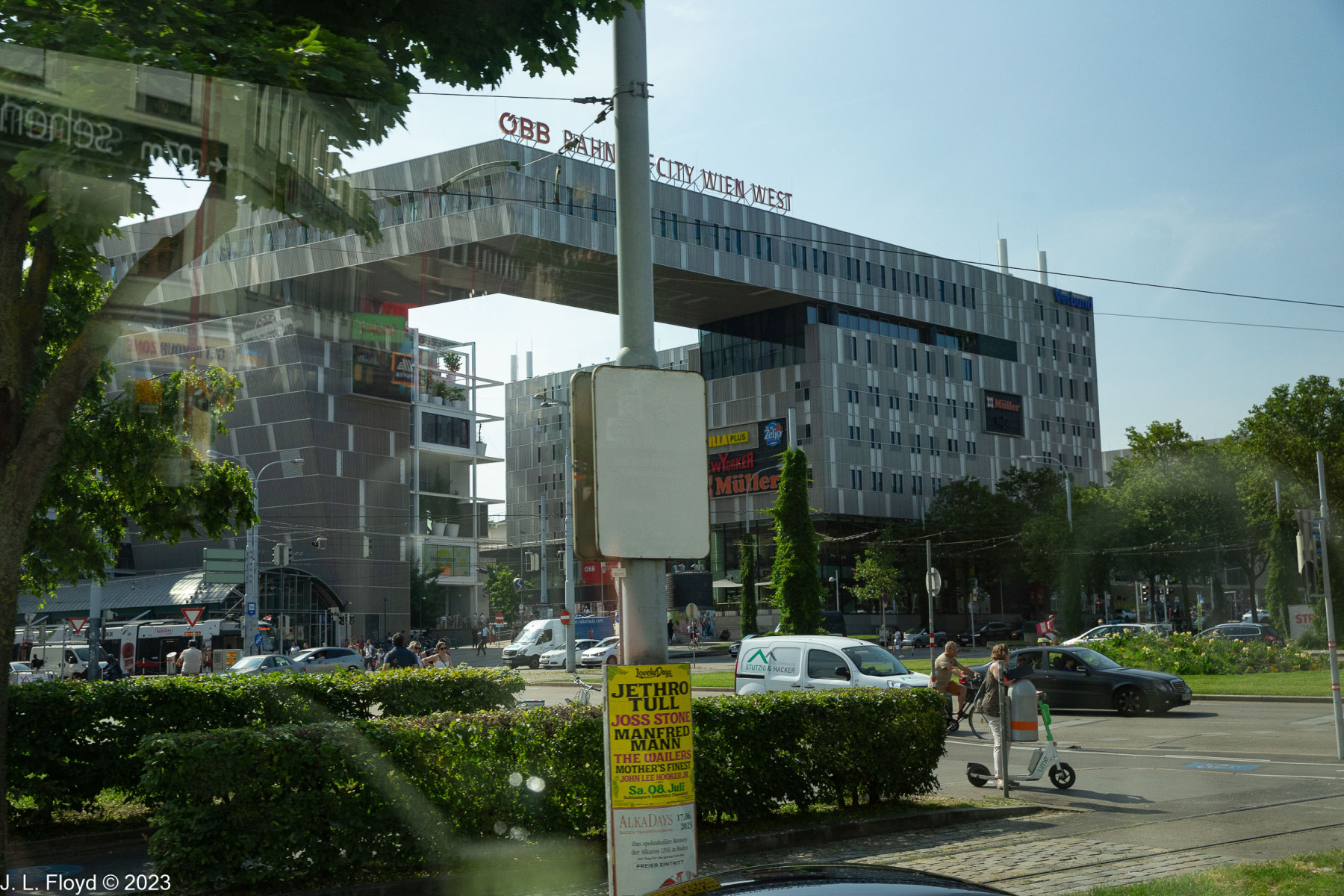
During the ride back to the Monarch Queen I attempted, mostly unsuccessfully, to shoot a few scenes from the bus. Nevertheless I have included a few of the pictures here to show some scenes of the outlying districts of Vienna.

This bus ride impressed upon me the extent of the graffiti problem in Vienna, which our guide had acknowledged earlier. The graffiti are far more profuse, and more visible, in the outlying districts than in the center, where I had never noticed any. It was a bit of a surprise to me because I had always thought of graffiti as mostly an American and southern European issue, not something shared by the disciplined and orderly Germanic peoples. But then the Austrians have always been considered by their northern brethren to be the least disciplined and most rowdy of the Teutonic tribes. (Now tell me that the graffiti craze has taken hold in Berlin, too….)

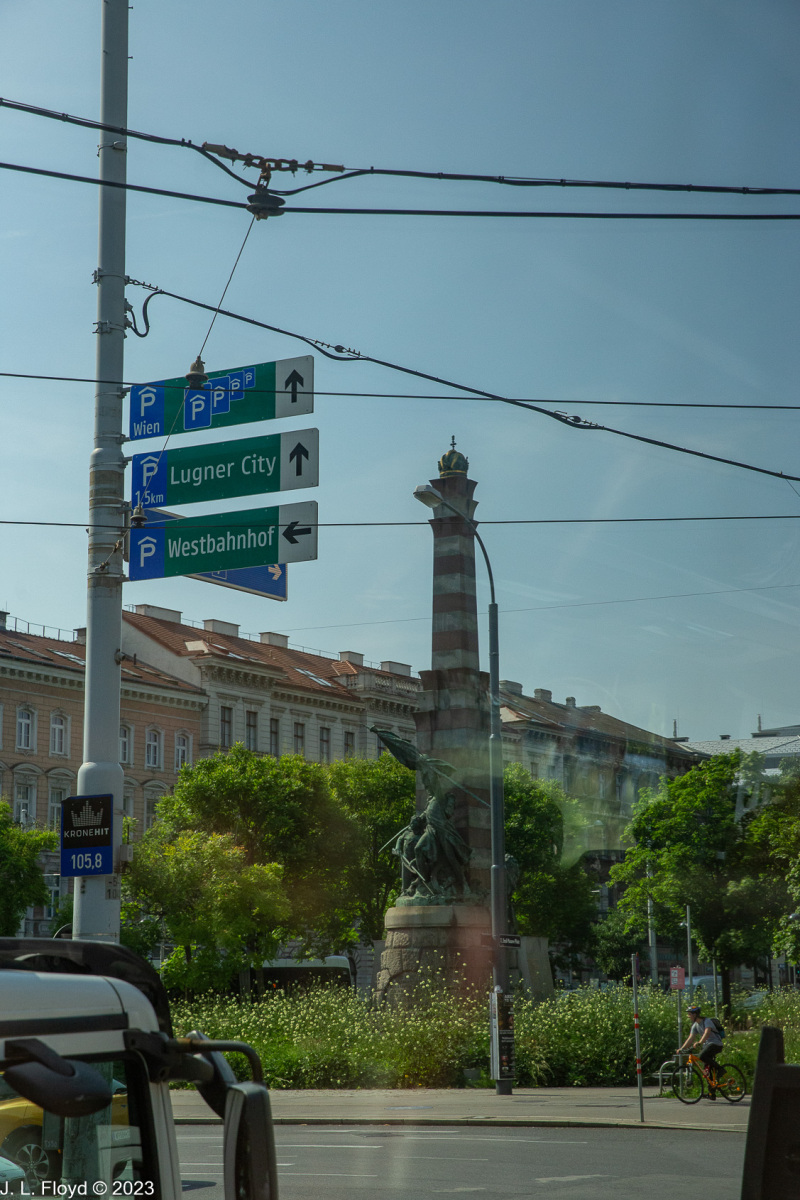
On the way back to the Monarch Queen we also passed the Wien Westbahnhof, or Vienna West Station, which for years was the main railway station of Vienna, until the advent of the new Wien Hauptbahnhof (Vienna Central Station) in 2015. Now the Westbahnhof is mainly a commuter station, though it also serves an intercity rail service from Salzburg. At the time I thought that the Westbahnhof was the striking building shown in the pictures here, but subsequently I discovered that it is actually associated with the BahnhofCity project, a development completed in 2011, and that it is an office building and shopping center; the railway station is hidden behind it in my pictures. Also not seen is an establishment called MotelOne, a colossal hotel flanking the other side of the Westbahnhof. Regardless, the BahnhofCity building with its unsupported upper-story corner section is one of the most unusual structures I encountered and well worth a picture. A better picture of the BahnhofCity complex on Europaplatz can be found on the Westbahnhof web page.

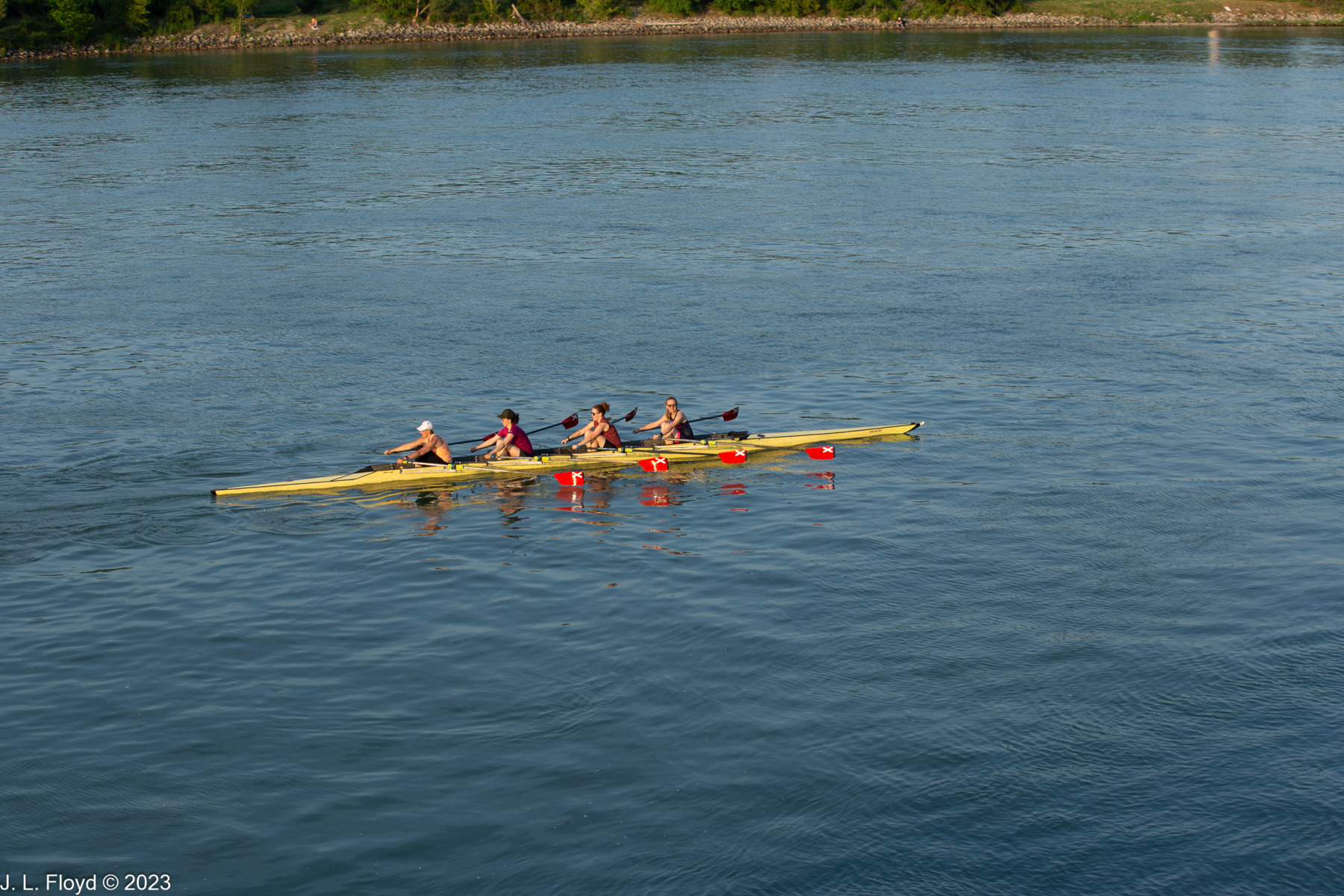
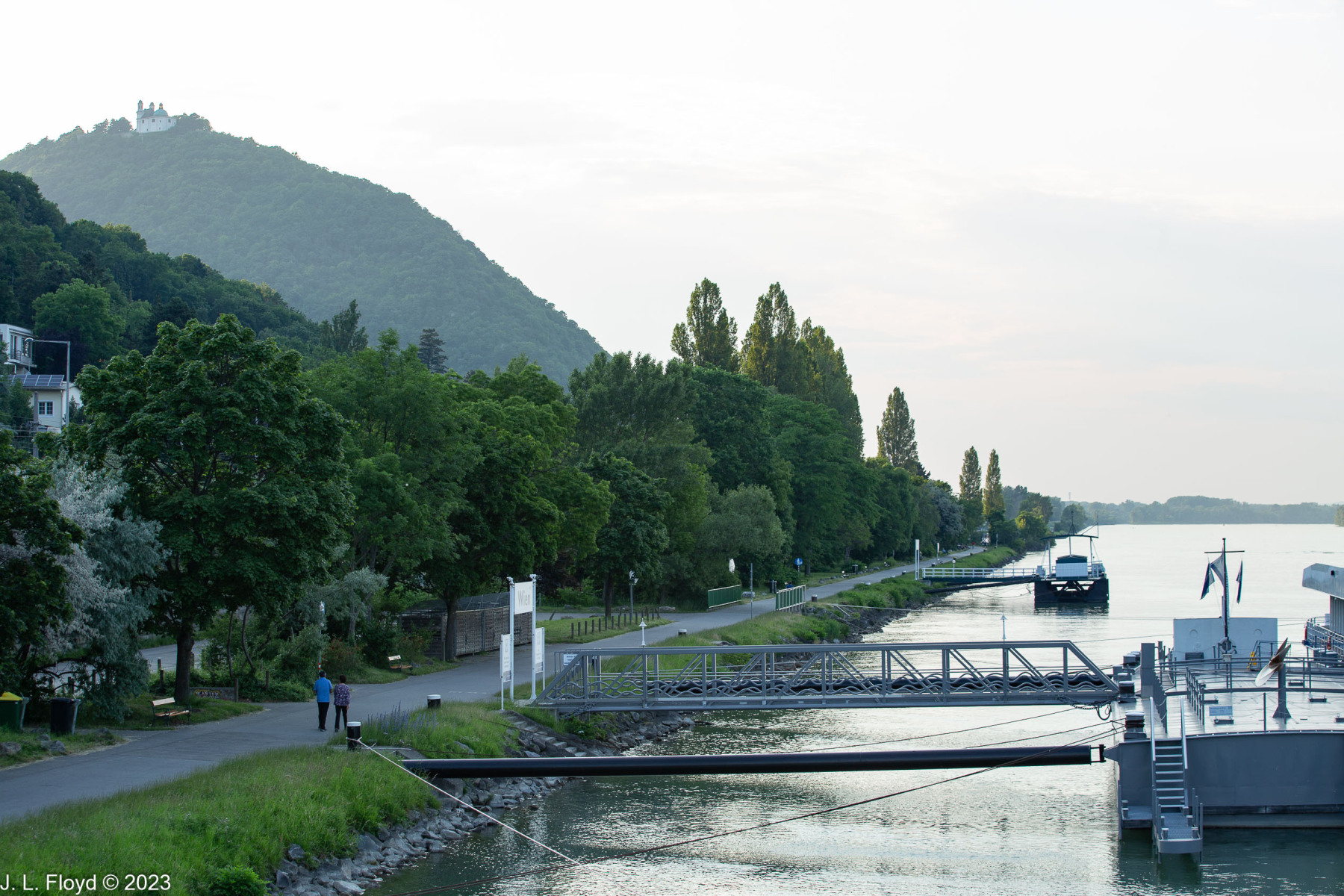
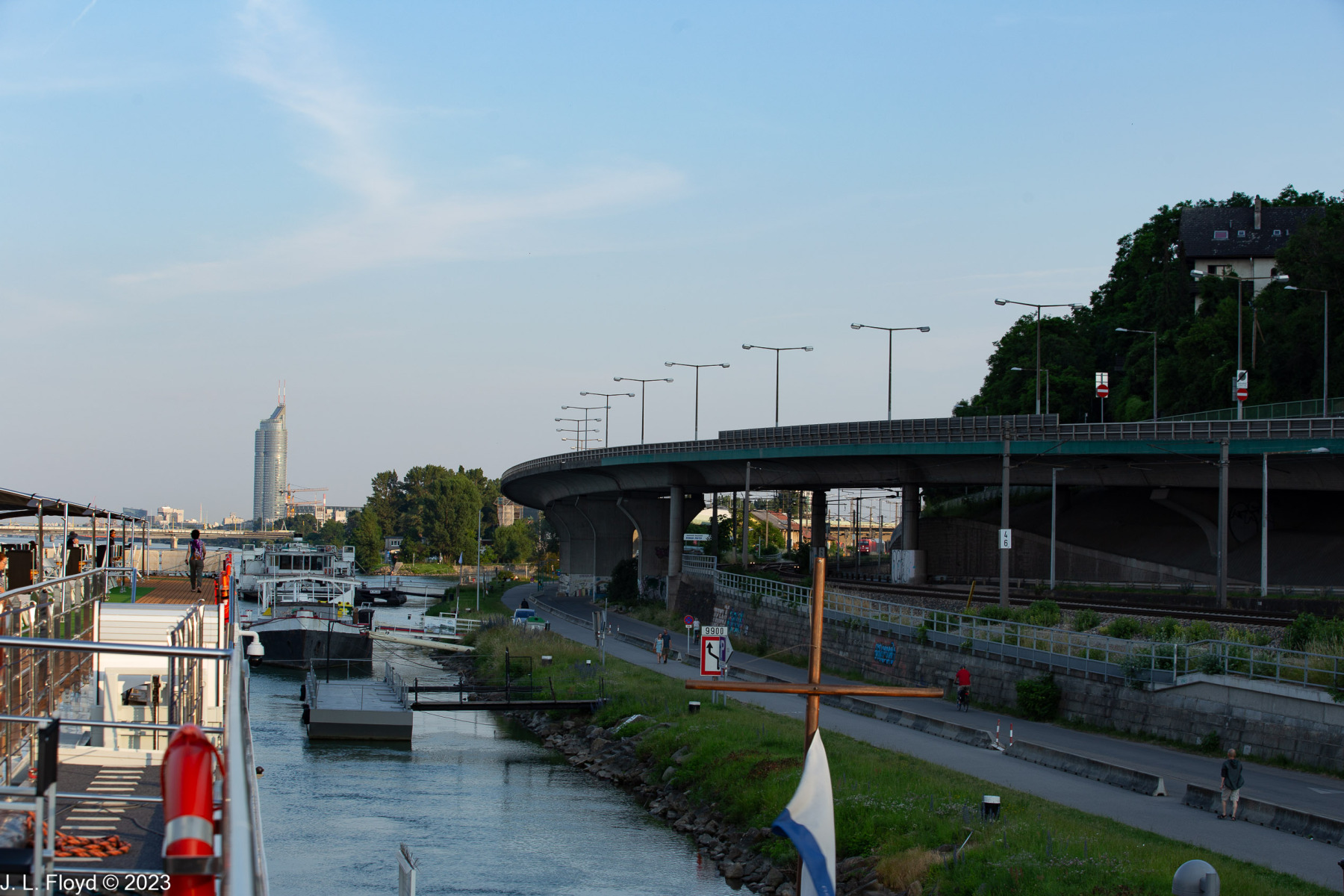
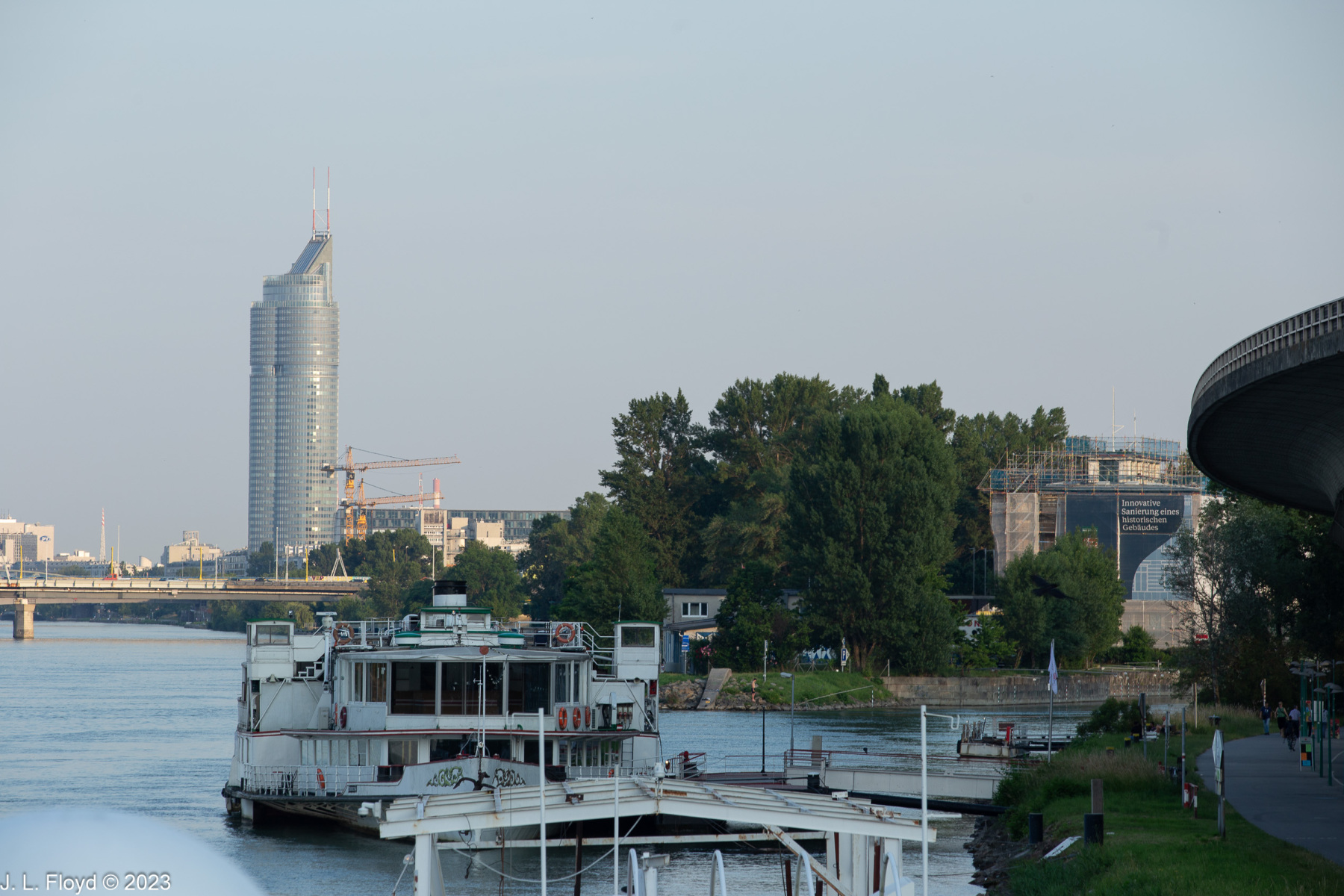
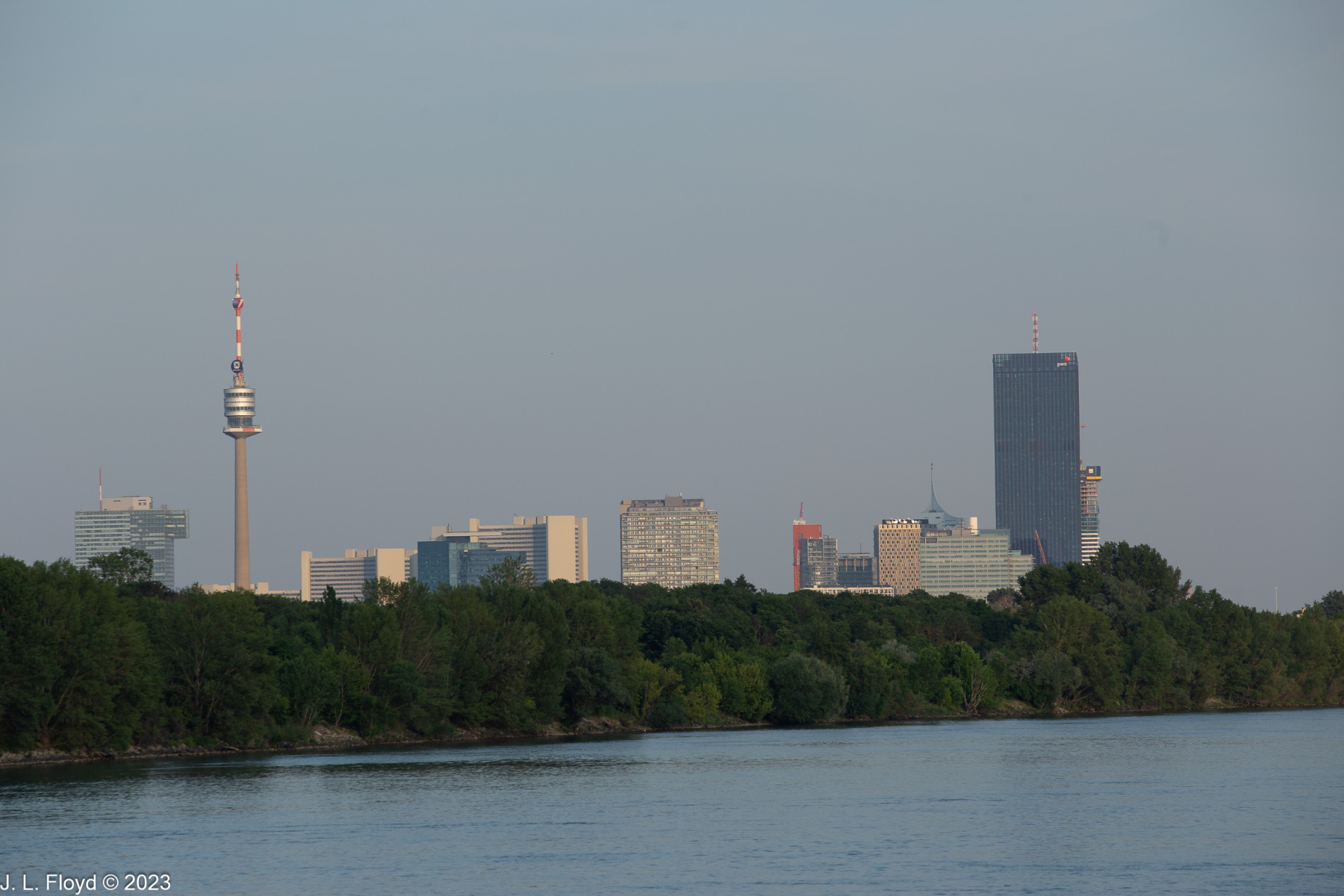
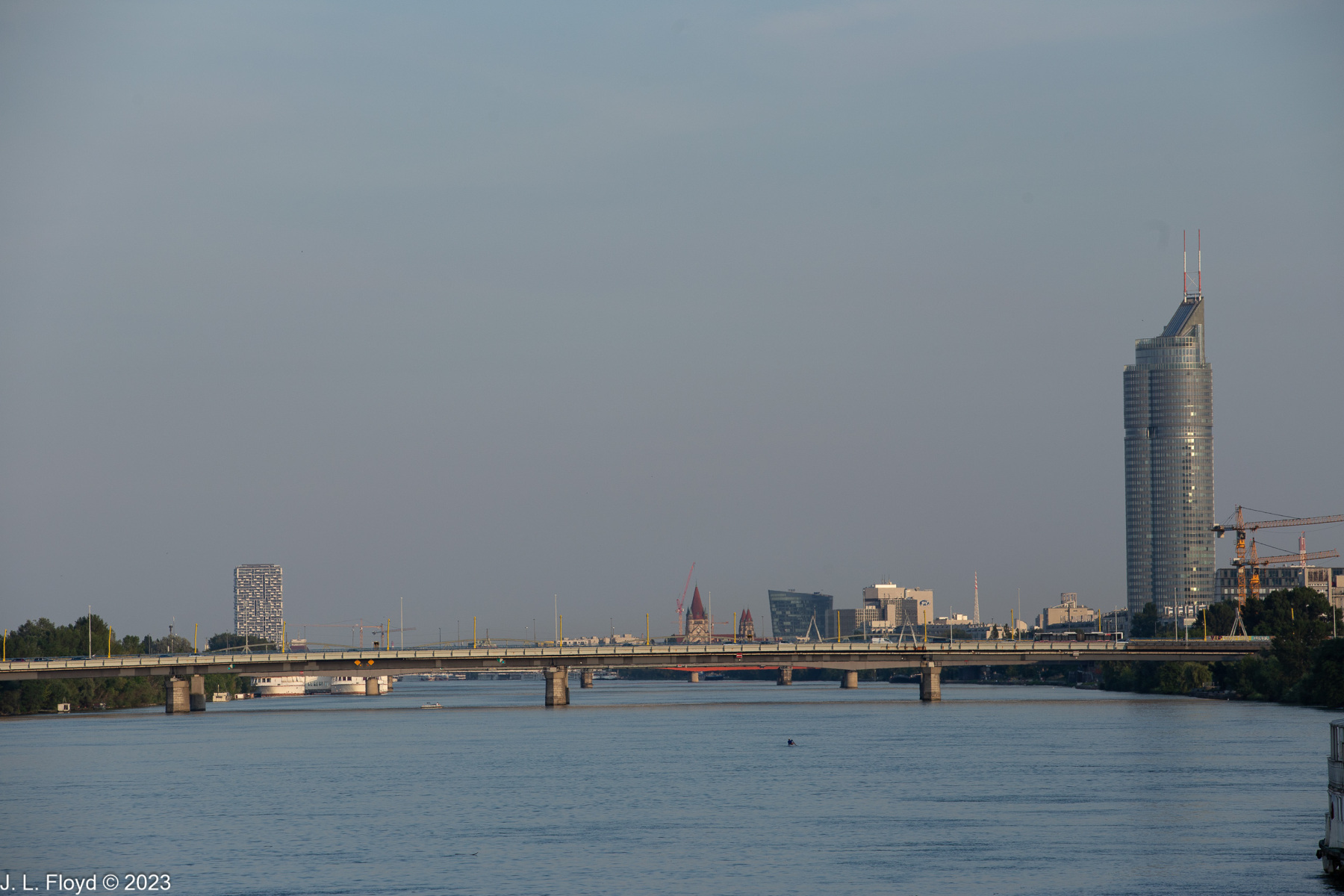
Back on the ship, I retrieved my 70-200 telephoto lens and used the remaining daylight hours to shoot a few scenes of the dock area and the river. The banks of the Danube in Vienna are a bustling area, and I was able to capture a wide variety of scenes, including some of the towering Vienna skyscrapers which I had not noticed earlier.

That was my last look at Vienna, which we had only a day to see. As with every place we went in Europe, this visit only whetted my appetite for a longer stay.

That night we started on our voyage upriver to the Wachau Valley, the subject of the next couple of posts.

Categories
Danube River Cruise, June 2023

Vienna – June 19, 2023

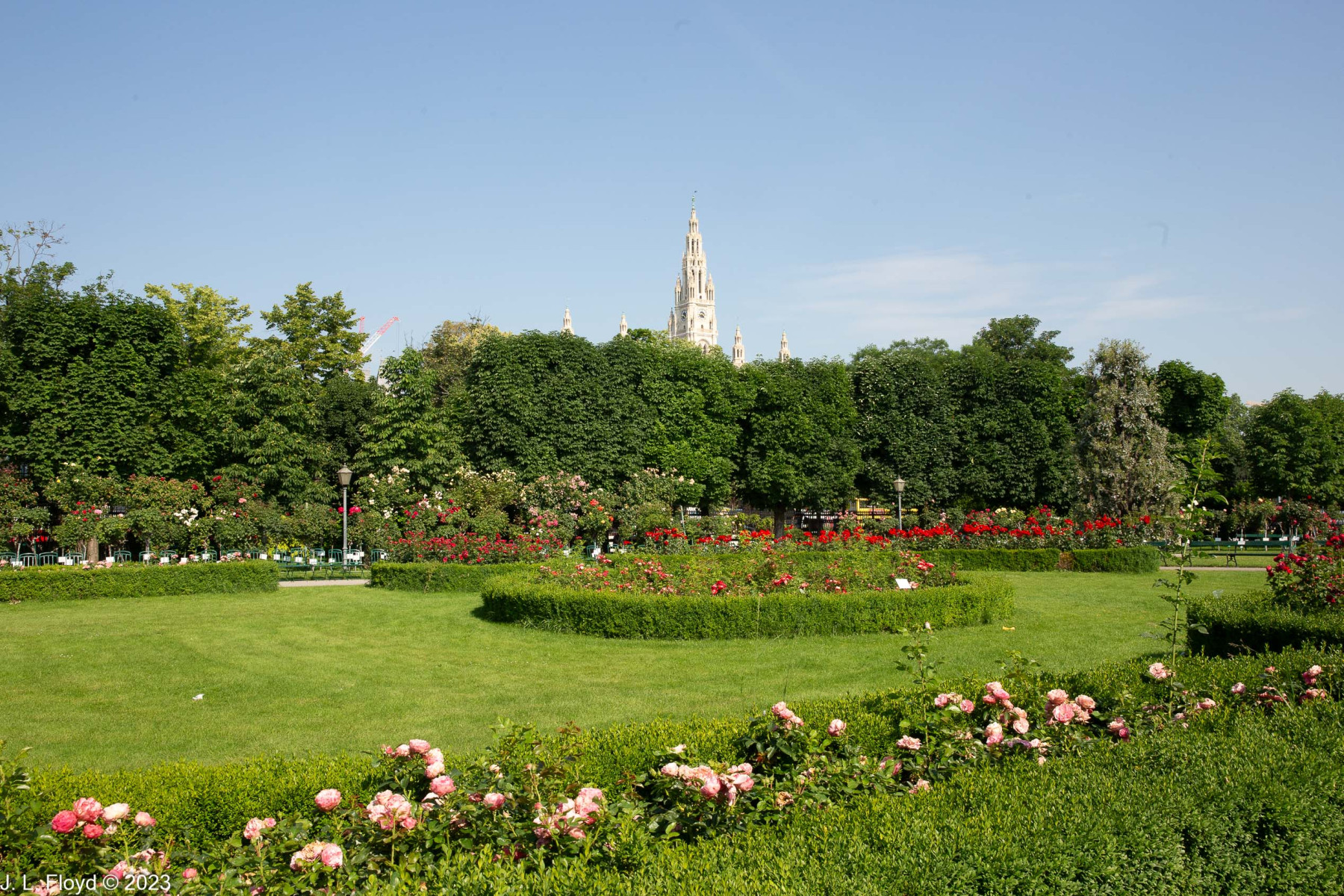
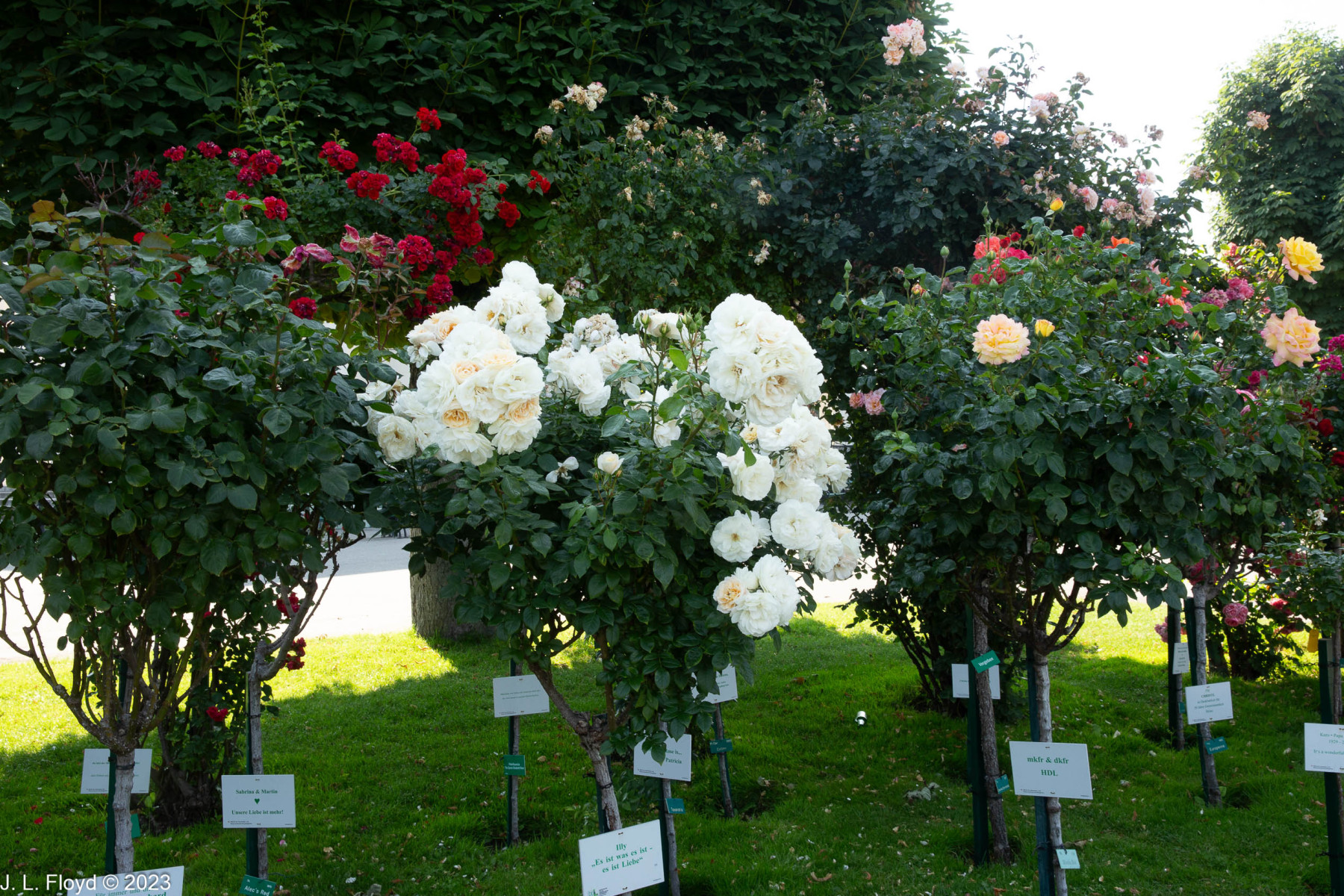
Our first stop in Vienna was to visit a garden. It was called the People’s Garden (Volksgarten), and since we were people, we found it quite suitable for a pleasant stroll.

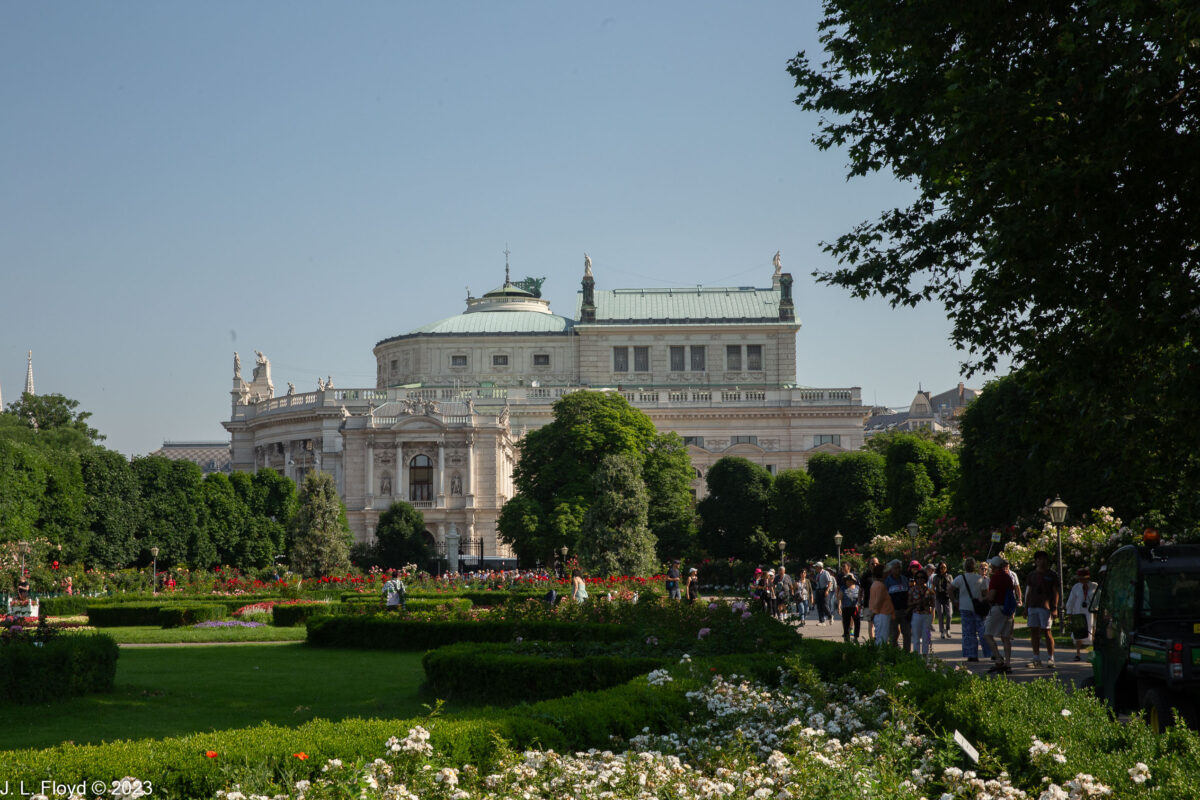
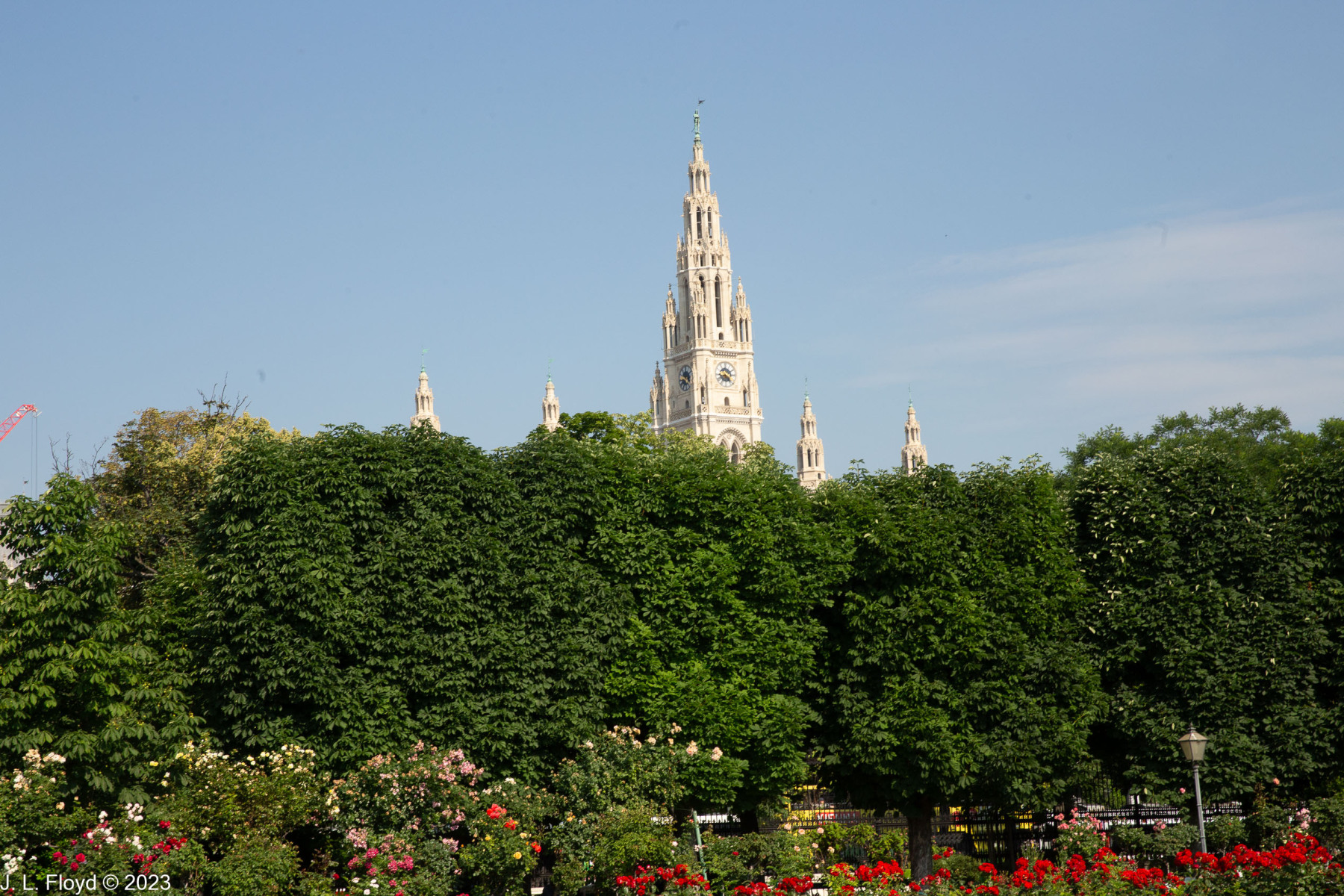
But the Volksgarten is set among and within walking distance of some of the chief landmarks and main attractions of Vienna. As soon as we got off the bus we began to encounter them. There was the neo-Gothic Votivkirche, which we could see over the treetops of the Volksgarten, and the Burgtheater, formerly the theater of the Imperial Court and now the national theater of Austria.

There is an interesting bit of history behind the Votivkirche. On February 18, 1853, a Hungarian nationalist attacked the Austrian Emperor, Franz Josef, with a knife as he was strolling on his palace grounds, which now constitute the Volksgarten. The Emperor was only wounded, and his companions quickly subdued the assailant. The Emperor insisted that the would-be assassin not be mistreated as he was led away to his execution. Franz Josef also granted a small pension to the assailant’s mother. After this incident the Emperor’s brother, Maximilian (later Emperor of Mexico), proposed that a new church be built on the site of the assassination attempt, as a votive offering in thanks for the preservation of the sovereign’s life. Construction of the church, which has the typical form of a Gothic cathedral, was begun in 1856, but it was only completed in 1879. By then Maximilian himself had been executed for being Emperor of Mexico.

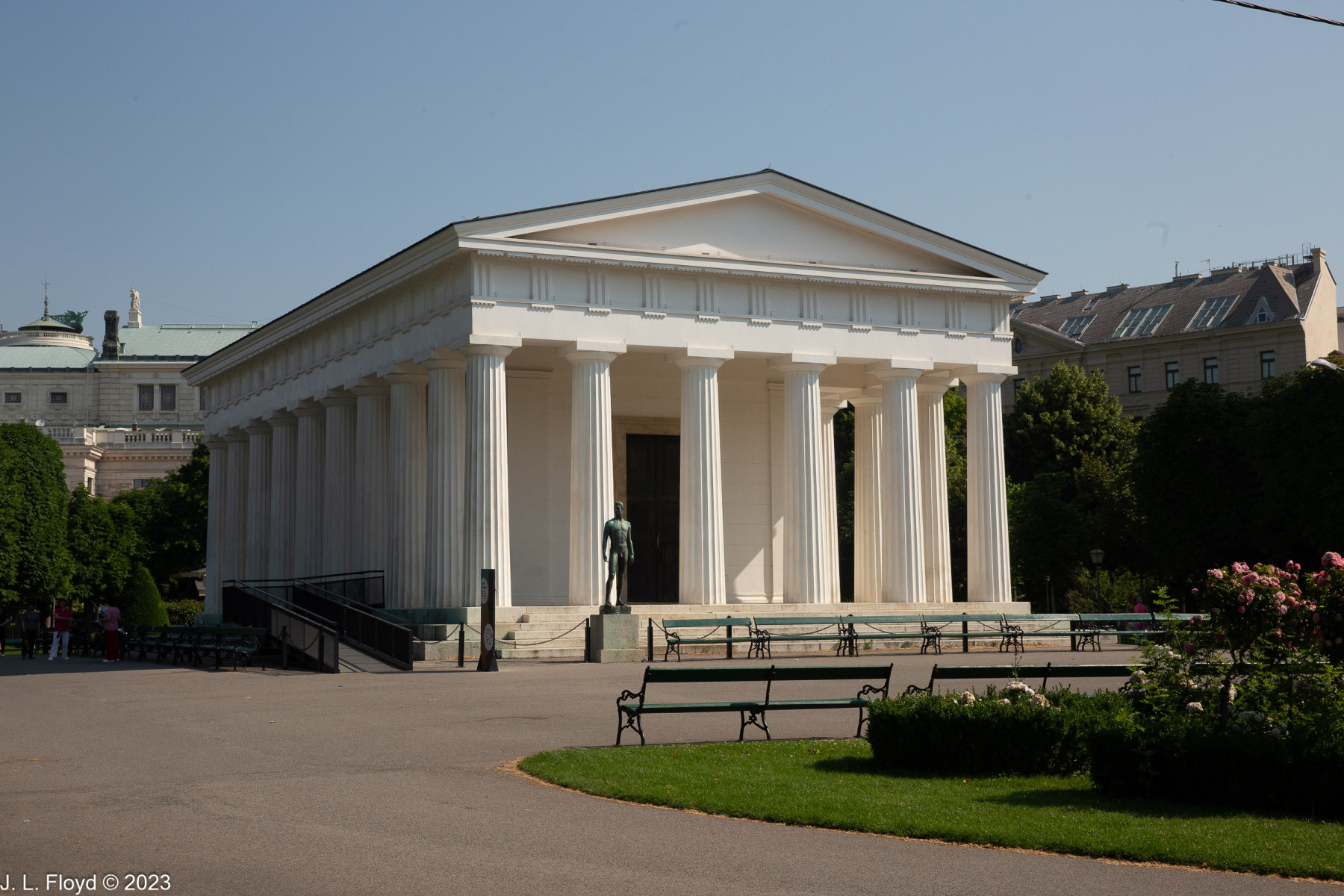
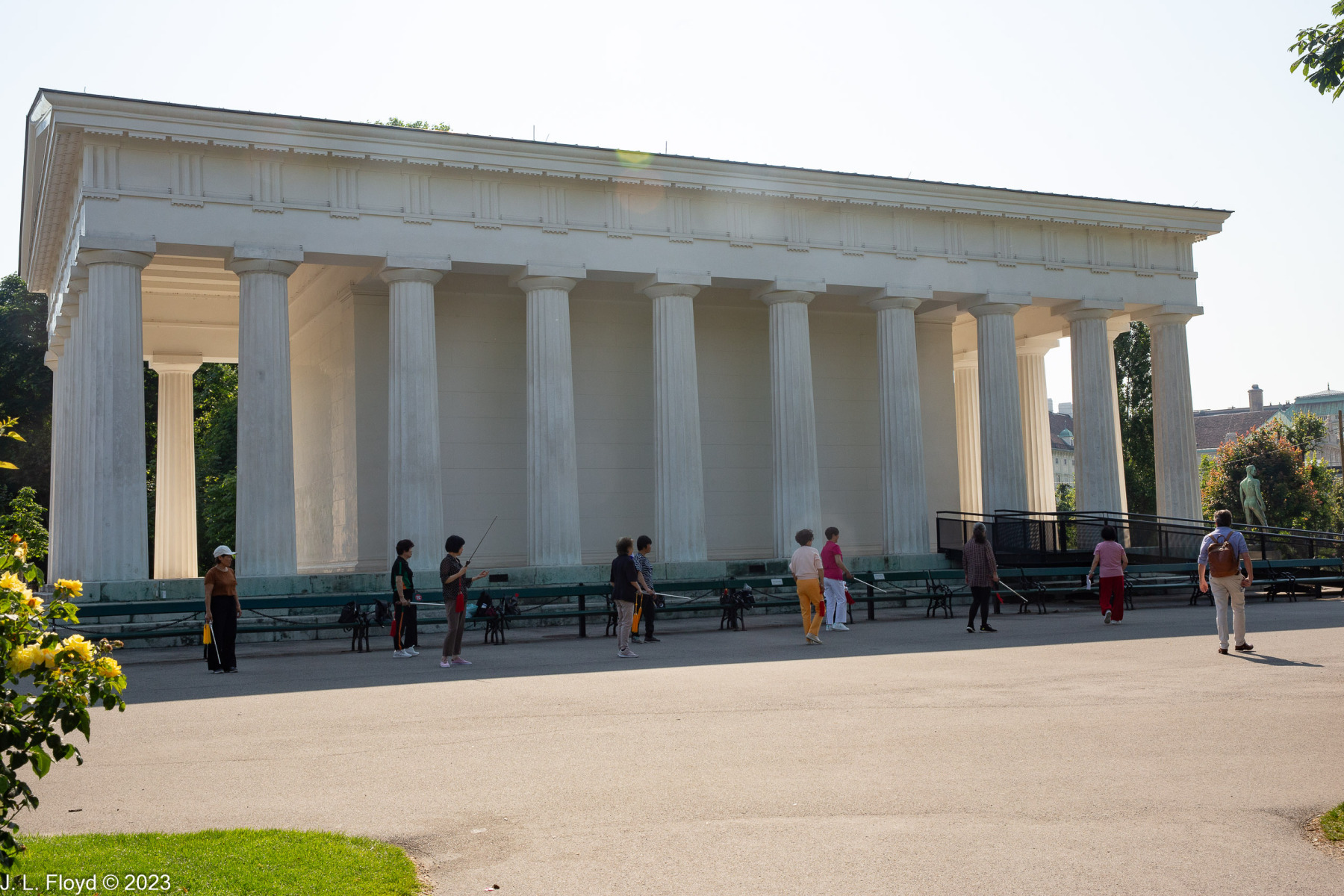
As we ambled our leisurely way through the gardens, we came across the Theseum, or Temple of Theseus, built in 1829 and modeled after an Athenian temple completed in 418 BCE. It was originally intended to hold a single sculpture, a depiction of Theseus battling the Minotaur by Antonio Canova, but nowadays it operates as an art gallery of an unusual sort: a single work of art is exhibited for a limited time and then swapped out for a different one. The original Canova sculpture is now in the Kunsthistorisches Museum elsewhere in Vienna, which also operates the Theseum.

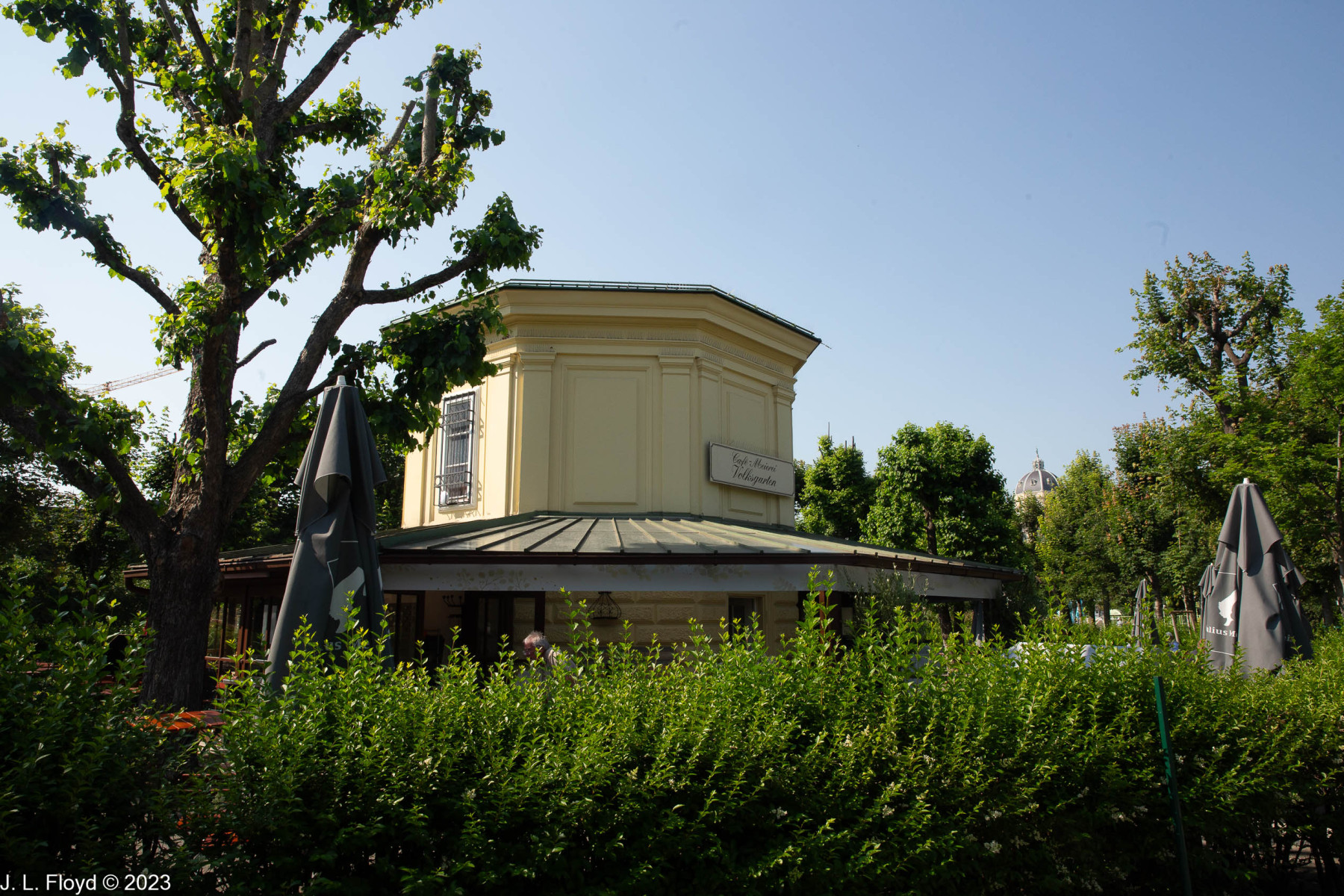
A little further on we encountered a pretty little café, almost hidden away in the trees, called the Stelldichein Meierei im Volksgarten. “Stelldichein” has the connotation of a trysting place for lovers. It seemed like a great place to stop for coffee and a pastry, but our schedule did not allow for it and, in any case, the place gets very mixed reviews, as I later found from online research.

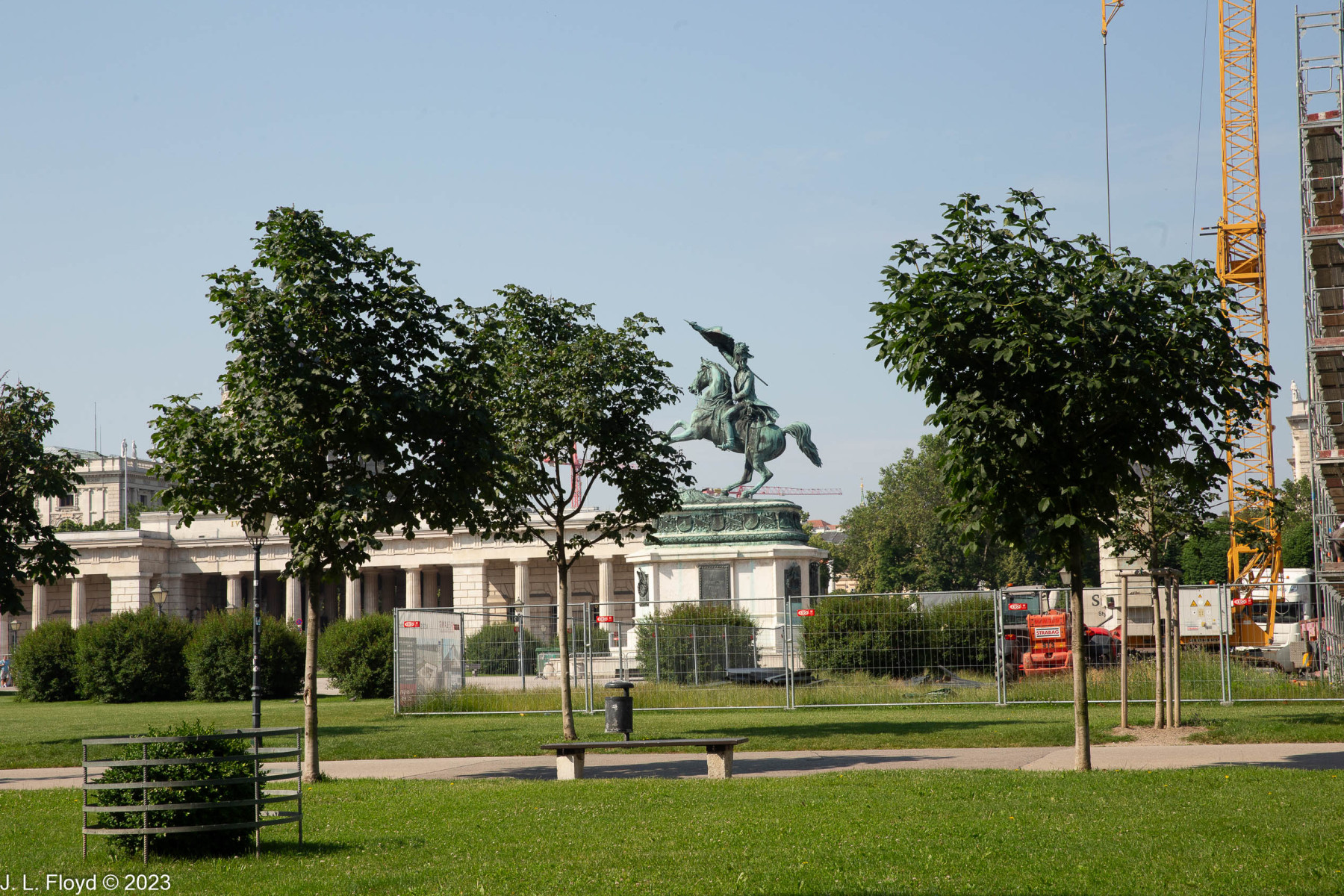
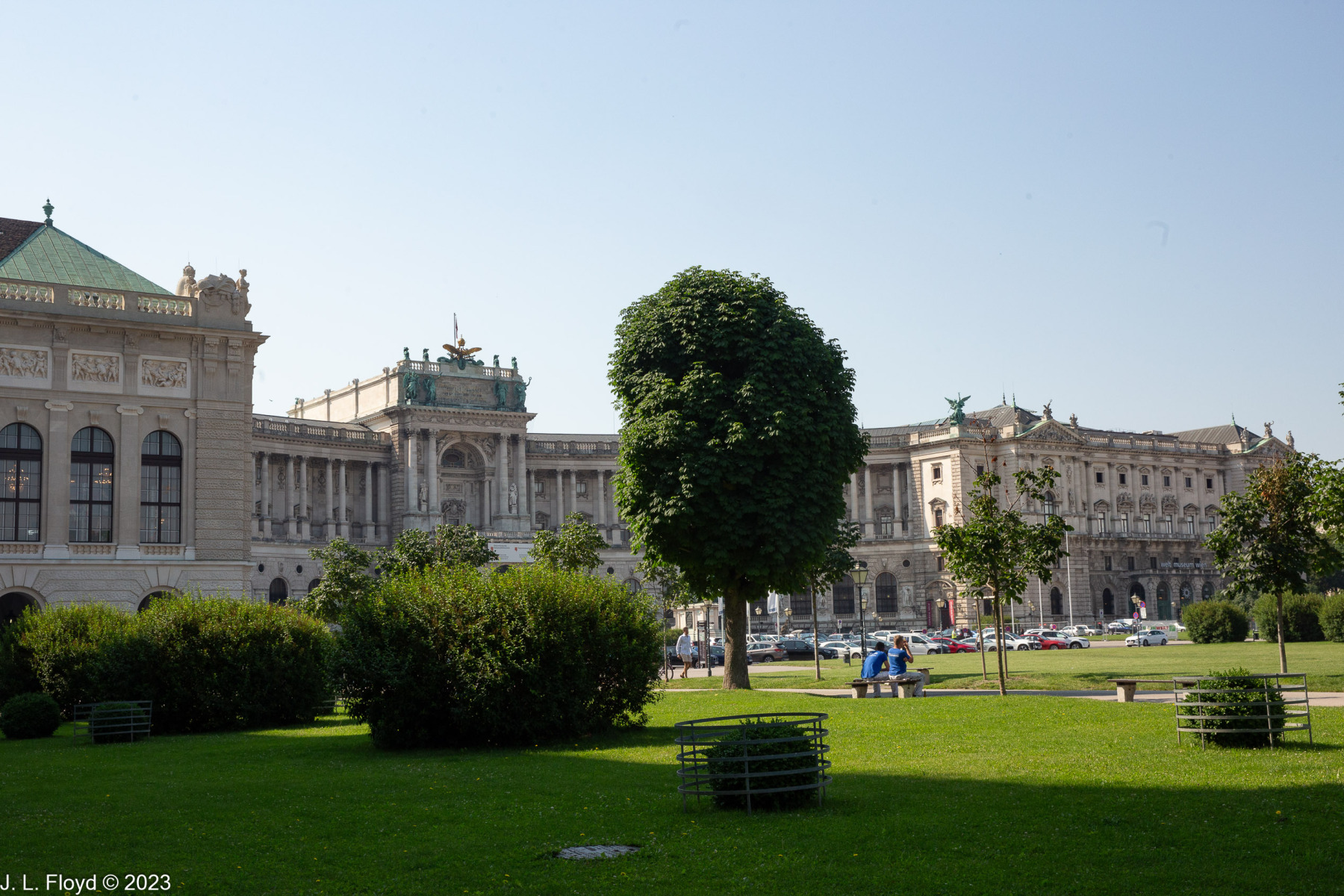
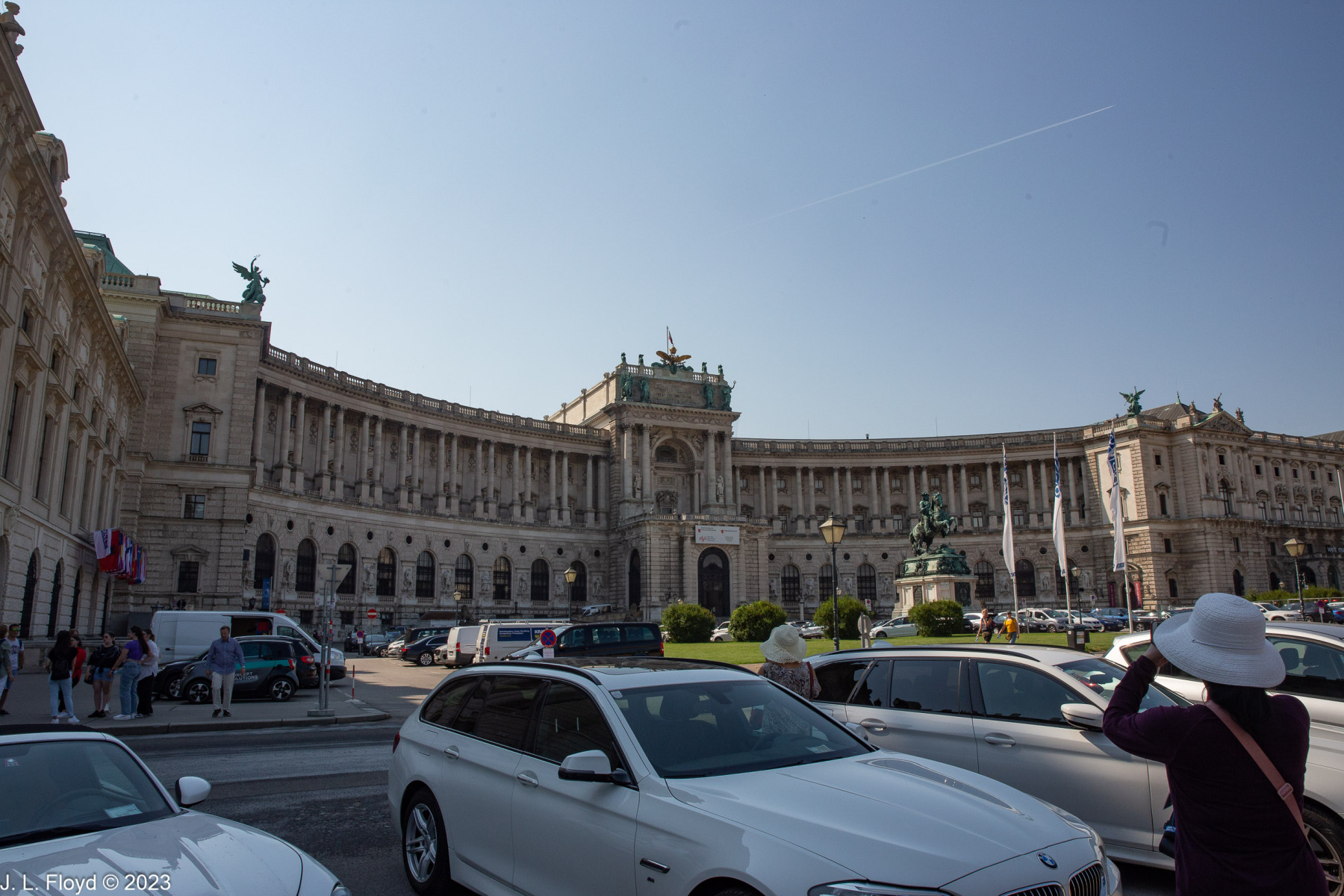
We were slowly making our way toward the Hofburg, the huge main palace of the Austrian emperors, at the eastern end of the Volksgarten. Out in front of the palace is an area called the Heldenplatz (Heroes’ Square), where a couple of equestrian statues stand. One is of Prince Eugene of Savoy, the great general who led the Habsburg armies against the Turks and later partnered with John Churchill, the Duke of Marlborough, to foil Louis XIV’s schemes to establish French dominance in Europe. We had already met Eugene in Budapest, so I won’t dwell on him here. The other equestrian statue is a memorial to Archduke Karl von Österreich-Teschen, brother of Emperor Franz I, who less successfully commanded Austrian armies against the forces of Napoleon a century later. He actually inflicted the first defeat of Napoleon in a major battle, that of Aspern-Essling, in May 1809, but two months later, in July 1809, he was in turn defeated by the French emperor in the bloody Battle of Wagram, which forced the Austrians to ask for an armistice.

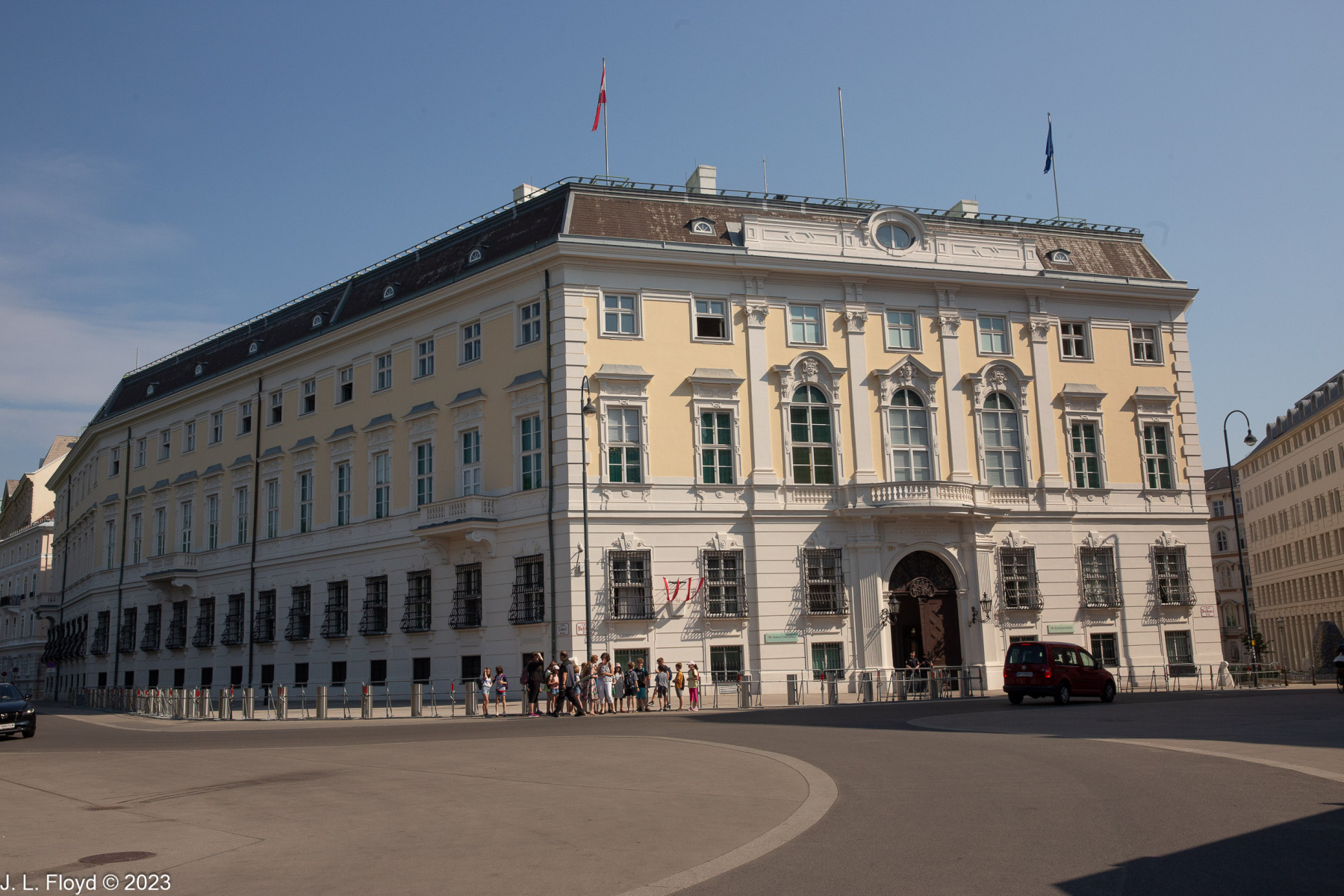
From the Heldenplatz I was able to photograph a building on the Ballhausplatz, a little way off to the northeast, which houses the Bundeskanzleramt, the Federal Chancery of the Austrian Republic. This is a historic structure which was originally constructed in 1719 and for two hundred years has been the official residence of the senior Austrian cabinet minister, formerly the Imperial Chancellor, now the Chancellor of Austria, Austria’s equivalent of a Prime Minister. Among its noteworthy occupants was Chancellor Klemens von Metternich, and it was there that he convened the Congress of Vienna, which made the dispositions that reordered Europe following the defeat of Napoleon in 1814. The Ballhausplatz, as the chancery building is usually referred to, was also the scene of the murder of Austrian Chancellor Engelbert Dollfuss by the Nazis in 1934, and of the resignation of Chancellor Kurt von Schuschnigg prior to the Anschluss, the Nazi-engineered merger of Germany and Austria in 1938. The President of the Austrian Republic, its official head of state, has offices in the Hofburg.

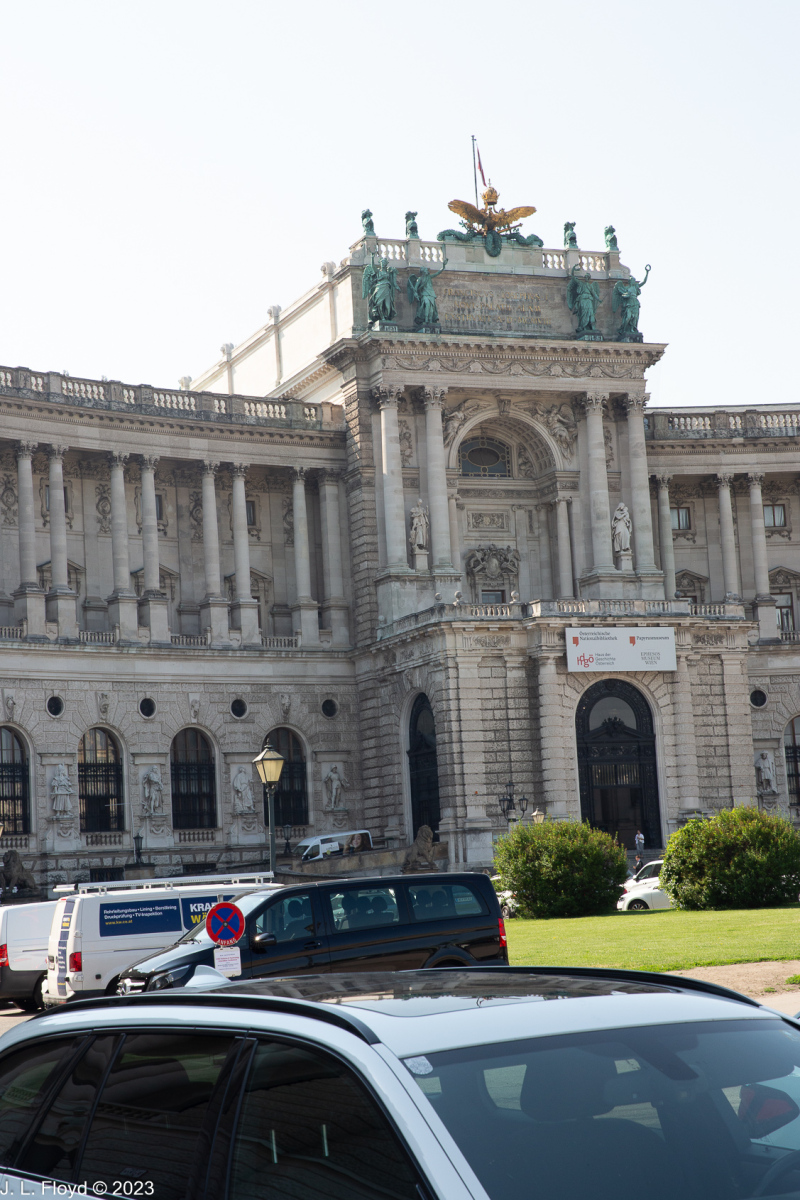
The imposing semi-circular Neo-Classicist structure facing the Heldenplatz is actually the newest part of the Hofburg, known as the Neue Burg. It was built between 1879 and 1902 and now houses five museums. It was from the balcony of the Neue Burg that Adolf Hitler proclaimed the Anschluss, the annexation of Austria to the Third Reich in 1938. The older wings of the Hofburg are on the northeast side of the Heldenplatz, to the left as one approaches the Neue Burg.

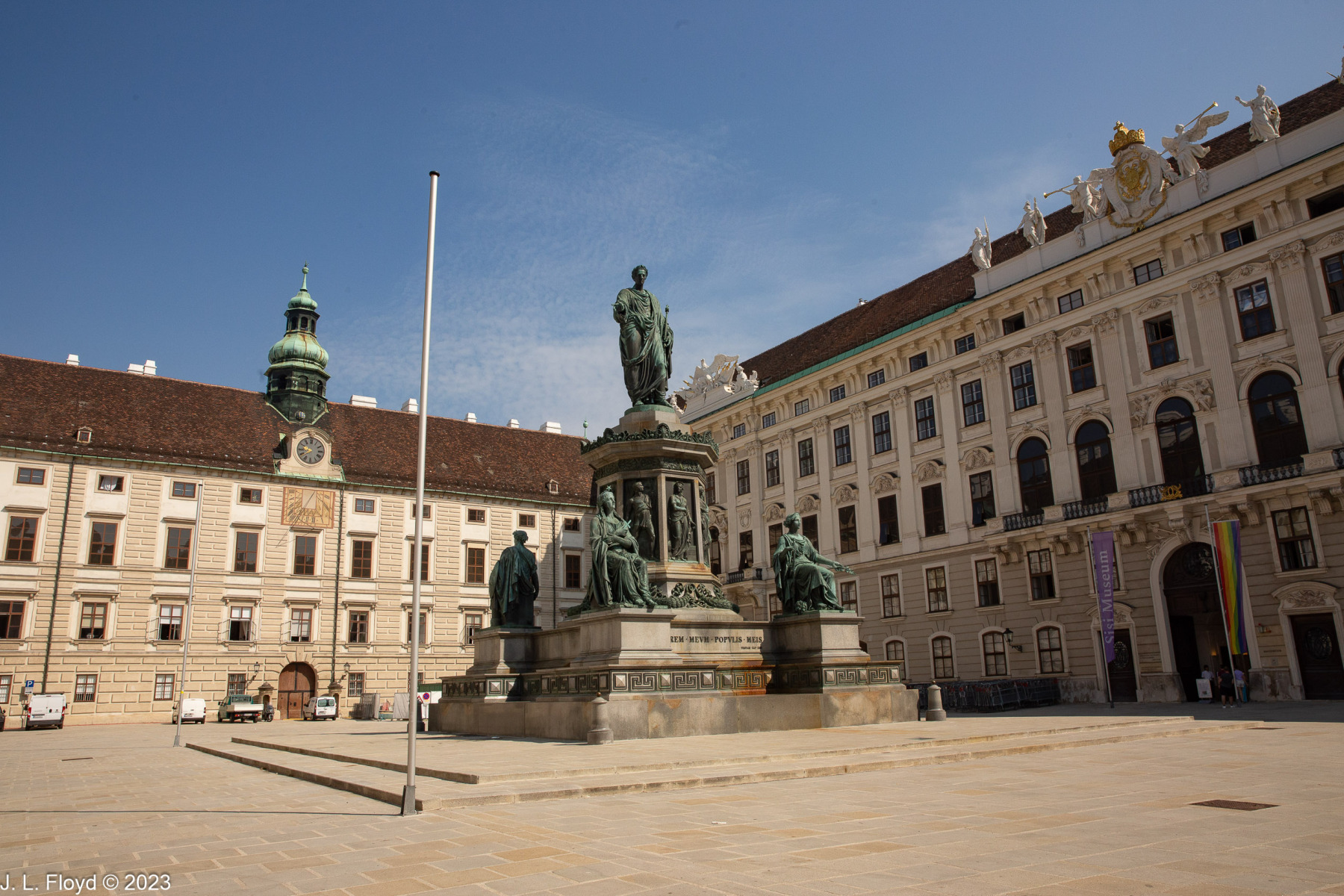
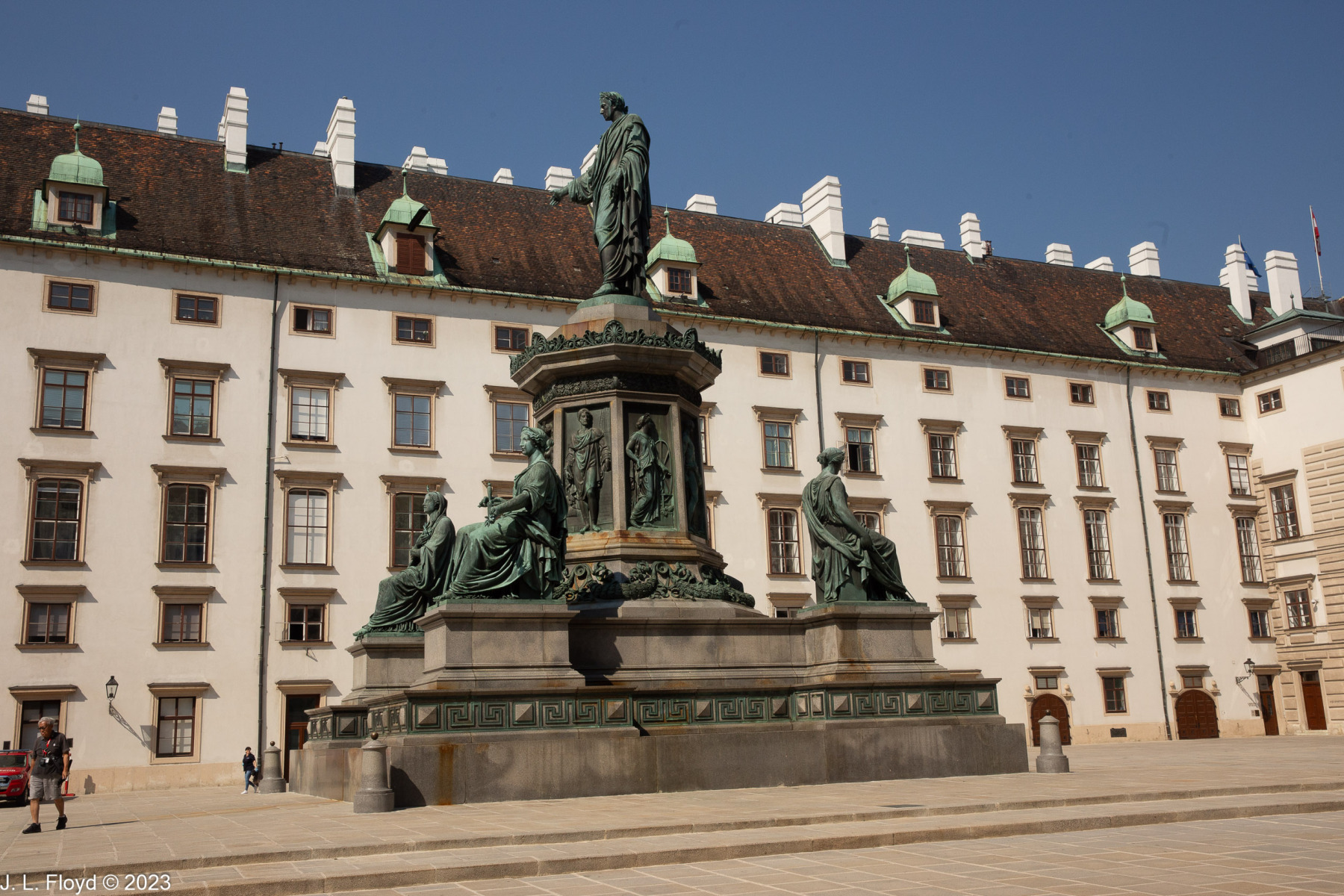
We did not linger long in front of the Neue Burg, but soon took a left turn and entered the Inner Courtyard (Innerer Burghof). The centerpiece of that space is the Kaiser-Franz-Denkmal, a monument to Franz I, first sovereign to hold the title of Emperor of Austria. He was also the last person to hold the title of Holy Roman Emperor as Franz II. The Holy Roman Empire had been in existence continuously since Otto I was crowned by the Pope in 962, but for much of that time it was an empire in name only; Voltaire famously said that it “was neither Holy, nor Roman, nor an Empire.” Following the catastrophic defeat of the Austrians and Russians in the Battle of Austerlitz in 1805, and Napoleon’s reorganization of many of the German principalities into the French-dominated Confederation of the Rhine in 1806, Franz II abdicated as Holy Roman Emperor and assumed the title of Emperor of Austria, thus dissolving the HRE for good.

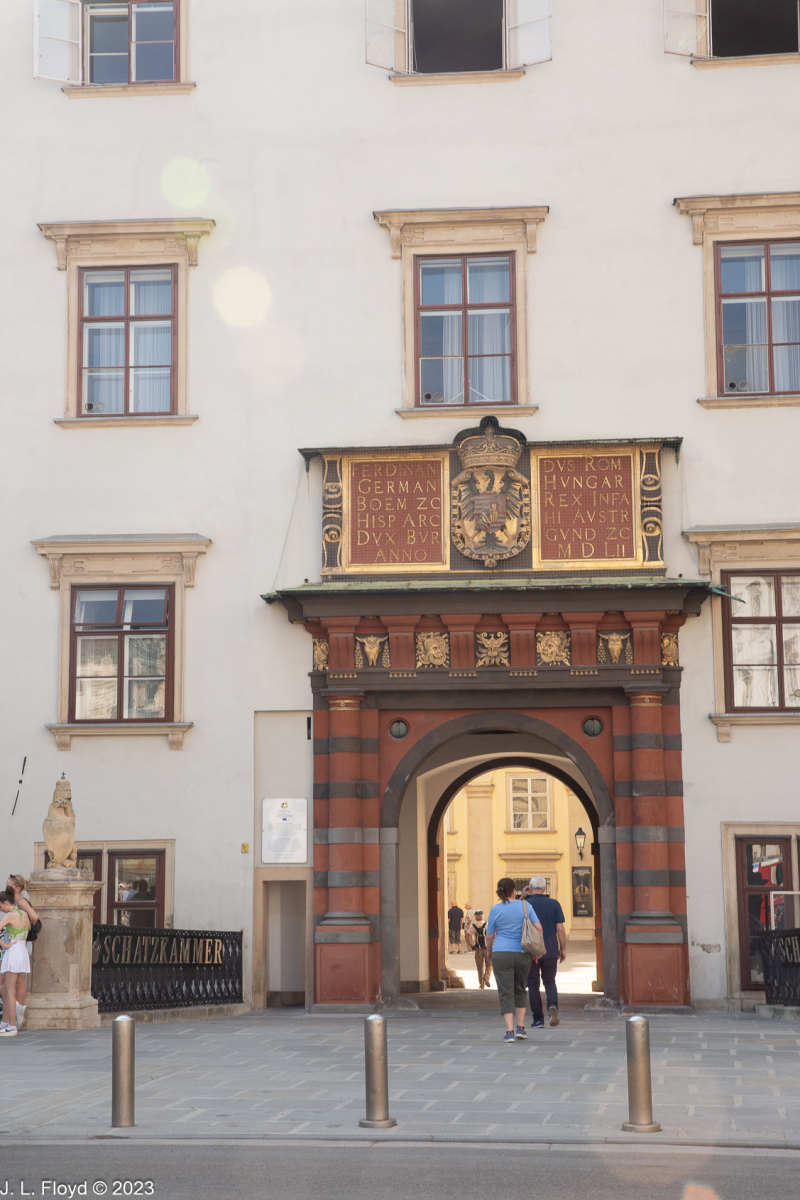
The Inner Courtyard was originally an open square where jousting tournaments were held until the late sixteenth century. On our right as we entered it, we passed the Swiss Gate, which provides entry into the Swiss Wing, the oldest part of the Hofburg. It had its beginnings in 1275 as a simple fort with four towers and a rectangular courtyard, today’s Swiss Court. The elegant red-and-black Swiss Gate was added in 1552.

At the opposite end of the Innerer Burghof from the Swiss Gate is the Amalienburg, named after Empress Amalie, wife of Emperor Joseph I (r. 1705-1711). It was actually built during the time of Rudolf II, Holy Roman Emperor from 1576 to 1612, patron of the astronomer Johannes Kepler among others. The Amalienburg is chiefly noteworthy for its cute little tower with a cupola on top and the astronomical clock on its façade.

Connecting the Amalienburg wing with the Swiss Court is the Leopold wing of the Hofburg, an Early Baroque structure dating from the reign of Emperor Leopold I (1640-1705). Empress Maria Theresa and her son Joseph II also took up residence in the Leopold Wing. It now holds the office of the Austrian Federal President, who receives state guests there.

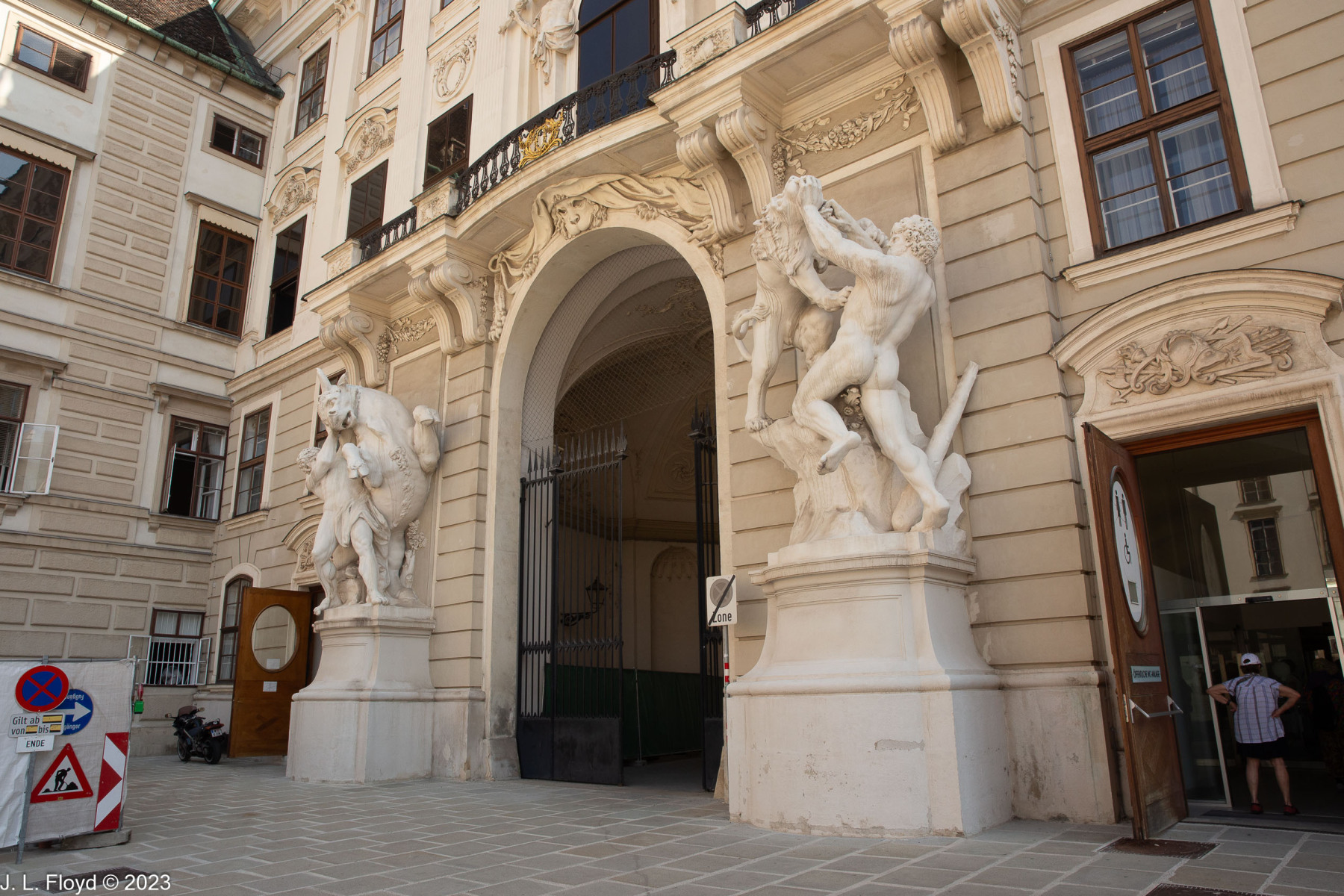
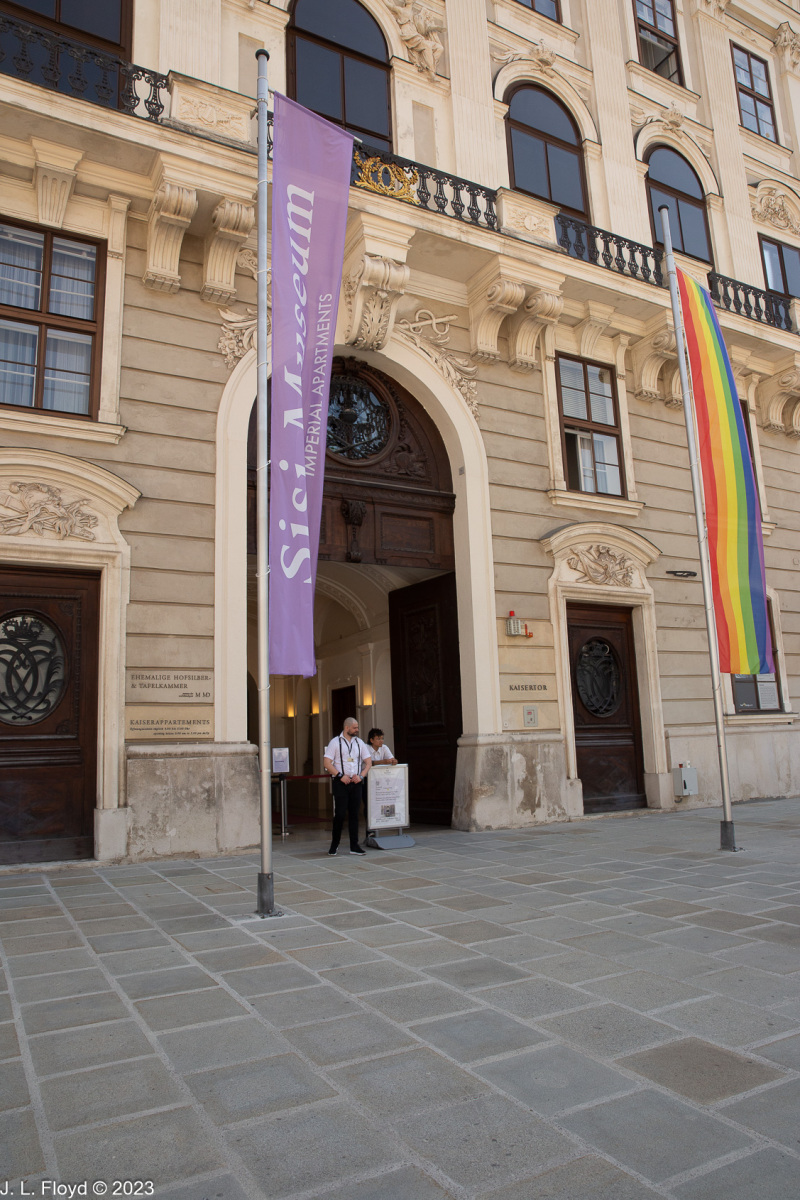
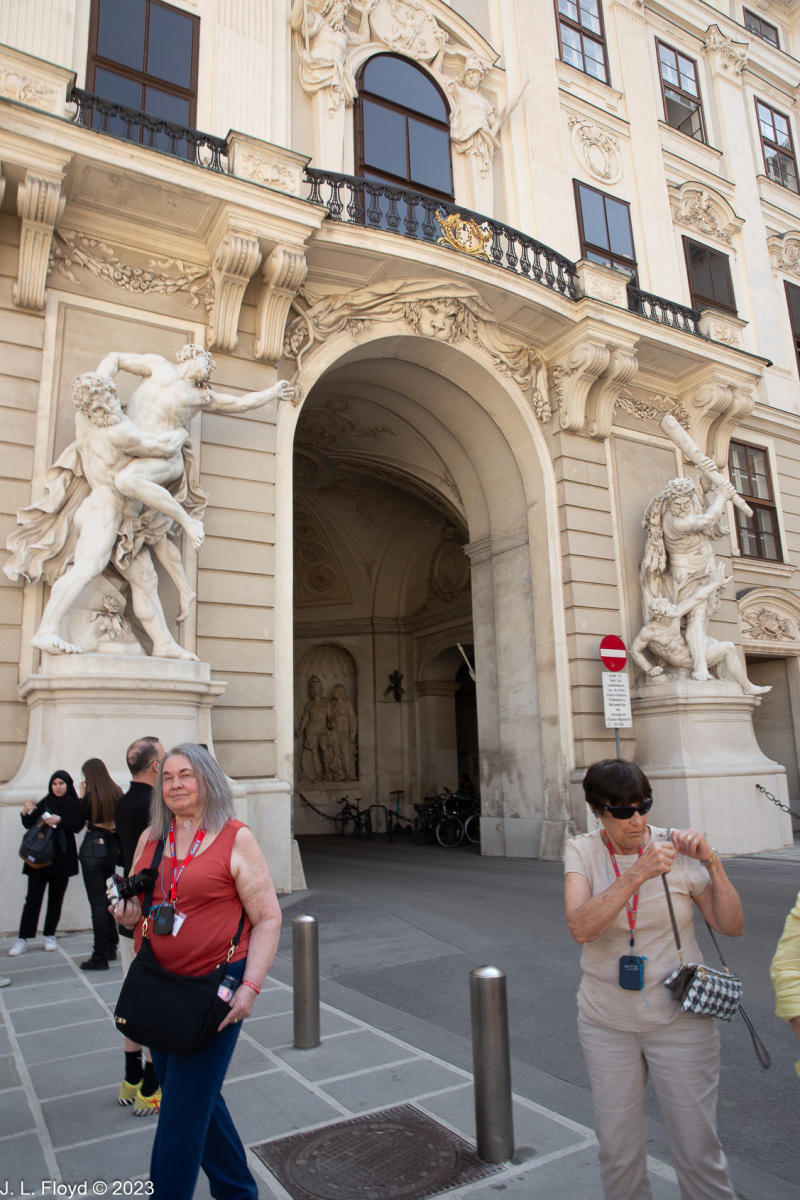
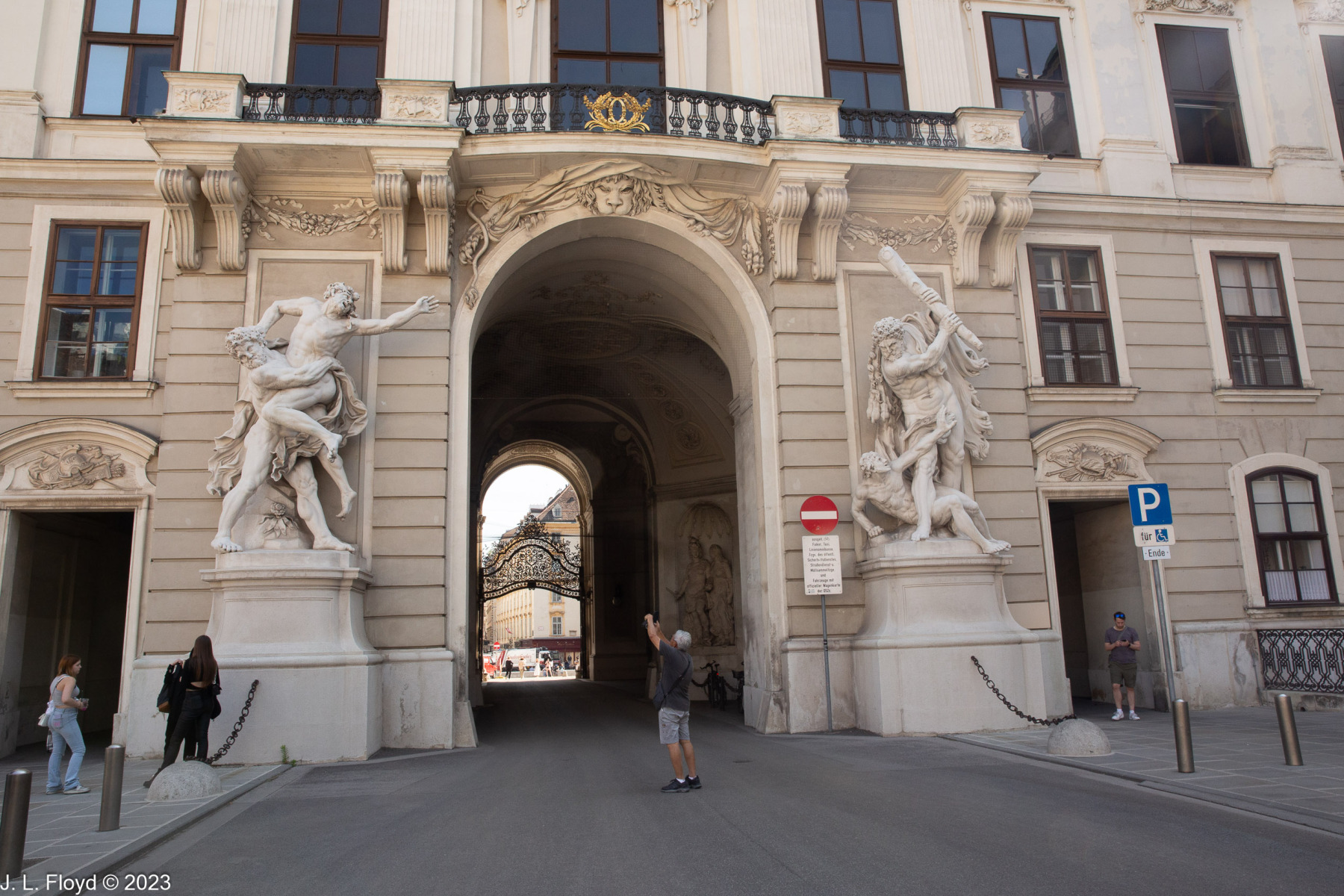
The St. Michael’s Wing, closing in the Burghof on the northeast, was begun in 1730 but finally completed only in 1888. Emperor Franz Joseph and his wife Elizabeth (nicknamed Sisi) lived in this wing, which now is home to the Sisi Museum among others. Flanking the several portals of the St. Michael’s Wing are sculptures depicting the Twelve Labors of Hercules.

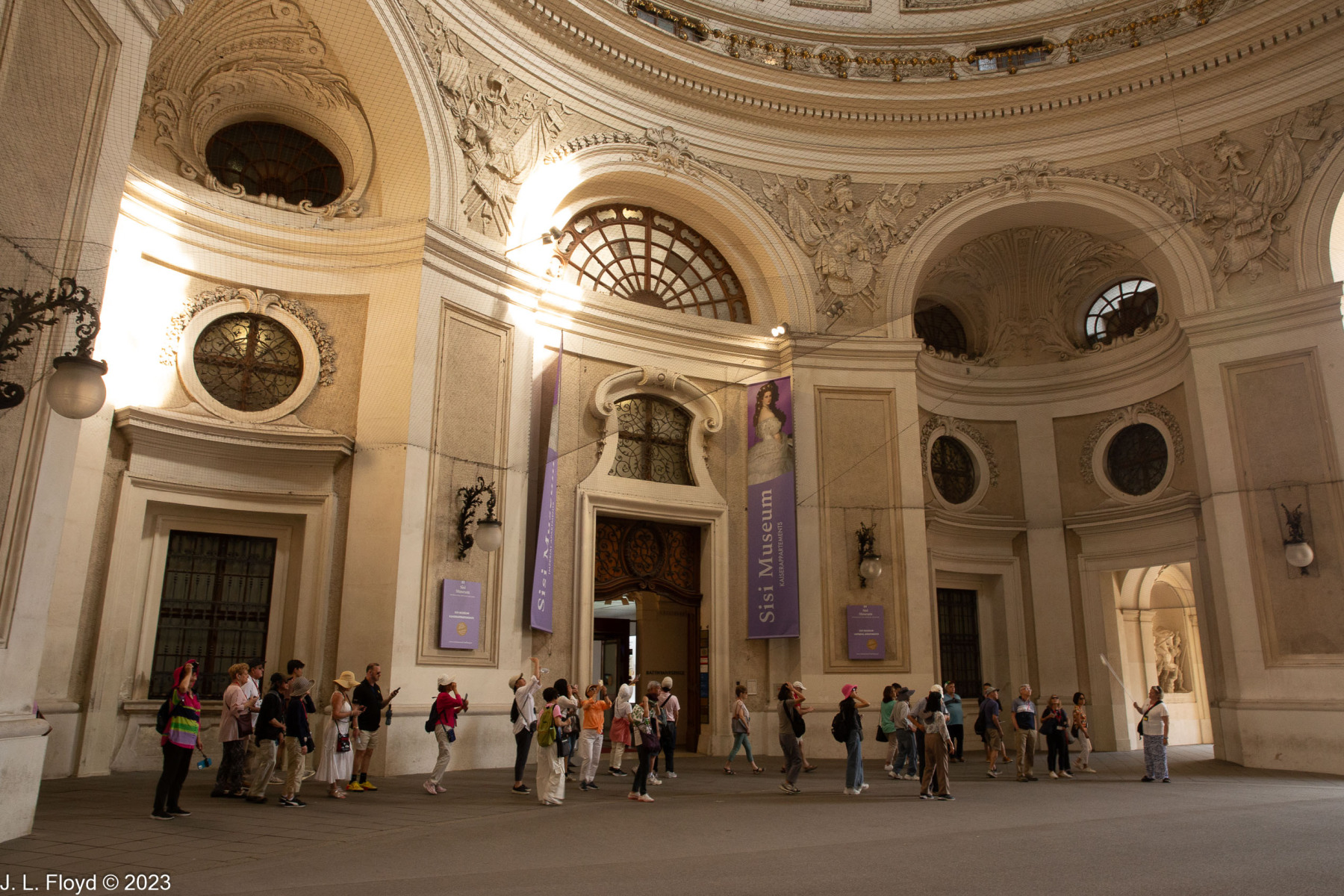
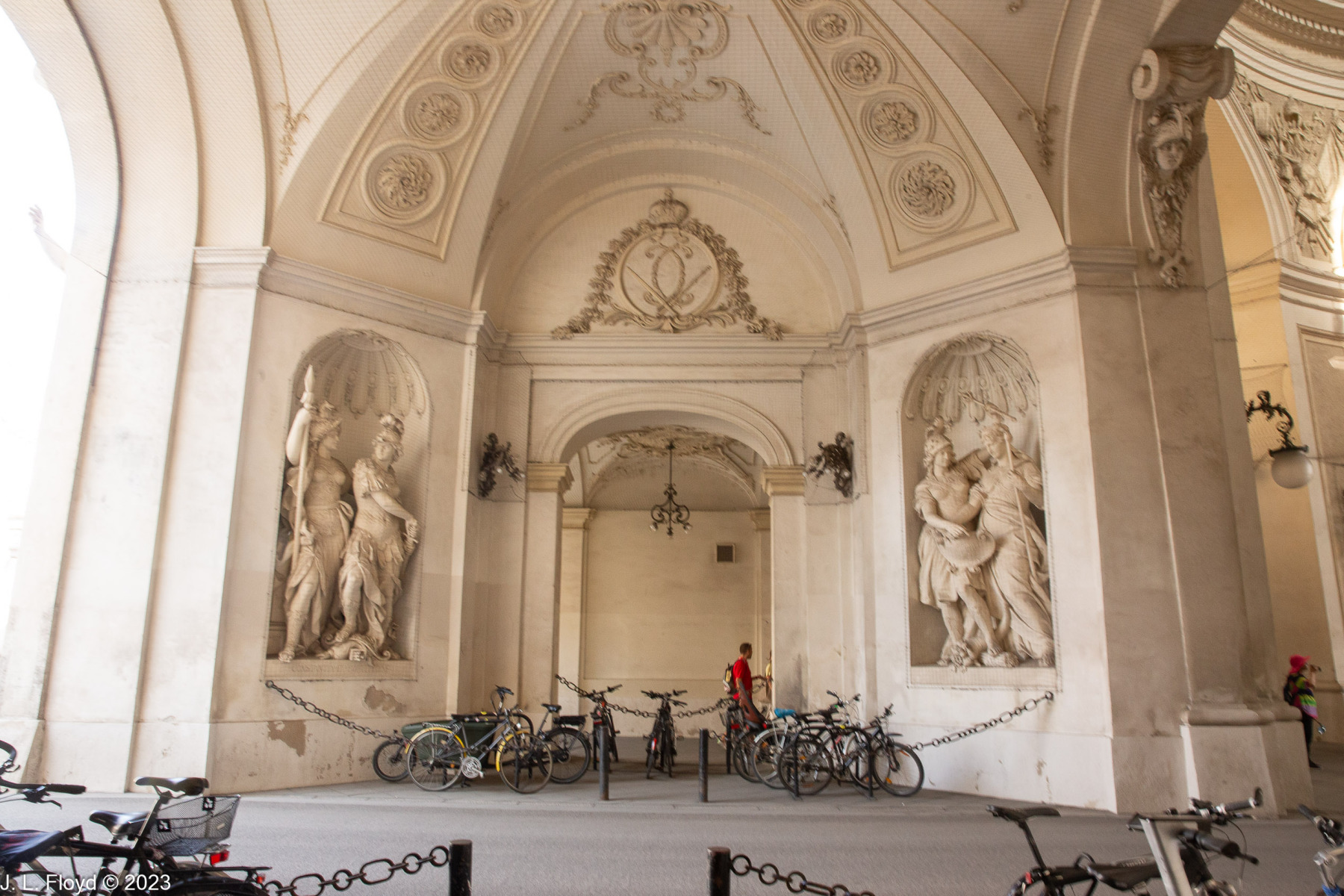
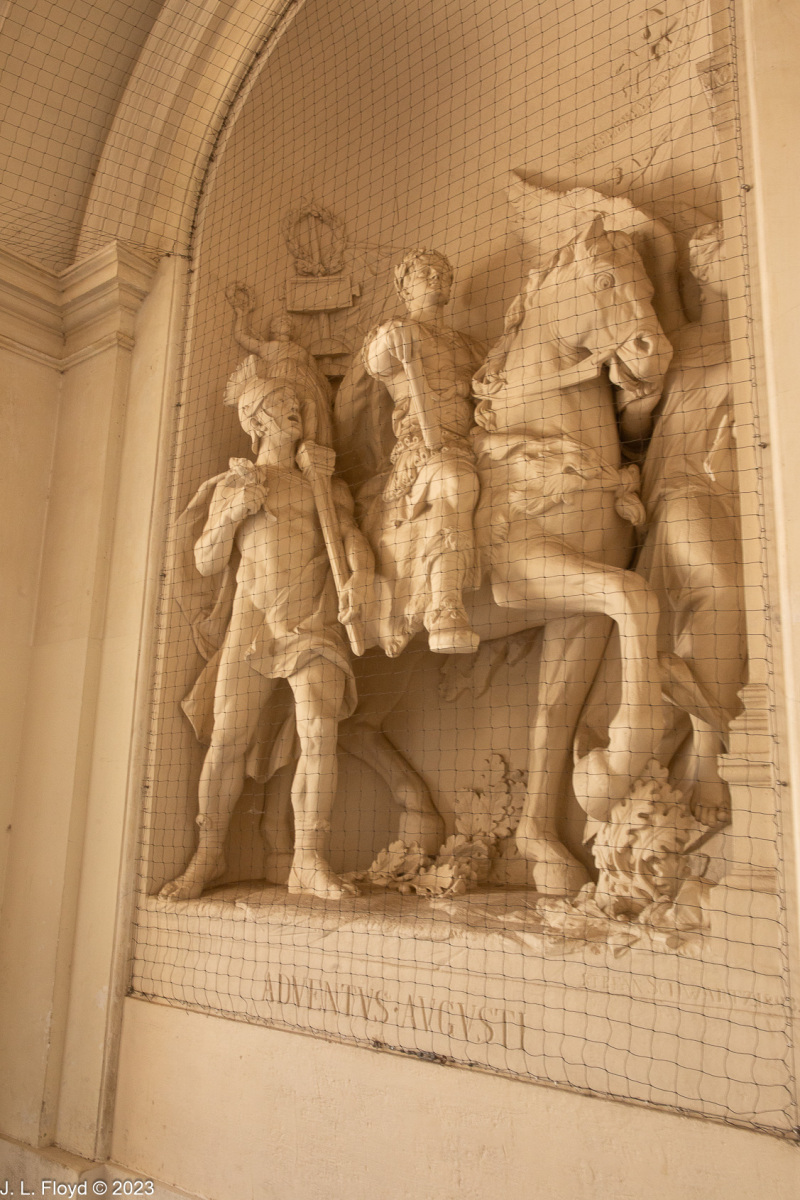
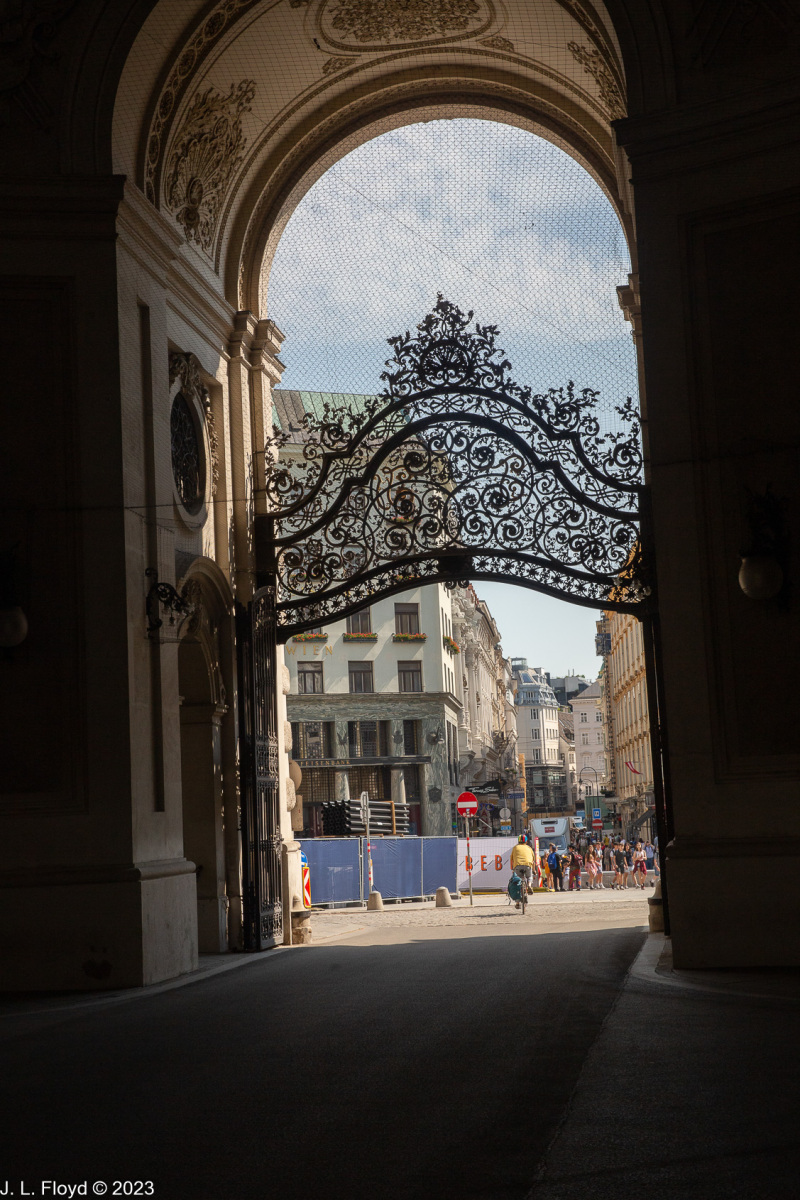
We exited from the Inner Court through the portal where Hercules was wrestling with Antaeus on the left and, on the right, beating some poor sod with a club (I don’t know which of his labors that was supposed to represent). We then passed through a rotunda containing a number of sculptures with classical motifs, a parking lot for bicycles and another entrance to the Sisi Museum. On the other side, the Michaelertor, a gate with elegant iron grillwork, opened to St. Michael’s Square (Michaelerplatz).

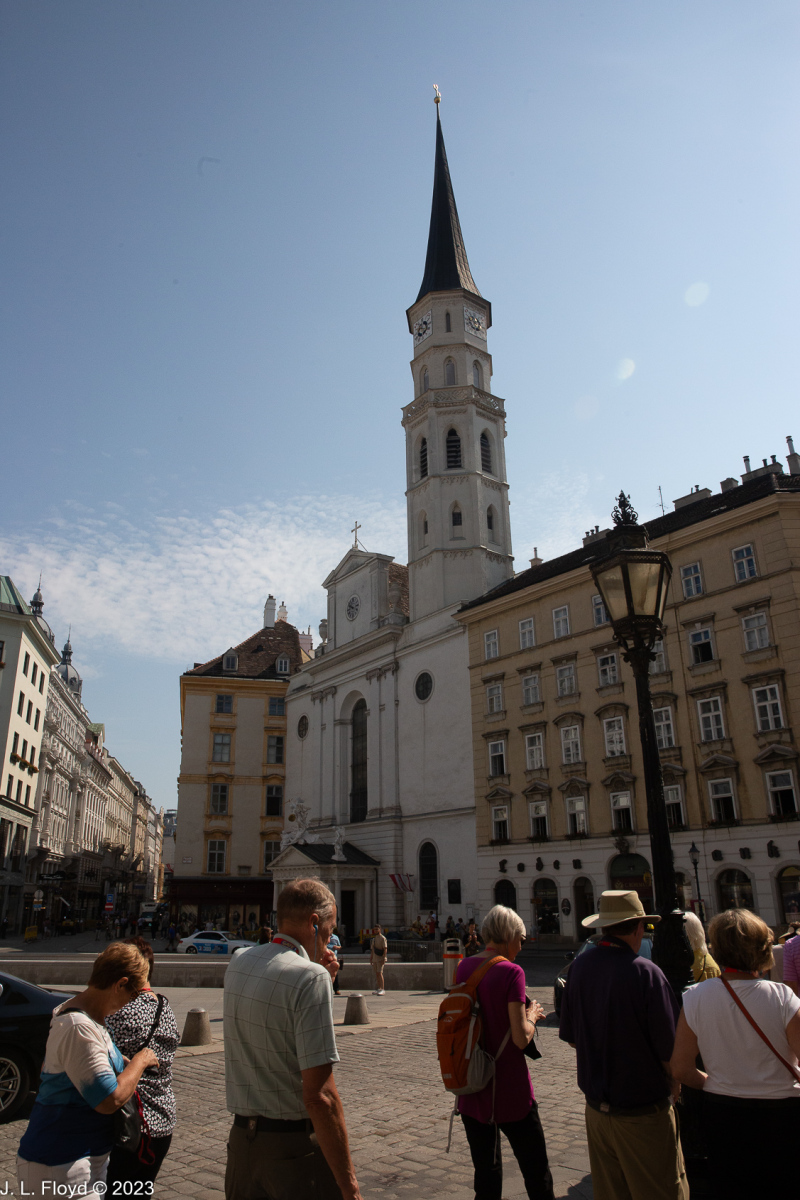
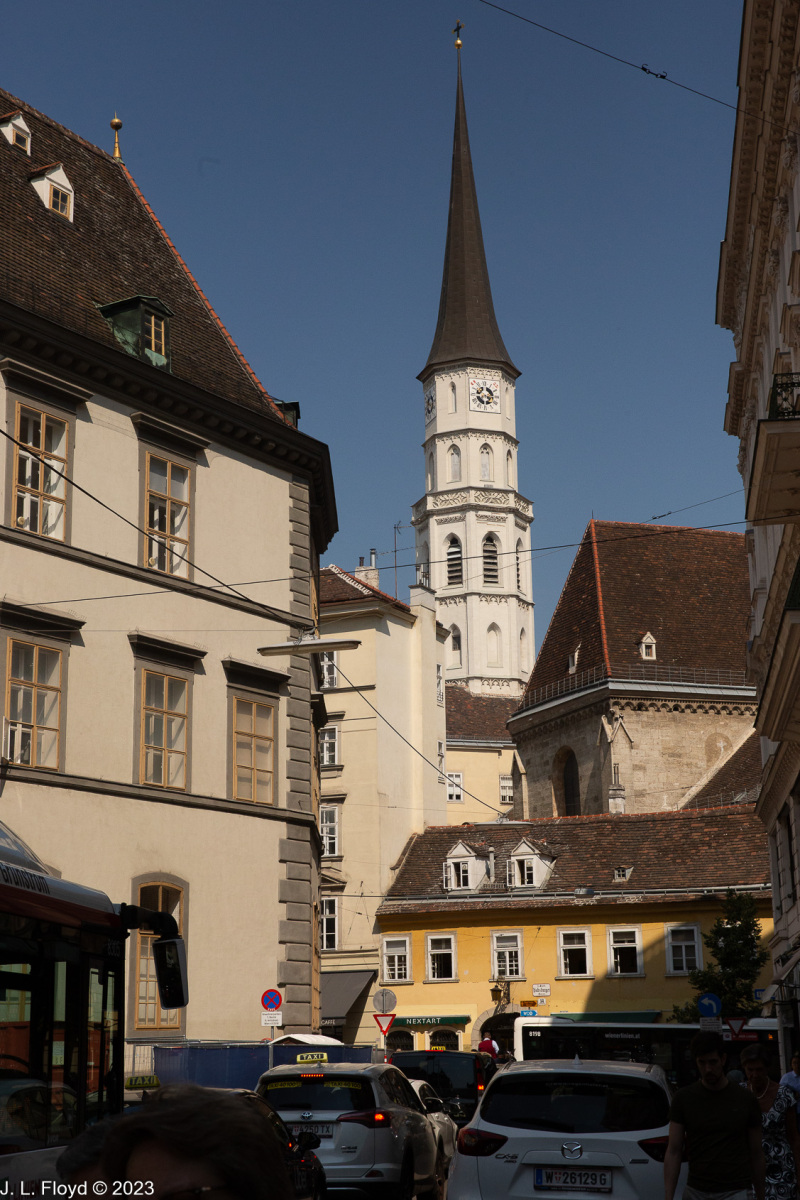
Michaelerplatz is the location of the Church of St. Michael (Michaelerkirche), after which both the square and the facing palace wing is named. It is one of the oldest churches in Vienna – a late Romanesque, early Gothic structure originally built in the early 13th century, but much modified afterward, though it has been unchanged since 1792. The square is also the location of an archaeological dig that uncovered some ruins from ancient and medieval times, including the site of a brothel frequented by Roman soldiers.

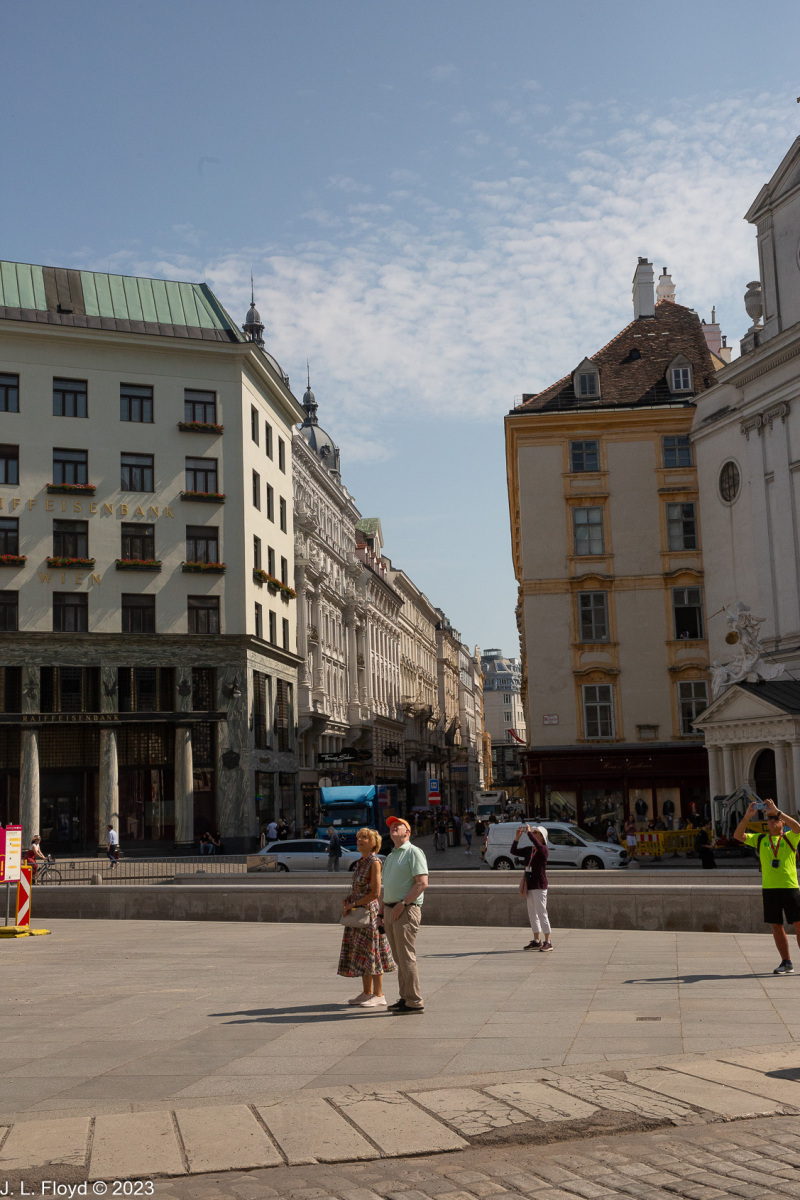
Also fronting on Michaelerplatz, across Kohlmarkt Street from the Michaelerkirche, is the Looshaus, considered to be a premier achievement of the Viennese Modernist (Wiener Moderne) movement in architecture. In 1909 the owners of a high-end men’s clothing business commissioned the architect Adolf Loos to design a new office building for them. Loos had lived in New York and Chicago and was heavily influenced by American design trends, such as reinforced concrete. But the design he produced for for the building was quite controversial, and Loos was forced to modify it, adding window boxes on the upper-story windows to relieve their “nakedness.” Even so many people hated it, including Emperor Franz Josef, who supposedly ordered the curtains of the Hofburg to remain closed so that he would not have to look at it. I was unaware of the significance of this structure at the time of our visit, and the photo I shot only shows part of it; otherwise I would have taken a better picture.

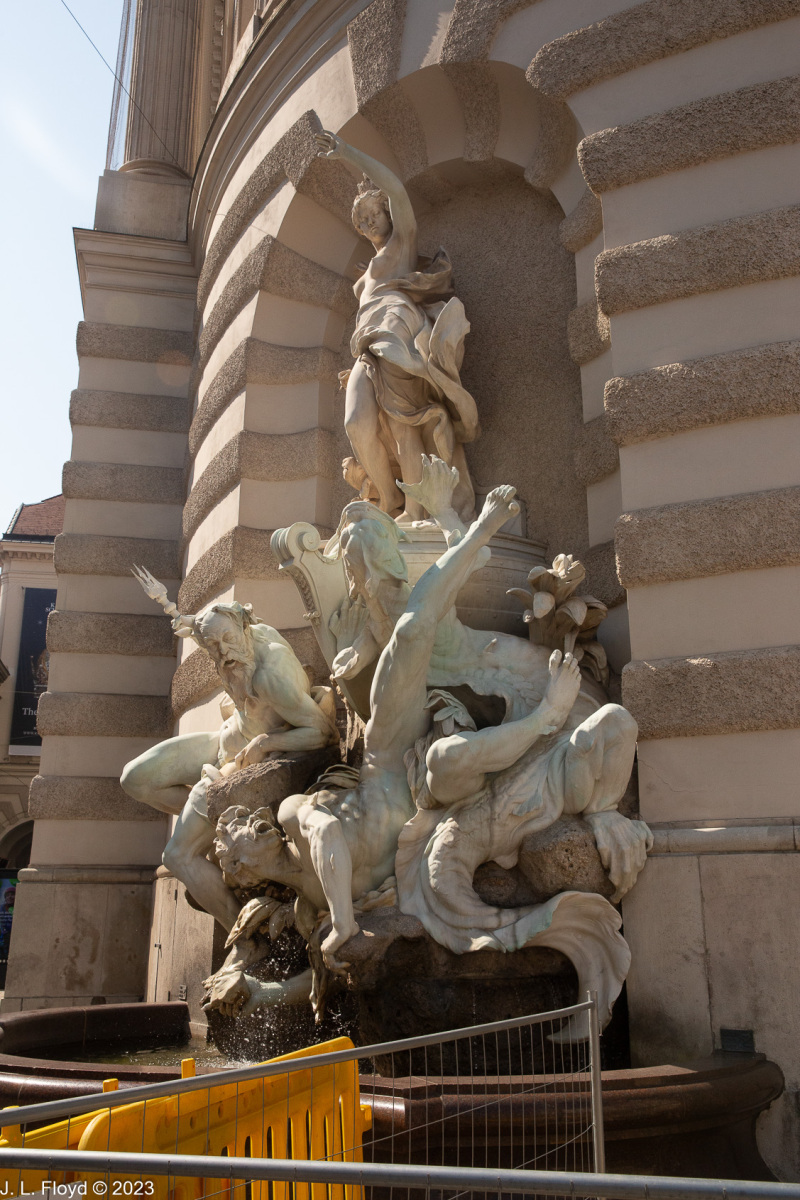
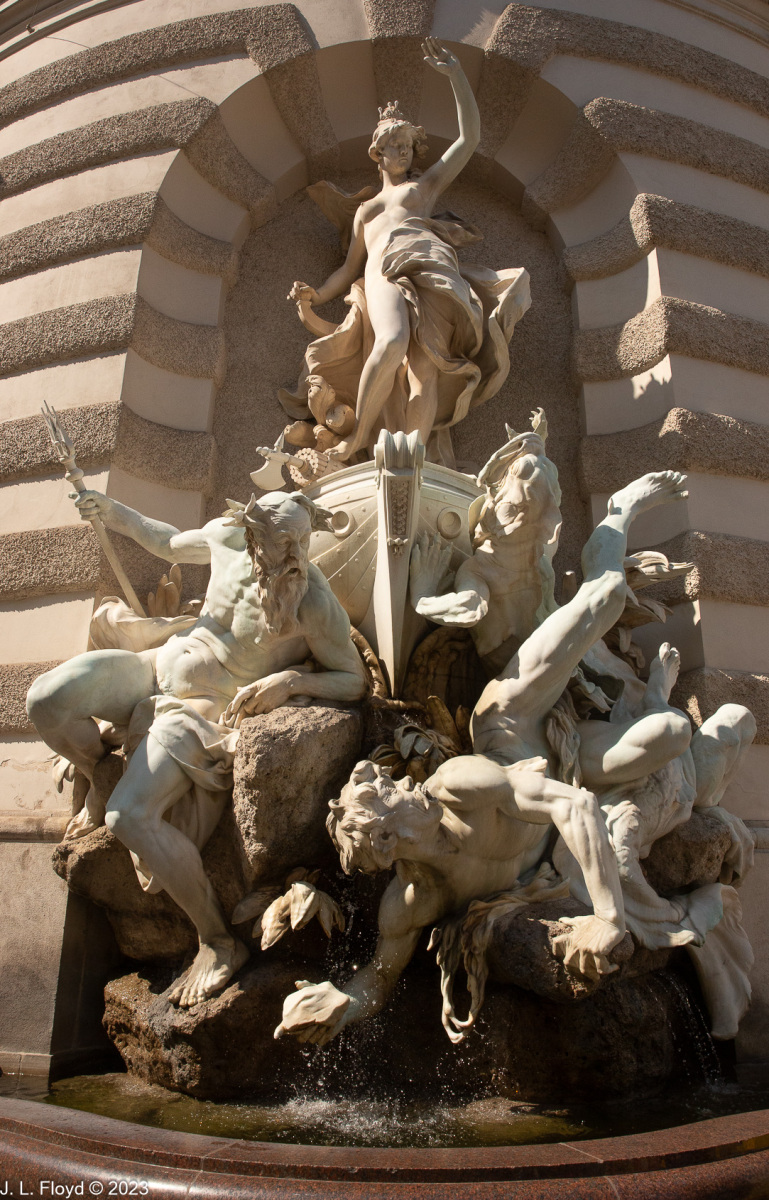
Exiting the Hofburg through the Michaelertor, we took a right turn and shortly encountered an imposing sculpted fountain, titled Power at Sea (Die Macht zur See), by Rudolf Weyr, which was supposed to symbolize Austro-Hungarian naval might. It has a counterpart at the other end of the building, Power on Land (Die Macht zu Lande), by Edmund Hellmer, but we missed it because we were going in the wrong direction, toward the Stallburg. The Power at Sea sculpture features a female figure, representing Austria, standing in the prow of a ship which is crashing over a group of sea creatures including the god Neptune, throwing them into confusion and disarray. At the time the fountain was installed, the Austro-Hungarian Empire was a considerable sea power, with naval bases on the Dalmatian coast, but after the First World War both Austria and Hungary were landlocked and didn’t need a navy any more.

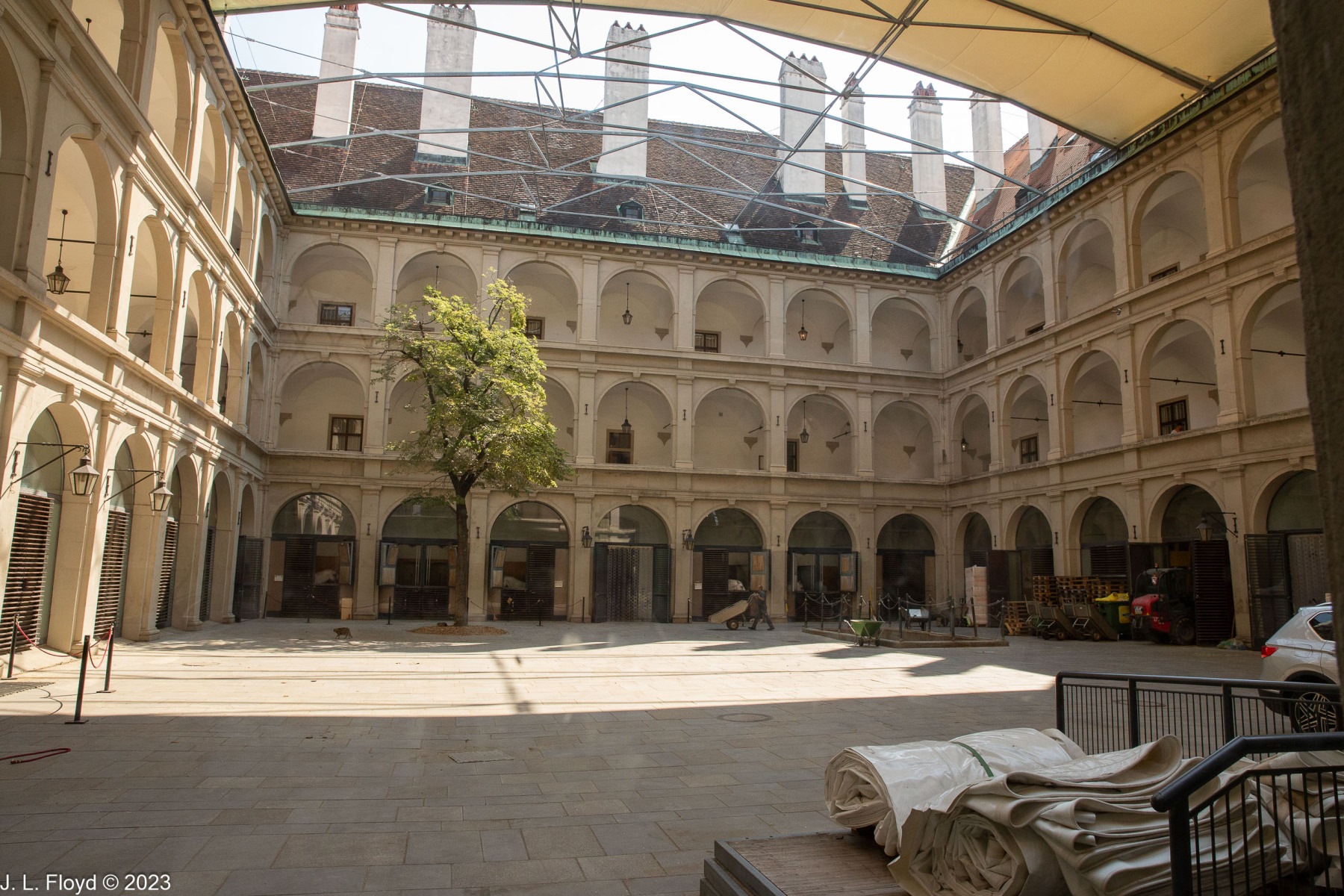
Shortly we came to the Stallburg, a Renaissance-style building originally built in the later sixteenth century for Archduke Maximilian, later Emperor Maximilian II. Later it was turned into an art gallery which became the core of the Kunsthistorisches Museum. Later still it was converted into the Imperial Stables, and now it belongs to the Spanish Riding School (Spanische Hofreitschule); the famous Lippizaner horses are stabled there.

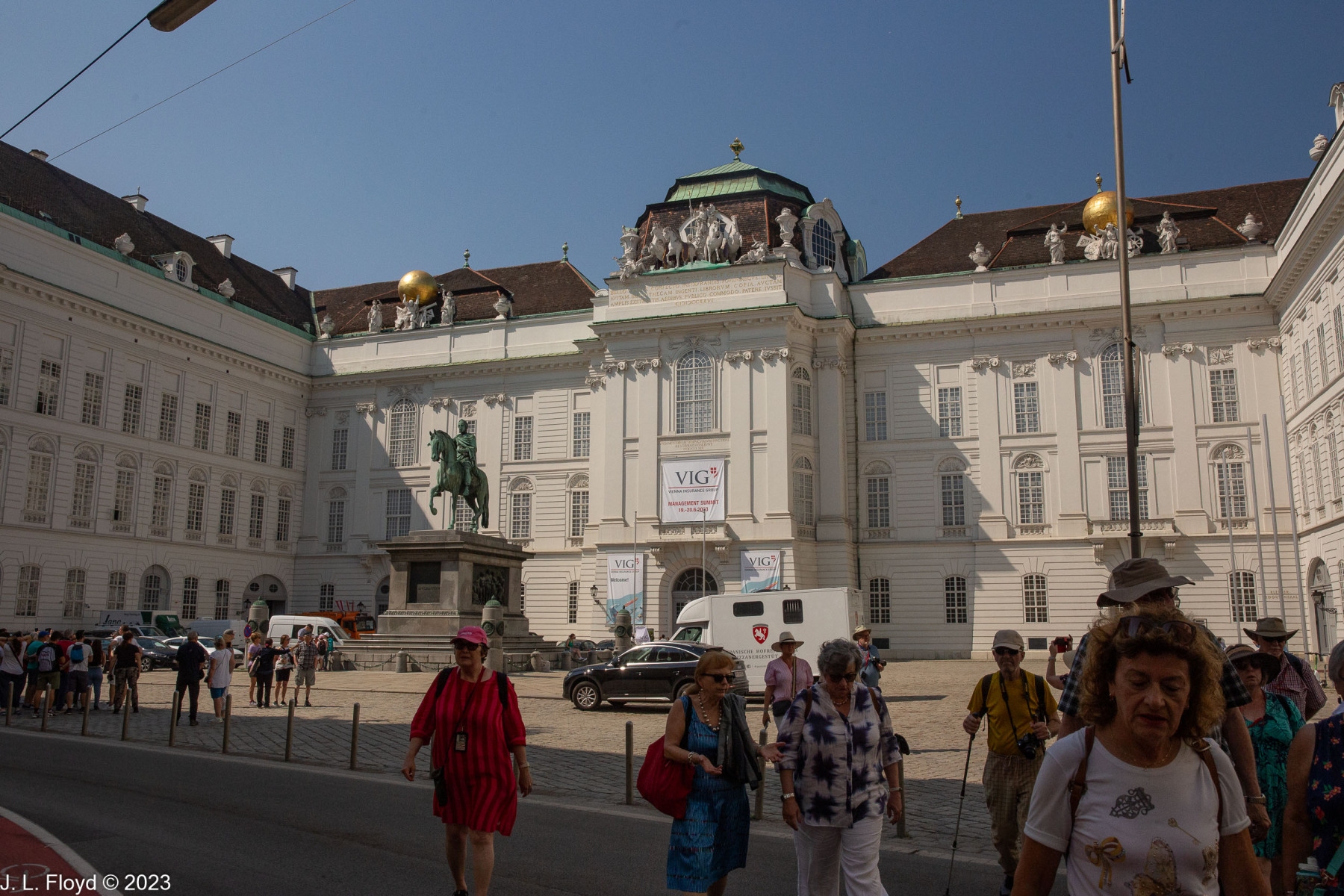
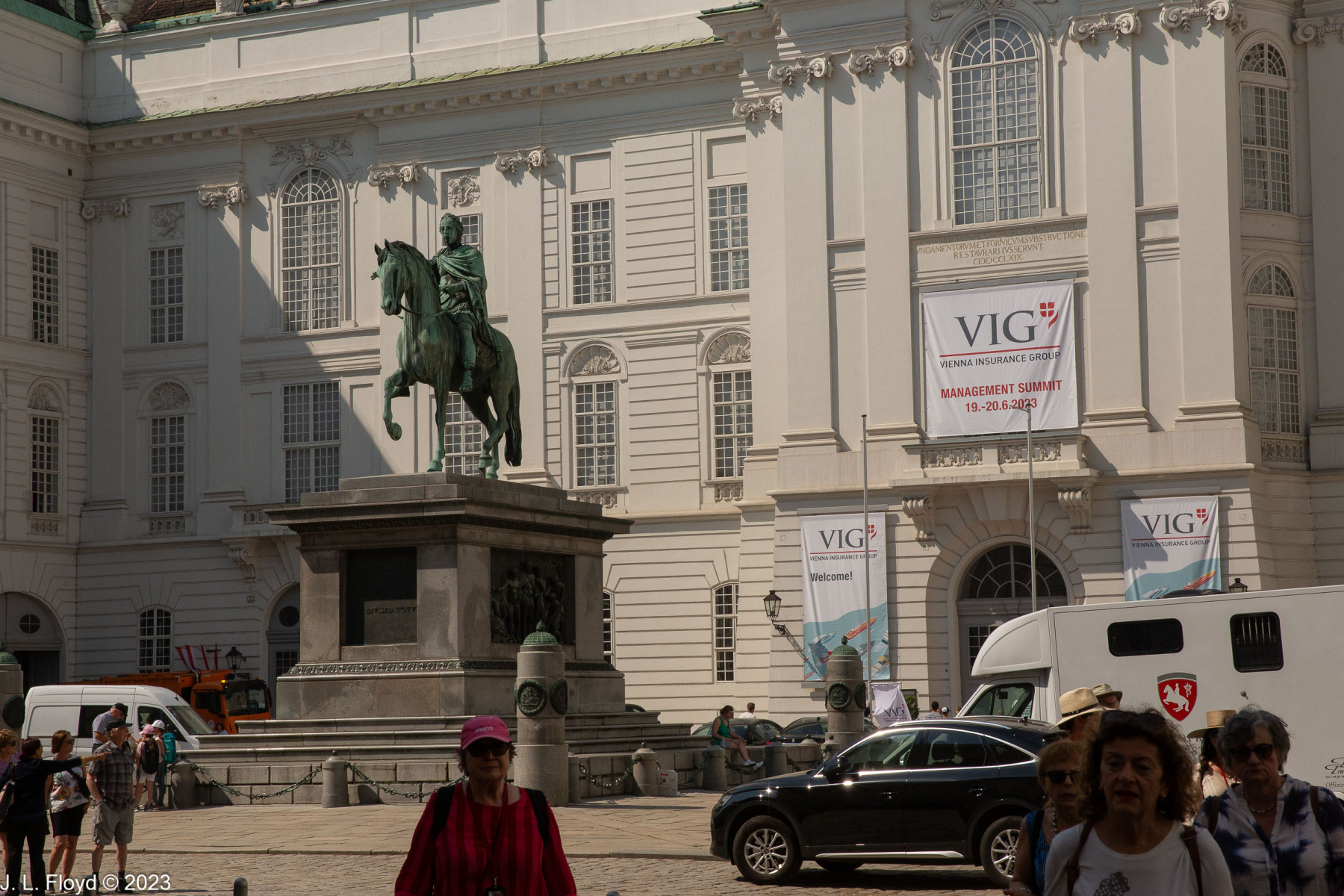
Next to the Stallburg is Josefsplatz, named after Emperor Josef II (1741-1790), son and successor of Empress Maria Theresa. He was co-regent with his mother from 1765, but held little real power until her death in 1780. After that Josef II ruled as an “enlightened despot,” according to the principles of the 18th-century Enlightenment, and sponsored reforms aiming at the advancement of education, freedom of worship, secularization of church lands and reduction of the influence of the Catholic church, emancipation of the peasantry, and rationalization of government administration. Unfortunately he also promoted complete centralization of authority and compulsory use of the German language, which earned him the opprobrium of the Czechs and other non-German nationalities of the Empire. In the play and movie Amadeus, he is portrayed as a pompous ninnyhammer; when meeting Mozart and being asked for his opinion of Mozart’s music, he has to turn to his aide to provide an answer, which is the idiotic “too many notes.” Actually Josef II was not so stupid, and he was a knowledgeable and enthusiastic patron of music and the arts. (Amadeus is mostly fiction, based on the 1830 play Mótsart i Sal’yéri by Alexander Pushkin.)

An equestrian statue of Josef II stands in the Josefsplatz. On the north side of the square is the Redoute Wing of the Hofburg. This began in the 17th century as an opera house; Empress Maria Theresa converted it into a concert hall and ballroom, and it now serves as a conference hall.

On the south side of Josefsplatz is the Augustinian Wing of the Hofburg. This is a baroque structure built in the early 18th century, but it since became integrated with the older Augustinian church (Augustinerkirche) and monastery next to it, which date from the fourteenth century. The Augustinerkirche was the parish church of the Habsburg court from 1634, and numerous royal weddings were held there. These days it is a venue for sacred music concerts.

Between the Augustinian and the Redoute Wings, on the west side of the Josefsplatz, is the former Imperial Library, now the Austrian National Library, a Baroque structure dating from the reign of Charles VI (r. 1711-1740). One of its chief benefactors was the general and statesman Prince Eugene of Savoy (d. 1736), who contributed 15,000 of the 200,000 volumes it held at the time. It now has over 12 million items in its various collections.

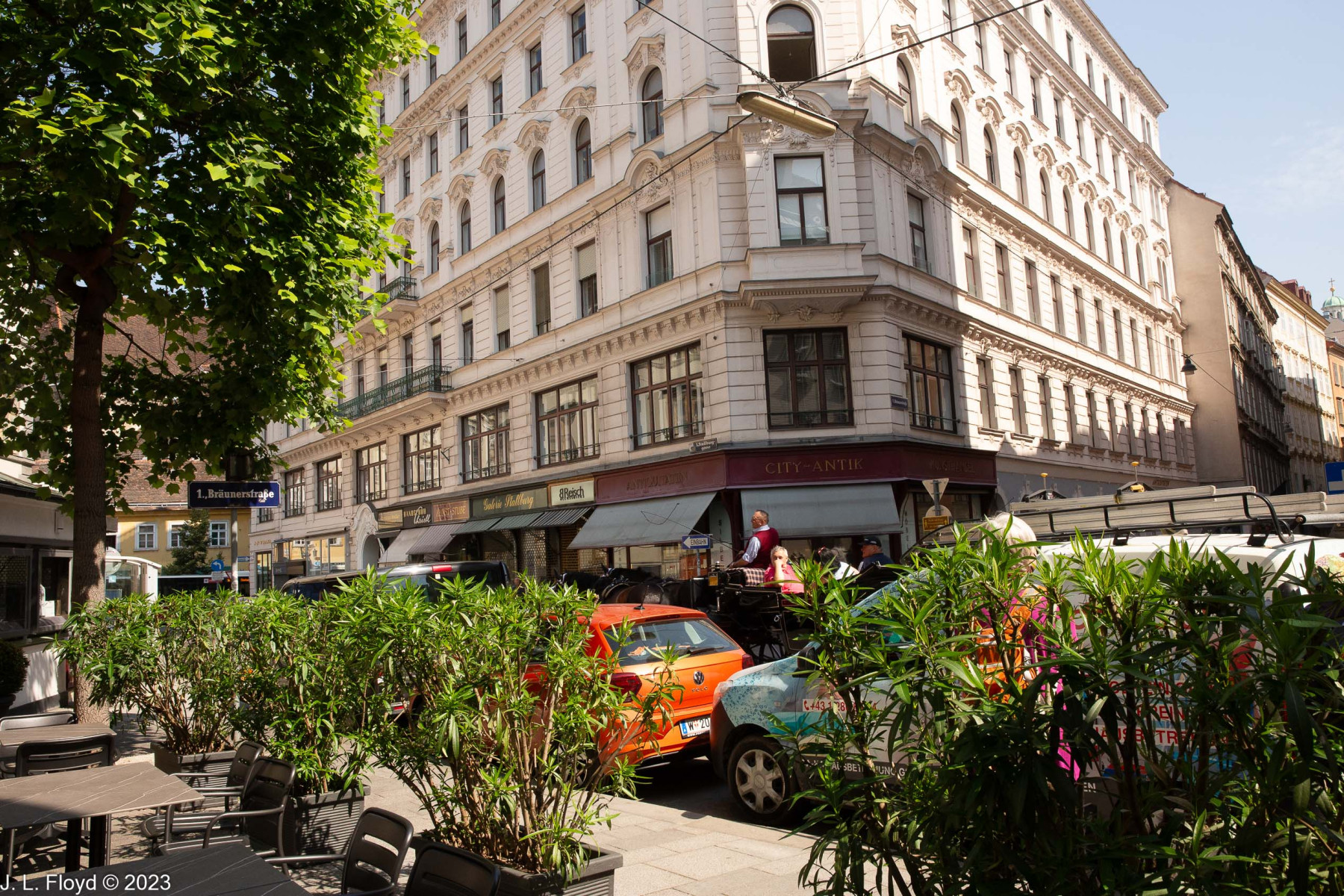
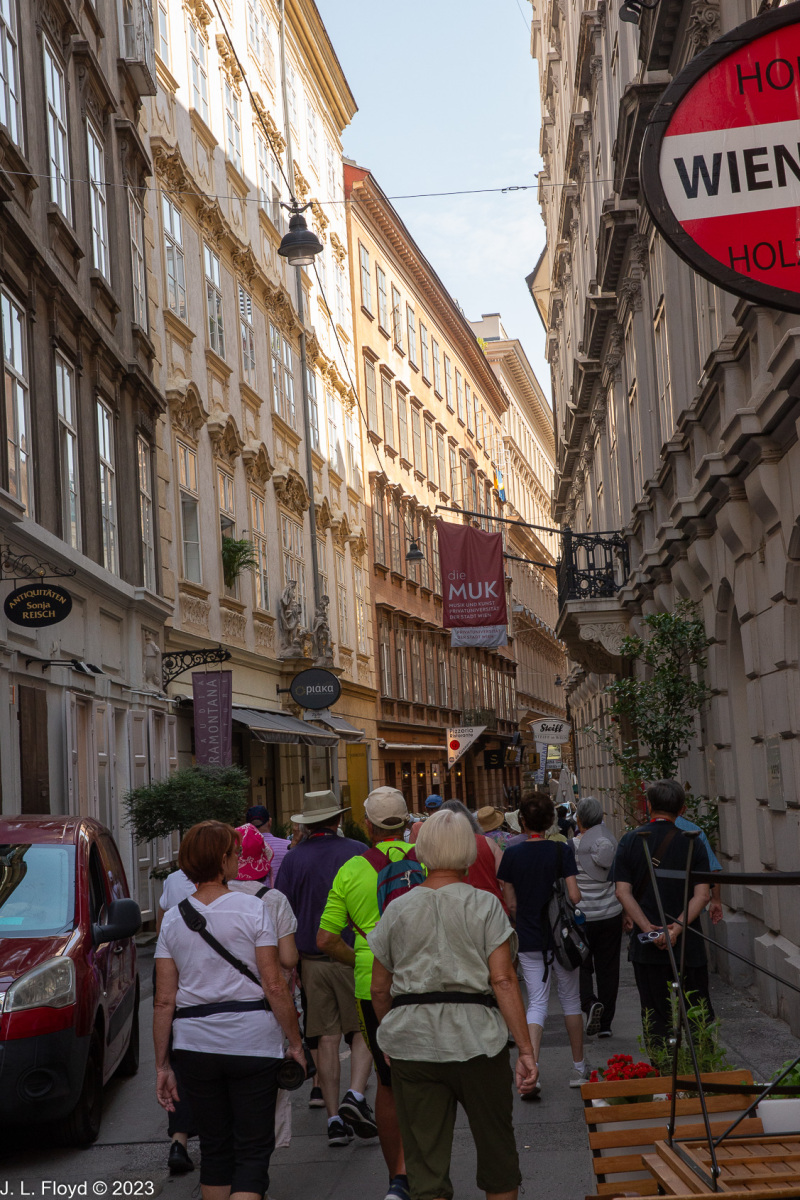
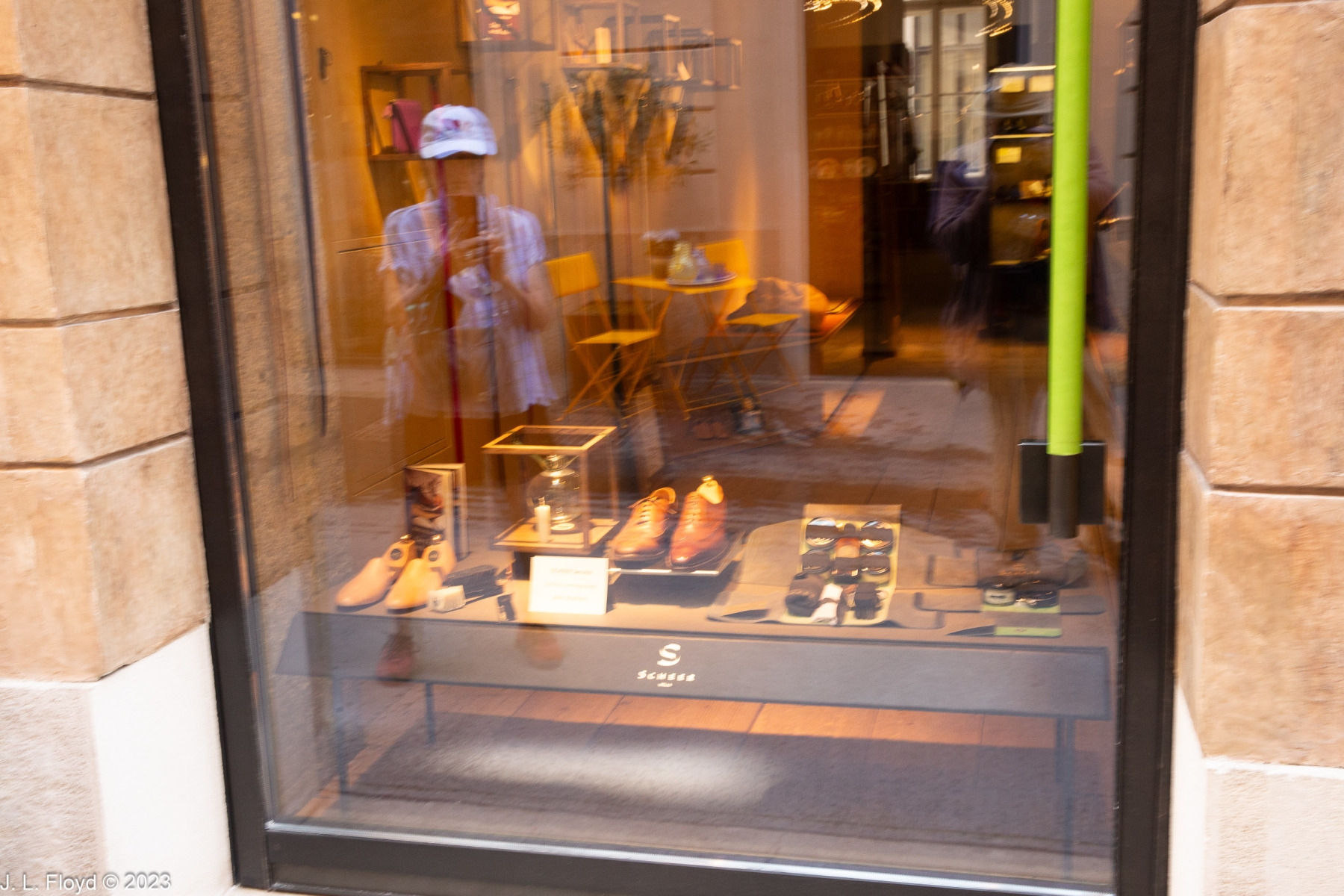
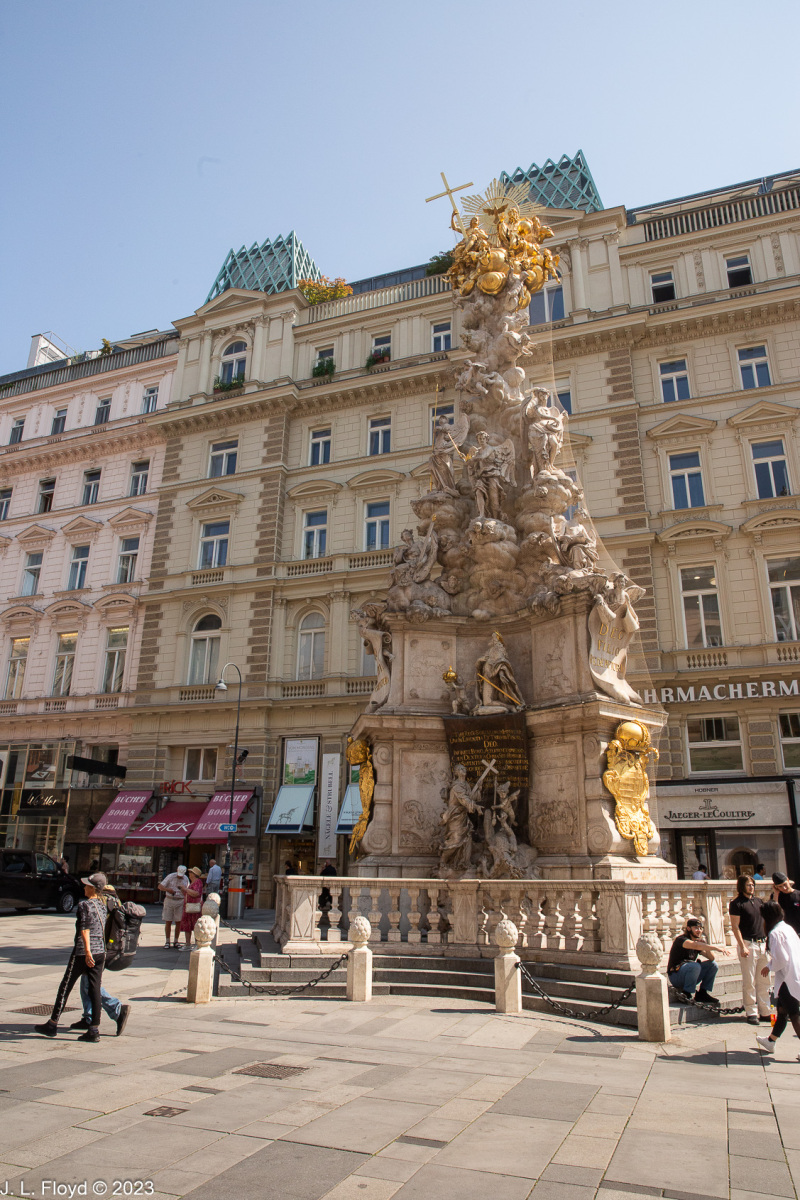
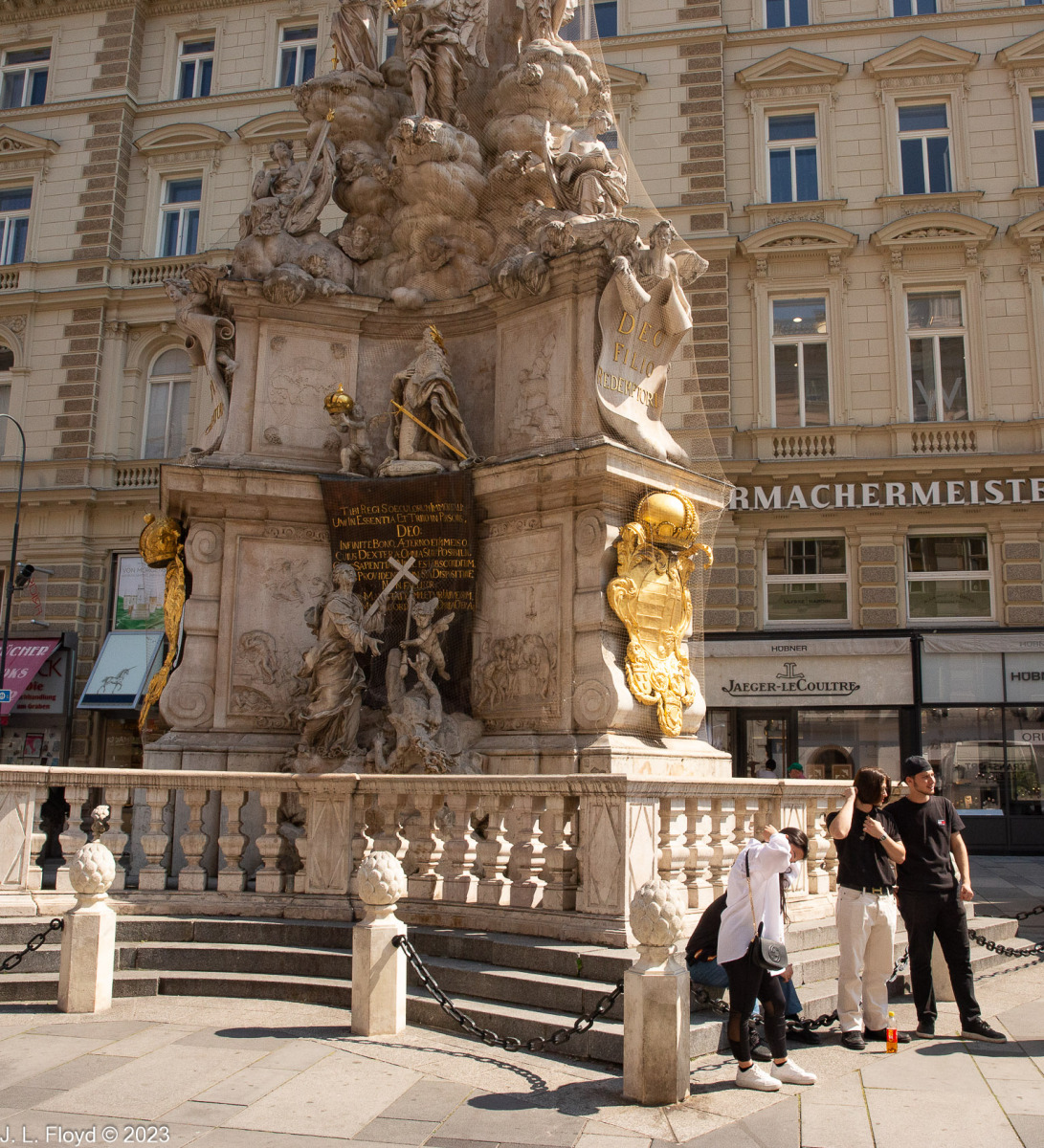
From the Hofburg we strolled down Bräunerstrasse to Graben, where the Vienna Plague Column is located. Along the way we passed some upscale boutiques, including the shoe store of R. Scheer and Sons, which featured the most expensive shoes I have ever seen in my life, at 4000 euros.

Every central European city, it seems, has to have a Plague Column, and Vienna is no exception. The Vienna Plague Column, Wiener Pestsäule in German, commemorates the last great outbreak of the plague in 1679. The first version was erected in that year and was made of wood; a permanent one was completed only in 1694. Meanwhile, in 1683 the Ottoman Turks had besieged Vienna for two months, but were defeated by a combined Polish and Habsburg army led by the Polish king Jan Sobieski, a rare instance of cooperation between the Austrians and the Poles. Leopold I, the Holy Roman Emperor, had concluded a defensive alliance with the Poles before the Ottoman onslaught, and this proved crucial. This was how the Plague Column evolved also into a victory monument for Leopold I. (The Austrians thanked the Poles in the 18th century by helping the Russians and Prussians to partition Poland, whereby Poland ceased to exist until the 20th century.)

The Plague Column as completed in 1694 has a tripartite design, both horizontally and vertically. The lowest level, the pedestal, is the province of mankind, and features Leopold I praying for deliverance; the second and top levels, comprising the column itself, are reserved for the angels and the Holy Trinity, respectively. The Trinity also appears in the vertical segmentation of the pedestal, with the western face devoted to God the Father, the eastern face to the Son (Jesus), and the northern face to the Holy Spirit. The western face also bears the coat of arms of the Holy Roman Empire and its core Austrian domains; the eastern face bears the coats of arms of Hungary, Croatia, Dalmatia and Bosnia; and the northern face bears the coats of arms of Bohemia, Lusatia and Silesia.

At the Plague Column we turned right and headed down Graben to Stephansplatz, location of St. Stephan’s Cathedral (Domkirche St. Stephan). There, in the shadow of St. Stephan’s, our tour guide disbanded the group, leaving us on our own for the remainder of the morning. Sandie and I headed up Kärntner Strasse to find a place where we could have coffee and a pastry. On Stock-im-Eisen Platz, next to Stephansplatz, we passed the Palais Equitable building at Stock-im-Eisen Platz. On the exterior of the building is a glass case containing the famous Stock im Eisen (German for “staff in iron”). Actually it is a “nail-tree” (nagelbaum), part of the trunk of a tree cut down in 1440, into which hundreds of nails have been pounded into it over the centuries for good luck. I wasn’t aware of it at the time, but only found out about it later, so I didn’t take a picture of it; but it does appear, though almost indistinguishably, in my photo of the Palais Equitable building.  

Incidentally, Stock-im-Eisen Platz is also the location of Haas House, a postmodernist building with a facade that is part stone and part reflective glass. Designed by the architect Hans Hollein, it was completed in 1990 on a site formerly occupied by the Haas Department Store. It is considered controversial because its detractors claim that the architectural style clashes with St. Stephan’s Cathedral across the street. Its advocates counter that the reflective façade mirrors and complements the cathedral, just like a lake or pond. Haas House now belongs to a catering company and houses shops, offices and a five-star restaurant.

After our coffee break, Sandie and I headed back down to the Stephansplatz. I didn’t take many pictures of the cathedral because the space was too confined to get a good perspective on it; mainly I concentrated on the west end, where the main entrance, known as the Giant’s Door, is located. There are plenty of websites where one can find great photos of the entire cathedral, especially the towers at the east end, as well as the interior, which we did not see.

St. Stephen’s was begun as a Romanesque church in 1137. Construction continued on and off until 1511. The oldest part of the church is the west end, which is the location of the Giant’s Door, and also of the two Romanesque towers called the Heidentürme (pagan towers), 65 meters (121 feet) tall. The massive South Tower, a Gothic addition, 136 meters (446 feet) tall, was built in the 14th and 15th centuries, and it was supposed to be matched by an equally tall North Tower, but the latter was only partially completed and at 68 meters (223 feet) is only half as tall as the south tower. It was capped with a Renaissance dome in 1578.

For me the chief glory of the cathedral is its roof, which consists of 230,000 richly colored tiles arranged to form complex mosaics. On the south side the mosaics depict the double-headed eagle of the Habsburg empire; on the north, the coats of arms of the city of Vienna and the Republic of Austria. The roof was badly damaged by fire at the end of World War II and since has been reconstructed.

From the Cathedral we wended our leisurely way down Rotenturmstrasse to Schwedenplatz. Along the way we spotted a number of seductive attractions; we had no time to enjoy them, because we had to get back to the Monarch Queen in time for the afternoon excursion, but I recorded them with my camera for future reference.

As we crossed Lugeck Street, off to the right I saw an elegant Baroque-looking white building a block or two away, which I instinctively took a picture of. (My high-school English teacher would have beaten me nearly to death for ending a sentence with a preposition, but she isn’t here to do so. Ninner, ninner.) Later research revealed that this is the Edificio Wüstenrot (Grandes almacenes Orendi), which means nothing to me – the web pages didn’t really provide much enlightenment – but it also houses a highly rated restaurant, the Regensburger Hof. It turns out that since the 14th century the location was a staging point and inn for merchants from Regensburg (which we were to visit a few days later) in Bavaria. It was rebuilt many times, most recently in 1897. It was then the site of a carpet store; now, in addition to the Lugeck Figlmuller Wien restaurant, it hosts a nightclub, bicycle store, and other commercial establishments, as well as private apartments.

Food and drink was clearly not in short supply in this district. We encountered a number of tempting eating places, although we didn’t have time to try any of them. My favorite was Der Mann der Verwohnt, which I translate as “The Spoiled Man.” The pastries and sandwiches in its display case were very nearly impossible to resist, and would have been had I not already had a bite to eat.

Before long we arrived at Schwedenplatz to board the bus back to the Monarch Queen. Schwedenplatz is a transportation hub, and there is a subway station there, as well as a tram (streetcar) stop, bus stop, and boat docks. Vienna has a very efficient public transportation system. The streetcars are quite colorful, and sport a great many advertisements; one came with the words “Fashion ist gern gross,” which I translated as “Fashion is gladly gross.” (Gerngross is actually a shopping mall.)

Categories
Danube River Cruise, June 2023

Saturday, June 17, 2023: Farewell to Budapest

The Danube is the second-longest river in Europe, after the Volga in Russia (which I’ve walked on, in the winter, but not cruised on). It rises in the Black Forest of Germany and flows southeast to the Black Sea, but in Hungary it takes a sharp turn due south near Visegrad and continues that way for 371 kilometers or 232 miles to Vukovar in Croatia, near its border with Serbia. Budapest is near the north end of this long north-south leg, only about 40 kilometers from Visegrad. Since our cruise was headed upriver, on the afternoon of June 17, 2023 the Monarch Queen began the voyage heading out of Budapest to the north.

By departure time we had already passed a day on board the ship. We first boarded on the afternoon of Friday, June 16, after completing our tour of Castle Hill. At 6 PM we gathered in the lounge for a briefing by Krysztina, the Cruise Director, who introduced us to the Captain and other officers of the ship. It turned out that the officers and crew were from all over the world, especially Eastern Europe (including the Ukraine). The Hotel Manager, Pavel, was from Rumania. The Activities Director, Nico, was from Italy; he was especially helpful to us in Budapest, as I related in my last post. Krysztina herself is a native of Hungary.

Like most river cruise boats, the Monarch Queen has a top deck, known as the sun deck, which is designed for passenger relaxation and entertainment. I spent a lot of time there during the cruise. Even before the ship left the dock I took a lot of pictures from the sun deck, and I continued doing so as the ship sailed up the river out of Budapest. Inevitably I took many photos of the same attractions I had already shot during our tours of the city; at the cost of some redundancy, I’m including some of them in this post because they are taken from a different perspective and, well, because I like them. But I also shot a lot of attractions that I haven’t touched on previously, so don’t hit the exit button in disgust just yet.

The Monarch Queen was parked on the Pest bank, just south of the Elizabeth Bridge. At the Pest end of the bridge stands the Inner City Parish Church, the main parish church of Pest. It is one of the oldest church sites in Budapest, dating from the 11th century. The church itself has been through several incarnations, the most recent being Baroque. After World War II, when the Elizabeth Bridge was being rebuilt, the Communist government of Hungary wanted to demolish the church, but the Catholic Church managed to negotiate its preservation. Next to the church stands a venerable building which now houses a theological seminary.

The Elizabeth Bridge itself was named for Elizabeth of Bavaria, who was wife of Emperor Franz Joseph and Empress of Austria from 1854. In contrast to Franz Joseph himself, Elizabeth loved Hungary and was popular there; she is still remembered fondly as “Sisi” by the Hungarians. She was assassinated in Switzerland by an anarchist in 1898. A statue of her now stands on the Buda side of the bridge.

The first version of the Elizabeth Bridge was completed in 1903; it was somewhat similar to the Széchenyi Chain Bridge farther north. Like all the other bridges of Budapest, it was destroyed by the Germans in World War II. The Communist government of the post-World War II era could not afford to reconstruct it in its original form, so it had a new plain suspension bridge built on the same foundations.

On the Buda side, on the hill above the Elizabeth Bridge stands a colonnaded monument to St. Gellért, one of the patron saints of Hungary, along with Saints István (Stephen) and Imre (Emeric). In fact, the hill itself is named Gellért Hill. Known as Gerardo di Sagredo in Italian, he was a native of Venice and Benedictine monk who went on a pilgrimage to the Holy Land in 1020 and wound up in Hungary instead. King Stephen persuaded him to stay there and made him tutor to his son. Eventually the king also made him a bishop. He was martyred in 1046 in a pagan uprising; the heathens supposedly put him in a barrel and rolled him down the hill which now bears his name.

At the top of Gellért Hill is the Hungarian Statue of Liberty. This is a bronze statue, 14 meters tall, standing on a pedestal that is 26 meters high, and holding a palm leaf. It was erected in 1947 to commemorate the 1945 Soviet liberation of Budapest from the Germans.  On the pedestal was an inscription in Hungarian and Russian which translated to English as “To the memory of the liberating Soviet heroes from the grateful Hungarian people 1945.” After the collapse of Communism in 1989 the Hungarians, no longer feeling much gratitude to the Soviet army, changed the inscription to read “To the memory of those all who sacrificed their lives for the independence, freedom, and prosperity of Hungary”.

Budapest also has a Liberty Bridge. It is the next bridge south of the dock where the Monarch Queen was moored, and I was able to take a couple of pictures as the Monarch Queen was getting underway. To my shame I didn’t get one of the entire bridge, just two pictures of east half. It is a beautiful bridge, designed in an art nouveau style and decorated with Turul bird sculptures and the country’s coat of arms. It was built during the 1890s as the Emperor Franz Joseph Bridge and inaugurated by the Emperor himself. At its west terminus (Buda side) is Gellert Square, with the Gellert Spa and the Budapest University of Technology and Economics close by; at the east end, the Pest side, is Fővám Square, the location of the Central Market Hall, which we had visited that very morning, but I hadn’t been in a position to get a good photo of the bridge then.

As the Monarch Queen began its leisurely voyage northward, crossing under the Elizabeth Bridge and heading toward the Chain Bridge, we passed a number of sites I hadn’t noticed or paid much attention to before. There was the Orthodox Church of Our Lady, just north of the Elizabeth Bridge on the Pest side, in Petőfi Square, originally built in 1801. Next came the massive structure of the Budapest Marriott Hotel, built as the Duna Intercontinental Hotel in 1969; it only became the Marriott in 1993. It is a 5-star hotel and is said to have wonderful views from all of its rooms.

On the Buda side, we passed the Hauszmann Palace, an Italian Renaissance mansion built by the celebrated architect Alajos Hauszmann for himself in 1892. He lived there until 1919, when the short-lived Hungarian Soviet Republic confiscated it. I don’t know whether he got it back after the fall of the Soviet regime.

Back on the Pest side, we came to the Four Seasons Hotel near the end of the Chain Bridge. The Four Seasons, considered by some to be the best hotel in Budapest, began life as in 1906 as an office building, the foreign headquarters of the London-based Gresham Life Assurance Company. It also contained apartments for the staff. But it was designed and built by Hungarian architects in an elegant art nouveau style. At the end of World War II, the Soviet army used it as barracks; later, under the People’s Republic, it served as an apartment building. It only became the Four Seasons Hotel at the end of the 20th century, when private investors purchased the property and rebuilt it as a luxury hotel, restoring the original amenities and works of art – staircases, mosaics, ironwork, gardens. It is now owned by the Sultanate of Oman, though Four Seasons continues to manage it. It is considered one of the finest examples of art nouveau architecture in the world.

As we cruised by the Four Seasons Hotel and the Ministry of Interior next to it, we passed under the Széchenyi Chain Bridge. Built in 1849 by British engineers, it was the first permanent bridge across the Danube in Hungary, and it is still Budapest’s most iconic bridge. It is named for Count István Széchenyi (1791-1860), an aristocratic Hungarian reformer and modernizer of the 19th century, at whose initiative it was built.  

From the sundeck of the Monarch Queen we had great views not only of the Chain Bridge but also of Buda Palace on the hill above it. As we sailed further up the river, just before we reached Parliament Point I turned my camera astern and shot a telephoto view of the part of the city we had just left. In the center of that picture there is a tall building, in fact the tallest in Hungary, called the MOL Campus. It is the 28-story headquarters of the MOL Group, a multinational oil and gas conglomerate based in Hungary. It is Hungary’s most valuable enterprise, reporting a net profit of $770 million in 2019. MOL gas stations are all over Budapest. But the group is truly multinational; its members include the formerly state-owned Croatian and Slovak oil and gas companies, among others, and it has operations in 30 countries.

On the Buda side, we were passing a district called Watertown (Víziváros), a long, narrow neighborhood between Castle Hill and the Danube, and partially built on the side of Castle Hill. Historically, it was an area inhabited by fishermen and artisans. Its most prominent landmarks are churches – St. Anna’s Parish Church, the Church of the Stigmata of St. Francis, and the Reformed Church in Szilágyi Dezső Square, with a neo-Gothic architecture strikingly different from the Catholic churches nearby.

On the Pest side, we took a last look at the House of Parliament as we continued north to the Margit Hid (Margaret Bridge). It is Budapest’s second oldest permanent bridge, after the Chain Bridge, having been built by French engineers in the 1870s. It is also rather unusual in having not two but three end points – one on each bank of the river, of course, and the third on Margaret Island in the middle of the river. Margaret Island, Margitsziget in Hungarian, was an important center of religious life in medieval times, and it is strewn with ruins of churches and convents. It is named after Saint Margaret (1242–1270), the sainted daughter of King Béla IV of Hungary, who lived in a Dominican convent on the island. Nowadays, however, it is a parkland and recreation area.

Another bridge crosses the north end of Margaret Island, but it does not provide access to the island. Completed in 1950, it was opened as Stalin Bridge, but the name was changed to Árpád Bridge in 1958.

As we passed under Árpád Bridge we came into a stretch of the Danube which apparently catered to aquatic recreation. This was the Vizafogó district, where pleasant beaches, docks and boat ramps line the riverbank, with parks and upscale hotels, condos and apartment buildings set back from the river. We shortly encountered a modern structure with a peculiar design, looking like a large windowless aluminum box with strips peeling off from the sides. There was nothing that we could see from the river to identify it, but later I found out that it is the Dagály Budapest Aquatics Complex, commonly called the Danube Arena, built in 2017 to host the World Aquatics Championships, and as a possible Summer Olympics venue. Just beyond it is Foka-öböl, or Foka Bay, with a marina and a yacht club.

Before long we noticed that the riverbank was becoming more verdant and less populated. We had reached the northernmost precincts of Budapest, and would soon leave the city behind. We were passing Óbudai Island on the left, the Buda side, and on the right Népsziget, originally an island (the name means “People’s Island”) but now a peninsula, which forms a bay with the Pest bank. The bay used to be the location of two shipyards, but now there is only a ship repair facility. The peninsula itself, secluded and sparsely populated, is home only to a homeless shelter and a few other small establishments. It is crossed by the Újpest Railway Bridge, which runs from the Újpest district of Pest to the Aquincum district on the Buda side; but it seemed to us, viewing it from the river, to emerge right from the thick woodland on Népsziget. The first version of this bridge was built in 1896, destroyed in World War II like all the other bridges in Budapest, rebuilt afterward, and finally demolished in 2008 to make way for a completely new bridge built on the old, though renovated, piers.

Bemused by the tranquil ambience of the sundeck, I was reminded of an old song from the 1940s by Russ Morgan which I had first heard as a child:

Cruising down the river on a Sunday afternoon
With one you love the sun above waiting for the moon
An old accordion playing a sentimental tune
Cruising down the river on a Sunday afternoon.

However, the pleasant atmosphere was suddenly shattered by the appearance of a small drone, which appeared to be following us. In the days of the People’s Republic I would have thought it was flown by the secret police to try to catch us smuggling any would-be defectors out of the country. But it was difficult to imagine the current regime doing any such thing. My best guess is that it was flown by someone in the crew to take aerial pictures of the ship for marketing purposes. Eventually it disappeared, and I didn’t see where it landed.

We had one more bridge to cross (under) before we could consider ourselves to be out of Budapest. This was the Megyeri Bridge, opened in 2008 as a section of the M0 Ring Road circling Budapest. At the point where it crosses the Danube, there is a large island, Szentendre Island, in the middle of the river, so that the bridge must cross the eastern or main branch of the Danube, the island, and finally the west branch of the river. The eastern span of the bridge, is cable-stayed and quite spectacular. I couldn’t get enough pictures of it. But no less memorable than the bridge itself is the controversy that arose over its name.

In 2006, when work on the bridge was beginning, the Hungarian Ministry of Economic Affairs and Transport organized a public online vote to solicit possible names for it.  The early leader in the contest was Chuck Norris, the American martial arts movie star who happened to be popular in Hungary (and also a Republican), but when Stephen Colbert heard about this he organized a campaign to get the bridge named after himself, posting instructions on his website for viewers to follow in casting votes. Some overenthusiastic computer-savvy fans wrote scripts (“bots”) to automate the voting process and used them to cast multiple votes. The result was that Colbert received 17 million votes, about 7 million more than the entire population of Hungary.

The Ministry countered by declaring a new round of voting, which this time would require registration to prevent multiple votes and automated voting. Colbert also asked his viewers to stop stuffing the ballot box. Nevertheless, Colbert won the second round of voting also.

The Hungarian Ambassador to the United States, András Simonyi, appeared on Colbert’s show to announce Colbert as the winner. However, he explained, under Hungarian law Colbert did not qualify as a candidate in the first place because he did not speak Hungarian and was still alive; contestants had to speak fluent Hungarian and be dead. The bridge was eventually named the Megyeri Bridge because it connected two suburbs of Budapest with “megyeri” in their names, Káposztásmegyer and Békásmegyer.

As the Megyeri Bridge receded into the distance, we bid a last goodbye to Budapest. A little later, as the Monarch Queen drew near to the great bend in the river which would take us west to Bratislava, I was able to mark the occasion with a farewell shot of the sun setting on the Danube.

Categories
Danube River Cruise, June 2023

Budapest, June 17, 2023: Liberty Square, St. Stephen’s Basilica, and the Central Market

The previous post, as you may recall, ended with me lost at the Visitors’ Center near the Hungarian Parliament, with no clue as to how to get back in touch with the tour group or find my way back to the Monarch Queen.

Before leaving the USA, I had made arrangements with our cell phone provider to ensure service abroad. I called the Gate1 emergency number, and the operator set the wheels in motion to rescue me, but that turned out not to be necessary. Sandie also had purchased travel service for her phone, and in a few minutes she called me and dispatched her chaperone, Nico, to fetch me from the Visitors’ Center.

It turned out that our tour guide had led the group to a strudel place at Liberty Square, southeast of Kossuth Square, where everyone was enjoying delicious strudels, except me. It was a bit of a hike to Liberty Square, but with Nico leading I made it there in time to enjoy a strudel myself. The downside was that I couldn’t stop to take many pictures on the way, and I missed some good shots.

It was a shame that I didn’t have time to explore much of Liberty Square, because it is one of the most historically interesting places in Budapest. Under Austrian rule it was the site of an army barracks and later a prison. Lajos Batthyány, first prime minister of the revolutionary government of Hungary in 1848, was executed there by the Austrians in 1849. The semi-autonomous Hungarian government created by the Compromise of 1867 tore down the barracks/prison in 1897 and converted the space into a public square.

The post-World War I Horthy regime erected a number of monuments in the square, mostly with the theme of lamenting Hungary’s losses of territory and population under the Treaty of Trianon. These of course were all swept away with the Soviet occupation at the end of World War II. The Soviets built an obelisk-type monument with a red star and hammer-and-sickle on top, and it is still there, although many Hungarians would like to see it gone.

Nowadays Liberty Square is a vibrant place with many different points of interest, often representing conflicting points of view. In 2013 a Memorial for Victims of the German Occupation was built on the south side of the square, depicting the Archangel Gabriel, representing Hungary, being attacked by an eagle representing Germany. Critics of the monument objects that it portrays Hungary as a passive victim of German aggression, ignoring the willing participation of Hungarians themselves in the war and the Holocaust. In protest, they created a Citizen’s Holocaust Memorial across the street from the official monument. Also known as the Living Memorial, it apparently consists of photos and personal objects of Holocaust victims, as well as placards, notes and other expressions of opinion.

But not all of the attractions of Liberty Square have political associations. Just to the south of the Citizen’s Holocaust Memorial is an “interactive” fountain, sometimes called the “Dancing Fountain,” consisting of a large square of pavement with holes that shoot water up at random intervals; the game is to see whether you can cross the square without getting wet. While I was watching, nobody succeeded. I didn’t try myself because I didn’t want to be walking around Budapest in soaking wet clothes.

Liberty Square also contains statues of U. S. presidents Ronald Reagan and George Bush. The U. S. Embassy stands on the east side of the square. I didn’t get that far, though, because the guide whisked us off to St. Stephen’s Basilica right after strudel time.

St. Stephen’s Basilica, though it is named after the first king of Hungary, who reigned a thousand years ago, is not a very old church. It was actually built between 1851 and 1905. The first architect designed it in neo-classical style, but he died in 1867, and his replacement switched to a neo-Renaissance style.

The basilica is set in a large square with plenty of open space around it. At the northwestern corner of the square there is a fountain with an obelisk, which turns out to be a monument to Stephen’s queen, Gizella, a Bavarian princess who married Stephen in 996 and is credited with a significant role in Christianizing the Hungarians. She is known in Hungarian as “Boldog Gizella”; “boldog” means “happy” in Hungarian but I think in this context it is better translated as “blessed.” She was the sister of Holy Roman Emperor Henry II. Deeply religious, she wanted to enter a convent, but when Prince Geza of Hungary asked for her hand for his son Istvan, she agreed to the marriage after being convinced that as Hungarian queen she would be in an excellent position to further the conversion of the Hungarian people to Christianity, which would please God far more than living in monastic seclusion.

Although St. Stephen’s is not the largest church in Hungary, it has the largest bell of any church in Hungary. The bell weighs 9250 kilograms, or 20,350 pounds; it was cast in Passau, Germany in 1990, transported to Budapest by riverboat, and hung in the southwest tower of St. Stephen’s, where it remains. By comparison, the Liberty Bell in Independence National Historic Park in Philadelphia, Pennsylvania, weighs 940 kilograms or 2,080 pounds. (The heaviest bell in the world, the Tsar-Kolokol in the Moscow Kremlin, cast in 1735, weighs 201,924 kg [445,166 pounds], but it broke soon after casting and has never rung.)

The great 1990 bell has had two predecessors in the southwest tower of the basilica. The first, known as St. George’s Bell, was hung in 1892 and was the largest bell in all of Austria-Hungary at the time, weighing 7735 kilograms (17,017 pounds). The military requisitioned it during the First World War, along with the other bells of St. Stephen’s, to be turned into cannons. It was not replaced until 1930, when a new bell, known as the Bell of Heroes or the Bell of St. Emeric (Latin form of the Hungarian name Imre), weighing 7945 kilograms (17,479 pounds), was installed. That bell was cast in Budapest by a Hungarian firm and was the pride of the nation; judging from its pictures, it was a very beautiful bell, a wonderful work of art. It lasted only 14 years before being hauled off by the Germans in 1944, presumably to be melted down for war production; at any rate it was never recovered.

Near St. Stephen’s we boarded our tour bus once again to make our final stop in Budapest – the Central Market Hall, or, as the Hungarians call it, the Nagy Vásárcsarnok.

Our Saturday morning tour of Pest had been billed as “A Taste of Budapest,” and other than our strudel stop at Liberty Square, the Central Market was where we indulged our palates.

The Central Market Hall, built in 1897, is a huge structure, 10,000 square meters in size, and is both a functioning market and a major tourist attraction. It has three floors filled with a myriad of small stalls, shops and eating places. The ground floor stalls offer produce, meats, pastries, candies, spices, and spirits.  The top floor (first floor in Europe, second floor in North America) is a mezzanine hosting mainly cafes and souvenir shops. The basement features fish, butcher shops and pickled vegetables.

At the entrance to the market, we were greeted by a pleasant lady in traditional Hungarian costume, carrying a placard advertising the Restaurant Mesterek Konyhája. I thought it was a nice touch.

Inside the market, our guide showed us to the Mintabolt Delicatessen, where we were regaled with an abundance of tasty free samples of bread, Hungarian sausage and cheese appetizers.

Our guide then turned us loose for a few minutes to explore the market further before meeting up to board the bus. But since we were slated to return to the ship, where lunch was waiting, there was no point in shopping for noshes; and I had already bought my souvenir T-shirts. In any case, Sandie and I were too exhausted from the morning’s exertions to take advantage of the opportunity to see more of the market, and we were barely able to stagger back to the bus.

After lunch we still had a few hours before the Monarch Queen was scheduled to depart, and I really wanted to see more of Budapest, but I was too worn out and most of the places I wanted to visit demanded too much time. I had already gotten lost once, and I didn’t think it was a good idea to miss the boat when it sailed. Which it did, promptly at 5 PM. But I am not done with Budapest yet; the departure was in itself a memorable experience, and I’ll deal with it in the next post.

Categories
Danube River Cruise, June 2023

Budapest, June 17, 2023: Parliament and Kossuth Square

Our bus deposited us at the corner of Bajcsy-Szilinski Boulevard and Alkotmány Street, leaving us to walk about five blocks to Kossuth Square, where the Hungarian House of Parliament, the Országgyűlés, is located. (We did a lot of walking that morning.) On the way to Kossuth Square we passed the Budapest Unitarian Church. I was surprised to find that the Unitarian Church has a long history in Hungary, having been founded in 1568. It is based in Transylvania, which is now part of Romania, but it has a majority Hungarian following.

We also passed the National Togetherness Monument (Nemzeti összetartozás emlékhelye in Hungarian), or National Unity Monument. Unveiled in 2020, it consists of a hundred meter long, four meter wide stone ramp descending underground, with an eternal flame burning at the end of the ramp. It is also known as the Trianon Monument because it laments the Treaty of Trianon, which ended World War I for Austria and Hungary, but also deprived the pre-war Kingdom of Hungary of two-thirds of its territory and imposed heavy reparations. The Treaty was dictated by the victorious Allies, and the Hungarians have resented it ever since. A major issue is that while the treaty rescued several non-Hungarian nationalities – Croats, Rumanians, Slovaks, etc. – from Hungarian domination, it also removed 3.3 million Hungarians, about a third of the Hungarian-speaking population, making them minorities in countries such as Rumania which benefited from the partition. The monument gives expression to irredentist sentiments by listing on its walls over 12,500 names of places in the pre-World-War I Kingdom of Hungary, many of which ended up in the surrounding countries in consequence of the Trianon Treaty.

We did not explore the monument, due to lack of time, but instead pressed on to Kossuth Square.

Kossuth Square is named for Lajos Kossuth, leader of the Hungarian Revolution of 1848, which briefly succeeded but was ultimately suppressed by the Austrians with the crucial aid of an army dispatched by Tsar Nicholas I of Russia. After the suppression of the Revolution of 1848, Kossuth went into exile and died in Italy in 1894.

Kossuth Square is dominated by the House of Parliament (Országház), the seat of the National Assembly of Hungary (Országgyűlés), the largest building in Hungary. It is mostly symmetrical, with two main façades – on the west (Danube) side and the other, with the main entrance, on the east side. Completed in 1904, it was built in Gothic Revival style with a Renaissance Revival dome. It is said to be equally impressive inside as outside, but exploring the interior was not on our schedule. Instead we circled around Parliament counterclockwise, starting on the east of Kossuth Square and going north, then west toward the riverbank.

On the north side of Kossuth Square stands the Kossuth Memorial. First inaugurated in 1927, the original memorial was replaced in 1950 by a different one more suited to the taste of the ruling Stalinist regime. Many years later, in 2014, the government of Hungary had the original monument recreated and installed in Kossuth Square. It depicts not only Kossuth himself but all the members of the first Hungarian parliamentary government during the 1848 revolution.

On the northern and eastern sides of Kossuth Square, facing the House of Parliament, stood several structures undergoing renovation. The most prominent of these was the former (and future) Palace of Justice, which was originally built in the 1890s to house the Hungarian Supreme Court (Magyar Királyi Kúria). After World War II, with the advent of the People’s Republic, the Kúria was abolished and its building was handed over first to the Labor Movement Institute of the Hungarian Workers’ Party, then to the Institute of Party History and the Hungarian National Gallery, and still later to the Museum of Ethnography. Now the Museum of Ethnography is in its new home in the Budapest City Park, and the Palace of Justice is being readied for the return of the revived Supreme Court, again named the Kúria.

Also under renovation are the Ministry of Agriculture building, to the south of the Palace of Justice, and the dilapidated office building on the north side of the square.

Just to the north of the House of Parliament stands a monument to Count István Tisza, who was the prime minister of Hungary during most of the First World War. Although he was a strong advocate of industrial development and a staunch foe of anti-Semitism, he was also adamantly opposed to democratic reforms. He was a firm adherent of the Dual Monarchy – the partnership with Austria – and a relentless supporter of Hungarian participation in the war effort. He was also a champion duelist, but this did not prevent his assassination by leftist revolutionaries in 1918.

Next to the Tisza Monument is the Visitors’ Center, where we took a short break and then resumed our hike around the square, heading west toward the Danube riverbank. There we enjoyed some great views of Buda, especially Buda Palace and Castle Hill, as well as of the river itself with its myriad watercraft.

I was also able to get some nice shots of the west façade of the Parliament building from the riverbank.

József Antall Boulevard runs along the east bank of the Danube, on the west side of the House of Parliament, and it has sidewalks on both sides of the street. Near the southern corner of Parliament we came to Parliament Point, where the Kossuth Bridge once stood. At the end of World War II, retreating German troops blew up all five bridges across the Danube in an effort to hinder the advance of the Soviet Red Army. This made life inconvenient for the inhabitants of Budapest more than the Soviets, who built a pontoon bridge across the river and continued to pursue the Germans. To remedy the situation, a makeshift bridge was built in January 1946, using metal salvaged from military equipment, cannibalized oil rigs and other expedients. There is disagreement as to who built the bridge. The Soviets claimed that their military engineers built it; the Hungarians dispute this. It any case the bridge was roughhewn and rickety, but for a while it was the only link between Buda and Pest, and it became known as the “Link of Life”. In the following years the prewar bridges across the Danube were rebuilt, and in 1960 the Kossuth bridge, having served its purpose, was demolished; so far it has not been replaced.

At Parliament Point stairs are provided for climbing back up to Kossuth Square, which at this point is above street level. But before making the climb, we had one more stop to make: the Shoes on the Danube.

By October, 1944, it had become abundantly clear to Miklós Horthy, Regent of Hungary, that the Hungarian alliance with Nazi Germany was no longer a good idea, and he attempted to conclude an armistice with the Soviets, whose armies were crashing into Hungary. To forestall this Adolf Hitler sent his favorite commando, Otto Skorzeny – the man who rescued Mussolini from jail in 1943 – to give Horthy the boot. Skorzeny engineered a coup in which Ferenc Szálasi, head of a fascist, anti-Semitic militia called the Arrow Cross, became head of government. Freed of the restraints which had existed under the Horthy regime, Arrow Cross militiamen began large-scale executions of Jews, as well as other citizens of Hungary they considered undesirable. One of the militia’s preferred methods was to bring their victims to the banks of the Danube and shoot them, so that they would fall into the river and their bodies would be carried away by the current, saving the trouble of burying the corpses. Before shooting them, however, the militiamen would require the victims to remove their shoes, because with the prevailing wartime shortages shoes were valuable and could be sold on the black market at a handsome profit. I have seen different figures as to how many people were executed in this way: anywhere from 3,500 to as many as 20,000. (It should be remembered that the Arrow Cross thugs as well as the Nazis executed the vast majority of their victims in other ways, such as deporting them to Auschwitz.)

Many years later, a film director named Can Togay conceived the idea of creating a monument to the victims of the riverside massacres. He joined forces with a sculptor named Gyula Pauer, who fashioned 60 pairs of shoes out of iron, replicating types and styles of footwear worn in World War II. The shoes are true to life in size and detail, and a full range of shoes are represented – men’s, women’s and children’s. The shoes were installed on the promenade near Parliament Point on April 16, 2005. Nearby are commemorative plaques in Hungarian, English and Hebrew. The one in English reads “To the memory of the victims shot into the Danube by Arrow Cross militiamen in 1944–45. Erected 16 April 2005.” The Shoes monument is one of the most heavily visited sites in Budapest, attracting hundreds of thousands of visitors per year.

Leaving the Shoes monument, we climbed the steps at Parliament Point to complete our tour of Kossuth Square. On the south side of the square we found several more monuments commemorating important events and personages in Hungarian history.

Just south of the House of Parliament there is an equestrian monument of Count Gyula Andrassy. Andrássy was a prominent figure in the revolutionary movement of 1848 and had been sentenced to death by the Hapsburg government, which he avoided by emigrating. But in 1858 he returned to Hungary, somehow managed to reinstate himself in the good graces of the Imperial authorities, and became active again in politics as a reformer. Following the Compromise of 1867, which marked the formation of the Dual Monarchy of Austria-Hungary, he was appointed the first prime minister of Hungary. Later he served as Foreign Minister of the Austro-Hungarian Empire.

Not far away, in front of the south wing of Parliament, stands a monument of a very different sort. It is a gray stone block with a flat top, completely bare except for the inscription on its face: “IN MEMORIAM 1956. octóber 25.” On that day a crowd of civilian demonstrators gathered on Kossuth Square to protest Soviet domination of Hungary and demand reforms. The area had been occupied the night before by Soviet troops, who opened fire on the demonstrators. The number killed has never been firmly established, but it is estimated at anything from 75 to 1,000. Along with other incidents, the massacre sparked a full-scale popular uprising that, as everyone knows, evoked brutal repression by the Soviets.

In a large green space in the southeast corner of Kossuth Square I spotted another equestrian statue with the name Rákóczi on the plinth. I had heard the name before but knew little about the person to whom it belonged, and I wanted to get some good shots of the monument so I could look him up and find out more. It turns out that Ferenc Rákóczi was a Hungarian nobleman, indeed a scion of the the richest family in the kingdom, who led an unsuccessful revolt against the Habsburgs in the early 18th century.

After retaking Hungary from the Turks at the end of the 17th century, the Austrians treated it as a conquered province with which they could do as they pleased. What pleased them most was to confiscate the estates of Hungarian nobles, especially Protestants, of whom there was a sizeable number in Hungary and whose loyalty was suspect, and award the land to outsiders, especially Catholic Austrian Germans. In 1703, with the Habsburgs fully engaged in the great War of the Spanish Succession, a desperate struggle with King Louis XIV of France, the disgruntled Hungarians thought they had their chance and rose in revolt. Rákóczi assumed leadership of the rebellion and for a time it appeared that the anti-Hapsburg forces would succeed, since they held most of Hungary east of the Danube; but eventually the French war wound down, and the Habsburgs were free to turn their full force against the rebels. Rákóczi fled to Poland and attempted to obtain help there, but in his absence the commander of the rebel army signed a peace treaty with the Habsburgs, who agreed to rule according to the constitution and laws of Hungary and to grant an amnesty to the rebels in return for their submission to the Crown. Rákóczi himself did not accept this settlement, and went into exile, ultimately defecting to the Ottoman Turks; but today he is regarded as a national hero in Hungary.

If it seems that I’ve included an excessive number of photos of the Rákóczi Monument, it’s because of all the trouble taking those photos caused me, which was almost as much as Rákóczi had caused for the Habsburgs. I was so anxious to obtain a good photo of his monument that I failed to keep track of the tour group. When I finished taking my pictures, I looked around and saw nobody I knew. I could hear Erika, the tour guide, on my Vox-box but I couldn’t see her, even with the flag she held to ensure she was visible from a distance, and I had no idea which direction she had taken. Soon I couldn’t hear her either. I looked for Sandie, who had been at the tail end of the group in the company of Nico, the Gate1 director who was making sure she didn’t get left behind, but they had vanished too.

For some reason I had the notion that the guide intended to completely circle the Parliament building and return to the Visitors’ Center before heading back to the bus. So I headed back to the Visitors’ Center, which turned out to be exactly the wrong direction. I soon realized that I was lost in Budapest, hot, tired and hungry, with no idea how to reconnect with the tour guide, and no idea how to get back to the Monarch Queen.

For the exciting conclusion to this cliffhanger, you’ll have to read the next post.

Categories
Danube River Cruise, June 2023

Budapest, June 16, 2023: Castle Hill

After leaving Buda Palace, we headed north to see the rest of Castle Hill: Holy Trinity Square, St. Matthew’s Church and Fishermen’s Bastion.

To get to Holy Trinity Square, we traipsed back past the Old Hussar and Disz Square, then down picturesque Tarnok Street, where we passed a number of majestic monuments, seductive shops and enticing restaurants. An inconspicuous sign next to a souvenir shop indicated the way to the Labyrinth (Labirintus). This is a network of caves and tunnels under Castle Hill which has been variously used over the centuries as a refuge, dungeon, prison and bomb shelter. Supposedly Vlad the Impaler was imprisoned there for 14 years. These days it is a museum, said to be quite interesting. We didn’t have time to venture into it, but I’ll make sure to do so next time I’m in Budapest.

Arriving at Holy Trinity Square, we first encountered the Holy Trinity Monument (Szentháromság-szobor), a 15-meter (50 feet) tall column with sculptures representing the Christian Trinity on top. Lower down on the column are figures of saints, angels, cherubs and the Virgin Mary. On the base are three bas-reliefs; the central one depicts King David praying for the end of the plague which God had inflicted on the people of Israel in punishment for David’s adulterous affair with Bathsheba. That scene is the key to understanding the monument. In 1691 an outbreak of the Black Plague visited Buda and Pest, and the City Council decided to erect a Holy Trinity Column in hopes of warding off further outbreaks. The column was finished in 1706, but it didn’t work; in 1709 the Plague struck again, and the City Council decided that a bigger column was needed. This time it worked; after the unveiling of the second column, in 1713, no further plague outbreaks are recorded. Indeed, the column appears to have survived the devastation of World War II intact, though everything around it on the square lay in ruins.

Not actually on Holy Trinity Square, but I’ll mention here since it is only a block away down Holy Trinity Street, is an equestrian statue of a hussar named András Hadik, whom I had never heard of before. It turns out that he became famous for an incident that occurred during the Seven Years’ War (1756-1763). Frederick II, King of Prussia, had incurred the implacable hatred of Maria Theresa, Empress of Austria, by rudely seizing her rich province of Silesia, and she formed an alliance with France and Russia to take him down. In 1756 he invaded Saxony in an attempt to head off the Russians, who were getting ready to send troops to aid Maria Theresa. This was where András Hadik stepped in, or rather rode in. Evading Frederick’s army – Frederick II wasn’t much of a cavalry guy, his forte was infantry – Hadik wheeled his 5,000 hussars around in back of the Prussians and seized Berlin. This didn’t stop the war, but Frederick had to pay 300,000 thalers to ransom his capital. Hadik distributed the sum among his men, and Maria Theresa made him a Field Marshal.

The premier attractions of Trinity Square are Fishermen’s Bastion and the Matthias Church (Mátyás-templom in Hungarian). The church spire is visible from afar and there is no mistaking it. It is not Saint Matthias’s church because the man whose name it bears, King Matthias, unlike some other Hungarian kings, didn’t become a saint. Anyway, the official name is Church of the Assumption of the Buda Castle; Mátyás-templom is the popular name. It is not the largest church in Budapest, but it is the most historic. In one incarnation or another, it has been the scene of numerous major events, including several coronations of Hungarian kings and both marriages of King Matthias.

And indeed the church has been through several major incarnations as well as a number of minor renovations. The first church was built on the site around 1015 CE, but it was destroyed by the Mongols (1241). It was replaced by a Gothic version, begun in 1255; construction and remodeling continued over the following two centuries, with the most memorable addition, the bell tower, erected in 1470, during the reign of King Matthias Corvinus – hence its common name.

When the Ottoman Turks occupied Buda in 1541, they turned the Matthias Church into a mosque, discarded the Christian accoutrements, and plastered over the Christian paintings on the walls.

In 1686 the Christian Holy League came to take it all back. Struck by cannonballs, one wall of the Matthias Mosque collapsed, revealing a statue of the Virgin Mary hidden until then behind it, causing costernation among the Muslim defenders, who thereupon surrendered. This became famous as the “Marian Miracle.”

Of course the Matthias Church had to be rebuilt, and this time most of the accretions were Baroque in style, especially in the interior. Fast forward to the 19th century: another major rebuilding of the Matthias Church takes place, under the direction of the Hungarian architect Frigyes Schulek, and by order of King Franz Joseph. The aim was to restore the Gothic church in its pristine glory; this could not be completely realized because too much had been lost, and Schulek introduced a number of elements of his own creation when he could not replicate the originals, or where he saw room for improvement. For instance, the colorful diamond pattern roof tiles were his doing. Although his work was somewhat controversial in its day, it is now considered a masterpiece of Hungarian neo-Gothic architecture.

Of course the church was mostly destroyed again in World War II, except for the bell tower, but it was subsequently restored and was in splendid condition when we visited.

The interior of the Matthias Church is also largely the work of Frigyes Schulek and his associates, though there are some significant survivals from earlier periods, and they took pains to restore the original appearance wherever possible. The stained glass windows, the murals in the side chapels, the reconstructed 1690 altarpiece, and several chapels are among the fruit of their efforts. One outstanding new addition, at least to my unsophisticated eye, is the pulpit, which was created from an original design by Schulek himself, and executed by a number of different artists.

The Fishermen’s Bastion or Halászbástya, as it is known in Hungarian, runs behind the Matthias Church and encloses part of Trinity Square. Its name originated with the historical circumstance that the guild of fishermen was supposedly responsible for defending this area of the city in earlier times.

In the space enclosed in the walls of the Bastion stands a large equestrian statue of St. Stephen (István in Hungarian), the first king of Hungary, who lived from reigned from 1000 until his death in 1038. and is credited with permanently establishing Christianity in Hungary.

Fishermen’s Bastion is a monument in the form of a castle wall, overlooking the Danube, with seven stone towers along its length. The towers represent the seven Magyar chieftains who became the founders of Hungary. They are described as Neo-Romanesque, but the conical shape of the towers gives them what seems to me a Turkish appearance. Although there were castle walls here from earlier times, the current wall was built at the end of the nineteenth century under direction of Frigyes Schulek, the same architect responsible for the restoration of the Matthias Church. Like almost everything else in Budapest, the Bastion was badly damaged in World War II and restored afterward.

As we climbed the stairs up to the walkway along the top of Fishermen’s Bastion, and at intervals along the wall, we saw steel gratings with padlocks hanging from the bars. These turned out to be the work of amorous couples who put the locks on the gratings with nametags to swear to their undying love for one another. I couldn’t help speculating on how many couples had come to place a new lock on the wall and been broken up by the discovery of another lock linking one of them to an erstwhile prior relationship. I also wondered what would happen if, after a relationship cemented with one of these locks fell apart, one of the pair showed up with boltcutters to cut off the lock.

Along the north section of the Bastion, just to the north of the Matthias Church, stands the huge block of the Hilton Hotel, opened in 1977. The northern wing was built on top of the remains of the 13th-century Dominican monastery of St. Nicholas, while the southern wing is decorated by the façade of a Jesuit’s College built at the end of the 1770s. The former tower and ruins of the monastery church lie in a courtyard between the two wings.

From the walkway on top of the Fishermen’s Bastion wall we obtained our best views of Budapest, even better than the ones from the Danubian terraces of Buda Palace.

Before we had to leave Trinity Square to catch our bus, I went back to the shops on Tarnok Street and fulfilled a small quest by buying some postcards to send to friends, and also a couple souvenir T-shirts. Unfortunately I missed the post office in the Old Town Hall nearby and failed to mail the postcards until near the end of the cruise. They didn’t arrive until more than a month afterward.

From Castle Hill our bus took us to board the Monarch Queen, which would be our home on the Danube for the following week. But since we weren’t scheduled to set sail until late the following afternoon, we still had most of a day to continue seeing Budapest, which will be the subject of the next post, and I’ll wait until I get to the tale of our departure from Budapest to relate our first experiences on board the ship.

Categories
Danube River Cruise, June 2023

Budapest, June 16, 2023: Buda Palace

Our bus deposited us on Castle Hill near the Statue of the Old Hussar. Hussars originated in Hungary in the fifteenth century; they were a type of light cavalry particularly useful in scouting and raiding, in contrast with dragoons, who were heavy cavalry fighting both mounted and unmounted. This hussar seemed to be contemplating his sword, which he held in his hands, and I wondered whether he was trying to decide which victim to behead next or merely considering whether it was sharp enough to do so.

In contrast to the peaceful and sedate Philosophers’ Garden, Castle Hill was bustling with activity, both of tourism and construction. In 2013 the Hungarian government initiated the “National Hauszmann Program” to restore and revitalize the historic structures of the Castle district, such as the Archduke Joseph’s palace, which was the first structure we encountered. It and several other structures were cordoned off and encased in scaffolding, and several giant cranes presided over them.

Continuing on down St. George Street, we came upon a neo-classical palace built in 1806 by Count Victor Sándor, a Hungarian aristocrat. Since 2003 it has been the residence and office of the President of Hungary (currently Katalin Novák; Victor Orbán is Prime Minister). We were able to witness the changing of the guard there.

At Sándor Palace we made a left turn and came to a large open plaza, elegantly fenced off with iron grillwork on the south side. On a column at the southeast corner of the plaza is perched the statue of a large bird, which looked to me like a vulture, but which is intended to represent the Turul, a mythical falcon-like bird and a national symbol of Hungary. Not far from the Turul is the Habsburg Gate, which opens to the Habsburg Steps, a stone stairway descending to a courtyard below called Fisherman’s Terrace.

Before going any further I should note that although the vast complex I am describing is usually listed in guidebooks as Buda Castle, I prefer to call it Buda Palace because the word “castle” implies a fortification, which it is clearly not. It is a Baroque palace first built in the reign of Empress Maria Theresa during the years 1749 to 1770 to replace the great Hungarian medieval palace, which did deserve to be called a castle but was destroyed in the Turkish wars of the 17th century. The Hungarians call it Budavári Palota, which translates as Buda Palace, and I shall follow suit.

After its initial completion, the Baroque palace underwent many modifications and additions. It was wrecked in the Revolution of 1848 and rebuilt during the rest of the 19th century, under direction of the celebrated Hungarian architects Miklós Ybl (1814-1891) and Alajos Hauszmann (1847-1926). They were responsible for several new additions, and the palace complex reached its “final” form under Hauszmann in 1912.

Finality is rarely final. During the siege of Budapest in World War II, Buda Palace became the last stronghold of the German occupiers against the advance of the Soviet Red Army, and the fighting reduced it to a nearly complete ruin.

Reconstruction efforts began shortly after the war’s end. But the Communist government installed by the Soviets considered Buda Palace to be a symbol of the ancien régime, and their architects regarded the Hauszmann style as too ornate. They undertook the rebuilding in a modernist style, simplifying everything and sweeping away many of the historic details of the prewar palace in the process. When, after the collapse of communism, the republican government undertook to restore the palace complex to its prewar state, it found that many of the changes were irreversible, and had to seek acceptable (and affordable) compromises.

The postwar reconstruction also included efforts to excavate and restore some of the medieval Gothic and Renaissance elements of the complex, but I am unable to distinguish those from the later construction, and to me it’s all Baroque. Art historians, not to mention locals, will undoubtedly find much to criticize in my descriptions, for which I abjectly beg and beseech forgiveness.

The current restoration and reconstruction project, the National Hauszmann Program, aims not only to further restore the Buda Palace complex as far as possible to its pre-World War II state, but also to revive its role as a seat of government. The first part of the program is already partially complete with the rebuilding of the Royal Riding hall, Stöckl Staircase and the Royal Guard headquarters (2019); reconstruction of the Archduke Joseph’s Palace is underway. The transfer of government functions to Castle Hill has also begun with the relocation of the Prime Minister’s offices from the Parliament building to Buda Palace in 2019. The next moves on the agenda are the relocation of the Ministries of Defense and Foreign Affairs to newly rebuilt quarters on the Hill.

The Hauszmann project has evoked a great deal of controversy. Proponents assert that Castle Hill is historically the proper place for government agencies and having them there improves the appearance of the district as well as the country’s image. Critics argue that the ministries are doing fine in their current locations, moving them is extremely costly, and having them on Castle Hill will increase traffic, inconvenience local residents and interfere with the tourist trade.

Descending the Habsburg Steps to the Fisherman’s Terrace, we came to the famous Fountain of the Fishing Children. The Fountain holds a 1912 creation by sculptor Károly Senyei depicting two children trying to catch a fish. Their net is especially notable for its fine workmanship. From the Fisherman’s Terrace, which fronts a side wing of the palace, one continues on to the Savoy Terrace, in front of the main entrance. These terraces provide wonderful views of the city of Budapest. The Savoy Terrace is the location of an equestrian statue of Prince Eugene of Savoy, the great general who decisively defeated the Ottoman Turks in the late 17th century and later partnered with the British Duke of Marlborough in saving the Austrian Empire from French conquest.

Also on Savoy Terrace, on either side of the palace entrance, are statues of Csongor and Tünde, the title characters of a major Hungarian literary work, the fairy-tale poetic play Csongor és Tünde, by Mihály Vörösmarty. I only photographed the statue of Csongor.

From the Savoy Terrace I was able to see and photograph the Hungarian Parliament building on the Pest bank of the Danube to the north; and directly across the river from Castle Hill, the Chain Bridge over the Danube, the Four Seasons Hotel/Gresham Palace, the Ministry of Interior to its right, and St. Stephen’s Basilica.

After soaking up the spectacular views from Savoy Terrace, we went around a corner of the palace to the Hunyadi Court on the west side. There we encountered a magnificent fountain sculpture created in 1900 by Alajos Stróbl. It depicts a hunting party led by King Matthias Corvinus (1443-1490) and is said to be the most photographed item in the castle complex.

On the west side of Hunyadi Court is the Main Guard Building, the former headquarters of the Hungarian Royal Noble Guard, founded in 1760. It now houses the Főőrség (Guard House) Restaurant and Coffeehouse, which is reputed to be mediocre at best.

On the south side of the courtyard there is an archway flanked by two stately and dignified stone lions. This leads to the Lions’ Court, which was an open court until 1896, when it was closed by adding the Krisztinaváros wing of the palace, named after the daughter of Maria Theresa. It now houses the Hungarian National Library.

The inner side of the archway is guarded by two more stone lions, who in contrast to the dignified lions on the other side are menacing, so much that you can almost hear them roaring. This was puzzling to me because I would have expected that the the hostile lions would be positioned on the outside to discourage undesirables, such as Donald Trump, from entering the courtyard, rather on the inside to discourage them from leaving.

On the east side of the Lion’s Court, opposite the Library, is the facade of the Grand Ballroom in the main wing of the palace. The interior of the Ballroom did not survive the destruction of World War II and the post-war remodeling.

The Lions’ Court also contains the Palatinal Crypt, which we did not see because it is underground. The entrance is presumably in the National Library. The Crypt is the burial place of the palatinal branch of the Habsburg family, i.e. the Hapsburgs who actually resided in Budapest. The Austrian emperors normally lived in Vienna and made only occasional visits to Budapest, but they sent their junior members – usually brothers of the monarch – to govern the unruly Hungarians. From 1796 to 1847 that was Archduke Joseph Anton, younger brother of Austrian Emperor Francis I. It was he who established the crypt as the family mausoleum for the Hungarian palatinal branch of the Habsburgs. Ironically, this place of death was the only part of the Buda Palace to survive intact the ravages of World War II.

Exiting the Lions’ Court, we backtracked through Hunyadi Court and left the palace grounds by way of Beggars’ Gate, as it had been known in medieval times. We encountered no beggars, but we did pass an iron spiderweb gate grille presided over by the figure of a raven with a ring in its beak. This is a symbol of the Hunyadi family, and is especially associated with King Matthias, on whose family crest and coat of arms it appears.