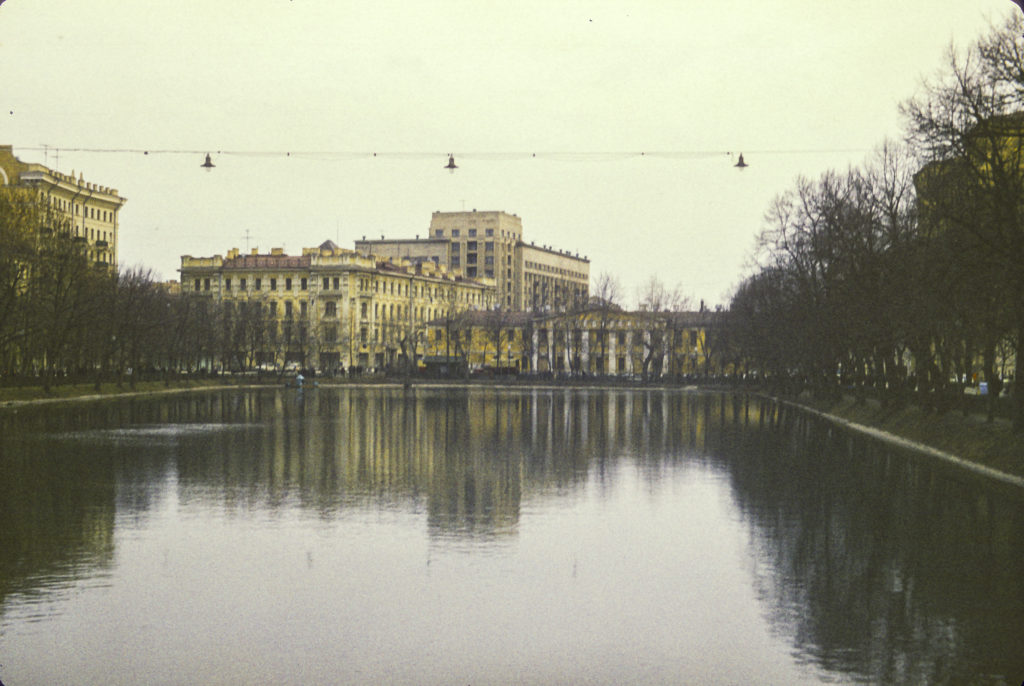
One cold day toward the end of winter, I went with my girlfriend Vera and our Norwegian friend Sidsel Larsen for a stroll in the area of Chistye Prudy (“Clean Ponds”), in the Basmanny district of Moscow. Despite the name, there is only one pond visible; the others are now all underground, as is the small Rachka river that feeds them. In the seventeenth century they had a different name – Griaznye Prudy, “Dirty Ponds,” because Muscovites used them as a garbage dump. In 1703 Prince Alexander Menshikov, Peter the Great’s crony, bought them, cleaned them up and gave them their present name. Chistye Prudy reminds me of another Moscow pond, Patriarch’s Ponds, which I’ve seen only in pictures (I was once told that it no longer exists, but that turns out not to be true), but which serves as the opening scene of my favorite Russian novel, Mikhail Bulgakov’s The Master and Margarita.
Chistye Prudy – Pond in the Basmanny District of Moscow – 1973
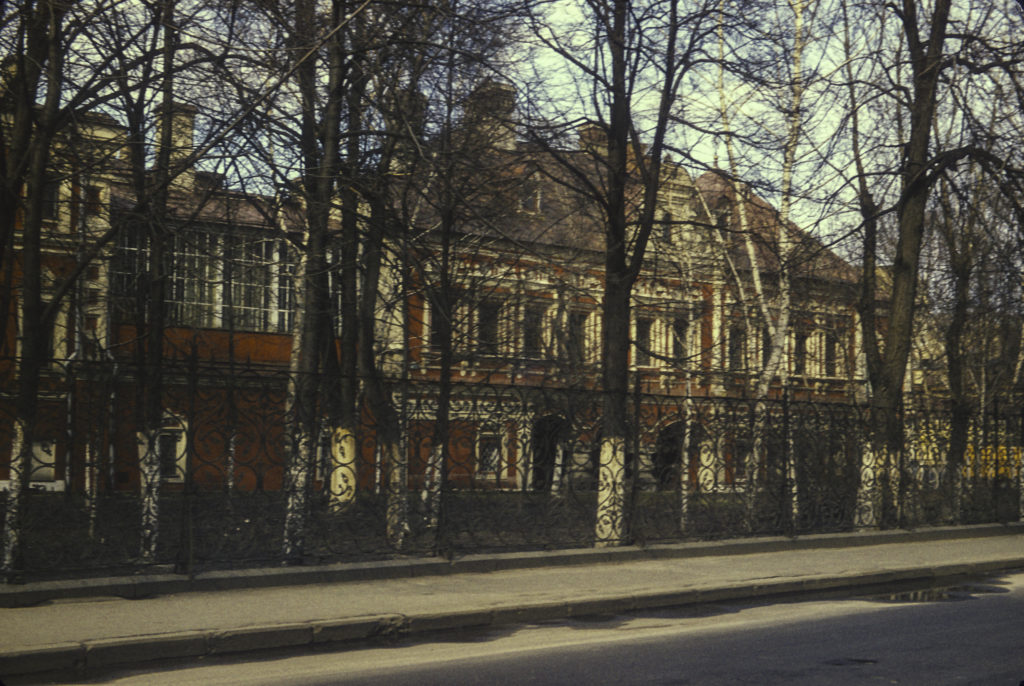
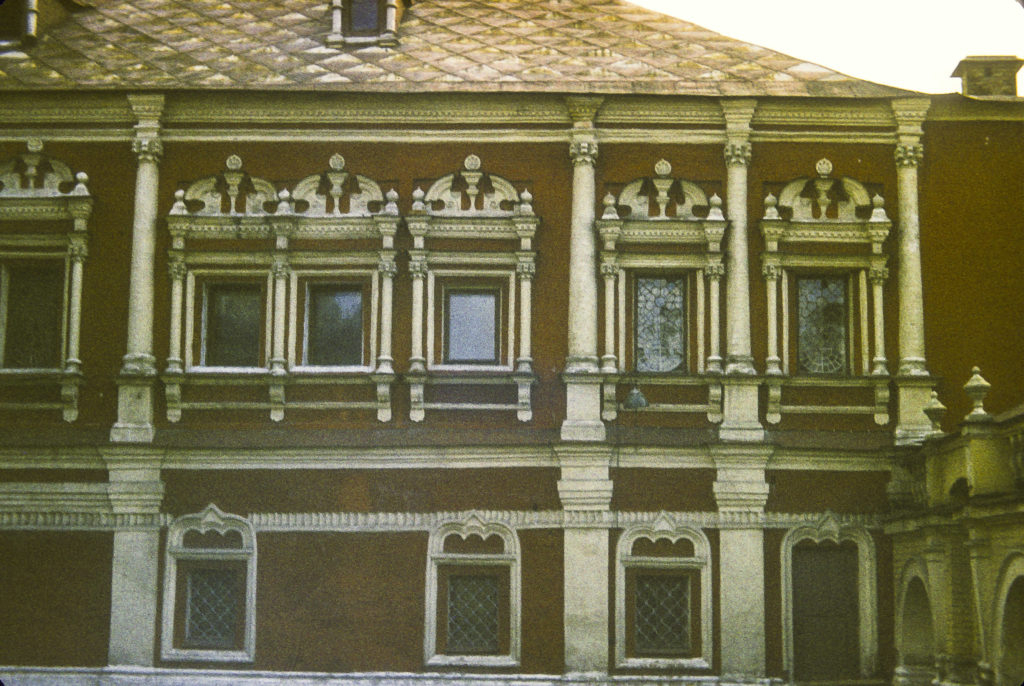
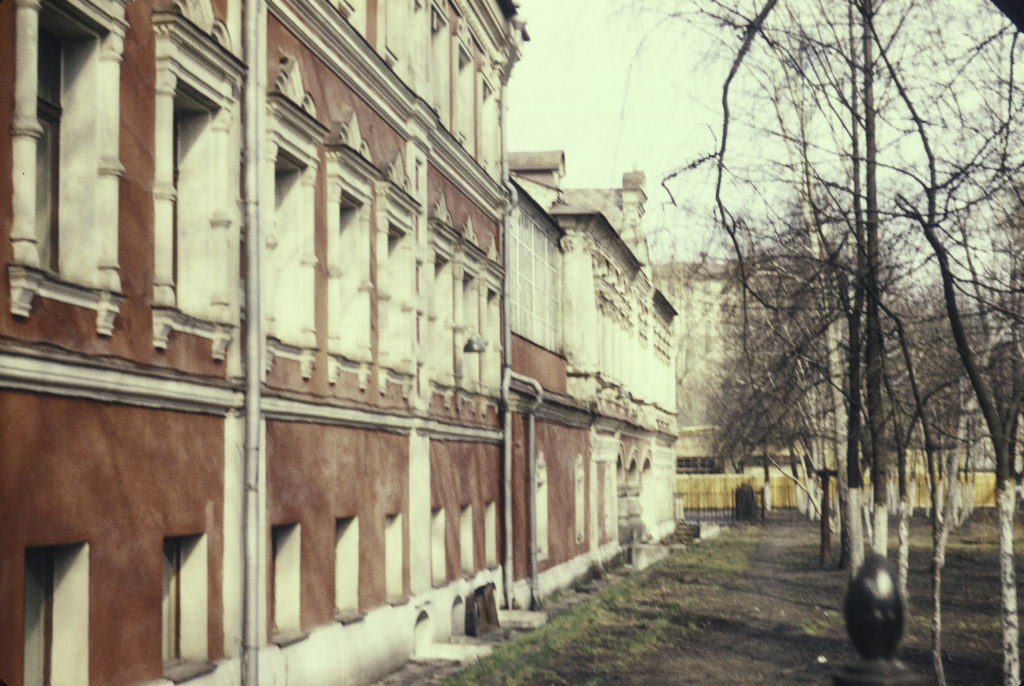
Our main objective on this excursion was a historic structure known as the “Palace of the Boyar Volkov” because it had supposedly been built in the 17th-century by a boyar (magnate of pre-Petrine Russia) named Volkov. In 1973 it was not open to the public. You could only snoop around the outside. Since then, it has opened as a museum, which has its own web page, in Russian. There is even information online in English about the place, although it is a bit sketchy and of poor quality. Without doing exhaustive research, I’ve been able to piece together some of the history of the palace. Legend has it that in the 16th century, a hunting lodge belonging to the tsar had occupied the site, from which Ivan the Terrible issued forth in disguise to spy on his subjects; but there doesn’t seem to be any documentary evidence to support this. Still, I suspect that it existed in some form prior to the usual date given for its construction, in 1698, during the reign of Peter the Great. Peter conferred it first on his vice-chancellor, the diplomat Peter Shafirov, and later on the head of his secret service, Count Peter Tolstoy.
Moscow – Palata Boyarina Volkova – Boyar Volkov’s Palace, 17th Century, as it looked in 1973.
When Peter the Great died in 1725, his widow came to the throne as Catherine I, but Prince Alexander Menshikov, who had been Peter’s right-hand man, ran the show for her; he gave the palace to one of his minions, Alexei Volkov, the Chief Secretary to the Military Board. This was how the palace got the name “Palace of Boyar Volkov,” though Volkov was not a boyar (the appellation had fallen out of use by then) and owned it only about a year. Catherine I died in 1727, and for a little while Menshikov dominated her successor, Peter the Great’s grandson Peter II, who was only twelve years old. But Peter II detested Menshikov and soon got rid of him, exiling him to Siberia. After the fall of Menshikov Peter II apparently purged Volkov too, and gave his palace to Prince Grigori Dmitrievich Yusupov. Thereafter the palace remained in the hands of the Yusupov family until the Revolution of 1917.
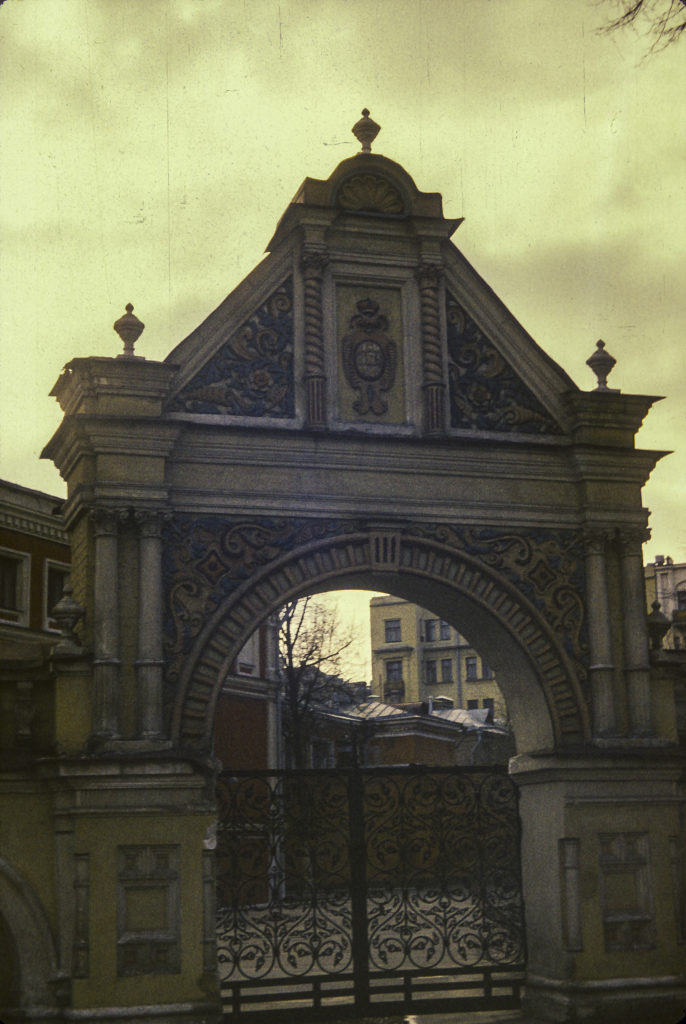
The elaborate gateway to the grounds of the Volkov-Yusupov Palace, with its wrought iron gate.
The Yusupovs were the descendants of Tatar princes of the Nogai horde who had converted to Orthodox Christianity in the 17th century. They were quickly absorbed into the Russian aristocracy and were one of the richest families in Imperial Russia. By the end of the eighteenth century they owned 675,000 acres of land and 40,000 serfs. However, the male line ended in 1891 with the death of Nikolai Borisovich Yusupov, leaving his only daughter, the famous beauty Zinaida Nikolaevna (1861-1939), as heiress. She had married Count Felix Felixovich Sumarokov-Elston (1856-1928) in 1882. Count Felix became commander of the Imperial Guards Cavalry under Nicholas II, and later served as Governor-General of Moscow in 1914-15. After his father-in-law’s death, Tsar Alexander III granted Count Felix the title of Prince Yusupov and the right to pass it on to the couple’s heirs. Their older son, Nikolai, was killed in a duel in 1908; the younger, Felix Felixovich, married a niece of Tsar Nicholas II. He lived primarily in St. Petersburg, where in December 1916 his house became the scene of the murder of Rasputin – in which he participated. For this he was exiled to one of his estates. But after the Tsar’s abdication in February 1917, the Yusupovs went to the Crimea, then emigrated to the West. They lived in Paris, where Felix died in 1967.
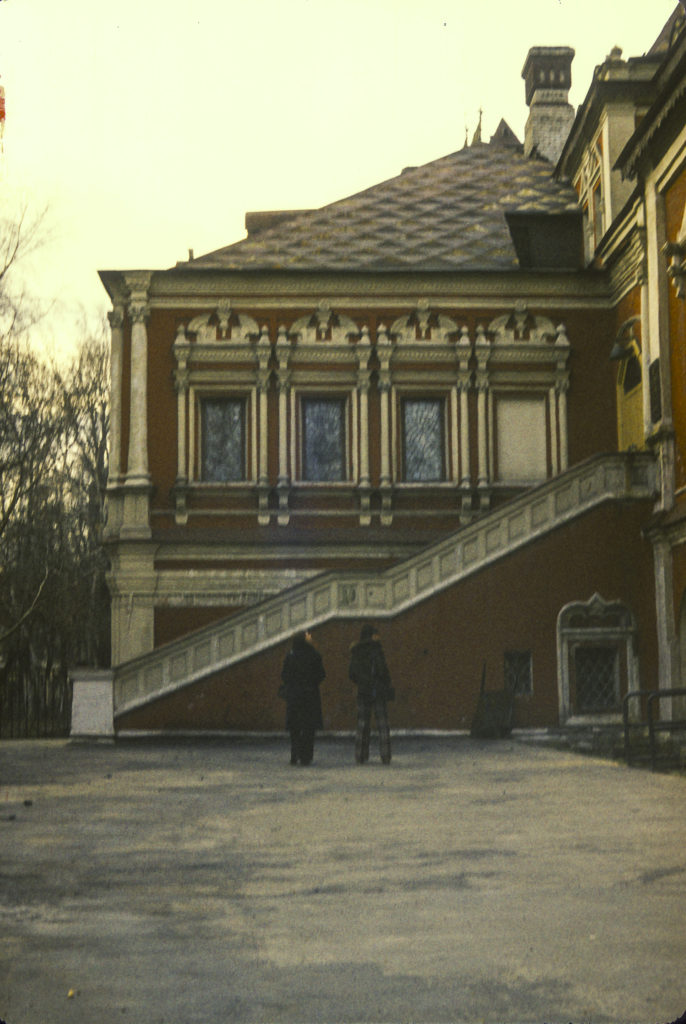
Sidsel Larsen and Vera Antonova check out the entrance to the Volkov-Yusupov Palace or Mansion, 21 Bol’shoi Kharitonovskii Pereulok, Moscow, 1973.
In the early nineteenth century (1801-1803), Sergei Lvovich Pushkin, the father of the poet Alexander Sergeevich Pushkin (1799-1837) rented an apartment in the Volkov-Yusupov Palace, and Alexander himself lived there for a while.
In the 1890s Princess Zinaida Nikolaevna Yusupova undertook extensive restoration, including renewal of the stoves with genuine antique tiles.
17th-century palace at 21 Bol’shoi Kharitonievskii Pereulok, Moscow, 1973.
After the Revolution, the Palace housed a series of Soviet institutions, of which the Lenin All-Union Academy of Agricultural Sciences (VASKhNIL) had the longest tenure. But finally, in 2010, after a period of reconstruction, the Palace was reopened as one of the newest museums in Moscow, in one of its oldest buildings; thus its lavishly furnished interior chambers, restored to their former opulence, are now open to the public.
The Volkov-Yusupov Palace, according to its website, is one of the best-preserved residential buildings surviving from Muscovite Russia (15th-17th century). Most such structures, of which there are several dozen, survive only in fragments or else have been reconstructed and remodeled so often that they are now unrecognizable. By contrast, the Volkov-Yusupov Palace is preserved in its original form, with its vaulted ceilings and tiled stoves. There are a few later additions, such as chimneys, but these do not detract from the overall impression of a 17th-century Muscovite dwelling.
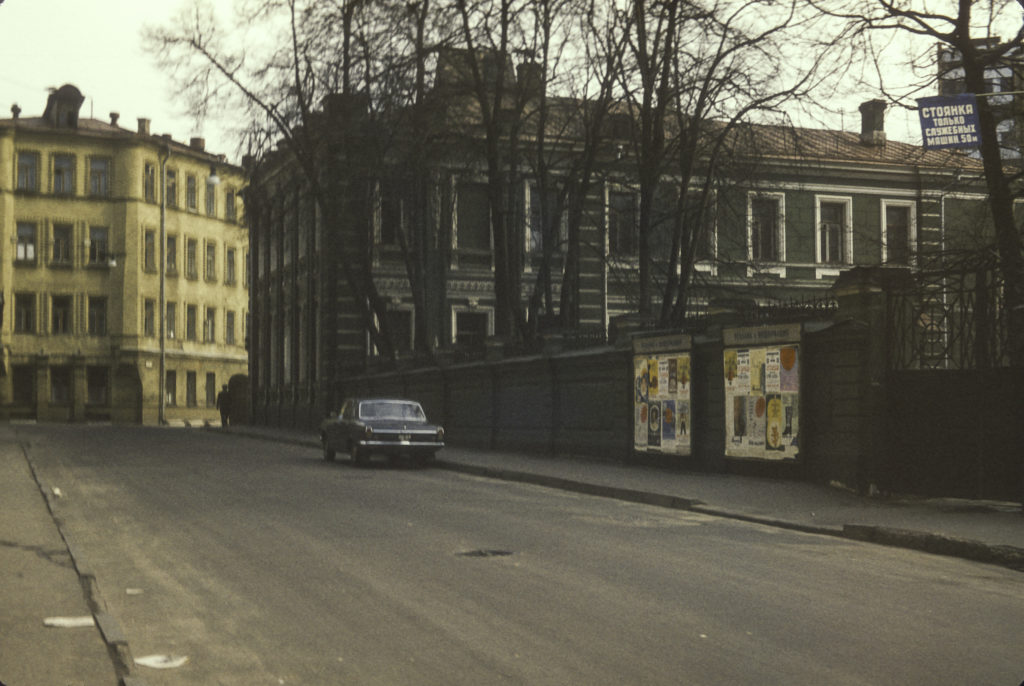
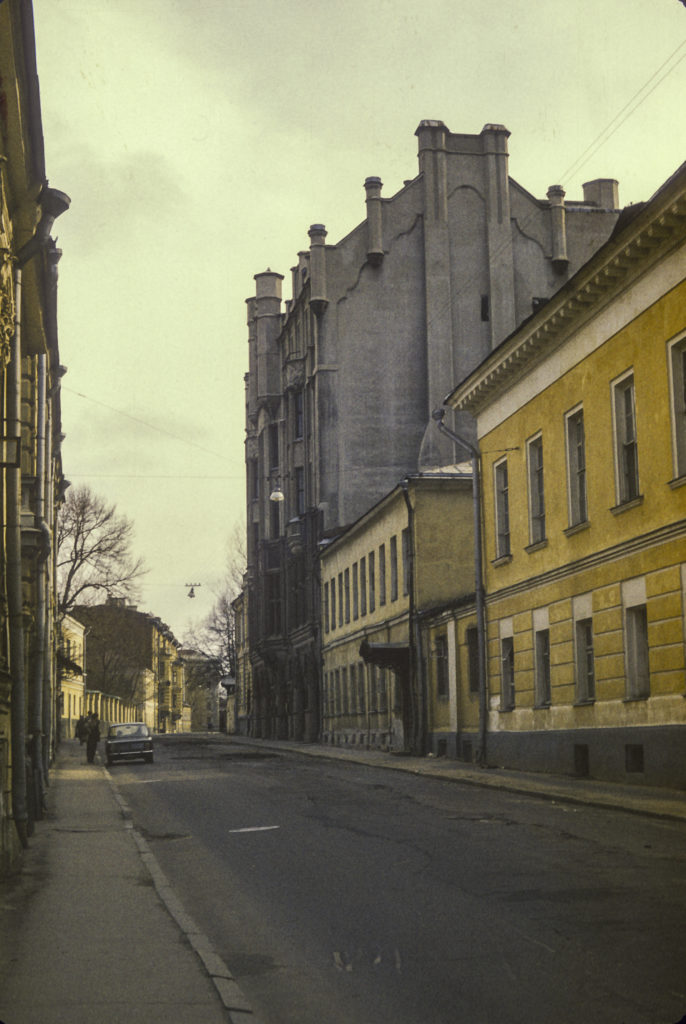
Street scene in Basmanny District, near Chistye Prudy
We continued to explore in the Chistye Prudy area for a little while before heading back to Moscow University. The surrounding neighborhood is said to be venerable and prestigious, and appeared to be relatively well-kept.
Basmanny District, near Chistye Prudy.
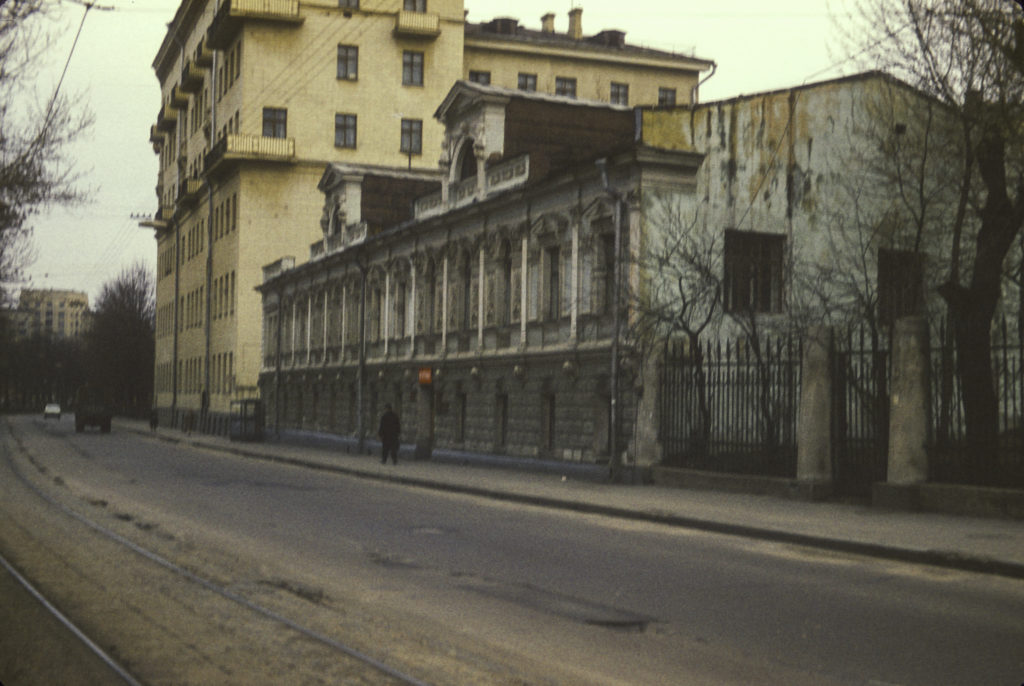
We encountered a few interesting items in our wanderings. For example, the building in the following photo was clearly of pre-revolutionary construction and quite likely had an impressive pedigree, but there was nothing on it in the way of identification.
Basmanny District, near Chistye Prudy. Clearly a historic building, but I don’t know anything about it.
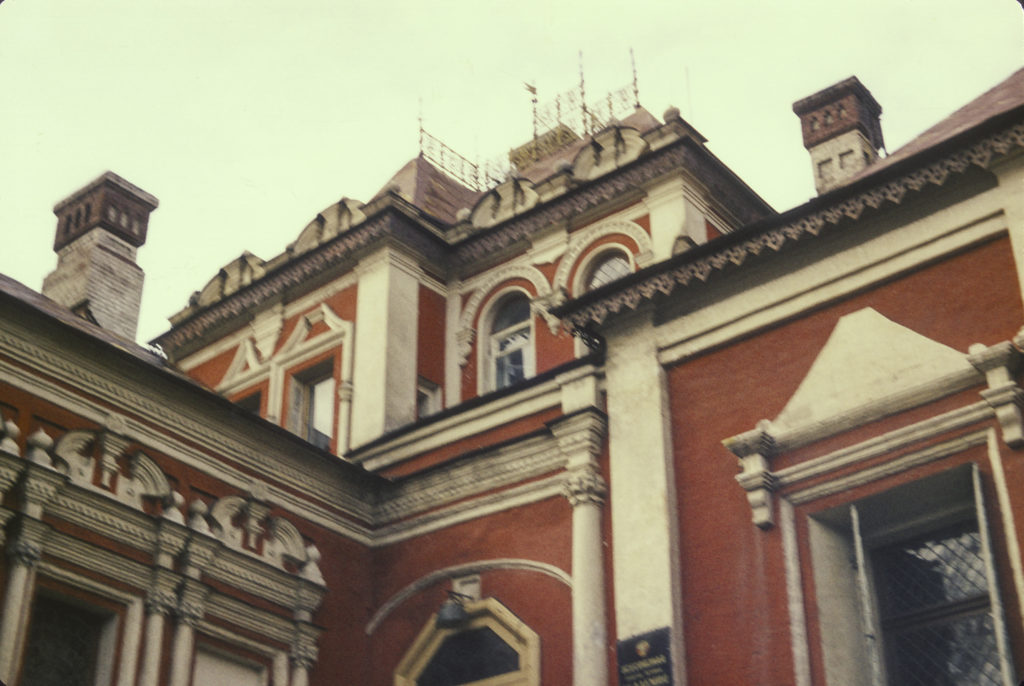
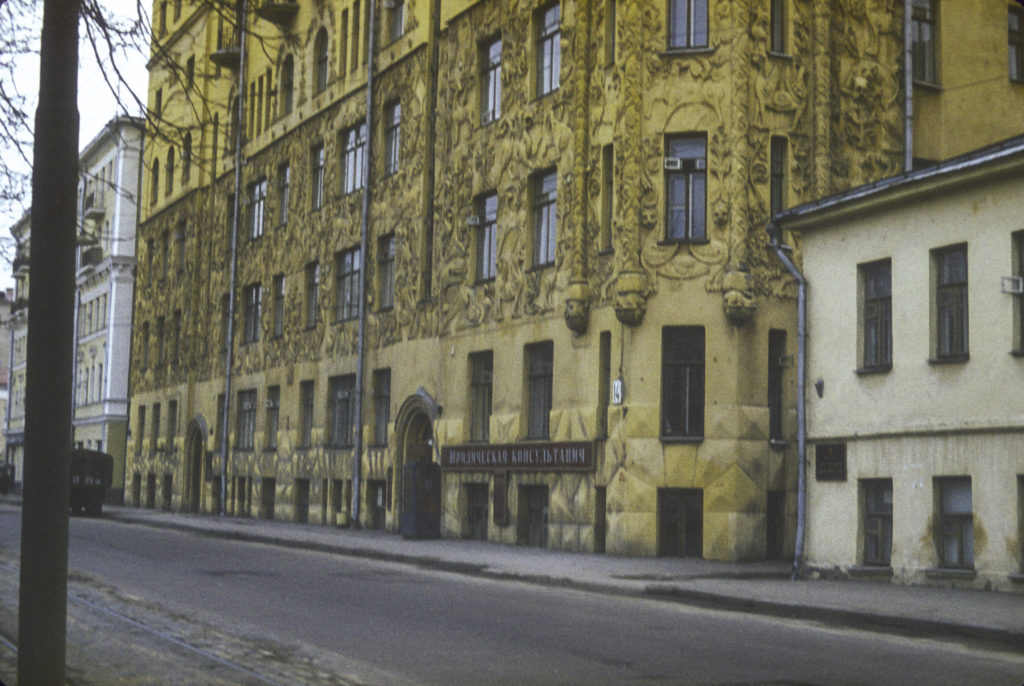
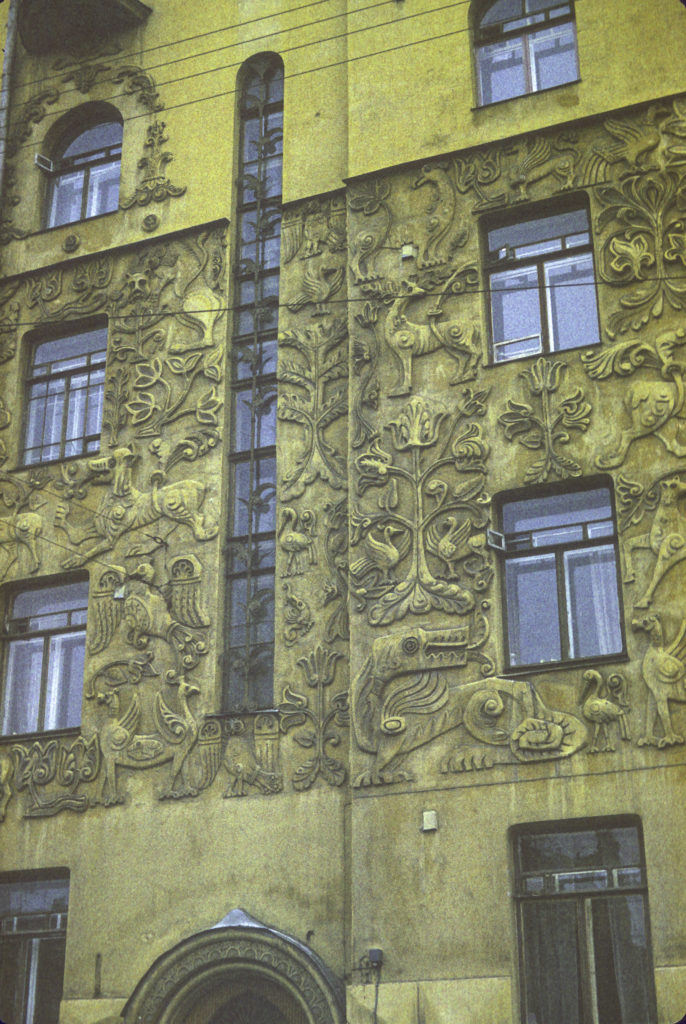
The same was true of the structure in the following few pictures. It appeared to be an apartment building with legal offices on the ground floow. Its salient feature was the elaborate and striking decoration around the second and third stories.
Apartment and office building near Chistye Prudy. The sign on the ground floor reads “Juridical Consultation.”
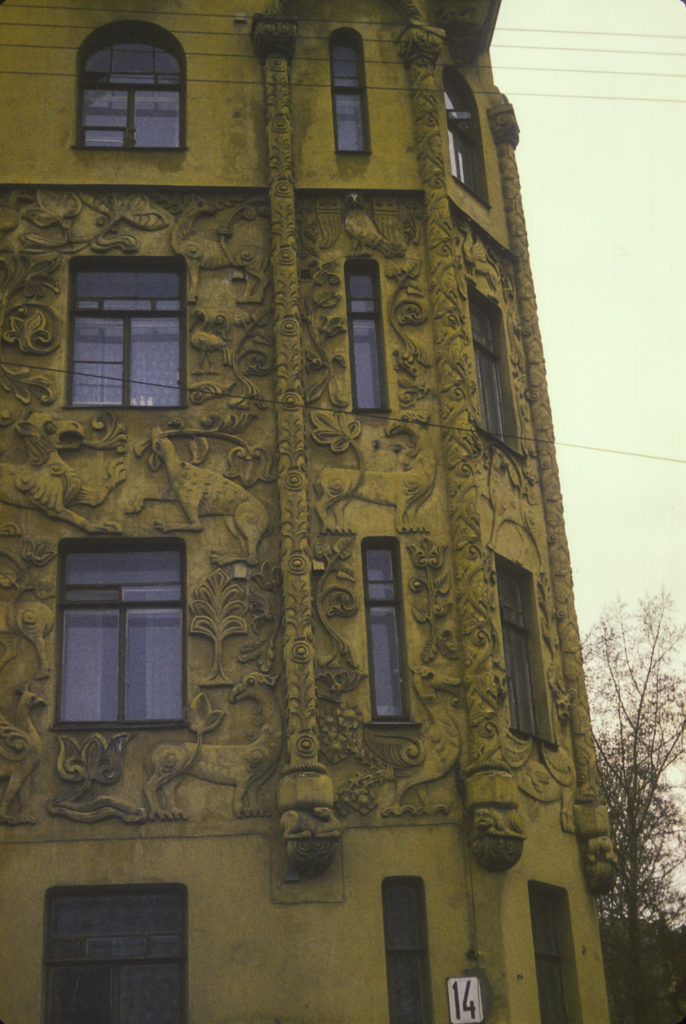
It would have been nice to find out who built this structure and especially who was responsible for the artistry, but there was nothing to provide any clues about it.
Detail of elaborately decorated apartment building in Basmanny District, near Chistye Prudy
I imagine that the people who lived and worked here led comfortable lives by Soviet standards. I haven’t given up trying to find out more about it, and if nothing else, someday I hope to go back to Moscow and find out more about this and some of the other sights that remained “incognito” in 1973.
I’m still trying to find out who was responsible for the artistic bas-relief type ornamentation on this structure.
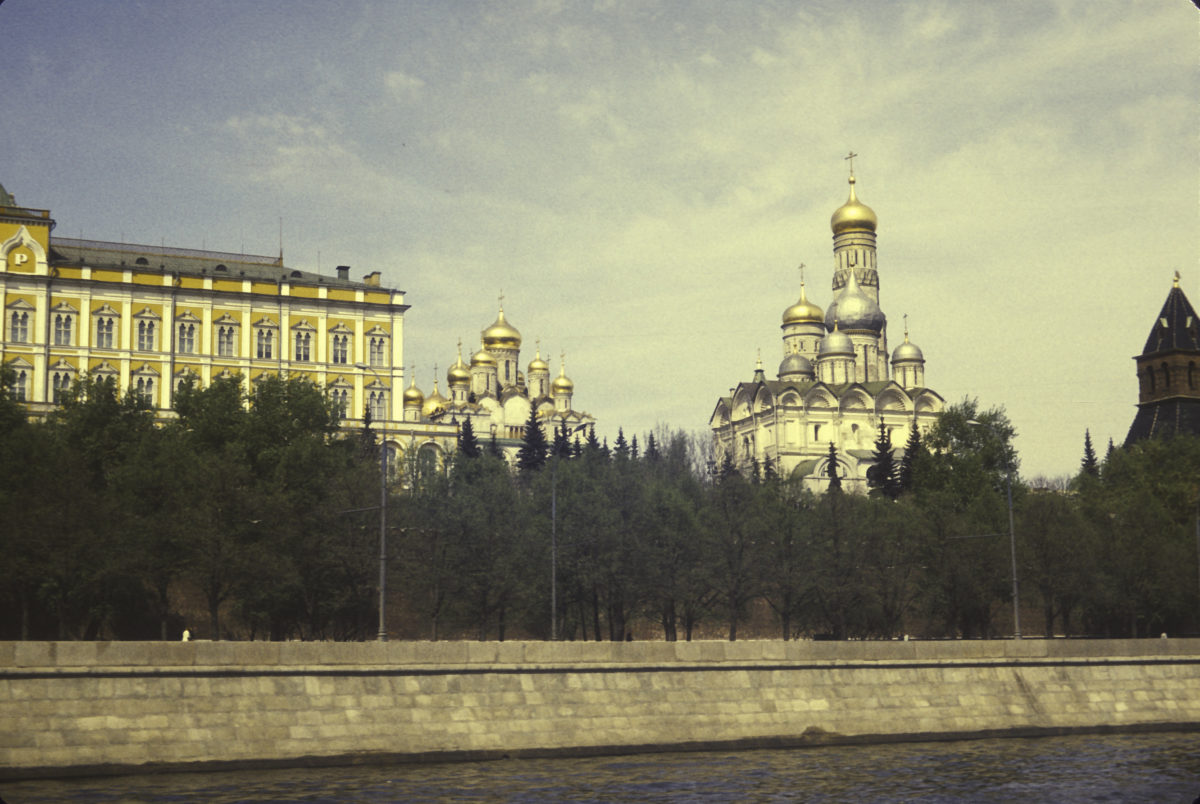
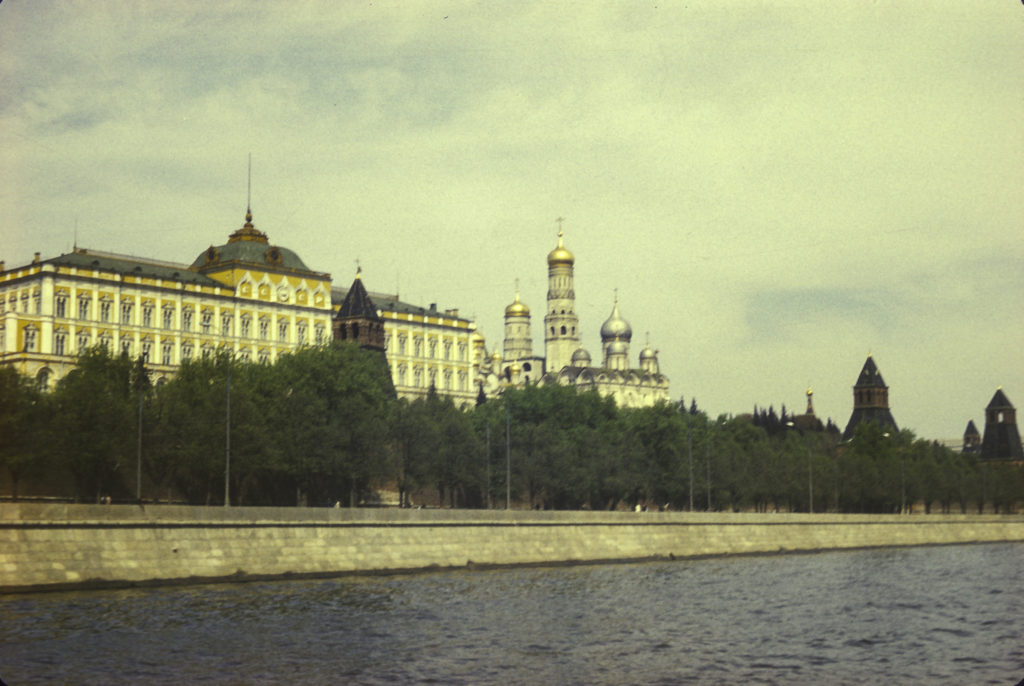
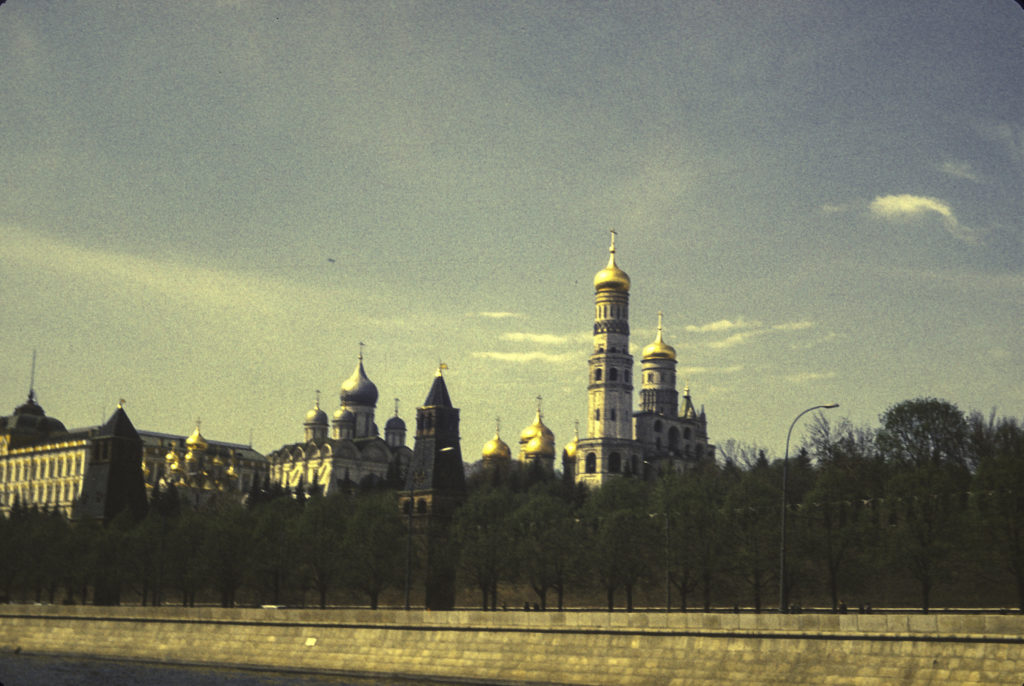
Grand Kremlin Palace on the left; center, Annunciation Cathedral; right, Cathedral of the Archangel and Ival the Great Bell Tower behind it; extreme right, Tainitskaya Tower on the Kremlin Wall.
Early on during my year in the Soviet Union, I took a sightseeing cruise down Moscow River. This is a good way to become acquainted with the layout of the city and some of the major landmarks. Of these the most famous and spectacular is, of course, the Kremlin, with its towers, palaces and cathedrals. But the cruise also provided me an opportunity to become acquainted not only with the major tourist attractions by the river, but also with a number of less well-known sights which don’t make it into the usual “must-see” lists but profoundly enriched my experience of Moscow.
The Moscow River meanders through the city from northwest to southeast in a series of great loops. Moscow University, where I was based, lies at the south end of one of these loops, and the Kremlin lies at the north end, where the river turns south again to form another great loop. Just before the river turns from south to north to form the loop that runs by the University, it passes the Novodevichy Convent, and that is where I’ll begin.
Novodevichy Convent. Right of center is the Cathedral of Our Lady of Smolensk, with the octagonal bell tower behind it;
The Novodevichy Convent dates from 1524, when Grand Prince Vasily III founded it to commemorate his conquest of Smolensk, and indeed the oldest structure and main church, which was built at that time, is named the Cathedral of Our Lady of Smolensk. It soon became the preferred place for the Muscovite aristocracy to send sisters, daughters, etc. whom they found inconvenient for one reason or another. One of its most famous residents was Peter the Great’s half-sister, Sofia Alexeevna, whom Peter forced to retire there after seizing power and ending her regency in 1689. Peter’s first wife, whom he divorced, also lived there toward the end of her life. It was Sofia Alexeevna who had the bell tower, the tallest structure in the convent, built in the 1680s.
The Soviets closed down the convent and turned it into a museum, but during World War II Stalin, in an effort to rally the Orthodox Church in support of the war effort, allowed it to resume a presence there, and since 1994 nuns have again been living in the convent.
Outside the south wall of the convent lies the Novodevichy Cemetery, which is the most fashionable place in Russia to be buried. Such notables as Anton Chekhov, Nikita Khrushchev, Sergei Prokofiev, Dmitri Shostakovich, Boris Yeltsin and Mstislav Rostropovich are interred there.
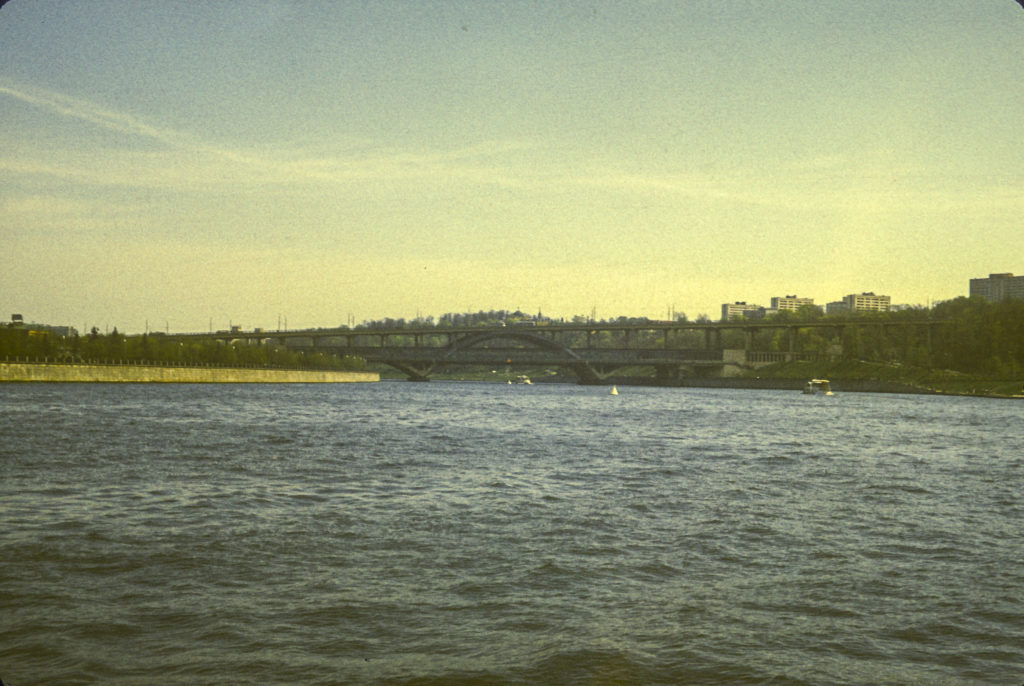
Continuing on around the bend of the river, past Moscow University, you come to the Luzhniki Metro Bridge (Luzhnetsky Metromost), a bridge which accommodates subway trains on the lower level and autos on the upper. It crosses the river from Sparrow Hills (the locale of Moscow University) on the south to the area of the Luzniki sports complex on the north side of the river, in Khamovniki district.
Moscow River – the Luzhnetsky Metromost (Luzhniki Subway-Auto Bridge)
Continuing on up toward downtown Moscow, I passed the Church of Saint Nicholas in the Khamovniki district. This church is a prime example of a flamboyant architectural style flourishing in the later 17th century, featuring rows of tightly packed gables called kokoshniki, in which each arch represents a heavenly fire, and the ensemble of rows taken together symbolizes the throne of God. This type of church is called ognyonnyi khram (bonfire temple) in Russian. The church of St. Nicholas in Khamovniki was built in 1679-82; the bell tower, which retains the tented-roof style popular in the late 16th and early 17th century, was added in the 1690s. The church suffered badly in the fire following the Napoleonic occupation of Moscow in 1812 and was closed until 1849, but after that it remained open continuously, even during the Soviet period, during which it was said to have always been full.
Church of Saint Nicholas in Khamovniki
As you approach the center of Moscow, you come to an island in the river known variously as Bolotnyi (Swamp) Island or Balchug. This is an artificial island, created as a by-product of eighteenth-century flood control engineering. After a catastrophic flood in 1783, the main flow of the river was diverted into its present channel and the old riverbed was converted into what is now the Vodootvodnyi (Water Bypass) Canal. The Island sits between the two channels and constitutes the northernmost section of the Zamoskvorechye District. Situated directly across the river from the Kremlin, it contains some of the most expensive and sought-after real estate in Moscow.
The south end of the Island, known as Bersenevka, is now marked by a gigantic (322 feet high) monument to Peter the Great, designed by the sculptor Zurab Tsereteli to commemorate the founding of the Russian navy by that monarch. It consists of several ships piled atop one another with Peter himself standing on the topmost ship. It has been voted one of the ugliest monuments in the world and is said to be generally unpopular among Muscovites, who haven’t forgotten that Peter the Great hated Moscow and moved the capital to St. Petersburg.
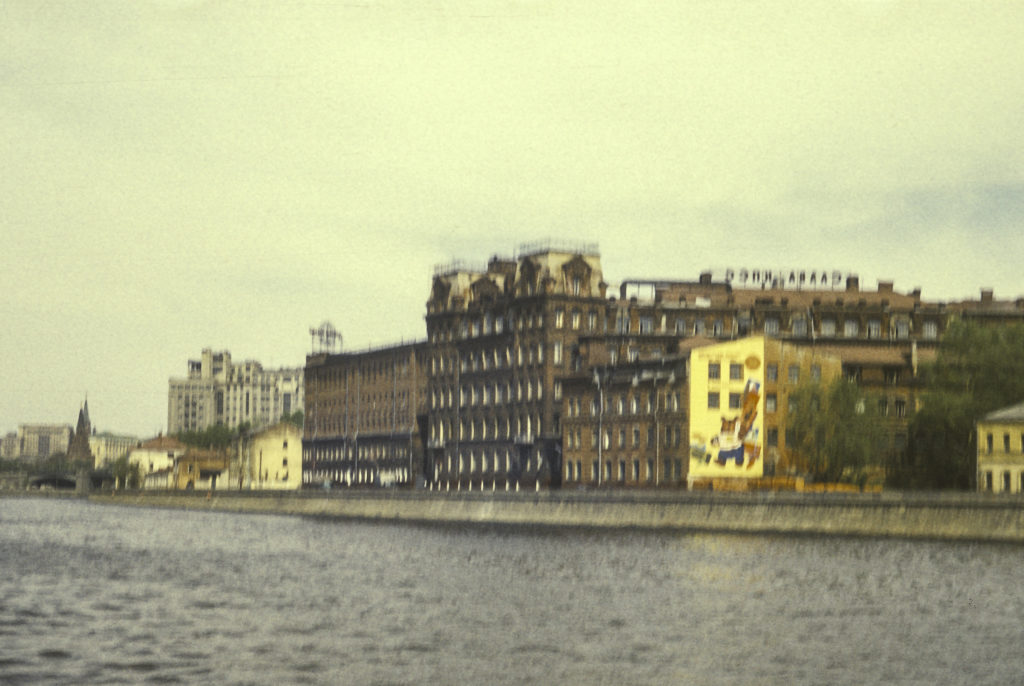
The central portion of the Krasnyi Oktyabr chocolate factory. The factory was relocated to the outskirts of Moscow in 2007, and the building now houses shops, studios and other businesses, including the headquarters of the news service Snob.ru.
But that monument was erected in 1997, 27 years after I was there, so I have never seen it in person. A little way north of where it now stands, I photographed a set of brown buildings with a sign on top proclaiming “Glory to the Communist Party of the Soviet Union” (which sounds as ridiculous in Russian as it does in English). This was the Red October chocolate factory. It was founded in the 19th century by a German named von Einem and supplied confectionery to the Russian Imperial court until the Revolution of 1917, when it was nationalized by the Bolsheviks and renamed to Red October. After the collapse of the Soviet regime it was privatized. In 2007 the factory itself was relocated to the outskirts of Moscow, and today the old factory building houses various shops, restaurants, studios and offices, including the Deworkacy Red October coworking space, the Digital October Conference Center, the Boy Cut Red October barbershop, the Moscow Point Red October Hotel, and the news service Snob.ru. It has of course been spruced up a bit since then.
The Krasnyi Oktyabr (Red October) chocolate factory in the Bersenevka area of Bolotnyi Ostrov. The sign on the top of the highest building says “Slava KPSS”, i.e. “Glory to the Communist Party of the Soviet Union.” In the distance are visible some of the Kremlin towers and the gray House on the Embankment, formerly an apartment building housing members of the Soviet elite.
Downriver from the Red October) chocolate factory stood (and still stands) an apartment complex known today as the House on the Embankment (Dom na naberezhnoi in Russian), but formerly known as “Government House” (Dom Pravitelstva). This is a Constructivist-style structure built in 1931 to house civil servants, especially high-ranking ones, in apartments that were considered luxurious for the time. The architect was Boris Iofan, who also designed the Palace of Soviets, which was to be built on the site of the Cathedral of Christ the Savior (Khram Khrista Spasitelya), but became the site of the Moscow open-air swimming pool instead. Government House became notorious for the frequent and unremarked disappearances of its residents during the later 1930s – fully a third of them are said to have vanished without trace. Nowadays, the complex has shops and movie theaters as well as apartments. Although their amenities have been eclipsed by newer developments, the apartments are still very much in demand due to their location.
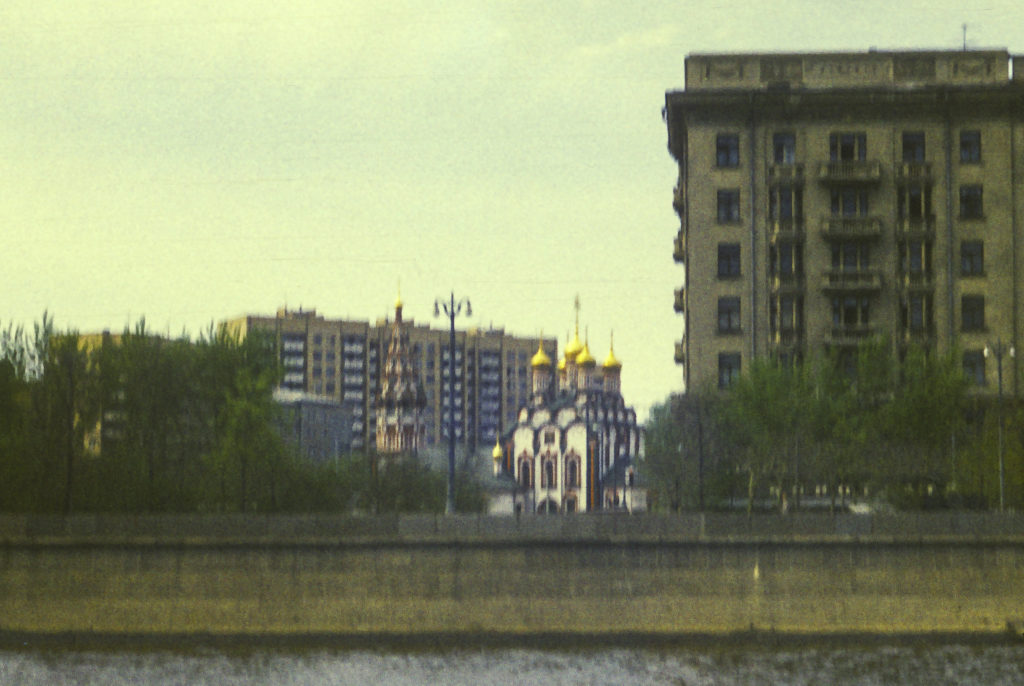
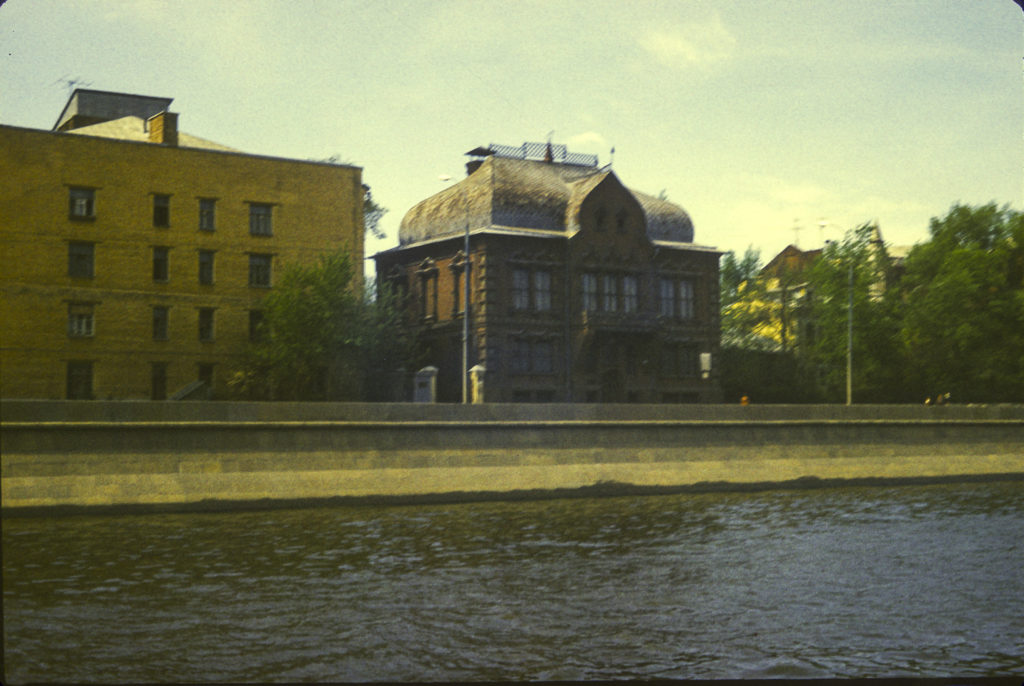
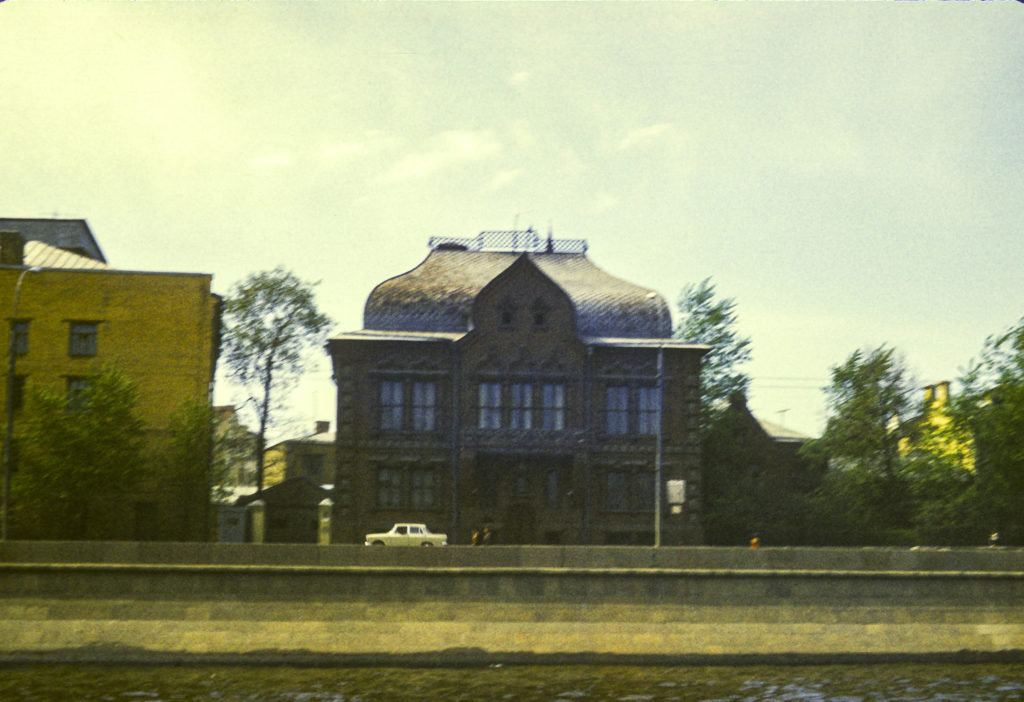
On the opposite side of the river from the Red October chocolate factory I observed an unusual mansion, which I was unable to identify at the time, but subsequent research has revealed it was built by a wealthy art collector named Ivan Tsvetkov in 1900 to house his collection of paintings.
Osobnyak Tsvetkova (Tsvetkov Mansion). Built 1901 by Ivan Evmeniyevich Tsvetkov to house his art collection. Now serves as office of the French Defense Attaché.
During World War II, the Tsvetkov Mansion was assigned to a military mission representing a Free French combat aviation unit, the Normandy-Niemen regiment, formed in the Soviet Union. Currently, the mansion houses the office of the French defense attaché as well as an exposition devoted to the history of the Normandy-Niemen regiment.
Another view of the Tsvetkov Mansion.
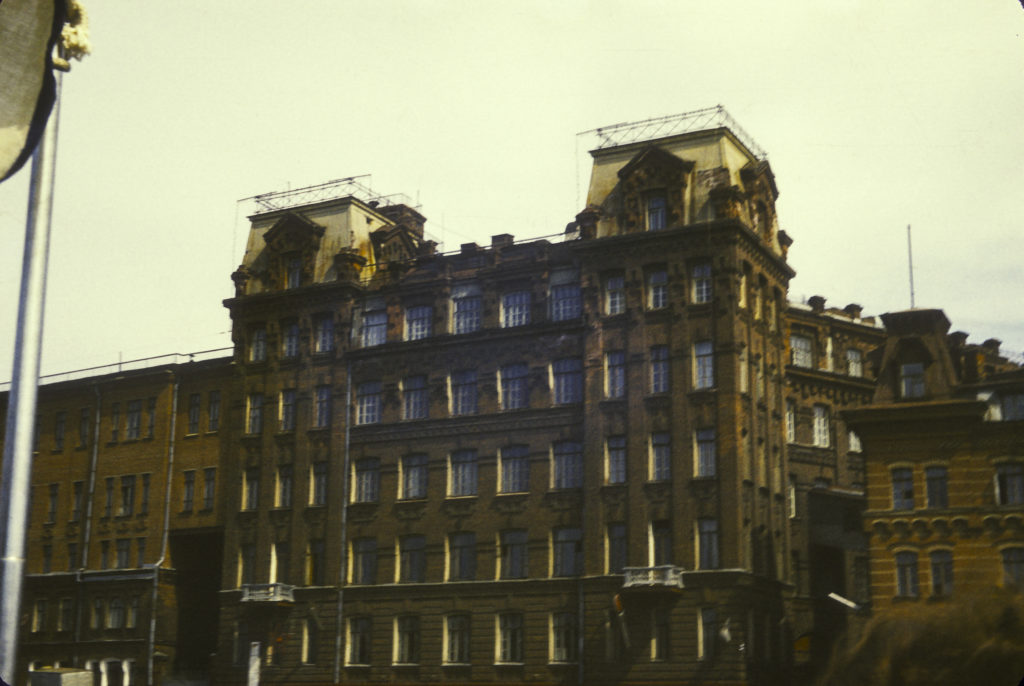
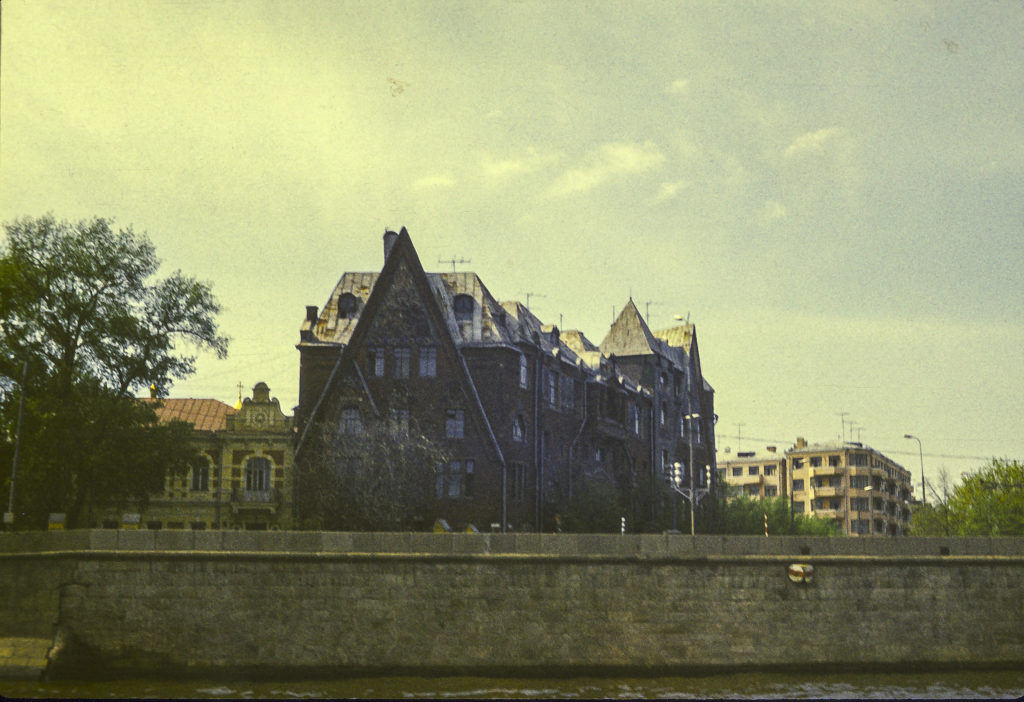
A few doors downstream from the Tsvetkov Mansion, I encountered an even more unusual house, which I was told was occupied by the Ethiopian Embassy. I doubt whether this was accurate, but I’ve since discovered that the house was built in 1905-07 by a well-to-do railway magnate named Petr Nikolayevich Pertsov, who intended it as a guest-house with residential apartments and workshops for artists and theatrical people.
Dom Pertsova (House of Pertsov) – guest-house with residential apartments and workshops for artists and theatrical people. Built 1905-1907.
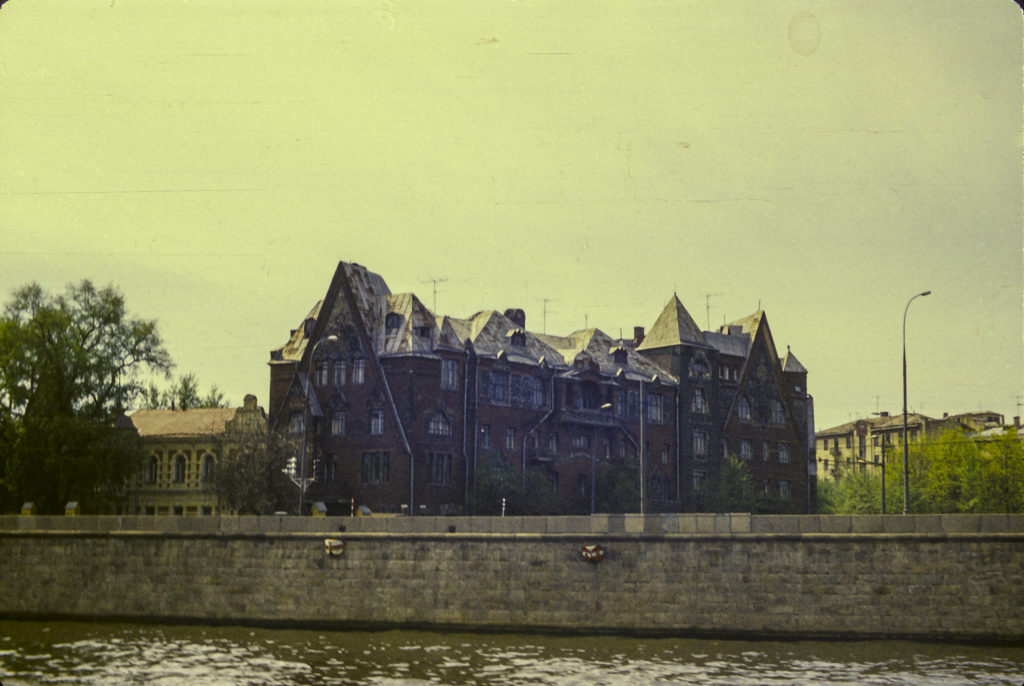
Tsvetkov may have sold or given Pertsov the land on which to build the house in return for a promise to make it a showcase of Russian art. In any case, it turned out to be a prime example of the flourishing of the art nouveau movement in Russia. If I had had a telephoto lens, I could have captured some of the extraordinary mosaics, figures of birds, animals, fantastic creatures and other decorations adorning the exterior of the building; you can view a few of them on Marina Pavljuk’s web page, which is a source for some of the information presented here. The artist responsible for the artwork was Sergei Maliutin, who is credited with originating the nested wooden Matryoshka dolls.
Another view of the Pertsov House, which is now occupied by the Russian Foreign Ministry and is closed to the public. The building next to it on the left houses the Embassy of Madagascar.
After the Revolution of 1917, the Bolsheviks confiscated the Pertsov house, as they did everything else, and turned it into a hostel for military officers. Nowadays it houses offices of the Foreign Ministry of the Russian Republic, so the interior remains closed to the public.
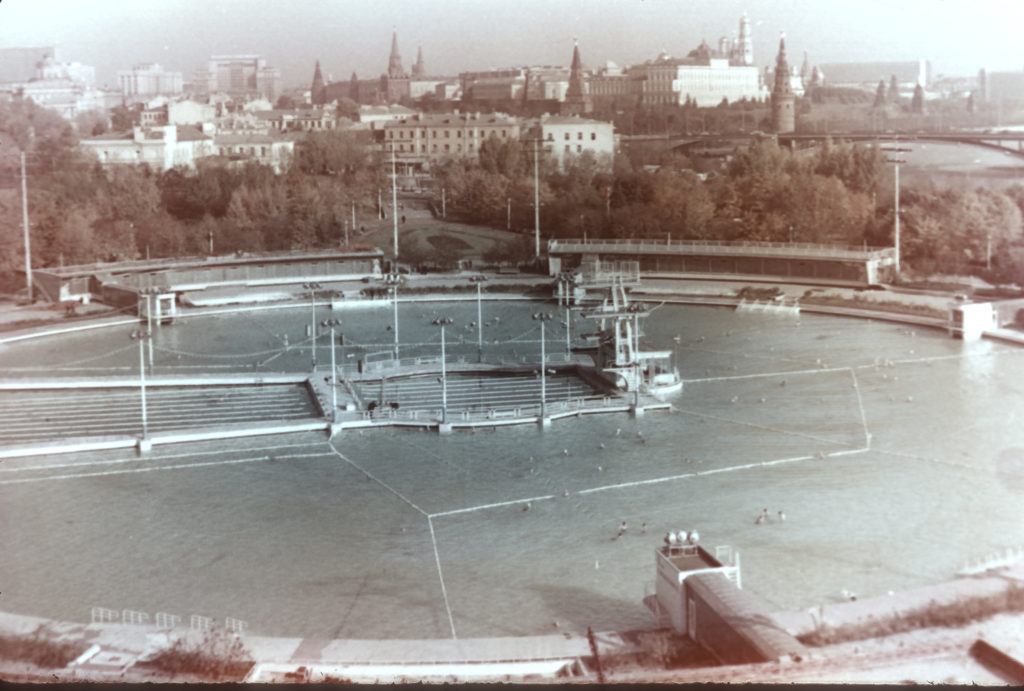
The Pertsov house is just a hop, skip and jump away from the next big attraction on the Moscow River, which is the Cathedral of Christ the Savior, but that, as I’ve noted elsewhere, did not exist when I was in Moscow in 1972-3. What did exist was the enormous outdoor swimming pool, which was not visible from Moscow River but which I had photographed in my earlier visit in 1964. I’ve included one of the badly faded color slides I bought in Moscow while I was there, just for laughs.
The Moscow Swimming Pool, with the Kremlin in the background (photo not taken by me)
And so, after passing under the Big Stone Bridge (Bol’shoy Kamennyi Most), I came to the Kremlin. I had, of course, been inside the Kremlin walls in 1964, and had photographed the wonders within; in 1972-73 I went inside the Kremlin several times, but seeing it from the river provides a different perspective. Most immediately you notice the towers on the Kremlin wall, because they are right in front of everything else. Each tower has a name and its own story.
The Moscow Kremlin. Grand Kremlin Palace on the left, Blagoveshchenskaya (Annunciation) Tower in front of it on the Kremlin Wall; center, Annunciation Cathedral, Cathedral of the Archangel Michael and Ivan the Great Bell Tower; right, Tainitskaya Tower and Vtoraya Tower on the Kremlin Wall.
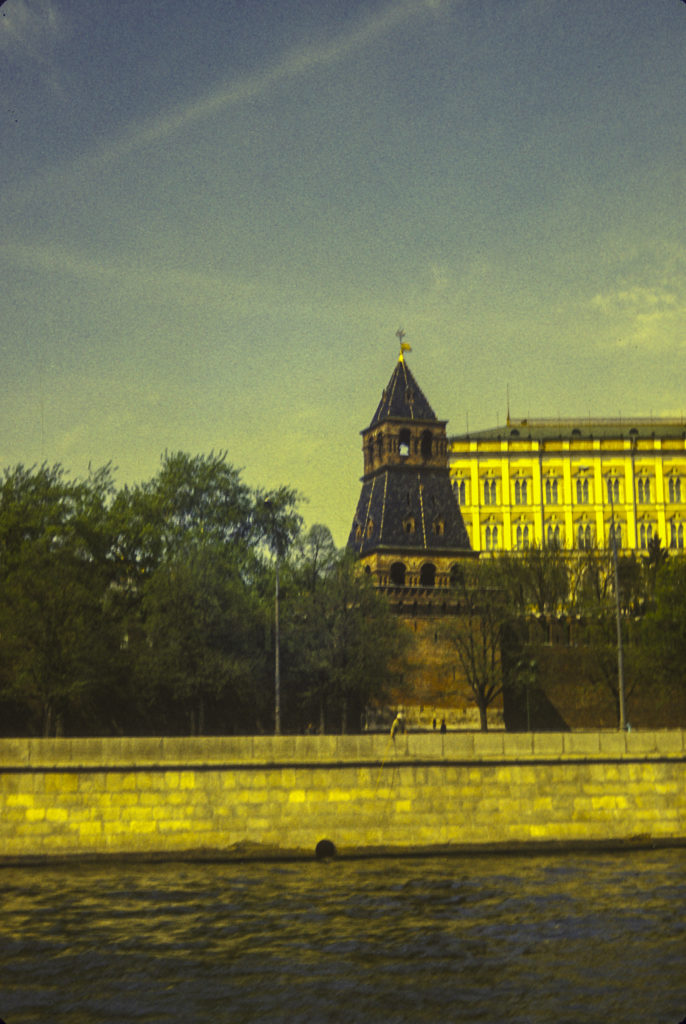
For example, the Blagoveshchenskaya Tower, pictured here, was built in 1488 and named for a miracle-working icon which was kept there. Ivan the Terrible used it as a prison. (Actually, there are two unnamed towers, but even these have names – the First and Second Unnamed Towers, respectively.)
Blagoveshchenskaya (Annunciation) Tower on the Kremlin Wall
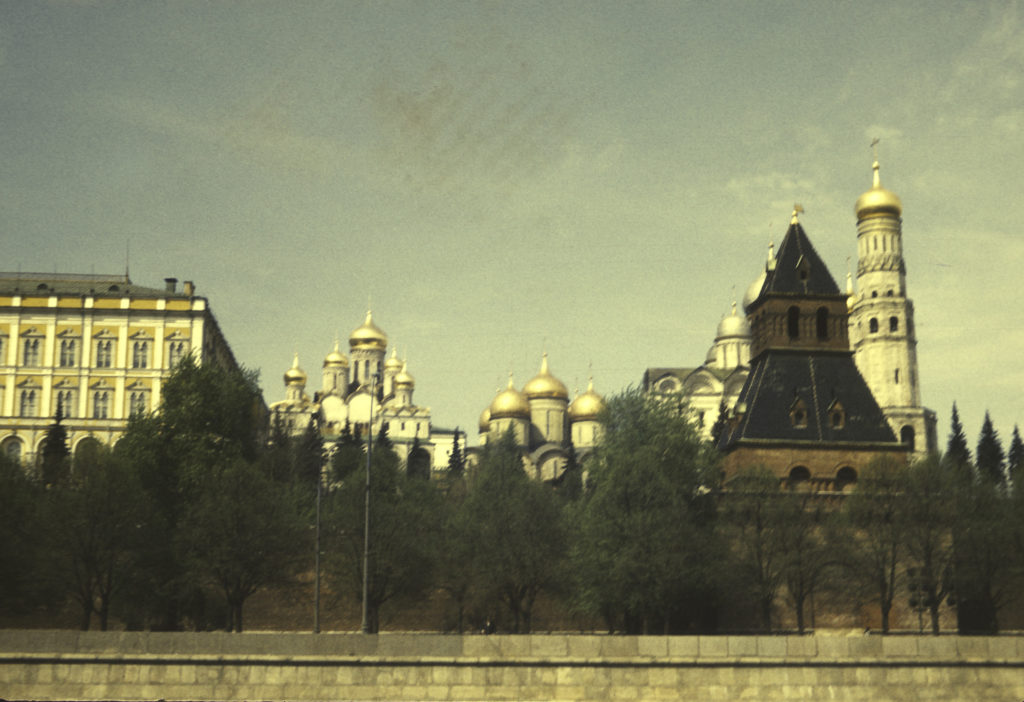
The Tainitskaya Tower, shown in the next picture, was so named (taina = “secret”) because it had a secret well, fed by a tunnel from the Moscow River. It was built in 1485. Like the Tainitskaya, the First and Second Unnamed Towers were built in the fifteenth century.
Grand Kremlin Palace on left, Cathedrals of the Annunciation, Dormition and Archangel Michael in center, Ivan the Great Bell Tower at right, the last two partially obscured by Tainitskaya Tower on Kremlin wall.
The Grand Kremlin Palace (Bol’shoi Kremlyovskyi Dvorets) was built during the reign of Nicholas I to be the Moscow residence of the Emperor; construction lasted from 1837 to 1849. The chief architect was Konstantin Andreevich Thon (or Ton), who also fulfilled that role for the Kremlin Armory and the Cathedral of Christ the Savior. I was surprised to find out that the Palace, which appears to have three stories, actually has only two, and that the two upper rows of windows both belong to the second floor. The Grand Kremlin Palace has an area of 25,000 square meters, over 700 rooms and five major reception halls. In the picture below, one may see the letters “CCCP” (which would be “SSSR” in the Latin alphabet, standing for “Soyuz Sovetskikh Sotsialisticheskikh Respublik”, i.e. Union of Soviet Socialist Republics) embedded between the pointed arches in the center section, between the windows and the roof; these were removed after the collapse of the Soviet Union.
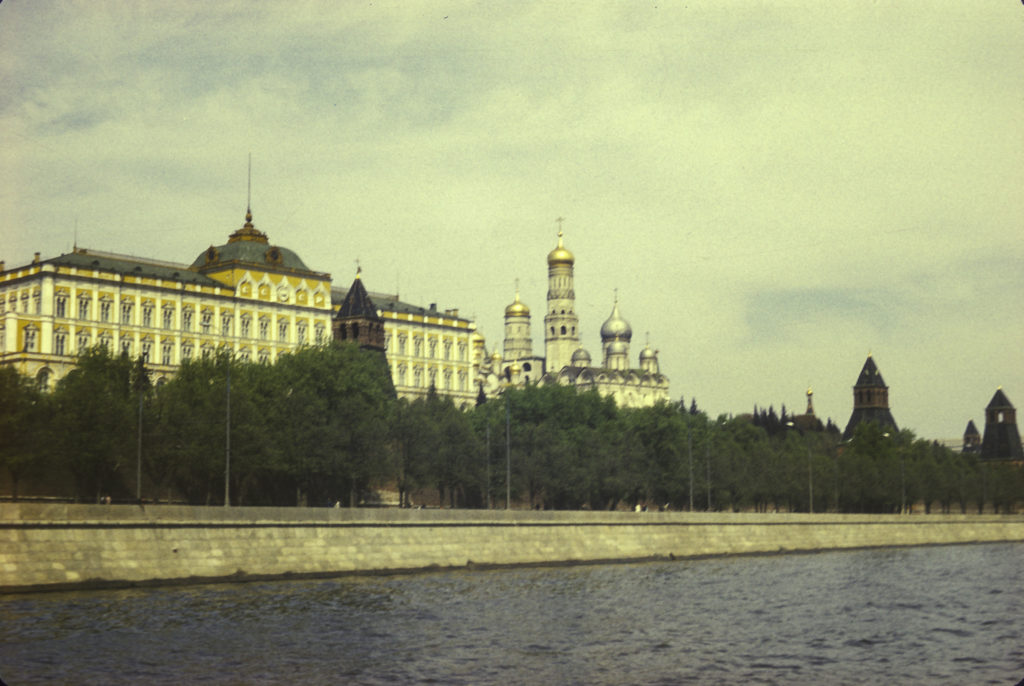
Grand Kremlin Palace on the left, with Blagoveshchenskaya (Annunciation) Tower in front of it on the Kremlin wall; in the center, Annunciation Cathedral, Cathedral of the Archangel Michael and Ivan the Great Bell Tower; right, Tainitskaya Tower and the Pervaya Bezymyannaya (First Unnamed)Tower on the Kremlin Wall.
Of the three cathedrals in the Kremlin which are visible in the pictures displayed here, the oldest is the Uspensky Sobor (Cathedral of the Dormition), built between 1475 and 1479. It has five golden domes, symbolizing Christ and the Four Evangelists. It was the official venue for the coronation of Russian rulers from 1547 to 1896.
The next to be built was the Blagoveshchensky Sobor (Cathedral of the Annunciation), completed in 1489. Although it has nine golden domes, four more than the Uspensky, it is the smallest of the three major Kremlin cathedrals. It is the one immediately next to the Grand Kremlin Palace and is actually connected to the Palace. Ivan III had it built as his personal chapel, and from the time of Ivan IV it was the church where members of the royal family were baptized and got married.
The largest of the three, the Cathedral of the Archangel Michael, was begun in 1505 and completed in 1509. Ivan III died in 1505 and was buried there, as were his successors until the time of Peter the Great, when the Peter-Paul Cathedral in St. Petersburg became the burial place of the Russian rulers. The exception was Peter II, who died in Moscow and was buried in the Archangel Michael Cathedral.
The tallest structure in the Kremlin is not a cathedral but the Bell Tower of Ivan the Great. (Ivan III was called Ivan the Great because of his enormous appetite for gobbling up the lands of his neighbors – he tripled the territory of the Muscovite state – as well as for throwing off the Mongol yoke once and for all, promulgating a new law code and renovating the Kremlin.) Like the Archangel Cathedral, it was begun in 1505 and completed after Ivan’s death, in 1508. It has 22 bells, 18 small and 4 large. Napoleon Bonaparte tried to blow it up in 1812, but failed.
On the Kremlin wall, the Tainitskaya and Pervaya Bezymyannaya Towers; Grand Kremlin Palace at left; Annunciation, Dormition and Archangel Michael Cathedrals in center; right of center, Ivan the Great Bell Tower
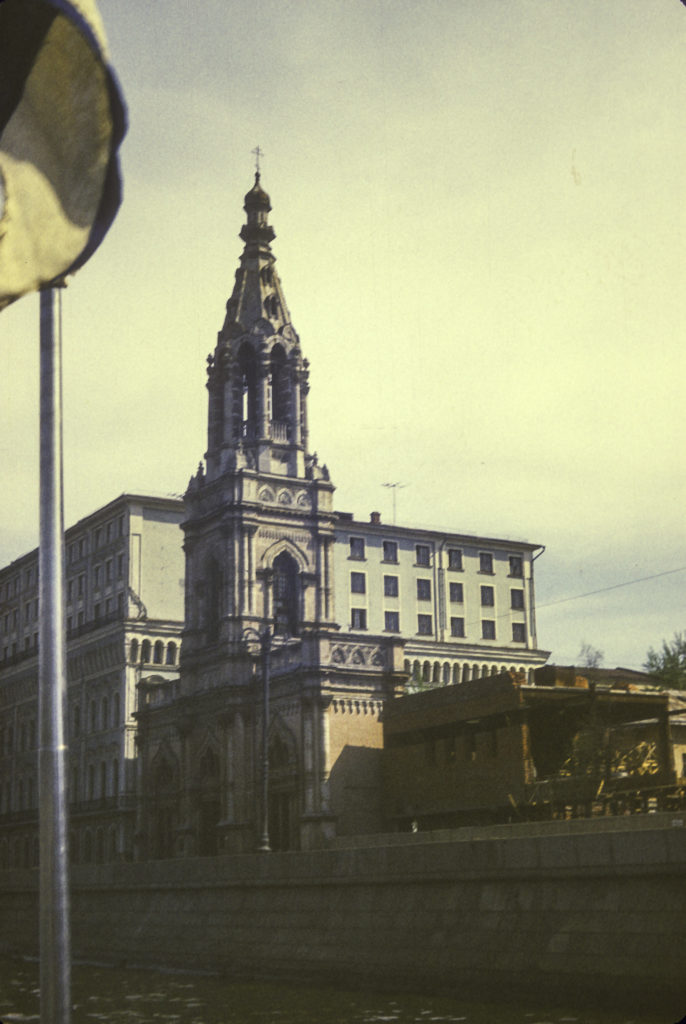
On Bolotny Island, directly opposite the Kremlin, stands the Saint Sophia Church in Middle Sadovniki (Khram Sofii Premudrosti Bozhiyey V Srednikh Sadovnikakh). Actually, from the river only the bell tower of the church is visible; the main part of the church is hidden behind the bell tower and obscured on either side by large waterfront buildings. I don’t know what was in the flanking structures in 1972, but today the headquarters of Rosneft (Russian Oil), the world’s largest publicly traded oil company and the third largest company in Russia (Gazprom and Lukoil being first and second respectively), occupies the right-hand building, while the one on the left belongs to the Ministry of Defense. The St. Sophia Church dates from the mid-17th century and is thought to have been established by merchants from Novgorod, where St. Sophia’s is the main center of worship. The church gave its name to the Sofia Embankment of the Moscow River, on which it stands. The Soviets closed the church in 1930 and turned it into communal apartments. It was reopened as a church in 2004 and now has its own web page.
Mid-17th century; stands on Sophia Embankment opposite the Kremlin; building next to it is Rosneft HQ
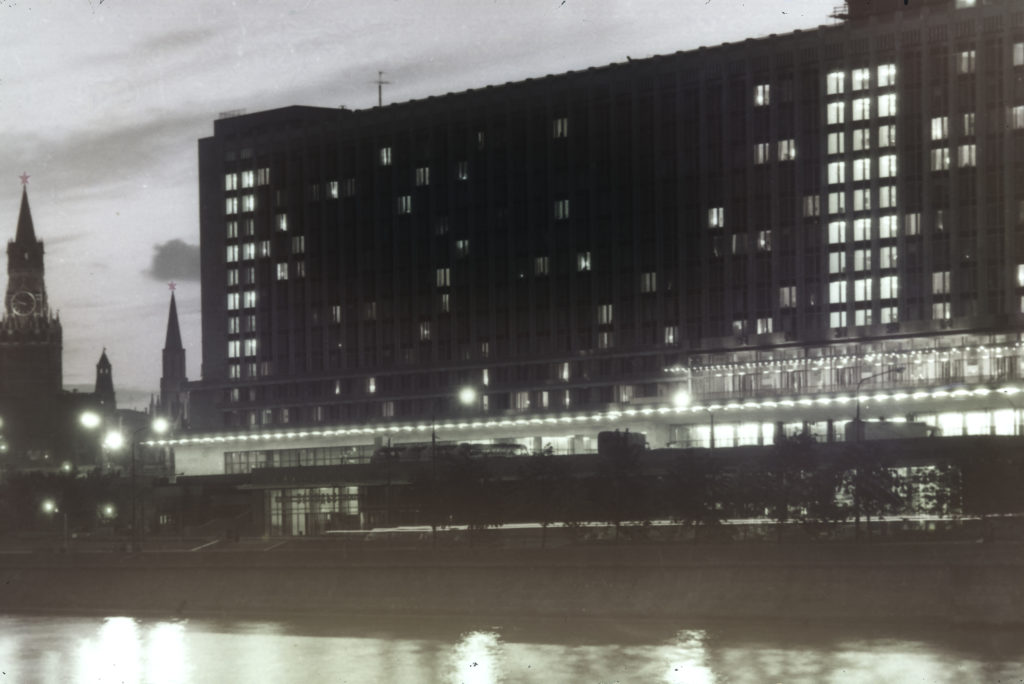
Continuing on past the Kremlin, I encountered the Hotel Rossiya. This was a gigantic hotel built in the Sixties, on the site of what was originally intended for the construction a Stalin-era skyscraper similar to Moscow University, the Hotel Ukraine and the other so-called “Seven Sisters.” The Zaryadye Administrative Building, as it was to be called, would have been the eighth Sister, but that project was canceled after Stalin’s death.
Hotel Rossiya at dusk from Moscow River; Kremlin at left. I did not take this picture; it is one of the Soviet tourist slides I purchased in Moscow, which have lost their color over the five decades since.
The Rossiya as finally built had 3,000 rooms, 245 half-suites, and a 2500-seat concert hall. Counting the central tower, which however was quite small in square footage compared to the main part of the hotel, it had 21 stories. It was designed to accommodate about 4,000 guests and was the largest hotel in the world until 1990, when it was topped by the Excalibur in Las Vegas, but it remained the largest in Europe until 2006.
One of its salient design peculiarities, dictated by the paranoiac Soviet emphasis on security and surveillance, was the paucity of exits. (I encountered the same situation in Moscow State University while I lived there.) This was intended to make it as difficult as possible for guests to enter or leave the building unseen, thereby making it easier for the hotel staff and security forces to keep track of their movements. But this feature had lethal consequences in 1977, when a major fire broke out in the hotel, resulting in the deaths of 42 people, some of whom perished because they couldn’t make it to the few available exits in time.
The hotel had other problems as well. It was noted for surly service, lousy food, ubiquitous cockroaches, bad beds, and radios that received only one station and could be turned off only by unplugging them. It was also considered an architectural blight, tasteless and ugly as well as incompatible with surrounding landmarks, such as the Kremlin. Finally, in 2006, it was demolished. At first the city government contemplated replacing it with another hotel, but eventually the site was converted into a park, which it remains today.
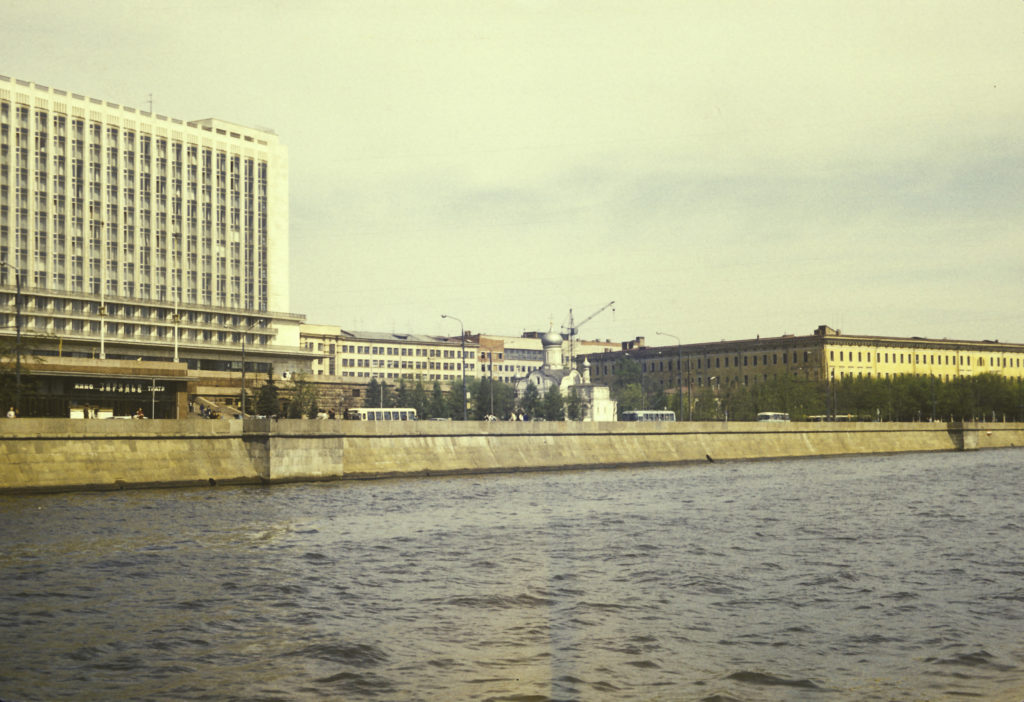
Hotel Rossiya with the Church of the Conception of St. Anna in the Corner on the Moat at right.
Next to the Hotel Rossiya, there stood and still stands a charming little Orthodox church with the improbable name of the Church of the Conception of St. Anna in the Corner on the Moat. I have not been able to find out much about this church, other than that it was built in 1493, and the picture I took of it is not very good; but you can see better pictures of it on the internet. The church survived both the construction of the hotel and its demolition, and now stands by itself in Zaryad’ye Park.
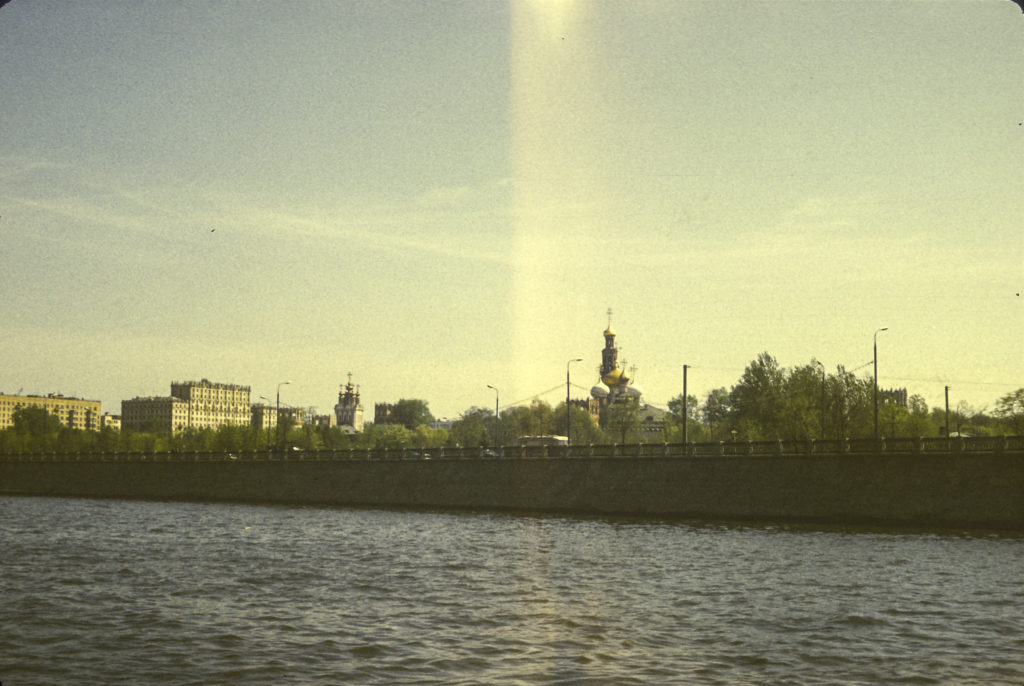
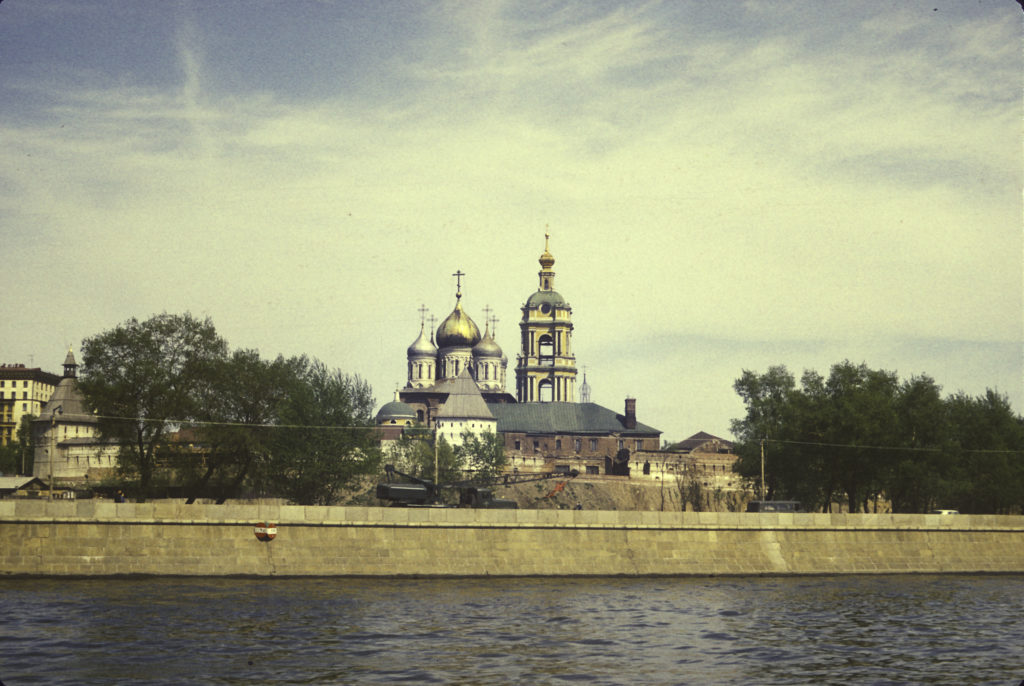
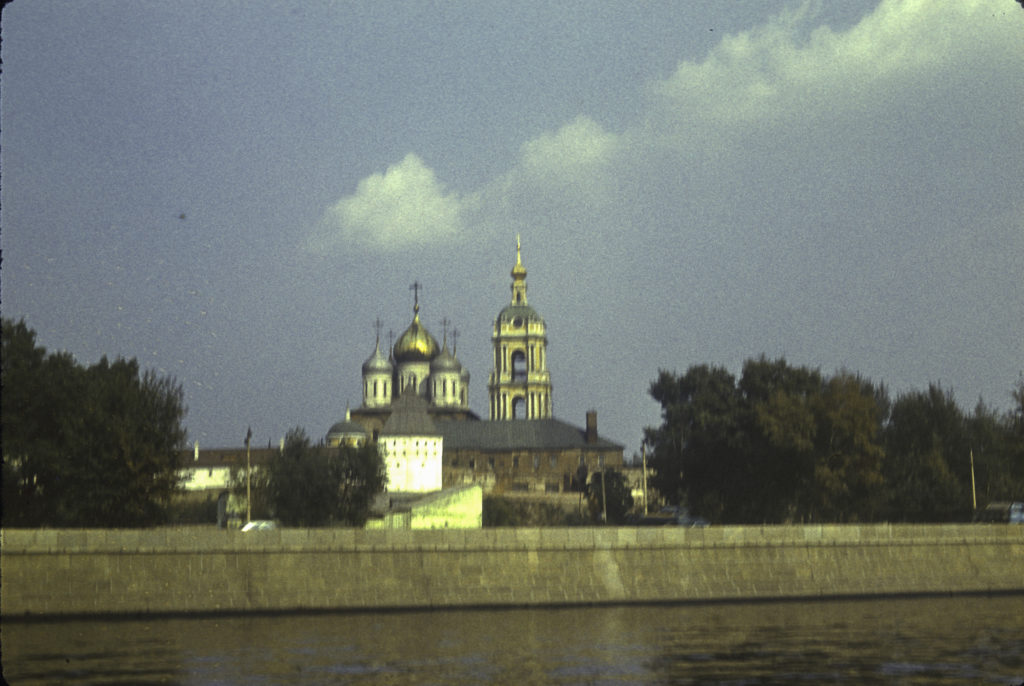
The last couple of photos from my Moscow River cruise are of the Novospassky (“New Savior”) Monastery. The “New” refers to the monastery rather than the Savior, and denotes the fact that it had an antecedent in the Kremlin. The Novospassky dates from 1491, but most of the buildings currently standing were erected in the 17th century. The Romanov family patronized the monastery in the 16th century, and it served as their burial ground. It was heavily fortified (note the white defensive towers anchoring the corners of the walls in the pictures) and withstood sieges by the Crimean Tatars, who sacked Moscow in 1571 and attacked again in 1591.
The Novospassky Monastery, on the banks of Moscow River in the Taganka district
But the Novospassky really came into its own after the Romanovs became the ruling family of Muscovy in the 17th century. In the 1640s they commissioned the construction of the main cathedral of the monastery, the Preobrazhenskii Sobor (Cathedral of the Transfiguration), and other structures followed, including the grandiose bell tower in the 18th century.
Novospassky Monastery: the round white structure with the tent roof is one of the towers that anchor the corners of the wall, with the Cathedral of the Transfiguration (Preobrazhensky Sobor) behind it and the bell tower rising above all in back.
The Soviets used the monastery as a prison and a police drunk tank until the 1970s, when it was turned over to an art restoration institute; but it was returned to the Orthodox Church after the Revolution of 1991.
This post is about two excursions I took in the Moscow area in the spring of 1973 – one to a former royal estate called Kolomenskoye, the other to the Donskoy Monastery in southeast Moscow.
The name Kolomenskoye (accent on the second syllable) owes itself to its location, several kilometers to the southeast of central Moscow on the road leading to the ancient town of Kolomna (now an industrial center; the Kolomna 37D diesel engine was the standard powerplant for Soviet submarines in World War II and after).
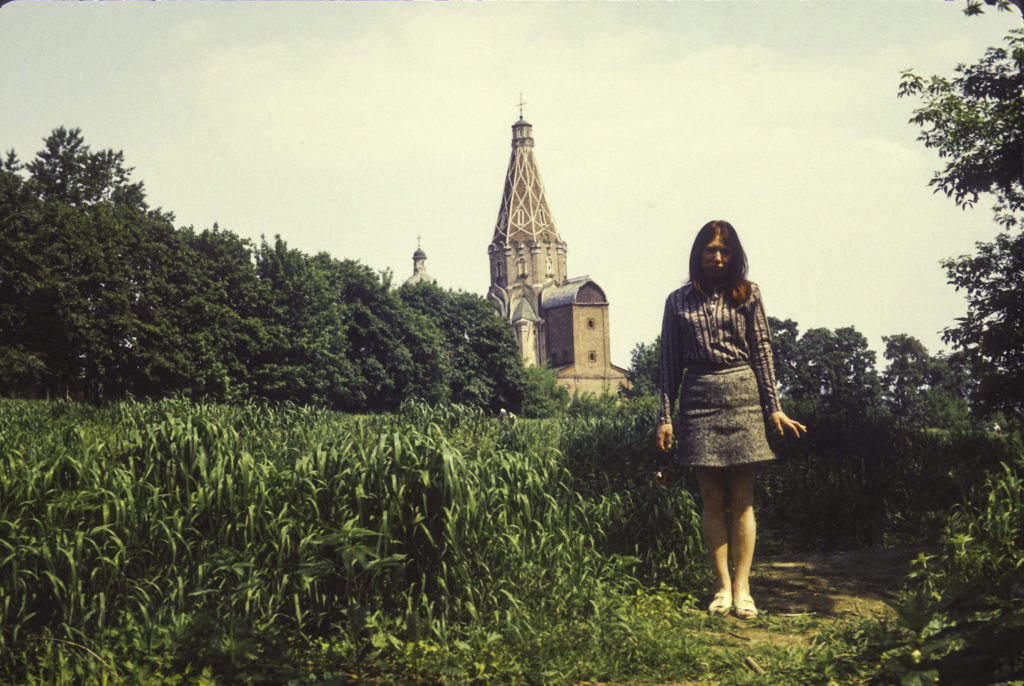
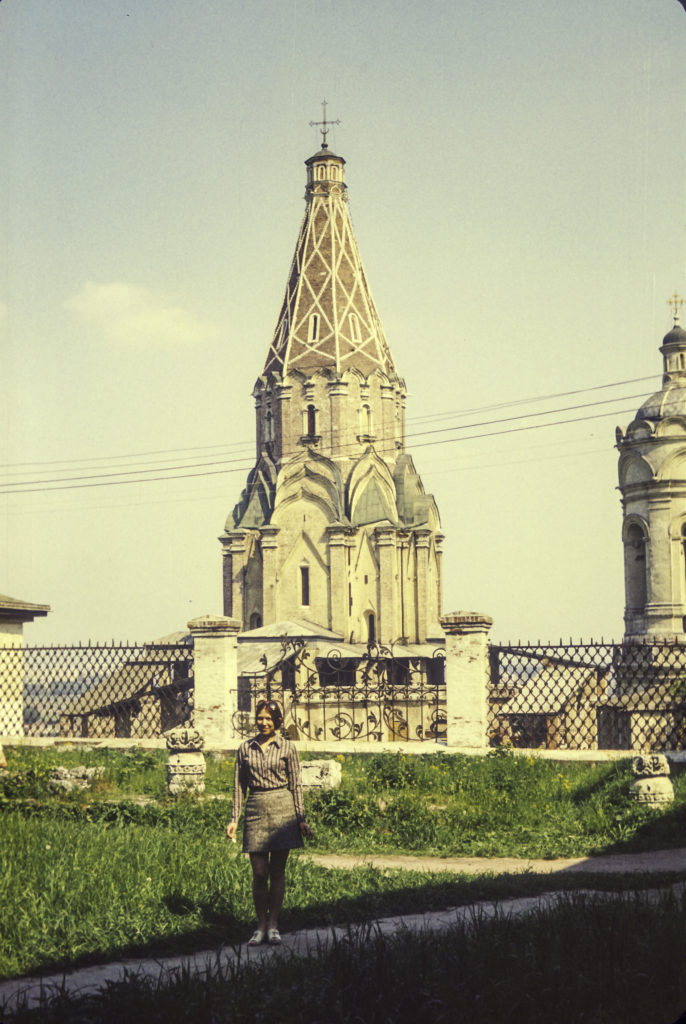
Vera posing in a field in front of the Church of the Ascenion at Kolomenskoe, spring 1973.
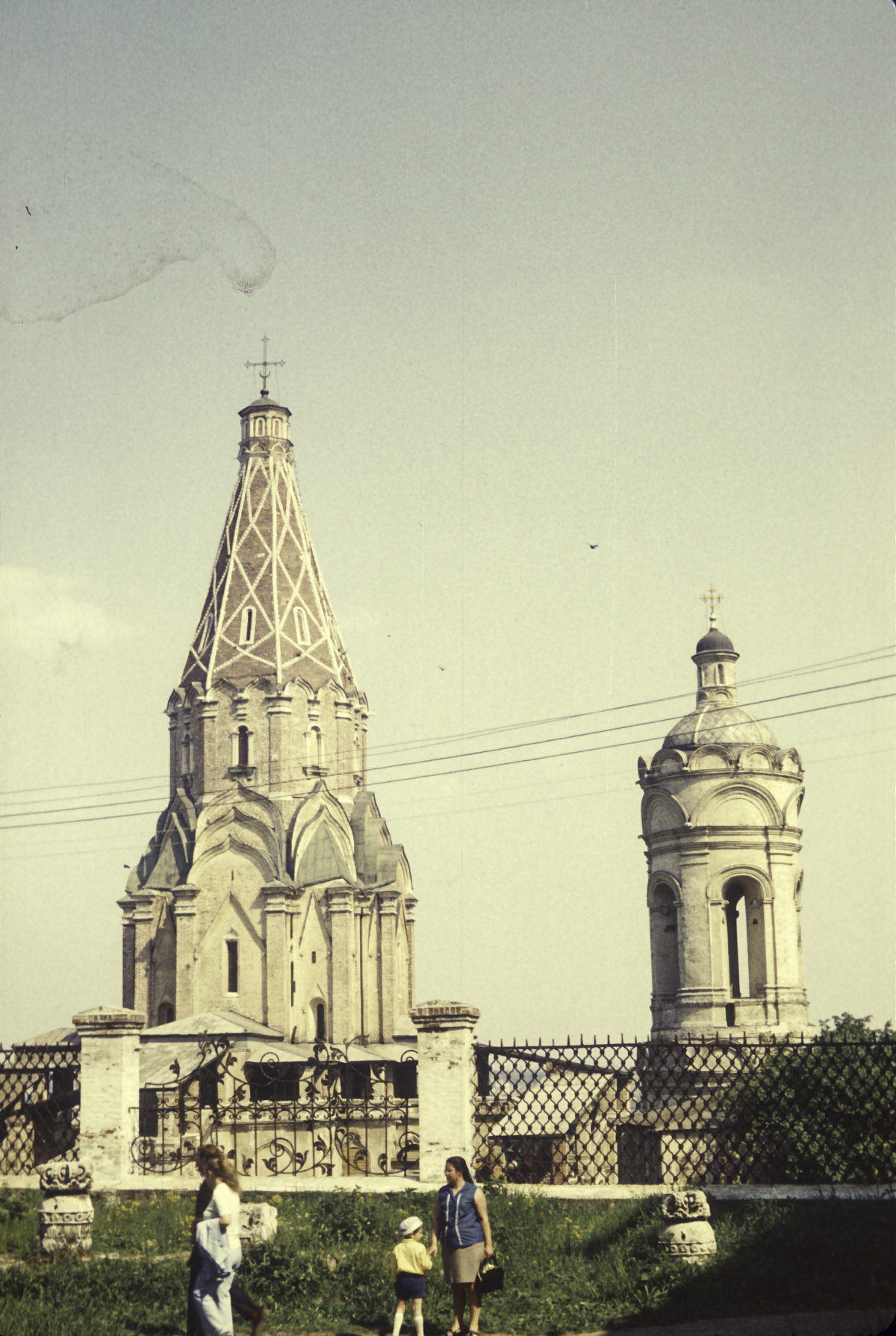
Kolomenskoye came to prominence as the site of the Church of the Ascension, built in 1532, toward the end of the reign of Grand Prince Vasily III of Muscovy, to commemorate the birth of an heir to the throne, who grew up to be Ivan IV – the Terrible. The church represented a dramatic departure from previous Russian tradition, which relied on Byzantine models, though with distinctive Russian features such as onion domes. The Church of the Ascension drew its inspiration from small wooden parish churches of the Russian north country, which were built with tent-shaped roofs to prevent snow from building up on them during the hard winters. The construction of the Ascension Church in Kolomenskoye started a trend, with tent-roofed churches becoming widespread during the reign of Ivan the Terrible and afterward; it is represented in St. Basil’s Cathedral on Red Square. The trend came to a halt in the mid-17th century with the advent of Patriarch Nikon, who considered tented roofs to be un-canonical. He favored a more flamboyant style with rotundas and rows of corbel arches called kokoshniki, as exemplified in the Church of St. Nicholas at Khamovniki.
Church of the Ascension, built in 1532 during the reign of Grand Prince Vasily III of Muscovy to commemorate the birth of an heir to the throne, who turned out to be Ivan the Terrible
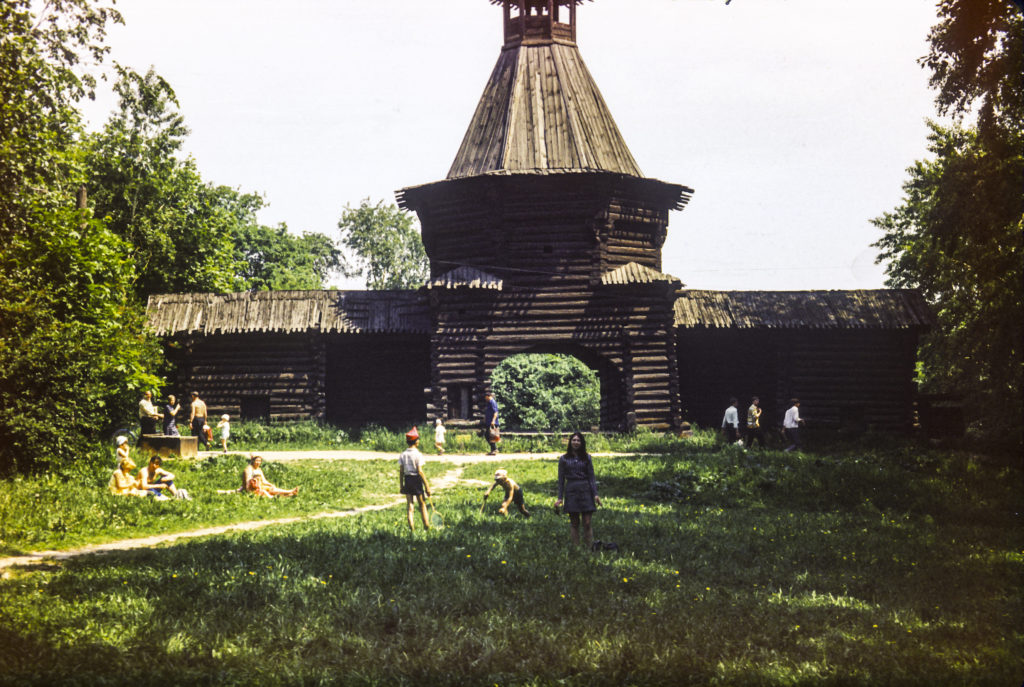
During the Soviet period, a number of old wooden buildings and other objects of historical significance were relocated from various regions of the USSR to Kolomenskoye to ensure their preservation. One such building was the barbican (gate) church of the Nikolo-Karelskoe Monastery. Located in the far north of Russia, in the port of Severodvinsk on the coast of the White Sea, this monastery was one of the first places encountered by English sailors on the Chancellor expedition of 1553 in their quest to open trade with Muscovy. The monastery still exists, but the wooden gateway, which contains a small church, is now in Kolomenskoe Park.
Barbican Church of the Nikolo-Karelskoe Monastery, transported from Severodvinsk by the Soviets
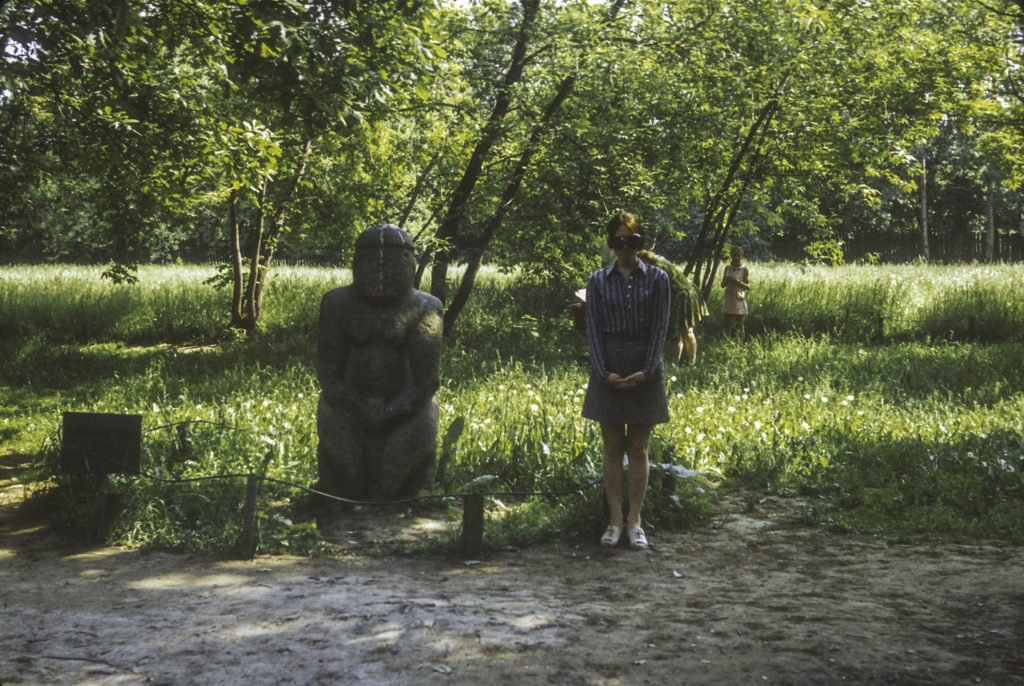
Another object which I suspect was transported from elsewhere, most likely the Far East, was a stone Buddha-like figure standing off by itself in a remote corner of the park. Vera posed next to it with her hands folded just like the statue. Unfortunately I didn’t write down the words on the sign next to it, so I don’t have any information about its provenance, and there is nothing about it on the Kolomenskoye website. Sometime I’ll go back there and rectify that omission.
Vera emulating the pose of the statue. Kolomenskoye Park, spring 1973.
Tsar Alexei Mikhailovich, who reigned from 1645 to 1676, built a great wooden summer palace at Kolomenskoye, which became his favorite residence. Peter the Great, despite his aversion to Moscow, spent time in Kolomenskoye, and his daughter, the future Empress Elizaveta Petrovna, was born in the palace in 1709. Sadly, in 1768 Catherine the Great tore down the palace, which by her time had fallen into decrepitude. She built a new, less grandiose stone-and-brick palace, but it in turn was demolished in 1872. The post-Soviet Moscow city government undertook a full-scale restoration of the 17th-century wooden palace and finished it in 2010, and next time I visit Moscow I’ll be sure to see it.
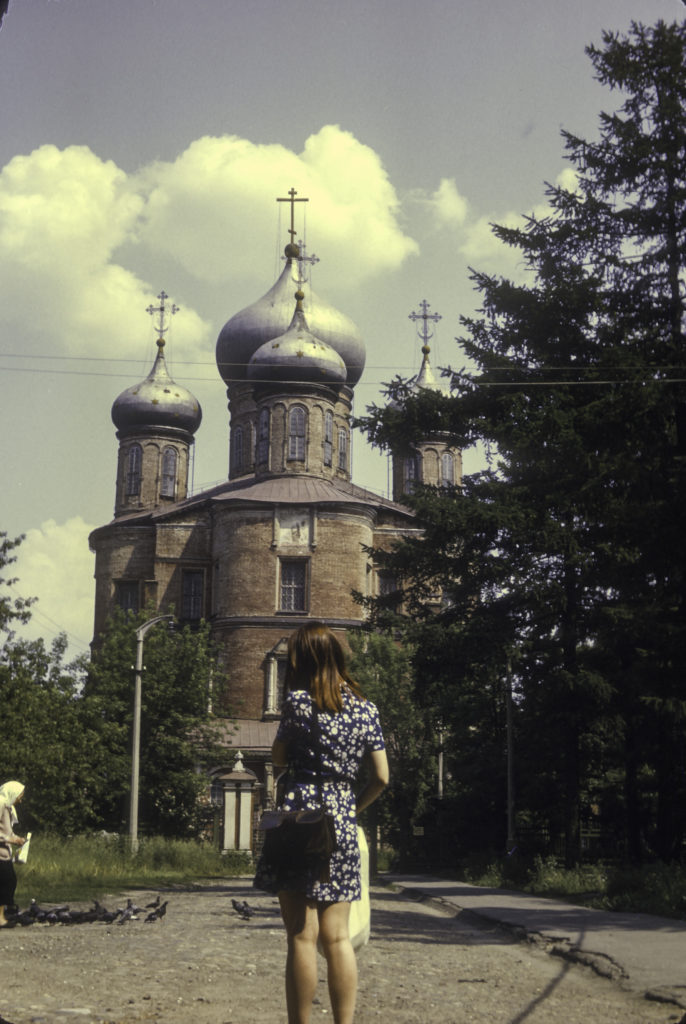
Donskoy Monastery
The Donskoy Monastery was founded in 1591 on the site where a church holding a famous icon, Our Lady of the Don, had previously been located. The monastery was founded to commemorate the deliverance of Moscow from a raid by the Crimean Tatars. However, it remained a stepchild for many years. The first cathedral was on the humble side – after the cataclysmic upheavals of the reign of Ivan the Terrible, resources were lacking for grandiose building projects. But in the late 17th century, new and generous donations of land and serfs began to flow in, and in 1684 the Regent Sofia Alekseevna began the construction of a much more pretentious cathedral, known as the New or Great Cathedral.
The New or Great Cathedral, built in the late 17th Century
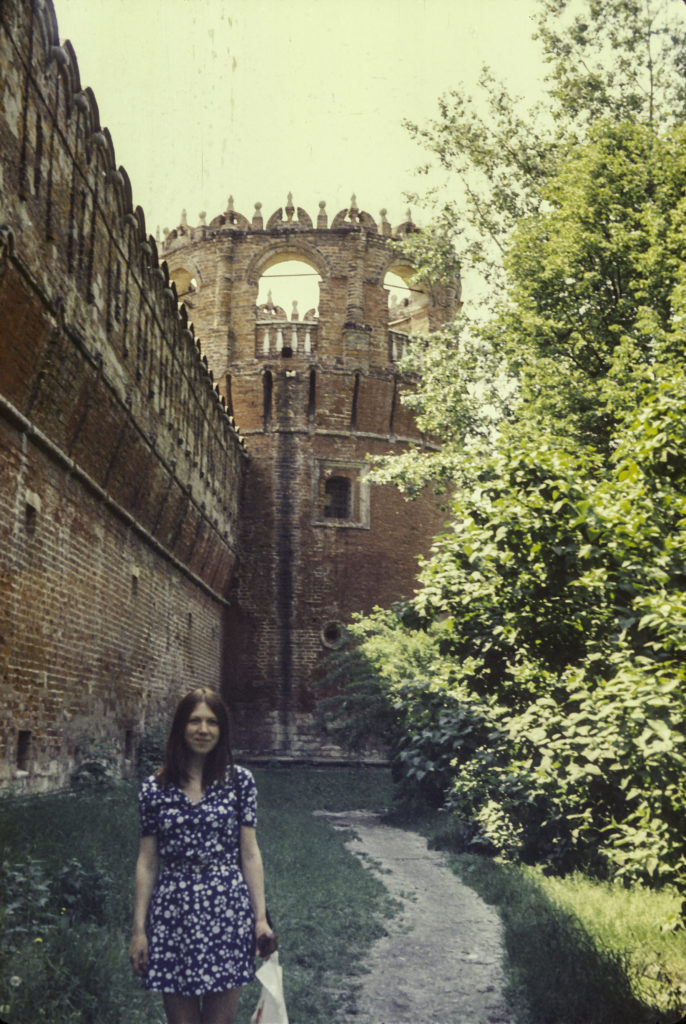
The imposing walls of the monastery, with their stout crowned towers, date from 1686-1711.
Vera standing next to the monastery wall, near one of the corner towers.
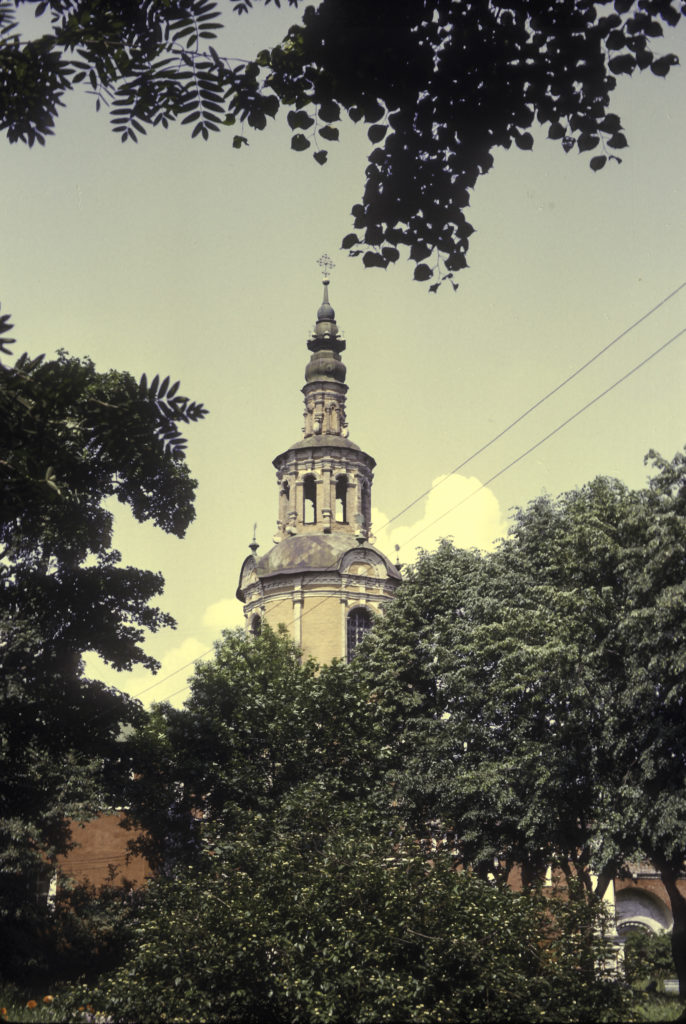
The Donskoy Monastery has two gate churches, but I only photographed one of them, the Gate Church of the Tikhvin Icon, which was built in 1713-14. You can see pictures of the other one, the Barbican Church of Sts. Zachary and Elizabeth with its bell tower, on the monastery’s Wikipedia web page.
Gate Church of the Tikhvin Icon, Donskoy Monastery
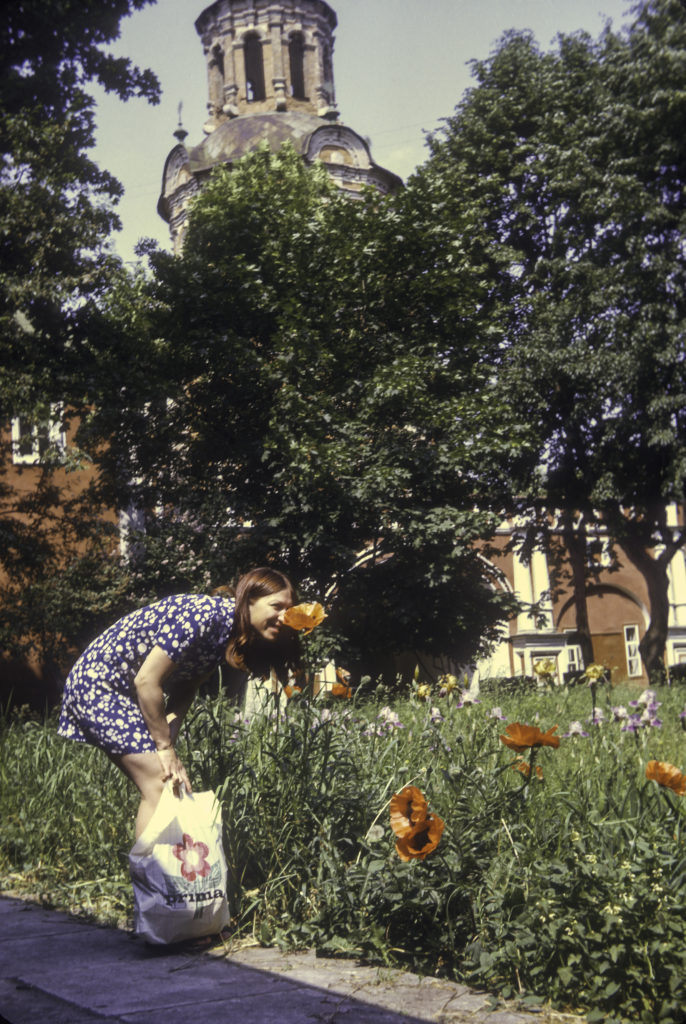
The flowers in bloom at the Donskoy Monastery were extraordinarily beautiful, and I took a shot of Vera sniffing one of them with the Tikhvin church as background.
Stopping to sniff the flowers at Donskoy Monastery, Spring 1973
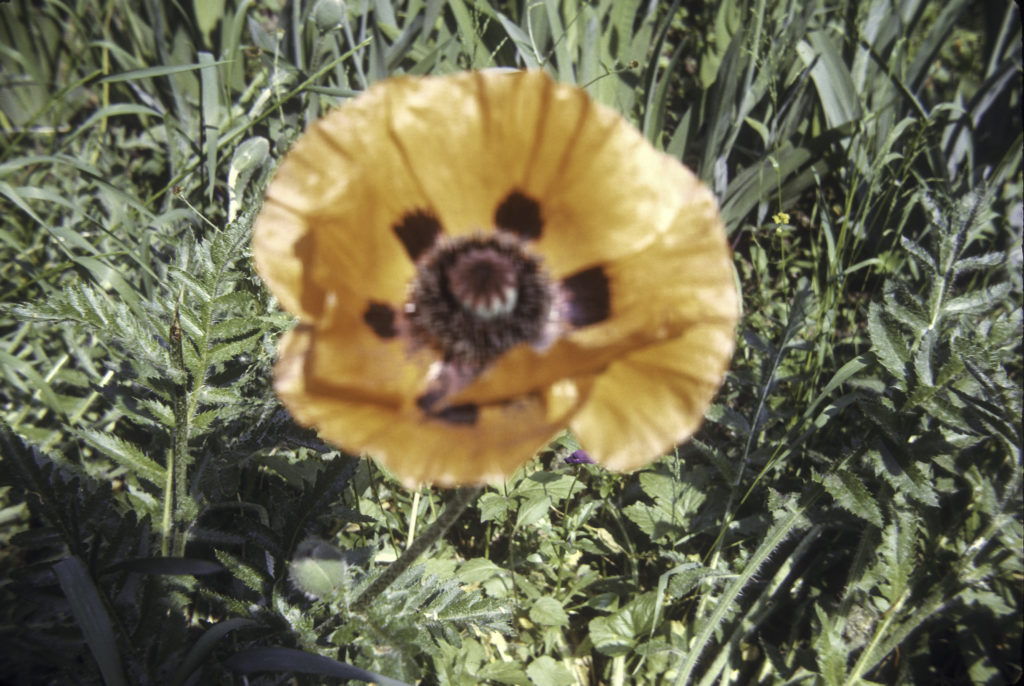
I never found out what kind of flowers these were, although my guess is that they are a type of poppy.
Spring flower in bloom at Donskoy Monastery
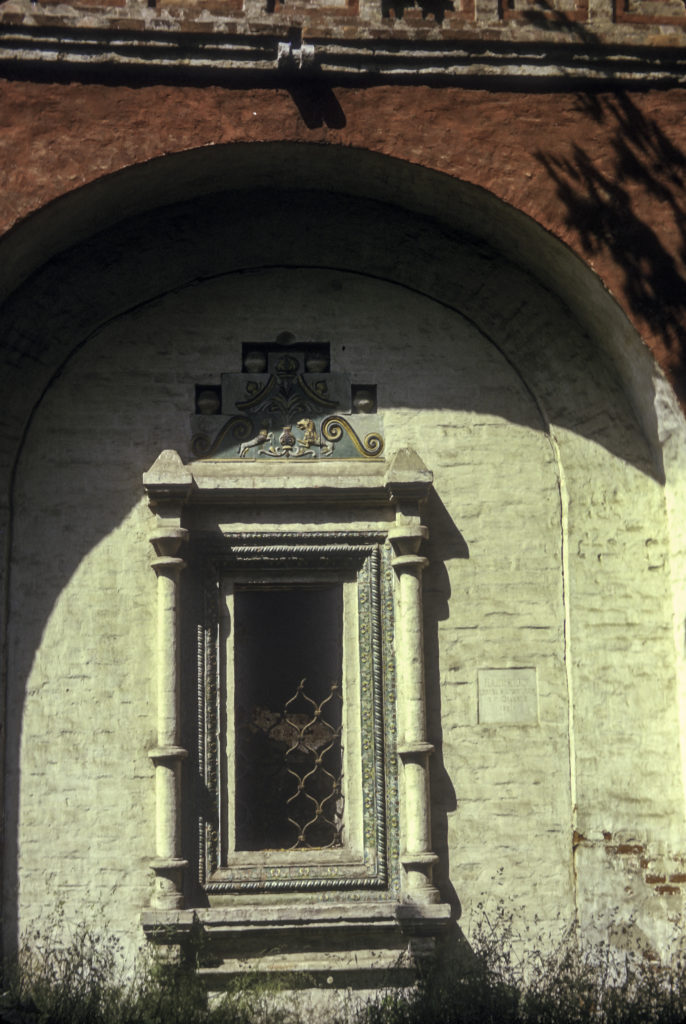
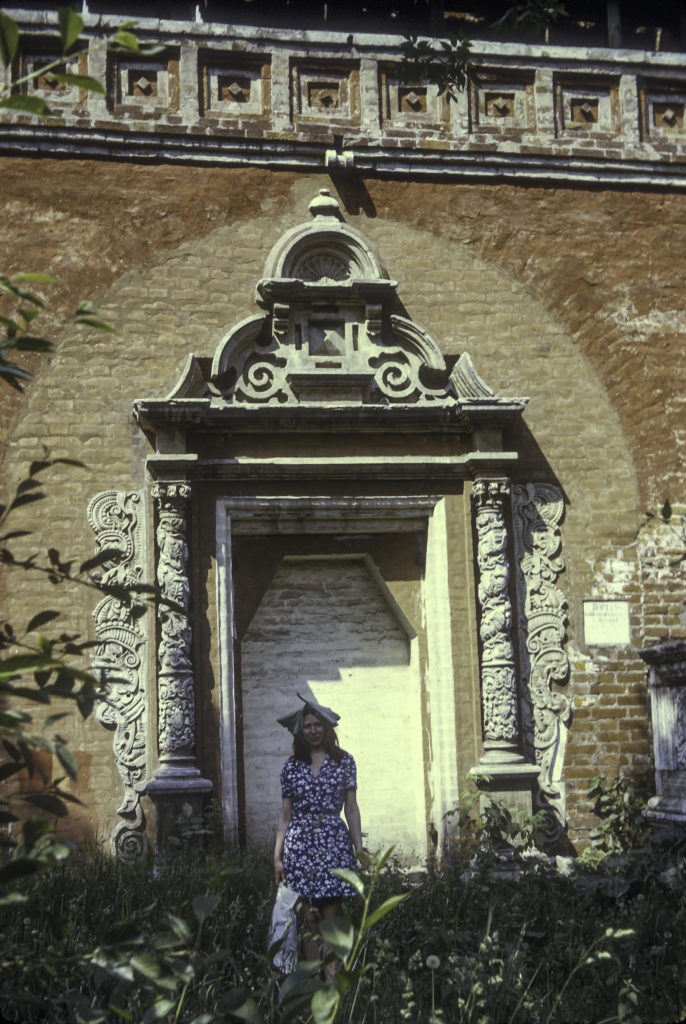
Like Kolomenskoye, Donskoy Monastery was one of those places where people brought items that they had salvaged from churches and other historical sites demolished by the Soviets to make way for their own typically dreary and banal construction projects. Among these salvaged items were elaborate door and window frames, which were physically inserted into niches carved into the walls of the monastery, with their provenance recorded in plaques embedded in the walls next to them. (Unfortunately, I didn’t note what was written on the plaques.)
Framed Window, Donskoy Monastery
In one of these niches, in which an ornate door-frame was embedded, Vera posed with a funny hat she made from an elephant-ear leaf.
Vera posed in this doorway with an unusual hat that she made from a leaf.
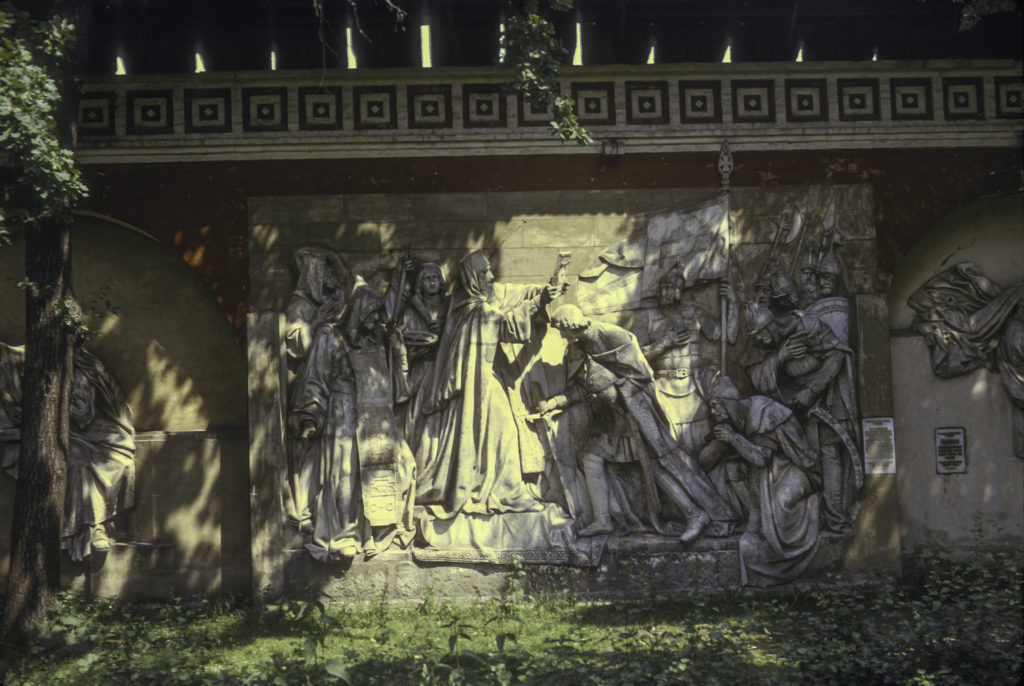
But to me the crowning glory of these reclaimed treasures was the relief of Sergei of Radonezh blessing Dmitry Donskoi. It’s worth relating some of the historical background of this sculpture, for those viewers unacquainted with the events that inspired it.
By 1380, Russia had been under the domination of the Mongol Golden Horde for over a century. But in the 1370s the Golden Horde was weakened by factional rivalries, with several contenders vying for the throne. Meanwhile, Grand Prince Dmitri Ivanovich, ruler of Moscow since 1359, had been acquiring new territories and increasing his power. One of the claimants to the throne of the Golden Horde, a general named Mamai, decided to bolster his authority by taking Dmitry down a peg or two, and went on the attack, meeting the Muscovite forces on Kulikovo Pole near the Don River in September 1380.
In 1380, the most revered spiritual leader in Russia was Sergei of Radonezh, founder of the great Trinity-St. Sergei Lavra (monastery) near Moscow. He generally avoided politics, but he made an exception in 1380. He conferred his blessing on Grand Prince Dmitri and sent two warrior-monk champions to his aid. One of these, Alexander Peresvet, opened the Battle of Kulikovo Pole by riding in single combat against the Tatar champion, Temir-murza. The two killed each other in the first charge. Then the real battle began. After a savage struggle, the Tatars were routed. Grand Prince thereafter became known as Dmitry Donskoi, Dmitry of the Don.
Relief of Sergius of Radonezh blessing Prince Dmitry Donskoy – removed from the Church of Christ the Savior when Stalin had it torn down in the ’30s
Ironically, the person to benefit most from the Russian victory at Kulikovo Pole was Mamai’s strongest rival, Khan Tokhtamysh, to whom the survivors of Mamai’s army transferred their allegiance afterward. Tokhtamysh attacked and burned Moscow in 1392, forcing Dmitry Donskoi to reaffirm his vassalage to the Golden Horde. But Dmitri kept the coveted patent to act as tax-collector of Russia for the Mongols, and thereafter the power of the Grand Prince of Moscow only continued to grow. A century after the Battle of Kulikovo Pole, the Russians under Ivan the Great threw off the Mongol yoke altogether.
The relief St. Sergei blessing Dmitri Donskoy on the eve of the Battle of Kulikovo Pole was created for the Cathedral of Christ the Savior in Moscow in 1849 by sculptor A. V. Loganovsky. On December 5, 1931, the Cathedral was demolished, and Loganovsky’s relief sculpture was rescued and brought to the Donskoy Monastery, where it remains to this day. Although the Cathedral of Christ the Savior was rebuilt after the collapse of the Soviet Union, the original relief of St. Sergei blessing Dmitry Donskoi was not restored to it; instead a version replicated in bronze was installed.
Pyatnitskaya Bashnya at left, Svyatye Vrata (Holy Gate) - entrance - in center
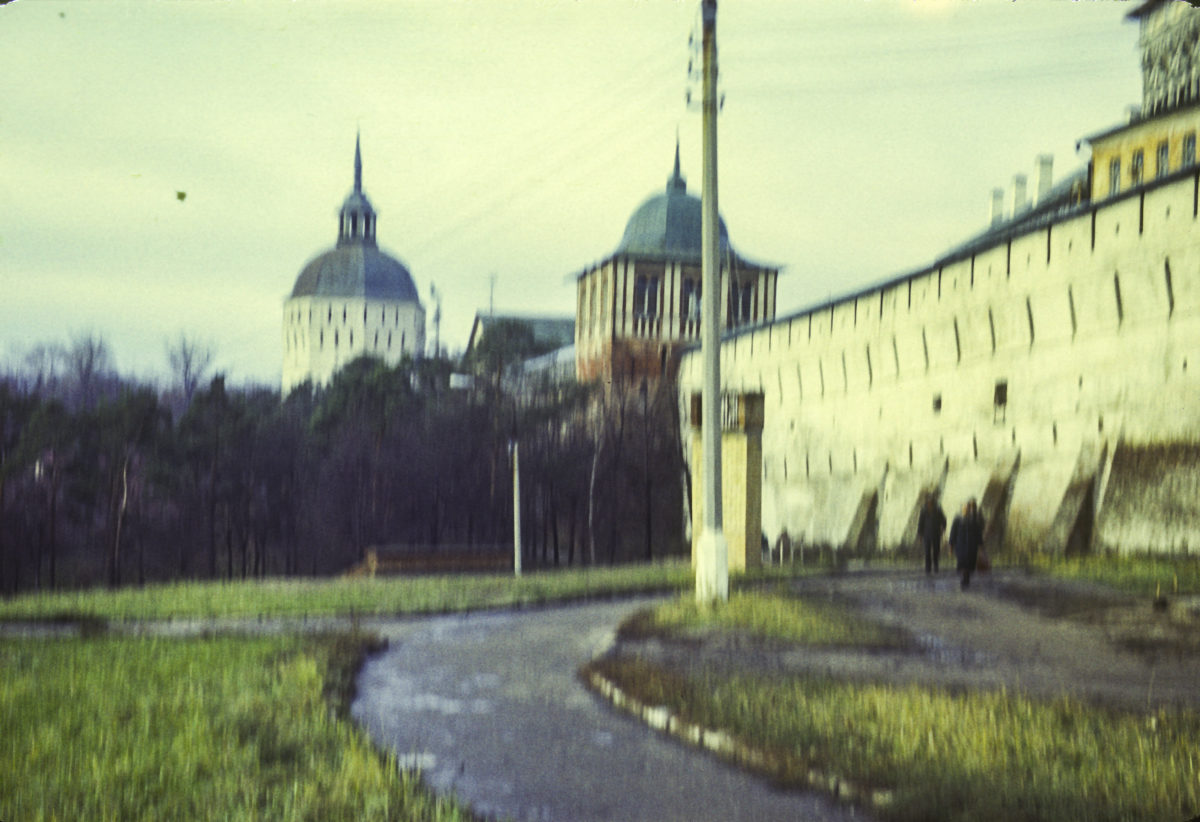
In the fall of 1972 – I don’t remember what month it was exactly, but the leaves had all fallen from the trees and the days were growing very short – I went with my fellow American exchange students on our first trip outside Moscow. Our destination was the Trinity-St. Sergius Monastery, located about 70 kilometers from Moscow in a town then called Zagorsk. The pre-Revolutionary name of the town was Sergiev Posad. The Bolsheviks didn’t like this name because of its religious connotations, so they renamed it to Zagorsk to honor a revolutionary martyr named Vladimir Mikhailovich Zagorsky, who had served for one year as head of the Bolshevik Party in Moscow before being assassinated in September 1919. (After the collapse of the Soviet Union in 1991, the town reverted to its pre-Soviet name.)
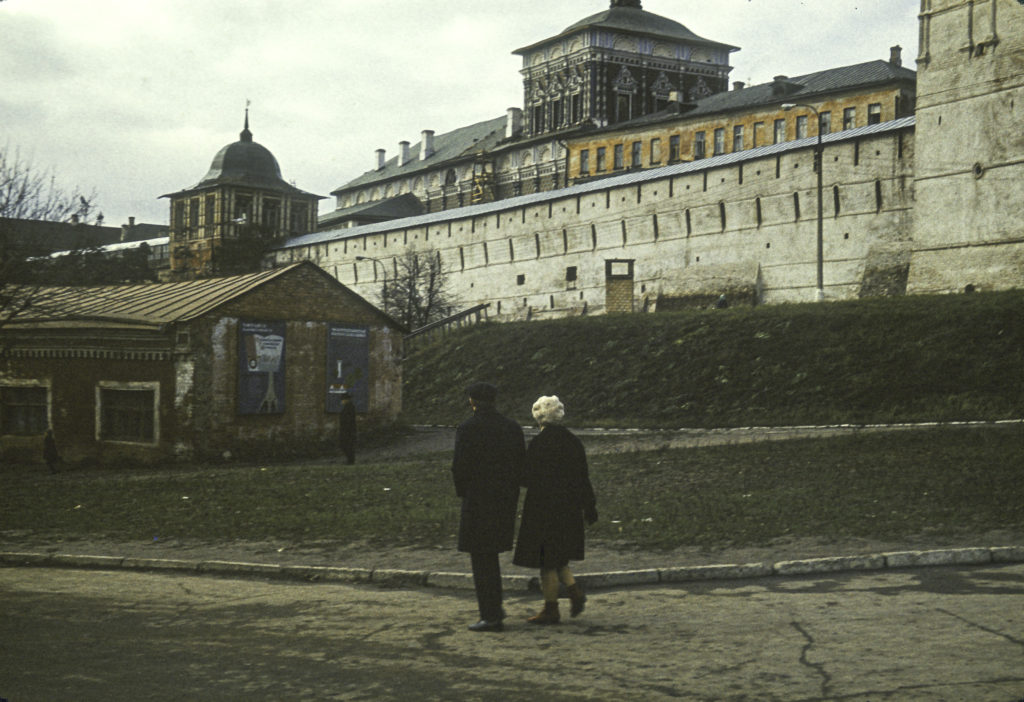
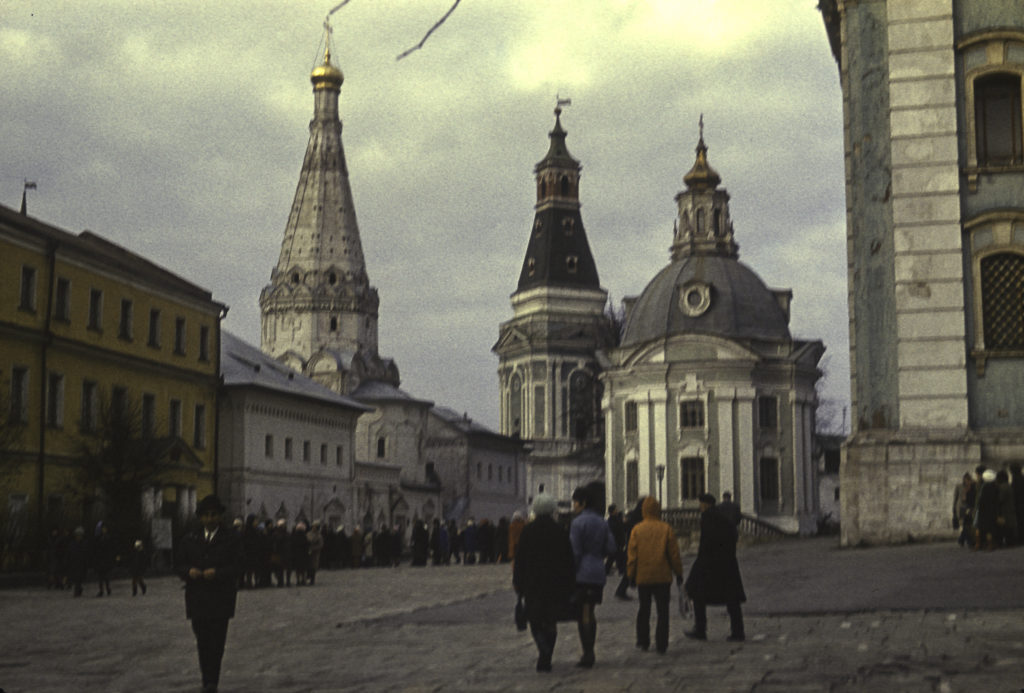
Street scene in the town of Zagorsk, which has since reverted to its pre-revolutionary name of Sergiyev Posad.
The Trinity-St. Sergius Monastery occupies a pre-eminent position among all the religious institutions of Russia. It was founded in 1337 by the monk St. Sergius of Radonezh (1314-1392), who became the patron saint of Muscovy in 1422. In that year also the wooden church that he built was replaced by a stone cathedral. A second cathedral was added in 1476, and a third was completed in 1584. In 1550 the wooden palisade walls were replaced by stone walls. This helped the monastery to survive the catastrophic years of the late 16th and early 17th centuries largely unscathed; it survived an 18-month siege by the Poles in 1608-10 and a shorter one in 1618. All the while the monastery continued to accumulate land and peasants, and it eventually became the wealthiest landlord in Russia.
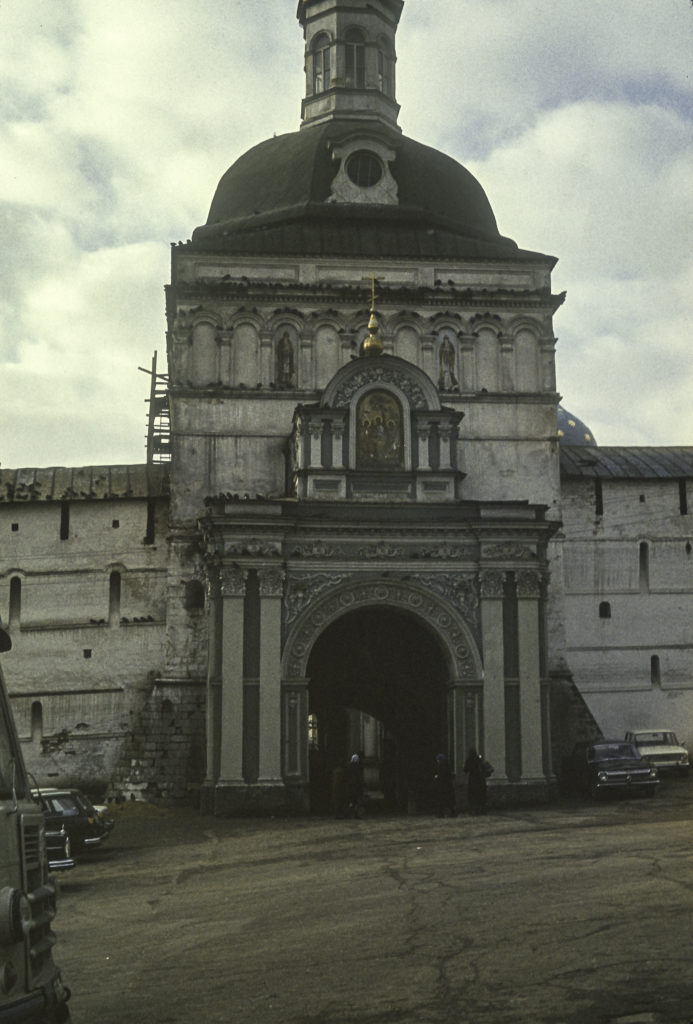
Entrance tower at left. Sushil’naya Bashnya at right. At center, behind the wall, is the tower of the Refectory.
Tsar Peter the Great, in the days before he became great, used the monastery as a refuge when he was feared that the minions of his half-sister Sofia were coming after him.
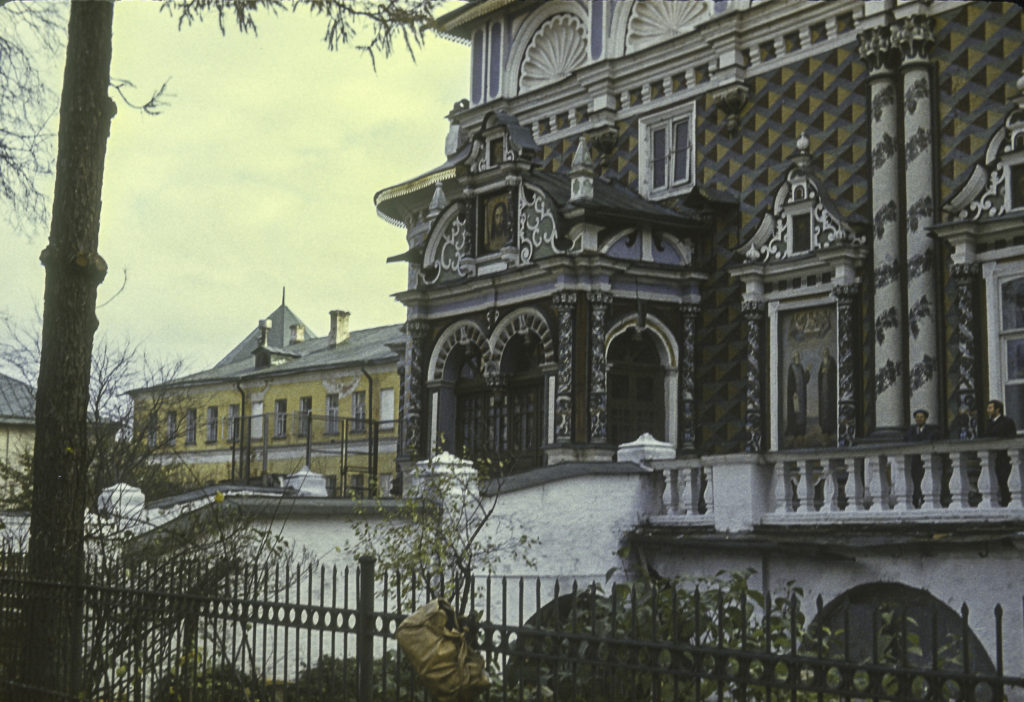
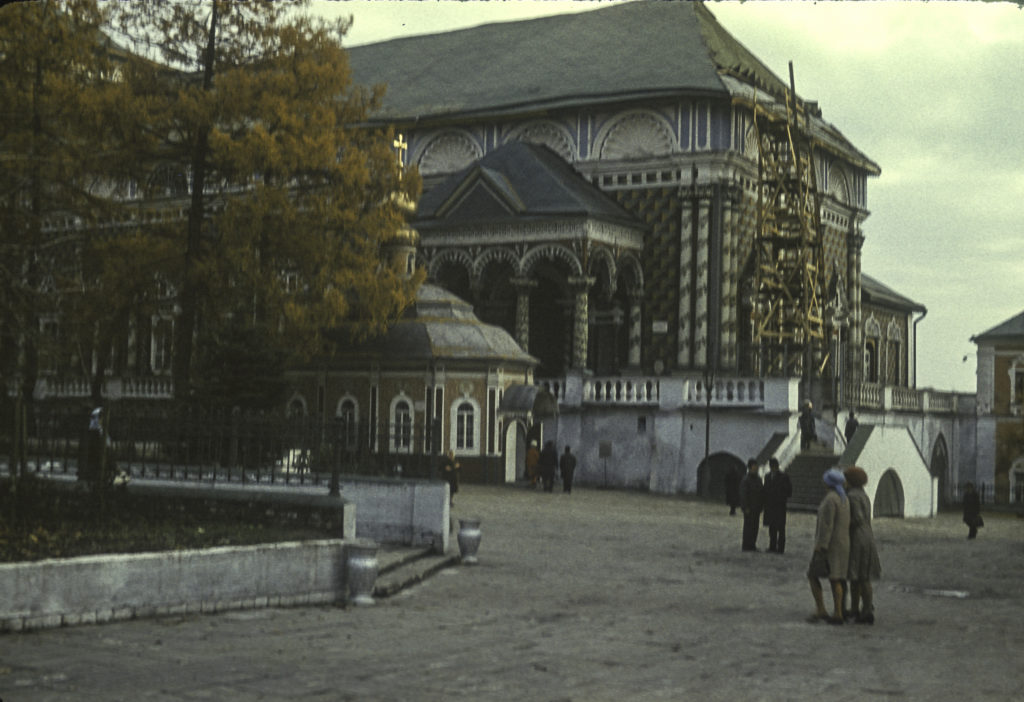
The Trapeznaia Palata (Refectory) at Trinity-St. Sergius Monastery
The first structure we encountered on entering the monastery was the huge Refectory, or dining hall. Built in the late 17th century, it occupies over 500 square meters and is painted in a striking checkerboard design.
Another view of the Refectory. The small building in front of it with cross on top is the Refectory Church.
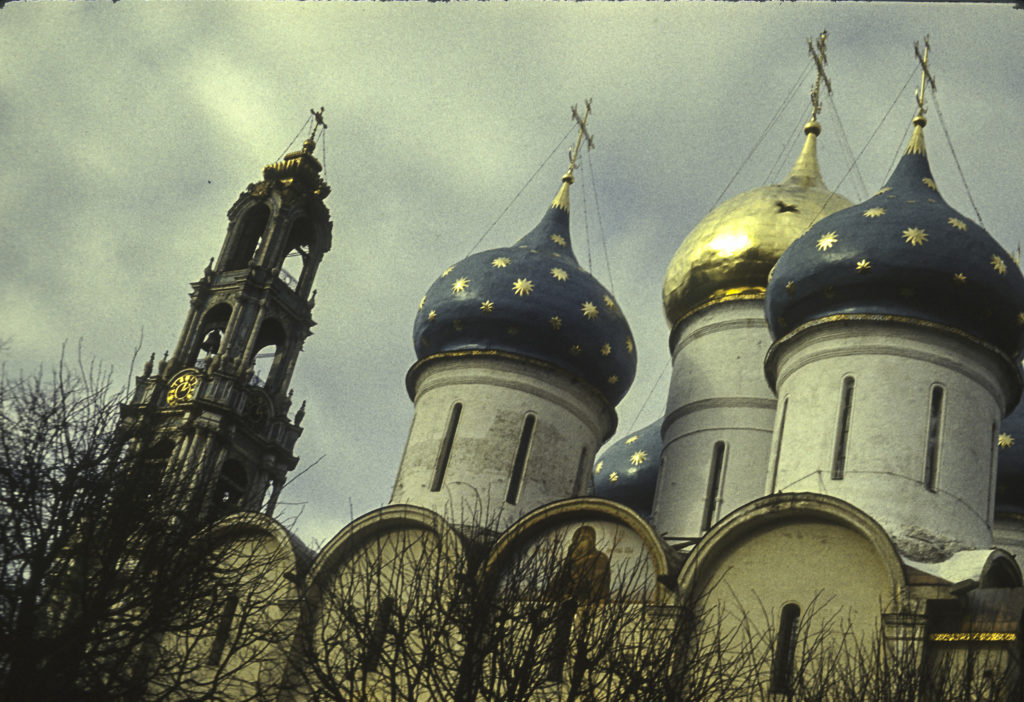
Proceeding further, we came to the imposing Annunciation Cathedral (Uspensky Sobor). (For those unfamiliar with the terminology, the Annunciation signifies the announcement of the Incarnation of Jesus to Mary by the angel Gabriel [Luke 1:26–38]). It is much larger than the Uspensky Sobor in the Moscow Kremlin.
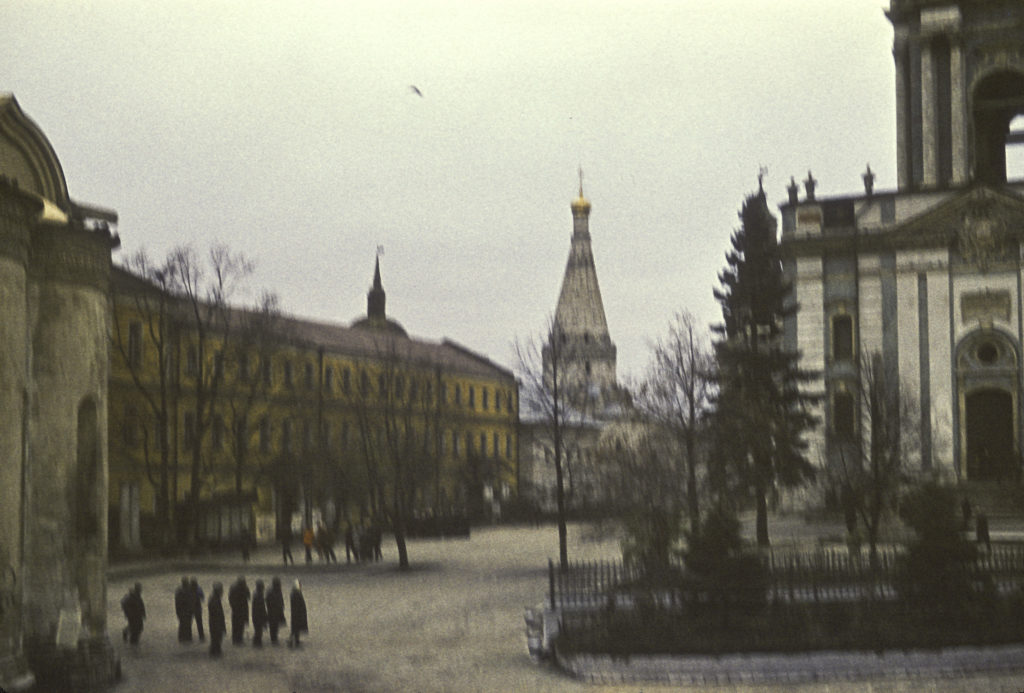
Uspensky Sobor – Assumption Cathedral. The structure at left is the monastery’s bell tower, erected in the 18th century.
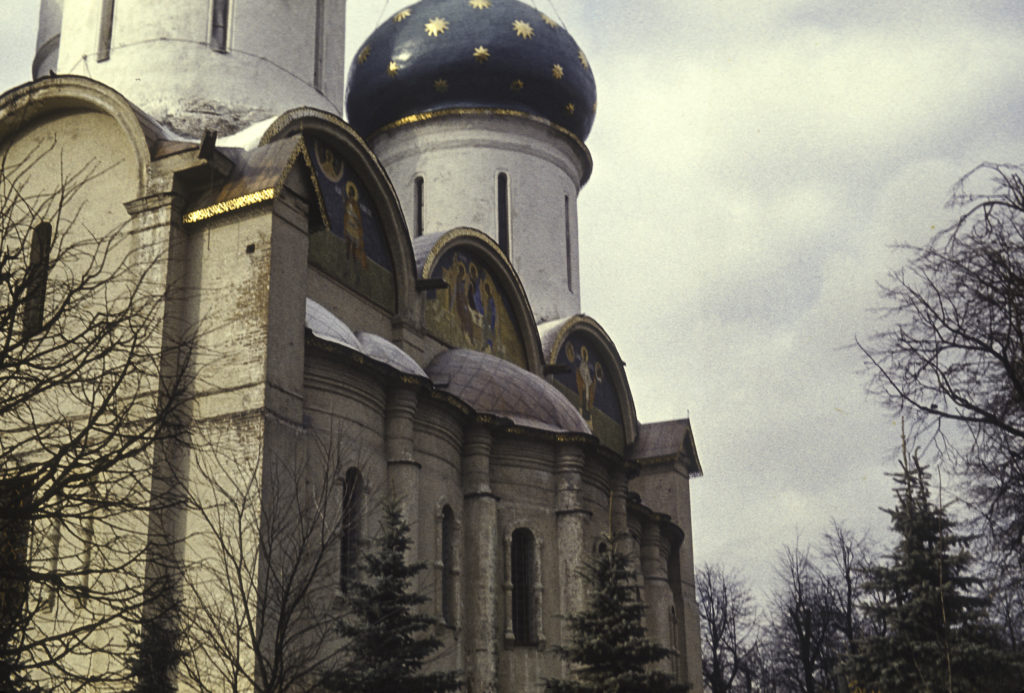
Ivan IV commissioned the Uspensky Sobor in 1559, but it was not completed until 1584 – 26 years later. It has a celebrated iconostasis featuring an icon of the Last Supper painted by Semen Ushakov, which is considered his masterpiece.
Detail of the Uspensky Sobor – frescoes under the arches
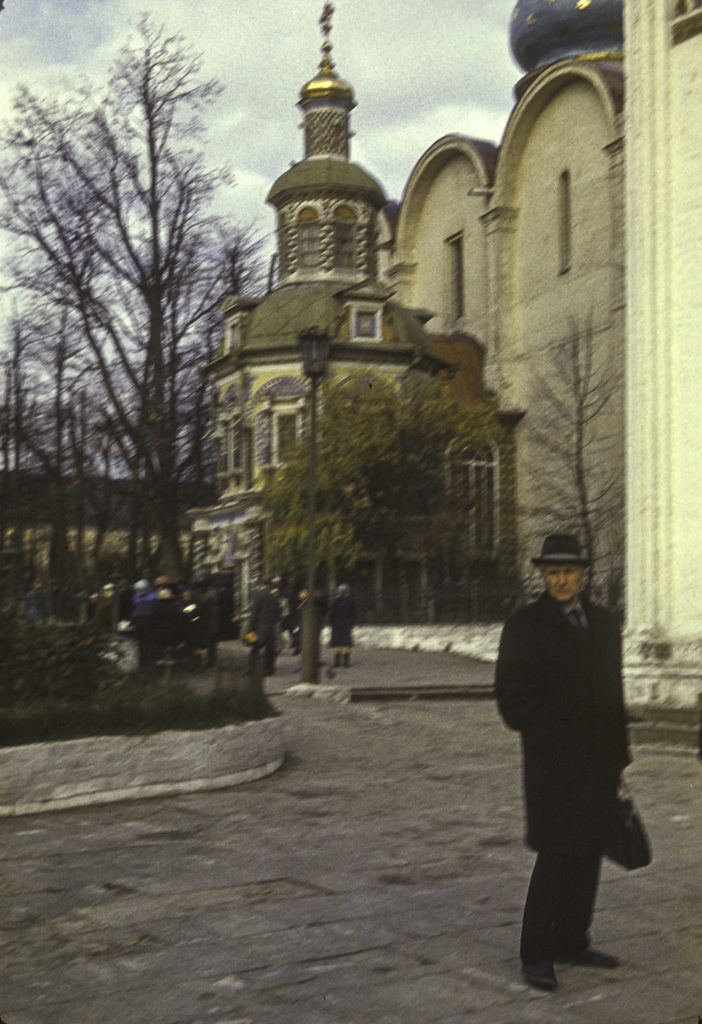
In 1644, monks digging a trench in connection with repairs being made to the southwest corner of the Uspensky Sobor unexpectedly found water flowing which, according to legend, was subsequently found to have healing powers. One monk was miraculously healed of blindness, the story goes, while a servant who expressed disbelief was stricken dead. Other miracles followed, and in the late 17th century a chapel was built over the spring in Moscow Baroque style.
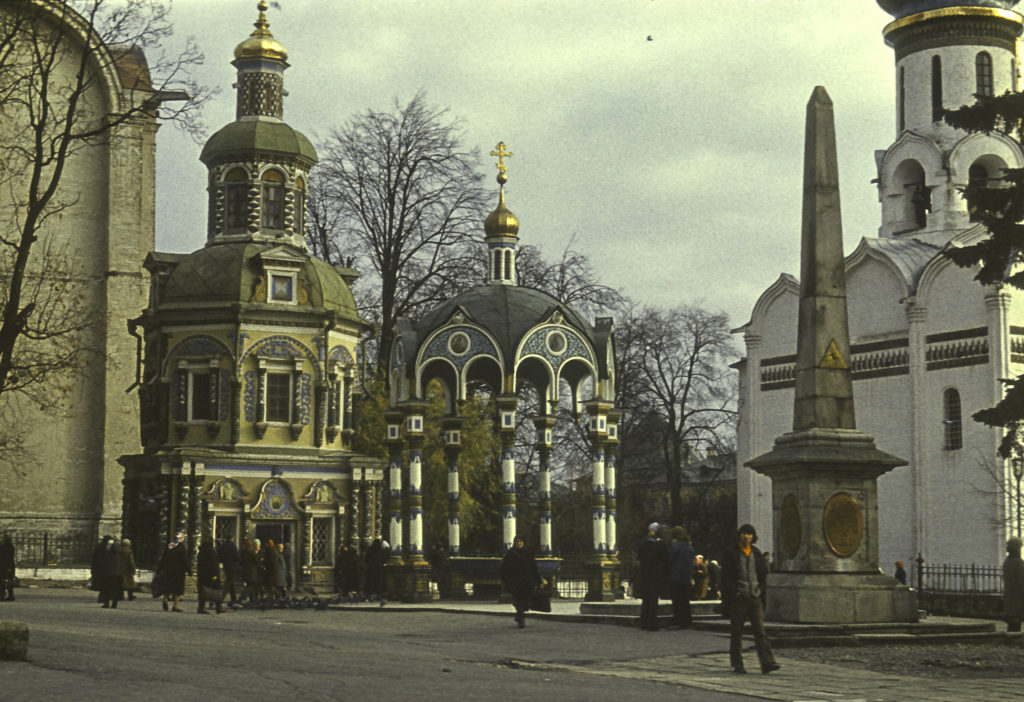
The Assumption Wellspring Chapel (Vodosvyatnaya Chasovnya-Sen’), next to the Uspensky Sobor. I don’t know the identity of the man in the hat; he was probably just a KGB agent sent to keep tabs on us.
Later, a well was dug near the chapel and a canopy or gazebo was erected over it; a cast-iron cup was provided so that people could draw drinking water from the well. According to one account, when the Bolsheviks closed the monastery in 1920, the gazebo was removed, but restored when Stalin allowed the monastery to be reopened in 1945. In any case, it was there when I visited in 1964.
The gazebo over the Assumption Wellspring, with the Wellspring Chapel at left and the Cathedral of the Holy Spirit at right. I don’t know anything about the monument in front of the cathedral.
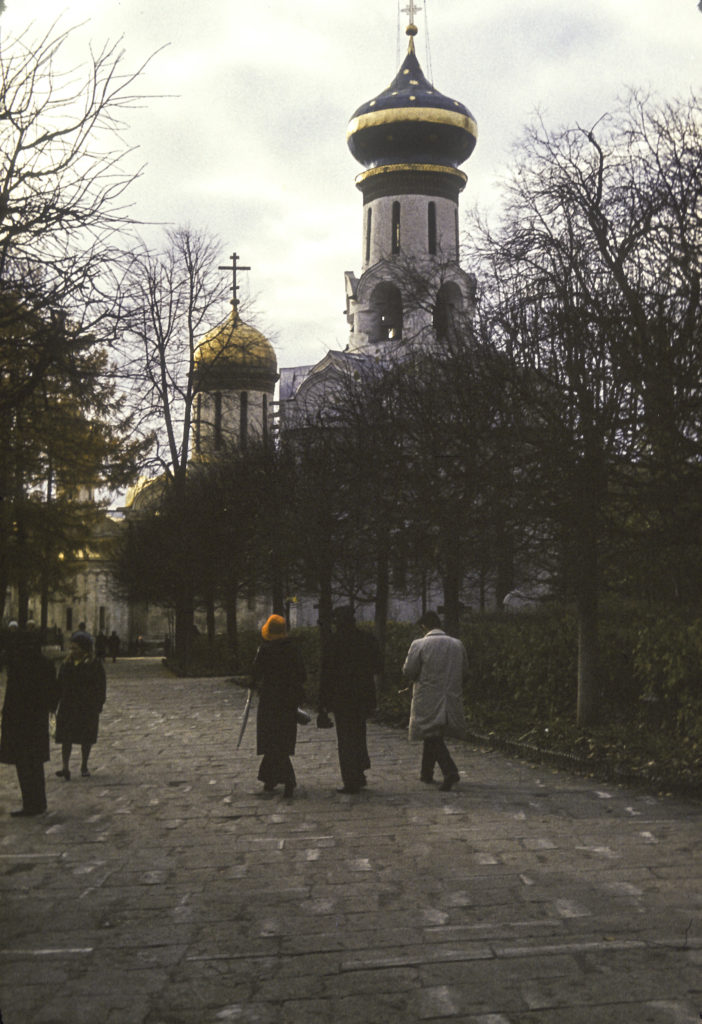
Continuing on, as if moving backward in time, we encountered the Church of the Holy Spirit (Dukhovskaya Tserkov). To build this church, Grand Prince Ivan III invited craftsmen from Pskov; they introduced the use of glazed tiles for decoration. It has a bell tower on top, one of the few surviving Russian churches with this feature; bell towers in Russia are usually separate from the church itself.
Dukhovskaya Tserkov’ (Духовская церковь), commissioned by Ivan III in 1476. The Trinity Cathedral is in the background.
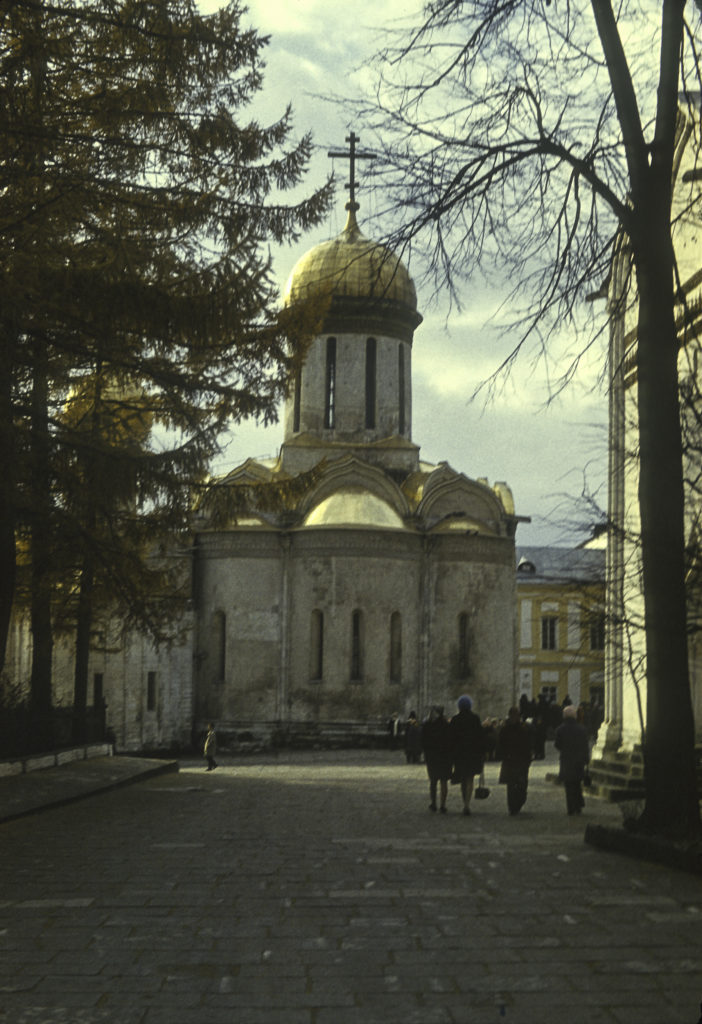
Finally we arrived at the original stone cathedral, the Trinity. In 1389, a fateful battle took place between the forces of the Ottoman Turks and the Serbian army of Prince Lazar, in the aftermath of which the Ottomans absorbed Serbia into their empire. Some Serbian monks, refusing to serve a Muslim ruler, sought refuge in Russia, and made their way to the Trinity-St. Sergius Monastery, where they ended up building the Trinity Cathedral in 1422.
Trinity Cathedral (Troitskii Sobor) – built 1422-23 – the oldest church in the monastery.
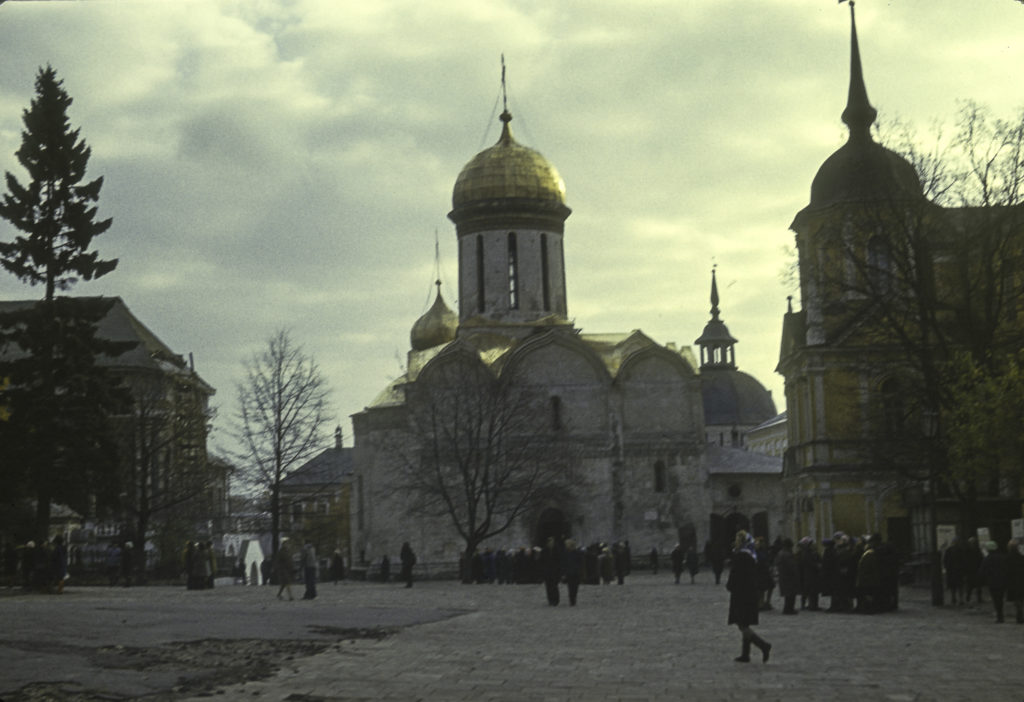
The great Russian icon painters Andrei Rublev and Daniil Chornyi also became involved, contributing their matchless frescoes. The Trinity Cathedral became the final repository of the relics of St. Sergius, who had died in 1392.
Another view of the Trinity Cathedral, looking back toward the Refectory from the Bell Tower.
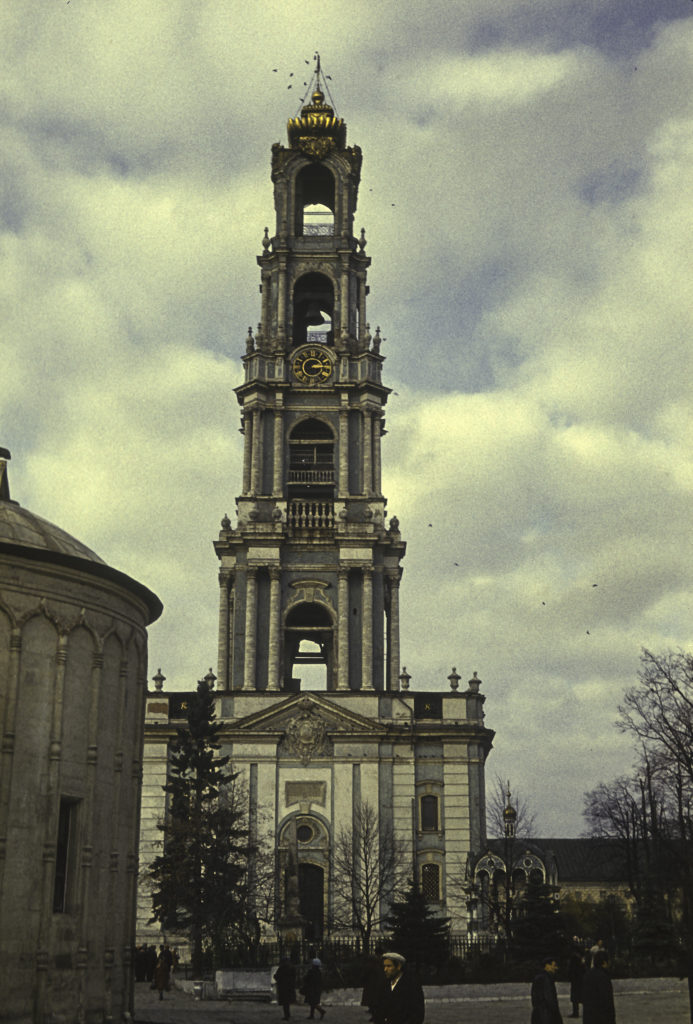
Retracing our steps back past the Uspensky Sobor, we came to the bell-tower. Peter the Great’s daughter Elizabeth, who became Empress of Russia in 1741, greatly favored the monastery and even made annual pilgrimages there on foot. She elevated the monastery to the status of a lavra (premium-grade monastery), and commissioned a baroque bell tower, which however was not completed until 1770. But at 88 meters (288 feet) high, it was taller than the Ivan the Great bell tower in the Kremlin.
Baroque bell tower, commissioned by Empress Elizabeth in the 1740s and completed in 1770
Also added to the monastery during Elizabeth’s reign was the Church of Our Lady of Smolensk, begun in 1746 and completed in 1753. This church was built to house an ostensibly wonder-working stone-carved icon, the original of which is now kept in the Sergiev Posad Historical-Artistic Museum, with a copy substituted for it in the Smolensk Church.
Left of center, tent church of Zosima and Savvaty; center, Kalichya Tower; right, Church of Our Lady of Smolensk
Visible behind and to the left of the Smolensk Church in the picture above is another 18th-century addition, the Kalichya Tower, on the northern wall of the monastery. This was completed around the same time as the Bell Tower and resembles it in architectural style and many details. The green tiles covering the roof were added later, in 1793, and are a feature shared with the Troitskaya Tower of the Kremlin. Like the Utochya Tower, it is a gated tower.
There is a third structure in the picture above, which also shows up in the center of the next photo. This is the tent church of Zosima and Savvaty, built in 1635-37, oddly enough on the top of the monastery hospital building. It was named for two of the founders of the Solovetsky Monastery on islands in the White Sea in the far north of Russia. Unfortunately, it leaves out the person who was mostly responsible for the establishment of the church, the Cellarer (Master of Provisions) Alexander, who migrated from the Solovetsky monastery after the Time of Troubles and worked tirelessly over the decades following to repair the destruction wrought by the Polish sieges and other disorders of that grim era.
Here the tent church of Zosima and Savvaty is seen in the center, with the top of the Carpenter Tower (Plotnichaya Bashnya) visible above the building to the left of it, and part of the Bell Tower on the right.
As I already mentioned, the Soviet regime shut down Trinity-St. Sergius Monastery in 1920, distributing its buildings among various government agencies or turning them into museums. The Soviets also removed many of the valuables and especially the bells. However, the sacristy collections and the relics of St. Sergius were saved, largely through the efforts of Pavel Florensky, an Orthodox priest and theologian as well as a mathematician and electrical engineer, who after the 1917 Revolution had worked for the Soviet government as an electrical engineer. For these crimes, as well as others such as publishing a monograph on geometry in which he drew a religious link to imaginary numbers, and being recommended for a job by Leon Trotsky, he was arrested and eventually executed in 1937.
During World War II, the Soviet government made some gestures in the way of improving relations with the Orthodox church, culminating in the return of the Trinity-St. Sergius Monastery to the church in 1945 and the resumption of services in the Assumption Cathedral in 1946.
I arrived in Moscow on a flight from Paris one day in August, 1972 and was immediately ejected and tossed on the plane going back to Paris.
I had committed the unforgivable sin of arriving without a visa. The International Research and Exchanges Board in New York, the agency that oversaw the academic exchanges between the USA and the USSR, was responsible for procuring the visas for the exchange participants. To ensure that they would be able to send the visas to the right addresses at the right times, they required the participants to keep them informed of their movements during the summer prior to departure.
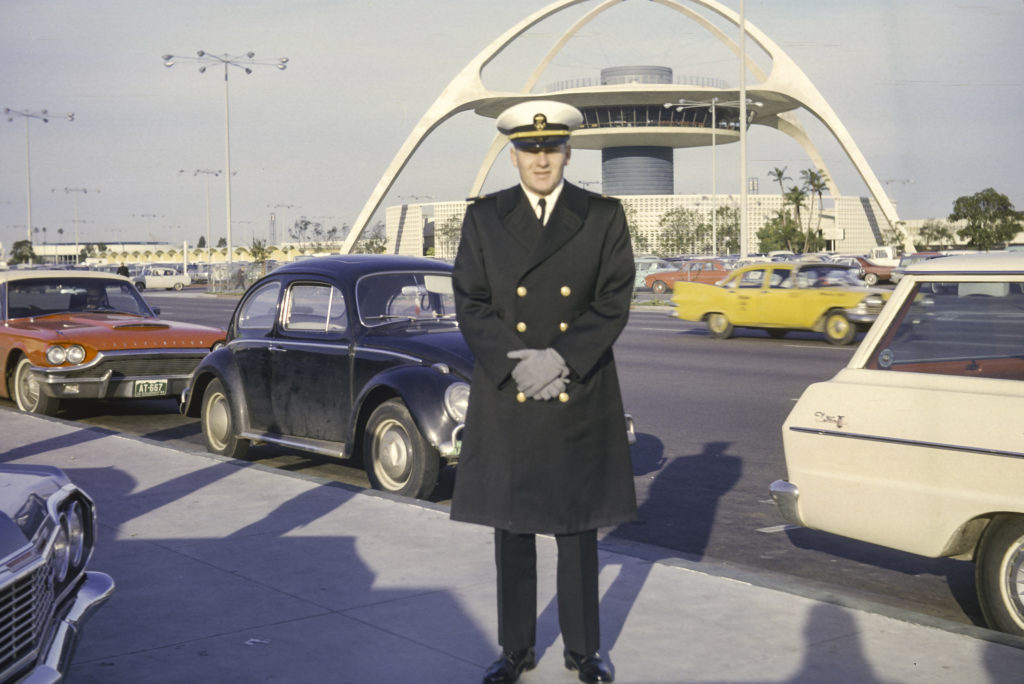
I was living in Washington, D.C. during June and July 1972, doing research in the Library of Congress on my dissertation topic. I took a short vacation to Southern California in late July, then flew to Paris. All the participants were to take the same flight from Paris to Moscow. I hadn’t received my visa by then, but I wasn’t worried about it. I figured that IREX would send the visa with their representative on the flight to Moscow. That was the procedure which had been used on my previous visit to the USSR in the summer of 1964. I spent a day or so visiting Alan Williams, a fellow graduate student from Yale, who was spending his year abroad doing dissertation research in Paris, before catching the plane to Moscow.
The joke was on me. When we arrived at Sheremetevo Airport in Moscow, everyone pulled out their visas – except me. Nobody came running up to me on the plane with my visa.
We were met at the airport by representatives of the Ministry of Education, who quickly took in the situation and contacted their superiors at the Ministry to get a copy of my visa. They knew I had one, I was on their list. While we were waiting for the visa to arrive, some jerk of a border guard lieutenant, turning a deaf ear to the Ministry’s reps, grabbed me and tossed me back on the plane.
Back in Paris, I contacted IREX to find out what was going on. It turned out that they had sent my visa to American Express in Paris, but had neglected to tell me about that. I guess they expected me to figure it out on my own. I retrieved the visa and booked another flight to Moscow. IREX covered it, but they said that I would have to pay them the money back – both for the return flight from Moscow to Paris, for which I had to sign a promissory note, and the second flight from Paris to Moscow. That was kind of a distressing prospect, because as a graduate student I didn’t have a lot of money and the repayment would cut heavily into my finances.
As it turned out, I never had to reimburse IREX for the extra flights. I did have to write them an explanatory letter, and they eventually figured out that they had dropped the ball, or at least thrown it to the wrong base.
That was the inauspicious beginning to my year in the Soviet Union. When I finally arrived at the airport for the second time, I was whisked off to a temporary hostel somewhere in Moscow for a few days while awaiting assignment to permanent quarters in Moscow University. I was “entertained” by a group of young men who purported to be students. They all spoke excellent English and some of them claimed to have lived in the USA as sons of diplomats. I figure they were assigned to evaluate me and determine what kind of threat I represented to the Soviet regime. No matter – they were genial and hospitable, and I passed the time well in their company.
After a few days I was able to move into my room on the 5th floor of Zona V of the main building of Moscow State University (abbreviated MGU after its Russian initials) in Sparrow Hills. The rooms in MGU were grouped into “blocks”, two rooms to a block, sharing a common entrance, toilet and shower. The rooms were quite small, and the Soviet students were assigned two to a room, four to a block, so their quarters were rather cramped. The exchange students, such as me, had one room to themselves, so that our roommates were really block-mates, and we had relative privacy. I had even more privacy at first since my assigned block-mate didn’t arrive until I had been there a month or so.
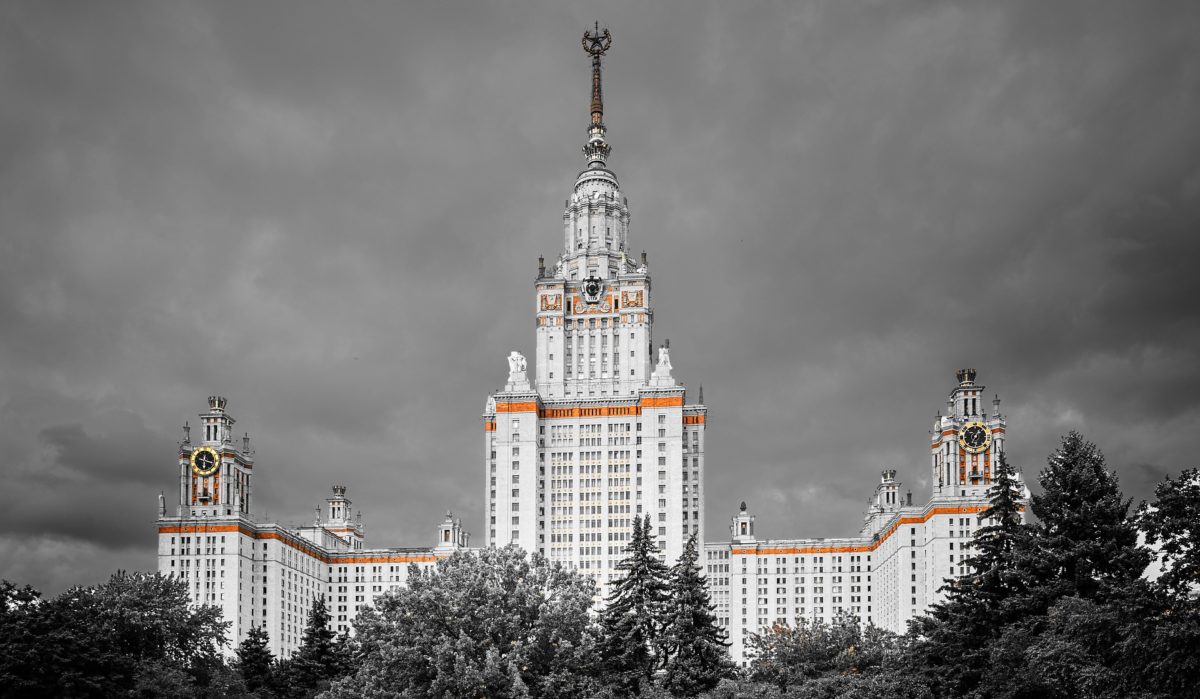
The main building of MGU consists of a central tower of 36 stories flanked by two huge wings that branch out like tuning forks. The place is gigantic, with 33 kilometers of corridors and 5000 rooms. It was one of the “Seven Sisters” – giant skyscrapers which Joseph Stalin ordered to be constructed around Moscow during the post-World War II era, in his favorite architectural style, a combination of Russian Baroque and Gothic, sometimes characterized as “Stalinist wedding-cake.” It was built in 1953 using gulag convict labor, and it had some of the features of a prison. Access was strictly limited. There was a fence around the building with entrances manned by babushki – older women who provided much of the clerical and menial labor for the Soviet workforce and whose duty was to check everybody’s passes to make sure that no unauthorized persons got in or out. Further control points were distributed inside the building at the entrance to each korpus (ward or section). You had to show your pass to get on an elevator to go to your room. Out of as many as eight elevators for each ward, only one or two would be kept running at a time, so that you generally had to wait in line to get into an elevator to go to your room. Moreover, for the corner towers of each ward the elevators were staged – that is, if you had a room in one of the corner towers you would have to take one elevator to get to the top floor of the lower ward, then another to get to your room in the tower. Luckily, I and the other American students had rooms in the lower floors, which were easy to access.
Moscow University courtyard, 1972. At some point during the year a staircase at one of the entry points to the building collapsed. Luckily it happened in the middle of the night and nobody was hurt.
There was more. Although the building had been constructed with portals allowing people to pass from one wing to another on each floor, all of these were sealed off, so that if you wanted to visit someone who lived in a different wing, you had to exit your ward, and sometimes even the building, go to another entrance, show your pass, explain where you were going and why or try to sneak past the guards, and then wait for the elevator.
Despite the controls, unauthorized people did manage to get in, and it was known that there were many, perhaps hundreds, of people living there whose student status had expired or who had never even been students in the first place. To deal with this situation, the authorities conducted random sweeps, unannounced in advance, to check the passports of everybody in the building. These were conducted by student officials. The same persons also conducted pre-announced periodic military-style inspections of the student rooms for cleanliness and good order. I recall that on one occasion, a gigantic Arab, at least six and a half feet tall, came to inspect my room with white gloves. He ran his glove over the top of the door and found dust on it. He then proceeded to act as if he had unearthed some heinous crime. I thought he was going to haul me off to the brig. He relented and became more courteous when he discovered that I was a foreigner and an American. It also turned out that he was an officer in the Egyptian army as well as a student at MGU.
The first month of our stay, all the American students were required to attend a class to bring us up to speed on our command of Russian. Most of us needed it. There were two instructors, both women. They were extremely competent and very personable. I improved my fluency in Russian a great deal in the class and thought it was in some ways the best part of the year.
Sometime in that first month, I started getting visits from a youngish woman in a short skirt and high leather boots, who said she was looking for a graduate student named Ronald Feldstein from Princeton, who had been there the previous year. This was clearly a pretext to come in and talk, and maybe drum up some trade. She said her name was Laima and she was from Latvia. Each time she showed up, she stayed and talked a while. She began by telling be how bad my Russian was. I already knew that. She also liked to tell me how brilliant and extraordinary Ronald Feldstein was. I never did find out how well she had known Feldstein, and I figure she was probably just using his name to get her foot in the door. She also liked to tell sex jokes, which to me was a clear indication of what her game was. She was not bad-looking, but her manner put me off, and it was easy to imagine she was there for some nefarious purpose, like perhaps trying to get some compromising information that the KGB could use to blackmail me with. I didn’t bite, and her visits soon ceased. She also visited other Americans in our party, who told much the same story. We called her Crazy Laima.
At the end of the first month, I got a roommate. I think I was the only American who got a roommate who wasn’t from the Soviet Union. His name was Waldemar Ariel Camaño-Brañas and he said he was from Uruguay but had gone to university in Brazil. When I asked him how he had ended up in MGU, his reply was a bit vague – something to the effect that the Soviets accepted students from all over the world. Ariel, as he preferred to be called, was very personable, outgoing, and generous. He helped me as well as some of the other American students get acquainted with the university facilities, with Moscow, shopping, dining, in general learning the ropes. He got to know some of the other foreigners in the ward, including some Scandinavian exchange students, and introduced us to them. (They had great parties and were in general lots of fun.) He even took me to the Uruguayan embassy and introduced me to some of the people there. He got us great coffee from the Brazilian embassy. And so on.
It soon became apparent that he was really disillusioned with the Soviet Union. He had nothing good to say about it. He was paranoid about being spied upon. He kept looking for microphones in the rooms, and thought he found where they were embedded in the wall. One time the American Communist professor Angela Davis came to Moscow University to give speeches supporting, among other things, the Soviet invasion of Czechoslovakia in 1968. We could see her in the auditorium where she was speaking from our dorm windows. Ariel grabbed an imaginary AK-47 and mimicked shooting at her.
Of course it turned out in the end that he was working with the KGB. Not that he was doing it voluntarily, at least not by the time I got there. As far as I could gather, when he first came to the Soviet Union, he had been a dedicated Communist, and the Soviets took care of his finances. As time went on his enthusiasm for Communism had withered, but to keep his stipend he had to perform services for the regime, which involved reporting on other foreign students to the KGB. But he didn’t feel good about it, and he wanted out. The trouble was, by that time he couldn’t go back to either Uruguay or Brazil; he was persona non grata to the authorities there, and they either wouldn’t let him in or would clap him in jail once he got there – it wasn’t clear which. But his handlers in the KGB had by that time gotten wind of his distaste for his assignments, and they cut off his stipend in the middle of the school year. At the time he told us that they had said to him something like “You people are all alike. You lose faith [in communism] and you go and sell yourselves to the Pope!” So he was in a dilemma. He had no money, and he could neither go nor stay.
He resolved the situation in an interesting way. One of the women he was involved with – there were several – was from Denmark, and he made known his situation to her. She invited him to come to Denmark and live with her and her husband until he could find a job. Around the end of December, I think it was, he left. I gave him $100 to help out with expenses. A few months later I heard from him again. He said that he was going to Sweden under the auspices of the same organization that helped the American draft-dodgers to find refuge there, and he needed more money, and could I send him some? I couldn’t. Later I heard from some of the other Danes and Norwegians who knew the couple he had been living with that he hadn’t shown much motivation, hadn’t really tried to find a job, etc., and finally decided to seek greener pastures. I never heard his side of the story, so I don’t really have a good idea of what his situation was in Denmark. In any case, I never heard from him again. I hope he finally found a niche somewhere.
After Ariel left I knew that I would be assigned a new roommate sooner or later; it would probably be a male Soviet student, and for various reasons I didn’t particularly relish the prospect. Around the same time, another member of our American IREX contingent, Chris Buck, a fellow graduate student from Yale, had a change in his circumstances. His wife Michelle left to go back to New Haven – they were en route to a divorce – and like me, he didn’t relish the idea of having to adjust to an unknown new roommate either. So we applied to the university administration to become roommates with one another, our request was immediately approved, and I moved into the second room of his block on the third floor. This made matters very convenient for us. I had a Russian girlfriend, Chris very shortly acquired one of his own, and if the powers that be wanted to listen in to our activities via microphones in the walls, assuming there were any, that was fine with us, but we preferred not to have roommates who might report on our comings and goings.
By then I also had contacts outside Moscow University that would not have been especially palatable to the Soviet regime. One of my fellow graduate students in Russian history and his wife had been on the IREX exchange in the spring of 1972, and they passed on to me one of their acquaintances, Boris Khazanov, who worked for the Soviet Academy of Sciences as a computer economist. He was Jewish and wanted to emigrate from the Soviet Union. This was the era when the Brezhnev regime was in theory letting Jews emigrate but putting all kinds of obstacles in their path. One way of making it difficult was to simply drag their heels on processing the application; another was to raise all kinds of legal obstacles, such as prior employment in jobs that gave access to sensitive military or scientific employment. Fortunately Boris didn’t have to worry about that. Still another way was to make would-be emigres pay for the education they had received at state expense, and since all education in the Soviet Union was at state expense, that could add up to a considerable sum of money, depending on how much education one had obtained. Boris of course had a lot, and I think the fee for him was about 90,000 rubles, which at the official ruble-to-dollar exchange ration of 1:1.3 or so would have been $117,000, a hefty sum of money. (Not that the official rate meant much in those circumstances; even though Soviet salaries were low, rubles were not so hard to come by via borrowing because there wasn’t much worth spending them on.) When Boris applied to emigrate, just before I arrived in Moscow, he was fired from his Academy position, which would have made it hard for him to stay afloat financially, were it not for the fact that the regime neglected to fire his wife from her job as an English teacher, so they were able to eke out a living on her salary. But the financial aspect was the lesser of his worries; the major obstacle was simply the bureaucratic refusal to grant him the foreign passport. That was where he was when I showed up. The role I inherited from my predecessors was to pass Boris’ letters to people in the West who might help him get out by raising a fuss in academic and scientific circles and thereby embarrassing the Soviets – people like the famous economist Paul Samuelson. If Boris sent his appeals via the regular Soviet post, they would be subject to scrutiny or censorship, or quite likely simply trashed. I was able to send out his letters unhindered through the American Embassy’s secure diplomatic post, to which we as exchange students had access.
In return for my help, which to be honest involved little effort or risk on my part, Boris did a lot to make my stay in the Soviet Union more pleasant and edifying. He took me on walking tours of Moscow and showed me sights that I would never have found on my own. He got me tickets to concerts, plays and ballets, including the Bol’shoi Theater and the Moscow Conservatory, which I would not have been able to obtain otherwise. He also passed me on to a friend of his named Oleg in Leningrad who showed me around that city when I was there. I’ll have more to say about Oleg when I get to the post on Leningrad.
But while I was hobnobbing with Boris, in the fall and winter of 1972, a curious episode occurred which, although it doesn’t reflect well on me, I’ll relate anyway, omitting the names of most of the participants to protect the guilty. One day out of the blue I received a letter from a fellow graduate student at Yale, who informed me that she was dating a guy, I’ll call him Sam, who had also been on the IREX exchange in spring 1972 and who knew Boris. He had told her that Boris, contrary to what he had told me, had actually been involved in highly classified work with the Academy of Sciences, that the Soviets would therefore never give him permission to emigrate, and that Boris was not to be trusted and I could get in big trouble with the authorities for associating with him. Needless to say I was dismayed to hear this. It was all the more believable since Sam was himself Jewish and could be expected to at least feel some empathy with persons of similar ethnic background. I wrote to the couple at Yale who had passed Boris on to me, asking for clarification, and in the meantime told Boris that something had come up and I would have to stop seeing him for a while. A few weeks passed before I got a reply from my friends at Yale. They berated me in no uncertain terms, and rightly so, for believing hearsay and for abandoning Boris. They also had a few things to say about Sam – to put it as kindly as possible, he was apparently prone to pose as an authority on subjects he knew nothing about. It turned out that Sam, indeed, knew not whereof he spoke; I shortly resumed relations with Boris and continued to pass on his letters, with no adverse consequences. The Soviet authorities finally did relent and allow Boris to emigrate – he left the USSR with his wife and daughter in the spring of ’73, while I was still in the Soviet Union – and subsequently settled in Boston, where he immediately found a job and, as far as I know, lived happily ever after.
After that episode, and Ariel’s departure, things settled down a bit. And it was during the remainder of the winter and the spring – January through May of 1973 – that I did most of my traveling in the Soviet Union. But I also continued to explore Moscow, and that is where this photographic odyssey sets forth.
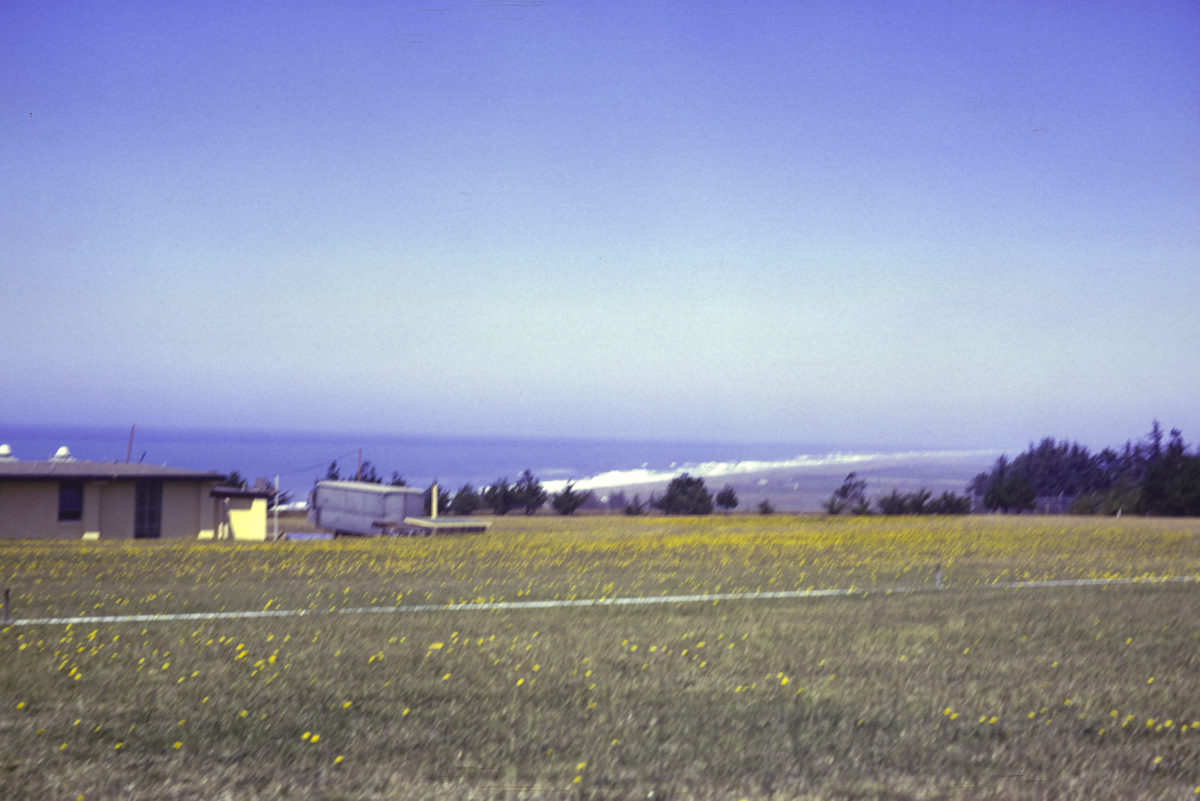
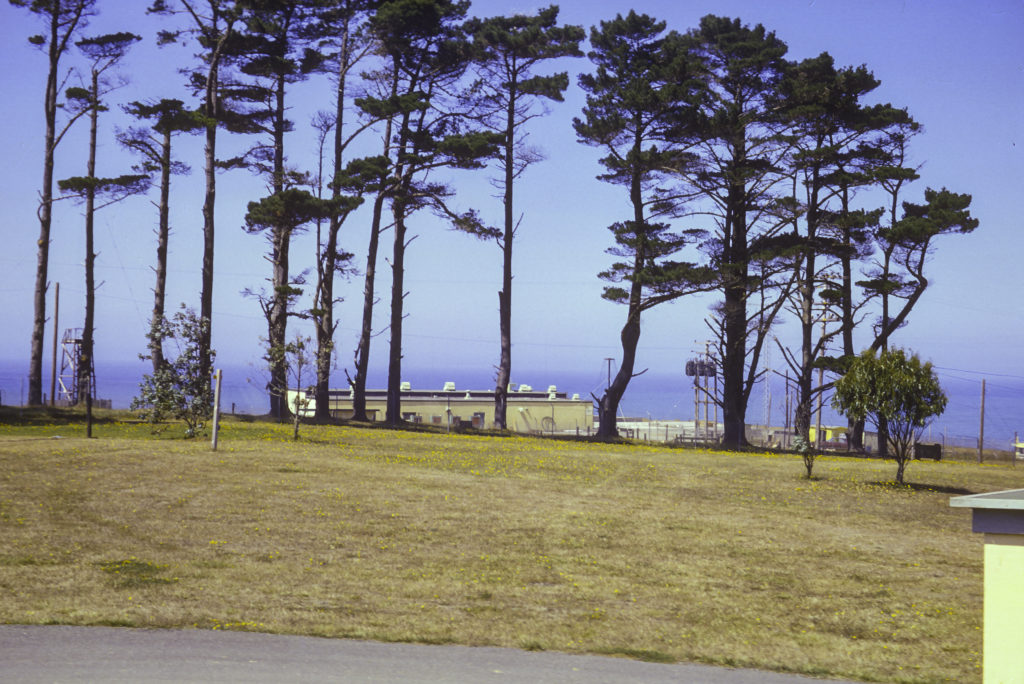
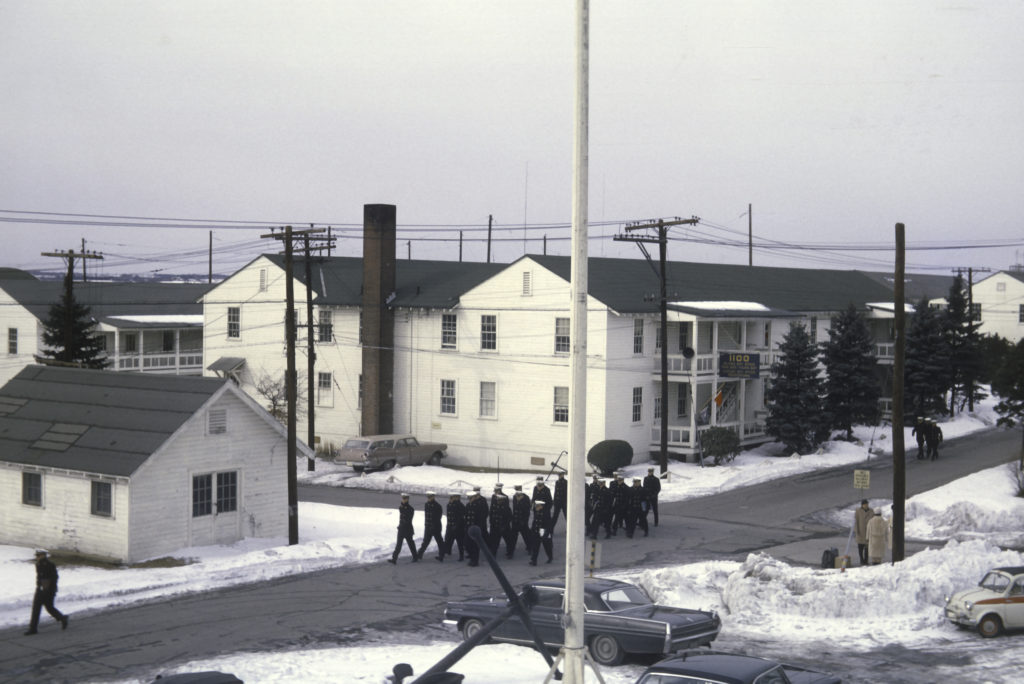
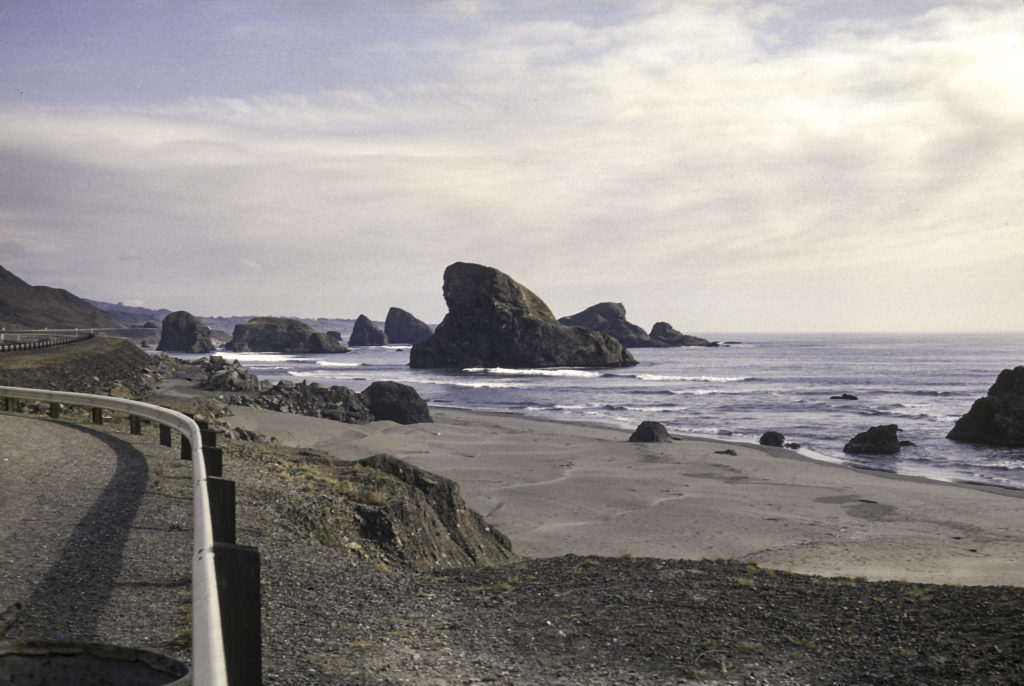
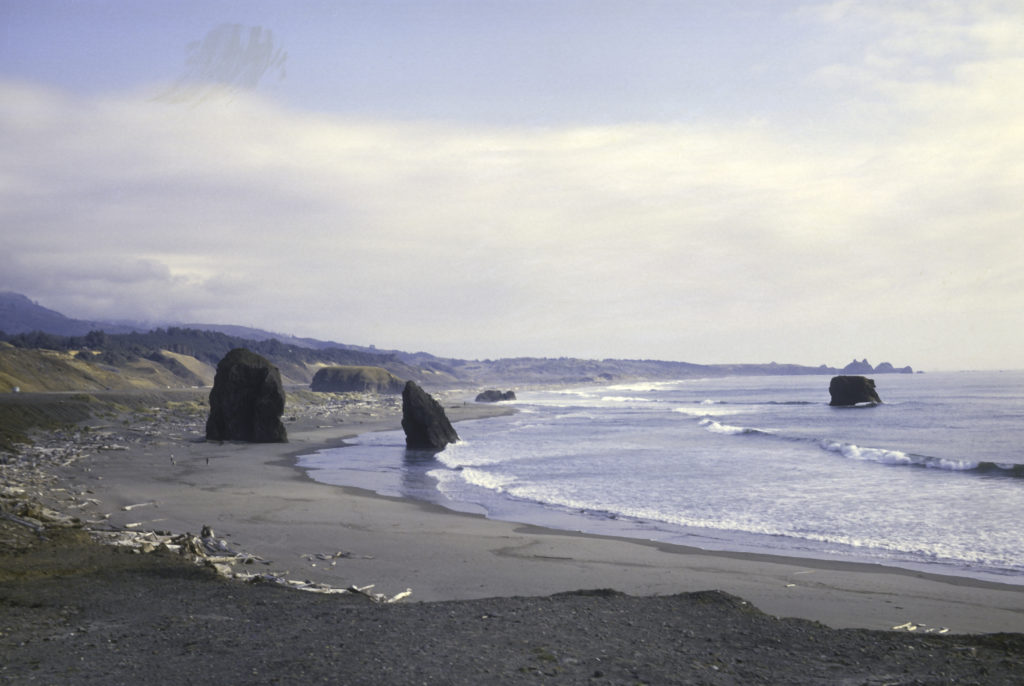
NAVFAC CentervilleBeach - 1965 - Looking north along the coast
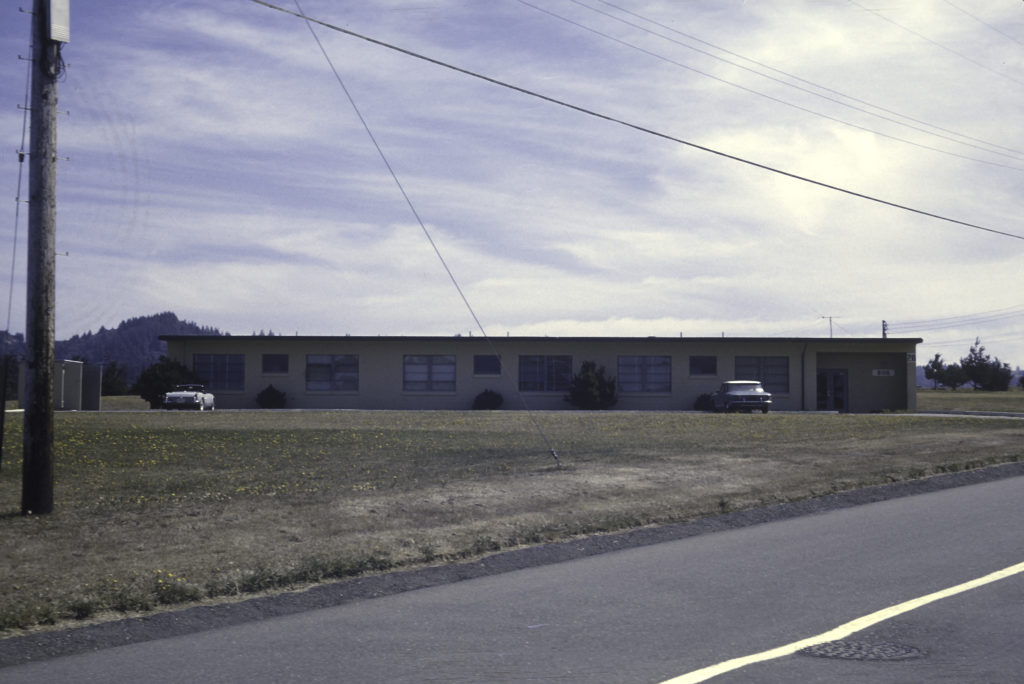
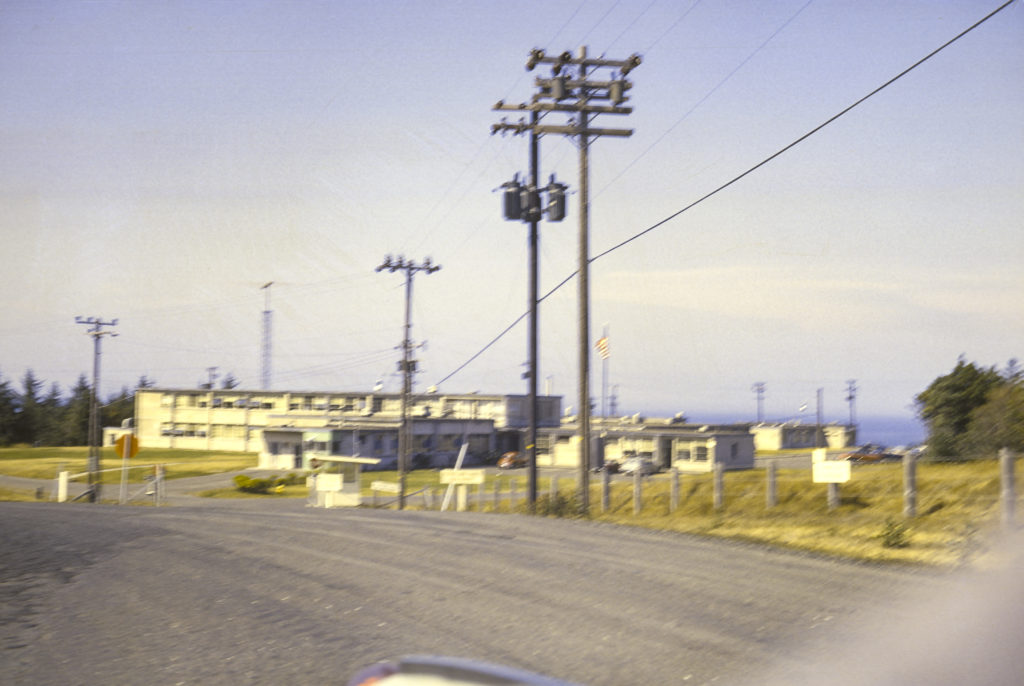
My first duty assignment in the Navy (other than training) was to the U. S. Naval Facility Centerville Beach, near Ferndale, California. The Naval Facility (NAVFAC) was part of the Sound Surveillance System (SOSUS), which consisted of a series of small stations located up and down the east and west coasts of the United States, as well as certain strategically located islands in the Caribbean and elsewhere, including Adak in the Aleutians and Iceland in the Atlantic. The mission of SOSUS was to detect and locate Soviet submarines. More on that later.
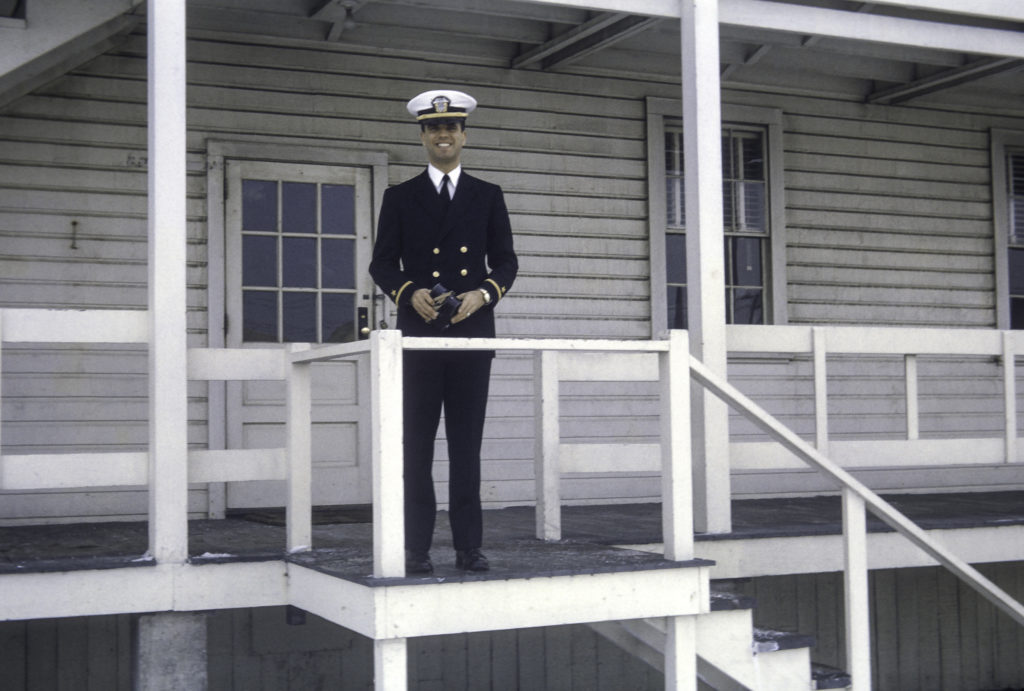
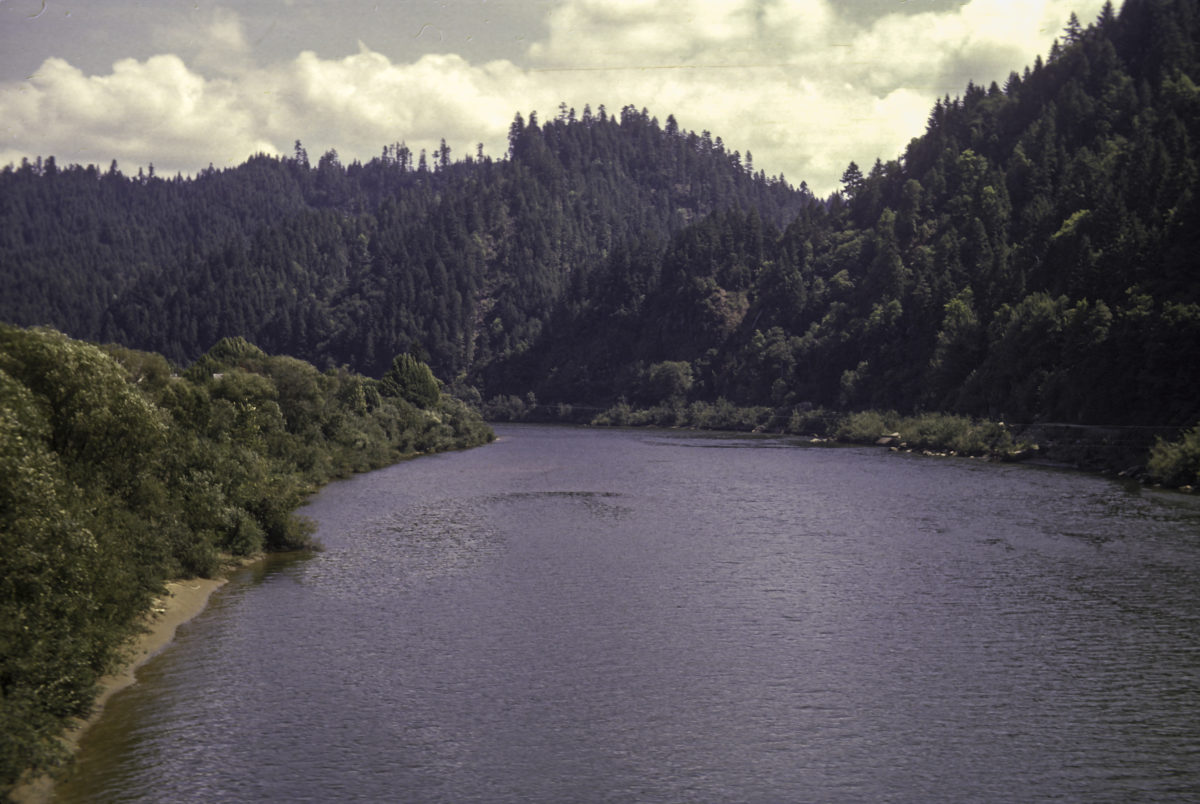
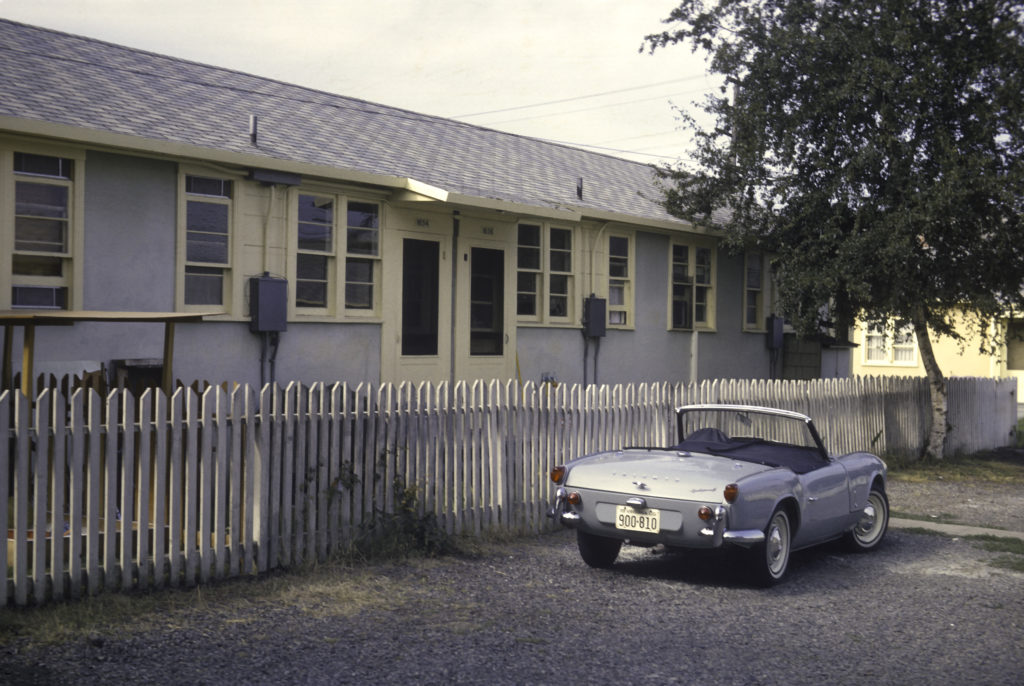
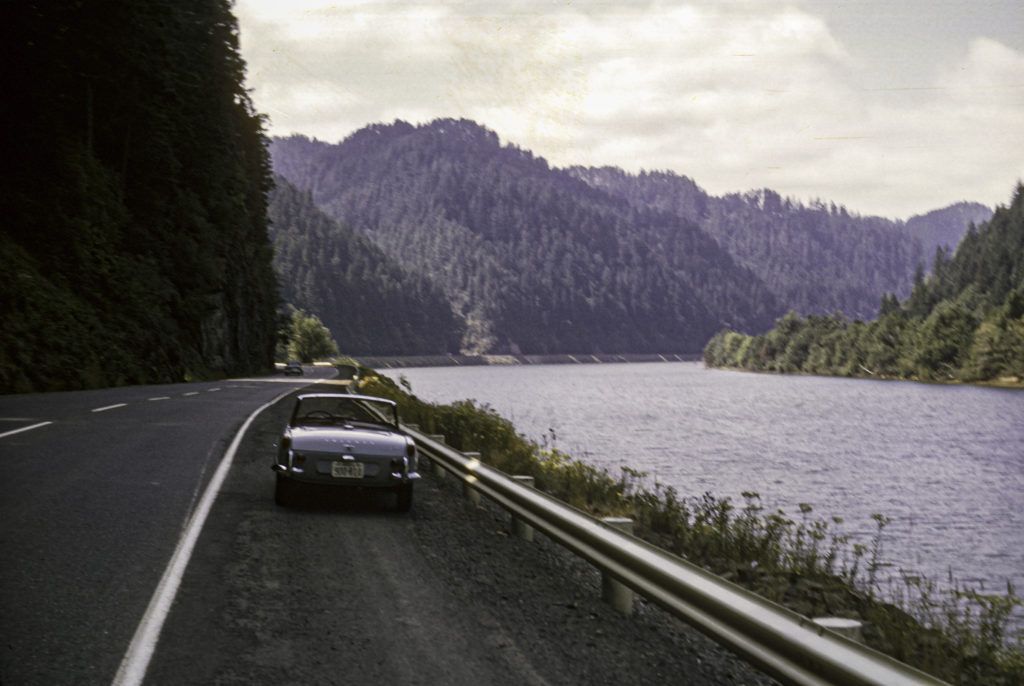
Ferndale is a town in Humboldt County about 20 miles south of Eureka, situated near the mouth of the Eel River, about five miles from the shore of the Pacific Ocean. The population is around 1370 and hasn’t changed much since I was there in the ’60s. Another nearby town, much larger than Ferndale and about five miles from it, is Fortuna, situated along Highway 101. I arrived at NAVFAC Centerville Beach in early April, 1965, a few months after the Eel River flooded the area and cut Ferndale and the Naval Facility off from the outside world for a period of several weeks. By the time I arrived, the flood waters had receded, but the residue of the disaster was all too visible – washed-out roads and bridges, bare flood-swept desolation, debris all around. The Commanding Officer, Lieutenant-Commander Richard Dickson, was a kindly fellow, a nice guy who was on his way out of the Navy and did, indeed, retire a few months after my arrival. His Executive Officer, Lieutenant Skip Sedlak, wasn’t such a nice guy. He was an ex-submariner, which was fine; the trouble was that he was also a boorish, ignorant imbecile. He was single because his former wife couldn’t stand him, which was understandable, since nobody else could either; and he was a fanatical 300% American who saw a Commie under every bunk. He was also a bit of a sadist, but I’ll get to that later. My transportation at the time was a 1965 Triumph Spitfire, a two-seater sports car, which I had bought upon graduation from Naval OCS. Additionally, when I first reported for duty at the Facility and was making the XO’s acquaintance, I happened to mention that I had ridden a motorcycle before I was in the Navy. Skip’s comment on that was “Oh, the CO won’t like that. He hates sports cars and motorcycles.” Skip enforced the CO’s prejudices with gusto, and generally enjoyed making life miserable for as many people as possible.
For his part, besides disliking sports cars and motorcycles, the CO had other quirks. A couple of months before my arrival, when the floodwaters had cut off the Facility from the outside world and no supplies were getting in, the mission of the Facility was threatened, and the Navy doesn’t like excuses such as “well, we couldn’t perform our mission because we ran out of supplies and none of our equipment would work.” The CO got so frustrated at the obstacles that he kicked in a metal cabinet in front of the men, which is not considered “coolness under fire” in the Navy. His most notorious idiosyncrasy, though, was his prudishness. Although he had an extremely attractive Japanese wife, he had an odd attitude toward sexual issues. Many enlisted men in the Navy liked to keep pinups from Playboy in their lockers. LCDR Dickson prohibited these, and when he conducted inspections of the barracks, he would check the men’s lockers for pictures of naked or scantily clad women, and remove any he found. I was also told by people who had served with him previously, of whom there were several on the base, that when serving on shipboard as the Executive Officer of a destroyer, whenever he found a Playboy or other such publication on the ship, he would tear it up and throw it over the side. A couple of months after I arrived at NAVFAC Centerville Beach, he ordered all copies of Time Magazine removed from the base because the cover of one issue displayed a picture of a woman in a bikini. But I kept a low profile and managed to avoid running afoul of his prejudices.
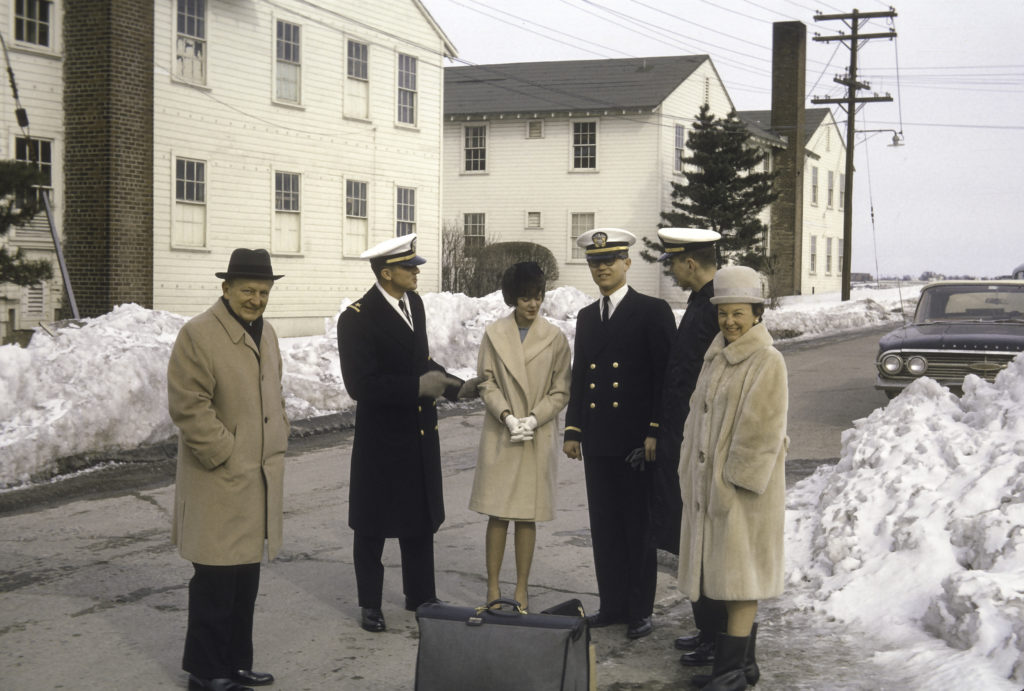
At NAVFAC Centerville Beach, as a single officer, I lived in the Bachelor Officer’s Quarters (BOQ). At the outset there were two other officers living there – Skip Sedlak, the XO, and Lee Elliott, the base Maintenance Officer, like me a new arrival. I had been at Sonar School in Key West with Lee, who was from Los Alamitos, California, right next to my home town of Long Beach. We got along well with one another, but Lee did not get along well with Skip Sedlak. The BOQ had one serious shortcoming which made life there (even disregarding Sedlak’s presence) quite unpleasant. The plumbing and heating system was badly designed, and the piping was put together such that the steam from the heating system created a water hammer effect which resonated throughout the BOQ at night, making sleep impossible. You could stop it temporarily by opening a valve to drain water from the piping, but it would soon start up again. Skip Sedlak ordered Lee as Base Maintenance Officer to fix the plumbing and eliminate the water hammer. This, it turned out, would have required a redesign of the plumbing and heating system, for which there was no budget, and was far beyond the capabilities of the base maintenance shop in any case. This meant nothing to Skip, who didn’t understand plumbing despite his years in the submarine service. When Lee failed to fulfill the order, Skip restricted him to the base indefinitely. This could have proved quite unpleasant for Lee, but fortunately for him it didn’t last long. After a few weeks Skip retired from the Navy, and as he drove out the gate on his way to civilian life, Lee was following right behind him in his Corvair with a big grin on his face.
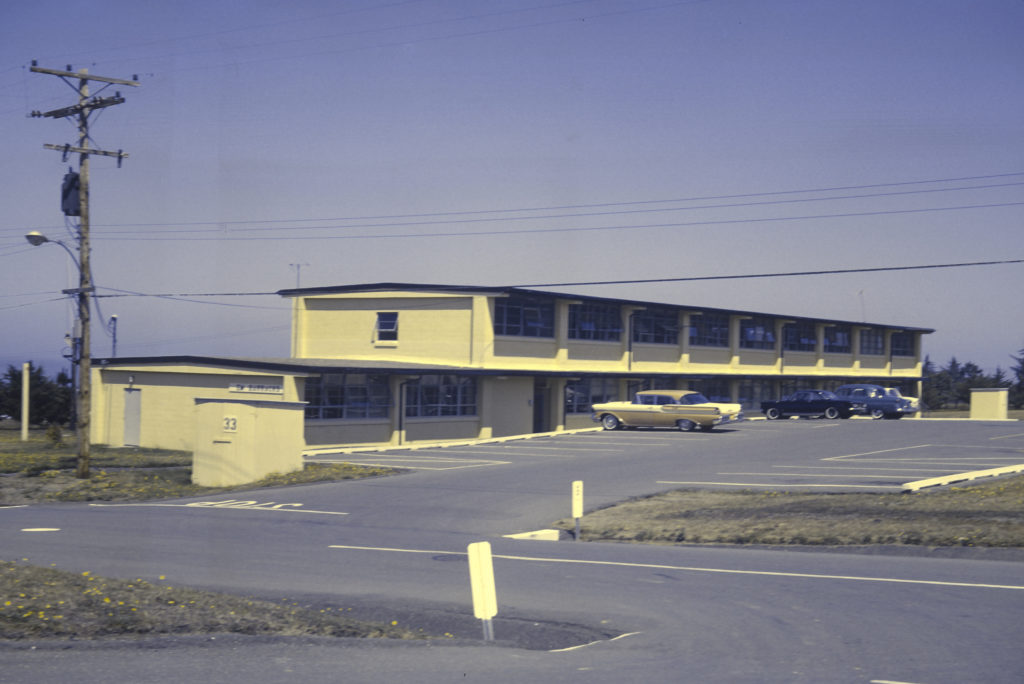
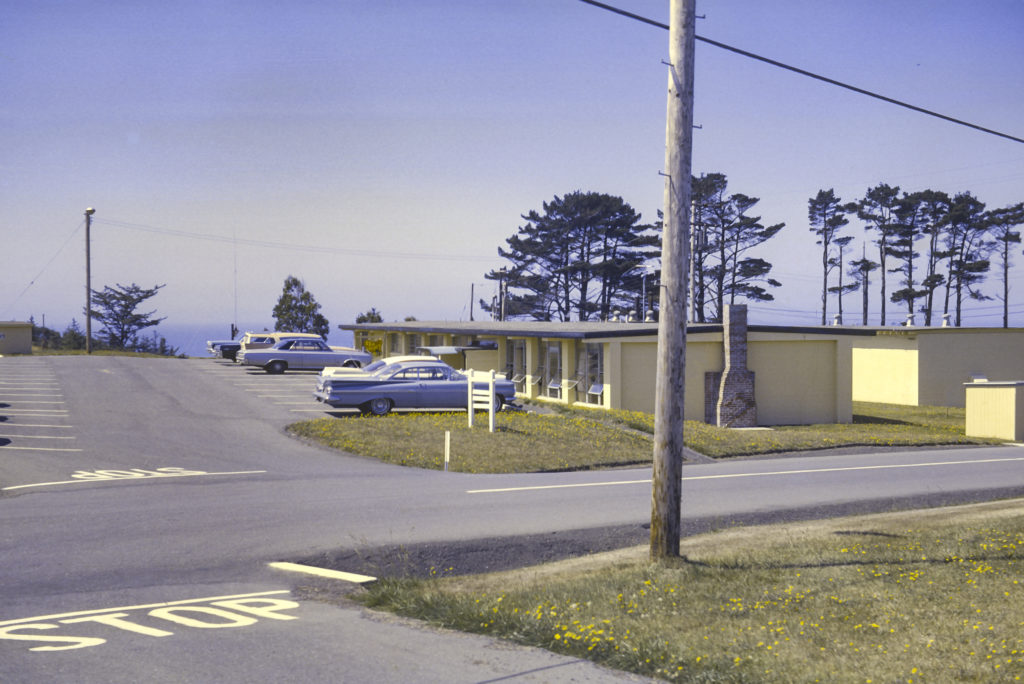
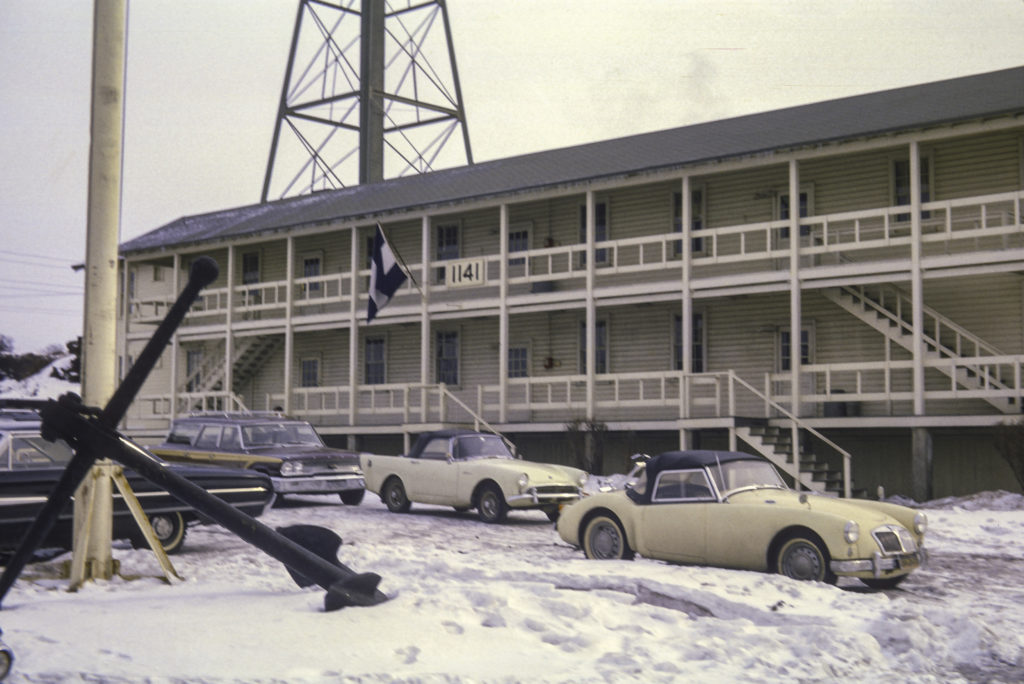
U. S. Naval Facility Centerville Beach BOQ, 1965, with my Triumph Spitfire parked on the left and Lee Elliott’s Corvair on the right
Sedlak was also responsible, according to a story I heard from some people on the base, for a deterioration in relations with the local community. Prior to his arrival, I was told, the officers on the base had enjoyed frequent invitations to attend the functions of the Ingomar Club, the premier social club of Humboldt County, which was headquartered in the famous Carson mansion in Eureka. But after Sedlak had come around a few times, his boorish and crass behavior alienated the members of the club, and the invitations stopped, leading to a lamentable decline in the quality of life for the officers at Centerville Beach. I don’t know whether this story is true, but it’s at least believable, and it does illustrate what kind of a reputation Skip Sedlak “enjoyed” on the base.
I barely managed to avoid incurring Sedlak’s active enmity myself. Once in the BOQ he spotted a robin on the grass outside. He told me to watch the robin while he went to get his .22 rifle so he could shoot it. I saw no reason why he should want to shoot a robin, so while he was off fetching his .22 I ran outside and scared it away.
I have already mentioned that I drove a Triumph Spitfire; Lee Elliott had a Chevrolet Corvair (see picture above). One time I raced Lee from Ferndale to the base, a distance of about five miles. He beat me. He was probably a better driver, but his Corvair was pretty impressive for a car which was supposed to be “Unsafe at Any Speed.” I always thought that Ralph Nader, whose book by that name was generally thought to have led to the demise of the Corvair, was full of crap. Why didn’t he rag on the VW Beetle, which was surely less safe than the Corvair? I knew several people who rolled VWs in tight curves, but I never knew anyone who rolled a Corvair. I figure Nader’s major accomplishment in life was to discourage all technical innovation in Detroit, with the possible exception of his run for president in 2000, which had the result of drawing enough votes away from Al Gore to get George W. Bush elected.
Anyway, Lee didn’t remain long in the BOQ because a place in Navy housing in Ferndale soon opened up, and he was able to move his family up from Los Alamitos. His place in the BOQ was taken by a new arrival, John Powers. John was an austere, prudish fundamentalist Christian, not the kind of person I, an agnostic bon vivant, was likely to become best pals with. While I was there, his major pastime was taking flying lessons, which was admirable, but I’m somewhat acrophobic and wasn’t interested in becoming a flier. Strangely enough, while stationed at Centerville Beach, I did make a stab at flying, but it was not voluntary on my part. The XO (Skip Sedlak’s successor) was a naval aviator who had served as navigator on a P-3 Orion antisubmarine aircraft. Even while on shore duty naval aviators had to put in their quota of flight time to continue receiving their flight pay. The XO did that by driving down to Moffett Field in the San Francisco Bay area, boarding a P-3, and doing a ridealong, sleeping in a bunk in the back of the aircraft while it performed its mission checking ships off the coast. He took me along on one of these trips. The pilot and plane commander, LCDR Coor, invited me into the cockpit while we were flying at cruising altitude over the ocean. It was a fine day and the view was great. The co-pilot left his seat for a while to take a break. LCDR Coor invited me to sit in the co-pilot’s seat, which I did. Then he told me to take control of the aircraft so he could take a break. I protested that I had never flown an airplane and wasn’t qualified to do do. He retorted that it wasn’t an obstacle – flying a plane was natural, “just like feeling a woman’s leg.” I retorted that I hadn’t had much experience at that either, but he was insistent, so I grabbed the control stick. Immediately the plane went into a nose dive. I pulled up on the stick. The P-3 took off into the stratosphere. When I finally got it leveled off, the pilot told me to bring the plane around to a course of 180 degrees. I pushed the control stick to the right. The plane came around to 180 degrees – then 190, 200, 210, 225, etc. I pulled the stick the other way. The plane came back to 210, 200, 190, 180, then 170, 160, 150, 130, 90 and so on. By this time I was beginning to panic and wondering if the plane carried parachutes and rafts. In the meantime, my XO back in his bunk was getting annoyed at the constant gyrations the plane was performing, which kept him awake. Finally, operational considerations intervened and LCDR Coor took back control of the plane so he could zoom down and take a close look at a suspicious merchant ship. Thus ended my first and only flying lesson.
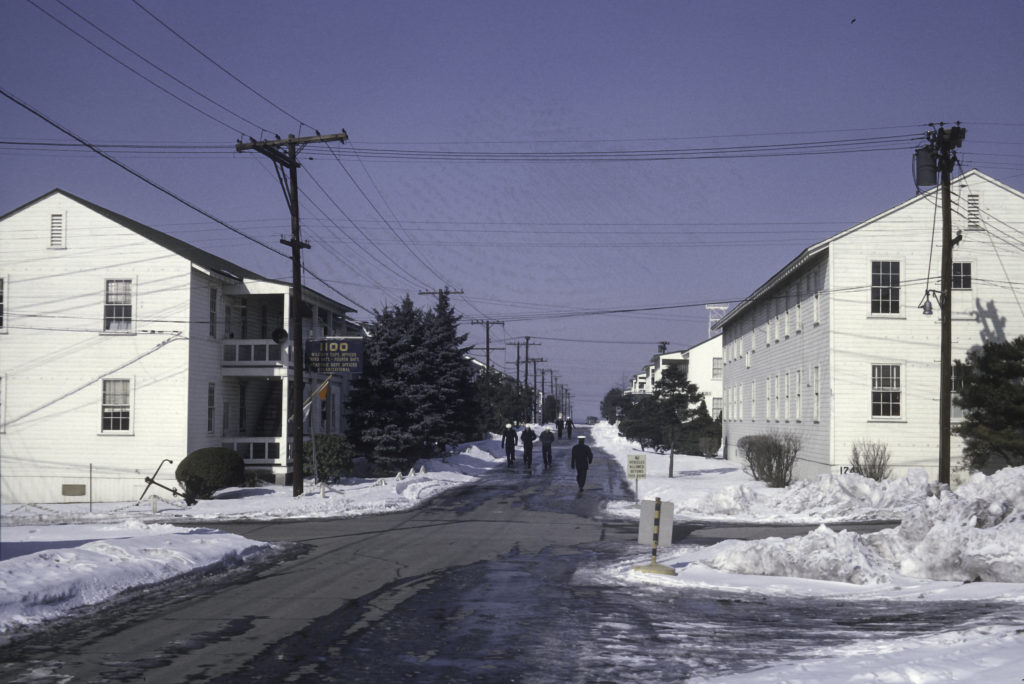
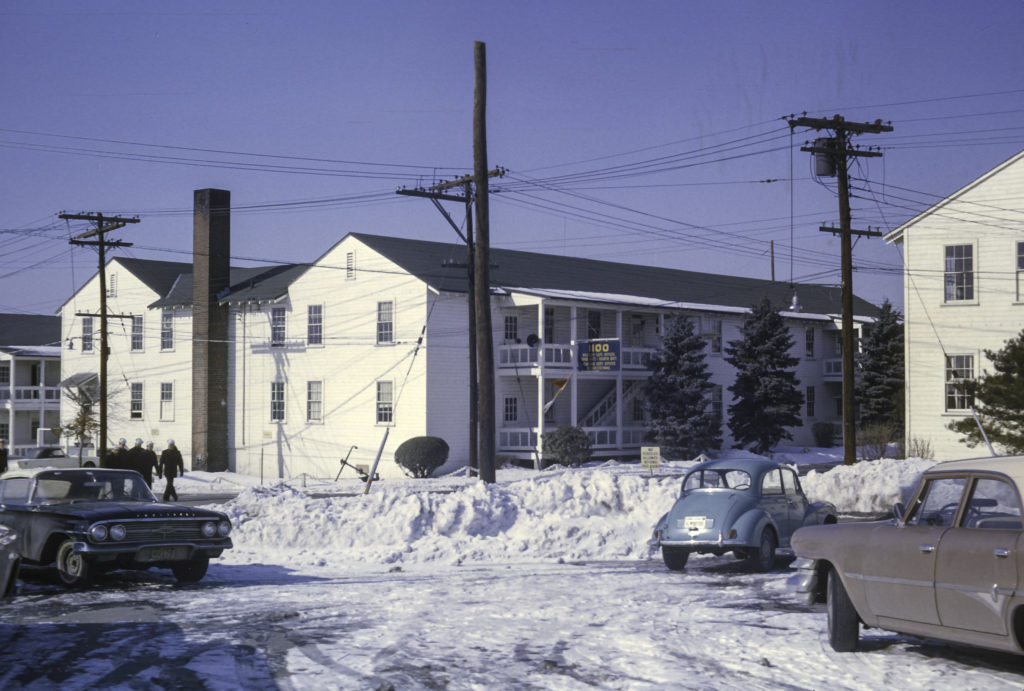
At NAVFAC Centerville Beach, the single enlisted men, of course, lived in the enlisted men’s barracks, pictured above. The married men, officers and enlisted alike, lived in naval housing in Ferndale. The enlisted men at NAVFAC Centerville Beach were (unlike the officers) a varied and colorful lot. A few months before my arrival, one of them who was on sentry duty had spotted one of his mates, a fellow named Ballard, and pulled out his .45 ACP and shouted jokingly, “Ballard, I’m gonna shoot you!” and he did. He thought the pistol was unloaded, and it wasn’t. Fortunately he didn’t kill Ballard, but that was the end of his sojourn at NAVFAC Centerville Beach.
Another incident, in which I was involved, featured a sly and unscrupulous radioman from Spokane named Galle. The enlisted men were paid in cash, and one payday a man in my division (Oceanographic Research) came to me with a complaint that he had gone to receive his pay and found that it had already been disbursed. It turned out that someone had collected his pay for him because he was on watch at the time and could not fetch it himself; but the someone who collected it hadn’t turned it over to him. That someone, it soon became apparent, was Galle, who eventually confessed to the theft. I never could figure out why Galle, who seemed to be a pretty smart cookie, thought he could get away with such a transparent trick. He was subsequently brought to Captain’s Mast, a kind of naval judicial proceeding where the judge and jury consists of the Commanding Officer, and given a relatively minor punishment.
NAVFAC Centerville Beach T Building, 1965, with the Pacific Ocean beyond
The NAVFAC’s military mission, which officially was “Oceanographic Research,” was performed in a windowless structure called the T Building. T stood for Terminal. That was because it was where the cable – actually two cables – from two hydrophone arrays out at the bottom of the Pacific Ocean – terminated. The cables transmitted sounds picked up by the hydrophones, and converted to electronic signals, to an array of equipment in the T Building which further processed the signals, converting them into 150-volt electric current which was used to draw lines on sheets of paper called lofargrams. The lines on the lofargrams varied in intensity according to the strength of the signal at any given frequency. Ships emitted sounds at particular frequencies according to type; a ship’s specific sonic emission pattern was called its “acoustic signature.” Merchant ships had their own set of distinctive signatures, military vessels operating on the surface had their own types of signatures, and submarines had still different acoustic signatures depending on their origin, mode of operation, type of propulsion, etc. Diesel subs and nuclear subs had very different types of signatures. Soviet subs were noisy; ours were quieter. I don’t remember that we ever picked up a Soviet sub when I was at Centerville Beach, though there were numerous false alarms. Anyway, life in the T Building was incredibly boring, especially for watch officers. Officers had to stand 8-hour (12 hours on weekends) watches around the clock, and almost nothing ever happened. It was a serious struggle to avoid falling asleep. The enlisted men who stood watch had to watch the lofargrams and write up everything they saw on forms designed for the purpose, and that kept them awake, more or less. The forms were then passed to radiomen in an adjoining room, who typed the numbers on the forms on teletypes, which then sent the data via encrypted landlines to the headquarters of the Oceanographic System Pacific on Treasure Island in San Francisco. Typing kept the radiomen awake. There was little to keep the officers awake. They were supposed to review the forms, but this was more honored in the breach than the observance, except when an unusual signature was detected. You could walk around and inspect the lofargrams, or pester the crew, or walk the T Building looking for enemy agents, but these activities were not enough to fill the vast stretches of dead time; and I couldn’t keep from dozing off now and then, especially during the midwatches (graveyard shift to civilians). On one occasion, a lieutenant named Ed Murphy came in to relieve me early in the morning and found me nodding off in the watch officer’s chair. He called me on the carpet (figuratively speaking, since there were no carpets in the T Building), noting that traditionally, military personnel who fell asleep on watch in time of war were shot. Of course he was right, but I resented it anyway, partly because Ed had himself objected to having to stand watches on a regular basis because of his elevated rank. He was a full Lieutenant, whereas all the other watch officers were Ensigns or Lieutenants Junior Grade (LTJG in naval parlance). Lieutenants were normally assigned to NAVFACs like Centerville Beach only as Executive Officers or Operations Officers. Ed was indeed an exceptional case. He came from Arcata, I think, which was a bit north of Eureka, in the metropolitan area of mostly rural (and remote) Humboldt County. His family owned a store there. His father had died suddenly of a heart attack and, in order to keep the store afloat, his mother needed help, so the Navy assigned Ed to the nearest naval facility, which happened to be Centerville Beach, on humanitarian duty. But Arcata was miles away from NAVFAC Centerville Beach, about an hour’s drive on lousy roads, and it was hard on Ed to help run the store and perform his military duties at the Facility, especially standing watches. He protested, to little or no avail except to arouse the hostility of the other officers, who would have to stand extra watches if he didn’t serve his time (we were already short-handed because the Vietnam War was drawing off people who would otherwise have been assigned to NAVFACs). So when he read me the riot act, I responded by telling him what all the other officers on the base thought of him. To his credit, he defused the situation with a conciliatory remark and let the matter drop. I was transferred to San Nicolas Island not long after, and Ed continued to serve at Centerville Beach a little while longer. I don’t know whether he managed to stabilize the situation with the family store, but eventually his humanitarian duty ended and he was given a “real” assignment: He became the executive officer on the USS Pueblo. On January 23, 1968, just as I was about to leave active duty in the Navy, the North Koreans captured the Pueblo and took the crew hostage, imprisoning and torturing them for a year until they were finally released.
Sea Shanty – a club for base personnel
After I had been at Centerville Beach for a few months, the CO and XO retired and a new regime took over. The new CO, Lieutenant-Commander Jack Vosseller, was the son of a vice-admiral and was determined to live up to the family name. Up to then most COs of SOSUS stations had been older men who were on their way out of the Navy and had been given the command position as their last stop before retirement. Vosseller’s appointment was supposed to be a signal of change – the SOSUS stations had acquired a higher profile as their ability to detect Soviet subs improved, and with this enhanced capability supposedly went a heightened emphasis on assigning up-and-coming people to the top NAVFAC jobs. However, I’m not sure whether this was for real or for show. LCDR Vosseller had started out as a naval aviator like his father the admiral, but had crashed too many airplanes, so then he tried the submarine service; but there he got into an altercation with his qualifying examiner, flunking his operational qualification and leaving him with the less prestigious surface navy as his only remaining option. Undiscouraged by these setbacks, he set out to make a name for himself by turning NAVFAC Centerville Beach from a spartan backwater outpost into a veritable paradise on earth. But he labored under several disadvantages. First, too many resources, material and human, were being siphoned off to the war in Vietnam. There were severe budgetary limitations and a shortage of qualified personnel, especially in the ratings associated with construction and facility maintenance. LCDR Vosseller wasn’t interested in any of these “excuses.” He was always going to Lee Elliott (the Base Maintenance Officer) with grandiose plans for construction of new amenities, such as a social club, bowling alley, etc. Lee would tell him that there was no money in the budget and nobody with the expertise to do the work required. The second obstacle was that nobody wanted to do any of the work involved or even reap the benefits of the work once it was completed. The single men (including me) mostly hated the place and wanted only to get out of there. The married men were more positive about their situation, but they mostly wanted to stay at home with their families and work as little as possible. Nevertheless, and amazingly enough, the CO did realize his plans for a club and a bowling alley, if not much else (he never did anything about the BOQ water hammer issue, for example). The club was named the Sea Shanty. I attended on opening night, to which a number of the townspeople were invited. I remember that some of them kind of looked down their noses at the Navy people. A couple of nubile young women were wandering through the crowd, and I heard one of them say loudly, “Doesn’t anyone here speak French?” I did, not too badly at that time, but I didn’t like her snotty demeanor so I didn’t say anything.
The CO started a bowling league, and tried to get me to join, but I brushed him off. I wasn’t interested in doing any recreation on-base; every chance I got I took off for Oregon or San Francisco. In retrospect, I hated the base and the area so much that I couldn’t give Vosseller an even break. Humboldt County is beautiful, and there is lots to do there if you’re an outdoor type, but at that time I wasn’t into any of it. Lee Elliott, more mature and resourceful (he was older and had come up through the ranks), was able to get involved with the locals in doing things like hunting and fishing. Years later, I would have jumped at the chance to go hunting and fishing, but at that time my priorities lay elsewhere. Women, for example. There weren’t many ways to meet women in the area. The most likely method would have been to go to church. I’m not a churchgoer. And Skip Sedlak’s alienation of the locals closed off some of the other possible avenues. But basically the problem was that I wasn’t interested in getting involved with the locals, who seemed to me a somewhat dull and uninteresting lot.
My highest priority at the time was the operational mission of the base, which did hold my interest. But that didn’t turn out well either. I started off on the wrong foot with the enlisted men, who found me an arrogant know-it-all and stuck-up popinjay. They soon put me in my place. One day while I was standing watch one of the men passed me what purported to be an SOS from a local lightship. A lightship was a ship that served the function of a lighthouse, to warn other ships away from potential hazards on the coast. The lightship was supposedly communicating through the hydrophone array to announce that it was in distress and needed help. I had the feeling that something was fishy, but played along with it and wound up swallowing the bait whole. After a few exchanges back and forth, with the messages from the “lightship” growing increasingly agitated, and me growing increasingly puzzled about how to respond, my relief showed up and explained to me that the whole business was a hoax, a practical joke played on me by the enlisted men to demonstrate that I was just a neophyte and not a very smart one at that. I took the hit with good grace and from then on got along much better with the men.
In fact, maybe I was too much on their side. When the new CO and XO took over, they were accompanied also by a new Operations Officer, whose name was Jess Kelly. The Operations Officer was my immediate boss. I got along well enough with his predecessor, Larry Brown, who called Ensigns (which I was) “insects.” Larry had his shortcomings – like anyone else – but he was a paragon compared with Jess Kelly, who, though he was an aviator, and so in theory was supposed to have something resembling a brain, was a few cards short of a full deck. He seemed to know or care little about the operational side of SOSUS; his major focus was on cleanliness. His favorite activity was to point to something and say, in a Texas drawl, “Iyutsfeyeelthee.” Not that he was wrong; the place could use some sprucing up. The trouble was that the enlisted men had long since grown accustomed to a regime that didn’t place top priority on spit-and-polish; they saw shore duty as a time to enjoy life and do as little work as possible, and they had been getting away with it for a long time. They figured that any extra time spent in making improvements to the physical appearance of the T-Building should be compensated by less time spent in off-watch training and analysis of lofargrams, and they had ways of enforcing their preferences. I didn’t disagree with Kelly about cleaning up the place and making improvements, but when it came at the expense of operational performance, I was at loggerheads with him.
In the end I made myself so obnoxious to the CO, XO and Ops Officer that Vosseller got the Navy to transfer out after I had spent only ten months at Centerville Beach. At least I’m pretty sure that’s what happened. I had put in for sea duty almost as soon as I had arrived there, before the change of command, but had been turned down; the Navy’s response was that it had spent a lot of money training me for duty in the SOSUS system, and it needed to recover its investment. If I wanted sea duty, I had to wait until my three-year mandatory stretch of active service was up, then apply for an extension with sea duty specified. I normally would have spent two years at Centerville Beach, so I’m pretty sure that LCDR Vosseller, with the connections that a scion of a vice-admiral’s family would have possessed, told someone in BuPers (the Navy Bureau of Personnel) that he needed to get rid of a thorn in his side, and would they please find somewhere else where they could stick me without violating any rules. The Bureau obliged by transferring me to NAVFAC San Nicolas Island, which, being on an island 60 miles off the coast of Southern California, qualified as sea duty, but also was part of the SOSUS system. Jack Vosseller may have thought he was having me punished for being an enfant terrible (which I certainly was) but he actually did me a tremendous favor, because being transferred to San Nic was the best thing that happened to me in the Navy. I should have thanked him profusely, but at the time my feelings about Centerville Beach were so negative that it never occurred to me to do so.
NAVFAC Centerville Beach had been commissioned in 1958. I was stationed there from April 1965 to February 1966, a period of ten months. Some time after I was transferred to NAVFAC San Nicolas Island, a tremendous underwater earthquake destroyed one of the Centerville Beach hydrophone arrays, severely impairing its detection capabilities. I think that the defunct array was eventually replaced, but I don’t know when. The North Coast of California, like all the rest of the state, only more so, is subject to severe earthquakes, and NAVFAC Centerville Beach underwent three of them in 1992. This may have provided the motivation to move the Facility’s operations to Naval Ocean Processing Facility (NOPF) Whidbey Island, which did not exist when I was in the service. From what I’ve been able to gather, the transfer was accomplished by “re-termination” of the detection apparatus to the NOPF, and that this entailed replacement of the underwater cables by some other means of transmission, but I have no information about the exact medium involved. In any case, NAVFAC Centerville Beach was decommissioned in 1993 and the site became a ghost town.
There is a detailed article about the SOSUS System on Wikipedia, for those who are interested.
On the beach at Key West, Florida, Feb. 1965; Ensign James A. Davis entering picture at left.
As I wrote in the account of my misadventures in Officer Candidate School and the aftermath, I arrived in Key West in mid-February in a pouring rain. This set the tone for the rest of the stay. Not that it rained the whole time I was there. There was plenty of sunshine, and lots of opportunities for relaxing by the swimming pool or on the beach. But the weather was fickle. On a perfectly sunny day, without a cloud in the sky, you could go inside for a few minutes, like about 20, and when you came out again, you would find yourself in the midst of a downpour.
But I didn’t mind that. It was the human environment that was most uncomfortable. Watching TV in the BOQ was particularly annoying. This was the era of civil rights demonstrations, and Martin Luther King was leading marches in Selma, Alabama and getting beat up by Sheriff Bull Connor’s cops and dogs. And the officers in the BOQ were cheering them on – Bull Connor’s cops and dogs, that is.
The classroom was no better. The instructor was a sonarman named Green, a PO2 (Petty Officer, Second Class). One day he got on a rant about Martin Luther King in the classroom. He went on and on about how MLK was the incarnation of evil and so forth. I finally interrupted him and told him that I didn’t think the classroom was the right venue for that kind of talk. Next thing I knew I was being called on the carpet by his superior, a lieutenant. Summoning me to his office, the lieutenant told me (a) that as far as he was concerned, the instructor, regardless of rank, was God in the classroom (I was an officer, of course, and outranked Green by several grades, but that didn’t matter in the classroom, nor should it have) and (b) he, the lieutenant, thought that the classroom was the right place for such talk. So I began my naval career with a reprimand right from the start.
There was an interesting sequel to this episode, which I’ll relate here even though it occurred several years later. After I finished my active duty tour in the Navy in January 1968, I moved to Eugene, Oregon, with the aim of attending Russian classes at the University of Oregon in preparation for studying Russian history in graduate school. I also enrolled in a Naval Reserve unit there to earn a little extra money and keep busy. Eugene, being a university town, experienced lots of political activity during the spring and summer of 1968, with the left-leaning students and faculty pitted against a sizeable local population of right-wing rednecks. On April 4, Martin Luther King was assassinated in Memphis, Tennessee. The next night I went to my reserve unit meeting. One of the enlisted men got on a rant about how Martin Luther King deserved to be assassinated because he was wrecking the country. I told him I thought it was the people like him who were wrecking the country. For this the CO called me on the carpet. To his credit, he did not agree with the views of the man doing the raving; he merely said that it was beneath me to argue with people like that. But it got me another black mark, and it kind of soured me on the Naval Reserve.
Anyway, there were some bright spots during my sojourn in Key West. My classmate from OCS, Jim Davis, destined for NAVFAC Nantucket, was there, and he was good company. He tried to teach me to play golf, which was fun though futile – I managed to hit all my golf balls into sand traps and lakes. I also met Lee Elliott, a mustang officer from Los Alamitos, who had been assigned to the same place as me, NAVFAC Centerville Beach.
But the high point of my sojourn in Florida did not come at Key West. One day I drove back up the Overseas Highway (US 1) to visit the Miami Serpentarium. I had seen it on the way down from Newport -you couldn’t miss it; it was right by the side of US 1, with a huge statue of a cobra rearing up out of the ground. I had previously read about the place in a magazine, so when I saw it I immediately vowed to come back and pay it a visit. I was not disappointed.
The Miami Serpentarium was founded in 1946 by William E. Haast, a native of Patterson, New Jersey, another place to which I have a connection of sorts (see the account of my visit to Paris earlier in 1964). Bill Haast, born in 1910, had an interest in snakes from an early age, and after serving as a flight engineer with Pan American during WWII, he determined to start a snake farm with the aim of producing venom for research and medicinal purposes. Long before then he had started milking poisonous snakes for their venom, and the profits that supported the Serpentarium in its early years came mainly from performing venom extraction in front of paying customers, of which I became one. He did this by using a snake hook to catch the snake and pull it out of its cage. Once the snake was out of the cage, he would grab it by the back of the neck and, with the snake’s mouth open trying to bite him, he would plonk its fangs down onto a rubber membrane stretched over a glass cup, and the snake would inject its venom harmlessly into the glass cup. I personally witnessed him doing this with a cobra.
Of course he got bitten – at least 172 times during his life (a Guinnes world’s record). To immunize himself against cobra bites, Haast began by injecting small amounts of venom, eventually building up to what would ordinarily be a lethal dose. He did this for many years and became the first person ever known to survive a king cobra bite – or so I read, though I don’t believe this is accurate. (King Cobras, the longest venomous snake in the world, are shy and slow by comparison with other cobras, but they secrete a lot of venom.) The gotcha here was that the cobra venom immunity was only effective against cobras and other neurotoxic snakes, and not even all of those, because the toxic components of snake venom vary according to species; it didn’t work for haemotoxic venoms at all. So he also injected himself with venom from other species of snakes – cottonmouths and rattlesnakes, which have haemotoxic venom, and kraits and mambas, which are neurotoxic but different from cobras. (In 1954 he barely survived a bite from a krait.) Even so, his immunity wasn’t complete, and sometimes he had to be hospitalized. In 2003 he was bitten by a Malaysian pit viper and lost a finger in consequence.
Haast was an outspoken exponent of the medicinal potential of snake venom, and he was convinced that it could be useful in the treatment of such diseases as arthritis and multiple sclerosis. In the early years of the Serpentarium there was some promise that it might help in the treatment of polio victims, but the advent of the Salk vaccine in the ’50s put the kibosh on that idea. I don’t know to what extent Haast’s beliefs were borne out in other areas, but the Miami Serpentarium did become a major world center for the production of snake antivenins, a considerable achievement in itself. And Haast’s own immunized blood was used a number of times during his life to rescue snake bite victims from the brink of death.
Visiting the Miami Serpentarium was an unforgettable experience, but unfortunately one that is not available to later generations. It wasn’t a snake bite that brought about its demise. Haast also kept other reptiles, including crocodiles, in a pit in the Serpentarium. In 1977 a 6-year old boy fell into the pit and was killed by a crocodile. According to a newspaper report in the St. Petersburg Times (Sept. 5, 1977), the boy was sitting on the wall of the pit, which was only 5 feet high, and he and his father, who had helped him climb onto the wall, were throwing sea grapes (fruit from a tree that grows in the Caribbean area, including south Florida) at the crocodile, whose name was Cookie, trying to provoke a reaction from it. The boy did indeed provoke a reaction, but not the way he had hoped; he lost his balance and fell into the pit, and the 12-foot crocodile instantly lunged and caught him. To my way of thinking the boy’s father was at fault for letting him sit on the wall. (If I remember correctly, in 1964 there were all kinds of signs posted with dire warnings against sitting on the wall or climbing into the pit.) But Haast was devastated and lost interest in running the Serpentarium. He closed it in 1984, and the cobra statue was removed, which I thought was a shame. In 1990 he opened a new establishment, the Miami Serpentarium Laboratories, in Punta Gorda, Florida. But this facility, as far as I can tell, is dedicated solely to research and production of venom for medical purposes and is not open to the public. Haast himself lived to be 100 years old and died in 2011. He ascribed his long life to his practice of injecting himself with snake venom.
I completed the course at Fleet Sonar School in March and embarked upon the drive across the North American continent to California. My first stop was for the 12-hour sports car race at Sebring, Florida, which by coincidence was held just as I was driving through the area. The winner of the race was the Chevy-powered Chaparral driven by Jim Hall and Hap Sharp. The day after the race, I resumed my northward progress. It was a beautiful sunny day, and I had the top down on the Spitfire. Before I knew it, one of those sudden Florida squalls had come up, and soon it was pouring rain, and before long I found that I was driving along the highway in a bathtub.
After draining the car, I continued on to Tallahassee, where I turned westward. I drove through southern Alabama, where I found to my surprise (I was pretty naive on the subject of race in those days) that segregation was alive and well, or at least well-supported, in the Deep South. I stopped at a gas station and headed for the rest room. As I was about to go into the men’s room, a little black boy stopped me and gestured to a sign I had missed. It said “Colored.” I was about to go into the black men’s rest room.
Destroyer Piers, Newport, RI as viewed from the Officer Candidate School Campus, February, 1965
Although I came from a Navy family – both my biological father and my stepfather had served in the Navy – I had never thought of myself as having any aptitude for military service. I was bookish, absent-minded, reserved, withdrawn, awkward and, in sum, about as unmilitary as anyone could be. I figured that if I got drafted and sent to Vietnam I would surely be a liability to any unit I was assigned to and probably get shot right at the start, by my own side if not the enemy. When I signed up for the Navy, I expected that I would have a rough time in OCS – I knew guys in college who had bilged out of officer training and had very discouraging tales to tell.
NAVOCS Newport, RI, Feb 5, 1965 – Juliet Company Barracks
I wasn’t wrong. On September 19, 1964, I reported to Naval Officer Candidate School in Newport, Rhode Island, was assigned to Juliet Company, taken to the barracks and given a bunk. Next morning before dawn I was roused out of bed by the Voice of Doom. It belonged to a Southerner named Hollin (we called him Howlin’), who along with others proceeded to make my life a living hell for the next month. (Life at OCS only got a little better after the first month, but at least by then we were used to it.)
It was immediately apparent that my apprehensions about lacking military aptitude were well-founded. Like the traditional military academies, Annapolis and West Point, discipline at OCS was enforced by a system of demerits, known colloquially as “gigs”. As an officer candidate, you had to carry in your back pocket a form known as a “7-Alfa.” At any moment, an officer – either a student officer or a real one – could order you to hand him a 7A and write you up for any offense, real or imagined. Gigs were then assigned based on the severity of the offense. Your military grade was rated on how many gigs you got. You could get gigs for failing to salute, for any discrepancies in your appearance, for forgetting to ask permission to speak – anything imaginable, and some things that weren’t imaginable. I got plenty of gigs.
Naval Officer Candidate School, Newport, RI – Feb 1965 – Bldg 1100 (Offices and Classrooms)
One of an officer candidate’s duties was to stand the midnight watch in the barracks, which involved staying up all night to watch out for fires, natural disasters, spies, enemy attacks, etc. – and most important of all, waking up the company officers in advance of reveille at dawn We took turns standing midwatches. It turned out that my turn to stand the midwatch came on the night scheduled for the transition from daylight savings to standard time – in those days it came in October. This of course meant that I had to spend an extra hour on watch. I suspect that whoever was responsible for scheduling watches assigned me this night on purpose, because I was the least-liked person in my section. Whatever the case, I did indeed somehow manage to bugger it up. When the time came to wake up the company officers, I made the rounds dutifully, but somehow one of the wakees, I forget his name, showed up late, mumbling something about “the goddamn midwatch didn’t wake me up.” Not being able to prove him wrong, or even given a chance to revisit the issue, I got 7 gigs for that.
Officer candidates forming up in ranks prior to marching off to class, Naval OCS, Newport, RI, Winter 1965
I’m not kidding when I said I was the least-esteemed person in my section. (Companies were divided into four sections – these corresponded to grades in a school. Each month one section graduated and another was admitted.) At the end of the first month peer ratings were conducted. Ostensibly a method of rating one another’s suitability for leadership, these were actually more like popularity contests. I was right at the bottom in the peer ratings. I was considered gauche, error-prone and excessively nervous (all true). However, the peer ratings did not take into account performance in the classroom, which was not widely shared among the officer candidates; in that I was above average, though not at the top.
View of The Grinder (marching area) from second floor of Juliet Company Barracks
The hierarchy of command at OCS at the company level was topped by the Company Officer, an actual commissioned officer, usually a lieutenant, assisted by a Company Chief Petty Officer (CPO). Beneath him were the company’s student officers. Each section had a permanent Section Leader, an Assistant Section Leader and various other functionaries. Our Company Officer was Lieutenant J. W. Johnson, who was a mustang, an officer who had come up through the enlisted ranks. He was a good ol’ boy from Florida, coarse and rough-edged, a bear of a man with a stentorian voice, whose entire education beyond high school had been in the Navy. Some of the OCs, especially the ones from the South, considered this to be scandalous, and complained about not enough college-educated officers not being assigned to OCS. This was unfair. LT Johnson may have been uneducated, but he was smarter than most of his critics. The same whiners also looked askance at our navigation instructor, who happened to be African-American. He was an intelligent and highly educated person, and a capable teacher, but that cut no ice with the malcontents, who called him “Snowball.” I should hasten to add that not all the malcontents were from the South. One of them, Richey G. Hope, who happened to be from Illinois – in fact he was the nephew of Otto Kerner, a onetime Governor of Illinois – lamented that he had never before had to work under a black man and the Navy shouldn’t put one over him. LT Johnson, who as I already mentioned was from Florida, for this and other reasons didn’t take much of a shine to Richey G. Hope. He pulled a 7A on Hope, gave him 75 gigs and rolled him back three months. I don’t know whether Richey G. Hope ever graduated from OCS. But LT Johnson wasn’t the last mustang I encountered in the Navy. In the course of my three years of active duty after graduating from OCS, I served with, and mostly under, a number of them. A few were jerks, but most were extremely competent officers and convivial people.
One outstanding example was Charles J. Duchock, our Section Leader. Chuck Duchock was also a Southerner, from Birmingham, Alabama. He said Birmingham was a good place to be from – FAR from. Chuck had come to OCS via the Navy Enlisted Scientific Education (NESEP) program. Sailors who qualified for the NESEP program were assigned to one of 22 universities, with all expenses paid for up to four years, after which they were offered an unrestricted line commission in the Navy. Prior to going into the NESEP program, Chuck had been in the submarine service, and intended to go back to it after OCS. He was not a typical Southerner. For one thing, he was Catholic (Polish by descent; in Polish the name would be spelled Duczok.) He recounted that when he became engaged to be married in Birmingham, his fiancée, a Protestant, was told by her family that she would have to sleep with a priest before the wedding to prove that she would make a good Catholic. Chuck Duchock was superb as a section leader, and I’m sure he went on to a successful career in the Navy. I know he at least made Commander, and was given command of the submarine rescue ship USS Pigeon in 1978.
Chuck’s room was right across the hall from mine. I remember that one time, after a hard day of work and study, I dozed off at my desk while reading a publication classified as Confidential. We had had it ground into us that we were to guard classified pubs with our lives and it would be the end of a career for anyone who lost track of a classified publication. (Confidential was the lowest level of classified-ness, the others being Secret and Top Secret.) I admittedly had kind of a cavalier attitude toward Confidential publications because my dad often had them around the house when we lived on the Philadelphia Naval Base. Chuck was determined to teach me a lesson. He sneaked into the room and delicately lifted the classified pubs off my desk without alerting me. When I woke up and couldn’t find them, I came unglued. I couldn’t understand how it happened, and I thought it was the end of my naval career. Chuck let me stew for a while and then gave back the pubs, to the accompaniment of severe admonitions. I guess I must have learned the lesson well, since I later enjoyed a successful run as Cryptocustodian and Top Secret Control Officer at NAVFAC San Nicolas Island. Chuck didn’t pull a 7A on me as someone less charitable might have done; he was a good guy.
OCS Graduation Day, Feb 5, 1965 – Newly minted Ensigns Charles Duchock (with wife), James MacMullen, and Terry Elliot (with parents on right and left)
I didn’t always get on well with my roommate, Assistant Section Leader Franzini, who was my roommate. Jim Franzini was a graduate of Penn State University. He had been to OCS on a previous occasion and had bilged out, to which there was no shame attached – it had been much more difficult then. (Sometime in the year before my arrival, after someone with influential relatives had committed suicide, the Navy had introduced reforms which made OCS a much less trying experience.) Franzini had served a year as an enlisted man, then reapplied for OCS, and this time he made it through with flying colors. But his first encounter with OCS had traumatized him, and he was a little insecure about it. I suspect he was worried that my proximity to him as a klutzy and ill-favored roommate would make him look bad and jeopardize his standing. He fears were not groundless, since his duties as Assistant Section Leader kept him busy and he had to rely on me to keep our room clean and neat. In the beginning he was always ragging on me for my shortcomings, assuring me that I would blow it and flunk out. But in the end he came around. Upon graduation he was assigned to Naval Intelligence in Bremerhaven, Germany, an assignment which I would have loved to get. To my considerable annoyance, despite my background with Russian and Soviet studies, the Navy did not even consider sending me to the Defense Language School in Monterey. I think the Navy used the “dart-board” method of figuring out where to assign OCS graduates.
ENS James G. Franzini (my roommate), at the Juliet Company barracks on Graduation Day, Feb. 5, 1965
In order to provide some leadership training in preparation for our future responsibilities, each officer candidate was given a shot at being “Section Leader of the Day” (abbreviated SLOD). This mainly consisted of marching the section from one classroom to another during breaks. Loudspeakers piped marching music from a tape player (“Waltzing Matilda” was a favorite piece) to keep us in step. It was the responsibility of the SLOD to make sure that the tape player was restarted when the tape ran out. Inevitably, when my turn came to be SLOD, I didn’t notice that the music had stopped and didn’t reset the tape. I forget how many gigs I got for that.
Officer Candidate J. L. Floyd at Los Angeles International Airport, en route back to OCS after Christmas vacation – January 2, 1965
My most grievous transgression, however, came in the last month of OCS, which was January 1965. The Navy sent us home for two weeks Christmas vacation, just like civilian schools. It hadn’t snowed much to speak of before Christmas, but on New Year’s Day, just before we were scheduled to return, a huge blizzard hit and shut down the entire northeastern USA. It was over by the time I boarded the plane at LAX for the return trip to OCS, but when I got back to Newport, everyone was still digging out. All the barracks had been shut down for vacation, and the heating system with them; it was a relic of a bygone age, it took a day or two to get it restarted and unfreeze the pipes, and in the meantime we froze. To speed up the process, the command ordered that everyone inspect the radiator valves in their rooms to make sure they were fully open. My roommate and I thought we had fulfilled the order, but when an inspection team came round to verify, they found that our valve had stuck half-way open. More pressure on the handle would have broken it loose, but we hadn’t realized it wasn’t open all the way. So we both got a lot of gigs for that. I think I wound up with a total of 31, with fifty being the limit.
Nevertheless, I graduated, and by the time it was all over, on February 5, 1965, I had a 3.2 grade average, which wasn’t bad for OCS. The Company Commander, Lieutenant Johnson, upon seeing this, roared with laughter – “He worried so much, he worried himself right into a 3.2!”
Naval War College, Newport, RI – Feb 1965
Our duty assignments came in during our last week of OCS. I was assigned to U. S. Naval Facility (NAVFAC for short) Centerville Beach, Ferndale, California. I had no idea where it was – it turned out to be in Humboldt County, south of Eureka, the county’s largest city. One other person in my section was also assigned to a NAVFAC – Jim Davis, who was going to Nantucket. Prior to reporting to our duty stations, we had to go through two weeks of training at Naval Communications School in Newport, then another five weeks and Fleet Sonar School in Key West, Florida. During the two weeks in Newport, I bought a new car, a baby-blue Triumph Spitfire.
The Comm School training was mostly concerned with cryptography, and the lion’s share of that was in the operation of the ADONIS system. This was a lineal descendant of the World War II German Enigma system, which used rotors to encrypt messages into five-letter groups. Enigma, as is now well known, was cracked by a British team led by Alan Turing operating out of Bletchley, England. But whereas the Enigma system had used three rotors, ADONIS used eight, which was supposed to make the messages virtually impossible to decrypt, even with the aid of a computer, unless of course you had the key used to align the rotors to the appropriate positions.
Despite many warnings, during our instruction in the ADONIS system I managed to assemble the rotors incorrectly, inserting seven into the containing cylinder instead of eight, which resulted in jamming my ADONIS machine and bringing the class to a temporary halt while the instructor extricated the rotors. The instructor read me the riot act for that, and I felt like sliding through a crack in the floor. Even worse, one of my fellow students tried to offer suggestions about what he thought I was doing wrong, and I nearly jumped down his throat in reply. The problem wasn’t what he thought it was; rather it was that the class went too fast for me, and I was too slow to keep up the pace that the instructor was going at. I’m a slow person – I like to think it’s a case of still waters running deep, but it’s probably just plain being slow.
I think I used the ADONIS system all of once in my subsequent naval career. It was on San Nicolas Island, to decrypt a TOP SECRET message.
In addition to berating me for my screwups, the Comm School instructor tried to fortify us for Sonar School in Key West. He recounted that when he woke up after spending his first night in the BOQ, he found a large pile of sawdust on the floor. This had been produced by the termites who infested the rickety and rundown BOQ building, along with hordes of other insects, most of them obnoxious. To deal with them, he went out and caught a lizard, whom he quartered in his room. The lizard took care of the insects and he was able to recover his composure. Unfortunately, the Filipino stewards didn’t understand the role of the lizard and tried to get rid of it, and he had to issue blood-curdling threats to get them to desist.
U. S. Navy ships in the harbor, Newport, RI, Feb. 1965
After completed the Comm School course, I headed south for Key West in my new car. I acquired a passenger, a fellow student in the class named Al Bognacki, who needed a ride down to Key West and was willing to share gas costs. It was still February and bitterly cold. As soon as we left Newport, which was late at night, my new car started sputtering and threatened to quit. I pulled into a gas station and asked the attendant for help. He said that I had frozen water in my gas and that it was clogging up the carburetor. He came up with a can of some chemical which was supposed to thaw the ice in the gas and poured it into the gas tank. It worked splendidly, and we sped off into the night. Except for gas and food, we didn’t stop until we got to Key West.
We arrived in Key West during a driving rain. It was so humid that the windshield fogged up and I couldn’t see where I was going. The windshield wipers were no help – the inside of the windshield was fogged up too, and as I dragged a towel across the glass, the fog followed right behind my hand and covered the glass again. I had to stick my head out of the window in the rain to see where we were going. Somehow we made it to the base and checked into the BOQ without wrecking the car. Thus began my sojourn in the tropical paradise of Key West, Florida, a state I don’t care if I ever see again.
The best argument against democracy is a five-minute conversation with the average voter.
Democracy is the worst form of government except all those other forms that have been tried.
Dictators ride to and fro on tigers from which they dare not dismount. And the tigers are getting hungry.
America always does the right thing, after exhausting all possible alternatives.
Men occasionally stumble over the truth, but most of them pick themselves up and hurry off as if nothing ever happened.
Never hold discussions with the monkey when the organ grinder is in the room.
In finance, everything that is agreeable is unsound and everything that is sound is disagreeable.
If you’re going through hell, keep going.
History will be kind to me for I intend to write it.
Lady X to Winston Churchill: Winston, you are drunk. Winston Churchill to Lady X: Yes, and you are ugly. But in the morning I will be sober and you will still be ugly.
If you have ten thousand regulations you destroy all respect for the law.
In the course of my life I have often had to eat my words, and I must confess that I have always found it a wholesome diet.
In wartime, truth is so precious that she should always be attended by a bodyguard of lies.
A lie gets halfway around the world before the truth has a chance to get its pants on.
Ending a sentence with a preposition is something up with which I will not put.
In 1965 I was in the Navy, stationed at U. S. Naval Facility Centerville Beach, Ferndale, California, about 100 miles south of the Oregon border. This provided a great jumping-off place to visit Oregon. I had every reason to visit Oregon. My college buddy Chuck Mattox lived in Eugene, where he was doing graduate work at the University of Oregon. There he had met his fiancée Elouise, and they were married in Portland in June – and I served as best man.
The NAVFAC, for all its shortcomings, had a generous leave and liberty policy, and I was able to get away for several long weekends in the ten months I was stationed there. Most of them I spent in Oregon. Chuck and Elouise lived in married housing at the University of Oregon in those days. They took me on several outings – at least one into the Cascade mountains east of Eugene, another to the Oregon coast. I brought my camera along and shot pictures, and I also took photos en route back and forth from Centerville Beach. Here they are.
My Triumph Spitfire parked in front of Chuck & Elouise Mattox’s residence in University of Oregon married students’ housing on Columbia Street, Eugene, August 1965
One outing took us up to Three-Fingered Jack, an inactive shield volcano in the Cascades, 7,844 feet high. Unlike some other volcanoes in the Cascades, such as Mt. Jefferson and the Three Sisters, Three-Fingered Jack is very irregular and jagged, and its highest peak appears from a distance to consist of three jagged spikes, hence its name.
Oregonians frolicking in a meadow near 3-Fingered Jack
In a shady area on the northeast side of the mountain is a glacier, which (surprise!) is called Jack Glacier. We climbed up to it and shot a few pictures.
Jack Glacier – from left to right: Dixon Johnson, Elouise Mattox and Chuck Mattox
There is a pool formed by meltwater at the bottom of the glacier. Part of it is visible in the picture above, but you can see all of it in the following photo, which also features me standing on the surface of the glacier.
J. L. Floyd at Jack Glacier in the Cascades, with glacial pool at the bottom of the glacier
Near Three-Fingered Jack there is also a small mountain lake, Jack Lake, with a campground where we stayed.
Jack Lake, with 3-Fingered Jack in the background – September 1965
While on a hike, we came across an old hulk of a tree with a hugely deformed branch growing out of it in the shape of a J. Elouise sat in the crook of the J, and the picture I shot of her in this natural “tree swing” is one of my most treasured mementos.
Elouise’s Tree Swing, Oregon Cascades, 1965
On my way to visit Chuck and Elouise from Centerville Beach, the shortest way was to take Highway 101 through the redwoods to Crescent City, then cut inland through the Smith River Valley on US 199 to Grant’s Pass, and finally shoot up Interstate 5 the rest of the way to Eugene. A slower, but more picturesque, way was to continue on Highway 101 past Crescent City and on up past Coos Bay to Reedsport, then cut inland on Oregon State Highway 38, which follows the Umpqua River, and runs into the I-5 near Drain, a few miles south of Eugene. Sometimes I would take that route go back to Centerville Beach too. Either way there were plenty of opportunities for pictures.
Umpqua River, Oregon, Aug 1965
The Umpqua River Valley is a beautiful area, and the road ran right next to the river. Sometimes I would stop the car along the highway to take a rest, soak up the scenery, and take a picture or two.
J. L. Floyd’s Triumph Spitfire parked by the side of the road along the Umpqua River, Oregon, August
There was little commercial traffic on the river; occasionally a barge would drift by carrying logs or other forest products down to Reedsport.
Barges in the Umpqua River, Oregon, Aug 1965
As you got nearer to the mouth of the Umpqua, the river grew wider and more meandering.
The Umpqua River in Oregon widens as it nears its mouth.
Although the Umpqua didn’t quite branch out into a river delta at its mouth like the Nile or the Mississippi, it did sport a few islands.
Island in the Umpqua River, near the junction of the Umpqua Highway with US 101, August 1965
When I drove north along US 101 from Crescent City, I passed through Brookings, Gold Beach, Ophir, Port Orford, Bandon, Coos Bay and North Bend before reaching the Umpqua at Reedsport. The Oregon Coast is rugged and often stormy. Several times I drove through driving rains in poor visibility, with huge trucks spraying tsunamis on my poor little Spitfire, threatening to swamp it. But in good weather, the vistas are fabulous.
Oregon Coast – Aug 1965
The Rogue is one of the most famous rivers in Oregon. It flows into the Pacific near the towns of Gold Beach and Wedderburn, and US 101 crosses it via the Isaac Lee Patterson Bridge, pictured below. This 1938-foot-long bridge was built in 1931 and shows strong Art Deco influences.
Rogue River Bridge, Oregon, 1965
Continuing north from Gold Beach, one encounters some of the most spectacular stretches of the southern Oregon coast, with rocky shores and driftwood-strewn sandy beaches.
Oregon Coast – 1965
One also encounters picturesque towns such as Port Orford and Bandon. Unfortunately none of my pictures of those places have survived. Bandon in particular lingers in my memory because Brent Parker, one of my classmates at OCS, came from there, and also because it was the site of a famous cheese factory, which rivaled Tillamook in the excellence of its product. You could stop at the Bandon Cheese Company and sample their wares for free. Unfortunately, their competitor Tillamook, whose factory is also on the Oregon Coast but much farther north, bought up Bandon Cheese in 2005, fired the staff and shut down the factory. However, that isn’t the end of the story. I recently read that in 2013 a new company, Face Rock Creamery, started up on the old Bandon Cheese factory site with the help of the city government and participation of some of the former Bandon staff.
Oregon Beach, August 1965
North of Bandon lies Coos Bay. With a population of around 16,000, the town of Coos Bay is the most populous city on the coast of Oregon, and together with the adjoining town of North Bend and other nearby small municipalities, forms a metropolitan area of around 32,000 people, known as the “Oregon Bay Area”. Coos Bay is considered the finest natural harbor on the West Coast between San Francisco and Puget Sound, and its port is the second busiest in Oregon after Portland (which is not on the coast but a ways inland on the Columbia River). During the ’50s and early ’60s the port of Coos Bay thrived on lumber exports and fishing, but with the decline of the logging industry and the fisheries it fell on evil days. But my interest in the Coos Bay area was focused on Coos Head, the promontory on the south side of the entrance to Coos Bay – because of the US Naval Facility located there.
Coos Head, August 1965
NAVFAC Coos Head was a SOSUS station just like the ones I was stationed at farther south – Centerville Beach and San Nicolas Island. (There were two other NAVFACs on the Pacific Coast, Point Sur and Pacific Beach.)
U. S. Naval Facility Coos Head, 1965
While I was stationed at Centerville Beach, on one of my trips north to Oregon, I dropped by Coos Head and shot a photo of the NAVFAC. Months later, while stationed at NAVFAC San Nicolas Island, I visited Coos Head as part of an Oceanographic System Pacific inspection team. I remember that the people there tried to “influence” the officer in charge of the team, LCDR Stong, by giving him a beautiful Samoyed puppy. He took the puppy, but the gift didn’t have any effect on their grade on the inspection.
NAVFAC Coos Head, like all the other SOSUS stations, is now defunct, having been decommissioned in 1987. While I was in the Navy, all the SOSUS stations except the one operated by the Canadians (Shelburne, Novia Scotia) were manned exclusively by men, but later the U. S. Navy followed the Canadian example and assigned women to them; the last Commanding Officer of NAVFAC Coos Head was a woman, LCDR Sheila McCoy.
The closure of NAVFAC Coos Head, the largest U. S. Navy installation in Oregon, was an economic disaster for the local area. The impact was mitigated to some extent when a new tenant, the Oregon Air National Guard, was found for the base. However, in 1996 the Guard pulled out too, and the base was shut down.
The local Native Americans had had their eye on the property for some time, and after the closure of the base the Confederated Tribes of the Coos, Lower Umpqua, and Siuslaw Indians began efforts to have the property turned over to them, which occurred in 2005. Their intention was to use it for tribal housing, administrative offices and an “interpretive center,” whatever that is. But the property was badly contaminated by PCBs, various solvents and petroleum products, herbicides, asbestos, lead from ammunition used at a rifle range, and it had to be cleaned up before it could be used. A joint cleanup project shared by the Navy, Air National Guard, Army Corps of Engineers, Oregon Department of Environmental Quality and the Bureau of Indian Affairs was undertaken and was 80% complete by 2015. I haven’t yet found any information on the subsequent development of the property.